Open Access
 - Review

21 Pages
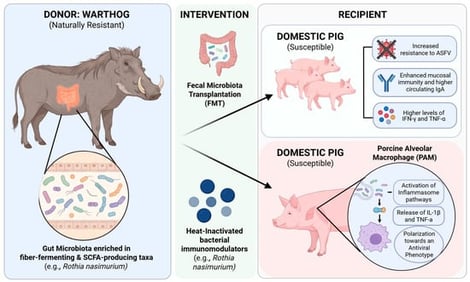
African swine fever (ASF) is a highly lethal disease affecting domestic pigs and wild boar, with no safe vaccines available. Macrophages are the primary target cells of African swine fever virus (ASFV), and infection impairs their antiviral functions, thereby facilitating efficient viral replication within these cells and rapid dissemination in the host. This review analyzes host-directed immunomodulatory strategies to functionally reprogram macrophages and restore their defenses. We summarize several classes of immunomodulants, including bacteria, Toll-like receptor (TLR-) agonists, recombinant cytokines, and natural compounds. First, we report recent work on a heat-inactivated bacterium isolated from warthog microbiota: Rothia nasimurium, which polarizes macrophages toward an antiviral phenotype and restricts ASFV replication in vitro. However, as a live-attenuated vaccine (LAV) adjuvant in vivo, it compromises protection by limiting LAV replication. On the contrary, extracellular TLR-2 and TLR-4 ligands induce pro-inflammatory polarization without reducing replication, suggesting that they can safely enhance the poor immunogenicity of inactivated or highly attenuated vaccine candidates. Conversely, intracellular TLR-3, TLR-7/8, and TLR-9 agonists induce type I interferon pathways, and other studies have shown that type I IFNs can restrict ASFV replication. However, direct experimental studies investigating these synthetic ligands against ASFV are currently lacking. Finally, we report that natural compounds like tetrandrine, berbamine, and fangchinoline are able to inhibit ASFV replication in vitro, but they can also modulate the macrophage’s immune responsiveness, preventing hyper-inflammation. Targeted immunomodulation may be fundamental to designing effective strategies against ASF. A fine-tuned orchestration of host immunity is required to control viral replication without compromising vaccine efficacy, contributing to the development of safe vaccines or alternative therapeutic tools for this fatal hemorrhagic disease.
Vaccines
16 October 2026
![H1N1 HA structure and locations of residues containing substitutions. (A) Cal/09 H1 structure, with HA2 in dark blue. HA1 fragment subdomains are the fusion domain (FD) in cyan, the vestigial esterase domain (VED) in yellow, and the receptor-binding domain (RBD) in red. (B–D) Substitutions, shown in black. (B) Screened HA-head substitutions putatively alter the stability of the interface between the VED and RBD and between RBDs. (C) Head–stalk mutations putatively alter interactions between the VED and the B-loop, C-helix, and FD. (D) Stalk substitutions putatively stabilize the fusion peptide pocket, histidine switch 1, and D-helix contacts. N154S is predicted to ablate glycosylation. * Inter-protomeric residues. PDB: 3UBE [64].](https://mdpi-res.com/cdn-cgi/image/width=281%2Cheight=192/https://mdpi-res.com/vaccines/vaccines-14-00701/article_deploy/html/images/vaccines-14-00701-g001-550.jpg)