Skip to Content
  • 31 days
    Submission to First Decision
  • 8 days
    Acceptance to Publication

Rheumato

Rheumato is an international, peer-reviewed, open access journal on rheumatology research published quarterly online by MDPI.

Get Alerted

Add your email address to receive forthcoming issues of this journal.

All Articles (93)

  • Case Report
  • Open Access

Concurrent Giant Cell Arteritis and Anti-PLA2R-Positive Membranous Nephropathy: A Case Report

  • Kudret Arslan,
  • Gerald J. Berry and
  • Philip L. Cohen
  • + 2 authors

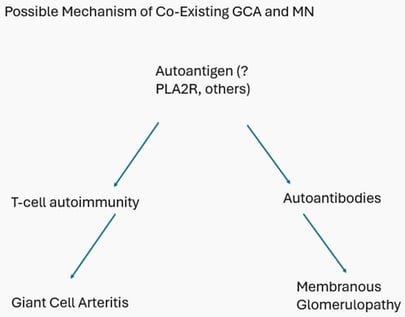
Background: Giant cell arteritis (GCA) is a vasculitis mostly affecting older people. Primary membranous nephropathy (MN) is an immune-mediated glomerulopathy recently shown to be caused by autoantibodies. We report a case of both illnesses in an older gentleman. Case Presentation: A 63-year-old man developed systemic inflammatory signs and symptoms and near simultaneous nephrotic-range proteinuria. Investigations demonstrated both giant cell arteritis (GCA) and membranous nephropathy, with the presence of the M-type phospholipase A2 receptor (PLA2R) within subepithelial immune deposits. Renal function remained normal throughout the course. The patient achieved complete clinical and biochemical remission of both illnesses coincident with corticosteroid therapy. Conclusions: Although rare cases of concurrent GCA and MN have been reported, GCA occurring with PLA2R-positive MN has not been documented. This case raises the possibility of overlapping immunological pathways and may offer clues to the pathogenesis of GCA.

Rheumato

9 September 2026
Clinical image demonstrating swelling of the left temporal artery (arrow) and periorbital edema.
  • Review
  • Open Access

Kawasaki disease (KD) is an acute, self-limiting systemic vasculitis that mainly affects young children. It is the leading cause of acquired heart disease in the developed world and is unique among childhood vasculitides for its predilection toward coronary artery involvement. This review describes the clinical spectrum of KD, highlighting diagnostic difficulties, especially in atypical presentations, and the challenges of managing treatment resistance. While intravenous immunoglobulin and aspirin remain the standard of care, especially in reducing coronary inflammation, early recognition and prompt therapy are crucial to preventing lifelong cardiac complications. To support this, various clinical risk scores have been developed over the decades to predict coronary artery lesions and IVIG resistance, enabling earlier intensification of treatment to prevent cardiac complications. Although the etiopathogenesis of KD remains unknown, extensive and robust research is ongoing to identify biomarkers, including epigenetic markers, innate and adaptive immunity activation markers, cytokine profiles, and to explore the influence of external triggers and the gut microbiome–immunity interplay. This review attempts to provide a concise overview of KD, aiming to assist clinicians in understanding the complexity of the problem rather than addressing all issues in detail.

Rheumato

25 August 2026

  • Review
  • Open Access

Restoring Immune Tolerance in Rheumatic Disease

  • Ola A. Al-Ewaidat and
  • Moawiah M. Naffaa

Autoimmune rheumatic diseases are still treated predominantly through broad or targeted suppression of inflammatory pathways, yet durable restoration of self-tolerance remains a central unmet therapeutic goal. This narrative review examines restoration of immune tolerance as an emerging translational framework in rheumatology, integrating checkpoint agonism, antigen-specific immunotherapy, regulatory cell-based strategies, and immune-reset approaches within a unified therapeutic perspective. Rather than treating these strategies as isolated innovations, the review evaluates how each attempts to restore, reinforce, or reconfigure immune restraint at distinct biological levels, spanning inhibitory receptor signaling, antigen-selective non-responsiveness, dominant regulatory control, and deeper reconfiguration of pathogenic immune architecture. Their relevance is considered across rheumatoid arthritis, systemic lupus erythematosus, Sjögren’s disease, and systemic sclerosis, with emphasis on mechanistic rationale, translational maturity, disease-specific therapeutic fit, biomarkers, therapeutic timing, and major barriers to clinical implementation. Collectively, these approaches suggest a shift in rheumatology from repeated control of inflammatory consequences toward more selective and potentially durable recalibration of autoreactive immunity. Although the field remains biologically and clinically immature, restoration of immune tolerance is emerging as an important organizing principle for the development of more precise and potentially disease-modifying therapies in autoimmune rheumatic disease.

Rheumato

21 August 2026

  • Review
  • Open Access

Gut Microbiota and Psoriatic Arthritis: From Pathogenesis to Microbiota-Targeted Therapies

  • Silvia Valentini,
  • Sauro Lorenzini and
  • Caterina Baldi
  • + 3 authors

Background/Objectives: Psoriatic disease (PsD) is a chronic, systemic inflammatory disorder characterized by a wide spectrum of clinical manifestations extending beyond skin and joint involvement. Increasing evidence suggests a relevant role of the gut microbiota in the pathogenesis of psoriatic arthritis (PsA), although a clear causal relationship remains to be fully established. The aim of this review is to summarize current evidence on the role of the gut microbiome in PsD, with a focus on immune modulation, disease pathogenesis and potential therapeutic implications. Methods: A narrative review of the literature was conducted, focusing on studies investigating gut microbiota composition, dysbiosis patterns, and microbiome-related mechanisms in PsD and PsA, as well as emerging microbiota-targeted interventions. Results: Recent advances in high-throughput sequencing technologies have identified distinct microbial signatures associated with PsA onset and progression. Dysbiosis appears to influence immune system regulation, contributing to systemic inflammation through mechanisms involving intestinal barrier dysfunction and immune activation. Patients with PsA exhibit specific alterations in gut microbial composition compared to healthy controls. Emerging therapeutic strategies targeting the microbiota—including dietary interventions, probiotics, and fecal microbiota transplantation—show potential as adjunctive approaches in disease management, although clinical evidence remains limited. Conclusions: The gut microbiome represents a promising area of research in PsD, offering novel insights into disease mechanisms and potential therapeutic targets. Further studies are needed to clarify causal relationships and to define the clinical applicability of microbiota-based interventions.

Rheumato

4 August 2026

Featured Articles of Last Quarter

Highly Accessed Articles

News & Conferences

Latest Issues

Open for Submission

Journal Sections

XFacebookLinkedIn
Rheumato - ISSN 2674-0621