<?xml version="1.0" encoding="UTF-8"?>
<!DOCTYPE article PUBLIC "-//NLM//DTD Journal Publishing DTD v2.3 20070202//EN" "journalpublishing.dtd">
<article xmlns:mml="http://www.w3.org/1998/Math/MathML" xmlns:xlink="http://www.w3.org/1999/xlink" xml:lang="en" article-type="research-article">
  <front>
    <journal-meta>
      <journal-id journal-id-type="publisher-id">jfb</journal-id>
      <journal-title>Journal of Functional Biomaterials</journal-title>
      <abbrev-journal-title abbrev-type="publisher">JFB</abbrev-journal-title>
      <abbrev-journal-title abbrev-type="pubmed">JFB</abbrev-journal-title>
      <issn pub-type="epub">2079-4983</issn>
      <publisher>
        <publisher-name>MDPI</publisher-name>
      </publisher>
    </journal-meta>
    <article-meta>
      <article-id pub-id-type="doi">10.3390/jfb3020327</article-id>
      <article-id pub-id-type="publisher-id">jfb-03-00327</article-id>
      <article-categories>
        <subj-group>
          <subject>Article</subject>
        </subj-group>
      </article-categories>
      <title-group>
        <article-title>Calcium Phosphate Growth at Electropolished Titanium Surfaces</article-title>
      </title-group>
      
      <contrib-group>
        <contrib contrib-type="author">
          <name>
            <surname>Ajami</surname>
            <given-names>Elnaz</given-names>
          </name>
          <xref rid="af1-jfb-03-00327" ref-type="aff">1</xref>
          <xref rid="c1-jfb-03-00327" ref-type="corresp">*</xref>
        </contrib>
        <contrib contrib-type="author">
          <name>
            <surname>Aguey-Zinsou</surname>
            <given-names>Kondo-Francois</given-names>
          </name>
          <xref rid="af2-jfb-03-00327" ref-type="aff">2</xref>
        </contrib>
      </contrib-group>
	  <aff id="af1-jfb-03-00327"><label>1 </label>School of Engineering and Materials Science, University of London, Queen Mary, London E1 4NS, UK </aff>
      <aff id="af2-jfb-03-00327"><label>2 </label>School of Chemical Engineering, The University of New South Wales, Sydney NSW 2052, Australia; Email: <email>f.aguey@unsw.edu.au</email></aff>
	  <author-notes>
        <corresp id="c1-jfb-03-00327"><label>*</label> Author to whom correspondence should be addressed; Email: <email>elnaz.ajami@utoronto.ca</email>; Tel.: +61-293-857-970; Fax: +61-293-855-966.</corresp>
      </author-notes>
      <pub-date pub-type="epub">
        <day>25</day>
        <month>04</month>
        <year>2012</year>
      </pub-date>
      <pub-date pub-type="collection"> <month>06</month>
        <year>2012</year>
      </pub-date>
      <volume>3</volume>
      <issue>2</issue>
      <fpage>327</fpage>
      <lpage>348</lpage>
      <history>
        <date date-type="received">
          <day>07</day>
          <month>02</month>
          <year>2012</year>
        </date>
        <date date-type="rev-recd">
          <day>21</day>
          <month>03</month>
          <year>2012</year>
        </date>
        <date date-type="accepted">
          <day>11</day>
          <month>04</month>
          <year>2012</year>
        </date>
      </history>
      <permissions>
        <copyright-statement>© 2012 by the authors; licensee MDPI, Basel, Switzerland.</copyright-statement>
        <copyright-year>2012</copyright-year>
        <license xmlns:xlink="http://www.w3.org/1999/xlink" license-type="open-access" xlink:href="http://creativecommons.org/licenses/by/3.0/">
          <p>This article is an open-access article distributed under the terms and conditions of the Creative Commons Attribution license (http://creativecommons.org/licenses/by/3.0/).</p>
        </license>
      </permissions>
      <abstract>
        <p>This work investigated the ability of electropolished Ti surface to induce Hydroxyapatite (HA) nucleation and growth <italic>in vitro</italic> via a biomimetic method in Simulated Body Fluid (SBF). The HA induction ability of Ti surface upon electropolishing was compared to that of Ti substrates modified with common chemical methods including alkali, acidic and hydrogen peroxide treatments. Our results revealed the excellent ability of electropolished Ti surfaces in inducing the formation of bone-like HA at the Ti/SBF interface. The chemical composition, crystallinity and thickness of the HA coating obtained on the electropolished Ti surface was found to be comparable to that achieved on the surface of alkali treated Ti substrate, one of the most effective and popular chemical treatments. The surface characteristics of electropolished Ti contributing to HA growth were discussed thoroughly.</p>
      </abstract>
      <kwd-group>
        <kwd>surface treatment</kwd>
        <kwd>electropolishing</kwd>
        <kwd>titanium</kwd>
        <kwd>hydroxyapatite</kwd>
        <kwd>biomimetic</kwd>
        <kwd>biomaterial</kwd>
      </kwd-group>
    </article-meta>
  </front>
  <body>
    <sec sec-type="intro">
      <title>1. Introduction</title>
      <p>Titanium (Ti) and its alloys are popular biomaterials for load-bearing endosseous implants, because they exhibit a combination of favorable properties such as adequate mechanical strength, sufficient formability, low specific weight, excellent corrosion resistance and biocompatibility [<xref ref-type="bibr" rid="B1-jfb-03-00327">1</xref>,<xref ref-type="bibr" rid="B2-jfb-03-00327">2</xref>]. In terms of bone bonding, Ti can bond to bone [<xref ref-type="bibr" rid="B3-jfb-03-00327">3</xref>], however the osteointegration does not occur well with unmodified Ti surfaces [<xref ref-type="bibr" rid="B2-jfb-03-00327">2</xref>] and the bio-passive properties of Ti surfaces usually hinder the healing process [<xref ref-type="bibr" rid="B4-jfb-03-00327">4</xref>]. To overcome such difficulties, there has been a growing interest in surface coating of Ti implants with Hydroxyapatite (HA), so that great osteoconductivity of HA combines with excellent mechanical properties of Ti. Popularity of HA among other calcium phosphate phases is because of its thermodynamic stability in biological conditions [<xref ref-type="bibr" rid="B5-jfb-03-00327">5</xref>] and its existence in bone mineral phase. To date, various physical methods of HA coating on Ti surfaces have been investigated [<xref ref-type="bibr" rid="B1-jfb-03-00327">1</xref>,<xref ref-type="bibr" rid="B6-jfb-03-00327">6</xref>,<xref ref-type="bibr" rid="B7-jfb-03-00327">7</xref>], however, the only commercially accepted method is plasma spraying. Major disadvantages associated with plasma spraying, <italic>i.e</italic>., high processing temperatures and poor integration of the coating with the metallic surface [<xref ref-type="bibr" rid="B8-jfb-03-00327">8</xref>], have drawn attentions towards development of chemical coating methods based on mimicking biomineralization process [<xref ref-type="bibr" rid="B9-jfb-03-00327">9</xref>]. In such biomimetic methods, the HA coating is produced by immersing the surface in a solution supersaturated with respect to HA (normally SBF) at a physiological temperature and pH, and a better HA integration onto metallic surface is achieved. However, kinetics of HA crystal nucleation and growth via biomimetic method might be very slow on the unmodified Ti surfaces. Therefore, many chemical surface treatment methods have been suggested to enhance the surface properties of Ti for accelerated HA nucleation, all of which aim to clarify the basic principles guiding the formation of HA from SBF on modified Ti surfaces. However, many contradictory observations are reported due to differences in the experimental conditions and thus it is difficult to draw a definitive conclusion on the mechanism of HA nucleation. Nonetheless, a general observation is that the surface charge plays a critical role in enhancing the mineralization of apatite. It has been found that at deprotonated Ti oxide layers (negatively charged), the adsorption of calcium ions and subsequent phosphate deposition would occur [<xref ref-type="bibr" rid="B10-jfb-03-00327">10</xref>,<xref ref-type="bibr" rid="B11-jfb-03-00327">11</xref>]. However, at positively charged Ti oxide surfaces, competitive adsorption between phosphate and chloride ions from SBF was found to hinder the growth of calcium phosphate phases [<xref ref-type="bibr" rid="B12-jfb-03-00327">12</xref>]. For that reason, attempts have mainly focused on implanting negative ions at the surface of Ti by chemical or physical methods. Common chemical methods rely on the use of hydrogen peroxide [<xref ref-type="bibr" rid="B13-jfb-03-00327">13</xref>], alkaline [<xref ref-type="bibr" rid="B7-jfb-03-00327">7</xref>,<xref ref-type="bibr" rid="B14-jfb-03-00327">14</xref>,<xref ref-type="bibr" rid="B15-jfb-03-00327">15</xref>,<xref ref-type="bibr" rid="B16-jfb-03-00327">16</xref>] or acidic solutions [<xref ref-type="bibr" rid="B17-jfb-03-00327">17</xref>]. The titanate gel layer obtained after these treatments bears negatively charged surface groups under physiological conditions, which facilitate the precipitation of Ca<sup>2+</sup> and further growth of apatite [<xref ref-type="bibr" rid="B15-jfb-03-00327">15</xref>,<xref ref-type="bibr" rid="B18-jfb-03-00327">18</xref>]. Functionalization of Ti surfaces with self-assembled monolayers (SAMs) also favors a mechanism whereby HA mineralization occurs at negatively charged surfaces only [<xref ref-type="bibr" rid="B19-jfb-03-00327">19</xref>,<xref ref-type="bibr" rid="B20-jfb-03-00327">20</xref>,<xref ref-type="bibr" rid="B21-jfb-03-00327">21</xref>,<xref ref-type="bibr" rid="B22-jfb-03-00327">22</xref>,<xref ref-type="bibr" rid="B23-jfb-03-00327">23</xref>,<xref ref-type="bibr" rid="B24-jfb-03-00327">24</xref>]. However, HA deposition has also been observed on positively charged SAMs, which indicates that, depending on experimental conditions (e.g., pH, temperature and ionic concentration of the SBF), various mineralization mechanisms with initial homogeneous and/or heterogeneous nucleation of apatite may occur [<xref ref-type="bibr" rid="B25-jfb-03-00327">25</xref>].</p>
      <p>Other methods to facilitate the deposition of HA are based on the direct implantation of ions such as Na<sup>+</sup> [<xref ref-type="bibr" rid="B13-jfb-03-00327">13</xref>,<xref ref-type="bibr" rid="B18-jfb-03-00327">18</xref>], Ca<sup>2+</sup> [<xref ref-type="bibr" rid="B26-jfb-03-00327">26</xref>,<xref ref-type="bibr" rid="B27-jfb-03-00327">27</xref>] and Mg<sup>2+</sup> [<xref ref-type="bibr" rid="B28-jfb-03-00327">28</xref>] onto Ti surfaces. For example, sodium titanate surfaces, implanted with Na<sup>+</sup> ions, have been found to promote the nucleation and growth of HA from SBF [<xref ref-type="bibr" rid="B18-jfb-03-00327">18</xref>,<xref ref-type="bibr" rid="B29-jfb-03-00327">29</xref>]. Upon sodium titanate hydrolysis in SBF, the subsequent release of NaOH is believed to increase the pH locally, favor the deprotonation of surface hydroxyl groups and thus increase supersaturation level with respect to HA [<xref ref-type="bibr" rid="B18-jfb-03-00327">18</xref>,<xref ref-type="bibr" rid="B29-jfb-03-00327">29</xref>] at the solution/Ti interface [<xref ref-type="bibr" rid="B28-jfb-03-00327">28</xref>,<xref ref-type="bibr" rid="B30-jfb-03-00327">30</xref>,<xref ref-type="bibr" rid="B31-jfb-03-00327">31</xref>]. Although these observations may contradict other findings with respect to negatively charged Ti surfaces, they also indicate that the nucleation of apatite may only proceed by the precipitation of Ca<sup>2+</sup> ions first.</p>
      <p>In this respect, the general trend observed with negatively charged Ti surfaces enhancing the mineralization of apatite has drawn our attention towards electropolished Ti surfaces. Upon electropolishing, Cl<sup>−</sup> residues are usually left at the surface of Ti within a depth of 20 to 35 Å [<xref ref-type="bibr" rid="B32-jfb-03-00327">32</xref>,<xref ref-type="bibr" rid="B33-jfb-03-00327">33</xref>,<xref ref-type="bibr" rid="B34-jfb-03-00327">34</xref>]. Such implanted ions should therefore enhance nucleation and growth of HA. To date, smooth and homogenous surfaces of electropolished Ti have only been used as well-defined starting points for subsequent surface treatments, such as anodic oxidation [<xref ref-type="bibr" rid="B33-jfb-03-00327">33</xref>]. They have also been used as control surfaces to investigate the effect of surface roughness on cell behaviour or tissue reactions with Ti surfaces [<xref ref-type="bibr" rid="B35-jfb-03-00327">35</xref>,<xref ref-type="bibr" rid="B36-jfb-03-00327">36</xref>]. To the best of authors’ knowledge, not much attention has been paid to HA nucleating ability of electropolished Ti surface and therefore, this study aims to evaluate the ability of electropolished Ti surface to induce HA nucleation and growth via biomimetic method in SBF. In order to truthfully evaluate this ability, the behaviour of electropolished Ti substrate was also compared to that of Ti surfaces modified with conventional chemical methods including alkaline [<xref ref-type="bibr" rid="B14-jfb-03-00327">14</xref>], hydrogen peroxide/hydrochloric acid mixtures [<xref ref-type="bibr" rid="B13-jfb-03-00327">13</xref>], and <italic>Piranha</italic> [<xref ref-type="bibr" rid="B37-jfb-03-00327">37</xref>] pre-treatments. To this aim, a range of experimental techniques including X-ray Photoelectron Spectroscopy (XPS), Energy-dispersive X-ray (EDX), X-ray diffraction (XRD) and Fourier Transform Infrared (FTIR) spectroscopy were used to fully characterize the physical and chemical properties of the modified Ti substrates. </p>
    </sec>
    <sec sec-type="results">
      <title>2. Results and Discussion</title>
      <sec>
        <title>2.1. Surface Properties of the Pre-Treated Ti Substrates</title>
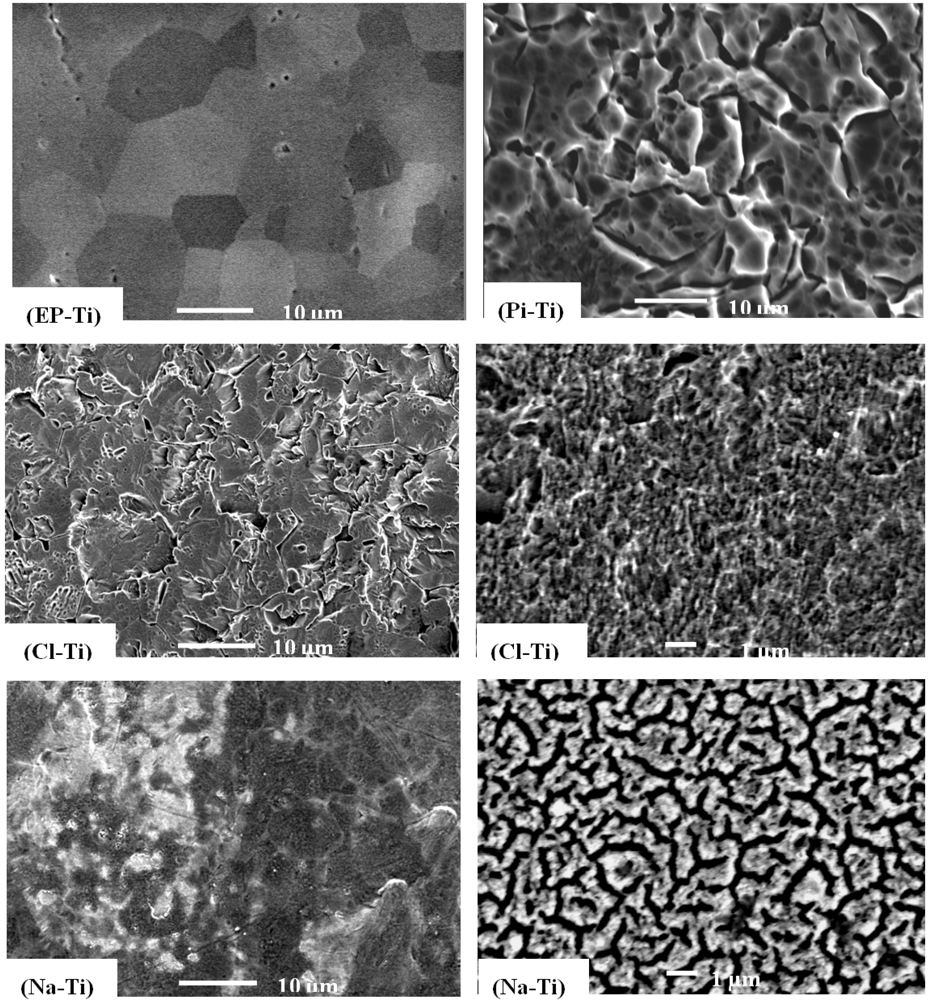
        <p>The evolution of the morphology of the Ti substrates as function of pre-treatments was analyzed by SEM (<xref ref-type="fig" rid="jfb-03-00327-f001">Figure 1</xref>). Electropolishing resulted in a smooth surface with grain boundaries clearly observable (<xref ref-type="fig" rid="jfb-03-00327-f001">Figure 1</xref>, EP-Ti). However, considerable modifications of the surface morphology were observed for all the chemically treated Ti substrates. Hence, upon <italic>Piranha</italic> etching, large crevices (~2.5 µm wide) were formed at the surface of Ti (<xref ref-type="fig" rid="jfb-03-00327-f001">Figure 1</xref>, Pi-Ti). The use of HCl and H<sub>2</sub>O<sub>2</sub> also resulted in the formation of a rough surface with a pore size of ~1 µm and crevices of ~2 µm long, but with additional micro-porosity (<xref ref-type="fig" rid="jfb-03-00327-f001">Figure 1</xref>, Cl-Ti) [<xref ref-type="bibr" rid="B13-jfb-03-00327">13</xref>]. On the Ti surface treated with NaOH no crevices were observed, but a microstructure corresponding to a sodium titanate hydrogel was obtained (<xref ref-type="fig" rid="jfb-03-00327-f001">Figure 1</xref>, Na-Ti) [<xref ref-type="bibr" rid="B14-jfb-03-00327">14</xref>,<xref ref-type="bibr" rid="B38-jfb-03-00327">38</xref>,<xref ref-type="bibr" rid="B39-jfb-03-00327">39</xref>]. </p>
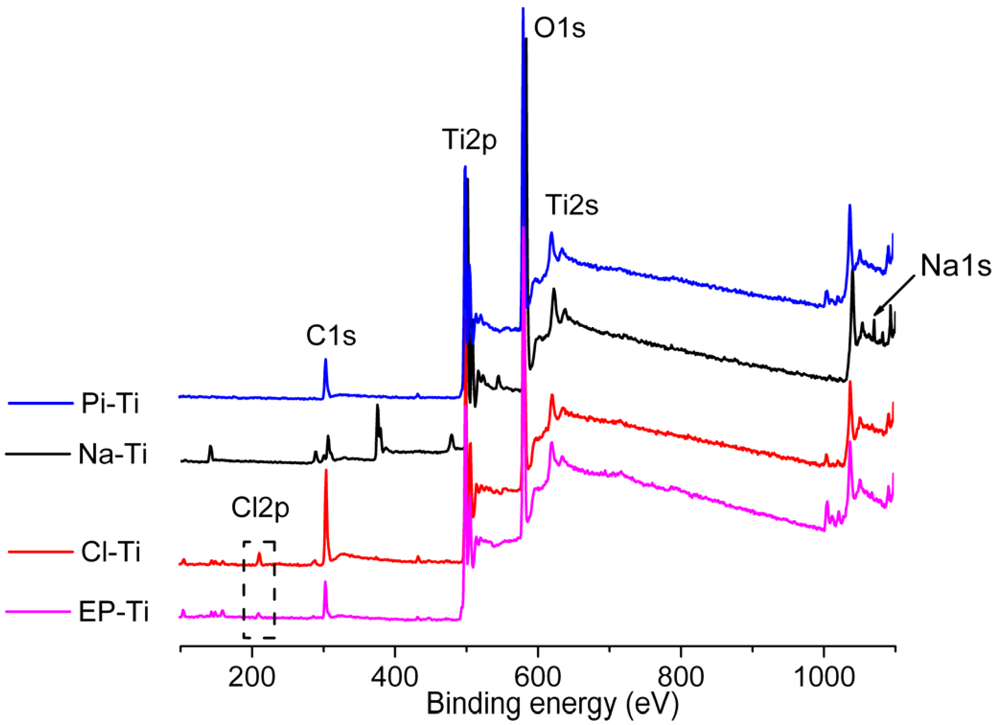
        <p>The surface chemistry of the substrates after pre-treatments was characterized by XPS. All the XPS survey spectra showed peaks related to Ti, O and C (<xref ref-type="fig" rid="jfb-03-00327-f002">Figure 2</xref>). The Auger peaks for Ti, O and C were also observed at higher binding energies. In addition, peaks related to Na1s at 1,072 eV on Na-Ti and Cl2p at 199.6 eV on both Cl-Ti and EP-Ti were detected. The Na1s peak was attributed to the formation of sodium titanate at the surface of Ti substrate pre-treated with NaOH [<xref ref-type="bibr" rid="B40-jfb-03-00327">40</xref>]. Whereas, the Cl2p peak was assigned to the formation of TiOCl<sub>x</sub> [<xref ref-type="bibr" rid="B41-jfb-03-00327">41</xref>] at the surface of EP-Ti and Cl-Ti due to the adsorption of Cl<sup>−</sup> or ClO<sub>4</sub><sup>−</sup> ions at the outermost surface as described previously [<xref ref-type="bibr" rid="B33-jfb-03-00327">33</xref>,<xref ref-type="bibr" rid="B34-jfb-03-00327">34</xref>,<xref ref-type="bibr" rid="B42-jfb-03-00327">42</xref>]. It is noteworthy that no sulphur peaks were detected on substrates pre-treated with the <italic>Piranha</italic> solution (Pi-Ti). </p>
        <fig id="jfb-03-00327-f001" position="anchor">
          <label>Figure 1</label>
          <caption>
            <p>SEM images of EP-Ti, Pi-Ti, Cl-Ti (left) and Na-Ti (left) with scale bars of 10 µm. Magnified SEM images of Cl-Ti and Na-Ti on the right show the surface micro-porosity with scale bars of 1 μm.</p>
          </caption>
          <graphic xmlns:xlink="http://www.w3.org/1999/xlink" xlink:href="jfb-03-00327-g001.tif"/>
        </fig>
        
		<fig id="jfb-03-00327-f002" position="anchor">
          <label>Figure 2</label>
          <caption>
            <p>XPS wide-scan spectra of the electropolished and chemically treated Ti substrates before HA coating.</p>
          </caption>
          <graphic xmlns:xlink="http://www.w3.org/1999/xlink" xlink:href="jfb-03-00327-g002.tif"/>
        </fig>
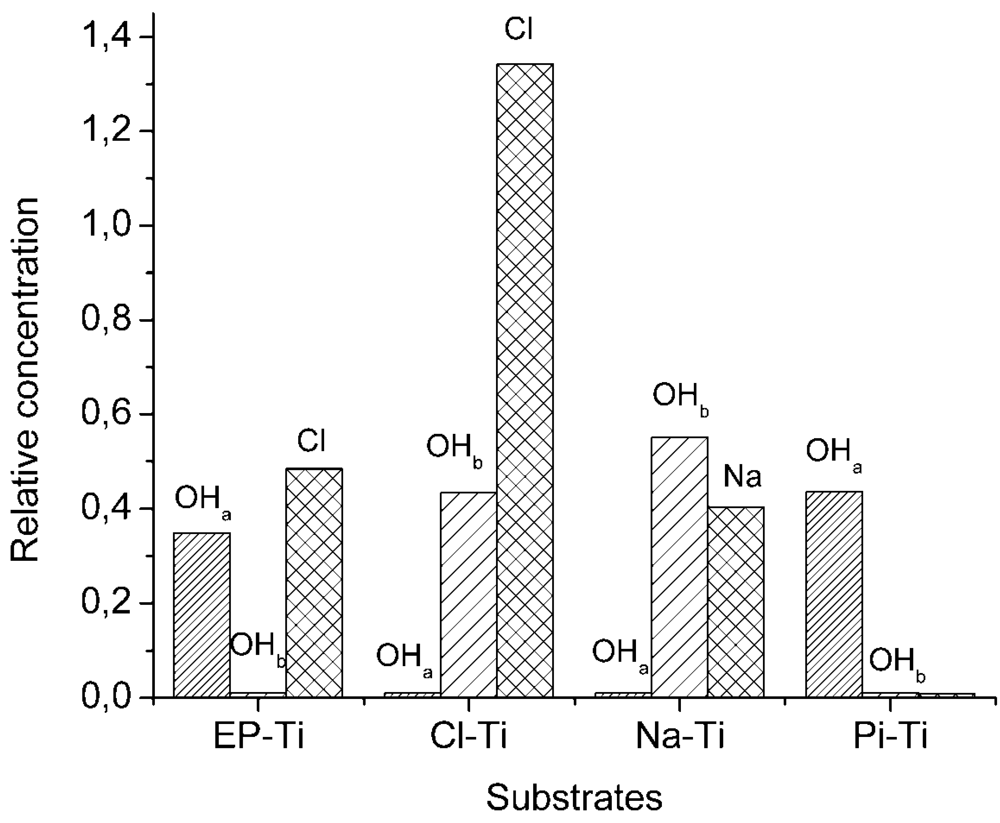
        <p>XPS narrow-scan spectra of Ti2p (Supplementary Figure S1) for all of the substrates showed two main peaks at 458.8 and 464.4 eV, corresponding to TiO<sub>2</sub> [<xref ref-type="bibr" rid="B43-jfb-03-00327">43</xref>,<xref ref-type="bibr" rid="B44-jfb-03-00327">44</xref>,<xref ref-type="bibr" rid="B45-jfb-03-00327">45</xref>,<xref ref-type="bibr" rid="B46-jfb-03-00327">46</xref>], and a weak peak at lower binding energies (~453.6 eV) only in the EP-Ti and Pi-Ti related to Ti<sup>0</sup> [<xref ref-type="bibr" rid="B2-jfb-03-00327">2</xref>]. The intensity of the latter was higher in EP-Ti compared to Pi-Ti, confirming a thinner oxide layer on EP-Ti, and the absence of such a peak in Na-Ti and Cl-Ti indicated that the thickness of the Ti oxide layer has increased beyond the penetration depth of the photoelectrons (&gt;7 nm). Further characterization of the substrates in C1s region by XPS (Supplementary Figure S2) also revealed a significant level of carbon contamination due to CO<sub>2</sub> and organic contaminants on all substrates, except on Pi-Ti. Furthermore, the XPS narrow-scan spectra in the O1s region (Supplementary Figure S3) revealed several peaks at 529, 530 and 531 eV, ascribed to the oxygen in bulk TiO<sub>2</sub> (Ti-O) [<xref ref-type="bibr" rid="B31-jfb-03-00327">31</xref>,<xref ref-type="bibr" rid="B47-jfb-03-00327">47</xref>,<xref ref-type="bibr" rid="B48-jfb-03-00327">48</xref>], surface acidic (OH<sub>a</sub>) and basic (OH<sub>b</sub>) hydroxyl groups, respectively [<xref ref-type="bibr" rid="B31-jfb-03-00327">31</xref>,<xref ref-type="bibr" rid="B43-jfb-03-00327">43</xref>,<xref ref-type="bibr" rid="B49-jfb-03-00327">49</xref>]. The OH<sub>a</sub> and OH<sub>b</sub> correspond to doubly and singly coordinated hydroxyls, respectively [<xref ref-type="bibr" rid="B50-jfb-03-00327">50</xref>], and the density of these hydroxyl groups was found to decrease in the following order: Na-Ti &gt; Pi-Ti~Cl-Ti &gt; EP-Ti (<xref ref-type="fig" rid="jfb-03-00327-f003">Figure 3</xref>). This is in agreement with previously reported data showing the highest density of hydroxyl groups on Ti substrates pre-treated with NaOH [<xref ref-type="bibr" rid="B51-jfb-03-00327">51</xref>]. It should also be highlighted that EP-Ti and Pi-Ti surfaces showed OH<sub>a</sub> only, while on Cl-Ti and Na-Ti, only OH<sub>b</sub> were found (<xref ref-type="fig" rid="jfb-03-00327-f003">Figure 3</xref>). </p>
        <fig id="jfb-03-00327-f003" position="anchor">
          <label>Figure 3</label>
          <caption>
            <p>Relative concentration of hydroxyl groups (OH<sub>a</sub> and OH<sub>b</sub>) and Na or Cl at the surface of the electropolished and chemically treated Ti substrates before HA coating. These concentrations were determined from the XPS results by taking the ratio of the peak area corresponding to a specific surface entity to that of the titanium peak. </p>
          </caption>
          <graphic xmlns:xlink="http://www.w3.org/1999/xlink" xlink:href="jfb-03-00327-g003.tif"/>
        </fig>
      </sec>
      <sec>
        <title>2.2. Ti Substrates upon CaP Coating</title>
        <sec>
          <title>2.2.1. Physical Properties of the CaP Coating</title>
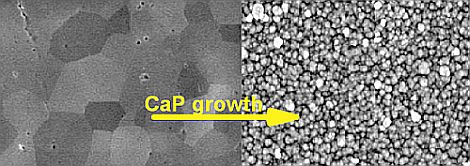
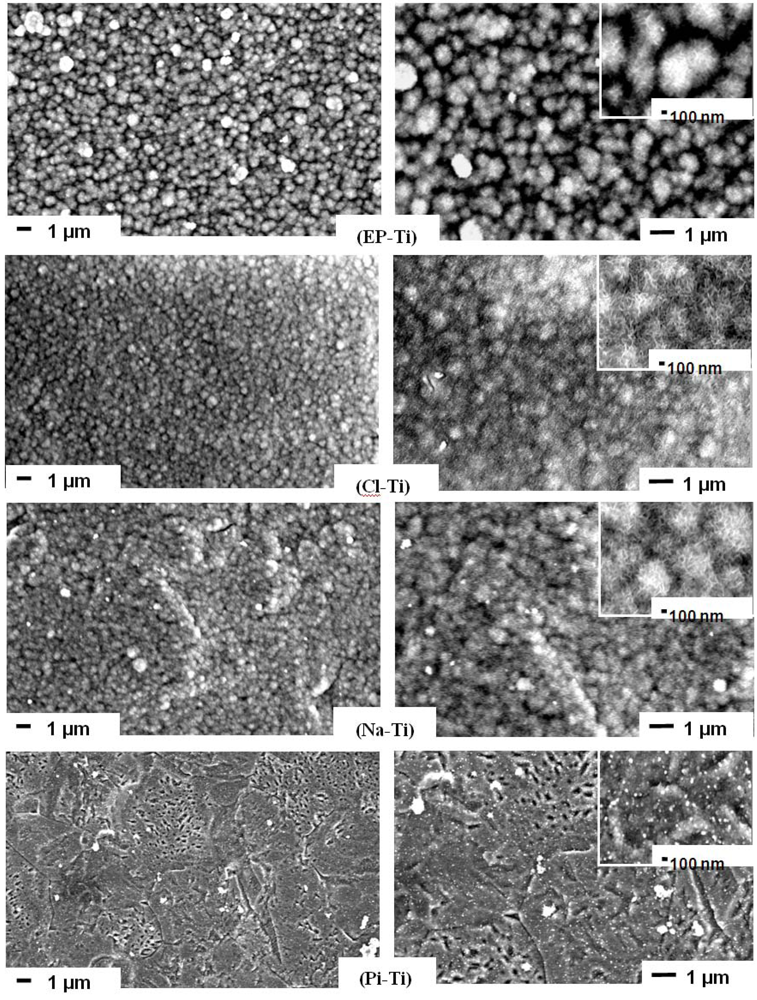
          <p>The pre-treated substrates were immersed in 1.5 SBF and the formation of a CaP coating was characterized after 14 days of immersion. Except for Pi-Ti, relatively dense CaP coatings were found by SEM at the surface of all pre-treated substrates (<xref ref-type="fig" rid="jfb-03-00327-f004">Figure 4</xref>). The CaP films comprised globular structures (1 to 0.5 µm) consisting of dense plate-like crystals (Supplementary Figure S4) as a result of a three-dimensional growth process [<xref ref-type="bibr" rid="B13-jfb-03-00327">13</xref>,<xref ref-type="bibr" rid="B52-jfb-03-00327">52</xref>,<xref ref-type="bibr" rid="B53-jfb-03-00327">53</xref>]. These globular structures are typical to biomimetic methods [<xref ref-type="bibr" rid="B38-jfb-03-00327">38</xref>,<xref ref-type="bibr" rid="B54-jfb-03-00327">54</xref>,<xref ref-type="bibr" rid="B55-jfb-03-00327">55</xref>,<xref ref-type="bibr" rid="B56-jfb-03-00327">56</xref>,<xref ref-type="bibr" rid="B57-jfb-03-00327">57</xref>,<xref ref-type="bibr" rid="B58-jfb-03-00327">58</xref>,<xref ref-type="bibr" rid="B59-jfb-03-00327">59</xref>,<xref ref-type="bibr" rid="B60-jfb-03-00327">60</xref>,<xref ref-type="bibr" rid="B61-jfb-03-00327">61</xref>,<xref ref-type="bibr" rid="B62-jfb-03-00327">62</xref>] and are observed in the bone cement line matrix interlocking with the surface of the modified titanium oxide at the bone-implant interface [<xref ref-type="bibr" rid="B63-jfb-03-00327">63</xref>]. On the surface of Pi-Ti, only small particles of CaP (~50 nm in diameter) were found and large globular structures of CaP could only be observed after 1 month of immersion (Supplementary Figure S5). Accordingly, it can be speculated that the surface of Pi-Ti induces CaP with slower growth kinetics. Such a slow kinetics on Pi-Ti is neither attributed to the reduced thickness of oxide layer on this surface nor to the nature of surface hydroxyl groups. The reason is that when Pi-Ti was compared to EP-Ti, the XPS Ti2p spectra (Supplementary Figure S1) proved a thicker oxide layer on Pi-Ti compared to EP-Ti, and as shown in <xref ref-type="fig" rid="jfb-03-00327-f003">Figure 3</xref>, both had acidic hydroxyl groups. Therefore, it is believed that lack of charged groups on the surface of Pi-Ti is the reason for its slower kinetics in inducing CaP growth as compared to other surfaces. </p>
          <fig id="jfb-03-00327-f004" position="anchor">
            <label>Figure 4</label>
            <caption>
              <p>SEM images of EP-Ti, Cl-Ti, Na-Ti and Pi-Ti after 14 days immersion in 1.5 SBF. Images on the right are magnified.</p>
            </caption>
            <graphic xmlns:xlink="http://www.w3.org/1999/xlink" xlink:href="jfb-03-00327-g004.tif"/>
          </fig>
          <p>Comparing the coating on Cl-Ti and EP-Ti, it is observed that the coating on EP-Ti is less dense than that on Cl-Ti and the underlying Ti substrate is exposed in between globular structures on EP-Ti (as indicated by arrows on the magnified inset image of EP-Ti in <xref ref-type="fig" rid="jfb-03-00327-f004">Figure 4</xref>). This could be explained by lower density of surface OH on EP-Ti compared to Cl-Ti as confirmed by XPS spectra in O1s region. Moreover, a sharper Cl2p that is observed on XPS survey spectrum of Cl-Ti compared to EP-Ti shows that there are more Cl<sup>−</sup> ions contributing to the mineralization process, thus resulting in a denser coating on Cl-Ti compared to EP-Ti.</p>
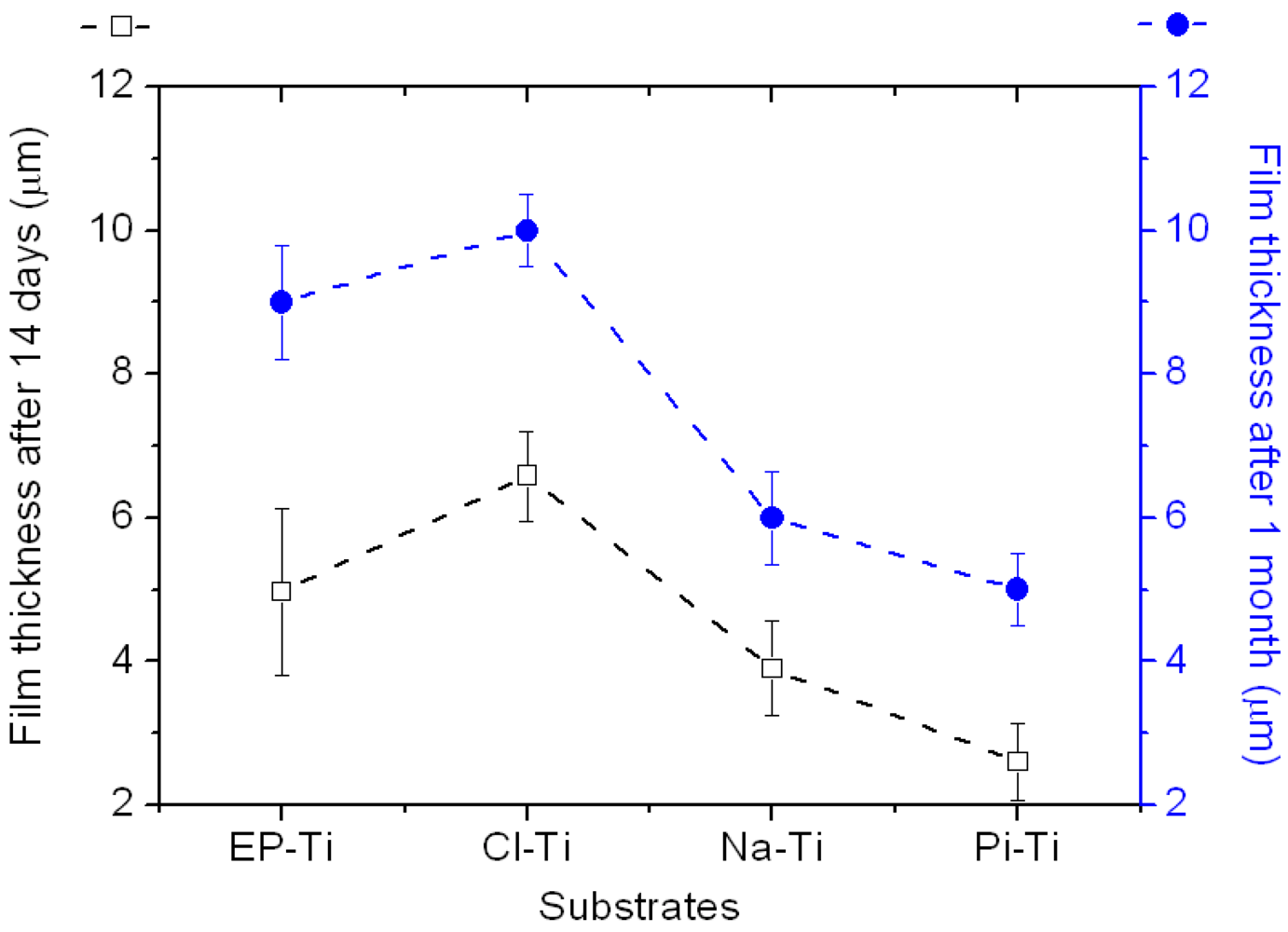
          <p>Further characterization of the film thickness revealed that different growth regimes occur at various Ti substrates, with Cl-Ti and EP-Ti showing the thickest film (~9.5 µm) after 1 month of immersion in 1.5 SBF (<xref ref-type="fig" rid="jfb-03-00327-f005">Figure 5</xref>). It is noteworthy that globular films have formed on all surfaces regardless of the initial surface roughness. This suggests that heterogeneous nucleation of CaP on Ti had happened immediately after immersion in 1.5 SBF and did not depend on the surface topography in agreement with previous reports [<xref ref-type="bibr" rid="B57-jfb-03-00327">57</xref>]. However, this statement is only valid for <italic>in vitro</italic> surface-induced mineralization of CaP on Ti surfaces and it is not applicable to bone bonding onto Ti implant surfaces. It is very well understood that implant surfaces with complex microtopography, and not the smooth surfaces, render surfaces bone bonding [<xref ref-type="bibr" rid="B64-jfb-03-00327">64</xref>]. In terms of <italic>in vitro</italic> surface-induced mineralization, it can be speculated that the surface topography would only influence the mechanical stability of final CaP film and not the initial surface-induced formation of CaP nuclei. This is because a more adherent CaP coating will be formed on rough surfaces due to increased interfacial adhesion strength between the coating and Ti surface [<xref ref-type="bibr" rid="B57-jfb-03-00327">57</xref>,<xref ref-type="bibr" rid="B65-jfb-03-00327">65</xref>,<xref ref-type="bibr" rid="B66-jfb-03-00327">66</xref>]. </p>
          <fig id="jfb-03-00327-f005" position="anchor">
            <label>Figure 5</label>
            <caption>
              <p>Evolution of the CaP film thickness on all substrates after immersion in 1.5 SBF for 14 days and 1 month. Film thickness was measured on three different locations with cross-sectional SEM imaging. The dashed lines are guides to the eye.</p>
            </caption>
            <graphic xmlns:xlink="http://www.w3.org/1999/xlink" xlink:href="jfb-03-00327-g005.tif"/>
          </fig>
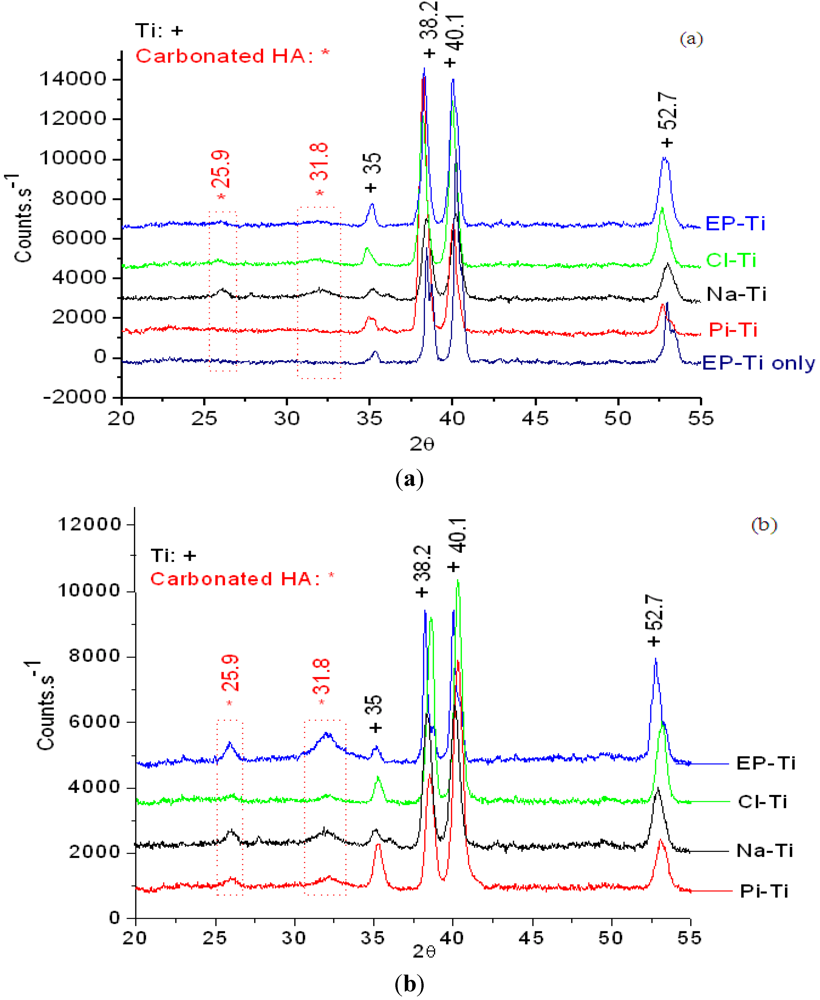
          <p>The crystallinity of the films was investigated by XRD after immersion in 1.5 SBF for 14 days (<xref ref-type="fig" rid="jfb-03-00327-f006">Figure 6</xref>a). All substrates showed peaks at 2θ = 35, 38.2, 40.1 and 52.7° related to the (100), (002), (101) and (102) planes of Ti, respectively [<xref ref-type="bibr" rid="B13-jfb-03-00327">13</xref>,<xref ref-type="bibr" rid="B18-jfb-03-00327">18</xref>,<xref ref-type="bibr" rid="B28-jfb-03-00327">28</xref>,<xref ref-type="bibr" rid="B55-jfb-03-00327">55</xref>,<xref ref-type="bibr" rid="B67-jfb-03-00327">67</xref>,<xref ref-type="bibr" rid="B68-jfb-03-00327">68</xref>]. Once more, except for Pi-Ti, all substrates showed peaks characteristic of a carbonated HA, <italic>i.e</italic>., at 2θ = 25.9 and 31.8°. The former peak corresponds to the overlapping of the (201) and (002) planes of carbonated HA, while the latter is related to the overlapping of the (211), (112) and (300) reflections [<xref ref-type="bibr" rid="B28-jfb-03-00327">28</xref>,<xref ref-type="bibr" rid="B55-jfb-03-00327">55</xref>,<xref ref-type="bibr" rid="B67-jfb-03-00327">67</xref>,<xref ref-type="bibr" rid="B69-jfb-03-00327">69</xref>,<xref ref-type="bibr" rid="B70-jfb-03-00327">70</xref>,<xref ref-type="bibr" rid="B71-jfb-03-00327">71</xref>,<xref ref-type="bibr" rid="B72-jfb-03-00327">72</xref>]. The additional peak at 2θ = 35.5–36° only appearing on the XRD patterns of the Na-Ti and Pi-Ti was attributed to the superposition of the carbonated HA or tricalcium phosphate peak. The broadness of the HA peaks also indicates very small crystal sizes and/or the orientation of crystals at different directions. The absence of these reflexes (and the low intensity of the peaks) is probably due to the thinness of the CaP film  [<xref ref-type="bibr" rid="B19-jfb-03-00327">19</xref>]. Moreover, the intensity of the peak at 2θ = 25.9° is equal to that of 2θ = 31.8° in the patterns, while it should normally be less than a quarter for the carbonated HA. This could be due to the reflection of other crystalline phases, such as crystalline dicalcium phosphate with an XRD peak at 2θ = 23.2° corresponding to (040) plane [<xref ref-type="bibr" rid="B73-jfb-03-00327">73</xref>] and tricalcium phosphate with an XRD peak at 2θ = 25.7° corresponding to the (10 10) plane [<xref ref-type="bibr" rid="B74-jfb-03-00327">74</xref>,<xref ref-type="bibr" rid="B75-jfb-03-00327">75</xref>]. Both of these peaks may superimpose on the carbonated HA peak at 2θ = 25.9° resulting in a higher intensity peak.</p>
          <fig id="jfb-03-00327-f006" position="anchor">
            <label>Figure 6</label>
            <caption>
              <p>XRD patterns of the CaP film formed on the different substrates after (<bold>a</bold>) 14 days and (<bold>b</bold>) 1 month immersion in 1.5 SBF.</p>
            </caption>
            <graphic xmlns:xlink="http://www.w3.org/1999/xlink" xlink:href="jfb-03-00327-g006.tif"/>
          </fig>
          <p>After 1 month of immersion in 1.5 SBF, the intensity of both HA peaks at 25.9 and 31.8° was found to increase considerably on the EP-Ti and Pi-Ti, which confirms the formation of a thicker HA film and/or better crystallinity of the HA phase (<xref ref-type="fig" rid="jfb-03-00327-f006">Figure 6</xref>b). Intensity of the peaks related to HA on other substrates did not show much change. Further determination of the HA crystal size using the Scherrer formula [<xref ref-type="bibr" rid="B76-jfb-03-00327">76</xref>] revealed similar crystallite sizes on all substrates expect for EP-Ti (<xref ref-type="table" rid="jfb-03-00327-t001">Table 1</xref>), where HA crystallite size was found to double from 3.5 after 14 days to 6.4 nm after 30 days of immersion in 1.5 SBF. While the formation of a very thin film on the Pi-Ti compared to other substrates confirms fast kinetics of CaP film growth on the charged Ti surfaces, the formation of thickest film on the Cl-Ti proves enhanced CaP film growth on negatively charged surfaces in agreement with previous observations [<xref ref-type="bibr" rid="B23-jfb-03-00327">23</xref>]. </p>
          <table-wrap id="jfb-03-00327-t001" position="anchor">
            <object-id pub-id-type="pii">jfb-03-00327-t001_Table 1</object-id>
            <label>Table 1</label>
            <caption>
              <p>Crystal size of HA formed at the surface of the substrates after 14 days and 1 month in 1.5 SBF.</p>
            </caption>
            <table>
              <thead>
                <tr>
                  <th align="left" valign="middle">HA crystallite size (±1.0 nm)</th>
                  <th align="center" valign="middle">Na-Ti</th>
                  <th align="center" valign="middle">EP-Ti</th>
                  <th align="center" valign="middle">Pi-Ti</th>
                  <th align="center" valign="middle">Cl-Ti</th>
                </tr>
              </thead>
              <tbody>
                <tr>
                  <td align="left" valign="middle">after 14 days</td>
                  <td align="center" valign="middle">5.5</td>
                  <td align="center" valign="middle">3.5</td>
                  <td align="center" valign="middle">-</td>
                  <td align="center" valign="middle">4.4</td>
                </tr>
                <tr>
                  <td align="left" valign="middle">after 30 days</td>
                  <td align="center" valign="middle">6.0</td>
                  <td align="center" valign="middle">6.4</td>
                  <td align="center" valign="middle">5.2</td>
                  <td align="center" valign="middle">5.2</td>
                </tr>
              </tbody>
            </table>
			</table-wrap>
        </sec>
        <sec>
          <title>2.2.2. Chemical Composition of the Coating</title>
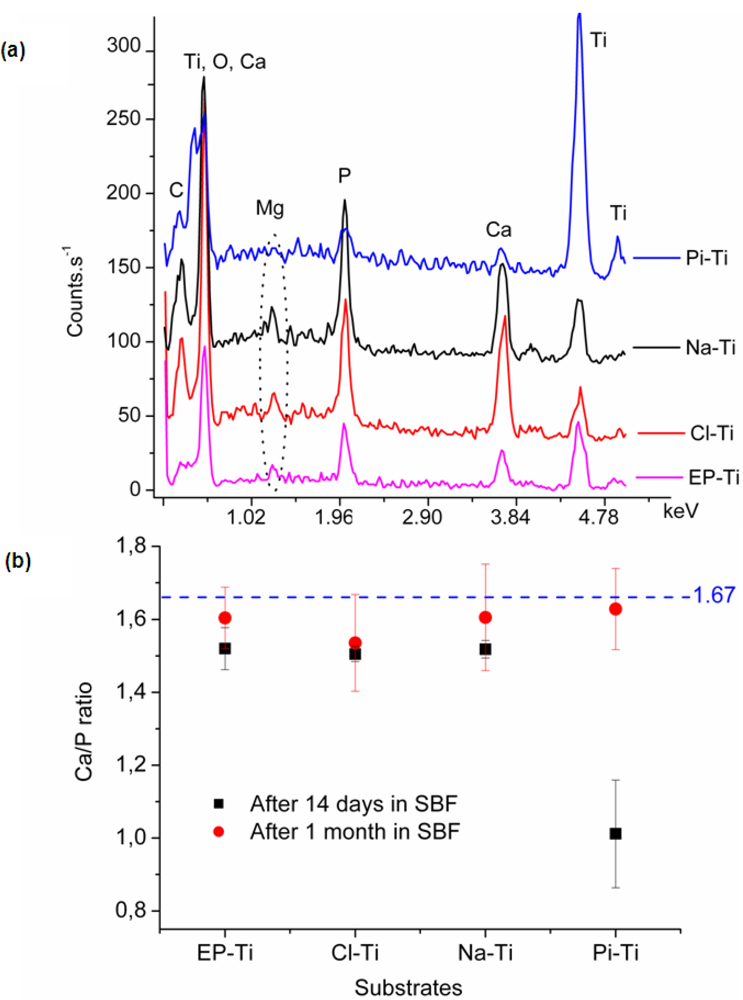
          <p>Upon EDX analysis, sharp peaks related to Ca and P were observed confirming the formation of CaP phases on all surfaces. Depending on the thickness of the film, peaks of different intensities related to Ti were also observed (<xref ref-type="fig" rid="jfb-03-00327-f007">Figure 7</xref>a). Furthermore, additional peaks corresponding to C and Mg were detected. The C peak was either due to the surface carbon contamination or carbonate ions in the lattice structure of CaP crystals. Similarly, it is believed that Mg<sup>2+</sup> ions had partially substituted Ca<sup>2+</sup> ions in the CaP lattice structure. Presence of similar traces of Mg<sup>2+</sup> in the EDX and XPS spectra of the CaP film formed at alkali treated Ti surfaces also supports such a hypothesis[E1]  [<xref ref-type="bibr" rid="B40-jfb-03-00327">40</xref>,<xref ref-type="bibr" rid="B77-jfb-03-00327">77</xref>].</p>
          <p>Further analysis of the EDX results after 14 days of immersion in 1.5 SBF showed that the Ca/P ratio on Pi-Ti is much lower than that of synthetic HA (<italic>i.e</italic>., ~1.67) and is related to Ca/P of dicalcium phosphate (<xref ref-type="fig" rid="jfb-03-00327-f007">Figure 7</xref>b). This small Ca/P ratio could be either due to the low film thickness along with the low detection limit of the instrument, or an inadequate surface chemistry of Pi-Ti in enabling Ca<sup>2+</sup> adsorption. However, on Na-Ti, EP-Ti and Cl-Ti, a Ca/P ratio of 1.50 was found and could be related to a Ca-deficient HA phase.</p>
          <p>After 30 days of immersion in 1.5 SBF, the Ca/P ratio was found to be close to that of synthetic HA, <italic>i.e</italic>., 1.67 (<xref ref-type="fig" rid="jfb-03-00327-f007">Figure 7</xref>b). The Ca/P ratio on all substrates was mainly around 1.55, which corresponds to a Ca-deficient HA. This could be due to a partial substitution of Ca<sup>2+</sup> by Mg<sup>2+</sup> ions or substitution of PO<sub>4</sub><sup>3−</sup> by CO<sub>3</sub><sup>2−</sup> in the crystal lattice structure, as previously discussed. Furthermore, it can be concluded that once the initial growth regime has been completed and an equilibrium state has been achieved, the Ca/P ratio is relatively the same on all substrates regardless of the early stages of the nucleation process. This would indicate similar growth mechanisms on all substrates after the initial nucleation and growth of the apatite. </p>
          <p>With respect to the deposition mechanism of CaP, the behaviour of the Na-Ti substrate in SBF has been explained by Kim <italic>et al</italic>. [<xref ref-type="bibr" rid="B15-jfb-03-00327">15</xref>,<xref ref-type="bibr" rid="B51-jfb-03-00327">51</xref>,<xref ref-type="bibr" rid="B78-jfb-03-00327">78</xref>]. According to their results, the release of Na<sup>+</sup> ions from the substrate induces a pH increase at the substrate/SBF interface, which leads to the deprotonation of OH<sub>b</sub> groups at the Ti surface. Therefore, the adsorption of Ca<sup>2+</sup> ions, which are initiators of the nucleation and growth of apatite, is enhanced. However, in the case of EP-Ti and Cl-Ti, the nucleation and growth mechanism of apatite may significantly differ, as the additional Cl<sup>−</sup> at EP-Ti and Cl-Ti may tend to stay on the surface due to the high concentration of Cl<sup>−</sup> ions in 1.5 SBF. These adsorbed Cl<sup>−</sup> may facilitate the electrostatic adsorption of Ca<sup>2+</sup> and thus trigger the heterogeneous precipitation of a CaP phase. This phenomenon could also be enhanced by the deprotonation of OH<sub>a</sub> at the surface of EP-Ti, since a pKa ~2.9 would be expected for the OH<sub>a</sub> populating the surface of EP-Ti [<xref ref-type="bibr" rid="B79-jfb-03-00327">79</xref>]. However, the role of OH<sub>a</sub> in comparison to that of Cl<sup>−</sup> should be minimized, since the initial deposition of CaP phases at the Pi-Ti surface comprising only OH<sub>a</sub> surface groups is slow (<xref ref-type="fig" rid="jfb-03-00327-f003">Figure 3</xref> and <xref ref-type="fig" rid="jfb-03-00327-f005">Figure 5</xref>). The implantation of Cl<sup>−</sup> ions at the surface of EP-Ti would therefore explain the good CaP induction ability observed after electropolishing in comparison to conventional chemical treatments. </p>
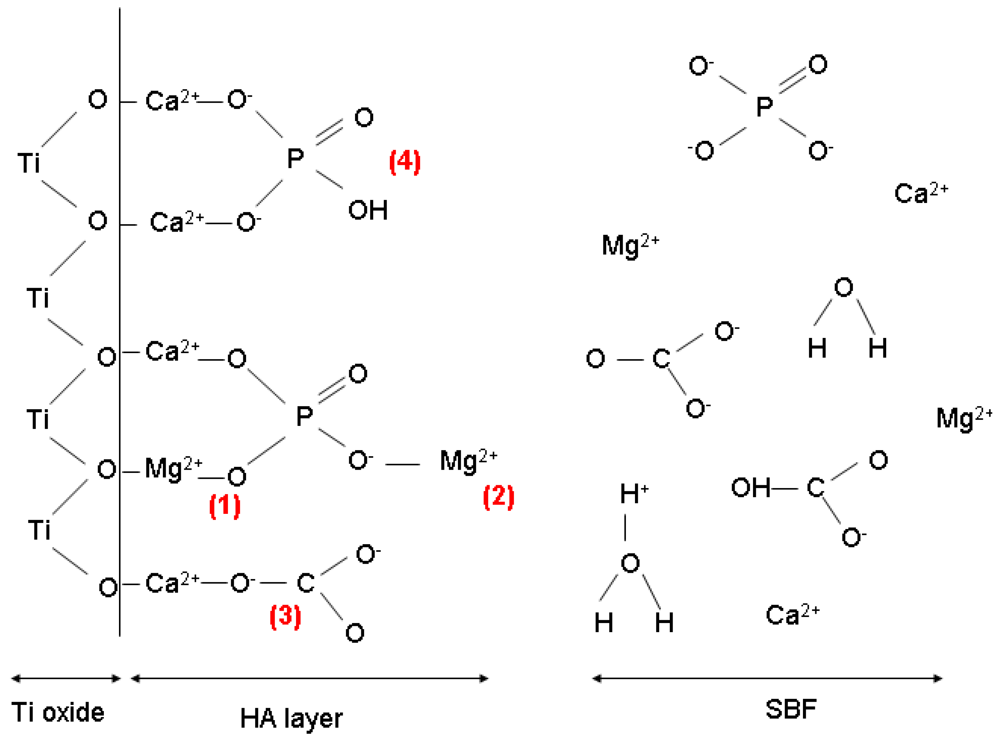
          <p>Other ions in SBF, in particular Mg<sup>2+</sup> and CO<sub>3</sub><sup>2−</sup>, have also influenced the nucleation and growth of CaP, its composition and possibly its kinetics of growth, as evidenced by EDX and XRD analysis. In fact, Mg<sup>2+</sup> and CO<sub>3</sub><sup>2−</sup> ions can compete for adsorption at the surface of Ti and form complexes preventing further CaP precipitation, as highlighted in <xref ref-type="fig" rid="jfb-03-00327-f008">Figure 8</xref> (mechanisms 1, 2 and 3) [<xref ref-type="bibr" rid="B80-jfb-03-00327">80</xref>,<xref ref-type="bibr" rid="B81-jfb-03-00327">81</xref>]. For example, traces of Mg<sup>2+</sup> ions have been shown to reduce the overall rate of CaP crystallization and delay the transformation of amorphous CaP to apatite phases [<xref ref-type="bibr" rid="B82-jfb-03-00327">82</xref>]. Furthermore, the formation of magnesium phosphates in solution would reduce the amount of phosphate ions available to form CaP phases [<xref ref-type="bibr" rid="B80-jfb-03-00327">80</xref>]. As a consequence, high concentrations of Mg<sup>2+</sup> ions at the substrate/solution interface would favor the heterogeneous nucleation of poorly crystallized CaP phases and hinder the growth of HA crystals. This inhibitory effect of Mg<sup>2+</sup> and CO<sub>3</sub><sup>2−</sup> ions on the growth of HA could explain the small crystal size of HA (~4–6 nm) obtained from the XRD patterns in this work. It could also lead to strong binding of HA to the substrate [<xref ref-type="bibr" rid="B81-jfb-03-00327">81</xref>]. </p>
		  <fig id="jfb-03-00327-f007" position="anchor">
            <label>Figure 7</label>
            <caption>
              <p>(<bold>a</bold>) Typical EDS spectra obtained on all substrates after 14 days immersion in 1.5 SBF; (<bold>b</bold>) Ca/P ratio of the CaP film as determined by EDS analysis on the substrates after 14 days and 1 month immersion in 1.5 SBF.</p>
            </caption>
            <graphic xmlns:xlink="http://www.w3.org/1999/xlink" xlink:href="jfb-03-00327-g007.tif"/>
          </fig>
                   
		 <fig id="jfb-03-00327-f008" position="anchor">
            <label>Figure 8</label>
            <caption>
              <p>Proposed mechanism of HA nucleation in the presence of Mg<sup>2+</sup> and CO<sub>3</sub><sup>2−</sup> ions at the Ti/SBF interface. (<bold>1</bold>) Mg<sup>2+</sup> substitutes Ca<sup>2+</sup> in the lattice structure or adsorbs directly on the surface; (<bold>2</bold>) Mg<sup>2+</sup> forms magnesium phosphate and inhibits further adsorption of Ca<sup>2+</sup>; (<bold>3</bold>) CO<sub>3</sub><sup>2−</sup> substitutes PO<sub>4</sub><sup>3−</sup>; (<bold>4</bold>) Protonated PO<sub>4</sub><sup>3−</sup> ions after adsorption at calcium sites.</p>
            </caption>
            <graphic xmlns:xlink="http://www.w3.org/1999/xlink" xlink:href="jfb-03-00327-g008.tif"/>
          </fig>
          <p>In order to determine the chemical formula of the carbonated HA formed on the substrates, further characterizations were carried out by FTIR (<xref ref-type="fig" rid="jfb-03-00327-f009">Figure 9</xref> and <xref ref-type="table" rid="jfb-03-00327-t002">Table 2</xref>). The obtained spectra, and the symmetric and asymmetric vibrations at 1,015–1,120 and 920 cm<sup>−1</sup> confirmed the apatitic nature of the CaP films formed on all substrates. Furthermore, the vibration observed at 872 cm<sup>−1</sup>, characteristic of a B-type apatite (<italic>i.e</italic>., substitution of PO<sub>4</sub><sup>3−</sup> by CO<sub>3</sub><sup>2−</sup> ions) [<xref ref-type="bibr" rid="B83-jfb-03-00327">83</xref>,<xref ref-type="bibr" rid="B84-jfb-03-00327">84</xref>], revealed that the apatite obtained on all substrates was partially of type-B. In fact, the frequency observed for C-O asymmetric stretching at 1,415–1,490 cm<sup>−1</sup> is too high to correspond to a B-type apatite and is more similar to those usually observed for A-type apatite (<italic>i.e</italic>., substitution of OH<sup>−</sup> by CO<sub>3</sub><sup>2−</sup> ions) [<xref ref-type="bibr" rid="B85-jfb-03-00327">85</xref>]. The absence of the apatite OH stretching peaks at 630 cm<sup>−1</sup> also partly confirmed the substitution of A-sites by the carbonate ions [<xref ref-type="bibr" rid="B70-jfb-03-00327">70</xref>,<xref ref-type="bibr" rid="B86-jfb-03-00327">86</xref>,<xref ref-type="bibr" rid="B87-jfb-03-00327">87</xref>,<xref ref-type="bibr" rid="B88-jfb-03-00327">88</xref>]. However, the characteristic IR peak for the A-type apatite, <italic>i.e</italic>., at 1,545 cm<sup>−1</sup> [<xref ref-type="bibr" rid="B89-jfb-03-00327">89</xref>], was not observed. Therefore, an AB-type apatite had most likely formed on all the Ti substrates in agreement with previous investigations showing the formation of an AB-type apatite at neutral pH (7.4 for the 1.5 SBF used in the present study) [<xref ref-type="bibr" rid="B83-jfb-03-00327">83</xref>,<xref ref-type="bibr" rid="B85-jfb-03-00327">85</xref>].</p>
          <fig id="jfb-03-00327-f009" position="anchor">
            <label>Figure 9</label>
            <caption>
              <p>FTIR spectra of the substrates after 14 days immersion in 1.5 SBF. The possible shifts in the peaks between 1,015–1,120 cm<sup>−1</sup> compared to those of stoichiometric HA are due to the presence of CO<sub>3</sub><sup>2−</sup>, HPO<sub>4</sub><sup>2−</sup> and crystal imperfections.</p>
            </caption>
            <graphic xmlns:xlink="http://www.w3.org/1999/xlink" xlink:href="jfb-03-00327-g009.tif"/>
          </fig>
          
		  <table-wrap id="jfb-03-00327-t002" position="anchor">
            <object-id pub-id-type="pii">jfb-03-00327-t002_Table 2</object-id>
            <label>Table 2</label>
            <caption>
              <p>Assignments of FTIR peaks for PO<sub>4</sub><sup>3−</sup> and CO<sub>3</sub><sup>2−</sup> vibrations on the spectra obtained and display on <xref ref-type="fig" rid="jfb-03-00327-f010">Figure 10</xref>.</p>
            </caption>
            <table>
              <thead>
                <tr align="center">
                  <th valign="middle">FTIR peaks related to PO<sub>4</sub><sup>3−</sup></th>
                  <th valign="middle">Wavenumber (cm<sup>−1</sup>)</th>
                </tr>
              </thead>
              <tbody>
                <tr align="center">
                  <td valign="middle"><italic>ν</italic><sub>4</sub>: O-P-O bending</td>
                  <td valign="middle">Doublet peaks at 571 and 604</td>
                </tr>
                <tr align="center">
                  <td valign="middle"><italic>ν</italic><sub>1</sub>: P-O symmetric stretching</td>
                  <td valign="middle">960</td>
                </tr>
                <tr align="center">
                  <td valign="middle"><italic>ν</italic><sub>3</sub>: P-O asymmetric stretching</td>
                  <td valign="middle">doublet peaks between 1,015–1,120</td>
                </tr>
                <tr align="center">
                  <td valign="middle"><bold>FTIR peaks related to CO<sub>3</sub><sup>2−</sup></bold></td>
                  <td valign="middle"><bold>Wavenumber (cm<sup>−1</sup>)</bold></td>
                </tr>
                <tr align="center">
                  <td valign="middle"><italic>ν</italic><sub>2</sub>: O-C-O out-of-plane bending </td>
                  <td valign="middle">872</td>
                </tr>
                <tr align="center">
                  <td valign="middle"><italic>ν</italic><sub>3</sub>: C-O asymmetric stretching</td>
                  <td valign="middle">doublet peaks between 1,415–1,490</td>
                </tr>
                <tr align="center">
                  <td valign="middle"><italic>ν</italic><sub>3</sub>: O-C-O bending </td>
                  <td valign="middle">Between 1,640–1,650</td>
                </tr>
              </tbody>
            </table>
			</table-wrap>
          <p>Based on these results, a chemical formula for the obtained HA film is suggested considering the fact that trivalent anionic phosphate sites can only be occupied by bivalent hydrogen phosphates or carbonate anions, and monovalent hydroxyl sites can only be substituted by carbonate ions. Furthermore, taking into account that calcium sites can be occupied by other cations and can accept a maximum of two vacant sites [<xref ref-type="bibr" rid="B90-jfb-03-00327">90</xref>], the AB-type apatite formed may have the following formula: Ca<sub>10−x−y</sub>Mg<sub>y</sub>(HPO<sub>4</sub>)<sub>x−z</sub>(CO<sub>3</sub>)<sub>z</sub>(PO<sub>4</sub>)<sub>6−x</sub>(OH)<sub>2−x−w</sub>(CO<sub>3</sub>)<sub>w/2</sub>, 0 ≤ x,y,z,w ≤ 1.</p>
        </sec>
      </sec>
    </sec>
    <sec>
      <title>3. Experimental Section</title>
      <p>All chemicals including methanol (AR grade), perchloric acid (ACS grade, ≥69%), 1-butanol (ACS grade, ≥99.5%), hydrogen peroxide 30 wt.% in water (ACS reagent), hydrochloric acid (GPR grade, 38%), sulphuric acid (AR grade, &gt;97.5%), ethanol (GPR grade), acetone (GPR grade) were purchased from Sigma and used as received. All chemicals for SBF preparation (listed in <xref ref-type="table" rid="jfb-03-00327-t003">Table 3</xref>) were also purchased from Sigma (ACS reagent grade).</p>
      <table-wrap id="jfb-03-00327-t003" position="anchor">
        <object-id pub-id-type="pii">jfb-03-00327-t003_Table 3</object-id>
        <label>Table 3</label>
        <caption>
          <p>Composition of 1.5 SBF listed in sequence of dissolution.</p>
        </caption>
        <table>
          <thead>
            <tr>
              <th align="left" valign="middle">#</th>
              <th align="left" valign="middle">Chemicals</th>
              <th align="center" valign="middle">Amount (g) for 1.5 SBF in 1L of water</th>
            </tr>
          </thead>
          <tbody>
            <tr>
              <td align="left" valign="middle">1</td>
              <td align="left" valign="middle">NaCl</td>
              <td align="center" valign="middle">10.806</td>
            </tr>
            <tr>
              <td align="left" valign="middle">2</td>
              <td align="left" valign="middle">NaHCO<sub>3</sub></td>
              <td align="center" valign="middle">1.472</td>
            </tr>
            <tr>
              <td align="left" valign="middle">3</td>
              <td align="left" valign="middle">Na<sub>2</sub>CO<sub>3</sub></td>
              <td align="center" valign="middle">4.072</td>
            </tr>
            <tr>
              <td align="left" valign="middle">4</td>
              <td align="left" valign="middle">KCl</td>
              <td align="center" valign="middle">0.45</td>
            </tr>
            <tr>
              <td align="left" valign="middle">5</td>
              <td align="left" valign="middle">K<sub>2</sub>HPO<sub>4</sub>.3H<sub>2</sub>O</td>
              <td align="center" valign="middle">0.476</td>
            </tr>
            <tr>
              <td align="left" valign="middle">6</td>
              <td align="left" valign="middle">MgCl<sub>2</sub>.H<sub>2</sub>O</td>
              <td align="center" valign="middle">0.622</td>
            </tr>
            <tr>
              <td align="left" valign="middle">7</td>
              <td align="left" valign="middle">HEPES</td>
              <td align="center" valign="middle">23.856</td>
            </tr>
            <tr>
              <td align="left" valign="middle">8</td>
              <td align="left" valign="middle">CaCl<sub>2</sub></td>
              <td align="center" valign="middle">0.586</td>
            </tr>
            <tr>
              <td align="left" valign="middle">9</td>
              <td align="left" valign="middle">Na<sub>2</sub>SO<sub>4</sub></td>
              <td align="center" valign="middle">0.144</td>
            </tr>
            <tr>
              <td align="left" valign="middle">10</td>
              <td align="left" valign="middle">1M-NaOH</td>
              <td align="center" valign="middle">3 mL</td>
            </tr>
          </tbody>
        </table>
		</table-wrap>
      <p>Commercially pure Ti plates were purchased from Goodfellow and cut to 1 × 2.5 cm<sup>2</sup>. Platinum/Rhodium foil (Pt90/Rh10) of 25 × 25 × 0.125 mm<sup>3</sup> size was purchased from Goodfellow and used as the cathode in the electropolishing unit. </p>
      <sec>
        <title>3.1. Electropolishing</title>
        <p>Before electropolishing, the as-received Ti substrates were first polished with a #1000 and then a #2400 silicon carbide grinding paper to remove the native oxide layer. The polished substrates were cleaned by sonication in distilled water, ethanol and then acetone, and finally dried in air. </p>
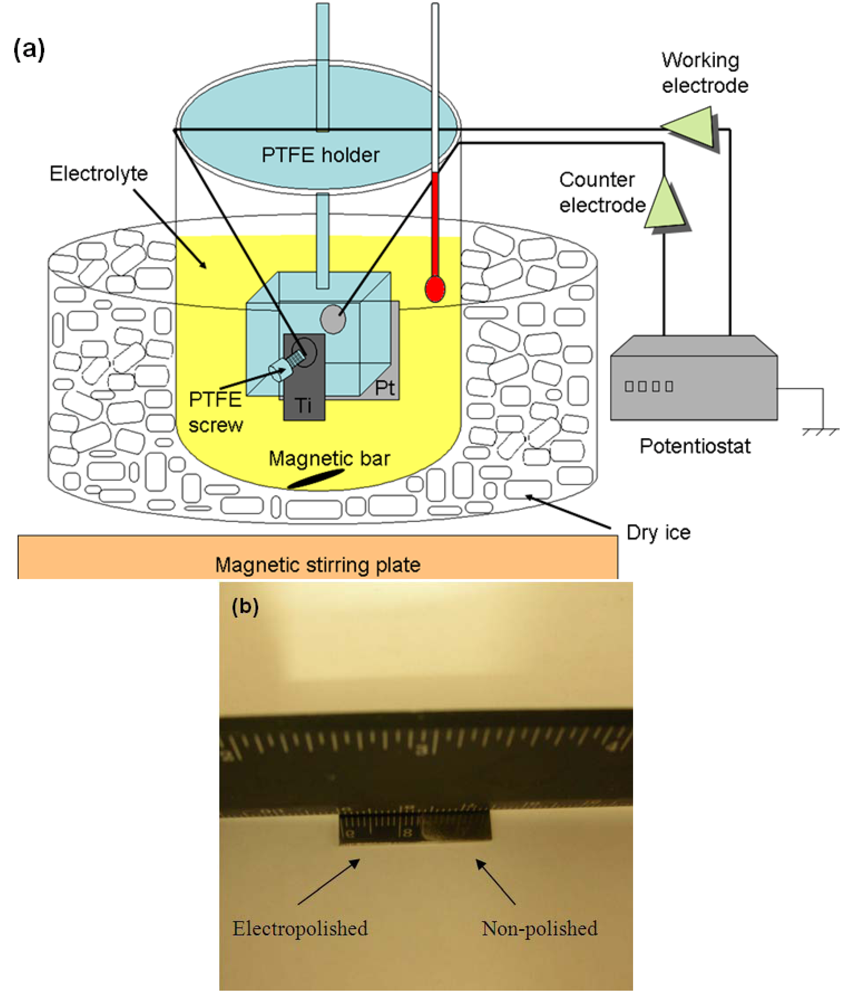
        <p>The electrochemical cell was home-made (<xref ref-type="fig" rid="jfb-03-00327-f010">Figure 10</xref>a) and a mixture of 54 mL methanol, 25 mL 1-butanol and 6 ml perchloric acid was used as the electrolyte. Electropolishing was conducted at −30 °C, under an anodic potential of 9.5 V for 5 min. Vigorous agitation was maintained throughout the process in order to obtain a homogenously electropolished surface [<xref ref-type="bibr" rid="B91-jfb-03-00327">91</xref>]. Once electropolished, the Ti substrate was sonicated in methanol, ethanol and water, and finally dried under blowing Ar before storage under Ar (substrate denoted EP-Ti). The electropolished surface had a mirror finish as shown in <xref ref-type="fig" rid="jfb-03-00327-f010">Figure 10</xref>b.</p>
        <fig id="jfb-03-00327-f010" position="anchor">
          <label>Figure 10</label>
          <caption>
            <p>(<bold>a</bold>) Schematic of the home made electropolishing unit; (<bold>b</bold>) Photo of a substrate with the electropolished surface at half length. The reflection of the ruler on the electropolished part is clearly seen.</p>
          </caption>
          <graphic xmlns:xlink="http://www.w3.org/1999/xlink" xlink:href="jfb-03-00327-g010.tif"/>
        </fig>
      </sec>
      <sec>
        <title>3.2. Conventional Surface Treatments</title>
        <p>The as-received Ti substrates were cleaned by sonication in water, ethanol and acetone. Three conventional chemical treatments were used to modify the surface chemistry of the Ti substrates: (a) immersion in a 2:1 <italic>Piranha</italic> solution (<italic>v</italic>:<italic>v</italic>, H<sub>2</sub>SO<sub>4</sub>: H<sub>2</sub>O<sub>2</sub>) at 100 °C for 10 min (substrate denoted Pi-Ti); (b) soaking in a 5 M sodium hydroxide (NaOH) solution at room temperature for 24 h (substrate denoted Na-Ti); (c) dipping in a mixture of 8.8 M H<sub>2</sub>O<sub>2</sub> + 0.1 M HCl at 80 °C for 1 h (substrate denoted Cl-Ti). All substrates were rinsed with a copious amount of distilled water after chemical treatments and then blow dried with Ar.</p>
      </sec>
      <sec>
        <title>3.3. CaP Coating</title>
        <p>For the nucleation and growth of HA, a “revised” SBF solution was used (see <xref ref-type="table" rid="jfb-03-00327-t003">Table 3</xref> for composition) [<xref ref-type="bibr" rid="B92-jfb-03-00327">92</xref>]. In order to decrease the immersion time required to start the process of mineralization in SBF, a 1.5 SBF was used. Using 1.5 SBF, and not 1 SBF, is not conflicting with the report of Kokubo <italic>et al</italic>. [<xref ref-type="bibr" rid="B93-jfb-03-00327">93</xref>], as the scope of the current study is not to evaluate the <italic>in vivo</italic> bone bioactivity of a material, and the SBF is used as a supersaturated solution with calcium and phosphate to study the effect of surface charge in the nucleation and growth of calcium phosphate phases <italic>in vitro</italic>. 1.5 SBF was prepared by dissolving the chemicals listed in <xref ref-type="table" rid="jfb-03-00327-t003">Table 3</xref> in sequence in 1,000 mL of high purity water in a polyethylene beaker at 36.5 °C under Ar. The solution was buffered at pH = 7.4 at 36.5 °C and the stock solution showed no precipitations after 1 month at 4 °C. Three substrates per treatment group were prepared and suspended with a cotton thread individually in 20 mL of 1.5 SBF at 36.5 °C in a polyethylene bottle under Ar to limit CO<sub>2</sub> dissolution. The sealed bottles were stirred throughout the experiments and the solution was refreshed every 3 days. Once the substrates were removed from the solution, they were washed gently with high purity water and dried under flowing Ar. The substrates were stored under Ar until being characterized. </p>
      </sec>
      <sec>
        <title>3.4. Characterization Methods</title>
        <p>The chemical composition of Ti surfaces before CaP coating was determined by X-ray Photoelectron Spectroscopy (XPS) using a VG-Microtech Mutilab 3000 instrument. The XPS measurements were performed at 10<sup>−7</sup> Pa with an Al Kα source at 150 W.</p>
        <p>The surface morphology of Ti substrates before and after CaP coating was further characterized using a Field Emission Scanning Electron Microscope (FE-SEM) JEOL 6301 operated at 5 kV. Chemical composition of the surface with CaP coating was gained by Energy-dispersive X-ray (EDX) analysis. Further characterization of the chemical composition of the HA coating was done by Infrared spectroscopy. A Digilab Fourier Transform Infrared (FTIR) spectrophotometer equipped with a diffuse reflectance accessory was used. The spectra were collected with 100 scans at a resolution of 4 cm<sup>−1</sup>. The crystallographic structure of the CaP film was analyzed using a Bruker thin film X-ray Diffractometer (XRD) equipped with a Cu Kα radiation source. The starting incident angle used was 5°.</p>
      </sec>
    </sec>
    <sec sec-type="conclusions">
      <title>4. Conclusions</title>
      <p>The formation of bone-like apatite film was achieved on the surface of all chemically treated substrates despite differences in mechanism of HA growth and kinetics, with an enhancement of HA mineralization at negatively charged surfaces. Hence, the electropolished Ti surface was found to be capable of inducing bone-like apatite and the formation of an AB-type carbonated HA layer was confirmed after only a few days of immersion of the substrate in SBF. The enhanced HA induction ability of electropolished Ti is believed to result from residual surface Cl<sup>−</sup> formed during electrochemical process. By providing sites to the adsorption of Ca<sup>2+</sup>, such surface Cl<sup>−</sup> would facilitate the nucleation and growth of HA. Therefore, electropolishing of Ti surfaces could be an alternative route to chemical modification techniques for facilitated growth of apatite on Ti surfaces via biomimetic methods. </p>
    </sec>
    
  </body>
  
  <back>
    <ack>
      <title>Acknowledgments</title>
      <p>This work was supported by Furlong Research Foundation (and Joint Replacement Instrumentation (JRI) Orthopaedics Limited), UK.</p>
    </ack>
	<ref-list>
      <title>References</title>
      <ref id="B1-jfb-03-00327">
        <label>1.</label>
        <citation citation-type="journal">
          <person-group person-group-type="author">
            <name>
              <surname>Liu</surname>
              <given-names>X.</given-names>
            </name>
            <name>
              <surname>Chu</surname>
              <given-names>P.K.</given-names>
            </name>
            <name>
              <surname>Ding</surname>
              <given-names>C.</given-names>
            </name>
          </person-group>
          <article-title>Surface modification of titanium, titanium alloys, and related materials for biomedical applications</article-title>
          <source>Mater. Sci. Eng. A</source>
          <year>2004</year>
          <volume>47</volume>
          <fpage>49</fpage>
          <lpage>121</lpage>
          <pub-id pub-id-type="doi">10.1016/j.mser.2004.11.001</pub-id>
        </citation>
      </ref>
      <ref id="B2-jfb-03-00327">
        <label>2.</label>
        <citation citation-type="book">
          <person-group person-group-type="author">
            <name>
              <surname>Brunnette</surname>
              <given-names>D.M.</given-names>
            </name>
            <name>
              <surname>Tengvall</surname>
              <given-names>P.</given-names>
            </name>
            <name>
              <surname>Textor</surname>
              <given-names>M.</given-names>
            </name>
            <name>
              <surname>Thomsen</surname>
              <given-names>P.</given-names>
            </name>
          </person-group>
          <source>Titanium in Medicine. Materials Science, Surface Science, Engineering, Biological Responses and Medical Applications</source>
          <publisher-name>Springer</publisher-name>
          <publisher-loc>Berlin, Germany</publisher-loc>
          <year>2001</year>
        </citation>
      </ref>
      <ref id="B3-jfb-03-00327">
        <label>3.</label>
        <citation citation-type="journal">
          <person-group person-group-type="author">
            <name>
              <surname>Gross</surname>
              <given-names>K.A.</given-names>
            </name>
            <name>
              <surname>Berndt</surname>
              <given-names>C.C.</given-names>
            </name>
          </person-group>
          <article-title>Thermal processing of hydroxyapatite for coating production</article-title>
          <source>J. Biomed. Mater. Res.</source>
          <year>1998</year>
          <volume>39</volume>
          <fpage>580</fpage>
          <lpage>587</lpage>
          <pub-id pub-id-type="doi">10.1002/(SICI)1097-4636(19980315)39:4&lt;580::AID-JBM12&gt;3.0.CO;2-B</pub-id>
        </citation>
      </ref>
      <ref id="B4-jfb-03-00327">
        <label>4.</label>
        <citation citation-type="journal">
          <person-group person-group-type="author">
            <name>
              <surname>Steinemann</surname>
              <given-names>S.G.</given-names>
            </name>
          </person-group>
          <article-title>Titanium—The materials of choice?</article-title>
          <source>Periodontology 2000</source>
          <year>1998</year>
          <volume>17</volume>
          <fpage>7</fpage>
          <lpage>21</lpage>
          <pub-id pub-id-type="doi">10.1111/j.1600-0757.1998.tb00119.x</pub-id>
        </citation>
      </ref>
      <ref id="B5-jfb-03-00327">
        <label>5.</label>
        <citation citation-type="journal">
          <person-group person-group-type="author">
            <name>
              <surname>Koutsopoulos</surname>
              <given-names>S.</given-names>
            </name>
          </person-group>
          <article-title>Kinetic study on the crystal growth of hydroxyapatite</article-title>
          <source>Langmuir</source>
          <year>2002</year>
          <volume>17</volume>
          <fpage>8092</fpage>
          <lpage>8097</lpage>
          <pub-id pub-id-type="doi">10.1021/la0107906</pub-id>
        </citation>
      </ref>
      <ref id="B6-jfb-03-00327">
        <label>6.</label>
        <citation citation-type="journal">
          <person-group person-group-type="author">
            <name>
              <surname>Blackwood</surname>
              <given-names>D.J.</given-names>
            </name>
            <name>
              <surname>Seah</surname>
              <given-names>K.H.W.</given-names>
            </name>
          </person-group>
          <article-title>Galvanostatic pulse deposition of hydroxyapatite for adhesion to titanium for biomedical purposes</article-title>
          <source>Mater. Sci. Eng. C</source>
          <year>2010</year>
          <volume>30</volume>
          <fpage>561</fpage>
          <lpage>565</lpage>
          <pub-id pub-id-type="doi">10.1016/j.msec.2010.02.007</pub-id>
        </citation>
      </ref>
      <ref id="B7-jfb-03-00327">
        <label>7.</label>
        <citation citation-type="journal">
          <person-group person-group-type="author">
            <name>
              <surname>Ueda</surname>
              <given-names>M.</given-names>
            </name>
            <name>
              <surname>Ikeda</surname>
              <given-names>M.</given-names>
            </name>
            <name>
              <surname>Ogawa</surname>
              <given-names>M.</given-names>
            </name>
          </person-group>
          <article-title>Chemical-hydrothermal combined surface modification of titanium for improvement of osteointegration</article-title>
          <source>Mater. Sci. Eng. C</source>
          <year>2009</year>
          <volume>29</volume>
          <fpage>994</fpage>
          <lpage>1000</lpage>
        <pub-id pub-id-type="doi">10.1016/j.msec.2008.09.002</pub-id></citation>
      </ref>
      <ref id="B8-jfb-03-00327">
        <label>8.</label>
        <citation citation-type="journal">
          <person-group person-group-type="author">
            <name>
              <surname>Sun</surname>
              <given-names>L.</given-names>
            </name>
            <name>
              <surname>Berndt</surname>
              <given-names>C.C.</given-names>
            </name>
            <name>
              <surname>Gross</surname>
              <given-names>K.A.</given-names>
            </name>
            <name>
              <surname>Kucuk</surname>
              <given-names>A.</given-names>
            </name>
          </person-group>
          <article-title>Material fundamentals and clinical performance of plasma-sprayed hydroxyapatite coatings: A review</article-title>
          <source>J. Biomed. Mater. Res.</source>
          <year>2001</year>
          <volume>58</volume>
          <fpage>570</fpage>
          <lpage>592</lpage>
          <pub-id pub-id-type="doi">10.1002/jbm.1056</pub-id>
        </citation>
      </ref>
      <ref id="B9-jfb-03-00327">
        <label>9.</label>
        <citation citation-type="journal">
          <person-group person-group-type="author">
            <name>
              <surname>Habibovic</surname>
              <given-names>P.</given-names>
            </name>
            <name>
              <surname>Barrere</surname>
              <given-names>F.</given-names>
            </name>
            <name>
              <surname>van Blitterswijk</surname>
              <given-names>C.A.</given-names>
            </name>
            <name>
              <surname>de Groot</surname>
              <given-names>K.</given-names>
            </name>
            <name>
              <surname>Layrolle</surname>
              <given-names>P.</given-names>
            </name>
          </person-group>
          <article-title>Biomimetic hydroxyapatite coating on metal implants</article-title>
          <source>J. Am. Ceram. Soc.</source>
          <year>2002</year>
          <volume>85</volume>
          <fpage>517</fpage>
          <lpage>522</lpage>
        </citation>
      </ref>
      <ref id="B10-jfb-03-00327">
        <label>10.</label>
        <citation citation-type="book">
          <person-group person-group-type="author">
            <name>
              <surname>Stumm</surname>
              <given-names>W.</given-names>
            </name>
          </person-group>
          <source>Chemistry of the Solid-Water Interface: Processes at the Mineral-Water and Particle-Water Interface in Natural Systems</source>
          <publisher-name>Wiley-Interscience</publisher-name>
          <publisher-loc>Weinheim, Germany</publisher-loc>
          <year>1992</year>
        </citation>
      </ref>
      <ref id="B11-jfb-03-00327">
        <label>11.</label>
        <citation citation-type="journal">
          <person-group person-group-type="author">
            <name>
              <surname>Li</surname>
              <given-names>P.</given-names>
            </name>
            <name>
              <surname>Zhang</surname>
              <given-names>F.</given-names>
            </name>
          </person-group>
          <article-title>The electrochemistry of a glass surface and its application to bioactive glass in solution</article-title>
          <source>J. Non Cryst. Solids.</source>
          <year>1990</year>
          <volume>119</volume>
          <fpage>112</fpage>
          <lpage>118</lpage>
          <pub-id pub-id-type="doi">10.1016/0022-3093(90)90247-J</pub-id>
        </citation>
      </ref>
      <ref id="B12-jfb-03-00327">
        <label>12.</label>
        <citation citation-type="journal">
          <person-group person-group-type="author">
            <name>
              <surname>Calvert</surname>
              <given-names>P.</given-names>
            </name>
            <name>
              <surname>Mann</surname>
              <given-names>S.</given-names>
            </name>
          </person-group>
          <article-title>The nagtive side of crystal growth</article-title>
          <source>Nature</source>
          <year>1997</year>
          <volume>386</volume>
          <fpage>127</fpage>
          <lpage>128</lpage>
          <pub-id pub-id-type="doi">10.1038/386127a0</pub-id>
        </citation>
      </ref>
      <ref id="B13-jfb-03-00327">
        <label>13.</label>
        <citation citation-type="journal">
          <person-group person-group-type="author">
            <name>
              <surname>Wang</surname>
              <given-names>X.</given-names>
            </name>
            <name>
              <surname>Hayakawa</surname>
              <given-names>S.</given-names>
            </name>
            <name>
              <surname>Tsurub</surname>
              <given-names>K.</given-names>
            </name>
            <name>
              <surname>Osaka</surname>
              <given-names>A.</given-names>
            </name>
          </person-group>
          <article-title>Bioactive titania gel layers formed by chemical treatment of Ti substrate with a H<sub>2</sub>O<sub>2</sub>/HCl solution</article-title>
          <source>Biomaterials</source>
          <year>2002</year>
          <volume>23</volume>
          <fpage>1353</fpage>
          <lpage>1357</lpage>
          <pub-id pub-id-type="doi">10.1016/S0142-9612(01)00254-X</pub-id>
        </citation>
      </ref>
      <ref id="B14-jfb-03-00327">
        <label>14.</label>
        <citation citation-type="journal">
          <person-group person-group-type="author">
            <name>
              <surname>Lee</surname>
              <given-names>B.H.</given-names>
            </name>
            <name>
              <surname>Kim</surname>
              <given-names>Y.D.</given-names>
            </name>
            <name>
              <surname>Shin</surname>
              <given-names>J.H.</given-names>
            </name>
            <name>
              <surname>Lee</surname>
              <given-names>K.H.</given-names>
            </name>
          </person-group>
          <article-title>Surface modification by alkali and heat treatments in titanium alloys</article-title>
          <source>J. Biomed. Mater. Res.</source>
          <year>2002</year>
          <volume>61</volume>
          <fpage>466</fpage>
          <lpage>473</lpage>
          <pub-id pub-id-type="doi">10.1002/jbm.10190</pub-id>
        </citation>
      </ref>
      <ref id="B15-jfb-03-00327">
        <label>15.</label>
        <citation citation-type="journal">
          <person-group person-group-type="author">
            <name>
              <surname>Kim</surname>
              <given-names>H.M.</given-names>
            </name>
            <name>
              <surname>Miyaji</surname>
              <given-names>F.</given-names>
            </name>
            <name>
              <surname>Kokubo</surname>
              <given-names>T.</given-names>
            </name>
            <name>
              <surname>Nakamura</surname>
              <given-names>T.</given-names>
            </name>
          </person-group>
          <article-title>Preparation of bioactive Ti and its alloys via simple chemical surface treatment</article-title>
          <source>J. Biomed. Mater. Res.</source>
          <year>1996</year>
          <volume>32</volume>
          <fpage>409</fpage>
          <lpage>417</lpage>
          <pub-id pub-id-type="doi">10.1002/(SICI)1097-4636(199611)32:3&lt;409::AID-JBM14&gt;3.0.CO;2-B</pub-id>
        </citation>
      </ref>
      <ref id="B16-jfb-03-00327">
        <label>16.</label>
        <citation citation-type="journal">
          <person-group person-group-type="author">
            <name>
              <surname>Wei</surname>
              <given-names>M.</given-names>
            </name>
            <name>
              <surname>Kim</surname>
              <given-names>H.M.</given-names>
            </name>
            <name>
              <surname>Kokubo</surname>
              <given-names>T.</given-names>
            </name>
            <name>
              <surname>Evans</surname>
              <given-names>J.H.</given-names>
            </name>
          </person-group>
          <article-title>Optimising the bioactivity of alkaline-treated titanium alloy</article-title>
          <source>Mater. Sci. Eng. C</source>
          <year>2002</year>
          <volume>20</volume>
          <fpage>125</fpage>
          <lpage>134</lpage>
          <pub-id pub-id-type="doi">10.1016/S0928-4931(02)00022-X</pub-id>
        </citation>
      </ref>
      <ref id="B17-jfb-03-00327">
        <label>17.</label>
        <citation citation-type="journal">
          <person-group person-group-type="author">
            <name>
              <surname>Wen</surname>
              <given-names>H.B.</given-names>
            </name>
            <name>
              <surname>de Wijn</surname>
              <given-names>J.R.</given-names>
            </name>
            <name>
              <surname>Liu</surname>
              <given-names>Q.</given-names>
            </name>
            <name>
              <surname>de Groot</surname>
              <given-names>K.</given-names>
            </name>
          </person-group>
          <article-title>A simple method to prepare calcium phosphate coatings on Ti6Al4V</article-title>
          <source>J. Mater. Sci. Mater. Med.</source>
          <year>1997</year>
          <volume>8</volume>
          <fpage>765</fpage>
          <lpage>770</lpage>
          <pub-id pub-id-type="doi">10.1023/A:1018512612695</pub-id>
        </citation>
      </ref>
      <ref id="B18-jfb-03-00327">
        <label>18.</label>
        <citation citation-type="journal">
          <person-group person-group-type="author">
            <name>
              <surname>Pham</surname>
              <given-names>M.T.</given-names>
            </name>
            <name>
              <surname>Maitz</surname>
              <given-names>M.F.</given-names>
            </name>
            <name>
              <surname>Matz</surname>
              <given-names>W.</given-names>
            </name>
            <name>
              <surname>Reuther</surname>
              <given-names>H.</given-names>
            </name>
            <name>
              <surname>Richter</surname>
              <given-names>E.</given-names>
            </name>
            <name>
              <surname>Steiner</surname>
              <given-names>G.</given-names>
            </name>
          </person-group>
          <article-title>Promoted hydroxyapatite nucleation on titanium ion-implanted with sodium</article-title>
          <source>Thin Solid Films</source>
          <year>2000</year>
          <volume>379</volume>
          <fpage>50</fpage>
          <lpage>56</lpage>
          <pub-id pub-id-type="doi">10.1016/S0040-6090(00)01553-4</pub-id>
        </citation>
      </ref>
      <ref id="B19-jfb-03-00327">
        <label>19.</label>
        <citation citation-type="journal">
          <person-group person-group-type="author">
            <name>
              <surname>Majewski</surname>
              <given-names>P.J.</given-names>
            </name>
            <name>
              <surname>Allidi</surname>
              <given-names>G.</given-names>
            </name>
          </person-group>
          <article-title>Synthesis of hydroxyapatite on titanium coated with organic self-assembled monolayers</article-title>
          <source>Mater. Sci. Eng. A</source>
          <year>2006</year>
          <volume>420</volume>
          <fpage>13</fpage>
          <lpage>20</lpage>
          <pub-id pub-id-type="doi">10.1016/j.msea.2006.01.022</pub-id>
        </citation>
      </ref>
      <ref id="B20-jfb-03-00327">
        <label>20.</label>
        <citation citation-type="journal">
          <person-group person-group-type="author">
            <name>
              <surname>Huang</surname>
              <given-names>S.</given-names>
            </name>
            <name>
              <surname>Zhou</surname>
              <given-names>K.</given-names>
            </name>
            <name>
              <surname>Liu</surname>
              <given-names>Y.</given-names>
            </name>
            <name>
              <surname>Huang</surname>
              <given-names>B.</given-names>
            </name>
          </person-group>
          <article-title>Controlled crystallization of hydroxyapatite under hexadecylamine self-assembled monolayer</article-title>
          <source>Trans. Nonferrous Met. Soc. China</source>
          <year>2003</year>
          <volume>13</volume>
          <fpage>595</fpage>
          <lpage>599</lpage>
        </citation>
      </ref>
      <ref id="B21-jfb-03-00327">
        <label>21.</label>
        <citation citation-type="journal">
          <person-group person-group-type="author">
            <name>
              <surname>Zhu</surname>
              <given-names>P.</given-names>
            </name>
            <name>
              <surname>Masuda</surname>
              <given-names>Y.</given-names>
            </name>
            <name>
              <surname>Koumoto</surname>
              <given-names>K.</given-names>
            </name>
          </person-group>
          <article-title>A novel approach to fabricate Hydroxyapatite coating on titanium substrate in an aqueous solution</article-title>
          <source>J. Ceram. Soc. Jpn.</source>
          <year>2001</year>
          <volume>109</volume>
          <fpage>676</fpage>
          <lpage>680</lpage>
          <pub-id pub-id-type="doi">10.2109/jcersj.109.1272_676</pub-id>
        </citation>
      </ref>
      <ref id="B22-jfb-03-00327">
        <label>22.</label>
        <citation citation-type="journal">
          <person-group person-group-type="author">
            <name>
              <surname>Tanahashi</surname>
              <given-names>M.</given-names>
            </name>
            <name>
              <surname>Matsuda</surname>
              <given-names>T.</given-names>
            </name>
          </person-group>
          <article-title>Surface functional group dependence on apatite formation on self-assembled monolayers in a simulated body fluid</article-title>
          <source>J. Biomed. Mater. Res.</source>
          <year>1997</year>
          <volume>34</volume>
          <fpage>305</fpage>
          <lpage>315</lpage>
          <pub-id pub-id-type="doi">10.1002/(SICI)1097-4636(19970305)34:3&lt;305::AID-JBM5&gt;3.0.CO;2-O</pub-id>
        </citation>
      </ref>
      <ref id="B23-jfb-03-00327">
        <label>23.</label>
        <citation citation-type="journal">
          <person-group person-group-type="author">
            <name>
              <surname>Li</surname>
              <given-names>P.</given-names>
            </name>
            <name>
              <surname>Ohtsuki</surname>
              <given-names>C.</given-names>
            </name>
            <name>
              <surname>Kokubo</surname>
              <given-names>T.</given-names>
            </name>
            <name>
              <surname>Nakanishi</surname>
              <given-names>K.</given-names>
            </name>
            <name>
              <surname>Soga</surname>
              <given-names>N.</given-names>
            </name>
            <name>
              <surname>de Groot</surname>
              <given-names>K.</given-names>
            </name>
          </person-group>
          <article-title>The role of hydrated silica, titania, and alumina in inducing apatite on implants</article-title>
          <source>J. Biomed. Mater. Res.</source>
          <year>1994</year>
          <volume>28</volume>
          <fpage>7</fpage>
          <lpage>15</lpage>
        <pub-id pub-id-type="doi">10.1002/jbm.820280103</pub-id><pub-id pub-id-type="pmid">8126031</pub-id></citation>
      </ref>
      <ref id="B24-jfb-03-00327">
        <label>24.</label>
        <citation citation-type="journal">
          <person-group person-group-type="author">
            <name>
              <surname>Ajami</surname>
              <given-names>E.</given-names>
            </name>
            <name>
              <surname>Aquey-Zinsou</surname>
              <given-names>K.F.</given-names>
            </name>
          </person-group>
          <article-title>Formation of OTS self-assembled monolayers at chemically treated titanium surfaces</article-title>
          <source>J. Mater. Sci. Mater. Med.</source>
          <year>2011</year>
          <volume>22</volume>
          <fpage>1813</fpage>
          <lpage>1824</lpage>
          <pub-id pub-id-type="doi">10.1007/s10856-011-4356-x</pub-id>
        </citation>
      </ref>
      <ref id="B25-jfb-03-00327">
        <label>25.</label>
        <citation citation-type="journal">
          <person-group person-group-type="author">
            <name>
              <surname>Zhu</surname>
              <given-names>P.</given-names>
            </name>
            <name>
              <surname>Masuda</surname>
              <given-names>Y.</given-names>
            </name>
            <name>
              <surname>Koumoto</surname>
              <given-names>K.</given-names>
            </name>
          </person-group>
          <article-title>The effect of surface charge on hydroxyapatite nucleation</article-title>
          <source>Biomaterials</source>
          <year>2004</year>
          <volume>25</volume>
          <fpage>3915</fpage>
          <lpage>3921</lpage>
          <pub-id pub-id-type="doi">10.1016/j.biomaterials.2003.10.022</pub-id>
        </citation>
      </ref>
      <ref id="B26-jfb-03-00327">
        <label>26.</label>
        <citation citation-type="journal">
          <person-group person-group-type="author">
            <name>
              <surname>Hanawa</surname>
              <given-names>T.</given-names>
            </name>
            <name>
              <surname>Kamiura</surname>
              <given-names>Y.</given-names>
            </name>
            <name>
              <surname>Yamamoto</surname>
              <given-names>S.</given-names>
            </name>
            <name>
              <surname>Kohgo</surname>
              <given-names>T.</given-names>
            </name>
            <name>
              <surname>Amemiya</surname>
              <given-names>A.</given-names>
            </name>
            <name>
              <surname>Ukai</surname>
              <given-names>H.</given-names>
            </name>
            <name>
              <surname>Murakami</surname>
              <given-names>K.</given-names>
            </name>
            <name>
              <surname>Asaoka</surname>
              <given-names>K.</given-names>
            </name>
          </person-group>
          <article-title>Early bone formation around calcium-ion-implanted titanium inserted into rat tibia</article-title>
          <source>J. Biomed. Mater. Res.</source>
          <year>1997</year>
          <volume>36</volume>
          <fpage>131</fpage>
          <lpage>136</lpage>
          <pub-id pub-id-type="doi">10.1002/(SICI)1097-4636(199707)36:1&lt;131::AID-JBM16&gt;3.0.CO;2-L</pub-id>
        </citation>
      </ref>
      <ref id="B27-jfb-03-00327">
        <label>27.</label>
        <citation citation-type="journal">
          <person-group person-group-type="author">
            <name>
              <surname>Xie</surname>
              <given-names>Y.</given-names>
            </name>
            <name>
              <surname>Liu</surname>
              <given-names>X.</given-names>
            </name>
            <name>
              <surname>Chu</surname>
              <given-names>P.K.</given-names>
            </name>
            <name>
              <surname>Ding</surname>
              <given-names>C.</given-names>
            </name>
          </person-group>
          <article-title>Nucleation and growth of calcium-phosphate on Ca-implanted titanium surface</article-title>
          <source>Surf. Sci.</source>
          <year>2006</year>
          <volume>600</volume>
          <fpage>651</fpage>
          <lpage>656</lpage>
          <pub-id pub-id-type="doi">10.1016/j.susc.2005.11.016</pub-id>
        </citation>
      </ref>
      <ref id="B28-jfb-03-00327">
        <label>28.</label>
        <citation citation-type="journal">
          <person-group person-group-type="author">
            <name>
              <surname>Wan</surname>
              <given-names>Y.Z.</given-names>
            </name>
            <name>
              <surname>Huang</surname>
              <given-names>Y.</given-names>
            </name>
            <name>
              <surname>He</surname>
              <given-names>F.</given-names>
            </name>
            <name>
              <surname>Wang</surname>
              <given-names>Y.L.</given-names>
            </name>
            <name>
              <surname>Zhao</surname>
              <given-names>Z.G.</given-names>
            </name>
            <name>
              <surname>Ding</surname>
              <given-names>H.F.</given-names>
            </name>
          </person-group>
          <article-title>Effect of Mg ion implantation on calcium phosphate formation on titanium</article-title>
          <source>Surf. Coating Tech.</source>
          <year>2006</year>
          <volume>201</volume>
          <fpage>2904</fpage>
          <lpage>2909</lpage>
          <pub-id pub-id-type="doi">10.1016/j.surfcoat.2006.06.004</pub-id>
        </citation>
      </ref>
      <ref id="B29-jfb-03-00327">
        <label>29.</label>
        <citation citation-type="journal">
          <person-group person-group-type="author">
            <name>
              <surname>Maitz</surname>
              <given-names>M.F.</given-names>
            </name>
            <name>
              <surname>Pham</surname>
              <given-names>M.T.</given-names>
            </name>
            <name>
              <surname>Matz</surname>
              <given-names>W.</given-names>
            </name>
            <name>
              <surname>Reuther</surname>
              <given-names>H.</given-names>
            </name>
            <name>
              <surname>Steiner</surname>
              <given-names>G.</given-names>
            </name>
            <name>
              <surname>Richter</surname>
              <given-names>E.</given-names>
            </name>
          </person-group>
          <article-title>Ion beam treatment of titanium surfaces for enhancing deposition of hydroxyapatite from solution</article-title>
          <source>Biomol. Eng.</source>
          <year>2002</year>
          <volume>19</volume>
          <fpage>269</fpage>
          <lpage>272</lpage>
          <pub-id pub-id-type="doi">10.1016/S1389-0344(02)00039-4</pub-id>
        </citation>
      </ref>
      <ref id="B30-jfb-03-00327">
        <label>30.</label>
        <citation citation-type="journal">
          <person-group person-group-type="author">
            <name>
              <surname>Hanawa</surname>
              <given-names>T.</given-names>
            </name>
          </person-group>
          <article-title><italic>In vivo</italic> metallic biomaterials and surface modification</article-title>
          <source>Mater. Sci. Eng. A</source>
          <year>1999</year>
          <volume>267</volume>
          <fpage>260</fpage>
          <lpage>266</lpage>
          <pub-id pub-id-type="doi">10.1016/S0921-5093(99)00101-X</pub-id>
        </citation>
      </ref>
      <ref id="B31-jfb-03-00327">
        <label>31.</label>
        <citation citation-type="journal">
          <person-group person-group-type="author">
            <name>
              <surname>Feng</surname>
              <given-names>B.</given-names>
            </name>
            <name>
              <surname>Chen</surname>
              <given-names>J.Y.</given-names>
            </name>
            <name>
              <surname>Qi</surname>
              <given-names>S.K.</given-names>
            </name>
            <name>
              <surname>He</surname>
              <given-names>L.</given-names>
            </name>
            <name>
              <surname>Zhao</surname>
              <given-names>J.Z.</given-names>
            </name>
            <name>
              <surname>Zhang</surname>
              <given-names>X.D.</given-names>
            </name>
          </person-group>
          <article-title>Carbonate apatite coating on titanium induced rapidly by precalcification</article-title>
          <source>Biomaterials</source>
          <year>2002</year>
          <volume>23</volume>
          <fpage>173</fpage>
          <lpage>179</lpage>
          <pub-id pub-id-type="doi">10.1016/S0142-9612(01)00093-X</pub-id>
        </citation>
      </ref>
      <ref id="B32-jfb-03-00327">
        <label>32.</label>
        <citation citation-type="journal">
          <person-group person-group-type="author">
            <name>
              <surname>Jobin</surname>
              <given-names>M.</given-names>
            </name>
            <name>
              <surname>Taborelli</surname>
              <given-names>M.</given-names>
            </name>
            <name>
              <surname>Descouts</surname>
              <given-names>P.</given-names>
            </name>
          </person-group>
          <article-title>Surface properties of electropolished titanium and vanadium</article-title>
          <source>Appl. Surf. Sci.</source>
          <year>1993</year>
          <volume>72</volume>
          <fpage>363</fpage>
          <lpage>372</lpage>
          <pub-id pub-id-type="doi">10.1016/0169-4332(93)90374-K</pub-id>
        </citation>
      </ref>
      <ref id="B33-jfb-03-00327">
        <label>33.</label>
        <citation citation-type="journal">
          <person-group person-group-type="author">
            <name>
              <surname>Lausmaa</surname>
              <given-names>J.</given-names>
            </name>
            <name>
              <surname>Kasemo</surname>
              <given-names>B.</given-names>
            </name>
            <name>
              <surname>Mattsson</surname>
              <given-names>H.</given-names>
            </name>
            <name>
              <surname>Odelius</surname>
              <given-names>H.</given-names>
            </name>
          </person-group>
          <article-title>Multi-technique surface characterization of oxide films on electropolished and anodically oxidized titanium</article-title>
          <source>Appl. Surf. Sci.</source>
          <year>1990</year>
          <volume>45</volume>
          <fpage>189</fpage>
          <lpage>200</lpage>
          <pub-id pub-id-type="doi">10.1016/0169-4332(90)90002-H</pub-id>
        </citation>
      </ref>
      <ref id="B34-jfb-03-00327">
        <label>34.</label>
        <citation citation-type="journal">
          <person-group person-group-type="author">
            <name>
              <surname>Mathieu</surname>
              <given-names>J.B.</given-names>
            </name>
            <name>
              <surname>Mathieu</surname>
              <given-names>H.J.</given-names>
            </name>
            <name>
              <surname>Landolt</surname>
              <given-names>D.</given-names>
            </name>
          </person-group>
          <article-title>Electropolishing of titanium in perchloric acid—Acetic acid solution</article-title>
          <source>J. Electrochem. Soc.</source>
          <year>1978</year>
          <volume>125</volume>
          <fpage>1039</fpage>
          <lpage>1043</lpage>
          <pub-id pub-id-type="doi">10.1149/1.2131617</pub-id>
        </citation>
      </ref>
      <ref id="B35-jfb-03-00327">
        <label>35.</label>
        <citation citation-type="journal">
          <person-group person-group-type="author">
            <name>
              <surname>Larsson</surname>
              <given-names>C.</given-names>
            </name>
            <name>
              <surname>Thomsen</surname>
              <given-names>P.</given-names>
            </name>
            <name>
              <surname>Lausmaa</surname>
              <given-names>J.</given-names>
            </name>
            <name>
              <surname>Rodahl</surname>
              <given-names>M.</given-names>
            </name>
            <name>
              <surname>Kasemo</surname>
              <given-names>B.</given-names>
            </name>
            <name>
              <surname>Ericson</surname>
              <given-names>L.E.</given-names>
            </name>
          </person-group>
          <article-title>Bone response to surface modified titanium implants: Studies on electropolished implants with different oxide thicknesses and morphology</article-title>
          <source>Biomaterials</source>
          <year>1994</year>
          <volume>15</volume>
          <fpage>1062</fpage>
          <lpage>1074</lpage>
          <pub-id pub-id-type="doi">10.1016/0142-9612(94)90092-2</pub-id>
        </citation>
      </ref>
      <ref id="B36-jfb-03-00327">
        <label>36.</label>
        <citation citation-type="journal">
          <person-group person-group-type="author">
            <name>
              <surname>Meredith</surname>
              <given-names>D.O.</given-names>
            </name>
            <name>
              <surname>Eschbach</surname>
              <given-names>L.</given-names>
            </name>
            <name>
              <surname>Wood</surname>
              <given-names>M.A.</given-names>
            </name>
            <name>
              <surname>Riehle</surname>
              <given-names>M.O.</given-names>
            </name>
            <name>
              <surname>Curtis</surname>
              <given-names>A.S.G.</given-names>
            </name>
            <name>
              <surname>Richards</surname>
              <given-names>R.G.</given-names>
            </name>
          </person-group>
          <article-title>Human fibroblast reactions to standard and electropolished titanium and Ti-6Al-7Nb, and electropolished stainless steel</article-title>
          <source>J. Biomed. Mater. Res. A</source>
          <year>2005</year>
          <volume>75</volume>
          <fpage>541</fpage>
          <lpage>555</lpage>
        <pub-id pub-id-type="pmid">16108034</pub-id></citation>
      </ref>
      <ref id="B37-jfb-03-00327">
        <label>37.</label>
        <citation citation-type="journal">
          <person-group person-group-type="author">
            <name>
              <surname>Lewandowska</surname>
              <given-names>M.</given-names>
            </name>
            <name>
              <surname>Wlodkowska</surname>
              <given-names>M.</given-names>
            </name>
            <name>
              <surname>Olkowski</surname>
              <given-names>R.</given-names>
            </name>
            <name>
              <surname>Roguska</surname>
              <given-names>A.</given-names>
            </name>
            <name>
              <surname>Polak</surname>
              <given-names>B.</given-names>
            </name>
            <name>
              <surname>Pisarek</surname>
              <given-names>M.</given-names>
            </name>
            <name>
              <surname>Lewandowska-Szumiel</surname>
              <given-names>M.</given-names>
            </name>
            <name>
              <surname>Kurzydłowski</surname>
              <given-names>K.J.</given-names>
            </name>
          </person-group>
          <article-title>Chemical surface modifications of titanium implants</article-title>
          <source>Macromol. Symp.</source>
          <year>2007</year>
          <volume>253</volume>
          <fpage>115</fpage>
          <lpage>121</lpage>
          <pub-id pub-id-type="doi">10.1002/masy.200750717</pub-id>
        </citation>
      </ref>
      <ref id="B38-jfb-03-00327">
        <label>38.</label>
        <citation citation-type="journal">
          <person-group person-group-type="author">
            <name>
              <surname>Fatehi</surname>
              <given-names>k.</given-names>
            </name>
            <name>
              <surname>Moztarzadeh</surname>
              <given-names>F.</given-names>
            </name>
            <name>
              <surname>Solati-Hashjin</surname>
              <given-names>M.</given-names>
            </name>
            <name>
              <surname>Tahriri</surname>
              <given-names>M.</given-names>
            </name>
          </person-group>
          <article-title><italic>In vitro</italic> biomimetic deposition of apatite on alkaline and heat treated Ti6Al4V alloy surface</article-title>
          <source>Bull. Mater. Sci.</source>
          <year>2008</year>
          <volume>31</volume>
          <fpage>101</fpage>
          <lpage>108</lpage>
        <pub-id pub-id-type="doi">10.1007/s12034-008-0018-0</pub-id></citation>
      </ref>
      <ref id="B39-jfb-03-00327">
        <label>39.</label>
        <citation citation-type="journal">
          <person-group person-group-type="author">
            <name>
              <surname>Chen</surname>
              <given-names>Y.</given-names>
            </name>
            <name>
              <surname>Zheng</surname>
              <given-names>X.</given-names>
            </name>
            <name>
              <surname>Ji</surname>
              <given-names>H.</given-names>
            </name>
            <name>
              <surname>Ding</surname>
              <given-names>C.</given-names>
            </name>
          </person-group>
          <article-title>Effect of Ti-OH formation on bioactivity of vacuum plasma sprayed titanium coating after chemical treatment</article-title>
          <source>Surf. Coating Tech.</source>
          <year>2007</year>
          <volume>202</volume>
          <fpage>494</fpage>
          <lpage>498</lpage>
        <pub-id pub-id-type="doi">10.1016/j.surfcoat.2007.06.015</pub-id></citation>
      </ref>
      <ref id="B40-jfb-03-00327">
        <label>40.</label>
        <citation citation-type="journal">
          <person-group person-group-type="author">
            <name>
              <surname>Takadama</surname>
              <given-names>H.</given-names>
            </name>
            <name>
              <surname>Kim</surname>
              <given-names>H.M.</given-names>
            </name>
            <name>
              <surname>Kokubo</surname>
              <given-names>T.</given-names>
            </name>
            <name>
              <surname>Nakamura</surname>
              <given-names>T.</given-names>
            </name>
          </person-group>
          <article-title>XPS study of the process of apatite formation on bioactive Ti-6Al-4V alloy in simulated body fluid</article-title>
          <source>Sci. Tech. Adv. Mater.</source>
          <year>2001</year>
          <volume>2</volume>
          <fpage>389</fpage>
          <lpage>396</lpage>
        <pub-id pub-id-type="doi">10.1016/S1468-6996(01)00007-9</pub-id></citation>
      </ref>
      <ref id="B41-jfb-03-00327">
        <label>41.</label>
        <citation citation-type="journal">
          <person-group person-group-type="author">
            <name>
              <surname>Ntais</surname>
              <given-names>S.</given-names>
            </name>
            <name>
              <surname>Dracopoulos</surname>
              <given-names>V.</given-names>
            </name>
            <name>
              <surname>Siokou</surname>
              <given-names>A.</given-names>
            </name>
          </person-group>
          <article-title>TiCl<sub>4</sub>(THF)<sub>2</sub> impregnation on a flat SiO<sub>x</sub>/Si(1 0 0) and on polycrystalline Au foil: Determination of surface species using XPS</article-title>
          <source>J. Mol. Catal. A Chem.</source>
          <year>2004</year>
          <volume>220</volume>
          <fpage>199</fpage>
          <lpage>205</lpage>
          <pub-id pub-id-type="doi">10.1016/j.molcata.2004.05.002</pub-id>
        </citation>
      </ref>
      <ref id="B42-jfb-03-00327">
        <label>42.</label>
        <citation citation-type="journal">
          <person-group person-group-type="author">
            <name>
              <surname>Lausmaa</surname>
              <given-names>J.</given-names>
            </name>
          </person-group>
          <article-title>Surface spectroscopic characterization of titanium implant materials</article-title>
          <source>J. Electron Spectros. Relat. Phenom.</source>
          <year>1996</year>
          <volume>81</volume>
          <fpage>343</fpage>
          <lpage>361</lpage>
          <pub-id pub-id-type="doi">10.1016/0368-2048(95)02530-8</pub-id>
        </citation>
      </ref>
      <ref id="B43-jfb-03-00327">
        <label>43.</label>
        <citation citation-type="journal">
          <person-group person-group-type="author">
            <name>
              <surname>Feng</surname>
              <given-names>B.</given-names>
            </name>
            <name>
              <surname>Chen</surname>
              <given-names>J.Y.</given-names>
            </name>
            <name>
              <surname>QI</surname>
              <given-names>S.K.</given-names>
            </name>
            <name>
              <surname>He</surname>
              <given-names>L.</given-names>
            </name>
            <name>
              <surname>Zhao</surname>
              <given-names>J.Z.</given-names>
            </name>
            <name>
              <surname>Zhang</surname>
              <given-names>X.D.</given-names>
            </name>
          </person-group>
          <article-title>Characterization of surface oxide films on titanium and bioactivity</article-title>
          <source>J. Mater. Sci. Mater. Med.</source>
          <year>2002</year>
          <volume>13</volume>
          <fpage>457</fpage>
          <lpage>464</lpage>
          <pub-id pub-id-type="doi">10.1023/A:1014737831371</pub-id>
        </citation>
      </ref>
      <ref id="B44-jfb-03-00327">
        <label>44.</label>
        <citation citation-type="journal">
          <person-group person-group-type="author">
            <name>
              <surname>Takeuchi</surname>
              <given-names>M.</given-names>
            </name>
            <name>
              <surname>Abe</surname>
              <given-names>Y.</given-names>
            </name>
            <name>
              <surname>Yoshida</surname>
              <given-names>Y.</given-names>
            </name>
            <name>
              <surname>Nakayama</surname>
              <given-names>Y.</given-names>
            </name>
            <name>
              <surname>Okazaki</surname>
              <given-names>M.</given-names>
            </name>
            <name>
              <surname>Akagawa</surname>
              <given-names>Y.</given-names>
            </name>
          </person-group>
          <article-title>Acid pretreatment of titanium implants</article-title>
          <source>Biomaterials</source>
          <year>2003</year>
          <volume>24</volume>
          <fpage>1821</fpage>
          <lpage>1827</lpage>
          <pub-id pub-id-type="doi">10.1016/S0142-9612(02)00576-8</pub-id>
        </citation>
      </ref>
      <ref id="B45-jfb-03-00327">
        <label>45.</label>
        <citation citation-type="journal">
          <person-group person-group-type="author">
            <name>
              <surname>Pouilleau</surname>
              <given-names>J.</given-names>
            </name>
            <name>
              <surname>Devilliers</surname>
              <given-names>D.</given-names>
            </name>
            <name>
              <surname>Groult</surname>
              <given-names>H.</given-names>
            </name>
          </person-group>
          <article-title>Surface study of a titanium-based ceramic electrode material by X-ray photoelectron spectroscopy</article-title>
          <source>J. Mater. Sci. Eng. A</source>
          <year>1997</year>
          <volume>32</volume>
          <fpage>5645</fpage>
          <lpage>5651</lpage>
        </citation>
      </ref>
      <ref id="B46-jfb-03-00327">
        <label>46.</label>
        <citation citation-type="journal">
          <person-group person-group-type="author">
            <name>
              <surname>Lu</surname>
              <given-names>G.</given-names>
            </name>
            <name>
              <surname>Bernasek</surname>
              <given-names>S.L.</given-names>
            </name>
            <name>
              <surname>Schwartz</surname>
              <given-names>J.</given-names>
            </name>
          </person-group>
          <article-title>Oxidation of a polycrystalline titanium surface by oxygen and water</article-title>
          <source>Surf. Sci.</source>
          <year>2000</year>
          <volume>458</volume>
          <fpage>80</fpage>
          <lpage>90</lpage>
          <pub-id pub-id-type="doi">10.1016/S0039-6028(00)00420-9</pub-id>
        </citation>
      </ref>
      <ref id="B47-jfb-03-00327">
        <label>47.</label>
        <citation citation-type="journal">
          <person-group person-group-type="author">
            <name>
              <surname>Shirkhanzadeh</surname>
              <given-names>M.</given-names>
            </name>
          </person-group>
          <article-title>XRD and XPS characterization of superplastic TiO<sub>2</sub> coatings prepared on Ti6Al4V surgical alloy by an electrochemical method</article-title>
          <source>J. Mater. Sci. Mater. Med.</source>
          <year>1995</year>
          <volume>6</volume>
          <fpage>206</fpage>
          <lpage>210</lpage>
          <pub-id pub-id-type="doi">10.1007/BF00146857</pub-id>
        </citation>
      </ref>
      <ref id="B48-jfb-03-00327">
        <label>48.</label>
        <citation citation-type="journal">
          <person-group person-group-type="author">
            <name>
              <surname>Sundgren</surname>
              <given-names>J.E.</given-names>
            </name>
            <name>
              <surname>Bodo</surname>
              <given-names>P.</given-names>
            </name>
            <name>
              <surname>Lundstrom</surname>
              <given-names>I.</given-names>
            </name>
          </person-group>
          <article-title>Auger electron spectroscopic studies of the interface between human tissue and implants of titanium and stainless steel</article-title>
          <source>J. Colloid Interface Sci.</source>
          <year>1986</year>
          <volume>110</volume>
          <fpage>9</fpage>
          <lpage>20</lpage>
          <pub-id pub-id-type="doi">10.1016/0021-9797(86)90348-6</pub-id>
        </citation>
      </ref>
      <ref id="B49-jfb-03-00327">
        <label>49.</label>
        <citation citation-type="journal">
          <person-group person-group-type="author">
            <name>
              <surname>Sham</surname>
              <given-names>T.K.</given-names>
            </name>
            <name>
              <surname>Lazarus</surname>
              <given-names>M.S.</given-names>
            </name>
          </person-group>
          <article-title>X-ray photoelectron spectroscopy (XPS) studies of clean and hydrated TiO<sub>2</sub> (Rutile) surfaces</article-title>
          <source>Chem. Phys. Lett.</source>
          <year>1979</year>
          <volume>68</volume>
          <fpage>426</fpage>
          <lpage>432</lpage>
          <pub-id pub-id-type="doi">10.1016/0009-2614(79)87231-0</pub-id>
        </citation>
      </ref>
      <ref id="B50-jfb-03-00327">
        <label>50.</label>
        <citation citation-type="journal">
          <person-group person-group-type="author">
            <name>
              <surname>Boehm</surname>
              <given-names>H.P.</given-names>
            </name>
          </person-group>
          <article-title>Acidic and basic properties of hydroxylated metal oxide surfaces</article-title>
          <source>Discuss. Faraday Soc.</source>
          <year>1971</year>
          <volume>52</volume>
          <fpage>264</fpage>
          <lpage>275</lpage>
          <pub-id pub-id-type="doi">10.1039/df9715200264</pub-id>
        </citation>
      </ref>
      <ref id="B51-jfb-03-00327">
        <label>51.</label>
        <citation citation-type="journal">
          <person-group person-group-type="author">
            <name>
              <surname>Kokubo</surname>
              <given-names>T.</given-names>
            </name>
          </person-group>
          <article-title>Design of bioactive bone substitutes based on mineralization process</article-title>
          <source>Mater. Sci. Eng. C</source>
          <year>2005</year>
          <volume>25</volume>
          <fpage>97</fpage>
          <lpage>104</lpage>
          <pub-id pub-id-type="doi">10.1016/j.msec.2005.01.002</pub-id>
        </citation>
      </ref>
      <ref id="B52-jfb-03-00327">
        <label>52.</label>
        <citation citation-type="journal">
          <person-group person-group-type="author">
            <name>
              <surname>Resende</surname>
              <given-names>C.X.</given-names>
            </name>
            <name>
              <surname>Dille</surname>
              <given-names>J.</given-names>
            </name>
            <name>
              <surname>Platt</surname>
              <given-names>G.M.</given-names>
            </name>
            <name>
              <surname>Bastos</surname>
              <given-names>N.I.</given-names>
            </name>
            <name>
              <surname>Soares</surname>
              <given-names>G.A.</given-names>
            </name>
          </person-group>
          <article-title>Characterization of coating produced on titanium surface by a designed solution containing calcium and phosphate ions</article-title>
          <source>Mater. Chem. Phys.</source>
          <year>2008</year>
          <volume>109</volume>
          <fpage>429</fpage>
          <lpage>435</lpage>
          <pub-id pub-id-type="doi">10.1016/j.matchemphys.2007.12.011</pub-id>
        </citation>
      </ref>
      <ref id="B53-jfb-03-00327">
        <label>53.</label>
        <citation citation-type="journal">
          <person-group person-group-type="author">
            <name>
              <surname>Kokubo</surname>
              <given-names>T.</given-names>
            </name>
            <name>
              <surname>Kim</surname>
              <given-names>H.M.</given-names>
            </name>
            <name>
              <surname>Kawashita</surname>
              <given-names>M.</given-names>
            </name>
            <name>
              <surname>Nakamura</surname>
              <given-names>T.</given-names>
            </name>
          </person-group>
          <article-title>Bioactive metals: Preparation and properties</article-title>
          <source>J. Mater. Sci. Mater. Med.</source>
          <year>2004</year>
          <volume>15</volume>
          <fpage>99</fpage>
          <lpage>107</lpage>
          <pub-id pub-id-type="doi">10.1023/B:JMSM.0000011809.36275.0c</pub-id>
        </citation>
      </ref>
      <ref id="B54-jfb-03-00327">
        <label>54.</label>
        <citation citation-type="journal">
          <person-group person-group-type="author">
            <name>
              <surname>Wang</surname>
              <given-names>X.X.</given-names>
            </name>
            <name>
              <surname>Hayakawa</surname>
              <given-names>S.</given-names>
            </name>
            <name>
              <surname>Tsuru</surname>
              <given-names>K.</given-names>
            </name>
            <name>
              <surname>Osaka</surname>
              <given-names>A.</given-names>
            </name>
          </person-group>
          <article-title>Improvement of bioactivity of H<sub>2</sub>O<sub>2</sub>/TaCl<sub>2</sub>-treated titanium after subsequent heat treatments</article-title>
          <source>J. Biomed. Mater. Res.</source>
          <year>2000</year>
          <volume>52</volume>
          <fpage>171</fpage>
          <lpage>176</lpage>
          <pub-id pub-id-type="doi">10.1002/1097-4636(200010)52:1&lt;171::AID-JBM22&gt;3.0.CO;2-O</pub-id>
        </citation>
      </ref>
      <ref id="B55-jfb-03-00327">
        <label>55.</label>
        <citation citation-type="journal">
          <person-group person-group-type="author">
            <name>
              <surname>Cui</surname>
              <given-names>X.</given-names>
            </name>
            <name>
              <surname>Kim</surname>
              <given-names>H.M.</given-names>
            </name>
            <name>
              <surname>Kawashita</surname>
              <given-names>M.</given-names>
            </name>
            <name>
              <surname>Wang</surname>
              <given-names>L.</given-names>
            </name>
            <name>
              <surname>Xiong</surname>
              <given-names>T.</given-names>
            </name>
            <name>
              <surname>Kokubo</surname>
              <given-names>T.</given-names>
            </name>
            <name>
              <surname>Nakamura</surname>
              <given-names>T.</given-names>
            </name>
          </person-group>
          <article-title>Effect of hot water and heat treatment on the apatite-forming ability of titania films formed on titanium metal via anodic oxidation in acetic acid solutions</article-title>
          <source>J. Mater. Sci. Mater. Med.</source>
          <year>2008</year>
          <volume>19</volume>
          <fpage>1767</fpage>
          <lpage>1773</lpage>
          <pub-id pub-id-type="doi">10.1007/s10856-007-3314-0</pub-id>
        </citation>
      </ref>
      <ref id="B56-jfb-03-00327">
        <label>56.</label>
        <citation citation-type="journal">
          <person-group person-group-type="author">
            <name>
              <surname>Takemoto</surname>
              <given-names>M.</given-names>
            </name>
            <name>
              <surname>Fujibayashi</surname>
              <given-names>S.</given-names>
            </name>
            <name>
              <surname>Neo</surname>
              <given-names>M.</given-names>
            </name>
            <name>
              <surname>Suzuki</surname>
              <given-names>J.</given-names>
            </name>
            <name>
              <surname>Matsushita</surname>
              <given-names>T.</given-names>
            </name>
            <name>
              <surname>Kokubo</surname>
              <given-names>T.</given-names>
            </name>
            <name>
              <surname>Nakamura</surname>
              <given-names>T.</given-names>
            </name>
          </person-group>
          <article-title>Osteoinductive porous titanium implants: Effect of sodium removal by dilute HCl treatment</article-title>
          <source>Biomaterials</source>
          <year>2006</year>
          <volume>27</volume>
          <fpage>2682</fpage>
          <lpage>2691</lpage>
          <pub-id pub-id-type="doi">10.1016/j.biomaterials.2005.12.014</pub-id>
        </citation>
      </ref>
      <ref id="B57-jfb-03-00327">
        <label>57.</label>
        <citation citation-type="journal">
          <person-group person-group-type="author">
            <name>
              <surname>Barrere</surname>
              <given-names>F.</given-names>
            </name>
            <name>
              <surname>Snell</surname>
              <given-names>M.E.</given-names>
            </name>
            <name>
              <surname>van Blitterswijk</surname>
              <given-names>C.A.</given-names>
            </name>
            <name>
              <surname>De Groot</surname>
              <given-names>K.</given-names>
            </name>
            <name>
              <surname>Layrolle</surname>
              <given-names>P.</given-names>
            </name>
          </person-group>
          <article-title>Nano-scale study of the nucleation and growth of calcium phosphate coating on titanium implants</article-title>
          <source>Biomaterials</source>
          <year>2004</year>
          <volume>25</volume>
          <fpage>2901</fpage>
          <lpage>2910</lpage>
        <pub-id pub-id-type="doi">10.1016/j.biomaterials.2003.09.063</pub-id><pub-id pub-id-type="pmid">14962569</pub-id></citation>
      </ref>
      <ref id="B58-jfb-03-00327">
        <label>58.</label>
        <citation citation-type="journal">
          <person-group person-group-type="author">
            <name>
              <surname>Kokubo</surname>
              <given-names>T.</given-names>
            </name>
            <name>
              <surname>Kim</surname>
              <given-names>H.M.</given-names>
            </name>
            <name>
              <surname>Kawashita</surname>
              <given-names>M.</given-names>
            </name>
          </person-group>
          <article-title>Novel bioactive materials with different mechanical properties</article-title>
          <source>Biomaterials</source>
          <year>2003</year>
          <volume>24</volume>
          <fpage>2161</fpage>
          <lpage>2175</lpage>
          <pub-id pub-id-type="doi">10.1016/S0142-9612(03)00044-9</pub-id>
        </citation>
      </ref>
      <ref id="B59-jfb-03-00327">
        <label>59.</label>
        <citation citation-type="journal">
          <person-group person-group-type="author">
            <name>
              <surname>Uchida</surname>
              <given-names>M.</given-names>
            </name>
            <name>
              <surname>Kim</surname>
              <given-names>H.M.</given-names>
            </name>
            <name>
              <surname>Fujibayashi</surname>
              <given-names>S.</given-names>
            </name>
            <name>
              <surname>Nakamura</surname>
              <given-names>T.</given-names>
            </name>
          </person-group>
          <article-title>Structural dependence of apatite formation on titania gels in a simulated body fluid</article-title>
          <source>J. Biomed. Mater. Res.</source>
          <year>2003</year>
          <volume>64A</volume>
          <fpage>164</fpage>
          <lpage>170</lpage>
          <pub-id pub-id-type="doi">10.1002/jbm.a.10414</pub-id>
        </citation>
      </ref>
      <ref id="B60-jfb-03-00327">
        <label>60.</label>
        <citation citation-type="journal">
          <person-group person-group-type="author">
            <name>
              <surname>Bigi</surname>
              <given-names>A.</given-names>
            </name>
            <name>
              <surname>Boanini</surname>
              <given-names>E.B.</given-names>
            </name>
            <name>
              <surname>Bracci</surname>
              <given-names>A.</given-names>
            </name>
            <name>
              <surname>Facchini</surname>
              <given-names>S.</given-names>
            </name>
            <name>
              <surname>Panzavolta</surname>
              <given-names>F.</given-names>
            </name>
            <name>
              <surname>Segatti</surname>
              <given-names>L.</given-names>
            </name>
          </person-group>
          <article-title>Sturba nanocrystalline hydroxyapatite coatings on titanium:a new fast biomimetic method</article-title>
          <source>Biomaterials</source>
          <year>2005</year>
          <volume>26</volume>
          <fpage>4085</fpage>
          <lpage>4089</lpage>
          <pub-id pub-id-type="doi">10.1016/j.biomaterials.2004.10.034</pub-id>
        </citation>
      </ref>
      <ref id="B61-jfb-03-00327">
        <label>61.</label>
        <citation citation-type="journal">
          <person-group person-group-type="author">
            <name>
              <surname>Uchida</surname>
              <given-names>M.</given-names>
            </name>
            <name>
              <surname>Kim</surname>
              <given-names>H.M.</given-names>
            </name>
            <name>
              <surname>Kokubo</surname>
              <given-names>T.</given-names>
            </name>
            <name>
              <surname>Fujibayashi</surname>
              <given-names>S.</given-names>
            </name>
            <name>
              <surname>Nakamura</surname>
              <given-names>T.</given-names>
            </name>
          </person-group>
          <article-title>Effect of water treatment on the apatite-forming ability of NaOH-treated titanium metal</article-title>
          <source>J. Biomed. Mater. Res.</source>
          <year>2002</year>
          <volume>63</volume>
          <fpage>522</fpage>
          <lpage>530</lpage>
          <pub-id pub-id-type="doi">10.1002/jbm.10304</pub-id>
        </citation>
      </ref>
      <ref id="B62-jfb-03-00327">
        <label>62.</label>
        <citation citation-type="journal">
          <person-group person-group-type="author">
            <name>
              <surname>Li</surname>
              <given-names>F.</given-names>
            </name>
            <name>
              <surname>Feng</surname>
              <given-names>Q.L.</given-names>
            </name>
            <name>
              <surname>Cui</surname>
              <given-names>F.Z.</given-names>
            </name>
            <name>
              <surname>Li</surname>
              <given-names>H.D.</given-names>
            </name>
            <name>
              <surname>Schubert</surname>
              <given-names>H.</given-names>
            </name>
          </person-group>
          <article-title>A simple biomimetic method for calcium phosphate coating</article-title>
          <source>Surf. Coating Tech.</source>
          <year>2002</year>
          <volume>154</volume>
          <fpage>88</fpage>
          <lpage>93</lpage>
          <pub-id pub-id-type="doi">10.1016/S0257-8972(01)01710-8</pub-id>
        </citation>
      </ref>
      <ref id="B63-jfb-03-00327">
        <label>63.</label>
        <citation citation-type="journal">
          <person-group person-group-type="author">
            <name>
              <surname>Davies</surname>
              <given-names>J.E.</given-names>
            </name>
          </person-group>
          <article-title>Bone bonding at natural and biomaterial surfaces</article-title>
          <source>Biomaterials</source>
          <year>2007</year>
          <volume>28</volume>
          <fpage>5058</fpage>
          <lpage>5067</lpage>
          <pub-id pub-id-type="doi">10.1016/j.biomaterials.2007.07.049</pub-id>
        </citation>
      </ref>
      <ref id="B64-jfb-03-00327">
        <label>64.</label>
        <citation citation-type="journal">
          <person-group person-group-type="author">
            <name>
              <surname>Davies</surname>
              <given-names>J.E.</given-names>
            </name>
          </person-group>
          <article-title>Understanding peri-implant endosseous healing</article-title>
          <source>J. Dent. Educ.</source>
          <year>2003</year>
          <volume>67</volume>
          <fpage>932</fpage>
          <lpage>949</lpage>
        <pub-id pub-id-type="pmid">12959168</pub-id></citation>
      </ref>
      <ref id="B65-jfb-03-00327">
        <label>65.</label>
        <citation citation-type="journal">
          <person-group person-group-type="author">
            <name>
              <surname>You</surname>
              <given-names>C.</given-names>
            </name>
            <name>
              <surname>OH</surname>
              <given-names>S.</given-names>
            </name>
            <name>
              <surname>Kim</surname>
              <given-names>S.</given-names>
            </name>
          </person-group>
          <article-title>Influences of heating condition and substrate-surface roughness on the characteristics of sol-gel-derived hydroxyapatite coatings</article-title>
          <source>J. Sol-Gel Sci. Tech.</source>
          <year>2001</year>
          <volume>21</volume>
          <fpage>49</fpage>
          <lpage>54</lpage>
          <pub-id pub-id-type="doi">10.1023/A:1011253431489</pub-id>
        </citation>
      </ref>
      <ref id="B66-jfb-03-00327">
        <label>66.</label>
        <citation citation-type="journal">
          <person-group person-group-type="author">
            <name>
              <surname>Blackwood</surname>
              <given-names>D.J.</given-names>
            </name>
            <name>
              <surname>Seah</surname>
              <given-names>K.H.</given-names>
            </name>
          </person-group>
          <article-title>Seah Influence of anodization on the adhesion of calcium and phosphate coatings on titanium substrates</article-title>
          <source>J. Biomed. Mater. Res.</source>
          <year>2009</year>
          <volume>93A</volume>
          <fpage>1551</fpage>
          <lpage>1556</lpage>
        </citation>
      </ref>
      <ref id="B67-jfb-03-00327">
        <label>67.</label>
        <citation citation-type="journal">
          <person-group person-group-type="author">
            <name>
              <surname>Liu</surname>
              <given-names>D.P.</given-names>
            </name>
            <name>
              <surname>Majewski</surname>
              <given-names>P.J.</given-names>
            </name>
            <name>
              <surname>O'Neill</surname>
              <given-names>B.K.</given-names>
            </name>
            <name>
              <surname>Ngothai</surname>
              <given-names>Y.</given-names>
            </name>
            <name>
              <surname>Colby</surname>
              <given-names>C.B.</given-names>
            </name>
          </person-group>
          <article-title>The optimal SAM surface functional group for producing a biomimetic HA coating on Ti</article-title>
          <source>J. Biomed. Mater. Res.</source>
          <year>2006</year>
          <volume>77A</volume>
          <fpage>763</fpage>
          <lpage>772</lpage>
          <pub-id pub-id-type="doi">10.1002/jbm.a.30641</pub-id>
        </citation>
      </ref>
      <ref id="B68-jfb-03-00327">
        <label>68.</label>
        <citation citation-type="journal">
          <person-group person-group-type="author">
            <name>
              <surname>Lin</surname>
              <given-names>C.M.</given-names>
            </name>
            <name>
              <surname>Yen</surname>
              <given-names>S.K.</given-names>
            </name>
          </person-group>
          <article-title>Characterization and bond strength of electrolytic HA/TiO<sub>2</sub> double layers for orthopaedic applications</article-title>
          <source>J. Mater. Sci. Mater. Med.</source>
          <year>2005</year>
          <volume>16</volume>
          <fpage>889</fpage>
          <lpage>897</lpage>
          <pub-id pub-id-type="doi">10.1007/s10856-005-4423-2</pub-id>
        </citation>
      </ref>
      <ref id="B69-jfb-03-00327">
        <label>69.</label>
        <citation citation-type="journal">
          <person-group person-group-type="author">
            <name>
              <surname>Koutsopoulos</surname>
              <given-names>S.</given-names>
            </name>
          </person-group>
          <article-title>Synthesis and characterization of hydroxyapatite crystals: A review study on the analytical methods</article-title>
          <source>J. Biomed. Mater. Res.</source>
          <year>2002</year>
          <volume>62</volume>
          <fpage>600</fpage>
          <lpage>612</lpage>
          <pub-id pub-id-type="doi">10.1002/jbm.10280</pub-id>
        </citation>
      </ref>
      <ref id="B70-jfb-03-00327">
        <label>70.</label>
        <citation citation-type="journal">
          <person-group person-group-type="author">
            <name>
              <surname>Li</surname>
              <given-names>H.</given-names>
            </name>
            <name>
              <surname>Huang</surname>
              <given-names>W.</given-names>
            </name>
            <name>
              <surname>Zhang</surname>
              <given-names>Y.</given-names>
            </name>
            <name>
              <surname>Zhong</surname>
              <given-names>M.</given-names>
            </name>
          </person-group>
          <article-title>Biomimetic synthesis of enamel-like hydroxyapatite on self-assembled monolayers</article-title>
          <source>Mater. Sci. Eng. C</source>
          <year>2007</year>
          <volume>27</volume>
          <fpage>756</fpage>
          <lpage>761</lpage>
          <pub-id pub-id-type="doi">10.1016/j.msec.2006.08.002</pub-id>
        </citation>
      </ref>
      <ref id="B71-jfb-03-00327">
        <label>71.</label>
        <citation citation-type="journal">
          <person-group person-group-type="author">
            <name>
              <surname>Yousefpour</surname>
              <given-names>M.</given-names>
            </name>
            <name>
              <surname>Afashar</surname>
              <given-names>A.</given-names>
            </name>
            <name>
              <surname>Yang</surname>
              <given-names>X.</given-names>
            </name>
            <name>
              <surname>Li</surname>
              <given-names>X.</given-names>
            </name>
            <name>
              <surname>Yang</surname>
              <given-names>B.</given-names>
            </name>
            <name>
              <surname>Wu</surname>
              <given-names>Y.</given-names>
            </name>
            <name>
              <surname>Chen</surname>
              <given-names>J.</given-names>
            </name>
            <name>
              <surname>Zhang</surname>
              <given-names>X.</given-names>
            </name>
          </person-group>
          <article-title>Nano-crystalline growth of electrochemically deposited apatite coating on pure titanium</article-title>
          <source>J. Electroanal. Chem.</source>
          <year>2006</year>
          <volume>589</volume>
          <fpage>96</fpage>
          <lpage>105</lpage>
          <pub-id pub-id-type="doi">10.1016/j.jelechem.2006.01.020</pub-id>
        </citation>
      </ref>
      <ref id="B72-jfb-03-00327">
        <label>72.</label>
        <citation citation-type="journal">
          <person-group person-group-type="author">
            <name>
              <surname>Leeuwenburgh</surname>
              <given-names>S.</given-names>
            </name>
            <name>
              <surname>Layrolle</surname>
              <given-names>P.</given-names>
            </name>
            <name>
              <surname>Barrere</surname>
              <given-names>F.</given-names>
            </name>
            <name>
              <surname>de Bruijn</surname>
              <given-names>J.</given-names>
            </name>
            <name>
              <surname>Schoonman</surname>
              <given-names>J.</given-names>
            </name>
            <name>
              <surname>van Blitterswijk</surname>
              <given-names>C.A.</given-names>
            </name>
            <name>
              <surname>de Groot</surname>
              <given-names>K.</given-names>
            </name>
          </person-group>
          <article-title>Osteoclastic resorption of biomimetic calcium phosphate coatings <italic>in vitro</italic></article-title>
          <source>J. Biomed. Mater. Res.</source>
          <year>2001</year>
          <volume>56</volume>
          <fpage>208</fpage>
          <lpage>215</lpage>
          <pub-id pub-id-type="doi">10.1002/1097-4636(200108)56:2&lt;208::AID-JBM1085&gt;3.0.CO;2-R</pub-id>
        </citation>
      </ref>
      <ref id="B73-jfb-03-00327">
        <label>73.</label>
        <citation citation-type="journal">
          <person-group person-group-type="author">
            <name>
              <surname>He</surname>
              <given-names>L.</given-names>
            </name>
            <name>
              <surname>Feng</surname>
              <given-names>Z.</given-names>
            </name>
          </person-group>
          <article-title>Preparation and characterization of dicalcium phosphate dihydrate coating on enamel</article-title>
          <source>Mater. Lett.</source>
          <year>2007</year>
          <volume>61</volume>
          <fpage>3923</fpage>
          <lpage>3926</lpage>
          <pub-id pub-id-type="doi">10.1016/j.matlet.2006.12.059</pub-id>
        </citation>
      </ref>
      <ref id="B74-jfb-03-00327">
        <label>74.</label>
        <citation citation-type="journal">
          <person-group person-group-type="author">
            <name>
              <surname>Ermrich</surname>
              <given-names>M.</given-names>
            </name>
            <name>
              <surname>Peters</surname>
              <given-names>F.</given-names>
            </name>
          </person-group>
          <article-title>X-ray powder diffraction data of synthetic b-tricalcium phosphate</article-title>
          <source>Z. Kristallogr. Suppl.</source>
          <year>2006</year>
          <volume>23</volume>
          <fpage>523</fpage>
          <lpage>528</lpage>
          <pub-id pub-id-type="doi">10.1524/zksu.2006.suppl_23.523</pub-id>
        </citation>
      </ref>
      <ref id="B75-jfb-03-00327">
        <label>75.</label>
        <citation citation-type="journal">
          <person-group person-group-type="author">
            <name>
              <surname>Furuzono</surname>
              <given-names>T.</given-names>
            </name>
            <name>
              <surname>Walsh</surname>
              <given-names>D.</given-names>
            </name>
            <name>
              <surname>Yasuda</surname>
              <given-names>S.</given-names>
            </name>
            <name>
              <surname>Sato</surname>
              <given-names>K.</given-names>
            </name>
            <name>
              <surname>Tanaka</surname>
              <given-names>J.</given-names>
            </name>
            <name>
              <surname>Kishida</surname>
              <given-names>A.</given-names>
            </name>
          </person-group>
          <article-title>Preparation of plated β-tricalcium phosphate containing hydroxyapatite for use in bonded inorganic-organic composites</article-title>
          <source>J. Mater. Sci.</source>
          <year>2005</year>
          <volume>40</volume>
          <fpage>2595</fpage>
          <lpage>2597</lpage>
        <pub-id pub-id-type="doi">10.1007/s10853-005-2083-8</pub-id></citation>
      </ref>
      <ref id="B76-jfb-03-00327">
        <label>76.</label>
        <citation citation-type="journal">
          <person-group person-group-type="author">
            <name>
              <surname>Rajabi-Zamani</surname>
              <given-names>A.H.</given-names>
            </name>
            <name>
              <surname>Behnamghader</surname>
              <given-names>A.</given-names>
            </name>
            <name>
              <surname>Kazemzadeh</surname>
              <given-names>A.</given-names>
            </name>
          </person-group>
          <article-title>Synthesis of nanocrystalline carbonated hydroxyapatite powder via nonalkoxide sol-gel method</article-title>
          <source>Mater. Sci. Eng. C</source>
          <year>2008</year>
          <volume>28</volume>
          <fpage>1326</fpage>
          <lpage>1329</lpage>
          <pub-id pub-id-type="doi">10.1016/j.msec.2008.02.001</pub-id>
        </citation>
      </ref>
      <ref id="B77-jfb-03-00327">
        <label>77.</label>
        <citation citation-type="journal">
          <person-group person-group-type="author">
            <name>
              <surname>Kim</surname>
              <given-names>H.E.</given-names>
            </name>
            <name>
              <surname>Himeno</surname>
              <given-names>T.</given-names>
            </name>
            <name>
              <surname>Kawashita</surname>
              <given-names>M.</given-names>
            </name>
            <name>
              <surname>Kokubo</surname>
              <given-names>T.</given-names>
            </name>
            <name>
              <surname>Nakamura</surname>
              <given-names>T.</given-names>
            </name>
          </person-group>
          <article-title>The mechanism of biomineralization of bone-like apatite on synthetic hydroxyapatite: An <italic>in vitro</italic> assessment</article-title>
          <source>J. R. Soc. Interface</source>
          <year>2004</year>
          <volume>1</volume>
          <fpage>17</fpage>
          <lpage>22</lpage>
          <pub-id pub-id-type="doi">10.1098/rsif.2004.0003</pub-id>
        </citation>
      </ref>
      <ref id="B78-jfb-03-00327">
        <label>78.</label>
        <citation citation-type="journal">
          <person-group person-group-type="author">
            <name>
              <surname>Kim</surname>
              <given-names>H.M.</given-names>
            </name>
            <name>
              <surname>Miyaji</surname>
              <given-names>F.</given-names>
            </name>
            <name>
              <surname>Kokubo</surname>
              <given-names>T.</given-names>
            </name>
          </person-group>
          <article-title>Effect of heat treatment on apatite-forming ability of Ti metal induced by alkali treatment</article-title>
          <source>J. Mater. Sci. Mater. Med.</source>
          <year>1997</year>
          <volume>8</volume>
          <fpage>341</fpage>
          <lpage>347</lpage>
          <pub-id pub-id-type="doi">10.1023/A:1018524731409</pub-id>
        </citation>
      </ref>
      <ref id="B79-jfb-03-00327">
        <label>79.</label>
        <citation citation-type="journal">
          <person-group person-group-type="author">
            <name>
              <surname>Schmidt</surname>
              <given-names>M.</given-names>
            </name>
          </person-group>
          <article-title>X-ray photoelectron spectroscopy studies on adsorption of amino acids from aqueous solutions onto oxidised titanium surfaces</article-title>
          <source>Arch. Orthop. Trauma Surg.</source>
          <year>2001</year>
          <volume>121</volume>
          <fpage>403</fpage>
          <lpage>410</lpage>
          <pub-id pub-id-type="doi">10.1007/s004020100262</pub-id>
        </citation>
      </ref>
      <ref id="B80-jfb-03-00327">
        <label>80.</label>
        <citation citation-type="journal">
          <person-group person-group-type="author">
            <name>
              <surname>Tomazic</surname>
              <given-names>B.</given-names>
            </name>
            <name>
              <surname>Tomson</surname>
              <given-names>M.</given-names>
            </name>
            <name>
              <surname>Nancollas</surname>
              <given-names>G.H.</given-names>
            </name>
          </person-group>
          <article-title>Growth of calcium phosphates on hydroxyapatite crystals: The effect of magnesium</article-title>
          <source>Arch. Oral. Biol.</source>
          <year>1975</year>
          <volume>20</volume>
          <fpage>803</fpage>
          <lpage>808</lpage>
          <pub-id pub-id-type="doi">10.1016/0003-9969(75)90057-6</pub-id>
        </citation>
      </ref>
      <ref id="B81-jfb-03-00327">
        <label>81.</label>
        <citation citation-type="journal">
          <person-group person-group-type="author">
            <name>
              <surname>Barrere</surname>
              <given-names>F.</given-names>
            </name>
            <name>
              <surname>van Blitterswijk</surname>
              <given-names>C.A.</given-names>
            </name>
            <name>
              <surname>de Groot</surname>
              <given-names>K.</given-names>
            </name>
            <name>
              <surname>Layrolle</surname>
              <given-names>P.</given-names>
            </name>
          </person-group>
          <article-title>Nucleation of biomimetic Ca-P coatings on Ti6Al4V from a SBF× 5 solution: influence of magnesium</article-title>
          <source>Biomaterials</source>
          <year>2002</year>
          <volume>23</volume>
          <fpage>2211</fpage>
          <lpage>2220</lpage>
          <pub-id pub-id-type="doi">10.1016/S0142-9612(01)00354-4</pub-id>
        </citation>
      </ref>
      <ref id="B82-jfb-03-00327">
        <label>82.</label>
        <citation citation-type="journal">
          <person-group person-group-type="author">
            <name>
              <surname>Salimi</surname>
              <given-names>M.H.</given-names>
            </name>
            <name>
              <surname>Heughebaert</surname>
              <given-names>J.C.</given-names>
            </name>
            <name>
              <surname>Nancollas</surname>
              <given-names>G.H.</given-names>
            </name>
          </person-group>
          <article-title>Crystal growth of calcium phosphates in the presence of magnesium ions</article-title>
          <source>Langmuir</source>
          <year>1985</year>
          <volume>1</volume>
          <fpage>119</fpage>
          <lpage>122</lpage>
          <pub-id pub-id-type="doi">10.1021/la00061a019</pub-id>
        </citation>
      </ref>
      <ref id="B83-jfb-03-00327">
        <label>83.</label>
        <citation citation-type="journal">
          <person-group person-group-type="author">
            <name>
              <surname>Rey</surname>
              <given-names>C.</given-names>
            </name>
            <name>
              <surname>Bracci</surname>
              <given-names>B.</given-names>
            </name>
            <name>
              <surname>Goehl</surname>
              <given-names>T.</given-names>
            </name>
            <name>
              <surname>Dickson</surname>
              <given-names>I.R.</given-names>
            </name>
            <name>
              <surname>Glimcher</surname>
              <given-names>M.J.</given-names>
            </name>
          </person-group>
          <article-title>The carbonate environment in bone mineral: A resolution-enhanced fourier transform infrared spectroscopy study</article-title>
          <source>Calcif. Tissue Int.</source>
          <year>1989</year>
          <volume>45</volume>
          <fpage>157</fpage>
          <lpage>164</lpage>
          <pub-id pub-id-type="doi">10.1007/BF02556059</pub-id>
        </citation>
      </ref>
      <ref id="B84-jfb-03-00327">
        <label>84.</label>
        <citation citation-type="journal">
          <person-group person-group-type="author">
            <name>
              <surname>Vignoles</surname>
              <given-names>M.</given-names>
            </name>
            <name>
              <surname>Bonel</surname>
              <given-names>G.</given-names>
            </name>
            <name>
              <surname>Holcomb</surname>
              <given-names>D.W.</given-names>
            </name>
            <name>
              <surname>Young</surname>
              <given-names>R.A.</given-names>
            </name>
          </person-group>
          <article-title>Influence of preparation conditions on the composition of type B carbonated hydroxyapatite and on the localization of the carbonate ions</article-title>
          <source>Calcif. Tissue Int.</source>
          <year>1988</year>
          <volume>43</volume>
          <fpage>33</fpage>
          <lpage>40</lpage>
          <pub-id pub-id-type="doi">10.1007/BF02555165</pub-id>
        </citation>
      </ref>
      <ref id="B85-jfb-03-00327">
        <label>85.</label>
        <citation citation-type="journal">
          <person-group person-group-type="author">
            <name>
              <surname>Cheng</surname>
              <given-names>Z.H.</given-names>
            </name>
            <name>
              <surname>Yasukawa</surname>
              <given-names>A.</given-names>
            </name>
            <name>
              <surname>Kandori</surname>
              <given-names>K.</given-names>
            </name>
            <name>
              <surname>Ishikawa</surname>
              <given-names>T.</given-names>
            </name>
          </person-group>
          <article-title>FTIR study on incorporation of CO<sub>2</sub> into calcium hydroxyapatite</article-title>
          <source>J. Chem. Soc. Faraday Trans.</source>
          <year>1998</year>
          <volume>94</volume>
          <fpage>1501</fpage>
          <lpage>1505</lpage>
          <pub-id pub-id-type="doi">10.1039/a708581h</pub-id>
        </citation>
      </ref>
      <ref id="B86-jfb-03-00327">
        <label>86.</label>
        <citation citation-type="journal">
          <person-group person-group-type="author">
            <name>
              <surname>Zhang</surname>
              <given-names>Q.</given-names>
            </name>
            <name>
              <surname>Chen</surname>
              <given-names>J.</given-names>
            </name>
            <name>
              <surname>Feng</surname>
              <given-names>J.</given-names>
            </name>
            <name>
              <surname>Cao</surname>
              <given-names>Y.</given-names>
            </name>
            <name>
              <surname>Deng</surname>
              <given-names>C.</given-names>
            </name>
            <name>
              <surname>Zhang</surname>
              <given-names>X.</given-names>
            </name>
          </person-group>
          <article-title>Dissolution and mineralization behaviours of HA coatings</article-title>
          <source>Biomaterials</source>
          <year>2003</year>
          <volume>24</volume>
          <fpage>4741</fpage>
          <lpage>4748</lpage>
          <pub-id pub-id-type="doi">10.1016/S0142-9612(03)00371-5</pub-id>
        </citation>
      </ref>
      <ref id="B87-jfb-03-00327">
        <label>87.</label>
        <citation citation-type="journal">
          <person-group person-group-type="author">
            <name>
              <surname>Chang</surname>
              <given-names>M.C.</given-names>
            </name>
            <name>
              <surname>Douglas</surname>
              <given-names>W.H.</given-names>
            </name>
            <name>
              <surname>Tanaka</surname>
              <given-names>J.</given-names>
            </name>
          </person-group>
          <article-title>Organic-inorganic interaction and the growth mechanism of hydroxyapatite crystals in gelatin matrices between 37 and 80 °C</article-title>
          <source>J. Mater. Sci. Mater. Med.</source>
          <year>2006</year>
          <volume>17</volume>
          <fpage>387</fpage>
          <lpage>396</lpage>
          <pub-id pub-id-type="doi">10.1007/s10856-006-8243-9</pub-id>
        </citation>
      </ref>
      <ref id="B88-jfb-03-00327">
        <label>88.</label>
        <citation citation-type="journal">
          <person-group person-group-type="author">
            <name>
              <surname>Stoch</surname>
              <given-names>A.</given-names>
            </name>
            <name>
              <surname>Jastrzebski</surname>
              <given-names>W.</given-names>
            </name>
            <name>
              <surname>Brozek</surname>
              <given-names>A.</given-names>
            </name>
            <name>
              <surname>Trybalska</surname>
              <given-names>B.</given-names>
            </name>
            <name>
              <surname>Cichocinska</surname>
              <given-names>M.</given-names>
            </name>
            <name>
              <surname>Szarawara</surname>
              <given-names>E.</given-names>
            </name>
          </person-group>
          <article-title>FTIR monitoring of the growth of the carbonate containing apatite layers from simulated and natural body fluids</article-title>
          <source>J. Mol. Struct.</source>
          <year>1999</year>
          <volume>511–512</volume>
          <fpage>287</fpage>
          <lpage>294</lpage>
        </citation>
      </ref>
      <ref id="B89-jfb-03-00327">
        <label>89.</label>
        <citation citation-type="journal">
          <person-group person-group-type="author">
            <name>
              <surname>Muller</surname>
              <given-names>L.</given-names>
            </name>
            <name>
              <surname>Conforto</surname>
              <given-names>E.</given-names>
            </name>
            <name>
              <surname>Caillard</surname>
              <given-names>D.</given-names>
            </name>
            <name>
              <surname>Muller</surname>
              <given-names>F.A.</given-names>
            </name>
          </person-group>
          <article-title>Biomimetic apatite coatings—Carbonate substitution and preferred growth orientation</article-title>
          <source>Biomol. Eng.</source>
          <year>2007</year>
          <volume>24</volume>
          <fpage>462</fpage>
          <lpage>466</lpage>
          <pub-id pub-id-type="doi">10.1016/j.bioeng.2007.07.011</pub-id>
        </citation>
      </ref>
      <ref id="B90-jfb-03-00327">
        <label>90.</label>
        <citation citation-type="journal">
          <person-group person-group-type="author">
            <name>
              <surname>Landi</surname>
              <given-names>E.</given-names>
            </name>
            <name>
              <surname>Tampieri</surname>
              <given-names>A.</given-names>
            </name>
            <name>
              <surname>Celotti</surname>
              <given-names>G.</given-names>
            </name>
            <name>
              <surname>Vichi</surname>
              <given-names>L.</given-names>
            </name>
            <name>
              <surname>Sandri</surname>
              <given-names>M.</given-names>
            </name>
          </person-group>
          <article-title>Influence of synthesis and sintering parameters on the characteristics of carbonate apatite</article-title>
          <source>Biomaterials</source>
          <year>2004</year>
          <volume>25</volume>
          <fpage>1763</fpage>
          <lpage>1770</lpage>
          <pub-id pub-id-type="doi">10.1016/j.biomaterials.2003.08.026</pub-id>
        </citation>
      </ref>
      <ref id="B91-jfb-03-00327">
        <label>91.</label>
        <citation citation-type="journal">
          <person-group person-group-type="author">
            <name>
              <surname>Piotrowski</surname>
              <given-names>O.</given-names>
            </name>
            <name>
              <surname>Madore</surname>
              <given-names>C.</given-names>
            </name>
            <name>
              <surname>Landolt</surname>
              <given-names>D.</given-names>
            </name>
          </person-group>
          <article-title>The mechanism of electropolishing of titanium in methanol-sulfuric acid electrolytes</article-title>
          <source>J. Electrochem. Soc.</source>
          <year>1998</year>
          <volume>145</volume>
          <fpage>2362</fpage>
          <lpage>2369</lpage>
          <pub-id pub-id-type="doi">10.1149/1.1838644</pub-id>
        </citation>
      </ref>
      <ref id="B92-jfb-03-00327">
        <label>92.</label>
        <citation citation-type="journal">
          <person-group person-group-type="author">
            <name>
              <surname>Kim</surname>
              <given-names>H.M.</given-names>
            </name>
            <name>
              <surname>Miyazaki</surname>
              <given-names>T.</given-names>
            </name>
            <name>
              <surname>Kokubo</surname>
              <given-names>T.</given-names>
            </name>
            <name>
              <surname>Nakamura</surname>
              <given-names>T.</given-names>
            </name>
          </person-group>
          <article-title>Revised simulated body fluid</article-title>
          <source>Key Eng. Mater.</source>
          <year>2001</year>
          <volume>192–195</volume>
          <fpage>47</fpage>
          <lpage>50</lpage>
        </citation>
      </ref>
      <ref id="B93-jfb-03-00327">
        <label>93.</label>
        <citation citation-type="journal">
          <person-group person-group-type="author">
            <name>
              <surname>Kokubo</surname>
              <given-names>T.</given-names>
            </name>
            <name>
              <surname>Takadama</surname>
              <given-names>H.</given-names>
            </name>
          </person-group>
          <article-title>How useful is SBF in predicting <italic>in vivo</italic> bone bioactivity?</article-title>
          <source>Biomaterials</source>
          <year>2006</year>
          <volume>27</volume>
          <fpage>2907</fpage>
          <lpage>2915</lpage>
        <pub-id pub-id-type="doi">10.1016/j.biomaterials.2006.01.017</pub-id><pub-id pub-id-type="pmid">16448693</pub-id></citation>
      </ref>
    </ref-list>
  </back>
</article>