<?xml version="1.0" encoding="UTF-8"?>
<!DOCTYPE article PUBLIC "-//NLM//DTD Journal Publishing DTD v2.3 20070202//EN" "journalpublishing.dtd">
<article xmlns:mml="http://www.w3.org/1998/Math/MathML" xmlns:xlink="http://www.w3.org/1999/xlink" xml:lang="en" article-type="review-article">
  <front>
    <journal-meta>
      <journal-id journal-id-type="publisher-id">insects</journal-id>
      <journal-title>Insects</journal-title>
      <abbrev-journal-title abbrev-type="publisher">Insects</abbrev-journal-title>
      <abbrev-journal-title abbrev-type="pubmed">Insects</abbrev-journal-title>
      <issn pub-type="epub">2075-4450</issn>
      <publisher>
        <publisher-name>MDPI</publisher-name>
      </publisher>
    </journal-meta>
    <article-meta>
      <article-id pub-id-type="doi">10.3390/insects4010031</article-id>
      <article-id pub-id-type="publisher-id">insects-04-00031</article-id>
      <article-categories>
        <subj-group>
          <subject>Review</subject>
        </subj-group>
      </article-categories>
      <title-group>
        <article-title>Chemical Ecology of the Colorado Potato Beetle, <italic>Leptinotarsa decemlineata</italic> (Say) (Coleoptera: Chrysomelidae), and Potential for Alternative Control Methods</article-title>
      </title-group>
      
      <contrib-group>
        <contrib contrib-type="author">
          <name>
            <surname>Sablon</surname>
            <given-names>Ludovic</given-names>
          </name>
          <xref rid="af1-insects-04-00031" ref-type="aff">1</xref>
          <xref rid="c1-insects-04-00031" ref-type="corresp">*</xref>
        </contrib>
        <contrib contrib-type="author">
          <name>
            <surname>Dickens</surname>
            <given-names>Joseph C.</given-names>
          </name>
          <xref rid="af2-insects-04-00031" ref-type="aff">2</xref>
        </contrib>
        <contrib contrib-type="author">
          <name>
            <surname>Haubruge</surname>
            <given-names>Éric</given-names>
          </name>
          <xref rid="af1-insects-04-00031" ref-type="aff">1</xref>
        </contrib>
        <contrib contrib-type="author">
          <name>
            <surname>Verheggen</surname>
            <given-names>François J.</given-names>
          </name>
          <xref rid="af1-insects-04-00031" ref-type="aff">1</xref>
        </contrib>
      </contrib-group>
      <aff id="af1-insects-04-00031"><label>1 </label>Unité d’Entomologie fonctionnelle et évolutive, Gembloux Agro-Bio Tech, Université de Liège, Passage des Déportés 2, B-5030 Gembloux, Belgium; E-Mails: <email>e.haubruge@ulg.ac.be</email> (E.H.); <email>fverheggen@ulg.ac.be</email> (F.J.V.)</aff>
      <aff id="af2-insects-04-00031"><label>2 </label>Invasive Insect Biocontrol and Behavior Laboratory, Plant Sciences Institute, Henry A. Wallace Beltsville Agricultural Research Center, Agricultural Research Service, United States Department of Agriculture, Beltsville, Maryland, United States of America 20705; E-Mail: <email>joseph.dickens@ars.usda.gov</email></aff>
	  <author-notes>
        <corresp id="c1-insects-04-00031"><label>*</label> Author to whom correspondence should be addressed; E-Mails: <email>ludovic.sablon@doct.ulg.ac.be</email> or <email>entomologie.gembloux@ulg.ac.be</email>; Tel.: +32-081-622423; Fax: +32-081-622312.</corresp>
      </author-notes>
      <pub-date pub-type="epub">
        <day>20</day>
        <month>12</month>
        <year>2012</year>
      </pub-date>
      <pub-date pub-type="collection">  <month>03</month>
        <year>2013</year>
      </pub-date>
      <volume>4</volume>
      <issue>1</issue>
      <fpage>31</fpage>
      <lpage>54</lpage>
      <history>
        <date date-type="received">
          <day>05</day>
          <month>10</month>
          <year>2012</year>
        </date>
        <date date-type="rev-recd">
          <day>08</day>
          <month>11</month>
          <year>2012</year>
        </date>
        <date date-type="accepted">
          <day>20</day>
          <month>11</month>
          <year>2012</year>
        </date>
      </history>
      <permissions>
        <copyright-statement>© 2013 by the authors; licensee MDPI, Basel, Switzerland.</copyright-statement>
        <copyright-year>2013</copyright-year>
        <license xmlns:xlink="http://www.w3.org/1999/xlink" license-type="open-access" xlink:href="http://creativecommons.org/licenses/by/3.0/">
          <p>This article is an open-access article distributed under the terms and conditions of the Creative Commons Attribution license (http://creativecommons.org/licenses/by/3.0/).</p>
        </license>
      </permissions>
      <abstract>
        <p>The Colorado potato beetle (CPB) has been a major insect pest to potato farming for over 150 years and various control methods have been established to reduce its impact on potato fields. Crop rotation and pesticide use are currently the most widely used approaches, although alternative methods are being developed. Here we review the role of various volatile and nonvolatile chemicals involved in behavior changes of CPB that may have potential for their control. First, we describe all volatile and nonvolatile chemicals involved in host plant localization and acceptance by CPB beetles, including glycoalcaloids and host plant volatiles used as kairomones. In the second section, we present the chemical signals used by CPB in intraspecific communication, including sex and aggregation pheromones. Some of these chemicals are used by natural enemies of CPBs to locate their prey and are presented in the third section. The last section of this review is devoted a discussion of the potential of some natural chemicals in biological control of CPB and to approaches that already reached efficient field applications.</p>
      </abstract>
      <kwd-group>
        <kwd>integrated pest management</kwd>
        <kwd>aggregation pheromone</kwd>
        <kwd>antifeedant</kwd>
        <kwd>attractant</kwd>
        <kwd>host plant</kwd>
        <kwd>semiochemical</kwd>
        <kwd>cropping management</kwd>
      </kwd-group>
    </article-meta>
  </front>
  <body>
    <sec sec-type="intro">
      <title>1. Introduction</title>
      <p>The Colorado potato beetle (CPB) <italic>Leptinotarsa decemlineata</italic> (Say), a coleopteran native to Mexico, was first described by Thomas Say in 1824. CPB then dispersed throughout North America in Solanaceae fields [<xref ref-type="bibr" rid="B1-insects-04-00031">1</xref>]. In 1874, the first serious damage in potato fields was reported by Riley [<xref ref-type="bibr" rid="B2-insects-04-00031">2</xref>]. The beetle was reported in Europe for the first time in 1922, probably arriving via cargo ships during World War I and subsequently colonizing all of Europe except for the British Isles and Scandinavia [<xref ref-type="bibr" rid="B3-insects-04-00031">3</xref>,<xref ref-type="bibr" rid="B4-insects-04-00031">4</xref>]. Then, CPB continued to expand eastward and has spread now into central Asia and western China [<xref ref-type="bibr" rid="B4-insects-04-00031">4</xref>].</p>
      <p>The CPB is an important defoliating pest of potatoes, <italic>Solanum tuberosum</italic> L., but can also be found on tomatoes or eggplants [<xref ref-type="bibr" rid="B5-insects-04-00031">5</xref>,<xref ref-type="bibr" rid="B6-insects-04-00031">6</xref>]. In late spring, adults emerge from the soil and colonize potato fields in the surroundings. A mated female can lay up to 800 eggs in her lifetime and one, two or even three generations per year can occur depending on climatic conditions [<xref ref-type="bibr" rid="B7-insects-04-00031">7</xref>,<xref ref-type="bibr" rid="B8-insects-04-00031">8</xref>,<xref ref-type="bibr" rid="B9-insects-04-00031">9</xref>]. During their complete larval stage (3 to 4 weeks), CPB larvae consume approximately 40 cm² of potato leaves while adults can ingest up to 10 cm²/day [<xref ref-type="bibr" rid="B8-insects-04-00031">8</xref>].</p>
      <p>The most commonly used method of CPB management, the application of insecticides, has resulted in the rapid development of resistance to most of the active substances [<xref ref-type="bibr" rid="B10-insects-04-00031">10</xref>,<xref ref-type="bibr" rid="B11-insects-04-00031">11</xref>,<xref ref-type="bibr" rid="B12-insects-04-00031">12</xref>,<xref ref-type="bibr" rid="B13-insects-04-00031">13</xref>]. Other approaches suggested for control of CPB are listed in <xref ref-type="table" rid="insects-04-00031-t001">Table 1</xref>. Among these alternative control approaches, crop rotation, a no cost method, can be effective if there are large distances between the newly planted fields and crops of the previous year [<xref ref-type="bibr" rid="B14-insects-04-00031">14</xref>,<xref ref-type="bibr" rid="B15-insects-04-00031">15</xref>]. Delaying planting time has also been commonly used. Physical barriers have not applied because of the time and energy required to establish them. Mechanical control causes undesirable damage and its efficacy should be improved. Prices of biological control are too high for economic use. The use of transgenic crops is an efficient control method but is currently unacceptable to many consumers [<xref ref-type="bibr" rid="B16-insects-04-00031">16</xref>,<xref ref-type="bibr" rid="B17-insects-04-00031">17</xref>]. Recently, RNA interference was suggested as a new control method but it is still in the experimental stage. Given the limitations of the different control methods and requirements of consumers, chemical ecology may prove to be an alternative method for controlling CPB, through the use of antifeedants or attractive and/or repulsive volatile organic compounds (VOC) deployed to modify chemical interactions of CPB with its environment.</p>
      
	  <table-wrap id="insects-04-00031-t001" position="float">
        <object-id pub-id-type="pii">insects-04-00031-t001_Table 1</object-id>
        <label>Table 1</label>
        <caption>
          <p>Different approaches suggested to control the Colorado potato beetle.</p>
        </caption>
        <table>
          <thead>
            <tr>
              <th align="left" valign="middle">
                <italic>Category</italic>
              </th>
              <th align="left" valign="middle">
                <italic>Control</italic> 
                <italic>Approaches</italic>
              </th>
              <th align="left" valign="middle">
                <italic>References</italic>
              </th>
            </tr>
          </thead>
          <tbody>
            <tr>
              <td rowspan="3" align="left" valign="middle">Cultural modifications</td>
              <td align="left" valign="middle">Crop rotation</td>
              <td align="left" valign="middle">[<xref ref-type="bibr" rid="B14-insects-04-00031">14</xref>,<xref ref-type="bibr" rid="B18-insects-04-00031">18</xref>]</td>
            </tr>
            <tr>
              <td align="left" valign="middle">Delayed or early planting</td>
              <td align="left" valign="middle">[<xref ref-type="bibr" rid="B15-insects-04-00031">15</xref>]</td>
            </tr>
            <tr>
              <td align="left" valign="middle">Trap crops</td>
              <td align="left" valign="middle">[<xref ref-type="bibr" rid="B15-insects-04-00031">15</xref>,<xref ref-type="bibr" rid="B19-insects-04-00031">19</xref>]</td>
            </tr>
            <tr>
              <td rowspan="2" align="left" valign="middle">Physical barriers</td>
              <td align="left" valign="middle">Straw mulch ground cover</td>
              <td align="left" valign="middle">[<xref ref-type="bibr" rid="B20-insects-04-00031">20</xref>]</td>
            </tr>
            <tr>
              <td align="left" valign="middle">Traps with plastic trenches</td>
              <td align="left" valign="middle">[<xref ref-type="bibr" rid="B21-insects-04-00031">21</xref>]</td>
            </tr>
            <tr>
              <td rowspan="2" align="left" valign="middle">Mechanical control</td>
              <td align="left" valign="middle">Use of propane flamers</td>
              <td align="left" valign="middle">[<xref ref-type="bibr" rid="B22-insects-04-00031">22</xref>]</td>
            </tr>
            <tr>
              <td align="left" valign="middle">Vacuum collection devices</td>
              <td align="left" valign="middle">[<xref ref-type="bibr" rid="B23-insects-04-00031">23</xref>]</td>
            </tr>
            <tr>
              <td align="left" valign="middle">Biological control</td>
              <td align="left" valign="middle">Predators or parasitoids</td>
              <td align="left" valign="middle">[<xref ref-type="bibr" rid="B24-insects-04-00031">24</xref>,<xref ref-type="bibr" rid="B25-insects-04-00031">25</xref>]</td>
            </tr>
            <tr>
              <td align="left" valign="middle"/>
              <td align="left" valign="middle">Nematodes</td>
              <td align="left" valign="middle">[<xref ref-type="bibr" rid="B26-insects-04-00031">26</xref>,<xref ref-type="bibr" rid="B27-insects-04-00031">27</xref>]</td>
            </tr>
            <tr>
              <td align="left" valign="middle"/>
              <td align="left" valign="middle">Fungi</td>
              <td align="left" valign="middle">[<xref ref-type="bibr" rid="B28-insects-04-00031">28</xref>]</td>
            </tr>
            <tr>
              <td align="left" valign="middle">Genetical modifications</td>
              <td align="left" valign="middle">Transgenic plants with <italic>Bacillus thuringiensis</italic></td>
              <td align="left" valign="middle">[<xref ref-type="bibr" rid="B29-insects-04-00031">29</xref>,<xref ref-type="bibr" rid="B30-insects-04-00031">30</xref>]</td>
            </tr>
            <tr>
              <td align="left" valign="middle">Molecular biology</td>
              <td align="left" valign="middle">RNA interference</td>
              <td align="left" valign="middle">[<xref ref-type="bibr" rid="B31-insects-04-00031">31</xref>]</td>
            </tr>
          </tbody>
        </table>
      </table-wrap>
    </sec>
    <sec>
      <title>2. Chemicals Involved in Host Plant Selection</title>
      <sec>
        <title>2.1. Role of Glycoalkaloids in Acceptance, Repellency and Defense</title>
        <p>The CPB is a specialist herbivore of plants in the family Solanaceae. Hsiao and Fraenkel [<xref ref-type="bibr" rid="B32-insects-04-00031">32</xref>] evaluated the acceptance of 104 plant species and found that only 36 of them were accepted to some degree by CPB. Among the 15 hosts that allow for completion of the CPB life cycle, only four are non-solanaceous plants. Feeding tests with different host plants showed that while potato is generally preferred [<xref ref-type="bibr" rid="B32-insects-04-00031">32</xref>], CPB populations in some regions showed preference for other Solanaceae [<xref ref-type="bibr" rid="B33-insects-04-00031">33</xref>].</p>
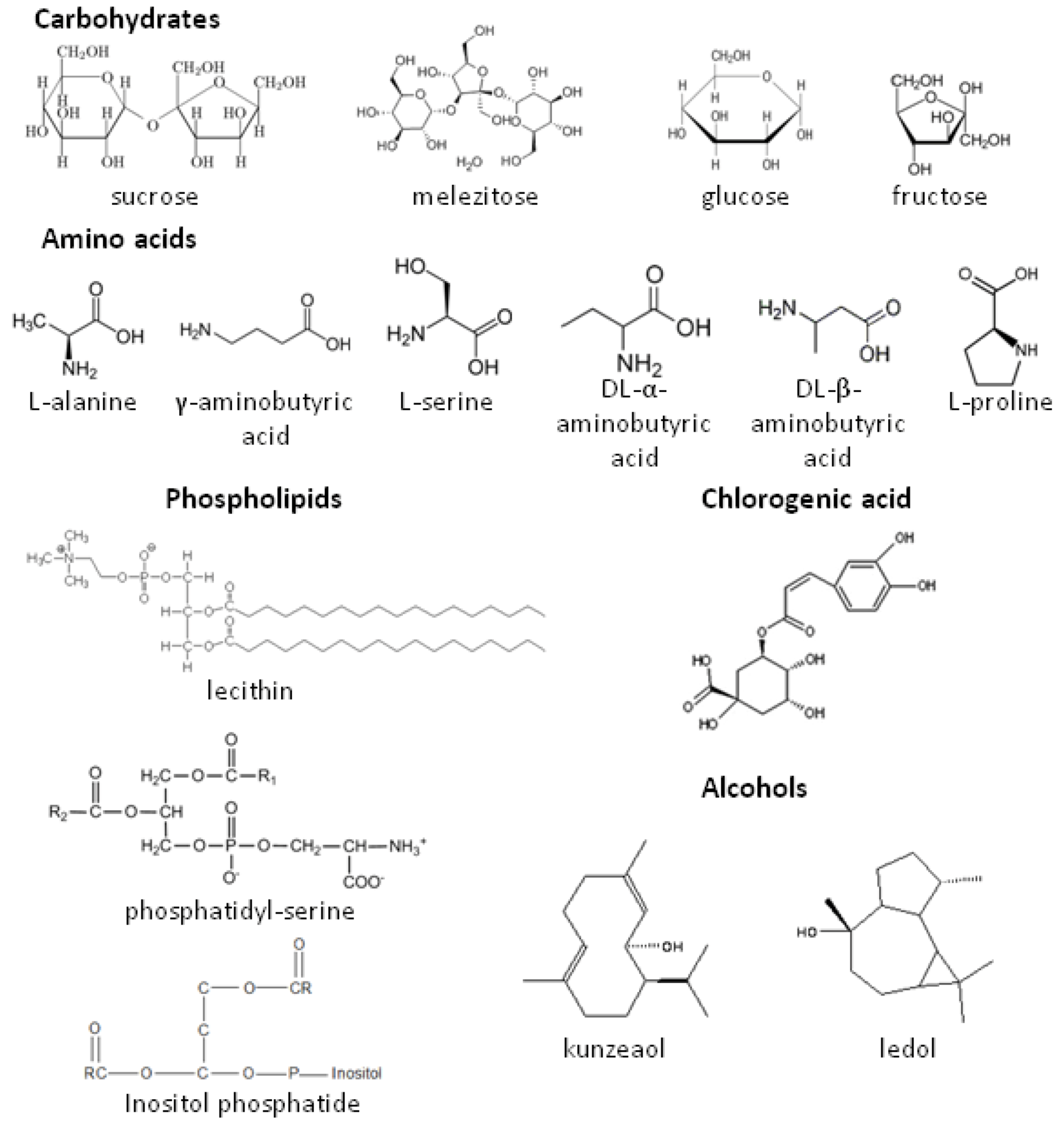
        <p>In phytophagous insects, chemical signals have an important role in host plant recognition and acceptance. For CPB, several feeding stimulants (<xref ref-type="fig" rid="insects-04-00031-f001">Figure 1</xref>) have been identified by Hsiao and Fraenkel [<xref ref-type="bibr" rid="B34-insects-04-00031">34</xref>] as carbohydrates (sucrose, melezitose, glucose and fructose), amino acids (L-alanine, γ-aminobutyric acid, L-serine, DL-α-aminobutyric acid, DL-β-aminobutyric acid and L-proline), phospholipids (lecithin, phosphatidyl L-serine and inositol phosphatide) and chlorogenic acid [<xref ref-type="bibr" rid="B35-insects-04-00031">35</xref>]. Inorganic salts (KCl, KH<sub>2</sub>PO<sub>4</sub> and NaCl) may act as co-factors of phagostimulants and enhance feeding [<xref ref-type="bibr" rid="B34-insects-04-00031">34</xref>]. Kunzeaol and ledol, two alcohols present in the leaf surface of potatoes, showed a phagostimulant effect but the concentration applied in bioassays was 5-fold higher than in a natural potato leaf [<xref ref-type="bibr" rid="B36-insects-04-00031">36</xref>].</p>
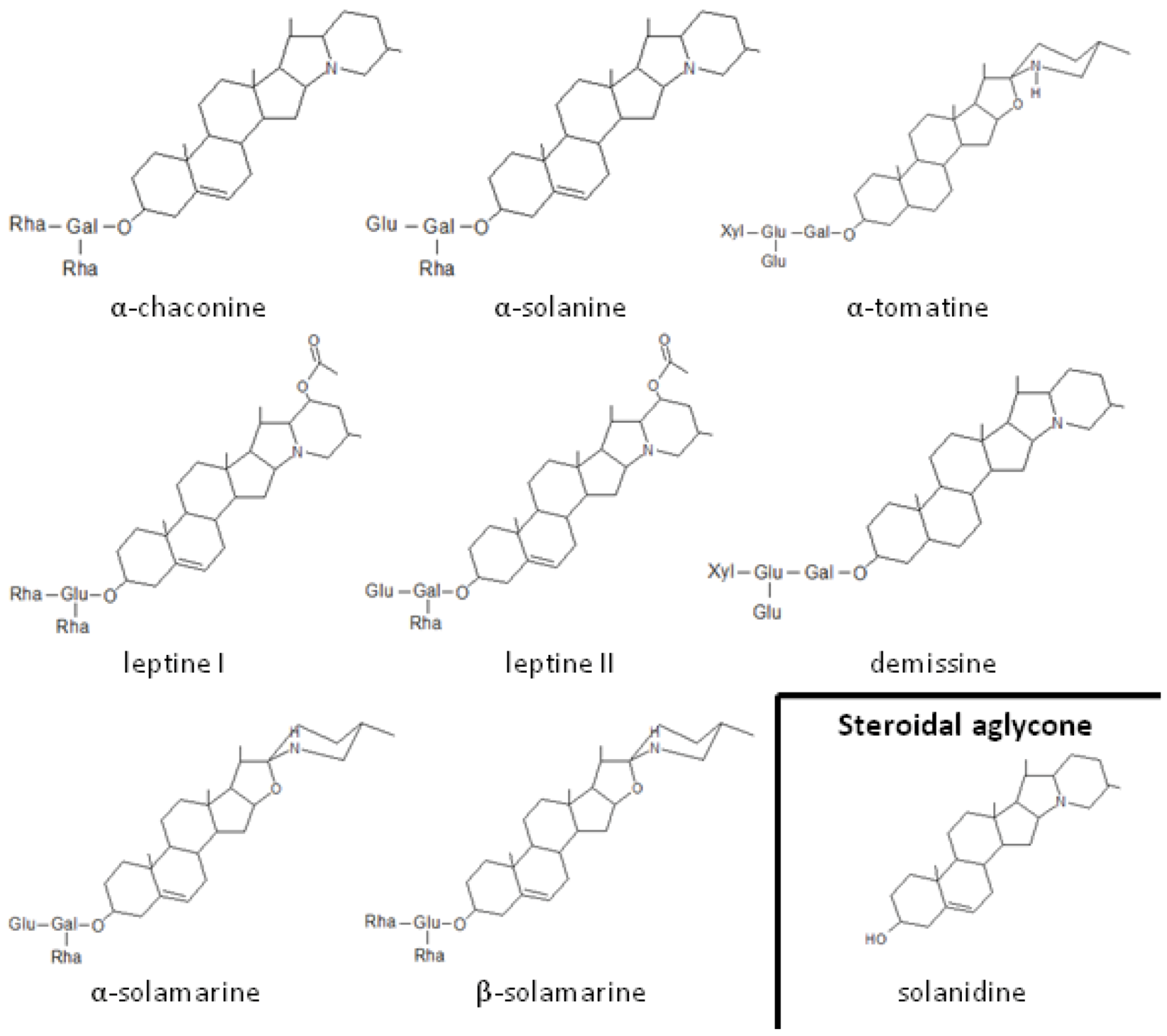
        <p>Potatoes and other solanaceous plants contain glycoalkaloids [<xref ref-type="bibr" rid="B37-insects-04-00031">37</xref>,<xref ref-type="bibr" rid="B38-insects-04-00031">38</xref>] (<xref ref-type="fig" rid="insects-04-00031-f002">Figure 2</xref>) that are thought to provide resistance against herbivorous insects including CPB [<xref ref-type="bibr" rid="B39-insects-04-00031">39</xref>]. Solanine, chaconine, tomatine [<xref ref-type="bibr" rid="B40-insects-04-00031">40</xref>], leptines [<xref ref-type="bibr" rid="B41-insects-04-00031">41</xref>] and demissines [<xref ref-type="bibr" rid="B42-insects-04-00031">42</xref>] have been identified as deterrents. Hybridization was used to create new potato progenies containing leptines with increased resistance to beetles [<xref ref-type="bibr" rid="B43-insects-04-00031">43</xref>]. Hollister <italic>et al.</italic> [<xref ref-type="bibr" rid="B44-insects-04-00031">44</xref>] demonstrated a specific dose dependent response to leptine I from a neuron associated with chemosensory hairs on the galea of CPB. Solanine and tomatine did not induce dose dependent responses but modified responses to leptine I and elicited irregular bursts of neural activity. These results are consistent with those of others and provide neural mechanisms for feeding deterrence attributed to these alkaloids [<xref ref-type="bibr" rid="B44-insects-04-00031">44</xref>,<xref ref-type="bibr" rid="B45-insects-04-00031">45</xref>,<xref ref-type="bibr" rid="B46-insects-04-00031">46</xref>].</p>
        <p>Various studies have examined the impact of glycoalkaloids on the development of CPB with equivocal results. Hare [<xref ref-type="bibr" rid="B47-insects-04-00031">47</xref>] tested the addition of glycoalkaloids (α and β-solamarine, α-tomatine, α-chaconine and α-solanine) to diets and observed weight gain of larvae after 24 hours. He concluded that larval development was negatively affected by each alkaloid. Kowalski <italic>et al.</italic> [<xref ref-type="bibr" rid="B48-insects-04-00031">48</xref>] studied the effects of five alkaloids (α-tomatine, α-chaconine, α-solanine, leptine I and the steroidal aglycone solanidine) on the development of CPB larvae, from hatching to prepupal stage. They highlighted the adverse effects of leptine I and steroidal aglycone solanidine on the development of the larva (weight gain and time to molt). On the other hand, α-chaconine (at high concentration) and a mix of α-chaconine with α-solanine (at concentrations commonly found in <italic>S. tuberosum</italic>) did not affect the larval growth. In 2007, Lyytinen <italic>et al.</italic> studied three varieties of potatoes in terms of nitrogen content (positive effect on beetle performance expected) and glycoalkaloid concentration (negative effect expected) [<xref ref-type="bibr" rid="B49-insects-04-00031">49</xref>]. Based on larval growth and survival, no significant difference was found in beetle performance related to the glycoalkaloid content of the potato variety. Moreover, Armer [<xref ref-type="bibr" rid="B50-insects-04-00031">50</xref>] showed that fourth instar CPB larvae and adults neither sequester nor metabolize glycoalkaloids (solanine and chaconine). In conclusion, the higher the concentration in glycoalkaloids, the more deterrent the host plant. However, the latter studies indicate that glycoalkaloids do not affect survival of larvae and adults.</p>
		<fig id="insects-04-00031-f001" position="float">
          <label>Figure 1</label>
          <caption>
            <p>Feeding stimulants of the Colorado potato beetle, <italic>Leptinotarsa decemlineata</italic>.</p>
          </caption>
          <graphic xmlns:xlink="http://www.w3.org/1999/xlink" xlink:href="insects-04-00031-g001.tif"/>
        </fig>
        
        <p>Other chemical defense mechanisms against herbivores in plants have also been reported. For example, Kruzmane <italic>et al.</italic> [<xref ref-type="bibr" rid="B51-insects-04-00031">51</xref>] showed that larval regurgitant increased production of ethylene and activity of two plant enzymes, peroxidase and polyphenol oxidase. The larval regurgitant can override proteinase inhibitors produced by the plant to limit the growth of herbivores. Indeed, two studies showed that the regurgitant of larvae prevented these genes transcribing some proteinase inhibitors [<xref ref-type="bibr" rid="B52-insects-04-00031">52</xref>,<xref ref-type="bibr" rid="B53-insects-04-00031">53</xref>]. Another study on gene expression in tomato, <italic>Lycopersicon esculentum</italic> L., showed that CPB larval regurgitant, induced a lower expression of defense genes compared with that induced by larval regurgitant of <italic>Manduca sexta</italic> (L.) (Lepidoptera: Sphingidae) [<xref ref-type="bibr" rid="B54-insects-04-00031">54</xref>].</p>
		
		<fig id="insects-04-00031-f002" position="float">
          <label>Figure 2</label>
          <caption>
            <p>Potential deterrents for Colorado potato beetle, <italic>Leptinotarsa decemlineata</italic>, include glycoalkaloids and a derived aglycone. Abbreviations for sugar group: Rha: Rhamnose; Gal: Galactose; Glu: Glucose; Xyl: Xylose.</p>
          </caption>
          <graphic xmlns:xlink="http://www.w3.org/1999/xlink" xlink:href="insects-04-00031-g002.tif"/>
        </fig>
        
      </sec>
      <sec>
        <title>2.2. Role of Plant Volatiles in CPB Orientation</title>
        <p>When CPB complete diapause and emerge from soil in spring, they quickly need to find host plants, using their olfactory system to locate a food source. The first observation on the attractive effect of volatile organic compounds (VOC) from potato was made by McIndoo [<xref ref-type="bibr" rid="B55-insects-04-00031">55</xref>] using an olfactometer test. In 1950, Chin also found that larvae were attracted by potato VOCs but at very short distances (&lt;5mm) in an assay without airflow [<xref ref-type="bibr" rid="B56-insects-04-00031">56</xref>]. In a wind tunnel, De Wilde <italic>et al.</italic> [<xref ref-type="bibr" rid="B57-insects-04-00031">57</xref>] showed that CPB adults were: (1) attracted to odors released by potential host-plants (potato, tomato, bittersweet, black nightshade and celery), (2) indifferent to alder, and (3) repelled by grass and dandelion. The attraction by potatoes disappeared with excision of the fourth antennal segment [<xref ref-type="bibr" rid="B57-insects-04-00031">57</xref>]. In another study, Visser and Nielsen [<xref ref-type="bibr" rid="B58-insects-04-00031">58</xref>] showed that CPB were attracted to solanaceous plants and supposed that after contact with the host plant, other mechanisms were involved in final acceptance. Starved males and females were attracted to undamaged potato plants in a wind tunnel [<xref ref-type="bibr" rid="B59-insects-04-00031">59</xref>]. Attraction of CPB toward potato plants was stronger with plants aged from four to eight weeks than with young potato plants [<xref ref-type="bibr" rid="B59-insects-04-00031">59</xref>]. Further, Thiery and Visser [<xref ref-type="bibr" rid="B60-insects-04-00031">60</xref>] showed that hunger was also important. In experiments using a servosphere, fed females exhibited less direct paths to potato VOCs, a decrease of the average speed, and more stops compared to starved females which showed a more distinct attraction to potato VOCs.</p>
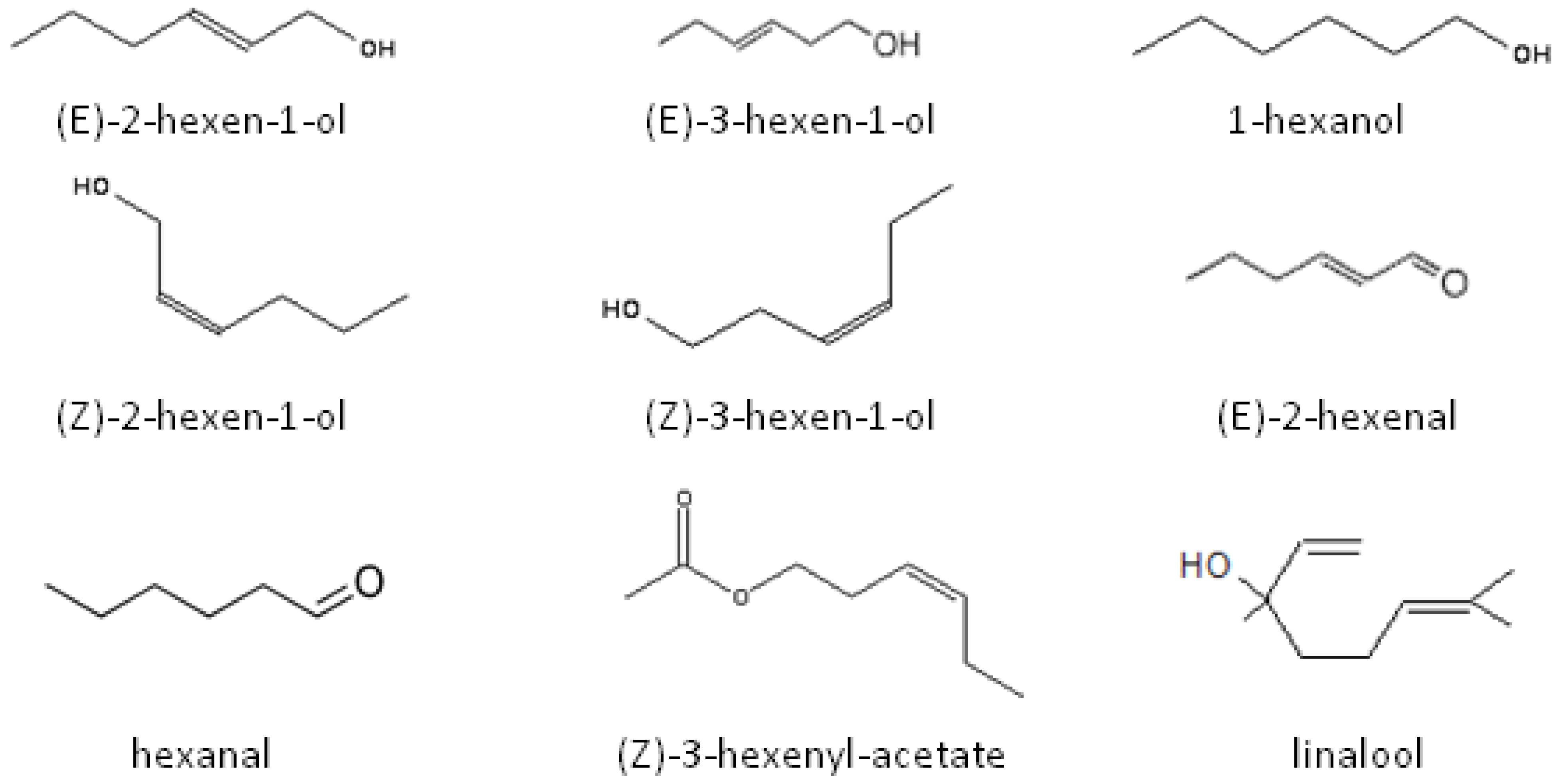
        <p>In 1979, Visser <italic>et al.</italic> characterized several VOCs called green leaf volatiles (GLVs) from potato with a successive vacuum steam distillation, freeze concentration, and extraction. (<italic>E</italic>)-2-hexen-l-ol, 1-hexanol, (<italic>Z</italic>)-3-hexen-l-ol, (<italic>E</italic>)-2-hexenal, and linalool were identified as main components of potato odor [<xref ref-type="bibr" rid="B61-insects-04-00031">61</xref>]. Visser [<xref ref-type="bibr" rid="B62-insects-04-00031">62</xref>] used electroantennograms (EAGs) to show that olfactory receptors of CPB adults responded to VOCs including (<italic>E</italic>)-2-hexen-1-ol, (<italic>Z</italic>)-3-hexen-1-ol, 1-hexanol, (<italic>E</italic>)-2-hexenal, hexanal and (<italic>Z</italic>)-3-hexenyl-acetate, <italic>i.e.</italic> GLVs, and to their isomers such as (<italic>E</italic>)-3-hexen-l-ol and (<italic>Z</italic>)-2-hexen-l-ol (<xref ref-type="fig" rid="insects-04-00031-f003">Figure 3</xref>). Dickens [<xref ref-type="bibr" rid="B63-insects-04-00031">63</xref>] confirmed the EAG results of Visser [<xref ref-type="bibr" rid="B62-insects-04-00031">62</xref>] and demonstrated the importance of sexual maturity for the recognition and attraction of the plant VOCs. The sensitivity of CPB antennae to potato VOCs increased with the number of post emergence days and sexual maturation. Maximal antennal sensitivity was recorded at 6–8 days males and 12–14 days females [<xref ref-type="bibr" rid="B63-insects-04-00031">63</xref>]. VOCs were classified into five groups based on the development and magnitude of the EAGs they elicited: (1) chemicals with a strong response and a weak variability during sexual maturation such as (<italic>Z</italic>)-3-hexen-1-ol and (<italic>E</italic>)-2-hexen-1-ol; (2) chemicals with an intermediate response and slightly increasing response with maturity such as methyl salicylate, nonanal, and (<italic>Z</italic>)-3-hexenyl butyrate; (3) chemicals with a low response and a little variation with maturation, including indole, (±)-linalool, and decanal; (4) chemicals with a weak response and slightly increasing reaction during the maturation such as β-caryophyllene and β-selinene; (5) chemicals with a weak response and a decreasing activity with maturation, including 1,8-cineole, (<italic>R</italic>)-(+)-limonene, (<italic>S</italic>)-(−)-limonene, myrcene, (1<italic>R</italic>)-(+)-a-pinene, (1<italic>S</italic>)-(−)-a-pinene, a-humulene, and (+)-longifolene. Mitchell and McCashin [<xref ref-type="bibr" rid="B64-insects-04-00031">64</xref>] showed that CPB may also taste GLVs. They found that nerve cells housed within the galeal sensilla of both adult and larval CPB responded to primary alcohols (hexanol and heptanol) and other components found among the GLV mixture such as the monounsaturated (<italic>Z</italic>)- and (<italic>E</italic>)-isomers of hexen-1-ol and the six-carbon aldehyde analog, (<italic>E</italic>)-2-hexenal.</p>
        <fig id="insects-04-00031-f003" position="float">
          <label>Figure 3</label>
          <caption>
            <p>Green leaf volatiles and their isomers from potato as potential chemical signals for the Colorado potato beetle, <italic>Leptinotarsa decemlineata</italic>. </p>
          </caption>
          <graphic xmlns:xlink="http://www.w3.org/1999/xlink" xlink:href="insects-04-00031-g003.tif"/>
        </fig>
        <p>GLVs are found in the headspace of most plant species and the fact that beetles distinguish potatoes from other plants is thought to be due to their ability to perceive the proper ratio of GLVs corresponding to potatoes [<xref ref-type="bibr" rid="B65-insects-04-00031">65</xref>]. Indeed, GLVs identified as originating from potato were tested individually and CPB females showed no attractive effect [<xref ref-type="bibr" rid="B61-insects-04-00031">61</xref>]. When potato GLVs were added, one by one, to the original odor cocktail from potato, no attraction was found, demonstrating that the whole cocktail of GLV in a very specific ratio, attract CPB [<xref ref-type="bibr" rid="B65-insects-04-00031">65</xref>]. Using an open air Y-olfactometer, CPB discriminated between two plants on the basis of their VOCs [<xref ref-type="bibr" rid="B66-insects-04-00031">66</xref>]. In this study, CPB preferentially chose potato <italic>versus</italic> tomato and eggplant, and preferred volatiles of the eggplant over the tomato. In field studies, when potatoes were intercropped or surrounded by other plants, the positive anemotaxis disappears because CPB do not perceive the potato odor blend alone. This change in the ratio of individual volatiles within the odorous blend disrupts orientation of CPB [<xref ref-type="bibr" rid="B67-insects-04-00031">67</xref>,<xref ref-type="bibr" rid="B68-insects-04-00031">68</xref>,<xref ref-type="bibr" rid="B69-insects-04-00031">69</xref>], a point that will be discussed further in a context of integrated pest management (IPM).</p>
        <p>Wounded potato plants have different emissions of VOCs compared to healthy plants, and changes depend on the nature of the damage: mechanical damage, molecules eliciting defense mechanisms, or CPB-infested plants. Whatever the origin of damage, CPB adults are attracted [<xref ref-type="bibr" rid="B70-insects-04-00031">70</xref>,<xref ref-type="bibr" rid="B71-insects-04-00031">71</xref>,<xref ref-type="bibr" rid="B72-insects-04-00031">72</xref>]. Bolter <italic>et al.</italic> [<xref ref-type="bibr" rid="B70-insects-04-00031">70</xref>] confirmed the results of Visser [<xref ref-type="bibr" rid="B59-insects-04-00031">59</xref>] that old plants were attractive to CPB females while young plants did not attract beetles. When plants were wounded using carborundum powder, VOCs were released that induced positive anemotaxis [<xref ref-type="bibr" rid="B70-insects-04-00031">70</xref>]. Positive anemotaxis was observed when CPB larvae actively fed on foliage, but this behavior disappeared when CPB wounded potatoes were tested 50 min after a feeding period of 30 min. When the feeding duration was longer, attraction was observed for a longer period of time. This study suggested that there are different volatiles inducing attraction. First, VOCs released directly from the wound site and later VOCs in response to herbivorous pests [<xref ref-type="bibr" rid="B70-insects-04-00031">70</xref>]. Similar results were found for damage caused by <italic>Spodoptera exigua</italic> (Hübner) (Lepidoptera: Noctuidae) larvae feeding on potato [<xref ref-type="bibr" rid="B70-insects-04-00031">70</xref>]. Potato plants injured by CPB larvae released an amount of VOCs seven to ten-fold higher than quantities released by healthy plants [<xref ref-type="bibr" rid="B70-insects-04-00031">70</xref>]. Anemotactic behavior of CPB was evaluated for VOCs released by plants that were: (1) damaged by insect feeding (CPB and cabbage looper, <italic>Trichoplusia ni</italic> (Hübner) (Lepidoptera: Noctuidae)), (2) chemically treated with either volicitin, a molecule isolated and identified from beet armyworm larval regurgitant that induces corn seedlings to emit volatiles [<xref ref-type="bibr" rid="B73-insects-04-00031">73</xref>] or methyl jasmonate, a compound that induces synthesis of proteinase inhibitors in plant leaves [<xref ref-type="bibr" rid="B74-insects-04-00031">74</xref>], (3) mechanically damaged [<xref ref-type="bibr" rid="B71-insects-04-00031">71</xref>,<xref ref-type="bibr" rid="B72-insects-04-00031">72</xref>]. Damage by CPB and cabbage looper larval feeding was mimicked by making an incision on the leaf and applying larval regurgitant to the wound. During the study by Schutz <italic>et al.</italic> [<xref ref-type="bibr" rid="B72-insects-04-00031">72</xref>], preference tests showed a greater attraction for: plants damaged and treated with CPB larval regurgitant &gt; mechanically damaged plants &gt; undamaged plants. Another study showed similar results and noted that plants damaged and treated with larval regurgitant (CPB and cabbage looper) or chemicals (volicitin or methyl jasmonate) were attractive for CPB females while undamaged plants were not attractive [<xref ref-type="bibr" rid="B71-insects-04-00031">71</xref>]. Moreover, Schutz Schutz <italic>et al.</italic> [<xref ref-type="bibr" rid="B72-insects-04-00031">72</xref>] demonstrated attraction by β-caryophyllene over a short distance while 2-phenylethanol was attractive at a long distance.</p>
        <p>CPB larvae (2nd and 4th instar) are also attracted by the odors from healthy and injured potato plants, without showing any preference for one or the other [<xref ref-type="bibr" rid="B75-insects-04-00031">75</xref>]. A three component blend comprising (±)-linalool, methyl salicylate and (<italic>Z</italic>)-3-hexenyl acetate attracted both larval and adult CPB, the latter being attracted to lower concentrations of this chemical blend [<xref ref-type="bibr" rid="B75-insects-04-00031">75</xref>]. Hammock <italic>et al.</italic> [<xref ref-type="bibr" rid="B76-insects-04-00031">76</xref>] found similar results for CPB larval perception of potato VOCs and noted that larvae reduce their speed in the presence of VOCs, perhaps indicative of the proximity of food resources.</p>
        <p>For additional descriptions of setups used in behavioral assays, we recommend the chapter of Hare [<xref ref-type="bibr" rid="B77-insects-04-00031">77</xref>] in "<italic>Methods in Chemical Ecology, Vol. 2</italic>".</p>
      </sec>
    </sec>
    <sec>
      <title>3. Intraspecific Communication in CPB</title>
      <sec>
        <title>3.1. Sexual Recognition and Sex Pheromone</title>
        <p>In 1969, De Wilde <italic>et al.</italic> hypothesized a sex pheromone in CPB mating behavior [<xref ref-type="bibr" rid="B57-insects-04-00031">57</xref>]. Males were attracted by excised elytra of females; this attraction disappeared when elytra were extracted for 2 h with pentane in a Soxhlet apparatus [<xref ref-type="bibr" rid="B78-insects-04-00031">78</xref>]. This pheromone is likely to act after contact between partners. Jermy and Butt [<xref ref-type="bibr" rid="B79-insects-04-00031">79</xref>] demonstrated that a glass rod, covered by an extract of female elytra, stimulated males to copulate with the rod.</p>
        <p>In a greenhouse assay, males moved from a potato plant toward another potato plant 50 cm distant downwind that was infested by females [<xref ref-type="bibr" rid="B80-insects-04-00031">80</xref>]. While this study suggested that a female sex pheromone attracted males over a short distance, one must be cautious when speaking about “sex pheromone” because a chemical has never been identified and the percentage of males attracted by females was relatively low [<xref ref-type="bibr" rid="B80-insects-04-00031">80</xref>].</p>
        <p>Dubis <italic>et al.</italic> [<xref ref-type="bibr" rid="B81-insects-04-00031">81</xref>] identified cuticular hydrocarbons of CPB and found the same hydrocarbons in both sexes but with quantitative differences. However, long-chained hydrocarbons were present in higher proportion in females than in males. Physical contact between two individuals of opposite sex also influences foraging behavior toward host plants. After a single contact with another beetle of the opposite sex, CPB remained attracted to potato VOCs for 24 hours, but during the second day, this attraction disappeared. Attraction to VOCs emitted by potato reappeared only after 72 hours. This should be considered as an adaptation to lower attraction for host plant while enhancing reproduction success as suggested by Dickens who observed that during two days, beetles moved less and increases their chances to meet a sexual partner [<xref ref-type="bibr" rid="B82-insects-04-00031">82</xref>]. These studies demonstrated the importance of contact between partners but did not demonstrate the existence of long-range sex pheromone. These studies led some researchers to reconsider the existence of a volatile sex pheromone and to explore other possibilities of long-range pheromones.</p>
      </sec>
      <sec>
        <title>3.2. Aggregation Pheromone and Aggregation Behavior</title>
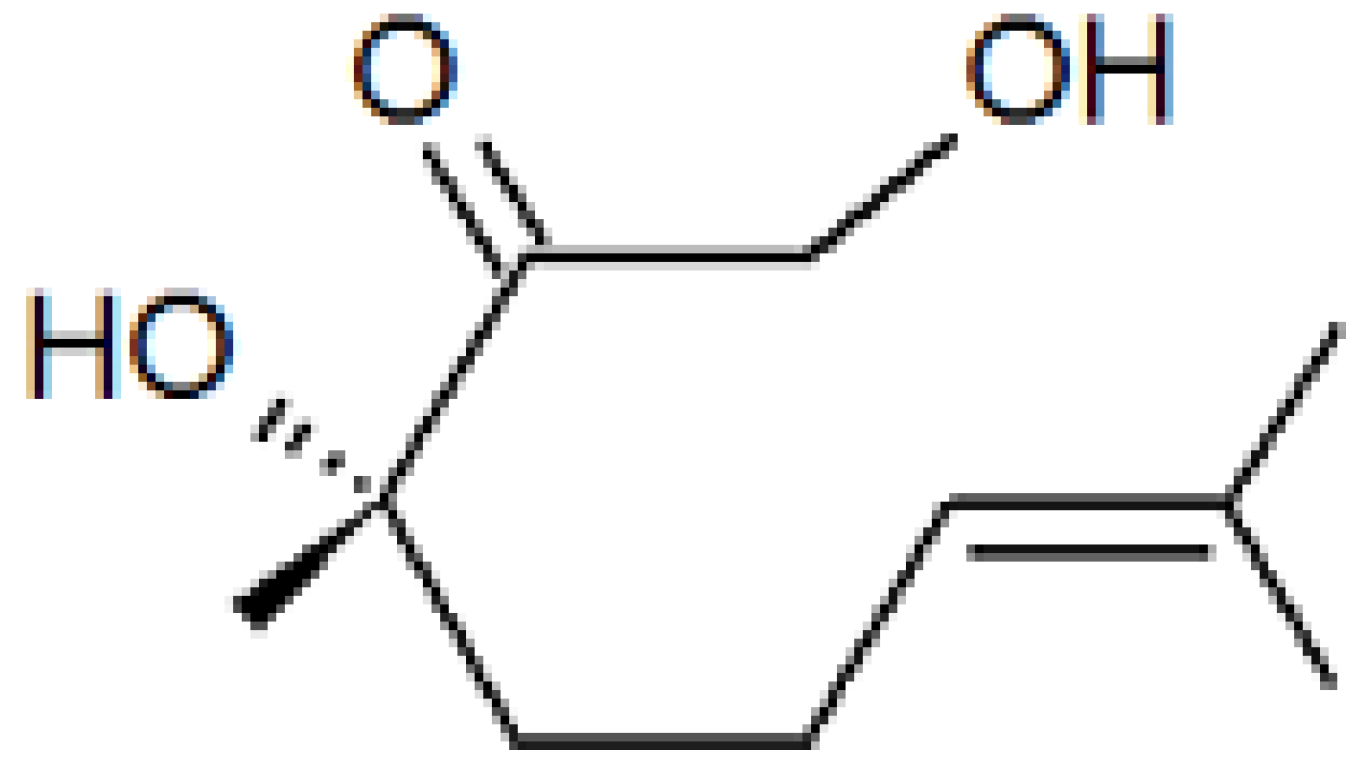
        <p>While several studies were directed to the characterization of a potential female-produced sex pheromone (see above), Dickens <italic>et al.</italic> [<xref ref-type="bibr" rid="B83-insects-04-00031">83</xref>] announced the discovery of an aggregation pheromone produced by males. Using GC-EAD (gas chromatography coupled with an electroantennographic detector) for analysis of aeration extracts of CPB males, active components were identified which elicited responses from olfactory receptors of both males and females. Among these chemicals, a single molecule was only found in volatiles of plants being fed on by male beetles. As only small quantities of the unknown compound were released, it was reasoned that males must regulate release through a feedback loop involving olfactory receptors on the antennae. When the antennae were excised, quantities of the unknown compound increased 40-fold. Topical application of juvenile hormone III (JH III) also stimulated pheromone release to a lesser extent. However, the combination of antennectomy and JH III treatment allowed a 200-fold increase, thus facilitating identification of the compound as (<italic>S</italic>)-3,7-dimethyl-2-oxo-oct-6-ene-1,3-diol, named (<italic>S</italic>)-CPB I (<xref ref-type="fig" rid="insects-04-00031-f004">Figure 4</xref>) [<xref ref-type="bibr" rid="B83-insects-04-00031">83</xref>]. The biological effect of (<italic>S</italic>)-CPB I was first evaluated in a Y-olfactometer on male and female CPB, both of which were highly attracted. The (<italic>R</italic>) enantiomer and the racemic mixture were not attractive [<xref ref-type="bibr" rid="B83-insects-04-00031">83</xref>]. CPB larvae also seem capable of perceiving the aggregation pheromone produced by adults, but further studies are needed to characterize larval behavior [<xref ref-type="bibr" rid="B76-insects-04-00031">76</xref>]. This aggregation pheromone should be useful in IPM programs as a key component of a potential attracticide (see later).</p>
        <fig id="insects-04-00031-f004" position="float">
          <label>Figure 4</label>
          <caption>
            <p>Male-produced aggregation pheromone for Colorado potato beetle, <italic>Leptinotarsa decemlineata</italic>: (S)-3,7-dimethyl-2-oxo-oct-6-ene-1,3-diol or (S)-CPB I. </p>
          </caption>
          <graphic xmlns:xlink="http://www.w3.org/1999/xlink" xlink:href="insects-04-00031-g004.tif"/>
        </fig>
      </sec>
    </sec>
    <sec>
      <title>4. Interspecific Interactions</title>
      <sec>
        <title>4.1. Defensive Chemicals</title>
        <p>CPB hemolymph contains a protein called leptinotarsin which is highly toxic when injected directly in insects or vertebrates. However leptinotarsin was found to be less toxic when ingested [<xref ref-type="bibr" rid="B84-insects-04-00031">84</xref>]. In mammals, this protein instantaneously blocks heart muscle cells [<xref ref-type="bibr" rid="B84-insects-04-00031">84</xref>,<xref ref-type="bibr" rid="B85-insects-04-00031">85</xref>,<xref ref-type="bibr" rid="B86-insects-04-00031">86</xref>]. Leptinotarsin also limits reproduction of the pathogenic nematode, <italic>Heterorhabditis marelatus</italic> Liu and Berry, in CPB [<xref ref-type="bibr" rid="B87-insects-04-00031">87</xref>].</p>
        <p>When disturbed, adult CPB eject a secretion through defensive glands located on the pronotum and the elytra. The major chemical component of the secretion has been identified as γ-L-glutamyl-L-2-amino-3(Z), 5-hexadienoic acid [<xref ref-type="bibr" rid="B88-insects-04-00031">88</xref>]. Preliminary experiments suggested that this molecule is toxic for <italic>Myrmica rubra</italic> (L.) (Hymenoptera: Formicidae) and deterrent for chickens [<xref ref-type="bibr" rid="B88-insects-04-00031">88</xref>,<xref ref-type="bibr" rid="B89-insects-04-00031">89</xref>].</p>
      </sec>
      <sec>
        <title>4.2. Volatile Perception by Predators</title>
        <p>Dickens [<xref ref-type="bibr" rid="B90-insects-04-00031">90</xref>] analyzed GC-EAD responses of a generalist and a specialist CPB predator, respectively, <italic>Podisus maculiventris</italic> (Say) (Hemiptera: Pentatomidae) and <italic>Perillus bioculatus</italic> (Fabr.) (Hemiptera: Pentatomidae), to constitutive odors and systemic volatiles elicited by CPB feeding. GC-EAD tests showed that, unlike CPB that detect easily GLVs, predators were more sensitive to volatile molecules induced by the systemic reaction of the plant injured by CPB larvae. Other studies on <italic>P. bioculatus</italic> showed the attractant effect of plant volatiles from a CPB infested plant [<xref ref-type="bibr" rid="B91-insects-04-00031">91</xref>,<xref ref-type="bibr" rid="B92-insects-04-00031">92</xref>,<xref ref-type="bibr" rid="B93-insects-04-00031">93</xref>]. CPB damage of plants caused a systemic reaction inducing production of VOCs that attracted third and fifth instars of <italic>P. maculiventris</italic> [<xref ref-type="bibr" rid="B94-insects-04-00031">94</xref>].</p>
      </sec>
      <sec>
        <title>4.3. Interactions between Different Pest Species</title>
        <p>The fact that a potato field is already attacked by another herbivore than CPB may influence the distribution of CPB. Bolter <italic>et al.</italic> [<xref ref-type="bibr" rid="B70-insects-04-00031">70</xref>] first demonstrated attraction of CPB adults to potatoes damaged by heterospecific herbivores, e.g., <italic>S. exigua</italic> larvae. Field cage tests with high densities of leafhoppers affected CPB as: (1) fewer egg masses on the potato foliage were observed, (2) larval development was longer with fewer surviving and (3) freshly emerged adults weighed less [<xref ref-type="bibr" rid="B95-insects-04-00031">95</xref>]. While this competition between the herbivores could be used by farmers to limit colonization by CPB, one must ensure that leafhopper damage does not involve an important yield loss. Furthermore, the idea of placing other pests competitive with CPB on potatoes remains unrealistic as farmers would be unlikely to accept such an approach.</p>
        <p>Gosset <italic>et al.</italic> [<xref ref-type="bibr" rid="B96-insects-04-00031">96</xref>] demonstrated that volatiles emitted by injured potato depended on whether the herbivores were piercing-sucking or chewing type feeders. Despite apparently lesser injuries inflicted by the aphid, <italic>Myzus persicae</italic> (Sulzer) (Homoptera: Aphididae), a greater number of volatiles were released, perhaps due to pathogen infection. Aphids were also unaffected by preliminary CPB wounding, suggesting that the presence of CPB does not influence the colonization behavior of <italic>Macrosiphum euphorbiae</italic> (Thomas) (Homoptera: Aphididae) [<xref ref-type="bibr" rid="B97-insects-04-00031">97</xref>].</p>
      </sec>
    </sec>
    <sec>
      <title>5. Semiochemical-Based IPM Strategies</title>
      <p>Recent discoveries have enhanced knowledge of chemical communication in CPB and highlight the potential of semiochemicals as a component of future integrated management strategies. However, the chemical ecology of CPB is not yet completely understood and this incomplete knowledge makes semiochemical-based approaches inefficient when compared to traditional insecticide treatments. However, alternative strategies have potential in the control of CPB populations and include: (1) disorientation of CPB adults by masking potato VOCs with intercropping cultures; (2) use of synthetic mixtures of volatiles and/or aggregation pheromone to trap beetles; (3) antifeedant sprays on potatoes; (4) increase, with genetic manipulations, the natural capacity of the plant to recognize the presence of CPB through chemical signals, thus triggering defense mechanisms. These tools are summarized in <xref ref-type="table" rid="insects-04-00031-t002">Table 2</xref>.</p>
      <sec>
        <title>5.1. Disorientation of CPB Adults with Masking Odors</title>
        <p>Intercropping represents an efficient method to repel and/or confuse CPB foraging for host plants. Among the 13 identified compounds from tansy oil, five were repellents (α- and γ-terpinene, α,β-thujone, dihydrocarvone and carvone) and one compound (α-pinene) was an attractant [<xref ref-type="bibr" rid="B98-insects-04-00031">98</xref>]. When tansy was used as an intercrop in potato fields, a 60%–100% decrease in the number of beetles present in the fields was observed [<xref ref-type="bibr" rid="B99-insects-04-00031">99</xref>]. Two other studies have shown that potato VOCs mixed with VOCs from tomato or cabbage, disrupted the searching behavior of CPB females for host plants [<xref ref-type="bibr" rid="B68-insects-04-00031">68</xref>,<xref ref-type="bibr" rid="B69-insects-04-00031">69</xref>].</p>
        <p>These initial results demonstrate the exciting potential of intercropping and support preliminary laboratory studies by Visser and Ave [<xref ref-type="bibr" rid="B65-insects-04-00031">65</xref>] that suggested that host orientation could be disrupted by modification of the ratio VOCs. Moreover, few intercropping models were studied and further investigations should be considered with other plant species.</p>
		<table-wrap id="insects-04-00031-t002" position="float">
        <object-id pub-id-type="pii">insects-04-00031-t002_Table 2</object-id>
        <label>Table 2</label>
        <caption>
          <p>Different approaches suggested to control the Colorado potato beetle.</p>
        </caption>
        <table>
          <thead>
            <tr>
              <th align="left" valign="middle">
                <italic>Name</italic>
              </th>
              <th align="left" valign="middle">
                <italic>Schemas</italic>
              </th>
              <th align="left" valign="middle">
                <italic>Brief description</italic>
              </th>
            </tr>
          </thead>
          <tbody>
            <tr>
              <td align="left" valign="middle">
                <italic>Masking odors</italic>
              </td>
              <td align="left" valign="middle">
                <inline-graphic xmlns:xlink="http://www.w3.org/1999/xlink" xlink:href="insects-04-00031-i001.tif"/>
              </td>
              <td align="left" valign="middle">
                <italic>CPB cannot detect its host plant because GLVs of potatoes were mixing with others odors from cultures intercropping</italic>
              </td>
            </tr>
            <tr style="border-top:solid thin">
              <td align="left" valign="middle">
                <italic>Trap crops</italic>
              </td>
              <td align="left" valign="middle">
                <inline-graphic xmlns:xlink="http://www.w3.org/1999/xlink" xlink:href="insects-04-00031-i002.tif"/>
              </td>
              <td align="left" valign="middle">
                <italic>CPB are attracted in a specific part of the field with semiochemicals and only this part is treated to eliminate the beetles</italic>
              </td>
            </tr>
            <tr style="border-top:solid thin">
              <td align="left" valign="middle">
                <italic>Antifeedants</italic>
              </td>
              <td align="left" valign="middle">
                <inline-graphic xmlns:xlink="http://www.w3.org/1999/xlink" xlink:href="insects-04-00031-i003.tif"/>
              </td>
              <td align="left" valign="middle">
                <italic>Chemical molecules were sprayed on potatoes to deter CPB feeding and damages are lesser on potato foliage</italic>
              </td>
            </tr>
            <tr style="border-top:solid thin">
              <td align="left" valign="middle">
                <italic>Genetic manipulations</italic>
              </td>
              <td align="left" valign="middle">
                <inline-graphic xmlns:xlink="http://www.w3.org/1999/xlink" xlink:href="insects-04-00031-i004.tif"/>
              </td>
              <td align="left" valign="middle">
                <italic>Potatoes are genetically modified to detect CPB presence and to express more their defense mechanisms to prevent CPB colonization</italic>
              </td>
            </tr>
          </tbody>
        </table>
      </table-wrap>
      
      </sec>
      <sec>
        <title>5.2. Use of Attractants and Aggregation Pheromone</title>
        <p>The use of semiochemical attractants to improve insecticide treatments should be considered as an innovative approach of CPB management. Chewing insects are indeed more sensitive to VOCs released by their host plants because the damage they induce in plant tissues increases the release of these compounds [<xref ref-type="bibr" rid="B100-insects-04-00031">100</xref>]. The difficulty consists in finding a cocktail of natural odors within which the quantitative proportion of each compound is as close as possible to that of the naturally emitted blend [<xref ref-type="bibr" rid="B65-insects-04-00031">65</xref>]. The challenge therefore consists in finding the appropriate molecules and their ratio, instead of trying to include as many compounds in the mixture as possible [<xref ref-type="bibr" rid="B100-insects-04-00031">100</xref>].</p>
        <p>The first synthetic blend to show potential in CPB management was comprised of (<italic>E</italic>)-2-hexen-1-ol, (<italic>Z</italic>)-3-hexen-1-ol, nonanal, (±)-linalool and methyl salicylate prepared in paraffin oil [<xref ref-type="bibr" rid="B90-insects-04-00031">90</xref>]. This blend, placed in competition with pure air attracted CPB adults in behavioral assays with a “T” choice test in the laboratory. For better efficiency, the proportion of (<italic>E</italic>)-2-hexen-1-ol and (<italic>Z</italic>)-3-hexen-1-ol were 10-fold lower compared to the three other compounds [<xref ref-type="bibr" rid="B90-insects-04-00031">90</xref>]. Dickens [<xref ref-type="bibr" rid="B75-insects-04-00031">75</xref>] also reported a synthetic blend of three compounds, (<italic>Z</italic>)-3-hexenyl acetate, (±)-linalool and methyl salicylate, which attracted second and fourth larval instars. This blend attracted CPB adults with a 10-fold lower concentration for females and 100-fold lower for males. Yet, an earlier study of [<xref ref-type="bibr" rid="B101-insects-04-00031">101</xref>] could not show attraction of females with this last blend. This attractive blend for all stages of CPB has a very interesting potential for creating attracticides in the field [<xref ref-type="bibr" rid="B75-insects-04-00031">75</xref>].</p>
        <p>The synthetic blend made of (<italic>Z</italic>)-3-hexenyl acetate, (±)-linalool and methyl salicylate, firstly reported in Dickens study [<xref ref-type="bibr" rid="B75-insects-04-00031">75</xref>] was evaluated in a greenhouse where it attracted newly emerged and 5-day-old adults when released at a rate of 57 μg/h [<xref ref-type="bibr" rid="B102-insects-04-00031">102</xref>]. However, habituation was observed in the beetles that were exposed more than 12 hours to this mixture. Initial field tests confirmed the effect of the attractant blend and its usefulness for semiochemical-based control [<xref ref-type="bibr" rid="B103-insects-04-00031">103</xref>]. Pitfall traps baited with the attractant captured a greater number of CPB in potato fields. Moreover, fewer egg masses and larvae were observed in neighboring untreated crops. The use of trap crops with the attractive blend allowed a decrease of 44% insecticides for similar yields to the conventional method [<xref ref-type="bibr" rid="B103-insects-04-00031">103</xref>].</p>
        <p>The first field experiments with the aggregation pheromone, (<italic>S</italic>)-CPB I, were performed by Kuhar <italic>et al.</italic> [<xref ref-type="bibr" rid="B104-insects-04-00031">104</xref>]. They placed pitfalls traps baited with the aggregation pheromone in a 0.5-ha land section cultivated for a good soil uniformity and wherein they released 400 CPB adults in the centre. More than 5-fold numbers of CPB adults were captured in traps baited with septa releasing the pheromone than in control traps. This significant difference in treatment numbers disappeared after 5 days presumably due to evaporation loss or degradation of the pheromone. In the second part of their study, they showed that fewer CPB eggs and larvae were present in plots bordered with pheromone-treated plots than in field plots bordered with untreated rows [<xref ref-type="bibr" rid="B104-insects-04-00031">104</xref>]. While these preliminary results offer promise for use of the pheromone in the field, more research is needed before practical applications may be available.</p>
        <p>In laboratory tests with an vertical Y-olfactometer, CPB adults were confronted with a cocktail of three volatiles, (<italic>Z</italic>)-3-hexenyl acetate, (±)-linalool and methyl salicylate, opposite to the aggregation pheromone [<xref ref-type="bibr" rid="B105-insects-04-00031">105</xref>]. Half of the tested CPB adults chose the aggregation pheromone side of the olfactometer and the other half chose the side connected to the plant volatiles. This indicates that CPB adults were unable to choose between plant VOCs blend and their aggregation pheromone in this vertical bioassay. However, in mowed field assays, the aggregation pheromone coupled with the blend of three odors attracted significantly more CPB adults in comparison with the plant odors blend alone [<xref ref-type="bibr" rid="B105-insects-04-00031">105</xref>].</p>
        <p>Another study in fields was made with the synthetic blend of three plant odors [(<italic>Z</italic>)-3-hexenyl acetate, (±)-linalool and methyl salicylate] [<xref ref-type="bibr" rid="B106-insects-04-00031">106</xref>]. The synthetic blend was coupled with a pyrethroid insecticide at different concentrations. A decrease in first and second instar CPB was observed with an application of 2% or 6% active ingredient permethrin coupled with the odorous blend but this method did not significantly decrease older larval stages because the insecticides were more efficacious on young larval stages [<xref ref-type="bibr" rid="B107-insects-04-00031">107</xref>]. However, the use of this attracticide showed the same control efficiency as the commercial insecticide while using 92% less insecticide by active ingredient [<xref ref-type="bibr" rid="B106-insects-04-00031">106</xref>]. As many CPB populations in the U.S. have developed resistance to permethrin [<xref ref-type="bibr" rid="B108-insects-04-00031">108</xref>], the authors suggested imidacloprid as a replacement [<xref ref-type="bibr" rid="B106-insects-04-00031">106</xref>].</p>
        <p>When considering use of chemical signals for manipulation of the behavior of CPB or other insects, it is important to understand that behavior of insects is a result of integration of multimodal signals in the environment of which olfaction represents only one of the input channels. For example, CPB walking on a servosphere orient to the aggregation pheromone in darkness [<xref ref-type="bibr" rid="B109-insects-04-00031">109</xref>]. However, in the presence of yellow light, a known attractant for CPB, orientation to the pheromone is abolished [<xref ref-type="bibr" rid="B110-insects-04-00031">110</xref>]. Thus, better understanding the complexities of the behavior of CPB and other insects to multimodal signals will enhance design and deployment of management strategies employing naturally-occurring chemical signals.</p>
        <p>The main difficulty with semiochemicals is ensuring a controlled release during a long period. This depends of the active molecule and its release rate kinetic. The knowledge of these molecules is thus essential. Other parameters such as UV light, oxygen, pluviometry and temperature could also alter semiochemicals. Therefore, the choice of the dispenser is also important to control the release and to prevent molecule degradation [<xref ref-type="bibr" rid="B111-insects-04-00031">111</xref>].</p>
      </sec>
      <sec>
        <title>5.3. Antifeedants</title>
        <p>Antifeedants to deter CPB adults and larvae include a wide variety of chemicals. The first chemical deterrents were identified by Hsiao and Fraenkel [<xref ref-type="bibr" rid="B112-insects-04-00031">112</xref>]. Other studies identified a multitude of additional antifeedants including: (1) constituents of some plants from the sagebrush community [<xref ref-type="bibr" rid="B113-insects-04-00031">113</xref>], (2) hydroxides which also act as fungicides [<xref ref-type="bibr" rid="B114-insects-04-00031">114</xref>], alcohol extracts of the leaves and bark of <italic>Quercus alba</italic> L. [<xref ref-type="bibr" rid="B115-insects-04-00031">115</xref>], (3) limonin [<xref ref-type="bibr" rid="B116-insects-04-00031">116</xref>], (4) α-mangostin [<xref ref-type="bibr" rid="B117-insects-04-00031">117</xref>], (5) sesquiterpenes [<xref ref-type="bibr" rid="B118-insects-04-00031">118</xref>], (6) terpenoid lactones [<xref ref-type="bibr" rid="B119-insects-04-00031">119</xref>], and (7) extracts from various plants [<xref ref-type="bibr" rid="B120-insects-04-00031">120</xref>,<xref ref-type="bibr" rid="B121-insects-04-00031">121</xref>] including wild species of potatoes [<xref ref-type="bibr" rid="B122-insects-04-00031">122</xref>,<xref ref-type="bibr" rid="B123-insects-04-00031">123</xref>]. Such molecules and blends of chemicals not only reduce feeding but also may deter oviposition by females as shown for citrus limonoids [<xref ref-type="bibr" rid="B124-insects-04-00031">124</xref>,<xref ref-type="bibr" rid="B125-insects-04-00031">125</xref>]. A phagorepellent effect was also found for leaf surface molecules specific to commercial varieties of <italic>S. tuberosum</italic>. However, the deterrent effect was observed when concentration of these molecules was 10-fold higher than in natural leaves [<xref ref-type="bibr" rid="B126-insects-04-00031">126</xref>]. One should be cautious when discussing antifeedants as physical properties of the plant (e.g., trichomes) and systemic modification of the plant due to the application of an external molecule may also play a deterrent role, an indirect antifeedant effect [<xref ref-type="bibr" rid="B127-insects-04-00031">127</xref>].</p>
        <p>Other field assays were conducted in Hungary by Szentesi [<xref ref-type="bibr" rid="B128-insects-04-00031">128</xref>] in which crops were treated with a 2% Bordeaux mixture during two consecutive weeks. This treatment resulted in significantly more eggs laid on the treated potatoes. The unequal distribution of eggs may have been caused by: (1) a decrease of foliage surface, (2) the presence of different larval instars or (3) the presence of larval and adult feces on unsprayed potatoes, thus highlighting the potential of field areas treated as egg traps [<xref ref-type="bibr" rid="B128-insects-04-00031">128</xref>]. In another study, fields treated regularly with fungicides, triphenyltin hydroxyde (TPTH) or copper hydroxyde (Cu[OH]<sub>2</sub>), had fewer CPB larvae, consistent with these fungicides acting as deterrents. The authors suggested a regular application of TPTH to reduce the use of insecticides and decrease cost [<xref ref-type="bibr" rid="B129-insects-04-00031">129</xref>].</p>
        <p>A neem-seed extract showed good efficiency to control CPB in fields but the magnitude of the effects depended on the dominant CPB life stage present when the application was made [<xref ref-type="bibr" rid="B130-insects-04-00031">130</xref>]. Yields were in some cases commercially acceptable, thus suggesting that neem seed extract applied in the potato growing season may control young larvae without insecticides. In 2006, Moreau <italic>et al.</italic> [<xref ref-type="bibr" rid="B131-insects-04-00031">131</xref>] showed that application of 2% neem reduced CPB densities and defoliation resulting in increased tuber yields. Azadirachtin is the main active molecule from neem extract and a field evaluation with this natural antifeedant showed satisfactory results for reduction of plant damages [<xref ref-type="bibr" rid="B132-insects-04-00031">132</xref>].</p>
        <p>Fields tests on the deterrent effect of citrus limonoids were made during three seasons in Maine. Colonizing CPB adults were fewer in limonoid treated plots, with a decrease in egg masses and smaller numbers of larvae [<xref ref-type="bibr" rid="B133-insects-04-00031">133</xref>]. These results were opposite with those of Szentesi [<xref ref-type="bibr" rid="B128-insects-04-00031">128</xref>] who showed that oviposition increased on potato plants treated with an antifeedant, 2% Bordeaux mixture. Murray <italic>et al.</italic> [<xref ref-type="bibr" rid="B134-insects-04-00031">134</xref>] showed that two applications of a high concentration (10.8 kg/ha) and three applications at a lower dose (3,6 kg/ha) of citrus limonoids were sufficient to maintain the rate of defoliation below 60%, allowing acceptable yields. This study seemed to confirm the potential of limonoids for the management of young larvae at the beginning of the potato growing season [<xref ref-type="bibr" rid="B125-insects-04-00031">125</xref>].</p>
        <p>Despite decades of study, the commercialization of antifeedants has been generally unsuccessful because: (1) they were considered as synthetic insecticides, (2) the life span of an antifeedant may vary depending on weather conditions, (3) they may take a long time before acting and (4) they do not always kill or deter target insects [<xref ref-type="bibr" rid="B133-insects-04-00031">133</xref>].</p>
      </sec>
      <sec>
        <title>5.4. Genetic Manipulations</title>
        <p>Recently there has been interest in genetic manipulation of potato to enhance expression of deterrent compounds. Hybrid assays were conducted with <italic>S. tuberosum</italic> and wild potato species to incorporate the gene expressing leptine and additional glycoalkaloids, to create commercial varieties having enhanced tuber yields and repellent activity [<xref ref-type="bibr" rid="B135-insects-04-00031">135</xref>,<xref ref-type="bibr" rid="B136-insects-04-00031">136</xref>]. Another possibility of genetically modified (GM) potatoes would take advantage of their hypersensitivity to chemical molecules associated with the presence of CPB eggs. In 1972, Wegorek &amp; Dubniak [<xref ref-type="bibr" rid="B137-insects-04-00031">137</xref>] observed necrotic areas near oviposition sites on potato leaves in Polish fields. Since no microorganisms were detected near the plant necrosis, the authors supposed that the necrosis was due to female substances secreted during oviposition. Balbyshev &amp; Lorenzen [<xref ref-type="bibr" rid="B138-insects-04-00031">138</xref>] observed a hybrid potato species with a hypersensitive response to egg deposition; a necrosis around eggs followed by the detachment of this part of the leaf. As neither bacteria nor microorganisms were found, they supposed a chemical associated with eggs was responsible for the defoliation. The consequence of this resistance mechanism was that egg masses fell on the soil, thus increasing predation by soil-dwelling predators such as carabids [<xref ref-type="bibr" rid="B138-insects-04-00031">138</xref>].</p>
      </sec>
    </sec>
    <sec sec-type="conclusions">
      <title>6. Conclusions</title>
      <p>Today, research is still being conducted to better understand CPB biology in an effort to devise new control techniques. Toxic chemical treatments have been the best method to control CPB despite continual development of resistance. Now because of the inevitable decline of effective insecticide treatments, research should focus even more on the development of new control methods and approaches. Some methods such as cultivating GM plants are not seen positively by consumers, and farmers have abandoned them due to a lack of buyers [<xref ref-type="bibr" rid="B139-insects-04-00031">139</xref>]. Among the various alternative control techniques, chemical signals seem to be promising, especially when coupled with the use of natural predators and targeted pesticide treatments. Thus, it is necessary to continue to explore alternative control methods using semiochemicals and important to better understand behaviors generated by these semiochemicals.</p>
      <p>The genetic variability between CPB populations, which seems to be greater for U.S. populations than for those in Europe [<xref ref-type="bibr" rid="B140-insects-04-00031">140</xref>], is also important to consider. Effectively, CPB have shown metabolic adaptations for: (1) insecticide resistance [<xref ref-type="bibr" rid="B10-insects-04-00031">10</xref>,<xref ref-type="bibr" rid="B141-insects-04-00031">141</xref>], (2) range expansion [<xref ref-type="bibr" rid="B142-insects-04-00031">142</xref>], and (3) different Solanaceous hosts [<xref ref-type="bibr" rid="B33-insects-04-00031">33</xref>,<xref ref-type="bibr" rid="B143-insects-04-00031">143</xref>,<xref ref-type="bibr" rid="B144-insects-04-00031">144</xref>]. One study on two different CPB populations showed a difference of intensity in perception of VOCs between Utah and Wageningen populations [<xref ref-type="bibr" rid="B145-insects-04-00031">145</xref>]. Differences in perception of VOCs and perhaps other chemical signals between CPB populations may be important for the development of semiochemical-based control strategies and merit more investigations.</p>
    </sec>
  </body>
  <back>
    <ack>
      <title>Acknowledgements</title>
      <p>We thank the CURAGx for financial support granted to start Ludovic Sablon PhD thesis.</p>
    </ack>
    <ref-list>
      <title>References and Notes</title>
      <ref id="B1-insects-04-00031">
        <label>1.</label>
        <citation citation-type="journal">
          <person-group person-group-type="author">
            <name>
              <surname>Casagrande</surname>
              <given-names>R.A.</given-names>
            </name>
          </person-group>
          <article-title>The Colorado potato beetle: 125 years of mismanagement</article-title>
          <source>Bull. Entomol. Soc. Am.</source>
          <year>1987</year>
          <volume>33</volume>
          <fpage>142</fpage>
          <lpage>150</lpage>
        </citation>
      </ref>
      <ref id="B2-insects-04-00031">
        <label>2.</label>
        <citation citation-type="book">
          <person-group person-group-type="author">
            <name>
              <surname>Riley</surname>
              <given-names>C.V.</given-names>
            </name>
          </person-group>
          <source>Seven Annual Report on the Noxious, Beneficial, and Other Insect of the State of Missouri</source>
          <publisher-name>Regan &amp; Carter</publisher-name>
          <publisher-loc>Jefferson City, MS, USA</publisher-loc>
          <year>1875</year>
        </citation>
      </ref>
      <ref id="B3-insects-04-00031">
        <label>3.</label>
        <citation citation-type="book">
          <person-group person-group-type="author">
            <name>
              <surname>du Chatenet</surname>
              <given-names>G.</given-names>
            </name>
          </person-group>
          <source>Coléoptères Phytophages d'Europe : Chrysomelidae</source>
          <publisher-name>N.A.P Editions</publisher-name>
          <publisher-loc>Verrières Le Buisson, France</publisher-loc>
          <year>2002</year>
          <volume>Vol. 2</volume>
          <fpage>258</fpage>
        </citation>
      </ref>
      <ref id="B4-insects-04-00031">
        <label>4.</label>
        <citation citation-type="journal">
          <person-group person-group-type="author">
            <name>
              <surname>Weber</surname>
              <given-names>D.C.</given-names>
            </name>
          </person-group>
          <article-title>Colorado beetle: Pest on the move</article-title>
          <source>Pesticide Outlook</source>
          <year>2003</year>
          <volume>14</volume>
          <fpage>256</fpage>
          <lpage>259</lpage>
        <pub-id pub-id-type="doi">10.1039/b314847p</pub-id></citation>
      </ref>
      <ref id="B5-insects-04-00031">
        <label>5.</label>
        <citation citation-type="journal">
          <person-group person-group-type="author">
            <name>
              <surname>Hare</surname>
              <given-names>J.D.</given-names>
            </name>
          </person-group>
          <article-title>Impact of defoliation by the Colorado potato beetle on potato yields</article-title>
          <source>J. Econ. Entomol.</source>
          <year>1980</year>
          <volume>73</volume>
          <fpage>369</fpage>
          <lpage>373</lpage>
        </citation>
      </ref>
      <ref id="B6-insects-04-00031">
        <label>6.</label>
        <citation citation-type="journal">
          <person-group person-group-type="author">
            <name>
              <surname>Hare</surname>
              <given-names>J.D.</given-names>
            </name>
          </person-group>
          <article-title>Ecology and management of the Colorado potato beetle</article-title>
          <source>Annu. Rev. Entomol.</source>
          <year>1990</year>
          <volume>35</volume>
          <fpage>81</fpage>
          <lpage>100</lpage>
          <pub-id pub-id-type="doi">10.1146/annurev.en.35.010190.000501</pub-id>
        </citation>
      </ref>
      <ref id="B7-insects-04-00031">
        <label>7.</label>
        <citation citation-type="journal">
          <person-group person-group-type="author">
            <name>
              <surname>Harcourt</surname>
              <given-names>D.G.</given-names>
            </name>
          </person-group>
          <article-title>Population dynamics of <italic>Leptinotarsa decemlineata</italic> (Say) in eastern Ontario. III. Major population processes</article-title>
          <source>Can. Entomol.</source>
          <year>1971</year>
          <volume>103</volume>
          <fpage>1049</fpage>
          <lpage>1061</lpage>
          <pub-id pub-id-type="doi">10.4039/Ent1031049-7</pub-id>
        </citation>
      </ref>
      <ref id="B8-insects-04-00031">
        <label>8.</label>
        <citation citation-type="journal">
          <person-group person-group-type="author">
            <name>
              <surname>Ferro</surname>
              <given-names>D.N.</given-names>
            </name>
            <name>
              <surname>Logan</surname>
              <given-names>J.A.</given-names>
            </name>
            <name>
              <surname>Voss</surname>
              <given-names>R.H.</given-names>
            </name>
            <name>
              <surname>Elkinton</surname>
              <given-names>J.S.</given-names>
            </name>
          </person-group>
          <article-title>Colorado potato beetle (Coleoptera: Chrysomelidae) temperature-dependent growth and feeding rates</article-title>
          <source>Environ. Entomol.</source>
          <year>1985</year>
          <volume>14</volume>
          <fpage>343</fpage>
          <lpage>348</lpage>
        </citation>
      </ref>
      <ref id="B9-insects-04-00031">
        <label>9.</label>
        <citation citation-type="journal">
          <person-group person-group-type="author">
            <name>
              <surname>Walgenbach</surname>
              <given-names>J.F.</given-names>
            </name>
            <name>
              <surname>Wyman</surname>
              <given-names>J.A.</given-names>
            </name>
          </person-group>
          <article-title>Colorado potato beetle (Coleoptera: Chrysomelidae) development in relation to temperature in Wisconsin</article-title>
          <source>Ann. Entomol. Soc. Am.</source>
          <year>1984</year>
          <volume>77</volume>
          <fpage>604</fpage>
          <lpage>609</lpage>
        </citation>
      </ref>
      <ref id="B10-insects-04-00031">
        <label>10.</label>
        <citation citation-type="journal">
          <person-group person-group-type="author">
            <name>
              <surname>Alyokhin</surname>
              <given-names>A.</given-names>
            </name>
            <name>
              <surname>Baker</surname>
              <given-names>M.</given-names>
            </name>
            <name>
              <surname>Mota-Sanchez</surname>
              <given-names>D.</given-names>
            </name>
            <name>
              <surname>Dively</surname>
              <given-names>G.</given-names>
            </name>
            <name>
              <surname>Grafius</surname>
              <given-names>E.</given-names>
            </name>
          </person-group>
          <article-title>Colorado potato beetle resistance to insecticides</article-title>
          <source>Am. J. Potato Res.</source>
          <year>2008</year>
          <volume>85</volume>
          <fpage>395</fpage>
          <lpage>413</lpage>
          <pub-id pub-id-type="doi">10.1007/s12230-008-9052-0</pub-id>
        </citation>
      </ref>
      <ref id="B11-insects-04-00031">
        <label>11.</label>
        <citation citation-type="journal">
          <person-group person-group-type="author">
            <name>
              <surname>Alyokhin</surname>
              <given-names>A.</given-names>
            </name>
          </person-group>
          <article-title>Colorado potato beetle management on potatoes: Current challenges and future prospects</article-title>
          <source>Fruit Vegetable Cereal Sci. Biotechnol.</source>
          <year>2009</year>
          <volume>3</volume>
          <fpage>10</fpage>
          <lpage>19</lpage>
        </citation>
      </ref>
      <ref id="B12-insects-04-00031">
        <label>12.</label>
        <citation citation-type="book">
          <person-group person-group-type="author">
            <name>
              <surname>Bishop</surname>
              <given-names>B.A.</given-names>
            </name>
            <name>
              <surname>Grafius</surname>
              <given-names>E.J.</given-names>
            </name>
          </person-group>
          <article-title>Insecticide resistance in the Colorado potato beetle</article-title>
          <source>Chrysomelidae Biology</source>
          <person-group person-group-type="editor">
            <name>
              <surname>Jolivet</surname>
              <given-names>P.</given-names>
            </name>
            <name>
              <surname>Hsiao</surname>
              <given-names>T.H.</given-names>
            </name>
          </person-group>
          <publisher-name>SBP Academic Publishing</publisher-name>
          <publisher-loc>Amsterdam, The Netherlands</publisher-loc>
          <year>1996</year>
          <volume>Volume 1</volume>
          <fpage>355</fpage>
          <lpage>377</lpage>
        </citation>
      </ref>
      <ref id="B13-insects-04-00031">
        <label>13.</label>
        <citation citation-type="book">
          <person-group person-group-type="author">
            <name>
              <surname>Clark</surname>
              <given-names>J.M.</given-names>
            </name>
            <name>
              <surname>Argentine</surname>
              <given-names>J.A.</given-names>
            </name>
          </person-group>
          <article-title>Biochemical mechanisms of insecticide resistance in the Colorado potato beetle</article-title>
          <source>Advances in Potato Pest Biology and Management</source>
          <person-group person-group-type="editor">
            <name>
              <surname>Zehnder</surname>
              <given-names>G.W.</given-names>
            </name>
            <name>
              <surname>Powelson</surname>
              <given-names>M.L.</given-names>
            </name>
            <name>
              <surname>Jansson</surname>
              <given-names>R.K.</given-names>
            </name>
            <name>
              <surname>Raman</surname>
              <given-names>K.V.</given-names>
            </name>
          </person-group>
          <publisher-name>APS Press</publisher-name>
          <publisher-loc>St. Paul, Minnesota, USA</publisher-loc>
          <year>1994</year>
          <fpage>294</fpage>
          <lpage>308</lpage>
        </citation>
      </ref>
      <ref id="B14-insects-04-00031">
        <label>14.</label>
        <citation citation-type="journal">
          <person-group person-group-type="author">
            <name>
              <surname>Weisz</surname>
              <given-names>R.</given-names>
            </name>
            <name>
              <surname>Smilowitz</surname>
              <given-names>Z.</given-names>
            </name>
            <name>
              <surname>Christ</surname>
              <given-names>B.</given-names>
            </name>
          </person-group>
          <article-title>Distance, rotation, and border crops affect Colorado potato beetle (Coleoptera, Chrysomelidae) colonization and population-density and early blight (<italic>Alternaria-solani</italic>) severity in rotated potato fields</article-title>
          <source>J. Econ. Entomol.</source>
          <year>1994</year>
          <volume>87</volume>
          <fpage>723</fpage>
          <lpage>729</lpage>
        </citation>
      </ref>
      <ref id="B15-insects-04-00031">
        <label>15.</label>
        <citation citation-type="journal">
          <person-group person-group-type="author">
            <name>
              <surname>Weber</surname>
              <given-names>D.C.</given-names>
            </name>
            <name>
              <surname>Ferro</surname>
              <given-names>D.N.</given-names>
            </name>
            <name>
              <surname>Buonaccorsi</surname>
              <given-names>J.</given-names>
            </name>
            <name>
              <surname>Hazzard</surname>
              <given-names>R.V.</given-names>
            </name>
          </person-group>
          <article-title>Disrupting spring colonization of Colorado potato beetle to nonrotated potato fields</article-title>
          <source>Entomol. Exp. Appl.</source>
          <year>1994</year>
          <volume>73</volume>
          <fpage>39</fpage>
          <lpage>50</lpage>
          <pub-id pub-id-type="doi">10.1111/j.1570-7458.1994.tb01837.x</pub-id>
        </citation>
      </ref>
      <ref id="B16-insects-04-00031">
        <label>16.</label>
        <citation citation-type="journal">
          <person-group person-group-type="author">
            <name>
              <surname>Coombs</surname>
              <given-names>J.J.</given-names>
            </name>
            <name>
              <surname>Douches</surname>
              <given-names>D.S.</given-names>
            </name>
            <name>
              <surname>Li</surname>
              <given-names>W.B.</given-names>
            </name>
            <name>
              <surname>Grafius</surname>
              <given-names>E.J.</given-names>
            </name>
            <name>
              <surname>Pett</surname>
              <given-names>W.L.</given-names>
            </name>
          </person-group>
          <article-title>Combining engineered (Bt-cry3A) and natural resistance mechanisms in potato for control of Colorado potato beetle</article-title>
          <source>J. Am. Soc. Hortic. Sci.</source>
          <year>2002</year>
          <volume>127</volume>
          <fpage>62</fpage>
          <lpage>68</lpage>
        </citation>
      </ref>
      <ref id="B17-insects-04-00031">
        <label>17.</label>
        <citation citation-type="book">
          <person-group person-group-type="author">
            <name>
              <surname>Grafius</surname>
              <given-names>E.J.</given-names>
            </name>
            <name>
              <surname>Douches</surname>
              <given-names>D.S.</given-names>
            </name>
          </person-group>
          <article-title>The present and future role of insect resistant, genetically modified potato cultivars in potato IPM</article-title>
          <source>Integration of Insect-Resistant GM Crops within IPM Programs</source>
          <person-group person-group-type="editor">
            <name>
              <surname>Romeis</surname>
              <given-names>J.</given-names>
            </name>
            <name>
              <surname>Shelton</surname>
              <given-names>A.M.</given-names>
            </name>
            <name>
              <surname>Kennedy</surname>
              <given-names>G.G.</given-names>
            </name>
          </person-group>
          <publisher-name>Springer</publisher-name>
          <publisher-loc>New York, NY, USA</publisher-loc>
          <year>2008</year>
          <fpage>195</fpage>
          <lpage>222</lpage>
        </citation>
      </ref>
      <ref id="B18-insects-04-00031">
        <label>18.</label>
        <citation citation-type="journal">
          <person-group person-group-type="author">
            <name>
              <surname>Lashomb</surname>
              <given-names>J.H.</given-names>
            </name>
            <name>
              <surname>Ng</surname>
              <given-names>Y.S.</given-names>
            </name>
          </person-group>
          <article-title>Colonization by Colorado potato beetles, <italic>Leptinotarsa decemlineata</italic> (Say) (Coleoptera: Chrysomelidae), in rotated and nonrotated potato fields</article-title>
          <source>Environ. Entomol.</source>
          <year>1984</year>
          <volume>13</volume>
          <fpage>1352</fpage>
          <lpage>1356</lpage>
        </citation>
      </ref>
      <ref id="B19-insects-04-00031">
        <label>19.</label>
        <citation citation-type="journal">
          <person-group person-group-type="author">
            <name>
              <surname>Hoy</surname>
              <given-names>C.W.</given-names>
            </name>
            <name>
              <surname>Vaughn</surname>
              <given-names>T.T.</given-names>
            </name>
            <name>
              <surname>East</surname>
              <given-names>D.A.</given-names>
            </name>
          </person-group>
          <article-title>Increasing the effectiveness of spring trap crops for <italic>Leptinotarsa decemlineata</italic></article-title>
          <source>Entomol. Exp. Appl.</source>
          <year>2000</year>
          <volume>96</volume>
          <fpage>193</fpage>
          <lpage>204</lpage>
        <pub-id pub-id-type="doi">10.1046/j.1570-7458.2000.00697.x</pub-id></citation>
      </ref>
      <ref id="B20-insects-04-00031">
        <label>20.</label>
        <citation citation-type="journal">
          <person-group person-group-type="author">
            <name>
              <surname>Zehnder</surname>
              <given-names>G.W.</given-names>
            </name>
            <name>
              <surname>Hough-Goldstein</surname>
              <given-names>J.</given-names>
            </name>
          </person-group>
          <article-title>Colorado potato beetle (Coleoptera: Chrysomelidae) population development and effects on yield of potatoes with and without straw mulch</article-title>
          <source>J. Econ. Entomol.</source>
          <year>1989</year>
          <volume>83</volume>
          <fpage>1982</fpage>
          <lpage>1987</lpage>
        </citation>
      </ref>
      <ref id="B21-insects-04-00031">
        <label>21.</label>
        <citation citation-type="journal">
          <person-group person-group-type="author">
            <name>
              <surname>Misener</surname>
              <given-names>G.C.</given-names>
            </name>
            <name>
              <surname>Boiteau</surname>
              <given-names>G.</given-names>
            </name>
            <name>
              <surname>McMillan</surname>
              <given-names>L.P.</given-names>
            </name>
          </person-group>
          <article-title>A plastic-lining trenching device for the control of Colorado potato beetle - beetle excluder</article-title>
          <source>Am. Potato J.</source>
          <year>1993</year>
          <volume>70</volume>
          <fpage>903</fpage>
          <lpage>908</lpage>
          <pub-id pub-id-type="doi">10.1007/BF02851475</pub-id>
        </citation>
      </ref>
      <ref id="B22-insects-04-00031">
        <label>22.</label>
        <citation citation-type="journal">
          <person-group person-group-type="author">
            <name>
              <surname>Pelletier</surname>
              <given-names>Y.</given-names>
            </name>
            <name>
              <surname>McLeod</surname>
              <given-names>C.D.</given-names>
            </name>
            <name>
              <surname>Bernard</surname>
              <given-names>G.</given-names>
            </name>
          </person-group>
          <article-title>Description of sublethals injuries caused to the Colorado potato beetle (Coleoptera, Chrysomelidae) by propane flamer treatement</article-title>
          <source>J. Econ. Entomol.</source>
          <year>1995</year>
          <volume>88</volume>
          <fpage>1203</fpage>
          <lpage>1205</lpage>
        </citation>
      </ref>
      <ref id="B23-insects-04-00031">
        <label>23.</label>
        <citation citation-type="journal">
          <person-group person-group-type="author">
            <name>
              <surname>Boiteau</surname>
              <given-names>G.</given-names>
            </name>
            <name>
              <surname>Misener</surname>
              <given-names>G.C.</given-names>
            </name>
            <name>
              <surname>Singh</surname>
              <given-names>R.P.</given-names>
            </name>
            <name>
              <surname>Bernard</surname>
              <given-names>G.</given-names>
            </name>
          </person-group>
          <article-title>Evaluation of vacuum collector for insect pest-control in potato</article-title>
          <source>Am. Potato J.</source>
          <year>1992</year>
          <volume>69</volume>
          <fpage>157</fpage>
          <lpage>166</lpage>
          <pub-id pub-id-type="doi">10.1007/BF02856547</pub-id>
        </citation>
      </ref>
      <ref id="B24-insects-04-00031">
        <label>24.</label>
        <citation citation-type="journal">
          <person-group person-group-type="author">
            <name>
              <surname>Hough-Goldstein</surname>
              <given-names>J.A.</given-names>
            </name>
            <name>
              <surname>Heimpel</surname>
              <given-names>G.E.</given-names>
            </name>
            <name>
              <surname>Bechmann</surname>
              <given-names>H.E.</given-names>
            </name>
            <name>
              <surname>Mason</surname>
              <given-names>C.E.</given-names>
            </name>
          </person-group>
          <article-title>Arthropod natural enemies of the Colorado potato beetle</article-title>
          <source>Crop. Prot.</source>
          <year>1993</year>
          <volume>12</volume>
          <fpage>324</fpage>
          <lpage>334</lpage>
          <pub-id pub-id-type="doi">10.1016/0261-2194(93)90074-S</pub-id>
        </citation>
      </ref>
      <ref id="B25-insects-04-00031">
        <label>25.</label>
        <citation citation-type="book">
          <person-group person-group-type="author">
            <name>
              <surname>Ferro</surname>
              <given-names>D.N.</given-names>
            </name>
          </person-group>
          <article-title>Biological control of the Colorado potato beetle</article-title>
          <source>Advances in Potato Pest Biology and Management</source>
          <person-group person-group-type="editor">
            <name>
              <surname>Zehnder</surname>
              <given-names>G.W.</given-names>
            </name>
            <name>
              <surname>Jansson</surname>
              <given-names>R.K.</given-names>
            </name>
            <name>
              <surname>Powelson</surname>
              <given-names>M.L.</given-names>
            </name>
            <name>
              <surname>Raman</surname>
              <given-names>K.V.</given-names>
            </name>
          </person-group>
          <publisher-name>APS Press</publisher-name>
          <publisher-loc>St. Paul, MI, USA</publisher-loc>
          <year>1994</year>
          <fpage>357</fpage>
          <lpage>375</lpage>
        </citation>
      </ref>
      <ref id="B26-insects-04-00031">
        <label>26.</label>
        <citation citation-type="journal">
          <person-group person-group-type="author">
            <name>
              <surname>Berry</surname>
              <given-names>R.E.</given-names>
            </name>
            <name>
              <surname>Liu</surname>
              <given-names>J.</given-names>
            </name>
            <name>
              <surname>Reed</surname>
              <given-names>G.</given-names>
            </name>
          </person-group>
          <article-title>Comparison of endemic and exotic entomopathogenic nematode species for control of Colorado potato beetle (Coleoptera:Chrysomelidae)</article-title>
          <source>J. Econ. Entomol.</source>
          <year>1997</year>
          <volume>90</volume>
          <fpage>1528</fpage>
          <lpage>1533</lpage>
        <pub-id pub-id-type="pmid">9461847</pub-id></citation>
      </ref>
      <ref id="B27-insects-04-00031">
        <label>27.</label>
        <citation citation-type="journal">
          <person-group person-group-type="author">
            <name>
              <surname>Ebrahimi</surname>
              <given-names>L.</given-names>
            </name>
            <name>
              <surname>Niknam</surname>
              <given-names>G.</given-names>
            </name>
            <name>
              <surname>Lewis</surname>
              <given-names>E.E.</given-names>
            </name>
          </person-group>
          <article-title>Lethal and sublethal effects of Iranian isolates of Steinernema feltiae and Heterorhabditis bacteriophora on the Colorado potato beetle, Leptinotarsa decemlineata</article-title>
          <source>Biocontrol</source>
          <year>2011</year>
          <volume>56</volume>
          <fpage>781</fpage>
          <lpage>788</lpage>
          <pub-id pub-id-type="doi">10.1007/s10526-011-9343-0</pub-id>
        </citation>
      </ref>
      <ref id="B28-insects-04-00031">
        <label>28.</label>
        <citation citation-type="journal">
          <person-group person-group-type="author">
            <name>
              <surname>Wraight</surname>
              <given-names>S.P.</given-names>
            </name>
            <name>
              <surname>Ramos</surname>
              <given-names>M.E.</given-names>
            </name>
          </person-group>
          <article-title>Application parameters affecting field efficacy of <italic>Beauveria bassiana</italic> foliar treatments against Colorado potato beetle <italic>Leptinotarsa decemlineata</italic></article-title>
          <source>Biol. Control</source>
          <year>2002</year>
          <volume>23</volume>
          <fpage>164</fpage>
          <lpage>178</lpage>
          <pub-id pub-id-type="doi">10.1006/bcon.2001.1004</pub-id>
        </citation>
      </ref>
      <ref id="B29-insects-04-00031">
        <label>29.</label>
        <citation citation-type="journal">
          <person-group person-group-type="author">
            <name>
              <surname>Perlak</surname>
              <given-names>F.J.</given-names>
            </name>
            <name>
              <surname>Stone</surname>
              <given-names>T.B.</given-names>
            </name>
            <name>
              <surname>Muskopf</surname>
              <given-names>Y.M.</given-names>
            </name>
            <name>
              <surname>Petersen</surname>
              <given-names>L.J.</given-names>
            </name>
            <name>
              <surname>Parker</surname>
              <given-names>G.B.</given-names>
            </name>
            <name>
              <surname>McPherson</surname>
              <given-names>S.A.</given-names>
            </name>
            <name>
              <surname>Wyman</surname>
              <given-names>J.</given-names>
            </name>
            <name>
              <surname>Love</surname>
              <given-names>S.</given-names>
            </name>
            <name>
              <surname>Reed</surname>
              <given-names>G.</given-names>
            </name>
            <name>
              <surname>Biever</surname>
              <given-names>D.</given-names>
            </name>
            <name>
              <surname>Fischhoff</surname>
              <given-names>D.A.</given-names>
            </name>
          </person-group>
          <article-title>Genetically improved potatoes - protection from damage by Colorado potato beetles</article-title>
          <source>Plant Mol. Biol.</source>
          <year>1993</year>
          <volume>22</volume>
          <fpage>313</fpage>
          <lpage>321</lpage>
          <pub-id pub-id-type="doi">10.1007/BF00014938</pub-id>
        </citation>
      </ref>
      <ref id="B30-insects-04-00031">
        <label>30.</label>
        <citation citation-type="journal">
          <person-group person-group-type="author">
            <name>
              <surname>Coombs</surname>
              <given-names>J.J.</given-names>
            </name>
            <name>
              <surname>Douches</surname>
              <given-names>D.S.</given-names>
            </name>
            <name>
              <surname>Li</surname>
              <given-names>W.B.</given-names>
            </name>
            <name>
              <surname>Grafius</surname>
              <given-names>E.J.</given-names>
            </name>
            <name>
              <surname>Pett</surname>
              <given-names>W.L.</given-names>
            </name>
          </person-group>
          <article-title>Field evaluation of natural, engineered, and combined resistance mechanisms in potato for control of colorado potato beetle</article-title>
          <source>J. Am. Soc. Hortic. Sci.</source>
          <year>2003</year>
          <volume>128</volume>
          <fpage>219</fpage>
          <lpage>224</lpage>
        </citation>
      </ref>
      <ref id="B31-insects-04-00031">
        <label>31.</label>
        <citation citation-type="journal">
          <person-group person-group-type="author">
            <name>
              <surname>Zhu</surname>
              <given-names>F.</given-names>
            </name>
            <name>
              <surname>Xu</surname>
              <given-names>J.J.</given-names>
            </name>
            <name>
              <surname>Palli</surname>
              <given-names>R.</given-names>
            </name>
            <name>
              <surname>Ferguson</surname>
              <given-names>J.</given-names>
            </name>
            <name>
              <surname>Palli</surname>
              <given-names>S.R.</given-names>
            </name>
          </person-group>
          <article-title>Ingested RNA interference for managing the populations of the Colorado potato beetle, <italic>Leptinotarsa decemlineata</italic></article-title>
          <source>Pest Manag. Sci.</source>
          <year>2011</year>
          <volume>67</volume>
          <fpage>175</fpage>
          <lpage>182</lpage>
          <pub-id pub-id-type="doi">10.1002/ps.2048</pub-id>
        </citation>
      </ref>
      <ref id="B32-insects-04-00031">
        <label>32.</label>
        <citation citation-type="journal">
          <person-group person-group-type="author">
            <name>
              <surname>Hsiao</surname>
              <given-names>T.H.</given-names>
            </name>
            <name>
              <surname>Fraenkel</surname>
              <given-names>G.</given-names>
            </name>
          </person-group>
          <article-title>Selection and specificity of the Colorado potato beetle for solanaceous and nonsolanaceous plants</article-title>
          <source>Ann. Entomol. Soc. Am.</source>
          <year>1968</year>
          <volume>61</volume>
          <fpage>493</fpage>
          <lpage>503</lpage>
        </citation>
      </ref>
      <ref id="B33-insects-04-00031">
        <label>33.</label>
        <citation citation-type="journal">
          <person-group person-group-type="author">
            <name>
              <surname>Harrison</surname>
              <given-names>G.D.</given-names>
            </name>
          </person-group>
          <article-title>Host-plant discrimination and evolution of feeding preference in the Colorado potato beetle <italic>Leptinotarsa-decemlineata</italic></article-title>
          <source>Physiol. Entomol.</source>
          <year>1987</year>
          <volume>12</volume>
          <fpage>407</fpage>
          <lpage>415</lpage>
          <pub-id pub-id-type="doi">10.1111/j.1365-3032.1987.tb00767.x</pub-id>
        </citation>
      </ref>
      <ref id="B34-insects-04-00031">
        <label>34.</label>
        <citation citation-type="journal">
          <person-group person-group-type="author">
            <name>
              <surname>Hsiao</surname>
              <given-names>T.H.</given-names>
            </name>
            <name>
              <surname>Fraenkel</surname>
              <given-names>G.</given-names>
            </name>
          </person-group>
          <article-title>The influence of nutrient chemicals on the feeding behavior of the Colorado potato beetle, <italic>Leptinotarsa decemlineata</italic> (Coleoptera:Chrysomelidae)</article-title>
          <source>Ann. Entomol. Soc. Am.</source>
          <year>1968</year>
          <volume>61</volume>
          <fpage>44</fpage>
          <lpage>54</lpage>
        </citation>
      </ref>
      <ref id="B35-insects-04-00031">
        <label>35.</label>
        <citation citation-type="journal">
          <person-group person-group-type="author">
            <name>
              <surname>Hsiao</surname>
              <given-names>T.H.</given-names>
            </name>
          </person-group>
          <article-title>Chemical basis of host selection and plant resistance in oligophagous insects</article-title>
          <source>Entomol. Exp. Appl.</source>
          <year>1969</year>
          <volume>12</volume>
          <fpage>777</fpage>
          <lpage>788</lpage>
          <pub-id pub-id-type="doi">10.1111/j.1570-7458.1969.tb02571.x</pub-id>
        </citation>
      </ref>
      <ref id="B36-insects-04-00031">
        <label>36.</label>
        <citation citation-type="journal">
          <person-group person-group-type="author">
            <name>
              <surname>Szafranek</surname>
              <given-names>B.</given-names>
            </name>
            <name>
              <surname>Chrapkowska</surname>
              <given-names>K.</given-names>
            </name>
            <name>
              <surname>Waligora</surname>
              <given-names>D.</given-names>
            </name>
            <name>
              <surname>Palavinskas</surname>
              <given-names>R.</given-names>
            </name>
            <name>
              <surname>Banach</surname>
              <given-names>A.</given-names>
            </name>
            <name>
              <surname>Szafranek</surname>
              <given-names>J.</given-names>
            </name>
          </person-group>
          <article-title>Leaf surface sesquiterpene alcohols of the potato (<italic>Solanum tuberosum</italic>) and their influence on Colorado beetle (<italic>Leptinotarsa decemlineata</italic> Say) feeding</article-title>
          <source>J. Agric. Food Chem.</source>
          <year>2006</year>
          <volume>54</volume>
          <fpage>7729</fpage>
          <lpage>7734</lpage>
          <pub-id pub-id-type="doi">10.1021/jf0615653</pub-id>
        </citation>
      </ref>
      <ref id="B37-insects-04-00031">
        <label>37.</label>
        <citation citation-type="journal">
          <person-group person-group-type="author">
            <name>
              <surname>Chen</surname>
              <given-names>Z.B.</given-names>
            </name>
            <name>
              <surname>Miller</surname>
              <given-names>A.R.</given-names>
            </name>
          </person-group>
          <article-title>Steroidal alkaloids in solanaceous vegetable crops</article-title>
          <source>Horticultural Reviews</source>
          <year>2001</year>
          <volume>25</volume>
          <fpage>171</fpage>
          <lpage>196</lpage>
        </citation>
      </ref>
      <ref id="B38-insects-04-00031">
        <label>38.</label>
        <citation citation-type="journal">
          <person-group person-group-type="author">
            <name>
              <surname>Herb</surname>
              <given-names>S.F.</given-names>
            </name>
            <name>
              <surname>Fitzpatrick</surname>
              <given-names>T.J.</given-names>
            </name>
            <name>
              <surname>Osman</surname>
              <given-names>S.F.</given-names>
            </name>
          </person-group>
          <article-title>Separation of potato glycoalkaloids by gas chromatography</article-title>
          <source>J. Agric. Food Chem.</source>
          <year>1975</year>
          <volume>23</volume>
          <fpage>520</fpage>
          <lpage>523</lpage>
          <pub-id pub-id-type="doi">10.1021/jf60199a001</pub-id>
        </citation>
      </ref>
      <ref id="B39-insects-04-00031">
        <label>39.</label>
        <citation citation-type="journal">
          <person-group person-group-type="author">
            <name>
              <surname>Flanders</surname>
              <given-names>K.L.</given-names>
            </name>
            <name>
              <surname>Hawkes</surname>
              <given-names>J.G.</given-names>
            </name>
            <name>
              <surname>Radcliffe</surname>
              <given-names>E.B.</given-names>
            </name>
            <name>
              <surname>Lauer</surname>
              <given-names>F.I.</given-names>
            </name>
          </person-group>
          <article-title>Insect resistance in potatoes - sources, evolutionary relantionships, morphological and chemical defenses, and ecogeographical associations</article-title>
          <source>Euphytica</source>
          <year>1992</year>
          <volume>61</volume>
          <fpage>83</fpage>
          <lpage>111</lpage>
          <pub-id pub-id-type="doi">10.1007/BF00026800</pub-id>
        </citation>
      </ref>
      <ref id="B40-insects-04-00031">
        <label>40.</label>
        <citation citation-type="journal">
          <person-group person-group-type="author">
            <name>
              <surname>Tingey</surname>
              <given-names>W.M.</given-names>
            </name>
          </person-group>
          <article-title>Glycoalkaloids as pest resistance factors</article-title>
          <source>Am. Potato J.</source>
          <year>1984</year>
          <volume>61</volume>
          <fpage>157</fpage>
          <lpage>167</lpage>
          <pub-id pub-id-type="doi">10.1007/BF02854036</pub-id>
        </citation>
      </ref>
      <ref id="B41-insects-04-00031">
        <label>41.</label>
        <citation citation-type="journal">
          <person-group person-group-type="author">
            <name>
              <surname>Sinden</surname>
              <given-names>S.L.</given-names>
            </name>
            <name>
              <surname>Sanford</surname>
              <given-names>L.L.</given-names>
            </name>
            <name>
              <surname>Cantelo</surname>
              <given-names>W.W.</given-names>
            </name>
            <name>
              <surname>Deahl</surname>
              <given-names>K.L.</given-names>
            </name>
          </person-group>
          <article-title>Leptine glycoalkaloids and resistance to the Colorado potato beetle (Coleoptera: Chrysomelidae) in <italic>Solanum chacoense</italic></article-title>
          <source>Environ. Entomol.</source>
          <year>1986</year>
          <volume>15</volume>
          <fpage>1057</fpage>
          <lpage>1062</lpage>
        </citation>
      </ref>
      <ref id="B42-insects-04-00031">
        <label>42.</label>
        <citation citation-type="journal">
          <person-group person-group-type="author">
            <name>
              <surname>Sinden</surname>
              <given-names>S.L.</given-names>
            </name>
            <name>
              <surname>Sanford</surname>
              <given-names>L.L.</given-names>
            </name>
            <name>
              <surname>Cantelo</surname>
              <given-names>W.W.</given-names>
            </name>
            <name>
              <surname>Deahl</surname>
              <given-names>K.L.</given-names>
            </name>
          </person-group>
          <article-title>Bioassays of segregating plants - a strategy for studying chemical defenses</article-title>
          <source>J. Chem. Ecol.</source>
          <year>1988</year>
          <volume>14</volume>
          <fpage>1941</fpage>
          <lpage>1950</lpage>
          <pub-id pub-id-type="doi">10.1007/BF01013487</pub-id>
        </citation>
      </ref>
      <ref id="B43-insects-04-00031">
        <label>43.</label>
        <citation citation-type="journal">
          <person-group person-group-type="author">
            <name>
              <surname>Yencho</surname>
              <given-names>G.C.</given-names>
            </name>
            <name>
              <surname>Kowalski</surname>
              <given-names>S.P.</given-names>
            </name>
            <name>
              <surname>Kennedy</surname>
              <given-names>G.G.</given-names>
            </name>
            <name>
              <surname>Sanford</surname>
              <given-names>L.L.</given-names>
            </name>
          </person-group>
          <article-title>Segregation of leptine glycoalkaloids and resistance to Colorado potato beetle (<italic>Leptinotarsa decemlineata</italic> (Say)) in F2 <italic>Solanum tuberosum</italic> (4x) x <italic>S-chacoense</italic> (4x) potato progenies</article-title>
          <source>Am. J. Potato Res.</source>
          <year>2000</year>
          <volume>77</volume>
          <fpage>167</fpage>
          <lpage>178</lpage>
          <pub-id pub-id-type="doi">10.1007/BF02853941</pub-id>
        </citation>
      </ref>
      <ref id="B44-insects-04-00031">
        <label>44.</label>
        <citation citation-type="journal">
          <person-group person-group-type="author">
            <name>
              <surname>Hollister</surname>
              <given-names>B.</given-names>
            </name>
            <name>
              <surname>Dickens</surname>
              <given-names>J.C.</given-names>
            </name>
            <name>
              <surname>Perez</surname>
              <given-names>F.</given-names>
            </name>
            <name>
              <surname>Deahl</surname>
              <given-names>K.L.</given-names>
            </name>
          </person-group>
          <article-title>Differential neurosensory responses of adult Colorado potato beetle, <italic>Leptinotarsa decemlineata</italic>, to glycoalkaloids</article-title>
          <source>J. Chem. Ecol.</source>
          <year>2001</year>
          <volume>27</volume>
          <fpage>1105</fpage>
          <lpage>1118</lpage>
          <pub-id pub-id-type="doi">10.1023/A:1010307827348</pub-id>
        </citation>
      </ref>
      <ref id="B45-insects-04-00031">
        <label>45.</label>
        <citation citation-type="journal">
          <person-group person-group-type="author">
            <name>
              <surname>Mitchell</surname>
              <given-names>B.K.</given-names>
            </name>
            <name>
              <surname>Harrison</surname>
              <given-names>G.D.</given-names>
            </name>
          </person-group>
          <article-title>Characterization of galeal chemosensilla in the adult Colorado beetle, <italic>Leptinotarsa decemlineata</italic></article-title>
          <source>Physiol. Entomol.</source>
          <year>1984</year>
          <volume>9</volume>
          <fpage>49</fpage>
          <lpage>56</lpage>
          <pub-id pub-id-type="doi">10.1111/j.1365-3032.1984.tb00680.x</pub-id>
        </citation>
      </ref>
      <ref id="B46-insects-04-00031">
        <label>46.</label>
        <citation citation-type="journal">
          <person-group person-group-type="author">
            <name>
              <surname>Mitchell</surname>
              <given-names>B.K.</given-names>
            </name>
          </person-group>
          <article-title>Interactions of alkaloids with galeal chemosensory cells of Colorado potato beetle</article-title>
          <source>J. Chem. Ecol.</source>
          <year>1987</year>
          <volume>13</volume>
          <fpage>2009</fpage>
          <lpage>2022</lpage>
          <pub-id pub-id-type="doi">10.1007/BF01041728</pub-id>
        </citation>
      </ref>
      <ref id="B47-insects-04-00031">
        <label>47.</label>
        <citation citation-type="journal">
          <person-group person-group-type="author">
            <name>
              <surname>Hare</surname>
              <given-names>J.D.</given-names>
            </name>
          </person-group>
          <article-title>Growth of <italic>Leptinotarsa-decemlineata</italic> larvae in response to simultaneous variation in protein and glycoalkaloid concentration</article-title>
          <source>J. Chem. Ecol.</source>
          <year>1987</year>
          <volume>13</volume>
          <fpage>39</fpage>
          <lpage>46</lpage>
          <pub-id pub-id-type="doi">10.1007/BF01020350</pub-id>
        </citation>
      </ref>
      <ref id="B48-insects-04-00031">
        <label>48.</label>
        <citation citation-type="journal">
          <person-group person-group-type="author">
            <name>
              <surname>Kowalski</surname>
              <given-names>S.P.</given-names>
            </name>
            <name>
              <surname>Domek</surname>
              <given-names>J.M.</given-names>
            </name>
            <name>
              <surname>Deahl</surname>
              <given-names>K.L.</given-names>
            </name>
            <name>
              <surname>Sanford</surname>
              <given-names>L.L.</given-names>
            </name>
          </person-group>
          <article-title>Performance of Colorado potato beetle larvae, <italic>Leptinotarsa decemlineata</italic> (Say), reared on synthetic diets supplemented with Solanum glycoalkaloids</article-title>
          <source>Am. J. Potato Res.</source>
          <year>1999</year>
          <volume>76</volume>
          <fpage>305</fpage>
          <lpage>312</lpage>
          <pub-id pub-id-type="doi">10.1007/BF02853629</pub-id>
        </citation>
      </ref>
      <ref id="B49-insects-04-00031">
        <label>49.</label>
        <citation citation-type="journal">
          <person-group person-group-type="author">
            <name>
              <surname>Lyytinen</surname>
              <given-names>A.</given-names>
            </name>
            <name>
              <surname>Lindstrom</surname>
              <given-names>L.</given-names>
            </name>
            <name>
              <surname>Mappes</surname>
              <given-names>J.</given-names>
            </name>
            <name>
              <surname>Julkunen-Tiitto</surname>
              <given-names>R.</given-names>
            </name>
            <name>
              <surname>Fasulati</surname>
              <given-names>S.R.</given-names>
            </name>
            <name>
              <surname>Tiilikkala</surname>
              <given-names>K.</given-names>
            </name>
          </person-group>
          <article-title>Variability in host plant chemistry: behavioural responses and life-history parameters of the Colorado potato beetle (<italic>Leptinotarsa decemlineata</italic>)</article-title>
          <source>Chemoecology</source>
          <year>2007</year>
          <volume>17</volume>
          <fpage>51</fpage>
          <lpage>56</lpage>
          <pub-id pub-id-type="doi">10.1007/s00049-006-0361-9</pub-id>
        </citation>
      </ref>
      <ref id="B50-insects-04-00031">
        <label>50.</label>
        <citation citation-type="journal">
          <person-group person-group-type="author">
            <name>
              <surname>Armer</surname>
              <given-names>C.A.</given-names>
            </name>
          </person-group>
          <article-title>Colorado potato beetle toxins revisited: Evidence the beetle does not sequester host plant glycoalkaloids</article-title>
          <source>J. Chem. Ecol.</source>
          <year>2004</year>
          <volume>30</volume>
          <fpage>883</fpage>
          <lpage>888</lpage>
          <pub-id pub-id-type="doi">10.1023/B:JOEC.0000028495.26931.c7</pub-id>
        </citation>
      </ref>
      <ref id="B51-insects-04-00031">
        <label>51.</label>
        <citation citation-type="journal">
          <person-group person-group-type="author">
            <name>
              <surname>Kruzmane</surname>
              <given-names>D.</given-names>
            </name>
            <name>
              <surname>Jankevica</surname>
              <given-names>L.</given-names>
            </name>
            <name>
              <surname>Ievinsh</surname>
              <given-names>G.</given-names>
            </name>
          </person-group>
          <article-title>Effect of regurgitant from <italic>Leptinotarsa decemlineata</italic> on wound responses in <italic>Solanum tuberosum</italic> and <italic>Phaseolus vulgaris</italic></article-title>
          <source>Physiol. Plant.</source>
          <year>2002</year>
          <volume>115</volume>
          <fpage>577</fpage>
          <lpage>584</lpage>
          <pub-id pub-id-type="doi">10.1034/j.1399-3054.2002.1150412.x</pub-id>
        </citation>
      </ref>
      <ref id="B52-insects-04-00031">
        <label>52.</label>
        <citation citation-type="journal">
          <person-group person-group-type="author">
            <name>
              <surname>Lawrence</surname>
              <given-names>S.D.</given-names>
            </name>
            <name>
              <surname>Novak</surname>
              <given-names>N.G.</given-names>
            </name>
            <name>
              <surname>Blackburn</surname>
              <given-names>M.B.</given-names>
            </name>
          </person-group>
          <article-title>Inhibition of proteinase inhibitor transcripts by <italic>Leptinotarsa decemlineata</italic> regurgitant in <italic>Solanum lycopersicum</italic></article-title>
          <source>J. Chem. Ecol.</source>
          <year>2007</year>
          <volume>33</volume>
          <fpage>1041</fpage>
          <lpage>1048</lpage>
          <pub-id pub-id-type="doi">10.1007/s10886-007-9285-2</pub-id>
        </citation>
      </ref>
      <ref id="B53-insects-04-00031">
        <label>53.</label>
        <citation citation-type="journal">
          <person-group person-group-type="author">
            <name>
              <surname>Lawrence</surname>
              <given-names>S.D.</given-names>
            </name>
            <name>
              <surname>Novak</surname>
              <given-names>N.G.</given-names>
            </name>
            <name>
              <surname>Ju</surname>
              <given-names>C.J.T.</given-names>
            </name>
            <name>
              <surname>Cooke</surname>
              <given-names>J.E.K.</given-names>
            </name>
          </person-group>
          <article-title>Potato, <italic>Solanum tuberosum</italic>, defense against colorado potato beetle, <italic>Leptinotarsa decemlineata</italic> (Say): Microarray gene expression profiling of potato by colorado potato beetle regurgitant treatment of wounded leaves</article-title>
          <source>J. Chem. Ecol.</source>
          <year>2008</year>
          <volume>34</volume>
          <fpage>1013</fpage>
          <lpage>1025</lpage>
          <pub-id pub-id-type="doi">10.1007/s10886-008-9507-2</pub-id>
        </citation>
      </ref>
      <ref id="B54-insects-04-00031">
        <label>54.</label>
        <citation citation-type="journal">
          <person-group person-group-type="author">
            <name>
              <surname>Chung</surname>
              <given-names>S.H.</given-names>
            </name>
            <name>
              <surname>Felton</surname>
              <given-names>G.W.</given-names>
            </name>
          </person-group>
          <article-title>Specificity of induced resistance in tomato against specialist lepidopteran and coleopteran species</article-title>
          <source>J. Chem. Ecol.</source>
          <year>2011</year>
          <volume>37</volume>
          <fpage>378</fpage>
          <lpage>386</lpage>
          <pub-id pub-id-type="doi">10.1007/s10886-011-9937-0</pub-id>
        </citation>
      </ref>
      <ref id="B55-insects-04-00031">
        <label>55.</label>
        <citation citation-type="journal">
          <person-group person-group-type="author">
            <name>
              <surname>McIndoo</surname>
              <given-names>N.E.</given-names>
            </name>
          </person-group>
          <article-title>An insect olfactometer</article-title>
          <source>J. Econ. Entomol.</source>
          <year>1926</year>
          <volume>19</volume>
          <fpage>545</fpage>
          <lpage>571</lpage>
        </citation>
      </ref>
      <ref id="B56-insects-04-00031">
        <label>56.</label>
        <citation citation-type="journal">
          <person-group person-group-type="author">
            <name>
              <surname>Chin</surname>
              <given-names>C.T.</given-names>
            </name>
          </person-group>
          <article-title>Studies on the physiological relation between the larvae of <italic>Leptinotarsa decemlineata</italic> Say and some solanaceous plants</article-title>
          <source>Eur. J. Plant Pathol.</source>
          <year>1950</year>
          <volume>56</volume>
          <fpage>1</fpage>
          <lpage>88</lpage>
        </citation>
      </ref>
      <ref id="B57-insects-04-00031">
        <label>57.</label>
        <citation citation-type="journal">
          <person-group person-group-type="author">
            <name>
              <surname>De Wilde</surname>
              <given-names>J.</given-names>
            </name>
            <name>
              <surname>Hille Ris Lambers-Suverkropp</surname>
              <given-names>K.</given-names>
            </name>
            <name>
              <surname>Van Tol</surname>
              <given-names>A.</given-names>
            </name>
          </person-group>
          <article-title>Responses to air flow and airborne plant odour in the Colorado beetle</article-title>
          <source>Neth. J. Plant Pathol.</source>
          <year>1969</year>
          <volume>75</volume>
          <fpage>53</fpage>
          <lpage>57</lpage>
          <pub-id pub-id-type="doi">10.1007/BF02137193</pub-id>
        </citation>
      </ref>
      <ref id="B58-insects-04-00031">
        <label>58.</label>
        <citation citation-type="journal">
          <person-group person-group-type="author">
            <name>
              <surname>Visser</surname>
              <given-names>J.H.</given-names>
            </name>
            <name>
              <surname>Nielsen</surname>
              <given-names>J.K.</given-names>
            </name>
          </person-group>
          <article-title>Specificity in the olfactory orientation of the Colorado beetle, <italic>Leptinotarsa decemlineata</italic></article-title>
          <source>Entomol. Exp. Appl.</source>
          <year>1977</year>
          <volume>21</volume>
          <fpage>14</fpage>
          <lpage>22</lpage>
          <pub-id pub-id-type="doi">10.1111/j.1570-7458.1977.tb02651.x</pub-id>
        </citation>
      </ref>
      <ref id="B59-insects-04-00031">
        <label>59.</label>
        <citation citation-type="journal">
          <person-group person-group-type="author">
            <name>
              <surname>Visser</surname>
              <given-names>J.H.</given-names>
            </name>
          </person-group>
          <article-title>The design of a low-speed wind tunnel as an instrument for the study of olfactory orientation in the Colorado beetle (<italic>Leptinotarsa decemlineata</italic>)</article-title>
          <source>Entomol. Exp. Appl.</source>
          <year>1976</year>
          <volume>20</volume>
          <fpage>275</fpage>
          <lpage>288</lpage>
          <pub-id pub-id-type="doi">10.1111/j.1570-7458.1976.tb02644.x</pub-id>
        </citation>
      </ref>
      <ref id="B60-insects-04-00031">
        <label>60.</label>
        <citation citation-type="journal">
          <person-group person-group-type="author">
            <name>
              <surname>Thiery</surname>
              <given-names>D.</given-names>
            </name>
            <name>
              <surname>Visser</surname>
              <given-names>J.H.</given-names>
            </name>
          </person-group>
          <article-title>Satiation effects on olfactory orientations patterns of Colorado potato beetle females</article-title>
          <source>Comptes Rendus Acad. Sci. Ser. III-Sci. Vie-Life Sci.</source>
          <year>1995</year>
          <volume>318</volume>
          <fpage>105</fpage>
          <lpage>111</lpage>
        </citation>
      </ref>
      <ref id="B61-insects-04-00031">
        <label>61.</label>
        <citation citation-type="journal">
          <person-group person-group-type="author">
            <name>
              <surname>Visser</surname>
              <given-names>J.H.</given-names>
            </name>
            <name>
              <surname>Straten</surname>
              <given-names>S.V.</given-names>
            </name>
            <name>
              <surname>Maarse</surname>
              <given-names>H.</given-names>
            </name>
          </person-group>
          <article-title>Isolation and identification of volatiles in the foliage of potato, <italic>Solanum tuberosum</italic>, a host plant of the Colorado beetle, <italic>Leptinotarsa decemlineata</italic></article-title>
          <source>J. Chem. Ecol.</source>
          <year>1979</year>
          <volume>5</volume>
          <fpage>13</fpage>
          <lpage>25</lpage>
          <pub-id pub-id-type="doi">10.1007/BF00987684</pub-id>
        </citation>
      </ref>
      <ref id="B62-insects-04-00031">
        <label>62.</label>
        <citation citation-type="journal">
          <person-group person-group-type="author">
            <name>
              <surname>Visser</surname>
              <given-names>J.H.</given-names>
            </name>
          </person-group>
          <article-title>Electroantennogram responses of the Colorado beetle, <italic>Leptinotarsa decemlineata</italic>, to plant volatiles</article-title>
          <source>Entomol. Exp. Appl.</source>
          <year>1979</year>
          <volume>25</volume>
          <fpage>86</fpage>
          <lpage>97</lpage>
          <pub-id pub-id-type="doi">10.1111/j.1570-7458.1979.tb02851.x</pub-id>
        </citation>
      </ref>
      <ref id="B63-insects-04-00031">
        <label>63.</label>
        <citation citation-type="journal">
          <person-group person-group-type="author">
            <name>
              <surname>Dickens</surname>
              <given-names>J.C.</given-names>
            </name>
          </person-group>
          <article-title>Sexual maturation and temporal variation of neural responses in adult Colorado potato beetles to volatiles emitted by potato plants</article-title>
          <source>J. Chem. Ecol.</source>
          <year>2000</year>
          <volume>26</volume>
          <fpage>1265</fpage>
          <lpage>1279</lpage>
          <pub-id pub-id-type="doi">10.1023/A:1005492229377</pub-id>
        </citation>
      </ref>
      <ref id="B64-insects-04-00031">
        <label>64.</label>
        <citation citation-type="journal">
          <person-group person-group-type="author">
            <name>
              <surname>Mitchell</surname>
              <given-names>B.K.</given-names>
            </name>
            <name>
              <surname>McCashin</surname>
              <given-names>B.G.</given-names>
            </name>
          </person-group>
          <article-title>Tasting green leaf volatiles by larvae and adults of Colorado potato beetle, <italic>Leptinotarsa-decemlineata</italic></article-title>
          <source>J. Chem. Ecol.</source>
          <year>1994</year>
          <volume>20</volume>
          <fpage>753</fpage>
          <lpage>769</lpage>
          <pub-id pub-id-type="doi">10.1007/BF02059611</pub-id>
        </citation>
      </ref>
      <ref id="B65-insects-04-00031">
        <label>65.</label>
        <citation citation-type="journal">
          <person-group person-group-type="author">
            <name>
              <surname>Visser</surname>
              <given-names>J.H.</given-names>
            </name>
            <name>
              <surname>Ave</surname>
              <given-names>D.A.</given-names>
            </name>
          </person-group>
          <article-title>General green leaf volatiles in the olfactory orientation of the Colorado beetle, <italic>Leptinotarsa decemlineata</italic></article-title>
          <source>Entomol. Exp. Appl.</source>
          <year>1978</year>
          <volume>24</volume>
          <fpage>738</fpage>
          <lpage>749</lpage>
          <pub-id pub-id-type="doi">10.1111/j.1570-7458.1978.tb02838.x</pub-id>
        </citation>
      </ref>
      <ref id="B66-insects-04-00031">
        <label>66.</label>
        <citation citation-type="journal">
          <person-group person-group-type="author">
            <name>
              <surname>Hitchner</surname>
              <given-names>E.M.</given-names>
            </name>
            <name>
              <surname>Kuhar</surname>
              <given-names>T.P.</given-names>
            </name>
            <name>
              <surname>Dickens</surname>
              <given-names>J.C.</given-names>
            </name>
            <name>
              <surname>Youngman</surname>
              <given-names>R.R.</given-names>
            </name>
            <name>
              <surname>Schultz</surname>
              <given-names>P.B.</given-names>
            </name>
            <name>
              <surname>Pfeiffer</surname>
              <given-names>D.G.</given-names>
            </name>
          </person-group>
          <article-title>Host plant choice experiments of Colorado potato beetle (Coleoptera : Chrysomelidae) in Virginia</article-title>
          <source>J. Econ. Entomol.</source>
          <year>2008</year>
          <volume>101</volume>
          <fpage>859</fpage>
          <lpage>865</lpage>
          <pub-id pub-id-type="doi">10.1603/0022-0493(2008)101[859:HPCEOC]2.0.CO;2</pub-id>
        </citation>
      </ref>
      <ref id="B67-insects-04-00031">
        <label>67.</label>
        <citation citation-type="journal">
          <person-group person-group-type="author">
            <name>
              <surname>Jermy</surname>
              <given-names>T.</given-names>
            </name>
            <name>
              <surname>Szentesi</surname>
              <given-names>A.</given-names>
            </name>
            <name>
              <surname>Horvath</surname>
              <given-names>J.</given-names>
            </name>
          </person-group>
          <article-title>Host plant finding in phytophagous insects - the case of the Colorado potato beetle</article-title>
          <source>Entomol. Exp. Appl.</source>
          <year>1988</year>
          <volume>49</volume>
          <fpage>83</fpage>
          <lpage>98</lpage>
          <pub-id pub-id-type="doi">10.1111/j.1570-7458.1988.tb02480.x</pub-id>
        </citation>
      </ref>
      <ref id="B68-insects-04-00031">
        <label>68.</label>
        <citation citation-type="journal">
          <person-group person-group-type="author">
            <name>
              <surname>Thiery</surname>
              <given-names>D.</given-names>
            </name>
            <name>
              <surname>Visser</surname>
              <given-names>J.H.</given-names>
            </name>
          </person-group>
          <article-title>Masking of host plant odour in the olfactory orientation of the Colorado potato beetle</article-title>
          <source>Entomol. Exp. Appl.</source>
          <year>1986</year>
          <volume>41</volume>
          <fpage>165</fpage>
          <lpage>172</lpage>
          <pub-id pub-id-type="doi">10.1111/j.1570-7458.1986.tb00524.x</pub-id>
        </citation>
      </ref>
      <ref id="B69-insects-04-00031">
        <label>69.</label>
        <citation citation-type="journal">
          <person-group person-group-type="author">
            <name>
              <surname>Thiery</surname>
              <given-names>D.</given-names>
            </name>
            <name>
              <surname>Visser</surname>
              <given-names>J.H.</given-names>
            </name>
          </person-group>
          <article-title>Misleading the Colorado potato beetle with an odor blend</article-title>
          <source>J. Chem. Ecol.</source>
          <year>1987</year>
          <volume>13</volume>
          <fpage>1139</fpage>
          <lpage>1146</lpage>
          <pub-id pub-id-type="doi">10.1007/BF01020544</pub-id>
        </citation>
      </ref>
      <ref id="B70-insects-04-00031">
        <label>70.</label>
        <citation citation-type="journal">
          <person-group person-group-type="author">
            <name>
              <surname>Bolter</surname>
              <given-names>C.J.</given-names>
            </name>
            <name>
              <surname>Dicke</surname>
              <given-names>M.</given-names>
            </name>
            <name>
              <surname>vanLoon</surname>
              <given-names>J.J.A.</given-names>
            </name>
            <name>
              <surname>Visser</surname>
              <given-names>J.H.</given-names>
            </name>
            <name>
              <surname>Posthumus</surname>
              <given-names>M.A.</given-names>
            </name>
          </person-group>
          <article-title>Attraction of Colorado potato beetle to herbivore-damaged plants during herbivory and after its termination</article-title>
          <source>J. Chem. Ecol.</source>
          <year>1997</year>
          <volume>23</volume>
          <fpage>1003</fpage>
          <lpage>1023</lpage>
          <pub-id pub-id-type="doi">10.1023/B:JOEC.0000006385.70652.5e</pub-id>
        </citation>
      </ref>
      <ref id="B71-insects-04-00031">
        <label>71.</label>
        <citation citation-type="journal">
          <person-group person-group-type="author">
            <name>
              <surname>Landolt</surname>
              <given-names>P.J.</given-names>
            </name>
            <name>
              <surname>Tumlinson</surname>
              <given-names>J.H.</given-names>
            </name>
            <name>
              <surname>Alborn</surname>
              <given-names>D.H.</given-names>
            </name>
          </person-group>
          <article-title>Attraction of Colorado potato beetle (Coleoptera : Chrysomelidae) to damaged and chemically induced potato plants</article-title>
          <source>Environ. Entomol.</source>
          <year>1999</year>
          <volume>28</volume>
          <fpage>973</fpage>
          <lpage>978</lpage>
        </citation>
      </ref>
      <ref id="B72-insects-04-00031">
        <label>72.</label>
        <citation citation-type="journal">
          <person-group person-group-type="author">
            <name>
              <surname>Schutz</surname>
              <given-names>S.</given-names>
            </name>
            <name>
              <surname>Weissbecker</surname>
              <given-names>B.</given-names>
            </name>
            <name>
              <surname>Klein</surname>
              <given-names>A.</given-names>
            </name>
            <name>
              <surname>Hummel</surname>
              <given-names>H.E.</given-names>
            </name>
          </person-group>
          <article-title>Host plant selection of the Colorado potato beetle as influenced by damage induced volatiles of the potato plant</article-title>
          <source>Naturwissenschaften</source>
          <year>1997</year>
          <volume>84</volume>
          <fpage>212</fpage>
          <lpage>217</lpage>
          <pub-id pub-id-type="doi">10.1007/s001140050381</pub-id>
        </citation>
      </ref>
      <ref id="B73-insects-04-00031">
        <label>73.</label>
        <citation citation-type="journal">
          <person-group person-group-type="author">
            <name>
              <surname>Alborn</surname>
              <given-names>H.T.</given-names>
            </name>
            <name>
              <surname>Turlings</surname>
              <given-names>T.C.J.</given-names>
            </name>
            <name>
              <surname>Jones</surname>
              <given-names>T.H.</given-names>
            </name>
            <name>
              <surname>Stenhagen</surname>
              <given-names>G.</given-names>
            </name>
            <name>
              <surname>Loughrin</surname>
              <given-names>J.H.</given-names>
            </name>
            <name>
              <surname>Tumlinson</surname>
              <given-names>J.H.</given-names>
            </name>
          </person-group>
          <article-title>An elicitor of plant volatiles from beet armyworm oral secretion</article-title>
          <source>Science</source>
          <year>1997</year>
          <volume>276</volume>
          <fpage>945</fpage>
          <lpage>949</lpage>
          <pub-id pub-id-type="doi">10.1126/science.276.5314.945</pub-id>
        </citation>
      </ref>
      <ref id="B74-insects-04-00031">
        <label>74.</label>
        <citation citation-type="journal">
          <person-group person-group-type="author">
            <name>
              <surname>Farmer</surname>
              <given-names>E.E.</given-names>
            </name>
            <name>
              <surname>Ryan</surname>
              <given-names>C.A.</given-names>
            </name>
          </person-group>
          <article-title>Interplant communication - airborne methyl jasmonate induces synthesis of proteinase-inhibitors in plant-leaves</article-title>
          <source>Proc. Natl. Acad. Sci. USA</source>
          <year>1990</year>
          <volume>87</volume>
          <fpage>7713</fpage>
          <lpage>7716</lpage>
          <pub-id pub-id-type="doi">10.1073/pnas.87.19.7713</pub-id>
        </citation>
      </ref>
      <ref id="B75-insects-04-00031">
        <label>75.</label>
        <citation citation-type="journal">
          <person-group person-group-type="author">
            <name>
              <surname>Dickens</surname>
              <given-names>J.C.</given-names>
            </name>
          </person-group>
          <article-title>Behavioural responses of larvae of Colorado potato beetle, <italic>Leptinotarsa decemlineata</italic> (Coleoptera: Chrysomelidae), to host plant volatile blends attractive to adults</article-title>
          <source>Agric. For. Entomol.</source>
          <year>2002</year>
          <volume>4</volume>
          <fpage>309</fpage>
          <lpage>314</lpage>
          <pub-id pub-id-type="doi">10.1046/j.1461-9563.2002.00153.x</pub-id>
        </citation>
      </ref>
      <ref id="B76-insects-04-00031">
        <label>76.</label>
        <citation citation-type="journal">
          <person-group person-group-type="author">
            <name>
              <surname>Hammock</surname>
              <given-names>J.A.</given-names>
            </name>
            <name>
              <surname>Vinyard</surname>
              <given-names>B.</given-names>
            </name>
            <name>
              <surname>Dickens</surname>
              <given-names>J.C.</given-names>
            </name>
          </person-group>
          <article-title>Response to host plant odors and aggregation pheromone by larvae of the Colorado potato beetle on a servosphere</article-title>
          <source>Arthropod-Plant Interact.</source>
          <year>2007</year>
          <volume>1</volume>
          <fpage>27</fpage>
          <lpage>35</lpage>
        <pub-id pub-id-type="doi">10.1007/s11829-007-9005-4</pub-id></citation>
      </ref>
      <ref id="B77-insects-04-00031">
        <label>77.</label>
        <citation citation-type="book">
          <person-group person-group-type="author">
            <name>
              <surname>Hare</surname>
              <given-names>J.D.</given-names>
            </name>
          </person-group>
          <article-title>Bioassay methods with terrestrial invertebrates</article-title>
          <source>Methods in Chemical Ecology</source>
          <person-group person-group-type="editor">
            <name>
              <surname>Haynes</surname>
              <given-names>K.F.</given-names>
            </name>
            <name>
              <surname>Millar</surname>
              <given-names>J.G.</given-names>
            </name>
          </person-group>
          <publisher-name>Kluwer Academic Publishers</publisher-name>
          <publisher-loc>Dordrecht, The Netherlands</publisher-loc>
          <year>1998</year>
          <volume>Volume 2</volume>
          <fpage>212</fpage>
          <lpage>270</lpage>
        </citation>
      </ref>
      <ref id="B78-insects-04-00031">
        <label>78.</label>
        <citation citation-type="journal">
          <person-group person-group-type="author">
            <name>
              <surname>Levinson</surname>
              <given-names>H.Z.</given-names>
            </name>
            <name>
              <surname>Levinson</surname>
              <given-names>A.R.</given-names>
            </name>
            <name>
              <surname>Jen</surname>
              <given-names>T.L.</given-names>
            </name>
          </person-group>
          <article-title>Sex recognition by a pheromone in the Colorado beetle</article-title>
          <source>Naturwissenschaften</source>
          <year>1979</year>
          <volume>66</volume>
          <fpage>472</fpage>
          <lpage>473</lpage>
          <pub-id pub-id-type="doi">10.1007/BF00399010</pub-id>
        </citation>
      </ref>
      <ref id="B79-insects-04-00031">
        <label>79.</label>
        <citation citation-type="journal">
          <person-group person-group-type="author">
            <name>
              <surname>Jermy</surname>
              <given-names>T.</given-names>
            </name>
            <name>
              <surname>Butt</surname>
              <given-names>B.A.</given-names>
            </name>
          </person-group>
          <article-title>Method for screening females sex-pheromone extracts of the Colorado potato beetle</article-title>
          <source>Entomol. Exp. Appl.</source>
          <year>1991</year>
          <volume>59</volume>
          <fpage>75</fpage>
          <lpage>78</lpage>
          <pub-id pub-id-type="doi">10.1111/j.1570-7458.1991.tb01488.x</pub-id>
        </citation>
      </ref>
      <ref id="B80-insects-04-00031">
        <label>80.</label>
        <citation citation-type="journal">
          <person-group person-group-type="author">
            <name>
              <surname>Edwards</surname>
              <given-names>M.A.</given-names>
            </name>
            <name>
              <surname>Seabrook</surname>
              <given-names>W.D.</given-names>
            </name>
          </person-group>
          <article-title>Evidence for an airborne sex pheromone in the Colorado potato beetle, <italic>Leptinotarsa decemlineata</italic></article-title>
          <source>Can. Entomol.</source>
          <year>1997</year>
          <volume>129</volume>
          <fpage>667</fpage>
          <lpage>672</lpage>
          <pub-id pub-id-type="doi">10.4039/Ent129667-4</pub-id>
        </citation>
      </ref>
      <ref id="B81-insects-04-00031">
        <label>81.</label>
        <citation citation-type="journal">
          <person-group person-group-type="author">
            <name>
              <surname>Dubis</surname>
              <given-names>E.</given-names>
            </name>
            <name>
              <surname>Malinski</surname>
              <given-names>E.</given-names>
            </name>
            <name>
              <surname>Dubis</surname>
              <given-names>A.</given-names>
            </name>
            <name>
              <surname>Szafranek</surname>
              <given-names>J.</given-names>
            </name>
            <name>
              <surname>Nawrot</surname>
              <given-names>J.</given-names>
            </name>
            <name>
              <surname>Poplawski</surname>
              <given-names>J.</given-names>
            </name>
            <name>
              <surname>Wrobel</surname>
              <given-names>J.T.</given-names>
            </name>
          </person-group>
          <article-title>Sex-dependent composition of cuticular hydrocarbons of the Colorado beetle, <italic>Leptinotarsa decemlineata</italic> Say</article-title>
          <source>Comp. Biochem. Physiol. A Physiol.</source>
          <year>1987</year>
          <volume>87</volume>
          <fpage>839</fpage>
          <lpage>843</lpage>
          <pub-id pub-id-type="doi">10.1016/0300-9629(87)90002-8</pub-id>
        </citation>
      </ref>
      <ref id="B82-insects-04-00031">
        <label>82.</label>
        <citation citation-type="journal">
          <person-group person-group-type="author">
            <name>
              <surname>Dickens</surname>
              <given-names>J.C.</given-names>
            </name>
          </person-group>
          <article-title>Sexual contact influences orientation to plant attractant in Colorado potato beetle, <italic>Leptinotarsa decemlineata</italic> Say (Coleoptera : Chrysomelidae)</article-title>
          <source>Naturwissenschaften</source>
          <year>2007</year>
          <volume>94</volume>
          <fpage>847</fpage>
          <lpage>852</lpage>
          <pub-id pub-id-type="doi">10.1007/s00114-007-0261-z</pub-id>
        </citation>
      </ref>
      <ref id="B83-insects-04-00031">
        <label>83.</label>
        <citation citation-type="journal">
          <person-group person-group-type="author">
            <name>
              <surname>Dickens</surname>
              <given-names>J.C.</given-names>
            </name>
            <name>
              <surname>Oliver</surname>
              <given-names>J.E.</given-names>
            </name>
            <name>
              <surname>Hollister</surname>
              <given-names>B.</given-names>
            </name>
            <name>
              <surname>Davis</surname>
              <given-names>J.C.</given-names>
            </name>
            <name>
              <surname>Klun</surname>
              <given-names>J.A.</given-names>
            </name>
          </person-group>
          <article-title>Breaking a paradigm: male-produced aggregation pheromone for the Colorado potato beetle</article-title>
          <source>J. Exp. Biol.</source>
          <year>2002</year>
          <volume>205</volume>
          <fpage>1925</fpage>
          <lpage>1933</lpage>
        <pub-id pub-id-type="pmid">12077169</pub-id></citation>
      </ref>
      <ref id="B84-insects-04-00031">
        <label>84.</label>
        <citation citation-type="journal">
          <person-group person-group-type="author">
            <name>
              <surname>Hsiao</surname>
              <given-names>T.H.</given-names>
            </name>
            <name>
              <surname>Fraenkel</surname>
              <given-names>G.</given-names>
            </name>
          </person-group>
          <article-title>Properties of leptinotarsin: A toxic hemolymph protein from the Colorado potato beetle</article-title>
          <source>Toxicon</source>
          <year>1969</year>
          <volume>7</volume>
          <fpage>119</fpage>
          <lpage>128</lpage>
          <pub-id pub-id-type="doi">10.1016/0041-0101(69)90074-9</pub-id>
        </citation>
      </ref>
      <ref id="B85-insects-04-00031">
        <label>85.</label>
        <citation citation-type="book">
          <person-group person-group-type="author">
            <name>
              <surname>Bortels</surname>
              <given-names>A.</given-names>
            </name>
          </person-group>
          <source>A Cation Selective Channel Induced by Two Protein Fractions from the Larval Hemolymph of the Colorado Potato Beetle, Leptinotarsa decemlineata (Say) An Electrophysiological Characterization on Guinea-pig Ventricular Myocytes and on Artificial Membranes</source>
          <publisher-name>K.U.Leuven</publisher-name>
          <publisher-loc>Leuven, Belgium</publisher-loc>
          <year>1994</year>
        </citation>
      </ref>
      <ref id="B86-insects-04-00031">
        <label>86.</label>
        <citation citation-type="journal">
          <person-group person-group-type="author">
            <name>
              <surname>Chiou</surname>
              <given-names>S.J.</given-names>
            </name>
            <name>
              <surname>Cerstiaens</surname>
              <given-names>A.</given-names>
            </name>
            <name>
              <surname>Kotanen</surname>
              <given-names>S.P.</given-names>
            </name>
            <name>
              <surname>De Loof</surname>
              <given-names>A.</given-names>
            </name>
            <name>
              <surname>Schoofs</surname>
              <given-names>L.</given-names>
            </name>
          </person-group>
          <article-title>Insect larvae contain substances toxic to adults: the discovery of paralysins</article-title>
          <source>J. Insect Physiol.</source>
          <year>1998</year>
          <volume>44</volume>
          <fpage>405</fpage>
          <lpage>411</lpage>
          <pub-id pub-id-type="doi">10.1016/S0022-1910(98)00026-2</pub-id>
        </citation>
      </ref>
      <ref id="B87-insects-04-00031">
        <label>87.</label>
        <citation citation-type="journal">
          <person-group person-group-type="author">
            <name>
              <surname>Armer</surname>
              <given-names>C.A.</given-names>
            </name>
            <name>
              <surname>Rao</surname>
              <given-names>S.J.Y.</given-names>
            </name>
            <name>
              <surname>Berry</surname>
              <given-names>R.E.</given-names>
            </name>
          </person-group>
          <article-title>Insect cellular and chemical limitations to pathogen development: the Colorado potato beetle, the nematode <italic>Heterorhabditis marelatus</italic>, and its symbiotic bacteria</article-title>
          <source>J. Invertebr. Pathol.</source>
          <year>2004</year>
          <volume>87</volume>
          <fpage>114</fpage>
          <lpage>122</lpage>
          <pub-id pub-id-type="doi">10.1016/j.jip.2004.08.001</pub-id>
        </citation>
      </ref>
      <ref id="B88-insects-04-00031">
        <label>88.</label>
        <citation citation-type="journal">
          <person-group person-group-type="author">
            <name>
              <surname>Daloze</surname>
              <given-names>D.</given-names>
            </name>
            <name>
              <surname>Braekman</surname>
              <given-names>J.C.</given-names>
            </name>
            <name>
              <surname>Pasteels</surname>
              <given-names>J.M.</given-names>
            </name>
          </person-group>
          <article-title>A toxic dipeptide from the defense glands of the Colorado beetle</article-title>
          <source>Science</source>
          <year>1986</year>
          <volume>233</volume>
          <fpage>221</fpage>
          <lpage>223</lpage>
        <pub-id pub-id-type="doi">10.1126/science.233.4760.221</pub-id><pub-id pub-id-type="pmid">17737292</pub-id></citation>
      </ref>
      <ref id="B89-insects-04-00031">
        <label>89.</label>
        <citation citation-type="journal">
          <person-group person-group-type="author">
            <name>
              <surname>Hough-Goldstein</surname>
              <given-names>J.A.</given-names>
            </name>
            <name>
              <surname>Geiger</surname>
              <given-names>J.</given-names>
            </name>
            <name>
              <surname>Chang</surname>
              <given-names>D.</given-names>
            </name>
            <name>
              <surname>Saylor</surname>
              <given-names>W.</given-names>
            </name>
          </person-group>
          <article-title>Palatability and toxicity of the Colorado potato beetle (Coleoptera, Chrysomelidae) to domestic chickens</article-title>
          <source>Ann. Entomol. Soc. Am.</source>
          <year>1993</year>
          <volume>86</volume>
          <fpage>158</fpage>
          <lpage>164</lpage>
        </citation>
      </ref>
      <ref id="B90-insects-04-00031">
        <label>90.</label>
        <citation citation-type="journal">
          <person-group person-group-type="author">
            <name>
              <surname>Dickens</surname>
              <given-names>J.C.</given-names>
            </name>
          </person-group>
          <article-title>Predator-prey interactions: olfactory adaptations of generalist and specialist predators</article-title>
          <source>Agric. For. Entomol.</source>
          <year>1999</year>
          <volume>1</volume>
          <fpage>47</fpage>
          <lpage>54</lpage>
          <pub-id pub-id-type="doi">10.1046/j.1461-9563.1999.00007.x</pub-id>
        </citation>
      </ref>
      <ref id="B91-insects-04-00031">
        <label>91.</label>
        <citation citation-type="journal">
          <person-group person-group-type="author">
            <name>
              <surname>van Loon</surname>
              <given-names>J.J.A.</given-names>
            </name>
            <name>
              <surname>de Vos</surname>
              <given-names>E.W.</given-names>
            </name>
            <name>
              <surname>Dicke</surname>
              <given-names>M.</given-names>
            </name>
          </person-group>
          <article-title>Orientation behaviour of the predatory hemipteran <italic>Perillus bioculatus</italic> to plant and prey odours</article-title>
          <source>Entomol. Exp. Appl.</source>
          <year>2000</year>
          <volume>96</volume>
          <fpage>51</fpage>
          <lpage>58</lpage>
        <pub-id pub-id-type="doi">10.1046/j.1570-7458.2000.00678.x</pub-id></citation>
      </ref>
      <ref id="B92-insects-04-00031">
        <label>92.</label>
        <citation citation-type="journal">
          <person-group person-group-type="author">
            <name>
              <surname>Weissbecker</surname>
              <given-names>B.</given-names>
            </name>
            <name>
              <surname>Van Loon</surname>
              <given-names>J.J.A.</given-names>
            </name>
            <name>
              <surname>Dicke</surname>
              <given-names>M.</given-names>
            </name>
          </person-group>
          <article-title>Electroantennogram responses of a predator, <italic>Perillus bioculatus</italic>, and its prey, <italic>Leptinotarsa decemlineata</italic>, to plant volatiles</article-title>
          <source>J. Chem. Ecol.</source>
          <year>1999</year>
          <volume>25</volume>
          <fpage>2313</fpage>
          <lpage>2325</lpage>
          <pub-id pub-id-type="doi">10.1023/A:1020825924703</pub-id>
        </citation>
      </ref>
      <ref id="B93-insects-04-00031">
        <label>93.</label>
        <citation citation-type="journal">
          <person-group person-group-type="author">
            <name>
              <surname>Weissbecker</surname>
              <given-names>B.</given-names>
            </name>
            <name>
              <surname>Van Loon</surname>
              <given-names>J.J.A.</given-names>
            </name>
            <name>
              <surname>Posthumus</surname>
              <given-names>M.A.</given-names>
            </name>
            <name>
              <surname>Bouwmeester</surname>
              <given-names>H.J.</given-names>
            </name>
            <name>
              <surname>Dicke</surname>
              <given-names>M.</given-names>
            </name>
          </person-group>
          <article-title>Identification of volatile potato sesquiterpenoids and their olfactory detection by the two-spotted stinkbug <italic>Perillus bioculatus</italic></article-title>
          <source>J. Chem. Ecol.</source>
          <year>2000</year>
          <volume>26</volume>
          <fpage>1433</fpage>
          <lpage>1445</lpage>
          <pub-id pub-id-type="doi">10.1023/A:1005535708866</pub-id>
        </citation>
      </ref>
      <ref id="B94-insects-04-00031">
        <label>94.</label>
        <citation citation-type="journal">
          <person-group person-group-type="author">
            <name>
              <surname>Sant'Ana</surname>
              <given-names>J.</given-names>
            </name>
            <name>
              <surname>Da Silva</surname>
              <given-names>R.F.P.</given-names>
            </name>
            <name>
              <surname>Dickens</surname>
              <given-names>J.C.</given-names>
            </name>
          </person-group>
          <article-title>Olfactory reception of conspecific aggregation pheromone and plant odors by nymphs of the predator, <italic>Podisus maculiventris</italic></article-title>
          <source>J. Chem. Ecol.</source>
          <year>1999</year>
          <volume>25</volume>
          <fpage>1813</fpage>
          <lpage>1826</lpage>
          <pub-id pub-id-type="doi">10.1023/A:1020977615385</pub-id>
        </citation>
      </ref>
      <ref id="B95-insects-04-00031">
        <label>95.</label>
        <citation citation-type="journal">
          <person-group person-group-type="author">
            <name>
              <surname>Lynch</surname>
              <given-names>M.E.</given-names>
            </name>
            <name>
              <surname>Kaplan</surname>
              <given-names>I.</given-names>
            </name>
            <name>
              <surname>Dively</surname>
              <given-names>G.P.</given-names>
            </name>
            <name>
              <surname>Denno</surname>
              <given-names>R.F.</given-names>
            </name>
          </person-group>
          <article-title>Host-plant-mediated competition via induced resistance: Interactions between pest herbivores on potatoes</article-title>
          <source>Ecol. Appl.</source>
          <year>2006</year>
          <volume>16</volume>
          <fpage>855</fpage>
          <lpage>864</lpage>
          <pub-id pub-id-type="doi">10.1890/1051-0761(2006)016[0855:HCVIRI]2.0.CO;2</pub-id>
        </citation>
      </ref>
      <ref id="B96-insects-04-00031">
        <label>96.</label>
        <citation citation-type="journal">
          <person-group person-group-type="author">
            <name>
              <surname>Gosset</surname>
              <given-names>V.</given-names>
            </name>
            <name>
              <surname>Harmel</surname>
              <given-names>N.</given-names>
            </name>
            <name>
              <surname>Gobel</surname>
              <given-names>C.</given-names>
            </name>
            <name>
              <surname>Francis</surname>
              <given-names>F.</given-names>
            </name>
            <name>
              <surname>Haubruge</surname>
              <given-names>E.</given-names>
            </name>
            <name>
              <surname>Wathelet</surname>
              <given-names>J.P.</given-names>
            </name>
            <name>
              <surname>du Jardin</surname>
              <given-names>P.</given-names>
            </name>
            <name>
              <surname>Feussner</surname>
              <given-names>I.</given-names>
            </name>
            <name>
              <surname>Fauconnier</surname>
              <given-names>M.L.</given-names>
            </name>
          </person-group>
          <article-title>Attacks by a piercing-sucking insect (<italic>Myzus persicae</italic> Sultzer) or a chewing insect (<italic>Leptinotarsa decemlineata</italic> Say) on potato plants (<italic>Solanum tuberosum</italic> L.) induce differential changes in volatile compound release and oxylipin synthesis</article-title>
          <source>J. Exp. Bot.</source>
          <year>2009</year>
          <volume>60</volume>
          <fpage>1231</fpage>
          <lpage>1240</lpage>
        <pub-id pub-id-type="doi">10.1093/jxb/erp015</pub-id><pub-id pub-id-type="pmid">19221142</pub-id></citation>
      </ref>
      <ref id="B97-insects-04-00031">
        <label>97.</label>
        <citation citation-type="journal">
          <person-group person-group-type="author">
            <name>
              <surname>Brunissen</surname>
              <given-names>L.</given-names>
            </name>
            <name>
              <surname>Vincent</surname>
              <given-names>C.</given-names>
            </name>
            <name>
              <surname>Le Roux</surname>
              <given-names>V.</given-names>
            </name>
            <name>
              <surname>Giordanengo</surname>
              <given-names>P.</given-names>
            </name>
          </person-group>
          <article-title>Effects of systemic potato response to wounding and jasmonate on the aphid <italic>Macrosiphum euphorbiae</italic> (Sternorryncha:Aphididae)</article-title>
          <source>J. Appl. Entomol.</source>
          <year>2010</year>
          <volume>134</volume>
          <fpage>562</fpage>
          <lpage>571</lpage>
        </citation>
      </ref>
      <ref id="B98-insects-04-00031">
        <label>98.</label>
        <citation citation-type="journal">
          <person-group person-group-type="author">
            <name>
              <surname>Panasiuk</surname>
              <given-names>O.</given-names>
            </name>
          </person-group>
          <article-title>Response of Colorado potato beetles, <italic>Leptinotarsa decemlineata</italic> (Say), to volatile components of tansy, <italic>Tanacetum vulgare</italic></article-title>
          <source>J. Chem. Ecol.</source>
          <year>1984</year>
          <volume>10</volume>
          <fpage>1325</fpage>
          <lpage>1333</lpage>
          <pub-id pub-id-type="doi">10.1007/BF00988114</pub-id>
        </citation>
      </ref>
      <ref id="B99-insects-04-00031">
        <label>99.</label>
        <citation citation-type="confproc">
          <person-group person-group-type="author">
            <name>
              <surname>Matthews</surname>
              <given-names>D.L.</given-names>
            </name>
            <name>
              <surname>Michalak</surname>
              <given-names>P.S.</given-names>
            </name>
            <name>
              <surname>MacRae</surname>
              <given-names>R.J.</given-names>
            </name>
          </person-group>
          <article-title>The Effect of Traditional Insect Repellent Plants on Insect Numbers in a Mixed Planting System</article-title>
          <source>Proceedings of the 4th International Federation of Organic Agricultural Movements Conference, Resource conserving, environmentally sound agricultural alternatives</source>
          <conf-loc>Cambridge, MA, USA</conf-loc>
          <conf-date>18–20 August 1982</conf-date>
        </citation>
      </ref>
      <ref id="B100-insects-04-00031">
        <label>100.</label>
        <citation citation-type="journal">
          <person-group person-group-type="author">
            <name>
              <surname>Szendrei</surname>
              <given-names>Z.</given-names>
            </name>
            <name>
              <surname>Rodriguez-Saona</surname>
              <given-names>C.</given-names>
            </name>
          </person-group>
          <article-title>A meta-analysis of insect pest behavioral manipulation with plant volatiles</article-title>
          <source>Entomol. Exp. Appl.</source>
          <year>2010</year>
          <volume>134</volume>
          <fpage>201</fpage>
          <lpage>210</lpage>
          <pub-id pub-id-type="doi">10.1111/j.1570-7458.2009.00954.x</pub-id>
        </citation>
      </ref>
      <ref id="B101-insects-04-00031">
        <label>101.</label>
        <citation citation-type="journal">
          <person-group person-group-type="author">
            <name>
              <surname>Dickens</surname>
              <given-names>J.C.</given-names>
            </name>
          </person-group>
          <article-title>Orientation of Colorado potato beetle to natural and synthetic blends of volatiles emitted by potato plants</article-title>
          <source>Agric. For. Entomol.</source>
          <year>2000</year>
          <volume>2</volume>
          <fpage>167</fpage>
          <lpage>172</lpage>
          <pub-id pub-id-type="doi">10.1046/j.1461-9563.2000.00065.x</pub-id>
        </citation>
      </ref>
      <ref id="B102-insects-04-00031">
        <label>102.</label>
        <citation citation-type="journal">
          <person-group person-group-type="author">
            <name>
              <surname>Martel</surname>
              <given-names>J.W.</given-names>
            </name>
            <name>
              <surname>Alford</surname>
              <given-names>A.R.</given-names>
            </name>
            <name>
              <surname>Dickens</surname>
              <given-names>J.C.</given-names>
            </name>
          </person-group>
          <article-title>Laboratory and greenhouse evaluation of a synthetic host volatile attractant for Colorado potato beetle, <italic>Leptinotarsa decemlineata</italic> (Say)</article-title>
          <source>Agric. For. Entomol.</source>
          <year>2005</year>
          <volume>7</volume>
          <fpage>71</fpage>
          <lpage>78</lpage>
          <pub-id pub-id-type="doi">10.1111/j.1461-9555.2005.00247.x</pub-id>
        </citation>
      </ref>
      <ref id="B103-insects-04-00031">
        <label>103.</label>
        <citation citation-type="journal">
          <person-group person-group-type="author">
            <name>
              <surname>Martel</surname>
              <given-names>J.W.</given-names>
            </name>
            <name>
              <surname>Alford</surname>
              <given-names>A.R.</given-names>
            </name>
            <name>
              <surname>Dickens</surname>
              <given-names>J.C.</given-names>
            </name>
          </person-group>
          <article-title>Synthetic host volatiles increase efficacy of trap cropping for management of Colorado potato beetle, <italic>Leptinotarsa decemlineata</italic> (Say)</article-title>
          <source>Agric. For. Entomol.</source>
          <year>2005</year>
          <volume>7</volume>
          <fpage>79</fpage>
          <lpage>86</lpage>
          <pub-id pub-id-type="doi">10.1111/j.1461-9555.2005.00248.x</pub-id>
        </citation>
      </ref>
      <ref id="B104-insects-04-00031">
        <label>104.</label>
        <citation citation-type="journal">
          <person-group person-group-type="author">
            <name>
              <surname>Kuhar</surname>
              <given-names>T.P.</given-names>
            </name>
            <name>
              <surname>Mori</surname>
              <given-names>K.</given-names>
            </name>
            <name>
              <surname>Dickens</surname>
              <given-names>J.C.</given-names>
            </name>
          </person-group>
          <article-title>Potential of a synthetic aggregation pheromone for integrated pest management of Colorado potato beetle</article-title>
          <source>Agric. For. Entomol.</source>
          <year>2006</year>
          <volume>8</volume>
          <fpage>77</fpage>
          <lpage>81</lpage>
          <pub-id pub-id-type="doi">10.1111/j.1461-9555.2006.00286.x</pub-id>
        </citation>
      </ref>
      <ref id="B105-insects-04-00031">
        <label>105.</label>
        <citation citation-type="journal">
          <person-group person-group-type="author">
            <name>
              <surname>Dickens</surname>
              <given-names>J.C.</given-names>
            </name>
          </person-group>
          <article-title>Plant volatiles moderate response to aggregation pheromone in Colorado potato beetle</article-title>
          <source>J. Appl. Entomol.</source>
          <year>2006</year>
          <volume>130</volume>
          <fpage>26</fpage>
          <lpage>31</lpage>
          <pub-id pub-id-type="doi">10.1111/j.1439-0418.2005.01014.x</pub-id>
        </citation>
      </ref>
      <ref id="B106-insects-04-00031">
        <label>106.</label>
        <citation citation-type="journal">
          <person-group person-group-type="author">
            <name>
              <surname>Martel</surname>
              <given-names>J.W.</given-names>
            </name>
            <name>
              <surname>Alford</surname>
              <given-names>A.R.</given-names>
            </name>
            <name>
              <surname>Dickens</surname>
              <given-names>J.C.</given-names>
            </name>
          </person-group>
          <article-title>Evaluation of a novel host plant volatile-based attracticide for management of Colorado potato beetle, <italic>Leptinotarsa decemlineata</italic> (Say)</article-title>
          <source>Crop. Prot.</source>
          <year>2007</year>
          <volume>26</volume>
          <fpage>822</fpage>
          <lpage>827</lpage>
        <pub-id pub-id-type="doi">10.1016/j.cropro.2006.08.002</pub-id></citation>
      </ref>
      <ref id="B107-insects-04-00031">
        <label>107.</label>
        <citation citation-type="web">
          <person-group person-group-type="author">
            <name>
              <surname>Ragsdale</surname>
              <given-names>D.W.</given-names>
            </name>
            <name>
              <surname>Radcliffe</surname>
              <given-names>E.B.</given-names>
            </name>
          </person-group>
          <article-title>Colorado potato beetle management</article-title>
          <comment>Available online:<ext-link xmlns:xlink="http://www.w3.org/1999/xlink" xlink:href="http://ipmworld.umn.edu/chapters/ragsdale.htm" ext-link-type="uri">http://ipmworld.umn.edu/chapters/ragsdale.htm</ext-link></comment>
          <access-date>(accessed on 14 September 2011)</access-date>
        </citation>
      </ref>
      <ref id="B108-insects-04-00031">
        <label>108.</label>
        <citation citation-type="journal">
          <person-group person-group-type="author">
            <name>
              <surname>Ioannidis</surname>
              <given-names>P.M.</given-names>
            </name>
            <name>
              <surname>Grafius</surname>
              <given-names>E.</given-names>
            </name>
            <name>
              <surname>Whalon</surname>
              <given-names>M.E.</given-names>
            </name>
          </person-group>
          <article-title>Patterns of insecticide resistance to azinphosmethyl, carbofuran, and permethrin in the Colorado potato beetle (Coleoptera, Chrysomelidae)</article-title>
          <source>J. Econ. Entomol.</source>
          <year>1991</year>
          <volume>84</volume>
          <fpage>1417</fpage>
          <lpage>1423</lpage>
        </citation>
      </ref>
      <ref id="B109-insects-04-00031">
        <label>109.</label>
        <citation citation-type="journal">
          <person-group person-group-type="author">
            <name>
              <surname>Otálora-Luna</surname>
              <given-names>F.</given-names>
            </name>
            <name>
              <surname>Dickens</surname>
              <given-names>J.C.</given-names>
            </name>
          </person-group>
          <article-title>Multimodal stimulation of Colorado potato beetle reveals modulation of pheromone response by yellow light</article-title>
          <source>PLoS ONE</source>
          <year>2011</year>
          <volume>6</volume>
          <fpage>e20990</fpage>
        <pub-id pub-id-type="doi">10.1371/journal.pone.0020990</pub-id><pub-id pub-id-type="pmid">21695167</pub-id></citation>
      </ref>
      <ref id="B110-insects-04-00031">
        <label>110.</label>
        <citation citation-type="journal">
          <person-group person-group-type="author">
            <name>
              <surname>Otálora-Luna</surname>
              <given-names>F.</given-names>
            </name>
            <name>
              <surname>Dickens</surname>
              <given-names>J.C.</given-names>
            </name>
          </person-group>
          <article-title>Spectral preference and temporal modulation of photic orientation by Colorado potato beetle on a servosphere</article-title>
          <source>Entomol. Exp. Appl.</source>
          <year>2011</year>
          <volume>138</volume>
          <fpage>93</fpage>
          <lpage>103</lpage>
        <pub-id pub-id-type="doi">10.1111/j.1570-7458.2010.01081.x</pub-id></citation>
      </ref>
      <ref id="B111-insects-04-00031">
        <label>111.</label>
        <citation citation-type="journal">
          <person-group person-group-type="author">
            <name>
              <surname>Heuskin</surname>
              <given-names>S.</given-names>
            </name>
            <name>
              <surname>Verheggen</surname>
              <given-names>F.J.</given-names>
            </name>
            <name>
              <surname>Haubruge</surname>
              <given-names>E.</given-names>
            </name>
            <name>
              <surname>Wathelet</surname>
              <given-names>J.P.</given-names>
            </name>
            <name>
              <surname>Lognay</surname>
              <given-names>G.</given-names>
            </name>
          </person-group>
          <article-title>The use of semiochemical slow-release devices in integrated pest management strategies</article-title>
          <source>Biotechnol. Agron. Soc. Environ.</source>
          <year>2011</year>
          <volume>15</volume>
          <fpage>459</fpage>
          <lpage>470</lpage>
        </citation>
      </ref>
      <ref id="B112-insects-04-00031">
        <label>112.</label>
        <citation citation-type="journal">
          <person-group person-group-type="author">
            <name>
              <surname>Hsiao</surname>
              <given-names>T.H.</given-names>
            </name>
            <name>
              <surname>Fraenkel</surname>
              <given-names>G.</given-names>
            </name>
          </person-group>
          <article-title>The role of secondary plant substances in the food specificity of the Colorado potato beetle</article-title>
          <source>Ann. Entomol. Soc. Am.</source>
          <year>1968</year>
          <volume>61</volume>
          <fpage>485</fpage>
          <lpage>493</lpage>
        </citation>
      </ref>
      <ref id="B113-insects-04-00031">
        <label>113.</label>
        <citation citation-type="journal">
          <person-group person-group-type="author">
            <name>
              <surname>Jermy</surname>
              <given-names>T.</given-names>
            </name>
            <name>
              <surname>Butt</surname>
              <given-names>B.A.</given-names>
            </name>
            <name>
              <surname>McDonough</surname>
              <given-names>L.</given-names>
            </name>
            <name>
              <surname>Dreyer</surname>
              <given-names>D.L.</given-names>
            </name>
            <name>
              <surname>Rose</surname>
              <given-names>A.F.</given-names>
            </name>
          </person-group>
          <article-title>Antifeedants for the Colorado potato beetle - I. Antifeeding constituents of some plants from the sagebrush community</article-title>
          <source>Insect Sci. Appl.</source>
          <year>1981</year>
          <volume>1</volume>
          <fpage>237</fpage>
          <lpage>242</lpage>
        </citation>
      </ref>
      <ref id="B114-insects-04-00031">
        <label>114.</label>
        <citation citation-type="journal">
          <person-group person-group-type="author">
            <name>
              <surname>Hare</surname>
              <given-names>J.D.</given-names>
            </name>
            <name>
              <surname>Logan</surname>
              <given-names>P.A.</given-names>
            </name>
            <name>
              <surname>Wright</surname>
              <given-names>R.J.</given-names>
            </name>
          </person-group>
          <article-title>Suppression of Colorado potato beetle, <italic>Leptinotarsa decemlineata</italic> (Say), (Coleoptera: Chrysomelidae) populations with antifeedant fungicides</article-title>
          <source>Environ. Entomol.</source>
          <year>1983</year>
          <volume>12</volume>
          <fpage>1470</fpage>
          <lpage>1477</lpage>
        </citation>
      </ref>
      <ref id="B115-insects-04-00031">
        <label>115.</label>
        <citation citation-type="journal">
          <person-group person-group-type="author">
            <name>
              <surname>Drummond</surname>
              <given-names>F.A.</given-names>
            </name>
            <name>
              <surname>Casagrande</surname>
              <given-names>R.A.</given-names>
            </name>
          </person-group>
          <article-title>Effect of white oak extracts on feeding by the Colorado potato beetle (Coleoptera: Chrysomelidae)</article-title>
          <source>J. Econ. Entomol.</source>
          <year>1985</year>
          <volume>78</volume>
          <fpage>1272</fpage>
          <lpage>1274</lpage>
        </citation>
      </ref>
      <ref id="B116-insects-04-00031">
        <label>116.</label>
        <citation citation-type="journal">
          <person-group person-group-type="author">
            <name>
              <surname>Alford</surname>
              <given-names>A.R.</given-names>
            </name>
            <name>
              <surname>Cullen</surname>
              <given-names>J.A.</given-names>
            </name>
            <name>
              <surname>Storch</surname>
              <given-names>R.H.</given-names>
            </name>
            <name>
              <surname>Bentley</surname>
              <given-names>M.D.</given-names>
            </name>
          </person-group>
          <article-title>Antifeedant activity of limonin against the Colorado potato beetle (Coleoptera, Chrysomelidae)</article-title>
          <source>J. Econ. Entomol.</source>
          <year>1987</year>
          <volume>80</volume>
          <fpage>575</fpage>
          <lpage>578</lpage>
        </citation>
      </ref>
      <ref id="B117-insects-04-00031">
        <label>117.</label>
        <citation citation-type="journal">
          <person-group person-group-type="author">
            <name>
              <surname>Kim</surname>
              <given-names>M.S.</given-names>
            </name>
            <name>
              <surname>Lan</surname>
              <given-names>Q.</given-names>
            </name>
          </person-group>
          <article-title>Larvicidal activity of α-mangostin in the Colorado potato beetle, <italic>Leptinotarsa decemlineata</italic></article-title>
          <source>Journal of Pesticide Science</source>
          <year>2011</year>
          <volume>36</volume>
          <fpage>370</fpage>
          <lpage>375</lpage>
        <pub-id pub-id-type="doi">10.1584/jpestics.G11-09</pub-id></citation>
      </ref>
      <ref id="B118-insects-04-00031">
        <label>118.</label>
        <citation citation-type="journal">
          <person-group person-group-type="author">
            <name>
              <surname>Gonzalezcoloma</surname>
              <given-names>A.</given-names>
            </name>
            <name>
              <surname>Reina</surname>
              <given-names>M.</given-names>
            </name>
            <name>
              <surname>Cabrera</surname>
              <given-names>R.</given-names>
            </name>
            <name>
              <surname>Castanera</surname>
              <given-names>P.</given-names>
            </name>
            <name>
              <surname>Gutierrez</surname>
              <given-names>C.</given-names>
            </name>
          </person-group>
          <article-title>Antifeedant and toxic effects of sesquiterpenes from <italic>Senecio-palmensis</italic> to Colorado potato beetle</article-title>
          <source>J. Chem. Ecol.</source>
          <year>1995</year>
          <volume>21</volume>
          <fpage>1255</fpage>
          <lpage>1270</lpage>
        <pub-id pub-id-type="doi">10.1007/BF02027560</pub-id></citation>
      </ref>
      <ref id="B119-insects-04-00031">
        <label>119.</label>
        <citation citation-type="journal">
          <person-group person-group-type="author">
            <name>
              <surname>Szczepanik</surname>
              <given-names>N.</given-names>
            </name>
            <name>
              <surname>Dams</surname>
              <given-names>I.</given-names>
            </name>
            <name>
              <surname>Wawrzenczyk</surname>
              <given-names>C.</given-names>
            </name>
          </person-group>
          <article-title>Feeding deterrent activity of terpenoid lactones with the p-menthane system against the Colorado potato beetle (Coleoptera:Chrysomelidae)</article-title>
          <source>Environ. Entomol.</source>
          <year>2005</year>
          <volume>34</volume>
          <fpage>1433</fpage>
          <lpage>1440</lpage>
        <pub-id pub-id-type="doi">10.1603/0046-225X-34.6.1433</pub-id></citation>
      </ref>
      <ref id="B120-insects-04-00031">
        <label>120.</label>
        <citation citation-type="journal">
          <person-group person-group-type="author">
            <name>
              <surname>Gokce</surname>
              <given-names>A.</given-names>
            </name>
            <name>
              <surname>Isaacs</surname>
              <given-names>R.</given-names>
            </name>
            <name>
              <surname>Whalon</surname>
              <given-names>M.E.</given-names>
            </name>
          </person-group>
          <article-title>Behavioural response of Colorado potato beetle (<italic>Leptinotarsa decemlineata</italic>) larvae to selected plant extracts</article-title>
          <source>Pest Manag. Sci.</source>
          <year>2006</year>
          <volume>62</volume>
          <fpage>1052</fpage>
          <lpage>1057</lpage>
        <pub-id pub-id-type="doi">10.1002/ps.1271</pub-id><pub-id pub-id-type="pmid">16886174</pub-id></citation>
      </ref>
      <ref id="B121-insects-04-00031">
        <label>121.</label>
        <citation citation-type="journal">
          <person-group person-group-type="author">
            <name>
              <surname>Pavela</surname>
              <given-names>R.</given-names>
            </name>
            <name>
              <surname>Sajfrtova</surname>
              <given-names>M.</given-names>
            </name>
            <name>
              <surname>Sovova</surname>
              <given-names>H.</given-names>
            </name>
            <name>
              <surname>Karban</surname>
              <given-names>J.</given-names>
            </name>
            <name>
              <surname>Barnet</surname>
              <given-names>M.</given-names>
            </name>
          </person-group>
          <article-title>The effects of extracts obtained by supercritical fluid extraction and traditional extraction techniques on larvae <italic>Leptinotarsa decemlineata</italic> SAY</article-title>
          <source>J. Essent. Oil Res.</source>
          <year>2009</year>
          <volume>21</volume>
          <fpage>367</fpage>
          <lpage>373</lpage>
        <pub-id pub-id-type="doi">10.1080/10412905.2009.9700194</pub-id></citation>
      </ref>
      <ref id="B122-insects-04-00031">
        <label>122.</label>
        <citation citation-type="journal">
          <person-group person-group-type="author">
            <name>
              <surname>Pelletier</surname>
              <given-names>Y.</given-names>
            </name>
            <name>
              <surname>Dutheil</surname>
              <given-names>J.</given-names>
            </name>
          </person-group>
          <article-title>Behavioural responses of the Colorado potato beetle to trichomes and leaf surface chemicals of <italic>Solanum tarijense</italic></article-title>
          <source>Entomol. Exp. Appl.</source>
          <year>2006</year>
          <volume>120</volume>
          <fpage>125</fpage>
          <lpage>130</lpage>
        <pub-id pub-id-type="doi">10.1111/j.1570-7458.2006.00432.x</pub-id></citation>
      </ref>
      <ref id="B123-insects-04-00031">
        <label>123.</label>
        <citation citation-type="journal">
          <person-group person-group-type="author">
            <name>
              <surname>Yencho</surname>
              <given-names>G.C.</given-names>
            </name>
            <name>
              <surname>Renwick</surname>
              <given-names>J.A.A.</given-names>
            </name>
            <name>
              <surname>Steffens</surname>
              <given-names>J.C.</given-names>
            </name>
            <name>
              <surname>Tingey</surname>
              <given-names>W.M.</given-names>
            </name>
          </person-group>
          <article-title>Leaf surface extracts of <italic>Solanum-berthaultii</italic> Hawkes deter Colorado potato beetle feeding</article-title>
          <source>J. Chem. Ecol.</source>
          <year>1994</year>
          <volume>20</volume>
          <fpage>991</fpage>
          <lpage>1007</lpage>
          <pub-id pub-id-type="doi">10.1007/BF02059737</pub-id>
        </citation>
      </ref>
      <ref id="B124-insects-04-00031">
        <label>124.</label>
        <citation citation-type="journal">
          <person-group person-group-type="author">
            <name>
              <surname>Liu</surname>
              <given-names>Y.B.</given-names>
            </name>
            <name>
              <surname>Alford</surname>
              <given-names>A.R.</given-names>
            </name>
            <name>
              <surname>Bentley</surname>
              <given-names>M.D.</given-names>
            </name>
          </person-group>
          <article-title>Effects of epilimonol and starvation on feeding and oviposition by <italic>Leptinotarsa-decemlineata</italic></article-title>
          <source>Entomol. Exp. Appl.</source>
          <year>1989</year>
          <volume>53</volume>
          <fpage>39</fpage>
          <lpage>44</lpage>
          <pub-id pub-id-type="doi">10.1111/j.1570-7458.1989.tb01283.x</pub-id>
        </citation>
      </ref>
      <ref id="B125-insects-04-00031">
        <label>125.</label>
        <citation citation-type="journal">
          <person-group person-group-type="author">
            <name>
              <surname>Murray</surname>
              <given-names>K.D.</given-names>
            </name>
            <name>
              <surname>Groden</surname>
              <given-names>E.</given-names>
            </name>
            <name>
              <surname>Drummond</surname>
              <given-names>F.A.</given-names>
            </name>
            <name>
              <surname>Alford</surname>
              <given-names>A.R.</given-names>
            </name>
            <name>
              <surname>Conley</surname>
              <given-names>S.</given-names>
            </name>
            <name>
              <surname>Storch</surname>
              <given-names>R.H.</given-names>
            </name>
            <name>
              <surname>Bentley</surname>
              <given-names>M.D.</given-names>
            </name>
          </person-group>
          <article-title>Citrus limonoid effects on Colorado potato beetle (Coleoptera:Chrysomelidae) colonization and oviposition</article-title>
          <source>Environ. Entomol.</source>
          <year>1995</year>
          <volume>24</volume>
          <fpage>1275</fpage>
          <lpage>1283</lpage>
        </citation>
      </ref>
      <ref id="B126-insects-04-00031">
        <label>126.</label>
        <citation citation-type="journal">
          <person-group person-group-type="author">
            <name>
              <surname>Szafranek</surname>
              <given-names>B.</given-names>
            </name>
            <name>
              <surname>Synak</surname>
              <given-names>E.</given-names>
            </name>
            <name>
              <surname>Waligora</surname>
              <given-names>D.</given-names>
            </name>
            <name>
              <surname>Szafranek</surname>
              <given-names>J.</given-names>
            </name>
            <name>
              <surname>Nawrot</surname>
              <given-names>J.</given-names>
            </name>
          </person-group>
          <article-title>Leaf surface compounds of the potato (<italic>Solanum tuberosum</italic>) and their influence on Colorado potato beetle (<italic>Leptinotarsa decemlineata</italic>) feeding</article-title>
          <source>Chemoecology</source>
          <year>2008</year>
          <volume>18</volume>
          <fpage>205</fpage>
          <lpage>216</lpage>
          <pub-id pub-id-type="doi">10.1007/s00049-008-0407-2</pub-id>
        </citation>
      </ref>
      <ref id="B127-insects-04-00031">
        <label>127.</label>
        <citation citation-type="journal">
          <person-group person-group-type="author">
            <name>
              <surname>Jermy</surname>
              <given-names>T.</given-names>
            </name>
          </person-group>
          <article-title>Prospects of antifeedant approach to pest-control - a critical review</article-title>
          <source>J. Chem. Ecol.</source>
          <year>1990</year>
          <volume>16</volume>
          <fpage>3151</fpage>
          <lpage>3166</lpage>
          <pub-id pub-id-type="doi">10.1007/BF00979617</pub-id>
        </citation>
      </ref>
      <ref id="B128-insects-04-00031">
        <label>128.</label>
        <citation citation-type="journal">
          <person-group person-group-type="author">
            <name>
              <surname>Szentesi</surname>
              <given-names>A.</given-names>
            </name>
          </person-group>
          <article-title>Antifeedant-treated potato plants as egg-laying traps for the Colorado beetle (<italic>Leptinotarsa decemlineata</italic> Say, Col., Chrysomelidae)</article-title>
          <source>Acta Phytopathol. Hun.</source>
          <year>1981</year>
          <volume>16</volume>
          <fpage>203</fpage>
          <lpage>209</lpage>
        </citation>
      </ref>
      <ref id="B129-insects-04-00031">
        <label>129.</label>
        <citation citation-type="journal">
          <person-group person-group-type="author">
            <name>
              <surname>Hare</surname>
              <given-names>J.D.</given-names>
            </name>
          </person-group>
          <article-title>Suppression of the Colorado potato beetle, <italic>Leptinotarsa decemlineata</italic> (Say) (Coleoptera:Chrysomelidae), on solanaceous crops with a copper-based fungicide</article-title>
          <source>Environ. Entomol.</source>
          <year>1984</year>
          <volume>13</volume>
          <fpage>1010</fpage>
          <lpage>1014</lpage>
        </citation>
      </ref>
      <ref id="B130-insects-04-00031">
        <label>130.</label>
        <citation citation-type="journal">
          <person-group person-group-type="author">
            <name>
              <surname>Zehnder</surname>
              <given-names>G.</given-names>
            </name>
            <name>
              <surname>Warthen</surname>
              <given-names>J.D.</given-names>
            </name>
          </person-group>
          <article-title>Feeding inhibition and mortality effects of neem-seed extract on the Colorado potato beetle (Coleoptera, Chrysomelidae)</article-title>
          <source>J. Econ. Entomol.</source>
          <year>1988</year>
          <volume>81</volume>
          <fpage>1040</fpage>
          <lpage>1044</lpage>
        </citation>
      </ref>
      <ref id="B131-insects-04-00031">
        <label>131.</label>
        <citation citation-type="journal">
          <person-group person-group-type="author">
            <name>
              <surname>Moreau</surname>
              <given-names>T.L.</given-names>
            </name>
            <name>
              <surname>Warman</surname>
              <given-names>P.R.</given-names>
            </name>
            <name>
              <surname>Hoyle</surname>
              <given-names>J.</given-names>
            </name>
          </person-group>
          <article-title>An evaluation of companion planting and botanical extracts as alternative pest controls for the Colorado potato beetle</article-title>
          <source>Biol. Agric. Hortic.</source>
          <year>2006</year>
          <volume>23</volume>
          <fpage>351</fpage>
          <lpage>370</lpage>
          <pub-id pub-id-type="doi">10.1080/01448765.2006.9755336</pub-id>
        </citation>
      </ref>
      <ref id="B132-insects-04-00031">
        <label>132.</label>
        <citation citation-type="journal">
          <person-group person-group-type="author">
            <name>
              <surname>Marčić</surname>
              <given-names>D.</given-names>
            </name>
            <name>
              <surname>Perić</surname>
              <given-names>P.</given-names>
            </name>
          </person-group>
          <article-title>Field evaluation of natural and synthetic insecticides against <italic>Leptinotarsa decemlineata</italic> say</article-title>
          <source>Acta Hortic.</source>
          <year>2009</year>
          <volume>830</volume>
          <fpage>391</fpage>
          <lpage>396</lpage>
        </citation>
      </ref>
      <ref id="B133-insects-04-00031">
        <label>133.</label>
        <citation citation-type="book">
          <person-group person-group-type="author">
            <name>
              <surname>Alford</surname>
              <given-names>R.</given-names>
            </name>
          </person-group>
          <article-title>Deployment strategies for antifeedants in management of Colorado potato beetle</article-title>
          <source>Advances in Potato Pest Biology and Management</source>
          <person-group person-group-type="editor">
            <name>
              <surname>ehnder</surname>
              <given-names>G.W.</given-names>
            </name>
            <name>
              <surname>Powelson</surname>
              <given-names>M.L.</given-names>
            </name>
            <name>
              <surname>Jansson</surname>
              <given-names>R.K.</given-names>
            </name>
            <name>
              <surname>Raman</surname>
              <given-names>K.V.</given-names>
            </name>
          </person-group>
          <publisher-name>APS Press</publisher-name>
          <publisher-loc>St Paul, MI, USA</publisher-loc>
          <year>1994</year>
          <fpage>342</fpage>
          <lpage>356</lpage>
        </citation>
      </ref>
      <ref id="B134-insects-04-00031">
        <label>134.</label>
        <citation citation-type="journal">
          <person-group person-group-type="author">
            <name>
              <surname>Murray</surname>
              <given-names>K.D.</given-names>
            </name>
            <name>
              <surname>Groden</surname>
              <given-names>E.</given-names>
            </name>
            <name>
              <surname>Drummond</surname>
              <given-names>F.A.</given-names>
            </name>
            <name>
              <surname>Alford</surname>
              <given-names>A.R.</given-names>
            </name>
            <name>
              <surname>Storch</surname>
              <given-names>R.H.</given-names>
            </name>
            <name>
              <surname>Bentley</surname>
              <given-names>M.D.</given-names>
            </name>
          </person-group>
          <article-title>Citrus limonoid effects on Colorado potato beetle larval survival and development</article-title>
          <source>Entomol. Exp. Appl.</source>
          <year>1996</year>
          <volume>80</volume>
          <fpage>503</fpage>
          <lpage>510</lpage>
          <pub-id pub-id-type="doi">10.1111/j.1570-7458.1996.tb00966.x</pub-id>
        </citation>
      </ref>
      <ref id="B135-insects-04-00031">
        <label>135.</label>
        <citation citation-type="journal">
          <person-group person-group-type="author">
            <name>
              <surname>Sinden</surname>
              <given-names>S.L.</given-names>
            </name>
          </person-group>
          <article-title>Potato plants make their own insect repellent</article-title>
          <source>Agric. Res. USA</source>
          <year>1988</year>
          <volume>36</volume>
          <fpage>15</fpage>
        </citation>
      </ref>
      <ref id="B136-insects-04-00031">
        <label>136.</label>
        <citation citation-type="journal">
          <person-group person-group-type="author">
            <name>
              <surname>Sinden</surname>
              <given-names>S.L.</given-names>
            </name>
            <name>
              <surname>Sanford</surname>
              <given-names>L.L.</given-names>
            </name>
            <name>
              <surname>Osman</surname>
              <given-names>S.F.</given-names>
            </name>
          </person-group>
          <article-title>Glycoalkaloids and resistance to the Colorado potato beetle in <italic>Solanum chacoense</italic> Bitter</article-title>
          <source>Am. Potato J.</source>
          <year>1980</year>
          <volume>57</volume>
          <fpage>331</fpage>
          <lpage>343</lpage>
          <pub-id pub-id-type="doi">10.1007/BF02854028</pub-id>
        </citation>
      </ref>
      <ref id="B137-insects-04-00031">
        <label>137.</label>
        <citation citation-type="journal">
          <person-group person-group-type="author">
            <name>
              <surname>Wegorek</surname>
              <given-names>W.</given-names>
            </name>
            <name>
              <surname>Dubniak</surname>
              <given-names>H.</given-names>
            </name>
          </person-group>
          <article-title>Reaction of potato leaves to the eggs of the Colorado beetle (<italic>Leptinotarsa decemlineata</italic> Say)</article-title>
          <source>Biuletyn Instytutu Ochrony Roslin</source>
          <year>1972</year>
          <volume>52</volume>
          <fpage>409</fpage>
          <lpage>413</lpage>
        </citation>
      </ref>
      <ref id="B138-insects-04-00031">
        <label>138.</label>
        <citation citation-type="journal">
          <person-group person-group-type="author">
            <name>
              <surname>Balbyshev</surname>
              <given-names>N.F.</given-names>
            </name>
            <name>
              <surname>Lorenzen</surname>
              <given-names>J.H.</given-names>
            </name>
          </person-group>
          <article-title>Hypersensitivity and egg drop: A novel mechanism of host plant resistance to Colorado potato beetle (Coleoptera: Chrysomelidae)</article-title>
          <source>J. Econ. Entomol.</source>
          <year>1997</year>
          <volume>90</volume>
          <fpage>652</fpage>
          <lpage>657</lpage>
        </citation>
      </ref>
      <ref id="B139-insects-04-00031">
        <label>139.</label>
        <citation citation-type="journal">
          <person-group person-group-type="author">
            <name>
              <surname>Guenthner</surname>
              <given-names>J.F.</given-names>
            </name>
          </person-group>
          <article-title>Consumer acceptance of genetically modified potaoes</article-title>
          <source>Am. J. Potato Res.</source>
          <year>2002</year>
          <volume>79</volume>
          <fpage>309</fpage>
          <lpage>316</lpage>
          <pub-id pub-id-type="doi">10.1007/BF02870167</pub-id>
        </citation>
      </ref>
      <ref id="B140-insects-04-00031">
        <label>140.</label>
        <citation citation-type="journal">
          <person-group person-group-type="author">
            <name>
              <surname>Grapputo</surname>
              <given-names>A.</given-names>
            </name>
            <name>
              <surname>Boman</surname>
              <given-names>S.</given-names>
            </name>
            <name>
              <surname>Lindstrom</surname>
              <given-names>L.</given-names>
            </name>
            <name>
              <surname>Lyytinen</surname>
              <given-names>A.</given-names>
            </name>
            <name>
              <surname>Mappes</surname>
              <given-names>J.</given-names>
            </name>
          </person-group>
          <article-title>The voyage of an invasive species across continents: genetic diversity of North American and European Colorado potato beetle populations</article-title>
          <source>Mol. Ecol.</source>
          <year>2005</year>
          <volume>14</volume>
          <fpage>4207</fpage>
          <lpage>4219</lpage>
          <pub-id pub-id-type="doi">10.1111/j.1365-294X.2005.02740.x</pub-id>
        </citation>
      </ref>
      <ref id="B141-insects-04-00031">
        <label>141.</label>
        <citation citation-type="journal">
          <person-group person-group-type="author">
            <name>
              <surname>Clark</surname>
              <given-names>J.M.</given-names>
            </name>
            <name>
              <surname>Lee</surname>
              <given-names>S.H.</given-names>
            </name>
            <name>
              <surname>Kim</surname>
              <given-names>H.J.</given-names>
            </name>
            <name>
              <surname>Yoon</surname>
              <given-names>K.S.</given-names>
            </name>
            <name>
              <surname>Zhang</surname>
              <given-names>A.G.</given-names>
            </name>
          </person-group>
          <article-title>DNA-based genotyping techniques for the detection of point mutations associated with insecticide resistance in Colorado potato beetle <italic>Leptinotarsa decemlineata</italic></article-title>
          <source>Pest Manag. Sci.</source>
          <year>2001</year>
          <volume>57</volume>
          <fpage>968</fpage>
          <lpage>974</lpage>
          <pub-id pub-id-type="doi">10.1002/ps.369</pub-id>
        </citation>
      </ref>
      <ref id="B142-insects-04-00031">
        <label>142.</label>
        <citation citation-type="journal">
          <person-group person-group-type="author">
            <name>
              <surname>Boman</surname>
              <given-names>S.</given-names>
            </name>
            <name>
              <surname>Grapputo</surname>
              <given-names>A.</given-names>
            </name>
            <name>
              <surname>Lindstrom</surname>
              <given-names>L.</given-names>
            </name>
            <name>
              <surname>Lyytinen</surname>
              <given-names>A.</given-names>
            </name>
            <name>
              <surname>Mappes</surname>
              <given-names>J.</given-names>
            </name>
          </person-group>
          <article-title>Quantitative genetic approach for assessing invasiveness: geographic and genetic variation in life-history traits</article-title>
          <source>Biol. Invasions</source>
          <year>2008</year>
          <volume>10</volume>
          <fpage>1135</fpage>
          <lpage>1145</lpage>
          <pub-id pub-id-type="doi">10.1007/s10530-007-9191-0</pub-id>
        </citation>
      </ref>
      <ref id="B143-insects-04-00031">
        <label>143.</label>
        <citation citation-type="journal">
          <person-group person-group-type="author">
            <name>
              <surname>Forister</surname>
              <given-names>M.L.</given-names>
            </name>
            <name>
              <surname>Ehmer</surname>
              <given-names>A.G.</given-names>
            </name>
            <name>
              <surname>Futuyma</surname>
              <given-names>D.J.</given-names>
            </name>
          </person-group>
          <article-title>The genetic architecture of a niche: variation and covariation in host use traits in the Colorado potato beetle</article-title>
          <source>J. Evol. Biol.</source>
          <year>2007</year>
          <volume>20</volume>
          <fpage>985</fpage>
          <lpage>996</lpage>
        <pub-id pub-id-type="doi">10.1111/j.1420-9101.2007.01310.x</pub-id><pub-id pub-id-type="pmid">17465909</pub-id></citation>
      </ref>
      <ref id="B144-insects-04-00031">
        <label>144.</label>
        <citation citation-type="journal">
          <person-group person-group-type="author">
            <name>
              <surname>Pelletier</surname>
              <given-names>Y.</given-names>
            </name>
            <name>
              <surname>Tai</surname>
              <given-names>G.C.C.</given-names>
            </name>
          </person-group>
          <article-title>Genotypic variability and mode of action of Colorado potato beetle (Coleoptera : Chrysomelidae) resistance in seven Solanum species</article-title>
          <source>J. Econ. Entomol.</source>
          <year>2001</year>
          <volume>94</volume>
          <fpage>572</fpage>
          <lpage>578</lpage>
          <pub-id pub-id-type="doi">10.1603/0022-0493-94.2.572</pub-id>
        </citation>
      </ref>
      <ref id="B145-insects-04-00031">
        <label>145.</label>
        <citation citation-type="book">
          <person-group person-group-type="author">
            <name>
              <surname>Visser</surname>
              <given-names>J.H.</given-names>
            </name>
          </person-group>
          <article-title>Differential sensory perception of plant compounds by insects. ACS symposiums series 208</article-title>
          <source>Plant Resistance to Insects</source>
          <person-group person-group-type="editor">
            <name>
              <surname>Hedin</surname>
              <given-names>P.A.</given-names>
            </name>
          </person-group>
          <publisher-name>American chemical society</publisher-name>
          <publisher-loc>Washington, DC, USA</publisher-loc>
          <year>1983</year>
          <fpage>215</fpage>
          <lpage>230</lpage>
        </citation>
      </ref>
    </ref-list>
  </back>
</article>