<?xml version="1.0" encoding="UTF-8"?>
<!DOCTYPE article PUBLIC "-//NLM//DTD Journal Publishing DTD v2.3 20070202//EN" "journalpublishing.dtd">
<article xmlns:xlink="http://www.w3.org/1999/xlink" xml:lang="en" article-type="review-article">
<front>
<journal-meta>
<journal-id journal-id-type="publisher-id">Cancers</journal-id>
<journal-title>Cancers</journal-title>
<issn pub-type="epub">2072-6694</issn>
<publisher>
<publisher-name>Molecular Diversity Preservation International (MDPI)</publisher-name></publisher></journal-meta>
<article-meta>
<article-id pub-id-type="doi">10.3390/cancers30100716</article-id>
<article-id pub-id-type="publisher-id">cancers-03-00716</article-id>
<article-categories>
<subj-group>
<subject>Review</subject></subj-group></article-categories>
<title-group>
<article-title>Cancer Stem Cells and Epithelial-to-Mesenchymal Transition (EMT)-Phenotypic Cells: Are They Cousins or Twins?</article-title></title-group>
<contrib-group>
<contrib contrib-type="author">
<name><surname>Kong</surname><given-names>Dejuan</given-names></name></contrib>
<contrib contrib-type="author">
<name><surname>Li</surname><given-names>Yiwei</given-names></name></contrib>
<contrib contrib-type="author">
<name><surname>Wang</surname><given-names>Zhiwei</given-names></name></contrib>
<contrib contrib-type="author">
<name><surname>Sarkar</surname><given-names>Fazlul H.</given-names></name><xref ref-type="corresp" rid="c1-cancers-03-00716"><sup>*</sup></xref></contrib>
<aff id="af1-cancers-03-00716">Department of Pathology, Karmanos Cancer Institute, Wayne State University School of Medicine, 4100 John R, Detroit, MI 48201, USA; E-Mails: <email>dkong@med.wayne.edu</email> (D.K.); <email>yiweili@med.wayne.edu</email> (Y.L.); <email>zhiweiwang@med.wayne.edu</email> (Z.W.)</aff></contrib-group>
<author-notes>
<corresp id="c1-cancers-03-00716">
<label>*</label> Author to whom correspondence should be addressed; E-Mail: <email>fsarkar@med.wayne.edu</email>; Tel.: +1-313-576-8327; Fax: +1-313-576-8389.</corresp></author-notes>
<pub-date pub-type="collection">
<year>2011</year></pub-date>
<pub-date pub-type="epub">
<day>21</day>
<month>02</month>
<year>2011</year></pub-date>
<volume>3</volume>
<issue>1</issue>
<fpage>716</fpage>
<lpage>729</lpage>
<history>
<date date-type="received">
<day>08</day>
<month>12</month>
<year>2010</year></date>
<date date-type="rev-recd">
<day>11</day>
<month>02</month>
<year>2011</year></date>
<date date-type="accepted">
<day>12</day>
<month>02</month>
<year>2011</year></date></history>
<permissions>
<copyright-statement>© 2011 by the authors; licensee MDPI, Basel, Switzerland.</copyright-statement>
<copyright-year>2011</copyright-year>
<license>
<p>This article is an open access article distributed under the terms and conditions of the Creative Commons Attribution license (http://creativecommons.org/licenses/by/3.0/).</p></license></permissions>
<abstract>
<p>Cancer stem cells (CSCs) are cells within a tumor that possess the capacity to self-renew and maintain tumor-initiating capacity through differentiation into the heterogeneous lineages of cancer cells that comprise the whole tumor. These tumor-initiating cells could provide a resource for cells that cause tumor recurrence after therapy. Although the cell origin of CSCs remains to be fully elucidated, mounting evidence has demonstrated that Epithelial-to-Mesenchymal Transition (EMT), induced by different factors, is associated with tumor aggressiveness and metastasis and these cells share molecular characteristics with CSCs, and thus are often called cancer stem-like cells or tumor-initiating cells. The acquisition of an EMT phenotype is a critical process for switching early stage carcinomas into invasive malignancies, which is often associated with the loss of epithelial differentiation and gain of mesenchymal phenotype. Recent studies have demonstrated that EMT plays a critical role not only in tumor metastasis but also in tumor recurrence and that it is tightly linked with the biology of cancer stem-like cells or cancer-initiating cells. Here we will succinctly summarize the state-of-our-knowledge regarding the molecular similarities between cancer stem-like cells or CSCs and EMT-phenotypic cells that are associated with tumor aggressiveness focusing on solid tumors.</p></abstract>
<kwd-group>
<kwd>Epithelial-to-Mesenchymal Transition</kwd>
<kwd>cancer stem-like cells</kwd>
<kwd>tumor-initiating cells</kwd>
<kwd>drug resistant</kwd></kwd-group></article-meta></front>
<body>
<sec sec-type="intro">
<label>1.</label>
<title>Introduction</title>
<p>Epithelial-to-Mesenchymal Transition (EMT) was first recognized as a feature of embryogenesis, which is vital for morphogenesis during embryonic development. Recently it has also been implicated in the conversion of early stage tumors into invasive malignancies [<xref ref-type="bibr" rid="b1-cancers-03-00716">1</xref>]. Increasing evidence suggests that tumor progression is critically involved with the acquisition of an EMT phenotype, which allows tumor cells to acquire the capacity to infiltrate surrounding tissues, and thus license these cells to metastasize in distant sites [<xref ref-type="bibr" rid="b2-cancers-03-00716">2</xref>-<xref ref-type="bibr" rid="b4-cancers-03-00716">4</xref>]. Progression of most carcinomas is associated with the acquisition of mesenchymal phenotype, which is accompanied by the loss of epithelial marker expression and up-regulation of mesenchymal molecular markers, leading to increased cell motility and invasion [<xref ref-type="bibr" rid="b5-cancers-03-00716">5</xref>]. These processes are consistent with the acquisition of a “cancer stem-like cell” phenotype that is also known as “stemness” or cancer stem cell (CSCs) characteristics [<xref ref-type="bibr" rid="b3-cancers-03-00716">3</xref>], although these terminologies are not synonymous. The initiation and recurrence of tumors is believed to be strongly linked with the biology of CSCs or cancer-initiating cells [<xref ref-type="bibr" rid="b6-cancers-03-00716">6</xref>-<xref ref-type="bibr" rid="b8-cancers-03-00716">8</xref>]. Accumulating evidence have shown that cells with an EMT phenotype induced by different factors are rich sources for cancer stem-like cells [<xref ref-type="bibr" rid="b5-cancers-03-00716">5</xref>,<xref ref-type="bibr" rid="b9-cancers-03-00716">9</xref>-<xref ref-type="bibr" rid="b11-cancers-03-00716">11</xref>], suggesting the biological similarities between CSCs, cancer stem-like cells, cancer-initiating cells and EMT-phenotypic cells. Moreover, induction of EMT in tumor cells not only promotes tumor cell invasion and metastasis but also contributes to drug resistance [<xref ref-type="bibr" rid="b12-cancers-03-00716">12</xref>-<xref ref-type="bibr" rid="b15-cancers-03-00716">15</xref>], suggesting that the molecular characterization of these cells will allow the development of newer therapies for complete eradication of tumors, which will certainly improve the overall survival of patients diagnosed with cancers.</p></sec>
<sec>
<label>2.</label>
<title>The Role of EMT in Cancer Progression and Metastasis</title>
<p>EMT is a process by which epithelial cells undergo remarkable morphological changes characterized by a transition from an epithelial cobblestone phenotype to an elongated fibroblastic phenotype [<xref ref-type="bibr" rid="b16-cancers-03-00716">16</xref>]. The process of EMT involves a disassembly of cell-cell junctions [<xref ref-type="bibr" rid="b17-cancers-03-00716">17</xref>], actin cytoskeleton reorganization [<xref ref-type="bibr" rid="b18-cancers-03-00716">18</xref>] and increased cell motility [<xref ref-type="bibr" rid="b1-cancers-03-00716">1</xref>] and invasion [<xref ref-type="bibr" rid="b2-cancers-03-00716">2</xref>], as characterized by down-regulation and relocation of E-cadherin and zonula occludens-1 (ZO-1) [<xref ref-type="bibr" rid="b19-cancers-03-00716">19</xref>,<xref ref-type="bibr" rid="b20-cancers-03-00716">20</xref>] as well as down-regulation and translocation of β-catenin from the cell membrane to nucleus, and up-regulation of mesenchymal molecular markers such as vimentin [<xref ref-type="bibr" rid="b18-cancers-03-00716">18</xref>, <xref ref-type="bibr" rid="b21-cancers-03-00716">21</xref>], fibronectin and N-cadherin [<xref ref-type="bibr" rid="b1-cancers-03-00716">1</xref>,<xref ref-type="bibr" rid="b4-cancers-03-00716">4</xref>,<xref ref-type="bibr" rid="b12-cancers-03-00716">12</xref>,<xref ref-type="bibr" rid="b16-cancers-03-00716">16</xref>]. During the processes of EMT, non-motile epithelial cells with regular cell-cell junctions and adhesion, lose their cell-cell junctions and convert into individual, motile and invasive mesenchymal phenotypic cells. The idea that EMT is relevant in cancer was initially met with skepticism because pathologists could not find conclusive evidence in support of the presence of EMT in human tumor samples [<xref ref-type="bibr" rid="b22-cancers-03-00716">22</xref>-<xref ref-type="bibr" rid="b25-cancers-03-00716">25</xref>]. However, increasing evidence have demonstrated that the process of EMT is vitally important in cancer progression and metastasis [<xref ref-type="bibr" rid="b2-cancers-03-00716">2</xref>,<xref ref-type="bibr" rid="b3-cancers-03-00716">3</xref>,<xref ref-type="bibr" rid="b5-cancers-03-00716">5</xref>,<xref ref-type="bibr" rid="b12-cancers-03-00716">12</xref>,<xref ref-type="bibr" rid="b22-cancers-03-00716">22</xref>,<xref ref-type="bibr" rid="b26-cancers-03-00716">26</xref>-<xref ref-type="bibr" rid="b29-cancers-03-00716">29</xref>]. Progression of solid tumors occurs through a spatial and temporal emergence of EMT, thereby the tumor cells acquire a more invasive and metastatic phenotype. Metastatic tumor cells with a mesenchymal phenotype are believed to undergo reverse transition, <italic>i.e.</italic>, Mesenchymal-to-Epithelial Transition (MET) at the site of metastasis to gain the pathology of their corresponding primary tumors [<xref ref-type="bibr" rid="b12-cancers-03-00716">12</xref>,<xref ref-type="bibr" rid="b22-cancers-03-00716">22</xref>]. This process is a critical step by which metastatic tumor cells grow at the secondary site. Recent studies have shown that primary colon carcinomas and their corresponding metastasis exhibited a mixed epithelial-mesenchymal phenotype [<xref ref-type="bibr" rid="b2-cancers-03-00716">2</xref>]. Cells in the tumor center remain positive for the expression of E-cadherin and cytoplasmic β-catenin, and the tumor cells in the periphery display loss of surface E-cadherin and up-regulation of vimentin as well as nuclear β-catenin staining, the typical characteristics of EMT phenotype [<xref ref-type="bibr" rid="b2-cancers-03-00716">2</xref>,<xref ref-type="bibr" rid="b22-cancers-03-00716">22</xref>]. More importantly, Chaffer <italic>et al.</italic> used bladder carcinoma TSU-pr1 (T24) series of cell lines selected <italic>in vivo</italic> for increasing metastatic ability following seeding through systemic circulation, and found that the more metastatic sub-lines had acquired EMT characteristics [<xref ref-type="bibr" rid="b27-cancers-03-00716">27</xref>]. In prostate cancer, Yates <italic>et al.</italic> performed co-culture of hepatocytes and DU145 or PC3 cells and found that DU145 and PC3 cells displayed E-cadherin up-regulation at peripheral sites of contact under the co-culture conditions [<xref ref-type="bibr" rid="b30-cancers-03-00716">30</xref>]. Although the PC3 cell line is a highly malignant prostate cancer cell line derived from metastatic tumors to the bone, the majority of EMT studies in prostate cancer have used PC3 cells [<xref ref-type="bibr" rid="b12-cancers-03-00716">12</xref>]. These cell lines showed expression of molecular markers of cell-cell adhesion junctions such as E-cadherin concomitant with epithelial-like morphology, which is consistent with the characteristics of primary epithelial tumor cells. It is highly likely that prostate cancer cells from the primary site in patients undergo EMT may have also acquired MET characteristics when they arrive at the site of metastasis (such as bone and the brain from where PC3 and DU145 cells, respectively, were originally derived). This could also be associated with the acquisition of an incomplete epithelial phenotype or mixed phenotype, typically known as fused cell phenotype [<xref ref-type="bibr" rid="b12-cancers-03-00716">12</xref>,<xref ref-type="bibr" rid="b22-cancers-03-00716">22</xref>]. Emerging evidence suggests that the process of EMT is triggered by a molecular interplay between extra-cellular signals such as collagen and growth factors including transforming growth factor-β (TGF-β), fibroblast growth factor (FGF), epidermal growth factor (EGF) and platelet-derived growth factor (PDGF) A, B and D [<xref ref-type="bibr" rid="b31-cancers-03-00716">31</xref>-<xref ref-type="bibr" rid="b35-cancers-03-00716">35</xref>]. In a recent study, Graham <italic>et al.</italic> showed that IGF-1 could activate an EMT phenotype in PC3 cells, which was mediated by the activation of ZEB1 (zinc finger E-box binding homeobox 1) [<xref ref-type="bibr" rid="b36-cancers-03-00716">36</xref>]. These results suggest that EMT phenotypic changes in cells contribute to tumor aggressiveness.</p></sec>
<sec>
<label>3.</label>
<title>Cancer Stem Cells (CSCs) or Cancer Stem-Like Cells</title>
<p>The cancer stem cells (CSCs) are cells within a tumor that possess the capacity to self-renew and differentiate into the heterogeneous lineages of cancer cells that comprise the whole tumor. These tumor-initiating cells could provide a reservoir of cells that cause tumor recurrence after therapy. The existence of CSCs was first identified by Dick and coworkers in leukemic cells [<xref ref-type="bibr" rid="b37-cancers-03-00716">37</xref>]. They found that only a minor subset of leukemic cells with the CD34<sup>+</sup>CD38<sup>−</sup> cell surface marker profile was transplanted into severe combined immune-deficient (SCID) mice, resulting in a pattern of dissemination and leukaemic cell morphology similar to that seen in the original patient [<xref ref-type="bibr" rid="b37-cancers-03-00716">37</xref>]. Recently, CSCs have been identified in solid tumors such as breast, colon, brain tumors and prostate cancer [<xref ref-type="bibr" rid="b38-cancers-03-00716">38</xref>-<xref ref-type="bibr" rid="b43-cancers-03-00716">43</xref>], Ricci-Vitiani <italic>et al.</italic> found that 10<sup>5</sup> CD133<sup>−</sup> colon cancer cells did not induce tumor formation. The injection of 10<sup>6</sup> total colon cancer cells resuspended in matrigel generated visible tumors after five weeks, whereas injection of 3,000 CD133<sup>+</sup> cells induced visible tumors after four weeks [<xref ref-type="bibr" rid="b40-cancers-03-00716">40</xref>]. O'Brien <italic>et al.</italic> also found that as few as 262 CD133<sup>+</sup> colon cancer cells could induce tumor formation in severe combined immune-deficient (SCID) mice [<xref ref-type="bibr" rid="b39-cancers-03-00716">39</xref>]. There results indicated that colon-cancer initiating cells are CD133<sup>+</sup> colon cancer cells. Singh <italic>et al.</italic> isolated the brain tumor stem cells (BTSC), the subset with the increased self-renewal capacity was derived from the most aggressive clinical samples of medulloblastomas compared with low-grade gliomas by using the neural stem cell surface marker CD133 [<xref ref-type="bibr" rid="b41-cancers-03-00716">41</xref>,<xref ref-type="bibr" rid="b42-cancers-03-00716">42</xref>]. These CD133<sup>+</sup> cells could differentiate in culture into tumor cells that phenotypically resembled the tumor from the patient. They also demonstrated that injection of as few as 100 CD133<sup>+</sup> cells induced tumor initiation in NOD-SCID (non-obese diabetic, severe combined immunodeficient) mouse brains. In human prostate cancer, Patrawala <italic>et al.</italic> identified tumor-initiating cells from established xenografts by using the CD44 surface marker and enriched these cells by sorting CD44<sup>+</sup>α2β1<sup>+</sup> cells [<xref ref-type="bibr" rid="b44-cancers-03-00716">44</xref>]. Since the majority of the human PCa possess the mature luminal phenotype cells characterized by the expression of cytokeratin 8/18, androgen receptor (AR) and prostate specific antigen (PSA), the hypothesis has been that the cell of origin of PCa is a differentiated luminal cell. However, there is high phenotypic heterogeneity within PCa, including metastatic sites, containing rare cells that are phenotypically undifferentiated [<xref ref-type="bibr" rid="b45-cancers-03-00716">45</xref>]. Although cell of origin of PCa needs to be fully elucidated, mounting evidence demonstrates that tumor-initiating cells play a critical role in the progression and recurrence of PCa [<xref ref-type="bibr" rid="b6-cancers-03-00716">6</xref>-<xref ref-type="bibr" rid="b8-cancers-03-00716">8</xref>,<xref ref-type="bibr" rid="b46-cancers-03-00716">46</xref>,<xref ref-type="bibr" rid="b47-cancers-03-00716">47</xref>]. Recent studies indicated that co-expression of pluripotency markers such as Oct4, Sox2, Nanog, lin28, Klf4 and c-myc can reprogram somatic cells into pluripotent embryonic stem-like cells [<xref ref-type="bibr" rid="b48-cancers-03-00716">48</xref>-<xref ref-type="bibr" rid="b50-cancers-03-00716">50</xref>], suggesting that combined expression of stem cell-associated factors in cells with oncogenes could also induce an undifferentiated state in these cells. Interestingly, Gu <italic>et al.</italic> found that cell lines derived from human prostate specimens with epithelial phenotype were immortalized by hTERT and showed expression of embryonic stem cell markers such as Oct4, Nanog, and Sox2 [<xref ref-type="bibr" rid="b46-cancers-03-00716">46</xref>], which is consistent with the results showing that over-expression of Oct4, Sox2, Nanog and c-myc has been found in poorly differentiated tumors [<xref ref-type="bibr" rid="b51-cancers-03-00716">51</xref>]. Nanog, Sox2 and Oct4 have been shown to play important roles in the progression of cancer [<xref ref-type="bibr" rid="b52-cancers-03-00716">52</xref>-<xref ref-type="bibr" rid="b55-cancers-03-00716">55</xref>]. Most interestingly, increasing evidence suggests that EMT induced by different factors is associated with metastasis and also associated with the generation of stem-like cells [<xref ref-type="bibr" rid="b5-cancers-03-00716">5</xref>,<xref ref-type="bibr" rid="b9-cancers-03-00716">9</xref>-<xref ref-type="bibr" rid="b11-cancers-03-00716">11</xref>, <xref ref-type="bibr" rid="b47-cancers-03-00716">47</xref>].</p></sec>
<sec>
<label>4.</label>
<title>EMT-Phenotypic Cells as a Resource for CSCs</title>
<p>Progression of most carcinomas toward malignancy is associated with the loss of epithelial differentiation and gain of mesenchymal phenotype as characterized by increased cell motility and invasion [<xref ref-type="bibr" rid="b1-cancers-03-00716">1</xref>], resulting in tumor metastasis [<xref ref-type="bibr" rid="b5-cancers-03-00716">5</xref>] and drug resistance [<xref ref-type="bibr" rid="b15-cancers-03-00716">15</xref>]. These processes are believed to be associated with EMT [<xref ref-type="bibr" rid="b1-cancers-03-00716">1</xref>,<xref ref-type="bibr" rid="b16-cancers-03-00716">16</xref>,<xref ref-type="bibr" rid="b56-cancers-03-00716">56</xref>,<xref ref-type="bibr" rid="b57-cancers-03-00716">57</xref>]. Recent studies have demonstrated that EMT plays a critical role not only in tumor metastasis but also in tumor recurrence, which is tightly linked with the biology of CSCs [<xref ref-type="bibr" rid="b14-cancers-03-00716">14</xref>,<xref ref-type="bibr" rid="b58-cancers-03-00716">58</xref>-<xref ref-type="bibr" rid="b64-cancers-03-00716">64</xref>]. Morel <italic>et al.</italic> demonstrated that CD44<sup>+</sup>CD24<sup>−/low</sup> stem-like cell signatures could be generated from CD44<sup>low</sup>CD24<sup>+</sup>cells, non-tumorigenic mammary epithelial cells, through activation of the Ras/MAPK signaling pathway. Further, they also found that CD44<sup>+</sup>CD24<sup>−/low</sup> cells displayed an EMT phenotype as characterized by the loss of E-cadherin expression and gain of vimentin expression. They hypothesized that the induction of EMT could be responsible for switching CD44<sup>low</sup>CD24<sup>+</sup> cells to CD44<sup>+</sup>CD24<sup>−/low</sup> stem-like cells. To this end, CD24<sup>+</sup> cells treated with TGF-β, a potential inducer of EMT, led to CD24 cell appearance eight days after treatment, concomitant with enrichment of mesenchymal phenotypic cells as characterized by the loss of E-cadherin and the gain of vimentin expression [<xref ref-type="bibr" rid="b65-cancers-03-00716">65</xref>]. Mani <italic>et al.</italic> further demonstrated that the induction of non-tumorigenic, immortalized human mammary epithelial cells into EMT phenotype induced by the expression of either twist or snail, well known transcription repressors, resulted in the loss of epithelial phenotype and the acquisition of mesenchymal phenotype concomitant with the acquisition of CD44<sup>high</sup>/CD24<sup>low</sup> expression pattern and increased mammosphere-forming ability as well as tumor initiating capacity [<xref ref-type="bibr" rid="b9-cancers-03-00716">9</xref>]. Whereas, isolated CD44<sup>high</sup> /CD24<sup>low</sup> stem-like cells from normal and neoplastic human mammary cells exhibited a mesenchymal morphology and expressed mesenchymal markers such as vimentin and fibronectin [<xref ref-type="bibr" rid="b9-cancers-03-00716">9</xref>]. Santisteban <italic>et al.</italic> observed that the induction of EMT by an immune response against an epithelial breast cancer led to the outgrowth of tumor <italic>in vivo</italic> [<xref ref-type="bibr" rid="b11-cancers-03-00716">11</xref>]. Interestingly, the resulting mesenchymal tumor cells had a CD44<sup>+</sup>CD24<sup>−/low</sup> phenotype with the ability to reestablish an epithelial tumor and increased drug resistance, which is consistent with breast CSCs [<xref ref-type="bibr" rid="b11-cancers-03-00716">11</xref>]. More recently, Gupta <italic>et al.</italic> also found that the induction of EMT in transformed HMLER breast cancer cells by shRNA-mediated knock-down of E-cadherin expression displayed an increased population of CD44<sup>high</sup> /CD24<sup>low</sup> cells, and these cells exhibited a ∼100-fold enhanced mammosphere-forming ability compared to their epithelial phenotypic cells [<xref ref-type="bibr" rid="b66-cancers-03-00716">66</xref>]. More importantly, they found that EMT cells displayed an increased drug resistance associated with CSCs signatures [<xref ref-type="bibr" rid="b66-cancers-03-00716">66</xref>]. These reports strongly suggest that the induction of EMT could generate stem-like cells; however, the molecular mechanisms responsible for such processes are not fully understood.</p></sec>
<sec>
<label>5.</label>
<title>The miRNAs linking EMT with Stem Cell Signatures</title>
<p>It is known that microRNAs (miRNAs) are involved during embryonic development and in cancer progression [<xref ref-type="bibr" rid="b67-cancers-03-00716">67</xref>], a process that is known to be associated with the acquisition of EMT phenotype of epithelial tumor cells [<xref ref-type="bibr" rid="b68-cancers-03-00716">68</xref>]. The miRNAs are small (19-24 nucleotides) non-coding RNA molecules which down-regulate gene expression by interacting with seed sequences located in the 3′UTR of multiple target mRNAs, resulting in either translational repression or degradation of mRNAs [<xref ref-type="bibr" rid="b69-cancers-03-00716">69</xref>]. The evolutionarily conserved family miR-200 has been implicated in regulation of the differentiation processes during development [<xref ref-type="bibr" rid="b68-cancers-03-00716">68</xref>]. Recent studies have also shown that miR-200 family members could regulate the processes of EMT by regulating ZEB1 and ZEB2 expression through binding to the sequences at the 3′UTR of ZEB1, ZEB2 mRNA [<xref ref-type="bibr" rid="b10-cancers-03-00716">10</xref>,<xref ref-type="bibr" rid="b19-cancers-03-00716">19</xref>,<xref ref-type="bibr" rid="b70-cancers-03-00716">70</xref>-<xref ref-type="bibr" rid="b73-cancers-03-00716">73</xref>]. ZEB1 and ZEB2 could repress the expression of miR-200 family by directly binding to E-box binding sites in the promoter of the miR-200 gene cluster, establishing a double negative feedback loop controlling ZEB1, ZEB2 and miR-200 family expression during EMT [<xref ref-type="bibr" rid="b74-cancers-03-00716">74</xref>]. Furthermore, miR-200 has also been shown to be associated with stem-like cell signatures by regulating the expression of Bmi1, Notch1 and Lin28B expression [<xref ref-type="bibr" rid="b75-cancers-03-00716">75</xref>-<xref ref-type="bibr" rid="b77-cancers-03-00716">77</xref>]. Shimono <italic>et al.</italic> found that the miR-200 family was strongly suppressed in CD44<sup>+</sup>CD24<sup>−/low</sup> lineage human breast cancer cells and normal human mammary stem cells, whereas miR-200c strongly suppressed the ability of normal mammary stem cells to form mammary ducts and tumor formation driven by human breast CSCs <italic>in vivo</italic> [<xref ref-type="bibr" rid="b76-cancers-03-00716">76</xref>]. They also found that miR-200c repressed the expression of Bmi1, which is associated with the regulation of stem cell self-renewal [<xref ref-type="bibr" rid="b76-cancers-03-00716">76</xref>]. Wellner <italic>et al.</italic> showed that the EMT-activator ZEB1 was strongly expressed in less differentiated human pancreatic cancer, and orthotopic (intrapancreatic) injection of Panc1 cells with ZEB1 expression resulted in the formation of a large primary tumor invading into stomach, spleen, small and large bowel, and metastasizing to lymph nodes as well as the liver in nude mice. In contrast, injection of cells with knock-down of ZEB1 resulted in smaller primary tumors with almost no local infiltration and without lymph nodes and distant metastasis. More importantly, they have also demonstrated that ZEB1 is necessary for tumor-initiating capacity of pancreatic and colorectal cancer cells. They found that ZEB1 not only repressed the expression of miR-200c but also controlled the expression of “stemness” associated factors such as Bmi1, Sox2 and Klf4 by inhibiting miR-203 and miR-183 expression [<xref ref-type="bibr" rid="b77-cancers-03-00716">77</xref>]. Therefore, ZEB1 could be a promising target for the treatment of tumors. More recently, Yang <italic>et al.</italic> revealed that Bmi1 played an essential role in Twist1-induced EMT of head and neck squamous cell carcinoma, and that the ectopic expression of Twist1 not only increased Bmi1 expression but also induced the stem cell marker Sox2 expression. They further showed that Twist1 directly regulated the expression of Bmi1. Twist1 and Bmi1 were mutually essential to promote EMT and tumor-initiating capacity by up-regulating stem cell factors and by repressing the expression of both E-cadherin and p16INK4a [<xref ref-type="bibr" rid="b63-cancers-03-00716">63</xref>]. These reports strongly suggest that the miR-200 family is directly linked with the regulation of EMT and the maintenance of CSCs and stem-like cell characteristics.</p>
<p>Among many signaling pathways, Akt is known to play a critical role in human cancer initiation and progression, and it is also associated with the induction of EMT phenotype [<xref ref-type="bibr" rid="b28-cancers-03-00716">28</xref>]. Interestingly, Iliopoulos <italic>et al.</italic> demonstrated that three isoforms of Akt played contrasting roles in the induction of EMT by regulating the expression of the miR-200 family. They expressed each isoform individually in an Akt-1<sup>−/−</sup>/Akt-2<sup>−/−</sup>/Akt-3<sup>−/−</sup> cell line and found that the expression of the miR-200 family was significantly decreased in cells expressing Akt-2 [<xref ref-type="bibr" rid="b78-cancers-03-00716">78</xref>]. Knock-down of Akt-1 in transforming growth factor-β (TGF-β)-treated MCF-10A cells also decreased the expression of miR-200 and promoted TGF-β-induced EMT as characterized by decreased expression of E-cadherin, and induced stem-like cell phenotype by increasing mammosphere-forming ability. Concomitantly, carcinomas developing in MMTV-cErbB2/Akt1<sup>−/−</sup> mice showed down-regulation of miR-200 and increased invasiveness. Therefore, the ratio of Akt-1 and Akt-2 rather than the overall activity of Akt could control the induction of EMT and maintenance of “stemness” by regulating the expression of the miR-200 family [<xref ref-type="bibr" rid="b78-cancers-03-00716">78</xref>]. Recently, they also found that the miR-200 family was inhibited during cancer stem cell induction but not transformation in an MCF-10A model carrying an inducible Src oncogene (ER-Src), and inhibition of miR-200b showed increased CSC formation. Interestingly, they demonstrated that miR-200b directly targeted Suz12, a subunit of a polycomb repressor complex (PRC2) [<xref ref-type="bibr" rid="b79-cancers-03-00716">79</xref>]. PRC2 contains Suz12, EZH2, EED and RbAp subunits and is known to be involved in the regulation of gene repression through chromatin modifications, which is essential for the maintenance of embryonic and adult stem cells [<xref ref-type="bibr" rid="b80-cancers-03-00716">80</xref>,<xref ref-type="bibr" rid="b81-cancers-03-00716">81</xref>]. PRC2 mediated repression of the E-cadherin gene promoted induction of EMT. Moreover, further studies have shown that PRC2 target genes are co-occupied by stem cell regulators such as Oct4, Sox2 and Nanog [<xref ref-type="bibr" rid="b80-cancers-03-00716">80</xref>-<xref ref-type="bibr" rid="b82-cancers-03-00716">82</xref>]. Ilipoulos <italic>et al.</italic> found that the loss of miR-200 during CSC formation could increase Suz12 expression, and re-expression of miR-200b or Suz12 depletion blocked the formation and maintenance of mammospheres [<xref ref-type="bibr" rid="b79-cancers-03-00716">79</xref>]. Conversely, ectopic expression of Suz12 in transformed cells promoted the generation of CSCs [<xref ref-type="bibr" rid="b79-cancers-03-00716">79</xref>]. These results suggest that the miR-200b-Suz12-E-cadherin pathway is involved in CSCs maintenance and invasive characteristics of breast cancer cells.</p>
<p>We have recently found that platelet-derived growth factor-D (PDGF-D), a newly recognized growth factor, which is known to regulate many cellular processes including cell proliferation, transformation, invasion and angiogenesis, induced EMT in PC3 PCa cell line by down-regulating the expression of the miR-200 family, resulting in increased expression of ZEB1, ZEB2 and slug [<xref ref-type="bibr" rid="b20-cancers-03-00716">20</xref>,<xref ref-type="bibr" rid="b70-cancers-03-00716">70</xref>,<xref ref-type="bibr" rid="b75-cancers-03-00716">75</xref>]. The expression of miR-200 was significantly reduced in PC3 cells exposed to purified active PDGF-D protein compared to parental PC3 cells, which was associated with the over-expression of ZEB2 and slug. Interestingly, re-expression of miR-200 in PDGF-D over-expressing PC3 cells with EMT phenotype led to the down-regulation of ZEB1, ZEB2 and slug with corresponding up-regulation of epithelial markers such as E-cadherin, stratifin, EpCAM, F11R and connexin 26, and decreased expression of vimentin [<xref ref-type="bibr" rid="b70-cancers-03-00716">70</xref>]. From these results, we concluded that the loss of miR-200 plays an important role during the acquisition of EMT phenotype of PC3 cells induced by PDGF-D, and that the re-expression of miR-200 could cause the reversal of the EMT phenotype to MET phenotype. Interestingly, we also found that the EMT-phenotypic PC3 cells induced by over-expression of PDGF-D shared stem-like cell features as characterized by enhanced clonogenicity, self-renewal capacity as well as increased tumorigenicity in mice, which was consistent with increased expression of stem cell markers such as Notch-1, Sox2, Nanog, Oct4 and Lin28B. These EMT-type cells also showed decreased expression of the miR-200 or let-7 family. More importantly, reversal of EMT by forced re-expression of miR-200 by transfection of miR-200 precursors significantly inhibited clonogenic and prostasphere-forming ability, which was associated with the down-regulation of Notch-1 and Lin28B expression [<xref ref-type="bibr" rid="b75-cancers-03-00716">75</xref>]. Moreover, knock-down of Lin28B markedly increased let-7 expression and reduced self-renewal ability. Concomitantly, we also found that ARCaP<sub>M</sub> cells with EMT phenotype also shared stem-like cell signatures consistent with increased expression of Notch-1 and enhanced clonogenic and prostasphere-forming ability compared with control cells (ARCaP<sub>E</sub> cells) with epithelial phenotype. The miR-200c was repressed in ARCaP<sub>M</sub> cells with EMT phenotype and the re-expression of miR-200c reversed EMT phenotype to MET phenotype associated with down-regulation of Notch-1 expression and self-renewal capacity of ARCaP<sub>M</sub> cells [<xref ref-type="bibr" rid="b75-cancers-03-00716">75</xref>] These reports strongly suggest that miRNAs, especially miR-200 family members, link EMT phenotype with stem cell signatures (<xref ref-type="table" rid="t1-cancers-03-00716">Table 1</xref>).</p>
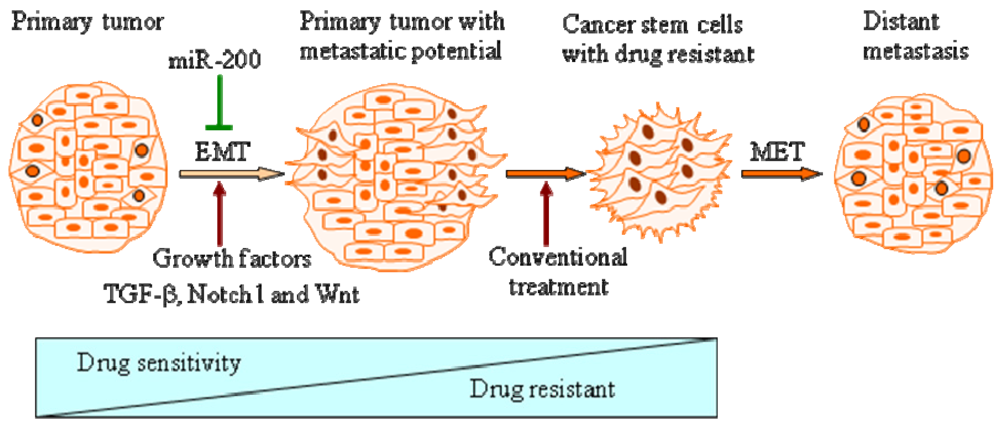
<p>Mounting evidence has shown that induction of EMT by different factors could generate stem-like cells characterized by enhanced self-renewal and invasive capacity and high drug resistance, which is strongly associated with metastases and recurrence of tumors (<xref ref-type="fig" rid="f1-cancers-03-00716">Figure 1</xref>).</p></sec>
<sec>
<label>6.</label>
<title>Perspectives</title>
<p>Conventional treatment for cancers mainly targets the differentiated tumor cells; however, in a significant number of patients, cancer cells will acquire a drug resistant phenotype after standard therapies, resulting in tumor recurrence and metastasis for which there is limited or no curative therapy. The recurrence of tumors is believed to be tightly linked with the biology of CSCs or cancer-initiating cells [<xref ref-type="bibr" rid="b6-cancers-03-00716">6</xref>-<xref ref-type="bibr" rid="b8-cancers-03-00716">8</xref>]. Mounting evidence has demonstrated that the acquisition of invasive characteristics of tumors is also associated with the ability of tumor cells to undergo EMT phenotype, which allows tumor cells to break through the structural constraints imposed by tissue architecture [<xref ref-type="bibr" rid="b3-cancers-03-00716">3</xref>,<xref ref-type="bibr" rid="b4-cancers-03-00716">4</xref>,<xref ref-type="bibr" rid="b12-cancers-03-00716">12</xref>,<xref ref-type="bibr" rid="b22-cancers-03-00716">22</xref>]. The stem-like cells or CSCs generated from EMT induction provide a resource for cancer to recur and these cells are well known to be highly drug resistant [<xref ref-type="bibr" rid="b9-cancers-03-00716">9</xref>,<xref ref-type="bibr" rid="b15-cancers-03-00716">15</xref>,<xref ref-type="bibr" rid="b65-cancers-03-00716">65</xref>,<xref ref-type="bibr" rid="b67-cancers-03-00716">67</xref>,<xref ref-type="bibr" rid="b72-cancers-03-00716">72</xref>]. Therefore, it is important to identify which factors could induce EMT and uncover the mechanistic role of such factors during cancer progression, which underscores the importance of such factors toward the development of novel and targeted therapies for complete eradication of cancer. The molecular understanding and the biological characteristics of CSCs, cancer stem-like cells and EMT phenotypic cells will allow us to screen for potential drugs that could cause selective killing of these cells to eradicate tumor recurrence. Moreover, agents that may result in the re-expression of specific miRNAs that are lost in these cells will also allow us to eliminate the cells that are the “root cause” of tumor development, maintenance, recurrence and metastasis. Thus, the future appears to be brighter than ever before for complete eradication of cancer by exploiting current molecular understanding of CSCs, and the processes of EMT.</p></sec></body>
<back>
<sec sec-type="display-objects">
<title>Figure and Table</title>
<fig id="f1-cancers-03-00716" position="float">
<label>Figure 1.</label>
<caption>
<p>Induction of epithelial-to-mesenchymal transition (EMT)-phenotypic cells produces cancer stem-like cells with drug-resistant characteristics. Growth factors, including FGF, EGF, PDGF-B and PDGF-D as well as factors such as TGF-β, Notch-1 and Wnt, can induce EMT, while miR-200 family inhibits EMT by regulating the expression of transcription repressors ZEB1 and ZEB2. EMT-phenotypic cells acquire stem-like cell signatures characterized by increased metastatic capacity, self-renewal ability and acquired drug resistance. These cells metastasize to distant sites and undergo MET to produce metastatic tumors that are phenotypically similar to the primary tumor.</p></caption>
<graphic xlink:href="cancers-03-00716f1.gif"/></fig>
<table-wrap id="t1-cancers-03-00716" position="float">
<label>Table 1.</label>
<caption>
<p>miRNAs linking epithelial-to-mesenchymal transition (EMT) phenotype with stem-like cell signatures in human cancers.</p></caption>
<table frame="box" rules="all">
<thead>
<tr>
<th align="center" valign="top"><bold>miRNAs</bold></th>
<th align="left" valign="top"><bold>Functions in Regulation of EMT and Stem Cell Signatures</bold></th>
<th align="left" valign="top"><bold>Ref.</bold></th></tr></thead>
<tbody>
<tr>
<td align="center" valign="middle">miR-200a</td>
<td align="left" valign="top">knockdown of Akt-1 decreases expression of miR-200 family including miR-200a, increases mammosphere forming ability in breast cancer</td>
<td align="center" valign="top">[<xref ref-type="bibr" rid="b78-cancers-03-00716">78</xref>]</td></tr>
<tr>
<td align="center" valign="middle">miR-200b</td>
<td align="left" valign="top">miR-200b inhibits expression of ZEB1, ZEB2, Lin28B and Notch1 in prostate cancer<break/>miR-200b targets Suz12 and contributes to maintain cancer stem cells in breast cancer</td>
<td align="center" valign="top">[<xref ref-type="bibr" rid="b75-cancers-03-00716">75</xref>,<xref ref-type="bibr" rid="b79-cancers-03-00716">79</xref>]</td></tr>
<tr>
<td align="center" valign="middle">miR-200c</td>
<td align="left" valign="top">miR-200c inhibits expression of ZEB1, ZEB2 and Bmi1 in breast cancer; miR-200c also inhibits expression of ZEB1, Sox2, Bmi1 and KLF4 in pancreatic cancer</td>
<td align="center" valign="top">[<xref ref-type="bibr" rid="b77-cancers-03-00716">77</xref>]</td></tr>
<tr>
<td align="center" valign="middle">miR-183</td>
<td align="left" valign="top">miR-183 downregulated by ZEB1 and inhibits expression of Bmi1 and KLF4 in pancreatic cancer</td>
<td align="center" valign="top">[<xref ref-type="bibr" rid="b77-cancers-03-00716">77</xref>]</td></tr>
<tr>
<td align="center" valign="middle">miR-203</td>
<td align="left" valign="top">miR-203 downregulated by ZEB1 and inhibits expression of Bmi1 and KLF4 in pancreatic cancer</td>
<td align="center" valign="top">[<xref ref-type="bibr" rid="b77-cancers-03-00716">77</xref>]</td></tr></tbody></table></table-wrap></sec>
<ack>
<p>The authors' work cited in this review was funded by grants from the national Cancer Institute, NIH (5R01CA131151, 5R01CA083695, 1R01CA132794, 1R01CA101870) to F.H.S.</p></ack>
<ref-list>
<title>References</title>
<ref id="b1-cancers-03-00716"><label>1.</label><citation citation-type="journal"><person-group person-group-type="author"><name><surname>Thiery</surname><given-names>J.P.</given-names></name></person-group><article-title>Epithelial-mesenchymal transitions in tumour progression</article-title><source>Nat. Rev. Cancer</source><year>2002</year><volume>2</volume><fpage>442</fpage><lpage>454</lpage><pub-id pub-id-type="doi">10.1038/nrc822</pub-id><pub-id pub-id-type="pmid">12189386</pub-id></citation></ref>
<ref id="b2-cancers-03-00716"><label>2.</label><citation citation-type="journal"><person-group person-group-type="author"><name><surname>Brabletz</surname><given-names>T.</given-names></name><name><surname>Jung</surname><given-names>A.</given-names></name><name><surname>Reu</surname><given-names>S.</given-names></name><name><surname>Porzner</surname><given-names>M.</given-names></name><name><surname>Hlubek</surname><given-names>F.</given-names></name><name><surname>Kunz-Schughart</surname><given-names>L.A.</given-names></name><name><surname>Knuechel</surname><given-names>R.</given-names></name><name><surname>Kirchner</surname><given-names>T.</given-names></name></person-group><article-title>Variable beta-catenin expression in colorectal cancers indicates tumor progression driven by the tumor environment</article-title><source>Proc. Natl. Acad. Sci. USA</source><year>2001</year><volume>98</volume><fpage>10356</fpage><lpage>10361</lpage><pub-id pub-id-type="doi">10.1073/pnas.171610498</pub-id><pub-id pub-id-type="pmid">11526241</pub-id></citation></ref>
<ref id="b3-cancers-03-00716"><label>3.</label><citation citation-type="journal"><person-group person-group-type="author"><name><surname>Brabletz</surname><given-names>T.</given-names></name><name><surname>Jung</surname><given-names>A.</given-names></name><name><surname>Spaderna</surname><given-names>S.</given-names></name><name><surname>Hlubek</surname><given-names>F.</given-names></name><name><surname>Kirchner</surname><given-names>T.</given-names></name></person-group><article-title>Opinion: Migrating cancer stem cells—An integrated concept of malignant tumour progression</article-title><source>Nat. Rev. Cancer</source><year>2005</year><volume>5</volume><fpage>744</fpage><lpage>749</lpage><pub-id pub-id-type="pmid">16148886</pub-id></citation></ref>
<ref id="b4-cancers-03-00716"><label>4.</label><citation citation-type="journal"><person-group person-group-type="author"><name><surname>Lee</surname><given-names>J.M.</given-names></name><name><surname>Dedhar</surname><given-names>S.</given-names></name><name><surname>Kalluri</surname><given-names>R.</given-names></name><name><surname>Thompson</surname><given-names>E.W.</given-names></name></person-group><article-title>The epithelial-mesenchymal transition: New insights in signaling, development, and disease</article-title><source>J. Cell Biol.</source><year>2006</year><volume>172</volume><fpage>973</fpage><lpage>981</lpage><pub-id pub-id-type="doi">10.1083/jcb.200601018</pub-id><pub-id pub-id-type="pmid">16567498</pub-id></citation></ref>
<ref id="b5-cancers-03-00716"><label>5.</label><citation citation-type="journal"><person-group person-group-type="author"><name><surname>Hollier</surname><given-names>B.G.</given-names></name><name><surname>Evans</surname><given-names>K.</given-names></name><name><surname>Mani</surname><given-names>S.A.</given-names></name></person-group><article-title>The epithelial-to-mesenchymal transition and cancer stem cells: A coalition against cancer therapies</article-title><source>J. Mammary. Gland. Biol. Neoplasia</source><year>2009</year><volume>14</volume><fpage>29</fpage><lpage>43</lpage><pub-id pub-id-type="doi">10.1007/s10911-009-9110-3</pub-id><pub-id pub-id-type="pmid">19242781</pub-id></citation></ref>
<ref id="b6-cancers-03-00716"><label>6.</label><citation citation-type="journal"><person-group person-group-type="author"><name><surname>Kasper</surname><given-names>S.</given-names></name></person-group><article-title>Stem cells: The root of prostate cancer?</article-title><source>J. Cell Physiol.</source><year>2008</year><volume>216</volume><fpage>332</fpage><lpage>336</lpage><pub-id pub-id-type="doi">10.1002/jcp.21489</pub-id><pub-id pub-id-type="pmid">18459113</pub-id></citation></ref>
<ref id="b7-cancers-03-00716"><label>7.</label><citation citation-type="journal"><person-group person-group-type="author"><name><surname>Kasper</surname><given-names>S.</given-names></name></person-group><article-title>Identification, characterization, and biological relevance of prostate cancer stem cells from clinical specimens</article-title><source>Urol. Oncol.</source><year>2009</year><volume>27</volume><fpage>301</fpage><lpage>303</lpage><pub-id pub-id-type="doi">10.1016/j.urolonc.2008.12.012</pub-id><pub-id pub-id-type="pmid">19414117</pub-id></citation></ref>
<ref id="b8-cancers-03-00716"><label>8.</label><citation citation-type="journal"><person-group person-group-type="author"><name><surname>Marian</surname><given-names>C.O.</given-names></name><name><surname>Shay</surname><given-names>J.W.</given-names></name></person-group><article-title>Prostate tumor-initiating cells: A new target for telomerase inhibition therapy?</article-title><source>Biochim. Biophys. Acta</source><year>2009</year><volume>1792</volume><fpage>289</fpage><lpage>296</lpage><pub-id pub-id-type="doi">10.1016/j.bbadis.2009.02.012</pub-id><pub-id pub-id-type="pmid">19264126</pub-id></citation></ref>
<ref id="b9-cancers-03-00716"><label>9.</label><citation citation-type="journal"><person-group person-group-type="author"><name><surname>Mani</surname><given-names>S.A.</given-names></name><name><surname>Guo</surname><given-names>W.</given-names></name><name><surname>Liao</surname><given-names>M.J.</given-names></name><name><surname>Eaton</surname><given-names>E.N.</given-names></name><name><surname>Ayyanan</surname><given-names>A.</given-names></name><name><surname>Zhou</surname><given-names>A.Y.</given-names></name><name><surname>Brooks</surname><given-names>M.</given-names></name><name><surname>Reinhard</surname><given-names>F.</given-names></name><name><surname>Zhang</surname><given-names>C.C.</given-names></name><name><surname>Shipitsin</surname><given-names>M.</given-names></name><name><surname>Campbell</surname><given-names>L.L.</given-names></name><name><surname>Polyak</surname><given-names>K.</given-names></name><name><surname>Brisken</surname><given-names>C.</given-names></name><name><surname>Yang</surname><given-names>J.</given-names></name><name><surname>Weinberg</surname><given-names>R.A.</given-names></name></person-group><article-title>The epithelial-mesenchymal transition generates cells with properties of stem cells</article-title><source>Cell</source><year>2008</year><volume>133</volume><fpage>704</fpage><lpage>715</lpage><pub-id pub-id-type="doi">10.1016/j.cell.2008.03.027</pub-id><pub-id pub-id-type="pmid">18485877</pub-id></citation></ref>
<ref id="b10-cancers-03-00716"><label>10.</label><citation citation-type="journal"><person-group person-group-type="author"><name><surname>Peter</surname><given-names>M.E.</given-names></name></person-group><article-title>Let-7 and miR-200 microRNAs: Guardians against pluripotency and cancer progression</article-title><source>Cell Cycle</source><year>2009</year><volume>8</volume><fpage>843</fpage><lpage>852</lpage><pub-id pub-id-type="doi">10.4161/cc.8.6.7907</pub-id><pub-id pub-id-type="pmid">19221491</pub-id></citation></ref>
<ref id="b11-cancers-03-00716"><label>11.</label><citation citation-type="journal"><person-group person-group-type="author"><name><surname>Santisteban</surname><given-names>M.</given-names></name><name><surname>Reiman</surname><given-names>J.M.</given-names></name><name><surname>Asiedu</surname><given-names>M.K.</given-names></name><name><surname>Behrens</surname><given-names>M.D.</given-names></name><name><surname>Nassar</surname><given-names>A.</given-names></name><name><surname>Kalli</surname><given-names>K.R.</given-names></name><name><surname>Haluska</surname><given-names>P.</given-names></name><name><surname>Ingle</surname><given-names>J.N.</given-names></name><name><surname>Hartmann</surname><given-names>L.C.</given-names></name><name><surname>Manjili</surname><given-names>M.H.</given-names></name><name><surname>Radisky</surname><given-names>D.C.</given-names></name><name><surname>Ferrone</surname><given-names>S.</given-names></name><name><surname>Knutson</surname><given-names>K.L.</given-names></name></person-group><article-title>Immune-induced epithelial to mesenchymal transition in vivo generates breast cancer stem cells</article-title><source>Cancer Res.</source><year>2009</year><volume>69</volume><fpage>2887</fpage><lpage>2895</lpage><pub-id pub-id-type="doi">10.1158/0008-5472.CAN-08-3343</pub-id><pub-id pub-id-type="pmid">19276366</pub-id></citation></ref>
<ref id="b12-cancers-03-00716"><label>12.</label><citation citation-type="journal"><person-group person-group-type="author"><name><surname>Hugo</surname><given-names>H.</given-names></name><name><surname>Ackland</surname><given-names>M.L.</given-names></name><name><surname>Blick</surname><given-names>T.</given-names></name><name><surname>Lawrence</surname><given-names>M.G.</given-names></name><name><surname>Clements</surname><given-names>J.A.</given-names></name><name><surname>Williams</surname><given-names>E.D.</given-names></name><name><surname>Thompson</surname><given-names>E.W.</given-names></name></person-group><article-title>Epithelial-mesenchymal and mesenchymal-epithelial transitions in carcinoma progression</article-title><source>J. Cell Physiol.</source><year>2007</year><volume>213</volume><fpage>374</fpage><lpage>383</lpage><pub-id pub-id-type="doi">10.1002/jcp.21223</pub-id><pub-id pub-id-type="pmid">17680632</pub-id></citation></ref>
<ref id="b13-cancers-03-00716"><label>13.</label><citation citation-type="journal"><person-group person-group-type="author"><name><surname>Sarkar</surname><given-names>F.H.</given-names></name><name><surname>Li</surname><given-names>Y.</given-names></name><name><surname>Wang</surname><given-names>Z.</given-names></name><name><surname>Kong</surname><given-names>D.</given-names></name></person-group><article-title>The role of nutraceuticals in the regulation of Wnt and Hedgehog signaling in cancer</article-title><source>Cancer Metastasis Rev.</source><year>2010</year><volume>29</volume><fpage>383</fpage><lpage>394</lpage><pub-id pub-id-type="doi">10.1007/s10555-010-9233-4</pub-id><pub-id pub-id-type="pmid">20711635</pub-id></citation></ref>
<ref id="b14-cancers-03-00716"><label>14.</label><citation citation-type="journal"><person-group person-group-type="author"><name><surname>Singh</surname><given-names>A.</given-names></name><name><surname>Settleman</surname><given-names>J.</given-names></name></person-group><article-title>EMT, cancer stem cells and drug resistance: An emerging axis of evil in the war on cancer</article-title><source>Oncogene</source><year>2010</year><volume>29</volume><fpage>4741</fpage><lpage>4751</lpage><pub-id pub-id-type="doi">10.1038/onc.2010.215</pub-id><pub-id pub-id-type="pmid">20531305</pub-id></citation></ref>
<ref id="b15-cancers-03-00716"><label>15.</label><citation citation-type="journal"><person-group person-group-type="author"><name><surname>Wang</surname><given-names>Z.</given-names></name><name><surname>Li</surname><given-names>Y.</given-names></name><name><surname>Ahmad</surname><given-names>A.</given-names></name><name><surname>Azmi</surname><given-names>A.S.</given-names></name><name><surname>Kong</surname><given-names>D.</given-names></name><name><surname>Banerjee</surname><given-names>S.</given-names></name><name><surname>Sarkar</surname><given-names>F.H.</given-names></name></person-group><article-title>Targeting miRNAs involved in cancer stem cell and EMT regulation: An emerging concept in overcoming drug resistance</article-title><source>Drug Resist. Updat.</source><year>2010</year><volume>13</volume><fpage>109</fpage><lpage>118</lpage><pub-id pub-id-type="doi">10.1016/j.drup.2010.07.001</pub-id><pub-id pub-id-type="pmid">20692200</pub-id></citation></ref>
<ref id="b16-cancers-03-00716"><label>16.</label><citation citation-type="journal"><person-group person-group-type="author"><name><surname>Thiery</surname><given-names>J.P.</given-names></name><name><surname>Sleeman</surname><given-names>J.P.</given-names></name></person-group><article-title>Complex networks orchestrate epithelial-mesenchymal transitions</article-title><source>Nat. Rev. Mol. Cell Biol.</source><year>2006</year><volume>7</volume><fpage>131</fpage><lpage>142</lpage><pub-id pub-id-type="doi">10.1038/nrm1835</pub-id><pub-id pub-id-type="pmid">16493418</pub-id></citation></ref>
<ref id="b17-cancers-03-00716"><label>17.</label><citation citation-type="journal"><person-group person-group-type="author"><name><surname>Schmalhofer</surname><given-names>O.</given-names></name><name><surname>Brabletz</surname><given-names>S.</given-names></name><name><surname>Brabletz</surname><given-names>T.</given-names></name></person-group><article-title>E-cadherin, beta-catenin, and ZEB1 in malignant progression of cancer</article-title><source>Cancer Metastasis Rev.</source><year>2009</year><volume>28</volume><fpage>151</fpage><lpage>166</lpage><pub-id pub-id-type="doi">10.1007/s10555-008-9179-y</pub-id><pub-id pub-id-type="pmid">19153669</pub-id></citation></ref>
<ref id="b18-cancers-03-00716"><label>18.</label><citation citation-type="journal"><person-group person-group-type="author"><name><surname>Berx</surname><given-names>G.</given-names></name><name><surname>Raspe</surname><given-names>E.</given-names></name><name><surname>Christofori</surname><given-names>G.</given-names></name><name><surname>Thiery</surname><given-names>J.P.</given-names></name><name><surname>Sleeman</surname><given-names>J.P.</given-names></name></person-group><article-title>Pre-EMTing metastasis? Recapitulation of morphogenetic processes in cancer</article-title><source>Clin. Exp. Metastasis.</source><year>2007</year><volume>24</volume><fpage>587</fpage><lpage>597</lpage><pub-id pub-id-type="doi">10.1007/s10585-007-9114-6</pub-id><pub-id pub-id-type="pmid">17978854</pub-id></citation></ref>
<ref id="b19-cancers-03-00716"><label>19.</label><citation citation-type="journal"><person-group person-group-type="author"><name><surname>Gregory</surname><given-names>P.A.</given-names></name><name><surname>Bert</surname><given-names>A.G.</given-names></name><name><surname>Paterson</surname><given-names>E.L.</given-names></name><name><surname>Barry</surname><given-names>S.C.</given-names></name><name><surname>Tsykin</surname><given-names>A.</given-names></name><name><surname>Farshid</surname><given-names>G.</given-names></name><name><surname>Vadas</surname><given-names>M.A.</given-names></name><name><surname>Khew-Goodall</surname><given-names>Y.</given-names></name><name><surname>Goodall</surname><given-names>G.J.</given-names></name></person-group><article-title>The miR-200 family and miR-205 regulate epithelial to mesenchymal transition by targeting ZEB1 and SIP1</article-title><source>Nat. Cell Biol.</source><year>2008</year><volume>10</volume><fpage>593</fpage><lpage>601</lpage><pub-id pub-id-type="doi">10.1038/ncb1722</pub-id><pub-id pub-id-type="pmid">18376396</pub-id></citation></ref>
<ref id="b20-cancers-03-00716"><label>20.</label><citation citation-type="journal"><person-group person-group-type="author"><name><surname>Kong</surname><given-names>D.</given-names></name><name><surname>Wang</surname><given-names>Z.</given-names></name><name><surname>Sarkar</surname><given-names>S.H.</given-names></name><name><surname>Li</surname><given-names>Y.</given-names></name><name><surname>Banerjee</surname><given-names>S.</given-names></name><name><surname>Saliganan</surname><given-names>A.</given-names></name><name><surname>Kim</surname><given-names>H.R.</given-names></name><name><surname>Cher</surname><given-names>M.L.</given-names></name><name><surname>Sarkar</surname><given-names>F.H.</given-names></name></person-group><article-title>Platelet-derived growth factor-D overexpression contributes to epithelial -mesenchymal transition of PC3 prostate cancer cells</article-title><source>Stem Cells</source><year>2008</year><volume>26</volume><fpage>1425</fpage><lpage>1435</lpage><pub-id pub-id-type="doi">10.1634/stemcells.2007-1076</pub-id><pub-id pub-id-type="pmid">18403754</pub-id></citation></ref>
<ref id="b21-cancers-03-00716"><label>21.</label><citation citation-type="journal"><person-group person-group-type="author"><name><surname>Shorning</surname><given-names>B.Y.</given-names></name><name><surname>Griffiths</surname><given-names>D.</given-names></name><name><surname>Clarke</surname><given-names>A.R.</given-names></name></person-group><article-title>Lkb1 and Pten Synergise to Suppress mTOR-Mediated Tumorigenesis and Epithelial-Mesenchymal Transition in the Mouse Bladder</article-title><source>PLoS One</source><year>2011</year><volume>6</volume><fpage>e16209</fpage><pub-id pub-id-type="doi">10.1371/journal.pone.0016209</pub-id><pub-id pub-id-type="pmid">21283818</pub-id></citation></ref>
<ref id="b22-cancers-03-00716"><label>22.</label><citation citation-type="journal"><person-group person-group-type="author"><name><surname>Christiansen</surname><given-names>J.J.</given-names></name><name><surname>Rajasekaran</surname><given-names>A.K.</given-names></name></person-group><article-title>Reassessing epithelial to mesenchymal transition as a prerequisite for carcinoma invasion and metastasis</article-title><source>Cancer Res.</source><year>2006</year><volume>66</volume><fpage>8319</fpage><lpage>8326</lpage><pub-id pub-id-type="doi">10.1158/0008-5472.CAN-06-0410</pub-id><pub-id pub-id-type="pmid">16951136</pub-id></citation></ref>
<ref id="b23-cancers-03-00716"><label>23.</label><citation citation-type="journal"><person-group person-group-type="author"><name><surname>Garber</surname><given-names>K.</given-names></name></person-group><article-title>Epithelial-to-mesenchymal transition is important to metastasis, but questions remain</article-title><source>J. Natl. Cancer Inst.</source><year>2008</year><volume>100</volume><fpage>232</fpage><lpage>3</lpage><fpage>239</fpage></citation></ref>
<ref id="b24-cancers-03-00716"><label>24.</label><citation citation-type="journal"><person-group person-group-type="author"><name><surname>Tarin</surname><given-names>D.</given-names></name><name><surname>Thompson</surname><given-names>E.W.</given-names></name><name><surname>Newgreen</surname><given-names>D.F.</given-names></name></person-group><article-title>The fallacy of epithelial mesenchymal transition in neoplasia</article-title><source>Cancer Res.</source><year>2005</year><volume>65</volume><fpage>5996</fpage><lpage>6000</lpage><pub-id pub-id-type="doi">10.1158/0008-5472.CAN-05-0699</pub-id><pub-id pub-id-type="pmid">16024596</pub-id></citation></ref>
<ref id="b25-cancers-03-00716"><label>25.</label><citation citation-type="journal"><person-group person-group-type="author"><name><surname>Thompson</surname><given-names>E.W.</given-names></name><name><surname>Newgreen</surname><given-names>D.F.</given-names></name><name><surname>Tarin</surname><given-names>D.</given-names></name></person-group><article-title>Carcinoma invasion and metastasis: A role for epithelial-mesenchymal transition?</article-title><source>Cancer Res.</source><year>2005</year><volume>65</volume><fpage>5991</fpage><lpage>5995</lpage><pub-id pub-id-type="pmid">16024595</pub-id></citation></ref>
<ref id="b26-cancers-03-00716"><label>26.</label><citation citation-type="journal"><person-group person-group-type="author"><name><surname>Aigner</surname><given-names>K.</given-names></name><name><surname>Dampier</surname><given-names>B.</given-names></name><name><surname>Descovich</surname><given-names>L.</given-names></name><name><surname>Mikula</surname><given-names>M.</given-names></name><name><surname>Sultan</surname><given-names>A.</given-names></name><name><surname>Schreiber</surname><given-names>M.</given-names></name><name><surname>Mikulits</surname><given-names>W.</given-names></name><name><surname>Brabletz</surname><given-names>T.</given-names></name><name><surname>Strand</surname><given-names>D.</given-names></name><name><surname>Obrist</surname><given-names>P.</given-names></name><name><surname>Sommergruber</surname><given-names>W.</given-names></name><name><surname>Schweifer</surname><given-names>N.</given-names></name><name><surname>Wernitznig</surname><given-names>A.</given-names></name><name><surname>Beug</surname><given-names>H.</given-names></name><name><surname>Foisner</surname><given-names>R.</given-names></name><name><surname>Eger</surname><given-names>A.</given-names></name></person-group><article-title>The transcription factor ZEB1 (deltaEF1) promotes tumour cell dedifferentiation by repressing master regulators of epithelial polarity</article-title><source>Oncogene</source><year>2007</year><volume>26</volume><fpage>6979</fpage><lpage>6988</lpage><pub-id pub-id-type="doi">10.1038/sj.onc.1210508</pub-id><pub-id pub-id-type="pmid">17486063</pub-id></citation></ref>
<ref id="b27-cancers-03-00716"><label>27.</label><citation citation-type="journal"><person-group person-group-type="author"><name><surname>Chaffer</surname><given-names>C.L.</given-names></name><name><surname>Brennan</surname><given-names>J.P.</given-names></name><name><surname>Slavin</surname><given-names>J.L.</given-names></name><name><surname>Blick</surname><given-names>T.</given-names></name><name><surname>Thompson</surname><given-names>E.W.</given-names></name><name><surname>Williams</surname><given-names>E.D.</given-names></name></person-group><article-title>Mesenchymal-to-epithelial transition facilitates bladder cancer metastasis: Role of fibroblast growth factor receptor-2</article-title><source>Cancer Res.</source><year>2006</year><volume>66</volume><fpage>11271</fpage><lpage>11278</lpage><pub-id pub-id-type="doi">10.1158/0008-5472.CAN-06-2044</pub-id><pub-id pub-id-type="pmid">17145872</pub-id></citation></ref>
<ref id="b28-cancers-03-00716"><label>28.</label><citation citation-type="journal"><person-group person-group-type="author"><name><surname>Irie</surname><given-names>H.Y.</given-names></name><name><surname>Pearline</surname><given-names>R.V.</given-names></name><name><surname>Grueneberg</surname><given-names>D.</given-names></name><name><surname>Hsia</surname><given-names>M.</given-names></name><name><surname>Ravichandran</surname><given-names>P.</given-names></name><name><surname>Kothari</surname><given-names>N.</given-names></name><name><surname>Natesan</surname><given-names>S.</given-names></name><name><surname>Brugge</surname><given-names>J.S.</given-names></name></person-group><article-title>Distinct roles of Akt1 and Akt2 in regulating cell migration and epithelial-mesenchymal transition</article-title><source>J. Cell Biol.</source><year>2005</year><volume>171</volume><fpage>1023</fpage><lpage>1034</lpage><pub-id pub-id-type="doi">10.1083/jcb.200505087</pub-id><pub-id pub-id-type="pmid">16365168</pub-id></citation></ref>
<ref id="b29-cancers-03-00716"><label>29.</label><citation citation-type="journal"><person-group person-group-type="author"><name><surname>Moustakas</surname><given-names>A.</given-names></name><name><surname>Heldin</surname><given-names>C.H.</given-names></name></person-group><article-title>Signaling networks guiding epithelial-mesenchymal transitions during embryogenesis and cancer progression</article-title><source>Cancer Sci.</source><year>2007</year><volume>98</volume><fpage>1512</fpage><lpage>1520</lpage><pub-id pub-id-type="doi">10.1111/j.1349-7006.2007.00550.x</pub-id><pub-id pub-id-type="pmid">17645776</pub-id></citation></ref>
<ref id="b30-cancers-03-00716"><label>30.</label><citation citation-type="journal"><person-group person-group-type="author"><name><surname>Yates</surname><given-names>C.C.</given-names></name><name><surname>Shepard</surname><given-names>C.R.</given-names></name><name><surname>Stolz</surname><given-names>D.B.</given-names></name><name><surname>Wells</surname><given-names>A.</given-names></name></person-group><article-title>Co-culturing human prostate carcinoma cells with hepatocytes leads to increased expression of E-cadherin</article-title><source>Br. J. Cancer</source><year>2007</year><volume>96</volume><fpage>1246</fpage><lpage>1252</lpage><pub-id pub-id-type="doi">10.1038/sj.bjc.6603700</pub-id><pub-id pub-id-type="pmid">17406365</pub-id></citation></ref>
<ref id="b31-cancers-03-00716"><label>31.</label><citation citation-type="journal"><person-group person-group-type="author"><name><surname>Ahmed</surname><given-names>N.</given-names></name><name><surname>Maines-Bandiera</surname><given-names>S.</given-names></name><name><surname>Quinn</surname><given-names>M.A.</given-names></name><name><surname>Unger</surname><given-names>W.G.</given-names></name><name><surname>Dedhar</surname><given-names>S.</given-names></name><name><surname>Auersperg</surname><given-names>N.</given-names></name></person-group><article-title>Molecular pathways regulating EGF-induced epithelio-mesenchymal transition in human ovarian surface epithelium</article-title><source>Am. J. Physiol Cell Physiol.</source><year>2006</year><volume>290</volume><fpage>C1532</fpage><lpage>C1542</lpage><pub-id pub-id-type="doi">10.1152/ajpcell.00478.2005</pub-id><pub-id pub-id-type="pmid">16394028</pub-id></citation></ref>
<ref id="b32-cancers-03-00716"><label>32.</label><citation citation-type="journal"><person-group person-group-type="author"><name><surname>Fischer</surname><given-names>A.N.</given-names></name><name><surname>Fuchs</surname><given-names>E.</given-names></name><name><surname>Mikula</surname><given-names>M.</given-names></name><name><surname>Huber</surname><given-names>H.</given-names></name><name><surname>Beug</surname><given-names>H.</given-names></name><name><surname>Mikulits</surname><given-names>W.</given-names></name></person-group><article-title>PDGF essentially links TGF-beta signaling to nuclear beta-catenin accumulation in hepatocellular carcinoma progression</article-title><source>Oncogene</source><year>2007</year><volume>26</volume><fpage>3395</fpage><lpage>3405</lpage><pub-id pub-id-type="doi">10.1038/sj.onc.1210121</pub-id><pub-id pub-id-type="pmid">17130832</pub-id></citation></ref>
<ref id="b33-cancers-03-00716"><label>33.</label><citation citation-type="journal"><person-group person-group-type="author"><name><surname>Gotzmann</surname><given-names>J.</given-names></name><name><surname>Fischer</surname><given-names>A.N.</given-names></name><name><surname>Zojer</surname><given-names>M.</given-names></name><name><surname>Mikula</surname><given-names>M.</given-names></name><name><surname>Proell</surname><given-names>V.</given-names></name><name><surname>Huber</surname><given-names>H.</given-names></name><name><surname>Jechlinger</surname><given-names>M.</given-names></name><name><surname>Waerner</surname><given-names>T.</given-names></name><name><surname>Weith</surname><given-names>A.</given-names></name><name><surname>Beug</surname><given-names>H.</given-names></name><name><surname>Mikulits</surname><given-names>W.</given-names></name></person-group><article-title>A crucial function of PDGF in TGF-beta-mediated cancer progression of hepatocytes</article-title><source>Oncogene</source><year>2006</year><volume>25</volume><fpage>3170</fpage><lpage>3185</lpage><pub-id pub-id-type="doi">10.1038/sj.onc.1209083</pub-id><pub-id pub-id-type="pmid">16607286</pub-id></citation></ref>
<ref id="b34-cancers-03-00716"><label>34.</label><citation citation-type="journal"><person-group person-group-type="author"><name><surname>Strutz</surname><given-names>F.</given-names></name><name><surname>Zeisberg</surname><given-names>M.</given-names></name><name><surname>Ziyadeh</surname><given-names>F.N.</given-names></name><name><surname>Yang</surname><given-names>C.Q.</given-names></name><name><surname>Kalluri</surname><given-names>R.</given-names></name><name><surname>Muller</surname><given-names>G.A.</given-names></name><name><surname>Neilson</surname><given-names>E.G.</given-names></name></person-group><article-title>Role of basic fibroblast growth factor-2 in epithelial-mesenchymal transformation</article-title><source>Kidney Int.</source><year>2002</year><volume>61</volume><fpage>1714</fpage><lpage>1728</lpage><pub-id pub-id-type="doi">10.1046/j.1523-1755.2002.00333.x</pub-id><pub-id pub-id-type="pmid">11967021</pub-id></citation></ref>
<ref id="b35-cancers-03-00716"><label>35.</label><citation citation-type="journal"><person-group person-group-type="author"><name><surname>Yang</surname><given-names>L.</given-names></name><name><surname>Lin</surname><given-names>C.</given-names></name><name><surname>Liu</surname><given-names>Z.R.</given-names></name></person-group><article-title>P68 RNA helicase mediates PDGF-induced epithelial mesenchymal transition by displacing Axin from beta-catenin</article-title><source>Cell</source><year>2006</year><volume>127</volume><fpage>139</fpage><lpage>155</lpage><pub-id pub-id-type="doi">10.1016/j.cell.2006.08.036</pub-id><pub-id pub-id-type="pmid">17018282</pub-id></citation></ref>
<ref id="b36-cancers-03-00716"><label>36.</label><citation citation-type="journal"><person-group person-group-type="author"><name><surname>Graham</surname><given-names>T.R.</given-names></name><name><surname>Zhau</surname><given-names>H.E.</given-names></name><name><surname>Odero-Marah</surname><given-names>V.A.</given-names></name><name><surname>Osunkoya</surname><given-names>A.O.</given-names></name><name><surname>Kimbro</surname><given-names>K.S.</given-names></name><name><surname>Tighiouart</surname><given-names>M.</given-names></name><name><surname>Liu</surname><given-names>T.</given-names></name><name><surname>Simons</surname><given-names>J.W.</given-names></name><name><surname>O'Regan</surname><given-names>R.M.</given-names></name></person-group><article-title>Insulin-like growth factor-I-dependent up-regulation of ZEB1 drives epithelial-to-mesenchymal transition in human prostate cancer cells</article-title><source>Cancer Res.</source><year>2008</year><volume>68</volume><fpage>2479</fpage><lpage>2488</lpage><pub-id pub-id-type="doi">10.1158/0008-5472.CAN-07-2559</pub-id><pub-id pub-id-type="pmid">18381457</pub-id></citation></ref>
<ref id="b37-cancers-03-00716"><label>37.</label><citation citation-type="journal"><person-group person-group-type="author"><name><surname>Lapidot</surname><given-names>T.</given-names></name><name><surname>Sirard</surname><given-names>C.</given-names></name><name><surname>Vormoor</surname><given-names>J.</given-names></name><name><surname>Murdoch</surname><given-names>B.</given-names></name><name><surname>Hoang</surname><given-names>T.</given-names></name><name><surname>Caceres-Cortes</surname><given-names>J.</given-names></name><name><surname>Minden</surname><given-names>M.</given-names></name><name><surname>Paterson</surname><given-names>B.</given-names></name><name><surname>Caligiuri</surname><given-names>M.A.</given-names></name><name><surname>Dick</surname><given-names>J.E.</given-names></name></person-group><article-title>A cell initiating human acute myeloid leukaemia after transplantation into SCID mice</article-title><source>Nature</source><year>1994</year><volume>367</volume><fpage>645</fpage><lpage>648</lpage><pub-id pub-id-type="doi">10.1038/367645a0</pub-id><pub-id pub-id-type="pmid">7509044</pub-id></citation></ref>
<ref id="b38-cancers-03-00716"><label>38.</label><citation citation-type="journal"><person-group person-group-type="author"><name><surname>Al-Hajj</surname><given-names>M.</given-names></name><name><surname>Wicha</surname><given-names>M.S.</given-names></name><name><surname>ito-Hernandez</surname><given-names>A.</given-names></name><name><surname>Morrison</surname><given-names>S.J.</given-names></name><name><surname>Clarke</surname><given-names>M.F.</given-names></name></person-group><article-title>Prospective identification of tumorigenic breast cancer cells</article-title><source>Proc. Natl. Acad. Sci. USA</source><year>2003</year><volume>100</volume><fpage>3983</fpage><lpage>3988</lpage><pub-id pub-id-type="doi">10.1073/pnas.0530291100</pub-id><pub-id pub-id-type="pmid">12629218</pub-id></citation></ref>
<ref id="b39-cancers-03-00716"><label>39.</label><citation citation-type="journal"><person-group person-group-type="author"><name><surname>O'Brien</surname><given-names>C.A.</given-names></name><name><surname>Pollett</surname><given-names>A.</given-names></name><name><surname>Gallinger</surname><given-names>S.</given-names></name><name><surname>Dick</surname><given-names>J.E.</given-names></name></person-group><article-title>A human colon cancer cell capable of initiating tumour growth in immunodeficient mice</article-title><source>Nature</source><year>2007</year><volume>445</volume><fpage>106</fpage><lpage>110</lpage><pub-id pub-id-type="doi">10.1038/nature05372</pub-id><pub-id pub-id-type="pmid">17122772</pub-id></citation></ref>
<ref id="b40-cancers-03-00716"><label>40.</label><citation citation-type="journal"><person-group person-group-type="author"><name><surname>Ricci-Vitiani</surname><given-names>L.</given-names></name><name><surname>Lombardi</surname><given-names>D.G.</given-names></name><name><surname>Pilozzi</surname><given-names>E.</given-names></name><name><surname>Biffoni</surname><given-names>M.</given-names></name><name><surname>Todaro</surname><given-names>M.</given-names></name><name><surname>Peschle</surname><given-names>C.</given-names></name><name><surname>De</surname><given-names>M.R.</given-names></name></person-group><article-title>Identification and expansion of human colon-cancer-initiating cells</article-title><source>Nature</source><year>2007</year><volume>445</volume><fpage>111</fpage><lpage>115</lpage><pub-id pub-id-type="doi">10.1038/nature05384</pub-id><pub-id pub-id-type="pmid">17122771</pub-id></citation></ref>
<ref id="b41-cancers-03-00716"><label>41.</label><citation citation-type="journal"><person-group person-group-type="author"><name><surname>Singh</surname><given-names>S.K.</given-names></name><name><surname>Hawkins</surname><given-names>C.</given-names></name><name><surname>Clarke</surname><given-names>I.D.</given-names></name><name><surname>Squire</surname><given-names>J.A.</given-names></name><name><surname>Bayani</surname><given-names>J.</given-names></name><name><surname>Hide</surname><given-names>T.</given-names></name><name><surname>Henkelman</surname><given-names>R.M.</given-names></name><name><surname>Cusimano</surname><given-names>M.D.</given-names></name><name><surname>Dirks</surname><given-names>P.B.</given-names></name></person-group><article-title>Identification of human brain tumour initiating cells</article-title><source>Nature</source><year>2004</year><volume>432</volume><fpage>396</fpage><lpage>401</lpage><pub-id pub-id-type="doi">10.1038/nature03128</pub-id><pub-id pub-id-type="pmid">15549107</pub-id></citation></ref>
<ref id="b42-cancers-03-00716"><label>42.</label><citation citation-type="journal"><person-group person-group-type="author"><name><surname>Singh</surname><given-names>S.K.</given-names></name><name><surname>Clarke</surname><given-names>I.D.</given-names></name><name><surname>Terasaki</surname><given-names>M.</given-names></name><name><surname>Bonn</surname><given-names>V.E.</given-names></name><name><surname>Hawkins</surname><given-names>C.</given-names></name><name><surname>Squire</surname><given-names>J.</given-names></name><name><surname>Dirks</surname><given-names>P.B.</given-names></name></person-group><article-title>Identification of a cancer stem cell in human brain tumors</article-title><source>Cancer Res.</source><year>2003</year><volume>63</volume><fpage>5821</fpage><lpage>5828</lpage><pub-id pub-id-type="pmid">14522905</pub-id></citation></ref>
<ref id="b43-cancers-03-00716"><label>43.</label><citation citation-type="journal"><person-group person-group-type="author"><name><surname>Collins</surname><given-names>A.T.</given-names></name><name><surname>Berry</surname><given-names>P.A.</given-names></name><name><surname>Hyde</surname><given-names>C.</given-names></name><name><surname>Stower</surname><given-names>M.J.</given-names></name><name><surname>Maitland</surname><given-names>N.J.</given-names></name></person-group><article-title>Prospective identification of tumorigenic prostate cancer stem cells</article-title><source>Cancer Res.</source><year>2005</year><volume>65</volume><fpage>10946</fpage><lpage>10951</lpage><pub-id pub-id-type="doi">10.1158/0008-5472.CAN-05-2018</pub-id><pub-id pub-id-type="pmid">16322242</pub-id></citation></ref>
<ref id="b44-cancers-03-00716"><label>44.</label><citation citation-type="journal"><person-group person-group-type="author"><name><surname>Patrawala</surname><given-names>L.</given-names></name><name><surname>Calhoun</surname><given-names>T.</given-names></name><name><surname>Schneider-Broussard</surname><given-names>R.</given-names></name><name><surname>Li</surname><given-names>H.</given-names></name><name><surname>Bhatia</surname><given-names>B.</given-names></name><name><surname>Tang</surname><given-names>S.</given-names></name><name><surname>Reilly</surname><given-names>J.G.</given-names></name><name><surname>Chandra</surname><given-names>D.</given-names></name><name><surname>Zhou</surname><given-names>J.</given-names></name><name><surname>Claypool</surname><given-names>K.</given-names></name><name><surname>Coghlan</surname><given-names>L.</given-names></name><name><surname>Tang</surname><given-names>D.G.</given-names></name></person-group><article-title>Highly purified CD44+ prostate cancer cells from xenograft human tumors are enriched in tumorigenic and metastatic progenitor cells</article-title><source>Oncogene</source><year>2006</year><volume>25</volume><fpage>1696</fpage><lpage>1708</lpage><pub-id pub-id-type="doi">10.1038/sj.onc.1209327</pub-id><pub-id pub-id-type="pmid">16449977</pub-id></citation></ref>
<ref id="b45-cancers-03-00716"><label>45.</label><citation citation-type="journal"><person-group person-group-type="author"><name><surname>Roudier</surname><given-names>M.P.</given-names></name><name><surname>True</surname><given-names>L.D.</given-names></name><name><surname>Higano</surname><given-names>C.S.</given-names></name><name><surname>Vesselle</surname><given-names>H.</given-names></name><name><surname>Ellis</surname><given-names>W.</given-names></name><name><surname>Lange</surname><given-names>P.</given-names></name><name><surname>Vessella</surname><given-names>R.L.</given-names></name></person-group><article-title>Phenotypic heterogeneity of end-stage prostate carcinoma metastatic to bone</article-title><source>Hum. Pathol.</source><year>2003</year><volume>34</volume><fpage>646</fpage><lpage>653</lpage><pub-id pub-id-type="doi">10.1016/S0046-8177(03)00190-4</pub-id><pub-id pub-id-type="pmid">12874759</pub-id></citation></ref>
<ref id="b46-cancers-03-00716"><label>46.</label><citation citation-type="journal"><person-group person-group-type="author"><name><surname>Gu</surname><given-names>G.</given-names></name><name><surname>Yuan</surname><given-names>J.</given-names></name><name><surname>Wills</surname><given-names>M.</given-names></name><name><surname>Kasper</surname><given-names>S.</given-names></name></person-group><article-title>Prostate cancer cells with stem cell characteristics reconstitute the original human tumor in vivo</article-title><source>Cancer Res.</source><year>2007</year><volume>67</volume><fpage>4807</fpage><lpage>4815</lpage><pub-id pub-id-type="doi">10.1158/0008-5472.CAN-06-4608</pub-id><pub-id pub-id-type="pmid">17510410</pub-id></citation></ref>
<ref id="b47-cancers-03-00716"><label>47.</label><citation citation-type="journal"><person-group person-group-type="author"><name><surname>Klarmann</surname><given-names>G.J.</given-names></name><name><surname>Hurt</surname><given-names>E.M.</given-names></name><name><surname>Mathews</surname><given-names>L.A.</given-names></name><name><surname>Zhang</surname><given-names>X.</given-names></name><name><surname>Duhagon</surname><given-names>M.A.</given-names></name><name><surname>Mistree</surname><given-names>T.</given-names></name><name><surname>Thomas</surname><given-names>S.B.</given-names></name><name><surname>Farrar</surname><given-names>W.L.</given-names></name></person-group><article-title>Invasive prostate cancer cells are tumor initiating cells that have a stem celllike genomic signature</article-title><source>Clin. Exp. Metastasis.</source><year>2009</year><volume>26</volume><fpage>433</fpage><lpage>446</lpage><pub-id pub-id-type="doi">10.1007/s10585-009-9242-2</pub-id><pub-id pub-id-type="pmid">19221883</pub-id></citation></ref>
<ref id="b48-cancers-03-00716"><label>48.</label><citation citation-type="journal"><person-group person-group-type="author"><name><surname>Aoi</surname><given-names>T.</given-names></name><name><surname>Yae</surname><given-names>K.</given-names></name><name><surname>Nakagawa</surname><given-names>M.</given-names></name><name><surname>Ichisaka</surname><given-names>T.</given-names></name><name><surname>Okita</surname><given-names>K.</given-names></name><name><surname>Takahashi</surname><given-names>K.</given-names></name><name><surname>Chiba</surname><given-names>T.</given-names></name><name><surname>Yamanaka</surname><given-names>S.</given-names></name></person-group><article-title>Generation of pluripotent stem cells from adult mouse liver and stomach cells</article-title><source>Science</source><year>2008</year><volume>321</volume><fpage>699</fpage><lpage>702</lpage><pub-id pub-id-type="doi">10.1126/science.1154884</pub-id><pub-id pub-id-type="pmid">18276851</pub-id></citation></ref>
<ref id="b49-cancers-03-00716"><label>49.</label><citation citation-type="journal"><person-group person-group-type="author"><name><surname>Yu</surname><given-names>J.</given-names></name><name><surname>Vodyanik</surname><given-names>M.A.</given-names></name><name><surname>Smuga-Otto</surname><given-names>K.</given-names></name><name><surname>ntosiewicz-Bourget</surname><given-names>J.</given-names></name><name><surname>Frane</surname><given-names>J.L.</given-names></name><name><surname>Tian</surname><given-names>S.</given-names></name><name><surname>Nie</surname><given-names>J.</given-names></name><name><surname>Jonsdottir</surname><given-names>G.A.</given-names></name><name><surname>Ruotti</surname><given-names>V.</given-names></name><name><surname>Stewart</surname><given-names>R.</given-names></name><name><surname>Slukvin</surname><given-names>I.I.</given-names></name><name><surname>Thomson</surname><given-names>J.A.</given-names></name></person-group><article-title>Induced pluripotent stem cell lines derived from human somatic cells</article-title><source>Science</source><year>2007</year><volume>318</volume><fpage>1917</fpage><lpage>1920</lpage><pub-id pub-id-type="doi">10.1126/science.1151526</pub-id><pub-id pub-id-type="pmid">18029452</pub-id></citation></ref>
<ref id="b50-cancers-03-00716"><label>50.</label><citation citation-type="journal"><person-group person-group-type="author"><name><surname>Yu</surname><given-names>J.</given-names></name><name><surname>Hu</surname><given-names>K.</given-names></name><name><surname>Smuga-Otto</surname><given-names>K.</given-names></name><name><surname>Tian</surname><given-names>S.</given-names></name><name><surname>Stewart</surname><given-names>R.</given-names></name><name><surname>Slukvin</surname><given-names>I.I.</given-names></name><name><surname>Thomson</surname><given-names>J.A.</given-names></name></person-group><article-title>Human induced pluripotent stem cells free of vector and transgene sequences</article-title><source>Science</source><year>2009</year><volume>324</volume><fpage>797</fpage><lpage>801</lpage><pub-id pub-id-type="doi">10.1126/science.1172482</pub-id><pub-id pub-id-type="pmid">19325077</pub-id></citation></ref>
<ref id="b51-cancers-03-00716"><label>51.</label><citation citation-type="journal"><person-group person-group-type="author"><name><surname>Ben-Porath</surname><given-names>I.</given-names></name><name><surname>Thomson</surname><given-names>M.W.</given-names></name><name><surname>Carey</surname><given-names>V.J.</given-names></name><name><surname>Ge</surname><given-names>R.</given-names></name><name><surname>Bell</surname><given-names>G.W.</given-names></name><name><surname>Regev</surname><given-names>A.</given-names></name><name><surname>Weinberg</surname><given-names>R.A.</given-names></name></person-group><article-title>An embryonic stem cell-like gene expression signature in poorly differentiated aggressive human tumors</article-title><source>Nat. Genet.</source><year>2008</year><volume>40</volume><fpage>499</fpage><lpage>507</lpage><pub-id pub-id-type="doi">10.1038/ng.127</pub-id><pub-id pub-id-type="pmid">18443585</pub-id></citation></ref>
<ref id="b52-cancers-03-00716"><label>52.</label><citation citation-type="journal"><person-group person-group-type="author"><name><surname>Jeter</surname><given-names>C.R.</given-names></name><name><surname>Badeaux</surname><given-names>M.</given-names></name><name><surname>Choy</surname><given-names>G.</given-names></name><name><surname>Chandra</surname><given-names>D.</given-names></name><name><surname>Patrawala</surname><given-names>L.</given-names></name><name><surname>Liu</surname><given-names>C.</given-names></name><name><surname>Calhoun-Davis</surname><given-names>T.</given-names></name><name><surname>Zaehres</surname><given-names>H.</given-names></name><name><surname>Daley</surname><given-names>G.Q.</given-names></name><name><surname>Tang</surname><given-names>D.G.</given-names></name></person-group><article-title>Functional evidence that the self-renewal gene NANOG regulates human tumor development</article-title><source>Stem Cells</source><year>2009</year><volume>27</volume><fpage>993</fpage><lpage>1005</lpage><pub-id pub-id-type="doi">10.1002/stem.29</pub-id><pub-id pub-id-type="pmid">19415763</pub-id></citation></ref>
<ref id="b53-cancers-03-00716"><label>53.</label><citation citation-type="journal"><person-group person-group-type="author"><name><surname>Lu</surname><given-names>Y.</given-names></name><name><surname>Futtner</surname><given-names>C.</given-names></name><name><surname>Rock</surname><given-names>J.R.</given-names></name><name><surname>Xu</surname><given-names>X.</given-names></name><name><surname>Whitworth</surname><given-names>W.</given-names></name><name><surname>Hogan</surname><given-names>B.L.</given-names></name><name><surname>Onaitis</surname><given-names>M.W.</given-names></name></person-group><article-title>Evidence that SOX2 overexpression is oncogenic in the lung</article-title><source>PLoS One</source><year>2010</year><volume>5</volume><fpage>e11022</fpage><pub-id pub-id-type="doi">10.1371/journal.pone.0011022</pub-id><pub-id pub-id-type="pmid">20548776</pub-id></citation></ref>
<ref id="b54-cancers-03-00716"><label>54.</label><citation citation-type="journal"><person-group person-group-type="author"><name><surname>Sholl</surname><given-names>L.M.</given-names></name><name><surname>Barletta</surname><given-names>J.A.</given-names></name><name><surname>Yeap</surname><given-names>B.Y.</given-names></name><name><surname>Chirieac</surname><given-names>L.R.</given-names></name><name><surname>Hornick</surname><given-names>J.L.</given-names></name></person-group><article-title>Sox2 protein expression is an independent poor prognostic indicator in stage I lung adenocarcinoma</article-title><source>Am. J. Surg. Pathol.</source><year>2010</year><volume>34</volume><fpage>1193</fpage><lpage>1198</lpage><pub-id pub-id-type="doi">10.1097/PAS.0b013e3181e5e024</pub-id><pub-id pub-id-type="pmid">20631605</pub-id></citation></ref>
<ref id="b55-cancers-03-00716"><label>55.</label><citation citation-type="journal"><person-group person-group-type="author"><name><surname>Sotomayor</surname><given-names>P.</given-names></name><name><surname>Godoy</surname><given-names>A.</given-names></name><name><surname>Smith</surname><given-names>G.J.</given-names></name><name><surname>Huss</surname><given-names>W.J.</given-names></name></person-group><article-title>Oct4A is expressed by a subpopulation of prostate neuroendocrine cells</article-title><source>Prostate</source><year>2009</year><volume>69</volume><fpage>401</fpage><lpage>410</lpage><pub-id pub-id-type="doi">10.1002/pros.20895</pub-id><pub-id pub-id-type="pmid">19058139</pub-id></citation></ref>
<ref id="b56-cancers-03-00716"><label>56.</label><citation citation-type="journal"><person-group person-group-type="author"><name><surname>Thiery</surname><given-names>J.P.</given-names></name><name><surname>Acloque</surname><given-names>H.</given-names></name><name><surname>Huang</surname><given-names>R.Y.</given-names></name><name><surname>Nieto</surname><given-names>M.A.</given-names></name></person-group><article-title>Epithelial-mesenchymal transitions in development and disease</article-title><source>Cell</source><year>2009</year><volume>139</volume><fpage>871</fpage><lpage>890</lpage><pub-id pub-id-type="doi">10.1016/j.cell.2009.11.007</pub-id><pub-id pub-id-type="pmid">19945376</pub-id></citation></ref>
<ref id="b57-cancers-03-00716"><label>57.</label><citation citation-type="journal"><person-group person-group-type="author"><name><surname>Tomaskovic-Crook</surname><given-names>E.</given-names></name><name><surname>Thompson</surname><given-names>E.W.</given-names></name><name><surname>Thiery</surname><given-names>J.P.</given-names></name></person-group><article-title>Epithelial to mesenchymal transition and breast cancer</article-title><source>Breast Cancer Res.</source><year>2009</year><volume>11</volume><fpage>213</fpage><pub-id pub-id-type="doi">10.1186/bcr2416</pub-id><pub-id pub-id-type="pmid">19909494</pub-id></citation></ref>
<ref id="b58-cancers-03-00716"><label>58.</label><citation citation-type="journal"><person-group person-group-type="author"><name><surname>Blick</surname><given-names>T.</given-names></name><name><surname>Hugo</surname><given-names>H.</given-names></name><name><surname>Widodo</surname><given-names>E.</given-names></name><name><surname>Waltham</surname><given-names>M.</given-names></name><name><surname>Pinto</surname><given-names>C.</given-names></name><name><surname>Mani</surname><given-names>S.A.</given-names></name><name><surname>Weinberg</surname><given-names>R.A.</given-names></name><name><surname>Neve</surname><given-names>R.M.</given-names></name><name><surname>Lenburg</surname><given-names>M.E.</given-names></name><name><surname>Thompson</surname><given-names>E.W.</given-names></name></person-group><article-title>Epithelial mesenchymal transition traits in human breast cancer cell lines parallel the CD44(hi/)CD24 (lo/-) stem cell phenotype in human breast cancer</article-title><source>J. Mammary. Gland. Biol. Neoplasia</source><year>2010</year><volume>15</volume><fpage>235</fpage><lpage>252</lpage><pub-id pub-id-type="doi">10.1007/s10911-010-9175-z</pub-id><pub-id pub-id-type="pmid">20521089</pub-id></citation></ref>
<ref id="b59-cancers-03-00716"><label>59.</label><citation citation-type="journal"><person-group person-group-type="author"><name><surname>Caja</surname><given-names>L.</given-names></name><name><surname>Bertran</surname><given-names>E.</given-names></name><name><surname>Campbell</surname><given-names>J.</given-names></name><name><surname>Fausto</surname><given-names>N.</given-names></name><name><surname>Fabregat</surname><given-names>I.</given-names></name></person-group><article-title>The transforming growth factor-beta (TGF-beta) mediates acquisition of a mesenchymal stem cell-like phenotype in human liver cells</article-title><source>J. Cell Physiol.</source><year>2010</year><pub-id pub-id-type="doi">10.1002/jcp.22439</pub-id></citation></ref>
<ref id="b60-cancers-03-00716"><label>60.</label><citation citation-type="journal"><person-group person-group-type="author"><name><surname>Fuxe</surname><given-names>J.</given-names></name><name><surname>Vincent</surname><given-names>T.</given-names></name><name><surname>de Herreros</surname><given-names>A.G.</given-names></name></person-group><article-title>Transcriptional crosstalk between TGFbeta and stem cell pathways in tumor cell invasion: Role of EMT promoting Smad complexes</article-title><source>Cell Cycle</source><year>2010</year><volume>9</volume><fpage>2363</fpage><lpage>2374</lpage><pub-id pub-id-type="doi">10.4161/cc.9.12.12050</pub-id><pub-id pub-id-type="pmid">20519943</pub-id></citation></ref>
<ref id="b61-cancers-03-00716"><label>61.</label><citation citation-type="journal"><person-group person-group-type="author"><name><surname>Martin</surname><given-names>A.</given-names></name><name><surname>Cano</surname><given-names>A.</given-names></name></person-group><article-title>Tumorigenesis: Twist1 links EMT to self-renewal</article-title><source>Nat. Cell Biol.</source><year>2010</year><volume>12</volume><fpage>924</fpage><lpage>925</lpage><pub-id pub-id-type="doi">10.1038/ncb1010-924</pub-id><pub-id pub-id-type="pmid">20885418</pub-id></citation></ref>
<ref id="b62-cancers-03-00716"><label>62.</label><citation citation-type="journal"><person-group person-group-type="author"><name><surname>Phinney</surname><given-names>D.G.</given-names></name></person-group><article-title>Twist, Epithelial-to-Mesenchymal Transition, and Stem Cells</article-title><source>Stem Cells</source><year>2011</year><volume>29</volume><fpage>3</fpage><lpage>4</lpage><pub-id pub-id-type="doi">10.1002/stem.553</pub-id><pub-id pub-id-type="pmid">21280153</pub-id></citation></ref>
<ref id="b63-cancers-03-00716"><label>63.</label><citation citation-type="journal"><person-group person-group-type="author"><name><surname>Yang</surname><given-names>M.H.</given-names></name><name><surname>Hsu</surname><given-names>D.S.</given-names></name><name><surname>Wang</surname><given-names>H.W.</given-names></name><name><surname>Wang</surname><given-names>H.J.</given-names></name><name><surname>Lan</surname><given-names>H.Y.</given-names></name><name><surname>Yang</surname><given-names>W.H.</given-names></name><name><surname>Huang</surname><given-names>C.H.</given-names></name><name><surname>Kao</surname><given-names>S.Y.</given-names></name><name><surname>Tzeng</surname><given-names>C.H.</given-names></name><name><surname>Tai</surname><given-names>S.K.</given-names></name><name><surname>Chang</surname><given-names>S.Y.</given-names></name><name><surname>Lee</surname><given-names>O.K.</given-names></name><name><surname>Wu</surname><given-names>K.J.</given-names></name></person-group><article-title>Bmi1 is essential in Twist1-induced epithelial-mesenchymal transition</article-title><source>Nat. Cell Biol.</source><year>2010</year><volume>12</volume><fpage>982</fpage><lpage>992</lpage><pub-id pub-id-type="doi">10.1038/ncb2099</pub-id><pub-id pub-id-type="pmid">20818389</pub-id></citation></ref>
<ref id="b64-cancers-03-00716"><label>64.</label><citation citation-type="journal"><person-group person-group-type="author"><name><surname>Zavadil</surname><given-names>J.</given-names></name></person-group><article-title>A spotlight on regulatory networks connecting EMT and cancer stem cells</article-title><source>Cell Cycle</source><year>2010</year><volume>9</volume><fpage>2927</fpage><pub-id pub-id-type="doi">10.4161/cc.9.15.12628</pub-id><pub-id pub-id-type="pmid">20703080</pub-id></citation></ref>
<ref id="b65-cancers-03-00716"><label>65.</label><citation citation-type="journal"><person-group person-group-type="author"><name><surname>Morel</surname><given-names>A.P.</given-names></name><name><surname>Lievre</surname><given-names>M.</given-names></name><name><surname>Thomas</surname><given-names>C.</given-names></name><name><surname>Hinkal</surname><given-names>G.</given-names></name><name><surname>Ansieau</surname><given-names>S.</given-names></name><name><surname>Puisieux</surname><given-names>A.</given-names></name></person-group><article-title>Generation of breast cancer stem cells through epithelial-mesenchymal transition</article-title><source>PLoS One</source><year>2008</year><volume>3</volume><fpage>e2888</fpage><pub-id pub-id-type="doi">10.1371/journal.pone.0002888</pub-id><pub-id pub-id-type="pmid">18682804</pub-id></citation></ref>
<ref id="b66-cancers-03-00716"><label>66.</label><citation citation-type="journal"><person-group person-group-type="author"><name><surname>Gupta</surname><given-names>P.B.</given-names></name><name><surname>Onder</surname><given-names>T.T.</given-names></name><name><surname>Jiang</surname><given-names>G.</given-names></name><name><surname>Tao</surname><given-names>K.</given-names></name><name><surname>Kuperwasser</surname><given-names>C.</given-names></name><name><surname>Weinberg</surname><given-names>R.A.</given-names></name><name><surname>Lander</surname><given-names>E.S.</given-names></name></person-group><article-title>Identification of selective inhibitors of cancer stem cells by high-throughput screening</article-title><source>Cell</source><year>2009</year><volume>138</volume><fpage>645</fpage><lpage>659</lpage><pub-id pub-id-type="doi">10.1016/j.cell.2009.06.034</pub-id><pub-id pub-id-type="pmid">19682730</pub-id></citation></ref>
<ref id="b67-cancers-03-00716"><label>67.</label><citation citation-type="journal"><person-group person-group-type="author"><name><surname>Sarkar</surname><given-names>F.H.</given-names></name><name><surname>Li</surname><given-names>Y.</given-names></name><name><surname>Wang</surname><given-names>Z.</given-names></name><name><surname>Kong</surname><given-names>D.</given-names></name><name><surname>Ali</surname><given-names>S.</given-names></name></person-group><article-title>Implication of microRNAs in drug resistance for designing novel cancer therapy</article-title><source>Drug Resist. Updat.</source><year>2010</year><volume>13</volume><fpage>57</fpage><lpage>66</lpage><pub-id pub-id-type="doi">10.1016/j.drup.2010.02.001</pub-id><pub-id pub-id-type="pmid">20236855</pub-id></citation></ref>
<ref id="b68-cancers-03-00716"><label>68.</label><citation citation-type="journal"><person-group person-group-type="author"><name><surname>Cano</surname><given-names>A.</given-names></name><name><surname>Nieto</surname><given-names>M.A.</given-names></name></person-group><article-title>Non-coding RNAs take centre stage in epithelial-to-mesenchymal transition</article-title><source>Trends Cell Biol.</source><year>2008</year><volume>18</volume><fpage>357</fpage><lpage>359</lpage><pub-id pub-id-type="doi">10.1016/j.tcb.2008.05.005</pub-id><pub-id pub-id-type="pmid">18585040</pub-id></citation></ref>
<ref id="b69-cancers-03-00716"><label>69.</label><citation citation-type="journal"><person-group person-group-type="author"><name><surname>Garzon</surname><given-names>R.</given-names></name><name><surname>Fabbri</surname><given-names>M.</given-names></name><name><surname>Cimmino</surname><given-names>A.</given-names></name><name><surname>Calin</surname><given-names>G.A.</given-names></name><name><surname>Croce</surname><given-names>C.M.</given-names></name></person-group><article-title>MicroRNA expression and function in cancer</article-title><source>Trends Mol. Med.</source><year>2006</year><volume>12</volume><fpage>580</fpage><lpage>587</lpage><pub-id pub-id-type="doi">10.1016/j.molmed.2006.10.006</pub-id><pub-id pub-id-type="pmid">17071139</pub-id></citation></ref>
<ref id="b70-cancers-03-00716"><label>70.</label><citation citation-type="journal"><person-group person-group-type="author"><name><surname>Kong</surname><given-names>D.</given-names></name><name><surname>Li</surname><given-names>Y.</given-names></name><name><surname>Wang</surname><given-names>Z.</given-names></name><name><surname>Banerjee</surname><given-names>S.</given-names></name><name><surname>Ahmad</surname><given-names>A.</given-names></name><name><surname>Kim</surname><given-names>H.R.</given-names></name><name><surname>Sarkar</surname><given-names>F.H.</given-names></name></person-group><article-title>miR-200 Regulates PDGF-D-Mediated Epithelial-Mesenchymal Transition, Adhesion, and Invasion of Prostate Cancer Cells</article-title><source>Stem Cells</source><year>2009</year><volume>27</volume><fpage>1712</fpage><lpage>1721</lpage><pub-id pub-id-type="doi">10.1002/stem.101</pub-id><pub-id pub-id-type="pmid">19544444</pub-id></citation></ref>
<ref id="b71-cancers-03-00716"><label>71.</label><citation citation-type="journal"><person-group person-group-type="author"><name><surname>Korpal</surname><given-names>M.</given-names></name><name><surname>Lee</surname><given-names>E.S.</given-names></name><name><surname>Hu</surname><given-names>G.</given-names></name><name><surname>Kang</surname><given-names>Y.</given-names></name></person-group><article-title>The miR-200 family inhibits epithelial-mesenchymal transition and cancer cell migration by direct targeting of E-cadherin transcriptional repressors ZEB1 and ZEB2</article-title><source>J. Biol. Chem.</source><year>2008</year><volume>283</volume><fpage>14910</fpage><lpage>14914</lpage><pub-id pub-id-type="doi">10.1074/jbc.C800074200</pub-id><pub-id pub-id-type="pmid">18411277</pub-id></citation></ref>
<ref id="b72-cancers-03-00716"><label>72.</label><citation citation-type="journal"><person-group person-group-type="author"><name><surname>Li</surname><given-names>Y.</given-names></name><name><surname>VandenBoom</surname><given-names>T.G.</given-names></name><name><surname>Kong</surname><given-names>D.</given-names></name><name><surname>Wang</surname><given-names>Z.</given-names></name><name><surname>Ali</surname><given-names>S.</given-names></name><name><surname>Philip</surname><given-names>P.A.</given-names></name><name><surname>Sarkar</surname><given-names>F.H.</given-names></name></person-group><article-title>Up-regulation of miR-200 and let-7 by natural agents leads to the reversal of epithelial-to-mesenchymal transition in gemcitabine-resistant pancreatic cancer cells</article-title><source>Cancer Res.</source><year>2009</year><volume>69</volume><fpage>6704</fpage><lpage>6712</lpage><pub-id pub-id-type="doi">10.1158/0008-5472.CAN-09-1298</pub-id><pub-id pub-id-type="pmid">19654291</pub-id></citation></ref>
<ref id="b73-cancers-03-00716"><label>73.</label><citation citation-type="journal"><person-group person-group-type="author"><name><surname>Park</surname><given-names>S.M.</given-names></name><name><surname>Gaur</surname><given-names>A.B.</given-names></name><name><surname>Lengyel</surname><given-names>E.</given-names></name><name><surname>Peter</surname><given-names>M.E.</given-names></name></person-group><article-title>The miR-200 family determines the epithelial phenotype of cancer cells by targeting the E-cadherin repressors ZEB1 and ZEB2</article-title><source>Genes Dev.</source><year>2008</year><volume>22</volume><fpage>894</fpage><lpage>907</lpage><pub-id pub-id-type="doi">10.1101/gad.1640608</pub-id><pub-id pub-id-type="pmid">18381893</pub-id></citation></ref>
<ref id="b74-cancers-03-00716"><label>74.</label><citation citation-type="journal"><person-group person-group-type="author"><name><surname>Burk</surname><given-names>U.</given-names></name><name><surname>Schubert</surname><given-names>J.</given-names></name><name><surname>Wellner</surname><given-names>U.</given-names></name><name><surname>Schmalhofer</surname><given-names>O.</given-names></name><name><surname>Vincan</surname><given-names>E.</given-names></name><name><surname>Spaderna</surname><given-names>S.</given-names></name><name><surname>Brabletz</surname><given-names>T.</given-names></name></person-group><article-title>A reciprocal repression between ZEB1 and members of the miR-200 family promotes EMT and invasion in cancer cells</article-title><source>EMBO Rep.</source><year>2008</year><volume>9</volume><fpage>582</fpage><lpage>589</lpage><pub-id pub-id-type="doi">10.1038/embor.2008.74</pub-id><pub-id pub-id-type="pmid">18483486</pub-id></citation></ref>
<ref id="b75-cancers-03-00716"><label>75.</label><citation citation-type="journal"><person-group person-group-type="author"><name><surname>Kong</surname><given-names>D.</given-names></name><name><surname>Banerjee</surname><given-names>S.</given-names></name><name><surname>Ahmad</surname><given-names>A.</given-names></name><name><surname>Li</surname><given-names>Y.</given-names></name><name><surname>Wang</surname><given-names>Z.</given-names></name><name><surname>Sethi</surname><given-names>S.</given-names></name><name><surname>Sarkar</surname><given-names>F.H.</given-names></name></person-group><article-title>Epithelial to mesenchymal transition is mechanistically linked with stem cell signatures in prostate cancer cells</article-title><source>PLoS One</source><year>2010</year><volume>5</volume><fpage>e12445</fpage><pub-id pub-id-type="doi">10.1371/journal.pone.0012445</pub-id><pub-id pub-id-type="pmid">20805998</pub-id></citation></ref>
<ref id="b76-cancers-03-00716"><label>76.</label><citation citation-type="journal"><person-group person-group-type="author"><name><surname>Shimono</surname><given-names>Y.</given-names></name><name><surname>Zabala</surname><given-names>M.</given-names></name><name><surname>Cho</surname><given-names>R.W.</given-names></name><name><surname>Lobo</surname><given-names>N.</given-names></name><name><surname>Dalerba</surname><given-names>P.</given-names></name><name><surname>Qian</surname><given-names>D.</given-names></name><name><surname>Diehn</surname><given-names>M.</given-names></name><name><surname>Liu</surname><given-names>H.</given-names></name><name><surname>Panula</surname><given-names>S.P.</given-names></name><name><surname>Chiao</surname><given-names>E.</given-names></name><name><surname>Dirbas</surname><given-names>F.M.</given-names></name><name><surname>Somlo</surname><given-names>G.</given-names></name><name><surname>Pera</surname><given-names>R.A.</given-names></name><name><surname>Lao</surname><given-names>K.</given-names></name><name><surname>Clarke</surname><given-names>M.F.</given-names></name></person-group><article-title>Downregulation of miRNA-200c links breast cancer stem cells with normal stem cells</article-title><source>Cell</source><year>2009</year><volume>138</volume><fpage>592</fpage><lpage>603</lpage><pub-id pub-id-type="doi">10.1016/j.cell.2009.07.011</pub-id><pub-id pub-id-type="pmid">19665978</pub-id></citation></ref>
<ref id="b77-cancers-03-00716"><label>77.</label><citation citation-type="journal"><person-group person-group-type="author"><name><surname>Wellner</surname><given-names>U.</given-names></name><name><surname>Schubert</surname><given-names>J.</given-names></name><name><surname>Burk</surname><given-names>U.C.</given-names></name><name><surname>Schmalhofer</surname><given-names>O.</given-names></name><name><surname>Zhu</surname><given-names>F.</given-names></name><name><surname>Sonntag</surname><given-names>A.</given-names></name><name><surname>Waldvogel</surname><given-names>B.</given-names></name><name><surname>Vannier</surname><given-names>C.</given-names></name><name><surname>Darling</surname><given-names>D.</given-names></name><name><surname>zur</surname><given-names>H.A.</given-names></name><name><surname>Brunton</surname><given-names>V.G.</given-names></name><name><surname>Morton</surname><given-names>J.</given-names></name><name><surname>Sansom</surname><given-names>O.</given-names></name><name><surname>Schuler</surname><given-names>J.</given-names></name><name><surname>Stemmler</surname><given-names>M.P.</given-names></name><name><surname>Herzberger</surname><given-names>C.</given-names></name><name><surname>Hopt</surname><given-names>U.</given-names></name><name><surname>Keck</surname><given-names>T.</given-names></name><name><surname>Brabletz</surname><given-names>S.</given-names></name><name><surname>Brabletz</surname><given-names>T.</given-names></name></person-group><article-title>The EMT-activator ZEB1 promotes tumorigenicity by repressing stemness-inhibiting microRNAs</article-title><source>Nat. Cell Biol.</source><year>2009</year><volume>11</volume><fpage>1487</fpage><lpage>1495</lpage><pub-id pub-id-type="doi">10.1038/ncb1998</pub-id><pub-id pub-id-type="pmid">19935649</pub-id></citation></ref>
<ref id="b78-cancers-03-00716"><label>78.</label><citation citation-type="journal"><person-group person-group-type="author"><name><surname>Iliopoulos</surname><given-names>D.</given-names></name><name><surname>Polytarchou</surname><given-names>C.</given-names></name><name><surname>Hatziapostolou</surname><given-names>M.</given-names></name><name><surname>Kottakis</surname><given-names>F.</given-names></name><name><surname>Maroulakou</surname><given-names>I.G.</given-names></name><name><surname>Struhl</surname><given-names>K.</given-names></name><name><surname>Tsichlis</surname><given-names>P.N.</given-names></name></person-group><article-title>MicroRNAs differentially regulated by Akt isoforms control EMT and stem cell renewal in cancer cells</article-title><source>Sci. Signal.</source><year>2009</year><volume>2</volume><fpage>ra62</fpage><pub-id pub-id-type="doi">10.1126/scisignal.2000356</pub-id><pub-id pub-id-type="pmid">19825827</pub-id></citation></ref>
<ref id="b79-cancers-03-00716"><label>79.</label><citation citation-type="journal"><person-group person-group-type="author"><name><surname>Iliopoulos</surname><given-names>D.</given-names></name><name><surname>Lindahl-Allen</surname><given-names>M.</given-names></name><name><surname>Polytarchou</surname><given-names>C.</given-names></name><name><surname>Hirsch</surname><given-names>H.A.</given-names></name><name><surname>Tsichlis</surname><given-names>P.N.</given-names></name><name><surname>Struhl</surname><given-names>K.</given-names></name></person-group><article-title>Loss of miR-200 inhibition of Suz12 leads to polycomb-mediated repression required for the formation and maintenance of cancer stem cells</article-title><source>Mol. Cell</source><year>2010</year><volume>39</volume><fpage>761</fpage><lpage>772</lpage><pub-id pub-id-type="doi">10.1016/j.molcel.2010.08.013</pub-id><pub-id pub-id-type="pmid">20832727</pub-id></citation></ref>
<ref id="b80-cancers-03-00716"><label>80.</label><citation citation-type="journal"><person-group person-group-type="author"><name><surname>Boyer</surname><given-names>L.A.</given-names></name><name><surname>Plath</surname><given-names>K.</given-names></name><name><surname>Zeitlinger</surname><given-names>J.</given-names></name><name><surname>Brambrink</surname><given-names>T.</given-names></name><name><surname>Medeiros</surname><given-names>L.A.</given-names></name><name><surname>Lee</surname><given-names>T.I.</given-names></name><name><surname>Levine</surname><given-names>S.S.</given-names></name><name><surname>Wernig</surname><given-names>M.</given-names></name><name><surname>Tajonar</surname><given-names>A.</given-names></name><name><surname>Ray</surname><given-names>M.K.</given-names></name><name><surname>Bell</surname><given-names>G.W.</given-names></name><name><surname>Otte</surname><given-names>A.P.</given-names></name><name><surname>Vidal</surname><given-names>M.</given-names></name><name><surname>Gifford</surname><given-names>D.K.</given-names></name><name><surname>Young</surname><given-names>R.A.</given-names></name><name><surname>Jaenisch</surname><given-names>R.</given-names></name></person-group><article-title>Polycomb complexes repress developmental regulators in murine embryonic stem cells</article-title><source>Nature</source><year>2006</year><volume>441</volume><fpage>349</fpage><lpage>353</lpage><pub-id pub-id-type="doi">10.1038/nature04733</pub-id><pub-id pub-id-type="pmid">16625203</pub-id></citation></ref>
<ref id="b81-cancers-03-00716"><label>81.</label><citation citation-type="journal"><person-group person-group-type="author"><name><surname>Lee</surname><given-names>T.I.</given-names></name><name><surname>Jenner</surname><given-names>R.G.</given-names></name><name><surname>Boyer</surname><given-names>L.A.</given-names></name><name><surname>Guenther</surname><given-names>M.G.</given-names></name><name><surname>Levine</surname><given-names>S.S.</given-names></name><name><surname>Kumar</surname><given-names>R.M.</given-names></name><name><surname>Chevalier</surname><given-names>B.</given-names></name><name><surname>Johnstone</surname><given-names>S.E.</given-names></name><name><surname>Cole</surname><given-names>M.F.</given-names></name><name><surname>Isono</surname><given-names>K.</given-names></name><name><surname>Koseki</surname><given-names>H.</given-names></name><name><surname>Fuchikami</surname><given-names>T.</given-names></name><name><surname>Abe</surname><given-names>K.</given-names></name><name><surname>Murray</surname><given-names>H.L.</given-names></name><name><surname>Zucker</surname><given-names>J.P.</given-names></name><name><surname>Yuan</surname><given-names>B.</given-names></name><name><surname>Bell</surname><given-names>G.W.</given-names></name><name><surname>Herbolsheimer</surname><given-names>E.</given-names></name><name><surname>Hannett</surname><given-names>N.M.</given-names></name><name><surname>Sun</surname><given-names>K.</given-names></name><name><surname>Odom</surname><given-names>D.T.</given-names></name><name><surname>Otte</surname><given-names>A.P.</given-names></name><name><surname>Volkert</surname><given-names>T.L.</given-names></name><name><surname>Bartel</surname><given-names>D.P.</given-names></name><name><surname>Melton</surname><given-names>D.A.</given-names></name><name><surname>Gifford</surname><given-names>D.K.</given-names></name><name><surname>Jaenisch</surname><given-names>R.</given-names></name><name><surname>Young</surname><given-names>R.A.</given-names></name></person-group><article-title>Control of developmental regulators by Polycomb in human embryonic stem cells</article-title><source>Cell</source><year>2006</year><volume>125</volume><fpage>301</fpage><lpage>313</lpage><pub-id pub-id-type="doi">10.1016/j.cell.2006.02.043</pub-id><pub-id pub-id-type="pmid">16630818</pub-id></citation></ref>
<ref id="b82-cancers-03-00716"><label>82.</label><citation citation-type="journal"><person-group person-group-type="author"><name><surname>Boyer</surname><given-names>L.A.</given-names></name><name><surname>Lee</surname><given-names>T.I.</given-names></name><name><surname>Cole</surname><given-names>M.F.</given-names></name><name><surname>Johnstone</surname><given-names>S.E.</given-names></name><name><surname>Levine</surname><given-names>S.S.</given-names></name><name><surname>Zucker</surname><given-names>J.P.</given-names></name><name><surname>Guenther</surname><given-names>M.G.</given-names></name><name><surname>Kumar</surname><given-names>R.M.</given-names></name><name><surname>Murray</surname><given-names>H.L.</given-names></name><name><surname>Jenner</surname><given-names>R.G.</given-names></name><name><surname>Gifford</surname><given-names>D.K.</given-names></name><name><surname>Melton</surname><given-names>D.A.</given-names></name><name><surname>Jaenisch</surname><given-names>R.</given-names></name><name><surname>Young</surname><given-names>R.A.</given-names></name></person-group><article-title>Core transcriptional regulatory circuitry in human embryonic stem cells</article-title><source>Cell</source><year>2005</year><volume>122</volume><fpage>947</fpage><lpage>956</lpage><pub-id pub-id-type="doi">10.1016/j.cell.2005.08.020</pub-id><pub-id pub-id-type="pmid">16153702</pub-id></citation></ref></ref-list></back></article>