
<?xml version="1.0" encoding="UTF-8"?>
<!DOCTYPE article PUBLIC "-//NLM//DTD Journal Publishing DTD v2.3 20070202//EN" "journalpublishing.dtd">
<article xmlns:mml="http://www.w3.org/1998/Math/MathML" xmlns:xlink="http://www.w3.org/1999/xlink" xml:lang="en" article-type="research-article">
<front>
<journal-meta>
<journal-id journal-id-type="publisher-id">nutrients</journal-id>
<journal-title>Nutrients</journal-title>
<abbrev-journal-title abbrev-type="publisher">Nutrients</abbrev-journal-title>
<abbrev-journal-title abbrev-type="pubmed">Nutrients</abbrev-journal-title>
<issn pub-type="epub">2072-6643</issn>
<publisher>
<publisher-name>Molecular Diversity Preservation International (MDPI)</publisher-name>
</publisher>
</journal-meta>
<article-meta>
<article-id pub-id-type="doi">10.3390/nu2020214</article-id>
<article-id pub-id-type="publisher-id">nutrients-02-00214</article-id>
<article-categories>
<subj-group>
<subject>Article</subject>
</subj-group>
</article-categories>
<title-group>
<article-title>Antioxidant Properties and Neuroprotective Capacity of Strawberry Tree Fruit (<italic>Arbutus unedo</italic>) </article-title>
</title-group>
<contrib-group>
<contrib contrib-type="author">
<name>
<surname>Fortalezas</surname>
<given-names>Sofia</given-names>
</name>
<xref rid="af1-nutrients-02-00214" ref-type="aff">1</xref>
</contrib>
<contrib contrib-type="author">
<name>
<surname>Tavares</surname>
<given-names>Lucélia</given-names>
</name>
<xref rid="af1-nutrients-02-00214" ref-type="aff">1</xref>
</contrib>
<contrib contrib-type="author">
<name>
<surname>Pimpão</surname>
<given-names>Rui</given-names>
</name>
<xref rid="af1-nutrients-02-00214" ref-type="aff">1</xref>
</contrib>
<contrib contrib-type="author">
<name>
<surname>Tyagi</surname>
<given-names>Meenu</given-names>
</name>
<xref rid="af1-nutrients-02-00214" ref-type="aff">1</xref>
</contrib>
<contrib contrib-type="author">
<name>
<surname>Pontes</surname>
<given-names>Vera</given-names>
</name>
<xref rid="af1-nutrients-02-00214" ref-type="aff">1</xref>
</contrib>
<contrib contrib-type="author">
<name>
<surname>Alves</surname>
<given-names>Paula M.</given-names>
</name>
<xref rid="af2-nutrients-02-00214" ref-type="aff">2</xref>
</contrib>
<contrib contrib-type="author">
<name>
<surname>McDougall</surname>
<given-names>Gordon</given-names>
</name>
<xref rid="af3-nutrients-02-00214" ref-type="aff">3</xref>
</contrib>
<contrib contrib-type="author">
<name>
<surname>Stewart</surname>
<given-names>Derek</given-names>
</name>
<xref rid="af3-nutrients-02-00214" ref-type="aff">3</xref>
</contrib>
<contrib contrib-type="author">
<name>
<surname>Ferreira</surname>
<given-names>Ricardo B.</given-names>
</name>
<xref rid="af1-nutrients-02-00214" ref-type="aff">1</xref>
<xref rid="af4-nutrients-02-00214" ref-type="aff">4</xref>
</contrib>
<contrib contrib-type="author">
<name>
<surname>Santos</surname>
<given-names>Cláudia N.</given-names>
</name>
<xref rid="af1-nutrients-02-00214" ref-type="aff">1</xref>
<xref rid="c1-nutrients-02-00214" ref-type="corresp">*</xref>
</contrib>
</contrib-group>
<aff id="af1-nutrients-02-00214"><label>1</label> Disease &amp; Stress Biology, Instituto de Tecnologia Química e Biológica, Universidade Nova de Lisboa, 2781-901 Oeiras, Portugal; Email: <email>fortalezas@itqb.unl.pt</email> (S.F.); <email>ltavares@itqb.unl.pt</email> (L.T.); <email>pimpaorc@itqb.unl.pt</email> (R.P.); <email>tyagi@itqb.unl.pt</email> (M.T.); <email>vpontes@itqb.unl.pt</email> (V.P.); <email>rbferreira@itqb.unl.pt</email> (R.B.F) </aff>
<aff id="af2-nutrients-02-00214"><label>2</label> Animal Cell Technology Unit, Instituto de Tecnologia Química e BiológicaUniversidade Nova de Lisboa/Instituto de Biologia Experimental e Tecnológica, 2781-901 Oeiras, Portugal; Email: <email>marques@itqb.unl.pt</email></aff>
<aff id="af3-nutrients-02-00214"><label>3</label> Plant Products and Food Quality Programme, Scottish Crop Research Institute, Dundee, DD2 5DA, Scotland, UK; Email: <email>Gordon.McDougall@scri.ac.uk</email> (G.M.); <email>Derek.Stewart@scri.ac.uk</email> (D.S.)</aff>
<aff id="af4-nutrients-02-00214"><label>4</label> Departamento de Botânica e Engenharia Biológica, Instituto Superior de Agronomia, Universidade Técnica de Lisboa, Tapada da Ajuda, 1349-017 Lisboa, Portugal</aff>

<author-notes>
<corresp id="c1-nutrients-02-00214"><label>*</label> Author to whom correspondence should be addressed; Email: <email>csantos@itqb.unl.pt</email>.</corresp>
</author-notes>
<pub-date pub-type="epub">
<day>21</day>
<month>02</month>
<year>2010</year>
</pub-date>
<pub-date pub-type="collection">
<month>02</month><year>2010</year>
</pub-date>
<volume>2</volume>
<issue>2</issue>
<fpage>214</fpage>
<lpage>229</lpage>
<history>
<date date-type="received">
<day>16</day>
<month>12</month>
<year>2009</year>
</date>
<date date-type="accepted">
<day>09</day>
<month>02</month>
<year>2010</year>
</date>
</history>
<permissions>
<copyright-statement>©  2010 by the authors; licensee Molecular Diversity Preservation International, Basel, Switzerland.</copyright-statement>
<copyright-year>2010</copyright-year>
<license xmlns:xlink="http://www.w3.org/1999/xlink" license-type="open-access" xlink:href="http://creativecommons.org/licenses/by/3.0/">
<p>This article is an open-access article distributed under the terms and conditions of the Creative Commons Attribution license (http://creativecommons.org/licenses/by/3.0/).</p>
</license>
</permissions>
<abstract>
<p>Berries contain significant amounts of phytochemicals, including polyphenols, which are reported to reduce cancer risk, coronary heart disease and other degenerative diseases. These effects are mainly attributed to the antioxidant capacity of polyphenols found in berries. Strawberry tree (<italic>Arbutus unedo</italic>) berries are used in folk medicine but seldom eaten as fresh fruits. Their phenolic profile and antioxidant capacity reveal a high potential, but they are not well characterized as a “health promoting food”. The aim of this study was to assess the antioxidant properties of the edible strawberry tree fruit <italic>in vitro</italic> and in a neurodegeneration cell model. Raspberry (<italic>Rubus idaeus</italic>), a well documented health-promoting fruit, was used as a control for comparison purposes. <italic>A. unedo</italic> yielded a similar content in polyphenols and a slightly lower value of total antioxidant capacity in comparison to <italic>R. idaeus</italic>. Although the chemically-measured antioxidant activity was similar between both fruits, <italic>R. idaeus</italic> increased neuroblastoma survival in a neurodegeneration cell model by 36.6% whereas <italic>A. unedo</italic> extracts caused no effect on neuroblastoma viability. These results clearly demonstrate that a promising level of chemically-determined antioxidant activity of a plant extract is not necessarily correlated with biological significance, as assessed by the effect of <italic>A. unedo</italic> fruit in a neurodegeneration cell model.</p>
</abstract>
<kwd-group>
<kwd>polyphenols</kwd>
<kwd>flavonoids</kwd>
<kwd>antioxidants</kwd>
<kwd>neuroprotection</kwd>
<kwd>strawberry tree</kwd>
</kwd-group>
</article-meta>
</front>
<body>
<sec sec-type="intro">
<title>1. Introduction</title>
<p>Aerobic cellular metabolism continuously produces reactive oxygen species (ROS) with concomitant potential for mutagenic and oncogenic effects. The imbalance between ROS and endogenous plus exogenous antioxidants induces oxidative stress, characteristic of some diseases, however diet provides natural antioxidants present in many fruits and vegetables that may participate in disease prevention. </p>
<p>There is epidemiological evidence that insufficient intake of fruits and vegetables may predispose the human body to a range of chronic health disorders, including cancer and cardiovascular disease [<xref ref-type="bibr" rid="B1-nutrients-02-00214">1</xref>]. Fruits are a rich source of antioxidants, especially polyphenols [<xref ref-type="bibr" rid="B2-nutrients-02-00214">2</xref>], which may protect against damage caused by ROS. Intake of fruits like berries seems to have a range of beneficial effects, from inhibition of cancer to alleviation of neurodegeneration [<xref ref-type="bibr" rid="B3-nutrients-02-00214">3</xref>]. </p>
<p>Neurodegenerative diseases involve a complex set of oxidative reactions leading to neuronal cell death. Central nervous system cells are able to combat oxidative stress using some limited resources: vitamins, bioactive molecules, lipoic acid, antioxidant enzymes and redox sensitive protein transcriptional factors. However, this defense system can be activated/modulated by nutritional antioxidants such as polyphenols. Flavonoids have been reported to have substantial neuroprotective activity [<xref ref-type="bibr" rid="B4-nutrients-02-00214">4</xref>,<xref ref-type="bibr" rid="B5-nutrients-02-00214">5</xref>,<xref ref-type="bibr" rid="B6-nutrients-02-00214">6</xref>,<xref ref-type="bibr" rid="B7-nutrients-02-00214">7</xref>]. These effects have been attributed to their general free radical trapping capacity, or antioxidant activity <italic>per se,</italic> on neurons, but they also intervene in multiple biological processes, such as iron chelation, activation of survival genes, cell signaling pathways and regulation of mitochondrial function [<xref ref-type="bibr" rid="B1-nutrients-02-00214">1</xref>,<xref ref-type="bibr" rid="B2-nutrients-02-00214">2</xref>]. </p>
<p>Strawberry tree (<italic>Arbutus unedo</italic> L.; Ericaceae family) is an evergreen shrub, a native Mediterranean species that is also cultivated in other regions of Eastern Europe [<xref ref-type="bibr" rid="B8-nutrients-02-00214">8</xref>]. Its fruits are spherical, about 2 cm in diameter, dark red, and tasty only when fully ripe in autumn. <italic>A. unedo</italic> berries are rarely eaten as fresh fruits, but have some importance in local agricultural communities where they are used for the production of alcoholic beverages, jams, jellies and marmalades [<xref ref-type="bibr" rid="B9-nutrients-02-00214">9</xref>,<xref ref-type="bibr" rid="B10-nutrients-02-00214">10</xref>]. The fruits are also used in folk medicine as antiseptics, diuretics and laxatives, while the leaves have long been employed as an astringent, diuretic, urinary anti-septic agent and, more recently, in the therapy of hypertension and diabetes [<xref ref-type="bibr" rid="B11-nutrients-02-00214">11</xref>]. Together with its traditional applications, the wide range of antioxidants in strawberry tree fruit, such as phenolic compounds (e.g. anthocyanins, gallic acid derivatives and tannins ), vitamin C, vitamin E and carotenoids [<xref ref-type="bibr" rid="B8-nutrients-02-00214">8</xref>,<xref ref-type="bibr" rid="B9-nutrients-02-00214">9</xref>,<xref ref-type="bibr" rid="B10-nutrients-02-00214">10</xref>,<xref ref-type="bibr" rid="B12-nutrients-02-00214">12</xref>,<xref ref-type="bibr" rid="B13-nutrients-02-00214">13</xref>], suggest a potentially high value as a “health promoting food”. However, the biological significance of these <italic>in vitro</italic>-detected antioxidant properties remains to be determined. It is therefore of considerable interest to validate the bioactivities of <italic>A. unedo</italic> fruits in cell/organism-based assays to assess their potential therapeutic effect against a wide range of human diseases. </p>
<p>In this work, the antioxidant properties of the edible fruit from <italic>A. unedo</italic> were tested. Raspberry (<italic>Rubus idaeus</italic>) was used as a control for comparison purposes, since it is a well documented antioxidant fruit with recognized biologically significance effects [<xref ref-type="bibr" rid="B14-nutrients-02-00214">14</xref>,<xref ref-type="bibr" rid="B15-nutrients-02-00214">15</xref>,<xref ref-type="bibr" rid="B16-nutrients-02-00214">16</xref>]. Their total polyphenol and anthocyanin contents were measured and their antioxidant potential was assessed by measuring the antioxidant capacity for one of the most relevant free radicals for humans, the peroxyl radical. Their phenolic composition was also checked by LC-MS.</p>
<p>The biological activity of <italic>A. unedo</italic> fruit phytochemicals (at known non-toxic levels) was further characterized using a more specific bioactivity assay, performed on a neurodegeneration cell model. Peroxides are often used as models to induce oxidative damage in cells cultured under <italic>in vitro</italic> conditions [<xref ref-type="bibr" rid="B17-nutrients-02-00214">17</xref>]. To this end, the neurodegeneration cell model consisted of a human SK-N-MC neuroblastoma cell line which was submitted to an oxidative injury by hydrogen peroxide (H<sub>2</sub>O<sub>2</sub>). The neuroprotective capacity of <italic>A. unedo</italic> and <italic>R. idaeus</italic> fruit extracts were evaluated and compared by the increase in cell viability detected when extract pre-conditioning was performed before the oxidative insult.</p>
</sec>
<sec sec-type="results">
<title>2. Results and Discussion</title>
<sec>
<title>2.1. Total Phenols, Anthocyaninsand Peroxyl Scavenging Activity</title>
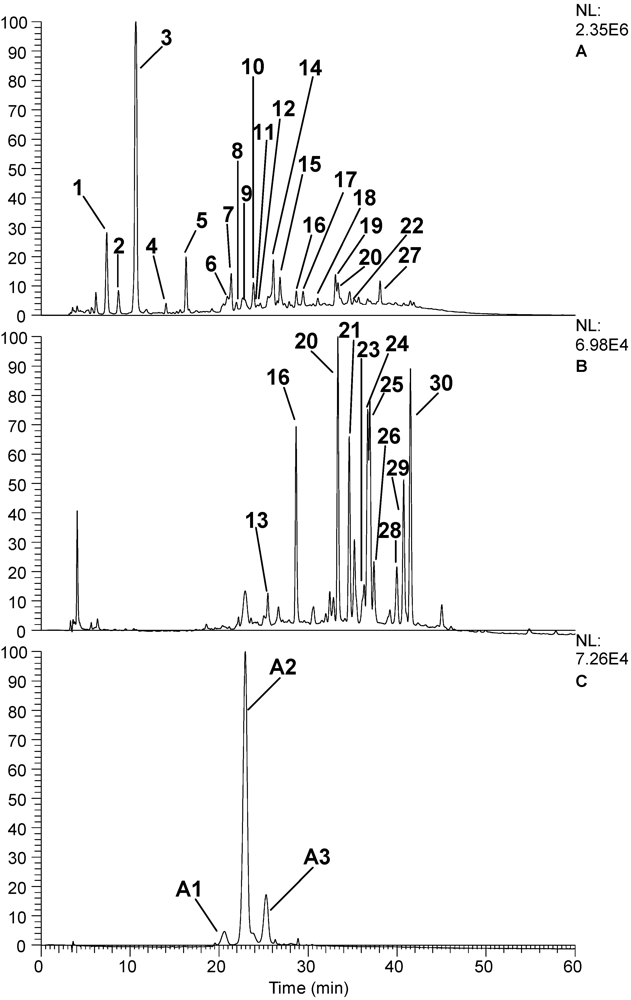
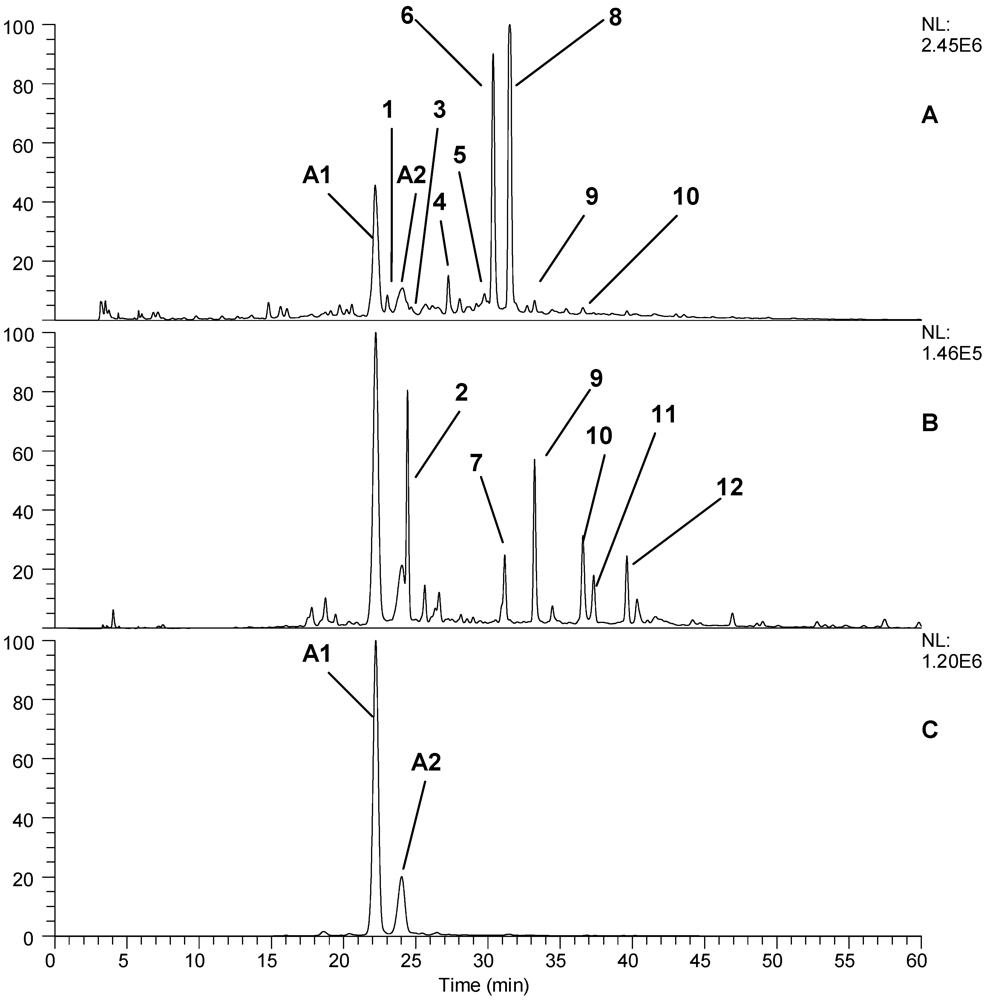
<p>Hydroethanolic extractions were performed on each fruit, <italic>A. unedo</italic> and <italic>R. idaeus</italic>, and the yield was determined. The extract yield was higher for <italic>A. unedo</italic> (79%, w/w) than for <italic>R. idaeus</italic> (47%, w/w). The total content in phenols was determined (<xref ref-type="table" rid="nutrients-02-00214-t001">Table 1</xref>). <italic>A. unedo</italic> extract yielded a similar content of total phenolics (16.46 ± 3.66 mg GAE. g<sup>-1</sup> dw) to <italic>R. idaeus</italic> (13.23 ± 0.94 mg GAE. g<sup>-1</sup> dw). Content in total phenols are in the range of values described in the literature for <italic>A. unedo</italic> and <italic>R. idaeus</italic> [<xref ref-type="bibr" rid="B9-nutrients-02-00214">9</xref>,<xref ref-type="bibr" rid="B18-nutrients-02-00214">18</xref>,<xref ref-type="bibr" rid="B19-nutrients-02-00214">19</xref>]. Phenolic compounds previously identified in strawberry tree fruits were mainly gallic acid derivatives, anthocyanins and proanthocyanidins, which are highly active as antioxidants [<xref ref-type="bibr" rid="B20-nutrients-02-00214">20</xref>]. Within these groups of antioxidant compounds, proanthocyanidins were the most abundant, representing more than 80% of the total flavonoid content [<xref ref-type="bibr" rid="B10-nutrients-02-00214">10</xref>]. The phenolic composition obtained for strawberry tree fruits used in this work (see supplementary data, <xref ref-type="table" rid="nutrients-02-00214-t002">Table 1</xref> and <xref ref-type="fig" rid="nutrients-02-00214-f003">Figure 1</xref>) was similar to the reported bibliography. We also detected some quercetin and ellagic acid derivatives as minor components. The raspberry extracts gave LC-MS profiles similar to previous work [<xref ref-type="bibr" rid="B14-nutrients-02-00214">14</xref>] and were dominated by anthocyanins and ellagitannins (see supplementary data, <xref ref-type="table" rid="nutrients-02-00214-t004">Table 3</xref> and <xref ref-type="table" rid="nutrients-02-00214-t005">Table 4</xref> and <xref ref-type="fig" rid="nutrients-02-00214-f004">Figure 2</xref>), with a number of other minor components.</p>
<p>Anthocyanins are a group of phenolic compounds of great interest in nutrition and medicine because of their potent antioxidant capacity and possible protective effects on human health [<xref ref-type="bibr" rid="B21-nutrients-02-00214">21</xref>]. The total anthocyanin content of raspberry was much higher than strawberry tree fruits (<xref ref-type="table" rid="nutrients-02-00214-t001">Table 1</xref>). Three main anthocyanins (cyanidin-3-<italic>O</italic>-<italic>β</italic>-D-galactopyranoside, delphinidin-3-<italic>O</italic>-<italic>β</italic>-D-glucopyranoside and cyanidin-3-<italic>O</italic>-<italic>β</italic>-D-arabinopyranoside; see supplementary data, <xref ref-type="table" rid="nutrients-02-00214-t003">Table 2</xref> and <xref ref-type="fig" rid="nutrients-02-00214-f003">Figure 1</xref>C) were seen in A. unedo fruits which agrees with previous reports  [<xref ref-type="bibr" rid="B12-nutrients-02-00214">12</xref>]. On the other hand, the most abundant <italic>R. idaeus</italic> anthocyanins are usually cyanidin-3-<italic>O</italic>-sophoroside, cyanidin-3-<italic>O</italic>-(2<sup>G</sup>)-glucosylrutinoside, cyanidin-3-<italic>O</italic>-glucoside, pelargonidin-3-<italic>O</italic>-sophoroside, cyanidin-3-<italic>O</italic>-rutinoside and pelargonidin-3-<italic>O</italic>-(2<sup>G</sup>)-glucosylrutinoside. Lower amounts of pelargonidin-3-<italic>O</italic>-glucoside and pelargonidin-3-<italic>O</italic>-rutinoside were also detected [<xref ref-type="bibr" rid="B14-nutrients-02-00214">14</xref>]. The raspberry extracts used in this study differed from reported anthocyanin compositions (e.g. [<xref ref-type="bibr" rid="B14-nutrients-02-00214">14</xref>]) with the dominant anthocyanins being cyanidin-3-<italic>O</italic>-sophoroside and cyanidin-3-<italic>O</italic>-rutinoside, probably as a result of varietal differences (see supplementary data, <xref ref-type="table" rid="nutrients-02-00214-t005">Table 4</xref> and <xref ref-type="fig" rid="nutrients-02-00214-f004">Figure 2</xref>C).</p>
<table-wrap id="nutrients-02-00214-t001" position="anchor">
<object-id pub-id-type="pii">nutrients-02-00214-t001_Table 1</object-id>
<label>Table 1</label>
<caption>
<p>Total phenol, anthocyanin content and antioxidant activity of <italic>A. unedo</italic> and <italic>R. idaeus</italic> fruits.</p>
</caption>
<table>
<thead>
<tr>
<th align="left" valign="middle">Fruit</th>
<th align="left" valign="middle">Total phenol content (mg GAE g<sup>-1</sup> dw)</th>
<th align="left" valign="middle">Anthocyanin content (mg cy-3-glucoside. 100 g<sup>-1</sup> dw)</th>
<th align="left" valign="middle">Antioxidant activity (mmol TE. 100 g<sup>-1</sup> dw)</th>
</tr>
</thead>
<tbody>
<tr>
<td align="left" valign="middle">
<bold> <italic>A. unedo</italic></bold>
</td>
<td align="left" valign="middle">16.46 ± 3.66</td>
<td align="left" valign="middle">76.26 ± 9.85<sup>***</sup></td>
<td align="left" valign="middle">11.66 ± 2.01</td>
</tr>
<tr>
<td align="left" valign="middle">
<bold><italic>R. idaeus</italic></bold></td>
<td align="left" valign="middle">13.23 ± 0.94</td>
<td align="left" valign="middle">438.60 ± 12.20</td>
<td align="left" valign="middle">15.37 ± 2.73</td>
</tr>
</tbody>
</table>
<table-wrap-foot><fn><p>Each value is the average of three independent replicates ±SD. *** - significantly different values for p &lt; 0.001.</p></fn></table-wrap-foot>
</table-wrap>

<p>Based on their high phenol content, it was possible to reasonably anticipate a high antioxidant activity for both <italic>A. unedo</italic> and <italic>R. idaeus</italic> berries. The antioxidant capacity, assessed by ORAC, was similar for both fruits (11.66 ± 2.01 mmol TE.100 g<sup>-1</sup> dw for strawberry tree fruit and 15.37 ± 2.73 mmol TE. 100 g<sup>-1</sup> dw for raspberry). Antioxidant capacities reported in the literature are difficult to compare due to differences in the methodologies used. However, García-Alonso and co-workers determined the antioxidant activity of 27 fruits, including strawberry tree and raspberry, and established a ranking (TEAC method) where strawberry tree antioxidant capacity was ranked slightly higher than that of raspberry [<xref ref-type="bibr" rid="B22-nutrients-02-00214">22</xref>].</p>
<p>Both <italic>A. unedo</italic> and <italic>R. idaeus</italic> berries have been characterized as good sources of antioxidants, with their antioxidant properties associated to different groups of compounds. For <italic>A. unedo</italic>, this activity is attributed to the high flavonoid content, (mainly comprised by proanthocyanidins, cyanidin and delphinidin glycosides), ellagic acid and its diglucoside derivative, vitamin C and E and carotenoids [<xref ref-type="bibr" rid="B10-nutrients-02-00214">10</xref>]. <italic>R. idaeus</italic> studies performed with an ellagitannin-rich fraction show that this fraction had considerably higher antioxidant capacity than the original raspberry extract or an anthocyanin-rich fraction [<xref ref-type="bibr" rid="B14-nutrients-02-00214">14</xref>], a observation already noted by others [<xref ref-type="bibr" rid="B23-nutrients-02-00214">23</xref>]. Over 50% of the total raspberry antioxidant capacity is conferred by Sanguiin H6 and Lambertianin C [<xref ref-type="bibr" rid="B23-nutrients-02-00214">23</xref>]. </p>
<p>Knowledge of the chemically-determined antioxidant characterization of <italic>A. unedo</italic> berries is certainly important. However, its biological significance remains to be evaluated. It is therefore crucial to validate these bioactivities on different cell-based human-disease models assays and, at the end, in the overall organism.</p>
</sec>
<sec>
<title>2.2. Effect of Fruit Extracts on a Neurodegeneration Cell Model</title>
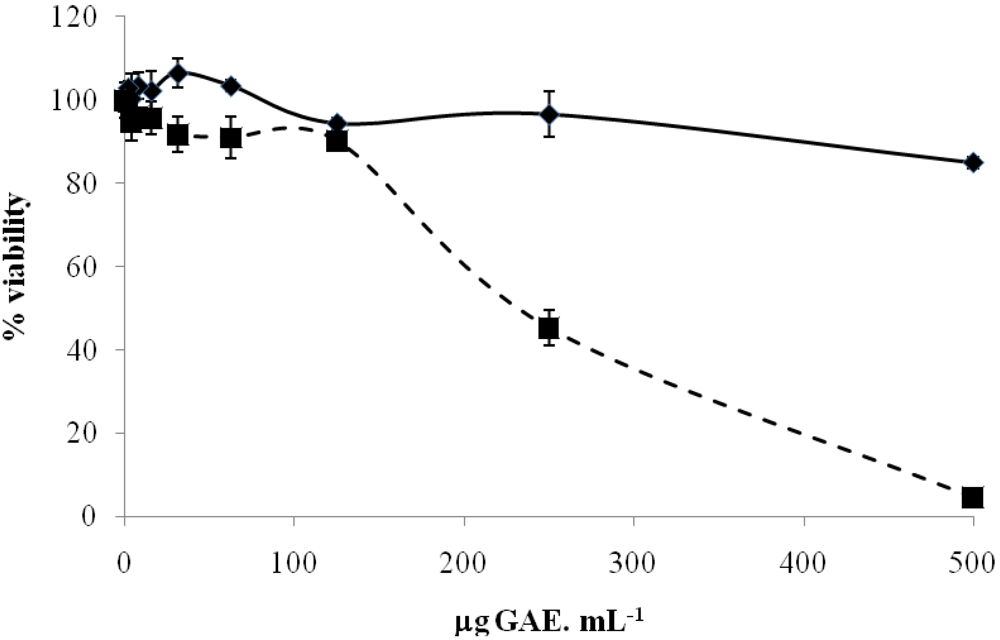
<p>Based on promising <italic>in vitro</italic> antioxidant results, a neuroprotective test was performed using an SK-N-MC human neuroblastoma cell line. Firstly, a non-toxic range of concentrations of raspberry and strawberry tree fruit extracts were defined. Toxicity tests involved the determination of cell viability after a 4 h incubation in the range 0 to 500 μg GAE. mL<sup>-1</sup> medium. No toxic effects were observed in cell viability until 125 μg GAE. mL<sup>-1</sup> for both fruits, as shown in <xref ref-type="fig" rid="nutrients-02-00214-f001">Figure 1</xref>. For concentrations higher than 125 μg GAE. mL<sup>-1</sup>, the viability decreased, particularly with raspberry, probably because the compounds become toxic for cells. This phenomenon should happen since many plant secondary products seem to have a paradoxical (hormetic) effect on diseases that depend on their concentration and thus level of consumption [<xref ref-type="bibr" rid="B24-nutrients-02-00214">24</xref>]; at low concentrations a compound could exert a benefic effect, but when its concentration is too high for the organism/cells it starts to be toxic [<xref ref-type="bibr" rid="B25-nutrients-02-00214">25</xref>,<xref ref-type="bibr" rid="B26-nutrients-02-00214">26</xref>,<xref ref-type="bibr" rid="B27-nutrients-02-00214">27</xref>].</p>
<fig id="nutrients-02-00214-f001" position="anchor">
<label>Figure 1</label>
<caption>
<p>Cytotoxicity evaluation of <italic>A</italic>. unedo and <italic>R. idaeus</italic> extracts in the neuroblastoma cell line SK-N-MC. Cell viability was determined with 3.45 × 10<sup>5</sup> cells/well in the range of 0 to 500 μg GAE. mL<sup>-1</sup> medium, using the CellTiter-Blue® Cell Viability Assay. <inline-graphic xmlns:xlink="http://www.w3.org/1999/xlink" xlink:href="nutrients-02-00214-i001.tif"/> <italic> A. unedo</italic> <inline-graphic xmlns:xlink="http://www.w3.org/1999/xlink" xlink:href="nutrients-02-00214-i002.tif"/> <italic>R. idaeus</italic>. Each point is the average of three independent replicates. Vertical bars represent ± SD. </p>
</caption>
<graphic xmlns:xlink="http://www.w3.org/1999/xlink" xlink:href="nutrients-02-00214-g001.tif"/>
</fig>
<p>To evaluate the neuroprotective effect of the fruit extracts, the neuroblastoma cell line SK-N-MC was submitted to an oxidative stress after a pre-incubation with the dried fruit extracts solubilized in medium. Peroxides are often used as models to induce oxidative damage in cells cultured under <italic>in vitro</italic> conditions [<xref ref-type="bibr" rid="B17-nutrients-02-00214">17</xref>]. To this end, the ability of hydrogen peroxide (H<sub>2</sub>O<sub>2</sub>) to induce oxidative stress in SK-N-MC cells was assessed by the cell viability test already described above. Non-toxic concentrations of the fruits extracts were used in the SK-N-MC cells challenged with 1 mM H<sub>2</sub>O<sub>2 </sub>to evaluate the neuroprotection capacity of the phytochemicals. This test evaluates the cytoprotective activities of the compounds, by protecting cell viability after pre-conditioning the cells with the extracts before the oxidative injury.</p>
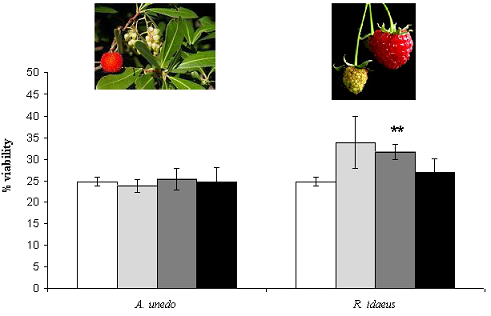
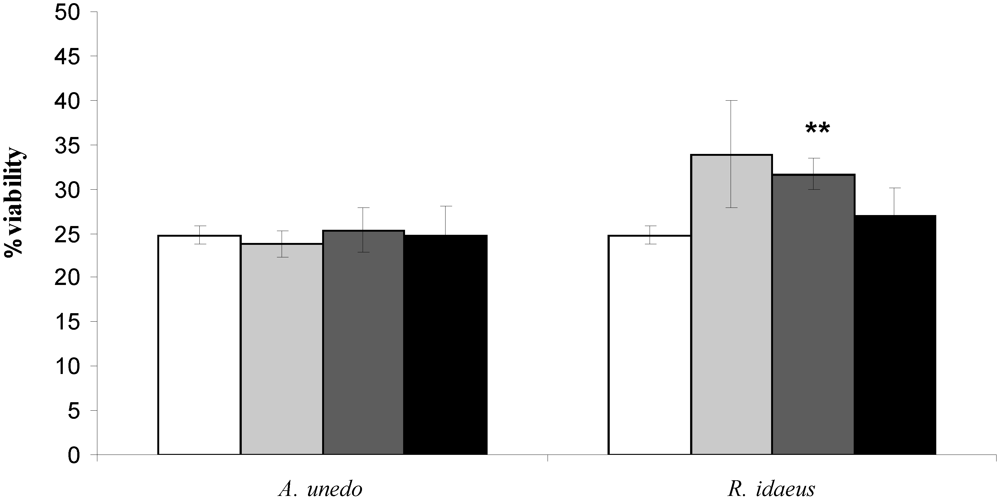
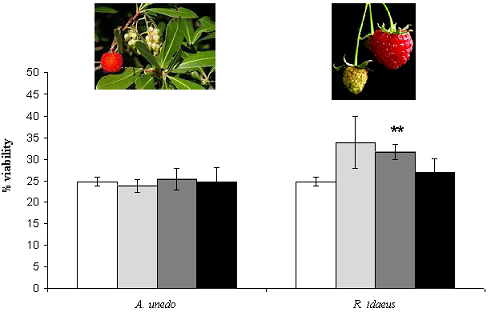
<p>Although the chemically-measured antioxidant activity exhibited by strawberry tree fruit was slightly lower from that of raspberry, the raspberry extract rescued cell survival while no significant effect in neuroblastoma viability was detected with the strawberry tree berry extract, using the same amount of polyphenols, estimated by Folin- Ciocaulteau method (<xref ref-type="fig" rid="nutrients-02-00214-f002">Figure 2</xref>).</p>
<fig id="nutrients-02-00214-f002" position="anchor">
<label>Figure 2</label>
<caption>
<p>Effect of <italic>A. unedo</italic> and <italic>R. idaeus</italic> fruit extracts on cell viability after H<sub>2</sub>O<sub>2</sub> insult SK-N-MC cells were treated with 1 mM H<sub>2</sub>O<sub>2</sub> for 1.5 h after 1 h pre-conditioning with the fruit extracts. Assay was performed with 2.8 x 10<sup>5</sup> cells/well as described in methods, and cell viability was determined using the CellTiter-Blue® Cell Viability Assay. (□) 0 (control), (<inline-graphic xmlns:xlink="http://www.w3.org/1999/xlink" xlink:href="nutrients-02-00214-i003.tif"/>) 50, (<inline-graphic xmlns:xlink="http://www.w3.org/1999/xlink" xlink:href="nutrients-02-00214-i004.tif"/>) 125 and (■) 175 µg GAE .mL<sup>-1</sup>. Each point is the average of three independent replicates. Vertical bars represent ± SD. ** - significantly different values for p &lt; 0.01 <bold>.</bold></p>
</caption>
<graphic xmlns:xlink="http://www.w3.org/1999/xlink" xlink:href="nutrients-02-00214-g002.tif"/>
</fig>

<p> In fact, the incubation of the human cells with 1 mM H<sub>2</sub>O<sub>2</sub> for 1.5 hours reduced viability to 25%, whereas pre-incubation with <italic>R. idaeus</italic> extract enhanced cell survival to 33.8%. In other words, the overall increase in cell viability with <italic>R.</italic><italic>idaeus</italic> was estimated as 36.6% at 50 µg GAE. mL<sup>-1 </sup>and 27.8% at 125 µg GAE. mL<sup>-1</sup>, but decreased for higher concentrations (8.9% at 175 µg GAE. mL<sup>-1</sup>).</p>
<p>Both <italic>R. idaeus</italic> and <italic>A. unedo</italic> fruits are potential sources of bioactive compounds like vitamin C, phenolic acids, proanthocyanidins and flavonol derivatives, however the absence of cell protection detected for <italic>A. unedo</italic> suggests that its phytochemical composition is not effective against H<sub>2</sub>O<sub>2</sub> stress induced in this neuroblastoma cell models, but does not exclude biological effectiveness in other systems. These fruits are qualitatively quite different in their chemical composition which could explain the different bioefficacy in protecting cells from oxidative stress. In fact, the biological effects presented by <italic>R. idaeus</italic> fruits could be attributed to ellagitannin content (not present in <italic>A. unedo</italic>) and the higher levels of anthocyanins.</p>
<p>This study is a good example of the importance in evaluating the biological function of phenolics to validate their <italic>in vitro</italic> antioxidant activity. Further assays in different biosystems will be performed to validate the biological effects of <italic>A. unedo</italic> phytochemicals.</p>
</sec>
</sec>
<sec>
<title>3. Experimental Section</title>
<sec>
<title>3.1. Biological Material</title>
<p><italic>Arbutus unedo</italic> L. fruits were collected in November 2007, by random sampling in an extensive area of Arrábida Natural Park (southern region of Portugal). The samples were immediately ground and freeze dried and stored at -80°C prior to extraction. <italic>Rubus idaeus</italic> cv. Polka was grown in Herdade Experimental da Fataca, Odemira, Portugal.</p>
</sec>
<sec>
<title>3.2. Extract Preparation</title>
<p>To each 1 g of lyophilized powder, 12 mL of hydroethanolic solvent (ethanol 50% (v/v)) were added and the mixture was shaken for 30 min, at room temperature in the dark. The mixture was then centrifuged at 12,400 <italic>g</italic> during 10 min at room temperature. The supernatant was filtered through paper filter and then through 0.20 µm cellulose acetate membrane filters. The resulting extracts were stored frozen at –80 °C, no longer than one month. For each fruit extract, an aliquot was freeze dried under vacuum conditions and the yield was determined. </p>
</sec>
<sec>
<title>3.3. Total Phenolic Measurement</title>
<p>Determination of total phenolic compounds was performed by the Folin-Ciocalteau method [<xref ref-type="bibr" rid="B28-nutrients-02-00214">28</xref>]. Briefly, to each well of a microplate, 235 µL water, 5 µL sample (or solvent, in the control), 15 µL Folin-Ciocalteau’s reagent (Fluka®) and 45 µL saturated Na<sub>2</sub>CO<sub>3</sub> were added. The microplate was incubated for 30 min at 40 °C and the absorbance at 765 nm measured. Gallic acid was used as the standard and the results were expressed in mg of gallic acid equivalents per g of dry weight of plant material (mg GAE. g<sup>-1</sup> dw). </p>
</sec>
<sec>
<title>3.4. Anthocyanin Content</title>
<p>The total anthocyanin content of the fruit extracts was determined using a pH differential absorbance method [<xref ref-type="bibr" rid="B18-nutrients-02-00214">18</xref>]. Absorbance readings were related to anthocyanin content using the molar extinction coefficient of 12100 calculated for cyanidin-3-O-glucoside. Results were expressed as mg of cyanidin 3-glucoside equivalents per 100 g of dry weight of plant material (mg cy-3-glucoside. 100 g<sup>-1</sup> dw).</p>
</sec>
<sec>
<title>3.5. Peroxyl Radical Scavenging Capacity Assay</title>
<p>Peroxyl radical scavenging capacity was determined by the ORAC (Oxygen Radical Absorbance Capacity) method [<xref ref-type="bibr" rid="B19-nutrients-02-00214">19</xref>,<xref ref-type="bibr" rid="B29-nutrients-02-00214">29</xref>]. Briefly, the reaction mixture contained 150 µL of sodium fluorescein (0.2 nM) (Uranine, Fluorescein Sodium Salt® TCI Europe), 25 µL sample and 25 µL of 2,2’-azobis(2-amidopropane)dihydrochloride (41.4 g.L<sup>-1</sup>). The blank contained 25 µL 75 mM phosphate buffer (pH 7.4) instaed of sample, whereas the standards contained 25 µL of 10 to 50 µM 6-hydroxy-2,5,7,8-tetramethylchroman-2-carboxylic acid (Trolox®) in place of the sample. The fluorescent emission at 515 nm was then monitored kinetically during 30 min at 37 °C, after excitation at 493 nm using a FLx800 Fluorescence Microplate Reader (Biotek). The final results were calculated using the area differences under the fluorescence decay curves between the blank and the sample, and were expressed as mM Trolox equivalents per g of dry weight of plant material (mM TE. 100 g<sup>-1</sup> dw).</p>
</sec>
<sec>
<title>3.6. HPLC-MS Phenolic Profile Determination</title>
<p>Phenolic extracts were dried by rotary evaporation, ressuspended in 5% (v/v) acetonitrile in water and was analyzed on a LCQ-DECA system controlled by the XCALIBUR software (2.0, ThermoFinnigan). The LCQ-Deca system comprised a Surveyor autosampler, pump and photo diode array detector (PDAD) and a Thermo Finnigan mass spectrometer iontrap. The PDA collected spectral data from 200-600 nm and scanned three discrete channels (at 280, 365 and 510 nm). The samples were applied to a C-18 column (Synergi Hydro C18 column with polar end capping, 4.6 mm x 150 mm, Phenomonex Ltd.) and eluted over a gradient of 95:5 solvent A:B at time=0 minutes to 60:40 A:B at time = 60 minutes at a flow rate of 400 μL/min. Solvent A was 0.1% (v/v) formic acid in ultra pure water and solvent B 0.1% (v/v) formic acid in acetonitrile. The LCQ-Deca LC-MS was fitted with an ESI (electrospray ionization) interface and analyzed the samples in positive and negative-ion mode. Two scan events, full scan analysis in mass range 80-2000 m/z followed by data dependent MS/MS of the most intense ions, were used for compounds detection and identification. The data-dependent MS/MS used collision energies (source voltage) of 45%. The capillary temperature was set at 275 °C with sheath gas at 60 psi and auxiliary gas at 10 psi. Before the analysis, the system was tuned by using known concentrations of cyanidin-3-glucoside (positive mode) and quercetin-3-glucoside (negative mode) in ultrapure water.</p>
</sec>
<sec>
<title>3.7. Cell Culture</title>
<p>Human neuroblastoma SK-N-MC cells were obtained from the European Collection of Cell Cultures (ECACC) and cultured in EMEM supplemented with 2 mM Glutamine, 10% (v/v) heat-inactivated fetal bovine serum (Gibco), 1% (w/v) of non-essential amino acids and sodium pyruvate (1mM). The cells were maintained at 37 °C in 5% CO<sub>2</sub>. All experiments were carried out 24-48 h after cells were seeded.</p>
</sec>
<sec>
<title>3.8. Cell Viability</title>
<p>Hydroethanolic extracts were prepared as described above, dried under vacuum and solubilized in cell medium for the cytotoxicity tests. The test was performed by a 96-well plate cell viability assay on the neuroblastoma human cell line SK-N-MC, to identify the nontoxic range of extract concentrations. Toxicity tests involved a 4 h incubation in the range 0 to 500 μg GAE. mL<sup>-1</sup> medium. Cell viability was assessed using the CellTiter-Blue<sup>®</sup> Cell Viability Assay, a fluorescent method based on the ability of living cells to convert a non-fluorescent redox dye (resazurin) into a fluorescent end product (resorufin), according to the manufacture instructions. Nonviable cells rapidly lose their metabolic capacity and thus do not generate the fluorescent signal. </p>
</sec>
<sec>
<title>3.9. Intracellular Antioxidant Activity</title>
<p>Neuroblastoma cells were pre-incubated for 1 h with strawberry tree or raspberry fruit extracts and then were treated with H<sub>2</sub>O<sub>2</sub> (1 mM) for 1.5 h. Fruit hydroethanolic extracts were prepared as described above, dried under vacuum and dissolved in cell medium. Cell viability was evaluated as described above. </p>
</sec>
<sec>
<title>3.10. Statistical Analysis</title>
<p>The results reported in this work are the averages of at least three independent experiments and are represented as the mean ± SD. Differences among treatments were detected by analysis of variance [<xref ref-type="bibr" rid="B30-nutrients-02-00214">30</xref>] with Tukey HSD (Honest Significant Difference) multiple comparison test (α = 0.05) using SigmaStat 3.10 (Systat). </p>
</sec>
</sec>
<sec sec-type="conclusions">
<title>4. Conclusions</title>
<p>The involvement of free radicals, specially their increased production, appears to be a common feature to most human diseases, including cardiovascular disease, neurodegeneration and cancer. As such, dietary antioxidants have been suggested to be particularly important tools to fight against these diseases, by affording protection towards free radical damage in cellular DNA, lipids and proteins. In <italic>Rubus</italic> species an attempt has been made to rationalize the antioxidant potential in terms of the phenolic compounds present [<xref ref-type="bibr" rid="B18-nutrients-02-00214">18</xref>]. In all samples analyzed, ascorbic acid was found to make only a minor contribution (3%) to the total antioxidant capacity; the majority of the antioxidant capacity thus appeared to be due to flavonoids, the dominant family of phenolic compounds [<xref ref-type="bibr" rid="B18-nutrients-02-00214">18</xref>]. </p>
<p>Although the chemically-determined antioxidant characterization of berries is important, evidence for their biological significance in human diseases and homeostasis is lacking. Therefore, the validation of these bioactivities in different cell-based human-disease model assays is very important, together with information on the bioavailability and metabolism of these phytomolecules.</p>
<p>In this study, a neurodegeneration cell model was used to evaluate the neuroprotective effect of the strawberry tree and raspberry fruit phenolics. The neuroblastoma cell line SK-N-MC was subjected to an oxidative stress after pre-incubation with the fruits extracts. Although the measured chemical antioxidant activity exhibited by strawberry tree fruit was comparable to that presented by raspberry, the latter could increase cell survival by 36.6% while no effect in neuroblastoma viability was detected with the former. These results clearly demonstrate that an interesting level of chemically-determined antioxidant activity present in a plant extract is not necessarily correlated with biological significance, as concluded by the effect of strawberry tree fruit on a neurodegeneration cell model. </p>
<p>It is clearly evident that many more cell and organism assays should be performed to validate previously detected chemical bioactivities. As a whole, the results presented in this work show that there is no protective effect of strawberry tree berry phenolics on a neurodegeneration cell model, but do not exclude other possible relevant biological effects. </p>
</sec>
</body>
<back>
<ack>
<title>Acknowledgements</title>
<p>To Action Cost 863 for financial support of SF to attend to the International Conference on Food-Omics, and to FCT for financial support of CS (SRFH/BPD/26562/2006) and LT (SFRH/BD/37382/2007). DS and GM thank Scottish Government Rural and Environment Research and Analysis Directorate (RERAD) for support. We also would like to acknowledge Pedro Oliveira for providing <italic>Rubus idaeus</italic> fruits from Herdade Experimental da Fataca. </p>
</ack>
<ref-list>
<title>References and Notes</title>
<ref id="B1-nutrients-02-00214">
<label>1.</label>
<citation citation-type="journal">
<person-group person-group-type="author">
<name>
<surname>Dore</surname>
<given-names>S.</given-names>
</name>
</person-group>
<article-title>Unique properties of polyphenol stilbenes in the brain: More than direct antioxidant actions; gene/protein regulatory activity</article-title>
<source>Neurosignals</source>
<year>2005</year>
<volume>14</volume>
<fpage>61</fpage>
<lpage>70</lpage>
<pub-id pub-id-type="pmid">15956815</pub-id>
<pub-id pub-id-type="doi">10.1159/000085386</pub-id>
</citation>
</ref>
<ref id="B2-nutrients-02-00214">
<label>2.</label>
<citation citation-type="journal">
<person-group person-group-type="author">
<name>
<surname>Mandel</surname>
<given-names>S.</given-names>
</name>
<name>
<surname>Youdim</surname>
<given-names>M.B.</given-names>
</name>
</person-group>
<article-title>Catechin polyphenols: Neurodegeneration and neuroprotection in neurodegenerative diseases</article-title>
<source>Free Radic. Biol. Med.</source>
<year>2004</year>
<volume>37</volume>
<fpage>304</fpage>
<lpage>317</lpage>
<pub-id pub-id-type="doi">10.1016/j.freeradbiomed.2004.04.012</pub-id><pub-id pub-id-type="pmid">15223064</pub-id></citation>
</ref>
<ref id="B3-nutrients-02-00214">
<label>3.</label>
<citation citation-type="journal">
<person-group person-group-type="author">
<name>
<surname>Butterfield</surname>
<given-names>D.A.</given-names>
</name>
</person-group>
<article-title>Amyloid beta-peptide (1-42)-induced oxidative stress and neurotoxicity: Implications for neurodegeneration in alzheimer's disease brain</article-title>
<source>A review. Free Radic. Res.</source>
<year>2002</year>
<volume>36</volume>
<fpage>1307</fpage>
<lpage>1313</lpage>
<pub-id pub-id-type="doi">10.1080/1071576021000049890</pub-id></citation>
</ref>
<ref id="B4-nutrients-02-00214">
<label>4.</label>
<citation citation-type="journal">
<person-group person-group-type="author">
<name>
<surname>Andres-Lacueva</surname>
<given-names>C.</given-names>
</name>
<name>
<surname>Shukitt-Hale</surname>
<given-names>B.</given-names>
</name>
<name>
<surname>Galli</surname>
<given-names>R.L.</given-names>
</name>
<name>
<surname>Jauregui</surname>
<given-names>O.</given-names>
</name>
<name>
<surname>Lamuela-Raventos</surname>
<given-names>R.M.</given-names>
</name>
<name>
<surname>Joseph</surname>
<given-names>J.A.</given-names>
</name>
</person-group>
<article-title>Anthocyanins in aged blueberry-fed rats are found centrally and may enhance memory</article-title>
<source>Nutr. Neurosci.</source>
<year>2005</year>
<volume>8</volume>
<fpage>111</fpage>
<lpage>120</lpage>
<pub-id pub-id-type="pmid">16053243</pub-id>
<pub-id pub-id-type="doi">10.1080/10284150500078117</pub-id>
</citation>
</ref>
<ref id="B5-nutrients-02-00214">
<label>5.</label>
<citation citation-type="journal">
<person-group person-group-type="author">
<name>
<surname>Bickford</surname>
<given-names>P.C.</given-names>
</name>
<name>
<surname>Gould</surname>
<given-names>T.</given-names>
</name>
<name>
<surname>Briederick</surname>
<given-names>L.</given-names>
</name>
<name>
<surname>Chadman</surname>
<given-names>K.</given-names>
</name>
<name>
<surname>Pollock</surname>
<given-names>A.</given-names>
</name>
<name>
<surname>Young</surname>
<given-names>D.</given-names>
<suffix>et al.</suffix>
</name>
</person-group>
<article-title>Antioxidant-rich diets improve cerebellar physiology and motor learning in aged rats</article-title>
<source>Brain Res. </source>
<year>2000</year>
<volume>866</volume>
<fpage>211</fpage>
<lpage>217</lpage>
<pub-id pub-id-type="pmid">10825496</pub-id>
<pub-id pub-id-type="doi">10.1016/S0006-8993(00)02280-0</pub-id>
</citation>
</ref>
<ref id="B6-nutrients-02-00214">
<label>6.</label>
<citation citation-type="journal">
<person-group person-group-type="author">
<name>
<surname>Lau</surname>
<given-names>F.C.</given-names>
</name>
<name>
<surname>Shukitt-Hale</surname>
<given-names>B.</given-names>
</name>
<name>
<surname>Joseph</surname>
<given-names>J.A.</given-names>
</name>
</person-group>
<article-title>Beneficial effects of berry fruit polyphenols on neuronal and behavioral aging</article-title>
<source>J. Sci. Food Agric.</source>
<year>2006</year>
<volume>86</volume>
<fpage>2251</fpage>
<lpage>2255</lpage>
<pub-id pub-id-type="doi">10.1002/jsfa.2671</pub-id></citation>
</ref>
<ref id="B7-nutrients-02-00214">
<label>7.</label>
<citation citation-type="journal">
<person-group person-group-type="author">
<name>
<surname>Shukitt-Hale</surname>
<given-names>B.</given-names>
</name>
<name>
<surname>Lau</surname>
<given-names>F.C.</given-names>
</name>
<name>
<surname>Joseph</surname>
<given-names>J.A.</given-names>
</name>
</person-group>
<article-title>Berry fruit supplementation and the aging brain</article-title>
<source>J. Agric. Food Chem.</source>
<year>2008</year>
<volume>56</volume>
<fpage>636</fpage>
<lpage>641</lpage>
<pub-id pub-id-type="doi">10.1021/jf072505f</pub-id><pub-id pub-id-type="pmid">18211020</pub-id></citation>
</ref>
<ref id="B8-nutrients-02-00214">
<label>8.</label>
<citation citation-type="journal">
<person-group person-group-type="author">
<name>
<surname>Ayaz</surname>
<given-names>F.A.</given-names>
</name>
<name>
<surname>Kucukislamoglu</surname>
<given-names>M.</given-names>
</name>
<name>
<surname>Reunanen</surname>
<given-names>M.</given-names>
</name>
</person-group>
<article-title>Sugar, non-volatile and phenolic acids composition of strawberry tree (<italic>Arbutus unedo</italic> L. var.Ellipsoidea ) fruits</article-title>
<source>J. Food Comp. Anal. </source>
<year>2000</year>
<volume>13</volume>
<fpage>171</fpage>
<lpage>177</lpage>
<pub-id pub-id-type="doi">10.1006/jfca.1999.0868</pub-id>
</citation>
</ref>
<ref id="B9-nutrients-02-00214">
<label>9.</label>
<citation citation-type="journal">
<person-group person-group-type="author">
<name>
<surname>Alarcao-E-Silva</surname>
<given-names>M.L.C.M.M.</given-names>
</name>
<name>
<surname>Leitao</surname>
<given-names>A.E.B.</given-names>
</name>
<name>
<surname>Azinheira</surname>
<given-names>H.G.</given-names>
</name>
<name>
<surname>Leitao</surname>
<given-names>M.C.A.</given-names>
</name>
</person-group>
<article-title>The <italic>Arbutus</italic> berry: Studies on its color and chemical characteristics at two mature stages</article-title>
<source>J. Food Comp. Anal.</source>
<year>2001</year>
<volume>14</volume>
<fpage>27</fpage>
<lpage>35</lpage>
<pub-id pub-id-type="doi">10.1006/jfca.2000.0962</pub-id>
</citation>
</ref>
<ref id="B10-nutrients-02-00214">
<label>10.</label>
<citation citation-type="journal">
<person-group person-group-type="author">
<name>
<surname>Pallauf</surname>
<given-names>K.</given-names>
</name>
<name>
<surname>Rivas-Gonzalo</surname>
<given-names>J.C.</given-names>
</name>
<name>
<surname>del Castillo</surname>
<given-names>M.D.</given-names>
</name>
<name>
<surname>Cano</surname>
<given-names>M.P.</given-names>
</name>
<name>
<surname>de Pascual-Teresa</surname>
<given-names>S. </given-names>
</name>
</person-group>
<article-title>Characterization of the antioxidant composition of strawberry tree (<italic>Arbutus unedo</italic> L.) fruits</article-title>
<source> J. Food Comp. Anal.</source>
<year>2008</year>
<volume>21</volume>
<fpage>273</fpage>
<lpage>281</lpage>
<pub-id pub-id-type="doi">10.1016/j.jfca.2007.11.006</pub-id>
</citation>
</ref>
<ref id="B11-nutrients-02-00214">
<label>11.</label>
<citation citation-type="journal">
<person-group person-group-type="author">
<name>
<surname>Bnouham</surname>
<given-names>M.</given-names>
</name>
<name>
<surname>Merhfour</surname>
<given-names>F.Z.</given-names>
</name>
<name>
<surname>Legssyer</surname>
<given-names>A.</given-names>
</name>
<name>
<surname>Mekhfi</surname>
<given-names>H.</given-names>
</name>
<name>
<surname>Maallem</surname>
<given-names>S.</given-names>
</name>
<name>
<surname>Ziyyat</surname>
<given-names>A.</given-names>
</name>
</person-group>
<article-title>Antihyperglycemic activity of <italic>Arbutus unedo</italic>, <italic>Ammoides pusilla</italic> and <italic>Thymelaea hirsuta</italic></article-title>
<source>Pharmazie.</source>
<year>2007</year>
<volume>62</volume>
<fpage>630</fpage>
<lpage>632</lpage>
<pub-id pub-id-type="pmid">17867561</pub-id>
</citation>
</ref>
<ref id="B12-nutrients-02-00214">
<label>12.</label>
<citation citation-type="journal">
<person-group person-group-type="author">
<name>
<surname>Pawlowska</surname>
<given-names>A.M.</given-names>
</name>
<name>
<surname>De Leo</surname>
<given-names>M.</given-names>
</name>
<name>
<surname>Braca</surname>
<given-names>A.</given-names>
</name>
</person-group>
<article-title>Phenolics of <italic>Arbutus unedo</italic> L. (ericaceae) fruits: Identification of anthocyanins and gallic acid derivatives</article-title>
<source>J. Agric. Food Chem.</source>
<year>2006</year>
<volume>54</volume>
<fpage>10234</fpage>
<lpage>10238</lpage>
<pub-id pub-id-type="pmid">17177565</pub-id>
<pub-id pub-id-type="doi">10.1021/jf062230o</pub-id>
</citation>
</ref>
<ref id="B13-nutrients-02-00214">
<label>13.</label>
<citation citation-type="journal">
<person-group person-group-type="author">
<name>
<surname>Males</surname>
<given-names>Z.</given-names>
</name>
<name>
<surname>Plazibat</surname>
<given-names>M.</given-names>
</name>
<name>
<surname>Vundac</surname>
<given-names>V.B.</given-names>
</name>
<name>
<surname>Zuntar</surname>
<given-names>I.</given-names>
</name>
</person-group>
<article-title>Qualitative and quantitative analysis of flavonoids of the strawberry tree-<italic>Arbutus unedo</italic> L. (ericaceae)</article-title>
<source>Acta Pharm.</source>
<year>2006</year>
<volume>56</volume>
<fpage>245</fpage>
<lpage>250</lpage>
<pub-id pub-id-type="pmid">16613729</pub-id>
</citation>
</ref>
<ref id="B14-nutrients-02-00214">
<label>14.</label>
<citation citation-type="journal">
<person-group person-group-type="author">
<name>
<surname>Ross</surname>
<given-names>H.A.</given-names>
</name>
<name>
<surname>McDougall</surname>
<given-names>G.J.</given-names>
</name>
<name>
<surname>Stewart</surname>
<given-names>D.</given-names>
</name>
</person-group>
<article-title>Antiproliferative activity is predominantly associated with ellagitannins in raspberry extracts</article-title>
<source>Phytochemistry</source>
<year>2007</year>
<volume>68</volume>
<fpage>218</fpage>
<lpage>228</lpage>
<pub-id pub-id-type="doi">10.1016/j.phytochem.2006.10.014</pub-id><pub-id pub-id-type="pmid">17126865</pub-id></citation>
</ref>
<ref id="B15-nutrients-02-00214">
<label>15.</label>
<citation citation-type="journal">
<person-group person-group-type="author">
<name>
<surname>Rouanet</surname>
<given-names>J.-M.</given-names>
</name>
<name>
<surname>Décordé</surname>
<given-names>K.</given-names>
</name>
<name>
<surname>Rio</surname>
<given-names>D.D.</given-names>
</name>
<name>
<surname>Auger</surname>
<given-names>C.</given-names>
</name>
<name>
<surname>Borges</surname>
<given-names>G.</given-names>
</name>
<name>
<surname>Cristol</surname>
<given-names>J.-P.</given-names>
</name>
<name>
<surname>Lean</surname>
<given-names>M.E.J.</given-names>
</name>
<name>
<surname>Crozier</surname>
<given-names>A.</given-names>
</name>
</person-group>
<article-title>Berry juices, teas, antioxidants and the prevention of atherosclerosis in hamsters</article-title>
<source>Food Chem.</source>
<year>2010</year>
<volume>118</volume>
<fpage>266</fpage>
<lpage>271</lpage>
<pub-id pub-id-type="doi">10.1016/j.foodchem.2009.04.116</pub-id>
</citation>
</ref>
<ref id="B16-nutrients-02-00214">
<label>16.</label>
<citation citation-type="journal">
<person-group person-group-type="author">
<name>
<surname>Zhang</surname>
<given-names>L.</given-names>
</name>
<name>
<surname>Li</surname>
<given-names>J.</given-names>
</name>
<name>
<surname>Hogan</surname>
<given-names>S.</given-names>
</name>
<name>
<surname>Chung</surname>
<given-names>H.</given-names>
</name>
<name>
<surname>Welbaum</surname>
<given-names>G.E.</given-names>
</name>
<name>
<surname>Zhou</surname>
<given-names>K.</given-names>
</name>
</person-group>
<article-title>Inhibitory effect of raspberries on starch digestive enzyme and their antioxidant properties and phenolic composition</article-title>
<source>Food Chem.</source>
<comment>in Press</comment>
<pub-id pub-id-type="doi">10.1016/j.foodchem.2009.04.116</pub-id></citation>
</ref>
<ref id="B17-nutrients-02-00214">
<label>17.</label>
<citation citation-type="journal">
<person-group person-group-type="author">
<name>
<surname>Linden</surname>
<given-names>A.</given-names>
</name>
<name>
<surname>Gulden</surname>
<given-names>M.</given-names>
</name>
<name>
<surname>Martin</surname>
<given-names>H.J.</given-names>
</name>
<name>
<surname>Maser</surname>
<given-names>E.</given-names>
</name>
<name>
<surname>Seibert</surname>
<given-names>H.</given-names>
</name>
</person-group>
<article-title>Peroxide-induced cell death and lipid peroxidation in c6 glioma cells</article-title>
<source>Toxicol. In Vitro</source>
<year>2008</year>
<volume>22</volume>
<fpage>1371</fpage>
<lpage>1376</lpage>
<pub-id pub-id-type="doi">10.1016/j.tiv.2008.02.003</pub-id><pub-id pub-id-type="pmid">18346863</pub-id></citation>
</ref>
<ref id="B18-nutrients-02-00214">
<label>18.</label>
<citation citation-type="journal">
<person-group person-group-type="author">
<name>
<surname>Deighton</surname>
<given-names>N.</given-names>
</name>
<name>
<surname>Brennan</surname>
<given-names>R.</given-names>
</name>
<name>
<surname>Finn</surname>
<given-names>C.</given-names>
</name>
<name>
<surname>Davies</surname>
<given-names>H.V.</given-names>
</name>
</person-group>
<article-title>Antioxidant properties of domesticated and wild Rubus species</article-title>
<source>J. Sci. Food Agric.</source>
<year>2000</year>
<volume>80</volume>
<fpage>1307</fpage>
<lpage>1313</lpage>
<pub-id pub-id-type="doi">10.1002/1097-0010(200007)80:9&lt;1307::AID-JSFA638&gt;3.0.CO;2-P</pub-id></citation>
</ref>
<ref id="B19-nutrients-02-00214">
<label>19.</label>
<citation citation-type="journal">
<person-group person-group-type="author">
<name>
<surname>Wang</surname>
<given-names>S.Y.</given-names>
</name>
<name>
<surname>Lin</surname>
<given-names>H.S.</given-names>
</name>
</person-group>
<article-title>Antioxidant activity in fruits and leaves of blackberry, raspberry, and strawberry varies with cultivar and developmental stage</article-title>
<source>J. Agric. Food Chem.</source>
<year>2000</year>
<volume>48</volume>
<fpage>140</fpage>
<lpage>146</lpage>
<pub-id pub-id-type="pmid">10691606</pub-id>
<pub-id pub-id-type="doi">10.1021/jf9908345</pub-id>
</citation>
</ref>
<ref id="B20-nutrients-02-00214">
<label>20.</label>
<citation citation-type="journal">
<person-group person-group-type="author">
<name>
<surname>Rice-Evans</surname>
<given-names>C.A.</given-names>
</name>
<name>
<surname>Miller</surname>
<given-names>N.J.</given-names>
</name>
<name>
<surname>Bolwell</surname>
<given-names>P.G.</given-names>
</name>
<name>
<surname>Bramley</surname>
<given-names>P.M.</given-names>
</name>
<name>
<surname>Pridham</surname>
<given-names>J.B.</given-names>
</name>
</person-group>
<article-title>The relative antioxidant activities of plant-derived polyphenolic flavonoids</article-title>
<source>Free Radic. Res.</source>
<year>1995</year>
<volume>22</volume>
<fpage>375</fpage>
<lpage>383</lpage>
<pub-id pub-id-type="doi">10.3109/10715769509145649</pub-id><pub-id pub-id-type="pmid">7633567</pub-id></citation>
</ref>
<ref id="B21-nutrients-02-00214">
<label>21.</label>
<citation citation-type="journal">
<person-group person-group-type="author">
<name>
<surname>Santos-Buelga</surname>
<given-names>C.</given-names>
</name>
<name>
<surname>Scalbert</surname>
<given-names>A.</given-names>
</name>
</person-group>
<article-title>Proanthocyanidins and tannin-like compounds - nature, occurrence, dietary intake and effects on nutrition and health</article-title>
<source>J. Sci. Food Agric.</source>
<year>2000</year>
<volume>80</volume>
<fpage>1094</fpage>
<lpage>1117</lpage>
<pub-id pub-id-type="doi">10.1002/(SICI)1097-0010(20000515)80:7&lt;1094::AID-JSFA569&gt;3.0.CO;2-1</pub-id>
</citation>
</ref>
<ref id="B22-nutrients-02-00214">
<label>22.</label>
<citation citation-type="journal">
<person-group person-group-type="author">
<name>
<surname>García-Alonso</surname>
<given-names>M.</given-names>
</name>
<name>
<surname>de Pascual-Teresa</surname>
<given-names>S.</given-names>
</name>
<name>
<surname>Santos-Buelga</surname>
<given-names>C.</given-names>
</name>
<name>
<surname>Rivas-Gonzalo</surname>
<given-names>J.C.</given-names>
</name>
</person-group>
<article-title>Evaluation of the antioxidant properties of fruits</article-title>
<source>Food Chem.</source>
<year>2004</year>
<volume>84</volume>
<fpage>13</fpage>
<lpage>18</lpage>
<pub-id pub-id-type="doi">10.1016/S0308-8146(03)00160-2</pub-id></citation>
</ref>
<ref id="B23-nutrients-02-00214">
<label>23.</label>
<citation citation-type="journal">
<person-group person-group-type="author">
<name>
<surname>Beekwilder</surname>
<given-names>J.</given-names>
</name>
<name>
<surname>Jonker</surname>
<given-names>H.</given-names>
</name>
<name>
<surname>Meesters</surname>
<given-names>P.</given-names>
</name>
<name>
<surname>Hall</surname>
<given-names>R.D.</given-names>
</name>
<name>
<surname>van der Meer</surname>
<given-names>I.M.</given-names>
</name>
<name>
<surname>Ric de Vos</surname>
<given-names>C.H.</given-names>
</name>
</person-group>
<article-title>Antioxidants in raspberry: On-line analysis links antioxidant activity to a diversity of individual metabolites</article-title>
<source>J. Agric. Food Chem.</source>
<year>2005</year>
<volume>53</volume>
<fpage>3313</fpage>
<lpage>3320</lpage>
<pub-id pub-id-type="doi">10.1021/jf047880b</pub-id><pub-id pub-id-type="pmid">15853365</pub-id></citation>
</ref>
<ref id="B24-nutrients-02-00214">
<label>24.</label>
<citation citation-type="journal">
<person-group person-group-type="author">
<name>
<surname>Trewavas</surname>
<given-names>A.</given-names>
</name>
<name>
<surname>Stewart</surname>
<given-names>D.</given-names>
</name>
</person-group>
<article-title>Paradoxical effects of chemicals in the diet on health</article-title>
<source>Curr. Opin. Plant Biol.</source>
<year>2003</year>
<volume>6</volume>
<fpage>185</fpage>
<lpage>190</lpage>
<pub-id pub-id-type="doi">10.1016/S1369-5266(03)00011-6</pub-id><pub-id pub-id-type="pmid">12667877</pub-id></citation>
</ref>
<ref id="B25-nutrients-02-00214">
<label>25.</label>
<citation citation-type="journal">
<person-group person-group-type="author">
<name>
<surname>Calabrese</surname>
<given-names>E.J.</given-names>
</name>
<name>
<surname>Baldwin</surname>
<given-names>L.A.</given-names>
</name>
</person-group>
<article-title>Hormesis: U-shaped dose responses and their centrality in toxicology</article-title>
<source>Trends Pharmacol Sci.</source>
<year>2001</year>
<volume>22</volume>
<fpage>285</fpage>
<lpage>291</lpage>
<pub-id pub-id-type="doi">10.1016/S0165-6147(00)01719-3</pub-id><pub-id pub-id-type="pmid">11395156</pub-id></citation>
</ref>
<ref id="B26-nutrients-02-00214">
<label>26.</label>
<citation citation-type="journal">
<person-group person-group-type="author">
<name>
<surname>Calabrese</surname>
<given-names>E.J.</given-names>
</name>
<name>
<surname>Baldwin</surname>
<given-names>L.A.</given-names>
</name>
</person-group>
<article-title>U-shaped dose-responses in biology, toxicology, and public health</article-title>
<source>Annu. Rev. Public Health.</source>
<year>2001</year>
<volume>22</volume>
<fpage>15</fpage>
<lpage>33</lpage>
<pub-id pub-id-type="pmid">11274508</pub-id>
<pub-id pub-id-type="doi">10.1146/annurev.publhealth.22.1.15</pub-id>
</citation>
</ref>
<ref id="B27-nutrients-02-00214">
<label>27.</label>
<citation citation-type="journal">
<person-group person-group-type="author">
<name>
<surname>Calabrese</surname>
<given-names>E.J.</given-names>
</name>
<name>
<surname>Baldwin</surname>
<given-names>L.A.</given-names>
</name>
</person-group>
<article-title>Applications of hormesis in toxicology, risk assessment and chemotherapeutics</article-title>
<source>Trends Pharmacol. Sci.</source>
<year>2002</year>
<volume>23</volume>
<fpage>331</fpage>
<lpage>337</lpage>
<pub-id pub-id-type="doi">10.1016/S0165-6147(02)02034-5</pub-id><pub-id pub-id-type="pmid">12119154</pub-id></citation>
</ref>
<ref id="B28-nutrients-02-00214">
<label>28.</label>
<citation citation-type="journal">
<person-group person-group-type="author">
<name>
<surname>Singleton</surname>
<given-names>V.L.</given-names>
</name>
<name>
<surname>Rossi</surname>
<given-names>J.A.</given-names>
</name>
</person-group>
<article-title>Colorimetry of total phenolics with phosphomolybdic-phosphotungstic acid reagents</article-title>
<source>Am. J. Enol. Vitic.</source>
<year>1965</year>
<volume>16</volume>
<fpage>144</fpage>
<lpage>158</lpage>
</citation>
</ref>
<ref id="B29-nutrients-02-00214">
<label>29.</label>
<citation citation-type="journal">
<person-group person-group-type="author">
<name>
<surname>Cao</surname>
<given-names>G.</given-names>
</name>
<name>
<surname>Alessio</surname>
<given-names>H.M.</given-names>
</name>
<name>
<surname>Cutler</surname>
<given-names>R.G.</given-names>
</name>
</person-group>
<article-title>Oxygen-radical absorbance capacity assay for antioxidants</article-title>
<source>Free Rad. Biol. Med.</source>
<year>1993</year>
<volume>14</volume>
<fpage>303</fpage>
<lpage>311</lpage>
<pub-id pub-id-type="doi">10.1016/0891-5849(93)90027-R</pub-id><pub-id pub-id-type="pmid">8458588</pub-id></citation>
</ref>
<ref id="B30-nutrients-02-00214">
<label>30.</label>
<citation citation-type="journal">
<person-group person-group-type="author">
<name>
<surname>Popova</surname>
<given-names>M.</given-names>
</name>
<name>
<surname>Bankova</surname>
<given-names>V.</given-names>
</name>
<name>
<surname>Butovska</surname>
<given-names>D.</given-names>
</name>
<name>
<surname>Petkov</surname>
<given-names>V.</given-names>
</name>
<name>
<surname>Nikolova-Damyanova</surname>
<given-names>B.</given-names>
</name>
<name>
<surname>Sabatini</surname>
<given-names>A.G.</given-names>
<suffix>et al.</suffix>
</name>
</person-group>
<article-title>Validated methods for the quantification of biologically active constituents of poplar-type propolis</article-title>
<source>Phytochem. Anal. </source>
<year>2004</year>
<volume>15</volume>
<fpage>235</fpage>
<lpage>240</lpage>
<pub-id pub-id-type="pmid">15311843</pub-id>
<pub-id pub-id-type="doi">10.1002/pca.777</pub-id>
</citation>
</ref>
</ref-list>
<app-group>
<app>
<title>Appendix</title>
<table-wrap id="nutrients-02-00214-t002" position="anchor">
<object-id pub-id-type="pii">nutrients-02-00214-t002_Table 2</object-id>
<label>Table 1</label>
<caption>
<p>Peak assignments, retention times and mass spectral data of phenols present in <italic>A. unedo</italic> fruit extract.</p>
</caption>
<table>
<thead>
<tr>
<th align="center" valign="middle">Peak No.</th>
<th align="center" valign="middle">RT</th>
<th align="center" valign="middle">PDA</th>
<th align="center" valign="middle">M/Z [M-H]</th>
<th align="center" valign="middle">MS<sup>2</sup></th>
<th align="center" valign="middle">Putative identity</th>
</tr>
</thead>
<tbody>
<tr>
<td align="center" valign="middle">1</td>
<td align="center" valign="middle">7.37</td>
<td align="center" valign="middle">280</td>
<td align="left" valign="middle">331.1</td>
<td align="left" valign="middle"><bold>271.0</bold>, 211.1, <bold>169.0</bold></td>
<td align="left" valign="middle">Gallic acid glucoside</td>
</tr>
<tr>
<td align="center" valign="middle">2</td>
<td align="center" valign="middle">8.7</td>
<td align="center" valign="middle">265</td>
<td align="left" valign="middle">331.1</td>
<td align="left" valign="middle"><bold>169.0</bold>, 125.0</td>
<td align="left" valign="middle">Galloyl glucoside</td>
</tr>
<tr>
<td align="center" valign="middle">3</td>
<td align="center" valign="middle">10.64</td>
<td align="center" valign="middle">270</td>
<td align="left" valign="middle">343</td>
<td align="left" valign="middle">191.2, 169.0</td>
<td align="left" valign="middle">3-O- or 5-O-galloylquinic acid [<xref ref-type="bibr" rid="B12-nutrients-02-00214">12</xref>]</td>
</tr>
<tr>
<td align="center" valign="middle">4</td>
<td align="center" valign="middle">14.04</td>
<td align="center" valign="middle">255-300</td>
<td align="left" valign="middle">331.1</td>
<td align="left" valign="middle">
<bold>169.1</bold>
</td>
<td align="left" valign="middle">Gallic acid 4-O-B-D-glucopyranoside or B-D-Glucogalline [<xref ref-type="bibr" rid="B12-nutrients-02-00214">12</xref>]</td>
</tr>
<tr>
<td align="center" valign="middle">5</td>
<td align="center" valign="middle">16.29</td>
<td align="center" valign="middle">255-300</td>
<td align="left" valign="middle">325</td>
<td align="left" valign="middle">169.0, 125.1</td>
<td align="left" valign="middle">Galloyl shikimic acid </td>
</tr>
<tr>
<td align="center" valign="middle">6</td>
<td align="center" valign="middle">20.93</td>
<td align="center" valign="middle">280</td>
<td align="left" valign="middle">577.1</td>
<td align="left" valign="middle">289.2</td>
<td align="left" valign="middle">Proanthocyanidin dimer [<xref ref-type="bibr" rid="B12-nutrients-02-00214">12</xref>]</td>
</tr>
<tr>
<td align="center" valign="middle">7</td>
<td align="center" valign="middle">21.36</td>
<td align="center" valign="middle">270-290</td>
<td align="left" valign="middle">495.0, 465.0, 343.0, 191.2</td>
<td align="left" valign="middle"><bold>343.0</bold>, 191.0</td>
<td align="left" valign="middle">Digalloylquinic acid </td>
</tr>
<tr>
<td align="center" valign="middle">8</td>
<td align="center" valign="middle">21.95</td>
<td align="center" valign="middle">295</td>
<td align="left" valign="middle">495.0, 465.0, 343.0, 191.2</td>
<td align="left" valign="middle"><bold>343.0</bold>, 191.0</td>
<td align="left" valign="middle">Isomer of digalloylquinic acid</td>
</tr>
<tr>
<td align="center" valign="middle">9</td>
<td align="center" valign="middle">22.66</td>
<td align="center" valign="middle">280</td>
<td align="left" valign="middle">577.0, 423.2, 407.2, 289.2</td>
<td align="left" valign="middle">425.0, 407.2, 289.2</td>
<td align="left" valign="middle">Procyanidin dimer B2 [<xref ref-type="bibr" rid="B10-nutrients-02-00214">10</xref>]</td>
</tr>
<tr>
<td align="center" valign="middle">10</td>
<td align="center" valign="middle">23.86</td>
<td align="center" valign="middle">280</td>
<td align="left" valign="middle">
<bold>289.1</bold>
</td>
<td align="left" valign="middle">261.0, 175.0</td>
<td align="left" valign="middle">Catechin</td>
</tr>
<tr>
<td align="center" valign="middle">11</td>
<td align="center" valign="middle">24.31</td>
<td align="center" valign="middle">320</td>
<td align="left" valign="middle">865.1, 453.2, 325.1</td>
<td align="left" valign="middle">577.1</td>
<td align="left" valign="middle">Procyanidin trimer</td>
</tr>
<tr>
<td align="center" valign="middle">12</td>
<td align="center" valign="middle">24.6</td>
<td align="center" valign="middle">285</td>
<td align="left" valign="middle">541.1, 483.1, 467.3, 321.0, 301.2</td>
<td align="left" valign="middle">453.1, 301.4, 169.2</td>
<td align="left" valign="middle">Gallic acid derivative</td>
</tr>
<tr>
<td align="center" valign="middle">13</td>
<td align="center" valign="middle">25.5</td>
<td align="center" valign="middle">280, 525</td>
<td align="left" valign="middle"><bold>477.0</bold>, 325.1</td>
<td align="left" valign="middle">325.0, 169.0</td>
<td align="left" valign="middle">Digalloyl shikimic acid</td>
</tr>
<tr>
<td align="center" valign="middle">14</td>
<td align="center" valign="middle">26.1</td>
<td align="center" valign="middle">275</td>
<td align="left" valign="middle"><bold>477.0</bold>, 325.1</td>
<td align="left" valign="middle">325.0, 169.0</td>
<td align="left" valign="middle">Digalloyl shikimic acid</td>
</tr>
<tr>
<td align="center" valign="middle">15</td>
<td align="center" valign="middle">26.84</td>
<td align="center" valign="middle">270</td>
<td align="left" valign="middle"><bold>633.1</bold>, 463.1, 301.2, 275.2</td>
<td align="left" valign="middle">463.0, 301.1</td>
<td align="left" valign="middle">Strictinin ellagitannin</td>
</tr>
<tr>
<td align="center" valign="middle">16</td>
<td align="center" valign="middle">28.68</td>
<td align="center" valign="middle">360</td>
<td align="left" valign="middle"><bold>463.2</bold>, 301.3</td>
<td align="left" valign="middle">301.2</td>
<td align="left" valign="middle">Quercetin-3-glucoside </td>
</tr>
<tr>
<td align="center" valign="middle">17</td>
<td align="center" valign="middle">29.44</td>
<td align="center" valign="middle">275</td>
<td align="left" valign="middle"><bold>1109.0</bold>, 972.9, 647.0, 635.1, 588.1, 441.0, 301.3</td>
<td align="left" valign="middle">783.1, 492.8</td>
<td align="left" valign="middle">Gallotannin derivative</td>
</tr>
<tr>
<td align="center" valign="middle">18</td>
<td align="center" valign="middle">31.09</td>
<td align="center" valign="middle">280</td>
<td align="left" valign="middle"><bold>366.2</bold>, 186.0</td>
<td align="left" valign="middle"><bold>204.1</bold>, 186.1, 142.0</td>
<td align="left" valign="middle">Unknown</td>
</tr>
<tr>
<td align="center" valign="middle">19</td>
<td align="center" valign="middle">33.08</td>
<td align="center" valign="middle">275</td>
<td align="left" valign="middle">953</td>
<td align="left" valign="middle">633.0, 463.2, 301.2</td>
<td align="left" valign="middle">Tannin</td>
</tr>
<tr>
<td align="center" valign="middle">20</td>
<td align="center" valign="middle">33.36</td>
<td align="center" valign="middle">360</td>
<td align="left" valign="middle">433.1, 301.2</td>
<td align="left" valign="middle">301</td>
<td align="left" valign="middle">Quercetin-3-xyloside </td>
</tr>
<tr>
<td align="center" valign="middle">21</td>
<td align="center" valign="middle">34.67</td>
<td align="center" valign="middle">260-355</td>
<td align="left" valign="middle">615.2, 463.2, 433.1, 301.1</td>
<td align="left" valign="middle">463.0, 301.1</td>
<td align="left" valign="middle">Quercetin hexose galloyl derivative</td>
</tr>
<tr>
<td align="center" valign="middle">22</td>
<td align="center" valign="middle">35.21</td>
<td align="center" valign="middle">260-355</td>
<td align="left" valign="middle">615.2, 463.2, 433.1, 301.1</td>
<td align="left" valign="middle">463.0, 301.1</td>
<td align="left" valign="middle">Quercetin hexose galloyl derivative</td>
</tr>
<tr>
<td align="center" valign="middle">23</td>
<td align="center" valign="middle">36.3</td>
<td align="center" valign="middle">260-355</td>
<td align="left" valign="middle">615.2, 463.2, 433.1, 301.1</td>
<td align="left" valign="middle">463.0, 301.1</td>
<td align="left" valign="middle">Quercetin hexose galloyl derivative</td>
</tr>
<tr>
<td align="center" valign="middle">24</td>
<td align="center" valign="middle">36.69</td>
<td align="center" valign="middle">255, 370</td>
<td align="left" valign="middle">
<bold>301.2</bold>
</td>
<td align="left" valign="middle">301.2, 257.2</td>
<td align="left" valign="middle">Ellagic acid</td>
</tr>
<tr>
<td align="center" valign="middle">25</td>
<td align="center" valign="middle">36.96</td>
<td align="center" valign="middle">345</td>
<td align="left" valign="middle">463.1, 301.2</td>
<td align="left" valign="middle">301.2</td>
<td align="left" valign="middle">Quercetin 3-galactoside </td>
</tr>
<tr>
<td align="center" valign="middle">26</td>
<td align="center" valign="middle">37.4</td>
<td align="center" valign="middle">275-355</td>
<td align="left" valign="middle"><bold>463.1</bold>, 301.2</td>
<td align="left" valign="middle">301.2</td>
<td align="left" valign="middle">Quercetin 3-glucoside</td>
</tr>
<tr>
<td align="center" valign="middle">27</td>
<td align="center" valign="middle">38.09</td>
<td align="center" valign="middle">280</td>
<td align="left" valign="middle">939.1, 769.1, 729.0, 617.1, 544.2, 480.2, 469.2</td>
<td align="left" valign="middle">769.0, 617.2</td>
<td align="left" valign="middle">Gallotannin</td>
</tr>
<tr>
<td align="center" valign="middle">28</td>
<td align="center" valign="middle">39.81</td>
<td align="center" valign="middle">355</td>
<td align="left" valign="middle"><bold>599.0</bold>, 301.0</td>
<td align="left" valign="middle">463.1, 301.1</td>
<td align="left" valign="middle">Ellagic acid-hexose derivative</td>
</tr>
<tr>
<td align="center" valign="middle">29</td>
<td align="center" valign="middle">40.75</td>
<td align="center" valign="middle">355</td>
<td align="left" valign="middle"><bold>433.0</bold>, 301.1</td>
<td align="left" valign="middle">301.1</td>
<td align="left" valign="middle">Ellagic acid arabinoside/xyloside</td>
</tr>
<tr>
<td align="center" valign="middle">30</td>
<td align="center" valign="middle">41.49</td>
<td align="center" valign="middle">355</td>
<td align="left" valign="middle"><bold>447.0</bold>, 301.1</td>
<td align="left" valign="middle">301.1</td>
<td align="left" valign="middle">Ellagic acid rhamnoside</td>
</tr>
</tbody>
</table>
<table-wrap-foot><fn><p>The most abundant ions are shown in bold. Numbers in brackets indicate references</p></fn></table-wrap-foot>
</table-wrap>
<table-wrap id="nutrients-02-00214-t003" position="anchor">
<object-id pub-id-type="pii">nutrients-02-00214-t003_Table 3</object-id>
<label>Table 2</label>
<caption>
<p>Peak assignments, retention times and mass spectral data of anthocyanins present in <italic>A. unedo</italic> fruitextract.</p>
</caption>
<table>
<thead>
<tr>
<th align="center" valign="middle">Peak No.</th>
<th align="center" valign="middle">RT</th>
<th align="center" valign="middle">PDA</th>
<th align="center" valign="middle">M/Z [M+H]</th>
<th align="center" valign="middle">MS2</th>
<th align="center" valign="middle">Putative identity</th>
</tr>
</thead>
<tbody>
<tr>
<td align="center" valign="middle">A1</td>
<td align="center" valign="middle">20.60</td>
<td align="center" valign="middle">280, 525</td>
<td align="left" valign="middle"><bold>579.1</bold>, 465.1, 303.2</td>
<td align="left" valign="middle">303.2</td>
<td align="left" valign="middle">Delphinidin-3-glucoside or delphinidin-3-galactoside [<xref ref-type="bibr" rid="B10-nutrients-02-00214">10</xref>]</td>
</tr>
<tr>
<td align="center" valign="middle">A2</td>
<td align="center" valign="middle">22.94</td>
<td align="center" valign="middle">280, 515</td>
<td align="left" valign="middle"><bold>449.0</bold>, 287.2</td>
<td align="left" valign="middle">287.2</td>
<td align="left" valign="middle">Cyanidin 3-O-glucoside or cyanidin-3-galactoside [<xref ref-type="bibr" rid="B10-nutrients-02-00214">10</xref>]</td>
</tr>
<tr>
<td align="center" valign="middle">A3</td>
<td align="center" valign="middle">25.28</td>
<td align="center" valign="middle">280, 515</td>
<td align="left" valign="middle"><bold>419.1</bold>, 287.2</td>
<td align="left" valign="middle">287.2</td>
<td align="left" valign="middle">Cyanidin 3-O-arabinoside [<xref ref-type="bibr" rid="B10-nutrients-02-00214">10</xref>]</td>
</tr>
</tbody>
</table>
<table-wrap-foot><fn><p>The most abundant ions are shown in bold. Numbers in brackets are references.</p></fn></table-wrap-foot>
</table-wrap>
<fig id="nutrients-02-00214-f003" position="anchor">
<label>Figure 1</label>
<caption>
<p>HPLC phenolic profile assessed for <italic>A. unedo</italic> fruit extract. The chromatogram in (A) shows the absorbance of peaks at 280 nm, (B) peaks at 365 nm and (C) peaks at 520 nm. The peaks are numbered and assignments are given in <xref ref-type="table" rid="nutrients-02-00214-t004">Table 3</xref> for phenols and <xref ref-type="table" rid="nutrients-02-00214-t005">Table 4</xref> for anthocyanins.</p>
</caption>
<graphic xmlns:xlink="http://www.w3.org/1999/xlink" xlink:href="nutrients-02-00214-g003.tif"/>
</fig>
<table-wrap id="nutrients-02-00214-t004" position="anchor">
<object-id pub-id-type="pii">nutrients-02-00214-t004_Table 4</object-id>
<label>Table 3</label>
<caption>
<p>Peak assignments, retention times and mass spectral data of phenols present in <italic>R. idaeus</italic> fruit extract.</p>
</caption>
<table>
<thead>
<tr>
<th align="center" valign="middle">Peak No.</th>
<th align="center" valign="middle">RT</th>
<th align="center" valign="middle">PDA</th>
<th align="center" valign="middle">M/Z [M-H]</th>
<th align="center" valign="middle">MS<sup>2</sup></th>
<th align="center" valign="middle">Putative identity</th>
</tr>
</thead>
<tbody>
<tr>
<td align="center" valign="middle">1</td>
<td align="center" valign="middle">23.03</td>
<td align="center" valign="middle">265</td>
<td align="left" valign="middle"><bold>1250.8</bold>, 609.3, 444.9, 323.0, 301.2, 224.83, 136.7 </td>
<td align="left" valign="middle">ND</td>
<td align="left" valign="middle">Ellagitannin</td>
</tr>
<tr>
<td align="center" valign="middle">2</td>
<td align="center" valign="middle">24.43</td>
<td align="center" valign="middle">340</td>
<td align="left" valign="middle"><bold>627.1</bold>, 593.1, 491.2, 285.1</td>
<td align="left" valign="middle">517.1, <bold>285.1</bold></td>
<td align="left" valign="middle">Unknown</td>
</tr>
<tr>
<td align="center" valign="middle">3</td>
<td align="center" valign="middle">25.68</td>
<td align="center" valign="middle">280, 365</td>
<td align="left" valign="middle"><bold>577.1</bold>, 465.1, 407.2, 289.2</td>
<td align="left" valign="middle"><bold>289.2</bold></td>
<td align="left" valign="middle">Proanthocyanidin dimer</td>
</tr>
<tr>
<td align="center" valign="middle">4</td>
<td align="center" valign="middle">27.25</td>
<td align="center" valign="middle">260</td>
<td align="left" valign="middle">1566.9, 1265.0, <bold>783.3</bold>, 633.2, 301.2 </td>
<td align="left" valign="middle"><bold>481.0</bold>, 301.2</td>
<td align="left" valign="middle">Ellagitannin</td>
</tr>
<tr>
<td align="center" valign="middle">5</td>
<td align="center" valign="middle">28.04</td>
<td align="center" valign="middle">280, 340</td>
<td align="left" valign="middle">289.2</td>
<td align="left" valign="middle">289.0, <bold>245.1</bold> </td>
<td align="left" valign="middle">Epicatechin</td>
</tr>
<tr>
<td align="center" valign="middle">6</td>
<td align="center" valign="middle">30.36</td>
<td align="center" valign="middle">250</td>
<td align="left" valign="middle">1868.9, 1567.0, <bold>1401.3</bold>, 1250.3, 934.1, 633.1, 301.2 </td>
<td align="left" valign="middle">1567.0, 1250.0, 932.6, 897.0</td>
<td align="left" valign="middle">Lambertianin C</td>
</tr>
<tr>
<td align="center" valign="middle">7</td>
<td align="center" valign="middle">31.16</td>
<td align="center" valign="middle">360</td>
<td align="left" valign="middle"><bold>625.2</bold>, 301.2</td>
<td align="left" valign="middle">301.1</td>
<td align="left" valign="middle">Ellagic acid diglucoside</td>
</tr>
<tr>
<td align="center" valign="middle">8</td>
<td align="center" valign="middle">31.50</td>
<td align="center" valign="middle">250</td>
<td align="left" valign="middle"><bold>1868.9</bold>, 1567.0, 1235.0, 934.3, 633.2, 301.2</td>
<td align="left" valign="middle">1566.9, 1235.2, 933.1, 897.0</td>
<td align="left" valign="middle">Sanguiin H6</td>
</tr>
<tr>
<td align="center" valign="middle">9</td>
<td align="center" valign="middle">33.22</td>
<td align="center" valign="middle">360</td>
<td align="left" valign="middle">433.1, 301.2</td>
<td align="left" valign="middle">301.2</td>
<td align="left" valign="middle">Ellagic acid arabinoside</td>
</tr>
<tr>
<td align="center" valign="middle">10</td>
<td align="center" valign="middle">36.57</td>
<td align="center" valign="middle">370</td>
<td align="left" valign="middle"><bold>301.2</bold></td>
<td align="left" valign="middle">301.2 </td>
<td align="left" valign="middle">Ellagic acid</td>
</tr>
<tr>
<td align="center" valign="middle">11</td>
<td align="center" valign="middle">37.31</td>
<td align="center" valign="middle">345</td>
<td align="left" valign="middle"><bold>477.0</bold>, 463.1, 301.2</td>
<td align="left" valign="middle">301.2</td>
<td align="left" valign="middle">Quercetin-3-glucuronide</td>
</tr>
<tr>
<td align="center" valign="middle">12</td>
<td align="center" valign="middle">39.62</td>
<td align="center" valign="middle">360</td>
<td align="left" valign="middle"><bold>447.1</bold>, 315.1, 300.1</td>
<td align="left" valign="middle">315.1</td>
<td align="left" valign="middle">Methyl ellagic acid conjugate</td>
</tr>
</tbody>
</table>
<table-wrap-foot><fn> <p>The most abundant ions are shown in bold; ND- Not detected.</p></fn></table-wrap-foot>
</table-wrap>
<table-wrap id="nutrients-02-00214-t005" position="anchor">
<object-id pub-id-type="pii">nutrients-02-00214-t005_Table 5</object-id>
<label>Table 4</label>
<caption>
<p>Peak assignments, retention times and mass spectral data of anthocyanins present in <italic>R. idaeus</italic> fruit extract.</p>
</caption>
<table>
<thead>
<tr>
<th align="center" valign="middle">Peak No.</th>
<th align="center" valign="middle">RT</th>
<th align="center" valign="middle">PDA</th>
<th align="center" valign="middle">M/Z [M+H]</th>
<th align="center" valign="middle">MS<sup>2</sup></th>
<th align="center" valign="middle">Putative identity</th>
</tr>
</thead>
<tbody>
<tr>
<td align="center" valign="middle">A1</td>
<td align="center" valign="middle">26.17</td>
<td align="center" valign="middle">280,515</td>
<td align="left" valign="middle">
<bold>611.1</bold>
</td>
<td align="left" valign="middle">287.2</td>
<td align="left" valign="middle">Cyanidin-3-sophoroside</td>
</tr>
<tr>
<td align="center" valign="middle">A2</td>
<td align="center" valign="middle">27.79</td>
<td align="center" valign="middle">275, 515</td>
<td align="left" valign="middle">
<bold>595.1 </bold>
</td>
<td align="left" valign="middle">449.1, 287.3</td>
<td align="left" valign="middle">Cyanidin-3-rutinoside</td>
</tr>
</tbody>
</table>
<table-wrap-foot><fn><p>The most abundant ions are shown in bold.</p></fn></table-wrap-foot>
</table-wrap>
<fig id="nutrients-02-00214-f004" position="anchor">
<label>Figure 2</label>
<caption>
<p>HPLC phenolic profile assessed for <italic>R. idaeus</italic> fruit extract. The chromatogram in (A) shows the absorbance of peaks at 280 nm, (B) peaks at 365 nm and (C) peaks at 520 nm. The peaks are numbered and assignments are given in <xref ref-type="table" rid="nutrients-02-00214-t002">Table 1</xref> for phenols and <xref ref-type="table" rid="nutrients-02-00214-t003">Table 2</xref> for anthocyanins.</p>
</caption>
<graphic xmlns:xlink="http://www.w3.org/1999/xlink" xlink:href="nutrients-02-00214-g004.tif"/>
</fig>
</app>
</app-group>
</back>
</article>