
<?xml version="1.0" encoding="UTF-8"?>
<!DOCTYPE article PUBLIC "-//NLM//DTD Journal Publishing DTD v2.3 20070202//EN" "journalpublishing.dtd">
<article xmlns:mml="http://www.w3.org/1998/Math/MathML" xmlns:xlink="http://www.w3.org/1999/xlink" article-type="review-article">
  <front>
	<journal-meta>
	<journal-id journal-id-type="publisher-id">7</journal-id>
	<journal-title>Viruses</journal-title>
	<abbrev-journal-title abbrev-type="publisher">Viruses</abbrev-journal-title>
	<abbrev-journal-title abbrev-type="pubmed">Viruses</abbrev-journal-title>
	<abbrev-journal-title abbrev-type="system">viruses</abbrev-journal-title>
	<abbrev-journal-title>Viruses</abbrev-journal-title>
	<issn pub-type="epub">1999-4915</issn>
	<publisher>
	<publisher-name>MDPI</publisher-name>
	</publisher>
	<abbrev-journal-title abbrev-type="publisher">Viruses</abbrev-journal-title><abbrev-journal-title abbrev-type="pubmed">Viruses</abbrev-journal-title><abbrev-journal-title abbrev-type="system">viruses</abbrev-journal-title></journal-meta>
	<article-meta><article-id pub-id-type="pii">viruses-02-01055</article-id>
	<article-id pub-id-type="pii">viruses-02-01055</article-id>
	<article-id pub-id-type="doi">10.3390/v2051055</article-id>
	<article-id pub-id-type="publisher-id">v2051055</article-id>
	<article-categories>
	<subj-group>
	<subject>Review</subject>
	</subj-group>
	</article-categories>
      <title-group>
        <article-title>Role of Cellular Lipids in Positive-Sense RNA Virus Replication Complex Assembly and Function</article-title>
      </title-group>
      <contrib-group>
        <contrib contrib-type="author">
          <name>
            <surname>Stapleford</surname>
            <given-names>Kenneth A.</given-names>
          </name>
          <xref rid="aff1" ref-type="aff">1</xref>
        </contrib>
        <contrib contrib-type="author">
          <name>
            <surname>Miller</surname>
            <given-names>David J. </given-names>
          </name>
          <xref rid="aff2" ref-type="aff">2</xref>
          <xref rid="aff3" ref-type="aff">3</xref>
          <xref rid="c1" ref-type="corresp">*</xref>
        </contrib>
      </contrib-group>
      <aff id="aff1"><label>1</label>Section of Microbial Pathogenesis, Yale University School of Medicine, New Haven, CT 06519, USA; E-Mail: kenneth.stapleford@yale.edu</aff>
      <aff id="aff2"><label>2</label>Department of Internal Medicine, University of Michigan Medical School, Ann Arbor, MI 48109, USA</aff>
      <aff id="aff3"><label>3</label>Department of Microbiology &amp; Immunology, University of Michigan Medical School, Ann Arbor, MI 48109, USA</aff>
      <author-notes>
        <corresp id="c1">Author to whom correspondence should be addressed; E-Mail: milldavi@umich.edu; Tel.: +1-734-763-0565; Fax: +1-734-615-5534.</corresp>
      </author-notes>
      <pub-date pub-type="epub">
        <day>29</day>
        <month>04</month>
        <year>2010</year>
      </pub-date>
      <volume>2</volume>
      <issue>5</issue>
      <fpage>1055</fpage>
      <lpage>1068</lpage>
      <history>
        <date date-type="received">
          <day>31</day>
          <month>01</month>
          <year>2010</year>
        </date>
        <date date-type="rev-recd">
          <day>07</day>
          <month>04</month>
          <year>2010</year>
        </date>
        <date date-type="accepted">
          <day>22</day>
          <month>04</month>
          <year>2010</year>
        </date>
      </history>
      <permissions>
        <copyright-statement>©  2010 by the authors; licensee Molecular Diversity Preservation International, Basel, Switzerland</copyright-statement>
        <copyright-year>2010</copyright-year>
        <license xmlns:xlink="http://www.w3.org/1999/xlink" license-type="open-access" xlink:href="http://creativecommons.org/licenses/by/3.0/">
          <p>This is an open-access article distributed under the terms of the Creative Commons Attribution License, which permits unrestricted use, distribution, and reproduction in any medium, provided the original work is properly cited.</p>
        </license>
      </permissions>
      <abstract>
        <p>Positive-sense RNA viruses are responsible for frequent and often devastating diseases in humans, animals, and plants. However, the development of effective vaccines and anti-viral therapies targeted towards these pathogens has been hindered by an incomplete understanding of the molecular mechanisms involved in viral replication. One common feature of all positive-sense RNA viruses is the manipulation of host intracellular membranes for the assembly of functional viral RNA replication complexes. This review will discuss the interplay between cellular membranes and positive-sense RNA virus replication, and will focus specifically on the potential structural and functional roles for cellular lipids in this process.</p>
      </abstract>
      <kwd-group>
        <kwd>RNA viruses</kwd>
        <kwd>replication</kwd>
        <kwd>membranes</kwd>
        <kwd>lipids</kwd>
      </kwd-group>
    <supplement>2010</supplement></article-meta>
  </front>
  <body>
    <sec sec-type="intro">
      <title>1. Introduction</title>
      <p>The virosphere is large, complex, and continually expanding. One group of viruses responsible for a wide range of diseases in humans, animals, and plants are classified as positive-sense RNA viruses due to their genome structure, which consists of one or more single-stranded RNA molecules that in many respects resemble cellular mRNAs. Clinically important members of this group cause significant morbidity and mortality, include viruses from the <italic>Picornaviridae</italic>, <italic>Flaviviridae</italic>, <italic>Caliciviridae</italic>, <italic>Coronaviridae</italic>, and <italic>Togaviridae</italic> families, and represent a prominent component of the growing list of emerging and potentially devastating health threats [<xref ref-type="bibr" rid="B1">1</xref>,<xref ref-type="bibr" rid="B2">2</xref>]. Currently approved therapies for infections with these pathogens are limited, and the development of specific viral enzyme-targeted inhibitors is frequently complicated by the inherently high mutation rate of viral RNA polymerases and the rapid development of resistance [<xref ref-type="bibr" rid="B3">3</xref>,<xref ref-type="bibr" rid="B4">4</xref>]. An alternative approach that has been advocated in the development of novel and potential broadly active antivirals is the targeting of host processes, which range from blockade of cell surface receptors to altering cellular metabolism [<xref ref-type="bibr" rid="B5">5</xref>,<xref ref-type="bibr" rid="B6">6</xref>,<xref ref-type="bibr" rid="B7">7</xref>,<xref ref-type="bibr" rid="B8">8</xref>,<xref ref-type="bibr" rid="B9">9</xref>]. However, the cell-centric approach to antiviral development requires substantial knowledge and understanding of the host-pathogen interactions that control virus replication.</p>
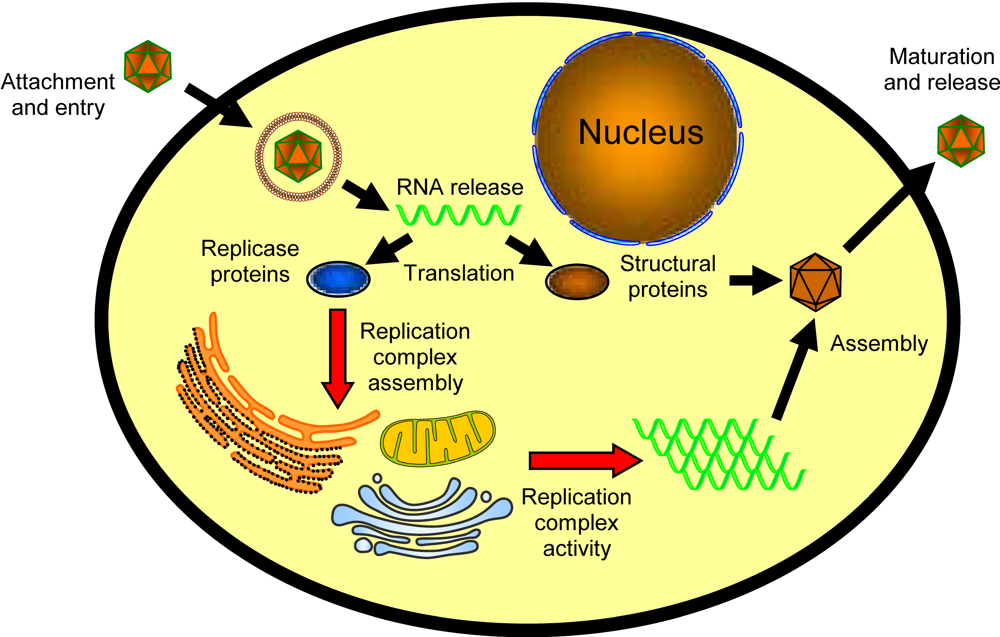
      <p>The small genomes of viruses relative to other organisms requires that they appropriate cellular machinery to complete their replication cycle, which for positive-sense RNA viruses is depicted schematically in <xref ref-type="fig" rid="figure1">Figure 1</xref>. For example, no virus encodes the complete set of nucleic acid and protein constituents necessary for autonomous translation of viral RNAs, which represents an important initial step in virus replication, and therefore positive-sense RNA viruses utilize diverse and often elaborate mechanisms to subvert the cellular translation apparatus to their benefit [<xref ref-type="bibr" rid="B10">10</xref>,<xref ref-type="bibr" rid="B11">11</xref>]. Another step in the life cycle of positive-sense RNA viruses that highlights the importance of cell components and virus-host interactions is the requirement of host-derived intracellular membranes for RNA replication [<xref ref-type="bibr" rid="B12">12</xref>,<xref ref-type="bibr" rid="B13">13</xref>,<xref ref-type="bibr" rid="B14">14</xref>]. This requirement is completely independent of their structural role during the encapsidation and assembly of enveloped viruses. The conclusion that cellular membranes are essential host factors in viral RNA replication is based primarily on four sets of observations. First, positive-sense RNA virus replication is associated with dramatic intracellular membrane rearrangements, which are readily demonstrated by electron microscopy [<xref ref-type="bibr" rid="B15">15</xref>,<xref ref-type="bibr" rid="B16">16</xref>,<xref ref-type="bibr" rid="B17">17</xref>,<xref ref-type="bibr" rid="B18">18</xref>,<xref ref-type="bibr" rid="B19">19</xref>,<xref ref-type="bibr" rid="B20">20</xref>,<xref ref-type="bibr" rid="B21">21</xref>,<xref ref-type="bibr" rid="B22">22</xref>,<xref ref-type="bibr" rid="B23">23</xref>,<xref ref-type="bibr" rid="B24">24</xref>,<xref ref-type="bibr" rid="B25">25</xref>,<xref ref-type="bibr" rid="B26">26</xref>,<xref ref-type="bibr" rid="B27">27</xref>,<xref ref-type="bibr" rid="B28">28</xref>,<xref ref-type="bibr" rid="B29">29</xref>,<xref ref-type="bibr" rid="B30">30</xref>,<xref ref-type="bibr" rid="B31">31</xref>,<xref ref-type="bibr" rid="B32">32</xref>,<xref ref-type="bibr" rid="B33">33</xref>,<xref ref-type="bibr" rid="B34">34</xref>,<xref ref-type="bibr" rid="B35">35</xref>,<xref ref-type="bibr" rid="B36">36</xref>,<xref ref-type="bibr" rid="B37">37</xref>,<xref ref-type="bibr" rid="B38">38</xref>,<xref ref-type="bibr" rid="B39">39</xref>]. Second, viral proteins with known or hypothesized enzymatic activity linked to genome amplification, which are referred to collectively as replicase proteins, co-partition with intracellular membrane fractions. Furthermore, these membrane fractions retain viral replicase enzymatic activity that can be measured <italic>in vitro</italic> [<xref ref-type="bibr" rid="B18">18</xref>,<xref ref-type="bibr" rid="B26">26</xref>,<xref ref-type="bibr" rid="B28">28</xref>,<xref ref-type="bibr" rid="B40">40</xref>,<xref ref-type="bibr" rid="B41">41</xref>,<xref ref-type="bibr" rid="B42">42</xref>,<xref ref-type="bibr" rid="B43">43</xref>,<xref ref-type="bibr" rid="B44">44</xref>,<xref ref-type="bibr" rid="B45">45</xref>]. Third, detergents can disrupt, whereas phospholipids can enhance, <italic>in vitro</italic> viral replicase activity [<xref ref-type="bibr" rid="B28">28</xref>,<xref ref-type="bibr" rid="B42">42</xref>,<xref ref-type="bibr" rid="B43">43</xref>,<xref ref-type="bibr" rid="B44">44</xref>,<xref ref-type="bibr" rid="B45">45</xref>]. And fourth, pharmacologic or genetic disruption of lipid metabolism has been shown to modulate positive-sense RNA virus replication [<xref ref-type="bibr" rid="B46">46</xref>,<xref ref-type="bibr" rid="B47">47</xref>,<xref ref-type="bibr" rid="B48">48</xref>,<xref ref-type="bibr" rid="B49">49</xref>,<xref ref-type="bibr" rid="B50">50</xref>,<xref ref-type="bibr" rid="B51">51</xref>,<xref ref-type="bibr" rid="B52">52</xref>,<xref ref-type="bibr" rid="B53">53</xref>,<xref ref-type="bibr" rid="B54">54</xref>,<xref ref-type="bibr" rid="B55">55</xref>,<xref ref-type="bibr" rid="B56">56</xref>,<xref ref-type="bibr" rid="B57">57</xref>,<xref ref-type="bibr" rid="B58">58</xref>,<xref ref-type="bibr" rid="B59">59</xref>,<xref ref-type="bibr" rid="B60">60</xref>,<xref ref-type="bibr" rid="B61">61</xref>,<xref ref-type="bibr" rid="B62">62</xref>,<xref ref-type="bibr" rid="B63">63</xref>].</p>

      <p>Although the observations outlined above provide substantial validation for the important role that cellular membranes play in positive-sense RNA virus replication, they provide only circumstantial evidence for the specific membrane components involved in the process and their precise molecular functions with respect to viral genome replication. Intracellular membranes contain diverse protein and lipid constituents and play a variety of roles during normal cellular physiology and metabolism, which include facilitating the spatial separation of cellular processes and the consequent differential concentrations of crucial cellular components, providing structural integrity to maintain organelle shape, and contributing functional co-factors for multiple processes such as signal transduction and biosynthesis. In this review, we will discuss three potential roles that lipid constituents of host cell membranes play in positive-sense RNA virus genome replication. These include: (i) providing a scaffold for targeting and assembly of RNA replication complexes; (ii) inducing alterations in membranes structure to potentially shield viral RNA replication intermediates from cellular innate antiviral pathways; and (iii) serving as functional co-factors for optimal enzymatic activity of viral replicase proteins. We will use examples of plant, insect, and mammalian viruses to highlight specific aspects of these potential roles, and will focus primarily on lipids rather than membranes in general. Several excellent reviews have recently been published [<xref ref-type="bibr" rid="B12">12</xref>,<xref ref-type="bibr" rid="B13">13</xref>,<xref ref-type="bibr" rid="B14">14</xref>] for readers interested in further exploring the connections between positive-sense RNA viruses and cellular membranes. In addition, readers with a particular interest in hepatitis C virus, one of the most clinically relevant positive-sense RNA viruses whose connection with cellular lipid metabolism is becoming increasingly apparent, are encouraged to explore the companion article by McLauchlan <italic>et al.</italic> forming part of this special issue of <italic>Viruses</italic>.</p>
      <fig id="figure1" position="float">
        <label>Figure 1</label>
        <caption>
          <p>Schematic of positive-sense RNA virus replication cycle. General steps include: (i) attachment and entry; (ii) release of genome into cytoplasm; (iii) translation of genomic viral RNA into replicase or structural proteins; (iv) assembly of replication complex on host intracellular membrane; (v) amplification of viral genome via dsRNA intermediate; (vi) genome encapsidation; and (vii) maturation and release.</p>
        </caption>
        <graphic xmlns:xlink="http://www.w3.org/1999/xlink" xlink:href="viruses-02-01055-g001.tif" scale="0"/>
      </fig>      
      <sec>
        <title>1.1. Lipids and replication complex targeting and assembly</title>
        <p>The interior of a cell is a highly organized environment, where membrane-bound organelles and specific organelle membranes represent one mechanism whereby cells enforce spatial constraints on particular metabolic processes. For example, the enzymes involved in electron transport and respiration are concentrated on the inner mitochondria membrane. Similarly, viruses may use intracellular membranes as simple molecular scaffolds on which to assemble their replication complexes, thereby increasing replication efficiency by concentrating essential viral and potential cellular components within a smaller microenvironment in the cell. Furthermore, membranes may provide a convenient platform to coordinate various steps in the replication cycle (see <xref ref-type="fig" rid="figure1">Figure 1</xref>), such as the demonstrated coupling of viral RNA replication, translation, and genome packaging [<xref ref-type="bibr" rid="B64">64</xref>,<xref ref-type="bibr" rid="B65">65</xref>,<xref ref-type="bibr" rid="B66">66</xref>]. However, although positive-sense RNA virus replication complexes have been found associated with cellular membranes derived from a number of intracellular organelles, including the endoplasmic reticulum, Golgi apparatus, endosomes, lysosomes, peroxisomes, chloroplasts, and the mitochondria (reviewed in ref [<xref ref-type="bibr" rid="B12">12</xref>,<xref ref-type="bibr" rid="B13">13</xref>,<xref ref-type="bibr" rid="B14">14</xref>]), individual viruses show a particular membrane selectivity (<xref ref-type="table" rid="table1">Table 1</xref>). This selectivity suggests a specific “receptor•ligand”-type interaction between viral replicase proteins and intracellular membrane components. Several membrane-specific targeting signals within individual virus-encoded replicase proteins have been characterized in detail [<xref ref-type="bibr" rid="B26">26</xref>,<xref ref-type="bibr" rid="B67">67</xref>,<xref ref-type="bibr" rid="B68">68</xref>,<xref ref-type="bibr" rid="B69">69</xref>,<xref ref-type="bibr" rid="B70">70</xref>], but only a limited number of cellular membrane components have been shown to be important in viral RNA replication complex targeting and assembly, most of which are membrane proteins [<xref ref-type="bibr" rid="B71">71</xref>,<xref ref-type="bibr" rid="B72">72</xref>,<xref ref-type="bibr" rid="B73">73</xref>]. However, preferential interactions between positive-sense RNA virus replicase proteins and membrane phospholipids have been described [<xref ref-type="bibr" rid="B44">44</xref>,<xref ref-type="bibr" rid="B74">74</xref>], suggesting that lipids may also contribute to replication complex targeting and assembly. We recently demonstrated that the membrane-targeting viral replicase protein of Flock House virus, a model alphanodavirus that assembles its replication complexes on outer mitochondrial membranes [<xref ref-type="bibr" rid="B25">25</xref>], preferentially interacts with anionic phospholipids, and in particular cardiolipin [<xref ref-type="bibr" rid="B74">74</xref>]. Although most phospholipids are widely distributed throughout intracellular membranes, cardiolipin is found predominantly, if not exclusively, in mitochondrial membranes [<xref ref-type="bibr" rid="B75">75</xref>,<xref ref-type="bibr" rid="B76">76</xref>], suggesting a potential role for this particular lipid in Flock House virus RNA replication complex targeting and assembly. The ubiquitous nature of cellular phospholipids and the substantial technical challenges associated with studying lipid-membrane protein interactions at the molecular and structural levels has thus far hampered our ability to more fully examine the potential role that cellular lipids play in positive-sense RNA virus replication complex assembly.</p>
      </sec>
      <sec>
        <title>1.2. Lipids and membrane structure alterations</title>
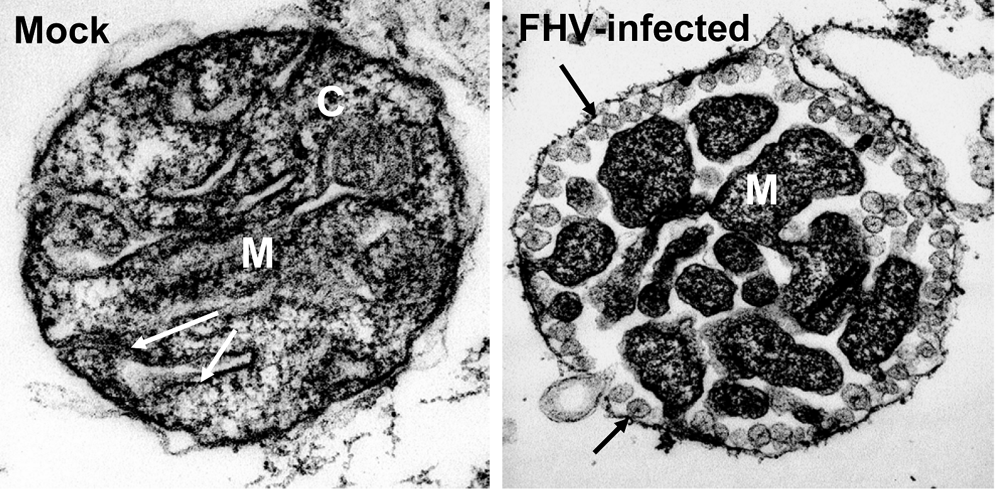
        <p>Positive-sense RNA viruses induce a number of distinctive membrane structures, which include the “membranous webs” of hepatitis C virus [<xref ref-type="bibr" rid="B24">24</xref>], the clustered vesicles of picornaviruses [<xref ref-type="bibr" rid="B27">27</xref>,<xref ref-type="bibr" rid="B29">29</xref>], the double-membrane vesicles of coronaviruses [<xref ref-type="bibr" rid="B15">15</xref>,<xref ref-type="bibr" rid="B20">20</xref>,<xref ref-type="bibr" rid="B21">21</xref>], flaviviruses [<xref ref-type="bibr" rid="B22">22</xref>,<xref ref-type="bibr" rid="B23">23</xref>], and arteriviruses [<xref ref-type="bibr" rid="B15">15</xref>,<xref ref-type="bibr" rid="B16">16</xref>], and the spherule-like cytopathic vacuoles of togaviruses that resemble cellular multivesicular bodies [<xref ref-type="bibr" rid="B30">30</xref>,<xref ref-type="bibr" rid="B31">31</xref>,<xref ref-type="bibr" rid="B32">32</xref>]. One virus whose membrane-induced structures have been examined in detail is Flock House virus, which induces spherule-like invaginations within the outer mitochondrial membrane (<xref ref-type="fig" rid="figure2">Figure 2</xref>). These structures, termed virus-induced “mini-organelles”, have been examined using tomographic electron microscopy to provide unprecedented detail and develop three-dimensional models of viral RNA replication complexes [<xref ref-type="bibr" rid="B38">38</xref>]. Similar tomographic models have also recently been described for dengue virus [<xref ref-type="bibr" rid="B23">23</xref>] and SARS-coronavirus [<xref ref-type="bibr" rid="B20">20</xref>], two positive-sense RNA viruses that extensively modify endoplasmic reticulum membranes.</p>
 
        <table-wrap id="table1" position="float"><object-id pub-id-type="pii">viruses-02-01055_table1</object-id>
          <object-id pub-id-type="pii">viruses-02-01055_table1</object-id>
          <label>Table 1</label>
          <caption>
            <p>Examples of diverse intracellular membranes used by positive-sense RNA viruses to assemble functional RNA replication complexes</p>
          </caption>
          <table>
            <thead>
              <tr>
                <th align="left" valign="middle">Family</th>
                <th align="left" valign="middle">Virus</th>
                <th align="left" valign="middle">Membrane(s)</th>
                <th align="left" valign="middle">References</th>
              </tr>
            </thead>
            <tbody>
              <tr>
                <td align="left" valign="middle">Arteriviridae</td>
                <td align="left" valign="middle">Equine arteritis virus</td>
                <td align="left" valign="middle">Endoplasmic reticulum</td>
                <td align="left" valign="middle">[15,16]</td>
              </tr>
              <tr>
                <td align="left" valign="middle">Bromoviridae</td>
                <td align="left" valign="middle">Alfalfa mosaic virusBrome mosaic virus</td>
                <td align="left" valign="middle">VacuoleEndoplasmic reticulum</td>
                <td align="left" valign="middle">[17,18]</td>
              </tr>
              <tr>
                <td align="left" valign="middle">Coronaviridae</td>
                <td align="left" valign="middle">SARS-coronavirus</td>
                <td align="left" valign="middle">Endoplasmic reticulum/Golgi</td>
                <td align="left" valign="middle">[19-21]</td>
              </tr>
              <tr>
                <td align="left" valign="middle">Flaviviridae</td>
                <td align="left" valign="middle">Hepatitis C virusDengue virusWest Nile virus</td>
                <td align="left" valign="middle">Endoplasmic reticulumEndoplasmic reticulumEndoplasmic reticulum/Golgi</td>
                <td align="left" valign="middle">[22-24]</td>
              </tr>
              <tr>
                <td align="left" valign="middle">Nodaviridae</td>
                <td align="left" valign="middle">Flock House virus</td>
                <td align="left" valign="middle">Mitochondria</td>
                <td align="left" valign="middle">[25,26]</td>
              </tr>
              <tr>
                <td align="left" valign="middle">Picornaviridae</td>
                <td align="left" valign="middle">Poliovirus</td>
                <td align="left" valign="middle">Endoplasmic reticulum/Golgi</td>
                <td align="left" valign="middle">[27-29]</td>
              </tr>
              <tr>
                <td align="left" valign="middle">Togaviridae</td>
                <td align="left" valign="middle">Rubella virusSemliki Forest virus</td>
                <td align="left" valign="middle">LysosomesEndosomes/lysosomes</td>
                <td align="left" valign="middle">[30-32]</td>
              </tr>
              <tr>
                <td align="left" valign="middle">Tombusviridae</td>
                <td align="left" valign="middle">Carnation Italian ringspot virusCucumber necrosis virusTomato bushy stunt virus</td>
                <td align="left" valign="middle">MitochondriaEndoplasmic reticulumPeroxisome</td>
                <td align="left" valign="middle">[33-36]</td>
              </tr>
              <tr>
                <td align="left" valign="middle">Tymoviridae</td>
                <td align="left" valign="middle">Turnip yellow mosaic virus</td>
                <td align="left" valign="middle">Chloroplast</td>
                <td align="left" valign="middle">[37]</td>
              </tr>
            </tbody>
          </table>
        </table-wrap>

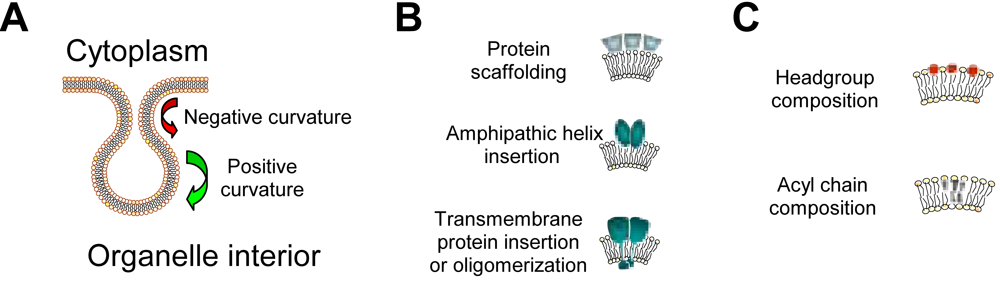
        <p>The structural changes that must occur within lipid bilayers to produce the virus-induced alterations in intracellular membranes are substantial. For example, the outer mitochondrial membrane invaginations induced by Flock House virus [<xref ref-type="bibr" rid="B38">38</xref>] (see also <xref ref-type="fig" rid="figure2">Figure 2</xref>) and the endoplasmic reticulum changes induced by dengue virus [<xref ref-type="bibr" rid="B23">23</xref>] and SARS-coronavirus [<xref ref-type="bibr" rid="B20">20</xref>] require regions of negative and positive curvature, as depicted schematically in <xref ref-type="fig" rid="figure3">Figure 3</xref>A. Membrane curvature can be induced by both protein and lipid modifications [<xref ref-type="bibr" rid="B77">77</xref>], which are depicted in <xref ref-type="fig" rid="figure3">Figure 3</xref>B and 3C, respectively. Protein modifications that induce membrane curvature include internal and external protein scaffolding by peripheral membrane proteins, such as cellular clathrin and calveolin, insertion of proteins with amphipathic helices, such as cellular amphiphysin and endophilins, and insertion or oligomerization of transmembrane proteins, for which there are numerous cellular examples. For positive-sense RNA viruses, replicase proteins with amphipathic helices [<xref ref-type="bibr" rid="B44">44</xref>,<xref ref-type="bibr" rid="B78">78</xref>,<xref ref-type="bibr" rid="B79">79</xref>] or transmembrane domains [<xref ref-type="bibr" rid="B68">68</xref>,<xref ref-type="bibr" rid="B70">70</xref>] with demonstrated membrane-binding characteristics have also been described. In addition, expression of specific viral proteins alone, in the absence of active viral RNA replication, can frequently induce intracellular membrane structures reminiscent of those induced by viral infections [<xref ref-type="bibr" rid="B16">16</xref>,<xref ref-type="bibr" rid="B24">24</xref>,<xref ref-type="bibr" rid="B29">29</xref>].</p>
        <fig id="figure2" position="float">
          <label>Figure 2</label>
          <caption>
            <p>Membrane alterations induced by positive-sense RNA virus replication. Transmission electron micrographs of mitochondria isolated from mock (left) and Flock House virus-infected (right) <italic>Drosophila</italic> cells. Note the normal matrix (M) and cristae (C) in mock mitochondria, whereas the matrix is compacted in mitochondria from infected cells. Furthermore, the outer mitochondrial membrane is studded with spherules (black arrows), which represent viral RNA replication factories.</p>
          </caption>
          <graphic xmlns:xlink="http://www.w3.org/1999/xlink" xlink:href="viruses-02-01055-g002.tif" scale="0"/>
        </fig>        
        <fig id="figure3" position="float">
          <label>Figure 3</label>
          <caption>
            <p>Schematics of membrane curvature necessary to form virus-induced membrane structures <bold>(A)</bold>, and potential protein <bold>(B)</bold> or lipid <bold>(C)</bold> modification that may induce membrane curvature.</p>
          </caption>
          <graphic xmlns:xlink="http://www.w3.org/1999/xlink" xlink:href="viruses-02-01055-g003.tif" scale="0"/>
        </fig>
        <p>An alternative mechanism to induce membrane curvature is modification of lipid structure, either through changes in the polar headgroup or acyl chain composition. For example, lysophospholipids, which contain only one acyl chain per phospholipid molecule, and special lipids such as cholesterol or cardiolipin, which has four acyl chains attached to diphosphatidylglycerol, can have profound impacts on membrane curvature and plasticity [<xref ref-type="bibr" rid="B80">80</xref>]. Acyl chain length and saturation can also impact membrane curvature [<xref ref-type="bibr" rid="B81">81</xref>]. Although the currently available data on the potential phospholipid alterations that are induced by and/or required for positive-sense RNA virus replication are limited, there are suggestive reports that specific and functionally important changes do occur. Brome mosaic virus RNA replication is suppressed in cells that lack Δ9 fatty acid desaturase and hence contain reduced levels of unsaturated fatty acids [<xref ref-type="bibr" rid="B49">49</xref>], Flock House virus induces a preferential increase in lipid molecules with longer and unsaturated acyl chains [<xref ref-type="bibr" rid="B54">54</xref>], and West Nile virus redistributes cholesterol to sites of active viral replication [<xref ref-type="bibr" rid="B56">56</xref>]. We anticipate that continued advances in cell fractionation, membrane isolation, and lipidomics techniques will begin to address this substantial gap in our understanding of positive-sense RNA virus biology. </p>
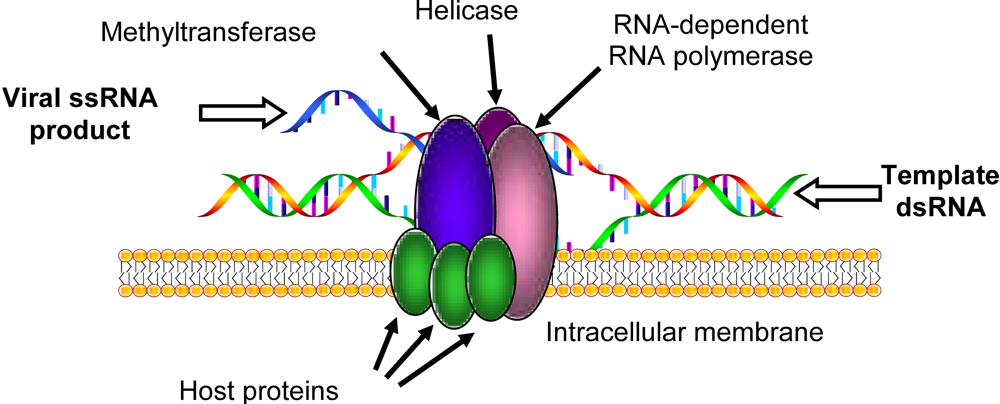
        <p>Regardless of the mechanism whereby membrane curvature occurs, the function of these curious virus-induced structures remains enigmatic. One interesting possibility is that virus-induced membrane structures shield viral products that have the potential to activate cellular innate immune pathways. The replication of positive-sense RNA viruses involves the formation of dsRNA intermediates that serve as templates for genome amplification (see below, <xref ref-type="fig" rid="figure4">Figure 4</xref>). These replication intermediates, or other “foreign” chemical moieties such as 5’ triphosphorylated RNAs, are potent stimuli for inducing innate antiviral immune responses [<xref ref-type="bibr" rid="B82">82</xref>]. Since positive-sense RNA viruses replicate almost exclusively within the cytoplasm of cells, they likely employ mechanisms to suppress or modify activation or amplification of these responses. Positive-sense RNA viruses possess multiple mechanisms to evade innate immune system activation, including the production of proteases that cleave, degrade, or inhibit essential innate immune signaling pathway components or the use of viral proteins to sequester viral dsRNA (reviewed in ref [<xref ref-type="bibr" rid="B83">83</xref>,<xref ref-type="bibr" rid="B84">84</xref>]). It is intriguing to speculate that virus-induced membrane structures may also play a role in sequestering or shielding viral products from the innate immune system, thus providing an additional level of protection.</p>

      </sec>
      <sec>
        <title>1.3. Lipids and replication complex function</title>
        <p>One major goal of positive-sense RNA virus research is the complete isolation, characterization, and de novo synthesis of fully functional RNA replication complexes, a generic example of which is shown schematically in <xref ref-type="fig" rid="figure4">Figure 4</xref>. The achievement of this goal has been hampered in part by the essential membrane-bound nature of these complexes. Substantial hurdles include the frequent inability to obtain soluble viral replicase proteins for detailed biochemical or structural studies, the inherent difficulties in interpreting protein co-purification results when detergents are required to solubilize viral RNA replication complexes, and the presence of three different types of molecular structures (proteins, lipids, and nucleic acids) that are all components of the RNA replication complex yet have different chemical characteristics. However, despite these difficulties some progress has been made. For example, <italic>de novo</italic> synthesis of a functional RNA replication complex in cell-free extracts has been accomplished for both poliovirus [<xref ref-type="bibr" rid="B85">85</xref>] and several related plant viruses [<xref ref-type="bibr" rid="B86">86</xref>], and this important step will have to be achieved for other viruses as well to provide additional systems in which to investigate the cellular components needed to assemble these viral genome production factories.</p>
        <fig id="figure4" position="float">
          <label>Figure 4</label>
          <caption>
            <p>Schematic of positive-sense RNA virus replication complex. Virus-encoded proteins with known or hypothesized enzymatic functions are labeled at the top.</p>
          </caption>
          <graphic xmlns:xlink="http://www.w3.org/1999/xlink" xlink:href="viruses-02-01055-g004.tif" scale="0"/>
        </fig>        
        <p>A substantial focus in the field of positive-sense RNA virus research has been the identification and characterization of the protein components necessary for replication complex function. The impact of lipids on this process has received far less attention in the past, in part due to some of the technical difficulties in lipid research noted above. However, there is both circumstantial and direct evidence that lipids can serve as functional co-factors for viral replicase proteins [<xref ref-type="bibr" rid="B18">18</xref>,<xref ref-type="bibr" rid="B26">26</xref>,<xref ref-type="bibr" rid="B28">28</xref>,<xref ref-type="bibr" rid="B40">40</xref>,<xref ref-type="bibr" rid="B41">41</xref>,<xref ref-type="bibr" rid="B42">42</xref>,<xref ref-type="bibr" rid="B43">43</xref>,<xref ref-type="bibr" rid="B44">44</xref>,<xref ref-type="bibr" rid="B45">45</xref>]. For example, although individual viruses typically assemble replication complexes on particular intracellular membranes (see <xref ref-type="table" rid="table1">Table 1</xref>), this specific targeting can be disrupted by altering either virus-encoded targeting signals [<xref ref-type="bibr" rid="B26">26</xref>,<xref ref-type="bibr" rid="B35">35</xref>] or host membrane-specific signals [<xref ref-type="bibr" rid="B71">71</xref>]. Furthermore, these “retargeted” replication complexes retain functional activity, suggesting that any necessary host components are widely present in multiple intracellular membranes. Although the exact lipid composition of intracellular membranes varies between organelles, phospholipids represent a prominent component of all intracellular membranes [<xref ref-type="bibr" rid="B76">76</xref>]. Positive-sense RNA virus replication complexes can be recovered from infected cells by density gradient centrifugation and the isolation of membrane fractions, which retain detergent-sensitive enzymatic activity. Although for many viruses this enzymatic activity is limited to primer-independent synthesis of a complementary negative strand, fully functional replication complexes from Flock House virus-infected cells that produce single-stranded positive-sense products have been described [<xref ref-type="bibr" rid="B42">42</xref>], where replicase activity is stimulated by specific phospholipids [<xref ref-type="bibr" rid="B45">45</xref>]. In addition, phospholipids have also been shown to influence alphavirus replicase protein activity [<xref ref-type="bibr" rid="B44">44</xref>,<xref ref-type="bibr" rid="B87">87</xref>]. These observations suggest that in addition to the potential structural roles of lipids in positive-sense RNA virus replication complex assembly described above, lipids may also play important functional roles to maximize replication complex activity.</p>
      </sec>
    </sec>
    <sec sec-type="conclusions">
      <title>2. Conclusions</title>
      <p>Despite the axiom that cellular membranes are essential host factors for positive-sense RNA virus replication, the specific role of individual membrane components, and in particular lipids, represents a vastly understudied area of virus biology and pathogenesis. We have discussed three potential structural or functional roles that cellular membrane-resident lipids may play in the assembly and function of positive-sense RNA virus replication complexes. These roles are not mutually exclusive, and it is possible that lipids contribute to several steps in the virus life cycle via multiple mechanisms, some of which we currently recognize, and others that remain to be discovered. The recent increase in targeted and genome-wide screens to identify host factors that impact positive-sense RNA virus replication [<xref ref-type="bibr" rid="B54">54</xref>,<xref ref-type="bibr" rid="B55">55</xref>,<xref ref-type="bibr" rid="B56">56</xref>,<xref ref-type="bibr" rid="B57">57</xref>,<xref ref-type="bibr" rid="B58">58</xref>,<xref ref-type="bibr" rid="B59">59</xref>,<xref ref-type="bibr" rid="B60">60</xref>,<xref ref-type="bibr" rid="B61">61</xref>,<xref ref-type="bibr" rid="B62">62</xref>,<xref ref-type="bibr" rid="B63">63</xref>], several of which have highlighted the importance of lipid metabolism-associated genes, provides an exciting foundation for these discoveries.</p>
    </sec>
  </body>
  <back>
    <ref-list>
    <title>References</title>
      <ref id="B1">
        <citation citation-type="journal">
          <person-group person-group-type="author">
            <name>
              <surname>Morse</surname>
              <given-names>S.S.</given-names>
            </name>
          </person-group>
          <article-title>The public health threat of emerging viral diseases</article-title>
          <source>J. Nutrition</source>
          <year>1997</year>
          <volume>127</volume>
          <fpage>951S</fpage>
          <lpage>957S</lpage>
          <supplement>(Suppl 5)&#13;
&#13;
&#13;
</supplement>
        </citation>
      </ref>
      <ref id="B2">
        <citation citation-type="journal">
          <person-group person-group-type="author">
            <name>
              <surname>Gubler</surname>
              <given-names>D.J.</given-names>
            </name>
          </person-group>
          <article-title>The global emergence/resurgence of arboviral diseases as public health problems</article-title>
          <source>Arch. Med. Res.</source>
          <year>2002</year>
          <volume>33</volume>
          <fpage>330</fpage>
          <lpage>342</lpage>
          <pub-id pub-id-type="pmid">12234522</pub-id>
          <pub-id pub-id-type="doi">10.1016/S0188-4409(02)00378-8</pub-id>
        </citation>
      </ref>
      <ref id="B3">
        <citation citation-type="journal">
          <person-group person-group-type="author">
            <name>
              <surname>Drake</surname>
              <given-names>J.W.</given-names>
            </name>
            <name>
              <surname>Holland</surname>
              <given-names>J.J.</given-names>
            </name>
          </person-group>
          <article-title>Mutation rates among RNA viruses</article-title>
          <source>Proc. Natl. Acad. Sci. USA</source>
          <year>1999</year>
          <volume>96</volume>
          <fpage>13910</fpage>
          <lpage>13913</lpage>
          <pub-id pub-id-type="doi">10.1073/pnas.96.24.13910</pub-id>
        </citation>
      </ref>
      <ref id="B4">
        <citation citation-type="journal">
          <person-group person-group-type="author">
            <name>
              <surname>Pillay</surname>
              <given-names>D.</given-names>
            </name>
            <name>
              <surname>Zambon</surname>
              <given-names>M.</given-names>
            </name>
          </person-group>
          <article-title>Antiviral drug resistance</article-title>
          <source>BMJ</source>
          <year>1998</year>
          <volume>317</volume>
          <fpage>660</fpage>
          <lpage>662</lpage>
          <pub-id pub-id-type="pmid">9728000</pub-id>
        </citation>
      </ref>
      <ref id="B5">
        <citation citation-type="journal">
          <person-group person-group-type="author">
            <name>
              <surname>Fox</surname>
              <given-names>J. L.</given-names>
            </name>
          </person-group>
          <article-title>Antivirals become a broader enterprise</article-title>
          <source>Nat. Biotechnol.</source>
          <year>2007</year>
          <volume>25</volume>
          <fpage>1395</fpage>
          <lpage>1402</lpage>
          <pub-id pub-id-type="pmid">18066034</pub-id>
          <pub-id pub-id-type="doi">10.1038/nbt1207-1395</pub-id>
        </citation>
      </ref>
      <ref id="B6">
        <citation citation-type="journal">
          <person-group person-group-type="author">
            <name>
              <surname>Ye</surname>
              <given-names>J.</given-names>
            </name>
            <name>
              <surname>Wang</surname>
              <given-names>C.</given-names>
            </name>
            <name>
              <surname>Sumpter Jr. </surname>
              <given-names>R.</given-names>
            </name>
            <name>
              <surname>Brown</surname>
              <given-names>M.S.</given-names>
            </name>
            <name>
              <surname>Goldstein</surname>
              <given-names>J.L.</given-names>
            </name>
            <name>
              <surname>Gale Jr.</surname>
              <given-names>M.</given-names>
            </name>
          </person-group>
          <article-title>Disruption of hepatitis C virus RNA replication through inhibition of host protein geranylgeranylation</article-title>
          <source>Proc. Natl. Acad. Sci. USA</source>
          <year>2003</year>
          <volume>100</volume>
          <fpage>15865</fpage>
          <lpage>15870</lpage>
          <pub-id pub-id-type="doi">10.1073/pnas.2237238100</pub-id>
        </citation>
      </ref>
      <ref id="B7">
        <citation citation-type="journal">
          <person-group person-group-type="author">
            <name>
              <surname>Ye</surname>
              <given-names>J.</given-names>
            </name>
          </person-group>
          <article-title>Reliance of host cholesterol metabolic pathways for the life cycle of hepatitis C virus</article-title>
          <source>PLoS Pathog.</source>
          <year>2007</year>
          <volume>3</volume>
          <fpage>e108</fpage>
          <pub-id pub-id-type="pmid">17784784</pub-id>
          <pub-id pub-id-type="doi">10.1371/journal.ppat.0030108</pub-id>
        </citation>
      </ref>
      <ref id="B8">
        <citation citation-type="journal">
          <person-group person-group-type="author">
            <name>
              <surname>Ikeda</surname>
              <given-names>M.</given-names>
            </name>
            <name>
              <surname>Kato</surname>
              <given-names>N.</given-names>
            </name>
          </person-group>
          <article-title>Modulation of host metabolism as a target of new antivirals</article-title>
          <source>Adv. Drug Deliv. Rev.</source>
          <year>2007</year>
          <volume>59</volume>
          <fpage>1277</fpage>
          <lpage>1289</lpage>
          <pub-id pub-id-type="pmid">17897752</pub-id>
          <pub-id pub-id-type="doi">10.1016/j.addr.2007.03.021</pub-id>
        </citation>
      </ref>
      <ref id="B9">
        <citation citation-type="journal">
          <person-group person-group-type="author">
            <name>
              <surname>Amemiya</surname>
              <given-names>F.</given-names>
            </name>
            <name>
              <surname>Maekawa</surname>
              <given-names>S.</given-names>
            </name>
            <name>
              <surname>Itakura</surname>
              <given-names>Y.</given-names>
            </name>
            <name>
              <surname>Kanayama</surname>
              <given-names>A.</given-names>
            </name>
            <name>
              <surname>Matsui</surname>
              <given-names>A.</given-names>
            </name>
            <name>
              <surname>Takano</surname>
              <given-names>S.</given-names>
            </name>
            <name>
              <surname>Yamaguchi</surname>
              <given-names>T.</given-names>
            </name>
            <name>
              <surname>Itakura</surname>
              <given-names>J.</given-names>
            </name>
            <name>
              <surname>Kitamura</surname>
              <given-names>T.</given-names>
            </name>
            <name>
              <surname>Inoue</surname>
              <given-names>T.</given-names>
            </name>
            <name>
              <surname>Sakamoto</surname>
              <given-names>M.</given-names>
            </name>
            <name>
              <surname>Yamauchi</surname>
              <given-names>K.</given-names>
            </name>
            <name>
              <surname>Okada</surname>
              <given-names>S.</given-names>
            </name>
            <name>
              <surname>Yamashita</surname>
              <given-names>A.</given-names>
            </name>
            <name>
              <surname>Sakamoto</surname>
              <given-names>N.</given-names>
            </name>
            <name>
              <surname>Itoh</surname>
              <given-names>M.</given-names>
            </name>
            <name>
              <surname>Enomoto</surname>
              <given-names>N.</given-names>
            </name>
          </person-group>
          <article-title>Targeting lipid metabolism in the treatment of hepatitis C virus infection</article-title>
          <source>J. Infect. Dis.</source>
          <year>2008</year>
          <volume>197</volume>
          <fpage>361</fpage>
          <lpage>370</lpage>
          <pub-id pub-id-type="pmid">18248300</pub-id>
          <pub-id pub-id-type="doi">10.1086/525287</pub-id>
        </citation>
      </ref>
      <ref id="B10">
        <citation citation-type="journal">
          <person-group person-group-type="author">
            <name>
              <surname>Dreher</surname>
              <given-names>T.W.</given-names>
            </name>
            <name>
              <surname>Miller</surname>
              <given-names>W.A.</given-names>
            </name>
          </person-group>
          <article-title>Translational control in positive strand RNA plant viruses</article-title>
          <source>Virology</source>
          <year>2006</year>
          <volume>344</volume>
          <fpage>185</fpage>
          <lpage>197</lpage>
          <pub-id pub-id-type="pmid">16364749</pub-id>
          <pub-id pub-id-type="doi">10.1016/j.virol.2005.09.031</pub-id>
        </citation>
      </ref>
      <ref id="B11">
        <citation citation-type="journal">
          <person-group person-group-type="author">
            <name>
              <surname>Bushell</surname>
              <given-names>M.</given-names>
            </name>
            <name>
              <surname>Sarnow</surname>
              <given-names>P.</given-names>
            </name>
          </person-group>
          <article-title>Hijacking the translation apparatus by RNA viruses</article-title>
          <source>J. Cell Biol.</source>
          <year>2002</year>
          <volume>158</volume>
          <fpage>395</fpage>
          <lpage>399</lpage>
          <pub-id pub-id-type="pmid">12163463</pub-id>
          <pub-id pub-id-type="doi">10.1083/jcb.200205044</pub-id>
        </citation>
      </ref>
      <ref id="B12">
        <citation citation-type="journal">
          <person-group person-group-type="author">
            <name>
              <surname>Miller</surname>
              <given-names>S.</given-names>
            </name>
            <name>
              <surname>Krijnse-Locker</surname>
              <given-names>J.</given-names>
            </name>
          </person-group>
          <article-title>Modification of intracellular membrane structures for virus replication</article-title>
          <source>Nat. Rev. Microbiol.</source>
          <year>2008</year>
          <volume>6</volume>
          <fpage>363</fpage>
          <lpage>374</lpage>
          <pub-id pub-id-type="pmid">18414501</pub-id>
          <pub-id pub-id-type="doi">10.1038/nrmicro1890</pub-id>
        </citation>
      </ref>
      <ref id="B13">
        <citation citation-type="journal">
          <person-group person-group-type="author">
            <name>
              <surname>Denison</surname>
              <given-names>M.R.</given-names>
            </name>
          </person-group>
          <article-title>Seeking membranes: positive-strand RNA virus replication complexes</article-title>
          <source>PLoS Biol.</source>
          <year>2008</year>
          <volume>6</volume>
          <fpage>e270</fpage>
          <pub-id pub-id-type="pmid">18959488</pub-id>
          <pub-id pub-id-type="doi">10.1371/journal.pbio.0060270</pub-id>
        </citation>
      </ref>
      <ref id="B14">
        <citation citation-type="journal">
          <person-group person-group-type="author">
            <name>
              <surname>Ahlquist</surname>
              <given-names>P.</given-names>
            </name>
            <name>
              <surname>Noueiry</surname>
              <given-names>A.O.</given-names>
            </name>
            <name>
              <surname>Lee</surname>
              <given-names>W.M.</given-names>
            </name>
            <name>
              <surname>Kushner</surname>
              <given-names>D.B.</given-names>
            </name>
            <name>
              <surname>Dye</surname>
              <given-names>B.T.</given-names>
            </name>
          </person-group>
          <article-title>Host factors in positive-strand RNA virus genome replication</article-title>
          <source>J. Virol.</source>
          <year>2003</year>
          <volume>77</volume>
          <fpage>8181</fpage>
          <lpage>8186</lpage>
          <pub-id pub-id-type="pmid">12857886</pub-id>
          <pub-id pub-id-type="doi">10.1128/JVI.77.15.8181-8186.2003</pub-id>
        </citation>
      </ref>
      <ref id="B15">
        <citation citation-type="journal">
          <person-group person-group-type="author">
            <name>
              <surname>van der Meer</surname>
              <given-names>Y.</given-names>
            </name>
            <name>
              <surname>van Tol</surname>
              <given-names>H.</given-names>
            </name>
            <name>
              <surname>Locker</surname>
              <given-names>J.K.</given-names>
            </name>
            <name>
              <surname>Snijder</surname>
              <given-names>E.J.</given-names>
            </name>
          </person-group>
          <article-title>ORF1a-encoded replicase subunits are involved in the membrane association of the arterivirus replication complex</article-title>
          <source>J. Virol.</source>
          <year>1998</year>
          <volume>72</volume>
          <fpage>6689</fpage>
          <lpage>6698</lpage>
          <pub-id pub-id-type="pmid">9658116</pub-id>
        </citation>
      </ref>
      <ref id="B16">
        <citation citation-type="journal">
          <person-group person-group-type="author">
            <name>
              <surname>Posthuma</surname>
              <given-names>C.C.</given-names>
            </name>
            <name>
              <surname>Pedersen</surname>
              <given-names>K.W.</given-names>
            </name>
            <name>
              <surname>Lu</surname>
              <given-names>Z.</given-names>
            </name>
            <name>
              <surname>Joosten</surname>
              <given-names>R.G.</given-names>
            </name>
            <name>
              <surname>Roos</surname>
              <given-names>N.</given-names>
            </name>
            <name>
              <surname>Zevenhoven-Dobbe</surname>
              <given-names>J.C.</given-names>
            </name>
            <name>
              <surname>Snijder</surname>
              <given-names>E.J.</given-names>
            </name>
          </person-group>
          <article-title>Formation of the arterivirus replication/transcription complex: a key role for nonstructural protein 3 in the remodeling of intracellular membranes</article-title>
          <source>J. Virol.</source>
          <year>2008</year>
          <volume>82</volume>
          <fpage>4480</fpage>
          <lpage>4491</lpage>
          <pub-id pub-id-type="pmid">18305048</pub-id>
          <pub-id pub-id-type="doi">10.1128/JVI.02756-07</pub-id>
        </citation>
      </ref>
      <ref id="B17">
        <citation citation-type="journal">
          <person-group person-group-type="author">
            <name>
              <surname>van der Heijden</surname>
              <given-names>M.W.</given-names>
            </name>
            <name>
              <surname>Carette</surname>
              <given-names>J.E.</given-names>
            </name>
            <name>
              <surname>Reinhoud</surname>
              <given-names>P.J.</given-names>
            </name>
            <name>
              <surname>Haegi</surname>
              <given-names>A.</given-names>
            </name>
            <name>
              <surname>Bol</surname>
              <given-names>J.F.</given-names>
            </name>
          </person-group>
          <article-title>Alfalfa mosaic virus replicase proteins P1 and P2 interact and colocalize at the vacuolar membrane</article-title>
          <source>J. Virol.</source>
          <year>2001</year>
          <volume>75</volume>
          <fpage>1879</fpage>
          <lpage>1887</lpage>
          <pub-id pub-id-type="pmid">11160687</pub-id>
          <pub-id pub-id-type="doi">10.1128/JVI.75.4.1879-1887.2001</pub-id>
        </citation>
      </ref>
      <ref id="B18">
        <citation citation-type="journal">
          <person-group person-group-type="author">
            <name>
              <surname>Schwartz</surname>
              <given-names>M.</given-names>
            </name>
            <name>
              <surname>Chen</surname>
              <given-names>J.</given-names>
            </name>
            <name>
              <surname>Janda</surname>
              <given-names>M.</given-names>
            </name>
            <name>
              <surname>Sullivan</surname>
              <given-names>M.</given-names>
            </name>
            <name>
              <surname>den Boon</surname>
              <given-names>J.</given-names>
            </name>
            <name>
              <surname>Ahlquist</surname>
              <given-names>P.</given-names>
            </name>
          </person-group>
          <article-title>A positive-strand RNA virus replication complex parallels form and function of retrovirus capsids</article-title>
          <source>Mol. Cell</source>
          <year>2002</year>
          <volume>9</volume>
          <fpage>505</fpage>
          <lpage>514</lpage>
          <pub-id pub-id-type="pmid">11931759</pub-id>
          <pub-id pub-id-type="doi">10.1016/S1097-2765(02)00474-4</pub-id>
        </citation>
      </ref>
      <ref id="B19">
        <citation citation-type="journal">
          <person-group person-group-type="author">
            <name>
              <surname>van der Meer</surname>
              <given-names>Y.</given-names>
            </name>
            <name>
              <surname>Snijder</surname>
              <given-names>E.J.</given-names>
            </name>
            <name>
              <surname>Dobbe</surname>
              <given-names>J.C.</given-names>
            </name>
            <name>
              <surname>Schleich</surname>
              <given-names>S.</given-names>
            </name>
            <name>
              <surname>Denison</surname>
              <given-names>M.R.</given-names>
            </name>
            <name>
              <surname>Spaan</surname>
              <given-names>W.J.</given-names>
            </name>
            <name>
              <surname>Locker</surname>
              <given-names>J.K.</given-names>
            </name>
          </person-group>
          <article-title>Localization of mouse hepatitis virus nonstructural proteins and RNA synthesis indicates a role for late endosomes in viral replication</article-title>
          <source>J. Virol.</source>
          <year>1999</year>
          <volume>73</volume>
          <fpage>7641</fpage>
          <lpage>7657</lpage>
          <pub-id pub-id-type="pmid">10438855</pub-id>
        </citation>
      </ref>
      <ref id="B20">
        <citation citation-type="journal">
          <person-group person-group-type="author">
            <name>
              <surname>Knoops</surname>
              <given-names>K.</given-names>
            </name>
            <name>
              <surname>Kikkert</surname>
              <given-names>M.</given-names>
            </name>
            <name>
              <surname>Worm</surname>
              <given-names>S.H.</given-names>
            </name>
            <name>
              <surname>Zevenhoven-Dobbe</surname>
              <given-names>J.C.</given-names>
            </name>
            <name>
              <surname>van der Meer</surname>
              <given-names>Y.</given-names>
            </name>
            <name>
              <surname>Koster</surname>
              <given-names>A.J.</given-names>
            </name>
            <name>
              <surname>Mommaas</surname>
              <given-names>A.M.</given-names>
            </name>
            <name>
              <surname>Snijder</surname>
              <given-names>E.J.</given-names>
            </name>
          </person-group>
          <article-title>SARS-coronavirus replication is supported by a reticulovesicular network of modified endoplasmic reticulum</article-title>
          <source>PLoS Biol.</source>
          <year>2008</year>
          <volume>6</volume>
          <fpage>e226</fpage>
          <pub-id pub-id-type="pmid">18798692</pub-id>
          <pub-id pub-id-type="doi">10.1371/journal.pbio.0060226</pub-id>
        </citation>
      </ref>
      <ref id="B21">
        <citation citation-type="journal">
          <person-group person-group-type="author">
            <name>
              <surname>Ulasli</surname>
              <given-names>M.</given-names>
            </name>
            <name>
              <surname>Verheije</surname>
              <given-names>M.H.</given-names>
            </name>
            <name>
              <surname>de Haan</surname>
              <given-names>C.A.</given-names>
            </name>
            <name>
              <surname>Reggiori</surname>
              <given-names>F.</given-names>
            </name>
          </person-group>
          <article-title>Qualitative and quantitative ultrastructural analysis of the membrane rearrangements induced by coronavirus</article-title>
          <source>Cell Microbiol.</source>
          <year>2010</year>
        </citation>
      </ref>
      <ref id="B22">
        <citation citation-type="journal">
          <person-group person-group-type="author">
            <name>
              <surname>Westaway</surname>
              <given-names>E.G.</given-names>
            </name>
            <name>
              <surname>Mackenzie</surname>
              <given-names>J.M.</given-names>
            </name>
            <name>
              <surname>Kenney</surname>
              <given-names>M.T.</given-names>
            </name>
            <name>
              <surname>Jones</surname>
              <given-names>M.K.</given-names>
            </name>
            <name>
              <surname>Khromykh</surname>
              <given-names>A.A.</given-names>
            </name>
          </person-group>
          <article-title>Ultrastructure of Kunjin virus-infected cells: colocalization of NS1 and NS3 with double-stranded RNA, and of NS2B with NS3, in virus- induced membrane structures</article-title>
          <source>J. Virol.</source>
          <year>1997</year>
          <volume>71</volume>
          <fpage>6650</fpage>
          <lpage>6661</lpage>
          <pub-id pub-id-type="pmid">9261387</pub-id>
        </citation>
      </ref>
      <ref id="B23">
        <citation citation-type="journal">
          <person-group person-group-type="author">
            <name>
              <surname>Welsch</surname>
              <given-names>S.</given-names>
            </name>
            <name>
              <surname>Miller</surname>
              <given-names>S.</given-names>
            </name>
            <name>
              <surname>Romero-Brey</surname>
              <given-names>I.</given-names>
            </name>
            <name>
              <surname>Merz</surname>
              <given-names>A.</given-names>
            </name>
            <name>
              <surname>Bleck</surname>
              <given-names>C.K.</given-names>
            </name>
            <name>
              <surname>Walther</surname>
              <given-names>P.</given-names>
            </name>
            <name>
              <surname>Fuller</surname>
              <given-names>S.D.</given-names>
            </name>
            <name>
              <surname>Antony</surname>
              <given-names>C.</given-names>
            </name>
            <name>
              <surname>Krijnse-Locker</surname>
              <given-names>J.</given-names>
            </name>
            <name>
              <surname>Bartenschlager</surname>
              <given-names>R.</given-names>
            </name>
          </person-group>
          <article-title>Composition and three-dimensional architecture of the dengue virus replication and assembly sites</article-title>
          <source>Cell Host Microbe</source>
          <year>2009</year>
          <volume>5</volume>
          <fpage>365</fpage>
          <lpage>375</lpage>
          <pub-id pub-id-type="pmid">19380115</pub-id>
          <pub-id pub-id-type="doi">10.1016/j.chom.2009.03.007</pub-id>
        </citation>
      </ref>
      <ref id="B24">
        <citation citation-type="journal">
          <person-group person-group-type="author">
            <name>
              <surname>Egger</surname>
              <given-names>D.</given-names>
            </name>
            <name>
              <surname>Wolk</surname>
              <given-names>B.</given-names>
            </name>
            <name>
              <surname>Gosert</surname>
              <given-names>R.</given-names>
            </name>
            <name>
              <surname>Bianchi</surname>
              <given-names>L.</given-names>
            </name>
            <name>
              <surname>Blum</surname>
              <given-names>H.E.</given-names>
            </name>
            <name>
              <surname>Moradpour</surname>
              <given-names>D.</given-names>
            </name>
            <name>
              <surname>Bienz</surname>
              <given-names>K.</given-names>
            </name>
          </person-group>
          <article-title>Expression of hepatitis C virus proteins induces distinct membrane alterations including a candidate viral replication complex</article-title>
          <source>J. Virol.</source>
          <year>2002</year>
          <volume>76</volume>
          <fpage>5974</fpage>
          <lpage>5984</lpage>
          <pub-id pub-id-type="pmid">12021330</pub-id>
          <pub-id pub-id-type="doi">10.1128/JVI.76.12.5974-5984.2002</pub-id>
        </citation>
      </ref>
      <ref id="B25">
        <citation citation-type="journal">
          <person-group person-group-type="author">
            <name>
              <surname>Miller</surname>
              <given-names>D.J.</given-names>
            </name>
            <name>
              <surname>Schwartz</surname>
              <given-names>M.D.</given-names>
            </name>
            <name>
              <surname>Ahlquist</surname>
              <given-names>P.</given-names>
            </name>
          </person-group>
          <article-title>Flock House virus RNA replicates on outer mitochondrial membranes in <italic>Drosophila </italic>cells</article-title>
          <source>J. Virol.</source>
          <year>2001</year>
          <volume>75</volume>
          <fpage>11664</fpage>
          <lpage>11676</lpage>
          <pub-id pub-id-type="pmid">11689648</pub-id>
          <pub-id pub-id-type="doi">10.1128/JVI.75.23.11664-11676.2001</pub-id>
        </citation>
      </ref>
      <ref id="B26">
        <citation citation-type="journal">
          <person-group person-group-type="author">
            <name>
              <surname>Miller</surname>
              <given-names>D.J.</given-names>
            </name>
            <name>
              <surname>Schwartz</surname>
              <given-names>M.D.</given-names>
            </name>
            <name>
              <surname>Dye</surname>
              <given-names>B.T.</given-names>
            </name>
            <name>
              <surname>Ahlquist</surname>
              <given-names>P.</given-names>
            </name>
          </person-group>
          <article-title>Engineered retargeting of viral RNA replication complexes to an alternative intracellular membrane</article-title>
          <source>J. Virol.</source>
          <year>2003</year>
          <volume>77</volume>
          <fpage>12193</fpage>
          <lpage>12202</lpage>
          <pub-id pub-id-type="pmid">14581556</pub-id>
          <pub-id pub-id-type="doi">10.1128/JVI.77.22.12193-12202.2003</pub-id>
        </citation>
      </ref>
      <ref id="B27">
        <citation citation-type="journal">
          <person-group person-group-type="author">
            <name>
              <surname>Schlegel</surname>
              <given-names>A.</given-names>
            </name>
            <name>
              <surname>Giddings</surname>
              <given-names>T.H J.</given-names>
            </name>
            <name>
              <surname>Ladinsky</surname>
              <given-names>M.S.</given-names>
            </name>
            <name>
              <surname>Kirkegaard</surname>
              <given-names>K.</given-names>
            </name>
          </person-group>
          <article-title>Cellular origin and ultrastructure of membranes induced during poliovirus infection</article-title>
          <source>J. Virol.</source>
          <year>1996</year>
          <volume>70</volume>
          <fpage>6576</fpage>
          <lpage>6588</lpage>
          <pub-id pub-id-type="pmid">8794292</pub-id>
        </citation>
      </ref>
      <ref id="B28">
        <citation citation-type="journal">
          <person-group person-group-type="author">
            <name>
              <surname>Bienz</surname>
              <given-names>K.</given-names>
            </name>
            <name>
              <surname>Egger</surname>
              <given-names>D.</given-names>
            </name>
            <name>
              <surname>Pfister</surname>
              <given-names>T.</given-names>
            </name>
            <name>
              <surname>Troxler</surname>
              <given-names>M.</given-names>
            </name>
          </person-group>
          <article-title>Structural and functional characterization of the poliovirus replication complex</article-title>
          <source>J. Virol.</source>
          <year>1992</year>
          <volume>66</volume>
          <fpage>2740</fpage>
          <lpage>2747</lpage>
          <pub-id pub-id-type="pmid">1313898</pub-id>
        </citation>
      </ref>
      <ref id="B29">
        <citation citation-type="journal">
          <person-group person-group-type="author">
            <name>
              <surname>Suhy</surname>
              <given-names>D.A.</given-names>
            </name>
            <name>
              <surname>Giddings</surname>
              <given-names>T.H. J.</given-names>
            </name>
            <name>
              <surname>Kirkegaard</surname>
              <given-names>K.</given-names>
            </name>
          </person-group>
          <article-title>Remodeling the endoplasmic reticulum by poliovirus infection and by individual viral proteins: an autophagy-like origin for virus-induced vesicles</article-title>
          <source>J. Virol.</source>
          <year>2000</year>
          <volume>74</volume>
          <fpage>8953</fpage>
          <lpage>8965</lpage>
          <pub-id pub-id-type="pmid">10982339</pub-id>
          <pub-id pub-id-type="doi">10.1128/JVI.74.19.8953-8965.2000</pub-id>
        </citation>
      </ref>
      <ref id="B30">
        <citation citation-type="journal">
          <person-group person-group-type="author">
            <name>
              <surname>Magliano</surname>
              <given-names>D.</given-names>
            </name>
            <name>
              <surname>Marshall</surname>
              <given-names>J.A.</given-names>
            </name>
            <name>
              <surname>Bowden</surname>
              <given-names>D.S.</given-names>
            </name>
            <name>
              <surname>Vardaxis</surname>
              <given-names>N.</given-names>
            </name>
            <name>
              <surname>Meanger</surname>
              <given-names>J.</given-names>
            </name>
            <name>
              <surname>Lee</surname>
              <given-names>J. Y.</given-names>
            </name>
          </person-group>
          <article-title>Rubella virus replication complexes are virus-modified lysosomes</article-title>
          <source>Virology</source>
          <year>1998</year>
          <volume>240</volume>
          <fpage>57</fpage>
          <lpage>63</lpage>
          <pub-id pub-id-type="pmid">9448689</pub-id>
          <pub-id pub-id-type="doi">10.1006/viro.1997.8906</pub-id>
        </citation>
      </ref>
      <ref id="B31">
        <citation citation-type="journal">
          <person-group person-group-type="author">
            <name>
              <surname>Kujala</surname>
              <given-names>P.</given-names>
            </name>
            <name>
              <surname>Ikaheimonen</surname>
              <given-names>A.</given-names>
            </name>
            <name>
              <surname>Ehsani</surname>
              <given-names>N.</given-names>
            </name>
            <name>
              <surname>Vihinen</surname>
              <given-names>H.</given-names>
            </name>
            <name>
              <surname>Auvinen</surname>
              <given-names>P.</given-names>
            </name>
            <name>
              <surname>Kaariainen</surname>
              <given-names>L.</given-names>
            </name>
          </person-group>
          <article-title>Biogenesis of the Semliki Forest virus RNA replication complex</article-title>
          <source>J. Virol.</source>
          <year>2001</year>
          <volume>75</volume>
          <fpage>3873</fpage>
          <lpage>3884</lpage>
          <pub-id pub-id-type="pmid">11264376</pub-id>
          <pub-id pub-id-type="doi">10.1128/JVI.75.8.3873-3884.2001</pub-id>
        </citation>
      </ref>
      <ref id="B32">
        <citation citation-type="journal">
          <person-group person-group-type="author">
            <name>
              <surname>Froshauer</surname>
              <given-names>S.</given-names>
            </name>
            <name>
              <surname>Kartenbeck</surname>
              <given-names>J.</given-names>
            </name>
            <name>
              <surname>Helenius</surname>
              <given-names>A.</given-names>
            </name>
          </person-group>
          <article-title>Alphavirus RNA replicase is located on the cytoplasmic surface of endosomes and lysosomes</article-title>
          <source>J. Cell Biol.</source>
          <year>1988</year>
          <volume>107</volume>
          <fpage>2075</fpage>
          <lpage>2086</lpage>
          <pub-id pub-id-type="pmid">2904446</pub-id>
          <pub-id pub-id-type="doi">10.1083/jcb.107.6.2075</pub-id>
        </citation>
      </ref>
      <ref id="B33">
        <citation citation-type="journal">
          <person-group person-group-type="author">
            <name>
              <surname>Weber-Lotfi</surname>
              <given-names>F.</given-names>
            </name>
            <name>
              <surname>Dietrich</surname>
              <given-names>A.</given-names>
            </name>
            <name>
              <surname>Russo</surname>
              <given-names>M.</given-names>
            </name>
            <name>
              <surname>Rubino</surname>
              <given-names>L.</given-names>
            </name>
          </person-group>
          <article-title>Mitochondrial targeting and membrane anchoring of a viral replicase in plant and yeast cells</article-title>
          <source>J. Virol.</source>
          <year>2002</year>
          <volume>76</volume>
          <fpage>10485</fpage>
          <lpage>10496</lpage>
          <pub-id pub-id-type="pmid">12239325</pub-id>
          <pub-id pub-id-type="doi">10.1128/JVI.76.20.10485-10496.2002</pub-id>
        </citation>
      </ref>
      <ref id="B34">
        <citation citation-type="journal">
          <person-group person-group-type="author">
            <name>
              <surname>Turner</surname>
              <given-names>K. A.</given-names>
            </name>
            <name>
              <surname>Sit</surname>
              <given-names>T. L.</given-names>
            </name>
            <name>
              <surname>Callaway</surname>
              <given-names>A. S.</given-names>
            </name>
            <name>
              <surname>Allen</surname>
              <given-names>N. S.</given-names>
            </name>
            <name>
              <surname>Lommel</surname>
              <given-names>S. A.</given-names>
            </name>
          </person-group>
          <article-title>Red clover necrotic mosaic virus replication proteins accumulate at the endoplasmic reticulum</article-title>
          <source>Virology</source>
          <year>2004</year>
          <volume>320</volume>
          <fpage>276</fpage>
          <lpage>290</lpage>
          <pub-id pub-id-type="pmid">15016550</pub-id>
          <pub-id pub-id-type="doi">10.1016/j.virol.2003.12.006</pub-id>
        </citation>
      </ref>
      <ref id="B35">
        <citation citation-type="journal">
          <person-group person-group-type="author">
            <name>
              <surname>Burgyan</surname>
              <given-names>J.</given-names>
            </name>
            <name>
              <surname>Rubino</surname>
              <given-names>L.</given-names>
            </name>
            <name>
              <surname>Russo</surname>
              <given-names>M.</given-names>
            </name>
          </person-group>
          <article-title>The 5'-terminal region of a tombusvirus genome determines the origin of multivesicular bodies</article-title>
          <source>J. Gen. Virol.</source>
          <year>1996</year>
          <volume>77</volume>
          <fpage>1967</fpage>
          <lpage>1974</lpage>
          <pub-id pub-id-type="pmid">8760449</pub-id>
          <pub-id pub-id-type="doi">10.1099/0022-1317-77-8-1967</pub-id>
        </citation>
      </ref>
      <ref id="B36">
        <citation citation-type="journal">
          <person-group person-group-type="author">
            <name>
              <surname>Rubino</surname>
              <given-names>L.</given-names>
            </name>
            <name>
              <surname>Weber-Lotfi</surname>
              <given-names>F.</given-names>
            </name>
            <name>
              <surname>Dietrich</surname>
              <given-names>A.</given-names>
            </name>
            <name>
              <surname>Stussi-Garaud</surname>
              <given-names>C.</given-names>
            </name>
            <name>
              <surname>Russo</surname>
              <given-names>M.</given-names>
            </name>
          </person-group>
          <article-title>The open reading frame 1-encoded ('36K') protein of Carnation Italian ringspot virus localizes to mitochondria</article-title>
          <source>J. Gen. Virol.</source>
          <year>2001</year>
          <volume>82</volume>
          <fpage>29</fpage>
          <lpage>34</lpage>
          <pub-id pub-id-type="pmid">11125155</pub-id>
        </citation>
      </ref>
      <ref id="B37">
        <citation citation-type="journal">
          <person-group person-group-type="author">
            <name>
              <surname>Prod'homme</surname>
              <given-names>D.</given-names>
            </name>
            <name>
              <surname>Le Panse</surname>
              <given-names>S.</given-names>
            </name>
            <name>
              <surname>Drugeon</surname>
              <given-names>G.</given-names>
            </name>
            <name>
              <surname>Jupin</surname>
              <given-names>I.</given-names>
            </name>
          </person-group>
          <article-title>Detection and subcellular localization of the turnip yellow mosaic virus 66K replication protein in infected cells</article-title>
          <source>Virology</source>
          <year>2001</year>
          <volume>281</volume>
          <fpage>88</fpage>
          <lpage>101</lpage>
          <pub-id pub-id-type="pmid">11222099</pub-id>
          <pub-id pub-id-type="doi">10.1006/viro.2000.0769</pub-id>
        </citation>
      </ref>
      <ref id="B38">
        <citation citation-type="journal">
          <person-group person-group-type="author">
            <name>
              <surname>Kopek</surname>
              <given-names>B.G.</given-names>
            </name>
            <name>
              <surname>Perkins</surname>
              <given-names>G.</given-names>
            </name>
            <name>
              <surname>Miller</surname>
              <given-names>D.J.</given-names>
            </name>
            <name>
              <surname>Ellisman</surname>
              <given-names>M.H.</given-names>
            </name>
            <name>
              <surname>Ahlquist</surname>
              <given-names>P.</given-names>
            </name>
          </person-group>
          <article-title>Three-dimensional analysis of a viral RNA replication complex reveals a virus-induced mini-organelle</article-title>
          <source>PLoS Biol.</source>
          <year>2007</year>
          <volume>5</volume>
          <fpage>e220</fpage>
          <pub-id pub-id-type="pmid">17696647</pub-id>
          <pub-id pub-id-type="doi">10.1371/journal.pbio.0050220</pub-id>
        </citation>
      </ref>
      <ref id="B39">
        <citation citation-type="journal">
          <person-group person-group-type="author">
            <name>
              <surname>Mas</surname>
              <given-names>P.</given-names>
            </name>
            <name>
              <surname>Beachy</surname>
              <given-names>R.N.</given-names>
            </name>
          </person-group>
          <article-title>Replication of tobacco mosaic virus on endoplasmic reticulum and role of the cytoskeleton and virus movement protein in intracellular distribution of viral RNA</article-title>
          <source>J. Cell Biol.</source>
          <year>1999</year>
          <volume>147</volume>
          <fpage>945</fpage>
          <lpage>958</lpage>
          <pub-id pub-id-type="pmid">10579716</pub-id>
          <pub-id pub-id-type="doi">10.1083/jcb.147.5.945</pub-id>
        </citation>
      </ref>
      <ref id="B40">
        <citation citation-type="journal">
          <person-group person-group-type="author">
            <name>
              <surname>Barton</surname>
              <given-names>D.J.</given-names>
            </name>
            <name>
              <surname>Sawicki</surname>
              <given-names>S.G.</given-names>
            </name>
            <name>
              <surname>Sawicki</surname>
              <given-names>D.L.</given-names>
            </name>
          </person-group>
          <article-title>Solubilization and immunoprecipitation of alphavirus replication complexes</article-title>
          <source>J. Virol.</source>
          <year>1991</year>
          <volume>65</volume>
          <fpage>1496</fpage>
          <lpage>1506</lpage>
          <pub-id pub-id-type="pmid">1847467</pub-id>
        </citation>
      </ref>
      <ref id="B41">
        <citation citation-type="journal">
          <person-group person-group-type="author">
            <name>
              <surname>Chu</surname>
              <given-names>P.W.G.</given-names>
            </name>
            <name>
              <surname>Westaway</surname>
              <given-names>E G.</given-names>
            </name>
          </person-group>
          <article-title>Molecular and ultrastructural analysis of heavy membrane fractions associated with the replication of Kunjin virus RNA</article-title>
          <source>Arch. Virol.</source>
          <year>1992</year>
          <volume>125</volume>
          <fpage>177</fpage>
          <lpage>191</lpage>
          <pub-id pub-id-type="pmid">1322651</pub-id>
          <pub-id pub-id-type="doi">10.1007/BF01309636</pub-id>
        </citation>
      </ref>
      <ref id="B42">
        <citation citation-type="journal">
          <person-group person-group-type="author">
            <name>
              <surname>Wu</surname>
              <given-names>S.X.</given-names>
            </name>
            <name>
              <surname>Kaesberg</surname>
              <given-names>P.</given-names>
            </name>
          </person-group>
          <article-title>Synthesis of template-sense, single-strand Flock House virus RNA in a cell-free replication system</article-title>
          <source>Virology</source>
          <year>1991</year>
          <volume>183</volume>
          <fpage>392</fpage>
          <lpage>396</lpage>
          <pub-id pub-id-type="pmid">1905080</pub-id>
          <pub-id pub-id-type="doi">10.1016/0042-6822(91)90153-3</pub-id>
        </citation>
      </ref>
      <ref id="B43">
        <citation citation-type="journal">
          <person-group person-group-type="author">
            <name>
              <surname>van Hemert</surname>
              <given-names>M.J.</given-names>
            </name>
            <name>
              <surname>van den Worm</surname>
              <given-names>S.H.</given-names>
            </name>
            <name>
              <surname>Knoops</surname>
              <given-names>K.</given-names>
            </name>
            <name>
              <surname>Mommaas</surname>
              <given-names>A.M.</given-names>
            </name>
            <name>
              <surname>Gorbalenya</surname>
              <given-names>A.E.</given-names>
            </name>
            <name>
              <surname>Snijder</surname>
              <given-names>E.J.</given-names>
            </name>
          </person-group>
          <article-title>SARS-coronavirus replication/transcription complexes are membrane-protected and need a host factor for activity <italic>in vitro</italic></article-title>
          <source>PLoS Pathog.</source>
          <year>2008</year>
          <volume>4</volume>
          <fpage>e1000054</fpage>
          <pub-id pub-id-type="pmid">18451981</pub-id>
          <pub-id pub-id-type="doi">10.1371/journal.ppat.1000054</pub-id>
        </citation>
      </ref>
      <ref id="B44">
        <citation citation-type="journal">
          <person-group person-group-type="author">
            <name>
              <surname>Ahola</surname>
              <given-names>T.</given-names>
            </name>
            <name>
              <surname>Lampio</surname>
              <given-names>A.</given-names>
            </name>
            <name>
              <surname>Auvinen</surname>
              <given-names>P.</given-names>
            </name>
            <name>
              <surname>Kaariainen</surname>
              <given-names>L.</given-names>
            </name>
          </person-group>
          <article-title>Semliki Forest virus mRNA capping enzyme requires association with anionic membrane phospholipids for activity</article-title>
          <source>EMBO J.</source>
          <year>1999</year>
          <volume>18</volume>
          <fpage>3164</fpage>
          <lpage>3172</lpage>
          <pub-id pub-id-type="pmid">10357827</pub-id>
          <pub-id pub-id-type="doi">10.1093/emboj/18.11.3164</pub-id>
        </citation>
      </ref>
      <ref id="B45">
        <citation citation-type="journal">
          <person-group person-group-type="author">
            <name>
              <surname>Wu</surname>
              <given-names>S.X.</given-names>
            </name>
            <name>
              <surname>Ahlquist</surname>
              <given-names>P.</given-names>
            </name>
            <name>
              <surname>Kaesberg</surname>
              <given-names>P.</given-names>
            </name>
          </person-group>
          <article-title>Active complete <italic>in vitro</italic> replication of nodavirus RNA requires glycerophospholipid</article-title>
          <source>Proc. Natl. Acad. Sci. USA</source>
          <year>1992</year>
          <volume>89</volume>
          <fpage>11136</fpage>
          <lpage>11140</lpage>
          <pub-id pub-id-type="doi">10.1073/pnas.89.23.11136</pub-id>
        </citation>
      </ref>
      <ref id="B46">
        <citation citation-type="journal">
          <person-group person-group-type="author">
            <name>
              <surname>Guinea</surname>
              <given-names>R.</given-names>
            </name>
            <name>
              <surname>Carrasco</surname>
              <given-names>L.</given-names>
            </name>
          </person-group>
          <article-title>Phospholipid biosynthesis and poliovirus genome replication, two coupled phenomena</article-title>
          <source>EMBO J.</source>
          <year>1990</year>
          <volume>9</volume>
          <fpage>2011</fpage>
          <lpage>2016</lpage>
        <pub-id pub-id-type="pmid">2161336</pub-id></citation>
      </ref>
      <ref id="B47">
        <citation citation-type="journal">
          <person-group person-group-type="author">
            <name>
              <surname>Maynell</surname>
              <given-names>L.A.</given-names>
            </name>
            <name>
              <surname>Kirkegaard</surname>
              <given-names>K.</given-names>
            </name>
            <name>
              <surname>Klymkowsky</surname>
              <given-names>M.K.</given-names>
            </name>
          </person-group>
          <article-title>Inhibition of poliovirus RNA synthesis by brefeldin A</article-title>
          <source>J. Virol.</source>
          <year>1992</year>
          <volume>66</volume>
          <fpage>1985</fpage>
          <lpage>1994</lpage>
          <pub-id pub-id-type="pmid">1312615</pub-id>
        </citation>
      </ref>
      <ref id="B48">
        <citation citation-type="journal">
          <person-group person-group-type="author">
            <name>
              <surname>Perez</surname>
              <given-names>L.</given-names>
            </name>
            <name>
              <surname>Guinea</surname>
              <given-names>R.</given-names>
            </name>
            <name>
              <surname>Carrasco</surname>
              <given-names>L.</given-names>
            </name>
          </person-group>
          <article-title>Synthesis of Semliki Forest virus RNA requires continuous lipid synthesis</article-title>
          <source>Virology</source>
          <year>1991</year>
          <volume>183</volume>
          <fpage>74</fpage>
          <lpage>82</lpage>
          <pub-id pub-id-type="pmid">1647077</pub-id>
          <pub-id pub-id-type="doi">10.1016/0042-6822(91)90119-V</pub-id>
        </citation>
      </ref>
      <ref id="B49">
        <citation citation-type="journal">
          <person-group person-group-type="author">
            <name>
              <surname>Lee</surname>
              <given-names>W.M.</given-names>
            </name>
            <name>
              <surname>Ishikawa</surname>
              <given-names>M.</given-names>
            </name>
            <name>
              <surname>Ahlquist</surname>
              <given-names>P.</given-names>
            </name>
          </person-group>
          <article-title>Mutation of host Δ9 fatty acid desaturase inhibits brome mosaic virus RNA replication between template recognition and RNA synthesis</article-title>
          <source>J. Virol.</source>
          <year>2001</year>
          <volume>75</volume>
          <fpage>2097</fpage>
          <lpage>2106</lpage>
          <pub-id pub-id-type="pmid">11160714</pub-id>
          <pub-id pub-id-type="doi">10.1128/JVI.75.5.2097-2106.2001</pub-id>
        </citation>
      </ref>
      <ref id="B50">
        <citation citation-type="journal">
          <person-group person-group-type="author">
            <name>
              <surname>Kampmueller</surname>
              <given-names>K.M.</given-names>
            </name>
            <name>
              <surname>Miller</surname>
              <given-names>D.J.</given-names>
            </name>
          </person-group>
          <article-title>The cellular chaperone heat shock protein 90 facilitates Flock House virus RNA replication in <italic>Drosophila</italic> cells</article-title>
          <source>J. Virol.</source>
          <year>2005</year>
          <volume>79</volume>
          <fpage>6827</fpage>
          <lpage>6837</lpage>
          <pub-id pub-id-type="pmid">15890922</pub-id>
          <pub-id pub-id-type="doi">10.1128/JVI.79.11.6827-6837.2005</pub-id>
        </citation>
      </ref>
      <ref id="B51">
        <citation citation-type="journal">
          <person-group person-group-type="author">
            <name>
              <surname>Yang</surname>
              <given-names>W.</given-names>
            </name>
            <name>
              <surname>Hood</surname>
              <given-names>B.L.</given-names>
            </name>
            <name>
              <surname>Chadwick</surname>
              <given-names>S.L.</given-names>
            </name>
            <name>
              <surname>Liu</surname>
              <given-names>S.</given-names>
            </name>
            <name>
              <surname>Watkins</surname>
              <given-names>S.C.</given-names>
            </name>
            <name>
              <surname>Luo</surname>
              <given-names>G.</given-names>
            </name>
            <name>
              <surname>Conrads</surname>
              <given-names>T.P.</given-names>
            </name>
            <name>
              <surname>Wang</surname>
              <given-names>T.</given-names>
            </name>
          </person-group>
          <article-title>Fatty acid synthase is up-regulated during hepatitis C virus infection and regulates hepatitis C virus entry and production</article-title>
          <source>Hepatology</source>
          <year>2008</year>
          <volume>48</volume>
          <fpage>1396</fpage>
          <lpage>1403</lpage>
          <pub-id pub-id-type="pmid">18830996</pub-id>
          <pub-id pub-id-type="doi">10.1002/hep.22508</pub-id>
        </citation>
      </ref>
      <ref id="B52">
        <citation citation-type="journal">
          <person-group person-group-type="author">
            <name>
              <surname>Kapadia</surname>
              <given-names>S.B.</given-names>
            </name>
            <name>
              <surname>Chisari</surname>
              <given-names>F.V.</given-names>
            </name>
          </person-group>
          <article-title>Hepatitis C virus RNA replication is regulated by host geranylgeranylation and fatty acids</article-title>
          <source>Proc. Natl. Acad. Sci. USA</source>
          <year>2005</year>
          <volume>102</volume>
          <fpage>2561</fpage>
          <lpage>2566</lpage>
          <pub-id pub-id-type="doi">10.1073/pnas.0409834102</pub-id>
        </citation>
      </ref>
      <ref id="B53">
        <citation citation-type="journal">
          <person-group person-group-type="author">
            <name>
              <surname>Rassmann</surname>
              <given-names>A.</given-names>
            </name>
            <name>
              <surname>Henke</surname>
              <given-names>A.</given-names>
            </name>
            <name>
              <surname>Jarasch</surname>
              <given-names>N.</given-names>
            </name>
            <name>
              <surname>Lottspeich</surname>
              <given-names>F.</given-names>
            </name>
            <name>
              <surname>Saluz</surname>
              <given-names>H.P.</given-names>
            </name>
            <name>
              <surname>Munder</surname>
              <given-names>T.</given-names>
            </name>
          </person-group>
          <article-title>The human fatty acid synthase: a new therapeutic target for coxsackievirus B3-induced diseases?</article-title>
          <source>Antiviral Res.</source>
          <year>2007</year>
          <volume>76</volume>
          <fpage>150</fpage>
          <lpage>158</lpage>
          <pub-id pub-id-type="pmid">17662476</pub-id>
          <pub-id pub-id-type="doi">10.1016/j.antiviral.2007.06.011</pub-id>
        </citation>
      </ref>
      <ref id="B54">
        <citation citation-type="journal">
          <person-group person-group-type="author">
            <name>
              <surname>Castorena</surname>
              <given-names>K.M.</given-names>
            </name>
            <name>
              <surname>Stapleford</surname>
              <given-names>K.A.</given-names>
            </name>
            <name>
              <surname>Miller</surname>
              <given-names>D.J.</given-names>
            </name>
          </person-group>
          <article-title>Complementary transcriptomic, lipidomic, and targeted functional genetic analyses in cultured <italic>Drosophila</italic> cells highlight the role of glycerophospholipid metabolism in Flock House virus RNA replication</article-title>
          <source>BMC Genomics</source>
          <year>2010</year>
          <volume>11</volume>
          <fpage>183</fpage>
          <pub-id pub-id-type="pmid">20236518</pub-id>
          <pub-id pub-id-type="doi">10.1186/1471-2164-11-183</pub-id>
        </citation>
      </ref>
      <ref id="B55">
        <citation citation-type="journal">
          <person-group person-group-type="author">
            <name>
              <surname>Cherry</surname>
              <given-names>S.</given-names>
            </name>
            <name>
              <surname>Kunte</surname>
              <given-names>A.</given-names>
            </name>
            <name>
              <surname>Wang</surname>
              <given-names>H.</given-names>
            </name>
            <name>
              <surname>Coyne</surname>
              <given-names>C.</given-names>
            </name>
            <name>
              <surname>Rawson</surname>
              <given-names>R.B.</given-names>
            </name>
            <name>
              <surname>Perrimon</surname>
              <given-names>N.</given-names>
            </name>
          </person-group>
          <article-title>COPI activity coupled with fatty acid biosynthesis is required for viral replication</article-title>
          <source>PLoS Pathog.</source>
          <year>2006</year>
          <volume>2</volume>
          <fpage>e102</fpage>
          <pub-id pub-id-type="pmid">17040126</pub-id>
          <pub-id pub-id-type="doi">10.1371/journal.ppat.0020102</pub-id>
        </citation>
      </ref>
      <ref id="B56">
        <citation citation-type="journal">
          <person-group person-group-type="author">
            <name>
              <surname>Mackenzie</surname>
              <given-names>J.M.</given-names>
            </name>
            <name>
              <surname>Khromykh</surname>
              <given-names>A.A.</given-names>
            </name>
            <name>
              <surname>Parton</surname>
              <given-names>R.G.</given-names>
            </name>
          </person-group>
          <article-title>Cholesterol manipulation by West Nile virus perturbs the cellular immune response</article-title>
          <source>Cell Host Microbe</source>
          <year>2007</year>
          <volume>2</volume>
          <fpage>229</fpage>
          <lpage>239</lpage>
          <pub-id pub-id-type="pmid">18005741</pub-id>
          <pub-id pub-id-type="doi">10.1016/j.chom.2007.09.003</pub-id>
        </citation>
      </ref>
      <ref id="B57">
        <citation citation-type="journal">
          <person-group person-group-type="author">
            <name>
              <surname>Panavas</surname>
              <given-names>T.</given-names>
            </name>
            <name>
              <surname>Serviene</surname>
              <given-names>E.</given-names>
            </name>
            <name>
              <surname>Brasher</surname>
              <given-names>J.</given-names>
            </name>
            <name>
              <surname>Nagy</surname>
              <given-names>P.D.</given-names>
            </name>
          </person-group>
          <article-title>Yeast genome-wide screen reveals dissimilar sets of host genes affecting replication of RNA viruses</article-title>
          <source>Proc. Natl. Acad. Sci.U SA</source>
          <year>2005</year>
          <volume>102</volume>
          <fpage>7326</fpage>
          <lpage>7331</lpage>
          <pub-id pub-id-type="doi">10.1073/pnas.0502604102</pub-id>
        </citation>
      </ref>
      <ref id="B58">
        <citation citation-type="journal">
          <person-group person-group-type="author">
            <name>
              <surname>Kushner</surname>
              <given-names>D.B.</given-names>
            </name>
            <name>
              <surname>Lindenbach</surname>
              <given-names>B.D.</given-names>
            </name>
            <name>
              <surname>Grdzelishvili</surname>
              <given-names>V. Z.</given-names>
            </name>
            <name>
              <surname>Noueiry</surname>
              <given-names>A.O.</given-names>
            </name>
            <name>
              <surname>Paul</surname>
              <given-names>S.M.</given-names>
            </name>
            <name>
              <surname>Ahlquist</surname>
              <given-names>P.</given-names>
            </name>
          </person-group>
          <article-title>Systematic, genome-wide identification of host genes affecting replication of a positive-strand RNA virus</article-title>
          <source>Proc. Natl. Acad. Sci. USA</source>
          <year>2003</year>
          <volume>100</volume>
          <fpage>15764</fpage>
          <lpage>15769</lpage>
          <pub-id pub-id-type="doi">10.1073/pnas.2536857100</pub-id>
        </citation>
      </ref>
      <ref id="B59">
        <citation citation-type="journal">
          <person-group person-group-type="author">
            <name>
              <surname>Jiang</surname>
              <given-names>Y.</given-names>
            </name>
            <name>
              <surname>Serviene</surname>
              <given-names>E.</given-names>
            </name>
            <name>
              <surname>Gal</surname>
              <given-names>J.</given-names>
            </name>
            <name>
              <surname>Panavas</surname>
              <given-names>T.</given-names>
            </name>
            <name>
              <surname>Nagy</surname>
              <given-names>P.D.</given-names>
            </name>
          </person-group>
          <article-title>Identification of essential host factors affecting tombusvirus RNA replication based on the yeast Tet promoters Hughes Collection</article-title>
          <source>J. Virol.</source>
          <year>2006</year>
          <volume>80</volume>
          <fpage>7394</fpage>
          <lpage>7404</lpage>
          <pub-id pub-id-type="pmid">16840320</pub-id>
          <pub-id pub-id-type="doi">10.1128/JVI.02686-05</pub-id>
        </citation>
      </ref>
      <ref id="B60">
        <citation citation-type="journal">
          <person-group person-group-type="author">
            <name>
              <surname>Berger</surname>
              <given-names>K.L.</given-names>
            </name>
            <name>
              <surname>Cooper</surname>
              <given-names>J.D.</given-names>
            </name>
            <name>
              <surname>Heaton</surname>
              <given-names>N.S.</given-names>
            </name>
            <name>
              <surname>Yoon</surname>
              <given-names>R.</given-names>
            </name>
            <name>
              <surname>Oakland</surname>
              <given-names>T.E.</given-names>
            </name>
            <name>
              <surname>Jordan</surname>
              <given-names>T. X.</given-names>
            </name>
            <name>
              <surname>Mateu</surname>
              <given-names>G.</given-names>
            </name>
            <name>
              <surname>Grakoui</surname>
              <given-names>A.</given-names>
            </name>
            <name>
              <surname>Randall</surname>
              <given-names>G.</given-names>
            </name>
          </person-group>
          <article-title>Roles for endocytic trafficking and phosphatidylinositol 4-kinase III alpha in hepatitis C virus replication</article-title>
          <source>Proc. Natl. Acad. Sci. USA</source>
          <year>2009</year>
          <volume>106</volume>
          <fpage>7577</fpage>
          <lpage>7582</lpage>
          <pub-id pub-id-type="doi">10.1073/pnas.0902693106</pub-id>
        </citation>
      </ref>
      <ref id="B61">
        <citation citation-type="journal">
          <person-group person-group-type="author">
            <name>
              <surname>Borawski</surname>
              <given-names>J.</given-names>
            </name>
            <name>
              <surname>Troke</surname>
              <given-names>P.</given-names>
            </name>
            <name>
              <surname>Puyang</surname>
              <given-names>X.</given-names>
            </name>
            <name>
              <surname>Gibaja</surname>
              <given-names>V.</given-names>
            </name>
            <name>
              <surname>Zhao</surname>
              <given-names>S.</given-names>
            </name>
            <name>
              <surname>Mickanin</surname>
              <given-names>C.</given-names>
            </name>
            <name>
              <surname>Leighton-Davies</surname>
              <given-names>J.</given-names>
            </name>
            <name>
              <surname>Wilson</surname>
              <given-names>C.J.</given-names>
            </name>
            <name>
              <surname>Myer</surname>
              <given-names>V.</given-names>
            </name>
            <name>
              <surname>Cornellataracido</surname>
              <given-names>I.</given-names>
            </name>
            <name>
              <surname>Baryza</surname>
              <given-names>J.</given-names>
            </name>
            <name>
              <surname>Tallarico</surname>
              <given-names>J.</given-names>
            </name>
            <name>
              <surname>Joberty</surname>
              <given-names>G.</given-names>
            </name>
            <name>
              <surname>Bantscheff</surname>
              <given-names>M.</given-names>
            </name>
            <name>
              <surname>Schirle</surname>
              <given-names>M.</given-names>
            </name>
            <name>
              <surname>Bouwmeester</surname>
              <given-names>T.</given-names>
            </name>
            <name>
              <surname>Mathy</surname>
              <given-names>J.E.</given-names>
            </name>
            <name>
              <surname>Lin</surname>
              <given-names>K.</given-names>
            </name>
            <name>
              <surname>Compton</surname>
              <given-names>T.</given-names>
            </name>
            <name>
              <surname>Labow</surname>
              <given-names>M.</given-names>
            </name>
            <name>
              <surname>Wiedmann</surname>
              <given-names>B.</given-names>
            </name>
            <name>
              <surname>Gaither</surname>
              <given-names>L.A.</given-names>
            </name>
          </person-group>
          <article-title>Class III phosphatidylinositol 4-kinase α and β are novel host factor regulators of hepatitis C virus replication</article-title>
          <source>J. Virol.</source>
          <year>2009</year>
          <volume>83</volume>
          <fpage>10058</fpage>
          <lpage>10074</lpage>
          <pub-id pub-id-type="pmid">19605471</pub-id>
          <pub-id pub-id-type="doi">10.1128/JVI.02418-08</pub-id>
        </citation>
      </ref>
      <ref id="B62">
        <citation citation-type="journal">
          <person-group person-group-type="author">
            <name>
              <surname>Tai</surname>
              <given-names>A.W.</given-names>
            </name>
            <name>
              <surname>Benita</surname>
              <given-names>Y.</given-names>
            </name>
            <name>
              <surname>Peng</surname>
              <given-names>L.F.</given-names>
            </name>
            <name>
              <surname>Kim</surname>
              <given-names>S.S.</given-names>
            </name>
            <name>
              <surname>Sakamoto</surname>
              <given-names>N.</given-names>
            </name>
            <name>
              <surname>Xavier</surname>
              <given-names>R.J.</given-names>
            </name>
            <name>
              <surname>Chung</surname>
              <given-names>R.T.</given-names>
            </name>
          </person-group>
          <article-title>A functional genomic screen identifies cellular cofactors of hepatitis C virus replication</article-title>
          <source>Cell Host Microbe</source>
          <year>2009</year>
          <volume>5</volume>
          <fpage>298</fpage>
          <lpage>307</lpage>
          <pub-id pub-id-type="doi">10.1016/j.chom.2009.02.001</pub-id>
        </citation>
      </ref>
      <ref id="B63">
        <citation citation-type="journal">
          <person-group person-group-type="author">
            <name>
              <surname>Vaillancourt</surname>
              <given-names>F.H.</given-names>
            </name>
            <name>
              <surname>Pilote</surname>
              <given-names>L.</given-names>
            </name>
            <name>
              <surname>Cartier</surname>
              <given-names>M.</given-names>
            </name>
            <name>
              <surname>Lippens</surname>
              <given-names>J.</given-names>
            </name>
            <name>
              <surname>Liuzzi</surname>
              <given-names>M.</given-names>
            </name>
            <name>
              <surname>Bethell</surname>
              <given-names>R. C.</given-names>
            </name>
            <name>
              <surname>Cordingley</surname>
              <given-names>M. G.</given-names>
            </name>
            <name>
              <surname>Kukolj</surname>
              <given-names>G.</given-names>
            </name>
          </person-group>
          <article-title>Identification of a lipid kinase as a host factor involved in hepatitis C virus RNA replication</article-title>
          <source>Virology</source>
          <year>2009</year>
          <volume>387</volume>
          <fpage>5</fpage>
          <lpage>10</lpage>
          <pub-id pub-id-type="pmid">19304308</pub-id>
          <pub-id pub-id-type="doi">10.1016/j.virol.2009.02.039</pub-id>
        </citation>
      </ref>
      <ref id="B64">
        <citation citation-type="journal">
          <person-group person-group-type="author">
            <name>
              <surname>Annamalai</surname>
              <given-names>P.</given-names>
            </name>
            <name>
              <surname>Rofail</surname>
              <given-names>F.</given-names>
            </name>
            <name>
              <surname>Demason</surname>
              <given-names>D.A.</given-names>
            </name>
            <name>
              <surname>Rao</surname>
              <given-names>A.L.</given-names>
            </name>
          </person-group>
          <article-title>Replication-coupled packaging mechanism in positive-strand RNA viruses: synchronized coexpression of functional multigenome RNA components of an animal and a plant virus in <italic>Nicotiana benthamiana</italic> cells by agroinfiltration</article-title>
          <source>J. Virol.</source>
          <year>2008</year>
          <volume>82</volume>
          <fpage>1484</fpage>
          <lpage>1495</lpage>
          <pub-id pub-id-type="pmid">18032497</pub-id>
          <pub-id pub-id-type="doi">10.1128/JVI.01540-07</pub-id>
        </citation>
      </ref>
      <ref id="B65">
        <citation citation-type="journal">
          <person-group person-group-type="author">
            <name>
              <surname>Venter</surname>
              <given-names>P.A.</given-names>
            </name>
            <name>
              <surname>Schneemann</surname>
              <given-names>A.</given-names>
            </name>
          </person-group>
          <article-title>Assembly of two independent populations of Flock House virus particles with distinct RNA packaging characteristics in the same cell</article-title>
          <source>J. Virol.</source>
          <year>2007</year>
          <volume>81</volume>
          <fpage>613</fpage>
          <lpage>619</lpage>
          <pub-id pub-id-type="pmid">17079301</pub-id>
          <pub-id pub-id-type="doi">10.1128/JVI.01668-06</pub-id>
        </citation>
      </ref>
      <ref id="B66">
        <citation citation-type="journal">
          <person-group person-group-type="author">
            <name>
              <surname>Nugent</surname>
              <given-names>C.I.</given-names>
            </name>
            <name>
              <surname>Johnson</surname>
              <given-names>K.L.</given-names>
            </name>
            <name>
              <surname>Sarnow</surname>
              <given-names>P.</given-names>
            </name>
            <name>
              <surname>Kirkegaard</surname>
              <given-names>K.</given-names>
            </name>
          </person-group>
          <article-title>Functional coupling between replication and packaging of poliovirus replicon RNA</article-title>
          <source>J. Virol.</source>
          <year>1999</year>
          <volume>73</volume>
          <fpage>427</fpage>
          <lpage>435</lpage>
          <pub-id pub-id-type="pmid">9847348</pub-id>
        </citation>
      </ref>
      <ref id="B67">
        <citation citation-type="journal">
          <person-group person-group-type="author">
            <name>
              <surname>Den Boon</surname>
              <given-names>J.A.</given-names>
            </name>
            <name>
              <surname>Chen</surname>
              <given-names>J.</given-names>
            </name>
            <name>
              <surname>Ahlquist</surname>
              <given-names>P.</given-names>
            </name>
          </person-group>
          <article-title>Identification of sequences in brome mosaic virus replicase protein 1a that mediate association with endoplasmic reticulum membranes</article-title>
          <source>J. Virol.</source>
          <year>2001</year>
          <volume>75</volume>
          <fpage>12370</fpage>
          <lpage>12381</lpage>
          <pub-id pub-id-type="pmid">11711627</pub-id>
          <pub-id pub-id-type="doi">10.1128/JVI.75.24.12370-12381.2001</pub-id>
        </citation>
      </ref>
      <ref id="B68">
        <citation citation-type="journal">
          <person-group person-group-type="author">
            <name>
              <surname>Miller</surname>
              <given-names>D.J.</given-names>
            </name>
            <name>
              <surname>Ahlquist</surname>
              <given-names>P.</given-names>
            </name>
          </person-group>
          <article-title>Flock House virus RNA polymerase is a transmembrane protein with amino-terminal sequences sufficient for mitochondrial localization and membrane insertion</article-title>
          <source>J. Virol.</source>
          <year>2002</year>
          <volume>76</volume>
          <fpage>9856</fpage>
          <lpage>9867</lpage>
          <pub-id pub-id-type="pmid">12208963</pub-id>
          <pub-id pub-id-type="doi">10.1128/JVI.76.19.9856-9867.2002</pub-id>
        </citation>
      </ref>
      <ref id="B69">
        <citation citation-type="journal">
          <person-group person-group-type="author">
            <name>
              <surname>Schaad</surname>
              <given-names>M.C.</given-names>
            </name>
            <name>
              <surname>Jensen</surname>
              <given-names>P.E.</given-names>
            </name>
            <name>
              <surname>Carrington</surname>
              <given-names>J.C.</given-names>
            </name>
          </person-group>
          <article-title>Formation of plant RNA virus replication complexes on membranes: role of an endoplasmic reticulum-targeted viral protein</article-title>
          <source>EMBO J.</source>
          <year>1997</year>
          <volume>16</volume>
          <fpage>4049</fpage>
          <lpage>4059</lpage>
          <pub-id pub-id-type="pmid">9233814</pub-id>
          <pub-id pub-id-type="doi">10.1093/emboj/16.13.4049</pub-id>
        </citation>
      </ref>
      <ref id="B70">
        <citation citation-type="journal">
          <person-group person-group-type="author">
            <name>
              <surname>Schmidt-Mende</surname>
              <given-names>J.</given-names>
            </name>
            <name>
              <surname>Bieck</surname>
              <given-names>E.</given-names>
            </name>
            <name>
              <surname>Hügle</surname>
              <given-names>T.</given-names>
            </name>
            <name>
              <surname>Penin</surname>
              <given-names>F.</given-names>
            </name>
            <name>
              <surname>Rice</surname>
              <given-names>C.M.</given-names>
            </name>
            <name>
              <surname>Blum</surname>
              <given-names>H.E.</given-names>
            </name>
            <name>
              <surname>Moradpour</surname>
              <given-names>D.</given-names>
            </name>
          </person-group>
          <article-title>Determinants for membrane association of the hepatitis C virus RNA-dependent RNA polymerase</article-title>
          <source>J. Biol. Chem.</source>
          <year>2001</year>
          <volume>276</volume>
          <fpage>44052</fpage>
          <lpage>44063</lpage>
          <pub-id pub-id-type="pmid">11557752</pub-id>
          <pub-id pub-id-type="doi">10.1074/jbc.M103358200</pub-id>
        </citation>
      </ref>
      <ref id="B71">
        <citation citation-type="journal">
          <person-group person-group-type="author">
            <name>
              <surname>Jonczyk</surname>
              <given-names>M.</given-names>
            </name>
            <name>
              <surname>Pathak</surname>
              <given-names>K.B.</given-names>
            </name>
            <name>
              <surname>Sharma</surname>
              <given-names>M.</given-names>
            </name>
            <name>
              <surname>Nagy</surname>
              <given-names>P.D.</given-names>
            </name>
          </person-group>
          <article-title>Exploiting alternative subcellular location for replication: tombusvirus replication switches to the endoplasmic reticulum in the absence of peroxisomes</article-title>
          <source>Virology</source>
          <year>2007</year>
          <volume>362</volume>
          <fpage>320</fpage>
          <lpage>330</lpage>
          <pub-id pub-id-type="pmid">17292435</pub-id>
          <pub-id pub-id-type="doi">10.1016/j.virol.2007.01.004</pub-id>
        </citation>
      </ref>
      <ref id="B72">
        <citation citation-type="journal">
          <person-group person-group-type="author">
            <name>
              <surname>Nishikiori</surname>
              <given-names>M.</given-names>
            </name>
            <name>
              <surname>Dohi</surname>
              <given-names>K.</given-names>
            </name>
            <name>
              <surname>Mori</surname>
              <given-names>M.</given-names>
            </name>
            <name>
              <surname>Meshi</surname>
              <given-names>T.</given-names>
            </name>
            <name>
              <surname>Naito</surname>
              <given-names>S.</given-names>
            </name>
            <name>
              <surname>Ishikawa</surname>
              <given-names>M.</given-names>
            </name>
          </person-group>
          <article-title>Membrane-bound tomato mosaic virus replication proteins participate in RNA synthesis and are associated with host proteins in a pattern distinct from those that are not membrane bound</article-title>
          <source>J. Virol.</source>
          <year>2006</year>
          <volume>80</volume>
          <fpage>8459</fpage>
          <lpage>8468</lpage>
          <pub-id pub-id-type="pmid">16912296</pub-id>
          <pub-id pub-id-type="doi">10.1128/JVI.00545-06</pub-id>
        </citation>
      </ref>
      <ref id="B73">
        <citation citation-type="journal">
          <person-group person-group-type="author">
            <name>
              <surname>Pathak</surname>
              <given-names>K.B.</given-names>
            </name>
            <name>
              <surname>Sasvari</surname>
              <given-names>Z.</given-names>
            </name>
            <name>
              <surname>Nagy</surname>
              <given-names>P.D.</given-names>
            </name>
          </person-group>
          <article-title>The host Pex19p plays a role in peroxisomal localization of tombusvirus replication proteins</article-title>
          <source>Virology</source>
          <year>2008</year>
          <volume>379</volume>
          <fpage>294</fpage>
          <lpage>305</lpage>
          <pub-id pub-id-type="pmid">18684480</pub-id>
          <pub-id pub-id-type="doi">10.1016/j.virol.2008.06.044</pub-id>
        </citation>
      </ref>
      <ref id="B74">
        <citation citation-type="journal">
          <person-group person-group-type="author">
            <name>
              <surname>Stapleford</surname>
              <given-names>K.A.</given-names>
            </name>
            <name>
              <surname>Rapaport</surname>
              <given-names>D.</given-names>
            </name>
            <name>
              <surname>Miller</surname>
              <given-names>D.J.</given-names>
            </name>
          </person-group>
          <article-title>Mitochondrion-enriched anionic phospholipids facilitate Flock House virus RNA polymerase membrane association</article-title>
          <source>J. Virol.</source>
          <year>2009</year>
          <volume>83</volume>
          <fpage>4498</fpage>
          <lpage>4507</lpage>
          <pub-id pub-id-type="pmid">19244330</pub-id>
          <pub-id pub-id-type="doi">10.1128/JVI.00040-09</pub-id>
        </citation>
      </ref>
      <ref id="B75">
        <citation citation-type="journal">
          <person-group person-group-type="author">
            <name>
              <surname>Zinser</surname>
              <given-names>E.</given-names>
            </name>
            <name>
              <surname>Daum</surname>
              <given-names>G.</given-names>
            </name>
          </person-group>
          <article-title>Isolation and biochemical characterization of organelles from the yeast, <italic>Saccharomyces cerevisiae</italic></article-title>
          <source>Yeast</source>
          <year>1995</year>
          <volume>11</volume>
          <fpage>493</fpage>
          <lpage>536</lpage>
          <pub-id pub-id-type="pmid">7645343</pub-id>
          <pub-id pub-id-type="doi">10.1002/yea.320110602</pub-id>
        </citation>
      </ref>
      <ref id="B76">
        <citation citation-type="journal">
          <person-group person-group-type="author">
            <name>
              <surname>van Meer</surname>
              <given-names>G.</given-names>
            </name>
            <name>
              <surname>Voelker</surname>
              <given-names>D.R.</given-names>
            </name>
            <name>
              <surname>Feigenson</surname>
              <given-names>G.W.</given-names>
            </name>
          </person-group>
          <article-title>Membrane lipids: where they are and how they behave</article-title>
          <source>Nat. Rev. Mol. Cell. Biol.</source>
          <year>2008</year>
          <volume>9</volume>
          <fpage>112</fpage>
          <lpage>124</lpage>
          <pub-id pub-id-type="pmid">18216768</pub-id>
          <pub-id pub-id-type="doi">10.1038/nrm2330</pub-id>
        </citation>
      </ref>
      <ref id="B77">
        <citation citation-type="journal">
          <person-group person-group-type="author">
            <name>
              <surname>McMahon</surname>
              <given-names>H.T.</given-names>
            </name>
            <name>
              <surname>Gallop</surname>
              <given-names>J.L.</given-names>
            </name>
          </person-group>
          <article-title>Membrane curvature and mechanisms of dynamic cell membrane remodeling</article-title>
          <source>Nature</source>
          <year>2005</year>
          <volume>438</volume>
          <fpage>590</fpage>
          <lpage>596</lpage>
          <pub-id pub-id-type="pmid">16319878</pub-id>
          <pub-id pub-id-type="doi">10.1038/nature04396</pub-id>
        </citation>
      </ref>
      <ref id="B78">
        <citation citation-type="journal">
          <person-group person-group-type="author">
            <name>
              <surname>Elazar</surname>
              <given-names>M.</given-names>
            </name>
            <name>
              <surname>Cheong</surname>
              <given-names>K.H.</given-names>
            </name>
            <name>
              <surname>Liu</surname>
              <given-names>P.</given-names>
            </name>
            <name>
              <surname>Greenberg</surname>
              <given-names>H.B.</given-names>
            </name>
            <name>
              <surname>Rice</surname>
              <given-names>C.M.</given-names>
            </name>
            <name>
              <surname>Glenn</surname>
              <given-names>J.S.</given-names>
            </name>
          </person-group>
          <article-title>Amphipathic helix-dependent localization of NS5A mediates hepatitis C virus RNA replication</article-title>
          <source>J. Virol.</source>
          <year>2003</year>
          <volume>77</volume>
          <fpage>6055</fpage>
          <lpage>6061</lpage>
          <pub-id pub-id-type="pmid">12719597</pub-id>
          <pub-id pub-id-type="doi">10.1128/JVI.77.10.6055-6061.2003</pub-id>
        </citation>
      </ref>
      <ref id="B79">
        <citation citation-type="journal">
          <person-group person-group-type="author">
            <name>
              <surname>Liu</surname>
              <given-names>L.</given-names>
            </name>
            <name>
              <surname>Westler</surname>
              <given-names>W.M.</given-names>
            </name>
            <name>
              <surname>den Boon</surname>
              <given-names>J.A.</given-names>
            </name>
            <name>
              <surname>Wang</surname>
              <given-names>X.</given-names>
            </name>
            <name>
              <surname>Diaz</surname>
              <given-names>A.</given-names>
            </name>
            <name>
              <surname>Steinberg</surname>
              <given-names>H.A.</given-names>
            </name>
            <name>
              <surname>Ahlquist</surname>
              <given-names>P. </given-names>
            </name>
          </person-group>
          <article-title>An amphipathic Î±-helix controls multiple roles of brome mosaic virus protein 1a in RNA replication complex assembly and function</article-title>
          <source>PLoS Pathog.</source>
          <year>2009</year>
          <volume>5</volume>
          <fpage>e1000351</fpage>
          <pub-id pub-id-type="pmid">19325881</pub-id>
          <pub-id pub-id-type="doi">10.1371/journal.ppat.1000351</pub-id>
        </citation>
      </ref>
      <ref id="B80">
        <citation citation-type="journal">
          <person-group person-group-type="author">
            <name>
              <surname>Fuller</surname>
              <given-names>N.</given-names>
            </name>
            <name>
              <surname>Rand</surname>
              <given-names>R.P.</given-names>
            </name>
          </person-group>
          <article-title>The influence of lysolipids on the spontaneous curvature and bending elasticity of phospholipid membranes</article-title>
          <source>Biophys. J.</source>
          <year>2001</year>
          <volume>81</volume>
          <fpage>243</fpage>
          <lpage>254</lpage>
          <pub-id pub-id-type="pmid">11423410</pub-id>
          <pub-id pub-id-type="doi">10.1016/S0006-3495(01)75695-0</pub-id>
        </citation>
      </ref>
      <ref id="B81">
        <citation citation-type="journal">
          <person-group person-group-type="author">
            <name>
              <surname>Szule</surname>
              <given-names>J.A.</given-names>
            </name>
            <name>
              <surname>Fuller</surname>
              <given-names>N.L.</given-names>
            </name>
            <name>
              <surname>Rand</surname>
              <given-names>R.P.</given-names>
            </name>
          </person-group>
          <article-title>The effects of acyl chain length and saturation of diacylglycerols and phosphatidylcholines on membrane monolayer curvature</article-title>
          <source>Biophys. J.</source>
          <year>2002</year>
          <volume>83</volume>
          <fpage>977</fpage>
          <lpage>984</lpage>
          <pub-id pub-id-type="pmid">12124279</pub-id>
          <pub-id pub-id-type="doi">10.1016/S0006-3495(02)75223-5</pub-id>
        </citation>
      </ref>
      <ref id="B82">
        <citation citation-type="journal">
          <person-group person-group-type="author">
            <name>
              <surname>Pichlmair</surname>
              <given-names>A.</given-names>
            </name>
            <name>
              <surname>Reis e Sousa</surname>
              <given-names>C.</given-names>
            </name>
          </person-group>
          <article-title>Innate recognition of viruses</article-title>
          <source>Immunity</source>
          <year>2007</year>
          <volume>27</volume>
          <fpage>370</fpage>
          <lpage>383</lpage>
          <pub-id pub-id-type="pmid">17892846</pub-id>
          <pub-id pub-id-type="doi">10.1016/j.immuni.2007.08.012</pub-id>
        </citation>
      </ref>
      <ref id="B83">
        <citation citation-type="journal">
          <person-group person-group-type="author">
            <name>
              <surname>Suthar</surname>
              <given-names>M.S.</given-names>
            </name>
            <name>
              <surname>Gale Jr.</surname>
              <given-names>M.</given-names>
            </name>
            <name>
              <surname>Owen</surname>
              <given-names>D.M.</given-names>
            </name>
          </person-group>
          <article-title>Evasion and disruption of innate immune signalling by hepatitis C and West Nile viruses</article-title>
          <source>Cell Microbiol.</source>
          <year>2009</year>
          <volume>11</volume>
          <fpage>880</fpage>
          <lpage>888</lpage>
          <pub-id pub-id-type="pmid">19341437</pub-id>
          <pub-id pub-id-type="doi">10.1111/j.1462-5822.2009.01311.x</pub-id>
        </citation>
      </ref>
      <ref id="B84">
        <citation citation-type="journal">
          <person-group person-group-type="author">
            <name>
              <surname>Bowie</surname>
              <given-names>A.G.</given-names>
            </name>
            <name>
              <surname>Unterholzner</surname>
              <given-names>L.</given-names>
            </name>
          </person-group>
          <article-title>Viral evasion and subversion of pattern-recognition receptor signalling</article-title>
          <source>Nat. Rev. Immunol.</source>
          <year>2008</year>
          <volume>8</volume>
          <fpage>911</fpage>
          <lpage>922</lpage>
          <pub-id pub-id-type="pmid">18989317</pub-id>
          <pub-id pub-id-type="doi">10.1038/nri2436</pub-id>
        </citation>
      </ref>
      <ref id="B85">
        <citation citation-type="journal">
          <person-group person-group-type="author">
            <name>
              <surname>Molla</surname>
              <given-names>A.</given-names>
            </name>
            <name>
              <surname>Paul</surname>
              <given-names>A. V.</given-names>
            </name>
            <name>
              <surname>Wimmer</surname>
              <given-names>E.</given-names>
            </name>
          </person-group>
          <article-title>Cell-free, de novo synthesis of poliovirus</article-title>
          <source>Science</source>
          <year>1991</year>
          <volume>254</volume>
          <fpage>1647</fpage>
          <lpage>1651</lpage>
          <pub-id pub-id-type="pmid">1661029</pub-id>
        </citation>
      </ref>
      <ref id="B86">
        <citation citation-type="journal">
          <person-group person-group-type="author">
            <name>
              <surname>Komoda</surname>
              <given-names>K.</given-names>
            </name>
            <name>
              <surname>Naito</surname>
              <given-names>S.</given-names>
            </name>
            <name>
              <surname>Ishikawa</surname>
              <given-names>M.</given-names>
            </name>
          </person-group>
          <article-title>Replication of plant RNA virus genomes in a cell-free extract of evacuolated plant protoplasts</article-title>
          <source>Proc. Natl. Acad. Sci. USA</source>
          <year>2004</year>
          <volume>101</volume>
          <fpage>1863</fpage>
          <lpage>1867</lpage>
          <pub-id pub-id-type="doi">10.1073/pnas.0307131101</pub-id>
        </citation>
      </ref>
      <ref id="B87">
        <citation citation-type="journal">
          <person-group person-group-type="author">
            <name>
              <surname>Saito</surname>
              <given-names>K.</given-names>
            </name>
            <name>
              <surname>Nishijima</surname>
              <given-names>M.</given-names>
            </name>
            <name>
              <surname>Kuge</surname>
              <given-names>O.</given-names>
            </name>
          </person-group>
          <article-title>Phosphatidylserine is involved in gene expression from Sindbis virus subgenomic promoter</article-title>
          <source>Biochem. Biophys. Res. Comm.</source>
          <year>2006</year>
          <volume>345</volume>
          <fpage>878</fpage>
          <lpage>885</lpage>
          <pub-id pub-id-type="doi">10.1016/j.bbrc.2006.04.138</pub-id>
        </citation>
      </ref>
    </ref-list>
  </back>
</article>