<?xml version="1.0" encoding="UTF-8"?>
<!DOCTYPE article PUBLIC "-//NLM//DTD Journal Publishing DTD v2.3 20070202//EN" "journalpublishing.dtd">
<article xmlns:mml="http://www.w3.org/1998/Math/MathML" xmlns:xlink="http://www.w3.org/1999/xlink" article-type="review-article">
  <front>
<journal-meta>
<journal-id journal-id-type="publisher-id">7</journal-id>
<journal-title>Viruses</journal-title>
<abbrev-journal-title abbrev-type="publisher">Viruses</abbrev-journal-title>
<abbrev-journal-title abbrev-type="pubmed">Viruses</abbrev-journal-title>
<abbrev-journal-title abbrev-type="system">viruses</abbrev-journal-title>
<abbrev-journal-title>Viruses</abbrev-journal-title>
<issn pub-type="epub">1999-4915</issn>
<publisher>
<publisher-name>Molecular Diversity Preservation International</publisher-name>
</publisher>
<abbrev-journal-title abbrev-type="publisher">Viruses</abbrev-journal-title><abbrev-journal-title abbrev-type="pubmed">Viruses</abbrev-journal-title><abbrev-journal-title abbrev-type="system">viruses</abbrev-journal-title></journal-meta>
<article-meta><article-id pub-id-type="pii">viruses-01-00873</article-id>
<article-id pub-id-type="pii">viruses-01-00873</article-id>
<article-id pub-id-type="doi">10.3390/v1030873</article-id>
<article-id pub-id-type="publisher-id">v1030873</article-id>
<article-categories>
<subj-group>
<subject>Review</subject>
</subj-group>
</article-categories>
      <title-group>
        <article-title>Reverse Transcriptase and Cellular Factors: Regulators of HIV-1 Reverse Transcription</article-title>
      </title-group>
      <contrib-group>
        <contrib contrib-type="author">
          <name>
            <surname>Warren</surname>
            <given-names>Kylie</given-names>
          </name>
          <xref rid="aff1" ref-type="aff">1</xref>
          <xref rid="aff2" ref-type="aff">2</xref>
        </contrib>
        <contrib contrib-type="author">
          <name>
            <surname>Warrilow</surname>
            <given-names>David</given-names>
          </name>
			<xref rid="aff1" ref-type="aff">1</xref>
        </contrib>
        <contrib contrib-type="author">
          <name>
            <surname>Meredith</surname>
            <given-names>Luke</given-names>
          </name>
			<xref rid="aff1" ref-type="aff">1</xref>
			<xref rid="aff3" ref-type="aff">3</xref>
        </contrib>
        <contrib contrib-type="author">
          <name>
            <surname> Harrich</surname>
            <given-names>David</given-names>
          </name>
          <xref rid="aff1" ref-type="aff">1</xref>
          <xref rid="aff3" ref-type="aff">3</xref>
          <xref ref-type="corresp" rid="c1">*</xref>
        </contrib>
      </contrib-group>
      <aff id="aff1"><label>1</label>Division of Infectious Diseases, Queensland Institute of Medical Research, Brisbane, QLD, Australia; E-Mails: kylieW@qimr.edu.au (K.W.); davidW@qimr.edu.au (D.W.); lukeMe@qimr.edu.au</aff>
	<aff id="aff2"><label>2</label>School of Natural Sciences, University of Western Sydney, Hawkesbury, NSW, Australia</aff>
	<aff id="aff3"><label>3</label>Griffith Medical Research College, a joint program of Griffith University and the Queensland Institute of Medical Research, QIMR, Herston, QLD, 4006, Australia</aff>
      <author-notes>
        <corresp id="c1">Author to whom correspondence should be addressed; E-Mail: davidH@qimr.edu.au; Tel.: +61-7-3845-36791; Fax: +61-7-3362-0107.</corresp>
      </author-notes>
      <pub-date pub-type="epub">
        <day>10</day>
        <month>11</month>
        <year>2009</year>
      </pub-date>
      <volume>1</volume>
      <issue>3</issue>
      <fpage>873</fpage>
      <lpage>894</lpage>
      <history>
        <date date-type="received">
          <day>30</day>
          <month>09</month>
          <year>2009</year>
        </date>
        <date date-type="rev-recd">
          <day>06</day>
          <month>11</month>
          <year>2009</year>
        </date>
        <date date-type="accepted">
          <day>09</day>
          <month>11</month>
          <year>2009</year>
        </date>
      </history>
      <permissions>
        <copyright-statement>©  2009 by the authors; licensee Molecular Diversity Preservation International, Basel, Switzerland</copyright-statement>
        <copyright-year>2009</copyright-year>
        <license xmlns:xlink="http://www.w3.org/1999/xlink" license-type="open-access" xlink:href="http://creativecommons.org/licenses/by/3.0/">
          <p>This is an open-access article distributed under the terms of the Creative Commons Attribution License, which permits unrestricted use, distribution, and reproduction in any medium, provided the original work is properly cited.</p>
        </license>
      </permissions>
      <abstract>
        <p>There is ample evidence that synthesis of HIV-1 proviral DNA from the viral RNA genome during reverse transcription requires host factors. However, only a few cellular proteins have been described in detail that affect reverse transcription and interact with reverse transcriptase (RT). HIV-1 integrase is an RT binding protein and a number of IN-binding proteins including INI1, components of the Sin3a complex, and Gemin2 affect reverse transcription. In addition, recent studies implicate the cellular proteins HuR, AKAP149, and DNA topoisomerase I in reverse transcription through an interaction with RT. In this review we will consider interactions of reverse transcription complex with viral and cellular factors and how they affect the reverse transcription process. </p>
      </abstract>
      <kwd-group>
        <kwd>HIV-1</kwd>
        <kwd>reverse transcriptase</kwd>
        <kwd>HuR</kwd>
        <kwd>AKAP149</kwd>
        <kwd>DNA topoisomerase I</kwd>
        <kwd>Sin3a</kwd>
        <kwd>HDAC1</kwd>
        <kwd>SAP18</kwd>
        <kwd>SAP</kwd>
        <kwd>SMN</kwd>
        <kwd>Gemin2</kwd>
        <kwd>lysl-tRNA synthetase</kwd>
        <kwd>INI1</kwd>
        <kwd>DHX9</kwd>
        <kwd>APOBEC3G</kwd>
      </kwd-group>
    <supplement>2009</supplement></article-meta>
  </front>
  <body>
    <sec>
      <title>1. Overview</title>
      <p>HIV-1 is a member of the lentivirus genus of the family <italic>Retroviridae</italic>. Like all retroviruses, HIV-1 is a positive sense (+) single stranded (ss) RNA virus that must integrate its genetic material into the host DNA chromosomes to complete its life cycle. This is accomplished in part by the complicated process of reverse transcription in which the retroviral enzyme reverse transcriptase (RT) copies the (+)ssRNA into double strand DNA. HIV-1 initially enters a target cell as a permeable protein shell composed of viral capsid and other proteins and protects the initial steps of reverse transcription from cellular detection and degradative processes. A number of different studies now point to interactions between the reverse transcription complex, which minimally includes RT and integrase (IN), with cellular proteins enabling the production of full length proviral DNA. Here we review the viral components of reverse transcription and subsequently critically consider recently described cellular factors that help or hinder HIV-1 reverse transcription by directly or indirectly affecting RT. </p>
    </sec>
    <sec>
      <title>2. RT Structure and Function</title>
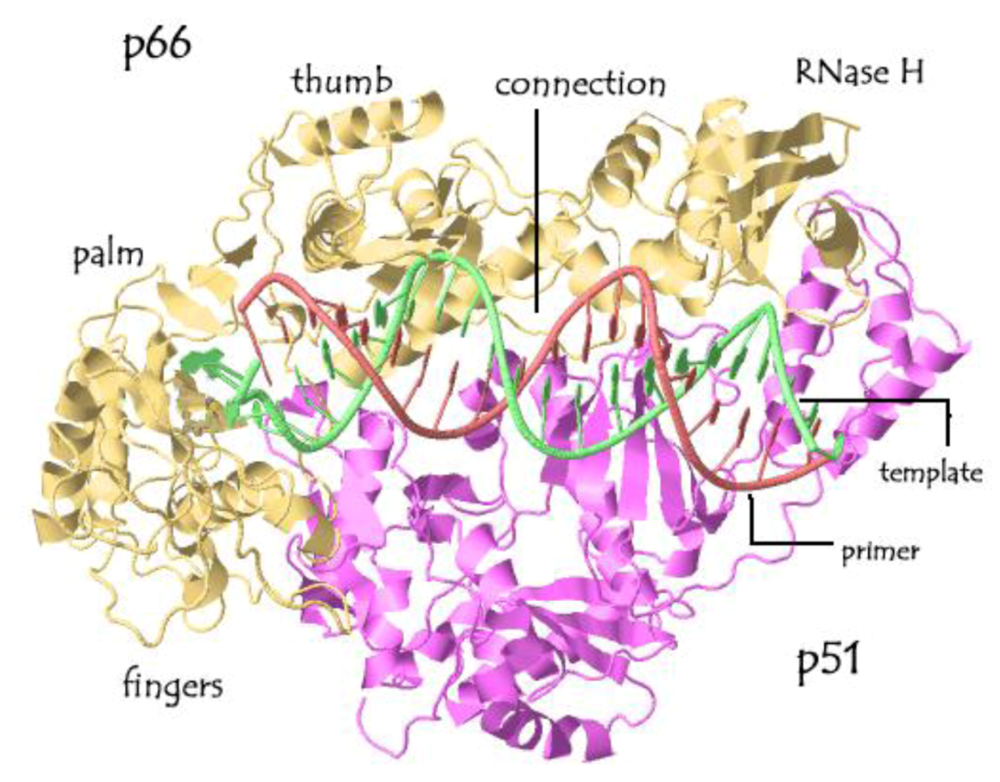
      <p>RT is an asymmetric heterodimeric enzyme consisting of a 560-amino-acid 66-kDa subunit (p66) and a 440-amino-acid 51-kDa subunit (p51)  [<xref ref-type="bibr" rid="B1">1</xref>] (<xref ref-type="fig" rid="figure1">Figure 1</xref>). The heterodimer contains a single active DNA polymerisation site, an RNase H active site and an RNA binding site.</p>
      <fig id="figure1" position="float">
<label>Figure 1</label>
<caption>
<p>RT Structure.<bold> </bold>The p66 subunit is shown in yellow and p51 subunit in purple. A vRNA:tRNA structure is juxtaposed on the RT molecule, where the vRNA is green and the tRNA is brown. The model was generated and adapted using RasMol and the PBD file ID# 1R0A  [<xref ref-type="bibr" rid="B2">2</xref>].</p>
</caption>
<graphic xmlns:xlink="http://www.w3.org/1999/xlink" xlink:href="viruses-01-00873-g001.tif"/>
</fig>
      <p>The p66 subunit of RT can be divided structurally into the polymerase and RNase H domains. The polymerase domain can be further differentiated into subdomains that have been described as structurally resembling a right hand, forming the fingers, palm, thumb, and connection subdomains  [<xref ref-type="bibr" rid="B1">1</xref>,<xref ref-type="bibr" rid="B3">3-6</xref>]. In the heterodimer, p66 has an “open” conformation, which facilitates binding to the incoming RNA template/tRNA complex during reverse transcription  [<xref ref-type="bibr" rid="B1">1</xref>,<xref ref-type="bibr" rid="B4">4</xref>,<xref ref-type="bibr" rid="B7">7</xref>]. </p>
      <p>While p51 has the same polymerase subdomains as p66, the relative orientations of the individual subdomains differ markedly. p51 lacks the cleft domain, as the active polymerase site is buried within the structure  [<xref ref-type="bibr" rid="B4">4</xref>]. Subsequently p51 forms a “closed” conformation and plays a largely structural role to stabilize the RT heterodimer  [<xref ref-type="bibr" rid="B8">8</xref>,<xref ref-type="bibr" rid="B9">9</xref>], although there is some evidence that the p51 subunit may be required for correct binding of the tRNA in the RT binding cleft  [<xref ref-type="bibr" rid="B10">10</xref>].</p>
    </sec>
    <sec>
      <title>3. Formation of the HIV-1 Reverse Transcription Initiation Complex in the Mature Virus Particle</title>
      <p>Interactions between RT and cellular factors are possible during early and late phases of virus replication. Two viral proteins, 55 kDa Gag and 160 kDa Gag-Pol, and two unspliced copies of viral genomic mRNA form the bulk of nascent virions assembled at the cellular plasma membrane. After budding, the virion precursor proteins are processed by the viral protease (PR) into matrix protein (MA), capsid protein (CA) and nucleocapsid protein (NC) and p6, and two small spacer proteins from Gag; and three viral enzymes: PR, reverse transcriptase (RT) and integrase (IN) from the Pol component of Gag-Pol. CA self-assembles into a fullerene cone  [<xref ref-type="bibr" rid="B11">11-13</xref>] which contains the genomic viral RNA (vRNA) associated with NC, RT, IN, MA and Vpr. Within this CA cone a prototypical reverse transcription complex (RTC) is established in the mature virion  [reviewed in 14]. At least two cellular factors have been linked to formation of the RTC. A cellular tRNA primer is packaged in particles by interaction with Gag with the aminoacyl-tRNA<sup>Lys,3</sup> synthetase (LysRS) which has tRNA<sup>Lys,3</sup> bound  [<xref ref-type="bibr" rid="B15">15</xref>]. Additional specificity is achieved as only “charged” LysRS molecules (those with tRNA<sup>Lys,3</sup> bound) are recruited by additional interaction with the thumb and connection domains of Pol (in the Gag-Pol precursor) [<xref ref-type="bibr" rid="B16">16</xref>]. The annealing of tRNA<sup>Lys,3</sup> requires the RNA chaperone activity of NC  [<xref ref-type="bibr" rid="B17">17</xref>,<xref ref-type="bibr" rid="B18">18</xref>]. Additionally, the mechanism by which the tRNA primer is bound to the viral RNA involves a complicated mechanism involving interactions between tRNA<sup>Lys,3</sup>, LysRS and RT, in which contact between Gag, Gag-Pol and LysRS facilitate annealing of non-actylated tRNA<sup>Lys,3</sup> to the PBS  [<xref ref-type="bibr" rid="B16">16</xref>]. RT binding to LysRS is mediated primarily by the thumb domain, although analysis of truncated RT proteins suggested that multiple domains of RT are important.</p>
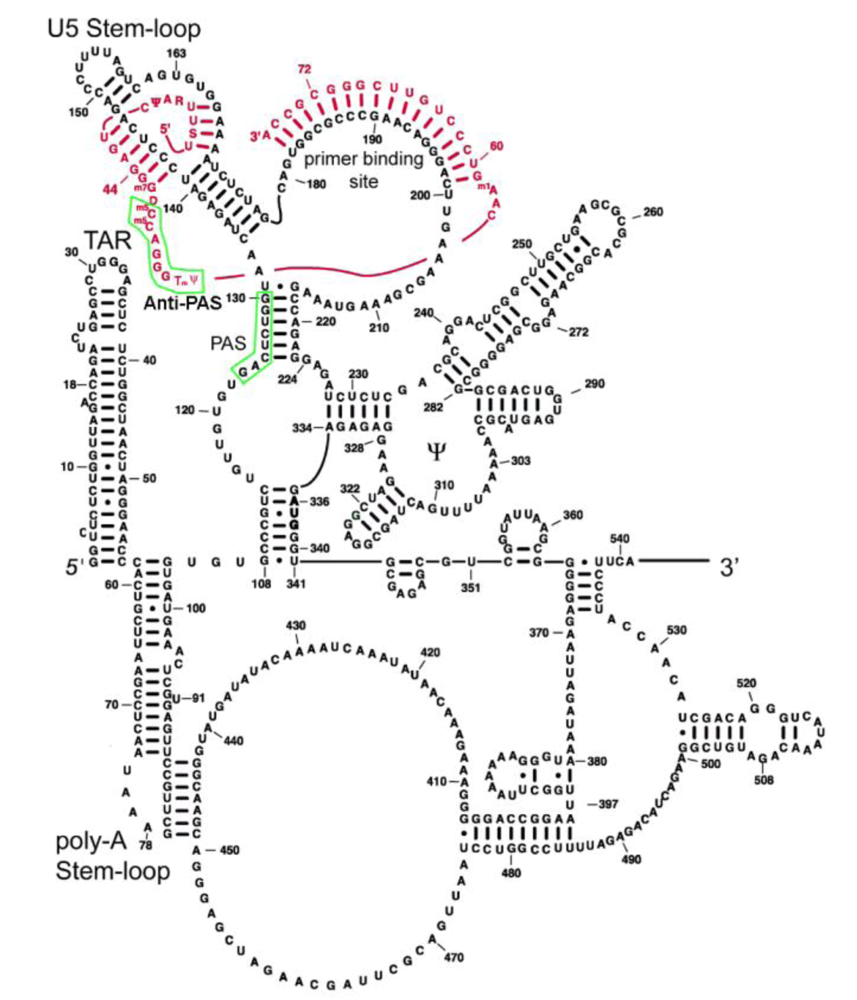
      <p>RNA interactions between vRNA and tRNA form an RNA architecture which is required for initiation of reverse transcription (<xref ref-type="fig" rid="figure2">Figure 2</xref>). Although some structural features are controversial, an RNA structure determined by chemical and enzymatic probing of synthetic or viral HIV-1 RNA annealed to tRNA<sup>Lys,3</sup> [<xref ref-type="bibr" rid="B19">19-23</xref>], and recently using high-throughput SHAPE (selective 2’-hydroxyl acylation analysed by primer extension) in intact viruses, with <italic>ex vivo</italic> virus RNA or synthetic RNA  [<xref ref-type="bibr" rid="B24">24</xref>,<xref ref-type="bibr" rid="B25">25</xref>] are similar. This complex is thought to form an RNA “scaffold” bound by reverse transcriptase, nucleocapsid and possibly other viral and cellular proteins, which as a whole form the reverse transcription initiation complex  [<xref ref-type="bibr" rid="B20">20</xref>,<xref ref-type="bibr" rid="B21">21</xref>]. A region referred to as the primer activation signal (PAS), located approximately 50 nucleotides upstream of the PBS, enhances the usage of tRNA<sup>Lys,3</sup> and appears to regulate the initiation reaction  [<xref ref-type="bibr" rid="B26">26-28</xref>]. However, an interaction between tRNA and PAS was not identified by SHAPE analysis suggesting that it may be transient. Generally, mutation of these RNA regions often negatively affects the initiation of reverse transcription. Finally, RT has contact sites in the vRNA:tRNA complex in addition to the known contact made by p66 in the substrate cleft where the primer:template are clamped  [<xref ref-type="bibr" rid="B29">29</xref>]. The p66 fingers subdomain make contacts to the vRNA:tRNA complex most likely in U5 just ahead of the tRNA primer. </p>
            <fig id="figure2" position="float">
<label>Figure 2</label>
<caption>
<p>Model of the HIV-1 RNA structure from +1 to +540.<bold> </bold>Proposed interactions between tRNA<sup>Lys,3</sup> and the U5 Stem-loop are indicated. The viral RNA sequence is colored black and the tRNA<sup>Lys,3</sup> sequence is in red. TAR: transactivation response element. Poly-A Stem loop contains the poly-adenylation signal AAUAAA functions on the 3’ long terminal repeat. The ψ indicates the vRNA packaging signal. The PAS on the vRNA and the anti-PAS on tRNA<sup>Lys,3</sup> are boxed in green. Adapted from Wilkinson <italic>et al. </italic>(2008)  [<xref ref-type="bibr" rid="B24">24</xref>].</p>
</caption>
<graphic xmlns:xlink="http://www.w3.org/1999/xlink" xlink:href="viruses-01-00873-g002.tif" scale="0"/>
</fig>
   <p><italic>In vitro</italic> kinetics studies of reverse transcription indicate that the initiation reaction is significantly slower than elongation of the nascent DNA strand by RT. The initiation phase incorporates 1 to 5 nucleotides to the tRNA primer, followed by a more rapid elongation phase where the polymerization rates increase about 3000-fold  [<xref ref-type="bibr" rid="B30">30</xref>,<xref ref-type="bibr" rid="B31">31</xref>]. Curiously, typical viral genomic RNAs are unextended or have a di-nucleotide extension on the primer prior to initiation of reverse transcription  [<xref ref-type="bibr" rid="B32">32</xref>]. The initiation step of HIV-1 reverse transcription is inhibited by a poorly defined mechanism possibly involving the RNA structure described, by low nucleotide concentrations or perhaps by an unknown factor  [<xref ref-type="bibr" rid="B28">28</xref>,<xref ref-type="bibr" rid="B33">33</xref>,<xref ref-type="bibr" rid="B34">34</xref>].</p>
    </sec>
    <sec>
      <title>4. The Complexities of Integrase and Reverse Transcriptase</title>
      <p>IN is a 288 amino acid, 31 kDa protein making up the C-terminal end of the Gag-Pol protein that has three domains consisting of the N-terminal (residues 1-50), catalytic core (residues 51-212), and C-terminal domain (CTD, residues 213-288). IN is active as a dimer with its primary function being to integrate the viral DNA product  [<xref ref-type="bibr" rid="B35">35</xref>]. Its penultimate role is to prepare the viral DNA for insertion into the host chromosome. To accomplish this task, IN remains associated with the reverse transcription complex, as the double strand viral DNA is made, and transitions into a pre-integration complex (PIC) capable of ligating proviral DNA into a chromosome  [<xref ref-type="bibr" rid="B36">36</xref>]. IN can directly bind to RT  [<xref ref-type="bibr" rid="B37">37-40</xref>] and deletion analysis of IN indicates that the CTD, which is a non-specific DNA binding domain  [<xref ref-type="bibr" rid="B41">41-44</xref>], is necessary and sufficient to bind RT  [<xref ref-type="bibr" rid="B39">39</xref>,<xref ref-type="bibr" rid="B40">40</xref>]. Conversely, RT reportedly has two IN-binding sites; one each in the finger-palm and connection subdomain regions  [<xref ref-type="bibr" rid="B39">39</xref>]. The association between IN and the RTC appears to be obligatory, as some IN mutants negatively affect proviral DNA synthesis  [<xref ref-type="bibr" rid="B37">37</xref>,<xref ref-type="bibr" rid="B45">45</xref>,<xref ref-type="bibr" rid="B46">46</xref>]. Mutations that inhibit reverse transcription are referred to as type II, whereas type I mutations affect integration  [<xref ref-type="bibr" rid="B47">47</xref>,<xref ref-type="bibr" rid="B48">48</xref>]. Recently nuclear magnetic and surface plasmon resonance (NMR and SPR, respectively) experiments using a CTD-derived peptide revealed a putative binding surface on IN  [<xref ref-type="bibr" rid="B49">49</xref>]. One mutation on this surface, K258A, substantially reduced CTD and RT binding. An unanswered question about CTD and other type II mutants is whether they act directly on RT, or if an interaction between IN and other viral or cellular factors are involved. Evidence that IN and RT interaction is required after infection has been inferred from genetic experiments, but rigorous correlation between IN and RT interaction and defective reverse transcription requires confirmation.</p>
      <p>Initiation of reverse transcription refers to the addition of the first five deoxynucleotides to the tRNA<sup>Lys,3</sup> primer. <italic>In vitro</italic> experiments using recombinant IN and RT indicate that IN can increase the efficiency of initiation [<xref ref-type="bibr" rid="B50">50</xref>]. Dobard <italic>et al.</italic> showed that IN-mediated initiation also requires natural tRNA<sup>Lys,3</sup> suggesting that the stability of the RT:primer/template complex is enhanced when IN is present. However IN also increases RT elongation dramatically. One possible explanation is that IN binding to RT increases the affinity of RT for the template RNA strand, as evident in competition assays using molecular traps that can bind RT that disengages the RNA template during DNA synthesis. It is unclear why IN is unable to enhance RT elongation when short RNA oligonucleotides are used to prime reverse transcription. It is possible that tRNA<sup>Lys,3</sup> is required to form an initial RT-IN complex, which is maintained during extended DNA synthesis. Another possibility is that tRNA<sup>Lys,3</sup> facilitates exposure of an IN binding site on RT. However, this is at odds with the observation that the RT-IN interaction does not require an RNA co-factor  [<xref ref-type="bibr" rid="B37">37</xref>]. </p>
    </sec>
    <sec>
      <title>5. IN-Binding Cellular Factors that Affect Reverse Transcription</title>
      <p>Yeast-two hybrid systems used to screen libraries of human genes have identified cellular factors that interact with integrase  [<xref ref-type="bibr" rid="B51">51-55</xref>], which were subsequently confirmed by <italic>in vitro</italic> protein GST pull-down and co-immunoprecipitation assays where IN was over expressed in cell culture. These include the cellular proteins integrase interactor 1 (INI1, hSNF5)  [<xref ref-type="bibr" rid="B53">53</xref>,<xref ref-type="bibr" rid="B54">54</xref>], sin3A-associated protein (SAP18), histone deactylase 1 (HDAC1)  [<xref ref-type="bibr" rid="B52">52</xref>] and survival motor neuron (SMN)-interacting protein 2 (Gemin2)  [<xref ref-type="bibr" rid="B55">55</xref>]. Given that mutation of IN can affect RT activity, it is not surprising that some IN binding cellular proteins also affect reverse transcription. Some of these cell proteins and their effects are described in the section below.</p>
      <sec>
        <title>5.1. A role for INI1 in early events during HIV-1 replication?</title>
        <p>INI1 is a 385 amino acid, 44 kDa nuclear protein (also called hSNF5, BAF47 and SMARCB1) component of the SWI/SNF chromatin remodeling complex that is involved in tumor suppression  [<xref ref-type="bibr" rid="B56">56</xref>]. INI1 binds to HIV-1 IN as well as proteins from other viruses including E1 from human papillomavirus 18 and the EBNA-2 from Epstein-Barr virus regulating virus replication  [<xref ref-type="bibr" rid="B57">57</xref>,<xref ref-type="bibr" rid="B58">58</xref>]. Structurally, INI1 has two imperfect amino acid repeat regions, RPT1 and RPT2, and a coiled coil domain that is conserved in other related mammalian and yeast proteins, termed the homology region 3 (HR3). INI1 is capable of multimerization and forms high molecular weight complexes primarily requiring both RPT motifs (the N-terminal domain also appears to play a role)  [<xref ref-type="bibr" rid="B59">59</xref>]. Whereas only RPT1 is required to bind IN  [<xref ref-type="bibr" rid="B53">53</xref>], a region adjacent to RPT1 in INI1 is required to bind DNA along the minor groove. Although primarily a nuclear protein, INI1 has a “masked” nuclear export signal (NES) within RPT2 that is critical for its ascribed cellular functions  [<xref ref-type="bibr" rid="B60">60</xref>]. </p>
        <p>INI1 affects HIV-1 replication at several points in the HIV-1 life cycle. In line with its role in the SWI/SNF chromatin remodeling complex, INI1 can affect both basal and Tat mediated HIV-1 gene expression  [<xref ref-type="bibr" rid="B61">61</xref>,<xref ref-type="bibr" rid="B62">62</xref>]. INI1 is also required for particle production as exogenously expressed INI1 can partially rescue reduced HIV-1 production in cells lacking INI1  [<xref ref-type="bibr" rid="B63">63</xref>]. INI1 is specifically packaged in HIV-1, but not other retroviruses, and is regulated by a direct interaction between INI1 and the IN domain of the HIV-1 Gag-Pol protein  [<xref ref-type="bibr" rid="B64">64</xref>]. Several lines of evidence suggest INI1 may be required during early steps of HIV-1 replication. Immediately following infection by HIV-1, INI1 in a target cell is rapidly and transiently exported from the nucleus by an hCRM1/exportin1 nuclear export pathway  [<xref ref-type="bibr" rid="B60">60</xref>,<xref ref-type="bibr" rid="B65">65</xref>]. INI1 associates with the incoming RTC/PIC in the cytoplasm  [<xref ref-type="bibr" rid="B65">65</xref>], and can stimulate IN activity <italic>in vitro </italic> [<xref ref-type="bibr" rid="B53">53</xref>]. Thus, INI1 is a candidate cellular factor regulating RTC/PIC activity (<xref ref-type="table" rid="table1">Table 1</xref>). </p>
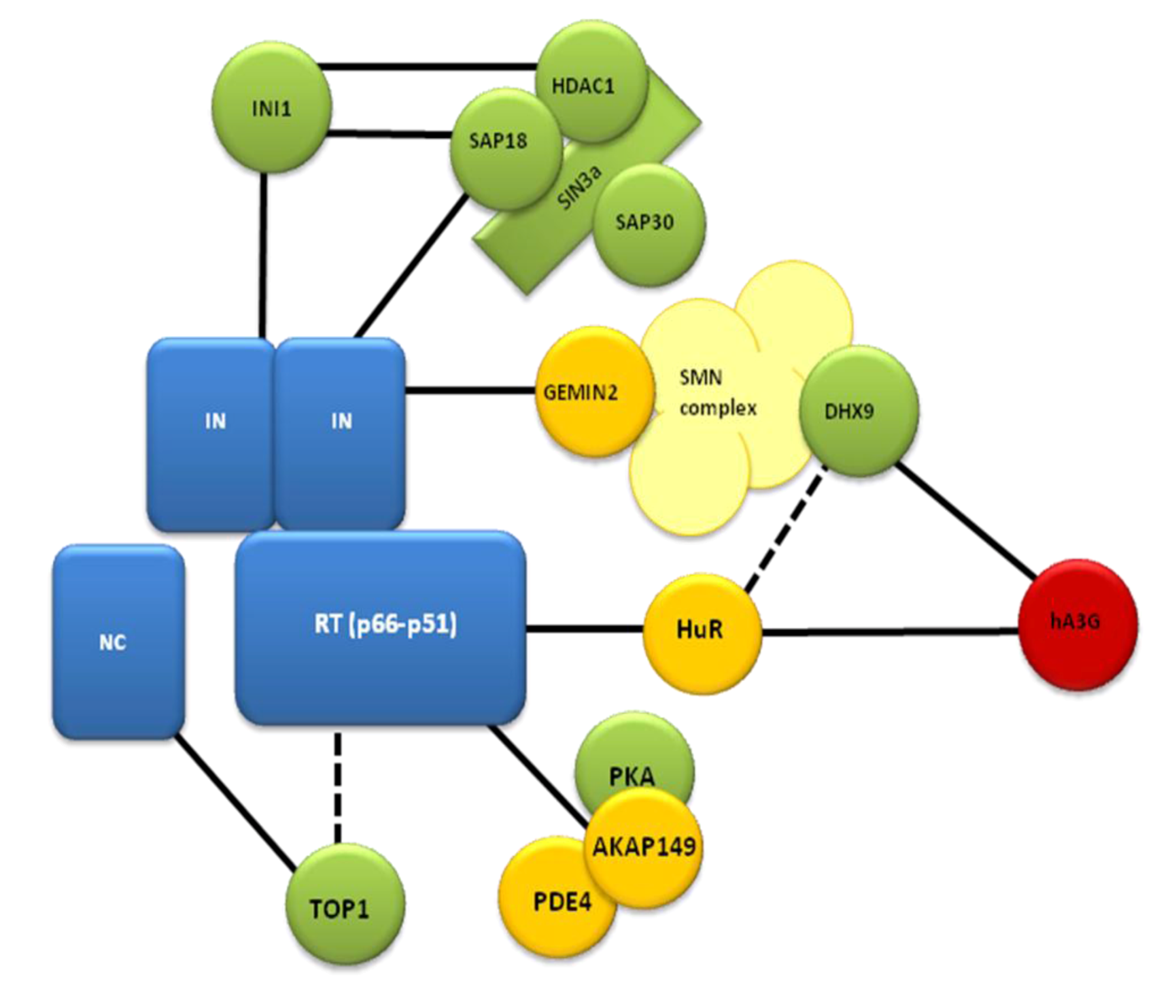
        <p>Three recent reports investigating early HIV-1 replication using different experimental approaches reached different conclusions regarding INI1 function during early replication. Sorin <italic>et al.</italic> used two rhabdoid tumor-derived cell lines, MON and STA-WTI, which are devoid of functional INI1, to produce HIV-1-like particles  [<xref ref-type="bibr" rid="B63">63</xref>]. MON and STA-WTI cells transfected with an HIV-1 derived lentiviral plasmid made &gt;10-fold less virus than 293T cells. Virus production could be increased by exogenously expressing INI1. Interestingly, the INI1 negatively regulated HIV-1 produced from MON cells, but not STA-WTI cells, exhibited a sharp defect in reverse transcription and virus infectivity. Exogenously expressed INI1 in MON cells did not complement these defects indicating that an additional unknown factor was involved in early replication. Curiously, exogenous RT activity in MON produced virions was sharply reduced. This is unexpected as RT levels in INI1+ and INI1- virions are similar; suggesting that a potent RT inhibitor made in MON cells may be packaged in virions. These experiments affirm INI1 as an important factor for virus particle production, but suggest that another factor perhaps acting in concert with INI1 is a regulator of reverse transcription (see Sin3a complex below) (<xref ref-type="fig" rid="figure3">Figure 3</xref>).</p>
        <p>Ariumi <italic>et al.</italic> investigated INI1 and its role in Tat transactivation of HIV-1 gene expression  [<xref ref-type="bibr" rid="B61">61</xref>]. Here, INI1 was stably downregulated in CD4+ HeLa-derived P4.2 cells and infected with an HIV-1-derived lentiviral vector expressing GFP using a CMV promoter (to bypass a need for Tat to monitor gene expression). In this study, no change in virus infectivity was observed. Hence, INI1 had no affect on events from fusion to integration, suggesting that INI1 was not essential for RTC or PIC function. </p>
        <p>Maroun <italic>et al.</italic> down-regulated INI1 in Jurkat or P4.2 cells transiently using siRNA  [<xref ref-type="bibr" rid="B66">66</xref>]. In this case, HIV-1 replication was enhanced in both cell types indicating that INI1 negatively affected HIV-1 replication. Infection of INI1 depleted cells resulted in increased levels of 2-LTR circular DNA and integrated provirus suggesting that interaction between INI1 and IN somehow inhibited integration. A specific IN mutant protein, K71R, blocked the INI1:IN interaction, and HIV-1 with this point mutation replicated better leading to the conclusion that INI1:IN complex was detrimental for HIV-1 replication. A similar conclusion was previously reported for the homologous recombination repair protein RAD52  [<xref ref-type="bibr" rid="B67">67</xref>]. </p>
        <p>It is clear that INI1 has diverse roles in HIV-1 replication including virus gene expression and virus assembly and integration. Sometimes, virus made by cells lacking INI1 display an RT defect, but this could be attributed to factors other than INI1. Discrepancies in INI1 function between these 3 studies may be due to differences in INI1 expression or cell type specific effects. The suggestion that INI1 has innate antiviral activity is intriguing, however further research is required to clarify the role INI1 in cells following HIV-1 infection. </p>
      </sec>
      <sec>
        <title>5.2. Sin3a-HDAC1complex and early events in HIV-1 replication.</title>
        <p>Recently, several Sin3a-HDAC1 complex proteins were found to be specifically packaged in HIV virions  [<xref ref-type="bibr" rid="B52">52</xref>] (Table1)(<xref ref-type="fig" rid="figure3">Figure 3</xref>). In cells, the Sin3a complex is involved in chromatin remodeling leading to transcriptional repression  [see 68]. At the heart of this complex is Sin3, a scaffold protein able to interact with several proteins simultaneously, which facilitates interaction between numerous proteins including transcription factors, histone modifying proteins, and various Sin3a associated protein (SAP) including SAP18 and SAP30  [reviewed in 68]. Initially SAP18 was identified by yeast two-hybrid analysis, GST pull-down and co-immunoprecipitation assays as an INI1 and IN interacting protein  [<xref ref-type="bibr" rid="B52">52</xref>]. Subsequently, several different members of the Sin3a-HDAC1 complex were specifically detected in HIV-1 virions including Sin3a, Sap18, Sap30, and HDAC1  [<xref ref-type="bibr" rid="B52">52</xref>]. Sorin <italic>et al.</italic> reported that they are incorporated in an IN dependent manner which likely involving a protein complex including INI1. The significance of HDAC1 activity in virions was tested by overexpression of a dominant negative HDAC1 mutant (H141A), by reducing HDAC1 expression using siRNA, or using chemical inhibitors of HDAC activity  [<xref ref-type="bibr" rid="B52">52</xref>]. These approaches resulted in reduced (~3-fold) HIV-1 infectivity suggesting that HDAC activity was important for early steps in HIV-1 infection. This was not attributed to a defect in virus maturation or ability of HIV-1 to fuse to a target cell. Curiously, a substantial defect in synthesis of reverse transcription products was observed, 10 to 100 fold, which indicated that a step between uncoating and reverse transcription was affected by HDAC1. Overall, the decreased infectivity was somewhat modest compared to the observed defect in viral cDNA synthesis. Nevertheless, components of the Sin3a complex, which includes INI1, plays a role in early steps of HIV-1 replication. </p>
        <p>Exploration of the role of Sin3a, SAP18, Sap30 and HDAC1 should provide significant insight to virus replication strategies. Sin3a, as previously mentioned, is a scaffold protein, but no specific functions are known for Sap18 and Sap30 other than they are associated within stable protein complexes often involving transcription factors. It is possible that they perform a similar function by stabilizing the reverse transcription or pre-integration complexes. While HDAC1 activity is important for HIV-1 infectivity, the viral substrate for HDAC1 is unknown. The only HIV-1 proteins regulated by HDAC and histone acetyltransferase activity (HAT) are Tat and IN  [<xref ref-type="bibr" rid="B69">69-74</xref>]. Acetylation of K51 in Tat positively affects HIV-1 gene expression  [<xref ref-type="bibr" rid="B69">69</xref>,<xref ref-type="bibr" rid="B71">71</xref>,<xref ref-type="bibr" rid="B75">75</xref>,<xref ref-type="bibr" rid="B76">76</xref>], and this post-translational modification can be opposed by human sirtuin 1 (SIRT1) [<xref ref-type="bibr" rid="B77">77</xref>], a nicotinamide adenine dinucleotide-dependent class III protein deacetylase. Integrase can be acetylated by p300 on three lysine residues, K264, K266, and K273 in the C-terminal domain. Interestingly, mutating IN residues K264 or K266 resulted in defective reverse transcription  [<xref ref-type="bibr" rid="B47">47</xref>] opening up the possibility of regulation of IN function by a reversible post-translational modification by p300 and a deactylase activity. </p>
      </sec>
      <sec>
        <title>5.3. Survival motor neuron complex member Gemin2; an essential reverse transcription co-factor.</title>
        <p>Gemin2 (also called SMN-interacting protein 1, SIP1) is 280 amino acid, 30 kDa protein and a component of the survival motor neuron (SMN) complex composed of SMN, Gemins2-8 and Unrip proteins  [reviewed in 78]. The primary role of the SMN complex in the cell is in the biogenesis of small nuclear ribonucleoproteins, which are assembled in the cell cytoplasm and accumulate in specific structures in the nucleus called gems (Gemini or coiled bodies)  [<xref ref-type="bibr" rid="B79">79</xref>]. Gemin2 was originally identified as an IN binding protein in a yeast two-hybrid protein interaction assay  [<xref ref-type="bibr" rid="B55">55</xref>], where Gemin2 amino acids 137 to 238 mediate binding to the C-terminal domain (amino acids 213-288) of HIV-1 IN (<xref ref-type="table" rid="table1">Table 1</xref>)(<xref ref-type="fig" rid="figure3">Figure 3</xref>). Hamamoto <italic>et al.</italic> showed that downregulation of Gemin2 expression by siRNA in primary monocyte derived macrophage cells significantly reduced HIV-1 replication that was attributed to reduced efficiency of reverse transcription and integration  [<xref ref-type="bibr" rid="B55">55</xref>]. Thus, Gemin2 is required for an early event post-infection that affects early reverse transcription product (negative strand strong stop) less than later products or integrated DNA, suggesting that Gemin2 associates with either the reverse transcription or pre-integration complexes  [<xref ref-type="bibr" rid="B55">55</xref>]. Alternatively, Gemin2 could recruit other cellular factors required for reverse transcription. For example DHX9 (RNA helicase A) is putative cellular factor regulating reverse transcription  [<xref ref-type="bibr" rid="B80">80</xref>] that can associate with the SMN complex [<xref ref-type="bibr" rid="B81">81</xref>] . It is possible that other SMN complex proteins are also important. The difficulty in resolving this issue is that the steady state level of Gemin2 and SMN appear to be co-dependent. That is, the downregulation of either protein by siRNAi leads to reduced levels of the other  [<xref ref-type="bibr" rid="B55">55</xref>]. Thus determining a role for SMN in early replication that is distinct from Gemin2 is problematic. Curiously, only one of four recent genome wide screens using RNAi methods  [<xref ref-type="bibr" rid="B82">82-85</xref>] identified Gemin2  [<xref ref-type="bibr" rid="B82">82</xref>] as a HIV-1 human dependency factor, and SMN was not identified in any screen. The precise mechanism of how Gemin2 affects early replication remains to be determined. </p>
<fig id="figure3" position="float">
<label>Figure 3</label>
<caption>
<p>Schematic of RTC interacting cellular factors. Known direct (—) and indirect (---) associations between RTC (blue) and host factors that affect reverse transcription. Cellular factors are incorporated into virion particles (green), not incorporated (yellow) or conditionally incorporated (red).</p>
</caption>
<graphic xmlns:xlink="http://www.w3.org/1999/xlink" xlink:href="viruses-01-00873-g003.tif" scale="0"/>
</fig>
      </sec>
    </sec>
    <sec>
      <title>6. Do Cellular Factors Directly Affect Reverse Transcription via RT Association?</title>
      <p>The importance of host cell factors for HIV replication was recently highlighted by siRNA library genomic screens  [<xref ref-type="bibr" rid="B82">82-85</xref>]. Each screen identified approximately 200-300 genes which affected HIV replication, with minimal overlap of genes between the individual screens. Interestingly, three of the studies identified host factors important for reverse transcription  [<xref ref-type="bibr" rid="B83">83-85</xref>]. As there are other recent analyses of these genomic screens  [<xref ref-type="bibr" rid="B86">86-88</xref>], in the section below we will instead focus on specific examples in the literature in which there is evidence of RT associations that affect reverse transcription.</p>
      <sec>
        <title>6.1. Human antigen R (HuR): an effector of multiple steps of HIV-1 replication</title>
        <p>HuR (also referred to as ELAVL1, HuA and MelG), is a ubiquitously expressed 326 amino acid, 36 kDa nuclear protein that possesses nucleocytoplasmic shuttling capabilities  [<xref ref-type="bibr" rid="B89">89</xref>]. Like all members of the ELAV-like protein family, HuR exhibits high specificity and affinity for AU-rich elements (AREs) and contains 3 RNA binding domains. A direct correlation between HuR expression and mRNA decay has been demonstrated, thus implicating a role in the ARE-mediated mRNA degradation pathway  [<xref ref-type="bibr" rid="B90">90-93</xref>]. A protective role for HuR in this pathway was suggested by the observation that overexpression of HuR in mouse cell lines significantly increased the stability of both type I and type II ARE-containing mRNAs  [<xref ref-type="bibr" rid="B89">89</xref>,<xref ref-type="bibr" rid="B94">94</xref>]. Interestingly, studies have suggested that nucleocytoplasmic shuttling of HuR may regulate its function and whilst the precise mechanism behind the nuclear export of the protein remains unclear, it is most likely that HuR binds ARE-containing mRNAs in the nucleus, accompanies them to the cytoplasm, and then returns to the nucleus upon release. </p>
        <p>Recently, altering HuR levels in cells has been shown to affect early HIV-1 replication  [<xref ref-type="bibr" rid="B95">95</xref>] (<xref ref-type="table" rid="table1">Table 1</xref>)(<xref ref-type="fig" rid="figure3">Figure 3</xref>). Both depletion and overexpression of HuR verified the requirement of this protein for optimal reverse transcription. While the mechanism behind this activity remains unclear, it appears to be due to HuR an interaction with the RNase H domain of RT [<xref ref-type="bibr" rid="B95">95</xref>], as opposed to the previously discussed protein-RNA binding that regulates the role of HuR in mRNA stability. It is also possible that such activities are dependent on the presence of cellular factors that bind and regulate HuR. For example, HuR is incorporated in cellular stress granules that are common sites of regulation of mRNA stability and translation  [<xref ref-type="bibr" rid="B96">96-98</xref>]. Interestingly human APOBEC3G (hA3G), known to have negative effects on reverse transcription  [<xref ref-type="bibr" rid="B99">99-102</xref>], also localizes to stress granules  [<xref ref-type="bibr" rid="B103">103</xref>]. Furthermore, hA3G was found to associate with a number of ribonucleoproteins present in stress granules  [<xref ref-type="bibr" rid="B103">103</xref>], a significant proportion of which are known mRNA-interacting proteins including DHX9  [<xref ref-type="bibr" rid="B80">80</xref>,<xref ref-type="bibr" rid="B104">104</xref>], HNRNPU  [<xref ref-type="bibr" rid="B105">105</xref>], PABPC1  [<xref ref-type="bibr" rid="B106">106</xref>], YB-1  [<xref ref-type="bibr" rid="B83">83</xref>,<xref ref-type="bibr" rid="B107">107</xref>] and SNRPA  [<xref ref-type="bibr" rid="B83">83</xref>] that have previously been shown to affect various steps of HIV-1 replication including reverse transcription. Most significantly, a direct interaction between hA3G and HuR was revealed  [<xref ref-type="bibr" rid="B103">103</xref>]. Hence, a HuR/hA3G protein complex could regulate the RTC as it progresses through the cytoplasm. Alternatively, HuR or DHX9 could oppose the negative effects of hA3G on HIV-1 reverse transcription. Further analysis of will be required to clarify a role for HuR:RT interaction. </p>
      </sec>
      <sec>
        <title>6.2. A kinase anchor protein 1 (AKAP1): anchoring HIV-1 reverse transcription?</title>
        <p>AKAP1, more commonly referred to as AKAP149 or PRKA1, is a member of the AKAP family of proteins which bind the regulatory subunits of cAMP-dependent protein kinase A (PKA) and anchors them to various membranes throughout the cell  [<xref ref-type="bibr" rid="B108">108</xref>,<xref ref-type="bibr" rid="B109">109</xref>]. AKAP149 binds both RI and RII subunits of PKA, attaching them to the outer mitochondrial membrane  [<xref ref-type="bibr" rid="B110">110</xref>], where it also interacts with c-myc binding protein (MYCBP, also called AMY-1), phosphodiesterase 4 (PDE4) and potentially caveolin 1 (CAV1)  [<xref ref-type="bibr" rid="B111">111-113</xref>]. In addition to mitochondria, AKAP149 also exhibits localization to the endoplasmic reticulum and nuclear envelope where it assists the maintenance of nuclear integrity through interactions with B-type lamin (LMNB) and protein phosphatase 1 (PP1)  [<xref ref-type="bibr" rid="B114">114-117</xref>]. A feature of the AKAP149 protein is the presence of a KH-Tudor domain  [<xref ref-type="bibr" rid="B108">108</xref>] that facilitates both RNA-binding and self-association properties  [<xref ref-type="bibr" rid="B118">118</xref>,<xref ref-type="bibr" rid="B119">119</xref>] .</p>
        <p>Recent research has demonstrated a direct interaction between AKAP149 and HIV-1 RT  [<xref ref-type="bibr" rid="B95">95</xref>] (<xref ref-type="table" rid="table1">Table 1</xref>). Like HuR, AKAP149 binds to the RNase H region of RT [<xref ref-type="bibr" rid="B124">124</xref>]. While siRNA knockdown experiments indicate that this interaction is essential for optimal reverse transcription, a direct role for AKAP149 in reverse transcription requires confirmation. AKAP149 is not incorporated into virions and localizes to the endoplasmic reticulum, nuclear envelope and mitochondria  [<xref ref-type="bibr" rid="B114">114</xref>,<xref ref-type="bibr" rid="B117">117</xref>,<xref ref-type="bibr" rid="B120">120</xref>]. While point mutation of the RNase H domain sharply downregulate AKAP149:RT interaction and reverse transcription, a clear connection has not been established. How AKAP149 is able to interact with RT prior to its function in reverse transcription is currently unknown, however AKAP149 does interact with cellular factors that could affect reverse transcription. For example, AKAP149 anchors PKA and PDE4 to mitochondria, both of which have been implicated in the regulation of HIV-1 replication  [<xref ref-type="bibr" rid="B121">121</xref>,<xref ref-type="bibr" rid="B122">122</xref>]. PKA is incorporated into HIV-1 virions and can phosphorylate HIV-1 CA, an activity that may be important for viral infectivity  [<xref ref-type="bibr" rid="B123">123</xref>]. Also, PKA and PDE4 themselves are key players in the cAMP signaling pathways  [<xref ref-type="bibr" rid="B124">124</xref>], which can stimulate HIV-1 from latently infected cells  [<xref ref-type="bibr" rid="B122">122</xref>,<xref ref-type="bibr" rid="B125">125</xref>] and in turn, can be activated by HIV-1 in normal lymphocytes  [<xref ref-type="bibr" rid="B126">126</xref>]. Hence AKAP149 could affect reverse transcription indirectly, perhaps through a protein kinase dependent signaling pathway. </p>
      </sec>
      <sec>
        <title>6.3. DNA topoisomerase 1 (TOP1) and increased RT efficiency</title>
        <p>TOP1 is a 91 kDa sumoylated enzyme that regulates the topologic state of DNA during the process of transcription. TOP1 activity is required for optimal replication of many different DNA and RNA viruses including equine infectious anaemia virus (EIAV), Rous sarcoma virus (RSV), herpes simplex virus 1 (HSV1), adenovirus type 5 (Ad5), simian virus 40 (SV40) and HIV-1  [<xref ref-type="bibr" rid="B127">127-132</xref>]. </p>

<table-wrap id="table1" position="float"><object-id pub-id-type="pii">viruses-01-00873_table1</object-id>
<label>Table 1</label>
<caption>
<p>Summary of host factors that affect reverse transcription</p>
</caption>
<table border="1" cellspacing="0" cellpadding="0">
<thead>
<tr>
    <th>Host  factor </th>
    <th>Found  in   virus   particle </th>
    <th>Virus   binding   partner </th>
    <th>RT/IN   binding site </th>
    <th>Affect on  reverse   transcription </th>
    <th>Other binding   partners with  respect to RT </th>
    <th>References </th>
  </tr>
</thead>
<tbody>
<tr>
    <td>INI1 </td>
    <td>Yes </td>
    <td>IN </td>
    <td>NH2-terminal;  zinc-finger  region </td>
    <td>Unclear, recruits Sin3a complex proteins to    the virion </td>
    <td>HIV-1 TAT; SAP18 </td>
    <td>[52,53,61,63,66] </td>
  </tr>
  <tr>
    <td>SAP18 </td>
    <td>Yes </td>
    <td>IN </td>
    <td>n/d </td>
    <td>unknown,   recruits Sin3a complex proteins to the   virion </td>
    <td>INI1 </td>
    <td>[52] </td>
  </tr>
  <tr>
    <td>HDAC1 </td>
    <td>Yes </td>
    <td>nil </td>
    <td>n/a </td>
    <td>required for  early  reverse   transcription </td>
    <td>INI1 </td>
    <td>[52] </td>
  </tr>
  <tr>
    <td>Gemin2 </td>
    <td>No </td>
    <td>IN </td>
    <td>C-terminal region;  amino acids 213-288 </td>
    <td>required for early   reverse   transcription </td>
    <td>SMN1;  DHX9 (but  indirectly  through the   SMN complex) </td>
    <td>[55,80] </td>
  </tr>
  <tr>
    <td>HuR </td>
    <td>n/d </td>
    <td>RT </td>
    <td>RNAse H  domain </td>
    <td>required for early  reverse transcription </td>
    <td>APOBEC3G </td>
    <td>[95,103] </td>
  </tr>
  <tr>
    <td>AKAP149 </td>
    <td>No </td>
    <td>RT </td>
    <td>RNAse H   domain </td>
    <td>required for early  reverse transcription </td>
    <td>PKA, PDE4,  </td>
    <td>[120,121,126] </td>
  </tr>
  <tr>
    <td>TOP1 </td>
    <td> Yes </td>
    <td> NC </td>
    <td> n/a </td>
    <td> stimulates RT activity </td>
    <td> n/a </td>
    <td> [132,134,135] </td>
  </tr>
  <tr>
    <td> APOBEC3G </td>
    <td> Yes, if  Vif is  absent </td>
    <td> NC; viral RNA/DNA </td>
    <td> n/a </td>
    <td> inhibits early reverse transcription and inhibits elongation of viral cDNA </td>
    <td> HuR </td>
    <td> [99-102]  </td>
  </tr>
  <tr>
    <td>DHX9 (RHA, RNA  helicase A) </td>
    <td>Yes </td>
    <td>Gag, viral RNA </td>
    <td>n/a </td>
    <td>required for early   reverse transcription </td>
    <td>SMN complex,  APOBEC3G </td>
    <td>[80,103] </td>
  </tr>
</tbody>
</table>
<table-wrap-foot>
<fn>
<p>n/d = not determined; n/a = not applicable</p>
</fn>
</table-wrap-foot>
</table-wrap>

        <p><bold>Table 1.</bold> </p>
        <p>TOP1 has been shown to enhance HIV-1 cDNA synthesis  [<xref ref-type="bibr" rid="B133">133</xref>,<xref ref-type="bibr" rid="B134">134</xref>], thus implicating a role for this enzyme in reverse transcription (<xref ref-type="table" rid="table1">Table 1</xref>)(<xref ref-type="fig" rid="figure3">Figure 3</xref>). Interestingly, TOP1 has been shown to directly interact with HIV-1 NC  [<xref ref-type="bibr" rid="B134">134</xref>], which itself is essential for the initiation of reverse transcription  [<xref ref-type="bibr" rid="B135">135</xref>]. Additionally, <italic>in vitro</italic> reverse transcription assays have demonstrated that TOP1 can significantly enhance the activity of HIV-1 RT  [<xref ref-type="bibr" rid="B134">134</xref>] and this can be impeded by the addition of the TOP1 inhibitor camptothecin  [<xref ref-type="bibr" rid="B134">134</xref>]. While the exact mechanism behind this activity has yet to be elucidated, TOP1 may dissociate RT from structured RNA  [<xref ref-type="bibr" rid="B136">136</xref>] in an ATP-dependent manner  [<xref ref-type="bibr" rid="B137">137</xref>,<xref ref-type="bibr" rid="B138">138</xref>]. Alternatively, an enzymatic difference between cellular and virus-derived TOP1 has been suggested although this notion is controversial  [<xref ref-type="bibr" rid="B131">131</xref>,<xref ref-type="bibr" rid="B134">134</xref>,<xref ref-type="bibr" rid="B137">137</xref>]. </p>
        <p>Also interesting is the ability of TOP1 to regulate virus tropism. HIV-1 virions derived from African green monkey cells are known to be less infectious than those derived from human cells  [<xref ref-type="bibr" rid="B139">139</xref>]. Studies by Shoya <italic>et al</italic>  [<xref ref-type="bibr" rid="B133">133</xref>] demonstrated that expression of human TOP1 in African green monkey cells increases the infectivity of progeny virions to 50-60% of that observed from human cells which was attributed to enhanced reverse transcription. Further research is required to determine the mechanism by which TOP1 enhances reverse transcription process. This could reveal whether this TOP1 activity is a possible candidate for the development of antiretroviral therapy.</p>
      </sec>
    </sec>
    <sec sec-type="conclusions">
      <title>7. Conclusions </title>
      <p>Given that HIV-1 encodes only 9 genes and 15 proteins, it is not surprising that HIV-1 uses many hundreds of cellular factors during the virus replication cycle. Recent reports of human genome screens using RNAi methods and proteomic analysis have identified a plethora of human dependency factors, but few have been studied in detail. The question of which cellular components are required for productive reverse transcription will undoubtedly have a complicated answer. The RT:IN complex recruits cellular proteins that are required to complete reverse transcription, and its highly likely that other viral factors, such as NC, Vpr, MA, and Tat do the same. The research highlighted here begins to reveal how some factors regulate RT activity, but whether these factors are RTC components, or if they direct the RTC is unknown. The proteins discussed here provide a starting point towards understanding complex host-pathogen interactions that makes productive reverse transcription in cells possible. The investigations of cellular factors give hope that unraveling the critical interactions will ultimately be the key to novel treatments for HIV-1 infection.</p>
    </sec>
  </body>
  <back>
    <ref-list>
<title>References</title>
      <ref id="B1">
        <citation citation-type="journal">
          <person-group person-group-type="author">
            <name>
              <surname>Kohlstaedt</surname>
              <given-names>L.A.</given-names>
            </name>
            <name>
              <surname>Wang</surname>
              <given-names>J.</given-names>
            </name>
            <name>
              <surname>Friedman</surname>
              <given-names>J.M.</given-names>
            </name>
            <name>
              <surname>Rice</surname>
              <given-names>P.A.</given-names>
            </name>
            <name>
              <surname>Steitz</surname>
              <given-names>T.A.</given-names>
            </name>
          </person-group>
          <article-title>Crystal structure at 3.5 A resolution of HIV-1 reverse transcriptase complexed with an inhibitor  </article-title>
          <source>Science</source>
          <year>1992</year>
          <volume>256</volume>
          <fpage>1783</fpage>
          <lpage>1790</lpage>
          <supplement/>
          <pub-id pub-id-type="pmid">1377403</pub-id>
        </citation>
      </ref>
      <ref id="B2">
        <citation citation-type="journal">
          <person-group person-group-type="author">
            <name>
              <surname>Peletskaya</surname>
              <given-names>E.N.</given-names>
            </name>
            <name>
              <surname>Kogon</surname>
              <given-names>A.A.</given-names>
            </name>
            <name>
              <surname>Tuske</surname>
              <given-names>S.</given-names>
            </name>
            <name>
              <surname>Arnold</surname>
              <given-names>E.</given-names>
            </name>
            <name>
              <surname>Hughes</surname>
              <given-names>S.H.</given-names>
            </name>
          </person-group>
          <article-title>Nonnucleoside inhibitor binding affects the interactions of the fingers subdomain of human immunodeficiency virus type 1 reverse transcriptase with DNA</article-title>
          <source>J. Virol.</source>
          <year>2004</year>
          <volume>78</volume>
          <fpage>3387</fpage>
          <lpage>3397</lpage>
          <pub-id pub-id-type="doi">10.1128/JVI.78.7.3387-3397.2004</pub-id>
          <pub-id pub-id-type="pmid">15016861</pub-id>
        </citation>
      </ref>
      <ref id="B3">
        <citation citation-type="journal">
          <person-group person-group-type="author">
            <name>
              <surname>Jacobo-Molina</surname>
              <given-names>A.</given-names>
            </name>
            <name>
              <surname>Arnold</surname>
              <given-names>E.</given-names>
            </name>
          </person-group>
          <article-title>HIV reverse transcriptase structure-function relationships</article-title>
          <source>Biochemistry</source>
          <year>1991</year>
          <volume>30</volume>
          <fpage>6351</fpage>
          <lpage>6356</lpage>
          <pub-id pub-id-type="doi">10.1021/bi00240a001</pub-id>
          <pub-id pub-id-type="pmid">1711368</pub-id>
        </citation>
      </ref>
      <ref id="B4">
        <citation citation-type="journal">
          <person-group person-group-type="author">
            <name>
              <surname>Jacobo-Molina</surname>
              <given-names>A.</given-names>
            </name>
            <name>
              <surname>Ding</surname>
              <given-names>J.</given-names>
            </name>
            <name>
              <surname>Nanni</surname>
              <given-names>R.G.</given-names>
            </name>
            <name>
              <surname>Clark Jr.</surname>
              <given-names>A.D.</given-names>
            </name>
            <name>
              <surname>Lu</surname>
              <given-names>X.</given-names>
            </name>
            <name>
              <surname>Tantillo</surname>
              <given-names>C.</given-names>
            </name>
            <name>
              <surname>Williams</surname>
              <given-names>R.L.</given-names>
            </name>
            <name>
              <surname>Kamer</surname>
              <given-names>G.</given-names>
            </name>
            <name>
              <surname>Ferris</surname>
              <given-names>A.L.</given-names>
            </name>
            <name>
              <surname>Clark</surname>
              <given-names>P.</given-names>
            </name>
            <name>
              <surname>Hizi</surname>
              <given-names>A.</given-names>
            </name>
            <name>
              <surname>Hughes</surname>
              <given-names>S.H.</given-names>
            </name>
            <name>
              <surname>Arnold</surname>
              <given-names>E.</given-names>
            </name>
          </person-group>
          <article-title>Crystal structure of human immunodeficiency virus type 1 reverse transcriptase complexed with double-stranded DNA at 3.0 A resolution shows bent DNA</article-title>
          <source>Proc. Natl. Acad. Sci. U S A</source>
          <year>1993</year>
          <volume>90</volume>
          <fpage>6320</fpage>
          <lpage>6324</lpage>
          <supplement>  
</supplement>
          <pub-id pub-id-type="doi">10.1073/pnas.90.13.6320</pub-id>
          <pub-id pub-id-type="pmid">7687065</pub-id>
        </citation>
      </ref>
      <ref id="B5">
        <citation citation-type="journal">
          <person-group person-group-type="author">
            <name>
              <surname>Beard</surname>
              <given-names>W.A.</given-names>
            </name>
            <name>
              <surname>Stahl</surname>
              <given-names>S.J.</given-names>
            </name>
            <name>
              <surname>Kim</surname>
              <given-names>H.R.</given-names>
            </name>
            <name>
              <surname>Bebenek</surname>
              <given-names>K.</given-names>
            </name>
            <name>
              <surname>Kumar</surname>
              <given-names>A.</given-names>
            </name>
            <name>
              <surname>Strub</surname>
              <given-names>M.P.</given-names>
            </name>
            <name>
              <surname>Becerra</surname>
              <given-names>S.P.</given-names>
            </name>
            <name>
              <surname>Kunkel</surname>
              <given-names>T.A.</given-names>
            </name>
            <name>
              <surname>Wilson</surname>
              <given-names>S.H.</given-names>
            </name>
          </person-group>
          <article-title>Structure/function studies of human immunodeficiency virus type 1 reverse transcriptase. Alanine scanning mutagenesis of an alpha-helix in the thumb subdomain</article-title>
          <source>J. Biol. Chem.</source>
          <year>1994</year>
          <volume>269</volume>
          <fpage>28091</fpage>
          <lpage>28097</lpage>
          <pub-id pub-id-type="pmid">7525566</pub-id>
        </citation>
      </ref>
      <ref id="B6">
        <citation citation-type="journal">
          <person-group person-group-type="author">
            <name>
              <surname>Wang</surname>
              <given-names>J.</given-names>
            </name>
            <name>
              <surname>Smerdon</surname>
              <given-names>S.J.</given-names>
            </name>
            <name>
              <surname>Jager</surname>
              <given-names>J.</given-names>
            </name>
            <name>
              <surname>Kohlstaedt</surname>
              <given-names>L.A.</given-names>
            </name>
            <name>
              <surname>Rice</surname>
              <given-names>P.A.</given-names>
            </name>
            <name>
              <surname>Friedman</surname>
              <given-names>J.M.</given-names>
            </name>
            <name>
              <surname>Steitz</surname>
              <given-names>T.A.</given-names>
            </name>
          </person-group>
          <article-title>Structural basis of asymmetry in the human immunodeficiency virus type 1 reverse transcriptase heterodimer</article-title>
          <source>Proc. Natl. Acad. Sci. U S A</source>
          <year>1994</year>
          <volume>91</volume>
          <fpage>7242</fpage>
          <lpage>7246</lpage>
          <pub-id pub-id-type="doi">10.1073/pnas.91.15.7242</pub-id>
          <pub-id pub-id-type="pmid">7518928</pub-id>
        </citation>
      </ref>
      <ref id="B7">
        <citation citation-type="journal">
          <person-group person-group-type="author">
            <name>
              <surname>Kohlstaedt</surname>
              <given-names>L.A.</given-names>
            </name>
            <name>
              <surname>Steitz</surname>
              <given-names>T.A.</given-names>
            </name>
          </person-group>
          <article-title>Reverse transcriptase of human immunodeficiency virus can use either human tRNA(3Lys) or Escherichia coli tRNA(2Gln) as a primer in an <italic>in vitro</italic> primer-utilization assay</article-title>
          <source>Proc. Natl. Acad. Sci. U S A</source>
          <year>1992</year>
          <volume>89</volume>
          <fpage>9652</fpage>
          <lpage>9656</lpage>
          <pub-id pub-id-type="doi">10.1073/pnas.89.20.9652</pub-id>
          <pub-id pub-id-type="pmid">1384059</pub-id>
        </citation>
      </ref>
      <ref id="B8">
        <citation citation-type="journal">
          <person-group person-group-type="author">
            <name>
              <surname>Amacker</surname>
              <given-names>M.</given-names>
            </name>
            <name>
              <surname>Hubscher</surname>
              <given-names>U.</given-names>
            </name>
          </person-group>
          <article-title>Chimeric HIV-1 and feline immunodeficiency virus reverse transcriptases: critical role of the p51 subunit in the structural integrity of heterodimeric lentiviral DNA polymerases</article-title>
          <source>J. Mol. Biol.</source>
          <year>1998</year>
          <volume>278</volume>
          <fpage>757</fpage>
          <lpage>765</lpage>
          <pub-id pub-id-type="doi">10.1006/jmbi.1998.1739</pub-id>
          <pub-id pub-id-type="pmid">9614940</pub-id>
        </citation>
      </ref>
      <ref id="B9">
        <citation citation-type="journal">
          <person-group person-group-type="author">
            <name>
              <surname>Hostomsky</surname>
              <given-names>Z.</given-names>
            </name>
            <name>
              <surname>Hudson</surname>
              <given-names>G.O.</given-names>
            </name>
            <name>
              <surname>Rahmati</surname>
              <given-names>S.</given-names>
            </name>
            <name>
              <surname>Hostomska</surname>
              <given-names>Z.</given-names>
            </name>
          </person-group>
          <article-title>RNase D, a reported new activity associated with HIV-1 reverse transcriptase, displays the same cleavage specificity as Escherichia coli RNase III</article-title>
          <source>Nucleic Acids Res.</source>
          <year>1992</year>
          <volume>20</volume>
          <fpage>5819</fpage>
          <lpage>5824</lpage>
          <pub-id pub-id-type="doi">10.1093/nar/20.21.5819</pub-id>
          <pub-id pub-id-type="pmid">1280810</pub-id>
        </citation>
      </ref>
      <ref id="B10">
        <citation citation-type="journal">
          <person-group person-group-type="author">
            <name>
              <surname>Richter-Cook</surname>
              <given-names>N.J.</given-names>
            </name>
            <name>
              <surname>Howard</surname>
              <given-names>K.J.</given-names>
            </name>
            <name>
              <surname>Cirino</surname>
              <given-names>N.M.</given-names>
            </name>
            <name>
              <surname>Wohrl</surname>
              <given-names>B.M.</given-names>
            </name>
            <name>
              <surname>Le Grice</surname>
              <given-names>S.F.</given-names>
            </name>
          </person-group>
          <article-title>Interaction of tRNA(Lys-3) with multiple forms of human immunodeficiency virus reverse transcriptase</article-title>
          <source>J. Biol. Chem.</source>
          <year>1992</year>
          <volume>267</volume>
          <fpage>15952</fpage>
          <lpage>15957</lpage>
          <pub-id pub-id-type="pmid">1379242</pub-id>
        </citation>
      </ref>
      <ref id="B11">
        <citation citation-type="journal">
          <person-group person-group-type="author">
            <name>
              <surname>Ganser</surname>
              <given-names>B.K.</given-names>
            </name>
            <name>
              <surname>Li</surname>
              <given-names>S.</given-names>
            </name>
            <name>
              <surname>Klishko</surname>
              <given-names>V.Y.</given-names>
            </name>
            <name>
              <surname>Finch</surname>
              <given-names>J.T.</given-names>
            </name>
            <name>
              <surname>Sundquist</surname>
              <given-names>W.I.</given-names>
            </name>
          </person-group>
          <article-title>Assembly and analysis of conical models for the HIV-1 core</article-title>
          <source>Science</source>
          <year>1999</year>
          <volume>283</volume>
          <fpage>80</fpage>
          <lpage>83</lpage>
          <pub-id pub-id-type="doi">10.1126/science.283.5398.80</pub-id>
          <pub-id pub-id-type="pmid">9872746</pub-id>
        </citation>
      </ref>
      <ref id="B12">
        <citation citation-type="journal">
          <person-group person-group-type="author">
            <name>
              <surname>Jin</surname>
              <given-names>Z.</given-names>
            </name>
            <name>
              <surname>Jin</surname>
              <given-names>L.</given-names>
            </name>
            <name>
              <surname>Peterson</surname>
              <given-names>D.L.</given-names>
            </name>
            <name>
              <surname>Lawson</surname>
              <given-names>C.L.</given-names>
            </name>
          </person-group>
          <article-title>Model for lentivirus capsid core assembly based on crystal dimers of EIAV p26</article-title>
          <source>J. Mol. Biol.</source>
          <year>1999</year>
          <volume>286</volume>
          <fpage>83</fpage>
          <lpage>93</lpage>
          <pub-id pub-id-type="doi">10.1006/jmbi.1998.2443</pub-id>
          <pub-id pub-id-type="pmid">9931251</pub-id>
        </citation>
      </ref>
      <ref id="B13">
        <citation citation-type="journal">
          <person-group person-group-type="author">
            <name>
              <surname>Li</surname>
              <given-names>S.</given-names>
            </name>
            <name>
              <surname>Hill</surname>
              <given-names>C.P.</given-names>
            </name>
            <name>
              <surname>Sundquist</surname>
              <given-names>W.I.</given-names>
            </name>
            <name>
              <surname>Finch</surname>
              <given-names>J.T.</given-names>
            </name>
          </person-group>
          <article-title>Image reconstructions of helical assemblies of the HIV-1 CA protein</article-title>
          <source>Nature</source>
          <year>2000</year>
          <volume>407</volume>
          <fpage>409</fpage>
          <lpage>413</lpage>
          <pub-id pub-id-type="doi">10.1038/35030177</pub-id>
          <pub-id pub-id-type="pmid">11014200</pub-id>
        </citation>
      </ref>
      <ref id="B14">
        <citation citation-type="journal">
          <person-group person-group-type="author">
            <name>
              <surname>Iordanskiy</surname>
              <given-names>S.</given-names>
            </name>
            <name>
              <surname>Burkrinsky</surname>
              <given-names>M.</given-names>
            </name>
          </person-group>
          <article-title>Reverse Transcription complex: the key player of the early phase of HIV replication</article-title>
          <source>Future Virol.</source>
          <year>2007</year>
          <volume>2</volume>
          <fpage>49</fpage>
          <lpage>64</lpage>
          <pub-id pub-id-type="doi">10.2217/17460794.2.1.49</pub-id>
        </citation>
      </ref>
      <ref id="B15">
        <citation citation-type="journal">
          <person-group person-group-type="author">
            <name>
              <surname>Cen</surname>
              <given-names>S.</given-names>
            </name>
            <name>
              <surname>Khorchid</surname>
              <given-names>A.</given-names>
            </name>
            <name>
              <surname>Javanbakht</surname>
              <given-names>H.</given-names>
            </name>
            <name>
              <surname>Gabor</surname>
              <given-names>J.</given-names>
            </name>
            <name>
              <surname>Stello</surname>
              <given-names>T.</given-names>
            </name>
            <name>
              <surname>Shiba</surname>
              <given-names>K.</given-names>
            </name>
            <name>
              <surname>Musier-Forsyth</surname>
              <given-names>K.</given-names>
            </name>
            <name>
              <surname>Kleiman</surname>
              <given-names>L.</given-names>
            </name>
          </person-group>
          <article-title>Incorporation of lysyl-tRNA synthetase into human immunodeficiency virus type 1</article-title>
          <source>J. Virol.</source>
          <year>2001</year>
          <volume>75</volume>
          <fpage>5043</fpage>
          <lpage>5048</lpage>
          <pub-id pub-id-type="doi">10.1128/JVI.75.11.5043-5048.2001</pub-id>
          <pub-id pub-id-type="pmid">11333884</pub-id>
        </citation>
      </ref>
      <ref id="B16">
        <citation citation-type="journal">
          <person-group person-group-type="author">
            <name>
              <surname>Saadatmand</surname>
              <given-names>J.</given-names>
            </name>
            <name>
              <surname>Guo</surname>
              <given-names>F.</given-names>
            </name>
            <name>
              <surname>Cen</surname>
              <given-names>S.</given-names>
            </name>
            <name>
              <surname>Niu</surname>
              <given-names>M.</given-names>
            </name>
            <name>
              <surname>Kleiman</surname>
              <given-names>L.</given-names>
            </name>
          </person-group>
          <article-title>Interactions of reverse transcriptase sequences in Pol with Gag and LysRS in the HIV-1 tRNALys3 packaging/annealing complex</article-title>
          <source>Virology</source>
          <year>2008</year>
          <volume>380</volume>
          <fpage>109</fpage>
          <lpage>117</lpage>
          <pub-id pub-id-type="doi">10.1016/j.virol.2008.07.015</pub-id>
          <pub-id pub-id-type="pmid">18708237</pub-id>
        </citation>
      </ref>
      <ref id="B17">
        <citation citation-type="journal">
          <person-group person-group-type="author">
            <name>
              <surname>Cen</surname>
              <given-names>S.</given-names>
            </name>
            <name>
              <surname>Khorchid</surname>
              <given-names>A.</given-names>
            </name>
            <name>
              <surname>Gabor</surname>
              <given-names>J.</given-names>
            </name>
            <name>
              <surname>Rong</surname>
              <given-names>L.</given-names>
            </name>
            <name>
              <surname>Wainberg</surname>
              <given-names>M.A.</given-names>
            </name>
            <name>
              <surname>Kleiman</surname>
              <given-names>L.</given-names>
            </name>
          </person-group>
          <article-title>Roles of Pr55(gag) and NCp7 in tRNA(3)(Lys) genomic placement and the initiation step of reverse transcription in human immunodeficiency virus type 1</article-title>
          <source>J. Virol.</source>
          <year>2000</year>
          <volume>74</volume>
          <fpage>10796</fpage>
          <lpage>10800</lpage>
          <pub-id pub-id-type="doi">10.1128/JVI.74.22.10796-10800.2000</pub-id>
          <pub-id pub-id-type="pmid">11044125</pub-id>
        </citation>
      </ref>
      <ref id="B18">
        <citation citation-type="journal">
          <person-group person-group-type="author">
            <name>
              <surname>Feng</surname>
              <given-names>Y.X.</given-names>
            </name>
            <name>
              <surname>Campbell</surname>
              <given-names>S.</given-names>
            </name>
            <name>
              <surname>Harvin</surname>
              <given-names>D.</given-names>
            </name>
            <name>
              <surname>Ehresmann</surname>
              <given-names>B.</given-names>
            </name>
            <name>
              <surname>Ehresmann</surname>
              <given-names>C.</given-names>
            </name>
            <name>
              <surname>Rein</surname>
              <given-names>A.</given-names>
            </name>
          </person-group>
          <article-title>The human immunodeficiency virus type 1 Gag polyprotein has nucleic acid chaperone activity: possible role in dimerization of genomic RNA and placement of tRNA on the primer binding site</article-title>
          <source>J. Virol.</source>
          <year>1999</year>
          <volume>73</volume>
          <fpage>4251</fpage>
          <lpage>4256</lpage>
          <pub-id pub-id-type="pmid">10196321</pub-id>
        </citation>
      </ref>
      <ref id="B19">
        <citation citation-type="journal">
          <person-group person-group-type="author">
            <name>
              <surname>Isel</surname>
              <given-names>C.</given-names>
            </name>
            <name>
              <surname>Ehresmann</surname>
              <given-names>C.</given-names>
            </name>
            <name>
              <surname>Keith</surname>
              <given-names>G.</given-names>
            </name>
            <name>
              <surname>Ehresmann</surname>
              <given-names>B.</given-names>
            </name>
            <name>
              <surname>Marquet</surname>
              <given-names>R.</given-names>
            </name>
          </person-group>
          <article-title>Initiation of reverse transcription of HIV-1: secondary structure of the HIV-1 RNA/tRNA(3Lys) (template/primer)</article-title>
          <source>J. Mol. Biol.</source>
          <year>1995</year>
          <volume>247</volume>
          <fpage>236</fpage>
          <lpage>250</lpage>
          <pub-id pub-id-type="doi">10.1006/jmbi.1994.0136</pub-id>
          <pub-id pub-id-type="pmid">7707372</pub-id>
        </citation>
      </ref>
      <ref id="B20">
        <citation citation-type="journal">
          <person-group person-group-type="author">
            <name>
              <surname>Goldschmidt</surname>
              <given-names>V.</given-names>
            </name>
            <name>
              <surname>Paillart</surname>
              <given-names>J.C.</given-names>
            </name>
            <name>
              <surname>Rigourd</surname>
              <given-names>M.</given-names>
            </name>
            <name>
              <surname>Ehresmann</surname>
              <given-names>B.</given-names>
            </name>
            <name>
              <surname>Aubertin</surname>
              <given-names>A.M.</given-names>
            </name>
            <name>
              <surname>Ehresmann</surname>
              <given-names>C.</given-names>
            </name>
            <name>
              <surname>Marquet</surname>
              <given-names>R.</given-names>
            </name>
          </person-group>
          <article-title>Structural variability of the initiation complex of HIV-1 reverse transcription</article-title>
          <source>J. Biol. Chem.</source>
          <year>2004</year>
          <volume>279</volume>
          <fpage>35923</fpage>
          <lpage>35931</lpage>
          <pub-id pub-id-type="doi">10.1074/jbc.M404473200</pub-id>
          <pub-id pub-id-type="pmid">15194685</pub-id>
        </citation>
      </ref>
      <ref id="B21">
        <citation citation-type="journal">
          <person-group person-group-type="author">
            <name>
              <surname>Isel</surname>
              <given-names>C.</given-names>
            </name>
            <name>
              <surname>Westhof</surname>
              <given-names>E.</given-names>
            </name>
            <name>
              <surname>Massire</surname>
              <given-names>C.</given-names>
            </name>
            <name>
              <surname>Le Grice</surname>
              <given-names>S.F.</given-names>
            </name>
            <name>
              <surname>Ehresmann</surname>
              <given-names>B.</given-names>
            </name>
            <name>
              <surname>Ehresmann</surname>
              <given-names>C.</given-names>
            </name>
            <name>
              <surname>Marquet</surname>
              <given-names>R.</given-names>
            </name>
          </person-group>
          <article-title>Structural basis for the specificity of the initiation of HIV-1 reverse transcription</article-title>
          <source>EMBO J.</source>
          <year>1999</year>
          <volume>18</volume>
          <fpage>1038</fpage>
          <lpage>1048</lpage>
          <pub-id pub-id-type="doi">10.1093/emboj/18.4.1038</pub-id>
          <pub-id pub-id-type="pmid">10022845</pub-id>
        </citation>
      </ref>
      <ref id="B22">
        <citation citation-type="journal">
          <person-group person-group-type="author">
            <name>
              <surname>Skripkin</surname>
              <given-names>E.</given-names>
            </name>
            <name>
              <surname>Isel</surname>
              <given-names>C.</given-names>
            </name>
            <name>
              <surname>Marquet</surname>
              <given-names>R.</given-names>
            </name>
            <name>
              <surname>Ehresmann</surname>
              <given-names>B.</given-names>
            </name>
            <name>
              <surname>Ehresmann</surname>
              <given-names>C.</given-names>
            </name>
          </person-group>
          <article-title>Psoralen crosslinking between human immunodeficiency virus type 1 RNA and primer tRNA3(Lys)</article-title>
          <source>Nucleic Acids Res.</source>
          <year>1996</year>
          <volume>24</volume>
          <fpage>509</fpage>
          <lpage>514</lpage>
          <pub-id pub-id-type="doi">10.1093/nar/24.3.509</pub-id>
          <pub-id pub-id-type="pmid">8602365</pub-id>
        </citation>
      </ref>
      <ref id="B23">
        <citation citation-type="journal">
          <person-group person-group-type="author">
            <name>
              <surname>Iwatani</surname>
              <given-names>Y.</given-names>
            </name>
            <name>
              <surname>Rosen</surname>
              <given-names>A.E.</given-names>
            </name>
            <name>
              <surname>Guo</surname>
              <given-names>J.</given-names>
            </name>
            <name>
              <surname>Musier-Forsyth</surname>
              <given-names>K.</given-names>
            </name>
            <name>
              <surname>Levin</surname>
              <given-names>J.G.</given-names>
            </name>
          </person-group>
          <article-title>Efficient initiation of HIV-1 reverse transcription <italic>in vitro</italic>. Requirement for RNA sequences downstream of the primer binding site abrogated by nucleocapsid protein-dependent primer-template interactions</article-title>
          <source>J. Biol. Chem.</source>
          <year>2003</year>
          <volume>278</volume>
          <fpage>14185</fpage>
          <lpage>14195</lpage>
          <pub-id pub-id-type="doi">10.1074/jbc.M211618200</pub-id>
          <pub-id pub-id-type="pmid">12560327</pub-id>
        </citation>
      </ref>
      <ref id="B24">
        <citation citation-type="journal">
          <person-group person-group-type="author">
            <name>
              <surname>Wilkinson</surname>
              <given-names>K.A.</given-names>
            </name>
            <name>
              <surname>Gorelick</surname>
              <given-names>R.J.</given-names>
            </name>
            <name>
              <surname>Vasa</surname>
              <given-names>S.M.</given-names>
            </name>
            <name>
              <surname>Guex</surname>
              <given-names>N.</given-names>
            </name>
            <name>
              <surname>Rein</surname>
              <given-names>A.</given-names>
            </name>
            <name>
              <surname>Mathews</surname>
              <given-names>D.H.</given-names>
            </name>
            <name>
              <surname>Giddings</surname>
              <given-names>M.C.</given-names>
            </name>
            <name>
              <surname>Weeks</surname>
              <given-names>K.M.</given-names>
            </name>
          </person-group>
          <article-title>High-throughput SHAPE analysis reveals structures in HIV-1 genomic RNA strongly conserved across distinct biological states</article-title>
          <source>PLoS Biol.</source>
          <year>2008</year>
          <volume>6</volume>
          <fpage>e96</fpage>
          <supplement>  
</supplement>
          <pub-id pub-id-type="doi">10.1371/journal.pbio.0060096</pub-id>
          <pub-id pub-id-type="pmid">18447581</pub-id>
        </citation>
      </ref>
      <ref id="B25">
        <citation citation-type="journal">
          <person-group person-group-type="author">
            <name>
              <surname>Watts</surname>
              <given-names>J.M.</given-names>
            </name>
            <name>
              <surname>Dang</surname>
              <given-names>K.K.</given-names>
            </name>
            <name>
              <surname>Gorelick</surname>
              <given-names>R.J.</given-names>
            </name>
            <name>
              <surname>Leonard</surname>
              <given-names>C.W.</given-names>
            </name>
            <name>
              <surname>Bess Jr.</surname>
              <given-names>J.W.</given-names>
            </name>
            <name>
              <surname>Swanstrom</surname>
              <given-names>R.</given-names>
            </name>
            <name>
              <surname>Burch</surname>
              <given-names>C.L.</given-names>
            </name>
            <name>
              <surname>Weeks</surname>
              <given-names>K.M. </given-names>
            </name>
          </person-group>
          <article-title>Architecture and secondary structure of an entire HIV-1 RNA genome</article-title>
          <source>Nature</source>
          <year>2009</year>
          <volume>460</volume>
          <fpage>711</fpage>
          <lpage>716</lpage>
          <supplement>  
</supplement>
          <pub-id pub-id-type="doi">10.1038/nature08237</pub-id>
          <pub-id pub-id-type="pmid">19661910</pub-id>
        </citation>
      </ref>
      <ref id="B26">
        <citation citation-type="journal">
          <person-group person-group-type="author">
            <name>
              <surname>Beerens</surname>
              <given-names>N.</given-names>
            </name>
            <name>
              <surname>Berkhout</surname>
              <given-names>B.</given-names>
            </name>
          </person-group>
          <article-title>In vitro studies on tRNA annealing and reverse transcription with mutant HIV-1 RNA templates</article-title>
          <source>J. Biol. Chem.</source>
          <year>2000</year>
          <volume>275</volume>
          <fpage>15474</fpage>
          <lpage>15481</lpage>
          <pub-id pub-id-type="doi">10.1074/jbc.275.20.15474</pub-id>
          <pub-id pub-id-type="pmid">10809779</pub-id>
        </citation>
      </ref>
      <ref id="B27">
        <citation citation-type="journal">
          <person-group person-group-type="author">
            <name>
              <surname>Beerens</surname>
              <given-names>N.</given-names>
            </name>
            <name>
              <surname>Groot</surname>
              <given-names>F.</given-names>
            </name>
            <name>
              <surname>Berkhout</surname>
              <given-names>B.</given-names>
            </name>
          </person-group>
          <article-title>Stabilization of the U5-leader stem in the HIV-1 RNA genome affects initiation and elongation of reverse transcription</article-title>
          <source>Nucleic Acids Res.</source>
          <year>2000</year>
          <volume>28</volume>
          <fpage>4130</fpage>
          <lpage>4137</lpage>
          <pub-id pub-id-type="doi">10.1093/nar/28.21.4130</pub-id>
          <pub-id pub-id-type="pmid">11058109</pub-id>
        </citation>
      </ref>
      <ref id="B28">
        <citation citation-type="journal">
          <person-group person-group-type="author">
            <name>
              <surname>Beerens</surname>
              <given-names>N.</given-names>
            </name>
            <name>
              <surname>Groot</surname>
              <given-names>F.</given-names>
            </name>
            <name>
              <surname>Berkhout</surname>
              <given-names>B.</given-names>
            </name>
          </person-group>
          <article-title>Initiation of HIV-1 reverse transcription is regulated by a primer activation signal</article-title>
          <source>J. Biol. Chem.</source>
          <year>2001</year>
          <volume>276</volume>
          <fpage>31247</fpage>
          <lpage>31256</lpage>
          <pub-id pub-id-type="doi">10.1074/jbc.M102441200</pub-id>
          <pub-id pub-id-type="pmid">11384976</pub-id>
        </citation>
      </ref>
      <ref id="B29">
        <citation citation-type="journal">
          <person-group person-group-type="author">
            <name>
              <surname>Kvaratskhelia</surname>
              <given-names>M.</given-names>
            </name>
            <name>
              <surname>Miller</surname>
              <given-names>J.T.</given-names>
            </name>
            <name>
              <surname>Budihas</surname>
              <given-names>S.R.</given-names>
            </name>
            <name>
              <surname>Pannell</surname>
              <given-names>L.K.</given-names>
            </name>
            <name>
              <surname>Le Grice</surname>
              <given-names>S.F.</given-names>
            </name>
          </person-group>
          <article-title>Identification of specific HIV-1 reverse transcriptase contacts to the viral RNA:tRNA complex by mass spectrometry and a primary amine selective reagent</article-title>
          <source>Proc. Natl. Acad. Sci. U S A</source>
          <year>2002</year>
          <volume>99</volume>
          <fpage>15988</fpage>
          <lpage>15993</lpage>
          <pub-id pub-id-type="doi">10.1073/pnas.252550199</pub-id>
          <pub-id pub-id-type="pmid">12461175</pub-id>
        </citation>
      </ref>
      <ref id="B30">
        <citation citation-type="journal">
          <person-group person-group-type="author">
            <name>
              <surname>Isel</surname>
              <given-names>C.</given-names>
            </name>
            <name>
              <surname>Lanchy</surname>
              <given-names>J.M.</given-names>
            </name>
            <name>
              <surname>Le Grice</surname>
              <given-names>S.F.</given-names>
            </name>
            <name>
              <surname>Ehresmann</surname>
              <given-names>C.</given-names>
            </name>
            <name>
              <surname>Ehresmann</surname>
              <given-names>B.</given-names>
            </name>
            <name>
              <surname>Marquet</surname>
              <given-names>R.</given-names>
            </name>
          </person-group>
          <article-title>Specific initiation and switch to elongation of human immunodeficiency virus type 1 reverse transcription require the post-transcriptional modifications of primer tRNA3Lys</article-title>
          <source>EMBO J.</source>
          <year>1996</year>
          <volume>15</volume>
          <fpage>917</fpage>
          <lpage>924</lpage>
          <pub-id pub-id-type="pmid">8631312</pub-id>
        </citation>
      </ref>
      <ref id="B31">
        <citation citation-type="journal">
          <person-group person-group-type="author">
            <name>
              <surname>Lanchy</surname>
              <given-names>J.M.</given-names>
            </name>
            <name>
              <surname>Keith</surname>
              <given-names>G.</given-names>
            </name>
            <name>
              <surname>Le Grice</surname>
              <given-names>S.F.</given-names>
            </name>
            <name>
              <surname>Ehresmann</surname>
              <given-names>B.</given-names>
            </name>
            <name>
              <surname>Ehresmann</surname>
              <given-names>C.</given-names>
            </name>
            <name>
              <surname>Marquet</surname>
              <given-names>R.</given-names>
            </name>
          </person-group>
          <article-title>Contacts between reverse transcriptase and the primer strand govern the transition from initiation to elongation of HIV-1 reverse transcription</article-title>
          <source>J. Biol. Chem.</source>
          <year>1998</year>
          <volume>273</volume>
          <fpage>24425</fpage>
          <lpage>24432</lpage>
          <pub-id pub-id-type="doi">10.1074/jbc.273.38.24425</pub-id>
          <pub-id pub-id-type="pmid">9733733</pub-id>
        </citation>
      </ref>
      <ref id="B32">
        <citation citation-type="journal">
          <person-group person-group-type="author">
            <name>
              <surname>Huang</surname>
              <given-names>Y.</given-names>
            </name>
            <name>
              <surname>Wang</surname>
              <given-names>J.</given-names>
            </name>
            <name>
              <surname>Shalom</surname>
              <given-names>A.</given-names>
            </name>
            <name>
              <surname>Li</surname>
              <given-names>Z.</given-names>
            </name>
            <name>
              <surname>Khorchid</surname>
              <given-names>A.</given-names>
            </name>
            <name>
              <surname>Wainberg</surname>
              <given-names>M.A.</given-names>
            </name>
            <name>
              <surname>Kleiman</surname>
              <given-names>L.</given-names>
            </name>
          </person-group>
          <article-title>Primer tRNA3Lys on the viral genome exists in unextended and two-base extended forms within mature human immunodeficiency virus type 1</article-title>
          <source>J. Virol.</source>
          <year>1997</year>
          <volume>71</volume>
          <fpage>726</fpage>
          <lpage>728</lpage>
          <pub-id pub-id-type="pmid">8985405</pub-id>
        </citation>
      </ref>
      <ref id="B33">
        <citation citation-type="journal">
          <person-group person-group-type="author">
            <name>
              <surname>Karageorgos</surname>
              <given-names>L.</given-names>
            </name>
            <name>
              <surname>Li</surname>
              <given-names>P.</given-names>
            </name>
            <name>
              <surname>Burrell</surname>
              <given-names>C.J.</given-names>
            </name>
          </person-group>
          <article-title>Stepwise analysis of reverse transcription in a cell-to-cell human immunodeficiency virus infection model: kinetics and implications</article-title>
          <source>J. Gen. Virol.</source>
          <year>1995</year>
          <volume>76</volume>
          <fpage>1675</fpage>
          <lpage>1686</lpage>
          <pub-id pub-id-type="doi">10.1099/0022-1317-76-7-1675</pub-id>
          <pub-id pub-id-type="pmid">9049373</pub-id>
        </citation>
      </ref>
      <ref id="B34">
        <citation citation-type="journal">
          <person-group person-group-type="author">
            <name>
              <surname>Thomas</surname>
              <given-names>D.C.</given-names>
            </name>
            <name>
              <surname>Voronin</surname>
              <given-names>Y.A.</given-names>
            </name>
            <name>
              <surname>Nikolenko</surname>
              <given-names>G.N.</given-names>
            </name>
            <name>
              <surname>Chen</surname>
              <given-names>J.</given-names>
            </name>
            <name>
              <surname>Hu</surname>
              <given-names>W.S.</given-names>
            </name>
            <name>
              <surname>Pathak</surname>
              <given-names>V.K.</given-names>
            </name>
          </person-group>
          <article-title>Determination of the <italic>ex vivo</italic> rates of human immunodeficiency virus type 1 reverse transcription by using novel strand-specific amplification analysis</article-title>
          <source>J. Virol.</source>
          <year>2007</year>
          <volume>81</volume>
          <fpage>4798</fpage>
          <lpage>4807</lpage>
          <pub-id pub-id-type="doi">10.1128/JVI.02471-06</pub-id>
          <pub-id pub-id-type="pmid">17314159</pub-id>
        </citation>
      </ref>
      <ref id="B35">
        <citation citation-type="journal">
          <person-group person-group-type="author">
            <name>
              <surname>Dyda</surname>
              <given-names>F.</given-names>
            </name>
            <name>
              <surname>Hickman</surname>
              <given-names>A.B.</given-names>
            </name>
            <name>
              <surname>Jenkins</surname>
              <given-names>T.M.</given-names>
            </name>
            <name>
              <surname>Engelman</surname>
              <given-names>A.</given-names>
            </name>
            <name>
              <surname>Craigie</surname>
              <given-names>R.</given-names>
            </name>
            <name>
              <surname>Davies</surname>
              <given-names>D.R.</given-names>
            </name>
          </person-group>
          <article-title>Crystal structure of the catalytic domain of HIV-1 integrase: similarity to other polynucleotidyl transferases [see comments]</article-title>
          <source>Science</source>
          <year>1994</year>
          <volume>266</volume>
          <fpage>1981</fpage>
          <lpage>1986</lpage>
          <pub-id pub-id-type="pmid">7801124</pub-id>
        </citation>
      </ref>
      <ref id="B36">
        <citation citation-type="journal">
          <person-group person-group-type="author">
            <name>
              <surname>Vandegraaff</surname>
              <given-names>N.</given-names>
            </name>
            <name>
              <surname>Engelman</surname>
              <given-names>A.</given-names>
            </name>
          </person-group>
          <article-title>Molecular mechanisms of HIV integration and therapeutic intervention</article-title>
          <source>Expert Rev. Mol. Med.</source>
          <year>2007</year>
          <volume>9</volume>
          <fpage>1</fpage>
          <lpage>19</lpage>
          <pub-id pub-id-type="doi">10.1017/S1462399407000257</pub-id>
          <pub-id pub-id-type="pmid">17320002</pub-id>
        </citation>
      </ref>
      <ref id="B37">
        <citation citation-type="journal">
          <person-group person-group-type="author">
            <name>
              <surname>Wu</surname>
              <given-names>X.</given-names>
            </name>
            <name>
              <surname>Liu</surname>
              <given-names>H.</given-names>
            </name>
            <name>
              <surname>Xiao</surname>
              <given-names>H.</given-names>
            </name>
            <name>
              <surname>Conway</surname>
              <given-names>J.A.</given-names>
            </name>
            <name>
              <surname>Hehl</surname>
              <given-names>E.</given-names>
            </name>
            <name>
              <surname>Kalpana</surname>
              <given-names>G.V.</given-names>
            </name>
            <name>
              <surname>Prasad</surname>
              <given-names>V.</given-names>
            </name>
            <name>
              <surname>Kappes</surname>
              <given-names>J.C.</given-names>
            </name>
          </person-group>
          <article-title>Human immunodeficiency virus type 1 integrase protein promotes reverse transcription through specific interactions with the nucleoprotein reverse transcription complex</article-title>
          <source>J. Virol.</source>
          <year>1999</year>
          <volume>73</volume>
          <fpage>2126</fpage>
          <lpage>2135</lpage>
          <pub-id pub-id-type="pmid">9971795</pub-id>
        </citation>
      </ref>
      <ref id="B38">
        <citation citation-type="journal">
          <person-group person-group-type="author">
            <name>
              <surname>Tasara</surname>
              <given-names>T.</given-names>
            </name>
            <name>
              <surname>Maga</surname>
              <given-names>G.</given-names>
            </name>
            <name>
              <surname>Hottiger</surname>
              <given-names>M.O.</given-names>
            </name>
            <name>
              <surname>Hubscher</surname>
              <given-names>U.</given-names>
            </name>
          </person-group>
          <article-title>HIV-1 reverse transcriptase and integrase enzymes physically interact and inhibit each other</article-title>
          <source>FEBS Lett.</source>
          <year>2001</year>
          <volume>507</volume>
          <fpage>39</fpage>
          <lpage>44</lpage>
          <pub-id pub-id-type="doi">10.1016/S0014-5793(01)02945-3</pub-id>
          <pub-id pub-id-type="pmid">11682056</pub-id>
        </citation>
      </ref>
      <ref id="B39">
        <citation citation-type="journal">
          <person-group person-group-type="author">
            <name>
              <surname>Hehl</surname>
              <given-names>E.A.</given-names>
            </name>
            <name>
              <surname>Joshi</surname>
              <given-names>P.</given-names>
            </name>
            <name>
              <surname>Kalpana</surname>
              <given-names>G.V.</given-names>
            </name>
            <name>
              <surname>Prasad</surname>
              <given-names>V.R.</given-names>
            </name>
          </person-group>
          <article-title>Interaction between human immunodeficiency virus type 1 reverse transcriptase and integrase proteins</article-title>
          <source>J. Virol.</source>
          <year>2004</year>
          <volume>78</volume>
          <fpage>5056</fpage>
          <lpage>5067</lpage>
          <pub-id pub-id-type="doi">10.1128/JVI.78.10.5056-5067.2004</pub-id>
          <pub-id pub-id-type="pmid">15113887</pub-id>
        </citation>
      </ref>
      <ref id="B40">
        <citation citation-type="journal">
          <person-group person-group-type="author">
            <name>
              <surname>Zhu</surname>
              <given-names>K.</given-names>
            </name>
            <name>
              <surname>Dobard</surname>
              <given-names>C.</given-names>
            </name>
            <name>
              <surname>Chow</surname>
              <given-names>S.A.</given-names>
            </name>
          </person-group>
          <article-title>Requirement for integrase during reverse transcription of human immunodeficiency virus type 1 and the effect of cysteine mutations of integrase on its interactions with reverse transcriptase</article-title>
          <source>J. Virol.</source>
          <year>2004</year>
          <volume>78</volume>
          <fpage>5045</fpage>
          <lpage>5055</lpage>
          <pub-id pub-id-type="doi">10.1128/JVI.78.10.5045-5055.2004</pub-id>
          <pub-id pub-id-type="pmid">15113886</pub-id>
        </citation>
      </ref>
      <ref id="B41">
        <citation citation-type="journal">
          <person-group person-group-type="author">
            <name>
              <surname>Engelman</surname>
              <given-names>A.</given-names>
            </name>
            <name>
              <surname>Hickman</surname>
              <given-names>A.B.</given-names>
            </name>
            <name>
              <surname>Craigie</surname>
              <given-names>R.</given-names>
            </name>
          </person-group>
          <article-title>The core and carboxyl-terminal domains of the integrase protein of human immunodeficiency virus type 1 each contribute to nonspecific DNA binding</article-title>
          <source>J. Virol.</source>
          <year>1994</year>
          <volume>68</volume>
          <fpage>5911</fpage>
          <lpage>5917</lpage>
          <pub-id pub-id-type="pmid">8057470</pub-id>
        </citation>
      </ref>
      <ref id="B42">
        <citation citation-type="journal">
          <person-group person-group-type="author">
            <name>
              <surname>Vink</surname>
              <given-names>C.</given-names>
            </name>
            <name>
              <surname>Oude Groeneger</surname>
              <given-names>A.M.</given-names>
            </name>
            <name>
              <surname>Plasterk</surname>
              <given-names>R.H.</given-names>
            </name>
          </person-group>
          <article-title>Identification of the catalytic and DNA-binding region of the human immunodeficiency virus type I integrase protein</article-title>
          <source>Nucleic Acids Res.</source>
          <year>1993</year>
          <volume>21</volume>
          <fpage>1419</fpage>
          <lpage>1425</lpage>
          <pub-id pub-id-type="doi">10.1093/nar/21.6.1419</pub-id>
          <pub-id pub-id-type="pmid">8464733</pub-id>
        </citation>
      </ref>
      <ref id="B43">
        <citation citation-type="journal">
          <person-group person-group-type="author">
            <name>
              <surname>Woerner</surname>
              <given-names>A.M.</given-names>
            </name>
            <name>
              <surname>Klutch</surname>
              <given-names>M.</given-names>
            </name>
            <name>
              <surname>Levin</surname>
              <given-names>J.G.</given-names>
            </name>
            <name>
              <surname>Marcus-Sekura</surname>
              <given-names>C.J.</given-names>
            </name>
          </person-group>
          <article-title>Localization of DNA binding activity of HIV-1 integrase to the C- terminal half of the protein [published erratum appears in AIDS Res Hum Retroviruses 1992 May;8(5):669]</article-title>
          <source>AIDS Res. Hum. Retroviruses</source>
          <year>1992</year>
          <volume>8</volume>
          <fpage>297</fpage>
          <lpage>304</lpage>
          <pub-id pub-id-type="doi">10.1089/aid.1992.8.297</pub-id>
        </citation>
      </ref>
      <ref id="B44">
        <citation citation-type="journal">
          <person-group person-group-type="author">
            <name>
              <surname>Woerner</surname>
              <given-names>A.M.</given-names>
            </name>
            <name>
              <surname>Marcus-Sekura</surname>
              <given-names>C.J.</given-names>
            </name>
          </person-group>
          <article-title>Characterization of a DNA binding domain in the C-terminus of HIV-1 integrase by deletion mutagenesis</article-title>
          <source>Nucleic Acids Res.</source>
          <year>1993</year>
          <volume>21</volume>
          <fpage>3507</fpage>
          <lpage>3511</lpage>
          <pub-id pub-id-type="doi">10.1093/nar/21.15.3507</pub-id>
          <pub-id pub-id-type="pmid">8346030</pub-id>
        </citation>
      </ref>
      <ref id="B45">
        <citation citation-type="journal">
          <person-group person-group-type="author">
            <name>
              <surname>Engelman</surname>
              <given-names>A.</given-names>
            </name>
            <name>
              <surname>Englund</surname>
              <given-names>G.</given-names>
            </name>
            <name>
              <surname>Orenstein</surname>
              <given-names>J.M.</given-names>
            </name>
            <name>
              <surname>Martin</surname>
              <given-names>M.A.</given-names>
            </name>
            <name>
              <surname>Craigie</surname>
              <given-names>R.</given-names>
            </name>
          </person-group>
          <article-title>Multiple effects of mutations in human immunodeficiency virus type 1 integrase on viral replication</article-title>
          <source>J. Virol.</source>
          <year>1995</year>
          <volume>69</volume>
          <fpage>2729</fpage>
          <lpage>2736</lpage>
          <pub-id pub-id-type="pmid">7535863</pub-id>
        </citation>
      </ref>
      <ref id="B46">
        <citation citation-type="journal">
          <person-group person-group-type="author">
            <name>
              <surname>Nakamura</surname>
              <given-names>T.</given-names>
            </name>
            <name>
              <surname>Masuda</surname>
              <given-names>T.</given-names>
            </name>
            <name>
              <surname>Goto</surname>
              <given-names>T.</given-names>
            </name>
            <name>
              <surname>Sano</surname>
              <given-names>K.</given-names>
            </name>
            <name>
              <surname>Nakai</surname>
              <given-names>M.</given-names>
            </name>
            <name>
              <surname>Harada</surname>
              <given-names>S.</given-names>
            </name>
          </person-group>
          <article-title>Lack of infectivity of HIV-1 integrase zinc finger-like domain mutant with morphologically normal maturation</article-title>
          <source>Biochem. Biophys. Res. Commun.</source>
          <year>1997</year>
          <volume>239</volume>
          <fpage>715</fpage>
          <lpage>722</lpage>
          <pub-id pub-id-type="doi">10.1006/bbrc.1997.7541</pub-id>
          <pub-id pub-id-type="pmid">9367835</pub-id>
        </citation>
      </ref>
      <ref id="B47">
        <citation citation-type="journal">
          <person-group person-group-type="author">
            <name>
              <surname>Lu</surname>
              <given-names>R.</given-names>
            </name>
            <name>
              <surname>Ghory</surname>
              <given-names>H.Z.</given-names>
            </name>
            <name>
              <surname>Engelman</surname>
              <given-names>A.</given-names>
            </name>
          </person-group>
          <article-title>Genetic analyses of conserved residues in the carboxyl-terminal domain of human immunodeficiency virus type 1 integrase</article-title>
          <source>J. Virol.</source>
          <year>2005</year>
          <volume>79</volume>
          <fpage>10356</fpage>
          <lpage>10368</lpage>
          <pub-id pub-id-type="doi">10.1128/JVI.79.16.10356-10368.2005</pub-id>
          <pub-id pub-id-type="pmid">16051828</pub-id>
        </citation>
      </ref>
      <ref id="B48">
        <citation citation-type="journal">
          <person-group person-group-type="author">
            <name>
              <surname>Lu</surname>
              <given-names>R.</given-names>
            </name>
            <name>
              <surname>Limon</surname>
              <given-names>A.</given-names>
            </name>
            <name>
              <surname>Ghory</surname>
              <given-names>H.Z.</given-names>
            </name>
            <name>
              <surname>Engelman</surname>
              <given-names>A.</given-names>
            </name>
          </person-group>
          <article-title>Genetic analyses of DNA-binding mutants in the catalytic core domain of human immunodeficiency virus type 1 integrase</article-title>
          <source>J. Virol.</source>
          <year>2005</year>
          <volume>79</volume>
          <fpage>2493</fpage>
          <lpage>2505</lpage>
          <pub-id pub-id-type="doi">10.1128/JVI.79.4.2493-2505.2005</pub-id>
          <pub-id pub-id-type="pmid">15681450</pub-id>
        </citation>
      </ref>
      <ref id="B49">
        <citation citation-type="journal">
          <person-group person-group-type="author">
            <name>
              <surname>Wilkinson</surname>
              <given-names>T.A.</given-names>
            </name>
            <name>
              <surname>Januszyk</surname>
              <given-names>K.</given-names>
            </name>
            <name>
              <surname>Phillips</surname>
              <given-names>M.L.</given-names>
            </name>
            <name>
              <surname>Tekeste</surname>
              <given-names>S.S.</given-names>
            </name>
            <name>
              <surname>Zhang</surname>
              <given-names>M.</given-names>
            </name>
            <name>
              <surname>Miller</surname>
              <given-names>J.T.</given-names>
            </name>
            <name>
              <surname>Le Grice</surname>
              <given-names>S.F.</given-names>
            </name>
            <name>
              <surname>Clubb</surname>
              <given-names>R.T.</given-names>
            </name>
            <name>
              <surname>Chow</surname>
              <given-names>S.A.</given-names>
            </name>
          </person-group>
          <article-title>Identifying and characterizing a functional HIV-1 reverse transcriptase-binding site on integrase</article-title>
          <source>J. Biol. Chem.</source>
          <year>2009</year>
          <volume>284</volume>
          <fpage>7931</fpage>
          <lpage>7939</lpage>
          <pub-id pub-id-type="doi">10.1074/jbc.M806241200</pub-id>
          <pub-id pub-id-type="pmid">19150986</pub-id>
        </citation>
      </ref>
      <ref id="B50">
        <citation citation-type="journal">
          <person-group person-group-type="author">
            <name>
              <surname>Dobard</surname>
              <given-names>C.W.</given-names>
            </name>
            <name>
              <surname>Briones</surname>
              <given-names>M.S.</given-names>
            </name>
            <name>
              <surname>Chow</surname>
              <given-names>S.A.</given-names>
            </name>
          </person-group>
          <article-title>Molecular mechanisms by which human immunodeficiency virus type 1 integrase stimulates the early steps of reverse transcription</article-title>
          <source>J. Virol.</source>
          <year>2007</year>
          <volume>81</volume>
          <fpage>10037</fpage>
          <lpage>10046</lpage>
          <pub-id pub-id-type="doi">10.1128/JVI.00519-07</pub-id>
          <pub-id pub-id-type="pmid">17626089</pub-id>
        </citation>
      </ref>
      <ref id="B51">
        <citation citation-type="journal">
          <person-group person-group-type="author">
            <name>
              <surname>Luban</surname>
              <given-names>J.</given-names>
            </name>
            <name>
              <surname>Goff</surname>
              <given-names>S.P.</given-names>
            </name>
          </person-group>
          <article-title>The yeast two-hybrid system for studying protein-protein interactions</article-title>
          <source>Curr. Opin. Biotechnol.</source>
          <year>1995</year>
          <volume>6</volume>
          <fpage>59</fpage>
          <lpage>64</lpage>
          <pub-id pub-id-type="doi">10.1016/0958-1669(95)80010-7</pub-id>
          <pub-id pub-id-type="pmid">7894083</pub-id>
        </citation>
      </ref>
      <ref id="B52">
        <citation citation-type="journal">
          <person-group person-group-type="author">
            <name>
              <surname>Sorin</surname>
              <given-names>M.</given-names>
            </name>
            <name>
              <surname>Cano</surname>
              <given-names>J.</given-names>
            </name>
            <name>
              <surname>Das</surname>
              <given-names>S.</given-names>
            </name>
            <name>
              <surname>Mathew</surname>
              <given-names>S.</given-names>
            </name>
            <name>
              <surname>Wu</surname>
              <given-names>X.</given-names>
            </name>
            <name>
              <surname>Davies</surname>
              <given-names>K.P.</given-names>
            </name>
            <name>
              <surname>Shi</surname>
              <given-names>X.</given-names>
            </name>
            <name>
              <surname>Cheng</surname>
              <given-names>S.W.</given-names>
            </name>
            <name>
              <surname>Ott</surname>
              <given-names>D.</given-names>
            </name>
            <name>
              <surname>Kalpana</surname>
              <given-names>G.V.</given-names>
            </name>
          </person-group>
          <article-title>Recruitment of a SAP18-HDAC1 complex into HIV-1 virions and its requirement for viral replication 
 
</article-title>
          <source>PLoS Pathog.</source>
          <year>2009</year>
          <volume>5</volume>
          <fpage>e1000463</fpage>
          <supplement>  
</supplement>
          <pub-id pub-id-type="doi">10.1371/journal.ppat.1000463</pub-id>
          <pub-id pub-id-type="pmid">19503603</pub-id>
        </citation>
      </ref>
      <ref id="B53">
        <citation citation-type="journal">
          <person-group person-group-type="author">
            <name>
              <surname>Kalpana</surname>
              <given-names>G.V.</given-names>
            </name>
            <name>
              <surname>Marmon</surname>
              <given-names>S.</given-names>
            </name>
            <name>
              <surname>Wang</surname>
              <given-names>W.</given-names>
            </name>
            <name>
              <surname>Crabtree</surname>
              <given-names>G.R.</given-names>
            </name>
            <name>
              <surname>Goff</surname>
              <given-names>S.P.</given-names>
            </name>
          </person-group>
          <article-title>Binding and stimulation of HIV-1 integrase by a human homolog of yeast transcription factor SNF5 [see comments]</article-title>
          <source>Science</source>
          <year>1994</year>
          <volume>266</volume>
          <fpage>2002</fpage>
          <lpage>2006</lpage>
          <pub-id pub-id-type="pmid">7801128</pub-id>
        </citation>
      </ref>
      <ref id="B54">
        <citation citation-type="journal">
          <person-group person-group-type="author">
            <name>
              <surname>Rain</surname>
              <given-names>J.C.</given-names>
            </name>
            <name>
              <surname>Cribier</surname>
              <given-names>A.</given-names>
            </name>
            <name>
              <surname>Gerard</surname>
              <given-names>A.</given-names>
            </name>
            <name>
              <surname>Emiliani</surname>
              <given-names>S.</given-names>
            </name>
            <name>
              <surname>Benarous</surname>
              <given-names>R.</given-names>
            </name>
          </person-group>
          <article-title>Yeast two-hybrid detection of integrase-host factor interactions</article-title>
          <source>Methods</source>
          <year>2009</year>
          <volume>47</volume>
          <fpage>291</fpage>
          <lpage>297</lpage>
          <pub-id pub-id-type="doi">10.1016/j.ymeth.2009.02.002</pub-id>
          <pub-id pub-id-type="pmid">19232540</pub-id>
        </citation>
      </ref>
      <ref id="B55">
        <citation citation-type="journal">
          <person-group person-group-type="author">
            <name>
              <surname>Hamamoto</surname>
              <given-names>S.</given-names>
            </name>
            <name>
              <surname>Nishitsuji</surname>
              <given-names>H.</given-names>
            </name>
            <name>
              <surname>Amagasa</surname>
              <given-names>T.</given-names>
            </name>
            <name>
              <surname>Kannagi</surname>
              <given-names>M.</given-names>
            </name>
            <name>
              <surname>Masuda</surname>
              <given-names>T.</given-names>
            </name>
          </person-group>
          <article-title>Identification of a novel human immunodeficiency virus type 1 integrase interactor, Gemin2, that facilitates efficient viral cDNA synthesis <italic>in vivo</italic></article-title>
          <source>J. Virol.</source>
          <year>2006</year>
          <volume>80</volume>
          <fpage>5670</fpage>
          <lpage>5677</lpage>
          <pub-id pub-id-type="doi">10.1128/JVI.02471-05</pub-id>
          <pub-id pub-id-type="pmid">16731905</pub-id>
        </citation>
      </ref>
      <ref id="B56">
        <citation citation-type="journal">
          <person-group person-group-type="author">
            <name>
              <surname>Wang</surname>
              <given-names>W.</given-names>
            </name>
            <name>
              <surname>Xue</surname>
              <given-names>Y.</given-names>
            </name>
            <name>
              <surname>Zhou</surname>
              <given-names>S.</given-names>
            </name>
            <name>
              <surname>Kuo</surname>
              <given-names>A.</given-names>
            </name>
            <name>
              <surname>Cairns</surname>
              <given-names>B.R.</given-names>
            </name>
            <name>
              <surname>Crabtree</surname>
              <given-names>G.R.</given-names>
            </name>
          </person-group>
          <article-title>Diversity and specialization of mammalian SWI/SNF complexes</article-title>
          <source>Genes Dev.</source>
          <year>1996</year>
          <volume>10</volume>
          <fpage>2117</fpage>
          <lpage>2130</lpage>
          <pub-id pub-id-type="doi">10.1101/gad.10.17.2117</pub-id>
          <pub-id pub-id-type="pmid">8804307</pub-id>
        </citation>
      </ref>
      <ref id="B57">
        <citation citation-type="journal">
          <person-group person-group-type="author">
            <name>
              <surname>Lee</surname>
              <given-names>D.</given-names>
            </name>
            <name>
              <surname>Sohn</surname>
              <given-names>H.</given-names>
            </name>
            <name>
              <surname>Kalpana</surname>
              <given-names>G.V.</given-names>
            </name>
            <name>
              <surname>Choe</surname>
              <given-names>J.</given-names>
            </name>
          </person-group>
          <article-title>Interaction of E1 and hSNF5 proteins stimulates replication of human papillomavirus DNA</article-title>
          <source>Nature</source>
          <year>1999</year>
          <volume>399</volume>
          <fpage>487</fpage>
          <lpage>491</lpage>
          <pub-id pub-id-type="doi">10.1038/20966</pub-id>
          <pub-id pub-id-type="pmid">10365963</pub-id>
        </citation>
      </ref>
      <ref id="B58">
        <citation citation-type="journal">
          <person-group person-group-type="author">
            <name>
              <surname>Wu</surname>
              <given-names>D.Y.</given-names>
            </name>
            <name>
              <surname>Kalpana</surname>
              <given-names>G.V.</given-names>
            </name>
            <name>
              <surname>Goff</surname>
              <given-names>S.P.</given-names>
            </name>
            <name>
              <surname>Schubach</surname>
              <given-names>W.H.</given-names>
            </name>
          </person-group>
          <article-title>Epstein-Barr virus nuclear protein 2 (EBNA2) binds to a component of the human SNF-SWI complex, hSNF5/Ini1</article-title>
          <source>J. Virol.</source>
          <year>1996</year>
          <volume>70</volume>
          <fpage>6020</fpage>
          <lpage>6028</lpage>
          <pub-id pub-id-type="pmid">8709224</pub-id>
        </citation>
      </ref>
      <ref id="B59">
        <citation citation-type="journal">
          <person-group person-group-type="author">
            <name>
              <surname>Das</surname>
              <given-names>S.</given-names>
            </name>
            <name>
              <surname>Cano</surname>
              <given-names>J.</given-names>
            </name>
            <name>
              <surname>Kalpana</surname>
              <given-names>G.V.</given-names>
            </name>
          </person-group>
          <article-title>Multimerization and DNA binding properties of INI1/hSNF5 and its functional significance</article-title>
          <source>J. Biol. Chem.</source>
          <year>2009</year>
          <volume>284</volume>
          <fpage>19903</fpage>
          <lpage>19914</lpage>
          <pub-id pub-id-type="doi">10.1074/jbc.M808141200</pub-id>
          <pub-id pub-id-type="pmid">19398554</pub-id>
        </citation>
      </ref>
      <ref id="B60">
        <citation citation-type="journal">
          <person-group person-group-type="author">
            <name>
              <surname>Craig</surname>
              <given-names>E.</given-names>
            </name>
            <name>
              <surname>Zhang</surname>
              <given-names>Z.K.</given-names>
            </name>
            <name>
              <surname>Davies</surname>
              <given-names>K.P.</given-names>
            </name>
            <name>
              <surname>Kalpana</surname>
              <given-names>G.V.</given-names>
            </name>
          </person-group>
          <article-title>A masked NES in INI1/hSNF5 mediates hCRM1-dependent nuclear export: implications for tumorigenesis</article-title>
          <source>EMBO J.</source>
          <year>2002</year>
          <volume>21</volume>
          <fpage>31</fpage>
          <lpage>42</lpage>
          <pub-id pub-id-type="doi">10.1093/emboj/21.1.31</pub-id>
          <pub-id pub-id-type="pmid">11782423</pub-id>
        </citation>
      </ref>
      <ref id="B61">
        <citation citation-type="journal">
          <person-group person-group-type="author">
            <name>
              <surname>Ariumi</surname>
              <given-names>Y.</given-names>
            </name>
            <name>
              <surname>Serhan</surname>
              <given-names>F.</given-names>
            </name>
            <name>
              <surname>Turelli</surname>
              <given-names>P.</given-names>
            </name>
            <name>
              <surname>Telenti</surname>
              <given-names>A.</given-names>
            </name>
            <name>
              <surname>Trono</surname>
              <given-names>D.</given-names>
            </name>
          </person-group>
          <article-title>The integrase interactor 1 (INI1) proteins facilitate Tat-mediated human immunodeficiency virus type 1 transcription</article-title>
          <source>Retrovirology</source>
          <year>2006</year>
          <volume>3</volume>
          <fpage>47</fpage>
          <pub-id pub-id-type="doi">10.1186/1742-4690-3-47</pub-id>
        </citation>
      </ref>
      <ref id="B62">
        <citation citation-type="journal">
          <person-group person-group-type="author">
            <name>
              <surname>Boese</surname>
              <given-names>A.</given-names>
            </name>
            <name>
              <surname>Sommer</surname>
              <given-names>P.</given-names>
            </name>
            <name>
              <surname>Holzer</surname>
              <given-names>D.</given-names>
            </name>
            <name>
              <surname>Maier</surname>
              <given-names>R.</given-names>
            </name>
            <name>
              <surname>Nehrbass</surname>
              <given-names>U.</given-names>
            </name>
          </person-group>
          <article-title>Integrase Interactor 1 (Ini1/hSNF5) is a repressor of basalHIV-1 promoter activity 
 
</article-title>
          <source>J. Gen. Virol.</source>
          <year>2009</year>
          <supplement>  
</supplement>
        </citation>
      </ref>
      <ref id="B63">
        <citation citation-type="journal">
          <person-group person-group-type="author">
            <name>
              <surname>Sorin</surname>
              <given-names>M.</given-names>
            </name>
            <name>
              <surname>Yung</surname>
              <given-names>E.</given-names>
            </name>
            <name>
              <surname>Wu</surname>
              <given-names>X.</given-names>
            </name>
            <name>
              <surname>Kalpana</surname>
              <given-names>G.V.</given-names>
            </name>
          </person-group>
          <article-title>HIV-1 replication in cell lines harboring INI1/hSNF5 mutations</article-title>
          <source>Retrovirology</source>
          <year>2006</year>
          <volume>3</volume>
          <fpage>56</fpage>
          <pub-id pub-id-type="doi">10.1186/1742-4690-3-56</pub-id>
          <pub-id pub-id-type="pmid">16945155</pub-id>
        </citation>
      </ref>
      <ref id="B64">
        <citation citation-type="journal">
          <person-group person-group-type="author">
            <name>
              <surname>Yung</surname>
              <given-names>E.</given-names>
            </name>
            <name>
              <surname>Sorin</surname>
              <given-names>M.</given-names>
            </name>
            <name>
              <surname>Wang</surname>
              <given-names>E.J.</given-names>
            </name>
            <name>
              <surname>Perumal</surname>
              <given-names>S.</given-names>
            </name>
            <name>
              <surname>Ott</surname>
              <given-names>D.</given-names>
            </name>
            <name>
              <surname>Kalpana</surname>
              <given-names>G.V.</given-names>
            </name>
          </person-group>
          <article-title>Specificity of interaction of INI1/hSNF5 with retroviral integrases and its functional significance</article-title>
          <source>J. Virol.</source>
          <year>2004</year>
          <volume>78</volume>
          <fpage>2222</fpage>
          <lpage>2231</lpage>
          <pub-id pub-id-type="doi">10.1128/JVI.78.5.2222-2231.2004</pub-id>
          <pub-id pub-id-type="pmid">14963118</pub-id>
        </citation>
      </ref>
      <ref id="B65">
        <citation citation-type="journal">
          <person-group person-group-type="author">
            <name>
              <surname>Turelli</surname>
              <given-names>P.</given-names>
            </name>
            <name>
              <surname>Doucas</surname>
              <given-names>V.</given-names>
            </name>
            <name>
              <surname>Craig</surname>
              <given-names>E.</given-names>
            </name>
            <name>
              <surname>Mangeat</surname>
              <given-names>B.</given-names>
            </name>
            <name>
              <surname>Klages</surname>
              <given-names>N.</given-names>
            </name>
            <name>
              <surname>Evans</surname>
              <given-names>R.</given-names>
            </name>
            <name>
              <surname>Kalpana</surname>
              <given-names>G.</given-names>
            </name>
            <name>
              <surname>Trono</surname>
              <given-names>D.</given-names>
            </name>
          </person-group>
          <article-title>Cytoplasmic recruitment of INI1 and PML on incoming HIV preintegration complexes: interference with early steps of viral replication</article-title>
          <source>Mol. Cell</source>
          <year>2001</year>
          <volume>7</volume>
          <fpage>1245</fpage>
          <lpage>1254</lpage>
          <pub-id pub-id-type="doi">10.1016/S1097-2765(01)00255-6</pub-id>
          <pub-id pub-id-type="pmid">11430827</pub-id>
        </citation>
      </ref>
      <ref id="B66">
        <citation citation-type="journal">
          <person-group person-group-type="author">
            <name>
              <surname>Maroun</surname>
              <given-names>M.</given-names>
            </name>
            <name>
              <surname>Delelis</surname>
              <given-names>O.</given-names>
            </name>
            <name>
              <surname>Coadou</surname>
              <given-names>G.</given-names>
            </name>
            <name>
              <surname>Bader</surname>
              <given-names>T.</given-names>
            </name>
            <name>
              <surname>Segeral</surname>
              <given-names>E.</given-names>
            </name>
            <name>
              <surname>Mbemba</surname>
              <given-names>G.</given-names>
            </name>
            <name>
              <surname>Petit</surname>
              <given-names>C.</given-names>
            </name>
            <name>
              <surname>Sonigo</surname>
              <given-names>P.</given-names>
            </name>
            <name>
              <surname>Rain</surname>
              <given-names>J.C.</given-names>
            </name>
            <name>
              <surname>Mouscadet</surname>
              <given-names>J.F.</given-names>
            </name>
            <name>
              <surname>Benarous</surname>
              <given-names>R.</given-names>
            </name>
            <name>
              <surname>Emiliani</surname>
              <given-names>S.</given-names>
            </name>
          </person-group>
          <article-title>Inhibition of early steps of HIV-1 replication by SNF5/Ini1</article-title>
          <source>J. Biol. Chem.</source>
          <year>2006</year>
          <volume>281</volume>
          <fpage>22736</fpage>
          <lpage>22743</lpage>
          <pub-id pub-id-type="doi">10.1074/jbc.M604849200</pub-id>
          <pub-id pub-id-type="pmid">16772295</pub-id>
        </citation>
      </ref>
      <ref id="B67">
        <citation citation-type="journal">
          <person-group person-group-type="author">
            <name>
              <surname>Lau</surname>
              <given-names>A.</given-names>
            </name>
            <name>
              <surname>Kanaar</surname>
              <given-names>R.</given-names>
            </name>
            <name>
              <surname>Jackson</surname>
              <given-names>S.P.</given-names>
            </name>
            <name>
              <surname>O'Connor</surname>
              <given-names>M.J.</given-names>
            </name>
          </person-group>
          <article-title>Suppression of retroviral infection by the RAD52 DNA repair protein</article-title>
          <source>EMBO J.</source>
          <year>2004</year>
          <volume>23</volume>
          <fpage>3421</fpage>
          <lpage>3429</lpage>
          <pub-id pub-id-type="doi">10.1038/sj.emboj.7600348</pub-id>
          <pub-id pub-id-type="pmid">15297876</pub-id>
        </citation>
      </ref>
      <ref id="B68">
        <citation citation-type="journal">
          <person-group person-group-type="author">
            <name>
              <surname>Grzenda</surname>
              <given-names>A.</given-names>
            </name>
            <name>
              <surname>Lomberk</surname>
              <given-names>G.</given-names>
            </name>
            <name>
              <surname>Zhang</surname>
              <given-names>J.S.</given-names>
            </name>
            <name>
              <surname>Urrutia</surname>
              <given-names>R.</given-names>
            </name>
          </person-group>
          <article-title>Sin3: Master scaffold and transcriptional corepressor</article-title>
          <source>Biochim. Biophys. Acta</source>
          <year>2009</year>
          <supplement>  
</supplement>
        </citation>
      </ref>
      <ref id="B69">
        <citation citation-type="journal">
          <person-group person-group-type="author">
            <name>
              <surname>Kiernan</surname>
              <given-names>R.E.</given-names>
            </name>
            <name>
              <surname>Vanhulle</surname>
              <given-names>C.</given-names>
            </name>
            <name>
              <surname>Schiltz</surname>
              <given-names>L.</given-names>
            </name>
            <name>
              <surname>Adam</surname>
              <given-names>E.</given-names>
            </name>
            <name>
              <surname>Xiao</surname>
              <given-names>H.</given-names>
            </name>
            <name>
              <surname>Maudoux</surname>
              <given-names>F.</given-names>
            </name>
            <name>
              <surname>Calomme</surname>
              <given-names>C.</given-names>
            </name>
            <name>
              <surname>Burny</surname>
              <given-names>A.</given-names>
            </name>
            <name>
              <surname>Nakatani</surname>
              <given-names>Y.</given-names>
            </name>
            <name>
              <surname>Jeang</surname>
              <given-names>K.T.</given-names>
            </name>
            <name>
              <surname>Benkirane</surname>
              <given-names>M.</given-names>
            </name>
            <name>
              <surname>Van Lint</surname>
              <given-names>C.</given-names>
            </name>
          </person-group>
          <article-title>HIV-1 tat transcriptional activity is regulated by acetylation</article-title>
          <source>EMBO J.</source>
          <year>1999</year>
          <volume>18</volume>
          <fpage>6106</fpage>
          <lpage>6118</lpage>
          <pub-id pub-id-type="doi">10.1093/emboj/18.21.6106</pub-id>
          <pub-id pub-id-type="pmid">10545121</pub-id>
        </citation>
      </ref>
      <ref id="B70">
        <citation citation-type="journal">
          <person-group person-group-type="author">
            <name>
              <surname>Ott</surname>
              <given-names>M.</given-names>
            </name>
            <name>
              <surname>Dorr</surname>
              <given-names>A.</given-names>
            </name>
            <name>
              <surname>Hetzer-Egger</surname>
              <given-names>C.</given-names>
            </name>
            <name>
              <surname>Kaehlcke</surname>
              <given-names>K.</given-names>
            </name>
            <name>
              <surname>Schnolzer</surname>
              <given-names>M.</given-names>
            </name>
            <name>
              <surname>Henklein</surname>
              <given-names>P.</given-names>
            </name>
            <name>
              <surname>Cole</surname>
              <given-names>P.</given-names>
            </name>
            <name>
              <surname>Zhou</surname>
              <given-names>M.M.</given-names>
            </name>
            <name>
              <surname>Verdin</surname>
              <given-names>E.</given-names>
            </name>
          </person-group>
          <article-title>Tat acetylation: a regulatory switch between early and late phases in HIV transcription elongation</article-title>
          <source>Novartis Found Symp.</source>
          <year>2004</year>
          <volume>259</volume>
          <fpage>182</fpage>
          <lpage>193</lpage>
          <supplement>  
</supplement>
          <pub-id pub-id-type="pmid">15171254</pub-id>
        </citation>
      </ref>
      <ref id="B71">
        <citation citation-type="journal">
          <person-group person-group-type="author">
            <name>
              <surname>Bres</surname>
              <given-names>V.</given-names>
            </name>
            <name>
              <surname>Tagami</surname>
              <given-names>H.</given-names>
            </name>
            <name>
              <surname>Peloponese</surname>
              <given-names>J.M.</given-names>
            </name>
            <name>
              <surname>Loret</surname>
              <given-names>E.</given-names>
            </name>
            <name>
              <surname>Jeang</surname>
              <given-names>K.T.</given-names>
            </name>
            <name>
              <surname>Nakatani</surname>
              <given-names>Y.</given-names>
            </name>
            <name>
              <surname>Emiliani</surname>
              <given-names>S.</given-names>
            </name>
            <name>
              <surname>Benkirane</surname>
              <given-names>M.</given-names>
            </name>
            <name>
              <surname>Kiernan</surname>
              <given-names>R.E.</given-names>
            </name>
          </person-group>
          <article-title>Differential acetylation of Tat coordinates its interaction with the co-activators cyclin T1 and PCAF</article-title>
          <source>EMBO J.</source>
          <year>2002</year>
          <volume>21</volume>
          <fpage>6811</fpage>
          <lpage>6819</lpage>
          <pub-id pub-id-type="doi">10.1093/emboj/cdf669</pub-id>
          <pub-id pub-id-type="pmid">12486002</pub-id>
        </citation>
      </ref>
      <ref id="B72">
        <citation citation-type="journal">
          <person-group person-group-type="author">
            <name>
              <surname>Mujtaba</surname>
              <given-names>S.</given-names>
            </name>
            <name>
              <surname>He</surname>
              <given-names>Y.</given-names>
            </name>
            <name>
              <surname>Zeng</surname>
              <given-names>L.</given-names>
            </name>
            <name>
              <surname>Farooq</surname>
              <given-names>A.</given-names>
            </name>
            <name>
              <surname>Carlson</surname>
              <given-names>J.E.</given-names>
            </name>
            <name>
              <surname>Ott</surname>
              <given-names>M.</given-names>
            </name>
            <name>
              <surname>Verdin</surname>
              <given-names>E.</given-names>
            </name>
            <name>
              <surname>Zhou</surname>
              <given-names>M.M.</given-names>
            </name>
          </person-group>
          <article-title>Structural basis of lysine-acetylated HIV-1 Tat recognition by PCAF bromodomain</article-title>
          <source>Mol. Cell</source>
          <year>2002</year>
          <volume>9</volume>
          <fpage>575</fpage>
          <lpage>586</lpage>
          <pub-id pub-id-type="doi">10.1016/S1097-2765(02)00483-5</pub-id>
          <pub-id pub-id-type="pmid">11931765</pub-id>
        </citation>
      </ref>
      <ref id="B73">
        <citation citation-type="journal">
          <person-group person-group-type="author">
            <name>
              <surname>Cereseto</surname>
              <given-names>A.</given-names>
            </name>
            <name>
              <surname>Manganaro</surname>
              <given-names>L.</given-names>
            </name>
            <name>
              <surname>Gutierrez</surname>
              <given-names>M.I.</given-names>
            </name>
            <name>
              <surname>Terreni</surname>
              <given-names>M.</given-names>
            </name>
            <name>
              <surname>Fittipaldi</surname>
              <given-names>A.</given-names>
            </name>
            <name>
              <surname>Lusic</surname>
              <given-names>M.</given-names>
            </name>
            <name>
              <surname>Marcello</surname>
              <given-names>A.</given-names>
            </name>
            <name>
              <surname>Giacca</surname>
              <given-names>M.</given-names>
            </name>
          </person-group>
          <article-title>Acetylation of HIV-1 integrase by p300 regulates viral integration</article-title>
          <source>EMBO J.</source>
          <year>2005</year>
          <volume>24</volume>
          <fpage>3070</fpage>
          <lpage>3081</lpage>
          <pub-id pub-id-type="doi">10.1038/sj.emboj.7600770</pub-id>
          <pub-id pub-id-type="pmid">16096645</pub-id>
        </citation>
      </ref>
      <ref id="B74">
        <citation citation-type="journal">
          <person-group person-group-type="author">
            <name>
              <surname>Topper</surname>
              <given-names>M.</given-names>
            </name>
            <name>
              <surname>Luo</surname>
              <given-names>Y.</given-names>
            </name>
            <name>
              <surname>Zhadina</surname>
              <given-names>M.</given-names>
            </name>
            <name>
              <surname>Mohammed</surname>
              <given-names>K.</given-names>
            </name>
            <name>
              <surname>Smith</surname>
              <given-names>L.</given-names>
            </name>
            <name>
              <surname>Muesing</surname>
              <given-names>M.A.</given-names>
            </name>
          </person-group>
          <article-title>Posttranslational acetylation of the human immunodeficiency virus type 1 integrase carboxyl-terminal domain is dispensable for viral replication</article-title>
          <source>J. Virol.</source>
          <year>2007</year>
          <volume>81</volume>
          <fpage>3012</fpage>
          <lpage>3017</lpage>
          <pub-id pub-id-type="doi">10.1128/JVI.02257-06</pub-id>
          <pub-id pub-id-type="pmid">17182677</pub-id>
        </citation>
      </ref>
      <ref id="B75">
        <citation citation-type="journal">
          <person-group person-group-type="author">
            <name>
              <surname>Ott</surname>
              <given-names>M.</given-names>
            </name>
            <name>
              <surname>Schnolzer</surname>
              <given-names>M.</given-names>
            </name>
            <name>
              <surname>Garnica</surname>
              <given-names>J.</given-names>
            </name>
            <name>
              <surname>Fischle</surname>
              <given-names>W.</given-names>
            </name>
            <name>
              <surname>Emiliani</surname>
              <given-names>S.</given-names>
            </name>
            <name>
              <surname>Rackwitz</surname>
              <given-names>H.R.</given-names>
            </name>
            <name>
              <surname>Verdin</surname>
              <given-names>E.</given-names>
            </name>
          </person-group>
          <article-title>Acetylation of the HIV-1 Tat protein by p300 is important for its transcriptional activity</article-title>
          <source>Curr. Biol.</source>
          <year>1999</year>
          <volume>9</volume>
          <fpage>1489</fpage>
          <lpage>1492</lpage>
          <pub-id pub-id-type="doi">10.1016/S0960-9822(00)80120-7</pub-id>
          <pub-id pub-id-type="pmid">10607594</pub-id>
        </citation>
      </ref>
      <ref id="B76">
        <citation citation-type="journal">
          <person-group person-group-type="author">
            <name>
              <surname>Deng</surname>
              <given-names>L.</given-names>
            </name>
            <name>
              <surname>de la Fuente</surname>
              <given-names>C.</given-names>
            </name>
            <name>
              <surname>Fu</surname>
              <given-names>P.</given-names>
            </name>
            <name>
              <surname>Wang</surname>
              <given-names>L.</given-names>
            </name>
            <name>
              <surname>Donnelly</surname>
              <given-names>R.</given-names>
            </name>
            <name>
              <surname>Wade</surname>
              <given-names>J.D.</given-names>
            </name>
            <name>
              <surname>Lambert</surname>
              <given-names>P.</given-names>
            </name>
            <name>
              <surname>Li</surname>
              <given-names>H.</given-names>
            </name>
            <name>
              <surname>Lee</surname>
              <given-names>C.G.</given-names>
            </name>
            <name>
              <surname>Kashanchi</surname>
              <given-names>F.</given-names>
            </name>
          </person-group>
          <article-title>Acetylation of HIV-1 Tat by CBP/P300 increases transcription of integrated HIV-1 genome and enhances binding to core histones</article-title>
          <source>Virology</source>
          <year>2000</year>
          <volume>277</volume>
          <fpage>278</fpage>
          <lpage>295</lpage>
          <pub-id pub-id-type="doi">10.1006/viro.2000.0593</pub-id>
          <pub-id pub-id-type="pmid">11080476</pub-id>
        </citation>
      </ref>
      <ref id="B77">
        <citation citation-type="journal">
          <person-group person-group-type="author">
            <name>
              <surname>Pagans</surname>
              <given-names>S.</given-names>
            </name>
            <name>
              <surname>Pedal</surname>
              <given-names>A.</given-names>
            </name>
            <name>
              <surname>North</surname>
              <given-names>B.J.</given-names>
            </name>
            <name>
              <surname>Kaehlcke</surname>
              <given-names>K.</given-names>
            </name>
            <name>
              <surname>Marshall</surname>
              <given-names>B.L.</given-names>
            </name>
            <name>
              <surname>Dorr</surname>
              <given-names>A.</given-names>
            </name>
            <name>
              <surname>Hetzer-Egger</surname>
              <given-names>C.</given-names>
            </name>
            <name>
              <surname>Henklein</surname>
              <given-names>P.</given-names>
            </name>
            <name>
              <surname>Frye</surname>
              <given-names>R.</given-names>
            </name>
            <name>
              <surname>McBurney</surname>
              <given-names>M.W.</given-names>
            </name>
            <name>
              <surname>Hruby</surname>
              <given-names>H.</given-names>
            </name>
            <name>
              <surname>Jung</surname>
              <given-names>M.</given-names>
            </name>
            <name>
              <surname>Verdin</surname>
              <given-names>E.</given-names>
            </name>
            <name>
              <surname>Ott</surname>
              <given-names>M.</given-names>
            </name>
          </person-group>
          <article-title>SIRT1 Regulates HIV Transcription via Tat Deacetylation</article-title>
          <source>PLoS Biol.</source>
          <year>2005</year>
          <volume>3</volume>
          <fpage>e41</fpage>
          <supplement>  
</supplement>
          <pub-id pub-id-type="doi">10.1371/journal.pbio.0030041</pub-id>
          <pub-id pub-id-type="pmid">15719057</pub-id>
        </citation>
      </ref>
      <ref id="B78">
        <citation citation-type="journal">
          <person-group person-group-type="author">
            <name>
              <surname>Morris</surname>
              <given-names>G.E.</given-names>
            </name>
          </person-group>
          <article-title>The Cajal body</article-title>
          <source>Biochim. Biophys. Acta</source>
          <year>2008</year>
          <volume>1783</volume>
          <fpage>2108</fpage>
          <lpage>2115</lpage>
          <pub-id pub-id-type="doi">10.1016/j.bbamcr.2008.07.016</pub-id>
          <pub-id pub-id-type="pmid">18755223</pub-id>
        </citation>
      </ref>
      <ref id="B79">
        <citation citation-type="journal">
          <person-group person-group-type="author">
            <name>
              <surname>Kolb</surname>
              <given-names>S.J.</given-names>
            </name>
            <name>
              <surname>Battle</surname>
              <given-names>D.J.</given-names>
            </name>
            <name>
              <surname>Dreyfuss</surname>
              <given-names>G.</given-names>
            </name>
          </person-group>
          <article-title>Molecular functions of the SMN complex</article-title>
          <source>J. Child Neurol.</source>
          <year>2007</year>
          <volume>22</volume>
          <fpage>990</fpage>
          <lpage>994</lpage>
          <pub-id pub-id-type="doi">10.1177/0883073807305666</pub-id>
          <pub-id pub-id-type="pmid">17761654</pub-id>
        </citation>
      </ref>
      <ref id="B80">
        <citation citation-type="journal">
          <person-group person-group-type="author">
            <name>
              <surname>Roy</surname>
              <given-names>B.B.</given-names>
            </name>
            <name>
              <surname>Hu</surname>
              <given-names>J.</given-names>
            </name>
            <name>
              <surname>Guo</surname>
              <given-names>X.</given-names>
            </name>
            <name>
              <surname>Russell</surname>
              <given-names>R.S.</given-names>
            </name>
            <name>
              <surname>Guo</surname>
              <given-names>F.</given-names>
            </name>
            <name>
              <surname>Kleiman</surname>
              <given-names>L.</given-names>
            </name>
            <name>
              <surname>Liang</surname>
              <given-names>C.</given-names>
            </name>
          </person-group>
          <article-title>Association of RNA helicase a with human immunodeficiency virus type 1 particles</article-title>
          <source>J. Biol. Chem.</source>
          <year>2006</year>
          <volume>281</volume>
          <fpage>12625</fpage>
          <lpage>12635</lpage>
          <pub-id pub-id-type="doi">10.1074/jbc.M510596200</pub-id>
          <pub-id pub-id-type="pmid">16527808</pub-id>
        </citation>
      </ref>
      <ref id="B81">
        <citation citation-type="journal">
          <person-group person-group-type="author">
            <name>
              <surname>Pellizzoni</surname>
              <given-names>L.</given-names>
            </name>
            <name>
              <surname>Charroux</surname>
              <given-names>B.</given-names>
            </name>
            <name>
              <surname>Rappsilber</surname>
              <given-names>J.</given-names>
            </name>
            <name>
              <surname>Mann</surname>
              <given-names>M.</given-names>
            </name>
            <name>
              <surname>Dreyfuss</surname>
              <given-names>G.</given-names>
            </name>
          </person-group>
          <article-title>A functional interaction between the survival motor neuron complex and RNA polymerase II</article-title>
          <source>J. Cell. Biol.</source>
          <year>2001</year>
          <volume>152</volume>
          <fpage>75</fpage>
          <lpage>85</lpage>
          <pub-id pub-id-type="doi">10.1083/jcb.152.1.75</pub-id>
          <pub-id pub-id-type="pmid">11149922</pub-id>
        </citation>
      </ref>
      <ref id="B82">
        <citation citation-type="journal">
          <person-group person-group-type="author">
            <name>
              <surname>Brass</surname>
              <given-names>A.L.</given-names>
            </name>
            <name>
              <surname>Dykxhoorn</surname>
              <given-names>D.M.</given-names>
            </name>
            <name>
              <surname>Benita</surname>
              <given-names>Y.</given-names>
            </name>
            <name>
              <surname>Yan</surname>
              <given-names>N.</given-names>
            </name>
            <name>
              <surname>Engelman</surname>
              <given-names>A.</given-names>
            </name>
            <name>
              <surname>Xavier</surname>
              <given-names>R.J.</given-names>
            </name>
            <name>
              <surname>Lieberman</surname>
              <given-names>J.</given-names>
            </name>
            <name>
              <surname>Elledge</surname>
              <given-names>S.J.</given-names>
            </name>
          </person-group>
          <article-title>Identification of Host Proteins Required for HIV Infection Through a Functional Genomic Screen</article-title>
          <source>Science</source>
          <year>2008</year>
          <pub-id pub-id-type="doi">10.1126/science.1152725</pub-id>
        </citation>
      </ref>
      <ref id="B83">
        <citation citation-type="journal">
          <person-group person-group-type="author">
            <name>
              <surname>Konig</surname>
              <given-names>R.</given-names>
            </name>
            <name>
              <surname>Zhou</surname>
              <given-names>Y.</given-names>
            </name>
            <name>
              <surname>Elleder</surname>
              <given-names>D.</given-names>
            </name>
            <name>
              <surname>Diamond</surname>
              <given-names>T.L.</given-names>
            </name>
            <name>
              <surname>Bonamy</surname>
              <given-names>G.M.</given-names>
            </name>
            <name>
              <surname>Irelan</surname>
              <given-names>J.T.</given-names>
            </name>
            <name>
              <surname>Chiang</surname>
              <given-names>C.Y.</given-names>
            </name>
            <name>
              <surname>Tu</surname>
              <given-names>B.P.</given-names>
            </name>
            <name>
              <surname>De Jesus</surname>
              <given-names>P.D.</given-names>
            </name>
            <name>
              <surname>Lilley</surname>
              <given-names>C.E.</given-names>
            </name>
            <name>
              <surname>Seidel</surname>
              <given-names>S.</given-names>
            </name>
            <name>
              <surname>Opaluch</surname>
              <given-names>A.M.</given-names>
            </name>
            <name>
              <surname>Caldwell</surname>
              <given-names>J.S.</given-names>
            </name>
            <name>
              <surname>Weitzman</surname>
              <given-names>M.D.</given-names>
            </name>
            <name>
              <surname>Kuhen</surname>
              <given-names>K.L.</given-names>
            </name>
            <name>
              <surname>Bandyopadhyay</surname>
              <given-names>S.</given-names>
            </name>
            <name>
              <surname>Ideker</surname>
              <given-names>T.</given-names>
            </name>
            <name>
              <surname>Orth</surname>
              <given-names>A.P.</given-names>
            </name>
            <name>
              <surname>Miraglia</surname>
              <given-names>L.J.</given-names>
            </name>
            <name>
              <surname>Bushman</surname>
              <given-names>F.D.</given-names>
            </name>
            <name>
              <surname>Young</surname>
              <given-names>J.A.</given-names>
            </name>
            <name>
              <surname>Chanda</surname>
              <given-names>S.K.</given-names>
            </name>
          </person-group>
          <article-title>Global analysis of host-pathogen interactions that regulate early-stage HIV-1 replication</article-title>
          <source>Cell</source>
          <year>2008</year>
          <volume>135</volume>
          <fpage>49</fpage>
          <lpage>60</lpage>
          <pub-id pub-id-type="doi">10.1016/j.cell.2008.07.032</pub-id>
          <pub-id pub-id-type="pmid">18854154</pub-id>
        </citation>
      </ref>
      <ref id="B84">
        <citation citation-type="journal">
          <person-group person-group-type="author">
            <name>
              <surname>Zhou</surname>
              <given-names>H.</given-names>
            </name>
            <name>
              <surname>Xu</surname>
              <given-names>M.</given-names>
            </name>
            <name>
              <surname>Huang</surname>
              <given-names>Q.</given-names>
            </name>
            <name>
              <surname>Gates</surname>
              <given-names>A.T.</given-names>
            </name>
            <name>
              <surname>Zhang</surname>
              <given-names>X.D.</given-names>
            </name>
            <name>
              <surname>Castle</surname>
              <given-names>J.C.</given-names>
            </name>
            <name>
              <surname>Stec</surname>
              <given-names>E.</given-names>
            </name>
            <name>
              <surname>Ferrer</surname>
              <given-names>M.</given-names>
            </name>
            <name>
              <surname>Strulovici</surname>
              <given-names>B.</given-names>
            </name>
            <name>
              <surname>Hazuda</surname>
              <given-names>D.J.</given-names>
            </name>
            <name>
              <surname>Espeseth</surname>
              <given-names>A.S.</given-names>
            </name>
          </person-group>
          <article-title>Genome-scale RNAi screen for host factors required for HIV replication</article-title>
          <source>Cell Host Microbe</source>
          <year>2008</year>
          <volume>4</volume>
          <fpage>495</fpage>
          <lpage>504</lpage>
          <pub-id pub-id-type="doi">10.1016/j.chom.2008.10.004</pub-id>
          <pub-id pub-id-type="pmid">18976975</pub-id>
        </citation>
      </ref>
      <ref id="B85">
        <citation citation-type="journal">
          <person-group person-group-type="author">
            <name>
              <surname>Yeung</surname>
              <given-names>M.L.</given-names>
            </name>
            <name>
              <surname>Houzet</surname>
              <given-names>L.</given-names>
            </name>
            <name>
              <surname>Yedavalli</surname>
              <given-names>V.S.</given-names>
            </name>
            <name>
              <surname>Jeang</surname>
              <given-names>K.T.</given-names>
            </name>
          </person-group>
          <article-title>A genome-wide short hairpin RNA screening of jurkat T-cells for human proteins contributing to productive HIV-1 replication</article-title>
          <source>J. Biol. Chem.</source>
          <year>2009</year>
          <volume>284</volume>
          <fpage>19463</fpage>
          <lpage>19473</lpage>
          <pub-id pub-id-type="doi">10.1074/jbc.M109.010033</pub-id>
          <pub-id pub-id-type="pmid">19460752</pub-id>
        </citation>
      </ref>
      <ref id="B86">
        <citation citation-type="journal">
          <person-group person-group-type="author">
            <name>
              <surname>Bushman</surname>
              <given-names>F.D.</given-names>
            </name>
            <name>
              <surname>Malani</surname>
              <given-names>N.</given-names>
            </name>
            <name>
              <surname>Fernandes</surname>
              <given-names>J.</given-names>
            </name>
            <name>
              <surname>D'Orso</surname>
              <given-names>I.</given-names>
            </name>
            <name>
              <surname>Cagney</surname>
              <given-names>G.</given-names>
            </name>
            <name>
              <surname>Diamond</surname>
              <given-names>T.L.</given-names>
            </name>
            <name>
              <surname>Zhou</surname>
              <given-names>H.</given-names>
            </name>
            <name>
              <surname>Hazuda</surname>
              <given-names>D.J.</given-names>
            </name>
            <name>
              <surname>Espeseth</surname>
              <given-names>A.S.</given-names>
            </name>
            <name>
              <surname>Konig</surname>
              <given-names>R.</given-names>
            </name>
            <name>
              <surname>Bandyopadhyay</surname>
              <given-names>S.</given-names>
            </name>
            <name>
              <surname>Ideker</surname>
              <given-names>T.</given-names>
            </name>
            <name>
              <surname>Goff</surname>
              <given-names>S.P.</given-names>
            </name>
            <name>
              <surname>Krogan</surname>
              <given-names>N.J.</given-names>
            </name>
            <name>
              <surname>Frankel</surname>
              <given-names>A.D.</given-names>
            </name>
            <name>
              <surname>Young</surname>
              <given-names>J.A.</given-names>
            </name>
            <name>
              <surname>Chanda</surname>
              <given-names>S.K.</given-names>
            </name>
          </person-group>
          <article-title>Host cell factors in HIV replication: meta-analysis of genome-wide studies</article-title>
          <source>PLoS Pathog.</source>
          <year>2009</year>
          <volume>5</volume>
          <fpage>e1000437</fpage>
          <supplement>  
</supplement>
          <pub-id pub-id-type="doi">10.1371/journal.ppat.1000437</pub-id>
          <pub-id pub-id-type="pmid">19478882</pub-id>
        </citation>
      </ref>
      <ref id="B87">
        <citation citation-type="journal">
          <person-group person-group-type="author">
            <name>
              <surname>Warrilow</surname>
              <given-names>D.</given-names>
            </name>
            <name>
              <surname>Tachedjian</surname>
              <given-names>G.</given-names>
            </name>
            <name>
              <surname>Harrich</surname>
              <given-names>D.</given-names>
            </name>
          </person-group>
          <article-title>Maturation of the HIV reverse transcription complex: putting the jigsaw together</article-title>
          <source>Rev. Med. Virol.</source>
          <year>2009</year>
          <volume>19</volume>
          <fpage>324</fpage>
          <lpage>337</lpage>
          <pub-id pub-id-type="doi">10.1002/rmv.627</pub-id>
          <pub-id pub-id-type="pmid">19750561</pub-id>
        </citation>
      </ref>
      <ref id="B88">
        <citation citation-type="journal">
          <person-group person-group-type="author">
            <name>
              <surname>Goff</surname>
              <given-names>S.P.</given-names>
            </name>
          </person-group>
          <article-title>Knockdown screens to knockout HIV-1</article-title>
          <source>Cell</source>
          <year>2008</year>
          <volume>135</volume>
          <fpage>417</fpage>
          <lpage>420</lpage>
          <pub-id pub-id-type="doi">10.1016/j.cell.2008.10.007</pub-id>
          <pub-id pub-id-type="pmid">18984154</pub-id>
        </citation>
      </ref>
      <ref id="B89">
        <citation citation-type="journal">
          <person-group person-group-type="author">
            <name>
              <surname>Fan</surname>
              <given-names>X.C.</given-names>
            </name>
            <name>
              <surname>Steitz</surname>
              <given-names>J.A.</given-names>
            </name>
          </person-group>
          <article-title>Overexpression of HuR, a nuclear-cytoplasmic shuttling protein, increases the <italic>in vivo</italic> stability of ARE-containing mRNAs</article-title>
          <source>EMBO J.</source>
          <year>1998</year>
          <volume>17</volume>
          <fpage>3448</fpage>
          <lpage>3460</lpage>
          <pub-id pub-id-type="doi">10.1093/emboj/17.12.3448</pub-id>
          <pub-id pub-id-type="pmid">9628880</pub-id>
        </citation>
      </ref>
      <ref id="B90">
        <citation citation-type="journal">
          <person-group person-group-type="author">
            <name>
              <surname>Myer</surname>
              <given-names>V.E.</given-names>
            </name>
            <name>
              <surname>Fan</surname>
              <given-names>X.C.</given-names>
            </name>
            <name>
              <surname>Steitz</surname>
              <given-names>J.A.</given-names>
            </name>
          </person-group>
          <article-title>Identification of HuR as a protein implicated in AUUUA-mediated mRNA decay</article-title>
          <source>EMBO J.</source>
          <year>1997</year>
          <volume>16</volume>
          <fpage>2130</fpage>
          <lpage>2139</lpage>
          <pub-id pub-id-type="doi">10.1093/emboj/16.8.2130</pub-id>
          <pub-id pub-id-type="pmid">9155038</pub-id>
        </citation>
      </ref>
      <ref id="B91">
        <citation citation-type="journal">
          <person-group person-group-type="author">
            <name>
              <surname>Shaw</surname>
              <given-names>G.</given-names>
            </name>
            <name>
              <surname>Kamen</surname>
              <given-names>R.</given-names>
            </name>
          </person-group>
          <article-title>A conserved AU sequence from the 3' untranslated region of GM-CSF mRNA mediates selective mRNA degradation</article-title>
          <source>Cell</source>
          <year>1986</year>
          <volume>46</volume>
          <fpage>659</fpage>
          <lpage>667</lpage>
          <pub-id pub-id-type="doi">10.1016/0092-8674(86)90341-7</pub-id>
          <pub-id pub-id-type="pmid">3488815</pub-id>
        </citation>
      </ref>
      <ref id="B92">
        <citation citation-type="journal">
          <person-group person-group-type="author">
            <name>
              <surname>Vakalopoulou</surname>
              <given-names>E.</given-names>
            </name>
            <name>
              <surname>Schaack</surname>
              <given-names>J.</given-names>
            </name>
            <name>
              <surname>Shenk</surname>
              <given-names>T.</given-names>
            </name>
          </person-group>
          <article-title>A 32-kilodalton protein binds to AU-rich domains in the 3' untranslated regions of rapidly degraded mRNAs</article-title>
          <source>Mol. Cell Biol.</source>
          <year>1991</year>
          <volume>11</volume>
          <fpage>3355</fpage>
          <lpage>3364</lpage>
          <pub-id pub-id-type="pmid">1903842</pub-id>
        </citation>
      </ref>
      <ref id="B93">
        <citation citation-type="journal">
          <person-group person-group-type="author">
            <name>
              <surname>Ma</surname>
              <given-names>W.J.</given-names>
            </name>
            <name>
              <surname>Cheng</surname>
              <given-names>S.</given-names>
            </name>
            <name>
              <surname>Campbell</surname>
              <given-names>C.</given-names>
            </name>
            <name>
              <surname>Wright</surname>
              <given-names>A.</given-names>
            </name>
            <name>
              <surname>Furneaux</surname>
              <given-names>H.</given-names>
            </name>
          </person-group>
          <article-title>Cloning and characterization of HuR, a ubiquitously expressed Elav-like protein</article-title>
          <source>J. Biol. Chem.</source>
          <year>1996</year>
          <volume>271</volume>
          <fpage>8144</fpage>
          <lpage>8151</lpage>
          <pub-id pub-id-type="doi">10.1074/jbc.271.14.8144</pub-id>
          <pub-id pub-id-type="pmid">8626503</pub-id>
        </citation>
      </ref>
      <ref id="B94">
        <citation citation-type="journal">
          <person-group person-group-type="author">
            <name>
              <surname>Peng</surname>
              <given-names>S.S.</given-names>
            </name>
            <name>
              <surname>Chen</surname>
              <given-names>C.Y.</given-names>
            </name>
            <name>
              <surname>Xu</surname>
              <given-names>N.</given-names>
            </name>
            <name>
              <surname>Shyu</surname>
              <given-names>A.B.</given-names>
            </name>
          </person-group>
          <article-title>RNA stabilization by the AU-rich element binding protein, HuR, an ELAV protein</article-title>
          <source>EMBO J.</source>
          <year>1998</year>
          <volume>17</volume>
          <fpage>3461</fpage>
          <lpage>3470</lpage>
          <pub-id pub-id-type="doi">10.1093/emboj/17.12.3461</pub-id>
          <pub-id pub-id-type="pmid">9628881</pub-id>
        </citation>
      </ref>
      <ref id="B95">
        <citation citation-type="journal">
          <person-group person-group-type="author">
            <name>
              <surname>Lemay</surname>
              <given-names>J.</given-names>
            </name>
            <name>
              <surname>Maidou-Peindara</surname>
              <given-names>P.</given-names>
            </name>
            <name>
              <surname>Bader</surname>
              <given-names>T.</given-names>
            </name>
            <name>
              <surname>Ennifar</surname>
              <given-names>E.</given-names>
            </name>
            <name>
              <surname>Rain</surname>
              <given-names>J.C.</given-names>
            </name>
            <name>
              <surname>Benarous</surname>
              <given-names>R.</given-names>
            </name>
            <name>
              <surname>Liu</surname>
              <given-names>L.X.</given-names>
            </name>
          </person-group>
          <article-title>HuR interacts with human immunodeficiency virus type 1 reverse transcriptase, and modulates reverse transcription in infected cells</article-title>
          <source>Retrovirology</source>
          <year>2008</year>
          <volume>5</volume>
          <fpage>47</fpage>
          <pub-id pub-id-type="doi">10.1186/1742-4690-5-47</pub-id>
          <pub-id pub-id-type="pmid">18544151</pub-id>
        </citation>
      </ref>
      <ref id="B96">
        <citation citation-type="journal">
          <person-group person-group-type="author">
            <name>
              <surname>Murata</surname>
              <given-names>T.</given-names>
            </name>
            <name>
              <surname>Morita</surname>
              <given-names>N.</given-names>
            </name>
            <name>
              <surname>Hikita</surname>
              <given-names>K.</given-names>
            </name>
            <name>
              <surname>Kiuchi</surname>
              <given-names>K.</given-names>
            </name>
            <name>
              <surname>Kaneda</surname>
              <given-names>N.</given-names>
            </name>
          </person-group>
          <article-title>Recruitment of mRNA-destabilizing protein TIS11 to stress granules is mediated by its zinc finger domain</article-title>
          <source>Exp. Cell Res.</source>
          <year>2005</year>
          <volume>303</volume>
          <fpage>287</fpage>
          <lpage>299</lpage>
          <pub-id pub-id-type="doi">10.1016/j.yexcr.2004.09.031</pub-id>
          <pub-id pub-id-type="pmid">15652343</pub-id>
        </citation>
      </ref>
      <ref id="B97">
        <citation citation-type="journal">
          <person-group person-group-type="author">
            <name>
              <surname>Kedersha</surname>
              <given-names>N.</given-names>
            </name>
            <name>
              <surname>Anderson</surname>
              <given-names>P.</given-names>
            </name>
          </person-group>
          <article-title>Stress granules: sites of mRNA triage that regulate mRNA stability and translatability</article-title>
          <source>Biochem. Soc. Trans.</source>
          <year>2002</year>
          <volume>30</volume>
          <fpage>963</fpage>
          <lpage>969</lpage>
          <pub-id pub-id-type="doi">10.1042/BST0300963</pub-id>
          <pub-id pub-id-type="pmid">12440955</pub-id>
        </citation>
      </ref>
      <ref id="B98">
        <citation citation-type="journal">
          <person-group person-group-type="author">
            <name>
              <surname>Meng</surname>
              <given-names>Z.</given-names>
            </name>
            <name>
              <surname>King</surname>
              <given-names>P.H.</given-names>
            </name>
            <name>
              <surname>Nabors</surname>
              <given-names>L.B.</given-names>
            </name>
            <name>
              <surname>Jackson</surname>
              <given-names>N.L.</given-names>
            </name>
            <name>
              <surname>Chen</surname>
              <given-names>C.Y.</given-names>
            </name>
            <name>
              <surname>Emanuel</surname>
              <given-names>P.D.</given-names>
            </name>
            <name>
              <surname>Blume</surname>
              <given-names>S.W.</given-names>
            </name>
          </person-group>
          <article-title>The ELAV RNA-stability factor HuR binds the 5'-untranslated region of the human IGF-IR transcript and differentially represses cap-dependent and IRES-mediated translation</article-title>
          <source>Nucleic Acids Res.</source>
          <year>2005</year>
          <volume>33</volume>
          <fpage>2962</fpage>
          <lpage>2979</lpage>
          <pub-id pub-id-type="doi">10.1093/nar/gki603</pub-id>
          <pub-id pub-id-type="pmid">15914670</pub-id>
        </citation>
      </ref>
      <ref id="B99">
        <citation citation-type="journal">
          <person-group person-group-type="author">
            <name>
              <surname>Bishop</surname>
              <given-names>K.N.</given-names>
            </name>
            <name>
              <surname>Verma</surname>
              <given-names>M.</given-names>
            </name>
            <name>
              <surname>Kim</surname>
              <given-names>E.Y.</given-names>
            </name>
            <name>
              <surname>Wolinsky</surname>
              <given-names>S.M.</given-names>
            </name>
            <name>
              <surname>Malim</surname>
              <given-names>M.H.</given-names>
            </name>
          </person-group>
          <article-title>APOBEC3G inhibits elongation of HIV-1 reverse transcripts</article-title>
          <source>PLoS Pathog.</source>
          <year>2008</year>
          <volume>4</volume>
          <fpage>e1000231</fpage>
          <supplement>  
</supplement>
          <pub-id pub-id-type="doi">10.1371/journal.ppat.1000231</pub-id>
          <pub-id pub-id-type="pmid">19057663</pub-id>
        </citation>
      </ref>
      <ref id="B100">
        <citation citation-type="journal">
          <person-group person-group-type="author">
            <name>
              <surname>Guo</surname>
              <given-names>F.</given-names>
            </name>
            <name>
              <surname>Cen</surname>
              <given-names>S.</given-names>
            </name>
            <name>
              <surname>Niu</surname>
              <given-names>M.</given-names>
            </name>
            <name>
              <surname>Saadatmand</surname>
              <given-names>J.</given-names>
            </name>
            <name>
              <surname>Kleiman</surname>
              <given-names>L.</given-names>
            </name>
          </person-group>
          <article-title>Inhibition of tRNAlys<sup>3</sup>-primed reverse transcription by human APOBEC3G during human immunodeficiency virus type 1 replication</article-title>
          <source>J. Virol.</source>
          <year>2006</year>
          <volume>80</volume>
          <fpage>11710</fpage>
          <lpage>11722</lpage>
          <pub-id pub-id-type="doi">10.1128/JVI.01038-06</pub-id>
          <pub-id pub-id-type="pmid">16971427</pub-id>
        </citation>
      </ref>
      <ref id="B101">
        <citation citation-type="journal">
          <person-group person-group-type="author">
            <name>
              <surname>Guo</surname>
              <given-names>F.</given-names>
            </name>
            <name>
              <surname>Cen</surname>
              <given-names>S.</given-names>
            </name>
            <name>
              <surname>Niu</surname>
              <given-names>M.</given-names>
            </name>
            <name>
              <surname>Yang</surname>
              <given-names>Y.</given-names>
            </name>
            <name>
              <surname>Gorelick</surname>
              <given-names>R.J.</given-names>
            </name>
            <name>
              <surname>Kleiman</surname>
              <given-names>L.</given-names>
            </name>
          </person-group>
          <article-title>The interaction of APOBEC3G with human immunodeficiency virus type 1 nucleocapsid inhibits tRNA3Lys annealing to viral RNA</article-title>
          <source>J. Virol.</source>
          <year>2007</year>
          <volume>81</volume>
          <fpage>11322</fpage>
          <lpage>11331</lpage>
          <pub-id pub-id-type="doi">10.1128/JVI.00162-07</pub-id>
          <pub-id pub-id-type="pmid">17670826</pub-id>
        </citation>
      </ref>
      <ref id="B102">
        <citation citation-type="journal">
          <person-group person-group-type="author">
            <name>
              <surname>Li</surname>
              <given-names>X.Y.</given-names>
            </name>
            <name>
              <surname>Guo</surname>
              <given-names>F.</given-names>
            </name>
            <name>
              <surname>Zhang</surname>
              <given-names>L.</given-names>
            </name>
            <name>
              <surname>Kleiman</surname>
              <given-names>L.</given-names>
            </name>
            <name>
              <surname>Cen</surname>
              <given-names>S.</given-names>
            </name>
          </person-group>
          <article-title>APOBEC3G inhibits DNA strand transfer during HIV-1 reverse transcription</article-title>
          <source>J. Biol. Chem.</source>
          <year>2007</year>
          <volume>282</volume>
          <fpage>32065</fpage>
          <lpage>32074</lpage>
          <pub-id pub-id-type="doi">10.1074/jbc.M703423200</pub-id>
          <pub-id pub-id-type="pmid">17855362</pub-id>
        </citation>
      </ref>
      <ref id="B103">
        <citation citation-type="journal">
          <person-group person-group-type="author">
            <name>
              <surname>Gallois-Montbrun</surname>
              <given-names>S.</given-names>
            </name>
            <name>
              <surname>Kramer</surname>
              <given-names>B.</given-names>
            </name>
            <name>
              <surname>Swanson</surname>
              <given-names>C.M.</given-names>
            </name>
            <name>
              <surname>Byers</surname>
              <given-names>H.</given-names>
            </name>
            <name>
              <surname>Lynham</surname>
              <given-names>S.</given-names>
            </name>
            <name>
              <surname>Ward</surname>
              <given-names>M.</given-names>
            </name>
            <name>
              <surname>Malim</surname>
              <given-names>M.H.</given-names>
            </name>
          </person-group>
          <article-title>Antiviral protein APOBEC3G localizes to ribonucleoprotein complexes found in P bodies and stress granules</article-title>
          <source>J. Virol.</source>
          <year>2007</year>
          <volume>81</volume>
          <fpage>2165</fpage>
          <lpage>2178</lpage>
          <pub-id pub-id-type="doi">10.1128/JVI.02287-06</pub-id>
          <pub-id pub-id-type="pmid">17166910</pub-id>
        </citation>
      </ref>
      <ref id="B104">
        <citation citation-type="journal">
          <person-group person-group-type="author">
            <name>
              <surname>Fujii</surname>
              <given-names>R.</given-names>
            </name>
            <name>
              <surname>Okamoto</surname>
              <given-names>M.</given-names>
            </name>
            <name>
              <surname>Aratani</surname>
              <given-names>S.</given-names>
            </name>
            <name>
              <surname>Oishi</surname>
              <given-names>T.</given-names>
            </name>
            <name>
              <surname>Ohshima</surname>
              <given-names>T.</given-names>
            </name>
            <name>
              <surname>Taira</surname>
              <given-names>K.</given-names>
            </name>
            <name>
              <surname>Baba</surname>
              <given-names>M.</given-names>
            </name>
            <name>
              <surname>Fukamizu</surname>
              <given-names>A.</given-names>
            </name>
            <name>
              <surname>Nakajima</surname>
              <given-names>T.</given-names>
            </name>
          </person-group>
          <article-title>A Role of RNA Helicase A in cis-Acting Transactivation Response Element-mediated Transcriptional Regulation of Human Immunodeficiency Virus Type 1</article-title>
          <source>J. Biol. Chem.</source>
          <year>2001</year>
          <volume>276</volume>
          <fpage>5445</fpage>
          <lpage>5451</lpage>
          <pub-id pub-id-type="doi">10.1074/jbc.M006892200</pub-id>
          <pub-id pub-id-type="pmid">11096080</pub-id>
        </citation>
      </ref>
      <ref id="B105">
        <citation citation-type="journal">
          <person-group person-group-type="author">
            <name>
              <surname>Valente</surname>
              <given-names>S.T.</given-names>
            </name>
            <name>
              <surname>Goff</surname>
              <given-names>S.P.</given-names>
            </name>
          </person-group>
          <article-title>Inhibition of HIV-1 gene expression by a fragment of hnRNP U</article-title>
          <source>Mol. Cell</source>
          <year>2006</year>
          <volume>23</volume>
          <fpage>597</fpage>
          <lpage>605</lpage>
          <pub-id pub-id-type="doi">10.1016/j.molcel.2006.07.021</pub-id>
          <pub-id pub-id-type="pmid">16916646</pub-id>
        </citation>
      </ref>
      <ref id="B106">
        <citation citation-type="journal">
          <person-group person-group-type="author">
            <name>
              <surname>Afonina</surname>
              <given-names>E.</given-names>
            </name>
            <name>
              <surname>Neumann</surname>
              <given-names>M.</given-names>
            </name>
            <name>
              <surname>Pavlakis</surname>
              <given-names>G.N.</given-names>
            </name>
          </person-group>
          <article-title>Preferential binding of poly(A)-binding protein 1 to an inhibitory RNA element in the human immunodeficiency virus type 1 gag mRNA</article-title>
          <source>J. Biol. Chem.</source>
          <year>1997</year>
          <volume>272</volume>
          <fpage>2307</fpage>
          <lpage>2311</lpage>
          <pub-id pub-id-type="doi">10.1074/jbc.272.4.2307</pub-id>
          <pub-id pub-id-type="pmid">8999938</pub-id>
        </citation>
      </ref>
      <ref id="B107">
        <citation citation-type="journal">
          <person-group person-group-type="author">
            <name>
              <surname>Sawaya</surname>
              <given-names>B.E.</given-names>
            </name>
            <name>
              <surname>Khalili</surname>
              <given-names>K.</given-names>
            </name>
            <name>
              <surname>Amini</surname>
              <given-names>S.</given-names>
            </name>
          </person-group>
          <article-title>Transcription of the human immunodeficiency virus type 1 (HIV-1) promoter in central nervous system cells: effect of YB-1 on expression of the HIV-1 long terminal repeat</article-title>
          <source>J. Gen. Virol.</source>
          <year>1998</year>
          <volume>79</volume>
          <fpage>239</fpage>
          <lpage>246</lpage>
          <pub-id pub-id-type="pmid">9472608</pub-id>
        </citation>
      </ref>
      <ref id="B108">
        <citation citation-type="journal">
          <person-group person-group-type="author">
            <name>
              <surname>Trendelenburg</surname>
              <given-names>G.</given-names>
            </name>
            <name>
              <surname>Hummel</surname>
              <given-names>M.</given-names>
            </name>
            <name>
              <surname>Riecken</surname>
              <given-names>E.O.</given-names>
            </name>
            <name>
              <surname>Hanski</surname>
              <given-names>C.</given-names>
            </name>
          </person-group>
          <article-title>Molecular characterization of AKAP149, a novel A kinase anchor protein with a KH domain</article-title>
          <source>Biochem. Biophys. Res. Commun.</source>
          <year>1996</year>
          <volume>225</volume>
          <fpage>313</fpage>
          <lpage>319</lpage>
          <pub-id pub-id-type="doi">10.1006/bbrc.1996.1172</pub-id>
          <pub-id pub-id-type="pmid">8769136</pub-id>
        </citation>
      </ref>
      <ref id="B109">
        <citation citation-type="journal">
          <person-group person-group-type="author">
            <name>
              <surname>Feliciello</surname>
              <given-names>A.</given-names>
            </name>
            <name>
              <surname>Gottesman</surname>
              <given-names>M.E.</given-names>
            </name>
            <name>
              <surname>Avvedimento</surname>
              <given-names>E.V.</given-names>
            </name>
          </person-group>
          <article-title>The biological functions of A-kinase anchor proteins</article-title>
          <source>J. Mol. Biol.</source>
          <year>2001</year>
          <volume>308</volume>
          <fpage>99</fpage>
          <lpage>114</lpage>
          <pub-id pub-id-type="doi">10.1006/jmbi.2001.4585</pub-id>
          <pub-id pub-id-type="pmid">11327755</pub-id>
        </citation>
      </ref>
      <ref id="B110">
        <citation citation-type="journal">
          <person-group person-group-type="author">
            <name>
              <surname>Herberg</surname>
              <given-names>F.W.</given-names>
            </name>
            <name>
              <surname>Maleszka</surname>
              <given-names>A.</given-names>
            </name>
            <name>
              <surname>Eide</surname>
              <given-names>T.</given-names>
            </name>
            <name>
              <surname>Vossebein</surname>
              <given-names>L.</given-names>
            </name>
            <name>
              <surname>Tasken</surname>
              <given-names>K.</given-names>
            </name>
          </person-group>
          <article-title>Analysis of A-kinase anchoring protein (AKAP) interaction with protein kinase A (PKA) regulatory subunits: PKA isoform specificity in AKAP binding</article-title>
          <source>J. Mol. Biol.</source>
          <year>2000</year>
          <volume>298</volume>
          <fpage>329</fpage>
          <lpage>339</lpage>
          <pub-id pub-id-type="doi">10.1006/jmbi.2000.3662</pub-id>
          <pub-id pub-id-type="pmid">10764601</pub-id>
        </citation>
      </ref>
      <ref id="B111">
        <citation citation-type="journal">
          <person-group person-group-type="author">
            <name>
              <surname>Furusawa</surname>
              <given-names>M.</given-names>
            </name>
            <name>
              <surname>Ohnishi</surname>
              <given-names>T.</given-names>
            </name>
            <name>
              <surname>Taira</surname>
              <given-names>T.</given-names>
            </name>
            <name>
              <surname>Iguchi-Ariga</surname>
              <given-names>S.M.</given-names>
            </name>
            <name>
              <surname>Ariga</surname>
              <given-names>H.</given-names>
            </name>
          </person-group>
          <article-title>AMY-1, a c-Myc-binding protein, is localized in the mitochondria of sperm by association with S-AKAP84, an anchor protein of cAMP-dependent protein kinase</article-title>
          <source>J. Biol. Chem.</source>
          <year>2001</year>
          <volume>276</volume>
          <fpage>36647</fpage>
          <lpage>36651</lpage>
          <pub-id pub-id-type="doi">10.1074/jbc.M103885200</pub-id>
          <pub-id pub-id-type="pmid">11483602</pub-id>
        </citation>
      </ref>
      <ref id="B112">
        <citation citation-type="journal">
          <person-group person-group-type="author">
            <name>
              <surname>Asirvatham</surname>
              <given-names>A.L.</given-names>
            </name>
            <name>
              <surname>Galligan</surname>
              <given-names>S.G.</given-names>
            </name>
            <name>
              <surname>Schillace</surname>
              <given-names>R.V.</given-names>
            </name>
            <name>
              <surname>Davey</surname>
              <given-names>M.P.</given-names>
            </name>
            <name>
              <surname>Vasta</surname>
              <given-names>V.</given-names>
            </name>
            <name>
              <surname>Beavo</surname>
              <given-names>J.A.</given-names>
            </name>
            <name>
              <surname>Carr</surname>
              <given-names>D.W.</given-names>
            </name>
          </person-group>
          <article-title>A-kinase anchoring proteins interact with phosphodiesterases in T lymphocyte cell lines</article-title>
          <source>J. Immunol.</source>
          <year>2004</year>
          <volume>173</volume>
          <fpage>4806</fpage>
          <lpage>4814</lpage>
          <pub-id pub-id-type="pmid">15470020</pub-id>
        </citation>
      </ref>
      <ref id="B113">
        <citation citation-type="journal">
          <person-group person-group-type="author">
            <name>
              <surname>Razani</surname>
              <given-names>B.</given-names>
            </name>
            <name>
              <surname>Lisanti</surname>
              <given-names>M.P.</given-names>
            </name>
          </person-group>
          <article-title>Two distinct caveolin-1 domains mediate the functional interaction of caveolin-1 with protein kinase A</article-title>
          <source>Am. J. Physiol. Cell Physiol.</source>
          <year>2001</year>
          <volume>281</volume>
          <fpage>C1241</fpage>
          <lpage>1250</lpage>
          <supplement>  
</supplement>
          <pub-id pub-id-type="pmid">11546661</pub-id>
        </citation>
      </ref>
      <ref id="B114">
        <citation citation-type="journal">
          <person-group person-group-type="author">
            <name>
              <surname>Huang</surname>
              <given-names>L.J.</given-names>
            </name>
            <name>
              <surname>Wang</surname>
              <given-names>L.</given-names>
            </name>
            <name>
              <surname>Ma</surname>
              <given-names>Y.</given-names>
            </name>
            <name>
              <surname>Durick</surname>
              <given-names>K.</given-names>
            </name>
            <name>
              <surname>Perkins</surname>
              <given-names>G.</given-names>
            </name>
            <name>
              <surname>Deerinck</surname>
              <given-names>T.J.</given-names>
            </name>
            <name>
              <surname>Ellisman</surname>
              <given-names>M.H.</given-names>
            </name>
            <name>
              <surname>Taylor</surname>
              <given-names>S.S.</given-names>
            </name>
          </person-group>
          <article-title>NH2-Terminal targeting motifs direct dual specificity A-kinase-anchoring protein 1 (D-AKAP1) to either mitochondria or endoplasmic reticulum</article-title>
          <source>J. Cell Biol.</source>
          <year>1999</year>
          <volume>145</volume>
          <fpage>951</fpage>
          <lpage>959</lpage>
          <pub-id pub-id-type="doi">10.1083/jcb.145.5.951</pub-id>
          <pub-id pub-id-type="pmid">10352013</pub-id>
        </citation>
      </ref>
      <ref id="B115">
        <citation citation-type="journal">
          <person-group person-group-type="author">
            <name>
              <surname>Steen</surname>
              <given-names>R.L.</given-names>
            </name>
            <name>
              <surname>Beullens</surname>
              <given-names>M.</given-names>
            </name>
            <name>
              <surname>Landsverk</surname>
              <given-names>H.B.</given-names>
            </name>
            <name>
              <surname>Bollen</surname>
              <given-names>M.</given-names>
            </name>
            <name>
              <surname>Collas</surname>
              <given-names>P.</given-names>
            </name>
          </person-group>
          <article-title>AKAP149 is a novel PP1 specifier required to maintain nuclear envelope integrity in G1 phase</article-title>
          <source>J. Cell Sci.</source>
          <year>2003</year>
          <volume>116</volume>
          <fpage>2237</fpage>
          <lpage>2246</lpage>
          <pub-id pub-id-type="doi">10.1242/jcs.00432</pub-id>
          <pub-id pub-id-type="pmid">12697839</pub-id>
        </citation>
      </ref>
      <ref id="B116">
        <citation citation-type="journal">
          <person-group person-group-type="author">
            <name>
              <surname>Steen</surname>
              <given-names>R.L.</given-names>
            </name>
            <name>
              <surname>Collas</surname>
              <given-names>P.</given-names>
            </name>
          </person-group>
          <article-title>Mistargeting of B-type lamins at the end of mitosis: implications on cell survival and regulation of lamins A/C expression</article-title>
          <source>J. Cell Biol.</source>
          <year>2001</year>
          <volume>153</volume>
          <fpage>621</fpage>
          <lpage>626</lpage>
          <pub-id pub-id-type="doi">10.1083/jcb.153.3.621</pub-id>
          <pub-id pub-id-type="pmid">11331311</pub-id>
        </citation>
      </ref>
      <ref id="B117">
        <citation citation-type="journal">
          <person-group person-group-type="author">
            <name>
              <surname>Steen</surname>
              <given-names>R.L.</given-names>
            </name>
            <name>
              <surname>Martins</surname>
              <given-names>S.B.</given-names>
            </name>
            <name>
              <surname>Tasken</surname>
              <given-names>K.</given-names>
            </name>
            <name>
              <surname>Collas</surname>
              <given-names>P.</given-names>
            </name>
          </person-group>
          <article-title>Recruitment of protein phosphatase 1 to the nuclear envelope by A-kinase anchoring protein AKAP149 is a prerequisite for nuclear lamina assembly</article-title>
          <source>J. Cell Biol.</source>
          <year>2000</year>
          <volume>150</volume>
          <fpage>1251</fpage>
          <lpage>1262</lpage>
          <pub-id pub-id-type="doi">10.1083/jcb.150.6.1251</pub-id>
          <pub-id pub-id-type="pmid">10995432</pub-id>
        </citation>
      </ref>
      <ref id="B118">
        <citation citation-type="journal">
          <person-group person-group-type="author">
            <name>
              <surname>Urlaub</surname>
              <given-names>H.</given-names>
            </name>
            <name>
              <surname>Kruft</surname>
              <given-names>V.</given-names>
            </name>
            <name>
              <surname>Bischof</surname>
              <given-names>O.</given-names>
            </name>
            <name>
              <surname>Muller</surname>
              <given-names>E.C.</given-names>
            </name>
            <name>
              <surname>Wittmann-Liebold</surname>
              <given-names>B.</given-names>
            </name>
          </person-group>
          <article-title>Protein-rRNA binding features and their structural and functional implications in ribosomes as determined by cross-linking studies</article-title>
          <source>EMBO J.</source>
          <year>1995</year>
          <volume>14</volume>
          <fpage>4578</fpage>
          <lpage>4588</lpage>
          <pub-id pub-id-type="pmid">7556101</pub-id>
        </citation>
      </ref>
      <ref id="B119">
        <citation citation-type="journal">
          <person-group person-group-type="author">
            <name>
              <surname>Rogne</surname>
              <given-names>M.</given-names>
            </name>
            <name>
              <surname>Landsverk</surname>
              <given-names>H.B.</given-names>
            </name>
            <name>
              <surname>Van Eynde</surname>
              <given-names>A.</given-names>
            </name>
            <name>
              <surname>Beullens</surname>
              <given-names>M.</given-names>
            </name>
            <name>
              <surname>Bollen</surname>
              <given-names>M.</given-names>
            </name>
            <name>
              <surname>Collas</surname>
              <given-names>P.</given-names>
            </name>
            <name>
              <surname>Kuntziger</surname>
              <given-names>T.</given-names>
            </name>
          </person-group>
          <article-title>The KH-Tudor domain of a-kinase anchoring protein 149 mediates RNA-dependent self-association</article-title>
          <source>Biochemistry</source>
          <year>2006</year>
          <volume>45</volume>
          <fpage>14980</fpage>
          <lpage>14989</lpage>
          <pub-id pub-id-type="doi">10.1021/bi061418y</pub-id>
          <pub-id pub-id-type="pmid">17154535</pub-id>
        </citation>
      </ref>
      <ref id="B120">
        <citation citation-type="journal">
          <person-group person-group-type="author">
            <name>
              <surname>Lemay</surname>
              <given-names>J.</given-names>
            </name>
            <name>
              <surname>Maidou-Peindara</surname>
              <given-names>P.</given-names>
            </name>
            <name>
              <surname>Cancio</surname>
              <given-names>R.</given-names>
            </name>
            <name>
              <surname>Ennifar</surname>
              <given-names>E.</given-names>
            </name>
            <name>
              <surname>Coadou</surname>
              <given-names>G.</given-names>
            </name>
            <name>
              <surname>Maga</surname>
              <given-names>G.</given-names>
            </name>
            <name>
              <surname>Rain</surname>
              <given-names>J.C.</given-names>
            </name>
            <name>
              <surname>Benarous</surname>
              <given-names>R.</given-names>
            </name>
            <name>
              <surname>Liu</surname>
              <given-names>L.X.</given-names>
            </name>
          </person-group>
          <article-title>AKAP149 binds to HIV-1 reverse transcriptase and is involved in the reverse transcription</article-title>
          <source>J. Mol. Biol.</source>
          <year>2008</year>
          <volume>383</volume>
          <fpage>783</fpage>
          <lpage>796</lpage>
          <pub-id pub-id-type="doi">10.1016/j.jmb.2008.08.055</pub-id>
          <pub-id pub-id-type="pmid">18786546</pub-id>
        </citation>
      </ref>
      <ref id="B121">
        <citation citation-type="journal">
          <person-group person-group-type="author">
            <name>
              <surname>Sun</surname>
              <given-names>Y.</given-names>
            </name>
            <name>
              <surname>Li</surname>
              <given-names>L.</given-names>
            </name>
            <name>
              <surname>Lau</surname>
              <given-names>F.</given-names>
            </name>
            <name>
              <surname>Beavo</surname>
              <given-names>J.A.</given-names>
            </name>
            <name>
              <surname>Clark</surname>
              <given-names>E.A.</given-names>
            </name>
          </person-group>
          <article-title>Infection of CD4+ memory T cells by HIV-1 requires expression of phosphodiesterase 4</article-title>
          <source>J. Immunol.</source>
          <year>2000</year>
          <volume>165</volume>
          <fpage>1755</fpage>
          <lpage>1761</lpage>
          <pub-id pub-id-type="pmid">10925252</pub-id>
        </citation>
      </ref>
      <ref id="B122">
        <citation citation-type="journal">
          <person-group person-group-type="author">
            <name>
              <surname>Rabbi</surname>
              <given-names>M.F.</given-names>
            </name>
            <name>
              <surname>al-Harthi</surname>
              <given-names>L.</given-names>
            </name>
            <name>
              <surname>Saifuddin</surname>
              <given-names>M.</given-names>
            </name>
            <name>
              <surname>Roebuck</surname>
              <given-names>K.A.</given-names>
            </name>
          </person-group>
          <article-title>The cAMP-dependent protein kinase A and protein kinase C-beta pathways synergistically interact to activate HIV-1 transcription in latently infected cells of monocyte/macrophage lineage</article-title>
          <source>Virology</source>
          <year>1998</year>
          <volume>245</volume>
          <fpage>257</fpage>
          <lpage>269</lpage>
          <pub-id pub-id-type="doi">10.1006/viro.1998.9158</pub-id>
          <pub-id pub-id-type="pmid">9636365</pub-id>
        </citation>
      </ref>
      <ref id="B123">
        <citation citation-type="journal">
          <person-group person-group-type="author">
            <name>
              <surname>Cartier</surname>
              <given-names>C.</given-names>
            </name>
            <name>
              <surname>Hemonnot</surname>
              <given-names>B.</given-names>
            </name>
            <name>
              <surname>Gay</surname>
              <given-names>B.</given-names>
            </name>
            <name>
              <surname>Bardy</surname>
              <given-names>M.</given-names>
            </name>
            <name>
              <surname>Sanchiz</surname>
              <given-names>C.</given-names>
            </name>
            <name>
              <surname>Devaux</surname>
              <given-names>C.</given-names>
            </name>
            <name>
              <surname>Briant</surname>
              <given-names>L.</given-names>
            </name>
          </person-group>
          <article-title>Active cAMP-dependent protein kinase incorporated within highly purified HIV-1 particles is required for viral infectivity and interacts with viral capsid protein</article-title>
          <source>J. Biol. Chem.</source>
          <year>2003</year>
          <volume>278</volume>
          <fpage>35211</fpage>
          <lpage>35219</lpage>
          <pub-id pub-id-type="doi">10.1074/jbc.M301257200</pub-id>
          <pub-id pub-id-type="pmid">12842892</pub-id>
        </citation>
      </ref>
      <ref id="B124">
        <citation citation-type="journal">
          <person-group person-group-type="author">
            <name>
              <surname>Willoughby</surname>
              <given-names>D.</given-names>
            </name>
            <name>
              <surname>Wong</surname>
              <given-names>W.</given-names>
            </name>
            <name>
              <surname>Schaack</surname>
              <given-names>J.</given-names>
            </name>
            <name>
              <surname>Scott</surname>
              <given-names>J.D.</given-names>
            </name>
            <name>
              <surname>Cooper</surname>
              <given-names>D.M.</given-names>
            </name>
          </person-group>
          <article-title>An anchored PKA and PDE4 complex regulates subplasmalemmal cAMP dynamics</article-title>
          <source>EMBO J.</source>
          <year>2006</year>
          <volume>25</volume>
          <fpage>2051</fpage>
          <lpage>2061</lpage>
          <pub-id pub-id-type="doi">10.1038/sj.emboj.7601113</pub-id>
          <pub-id pub-id-type="pmid">16642035</pub-id>
        </citation>
      </ref>
      <ref id="B125">
        <citation citation-type="journal">
          <person-group person-group-type="author">
            <name>
              <surname>Chowdhury</surname>
              <given-names>M.I.</given-names>
            </name>
            <name>
              <surname>Koyanagi</surname>
              <given-names>Y.</given-names>
            </name>
            <name>
              <surname>Horiuchi</surname>
              <given-names>S.</given-names>
            </name>
            <name>
              <surname>Hazeki</surname>
              <given-names>O.</given-names>
            </name>
            <name>
              <surname>Ui</surname>
              <given-names>M.</given-names>
            </name>
            <name>
              <surname>Kitano</surname>
              <given-names>K.</given-names>
            </name>
            <name>
              <surname>Golde</surname>
              <given-names>D.W.</given-names>
            </name>
            <name>
              <surname>Takada</surname>
              <given-names>K.</given-names>
            </name>
            <name>
              <surname>Yamamoto</surname>
              <given-names>N.</given-names>
            </name>
          </person-group>
          <article-title>cAMP stimulates human immunodeficiency virus (HIV-1) from latently infected cells of monocyte-macrophage lineage: synergism with TNF-alpha</article-title>
          <source>Virology</source>
          <year>1993</year>
          <volume>194</volume>
          <fpage>345</fpage>
          <lpage>349</lpage>
          <pub-id pub-id-type="doi">10.1006/viro.1993.1265</pub-id>
          <pub-id pub-id-type="pmid">7683159</pub-id>
        </citation>
      </ref>
      <ref id="B126">
        <citation citation-type="journal">
          <person-group person-group-type="author">
            <name>
              <surname>Hofmann</surname>
              <given-names>B.</given-names>
            </name>
            <name>
              <surname>Nishanian</surname>
              <given-names>P.</given-names>
            </name>
            <name>
              <surname>Nguyen</surname>
              <given-names>T.</given-names>
            </name>
            <name>
              <surname>Insixiengmay</surname>
              <given-names>P.</given-names>
            </name>
            <name>
              <surname>Fahey</surname>
              <given-names>J.L.</given-names>
            </name>
          </person-group>
          <article-title>Human immunodeficiency virus proteins induce the inhibitory cAMP/protein kinase A pathway in normal lymphocytes</article-title>
          <source>Proc. Natl. Acad. Sci. U S A</source>
          <year>1993</year>
          <volume>90</volume>
          <fpage>6676</fpage>
          <lpage>6680</lpage>
          <pub-id pub-id-type="doi">10.1073/pnas.90.14.6676</pub-id>
          <pub-id pub-id-type="pmid">7688126</pub-id>
        </citation>
      </ref>
      <ref id="B127">
        <citation citation-type="journal">
          <person-group person-group-type="author">
            <name>
              <surname>Wold</surname>
              <given-names>M.S.</given-names>
            </name>
            <name>
              <surname>Weinberg</surname>
              <given-names>D.H.</given-names>
            </name>
            <name>
              <surname>Virshup</surname>
              <given-names>D.M.</given-names>
            </name>
            <name>
              <surname>Li</surname>
              <given-names>J.J.</given-names>
            </name>
            <name>
              <surname>Kelly</surname>
              <given-names>T.J.</given-names>
            </name>
          </person-group>
          <article-title>Identification of cellular proteins required for simian virus 40 DNA replication</article-title>
          <source>J. Biol. Chem.</source>
          <year>1989</year>
          <volume>264</volume>
          <fpage>2801</fpage>
          <lpage>2809</lpage>
          <pub-id pub-id-type="pmid">2536723</pub-id>
        </citation>
      </ref>
      <ref id="B128">
        <citation citation-type="journal">
          <person-group person-group-type="author">
            <name>
              <surname>Weis</surname>
              <given-names>J.H.</given-names>
            </name>
            <name>
              <surname>Faras</surname>
              <given-names>A.J.</given-names>
            </name>
          </person-group>
          <article-title>DNA topoisomerase activity associated with Rous sarcoma virus</article-title>
          <source>Virology</source>
          <year>1981</year>
          <volume>114</volume>
          <fpage>563</fpage>
          <lpage>566</lpage>
          <pub-id pub-id-type="doi">10.1016/0042-6822(81)90236-1</pub-id>
          <pub-id pub-id-type="pmid">6270888</pub-id>
        </citation>
      </ref>
      <ref id="B129">
        <citation citation-type="journal">
          <person-group person-group-type="author">
            <name>
              <surname>Muller</surname>
              <given-names>M.T.</given-names>
            </name>
            <name>
              <surname>Bolles</surname>
              <given-names>C.S.</given-names>
            </name>
            <name>
              <surname>Parris</surname>
              <given-names>D.S.</given-names>
            </name>
          </person-group>
          <article-title>Association of type I DNA topoisomerase with herpes simplex virus</article-title>
          <source>J. Gen. Virol.</source>
          <year>1985</year>
          <volume>66</volume>
          <fpage>1565</fpage>
          <lpage>1574</lpage>
          <supplement>  
</supplement>
          <pub-id pub-id-type="doi">10.1099/0022-1317-66-7-1565</pub-id>
          <pub-id pub-id-type="pmid">2991429</pub-id>
        </citation>
      </ref>
      <ref id="B130">
        <citation citation-type="journal">
          <person-group person-group-type="author">
            <name>
              <surname>Priel</surname>
              <given-names>E.</given-names>
            </name>
            <name>
              <surname>Showalter</surname>
              <given-names>S.D.</given-names>
            </name>
            <name>
              <surname>Roberts</surname>
              <given-names>M.</given-names>
            </name>
            <name>
              <surname>Oroszlan</surname>
              <given-names>S.</given-names>
            </name>
            <name>
              <surname>Segal</surname>
              <given-names>S.</given-names>
            </name>
            <name>
              <surname>Aboud</surname>
              <given-names>M.</given-names>
            </name>
            <name>
              <surname>Blair</surname>
              <given-names>D.G.</given-names>
            </name>
          </person-group>
          <article-title>Topoisomerase I activity associated with human immunodeficiency virus (HIV) particles and equine infectious anemia virus core</article-title>
          <source>EMBO J.</source>
          <year>1990</year>
          <volume>9</volume>
          <fpage>4167</fpage>
          <lpage>4172</lpage>
        <pub-id pub-id-type="pmid">2174357</pub-id></citation>
      </ref>
      <ref id="B131">
        <citation citation-type="journal">
          <person-group person-group-type="author">
            <name>
              <surname>Jardine</surname>
              <given-names>D.</given-names>
            </name>
            <name>
              <surname>Tachedjian</surname>
              <given-names>G.</given-names>
            </name>
            <name>
              <surname>Locarnini</surname>
              <given-names>S.</given-names>
            </name>
            <name>
              <surname>Birch</surname>
              <given-names>C.</given-names>
            </name>
          </person-group>
          <article-title>Cellular topoisomerase I activity associated with HIV-1</article-title>
          <source>AIDS Res. Hum. Retroviruses</source>
          <year>1993</year>
          <volume>9</volume>
          <fpage>1245</fpage>
          <lpage>1250</lpage>
          <pub-id pub-id-type="doi">10.1089/aid.1993.9.1245</pub-id>
          <pub-id pub-id-type="pmid">8142141</pub-id>
        </citation>
      </ref>
      <ref id="B132">
        <citation citation-type="journal">
          <person-group person-group-type="author">
            <name>
              <surname>Schaak</surname>
              <given-names>J.</given-names>
            </name>
            <name>
              <surname>Schedl</surname>
              <given-names>P.</given-names>
            </name>
            <name>
              <surname>Shenk</surname>
              <given-names>T.</given-names>
            </name>
          </person-group>
          <article-title>Transcription of adenovirus and HeLa cell genes in the presence of drugs that inhibit topoisomerase I and II function</article-title>
          <source>Nucleic Acids Res.</source>
          <year>1990</year>
          <volume>18</volume>
          <fpage>1499</fpage>
          <lpage>1508</lpage>
          <pub-id pub-id-type="doi">10.1093/nar/18.6.1499</pub-id>
          <pub-id pub-id-type="pmid">2158079</pub-id>
        </citation>
      </ref>
      <ref id="B133">
        <citation citation-type="journal">
          <person-group person-group-type="author">
            <name>
              <surname>Shoya</surname>
              <given-names>Y.</given-names>
            </name>
            <name>
              <surname>Tokunaga</surname>
              <given-names>K.</given-names>
            </name>
            <name>
              <surname>Sawa</surname>
              <given-names>H.</given-names>
            </name>
            <name>
              <surname>Maeda</surname>
              <given-names>M.</given-names>
            </name>
            <name>
              <surname>Ueno</surname>
              <given-names>T.</given-names>
            </name>
            <name>
              <surname>Yoshikawa</surname>
              <given-names>T.</given-names>
            </name>
            <name>
              <surname>Hasegawa</surname>
              <given-names>H.</given-names>
            </name>
            <name>
              <surname>Sata</surname>
              <given-names>T.</given-names>
            </name>
            <name>
              <surname>Kurata</surname>
              <given-names>T.</given-names>
            </name>
            <name>
              <surname>Hall</surname>
              <given-names>W.W.</given-names>
            </name>
            <name>
              <surname>Cullen</surname>
              <given-names>B.R.</given-names>
            </name>
            <name>
              <surname>Takahashi</surname>
              <given-names>H.</given-names>
            </name>
          </person-group>
          <article-title>Human topoisomerase I promotes HIV-1 proviral DNA synthesis: implications for the species specificity and cellular tropism of HIV-1 infection</article-title>
          <source>Proc. Natl. Acad. Sci. U S A</source>
          <year>2003</year>
          <volume>100</volume>
          <fpage>8442</fpage>
          <lpage>8447</lpage>
          <pub-id pub-id-type="doi">10.1073/pnas.1430827100</pub-id>
          <pub-id pub-id-type="pmid">12829794</pub-id>
        </citation>
      </ref>
      <ref id="B134">
        <citation citation-type="journal">
          <person-group person-group-type="author">
            <name>
              <surname>Takahashi</surname>
              <given-names>H.</given-names>
            </name>
            <name>
              <surname>Matsuda</surname>
              <given-names>M.</given-names>
            </name>
            <name>
              <surname>Kojima</surname>
              <given-names>A.</given-names>
            </name>
            <name>
              <surname>Sata</surname>
              <given-names>T.</given-names>
            </name>
            <name>
              <surname>Andoh</surname>
              <given-names>T.</given-names>
            </name>
            <name>
              <surname>Kurata</surname>
              <given-names>T.</given-names>
            </name>
            <name>
              <surname>Nagashima</surname>
              <given-names>K.</given-names>
            </name>
            <name>
              <surname>Hall</surname>
              <given-names>W.W.</given-names>
            </name>
          </person-group>
          <article-title>Human immunodeficiency virus type 1 reverse transcriptase: enhancement of activity by interaction with cellular topoisomerase I</article-title>
          <source>Proc. Natl. Acad. Sci. U S A</source>
          <year>1995</year>
          <volume>92</volume>
          <fpage>5694</fpage>
          <lpage>5698</lpage>
          <pub-id pub-id-type="doi">10.1073/pnas.92.12.5694</pub-id>
          <pub-id pub-id-type="pmid">7539924</pub-id>
        </citation>
      </ref>
      <ref id="B135">
        <citation citation-type="journal">
          <person-group person-group-type="author">
            <name>
              <surname>Barat</surname>
              <given-names>C.</given-names>
            </name>
            <name>
              <surname>Lullien</surname>
              <given-names>V.</given-names>
            </name>
            <name>
              <surname>Schatz</surname>
              <given-names>O.</given-names>
            </name>
            <name>
              <surname>Keith</surname>
              <given-names>G.</given-names>
            </name>
            <name>
              <surname>Nugeyre</surname>
              <given-names>M.T.</given-names>
            </name>
            <name>
              <surname>Gruninger-Leitch</surname>
              <given-names>F.</given-names>
            </name>
            <name>
              <surname>Barre-Sinoussi</surname>
              <given-names>F.</given-names>
            </name>
            <name>
              <surname>LeGrice</surname>
              <given-names>S.F.</given-names>
            </name>
            <name>
              <surname>Darlix</surname>
              <given-names>J.L.</given-names>
            </name>
          </person-group>
          <article-title>HIV-1 reverse transcriptase specifically interacts with the anticodon domain of its cognate primer tRNA</article-title>
          <source>EMBO J.</source>
          <year>1989</year>
          <volume>8</volume>
          <fpage>3279</fpage>
          <lpage>3285</lpage>
        <pub-id pub-id-type="pmid">2479543</pub-id></citation>
      </ref>
      <ref id="B136">
        <citation citation-type="journal">
          <person-group person-group-type="author">
            <name>
              <surname>Takahashi</surname>
              <given-names>H.</given-names>
            </name>
            <name>
              <surname>Sawa</surname>
              <given-names>H.</given-names>
            </name>
            <name>
              <surname>Hasegawa</surname>
              <given-names>H.</given-names>
            </name>
            <name>
              <surname>Nagashima</surname>
              <given-names>K.</given-names>
            </name>
            <name>
              <surname>Sata</surname>
              <given-names>T.</given-names>
            </name>
            <name>
              <surname>Kurata</surname>
              <given-names>T.</given-names>
            </name>
          </person-group>
          <article-title>Topoisomerase I dissociates human immunodeficiency virus type 1 reverse transcriptase from genomic RNAs</article-title>
          <source>Biochem. Biophys. Res. Commun.</source>
          <year>2004</year>
          <volume>313</volume>
          <fpage>1073</fpage>
          <lpage>1078</lpage>
          <pub-id pub-id-type="doi">10.1016/j.bbrc.2003.12.042</pub-id>
          <pub-id pub-id-type="pmid">14706652</pub-id>
        </citation>
      </ref>
      <ref id="B137">
        <citation citation-type="journal">
          <person-group person-group-type="author">
            <name>
              <surname>Takahashi</surname>
              <given-names>H.</given-names>
            </name>
            <name>
              <surname>Sawa</surname>
              <given-names>H.</given-names>
            </name>
            <name>
              <surname>Hasegawa</surname>
              <given-names>H.</given-names>
            </name>
            <name>
              <surname>Shoya</surname>
              <given-names>Y.</given-names>
            </name>
            <name>
              <surname>Sata</surname>
              <given-names>T.</given-names>
            </name>
            <name>
              <surname>Hall</surname>
              <given-names>W.W.</given-names>
            </name>
            <name>
              <surname>Nagashima</surname>
              <given-names>K.</given-names>
            </name>
            <name>
              <surname>Kurata</surname>
              <given-names>T.</given-names>
            </name>
          </person-group>
          <article-title>Topoisomerase I and ATP activate cDNA synthesis of human immunodeficiency virus type 1</article-title>
          <source>Biochem. Biophys. Res. Commun.</source>
          <year>2002</year>
          <volume>294</volume>
          <fpage>509</fpage>
          <lpage>517</lpage>
          <pub-id pub-id-type="doi">10.1016/S0006-291X(02)00503-X</pub-id>
          <pub-id pub-id-type="pmid">12051740</pub-id>
        </citation>
      </ref>
      <ref id="B138">
        <citation citation-type="journal">
          <person-group person-group-type="author">
            <name>
              <surname>Chen</surname>
              <given-names>H.J.</given-names>
            </name>
            <name>
              <surname>Hwang</surname>
              <given-names>J.</given-names>
            </name>
          </person-group>
          <article-title>Binding of ATP to human DNA topoisomerase I resulting in an alteration of the conformation of the enzyme</article-title>
          <source>Eur. J. Biochem.</source>
          <year>1999</year>
          <volume>265</volume>
          <fpage>367</fpage>
          <lpage>375</lpage>
          <pub-id pub-id-type="doi">10.1046/j.1432-1327.1999.00741.x</pub-id>
          <pub-id pub-id-type="pmid">10491194</pub-id>
        </citation>
      </ref>
      <ref id="B139">
        <citation citation-type="journal">
          <person-group person-group-type="author">
            <name>
              <surname>Hofmann</surname>
              <given-names>W.</given-names>
            </name>
            <name>
              <surname>Schubert</surname>
              <given-names>D.</given-names>
            </name>
            <name>
              <surname>LaBonte</surname>
              <given-names>J.</given-names>
            </name>
            <name>
              <surname>Munson</surname>
              <given-names>L.</given-names>
            </name>
            <name>
              <surname>Gibson</surname>
              <given-names>S.</given-names>
            </name>
            <name>
              <surname>Scammell</surname>
              <given-names>J.</given-names>
            </name>
            <name>
              <surname>Ferrigno</surname>
              <given-names>P.</given-names>
            </name>
            <name>
              <surname>Sodroski</surname>
              <given-names>J.</given-names>
            </name>
          </person-group>
          <article-title>Species-specific, postentry barriers to primate immunodeficiency virus infection</article-title>
          <source>J. Virol.</source>
          <year>1999</year>
          <volume>73</volume>
          <fpage>10020</fpage>
          <lpage>10028</lpage>
          <pub-id pub-id-type="pmid">10559316</pub-id>
        </citation>
      </ref>
    </ref-list>
  </back>
</article>