<?xml version="1.0" encoding="UTF-8"?>
<!DOCTYPE article PUBLIC "-//NLM//DTD Journal Publishing DTD v2.3 20070202//EN" "journalpublishing.dtd">
<article xmlns:mml="http://www.w3.org/1998/Math/MathML" xmlns:xlink="http://www.w3.org/1999/xlink" article-type="research-article">
  <front>
   <journal-meta>
 <journal-id journal-id-type="publisher-id">7</journal-id>
<journal-title>Viruses</journal-title>
<abbrev-journal-title abbrev-type="publisher">Viruses</abbrev-journal-title>
<abbrev-journal-title abbrev-type="pubmed">Viruses</abbrev-journal-title>
<abbrev-journal-title abbrev-type="system">viruses</abbrev-journal-title>
<abbrev-journal-title>Viruses</abbrev-journal-title>
<issn pub-type="epub">1999-4915</issn>
<publisher>
<publisher-name>Molecular Diversity Preservation International</publisher-name>
</publisher>
<abbrev-journal-title abbrev-type="publisher">Viruses</abbrev-journal-title><abbrev-journal-title abbrev-type="pubmed">Viruses</abbrev-journal-title><abbrev-journal-title abbrev-type="system">viruses</abbrev-journal-title></journal-meta>
    <article-meta><article-id pub-id-type="pii">viruses-01-00630</article-id>
      <article-id pub-id-type="pii">viruses-01-00630</article-id>
<article-id pub-id-type="doi">10.3390/v1030630</article-id>
<article-id pub-id-type="publisher-id">v1030630</article-id>
<article-categories>
<subj-group>
<subject>Article</subject>
</subj-group>
</article-categories>
      <title-group>
        <article-title>Liver Cell Transformation in Chronic HBV Infection</article-title>
      </title-group>
      <contrib-group>
        <contrib contrib-type="author">
          <name>
            <surname>Benhenda</surname>
            <given-names>Shirine</given-names>
          </name>
        </contrib>
        <contrib contrib-type="author">
          <name>
            <surname>Cougot</surname>
            <given-names>Delphine</given-names>
          </name>
        </contrib>
        <contrib contrib-type="author">
          <name>
            <surname>Neuveut</surname>
            <given-names>Christine</given-names>
          </name>
        </contrib>
        <contrib contrib-type="author">
          <name>
            <surname>Buendia</surname>
            <given-names>Marie Annick</given-names>
          </name>
           <xref ref-type="corresp" rid="c1">*</xref>
        </contrib>
      </contrib-group>
      <aff>Oncogenesis and Molecular Virology Unit, Institut Pasteur, Inserm U579, 28 rue du  Dr. Roux, 75724 Paris cedex 15, France; E-Mails: shirine.benhenda@pasteur.fr (S.B.); delphine.cougot@pasteur.fr (D.C.); christine.neuveut@pasteur.fr (C.N.)</aff>
 <author-notes>
        <corresp id="c1">Author to whom correspondence should be addressed; E-mail: marie-annick.buendia@pasteur.fr; Tel.: +33-145-688-866; Fax: +33-145-688-943.</corresp>
      </author-notes>
      <pub-date pub-type="epub">
        <day>30</day>
        <month>10</month>
        <year>2009</year>
      </pub-date>
      <volume>1</volume>
      <issue>3</issue>
      <fpage>630</fpage>
      <lpage>646</lpage>
      <history>
        <date date-type="received">
          <day>27</day>
          <month>07</month>
          <year>2009</year>
        </date>
        <date date-type="rev-recd">
          <day>26</day>
          <month>10</month>
          <year>2009</year>
        </date>
        <date date-type="accepted">
          <day>29</day>
          <month>10</month>
          <year>2009</year>
        </date>
      </history>
      <permissions>
        <copyright-statement>©  2009 by the authors; licensee Molecular Diversity Preservation International, Basel, Switzerland</copyright-statement>
        <copyright-year>2009</copyright-year>
        <license xmlns:xlink="http://www.w3.org/1999/xlink" license-type="open-access" xlink:href="http://creativecommons.org/licenses/by/3.0/">
          <p>This is an open-access article distributed under the terms of the Creative Commons Attribution License, which permits unrestricted use, distribution, and reproduction in any medium, provided the original work is properly cited.</p>
        </license>
      </permissions>
      <abstract>
        <p>Epidemiological studies have provided overwhelming evidence for a causal role of chronic HBV infection in the development of hepatocellular carcinoma (HCC), but the molecular mechanisms underlying virally-induced tumorigenesis remain largely debated. In the absence of a dominant oncogene encoded by the HBV genome, indirect roles have been proposed, including insertional activation of cellular oncogenes by HBV DNA integration, induction of genetic instability by viral integration or by the regulatory protein HBx, and long term effects of viral proteins in enhancing immune-mediated liver disease. In this chapter, we discuss different models of HBV-mediated liver cell transformation based on animal systems of hepadnavirus infection as well as functional studies in hepatocyte and hepatoma cell lines. These studies might help identifying the cellular effectors connecting HBV infection and liver cell transformation. </p>
      </abstract>
      <kwd-group>
        <kwd>hepatitis B virus</kwd>
        <kwd>hepatocellular carcinoma</kwd>
        <kwd>HBx</kwd>
        <kwd>pathogenesis</kwd>
        <kwd>transformation</kwd>
      </kwd-group>
    <supplement>2009</supplement></article-meta>
  </front>
  <body>
    <sec sec-type="intro">
      <title>1. Introduction </title>
      <p>A number of viruses including the hepatitis B virus (HBV) have been recognized as human oncogenic agents [<xref ref-type="bibr" rid="B1">1</xref>,<xref ref-type="bibr" rid="B2">2</xref>]. The criteria accepted as establishing causality are based on (i) strong epidemiological association; (ii) finding of integrated or episomal viral genomes and gene products in the tumor cells, and (iii) directly oncogenic properties revealed by cell transformation in culture and production of tumors in experimental animals. However, the stringency of these criteria differs among the various malignancies. The case of HBV and hepatocellular carcinoma (HCC) provides one of the most convincing examples of causality based essentially on epidemiologic evidence, using the viral surface antigen HBsAg as specific viral marker of persistent infection [<xref ref-type="bibr" rid="B3">3</xref>,<xref ref-type="bibr" rid="B4">4</xref>]. Moreover, increased risk of developing HCC has been associated with HBsAg-negative HBV infection or occult infection [<xref ref-type="bibr" rid="B5">5</xref>,<xref ref-type="bibr" rid="B6">6</xref>]. Concerning the second criteria, integrated HBV DNA sequences and episomal HBV genomes have been found in a majority of HBV-related tumors [<xref ref-type="bibr" rid="B7">7</xref>,<xref ref-type="bibr" rid="B8">8</xref>]. The third criteria however, <italic>in vivo</italic> direct transforming capacities assessed in functional assays, is strikingly weak for HBV compared to other human tumor viruses. Thus, for HBV and HCC, as well as for hepatitis C virus (HCV) and HCC, etiological relation might be viewed as indirect, being caused by persistent viral replication and chronic tissue injury, rather than by inherent oncogenic features of the virus [<xref ref-type="bibr" rid="B2">2</xref>,<xref ref-type="bibr" rid="B9">9</xref>]. The role of the chronic necro-inflammatory disease induced by immune responses to HBV is largely recognized as a major cause of liver cancer. However, other studies have pointed to different procarcinogenic events induced more directly by the virus (reviewed in [<xref ref-type="bibr" rid="B10">10</xref>,<xref ref-type="bibr" rid="B11">11</xref>]). Notably, the hypothesis of a direct role of the virus is supported by the ability of HBV DNA to integrate into the genome of infected cells. Genomic changes and insertional activation of cancer-related genes have been shown to result from HBV DNA insertion into host chromosomes. Other data argue for a contribution of HBV gene products to the tumoral process. Notably, the regulatory protein HBx has been involved in disruption of cell cycle regulation, in activation of oncogenic pathways, as well as in induction of DNA damage and genetic instability, all features that underlie the liver tumorigenic process (reviewed in [<xref ref-type="bibr" rid="B12">12</xref>]). </p>
      <p>In this article, we summarize some of the findings that support these notions and discuss the possible implications for our understanding of HBV-related tumorigenesis. </p>
    </sec>
    <sec>
      <title>2. Animal Models of Hepadnavirus-Related Carcinogenesis</title>
      <p>The human hepatitis B virus is the prototype of the hepadnavirus family, which includes closely related viruses infecting a limited number of primates, mammals and birds [<xref ref-type="bibr" rid="B13">13</xref>]. Mammalian hepadnavirus models have been extensively used for studying the molecular mechanisms leading to liver cancer [<xref ref-type="bibr" rid="B14">14</xref>], as well as for experimenting potential therapeutical approaches in the management of HBV infection [<xref ref-type="bibr" rid="B15">15</xref>]. In particular, woodchucks chronically infected with the woodchuck hepatitis virus (WHV) have provided a unique model in which viral DNA integration into the host genome plays a pivotal role in the tumoral process.</p>
      <p>WHV-infected woodchucks develop chronic hepatitis and HCCs that are in many points similar to those associated with HBV infection in humans, although the liver of this rodent species is not susceptible to cirrhosis. In experimental inoculations shortly after birth, virtually all woodchucks that become chronic WHV carriers develop HCCs with a median tumor-free survival of 24 months and a median life expectancy of 30-32 months [<xref ref-type="bibr" rid="B16">16</xref>]. Moreover, HCC occurs in 17% of woodchucks serologically recovered from acute infection [<xref ref-type="bibr" rid="B17">17</xref>], and these tumors carry integrated viral sequences. These data may be explained by lifelong persistence of “occult” infection after recovery from acute hepadnavirus infection [<xref ref-type="bibr" rid="B18">18</xref>]. Related findings have been reported in human HCCs from HBsAg-negative patients [<xref ref-type="bibr" rid="B19">19</xref>], and it has been reported that occult HBV infection is a risk factor for HCC development [<xref ref-type="bibr" rid="B6">6</xref>]. By contrast, liver tumors are not seen in non-infected woodchucks over their entire life span. During preneoplastic stages, WHV replicates at high level in the liver and viral DNA is frequently integrated into host chromosomes, leading to clonal expansion of hepatocytes carrying integration events [<xref ref-type="bibr" rid="B20">20</xref>,<xref ref-type="bibr" rid="B21">21</xref>]. Early preneoplastic lesions consist of altered hepatic foci that overexpress N-myc and IGF-II [<xref ref-type="bibr" rid="B22">22</xref>]. At tumoral stage, almost all tumors carry integrated viral sequences that may be detected by Southern blotting, reflecting selection by clonal outgrowth of a transformed cell targeted by the integration event [<xref ref-type="bibr" rid="B14">14</xref>]. </p>
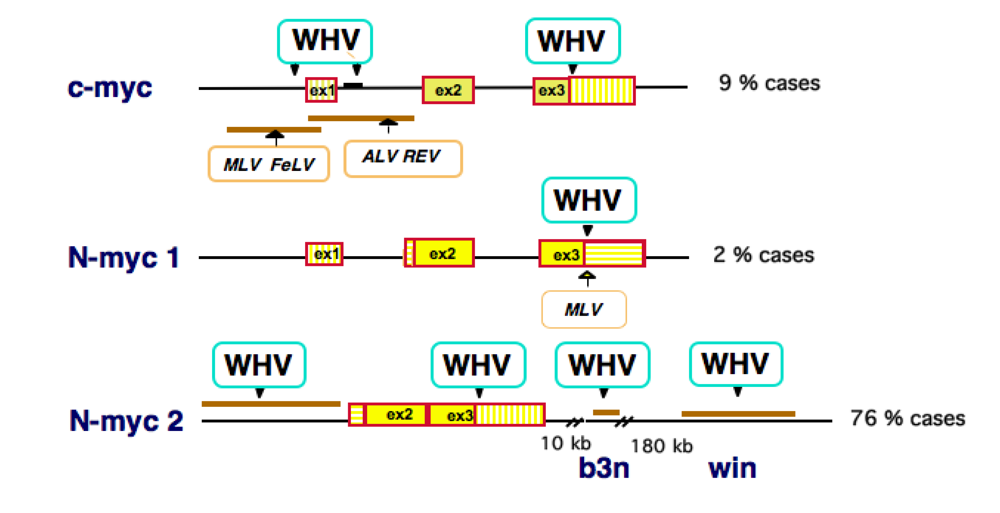
      <p>Search for oncogenes at integration sites in woodchuck HCCs has led us to demonstrate that WHV acts mainly as an insertional mutagen of <italic>myc</italic> family genes. The patterns of WHV DNA insertion in c-<italic>myc </italic>in these tumors share common aspects with those of Moloney murine leukemia virus (MLV) in murine T-cell lymphomas [<xref ref-type="bibr" rid="B23">23</xref>].</p>
        <fig id="figure1" position="float">
        <label>Figure 1</label>
        <caption>
          <p>Insertional activation of <italic>myc</italic> genes in WHV-induced woodchuck HCCs. The c-myc, N-myc1 and N-myc2 loci are represented as a line with exons as boxes and WHV insertion sites are shown with arrows. Under each locus are shown the preferred integration sites of retroviruses including murine leukemia virus (MLV), feline leukemia virus (FeLV), avian leukemia virus (ALV) and avian reticuloendotheliosis virus (REV). The b3n and win loci are located at 10 and 180 kb downstream of N-myc2 on the woodchuck X chromosome. Percentages of WHV integration at each locus in a panel of 70 woodchuck tumors analyzed are shown on the right side.</p>
        </caption>
        <graphic xmlns:xlink="http://www.w3.org/1999/xlink" xlink:href="viruses-01-00630-g001.tif" scale="0"/>
      </fig>
      <p>The highest frequency of viral integrations was found in the woodchuck N-<italic>myc</italic> genes, particularly in the intronless retroposon N-<italic>myc</italic>2 and in two nearby loci on the X chromosome called <italic>b3n</italic> and <italic>win</italic> [<xref ref-type="bibr" rid="B24">24-28</xref>] (<xref ref-type="fig" rid="figure1">Figure 1</xref>). Interestingly, integrations targeting the N-<italic>myc</italic>2 gene have been found preferentially in large, advanced stage tumors, highlighting the strong oncogenic activity of N-<italic>myc</italic>2 [<xref ref-type="bibr" rid="B29">29</xref>]. Besides abnormal, elevated expression levels of the c-<italic>myc</italic> or N-<italic>myc</italic> oncogenes, evidence for a direct role of Myc activation in woodchuck tumorigenesis came from the finding that virtually all transgenic mice carrying WHV insertion sites in c-<italic>myc</italic> and N-<italic>myc</italic>2 developed HCC [<xref ref-type="bibr" rid="B30">30</xref>,<xref ref-type="bibr" rid="B31">31</xref>]. Myc is required for maintenance and expansion of cancer cells, where it hijacks different programs that drive normal cell proliferation. In murine models, Myc proved to be a key contributor to liver carcinogenesis, and recent studies have identified c-Myc as a central regulator at the early steps of malignant transformation in the human liver [<xref ref-type="bibr" rid="B32">32</xref>]. Thus, integration of WHV DNA confers a selective growth advantage on target hepatocytes, leading to the emergence of neoplastic nodules or providing an additional step in tumor progression.</p>
          <p>The frequency of tumor incidence in humans and rodents is generally correlated with the fractional life span in a similar manner. The average life span of captive healthy woodchucks is about 10 years. Hepatocarcinogenesis appears therefore much more rapid and frequent in WHV-infected woodchucks than in human HBV carriers, suggesting that WHV might be a more oncogenic virus than HBV. As no insertional event into <italic>myc</italic> genes has been detected so far in human HCCs, the major difference in tumorigenicity between the two viruses might be attributed to the unique ability of WHV to provoke insertional activation of <italic>myc</italic> genes [<xref ref-type="bibr" rid="B33">33</xref>]. </p>
    </sec>
    <sec>
      <title>3. HBV DNA Integration into Human Chromosomes</title>
      <p>In humans, HBV DNA integration into host chromosomes occurs since early stages in natural acute infections [<xref ref-type="bibr" rid="B34">34</xref>,<xref ref-type="bibr" rid="B35">35</xref>]. Multiple integrations have been detected in chronic hepatitis tissues [<xref ref-type="bibr" rid="B36">36</xref>,<xref ref-type="bibr" rid="B37">37</xref>], and integrated HBV sequences have been seen in most (about 80%) HBV-related HCCs [<xref ref-type="bibr" rid="B7">7</xref>,<xref ref-type="bibr" rid="B10">10</xref>]. In the absence of complete genomes in virtually all HBV inserts, these sequences cannot serve as template for viral replication. Integrated forms made of a single subgenomic fragment are believed to represent primary products of integration, and are frequent in HCC and hepatitis tissues from children [<xref ref-type="bibr" rid="B35">35</xref>]. Single HBV insertions are common in childhood HCCs but are rather uncommon later in life, suggesting that multiple integrations accumulate within single cells during long-standing HBV infections [<xref ref-type="bibr" rid="B38">38</xref>]. Studies of the organization of cloned HBV inserts in liver tissues and HCCs have shown that HBV sequences are often fragmented and rearranged. Moreover, the finding of integration and recombination sites dispersed over the viral genome suggests that HBV integration does not occur through a unique mechanism, as for integrase-mediated integration of retroviruses. However, highly preferred integration sites have been mapped in the HBV genome within the “cohesive ends” region, which lies between two 11-bp direct repeats (DR1 and DR2) highly conserved among hepadnaviruses [<xref ref-type="bibr" rid="B39">39</xref>]. More specifically, a narrow region encompassing DR1 has been shown to be particularly prone to recombination [<xref ref-type="bibr" rid="B40">40</xref>]. It encompasses a short terminal redundancy of the minus-strand DNA, which confers a triple-stranded structure to the circular viral genome. Accordingly, it has been proposed that relaxed circular DNA might be a preferential pre-integration substrate [<xref ref-type="bibr" rid="B41">41</xref>], and that Topo I might promote illegitimate recombination of hepadnavirus DNA <italic>in vivo</italic> [<xref ref-type="bibr" rid="B42">42</xref>].</p>
      <p>In human HCCs, HBV DNA integration sites have been mapped to multiple regions on virtually all chromosomes, suggesting that viral integrations are distributed randomly throughout the host genome [<xref ref-type="bibr" rid="B35">35</xref>,<xref ref-type="bibr" rid="B43">43</xref>]. These events have multiple consequences either by inducing large-scale chromosome changes or by cis-acting effects on the expression or function of nearby cellular genes. Initial studies have suggested that HBV insertional mutagenesis is a rare event, and that simple repetitive elements such as Alu-type repeats, minisatellite-like, satellite III, or variable number of tandem repeat (VNTR) sequences are hotspots for HBV insertion in the human genome. However, evidence for a direct <italic>cis</italic>-acting promoter insertion mechanism was first provided in two independent HCCs. In one case, the HBV insertion targeted the retinoic acid receptor-ß (RARß) gene and resulted in the fusion of 29 amino-terminal residues of the HBV pre-S1 gene to the DNA-binding and hormone-binding domains of RARß [<xref ref-type="bibr" rid="B44">44</xref>,<xref ref-type="bibr" rid="B45">45</xref>]. Expression of the tumor-specific chimeric protein has been shown to display transforming potential [<xref ref-type="bibr" rid="B46">46</xref>]. In a second HCC, HBV DNA integration occurred in an intron of the human cyclin A gene, an essential gene for cell cycle progression, resulting in a strong expression of hybrid HBV/cyclin transcripts encoding a stabilized cyclin A [<xref ref-type="bibr" rid="B47">47</xref>,<xref ref-type="bibr" rid="B48">48</xref>]. Such modification of cyclin A expression has been linked to liver carcinogenesis [<xref ref-type="bibr" rid="B49">49</xref>]. In these two HCC cases, analysis of single HBV insertion sites has allowed identifying new genes that play critical roles in the control of cell growth and differentiation. Both studies have opened the way to novel approaches of the cellular pathways regulating cell division and differentiation.</p>
      <p>More recently, the notion that HBV integrates randomly into human chromosomes has been challenged by large-scale analysis of HBV DNA integration sites using the Alu-PCR approach. These studies have revealed that targeting of cellular genes by HBV integration is a more frequent event than suspected previously [<xref ref-type="bibr" rid="B8">8</xref>,<xref ref-type="bibr" rid="B50">50</xref>]. As previously shown for retroviruses [<xref ref-type="bibr" rid="B51">51</xref>,<xref ref-type="bibr" rid="B52">52</xref>], HBV DNA integration appears to occur frequently in actively transcribed chromosomal regions, within genes or at their immediate vicinity. Recently, sequence analysis of 68 viral-host junctions from 60 HCCs provided evidence for cellular coding regions within several kbs in 90% of the cases [<xref ref-type="bibr" rid="B8">8</xref>]. Moreover, it was shown that HBV integration often targets gene families involved in cell survival, proliferation and immortalization, such as hTERT, PDGF receptor, MLL, calcium signaling-related genes and 60s ribosomal protein genes. Indeed, recurrent viral insertions nearby the hTERT or MLL gene have been reported by different groups [<xref ref-type="bibr" rid="B8">8</xref>,<xref ref-type="bibr" rid="B53">53-55</xref>]. Although the functional impact of integrated HBV sequences on nearby cellular genes has not been tested in all cases, these data support the view that viral insertion might be implicated in one of the multiple steps of liver cell transformation, and that different genes targeted by viral integration play important role in the tumoral process. Finally, although integrated viral sequences are defective for replication, they might also contribute “in trans” to tumorigenesis through the production of truncated and mutated HBx or preS2/S proteins. These proteins may act on HCC development by disrupting the control of cellular gene expression or by activating oncogenic signaling pathways.</p>
      <p>Besides acting by cis–or trans-activation, HBV insertions have been associated with major genetic alterations within the cell genome, including large deletions, duplications and chromosomal translocations [<xref ref-type="bibr" rid="B56">56-60</xref>]. The association of HBV integration with large genomic changes might reflect the abrogation of control mechanisms that safeguard chromosomal integrity [<xref ref-type="bibr" rid="B61">61</xref>]. In this regard, it is interesting to note that HBV-related HCCs have been found to display higher rates of chromosomal alterations than HCCs related to other risk factors [<xref ref-type="bibr" rid="B62">62-64</xref>]. Moreover, molecular classification of HCC using genome-wide approaches has clearly indicated that HBV-related tumors harbor distinctive characteristics such as frequent mutations of the p53 tumor suppressor gene, activation of the mitotic cell cycle, deregulated expression of developmental and imprinted genes such as IGF2, and activation of the AKT pathway [<xref ref-type="bibr" rid="B64">64</xref>]. In addition, large-scale methodogies have led to conclude that HBV-related tumors are often poorly differentiated and present with unfavorable prognosis [<xref ref-type="bibr" rid="B65">65</xref>,<xref ref-type="bibr" rid="B66">66</xref>]. At preneoplastic stages, distinctive gene expression profiles have been detected in the non-tumoral livers of chronic hepatitis B carriers, such as activated expression of genes implicated in pro-apoptotic, inflammatory and DNA repair responses, suggesting specific oncogenic pathways triggered by chronic hepatitis B [<xref ref-type="bibr" rid="B67">67</xref>,<xref ref-type="bibr" rid="B68">68</xref>]. It seems therefore probable that HBV replication and integration might trigger various genomic changes in the infected hepatocytes, playing a role beyond the chronic necro-inflammatory disease induced by the host immune responses.</p>
    </sec>
    <sec>
      <title>4. Oncogenic Capabilities of the HBx Regulatory Protein</title>
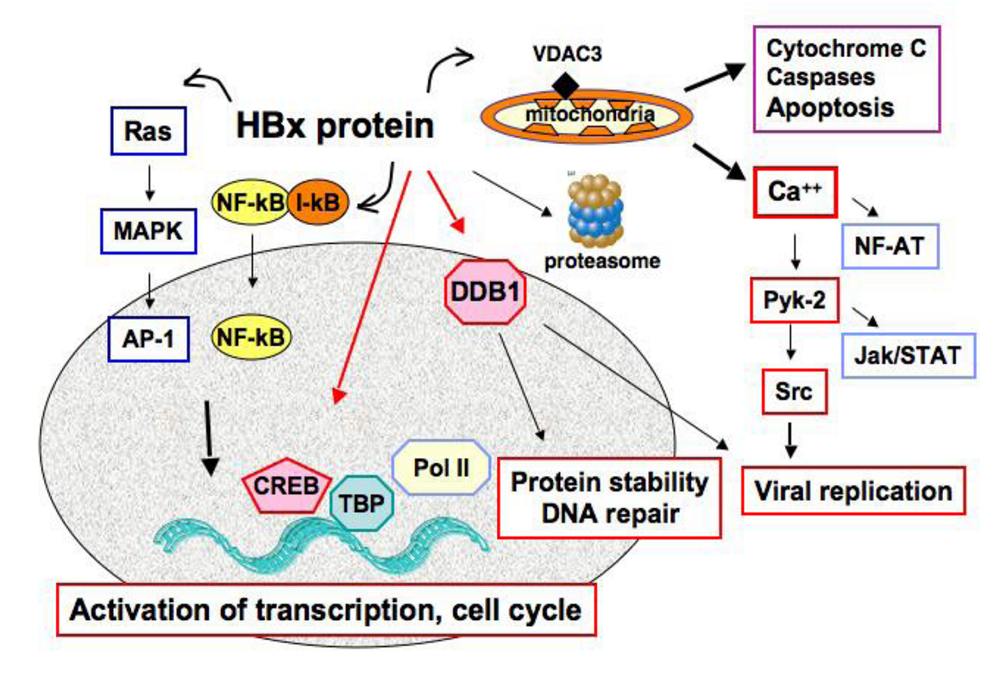
      <p>Among the viral gene products, the HBx protein encoded by the HBV X gene has been termed “viral oncoprotein” by many authors, and it has been involved in liver cell transformation because of its pleiotropic activities on cell cycle regulation, signaling pathways and DNA repair (reviewed in [<xref ref-type="bibr" rid="B69">69-71</xref>]) (<xref ref-type="fig" rid="figure2">Figure 2</xref>). However, different studies in cellular and animal models have provided divergent data on the transforming abilities of this viral protein. HBx has been reported to transform two cell lines immortalized by the simian virus 40 large T antigen (SV40TAg): Rev-2 and a mouse fetal hepatocyte cell line [<xref ref-type="bibr" rid="B72">72</xref>,<xref ref-type="bibr" rid="B73">73</xref>]. HBx has also been shown to cooperate with Ras in the transformation of primary human fibroblasts, either by activating the phosphatidylinositol-3 kinase and Akt pathway or by overcoming Ras-induced senescence [<xref ref-type="bibr" rid="B74">74</xref>,<xref ref-type="bibr" rid="B75">75</xref>]. A weak tumorigenicity has been attributed to HBx in TGF-α immortalized murine hepatocytes, but no cooperation could be evidenced with mutated p53 [<xref ref-type="bibr" rid="B76">76</xref>]. In contrast, other studies have shown that the apoptotic properties of HBx suppress transformation of primary rodent fibroblasts by different oncogenes [<xref ref-type="bibr" rid="B77">77</xref>]. One caveat with the observations described above is that most of them were made in cell culture under conditions of high levels of X gene expression. Indeed, in the chronically infected liver, HBx expression is kept at very low levels, rendering its detection uneasy with most available antibodies [<xref ref-type="bibr" rid="B78">78</xref>].</p>
     
      <p>The oncogenic potential of HBx has also been addressed in transgenic mice, with again divergent results that probably reflect the use of different murine genetic backgrounds and various promoters yielding different expression levels of the viral protein. Development of HCC associated with high-level expression of HBx in the liver was essentially described for a transgenic mouse line generated in the outbred CD-1 background [<xref ref-type="bibr" rid="B79">79</xref>]. In other transgenic lines on different backgrounds, expression of HBx by itself did not lead to HCC development, although slight histopathologic alterations could be observed in the liver [<xref ref-type="bibr" rid="B80">80</xref>].</p>
      <p>Transgenic expression of the viral protein cooperates with chemical carcinogens such as diethyl nitrosamine (DEN) in accelerating hepatocarcinogenesis [<xref ref-type="bibr" rid="B81">81</xref>]. By crossing HBx mice with WHV/c-myc oncomice, liver damage was increased and the average tumor latency was shortened by three months compared to WHV/c-myc littermates [<xref ref-type="bibr" rid="B82">82</xref>]. This could be explained by the reported ability of HBx to protect the c-Myc protein from degradation [<xref ref-type="bibr" rid="B83">83</xref>]. Moreover, HBx knock-in transgenic lines generated by homologous recombination into the mouse p21 locus develop HCC [<xref ref-type="bibr" rid="B84">84</xref>]. The CDK inhibitor p21<sup>WAF1/Cip1</sup> is a master effector of tumor suppressor pathways that promote cell cycle arrest in response to various stimuli, and its genetic ablation might cooperate with HBx in cell transformation. Recently, it has been shown that constitutive liver expression of HBx and insulin receptor substrate-1 (IRS-1) contribute cooperatively to the development of dysplasia and eventually HCC [<xref ref-type="bibr" rid="B85">85</xref>]. The multisite docking protein IRS-1 alone had no direct oncogenic effects, but it stimulated hepatocyte proliferation through its central role in the transduction of growth factor signals, resulting in the activation of downstream mitogen-activated protein kinase (MAPK) cascade and the Wnt/β-catenin pathway in double transgenic mice. Together, these data suggest that HBx alone does not behave as a dominant oncogene but rather acts as a co-factor during hepatocarcinogenesis.</p>
       <fig id="figure2" position="float">
        <label>Figure 2</label>
        <caption>
          <p>Pleiotropic activities of the regulatory protein HBx. Here we depict a large array of HBx functions that may be relevant for cellular transformation, such as stimulation of virus replication, cell cycle deregulation, activation of signaling pathways, induction/repression of apoptosis and interference with DNA repair. Most of these functions are achieved through the transcriptional transactivation activity of HBx or by interactions with cellular partners in both cell cytoplasm and nucleus (shown as a grey ellipse).</p>
        </caption>
        <graphic xmlns:xlink="http://www.w3.org/1999/xlink" xlink:href="viruses-01-00630-g002.tif" scale="0"/>
      </fig>
      <p>The mechanisms implicating HBx in the tumoral process have been investigated in HBx transgenic models. It has been shown that hepatic expression of HBx is associated with a significant increase in S-phase hepatocytes in young animals but not in adult mice [<xref ref-type="bibr" rid="B86">86</xref>], while our group observed increased levels of apoptosis that was independent of p53 in the transgenic livers [<xref ref-type="bibr" rid="B87">87</xref>]. These observations are consistent with a model in which HBx stimulates cell cycle progression of quiescent G0 cells to the G1/S phase, followed by prolongation of the G1-S transition or cell arrest at the G1/S boundary and eventually apoptosis [<xref ref-type="bibr" rid="B88">88-91</xref>]. A similar process might operate during liver regeneration after partial hepatectomy, leading to premature cell cycle entry or to impaired regeneration in different HBx transgenic lines [<xref ref-type="bibr" rid="B92">92-94</xref>]. Association with severe fat accumulation and impaired glycogen storage has been observed in the particular HBx transgenic line that eventually develop HCC [<xref ref-type="bibr" rid="B92">92</xref>], but not on other backgrounds. The pathological consequences of cell cycle deregulation by HBx have been extensively studied using established hepatocyte and hepatoma cell lines.</p>
    </sec>
    <sec>
      <title>5. HBx, Replication Stress and Mitotic Defects</title>
      <p>Recent studies have led to a consensus agreement on the fact that HBx interferes with the normal control of cell cycle progression. This function may be attributed to the ability of HBx to bind different cellular partners and to activate transcription as well as various signaling cascades [<xref ref-type="bibr" rid="B95">95-99</xref>]. The impact of HBx on the mitotic phase of the cell cycle seemingly implicates HBx in the induction of chromosomal instability (CIN), a hallmark of many tumors that correlates with the presence of extra centrosomes. It has been shown that CIN cells with extra centrosomes routinely undergo bipolar cell divisions, but display a significantly increased frequency of lagging chromosomes during anaphase [<xref ref-type="bibr" rid="B100">100</xref>]. Delayed movement (lagging) during anaphase results in chromosome missegregation, as some chromosomes or chromatids fail to be incorporated into one of the daughter nuclei following cell division. Accordingly, the observed prolongation of S phase in cells expressing the viral protein has been linked to aberrant centrosome duplication, multipolar spindle formation, chromosome segregation defects, and appearance of multinucleated cells.</p>
      <p>Interestingly, in some studies these deleterious effects of HBx have been observed in the context of viral replication, and they were detectable in dividing, but not in quiescent hepatoma cells [<xref ref-type="bibr" rid="B101">101</xref>]. Different mechanisms have been implicated, in particular the interaction of HBx with UV-damaged DNA binding protein 1 (DDB1), a protein involved in DNA repair and cell cycle regulation [<xref ref-type="bibr" rid="B101">101</xref>]. The ability of HBx to bind DDB1, and the pivotal role of this interaction in viral infectivity and replication have been firmly established [<xref ref-type="bibr" rid="B102">102-104</xref>]. DDB1 is a subunit of the E3 ubiquitin ligase Cul4 complex that serves as an adaptor for selective ubiquitin-dependent degradation of target proteins [<xref ref-type="bibr" rid="B105">105</xref>,<xref ref-type="bibr" rid="B106">106</xref>]. It is known that anaphase onset and mitosis completion are highly complex and coordinated processes governed by dephosphorylation of Cdk substrates and ubiquitination of APC substrates. Deregulation of the mechanisms that control protein stability by the viral protein might therefore contribute to aberrant cellular growth and tumorigenesis.</p>
      <p>Other studies have shown that HBx effects on centrosome dynamics and mitotic spindle formation are associated to the binding of HBx with different cellular partners implicated in centrosome formation. It has been reported that HBx interacts with HBXIP, a major regulator of centrosome duplication, required for bipolar spindle formation and cytokinesis. This interaction appears to be responsible for the formation of defective spindles and subsequent aberrant chromosome segregation [<xref ref-type="bibr" rid="B107">107</xref>]. In other report, HBx induces cytoplasmic sequestration of Crm1, a nuclear export receptor that binds to Ran GTPase and also localizes at the centrosomes. This interaction seemingly results in supernumerary centrosomes, increased frequency of defective mitoses and chromosome transmission errors  [<xref ref-type="bibr" rid="B108">108</xref>]. Interestingly, recent data have linked DNA re-replication induced by HBx to partial polyploidy, known to be associated with cancer pathogenesis [<xref ref-type="bibr" rid="B109">109</xref>]. The mechanisms involve simultaneous increase of the replication initiation factors Cdc6 and Cdt1, and downregulation of geminin, the inhibitor of replication licensing. Modulation of Cdt1/geminin ratio leads to uncontrolled DNA re-replication, DNA damage, and partial polyploidy. The resulting polyploid cells are prone to oncogenic transformation that is dependent upon the expression of polo-like kinase 1 (Plk1), a crucial factor that positively influences mitotic entry [<xref ref-type="bibr" rid="B110">110</xref>]. HBx has also been shown to target BubR1, an effector of multiple mitotic kinases that specifies microtubule attachments and checkpoint functions [<xref ref-type="bibr" rid="B111">111</xref>]. It is worth noticing that mitotic phosphorylation of BubR1 by Plk1 is known to stimulate BubR1 kinase activity, promoting kinetochore microtubule attachments and recruitment of the Mad2 checkpoint protein to kinetochores. Moreover, it has been shown that SV40 large T antigen (LT) targets Bub1 and this has been correlated with alteration of the spindle checkpoint and oncogenic transformation. </p>
      <p>Although the precise HBx activities that interfere with the mitotic cell cycle remain to be determined, these data provide insight into possible mechanisms leading to deregulation of the cellular mitotic machinery by a viral protein. They also provide a strong link between HBx expression and chromosomal instability in HBV-related carcinogenesis.</p>
    </sec>
    <sec sec-type="conclusions">
      <title>6. Conclusions </title>
      <p>Cancer arises from stepwise accumulation of genetic changes that confer unlimited, self-sufficient growth and resistance to normal homeostatic mechanisms. The long latency of HCC development after the primary HBV infection may be interpreted as a sign of an indirect action of the virus. It is generally admitted that host immune responses against infected hepatocytes triggers continuous necrosis and cell regeneration, leading to chronic inflammatory disease that in turn favors the accumulation of genetic alterations. In this view, long-term toxic effect of viral gene products, notably the HBx protein, as well as exogenous carcinogens such as aflatoxins and alcohol, potentiate the action of chronic liver inflammation. However, tumor onset might also depend on the occurrence of a decisive HBV integration event that would promote genetic instability or lead to <italic>cis</italic>- or <italic>trans</italic>-activation of cancer-related genes. The large variety of pathological properties attributed to the viral protein HBx indicates that multiple cooperative mechanisms may operate in the development of liver cancer. Future studies identifying more precisely the cellular effectors that mediate the tumorigenic effects of HBV are poised to advance the field of liver cancer biology and to develop adapted therapeutic strategies.</p>
    </sec>
  </body>
  <back>
       <ref-list>
       <title>References and Notes</title>
      <ref id="B1">
        <citation citation-type="journal">
          <person-group person-group-type="author">
            <name>
              <surname>Butel</surname>
              <given-names>J.S.</given-names>
            </name>
          </person-group>
          <article-title>Viral carcinogenesis: revelation of molecular mechanisms and etiology of human disease</article-title>
          <source>Carcinogenesis</source>
          <year>2000</year>
          <volume>21</volume>
          <fpage>405</fpage>
          <lpage>426</lpage>
          <pub-id pub-id-type="doi">10.1093/carcin/21.3.405</pub-id>
          <pub-id pub-id-type="pmid">10688861</pub-id>
        </citation>
      </ref>
      <ref id="B2">
        <citation citation-type="journal">
          <person-group person-group-type="author">
            <name>
              <surname>Pagano</surname>
              <given-names>J.S.</given-names>
            </name>
            <name>
              <surname>Blaser</surname>
              <given-names>M.</given-names>
            </name>
            <name>
              <surname>Buendia</surname>
              <given-names>M.A.</given-names>
            </name>
            <name>
              <surname>Damania</surname>
              <given-names>B.</given-names>
            </name>
            <name>
              <surname>Khalili</surname>
              <given-names>K.</given-names>
            </name>
            <name>
              <surname>Raab-Traub</surname>
              <given-names>N.</given-names>
            </name>
            <name>
              <surname>Roizman</surname>
              <given-names>B.</given-names>
            </name>
          </person-group>
          <article-title>Infectious agents and cancer: criteria for a causal relation</article-title>
          <source>Semin. Cancer Biol.</source>
          <year>2004</year>
          <volume>14</volume>
          <fpage>453</fpage>
          <lpage>471</lpage>
          <pub-id pub-id-type="doi">10.1016/j.semcancer.2004.06.009</pub-id>
          <pub-id pub-id-type="pmid">15489139</pub-id>
        </citation>
      </ref>
      <ref id="B3">
        <citation citation-type="journal">
          <person-group person-group-type="author">
            <name>
              <surname>Szmuness</surname>
              <given-names>W.</given-names>
            </name>
          </person-group>
          <article-title>Hepatocellular carcinoma and the hepatitis B virus : Evidence for a causal association</article-title>
          <source>Prog. Med. Virol.</source>
          <year>1978</year>
          <volume>24</volume>
          <fpage>40</fpage>
          <lpage>69</lpage>
          <pub-id pub-id-type="pmid">212785</pub-id>
        </citation>
      </ref>
      <ref id="B4">
        <citation citation-type="journal">
          <person-group person-group-type="author">
            <name>
              <surname>Parkin</surname>
              <given-names>D.M.</given-names>
            </name>
          </person-group>
          <article-title>The global health burden of infection-associated cancers in the year 2002</article-title>
          <source>Int J Cancer</source>
          <year>2006</year>
          <volume>118</volume>
          <fpage>3030</fpage>
          <lpage>3044</lpage>
          <pub-id pub-id-type="doi">10.1002/ijc.21731</pub-id>
          <pub-id pub-id-type="pmid">16404738</pub-id>
        </citation>
      </ref>
      <ref id="B5">
        <citation citation-type="journal">
          <person-group person-group-type="author">
            <name>
              <surname>Paterlini</surname>
              <given-names>P.</given-names>
            </name>
            <name>
              <surname>Driss</surname>
              <given-names>F.</given-names>
            </name>
            <name>
              <surname>Pisi</surname>
              <given-names>E.</given-names>
            </name>
            <name>
              <surname>Franco</surname>
              <given-names>D.</given-names>
            </name>
            <name>
              <surname>Berthelot</surname>
              <given-names>P.</given-names>
            </name>
            <name>
              <surname>Bréchot</surname>
              <given-names>C.</given-names>
            </name>
          </person-group>
          <article-title>Persistence of hepatitis B and hepatitis C viral genomes in primary liver cancers from HBsAg negative patients: a study of a low endemic area</article-title>
          <source>Hepatology</source>
          <year>1993</year>
          <volume>17</volume>
          <fpage>20</fpage>
          <lpage>29</lpage>
          <pub-id pub-id-type="doi">10.1002/hep.1840170106</pub-id>
          <pub-id pub-id-type="pmid">8380790</pub-id>
        </citation>
      </ref>
      <ref id="B6">
        <citation citation-type="journal">
          <person-group person-group-type="author">
            <name>
              <surname>Pollicino</surname>
              <given-names>T.</given-names>
            </name>
            <name>
              <surname>Squadrito</surname>
              <given-names>G.</given-names>
            </name>
            <name>
              <surname>Cerenzia</surname>
              <given-names>G.</given-names>
            </name>
            <name>
              <surname>Cacciola</surname>
              <given-names>I.</given-names>
            </name>
            <name>
              <surname>Raffa</surname>
              <given-names>G.</given-names>
            </name>
            <name>
              <surname>Craxi</surname>
              <given-names>A.</given-names>
            </name>
            <name>
              <surname>Farinati</surname>
              <given-names>F.</given-names>
            </name>
            <name>
              <surname>Missale</surname>
              <given-names>G.</given-names>
            </name>
            <name>
              <surname>Smedile</surname>
              <given-names>A.</given-names>
            </name>
            <name>
              <surname>Tiribelli</surname>
              <given-names>C.</given-names>
            </name>
            <name>
              <surname>Villa</surname>
              <given-names>E.</given-names>
            </name>
            <name>
              <surname>Raimondo</surname>
              <given-names>G.</given-names>
            </name>
          </person-group>
          <article-title>Hepatitis B virus maintains its pro-oncogenic properties in the case of occult HBV infection</article-title>
          <source>Gastroenterology</source>
          <year>2004</year>
          <volume>126</volume>
          <fpage>102</fpage>
          <lpage>110</lpage>
          <pub-id pub-id-type="doi">10.1053/j.gastro.2003.10.048</pub-id>
          <pub-id pub-id-type="pmid">14699492</pub-id>
        </citation>
      </ref>
      <ref id="B7">
        <citation citation-type="journal">
          <person-group person-group-type="author">
            <name>
              <surname>Bréchot</surname>
              <given-names>C.</given-names>
            </name>
            <name>
              <surname>Pourcel</surname>
              <given-names>C.</given-names>
            </name>
            <name>
              <surname>Louise</surname>
              <given-names>A.</given-names>
            </name>
            <name>
              <surname>Rain</surname>
              <given-names>B.</given-names>
            </name>
            <name>
              <surname>Tiollais</surname>
              <given-names>P.</given-names>
            </name>
          </person-group>
          <article-title>Presence of integrated hepatitis B virus DNA sequences in cellular DNA of human hepatocellular carcinoma</article-title>
          <source>Nature</source>
          <year>1980</year>
          <volume>286</volume>
          <fpage>533</fpage>
          <lpage>535</lpage>
          <pub-id pub-id-type="doi">10.1038/286533a0</pub-id>
          <pub-id pub-id-type="pmid">6250074</pub-id>
        </citation>
      </ref>
      <ref id="B8">
        <citation citation-type="journal">
          <person-group person-group-type="author">
            <name>
              <surname>Murakami</surname>
              <given-names>Y.</given-names>
            </name>
            <name>
              <surname>Saigo</surname>
              <given-names>K.</given-names>
            </name>
            <name>
              <surname>Takashima</surname>
              <given-names>H.</given-names>
            </name>
            <name>
              <surname>Minami</surname>
              <given-names>M.</given-names>
            </name>
            <name>
              <surname>Okanoue</surname>
              <given-names>T.</given-names>
            </name>
            <name>
              <surname>Brechot</surname>
              <given-names>C.</given-names>
            </name>
            <name>
              <surname>Paterlini-Brechot</surname>
              <given-names>P.</given-names>
            </name>
          </person-group>
          <article-title>Large scaled analysis of hepatitis B virus (HBV) DNA integration in HBV related hepatocellular carcinomas</article-title>
          <source>Gut</source>
          <year>2005</year>
          <volume>54</volume>
          <fpage>1162</fpage>
          <lpage>1168</lpage>
          <pub-id pub-id-type="doi">10.1136/gut.2004.054452</pub-id>
          <pub-id pub-id-type="pmid">16009689</pub-id>
        </citation>
      </ref>
      <ref id="B9">
        <citation citation-type="journal">
          <person-group person-group-type="author">
            <name>
              <surname>Nakamoto</surname>
              <given-names>Y.</given-names>
            </name>
            <name>
              <surname>Guidotti</surname>
              <given-names>L.G.</given-names>
            </name>
            <name>
              <surname>Kuhlen</surname>
              <given-names>C.V.</given-names>
            </name>
            <name>
              <surname>Fowler</surname>
              <given-names>P.</given-names>
            </name>
            <name>
              <surname>Chisari</surname>
              <given-names>F.V.</given-names>
            </name>
          </person-group>
          <article-title>Immune pathogenesis of hepatocellular carcinoma</article-title>
          <source>J. Exp. Med.</source>
          <year>1998</year>
          <volume>188</volume>
          <fpage>341</fpage>
          <lpage>350</lpage>
          <pub-id pub-id-type="doi">10.1084/jem.188.2.341</pub-id>
          <pub-id pub-id-type="pmid">9670046</pub-id>
        </citation>
      </ref>
      <ref id="B10">
        <citation citation-type="journal">
          <person-group person-group-type="author">
            <name>
              <surname>Brechot</surname>
              <given-names>C.</given-names>
            </name>
            <name>
              <surname>Gozuacik</surname>
              <given-names>D.</given-names>
            </name>
            <name>
              <surname>Murakami</surname>
              <given-names>Y.</given-names>
            </name>
            <name>
              <surname>Paterlini-Brechot</surname>
              <given-names>P.</given-names>
            </name>
          </person-group>
          <article-title>Molecular bases for the development of hepatitis B virus (HBV)-related hepatocellular carcinoma (HCC)</article-title>
          <source>Semin. Cancer Biol.</source>
          <year>2000</year>
          <volume>10</volume>
          <fpage>211</fpage>
          <lpage>231</lpage>
          <pub-id pub-id-type="doi">10.1006/scbi.2000.0321</pub-id>
          <pub-id pub-id-type="pmid">10936070</pub-id>
        </citation>
      </ref>
      <ref id="B11">
        <citation citation-type="journal">
          <person-group person-group-type="author">
            <name>
              <surname>Kremsdorf</surname>
              <given-names>D.</given-names>
            </name>
            <name>
              <surname>Soussan</surname>
              <given-names>P.</given-names>
            </name>
            <name>
              <surname>Paterlini-Brechot</surname>
              <given-names>P.</given-names>
            </name>
            <name>
              <surname>Brechot</surname>
              <given-names>C.</given-names>
            </name>
          </person-group>
          <article-title>Hepatitis B virus-related hepatocellular carcinoma: paradigms for viral-related human carcinogenesis</article-title>
          <source>Oncogene.</source>
          <year>2006</year>
          <volume>25</volume>
          <fpage>3823</fpage>
          <lpage>3833</lpage>
          <pub-id pub-id-type="doi">10.1038/sj.onc.1209559</pub-id>
          <pub-id pub-id-type="pmid">16799624</pub-id>
        </citation>
      </ref>
      <ref id="B12">
        <citation citation-type="book">
          <person-group person-group-type="author">
            <name>
              <surname>Cougot</surname>
              <given-names>D.</given-names>
            </name>
            <name>
              <surname>Buendia</surname>
              <given-names>M.A.</given-names>
            </name>
            <name>
              <surname>Neuveut</surname>
              <given-names>C.</given-names>
            </name>
          </person-group>
          <article-title>Carcinogenesis induced by Hepatitis B Virus&#13;
&#13;
&#13;
&#13;
&#13;
&#13;
&#13;
&#13;
&#13;
&#13;
&#13;
</article-title>
          <person-group person-group-type="editor">
            <name>
              <surname>Chan</surname>
              <given-names>S.H.H.</given-names>
            </name>
          </person-group>
          <publisher-name>Karger</publisher-name>
          <publisher-loc>Basel</publisher-loc>
          <year>2008</year>
          <fpage>108</fpage>
          <lpage>136</lpage>
          <supplement/>
        </citation>
      </ref>
      <ref id="B13">
        <citation citation-type="journal">
          <person-group person-group-type="author">
            <name>
              <surname>Summers</surname>
              <given-names>J.</given-names>
            </name>
          </person-group>
          <article-title>Three recently described animal virus models for human hepatitis B virus</article-title>
          <source>Hepatology</source>
          <year>1981</year>
          <volume>1</volume>
          <fpage>179</fpage>
          <lpage>183</lpage>
          <pub-id pub-id-type="doi">10.1002/hep.1840010215</pub-id>
          <pub-id pub-id-type="pmid">7286898</pub-id>
        </citation>
      </ref>
      <ref id="B14">
        <citation citation-type="journal">
          <person-group person-group-type="author">
            <name>
              <surname>Buendia</surname>
              <given-names>M.A.</given-names>
            </name>
          </person-group>
          <article-title>Hepatitis B viruses and hepatocellular carcinoma</article-title>
          <source>Adv. Cancer Res.</source>
          <year>1992</year>
          <volume>59</volume>
          <fpage>167</fpage>
          <lpage>226</lpage>
          <pub-id pub-id-type="pmid">1325733</pub-id>
        </citation>
      </ref>
      <ref id="B15">
        <citation citation-type="journal">
          <person-group person-group-type="author">
            <name>
              <surname>Kulkarni</surname>
              <given-names>K.</given-names>
            </name>
            <name>
              <surname>Jacobson</surname>
              <given-names>I.M.</given-names>
            </name>
            <name>
              <surname>Tennant</surname>
              <given-names>B.C.</given-names>
            </name>
          </person-group>
          <article-title>The role of the woodchuck model in the treatment of hepatitis B virus infection</article-title>
          <source>Clin. Liver Dis.</source>
          <year>2007</year>
          <volume>11</volume>
          <fpage>707</fpage>
          <lpage>725</lpage>
          <pub-id pub-id-type="doi">10.1016/j.cld.2007.08.012</pub-id>
          <pub-id pub-id-type="pmid">17981226</pub-id>
        </citation>
      </ref>
      <ref id="B16">
        <citation citation-type="journal">
          <person-group person-group-type="author">
            <name>
              <surname>Tennant</surname>
              <given-names>B.C.</given-names>
            </name>
            <name>
              <surname>Toshkov</surname>
              <given-names>I.A.</given-names>
            </name>
            <name>
              <surname>Peek</surname>
              <given-names>S.F.</given-names>
            </name>
            <name>
              <surname>Jacob</surname>
              <given-names>J.R.</given-names>
            </name>
            <name>
              <surname>Menne</surname>
              <given-names>S.</given-names>
            </name>
            <name>
              <surname>Hornbuckle</surname>
              <given-names>W.E.</given-names>
            </name>
            <name>
              <surname>Schinazi</surname>
              <given-names>R.D.</given-names>
            </name>
            <name>
              <surname>Korba</surname>
              <given-names>B.E.</given-names>
            </name>
            <name>
              <surname>Cote</surname>
              <given-names>P.J.</given-names>
            </name>
            <name>
              <surname>Gerin</surname>
              <given-names>J.L.</given-names>
            </name>
          </person-group>
          <article-title>Hepatocellular carcinoma in the woodchuck model of hepatitis B virus infection&#13;
&#13;
</article-title>
          <source>Gastroenterology</source>
          <year>2004</year>
          <volume>127</volume>
          <fpage>S283</fpage>
          <lpage>293</lpage>
          <supplement> &#13;
</supplement>
          <pub-id pub-id-type="doi">10.1053/j.gastro.2004.09.043</pub-id>
          <pub-id pub-id-type="pmid">15508096</pub-id>
        </citation>
      </ref>
      <ref id="B17">
        <citation citation-type="journal">
          <person-group person-group-type="author">
            <name>
              <surname>Korba</surname>
              <given-names>B.E.</given-names>
            </name>
            <name>
              <surname>Wells</surname>
              <given-names>F.V.</given-names>
            </name>
            <name>
              <surname>Baldwin</surname>
              <given-names>B.</given-names>
            </name>
            <name>
              <surname>Cote</surname>
              <given-names>P.J.</given-names>
            </name>
            <name>
              <surname>Tennant</surname>
              <given-names>B.C.</given-names>
            </name>
            <name>
              <surname>Popper</surname>
              <given-names>H.</given-names>
            </name>
            <name>
              <surname>Gerin</surname>
              <given-names>J.L.</given-names>
            </name>
          </person-group>
          <article-title>Hepatocellular carcinoma in woodchuck hepatitis virus-infected woodchucks: presence of viral DNA in tumor tissue from chronic carriers and animals serologically recovered from acute infections</article-title>
          <source>Hepatology</source>
          <year>1989</year>
          <volume>9</volume>
          <fpage>461</fpage>
          <lpage>470</lpage>
          <pub-id pub-id-type="doi">10.1002/hep.1840090321</pub-id>
        </citation>
      </ref>
      <ref id="B18">
        <citation citation-type="journal">
          <person-group person-group-type="author">
            <name>
              <surname>Michalak</surname>
              <given-names>T.I.</given-names>
            </name>
            <name>
              <surname>Pardoe</surname>
              <given-names>I.U.</given-names>
            </name>
            <name>
              <surname>Coffin</surname>
              <given-names>C.S.</given-names>
            </name>
            <name>
              <surname>Churchill</surname>
              <given-names>N.D.</given-names>
            </name>
            <name>
              <surname>Freake</surname>
              <given-names>D.S.</given-names>
            </name>
            <name>
              <surname>Smith</surname>
              <given-names>P.</given-names>
            </name>
            <name>
              <surname>Trelegan</surname>
              <given-names>C.L.</given-names>
            </name>
          </person-group>
          <article-title>Occult lifelong persistence of infectious hepadnavirus and residual liver inflammation in woodchucks convalescent from acute viral hepatitis</article-title>
          <source>Hepatology</source>
          <year>1999</year>
          <volume>29</volume>
          <fpage>928</fpage>
          <lpage>938</lpage>
          <pub-id pub-id-type="doi">10.1002/hep.510290329</pub-id>
          <pub-id pub-id-type="pmid">10051500</pub-id>
        </citation>
      </ref>
      <ref id="B19">
        <citation citation-type="journal">
          <person-group person-group-type="author">
            <name>
              <surname>Paterlini</surname>
              <given-names>P.</given-names>
            </name>
            <name>
              <surname>Gerken</surname>
              <given-names>G.</given-names>
            </name>
            <name>
              <surname>Nakajima</surname>
              <given-names>E.</given-names>
            </name>
            <name>
              <surname>Terré</surname>
              <given-names>S.</given-names>
            </name>
            <name>
              <surname>D'Errico</surname>
              <given-names>A.</given-names>
            </name>
            <name>
              <surname>Grigioni</surname>
              <given-names>W.</given-names>
            </name>
            <name>
              <surname>Nalpas</surname>
              <given-names>B.</given-names>
            </name>
            <name>
              <surname>Franco</surname>
              <given-names>D.</given-names>
            </name>
            <name>
              <surname>Wands</surname>
              <given-names>J.</given-names>
            </name>
            <name>
              <surname>Kew</surname>
              <given-names>M.</given-names>
            </name>
            <name>
              <surname>Pisi</surname>
              <given-names>E.</given-names>
            </name>
            <name>
              <surname>Tiollais</surname>
              <given-names>P.</given-names>
            </name>
            <name>
              <surname>Bréchot</surname>
              <given-names>C.</given-names>
            </name>
          </person-group>
          <article-title>Polymerase chain reaction to detect hepatitis B virus DNA and RNA sequences in primary liver cancers from patients negative for hepatitis B surface antigen</article-title>
          <source>New Engl. J. Med.</source>
          <year>1990</year>
          <volume>323</volume>
          <fpage>80</fpage>
          <lpage>85</lpage>
        <pub-id pub-id-type="doi">10.1056/NEJM199007123230202</pub-id><pub-id pub-id-type="pmid">2359427</pub-id></citation>
      </ref>
      <ref id="B20">
        <citation citation-type="journal">
          <person-group person-group-type="author">
            <name>
              <surname>Rogler</surname>
              <given-names>C.E.</given-names>
            </name>
            <name>
              <surname>Summers</surname>
              <given-names>J.</given-names>
            </name>
          </person-group>
          <article-title>Cloning and structural analysis of integrated woochuck hepatitis virus sequences from a chronically infected liver</article-title>
          <source>J. Virol.</source>
          <year>1984</year>
          <volume>50</volume>
          <fpage>832</fpage>
          <lpage>837</lpage>
          <pub-id pub-id-type="pmid">6328013</pub-id>
        </citation>
      </ref>
      <ref id="B21">
        <citation citation-type="journal">
          <person-group person-group-type="author">
            <name>
              <surname>Mason</surname>
              <given-names>W.S.</given-names>
            </name>
            <name>
              <surname>Jilbert</surname>
              <given-names>A.R.</given-names>
            </name>
            <name>
              <surname>Summers</surname>
              <given-names>J.</given-names>
            </name>
          </person-group>
          <article-title>Clonal expansion of hepatocytes during chronic woodchuck hepatitis virus infection</article-title>
          <source>Proc. Natl. Acad. Sci. U S A</source>
          <year>2005</year>
          <volume>102</volume>
          <fpage>1139</fpage>
          <lpage>1144</lpage>
          <pub-id pub-id-type="doi">10.1073/pnas.0409332102</pub-id>
          <pub-id pub-id-type="pmid">15657132</pub-id>
        </citation>
      </ref>
      <ref id="B22">
        <citation citation-type="journal">
          <person-group person-group-type="author">
            <name>
              <surname>Yang</surname>
              <given-names>D.</given-names>
            </name>
            <name>
              <surname>Alt</surname>
              <given-names>E.</given-names>
            </name>
            <name>
              <surname>Rogler</surname>
              <given-names>C.E.</given-names>
            </name>
          </person-group>
          <article-title>Coordinate expression of N-myc 2 and insulin-like growth factor II in precancerous altered hepatic foci in woodchuck hepatitis virus carriers</article-title>
          <source>Cancer Res.</source>
          <year>1993</year>
          <volume>53</volume>
          <fpage>2020</fpage>
          <lpage>2027</lpage>
          <pub-id pub-id-type="pmid">8481904</pub-id>
        </citation>
      </ref>
      <ref id="B23">
        <citation citation-type="journal">
          <person-group person-group-type="author">
            <name>
              <surname>Hsu</surname>
              <given-names>T.</given-names>
            </name>
            <name>
              <surname>Moroy</surname>
              <given-names>T.</given-names>
            </name>
            <name>
              <surname>Etiemble</surname>
              <given-names>J.</given-names>
            </name>
            <name>
              <surname>Louise</surname>
              <given-names>A.</given-names>
            </name>
            <name>
              <surname>Trepo</surname>
              <given-names>C.</given-names>
            </name>
            <name>
              <surname>Tiollais</surname>
              <given-names>P.</given-names>
            </name>
            <name>
              <surname>Buendia</surname>
              <given-names>M.A.</given-names>
            </name>
          </person-group>
          <article-title>Activation of c-myc by woodchuck hepatitis virus insertion in hepatocellular carcinoma</article-title>
          <source>Cell</source>
          <year>1988</year>
          <volume>55</volume>
          <fpage>627</fpage>
          <lpage>635</lpage>
          <pub-id pub-id-type="doi">10.1016/0092-8674(88)90221-8</pub-id>
          <pub-id pub-id-type="pmid">3180223</pub-id>
        </citation>
      </ref>
      <ref id="B24">
        <citation citation-type="journal">
          <person-group person-group-type="author">
            <name>
              <surname>Fourel</surname>
              <given-names>G.</given-names>
            </name>
            <name>
              <surname>Trépo</surname>
              <given-names>C.</given-names>
            </name>
            <name>
              <surname>Bougueleret</surname>
              <given-names>L.</given-names>
            </name>
            <name>
              <surname>Henglein</surname>
              <given-names>B.</given-names>
            </name>
            <name>
              <surname>Ponzetto</surname>
              <given-names>A.</given-names>
            </name>
            <name>
              <surname>Tiollais</surname>
              <given-names>P.</given-names>
            </name>
            <name>
              <surname>Buendia</surname>
              <given-names>M.A.</given-names>
            </name>
          </person-group>
          <article-title>Frequent activation of N-myc genes by hepadnavirus insertion in woodchuck liver tumours</article-title>
          <source>Nature</source>
          <year>1990</year>
          <volume>347</volume>
          <fpage>294</fpage>
          <lpage>298</lpage>
          <pub-id pub-id-type="doi">10.1038/347294a0</pub-id>
          <pub-id pub-id-type="pmid">2205804</pub-id>
        </citation>
      </ref>
      <ref id="B25">
        <citation citation-type="journal">
          <person-group person-group-type="author">
            <name>
              <surname>Wei</surname>
              <given-names>Y.</given-names>
            </name>
            <name>
              <surname>Fourel</surname>
              <given-names>G.</given-names>
            </name>
            <name>
              <surname>Ponzetto</surname>
              <given-names>A.</given-names>
            </name>
            <name>
              <surname>Silvestro</surname>
              <given-names>M.</given-names>
            </name>
            <name>
              <surname>Tiollais</surname>
              <given-names>P.</given-names>
            </name>
            <name>
              <surname>Buendia</surname>
              <given-names>M.A.</given-names>
            </name>
          </person-group>
          <article-title>Hepadnavirus integration: mechanisms of activation of the N-myc2 retrotransposon in woodchuck liver tumors</article-title>
          <source>J. Virol.</source>
          <year>1992</year>
          <volume>66</volume>
          <fpage>5265</fpage>
          <lpage>5276</lpage>
          <pub-id pub-id-type="pmid">1323693</pub-id>
        </citation>
      </ref>
      <ref id="B26">
        <citation citation-type="journal">
          <person-group person-group-type="author">
            <name>
              <surname>Fourel</surname>
              <given-names>G.</given-names>
            </name>
            <name>
              <surname>Couturier</surname>
              <given-names>J.</given-names>
            </name>
            <name>
              <surname>Wei</surname>
              <given-names>Y.</given-names>
            </name>
            <name>
              <surname>Apiou</surname>
              <given-names>F.</given-names>
            </name>
            <name>
              <surname>Tiollais</surname>
              <given-names>P.</given-names>
            </name>
            <name>
              <surname>Buendia</surname>
              <given-names>M.A.</given-names>
            </name>
          </person-group>
          <article-title>Evidence for long-range oncogene activation by hepadnavirus insertion</article-title>
          <source>EMBO J.</source>
          <year>1994</year>
          <volume>13</volume>
          <fpage>2526</fpage>
          <lpage>2534</lpage>
          <pub-id pub-id-type="pmid">8013453</pub-id>
        </citation>
      </ref>
      <ref id="B27">
        <citation citation-type="journal">
          <person-group person-group-type="author">
            <name>
              <surname>Bruni</surname>
              <given-names>R.</given-names>
            </name>
            <name>
              <surname>D'Ugo</surname>
              <given-names>E.</given-names>
            </name>
            <name>
              <surname>Giuseppetti</surname>
              <given-names>R.</given-names>
            </name>
            <name>
              <surname>Argentini</surname>
              <given-names>C.</given-names>
            </name>
            <name>
              <surname>Rapicetta</surname>
              <given-names>M.</given-names>
            </name>
          </person-group>
          <article-title>Activation of the N-myc2 oncogene by woodchuck hepatitis virus integration in the linked downstream b3n locus in woodchuck hepatocellular carcinoma</article-title>
          <source>Virology</source>
          <year>1999</year>
          <volume>257</volume>
          <fpage>483</fpage>
          <lpage>490</lpage>
          <pub-id pub-id-type="doi">10.1006/viro.1999.9678</pub-id>
          <pub-id pub-id-type="pmid">10329558</pub-id>
        </citation>
      </ref>
      <ref id="B28">
        <citation citation-type="journal">
          <person-group person-group-type="author">
            <name>
              <surname>Bruni</surname>
              <given-names>R.</given-names>
            </name>
            <name>
              <surname>D'Ugo</surname>
              <given-names>E.</given-names>
            </name>
            <name>
              <surname>Villano</surname>
              <given-names>U.</given-names>
            </name>
            <name>
              <surname>Fourel</surname>
              <given-names>G.</given-names>
            </name>
            <name>
              <surname>Buendia</surname>
              <given-names>M.A.</given-names>
            </name>
            <name>
              <surname>Rapicetta</surname>
              <given-names>M.</given-names>
            </name>
          </person-group>
          <article-title>The win locus involved in activation of the distal N-myc2 gene upon WHV integration in woodchuck liver tumors harbors S/MAR elements</article-title>
          <source>Virology</source>
          <year>2004</year>
          <volume>329</volume>
          <fpage>1</fpage>
          <lpage>10</lpage>
          <pub-id pub-id-type="doi">10.1016/j.virol.2004.08.008</pub-id>
          <pub-id pub-id-type="pmid">15476869</pub-id>
        </citation>
      </ref>
      <ref id="B29">
        <citation citation-type="journal">
          <person-group person-group-type="author">
            <name>
              <surname>Jacob</surname>
              <given-names>J.R.</given-names>
            </name>
            <name>
              <surname>Sterczer</surname>
              <given-names>A.</given-names>
            </name>
            <name>
              <surname>Toshkov</surname>
              <given-names>I.A.</given-names>
            </name>
            <name>
              <surname>Yeager</surname>
              <given-names>A.E.</given-names>
            </name>
            <name>
              <surname>Korba</surname>
              <given-names>B.E.</given-names>
            </name>
            <name>
              <surname>Cote</surname>
              <given-names>P.J.</given-names>
            </name>
            <name>
              <surname>Buendia</surname>
              <given-names>M.A.</given-names>
            </name>
            <name>
              <surname>Gerin</surname>
              <given-names>J.L.</given-names>
            </name>
            <name>
              <surname>Tennant</surname>
              <given-names>B.C.</given-names>
            </name>
          </person-group>
          <article-title>Integration of woodchuck hepatitis and N-myc rearrangement determine size and histologic grade of hepatic tumors</article-title>
          <source>Hepatology</source>
          <year>2004</year>
          <volume>39</volume>
          <fpage>1008</fpage>
          <lpage>1016</lpage>
          <pub-id pub-id-type="doi">10.1002/hep.20106</pub-id>
          <pub-id pub-id-type="pmid">15057905</pub-id>
        </citation>
      </ref>
      <ref id="B30">
        <citation citation-type="journal">
          <person-group person-group-type="author">
            <name>
              <surname>Etiemble</surname>
              <given-names>J.</given-names>
            </name>
            <name>
              <surname>Degott</surname>
              <given-names>C.</given-names>
            </name>
            <name>
              <surname>Renard</surname>
              <given-names>C.A.</given-names>
            </name>
            <name>
              <surname>Fourel</surname>
              <given-names>G.</given-names>
            </name>
            <name>
              <surname>Shamoon</surname>
              <given-names>B.</given-names>
            </name>
            <name>
              <surname>Vitvitski-Trepo</surname>
              <given-names>L.</given-names>
            </name>
            <name>
              <surname>Hsu</surname>
              <given-names>T.Y.</given-names>
            </name>
            <name>
              <surname>Tiollais</surname>
              <given-names>P.</given-names>
            </name>
            <name>
              <surname>Babinet</surname>
              <given-names>C.</given-names>
            </name>
            <name>
              <surname>Buendia</surname>
              <given-names>M.A.</given-names>
            </name>
          </person-group>
          <article-title>Liver-specific expression and high oncogenic efficiency of a c-myc transgene activated by woodchuck hepatitis virus insertion</article-title>
          <source>Oncogene</source>
          <year>1994</year>
          <volume>9</volume>
          <fpage>727</fpage>
          <lpage>737</lpage>
          <pub-id pub-id-type="pmid">8108115</pub-id>
        </citation>
      </ref>
      <ref id="B31">
        <citation citation-type="journal">
          <person-group person-group-type="author">
            <name>
              <surname>Renard</surname>
              <given-names>C.A.</given-names>
            </name>
            <name>
              <surname>Fourel</surname>
              <given-names>G.</given-names>
            </name>
            <name>
              <surname>Bralet</surname>
              <given-names>M.P.</given-names>
            </name>
            <name>
              <surname>Degott</surname>
              <given-names>C.</given-names>
            </name>
            <name>
              <surname>De la Coste</surname>
              <given-names>A.</given-names>
            </name>
            <name>
              <surname>Perret</surname>
              <given-names>C.</given-names>
            </name>
            <name>
              <surname>Tiollais</surname>
              <given-names>P.</given-names>
            </name>
            <name>
              <surname>Buendia</surname>
              <given-names>M.A.</given-names>
            </name>
          </person-group>
          <article-title>Hepatocellular carcinoma in WHV/N-myc2 transgenic mice: oncogenic mutations of beta-catenin and synergistic effects of p53-null alleles</article-title>
          <source>Oncogene</source>
          <year>2000</year>
          <volume>19</volume>
          <fpage>2678</fpage>
          <lpage>2686</lpage>
          <pub-id pub-id-type="doi">10.1038/sj.onc.1203617</pub-id>
          <pub-id pub-id-type="pmid">10851067</pub-id>
        </citation>
      </ref>
      <ref id="B32">
        <citation citation-type="journal">
          <person-group person-group-type="author">
            <name>
              <surname>Kaposi-Novak</surname>
              <given-names>P.</given-names>
            </name>
            <name>
              <surname>Libbrecht</surname>
              <given-names>L.</given-names>
            </name>
            <name>
              <surname>Woo</surname>
              <given-names>H.G.</given-names>
            </name>
            <name>
              <surname>Lee</surname>
              <given-names>Y.H.</given-names>
            </name>
            <name>
              <surname>Sears</surname>
              <given-names>N.C.</given-names>
            </name>
            <name>
              <surname>Conner</surname>
              <given-names>E.A.</given-names>
            </name>
            <name>
              <surname>Factor</surname>
              <given-names>V.M.</given-names>
            </name>
            <name>
              <surname>Roskams</surname>
              <given-names>T.</given-names>
            </name>
            <name>
              <surname>Thorgeirsson</surname>
              <given-names>S.S.</given-names>
            </name>
          </person-group>
          <article-title>Central role of c-Myc during malignant conversion in human hepatocarcinogenesis</article-title>
          <source>Cancer Res.</source>
          <year>2009</year>
          <volume>69</volume>
          <fpage>2775</fpage>
          <lpage>2782</lpage>
          <pub-id pub-id-type="doi">10.1158/0008-5472.CAN-08-3357</pub-id>
          <pub-id pub-id-type="pmid">19276364</pub-id>
        </citation>
      </ref>
      <ref id="B33">
        <citation citation-type="journal">
          <person-group person-group-type="author">
            <name>
              <surname>Ganem</surname>
              <given-names>D.</given-names>
            </name>
          </person-group>
          <article-title>Oncogenic viruses. Of marmots and men</article-title>
          <source>Nature</source>
          <year>1990</year>
          <volume>347</volume>
          <fpage>230</fpage>
          <lpage>232</lpage>
          <pub-id pub-id-type="doi">10.1038/347230b0</pub-id>
          <pub-id pub-id-type="pmid">2169590</pub-id>
        </citation>
      </ref>
      <ref id="B34">
        <citation citation-type="journal">
          <person-group person-group-type="author">
            <name>
              <surname>Lugassy</surname>
              <given-names>C.</given-names>
            </name>
            <name>
              <surname>Bernuau</surname>
              <given-names>J.</given-names>
            </name>
            <name>
              <surname>Thiers</surname>
              <given-names>V.</given-names>
            </name>
            <name>
              <surname>Krosgaard</surname>
              <given-names>K.</given-names>
            </name>
            <name>
              <surname>Degott</surname>
              <given-names>C.</given-names>
            </name>
            <name>
              <surname>Wantzin</surname>
              <given-names>P.</given-names>
            </name>
            <name>
              <surname>Schalm</surname>
              <given-names>S.W.</given-names>
            </name>
            <name>
              <surname>Rueff</surname>
              <given-names>B.</given-names>
            </name>
            <name>
              <surname>Benhamou</surname>
              <given-names>J.P.</given-names>
            </name>
            <name>
              <surname>Tiollais</surname>
              <given-names>P.</given-names>
            </name>
            <name>
              <surname>Bréchot</surname>
              <given-names>C.</given-names>
            </name>
          </person-group>
          <article-title>Sequences of hepatitis B virus DNA in the serum and liver of patients with acute benign and fulminant hepatitis</article-title>
          <source>J. Infect. Dis.</source>
          <year>1987</year>
          <volume>155</volume>
          <fpage>64</fpage>
          <lpage>71</lpage>
          <pub-id pub-id-type="pmid">3794404</pub-id>
        </citation>
      </ref>
      <ref id="B35">
        <citation citation-type="journal">
          <person-group person-group-type="author">
            <name>
              <surname>Yaginuma</surname>
              <given-names>K.</given-names>
            </name>
            <name>
              <surname>Kobayashi</surname>
              <given-names>H.</given-names>
            </name>
            <name>
              <surname>Kobayashi</surname>
              <given-names>M.</given-names>
            </name>
            <name>
              <surname>Morishima</surname>
              <given-names>T.</given-names>
            </name>
            <name>
              <surname>Matsuyama</surname>
              <given-names>K.</given-names>
            </name>
            <name>
              <surname>Koike</surname>
              <given-names>K.</given-names>
            </name>
          </person-group>
          <article-title>Multiple integration site of hepatitis B virus DNA in hepatocellular carcinoma and chronic active hepatitis tissues from children</article-title>
          <source>J. Virol.</source>
          <year>1987</year>
          <volume>61</volume>
          <fpage>1808</fpage>
          <lpage>1813</lpage>
          <pub-id pub-id-type="pmid">3033312</pub-id>
        </citation>
      </ref>
      <ref id="B36">
        <citation citation-type="journal">
          <person-group person-group-type="author">
            <name>
              <surname>Boender</surname>
              <given-names>P.J.</given-names>
            </name>
            <name>
              <surname>Schalm</surname>
              <given-names>S.W.</given-names>
            </name>
            <name>
              <surname>Heijtink</surname>
              <given-names>R.A.</given-names>
            </name>
          </person-group>
          <article-title>Detection of integration during active replication of hepatitis B virus in the liver</article-title>
          <source>J. Med. Virol.</source>
          <year>1985</year>
          <volume>16</volume>
          <fpage>47</fpage>
          <lpage>54</lpage>
          <pub-id pub-id-type="doi">10.1002/jmv.1890160107</pub-id>
          <pub-id pub-id-type="pmid">2995567</pub-id>
        </citation>
      </ref>
      <ref id="B37">
        <citation citation-type="journal">
          <person-group person-group-type="author">
            <name>
              <surname>Tanaka</surname>
              <given-names>Y.</given-names>
            </name>
            <name>
              <surname>Esumi</surname>
              <given-names>M.</given-names>
            </name>
            <name>
              <surname>Shikata</surname>
              <given-names>T.</given-names>
            </name>
          </person-group>
          <article-title>Frequent integration of hepatitis B virus DNA in noncancerous liver tissue from hepatocellular carcinoma patients</article-title>
          <source>J. Med. Virol.</source>
          <year>1988</year>
          <volume>26</volume>
          <fpage>7</fpage>
          <lpage>14</lpage>
          <pub-id pub-id-type="doi">10.1002/jmv.1890260103</pub-id>
          <pub-id pub-id-type="pmid">2846771</pub-id>
        </citation>
      </ref>
      <ref id="B38">
        <citation citation-type="journal">
          <person-group person-group-type="author">
            <name>
              <surname>Chang</surname>
              <given-names>M.H.</given-names>
            </name>
            <name>
              <surname>Chen</surname>
              <given-names>P.J.</given-names>
            </name>
            <name>
              <surname>Chen</surname>
              <given-names>J.Y.</given-names>
            </name>
            <name>
              <surname>Lai</surname>
              <given-names>M.Y.</given-names>
            </name>
            <name>
              <surname>Hsu</surname>
              <given-names>H.C.</given-names>
            </name>
            <name>
              <surname>Lian</surname>
              <given-names>D.C.</given-names>
            </name>
            <name>
              <surname>Liu</surname>
              <given-names>Y.G.</given-names>
            </name>
            <name>
              <surname>Chen</surname>
              <given-names>D.S.</given-names>
            </name>
          </person-group>
          <article-title>Hepatitis B virus integration in hepatitis B virus-related hepatocellular carcinoma in childhood</article-title>
          <source>Hepatology</source>
          <year>1991</year>
          <volume>13</volume>
          <fpage>316</fpage>
          <lpage>320</lpage>
          <pub-id pub-id-type="doi">10.1002/hep.1840130218</pub-id>
          <pub-id pub-id-type="pmid">1847352</pub-id>
        </citation>
      </ref>
      <ref id="B39">
        <citation citation-type="journal">
          <person-group person-group-type="author">
            <name>
              <surname>Koshy</surname>
              <given-names>R.</given-names>
            </name>
            <name>
              <surname>Koch</surname>
              <given-names>S.</given-names>
            </name>
            <name>
              <surname>von Loringhoven</surname>
              <given-names>A.F.</given-names>
            </name>
            <name>
              <surname>Kahmann</surname>
              <given-names>R.</given-names>
            </name>
            <name>
              <surname>Murray</surname>
              <given-names>K.</given-names>
            </name>
            <name>
              <surname>Hofschneider</surname>
              <given-names>P.H.</given-names>
            </name>
          </person-group>
          <article-title>Integration of hepatitis B virus DNA: evidence for integration in the single-stranded gap</article-title>
          <source>Cell</source>
          <year>1983</year>
          <volume>34</volume>
          <fpage>215</fpage>
          <lpage>223</lpage>
          <pub-id pub-id-type="doi">10.1016/0092-8674(83)90152-6</pub-id>
          <pub-id pub-id-type="pmid">6309408</pub-id>
        </citation>
      </ref>
      <ref id="B40">
        <citation citation-type="journal">
          <person-group person-group-type="author">
            <name>
              <surname>Shih</surname>
              <given-names>C.</given-names>
            </name>
            <name>
              <surname>Burke</surname>
              <given-names>K.</given-names>
            </name>
            <name>
              <surname>Chou</surname>
              <given-names>M.J.</given-names>
            </name>
            <name>
              <surname>Zeldis</surname>
              <given-names>J.B.</given-names>
            </name>
            <name>
              <surname>Yang</surname>
              <given-names>C.S.</given-names>
            </name>
            <name>
              <surname>Lee</surname>
              <given-names>C.S.</given-names>
            </name>
            <name>
              <surname>Isselbacher</surname>
              <given-names>K.J.</given-names>
            </name>
            <name>
              <surname>Wands</surname>
              <given-names>J.R.</given-names>
            </name>
            <name>
              <surname>Goodman</surname>
              <given-names>H.</given-names>
            </name>
          </person-group>
          <article-title>Tight clustering of human hepatitis B virus integration sites in hepatomas near a triple-stranded region</article-title>
          <source>J. Virol.</source>
          <year>1987</year>
          <volume>61</volume>
          <fpage>3491</fpage>
          <lpage>3498</lpage>
          <pub-id pub-id-type="pmid">2822957</pub-id>
        </citation>
      </ref>
      <ref id="B41">
        <citation citation-type="journal">
          <person-group person-group-type="author">
            <name>
              <surname>Nagaya</surname>
              <given-names>T.</given-names>
            </name>
            <name>
              <surname>Nakamura</surname>
              <given-names>T.</given-names>
            </name>
            <name>
              <surname>Tokino</surname>
              <given-names>T.</given-names>
            </name>
            <name>
              <surname>Tsurimoto</surname>
              <given-names>T.</given-names>
            </name>
            <name>
              <surname>Imai</surname>
              <given-names>M.</given-names>
            </name>
            <name>
              <surname>Mayumi</surname>
              <given-names>T.</given-names>
            </name>
            <name>
              <surname>Kamino</surname>
              <given-names>K.</given-names>
            </name>
            <name>
              <surname>Yamamura</surname>
              <given-names>K.</given-names>
            </name>
            <name>
              <surname>Matsubara</surname>
              <given-names>K.</given-names>
            </name>
          </person-group>
          <article-title>The mode of hepatitis B virus DNA integration in chromosomes of human hepatocellular carcinoma</article-title>
          <source>Genes Dev.</source>
          <year>1987</year>
          <volume>1</volume>
          <fpage>773</fpage>
          <lpage>782</lpage>
          <pub-id pub-id-type="doi">10.1101/gad.1.8.773</pub-id>
          <pub-id pub-id-type="pmid">2828171</pub-id>
        </citation>
      </ref>
      <ref id="B42">
        <citation citation-type="journal">
          <person-group person-group-type="author">
            <name>
              <surname>Wang</surname>
              <given-names>H.P.</given-names>
            </name>
            <name>
              <surname>Rogler</surname>
              <given-names>C.E.</given-names>
            </name>
          </person-group>
          <article-title>Topoisomerase I-mediated integration of hepadnavirus DNA <italic>in vitro</italic></article-title>
          <source>J. Virol.</source>
          <year>1991</year>
          <volume>65</volume>
          <fpage>2381</fpage>
          <lpage>2392</lpage>
          <pub-id pub-id-type="pmid">1850018</pub-id>
        </citation>
      </ref>
      <ref id="B43">
        <citation citation-type="journal">
          <person-group person-group-type="author">
            <name>
              <surname>Tokino</surname>
              <given-names>T.</given-names>
            </name>
            <name>
              <surname>Matsubara</surname>
              <given-names>K.</given-names>
            </name>
          </person-group>
          <article-title>Chromosomal sites for hepatitis B virus integration in human hepatocellular carcinoma</article-title>
          <source>J. Virol.</source>
          <year>1991</year>
          <volume>65</volume>
          <fpage>6761</fpage>
          <lpage>6764</lpage>
          <pub-id pub-id-type="pmid">1682510</pub-id>
        </citation>
      </ref>
      <ref id="B44">
        <citation citation-type="journal">
          <person-group person-group-type="author">
            <name>
              <surname>Dejean</surname>
              <given-names>A.</given-names>
            </name>
            <name>
              <surname>Bougueleret</surname>
              <given-names>L.</given-names>
            </name>
            <name>
              <surname>Grzeschik</surname>
              <given-names>K.H.</given-names>
            </name>
            <name>
              <surname>Tiollais</surname>
              <given-names>P.</given-names>
            </name>
          </person-group>
          <article-title>Hepatitis B virus DNA integration in a sequence homologous to v-erbA and steroid receptor genes in a hepatocellular carcinoma</article-title>
          <source>Nature</source>
          <year>1986</year>
          <volume>322</volume>
          <fpage>70</fpage>
          <lpage>72</lpage>
          <pub-id pub-id-type="doi">10.1038/322070a0</pub-id>
          <pub-id pub-id-type="pmid">3014347</pub-id>
        </citation>
      </ref>
      <ref id="B45">
        <citation citation-type="journal">
          <person-group person-group-type="author">
            <name>
              <surname>De Thé</surname>
              <given-names>H.</given-names>
            </name>
            <name>
              <surname>Marchio</surname>
              <given-names>A.</given-names>
            </name>
            <name>
              <surname>Tiollais</surname>
              <given-names>P.</given-names>
            </name>
            <name>
              <surname>Dejean</surname>
              <given-names>A.</given-names>
            </name>
          </person-group>
          <article-title>A novel steroid/thyroid hormone receptor-related gene inappropriately expressed in human hepatocellular carcinoma</article-title>
          <source>Nature</source>
          <year>1987</year>
          <volume>330</volume>
          <fpage>667</fpage>
          <lpage>670</lpage>
          <pub-id pub-id-type="doi">10.1038/330667a0</pub-id>
          <pub-id pub-id-type="pmid">2825037</pub-id>
        </citation>
      </ref>
      <ref id="B46">
        <citation citation-type="journal">
          <person-group person-group-type="author">
            <name>
              <surname>Garcia</surname>
              <given-names>M.</given-names>
            </name>
            <name>
              <surname>de The</surname>
              <given-names>H.</given-names>
            </name>
            <name>
              <surname>Tiollais</surname>
              <given-names>P.</given-names>
            </name>
            <name>
              <surname>Samarut</surname>
              <given-names>J.</given-names>
            </name>
            <name>
              <surname>Dejean</surname>
              <given-names>A.</given-names>
            </name>
          </person-group>
          <article-title>A hepatitis B virus pre-S-retinoic acid receptor beta chimera transforms erythrocytic progenitor cells <italic>in vitro</italic></article-title>
          <source>Proc. Natl. Acad. Sci. U S A</source>
          <year>1993</year>
          <volume>90</volume>
          <fpage>89</fpage>
          <lpage>93</lpage>
          <pub-id pub-id-type="doi">10.1073/pnas.90.1.89</pub-id>
          <pub-id pub-id-type="pmid">8093562</pub-id>
        </citation>
      </ref>
      <ref id="B47">
        <citation citation-type="journal">
          <person-group person-group-type="author">
            <name>
              <surname>Wang</surname>
              <given-names>J.</given-names>
            </name>
            <name>
              <surname>Chenivesse</surname>
              <given-names>X.</given-names>
            </name>
            <name>
              <surname>Henglein</surname>
              <given-names>B.</given-names>
            </name>
            <name>
              <surname>Bréchot</surname>
              <given-names>C.</given-names>
            </name>
          </person-group>
          <article-title>Hepatitis B virus integration in a cyclin A gene in a human hepatocellular carcinoma</article-title>
          <source>Nature</source>
          <year>1990</year>
          <volume>343</volume>
          <fpage>555</fpage>
          <lpage>557</lpage>
          <pub-id pub-id-type="doi">10.1038/343555a0</pub-id>
          <pub-id pub-id-type="pmid">1967822</pub-id>
        </citation>
      </ref>
      <ref id="B48">
        <citation citation-type="journal">
          <person-group person-group-type="author">
            <name>
              <surname>Wang</surname>
              <given-names>J.</given-names>
            </name>
            <name>
              <surname>Zindy</surname>
              <given-names>F.</given-names>
            </name>
            <name>
              <surname>Chenivesse</surname>
              <given-names>X.</given-names>
            </name>
            <name>
              <surname>Lamas</surname>
              <given-names>E.</given-names>
            </name>
            <name>
              <surname>Henglein</surname>
              <given-names>B.</given-names>
            </name>
            <name>
              <surname>Brechot</surname>
              <given-names>C.</given-names>
            </name>
          </person-group>
          <article-title>Modification of cyclin A expression by hepatitis B virus DNA integration in a hepatocellular carcinoma</article-title>
          <source>Oncogene</source>
          <year>1992</year>
          <volume>7</volume>
          <fpage>1653</fpage>
          <lpage>1656</lpage>
          <pub-id pub-id-type="pmid">1321406</pub-id>
        </citation>
      </ref>
      <ref id="B49">
        <citation citation-type="journal">
          <person-group person-group-type="author">
            <name>
              <surname>Berasain</surname>
              <given-names>C.</given-names>
            </name>
            <name>
              <surname>Patil</surname>
              <given-names>D.</given-names>
            </name>
            <name>
              <surname>Perara</surname>
              <given-names>E.</given-names>
            </name>
            <name>
              <surname>Huang</surname>
              <given-names>S.M.</given-names>
            </name>
            <name>
              <surname>Mouly</surname>
              <given-names>H.</given-names>
            </name>
            <name>
              <surname>Brechot</surname>
              <given-names>C.</given-names>
            </name>
          </person-group>
          <article-title>Oncogenic activation of a human cyclin A2 targeted to the endoplasmic reticulum upon hepatitis B virus genome insertion</article-title>
          <source>Oncogene</source>
          <year>1998</year>
          <volume>16</volume>
          <fpage>1277</fpage>
          <lpage>1288</lpage>
          <pub-id pub-id-type="pmid">9546429</pub-id>
        </citation>
      </ref>
      <ref id="B50">
        <citation citation-type="journal">
          <person-group person-group-type="author">
            <name>
              <surname>Paterlini-Brechot</surname>
              <given-names>P.</given-names>
            </name>
            <name>
              <surname>Saigo</surname>
              <given-names>K.</given-names>
            </name>
            <name>
              <surname>Murakami</surname>
              <given-names>Y.</given-names>
            </name>
            <name>
              <surname>Chami</surname>
              <given-names>M.</given-names>
            </name>
            <name>
              <surname>Gozuacik</surname>
              <given-names>D.</given-names>
            </name>
            <name>
              <surname>Mugnier</surname>
              <given-names>C.</given-names>
            </name>
            <name>
              <surname>Lagorce</surname>
              <given-names>D.</given-names>
            </name>
            <name>
              <surname>Brechot</surname>
              <given-names>C.</given-names>
            </name>
          </person-group>
          <article-title>Hepatitis B virus-related insertional mutagenesis occurs frequently in human liver cancers and recurrently targets human telomerase gene</article-title>
          <source>Oncogene</source>
          <year>2003</year>
          <volume>22</volume>
          <fpage>3911</fpage>
          <lpage>3916</lpage>
          <pub-id pub-id-type="doi">10.1038/sj.onc.1206492</pub-id>
          <pub-id pub-id-type="pmid">12813464</pub-id>
        </citation>
      </ref>
      <ref id="B51">
        <citation citation-type="journal">
          <person-group person-group-type="author">
            <name>
              <surname>Mikkers</surname>
              <given-names>H.</given-names>
            </name>
            <name>
              <surname>Allen</surname>
              <given-names>J.</given-names>
            </name>
            <name>
              <surname>Knipscheer</surname>
              <given-names>P.</given-names>
            </name>
            <name>
              <surname>Romeijn</surname>
              <given-names>L.</given-names>
            </name>
            <name>
              <surname>Hart</surname>
              <given-names>A.</given-names>
            </name>
            <name>
              <surname>Vink</surname>
              <given-names>E.</given-names>
            </name>
            <name>
              <surname>Berns</surname>
              <given-names>A.</given-names>
            </name>
          </person-group>
          <article-title>High-throughput retroviral tagging to identify components of specific signaling pathways in cancer</article-title>
          <source>Nat. Genet.</source>
          <year>2002</year>
          <volume>32</volume>
          <fpage>153</fpage>
          <lpage>159</lpage>
          <pub-id pub-id-type="doi">10.1038/ng950</pub-id>
          <pub-id pub-id-type="pmid">12185366</pub-id>
        </citation>
      </ref>
      <ref id="B52">
        <citation citation-type="journal">
          <person-group person-group-type="author">
            <name>
              <surname>Wu</surname>
              <given-names>X.</given-names>
            </name>
            <name>
              <surname>Li</surname>
              <given-names>Y.</given-names>
            </name>
            <name>
              <surname>Crise</surname>
              <given-names>B.</given-names>
            </name>
            <name>
              <surname>Burgess</surname>
              <given-names>S.M.</given-names>
            </name>
          </person-group>
          <article-title>Transcription start regions in the human genome are favored targets for MLV integration</article-title>
          <source>Science</source>
          <year>2003</year>
          <volume>300</volume>
          <fpage>1749</fpage>
          <lpage>1751</lpage>
          <pub-id pub-id-type="doi">10.1126/science.1083413</pub-id>
          <pub-id pub-id-type="pmid">12805549</pub-id>
        </citation>
      </ref>
      <ref id="B53">
        <citation citation-type="journal">
          <person-group person-group-type="author">
            <name>
              <surname>Horikawa</surname>
              <given-names>I.</given-names>
            </name>
            <name>
              <surname>Barrett</surname>
              <given-names>J.C.</given-names>
            </name>
          </person-group>
          <article-title>cis-Activation of the human telomerase gene (hTERT) by the hepatitis B virus genome</article-title>
          <source>J. Natl. Cancer Inst.</source>
          <year>2001</year>
          <volume>93</volume>
          <fpage>1171</fpage>
          <lpage>1173</lpage>
          <pub-id pub-id-type="doi">10.1093/jnci/93.15.1171</pub-id>
          <pub-id pub-id-type="pmid">11481390</pub-id>
        </citation>
      </ref>
      <ref id="B54">
        <citation citation-type="journal">
          <person-group person-group-type="author">
            <name>
              <surname>Ferber</surname>
              <given-names>M.J.</given-names>
            </name>
            <name>
              <surname>Montoya</surname>
              <given-names>D.P.</given-names>
            </name>
            <name>
              <surname>Yu</surname>
              <given-names>C.</given-names>
            </name>
            <name>
              <surname>Aderca</surname>
              <given-names>I.</given-names>
            </name>
            <name>
              <surname>McGee</surname>
              <given-names>A.</given-names>
            </name>
            <name>
              <surname>Thorland</surname>
              <given-names>E.C.</given-names>
            </name>
            <name>
              <surname>Nagorney</surname>
              <given-names>D.M.</given-names>
            </name>
            <name>
              <surname>Gostout</surname>
              <given-names>B.S.</given-names>
            </name>
            <name>
              <surname>Burgart</surname>
              <given-names>L.J.</given-names>
            </name>
            <name>
              <surname>Boix</surname>
              <given-names>L.</given-names>
            </name>
            <name>
              <surname>Bruix</surname>
              <given-names>J.</given-names>
            </name>
            <name>
              <surname>McMahon</surname>
              <given-names>B.J.</given-names>
            </name>
            <name>
              <surname>Cheung</surname>
              <given-names>T.H.</given-names>
            </name>
            <name>
              <surname>Chung</surname>
              <given-names>T.K.</given-names>
            </name>
            <name>
              <surname>Wong</surname>
              <given-names>Y.F.</given-names>
            </name>
            <name>
              <surname>Smith</surname>
              <given-names>D.I.</given-names>
            </name>
            <name>
              <surname>Roberts</surname>
              <given-names>L.R.</given-names>
            </name>
          </person-group>
          <article-title>Integrations of the hepatitis B virus (HBV) and human papillomavirus (HPV) into the human telomerase reverse transcriptase (hTERT) gene in liver and cervical cancers</article-title>
          <source>Oncogene</source>
          <year>2003</year>
          <volume>22</volume>
          <fpage>3813</fpage>
          <lpage>3820</lpage>
          <pub-id pub-id-type="doi">10.1038/sj.onc.1206528</pub-id>
          <pub-id pub-id-type="pmid">12802289</pub-id>
        </citation>
      </ref>
      <ref id="B55">
        <citation citation-type="journal">
          <person-group person-group-type="author">
            <name>
              <surname>Tamori</surname>
              <given-names>A.</given-names>
            </name>
            <name>
              <surname>Yamanishi</surname>
              <given-names>Y.</given-names>
            </name>
            <name>
              <surname>Kawashima</surname>
              <given-names>S.</given-names>
            </name>
            <name>
              <surname>Kanehisa</surname>
              <given-names>M.</given-names>
            </name>
            <name>
              <surname>Enomoto</surname>
              <given-names>M.</given-names>
            </name>
            <name>
              <surname>Tanaka</surname>
              <given-names>H.</given-names>
            </name>
            <name>
              <surname>Kubo</surname>
              <given-names>S.</given-names>
            </name>
            <name>
              <surname>Shiomi</surname>
              <given-names>S.</given-names>
            </name>
            <name>
              <surname>Nishiguchi</surname>
              <given-names>S.</given-names>
            </name>
          </person-group>
          <article-title>Alteration of gene expression in human hepatocellular carcinoma with integrated hepatitis B virus DNA. <italic>Clin</italic></article-title>
          <source>Cancer Res.</source>
          <year>2005</year>
          <volume>11</volume>
          <fpage>5821</fpage>
          <lpage>5826</lpage>
          <pub-id pub-id-type="doi">10.1158/1078-0432.CCR-04-2055</pub-id>
        </citation>
      </ref>
      <ref id="B56">
        <citation citation-type="journal">
          <person-group person-group-type="author">
            <name>
              <surname>Yaginuma</surname>
              <given-names>K.</given-names>
            </name>
            <name>
              <surname>Kobayashi</surname>
              <given-names>M.</given-names>
            </name>
            <name>
              <surname>Yoshida</surname>
              <given-names>E.</given-names>
            </name>
            <name>
              <surname>Koike</surname>
              <given-names>K.</given-names>
            </name>
          </person-group>
          <article-title>Hepatitis B virus integration in hepatocellular carcinoma DNA: duplication of cellular flanking sequences at the integration site</article-title>
          <source>Proc. Natl. Acad. Sci. U S A</source>
          <year>1985</year>
          <volume>82</volume>
          <fpage>4458</fpage>
          <lpage>4462</lpage>
          <pub-id pub-id-type="doi">10.1073/pnas.82.13.4458</pub-id>
          <pub-id pub-id-type="pmid">2989822</pub-id>
        </citation>
      </ref>
      <ref id="B57">
        <citation citation-type="journal">
          <person-group person-group-type="author">
            <name>
              <surname>Tokino</surname>
              <given-names>T.</given-names>
            </name>
            <name>
              <surname>Fukushige</surname>
              <given-names>S.</given-names>
            </name>
            <name>
              <surname>Nakamura</surname>
              <given-names>T.</given-names>
            </name>
            <name>
              <surname>Nagaya</surname>
              <given-names>T.</given-names>
            </name>
            <name>
              <surname>Murotsu</surname>
              <given-names>T.</given-names>
            </name>
            <name>
              <surname>Shiga</surname>
              <given-names>K.</given-names>
            </name>
            <name>
              <surname>Aoki</surname>
              <given-names>N.</given-names>
            </name>
            <name>
              <surname>Matsubara</surname>
              <given-names>K.</given-names>
            </name>
          </person-group>
          <article-title>Chromosomal translocation and inverted duplication associated with integrated hepatitis B virus in hepatocellular carcinomas</article-title>
          <source>J. Virol.</source>
          <year>1987</year>
          <volume>61</volume>
          <fpage>3848</fpage>
          <lpage>3854</lpage>
          <pub-id pub-id-type="pmid">2824819</pub-id>
        </citation>
      </ref>
      <ref id="B58">
        <citation citation-type="journal">
          <person-group person-group-type="author">
            <name>
              <surname>Hino</surname>
              <given-names>O.</given-names>
            </name>
            <name>
              <surname>Shows</surname>
              <given-names>T.B.</given-names>
            </name>
            <name>
              <surname>Rogler</surname>
              <given-names>C.E.</given-names>
            </name>
          </person-group>
          <article-title>Hepatitis B virus integration site in hepatocellular carcinoma at chromosome 17;18 translocation</article-title>
          <source>Proc. Natl. Acad. Sci. U S A</source>
          <year>1986</year>
          <volume>83</volume>
          <fpage>8338</fpage>
          <lpage>8342</lpage>
          <pub-id pub-id-type="doi">10.1073/pnas.83.21.8338</pub-id>
          <pub-id pub-id-type="pmid">3022290</pub-id>
        </citation>
      </ref>
      <ref id="B59">
        <citation citation-type="journal">
          <person-group person-group-type="author">
            <name>
              <surname>Hino</surname>
              <given-names>O.</given-names>
            </name>
            <name>
              <surname>Tabata</surname>
              <given-names>S.</given-names>
            </name>
            <name>
              <surname>Hotta</surname>
              <given-names>Y.</given-names>
            </name>
          </person-group>
          <article-title>Evidence for increased <italic>in vitro</italic> recombination with insertion of human hepatitis B virus DNA</article-title>
          <source>Proc. Natl. Acad. Sci. U S A</source>
          <year>1991</year>
          <volume>88</volume>
          <fpage>9248</fpage>
          <lpage>9252</lpage>
          <pub-id pub-id-type="doi">10.1073/pnas.88.20.9248</pub-id>
          <pub-id pub-id-type="pmid">1656466</pub-id>
        </citation>
      </ref>
      <ref id="B60">
        <citation citation-type="journal">
          <person-group person-group-type="author">
            <name>
              <surname>Tsuei</surname>
              <given-names>D.J.</given-names>
            </name>
            <name>
              <surname>Chang</surname>
              <given-names>M.H.</given-names>
            </name>
            <name>
              <surname>Chen</surname>
              <given-names>P.J.</given-names>
            </name>
            <name>
              <surname>Hsu</surname>
              <given-names>T.Y.</given-names>
            </name>
            <name>
              <surname>Ni</surname>
              <given-names>Y.H.</given-names>
            </name>
          </person-group>
          <article-title>Characterization of integration patterns and flanking cellular sequences of hepatitis B virus in childhood hepatocellular carcinomas</article-title>
          <source>J. Med. Virol.</source>
          <year>2002</year>
          <volume>68</volume>
          <fpage>513</fpage>
          <lpage>521</lpage>
          <pub-id pub-id-type="doi">10.1002/jmv.10240</pub-id>
          <pub-id pub-id-type="pmid">12376959</pub-id>
        </citation>
      </ref>
      <ref id="B61">
        <citation citation-type="journal">
          <person-group person-group-type="author">
            <name>
              <surname>Buendia</surname>
              <given-names>M.A.</given-names>
            </name>
          </person-group>
          <article-title>Genetics of Hepatocellular Carcinoma</article-title>
          <source>Semin. Cancer Biol.</source>
          <year>2000</year>
          <volume>10</volume>
          <fpage>185</fpage>
          <lpage>200</lpage>
          <pub-id pub-id-type="doi">10.1006/scbi.2000.0319</pub-id>
          <pub-id pub-id-type="pmid">10936068</pub-id>
        </citation>
      </ref>
      <ref id="B62">
        <citation citation-type="journal">
          <person-group person-group-type="author">
            <name>
              <surname>Marchio</surname>
              <given-names>A.</given-names>
            </name>
            <name>
              <surname>Pineau</surname>
              <given-names>P.</given-names>
            </name>
            <name>
              <surname>Meddeb</surname>
              <given-names>M.</given-names>
            </name>
            <name>
              <surname>Terris</surname>
              <given-names>B.</given-names>
            </name>
            <name>
              <surname>Tiollais</surname>
              <given-names>P.</given-names>
            </name>
            <name>
              <surname>Bernheim</surname>
              <given-names>A.</given-names>
            </name>
            <name>
              <surname>Dejean</surname>
              <given-names>A.</given-names>
            </name>
          </person-group>
          <article-title>Distinct chromosomal abnormality pattern in primary liver cancer of non-B, non-C patients</article-title>
          <source>Oncogene</source>
          <year>2000</year>
          <volume>19</volume>
          <fpage>3733</fpage>
          <lpage>3738</lpage>
          <pub-id pub-id-type="doi">10.1038/sj.onc.1203713</pub-id>
          <pub-id pub-id-type="pmid">10949927</pub-id>
        </citation>
      </ref>
      <ref id="B63">
        <citation citation-type="journal">
          <person-group person-group-type="author">
            <name>
              <surname>Laurent-Puig</surname>
              <given-names>P.</given-names>
            </name>
            <name>
              <surname>Legoix</surname>
              <given-names>P.</given-names>
            </name>
            <name>
              <surname>Bluteau</surname>
              <given-names>O.</given-names>
            </name>
            <name>
              <surname>Belghiti</surname>
              <given-names>J.</given-names>
            </name>
            <name>
              <surname>Franco</surname>
              <given-names>D.</given-names>
            </name>
            <name>
              <surname>Binot</surname>
              <given-names>F.</given-names>
            </name>
            <name>
              <surname>Monges</surname>
              <given-names>G.</given-names>
            </name>
            <name>
              <surname>Thomas</surname>
              <given-names>G.</given-names>
            </name>
            <name>
              <surname>Bioulac-Sage</surname>
              <given-names>P.</given-names>
            </name>
            <name>
              <surname>Zucman-Rossi</surname>
              <given-names>J.</given-names>
            </name>
          </person-group>
          <article-title>Genetic alterations associated with hepatocellular carcinomas define distinct pathways of hepatocarcinogenesis</article-title>
          <source>Gastroenterology</source>
          <year>2001</year>
          <volume>120</volume>
          <fpage>1763</fpage>
          <lpage>1773</lpage>
          <pub-id pub-id-type="doi">10.1053/gast.2001.24798</pub-id>
          <pub-id pub-id-type="pmid">11375957</pub-id>
        </citation>
      </ref>
      <ref id="B64">
        <citation citation-type="journal">
          <person-group person-group-type="author">
            <name>
              <surname>Boyault</surname>
              <given-names>S.</given-names>
            </name>
            <name>
              <surname>Rickman</surname>
              <given-names>D.S.</given-names>
            </name>
            <name>
              <surname>de Reynies</surname>
              <given-names>A.</given-names>
            </name>
            <name>
              <surname>Balabaud</surname>
              <given-names>C.</given-names>
            </name>
            <name>
              <surname>Rebouissou</surname>
              <given-names>S.</given-names>
            </name>
            <name>
              <surname>Jeannot</surname>
              <given-names>E.</given-names>
            </name>
            <name>
              <surname>Herault</surname>
              <given-names>A.</given-names>
            </name>
            <name>
              <surname>Saric</surname>
              <given-names>J.</given-names>
            </name>
            <name>
              <surname>Belghiti</surname>
              <given-names>J.</given-names>
            </name>
            <name>
              <surname>Franco</surname>
              <given-names>D.</given-names>
            </name>
            <name>
              <surname>Bioulac-Sage</surname>
              <given-names>P.</given-names>
            </name>
            <name>
              <surname>Laurent-Puig</surname>
              <given-names>P.</given-names>
            </name>
            <name>
              <surname>Zucman-Rossi</surname>
              <given-names>J.</given-names>
            </name>
          </person-group>
          <article-title>Transcriptome classification of HCC is related to gene alterations and to new therapeutic targets</article-title>
          <source>Hepatology</source>
          <year>2007</year>
          <volume>45</volume>
          <fpage>42</fpage>
          <lpage>52</lpage>
          <pub-id pub-id-type="doi">10.1002/hep.21467</pub-id>
          <pub-id pub-id-type="pmid">17187432</pub-id>
        </citation>
      </ref>
      <ref id="B65">
        <citation citation-type="journal">
          <person-group person-group-type="author">
            <name>
              <surname>Lee</surname>
              <given-names>J.S.</given-names>
            </name>
            <name>
              <surname>Chu</surname>
              <given-names>I.S.</given-names>
            </name>
            <name>
              <surname>Heo</surname>
              <given-names>J.</given-names>
            </name>
            <name>
              <surname>Calvisi</surname>
              <given-names>D.F.</given-names>
            </name>
            <name>
              <surname>Sun</surname>
              <given-names>Z.</given-names>
            </name>
            <name>
              <surname>Roskams</surname>
              <given-names>T.</given-names>
            </name>
            <name>
              <surname>Durnez</surname>
              <given-names>A.</given-names>
            </name>
            <name>
              <surname>Demetris</surname>
              <given-names>A.J.</given-names>
            </name>
            <name>
              <surname>Thorgeirsson</surname>
              <given-names>S.S.</given-names>
            </name>
          </person-group>
          <article-title>Classification and prediction of survival in hepatocellular carcinoma by gene expression profiling</article-title>
          <source>Hepatology</source>
          <year>2004</year>
          <volume>40</volume>
          <fpage>667</fpage>
          <lpage>676</lpage>
          <pub-id pub-id-type="doi">10.1002/hep.20375</pub-id>
          <pub-id pub-id-type="pmid">15349906</pub-id>
        </citation>
      </ref>
      <ref id="B66">
        <citation citation-type="journal">
          <person-group person-group-type="author">
            <name>
              <surname>Lee</surname>
              <given-names>J.S.</given-names>
            </name>
            <name>
              <surname>Heo</surname>
              <given-names>J.</given-names>
            </name>
            <name>
              <surname>Libbrecht</surname>
              <given-names>L.</given-names>
            </name>
            <name>
              <surname>Chu</surname>
              <given-names>I.S.</given-names>
            </name>
            <name>
              <surname>Kaposi-Novak</surname>
              <given-names>P.</given-names>
            </name>
            <name>
              <surname>Calvisi</surname>
              <given-names>D.F.</given-names>
            </name>
            <name>
              <surname>Mikaelyan</surname>
              <given-names>A.</given-names>
            </name>
            <name>
              <surname>Roberts</surname>
              <given-names>L.R.</given-names>
            </name>
            <name>
              <surname>Demetris</surname>
              <given-names>A.J.</given-names>
            </name>
            <name>
              <surname>Sun</surname>
              <given-names>Z.</given-names>
            </name>
            <name>
              <surname>Nevens</surname>
              <given-names>F.</given-names>
            </name>
            <name>
              <surname>Roskams</surname>
              <given-names>T.</given-names>
            </name>
            <name>
              <surname>Thorgeirsson</surname>
              <given-names>S.S.</given-names>
            </name>
          </person-group>
          <article-title>A novel prognostic subtype of human hepatocellular carcinoma derived from hepatic progenitor cells</article-title>
          <source>Nat. Med.</source>
          <year>2006</year>
          <volume>12</volume>
          <fpage>410</fpage>
          <lpage>416</lpage>
          <pub-id pub-id-type="doi">10.1038/nm1377</pub-id>
          <pub-id pub-id-type="pmid">16532004</pub-id>
        </citation>
      </ref>
      <ref id="B67">
        <citation citation-type="journal">
          <person-group person-group-type="author">
            <name>
              <surname>Honda</surname>
              <given-names>M.</given-names>
            </name>
            <name>
              <surname>Kaneko</surname>
              <given-names>S.</given-names>
            </name>
            <name>
              <surname>Kawai</surname>
              <given-names>H.</given-names>
            </name>
            <name>
              <surname>Shirota</surname>
              <given-names>Y.</given-names>
            </name>
            <name>
              <surname>Kobayashi</surname>
              <given-names>K.</given-names>
            </name>
          </person-group>
          <article-title>Differential gene expression between chronic hepatitis B and C hepatic lesion</article-title>
          <source>Gastroenterology</source>
          <year>2001</year>
          <volume>120</volume>
          <fpage>955</fpage>
          <lpage>966</lpage>
          <pub-id pub-id-type="doi">10.1053/gast.2001.22468</pub-id>
          <pub-id pub-id-type="pmid">11231949</pub-id>
        </citation>
      </ref>
      <ref id="B68">
        <citation citation-type="journal">
          <person-group person-group-type="author">
            <name>
              <surname>Honda</surname>
              <given-names>M.</given-names>
            </name>
            <name>
              <surname>Yamashita</surname>
              <given-names>T.</given-names>
            </name>
            <name>
              <surname>Ueda</surname>
              <given-names>T.</given-names>
            </name>
            <name>
              <surname>Takatori</surname>
              <given-names>H.</given-names>
            </name>
            <name>
              <surname>Nishino</surname>
              <given-names>R.</given-names>
            </name>
            <name>
              <surname>Kaneko</surname>
              <given-names>S.</given-names>
            </name>
          </person-group>
          <article-title>Different signaling pathways in the livers of patients with chronic hepatitis B or chronic hepatitis C</article-title>
          <source>Hepatology</source>
          <year>2006</year>
          <volume>44</volume>
          <fpage>1122</fpage>
          <lpage>1138</lpage>
          <pub-id pub-id-type="doi">10.1002/hep.21383</pub-id>
          <pub-id pub-id-type="pmid">17058214</pub-id>
        </citation>
      </ref>
      <ref id="B69">
        <citation citation-type="journal">
          <person-group person-group-type="author">
            <name>
              <surname>Andrisani</surname>
              <given-names>O.M.</given-names>
            </name>
            <name>
              <surname>Barnabas</surname>
              <given-names>S.</given-names>
            </name>
          </person-group>
          <article-title>The transcriptional function of the hepatitis B virus X protein and its role in hepatocarcinogenesis (Review)</article-title>
          <source>Int. J. Oncol.</source>
          <year>1999</year>
          <volume>15</volume>
          <fpage>373</fpage>
          <lpage>379</lpage>
          <pub-id pub-id-type="pmid">10402250</pub-id>
        </citation>
      </ref>
      <ref id="B70">
        <citation citation-type="journal">
          <person-group person-group-type="author">
            <name>
              <surname>Bouchard</surname>
              <given-names>M.J.</given-names>
            </name>
            <name>
              <surname>Schneider</surname>
              <given-names>R.J.</given-names>
            </name>
          </person-group>
          <article-title>The enigmatic X gene of hepatitis B virus</article-title>
          <source>J. Virol.</source>
          <year>2004</year>
          <volume>78</volume>
          <fpage>12725</fpage>
          <lpage>12734</lpage>
          <pub-id pub-id-type="doi">10.1128/JVI.78.23.12725-12734.2004</pub-id>
          <pub-id pub-id-type="pmid">15542625</pub-id>
        </citation>
      </ref>
      <ref id="B71">
        <citation citation-type="journal">
          <person-group person-group-type="author">
            <name>
              <surname>Tang</surname>
              <given-names>H.</given-names>
            </name>
            <name>
              <surname>Oishi</surname>
              <given-names>N.</given-names>
            </name>
            <name>
              <surname>Kaneko</surname>
              <given-names>S.</given-names>
            </name>
            <name>
              <surname>Murakami</surname>
              <given-names>S.</given-names>
            </name>
          </person-group>
          <article-title>Molecular functions and biological roles of hepatitis B virus x protein</article-title>
          <source>Cancer Sci.</source>
          <year>2006</year>
          <volume>97</volume>
          <fpage>977</fpage>
          <lpage>983</lpage>
          <pub-id pub-id-type="doi">10.1111/j.1349-7006.2006.00299.x</pub-id>
          <pub-id pub-id-type="pmid">16984372</pub-id>
        </citation>
      </ref>
      <ref id="B72">
        <citation citation-type="journal">
          <person-group person-group-type="author">
            <name>
              <surname>Seifer</surname>
              <given-names>M.</given-names>
            </name>
            <name>
              <surname>Hohne</surname>
              <given-names>M.</given-names>
            </name>
            <name>
              <surname>Schaefer</surname>
              <given-names>S.</given-names>
            </name>
            <name>
              <surname>Gerlich</surname>
              <given-names>W.H.</given-names>
            </name>
          </person-group>
          <article-title><italic>In vitro</italic> tumorigenicity of hepatitis B virus DNA and HBx protein&#13;
&#13;
</article-title>
          <source>J. Hepatol.</source>
          <year>1991</year>
          <volume>13</volume>
          <fpage>S61</fpage>
          <lpage>65</lpage>
          <supplement/>
          <pub-id pub-id-type="doi">10.1016/0168-8278(91)90026-8</pub-id>
          <pub-id pub-id-type="pmid">1822516</pub-id>
        </citation>
      </ref>
      <ref id="B73">
        <citation citation-type="journal">
          <person-group person-group-type="author">
            <name>
              <surname>Gottlob</surname>
              <given-names>K.</given-names>
            </name>
            <name>
              <surname>Pagano</surname>
              <given-names>S.</given-names>
            </name>
            <name>
              <surname>Levrero</surname>
              <given-names>M.</given-names>
            </name>
            <name>
              <surname>Graessmann</surname>
              <given-names>A.</given-names>
            </name>
          </person-group>
          <article-title>Hepatitis B virus X protein transcription activation domains are neither required nor sufficient for cell transformation</article-title>
          <source>Cancer Res.</source>
          <year>1998</year>
          <volume>58</volume>
          <fpage>3566</fpage>
          <lpage>3570</lpage>
          <pub-id pub-id-type="pmid">9721862</pub-id>
        </citation>
      </ref>
      <ref id="B74">
        <citation citation-type="journal">
          <person-group person-group-type="author">
            <name>
              <surname>Kim</surname>
              <given-names>Y.C.</given-names>
            </name>
            <name>
              <surname>Song</surname>
              <given-names>K.S.</given-names>
            </name>
            <name>
              <surname>Yoon</surname>
              <given-names>G.</given-names>
            </name>
            <name>
              <surname>Nam</surname>
              <given-names>M.J.</given-names>
            </name>
            <name>
              <surname>Ryu</surname>
              <given-names>W.S.</given-names>
            </name>
          </person-group>
          <article-title>Activated ras oncogene collaborates with HBx gene of hepatitis B virus to transform cells by suppressing HBx-mediated apoptosis</article-title>
          <source>Oncogene</source>
          <year>2001</year>
          <volume>20</volume>
          <fpage>16</fpage>
          <lpage>23</lpage>
          <pub-id pub-id-type="doi">10.1038/sj.onc.1203840</pub-id>
          <pub-id pub-id-type="pmid">11244501</pub-id>
        </citation>
      </ref>
      <ref id="B75">
        <citation citation-type="journal">
          <person-group person-group-type="author">
            <name>
              <surname>Oishi</surname>
              <given-names>N.</given-names>
            </name>
            <name>
              <surname>Shilagardi</surname>
              <given-names>K.</given-names>
            </name>
            <name>
              <surname>Nakamoto</surname>
              <given-names>Y.</given-names>
            </name>
            <name>
              <surname>Honda</surname>
              <given-names>M.</given-names>
            </name>
            <name>
              <surname>Kaneko</surname>
              <given-names>S.</given-names>
            </name>
            <name>
              <surname>Murakami</surname>
              <given-names>S.</given-names>
            </name>
          </person-group>
          <article-title>Hepatitis B virus X protein overcomes oncogenic RAS-induced senescence in human immortalized cells</article-title>
          <source>Cancer Sci.</source>
          <year>2007</year>
          <volume>98</volume>
          <fpage>1540</fpage>
          <lpage>1548</lpage>
          <pub-id pub-id-type="doi">10.1111/j.1349-7006.2007.00579.x</pub-id>
          <pub-id pub-id-type="pmid">17760951</pub-id>
        </citation>
      </ref>
      <ref id="B76">
        <citation citation-type="journal">
          <person-group person-group-type="author">
            <name>
              <surname>Oguey</surname>
              <given-names>D.</given-names>
            </name>
            <name>
              <surname>Dumenco</surname>
              <given-names>L.L.</given-names>
            </name>
            <name>
              <surname>Pierce</surname>
              <given-names>R.H.</given-names>
            </name>
            <name>
              <surname>Fausto</surname>
              <given-names>N.</given-names>
            </name>
          </person-group>
          <article-title>Analysis of the tumorigenicity of the X gene of hepatitis B virus in a nontransformed hepatocyte cell line and the effects of cotransfection with a murine p53 mutant equivalent to human codon 249</article-title>
          <source>Hepatology</source>
          <year>1996</year>
          <volume>24</volume>
          <fpage>1024</fpage>
          <lpage>1033</lpage>
          <pub-id pub-id-type="doi">10.1002/hep.510240508</pub-id>
          <pub-id pub-id-type="pmid">8903370</pub-id>
        </citation>
      </ref>
      <ref id="B77">
        <citation citation-type="journal">
          <person-group person-group-type="author">
            <name>
              <surname>Schuster</surname>
              <given-names>R.</given-names>
            </name>
            <name>
              <surname>Gerlich</surname>
              <given-names>W.H.</given-names>
            </name>
            <name>
              <surname>Schaefer</surname>
              <given-names>S.</given-names>
            </name>
          </person-group>
          <article-title>Induction of apoptosis by the transactivating domains of the hepatitis B virus X gene leads to suppression of oncogenic transformation of primary rat embryo fibroblasts</article-title>
          <source>Oncogene</source>
          <year>2000</year>
          <volume>19</volume>
          <fpage>1173</fpage>
          <lpage>1180</lpage>
          <pub-id pub-id-type="doi">10.1038/sj.onc.1203417</pub-id>
          <pub-id pub-id-type="pmid">10713705</pub-id>
        </citation>
      </ref>
      <ref id="B78">
        <citation citation-type="journal">
          <person-group person-group-type="author">
            <name>
              <surname>Su</surname>
              <given-names>Q.</given-names>
            </name>
            <name>
              <surname>Schrôder</surname>
              <given-names>C.H.</given-names>
            </name>
            <name>
              <surname>Hofman</surname>
              <given-names>W.J.</given-names>
            </name>
            <name>
              <surname>Otto</surname>
              <given-names>G.</given-names>
            </name>
            <name>
              <surname>Pichlmayr</surname>
              <given-names>R.</given-names>
            </name>
            <name>
              <surname>Bannasch</surname>
              <given-names>P.</given-names>
            </name>
          </person-group>
          <article-title>Expression of hepatitis B virus X protein in HBV-infected human livers and hepatocellular carcinoma</article-title>
          <source>Hepatology</source>
          <year>1998</year>
          <volume>27</volume>
          <fpage>1109</fpage>
          <lpage>1120</lpage>
          <pub-id pub-id-type="doi">10.1002/hep.510270428</pub-id>
          <pub-id pub-id-type="pmid">9537452</pub-id>
        </citation>
      </ref>
      <ref id="B79">
        <citation citation-type="journal">
          <person-group person-group-type="author">
            <name>
              <surname>Kim</surname>
              <given-names>C.M.</given-names>
            </name>
            <name>
              <surname>Koike</surname>
              <given-names>K.</given-names>
            </name>
            <name>
              <surname>Saito</surname>
              <given-names>I.</given-names>
            </name>
            <name>
              <surname>Miyamura</surname>
              <given-names>T.</given-names>
            </name>
            <name>
              <surname>Jay</surname>
              <given-names>G.</given-names>
            </name>
          </person-group>
          <article-title>HBx gene of hepatitis B virus induces liver cancer in transgenic mice</article-title>
          <source>Nature</source>
          <year>1991</year>
          <volume>351</volume>
          <fpage>317</fpage>
          <lpage>320</lpage>
          <pub-id pub-id-type="doi">10.1038/351317a0</pub-id>
          <pub-id pub-id-type="pmid">2034275</pub-id>
        </citation>
      </ref>
      <ref id="B80">
        <citation citation-type="journal">
          <person-group person-group-type="author">
            <name>
              <surname>Reifenberg</surname>
              <given-names>K.</given-names>
            </name>
            <name>
              <surname>Pudollek</surname>
              <given-names>H.P.</given-names>
            </name>
            <name>
              <surname>Schmitteckert</surname>
              <given-names>E.</given-names>
            </name>
            <name>
              <surname>Spindler</surname>
              <given-names>G.</given-names>
            </name>
            <name>
              <surname>Köck</surname>
              <given-names>J.</given-names>
            </name>
            <name>
              <surname>Schlicht</surname>
              <given-names>H.J.</given-names>
            </name>
          </person-group>
          <article-title>Long-term expression of hepatitis B virus core-e- and X-proteins does not cause pathologic changes in transgenic mice</article-title>
          <source>J. Hepatol.</source>
          <year>1997</year>
          <volume>26</volume>
          <fpage>119</fpage>
          <lpage>130</lpage>
          <pub-id pub-id-type="doi">10.1016/S0168-8278(97)80018-9</pub-id>
          <pub-id pub-id-type="pmid">9148002</pub-id>
        </citation>
      </ref>
      <ref id="B81">
        <citation citation-type="journal">
          <person-group person-group-type="author">
            <name>
              <surname>Slagle</surname>
              <given-names>B.L.</given-names>
            </name>
            <name>
              <surname>Lee</surname>
              <given-names>T.H.</given-names>
            </name>
            <name>
              <surname>Medina</surname>
              <given-names>D.</given-names>
            </name>
            <name>
              <surname>Finegold</surname>
              <given-names>M.J.</given-names>
            </name>
            <name>
              <surname>Butel</surname>
              <given-names>J.S.</given-names>
            </name>
          </person-group>
          <article-title>Increased sensitivity to the hepatocarcinogen diethylnitrosamine in transgenic mice carrying the hepatitis B virus x gene</article-title>
          <source>Mol. Carcinog.</source>
          <year>1996</year>
          <volume>15</volume>
          <fpage>261</fpage>
          <lpage>269</lpage>
          <pub-id pub-id-type="doi">10.1002/(SICI)1098-2744(199604)15:4&lt;261::AID-MC3&gt;3.0.CO;2-J</pub-id>
          <pub-id pub-id-type="pmid">8634084</pub-id>
        </citation>
      </ref>
      <ref id="B82">
        <citation citation-type="journal">
          <person-group person-group-type="author">
            <name>
              <surname>Terradillos</surname>
              <given-names>O.</given-names>
            </name>
            <name>
              <surname>Billet</surname>
              <given-names>O.</given-names>
            </name>
            <name>
              <surname>Renard</surname>
              <given-names>C.A.</given-names>
            </name>
            <name>
              <surname>Lévy</surname>
              <given-names>R.</given-names>
            </name>
            <name>
              <surname>Molina</surname>
              <given-names>T.</given-names>
            </name>
            <name>
              <surname>Briand</surname>
              <given-names>P.</given-names>
            </name>
            <name>
              <surname>Buendia</surname>
              <given-names>M.A.</given-names>
            </name>
          </person-group>
          <article-title>The hepatitis B virus X gene potentiates c-myc-induced liver oncogenesis in transgenic mice</article-title>
          <source>Oncogene</source>
          <year>1997</year>
          <volume>14</volume>
          <fpage>395</fpage>
          <lpage>404</lpage>
          <pub-id pub-id-type="pmid">9053836</pub-id>
        </citation>
      </ref>
      <ref id="B83">
        <citation citation-type="journal">
          <person-group person-group-type="author">
            <name>
              <surname>Kalra</surname>
              <given-names>N.</given-names>
            </name>
            <name>
              <surname>Kumar</surname>
              <given-names>V.</given-names>
            </name>
          </person-group>
          <article-title>The X protein of hepatitis B virus binds to the F box protein Skp2 and&#13;
inhibits the ubiquitination and proteasomal degradation of c-Myc&#13;
&#13;
</article-title>
          <source>FEBS Lett.</source>
          <year>2006</year>
          <volume>580</volume>
          <fpage>431</fpage>
          <lpage>436</lpage>
          <supplement> &#13;
</supplement>
          <pub-id pub-id-type="doi">10.1016/j.febslet.2005.12.034</pub-id>
          <pub-id pub-id-type="pmid">16376880</pub-id>
        </citation>
      </ref>
      <ref id="B84">
        <citation citation-type="journal">
          <person-group person-group-type="author">
            <name>
              <surname>Wang</surname>
              <given-names>Y.</given-names>
            </name>
            <name>
              <surname>Cui</surname>
              <given-names>F.</given-names>
            </name>
            <name>
              <surname>Lv</surname>
              <given-names>Y.</given-names>
            </name>
            <name>
              <surname>Li</surname>
              <given-names>C.</given-names>
            </name>
            <name>
              <surname>Xu</surname>
              <given-names>X.</given-names>
            </name>
            <name>
              <surname>Deng</surname>
              <given-names>C.</given-names>
            </name>
            <name>
              <surname>Wang</surname>
              <given-names>D.</given-names>
            </name>
            <name>
              <surname>Sun</surname>
              <given-names>Y.</given-names>
            </name>
            <name>
              <surname>Hu</surname>
              <given-names>G.</given-names>
            </name>
            <name>
              <surname>Lang</surname>
              <given-names>Z.</given-names>
            </name>
            <name>
              <surname>Huang</surname>
              <given-names>C.</given-names>
            </name>
            <name>
              <surname>Yang</surname>
              <given-names>X.</given-names>
            </name>
          </person-group>
          <article-title>HBsAg and HBx knocked into the p21 locus causes hepatocellular carcinoma in mice</article-title>
          <source>Hepatology</source>
          <year>2004</year>
          <volume>39</volume>
          <fpage>318</fpage>
          <lpage>324</lpage>
          <pub-id pub-id-type="doi">10.1002/hep.20076</pub-id>
          <pub-id pub-id-type="pmid">14767984</pub-id>
        </citation>
      </ref>
      <ref id="B85">
        <citation citation-type="journal">
          <person-group person-group-type="author">
            <name>
              <surname>Longato</surname>
              <given-names>L.</given-names>
            </name>
            <name>
              <surname>de la Monte</surname>
              <given-names>S.</given-names>
            </name>
            <name>
              <surname>Kuzushita</surname>
              <given-names>N.</given-names>
            </name>
            <name>
              <surname>Horimoto</surname>
              <given-names>M.</given-names>
            </name>
            <name>
              <surname>Rogers</surname>
              <given-names>A.B.</given-names>
            </name>
            <name>
              <surname>Slagle</surname>
              <given-names>B.L.</given-names>
            </name>
            <name>
              <surname>Wands</surname>
              <given-names>J.R.</given-names>
            </name>
          </person-group>
          <article-title>Overexpression of insulin receptor substrate-1 and hepatitis Bx genes causes premalignant alterations in the liver</article-title>
          <source>Hepatology</source>
          <year>2009</year>
          <volume>49</volume>
          <fpage>1935</fpage>
          <lpage>1943</lpage>
          <pub-id pub-id-type="doi">10.1002/hep.22856</pub-id>
          <pub-id pub-id-type="pmid">19475691</pub-id>
        </citation>
      </ref>
      <ref id="B86">
        <citation citation-type="journal">
          <person-group person-group-type="author">
            <name>
              <surname>Madden</surname>
              <given-names>C.R.</given-names>
            </name>
            <name>
              <surname>Finegold</surname>
              <given-names>M.J.</given-names>
            </name>
            <name>
              <surname>Slagle</surname>
              <given-names>B.L.</given-names>
            </name>
          </person-group>
          <article-title>Hepatitis B virus X protein acts as a tumor promoter in development of diethylnitrosamine-induced preneoplastic lesions</article-title>
          <source>J. Virol.</source>
          <year>2001</year>
          <volume>75</volume>
          <fpage>3851</fpage>
          <lpage>3858</lpage>
          <pub-id pub-id-type="doi">10.1128/JVI.75.8.3851-3858.2001</pub-id>
          <pub-id pub-id-type="pmid">11264374</pub-id>
        </citation>
      </ref>
      <ref id="B87">
        <citation citation-type="journal">
          <person-group person-group-type="author">
            <name>
              <surname>Terradillos</surname>
              <given-names>O.</given-names>
            </name>
            <name>
              <surname>Pollicino</surname>
              <given-names>T.</given-names>
            </name>
            <name>
              <surname>Lecoeur</surname>
              <given-names>H.</given-names>
            </name>
            <name>
              <surname>Tripodi</surname>
              <given-names>M.</given-names>
            </name>
            <name>
              <surname>Gougeon</surname>
              <given-names>M.L.</given-names>
            </name>
            <name>
              <surname>Tiollais</surname>
              <given-names>P.</given-names>
            </name>
            <name>
              <surname>Buendia</surname>
              <given-names>M.A.</given-names>
            </name>
          </person-group>
          <article-title>p53-independent apoptotic effects of the hepatitis B virus HBx protein <italic>in vivo</italic> and <italic>in vitro</italic></article-title>
          <source>Oncogene</source>
          <year>1998</year>
          <volume>17</volume>
          <fpage>2115</fpage>
          <lpage>2123</lpage>
          <pub-id pub-id-type="pmid">9798683</pub-id>
        </citation>
      </ref>
      <ref id="B88">
        <citation citation-type="journal">
          <person-group person-group-type="author">
            <name>
              <surname>Bouchard</surname>
              <given-names>M.</given-names>
            </name>
            <name>
              <surname>Giannakopoulos</surname>
              <given-names>S.</given-names>
            </name>
            <name>
              <surname>Wang</surname>
              <given-names>E.H.</given-names>
            </name>
            <name>
              <surname>Tanese</surname>
              <given-names>N.</given-names>
            </name>
            <name>
              <surname>Schneider</surname>
              <given-names>R.J.</given-names>
            </name>
          </person-group>
          <article-title>Hepatitis B virus HBx protein activation of cyclin A-cyclin-dependent kinase 2 complexes and G1 transit via a Src kinase pathway</article-title>
          <source>J. Virol.</source>
          <year>2001</year>
          <volume>75</volume>
          <fpage>4247</fpage>
          <lpage>4257</lpage>
          <pub-id pub-id-type="doi">10.1128/JVI.75.9.4247-4257.2001</pub-id>
          <pub-id pub-id-type="pmid">11287574</pub-id>
        </citation>
      </ref>
      <ref id="B89">
        <citation citation-type="journal">
          <person-group person-group-type="author">
            <name>
              <surname>Chirillo</surname>
              <given-names>P.</given-names>
            </name>
            <name>
              <surname>Pagano</surname>
              <given-names>S.</given-names>
            </name>
            <name>
              <surname>Natoli</surname>
              <given-names>G.</given-names>
            </name>
            <name>
              <surname>Puri</surname>
              <given-names>P.L.</given-names>
            </name>
            <name>
              <surname>Burgio</surname>
              <given-names>V.L.</given-names>
            </name>
            <name>
              <surname>Balsano</surname>
              <given-names>C.</given-names>
            </name>
            <name>
              <surname>Levrero</surname>
              <given-names>M.</given-names>
            </name>
          </person-group>
          <article-title>The hepatitis B virus X gene induces p53-mediated programmed cell death</article-title>
          <source>Proc. Natl. Acad. Sci. U S A</source>
          <year>1997</year>
          <volume>94</volume>
          <fpage>8162</fpage>
          <lpage>8167</lpage>
          <pub-id pub-id-type="doi">10.1073/pnas.94.15.8162</pub-id>
          <pub-id pub-id-type="pmid">9223332</pub-id>
        </citation>
      </ref>
      <ref id="B90">
        <citation citation-type="journal">
          <person-group person-group-type="author">
            <name>
              <surname>Qiao</surname>
              <given-names>L.</given-names>
            </name>
            <name>
              <surname>Leach</surname>
              <given-names>K.</given-names>
            </name>
            <name>
              <surname>McKinstry</surname>
              <given-names>R.</given-names>
            </name>
            <name>
              <surname>Gilfor</surname>
              <given-names>D.</given-names>
            </name>
            <name>
              <surname>Yacoub</surname>
              <given-names>A.</given-names>
            </name>
            <name>
              <surname>Park</surname>
              <given-names>J.S.</given-names>
            </name>
            <name>
              <surname>Grant</surname>
              <given-names>S.</given-names>
            </name>
            <name>
              <surname>Hylemon</surname>
              <given-names>P.B.</given-names>
            </name>
            <name>
              <surname>Fisher</surname>
              <given-names>P.B.</given-names>
            </name>
            <name>
              <surname>Dent</surname>
              <given-names>P.</given-names>
            </name>
          </person-group>
          <article-title>Hepatitis B virus X protein increases expression of p21(Cip-1/WAF1/MDA6) and p27(Kip-1) in primary mouse hepatocytes, leading to reduced cell cycle progression</article-title>
          <source>Hepatology</source>
          <year>2001</year>
          <volume>34</volume>
          <fpage>906</fpage>
          <lpage>917</lpage>
          <pub-id pub-id-type="doi">10.1053/jhep.2001.28886</pub-id>
          <pub-id pub-id-type="pmid">11679961</pub-id>
        </citation>
      </ref>
      <ref id="B91">
        <citation citation-type="journal">
          <person-group person-group-type="author">
            <name>
              <surname>Park</surname>
              <given-names>U.S.</given-names>
            </name>
            <name>
              <surname>Park</surname>
              <given-names>S.K.</given-names>
            </name>
            <name>
              <surname>Lee</surname>
              <given-names>Y.I.</given-names>
            </name>
            <name>
              <surname>Park</surname>
              <given-names>J.G.</given-names>
            </name>
            <name>
              <surname>Lee</surname>
              <given-names>Y.I.</given-names>
            </name>
          </person-group>
          <article-title>Hepatitis B virus-X protein upregulates the expression of p21waf1/cip1 and prolongs G1--&gt;S transition via a p53-independent pathway in human hepatoma cells. <italic>O</italic></article-title>
          <source>Oncogene</source>
          <year>2000</year>
          <volume>19</volume>
          <fpage>3384</fpage>
          <lpage>3394</lpage>
          <pub-id pub-id-type="doi">10.1038/sj.onc.1203674</pub-id>
          <pub-id pub-id-type="pmid">10918595</pub-id>
        </citation>
      </ref>
      <ref id="B92">
        <citation citation-type="journal">
          <person-group person-group-type="author">
            <name>
              <surname>Wu</surname>
              <given-names>B.K.</given-names>
            </name>
            <name>
              <surname>Li</surname>
              <given-names>C.C.</given-names>
            </name>
            <name>
              <surname>Chen</surname>
              <given-names>H.J.</given-names>
            </name>
            <name>
              <surname>Chang</surname>
              <given-names>J.L.</given-names>
            </name>
            <name>
              <surname>Jeng</surname>
              <given-names>K.S.</given-names>
            </name>
            <name>
              <surname>Chou</surname>
              <given-names>C.K.</given-names>
            </name>
            <name>
              <surname>Hsu</surname>
              <given-names>M.T.</given-names>
            </name>
            <name>
              <surname>Tsai</surname>
              <given-names>T.F.</given-names>
            </name>
          </person-group>
          <article-title>Blocking of G1/S transition and cell death in the regenerating liver of Hepatitis B virus X protein transgenic mice</article-title>
          <source>Biochem. Biophys. Res. Commun.</source>
          <year>2006</year>
          <volume>340</volume>
          <fpage>916</fpage>
          <lpage>928</lpage>
          <pub-id pub-id-type="doi">10.1016/j.bbrc.2005.12.089</pub-id>
          <pub-id pub-id-type="pmid">16403455</pub-id>
        </citation>
      </ref>
      <ref id="B93">
        <citation citation-type="journal">
          <person-group person-group-type="author">
            <name>
              <surname>Tralhao</surname>
              <given-names>J.G.</given-names>
            </name>
            <name>
              <surname>Roudier</surname>
              <given-names>J.</given-names>
            </name>
            <name>
              <surname>Morosan</surname>
              <given-names>S.</given-names>
            </name>
            <name>
              <surname>Giannini</surname>
              <given-names>C.</given-names>
            </name>
            <name>
              <surname>Tu</surname>
              <given-names>H.</given-names>
            </name>
            <name>
              <surname>Goulenok</surname>
              <given-names>C.</given-names>
            </name>
            <name>
              <surname>Carnot</surname>
              <given-names>F.</given-names>
            </name>
            <name>
              <surname>Zavala</surname>
              <given-names>F.</given-names>
            </name>
            <name>
              <surname>Joulin</surname>
              <given-names>V.</given-names>
            </name>
            <name>
              <surname>Kremsdorf</surname>
              <given-names>D.</given-names>
            </name>
            <name>
              <surname>Brechot</surname>
              <given-names>C.</given-names>
            </name>
          </person-group>
          <article-title>Paracrine <italic>in vivo</italic> inhibitory effects of hepatitis B virus X protein (HBx) on liver cell proliferation: an alternative mechanism of HBx-related pathogenesis</article-title>
          <source>Proc. Natl. Acad. Sci. U S A</source>
          <year>2002</year>
          <volume>99</volume>
          <fpage>6991</fpage>
          <lpage>6996</lpage>
          <pub-id pub-id-type="doi">10.1073/pnas.092657699</pub-id>
          <pub-id pub-id-type="pmid">12011457</pub-id>
        </citation>
      </ref>
      <ref id="B94">
        <citation citation-type="journal">
          <person-group person-group-type="author">
            <name>
              <surname>Hodgson</surname>
              <given-names>A.J.</given-names>
            </name>
            <name>
              <surname>Keasler</surname>
              <given-names>V.V.</given-names>
            </name>
            <name>
              <surname>Slagle</surname>
              <given-names>B.L.</given-names>
            </name>
          </person-group>
          <article-title>Premature cell cycle entry induced by hepatitis B virus regulatory HBx protein during compensatory liver regeneration</article-title>
          <source>Cancer Res.</source>
          <year>2008</year>
          <volume>68</volume>
          <fpage>10341</fpage>
          <lpage>10348</lpage>
          <pub-id pub-id-type="doi">10.1158/0008-5472.CAN-08-2695</pub-id>
          <pub-id pub-id-type="pmid">19074903</pub-id>
        </citation>
      </ref>
      <ref id="B95">
        <citation citation-type="journal">
          <person-group person-group-type="author">
            <name>
              <surname>Twu</surname>
              <given-names>J.S.</given-names>
            </name>
            <name>
              <surname>Robinson</surname>
              <given-names>W.S.</given-names>
            </name>
          </person-group>
          <article-title>Hepatitis B virus X gene can transactivate heterologous viral sequences</article-title>
          <source>Proc. Natl. Acad. Sci. U S A</source>
          <year>1989</year>
          <volume>86</volume>
          <fpage>2046</fpage>
          <lpage>2050</lpage>
          <pub-id pub-id-type="doi">10.1073/pnas.86.6.2046</pub-id>
          <pub-id pub-id-type="pmid">2538828</pub-id>
        </citation>
      </ref>
      <ref id="B96">
        <citation citation-type="journal">
          <person-group person-group-type="author">
            <name>
              <surname>Balsano</surname>
              <given-names>C.</given-names>
            </name>
            <name>
              <surname>Avantaggiati</surname>
              <given-names>M.L.</given-names>
            </name>
            <name>
              <surname>Natoli</surname>
              <given-names>G.</given-names>
            </name>
            <name>
              <surname>De Marzio</surname>
              <given-names>E.</given-names>
            </name>
            <name>
              <surname>Will</surname>
              <given-names>H.</given-names>
            </name>
            <name>
              <surname>Perricaudet</surname>
              <given-names>M.</given-names>
            </name>
            <name>
              <surname>Levrero</surname>
              <given-names>M.</given-names>
            </name>
          </person-group>
          <article-title>Full-length and truncated versions of the hepatitis B virus (HBV) X protein (pX) transactivate the cmyc protooncogene at the transcriptional level</article-title>
          <source>Biochem. Biophys. Res. Commun.</source>
          <year>1991</year>
          <volume>176</volume>
          <fpage>985</fpage>
          <lpage>992</lpage>
          <pub-id pub-id-type="doi">10.1016/0006-291X(91)90379-L</pub-id>
          <pub-id pub-id-type="pmid">1645550</pub-id>
        </citation>
      </ref>
      <ref id="B97">
        <citation citation-type="journal">
          <person-group person-group-type="author">
            <name>
              <surname>Benn</surname>
              <given-names>J.</given-names>
            </name>
            <name>
              <surname>Schneider</surname>
              <given-names>R.J.</given-names>
            </name>
          </person-group>
          <article-title>Hepatitis B virus HBx protein activates Ras-GTP complex formation and establishes a Ras, Raf, MAP kinase signaling cascade</article-title>
          <source>Proc. Natl. Acad. Sci. U S A</source>
          <year>1994</year>
          <volume>91</volume>
          <fpage>10350</fpage>
          <lpage>10354</lpage>
          <pub-id pub-id-type="doi">10.1073/pnas.91.22.10350</pub-id>
          <pub-id pub-id-type="pmid">7937954</pub-id>
        </citation>
      </ref>
      <ref id="B98">
        <citation citation-type="journal">
          <person-group person-group-type="author">
            <name>
              <surname>Bouchard</surname>
              <given-names>M.J.</given-names>
            </name>
            <name>
              <surname>Wang</surname>
              <given-names>L.H.</given-names>
            </name>
            <name>
              <surname>Schneider</surname>
              <given-names>R.J.</given-names>
            </name>
          </person-group>
          <article-title>Calcium signaling by HBx protein in hepatitis B virus DNA replication</article-title>
          <source>Science</source>
          <year>2001</year>
          <volume>294</volume>
          <fpage>2376</fpage>
          <lpage>2378</lpage>
          <pub-id pub-id-type="doi">10.1126/science.294.5550.2376</pub-id>
          <pub-id pub-id-type="pmid">11743208</pub-id>
        </citation>
      </ref>
      <ref id="B99">
        <citation citation-type="journal">
          <person-group person-group-type="author">
            <name>
              <surname>Cougot</surname>
              <given-names>D.</given-names>
            </name>
            <name>
              <surname>Wu</surname>
              <given-names>Y.</given-names>
            </name>
            <name>
              <surname>Cairo</surname>
              <given-names>S.</given-names>
            </name>
            <name>
              <surname>Caramel</surname>
              <given-names>J.</given-names>
            </name>
            <name>
              <surname>Renard</surname>
              <given-names>C.A.</given-names>
            </name>
            <name>
              <surname>Levy</surname>
              <given-names>L.</given-names>
            </name>
            <name>
              <surname>Buendia</surname>
              <given-names>M.A.</given-names>
            </name>
            <name>
              <surname>Neuveut</surname>
              <given-names>C.</given-names>
            </name>
          </person-group>
          <article-title>The hepatitis B virus X protein functionally interacts with CREB-binding protein/p300 in the regulation of CREB-mediated transcription</article-title>
          <source>J. Biol. Chem.</source>
          <year>2007</year>
          <volume>282</volume>
          <fpage>4277</fpage>
          <lpage>4287</lpage>
          <pub-id pub-id-type="doi">10.1074/jbc.M606774200</pub-id>
          <pub-id pub-id-type="pmid">17158882</pub-id>
        </citation>
      </ref>
      <ref id="B100">
        <citation citation-type="journal">
          <person-group person-group-type="author">
            <name>
              <surname>Ganem</surname>
              <given-names>N.J.</given-names>
            </name>
            <name>
              <surname>Godinho</surname>
              <given-names>S.A.</given-names>
            </name>
            <name>
              <surname>Pellman</surname>
              <given-names>D.</given-names>
            </name>
          </person-group>
          <article-title>A mechanism linking extra centrosomes to chromosomal instability</article-title>
          <source>Nature</source>
          <year>2009</year>
          <volume>460</volume>
          <fpage>278</fpage>
          <lpage>282</lpage>
          <pub-id pub-id-type="doi">10.1038/nature08136</pub-id>
          <pub-id pub-id-type="pmid">19506557</pub-id>
        </citation>
      </ref>
      <ref id="B101">
        <citation citation-type="journal">
          <person-group person-group-type="author">
            <name>
              <surname>Martin-Lluesma</surname>
              <given-names>S.</given-names>
            </name>
            <name>
              <surname>Schaeffer</surname>
              <given-names>C.</given-names>
            </name>
            <name>
              <surname>Robert</surname>
              <given-names>E.I.</given-names>
            </name>
            <name>
              <surname>van Breugel</surname>
              <given-names>P.C.</given-names>
            </name>
            <name>
              <surname>Leupin</surname>
              <given-names>O.</given-names>
            </name>
            <name>
              <surname>Hantz</surname>
              <given-names>O.</given-names>
            </name>
            <name>
              <surname>Strubin</surname>
              <given-names>M.</given-names>
            </name>
          </person-group>
          <article-title>Hepatitis B virus X protein affects S phase progression leading to chromosome segregation defects by binding to damaged DNA binding protein 1</article-title>
          <source>Hepatology</source>
          <year>2008</year>
          <volume>48</volume>
          <fpage>1467</fpage>
          <lpage>1476</lpage>
          <pub-id pub-id-type="doi">10.1002/hep.22542</pub-id>
          <pub-id pub-id-type="pmid">18781669</pub-id>
        </citation>
      </ref>
      <ref id="B102">
        <citation citation-type="journal">
          <person-group person-group-type="author">
            <name>
              <surname>Lee</surname>
              <given-names>T.H.</given-names>
            </name>
            <name>
              <surname>Elledge</surname>
              <given-names>S.J.</given-names>
            </name>
            <name>
              <surname>Butel</surname>
              <given-names>J.S.</given-names>
            </name>
          </person-group>
          <article-title>Hepatitis B virus X protein interacts with a probable cellular DNA repair protein</article-title>
          <source>J. Virol.</source>
          <year>1995</year>
          <volume>69</volume>
          <fpage>1107</fpage>
          <lpage>1114</lpage>
          <pub-id pub-id-type="pmid">7815490</pub-id>
        </citation>
      </ref>
      <ref id="B103">
        <citation citation-type="journal">
          <person-group person-group-type="author">
            <name>
              <surname>Sitterlin</surname>
              <given-names>D.</given-names>
            </name>
            <name>
              <surname>Bergametti</surname>
              <given-names>F.</given-names>
            </name>
            <name>
              <surname>Tiollais</surname>
              <given-names>P.</given-names>
            </name>
            <name>
              <surname>Tennant</surname>
              <given-names>B.C.</given-names>
            </name>
            <name>
              <surname>Transy</surname>
              <given-names>C.</given-names>
            </name>
          </person-group>
          <article-title>Correct binding of viral X protein to UVDDB-p127 cellular protein is critical for efficient infection by hepatitis B viruses</article-title>
          <source>Oncogene</source>
          <year>2000</year>
          <volume>19</volume>
          <fpage>4427</fpage>
          <lpage>4431</lpage>
          <pub-id pub-id-type="doi">10.1038/sj.onc.1203770</pub-id>
          <pub-id pub-id-type="pmid">10980618</pub-id>
        </citation>
      </ref>
      <ref id="B104">
        <citation citation-type="journal">
          <person-group person-group-type="author">
            <name>
              <surname>Leupin</surname>
              <given-names>O.</given-names>
            </name>
            <name>
              <surname>Bontron</surname>
              <given-names>S.</given-names>
            </name>
            <name>
              <surname>Schaeffer</surname>
              <given-names>C.</given-names>
            </name>
            <name>
              <surname>Strubin</surname>
              <given-names>M.</given-names>
            </name>
          </person-group>
          <article-title>Hepatitis B virus X protein stimulates viral genome replication via a DDB1-dependent pathway distinct from that leading to cell death</article-title>
          <source>J. Virol.</source>
          <year>2005</year>
          <volume>79</volume>
          <fpage>4238</fpage>
          <lpage>4245</lpage>
          <pub-id pub-id-type="doi">10.1128/JVI.79.7.4238-4245.2005</pub-id>
          <pub-id pub-id-type="pmid">15767425</pub-id>
        </citation>
      </ref>
      <ref id="B105">
        <citation citation-type="journal">
          <person-group person-group-type="author">
            <name>
              <surname>Hu</surname>
              <given-names>J.</given-names>
            </name>
            <name>
              <surname>McCall</surname>
              <given-names>C.M.</given-names>
            </name>
            <name>
              <surname>Ohta</surname>
              <given-names>T.</given-names>
            </name>
            <name>
              <surname>Xiong</surname>
              <given-names>Y.</given-names>
            </name>
          </person-group>
          <article-title>Targeted ubiquitination of CDT1 by the DDB1-CUL4A-ROC1 ligase in response to DNA damage</article-title>
          <source>Nat Cell Biol</source>
          <year>2004</year>
          <volume>6</volume>
          <fpage>1003</fpage>
          <lpage>1009</lpage>
          <pub-id pub-id-type="doi">10.1038/ncb1172</pub-id>
        </citation>
      </ref>
      <ref id="B106">
        <citation citation-type="journal">
          <person-group person-group-type="author">
            <name>
              <surname>O'Connell</surname>
              <given-names>B.C.</given-names>
            </name>
            <name>
              <surname>Harper</surname>
              <given-names>J.W.</given-names>
            </name>
          </person-group>
          <article-title>Ubiquitin proteasome system (UPS): what can chromatin do for you?</article-title>
          <source>Curr. Opin. Cell Biol.</source>
          <year>2007</year>
          <volume>19</volume>
          <fpage>206</fpage>
          <lpage>214</lpage>
          <pub-id pub-id-type="doi">10.1016/j.ceb.2007.02.014</pub-id>
          <pub-id pub-id-type="pmid">17314036</pub-id>
        </citation>
      </ref>
      <ref id="B107">
        <citation citation-type="journal">
          <person-group person-group-type="author">
            <name>
              <surname>Wen</surname>
              <given-names>Y.</given-names>
            </name>
            <name>
              <surname>Golubkov</surname>
              <given-names>V.S.</given-names>
            </name>
            <name>
              <surname>Strongin</surname>
              <given-names>A.Y.</given-names>
            </name>
            <name>
              <surname>Jiang</surname>
              <given-names>W.</given-names>
            </name>
            <name>
              <surname>Reed</surname>
              <given-names>J.C.</given-names>
            </name>
          </person-group>
          <article-title>Interaction of hepatitis B viral oncoprotein with cellular target HBXIP dysregulates centrosome dynamics and mitotic spindle formation</article-title>
          <source>J. Biol. Chem.</source>
          <year>2008</year>
          <volume>283</volume>
          <fpage>2793</fpage>
          <lpage>2803</lpage>
          <pub-id pub-id-type="doi">10.1074/jbc.M708419200</pub-id>
          <pub-id pub-id-type="pmid">18032378</pub-id>
        </citation>
      </ref>
      <ref id="B108">
        <citation citation-type="journal">
          <person-group person-group-type="author">
            <name>
              <surname>Forgues</surname>
              <given-names>M.</given-names>
            </name>
            <name>
              <surname>Difilippantonio</surname>
              <given-names>M.J.</given-names>
            </name>
            <name>
              <surname>Linke</surname>
              <given-names>S.P.</given-names>
            </name>
            <name>
              <surname>Ried</surname>
              <given-names>T.</given-names>
            </name>
            <name>
              <surname>Nagashima</surname>
              <given-names>K.</given-names>
            </name>
            <name>
              <surname>Feden</surname>
              <given-names>J.</given-names>
            </name>
            <name>
              <surname>Valerie</surname>
              <given-names>K.</given-names>
            </name>
            <name>
              <surname>Fukasawa</surname>
              <given-names>K.</given-names>
            </name>
            <name>
              <surname>Wang</surname>
              <given-names>X.W.</given-names>
            </name>
          </person-group>
          <article-title>Involvement of Crm1 in hepatitis B virus X protein-induced aberrant centriole replication and abnormal mitotic spindles</article-title>
          <source>Mol. Cell Biol.</source>
          <year>2003</year>
          <volume>23</volume>
          <fpage>5282</fpage>
          <lpage>5292</lpage>
          <pub-id pub-id-type="doi">10.1128/MCB.23.15.5282-5292.2003</pub-id>
          <pub-id pub-id-type="pmid">12861014</pub-id>
        </citation>
      </ref>
      <ref id="B109">
        <citation citation-type="journal">
          <person-group person-group-type="author">
            <name>
              <surname>Rakotomalala</surname>
              <given-names>L.</given-names>
            </name>
            <name>
              <surname>Studach</surname>
              <given-names>L.</given-names>
            </name>
            <name>
              <surname>Wang</surname>
              <given-names>W.H.</given-names>
            </name>
            <name>
              <surname>Gregori</surname>
              <given-names>G.</given-names>
            </name>
            <name>
              <surname>Hullinger</surname>
              <given-names>R.L.</given-names>
            </name>
            <name>
              <surname>Andrisani</surname>
              <given-names>O.</given-names>
            </name>
          </person-group>
          <article-title>Hepatitis B virus X protein increases the Cdt1-to-geminin ratio inducing DNA re-replication and polyploidy</article-title>
          <source>J. Biol. Chem.</source>
          <year>2008</year>
          <volume>283</volume>
          <fpage>28729</fpage>
          <lpage>28740</lpage>
          <pub-id pub-id-type="doi">10.1074/jbc.M802751200</pub-id>
          <pub-id pub-id-type="pmid">18693245</pub-id>
        </citation>
      </ref>
      <ref id="B110">
        <citation citation-type="journal">
          <person-group person-group-type="author">
            <name>
              <surname>Studach</surname>
              <given-names>L.L.</given-names>
            </name>
            <name>
              <surname>Rakotomalala</surname>
              <given-names>L.</given-names>
            </name>
            <name>
              <surname>Wang</surname>
              <given-names>W.H.</given-names>
            </name>
            <name>
              <surname>Hullinger</surname>
              <given-names>R.L.</given-names>
            </name>
            <name>
              <surname>Cairo</surname>
              <given-names>S.</given-names>
            </name>
            <name>
              <surname>Buendia</surname>
              <given-names>M.A.</given-names>
            </name>
            <name>
              <surname>Andrisani</surname>
              <given-names>O.M.</given-names>
            </name>
          </person-group>
          <article-title>Polo-like kinase 1 inhibition suppresses hepatitis B virus X protein-induced transformation in an <italic>in vitro</italic> model of liver cancer progression&#13;
&#13;
</article-title>
          <source>Hepatology</source>
          <year>2009</year>
          <supplement> &#13;
</supplement>
        </citation>
      </ref>
      <ref id="B111">
        <citation citation-type="journal">
          <person-group person-group-type="author">
            <name>
              <surname>Kim</surname>
              <given-names>S.</given-names>
            </name>
            <name>
              <surname>Park</surname>
              <given-names>S.Y.</given-names>
            </name>
            <name>
              <surname>Yong</surname>
              <given-names>H.</given-names>
            </name>
            <name>
              <surname>Famulski</surname>
              <given-names>J.K.</given-names>
            </name>
            <name>
              <surname>Chae</surname>
              <given-names>S.</given-names>
            </name>
            <name>
              <surname>Lee</surname>
              <given-names>J.H.</given-names>
            </name>
            <name>
              <surname>Kang</surname>
              <given-names>C.M.</given-names>
            </name>
            <name>
              <surname>Saya</surname>
              <given-names>H.</given-names>
            </name>
            <name>
              <surname>Chan</surname>
              <given-names>G.K.</given-names>
            </name>
            <name>
              <surname>Cho</surname>
              <given-names>H.</given-names>
            </name>
          </person-group>
          <article-title>HBV X protein targets hBubR1, which induces dysregulation of the mitotic checkpoint</article-title>
          <source>Oncogene</source>
          <year>2008</year>
          <volume>27</volume>
          <fpage>3457</fpage>
          <lpage>3464</lpage>
          <pub-id pub-id-type="doi">10.1038/sj.onc.1210998</pub-id>
          <pub-id pub-id-type="pmid">18193091</pub-id>
        </citation>
      </ref>
    </ref-list>
  </back>
</article>