
<?xml version="1.0" encoding="UTF-8"?>
<!DOCTYPE article PUBLIC "-//NLM//DTD Journal Publishing DTD v2.3 20070202//EN" "journalpublishing.dtd">
<article xmlns:mml="http://www.w3.org/1998/Math/MathML" xmlns:xlink="http://www.w3.org/1999/xlink" article-type="review-article">
  <front>
<journal-meta>
<journal-id journal-id-type="publisher-id">7</journal-id>
<journal-title>Viruses</journal-title>
<abbrev-journal-title abbrev-type="publisher">Viruses</abbrev-journal-title>
<abbrev-journal-title abbrev-type="pubmed">Viruses</abbrev-journal-title>
<abbrev-journal-title abbrev-type="system">viruses</abbrev-journal-title>
<abbrev-journal-title>Viruses</abbrev-journal-title>
<issn pub-type="epub">1999-4915</issn>
<publisher>
<publisher-name>Molecular Diversity Preservation International</publisher-name>
</publisher>
<abbrev-journal-title abbrev-type="publisher">Viruses</abbrev-journal-title><abbrev-journal-title abbrev-type="pubmed">Viruses</abbrev-journal-title><abbrev-journal-title abbrev-type="system">viruses</abbrev-journal-title></journal-meta>
<article-meta><article-id pub-id-type="pii">viruses-01-01073</article-id>
<article-id pub-id-type="pii">viruses-01-01073</article-id>
<article-id pub-id-type="doi">10.3390/v1031073</article-id>
<article-id pub-id-type="publisher-id">v1031073</article-id>
<article-categories>
<subj-group>
<subject>Review</subject>
</subj-group>
</article-categories>
      <title-group>
        <article-title>HCV Innate Immune Responses</article-title>
      </title-group>
      <contrib-group>
        <contrib contrib-type="author">
          <name>
            <surname>Heim</surname>
            <given-names>Markus H.</given-names>
          </name>
<xref rid="aff1" ref-type="aff">1</xref>
<xref rid="aff2" ref-type="aff">2</xref>
        </contrib>
      </contrib-group>
      <aff id="aff1"><label>1</label>Clinic for Gastroenterology and Hepatology, University Hospital Basel, Petersgraben 4, CH-4031 Basel, Switzerland</aff>
	<aff id="aff2"><label>2</label>Department of Biomedicine, University Basel, ZLF, Hebelstrasse 20, CH-4031 Basel, Switzerland; E-Mail: markus.heim@unibas.ch; Tel.: +41 61 265 25 25; Fax: +41-61-265 52 53</aff>
      <pub-date pub-type="epub">
        <day>30</day>
        <month>11</month>
        <year>2009</year>
      </pub-date>
      <volume>1</volume>
      <issue>3</issue>
      <fpage>1073</fpage>
      <lpage>1088</lpage>
      <history>
        <date date-type="received">
          <day>27</day>
          <month>08</month>
          <year>2009</year>
        </date>
        <date date-type="rev-recd">
          <day>25</day>
          <month>11</month>
          <year>2009</year>
        </date>
        <date date-type="accepted">
          <day>26</day>
          <month>11</month>
          <year>2009</year>
        </date>
      </history>
      <permissions>
        <copyright-statement>©  2009 by the authors; licensee Molecular Diversity Preservation International, Basel, Switzerland</copyright-statement>
        <copyright-year>2009</copyright-year>
        <license xmlns:xlink="http://www.w3.org/1999/xlink" license-type="open-access" xlink:href="http://creativecommons.org/licenses/by/3.0/">
          <p>This is an open-access article distributed under the terms of the Creative Commons Attribution License, which permits unrestricted use, distribution, and reproduction in any medium, provided the original work is properly cited.</p>
        </license>
      </permissions>
      <abstract>
        <p>Hepatitis C virus (HCV) establishes a persistent infection in more than 70% of infected individuals. This striking ability to evade the powerful innate immune system results from viral interference occurring at several levels of the interferon (IFN) system. There is strong evidence from cell culture experiments that HCV can inhibit the induction of IFNβ by cleaving important proteins in the virus sensory pathways of cells such as MAVS and TRIF. There is also evidence that HCV interferes with IFNα signaling through the Jak-STAT pathway, and that HCV proteins target IFN effector systems such as protein kinase R (PKR). These <italic>in vitro </italic>findings will have to be confirmed in clinical trials investigating the molecular mechanisms of HCV interference with the innate immune system in liver samples.</p>
      </abstract>
      <kwd-group>
        <kwd>interferon</kwd>
        <kwd>MAVS</kwd>
        <kwd>Toll-like receptors</kwd>
        <kwd>Jak-STAT</kwd>
        <kwd>HCV</kwd>
        <kwd>viral interference</kwd>
      </kwd-group>
    <supplement>2009</supplement></article-meta>
  </front>
  <body>
    <sec sec-type="intro">
      <title>1. Introduction</title>
      <p>Hepatitis C virus (HCV) infection persists in more than 70% of exposed individuals. The ability of HCV to persist within a host is striking, and is believed to be due to numerous efficient mechanisms by which the virus evades the immune response of the host. Type 1 interferons (IFNs) are crucial cytokines in innate immunity. HCV interferes with all aspects of the IFN system: with the induction of IFNβ in infected cells, with IFNα/β signaling through the Jak-STAT pathway, and with IFN induced proteins with antiviral properties.</p>
    </sec>
    <sec>
      <title>2. Interferons</title>
      <p>IFN was identified more than 50 years ago by Isaacs and Lindenmann during their studies of the phenomenon of viral interference, the ability of an active or inactivated virus to interfere with the growth of an unrelated virus [<xref ref-type="bibr" rid="B1">1</xref>]. Today, more than 10 mammalian IFN species and numerous subspecies have been discovered, each with individual properties, but all having antiviral activity [<xref ref-type="bibr" rid="B2">2</xref>]. They are currently classified into three groups: type I, type II and type III IFNs. The type I IFNs include all IFN-αs, IFN-β, IFN-ε, IFN-κ, IFN-ω and IFN-ν [<xref ref-type="bibr" rid="B3">3</xref>]. Humans have 12 different IFN-αs and a single IFN-β. Type I IFN genes are clustered on the human chromosome 9. Each subtype is encoded by its own gene and regulated by its own promoter, and none of them contain introns [<xref ref-type="bibr" rid="B3">3</xref>]. The different IFN-αs and IFN-β have substantial differences in their specific antiviral activities and in the ratios of antiviral to antiproliferative activities. However, the molecular basis of these differences is not yet known. All type I IFNs bind to the same interferon alpha/beta receptor (IFNAR) that consists of two major subunits: IFNAR1 (the a subunit in the older literature) [<xref ref-type="bibr" rid="B4">4</xref>] and IFNAR2c (the βL subunit) [<xref ref-type="bibr" rid="B5">5</xref>,<xref ref-type="bibr" rid="B6">6</xref>]. </p>
      <p>There is only one class II IFN, IFN-γ. IFNγ is produced by T lymphocytes when stimulated with antigens or mitogens. IFNγ binds to a distinct receptor, the interferon gamma receptor (IFNGR), that consists of the two subunits IFNGR1 (previously α chain) [<xref ref-type="bibr" rid="B7">7</xref>] and IFNGR2 (previously β chain or accessory factor) [<xref ref-type="bibr" rid="B8">8</xref>,<xref ref-type="bibr" rid="B9">9</xref>].</p>
      <p>The recently described type III IFNs IFN-λ2, IFN-λ3 and IFN-λ1 are also known as IL-28A, IL-28B and IL29, respectively. Same as type I IFNs, they are also induced by viral infections [<xref ref-type="bibr" rid="B10">10</xref>]. They signal through the IFN-λ receptor consisting of the IL-10R2 chain that is shared with the IL-10 receptor, and a unique IFN-λ chain [<xref ref-type="bibr" rid="B11">11</xref>,<xref ref-type="bibr" rid="B12">12</xref>]. The recent discovery that a genetic polymorphism near the IL28B gene, encoding IFN-λ3, is associated with an approximately twofold change in response to treatment with pegylated IFNα/ribavirin provides strong evidence that type III IFNs are important for the control of HCV [<xref ref-type="bibr" rid="B13">13-15</xref>].</p>
    </sec>
    <sec>
      <title>3. Induction of Type I Interferons</title>
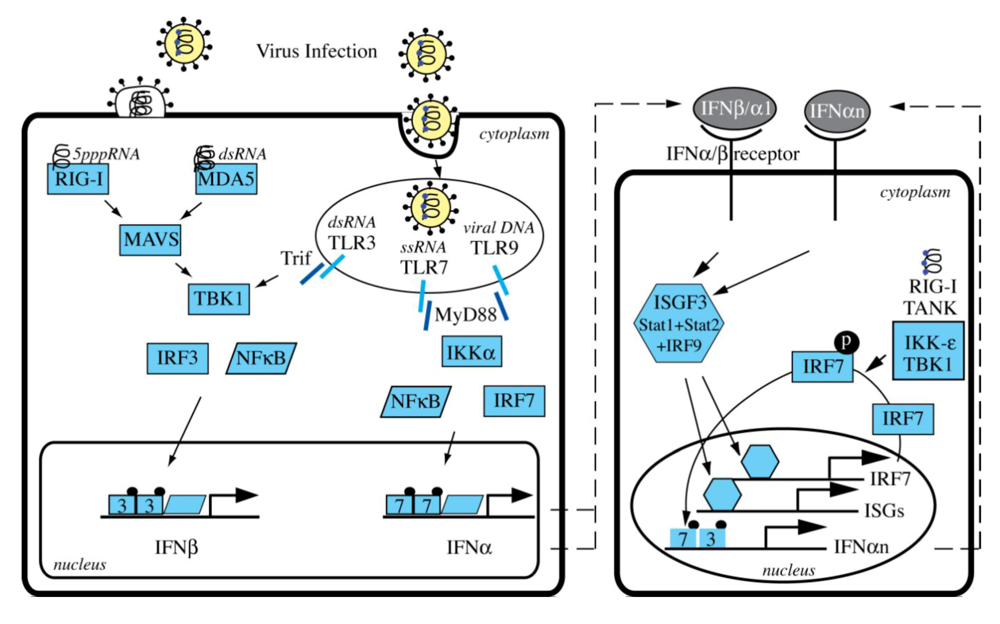
      <p>Cells produce IFN-αs and IFN-β in response to infection by a variety of viruses. Unlike bacteria and fungi, which have microbe-specific structures distinguishable from host cell structures, viruses are made predominantly of host-derived components. Given the lack of virus specific proteins or lipids, the cellular receptors that detect viruses have instead evolved to recognize the presence of the viral genome composed of nucleic acids. Two important pathways that detect viral genomes and induce type I IFNs have been discovered and characterized during recent years: the toll-like receptor (TLR) dependent pathway [<xref ref-type="bibr" rid="B16">16</xref>,<xref ref-type="bibr" rid="B17">17</xref>] and the cytosolic pathway triggered by binding of viral RNA to the RNA helicases retinoic acid inducible gene-I (RIG-I) and melanoma differentiation antigen 5 (MDA5) [<xref ref-type="bibr" rid="B18">18</xref>,<xref ref-type="bibr" rid="B19">19</xref>].</p>
      <p>TLRs are a family of transmembrane pattern recognition receptors (PRRs) that recognize microbial pathogen associated molecular patterns (PAMPs) and activate the expression of genes involved in inflammatory and immune responses [<xref ref-type="bibr" rid="B17">17</xref>]. There are at least 10 human TLRs, and 3 of them are involved in the recognition of viral infections: TLR3, TLR7 and TLR9. TLRs are expressed on various immune cells such as macrophages, dendritic cells (DCs), B cells, but also on fibroblasts and epithelial cells. While TLRs involved in the recognition of bacterial components are expressed on the cell surface, TLR3, TLR7 and TLR9 are localized in intracellular compartments such as endosomes. TLR3 recognizes dsRNA (e.g. HCV-RNA)[<xref ref-type="bibr" rid="B20">20</xref>], TLR7 detects ssRNA [<xref ref-type="bibr" rid="B21">21</xref>,<xref ref-type="bibr" rid="B22">22</xref>] and TLR9 interacts with unmethylated DNA with CpG motifs [<xref ref-type="bibr" rid="B23">23</xref>]. TLR activation induces signaling cascades that mainly involve the key transcription factors NF-κB and various interferon regulatory factors (IRFs) (<xref ref-type="fig" rid="figure1">Figure 1</xref>). Specifically, IRF3 and IRF7 have both distinct and essential roles for virus induced transcriptional activation of IFN-β [<xref ref-type="bibr" rid="B24">24</xref>]. IRF3 is constitutively expressed in most cells, whereas IRF7 is expressed at low amounts and is strongly expressed only after stimulation of cells with type I IFNs [<xref ref-type="bibr" rid="B25">25</xref>]. A notable exception to this rule are the plasmocytoid dendritic cells that have high constitutive expression levels of IRF7 [<xref ref-type="bibr" rid="B10">10</xref>,<xref ref-type="bibr" rid="B26">26</xref>,<xref ref-type="bibr" rid="B27">27</xref>]. TLR3 uses the adapter protein TRIF and the kinase TBK1 to mainly activate IRF3 in conventional DCs and macrophages, whereas TLR7 and TLR9 induce the expression and secretion of large amounts of type I IFNs in plasmacytoid DCs through the adaptor molecule MyD88 that directly interacts with IRF7 (not IRF3) [<xref ref-type="bibr" rid="B28">28</xref>,<xref ref-type="bibr" rid="B29">29</xref>]. The MyD88 pathway requires the IRAK4-IRAK1-IKKα kinase cascade to activate both IRF7 and the NF-κB pathway [<xref ref-type="bibr" rid="B30">30</xref>].</p>
      <fig id="figure1" position="float">
        <label>Figure 1</label>
        <caption>
          <p>Induction of IFNβ by viral infections.</p>
        </caption>
        <graphic xmlns:xlink="http://www.w3.org/1999/xlink" xlink:href="viruses-01-01073-g001.tif" scale="0"/>
      </fig>
      <p>The cytosolic pathway of type I IFN induction is initiated by the recognition of viral 5’triphosphate RNA and dsRNA by RIG-I and MDA5. Binding of viral RNA leads to a conformational change of these sensors that results in their binding to MAVS (also called IPS-1, Cardif, VISA), an essential downstream adaptor in the cytosolic pathway [<xref ref-type="bibr" rid="B31">31-34</xref>]. Through as yet unidentified mediators, MAVS propagates the signal to the TBK1 and IKKi kinases that finally activate IRF3 and NF-κB (<xref ref-type="fig" rid="figure1">Figure 1</xref>).</p>
      <p>Activated IRF3, NF-κB and ATF2/c-jun bind to the IFN-β gene promoter and induce gene transcription. IFN-β is secreted by the cells, and binds to the IFNAR in an autocrine or paracrine way. The activation of the Jak-STAT pathway upon IFNAR binding by IFN-β induces an important positive feedback loop that allows a very rapid and strong induction of an antiviral state in the infected cells and their neighbors (<xref ref-type="fig" rid="figure1">Figure 1</xref>).</p>
    </sec>
    <sec>
      <title>4. HCV Interference with Cellular Sensors</title>
      <p>The infection of cells with HCV leads to the induction of IFN-β through activation of the RIG-I and TLR3 pathways [<xref ref-type="bibr" rid="B19">19</xref>,<xref ref-type="bibr" rid="B35">35</xref>,<xref ref-type="bibr" rid="B36">36</xref>]. Interestingly, the HCV NS3/4A protease has been shown to cleave and inactivate MAVS (Cardif, IPS-1, VISA) and TRIF, two important adaptor proteins in the RIG-I and the TLR3 pathway, respectively [<xref ref-type="bibr" rid="B32">32</xref>,<xref ref-type="bibr" rid="B35">35</xref>]. The inhibition of these cellular sensors could be one of the factors contributing to viral persistence. However, as outlined in the next paragraph, HCV infection actually induces the endogenous IFN system despite HCV’s ability to cleave TRIF and MAVS.</p>
    </sec>
    <sec>
      <title>5. Induction of Interferon Stimulated Genes by HCV</title>
      <p>Hepatic gene expression studies with chimpanzees and humans provide compelling evidence that the inhibition of IFN-β induction, by cleavage of MAVS and/or TRIF, is in many cases incomplete and cannot prevent the activation of the endogenous IFN system in the liver. Acute infection of chimpanzees with HCV leads to the rapid activation of the endogenous IFN system [<xref ref-type="bibr" rid="B37">37</xref>]. Moreover, chronically HCV infected chimpanzees have an ongoing induction of a large number of IFN-stimulated genes (ISGs) in the liver, suggesting a continuous stimulation of the endogenous IFN system [<xref ref-type="bibr" rid="B38">38</xref>]. Interestingly, a single chimpanzee infected with a genotype (GT) 3 HCV showed less induction of ISGs compared to genotype 1 infected animals [<xref ref-type="bibr" rid="B38">38</xref>]. Many patients with chronic hepatitis C (CHC) also have a permanent induction of ISGs in the liver [<xref ref-type="bibr" rid="B39">39-41</xref>]. There is a strong association between such pre-activation of the endogenous IFN system and the failure to respond to pegIFNα/ribavirin therapy [<xref ref-type="bibr" rid="B39">39-41</xref>]. Interestingly, patients with a pre-activated IFN system have ISG expression levels comparable to those achieved in responders by the treatment with pegIFNα, and it is presently not known, why such a high expression level of ISGs in pre-activated patients does not induce a spontaneous clearance of HCV [<xref ref-type="bibr" rid="B40">40</xref>]. Patients with GT 1 infections significantly more often had a pre-activated IFN system than those infected with GTs 2 and 3, providing a possible explanation why the treatment is more often successful in the latter group [<xref ref-type="bibr" rid="B40">40</xref>].</p>
    </sec>
    <sec>
      <title>6. Interferon signaling through the Jak-STAT pathway</title>
      <sec>
        <title>6.1. The receptor-kinase complex</title>
        <p>All type I IFNs bind to the same interferon alpha/beta receptor (IFNAR) that consists of two major subunits: IFNAR1 (the a subunit in the older literature) [<xref ref-type="bibr" rid="B4">4</xref>] and IFNAR2c (the βL subunit) [<xref ref-type="bibr" rid="B5">5</xref>,<xref ref-type="bibr" rid="B6">6</xref>]. Each receptor subunit constitutively binds to a single specific member of the Janus kinase (Jak) family: IFNAR1 to tyrosine kinase 2 (TYK2) and IFNAR2c to JAK1. When type I IFNs bind to the two receptor chains, TYK2 and JAK1 transactivate each other by mutual tyrosine phosphorylation, and then initiate a cascade of tyrosine phosphorylation events on the intracellular domains of the receptors and on signal transducer and activator of transcription (STAT) 1, STAT2 and STAT3.</p>
      </sec>
      <sec>
        <title>6.2. Signal Transducers and Activators of Transcription (STATs)</title>
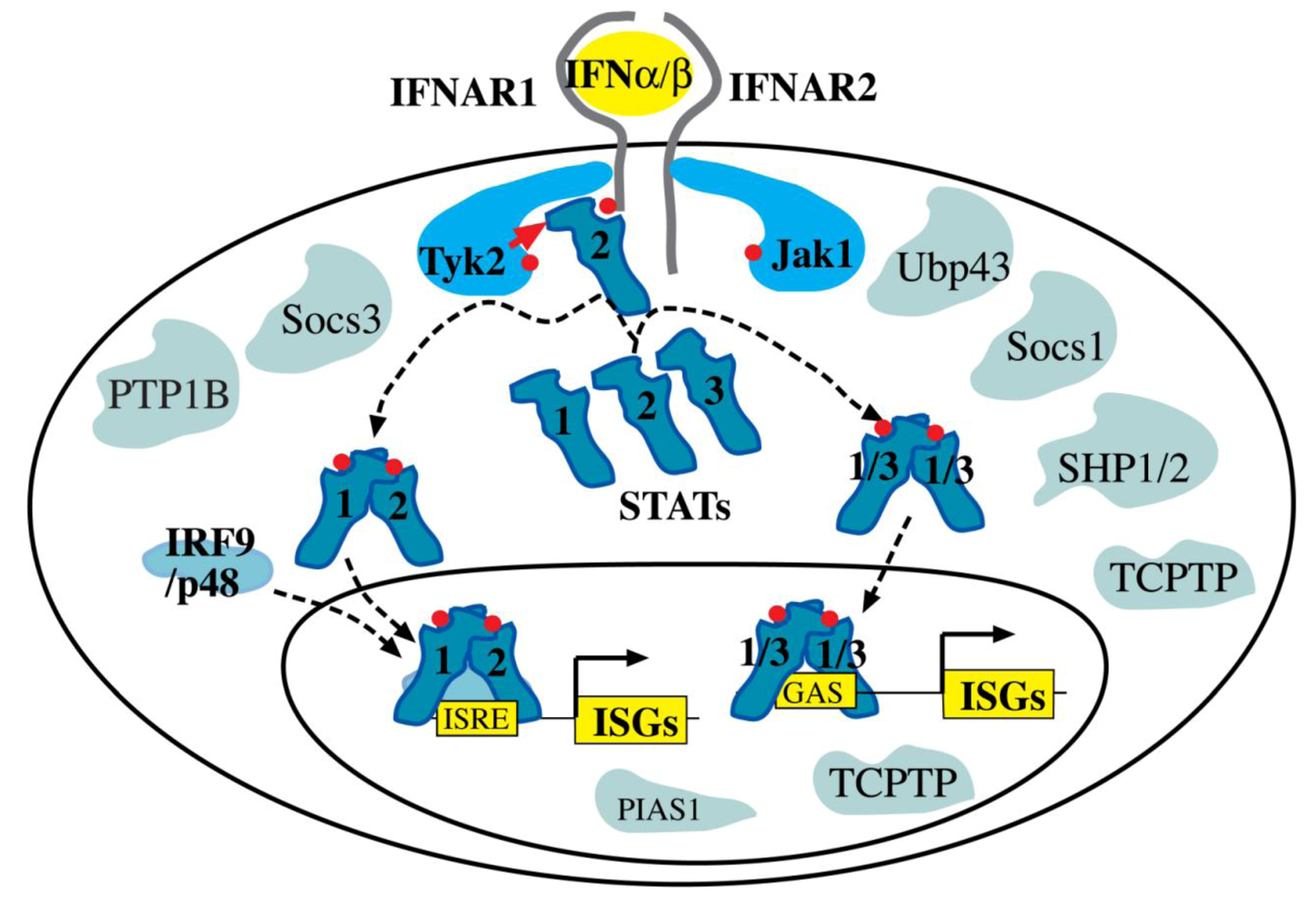
        <p>In most cells, type I IFNs activate STAT1, STAT2 and STAT3. STAT1 and STAT2 combine with a third transcription factor, IRF9, to form interferon stimulated gene factor 3 (ISGF3). ISGF3 binds to interferon stimulated response elements (ISREs) in the promoters of ISGs. Alternatively, IFN activated STAT1 and STAT3 can form homodimers or STAT1-STAT3 heterodimers. These STAT dimers bind a different class of response elements, the gamma activated sequence (GAS) elements. Once bound to the promoters of ISGs, STATs induce the transcription of genes involved in the generation of an antiviral state (<xref ref-type="fig" rid="figure2">Figure 2</xref>) [<xref ref-type="bibr" rid="B42">42</xref>,<xref ref-type="bibr" rid="B43">43</xref>].</p>
        <fig id="figure2" position="float">
          <label>Figure 2</label>
          <caption>
            <p>Type I IFNs signal through the Jak-STAT pathway. PTP1B, protein tyrosine phosphatase 1B; SHP1/2, SH2 domain-containing protein tyrosine phosphatase1 or 2; TCPTP, T cell protein tyrosine phosphatase.</p>
          </caption>
          <graphic xmlns:xlink="http://www.w3.org/1999/xlink" xlink:href="viruses-01-01073-g002.tif" scale="0"/>
        </fig>
        <p>STAT proteins are composed of 750 to 850 amino acids. They share well-defined, structurally and functionally conserved domains including the amino-terminal (NH2), coiled-coil, DNA-binding, linker, SH2, tyrosine activation, and transcriptional activation domains [<xref ref-type="bibr" rid="B44">44</xref>].</p>
      </sec>
      <sec>
        <title>6.3. Negative Regulators of Interferon Signaling</title>
        <sec>
          <title>6.3.1. Suppressor of Cytokine Signaling (SOCS)</title>
          <p>SOCS proteins are important negative regulators of Jak-STAT signaling [<xref ref-type="bibr" rid="B45">45</xref>]. The family consists of eight members, CIS and SOCS1 to SOCS7. CIS, SOCS1, SOCS2 and SOCS3 are induced by a large number of cytokines and inhibit cytokine receptors in a negative feedback loop. Type I IFNs induce SOCS1 and SOCS3 [<xref ref-type="bibr" rid="B46">46</xref>], and overexpression experiments have demonstrated that both inhibit IFN signaling through the Jak-STAT pathway [<xref ref-type="bibr" rid="B46">46</xref>,<xref ref-type="bibr" rid="B47">47</xref>]. SOCS1-deficient mice develop severe inflammatory disease because of IFN-γ hypersensitivity [<xref ref-type="bibr" rid="B48">48</xref>], but are very resistant to viral infections, most likely because of enhanced type I IFN signaling [<xref ref-type="bibr" rid="B49">49</xref>].</p>
        </sec>
        <sec>
          <title>6.3.2. USP18</title>
          <p>Ubiquitin specific peptidase 18 (USP18/UBP43) is another important negative regulator in type I IFN signaling. USP18/UBP43 was originally identified as a protease cleaving ubiquitin-like modifier ISG15 from target proteins, but was recently found to play a negative regulatory role independently of its ISG-deconjugating ability [<xref ref-type="bibr" rid="B50">50</xref>,<xref ref-type="bibr" rid="B51">51</xref>]. UBP43 was reported to inhibit the activation of JAK1 by interfering with the binding of JAK1 to IFNAR2c [<xref ref-type="bibr" rid="B52">52</xref>]. UBP43 deficient mice show a severe phenotype characterized by brain cell injury, poly-I:C hypersensitivity, and premature death [<xref ref-type="bibr" rid="B53">53</xref>,<xref ref-type="bibr" rid="B54">54</xref>]. Interestingly, they are resistant to otherwise fatal cerebral infections with LCMV and VSV [<xref ref-type="bibr" rid="B55">55</xref>]. USP18/UBP43 is also important for long-term refractoriness of the IFN system [<xref ref-type="bibr" rid="B56">56</xref>].</p>
        </sec>
        <sec>
          <title>6.3.3. Protein Inhibitor of Activated STAT1 (PIAS1) and PIAS3</title>
          <p>PIAS1 and PIAS3 specifically bind to tyrosine phosphorylated STAT1 and STAT3, respectively, and inhibit the DNA-binding of STAT dimers [<xref ref-type="bibr" rid="B57">57</xref>]. PIAS1 selectively inhibits interferon-inducible genes and is important in innate immunity. As a consequence, PIAS1 deficient mice show increased protection against pathogenic infection [<xref ref-type="bibr" rid="B58">58</xref>].</p>
        </sec>
        <sec>
          <title>6.3.4. TcPTP</title>
          <p>STAT1 is deactivated in the nucleaus by dephosphorylation of the tyrosine 701 by T cell protein tyrosine phosphatase (TcPTP) [<xref ref-type="bibr" rid="B59">59</xref>]. TcPTP deficient mice develop progressive systemic inflammatory disease as shown by chronic myocarditis, gastritis, nephritis, and sialadenitis as well as elevated serum IFN-γ [<xref ref-type="bibr" rid="B60">60</xref>].</p>
        </sec>
      </sec>
    </sec>
    <sec>
      <title>7. Interference of HCV with IFN Signaling through the Jak-STAT pathway</title>
      <p>In order to escape from the powerful antiviral effects of the IFN system, many viruses have evolved strategies to block IFN signal transduction [<xref ref-type="bibr" rid="B61">61</xref>,<xref ref-type="bibr" rid="B62">62</xref>]. Interference of HCV with IFN signaling has been suggested in several studies, sometimes with controversial results [<xref ref-type="bibr" rid="B63">63</xref>,<xref ref-type="bibr" rid="B64">64</xref>]. One proposed mechanism is the inhibition of STAT1 activation through an upregulation of SOCS3 by HCV core protein, which has been found after transient transfection of HepG2 and Huh7 cells [<xref ref-type="bibr" rid="B65">65</xref>,<xref ref-type="bibr" rid="B66">66</xref>]. Another group reported that the expression of HCV proteins in Huh7 cells leads to a proteasome-dependent degradation of STAT1 [<xref ref-type="bibr" rid="B67">67</xref>]. A third group, also using HCV protein expression in Huh7 cells, reported normal STAT1 expression and phosphorylation, but an inhibition of nuclear translocation of phosphorylated STAT1 [<xref ref-type="bibr" rid="B68">68</xref>]. A fourth group reported found reduced STAT3 expression levels in livers of patients with chronic hepatitis C and reported that HCV expression in Huh7 cells inhibited IFN-α induced phosphorylation of STAT1, STAT2 and STAT3 [<xref ref-type="bibr" rid="B69">69</xref>]. We have found an inhibition of DNA binding of activated STATs not only in cells transfected with the HCV genome, but also in the liver of HCV transgenic mice, and in liver biopsies of patients with CHC [<xref ref-type="bibr" rid="B70">70</xref>,<xref ref-type="bibr" rid="B71">71</xref>]. In all cases, STAT1 protein expression and tyrosine phosphorylation were not impaired. </p>
            <fig id="figure3" position="float">
        <label>Figure 3</label>
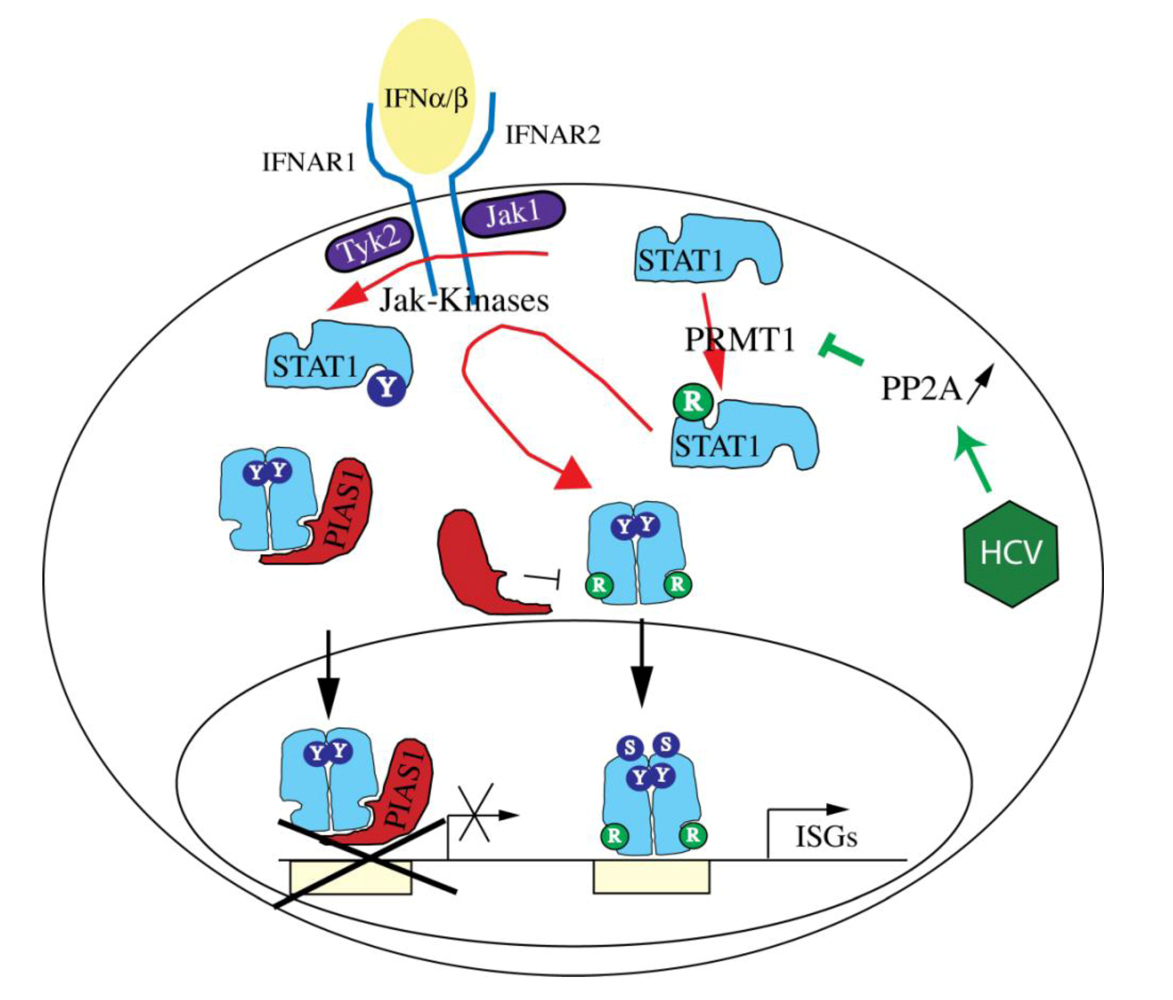
        <caption>
          <p>HCV induces the over-expression of PP2Ac via an ER stress response pathway. PP2A inhibits PRMT1, the enzyme responsible for STAT1 methylation. The resulting hypomethylation of STAT1 facilitates the binding of PIAS1, an inhibitor of DNA binding of activated STAT1. Tyrosine phosphorylation is shown by Y, and arginine methylation by R.</p>
        </caption>
        <graphic xmlns:xlink="http://www.w3.org/1999/xlink" xlink:href="viruses-01-01073-g003.tif" scale="0"/>
      </fig>
      <p>Further investigations of the molecular mechanisms of HCV interference with IFN signaling identified protein phosphatase 2A (PP2A) as an important mediator in the inhibitory pathway [<xref ref-type="bibr" rid="B72">72</xref>]. The catalytic subunit of PP2A, PP2Ac, was found to be overexpressed as a result of an endoplasmatic reticulum (ER) stress response induced by HCV protein expression [<xref ref-type="bibr" rid="B73">73</xref>]. PP2Ac was overexpressed in cells after HCV protein expression, in liver extracts of HCV transgenic mice, and in liver biopsies of patients with CHC [<xref ref-type="bibr" rid="B72">72</xref>]. Furthermore, expression of a constitutive active form of PP2Ac in Huh7 cells resulted in an inhibition of STAT1 DNA binding [<xref ref-type="bibr" rid="B72">72</xref>]. PP2A can directly bind to protein arginine methyltransferase 1 (PRMT1) and inhibit its enzymatic activity [<xref ref-type="bibr" rid="B74">74</xref>]. This inhibition of PRMT1 results in a decreased methylation of a number of proteins, amongst them STAT1 [<xref ref-type="bibr" rid="B72">72</xref>]. It has been reported that the arginine methylation of STAT1 regulates the association of STAT1 with the inhibitor PIAS1 [<xref ref-type="bibr" rid="B75">75</xref>], a finding that is still controversial [<xref ref-type="bibr" rid="B76">76</xref>]. Nonetheless, we have found that inhibition of PRMT1 by increased expression of PP2Ac leads to an increased association of STAT1 with PIAS1, a finding that could well explain the impaired DNA binding of activated STATs in HCV infected cells [<xref ref-type="bibr" rid="B72">72</xref>]. Interestingly, treatment of cells with the methyl group donor S-adenosyl-methionine restored normal IFN signaling in cells with HCV protein expression and increased the potency of IFNα in the HCV replicon system [<xref ref-type="bibr" rid="B77">77</xref>]. Our current working model of HCV interference with IFN signaling is shown in <xref ref-type="fig" rid="figure3">Figure 3</xref>.</p>

    </sec>
    <sec>
      <title>8. Effects of Type I Interferons</title>
      <p>Interferons exhibit a wide spectrum of biological activities in target cells, including antiviral, immunomodulatory, antiangiogenic, and growth inhibitory effects. They exert their effects mainly through Jak-STAT mediated regulation of gene transcription. However, there are also Jak-STAT independent effects, notably the activation of the p38 Map kinase signaling cascade [<xref ref-type="bibr" rid="B78">78</xref>,<xref ref-type="bibr" rid="B79">79</xref>], and the activation of the phosphatidylinositol 3 (PI3) kinase – Akt kinase – mTOR/p70 S6 kinase pathway that regulates mRNA translation [<xref ref-type="bibr" rid="B80">80</xref>,<xref ref-type="bibr" rid="B81">81</xref>].</p>
      <sec>
        <title>8.1. Interferon Regulated Genes</title>
        <p>Stimulation of cells with type I IFNs usually leads to the induction of several hundred genes (IFN stimulated genes, ISGs), but there are also some genes that are negatively regulated by IFNs [<xref ref-type="bibr" rid="B40">40</xref>,<xref ref-type="bibr" rid="B82">82</xref>,<xref ref-type="bibr" rid="B83">83</xref>]. There is considerable variation between different cell types in regard to the number and also the identity of the regulated genes [<xref ref-type="bibr" rid="B83">83</xref>]. Gene expression analysis in human and chimpanzee have shown that systemic administration of (pegylated) IFNα induces overlapping but clearly distinct sets of genes in liver and peripheral blood mononuclear cells (PBMCs) [<xref ref-type="bibr" rid="B40">40</xref>,<xref ref-type="bibr" rid="B84">84</xref>]. The mRNA levels of most of the genes are increased 2 to 10 fold by IFN stimulation, but some genes are induced even stronger [<xref ref-type="bibr" rid="B40">40</xref>]. In the liver, most of the ISGs are upregulated within hours after administration of pegylated IFNα and rapidly downregulated again within the first 8 to 24 hours [<xref ref-type="bibr" rid="B84">84</xref>].</p>
      </sec>
      <sec>
        <title>8.2. Antiviral Effects</title>
        <p>Type I IFN induced regulation of hundreds of genes establishes an “antiviral state” in the cell [<xref ref-type="bibr" rid="B85">85</xref>,<xref ref-type="bibr" rid="B86">86</xref>]. The term “antiviral state” implies protection of the cell against viral infection, but it is a generic term, and the lack of precise criteria for its definition reflects the fact that we still have only an elementary understanding of what exactly it is. Indeed, a large number of these regulated genes have as yet unknown functions. Some ISGs have broad antiviral effects. For example, protein kinase R (PKR), a member of the eukaryotic initiation factor 2α (eIF2α) kinase family, phosphorylates eIF2α with a consequent blockade of translation of most cellular and viral mRNAs [<xref ref-type="bibr" rid="B87">87</xref>]. Members of the interferon-induced protein with tetratricopeptide repeats (IFIT1 (ISG56) and IFIT2 (ISG54)) also inhibit translation by binding to eIF3 [<xref ref-type="bibr" rid="B88">88</xref>]. Another well-studied antiviral effector is 2’-5’ oligoadenylate synthetase (OAS). Both the gene transcription and the enzymatic activity are regulated: the enzymatic activity is stimulated by viral dsRNA, and OAS expression is upregulated several-fold by IFN-α. The 2’-5’oligoadenylates produced by activated OAS in turn activate the latent RNA nuclease RNase L, resulting in the degradation of viral and host RNAs [<xref ref-type="bibr" rid="B87">87</xref>]. Recently, the ISG15 system has been found to be another broadly active non-specific antiviral effector. ISG15 is one of the most prominent ISGs. It is an ubiquitin-like protein that conjugates to more than 150 cellular target proteins [<xref ref-type="bibr" rid="B55">55</xref>,<xref ref-type="bibr" rid="B89">89-91</xref>]. The conjugation is executed by an enzymatic cascade that includes an E1 activating enzyme (UBE1L) [<xref ref-type="bibr" rid="B92">92</xref>], an E2 conjugating enzyme (UbcH8) [<xref ref-type="bibr" rid="B93">93</xref>,<xref ref-type="bibr" rid="B94">94</xref>], and an E3 ligase (HERC5 and TRIM25) [<xref ref-type="bibr" rid="B95">95</xref>,<xref ref-type="bibr" rid="B96">96</xref>]. The conjugation can be reversed by ubiquitin protease 43 (UBP43, also known as USP18) [<xref ref-type="bibr" rid="B51">51</xref>]. All these enzymes are induced by type I IFNs. Many of the ISG15 target proteins have important roles in the IFN response, for example Jak1, STAT1, RIG-I, MxA, PKR and RNaseL [<xref ref-type="bibr" rid="B90">90</xref>]. Consistent with its role in the IFN system, mice deficient in ISG15 have increased susceptibility to infection with several viruses [<xref ref-type="bibr" rid="B97">97</xref>].</p>
        <p>Several ISGs have been implicated in the host defence against hepatitis C virus (HCV). Viperin, a member of the radical S-adenosyl methionine domain containing enzymes, inhibits replication of HCV in the replicon system [<xref ref-type="bibr" rid="B98">98</xref>,<xref ref-type="bibr" rid="B99">99</xref>]. PKR and ISG20, a 3’-5’ exonuclease with a strong preference for single-stranded RNA, also strongly inhibit HCV replicons [<xref ref-type="bibr" rid="B99">99</xref>].</p>
      </sec>
    </sec>
    <sec>
      <title>9. Interference of Hepatitis C Virus with Interferon Effector Systems</title>
      <p>The HCV protein NS5A was shown to inhibit PKR activation in cell culture [<xref ref-type="bibr" rid="B100">100</xref>]. In some populations, mutations in the so-called IFN sensitivity-determining region (ISDR) of HCV NS5A correlate with response to IFN treatments, and the ISDR is part of the PKR binding domain [<xref ref-type="bibr" rid="B101">101</xref>]. This finding, however, was not confirmed in other populations. </p>
      <p>Likewise, HCV E2 was shown to bind to PKR through a 12-amino acid sequence similar to the PKR autophosphorylation site and the eIF2α phosphorylation site, the PKR-eIF2α phosphorylation homology domain (PePHD). In this elegant work using transfected cells and yeast, E2 blocked the inhibitory effect of PKR on protein synthesis and cell growth. Interestingly, the homology of this 12-amino acid sequence of E2 was found only in HCV GT 1a and 1b, but not GT 2a, 2b or 3a, providing a potential explanation for the better response rates obtained in patients with GT 2 or GT 3 infections [<xref ref-type="bibr" rid="B102">102</xref>]. However, a clinical study could not find a significant correlation between the presence of this 12-amino acid motif and response to IFN therapy [<xref ref-type="bibr" rid="B103">103</xref>].</p>
    </sec>
    <sec sec-type="conclusions">
      <title>10. Conclusions</title>
      <p>HCV is exceptionally successful in establishing a persistent infection, and must have therefore evolved mechanisms to interfere with the powerful innate immune system. There is evidence mainly from cell culture work that HCV interferes with the induction of IFNβ in infected cells, with IFNα signaling trough the Jak-STAT pathway, and with IFN induced effector mechanisms, e.g. PKR. However, the significance of these mechanisms <italic>in vivo</italic> is less clear, and further work with liver biopsy samples obtained from patients treated within the framework of rigorously designed clinical trials will have to identify the mechanisms of viral interference that allow HCV to persist chronically in such a high percentage of infected individuals. </p>
    </sec>
  </body>
  <back>
    <ref-list>
    <title>References</title>
      <ref id="B1">
        <citation citation-type="journal">
          <person-group person-group-type="author">
            <name>
              <surname>Isaacs</surname>
              <given-names>A.</given-names>
            </name>
            <name>
              <surname>Lindenmann</surname>
              <given-names>J.</given-names>
            </name>
          </person-group>
          <article-title>Virus interferenceI. The interferon.</article-title>
          <source>Proc. R. Soc. Lond. B. Biol. Sci.</source>
          <year>1957</year>
          <volume>147</volume>
          <fpage>258</fpage>
          <lpage>267</lpage>
          <supplement/>
          <pub-id pub-id-type="doi">10.1098/rspb.1957.0048</pub-id>
          <pub-id pub-id-type="pmid">13465720</pub-id>
        </citation>
      </ref>
      <ref id="B2">
        <citation citation-type="journal">
          <person-group person-group-type="author">
            <name>
              <surname>Pestka</surname>
              <given-names>S.</given-names>
            </name>
          </person-group>
          <article-title>The interferons: 50 years after their discovery, there is much more to learn</article-title>
          <source>J. Biol. Chem.</source>
          <year>2007</year>
          <volume>282</volume>
          <fpage>20047</fpage>
          <lpage>20051</lpage>
          <pub-id pub-id-type="doi">10.1074/jbc.R700004200</pub-id>
          <pub-id pub-id-type="pmid">17502369</pub-id>
        </citation>
      </ref>
      <ref id="B3">
        <citation citation-type="journal">
          <person-group person-group-type="author">
            <name>
              <surname>Pestka</surname>
              <given-names>S.</given-names>
            </name>
            <name>
              <surname>Krause</surname>
              <given-names>C.D.</given-names>
            </name>
            <name>
              <surname>Walter</surname>
              <given-names>M.R.</given-names>
            </name>
          </person-group>
          <article-title>Interferons, interferon-like cytokines, and their receptors</article-title>
          <source>Immunol. Rev.</source>
          <year>2004</year>
          <volume>202</volume>
          <fpage>8</fpage>
          <lpage>32</lpage>
          <pub-id pub-id-type="doi">10.1111/j.0105-2896.2004.00204.x</pub-id>
        </citation>
      </ref>
      <ref id="B4">
        <citation citation-type="journal">
          <person-group person-group-type="author">
            <name>
              <surname>Uze</surname>
              <given-names>G.</given-names>
            </name>
            <name>
              <surname>Lutfalla</surname>
              <given-names>G.</given-names>
            </name>
            <name>
              <surname>Gresser</surname>
              <given-names>I.</given-names>
            </name>
          </person-group>
          <article-title>Genetic transfer of a functional human interferon alpha receptor into mouse cells: cloning and expression of its cDNA</article-title>
          <source>Cell</source>
          <year>1990</year>
          <volume>60</volume>
          <fpage>225</fpage>
          <lpage>234</lpage>
          <pub-id pub-id-type="doi">10.1016/0092-8674(90)90738-Z</pub-id>
          <pub-id pub-id-type="pmid">2153461</pub-id>
        </citation>
      </ref>
      <ref id="B5">
        <citation citation-type="journal">
          <person-group person-group-type="author">
            <name>
              <surname>Novick</surname>
              <given-names>D.</given-names>
            </name>
            <name>
              <surname>Cohen</surname>
              <given-names>B.</given-names>
            </name>
            <name>
              <surname>Rubinstein</surname>
              <given-names>M.</given-names>
            </name>
          </person-group>
          <article-title>The human interferon alpha/beta receptor: characterization and molecular cloning</article-title>
          <source>Cell</source>
          <year>1994</year>
          <volume>77</volume>
          <fpage>391</fpage>
          <lpage>400</lpage>
          <pub-id pub-id-type="doi">10.1016/0092-8674(94)90154-6</pub-id>
          <pub-id pub-id-type="pmid">8181059</pub-id>
        </citation>
      </ref>
      <ref id="B6">
        <citation citation-type="journal">
          <person-group person-group-type="author">
            <name>
              <surname>Lutfalla</surname>
              <given-names>G.</given-names>
            </name>
            <name>
              <surname>Holland</surname>
              <given-names>S.J.</given-names>
            </name>
            <name>
              <surname>Cinato</surname>
              <given-names>E.</given-names>
            </name>
            <name>
              <surname>Monneron</surname>
              <given-names>D.</given-names>
            </name>
            <name>
              <surname>Reboul</surname>
              <given-names>J.</given-names>
            </name>
            <name>
              <surname>Rogers</surname>
              <given-names>N.C.</given-names>
            </name>
            <name>
              <surname>Smith</surname>
              <given-names>J.M.</given-names>
            </name>
            <name>
              <surname>Stark</surname>
              <given-names>G.R.</given-names>
            </name>
            <name>
              <surname>Gardiner</surname>
              <given-names>K.</given-names>
            </name>
            <name>
              <surname>Mogensen</surname>
              <given-names>K.E.</given-names>
            </name>
            <name>
              <surname>et al</surname>
              <given-names/>
            </name>
          </person-group>
          <article-title>Mutant U5A cells are complemented by an interferon-alpha beta receptor subunit generated by alternative processing of a new member of a cytokine receptor gene cluster</article-title>
          <source>Embo J.</source>
          <year>1995</year>
          <volume>14</volume>
          <fpage>5100</fpage>
          <lpage>5108</lpage>
          <pub-id pub-id-type="pmid">7588638</pub-id>
        </citation>
      </ref>
      <ref id="B7">
        <citation citation-type="journal">
          <person-group person-group-type="author">
            <name>
              <surname>Aguet</surname>
              <given-names>M.</given-names>
            </name>
            <name>
              <surname>Dembic</surname>
              <given-names>Z.</given-names>
            </name>
            <name>
              <surname>Merlin</surname>
              <given-names>G.</given-names>
            </name>
          </person-group>
          <article-title>Molecular cloning and expression of the human interferon-gamma receptor</article-title>
          <source>Cell</source>
          <year>1988</year>
          <volume>55</volume>
          <fpage>273</fpage>
          <lpage>280</lpage>
          <pub-id pub-id-type="doi">10.1016/0092-8674(88)90050-5</pub-id>
          <pub-id pub-id-type="pmid">2971451</pub-id>
        </citation>
      </ref>
      <ref id="B8">
        <citation citation-type="journal">
          <person-group person-group-type="author">
            <name>
              <surname>Soh</surname>
              <given-names>J.</given-names>
            </name>
            <name>
              <surname>Donnelly</surname>
              <given-names>R.J.</given-names>
            </name>
            <name>
              <surname>Kotenko</surname>
              <given-names>S.</given-names>
            </name>
            <name>
              <surname>Mariano</surname>
              <given-names>T.M.</given-names>
            </name>
            <name>
              <surname>Cook</surname>
              <given-names>J.R.</given-names>
            </name>
            <name>
              <surname>Wang</surname>
              <given-names>N.</given-names>
            </name>
            <name>
              <surname>Emanuel</surname>
              <given-names>S.</given-names>
            </name>
            <name>
              <surname>Schwartz</surname>
              <given-names>B.</given-names>
            </name>
            <name>
              <surname>Miki</surname>
              <given-names>T.</given-names>
            </name>
            <name>
              <surname>Pestka</surname>
              <given-names>S.</given-names>
            </name>
          </person-group>
          <article-title>Identification and sequence of an accessory factor required for activation of the human interferon gamma receptor</article-title>
          <source>Cell</source>
          <year>1994</year>
          <volume>76</volume>
          <fpage>793</fpage>
          <lpage>802</lpage>
          <pub-id pub-id-type="doi">10.1016/0092-8674(94)90354-9</pub-id>
          <pub-id pub-id-type="pmid">8124716</pub-id>
        </citation>
      </ref>
      <ref id="B9">
        <citation citation-type="journal">
          <person-group person-group-type="author">
            <name>
              <surname>Hemmi</surname>
              <given-names>S.</given-names>
            </name>
            <name>
              <surname>Bohni</surname>
              <given-names>R.</given-names>
            </name>
            <name>
              <surname>Stark</surname>
              <given-names>G.</given-names>
            </name>
            <name>
              <surname>Di Marco</surname>
              <given-names>F.</given-names>
            </name>
            <name>
              <surname>Aguet</surname>
              <given-names>M.</given-names>
            </name>
          </person-group>
          <article-title>A novel member of the interferon receptor family complements functionality of the murine interferon gamma receptor in human cells</article-title>
          <source>Cell</source>
          <year>1994</year>
          <volume>76</volume>
          <fpage>803</fpage>
          <lpage>810</lpage>
          <pub-id pub-id-type="doi">10.1016/0092-8674(94)90355-7</pub-id>
          <pub-id pub-id-type="pmid">8124717</pub-id>
        </citation>
      </ref>
      <ref id="B10">
        <citation citation-type="journal">
          <person-group person-group-type="author">
            <name>
              <surname>Coccia</surname>
              <given-names>E.M.</given-names>
            </name>
            <name>
              <surname>Severa</surname>
              <given-names>M.</given-names>
            </name>
            <name>
              <surname>Giacomini</surname>
              <given-names>E.</given-names>
            </name>
            <name>
              <surname>Monneron</surname>
              <given-names>D.</given-names>
            </name>
            <name>
              <surname>Remoli</surname>
              <given-names>M.E.</given-names>
            </name>
            <name>
              <surname>Julkunen</surname>
              <given-names>I.</given-names>
            </name>
            <name>
              <surname>Cella</surname>
              <given-names>M.</given-names>
            </name>
            <name>
              <surname>Lande</surname>
              <given-names>R.</given-names>
            </name>
            <name>
              <surname>Uze</surname>
              <given-names>G.</given-names>
            </name>
          </person-group>
          <article-title>Viral infection and Toll-like receptor agonists induce a differential expression of type I and lambda interferons in human plasmacytoid and monocyte-derived dendritic cells</article-title>
          <source>Eur. J. Immunol.</source>
          <year>2004</year>
          <volume>34</volume>
          <fpage>796</fpage>
          <lpage>805</lpage>
          <pub-id pub-id-type="doi">10.1002/eji.200324610</pub-id>
          <pub-id pub-id-type="pmid">14991609</pub-id>
        </citation>
      </ref>
      <ref id="B11">
        <citation citation-type="journal">
          <person-group person-group-type="author">
            <name>
              <surname>Kotenko</surname>
              <given-names>S.V.</given-names>
            </name>
            <name>
              <surname>Gallagher</surname>
              <given-names>G.</given-names>
            </name>
            <name>
              <surname>Baurin</surname>
              <given-names>V.V.</given-names>
            </name>
            <name>
              <surname>Lewis-Antes</surname>
              <given-names>A.</given-names>
            </name>
            <name>
              <surname>Shen</surname>
              <given-names>M.</given-names>
            </name>
            <name>
              <surname>Shah</surname>
              <given-names>N.K.</given-names>
            </name>
            <name>
              <surname>Langer</surname>
              <given-names>J.A.</given-names>
            </name>
            <name>
              <surname>Sheikh</surname>
              <given-names>F.</given-names>
            </name>
            <name>
              <surname>Dickensheets</surname>
              <given-names>H.</given-names>
            </name>
            <name>
              <surname>Donnelly</surname>
              <given-names>R.P.</given-names>
            </name>
          </person-group>
          <article-title>IFN-lambdas mediate antiviral protection through a distinct class II cytokine receptor complex</article-title>
          <source>Nat. Immunol.</source>
          <year>2003</year>
          <volume>4</volume>
          <fpage>69</fpage>
          <lpage>77</lpage>
          <pub-id pub-id-type="doi">10.1038/ni875</pub-id>
          <pub-id pub-id-type="pmid">12483210</pub-id>
        </citation>
      </ref>
      <ref id="B12">
        <citation citation-type="journal">
          <person-group person-group-type="author">
            <name>
              <surname>Donnelly</surname>
              <given-names>R.P.</given-names>
            </name>
            <name>
              <surname>Sheikh</surname>
              <given-names>F.</given-names>
            </name>
            <name>
              <surname>Kotenko</surname>
              <given-names>S.V.</given-names>
            </name>
            <name>
              <surname>Dickensheets</surname>
              <given-names>H.</given-names>
            </name>
          </person-group>
          <article-title>The expanded family of class II cytokines that share the IL-10 receptor-2 (IL-10R2) chain</article-title>
          <source>J. Leukoc. Biol.</source>
          <year>2004</year>
          <volume>76</volume>
          <fpage>314</fpage>
          <lpage>321</lpage>
          <pub-id pub-id-type="doi">10.1189/jlb.0204117</pub-id>
          <pub-id pub-id-type="pmid">15123776</pub-id>
        </citation>
      </ref>
      <ref id="B13">
        <citation citation-type="journal">
          <person-group person-group-type="author">
            <name>
              <surname>Ge</surname>
              <given-names>D.</given-names>
            </name>
            <name>
              <surname>Fellay</surname>
              <given-names>J.</given-names>
            </name>
            <name>
              <surname>Thompson</surname>
              <given-names>A.J.</given-names>
            </name>
            <name>
              <surname>Simon</surname>
              <given-names>J.S.</given-names>
            </name>
            <name>
              <surname>Shianna</surname>
              <given-names>K.V.</given-names>
            </name>
            <name>
              <surname>Urban</surname>
              <given-names>T.J.</given-names>
            </name>
            <name>
              <surname>Heinzen</surname>
              <given-names>E.L.</given-names>
            </name>
            <name>
              <surname>Qiu</surname>
              <given-names>P.</given-names>
            </name>
            <name>
              <surname>Bertelsen</surname>
              <given-names>A.H.</given-names>
            </name>
            <name>
              <surname>Muir</surname>
              <given-names>A.J.</given-names>
            </name>
            <name>
              <surname>Sulkowski</surname>
              <given-names>M.</given-names>
            </name>
            <name>
              <surname>McHutchison</surname>
              <given-names>J.G.</given-names>
            </name>
            <name>
              <surname>Goldstein</surname>
              <given-names>D.B.</given-names>
            </name>
          </person-group>
          <article-title>Genetic variation in IL28B predicts hepatitis C treatment-induced viral clearance</article-title>
          <source>Nature</source>
          <year>2009</year>
          <volume>461</volume>
          <fpage>399</fpage>
          <lpage>401</lpage>
          <pub-id pub-id-type="doi">10.1038/nature08309</pub-id>
          <pub-id pub-id-type="pmid">19684573</pub-id>
        </citation>
      </ref>
      <ref id="B14">
        <citation citation-type="journal">
          <person-group person-group-type="author">
            <name>
              <surname>Tanaka</surname>
              <given-names>Y.</given-names>
            </name>
            <name>
              <surname>Nishida</surname>
              <given-names>N.</given-names>
            </name>
            <name>
              <surname>Sugiyama</surname>
              <given-names>M.</given-names>
            </name>
            <name>
              <surname>Kurosaki</surname>
              <given-names>M.</given-names>
            </name>
            <name>
              <surname>Matsuura</surname>
              <given-names>K.</given-names>
            </name>
            <name>
              <surname>Sakamoto</surname>
              <given-names>N.</given-names>
            </name>
            <name>
              <surname>Nakagawa</surname>
              <given-names>M.</given-names>
            </name>
            <name>
              <surname>Korenaga</surname>
              <given-names>M.</given-names>
            </name>
            <name>
              <surname>Hino</surname>
              <given-names>K.</given-names>
            </name>
            <name>
              <surname>Hige</surname>
              <given-names>S.</given-names>
            </name>
            <name>
              <surname>Ito</surname>
              <given-names>Y.</given-names>
            </name>
            <name>
              <surname>Mita</surname>
              <given-names>E.</given-names>
            </name>
            <name>
              <surname>Tanaka</surname>
              <given-names>E.</given-names>
            </name>
            <name>
              <surname>Mochida</surname>
              <given-names>S.</given-names>
            </name>
            <name>
              <surname>Murawaki</surname>
              <given-names>Y.</given-names>
            </name>
            <name>
              <surname>Honda</surname>
              <given-names>M.</given-names>
            </name>
            <name>
              <surname>Sakai</surname>
              <given-names>A.</given-names>
            </name>
            <name>
              <surname>Hiasa</surname>
              <given-names>Y.</given-names>
            </name>
            <name>
              <surname>Nishiguchi</surname>
              <given-names>S.</given-names>
            </name>
            <name>
              <surname>Koike</surname>
              <given-names>A.</given-names>
            </name>
            <name>
              <surname>Sakaida</surname>
              <given-names>I.</given-names>
            </name>
            <name>
              <surname>Imamura</surname>
              <given-names>M.</given-names>
            </name>
            <name>
              <surname>Ito</surname>
              <given-names>K.</given-names>
            </name>
            <name>
              <surname>Yano</surname>
              <given-names>K.</given-names>
            </name>
            <name>
              <surname>Masaki</surname>
              <given-names>N.</given-names>
            </name>
            <name>
              <surname>Sugauchi</surname>
              <given-names>F.</given-names>
            </name>
            <name>
              <surname>Izumi</surname>
              <given-names>N.</given-names>
            </name>
            <name>
              <surname>Tokunaga</surname>
              <given-names>K.</given-names>
            </name>
            <name>
              <surname>Mizokami</surname>
              <given-names>M.</given-names>
            </name>
          </person-group>
          <article-title>Genome-wide association of IL28B with response to pegylated interferon-alpha and ribavirin therapy for chronic hepatitis C</article-title>
          <source>Nat. Genet.</source>
          <year>2009</year>
          <volume>41</volume>
          <fpage>1105</fpage>
          <lpage>1109</lpage>
          <pub-id pub-id-type="doi">10.1038/ng.449</pub-id>
          <pub-id pub-id-type="pmid">19749757</pub-id>
        </citation>
      </ref>
      <ref id="B15">
        <citation citation-type="journal">
          <person-group person-group-type="author">
            <name>
              <surname>Suppiah</surname>
              <given-names>V.</given-names>
            </name>
            <name>
              <surname>Moldovan</surname>
              <given-names>M.</given-names>
            </name>
            <name>
              <surname>Ahlenstiel</surname>
              <given-names>G.</given-names>
            </name>
            <name>
              <surname>Berg</surname>
              <given-names>T.</given-names>
            </name>
            <name>
              <surname>Weltman</surname>
              <given-names>M.</given-names>
            </name>
            <name>
              <surname>Abate</surname>
              <given-names>M.L.</given-names>
            </name>
            <name>
              <surname>Bassendine</surname>
              <given-names>M.</given-names>
            </name>
            <name>
              <surname>Spengler</surname>
              <given-names>U.</given-names>
            </name>
            <name>
              <surname>Dore</surname>
              <given-names>G.J.</given-names>
            </name>
            <name>
              <surname>Powell</surname>
              <given-names>E.</given-names>
            </name>
            <name>
              <surname>Riordan</surname>
              <given-names>S.</given-names>
            </name>
            <name>
              <surname>Sheridan</surname>
              <given-names>D.</given-names>
            </name>
            <name>
              <surname>Smedile</surname>
              <given-names>A.</given-names>
            </name>
            <name>
              <surname>Fragomeli</surname>
              <given-names>V.</given-names>
            </name>
            <name>
              <surname>Muller</surname>
              <given-names>T.</given-names>
            </name>
            <name>
              <surname>Bahlo</surname>
              <given-names>M.</given-names>
            </name>
            <name>
              <surname>Stewart</surname>
              <given-names>G.J.</given-names>
            </name>
            <name>
              <surname>Booth</surname>
              <given-names>D.R.</given-names>
            </name>
            <name>
              <surname>George</surname>
              <given-names>J.</given-names>
            </name>
          </person-group>
          <article-title>IL28B is associated with response to chronic hepatitis C interferon-alpha and ribavirin therapy</article-title>
          <source>Nat. Genet.</source>
          <year>2009</year>
          <volume>41</volume>
          <fpage>1100</fpage>
          <lpage>1104</lpage>
          <pub-id pub-id-type="doi">10.1038/ng.447</pub-id>
          <pub-id pub-id-type="pmid">19749758</pub-id>
        </citation>
      </ref>
      <ref id="B16">
        <citation citation-type="journal">
          <person-group person-group-type="author">
            <name>
              <surname>Iwasaki</surname>
              <given-names>A.</given-names>
            </name>
            <name>
              <surname>Medzhitov</surname>
              <given-names>R.</given-names>
            </name>
          </person-group>
          <article-title>Toll-like receptor control of the adaptive immune responses</article-title>
          <source>Nat. Immunol.</source>
          <year>2004</year>
          <volume>5</volume>
          <fpage>987</fpage>
          <lpage>995</lpage>
          <pub-id pub-id-type="doi">10.1038/ni1112</pub-id>
          <pub-id pub-id-type="pmid">15454922</pub-id>
        </citation>
      </ref>
      <ref id="B17">
        <citation citation-type="journal">
          <person-group person-group-type="author">
            <name>
              <surname>Akira</surname>
              <given-names>S.</given-names>
            </name>
            <name>
              <surname>Uematsu</surname>
              <given-names>S.</given-names>
            </name>
            <name>
              <surname>Takeuchi</surname>
              <given-names>O.</given-names>
            </name>
          </person-group>
          <article-title>Pathogen recognition and innate immunity</article-title>
          <source>Cell</source>
          <year>2006</year>
          <volume>124</volume>
          <fpage>783</fpage>
          <lpage>801</lpage>
          <pub-id pub-id-type="doi">10.1016/j.cell.2006.02.015</pub-id>
          <pub-id pub-id-type="pmid">16497588</pub-id>
        </citation>
      </ref>
      <ref id="B18">
        <citation citation-type="journal">
          <person-group person-group-type="author">
            <name>
              <surname>Yoneyama</surname>
              <given-names>M.</given-names>
            </name>
            <name>
              <surname>Fujita</surname>
              <given-names>T.</given-names>
            </name>
          </person-group>
          <article-title>Function of RIG-I-like receptors in antiviral innate immunity</article-title>
          <source>J. Biol. Chem.</source>
          <year>2007</year>
          <volume>282</volume>
          <fpage>15315</fpage>
          <lpage>15318</lpage>
          <pub-id pub-id-type="doi">10.1074/jbc.R700007200</pub-id>
          <pub-id pub-id-type="pmid">17395582</pub-id>
        </citation>
      </ref>
      <ref id="B19">
        <citation citation-type="journal">
          <person-group person-group-type="author">
            <name>
              <surname>Yoneyama</surname>
              <given-names>M.</given-names>
            </name>
            <name>
              <surname>Kikuchi</surname>
              <given-names>M.</given-names>
            </name>
            <name>
              <surname>Natsukawa</surname>
              <given-names>T.</given-names>
            </name>
            <name>
              <surname>Shinobu</surname>
              <given-names>N.</given-names>
            </name>
            <name>
              <surname>Imaizumi</surname>
              <given-names>T.</given-names>
            </name>
            <name>
              <surname>Miyagishi</surname>
              <given-names>M.</given-names>
            </name>
            <name>
              <surname>Taira</surname>
              <given-names>K.</given-names>
            </name>
            <name>
              <surname>Akira</surname>
              <given-names>S.</given-names>
            </name>
            <name>
              <surname>Fujita</surname>
              <given-names>T.</given-names>
            </name>
          </person-group>
          <article-title>The RNA helicase RIG-I has an essential function in double-stranded RNA-induced innate antiviral responses</article-title>
          <source>Nat. Immunol.</source>
          <year>2004</year>
          <volume>5</volume>
          <fpage>730</fpage>
          <lpage>737</lpage>
          <pub-id pub-id-type="doi">10.1038/ni1087</pub-id>
          <pub-id pub-id-type="pmid">15208624</pub-id>
        </citation>
      </ref>
      <ref id="B20">
        <citation citation-type="journal">
          <person-group person-group-type="author">
            <name>
              <surname>Alexopoulou</surname>
              <given-names>L.</given-names>
            </name>
            <name>
              <surname>Holt</surname>
              <given-names>A.C.</given-names>
            </name>
            <name>
              <surname>Medzhitov</surname>
              <given-names>R.</given-names>
            </name>
            <name>
              <surname>Flavell</surname>
              <given-names>R.A.</given-names>
            </name>
          </person-group>
          <article-title>Recognition of double-stranded RNA and activation of NF-kappaB by Toll-like receptor 3</article-title>
          <source>Nature</source>
          <year>2001</year>
          <volume>413</volume>
          <fpage>732</fpage>
          <lpage>738</lpage>
          <pub-id pub-id-type="doi">10.1038/35099560</pub-id>
          <pub-id pub-id-type="pmid">11607032</pub-id>
        </citation>
      </ref>
      <ref id="B21">
        <citation citation-type="journal">
          <person-group person-group-type="author">
            <name>
              <surname>Diebold</surname>
              <given-names>S.S.</given-names>
            </name>
            <name>
              <surname>Kaisho</surname>
              <given-names>T.</given-names>
            </name>
            <name>
              <surname>Hemmi</surname>
              <given-names>H.</given-names>
            </name>
            <name>
              <surname>Akira</surname>
              <given-names>S.</given-names>
            </name>
            <name>
              <surname>Reis e Sousa</surname>
              <given-names>C.</given-names>
            </name>
          </person-group>
          <article-title>Innate antiviral responses by means of TLR7-mediated recognition of single-stranded RNA</article-title>
          <source>Science</source>
          <year>2004</year>
          <volume>303</volume>
          <fpage>1529</fpage>
          <lpage>1531</lpage>
          <pub-id pub-id-type="doi">10.1126/science.1093616</pub-id>
          <pub-id pub-id-type="pmid">14976261</pub-id>
        </citation>
      </ref>
      <ref id="B22">
        <citation citation-type="journal">
          <person-group person-group-type="author">
            <name>
              <surname>Heil</surname>
              <given-names>F.</given-names>
            </name>
            <name>
              <surname>Hemmi</surname>
              <given-names>H.</given-names>
            </name>
            <name>
              <surname>Hochrein</surname>
              <given-names>H.</given-names>
            </name>
            <name>
              <surname>Ampenberger</surname>
              <given-names>F.</given-names>
            </name>
            <name>
              <surname>Kirschning</surname>
              <given-names>C.</given-names>
            </name>
            <name>
              <surname>Akira</surname>
              <given-names>S.</given-names>
            </name>
            <name>
              <surname>Lipford</surname>
              <given-names>G.</given-names>
            </name>
            <name>
              <surname>Wagner</surname>
              <given-names>H.</given-names>
            </name>
            <name>
              <surname>Bauer</surname>
              <given-names>S.</given-names>
            </name>
          </person-group>
          <article-title>Species-specific recognition of single-stranded RNA via toll-like receptor 7 and 8</article-title>
          <source>Science</source>
          <year>2004</year>
          <volume>303</volume>
          <fpage>1526</fpage>
          <lpage>1529</lpage>
          <pub-id pub-id-type="doi">10.1126/science.1093620</pub-id>
          <pub-id pub-id-type="pmid">14976262</pub-id>
        </citation>
      </ref>
      <ref id="B23">
        <citation citation-type="journal">
          <person-group person-group-type="author">
            <name>
              <surname>Bauer</surname>
              <given-names>S.</given-names>
            </name>
            <name>
              <surname>Kirschning</surname>
              <given-names>C.J.</given-names>
            </name>
            <name>
              <surname>Hacker</surname>
              <given-names>H.</given-names>
            </name>
            <name>
              <surname>Redecke</surname>
              <given-names>V.</given-names>
            </name>
            <name>
              <surname>Hausmann</surname>
              <given-names>S.</given-names>
            </name>
            <name>
              <surname>Akira</surname>
              <given-names>S.</given-names>
            </name>
            <name>
              <surname>Wagner</surname>
              <given-names>H.</given-names>
            </name>
            <name>
              <surname>Lipford</surname>
              <given-names>G.B.</given-names>
            </name>
          </person-group>
          <article-title>Human TLR9 confers responsiveness to bacterial DNA via species-specific CpG motif recognition</article-title>
          <source>Proc. Natl. Acad. Sci. U. S. A.</source>
          <year>2001</year>
          <volume>98</volume>
          <fpage>9237</fpage>
          <lpage>9242</lpage>
          <pub-id pub-id-type="doi">10.1073/pnas.161293498</pub-id>
          <pub-id pub-id-type="pmid">11470918</pub-id>
        </citation>
      </ref>
      <ref id="B24">
        <citation citation-type="journal">
          <person-group person-group-type="author">
            <name>
              <surname>Sato</surname>
              <given-names>M.</given-names>
            </name>
            <name>
              <surname>Suemori</surname>
              <given-names>H.</given-names>
            </name>
            <name>
              <surname>Hata</surname>
              <given-names>N.</given-names>
            </name>
            <name>
              <surname>Asagiri</surname>
              <given-names>M.</given-names>
            </name>
            <name>
              <surname>Ogasawara</surname>
              <given-names>K.</given-names>
            </name>
            <name>
              <surname>Nakao</surname>
              <given-names>K.</given-names>
            </name>
            <name>
              <surname>Nakaya</surname>
              <given-names>T.</given-names>
            </name>
            <name>
              <surname>Katsuki</surname>
              <given-names>M.</given-names>
            </name>
            <name>
              <surname>Noguchi</surname>
              <given-names>S.</given-names>
            </name>
            <name>
              <surname>Tanaka</surname>
              <given-names>N.</given-names>
            </name>
            <name>
              <surname>Taniguchi</surname>
              <given-names>T.</given-names>
            </name>
          </person-group>
          <article-title>Distinct and essential roles of transcription factors IRF-3 and IRF-7 in response to viruses for IFN-alpha/beta gene induction</article-title>
          <source>Immunity</source>
          <year>2000</year>
          <volume>13</volume>
          <fpage>539</fpage>
          <lpage>548</lpage>
          <pub-id pub-id-type="doi">10.1016/S1074-7613(00)00053-4</pub-id>
          <pub-id pub-id-type="pmid">11070172</pub-id>
        </citation>
      </ref>
      <ref id="B25">
        <citation citation-type="journal">
          <person-group person-group-type="author">
            <name>
              <surname>Marie</surname>
              <given-names>I.</given-names>
            </name>
            <name>
              <surname>Durbin</surname>
              <given-names>J.E.</given-names>
            </name>
            <name>
              <surname>Levy</surname>
              <given-names>D.E.</given-names>
            </name>
          </person-group>
          <article-title>Differential viral induction of distinct interferon-alpha genes by positive feedback through interferon regulatory factor-7</article-title>
          <source>Embo J.</source>
          <year>1998</year>
          <volume>17</volume>
          <fpage>6660</fpage>
          <lpage>6669</lpage>
          <pub-id pub-id-type="doi">10.1093/emboj/17.22.6660</pub-id>
          <pub-id pub-id-type="pmid">9822609</pub-id>
        </citation>
      </ref>
      <ref id="B26">
        <citation citation-type="journal">
          <person-group person-group-type="author">
            <name>
              <surname>Izaguirre</surname>
              <given-names>A.</given-names>
            </name>
            <name>
              <surname>Barnes</surname>
              <given-names>B.J.</given-names>
            </name>
            <name>
              <surname>Amrute</surname>
              <given-names>S.</given-names>
            </name>
            <name>
              <surname>Yeow</surname>
              <given-names>W.S.</given-names>
            </name>
            <name>
              <surname>Megjugorac</surname>
              <given-names>N.</given-names>
            </name>
            <name>
              <surname>Dai</surname>
              <given-names>J.</given-names>
            </name>
            <name>
              <surname>Feng</surname>
              <given-names>D.</given-names>
            </name>
            <name>
              <surname>Chung</surname>
              <given-names>E.</given-names>
            </name>
            <name>
              <surname>Pitha</surname>
              <given-names>P.M.</given-names>
            </name>
            <name>
              <surname>Fitzgerald-Bocarsly</surname>
              <given-names>P.</given-names>
            </name>
          </person-group>
          <article-title>Comparative analysis of IRF and IFN-alpha expression in human plasmacytoid and monocyte-derived dendritic cells</article-title>
          <source>J. Leukoc. Biol.</source>
          <year>2003</year>
          <volume>74</volume>
          <fpage>1125</fpage>
          <lpage>1138</lpage>
          <pub-id pub-id-type="doi">10.1189/jlb.0603255</pub-id>
          <pub-id pub-id-type="pmid">12960254</pub-id>
        </citation>
      </ref>
      <ref id="B27">
        <citation citation-type="journal">
          <person-group person-group-type="author">
            <name>
              <surname>Kerkmann</surname>
              <given-names>M.</given-names>
            </name>
            <name>
              <surname>Rothenfusser</surname>
              <given-names>S.</given-names>
            </name>
            <name>
              <surname>Hornung</surname>
              <given-names>V.</given-names>
            </name>
            <name>
              <surname>Towarowski</surname>
              <given-names>A.</given-names>
            </name>
            <name>
              <surname>Wagner</surname>
              <given-names>M.</given-names>
            </name>
            <name>
              <surname>Sarris</surname>
              <given-names>A.</given-names>
            </name>
            <name>
              <surname>Giese</surname>
              <given-names>T.</given-names>
            </name>
            <name>
              <surname>Endres</surname>
              <given-names>S.</given-names>
            </name>
            <name>
              <surname>Hartmann</surname>
              <given-names>G.</given-names>
            </name>
          </person-group>
          <article-title>Activation with CpG-A and CpG-B oligonucleotides reveals two distinct regulatory pathways of type I IFN synthesis in human plasmacytoid dendritic cells</article-title>
          <source>J. Immunol.</source>
          <year>2003</year>
          <volume>170</volume>
          <fpage>4465</fpage>
          <lpage>4474</lpage>
          <pub-id pub-id-type="pmid">12707322</pub-id>
        </citation>
      </ref>
      <ref id="B28">
        <citation citation-type="journal">
          <person-group person-group-type="author">
            <name>
              <surname>Kawai</surname>
              <given-names>T.</given-names>
            </name>
            <name>
              <surname>Sato</surname>
              <given-names>S.</given-names>
            </name>
            <name>
              <surname>Ishii</surname>
              <given-names>K.J.</given-names>
            </name>
            <name>
              <surname>Coban</surname>
              <given-names>C.</given-names>
            </name>
            <name>
              <surname>Hemmi</surname>
              <given-names>H.</given-names>
            </name>
            <name>
              <surname>Yamamoto</surname>
              <given-names>M.</given-names>
            </name>
            <name>
              <surname>Terai</surname>
              <given-names>K.</given-names>
            </name>
            <name>
              <surname>Matsuda</surname>
              <given-names>M.</given-names>
            </name>
            <name>
              <surname>Inoue</surname>
              <given-names>J.</given-names>
            </name>
            <name>
              <surname>Uematsu</surname>
              <given-names>S.</given-names>
            </name>
            <name>
              <surname>Takeuchi</surname>
              <given-names>O.</given-names>
            </name>
            <name>
              <surname>Akira</surname>
              <given-names>S.</given-names>
            </name>
          </person-group>
          <article-title>Interferon-alpha induction through Toll-like receptors involves a direct interaction of IRF7 with MyD88 and TRAF6</article-title>
          <source>Nat. Immunol.</source>
          <year>2004</year>
          <volume>5</volume>
          <fpage>1061</fpage>
          <lpage>1068</lpage>
          <pub-id pub-id-type="doi">10.1038/ni1118</pub-id>
          <pub-id pub-id-type="pmid">15361868</pub-id>
        </citation>
      </ref>
      <ref id="B29">
        <citation citation-type="journal">
          <person-group person-group-type="author">
            <name>
              <surname>Honda</surname>
              <given-names>K.</given-names>
            </name>
            <name>
              <surname>Yanai</surname>
              <given-names>H.</given-names>
            </name>
            <name>
              <surname>Mizutani</surname>
              <given-names>T.</given-names>
            </name>
            <name>
              <surname>Negishi</surname>
              <given-names>H.</given-names>
            </name>
            <name>
              <surname>Shimada</surname>
              <given-names>N.</given-names>
            </name>
            <name>
              <surname>Suzuki</surname>
              <given-names>N.</given-names>
            </name>
            <name>
              <surname>Ohba</surname>
              <given-names>Y.</given-names>
            </name>
            <name>
              <surname>Takaoka</surname>
              <given-names>A.</given-names>
            </name>
            <name>
              <surname>Yeh</surname>
              <given-names>W.C.</given-names>
            </name>
            <name>
              <surname>Taniguchi</surname>
              <given-names>T.</given-names>
            </name>
          </person-group>
          <article-title>Role of a transductional-transcriptional processor complex involving MyD88 and IRF-7 in Toll-like receptor signaling</article-title>
          <source>Proc. Natl. Acad. Sci. USA</source>
          <year>2004</year>
          <volume>101</volume>
          <fpage>15416</fpage>
          <lpage>15421</lpage>
          <pub-id pub-id-type="doi">10.1073/pnas.0406933101</pub-id>
        </citation>
      </ref>
      <ref id="B30">
        <citation citation-type="journal">
          <person-group person-group-type="author">
            <name>
              <surname>Hoshino</surname>
              <given-names>K.</given-names>
            </name>
            <name>
              <surname>Sugiyama</surname>
              <given-names>T.</given-names>
            </name>
            <name>
              <surname>Matsumoto</surname>
              <given-names>M.</given-names>
            </name>
            <name>
              <surname>Tanaka</surname>
              <given-names>T.</given-names>
            </name>
            <name>
              <surname>Saito</surname>
              <given-names>M.</given-names>
            </name>
            <name>
              <surname>Hemmi</surname>
              <given-names>H.</given-names>
            </name>
            <name>
              <surname>Ohara</surname>
              <given-names>O.</given-names>
            </name>
            <name>
              <surname>Akira</surname>
              <given-names>S.</given-names>
            </name>
            <name>
              <surname>Kaisho</surname>
              <given-names>T.</given-names>
            </name>
          </person-group>
          <article-title>IkappaB kinase-alpha is critical for interferon-alpha production induced by Toll-like receptors 7 and 9</article-title>
          <source>Nature</source>
          <year>2006</year>
          <volume>440</volume>
          <fpage>949</fpage>
          <lpage>953</lpage>
          <pub-id pub-id-type="doi">10.1038/nature04641</pub-id>
          <pub-id pub-id-type="pmid">16612387</pub-id>
        </citation>
      </ref>
      <ref id="B31">
        <citation citation-type="journal">
          <person-group person-group-type="author">
            <name>
              <surname>Xu</surname>
              <given-names>L.G.</given-names>
            </name>
            <name>
              <surname>Wang</surname>
              <given-names>Y.Y.</given-names>
            </name>
            <name>
              <surname>Han</surname>
              <given-names>K.J.</given-names>
            </name>
            <name>
              <surname>Li</surname>
              <given-names>L.Y.</given-names>
            </name>
            <name>
              <surname>Zhai</surname>
              <given-names>Z.</given-names>
            </name>
            <name>
              <surname>Shu</surname>
              <given-names>H.B.</given-names>
            </name>
          </person-group>
          <article-title>VISA is an adapter protein required for virus-triggered IFN-beta signaling</article-title>
          <source>Mol. Cell.</source>
          <year>2005</year>
          <volume>19</volume>
          <fpage>727</fpage>
          <lpage>740</lpage>
          <pub-id pub-id-type="doi">10.1016/j.molcel.2005.08.014</pub-id>
          <pub-id pub-id-type="pmid">16153868</pub-id>
        </citation>
      </ref>
      <ref id="B32">
        <citation citation-type="journal">
          <person-group person-group-type="author">
            <name>
              <surname>Meylan</surname>
              <given-names>E.</given-names>
            </name>
            <name>
              <surname>Curran</surname>
              <given-names>J.</given-names>
            </name>
            <name>
              <surname>Hofmann</surname>
              <given-names>K.</given-names>
            </name>
            <name>
              <surname>Moradpour</surname>
              <given-names>D.</given-names>
            </name>
            <name>
              <surname>Binder</surname>
              <given-names>M.</given-names>
            </name>
            <name>
              <surname>Bartenschlager</surname>
              <given-names>R.</given-names>
            </name>
            <name>
              <surname>Tschopp</surname>
              <given-names>J.</given-names>
            </name>
          </person-group>
          <article-title>Cardif is an adaptor protein in the RIG-I antiviral pathway and is targeted by hepatitis C virus</article-title>
          <source>Nature</source>
          <year>2005</year>
          <volume>437</volume>
          <fpage>1167</fpage>
          <lpage>1172</lpage>
          <pub-id pub-id-type="doi">10.1038/nature04193</pub-id>
          <pub-id pub-id-type="pmid">16177806</pub-id>
        </citation>
      </ref>
      <ref id="B33">
        <citation citation-type="journal">
          <person-group person-group-type="author">
            <name>
              <surname>Seth</surname>
              <given-names>R.B.</given-names>
            </name>
            <name>
              <surname>Sun</surname>
              <given-names>L.</given-names>
            </name>
            <name>
              <surname>Ea</surname>
              <given-names>C.K.</given-names>
            </name>
            <name>
              <surname>Chen</surname>
              <given-names>Z.J.</given-names>
            </name>
          </person-group>
          <article-title>Identification and characterization of MAVS, a mitochondrial antiviral signaling protein that activates NF-kappaB and IRF 3</article-title>
          <source>Cell</source>
          <year>2005</year>
          <volume>122</volume>
          <fpage>669</fpage>
          <lpage>682</lpage>
          <pub-id pub-id-type="doi">10.1016/j.cell.2005.08.012</pub-id>
          <pub-id pub-id-type="pmid">16125763</pub-id>
        </citation>
      </ref>
      <ref id="B34">
        <citation citation-type="journal">
          <person-group person-group-type="author">
            <name>
              <surname>Kawai</surname>
              <given-names>T.</given-names>
            </name>
            <name>
              <surname>Takahashi</surname>
              <given-names>K.</given-names>
            </name>
            <name>
              <surname>Sato</surname>
              <given-names>S.</given-names>
            </name>
            <name>
              <surname>Coban</surname>
              <given-names>C.</given-names>
            </name>
            <name>
              <surname>Kumar</surname>
              <given-names>H.</given-names>
            </name>
            <name>
              <surname>Kato</surname>
              <given-names>H.</given-names>
            </name>
            <name>
              <surname>Ishii</surname>
              <given-names>K. J.</given-names>
            </name>
            <name>
              <surname>Takeuchi</surname>
              <given-names>O.</given-names>
            </name>
            <name>
              <surname>Akira</surname>
              <given-names>S.</given-names>
            </name>
          </person-group>
          <article-title>IPS-1, an adaptor triggering RIG-I- and Mda5-mediated type I interferon induction</article-title>
          <source>Nat. Immunol.</source>
          <year>2005</year>
          <volume>6</volume>
          <fpage>981</fpage>
          <lpage>988</lpage>
          <pub-id pub-id-type="doi">10.1038/ni1243</pub-id>
        </citation>
      </ref>
      <ref id="B35">
        <citation citation-type="journal">
          <person-group person-group-type="author">
            <name>
              <surname>Li</surname>
              <given-names>K.</given-names>
            </name>
            <name>
              <surname>Foy</surname>
              <given-names>E.</given-names>
            </name>
            <name>
              <surname>Ferreon</surname>
              <given-names>J.C.</given-names>
            </name>
            <name>
              <surname>Nakamura</surname>
              <given-names>M.</given-names>
            </name>
            <name>
              <surname>Ferreon</surname>
              <given-names>A.C.</given-names>
            </name>
            <name>
              <surname>Ikeda</surname>
              <given-names>M.</given-names>
            </name>
            <name>
              <surname>Ray</surname>
              <given-names>S.C.</given-names>
            </name>
            <name>
              <surname>Gale Jr.</surname>
              <given-names>M.</given-names>
            </name>
            <name>
              <surname>Lemon</surname>
              <given-names>S.M.</given-names>
            </name>
          </person-group>
          <article-title>Immune evasion by hepatitis C virus NS3/4A protease-mediated cleavage of the Toll-like receptor 3 adaptor protein TRIF</article-title>
          <source>Proc. Natl. Acad. Sci. USA</source>
          <year>2005</year>
          <volume>102</volume>
          <fpage>2992</fpage>
          <lpage>2997</lpage>
          <pub-id pub-id-type="doi">10.1073/pnas.0408824102</pub-id>
        </citation>
      </ref>
      <ref id="B36">
        <citation citation-type="journal">
          <person-group person-group-type="author">
            <name>
              <surname>Sumpter Jr.</surname>
              <given-names>R.</given-names>
            </name>
            <name>
              <surname>Loo</surname>
              <given-names>Y.M.</given-names>
            </name>
            <name>
              <surname>Foy</surname>
              <given-names>E.</given-names>
            </name>
            <name>
              <surname>Li</surname>
              <given-names>K.</given-names>
            </name>
            <name>
              <surname>Yoneyama</surname>
              <given-names>M.</given-names>
            </name>
            <name>
              <surname>Fujita</surname>
              <given-names>T.</given-names>
            </name>
            <name>
              <surname>Lemon</surname>
              <given-names>S.M.</given-names>
            </name>
            <name>
              <surname>Gale Jr.</surname>
              <given-names>M.</given-names>
            </name>
          </person-group>
          <article-title/>
          <source>J. Virol.</source>
          <year>2005</year>
          <volume>79</volume>
          <fpage>2689</fpage>
          <lpage>2699</lpage>
          <pub-id pub-id-type="doi">10.1128/JVI.79.5.2689-2699.2005</pub-id>
          <pub-id pub-id-type="pmid">15708988</pub-id>
        </citation>
      </ref>
      <ref id="B37">
        <citation citation-type="journal">
          <person-group person-group-type="author">
            <name>
              <surname>Bigger</surname>
              <given-names>C.B.</given-names>
            </name>
            <name>
              <surname>Brasky</surname>
              <given-names>K.M.</given-names>
            </name>
            <name>
              <surname>Lanford</surname>
              <given-names>R.E.</given-names>
            </name>
          </person-group>
          <article-title>DNA microarray analysis of chimpanzee liver during acute resolving hepatitis C virus infection</article-title>
          <source>J. Virol.</source>
          <year>2001</year>
          <volume>75</volume>
          <fpage>7059</fpage>
          <lpage>7066</lpage>
          <pub-id pub-id-type="doi">10.1128/JVI.75.15.7059-7066.2001</pub-id>
          <pub-id pub-id-type="pmid">11435586</pub-id>
        </citation>
      </ref>
      <ref id="B38">
        <citation citation-type="journal">
          <person-group person-group-type="author">
            <name>
              <surname>Bigger</surname>
              <given-names>C.B.</given-names>
            </name>
            <name>
              <surname>Guerra</surname>
              <given-names>B.</given-names>
            </name>
            <name>
              <surname>Brasky</surname>
              <given-names>K.M.</given-names>
            </name>
            <name>
              <surname>Hubbard</surname>
              <given-names>G.</given-names>
            </name>
            <name>
              <surname>Beard</surname>
              <given-names>M.R.</given-names>
            </name>
            <name>
              <surname>Luxon</surname>
              <given-names>B.A.</given-names>
            </name>
            <name>
              <surname>Lemon</surname>
              <given-names>S.M.</given-names>
            </name>
            <name>
              <surname>Lanford</surname>
              <given-names>R.E.</given-names>
            </name>
          </person-group>
          <article-title>Intrahepatic gene expression during chronic hepatitis C virus infection in chimpanzees</article-title>
          <source>J. Virol.</source>
          <year>2004</year>
          <volume>78</volume>
          <fpage>13779</fpage>
          <lpage>13792</lpage>
          <pub-id pub-id-type="doi">10.1128/JVI.78.24.13779-13792.2004</pub-id>
          <pub-id pub-id-type="pmid">15564486</pub-id>
        </citation>
      </ref>
      <ref id="B39">
        <citation citation-type="journal">
          <person-group person-group-type="author">
            <name>
              <surname>Chen</surname>
              <given-names>L.</given-names>
            </name>
            <name>
              <surname>Borozan</surname>
              <given-names>I.</given-names>
            </name>
            <name>
              <surname>Feld</surname>
              <given-names>J.</given-names>
            </name>
            <name>
              <surname>Sun</surname>
              <given-names>J.</given-names>
            </name>
            <name>
              <surname>Tannis</surname>
              <given-names>L.L.</given-names>
            </name>
            <name>
              <surname>Coltescu</surname>
              <given-names>C.</given-names>
            </name>
            <name>
              <surname>Heathcote</surname>
              <given-names>J.</given-names>
            </name>
            <name>
              <surname>Edwards</surname>
              <given-names>A.M.</given-names>
            </name>
            <name>
              <surname>McGilvray</surname>
              <given-names>I.D.</given-names>
            </name>
          </person-group>
          <article-title>Hepatic gene expression discriminates responders and nonresponders in treatment of chronic hepatitis C viral infection</article-title>
          <source>Gastroenterology</source>
          <year>2005</year>
          <volume>128</volume>
          <fpage>1437</fpage>
          <lpage>1444</lpage>
          <pub-id pub-id-type="doi">10.1053/j.gastro.2005.01.059</pub-id>
          <pub-id pub-id-type="pmid">15887125</pub-id>
        </citation>
      </ref>
      <ref id="B40">
        <citation citation-type="journal">
          <person-group person-group-type="author">
            <name>
              <surname>Sarasin-Filipowicz</surname>
              <given-names>M.</given-names>
            </name>
            <name>
              <surname>Oakeley</surname>
              <given-names>E.J.</given-names>
            </name>
            <name>
              <surname>Duong</surname>
              <given-names>F.H.</given-names>
            </name>
            <name>
              <surname>Christen</surname>
              <given-names>V.</given-names>
            </name>
            <name>
              <surname>Terracciano</surname>
              <given-names>L.</given-names>
            </name>
            <name>
              <surname>Filipowicz</surname>
              <given-names>W.</given-names>
            </name>
            <name>
              <surname>Heim</surname>
              <given-names>M.H.</given-names>
            </name>
          </person-group>
          <article-title>Interferon signaling and treatment outcome in chronic hepatitis C</article-title>
          <source>Proc. Natl. Acad. Sci. USA</source>
          <year>2008</year>
          <volume>105</volume>
          <fpage>7034</fpage>
          <lpage>7039</lpage>
          <pub-id pub-id-type="doi">10.1073/pnas.0707882105</pub-id>
        </citation>
      </ref>
      <ref id="B41">
        <citation citation-type="journal">
          <person-group person-group-type="author">
            <name>
              <surname>Asselah</surname>
              <given-names>T.</given-names>
            </name>
            <name>
              <surname>Bieche</surname>
              <given-names>I.</given-names>
            </name>
            <name>
              <surname>Narguet</surname>
              <given-names>S.</given-names>
            </name>
            <name>
              <surname>Sabbagh</surname>
              <given-names>A.</given-names>
            </name>
            <name>
              <surname>Laurendeau</surname>
              <given-names>I.</given-names>
            </name>
            <name>
              <surname>Ripault</surname>
              <given-names>M.P.</given-names>
            </name>
            <name>
              <surname>Boyer</surname>
              <given-names>N.</given-names>
            </name>
            <name>
              <surname>Martinot-Peignoux</surname>
              <given-names>M.</given-names>
            </name>
            <name>
              <surname>Valla</surname>
              <given-names>D.</given-names>
            </name>
            <name>
              <surname>Vidaud</surname>
              <given-names>M.</given-names>
            </name>
            <name>
              <surname>Marcellin</surname>
              <given-names>P.</given-names>
            </name>
          </person-group>
          <article-title>Liver gene expression signature to predict response to pegylated interferon plus ribavirin combination therapy in patients with chronic hepatitis C</article-title>
          <source>Gut</source>
          <year>2008</year>
          <volume>57</volume>
          <fpage>516</fpage>
          <lpage>524</lpage>
          <pub-id pub-id-type="doi">10.1136/gut.2007.128611</pub-id>
          <pub-id pub-id-type="pmid">17895355</pub-id>
        </citation>
      </ref>
      <ref id="B42">
        <citation citation-type="journal">
          <person-group person-group-type="author">
            <name>
              <surname>Darnell Jr.</surname>
              <given-names>J.E.</given-names>
            </name>
          </person-group>
          <article-title>STATs and gene regulation</article-title>
          <source>Science</source>
          <year>1997</year>
          <volume>277</volume>
          <fpage>1630</fpage>
          <lpage>1635</lpage>
          <pub-id pub-id-type="doi">10.1126/science.277.5332.1630</pub-id>
          <pub-id pub-id-type="pmid">9287210</pub-id>
        </citation>
      </ref>
      <ref id="B43">
        <citation citation-type="journal">
          <person-group person-group-type="author">
            <name>
              <surname>Darnell Jr.</surname>
              <given-names>J.E.</given-names>
            </name>
            <name>
              <surname>Kerr</surname>
              <given-names>I.M.</given-names>
            </name>
            <name>
              <surname>Stark</surname>
              <given-names>G.R.</given-names>
            </name>
          </person-group>
          <article-title>Jak-STAT pathways and transcriptional activation in response to IFNs and other extracellular signaling proteins</article-title>
          <source>Science</source>
          <year>1994</year>
          <volume>264</volume>
          <fpage>1415</fpage>
          <lpage>1421</lpage>
          <pub-id pub-id-type="pmid">8197455</pub-id>
        </citation>
      </ref>
      <ref id="B44">
        <citation citation-type="book">
          <person-group person-group-type="author">
            <name>
              <surname>Heim</surname>
              <given-names>M.H.</given-names>
            </name>
          </person-group>
          <article-title>The STAT protein family</article-title>
          <person-group person-group-type="editor">
            <name>
              <surname>Sehgal P. B.; Levy D. E.;</surname>
              <given-names>Hirano</given-names>
            </name>
            <name>
              <surname/>
              <given-names>T.</given-names>
            </name>
          </person-group>
          <publisher-name>Kluwer Academic Publishers</publisher-name>
          <publisher-loc>Dordrecht, The Netherlands/Boston, USA/London, UK</publisher-loc>
          <year>2003</year>
          <fpage>11</fpage>
          <lpage>26</lpage>
          <supplement/>
        </citation>
      </ref>
      <ref id="B45">
        <citation citation-type="journal">
          <person-group person-group-type="author">
            <name>
              <surname>Krebs</surname>
              <given-names>D.L.</given-names>
            </name>
            <name>
              <surname>Hilton</surname>
              <given-names>D.J.</given-names>
            </name>
          </person-group>
          <article-title>SOCS proteins: negative regulators of cytokine signaling</article-title>
          <source>Stem Cells</source>
          <year>2001</year>
          <volume>19</volume>
          <fpage>378</fpage>
          <lpage>387</lpage>
          <pub-id pub-id-type="doi">10.1634/stemcells.19-5-378</pub-id>
          <pub-id pub-id-type="pmid">11553846</pub-id>
        </citation>
      </ref>
      <ref id="B46">
        <citation citation-type="journal">
          <person-group person-group-type="author">
            <name>
              <surname>Song</surname>
              <given-names>M.M.</given-names>
            </name>
            <name>
              <surname>Shuai</surname>
              <given-names>K.</given-names>
            </name>
          </person-group>
          <article-title>The suppressor of cytokine signaling (SOCS) 1 and SOCS3 but not SOCS2 proteins inhibit interferon-mediated antiviral and antiproliferative activities</article-title>
          <source>J. Biol. Chem.</source>
          <year>1998</year>
          <volume>273</volume>
          <fpage>35056</fpage>
          <lpage>35062</lpage>
          <pub-id pub-id-type="doi">10.1074/jbc.273.52.35056</pub-id>
          <pub-id pub-id-type="pmid">9857039</pub-id>
        </citation>
      </ref>
      <ref id="B47">
        <citation citation-type="journal">
          <person-group person-group-type="author">
            <name>
              <surname>Sakamoto</surname>
              <given-names>H.</given-names>
            </name>
            <name>
              <surname>Kinjyo</surname>
              <given-names>I.</given-names>
            </name>
            <name>
              <surname>Yoshimura</surname>
              <given-names>A.</given-names>
            </name>
          </person-group>
          <article-title>The janus kinase inhibitor, Jab/SOCS-1, is an interferon-gamma inducible gene and determines the sensitivity to interferons</article-title>
          <source>Leuk. Lymphoma</source>
          <year>2000</year>
          <volume>38</volume>
          <fpage>49</fpage>
          <lpage>58</lpage>
          <pub-id pub-id-type="pmid">10811447</pub-id>
        </citation>
      </ref>
      <ref id="B48">
        <citation citation-type="journal">
          <person-group person-group-type="author">
            <name>
              <surname>Alexander</surname>
              <given-names>W.S.</given-names>
            </name>
            <name>
              <surname>Starr</surname>
              <given-names>R.</given-names>
            </name>
            <name>
              <surname>Fenner</surname>
              <given-names>J.E.</given-names>
            </name>
            <name>
              <surname>Scott</surname>
              <given-names>C.L.</given-names>
            </name>
            <name>
              <surname>Handman</surname>
              <given-names>E.</given-names>
            </name>
            <name>
              <surname>Sprigg</surname>
              <given-names>N.S.</given-names>
            </name>
            <name>
              <surname>Corbin</surname>
              <given-names>J.E.</given-names>
            </name>
            <name>
              <surname>Cornish</surname>
              <given-names>A.L.</given-names>
            </name>
            <name>
              <surname>Darwiche</surname>
              <given-names>R.</given-names>
            </name>
            <name>
              <surname>Owczarek</surname>
              <given-names>C.M.</given-names>
            </name>
            <name>
              <surname>Kay</surname>
              <given-names>T.W.</given-names>
            </name>
            <name>
              <surname>Nicola</surname>
              <given-names>N.A.</given-names>
            </name>
            <name>
              <surname>Hertzog</surname>
              <given-names>P.J.</given-names>
            </name>
            <name>
              <surname>Metcalf</surname>
              <given-names>D.</given-names>
            </name>
            <name>
              <surname>Hilton</surname>
              <given-names>D.J.</given-names>
            </name>
          </person-group>
          <article-title>SOCS1 is a critical inhibitor of interferon gamma signaling and prevents the potentially fatal neonatal actions of this cytokine</article-title>
          <source>Cell</source>
          <year>1999</year>
          <volume>98</volume>
          <fpage>597</fpage>
          <lpage>608</lpage>
          <pub-id pub-id-type="doi">10.1016/S0092-8674(00)80047-1</pub-id>
          <pub-id pub-id-type="pmid">10490099</pub-id>
        </citation>
      </ref>
      <ref id="B49">
        <citation citation-type="journal">
          <person-group person-group-type="author">
            <name>
              <surname>Fenner</surname>
              <given-names>J.E.</given-names>
            </name>
            <name>
              <surname>Starr</surname>
              <given-names>R.</given-names>
            </name>
            <name>
              <surname>Cornish</surname>
              <given-names>A.L.</given-names>
            </name>
            <name>
              <surname>Zhang</surname>
              <given-names>J.G.</given-names>
            </name>
            <name>
              <surname>Metcalf</surname>
              <given-names>D.</given-names>
            </name>
            <name>
              <surname>Schreiber</surname>
              <given-names>R.D.</given-names>
            </name>
            <name>
              <surname>Sheehan</surname>
              <given-names>K.</given-names>
            </name>
            <name>
              <surname>Hilton</surname>
              <given-names>D.J.</given-names>
            </name>
            <name>
              <surname>Alexander</surname>
              <given-names>W.S.</given-names>
            </name>
            <name>
              <surname>Hertzog</surname>
              <given-names>P.J.</given-names>
            </name>
          </person-group>
          <article-title>Suppressor of cytokine signaling 1 regulates the immune response to infection by a unique inhibition of type I interferon activity</article-title>
          <source>Nat. Immunol.</source>
          <year>2006</year>
          <volume>7</volume>
          <fpage>33</fpage>
          <lpage>39</lpage>
          <pub-id pub-id-type="doi">10.1038/ni1287</pub-id>
          <pub-id pub-id-type="pmid">16311601</pub-id>
        </citation>
      </ref>
      <ref id="B50">
        <citation citation-type="journal">
          <person-group person-group-type="author">
            <name>
              <surname>Liu</surname>
              <given-names>L.Q.</given-names>
            </name>
            <name>
              <surname>Ilaria Jr.</surname>
              <given-names>R.</given-names>
            </name>
            <name>
              <surname>Kingsley</surname>
              <given-names>P.D.</given-names>
            </name>
            <name>
              <surname>Iwama</surname>
              <given-names>A.</given-names>
            </name>
            <name>
              <surname>van Etten</surname>
              <given-names>R.A.</given-names>
            </name>
            <name>
              <surname>Palis</surname>
              <given-names>J.</given-names>
            </name>
            <name>
              <surname>Zhang</surname>
              <given-names>D.E.</given-names>
            </name>
          </person-group>
          <article-title>A novel ubiquitin-specific protease, UBP43, cloned from leukemia fusion protein AML1-ETO-expressing mice, functions in hematopoietic cell differentiation</article-title>
          <source>Mol. Cell. Biol.</source>
          <year>1999</year>
          <volume>19</volume>
          <fpage>3029</fpage>
          <lpage>3038</lpage>
          <pub-id pub-id-type="pmid">10082570</pub-id>
        </citation>
      </ref>
      <ref id="B51">
        <citation citation-type="journal">
          <person-group person-group-type="author">
            <name>
              <surname>Malakhov</surname>
              <given-names>M.P.</given-names>
            </name>
            <name>
              <surname>Malakhova</surname>
              <given-names>O.A.</given-names>
            </name>
            <name>
              <surname>Kim</surname>
              <given-names>K.I.</given-names>
            </name>
            <name>
              <surname>Ritchie</surname>
              <given-names>K.J.</given-names>
            </name>
            <name>
              <surname>Zhang</surname>
              <given-names>D.E.</given-names>
            </name>
          </person-group>
          <article-title>UBP43 (USP18) specifically removes ISG15 from conjugated proteins</article-title>
          <source>J. Biol. Chem.</source>
          <year>2002</year>
          <volume>277</volume>
          <fpage>9976</fpage>
          <lpage>9981</lpage>
          <pub-id pub-id-type="doi">10.1074/jbc.M109078200</pub-id>
          <pub-id pub-id-type="pmid">11788588</pub-id>
        </citation>
      </ref>
      <ref id="B52">
        <citation citation-type="journal">
          <person-group person-group-type="author">
            <name>
              <surname>Malakhova</surname>
              <given-names>O.A.</given-names>
            </name>
            <name>
              <surname>Kim</surname>
              <given-names>K.I.</given-names>
            </name>
            <name>
              <surname>Luo</surname>
              <given-names>J.K.</given-names>
            </name>
            <name>
              <surname>Zou</surname>
              <given-names>W.</given-names>
            </name>
            <name>
              <surname>Kumar</surname>
              <given-names>K.G.</given-names>
            </name>
            <name>
              <surname>Fuchs</surname>
              <given-names>S.Y.</given-names>
            </name>
            <name>
              <surname>Shuai</surname>
              <given-names>K.</given-names>
            </name>
            <name>
              <surname>Zhang</surname>
              <given-names>D.E.</given-names>
            </name>
          </person-group>
          <article-title>UBP43 is a novel regulator of interferon signaling independent of its ISG15 isopeptidase activity</article-title>
          <source>Embo J.</source>
          <year>2006</year>
          <volume>25</volume>
          <fpage>2358</fpage>
          <lpage>2367</lpage>
          <pub-id pub-id-type="doi">10.1038/sj.emboj.7601149</pub-id>
          <pub-id pub-id-type="pmid">16710296</pub-id>
        </citation>
      </ref>
      <ref id="B53">
        <citation citation-type="journal">
          <person-group person-group-type="author">
            <name>
              <surname>Ritchie</surname>
              <given-names>K.J.</given-names>
            </name>
            <name>
              <surname>Malakhov</surname>
              <given-names>M.P.</given-names>
            </name>
            <name>
              <surname>Hetherington</surname>
              <given-names>C.J.</given-names>
            </name>
            <name>
              <surname>Zhou</surname>
              <given-names>L.</given-names>
            </name>
            <name>
              <surname>Little</surname>
              <given-names>M.T.</given-names>
            </name>
            <name>
              <surname>Malakhova</surname>
              <given-names>O.A.</given-names>
            </name>
            <name>
              <surname>Sipe</surname>
              <given-names>J.C.</given-names>
            </name>
            <name>
              <surname>Orkin</surname>
              <given-names>S.H.</given-names>
            </name>
            <name>
              <surname>Zhang</surname>
              <given-names>D.E.</given-names>
            </name>
          </person-group>
          <article-title>Dysregulation of protein modification by ISG15 results in brain cell injury</article-title>
          <source>Genes Dev.</source>
          <year>2002</year>
          <volume>16</volume>
          <fpage>2207</fpage>
          <lpage>2212</lpage>
          <pub-id pub-id-type="doi">10.1101/gad.1010202</pub-id>
          <pub-id pub-id-type="pmid">12208842</pub-id>
        </citation>
      </ref>
      <ref id="B54">
        <citation citation-type="journal">
          <person-group person-group-type="author">
            <name>
              <surname>Malakhova</surname>
              <given-names>O.A.</given-names>
            </name>
            <name>
              <surname>Yan</surname>
              <given-names>M.</given-names>
            </name>
            <name>
              <surname>Malakhov</surname>
              <given-names>M.P.</given-names>
            </name>
            <name>
              <surname>Yuan</surname>
              <given-names>Y.</given-names>
            </name>
            <name>
              <surname>Ritchie</surname>
              <given-names>K.J.</given-names>
            </name>
            <name>
              <surname>Kim</surname>
              <given-names>K.I.</given-names>
            </name>
            <name>
              <surname>Peterson</surname>
              <given-names>L.F.</given-names>
            </name>
            <name>
              <surname>Shuai</surname>
              <given-names>K.</given-names>
            </name>
            <name>
              <surname>Zhang</surname>
              <given-names>D.E.</given-names>
            </name>
          </person-group>
          <article-title>Protein ISGylation modulates the JAK-STAT signaling pathway</article-title>
          <source>Genes Dev.</source>
          <year>2003</year>
          <volume>17</volume>
          <fpage>455</fpage>
          <lpage>460</lpage>
          <pub-id pub-id-type="doi">10.1101/gad.1056303</pub-id>
          <pub-id pub-id-type="pmid">12600939</pub-id>
        </citation>
      </ref>
      <ref id="B55">
        <citation citation-type="journal">
          <person-group person-group-type="author">
            <name>
              <surname>Ritchie</surname>
              <given-names>K.J.</given-names>
            </name>
            <name>
              <surname>Hahn</surname>
              <given-names>C.S.</given-names>
            </name>
            <name>
              <surname>Kim</surname>
              <given-names>K.I.</given-names>
            </name>
            <name>
              <surname>Yan</surname>
              <given-names>M.</given-names>
            </name>
            <name>
              <surname>Rosario</surname>
              <given-names>D.</given-names>
            </name>
            <name>
              <surname>Li</surname>
              <given-names>L.</given-names>
            </name>
            <name>
              <surname>de la Torre</surname>
              <given-names>J. C.</given-names>
            </name>
            <name>
              <surname>Zhang</surname>
              <given-names>D.E.</given-names>
            </name>
          </person-group>
          <article-title>Role of ISG15 protease UBP43 (USP18) in innate immunity to viral infection</article-title>
          <source>Nat. Med.</source>
          <year>2004</year>
          <volume>10</volume>
          <fpage>1374</fpage>
          <lpage>1378</lpage>
          <pub-id pub-id-type="doi">10.1038/nm1133</pub-id>
          <pub-id pub-id-type="pmid">15531891</pub-id>
        </citation>
      </ref>
      <ref id="B56">
        <citation citation-type="journal">
          <person-group person-group-type="author">
            <name>
              <surname>Sarasin-Filipowicz</surname>
              <given-names>M.</given-names>
            </name>
            <name>
              <surname>Wang</surname>
              <given-names>X.</given-names>
            </name>
            <name>
              <surname>Yan</surname>
              <given-names>M.</given-names>
            </name>
            <name>
              <surname>Duong</surname>
              <given-names>F.H.</given-names>
            </name>
            <name>
              <surname>Poli</surname>
              <given-names>V.</given-names>
            </name>
            <name>
              <surname>Hilton</surname>
              <given-names>D.J.</given-names>
            </name>
            <name>
              <surname>Zhang</surname>
              <given-names>D.E.</given-names>
            </name>
            <name>
              <surname>Heim</surname>
              <given-names>M.H.</given-names>
            </name>
          </person-group>
          <article-title>Alpha interferon induces long-lasting refractoriness of JAK-STAT signaling in the mouse liver through induction of USP18/UBP43</article-title>
          <source>Mol. Cell. Biol.</source>
          <year>2009</year>
          <volume>29</volume>
          <fpage>4841</fpage>
          <lpage>4851</lpage>
          <pub-id pub-id-type="doi">10.1128/MCB.00224-09</pub-id>
          <pub-id pub-id-type="pmid">19564419</pub-id>
        </citation>
      </ref>
      <ref id="B57">
        <citation citation-type="journal">
          <person-group person-group-type="author">
            <name>
              <surname>Liu</surname>
              <given-names>B.</given-names>
            </name>
            <name>
              <surname>Liao</surname>
              <given-names>J.</given-names>
            </name>
            <name>
              <surname>Rao</surname>
              <given-names>X.</given-names>
            </name>
            <name>
              <surname>Kushner</surname>
              <given-names>S.A.</given-names>
            </name>
            <name>
              <surname>Chung</surname>
              <given-names>C.D.</given-names>
            </name>
            <name>
              <surname>Chang</surname>
              <given-names>D.D.</given-names>
            </name>
            <name>
              <surname>Shuai</surname>
              <given-names>K.</given-names>
            </name>
          </person-group>
          <article-title>Inhibition of Stat1-mediated gene activation by PIAS1</article-title>
          <source>Proc. Natl. Acad. Sci. USA</source>
          <year>1998</year>
          <volume>95</volume>
          <fpage>10626</fpage>
          <lpage>10631</lpage>
          <pub-id pub-id-type="doi">10.1073/pnas.95.18.10626</pub-id>
        </citation>
      </ref>
      <ref id="B58">
        <citation citation-type="journal">
          <person-group person-group-type="author">
            <name>
              <surname>Liu</surname>
              <given-names>B.</given-names>
            </name>
            <name>
              <surname>Mink</surname>
              <given-names>S.</given-names>
            </name>
            <name>
              <surname>Wong</surname>
              <given-names>K.A.</given-names>
            </name>
            <name>
              <surname>Stein</surname>
              <given-names>N.</given-names>
            </name>
            <name>
              <surname>Getman</surname>
              <given-names>C.</given-names>
            </name>
            <name>
              <surname>Dempsey</surname>
              <given-names>P.W.</given-names>
            </name>
            <name>
              <surname>Wu</surname>
              <given-names>H.</given-names>
            </name>
            <name>
              <surname>Shuai</surname>
              <given-names>K.</given-names>
            </name>
          </person-group>
          <article-title>PIAS1 selectively inhibits interferon-inducible genes and is important in innate immunity</article-title>
          <source>Nat. Immunol.</source>
          <year>2004</year>
          <volume>5</volume>
          <fpage>891</fpage>
          <lpage>898</lpage>
          <pub-id pub-id-type="doi">10.1038/ni1104</pub-id>
        </citation>
      </ref>
      <ref id="B59">
        <citation citation-type="journal">
          <person-group person-group-type="author">
            <name>
              <surname>ten Hoeve</surname>
              <given-names>J.</given-names>
            </name>
            <name>
              <surname>de Jesus Ibarra-Sanchez</surname>
              <given-names>M.</given-names>
            </name>
            <name>
              <surname>Fu</surname>
              <given-names>Y.</given-names>
            </name>
            <name>
              <surname>Zhu</surname>
              <given-names>W.</given-names>
            </name>
            <name>
              <surname>Tremblay</surname>
              <given-names>M.</given-names>
            </name>
            <name>
              <surname>David</surname>
              <given-names>M.</given-names>
            </name>
            <name>
              <surname>Shuai</surname>
              <given-names>K.</given-names>
            </name>
          </person-group>
          <article-title>Identification of a nuclear Stat1 protein tyrosine phosphatase</article-title>
          <source>Mol. Cell. Biol.</source>
          <year>2002</year>
          <volume>22</volume>
          <fpage>5662</fpage>
          <lpage>5668</lpage>
          <pub-id pub-id-type="doi">10.1128/MCB.22.16.5662-5668.2002</pub-id>
          <pub-id pub-id-type="pmid">12138178</pub-id>
        </citation>
      </ref>
      <ref id="B60">
        <citation citation-type="journal">
          <person-group person-group-type="author">
            <name>
              <surname>Heinonen</surname>
              <given-names>K.M.</given-names>
            </name>
            <name>
              <surname>Nestel</surname>
              <given-names>F.P.</given-names>
            </name>
            <name>
              <surname>Newell</surname>
              <given-names>E.W.</given-names>
            </name>
            <name>
              <surname>Charette</surname>
              <given-names>G.</given-names>
            </name>
            <name>
              <surname>Seemayer</surname>
              <given-names>T.A.</given-names>
            </name>
            <name>
              <surname>Tremblay</surname>
              <given-names>M.L.</given-names>
            </name>
            <name>
              <surname>Lapp</surname>
              <given-names>W.S.</given-names>
            </name>
          </person-group>
          <article-title>T-cell protein tyrosine phosphatase deletion results in progressive systemic inflammatory disease</article-title>
          <source>Blood</source>
          <year>2004</year>
          <volume>103</volume>
          <fpage>3457</fpage>
          <lpage>3464</lpage>
          <pub-id pub-id-type="doi">10.1182/blood-2003-09-3153</pub-id>
          <pub-id pub-id-type="pmid">14726372</pub-id>
        </citation>
      </ref>
      <ref id="B61">
        <citation citation-type="journal">
          <person-group person-group-type="author">
            <name>
              <surname>Randall</surname>
              <given-names>R.E.</given-names>
            </name>
            <name>
              <surname>Goodbourn</surname>
              <given-names>S.</given-names>
            </name>
          </person-group>
          <article-title>Interferons and viruses: an interplay between induction, signalling, antiviral responses and virus countermeasures</article-title>
          <source>J. Gen. Virol.</source>
          <year>2008</year>
          <volume>89</volume>
          <fpage>1</fpage>
          <lpage>47</lpage>
          <pub-id pub-id-type="doi">10.1099/vir.0.83391-0</pub-id>
        </citation>
      </ref>
      <ref id="B62">
        <citation citation-type="journal">
          <person-group person-group-type="author">
            <name>
              <surname>Weber</surname>
              <given-names>F.</given-names>
            </name>
            <name>
              <surname>Haller</surname>
              <given-names>O.</given-names>
            </name>
          </person-group>
          <article-title>Viral suppression of the interferon system</article-title>
          <source>Biochimie</source>
          <year>2007</year>
          <volume>89</volume>
          <fpage>836</fpage>
          <lpage>842</lpage>
          <pub-id pub-id-type="doi">10.1016/j.biochi.2007.01.005</pub-id>
          <pub-id pub-id-type="pmid">17336442</pub-id>
        </citation>
      </ref>
      <ref id="B63">
        <citation citation-type="journal">
          <person-group person-group-type="author">
            <name>
              <surname>Feld</surname>
              <given-names>J.J.</given-names>
            </name>
            <name>
              <surname>Hoofnagle</surname>
              <given-names>J.H.</given-names>
            </name>
          </person-group>
          <article-title>Mechanism of action of interferon and ribavirin in treatment of hepatitis C</article-title>
          <source>Nature</source>
          <year>2005</year>
          <volume>436</volume>
          <fpage>967</fpage>
          <lpage>972</lpage>
          <pub-id pub-id-type="doi">10.1038/nature04082</pub-id>
          <pub-id pub-id-type="pmid">16107837</pub-id>
        </citation>
      </ref>
      <ref id="B64">
        <citation citation-type="journal">
          <person-group person-group-type="author">
            <name>
              <surname>Bode</surname>
              <given-names>J.G.</given-names>
            </name>
            <name>
              <surname>Brenndorfer</surname>
              <given-names>E.D.</given-names>
            </name>
            <name>
              <surname>Haussinger</surname>
              <given-names>D.</given-names>
            </name>
          </person-group>
          <article-title>Hepatitis C virus (HCV) employs multiple strategies to subvert the host innate antiviral response</article-title>
          <source>Biol. Chem.</source>
          <year>2008</year>
          <volume>389</volume>
          <fpage>1283</fpage>
          <lpage>1298</lpage>
          <pub-id pub-id-type="doi">10.1515/BC.2008.147</pub-id>
          <pub-id pub-id-type="pmid">18713016</pub-id>
        </citation>
      </ref>
      <ref id="B65">
        <citation citation-type="journal">
          <person-group person-group-type="author">
            <name>
              <surname>Bode</surname>
              <given-names>J.G.</given-names>
            </name>
            <name>
              <surname>Ludwig</surname>
              <given-names>S.</given-names>
            </name>
            <name>
              <surname>Ehrhardt</surname>
              <given-names>C.</given-names>
            </name>
            <name>
              <surname>Albrecht</surname>
              <given-names>U.</given-names>
            </name>
            <name>
              <surname>Erhardt</surname>
              <given-names>A.</given-names>
            </name>
            <name>
              <surname>Schaper</surname>
              <given-names>F.</given-names>
            </name>
            <name>
              <surname>Heinrich</surname>
              <given-names>P.C.</given-names>
            </name>
            <name>
              <surname>Haussinger</surname>
              <given-names>D.</given-names>
            </name>
          </person-group>
          <article-title>IFN-alpha antagonistic activity of HCV core protein involves induction of suppressor of cytokine signaling-3</article-title>
          <source>Faseb J.</source>
          <year>2003</year>
          <volume>17</volume>
          <fpage>488</fpage>
          <lpage>490</lpage>
          <pub-id pub-id-type="pmid">12551851</pub-id>
        </citation>
      </ref>
      <ref id="B66">
        <citation citation-type="journal">
          <person-group person-group-type="author">
            <name>
              <surname>Kawaguchi</surname>
              <given-names>T.</given-names>
            </name>
            <name>
              <surname>Yoshida</surname>
              <given-names>T.</given-names>
            </name>
            <name>
              <surname>Harada</surname>
              <given-names>M.</given-names>
            </name>
            <name>
              <surname>Hisamoto</surname>
              <given-names>T.</given-names>
            </name>
            <name>
              <surname>Nagao</surname>
              <given-names>Y.</given-names>
            </name>
            <name>
              <surname>Ide</surname>
              <given-names>T.</given-names>
            </name>
            <name>
              <surname>Taniguchi</surname>
              <given-names>E.</given-names>
            </name>
            <name>
              <surname>Kumemura</surname>
              <given-names>H.</given-names>
            </name>
            <name>
              <surname>Hanada</surname>
              <given-names>S.</given-names>
            </name>
            <name>
              <surname>Maeyama</surname>
              <given-names>M.</given-names>
            </name>
            <name>
              <surname>Baba</surname>
              <given-names>S.</given-names>
            </name>
            <name>
              <surname>Koga</surname>
              <given-names>H.</given-names>
            </name>
            <name>
              <surname>Kumashiro</surname>
              <given-names>R.</given-names>
            </name>
            <name>
              <surname>Ueno</surname>
              <given-names>T.</given-names>
            </name>
            <name>
              <surname>Ogata</surname>
              <given-names>H.</given-names>
            </name>
            <name>
              <surname>Yoshimura</surname>
              <given-names>A.</given-names>
            </name>
            <name>
              <surname>Sata</surname>
              <given-names>M.</given-names>
            </name>
          </person-group>
          <article-title>Hepatitis C virus down-regulates insulin receptor substrates 1 and 2 through up-regulation of suppressor of cytokine signaling 3</article-title>
          <source>Am. J. Pathol.</source>
          <year>2004</year>
          <volume>165</volume>
          <fpage>1499</fpage>
          <lpage>1508</lpage>
          <pub-id pub-id-type="pmid">15509521</pub-id>
        </citation>
      </ref>
      <ref id="B67">
        <citation citation-type="journal">
          <person-group person-group-type="author">
            <name>
              <surname>Lin</surname>
              <given-names>W.</given-names>
            </name>
            <name>
              <surname>Choe</surname>
              <given-names>W.H.</given-names>
            </name>
            <name>
              <surname>Hiasa</surname>
              <given-names>Y.</given-names>
            </name>
            <name>
              <surname>Kamegaya</surname>
              <given-names>Y.</given-names>
            </name>
            <name>
              <surname>Blackard</surname>
              <given-names>J.T.</given-names>
            </name>
            <name>
              <surname>Schmidt</surname>
              <given-names>E.V.</given-names>
            </name>
            <name>
              <surname>Chung</surname>
              <given-names>R.T.</given-names>
            </name>
          </person-group>
          <article-title>Hepatitis C virus expression suppresses interferon signaling by degrading STAT1</article-title>
          <source>Gastroenterology</source>
          <year>2005</year>
          <volume>128</volume>
          <fpage>1034</fpage>
          <lpage>1041</lpage>
          <pub-id pub-id-type="doi">10.1053/j.gastro.2005.02.006</pub-id>
          <pub-id pub-id-type="pmid">15825084</pub-id>
        </citation>
      </ref>
      <ref id="B68">
        <citation citation-type="journal">
          <person-group person-group-type="author">
            <name>
              <surname>Melen</surname>
              <given-names>K.</given-names>
            </name>
            <name>
              <surname>Fagerlund</surname>
              <given-names>R.</given-names>
            </name>
            <name>
              <surname>Nyqvist</surname>
              <given-names>M.</given-names>
            </name>
            <name>
              <surname>Keskinen</surname>
              <given-names>P.</given-names>
            </name>
            <name>
              <surname>Julkunen</surname>
              <given-names>I.</given-names>
            </name>
          </person-group>
          <article-title>Expression of hepatitis C virus core protein inhibits interferon-induced nuclear import of STATs</article-title>
          <source>J. Med. Virol.</source>
          <year>2004</year>
          <volume>73</volume>
          <fpage>536</fpage>
          <lpage>547</lpage>
          <pub-id pub-id-type="doi">10.1002/jmv.20123</pub-id>
          <pub-id pub-id-type="pmid">15221897</pub-id>
        </citation>
      </ref>
      <ref id="B69">
        <citation citation-type="journal">
          <person-group person-group-type="author">
            <name>
              <surname>Larrea</surname>
              <given-names>E.</given-names>
            </name>
            <name>
              <surname>Aldabe</surname>
              <given-names>R.</given-names>
            </name>
            <name>
              <surname>Molano</surname>
              <given-names>E.</given-names>
            </name>
            <name>
              <surname>Fernandez-Rodriguez</surname>
              <given-names>C.M.</given-names>
            </name>
            <name>
              <surname>Ametzazurra</surname>
              <given-names>A.</given-names>
            </name>
            <name>
              <surname>Civeira</surname>
              <given-names>M.P.</given-names>
            </name>
            <name>
              <surname>Prieto</surname>
              <given-names>J.</given-names>
            </name>
          </person-group>
          <article-title>Altered expression and activation of signal transducers and activators of transcription (STATs) in hepatitis C virus infection: in vivo and in vitro studies</article-title>
          <source>Gut</source>
          <year>2006</year>
          <volume>55</volume>
          <fpage>1188</fpage>
          <lpage>1196</lpage>
          <pub-id pub-id-type="doi">10.1136/gut.2005.070060</pub-id>
          <pub-id pub-id-type="pmid">16120756</pub-id>
        </citation>
      </ref>
      <ref id="B70">
        <citation citation-type="journal">
          <person-group person-group-type="author">
            <name>
              <surname>Heim</surname>
              <given-names>M.H.</given-names>
            </name>
            <name>
              <surname>Moradpour</surname>
              <given-names>D.</given-names>
            </name>
            <name>
              <surname>Blum</surname>
              <given-names>H.E.</given-names>
            </name>
          </person-group>
          <article-title>Expression of hepatitis C virus proteins inhibits signal transduction through the Jak-STAT pathway</article-title>
          <source>J. Virol.</source>
          <year>1999</year>
          <volume>73</volume>
          <fpage>8469</fpage>
          <lpage>8475</lpage>
          <pub-id pub-id-type="pmid">10482599</pub-id>
        </citation>
      </ref>
      <ref id="B71">
        <citation citation-type="journal">
          <person-group person-group-type="author">
            <name>
              <surname>Blindenbacher</surname>
              <given-names>A.</given-names>
            </name>
            <name>
              <surname>Duong</surname>
              <given-names>F.H.</given-names>
            </name>
            <name>
              <surname>Hunziker</surname>
              <given-names>L.</given-names>
            </name>
            <name>
              <surname>Stutvoet</surname>
              <given-names>S.T.</given-names>
            </name>
            <name>
              <surname>Wang</surname>
              <given-names>X.</given-names>
            </name>
            <name>
              <surname>Terracciano</surname>
              <given-names>L.</given-names>
            </name>
            <name>
              <surname>Moradpour</surname>
              <given-names>D.</given-names>
            </name>
            <name>
              <surname>Blum</surname>
              <given-names>H.E.</given-names>
            </name>
            <name>
              <surname>Alonzi</surname>
              <given-names>T.</given-names>
            </name>
            <name>
              <surname>Tripodi</surname>
              <given-names>M.</given-names>
            </name>
            <name>
              <surname>La Monica</surname>
              <given-names>N.</given-names>
            </name>
            <name>
              <surname>Heim</surname>
              <given-names>M.H.</given-names>
            </name>
          </person-group>
          <article-title>Expression of hepatitis c virus proteins inhibits interferon alpha signaling in the liver of transgenic mice</article-title>
          <source>Gastroenterology</source>
          <year>2003</year>
          <volume>124</volume>
          <fpage>1465</fpage>
          <lpage>1475</lpage>
          <pub-id pub-id-type="doi">10.1016/S0016-5085(03)00290-7</pub-id>
          <pub-id pub-id-type="pmid">12730885</pub-id>
        </citation>
      </ref>
      <ref id="B72">
        <citation citation-type="journal">
          <person-group person-group-type="author">
            <name>
              <surname>Duong</surname>
              <given-names>F.H.</given-names>
            </name>
            <name>
              <surname>Filipowicz</surname>
              <given-names>M.</given-names>
            </name>
            <name>
              <surname>Tripodi</surname>
              <given-names>M.</given-names>
            </name>
            <name>
              <surname>La Monica</surname>
              <given-names>N.</given-names>
            </name>
            <name>
              <surname>Heim</surname>
              <given-names>M.H.</given-names>
            </name>
          </person-group>
          <article-title>Hepatitis C virus inhibits interferon signaling through up-regulation of protein phosphatase 2A</article-title>
          <source>Gastroenterology</source>
          <year>2004</year>
          <volume>126</volume>
          <fpage>263</fpage>
          <lpage>277</lpage>
          <pub-id pub-id-type="doi">10.1053/j.gastro.2003.10.076</pub-id>
          <pub-id pub-id-type="pmid">14699505</pub-id>
        </citation>
      </ref>
      <ref id="B73">
        <citation citation-type="journal">
          <person-group person-group-type="author">
            <name>
              <surname>Christen</surname>
              <given-names>V.</given-names>
            </name>
            <name>
              <surname>Treves</surname>
              <given-names>S.</given-names>
            </name>
            <name>
              <surname>Duong</surname>
              <given-names>F.H.</given-names>
            </name>
            <name>
              <surname>Heim</surname>
              <given-names>M.H.</given-names>
            </name>
          </person-group>
          <article-title>Activation of endoplasmic reticulum stress response by hepatitis viruses up-regulates protein phosphatase 2A</article-title>
          <source>Hepatology</source>
          <year>2007</year>
          <volume>46</volume>
          <fpage>558</fpage>
          <lpage>565</lpage>
          <pub-id pub-id-type="doi">10.1002/hep.21611</pub-id>
          <pub-id pub-id-type="pmid">17526027</pub-id>
        </citation>
      </ref>
      <ref id="B74">
        <citation citation-type="journal">
          <person-group person-group-type="author">
            <name>
              <surname>Duong</surname>
              <given-names>F.H.</given-names>
            </name>
            <name>
              <surname>Christen</surname>
              <given-names>V.</given-names>
            </name>
            <name>
              <surname>Berke</surname>
              <given-names>J.M.</given-names>
            </name>
            <name>
              <surname>Penna</surname>
              <given-names>S.H.</given-names>
            </name>
            <name>
              <surname>Moradpour</surname>
              <given-names>D.</given-names>
            </name>
            <name>
              <surname>Heim</surname>
              <given-names>M.H.</given-names>
            </name>
          </person-group>
          <article-title>Upregulation of Protein Phosphatase 2Ac by Hepatitis C Virus Modulates NS3 Helicase Activity through Inhibition of Protein Arginine Methyltransferase 1</article-title>
          <source>J. Virol.</source>
          <year>2005</year>
          <volume>79</volume>
          <fpage>15342</fpage>
          <lpage>15350</lpage>
          <pub-id pub-id-type="doi">10.1128/JVI.79.24.15342-15350.2005</pub-id>
          <pub-id pub-id-type="pmid">16306605</pub-id>
        </citation>
      </ref>
      <ref id="B75">
        <citation citation-type="journal">
          <person-group person-group-type="author">
            <name>
              <surname>Mowen</surname>
              <given-names>K.A.</given-names>
            </name>
            <name>
              <surname>Tang</surname>
              <given-names>J.</given-names>
            </name>
            <name>
              <surname>Zhu</surname>
              <given-names>W.</given-names>
            </name>
            <name>
              <surname>Schurter</surname>
              <given-names>B.T.</given-names>
            </name>
            <name>
              <surname>Shuai</surname>
              <given-names>K.</given-names>
            </name>
            <name>
              <surname>Herschman</surname>
              <given-names>H.R.</given-names>
            </name>
            <name>
              <surname>David</surname>
              <given-names>M.</given-names>
            </name>
          </person-group>
          <article-title>Arginine methylation of STAT1 modulates IFNalpha/beta-induced transcription</article-title>
          <source>Cell</source>
          <year>2001</year>
          <volume>104</volume>
          <fpage>731</fpage>
          <lpage>741</lpage>
          <pub-id pub-id-type="doi">10.1016/S0092-8674(01)00269-0</pub-id>
          <pub-id pub-id-type="pmid">11257227</pub-id>
        </citation>
      </ref>
      <ref id="B76">
        <citation citation-type="journal">
          <person-group person-group-type="author">
            <name>
              <surname>Meissner</surname>
              <given-names>T.</given-names>
            </name>
            <name>
              <surname>Krause</surname>
              <given-names>E.</given-names>
            </name>
            <name>
              <surname>Lodige</surname>
              <given-names>I.</given-names>
            </name>
            <name>
              <surname>Vinkemeier</surname>
              <given-names>U.</given-names>
            </name>
          </person-group>
          <article-title>Arginine methylation of STAT1: a reassessment</article-title>
          <source>Cell</source>
          <year>2004</year>
          <volume>119</volume>
          <fpage>587</fpage>
          <lpage>590</lpage>
          <pub-id pub-id-type="pmid">15550240</pub-id>
        </citation>
      </ref>
      <ref id="B77">
        <citation citation-type="journal">
          <person-group person-group-type="author">
            <name>
              <surname>Duong</surname>
              <given-names>F.H.</given-names>
            </name>
            <name>
              <surname>Christen</surname>
              <given-names>V.</given-names>
            </name>
            <name>
              <surname>Filipowicz</surname>
              <given-names>M.</given-names>
            </name>
            <name>
              <surname>Heim</surname>
              <given-names>M.H.</given-names>
            </name>
          </person-group>
          <article-title>S-adenosylmethionine and betaine correct hepatitis C virus induced inhibition of interferon signaling in vitro</article-title>
          <source>Hepatology</source>
          <year>2006</year>
          <volume>43</volume>
          <fpage>796</fpage>
          <lpage>806</lpage>
          <pub-id pub-id-type="doi">10.1002/hep.21116</pub-id>
          <pub-id pub-id-type="pmid">16557551</pub-id>
        </citation>
      </ref>
      <ref id="B78">
        <citation citation-type="journal">
          <person-group person-group-type="author">
            <name>
              <surname>Goh</surname>
              <given-names>K.C.</given-names>
            </name>
            <name>
              <surname>Haque</surname>
              <given-names>S.J.</given-names>
            </name>
            <name>
              <surname>Williams</surname>
              <given-names>B.R.</given-names>
            </name>
          </person-group>
          <article-title>p38 MAP kinase is required for STAT1 serine phosphorylation and transcriptional activation induced by interferons</article-title>
          <source>Embo J.</source>
          <year>1999</year>
          <volume>18</volume>
          <fpage>5601</fpage>
          <lpage>5608</lpage>
          <pub-id pub-id-type="doi">10.1093/emboj/18.20.5601</pub-id>
          <pub-id pub-id-type="pmid">10523304</pub-id>
        </citation>
      </ref>
      <ref id="B79">
        <citation citation-type="journal">
          <person-group person-group-type="author">
            <name>
              <surname>Li</surname>
              <given-names>Y.</given-names>
            </name>
            <name>
              <surname>Sassano</surname>
              <given-names>A.</given-names>
            </name>
            <name>
              <surname>Majchrzak</surname>
              <given-names>B.</given-names>
            </name>
            <name>
              <surname>Deb</surname>
              <given-names>D.K.</given-names>
            </name>
            <name>
              <surname>Levy</surname>
              <given-names>D.E.</given-names>
            </name>
            <name>
              <surname>Gaestel</surname>
              <given-names>M.</given-names>
            </name>
            <name>
              <surname>Nebreda</surname>
              <given-names>A.R.</given-names>
            </name>
            <name>
              <surname>Fish</surname>
              <given-names>E.N.</given-names>
            </name>
            <name>
              <surname>Platanias</surname>
              <given-names>L.C.</given-names>
            </name>
          </person-group>
          <article-title>Role of p38alpha Map kinase in Type I interferon signaling</article-title>
          <source>J. Biol. Chem.</source>
          <year>2004</year>
          <volume>279</volume>
          <fpage>970</fpage>
          <lpage>979</lpage>
          <pub-id pub-id-type="doi">10.1074/jbc.M309927200</pub-id>
          <pub-id pub-id-type="pmid">14578350</pub-id>
        </citation>
      </ref>
      <ref id="B80">
        <citation citation-type="journal">
          <person-group person-group-type="author">
            <name>
              <surname>Yang</surname>
              <given-names>C.H.</given-names>
            </name>
            <name>
              <surname>Murti</surname>
              <given-names>A.</given-names>
            </name>
            <name>
              <surname>Pfeffer</surname>
              <given-names>S.R.</given-names>
            </name>
            <name>
              <surname>Kim</surname>
              <given-names>J.G.</given-names>
            </name>
            <name>
              <surname>Donner</surname>
              <given-names>D.B.</given-names>
            </name>
            <name>
              <surname>Pfeffer</surname>
              <given-names>L.M.</given-names>
            </name>
          </person-group>
          <article-title>Interferon alpha /beta promotes cell survival by activating nuclear factor kappa B through phosphatidylinositol 3-kinase and Akt</article-title>
          <source>J. Biol. Chem.</source>
          <year>2001</year>
          <volume>276</volume>
          <fpage>13756</fpage>
          <lpage>13761</lpage>
          <pub-id pub-id-type="pmid">11278812</pub-id>
        </citation>
      </ref>
      <ref id="B81">
        <citation citation-type="journal">
          <person-group person-group-type="author">
            <name>
              <surname>Kaur</surname>
              <given-names>S.</given-names>
            </name>
            <name>
              <surname>Sassano</surname>
              <given-names>A.</given-names>
            </name>
            <name>
              <surname>Dolniak</surname>
              <given-names>B.</given-names>
            </name>
            <name>
              <surname>Joshi</surname>
              <given-names>S.</given-names>
            </name>
            <name>
              <surname>Majchrzak-Kita</surname>
              <given-names>B.</given-names>
            </name>
            <name>
              <surname>Baker</surname>
              <given-names>D.P.</given-names>
            </name>
            <name>
              <surname>Hay</surname>
              <given-names>N.</given-names>
            </name>
            <name>
              <surname>Fish</surname>
              <given-names>E.N.</given-names>
            </name>
            <name>
              <surname>Platanias</surname>
              <given-names>L. C.</given-names>
            </name>
          </person-group>
          <article-title>Role of the Akt pathway in mRNA translation of interferon-stimulated genes</article-title>
          <source>Proc. Natl. Acad. Sci. USA</source>
          <year>2008</year>
          <volume>105</volume>
          <fpage>4808</fpage>
          <lpage>4813</lpage>
          <pub-id pub-id-type="doi">10.1073/pnas.0710907105</pub-id>
        </citation>
      </ref>
      <ref id="B82">
        <citation citation-type="journal">
          <person-group person-group-type="author">
            <name>
              <surname>Der</surname>
              <given-names>S.D.</given-names>
            </name>
            <name>
              <surname>Zhou</surname>
              <given-names>A.</given-names>
            </name>
            <name>
              <surname>Williams</surname>
              <given-names>B.R.</given-names>
            </name>
            <name>
              <surname>Silverman</surname>
              <given-names>R.H.</given-names>
            </name>
          </person-group>
          <article-title>Identification of genes differentially regulated by interferon alpha, beta, or gamma using oligonucleotide arrays</article-title>
          <source>Proc. Natl. Acad. Sci. USA</source>
          <year>1998</year>
          <volume>95</volume>
          <fpage>15623</fpage>
          <lpage>15628</lpage>
          <pub-id pub-id-type="doi">10.1073/pnas.95.26.15623</pub-id>
        </citation>
      </ref>
      <ref id="B83">
        <citation citation-type="journal">
          <person-group person-group-type="author">
            <name>
              <surname>de Veer</surname>
              <given-names>M.J.</given-names>
            </name>
            <name>
              <surname>Holko</surname>
              <given-names>M.</given-names>
            </name>
            <name>
              <surname>Frevel</surname>
              <given-names>M.</given-names>
            </name>
            <name>
              <surname>Walker</surname>
              <given-names>E.</given-names>
            </name>
            <name>
              <surname>Der</surname>
              <given-names>S.</given-names>
            </name>
            <name>
              <surname>Paranjape</surname>
              <given-names>J.M.</given-names>
            </name>
            <name>
              <surname>Silverman</surname>
              <given-names>R.H.</given-names>
            </name>
            <name>
              <surname>Williams</surname>
              <given-names>B.R.</given-names>
            </name>
          </person-group>
          <article-title>Functional classification of interferon-stimulated genes identified using microarrays</article-title>
          <source>J. Leukoc. Biol.</source>
          <year>2001</year>
          <volume>69</volume>
          <fpage>912</fpage>
          <lpage>920</lpage>
          <pub-id pub-id-type="pmid">11404376</pub-id>
        </citation>
      </ref>
      <ref id="B84">
        <citation citation-type="journal">
          <person-group person-group-type="author">
            <name>
              <surname>Lanford</surname>
              <given-names>R.E.</given-names>
            </name>
            <name>
              <surname>Guerra</surname>
              <given-names>B.</given-names>
            </name>
            <name>
              <surname>Lee</surname>
              <given-names>H.</given-names>
            </name>
            <name>
              <surname>Chavez</surname>
              <given-names>D.</given-names>
            </name>
            <name>
              <surname>Brasky</surname>
              <given-names>K.M.</given-names>
            </name>
            <name>
              <surname>Bigger</surname>
              <given-names>C.B.</given-names>
            </name>
          </person-group>
          <article-title>Genomic response to interferon-alpha in chimpanzees: implications of rapid downregulation for hepatitis C kinetics</article-title>
          <source>Hepatology</source>
          <year>2006</year>
          <volume>43</volume>
          <fpage>961</fpage>
          <lpage>972</lpage>
          <pub-id pub-id-type="doi">10.1002/hep.21167</pub-id>
          <pub-id pub-id-type="pmid">16628626</pub-id>
        </citation>
      </ref>
      <ref id="B85">
        <citation citation-type="journal">
          <person-group person-group-type="author">
            <name>
              <surname>van Boxel-Dezaire</surname>
              <given-names>A.H.</given-names>
            </name>
            <name>
              <surname>Rani</surname>
              <given-names>M.R.</given-names>
            </name>
            <name>
              <surname>Stark</surname>
              <given-names>G.R.</given-names>
            </name>
          </person-group>
          <article-title>Complex modulation of cell type-specific signaling in response to type I interferons</article-title>
          <source>Immunity</source>
          <year>2006</year>
          <volume>25</volume>
          <fpage>361</fpage>
          <lpage>372</lpage>
          <pub-id pub-id-type="doi">10.1016/j.immuni.2006.08.014</pub-id>
          <pub-id pub-id-type="pmid">16979568</pub-id>
        </citation>
      </ref>
      <ref id="B86">
        <citation citation-type="journal">
          <person-group person-group-type="author">
            <name>
              <surname>Stetson</surname>
              <given-names>D.B.</given-names>
            </name>
            <name>
              <surname>Medzhitov</surname>
              <given-names>R.</given-names>
            </name>
          </person-group>
          <article-title>Type I interferons in host defense</article-title>
          <source>Immunity</source>
          <year>2006</year>
          <volume>25</volume>
          <fpage>373</fpage>
          <lpage>381</lpage>
          <pub-id pub-id-type="doi">10.1016/j.immuni.2006.08.007</pub-id>
          <pub-id pub-id-type="pmid">16979569</pub-id>
        </citation>
      </ref>
      <ref id="B87">
        <citation citation-type="journal">
          <person-group person-group-type="author">
            <name>
              <surname>Sadler</surname>
              <given-names>A.J.</given-names>
            </name>
            <name>
              <surname>Williams</surname>
              <given-names>B.R.</given-names>
            </name>
          </person-group>
          <article-title>Interferon-inducible antiviral effectors</article-title>
          <source>Nat. Rev. Immunol.</source>
          <year>2008</year>
          <volume>8</volume>
          <fpage>559</fpage>
          <lpage>568</lpage>
          <pub-id pub-id-type="doi">10.1038/nri2314</pub-id>
        </citation>
      </ref>
      <ref id="B88">
        <citation citation-type="journal">
          <person-group person-group-type="author">
            <name>
              <surname>Terenzi</surname>
              <given-names>F.</given-names>
            </name>
            <name>
              <surname>Hui</surname>
              <given-names>D.J.</given-names>
            </name>
            <name>
              <surname>Merrick</surname>
              <given-names>W.C.</given-names>
            </name>
            <name>
              <surname>Sen</surname>
              <given-names>G.C.</given-names>
            </name>
          </person-group>
          <article-title>Distinct induction patterns and functions of two closely related interferon-inducible human genes, ISG54 and ISG56</article-title>
          <source>J. Biol. Chem.</source>
          <year>2006</year>
          <volume>281</volume>
          <fpage>34064</fpage>
          <lpage>34071</lpage>
          <pub-id pub-id-type="doi">10.1074/jbc.M605771200</pub-id>
          <pub-id pub-id-type="pmid">16973618</pub-id>
        </citation>
      </ref>
      <ref id="B89">
        <citation citation-type="journal">
          <person-group person-group-type="author">
            <name>
              <surname>Narasimhan</surname>
              <given-names>J.</given-names>
            </name>
            <name>
              <surname>Potter</surname>
              <given-names>J.L.</given-names>
            </name>
            <name>
              <surname>Haas</surname>
              <given-names>A.L.</given-names>
            </name>
          </person-group>
          <article-title>Conjugation of the 15-kDa interferon-induced ubiquitin homolog is distinct from that of ubiquitin</article-title>
          <source>J. Biol. Chem.</source>
          <year>1996</year>
          <volume>271</volume>
          <fpage>324</fpage>
          <lpage>330</lpage>
          <pub-id pub-id-type="doi">10.1074/jbc.271.1.324</pub-id>
          <pub-id pub-id-type="pmid">8550581</pub-id>
        </citation>
      </ref>
      <ref id="B90">
        <citation citation-type="journal">
          <person-group person-group-type="author">
            <name>
              <surname>Zhao</surname>
              <given-names>C.</given-names>
            </name>
            <name>
              <surname>Denison</surname>
              <given-names>C.</given-names>
            </name>
            <name>
              <surname>Huibregtse</surname>
              <given-names>J.M.</given-names>
            </name>
            <name>
              <surname>Gygi</surname>
              <given-names>S.</given-names>
            </name>
            <name>
              <surname>Krug</surname>
              <given-names>R.M.</given-names>
            </name>
          </person-group>
          <article-title>Human ISG15 conjugation targets both IFN-induced and constitutively expressed proteins functioning in diverse cellular pathways</article-title>
          <source>Proc. Natl. Acad. Sci. USA</source>
          <year>2005</year>
          <volume>102</volume>
          <fpage>10200</fpage>
          <lpage>10205</lpage>
          <pub-id pub-id-type="doi">10.1073/pnas.0504754102</pub-id>
        </citation>
      </ref>
      <ref id="B91">
        <citation citation-type="journal">
          <person-group person-group-type="author">
            <name>
              <surname>Giannakopoulos</surname>
              <given-names>N.V.</given-names>
            </name>
            <name>
              <surname>Luo</surname>
              <given-names>J.K.</given-names>
            </name>
            <name>
              <surname>Papov</surname>
              <given-names>V.</given-names>
            </name>
            <name>
              <surname>Zou</surname>
              <given-names>W.</given-names>
            </name>
            <name>
              <surname>Lenschow</surname>
              <given-names>D.J.</given-names>
            </name>
            <name>
              <surname>Jacobs</surname>
              <given-names>B.S.</given-names>
            </name>
            <name>
              <surname>Borden</surname>
              <given-names>E.C.</given-names>
            </name>
            <name>
              <surname>Li</surname>
              <given-names>J.</given-names>
            </name>
            <name>
              <surname>Virgin</surname>
              <given-names>H.W.</given-names>
            </name>
            <name>
              <surname>Zhang</surname>
              <given-names>D.E.</given-names>
            </name>
          </person-group>
          <article-title>Proteomic identification of proteins conjugated to ISG15 in mouse and human cells</article-title>
          <source>Biochem. Biophys. Res. Commun.</source>
          <year>2005</year>
          <volume>336</volume>
          <fpage>496</fpage>
          <lpage>506</lpage>
          <pub-id pub-id-type="doi">10.1016/j.bbrc.2005.08.132</pub-id>
          <pub-id pub-id-type="pmid">16139798</pub-id>
        </citation>
      </ref>
      <ref id="B92">
        <citation citation-type="journal">
          <person-group person-group-type="author">
            <name>
              <surname>Yuan</surname>
              <given-names>W.</given-names>
            </name>
            <name>
              <surname>Krug</surname>
              <given-names>R.M.</given-names>
            </name>
          </person-group>
          <article-title>Influenza B virus NS1 protein inhibits conjugation of the interferon (IFN)-induced ubiquitin-like ISG15 protein</article-title>
          <source>Embo J.</source>
          <year>2001</year>
          <volume>20</volume>
          <fpage>362</fpage>
          <lpage>371</lpage>
          <pub-id pub-id-type="doi">10.1093/emboj/20.3.362</pub-id>
          <pub-id pub-id-type="pmid">11157743</pub-id>
        </citation>
      </ref>
      <ref id="B93">
        <citation citation-type="journal">
          <person-group person-group-type="author">
            <name>
              <surname>Kim</surname>
              <given-names>K.I.</given-names>
            </name>
            <name>
              <surname>Giannakopoulos</surname>
              <given-names>N.V.</given-names>
            </name>
            <name>
              <surname>Virgin</surname>
              <given-names>H.W.</given-names>
            </name>
            <name>
              <surname>Zhang</surname>
              <given-names>D.E.</given-names>
            </name>
          </person-group>
          <article-title>Interferon-inducible ubiquitin E2, Ubc8, is a conjugating enzyme for protein ISGylation</article-title>
          <source>Mol. Cell. Biol.</source>
          <year>2004</year>
          <volume>24</volume>
          <fpage>9592</fpage>
          <lpage>9600</lpage>
          <pub-id pub-id-type="doi">10.1128/MCB.24.21.9592-9600.2004</pub-id>
          <pub-id pub-id-type="pmid">15485925</pub-id>
        </citation>
      </ref>
      <ref id="B94">
        <citation citation-type="journal">
          <person-group person-group-type="author">
            <name>
              <surname>Zhao</surname>
              <given-names>C.</given-names>
            </name>
            <name>
              <surname>Beaudenon</surname>
              <given-names>S.L.</given-names>
            </name>
            <name>
              <surname>Kelley</surname>
              <given-names>M.L.</given-names>
            </name>
            <name>
              <surname>Waddell</surname>
              <given-names>M.B.</given-names>
            </name>
            <name>
              <surname>Yuan</surname>
              <given-names>W.</given-names>
            </name>
            <name>
              <surname>Schulman</surname>
              <given-names>B.A.</given-names>
            </name>
            <name>
              <surname>Huibregtse</surname>
              <given-names>J.M.</given-names>
            </name>
            <name>
              <surname>Krug</surname>
              <given-names>R.M.</given-names>
            </name>
          </person-group>
          <article-title>The UbcH8 ubiquitin E2 enzyme is also the E2 enzyme for ISG15, an IFN-alpha/beta-induced ubiquitin-like protein</article-title>
          <source>Proc. Natl. Acad. Sci. USA</source>
          <year>2004</year>
          <volume>101</volume>
          <fpage>7578</fpage>
          <lpage>7582</lpage>
          <pub-id pub-id-type="doi">10.1073/pnas.0402528101</pub-id>
        </citation>
      </ref>
      <ref id="B95">
        <citation citation-type="journal">
          <person-group person-group-type="author">
            <name>
              <surname>Zou</surname>
              <given-names>W.</given-names>
            </name>
            <name>
              <surname>Zhang</surname>
              <given-names>D.E.</given-names>
            </name>
          </person-group>
          <article-title>The interferon-inducible ubiquitin-protein isopeptide ligase (E3) EFP also functions as an ISG15 E3 ligase</article-title>
          <source>J. Biol. Chem.</source>
          <year>2006</year>
          <volume>281</volume>
          <fpage>3989</fpage>
          <lpage>3994</lpage>
          <pub-id pub-id-type="doi">10.1074/jbc.M510787200</pub-id>
          <pub-id pub-id-type="pmid">16352599</pub-id>
        </citation>
      </ref>
      <ref id="B96">
        <citation citation-type="journal">
          <person-group person-group-type="author">
            <name>
              <surname>Wong</surname>
              <given-names>J.J.</given-names>
            </name>
            <name>
              <surname>Pung</surname>
              <given-names>Y.F.</given-names>
            </name>
            <name>
              <surname>Sze</surname>
              <given-names>N.S.</given-names>
            </name>
            <name>
              <surname>Chin</surname>
              <given-names>K.C.</given-names>
            </name>
          </person-group>
          <article-title>HERC5 is an IFN-induced HECT-type E3 protein ligase that mediates type I IFN-induced ISGylation of protein targets</article-title>
          <source>Proc. Natl. Acad. Sci. USA</source>
          <year>2006</year>
          <volume>103</volume>
          <fpage>10735</fpage>
          <lpage>10740</lpage>
          <pub-id pub-id-type="doi">10.1073/pnas.0600397103</pub-id>
        </citation>
      </ref>
      <ref id="B97">
        <citation citation-type="journal">
          <person-group person-group-type="author">
            <name>
              <surname>Lenschow</surname>
              <given-names>D.J.</given-names>
            </name>
            <name>
              <surname>Lai</surname>
              <given-names>C.</given-names>
            </name>
            <name>
              <surname>Frias-Staheli</surname>
              <given-names>N.</given-names>
            </name>
            <name>
              <surname>Giannakopoulos</surname>
              <given-names>N.V.</given-names>
            </name>
            <name>
              <surname>Lutz</surname>
              <given-names>A.</given-names>
            </name>
            <name>
              <surname>Wolff</surname>
              <given-names>T.</given-names>
            </name>
            <name>
              <surname>Osiak</surname>
              <given-names>A.</given-names>
            </name>
            <name>
              <surname>Levine</surname>
              <given-names>B.</given-names>
            </name>
            <name>
              <surname>Schmidt</surname>
              <given-names>R.E.</given-names>
            </name>
            <name>
              <surname>Garcia-Sastre</surname>
              <given-names>A.</given-names>
            </name>
            <name>
              <surname>Leib</surname>
              <given-names>D.A.</given-names>
            </name>
            <name>
              <surname>Pekosz</surname>
              <given-names>A.</given-names>
            </name>
            <name>
              <surname>Knobeloch</surname>
              <given-names>K.P.</given-names>
            </name>
            <name>
              <surname>Horak</surname>
              <given-names>I.</given-names>
            </name>
            <name>
              <surname>Virgin</surname>
              <given-names>H.W.t.</given-names>
            </name>
          </person-group>
          <article-title>IFN-stimulated gene 15 functions as a critical antiviral molecule against influenza, herpes, and Sindbis viruses</article-title>
          <source>Proc. Natl. Acad. Sci. USA</source>
          <year>2007</year>
          <volume>104</volume>
          <fpage>1371</fpage>
          <lpage>1376</lpage>
          <pub-id pub-id-type="doi">10.1073/pnas.0607038104</pub-id>
        </citation>
      </ref>
      <ref id="B98">
        <citation citation-type="journal">
          <person-group person-group-type="author">
            <name>
              <surname>Helbig</surname>
              <given-names>K.J.</given-names>
            </name>
            <name>
              <surname>Lau</surname>
              <given-names>D.T.</given-names>
            </name>
            <name>
              <surname>Semendric</surname>
              <given-names>L.</given-names>
            </name>
            <name>
              <surname>Harley</surname>
              <given-names>H.A.</given-names>
            </name>
            <name>
              <surname>Beard</surname>
              <given-names>M.R.</given-names>
            </name>
          </person-group>
          <article-title>Analysis of ISG expression in chronic hepatitis C identifies viperin as a potential antiviral effector</article-title>
          <source>Hepatology</source>
          <year>2005</year>
          <volume>42</volume>
          <fpage>702</fpage>
          <lpage>710</lpage>
          <pub-id pub-id-type="doi">10.1002/hep.20844</pub-id>
          <pub-id pub-id-type="pmid">16108059</pub-id>
        </citation>
      </ref>
      <ref id="B99">
        <citation citation-type="journal">
          <person-group person-group-type="author">
            <name>
              <surname>Jiang</surname>
              <given-names>D.</given-names>
            </name>
            <name>
              <surname>Guo</surname>
              <given-names>H.</given-names>
            </name>
            <name>
              <surname>Xu</surname>
              <given-names>C.</given-names>
            </name>
            <name>
              <surname>Chang</surname>
              <given-names>J.</given-names>
            </name>
            <name>
              <surname>Gu</surname>
              <given-names>B.</given-names>
            </name>
            <name>
              <surname>Wang</surname>
              <given-names>L.</given-names>
            </name>
            <name>
              <surname>Block</surname>
              <given-names>T.M.</given-names>
            </name>
            <name>
              <surname>Guo</surname>
              <given-names>J.T.</given-names>
            </name>
          </person-group>
          <article-title>Identification of three interferon-inducible cellular enzymes that inhibit the replication of hepatitis C virus</article-title>
          <source>J. Virol.</source>
          <year>2008</year>
          <volume>82</volume>
          <fpage>1665</fpage>
          <lpage>1678</lpage>
          <pub-id pub-id-type="doi">10.1128/JVI.02113-07</pub-id>
          <pub-id pub-id-type="pmid">18077728</pub-id>
        </citation>
      </ref>
      <ref id="B100">
        <citation citation-type="journal">
          <person-group person-group-type="author">
            <name>
              <surname>Gale Jr.</surname>
              <given-names>M.J.</given-names>
            </name>
            <name>
              <surname>Korth</surname>
              <given-names>M.J.</given-names>
            </name>
            <name>
              <surname>Tang</surname>
              <given-names>N.M.</given-names>
            </name>
            <name>
              <surname>Tan</surname>
              <given-names>S.L.</given-names>
            </name>
            <name>
              <surname>Hopkins</surname>
              <given-names>D.A.</given-names>
            </name>
            <name>
              <surname>Dever</surname>
              <given-names>T.E.</given-names>
            </name>
            <name>
              <surname>Polyak</surname>
              <given-names>S.J.</given-names>
            </name>
            <name>
              <surname>Gretch</surname>
              <given-names>D.R.</given-names>
            </name>
            <name>
              <surname>Katze</surname>
              <given-names>M.G.</given-names>
            </name>
          </person-group>
          <article-title>Evidence that hepatitis C virus resistance to interferon is mediated through repression of the PKR protein kinase by the nonstructural 5A protein</article-title>
          <source>Virology</source>
          <year>1997</year>
          <volume>230</volume>
          <fpage>217</fpage>
          <lpage>227</lpage>
          <pub-id pub-id-type="doi">10.1006/viro.1997.8493</pub-id>
          <pub-id pub-id-type="pmid">9143277</pub-id>
        </citation>
      </ref>
      <ref id="B101">
        <citation citation-type="journal">
          <person-group person-group-type="author">
            <name>
              <surname>Enomoto</surname>
              <given-names>N.</given-names>
            </name>
            <name>
              <surname>Sakuma</surname>
              <given-names>I.</given-names>
            </name>
            <name>
              <surname>Asahina</surname>
              <given-names>Y.</given-names>
            </name>
            <name>
              <surname>Kurosaki</surname>
              <given-names>M.</given-names>
            </name>
            <name>
              <surname>Murakami</surname>
              <given-names>T.</given-names>
            </name>
            <name>
              <surname>Yamamoto</surname>
              <given-names>C.</given-names>
            </name>
            <name>
              <surname>Ogura</surname>
              <given-names>Y.</given-names>
            </name>
            <name>
              <surname>Izumi</surname>
              <given-names>N.</given-names>
            </name>
            <name>
              <surname>Marumo</surname>
              <given-names>F.</given-names>
            </name>
            <name>
              <surname>Sato</surname>
              <given-names>C.</given-names>
            </name>
          </person-group>
          <article-title>Mutations in the nonstructural protein 5A gene and response to interferon in patients with chronic hepatitis C virus 1b infection</article-title>
          <source>N. Engl. J. Med.</source>
          <year>1996</year>
          <volume>334</volume>
          <fpage>77</fpage>
          <lpage>81</lpage>
          <pub-id pub-id-type="doi">10.1056/NEJM199601113340203</pub-id>
          <pub-id pub-id-type="pmid">8531962</pub-id>
        </citation>
      </ref>
      <ref id="B102">
        <citation citation-type="journal">
          <person-group person-group-type="author">
            <name>
              <surname>Taylor</surname>
              <given-names>D.R.</given-names>
            </name>
            <name>
              <surname>Shi</surname>
              <given-names>S.T.</given-names>
            </name>
            <name>
              <surname>Romano</surname>
              <given-names>P.R.</given-names>
            </name>
            <name>
              <surname>Barber</surname>
              <given-names>G.N.</given-names>
            </name>
            <name>
              <surname>Lai</surname>
              <given-names>M.M.</given-names>
            </name>
          </person-group>
          <article-title>Inhibition of the interferon-inducible protein kinase PKR by HCV E2 protein</article-title>
          <source>Science</source>
          <year>1999</year>
          <volume>285</volume>
          <fpage>107</fpage>
          <lpage>110</lpage>
          <pub-id pub-id-type="doi">10.1126/science.285.5424.107</pub-id>
          <pub-id pub-id-type="pmid">10390359</pub-id>
        </citation>
      </ref>
      <ref id="B103">
        <citation citation-type="journal">
          <person-group person-group-type="author">
            <name>
              <surname>Abid</surname>
              <given-names>K.</given-names>
            </name>
            <name>
              <surname>Quadri</surname>
              <given-names>R.</given-names>
            </name>
            <name>
              <surname>Negro</surname>
              <given-names>F.</given-names>
            </name>
          </person-group>
          <article-title>Hepatitis C virus, the E2 envelope protein, and alpha-interferon resistance</article-title>
          <source>Science</source>
          <year>2000</year>
          <volume>287</volume>
          <fpage>1555</fpage>
          <pub-id pub-id-type="doi">10.1126/science.287.5458.1555a</pub-id>
          <pub-id pub-id-type="pmid">10733410</pub-id>
        </citation>
      </ref>
    </ref-list>
  </back>
</article>