
A Cluster Randomized Trial to Evaluate a Health Education Programme “Living with Sun at School”



Abstract
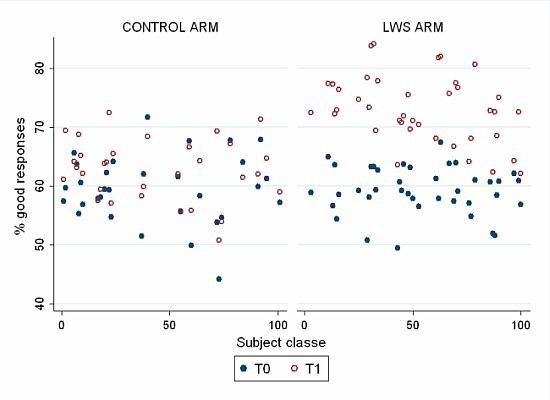
:
1. Introduction
2. Methods
2.1. The Teaching Guide LWS: Composition and Use
2.2. The Evaluation
2.2.1. The Experimental Design
2.2.2. Data Collection and Measures
2.2.3. Statistical Analysis
3. Results and Discussion
3.1. Characteristics of the Children by Groups
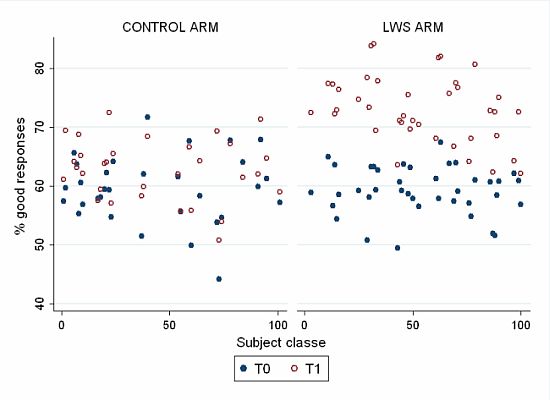
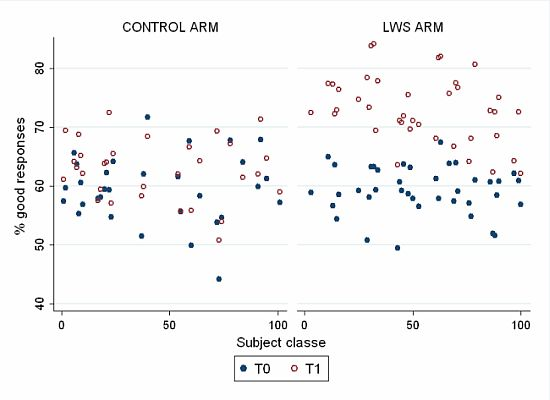
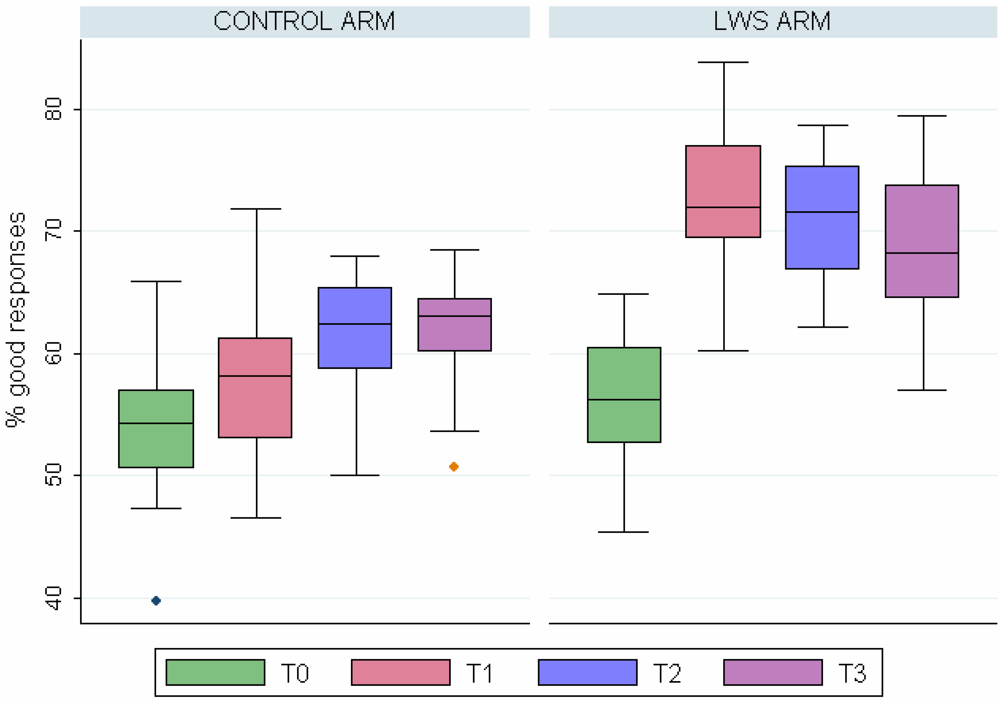
3.2. Modification of Knowledge between T0 and T1

| Characteristics (% item) | LWS group (798) | Control group (567) | |
|---|---|---|---|
| Mean age | 9.93 (SD * = 0.6) | 9.87 (SD * = 0.8) | |
| Gender | % girls | 45.8 | 46.1 |
| Eye colour: | % fair | 34.3 | 35.5 |
| Hair colour | % fair | 49.5 | 52 |
| Skin type I + II + III ** | % | 57.7 | 58.7 |
| Freckles | % no | 70.8 | 70.2 |
| Easy sunburn | % yes | 30.5 | 36 |
| Questionnaire Headings | T0 | T1 | ||
|---|---|---|---|---|
| CTRL 1 | LWS 2 | CTRL | LWS | |
| Does the sun emit visible/invisible rays or gas to the earth? | 57.7 | 58.8 | 58.7 | 63.8 3 |
| What rays produced by the sun can our eye see UV, IR, or white light? | 65.9 | 55.6 3 | 62.4 | 73.4 3 |
| Sun and earth trajectories | 63.4 | 63.4 | 66.7 | 74.5 3 |
| The time of the day the sun has maximum intensity | 28.4 | 33.4 | 29.0 | 49.4 3 |
| Risk for skin and eyes | 62.8 | 61.5 | 62.2 | 78.2 3 |
| What are the good health effects of the sun? | 62.0 | 63.4 | 65.4 | 79.4 3 |
| Sun exposure risks? | 56.8 | 61.6 | 70.2 | 88.3 3 |
| Which clothes are more protective? | 49.3 | 50.8 | 48.9 | 64.6 3 |
| Other types of protection? | 74.3 | 73.5 | 80.4 | 88.2 3 |
| About sunscreen use | 43.8 | 39.3 | 45.3 | 45.6 |
| Use of protection index on sunscreen | 59.5 | 60.2 | 61.6 | 70.1 3 |
| What to do in case of insolation? | 75.2 | 75.4 | 79.5 | 82.4 |
| True or false information | 56.2 | 56.1 | 60.9 | 73.3 3 |
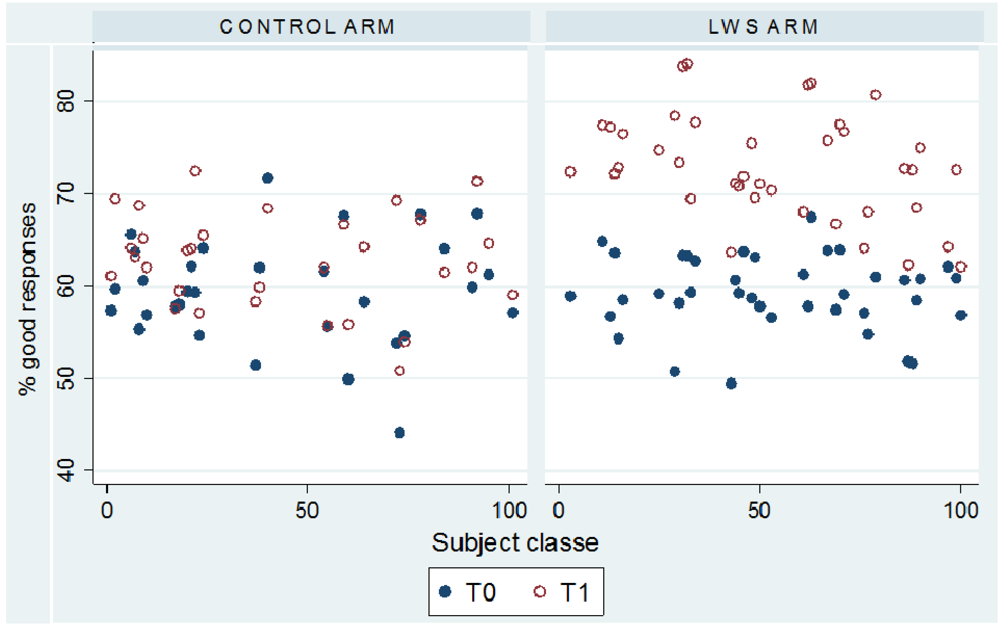
3.3. Modification of Attitude between T0 and T1
| Children’s attitude (% yes) | T0 | T1 | ||
|---|---|---|---|---|
| CTRL 1 | LWS 2 | CTRL 1 | LWS 2 | |
| For you, what does it mean to be tan? | ||||
| To be more beautiful? | 47.5 | 46.1 | 47.4 | 46.6 |
| To be fashionable or trendy | 26.2 | 24.3 | 31.8 | 27.9 |
| To be protected against sunburn? | 36.2 | 37.0 | 35.4 | 48.6 3 |
| When is it necessary to protect yourself from sun exposure? | ||||
| When practicing sports outside? | 70.9 | 74.5 | 77.6 | 81.7 |
| At the swimming pool? | 58.0 | 57.8 | 66.7 | 68.5 |
| On the beach? | 85.2 | 88.5 | 89.6 | 90.2 |
| Walking? | 63.9 | 66.0 | 69.2 | 76.7 3 |
| In the mountains? | 52.2 | 48.9 | 60.0 | 79.1 3 |
| Why do you use sunscreen? | ||||
| To avoid sunburn? | 56.8 | 56.9 | 47.3 | 51.3 |
| To prolong sun exposure? | 8.8 | 11.4 | 13.4 | 15.5 |
| To avoid later skin damage? | 14.6 | 15.0 | 20.5 | 27.6 3 |
| Because your parents want you to? | 10.2 | 11.6 | 19.9 | 16.5 |
| What do you think is the best protection against sun risks? | ||||
| Sunscreen use? | 10.6 | 11.8 | 10.4 | 7.4 |
| Sunscreen use + hat? | 18.2 | 18.6 | 9.3 | 6.1 |
| Sunscreen use + hat + avoid risky hours? | 15.3 | 14.8 | 15.7 | 15.3 |
| Sunscreen, hat, avoid risky hour, sunglasses, T-shirt, all together? | 46.7 | 48.1 | 59.6 | 67.0 3 |
3.4. Results after Summer Holidays
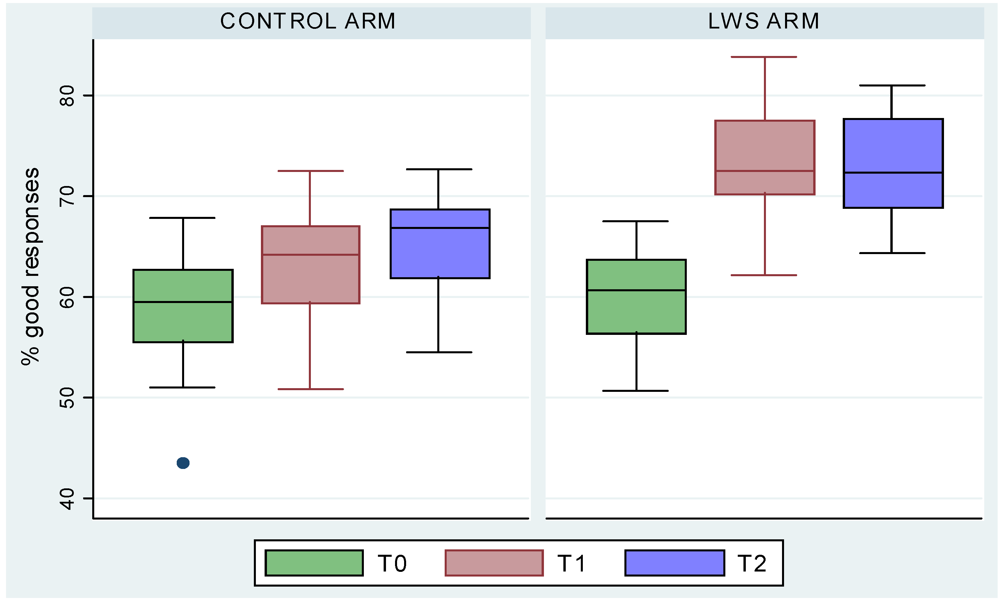
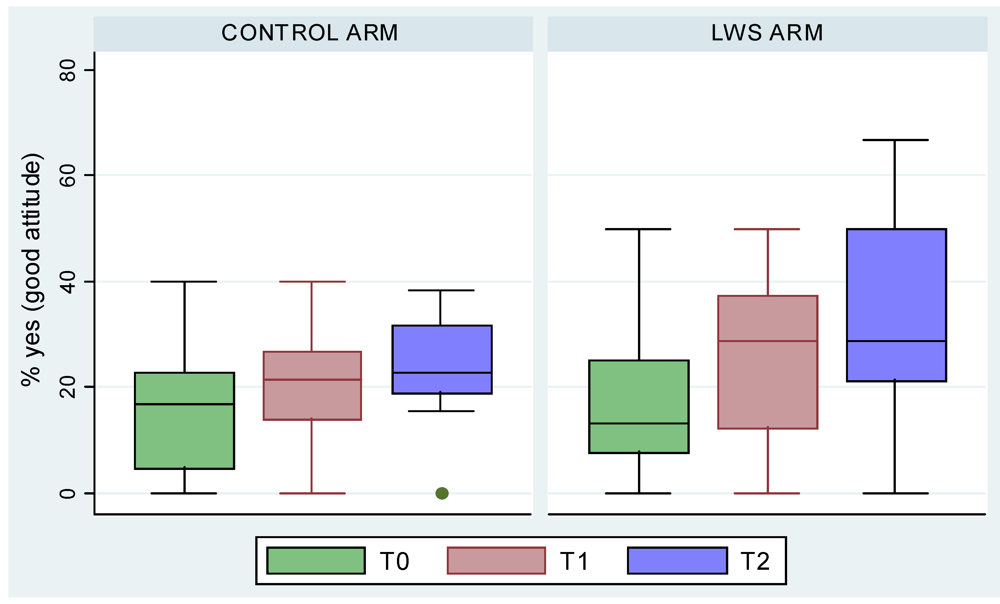
| Questions and answers (%) | T0 | T2 | ||
|---|---|---|---|---|
| CTRL 1 | LWS 2 | CTRL 1 | LWS 2 | |
| During the last summer holidays did you experiment: | ||||
| Skin turning red and burning | 10.1 | 20.7 | 18.5 | 19.6 |
| Skin burnt and swelling | 1.5 | 0.3 | 3.5 | 1.9 |
| Peeled off skin | 24.9 | 23.1 | 23.2 | 22.6 |
| Nothing | 53.7 | 53.7 | 54.8 | 55.1 |
| On the beach do you usually used: | ||||
| A T-shirt | 54.0 | 48.7 | 61.7 | 59.0 |
| A hat | 59.2 | 66.0 | 59.0 | 72.3 3 |
| Sunscreen | 89.7 | 90.5 | 89.6 | 91.8 |
| Sun-glasses | 55.3 | 51.7 | 58.9 | 55.1 |
| Sunshade | 65.8 | 70.1 | 64.5 | 75.2 3 |
| At the swimming pool do you usually used: | ||||
| A T-shirt | 27.6 | 27.8 | 27.6 | 31.4 |
| A hat | 29.5 | 30.5 | 34.6 | 39.1 |
| Sunscreen | 56.5 | 55.1 | 52.4 | 59.6 |
| Sunglasses | 30.2 | 27.1 | 23.2 | 24.7 |
| Sunshade | 20.5 | 22.8 | 21.0 | 28.5 |
| Sunscreen various times during the day? | 48.9 | 56.5 | 57.3 | 65.1 3 |
| Where did you find information on sun exposure? | ||||
| At school? | 51.0 | 65.0 | 58.9 | 79.1 3 |
| On the web? | 19.9 | 18.5 | 18.5 | 22.1 |
| On TV? | 44.9 | 47.9 | 47.5 | 40.8 |
| In books | 43.1 | 43.2 | 38.1 | 31.4 |
| From your parents? | 57.5 | 59.5 | 66.9 | 59.8 3 |
3.5. Results One Year Later

| Questions and answers (%) | T0 | T3 | ||
|---|---|---|---|---|
| CTRL 1 | LWS 2 | CTRL 1 | LWS 2 | |
| On the beach do you usually used: | ||||
| A T-shirt | 55.5 | 48.1 | 52.2 | 65.3 3 |
| A hat | 60.5 | 67.1 | 64.0 | 73.3 3 |
| Sunscreen | 90.1 | 89.0 | 86.8 | 90.4 |
| Sun-glasses | 55.3 | 51.8 | 68.6 | 70.2 |
| Sunshade | 65.2 | 71.5 | 67.2 | 76.2 3 |
| At the swimming pool do you usually used: | ||||
| A T-shirt | 28.9 | 25.5 | 21.2 | 25.1 |
| A hat | 32.8 | 31.8 | 32.3 | 37.2 |
| Sunscreen | 54.9 | 52.1 | 54.2 | 59.5 |
| Sunglasses | 28.9 | 26.6 | 36.5 | 37.6 |
| Sunshade | 21.5 | 26.1 | 22.9 | 27.0 |
| Sunscreen various times during the day? | 44.3 | 56.3 3 | 59.2 | 68.0 4 |
3.6. Discussion
4. Conclusions
Acknowledgments
Conflict of interest
References
- Rosso, S.; Zanetti, R.; Pipione, M.; Sancho-Garnier, H. Parallel risk assessment of melanoma and basal cell carcinoma: Skin characteristics and sun-exposure. Melanoma Res. 1998, 8, 573–583. [Google Scholar]
- Taylor, H.R.; West, S.K.; Rosenthal, F.S.; Munoz, B.; Newland, H.S.; Abbey, H.; Emmet, E.A. Effect of ultraviolet radiation on cataract formation. N. Engl. J. Med. 1988, 319, 1429–1433. [Google Scholar]
- Younf, R.W. Solar radiation and age-related macular degeneration. Surv. Ophtalmol. 1988, 32, 252–269. [Google Scholar]
- Dennis, L.K.; van Beek, M.J.; Beane Freeman, L.E.; Smith, B.J.; Dawson, D.V.; Coughlin, J.A. Sunburns and risk for cutaneous melanoma: Does age matter? A comprehensive meta-analysis. Ann. Epidemiol. 2008, 18, 614–627. [Google Scholar]
- Linos, E.; Swetter, S.M.; Cockburn, M.G.; Colditz, G.A.; Clarke, C.A. Increasing burden of melanoma in the United States. J. Invest. Dermatol. 2009, 129, 1666–1674. [Google Scholar]
- Institut National de Veille Sanitaire. Available online: http://www.invs.sante.fr/surveillance/cancers/estimations_cancers/donnees_localisation (accessed on 12 February 2012).
- Stoebner-Delbarre, A.; Defez, C.; Borrel, E.; Sancho-Garnier, H.; Guillot, B. Groupe EPI-CES. Prevention of skin cancer programs: Analysis of the impact of randomized trials. Ann. Dermatol. Venereol. 2005, 132, 641–647. [Google Scholar] [CrossRef]
- Behavioral Counseling to Prevent Skin Cancer: Systematic Evidence Review to Update the 2003 US Preventive Services Task Force Recommendation; Report number 11-05152-EF-1; Agency for Healthcare Research and Quality (U.S.): Rockville, MD, USA, 2011. Available online: http://www.cdc.gov/mmwr (accessed on 12 April 2012).
- Sandrin-Berthon, B. Apprendre à l’Ecole; ESF: Paris, France, 1997. [Google Scholar]
- Mermelstein, R.J.; Riesenberg, L.A. Changing knowledge and attitudes about skin cancer risk factors in adolescents. Health Psychol. 1992, 11, 371–376. [Google Scholar]
- Hugues, B.R.; Altman, D.G.; Newton, J.A. Melanoma and skin cancer: Evaluation of a health education programme for secondary schools. Br. J. Dermatol. 1993, 128, 412–417. [Google Scholar] [CrossRef]
- Buller, D.B.; Buller, M.K.; Beach, B.; Ertl, G. Sunny days, healthy ways” evaluation of a skin cancer prevention curriculum for elementary school-aged children. J. Am. Acad. Dermatol. 1996, 35, 911–922. [Google Scholar]
- Buller, D.B.; Hall, J.R.; Powers, P.J.; Ellsworth, R.; Beach, B.H.; Frank, C.A.; Maloy, J.A.; Buller, M.K. Evaluation of the “Sunny Days, Healthy Ways” sun safety CD-Rom program for children in grades 4 and 5. Cancer Prev. Control. 1999, 3, 188–195. [Google Scholar]
- Lowe, J.B.; Balanda, K.P.; Stanton, W.R.; Gillespie, A. Evaluation of a three-year school-based intervention to increase adolescent sun protection. Health Educ. Behav. 1999, 26, 396–408. [Google Scholar]
- Milne, E.; English, D.R.; Cross, D.; Corti, B.; Costa, C.; Johnston, R. Evaluation of an intervention to reduce sun exposure in children. Am. J. Epidemiol. 1999, 150, 164–173. [Google Scholar]
- Hornung, R.L.; Lennon, P.A.; Garrett, J.M.; DeVellis, R.F.; Weinberg, P.D.; Strecher, V.J. Interactive computer technology for skin cancer prevention targeting children. Am. J. Prev. Med. 2000, 18, 69–76. [Google Scholar]
- Barankin, B.; Liu, K.; Howard, J.; Guenther, L. Effects of a sun protection program targeting elementary school children and their parents. J. Cutan. Med. Surg. 2001, 5, 2–7. [Google Scholar]
- Glanz, K.; Geller, A.C.; Shigaki, D.; Maddock, J.E.; Isnec, M.R. A randomized trial of skin cancer prevention in aquatics settings: The Pool Cool program. Health Psychol. 2002, 21, 579–587. [Google Scholar]
- Naldi, L.; Chatenoud, L.; Bertuccio, P.; Zinetti, C.; Di Landro, A.; Scotti, L.; La Vecchia, C. Oncology Cooperative Group of the Italian Group for Epidemiologic Research in Dermatology (GISED). Improving sun protection behaviour among children: Results of a cluster-randomized trial in Italian elementary schools. The “SoleSi-SoleNo-GISED” project. J. Invest. Dermatol. 2007, 127, 1871–1877. [Google Scholar]
- Olson, A.L.; Gaffney, C.; Starr, P.; Gibson, J.J.; Cole, B.F.; Dietrich, A.J. Sunsafe in the middle school years: A community wide intervention to change early adolescent sun protection. Pediatrics 2007, 119, e247–e256. [Google Scholar]
- Hunter, S.; Love-Jacson, K.; Abdulla, R.; Zhu, W.; Lee, J.H.; Wells, K.J.; Roetzheim, R. Sun protection at elementary schools: A cluster randomized trial. J. Natl. Cancer Inst. 2010, 102, 484–492. [Google Scholar]
- Roetzheim, R.G.; Love-Jacson, K.M.; Hunter, S.G.; Lee, J.H.; Chen, R.; Abdulla, R.; Wells, K.J. A cluster randomized trial of sun protection at elementary schools. Results from year 2. Am. J. Prev. Med. 2011, 41, 615–618. [Google Scholar] [CrossRef]
- Milne, E.; Johnston, R.; Cross, D.; Giles-Corti, B.; English, D.R. Effect of a school-based sun-protection intervention in the development of melanocytic nevi in children. Am. J. Epidemiol. 2002, 155, 739–745. [Google Scholar]
- English, D.R.; Milne, E.; Jacoby, P.; Giles-Corti, B.; Cross, D.; Johnston, R. The effect of a school-based sun protection intervention in the development of melanocytic nevi in children: 6 year follow-up. Cancer Epidemiol. Biomarkers Prev. 2005, 14, 977–980. [Google Scholar]
- Bauer, J.; Buttner, P.; Wiecker, T.S.; Luther, H.; Garbe, C. Interventional study in 1232 young German children to prevent the development of melanocytic nevi failed to change sun exposure and sun protective behavior. Int. J. Cancer 2005, 116, 755–761. [Google Scholar]
- Harrison, S.L.; Buettner, P.G.; MacLennan, R. The North Queensland “Sun Safe Clothing” study: Design and baseline results of a randomized trial to determine the effectiveness of sun-protective clothing in preventing melanocytic nevi. Am. J. Epidemiol. 2005, 161, 536–545. [Google Scholar]
- Saraiya, M.; Glanz, K.; Briss, P.A.; Nichols, P.; White, C.; Das, D.; Jay Smith, S.; Tannor, B.; Hutchinson, A.B.; Wilson, K.M. Interventions to prevent skin cancer by reducing exposure to ultraviolet radiations: A systematic review. Am. J. Prev. Med. 2004, 27, 422–466. [Google Scholar]
- Wilgenbus, D.; Cesarini, P.; Bense, D. Vivre avec le Soleil, Guide de L’Enseignant; Hatier: Paris, France, 2005. Available online: http://www.soleil.info (accessed on 29 May 2012).
- Quéreux, G.; Nguyen, J.M.; Volteau, C.; Dréno, B. Prospective trial on a school-based skin cancer prevention project. Eur. J. Cancer Prev. 2009, 18, 133–144. [Google Scholar]
- Fitzpatrick, T.B. The validity and practicability of sun-reactive skin types I through to VI. Arch. Dermatol. 1988, 124, 869–871. [Google Scholar]
- Defez, C.; Stoebner-Delbarre, A.; Sancho-Garnier, H. La prévention des cancers cutanés: Résultats de quelques programmes. Oncologie 2002, 4, 488–492. [Google Scholar]
- Peters, L.; Paulussen, T. School Health Promotion and Cancer Prevention. A Review of International Effect Research on Skin Cancer Prevention; NIGZ, European Commission: Brussels, Belgium, 1997. [Google Scholar]
- Conner, M.; Norman, P. Predicting Health Behavior: Research and Practice with Social Cognition Model; Oxford University Press: Buckingham, UK, 1995; p. 230. [Google Scholar]
- Fishbein, M.; Ajtzen, I. Belief, Attitude, Intention, and Behavior; Addison-Wesley: Reading, MA, USA, 1975. [Google Scholar]
- Ajtzen, I. From intention to actions: A Theory of Planned Behavior. In Action-Control: From Cognition to Behavior; Kuhl, J., Beckmann, J., Eds.; Springer: Heidelberg, Germany, 1985; pp. 11–19. [Google Scholar]
- Buller, D.B.; Reynolds, K.D.; Yaroch, A.; Cutter, G.R.; Hines, J.M.; Geno, C.R.; Maloy, J.A.; Brown, M.; Woodall, W.J.; Grandpre, J. Effects of the “Sunny Days Healthy Way” curriculum on students in grades 6 to 8. Am. J. Prev. Med. 2006, 30, 13–22. [Google Scholar]
- Donner, A.; Klar, N. Design and Analysis of Cluster Randomization Trials in Health Research; Wiley: Hoboken, NJ, USA, 2000. [Google Scholar]
- Murray, D.M.; Varnell, S.P.; Blitstein, J.L. Design and analysis of group-randomized trials: A review of recent methodological developments. Am. J. PublicHealth 2004, 94, 423–432. [Google Scholar]
- Zanetti, R.; Rosso, S.; Martinez, C.; Navarro, C.; Schraub, S.; Sancho-Garnier, H.; Franceschi, S.; Gafa, L.; Perea, E.; Tormo, M.J.; et al. The multicentre south European study “Helios” I: Skin characteristics and sunburns in basal cell and squamous cell carcinomas of the skin. Br. J. Cancer 1996, 73, 1440–1446. [Google Scholar] [CrossRef]
- Rosso, S.; Zanetti, R.; Martinez, C.; Tormo, M.J.; Schraub, S.; Sancho-Garnier, H.; Franceschi, S.; Gafa, L.; Perea, E.; Navarro, C.; et al. The multicentre south European study “Helios” II: Different sun exposure patterns in the aetiology of basal cell and squamous cell carcinomas of the skin. Br. J. Cancer 1996, 73, 1447–1454. [Google Scholar] [CrossRef]
- Sancho-Garnier, H. Prévention des Cancers Cutanés: Connaissance, Attitudes et Comportements. In Soleil et Santé (Rapport de l’Académie Nationale de Médecine); Dubertret, L., Ed.; Lavoisier: Paris, France, 2006; pp. 111–114. [Google Scholar]
- Klar, N.; Darlington, G. Methods for modelling in cluster randomization trials. Stat. Med. 2004, 23, 2341–2357. [Google Scholar]
- Benjamini, Y.; Hochberg, Y. Controlling the false discovery rate: A practical and powerful approach to multiple testing. J. R. Statist. Soc. Ser. B 1995, 57, 289–300. [Google Scholar]
- Pereira, B.; Sancho-Garnier, H.; Kramar, A. Methodological Developments of Cluster Randomised Trials (CRT)—How to Analyse a CRT with Repeated Measures? In Proceedings of the International Congress of Epidemiology IEA-EPI, Rio de Janeiro, Brazil, 20–24 September 2008.
- Verbeke, G.; Molenbergs, M. Linear Mixed Models for Longitudinal Data; Springer: New York, NY, USA, 2000; pp. 201–230. [Google Scholar]
- Daurès, J.P.; Sancho-Garnier, H.; Pourrin-Bourdonneau, C.; Fissier, M.; Arnaud, C.; Grabbar, S.; Vergnes, C.; Picot, E.; Meynadier, J. Etude des facteurs démographiques, environnementaux et congénitaux de développement des naevi chez l’enfant entre 3 et 15 ans. Premiers résultats. Rev. Epidém. et Santé Publ. 1995, 43, 461–469. [Google Scholar]
- Abar, B.W.; Turrisi, R.; Hillhouse, J.; Loken, E.; Stapleton, J.; Gunn, H. Preventing skin cancer in college females: Heterogeneous effects over time health. Psychology 2010, 29, 574–582. [Google Scholar]
- Escoffery, C.; Glanz, K.; Hall, D.; Elliot, T. A multi-method process evaluation for a skin cancer prevention diffusion trial. Eval. Health Prof. 2009, 32, 184–203. [Google Scholar]
- Buller, D.B.; Reynolds, K.D.; Ashley, J.L.; Buller, M.K.; Kane, I.L.; Stabe, C.L.; Massie, K.L.; Liu, X.; Cutter, G.R. Motivating public school districts to adopt sun protection policies: A randomized controlled trial. Am. J. Prev. Med. 2011, 41, 309–316. [Google Scholar]
- Azorin, J.C.; Stoebner-Delbarre, A. L’Education Promotricede Santé des Enfants de 3 à 11 ans. In Au Delà de L’information la Prévention; Sancho-Garnier, H., Ed.; Springer: Paris, France, 2007. [Google Scholar]
- Slama, K. Health Behavior and Change. Evidence-Based Cancer Prevention: Strategies for NGOs: A UICC Handbook for Europe; UICC: Geneva, Switzerland, 2004. Available online: http://www.uicc.org (accessed on 12 February 2012).
© 2012 by the authors; licensee MDPI, Basel, Switzerland. This article is an open-access article distributed under the terms and conditions of the Creative Commons Attribution license (http://creativecommons.org/licenses/by/3.0/).
Share and Cite
Sancho-Garnier, H.; Pereira, B.; Césarini, P. A Cluster Randomized Trial to Evaluate a Health Education Programme “Living with Sun at School”. Int. J. Environ. Res. Public Health 2012, 9, 2345-2361. https://doi.org/10.3390/ijerph9072345
Sancho-Garnier H, Pereira B, Césarini P. A Cluster Randomized Trial to Evaluate a Health Education Programme “Living with Sun at School”. International Journal of Environmental Research and Public Health. 2012; 9(7):2345-2361. https://doi.org/10.3390/ijerph9072345
Chicago/Turabian StyleSancho-Garnier, Hélène, Bruno Pereira, and Pierre Césarini. 2012. "A Cluster Randomized Trial to Evaluate a Health Education Programme “Living with Sun at School”" International Journal of Environmental Research and Public Health 9, no. 7: 2345-2361. https://doi.org/10.3390/ijerph9072345