<?xml version="1.0" encoding="UTF-8"?>
<!DOCTYPE article PUBLIC "-//NLM//DTD Journal Publishing DTD v2.3 20070202//EN" "journalpublishing.dtd">
<article xmlns:xlink="http://www.w3.org/1999/xlink" xml:lang="en" article-type="research-article">
<front>
<journal-meta>
<journal-id journal-id-type="publisher-id">101238455</journal-id>
<journal-title>International Journal of Environmental Research and Public Health</journal-title>
<issn pub-type="ppub">1661-7827</issn>
<issn pub-type="epub">1660-4601</issn>
<publisher>
<publisher-name>Molecular Diversity Preservation International (MDPI)</publisher-name></publisher></journal-meta>
<article-meta>
<article-id pub-id-type="doi">10.3390/ijerph8083179</article-id>
<article-id pub-id-type="publisher-id">ijerph-08-03179</article-id>
<article-categories>
<subj-group>
<subject>Article</subject></subj-group></article-categories>
<title-group>
<article-title>Fumonisin B<sub>1</sub> Toxicity in Grower-Finisher Pigs: A Comparative Analysis of Genetically Engineered Bt Corn and non-Bt Corn by Using Quantitative Dietary Exposure Assessment Modeling</article-title></title-group>
<contrib-group>
<contrib contrib-type="author">
<name><surname>Delgado</surname><given-names>James E.</given-names></name><xref ref-type="corresp" rid="c1-ijerph-08-03179"><sup>*</sup></xref></contrib>
<contrib contrib-type="author">
<name><surname>Wolt</surname><given-names>Jeffrey D.</given-names></name></contrib>
<aff id="af1-ijerph-08-03179">Interdepartmental Toxicology Program, Department of Agronomy, Iowa State University, Ames, IA 50011, USA; E-Mail: <email>jdwolt@iastate.edu</email></aff></contrib-group>
<author-notes>
<corresp id="c1-ijerph-08-03179">
<label>*</label>Author to whom correspondence should be addressed; E-Mail: <email>jdelgado@iastate.edu</email>; Tel.: +1-515-294-9629.</corresp></author-notes>
<pub-date pub-type="ppub">
<month>8</month>
<year>2011</year></pub-date>
<pub-date pub-type="epub">
<day>28</day>
<month>7</month>
<year>2011</year></pub-date>
<volume>8</volume>
<issue>8</issue>
<fpage>3179</fpage>
<lpage>3190</lpage>
<history>
<date date-type="received">
<day>11</day>
<month>5</month>
<year>2011</year></date>
<date date-type="rev-recd">
<day>12</day>
<month>7</month>
<year>2011</year></date>
<date date-type="accepted">
<day>15</day>
<month>7</month>
<year>2011</year></date></history>
<permissions>
<copyright-statement>© 2011 by the authors; licensee MDPI, Basel, Switzerland.</copyright-statement>
<copyright-year>2011</copyright-year>
<license license-type="open-access" xlink:href="http://creativecommons.org/licenses/by/3.0">
<p>This article is an open-access article distributed under the terms and conditions of the Creative Commons Attribution license (http://creativecommons.org/licenses/by/3.0/).</p></license></permissions>
<abstract>
<p>In this study, we investigate the long-term exposure (20 weeks) to fumonisin B<sub>1</sub> (FB<sub>1</sub>) in grower-finisher pigs by conducting a quantitative exposure assessment (QEA). Our analytical approach involved both deterministic and semi-stochastic modeling for dietary comparative analyses of FB<sub>1</sub> exposures originating from genetically engineered <italic>Bacillus thuringiensis</italic> (Bt)-corn, conventional non-Bt corn and distiller’s dried grains with solubles (DDGS) derived from Bt and/or non-Bt corn. Results from both deterministic and semi-stochastic demonstrated a distinct difference of FB<sub>1</sub> toxicity in feed between Bt corn and non-Bt corn. Semi-stochastic results predicted the lowest FB<sub>1</sub> exposure for Bt grain with a mean of 1.5 mg FB<sub>1</sub>/kg diet and the highest FB<sub>1</sub> exposure for a diet consisting of non-Bt grain and non-Bt DDGS with a mean of 7.87 mg FB<sub>1</sub>/kg diet; the chronic toxicological incipient level of concern is 1.0 mg of FB<sub>1</sub>/kg of diet. Deterministic results closely mirrored but tended to slightly under predict the mean result for the semi-stochastic analysis. This novel comparative QEA model reveals that diet scenarios where the source of grain is derived from Bt corn presents less potential to induce FB<sub>1</sub> toxicity than diets containing non-Bt corn.</p></abstract>
<kwd-group>
<kwd><italic>Bacillius thuringiensis corn</italic></kwd>
<kwd>Bt corn</kwd>
<kwd>swine diet</kwd>
<kwd>DDGS</kwd>
<kwd>fumonisin</kwd>
<kwd>risk assessment</kwd></kwd-group></article-meta></front>
<body>
<sec sec-type="intro">
<label>1.</label>
<title>Introduction</title>
<p>Fumonisins are a series of mycotoxins ubiquitous in Nature, infecting corn (<italic>Zea mays</italic> L<italic>)</italic> and other grains throughout the World. Major fumonisin fungi species-mycotoxin associations are derived from <italic>Fusarium verticilliodes</italic> (formerly known as <italic>F. moniliforme</italic>) and <italic>F. proliferatum.</italic> Minor fumonisin sources include <italic>Fusarium nygamai, F. napiforme</italic>, <italic>F. thapsinum</italic>, <italic>F. anthophilum and F. dlamini</italic> [<xref ref-type="bibr" rid="b1-ijerph-08-03179">1</xref>]. Detection of mycotoxicosis usually involves a close association between the consumption of moldy feed and a specific onset of toxicological effects, altered performance or behavior. Fumonisin-induced porcine pulmonary edema (PPE) is a well-established toxin specific adverse effect [<xref ref-type="bibr" rid="b2-ijerph-08-03179">2</xref>], and fumonisin also has the potential to negatively impact the food and feed market due to contaminated grain [<xref ref-type="bibr" rid="b3-ijerph-08-03179">3</xref>].</p>
<p>We recently reported after conducting an exposure assessment that swine populations in nursery facilities may frequently exhibit incipient fumonisin B<sub>1</sub> (FB<sub>1</sub>) toxicological effects (<italic>i.e.</italic>, 8% decrease in average daily weight gain) when diets are contaminated at 1 mg of FB<sub>1</sub>/kg of diet. The results of Delgado and Wolt [<xref ref-type="bibr" rid="b4-ijerph-08-03179">4</xref>] have been largely validated by the recent study of Rossi <italic>et al.</italic> [<xref ref-type="bibr" rid="b5-ijerph-08-03179">5</xref>] which reports better performance in weaned piglets fed Bt corn compared to piglets fed near isogenic corn and suggests better performance due to lower FB<sub>1</sub> associated with Bt corn [<xref ref-type="bibr" rid="b4-ijerph-08-03179">4</xref>,<xref ref-type="bibr" rid="b5-ijerph-08-03179">5</xref>]. The authors’ goals in this investigation are to better understand the lifetime exposure (<italic>utero</italic>-to-finish) and toxicity of FB<sub>1</sub> in pig diets. Due to the variation of percent corn in the diet design throughout the lifetime production, we have divided our quantitative exposure assessment (QEA) modeling into three major components: gestation, nursery, and grower-finisher. This investigation is currently focused on the grower-finisher component and will use our previously established analytical exposure model framework. The only variation in the grower-finisher model compared to our previous nursery model is the current inputs reflect diet formulation for grower-finisher pigs.</p>
<p>Quantitative exposure assessment was conducted using both deterministic (single-point estimates) and stochastic (probabilistic) analysis for comparative interpretation of FB<sub>1</sub> exposure originating from genetically engineered <italic>Bacillus thuringiensis</italic> (Bt)-corn, conventional non-Bt corn and distiller’s dried grains with solubles (DDGS). Comparative analysis between Bt corn and non-Bt corn is conducted to determine if FB<sub>1</sub> concentrations differ depending on the corn source, estimating which swine populations may be more susceptible to FB<sub>1</sub> toxicity.</p></sec>
<sec sec-type="materials|methods">
<label>2.</label>
<title>Materials and Methods</title>
<p>Animal Care and Use Committee approval was not obtained for this study because forecast data were derived from existing literature.</p>
<sec>
<label>2.1.</label>
<title>Analytical Model</title>
<p>Characterization of risk from FB<sub>1</sub> dietary exposure was estimated by using a conceptual model, which consists of three major components: toxicological effects (levels of concern, LOC), swine management, and agronomic management as described in Delgado and Wolt [<xref ref-type="bibr" rid="b4-ijerph-08-03179">4</xref>]. Six scenarios were developed to consider FB<sub>1</sub> exposure influenced by corn and DDGS as the primary protein source in diets:
<list list-type="bullet">
<list-item>
<p>Scenario 1: Blended diet (Bt grain, non-Bt grain, Bt-DDGS and non-Bt DDGS)</p></list-item>
<list-item>
<p>Scenario 2: Bt grain and Bt DDGS</p></list-item>
<list-item>
<p>Scenario 3: non-Bt grain and non-Bt DDGS</p></list-item>
<list-item>
<p>Scenario 4: Bt and non-Bt grain</p></list-item>
<list-item>
<p>Scenario 5: Bt grain</p></list-item>
<list-item>
<p>Scenario 6: non-Bt grain</p></list-item></list></p></sec>
<sec>
<label>2.2.</label>
<title>Exposure Characterization and Model Parameterization</title>
<p>Information necessary to forecast FB<sub>1</sub> exposure and model parameterization needed to estimate risk consistent with the conceptual model is presented in the following subsections. Each diet scenario required separate sets of worksheets (Microsoft Excel 2010) to describe the FB<sub>1</sub> exposure. Deterministic inputs (<xref ref-type="table" rid="t1-ijerph-08-03179">Table 1</xref>) used average, maximum, midpoint or fixed parameter estimates and all probabilistic modeling (<xref ref-type="table" rid="t1-ijerph-08-03179">Table 1</xref>) used Palisade @Risk 5.7 with random Latin hypercube sampling [<xref ref-type="bibr" rid="b6-ijerph-08-03179">6</xref>]. The term semi-stochastic will be used to refer to the non-deterministic modeling which does not contain distributions for the inputs of specific week in grower-finisher phase, Bt use fraction in diets and estimations of FB<sub>1</sub> in corn. Refer to <xref ref-type="table" rid="t1-ijerph-08-03179">Table 1</xref> for descriptions of model input assumptions.</p>
<p><italic>Swine Management</italic>. Model parameterization required for diet development included the following: mycotoxin exposure assessed by weekly intervals during the production phase, changes in body weight (BW) over time (<italic>i.e.</italic>, weekly), and total corn intake fraction (TCIF). Information for modeling the diet reflected a typical corn-soybean diet for swine facilities in the Midwestern USA.</p>
<p><italic>Duration of Exposure (Weekly).</italic> For the purpose of this dietary exposure assessment, weekly intervals were modeled in order to estimate variations of FB<sub>1</sub> in diets. Estimating exposure by daily intervals was not conducted due to limited changes in diet composition. The sampling of the weekly intervals (<italic>i.e.</italic>, 20 weeks) during production allows for an estimated correlated BW and expected TCIF in accordance with the Kansas State University Growth and Feed Intake Curve Calculator (FICC, see BW and TCIF below). All deterministic modeling scenarios used the 10<sup>th</sup> week of production to represent the midpoint of duration. For the semi-stochastic analysis a total of 20 weekly intervals of production were partitioned into six timeframes representative of weight ranges corresponding to the TCIF (<xref ref-type="table" rid="t2-ijerph-08-03179">Table 2</xref> and <xref ref-type="table" rid="t3-ijerph-08-03179">Table 3</xref>) and sampled by a discrete uniform distribution to estimate the body weight associated with weekly interval.</p>
<p><italic>Bodyweight (BW)</italic>. Determination of BW was calculated by the Kansas State University Growth FICC as a function of the specific week during production [<xref ref-type="bibr" rid="b7-ijerph-08-03179">7</xref>]. Parameterization inputs for the FICC included initial nursery average BW of 5.67 kg and an average daily gain of 0.39 kg. Initial BW of grower-finisher production was 22.68 kg with an average daily gain of 0.82 kg, and 120.20 kg as the close out average BW. Values of BW were calculated at the end of the indicated week after placement into the grower-finisher phase (<xref ref-type="table" rid="t2-ijerph-08-03179">Table 2</xref>).</p>
<p><italic>Total Corn Intake Fraction.</italic> Estimation of the TCIF in diet is based on the BW intervals associated within the 20 week production duration (<xref ref-type="table" rid="t3-ijerph-08-03179">Table 3</xref>) [<xref ref-type="bibr" rid="b9-ijerph-08-03179">9</xref>].</p></sec>
<sec>
<label>2.3.</label>
<title>Agronomic Management</title>
<p><italic>Bt vs. non-Bt Corn Fraction in Diet.</italic> Estimation of the fraction of Bt and non-Bt corn in swine diets was conducted by using the percentage of US hectares planting Bt and non-Bt seed corn. The USDA National Agricultural Statistics Service (NASS) estimated in 2010 that 15% of corn planted in the state of Iowa was insect-resistant (Bt) and 61% of all corn planted in Iowa was stacked gene varieties (Bt plus herbicide resistance) [<xref ref-type="bibr" rid="b10-ijerph-08-03179">10</xref>]. Therefore, in our deterministic model we assume that the TCIF in swine diets has a maximum Bt use fraction (BUF) representing 76% of Iowa corn planted, whereas the stochastic analysis distribution was developed from hectares planted in the major corn production states of the US [<xref ref-type="bibr" rid="b10-ijerph-08-03179">10</xref>]. For stochastic analysis Bt-corn adoption fractions were estimated by using a beta generalized distribution as described by Delgado and Wolt (<xref ref-type="table" rid="t4-ijerph-08-03179">Table 4</xref>) [<xref ref-type="bibr" rid="b4-ijerph-08-03179">4</xref>].</p>
<p><italic>DDGS Fraction in Diet</italic>. In the Midwestern USA DDGS is increasingly used as an alternative feed source due to increased prices of corn and the widespread availability of DDGS as a by-product of ethanol production. Producers usually design the diets to use the maximum allowed percentage of DDGS. Therefore, DDGS distributions were not used in the models. Both deterministic and semi-stochastic modeling used a maximum of 30% DDGS in the diet formulation, since this value represents acceptable growth performance for swine in the grower-finisher phase [<xref ref-type="bibr" rid="b8-ijerph-08-03179">8</xref>].</p>
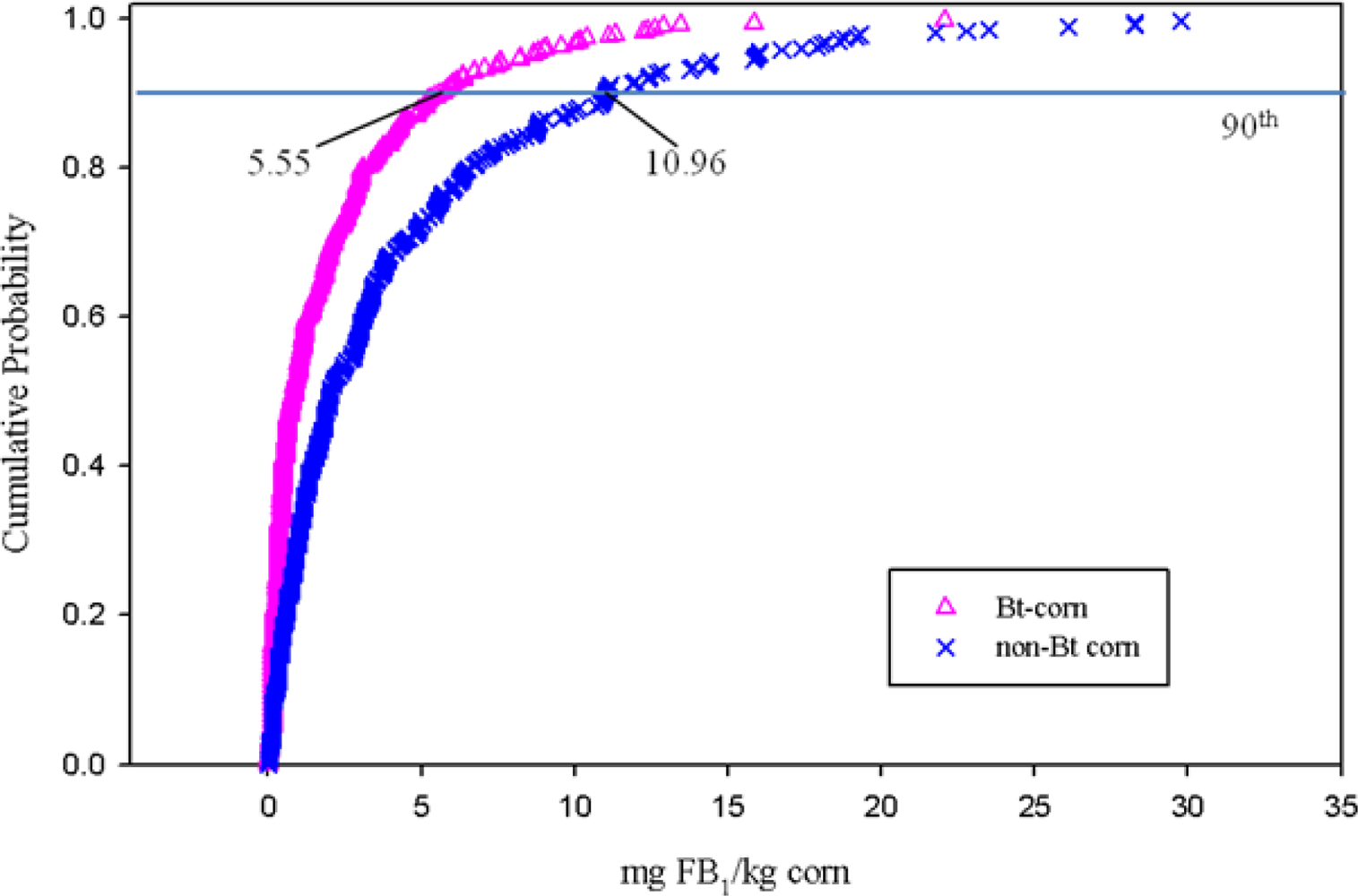
<p><italic>Fumonisin B<sub>1</sub> Concentrations in Bt-hybrids, Non-Bt Hybrids, and DDGS</italic>. Paired trials of Bt and non-Bt hybrids were used for estimates of FB<sub>1</sub> in diets, which were expressed as cumulative distribution functions (CDF) describing the empirical data (<xref ref-type="fig" rid="f1-ijerph-08-03179">Figure 1</xref>) [<xref ref-type="bibr" rid="b11-ijerph-08-03179">11</xref>–<xref ref-type="bibr" rid="b21-ijerph-08-03179">21</xref>]. For specific details pertaining to the CDF calculations, see Delgado and Wolt [<xref ref-type="bibr" rid="b4-ijerph-08-03179">4</xref>]. Estimates of FB<sub>1</sub> concentration in DDGS used a 3-fold scaling for both deterministic and semi-stochastic analysis as a typically reported value [<xref ref-type="bibr" rid="b3-ijerph-08-03179">3</xref>].</p>
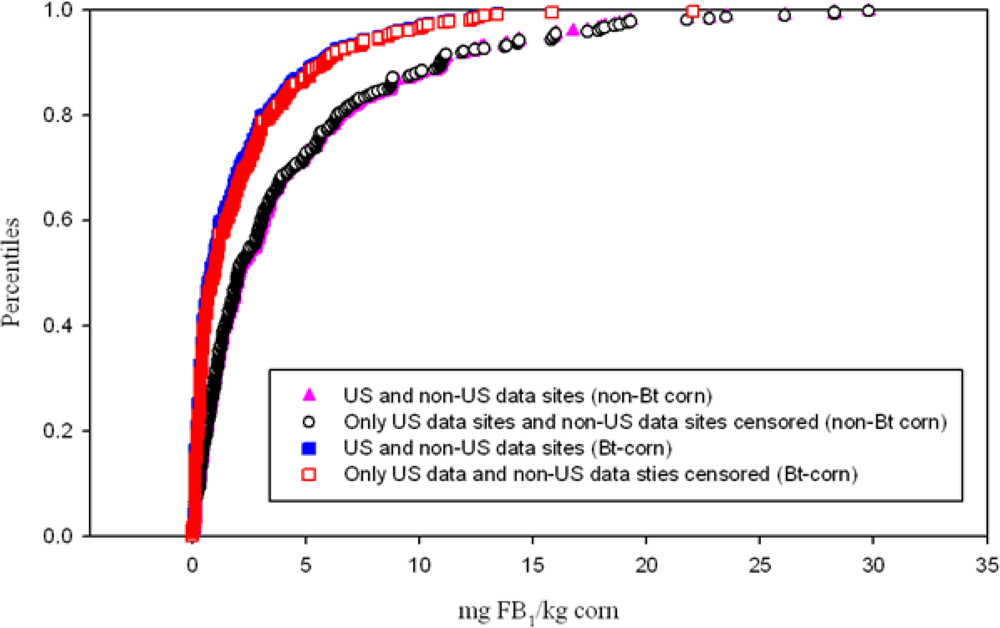
<p>Information used to generate CDF contains both US and non-US data. We considered very carefully the source data and rationale for inclusion of non-US data sites. Rationale for inclusiveness is to better represent the potential variation in FB<sub>1</sub> due to diverse genetic backgrounds and environments (e.g., location and years). The inclusion of non-US data represents 8.31% (<italic>i.e.</italic>, 32 observations in a total of 385) of the total data used to represent FB<sub>1</sub> in corn (<xref ref-type="fig" rid="f2-ijerph-08-03179">Figure 2</xref>).</p></sec>
<sec>
<label>2.4.</label>
<title>Effects Characterization</title>
<p>Chronic toxicological adverse effects associated with FB<sub>1</sub> concentrations relevant to dietary exposure in the grower-finisher production phase for formulating the incipient level of concern (LOC) are reviewed in depth by Delgado and Wolt [<xref ref-type="bibr" rid="b4-ijerph-08-03179">4</xref>] and include the toxicological study of Rotter <italic>et al.</italic> [<xref ref-type="bibr" rid="b22-ijerph-08-03179">22</xref>]. The LOC for this QEA is 1.0 mg of FB<sub>1</sub>/kg of diet, which is consistent with the lower LOC used by Delgado and Wolt in the QEA for swine in nurseries [<xref ref-type="bibr" rid="b4-ijerph-08-03179">4</xref>].</p></sec></sec>
<sec sec-type="results">
<label>3.</label>
<title>Results</title>
<sec sec-type="results">
<label>3.1.</label>
<title>Deterministic Results</title>
<p>Existing data were used to forecast long-term FB<sub>1</sub> exposures in feeding scenarios which may occur in the swine industry. Risk findings were expressed as the probability for exposures to exceed the LOC for long-term effects (1 mg FB<sub>1</sub>/kg diet). All diet scenarios predicted some level of FB<sub>1</sub> exposure exceeding the LOC (<xref ref-type="table" rid="t5-ijerph-08-03179">Table 5</xref>). Diet scenarios where the source of grain or DDGS is derived from non-Bt corn (scenarios 3 and 6) pose the greatest opportunity for exceeding the LOC. Scenarios including only Bt grain (scenario 5) without DDGS exhibited the least mycotoxin exposure. The blended diet design (scenario 1) containing Bt and non-Bt grain and DDGS was ranked intermediate relative to other diet scenarios.</p></sec>
<sec sec-type="results">
<label>3.2.</label>
<title>Semi-Stochastic Results</title>
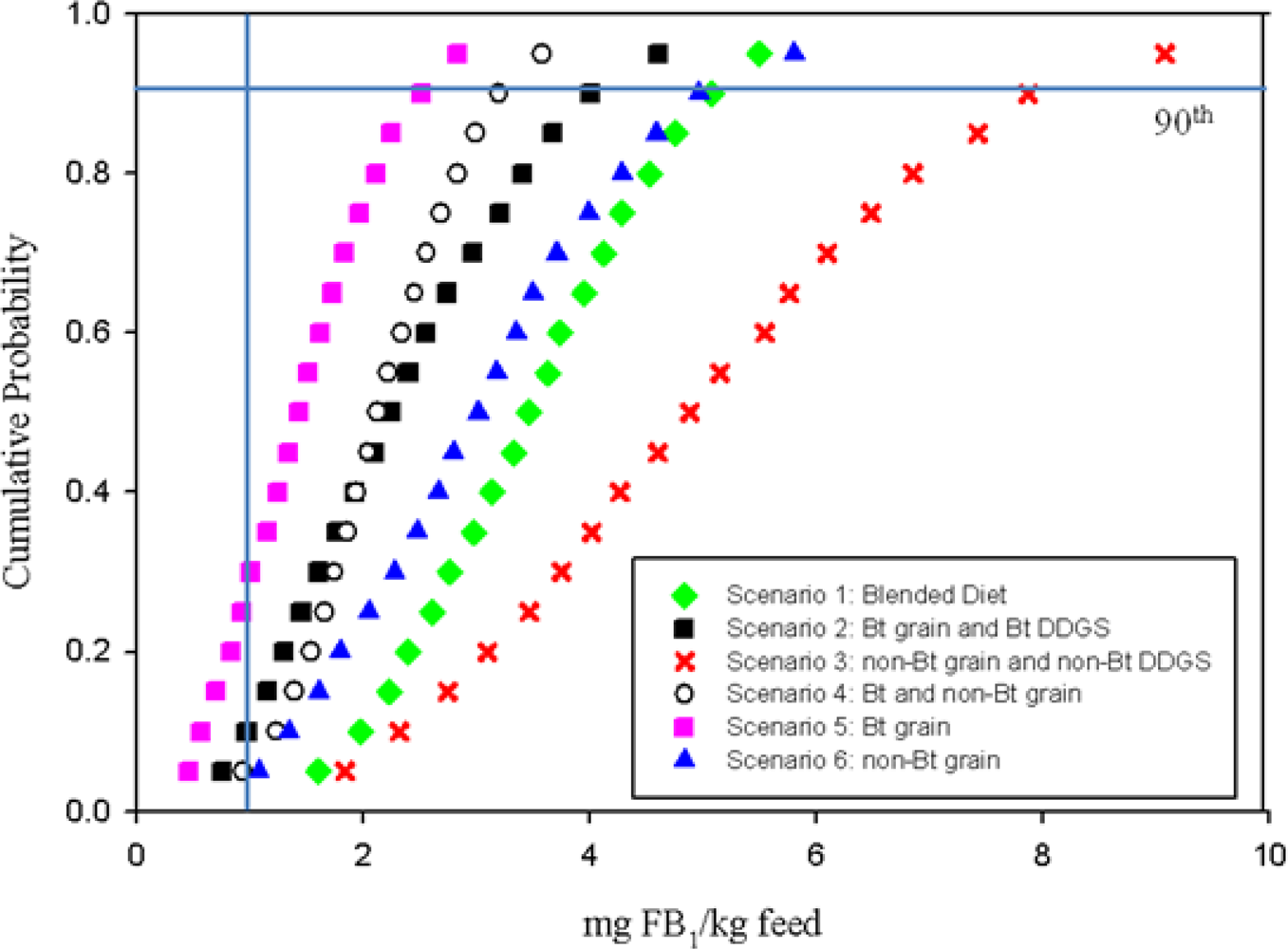
<p>FB<sub>1</sub> exposures exceeding the LOC were forecasted for all diet scenarios (<xref ref-type="fig" rid="f3-ijerph-08-03179">Figure 3</xref>). Variation of FB<sub>1</sub> exposure among scenarios and worst-case incidences representing the 90th percentile of exposure (<xref ref-type="table" rid="t5-ijerph-08-03179">Table 5</xref>) showed the least risk when the diets were developed with Bt grain only (scenario 5) while non-Bt and non-Bt DDGS diets (scenario 3) showed the highest LOC exceedance in 95% of cases. The percentile exceedance of LOC (1 mg FB<sub>1</sub>/kg diet) forecasted were:
<list list-type="bullet">
<list-item>
<p>Scenario 1: Blended diet (95% of occasions)</p></list-item>
<list-item>
<p>Scenario 2: Bt-grain and Bt DDGS (85% of occasions)</p></list-item>
<list-item>
<p>Scenario 3: non-Bt and non-Bt DDGS (95% of occasions)</p></list-item>
<list-item>
<p>Scenario 4: Bt-grain and non-Bt grain (90% of occasions)</p></list-item>
<list-item>
<p>Scenario 5: Bt grain (70% of occasions)</p></list-item>
<list-item>
<p>Scenario 6: non-Bt grain (95% of occasions)</p></list-item></list></p></sec></sec>
<sec sec-type="discussion">
<label>4.</label>
<title>Discussion</title>
<p>Semi-stochastic results predicted FB<sub>1</sub> ranging from 1.50 to 5.08 and 2.52 to 7.87 mg FB<sub>1</sub>/kg diet for the mean and 90th percentile, respectively, where the chronic toxicological incipient level of concern is 1.0 mg of FB<sub>1</sub>/kg of diet. Due to the lack of toxicological data in grower-finisher pigs, it is difficult to predict the possible adverse effects induced above the LOC. Additional studies will be required to fully understand the potential negative impact(s) that may be generated from chronic low-dose exposure to FB<sub>1</sub> diets. It is worth noting that the blended diet (scenario 1) may represent the swine industry as a whole; however, it is more likely that diets will contain 1 type of corn source or 1 type of DDGS. Methods of preventing, decontaminating and minimizing the toxicity of mycotoxins in feeds has been discussed by Jouany [<xref ref-type="bibr" rid="b23-ijerph-08-03179">23</xref>].</p>
<p>Long-term, low-dose exposures to FB<sub>1</sub> in swine feed (as well as in the diets for other sensitive species with a large component of corn and/or DDGS) may represent a factor limiting health and productivity even when FB<sub>1</sub> is controlled to levels below the acute advisory limits. Both our previous QEA and the recent study of Rossi <italic>et al</italic>. show any potential concern for FB<sub>1</sub> chronic toxicity in nursery production will be largely alleviated by the use of Bt corn in the feed [<xref ref-type="bibr" rid="b4-ijerph-08-03179">4</xref>,<xref ref-type="bibr" rid="b5-ijerph-08-03179">5</xref>]. In order to understand the lifetime exposure (<italic>utero</italic>-to-finish) of FB<sub>1</sub>, further QEA models will be required for the gestation phase. This novel Bt and non-Bt comparative dietary QEA model may assist researchers in the dosimetry exposure characterization of experimental designs.</p>
<sec>
<title>Uncertainties in Assessment</title>
<p>Our current model did not include environmental factors inputs, such as temperature, insect pressure, and storage practice variations [<xref ref-type="bibr" rid="b24-ijerph-08-03179">24</xref>]. However, since we have used data for FB<sub>1</sub> corn spanning multiple use environments and seven growing seasons, the effects of environmental factors is represented in our sampling distribution.</p>
<p>Estimating the DDGS concentration factor of a 3-fold increase is an overestimate of FB<sub>1</sub> in diets. Preliminary research to determine the DDGS FB<sub>1</sub> concentration factors is estimated to range from 1.5 to 2.8 fold [<xref ref-type="bibr" rid="b25-ijerph-08-03179">25</xref>]. Inclusion of 30% DDGS throughout the entire grower-finisher production phase has been documented to induce softer pork fat due to high concentrations of linoleic acid in the oil of DDGS, resulting in pork fat iodine that are not acceptable. Therefore, recommendations suggest the removal of DDGS at least 3 weeks before slaughter [<xref ref-type="bibr" rid="b8-ijerph-08-03179">8</xref>]. The current model included DDGS in diets throughout the production phase without removal.</p></sec></sec></body>
<back>
<ack>
<p>Appreciation is expressed to K. Stalder for swine nutrition consultation.</p></ack>
<ref-list>
<title>References</title>
<ref id="b1-ijerph-08-03179"><label>1.</label><citation citation-type="journal"><person-group person-group-type="author"><name><surname>Frisvad</surname><given-names>JC</given-names></name><name><surname>Thrane</surname><given-names>U</given-names></name><name><surname>Samson</surname><given-names>RA</given-names></name><name><surname>Pitt</surname><given-names>JI</given-names></name></person-group><article-title>Important mycotoxins and the fungi which produce them</article-title><source>Adv. Food Mycol</source><year>2006</year><volume>571</volume><fpage>3</fpage><lpage>31</lpage></citation></ref>
<ref id="b2-ijerph-08-03179"><label>2.</label><citation citation-type="journal"><person-group person-group-type="author"><name><surname>Haschek</surname><given-names>WM</given-names></name><name><surname>Gumprecht</surname><given-names>LA</given-names></name><name><surname>Smith</surname><given-names>G</given-names></name><name><surname>Tumbleson</surname><given-names>ME</given-names></name><name><surname>Constable</surname><given-names>PD</given-names></name></person-group><article-title>Fumonisin toxicosis in swine: An overview of porcine pulmonary edema and current perspectives</article-title><source>Environ. Health Perspect</source><year>2001</year><volume>109</volume><fpage>251</fpage><lpage>257</lpage><pub-id pub-id-type="pmid">11359693</pub-id></citation></ref>
<ref id="b3-ijerph-08-03179"><label>3.</label><citation citation-type="journal"><person-group person-group-type="author"><name><surname>Wu</surname><given-names>F</given-names></name><name><surname>Munkvold</surname><given-names>GP</given-names></name></person-group><article-title>Mycotoxins in ethanol co-products: Modeling economic impacts on the livestock industry and management strategies</article-title><source>J. Agr. Food Chem</source><year>2008</year><volume>56</volume><fpage>3900</fpage><lpage>3911</lpage><pub-id pub-id-type="doi">10.1021/jf072697e</pub-id></citation></ref>
<ref id="b4-ijerph-08-03179"><label>4.</label><citation citation-type="journal"><person-group person-group-type="author"><name><surname>Delgado</surname><given-names>JE</given-names></name><name><surname>Wolt</surname><given-names>JD</given-names></name></person-group><article-title>Fumonisin B1 and implications in nursery swine productivity: A quantitative exposure assessment</article-title><source>J. Anim. Sci</source><year>2010</year><volume>88</volume><fpage>3767</fpage><lpage>3777</lpage><pub-id pub-id-type="doi">10.2527/jas.2009-2422</pub-id><pub-id pub-id-type="pmid">20622179</pub-id></citation></ref>
<ref id="b5-ijerph-08-03179"><label>5.</label><citation citation-type="journal"><person-group person-group-type="author"><name><surname>Rossi</surname><given-names>F</given-names></name><name><surname>Morlacchini</surname><given-names>M</given-names></name><name><surname>Fusconi</surname><given-names>G</given-names></name><name><surname>Pietri</surname><given-names>A</given-names></name><name><surname>Piva</surname><given-names>G</given-names></name></person-group><article-title>Effect of insertion of Bt gene in corn and different fumonisin content on growth performance of weaned piglets</article-title><source>Ital. J. Anim. Sci</source><year>2011</year><volume>10</volume><fpage>95</fpage><lpage>100</lpage></citation></ref>
<ref id="b6-ijerph-08-03179"><label>6.</label><citation citation-type="book"><person-group person-group-type="author"><name><surname>Cullen</surname><given-names>AC</given-names></name><name><surname>Frey</surname><given-names>HC</given-names></name></person-group><source>Probabilistic Techniques in Exposure Assessment: A Handbook for Dealing with Variability and Uncertainty in Models and Inputs</source><publisher-name>Plenum Press</publisher-name><publisher-loc>New York, NY, USA</publisher-loc><year>1999</year><fpage>39</fpage></citation></ref>
<ref id="b7-ijerph-08-03179"><label>7.</label><citation citation-type="other"><person-group person-group-type="author"><name><surname>Goodband</surname><given-names>RD</given-names></name></person-group><comment>Kansas State University: Manhattan, KS, USA, personal communication, 2008.</comment></citation></ref>
<ref id="b8-ijerph-08-03179"><label>8.</label><citation citation-type="journal"><person-group person-group-type="author"><name><surname>Stein</surname><given-names>HH</given-names></name><name><surname>Shurson</surname><given-names>GC</given-names></name></person-group><article-title>BOARD-INVITED REVIEW: The use and application of distillers dried grains with solubles in swine diets</article-title><source>J. Anim. Sci</source><year>2009</year><volume>87</volume><fpage>1292</fpage><lpage>1303</lpage><pub-id pub-id-type="doi">10.2527/jas.2008-1290</pub-id><pub-id pub-id-type="pmid">19028847</pub-id></citation></ref>
<ref id="b9-ijerph-08-03179"><label>9.</label><citation citation-type="book"><person-group person-group-type="author"><name><surname>DeRouchey</surname><given-names>JM</given-names></name><name><surname>Tokach</surname><given-names>MD</given-names></name><name><surname>Dritz</surname><given-names>SS</given-names></name><name><surname>Goodband</surname><given-names>RD</given-names></name><name><surname>Nelssen</surname><given-names>JL</given-names></name></person-group><source>Growing-Finishing Pig Recommendations, MF2300</source><publisher-name>Kansas State University Agriculture Experiment Station and Cooperative Extension Service</publisher-name><publisher-loc>Manhattan, NY, USA</publisher-loc><year>2007</year></citation></ref>
<ref id="b10-ijerph-08-03179"><label>10.</label><citation citation-type="book"><person-group person-group-type="author"><collab>USDA</collab></person-group><source>Adoption of Genetically Engineered Crops in the U.S: Corn Varieties</source><publisher-name>Economic Research Service</publisher-name><publisher-loc>Washingtong, DC, USA</publisher-loc><year>2010</year><comment>Available online: <ext-link xlink:href="http://www.ers.usda.gov/data/biotechcrops/ExtentofAdoptionTable1.htm" ext-link-type="uri">http://www.ers.usda.gov/data/biotechcrops/ExtentofAdoptionTable1.htm</ext-link> (accessed on 22 July 2011).</comment></citation></ref>
<ref id="b11-ijerph-08-03179"><label>11.</label><citation citation-type="journal"><person-group person-group-type="author"><name><surname>Munkvold</surname><given-names>GP</given-names></name><name><surname>Hellmich</surname><given-names>RL</given-names></name><name><surname>Showers</surname><given-names>WB</given-names></name></person-group><article-title>Reduced <italic>Fusarium</italic> ear rot and symptomless infection in kernels of maize genetically engineered for European corn borer resistance</article-title><source>Phytopathology</source><year>1997</year><volume>87</volume><fpage>1071</fpage><lpage>1077</lpage><pub-id pub-id-type="doi">10.1094/PHYTO.1997.87.10.1071</pub-id><pub-id pub-id-type="pmid">18945043</pub-id></citation></ref>
<ref id="b12-ijerph-08-03179"><label>12.</label><citation citation-type="journal"><person-group person-group-type="author"><name><surname>Munkvold</surname><given-names>GP</given-names></name><name><surname>Hellmich</surname><given-names>RL</given-names></name></person-group><article-title>Genetically modified insect resistant maize implications for management of ear and stalk disease</article-title><source>Plant Health Progr</source><year>2000</year><pub-id pub-id-type="doi">10.1094/PHP-2000-0912-01-RV</pub-id></citation></ref>
<ref id="b13-ijerph-08-03179"><label>13.</label><citation citation-type="journal"><person-group person-group-type="author"><name><surname>Dowd</surname><given-names>PF</given-names></name></person-group><article-title>Biotic and abiotic factors limiting efficacy of Bt corn in indirectly reducing mycotoxin levels in commercial fields</article-title><source>J. Econ. Entomol</source><year>2001</year><volume>94</volume><fpage>1067</fpage><lpage>1074</lpage><pub-id pub-id-type="doi">10.1603/0022-0493-94.5.1067</pub-id><pub-id pub-id-type="pmid">11681667</pub-id></citation></ref>
<ref id="b14-ijerph-08-03179"><label>14.</label><citation citation-type="journal"><person-group person-group-type="author"><name><surname>Bakan</surname><given-names>B</given-names></name><name><surname>Melcion</surname><given-names>D</given-names></name><name><surname>Richard-Molard</surname><given-names>D</given-names></name><name><surname>Cahagnier</surname><given-names>B</given-names></name></person-group><article-title>Fungal growth and <italic>Fusarium</italic> mycotoxin content in isogenic traditional maize and genetically modified maize grown in France and Spain</article-title><source>J. Agr. Food Chem</source><year>2002</year><volume>50</volume><fpage>728</fpage><lpage>731</lpage><pub-id pub-id-type="doi">10.1021/jf0108258</pub-id></citation></ref>
<ref id="b15-ijerph-08-03179"><label>15.</label><citation citation-type="journal"><person-group person-group-type="author"><name><surname>Magg</surname><given-names>T</given-names></name><name><surname>Melchinger</surname><given-names>AE</given-names></name><name><surname>Klein</surname><given-names>D</given-names></name><name><surname>Bohn</surname><given-names>M</given-names></name></person-group><article-title>Relationship between European corn borer resistance and concentration of mycotoxins produced by <italic>Fusarium</italic> spp. in grains of transgenic Bt maize hybrids, their isogenic counterparts, and commercial varieties</article-title><source>Plant Breed</source><year>2002</year><volume>121</volume><fpage>146</fpage><lpage>154</lpage><pub-id pub-id-type="doi">10.1046/j.1439-0523.2002.00659.x</pub-id></citation></ref>
<ref id="b16-ijerph-08-03179"><label>16.</label><citation citation-type="journal"><person-group person-group-type="author"><name><surname>Clements</surname><given-names>MJ</given-names></name><name><surname>Campbell</surname><given-names>KW</given-names></name><name><surname>Maragos</surname><given-names>CM</given-names></name><name><surname>Pilcher</surname><given-names>C</given-names></name><name><surname>Headrick</surname><given-names>JM</given-names></name><name><surname>Pataky</surname><given-names>JK</given-names></name><name><surname>White</surname><given-names>DG</given-names></name></person-group><article-title>Influence of Cry1Ab protein and hybrid genotype on fumonisin contamination and <italic>Fusarium</italic> ear rot of corn</article-title><source>Crop Sci</source><year>2003</year><volume>43</volume><fpage>1283</fpage><lpage>1293</lpage><pub-id pub-id-type="doi">10.2135/cropsci2003.1283</pub-id></citation></ref>
<ref id="b17-ijerph-08-03179"><label>17.</label><citation citation-type="journal"><person-group person-group-type="author"><name><surname>Hammond</surname><given-names>BG</given-names></name><name><surname>Campbell</surname><given-names>KW</given-names></name><name><surname>Pilcher</surname><given-names>CD</given-names></name><name><surname>Degooyer</surname><given-names>TA</given-names></name><name><surname>Robinson</surname><given-names>AE</given-names></name><name><surname>McMillen</surname><given-names>BL</given-names></name><name><surname>Spangler</surname><given-names>SM</given-names></name><name><surname>Riordan</surname><given-names>SG</given-names></name><name><surname>Rice</surname><given-names>LG</given-names></name><name><surname>Richard</surname><given-names>JL</given-names></name></person-group><article-title>Lower fumonisin mycotoxin levels in the grain of Bt corn grown in the United States in 2000−2002</article-title><source>J. Agr. Food Chem</source><year>2004</year><volume>52</volume><fpage>1390</fpage><lpage>1397</lpage><pub-id pub-id-type="doi">10.1021/jf030441c</pub-id></citation></ref>
<ref id="b18-ijerph-08-03179"><label>18.</label><citation citation-type="journal"><person-group person-group-type="author"><name><surname>Tatli</surname><given-names>F</given-names></name><name><surname>Gullu</surname><given-names>M</given-names></name><name><surname>Ozdemir</surname><given-names>F</given-names></name></person-group><article-title>Determination of fungi species, relationship between ear infection rates and fumonisin quantities in Bt maize</article-title><source>IOBC/WPRS Bull</source><year>2004</year><volume>27</volume><fpage>161</fpage><lpage>164</lpage></citation></ref>
<ref id="b19-ijerph-08-03179"><label>19.</label><citation citation-type="journal"><person-group person-group-type="author"><name><surname>De la Campa</surname><given-names>R</given-names></name><name><surname>Hooker</surname><given-names>DC</given-names></name><name><surname>Miller</surname><given-names>JD</given-names></name><name><surname>Schaafsma</surname><given-names>AW</given-names></name><name><surname>Hammond</surname><given-names>BG</given-names></name></person-group><article-title>Modeling effects of environment, insect damage, and Bt genotypes on fumonisin accumulation in maize in Argentina and the Philippines</article-title><source>Mycopathologia</source><year>2005</year><volume>159</volume><fpage>539</fpage><lpage>552</lpage><pub-id pub-id-type="doi">10.1007/s11046-005-2150-3</pub-id><pub-id pub-id-type="pmid">15983741</pub-id></citation></ref>
<ref id="b20-ijerph-08-03179"><label>20.</label><citation citation-type="journal"><person-group person-group-type="author"><name><surname>Papst</surname><given-names>C</given-names></name><name><surname>Utz</surname><given-names>HF</given-names></name><name><surname>Melchinger</surname><given-names>AE</given-names></name><name><surname>Eder</surname><given-names>J</given-names></name><name><surname>Magg</surname><given-names>T</given-names></name><name><surname>Klein</surname><given-names>D</given-names></name><name><surname>Bohn</surname><given-names>M</given-names></name></person-group><article-title>Mycotoxins produced by <italic>Fusarium</italic> spp. in isogenic Bt <italic>vs.</italic> non-Bt maize hybrids under European corn borer pressure</article-title><source>Agron. J</source><year>2005</year><volume>97</volume><fpage>219</fpage><lpage>224</lpage></citation></ref>
<ref id="b21-ijerph-08-03179"><label>21.</label><citation citation-type="journal"><person-group person-group-type="author"><name><surname>Catangui</surname><given-names>MA</given-names></name><name><surname>Berg</surname><given-names>RK</given-names></name></person-group><article-title>Western Bean Cutworm, <italic>Striacosta albicosta</italic> (Smith) (Lepidoptera: Noctuidae), as a potential pest of transgenic Cry1Ab <italic>Bacillus thuringiensis</italic> corn hybrids in south Dakota</article-title><source>Environ. Entomol</source><year>2006</year><volume>35</volume><fpage>1439</fpage><lpage>1452</lpage><pub-id pub-id-type="doi">10.1603/0046-225X(2006)35[1439:WBCSAS]2.0.CO;2</pub-id></citation></ref>
<ref id="b22-ijerph-08-03179"><label>22.</label><citation citation-type="journal"><person-group person-group-type="author"><name><surname>Rotter</surname><given-names>BA</given-names></name><name><surname>Prelusky</surname><given-names>DB</given-names></name><name><surname>Fortin</surname><given-names>A</given-names></name><name><surname>Miller</surname><given-names>JD</given-names></name><name><surname>Savard</surname><given-names>ME</given-names></name></person-group><article-title>Impact of pure fumonisin B-1 on various metabolic parameters and carcass quality of growing-finishing swine—Preliminary findings</article-title><source>Can. J. Anim. Sci</source><year>1997</year><volume>77</volume><fpage>465</fpage><lpage>470</lpage><pub-id pub-id-type="doi">10.4141/A96-105</pub-id></citation></ref>
<ref id="b23-ijerph-08-03179"><label>23.</label><citation citation-type="journal"><person-group person-group-type="author"><name><surname>Jouany</surname><given-names>JP</given-names></name></person-group><article-title>Methods for preventing, decontaminating and minimizing the toxicity of mycotoxins in feeds</article-title><source>Anim. Feed. Sci.Technol</source><year>2007</year><volume>137</volume><fpage>342</fpage><lpage>362</lpage><pub-id pub-id-type="doi">10.1016/j.anifeedsci.2007.06.009</pub-id></citation></ref>
<ref id="b24-ijerph-08-03179"><label>24.</label><citation citation-type="journal"><person-group person-group-type="author"><name><surname>Maiorano</surname><given-names>A</given-names></name><name><surname>Reyneri</surname><given-names>A</given-names></name><name><surname>Sacco</surname><given-names>D</given-names></name><name><surname>Magni</surname><given-names>A</given-names></name><name><surname>Ramponi</surname><given-names>C</given-names></name></person-group><article-title>A dynamic risk assessment model (FUMA grain) of fumonisin synthesis by <italic>Fusarium verticillioides</italic> in maize grain in Italy</article-title><source>Crop Protect</source><year>2009</year><volume>28</volume><fpage>243</fpage><lpage>256</lpage><pub-id pub-id-type="doi">10.1016/j.cropro.2008.10.012</pub-id></citation></ref>
<ref id="b25-ijerph-08-03179"><label>25.</label><citation citation-type="other"><person-group person-group-type="author"><name><surname>Munkvold</surname><given-names>GP</given-names></name><name><surname>Bilsten</surname><given-names>E</given-names></name></person-group><comment>Iowa State University: Ames, IA, USA, personal communication, 2011.</comment></citation></ref></ref-list>
<sec sec-type="display-objects">
<title>Figures and Tables</title>
<fig id="f1-ijerph-08-03179" position="float">
<label>Figure 1.</label>
<caption>
<p>Cumulative distribution of fumonisin B<sub>1</sub> (FB<sub>1</sub>) concentrations (mg of FB<sub>1</sub>/kg corn) in Bt (<italic>Bacillius thuringiensis</italic>) <italic>vs.</italic> non-Bt corn; data from 1999 to 2006 [<xref ref-type="bibr" rid="b11-ijerph-08-03179">11</xref>–<xref ref-type="bibr" rid="b21-ijerph-08-03179">21</xref>] from Delgado and Wolt [<xref ref-type="bibr" rid="b4-ijerph-08-03179">4</xref>].</p></caption>
<graphic xlink:href="ijerph-08-03179f1.gif"/></fig>
<fig id="f2-ijerph-08-03179" position="float">
<label>Figure 2.</label>
<caption>
<p>Comparison of US and non-US data <italic>versus</italic> censoring non-US data showing a cumulative distribution of fumonisin B<sub>1</sub> (FB<sub>1</sub>) concentrations (mg of FB<sub>1</sub>/kg corn).</p></caption>
<graphic xlink:href="ijerph-08-03179f2.gif"/></fig>
<fig id="f3-ijerph-08-03179" position="float">
<label>Figure 3.</label>
<caption>
<p>Cumulative distributions of chronic fumonisin B<sub>1</sub> (FB<sub>1</sub>) exposure in grower-finisher pig diet scenarios compared to the lower threshold of concern (1 mg FB<sub>1</sub>/kg diet). Blended diet contains Bt grain, non-Bt grain, Bt DDGS, non-Bt DDGS.</p></caption>
<graphic xlink:href="ijerph-08-03179f3.gif"/></fig>
<table-wrap id="t1-ijerph-08-03179" position="float">
<label>Table 1.</label>
<caption>
<p>Scenario 1 deterministic (single-point estimate) and semi-stochastic (probabilistic) analysis input assumptions for estimating long-term (20 weeks) exposure to fumonisin B<sub>1</sub> in grower-finisher pig diets<xref ref-type="table-fn" rid="tfn1-ijerph-08-03179"><sup>1</sup></xref>.</p></caption>
<table frame="hsides" rules="groups">
<thead>
<tr>
<th align="center" valign="middle" rowspan="2"><bold>Input Parameter</bold></th>
<th colspan="2" align="center" valign="middle"><bold>Deterministic</bold>
<hr/></th>
<th colspan="2" align="center" valign="middle"><bold>Semi-stochastic</bold>
<hr/></th></tr>
<tr>
<th align="center" valign="middle"><bold>Value</bold></th>
<th align="center" valign="middle"><bold>Rationale</bold></th>
<th align="center" valign="middle"><bold>Distribution</bold></th>
<th align="center" valign="middle"><bold>Parameters</bold></th></tr></thead>
<tbody>
<tr>
<td align="center" valign="top"><bold>Specific Week in Grower-Finisher</bold></td>
<td align="center" valign="top"/>
<td align="center" valign="top">Discrete</td>
<td align="center" valign="top">range: 1 to 20</td></tr>
<tr>
<td align="center" valign="top"><bold>Phase, (week, wk)<xref ref-type="table-fn" rid="tfn2-ijerph-08-03179"><sup>2</sup></xref></bold></td>
<td align="center" valign="top">10.00</td>
<td align="center" valign="top">midpoint</td>
<td align="center" valign="top">Uniform</td>
<td align="center" valign="top"/></tr>
<tr>
<td align="center" valign="top"><bold>Body Weight<xref ref-type="table-fn" rid="tfn2-ijerph-08-03179"><sup>2</sup></xref>, kg</bold></td>
<td align="center" valign="top">79.4</td>
<td align="center" valign="top">FICC<xref ref-type="table-fn" rid="tfn2-ijerph-08-03179"><sup>2</sup></xref></td>
<td align="center" valign="top">BW = <italic>f</italic>(wk)</td>
<td align="center" valign="top">FICC<xref ref-type="table-fn" rid="tfn2-ijerph-08-03179"><sup>2</sup></xref></td></tr>
<tr>
<td align="center" valign="top" rowspan="6"><bold>Bt Use Fraction, (BUF)<xref ref-type="table-fn" rid="tfn3-ijerph-08-03179"><sup>3</sup></xref></bold></td>
<td align="center" valign="top" rowspan="6">0.76</td>
<td align="center" valign="top" rowspan="6">maximum</td>
<td align="center" valign="top">Generalized</td>
<td align="center" valign="top">min = 0.47</td></tr>
<tr>
<td align="center" valign="top" rowspan="5">Beta<xref ref-type="table-fn" rid="tfn4-ijerph-08-03179"><sup>4</sup></xref></td>
<td align="center" valign="top">max = 0.69</td></tr>
<tr>
<td align="center" valign="top">mean = 0.57</td></tr>
<tr>
<td align="center" valign="top">mode = 0.49</td></tr>
<tr>
<td align="center" valign="top"><italic>p</italic> = 1.02</td></tr>
<tr>
<td align="center" valign="top"><italic>q</italic> = 1.23</td></tr>
<tr>
<td align="center" valign="top"><bold>DDGS Use Fraction, (DUF)<xref ref-type="table-fn" rid="tfn5-ijerph-08-03179"><sup>5</sup></xref></bold></td>
<td align="center" valign="top">0.30</td>
<td align="center" valign="top">maximum</td>
<td align="center" valign="top"/></tr>
<tr>
<td align="center" valign="top"><bold>Total corn intake fraction (TCIF), kg corn/kg diet<xref ref-type="table-fn" rid="tfn6-ijerph-08-03179"><sup>6</sup></xref></bold></td>
<td align="center" valign="middle">0.820</td>
<td align="center" valign="middle">TCIF=<italic>f</italic>(BW)</td>
<td align="center" valign="middle">TCIF = <italic>f</italic>(BW)</td>
<td align="center" valign="middle"/></tr>
<tr>
<td align="center" valign="top" rowspan="11"><bold>Fumonisin B<sub>1</sub> concentration in Bt grain, mg FB<sub>1</sub>/kg corn, ([FB<sub>1</sub>]Bt)</bold></td>
<td align="center" valign="top" rowspan="11">2.05</td>
<td align="center" valign="top" rowspan="11">arithmetic mean</td>
<td align="center" valign="top" rowspan="11">empirical CDF<xref ref-type="table-fn" rid="tfn7-ijerph-08-03179"><sup>7</sup></xref></td>
<td align="center" valign="top">min = 0.01</td></tr>
<tr>
<td align="center" valign="top">1% = 0.02</td></tr>
<tr>
<td align="center" valign="top">5% = 0.11</td></tr>
<tr>
<td align="center" valign="top">10% = 0.14</td></tr>
<tr>
<td align="center" valign="top">25% = 0.28</td></tr>
<tr>
<td align="center" valign="top">50% = 0.85</td></tr>
<tr>
<td align="center" valign="top">75% = 2.69</td></tr>
<tr>
<td align="center" valign="top">90% = 5.59</td></tr>
<tr>
<td align="center" valign="top">95% = 8.22</td></tr>
<tr>
<td align="center" valign="top">99% = 13.43</td></tr>
<tr>
<td align="center" valign="top">max = 22.50</td></tr>
<tr>
<td align="center" valign="top" rowspan="11"><bold>Fumonisin B<sub>1</sub> concentration in non-Bt grain, mg FB<sub>1</sub>/kg corn, ([FB<sub>1</sub>]non-Bt)</bold></td>
<td align="center" valign="top" rowspan="11">4.15</td>
<td align="center" valign="top" rowspan="11">arithmetic mean</td>
<td align="center" valign="top" rowspan="11">empirical CDF<xref ref-type="table-fn" rid="tfn7-ijerph-08-03179"><sup>7</sup></xref></td>
<td align="center" valign="top">min = 0.00</td></tr>
<tr>
<td align="center" valign="top">1% = 0.05</td></tr>
<tr>
<td align="center" valign="top">5% = 0.14</td></tr>
<tr>
<td align="center" valign="top">10% = 0.28</td></tr>
<tr>
<td align="center" valign="top">25% = 0.78</td></tr>
<tr>
<td align="center" valign="top">50% = 2.05</td></tr>
<tr>
<td align="center" valign="top">75% = 5.59</td></tr>
<tr>
<td align="center" valign="top">90% = 11.03</td></tr>
<tr>
<td align="center" valign="top">95% = 15.91</td></tr>
<tr>
<td align="center" valign="top">99% = 28.28</td></tr>
<tr>
<td align="center" valign="top">max = 54.45</td></tr>
<tr>
<td align="center" valign="top"><bold>DDGS Concentration Factor (DCF)<xref ref-type="table-fn" rid="tfn8-ijerph-08-03179"><sup>8</sup></xref></bold></td>
<td align="center" valign="top">3.00</td>
<td align="center" valign="top">fixed</td>
<td align="center" valign="top"/></tr></tbody></table>
<table-wrap-foot><fn id="tfn1-ijerph-08-03179">
<label>1</label>
<p>Fumonisin B<sub>1</sub> exposure equation: TCIF × [FB<sub>1</sub>]Bt [(BUF – DUF) + (DUF × DCF)] + TCIF × [FB<sub>1</sub>]non Bt {[(1 – BUF) – DUF] + (DUF × DCF)]}. Bt = <italic>Bacillus thuringiensis</italic>.</p></fn><fn id="tfn2-ijerph-08-03179">
<label>2</label>
<p>Source: Kansas State University Feed Intake Curve Calculator (FICC).</p></fn><fn id="tfn3-ijerph-08-03179">
<label>3</label>
<p>Source: USDA, 2010. Adoption of genetically engineered crops in the US: corn varieties.</p></fn><fn id="tfn4-ijerph-08-03179">
<label>4</label>
<p><italic>p</italic> and <italic>q</italic> = beta generalized distribution shape parameters.</p></fn><fn id="tfn5-ijerph-08-03179">
<label>5</label>
<p>Source: [<xref ref-type="bibr" rid="b8-ijerph-08-03179">8</xref>].</p></fn><fn id="tfn6-ijerph-08-03179">
<label>6</label>
<p>Data modified from the Kansas State University swine nutritional guide. Grower-Finishing pig recommendations [<xref ref-type="bibr" rid="b9-ijerph-08-03179">9</xref>]. Corn was determined by the appropriate TCIF on the basis of body weight.</p></fn><fn id="tfn7-ijerph-08-03179">
<label>7</label>
<p>Cumulative distribution function (CDF).</p></fn><fn id="tfn8-ijerph-08-03179">
<label>8</label>
<p>Corn source derived from distiller’s dried grains with solubles (DDGS) is estimated to increase fumonisin B<sub>1</sub> concentrations by a magnitude of 3.</p></fn></table-wrap-foot></table-wrap>
<table-wrap id="t2-ijerph-08-03179" position="float">
<label>Table 2.</label>
<caption>
<p>Body weight estimates by weekly intervals during grower-finishing phase production as determined from the Kansas State growth and feed intake curve calculator (FICC)<xref ref-type="table-fn" rid="tfn9-ijerph-08-03179"><sup>1</sup></xref> and partitioned timeframes corresponding to total corn intake fraction (TCIF)<xref ref-type="table-fn" rid="tfn10-ijerph-08-03179"><sup>2</sup></xref>.</p></caption>
<table frame="hsides" rules="groups">
<thead>
<tr>
<th align="center" valign="middle"><bold>Week</bold></th>
<th align="center" valign="middle"><bold>Weight, kg</bold></th>
<th align="center" valign="middle"><bold>Week</bold></th>
<th align="center" valign="middle"><bold>Weight, Kg</bold></th>
<th align="center" valign="middle"><bold>Portioned Weekly Timeframes</bold></th>
<th align="center" valign="middle"><bold>TCIF<xref ref-type="table-fn" rid="tfn10-ijerph-08-03179"><sup>2</sup></xref></bold></th></tr></thead>
<tbody>
<tr>
<td align="center" valign="top">1</td>
<td align="center" valign="top">27.2</td>
<td align="center" valign="top">11</td>
<td align="center" valign="top">85.5</td>
<td align="center" valign="top">Weeks 1 and 2</td>
<td align="center" valign="top">0.685</td></tr>
<tr>
<td align="center" valign="top">2</td>
<td align="center" valign="top">32.4</td>
<td align="center" valign="top">12</td>
<td align="center" valign="top">91.5</td>
<td align="center" valign="top">Weeks 3, 4, and 5</td>
<td align="center" valign="top">0.734</td></tr>
<tr>
<td align="center" valign="top">3</td>
<td align="center" valign="top">37.8</td>
<td align="center" valign="top">13</td>
<td align="center" valign="top">97.3</td>
<td align="center" valign="top">Weeks 6, 7, and 8</td>
<td align="center" valign="top">0.783</td></tr>
<tr>
<td align="center" valign="top">4</td>
<td align="center" valign="top">43.7</td>
<td align="center" valign="top">14</td>
<td align="center" valign="top">103.1</td>
<td align="center" valign="top">Weeks 9, 10, and 11</td>
<td align="center" valign="top">0.820</td></tr>
<tr>
<td align="center" valign="top">5</td>
<td align="center" valign="top">49.2</td>
<td align="center" valign="top">15</td>
<td align="center" valign="top">108.6</td>
<td align="center" valign="top">Weeks 12, 13, and 14</td>
<td align="center" valign="top">0.844</td></tr>
<tr>
<td align="center" valign="top">6</td>
<td align="center" valign="top">55.1</td>
<td align="center" valign="top">16</td>
<td align="center" valign="top">113.9</td>
<td align="center" valign="top" rowspan="5">Weeks 15, 16, 17, 18, 19 and 20</td>
<td align="center" valign="top" rowspan="5">0.864</td></tr>
<tr>
<td align="center" valign="top">7</td>
<td align="center" valign="top">61.1</td>
<td align="center" valign="top">17</td>
<td align="center" valign="top">118.9</td></tr>
<tr>
<td align="center" valign="top">8</td>
<td align="center" valign="top">67.2</td>
<td align="center" valign="top">18</td>
<td align="center" valign="top">123.7</td></tr>
<tr>
<td align="center" valign="top">9</td>
<td align="center" valign="top">73.3</td>
<td align="center" valign="top">19</td>
<td align="center" valign="top">128.2</td></tr>
<tr>
<td align="center" valign="top">10</td>
<td align="center" valign="top">79.4</td>
<td align="center" valign="top">20</td>
<td align="center" valign="top">132.4</td></tr></tbody></table>
<table-wrap-foot><fn id="tfn9-ijerph-08-03179">
<label>1</label>
<p>FICC [<xref ref-type="bibr" rid="b7-ijerph-08-03179">7</xref>].</p></fn><fn id="tfn10-ijerph-08-03179">
<label>2</label>
<p>Data modified from the Kansas State University swine nutritional guide [<xref ref-type="bibr" rid="b9-ijerph-08-03179">9</xref>].</p></fn></table-wrap-foot></table-wrap>
<table-wrap id="t3-ijerph-08-03179" position="float">
<label>Table 3.</label>
<caption>
<p>Determination of total corn intake fraction (TCIF) in grower-finisher pig diets based on bodyweight<xref ref-type="table-fn" rid="tfn11-ijerph-08-03179"><sup>1</sup></xref>.</p></caption>
<table frame="hsides" rules="groups">
<thead>
<tr>
<th align="center" valign="bottom"><bold>Weight Ranges, kg</bold></th>
<th align="center" valign="bottom"><bold>TCIF</bold></th></tr></thead>
<tbody>
<tr>
<td align="center" valign="top">22.7 to 33.6</td>
<td align="center" valign="top">0.685</td></tr>
<tr>
<td align="center" valign="top">34.0 to 54.0</td>
<td align="center" valign="top">0.734</td></tr>
<tr>
<td align="center" valign="top">54.4 to 72.1</td>
<td align="center" valign="top">0.783</td></tr>
<tr>
<td align="center" valign="top">72.6 to 88.0</td>
<td align="center" valign="top">0.820</td></tr>
<tr>
<td align="center" valign="top">88.5 to 104.0</td>
<td align="center" valign="top">0.844</td></tr>
<tr>
<td align="center" valign="top">&gt;104.3</td>
<td align="center" valign="top">0.864</td></tr></tbody></table>
<table-wrap-foot><fn id="tfn11-ijerph-08-03179">
<label>1</label>
<p>Data modified from the Kansas State University swine nutritional guide [<xref ref-type="bibr" rid="b9-ijerph-08-03179">9</xref>].</p></fn></table-wrap-foot></table-wrap>
<table-wrap id="t4-ijerph-08-03179" position="float">
<label>Table 4.</label>
<caption>
<p>Percentage of insect-resistant <italic>Bacillucs thuringiensis</italic> (Bt) and stacked gene varieties (Bt plus herbicide resistance) in US 2010 corn varieties used to estimate Bt use fractions (BUF) in grower-finisher pig diets<xref ref-type="table-fn" rid="tfn12-ijerph-08-03179"><sup>1</sup></xref> [<xref ref-type="bibr" rid="b4-ijerph-08-03179">4</xref>].</p></caption>
<table frame="hsides" rules="groups">
<thead>
<tr>
<th align="center" valign="middle"><bold>State</bold></th>
<th align="center" valign="middle"><bold>% Insect-resistant Bt only</bold></th>
<th align="center" valign="middle"><bold>% Stacked genes varities</bold></th>
<th align="center" valign="middle"><bold>% Insect-resistant Bt only + % Stacked Gene Varieties</bold></th>
<th align="center" valign="middle"><bold>Fraction of insect-resistant Bt only + stacked gene varieties</bold></th></tr></thead>
<tbody>
<tr>
<td align="center" valign="top">Illinois</td>
<td align="center" valign="top">15</td>
<td align="center" valign="top">52</td>
<td align="center" valign="top">67</td>
<td align="center" valign="top">0.67</td></tr>
<tr>
<td align="center" valign="top">Indiana</td>
<td align="center" valign="top">7</td>
<td align="center" valign="top">56</td>
<td align="center" valign="top">63</td>
<td align="center" valign="top">0.63</td></tr>
<tr>
<td align="center" valign="top">Iowa</td>
<td align="center" valign="top">15</td>
<td align="center" valign="top">61</td>
<td align="center" valign="top">76</td>
<td align="center" valign="top">0.76</td></tr>
<tr>
<td align="center" valign="top">Kansas</td>
<td align="center" valign="top">22</td>
<td align="center" valign="top">40</td>
<td align="center" valign="top">62</td>
<td align="center" valign="top">0.62</td></tr>
<tr>
<td align="center" valign="top">Michigan</td>
<td align="center" valign="top">11</td>
<td align="center" valign="top">44</td>
<td align="center" valign="top">55</td>
<td align="center" valign="top">0.55</td></tr>
<tr>
<td align="center" valign="top">Minnesota</td>
<td align="center" valign="top">18</td>
<td align="center" valign="top">46</td>
<td align="center" valign="top">64</td>
<td align="center" valign="top">0.64</td></tr>
<tr>
<td align="center" valign="top">Missouri</td>
<td align="center" valign="top">15</td>
<td align="center" valign="top">45</td>
<td align="center" valign="top">60</td>
<td align="center" valign="top">0.60</td></tr>
<tr>
<td align="center" valign="top">Nebraska</td>
<td align="center" valign="top">22</td>
<td align="center" valign="top">45</td>
<td align="center" valign="top">67</td>
<td align="center" valign="top">0.67</td></tr>
<tr>
<td align="center" valign="top">North Dakota</td>
<td align="center" valign="top">22</td>
<td align="center" valign="top">37</td>
<td align="center" valign="top">59</td>
<td align="center" valign="top">0.59</td></tr>
<tr>
<td align="center" valign="top">Ohio</td>
<td align="center" valign="top">13</td>
<td align="center" valign="top">36</td>
<td align="center" valign="top">49</td>
<td align="center" valign="top">0.49</td></tr>
<tr>
<td align="center" valign="top">South Dakota</td>
<td align="center" valign="top">6</td>
<td align="center" valign="top">60</td>
<td align="center" valign="top">66</td>
<td align="center" valign="top">0.66</td></tr>
<tr>
<td align="center" valign="top">Texas</td>
<td align="center" valign="top">18</td>
<td align="center" valign="top">40</td>
<td align="center" valign="top">58</td>
<td align="center" valign="top">0.58</td></tr>
<tr>
<td align="center" valign="top" rowspan="8">Wisconsin</td>
<td align="center" valign="top" rowspan="8">13</td>
<td align="center" valign="top" rowspan="8">38</td>
<td align="center" valign="top">51</td>
<td align="center" valign="top">0.51</td></tr>
<tr>
<td colspan="2" align="center" valign="top">Generalized β parameters<xref ref-type="table-fn" rid="tfn13-ijerph-08-03179"><sup>2</sup></xref>
<hr/></td></tr>
<tr>
<td align="center" valign="top">Mean = μ</td>
<td align="center" valign="top">0.61</td></tr>
<tr>
<td align="center" valign="top">Mode = <italic>c</italic></td>
<td align="center" valign="top">0.67</td></tr>
<tr>
<td align="center" valign="top">Maximum = <italic>b</italic></td>
<td align="center" valign="top">0.76</td></tr>
<tr>
<td align="center" valign="top">Minimum = <italic>a</italic></td>
<td align="center" valign="top">0.49</td></tr>
<tr>
<td align="center" valign="top">p = α1</td>
<td align="center" valign="top">0.67</td></tr>
<tr>
<td align="center" valign="top">q = α1</td>
<td align="center" valign="top">0.83</td></tr></tbody></table>
<table-wrap-foot><fn id="tfn12-ijerph-08-03179">
<label>1</label>
<p>USDA (2010), National Agriculture Statistics Service (NASS).</p></fn><fn id="tfn13-ijerph-08-03179">
<label>2</label>
<p><italic>p</italic> and <italic>q</italic> = shape parameters.</p></fn></table-wrap-foot></table-wrap>
<table-wrap id="t5-ijerph-08-03179" position="float">
<label>Table 5.</label>
<caption>
<p>Deterministic and semi-stochastic predictions of grower-finishing pig exposure to fumonisin B<sub>1</sub> (FB<sub>1</sub>) in diets.</p></caption>
<table frame="hsides" rules="groups">
<thead>
<tr>
<th align="center" valign="middle" rowspan="2"><bold>Feeding Scenarios<xref ref-type="table-fn" rid="tfn14-ijerph-08-03179"><sup>1</sup></xref></bold></th>
<th align="center" valign="middle" rowspan="2"><bold>Deterministic exposures mg FB<sub>1</sub>/kg diet</bold></th>
<th colspan="3" align="center" valign="middle"><bold>Semi-stochastic exposures mg of FB<sub>1</sub>/kg of diet</bold>
<hr/></th></tr>
<tr>
<th align="center" valign="middle"><bold>Median</bold></th>
<th align="center" valign="middle"><bold>Mean</bold></th>
<th align="center" valign="middle"><bold>90th</bold></th></tr></thead>
<tbody>
<tr>
<td align="center" valign="top"><bold>Scenario 1: Blended Diet<xref ref-type="table-fn" rid="tfn15-ijerph-08-03179"><sup>2</sup></xref></bold></td>
<td align="center" valign="top">2.86</td>
<td align="center" valign="top">3.46</td>
<td align="center" valign="top">3.50</td>
<td align="center" valign="top">5.08</td></tr>
<tr>
<td align="center" valign="top"><bold>Scenario 2: Bt grain &amp; Bt DDGS</bold></td>
<td align="center" valign="top">2.32</td>
<td align="center" valign="top">2.25</td>
<td align="center" valign="top">2.40</td>
<td align="center" valign="top">4.01</td></tr>
<tr>
<td align="center" valign="top"><bold>Scenario 3: non-Bt grain &amp; non-Bt DDGS</bold></td>
<td align="center" valign="top">4.69</td>
<td align="center" valign="top">4.88</td>
<td align="center" valign="top">5.08</td>
<td align="center" valign="top">7.87</td></tr>
<tr>
<td align="center" valign="top"><bold>Scenario 4: Bt &amp; non-Bt grain</bold></td>
<td align="center" valign="top">2.09</td>
<td align="center" valign="top">2.13</td>
<td align="center" valign="top">2.19</td>
<td align="center" valign="top">3.20</td></tr>
<tr>
<td align="center" valign="top"><bold>Scenario 5: Bt grain</bold></td>
<td align="center" valign="top">1.68</td>
<td align="center" valign="top">1.43</td>
<td align="center" valign="top">1.50</td>
<td align="center" valign="top">2.52</td></tr>
<tr>
<td align="center" valign="top"><bold>Scenario 6: non-Bt grain</bold></td>
<td align="center" valign="top">3.40</td>
<td align="center" valign="top">3.02</td>
<td align="center" valign="top">3.11</td>
<td align="center" valign="top">4.97</td></tr></tbody></table>
<table-wrap-foot><fn id="tfn14-ijerph-08-03179">
<label>1</label>
<p>Corn and corn derived component distiller dried grains with solubles (DDGS) in diet.</p></fn><fn id="tfn15-ijerph-08-03179">
<label>2</label>
<p>Includes a blend of Bt grain, non-Bt grain, Bt DDGS and non-Bt DDGS.</p></fn></table-wrap-foot></table-wrap></sec></back></article>