<?xml version="1.0" encoding="UTF-8"?>
<!DOCTYPE article PUBLIC "-//NLM//DTD Journal Publishing DTD v2.3 20070202//EN" "journalpublishing.dtd">
<article xmlns:xlink="http://www.w3.org/1999/xlink" xml:lang="en" article-type="review-article">
<front>
<journal-meta>
<journal-id journal-id-type="publisher-id">MD</journal-id>
<journal-title>Marine Drugs</journal-title>
<abbrev-journal-title>MD</abbrev-journal-title>
<issn pub-type="epub">1660-3397</issn>
<publisher>
<publisher-name>Molecular Diversity Preservation International</publisher-name></publisher></journal-meta>
<article-meta>
<article-id pub-id-type="doi">10.3390/md9050719</article-id>
<article-id pub-id-type="publisher-id">marinedrugs-09-00719</article-id>
<article-categories>
<subj-group>
<subject>Review</subject></subj-group></article-categories>
<title-group>
<article-title>The Biological Deep Sea Hydrothermal Vent as a Model to Study Carbon Dioxide Capturing Enzymes</article-title></title-group>
<contrib-group>
<contrib contrib-type="author">
<name><surname>Minic</surname><given-names>Zoran</given-names></name><xref ref-type="aff" rid="af1-marinedrugs-09-00719"><sup>1</sup></xref><xref ref-type="corresp" rid="c1-marinedrugs-09-00719"><sup>*</sup></xref></contrib>
<contrib contrib-type="author">
<name><surname>Thongbam</surname><given-names>Premila D.</given-names></name><xref ref-type="aff" rid="af2-marinedrugs-09-00719"><sup>2</sup></xref></contrib></contrib-group>
<aff id="af1-marinedrugs-09-00719">
<label>1</label> Department of Chemistry, University of Saskatchewan, 110 Science Place, Saskatoon, SK S7N 5C9, Canada</aff>
<aff id="af2-marinedrugs-09-00719">
<label>2</label> Biochemistry Laboratory, ICAR Research Complex for North Eastern Hill Region, Umiam, Meghalaya 793103, India; E-Mail: <email>pthongbam2000@yahoo.co.in</email></aff>
<author-notes>
<corresp id="c1-marinedrugs-09-00719">
<label>*</label>Author to whom correspondence should be addressed; E-Mail: <email>zom198@mail.usask.ca</email> or <email>zoranminic@yahoo.fr</email>; Tel.: +1-306-370-4701.</corresp></author-notes>
<pub-date pub-type="collection">
<year>2011</year></pub-date>
<pub-date pub-type="epub">
<day>28</day>
<month>4</month>
<year>2011</year></pub-date>
<volume>9</volume>
<issue>5</issue>
<fpage>719</fpage>
<lpage>738</lpage>
<history>
<date date-type="rev-recd">
<day>20</day>
<month>3</month>
<year>2011</year></date>
<date date-type="received">
<day>14</day>
<month>4</month>
<year>2011</year></date>
<date date-type="accepted">
<day>20</day>
<month>4</month>
<year>2011</year></date></history>
<permissions>
<copyright-statement>© 2011 by the authors; licensee MDPI, Basel, Switzerland.</copyright-statement>
<copyright-year>2011</copyright-year>
<license license-type="open-access" xlink:href="http://creativecommons.org/licenses/by/3.0">
<p>This article is an open-access article distributed under the terms and conditions of the Creative Commons Attribution license (http://creativecommons.org/licenses/by/3.0/).</p></license></permissions>
<abstract>
<p>Deep sea hydrothermal vents are located along the mid-ocean ridge system, near volcanically active areas, where tectonic plates are moving away from each other. Sea water penetrates the fissures of the volcanic bed and is heated by magma. This heated sea water rises to the surface dissolving large amounts of minerals which provide a source of energy and nutrients to chemoautotrophic organisms. Although this environment is characterized by extreme conditions (high temperature, high pressure, chemical toxicity, acidic pH and absence of photosynthesis) a diversity of microorganisms and many animal species are specially adapted to this hostile environment. These organisms have developed a very efficient metabolism for the assimilation of inorganic CO<sub>2</sub> from the external environment. In order to develop technology for the capture of carbon dioxide to reduce greenhouse gases in the atmosphere, enzymes involved in CO<sub>2</sub> fixation and assimilation might be very useful. This review describes some current research concerning CO<sub>2</sub> fixation and assimilation in the deep sea environment and possible biotechnological application of enzymes for carbon dioxide capture.</p></abstract>
<kwd-group>
<kwd>deep sea hydrothermal vents</kwd>
<kwd>carbon dioxide</kwd>
<kwd>fixation</kwd>
<kwd>assimilation</kwd>
<kwd>capturing enzyme</kwd></kwd-group></article-meta></front>
<body>
<sec sec-type="intro">
<label>1.</label>
<title>Introduction</title>
<p>Some organisms are capable of synthesizing complex organic molecules from simpler inorganic compounds such as carbon dioxide (CO<sub>2</sub>), minerals and water. On Earth, photosynthetic organisms are able to manufacture complex organic molecules from simple inorganic compounds using the energy from sunlight. These organisms include plants, green algae, some protists (such as phytoplankton), and some bacteria (such as cyanobacteria) [<xref ref-type="bibr" rid="b1-marinedrugs-09-00719">1</xref>,<xref ref-type="bibr" rid="b2-marinedrugs-09-00719">2</xref>]. Photosynthetic organisms can create their own food and these are called autotrophs, meaning “self-feeding”. Autotrophs also are referred to as primary producers. It has been estimated that their total net primary production on Earth exceeds 104.9 petagrams of carbon per year, and that they play a crucial role in the global carbon cycle [<xref ref-type="bibr" rid="b1-marinedrugs-09-00719">1</xref>]. It is important to note that roughly half of this productivity occurs in the oceans and is mainly performed by microscopic organisms called phytoplankton. Although the concentration of carbon dioxide in the atmosphere is low, about 0.039%, this gas is indispensable for terrestrial photosynthesis. However, in some environments, primary production happens though a process called chemosynthesis [<xref ref-type="bibr" rid="b3-marinedrugs-09-00719">3</xref>]. Chemosynthetic organisms are autotrophs capable of obtaining energy to make their organic food by oxidizing high-energy inorganic compounds (hydrogen gas, ammonia, nitrates, and sulfides). On Earth, chemosynthetic ecosystems include hot vents, cold seeps, mud volcanoes and sulfidic brine pools. Therefore, autotrophs of different types can produce energy either through photosynthesis or chemosynthesis.</p>
<p>In 1977, marine scientists discovered ecosystems based on chemosynthesis at a depth of 2.5 km around a hot spring on the Galapagos volcanic Rift (spreading ridge) off the coast of Ecuador [<xref ref-type="bibr" rid="b4-marinedrugs-09-00719">4</xref>,<xref ref-type="bibr" rid="b5-marinedrugs-09-00719">5</xref>]. Since then, several hydrothermal vents rich in living organisms have been discovered and explored along the volcanic ridges in the Atlantic and Pacific oceans. The environments of these hydrothermal vents are considered extreme with unique physical and chemical properties such as elevated pressure (up to 420 atm), high and rapidly changing temperature (from 2–4 °C to 400 °C), acidic pH, toxic heavy metals, hydrogen sulfide and complete absence of light [<xref ref-type="bibr" rid="b6-marinedrugs-09-00719">6</xref>,<xref ref-type="bibr" rid="b7-marinedrugs-09-00719">7</xref>]. The origin of deep hydrothermal vents is continental drift. The lithosphere is divided into seven major and several minor plates all of which are moving relative to each other, creating cracks and crevices in the ocean floor [<xref ref-type="bibr" rid="b8-marinedrugs-09-00719">8</xref>]. These plates are separated by ridges divided into multiple segments separated by fracture zones. The rate of expansion of dorsal segments varies from 1 to 280 mm per year. The fracture zone is characterized by strong volcanic activity. Seawater seeps into these openings and is heated by the molten rock, or magma, which can reach very high temperatures (up to 400 °C) and then this hydrothermal fluid of heated sea water rises back to the surface dissolving large amounts of minerals which provide a source of energy and nutrients to chemoautotrophic organisms [<xref ref-type="bibr" rid="b9-marinedrugs-09-00719">9</xref>–<xref ref-type="bibr" rid="b17-marinedrugs-09-00719">17</xref>]. Numerous living organisms have been discovered in these hostile environments including microorganisms (Eubacteria and Archaea) and pluricellular organisms such as shrimps, clams and giant mussels, giant tubeworms, crabs and fishes [<xref ref-type="bibr" rid="b18-marinedrugs-09-00719">18</xref>]. These organisms have developed different strategies to ensure their adaptation to these extreme environments. In the total absence of photosynthesis, the food chain is based on the primary production of energy and organic molecules by chemolithoautotrophic bacteria, free or more or less associated to some of these organisms such as tubeworms, mussels and clams [<xref ref-type="bibr" rid="b6-marinedrugs-09-00719">6</xref>,<xref ref-type="bibr" rid="b7-marinedrugs-09-00719">7</xref>,<xref ref-type="bibr" rid="b17-marinedrugs-09-00719">17</xref>]. The environment around hydrothermal vents, where different populations of bacteria live, is characterized by large temperature variation. Some microorganisms thrive at the low temperature of 1–4 °C prevailing in the deep sea (cold-adapted psychrophilic bacteria), others, mesophiles, at moderate temperatures (10–60 °C) and finally, some strains, called thermophiles or hyperthermophiles, thrive at around 60 °C and 100 °C, respectively [<xref ref-type="bibr" rid="b17-marinedrugs-09-00719">17</xref>]. For example, the archaea <italic>Pyrolobus fumarii</italic> can grow at 113 °C with an optimal temperature of growth at 106 °C [<xref ref-type="bibr" rid="b19-marinedrugs-09-00719">19</xref>]. In contrast to photosynthetic organisms that use solar energy, carbon dioxide, nutrients and water to produce organic materials and thereby biomass, chemiolithoautotrophic bacteria in deep sea hydrothermal vents are able to extract chemical energy starting from the oxidation of reduced mineral compounds present in their habitat. Then, this energy is used to synthesize complex organic molecules from simpler inorganic compounds such as carbon dioxide, nitrate, ammonium and other minerals. The synthesized small organic molecules are available to a number of animal species, which live in an obligate symbiosis with these chemosynthetic bacteria (clams, mussels, gastropods and vestimentiferan tubeworms). The hydrogen sulfide (H<sub>2</sub>S) and heavy metals (Pb, Cd, Hg, Zn, <italic>etc.</italic>) which are present in high concentrations in the hydrothermal vents are toxic for living organisms. The organisms of this ecosystem developed efficient mechanisms of defense to protect themselves from these toxic materials [<xref ref-type="bibr" rid="b17-marinedrugs-09-00719">17</xref>]. For example, they use unusual enzymes capable of resisting high temperatures and pressures. In addition, the adaptation of these microorganisms implies that there must be many others modifications of their biochemical components such as proteins, membranes and nucleic acids, as well as other physiological modes of adaptation.</p>
<p>Overall, autotrophic organisms (photosynthetic or chemoautotrophic) can use different sources of energy such as light or reduced minerals to synthesize complex organic molecules but possess the common characteristic of being able to incorporate carbon from CO<sub>2</sub> into organic compounds. This aspect of carbon fixation has been mentioned in some excellent reviews [<xref ref-type="bibr" rid="b20-marinedrugs-09-00719">20</xref>–<xref ref-type="bibr" rid="b24-marinedrugs-09-00719">24</xref>]. In this review, we summarize current knowledge about enzymes that are involved in carbon dioxide fixation and assimilation, such as carbonic anhydrase, by organisms associated with deep sea hydrothermal vents. Because of the fact that this environment is characterized not only by diversity in physical and chemical factors but also by microbial and animal biodiversity, suggests that enzymes from these organisms might be of interest in different biotechnological strategies regardless of carbon dioxide capturing.</p></sec>
<sec>
<label>2.</label>
<title>Carbon Dioxide in the Environments of Marine Hydrothermal Vents</title>
<p>The organisms in hydrothermal vents, are exposed to wide variations in dissolved inorganic carbon species (DIC) = CO<sub>2</sub> + HCO<sub>3</sub><sup>−</sup> + CO<sub>3</sub><sup>2–</sup> = 2 to 7 mM; pH = 5 to 8 and bottom water (DIC = 2 mM; pH = 8) [<xref ref-type="bibr" rid="b25-marinedrugs-09-00719">25</xref>]. In this environment with constantly changing pH and DIC, the CO<sub>2</sub> concentration oscillates between 20 μM and 1 mM [<xref ref-type="bibr" rid="b25-marinedrugs-09-00719">25</xref>–<xref ref-type="bibr" rid="b28-marinedrugs-09-00719">28</xref>]. Although these habitats are characterized with oscillations in the availability of the inorganic nutrients necessary for chemolithoautotrophic growth, many organisms have adapted to this fluctuation in the concentration of dissolved inorganic carbon. One of the strategies of adaptation, in the presence of low concentrations of dissolved inorganic carbon, is cellular ability to use both HCO<sub>3</sub><sup>−</sup> and CO<sub>2</sub> [<xref ref-type="bibr" rid="b29-marinedrugs-09-00719">29</xref>]. In contrast to plants that are able to fix CO<sub>2</sub> via a Calvin Benson cycle, the organisms of hydrothermal vents use multiple mechanisms for fixation of CO<sub>2</sub> such as Calvin-Benson cycle, reductive tricarboxylic acid cycle (reductive TCA cycle), acetyl-CoA pathway, dicarboxylate/4-hydroxybutyrate cycle and 3-hydroxypropionate/4-hydroxybutyrate cycle.</p></sec>
<sec>
<label>3.</label>
<title>Fixation and Assimilation of Carbon</title>
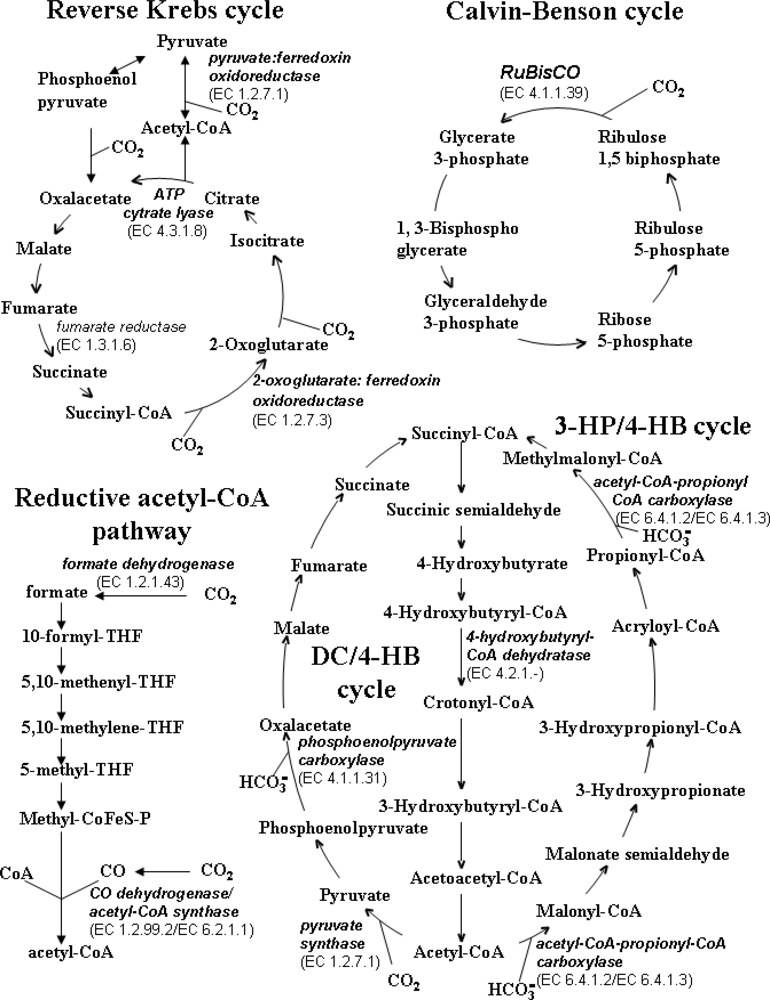
<p>Based on numerous reports, organisms of deep sea hydrothermal vents use several metabolic pathways for CO<sub>2</sub> fixation. These include the Calvin-Benson cycle, reductive TCA cycle, 3-hydroxypropionate bicycle, acetyl CoA-pathway, dicarboxylate/4-hydroxybutyrate cycle and 3-hydroxypropionate/4-hydroxybutyrate cycle [<xref ref-type="bibr" rid="b20-marinedrugs-09-00719">20</xref>–<xref ref-type="bibr" rid="b24-marinedrugs-09-00719">24</xref>] (<xref ref-type="fig" rid="f1-marinedrugs-09-00719">Figure 1</xref>).</p>
<p>As shown, several enzymes are associated with CO<sub>2</sub> fixation such as adenosine triphosphate (ATP) citrate lyase, 2-oxoglutarate: ferredoxin oxidoreductase and fumarate reductase, ribulose-1,5-bisphosphate carboxylase, acetyl-CoA carboxylase, propionyl-CoA carboxylase, formate dehydrogenase, CO dehydrogenase/acetyl CoA synthase, 4-hydroxybutyryl-CoA dehydratase and acetyl-CoA-propionyl-CoA-carboxylase. In addition, organisms of deep sea vents possess different forms of carbonic anhydrase important for assimilation of CO<sub>2</sub> [<xref ref-type="bibr" rid="b30-marinedrugs-09-00719">30</xref>–<xref ref-type="bibr" rid="b34-marinedrugs-09-00719">34</xref>].</p>
<sec>
<label>3.1.</label>
<title>Calvin-Benson Cycle</title>
<p>In the Calvin-Benson cycle, ribulose 1,5-bisphosphate carboxylase/oxygenase (RuBisCO, EC 4.1.1.39) catalyzes the addition of molecular CO<sub>2</sub> to ribulose 1,5-bisphosphate generating two molecules of 3-phosphoglycerate (3-PGA) [<xref ref-type="bibr" rid="b21-marinedrugs-09-00719">21</xref>]. This reaction (carboxylase reaction) is the essential step in the transformation of atmospheric inorganic carbon to organic carbon in our biosphere, and 3-PGA plays a key role in the synthesis of all organic cell materials. This is the most abundant enzyme on earth and plays a crucial role in CO<sub>2</sub> fixation.</p>
<p>The first demonstration of the existence of enzymes of the Calvin-Benson cycle associated with hydrothermal vents was demonstrated by Felbeck [<xref ref-type="bibr" rid="b12-marinedrugs-09-00719">12</xref>]. High activities of ribulose-1,5-bisphosphate carboxylase/oxygenase and ribulose 5-phosphate kinase, enzymes of the Calvin-Benson cycle of CO<sub>2</sub> fixation, have been detected in the trophosome of <italic>Riftia pachiptila. Riftia pachyptila</italic> is the giant tubeworm (Siboglinidae annelide polychaete) present in the East Pacific Ridge. This animal is devoid of a digestive tract and lives in an intimate symbiosis with a sulfur-oxidizing chemoautotrophic bacterium that is localized in the cells of a richly vascularized organ of the worm: The trophosome [<xref ref-type="bibr" rid="b16-marinedrugs-09-00719">16</xref>,<xref ref-type="bibr" rid="b17-marinedrugs-09-00719">17</xref>,<xref ref-type="bibr" rid="b35-marinedrugs-09-00719">35</xref>]. It is interesting to note that the detected activities of two enzymes, ribulosebisphosphate carboxylase and ribulose 5-phosphate kinase, are present at high levels in trophosome (the organ housing the symbiotic bacteria), but are absent in muscle [<xref ref-type="bibr" rid="b12-marinedrugs-09-00719">12</xref>]. In addition, enzymatic activities of rhodanese, APSreductase, and ATP-sulfurylase were positive and these enzymes are involved in the synthesis of adenosine triphosphate using energy contained in sulfur compounds such as hydrogen sulfide. These results lead to the conclusion that the <italic>R. pachyptila</italic> symbiont is capable of generating ATP by way of sulfide oxidation and energy from ATP could be used to fix CO<sub>2</sub>.</p>
<p>In addition to the <italic>Riftia pachyptila</italic> symbiont, other deep-sea invertebrate symbionts that utilize the Calvin cycle for CO<sub>2</sub> fixation have since been characterized [<xref ref-type="bibr" rid="b12-marinedrugs-09-00719">12</xref>,<xref ref-type="bibr" rid="b36-marinedrugs-09-00719">36</xref>–<xref ref-type="bibr" rid="b40-marinedrugs-09-00719">40</xref>].</p>
<p>Studies of microbial community at different hydrothermal vent sites have revealed that these microorganisms fix carbon dioxide using the Calvin-Benson cycle [<xref ref-type="bibr" rid="b41-marinedrugs-09-00719">41</xref>,<xref ref-type="bibr" rid="b42-marinedrugs-09-00719">42</xref>]. Several investigations reported the presence of RuBisCO in archaeal, bacterial and eukaryal species in different hydrothermal vents [<xref ref-type="bibr" rid="b43-marinedrugs-09-00719">43</xref>–<xref ref-type="bibr" rid="b46-marinedrugs-09-00719">46</xref>]. It is important to note that over the past 3.5 billion years, with decreasing CO<sub>2</sub> and increasing O<sub>2</sub> in the atmosphere, RuBisCO has also evolved into multiple enzymatic forms having a range of functional properties [<xref ref-type="bibr" rid="b47-marinedrugs-09-00719">47</xref>]. Data obtained from structural and sequence homology of the enzymes using cyanobacterial RuBisCO provided information that the cyanobacteria are the origin of plant chloroplasts [<xref ref-type="bibr" rid="b48-marinedrugs-09-00719">48</xref>,<xref ref-type="bibr" rid="b49-marinedrugs-09-00719">49</xref>]. There are four forms of RuBisCO. Forms I, II and III catalyse the same reactions, carboxylation or oxygenation of ribulose 1,5-bisphosphate. Form I is comprised of small and large subunits [<xref ref-type="bibr" rid="b44-marinedrugs-09-00719">44</xref>,<xref ref-type="bibr" rid="b50-marinedrugs-09-00719">50</xref>], whereas form II possesses two identical large subunits [<xref ref-type="bibr" rid="b44-marinedrugs-09-00719">44</xref>,<xref ref-type="bibr" rid="b51-marinedrugs-09-00719">51</xref>–<xref ref-type="bibr" rid="b54-marinedrugs-09-00719">54</xref>]. Form III and IV consist of the large subunits only. Form IV constitutes the RuBisCO-like proteins (RLPs) because this protein does not catalyse RuBisCO activity.</p>
<p>RuBisCO form I has been classified into four types, IA–ID, based on the amino acid homology of the large subunit genes (<italic>cbbL</italic>) [<xref ref-type="bibr" rid="b55-marinedrugs-09-00719">55</xref>]. Previous studies showed that the bacterial forms IA/IC and II occur in deep sea hydrothermal vents. Form IA is present in Proteobacteria [<xref ref-type="bibr" rid="b44-marinedrugs-09-00719">44</xref>,<xref ref-type="bibr" rid="b56-marinedrugs-09-00719">56</xref>,<xref ref-type="bibr" rid="b57-marinedrugs-09-00719">57</xref>] and in the symbionts of several deep-sea hydrothermal vents such as mollusks and some Pogonophora species [<xref ref-type="bibr" rid="b58-marinedrugs-09-00719">58</xref>–<xref ref-type="bibr" rid="b61-marinedrugs-09-00719">61</xref>]. Form IB has only been identified from a vent plume at a Mid-Okinawa trough hydrothermal vent. Recently, studies of three Western Pacific arc hydrothermal systems revealed both archaeal forms IC and ID, in addition to form IA and form II [<xref ref-type="bibr" rid="b43-marinedrugs-09-00719">43</xref>] from the Pika/Suiyo and Suiyo samples, respectively. Form II has been identified in free-living autotrophic microbial communities at only two hydrothermal vent sites [<xref ref-type="bibr" rid="b44-marinedrugs-09-00719">44</xref>,<xref ref-type="bibr" rid="b57-marinedrugs-09-00719">57</xref>]. In addition, form II was detected as the predominant form in cold seeps, symbionts of tubeworms and some deep-sea clams [<xref ref-type="bibr" rid="b62-marinedrugs-09-00719">62</xref>,<xref ref-type="bibr" rid="b63-marinedrugs-09-00719">63</xref>]. The crystal structure and biochemical studies of RuBisCO (Tk-Rubisco) from the hyperthermophilic archaeon <italic>Thermococcus kodakaraensis</italic> KOD1 indicated that its structure is distinct from form I and II RuBisCO [<xref ref-type="bibr" rid="b64-marinedrugs-09-00719">64</xref>]. This Tk-Rubisco is classified as a novel form III. Form IV has been found in <italic>Archaeoglobus fulgidus</italic>, a hyperthermophilic sulfate-reducing Archaeon, from marine hydrothermal systems [<xref ref-type="bibr" rid="b65-marinedrugs-09-00719">65</xref>].</p></sec>
<sec>
<label>3.2.</label>
<title>Krebs Reverse Cycle (Reductive Tricarboxylic Acid Cycle)</title>
<p>The reverse tricarboxylic acid (rTCA) cycle fixes CO<sub>2</sub> and leads to the synthesis of acetyl coenzyme A, which is carboxylated to pyruvate. The three key enzymes essential to run the rTCA cycle include ATP citrate lyase, 2-oxoglutarate: ferredoxin oxidoreductase and fumarate reductase (<xref ref-type="fig" rid="f1-marinedrugs-09-00719">Figure 1</xref>).</p>
<p>Pioneer work on the presence of the rTCA cycle in deep-sea hydrothermal vent microbial communities has been obtained from expression studies of the episymbiotic community associated with the vent polychaete <italic>Alvinella pompejana</italic> [<xref ref-type="bibr" rid="b57-marinedrugs-09-00719">57</xref>,<xref ref-type="bibr" rid="b66-marinedrugs-09-00719">66</xref>,<xref ref-type="bibr" rid="b67-marinedrugs-09-00719">67</xref>]. This deep-sea polychaete <italic>Alvinella pompejana</italic> colonizes tubes on the sides of black smoker chimneys along the East Pacific Rise. The two key genes in the rTCA cycle, the ATP citrate lyase and 2-oxoglutarate: ferredoxin oxidoreductase, were utilized to demonstrate the abundance of these genes in the episymbiont community [<xref ref-type="bibr" rid="b66-marinedrugs-09-00719">66</xref>] and in diverse vent samples [<xref ref-type="bibr" rid="b57-marinedrugs-09-00719">57</xref>]. The overall results of these analyses demonstrated: (i) the presence and expression of key rTCA cycle genes in at least two groups of free-living microorganisms from deep-sea hydrothermal vents; and (ii) the majority of autotrophs that utilize the reverse tricarboxylic acid cycle are members of the epsilon subdivision of Proteobacteria. Concerning the best studied organism in deep sea hydrothermal vents, the giant tubeworm <italic>Riftia pachyptila</italic>, its chemoautotrophic gamma proteobacterial endosymbionts fix carbon via the Calvin cycle [<xref ref-type="bibr" rid="b12-marinedrugs-09-00719">12</xref>,<xref ref-type="bibr" rid="b13-marinedrugs-09-00719">13</xref>,<xref ref-type="bibr" rid="b16-marinedrugs-09-00719">16</xref>,<xref ref-type="bibr" rid="b17-marinedrugs-09-00719">17</xref>,<xref ref-type="bibr" rid="b35-marinedrugs-09-00719">35</xref>]. In addition, recent proteomic analyses revealed the presence of enzymes involved in the reverse TCA cycle [<xref ref-type="bibr" rid="b68-marinedrugs-09-00719">68</xref>]. These results indicated that <italic>Riftia</italic> uses both the reverse TCA pathway and the Calvin cycle for fixation of CO<sub>2</sub>.</p>
<p>Several studies of the occurrence of the rTCA cycle in microbial communities of deep-sea hydrothermal habitats have been carried out. These studies demonstrated that pure cultures of Epsilonproteobacteria and Aquificae, which include representatives of hydrothermal vent bacteria, fix carbon dioxide via the rTCA cycle [<xref ref-type="bibr" rid="b69-marinedrugs-09-00719">69</xref>–<xref ref-type="bibr" rid="b76-marinedrugs-09-00719">76</xref>]. Comparative analyses of the ATP citrate lyase encoding genes from natural microbial communities of three deep-sea hydrothermal vent systems located on the Mid-Atlantic Ridge (MAR; Rainbow, Logatchev and Broken Spur) suggested that Epsilonproteobacteria were the dominant primary producers using the reverse TCA cycle (rTCA) at Rainbow, while Aquificales of the genera Desulfurobacterium and Persephonella were prevalent in the Broken Spur chimney [<xref ref-type="bibr" rid="b76-marinedrugs-09-00719">76</xref>]. Several studies indicate that the majority of bacteria associated with deep-sea hydrothermal chimneys are members of the Epsilonproteobacteria [<xref ref-type="bibr" rid="b73-marinedrugs-09-00719">73</xref>,<xref ref-type="bibr" rid="b77-marinedrugs-09-00719">77</xref>–<xref ref-type="bibr" rid="b81-marinedrugs-09-00719">81</xref>]. The habitat of these bacteria are located in the zone where hydrothermal fluids mix with ambient seawater giving temperatures in the range from 20 to 60 °C and characterized by microaerobic to anaerobic conditions [<xref ref-type="bibr" rid="b71-marinedrugs-09-00719">71</xref>]. Since the energy in these environments is limited, it is more favorable to use a carbon fixation pathway other than the Calvin cycle, which requires nine ATP molecules to synthesize one triose phosphate molecule compared to five ATP for the reductive TCA cycle [<xref ref-type="bibr" rid="b82-marinedrugs-09-00719">82</xref>]. The fact that the Epsilonproteobacteria at hydrothermal vent sites express enzymes of rTCA, suggests that the rTCA cycle could play a more important role in chemoautotrophic production by free-living microorganisms at hydrothermal vents than the Calvin cycle.</p></sec>
<sec>
<label>3.3.</label>
<title>3-Hydroxypropionate Bicycle</title>
<p>The key enzymes for the 3-hydroxypropionate (3-HP) bicycle are two carboxylases: acetyl-CoA/propionyl-CoA carboxylase. The 3-hydroxypropionate bicycle appears to be restricted to Chloroflexaceae [<xref ref-type="bibr" rid="b24-marinedrugs-09-00719">24</xref>,<xref ref-type="bibr" rid="b83-marinedrugs-09-00719">83</xref>–<xref ref-type="bibr" rid="b85-marinedrugs-09-00719">85</xref>]. Consequently, this cycle may not be present in deep sea vents.</p></sec>
<sec>
<label>3.4.</label>
<title>Reductive Acetyl-CoA Pathway</title>
<p>The reductive acetyl-CoA pathway (<xref ref-type="fig" rid="f1-marinedrugs-09-00719">Figure 1</xref>) results in the fixation of two molecules of CO<sub>2</sub> to form acetyl-CoA. One molecule of CO<sub>2</sub> is consecutively reduced to a cofactor-bound methyl residue, and another CO<sub>2</sub> molecule is reduced to an enzyme-bound carbonyl residue. The key enzyme of the reductive acetyl-CoA pathway is a bifunctional metalloenzyme belonging to the class of oxidoreductases, CO dehydrogenase/acetyl-CoA synthase, which catalyzes the reversible reduction of CO<sub>2</sub> to CO and the assembly of acetyl-CoA from CO, Coenzyme A and a methyl moiety derived from the corrinoid iron-sulfur protein [<xref ref-type="bibr" rid="b86-marinedrugs-09-00719">86</xref>,<xref ref-type="bibr" rid="b87-marinedrugs-09-00719">87</xref>]. The reduction of CO<sub>2</sub> to the methyl group is accomplished by a series of enzymes, most of which are also unique for this pathway [<xref ref-type="bibr" rid="b88-marinedrugs-09-00719">88</xref>,<xref ref-type="bibr" rid="b89-marinedrugs-09-00719">89</xref>]. The formate dehydrogenase in this pathway is important because it “reductively fixes” CO<sub>2</sub> to formate.</p>
<p>At deep-sea hydrothermal vents, the majority of methanogenic microorganisms use the reductive acetyl-CoA pathway for carbon fixation. These methanogens include <italic>Methanococcales</italic> (e.g., <italic>Methanocaldococcus</italic> and <italic>Methanothermococcus</italic>) and <italic>Methanopyrales</italic> (<italic>i.e.</italic>, Methanopyrus) [<xref ref-type="bibr" rid="b20-marinedrugs-09-00719">20</xref>] and are identified within mid-ocean ridge systems, backarc basin systems [<xref ref-type="bibr" rid="b90-marinedrugs-09-00719">90</xref>,<xref ref-type="bibr" rid="b91-marinedrugs-09-00719">91</xref>] and also in ridge flank systems [<xref ref-type="bibr" rid="b92-marinedrugs-09-00719">92</xref>].</p></sec>
<sec>
<label>3.5.</label>
<title>Dicarboxylate/4-Hydroxybutyrate Cycle</title>
<p>The complete metabolic cycle of dicarboxylate/4-hydroxybutyrate (DC/4-HB) was elucidated recently by Huber <italic>et al.</italic> [<xref ref-type="bibr" rid="b93-marinedrugs-09-00719">93</xref>] (<xref ref-type="fig" rid="f1-marinedrugs-09-00719">Figure 1</xref>). The key enzyme of the DC/4-HB cycle is 4-hydroxybutyryl-CoA dehydratase [<xref ref-type="bibr" rid="b94-marinedrugs-09-00719">94</xref>,<xref ref-type="bibr" rid="b95-marinedrugs-09-00719">95</xref>]. This pathway occurs in the thermophilic crenarchaeon <italic>Ignicoccus hospitalis</italic> (Desulfurococcales), but it is also present in other Crenarchaeota such as Thermoproteales and Desulfurococcales [<xref ref-type="bibr" rid="b23-marinedrugs-09-00719">23</xref>,<xref ref-type="bibr" rid="b93-marinedrugs-09-00719">93</xref>,<xref ref-type="bibr" rid="b96-marinedrugs-09-00719">96</xref>]. <italic>I. hospitalis</italic> is a chemolithoautotrophic, sulfur reducer and hyperthermophilic crenarchaeon which was isolated from a submarine hydrothermal system at the Kolbeinsey Ridge, to the north of Iceland [<xref ref-type="bibr" rid="b97-marinedrugs-09-00719">97</xref>]. Microbial analyses at several deep sea hydrothermal vent sites showed the abundance of archaeal domains Crenarchaeota, including the group closely associated with <italic>Ignicoccus</italic> [<xref ref-type="bibr" rid="b98-marinedrugs-09-00719">98</xref>–<xref ref-type="bibr" rid="b100-marinedrugs-09-00719">100</xref>]. This evidence suggests that the fixation of CO<sub>2</sub> might occur through dicarboxylate/4-hydroxybutyrate cycle at deep sea hydrothermal vents.</p></sec>
<sec>
<label>3.6.</label>
<title>3-Hydroxypropionate/4-Hydroxybutyrate Cycle</title>
<p>The 3-HP/4-HB cycle functions in the autotrophic thermoacidophilic members of the crenarchaeal order Sulfolobales [<xref ref-type="bibr" rid="b23-marinedrugs-09-00719">23</xref>,<xref ref-type="bibr" rid="b101-marinedrugs-09-00719">101</xref>–<xref ref-type="bibr" rid="b103-marinedrugs-09-00719">103</xref>] (<xref ref-type="fig" rid="f1-marinedrugs-09-00719">Figure 1</xref>). The key enzyme of the 3-HP/4-HB cycle, 4-hydroxybutyryl-CoA dehydratase, was identified in the genome of marine group 1 Crenarchaeota [<xref ref-type="bibr" rid="b104-marinedrugs-09-00719">104</xref>] and in the Global Ocean Sampling database [<xref ref-type="bibr" rid="b101-marinedrugs-09-00719">101</xref>,<xref ref-type="bibr" rid="b105-marinedrugs-09-00719">105</xref>,<xref ref-type="bibr" rid="b106-marinedrugs-09-00719">106</xref>]. A recent study showed that anaerobic ammonium-oxidizing bacteria and archaea are present and active in hydrothermal vent areas [<xref ref-type="bibr" rid="b107-marinedrugs-09-00719">107</xref>]. Therefore, it appears that the 3-HP/4-hydroxybutyrate is potentially an important carbon fixation pathway in deep-sea hydrothermal vents.</p></sec>
<sec>
<label>3.7.</label>
<title>Carbonic Anhydrase</title>
<p>In general, the inorganic carbon acquisition and fixation by marine species depend upon changes in CO<sub>2</sub> and/or HCO<sub>3</sub><sup>−</sup> concentrations [<xref ref-type="bibr" rid="b108-marinedrugs-09-00719">108</xref>–<xref ref-type="bibr" rid="b110-marinedrugs-09-00719">110</xref>]. The carbonic anhydrases (CA) are enzymes that facilitate DIC uptake and fixation [<xref ref-type="bibr" rid="b33-marinedrugs-09-00719">33</xref>,<xref ref-type="bibr" rid="b30-marinedrugs-09-00719">30</xref>]. These enzymes catalyze the reversible hydration of CO<sub>2</sub> to form bicarbonate [CO<sub>2</sub> + H<sub>2</sub>O ↔ HCO<sub>3</sub><sup>−</sup> + H<sup>+</sup>]. In typical physiological solutions, CO<sub>2</sub>(aq) is in equilibrium with HCO<sub>3</sub><sup>−</sup> (aq). The HCO<sub>3</sub><sup>−</sup> is negatively charged and poorly soluble in lipids, while CO<sub>2</sub> is highly soluble in lipids. Therefore, CO<sub>2</sub> can freely diffuse out of the cell but HCO<sub>3</sub><sup>−</sup> must be transported across the cell membrane. However, some microorganisms such as cyanobacteria possess a transport system specialized for CO<sub>2</sub> uptake by converting CO<sub>2</sub> to HCO<sub>3</sub><sup>−</sup> [<xref ref-type="bibr" rid="b111-marinedrugs-09-00719">111</xref>,<xref ref-type="bibr" rid="b112-marinedrugs-09-00719">112</xref>]. In addition, above pH 6.3, the equilibrium between these two species shifts toward HCO<sub>3</sub><sup>−</sup> and thus poses problems in the maintenance of intracellular CO<sub>2</sub> [<xref ref-type="bibr" rid="b30-marinedrugs-09-00719">30</xref>]. For trapping CO<sub>2</sub> in the cell, HCO<sub>3</sub><sup>−</sup> is enzymatically converted to CO<sub>2</sub> and in this manner it facilitates its transport into the cell. In the cell, the RuBisCO enzyme is restricted to using CO<sub>2</sub> for its function and the efficiency of CO<sub>2</sub> fixation is enhanced by a specialized carbonic anhydrase that catalyzes dehydration of the cytoplasmic bicarbonate and ensures saturation of RuBisCO with its substrate [<xref ref-type="bibr" rid="b33-marinedrugs-09-00719">33</xref>,<xref ref-type="bibr" rid="b113-marinedrugs-09-00719">113</xref>].</p>
<p>Investigations of CAs in the model organism <italic>Riftia pachyptila</italic>, revealed the presence of several isoforms of this enzyme [<xref ref-type="bibr" rid="b31-marinedrugs-09-00719">31</xref>,<xref ref-type="bibr" rid="b32-marinedrugs-09-00719">32</xref>,<xref ref-type="bibr" rid="b34-marinedrugs-09-00719">34</xref>]. Inorganic carbon (CO<sub>2</sub>) is first acquired from the environment by diffusion across the plume, a branchial organ [<xref ref-type="bibr" rid="b26-marinedrugs-09-00719">26</xref>]. At the environment-branchial plume interface CO<sub>2</sub> is converted to HCO<sub>3</sub><sup>−</sup> [<xref ref-type="bibr" rid="b114-marinedrugs-09-00719">114</xref>,<xref ref-type="bibr" rid="b115-marinedrugs-09-00719">115</xref>] and is transported to trophosome cells mainly in the form of bicarbonate. HCO<sub>3</sub><sup>−</sup> is converted to CO<sub>2</sub> at the body fluid-bacteriocyte interface [<xref ref-type="bibr" rid="b31-marinedrugs-09-00719">31</xref>,<xref ref-type="bibr" rid="b32-marinedrugs-09-00719">32</xref>,<xref ref-type="bibr" rid="b34-marinedrugs-09-00719">34</xref>] and fixed by the bacterial symbionts enzyme RuBisCO form II [<xref ref-type="bibr" rid="b21-marinedrugs-09-00719">21</xref>].</p>
<p>In prokaryotes there are three phylogenetically distinct classes of CAs: α, β and γ. Interestingly all three of these classes of CA are present in the <italic>Thiomicrospira crunogena</italic>, a deep-sea hydrothermal vent sulfur-oxidizing chemolithoautotroph that lives in a spatially and thermally heterogeneous environment [<xref ref-type="bibr" rid="b33-marinedrugs-09-00719">33</xref>,<xref ref-type="bibr" rid="b116-marinedrugs-09-00719">116</xref>]. When the corresponding genes have been expressed in <italic>Escherichia coli</italic>, CA activity was detected for α-CA and β-CA, but not for the γ-CA-like protein [<xref ref-type="bibr" rid="b33-marinedrugs-09-00719">33</xref>].</p>
<p>As mentioned above, two general roles have been suggested for the known carbonic anhydrases; the transport of CO<sub>2</sub> or HCO<sub>3</sub><sup>−</sup> and provision of these substrates to cells [<xref ref-type="bibr" rid="b30-marinedrugs-09-00719">30</xref>]. Therefore, in addition to CO<sub>2</sub> transport, the CAs can provide also HCO<sub>3</sub><sup>−</sup> for various enzymes that can assimilate carbon. For example, the first enzymes, carbamylphosphate synthetase, in the arginine biosynthetic pathway and the pyrimidine <italic>de novo</italic> pathway use the inorganic HCO<sub>3</sub><sup>−</sup> to initiate the biosynthesis [<xref ref-type="bibr" rid="b117-marinedrugs-09-00719">117</xref>,<xref ref-type="bibr" rid="b118-marinedrugs-09-00719">118</xref>]. The existence of these enzymes has been studied in all the tissues of <italic>Riftia</italic>. The results indicate that the first three enzymes of the <italic>de novo</italic> pyrimidine nucleotide pathway, carbamylphosphate synthetase, aspartate transcarbamylase and dihydroorotase are present only in the trophosome, the symbiont-harboring tissue [<xref ref-type="bibr" rid="b117-marinedrugs-09-00719">117</xref>]. Concerning the arginine biosynthetic pathway, it appears that the ammonium dependent carbamylphosphate synthetase is present in all the body parts of <italic>R. pachyptila</italic> as well as in the bacterial symbiont [<xref ref-type="bibr" rid="b118-marinedrugs-09-00719">118</xref>]. The unusual distribution of the enzymes of the <italic>de novo</italic> pyrimidine nucleotide pathway in all the tissues of <italic>R. pachyptila</italic> indicates that the metabolic relationship between <italic>R. pachyptila</italic> and its endosymbiont is clearly essential for the survival of both organisms.</p></sec></sec>
<sec>
<label>4.</label>
<title>Biotechnological Application</title>
<p>Organisms that live in the environment of deep sea hydrothermal vents characterized by extreme physico-chemical conditions of temperature, pressure, pH and high concentrations of toxic heavy metals represent one of the most important sources for the development of new biotechnological applications. The biotope of hydrothermal vents harbors various and complex microbial communities adapted to different environmental conditions with unique features and characteristics and consequently these organisms could be used in biotechnology. Concerning carbon dioxide fixation and assimilation, the environment of deep sea hydrothermal vents can provide sources of unique enzymes, genes and metabolic processes important for the development of technologies related to industrial processes for reduction of atmospheric CO<sub>2</sub>, biofuels production, materials and chemical synthesis [<xref ref-type="bibr" rid="b17-marinedrugs-09-00719">17</xref>,<xref ref-type="bibr" rid="b119-marinedrugs-09-00719">119</xref>–<xref ref-type="bibr" rid="b122-marinedrugs-09-00719">122</xref>].</p>
<p>Carbon dioxide is the gas that is the major contributor to the green house effect and as such is largely responsible for global warming [<xref ref-type="bibr" rid="b123-marinedrugs-09-00719">123</xref>–<xref ref-type="bibr" rid="b125-marinedrugs-09-00719">125</xref>]. This gas has been extensively released during the past 100–150 years into the atmosphere due to human activities. Over the past 150 years atmospheric CO<sub>2</sub> concentrations have increased approximately by 30% [<xref ref-type="bibr" rid="b126-marinedrugs-09-00719">126</xref>]. To overcome the effects of global warming there is an urgent need to reduce the atmospheric CO<sub>2</sub> content. Biotechnological methods have been used to reduce the atmospheric CO<sub>2</sub> content at two levels; the biological fixation using microorganisms, and the capture of carbon dioxide via enzyme (carbonic anhydrase).</p>
<p>Some microalgae like Cyanophyceae (blue-green algae), Chlorophyceae (green algae), Bacillariophyceae (including diatoms) and Chrysophyceae (including golden algae) are known to be very efficient in utilizing atmospheric CO<sub>2</sub> via photosynthesis [<xref ref-type="bibr" rid="b127-marinedrugs-09-00719">127</xref>,<xref ref-type="bibr" rid="b128-marinedrugs-09-00719">128</xref>]. Using genetic engineering and technology, new strains of these microalgae have been developed that can tolerate high concentrations of CO<sub>2</sub> [<xref ref-type="bibr" rid="b127-marinedrugs-09-00719">127</xref>]. In addition, current technologies are being employed to examine the possibility of coupling wastewater treatment with microalgal growth for eventual production of biofuels [<xref ref-type="bibr" rid="b127-marinedrugs-09-00719">127</xref>]. Recently, a cyanobacterium, <italic>Synechococcus elongatus</italic> PCC7942 has been genetically engineered to produce isobutyraldehyde and isobutanol directly from CO<sub>2</sub>, increasing productivity by overexpression of ribulose 1,5-bisphosphate carboxylase/oxygenase (RuBisCO) [<xref ref-type="bibr" rid="b129-marinedrugs-09-00719">129</xref>]. Isobutyraldehyde is a precursor for the synthesis of other chemicals, and isobutanol can be used as a biofuel. However, a bioreactor that is able to achieve maximum productivity and maximum energy efficiency under a given set of operational costs is not yet fabricated [<xref ref-type="bibr" rid="b127-marinedrugs-09-00719">127</xref>]. A major problem with these reactors is related to low efficiency of carbon fixation using the Calvin cycle native to microalgae [<xref ref-type="bibr" rid="b130-marinedrugs-09-00719">130</xref>]. In order to develop a new reactor for enhanced microalgal CO<sub>2</sub> fixation, it is necessary to increase the efficiency of the Calvin cycle. Genetic manipulation of RuBisCO might help to develop a new biotechnological system for large-scale carbon dioxide capture. In addition to the Calvin cycle, other CO<sub>2</sub> fixation pathways or carboxylase enzymes could be used. These engineering alternatives for CO<sub>2</sub> fixation strategies might be advantageous as they may avoid the regulatory constraints and substrate limitations of native pathways [<xref ref-type="bibr" rid="b130-marinedrugs-09-00719">130</xref>]. Moreover, besides microalgae other microbes, <italic>i.e.</italic>, bacteria and archaea, can also contribute to biofuel production and reduction of global warming [<xref ref-type="bibr" rid="b131-marinedrugs-09-00719">131</xref>]. For example, various types of bacteria that use energy obtained from chemical oxidation under dark conditions can be efficient in CO<sub>2</sub> fixation and can reduce CO<sub>2</sub> to fuel. These bacteria possess the genes that encode the key enzymes of ethanol biosynthesis from pyruvate. Several studies have showed that CO<sub>2</sub> may be converted to ethanol by Rhodobacter species under anoxygenic conditions in the light or under dark aerobic growth conditions [<xref ref-type="bibr" rid="b132-marinedrugs-09-00719">132</xref>–<xref ref-type="bibr" rid="b134-marinedrugs-09-00719">134</xref>]. Therefore, microbes from hydrothermal deep sea vents that can fix CO<sub>2</sub> into biomass could be of interest for development of the technologies for the production of biofuel as well as other compounds.</p>
<p>Carbonic anhydrases (CAs), the enzymes that catalyze the conversion of CO<sub>2</sub> to bicarbonate and the selective conversion of CO<sub>2</sub> to a liquid phase, can separate the CO<sub>2</sub> from other gases. Therefore, as a potential catalyst, CA could be used in capture of CO<sub>2</sub> from combustion fuel gas streams [<xref ref-type="bibr" rid="b135-marinedrugs-09-00719">135</xref>,<xref ref-type="bibr" rid="b136-marinedrugs-09-00719">136</xref>]. Different laboratory-scale reactors have been developed to evaluate the capture of carbon dioxide from a gas into a liquid. The capture efficiencies could be enhanced by adding base (e.g., sodium hydroxide) to form bicarbonate or carbonate, which could be further transformed into insoluble CaCO<sub>3</sub> by adding precipitating cations, like Ca<sup>2+</sup> [<xref ref-type="bibr" rid="b137-marinedrugs-09-00719">137</xref>]. CaCO<sub>3</sub> is a thermodynamically stable mineral found in all parts of the world, and is the main component of marine shells, snails, pearls, and eggshells. Sharma <italic>et al.</italic> [<xref ref-type="bibr" rid="b138-marinedrugs-09-00719">138</xref>] screened diverse groups of bacteria and found the best activity for CO<sub>2</sub> conversion was obtained with a 29 kDa CA extracted from <italic>Enterobacter taylorae</italic>. Bhattacharya <italic>et al.</italic> [<xref ref-type="bibr" rid="b139-marinedrugs-09-00719">139</xref>] have developed a spray reactor coated with immobilized CA for CO<sub>2</sub> capture and storage. They obtained a decrease in CO<sub>2</sub> of almost 70%, and observed stability of CA at 40 °C. Novozymes Inc has a patent application for the cloning and purification of CA for CO<sub>2</sub> storage [<xref ref-type="bibr" rid="b140-marinedrugs-09-00719">140</xref>]. The cloning of CA from <italic>Methanosarcina thermophila</italic> (Archaea) was performed using the bacterium <italic>Bacillus halodurans</italic>, and expressed enzymes were then purified by chromatography. Carbon Sciences Inc. has developed a method for synthetic precipitation of calcium carbonate (PCC) that can be used for various applications, e.g., paper, medicine and plastics production, and in a technology to transform CO<sub>2</sub> emissions into the basic fuel building blocks required to produce gasoline, diesel, and jet fuel and other fuels. CO<sub>2</sub> Solution Inc. has developed a method by which CO<sub>2</sub> emissions from cement factories can be captured and converted into bicarbonate ions. These ions are then used to produce limestone, a raw material that can be reintroduced into the cement manufacturing process [<xref ref-type="bibr" rid="b141-marinedrugs-09-00719">141</xref>]. However, existing CAs are expensive due to high manufacturing costs, low activity and stability. The majority of enzymes exhibit very low, or no, activity when the temperature exceeds 50 °C [<xref ref-type="bibr" rid="b134-marinedrugs-09-00719">134</xref>]. Most industrial processes to eliminate CO<sub>2</sub> occur at elevated temperatures, and immobilization techniques to retain biocatalyst activity will need to be performed at relatively higher temperatures [<xref ref-type="bibr" rid="b142-marinedrugs-09-00719">142</xref>]. In the environments of deep sea hydrothermal vents, many microorganisms have adapted to high temperatures, toxic substances such as H<sub>2</sub>S and heavy metals. For these reason, biomolecules from these organisms might be of great value in different biotechnological strategies [<xref ref-type="bibr" rid="b17-marinedrugs-09-00719">17</xref>]. Therefore, the exploration of carbonic anhydrases for carbon capture from these environments could be attractive for use in new biotechnological applications.</p></sec>
<sec sec-type="conclusions">
<label>5.</label>
<title>Conclusions</title>
<p>Deep sea hydrothermal vents are isolated habitats that contain many unique organisms of the three domains of life; archaea, bacteria and eukarya. Most microbial communities in these habitats have the capability to fix inorganic carbon dioxide. Five CO<sub>2</sub> fixation pathways have been documented as important in hydrothermal habitats; the Calvin-Benson cycle, reductive tricarboxylic acid cycle, reductive acetyl-CoA pathway, dicarboxylate/4-hydroxybutyrate cycle and 3-hydroxypropionate/4-hydroxybutyrate cycle. Four different forms of RuBisCO, designated as I, II, III and IV, operate in different microbial communities associated with deep sea hydrothermal vents. The rTCA cycle is found in the Epsilonproteobacteria and Aquificales and the reductive acetyl-CoA pathway in the methanogens microorganisms. It appears that the 3-HP/4-hydroxybutyrate is potentially an important carbon fixation pathway for archaeal communities in deep-sea hydrothermal vent environments. In addition to these pathways for the direct fixation of carbon dioxide, carbonic anhydrase catalyzes the interconversion of CO<sub>2</sub> and HCO<sub>3</sub><sup>−</sup>, and facilitates inorganic carbon dioxide uptake, fixation and assimilation. The bicarbonate formed by CA is an essential growth factor for microorganisms and is a metabolic precursor for many other compounds.</p>
<p>Human activities have significantly increased the atmospheric carbon dioxide concentration and this is an important cause of global warming. Therefore, it is of interest to find technologies for carbon dioxide capture. These technologies, combined with other efforts, could help stabilize greenhouse gas concentrations in the atmosphere and mitigate climate change. Biological CO<sub>2</sub> fixation has attracted much attention as an alternative strategy. It can be done by plants and by photosynthetic and chemosynthetic microorganisms. These biological technologies could also be attractive for production of biofuels or other industrial products. A variety of technological solutions have been proposed for CO<sub>2</sub> sequestration systems. In addition, a number of technologies are currently employed or under development to separate carbon dioxide from mixed byproduct streams of large stationary anthropogenic sources. Therefore, a variety of reactors containing an enzyme such as carbonic anhydrase have been designed to extract CO<sub>2</sub> from mixed gas.</p>
<p>In order to develop and improve new technologies, it is important to search and explore enzymes from different sources. The organisms of deep sea hydrothermal vents are well adapted to fix carbon dioxide in an unusual range of temperatures, pressure condition, pH and metal toxicity. So, organisms from the environment could be used for engineering microbes to solve the various technology options for carbon capture and storage.</p></sec></body>
<back>
<ack>
<p>We thank the anonymous reviewer for thoroughly reading the paper and providing thoughtful comments. We would like to thank Ron Verrall and Ronald Steer for the critical review of this manuscript. This review is dedicated to Lucienne Arbos Bloch, Carlo Cereceda and Jean Laporte.</p></ack>
<ref-list>
<title>References</title>
<ref id="b1-marinedrugs-09-00719"><label>1.</label><citation citation-type="journal"><person-group person-group-type="author"><name><surname>Field</surname><given-names>CB</given-names></name><name><surname>Behrenfeld</surname><given-names>MJ</given-names></name><name><surname>Randerson</surname><given-names>JT</given-names></name><name><surname>Falkowski</surname><given-names>P</given-names></name></person-group><article-title>Primary production of the biosphere: Integrating terrestrial and oceanic components</article-title><source>Science</source><year>1998</year><volume>28</volume><fpage>237</fpage><lpage>240</lpage></citation></ref>
<ref id="b2-marinedrugs-09-00719"><label>2.</label><citation citation-type="journal"><person-group person-group-type="author"><name><surname>Falkowski</surname><given-names>P</given-names></name><name><surname>Scholes</surname><given-names>RJ</given-names></name><name><surname>Boyle</surname><given-names>E</given-names></name><name><surname>Canadell</surname><given-names>J</given-names></name><name><surname>Canfield</surname><given-names>D</given-names></name><name><surname>Elser</surname><given-names>J</given-names></name><name><surname>Gruber</surname><given-names>N</given-names></name><name><surname>Hibbard</surname><given-names>K</given-names></name><name><surname>Högberg</surname><given-names>P</given-names></name><name><surname>Linder</surname><given-names>S</given-names></name><etal/></person-group><article-title>The global carbon cycle: A test of our knowledge of earth as a system</article-title><source>Science</source><year>2000</year><volume>290</volume><fpage>291</fpage><lpage>296</lpage><pub-id pub-id-type="doi">10.1126/science.290.5490.291</pub-id><pub-id pub-id-type="pmid">11030643</pub-id></citation></ref>
<ref id="b3-marinedrugs-09-00719"><label>3.</label><citation citation-type="journal"><person-group person-group-type="author"><name><surname>Dubilier</surname><given-names>N</given-names></name><name><surname>Bergin</surname><given-names>C</given-names></name><name><surname>Lott</surname><given-names>C</given-names></name></person-group><article-title>Symbiotic diversity in marine animals: The art of harnessing chemosynthesis</article-title><source>Nat Rev Microbiol</source><year>2008</year><volume>10</volume><fpage>725</fpage><lpage>740</lpage></citation></ref>
<ref id="b4-marinedrugs-09-00719"><label>4.</label><citation citation-type="journal"><person-group person-group-type="author"><name><surname>Lonsdale</surname><given-names>P</given-names></name></person-group><article-title>Clustering of suspension-feeding macrobenthos near abyssal hydrothermal vents at oceanic spreading centers</article-title><source>Deep Sea Res</source><year>1977</year><volume>24</volume><fpage>857</fpage><lpage>863</lpage><pub-id pub-id-type="doi">10.1016/0146-6291(77)90478-7</pub-id></citation></ref>
<ref id="b5-marinedrugs-09-00719"><label>5.</label><citation citation-type="journal"><person-group person-group-type="author"><name><surname>Corliss</surname><given-names>JB</given-names></name><name><surname>Dymond</surname><given-names>J</given-names></name><name><surname>Gordon</surname><given-names>LI</given-names></name><name><surname>Edmond</surname><given-names>JM</given-names></name><name><surname>Herzen</surname><given-names>RPV</given-names></name><name><surname>Ballard</surname><given-names>RD</given-names></name><name><surname>Green</surname><given-names>K</given-names></name><name><surname>Williams</surname><given-names>D</given-names></name><name><surname>Bainbridge</surname><given-names>A</given-names></name><name><surname>Crane</surname><given-names>K</given-names></name><etal/></person-group><article-title>Submarine thermal spring on the Galapagos Rift</article-title><source>Science</source><year>1979</year><volume>203</volume><fpage>1073</fpage><lpage>1083</lpage><pub-id pub-id-type="doi">10.1126/science.203.4385.1073</pub-id><pub-id pub-id-type="pmid">17776033</pub-id></citation></ref>
<ref id="b6-marinedrugs-09-00719"><label>6.</label><citation citation-type="journal"><person-group person-group-type="author"><name><surname>Tunnicliffe</surname><given-names>V</given-names></name><name><surname>McArthur</surname><given-names>A</given-names></name><name><surname>McHugh</surname><given-names>D</given-names></name></person-group><article-title>A biogeographical perspective of the deep-sea hydrothermal vent fauna</article-title><source>Adv Mar Biol</source><year>1998</year><volume>34</volume><fpage>353</fpage><lpage>442</lpage></citation></ref>
<ref id="b7-marinedrugs-09-00719"><label>7.</label><citation citation-type="journal"><person-group person-group-type="author"><name><surname>Zierenberg</surname><given-names>RA</given-names></name><name><surname>Adams</surname><given-names>MW</given-names></name><name><surname>Arp</surname><given-names>AJ</given-names></name></person-group><article-title>Life in extreme environments: Hydrothermal vents</article-title><source>Proc Natl Acad Sci USA</source><year>2000</year><volume>97</volume><fpage>12961</fpage><lpage>12962</lpage><pub-id pub-id-type="doi">10.1073/pnas.210395997</pub-id><pub-id pub-id-type="pmid">11058150</pub-id></citation></ref>
<ref id="b8-marinedrugs-09-00719"><label>8.</label><citation citation-type="journal"><person-group person-group-type="author"><name><surname>Bott</surname><given-names>MHP</given-names></name><name><surname>Dean</surname><given-names>DS</given-names></name></person-group><article-title>Stress diffusion from plate boundaries</article-title><source>Nature</source><year>1973</year><volume>243</volume><fpage>339</fpage><lpage>341</lpage><pub-id pub-id-type="doi">10.1038/243339a0</pub-id></citation></ref>
<ref id="b9-marinedrugs-09-00719"><label>9.</label><citation citation-type="journal"><person-group person-group-type="author"><name><surname>MacDonald</surname><given-names>IR</given-names></name><name><surname>Boland</surname><given-names>GS</given-names></name><name><surname>Baker</surname><given-names>JS</given-names></name><name><surname>Brooks</surname><given-names>JM</given-names></name><name><surname>Kennicutt</surname><given-names>MC</given-names><suffix>II</suffix></name><name><surname>Bidigare</surname><given-names>RR</given-names></name></person-group><article-title>Gulf of Mexico hydrocarbon seep communities. II. Spatial distribution of seep organisms and hydrocarbons at Bush Hill</article-title><source>Mar Biol</source><year>1989</year><volume>101</volume><fpage>235</fpage><lpage>247</lpage><pub-id pub-id-type="doi">10.1007/BF00391463</pub-id></citation></ref>
<ref id="b10-marinedrugs-09-00719"><label>10.</label><citation citation-type="journal"><person-group person-group-type="author"><name><surname>MacDonald</surname><given-names>IR</given-names></name><name><surname>Guinasso</surname><given-names>NL</given-names></name><name><surname>Reilly</surname><given-names>JF</given-names></name><name><surname>Brooks</surname><given-names>JM</given-names></name><name><surname>Callender</surname><given-names>WR</given-names></name><name><surname>Gabrielle</surname><given-names>SG</given-names></name></person-group><article-title>Gulf of Mexico hydrocarbon seep communities. IV. Patterns in community structure and habitat</article-title><source>Geo-Mar Lett</source><year>1990</year><volume>10</volume><fpage>244</fpage><lpage>252</lpage><pub-id pub-id-type="doi">10.1007/BF02431071</pub-id></citation></ref>
<ref id="b11-marinedrugs-09-00719"><label>11.</label><citation citation-type="journal"><person-group person-group-type="author"><name><surname>Felbeck</surname><given-names>H</given-names></name></person-group><article-title>Chemoautotrophic potential of the hydrothermal vent tube worm <italic>Riftia pachyptila</italic> Jones (Vestimentifera)</article-title><source>Science</source><year>1981</year><volume>213</volume><fpage>336</fpage><lpage>338</lpage><pub-id pub-id-type="doi">10.1126/science.213.4505.336</pub-id><pub-id pub-id-type="pmid">17819905</pub-id></citation></ref>
<ref id="b12-marinedrugs-09-00719"><label>12.</label><citation citation-type="journal"><person-group person-group-type="author"><name><surname>Felbeck</surname><given-names>H</given-names></name><name><surname>Childress</surname><given-names>JJ</given-names></name><name><surname>Somero</surname><given-names>GN</given-names></name></person-group><article-title>Calvin-Benson cycle and sulfide oxidation enzymes in animals from sulfide rich environment habitats</article-title><source>Nature</source><year>1981</year><volume>293</volume><fpage>291</fpage><lpage>293</lpage><pub-id pub-id-type="doi">10.1038/293291a0</pub-id></citation></ref>
<ref id="b13-marinedrugs-09-00719"><label>13.</label><citation citation-type="journal"><person-group person-group-type="author"><name><surname>Cavanaugh</surname><given-names>CM</given-names></name><name><surname>Gardiner</surname><given-names>SL</given-names></name><name><surname>Jones</surname><given-names>ML</given-names></name><name><surname>Jannasch</surname><given-names>HW</given-names></name><name><surname>Waterbury</surname><given-names>JB</given-names></name></person-group><article-title>Procaryotic cells in the hydrothermal vent tube worm <italic>Riftia pachyptila</italic> Jones: Possible chemoautotrophic symbionts</article-title><source>Science</source><year>1981</year><volume>213</volume><fpage>340</fpage><lpage>342</lpage><pub-id pub-id-type="doi">10.1126/science.213.4505.340</pub-id><pub-id pub-id-type="pmid">17819907</pub-id></citation></ref>
<ref id="b14-marinedrugs-09-00719"><label>14.</label><citation citation-type="journal"><person-group person-group-type="author"><name><surname>Gaill</surname><given-names>F</given-names></name></person-group><article-title>Aspects of life development at deep sea hydrothermal vents</article-title><source>FASEB J</source><year>1993</year><volume>7</volume><fpage>558</fpage><lpage>565</lpage><pub-id pub-id-type="pmid">8472894</pub-id></citation></ref>
<ref id="b15-marinedrugs-09-00719"><label>15.</label><citation citation-type="journal"><person-group person-group-type="author"><name><surname>Fisher</surname><given-names>CR</given-names></name></person-group><article-title>Chemoautotrophic and methanotrophic symbioses in marine invertebrates</article-title><source>Aquat Sci</source><year>1996</year><volume>2</volume><fpage>399</fpage><lpage>436</lpage></citation></ref>
<ref id="b16-marinedrugs-09-00719"><label>16.</label><citation citation-type="journal"><person-group person-group-type="author"><name><surname>Minic</surname><given-names>Z</given-names></name><name><surname>Hervé</surname><given-names>G</given-names></name></person-group><article-title>Biochemical and enzymological aspects of the symbiosis between the deep-sea tubeworm <italic>Riftia pachyptila</italic> and its bacterial endosymbiont</article-title><source>Eur J Biochem</source><year>2004</year><volume>271</volume><fpage>3093</fpage><lpage>3102</lpage><pub-id pub-id-type="doi">10.1111/j.1432-1033.2004.04248.x</pub-id><pub-id pub-id-type="pmid">15265029</pub-id></citation></ref>
<ref id="b17-marinedrugs-09-00719"><label>17.</label><citation citation-type="journal"><person-group person-group-type="author"><name><surname>Minic</surname><given-names>Z</given-names></name><name><surname>Serre</surname><given-names>V</given-names></name><name><surname>Hervé</surname><given-names>G</given-names></name></person-group><article-title>Adaptation des organismes aux conditions extrêmes des sources hydrothermales marines profondes</article-title><source>Comp Rend Biol</source><year>2006</year><volume>329</volume><fpage>527</fpage><lpage>540</lpage><pub-id pub-id-type="doi">10.1016/j.crvi.2006.02.001</pub-id></citation></ref>
<ref id="b18-marinedrugs-09-00719"><label>18.</label><citation citation-type="book"><person-group person-group-type="author"><name><surname>Desbruyères</surname><given-names>D</given-names></name><name><surname>Segonzac</surname><given-names>M</given-names></name><name><surname>Bright</surname><given-names>M</given-names></name></person-group><source>Handbook of Deep-Sea Hydrothermal Vent Fauna</source><edition>2nd ed</edition><publisher-name>Oberösterreichische Landesmuseen</publisher-name><publisher-loc>Linz, Austria</publisher-loc><year>2006</year><fpage>1</fpage><lpage>544</lpage></citation></ref>
<ref id="b19-marinedrugs-09-00719"><label>19.</label><citation citation-type="journal"><person-group person-group-type="author"><name><surname>Blöchl</surname><given-names>E</given-names></name><name><surname>Rachel</surname><given-names>R</given-names></name><name><surname>Burggraf</surname><given-names>S</given-names></name><name><surname>Hafenbradl</surname><given-names>D</given-names></name><name><surname>Jannasch</surname><given-names>HW</given-names></name><name><surname>Stetter</surname><given-names>KO</given-names></name></person-group><article-title><italic>Pyrolobus fumarii,</italic> gen. and sp. nov., represents a novel group of archaea, extending the upper temperature limit for life to 113 degrees C</article-title><source>Extremophiles</source><year>1997</year><volume>1</volume><fpage>14</fpage><lpage>21</lpage><pub-id pub-id-type="doi">10.1007/s007920050010</pub-id><pub-id pub-id-type="pmid">9680332</pub-id></citation></ref>
<ref id="b20-marinedrugs-09-00719"><label>20.</label><citation citation-type="journal"><person-group person-group-type="author"><name><surname>Nakagawa</surname><given-names>S</given-names></name><name><surname>Takai</surname><given-names>K</given-names></name></person-group><article-title>Deep-sea vent chemoautotrophs: Diversity, biochemistry and ecological significance</article-title><source>FEMS Microbiol Ecol</source><year>2008</year><volume>65</volume><fpage>1</fpage><lpage>14</lpage><pub-id pub-id-type="doi">10.1111/j.1574-6941.2008.00502.x</pub-id><pub-id pub-id-type="pmid">18503548</pub-id></citation></ref>
<ref id="b21-marinedrugs-09-00719"><label>21.</label><citation citation-type="journal"><person-group person-group-type="author"><name><surname>Shively</surname><given-names>JM</given-names></name><name><surname>van Keulen</surname><given-names>G</given-names></name><name><surname>Meijer</surname><given-names>WG</given-names></name></person-group><article-title>Something from almost nothing: Carbon dioxide fixation in chemoautotrophs</article-title><source>Annu Rev Microbiol</source><year>1998</year><volume>52</volume><fpage>191</fpage><lpage>230</lpage><pub-id pub-id-type="doi">10.1146/annurev.micro.52.1.191</pub-id><pub-id pub-id-type="pmid">9891798</pub-id></citation></ref>
<ref id="b22-marinedrugs-09-00719"><label>22.</label><citation citation-type="journal"><person-group person-group-type="author"><name><surname>Shively</surname><given-names>JM</given-names></name><name><surname>English</surname><given-names>RS</given-names></name><name><surname>Baker</surname><given-names>SH</given-names></name><name><surname>Cannon</surname><given-names>GC</given-names></name></person-group><article-title>Carbon cycling: The prokaryotic contribution</article-title><source>Curr Opin Microbiol</source><year>2001</year><volume>3</volume><fpage>301</fpage><lpage>306</lpage></citation></ref>
<ref id="b23-marinedrugs-09-00719"><label>23.</label><citation citation-type="journal"><person-group person-group-type="author"><name><surname>Berg</surname><given-names>IA</given-names></name><name><surname>Kockelkorn</surname><given-names>D</given-names></name><name><surname>Ramos-Vera</surname><given-names>WH</given-names></name><name><surname>Say</surname><given-names>RF</given-names></name><name><surname>Zarzycki</surname><given-names>J</given-names></name><name><surname>Hügler</surname><given-names>M</given-names></name><name><surname>Alber</surname><given-names>BE</given-names></name><name><surname>Fuchs</surname><given-names>G</given-names></name></person-group><article-title>Autotrophic carbon fixation in archaea</article-title><source>Nat Rev Microbiol</source><year>2010</year><volume>6</volume><fpage>447</fpage><lpage>460</lpage></citation></ref>
<ref id="b24-marinedrugs-09-00719"><label>24.</label><citation citation-type="journal"><person-group person-group-type="author"><name><surname>Hügler</surname><given-names>M</given-names></name><name><surname>Sievert</surname><given-names>SM</given-names></name></person-group><article-title>Beyond the Calvin Cycle: Autotrophic carbon fixation in the ocean</article-title><source>Annu Rev Mar Sci</source><year>2011</year><volume>3</volume><fpage>261</fpage><lpage>289</lpage><pub-id pub-id-type="doi">10.1146/annurev-marine-120709-142712</pub-id></citation></ref>
<ref id="b25-marinedrugs-09-00719"><label>25.</label><citation citation-type="journal"><person-group person-group-type="author"><name><surname>Jannasch</surname><given-names>HW</given-names></name><name><surname>Wirsen</surname><given-names>CO</given-names></name><name><surname>Nelson</surname><given-names>DC</given-names></name><name><surname>Robertson</surname><given-names>LA</given-names></name></person-group><article-title><italic>Thiomicrospira crunogena</italic> sp. nov., a colorless, sulfur-oxidizing bacterium from a deep-sea hydrothermal vent</article-title><source>Int J Syst Bacteriol</source><year>1985</year><volume>35</volume><fpage>422</fpage><lpage>424</lpage><pub-id pub-id-type="doi">10.1099/00207713-35-4-422</pub-id></citation></ref>
<ref id="b26-marinedrugs-09-00719"><label>26.</label><citation citation-type="journal"><person-group person-group-type="author"><name><surname>Goffredi</surname><given-names>S</given-names></name><name><surname>Childress</surname><given-names>J</given-names></name><name><surname>Desaulniers</surname><given-names>N</given-names></name><name><surname>Lee</surname><given-names>R</given-names></name><name><surname>Lallier</surname><given-names>F</given-names></name><name><surname>Hammond</surname><given-names>D</given-names></name></person-group><article-title>Inorganic carbon acquisition by the hydrothermal vent tubeworm <italic>Riftia pachyptila</italic> depends upon high external P-CO<sub>2</sub> and upon proton-equivalent ion transport by the worm</article-title><source>J Exp Biol</source><year>1997</year><volume>200</volume><fpage>883</fpage><lpage>896</lpage><pub-id pub-id-type="pmid">9318669</pub-id></citation></ref>
<ref id="b27-marinedrugs-09-00719"><label>27.</label><citation citation-type="journal"><person-group person-group-type="author"><name><surname>Dobrinski</surname><given-names>KP</given-names></name><name><surname>Longo</surname><given-names>DL</given-names></name><name><surname>Scott</surname><given-names>KM</given-names></name></person-group><article-title>The carbon-concentrating mechanism of the hydrothermal vent chemolithoautotroph <italic>Thiomicrospira crunogena</italic></article-title> <source>J Bacteriol</source><year>2005</year><volume>187</volume><fpage>5761</fpage><lpage>5766</lpage><pub-id pub-id-type="doi">10.1128/JB.187.16.5761-5766.2005</pub-id><pub-id pub-id-type="pmid">16077123</pub-id></citation></ref>
<ref id="b28-marinedrugs-09-00719"><label>28.</label><citation citation-type="journal"><person-group person-group-type="author"><name><surname>Johnson</surname><given-names>KS</given-names></name><name><surname>Childress</surname><given-names>JJ</given-names></name><name><surname>Beehler</surname><given-names>CL</given-names></name></person-group><article-title>Short term temperature variability in the Rose Garden hydrothermal vent field</article-title><source>Deep Sea Res</source><year>1988</year><volume>35</volume><fpage>1711</fpage><lpage>1722</lpage><pub-id pub-id-type="doi">10.1016/0198-0149(88)90045-3</pub-id></citation></ref>
<ref id="b29-marinedrugs-09-00719"><label>29.</label><citation citation-type="journal"><person-group person-group-type="author"><name><surname>Dobrinski</surname><given-names>KP</given-names></name><name><surname>Longo</surname><given-names>DL</given-names></name><name><surname>Scott</surname><given-names>KM</given-names></name></person-group><article-title>The carbonconcentrating mechanism of the hydrothermal vent chemolithoautotroph <italic>Thiomicrospira crunogena</italic></article-title><source>J Bacteriol</source><year>2005</year><volume>187</volume><fpage>5761</fpage><lpage>5766</lpage><pub-id pub-id-type="doi">10.1128/JB.187.16.5761-5766.2005</pub-id><pub-id pub-id-type="pmid">16077123</pub-id></citation></ref>
<ref id="b30-marinedrugs-09-00719"><label>30.</label><citation citation-type="journal"><person-group person-group-type="author"><name><surname>Smith</surname><given-names>KS</given-names></name><name><surname>Ferry</surname><given-names>JG</given-names></name></person-group><article-title>Prokaryotic carbonic anhydrases</article-title><source>FEMS Microbiol Rev</source><year>2000</year><volume>24</volume><fpage>335</fpage><lpage>366</lpage><pub-id pub-id-type="doi">10.1111/j.1574-6976.2000.tb00546.x</pub-id><pub-id pub-id-type="pmid">10978542</pub-id></citation></ref>
<ref id="b31-marinedrugs-09-00719"><label>31.</label><citation citation-type="journal"><person-group person-group-type="author"><name><surname>De Cian</surname><given-names>MC</given-names></name><name><surname>Bailly</surname><given-names>X</given-names></name><name><surname>Morales</surname><given-names>J</given-names></name><name><surname>Strub</surname><given-names>JM</given-names></name><name><surname>Van Dorsselaer</surname><given-names>A</given-names></name><name><surname>Lallier</surname><given-names>FH</given-names></name></person-group><article-title>Characterization of carbonic anhydrases from <italic>Riftia pachyptila,</italic> a symbiotic invertebrate from deep-sea hydrothermal vents</article-title><source>Proteins</source><year>2003</year><volume>51</volume><fpage>327</fpage><lpage>339</lpage><pub-id pub-id-type="doi">10.1002/prot.10295</pub-id><pub-id pub-id-type="pmid">12696045</pub-id></citation></ref>
<ref id="b32-marinedrugs-09-00719"><label>32.</label><citation citation-type="journal"><person-group person-group-type="author"><name><surname>De Cian</surname><given-names>MC</given-names></name><name><surname>Andersen</surname><given-names>AC</given-names></name><name><surname>Bailly</surname><given-names>X</given-names></name><name><surname>Lallier</surname><given-names>FH</given-names></name></person-group><article-title>Expression and localization of carbonic anhydrase and ATPases in the symbiotic tubeworm Riftia pachyptila</article-title><source>J Exp Biol</source><year>2003</year><volume>206</volume><fpage>399</fpage><lpage>409</lpage><pub-id pub-id-type="doi">10.1242/jeb.00074</pub-id><pub-id pub-id-type="pmid">12477910</pub-id></citation></ref>
<ref id="b33-marinedrugs-09-00719"><label>33.</label><citation citation-type="journal"><person-group person-group-type="author"><name><surname>Dobrinski</surname><given-names>KP</given-names></name><name><surname>Boller</surname><given-names>AJ</given-names></name><name><surname>Scott</surname><given-names>KM</given-names></name></person-group><article-title>Expression and function of four carbonic anhydrase homologs in the deep-sea chemolithoautotroph <italic>Thiomicrospira crunogena</italic></article-title><source>Appl Environ Microbiol</source><year>2010</year><volume>76</volume><fpage>3561</fpage><lpage>3567</lpage><pub-id pub-id-type="doi">10.1128/AEM.00064-10</pub-id><pub-id pub-id-type="pmid">20400567</pub-id></citation></ref>
<ref id="b34-marinedrugs-09-00719"><label>34.</label><citation citation-type="journal"><person-group person-group-type="author"><name><surname>Kochevar</surname><given-names>RE</given-names></name><name><surname>Govind</surname><given-names>NS</given-names></name><name><surname>Childress</surname><given-names>JJ</given-names></name></person-group><article-title>Identification and characterization of two carbonic anhydrases from the hydrothermal vent tubeworm <italic>Riftia pachyptila</italic> Jones</article-title><source>Mol Mar Biol Biotechnol</source><year>1993</year><volume>2</volume><fpage>10</fpage><lpage>19</lpage></citation></ref>
<ref id="b35-marinedrugs-09-00719"><label>35.</label><citation citation-type="journal"><person-group person-group-type="author"><name><surname>Minic</surname><given-names>Z</given-names></name></person-group><article-title>Organisms of deep sea hydrothermal vents as a source for studying adaptation and evolution</article-title><source>Symbiosis</source><year>2009</year><volume>47</volume><fpage>121</fpage><lpage>132</lpage><pub-id pub-id-type="doi">10.1007/BF03179972</pub-id></citation></ref>
<ref id="b36-marinedrugs-09-00719"><label>36.</label><citation citation-type="journal"><person-group person-group-type="author"><name><surname>Cavanaugh</surname><given-names>C</given-names></name></person-group><article-title>Symbiotic chemoautotrophic bacteria in marine invertebrates from sulphide-rich habitats</article-title><source>Nature</source><year>1983</year><volume>302</volume><fpage>58</fpage><lpage>61</lpage><pub-id pub-id-type="doi">10.1038/302058a0</pub-id></citation></ref>
<ref id="b37-marinedrugs-09-00719"><label>37.</label><citation citation-type="journal"><person-group person-group-type="author"><name><surname>Karl</surname><given-names>DM</given-names></name><name><surname>Taylor</surname><given-names>GT</given-names></name><name><surname>Novitsky</surname><given-names>JA</given-names></name><name><surname>Jannasch</surname><given-names>HW</given-names></name><name><surname>Wirsen</surname><given-names>CO</given-names></name><name><surname>Pace</surname><given-names>NR</given-names></name><name><surname>Lane</surname><given-names>DJ</given-names></name><name><surname>Olsen</surname><given-names>GJ</given-names></name><name><surname>Giovannoni</surname><given-names>SJ</given-names></name></person-group><article-title>A microbiological study of Guaymas Basin high temperature hydrothermal vents</article-title><source>Deep Sea Res</source><year>1988</year><volume>35</volume><fpage>777</fpage><lpage>791</lpage><pub-id pub-id-type="doi">10.1016/0198-0149(88)90030-1</pub-id></citation></ref>
<ref id="b38-marinedrugs-09-00719"><label>38.</label><citation citation-type="journal"><person-group person-group-type="author"><name><surname>Nelson</surname><given-names>DC</given-names></name><name><surname>Wirsen</surname><given-names>CO</given-names></name><name><surname>Jannasch</surname><given-names>HW</given-names></name></person-group><article-title>Characterization of large, autotrophic <italic>Beggiatoa</italic> spp. abundant at hydrothermal vents of Guayamas basin</article-title><source>Appl Environ Microbiol</source><year>1989</year><volume>55</volume><fpage>2909</fpage><lpage>2917</lpage><pub-id pub-id-type="pmid">16348053</pub-id></citation></ref>
<ref id="b39-marinedrugs-09-00719"><label>39.</label><citation citation-type="journal"><person-group person-group-type="author"><name><surname>Ruby</surname><given-names>EG</given-names></name><name><surname>Wirsen</surname><given-names>CO</given-names></name><name><surname>Jannasch</surname><given-names>HW</given-names></name></person-group><article-title>Chemolithotrophic sulfur-oxidizing bacteria from the Galapagos rift hydrothermal vents</article-title><source>Appl Environ Microbiol</source><year>1981</year><volume>42</volume><fpage>317</fpage><lpage>324</lpage><pub-id pub-id-type="pmid">16345831</pub-id></citation></ref>
<ref id="b40-marinedrugs-09-00719"><label>40.</label><citation citation-type="journal"><person-group person-group-type="author"><name><surname>Wirsen</surname><given-names>CO</given-names></name><name><surname>Jannasch</surname><given-names>HW</given-names></name><name><surname>Molyneaux</surname><given-names>SJ</given-names></name></person-group><article-title>Chemosynthetic microbial activity at Mid-Atlantic Ridge hydrothermal vent sites</article-title><source>J Geophys Res</source><year>1993</year><volume>98</volume><fpage>9693</fpage><lpage>9703</lpage><pub-id pub-id-type="doi">10.1029/92JB01556</pub-id></citation></ref>
<ref id="b41-marinedrugs-09-00719"><label>41.</label><citation citation-type="journal"><person-group person-group-type="author"><name><surname>Van Dover</surname><given-names>CL</given-names></name><name><surname>Fry</surname><given-names>B</given-names></name></person-group><article-title>Stable isotopic compositions of hydrothermal vent organisms</article-title><source>Mar Biol</source><year>1989</year><volume>102</volume><fpage>257</fpage><lpage>263</lpage><pub-id pub-id-type="doi">10.1007/BF00428287</pub-id></citation></ref>
<ref id="b42-marinedrugs-09-00719"><label>42.</label><citation citation-type="journal"><person-group person-group-type="author"><name><surname>Van Dover</surname><given-names>CL</given-names></name><name><surname>Humphris</surname><given-names>SE</given-names></name><name><surname>Fornari</surname><given-names>D</given-names></name><name><surname>Cavanaugh</surname><given-names>CM</given-names></name><name><surname>Collier</surname><given-names>R</given-names></name><name><surname>Goffredi</surname><given-names>SK</given-names></name><name><surname>Hashimoto</surname><given-names>J</given-names></name><name><surname>Lilley</surname><given-names>MD</given-names></name><name><surname>Reysenbach</surname><given-names>AL</given-names></name><name><surname>Shank</surname><given-names>TM</given-names></name><etal/></person-group><article-title>Biogeography and ecological setting of Indian Ocean hydrothermal vents</article-title><source>Science</source><year>2001</year><volume>294</volume><fpage>818</fpage><lpage>823</lpage><pub-id pub-id-type="doi">10.1126/science.1064574</pub-id><pub-id pub-id-type="pmid">11557843</pub-id></citation></ref>
<ref id="b43-marinedrugs-09-00719"><label>43.</label><citation citation-type="journal"><person-group person-group-type="author"><name><surname>Elsaied</surname><given-names>HE</given-names></name><name><surname>Kimura</surname><given-names>H</given-names></name><name><surname>Naganuma</surname><given-names>T</given-names></name></person-group><article-title>Composition of archaeal, bacterial, and eukaryal RuBisCO genotypes in three Western Pacific arc hydrothermal vent systems</article-title><source>Extremophiles</source><year>2007</year><volume>11</volume><fpage>191</fpage><lpage>202</lpage><pub-id pub-id-type="doi">10.1007/s00792-006-0025-2</pub-id><pub-id pub-id-type="pmid">17024516</pub-id></citation></ref>
<ref id="b44-marinedrugs-09-00719"><label>44.</label><citation citation-type="journal"><person-group person-group-type="author"><name><surname>Elsaied</surname><given-names>H</given-names></name><name><surname>Naganuma</surname><given-names>T</given-names></name></person-group><article-title>Phylogenetic diversity of ribulose-1,5-bisphosphate carboxylase/oxygenase large-subunit genes from deep-sea microorganisms</article-title><source>Appl Environ Microbiol</source><year>2001</year><volume>67</volume><fpage>1751</fpage><lpage>1765</lpage><pub-id pub-id-type="doi">10.1128/AEM.67.4.1751-1765.2001</pub-id><pub-id pub-id-type="pmid">11282630</pub-id></citation></ref>
<ref id="b45-marinedrugs-09-00719"><label>45.</label><citation citation-type="journal"><person-group person-group-type="author"><name><surname>Eisen</surname><given-names>JA</given-names></name><name><surname>Nelson</surname><given-names>KE</given-names></name><name><surname>Paulsen</surname><given-names>IT</given-names></name><name><surname>Heidelberg</surname><given-names>JF</given-names></name><name><surname>Wu</surname><given-names>M</given-names></name><name><surname>Dodson</surname><given-names>RJ</given-names></name><name><surname>Deboy</surname><given-names>R</given-names></name><name><surname>Gwinn</surname><given-names>ML</given-names></name><name><surname>Nelson</surname><given-names>WC</given-names></name><name><surname>Haft</surname><given-names>DH</given-names></name><etal/></person-group><article-title>The complete genome sequence of <italic>Chlorobium tepidum</italic> TLS, a photosynthetic, anaerobic, green-sulfur bacterium</article-title><source>Proc Natl Acad Sci USA</source><year>2002</year><volume>99</volume><fpage>9509</fpage><lpage>9514</lpage><pub-id pub-id-type="doi">10.1073/pnas.132181499</pub-id><pub-id pub-id-type="pmid">12093901</pub-id></citation></ref>
<ref id="b46-marinedrugs-09-00719"><label>46.</label><citation citation-type="journal"><person-group person-group-type="author"><name><surname>Finn</surname><given-names>MW</given-names></name><name><surname>Tabita</surname><given-names>FR</given-names></name></person-group><article-title>Synthesis of catalytically active form III ribulose 1,5-bisphosphate carboxylase/oxygenase in archaea</article-title><source>J Bacteriol</source><year>2003</year><volume>185</volume><fpage>3049</fpage><lpage>3059</lpage><pub-id pub-id-type="doi">10.1128/JB.185.10.3049-3059.2003</pub-id><pub-id pub-id-type="pmid">12730164</pub-id></citation></ref>
<ref id="b47-marinedrugs-09-00719"><label>47.</label><citation citation-type="journal"><person-group person-group-type="author"><name><surname>Badger</surname><given-names>MR</given-names></name><name><surname>Bek</surname><given-names>EJ</given-names></name></person-group><article-title>Multiple Rubisco forms in proteobacteria: Their functional significance in relation to CO<sub>2</sub> acquisition by the CBB cycle</article-title><source>J Exp Bot</source><year>2008</year><volume>59</volume><fpage>1525</fpage><lpage>1541</lpage><pub-id pub-id-type="pmid">18245799</pub-id></citation></ref>
<ref id="b48-marinedrugs-09-00719"><label>48.</label><citation citation-type="journal"><person-group person-group-type="author"><name><surname>Akazawa</surname><given-names>T</given-names></name><name><surname>Takabe</surname><given-names>T</given-names></name><name><surname>Kobayashi</surname><given-names>H</given-names></name></person-group><article-title>Molecular evolution of ribulose-l,5-bisphosphate carboxylase/oxgenase (RuBisCo)</article-title><source>Trends Biochem Sci</source><year>1984</year><volume>9</volume><fpage>380</fpage><lpage>383</lpage><pub-id pub-id-type="doi">10.1016/0968-0004(84)90219-6</pub-id></citation></ref>
<ref id="b49-marinedrugs-09-00719"><label>49.</label><citation citation-type="journal"><person-group person-group-type="author"><name><surname>Newman</surname><given-names>SM</given-names></name><name><surname>Cattolico</surname><given-names>RA</given-names></name></person-group><article-title>Ribulose bisphosphate earboxylase in evolution</article-title><source>Photosynth Res</source><year>1990</year><volume>26</volume><fpage>69</fpage><lpage>85</lpage><pub-id pub-id-type="doi">10.1007/BF00047078</pub-id></citation></ref>
<ref id="b50-marinedrugs-09-00719"><label>50.</label><citation citation-type="journal"><person-group person-group-type="author"><name><surname>Tabita</surname><given-names>FR</given-names></name></person-group><article-title>Microbial ribulose-1,5-bisphosphate carboxylase/oxygenase: A different perspective</article-title><source>Photosynth Res</source><year>1999</year><volume>60</volume><fpage>1</fpage><lpage>28</lpage><pub-id pub-id-type="doi">10.1023/A:1006211417981</pub-id></citation></ref>
<ref id="b51-marinedrugs-09-00719"><label>51.</label><citation citation-type="journal"><person-group person-group-type="author"><name><surname>Giri</surname><given-names>BJ</given-names></name><name><surname>Bano</surname><given-names>N</given-names></name><name><surname>Hollibaugh</surname><given-names>JT</given-names></name></person-group><article-title>Distribution of RuBisCO genotypes along a redox gradient in Mono Lake, California</article-title><source>Appl Environ Microbiol</source><year>2004</year><volume>70</volume><fpage>3443</fpage><lpage>3448</lpage><pub-id pub-id-type="doi">10.1128/AEM.70.6.3443-3448.2004</pub-id><pub-id pub-id-type="pmid">15184142</pub-id></citation></ref>
<ref id="b52-marinedrugs-09-00719"><label>52.</label><citation citation-type="journal"><person-group person-group-type="author"><name><surname>Kusian</surname><given-names>B</given-names></name><name><surname>Bowien</surname><given-names>B</given-names></name></person-group><article-title>Organization and regulation of cbbCO<sub>2</sub> assimilation genes in autotrophic bacteria</article-title><source>FEMS Microbiol Rev</source><year>1997</year><volume>21</volume><fpage>135</fpage><lpage>155</lpage><pub-id pub-id-type="doi">10.1111/j.1574-6976.1997.tb00348.x</pub-id><pub-id pub-id-type="pmid">9348665</pub-id></citation></ref>
<ref id="b53-marinedrugs-09-00719"><label>53.</label><citation citation-type="journal"><person-group person-group-type="author"><name><surname>Tabita</surname><given-names>FR</given-names></name><name><surname>Hanson</surname><given-names>TE</given-names></name><name><surname>Li</surname><given-names>H</given-names></name><name><surname>Satagopan</surname><given-names>S</given-names></name><name><surname>Singh</surname><given-names>J</given-names></name><name><surname>Chan</surname><given-names>S</given-names></name></person-group><article-title>Function, evolution, and structure of the Rubisco-like proteins and their Rubisco homologs</article-title><source>Microbiol Mol Biol Rev</source><year>2007</year><volume>71</volume><fpage>576</fpage><lpage>599</lpage><pub-id pub-id-type="doi">10.1128/MMBR.00015-07</pub-id><pub-id pub-id-type="pmid">18063718</pub-id></citation></ref>
<ref id="b54-marinedrugs-09-00719"><label>54.</label><citation citation-type="journal"><person-group person-group-type="author"><name><surname>Tabita</surname><given-names>FR</given-names></name><name><surname>Satagopan</surname><given-names>S</given-names></name><name><surname>Hanson</surname><given-names>TE</given-names></name><name><surname>Kreel</surname><given-names>NE</given-names></name><name><surname>Scott</surname><given-names>SS</given-names></name></person-group><article-title>Distinct form I, II, III, and IV Rubisco proteins from the three kingdoms of life provide clues about Rubisco evolution and structure/function relationships</article-title><source>J Exp Bot</source><year>2008</year><volume>59</volume><fpage>1515</fpage><lpage>1524</lpage><pub-id pub-id-type="pmid">18281717</pub-id></citation></ref>
<ref id="b55-marinedrugs-09-00719"><label>55.</label><citation citation-type="journal"><person-group person-group-type="author"><name><surname>Watson</surname><given-names>GM</given-names></name><name><surname>Tabita</surname><given-names>FR</given-names></name></person-group><article-title>Microbial ribulose 1,5-bisphosphate carboxylase/oxygenase: A molecule for phylogenetic and enzymological investigation</article-title><source>FEMS Microbiol Lett</source><year>1997</year><volume>146</volume><fpage>13</fpage><lpage>22</lpage><pub-id pub-id-type="doi">10.1111/j.1574-6968.1997.tb10165.x</pub-id><pub-id pub-id-type="pmid">8997702</pub-id></citation></ref>
<ref id="b56-marinedrugs-09-00719"><label>56.</label><citation citation-type="journal"><person-group person-group-type="author"><name><surname>Elsaied</surname><given-names>H</given-names></name><name><surname>Sato</surname><given-names>M</given-names></name><name><surname>Naka</surname><given-names>J</given-names></name><name><surname>Naganuma</surname><given-names>T</given-names></name></person-group><article-title>Analysis of 16S rRNA and RuBisCO large subunit genes from an abyssal low-temperature vent, Loihi Seamount, Hawaii</article-title><source>Cah Biol Mar</source><year>2002</year><volume>43</volume><fpage>403</fpage><lpage>408</lpage></citation></ref>
<ref id="b57-marinedrugs-09-00719"><label>57.</label><citation citation-type="journal"><person-group person-group-type="author"><name><surname>Campbell</surname><given-names>BJ</given-names></name><name><surname>Cary</surname><given-names>SC</given-names></name></person-group><article-title>Abundance of reverse tricarboxylic acid cycle genes in free-living microorganisms at deep sea hydrothermal vents</article-title><source>Appl Environ Microbiol</source><year>2004</year><volume>70</volume><fpage>6282</fpage><lpage>6289</lpage><pub-id pub-id-type="doi">10.1128/AEM.70.10.6282-6289.2004</pub-id><pub-id pub-id-type="pmid">15466576</pub-id></citation></ref>
<ref id="b58-marinedrugs-09-00719"><label>58.</label><citation citation-type="journal"><person-group person-group-type="author"><name><surname>Stein</surname><given-names>JL</given-names></name><name><surname>Haygood</surname><given-names>M</given-names></name><name><surname>Felbeck</surname><given-names>H</given-names></name></person-group><article-title>Nucleotide sequence and expression of a deep-sea ribulose-1,5-bisphosphate carboxylase gene cloned from a chemoautotrophic bacterial endosymbiont</article-title><source>Proc Natl Acad Sci USA</source><year>1990</year><volume>87</volume><fpage>8850</fpage><lpage>8854</lpage><pub-id pub-id-type="doi">10.1073/pnas.87.22.8850</pub-id><pub-id pub-id-type="pmid">2247456</pub-id></citation></ref>
<ref id="b59-marinedrugs-09-00719"><label>59.</label><citation citation-type="journal"><person-group person-group-type="author"><name><surname>Kimura</surname><given-names>H</given-names></name><name><surname>Sato</surname><given-names>M</given-names></name><name><surname>Sasayama</surname><given-names>Y</given-names></name><name><surname>Naganuma</surname><given-names>T</given-names></name></person-group><article-title>Molecular characterization and <italic>in situ</italic> localization of endosymbiotic 16S ribosomal RNA and RuBisCO genes in the Pogonophoran tissue</article-title><source>Mar Biotechnol</source><year>2003</year><volume>5</volume><fpage>261</fpage><lpage>269</lpage><pub-id pub-id-type="doi">10.1007/s10126-002-0073-2</pub-id><pub-id pub-id-type="pmid">14502398</pub-id></citation></ref>
<ref id="b60-marinedrugs-09-00719"><label>60.</label><citation citation-type="journal"><person-group person-group-type="author"><name><surname>Schwedock</surname><given-names>J</given-names></name><name><surname>Harmer</surname><given-names>T</given-names></name><name><surname>Scott</surname><given-names>K</given-names></name><name><surname>Hektor</surname><given-names>H</given-names></name><name><surname>Seitz</surname><given-names>A</given-names></name><name><surname>Fontana</surname><given-names>M</given-names></name><name><surname>Distel</surname><given-names>D</given-names></name><name><surname>Cavanaugh</surname><given-names>C</given-names></name></person-group><article-title>Characterization and expression of genes from the RubisCO gene cluster of the chemoautotrophic symbiont of <italic>Solemya velum</italic>: cbbLSQO</article-title><source>Arch Microbiol</source><year>2004</year><volume>182</volume><fpage>18</fpage><lpage>29</lpage><pub-id pub-id-type="doi">10.1007/s00203-004-0689-x</pub-id><pub-id pub-id-type="pmid">15316720</pub-id></citation></ref>
<ref id="b61-marinedrugs-09-00719"><label>61.</label><citation citation-type="journal"><person-group person-group-type="author"><name><surname>Elsaied</surname><given-names>H</given-names></name><name><surname>Kimura</surname><given-names>EH</given-names></name><name><surname>Naganuma</surname><given-names>T</given-names></name></person-group><article-title>Composition of archaeal, bacterial, and eukaryal RuBisCO genotypes in three Western Pacific arc hydrothermal vent systems</article-title><source>Extermofils</source><year>2006</year><volume>11</volume><fpage>191</fpage><lpage>202</lpage></citation></ref>
<ref id="b62-marinedrugs-09-00719"><label>62.</label><citation citation-type="journal"><person-group person-group-type="author"><name><surname>Robinson</surname><given-names>J</given-names></name><name><surname>Stein</surname><given-names>J</given-names></name><name><surname>Cavanaugh</surname><given-names>C</given-names></name></person-group><article-title>Cloning and sequencing of a form II ribulose-1,5-bisphosphate carboxylase/oxygenase from the bacterial symbiont of the hydrothermal vent tubeworm <italic>Riftia pachyptila</italic></article-title><source>J Bacteriol</source><year>1998</year><volume>180</volume><fpage>1596</fpage><lpage>1599</lpage><pub-id pub-id-type="pmid">9515935</pub-id></citation></ref>
<ref id="b63-marinedrugs-09-00719"><label>63.</label><citation citation-type="journal"><person-group person-group-type="author"><name><surname>Elsaied</surname><given-names>H</given-names></name><name><surname>Kimura</surname><given-names>H</given-names></name><name><surname>Naganuma</surname><given-names>T</given-names></name></person-group><article-title>Molecular characterization and endosymbiotic localization of the gene encoding d-ribulose 1,5-bisphosphate carboxylase-oxygenase (RuBisCO) form II in the deep-sea vestimentiferan trophosome</article-title><source>Microbiology</source><year>2002</year><volume>148</volume><fpage>1947</fpage><lpage>1957</lpage><pub-id pub-id-type="pmid">12055314</pub-id></citation></ref>
<ref id="b64-marinedrugs-09-00719"><label>64.</label><citation citation-type="journal"><person-group person-group-type="author"><name><surname>Kitano</surname><given-names>K</given-names></name><name><surname>Maeda</surname><given-names>N</given-names></name><name><surname>Fukui</surname><given-names>T</given-names></name><name><surname>Atomi</surname><given-names>H</given-names></name><name><surname>Imanaka</surname><given-names>T</given-names></name><name><surname>Miki</surname><given-names>K</given-names></name></person-group><article-title>Crystal structure of a novel-type archaeal rubisco with pentagonal symmetry</article-title><source>Structure</source><year>2001</year><volume>9</volume><fpage>473</fpage><lpage>481</lpage><pub-id pub-id-type="doi">10.1016/S0969-2126(01)00608-6</pub-id><pub-id pub-id-type="pmid">11435112</pub-id></citation></ref>
<ref id="b65-marinedrugs-09-00719"><label>65.</label><citation citation-type="journal"><person-group person-group-type="author"><name><surname>Klenk</surname><given-names>HP</given-names></name><name><surname>Clayton</surname><given-names>RA</given-names></name><name><surname>Tomb</surname><given-names>JF</given-names></name><name><surname>White</surname><given-names>O</given-names></name><name><surname>Nelson</surname><given-names>KE</given-names></name><name><surname>Ketchum</surname><given-names>KA</given-names></name><name><surname>Dodson</surname><given-names>RJ</given-names></name><name><surname>Gwinn</surname><given-names>M</given-names></name><name><surname>Hickey</surname><given-names>EK</given-names></name><name><surname>Peterson</surname><given-names>JD</given-names></name><etal/></person-group><article-title>The complete genome sequence of the hyperthermophilic, sulphate-reducing archaeon <italic>Archaeoglobus fulgidus</italic></article-title><source>Nature</source><year>1997</year><volume>390</volume><fpage>364</fpage><lpage>370</lpage><pub-id pub-id-type="doi">10.1038/37052</pub-id><pub-id pub-id-type="pmid">9389475</pub-id></citation></ref>
<ref id="b66-marinedrugs-09-00719"><label>66.</label><citation citation-type="journal"><person-group person-group-type="author"><name><surname>Campbell</surname><given-names>BJ</given-names></name><name><surname>Stein</surname><given-names>JL</given-names></name><name><surname>Cary</surname><given-names>SC</given-names></name></person-group><article-title>Evidence of chemolithoautotrophy in the bacterial community associated with <italic>Alvinella pompejana,</italic> a hydrothermal vent polychaete</article-title><source>Appl Environ Microbiol</source><year>2003</year><volume>69</volume><fpage>5070</fpage><lpage>5078</lpage><pub-id pub-id-type="doi">10.1128/AEM.69.9.5070-5078.2003</pub-id><pub-id pub-id-type="pmid">12957888</pub-id></citation></ref>
<ref id="b67-marinedrugs-09-00719"><label>67.</label><citation citation-type="journal"><person-group person-group-type="author"><name><surname>Campbell</surname><given-names>BJ</given-names></name><name><surname>Engel</surname><given-names>AS</given-names></name><name><surname>Porter</surname><given-names>ML</given-names></name><name><surname>Takai</surname><given-names>K</given-names></name></person-group><article-title>The versatile epsilon-proteobacteria: Key players in sulphidic habitats</article-title><source>Nat Microbiol Rev</source><year>2006</year><volume>4</volume><fpage>458</fpage><lpage>468</lpage><pub-id pub-id-type="doi">10.1038/nrmicro1414</pub-id></citation></ref>
<ref id="b68-marinedrugs-09-00719"><label>68.</label><citation citation-type="journal"><person-group person-group-type="author"><name><surname>Markert</surname><given-names>S</given-names></name><name><surname>Arndt</surname><given-names>C</given-names></name><name><surname>Felbeck</surname><given-names>H</given-names></name><name><surname>Becher</surname><given-names>D</given-names></name><name><surname>Sievert</surname><given-names>SM</given-names></name><name><surname>Hügler</surname><given-names>M</given-names></name><name><surname>Albrecht</surname><given-names>D</given-names></name><name><surname>Robidart</surname><given-names>J</given-names></name><name><surname>Bench</surname><given-names>S</given-names></name><name><surname>Feldman</surname><given-names>RA</given-names></name><etal/></person-group><article-title>Physiological proteomics of the uncultured endosymbiont of <italic>Riftia pachyptila</italic></article-title><source>Science</source><year>2007</year><volume>315</volume><fpage>247</fpage><lpage>250</lpage><pub-id pub-id-type="doi">10.1126/science.1132913</pub-id><pub-id pub-id-type="pmid">17218528</pub-id></citation></ref>
<ref id="b69-marinedrugs-09-00719"><label>69.</label><citation citation-type="journal"><person-group person-group-type="author"><name><surname>Ferrera</surname><given-names>I</given-names></name><name><surname>Longhorn</surname><given-names>S</given-names></name><name><surname>Banta</surname><given-names>AB</given-names></name><name><surname>Liu</surname><given-names>Y</given-names></name><name><surname>Preston</surname><given-names>D</given-names></name><name><surname>Reysenbach</surname><given-names>AL</given-names></name></person-group><article-title>Diversity of 16S rRNA gene, ITS region and aclB gene of the <italic>Aquificales</italic></article-title><source>Extremophiles</source><year>2007</year><volume>11</volume><fpage>57</fpage><lpage>64</lpage><pub-id pub-id-type="doi">10.1007/s00792-006-0009-2</pub-id><pub-id pub-id-type="pmid">16988757</pub-id></citation></ref>
<ref id="b70-marinedrugs-09-00719"><label>70.</label><citation citation-type="journal"><person-group person-group-type="author"><name><surname>Takaki</surname><given-names>Y</given-names></name><name><surname>Shimamura</surname><given-names>S</given-names></name><name><surname>Nakagawa</surname><given-names>S</given-names></name><name><surname>Fukuhara</surname><given-names>Y</given-names></name><name><surname>Horikawa</surname><given-names>H</given-names></name><name><surname>Ankai</surname><given-names>A</given-names></name><name><surname>Harada</surname><given-names>T</given-names></name><name><surname>Hosoyama</surname><given-names>A</given-names></name><name><surname>Oguchi</surname><given-names>A</given-names></name><name><surname>Fukui</surname><given-names>S</given-names></name><etal/></person-group><article-title>Bacterial lifestyle in a deep-sea hydrothermal vent chimney revealed by the genome sequence of the thermophilic bacterium <italic>Deferribacter desulfuricans</italic> SSM1</article-title><source>DNA Res</source><year>2010</year><volume>17</volume><fpage>123</fpage><lpage>137</lpage><pub-id pub-id-type="doi">10.1093/dnares/dsq005</pub-id><pub-id pub-id-type="pmid">20189949</pub-id></citation></ref>
<ref id="b71-marinedrugs-09-00719"><label>71.</label><citation citation-type="journal"><person-group person-group-type="author"><name><surname>Hügler</surname><given-names>M</given-names></name><name><surname>Wirsen</surname><given-names>CO</given-names></name><name><surname>Fuchs</surname><given-names>G</given-names></name><name><surname>Taylor</surname><given-names>CD</given-names></name><name><surname>Sievert</surname><given-names>SM</given-names></name></person-group><article-title>Evidence for autotrophic CO<sub>2</sub> fixation via the reductive tricarboxylic acid cycle by members of the epsilon subdivision of proteobacteria</article-title><source>J Bacteriol</source><year>2005</year><volume>187</volume><fpage>3020</fpage><lpage>3027</lpage><pub-id pub-id-type="doi">10.1128/JB.187.9.3020-3027.2005</pub-id><pub-id pub-id-type="pmid">15838028</pub-id></citation></ref>
<ref id="b72-marinedrugs-09-00719"><label>72.</label><citation citation-type="journal"><person-group person-group-type="author"><name><surname>Hügler</surname><given-names>M</given-names></name><name><surname>Huber</surname><given-names>H</given-names></name><name><surname>Molyneaux</surname><given-names>SJ</given-names></name><name><surname>Vetriani</surname><given-names>C</given-names></name><name><surname>Sievert</surname><given-names>SM</given-names></name></person-group><article-title>Autotrophic CO<sub>2</sub> fixation via the reductive tricarboxylic acid cycle in different lineages within the phylum <italic>Aquificae</italic>: Evidence for two ways of citrate cleavage</article-title><source>Environ Microbiol</source><year>2007</year><volume>9</volume><fpage>81</fpage><lpage>92</lpage><pub-id pub-id-type="doi">10.1111/j.1462-2920.2006.01118.x</pub-id><pub-id pub-id-type="pmid">17227414</pub-id></citation></ref>
<ref id="b73-marinedrugs-09-00719"><label>73.</label><citation citation-type="journal"><person-group person-group-type="author"><name><surname>Hügler</surname><given-names>M</given-names></name><name><surname>Gärtner</surname><given-names>A</given-names></name><name><surname>Imhoff</surname><given-names>JF</given-names></name></person-group><article-title>Functional genes as markers for sulfur cycling and CO<sub>2</sub> fixation in microbial communities of hydrothermal vents of the Logatchev field</article-title><source>FEMS Microbiol Ecol</source><year>2010</year><volume>73</volume><fpage>526</fpage><lpage>537</lpage><pub-id pub-id-type="pmid">20597983</pub-id></citation></ref>
<ref id="b74-marinedrugs-09-00719"><label>74.</label><citation citation-type="journal"><person-group person-group-type="author"><name><surname>Takai</surname><given-names>K</given-names></name><name><surname>Campbell</surname><given-names>BJ</given-names></name><name><surname>Cary</surname><given-names>SC</given-names></name><name><surname>Suzuki</surname><given-names>M</given-names></name><name><surname>Oida</surname><given-names>H</given-names></name><name><surname>Nunoura</surname><given-names>T</given-names></name><name><surname>Hirayama</surname><given-names>H</given-names></name><name><surname>Nakagawa</surname><given-names>S</given-names></name><name><surname>Suzuki</surname><given-names>Y</given-names></name><name><surname>Inagaki</surname><given-names>F</given-names></name><etal/></person-group><article-title>Enzymatic and genetic characterization of carbon and energy metabolisms by deep-sea hydrothermal chemolithoautotrophic isolates of Epsilonproteobacteria</article-title><source>Appl Environ Microbiol</source><year>2005</year><volume>71</volume><fpage>7310</fpage><lpage>7320</lpage><pub-id pub-id-type="doi">10.1128/AEM.71.11.7310-7320.2005</pub-id><pub-id pub-id-type="pmid">16269773</pub-id></citation></ref>
<ref id="b75-marinedrugs-09-00719"><label>75.</label><citation citation-type="journal"><person-group person-group-type="author"><name><surname>Perner</surname><given-names>M</given-names></name><name><surname>Seifert</surname><given-names>R</given-names></name><name><surname>Weber</surname><given-names>S</given-names></name><name><surname>Koschinsky</surname><given-names>A</given-names></name><name><surname>Schmidt</surname><given-names>K</given-names></name><name><surname>Strauss</surname><given-names>H</given-names></name><name><surname>Peters</surname><given-names>M</given-names></name><name><surname>Haase</surname><given-names>K</given-names></name><name><surname>Imhoff</surname><given-names>JF</given-names></name></person-group><article-title>Microbial CO<sub>2</sub> fixation and sulfur cycling associated with low-temperature emissions at the Lilliput hydrothermal field, southern Mid-Atlantic Ridge (9 degrees S)</article-title><source>Environ Microbiol</source><year>2007</year><volume>9</volume><fpage>1186</fpage><lpage>1201</lpage><pub-id pub-id-type="doi">10.1111/j.1462-2920.2007.01241.x</pub-id><pub-id pub-id-type="pmid">17472634</pub-id></citation></ref>
<ref id="b76-marinedrugs-09-00719"><label>76.</label><citation citation-type="journal"><person-group person-group-type="author"><name><surname>Voordeckers</surname><given-names>JW</given-names></name><name><surname>Do</surname><given-names>MH</given-names></name><name><surname>Hügler</surname><given-names>M</given-names></name><name><surname>Ko</surname><given-names>V</given-names></name><name><surname>Sievert</surname><given-names>SM</given-names></name><name><surname>Vetriani</surname><given-names>C</given-names></name></person-group><article-title>Culture dependent and independent analyses of 16S rRNA and ATP citrate lyase genes: A comparison of microbial communities from different black smoker chimneys on the Mid-Atlantic Ridge</article-title><source>Extremophiles</source><year>2008</year><volume>12</volume><fpage>627</fpage><lpage>640</lpage><pub-id pub-id-type="doi">10.1007/s00792-008-0167-5</pub-id><pub-id pub-id-type="pmid">18523725</pub-id></citation></ref>
<ref id="b77-marinedrugs-09-00719"><label>77.</label><citation citation-type="journal"><person-group person-group-type="author"><name><surname>Corre</surname><given-names>E</given-names></name><name><surname>Reysenbach</surname><given-names>AL</given-names></name><name><surname>Prieur</surname><given-names>D</given-names></name></person-group><article-title>Epsilon proteobacterial diversity from a deep-sea hydrothermal vent on the Mid-Atlantic Ridge</article-title><source>FEMS Microbiol Lett</source><year>2001</year><volume>205</volume><fpage>329</fpage><lpage>335</lpage><pub-id pub-id-type="pmid">11750823</pub-id></citation></ref>
<ref id="b78-marinedrugs-09-00719"><label>78.</label><citation citation-type="journal"><person-group person-group-type="author"><name><surname>Haddad</surname><given-names>MA</given-names></name><name><surname>Camacho</surname><given-names>F</given-names></name><name><surname>Durand</surname><given-names>P</given-names></name><name><surname>Cary</surname><given-names>SC</given-names></name></person-group><article-title>Phlogenetic characterization of the epibiotic bacteria associated with the hydrothermal vent polychaete <italic>Alvinella pompejana</italic></article-title><source>Appl Environ Microbiol</source><year>1995</year><volume>61</volume><fpage>1679</fpage><lpage>1687</lpage><pub-id pub-id-type="pmid">7544093</pub-id></citation></ref>
<ref id="b79-marinedrugs-09-00719"><label>79.</label><citation citation-type="journal"><person-group person-group-type="author"><name><surname>Longnecker</surname><given-names>K</given-names></name><name><surname>Reysenbach</surname><given-names>AL</given-names></name></person-group><article-title>Expansion of the geographic distribution of a novel lineage of epsilon <italic>Proteobacteria</italic> to a hydrothermal vent site on the Southern East Pacific Rise</article-title><source>FEMS Microbiol Ecol</source><year>2001</year><volume>35</volume><fpage>287</fpage><lpage>293</lpage><pub-id pub-id-type="pmid">11311439</pub-id></citation></ref>
<ref id="b80-marinedrugs-09-00719"><label>80.</label><citation citation-type="journal"><person-group person-group-type="author"><name><surname>Moyer</surname><given-names>CL</given-names></name><name><surname>Dobbs</surname><given-names>FC</given-names></name><name><surname>Karl</surname><given-names>DM</given-names></name></person-group><article-title>Phylogenetic diversity of the bacterial community from a microbial mat at an active, hydrothermal vent system, Loihi Seamount, Hawaii</article-title><source>Appl Environ Microbiol</source><year>1995</year><volume>61</volume><fpage>1555</fpage><lpage>1562</lpage><pub-id pub-id-type="pmid">7538279</pub-id></citation></ref>
<ref id="b81-marinedrugs-09-00719"><label>81.</label><citation citation-type="journal"><person-group person-group-type="author"><name><surname>Reysenbach</surname><given-names>AL</given-names></name><name><surname>Longnecker</surname><given-names>K</given-names></name><name><surname>Kirshtein</surname><given-names>J</given-names></name></person-group><article-title>Novel bacterial and archaeal lineages from an <italic>in situ</italic> growth chamber deployed at a Mid-Atlantic ridge hydrothermal vent</article-title><source>Appl Environ Microbiol</source><year>2000</year><volume>66</volume><fpage>3798</fpage><lpage>3806</lpage><pub-id pub-id-type="doi">10.1128/AEM.66.9.3798-3806.2000</pub-id><pub-id pub-id-type="pmid">10966393</pub-id></citation></ref>
<ref id="b82-marinedrugs-09-00719"><label>82.</label><citation citation-type="book"><person-group person-group-type="author"><name><surname>Madigan</surname><given-names>MT</given-names></name><name><surname>Martinko</surname><given-names>JM</given-names></name><name><surname>Parker</surname><given-names>J</given-names></name></person-group><source>Brock Biology of Microorganisms</source><edition>10th ed</edition><publisher-name>Prentice Hall</publisher-name><publisher-loc>Upper Saddle River, NJ, USA</publisher-loc><year>2002</year></citation></ref>
<ref id="b83-marinedrugs-09-00719"><label>83.</label><citation citation-type="journal"><person-group person-group-type="author"><name><surname>Strauss</surname><given-names>G</given-names></name><name><surname>Fuchs</surname><given-names>G</given-names></name></person-group><article-title>Enzymes of a novel autotrophic CO<sub>2</sub>-fixation pathway in the phototrophic bacterium <italic>Chloroflexus aurantiacus,</italic> the 3-hydroxypropionate cycle</article-title><source>Eur J Biochem</source><year>1993</year><volume>215</volume><fpage>633</fpage><lpage>643</lpage><pub-id pub-id-type="doi">10.1111/j.1432-1033.1993.tb18074.x</pub-id><pub-id pub-id-type="pmid">8354269</pub-id></citation></ref>
<ref id="b84-marinedrugs-09-00719"><label>84.</label><citation citation-type="journal"><person-group person-group-type="author"><name><surname>Herter</surname><given-names>S</given-names></name><name><surname>Fuchs</surname><given-names>G</given-names></name><name><surname>Bacher</surname><given-names>A</given-names></name><name><surname>Eisenreich</surname><given-names>W</given-names></name></person-group><article-title>A bicyclic autotrophic CO<sub>2</sub> fixation pathway in <italic>Chloroflexus aurantiacus</italic></article-title><source>J Biol Chem</source><year>2002</year><volume>277</volume><fpage>20277</fpage><lpage>20283</lpage><pub-id pub-id-type="doi">10.1074/jbc.M201030200</pub-id><pub-id pub-id-type="pmid">11929869</pub-id></citation></ref>
<ref id="b85-marinedrugs-09-00719"><label>85.</label><citation citation-type="journal"><person-group person-group-type="author"><name><surname>Zarzycki</surname><given-names>J</given-names></name><name><surname>Brecht</surname><given-names>V</given-names></name><name><surname>Muller</surname><given-names>M</given-names></name><name><surname>Fuchs</surname><given-names>G</given-names></name></person-group><article-title>Identifying the missing steps of the autotrophic 3-hydroxypropionate CO<sub>2</sub> fixation cycle in <italic>Chloroflexus aurantiacus</italic></article-title><source>Proc Natl Acad Sci USA</source><year>2009</year><volume>106</volume><fpage>21317</fpage><lpage>21322</lpage><pub-id pub-id-type="doi">10.1073/pnas.0908356106</pub-id><pub-id pub-id-type="pmid">19955419</pub-id></citation></ref>
<ref id="b86-marinedrugs-09-00719"><label>86.</label><citation citation-type="journal"><person-group person-group-type="author"><name><surname>Pezacka</surname><given-names>E</given-names></name><name><surname>Wood</surname><given-names>HG</given-names></name></person-group><article-title>Role of carbon monoxide dehydrogenase in the autotrophic pathway used by acetogenic bacteria</article-title><source>Proc Natl Acad Sci USA</source><year>1984</year><volume>81</volume><fpage>6261</fpage><lpage>6265</lpage><pub-id pub-id-type="doi">10.1073/pnas.81.20.6261</pub-id><pub-id pub-id-type="pmid">6436811</pub-id></citation></ref>
<ref id="b87-marinedrugs-09-00719"><label>87.</label><citation citation-type="journal"><person-group person-group-type="author"><name><surname>Ragsdale</surname><given-names>SW</given-names></name><name><surname>Wood</surname><given-names>HG</given-names></name></person-group><article-title>Acetate biosynthesis by acetogenic bacteria. Evidence that carbon monoxide dehydrogenase is the condensing enzyme that catalyzes the final steps of the synthesis</article-title><source>J Biol Chem</source><year>1985</year><volume>260</volume><fpage>3970</fpage><lpage>3977</lpage><pub-id pub-id-type="pmid">2984190</pub-id></citation></ref>
<ref id="b88-marinedrugs-09-00719"><label>88.</label><citation citation-type="journal"><person-group person-group-type="author"><name><surname>Ragsdale</surname><given-names>SW</given-names></name><name><surname>Pierce</surname><given-names>E</given-names></name></person-group><article-title>Acetogenesis and the Wood-Ljungdahl pathway of CO<sub>2</sub> fixation</article-title><source>Biochim Biophys Acta</source><year>2008</year><volume>1784</volume><fpage>1873</fpage><lpage>1898</lpage><pub-id pub-id-type="doi">10.1016/j.bbapap.2008.08.012</pub-id><pub-id pub-id-type="pmid">18801467</pub-id></citation></ref>
<ref id="b89-marinedrugs-09-00719"><label>89.</label><citation citation-type="journal"><person-group person-group-type="author"><name><surname>Ljungdahl</surname><given-names>LG</given-names></name></person-group><article-title>The autotrophic pathway of acetate synthesis in acetogenic bacteria</article-title><source>Annu Rev Microbiol</source><year>1986</year><volume>40</volume><fpage>415</fpage><lpage>450</lpage><pub-id pub-id-type="doi">10.1146/annurev.mi.40.100186.002215</pub-id><pub-id pub-id-type="pmid">3096193</pub-id></citation></ref>
<ref id="b90-marinedrugs-09-00719"><label>90.</label><citation citation-type="journal"><person-group person-group-type="author"><name><surname>Nakagawa</surname><given-names>S</given-names></name><name><surname>Takai</surname><given-names>K</given-names></name></person-group><article-title>Methods for the isolation of thermophiles from deep-sea hydrothermal environments</article-title><source>Methods Microbiol</source><year>2006</year><volume>35</volume><fpage>55</fpage><lpage>91</lpage></citation></ref>
<ref id="b91-marinedrugs-09-00719"><label>91.</label><citation citation-type="book"><person-group person-group-type="author"><name><surname>Takai</surname><given-names>K</given-names></name><name><surname>Nakagawa</surname><given-names>S</given-names></name><name><surname>Reysenbach</surname><given-names>AL</given-names></name><name><surname>Hoek</surname><given-names>J</given-names></name></person-group><article-title>Microbial ecology of Mid-Ocean Ridges and Back-arc Basins</article-title><source>Back-Arc Spreading Systems: Geological, Biological, Chemical, and Physical Interactions</source><person-group person-group-type="editor"><name><surname>Christie</surname><given-names>DM</given-names></name><name><surname>Fisher</surname><given-names>CR</given-names></name><name><surname>Lee</surname><given-names>SM</given-names></name><name><surname>Givens</surname><given-names>S</given-names></name></person-group><publisher-name>American Geophysical Union</publisher-name><publisher-loc>Washington DC, USA</publisher-loc><year>2006</year><fpage>185</fpage><lpage>213</lpage></citation></ref>
<ref id="b92-marinedrugs-09-00719"><label>92.</label><citation citation-type="journal"><person-group person-group-type="author"><name><surname>Nakagawa</surname><given-names>S</given-names></name><name><surname>Inagaki</surname><given-names>F</given-names></name><name><surname>Suzuki</surname><given-names>Y</given-names></name><name><surname>Steinsbu</surname><given-names>BO</given-names></name><name><surname>Lever</surname><given-names>MA</given-names></name><name><surname>Takai</surname><given-names>K</given-names></name><name><surname>Engelen</surname><given-names>B</given-names></name><name><surname>Sako</surname><given-names>Y</given-names></name><name><surname>Wheat</surname><given-names>CG</given-names></name><name><surname>Horikoshi</surname><given-names>K</given-names></name></person-group><article-title>Microbial community in black rust exposed to hot ridge flank crustal fluids</article-title><source>Appl Environ Microbiol</source><year>2006</year><volume>72</volume><fpage>6789</fpage><lpage>6799</lpage><pub-id pub-id-type="doi">10.1128/AEM.01238-06</pub-id><pub-id pub-id-type="pmid">17021232</pub-id></citation></ref>
<ref id="b93-marinedrugs-09-00719"><label>93.</label><citation citation-type="journal"><person-group person-group-type="author"><name><surname>Huber</surname><given-names>H</given-names></name><name><surname>Gallenberger</surname><given-names>M</given-names></name><name><surname>Jahn</surname><given-names>U</given-names></name><name><surname>Eylert</surname><given-names>E</given-names></name><name><surname>Berg</surname><given-names>IA</given-names></name><name><surname>Kockelkorn</surname><given-names>D</given-names></name><name><surname>Eisenreich</surname><given-names>W</given-names></name><name><surname>Fuchs</surname><given-names>G</given-names></name></person-group><article-title>A dicarboxylate/4-hydroxybutyrate autotrophic carbon assimilation cycle in the hyperthermophilic Archaeum Ignicoccus hospitalis</article-title><source>Proc Natl Acad Sci USA</source><year>2008</year><volume>105</volume><fpage>7851</fpage><lpage>7856</lpage><pub-id pub-id-type="doi">10.1073/pnas.0801043105</pub-id><pub-id pub-id-type="pmid">18511565</pub-id></citation></ref>
<ref id="b94-marinedrugs-09-00719"><label>94.</label><citation citation-type="journal"><person-group person-group-type="author"><name><surname>Martins</surname><given-names>BM</given-names></name><name><surname>Dobbek</surname><given-names>H</given-names></name><name><surname>Cinkaya</surname><given-names>I</given-names></name><name><surname>Buckel</surname><given-names>W</given-names></name><name><surname>Messerschmidt</surname><given-names>A</given-names></name></person-group><article-title>Crystal structure of 4-hydroxybutyryl-CoA dehydratase: Radical catalysis involving a [4Fe–4S] cluster and flavin</article-title><source>Proc Natl Acad Sci USA</source><year>2004</year><volume>101</volume><fpage>15645</fpage><lpage>15649</lpage><pub-id pub-id-type="doi">10.1073/pnas.0403952101</pub-id><pub-id pub-id-type="pmid">15496473</pub-id></citation></ref>
<ref id="b95-marinedrugs-09-00719"><label>95.</label><citation citation-type="journal"><person-group person-group-type="author"><name><surname>Buckel</surname><given-names>W</given-names></name><name><surname>Golding</surname><given-names>GT</given-names></name></person-group><article-title>Radical enzymes in anaerobes</article-title><source>Annu Rev Microbiol</source><year>2006</year><volume>60</volume><fpage>27</fpage><lpage>49</lpage><pub-id pub-id-type="doi">10.1146/annurev.micro.60.080805.142216</pub-id><pub-id pub-id-type="pmid">16704345</pub-id></citation></ref>
<ref id="b96-marinedrugs-09-00719"><label>96.</label><citation citation-type="journal"><person-group person-group-type="author"><name><surname>Ramos-Vera</surname><given-names>WH</given-names></name><name><surname>Berg</surname><given-names>IA</given-names></name><name><surname>Fuchs</surname><given-names>G</given-names></name></person-group><article-title>Autotrophic carbon dioxide assimilation in Thermoproteales revisited</article-title><source>J Bacteriol</source><year>2009</year><volume>191</volume><fpage>4286</fpage><lpage>4297</lpage><pub-id pub-id-type="doi">10.1128/JB.00145-09</pub-id><pub-id pub-id-type="pmid">19411323</pub-id></citation></ref>
<ref id="b97-marinedrugs-09-00719"><label>97.</label><citation citation-type="journal"><person-group person-group-type="author"><name><surname>Paper</surname><given-names>W</given-names></name><name><surname>Jahn</surname><given-names>U</given-names></name><name><surname>Hohn</surname><given-names>MJ</given-names></name><name><surname>Kronner</surname><given-names>M</given-names></name><name><surname>Näther</surname><given-names>DJ</given-names></name><name><surname>Burghardt</surname><given-names>T</given-names></name><name><surname>Rachel</surname><given-names>R</given-names></name><name><surname>Stetter</surname><given-names>KO</given-names></name><name><surname>Huber</surname><given-names>H</given-names></name></person-group><article-title><italic>Ignicoccus hospitalis</italic> sp. nov., the host of “<italic>Nanoarchaeum equitans</italic>”</article-title><source>Int J Syst Evol Microbiol</source><year>2007</year><volume>57</volume><fpage>803</fpage><lpage>808</lpage><pub-id pub-id-type="doi">10.1099/ijs.0.64721-0</pub-id><pub-id pub-id-type="pmid">17392210</pub-id></citation></ref>
<ref id="b98-marinedrugs-09-00719"><label>98.</label><citation citation-type="journal"><person-group person-group-type="author"><name><surname>Zhou</surname><given-names>H</given-names></name><name><surname>Li</surname><given-names>J</given-names></name><name><surname>Peng</surname><given-names>X</given-names></name><name><surname>Meng</surname><given-names>J</given-names></name><name><surname>Wang</surname><given-names>F</given-names></name><name><surname>Ai</surname><given-names>Y</given-names></name></person-group><article-title>Microbial diversity of a sulfide black smoker in main endeavour hydrothermal vent field, Juan de Fuca Ridge</article-title><source>J Microbiol</source><year>2009</year><volume>47</volume><fpage>235</fpage><lpage>247</lpage><pub-id pub-id-type="doi">10.1007/s12275-008-0311-z</pub-id><pub-id pub-id-type="pmid">19557339</pub-id></citation></ref>
<ref id="b99-marinedrugs-09-00719"><label>99.</label><citation citation-type="journal"><person-group person-group-type="author"><name><surname>Naganuma</surname><given-names>T</given-names></name><name><surname>Miyoshi</surname><given-names>T</given-names></name><name><surname>Kimura</surname><given-names>H</given-names></name></person-group><article-title>Phylotype diversity of deep-sea hydrothermal vent prokaryotes trapped by 0.2- and 0.1-microm-pore-size filters</article-title><source>Extremophiles</source><year>2007</year><volume>11</volume><fpage>637</fpage><lpage>646</lpage><pub-id pub-id-type="doi">10.1007/s00792-007-0070-5</pub-id><pub-id pub-id-type="pmid">17401540</pub-id></citation></ref>
<ref id="b100-marinedrugs-09-00719"><label>100.</label><citation citation-type="journal"><person-group person-group-type="author"><name><surname>McCliment</surname><given-names>EA</given-names></name><name><surname>Voglesonger</surname><given-names>KM</given-names></name><name><surname>O’Day</surname><given-names>PA</given-names></name><name><surname>Dunn</surname><given-names>EE</given-names></name><name><surname>Holloway</surname><given-names>JR</given-names></name><name><surname>Cary</surname><given-names>SC</given-names></name></person-group><article-title>Colonization of nascent, deep-sea hydrothermal vents by a novel Archaeal and Nanoarchaeal assemblage</article-title><source>Environ Microbiol</source><year>2006</year><volume>8</volume><fpage>114</fpage><lpage>125</lpage><pub-id pub-id-type="doi">10.1111/j.1462-2920.2005.00874.x</pub-id><pub-id pub-id-type="pmid">16343327</pub-id></citation></ref>
<ref id="b101-marinedrugs-09-00719"><label>101.</label><citation citation-type="journal"><person-group person-group-type="author"><name><surname>Berg</surname><given-names>IA</given-names></name><name><surname>Kockelkorn</surname><given-names>D</given-names></name><name><surname>Buckel</surname><given-names>W</given-names></name><name><surname>Fuchs</surname><given-names>G</given-names></name></person-group><article-title>A 3-hydroxypropionate/4-hydroxybutyrate autotrophic carbon dioxide assimilation pathway in Archaea</article-title><source>Science</source><year>2007</year><volume>318</volume><fpage>1782</fpage><lpage>1786</lpage><pub-id pub-id-type="doi">10.1126/science.1149976</pub-id><pub-id pub-id-type="pmid">18079405</pub-id></citation></ref>
<ref id="b102-marinedrugs-09-00719"><label>102.</label><citation citation-type="journal"><person-group person-group-type="author"><name><surname>Ishii</surname><given-names>M</given-names></name><name><surname>Miyake</surname><given-names>T</given-names></name><name><surname>Satoh</surname><given-names>T</given-names></name><name><surname>Sugiyama</surname><given-names>H</given-names></name><name><surname>Oshima</surname><given-names>Y</given-names></name><name><surname>Kodama</surname><given-names>T</given-names></name><name><surname>Igarashi</surname><given-names>Y</given-names></name></person-group><article-title>Autotrophic carbon dioxide fixation in <italic>Acidianus brierleyi</italic></article-title><source>Arch Microbiol</source><year>1997</year><volume>166</volume><fpage>368</fpage><lpage>371</lpage><pub-id pub-id-type="doi">10.1007/s002030050397</pub-id></citation></ref>
<ref id="b103-marinedrugs-09-00719"><label>103.</label><citation citation-type="journal"><person-group person-group-type="author"><name><surname>Menendez</surname><given-names>C</given-names></name><name><surname>Bauer</surname><given-names>Z</given-names></name><name><surname>Huber</surname><given-names>H</given-names></name><name><surname>Gad’on</surname><given-names>N</given-names></name><name><surname>Stetter</surname><given-names>KO</given-names></name><name><surname>Fuchs</surname><given-names>G</given-names></name></person-group><article-title>Presence of acetyl coenzyme A (CoA) carboxylase and propionyl-CoA carboxylase in autotrophic Crenarchaeota and indication for operation of a 3-hydroxypropionate cycle in autotrophic carbon fixation</article-title><source>J Bacteriol</source><year>1999</year><volume>181</volume><fpage>1088</fpage><lpage>1098</lpage><pub-id pub-id-type="pmid">9973333</pub-id></citation></ref>
<ref id="b104-marinedrugs-09-00719"><label>104.</label><citation citation-type="journal"><person-group person-group-type="author"><name><surname>Hallam</surname><given-names>SJ</given-names></name><name><surname>Mincer</surname><given-names>TJ</given-names></name><name><surname>Schleper</surname><given-names>C</given-names></name><name><surname>Preston</surname><given-names>CM</given-names></name><name><surname>Roberts</surname><given-names>K</given-names></name><name><surname>Richardson</surname><given-names>PM</given-names></name><name><surname>DeLong</surname><given-names>EF</given-names></name></person-group><article-title>Pathways of carbon assimilation and ammonia oxidation suggested by environmental genomic analyses of marine crenarchaeota</article-title><source>PLoS Biol</source><year>2006</year><volume>4</volume><fpage>520</fpage><lpage>536</lpage></citation></ref>
<ref id="b105-marinedrugs-09-00719"><label>105.</label><citation citation-type="journal"><person-group person-group-type="author"><name><surname>Rusch</surname><given-names>DB</given-names></name><name><surname>Halpern</surname><given-names>AL</given-names></name><name><surname>Sutton</surname><given-names>G</given-names></name></person-group><article-title>The Sorcerer II Global ocean sampling expedition: Northwest Atlantic through Eastern Tropical Pacific</article-title><source>PLoS Biol</source><year>2007</year><volume>5</volume><fpage>e77</fpage><pub-id pub-id-type="doi">10.1371/journal.pbio.0050077</pub-id><pub-id pub-id-type="pmid">17355176</pub-id></citation></ref>
<ref id="b106-marinedrugs-09-00719"><label>106.</label><citation citation-type="journal"><person-group person-group-type="author"><name><surname>Yooseph</surname><given-names>S</given-names></name><name><surname>Sutton</surname><given-names>G</given-names></name><name><surname>Rusch</surname><given-names>DB</given-names></name><name><surname>Halpern</surname><given-names>AL</given-names></name><name><surname>Williamson</surname><given-names>SJ</given-names></name><name><surname>Remington</surname><given-names>K</given-names></name><name><surname>Eisen</surname><given-names>JA</given-names></name><name><surname>Heidelberg</surname><given-names>KB</given-names></name><name><surname>Manning</surname><given-names>G</given-names></name><name><surname>Li</surname><given-names>W</given-names></name><etal/></person-group><article-title>The sorcerer II global ocean sampling expedition: Expanding the universe of protein families</article-title><source>PLoS Biol</source><year>2007</year><volume>5</volume><fpage>e16</fpage><pub-id pub-id-type="doi">10.1371/journal.pbio.0050016</pub-id><pub-id pub-id-type="pmid">17355171</pub-id></citation></ref>
<ref id="b107-marinedrugs-09-00719"><label>107.</label><citation citation-type="journal"><person-group person-group-type="author"><name><surname>Byrne</surname><given-names>N</given-names></name><name><surname>Strous</surname><given-names>M</given-names></name><name><surname>Crepeau</surname><given-names>V</given-names></name><name><surname>Kartal</surname><given-names>B</given-names></name><name><surname>Birrien</surname><given-names>JL</given-names></name><name><surname>Schmid</surname><given-names>MC</given-names></name><name><surname>Lesongeur</surname><given-names>F</given-names></name><name><surname>Schouten</surname><given-names>S</given-names></name><name><surname>Jaeschke</surname><given-names>A</given-names></name><name><surname>Jetten</surname><given-names>M</given-names></name><etal/></person-group><article-title>Presence and activity of anaerobic ammoniumoxidizing bacteria at deep-sea hydrothermal vents</article-title><source>ISME J</source><year>2009</year><volume>3</volume><fpage>117</fpage><lpage>123</lpage><pub-id pub-id-type="doi">10.1038/ismej.2008.72</pub-id><pub-id pub-id-type="pmid">18670398</pub-id></citation></ref>
<ref id="b108-marinedrugs-09-00719"><label>108.</label><citation citation-type="journal"><person-group person-group-type="author"><name><surname>Coleman</surname><given-names>JR</given-names></name></person-group><article-title>The molecular and biochemical analyses of CO<sub>2</sub> concentrating mechanism in cyanobacteria and microalgae</article-title><source>Plant Cell Environ</source><year>1991</year><volume>14</volume><fpage>861</fpage><lpage>867</lpage><pub-id pub-id-type="doi">10.1111/j.1365-3040.1991.tb01449.x</pub-id></citation></ref>
<ref id="b109-marinedrugs-09-00719"><label>109.</label><citation citation-type="journal"><person-group person-group-type="author"><name><surname>Nimer</surname><given-names>NA</given-names></name><name><surname>Merrett</surname><given-names>MJ</given-names></name></person-group><article-title>Calcification and utilization of inorganic carbon by the coccolithophorid Emiliania huxleyi Lohamnn</article-title><source>New Phytol</source><year>1992</year><volume>121</volume><fpage>173</fpage><lpage>177</lpage><pub-id pub-id-type="doi">10.1111/j.1469-8137.1992.tb01102.x</pub-id></citation></ref>
<ref id="b110-marinedrugs-09-00719"><label>110.</label><citation citation-type="journal"><person-group person-group-type="author"><name><surname>Nimer</surname><given-names>NA</given-names></name><name><surname>Iglesias-Rodriguez</surname><given-names>MD</given-names></name><name><surname>Merrett</surname><given-names>MJ</given-names></name></person-group><article-title>Bicarbonate utilization by marine phytoplankton species</article-title><source>J Phycol</source><year>1997</year><volume>33</volume><fpage>625</fpage><lpage>631</lpage><pub-id pub-id-type="doi">10.1111/j.0022-3646.1997.00625.x</pub-id></citation></ref>
<ref id="b111-marinedrugs-09-00719"><label>111.</label><citation citation-type="journal"><person-group person-group-type="author"><name><surname>Badger</surname><given-names>MR</given-names></name><name><surname>Price</surname><given-names>GD</given-names></name><name><surname>Long</surname><given-names>BM</given-names></name><name><surname>Woodger</surname><given-names>FJ</given-names></name></person-group><article-title>The environmental plasticity and ecological genomics of the cyanobacterial CO<sub>2</sub> concentrating mechanism</article-title><source>J Exp Bot</source><year>2006</year><volume>57</volume><fpage>249</fpage><lpage>265</lpage><pub-id pub-id-type="pmid">16216846</pub-id></citation></ref>
<ref id="b112-marinedrugs-09-00719"><label>112.</label><citation citation-type="journal"><person-group person-group-type="author"><name><surname>Price</surname><given-names>GD</given-names></name><name><surname>Badger</surname><given-names>MR</given-names></name><name><surname>Woodger</surname><given-names>FJ</given-names></name><name><surname>Long</surname><given-names>BM</given-names></name></person-group><article-title>Advances in understanding the cyanobacterial CO<sub>2</sub>-concentrating-mechanism (CCM): Functional components, Ci transporters, diversity, genetic regulation and prospects for engineering into plants</article-title><source>J Exp Bot</source><year>2008</year><volume>59</volume><fpage>1441</fpage><lpage>1461</lpage><pub-id pub-id-type="pmid">18972622</pub-id></citation></ref>
<ref id="b113-marinedrugs-09-00719"><label>113.</label><citation citation-type="journal"><person-group person-group-type="author"><name><surname>Dou</surname><given-names>Z</given-names></name><name><surname>Heinhorst</surname><given-names>S</given-names></name><name><surname>Williams</surname><given-names>EB</given-names></name><name><surname>Murin</surname><given-names>CD</given-names></name><name><surname>Shively</surname><given-names>JM</given-names></name><name><surname>Cannon</surname><given-names>GC</given-names></name></person-group><article-title>CO<sub>2</sub> fixation kinetics of Halothiobacillus neapolitanus mutant carboxysomes lacking carbonic anhydrase suggest the shell acts as a diffusional barrier for CO<sub>2</sub></article-title><source>J Biol Chem</source><year>2008</year><volume>283</volume><fpage>10377</fpage><lpage>10384</lpage><pub-id pub-id-type="doi">10.1074/jbc.M709285200</pub-id><pub-id pub-id-type="pmid">18258595</pub-id></citation></ref>
<ref id="b114-marinedrugs-09-00719"><label>114.</label><citation citation-type="journal"><person-group person-group-type="author"><name><surname>Childress</surname><given-names>JJ</given-names></name><name><surname>Fischer</surname><given-names>CR</given-names></name></person-group><article-title>The biology of hydrothermal vent animals: Physiology, biochemistry and autotrophic symbioses</article-title><source>Oceanogr Mar Biol Annu Rev</source><year>1992</year><volume>30</volume><fpage>337</fpage><lpage>341</lpage></citation></ref>
<ref id="b115-marinedrugs-09-00719"><label>115.</label><citation citation-type="journal"><person-group person-group-type="author"><name><surname>Goffredi</surname><given-names>SK</given-names></name><name><surname>Childress</surname><given-names>JJ</given-names></name><name><surname>Lallier</surname><given-names>FH</given-names></name><name><surname>Desaulniers</surname><given-names>NT</given-names></name></person-group><article-title>How to be the perfect host: CO<sub>2</sub> and HS<sup>−</sup> accumulation and H<sup>+</sup> elimination in the hydrothermal vent tube-worm <italic>Riftia pachyptila</italic></article-title><source>Cah Biol Mar</source><year>1998</year><volume>39</volume><fpage>297</fpage><lpage>300</lpage></citation></ref>
<ref id="b116-marinedrugs-09-00719"><label>116.</label><citation citation-type="journal"><person-group person-group-type="author"><name><surname>Scott</surname><given-names>KM</given-names></name><name><surname>Sievert</surname><given-names>SM</given-names></name><name><surname>Abril</surname><given-names>FN</given-names></name><name><surname>Ball</surname><given-names>LA</given-names></name><name><surname>Barrett</surname><given-names>CJ</given-names></name><name><surname>Blake</surname><given-names>RA</given-names></name><name><surname>Boller</surname><given-names>AJ</given-names></name><name><surname>Chain</surname><given-names>PS</given-names></name><name><surname>Clark</surname><given-names>JA</given-names></name><name><surname>Davis</surname><given-names>CR</given-names></name><etal/></person-group><article-title>The genome of deep-sea vent chemolithoautotroph <italic>Thiomicrospira crunogena</italic></article-title><source>PLoS Biol</source><year>2006</year><volume>4</volume><fpage>1</fpage><lpage>17</lpage><pub-id pub-id-type="doi">10.1371/journal.pbio.0040001</pub-id></citation></ref>
<ref id="b117-marinedrugs-09-00719"><label>117.</label><citation citation-type="journal"><person-group person-group-type="author"><name><surname>Minic</surname><given-names>Z</given-names></name><name><surname>Simon</surname><given-names>V</given-names></name><name><surname>Penverne</surname><given-names>B</given-names></name><name><surname>Gaill</surname><given-names>F</given-names></name><name><surname>Herve</surname><given-names>G</given-names></name></person-group><article-title>Contribution of the bacterial endosymbiont to the biosynthesis of pyrimidine nucleotides in the deep-sea tube worm <italic>Riftia pachyptila</italic></article-title><source>J Biol Chem</source><year>2001</year><volume>276</volume><fpage>23777</fpage><lpage>23784</lpage><pub-id pub-id-type="doi">10.1074/jbc.M102249200</pub-id><pub-id pub-id-type="pmid">11306586</pub-id></citation></ref>
<ref id="b118-marinedrugs-09-00719"><label>118.</label><citation citation-type="journal"><person-group person-group-type="author"><name><surname>Minic</surname><given-names>Z</given-names></name><name><surname>Herve</surname><given-names>G</given-names></name></person-group><article-title>Arginine metabolism in the deep sea tube worm <italic>Riftia pachyptila</italic> and its bacterial endosyrnbiont</article-title><source>J Biol Chem</source><year>2003</year><volume>278</volume><fpage>40527</fpage><lpage>40533</lpage><pub-id pub-id-type="doi">10.1074/jbc.M307835200</pub-id><pub-id pub-id-type="pmid">12882969</pub-id></citation></ref>
<ref id="b119-marinedrugs-09-00719"><label>119.</label><citation citation-type="journal"><person-group person-group-type="author"><name><surname>Debashish</surname><given-names>G</given-names></name><name><surname>Malay</surname><given-names>S</given-names></name><name><surname>Barindra</surname><given-names>S</given-names></name><name><surname>Joydeep</surname><given-names>M</given-names></name></person-group><article-title>Marine enzymes</article-title><source>Adv Biochem Eng Biotechnol</source><year>2005</year><volume>96</volume><fpage>189</fpage><lpage>218</lpage><pub-id pub-id-type="pmid">16566092</pub-id></citation></ref>
<ref id="b120-marinedrugs-09-00719"><label>120.</label><citation citation-type="book"><person-group person-group-type="author"><name><surname>Guezennec</surname><given-names>J</given-names></name></person-group><article-title>Les bactéries des sources hydrothermales profondes a l’origine de nouvelles molécules bioactives?</article-title><source>VertigO—La revue électronique en sciences de l'environnement</source><publisher-name>Les Éditions en environnement VertigO</publisher-name><publisher-loc>Montréal, Canada</publisher-loc><year>2004</year><comment>Volume 5, Numéro 3</comment></citation></ref>
<ref id="b121-marinedrugs-09-00719"><label>121.</label><citation citation-type="journal"><person-group person-group-type="author"><name><surname>Thornburg</surname><given-names>CC</given-names></name><name><surname>Zabriskie</surname><given-names>TM</given-names></name><name><surname>McPhail</surname><given-names>KL</given-names></name></person-group><article-title>Deep-sea hydrothermal vents: Potential hot spots for natural products discovery?</article-title><source>J Nat Prod</source><year>2010</year><volume>73</volume><fpage>489</fpage><lpage>499</lpage><pub-id pub-id-type="doi">10.1021/np900662k</pub-id><pub-id pub-id-type="pmid">20099811</pub-id></citation></ref>
<ref id="b122-marinedrugs-09-00719"><label>122.</label><citation citation-type="journal"><person-group person-group-type="author"><name><surname>Trincone</surname><given-names>A</given-names></name></person-group><article-title>Potential biocatalysts originating from sea environments</article-title><source>J Mol Cat B: Enzym</source><year>2010</year><volume>66</volume><fpage>241</fpage><lpage>256</lpage><pub-id pub-id-type="doi">10.1016/j.molcatb.2010.06.004</pub-id></citation></ref>
<ref id="b123-marinedrugs-09-00719"><label>123.</label><citation citation-type="journal"><person-group person-group-type="author"><name><surname>Lackne</surname><given-names>KS</given-names></name></person-group><article-title>Climate Change: A guide to CO<sub>2</sub> sequestration</article-title><source>Science</source><year>2003</year><volume>300</volume><fpage>1677</fpage><lpage>1678</lpage><pub-id pub-id-type="doi">10.1126/science.1079033</pub-id><pub-id pub-id-type="pmid">12805529</pub-id></citation></ref>
<ref id="b124-marinedrugs-09-00719"><label>124.</label><citation citation-type="journal"><person-group person-group-type="author"><name><surname>Solomon</surname><given-names>S</given-names></name><name><surname>Plattner</surname><given-names>GK</given-names></name><name><surname>Knutti</surname><given-names>R</given-names></name><name><surname>Friedlingstein</surname><given-names>P</given-names></name></person-group><article-title>Irreversible climate change due to carbon dioxide emissions</article-title><source>Proc Natl Acad Sci USA</source><year>2009</year><volume>106</volume><fpage>1704</fpage><lpage>1709</lpage><pub-id pub-id-type="doi">10.1073/pnas.0812721106</pub-id><pub-id pub-id-type="pmid">19179281</pub-id></citation></ref>
<ref id="b125-marinedrugs-09-00719"><label>125.</label><citation citation-type="journal"><person-group person-group-type="author"><name><surname>Schneider</surname><given-names>SH</given-names></name><name><surname>Thompson</surname><given-names>S</given-names></name></person-group><article-title>Atmospheric CO<sub>2</sub> and climate: The importance of the transient response</article-title><source>J Geophys Res</source><year>1981</year><volume>86</volume><fpage>3135</fpage><lpage>3147</lpage><pub-id pub-id-type="doi">10.1029/JC086iC04p03135</pub-id></citation></ref>
<ref id="b126-marinedrugs-09-00719"><label>126.</label><citation citation-type="journal"><person-group person-group-type="author"><name><surname>Vitousek</surname><given-names>PM</given-names></name><name><surname>Mooney</surname><given-names>HA</given-names></name><name><surname>Lubchenco</surname><given-names>J</given-names></name><name><surname>Melillo</surname><given-names>JM</given-names></name></person-group><article-title>Human Domination of Earth’s Ecosystems</article-title><source>Science</source><year>1997</year><volume>277</volume><fpage>494</fpage><lpage>499</lpage><pub-id pub-id-type="doi">10.1126/science.277.5325.494</pub-id></citation></ref>
<ref id="b127-marinedrugs-09-00719"><label>127.</label><citation citation-type="journal"><person-group person-group-type="author"><name><surname>Kumar</surname><given-names>A</given-names></name><name><surname>Ergas</surname><given-names>S</given-names></name><name><surname>Yuan</surname><given-names>X</given-names></name><name><surname>Sahu</surname><given-names>A</given-names></name><name><surname>Zhang</surname><given-names>Q</given-names></name><name><surname>Dewulf</surname><given-names>J</given-names></name><name><surname>Malcata</surname><given-names>FX</given-names></name><name><surname>van Langenhove</surname><given-names>H</given-names></name></person-group><article-title>Enhanced CO<sub>2</sub> fixation and biofuel production via microalgae: Recent developments and future directions</article-title><source>Trends Biotechnol</source><year>2010</year><volume>28</volume><fpage>371</fpage><lpage>380</lpage><pub-id pub-id-type="doi">10.1016/j.tibtech.2010.04.004</pub-id><pub-id pub-id-type="pmid">20541270</pub-id></citation></ref>
<ref id="b128-marinedrugs-09-00719"><label>128.</label><citation citation-type="journal"><person-group person-group-type="author"><name><surname>Li</surname><given-names>Y</given-names></name><name><surname>Horsman</surname><given-names>M</given-names></name><name><surname>Wu</surname><given-names>N</given-names></name><name><surname>Lan</surname><given-names>CQ</given-names></name><name><surname>Dubios-Calero</surname><given-names>M</given-names></name></person-group><article-title>Biofuels from microalgae</article-title><source>Biotechnol Prog</source><year>2008</year><volume>24</volume><fpage>815</fpage><lpage>820</lpage><pub-id pub-id-type="pmid">18335954</pub-id></citation></ref>
<ref id="b129-marinedrugs-09-00719"><label>129.</label><citation citation-type="journal"><person-group person-group-type="author"><name><surname>Atsumi</surname><given-names>S</given-names></name><name><surname>Higashide</surname><given-names>W</given-names></name><name><surname>Liao</surname><given-names>JC</given-names></name></person-group><article-title>Direct photosynthetic recycling of carbon dioxide to isobutyraldehyde</article-title><source>Nat Biotechnol</source><year>2009</year><volume>27</volume><fpage>1177</fpage><lpage>1180</lpage><pub-id pub-id-type="doi">10.1038/nbt.1586</pub-id><pub-id pub-id-type="pmid">19915552</pub-id></citation></ref>
<ref id="b130-marinedrugs-09-00719"><label>130.</label><citation citation-type="book"><person-group person-group-type="author"><name><surname>Milne</surname><given-names>JL</given-names></name><name><surname>Cameron</surname><given-names>JC</given-names></name><name><surname>Page</surname><given-names>LE</given-names></name><name><surname>Benson</surname><given-names>SM</given-names></name><name><surname>Pakrasi</surname><given-names>HB</given-names></name></person-group><source>Report from Workshop on Biological Capture and Utilization of CO<sub>2</sub>, Charles F Knight Center, Washington University in St. Louis, September 1–2, 2009</source><publisher-name>The Global Climate and Energy Project (GCEP)</publisher-name><publisher-loc>Stanford, CA, USA</publisher-loc><fpage>1</fpage><lpage>43</lpage></citation></ref>
<ref id="b131-marinedrugs-09-00719"><label>131.</label><citation citation-type="journal"><person-group person-group-type="author"><name><surname>Saini</surname><given-names>R</given-names></name><name><surname>Majhi</surname><given-names>MC</given-names></name><name><surname>Kapoor</surname><given-names>R</given-names></name><name><surname>Kumar</surname><given-names>A</given-names></name><name><surname>Kumar</surname><given-names>R</given-names></name></person-group><article-title>CSD, a database of microbial strains for carbon fixation</article-title><source>Environ Modell Softw</source><year>2009</year><volume>24</volume><fpage>1133</fpage><lpage>1134</lpage><pub-id pub-id-type="doi">10.1016/j.envsoft.2009.02.016</pub-id></citation></ref>
<ref id="b132-marinedrugs-09-00719"><label>132.</label><citation citation-type="journal"><person-group person-group-type="author"><name><surname>Wahlund</surname><given-names>TM</given-names></name><name><surname>Conway</surname><given-names>T</given-names></name><name><surname>Tabita</surname><given-names>FR</given-names></name></person-group><article-title>Bioconversion of CO<sub>2</sub> to ethanol and other compounds. Symposium on the Capture, Utilization and Disposal of CO<sub>2</sub></article-title><source>Amer Chem Soc Div Fuel Chem</source><year>1996</year><volume>41</volume><fpage>1403</fpage><lpage>1406</lpage></citation></ref>
<ref id="b133-marinedrugs-09-00719"><label>133.</label><citation citation-type="journal"><person-group person-group-type="author"><name><surname>Conway</surname><given-names>T</given-names></name><name><surname>Osman</surname><given-names>YA</given-names></name><name><surname>Konnan</surname><given-names>JI</given-names></name><name><surname>Hoffman</surname><given-names>E</given-names></name><name><surname>Ingram</surname><given-names>LO</given-names></name></person-group><article-title>Promoter and nucleotide sequences of <italic>Zymomonas mobilis</italic> pyruvate decarboxylase</article-title><source>J Bacteriol</source><year>1987</year><volume>169</volume><fpage>949</fpage><lpage>954</lpage><pub-id pub-id-type="pmid">3029037</pub-id></citation></ref>
<ref id="b134-marinedrugs-09-00719"><label>134.</label><citation citation-type="journal"><person-group person-group-type="author"><name><surname>Conway</surname><given-names>T</given-names></name><name><surname>Sewall</surname><given-names>GW</given-names></name><name><surname>Osman</surname><given-names>YA</given-names></name><name><surname>Ingram</surname><given-names>LO</given-names></name></person-group><article-title>Cloning and sequencing of the alcohol dehydrogenase I1 gene from <italic>Zymomonas mobilis</italic></article-title><source>J Bacteriol</source><year>1987</year><volume>169</volume><fpage>2591</fpage><lpage>2597</lpage><pub-id pub-id-type="pmid">3584063</pub-id></citation></ref>
<ref id="b135-marinedrugs-09-00719"><label>135.</label><citation citation-type="journal"><person-group person-group-type="author"><name><surname>Ingram</surname><given-names>LO</given-names></name><name><surname>Conway</surname><given-names>T</given-names></name></person-group><article-title>Expression of different levels of ethanologek enzymes from <italic>Zymomonas mobilis</italic></article-title><source>J Bacteriol</source><year>1988</year><volume>169</volume><fpage>2591</fpage><lpage>2597</lpage></citation></ref>
<ref id="b136-marinedrugs-09-00719"><label>136.</label><citation citation-type="journal"><person-group person-group-type="author"><name><surname>Dilmore</surname><given-names>RM</given-names></name><name><surname>Howard</surname><given-names>BH</given-names></name><name><surname>Soong</surname><given-names>Y</given-names></name><name><surname>Griffith</surname><given-names>C</given-names></name><name><surname>Hedges</surname><given-names>SW</given-names></name><name><surname>Degalbo</surname><given-names>AD</given-names></name><name><surname>Morreale</surname><given-names>B</given-names></name><name><surname>Baltrus</surname><given-names>JP</given-names></name><name><surname>Allen</surname><given-names>DE</given-names></name><name><surname>Fu</surname><given-names>JK</given-names></name></person-group><article-title>Sequestration of CO<sub>2</sub> in mixtures of caustic byproduct and saline waste water</article-title><source>Environ Eng Sci</source><year>2009</year><volume>26</volume><fpage>1325</fpage><lpage>1333</lpage><pub-id pub-id-type="doi">10.1089/ees.2008.0395</pub-id></citation></ref>
<ref id="b137-marinedrugs-09-00719"><label>137.</label><citation citation-type="journal"><person-group person-group-type="author"><name><surname>Mirjafari</surname><given-names>P</given-names></name><name><surname>Asghari</surname><given-names>K</given-names></name><name><surname>Mahinpey</surname><given-names>N</given-names></name></person-group><article-title>Investigation the application of enzyme carbonic anhydrase for CO<sub>2</sub> sequestration purposes</article-title><source>Ind Eng Chem Res</source><year>2007</year><volume>46</volume><fpage>921</fpage><lpage>926</lpage><pub-id pub-id-type="doi">10.1021/ie060287u</pub-id></citation></ref>
<ref id="b138-marinedrugs-09-00719"><label>138.</label><citation citation-type="journal"><person-group person-group-type="author"><name><surname>Sharma</surname><given-names>A</given-names></name><name><surname>Bhattacharya</surname><given-names>A</given-names></name><name><surname>Pujari</surname><given-names>R</given-names></name><name><surname>Shrivastav</surname><given-names>A</given-names></name></person-group><article-title>Characterization of carbonic anhydrase from diversified genus for biomimetic carbon-dioxide sequestration</article-title><source>Indian J Microbiol</source><year>2008</year><volume>48</volume><fpage>365</fpage><lpage>371</lpage><pub-id pub-id-type="doi">10.1007/s12088-008-0045-y</pub-id><pub-id pub-id-type="pmid">23100736</pub-id></citation></ref>
<ref id="b139-marinedrugs-09-00719"><label>139.</label><citation citation-type="journal"><person-group person-group-type="author"><name><surname>Bhattacharya</surname><given-names>S</given-names></name><name><surname>Nayak</surname><given-names>A</given-names></name><name><surname>Schiavone</surname><given-names>M</given-names></name><name><surname>Bhattacharya</surname><given-names>SK</given-names></name></person-group><article-title>Solubilization and conversion of carbon dioxide: Novel spray reactors with immobilized carbonic anhydrase</article-title><source>Biotechnol Bioeng</source><year>2004</year><volume>86</volume><fpage>3</fpage><lpage>46</lpage></citation></ref>
<ref id="b140-marinedrugs-09-00719"><label>140.</label><citation citation-type="journal"><person-group person-group-type="author"><name><surname>Borchert</surname><given-names>M</given-names></name><name><surname>Saunders</surname><given-names>P</given-names></name></person-group><article-title>Heat-stable carbonic anhydrase and their use</article-title><source>WO Patent WO08/095057</source><day>7</day><month>August</month><year>2008</year></citation></ref>
<ref id="b141-marinedrugs-09-00719"><label>141.</label><citation citation-type="journal"><person-group person-group-type="author"><name><surname>Lalande</surname><given-names>JM</given-names></name><name><surname>Tremblay</surname><given-names>A</given-names></name></person-group><article-title>Process and a plant for the production of Portland cement clinker</article-title><source>US Patent 6,908,507 B2</source><day>21</day><month>June</month><year>2005</year></citation></ref>
<ref id="b142-marinedrugs-09-00719"><label>142.</label><citation citation-type="journal"><person-group person-group-type="author"><name><surname>Lee</surname><given-names>SW</given-names></name><name><surname>Park</surname><given-names>SB</given-names></name><name><surname>Jeong</surname><given-names>SK</given-names></name><name><surname>Lim</surname><given-names>KS</given-names></name><name><surname>Lee</surname><given-names>SH</given-names></name><name><surname>Trachtenberg</surname><given-names>MC</given-names></name></person-group><article-title>On carbon dioxide storage based on biomineralization strategies</article-title><source>Micron</source><year>2010</year><volume>41</volume><fpage>273</fpage><lpage>282</lpage><pub-id pub-id-type="doi">10.1016/j.micron.2009.11.012</pub-id><pub-id pub-id-type="pmid">20144548</pub-id></citation></ref></ref-list>
<sec sec-type="display-objects">
<title>Figure</title>
<fig id="f1-marinedrugs-09-00719" position="float">
<label>Figure 1.</label>
<caption>
<p>Pathways of autotrophic CO<sub>2</sub> fixation: reverse Krebs cycle (reductive TCA cycle), Calvin-Benson cycle, acetyl CoA-pathway, dicarboxylate/4-hydroxybutyrate and 3-hydroxypropionate/4-hydroxybutyrate cycle. The reactions catalyzed by key enzymes are shown in italics. Abbreviations: THF, tetrahydrofolate; CoA, coenzyme A; CoFe/S-P, carrinoid-iron sulfur protein; RuBisCO, Ribulose-1,5-bisphosphate carboxylase/oxygenase.</p></caption>
<graphic xlink:href="marinedrugs-09-00719f1.gif"/></fig></sec></back></article>