<?xml version="1.0" encoding="UTF-8"?>
<!DOCTYPE article PUBLIC "-//NLM//DTD Journal Publishing DTD v2.3 20070202//EN" "journalpublishing.dtd">
<article xmlns:xlink="http://www.w3.org/1999/xlink" xml:lang="en" article-type="research-article">
<front>
<journal-meta>
<journal-id journal-id-type="nlm-ta">Sensors</journal-id>
<journal-title>Sensors</journal-title>
<issn pub-type="epub">1424-8220</issn>
<publisher>
<publisher-name>Molecular Diversity Preservation International (MDPI)</publisher-name></publisher></journal-meta>
<article-meta>
<article-id pub-id-type="doi">10.3390/s91209734</article-id>
<article-id pub-id-type="publisher-id">sensors-09-09734</article-id>
<article-categories>
<subj-group>
<subject>Article</subject></subj-group></article-categories>
<title-group>
<article-title>Low Magnetic Field Detection Using a CuPt Nano Structure Made on a SiO<sub>2</sub>/Si Structure</article-title></title-group>
<contrib-group>
<contrib contrib-type="author">
<name><surname>Hajghassem</surname><given-names>Hassan</given-names></name><xref ref-type="aff" rid="af1-sensors-09-09734"><sup>1</sup></xref></contrib>
<contrib contrib-type="author">
<name><surname>Banihashemian</surname><given-names>Seyedeh Maryam</given-names></name><xref ref-type="aff" rid="af2-sensors-09-09734"><sup>2</sup></xref><xref ref-type="corresp" rid="c1-sensors-09-09734"><sup>*</sup></xref></contrib>
<contrib contrib-type="author">
<name><surname>Aliahmadi</surname><given-names>Majidreza</given-names></name><xref ref-type="aff" rid="af3-sensors-09-09734"><sup>3</sup></xref></contrib></contrib-group>
<aff id="af1-sensors-09-09734">
<label>1</label> Electrical Engineering Department Shahid Beheshti University, Tehran, Iran</aff>
<aff id="af2-sensors-09-09734">
<label>2</label> Department of Physics Islamic Azad University Qom branch, Qom Payam Noor University, Iran</aff>
<aff id="af3-sensors-09-09734">
<label>3</label> Electronic Research Center, Tehran, Iran</aff>
<author-notes>
<corresp id="c1-sensors-09-09734">
<label>*</label>Author to whom correspondence should be addressed; E-Mail: <email>banihashemian_physics@yahoo.com</email>; Tel.: +98-21-220-19991; Fax: +98-21-228-16048.</corresp></author-notes>
<pub-date pub-type="collection">
<year>2009</year></pub-date>
<pub-date pub-type="epub">
<day>2</day>
<month>12</month>
<year>2009</year></pub-date>
<volume>9</volume>
<issue>12</issue>
<fpage>9734</fpage>
<lpage>9740</lpage>
<history>
<date date-type="received">
<day>3</day>
<month>11</month>
<year>2009</year></date>
<date date-type="rev-recd">
<day>19</day>
<month>11</month>
<year>2009</year></date>
<date date-type="accepted">
<day>25</day>
<month>11</month>
<year>2009</year></date></history>
<permissions>
<copyright-statement>© 2009 by the authors; licensee Molecular Diversity Preservation International, Basel, Switzerland.</copyright-statement>
<copyright-year>2009</copyright-year>
<license>
<p>This article is an open access article distributed under the terms and conditions of the Creative Commons Attribution license (http://creativecommons.org/licenses/by/3.0/).</p></license></permissions>
<abstract>
<p>A Si/SiO<sub>2</sub>/CuPt structure is formed by depositing a very thin SiO<sub>2</sub> layer between CuPt and P-type Si layers using e-beam evaporation. SEM images show the formation of CuPt nano clusters with an average size of less than 100 nm. This structure shows high sensitivity to applied magnetic fields at 77K and at low and high dc voltages such that magnetic field as low as 6 mT is detected using I-V and I–B measurements. The variation of current with various magnetic field strength at the constant voltage shows also an oscillatory behavior. The sensitivity of this structure to magnetic fields is believed to be due to small nano size of the platinum–copper structures as well as their discrete energy states and the tunneling of carriers into the insulating layer. Our results indicate that this structure may be a good candidate for small, simple, low cost and sensitive low magnetic field detectors.</p></abstract>
<kwd-group>
<kwd>Cu-Pt nano clusters</kwd>
<kwd>I-V Curve</kwd>
<kwd>magnetic field detection</kwd></kwd-group></article-meta></front>
<body>
<sec sec-type="intro">
<label>1.</label>
<title>Introduction</title>
<p>Mixed magnetic sensors provide a very sensitive measurement of low fields [<xref ref-type="bibr" rid="b1-sensors-09-09734">1</xref>]. Currently, commonly used cryogenic magnetic sensors are based on the Hall Effect, or the magneto resistive (MR) effect in semiconductors. However, both of these types of sensors are expensive. The most desirable operating temperature range for cryogenic magnetic field sensor is at around the liquid nitrogen temperature [<xref ref-type="bibr" rid="b2-sensors-09-09734">2</xref>]. Kvon [<xref ref-type="bibr" rid="b3-sensors-09-09734">3</xref>] and Baturina [<xref ref-type="bibr" rid="b4-sensors-09-09734">4</xref>] have investigated the variation in magnetic field at temperature close to 0K in platinum silicide superconductors. A magnetic field sensor made of magnetic tunnel junction of ferromagnetic/ insulator (FM/I) layers was reported in 2006. Magnetic tunnel junctions (MTJs) consisted of two ferromagnetic metal layers separated by a thin insulating oxide barrier [<xref ref-type="bibr" rid="b5-sensors-09-09734">5</xref>-<xref ref-type="bibr" rid="b7-sensors-09-09734">7</xref>]. When a thin insulating layer is placed between two metal or superconductor layers and if other conditions are set, the tunneling of carriers through the insulating layer may take place. As a result, the wave function of carriers extends into the insulating layer and the probability of existence of carriers on the other side of the insulating layer increases. By solving the wave function relation on two sides of insulating layer and based on quantum mechanical equations, one can theoretically calculate this current [<xref ref-type="bibr" rid="b8-sensors-09-09734">8</xref>]. Schoonus has investigated the variation of current-voltage due to magnetic field in Al/SiO<sub>2</sub>/Si:B structures. According to his report, this structure is sensitive to a magnetic field of 500 mT at 4K [<xref ref-type="bibr" rid="b9-sensors-09-09734">9</xref>]. The variation of magnetic resistance in CuPt/SiO<sub>2</sub>/Si structure has been recently investigated and reported by our team [<xref ref-type="bibr" rid="b10-sensors-09-09734">10</xref>].</p>
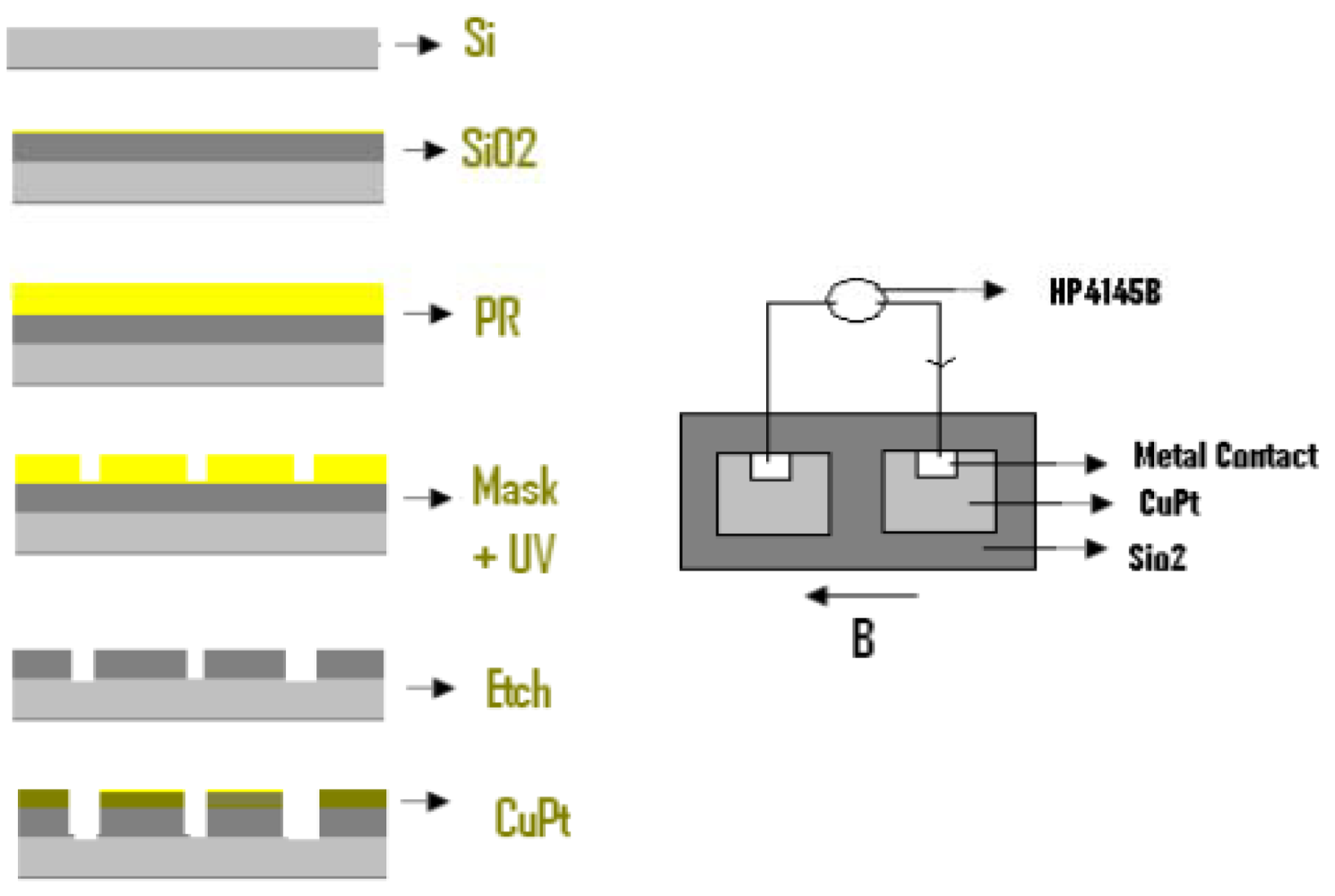
<p>In this work we have shown that a very low magnetic field can be sensed using nonmagnetic material of nano clusters of CuPt on SiO<sub>2</sub>/Si using a CuPt (8 nm)/SiO<sub>2</sub> (5 nm)/Si (50,000 nm)/SiO<sub>2</sub> (5 nm)/CuPt (8 nm) atructure at liquid nitrogen temperature (as shown in <xref ref-type="fig" rid="f1-sensors-09-09734">Figure 1</xref>). This structure shows high sensitivity to applied magnetic fields at 77K and at low and high dc voltages.</p>
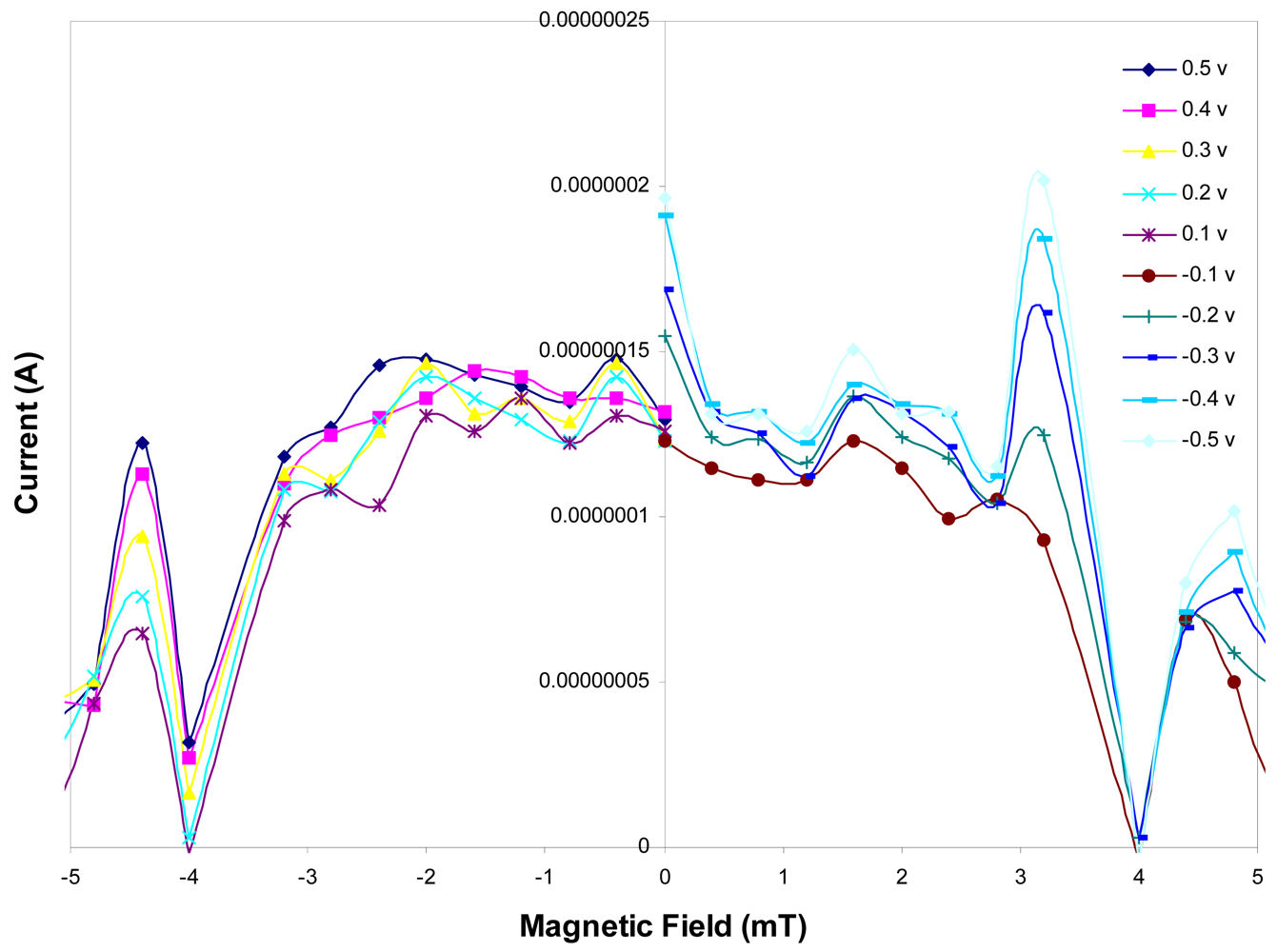
<p>I-V measurement in the Si/SiO<sub>2</sub>/CuPt structure is made at 77 K and 300 K respectively. All measurements are made in the presence and absence of magnetic fields applied in parallel to the formed junction. Magnetic fields as low as 6 mT are detected using I-V and I–B measurements made in the Si/SiO<sub>2</sub>/CuPt structure at 77 K. The current as a function of magnetic field has an oscillatory behavior. This curve has the same oscillatory behavior for other voltages with maximum variation occurring near the origin (<italic>i.e.</italic>, zero magnetic fields) SEM images show the formation of CuPt nano clusters with an average size of less than 100 nm. The magnetic behavior of these nanosized metals is a new observation that will be explained below and is believed to be due to the small nanosize of the platinum and copper structures as well as their discrete energy states and the tunneling of carriers into the insulating layer.</p></sec>
<sec sec-type="results|discussion">
<label>2.</label>
<title>Results and Discussion</title>
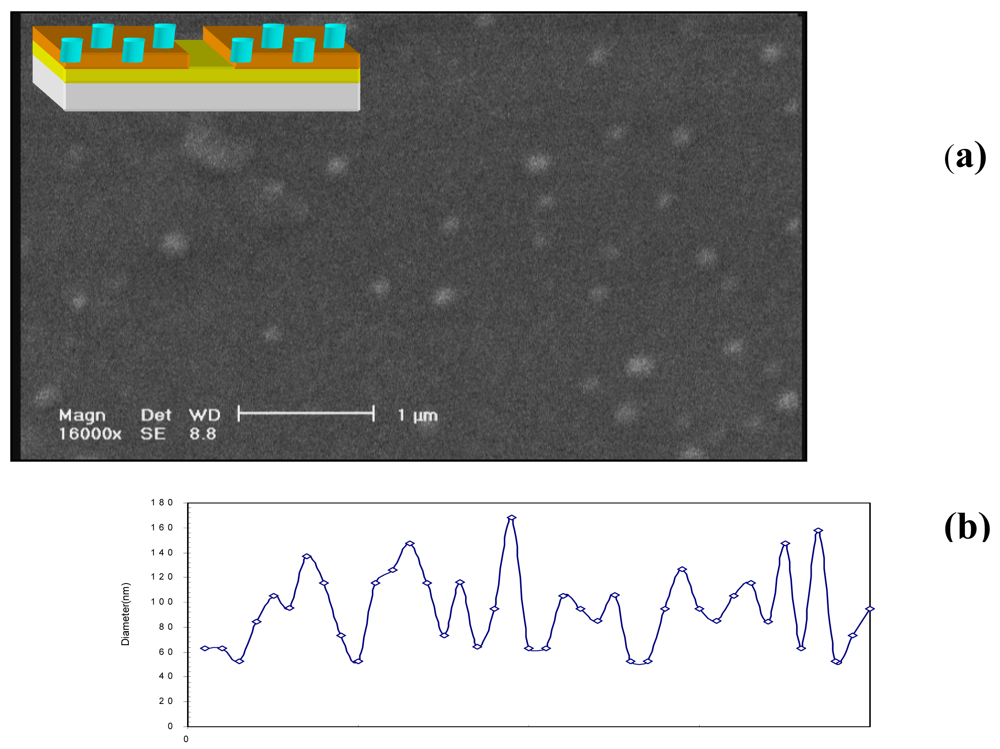
<p>In this work a very thin SiO<sub>2</sub> layer is placed between CuPt and Silicon and CuPt/SiO<sub>2</sub>/Si/SiO<sub>2</sub>/CuPt structure is formed. <xref ref-type="fig" rid="f2-sensors-09-09734">Figure 2a</xref> shows the SEM images of the nanocluster CuPt structure on the SiO<sub>2</sub>/Si. As it can be seen in this Figure that the CuPt clusters are randomly distributed on a 30 μm<sup>2</sup> surface. The diameters of these clusters are less than 100 nm. <xref ref-type="fig" rid="f2-sensors-09-09734">Figure 2b</xref> shows the distribution of cluster size in an area of 5 μm by 6 μm.</p>
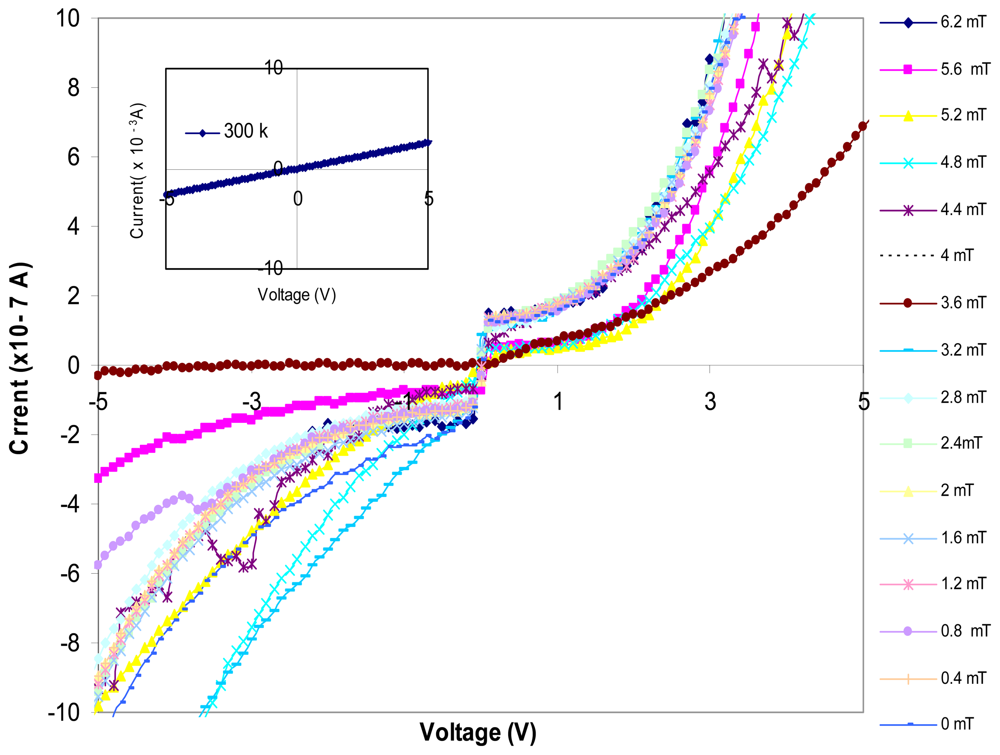
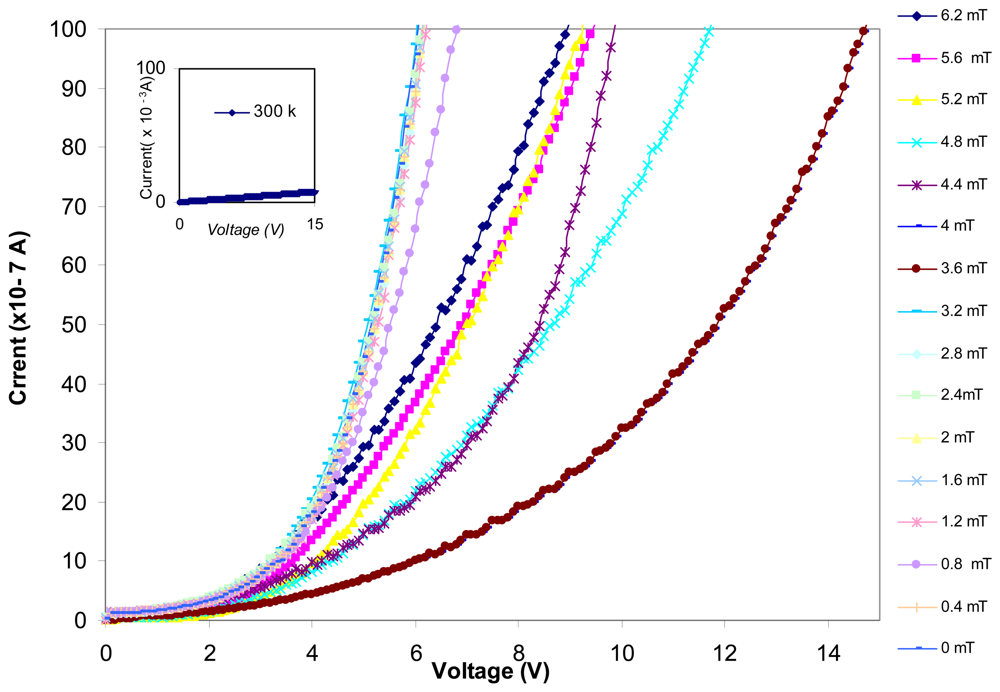
<p>As it can be seen, the average diameter size of these clusters is 96 nm and their approximate thickness is 8 nm. The Current-Voltage characteristics of this structure at 77 K and 300 K is shown in <xref ref-type="fig" rid="f3-sensors-09-09734">Figures 3</xref>, <xref ref-type="fig" rid="f4-sensors-09-09734">4</xref> and their insets, respectively. Variation of the I-V curve due to the external field exposed in parallel to the junction is also investigated in this work. As it can be seen in <xref ref-type="fig" rid="f3-sensors-09-09734">Figures 3</xref>, <xref ref-type="fig" rid="f4-sensors-09-09734">4</xref> there are some variations in the I-V curve due to different magnetic field strengths applied at liquid nitrogen temperature. However, The I-V curve is ohmic at 300 K and has no response to an external field (inset of <xref ref-type="fig" rid="f3-sensors-09-09734">Figures 3</xref>, <xref ref-type="fig" rid="f4-sensors-09-09734">4</xref>). As we can see in these Figures the I-V curves have barrier type behavior at 77 K, which indicates that there is a potential barrier between the CuPt and Si/SiO<sub>2</sub> layers. However, at higher temperature close to room temperature the thermionic emissions, the field effect emissions and the tunneling emission in spot size contacts of CuPt structure on Si/SiO<sub>2</sub>, superimpose and an ohmic behavior is observed.</p>
<p>The slope of the curve at liquid nitrogen temperature varies by increasing the strength of the magnetic fields. The resulting current as a function of different magnetic field strength is also shown in <xref ref-type="fig" rid="f5-sensors-09-09734">Figure 5</xref>. As it is shown in this Figure, the variation of current with magnetic field has an oscillatory relation. Such that the envelope of the curve has almost a Gaussian shape with its peak at zero magnetic field. These curves are symmetric with respect to the direction of applied field and as we can see the current decreases by increasing the magnitude of the applied fields. Non-magnetic platinum atoms can exhibit magnetic behavior when bound together in a form of small clusters [<xref ref-type="bibr" rid="b9-sensors-09-09734">9</xref>,<xref ref-type="bibr" rid="b11-sensors-09-09734">11</xref>,<xref ref-type="bibr" rid="b12-sensors-09-09734">12</xref>]. However, based on SEM images and I-V and I-B curves obtained in this work, the observed magnetic behavior as will be explained below is believed to be due to the small nanosize of the platinum and copper structure as well as their discrete energy states. Since the energy states in CuPt are discrete and by considering the fact that the tunneling of carriers into the insulating layer is only satisfied when the carriers tunnel from full occupied states into the empty states of the other side, this magnetic behavior varies with the variation in voltage and consequently variation in Fermi energy states.</p>
<p>However, by applying external magnetic field there will be a change in carrier concentration and as a result change in tunneling current and slope of the I-V curve. The magnetic sensitivity observed in this structure indicates the potential of CuPt nano clusters for sensing magnetic field as low as the earth magnetic fields.</p></sec>
<sec>
<label>3.</label>
<title>Experimental Section</title>
<p>P-type Si doped with 7 × 10 <sup>14</sup> Boron atom/cm<sup>3</sup> is used in this work. After RCA cleaning followed by plasma cleaning, 200 nm of silicon dioxide is deposited on the surface. Annealing for 30 minutes at 500 °C is performed after oxide deposition; Patterning with an array structure is formed as shown in <xref ref-type="fig" rid="f1-sensors-09-09734">Figure 1</xref>. A 1 mm × 1 mm window is opened on SiO<sub>2</sub> layer using chemical etching such that a very thin SiO<sub>2</sub> layer remained on the surface. Deposition of platinum and copper is performed on the surface, such that 8 nm of Cu-Pt is formed. Thirty minutes of annealing at 400 °C followed after the deposition. Molybdenum and aluminum (<italic>i.e.</italic>, 100 nm and 500 nm, respectively) are then deposited on top of the Cu-Pt layer using e-beam evaporation followed by 20 minutes of annealing at 200 °C. After preparation of the devices they are tested both with and without the presence of magnetic fields as shown in <xref ref-type="fig" rid="f1-sensors-09-09734">Figure 1</xref>. Scanning Electron Microscope SEM: XL30 Philips, HP4145B semiconductor parameter analyzer, Microstructure Measurements software and other computer software are used for measurements and analysis.</p></sec>
<sec sec-type="conclusions">
<label>4.</label>
<title>Conclusions</title>
<p>The CuPt/SiO<sub>2</sub>/Si/SiO<sub>2</sub>/CuPt structure presented in this work shows a good response to low magnetic field (<italic>i.e.</italic>, less than 6 mT) at 77 K, which is a new observation in this structure. The sensitivity of this structure to magnetic fields is believed to be due to small nano size of the Pt–Cu structures as well as their discrete energy states and the tunneling of carriers into the insulating layer. The variation of current due to external magnetic field has an oscillatory behavior such that the average current increases with the voltage. The variation of current with various magnetic field strength at the constant voltage shows also an oscillatory behavior. Since this structure is very sensitive to low intensity magnetic fields, it may also be used for measuring earth magnetic fields. Small size, simple processing fabrication, low cost and high sensitivity are some advantages of this structure to be considered as a magnetic field detector.</p></sec></body>
<back>
<ack>
<p>This work was supported by the Department of Electronic and Thin Film Laboratory in Tehran.</p></ack>
<ref-list>
<title>References</title>
<ref id="b1-sensors-09-09734"><label>1.</label><citation citation-type="journal"><person-group person-group-type="author"><name><surname>Pannetier</surname><given-names>M.</given-names></name><name><surname>Fermona</surname><given-names>C.</given-names></name><name><surname>Vedrine</surname><given-names>P.</given-names></name><name><surname>Welling</surname><given-names>M.S.</given-names></name><name><surname>Wijngaarden</surname><given-names>R.J.</given-names></name></person-group><article-title>Field line distribution in a mixed sensor</article-title><source>Sens. Actuat. B</source><year>2006</year><volume>129</volume><fpage>146</fpage><lpage>149</lpage><pub-id pub-id-type="doi">10.1016/j.sna.2005.11.057</pub-id></citation></ref>
<ref id="b2-sensors-09-09734"><label>2.</label><citation citation-type="journal"><person-group person-group-type="author"><name><surname>Winton</surname><given-names>B.</given-names></name><name><surname>Silver</surname><given-names>T.</given-names></name><name><surname>Dou</surname><given-names>S.X.</given-names></name></person-group><article-title>Cryogenic magnetic field sensor based on the magnetoresistive effect, in bulk Bi2212 + USr2CaO6, M</article-title><source>Appl. Phys. Lett.</source><year>2004</year><volume>84</volume><fpage>5335</fpage><lpage>5337</lpage><pub-id pub-id-type="doi">10.1063/1.1766398</pub-id></citation></ref>
<ref id="b3-sensors-09-09734"><label>3.</label><citation citation-type="journal"><person-group person-group-type="author"><name><surname>Kvon</surname><given-names>Z.D.</given-names></name><name><surname>Baturina</surname><given-names>T.I.</given-names></name><name><surname>Donaton</surname><given-names>R.A.</given-names></name><name><surname>Baklanov</surname><given-names>M.R.</given-names></name><name><surname>Kostrikin</surname><given-names>M.N.</given-names></name><name><surname>Maex</surname><given-names>K.</given-names></name><name><surname>Olshanetsky</surname><given-names>E.B.</given-names></name><name><surname>Portal</surname><given-names>J.C.</given-names></name></person-group><article-title>Maki–Thompson corrections in thin superconducting PtSi films nearby Tc</article-title><source>Physica B</source><year>2000</year><volume>284</volume><fpage>959</fpage><lpage>960</lpage><pub-id pub-id-type="doi">10.1016/S0921-4526(99)02272-3</pub-id></citation></ref>
<ref id="b4-sensors-09-09734"><label>4.</label><citation citation-type="journal"><person-group person-group-type="author"><name><surname>Baturina</surname><given-names>T.I.</given-names></name><name><surname>Horsell</surname><given-names>D.W.</given-names></name><name><surname>Islamovc</surname><given-names>D.R.</given-names></name><name><surname>Drebushchakc</surname><given-names>I.V.</given-names></name><name><surname>Tsaplin</surname><given-names>Yu. A.</given-names></name><name><surname>Babenko</surname><given-names>A.A.</given-names></name><name><surname>Kvon</surname><given-names>Z.D.</given-names></name><name><surname>Savchenko</surname><given-names>A.K.</given-names></name><name><surname>Plotnikov</surname><given-names>A.E.</given-names></name></person-group><article-title>Josephson junction arrays on the basis of superconducting PtSi films</article-title><source>Physica B</source><year>2003</year><volume>329</volume><fpage>1496</fpage><lpage>1497</lpage><pub-id pub-id-type="doi">10.1016/S0921-4526(02)02631-5</pub-id></citation></ref>
<ref id="b5-sensors-09-09734"><label>5.</label><citation citation-type="journal"><person-group person-group-type="author"><name><surname>Tezuka</surname><given-names>N.</given-names></name><name><surname>Miyazaki</surname><given-names>T.</given-names></name></person-group><article-title>Barrier height dependence of MR ratio in Fe/A1-oxide/Fe junctions</article-title><source>J. Magn. Magn. Mater.</source><year>1998</year><volume>178</volume><fpage>1283</fpage><lpage>1284</lpage></citation></ref>
<ref id="b6-sensors-09-09734"><label>6.</label><citation citation-type="journal"><person-group person-group-type="author"><name><surname>Miyazaki</surname><given-names>T.</given-names></name><name><surname>Tezuka</surname><given-names>N.</given-names></name></person-group><article-title>Giant magnetic tunneling effect in Fe/Al2O3/Fe junction</article-title><source>J. Magn. Magn. Mater.</source><year>1995</year><volume>139</volume><fpage>L231</fpage><lpage>L234</lpage></citation></ref>
<ref id="b7-sensors-09-09734"><label>7.</label><citation citation-type="journal"><person-group person-group-type="author"><name><surname>Wei</surname><given-names>H.X.</given-names></name><name><surname>Wang</surname><given-names>T.X.</given-names></name><name><surname>Zeng</surname><given-names>Z.M.</given-names></name><name><surname>Zhang</surname><given-names>X.Q.</given-names></name><name><surname>Zhao</surname><given-names>J.</given-names></name><name><surname>Han</surname><given-names>X.F.</given-names></name></person-group><article-title>Controlled fabrication of nano-scale double barrier magnetic tunnel junctions using focused ion beam milling method</article-title><source>J. Magn. Magn. Mater.</source><year>2006</year><volume>303</volume><fpage>208</fpage><lpage>211</lpage><pub-id pub-id-type="doi">10.1016/j.jmmm.2006.01.072</pub-id></citation></ref>
<ref id="b8-sensors-09-09734"><label>8.</label><citation citation-type="book"><person-group person-group-type="author"><name><surname>Sze</surname><given-names>S.M.</given-names></name></person-group><article-title>Special Microwave Device</article-title><source>Semiconductor Devices: Physics and Technology</source><edition>2nd ed.</edition><publisher-name>Wiley Interscience Publication</publisher-name><publisher-loc>New York, NY, USA</publisher-loc><year>1981</year><fpage>513</fpage><lpage>566</lpage></citation></ref>
<ref id="b9-sensors-09-09734"><label>9.</label><citation citation-type="journal"><person-group person-group-type="author"><name><surname>Schoonus</surname><given-names>J.J.H.M.</given-names></name><name><surname>Bloom</surname><given-names>F.L.</given-names></name><name><surname>Wagemans</surname><given-names>W.</given-names></name><name><surname>Swagten</surname><given-names>H.J.M.</given-names></name><name><surname>Koopmans</surname><given-names>B.</given-names></name></person-group><article-title>Extremely large magnetoresistance in boron-doped ilicon</article-title><source>Phs. Rev. Lett.</source><year>2008</year><volume>127202</volume><fpage>1</fpage><lpage>2</lpage></citation></ref>
<ref id="b10-sensors-09-09734"><label>10.</label><citation citation-type="journal"><person-group person-group-type="author"><name><surname>Hajghassem</surname><given-names>H.</given-names></name><name><surname>Erfanian</surname><given-names>A.R.</given-names></name><name><surname>Banihashemian</surname><given-names>S.M.</given-names></name><name><surname>Aliahmadi</surname><given-names>M.R.</given-names></name><name><surname>Mohtashamifar</surname><given-names>M.</given-names></name></person-group><article-title>Observation of large magnetic resistance in weak magnetic fields using CuPt/SiO2/Si/SiO2/CuPt Structure</article-title><source>J. Magn. Magn. Mater.</source><year>2009</year><volume>321</volume><fpage>2733</fpage><lpage>2736</lpage><pub-id pub-id-type="doi">10.1016/j.jmmm.2009.03.080</pub-id></citation></ref>
<ref id="b11-sensors-09-09734"><label>11.</label><citation citation-type="journal"><person-group person-group-type="author"><name><surname>Liu</surname><given-names>X.</given-names></name><name><surname>Bauer</surname><given-names>M.</given-names></name><name><surname>Bertagnolli</surname><given-names>H.</given-names></name><name><surname>Roduner</surname><given-names>E.</given-names></name></person-group><article-title>Structure and magnetization of small monodisperse platinum clusters</article-title><source>Phys. Rew. Lett</source><year>2006</year><volume>97</volume><fpage>253401</fpage><pub-id pub-id-type="doi">10.1103/PhysRevLett.97.253401</pub-id></citation></ref>
<ref id="b12-sensors-09-09734"><label>12.</label><citation citation-type="journal"><person-group person-group-type="author"><name><surname>Kubo</surname><given-names>R.</given-names></name></person-group><article-title>Electronic properties of metallic fine particles</article-title><source>J. Phys. Soc. Jpn.</source><year>1962</year><volume>17</volume><fpage>975</fpage><lpage>986</lpage><pub-id pub-id-type="doi">10.1143/JPSJ.17.975</pub-id></citation></ref></ref-list>
<sec sec-type="display-objects">
<title>Figures</title>
<fig id="f1-sensors-09-09734" position="float">
<label>Figure 1.</label>
<caption>
<p>Cu-Pt film (8 nm) on a p type silicon with an ultra thin insulating (SiO<sub>2</sub>) layer and CuPt (8nm)/SiO<sub>2</sub> (5 nm)/Si (50,000 nm)/SiO<sub>2</sub> (5 nm)/CuPt (8 nm) array structure Fabrication procedure is shown on the left and the measurement procedure is shown on the right.</p></caption>
<graphic xlink:href="sensors-09-09734f1.gif"/></fig>
<fig id="f2-sensors-09-09734" position="float">
<label>Figure 2.</label>
<caption>
<p>(a) SEM image of CuPt nano cluster on SiO2/Si surface. (b) Distribution of cluster diameter in an area of 5 μm by 6 μm.</p></caption>
<graphic xlink:href="sensors-09-09734f2.gif"/></fig>
<fig id="f3-sensors-09-09734" position="float">
<label>Figure 3.</label>
<caption>
<p>I-V Curve made at liquid nitrogen temperature and room temperature (inset of Figure3) for CuPt/Sio<sub>2</sub>/Si/Sio<sub>2</sub>/CuPt structure respectively. External magnetic field is applied parallel to the surface of the device for low voltages.</p></caption>
<graphic xlink:href="sensors-09-09734f3.gif"/></fig>
<fig id="f4-sensors-09-09734" position="float">
<label>Figure 4.</label>
<caption>
<p>I-V Curve made at liquid nitrogen temperature and room temperature (inset of Figure 4) for CuPt/Sio<sub>2</sub>/Si/Sio<sub>2</sub>/CuPt structure respectively. External magnetic field is applied parallel to the surface of the device for higher voltages.</p></caption>
<graphic xlink:href="sensors-09-09734f4.gif"/></fig>
<fig id="f5-sensors-09-09734" position="float">
<label>Figure 5.</label>
<caption>
<p>Current as a function of external field applied to the junction at 77 K for different voltages.</p></caption>
<graphic xlink:href="sensors-09-09734f5.gif"/></fig></sec></back></article>