<?xml version="1.0" encoding="UTF-8"?>
<!DOCTYPE article PUBLIC "-//NLM//DTD Journal Publishing DTD v2.3 20070202//EN" "journalpublishing.dtd">
<article xmlns:xlink="http://www.w3.org/1999/xlink" xml:lang="en" article-type="review-article">
<front>
<journal-meta>
<journal-id journal-id-type="nlm-ta">Sensors</journal-id>
<journal-title>Sensors</journal-title>
<issn pub-type="epub">1424-8220</issn>
<publisher>
<publisher-name>Molecular Diversity Preservation International (MDPI)</publisher-name></publisher></journal-meta>
<article-meta>
<article-id pub-id-type="doi">10.3390/s111211036</article-id>
<article-id pub-id-type="publisher-id">sensors-11-11036</article-id>
<article-categories>
<subj-group>
<subject>Review</subject></subj-group></article-categories>
<title-group>
<article-title>Overview of Stabilizing Ligands for Biocompatible Quantum Dot Nanocrystals</article-title></title-group>
<contrib-group>
<contrib contrib-type="author">
<name><surname>Zhang</surname><given-names>Yanjie</given-names></name></contrib>
<contrib contrib-type="author">
<name><surname>Clapp</surname><given-names>Aaron</given-names></name><xref ref-type="corresp" rid="c1-sensors-11-11036"><sup>*</sup></xref></contrib>
<aff id="af1-sensors-11-11036">Department of Chemical and Biological Engineering, Iowa State University, Ames, IA50011, USA; E-Mail: <email>yanjiez@iastate.edu</email></aff></contrib-group>
<author-notes>
<corresp id="c1-sensors-11-11036">
<label>*</label> Author to whom correspondence should be addressed; E-Mail: <email>clapp@iastate.edu</email>; Tel.:+1-515-294-9514; Fax: +1-515-294-2689.</corresp></author-notes>
<pub-date pub-type="collection">
<year>2011</year></pub-date>
<pub-date pub-type="epub">
<day>28</day>
<month>11</month>
<year>2011</year></pub-date>
<volume>11</volume>
<issue>12</issue>
<fpage>11036</fpage>
<lpage>11055</lpage>
<history>
<date date-type="received">
<day>12</day>
<month>10</month>
<year>2011</year></date>
<date date-type="rev-recd">
<day>21</day>
<month>11</month>
<year>2011</year></date>
<date date-type="accepted">
<day>22</day>
<month>11</month>
<year>2011</year></date></history>
<permissions>
<copyright-statement>© 2011 by the authors; licensee MDPI, Basel, Switzerland.</copyright-statement>
<copyright-year>2011</copyright-year>
<license>
<p>This article is an open access article distributed under the terms and conditions of the Creative Commons Attribution license (http://creativecommons.org/licenses/by/3.0/).</p></license></permissions>
<abstract>
<p>Luminescent colloidal quantum dots (QDs) possess numerous advantages as fluorophores in biological applications. However, a principal challenge is how to retain the desirable optical properties of quantum dots in aqueous media while maintaining biocompatibility. Because QD photophysical properties are directly related to surface states, it is critical to control the surface chemistry that renders QDs biocompatible while maintaining electronic passivation. For more than a decade, investigators have used diverse strategies for altering the QD surface. This review summarizes the most successful approaches for preparing biocompatible QDs using various chemical ligands.</p></abstract>
<kwd-group>
<kwd>quantum dots</kwd>
<kwd>ligand</kwd>
<kwd>biocompatible</kwd></kwd-group></article-meta></front>
<body>
<sec sec-type="intro">
<label>1.</label>
<title>Introduction</title>
<p>Due to their sensitivity, reliability, and rapid response, fluorescence-based techniques are now vital in biological applications including <italic>in vivo</italic> and <italic>in vitro</italic> cellular targeting and imaging, molecular imaging, and multiplexed analyses. These applications require an appropriate fluorescent probe having specific chemical and optical properties. Organic and genetically-encoded fluorophores generally have narrow absorption, broad emission, and are vulnerable to continuous irradiation by the excitation source which limits their usefulness in some applications such as multiplexed measurements, long-term imaging, and single molecule imaging, among others [<xref ref-type="bibr" rid="b1-sensors-11-11036">1</xref>,<xref ref-type="bibr" rid="b2-sensors-11-11036">2</xref>]. While fluorescent dyes and proteins have been applied broadly to problems in biological sciences, some of their inherent weaknesses have significantly limited the potential of related fluorescence techniques. Quantum dots (QDs) are appealing alternatives to conventional fluorophores due to their superior optical properties and have the potential to meet some of these outstanding challenges in biotechnology. However, the surface chemistry of QDs and the presence of the surface trap sites usually tend to deteriorate their properties in terms of quantum yield and stability. This aspect of QD synthesis remains a considerable challenge for researchers. In this review, we examine some of the most successful methods for rendering QDs biocompatible with the goal of inspiring new and related methods that realize the vast potential of these fluorophores.</p>
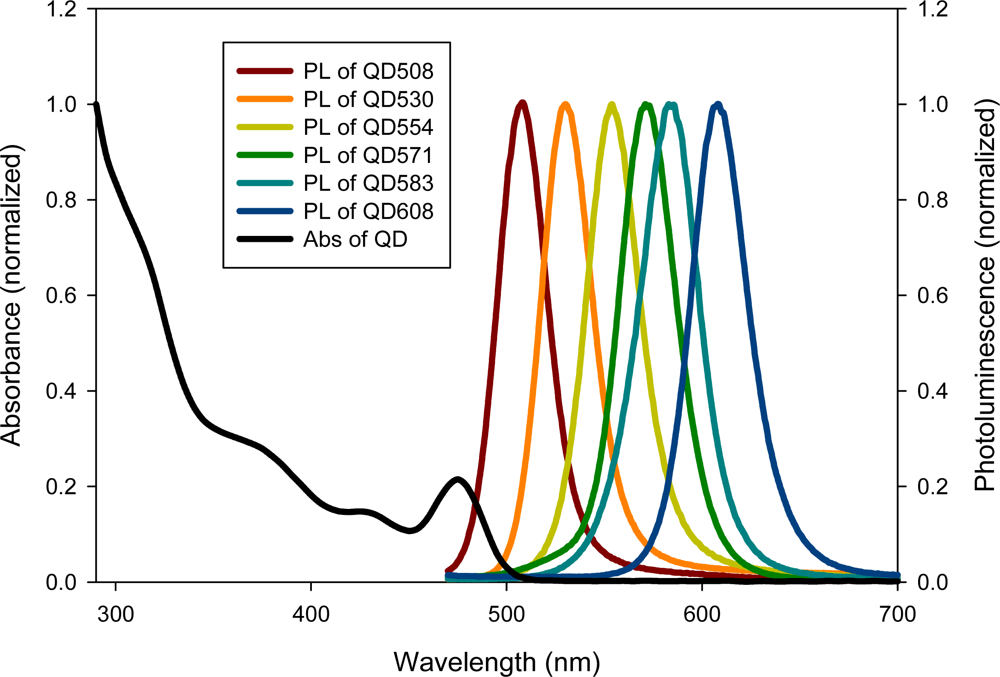
<p>The physical size of colloidal QDs is usually the range of 2–15 nm in diameter where the energy levels of the excited state electron-hole pair (or “exciton”) are quantized rather than continuous. Within this nanocrystal size range, which is on the order of or smaller than the exciton Bohr radius, QDs cease to behave as bulk materials due to confinement of their charge carriers (electrons and holes) in three spatial dimensions. This endows QDs with size, shape, and composition-dependent physical/optical properties that are readily tunable during synthesis. Unlike conventional fluorophores, QDs have broad absorption spectra (QDs of multiple colors can be excited by a monochromatic source), narrow, symmetric, and size-tunable emission spectra (where it is relatively easy to distinguish one QD population from another, as shown in <xref ref-type="fig" rid="f1-sensors-11-11036">Figure 1</xref>); high resistance to physical and chemical degradation (suitable for long-term imaging); high extinction coefficients and quantum yields (sufficient for single molecule measurements); and long fluorescence lifetimes (on the order of 10 ns, useful in time-gated experiments) [<xref ref-type="bibr" rid="b2-sensors-11-11036">2</xref>,<xref ref-type="bibr" rid="b3-sensors-11-11036">3</xref>]. Because of their appealing and tailorable properties, they have been widely used in a diverse range of fields from clinical diagnostics [<xref ref-type="bibr" rid="b4-sensors-11-11036">4</xref>–<xref ref-type="bibr" rid="b6-sensors-11-11036">6</xref>] to photovoltaics [<xref ref-type="bibr" rid="b7-sensors-11-11036">7</xref>,<xref ref-type="bibr" rid="b8-sensors-11-11036">8</xref>].</p>
<p>QDs are generally synthesized using an organometallic approach in which they are stabilized by hydrophobic surfactants and are therefore initially soluble in non-polar media. It is critical to render QDs water-soluble through modification of their surface in preparation for biological applications. An ideal water-soluble ligand should meet the following requirements: (1) provide QDs stability and solubility in biological buffers; (2) maintain a high resistance to photobleaching and other photophysical properties in aqueous media; (3) have functional groups which are able to conjugate to biomolecules; (4) minimize overall hydrodynamic size. The stability of QDs in water can be obtained by either a complete ligand exchange procedure, or through steric stabilization where the native hydrophobic surface is coated with amphiphilic molecules and/or polymers [<xref ref-type="bibr" rid="b2-sensors-11-11036">2</xref>]. Both of these methods have their own advantages where the ultimate choice largely depends on the specific application and requirements of the nanocrystals. Small molecules carrying a net charge tend to contribute to aggregation in buffers of high ionic strength and exhibit variable stability with changes in pH. Additionally, electrostatically stabilized QDs can increase the possibility of non-specific binding in certain biological environments [<xref ref-type="bibr" rid="b2-sensors-11-11036">2</xref>]. Although coating with polymers can effectively mitigate these problems, for example by creating a steric barrier around the nanocrystal, the effective hydrodynamic diameter of these QDs can increase three to four fold [<xref ref-type="bibr" rid="b9-sensors-11-11036">9</xref>,<xref ref-type="bibr" rid="b10-sensors-11-11036">10</xref>] which may preclude uptake into cells via endocytosis or disrupt signal transduction in sensing applications that utilize distance-dependent fluorescence resonance energy transfer (FRET).</p>
<p>Here we review recent progress for preparing biocompatible QDs including aqueous phase synthetic methods, cap exchange procedures that completely replace hydrophobic ligands with hydrophilic species, encapsulating QDs with amphiphiles, and coating QDs with solid shell layers.</p></sec>
<sec>
<label>2.</label>
<title>Aqueous Synthesis of Quantum Dots</title>
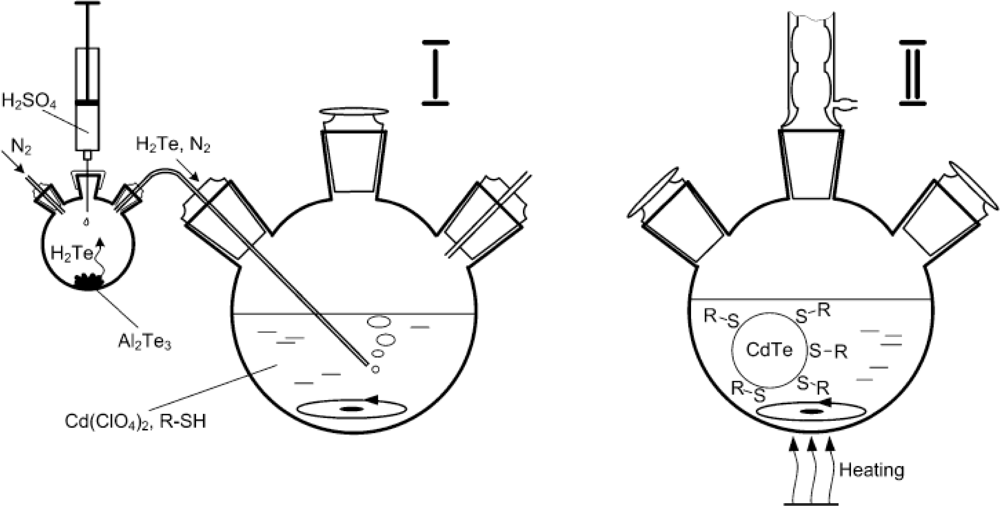
<p>Other than the organometallic approach, QDs can be synthesized through a more direct approach toward water-solubility by using phosphates [<xref ref-type="bibr" rid="b11-sensors-11-11036">11</xref>] or thiols [<xref ref-type="bibr" rid="b12-sensors-11-11036">12</xref>–<xref ref-type="bibr" rid="b15-sensors-11-11036">15</xref>] acting as stabilizing agents in aqueous media. The ligands used during synthesis become the eventual biocompatible surface ligands and do not require an exchange procedure. <xref ref-type="fig" rid="f2-sensors-11-11036">Figure 2</xref> illustrates a typical aqueous synthesis of CdTe [<xref ref-type="bibr" rid="b16-sensors-11-11036">16</xref>] which is completed in two distinct stages. Cd and Te precursors are mixed in stage I in the presence of a thiol stabilizer. CdTe nanocrystals nucleate and grow by reflux in stage II. Gaponik and co-workers [<xref ref-type="bibr" rid="b16-sensors-11-11036">16</xref>] investigated the effect of thiol-capping of CdTe QDs and found that each ligand has a unique effect on the overall performance of QDs (<xref ref-type="table" rid="t1-sensors-11-11036">Table 1</xref>).</p>
<p>The growth rate and surface charge of the nanocrystals depended on the choice of stabilizers. They had difficulty in achieving bright QDs that also exhibit long-term colloidal stability. However, the quantum yield (QY) of these thiol-stablized QDs can be improved by various post-synthesis treatments such as photochemical etching [<xref ref-type="bibr" rid="b16-sensors-11-11036">16</xref>], long term exposure to illumination by a mercury discharge lamp [<xref ref-type="bibr" rid="b17-sensors-11-11036">17</xref>] (photo annealing), and size-selective precipitation [<xref ref-type="bibr" rid="b13-sensors-11-11036">13</xref>].</p>
<p>Glutathione (GSH), a thiol-containing tripeptide, which is known to detoxify heavy metals in plant cells, is able to provide improved biocompatible capping for QDs as compared with many other water-soluble ligands [<xref ref-type="bibr" rid="b18-sensors-11-11036">18</xref>]. It has been used successfully to cap Au, ZnS, CdS, CdSe [<xref ref-type="bibr" rid="b19-sensors-11-11036">19</xref>–<xref ref-type="bibr" rid="b21-sensors-11-11036">21</xref>] and CdTe nanoparticles, but appears to work best with CdTe in terms of promoting high photoluminescence [<xref ref-type="bibr" rid="b22-sensors-11-11036">22</xref>]. The pH of the solution containing the Cd<sup>2+</sup>-GSH precursors and the molar ratio of Cd<sup>2+</sup>-GSH to NaHTe (Te precursor) were found to have a strong influence on the QY of CdTe QDs. Higher molar ratios resulted in better passivation of the surface states on CdTe which led to higher QY. This effect saturated with complete surface passivation by Cd<sup>2+</sup>-GSH.</p>
<p>Most reported aqueous synthesis methods have focused on II–VI group nanocrystals, while there are few reports regarding the synthesis of III–V QDs in water, save the work of Qian’s group [<xref ref-type="bibr" rid="b23-sensors-11-11036">23</xref>]. They prepared InP QDs in aqueous ammonia in the presence of potassium stearate. However, this hydrothermal method can only produce nanocrystals in the form of secondary particles [<xref ref-type="bibr" rid="b24-sensors-11-11036">24</xref>].</p></sec>
<sec>
<label>3.</label>
<title>Direct Ligand Exchange</title>
<p>QDs synthesized via the organometallic method require an extra processing step to achieve biocompatibility. The direct ligand exchange is accomplished by replacing QDs’ native hydrophobic ligands with hydrophilic molecules that have higher affinity for the QD surface. The most popular anchoring molecules utilize thiol groups. Others including amines, phosphonic acids, and carboxylic acids have also been widely used [<xref ref-type="bibr" rid="b25-sensors-11-11036">25</xref>–<xref ref-type="bibr" rid="b28-sensors-11-11036">28</xref>].</p>
<sec>
<label>3.1.</label>
<title>Monodentate Thiols</title>
<p>In 1998, Nie’s group [<xref ref-type="bibr" rid="b29-sensors-11-11036">29</xref>] developed one of the first protocols for generating hydrophilic QDs by coating CdSe/ZnS core-shell QDs with mercaptoacetic acid which exploits the affinity of monothiols for the ZnS shell. Since then, many other monothiol ligands have been used to provide QDs water-solubility such as mercaptopropionic acid (MPA) [<xref ref-type="bibr" rid="b30-sensors-11-11036">30</xref>–<xref ref-type="bibr" rid="b32-sensors-11-11036">32</xref>], mercaptoundecanoic (MUA) [<xref ref-type="bibr" rid="b33-sensors-11-11036">33</xref>], 4-mercaptobenzoic acid [<xref ref-type="bibr" rid="b34-sensors-11-11036">34</xref>], thiol-derivatized sugar [<xref ref-type="bibr" rid="b35-sensors-11-11036">35</xref>], thiolated derivative of diethyleneglycol [<xref ref-type="bibr" rid="b36-sensors-11-11036">36</xref>], dendrons [<xref ref-type="bibr" rid="b37-sensors-11-11036">37</xref>,<xref ref-type="bibr" rid="b38-sensors-11-11036">38</xref>], cystamine [<xref ref-type="bibr" rid="b2-sensors-11-11036">2</xref>], cysteine [<xref ref-type="bibr" rid="b39-sensors-11-11036">39</xref>] and related residues [<xref ref-type="bibr" rid="b40-sensors-11-11036">40</xref>]. This approach continues to be a popular method due to the ease of processing and the commercial availability of candidate ligands.</p>
<p>Due to the dynamic binding interactions between the thiol and ZnS, QDs coated with monothiol ligands tend to have shorter shelf lives [<xref ref-type="bibr" rid="b41-sensors-11-11036">41</xref>]. Also, the pH of the solution is found to be responsible for the thiolate ligand stability. Peng’s group [<xref ref-type="bibr" rid="b42-sensors-11-11036">42</xref>] used a pseudo steady-state titration method to investigate the stability of colloidal nanocrystals coated with thiolate ligands upon pH change. They found that as pH of the solution fell into a relatively low range (2–7), the thiolate ligand became protonated and dissociated from the nanocrystal surface. This effect was confirmed as the main reason for the precipitation of the nanocrystals. This dissociation process was found to be reversible and the equilibrium pH value was size dependent. Similarly, the luminescence QY tends to suffer with these samples presumably due to the instability of the ligand and reduced surface coverage over time. The quenching efficiency was found to depend strongly on both the size and charge of the thiol [<xref ref-type="bibr" rid="b43-sensors-11-11036">43</xref>]. Several groups have found that an appropriate ligand exchange method is crucial for preserving colloidal stability and brightness. Pong <italic>et al.</italic> [<xref ref-type="bibr" rid="b44-sensors-11-11036">44</xref>] discovered that the bond strength between a monothiol and ZnS can be increased by removing thiolic hydrogen during the adsorption process. Wang <italic>et al.</italic> reported [<xref ref-type="bibr" rid="b45-sensors-11-11036">45</xref>] that the photoluminescence can be maintained if the ligand exchange step was eliminated as a separate step. Alternatively, they developed a new strategy, <italic>in situ</italic> shell formation and ligand capping, which allowed the core CdSe to be overcoated by a ZnS shell and the water-soluble ligand MPA in a single step. They further found the QY of synthesized CdSe/ZnS core-shell QDs capped with MPA was comparable to that of trioctylphosphine oxide (TOPO)-capped QDs while the QY of MPA-capped CdSe-ZnS QDs using ligand exchange method was five-fold lower. Tamang <italic>et al.</italic> [<xref ref-type="bibr" rid="b46-sensors-11-11036">46</xref>] found that pH played an important role in increasing stability of InP/ZnS QDs during an aqueous phase transfer procedure. The thiol group of a water-soluble ligand is deprotonated at high pH, and thiolate has been shown to bind the QDs surface more strongly than thiol [<xref ref-type="bibr" rid="b47-sensors-11-11036">47</xref>]. They also discovered that the QY could be improved by adding an appropriate reducing agent.</p>
<p>The QD surface states have a significant effect on the quantum yield. Jeong <italic>et al.</italic> [<xref ref-type="bibr" rid="b48-sensors-11-11036">48</xref>] found that it was the thiolate, not thiol, that had a time-, concentration-, and pH-dependent effect on QD surface states. They proved that the thiol addition could better passivate the electron trap sites and therefore increased the QY at low thiol concentration, while at high thiol concentration new hole traps would be created and QY decreased.</p>
<p>A reduction in the luminescent QY mediated by thiol binding can be mitigated by either crosslinking or adding layers to the surface [<xref ref-type="bibr" rid="b49-sensors-11-11036">49</xref>]. Chan’s group [<xref ref-type="bibr" rid="b50-sensors-11-11036">50</xref>] first coated hydrophobic QDs with MPA and then crosslinked these ligands with lysine or diaminopimelic acid in the presence of dicyclohexylcarbodiimide. They later examined stability of these QDs in various biological conditions in order to optimize their behavior for various applications. This cost-effective, simple method was able to synthesize highly stable water-soluble QDs which maintained all of the hydrophobic QD optical properties. However, due to the relatively thick coating layer, the size was twice as big as the TOPO coated QDs.</p>
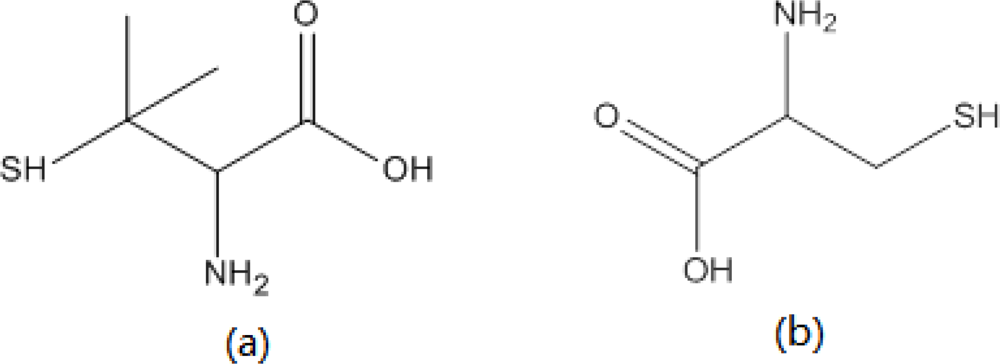
<p>Zwitterionic monothiols, possessing positive and negative charges simultaneously, have the potential to minimize hydrodynamic particle size and reduce nonspecific binding. Bawendi’s group [<xref ref-type="bibr" rid="b51-sensors-11-11036">51</xref>] found that zwitterionic or net neutral charged organic coatings prevented the binding of QDs to serum proteins. They further found that QDs having a hydrodynamic diameter below 5.5 nm can be efficiently removed from the body by renal clearance. They compared four different coatings including dihydrolipoic acid (DHLA, anionic), cysteamine (cationic), cysteine (zwitterionic), and DHLA-polyethylene glycol (DHLA-PEG, neutral). Of these, only cysteine and DHLA-PEG coated QDs were able to prevent the adsorption of serum proteins. However, the effective size of the DHLA-PEG coated QDs was too large to be eliminated via renal clearance. Although they showed promising results, the main drawback of cysteine-coated QDs was their instability. These samples typically precipitated after 24 hours of storage at 4 °C [<xref ref-type="bibr" rid="b39-sensors-11-11036">39</xref>]. Breus <italic>et al.</italic> [<xref ref-type="bibr" rid="b52-sensors-11-11036">52</xref>] used zwitterionic <sc>d</sc>-penicillamine (DPA) as a stabilizing ligand for QDs and showed that they are far more stable than cysteine-coated QDs. The chemical structures of DPA and cysteine are shown in <xref ref-type="fig" rid="f3-sensors-11-11036">Figure 3</xref>. These DPA-coated QDs were shown to be stable over a pH range of 5–9 and exhibited excellent chemical stability even in strongly oxidizing environments. They hypothesized that the superior stability results from the reduced interaction between DPA ligands.</p></sec>
<sec>
<label>3.2.</label>
<title>Bidentate Thiols</title>
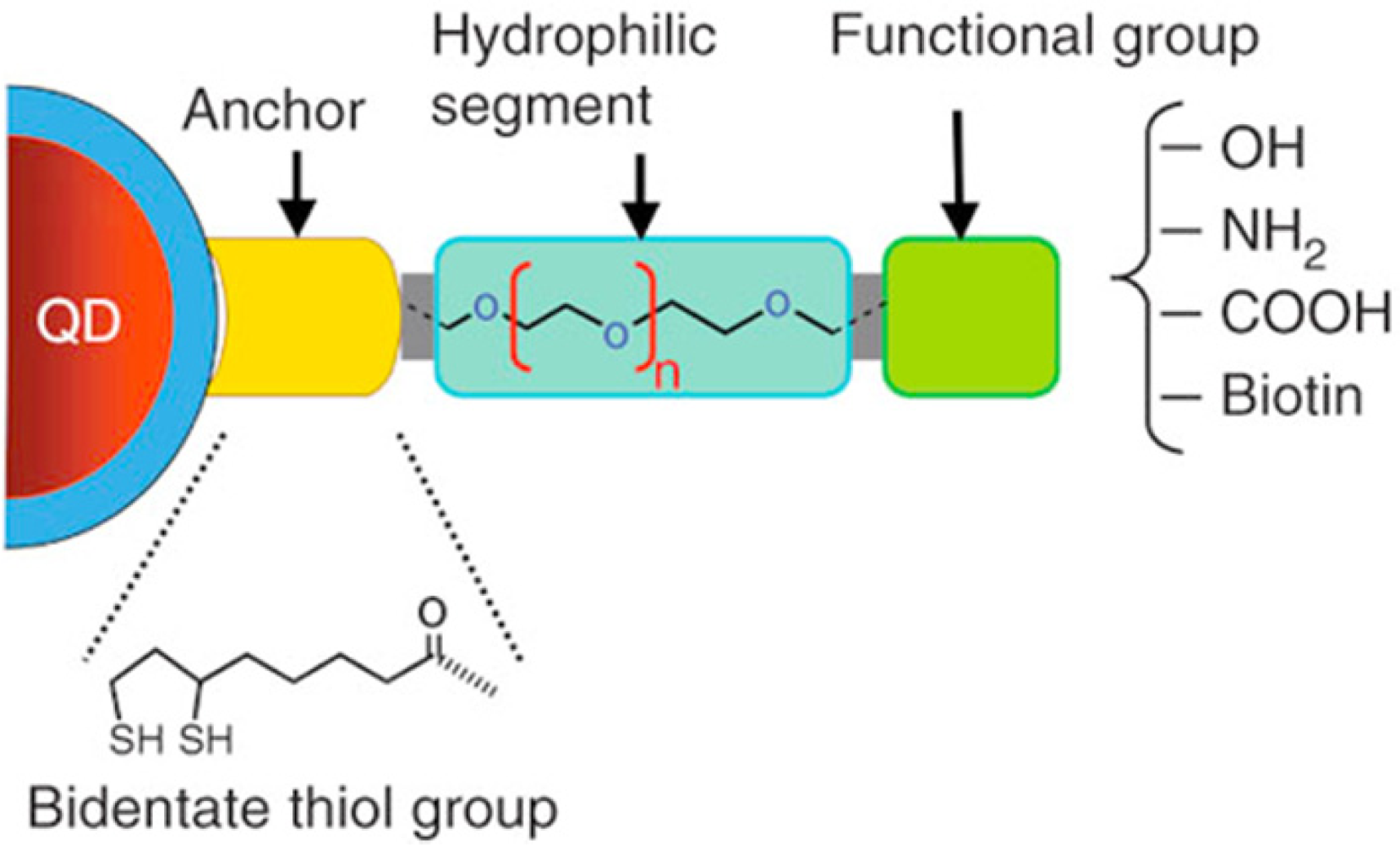
<p>Recognizing the poor inherent stability of monothiol-coated QDs, Mattoussi <italic>et al.</italic> [<xref ref-type="bibr" rid="b53-sensors-11-11036">53</xref>] overcoated QDs with negatively charged dihydrolipoic acid (DHLA) to render them water-soluble and promote attachment of engineered recombinant proteins through electrostatic attraction. These QDs demonstrated a dramatically improved shelf life of up to two years with proper storage. Nonetheless, DHLA is not able to preserve the high luminescence of native QDs presumably due to its lower density on the nanocrystal surface. Moreover, this negatively charged capping ligand is only stable in basic conditions (pH ≥ 7), and may induce non-specific binding to positively charged proteins in cellular applications. To circumvent this, the carboxylated DHLA-coated QDs can be further modified to have various functional groups which can serve different purposes. As <xref ref-type="fig" rid="f4-sensors-11-11036">Figure 4</xref> shows, Susumu <italic>et al.</italic> [<xref ref-type="bibr" rid="b54-sensors-11-11036">54</xref>,<xref ref-type="bibr" rid="b55-sensors-11-11036">55</xref>] developed a new class of water-soluble ligands consisting of DHLA and PEG. The appended functional groups (hydroxyl, carboxylic acid, amino, and biotin) are readily able to conjugate with biomolecules. In addition to DHLA [<xref ref-type="bibr" rid="b56-sensors-11-11036">56</xref>–<xref ref-type="bibr" rid="b58-sensors-11-11036">58</xref>] and modified DHLA [<xref ref-type="bibr" rid="b59-sensors-11-11036">59</xref>–<xref ref-type="bibr" rid="b63-sensors-11-11036">63</xref>], other bidentate thiols such as dithiothreitol (DTT) [<xref ref-type="bibr" rid="b64-sensors-11-11036">64</xref>], and thiol-modified β-cyclodextrin [<xref ref-type="bibr" rid="b65-sensors-11-11036">65</xref>] have been successfully used as QD ligands, however none of these appears capable of achieving high luminescence and small size simultaneously.</p>
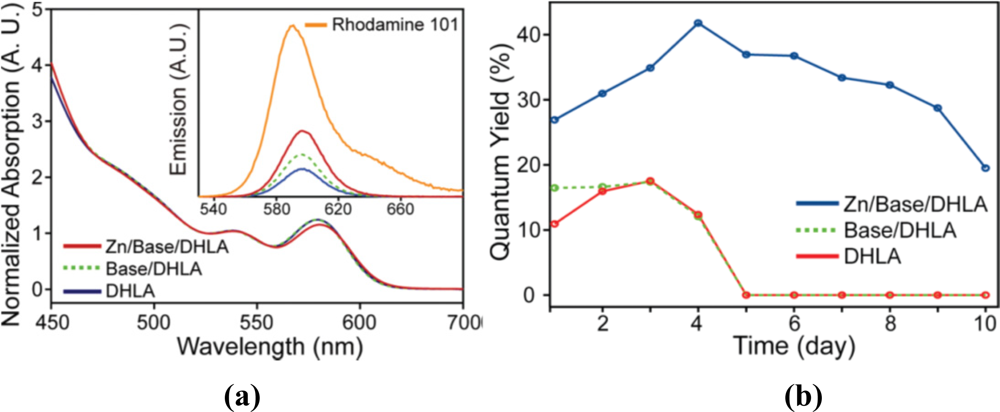
<p>Liu <italic>et al.</italic> [<xref ref-type="bibr" rid="b66-sensors-11-11036">66</xref>] recently found that the quantum yield of DHLA-coated QDs can be increased twice during the ligand exchange process with the presence of zinc and base. Zn(DHLA)<sub>2</sub> formed by metalation of zinc and DHLA and reacted with tetradecylphosphonic acid (TDPA) which initially capped hydrophobic QDs. They believed that this process was able to avoid the etching of the QD shell during cap exchange. They compared the quantum yield of QDs capped using different methods (with or without zinc/base) and found that the QY was improved with the help of zinc and base (<xref ref-type="fig" rid="f5-sensors-11-11036">Figure 5</xref>).</p>
<p>Reiss’s group [<xref ref-type="bibr" rid="b67-sensors-11-11036">67</xref>,<xref ref-type="bibr" rid="b68-sensors-11-11036">68</xref>] designed a new family of ligands called carbondithioates, which have high resistance to photooxidation and adsorb strongly onto the QD surface. However, a new specific synthesis is required to prepare every new ligand. Dubois <italic>et al.</italic> [<xref ref-type="bibr" rid="b69-sensors-11-11036">69</xref>] then developed a facile and effective way to prepare similar ligands called dithiocarbamates (DTCs) by simply mixing carbon disulfide with an appropriate amine precursor. These DTC-coated QDs lost only 15% of their initial fluorescence after 500 consecutive illuminations at 350 nm (having a duration of 4 s each), where their absorption profiles were unchanged. Similar to effects seen with other thiolated capping molecules, the QY of these QDs was shown to drop substantially (∼40%) from its initial values. Based on similar chemistry, our own group [<xref ref-type="bibr" rid="b70-sensors-11-11036">70</xref>] performed a ligand exchange procedure with DTCs in two phases rather than a single phase and found that the initial QY of hydrophobic QDs could be fully preserved or even enhanced if using high quality TOP/TOPO-capped CdSe/ZnS QDs. Another interesting finding is that these DTC-capped QDs can be either pH-insensitive or pH-sensitive based on the side chain group of the DTC ligand which may provide some advantage over traditional capping ligands.</p></sec>
<sec>
<label>3.3.</label>
<title>Multidentate Ligands</title>
<p>Multidentate ligands offer QDs enhanced stability because of the increased number of binding sites between each ligand and the QD surface. Bawendi’s group [<xref ref-type="bibr" rid="b71-sensors-11-11036">71</xref>] crosslinked alkyl phosphines, commonly used to stabilize hydrophobic QDs, with a crosslinker dissocyanatohexane to form polydentate ligands known as oligomeric phosphines (OPs). This new class of ligands consists of three components which are the inner phosphine layer (which passivate the QD surface), linking layer (which protect the QD), and an outer functionalized layer (which impart desirable chemical properties). The OPs displaying carboxylic acid groups were compared with MPA coatings on QDs with the former maintaining the initial QY and showing enhanced stability in various pH (ranging from 5.5 to 12) and in high ionic strength solutions. Wang <italic>et al.</italic> [<xref ref-type="bibr" rid="b72-sensors-11-11036">72</xref>,<xref ref-type="bibr" rid="b73-sensors-11-11036">73</xref>] passivated QDs with a multidentate diblock copolymer, poly(ethylene glycol-<italic>b</italic>-2-<italic>N</italic>,<italic>N</italic>-dimethylaminoethyl methacrylate) (PEG-<italic>b</italic>-PDMA). The pendent tertiary amine groups had proved to high affinity to the QD surface [<xref ref-type="bibr" rid="b74-sensors-11-11036">74</xref>]. They found that the QY of QDs coated with 10k and 15k molecular weight polymer prepared by traditional solution polymerization were substantially higher than that of QDs coated with TOPO, while the presence of 35k molecular weight polymer synthesized by atom transfer radical polymerization (ATRP) decreased brightness of the QDs. They attributed this to two competing effects: enhanced surface passivation by the polymer and a parasitic effect caused by copper ion residual from the initiator during the ATRP synthesis.</p>
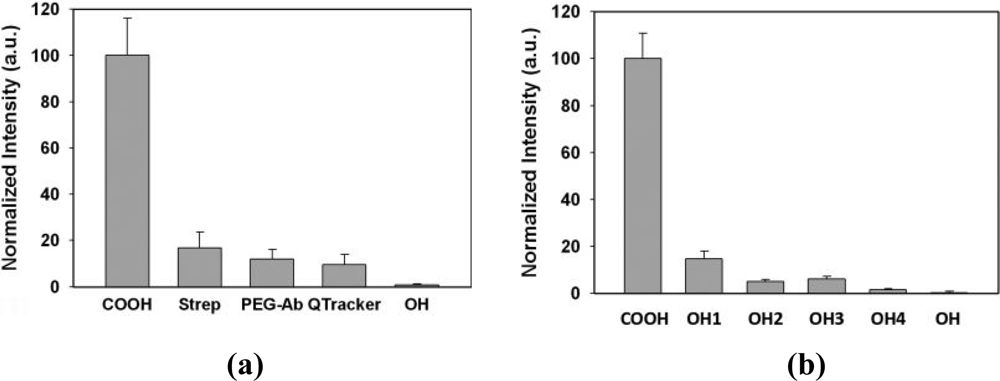
<p>For certain biological applications, the QD capping ligands are required to minimize the nonspecific binding to the cell membrane or proteins. Nie’s group [<xref ref-type="bibr" rid="b75-sensors-11-11036">75</xref>] prepared a new class of hydroxylated QDs, which initially have carboxyl groups, that are prepared through a hydroxylation and cross-linking procedure. These QDs had relatively small sizes (13–14 nm) as compared to other amphiphilic polymer-coated QDs (20–40 nm) [<xref ref-type="bibr" rid="b76-sensors-11-11036">76</xref>–<xref ref-type="bibr" rid="b78-sensors-11-11036">78</xref>]. They also evaluated their nonspecific binding properties with a series of different coatings including carboxylated, streptavidin-functionalized, and PEG-coated QDs; these results are shown in <xref ref-type="fig" rid="f6-sensors-11-11036">Figure 6</xref>. The hydroxylated QDs showed the lowest nonspecific cellular binding where a higher degree of hydroxylation helped to further reduce the nonspecific binding. To reduce the hydrodynamic size, they overcoated QDs with a linear polymer chain which had a mixed composition of thiols and amines [<xref ref-type="bibr" rid="b79-sensors-11-11036">79</xref>]. This novel coating tightly wrapped around QD surface as “loops-and-trains” [<xref ref-type="bibr" rid="b73-sensors-11-11036">73</xref>,<xref ref-type="bibr" rid="b74-sensors-11-11036">74</xref>] where the size of QDs was as small as 4–7 nm in diameter. They further found that the number of available binding groups (thiols and amines) had strong influence on QD polydispersity, QY, and photostability. Increasing the number of binding groups offered better stability but sacrificed QY suggesting an optimal number of binding groups per QD.</p>
<p>Rather than using single DHLA as an anchoring group, Stewart <italic>et al.</italic> [<xref ref-type="bibr" rid="b80-sensors-11-11036">80</xref>] synthesized a new set of multidentate PEG-based ligands which have two DHLA, or thioctic acid, molecules. These ligands improved QD stability to survive in conditions unfavorable to DHLA-capped QDs. They showed remarkably stability in various pH solutions ranging from 1.1 to 13.9 and extremely high salt conditions (2 M NaCl).</p></sec></sec>
<sec>
<label>4.</label>
<title>Indirect Surface Encapsulation</title>
<sec>
<label>4.1.</label>
<title>Silica Coatings</title>
<p>A silica shell is another desirable method for producing biocompatible nanocrystals due to the formation of a contiguous protective surface layer. QDs can acquire a silica layer either through direct ligand exchange [<xref ref-type="bibr" rid="b81-sensors-11-11036">81</xref>–<xref ref-type="bibr" rid="b83-sensors-11-11036">83</xref>] (surface silanization) or indirect encapsulation [<xref ref-type="bibr" rid="b84-sensors-11-11036">84</xref>–<xref ref-type="bibr" rid="b88-sensors-11-11036">88</xref>] (sol-gel process, microemulsion, micellization of siloxane surfactants). The deposited silica shell can be further modified to conjugate biomolecules using standard silane coupling chemistry that is already ubiquitous for modifying bulk glass surfaces such as microscope slides.</p>
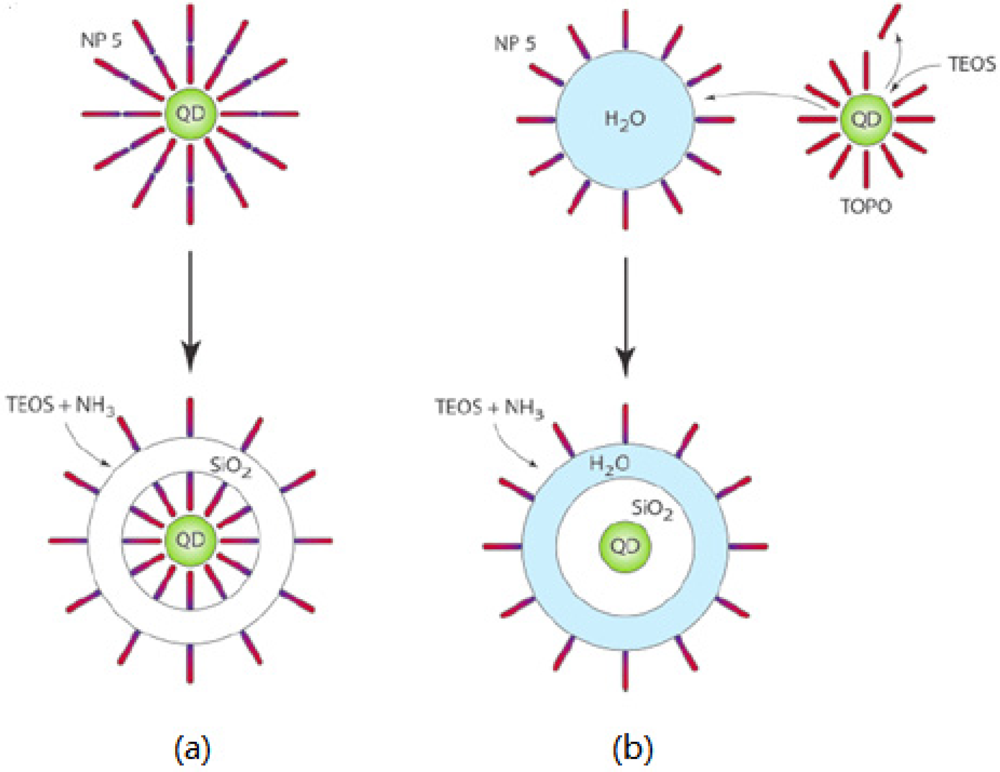
<p>The sol-gel process was first developed by Stöber <italic>et al.</italic> [<xref ref-type="bibr" rid="b89-sensors-11-11036">89</xref>] and requires water-soluble QDs as a starting material. Compared to the sol-gel process, the advantage of the microemulsion process is that it is able to overcoat hydrophobic QDs directly with a silica layer where the resulting nanoparticles have smoother surfaces and narrow size distributions [<xref ref-type="bibr" rid="b84-sensors-11-11036">84</xref>]. Darbandi <italic>et al.</italic> [<xref ref-type="bibr" rid="b84-sensors-11-11036">84</xref>] reported that the silica growth on QD surfaces involve two hypothetical mechanisms during the microemulsion process (<xref ref-type="fig" rid="f7-sensors-11-11036">Figure 7</xref>). The first possible mechanism is shown in <xref ref-type="fig" rid="f7-sensors-11-11036">Figure 7(a)</xref> where the surfactant forms an inverted bilayer around TOPO-coated QDs followed by deposition of a silica layer within the hydrophilic region carried out in the presence of an ammonia catalyst used to promote the polymerization of tetraethyl orthosilicate (TEOS). In the second hypothetical mechanism [<xref ref-type="fig" rid="f7-sensors-11-11036">Figure 7(b)</xref>], the TOPO ligand is replaced by TEOS and QDs are transferred to the aqueous phase followed by the polymerization of TEOS from the QD surface. The resulting nanoparticles were monodisperse and had high luminescence with a single QD in the center.</p>
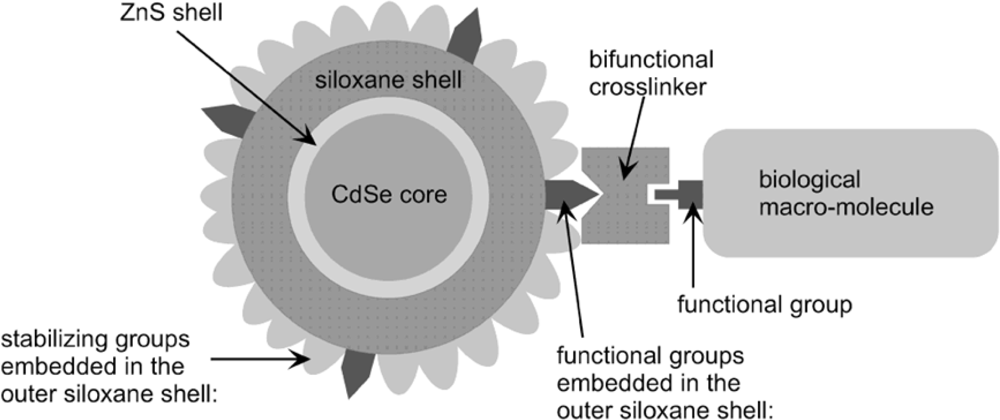
<p>Surface silanization is another way to form a silica shell around the QD by fully displacing the pre-existing hydrophobic ligands. In a typical process, TOPO-coated QDs are mixed with mercaptopropyltrimethoxysilane (MPTS) in alkaline methanol. The mercapto group is able to bind to the ZnS layer of QDs and thus replace the TOPO layer, followed by heating the solution to promote crosslinking of the silanol groups. The silica shell is later modified to have different functional group such as thiols, amines, or carboxyl groups to ensure covalent attachment to biomolecules (<xref ref-type="fig" rid="f8-sensors-11-11036">Figure 8</xref>) [<xref ref-type="bibr" rid="b83-sensors-11-11036">83</xref>].</p></sec>
<sec>
<label>4.2.</label>
<title>Amphiphilic Ligands</title>
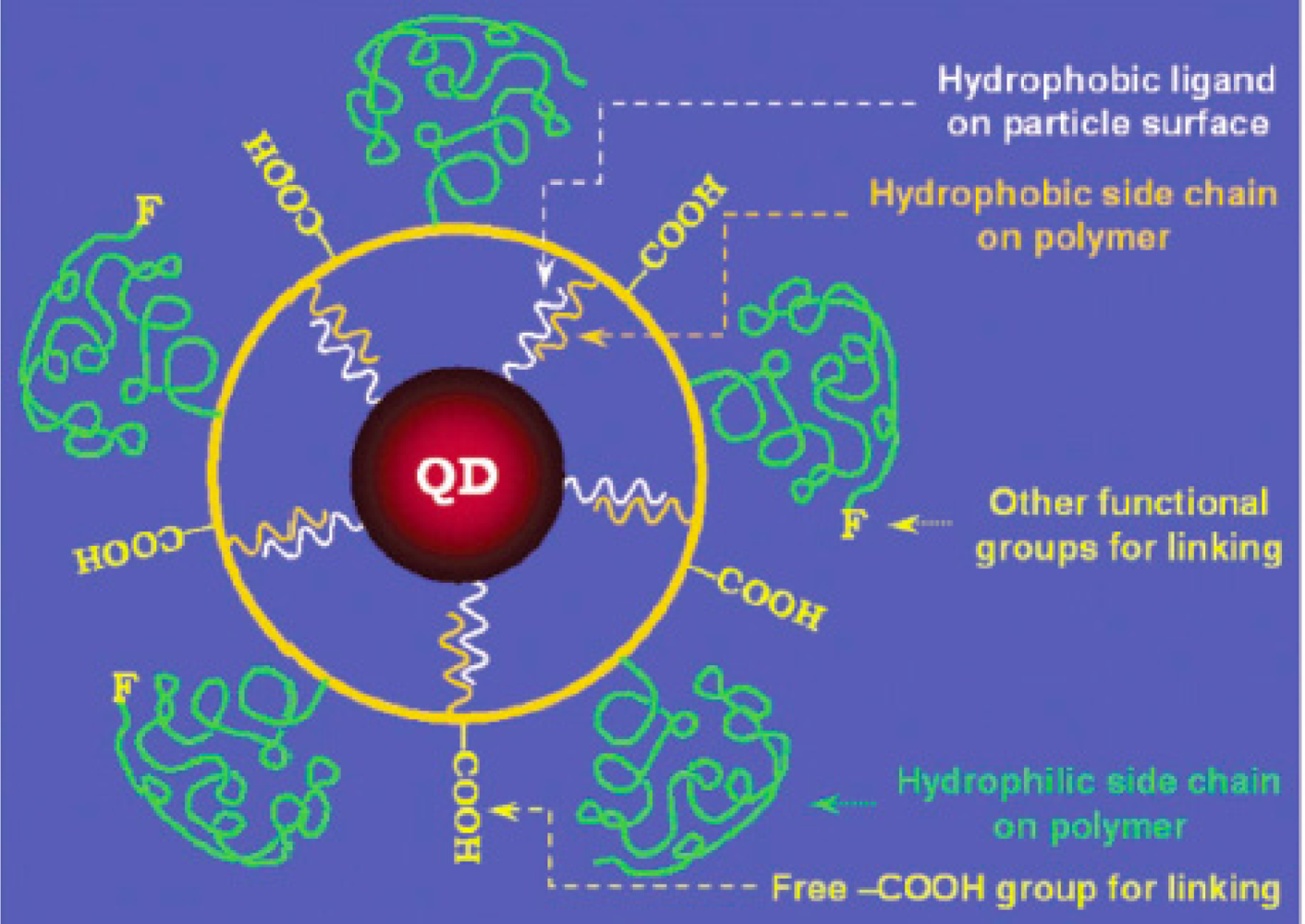
<p>Unlike a direct ligand exchange process where hydrophilic ligands completely replace hydrophobic ligands, the method of encapsulating QDs with amphiphiles uses native nonpolar molecules as binding intermediates. The hydrophobic section of the amphiphiles intercalates the hydrophobic stabilizing agent such as TOPO while the hydrophilic portion offers aqueous solubility. Surfactants such as phospholipids [<xref ref-type="bibr" rid="b76-sensors-11-11036">76</xref>,<xref ref-type="bibr" rid="b90-sensors-11-11036">90</xref>,<xref ref-type="bibr" rid="b91-sensors-11-11036">91</xref>], α-cyclodextrin [<xref ref-type="bibr" rid="b92-sensors-11-11036">92</xref>,<xref ref-type="bibr" rid="b93-sensors-11-11036">93</xref>], <italic>n</italic>-alcanoic acids [<xref ref-type="bibr" rid="b94-sensors-11-11036">94</xref>], and cetyl-trimethylammonium bromide [<xref ref-type="bibr" rid="b95-sensors-11-11036">95</xref>] have all been used to transfer nanoparticles into water. However, due to relatively weak hydrophobic interactions, they are normally not sufficiently stable when subjected to biologically relevant conditions [<xref ref-type="bibr" rid="b96-sensors-11-11036">96</xref>]. The use of amphiphilic polymers can overcome this issue because a single polymer chain can possess multiple hydrophobic subunits which greatly enhances intercalation affinity with the hydrophobic ligands on the QD surface. Yu <italic>et al.</italic> [<xref ref-type="bibr" rid="b96-sensors-11-11036">96</xref>] prepared the amphiphilic polymer poly(maleic anhydride-alt-1-octadecene) (PMAO)-PEG through the reaction between PMAO and primary amine-terminated PEG methyl ethers. Nonpolar QDs were then mixed with PMAO-PEG in chloroform and stirred overnight. The modular design of these amphiphilic polymer-coated QDs is shown in <xref ref-type="fig" rid="f9-sensors-11-11036">Figure 9</xref>. These PMAO-PEG-coated QDs were found to have the same optical properties, including QY, as hydrophobic QDs, and successfully recognized the cancer cells with the Her2 receptor. In this case, the binding between QDs and polymer ligands solely relies on hydrophobic attraction, however the length of the polymer improves this interaction substantially. The stability of amphiphilic polymer-coated QDs can be further improved by covalently crosslinking the outmost layer [<xref ref-type="bibr" rid="b78-sensors-11-11036">78</xref>,<xref ref-type="bibr" rid="b97-sensors-11-11036">97</xref>].</p>
<p>Gao’s group [<xref ref-type="bibr" rid="b98-sensors-11-11036">98</xref>] found that capping QDs with silica and amphiphilic polymer together offered better passivation than capping with either one alone. Single hydrophobic CdSe/ZnS QDs were first incorporated into silica spheres via a reverse microemulsion, followed by surface modification with hydrophobic trimethoxy(octadecyl)silane (OTMS). The amiphiphilic polymer (1,2-distearoyl-<italic>sn</italic>-glycero-3-phosphoethanolamine-N-[carboxy(polyethylene glycol)-2000] (PE-PEG) was the attached to SiO<sub>2</sub>-OTMS-coated QDs through hydrophobic interactions [<xref ref-type="fig" rid="f10-sensors-11-11036">Figure 10(b)</xref>]. As <xref ref-type="fig" rid="f10-sensors-11-11036">Figure 10(a)</xref> shows, only QDs capped with SiO<sub>2</sub> and PE-PEG showed similar brightness over pH 1–14. They also evaluated the cellular toxicity of these nanoparticles with and without embedded QDs and found that the toxicity is purely due to the exposure of bare nanoparticles, indicating QDs were adequately protected within the silica spheres with no appreciable leaching of heavy metals [<xref ref-type="fig" rid="f10-sensors-11-11036">Figure 10(c)</xref>].</p></sec></sec>
<sec>
<label>5.</label>
<title>Conjugating Quantum Dots to Biomolecules</title>
<p>To enable the use of QDs in a wider range of biological applications, all of the preceding methods require a route for attaching biomolecules stably onto the QD surface. A suitable ligand candidate should allow attachment of a diversity of biomolecules including nucleic acids, proteins (avidin/streptavidin, albumin, adaptor proteins, and antibodies), polysaccharides, and peptides. Biomolecules are commonly conjugated to the QD surface through the following approaches [<xref ref-type="bibr" rid="b99-sensors-11-11036">99</xref>]: (1) covalent crosslinking: links carboxyl groups on the QD surface to amines by the use of 1-ethyl-3-(3-dimethylaminopropl) carbodiimide (EDC) [<xref ref-type="bibr" rid="b100-sensors-11-11036">100</xref>] or 4-(N-maleimidomethyl)-cyclohexanecarboxylic acid N-hydroxysuccinimide ester (SMCC) [<xref ref-type="bibr" rid="b101-sensors-11-11036">101</xref>], which crosslinks primary amine and sulfhydryl groups; (2) thiolated peptides (cysteine residues) can be directly conjugated to the QD surface through the affinity to ZnS shell layer [<xref ref-type="bibr" rid="b102-sensors-11-11036">102</xref>,<xref ref-type="bibr" rid="b103-sensors-11-11036">103</xref>]; (3) adsorption or non-convalent self-assembly using engineered proteins (e.g., a positively charged domain, His-tags) [<xref ref-type="bibr" rid="b104-sensors-11-11036">104</xref>–<xref ref-type="bibr" rid="b106-sensors-11-11036">106</xref>]. Owing to the large surface area-to-volume ratio, several biomolecules of varying types can be attached to a single QD. Each of these biomolecules provides a desired function which affords multi-functionality [<xref ref-type="bibr" rid="b6-sensors-11-11036">6</xref>].</p></sec>
<sec sec-type="conclusions">
<label>6.</label>
<title>Summary</title>
<p>Biocompatible QDs are typically generated through either an organic synthetic route requiring subsequent ligand exchange or encapsulation, or a more direct aqueous synthetic route where the nanocrystals are inherently water-soluble. There are nearly countless variations of these methods reported in the literature where each protocol carries its own inherent advantages and disadvantages and must be considered in light of the eventual application. A ligand exchange procedure that uses small charged molecules can maintain minimal hydrodynamic diameters, but they are usually more susceptible to aggregation in biological buffers or solutions of high ionic strength. These compact capping ligands often fail to maintain suitably high luminescence without additional processing. Methods that improve the density of ligands on the QD surface while ensuring a strong binding interaction appear to have the most promise. Polymer and silica coatings are better able to isolate QDs from solution which results in improved colloidal stability, limited non-specific binding, and high QY. However, these characteristics are often achieved at the expense of compact size which can impede cellular mobility [<xref ref-type="bibr" rid="b107-sensors-11-11036">107</xref>] and limit the ability to perform sensing via FRET. Although many excellent synthetic protocols already exist for creating biocompatible QDs, there is no ideal universal route, and each method must be considered against the requirements of the experiment. Continued research in this area is needed in order to realize the vast potential of QDs in biological applications, perhaps even resulting in human <italic>in vivo</italic> diagnostics and treatments.</p></sec></body>
<back>
<ref-list>
<title>References</title>
<ref id="b1-sensors-11-11036"><label>1.</label><citation citation-type="journal"><person-group person-group-type="author"><name><surname>Miyawaki</surname><given-names>A.</given-names></name></person-group><article-title>Visualization of the spatial and temporal dynamics of intracellular signaling</article-title><source>Dev. Cell</source><year>2003</year><volume>4</volume><fpage>295</fpage><lpage>305</lpage><pub-id pub-id-type="doi">10.1016/S1534-5807(03)00060-1</pub-id><pub-id pub-id-type="pmid">12636912</pub-id></citation></ref>
<ref id="b2-sensors-11-11036"><label>2.</label><citation citation-type="journal"><person-group person-group-type="author"><name><surname>Resch-Genger</surname><given-names>U.</given-names></name><name><surname>Grabolle</surname><given-names>M.</given-names></name><name><surname>Cavaliere-Jaricot</surname><given-names>S.</given-names></name><name><surname>Nitschke</surname><given-names>R.</given-names></name><name><surname>Nann</surname><given-names>T.</given-names></name></person-group><article-title>Quantum dots versus organic dyes as fluorescent labels</article-title><source>Nat. Methods</source><year>2008</year><volume>5</volume><fpage>763</fpage><lpage>775</lpage><pub-id pub-id-type="doi">10.1038/nmeth.1248</pub-id><pub-id pub-id-type="pmid">18756197</pub-id></citation></ref>
<ref id="b3-sensors-11-11036"><label>3.</label><citation citation-type="journal"><person-group person-group-type="author"><name><surname>Sutherland</surname><given-names>A.J.</given-names></name></person-group><article-title>Quantum dots as luminescent probes in biological systems</article-title><source>Curr. Opin. Solid State Mater. Sci</source><year>2002</year><volume>6</volume><fpage>365</fpage><lpage>370</lpage><pub-id pub-id-type="doi">10.1016/S1359-0286(02)00081-5</pub-id></citation></ref>
<ref id="b4-sensors-11-11036"><label>4.</label><citation citation-type="journal"><person-group person-group-type="author"><name><surname>Xing</surname><given-names>Y.</given-names></name><name><surname>Rao</surname><given-names>J.</given-names></name></person-group><article-title>Quantum dot bioconjugates for <italic>in vitro</italic> diagnostics &amp; <italic>in vivo</italic> imaging</article-title><source>Cancer Biomark</source><year>2008</year><volume>4</volume><fpage>307</fpage><lpage>319</lpage><pub-id pub-id-type="pmid">19126959</pub-id></citation></ref>
<ref id="b5-sensors-11-11036"><label>5.</label><citation citation-type="journal"><person-group person-group-type="author"><name><surname>Medintz</surname><given-names>I.L.</given-names></name><name><surname>Mattoussi</surname><given-names>H.</given-names></name><name><surname>Clapp</surname><given-names>A.R.</given-names></name></person-group><article-title>Potential clinical applications of quantum dots</article-title><source>Int. J. Nanomedicine</source><year>2008</year><volume>3</volume><fpage>151</fpage><lpage>167</lpage><pub-id pub-id-type="pmid">18686776</pub-id></citation></ref>
<ref id="b6-sensors-11-11036"><label>6.</label><citation citation-type="journal"><person-group person-group-type="author"><name><surname>Michalet</surname><given-names>X.</given-names></name><name><surname>Pinaud</surname><given-names>F.F.</given-names></name><name><surname>Bentolila</surname><given-names>L.A.</given-names></name><name><surname>Tsay</surname><given-names>J.M.</given-names></name><name><surname>Doose</surname><given-names>S.</given-names></name><name><surname>Li</surname><given-names>J.J.</given-names></name><name><surname>Sundaresan</surname><given-names>G.</given-names></name><name><surname>Wu</surname><given-names>A.M.</given-names></name><name><surname>Gambhir</surname><given-names>S.S.</given-names></name><name><surname>Weiss</surname><given-names>S.</given-names></name></person-group><article-title>Quantum dots for live cells, <italic>in vivo</italic> imaging, and diagnostics</article-title><source>Science</source><year>2005</year><volume>307</volume><fpage>538</fpage><lpage>544</lpage><pub-id pub-id-type="doi">10.1126/science.1104274</pub-id><pub-id pub-id-type="pmid">15681376</pub-id></citation></ref>
<ref id="b7-sensors-11-11036"><label>7.</label><citation citation-type="journal"><person-group person-group-type="author"><name><surname>Robel</surname><given-names>I.</given-names></name><name><surname>Subramanian</surname><given-names>V.</given-names></name><name><surname>Kuno</surname><given-names>M.</given-names></name><name><surname>Kamat</surname><given-names>P.V.</given-names></name></person-group><article-title>Quantum dot solar cells. Harvesting light energy with CdSe nanocrystals molecularly linked to mesoscopic TiO<sub>2</sub> films</article-title><source>J. Am. Chem. Soc</source><year>2006</year><volume>128</volume><fpage>2385</fpage><lpage>2393</lpage><pub-id pub-id-type="doi">10.1021/ja056494n</pub-id><pub-id pub-id-type="pmid">16478194</pub-id></citation></ref>
<ref id="b8-sensors-11-11036"><label>8.</label><citation citation-type="journal"><person-group person-group-type="author"><name><surname>McDonald</surname><given-names>S.A.</given-names></name><name><surname>Konstantatos</surname><given-names>G.</given-names></name><name><surname>Zhang</surname><given-names>S.</given-names></name><name><surname>Cyr</surname><given-names>P.W.</given-names></name><name><surname>Klem</surname><given-names>E.J.D.</given-names></name><name><surname>Levina</surname><given-names>L.</given-names></name><name><surname>Sargent</surname><given-names>E.H.</given-names></name></person-group><article-title>Solution-processed PbS quantum dot infrared photodetectors and photovoltaics</article-title><source>Nat. Mater</source><year>2005</year><volume>4</volume><fpage>138</fpage><lpage>142</lpage><pub-id pub-id-type="doi">10.1038/nmat1299</pub-id><pub-id pub-id-type="pmid">15640806</pub-id></citation></ref>
<ref id="b9-sensors-11-11036"><label>9.</label><citation citation-type="journal"><person-group person-group-type="author"><name><surname>Pellegrino</surname><given-names>T.</given-names></name><name><surname>Manna</surname><given-names>L.</given-names></name><name><surname>Kudera</surname><given-names>S.</given-names></name><name><surname>Liedl</surname><given-names>T.</given-names></name><name><surname>Koktysh</surname><given-names>D.</given-names></name><name><surname>Rogach</surname><given-names>A.L.</given-names></name><name><surname>Keller</surname><given-names>S.</given-names></name><name><surname>Rädler</surname><given-names>J.</given-names></name><name><surname>Natile</surname><given-names>G.</given-names></name><name><surname>Parak</surname><given-names>W.J.</given-names></name></person-group><article-title>Hydrophobic nanocrystals coated with an amphiphilic polymer shell: A general route to water soluble nanocrystals</article-title><source>Nano Lett</source><year>2004</year><volume>4</volume><fpage>703</fpage><lpage>707</lpage><pub-id pub-id-type="doi">10.1021/nl035172j</pub-id></citation></ref>
<ref id="b10-sensors-11-11036"><label>10.</label><citation citation-type="journal"><person-group person-group-type="author"><name><surname>Doose</surname><given-names>S.</given-names></name><name><surname>Tsay</surname><given-names>J.M.</given-names></name><name><surname>Pinaud</surname><given-names>F.</given-names></name><name><surname>Weiss</surname><given-names>S.</given-names></name></person-group><article-title>Comparison of photophysical and colloidal properties of biocompatible semiconductor nanocrystals using fluorescence correlation spectroscopy</article-title><source>Anal. Chem</source><year>2005</year><volume>77</volume><fpage>2235</fpage><lpage>2242</lpage><pub-id pub-id-type="doi">10.1021/ac050035n</pub-id><pub-id pub-id-type="pmid">15801758</pub-id></citation></ref>
<ref id="b11-sensors-11-11036"><label>11.</label><citation citation-type="journal"><person-group person-group-type="author"><name><surname>Spanhel</surname><given-names>L.</given-names></name><name><surname>Haase</surname><given-names>M.</given-names></name><name><surname>Weller</surname><given-names>H.</given-names></name><name><surname>Henglein</surname><given-names>A.</given-names></name></person-group><article-title>Photochemistry of colloidal semiconductors. 20. Surface modification and stability of strong luminescing CdS particles</article-title><source>J. Am. Chem. Soc</source><year>1987</year><volume>109</volume><fpage>5649</fpage><lpage>5655</lpage><pub-id pub-id-type="doi">10.1021/ja00253a015</pub-id></citation></ref>
<ref id="b12-sensors-11-11036"><label>12.</label><citation citation-type="journal"><person-group person-group-type="author"><name><surname>Vinayaka</surname><given-names>A.C.</given-names></name><name><surname>Thakur</surname><given-names>M.S.</given-names></name></person-group><article-title>Photo-absorption and resonance energy transfer phenomenon in CdTe-protein bioconjugates: An insight towards QD-biomolecular interactions</article-title><source>Bioconjugate Chem</source><year>2011</year><volume>22</volume><fpage>968</fpage><lpage>975</lpage><pub-id pub-id-type="doi">10.1021/bc200034a</pub-id></citation></ref>
<ref id="b13-sensors-11-11036"><label>13.</label><citation citation-type="journal"><person-group person-group-type="author"><name><surname>Talapin</surname><given-names>D.V.</given-names></name><name><surname>Rogach</surname><given-names>A.L.</given-names></name><name><surname>Shevchenko</surname><given-names>E.V.</given-names></name><name><surname>Kornowski</surname><given-names>A.</given-names></name><name><surname>Haase</surname><given-names>M.</given-names></name><name><surname>Weller</surname><given-names>H.</given-names></name></person-group><article-title>Dynamic distribution of growth rates within the ensembles of colloidal II–VI and III–V semiconductor nanocrystals as a factor governing their photoluminescence efficiency</article-title><source>J. Am. Chem. Soc</source><year>2002</year><volume>124</volume><fpage>5782</fpage><lpage>5790</lpage><pub-id pub-id-type="doi">10.1021/ja0123599</pub-id><pub-id pub-id-type="pmid">12010053</pub-id></citation></ref>
<ref id="b14-sensors-11-11036"><label>14.</label><citation citation-type="journal"><person-group person-group-type="author"><name><surname>Rogach</surname><given-names>A.L.</given-names></name><name><surname>Harrison</surname><given-names>M.T.</given-names></name><name><surname>Kershaw</surname><given-names>S.V.</given-names></name><name><surname>Kornowski</surname><given-names>A.</given-names></name><name><surname>Burt</surname><given-names>M.G.</given-names></name><name><surname>Eychmüller</surname><given-names>A.</given-names></name><name><surname>Weller</surname><given-names>H.</given-names></name></person-group><article-title>Colloidally prepared CdHgTe and HgTe quantum dots with strong near-infrared luminescence</article-title><source>Phys. Stat. Sol. B</source><year>2001</year><volume>224</volume><fpage>153</fpage><lpage>158</lpage><pub-id pub-id-type="doi">10.1002/1521-3951(200103)224:1&lt;153::AID-PSSB153&gt;3.0.CO;2-3</pub-id></citation></ref>
<ref id="b15-sensors-11-11036"><label>15.</label><citation citation-type="journal"><person-group person-group-type="author"><name><surname>Bao</surname><given-names>H.</given-names></name><name><surname>Wang</surname><given-names>E.</given-names></name><name><surname>Dong</surname><given-names>S.</given-names></name></person-group><article-title>One-pot synthesis of cdte nanocrystals and shape control of luminescent CdTe–cystine nanocomposites</article-title><source>Small</source><year>2006</year><volume>2</volume><fpage>476</fpage><lpage>480</lpage><pub-id pub-id-type="doi">10.1002/smll.200500346</pub-id><pub-id pub-id-type="pmid">17193069</pub-id></citation></ref>
<ref id="b16-sensors-11-11036"><label>16.</label><citation citation-type="journal"><person-group person-group-type="author"><name><surname>Gaponik</surname><given-names>N.</given-names></name><name><surname>Talapin</surname><given-names>D.V.</given-names></name><name><surname>Rogach</surname><given-names>A.L.</given-names></name><name><surname>Hoppe</surname><given-names>K.</given-names></name><name><surname>Shevchenko</surname><given-names>E.V.</given-names></name><name><surname>Kornowski</surname><given-names>A.</given-names></name><name><surname>Eychmüller</surname><given-names>A.</given-names></name><name><surname>Weller</surname><given-names>H.</given-names></name></person-group><article-title>Thiol-capping of CdTe nanocrystals: An alternative to organometallic synthetic routes</article-title><source>J. Phys. Chem. B</source><year>2002</year><volume>106</volume><fpage>7177</fpage><lpage>7185</lpage></citation></ref>
<ref id="b17-sensors-11-11036"><label>17.</label><citation citation-type="journal"><person-group person-group-type="author"><name><surname>Bao</surname><given-names>H.</given-names></name><name><surname>Gong</surname><given-names>Y.</given-names></name><name><surname>Li</surname><given-names>Z.</given-names></name><name><surname>Gao</surname><given-names>M.</given-names></name></person-group><article-title>Enhancement effect of illumination on the photoluminescence of water-soluble CdTe nanocrystals: Toward highly fluorescent CdTe/CdS core−shell structure</article-title><source>Chem. Mater</source><year>2004</year><volume>16</volume><fpage>3853</fpage><lpage>3859</lpage><pub-id pub-id-type="doi">10.1021/cm049172b</pub-id></citation></ref>
<ref id="b18-sensors-11-11036"><label>18.</label><citation citation-type="journal"><person-group person-group-type="author"><name><surname>Zheng</surname><given-names>Y.</given-names></name><name><surname>Gao</surname><given-names>S.</given-names></name><name><surname>Ying</surname><given-names>J.Y.</given-names></name></person-group><article-title>Synthesis and cell-imaging applications of glutathione-capped CdTe quantum dots</article-title><source>Adv. Mater</source><year>2007</year><volume>19</volume><fpage>376</fpage><lpage>380</lpage><pub-id pub-id-type="doi">10.1002/adma.200600342</pub-id></citation></ref>
<ref id="b19-sensors-11-11036"><label>19.</label><citation citation-type="journal"><person-group person-group-type="author"><name><surname>Negishi</surname><given-names>Y.</given-names></name><name><surname>Nobusada</surname><given-names>K.</given-names></name><name><surname>Tsukuda</surname><given-names>T.</given-names></name></person-group><article-title>Glutathione-protected gold clusters revisited: Bridging the gap between gold(I)−thiolate complexes and thiolate-protected gold nanocrystals</article-title><source>J. Am. Chem. Soc</source><year>2005</year><volume>127</volume><fpage>5261</fpage><lpage>5270</lpage><pub-id pub-id-type="doi">10.1021/ja042218h</pub-id><pub-id pub-id-type="pmid">15810862</pub-id></citation></ref>
<ref id="b20-sensors-11-11036"><label>20.</label><citation citation-type="journal"><person-group person-group-type="author"><name><surname>Barglik-Chory</surname><given-names>C.</given-names></name><name><surname>Remenyi</surname><given-names>C.</given-names></name><name><surname>Strohm</surname><given-names>H.</given-names></name><name><surname>Müller</surname><given-names>G.</given-names></name></person-group><article-title>Adjustment of the band gap energies of biostabilized CdS nanoparticles by application of statistical design of experiments</article-title><source>J. Phys. Chem. B</source><year>2004</year><volume>108</volume><fpage>7637</fpage><lpage>7640</lpage></citation></ref>
<ref id="b21-sensors-11-11036"><label>21.</label><citation citation-type="journal"><person-group person-group-type="author"><name><surname>Bäumle</surname><given-names>M.</given-names></name><name><surname>Stamou</surname><given-names>D.</given-names></name><name><surname>Segura</surname><given-names>J.-M.</given-names></name><name><surname>Hovius</surname><given-names>R.</given-names></name><name><surname>Vogel</surname><given-names>H.</given-names></name></person-group><article-title>Highly fluorescent streptavidin-coated CdSe nanoparticles: Preparation in water, characterization, and micropatterning</article-title><source>Langmuir</source><year>2004</year><volume>20</volume><fpage>3828</fpage><lpage>3831</lpage><pub-id pub-id-type="doi">10.1021/la0363940</pub-id><pub-id pub-id-type="pmid">15969364</pub-id></citation></ref>
<ref id="b22-sensors-11-11036"><label>22.</label><citation citation-type="journal"><person-group person-group-type="author"><name><surname>Qian</surname><given-names>H.</given-names></name><name><surname>Dong</surname><given-names>C.</given-names></name><name><surname>Weng</surname><given-names>J.</given-names></name><name><surname>Ren</surname><given-names>J.</given-names></name></person-group><article-title>Facile one-pot synthesis of luminescent, water-soluble, and biocompatible glutathione-coated CdTe nanocrystals</article-title><source>Small</source><year>2006</year><volume>2</volume><fpage>747</fpage><lpage>751</lpage><pub-id pub-id-type="doi">10.1002/smll.200500530</pub-id><pub-id pub-id-type="pmid">17193117</pub-id></citation></ref>
<ref id="b23-sensors-11-11036"><label>23.</label><citation citation-type="journal"><person-group person-group-type="author"><name><surname>Wei</surname><given-names>S.</given-names></name><name><surname>Lu</surname><given-names>J.</given-names></name><name><surname>Yu</surname><given-names>W.C.</given-names></name><name><surname>Qian</surname><given-names>Y.T.</given-names></name></person-group><article-title>InP nanocrystals via surfactant-aided hydrothermal synthesis</article-title><source>J. Appl. Phys</source><year>2004</year><volume>95</volume><fpage>3683</fpage><lpage>3688</lpage><pub-id pub-id-type="doi">10.1063/1.1650883</pub-id></citation></ref>
<ref id="b24-sensors-11-11036"><label>24.</label><citation citation-type="journal"><person-group person-group-type="author"><name><surname>Li</surname><given-names>C.</given-names></name><name><surname>Ando</surname><given-names>M.</given-names></name><name><surname>Enomoto</surname><given-names>H.</given-names></name><name><surname>Murase</surname><given-names>N.</given-names></name></person-group><article-title>Highly luminescent water-soluble InP/ZnS nanocrystals prepared via reactive phase transfer and photochemical processing</article-title><source>J. Phys. Chem. C</source><year>2008</year><volume>112</volume><fpage>20190</fpage><lpage>20199</lpage><pub-id pub-id-type="doi">10.1021/jp805491b</pub-id></citation></ref>
<ref id="b25-sensors-11-11036"><label>25.</label><citation citation-type="journal"><person-group person-group-type="author"><name><surname>Skaff</surname><given-names>H.</given-names></name><name><surname>Emrick</surname><given-names>T.</given-names></name></person-group><article-title>The use of 4-substituted pyridines to afford amphiphilic, pegylated cadmium selenide nanoparticlesElectronic supplementary information (ESI) available: TEM images and absorbance profiles</article-title><source>Chem. Commun</source><year>2003</year><fpage>52</fpage><lpage>53</lpage><pub-id pub-id-type="doi">10.1039/B208718A</pub-id><comment>Available online: <ext-link xlink:href="http://www.rsc.org/suppdata/cc/b2/b208718a/" ext-link-type="uri">http://www.rsc.org/suppdata/cc/b2/b208718a/</ext-link> (accessed on 9/14/2011).</comment></citation></ref>
<ref id="b26-sensors-11-11036"><label>26.</label><citation citation-type="journal"><person-group person-group-type="author"><name><surname>Locklin</surname><given-names>J.</given-names></name><name><surname>Patton</surname><given-names>D.</given-names></name><name><surname>Deng</surname><given-names>S.</given-names></name><name><surname>Baba</surname><given-names>A.</given-names></name><name><surname>Millan</surname><given-names>M.</given-names></name><name><surname>Advincula</surname><given-names>R.C.</given-names></name></person-group><article-title>Conjugated oligothiophene-dendron-capped CdSe nanoparticles: Synthesis and energy transfer</article-title><source>Chem. Mater</source><year>2004</year><volume>16</volume><fpage>5187</fpage><lpage>5193</lpage><pub-id pub-id-type="doi">10.1021/cm048961q</pub-id></citation></ref>
<ref id="b27-sensors-11-11036"><label>27.</label><citation citation-type="journal"><person-group person-group-type="author"><name><surname>Liu</surname><given-names>Y.</given-names></name><name><surname>Kim</surname><given-names>M.</given-names></name><name><surname>Wang</surname><given-names>Y.</given-names></name><name><surname>Wang</surname><given-names>Y.A.</given-names></name><name><surname>Peng</surname><given-names>X.</given-names></name></person-group><article-title>Highly luminescent, stable, and water-soluble CdSe/CdS core−shell dendron nanocrystals with carboxylate anchoring groups</article-title><source>Langmuir</source><year>2006</year><volume>22</volume><fpage>6341</fpage><lpage>6345</lpage><pub-id pub-id-type="doi">10.1021/la052747e</pub-id><pub-id pub-id-type="pmid">16800696</pub-id></citation></ref>
<ref id="b28-sensors-11-11036"><label>28.</label><citation citation-type="journal"><person-group person-group-type="author"><name><surname>Ren</surname><given-names>T.</given-names></name><name><surname>Mandal</surname><given-names>P.K.</given-names></name><name><surname>Erker</surname><given-names>W.</given-names></name><name><surname>Liu</surname><given-names>Z.</given-names></name><name><surname>Avlasevich</surname><given-names>Y.</given-names></name><name><surname>Puhl</surname><given-names>L.</given-names></name><name><surname>Müllen</surname><given-names>K.</given-names></name><name><surname>Basché</surname><given-names>T.</given-names></name></person-group><article-title>A simple and versatile route to stable quantum dot-dye hybrids in nonaqueous and aqueous solutions</article-title><source>J. Am. Chem. Soc</source><year>2008</year><volume>130</volume><fpage>17242</fpage><lpage>17243</lpage><pub-id pub-id-type="doi">10.1021/ja8073962</pub-id><pub-id pub-id-type="pmid">19053419</pub-id></citation></ref>
<ref id="b29-sensors-11-11036"><label>29.</label><citation citation-type="journal"><person-group person-group-type="author"><name><surname>Chan</surname><given-names>W.C.W.</given-names></name><name><surname>Nie</surname><given-names>S.</given-names></name></person-group><article-title>Quantum dot bioconjugates for ultrasensitive nonisotopic detection</article-title><source>Science</source><year>1998</year><volume>281</volume><fpage>2016</fpage><lpage>2018</lpage><pub-id pub-id-type="doi">10.1126/science.281.5385.2016</pub-id><pub-id pub-id-type="pmid">9748158</pub-id></citation></ref>
<ref id="b30-sensors-11-11036"><label>30.</label><citation citation-type="journal"><person-group person-group-type="author"><name><surname>Tetsuka</surname><given-names>H.</given-names></name><name><surname>Ebina</surname><given-names>T.</given-names></name><name><surname>Mizukami</surname><given-names>F.</given-names></name></person-group><article-title>Highly luminescent flexible quantum dot-clay films</article-title><source>Adv. Mater</source><year>2008</year><volume>20</volume><fpage>3039</fpage><lpage>3043</lpage><pub-id pub-id-type="doi">10.1002/adma.200702544</pub-id></citation></ref>
<ref id="b31-sensors-11-11036"><label>31.</label><citation citation-type="journal"><person-group person-group-type="author"><name><surname>Mitchell</surname><given-names>G.P.</given-names></name><name><surname>Mirkin</surname><given-names>C.A.</given-names></name><name><surname>Letsinger</surname><given-names>R.L.</given-names></name></person-group><article-title>Programmed assembly of DNA functionalized quantum dots</article-title><source>J. Am. Chem. Soc</source><year>1999</year><volume>121</volume><fpage>8122</fpage><lpage>8123</lpage><pub-id pub-id-type="doi">10.1021/ja991662v</pub-id></citation></ref>
<ref id="b32-sensors-11-11036"><label>32.</label><citation citation-type="journal"><person-group person-group-type="author"><name><surname>Kirchner</surname><given-names>C.</given-names></name><name><surname>Liedl</surname><given-names>T.</given-names></name><name><surname>Kudera</surname><given-names>S.</given-names></name><name><surname>Pellegrino</surname><given-names>T.</given-names></name><name><surname>Muñoz Javier</surname><given-names>A.</given-names></name><name><surname>Gaub</surname><given-names>H.E.</given-names></name><name><surname>Stölzle</surname><given-names>S.</given-names></name><name><surname>Fertig</surname><given-names>N.</given-names></name><name><surname>Parak</surname><given-names>W.J.</given-names></name></person-group><article-title>Cytotoxicity of colloidal CdSe and CdSe/ZnS nanoparticles</article-title><source>Nano Lett</source><year>2005</year><volume>5</volume><fpage>331</fpage><lpage>338</lpage><pub-id pub-id-type="doi">10.1021/nl047996m</pub-id><pub-id pub-id-type="pmid">15794621</pub-id></citation></ref>
<ref id="b33-sensors-11-11036"><label>33.</label><citation citation-type="journal"><person-group person-group-type="author"><name><surname>Hanaki</surname><given-names>K.</given-names></name><name><surname>Momo</surname><given-names>A.</given-names></name><name><surname>Oku</surname><given-names>T.</given-names></name><name><surname>Komoto</surname><given-names>A.</given-names></name><name><surname>Maenosono</surname><given-names>S.</given-names></name><name><surname>Yamaguchi</surname><given-names>Y.</given-names></name><name><surname>Yamamoto</surname><given-names>K.</given-names></name></person-group><article-title>Semiconductor quantum dot/albumin complex is a long-life and highly photostable endosome marker</article-title><source>Biochem. Bioph. Res. Commun</source><year>2003</year><volume>302</volume><fpage>496</fpage><lpage>501</lpage><pub-id pub-id-type="doi">10.1016/S0006-291X(03)00211-0</pub-id></citation></ref>
<ref id="b34-sensors-11-11036"><label>34.</label><citation citation-type="journal"><person-group person-group-type="author"><name><surname>Chen</surname><given-names>C.-C.</given-names></name><name><surname>Yet</surname><given-names>C.-P.</given-names></name><name><surname>Wang</surname><given-names>H.-N.</given-names></name><name><surname>Chao</surname><given-names>C.-Y.</given-names></name></person-group><article-title>Self-assembly of monolayers of cadmium selenide nanocrystals with dual color emission</article-title><source>Langmuir</source><year>1999</year><volume>15</volume><fpage>6845</fpage><lpage>6850</lpage><pub-id pub-id-type="doi">10.1021/la990165p</pub-id></citation></ref>
<ref id="b35-sensors-11-11036"><label>35.</label><citation citation-type="journal"><person-group person-group-type="author"><name><surname>Babu</surname><given-names>P.</given-names></name><name><surname>Sinha</surname><given-names>S.</given-names></name><name><surname>Surolia</surname><given-names>A.</given-names></name></person-group><article-title>Sugar-quantum dot conjugates for a selective and sensitive detection of lectins</article-title><source>Bioconjugate Chem</source><year>2007</year><volume>18</volume><fpage>146</fpage><lpage>151</lpage><pub-id pub-id-type="doi">10.1021/bc060204q</pub-id></citation></ref>
<ref id="b36-sensors-11-11036"><label>36.</label><citation citation-type="journal"><person-group person-group-type="author"><name><surname>Charvet</surname><given-names>N.</given-names></name><name><surname>Reiss</surname><given-names>P.</given-names></name><name><surname>Roget</surname><given-names>A.</given-names></name><name><surname>Dupuis</surname><given-names>A.</given-names></name><name><surname>Grunwald</surname><given-names>D.</given-names></name><name><surname>Carayon</surname><given-names>S.</given-names></name><name><surname>Chandezon</surname><given-names>F.</given-names></name><name><surname>Livache</surname><given-names>T.</given-names></name></person-group><article-title>Biotinylated CdSe/ZnSe nanocrystals for specific fluorescent labeling</article-title><source>J. Mater. Chem</source><year>2004</year><volume>14</volume><fpage>2638</fpage><lpage>2642</lpage><pub-id pub-id-type="doi">10.1039/b403714f</pub-id></citation></ref>
<ref id="b37-sensors-11-11036"><label>37.</label><citation citation-type="journal"><person-group person-group-type="author"><name><surname>Wang</surname><given-names>Y.A.</given-names></name><name><surname>Li</surname><given-names>J.J.</given-names></name><name><surname>Chen</surname><given-names>H.</given-names></name><name><surname>Peng</surname><given-names>X.</given-names></name></person-group><article-title>Stabilization of inorganic nanocrystals by organic dendrons</article-title><source>J. Am. Chem. Soc</source><year>2002</year><volume>124</volume><fpage>2293</fpage><lpage>2298</lpage><pub-id pub-id-type="doi">10.1021/ja016711u</pub-id><pub-id pub-id-type="pmid">11878983</pub-id></citation></ref>
<ref id="b38-sensors-11-11036"><label>38.</label><citation citation-type="journal"><person-group person-group-type="author"><name><surname>Guo</surname><given-names>W.</given-names></name><name><surname>Li</surname><given-names>J.J.</given-names></name><name><surname>Wang</surname><given-names>Y.A.</given-names></name><name><surname>Peng</surname><given-names>X.</given-names></name></person-group><article-title>Luminescent CdSe/CdS Core/Shell nanocrystals in dendron boxes: Superior chemical, photochemical and thermal stability</article-title><source>J. Am. Chem. Soc</source><year>2003</year><volume>125</volume><fpage>3901</fpage><lpage>3909</lpage><pub-id pub-id-type="doi">10.1021/ja028469c</pub-id><pub-id pub-id-type="pmid">12656625</pub-id></citation></ref>
<ref id="b39-sensors-11-11036"><label>39.</label><citation citation-type="journal"><person-group person-group-type="author"><name><surname>Liu</surname><given-names>W.</given-names></name><name><surname>Choi</surname><given-names>H.S.</given-names></name><name><surname>Zimmer</surname><given-names>J.P.</given-names></name><name><surname>Tanaka</surname><given-names>E.</given-names></name><name><surname>Frangioni</surname><given-names>J.V.</given-names></name><name><surname>Bawendi</surname><given-names>M.</given-names></name></person-group><article-title>Compact cysteine-coated CdSe(ZnCdS) quantum dots for <italic>in vivo</italic> applications</article-title><source>J. Am. Chem. Soc</source><year>2007</year><volume>129</volume><fpage>14530</fpage><lpage>14531</lpage><pub-id pub-id-type="doi">10.1021/ja073790m</pub-id><pub-id pub-id-type="pmid">17983223</pub-id></citation></ref>
<ref id="b40-sensors-11-11036"><label>40.</label><citation citation-type="journal"><person-group person-group-type="author"><name><surname>Sukhanova</surname><given-names>A.</given-names></name><name><surname>Venteo</surname><given-names>L.</given-names></name><name><surname>Devy</surname><given-names>J.</given-names></name><name><surname>Artemyev</surname><given-names>M.</given-names></name><name><surname>Oleinikov</surname><given-names>V.</given-names></name><name><surname>Pluot</surname><given-names>M.</given-names></name><name><surname>Nabiev</surname><given-names>I.</given-names></name></person-group><article-title>Highly stable fluorescent nanocrystals as a novel class of labels for immunohistochemical analysis of paraffin-embedded tissue sections</article-title><source>Lab. Invest</source><year>2002</year><volume>82</volume><fpage>1259</fpage><lpage>1261</lpage><pub-id pub-id-type="pmid">12218088</pub-id></citation></ref>
<ref id="b41-sensors-11-11036"><label>41.</label><citation citation-type="journal"><person-group person-group-type="author"><name><surname>Parak</surname><given-names>W.J.</given-names></name><name><surname>Gerion</surname><given-names>D.</given-names></name><name><surname>Pellegrino</surname><given-names>T.</given-names></name><name><surname>Zanchet</surname><given-names>D.</given-names></name><name><surname>Micheel</surname><given-names>C.</given-names></name><name><surname>Williams</surname><given-names>S.C.</given-names></name><name><surname>Boudreau</surname><given-names>R.</given-names></name><name><surname>Gros</surname><given-names>M.A.L.</given-names></name><name><surname>Larabell</surname><given-names>C.A.</given-names></name><name><surname>Alivisatos</surname><given-names>A.P.</given-names></name></person-group><article-title>Biological applications of colloidal nanocrystals</article-title><source>Nanotechnology</source><year>2003</year><volume>14</volume><fpage>R15</fpage><lpage>R27</lpage><pub-id pub-id-type="doi">10.1088/0957-4484/14/7/201</pub-id></citation></ref>
<ref id="b42-sensors-11-11036"><label>42.</label><citation citation-type="journal"><person-group person-group-type="author"><name><surname>Aldana</surname><given-names>J.</given-names></name><name><surname>Lavelle</surname><given-names>N.</given-names></name><name><surname>Wang</surname><given-names>Y.</given-names></name><name><surname>Peng</surname><given-names>X.</given-names></name></person-group><article-title>Size-dependent dissociation ph of thiolate ligands from cadmium chalcogenide nanocrystals</article-title><source>J. Am. Chem. Soc</source><year>2005</year><volume>127</volume><fpage>2496</fpage><lpage>2504</lpage><pub-id pub-id-type="doi">10.1021/ja047000+</pub-id><pub-id pub-id-type="pmid">15725004</pub-id></citation></ref>
<ref id="b43-sensors-11-11036"><label>43.</label><citation citation-type="journal"><person-group person-group-type="author"><name><surname>Breus</surname><given-names>V.V.</given-names></name><name><surname>Heyes</surname><given-names>C.D.</given-names></name><name><surname>Nienhaus</surname><given-names>G.U.</given-names></name></person-group><article-title>Quenching of CdSe-ZnS core-shell quantum dot luminescence by water-soluble thiolated ligands</article-title><source>J. Phys. Chem. C</source><year>2007</year><volume>111</volume><fpage>18589</fpage><lpage>18594</lpage><pub-id pub-id-type="doi">10.1021/jp075848p</pub-id></citation></ref>
<ref id="b44-sensors-11-11036"><label>44.</label><citation citation-type="journal"><person-group person-group-type="author"><name><surname>Pong</surname><given-names>B.-K.</given-names></name><name><surname>Trout</surname><given-names>B.L.</given-names></name><name><surname>Lee</surname><given-names>J.-Y.</given-names></name></person-group><article-title>Modified ligand-exchange for efficient solubilization of CdSe/ZnS quantum dots in water: A procedure guided by computational studies</article-title><source>Langmuir</source><year>2008</year><volume>24</volume><fpage>5270</fpage><lpage>5276</lpage><pub-id pub-id-type="doi">10.1021/la703431j</pub-id><pub-id pub-id-type="pmid">18412382</pub-id></citation></ref>
<ref id="b45-sensors-11-11036"><label>45.</label><citation citation-type="journal"><person-group person-group-type="author"><name><surname>Wang</surname><given-names>Q.</given-names></name><name><surname>Xu</surname><given-names>Y.</given-names></name><name><surname>Zhao</surname><given-names>X.</given-names></name><name><surname>Chang</surname><given-names>Y.</given-names></name><name><surname>Liu</surname><given-names>Y.</given-names></name><name><surname>Jiang</surname><given-names>L.</given-names></name><name><surname>Sharma</surname><given-names>J.</given-names></name><name><surname>Seo</surname><given-names>D.-K.</given-names></name><name><surname>Yan</surname><given-names>H.</given-names></name></person-group><article-title>A facile one-step in situ functionalization of quantum dots with preserved photoluminescence for bioconjugation</article-title><source>J. Am. Chem. Soc</source><year>2007</year><volume>129</volume><fpage>6380</fpage><lpage>6381</lpage><pub-id pub-id-type="doi">10.1021/ja071434y</pub-id><pub-id pub-id-type="pmid">17469831</pub-id></citation></ref>
<ref id="b46-sensors-11-11036"><label>46.</label><citation citation-type="confproc"><person-group person-group-type="author"><name><surname>Tamang</surname><given-names>S.</given-names></name><name><surname>Beaune</surname><given-names>G.</given-names></name><name><surname>Poillot</surname><given-names>C.</given-names></name><name><surname>de Waard</surname><given-names>M.</given-names></name><name><surname>Texier-Nogues</surname><given-names>I.</given-names></name><name><surname>Reiss</surname><given-names>P.</given-names></name></person-group><article-title>Compact and highly stable quantum dots through optimized aqueous phase transfer</article-title><source>SPIE Photonics West BIOS session</source><conf-name>Proceedings of SPIE</conf-name><publisher-name>SPIE</publisher-name><publisher-loc>San Francisco, CA, USA</publisher-loc><year>2011</year><fpage>79091B</fpage><lpage>79091B-6</lpage></citation></ref>
<ref id="b47-sensors-11-11036"><label>47.</label><citation citation-type="journal"><person-group person-group-type="author"><name><surname>Schapotschnikow</surname><given-names>P.</given-names></name><name><surname>Hommersom</surname><given-names>B.</given-names></name><name><surname>Vlugt</surname><given-names>T.J.H.</given-names></name></person-group><article-title>Adsorption and binding of ligands to CdSe nanocrystals</article-title><source>J. Phys. Chem. C</source><year>2009</year><volume>113</volume><fpage>12690</fpage><lpage>12698</lpage><pub-id pub-id-type="doi">10.1021/jp903291d</pub-id></citation></ref>
<ref id="b48-sensors-11-11036"><label>48.</label><citation citation-type="journal"><person-group person-group-type="author"><name><surname>Jeong</surname><given-names>S.</given-names></name><name><surname>Achermann</surname><given-names>M.</given-names></name><name><surname>Nanda</surname><given-names>J.</given-names></name><name><surname>Ivanov</surname><given-names>S.</given-names></name><name><surname>Klimov</surname><given-names>V.I.</given-names></name><name><surname>Hollingsworth</surname><given-names>J.A.</given-names></name></person-group><article-title>Effect of the thiol-thiolate equilibrium on the photophysical properties of aqueous CdSe/ZnS nanocrystal quantum dots</article-title><source>J. Am. Chem. Soc</source><year>2005</year><volume>127</volume><fpage>10126</fpage><lpage>10127</lpage><pub-id pub-id-type="doi">10.1021/ja042591p</pub-id><pub-id pub-id-type="pmid">16028897</pub-id></citation></ref>
<ref id="b49-sensors-11-11036"><label>49.</label><citation citation-type="journal"><person-group person-group-type="author"><name><surname>Sukhanova</surname><given-names>A.</given-names></name><name><surname>Devy</surname><given-names>J.</given-names></name><name><surname>Venteo</surname><given-names>L.</given-names></name><name><surname>Kaplan</surname><given-names>H.</given-names></name><name><surname>Artemyev</surname><given-names>M.</given-names></name><name><surname>Oleinikov</surname><given-names>V.</given-names></name><name><surname>Klinov</surname><given-names>D.</given-names></name><name><surname>Pluot</surname><given-names>M.</given-names></name><name><surname>Cohen</surname><given-names>J.H.M.</given-names></name><name><surname>Nabiev</surname><given-names>I.</given-names></name></person-group><article-title>Biocompatible fluorescent nanocrystals for immunolabeling of membrane proteins and cells</article-title><source>Anal. Biochem</source><year>2004</year><volume>324</volume><fpage>60</fpage><lpage>67</lpage><pub-id pub-id-type="doi">10.1016/j.ab.2003.09.031</pub-id><pub-id pub-id-type="pmid">14654046</pub-id></citation></ref>
<ref id="b50-sensors-11-11036"><label>50.</label><citation citation-type="journal"><person-group person-group-type="author"><name><surname>Jiang</surname><given-names>W.</given-names></name><name><surname>Mardyani</surname><given-names>S.</given-names></name><name><surname>Fischer</surname><given-names>H.</given-names></name><name><surname>Chan</surname><given-names>W.C.W.</given-names></name></person-group><article-title>Design and characterization of lysine cross-linked mercapto-acid biocompatible quantum dots</article-title><source>Chem. Mater</source><year>2006</year><volume>18</volume><fpage>872</fpage><lpage>878</lpage><pub-id pub-id-type="doi">10.1021/cm051393+</pub-id></citation></ref>
<ref id="b51-sensors-11-11036"><label>51.</label><citation citation-type="journal"><person-group person-group-type="author"><name><surname>Soo Choi</surname><given-names>H.</given-names></name><name><surname>Liu</surname><given-names>W.</given-names></name><name><surname>Misra</surname><given-names>P.</given-names></name><name><surname>Tanaka</surname><given-names>E.</given-names></name><name><surname>Zimmer</surname><given-names>J.P.</given-names></name><name><surname>Itty Ipe</surname><given-names>B.</given-names></name><name><surname>Bawendi</surname><given-names>M.G.</given-names></name><name><surname>Frangioni</surname><given-names>J.V.</given-names></name></person-group><article-title>Renal clearance of quantum dots</article-title><source>Nat. Biotech</source><year>2007</year><volume>25</volume><fpage>1165</fpage><lpage>1170</lpage><pub-id pub-id-type="doi">10.1038/nbt1340</pub-id></citation></ref>
<ref id="b52-sensors-11-11036"><label>52.</label><citation citation-type="journal"><person-group person-group-type="author"><name><surname>Breus</surname><given-names>V.V.</given-names></name><name><surname>Heyes</surname><given-names>C.D.</given-names></name><name><surname>Tron</surname><given-names>K.</given-names></name><name><surname>Nienhaus</surname><given-names>G.U.</given-names></name></person-group><article-title>Zwitterionic biocompatible quantum dots for wide pH stability and weak nonspecific binding to cells</article-title><source>ACS Nano</source><year>2009</year><volume>3</volume><fpage>2573</fpage><lpage>2580</lpage><pub-id pub-id-type="doi">10.1021/nn900600w</pub-id><pub-id pub-id-type="pmid">19719085</pub-id></citation></ref>
<ref id="b53-sensors-11-11036"><label>53.</label><citation citation-type="journal"><person-group person-group-type="author"><name><surname>Mattoussi</surname><given-names>H.</given-names></name><name><surname>Mauro</surname><given-names>J.M.</given-names></name><name><surname>Goldman</surname><given-names>E.R.</given-names></name><name><surname>Anderson</surname><given-names>G.P.</given-names></name><name><surname>Sundar</surname><given-names>V.C.</given-names></name><name><surname>Mikulec</surname><given-names>F.V.</given-names></name><name><surname>Bawendi</surname><given-names>M.G.</given-names></name></person-group><article-title>Self-assembly of CdSe-ZnS quantum dot bioconjugates using an engineered recombinant protein</article-title><source>J. Am. Chem. Soc</source><year>2000</year><volume>122</volume><fpage>12142</fpage><lpage>12150</lpage><pub-id pub-id-type="doi">10.1021/ja002535y</pub-id></citation></ref>
<ref id="b54-sensors-11-11036"><label>54.</label><citation citation-type="journal"><person-group person-group-type="author"><name><surname>Susumu</surname><given-names>K.</given-names></name><name><surname>Mei</surname><given-names>B.C.</given-names></name><name><surname>Mattoussi</surname><given-names>H.</given-names></name></person-group><article-title>Multifunctional ligands based on dihydrolipoic acid and polyethylene glycol to promote biocompatibility of quantum dots</article-title><source>Nat. Protoc</source><year>2009</year><volume>4</volume><fpage>424</fpage><lpage>436</lpage><pub-id pub-id-type="doi">10.1038/nprot.2008.247</pub-id><pub-id pub-id-type="pmid">19265801</pub-id></citation></ref>
<ref id="b55-sensors-11-11036"><label>55.</label><citation citation-type="journal"><person-group person-group-type="author"><name><surname>Susumu</surname><given-names>K.</given-names></name><name><surname>Uyeda</surname><given-names>H.T.</given-names></name><name><surname>Medintz</surname><given-names>I.L.</given-names></name><name><surname>Pons</surname><given-names>T.</given-names></name><name><surname>Delehanty</surname><given-names>J.B.</given-names></name><name><surname>Mattoussi</surname><given-names>H.</given-names></name></person-group><article-title>Enhancing the stability and biological functionalities of quantum dots via compact multifunctional ligands</article-title><source>J. Am. Chem. Soc</source><year>2007</year><volume>129</volume><fpage>13987</fpage><lpage>13996</lpage><pub-id pub-id-type="doi">10.1021/ja0749744</pub-id><pub-id pub-id-type="pmid">17956097</pub-id></citation></ref>
<ref id="b56-sensors-11-11036"><label>56.</label><citation citation-type="journal"><person-group person-group-type="author"><name><surname>Clapp</surname><given-names>A.R.</given-names></name><name><surname>Medintz</surname><given-names>I.L.</given-names></name><name><surname>Fisher</surname><given-names>B.R.</given-names></name><name><surname>Anderson</surname><given-names>G.P.</given-names></name><name><surname>Mattoussi</surname><given-names>H.</given-names></name></person-group><article-title>Can luminescent quantum dots be efficient energy acceptors with organic dye donors?</article-title><source>J. Am. Chem. Soc</source><year>2005</year><volume>127</volume><fpage>1242</fpage><lpage>1250</lpage><pub-id pub-id-type="doi">10.1021/ja045676z</pub-id><pub-id pub-id-type="pmid">15669863</pub-id></citation></ref>
<ref id="b57-sensors-11-11036"><label>57.</label><citation citation-type="journal"><person-group person-group-type="author"><name><surname>Clapp</surname><given-names>A.R.</given-names></name><name><surname>Medintz</surname><given-names>I.L.</given-names></name><name><surname>Uyeda</surname><given-names>H.T.</given-names></name><name><surname>Fisher</surname><given-names>B.R.</given-names></name><name><surname>Goldman</surname><given-names>E.R.</given-names></name><name><surname>Bawendi</surname><given-names>M.G.</given-names></name><name><surname>Mattoussi</surname><given-names>H.</given-names></name></person-group><article-title>Quantum dot-based multiplexed fluorescence resonance energy transfer</article-title><source>J. Am. Chem. Soc</source><year>2005</year><volume>127</volume><fpage>18212</fpage><lpage>18221</lpage><pub-id pub-id-type="doi">10.1021/ja054630i</pub-id><pub-id pub-id-type="pmid">16366574</pub-id></citation></ref>
<ref id="b58-sensors-11-11036"><label>58.</label><citation citation-type="journal"><person-group person-group-type="author"><name><surname>Clapp</surname><given-names>A.R.</given-names></name><name><surname>Goldman</surname><given-names>E.R.</given-names></name><name><surname>Mattoussi</surname><given-names>H.</given-names></name></person-group><article-title>Capping of CdSe–ZnS quantum dots with DHLA and subsequent conjugation with proteins</article-title><source>Nat. Protoc</source><year>2006</year><volume>1</volume><fpage>1258</fpage><lpage>1266</lpage><pub-id pub-id-type="doi">10.1038/nprot.2006.184</pub-id><pub-id pub-id-type="pmid">17406409</pub-id></citation></ref>
<ref id="b59-sensors-11-11036"><label>59.</label><citation citation-type="journal"><person-group person-group-type="author"><name><surname>Howarth</surname><given-names>M.</given-names></name><name><surname>Liu</surname><given-names>W.</given-names></name><name><surname>Puthenveetil</surname><given-names>S.</given-names></name><name><surname>Zheng</surname><given-names>Y.</given-names></name><name><surname>Marshall</surname><given-names>L.F.</given-names></name><name><surname>Schmidt</surname><given-names>M.M.</given-names></name><name><surname>Wittrup</surname><given-names>K.D.</given-names></name><name><surname>Bawendi</surname><given-names>M.G.</given-names></name><name><surname>Ting</surname><given-names>A.Y.</given-names></name></person-group><article-title>Monovalent, reduced-size quantum dots for imaging receptors on living cells</article-title><source>Nat. Methods</source><year>2008</year><volume>5</volume><fpage>397</fpage><lpage>399</lpage><pub-id pub-id-type="doi">10.1038/nmeth.1206</pub-id><pub-id pub-id-type="pmid">18425138</pub-id></citation></ref>
<ref id="b60-sensors-11-11036"><label>60.</label><citation citation-type="journal"><person-group person-group-type="author"><name><surname>Susumu</surname><given-names>K.</given-names></name><name><surname>Medintz</surname><given-names>I.L.</given-names></name><name><surname>Delehanty</surname><given-names>J.B.</given-names></name><name><surname>Boeneman</surname><given-names>K.</given-names></name><name><surname>Mattoussi</surname><given-names>H.</given-names></name></person-group><article-title>Modification of poly(ethylene glycol)-capped quantum dots with nickel nitrilotriacetic acid and self-assembly with histidine-tagged proteins</article-title><source>J. Phys. Chem. C</source><year>2010</year><volume>114</volume><fpage>13526</fpage><lpage>13531</lpage><pub-id pub-id-type="doi">10.1021/jp103872j</pub-id></citation></ref>
<ref id="b61-sensors-11-11036"><label>61.</label><citation citation-type="journal"><person-group person-group-type="author"><name><surname>Medintz</surname><given-names>I.L.</given-names></name><name><surname>Stewart</surname><given-names>M.H.</given-names></name><name><surname>Trammell</surname><given-names>S.A.</given-names></name><name><surname>Susumu</surname><given-names>K.</given-names></name><name><surname>Delehanty</surname><given-names>J.B.</given-names></name><name><surname>Mei</surname><given-names>B.C.</given-names></name><name><surname>Melinger</surname><given-names>J.S.</given-names></name><name><surname>Blanco-Canosa</surname><given-names>J.B.</given-names></name><name><surname>Dawson</surname><given-names>P.E.</given-names></name><name><surname>Mattoussi</surname><given-names>H.</given-names></name></person-group><article-title>Quantum-dot/dopamine bioconjugates function as redox coupled assemblies for <italic>in vitro</italic> and intracellular pH sensing</article-title><source>Nat. Mater</source><year>2010</year><volume>9</volume><fpage>676</fpage><lpage>684</lpage><pub-id pub-id-type="doi">10.1038/nmat2811</pub-id><pub-id pub-id-type="pmid">20651808</pub-id></citation></ref>
<ref id="b62-sensors-11-11036"><label>62.</label><citation citation-type="journal"><person-group person-group-type="author"><name><surname>Kikkeri</surname><given-names>R.</given-names></name><name><surname>Lepenies</surname><given-names>B.</given-names></name><name><surname>Adibekian</surname><given-names>A.</given-names></name><name><surname>Laurino</surname><given-names>P.</given-names></name><name><surname>Seeberger</surname><given-names>P.H.</given-names></name></person-group><article-title><italic>In vitro</italic> imaging and <italic>in vivo</italic> liver targeting with carbohydrate capped quantum dots</article-title><source>J. Am. Chem. Soc</source><year>2009</year><volume>131</volume><fpage>2110</fpage><lpage>2112</lpage><pub-id pub-id-type="doi">10.1021/ja807711w</pub-id><pub-id pub-id-type="pmid">19199612</pub-id></citation></ref>
<ref id="b63-sensors-11-11036"><label>63.</label><citation citation-type="journal"><person-group person-group-type="author"><name><surname>Uyeda</surname><given-names>H.T.</given-names></name><name><surname>Medintz</surname><given-names>I.L.</given-names></name><name><surname>Jaiswal</surname><given-names>J.K.</given-names></name><name><surname>Simon</surname><given-names>S.M.</given-names></name><name><surname>Mattoussi</surname><given-names>H.</given-names></name></person-group><article-title>Synthesis of compact multidentate ligands to prepare stable hydrophilic quantum dot fluorophores</article-title><source>J. Am. Chem. Soc</source><year>2005</year><volume>127</volume><fpage>3870</fpage><lpage>3878</lpage><pub-id pub-id-type="doi">10.1021/ja044031w</pub-id><pub-id pub-id-type="pmid">15771523</pub-id></citation></ref>
<ref id="b64-sensors-11-11036"><label>64.</label><citation citation-type="journal"><person-group person-group-type="author"><name><surname>Pathak</surname><given-names>S.</given-names></name><name><surname>Choi</surname><given-names>S.-K.</given-names></name><name><surname>Arnheim</surname><given-names>N.</given-names></name><name><surname>Thompson</surname><given-names>M.E.</given-names></name></person-group><article-title>Hydroxylated quantum dots as luminescent probes for in situ hybridization</article-title><source>J. Am. Chem. Soc</source><year>2001</year><volume>123</volume><fpage>4103</fpage><lpage>4104</lpage><pub-id pub-id-type="doi">10.1021/ja0058334</pub-id><pub-id pub-id-type="pmid">11457171</pub-id></citation></ref>
<ref id="b65-sensors-11-11036"><label>65.</label><citation citation-type="journal"><person-group person-group-type="author"><name><surname>Palaniappan</surname><given-names>K.</given-names></name><name><surname>Hackney</surname><given-names>S.A.</given-names></name><name><surname>Liu</surname><given-names>J.</given-names></name></person-group><article-title>Supramolecular control of complexation-induced fluorescence change of water-soluble, β-cyclodextrin-modified CdS quantum dots</article-title><source>Chem. Commun</source><year>2004</year><fpage>2704</fpage><lpage>2705</lpage><comment>supply the doi if there is no volume.</comment></citation></ref>
<ref id="b66-sensors-11-11036"><label>66.</label><citation citation-type="journal"><person-group person-group-type="author"><name><surname>Liu</surname><given-names>D.</given-names></name><name><surname>Snee</surname><given-names>P.T.</given-names></name></person-group><article-title>Water-soluble semiconductor nanocrystals cap exchanged with metalated ligands</article-title><source>ACS Nano</source><year>2011</year><volume>5</volume><fpage>546</fpage><lpage>550</lpage><pub-id pub-id-type="doi">10.1021/nn1025934</pub-id><pub-id pub-id-type="pmid">21141814</pub-id></citation></ref>
<ref id="b67-sensors-11-11036"><label>67.</label><citation citation-type="journal"><person-group person-group-type="author"><name><surname>Querner</surname><given-names>C.</given-names></name><name><surname>Reiss</surname><given-names>P.</given-names></name><name><surname>Bleuse</surname><given-names>J.</given-names></name><name><surname>Pron</surname><given-names>A.</given-names></name></person-group><article-title>Chelating ligands for nanocrystals’ surface functionalization</article-title><source>J. Am. Chem. Soc</source><year>2004</year><volume>126</volume><fpage>11574</fpage><lpage>11582</lpage><pub-id pub-id-type="doi">10.1021/ja047882c</pub-id><pub-id pub-id-type="pmid">15366904</pub-id></citation></ref>
<ref id="b68-sensors-11-11036"><label>68.</label><citation citation-type="journal"><person-group person-group-type="author"><name><surname>Querner</surname><given-names>C.</given-names></name><name><surname>Benedetto</surname><given-names>A.</given-names></name><name><surname>Demadrille</surname><given-names>R.</given-names></name><name><surname>Rannou</surname><given-names>P.</given-names></name><name><surname>Reiss</surname><given-names>P.</given-names></name></person-group><article-title>Carbodithioate-Containing oligo- and polythiophenes for nanocrystals’ surface functionalization</article-title><source>Chem. Mater</source><year>2006</year><volume>18</volume><fpage>4817</fpage><lpage>4826</lpage><pub-id pub-id-type="doi">10.1021/cm061105p</pub-id></citation></ref>
<ref id="b69-sensors-11-11036"><label>69.</label><citation citation-type="journal"><person-group person-group-type="author"><name><surname>Dubois</surname><given-names>F.</given-names></name><name><surname>Mahler</surname><given-names>B.</given-names></name><name><surname>Dubertret</surname><given-names>B.</given-names></name><name><surname>Doris</surname><given-names>E.</given-names></name><name><surname>Mioskowski</surname><given-names>C.</given-names></name></person-group><article-title>A versatile strategy for quantum dot ligand exchange</article-title><source>J. Am. Chem. Soc</source><year>2007</year><volume>129</volume><fpage>482</fpage><lpage>483</lpage><pub-id pub-id-type="doi">10.1021/ja067742y</pub-id><pub-id pub-id-type="pmid">17226998</pub-id></citation></ref>
<ref id="b70-sensors-11-11036"><label>70.</label><citation citation-type="journal"><person-group person-group-type="author"><name><surname>Zhang</surname><given-names>Y.</given-names></name><name><surname>Schnoes</surname><given-names>A.M.</given-names></name><name><surname>Clapp</surname><given-names>A.R.</given-names></name></person-group><article-title>Dithiocarbamates as capping ligands for water-soluble quantum dots</article-title><source>ACS Appl. Mater. Interfaces</source><year>2010</year><volume>2</volume><fpage>3384</fpage><lpage>3395</lpage><pub-id pub-id-type="doi">10.1021/am100996g</pub-id><pub-id pub-id-type="pmid">21053924</pub-id></citation></ref>
<ref id="b71-sensors-11-11036"><label>71.</label><citation citation-type="journal"><person-group person-group-type="author"><name><surname>Kim</surname><given-names>S.</given-names></name><name><surname>Bawendi</surname><given-names>M.G.</given-names></name></person-group><article-title>Oligomeric ligands for luminescent and stable nanocrystal quantum dots</article-title><source>J. Am. Chem. Soc</source><year>2003</year><volume>125</volume><fpage>14652</fpage><lpage>14653</lpage><pub-id pub-id-type="doi">10.1021/ja0368094</pub-id><pub-id pub-id-type="pmid">14640609</pub-id></citation></ref>
<ref id="b72-sensors-11-11036"><label>72.</label><citation citation-type="journal"><person-group person-group-type="author"><name><surname>Wang</surname><given-names>M.</given-names></name><name><surname>Oh</surname><given-names>J.K.</given-names></name><name><surname>Dykstra</surname><given-names>T.E.</given-names></name><name><surname>Lou</surname><given-names>X.</given-names></name><name><surname>Scholes</surname><given-names>G.D.</given-names></name><name><surname>Winnik</surname><given-names>M.A.</given-names></name></person-group><article-title>Surface modification of CdSe and CdSe/ZnS semiconductor nanocrystals with poly(N,N-dimethylaminoethyl methacrylate)</article-title><source>Macromolecules</source><year>2006</year><volume>39</volume><fpage>3664</fpage><lpage>3672</lpage><pub-id pub-id-type="doi">10.1021/ma0525740</pub-id></citation></ref>
<ref id="b73-sensors-11-11036"><label>73.</label><citation citation-type="journal"><person-group person-group-type="author"><name><surname>Wang</surname><given-names>M.</given-names></name><name><surname>Felorzabihi</surname><given-names>N.</given-names></name><name><surname>Guerin</surname><given-names>G.</given-names></name><name><surname>Haley</surname><given-names>J.C.</given-names></name><name><surname>Scholes</surname><given-names>G.D.</given-names></name><name><surname>Winnik</surname><given-names>M.A.</given-names></name></person-group><article-title>Water-soluble CdSe quantum dots passivated by a multidentate diblock copolymer</article-title><source>Macromolecules</source><year>2007</year><volume>40</volume><fpage>6377</fpage><lpage>6384</lpage><pub-id pub-id-type="doi">10.1021/ma070553v</pub-id></citation></ref>
<ref id="b74-sensors-11-11036"><label>74.</label><citation citation-type="journal"><person-group person-group-type="author"><name><surname>Wang</surname><given-names>X.-S.</given-names></name><name><surname>Dykstra</surname><given-names>T.E.</given-names></name><name><surname>Salvador</surname><given-names>M.R.</given-names></name><name><surname>Manners</surname><given-names>I.</given-names></name><name><surname>Scholes</surname><given-names>G.D.</given-names></name><name><surname>Winnik</surname><given-names>M.A.</given-names></name></person-group><article-title>Surface passivation of luminescent colloidal quantum dots with poly(dimethylaminoethyl methacrylate) through a ligand exchange process</article-title><source>J. Am. Chem. Soc</source><year>2004</year><volume>126</volume><fpage>7784</fpage><lpage>7785</lpage><pub-id pub-id-type="doi">10.1021/ja0489339</pub-id><pub-id pub-id-type="pmid">15212519</pub-id></citation></ref>
<ref id="b75-sensors-11-11036"><label>75.</label><citation citation-type="journal"><person-group person-group-type="author"><name><surname>Kairdolf</surname><given-names>B.A.</given-names></name><name><surname>Mancini</surname><given-names>M.C.</given-names></name><name><surname>Smith</surname><given-names>A.M.</given-names></name><name><surname>Nie</surname><given-names>S.</given-names></name></person-group><article-title>Minimizing nonspecific cellular binding of quantum dots with hydroxyl-derivatized surface coatings</article-title><source>Anal. Chem</source><year>2008</year><volume>80</volume><fpage>3029</fpage><lpage>3034</lpage><pub-id pub-id-type="doi">10.1021/ac800068q</pub-id><pub-id pub-id-type="pmid">18324840</pub-id></citation></ref>
<ref id="b76-sensors-11-11036"><label>76.</label><citation citation-type="journal"><person-group person-group-type="author"><name><surname>Smith</surname><given-names>A.M.</given-names></name><name><surname>Duan</surname><given-names>H.</given-names></name><name><surname>Rhyner</surname><given-names>M.N.</given-names></name><name><surname>Ruan</surname><given-names>G.</given-names></name><name><surname>Nie</surname><given-names>S.</given-names></name></person-group><article-title>A systematic examination of surface coatings on the optical and chemical properties of semiconductor quantum dots</article-title><source>Phys. Chem. Chem. Phys</source><year>2006</year><volume>8</volume><fpage>3895</fpage><lpage>3903</lpage><pub-id pub-id-type="doi">10.1039/b606572b</pub-id><pub-id pub-id-type="pmid">19817050</pub-id></citation></ref>
<ref id="b77-sensors-11-11036"><label>77.</label><citation citation-type="journal"><person-group person-group-type="author"><name><surname>Pons</surname><given-names>T.</given-names></name><name><surname>Uyeda</surname><given-names>H.T.</given-names></name><name><surname>Medintz</surname><given-names>I.L.</given-names></name><name><surname>Mattoussi</surname><given-names>H.</given-names></name></person-group><article-title>Hydrodynamic dimensions, electrophoretic mobility, and stability of hydrophilic quantum dots</article-title><source>J. Phys. Chem. B</source><year>2006</year><volume>110</volume><fpage>20308</fpage><lpage>20316</lpage><pub-id pub-id-type="doi">10.1021/jp065041h</pub-id><pub-id pub-id-type="pmid">17034212</pub-id></citation></ref>
<ref id="b78-sensors-11-11036"><label>78.</label><citation citation-type="journal"><person-group person-group-type="author"><name><surname>Pellegrino</surname><given-names>T.</given-names></name><name><surname>Manna</surname><given-names>L.</given-names></name><name><surname>Kudera</surname><given-names>S.</given-names></name><name><surname>Liedl</surname><given-names>T.</given-names></name><name><surname>Koktysh</surname><given-names>D.</given-names></name><name><surname>Rogach</surname><given-names>A.L.</given-names></name><name><surname>Keller</surname><given-names>S.</given-names></name><name><surname>Rädler</surname><given-names>J.</given-names></name><name><surname>Natile</surname><given-names>G.</given-names></name><name><surname>Parak</surname><given-names>W.J.</given-names></name></person-group><article-title>Hydrophobic nanocrystals coated with an amphiphilic polymer shell: A general route to water soluble nanocrystals</article-title><source>Nano Lett</source><year>2004</year><volume>4</volume><fpage>703</fpage><lpage>707</lpage><pub-id pub-id-type="doi">10.1021/nl035172j</pub-id></citation></ref>
<ref id="b79-sensors-11-11036"><label>79.</label><citation citation-type="journal"><person-group person-group-type="author"><name><surname>Smith</surname><given-names>A.M.</given-names></name><name><surname>Nie</surname><given-names>S.</given-names></name></person-group><article-title>Minimizing the hydrodynamic size of quantum dots with multifunctional multidentate polymer ligands</article-title><source>J. Am. Chem. Soc</source><year>2008</year><volume>130</volume><fpage>11278</fpage><lpage>11279</lpage><pub-id pub-id-type="doi">10.1021/ja804306c</pub-id><pub-id pub-id-type="pmid">18680294</pub-id></citation></ref>
<ref id="b80-sensors-11-11036"><label>80.</label><citation citation-type="journal"><person-group person-group-type="author"><name><surname>Stewart</surname><given-names>M.H.</given-names></name><name><surname>Susumu</surname><given-names>K.</given-names></name><name><surname>Mei</surname><given-names>B.C.</given-names></name><name><surname>Medintz</surname><given-names>I.L.</given-names></name><name><surname>Delehanty</surname><given-names>J.B.</given-names></name><name><surname>Blanco-Canosa</surname><given-names>J.B.</given-names></name><name><surname>Dawson</surname><given-names>P.E.</given-names></name><name><surname>Mattoussi</surname><given-names>H.</given-names></name></person-group><article-title>Multidentate poly(ethylene glycol) ligands provide colloidal stability to semiconductor and metallic nanocrystals in extreme conditions</article-title><source>J. Am. Chem. Soc</source><year>2010</year><volume>132</volume><fpage>9804</fpage><lpage>9813</lpage><pub-id pub-id-type="doi">10.1021/ja102898d</pub-id><pub-id pub-id-type="pmid">20578776</pub-id></citation></ref>
<ref id="b81-sensors-11-11036"><label>81.</label><citation citation-type="journal"><person-group person-group-type="author"><name><surname>Gerion</surname><given-names>D.</given-names></name><name><surname>Pinaud</surname><given-names>F.</given-names></name><name><surname>Williams</surname><given-names>S.C.</given-names></name><name><surname>Parak</surname><given-names>W.J.</given-names></name><name><surname>Zanchet</surname><given-names>D.</given-names></name><name><surname>Weiss</surname><given-names>S.</given-names></name><name><surname>Alivisatos</surname><given-names>A.P.</given-names></name></person-group><article-title>Synthesis and properties of biocompatible water-soluble silica-coated CdSe/ZnS semiconductor quantum dots</article-title><source>J. Phys. Chem. B</source><year>2001</year><volume>105</volume><fpage>8861</fpage><lpage>8871</lpage><pub-id pub-id-type="doi">10.1021/jp0105488</pub-id></citation></ref>
<ref id="b82-sensors-11-11036"><label>82.</label><citation citation-type="journal"><person-group person-group-type="author"><name><surname>Fu</surname><given-names>A.</given-names></name><name><surname>Gu</surname><given-names>W.</given-names></name><name><surname>Boussert</surname><given-names>B.</given-names></name><name><surname>Koski</surname><given-names>K.</given-names></name><name><surname>Gerion</surname><given-names>D.</given-names></name><name><surname>Manna</surname><given-names>L.</given-names></name><name><surname>Le Gros</surname><given-names>M.</given-names></name><name><surname>Larabell</surname><given-names>C.A.</given-names></name><name><surname>Alivisatos</surname><given-names>A.P.</given-names></name></person-group><article-title>Semiconductor quantum rods as single molecule fluorescent biological labels</article-title><source>Nano Lett</source><year>2007</year><volume>7</volume><fpage>179</fpage><lpage>182</lpage><pub-id pub-id-type="doi">10.1021/nl0626434</pub-id><pub-id pub-id-type="pmid">17212460</pub-id></citation></ref>
<ref id="b83-sensors-11-11036"><label>83.</label><citation citation-type="journal"><person-group person-group-type="author"><name><surname>Parak</surname><given-names>W.J.</given-names></name><name><surname>Gerion</surname><given-names>D.</given-names></name><name><surname>Zanchet</surname><given-names>D.</given-names></name><name><surname>Woerz</surname><given-names>A.S.</given-names></name><name><surname>Pellegrino</surname><given-names>T.</given-names></name><name><surname>Micheel</surname><given-names>C.</given-names></name><name><surname>Williams</surname><given-names>S.C.</given-names></name><name><surname>Seitz</surname><given-names>M.</given-names></name><name><surname>Bruehl</surname><given-names>R.E.</given-names></name><name><surname>Bryant</surname><given-names>Z.</given-names></name><etal/></person-group><article-title>Conjugation of DNA to silanized colloidal semiconductor nanocrystalline quantum dots</article-title><source>Chem. Mater</source><year>2002</year><volume>14</volume><fpage>2113</fpage><lpage>2119</lpage><pub-id pub-id-type="doi">10.1021/cm0107878</pub-id></citation></ref>
<ref id="b84-sensors-11-11036"><label>84.</label><citation citation-type="journal"><person-group person-group-type="author"><name><surname>Darbandi</surname><given-names>M.</given-names></name><name><surname>Thomann</surname><given-names>R.</given-names></name><name><surname>Nann</surname><given-names>T.</given-names></name></person-group><article-title>Single quantum dots in silica spheres by microemulsion synthesis</article-title><source>Chem. Mater</source><year>2005</year><volume>17</volume><fpage>5720</fpage><lpage>5725</lpage><pub-id pub-id-type="doi">10.1021/cm051467h</pub-id></citation></ref>
<ref id="b85-sensors-11-11036"><label>85.</label><citation citation-type="journal"><person-group person-group-type="author"><name><surname>Kim</surname><given-names>J.</given-names></name><name><surname>Lee</surname><given-names>J.E.</given-names></name><name><surname>Lee</surname><given-names>J.</given-names></name><name><surname>Yu</surname><given-names>J.H.</given-names></name><name><surname>Kim</surname><given-names>B.C.</given-names></name><name><surname>An</surname><given-names>K.</given-names></name><name><surname>Hwang</surname><given-names>Y.</given-names></name><name><surname>Shin</surname><given-names>C.-H.</given-names></name><name><surname>Park</surname><given-names>J.-G.</given-names></name><name><surname>Kim</surname><given-names>J.</given-names></name><name><surname>Hyeon</surname><given-names>T.</given-names></name></person-group><article-title>Magnetic fluorescent delivery vehicle using uniform mesoporous silica spheres embedded with monodisperse magnetic and semiconductor nanocrystals</article-title><source>J. Am. Chem. Soc</source><year>2006</year><volume>128</volume><fpage>688</fpage><lpage>689</lpage><pub-id pub-id-type="doi">10.1021/ja0565875</pub-id><pub-id pub-id-type="pmid">16417336</pub-id></citation></ref>
<ref id="b86-sensors-11-11036"><label>86.</label><citation citation-type="journal"><person-group person-group-type="author"><name><surname>Yi</surname><given-names>D.K.</given-names></name><name><surname>Selvan</surname><given-names>S.T.</given-names></name><name><surname>Lee</surname><given-names>S.S.</given-names></name><name><surname>Papaefthymiou</surname><given-names>G.C.</given-names></name><name><surname>Kundaliya</surname><given-names>D.</given-names></name><name><surname>Ying</surname><given-names>J.Y.</given-names></name></person-group><article-title>Silica-coated nanocomposites of magnetic nanoparticles and quantum dots</article-title><source>J. Am. Chem. Soc</source><year>2005</year><volume>127</volume><fpage>4990</fpage><lpage>4991</lpage><pub-id pub-id-type="doi">10.1021/ja0428863</pub-id><pub-id pub-id-type="pmid">15810812</pub-id></citation></ref>
<ref id="b87-sensors-11-11036"><label>87.</label><citation citation-type="journal"><person-group person-group-type="author"><name><surname>Nann</surname><given-names>T.</given-names></name><name><surname>Mulvaney</surname><given-names>P.</given-names></name></person-group><article-title>Single quantum dots in spherical silica particles</article-title><source>Angew. Chem. Int. Ed</source><year>2004</year><volume>43</volume><fpage>5393</fpage><lpage>5396</lpage><pub-id pub-id-type="doi">10.1002/anie.200460752</pub-id></citation></ref>
<ref id="b88-sensors-11-11036"><label>88.</label><citation citation-type="journal"><person-group person-group-type="author"><name><surname>Chen</surname><given-names>Y.</given-names></name><name><surname>Rosenzweig</surname><given-names>Z.</given-names></name></person-group><article-title>Luminescent CdSe quantum dot doped stabilized micelles</article-title><source>Nano Lett</source><year>2002</year><volume>2</volume><fpage>1299</fpage><lpage>1302</lpage><pub-id pub-id-type="doi">10.1021/nl025767z</pub-id></citation></ref>
<ref id="b89-sensors-11-11036"><label>89.</label><citation citation-type="journal"><person-group person-group-type="author"><name><surname>Stöber</surname><given-names>W.</given-names></name><name><surname>Fink</surname><given-names>A.</given-names></name><name><surname>Bohn</surname><given-names>E.</given-names></name></person-group><article-title>Controlled growth of monodisperse silica spheres in the micron size range</article-title><source>J. Colloid Interface Sci</source><year>1968</year><volume>26</volume><fpage>62</fpage><lpage>69</lpage><pub-id pub-id-type="doi">10.1016/0021-9797(68)90272-5</pub-id></citation></ref>
<ref id="b90-sensors-11-11036"><label>90.</label><citation citation-type="journal"><person-group person-group-type="author"><name><surname>Dubertret</surname><given-names>B.</given-names></name></person-group><article-title><italic>In vivo</italic> imaging of quantum dots encapsulated in phospholipid micelles</article-title><source>Science</source><year>2002</year><volume>298</volume><fpage>1759</fpage><lpage>1762</lpage><pub-id pub-id-type="doi">10.1126/science.1077194</pub-id><pub-id pub-id-type="pmid">12459582</pub-id></citation></ref>
<ref id="b91-sensors-11-11036"><label>91.</label><citation citation-type="journal"><person-group person-group-type="author"><name><surname>Fan</surname><given-names>H.</given-names></name><name><surname>Leve</surname><given-names>E.W.</given-names></name><name><surname>Scullin</surname><given-names>C.</given-names></name><name><surname>Gabaldon</surname><given-names>J.</given-names></name><name><surname>Tallant</surname><given-names>D.</given-names></name><name><surname>Bunge</surname><given-names>S.</given-names></name><name><surname>Boyle</surname><given-names>T.</given-names></name><name><surname>Wilson</surname><given-names>M.C.</given-names></name><name><surname>Brinker</surname><given-names>C.J.</given-names></name></person-group><article-title>Surfactant-assisted synthesis of water-soluble and biocompatible semiconductor quantum dot micelles</article-title><source>Nano Lett</source><year>2005</year><volume>5</volume><fpage>645</fpage><lpage>648</lpage><pub-id pub-id-type="doi">10.1021/nl050017l</pub-id><pub-id pub-id-type="pmid">15826102</pub-id></citation></ref>
<ref id="b92-sensors-11-11036"><label>92.</label><citation citation-type="journal"><person-group person-group-type="author"><name><surname>Lala</surname><given-names>N.</given-names></name><name><surname>Lalbegi</surname><given-names>S.P.</given-names></name><name><surname>Adyanthaya</surname><given-names>S.D.</given-names></name><name><surname>Sastry</surname><given-names>M.</given-names></name></person-group><article-title>Phase transfer of aqueous gold colloidal particles capped with inclusion complexes of cyclodextrin and alkanethiol molecules into chloroform</article-title><source>Langmuir</source><year>2001</year><volume>17</volume><fpage>3766</fpage><lpage>3768</lpage><pub-id pub-id-type="doi">10.1021/la0015765</pub-id></citation></ref>
<ref id="b93-sensors-11-11036"><label>93.</label><citation citation-type="journal"><person-group person-group-type="author"><name><surname>Wang</surname><given-names>Y.</given-names></name><name><surname>Wong</surname><given-names>J.F.</given-names></name><name><surname>Teng</surname><given-names>X.</given-names></name><name><surname>Lin</surname><given-names>X.Z.</given-names></name><name><surname>Yang</surname><given-names>H.</given-names></name></person-group><article-title>“Pulling” nanoparticles into water: Phase transfer of oleic acid stabilized monodisperse nanoparticles into aqueous solutions of α-cyclodextrin</article-title><source>Nano Lett</source><year>2003</year><volume>3</volume><fpage>1555</fpage><lpage>1559</lpage><pub-id pub-id-type="doi">10.1021/nl034731j</pub-id></citation></ref>
<ref id="b94-sensors-11-11036"><label>94.</label><citation citation-type="journal"><person-group person-group-type="author"><name><surname>Shen</surname><given-names>L.</given-names></name><name><surname>Laibinis</surname><given-names>P.E.</given-names></name><name><surname>Hatton</surname><given-names>T.A.</given-names></name></person-group><article-title>Bilayer surfactant stabilized magnetic fluids: Synthesis and interactions at interfaces</article-title><source>Langmuir</source><year>1999</year><volume>15</volume><fpage>447</fpage><lpage>453</lpage><pub-id pub-id-type="doi">10.1021/la9807661</pub-id></citation></ref>
<ref id="b95-sensors-11-11036"><label>95.</label><citation citation-type="journal"><person-group person-group-type="author"><name><surname>Swami</surname><given-names>A.</given-names></name><name><surname>Kumar</surname><given-names>A.</given-names></name><name><surname>Sastry</surname><given-names>M.</given-names></name></person-group><article-title>Formation of water-dispersible gold nanoparticles using a technique based on surface-bound interdigitated bilayers</article-title><source>Langmuir</source><year>2003</year><volume>19</volume><fpage>1168</fpage><lpage>1172</lpage><pub-id pub-id-type="doi">10.1021/la026523x</pub-id></citation></ref>
<ref id="b96-sensors-11-11036"><label>96.</label><citation citation-type="journal"><person-group person-group-type="author"><name><surname>Yu</surname><given-names>W.W.</given-names></name><name><surname>Chang</surname><given-names>E.</given-names></name><name><surname>Falkner</surname><given-names>J.C.</given-names></name><name><surname>Zhang</surname><given-names>J.</given-names></name><name><surname>Al-Somali</surname><given-names>A.M.</given-names></name><name><surname>Sayes</surname><given-names>C.M.</given-names></name><name><surname>Johns</surname><given-names>J.</given-names></name><name><surname>Drezek</surname><given-names>R.</given-names></name><name><surname>Colvin</surname><given-names>V.L.</given-names></name></person-group><article-title>Forming biocompatible and nonaggregated nanocrystals in water using amphiphilic polymers</article-title><source>J. Am. Chem. Soc</source><year>2007</year><volume>129</volume><fpage>2871</fpage><lpage>2879</lpage><pub-id pub-id-type="doi">10.1021/ja067184n</pub-id><pub-id pub-id-type="pmid">17309256</pub-id></citation></ref>
<ref id="b97-sensors-11-11036"><label>97.</label><citation citation-type="journal"><person-group person-group-type="author"><name><surname>Wu</surname><given-names>X.</given-names></name><name><surname>Liu</surname><given-names>H.</given-names></name><name><surname>Liu</surname><given-names>J.</given-names></name><name><surname>Haley</surname><given-names>K.N.</given-names></name><name><surname>Treadway</surname><given-names>J.A.</given-names></name><name><surname>Larson</surname><given-names>J.P.</given-names></name><name><surname>Ge</surname><given-names>N.</given-names></name><name><surname>Peale</surname><given-names>F.</given-names></name><name><surname>Bruchez</surname><given-names>M.P.</given-names></name></person-group><article-title>Immunofluorescent labeling of cancer marker Her2 and other cellular targets with semiconductor quantum dots</article-title><source>Nat. Biotech</source><year>2003</year><volume>21</volume><fpage>41</fpage><lpage>46</lpage><pub-id pub-id-type="doi">10.1038/nbt764</pub-id></citation></ref>
<ref id="b98-sensors-11-11036"><label>98.</label><citation citation-type="journal"><person-group person-group-type="author"><name><surname>Hu</surname><given-names>X.</given-names></name><name><surname>Gao</surname><given-names>X.</given-names></name></person-group><article-title>Silica-polymer dual layer-encapsulated quantum dots with remarkable stability</article-title><source>ACS Nano</source><year>2010</year><volume>4</volume><fpage>6080</fpage><lpage>6086</lpage><pub-id pub-id-type="doi">10.1021/nn1017044</pub-id><pub-id pub-id-type="pmid">20863118</pub-id></citation></ref>
<ref id="b99-sensors-11-11036"><label>99.</label><citation citation-type="book"><person-group person-group-type="author"><name><surname>Hermanson</surname><given-names>G.T.</given-names></name></person-group><source>Bioconjugate Techniques</source><edition>2nd ed</edition><publisher-name>Academic Press</publisher-name><publisher-loc>Durham, NC, USA</publisher-loc><year>2008</year></citation></ref>
<ref id="b100-sensors-11-11036"><label>100.</label><citation citation-type="journal"><person-group person-group-type="author"><name><surname>Wu</surname><given-names>X.</given-names></name><name><surname>Liu</surname><given-names>H.</given-names></name><name><surname>Liu</surname><given-names>J.</given-names></name><name><surname>Haley</surname><given-names>K.N.</given-names></name><name><surname>Treadway</surname><given-names>J.A.</given-names></name><name><surname>Larson</surname><given-names>J.P.</given-names></name><name><surname>Ge</surname><given-names>N.</given-names></name><name><surname>Peale</surname><given-names>F.</given-names></name><name><surname>Bruchez</surname><given-names>M.P.</given-names></name></person-group><article-title>Immunofluorescent labeling of cancer marker Her2 and other cellular targets with semiconductor quantum dots</article-title><source>Nat. Biotech</source><year>2003</year><volume>21</volume><fpage>41</fpage><lpage>46</lpage><pub-id pub-id-type="doi">10.1038/nbt764</pub-id></citation></ref>
<ref id="b101-sensors-11-11036"><label>101.</label><citation citation-type="journal"><person-group person-group-type="author"><name><surname>Xing</surname><given-names>Y.</given-names></name><name><surname>Rao</surname><given-names>J.</given-names></name></person-group><article-title>Quantum dot bioconjugates for <italic>in vitro</italic> diagnostics &amp; <italic>in vivo</italic> imaging</article-title><source>Cancer Biomark. Sect. A Dis. Markers</source><year>2008</year><volume>4</volume><fpage>307</fpage><lpage>319</lpage></citation></ref>
<ref id="b102-sensors-11-11036"><label>102.</label><citation citation-type="journal"><person-group person-group-type="author"><name><surname>Pinaud</surname><given-names>F.</given-names></name><name><surname>King</surname><given-names>D.</given-names></name><name><surname>Moore</surname><given-names>H.-P.</given-names></name><name><surname>Weiss</surname><given-names>S.</given-names></name></person-group><article-title>Bioactivation and cell targeting of semiconductor CdSe/ZnS nanocrystals with phytochelatin-related peptides</article-title><source>J. Am. Chem. Soc</source><year>2004</year><volume>126</volume><fpage>6115</fpage><lpage>6123</lpage><pub-id pub-id-type="doi">10.1021/ja031691c</pub-id><pub-id pub-id-type="pmid">15137777</pub-id></citation></ref>
<ref id="b103-sensors-11-11036"><label>103.</label><citation citation-type="journal"><person-group person-group-type="author"><name><surname>Åkerman</surname><given-names>M.E.</given-names></name><name><surname>Chan</surname><given-names>W.C.W.</given-names></name><name><surname>Laakkonen</surname><given-names>P.</given-names></name><name><surname>Bhatia</surname><given-names>S.N.</given-names></name><name><surname>Ruoslahti</surname><given-names>E.</given-names></name></person-group><article-title>Nanocrystal targeting <italic>in vivo</italic></article-title><source>Proc. Natl. Acad. Soc. USA</source><year>2002</year><volume>99</volume><fpage>12617</fpage><lpage>12621</lpage><pub-id pub-id-type="doi">10.1073/pnas.152463399</pub-id></citation></ref>
<ref id="b104-sensors-11-11036"><label>104.</label><citation citation-type="journal"><person-group person-group-type="author"><name><surname>Slocik</surname><given-names>J.M.</given-names></name><name><surname>Moore</surname><given-names>J.T.</given-names></name><name><surname>Wright</surname><given-names>D.W.</given-names></name></person-group><article-title>Monoclonal antibody recognition of histidine-rich peptide encapsulated nanoclusters</article-title><source>Nano Lett</source><year>2002</year><volume>2</volume><fpage>169</fpage><lpage>173</lpage><pub-id pub-id-type="doi">10.1021/nl015706l</pub-id></citation></ref>
<ref id="b105-sensors-11-11036"><label>105.</label><citation citation-type="journal"><person-group person-group-type="author"><name><surname>Hainfeld</surname><given-names>J.F.</given-names></name><name><surname>Liu</surname><given-names>W.</given-names></name><name><surname>Halsey</surname><given-names>C.M.R.</given-names></name><name><surname>Freimuth</surname><given-names>P.</given-names></name><name><surname>Powell</surname><given-names>R.D.</given-names></name></person-group><article-title>Ni-NTA-gold clusters target his-tagged proteins</article-title><source>J. Struct. Biol</source><year>1999</year><volume>127</volume><fpage>185</fpage><lpage>198</lpage><pub-id pub-id-type="doi">10.1006/jsbi.1999.4149</pub-id><pub-id pub-id-type="pmid">10527908</pub-id></citation></ref>
<ref id="b106-sensors-11-11036"><label>106.</label><citation citation-type="journal"><person-group person-group-type="author"><name><surname>Mattoussi</surname><given-names>H.</given-names></name><name><surname>Mauro</surname><given-names>J.M.</given-names></name><name><surname>Goldman</surname><given-names>E.R.</given-names></name><name><surname>Anderson</surname><given-names>G.P.</given-names></name><name><surname>Sundar</surname><given-names>V.C.</given-names></name><name><surname>Mikulec</surname><given-names>F.V.</given-names></name><name><surname>Bawendi</surname><given-names>M.G.</given-names></name></person-group><article-title>Self-assembly of CdSe−ZnS quantum dot bioconjugates using an engineered recombinant protein</article-title><source>J. Am. Chem. Soc</source><year>2000</year><volume>122</volume><fpage>12142</fpage><lpage>12150</lpage><pub-id pub-id-type="doi">10.1021/ja002535y</pub-id></citation></ref>
<ref id="b107-sensors-11-11036"><label>107.</label><citation citation-type="journal"><person-group person-group-type="author"><name><surname>Howarth</surname><given-names>M.</given-names></name><name><surname>Takao</surname><given-names>K.</given-names></name><name><surname>Hayashi</surname><given-names>Y.</given-names></name><name><surname>Ting</surname><given-names>A.Y.</given-names></name></person-group><article-title>Targeting quantum dots to surface proteins in living cells with biotin ligase</article-title><source>Proc. Natl. Acad. Soc. USA</source><year>2005</year><volume>102</volume><fpage>7583</fpage><lpage>7588</lpage><pub-id pub-id-type="doi">10.1073/pnas.0503125102</pub-id></citation></ref></ref-list>
<sec sec-type="display-objects">
<title>Figures and Table</title>
<fig id="f1-sensors-11-11036" position="float">
<label>Figure 1.</label>
<caption>
<p>Absorption and emission of six different quantum dot populations.</p></caption>
<graphic xlink:href="sensors-11-11036f1.gif"/></fig>
<fig id="f2-sensors-11-11036" position="float">
<label>Figure 2.</label>
<caption>
<p>Schematic of CdTe synthesis using aqueous method [<xref ref-type="bibr" rid="b16-sensors-11-11036">16</xref>]. Copyright 2002 American Chemical Society.</p></caption>
<graphic xlink:href="sensors-11-11036f2.gif"/></fig>
<fig id="f3-sensors-11-11036" position="float">
<label>Figure 3.</label>
<caption>
<p>Chemical structures of <bold>(a)</bold> <sc>d</sc>-pencillamine and <bold>(b)</bold> cysteine.</p></caption>
<graphic xlink:href="sensors-11-11036f3.gif"/></fig>
<fig id="f4-sensors-11-11036" position="float">
<label>Figure 4.</label>
<caption>
<p>Modular design of QD hydrophilic ligands with different terminal functional groups based on DHLA-PEG [<xref ref-type="bibr" rid="b55-sensors-11-11036">55</xref>]. Copyright 2007 American Chemical Society.</p></caption>
<graphic xlink:href="sensors-11-11036f4.gif"/></fig>
<fig id="f5-sensors-11-11036" position="float">
<label>Figure 5.</label>
<caption>
<p><bold>(a)</bold> Normalized absorption spectra of water-soluble CdSe/ZnS using different cap exchange methods. Inset: Emission spectra of same QDs and Rhodamine 101, excited at 525 nm. <bold>(b)</bold> Quantum yield of water-soluble CdSe/ZnS using different cap exchange methods over time. Zero quantum yield indicates the precipitation of the samples [<xref ref-type="bibr" rid="b66-sensors-11-11036">66</xref>]. Copyright 2011 American Chemical Society.</p></caption>
<graphic xlink:href="sensors-11-11036f5.gif"/></fig>
<fig id="f6-sensors-11-11036" position="float">
<label>Figure 6.</label>
<caption>
<p><bold>(a)</bold> Normalized photoluminescence intensity of QDs with different ligands measured by microplate assays. <bold>(b)</bold> Nonspecific cellular binding of QDs with different degree of hydroxylation [<xref ref-type="bibr" rid="b75-sensors-11-11036">75</xref>]. Copyright 2008 American Chemical Society.</p></caption>
<graphic xlink:href="sensors-11-11036f6.gif"/></fig>
<fig id="f7-sensors-11-11036" position="float">
<label>Figure 7.</label>
<caption>
<p>Scheme of two hypothetical mechanisms of silica growth on QDs. <bold>(a)</bold> Silica growth without ligand exchange. <bold>(b)</bold> Silica growth with ligand exchange and phase transfer [<xref ref-type="bibr" rid="b84-sensors-11-11036">84</xref>]. Copyright 2005 American Chemical Society.</p></caption>
<graphic xlink:href="sensors-11-11036f7.gif"/></fig>
<fig id="f8-sensors-11-11036" position="float">
<label>Figure 8.</label>
<caption>
<p>Modular design of silica-coated QDs with functional groups that is readily to crosslink with biological molecules [<xref ref-type="bibr" rid="b83-sensors-11-11036">83</xref>] (phosphate, PEG, or ammonium groups on the outer siloxane surface act as stabilizing groups to maintain water solubility). Copyright 2002 Amercian Chemical Society.</p></caption>
<graphic xlink:href="sensors-11-11036f8.gif"/></fig>
<fig id="f9-sensors-11-11036" position="float">
<label>Figure 9.</label>
<caption>
<p>Scheme of amphiphilic polymer-coated QDs. The binding is through the hydrophobic attraction between the ligands that initially cap QDs and hydrophobic portion of the amphiphilic polymer. The outmost layer is modified with functional group for linking with other molecules [<xref ref-type="bibr" rid="b96-sensors-11-11036">96</xref>]. Copyright 2007 American Chemical Society.</p></caption>
<graphic xlink:href="sensors-11-11036f9.gif"/></fig>
<fig id="f10-sensors-11-11036" position="float">
<label>Figure 10.</label>
<caption>
<p><bold>(a)</bold> Normalized fluorescence intensity of QDs capped with different coatings (SiO<sub>2</sub>-PE-PEG, thiolated PEG, mercaptoacetic acid (MAA), PE-PEG, poly(maleic anhydride alt-1-tetradecene) (PMAT), polyethylene imine (PEI) and SiO<sub>2</sub>) in various pH from 1 to 14 (tuned with HCl or NaOH). The photo on the right panel shows the corresponding florescence image under 365 nm hand-held UV lamp. <bold>(b)</bold> Scheme of incorporation QDs into SiO<sub>2</sub>-PE-PEG sphere. <bold>(c)</bold> Cell viability data of SiO<sub>2</sub>-PE-PEG-coated QDs and SiO<sub>2</sub>-PE-PEG nanoparticles without QDs doped inside [<xref ref-type="bibr" rid="b98-sensors-11-11036">98</xref>]. Copyright 2010 American Chemical Society.</p></caption>
<graphic xlink:href="sensors-11-11036f10.gif"/></fig>
<table-wrap id="t1-sensors-11-11036" position="float">
<label>Table 1.</label>
<caption>
<p>Conditions for the aqueous synthesis of CdTe nanocrystals and their properties [<xref ref-type="bibr" rid="b16-sensors-11-11036">16</xref>]. Copyright 2002 American Chemical Society.</p></caption>
<table frame="hsides" rules="groups">
<thead>
<tr>
<th align="center" valign="middle"><bold>Stabilizer</bold></th>
<th align="center" valign="middle"><bold>pH used for the synthesis</bold></th>
<th align="center" valign="middle"><bold>Stability of CdTe QDs</bold></th>
<th align="center" valign="middle"><bold>Surface charge of CdTe QDs</bold></th>
<th align="center" valign="middle"><bold>Typical QY of as prepared CdTe QDs</bold></th></tr></thead>
<tbody>
<tr>
<td align="left" valign="top">2-mercaptoethanol</td>
<td align="center" valign="top">11.2–11.8</td>
<td align="center" valign="top">stable</td>
<td align="left" valign="top">slightly negative in alkaline</td>
<td align="center" valign="top">&lt;1%</td></tr>
<tr>
<td align="left" valign="top">1-thioglycerol</td>
<td align="center" valign="top">11.2–11.8</td>
<td align="center" valign="top">stable</td>
<td align="left" valign="top">slightly negative in alkaline</td>
<td align="center" valign="top">3%</td></tr>
<tr>
<td align="left" valign="top">mixture (1:1) of 1-thioglycerol and 2,3-dimercapto-1-propanol</td>
<td align="center" valign="top">11.2–11.8</td>
<td align="center" valign="top">moderate</td>
<td align="left" valign="top">slightly negative in alkaline</td>
<td align="center" valign="top">6%</td></tr>
<tr>
<td align="left" valign="top">thioglycolic acid (TGA)</td>
<td align="center" valign="top">11.2–11.8</td>
<td align="center" valign="top">stable</td>
<td align="left" valign="top">negative</td>
<td align="center" valign="top">10%</td></tr>
<tr>
<td align="left" valign="top">2-mercaptoethylamine (MA)</td>
<td align="center" valign="top">5.6–5.9</td>
<td align="center" valign="top">moderate</td>
<td align="left" valign="top">positive</td>
<td align="center" valign="top">10%</td></tr>
<tr>
<td align="left" valign="top"><sc>l</sc>-cysteine</td>
<td align="center" valign="top">11.2–11.8</td>
<td align="center" valign="top">moderate</td>
<td align="left" valign="top">negative or positive depending on the pH</td>
<td align="center" valign="top">10%</td></tr>
<tr>
<td align="left" valign="top">2-(dimethylamino)ethanethiol</td>
<td align="center" valign="top">5.0–6.0</td>
<td align="center" valign="top">moderate</td>
<td align="left" valign="top">positive</td>
<td align="center" valign="top">30%</td></tr></tbody></table></table-wrap></sec></back></article>