
<?xml version="1.0" encoding="UTF-8"?>
<!DOCTYPE article PUBLIC "-//NLM//DTD Journal Publishing DTD v2.3 20070202//EN" "journalpublishing.dtd">
<article xmlns:mml="http://www.w3.org/1998/Math/MathML" xmlns:xlink="http://www.w3.org/1999/xlink" xml:lang="en" article-type="research-article">
<front>
<journal-meta>
<journal-id journal-id-type="nlm-ta">Sensors</journal-id>
<journal-title>Sensors</journal-title>
<issn pub-type="epub">1424-8220</issn>
<publisher>
<publisher-name>Molecular Diversity Preservation International (MDPI)</publisher-name></publisher></journal-meta>
<article-meta>
<article-id pub-id-type="doi">10.3390/s100706488</article-id>
<article-id pub-id-type="publisher-id">sensors-10-06488-v2</article-id>
<article-categories>
<subj-group>
<subject>Article</subject></subj-group></article-categories>
<title-group>
<article-title>Semiconducting Polymer Photodetectors with Electron and Hole Blocking Layers: High Detectivity in the Near-Infrared</article-title></title-group>
<contrib-group>
<contrib contrib-type="author">
<name><surname>Gong</surname><given-names>Xiong</given-names></name><xref ref-type="aff" rid="af1-sensors-10-06488-v2"><sup>1</sup></xref><xref ref-type="corresp" rid="c1-sensors-10-06488-v2">*</xref></contrib>
<contrib contrib-type="author">
<name><surname>Tong</surname><given-names>Ming-Hong</given-names></name><xref ref-type="aff" rid="af1-sensors-10-06488-v2"><sup>1</sup></xref></contrib>
<contrib contrib-type="author">
<name><surname>Park</surname><given-names>Sung Heum</given-names></name><xref ref-type="aff" rid="af1-sensors-10-06488-v2"><sup>1</sup></xref></contrib>
<contrib contrib-type="author">
<name><surname>Liu</surname><given-names>Michelle</given-names></name><xref ref-type="aff" rid="af2-sensors-10-06488-v2"><sup>2</sup></xref></contrib>
<contrib contrib-type="author">
<name><surname>Jen</surname><given-names>Alex</given-names></name><xref ref-type="aff" rid="af2-sensors-10-06488-v2"><sup>2</sup></xref></contrib>
<contrib contrib-type="author">
<name><surname>Heeger</surname><given-names>Alan J.</given-names></name><xref ref-type="aff" rid="af1-sensors-10-06488-v2"><sup>1</sup></xref><xref ref-type="corresp" rid="c1-sensors-10-06488-v2">*</xref></contrib></contrib-group>
<aff id="af1-sensors-10-06488-v2">
<label>1</label> Center for Polymers and Organic Solids, University of California Santa Barbara, Santa Barbara, CA 93106-5090, USA; E-Mails: <email>minghong@physics.ucsb.edu</email> (M.-H.T.); <email>shpark@physics.ucsb.edu</email> (S.H.P.)</aff>
<aff id="af2-sensors-10-06488-v2">
<label>2</label> Department of Materials Science and Engineering, University of Washington, Seattle, WA 98195-4330, USA; E-Mails: <email>shiliu@u.washington.edu</email> (M.L.); <email>ajen@u.washington.edu</email> (A.J.)</aff>
<author-notes>
<corresp id="c1-sensors-10-06488-v2">
<label>*</label> Author to whom correspondence should be addressed; E-Mails: <email>xgong@physics.ucsb.edu</email> (X.G.); <email>ajhe@physics.ucsb.edu</email> (A.J.H.).</corresp></author-notes>
<pub-date pub-type="collection">
<year>2010</year></pub-date>
<pub-date pub-type="epub">
<day>1</day>
<month>7</month>
<year>2010</year></pub-date>
<volume>10</volume>
<issue>7</issue>
<fpage>6488</fpage>
<lpage>6496</lpage>
<history>
<date date-type="received">
<day>22</day>
<month>4</month>
<year>2010</year></date>
<date date-type="rev-recd">
<day>11</day>
<month>5</month>
<year>2010</year></date>
<date date-type="accepted">
<day>30</day>
<month>6</month>
<year>2010</year></date></history>
<permissions>
<copyright-statement>© 2010 by the authors licensee MDPI, Basel, Switzerland.</copyright-statement>
<copyright-year>2010</copyright-year>
<license>
<p>This article is an open access article distributed under the terms and conditions of the Creative Commons Attribution license (http://creativecommons.org/licenses/by/3.0/).</p></license></permissions>
<abstract>
<p>Sensing from the ultraviolet-visible to the infrared is critical for a variety of industrial and scientific applications. Photodetectors with broad spectral response, from 300 nm to 1,100 nm, were fabricated using a narrow-band gap semiconducting polymer blended with a fullerene derivative. By using both an electron-blocking layer and a hole-blocking layer, the polymer photodetectors, operating at room temperature, exhibited calculated detectivities greater than 10<sup>13</sup> cm Hz<sup>1/2</sup>/W over entire spectral range with linear dynamic range approximately 130 dB. The performance is comparable to or even better than Si photodetectors.</p></abstract>
<kwd-group>
<kwd>semiconducting polymer</kwd>
<kwd>photodetectors</kwd>
<kwd>blocking layers</kwd>
<kwd>detectivity</kwd></kwd-group></article-meta></front>
<body>
<sec sec-type="intro">
<label>1.</label>
<title>Introduction</title>
<p>Sensing from the ultraviolet (UV)-visible to the infrared is critical for a variety of industrial and scientific applications, including image sensing, communications, environmental monitoring, remote control, day- and night-time surveillance and chemical/biological sensing [<xref ref-type="bibr" rid="b1-sensors-10-06488-v2">1</xref>–<xref ref-type="bibr" rid="b3-sensors-10-06488-v2">3</xref>]. Today, separate sensors are fabricated from inorganic materials for different sub-bands within the UV to near-infrared (NIR) wavelength (λ) range [<xref ref-type="bibr" rid="b4-sensors-10-06488-v2">4</xref>]. Colloidal inorganic semiconductor quantum dots (PbS) were used to fabricate NIR-photodetectors onto gold interdigitated electrodes [<xref ref-type="bibr" rid="b5-sensors-10-06488-v2">5</xref>,<xref ref-type="bibr" rid="b6-sensors-10-06488-v2">6</xref>]. These NIR-photodetectors showed photoconductive gain and photoresponse out to 1,450 nm [<xref ref-type="bibr" rid="b6-sensors-10-06488-v2">6</xref>]. However, the quantum dot NIR-photodetectors were fabricated using the “in-plane” structure with electrode spacing &gt;5 μm. As a result the required driving voltage is too high (&gt;40 V) to be used with any commercially available thin film transistor (TFTs) arrays for read-out. These limitations significantly restrict the application of inorganic photodetectors in day- and night-time surveillance and chemical/biological sensing where high-speed and low power photodetectors are desired.</p>
<p>Polymer photodetectors (PPDs) have been the subject of extensive research in the past decade. PPDs offer a number of advantages: large-area detection, wide selection of materials, thin and light weight, low-cost fabrication on flexible substrates and operation at room temperature. PPDs with fast temporal-response have been reported [<xref ref-type="bibr" rid="b7-sensors-10-06488-v2">7</xref>–<xref ref-type="bibr" rid="b10-sensors-10-06488-v2">10</xref>]. In previous work [<xref ref-type="bibr" rid="b10-sensors-10-06488-v2">10</xref>], we reported PPDs with spectral response from 300 nm to 1,450 nm with detectivities larger than 10<sup>13</sup> cm Hz<sup>1/2</sup>/W.</p>
<p>Although very small dark currents are required for high performance, there is no previous report that addresses how to minimize thermally generated dark currents from narrow-band gap semiconducting polymers. We report here PPDs comprising bulk heterojunction materials. By using electron and hole blocking layers, we have reduced the dark current by 3 orders of magnitude. As a result the detectivity is enhanced by a factor of 20.</p></sec>
<sec>
<label>2.</label>
<title>Experiment</title>
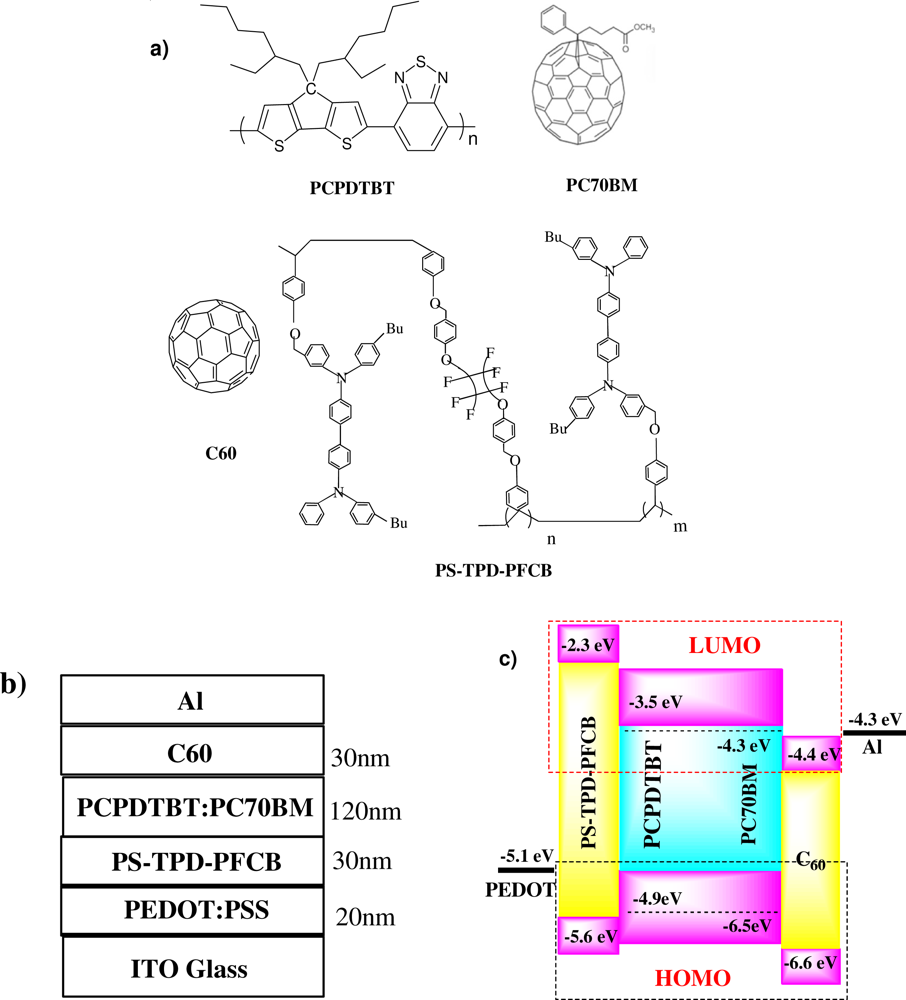
<p><bold><italic>Device Fabrication</italic></bold>: poly[2,6-(4,4-bis-(2-ethylhexyl)-4<italic>H</italic>-cyclopenta[2,1-<italic>b</italic>;3,4-<italic>b</italic>′]dithiophene)-<italic>alt</italic>-4,7-(2,1,3-benzothiadiazole)] (PCPDTBT) [<xref ref-type="bibr" rid="b11-sensors-10-06488-v2">11</xref>,<xref ref-type="bibr" rid="b12-sensors-10-06488-v2">12</xref>] mixed with (6,6)-phenyl-C<sub>71</sub>-butyric acid methyl ester (PC<sub>70</sub>BM) were co-dissolved in 1, 2-dichlorobenzene (ODCB) at 1:1 weight ratio and stirred overnight at 70 °C. Indium tin oxide (ITO) coated glass substrates were cleaned, sequentially, by ultrasonic treatment in detergent, de-ionized water, acetone and isopropyl alcohol, and dried overnight in an oven at &gt;100 °C. A thin layer (∼20 nm) of poly(3,4-ethylenedioxythiophene):poly(styrenesulfonate) (PEDOT:PSS) was spin-cast onto the ITO surface. Then the PCPDTBT:PC<sub>70</sub>BM BHJ layer (∼120 nm) was spin-cast (1,000 rpm) from the blend solution on the modified ITO surface. For PPD A: ITO/PEDOT/PCPDTBT:PC<sub>70</sub>BM/Al, a ∼200 nm Al layer was thermally deposited on top of the BHJ layer and used as the top electrode. For PPD B: ITO/PEDOT/PCPDTBT:PC<sub>70</sub>BM/C<sub>60</sub>/Al, a ∼30 nm C<sub>60</sub> layer was thermally deposited on top of BHJ layer, and Al (∼200 nm) was used as electrode. For PPD C: ITO/PEDOT/PS-TPD-PFCB/PCPDTBT:PC<sub>70</sub>BM/C<sub>60</sub>/Al, a ∼30 nm thin layer of polystyrene-N,N-diphenyl-N,N-bis(4-n-butylphenyl)-(1,10-biphenyl)-4,4-diamine-erfluorocyclobutane (PS-TPD-PFCB) [<xref ref-type="bibr" rid="b13-sensors-10-06488-v2">13</xref>] was inserted between PEDOT:PSS and active layer, by spin-casting from the corresponding solution and thermally annealed at 210 °C for 10 minutes inside the glove box. A thin layer of C<sub>60</sub> (∼30 nm) was then inserted between the BHJ layer and top Al electrode. The PPD area is 4.5 mm<sup>2</sup>. The molecular structures of all the component materials are shown in <xref ref-type="fig" rid="f5-sensors-10-06488-v2">Scheme 1a</xref>.</p>
<p><bold><italic>Current-Voltage Measurement:</italic></bold> The light source was calibrated solar simulator. For <italic>J–V</italic> measurement of PPDs, a band-pass filter was used to obtain the light at 800 nm. Data were collected using a Keithley 236 SMU.</p>
<p><bold><italic>External Quantum Efficiency (EQE) Measurement:</italic></bold> EQEs under short circuit was determined by illuminating the device with periodic (<italic>i.e.,</italic> “chopped”) monochromatic light. The AC photocurrent from the device is converted to an AC voltage and measured with a lock-in amplifier. Incident light from a xenon lamp (100 W) passing through a monochromator was chopped at 170 Hz and focused on the active area of device. A calibrated crystalline silicon diode (818UV, Newport) was used as a reference before each measurement.</p></sec>
<sec sec-type="results|discussion">
<label>3.</label>
<title>Results and Discussions</title>
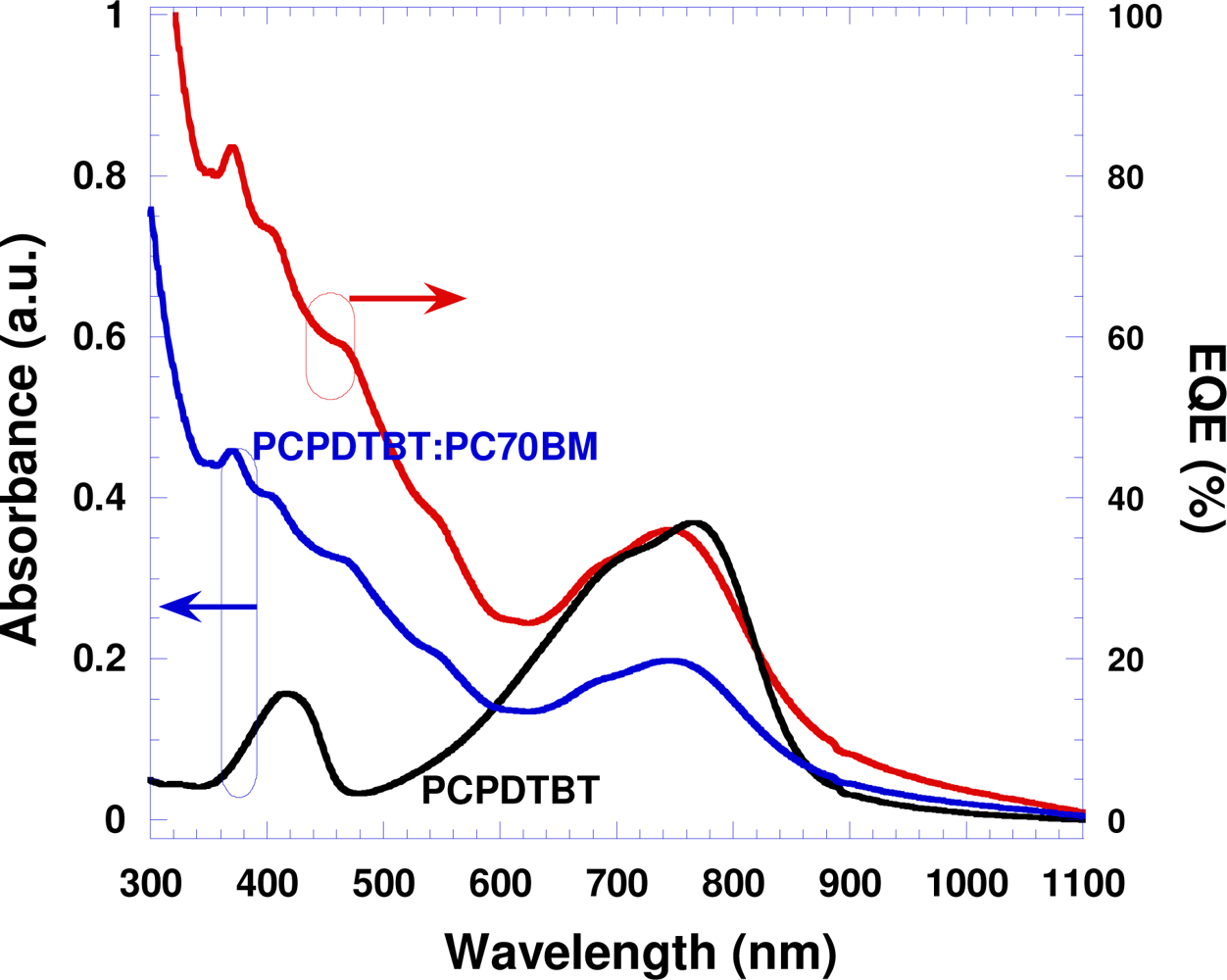
<p>The narrow-band gap semiconducting polymer, PCPDTBT (<xref ref-type="fig" rid="f5-sensors-10-06488-v2">Scheme 1a</xref>), has broad band absorption at the wavelengths λ = 300–950 nm, with a cutoff at λ ≈ 1,000 nm (<xref ref-type="fig" rid="f1-sensors-10-06488-v2">Figure 1</xref>), high photoconductivity. Good solar cell performance is obtained by blending it with PC<sub>70</sub>BM [<xref ref-type="bibr" rid="b12-sensors-10-06488-v2">12</xref>].</p>
<p>The photo-active layer in our PPDs comprises a phase separated blend of PCPDTBT and PC<sub>70</sub>BM. The two components form interpenetrating donor/acceptor networks in the bulk heretojunction (BHJ) structure. Three different PPD architectures were investigated:
<list list-type="simple">
<list-item>
<p>PPD A: ITO/PEDOT:PSS/PCPDTBT: PC<sub>70</sub>BM/Al;</p></list-item>
<list-item>
<p>PPD B: ITO/PEDOT:PSS/PCPDTBT: PC<sub>70</sub>BM/C<sub>60</sub>/Al and</p></list-item>
<list-item>
<p>PPD C: ITO/PEDOT:PSS/PS-TPD-PFCB/PCPDTBT: PC<sub>70</sub>BM/C<sub>60</sub>/Al.</p></list-item></list></p>
<p>These three device architectures are shown in <xref ref-type="fig" rid="f5-sensors-10-06488-v2">Scheme 1b</xref> (the thickness of each layer is indicated). The energy level diagram in <xref ref-type="fig" rid="f5-sensors-10-06488-v2">Scheme 1c</xref> shows the lowest unoccupied molecular orbital (LUMO) and the highest occupied molecular orbital (HOMO) of PCPDTBT, PC<sub>70</sub>BM, C<sub>60</sub> and PS-TPD-PFCB. The workfunctions of PEDOT:PSS and Al are also shown in <xref ref-type="fig" rid="f5-sensors-10-06488-v2">Scheme 1c</xref>. The difference between the LUMOs of PCPDTBT and PC<sub>70</sub>BM is ∼0.8 eV, which ensures photoinduced charge transfer and charge separation in the PCPDTBT:PC<sub>70</sub>BM BHJ structure [<xref ref-type="bibr" rid="b14-sensors-10-06488-v2">14</xref>].</p>
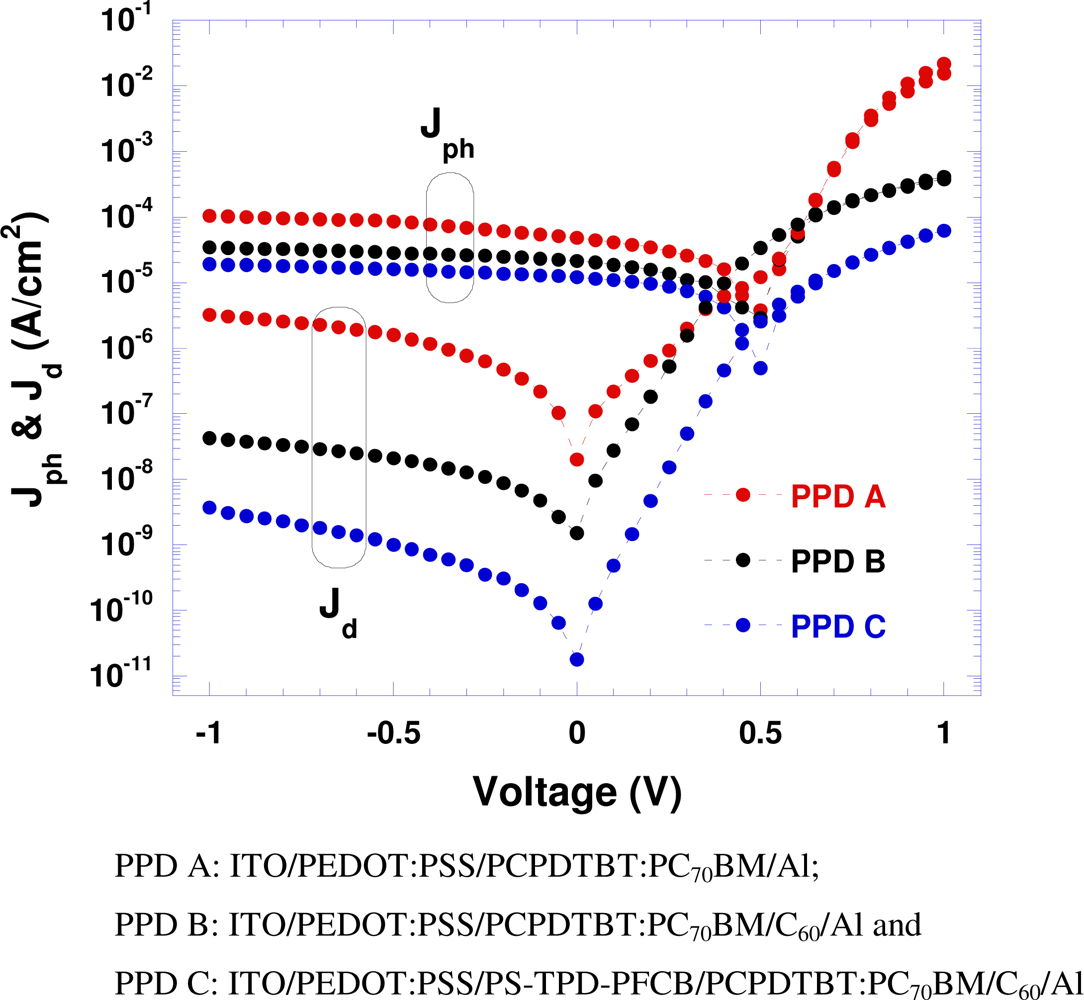
<p>The current-density voltage (J–V) characteristics measured in the dark and under illumination (λ = 800 nm) with light intensity of 0.22 mW/cm<sup>2</sup> are shown in <xref ref-type="fig" rid="f2-sensors-10-06488-v2">Figure 2</xref>. All PPDs (A, B and C) show good rectification ratios in the dark, 10<sup>4</sup> at ±1 V, indicating the formation of good diodes. The dark currents observed from PPD B are more than 2 orders of magnitude smaller than that from PPD A; the dark currents observed from PPD C are more than 10 times smaller than that from PPD B. These results indicate that the thin C<sub>60</sub> and PS-TPD-PFCB buffer layers are important for minimizing the dark currents generated withinfrom the PCPDTBT:PCBM PC<sub>70</sub>BM BHJ structure.</p>
<p>For PPDs A, B and C, the current density (<italic>J</italic>)–voltage (<italic>V</italic>) relationship can be described by the standard diode equation [<xref ref-type="bibr" rid="b15-sensors-10-06488-v2">15</xref>]:
<disp-formula id="FD1">
<label>(1)</label>
<mml:math display="block">
<mml:mrow>
<mml:mi>J</mml:mi>
<mml:mo>=</mml:mo>
<mml:mo>−</mml:mo>
<mml:msub>
<mml:mrow>
<mml:mi>J</mml:mi></mml:mrow>
<mml:mn>0</mml:mn></mml:msub>
<mml:mrow>
<mml:mo>{</mml:mo>
<mml:mrow>
<mml:mtext>exp</mml:mtext>
<mml:mrow>
<mml:mo>[</mml:mo>
<mml:mrow>
<mml:mfrac>
<mml:mrow>
<mml:mi>q</mml:mi>
<mml:mrow>
<mml:mo>(</mml:mo>
<mml:mrow>
<mml:mi>V</mml:mi>
<mml:mo>+</mml:mo>
<mml:msub>
<mml:mi mathvariant="italic">JR</mml:mi>
<mml:mi>S</mml:mi></mml:msub></mml:mrow>
<mml:mo>)</mml:mo></mml:mrow></mml:mrow>
<mml:mrow>
<mml:mi>n</mml:mi>
<mml:msub>
<mml:mi>K</mml:mi>
<mml:mi>B</mml:mi></mml:msub>
<mml:mi>T</mml:mi></mml:mrow></mml:mfrac></mml:mrow>
<mml:mo>]</mml:mo></mml:mrow>
<mml:mo>−</mml:mo>
<mml:mn>1</mml:mn></mml:mrow>
<mml:mo>}</mml:mo></mml:mrow>
<mml:mo>−</mml:mo>
<mml:mfrac>
<mml:mrow>
<mml:mi>V</mml:mi>
<mml:mo>+</mml:mo>
<mml:msub>
<mml:mi mathvariant="italic">JR</mml:mi>
<mml:mi>S</mml:mi></mml:msub></mml:mrow>
<mml:mrow>
<mml:msub>
<mml:mi>R</mml:mi>
<mml:mi mathvariant="italic">SE</mml:mi></mml:msub></mml:mrow></mml:mfrac></mml:mrow></mml:math></disp-formula>where
<disp-formula id="FD2">
<label>(2)</label>
<mml:math display="block">
<mml:mrow>
<mml:msub>
<mml:mi>J</mml:mi>
<mml:mn>0</mml:mn></mml:msub>
<mml:mo>=</mml:mo>
<mml:mi>A</mml:mi>
<mml:mo>*</mml:mo>
<mml:msup>
<mml:mi>T</mml:mi>
<mml:mn>2</mml:mn></mml:msup>
<mml:mtext>exp</mml:mtext>
<mml:mrow>
<mml:mo>(</mml:mo>
<mml:mrow>
<mml:mo>−</mml:mo>
<mml:mfrac>
<mml:mrow>
<mml:msub>
<mml:mi>E</mml:mi>
<mml:mi mathvariant="italic">PF</mml:mi></mml:msub></mml:mrow>
<mml:mrow>
<mml:msub>
<mml:mi>K</mml:mi>
<mml:mi>B</mml:mi></mml:msub>
<mml:mi>T</mml:mi></mml:mrow></mml:mfrac></mml:mrow>
<mml:mo>)</mml:mo></mml:mrow></mml:mrow></mml:math></disp-formula>and <italic>A*</italic> = 4π<italic>qm*K</italic><sub>B</sub><sup>2</sup>/<italic>h</italic><sup>3</sup>, <italic>J</italic><sub>0</sub> is the saturation current density, <italic>q</italic> is the electron charge <italic>V</italic> is the voltage, <italic>n</italic> is the ideality factor, <italic>K</italic><italic><sub>B</sub></italic> is the Boltzman constant, <italic>T</italic> is the absolute temperature <italic>R</italic><italic><sub>S</sub></italic> is the series resistance, <italic>R</italic><italic><sub>SH</sub></italic> is the shunt resistance, <italic>m*</italic> is the effective electron mass, <italic>h</italic> is Planck’s constant, <italic>A*</italic> is Richardson’s constant and <italic>E</italic><italic><sub>PF</sub></italic> is the energy difference between the HOMO of PCPDTBT and the LUMO of PC<sub>70</sub>BM (∼0.6 eV).</p>
<p>As described above, a high dark current is expected from PPD A because <italic>E</italic><italic><sub>PF</sub></italic> (∼0.6 eV) is relatively small. In PPD B, because the HOMO of C<sub>60</sub> is lower than the HOMO of PCPDTBT, a thin layer of C<sub>60</sub> can block holes from moving into the Al cathode, resulting in a lower dark current. In PPD C, because the LUMO of PS-TPD-PFCB is higher than the LUMO of PC<sub>70</sub>BM, even higher than the LUMO of PCPDTBT, a thin layer of PS-TPD-PFCB blocks electrons from moving into the ITO/PEDOT:PSS bi-layer anode. The thin layer of C<sub>60</sub> also blocks holes from moving into the Al cathode. Therefore, a significantly lower dark current was observed in PPD C because of the insertion of the C<sub>60</sub> hole-blocking layer and the PS-TPD-PFCB electron-blocking layer.</p>
<p>Moreover, due to a thin layer of C<sub>60</sub> inserted between PCPDTBT:PC70BM and the Al electrode, <italic>R<sub>S</sub></italic> in PPD B should be larger than in PPD A because <italic>R<sub>S</sub></italic> is the sum of the contact resistance and the bulk resistance of the materials [<xref ref-type="bibr" rid="b16-sensors-10-06488-v2">16</xref>,<xref ref-type="bibr" rid="b17-sensors-10-06488-v2">17</xref>]. For PPD A, <italic>R<sub>S</sub></italic> = R<sub>ITO</sub>+R<sub>PEDOT:PSS</sub>+R<sub>PCPDTBT:C70BM</sub> For PPD B, <italic>R<sub>S</sub></italic> = R<sub>ITO</sub> + R<sub>PEDOT:PSS</sub>+ R<sub>(PCPDTB:PC70BM)</sub> + R<sub>C60</sub> + R<sub>Al</sub>. For PDD C, For PPD B, <italic>R<sub>S</sub></italic> = R<sub>ITO</sub> + R<sub>PEDOT:PSS</sub> + R<sub>PS-TPD-PFCB</sub> R<sub>(PCPDTB:PC70BM)</sub> + R<sub>C60</sub> + R<sub>Al</sub>. The <italic>R<sub>s</sub></italic> values were obtained by fitting the <italic>J-V</italic> curves shown in <xref ref-type="fig" rid="f2-sensors-10-06488-v2">Figure 2</xref> to <xref ref-type="disp-formula" rid="FD1">Equation 1</xref>. <italic>R<sub>s</sub></italic> = 2.6 × 10<sup>3</sup> Ω/cm<sup>2</sup>, 4.6 × 10<sup>3</sup> Ω/cm<sup>2</sup> and 2.5 × 10<sup>4</sup> Ω/cm<sup>2</sup> for PPD A, PPD B and PPD C, respectively. The <italic>R<sub>sh</sub></italic> values are the following: <italic>R<sub>sh</sub></italic> = 5.6 × 10<sup>5</sup> Ω/cm<sup>2</sup>, 6.3 × 10<sup>6</sup> Ω/cm<sup>2</sup> and 4.6 × 10<sup>8</sup> Ω/cm<sup>2</sup> for PPD A, PPD B and PPD C, respectively. Therefore, the dark current densities in these PPDs is controlled by the blocking layers: J<sub>D</sub>(PPD A) &gt; J<sub>D</sub>(PPD B) &gt; J<sub>D</sub>(PPD C), as described by <xref ref-type="disp-formula" rid="FD1">Equation (1)</xref>.</p>
<p>In order to get photoresponsivity (<italic>PR</italic>), the ratio of photocurrent to incident-light power, we measured the photocurrent under the light at λ = 800 nm with a light intensity of 0.22 mW/cm<sup>2</sup> as shown in <xref ref-type="fig" rid="f2-sensors-10-06488-v2">Figure 2</xref>. <italic>PR</italic> is calculated accordingly from the observed photocurrents and the light intensity used for measurement of photo response. With a bias at 0 V, the <italic>PR</italic> = 217 mA/W, 96 mA/W and 54 mA/W for PPDs A, B and C, respectively. With a bias at −0.5 V, the <italic>PR</italic> = 387 mA/W, 129 mA/W and 72 mA/W for PPDs A, B and C, respectively. These high <italic>PR</italic> values demonstrate very good photoresponsivity.</p>
<p>We also measured the external quantum efficiency (EQE) under short-circuit and reversed bias chopping the light and using a lock-in amolifier. The data are presented in <xref ref-type="fig" rid="f1-sensors-10-06488-v2">Figure 1</xref>. For comparison, the absorption spectra of pristine PCPDTBT and the composite of PCPDTBT:PC<sub>70</sub>BM thin films are also presented in <xref ref-type="fig" rid="f1-sensors-10-06488-v2">Figure 1</xref>. The similar spectral profiles of absorption and EQE of PCPDTBT:PC<sub>70</sub>BM indicate that photons absorbed in IR range by both PCPDTBT and PC<sub>70</sub>BM contribute to the photocurrent. At λ= 800 nm, the <italic>EQE</italic> is 33% at 0 V and increases by a factor of 2 to 60% at −0.5 V. We note that recently several novel narrow-band gap semiconducting polymers are reported to have efficient photovoltaic activity in IR spectral region [<xref ref-type="bibr" rid="b18-sensors-10-06488-v2">18</xref>–<xref ref-type="bibr" rid="b21-sensors-10-06488-v2">21</xref>]. For example, Yao <italic>et al.</italic> showed spectral response extended to 1,000 nm with <italic>EQE</italic> of 19% at 850 nm [<xref ref-type="bibr" rid="b21-sensors-10-06488-v2">21</xref>]. Mühlbacher <italic>et al.</italic> showed 38% <italic>EQE</italic> around 700 nm and 13% <italic>EQE</italic> at 850 nm [<xref ref-type="bibr" rid="b20-sensors-10-06488-v2">20</xref>]. The high <italic>EQE</italic> observed from PCPDTBT: PC<sub>70</sub>BM BHJ structure imply that PPDs fabricated by PCPDTBT: PC<sub>70</sub>BM will exhibit high detectivity.</p>
<p>Assuming that the shot noise from the dark current is the dominant contribution [<xref ref-type="bibr" rid="b4-sensors-10-06488-v2">4</xref>,<xref ref-type="bibr" rid="b10-sensors-10-06488-v2">10</xref>,<xref ref-type="bibr" rid="b22-sensors-10-06488-v2">22</xref>], the detectivity can be expressed as
<disp-formula id="FD3">
<label>(3)</label>
<mml:math display="block">
<mml:mrow>
<mml:mi>D</mml:mi>
<mml:mo>*</mml:mo>
<mml:mo>=</mml:mo>
<mml:mi mathvariant="italic">PR</mml:mi>
<mml:mo>/</mml:mo>
<mml:msup>
<mml:mrow>
<mml:mrow>
<mml:mo stretchy="false">(</mml:mo>
<mml:mn>2</mml:mn>
<mml:mi>q</mml:mi>
<mml:msub>
<mml:mi>J</mml:mi>
<mml:mi>d</mml:mi></mml:msub>
<mml:mo stretchy="false">)</mml:mo></mml:mrow></mml:mrow>
<mml:mrow>
<mml:mn>1</mml:mn>
<mml:mo>/</mml:mo>
<mml:mn>2</mml:mn></mml:mrow></mml:msup>
<mml:mo>=</mml:mo>
<mml:mo stretchy="false">(</mml:mo>
<mml:msub>
<mml:mi>J</mml:mi>
<mml:mi mathvariant="italic">ph</mml:mi></mml:msub>
<mml:mo>/</mml:mo>
<mml:msub>
<mml:mi>L</mml:mi>
<mml:mi mathvariant="italic">light</mml:mi></mml:msub>
<mml:mo stretchy="false">)</mml:mo>
<mml:mo>/</mml:mo>
<mml:msup>
<mml:mrow>
<mml:mrow>
<mml:mo stretchy="false">(</mml:mo>
<mml:mn>2</mml:mn>
<mml:mi>q</mml:mi>
<mml:msub>
<mml:mi>J</mml:mi>
<mml:mi>d</mml:mi></mml:msub>
<mml:mo stretchy="false">)</mml:mo></mml:mrow></mml:mrow>
<mml:mrow>
<mml:mn>1</mml:mn>
<mml:mo>/</mml:mo>
<mml:mn>2</mml:mn></mml:mrow></mml:msup></mml:mrow></mml:math></disp-formula>where <italic>PR</italic> is the photoresponsivity; <italic>q</italic> is the absolute value of electron charge (1.6 × 10<sup>−19</sup> Coulombs), <italic>J<sub>d</sub></italic> is the dark current, <italic>J<sub>ph</sub></italic> is the photo current, and <italic>L<sub>light</sub></italic> is the light intensity. Detectivities were calculated based on the measured photocurrent, dark current and incident light intensity (<xref ref-type="fig" rid="f2-sensors-10-06488-v2">Figure 2</xref>).</p>
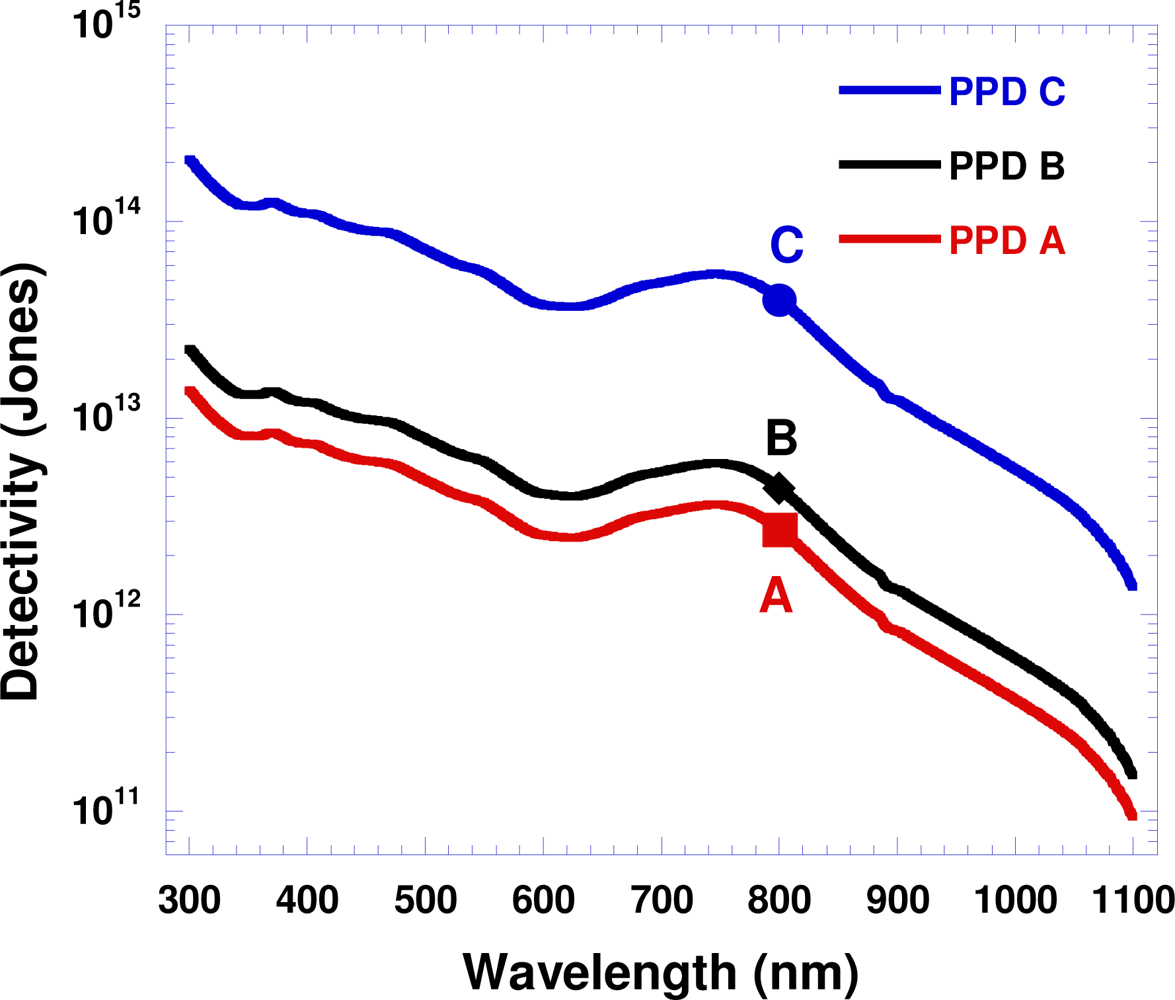
<p>Under illumination at λ = 800 nm with light intensity of 0.22 mW/cm<sup>2</sup>, the calculated detectivities are <italic>D*</italic> = 2.7 × 10<sup>12</sup> cm Hz<sup>1/2</sup>/W (Jones), 4.4 × 10<sup>12</sup> Jones, and 4.0 × 10<sup>13</sup> Jones for PPDs A, B and C, respectively (at zero bias); <italic>D*</italic> = 5.4 × 10<sup>11</sup> Jones, 1.6 × 10<sup>12</sup> Jones, and 7.2 × 10<sup>12</sup> Jones for PPDs A, B and C, respectively (at −0.5 V).</p>
<p>By combining the calculated detectivities at 800 nm with the photoresponsivity data, the PPDs detectivity values were obtained over the entire spectral range; the results are shown in <xref ref-type="fig" rid="f3-sensors-10-06488-v2">Figure 3</xref>. The calculated detectivities at λ = 800 nm are also shown in <xref ref-type="fig" rid="f3-sensors-10-06488-v2">Figure 3</xref>, represented by points A, B and C for PPDs A, B and C, respectively. Operating at room temperature, all PPDs exhibited spectral response from 300 nm to 1,100 nm. PPD C calculated showed detectivity greater than 10<sup>13</sup> Jones from 300 nm to 900 nm and greater than 10<sup>12</sup> Jones from 900 nm to 1,100 nm (10 times larger than observed from PPD B, and approximately 20 times larger than observed from PPD A). These results demonstrate that the electron-blocking layer, PS-TPD-PFCB, and the hole-blocking layer, C<sub>60</sub>, are important for achieving high detectivity NIR polymer photodetectors.</p>
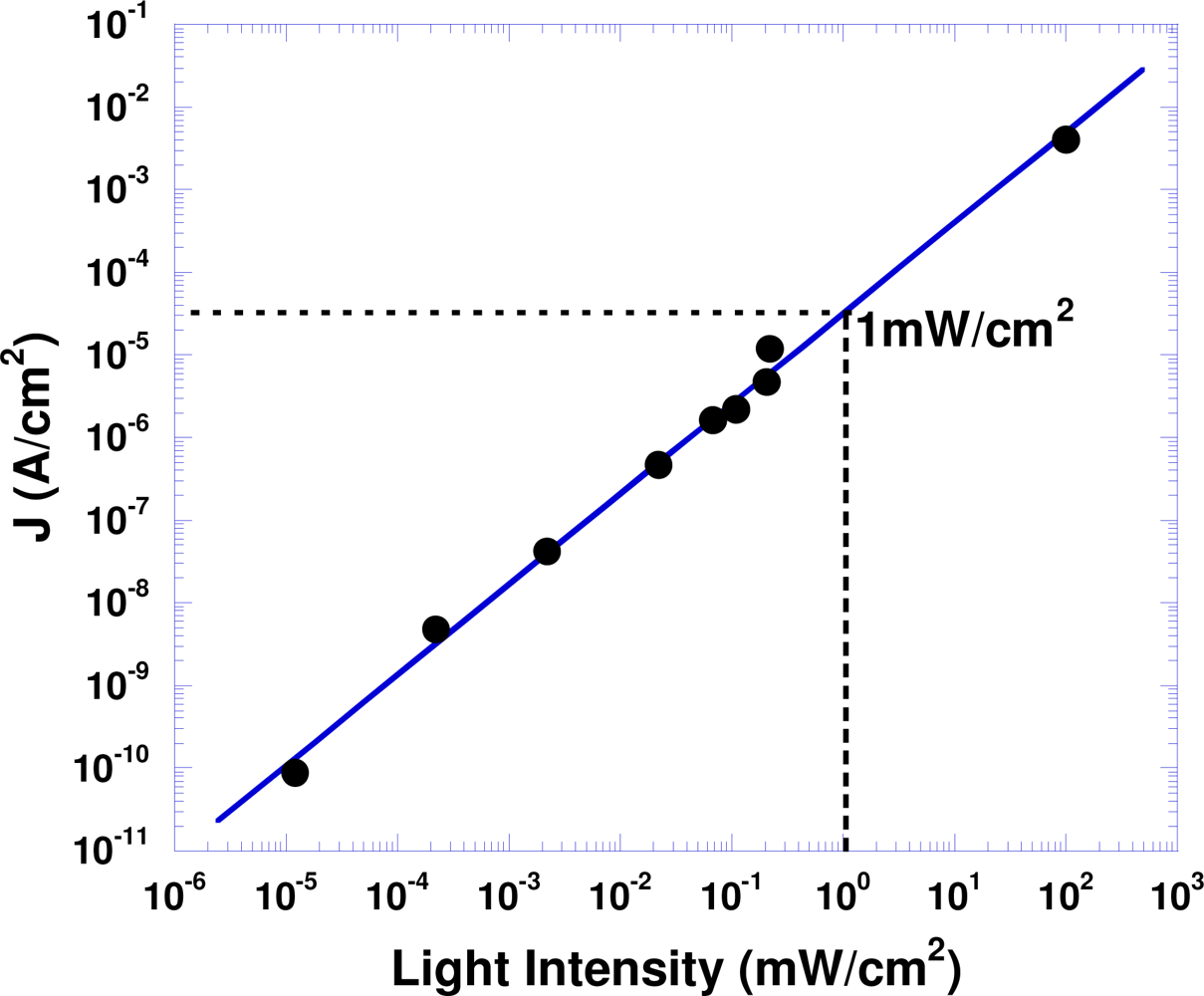
<p><xref ref-type="fig" rid="f4-sensors-10-06488-v2">Figure 4</xref> shows the photocurrent <italic>versus</italic> light intensity for PPD C (at λ = 800 nm). For PPD C, the photosensitivity is linear in light intensity over a range exceeding 130 dB, better than that of Si photodetectors (120 dB) [<xref ref-type="bibr" rid="b4-sensors-10-06488-v2">4</xref>].</p>
<p>In conclusion, the results presented here indicate that electron-blocking and hole-blocking layers are important for achieving high performance NIR polymer photodetectors. The results demonstrate that the performance parameters of near infrared polymer photodetectors based on PCPDTBT are comparable to or even better than Si photodetectors. The high detectivity and high photoresponsivity open opportunities for the creation of detectors with unusually wide spectral range and for the fabrication of high-resolution detector arrays for optical communications, chemical/biological sensing and day- and night-time surveillance.</p></sec></body>
<back>
<ack>
<p>This research was supported by the DARPA-HARDI Program (D. Shenoy, Program Officer). We thank D. Waller of Konarka Technologies for supplying the PCPDTBT and fullerene materials used in these studies. The author X. Gong would like to thank the Joint Research Fund for Overseas Chinese Scholars, the National Science Foundation of China (#50828301).</p></ack>
<ref-list>
<title>References</title>
<ref id="b1-sensors-10-06488-v2"><label>1.</label><citation citation-type="journal"><person-group person-group-type="author"><name><surname>Rogalski</surname><given-names>A</given-names></name><name><surname>Antoszewski</surname><given-names>J</given-names></name><name><surname>Faraone</surname><given-names>L</given-names></name></person-group><article-title>Third-generation infrared photodetector arrays</article-title><source>J Appl Phys</source><year>2009</year><volume>105</volume><fpage>091101/1</fpage><lpage>44</lpage></citation></ref>
<ref id="b2-sensors-10-06488-v2"><label>2.</label><citation citation-type="journal"><person-group person-group-type="author"><name><surname>Ettenberg</surname><given-names>M</given-names></name></person-group><article-title>A little night vision</article-title><source>Adv. Imaging</source><year>2005</year><volume>20</volume><fpage>29</fpage><lpage>32</lpage></citation></ref>
<ref id="b3-sensors-10-06488-v2"><label>3.</label><citation citation-type="journal"><person-group person-group-type="author"><name><surname>Kim</surname><given-names>S</given-names></name><name><surname>Lim</surname><given-names>YT</given-names></name><name><surname>Soltesz</surname><given-names>E</given-names></name><name><surname>Grand</surname><given-names>A</given-names></name><name><surname>Lee</surname><given-names>J</given-names></name><name><surname>Nakayama</surname><given-names>A</given-names></name><name><surname>Parker</surname><given-names>J</given-names></name><name><surname>Mihaljevic</surname><given-names>T</given-names></name><name><surname>Laurence</surname><given-names>RG</given-names></name><name><surname>Dor</surname><given-names>D</given-names></name><name><surname>Cohn</surname><given-names>L</given-names></name><name><surname>Bawendi</surname><given-names>M</given-names></name><name><surname>Frangioni</surname><given-names>J</given-names></name></person-group><article-title>Near-infrared fluorescent type II quantum dots for sentinel lymph node mapping</article-title><source>Nature Biotechnol</source><year>2003</year><volume>22</volume><fpage>93</fpage><lpage>97</lpage></citation></ref>
<ref id="b4-sensors-10-06488-v2"><label>4.</label><citation citation-type="book"><person-group person-group-type="author"><name><surname>Jha</surname><given-names>AR</given-names></name></person-group><source>Infrared technology</source><publisher-name>John Wiley &amp; Sons, Inc</publisher-name><publisher-loc>New York, NY, USA</publisher-loc><year>2000</year><fpage>245</fpage><lpage>267</lpage></citation></ref>
<ref id="b5-sensors-10-06488-v2"><label>5.</label><citation citation-type="journal"><person-group person-group-type="author"><name><surname>Sargent</surname><given-names>EH</given-names></name></person-group><article-title>Infrared quantum dots</article-title><source>Adv. Mater</source><year>2005</year><volume>17</volume><fpage>515</fpage><lpage>522</lpage><pub-id pub-id-type="doi">10.1002/adma.200401552</pub-id></citation></ref>
<ref id="b6-sensors-10-06488-v2"><label>6.</label><citation citation-type="journal"><person-group person-group-type="author"><name><surname>Mcdonald</surname><given-names>SA</given-names></name><name><surname>Konstantatos</surname><given-names>G</given-names></name><name><surname>Zhang</surname><given-names>SG</given-names></name><name><surname>Klem</surname><given-names>EJD</given-names></name><name><surname>Levina</surname><given-names>L</given-names></name><name><surname>Sargent</surname><given-names>EH</given-names></name></person-group><article-title>Solution-processed PbS quantum dot infrared photodectors and photovoltaics</article-title><source>Nat. Mater</source><year>2005</year><volume>4</volume><fpage>138</fpage><lpage>142</lpage><pub-id pub-id-type="doi">10.1038/nmat1299</pub-id><pub-id pub-id-type="pmid">15640806</pub-id></citation></ref>
<ref id="b7-sensors-10-06488-v2"><label>7.</label><citation citation-type="journal"><person-group person-group-type="author"><name><surname>Schilinsky</surname><given-names>P</given-names></name><name><surname>Waldauf</surname><given-names>C</given-names></name><name><surname>Brabec</surname><given-names>CJ</given-names></name></person-group><article-title>Recombination and loss analysis in polythiophene based bulk heterojunction photodetectors</article-title><source>Appl. Phys. Lett</source><year>2002</year><volume>81</volume><fpage>3885</fpage><lpage>3887</lpage><pub-id pub-id-type="doi">10.1063/1.1521244</pub-id></citation></ref>
<ref id="b8-sensors-10-06488-v2"><label>8.</label><citation citation-type="journal"><person-group person-group-type="author"><name><surname>Peumans</surname><given-names>P</given-names></name><name><surname>Bulovic</surname><given-names>V</given-names></name><name><surname>Forrest</surname><given-names>SR</given-names></name></person-group><article-title>Efficient, high-bandwidth organic multiplayer photodetectors</article-title><source>Appl. Phys. Lett</source><year>2000</year><volume>76</volume><fpage>3855</fpage><lpage>3867</lpage><pub-id pub-id-type="doi">10.1063/1.126800</pub-id></citation></ref>
<ref id="b9-sensors-10-06488-v2"><label>9.</label><citation citation-type="journal"><person-group person-group-type="author"><name><surname>O’Brien</surname><given-names>GA</given-names></name><name><surname>Quinn</surname><given-names>AJ</given-names></name><name><surname>Tanner</surname><given-names>DA</given-names></name><name><surname>Redmond</surname><given-names>GA</given-names></name></person-group><article-title>single polymer nanowire photodetector</article-title><source>Adv. Mater</source><year>2006</year><volume>18</volume><fpage>2379</fpage><lpage>2383</lpage><pub-id pub-id-type="doi">10.1002/adma.200601012</pub-id></citation></ref>
<ref id="b10-sensors-10-06488-v2"><label>10.</label><citation citation-type="journal"><person-group person-group-type="author"><name><surname>Gong</surname><given-names>X</given-names></name><name><surname>Tong</surname><given-names>MH</given-names></name><name><surname>Xia</surname><given-names>YJ</given-names></name><name><surname>Cai</surname><given-names>WZ</given-names></name><name><surname>Moon</surname><given-names>JS</given-names></name><name><surname>Cao</surname><given-names>Y</given-names></name><name><surname>Yu</surname><given-names>G</given-names></name><name><surname>Shieh</surname><given-names>CL</given-names></name><name><surname>Nilsson</surname><given-names>B</given-names></name><name><surname>Heeger</surname><given-names>AJ</given-names></name></person-group><article-title>High-detectivity polymer photodetectors with spectral response from 300 nm to 1450 nm</article-title><source>Science</source><year>2009</year><volume>325</volume><fpage>1665</fpage><lpage>1667</lpage><pub-id pub-id-type="doi">10.1126/science.1176706</pub-id><pub-id pub-id-type="pmid">19679770</pub-id></citation></ref>
<ref id="b11-sensors-10-06488-v2"><label>11.</label><citation citation-type="journal"><person-group person-group-type="author"><name><surname>Soci</surname><given-names>C</given-names></name><name><surname>Hwang</surname><given-names>IW</given-names></name><name><surname>Moses</surname><given-names>D</given-names></name><name><surname>Zhu</surname><given-names>ZZ</given-names></name><name><surname>Waller</surname><given-names>D</given-names></name><name><surname>Gaudiana</surname><given-names>R</given-names></name><name><surname>Brabec</surname><given-names>CJ</given-names></name><name><surname>Heeger</surname><given-names>AJ</given-names></name></person-group><article-title>Photoconductivity of a low-bandgap conjugated polymer</article-title><source>Adv. Func. Mater</source><year>2007</year><volume>17</volume><fpage>632</fpage><lpage>636</lpage><pub-id pub-id-type="doi">10.1002/adfm.200600199</pub-id></citation></ref>
<ref id="b12-sensors-10-06488-v2"><label>12.</label><citation citation-type="journal"><person-group person-group-type="author"><name><surname>Peet</surname><given-names>J</given-names></name><name><surname>Kim</surname><given-names>JY</given-names></name><name><surname>Coates</surname><given-names>NE</given-names></name><name><surname>Ma</surname><given-names>WL</given-names></name><name><surname>Moses</surname><given-names>D</given-names></name><name><surname>Heeger</surname><given-names>AJ</given-names></name><name><surname>Bazan</surname><given-names>GC</given-names></name></person-group><article-title>Efficiency enhancement in low-bandgap polymer solar cells by processing with alkane dithiols</article-title><source>Nat. Mater</source><year>2007</year><volume>6</volume><fpage>497</fpage><lpage>500</lpage><pub-id pub-id-type="doi">10.1038/nmat1928</pub-id><pub-id pub-id-type="pmid">17529968</pub-id></citation></ref>
<ref id="b13-sensors-10-06488-v2"><label>13.</label><citation citation-type="journal"><person-group person-group-type="author"><name><surname>Gong</surname><given-names>X</given-names></name><name><surname>Moses</surname><given-names>D</given-names></name><name><surname>Heeger</surname><given-names>AJ</given-names></name><name><surname>Liu</surname><given-names>S</given-names></name><name><surname>Jen</surname><given-names>AKY</given-names></name></person-group><article-title>High-performance polymer light-emitting diodes fabricated with a polymer hole injection</article-title><source>Appl. Phys. Lett</source><year>2003</year><volume>83</volume><fpage>183</fpage><lpage>185</lpage><pub-id pub-id-type="doi">10.1063/1.1589185</pub-id></citation></ref>
<ref id="b14-sensors-10-06488-v2"><label>14.</label><citation citation-type="journal"><person-group person-group-type="author"><name><surname>Brédas</surname><given-names>JL</given-names></name><name><surname>Beljonne</surname><given-names>D</given-names></name><name><surname>Coropceanu</surname><given-names>V</given-names></name><name><surname>Cornil</surname><given-names>J</given-names></name></person-group><article-title>Charge-transfer and energy-transfer processes in π-conjugated oligomers and polymers: a molecular picture</article-title><source>Chem. Rev</source><year>2004</year><volume>104</volume><fpage>4971</fpage><lpage>5004</lpage><pub-id pub-id-type="doi">10.1021/cr040084k</pub-id><pub-id pub-id-type="pmid">15535639</pub-id></citation></ref>
<ref id="b15-sensors-10-06488-v2"><label>15.</label><citation citation-type="book"><person-group person-group-type="author"><name><surname>Nelson</surname><given-names>J</given-names></name></person-group><source>The Physics of Solar Cells</source><publisher-name>Imperial College Press</publisher-name><publisher-loc>London, UK</publisher-loc><year>2003</year><fpage>145</fpage><lpage>180</lpage></citation></ref>
<ref id="b16-sensors-10-06488-v2"><label>16.</label><citation citation-type="journal"><person-group person-group-type="author"><name><surname>Rostalski</surname><given-names>J</given-names></name><name><surname>Meissner</surname><given-names>D</given-names></name></person-group><article-title>Photocurrent spectroscopy for the investigation of charge carrier generation and transport mechanisms in organic p/n-junction solar cells</article-title><source>Sol. Energy Mater. Sol. Cells</source><year>2000</year><volume>63</volume><fpage>37</fpage><lpage>47</lpage><pub-id pub-id-type="doi">10.1016/S0927-0248(00)00018-0</pub-id></citation></ref>
<ref id="b17-sensors-10-06488-v2"><label>17.</label><citation citation-type="journal"><person-group person-group-type="author"><name><surname>Chang</surname><given-names>YM</given-names></name><name><surname>Wang</surname><given-names>L</given-names></name><name><surname>Su</surname><given-names>WF</given-names></name></person-group><article-title>Polymer solar cells with poly(3,4-ethylenedioxythiophene) as transparent anode</article-title><source>Organ. Elect</source><year>2008</year><volume>9</volume><fpage>968</fpage><lpage>973</lpage><pub-id pub-id-type="doi">10.1016/j.orgel.2008.07.003</pub-id></citation></ref>
<ref id="b18-sensors-10-06488-v2"><label>18.</label><citation citation-type="journal"><person-group person-group-type="author"><name><surname>Wienk</surname><given-names>MM</given-names></name><name><surname>Turbiez</surname><given-names>MGR</given-names></name><name><surname>Struijk</surname><given-names>MP</given-names></name><name><surname>Fonrodona</surname><given-names>M</given-names></name><name><surname>Janssen</surname><given-names>RAJ</given-names></name></person-group><article-title>Low-band gap poly(di-2-thienylthienopyrazine): fullerene solar cells</article-title><source>Appl Phys Lett</source><year>2006</year><volume>88</volume><fpage>153511/1</fpage><lpage>3</lpage></citation></ref>
<ref id="b19-sensors-10-06488-v2"><label>19.</label><citation citation-type="journal"><person-group person-group-type="author"><name><surname>Zhang</surname><given-names>F</given-names></name><name><surname>Mammo</surname><given-names>W</given-names></name><name><surname>Andersson</surname><given-names>LM</given-names></name><name><surname>Admassie</surname><given-names>S</given-names></name><name><surname>Andersson</surname><given-names>MR</given-names></name><name><surname>Inganäs</surname><given-names>O</given-names></name></person-group><article-title>Low-bandgap alternating fluorine copolymer/methanofullerene heterojunctions in efficient near-infrared polymer solar cells</article-title><source>Adv. Mater</source><year>2006</year><volume>18</volume><fpage>2169</fpage><lpage>2173</lpage><pub-id pub-id-type="doi">10.1002/adma.200600124</pub-id></citation></ref>
<ref id="b20-sensors-10-06488-v2"><label>20.</label><citation citation-type="journal"><person-group person-group-type="author"><name><surname>Mühlbacher</surname><given-names>D</given-names></name><name><surname>Scharber</surname><given-names>M</given-names></name><name><surname>Morana</surname><given-names>M</given-names></name><name><surname>Zhu</surname><given-names>Z</given-names></name><name><surname>Waller</surname><given-names>D</given-names></name><name><surname>Gaudiana</surname><given-names>R</given-names></name><name><surname>Brabec</surname><given-names>CJ</given-names></name></person-group><article-title>High photovoltaic performance of a low-bandgap polymer</article-title><source>Adv. Mater</source><year>2006</year><volume>18</volume><fpage>2884</fpage><lpage>2889</lpage><pub-id pub-id-type="doi">10.1002/adma.200600160</pub-id></citation></ref>
<ref id="b21-sensors-10-06488-v2"><label>21.</label><citation citation-type="journal"><person-group person-group-type="author"><name><surname>Yao</surname><given-names>Y</given-names></name><name><surname>Liang</surname><given-names>YY</given-names></name><name><surname>Shrotriya</surname><given-names>V</given-names></name><name><surname>Xiao</surname><given-names>SQ</given-names></name><name><surname>Yu</surname><given-names>LP</given-names></name><name><surname>Yang</surname><given-names>Y</given-names></name></person-group><article-title>Plastic near-infrared photodetectors ultilizing low band gap polymer</article-title><source>Adv. Mater</source><year>2007</year><volume>19</volume><fpage>3979</fpage><lpage>3983</lpage><pub-id pub-id-type="doi">10.1002/adma.200602670</pub-id></citation></ref>
<ref id="b22-sensors-10-06488-v2"><label>22.</label><citation citation-type="book"><person-group person-group-type="author"><name><surname>Bhattacharya</surname><given-names>P</given-names></name></person-group><source>Semiconductor Optoelectronics Device</source><publisher-name>Prentice-Hall, Inc</publisher-name><publisher-loc>New Jersey, NJ, USA</publisher-loc><year>1997</year><fpage>345</fpage><lpage>367</lpage></citation></ref></ref-list>
<sec sec-type="display-objects">
<title>Figures</title>
<fig id="f1-sensors-10-06488-v2" position="float">
<label>Figure 1.</label>
<caption>
<p>Absorption spectra (left) of pristine PCPDTBT and PCPDTBT:PC<sub>70</sub>BM thin films, and EQE (right) from the device with the following structure: ITO/PEDOT:PSS/PCPDTBT:PC<sub>70</sub>BM/Al. The EQE was measured at zero bias.</p></caption>
<graphic xlink:href="sensors-10-06488-v2f1.gif"/></fig>
<fig id="f2-sensors-10-06488-v2" position="float">
<label>Figure 2.</label>
<caption>
<p>Current-density-voltage characteristics of polymer photodetectors measured in the dark (J<sub>d</sub>) and under light (J<sub>ph</sub>); λ = 800nm with intensity of 0.22 mW/cm<sup>2</sup></p></caption>
<graphic xlink:href="sensors-10-06488-v2f2.gif"/></fig>
<fig id="f3-sensors-10-06488-v2" position="float">
<label>Figure 3.</label>
<caption>
<p>Detectivities (at 0 bias) <italic>versus</italic> wavelength for polymer photodetectors; the points A, B and C represent the calculated detectvities (at 0 bias) for PPDs A, B and C, respectively.</p></caption>
<graphic xlink:href="sensors-10-06488-v2f3.gif"/></fig>
<fig id="f4-sensors-10-06488-v2" position="float">
<label>Figure 4.</label>
<caption>
<p>Photosensitivity <italic>vs.</italic> light intensity of polymer photodetector with structure ITO/PEDOT/PS-TPD-PFCB/PCPDTBT:PC<sub>70</sub>BM/C<sub>60</sub>/Al.</p></caption>
<graphic xlink:href="sensors-10-06488-v2f4.gif"/></fig>
<fig id="f5-sensors-10-06488-v2" position="float">
<label>Scheme 1.</label>
<caption>
<p>(a) Molecular structures of PCPDTBT, PC<sub>70</sub>BM, C<sub>60</sub> and PS-TPD-PFCB; (b) Device structure; (c) Energy level diagram of PCPDTBT, PC<sub>70</sub>BM, C<sub>60</sub>, PS-TPD-PFCB, ITO and Al.</p></caption>
<graphic xlink:href="sensors-10-06488-v2f5.gif"/></fig></sec></back></article>