
Evaluation of Depigmenting Activity by 8-Hydroxydaidzein in Mouse B16 Melanoma Cells and Human Volunteers

Abstract
:
1. Introduction
2. Results and Discussion
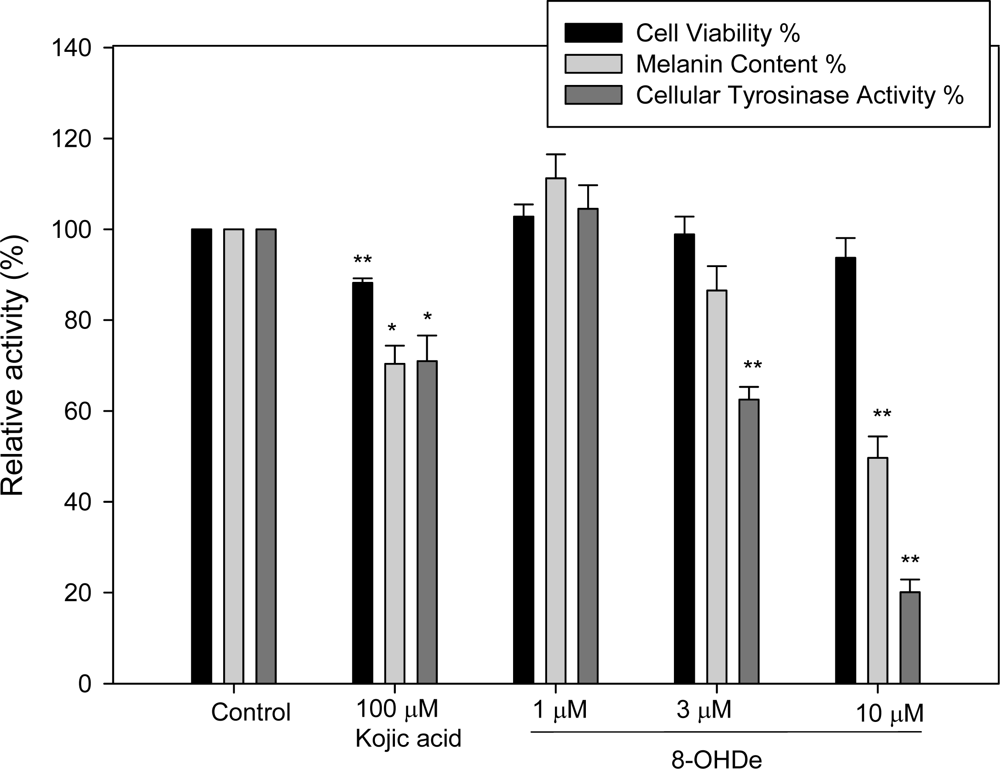
2.1. In Vitro Evaluation of Depigmenting Activity of 8-OHDe in Mouse B16 Melanoma Cells
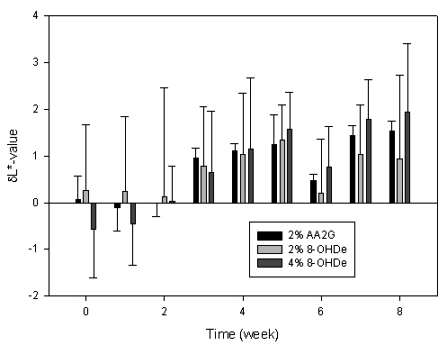
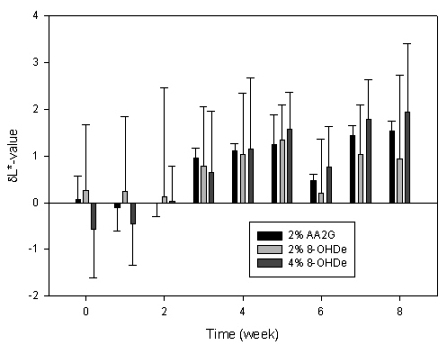
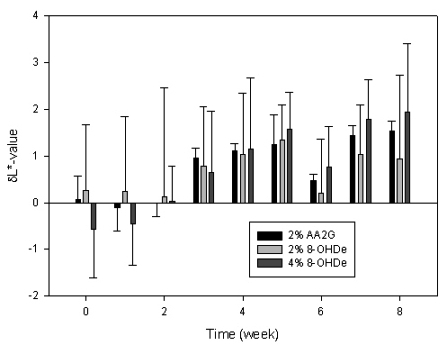
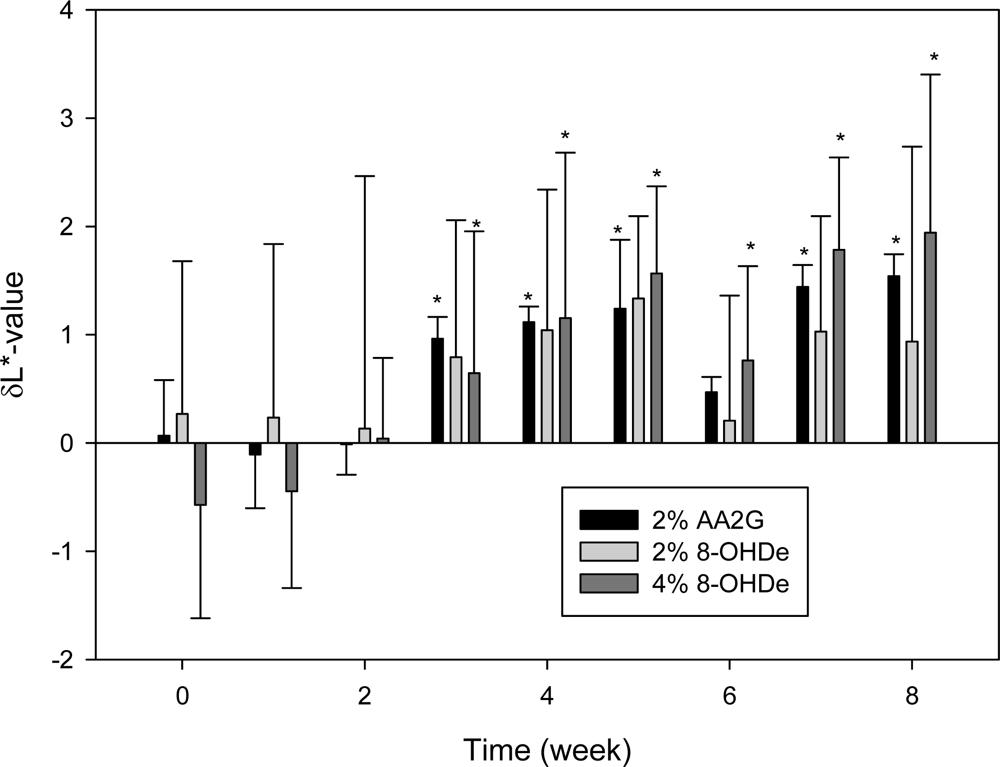
2.2. In Vivo Evaluation of Skin-Whitening Activity of 8-OHDe in Human Volunteers
3. Experimental Section
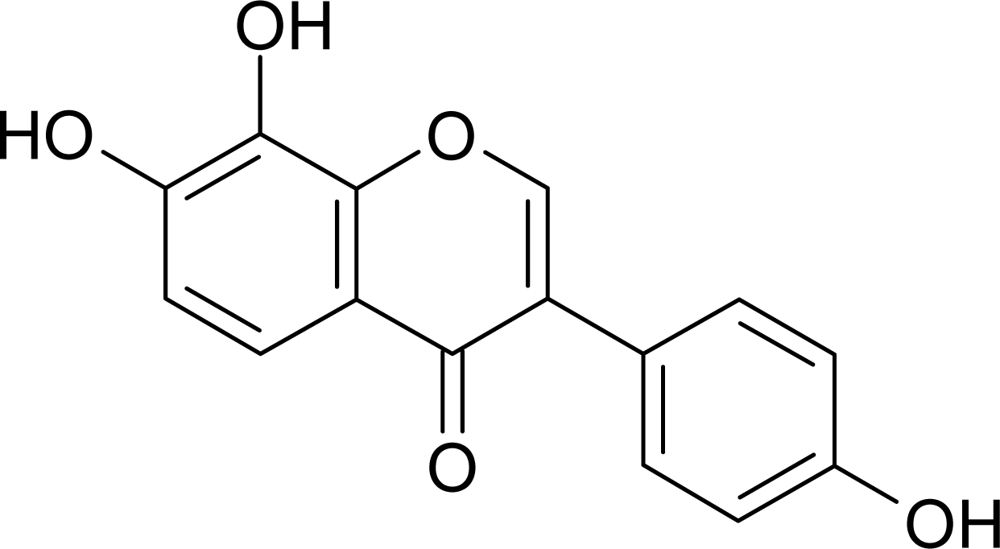
3.1. 8-OHDe Purification and the Cream Formulation
3.2. Cell Cultures
3.3. Measurements of Cell Viability
3.4. Determination of Melanin Content
3.5. Measurements of Tyrosinase Activity
3.6. Instruments for in Vivo Measurements
3.7. In Vivo Measurements
4. Conclusions
References and Notes
- Schallreuter, KU; Kothari, S; Chavan, B; Spencer, JD. Regulation of melanogenesis-controversies and new concepts. Exp. Dermatol 2008, 17, 395–404. [Google Scholar]
- Chang, TS. An updated review of tyrosinase inhibitors. Int. J. Mol. Sci 2009, 10, 2440–2475. [Google Scholar]
- Walter, PS. The effects of topical l(+) lactic acid and ascorbic acid on skin whitening. Int. J. Cosmet. Sci 1999, 21, 33–40. [Google Scholar]
- Ahn, HH; Kim, IH. Whitening effect of salicylic acid peels in Asian patients. Dermatol. Surg 2006, 32, 372–375. [Google Scholar]
- Tengamnuay, P; Pengrungruangwong, K; Pheansri, I; Likhitwitayawuid, K. Artocarpus lakoocha heartwood extract as a novel cosmetic ingredient: Evaluation of the in vitro anti-tyrosinase and in vivo skin whitening activities. Int. J. Cosmet. Sci 2006, 28, 269–276. [Google Scholar]
- Tian, Y; Hoshino, T; Chen, CJ; E, Y; Yabe, S; Liu, W. The evaluation of whitening efficacy of cosmetic products using a human skin pigmentation spot model. Skin Res. Technol 2009, 15, 218–223. [Google Scholar]
- Land, EJ; Ramsden, CA; Riley, PA. The mechanism of suicide-inactivation of tyrosinase: A substrate structure investigation. Tohoku J. Exp. Med 2007, 212, 341–348. [Google Scholar]
- Chang, TS; Ding, HY; Tai, SSK; Wu, CY. Tyrosinase inhibitors isolated from soygerm koji fermented with Aspergillus oryzae BCRC 32288. Food Chem 2007, 105, 1430–1438. [Google Scholar]
- Chang, TS. Two potent suicide substrates of mushroom tyrosinase: 7,8,4′-Trihydroxyisoflavone and 5,7,8,4′-tetrahydroxyisoflavone. J. Agric. Food Chem 2007, 55, 2010–2015. [Google Scholar]
- Chang, TS; Ding, HY; Lin, HC. Identifying 6,7,4′-trihydroxyisoflavone as a potent tyrosinase inhibitor. Biosci. Biotechnol. Biochem 2005, 69, 1999–2001. [Google Scholar]
- Ding, HY; Lin, HC; Chang, TS. Tyrosinase inhibitors isolated from the roots of Paeonia suffruticosa. J. Cosmet. Sci 2009, 60, 347–352. [Google Scholar]
- Chang, TS; Ding, HY; Tai, SSK; Wu, CY. Metabolism of the soy isoflavone daidzein and genistein by the fungi used for the preparation of various fermented soybean foods. Biosci. Biotechnol. Biochem 2007, 71, 1330–1333. [Google Scholar]
- Takiwaki, H; Serup, J. Measurement of color parameters of psoriatic plaques by narrow-band reflectance spectrophotometry and tristimulus colorimetry. Skin Pharmacol 1994, 7, 145–150. [Google Scholar]
- Burdock, GA; Soni, MG; Carabin, IG. Evaluation of health aspects of kojic acid in food. Regul. Toxicol. Pharmacol 2001, 33, 80–101. [Google Scholar]
- Kameyama, K; Sakai, C; Kondoh, S; Yonemoto, K; Nishiyama, S; Tagawa, M; Murata, T; Ohnuma, T; Quigley, J; Dorsky, A; Bucks, D; Blanock, K. Inhibitory effect of magnesium l-ascorbyl-2-phosphate (VC-PMG) on melanogenesis in vitro and in vivo. J. Am. Acad. Dermatol 1996, 34, 29–33. [Google Scholar]
- Kumano, Y; Sakamoto, T; Egawa, M; Iwai, I; Tanaka, M; Yamamoto, I. In vitro and in vivo prolonged biological activities of novel vitamin C derivative, 2-O-alpha-d-glucopyranosyl-l-ascorbic acid (AA-2G), in cosmetic fields. J. Nutr. Sci. Vitaminol 1998, 44, 345–359. [Google Scholar]
- Akhtar, N; Yazan, Y. Formulation and in-vivo evaluation of a cosmetic multiple emulsion containing vitamin C and wheat protein. Pak. J. Pharm. Sci 2008, 21, 45–50. [Google Scholar]
- Shimada, Y; Tai, H; Tanaka, A; Ikezawa-Suzuki, I; Takagi, K; Yoshida, Y; Yoshie, H. Effects of ascorbic acid on gingival melanin pigmentation in vitro and in vivo. J. Periodontol 2009, 80, 317–323. [Google Scholar]
- Chang, TS. 8-Hydroxydaidzein is unstable in alkaline solutions. J. Cosmet. Sci 2009, 60, 353–357. [Google Scholar]


© 2009 by the authors; licensee Molecular Diversity Preservation International, Basel, Switzerland. This article is an open-access article distributed under the terms and conditions of the Creative Commons Attribution license (http://creativecommons.org/licenses/by/3.0/).
Share and Cite
Tai, S.S.-K.; Lin, C.-G.; Wu, M.-H.; Chang, T.-S. Evaluation of Depigmenting Activity by 8-Hydroxydaidzein in Mouse B16 Melanoma Cells and Human Volunteers. Int. J. Mol. Sci. 2009, 10, 4257-4266. https://doi.org/10.3390/ijms10104257
Tai SS-K, Lin C-G, Wu M-H, Chang T-S. Evaluation of Depigmenting Activity by 8-Hydroxydaidzein in Mouse B16 Melanoma Cells and Human Volunteers. International Journal of Molecular Sciences. 2009; 10(10):4257-4266. https://doi.org/10.3390/ijms10104257
Chicago/Turabian StyleTai, Sorgan Shou-Ku, Ching-Gong Lin, Mon-Han Wu, and Te-Sheng Chang. 2009. "Evaluation of Depigmenting Activity by 8-Hydroxydaidzein in Mouse B16 Melanoma Cells and Human Volunteers" International Journal of Molecular Sciences 10, no. 10: 4257-4266. https://doi.org/10.3390/ijms10104257