<?xml version="1.0" encoding="UTF-8"?>
<!DOCTYPE article PUBLIC "-//NLM//DTD Journal Publishing DTD v2.3 20070202//EN" "journalpublishing.dtd">
<article xmlns:mml="http://www.w3.org/1998/Math/MathML" xmlns:xlink="http://www.w3.org/1999/xlink" xml:lang="en" article-type="research-article">
  <front>
    <journal-meta>
      <journal-id journal-id-type="publisher-id">molecules</journal-id>
      <journal-title>Molecules</journal-title>
      <abbrev-journal-title abbrev-type="publisher">Molecules</abbrev-journal-title>
      <abbrev-journal-title abbrev-type="pubmed">Molecules</abbrev-journal-title>
      <issn pub-type="epub">1420-3049</issn>
      <publisher>
        <publisher-name>MDPI</publisher-name>
      </publisher>
    </journal-meta>
    <article-meta>
      <article-id pub-id-type="doi">10.3390/molecules17044703</article-id>
      <article-id pub-id-type="publisher-id">molecules-17-04703</article-id>
      <article-categories>
        <subj-group>
          <subject>Article</subject>
        </subj-group>
      </article-categories>
      <title-group>
        <article-title>Synthesis and Cytotoxic Activity of Some Novel <italic>N</italic>-Pyridinyl-2-(6-phenylimidazo[2,1-<italic>b</italic>]thiazol-3-yl)acetamide Derivatives</article-title>
      </title-group>
      <contrib-group>
        <contrib contrib-type="author">
          <name>
            <surname>Ding</surname>
            <given-names>Huaiwei</given-names>
          </name>
          <xref rid="af1-molecules-17-04703" ref-type="aff">1</xref>
          <xref rid="af2-molecules-17-04703" ref-type="aff">2</xref>
        </contrib>
        <contrib contrib-type="author">
          <name>
            <surname>Chen</surname>
            <given-names>Zhe</given-names>
          </name>
          <xref rid="af2-molecules-17-04703" ref-type="aff">2</xref>
        </contrib>
        <contrib contrib-type="author">
          <name>
            <surname>Zhang</surname>
            <given-names>Cunlong</given-names>
          </name>
          <xref rid="af2-molecules-17-04703" ref-type="aff">2</xref>
        </contrib>
        <contrib contrib-type="author">
          <name>
            <surname>Xin</surname>
            <given-names>Tian</given-names>
          </name>
          <xref rid="af2-molecules-17-04703" ref-type="aff">2</xref>
        </contrib>
        <contrib contrib-type="author">
          <name>
            <surname>Wang</surname>
            <given-names>Yini</given-names>
          </name>
          <xref rid="af2-molecules-17-04703" ref-type="aff">2</xref>
        </contrib>
        <contrib contrib-type="author">
          <name>
            <surname>Song</surname>
            <given-names>Hongrui</given-names>
          </name>
          <xref rid="af1-molecules-17-04703" ref-type="aff">1</xref>
        </contrib>
        <contrib contrib-type="author">
          <name>
            <surname>Jiang</surname>
            <given-names>Yuyang</given-names>
          </name>
          <xref rid="af2-molecules-17-04703" ref-type="aff">2</xref>
          <xref rid="c1-molecules-17-04703" ref-type="corresp"/>
        </contrib>
        <contrib contrib-type="author">
          <name>
            <surname>Chen</surname>
            <given-names>Yuzong</given-names>
          </name>
          <xref rid="af3-molecules-17-04703" ref-type="aff">3</xref>
        </contrib>
        <contrib contrib-type="author">
          <name>
            <surname>Xu</surname>
            <given-names>Yongnan</given-names>
          </name>
          <xref rid="af1-molecules-17-04703" ref-type="aff">1</xref>
          <xref rid="c1-molecules-17-04703" ref-type="corresp">*</xref>
        </contrib>
        <contrib contrib-type="author">
          <name>
            <surname>Tan</surname>
            <given-names>Chunyan</given-names>
          </name>
          <xref rid="af2-molecules-17-04703" ref-type="aff">2</xref>
          <xref rid="c1-molecules-17-04703" ref-type="corresp">*</xref>
        </contrib>
      </contrib-group>
      <aff id="af1-molecules-17-04703"><label>1</label> School of Pharmaceutical Engineering, Shenyang Pharmaceutical University, Shenyang 110016, China; Email: <email>dinghuaiwei627@163.com</email> (H.D.); <email>hongruisong@163.com</email> (H.S.)</aff>
      <aff id="af2-molecules-17-04703"><label>2</label> The Key Laboratory of Chemical Biology, Guangdong Province, Graduate School at Shenzhen, Tsinghua University, Shenzhen 518055, China; Email: <email>czseasky@yahoo.com.cn</email> (Z.C.); <email>zhcunl@126.com</email> (C.Z.); <email>xintian0904@163.com</email> (T.X.); <email>yini0403@163.com</email> (Y.W.); <email>jiangyy@sz.tsinghua.edu.cn</email> (Y.J.)</aff>
      <aff id="af3-molecules-17-04703"><label>3</label> Bioinformatics and Drug Design Group, Department of Computational Science, National University of Singapore, Blk SOC1, Level 7, 3 Science Drive 2, Singapore 117543, Singapore; Email: <email>csccyz@nus.edu.sg</email></aff>
      <author-notes>
        <corresp id="c1-molecules-17-04703"><label>*</label> Authors to whom correspondence should be addressed; Email: <email>ynxucn@yahoo.com.cn</email> (Y.X.); <email>chunyantan@yahoo.com</email> (C.T.); Tel.: +86-24-2398-6445 (Y.X.); Tel./Fax: +86-755-2603-2094 (C.T.).</corresp>
      </author-notes>
      <pub-date pub-type="epub">
        <day>23</day>
        <month>04</month>
        <year>2012</year>
      </pub-date>
      <pub-date pub-type="collection"><month>04</month>
        <year>2012</year>
      </pub-date>
      <volume>17</volume>
      <issue>4</issue>
      <fpage>4703</fpage>
      <lpage>4716</lpage>
      <history>
        <date date-type="received">
          <day>29</day>
          <month>02</month>
          <year>2012</year>
        </date>
        <date date-type="rev-recd">
          <day>01</day>
          <month>04</month>
          <year>2012</year>
        </date>
        <date date-type="accepted">
          <day>13</day>
          <month>04</month>
          <year>2012</year>
        </date>
      </history>
      <permissions>
        <copyright-statement>©  2012 by the authors; licensee MDPI, Basel, Switzerland.</copyright-statement>
        <copyright-year>2012</copyright-year>
        <license xmlns:xlink="http://www.w3.org/1999/xlink" license-type="open-access" xlink:href="http://creativecommons.org/licenses/by/3.0/">
          <p>This article is an open-access article distributed under the terms and conditions of the Creative Commons Attribution license (http://creativecommons.org/licenses/by/3.0/).</p>
        </license>
      </permissions>
      <abstract>
        <p> A series of novel compounds bearing imidazo[2,1-<italic>b</italic>]thiazole scaffolds were designed and synthesized based on the optimization of the virtual screening hit compound <italic>N</italic>-(6-morpholinopyridin-3-yl)-2-(6-phenylimidazo[2,1-b]thiazol-3-yl)acetamide (<bold>5a</bold>), and tested for their cytotoxicity against human cancer cell lines, including HepG2 and MDA-MB-231. The results indicated that the compound 2-(6-(4-chlorophenyl)imidazo[2,1-b]thiazol-3-yl)-N-(6-(4-(4-methoxybenzyl)piperazin-1-yl)pyridin-3-yl)acetamide (<bold>5l</bold>), with slightly higher inhibition on VEGFR2 than <bold>5a</bold> (5.72% and 3.76% inhibitory rate at 20 μM, respectively), was a potential inhibitor against MDA-MB-231 (IC<sub>50</sub> = 1.4 μM) compared with sorafenib (IC<sub>50</sub> = 5.2 μM), and showed more selectivity against MDA-MB-231 than HepG2 cell line (IC<sub>50</sub> = 22.6 μM).</p>
      </abstract>
      <kwd-group>
        <kwd>imidazo[2,1-<italic>b</italic>]thiazoles</kwd>
        <kwd>cytotoxic activity</kwd>
        <kwd>synthesis</kwd>
      </kwd-group>
    </article-meta>
  </front>
  <body>
    <sec sec-type="intro">
      <title>1. Introduction</title>
      <p>During the last few decades, anticancer therapy has made significantly progress, especially after the approval of a few small-molecule inhibitors, but the management of malignancies in humans is still one major concern. Extensive interest is being focused on exploring newly functional scaffolds capable of being further developed as anticancer agents. Recently, considerable attention has been paid to the design and the biological activity of compounds bearing imidazo[2,1-<italic>b</italic>]thiazole scaffolds due to their broad spectrum of pharmacological activities, such as antifungal [<xref ref-type="bibr" rid="B1-molecules-17-04703">1</xref>,<xref ref-type="bibr" rid="B2-molecules-17-04703">2</xref>,<xref ref-type="bibr" rid="B3-molecules-17-04703">3</xref>], antibacterial [<xref ref-type="bibr" rid="B3-molecules-17-04703">3</xref>,<xref ref-type="bibr" rid="B4-molecules-17-04703">4</xref>,<xref ref-type="bibr" rid="B5-molecules-17-04703">5</xref>,<xref ref-type="bibr" rid="B6-molecules-17-04703">6</xref>] anti-inflammatory [<xref ref-type="bibr" rid="B7-molecules-17-04703">7</xref>] and antihypertensive properties [<xref ref-type="bibr" rid="B8-molecules-17-04703">8</xref>], as well as being used as cystic fibrosis transmembrane conductance regulator (CFTR)-selective potentiators [<xref ref-type="bibr" rid="B9-molecules-17-04703">9</xref>]. In particular, many imidazo[2,1-<italic>b</italic>]thiazole derivatives have been reported to display potential antitumor activities against a variety of human cancer cell lines [<xref ref-type="bibr" rid="B10-molecules-17-04703">10</xref>,<xref ref-type="bibr" rid="B11-molecules-17-04703">11</xref>,<xref ref-type="bibr" rid="B12-molecules-17-04703">12</xref>,<xref ref-type="bibr" rid="B13-molecules-17-04703">13</xref>,<xref ref-type="bibr" rid="B14-molecules-17-04703">14</xref>,<xref ref-type="bibr" rid="B15-molecules-17-04703">15</xref>,<xref ref-type="bibr" rid="B16-molecules-17-04703">16</xref>]. The recent studies demonstrated that pyrimidinyl-substituted imidazo[2,1-<italic>b</italic>]thiazole derivatives could inhibit Raf kinases [<xref ref-type="bibr" rid="B17-molecules-17-04703">17</xref>], and appropriately substituted imidazo[2,1-<italic>b</italic>]thiazoles could be developed as dual inhibitors of IGF-IR (insulin-like growth factor receptor) and EGFR (epidermal growth factor receptor) [<xref ref-type="bibr" rid="B18-molecules-17-04703">18</xref>] or P38 kinase inhibitors [<xref ref-type="bibr" rid="B19-molecules-17-04703">19</xref>]. However, there is no report about imidazo[2,1-<italic>b</italic>]thiazole derivatives as vascular endothelial growth factor receptor (VEGFR) inhibitors. These observations elicited much interest in this fused ring system and prompted us to attempt to develop VEGFR inhibitors possessing the imidazo[2,1-<italic>b</italic>]thiazole core.</p>
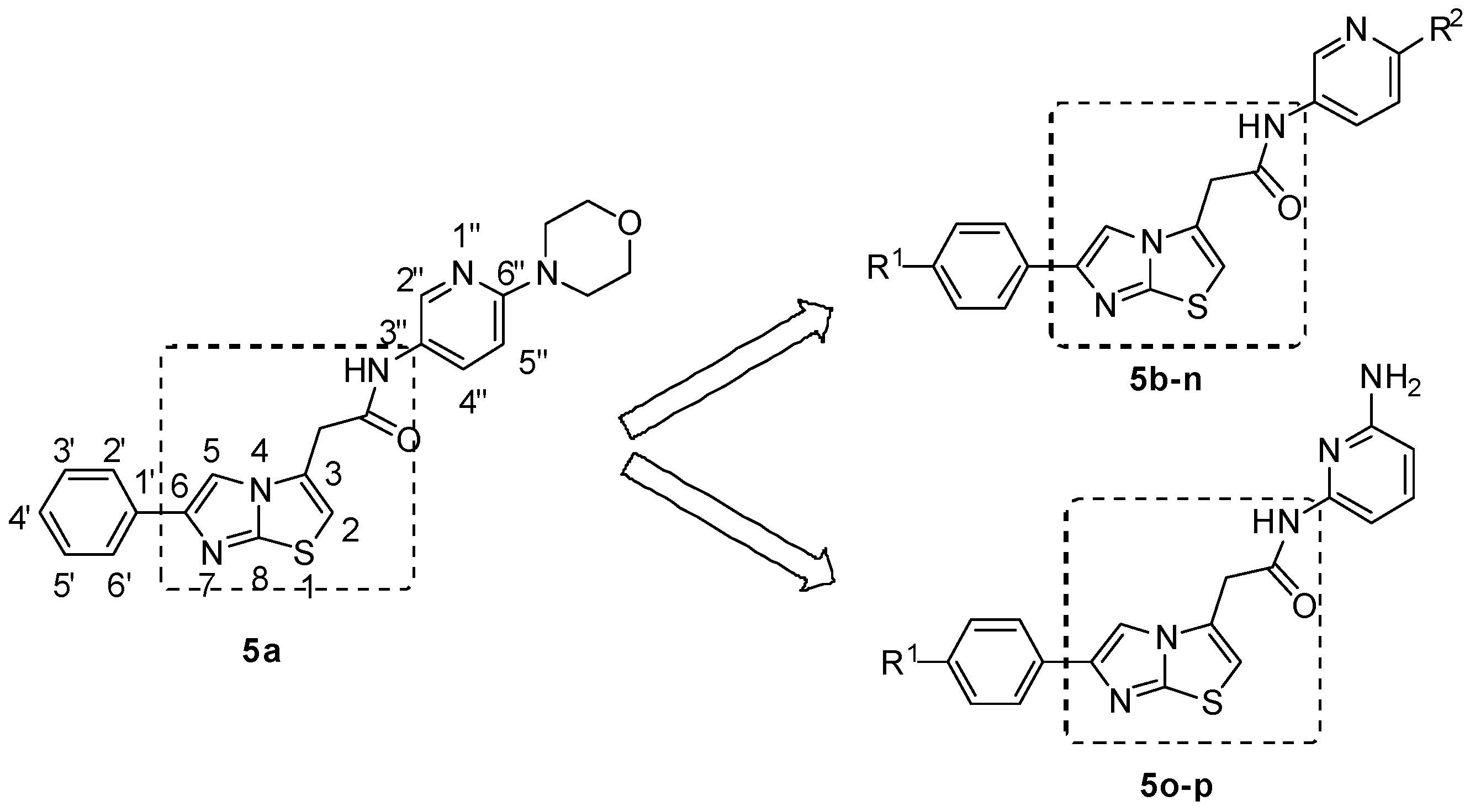
      <p>Angiogenesis, the formation of new blood vessels from pre-existing ones, plays a central role in the process of tumor growth and metastasis [<xref ref-type="bibr" rid="B20-molecules-17-04703">20</xref>]. Blockade of VEGF/VEGFR signaling pathways, which regulates proliferation and migration of endothelial cells, has been explored as a highly successful clinical strategy in cancer treatment [<xref ref-type="bibr" rid="B21-molecules-17-04703">21</xref>]. Several VEGFR inhibitors have been approved and many are under development in clinic. Based on our interest in searching for novel biologically active molecules as VEGFR inhibitors and consideration of the potent bioactivities of compounds that possess an imidazo[2,1-<italic>b</italic>]thiazole scaffold, we searched Ambinter and ChemSpider chemical database using a SVM (support vector machine) screening model [<xref ref-type="bibr" rid="B22-molecules-17-04703">22</xref>,<xref ref-type="bibr" rid="B23-molecules-17-04703">23</xref>], and found one hit compound <bold>5a</bold> (ChemSpider ID: 11102329) (<xref ref-type="fig" rid="molecules-17-04703-f001">Figure 1</xref>) bearing an imidazo[2,1-<italic>b</italic>]thiazole core with potential anticancer activity. As follow-up to this observation, we have now designed and synthesized a series of novel imidazo[2,1-<italic>b</italic>]thiazole acetamide derivatives and assessed their <italic>in vitro</italic> activities.</p>
    </sec>
    <sec sec-type="results">
      <title>2. Results and Discussion</title>
      <sec>
        <title>2.1. Chemistry</title>
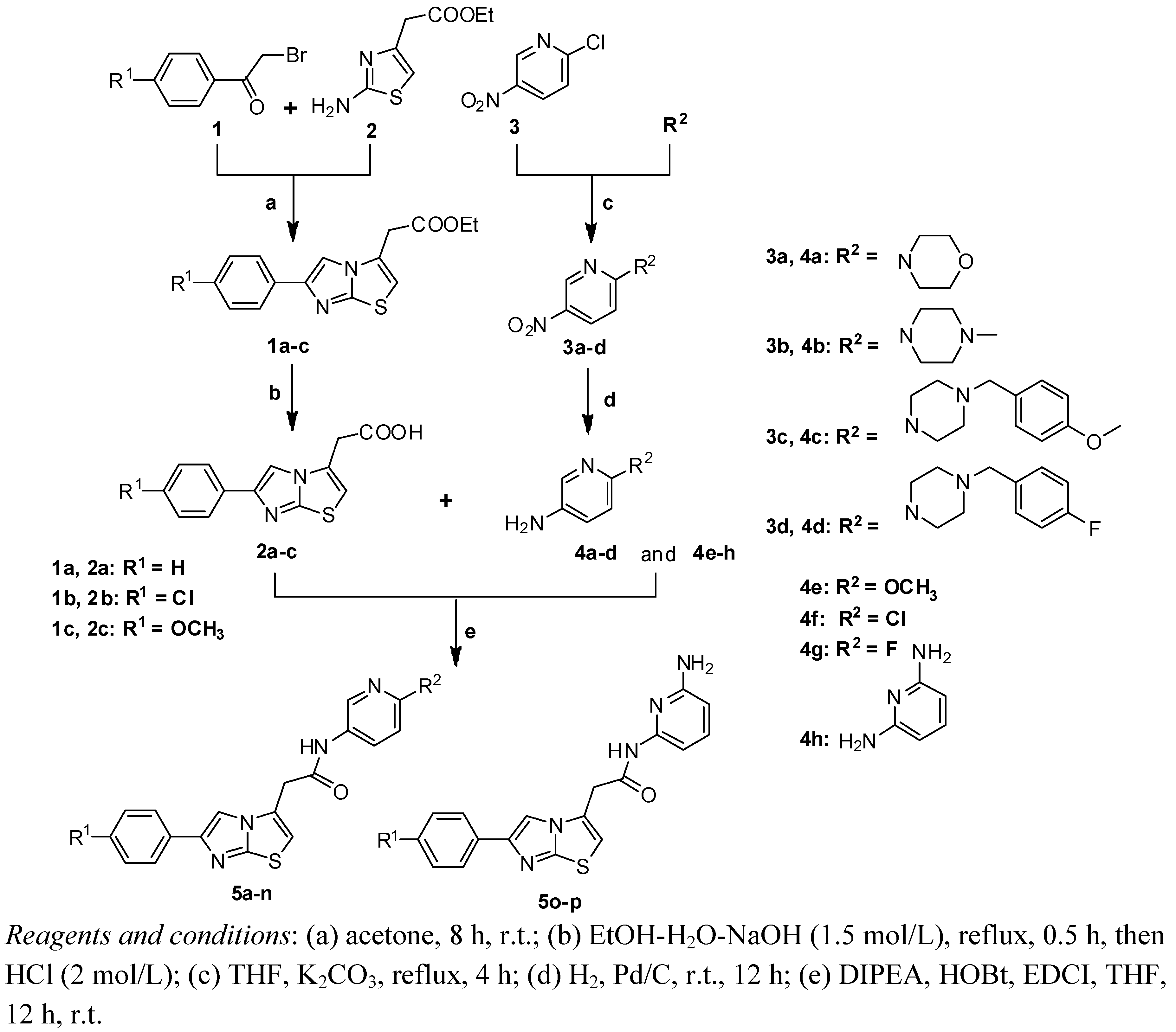
        <p>All the agents, unless mentioned otherwise, are commercially available and were directly used without further purification. Synthesis of the intermediates and target compounds was accomplished according to the steps illustrated in <xref ref-type="scheme" rid="molecules-17-04703-f002">Scheme 1</xref>. Ethyl 2-(2-aminothiazol-4-yl)acetate (<bold>2</bold>) reacted with substituted or nonsubstituted 2-bromoacetophenones <bold>1</bold> to give the crude products <bold>1a–c</bold> [<xref ref-type="bibr" rid="B12-molecules-17-04703">12</xref>], which without further purification were refluxed in EtOH-H<sub>2</sub>O-NaOH (1.5 mol/L), acidified by 2M HCl, to afford <bold>2a–c</bold> in good yields (62%–80%) [<xref ref-type="bibr" rid="B24-molecules-17-04703">24</xref>]. Compounds <bold>3a–d</bold> were prepared by the reaction of 2-chloro-5-nitropyridine (<bold>3</bold>) with various R<sup>2</sup>groups in high yield (96%–99%) [<xref ref-type="bibr" rid="B25-molecules-17-04703">25</xref>]. Compounds <bold>4a–d</bold> which were obtained by the reduction of <bold>3a–d</bold> [<xref ref-type="bibr" rid="B26-molecules-17-04703">26</xref>], along with commercial agents <bold>4e–h</bold>, were coupled with <bold>2a–c</bold> to afford the target compounds <bold>5a–p</bold>.</p>
      <fig id="molecules-17-04703-f001" position="anchor">
        <label>Figure 1</label>
        <caption>
          <p>Structures of hit compound <bold>5a</bold> and modification position of target compounds.</p>
        </caption>
        <graphic xmlns:xlink="http://www.w3.org/1999/xlink" xlink:href="molecules-17-04703-g001.tif"/>
      </fig>
        <fig id="molecules-17-04703-f002" position="anchor">
          <object-id pub-id-type="pii">molecules-17-04703-f002_Scheme 1</object-id>
          <label>Scheme 1</label>
          <caption>
            <p>The Synthesis Route of Compounds <bold>5a–p</bold>.</p>
          </caption>
          <graphic xmlns:xlink="http://www.w3.org/1999/xlink" xlink:href="molecules-17-04703-g002.tif"/>
        </fig>
      </sec>
      <sec>
        <title>2.2. <italic>In Vitro</italic> Bioactivity</title>
        <p>Compound <bold>5a</bold> acquired by the SVM screening model was first evaluated for its inhibitory activity on VEGFR2 kinase and against HepG2 and MDA-MB-231 cell lines. Although <bold>5a</bold> at 20 µM exhibited only a 3.76% inhibitory rate on VEGFR2 kinase, it displayed moderate cytotoxic activity against the HepG2 and MDA-MB-231 cell lines (IC<sub>50</sub> = 74.2 and 27.1 μM, respectively), which made it a potential hit compound for further investigation. The other 15 compounds were also evaluated against HepG2 and MDA-MB-231 cell lines with sorafenib as the positive control. The IC<sub>50</sub> value results are summarized in <xref ref-type="table" rid="molecules-17-04703-t001">Table 1</xref>.</p>
        <table-wrap id="molecules-17-04703-t001" position="anchor">
          <object-id pub-id-type="pii">molecules-17-04703-t001_Table 1</object-id>
          <label>Table 1</label>
          <caption>
            <p>The substituents and <italic>in vitro</italic> cytotoxicity of synthesized compounds against HepG2 and MDA-MB-231 cell lines.</p>
			<p><inline-graphic xmlns:xlink="http://www.w3.org/1999/xlink" xlink:href="molecules-17-04703-i001.tif"/></p>
          </caption>
          <table>
<thead>
              <tr>
                <th rowspan="2" align="center" valign="middle">Compound</th>
                <th rowspan="2" align="center" valign="middle">R<sup>1</sup></th>
                <th rowspan="2" align="center" valign="middle">R<sup>2</sup></th>
                <th colspan="2" align="center" valign="middle" style="border-bottom:solid thin">IC<sub>50</sub>* (µM)</th>
              </tr>
              <tr>
                <th align="center" valign="middle">HepG2</th>
                <th align="center" valign="middle">MDA-MB-231</th>
              </tr>
            </thead>
            <tbody>
              <tr>
                <td align="center" valign="middle"><bold>5a</bold></td>
                <td align="center" valign="middle">H</td>
                <td align="center" valign="middle"><inline-graphic xmlns:xlink="http://www.w3.org/1999/xlink" xlink:href="molecules-17-04703-i002.tif"/></td>
                <td align="center" valign="middle">74.2 ± 2.5</td>
                <td align="center" valign="middle">27.1 ± 0.4</td>
              </tr>
              <tr>
                <td align="center" valign="middle"><bold>5b</bold></td>
                <td align="center" valign="middle">H</td>
                <td align="center" valign="middle">OCH<sub>3</sub></td>
                <td align="center" valign="middle">&gt;100</td>
                <td align="center" valign="middle">&gt;100</td>
              </tr>
              <tr>
                <td align="center" valign="middle"><bold>5c</bold></td>
                <td align="center" valign="middle">Cl</td>
                <td align="center" valign="middle">OCH<sub>3</sub></td>
                <td align="center" valign="middle">63.7 ± 0.4</td>
                <td align="center" valign="middle">40.1 ± 1.3</td>
              </tr>
              <tr>
                <td align="center" valign="middle"><bold>5d</bold></td>
                <td align="center" valign="middle">H</td>
                <td align="center" valign="middle">Cl</td>
                <td align="center" valign="middle">62.0 ± 3.7</td>
                <td align="center" valign="middle">22.8 ± 4.6</td>
              </tr>
              <tr>
                <td align="center" valign="middle"><bold>5e</bold></td>
                <td align="center" valign="middle">H</td>
                <td align="center" valign="middle">F</td>
                <td align="center" valign="middle">&gt;100</td>
                <td align="center" valign="middle">79.0 ± 3.8</td>
              </tr>
              <tr>
                <td align="center" valign="middle"><bold>5f</bold></td>
                <td align="center" valign="middle">Cl</td>
                <td align="center" valign="middle">Cl</td>
                <td align="center" valign="middle">50.0 ± 1.4</td>
                <td align="center" valign="middle">13.0 ± 0.2</td>
              </tr>
              <tr>
                <td align="center" valign="middle"><bold>5g</bold></td>
                <td align="center" valign="middle">Cl</td>
                <td align="center" valign="middle">F</td>
                <td align="center" valign="middle">53.4 ± 0.5</td>
                <td align="center" valign="middle">22.3 ± 1.3</td>
              </tr>
              <tr>
                <td align="center" valign="middle"><bold>5h</bold></td>
                <td align="center" valign="middle">OCH<sub>3</sub></td>
                <td align="center" valign="middle">Cl</td>
                <td align="center" valign="middle">&gt;100</td>
                <td align="center" valign="middle">51.8 ± 0.8</td>
              </tr>
              <tr>
                <td align="center" valign="middle"><bold>5i</bold></td>
                <td align="center" valign="middle">H</td>
                <td align="center" valign="middle"><inline-graphic xmlns:xlink="http://www.w3.org/1999/xlink" xlink:href="molecules-17-04703-i003.tif"/></td>
                <td align="center" valign="middle">71.5 ± 1.7</td>
                <td align="center" valign="middle">&gt;100</td>
              </tr>
              <tr>
                <td align="center" valign="middle"><bold>5j</bold></td>
                <td align="center" valign="middle">Cl</td>
                <td align="center" valign="middle"><inline-graphic xmlns:xlink="http://www.w3.org/1999/xlink" xlink:href="molecules-17-04703-i004.tif"/></td>
                <td align="center" valign="middle">28.2 ± 0.6</td>
                <td align="center" valign="middle">&gt;100</td>
              </tr>
              <tr>
                <td align="center" valign="middle"><bold>5k</bold></td>
                <td align="center" valign="middle">H</td>
                <td align="center" valign="middle"><inline-graphic xmlns:xlink="http://www.w3.org/1999/xlink" xlink:href="molecules-17-04703-i005.tif"/></td>
                <td align="center" valign="middle">39.4 ± 1.9</td>
                <td align="center" valign="middle">6.0 ± 0.7</td>
              </tr>
              <tr>
                <td align="center" valign="middle"><bold>5l</bold></td>
                <td align="center" valign="middle">Cl</td>
                <td align="center" valign="middle"><inline-graphic xmlns:xlink="http://www.w3.org/1999/xlink" xlink:href="molecules-17-04703-i006.tif"/></td>
                <td align="center" valign="middle">22.6 ± 1.5</td>
                <td align="center" valign="middle">1.4 ± 0.1</td>
              </tr>
              <tr>
                <td align="center" valign="middle"><bold>5m</bold></td>
                <td align="center" valign="middle">H</td>
                <td align="center" valign="middle"><inline-graphic xmlns:xlink="http://www.w3.org/1999/xlink" xlink:href="molecules-17-04703-i007.tif"/></td>
                <td align="center" valign="middle">55.2 ± 1.5</td>
                <td align="center" valign="middle">19.8 ± 2.2</td>
              </tr>
              <tr>
                <td align="center" valign="middle"><bold>5n</bold></td>
                <td align="center" valign="middle">Cl</td>
                <td align="center" valign="middle"><inline-graphic xmlns:xlink="http://www.w3.org/1999/xlink" xlink:href="molecules-17-04703-i008.tif"/></td>
                <td align="center" valign="middle">34.7 ± 0.4</td>
                <td align="center" valign="middle">12.9 ± 0.2</td>
              </tr>
              <tr>
                <td align="center" valign="middle"><bold>5o</bold></td>
                <td align="center" valign="middle">H</td>
                <td align="center" valign="middle"> </td>
                <td align="center" valign="middle">&gt;100</td>
                <td align="center" valign="middle">62.6 ± 3.7</td>
              </tr>
              <tr>
                <td align="center" valign="middle"><bold>5p</bold></td>
                <td align="center" valign="middle">Cl</td>
                <td align="center" valign="middle"> </td>
                <td align="center" valign="middle">48.9 ± 1.4</td>
                <td align="center" valign="middle">35.1 ± 0.5</td>
              </tr>
              <tr>
                <td align="center" valign="middle"><bold>sorafenib</bold></td>
                <td align="center" valign="middle"> </td>
                <td align="center" valign="middle"> </td>
                <td align="center" valign="middle">33.7 ± 1.3</td>
                <td align="center" valign="middle">5.2 ± 0.2</td>
              </tr>
            </tbody>
          </table>
    <table-wrap-foot>
      <fn>
        <p>* The IC<sub>50</sub> values were reported as the average of three independent determinations and expressed as the mean ± SD.</p>
      </fn>
    </table-wrap-foot>		
		</table-wrap>
        <p>As shown in <xref ref-type="table" rid="molecules-17-04703-t001">Table 1</xref>, some of the modified compounds showed tantamount or better cytotoxicity against either HepG2 or MDA-MB-231 cell line compared with hit compound <bold>5a</bold>. In particular, <bold>5l</bold> exhibited potent activity against MDA-MB-231 cell line, slightly better than sorafenib, with IC<sub>50</sub> values of 1.4 µM and 5.2 µM, respectively, though it displayed only a little increased inhibition on VEGFR2 kinase (5.72%, inhibitory rate at 20 µM) compared with <bold>5a</bold> (3.76%, inhibitory rate at 20 µM); Compared to the positive control sorafenib, whose activity against the MDA-MB-231 cell line was 7-fold stronger than HepG2, our synthesized compound <bold>5l</bold> demonstrated 16-fold stronger inhibition against MDA-MB-231 than HepG2. Moreover, <bold>5l</bold> showed much lower toxicity towards the HL7702 cell line (normal liver cell) with an IC<sub>50</sub> value of more than 100 µM, indicating that it may be considered a lead structure for the design of novel useful anticancer agents with low toxicity. Besides <bold>5l</bold>, <bold>5k</bold> with an IC<sub>50</sub> value of 6.0 µM also displayed good activity which is equivalent to that of sorafenib.</p>
        <p>The structure-activity relationships (SARs) suggested that all of compounds with Cl substituents at the R<sup>1</sup> position displayed better cytotoxic activities than those substituted by H atom or OCH<sub>3</sub> groups on the same position, including <bold>5c</bold> <italic>vs</italic>. <bold>5b</bold>, <bold>5f</bold> <italic>vs</italic>. <bold>5d</bold> or <bold>5h</bold>, <bold>5g</bold> <italic>vs</italic>. <bold>5e</bold>, <bold>5j</bold> <italic>vs</italic>. <bold>5i</bold>, <bold>5l</bold> <italic>vs</italic>. <bold>5k</bold>, <bold>5n</bold> <italic>vs</italic>. <bold>5m</bold> and <bold>5p</bold> <italic>vs</italic>. <bold>5o</bold>. When R<sup>1</sup> is H atom, morpholine on R<sup>2</sup> position replaced by smaller groups, methoxyl or F, decreased the cytotoxicity against both cell lines, but Cl atom showed similar activity to <bold>5a</bold>. Trying 1-methylpiperazine on this position to produce <bold>5j</bold> increased the cytotoxic activity against the HepG2 cell line but considerably decreased cytotoxicity against the MDA-MB-231 cell line, with IC<sub>50</sub> values of 28.2 μM and &gt;100 μM, respectively. Compounds <bold>5k</bold> and <bold>5m</bold> with further substituted piperazine groups slightly increased the cytotoxic activity, especially <bold>5k</bold> increased much more against MDA-MB-231 cell line. The above observation indicates that pyridine substituted by bulk groups is beneficial for the antitumor activity. Compounds <bold>5o</bold> and <bold>5p</bold> with <italic>N</italic>-(6-aminopyridin-2-yl) moieties displayed lower or similar cytotoxic activity against both cell lines, compared with most of other compounds, which may indicate that the N position on the pyridine ring is important for the cytotoxic activity, or that aminopyridine groups with much larger hydrophilicity hamper the activity. More studies need to be carried out for confirmation of this conjecture.</p>
      </sec>
    </sec>
    <sec sec-type="methods">
      <title>3. Experimental</title>
      <sec>
        <title>3.1. Materials and Reagents</title>
        <p><sup>1</sup>H-NMR, and <sup>13</sup>C-NMR spectra were determined on a Bruker ARX-400 400 MHz spectrometer with tetramethylsilane (TMS) as the internal standard and DMSO-<italic>d</italic><sub>6</sub> or CDCl<sub>3</sub> as the solvents (chemical shifts in ppm). Splitting patterns were designated as follows: s: singlet; d: doublet; t: triplet; m: multiplet. Mass spectra were carried out using a Waters Micromass Q-TOF Premier Mass Spectrometer. Melting points were determined in open glass capillaries with a SGW X-4 digital apparatus and were uncorrected. Follow-up of the reactions and checking the homogeneity of the compounds were made by TLC (thin layer chromatography) on silica gel-protected glass plates and the spots were detected by exposure to UV-lamp at <italic>λ</italic>254 and <italic>λ</italic>365. Unless otherwise noted, all solvents and reagents were commercially available and used without further purification.</p>
      </sec>
      <sec>
        <title>3.2. Chemical Synthesis</title>
        <sec>
          <title>3.2.1. General Procedure for Preparation of 2-(6-Phenylimidazo[2,1-<italic>b</italic>]thiazol-3-yl)acetic Acid Derivatives <bold>2a–c</bold></title>
          <p>Ethyl 2-(2-aminothiazol-4-yl) acetate (20 mmol) was dissolved in acetone (50 mL) and treated with the substituted 2-bromoacetophenone (20 mmol, 1 eq.), the mixture was refluxed for 8 h. and then concentrated to 20 mL. The resulting solution was cautiously basified with 15% NH<sub>4</sub>OH to pH 8–9, then poured into CH<sub>2</sub>Cl<sub>2</sub>, separated, washed and concentrated. The crude product was dissolved in EtOH-H<sub>2</sub>O-NaOH (1.5 mol/L) and refluxed for another 0.5 h, then acidified to pH 3–4 with 2M HCl to afford white solid precipitate, following by wash and dry, to afford the desired compounds <bold>2a–c</bold>.</p>
          <p><italic>2-(6-Phenylimidazo[2,1-b]thiazol-3-yl)acetic acid </italic>(<bold>2a</bold>, C<sub>13</sub>H<sub>10</sub>N<sub>2</sub>O<sub>2</sub>S; M.W.: 258.0463). Yield: 79%; mp: 221–223 °C; <sup>1</sup>H-NMR (DMSO-<italic>d</italic><sub>6</sub>) <italic>δ</italic>: 8.72 (s, 1H, imidazole H), 7.91 (d, <italic>J </italic>= 7.6 Hz, 2H, Ar-H), 7.55–7.41 (m, 4H, Ar-H and thiazole H), 4.12 (s, 2H, CH<sub>2</sub>); <sup>13</sup>C-NMR (DMSO-<italic>d</italic><sub>6</sub>) <italic>δ</italic>: 169.3, 147.4, 139.3, 129.1, 128.9, 128.7, 127.6, 125.0, 114.5, 110.0, 32.2.</p>
          <p><italic>2-(6-(4-Chlorophenyl)imidazo[2,1-b]thiazol-3-yl)acetic acid</italic> (<bold>2b</bold>, C<sub>13</sub>H<sub>9</sub>ClN<sub>2</sub>O<sub>2</sub>S; M.W.: 292.0073). Yield: 80%; mp: 236–238 °C; <sup>1</sup>H-NMR (DMSO-<italic>d</italic><sub>6</sub>) <italic>δ</italic>: 8.50 (s, 1H, imidazole H), 7.89 (d, <italic>J </italic>= 8.4 Hz, 2H, Ar-H), 7.52 (d, <italic>J </italic>= 8.4 Hz, 2H, Ar-H), 7.30 (s, 1H, thiazole H), 4.04 (s, 2H, CH<sub>2</sub>); <sup>13</sup>C-NMR (DMSO-<italic>d</italic><sub>6</sub>) <italic>δ</italic>: 169.4, 148.2, 141.8, 132.3, 130.6, 128.8, 126.7, 126.5, 112.3, 109.6, 32.6.</p>
          <p><italic>2-(6-(4-Methoxyphenyl)imidazo[2,1-b]thiazol-3-yl)acetic acid</italic> (<bold>2c</bold>, C<sub>14</sub>H<sub>12</sub>N<sub>2</sub>O<sub>3</sub>S; M.W.: 288.0569). Yield: 62%; mp: 231–233 °C; <sup>1</sup>H-NMR (DMSO-<italic>d</italic><sub>6</sub>)<italic>δ</italic>: 8.57 (s, 1H, imidazole H), 7.83 (d, <italic>J </italic>= 8.4 Hz, 2H, Ar-H), 7.46 (s, 1H, thiazole H), 7.09 (d, <italic>J </italic>= 8.4 Hz, 2H, Ar-H), 4.10 (s, 2H, CH<sub>2</sub>), 3.82 (s, 3H, CH<sub>3</sub>); <sup>13</sup>C-NMR (DMSO-<italic>d</italic><sub>6</sub>) <italic>δ</italic>: 169.2, 159.7, 147.0, 139.7, 127.5, 126.6, 121.3, 114.6, 114.0, 108.7, 55.3, 32.2.</p>
        </sec>
        <sec>
          <title>3.2.2. General Procedure for Preparation of Compounds <bold>3a–d</bold></title>
          <p>A mixture of morpholine (100 mmol), 2-chloro-5-nitropyridine (50 mmol), and K<sub>2</sub>CO<sub>3</sub> (100 mmol) in THF (50 mL) were stirred at 80 °C for 4 h, and then concentrated to 20 mL, poured into water (100 mL), whereby a yellow solid precipitate formed. The precipitate was washed, dried and recrystallized with CH<sub>2</sub>Cl<sub>2</sub> to afford yellow crystals of <bold>3a</bold>. Compounds <bold>3b–d</bold> were obtained as the same procedure as <bold>3a</bold>.</p>
          <p><italic>4-(5-Nitropyridin-2-yl)morpholine </italic>(<bold>3a</bold>, C<sub>9</sub>H<sub>11</sub>N<sub>3</sub>O<sub>3</sub>; M.W.: 209.0800). Yield: 99%; mp: 141–143 °C; <sup>1</sup>H-NMR (CDCl<sub>3</sub>) <italic>δ</italic>: 9.04 (d, <italic>J </italic>= 2.8 Hz, 1H, pyridine H), 8.23 (dd, <italic>J </italic>= 2.8, 9.6 Hz, 1H, pyridine H), 6.57 (d, <italic>J </italic>= 9.6 Hz, 1H, pyridine H), 3.82 (t, <italic>J </italic>= 4.8 Hz, 4H, CH<sub>2</sub>), 3.75 (t, <italic>J </italic>= 4.8 Hz, 4H, CH<sub>2</sub>); <sup>13</sup>C-NMR (CDCl<sub>3</sub>) <italic>δ</italic>: 160.6, 146.3, 135.5, 133.1, 104.5, 66.5, 45.1.</p>
          <p><italic>1-Methyl-4-(5-nitropyridin-2-yl)piperazine </italic>(<bold>3b</bold>, C<sub>10</sub>H<sub>14</sub>N<sub>4</sub>O<sub>2</sub>; M.W.: 222.1117). Yield: 97%; mp: 97–99 °C; <sup>1</sup>H-NMR (DMSO-<italic>d</italic><sub>6</sub>) <italic>δ</italic>: 9.02 (d, <italic>J </italic>= 2.4 Hz, 1H, pyridine H), 8.19 (dd, <italic>J </italic>= 2.4, 9.6 Hz, 1H, pyridine H), 6.57 (d, <italic>J </italic>= 9.6 Hz, 1H, pyridine H), 3.79 (t, <italic>J </italic>= 4.8 Hz, 4H, CH<sub>2</sub>), 2.52 (t, <italic>J </italic>= 4.8 Hz, 4H, CH<sub>2</sub>), 2.36 (s, 3H, CH<sub>3</sub>); <sup>13</sup>C-NMR (DMSO-<italic>d</italic><sub>6</sub>) <italic>δ</italic>: 160.4, 146.5, 135.1, 133.0, 104.5, 54.6, 46.5, 44.9.</p>
          <p><italic>1-(4-Methoxybenzyl)-4-(5-nitropyridin-2-yl)piperazine </italic>(<bold>3c</bold>, C<sub>17</sub>H<sub>20</sub>N<sub>4</sub>O<sub>3</sub>; M.W.: 328.1535). Yield: 96%; mp: 110–112 °C; <sup>1</sup>H-NMR (DMSO-<italic>d</italic><sub>6</sub>) <italic>δ</italic>: 8.94 (d, <italic>J </italic>= 2.8 Hz, 1H, pyridine H), 8.20 (dd, <italic>J </italic>= 2.8, 9.6 Hz, 1H, pyridine H), 7.24 (d, <italic>J </italic>= 8.4 Hz, 2H, Ar-H), 6.92 (d, <italic>J </italic>= 9.6 Hz, 1H, pyridine H), 6.90 (d, <italic>J </italic>= 8.8 Hz, 2H, Ar-H), 3.74 (brs, 7H, CH<sub>2</sub> and CH<sub>3</sub>), 3.47 (brs, 2H, CH<sub>2</sub>), 2.45 (brs, 4H, CH<sub>2</sub>); <sup>13</sup>C-NMR (DMSO-<italic>d</italic><sub>6</sub>) <italic>δ</italic>: 160.0, 158.3, 146.0, 134.1, 132.7, 130.1, 113.5, 105.5, 61.0, 54.9, 51.9, 44.4.</p>
          <p><italic>1-(4-Fluorobenzyl)-4-(5-nitropyridin-2-yl)piperazine</italic> (<bold>3d</bold>, C<sub>16</sub>H<sub>17</sub>FN<sub>4</sub>O<sub>2</sub>; M.W.: 316.1336). Yield: 98%; mp: 99–101 °C; <sup>1</sup>H-NMR (CDCl<sub>3</sub>) <italic>δ</italic>: 9.00 (d, <italic>J </italic>= 2.4 Hz, 1H, pyridine H), 8.18–8.15 (m, 1H, pyridine H), 7.31 (dd, <italic>J </italic>= 5.2, 8.8 Hz, 2H, Ar-H), 7.03 (d, <italic>J </italic>= 8.8 Hz, 2H, Ar-H), 6.54 (d, <italic>J </italic>= 9.6 Hz, 1H, pyridine H), 3.77 (t, <italic>J </italic>= 5.2 Hz, 4H, CH<sub>2</sub>), 3.52 (s, 2H, CH<sub>2</sub>), 2.53 (t, <italic>J </italic>= 5.2 Hz, 4H, CH<sub>2</sub>); <sup>13</sup>C-NMR (CDCl<sub>3</sub>) <italic>δ</italic>: 162.2, 160.4, 146.5, 134.9, 133.3, 132.9, 130.6, 115.2, 104.5, 62.0, 52.5, 44.9.</p>
        </sec>
        <sec>
          <title>3.2.3. General Procedure for Preparation of Compounds <bold>4a–d</bold></title>
          <p>The mixture of <bold>3a–d</bold> (20 mmol) and Pd/C (20%, 500 mg) in methanol was hydrogenated at atmosphere at r.t. for 12 h, followed by filtration and concentration, to afford crude residue <bold>4a–d</bold>, which was purified by recrystallization (ethanol).</p>
          <p><italic>6-Morpholinopyridin-3-amine</italic> (<bold>4a</bold>, C<sub>9</sub>H<sub>13</sub>N<sub>3</sub>O; M.W.: 179.1059). Yield: 70%; mp: 119–121 °C; <sup>1</sup>H-NMR (CDCl<sub>3</sub>) <italic>δ</italic>: 7.79 (d, <italic>J </italic>= 2.8 Hz, 1H, pyridine H), 7.00 (dd, <italic>J </italic>= 2.8, 8.8 Hz, 1H, pyridine H), 6.56 (d, <italic>J </italic>= 8.8 Hz, 1H, pyridine H), 3.83 (t, <italic>J </italic>= 4.8 Hz, 4H, CH<sub>2</sub>), 3.33 (t, <italic>J </italic>= 4.8 Hz, 4H, CH<sub>2</sub>), 3.26 (brs, H, NH<sub>2</sub>); <sup>13</sup>C-NMR (CDCl<sub>3</sub>) <italic>δ</italic>: 154.4, 135.2, 135.1, 126.0, 108.3, 66.8, 47.1.</p>
          <p><italic>6-(4-Methylpiperazin-1-yl)pyridin-3-amine</italic> (<bold>4b</bold>, C<sub>10</sub>H<sub>16</sub>N<sub>4</sub>; M.W.: 192.1375). Yield: 76%; mp: 91–93 °C; <sup>1</sup>H-NMR (CDCl<sub>3</sub>) <italic>δ</italic>: 7.78 (d, <italic>J </italic>= 2.8 Hz, 1H, pyridine H), 6.98 (dd, <italic>J </italic>= 2.8, 8.8 Hz, 1H, pyridine H), 6.57 (d, <italic>J </italic>= 8.8 Hz, 1H, pyridine H), 3.39 (t, <italic>J </italic>= 4.8 Hz, 4H, CH<sub>2</sub>), 3.29 (brs, 2H, NH<sub>2</sub>), 2.54 (t, <italic>J </italic>= 4.8 Hz, 4H, CH<sub>2</sub>), 2.34 (s, 3H, CH<sub>3</sub>); <sup>13</sup>C-NMR (CDCl<sub>3</sub>) <italic>δ</italic>: 154.4, 135.2, 134.7, 126.1, 108.5, 55.0, 46.7, 46.2.</p>
          <p><italic>6-(4-(4-Methoxybenzyl)piperazin-1-yl)pyridin-3-amine</italic> (<bold>4c</bold>, C<sub>17</sub>H<sub>22</sub>N<sub>4</sub>O; M.W.: 298.1794). Yield: 74%; mp: 104–106 °C; <sup>1</sup>H-NMR (CDCl<sub>3</sub>) <italic>δ</italic>: 7.78 (d, <italic>J </italic>= 2.8 Hz, 1H, pyridine H), 7.25 (d, <italic>J </italic>= 8.4 Hz, 2H, Ar-H), 6.96 (dd, <italic>J </italic>= 2.8, 8.8 Hz, 1H, pyridine H), 6.87 (dd, <italic>J </italic>= 2.8, 8.8 Hz, 2H, Ar-H), 6.54 (d, <italic>J </italic>= 8.8 Hz, 1H, pyridine H), 3.84 (brs, 2H, NH<sub>2</sub>), 3.80 (s, 3H, CH<sub>3</sub>), 3.52 (s, 2H, CH<sub>2</sub>), 3.37 (t, <italic>J </italic>= 4.8 Hz, 4H, CH<sub>2</sub>), 2.58 (t, <italic>J </italic>= 4.8 Hz, 4H, CH<sub>2</sub>); <sup>13</sup>C-NMR (CDCl<sub>3</sub>) <italic>δ</italic>: 158.9, 154.6, 135.4, 134.6, 130.5, 129.7, 126.2, 113.7, 108.4, 62.3, 55.3, 52.7, 46.6.</p>
          <p><italic>6-(4-(4-Fluorobenzyl)piperazin-1-yl)pyridin-3-amine</italic> (<bold>4d</bold>, C<sub>16</sub>H<sub>19</sub>FN<sub>4</sub>; M.W.: 286.1594). Yield: 80%; mp: 94–96 °C; <sup>1</sup>H-NMR (CDCl<sub>3</sub>) <italic>δ</italic>: 7.76 (d, <italic>J </italic>= 2.8 Hz, 1H, pyridine H), 7.29 (t, <italic>J </italic>= 6.8 Hz, 2H, Ar-H), 6.99 (t, <italic>J </italic>= 8.8 Hz, 2H, Ar-H), 6.92 (dd, <italic>J </italic>= 2.8, 8.8 Hz, 1H, pyridine H), 6.52 (d, <italic>J </italic>= 8.8 Hz, 1H, pyridine H), 3.48 (s, 2H, NH<sub>2</sub>), 3.35 (t, <italic>J </italic>= 4.8 Hz, 6H, CH<sub>2</sub>), 2.53 (t, <italic>J </italic>= 4.8 Hz, 4H, CH<sub>2</sub>); <sup>13</sup>C-NMR (CDCl<sub>3</sub>) <italic>δ</italic>: 161.9, 154.3, 135.1, 134.8, 133.8, 130.5, 126.0, 115.0, 108.4, 62.2, 52.8, 46.7.</p>
        </sec>
        <sec>
          <title>3.2.4. General Procedure for Preparation of Compounds <bold>5a–p</bold></title>
          <p>A solution of the <bold>2a</bold> (1 mmol), <bold>4a</bold> (1 mmol), 1-(3-dimethylaminopropyl)-3-ethylcarbodiimide hydrochloride (EDCI, 1 mmol), <italic>N</italic>-hydroxybenzotrizole (HOBt, 1 mmol), and <italic>N</italic>-diisopropylethylamine (DIPEA, 3 mmol) in anhydrous THF (10 mL) was stirred for 24 h. The reaction was quenched with 1M NaOH (20 mL) and extracted with ethyl acetate (3 × 20 mL), the organic layer was washed with 1M HCl (3 × 20 mL), water (20 mL), dried with Na<sub>2</sub>SO<sub>4</sub> and evaporated to give compound <bold>5a</bold> as a white solid. Other title compounds <bold>5b–p</bold> were synthesized using the same procedure.</p>
          <p><italic>N-(6-Morpholinopyridin-3-yl)-2-(6-phenylimidazo[2,1-b]thiazol-3-yl)acetamide</italic> (<bold>5a</bold>). Yield: 72%; mp: 212–214 °C; <sup>1</sup>H-NMR (DMSO-<italic>d</italic><sub>6</sub>) <italic>δ</italic>: 10.23 (s, 1H, NH), 8.33 (d, <italic>J </italic>= 2.4 Hz, 1H, pyridine H), 8.24 (s, 1H, imidazole H), 7.84–7.81 (m, 3H, Ar-H and pyridine H), 7.39 (t, <italic>J </italic>= 7.6 Hz, 2H, Ar-H), 7.25 (t, <italic>J </italic>= 7.6 Hz, 1H, Ar-H), 7.08 (s, 1H, thiazole H), 6.83 (d, <italic>J </italic>= 9.2 Hz, 1H, pyridine H), 3.99 (s, 2H, CH<sub>2</sub>), 3.69 (t, <italic>J </italic>= 4.8 Hz, 4H), 3.36 (t, <italic>J </italic>= 4.8 Hz, 4H); <sup>13</sup>C-NMR (DMSO-<italic>d</italic><sub>6</sub>) <italic>δ</italic>: 165.4, 156.0, 148.5, 145.9, 139.1, 134.2, 130.0, 128.5, 126.9, 126.7, 126.6, 124.6, 109.9, 108.3, 106.8, 65.8, 45.5, 34.9; MS (Q-TOF) <italic>m</italic><italic>/</italic><italic>z</italic>: 420.1491 [M+H]<sup>+</sup> (calc. for C<sub>22</sub>H<sub>21</sub>N<sub>5</sub>O<sub>2</sub>S, 419.1416).</p>
          <p><italic>N-(6-Methoxypyridin-3-yl)-2-(6-phenylimidazo[2,1-b]thiazol-3-yl)acetamide</italic> (<bold>5b</bold>). Yield: 76%; mp: 184–186 °C; <sup>1</sup>H-NMR (DMSO-<italic>d</italic><sub>6</sub>) <italic>δ</italic>: 10.48 (s, 1H, NH), 8.42 (s, 1H, pyridine H), 8.31 (s, 1H, imidazole H), 7.96 (d, <italic>J </italic>= 1.6 Hz, 1H, Ar-H), 7.94 (s, 1H, Ar-H), 7.86 (d, <italic>J </italic>= 7.6 Hz, 1H, pyridine H), 7.41 (t, <italic>J </italic>= 7.2 Hz, 2H, Ar-H), 7.27 (t, <italic>J </italic>= 7.2 Hz, 1H, Ar-H), 7.14 (s, 1H, thiazole H), 6.83 (d, <italic>J </italic>= 8.8 Hz, 1H, pyridine H), 4.06 (s, 2H, CH<sub>2</sub>), 3.83 (s, 3H, CH<sub>3</sub>); <sup>13</sup>C-NMR (DMSO-<italic>d</italic><sub>6</sub>)<italic>δ</italic>: 165.6, 159.8, 148.5, 145.6, 137.8, 33.9, 131.5, 129.7, 128.6, 127.1, 126.6, 124.7, 110.4, 110.1, 108.5, 53.1, 34.9; MS (Q-TOF) <italic>m</italic><italic>/</italic><italic>z</italic>: 365.1066 [M+H]<sup>+</sup> (calc. for C<sub>19</sub>H<sub>16</sub>N<sub>4</sub>O<sub>2</sub>S, 364.0994).</p>
          <p><italic>2-(6-(4-Chlorophenyl)imidazo[2,1-b]thiazol-3-yl)-N-(6-methoxypyridin-3-yl)acetamide</italic> (<bold>5c</bold>). Yield: 75%; mp: 247–249 °C; <sup>1</sup>H-NMR (DMSO-<italic>d</italic><sub>6</sub>) <italic>δ</italic>: 10.39 (s, 1H, NH), 8.39 (d, <italic>J </italic>= 2.8 Hz, 1H, pyridine H), 8.31 (s, 1H, imidazole H), 7.94 (dd, <italic>J </italic>= 2.8, 8.8 Hz, 1H, pyridine H), 7.87 (d, <italic>J </italic>= 8.8 Hz, 2H, Ar-H), 7.45 (d, <italic>J </italic>= 8.4 Hz, 2H, Ar-H), 7.12 (s, 1H, thiazole H), 6.82 (d, <italic>J </italic>= 8.8 Hz, 1H, pyridine H), 4.03 (s, 2H, CH<sub>2</sub>), 3.83 (s, 3H, CH<sub>3</sub>); <sup>13</sup>C-NMR (DMSO-<italic>d</italic><sub>6</sub>)<italic>δ</italic>: 165.6, 159.8, 148.8, 144.8, 137.7, 133.2, 131.5, 131.3, 129.7, 128.6, 126.5, 126.3, 110.4, 110.1, 108.9, 53.1, 34.9; MS (Q-TOF) <italic>m</italic><italic>/</italic><italic>z</italic>: 399.0683 [M+H]<sup>+</sup> (calc. for C<sub>19</sub>H<sub>15</sub>ClN<sub>4</sub>O<sub>2</sub>S, 398.0604).</p>
          <p><italic>N-(6-Chloropyridin-3-yl)-2-(6-phenylimidazo[2,1-b]thiazol-3-yl)acetamide </italic>(<bold>5d</bold>). Yield: 70%; mp: 161–163 °C; <sup>1</sup>H-NMR (DMSO-<italic>d</italic><sub>6</sub>) <italic>δ</italic>: 11.21 (s, 1H, NH), 8.73 (d, <italic>J </italic>= 4.0 Hz, 1H, imidazole H), 8.70 (d, <italic>J </italic>= 2.8 Hz, 1H, pyridine H), 8.14 (dd, <italic>J </italic>= 2.8, 8.8 Hz, 1H, pyridine H), 7.88 (d, <italic>J </italic>= 7.2 Hz, 2H, Ar-H), 7.53–7.48 (m, 4H, Ar-H and thiazole H and pyridine H), 7.41 (t, <italic>J </italic>= 7.2 Hz, 1H, Ar-H), 4.26 (s, 2H, CH<sub>2</sub>); <sup>13</sup>C-NMR (DMSO-<italic>d</italic><sub>6</sub>)<italic>δ</italic>: 166.1, 147.7, 143.8, 140.7, 140.4, 135.1, 129.8, 129.0, 128.6, 127.5, 127.4, 125.0, 124.1, 113.9, 109.9, 34.4; MS (Q-TOF) <italic>m</italic><italic>/</italic><italic>z</italic>: 369.0573 [M+H]<sup>+</sup> (calc. for C<sub>18</sub>H<sub>13</sub>ClN<sub>4</sub>OS, 368.0499).</p>
          <p><italic>N-(6-Fluoropyridin-3-yl)-2-(6-phenylimidazo[2,1-b]thiazol-3-yl)acetamide</italic> (<bold>5e</bold>). Yield: 77%; mp: 98–100 °C; <sup>1</sup>H NMR (DMSO-<italic>d</italic><sub>6</sub>) <italic>δ</italic>: 10.13 (s, 1H, NH), 8.32 (d, <italic>J </italic>= 1.6 Hz, 1H, imidazole H), 8.22–8.18 (m, 1H, pyridine H), 7.69 (d, <italic>J </italic>= 7.2 Hz, 2H, Ar-H), 7.57 (s, 1H, pyridine H), 7.34 (t, <italic>J </italic>= 7.2 Hz, 2H, Ar-H), 7.26 (dd, <italic>J </italic>= 1.6, 7.2 Hz, 1H, Ar-H), 6.87 (dd, <italic>J </italic>= 2.8, 8.8 Hz, 1H, pyridine H), 6.45 (s, 1H, thiazole H), 3.68 (s, 2H, CH<sub>2</sub>); <sup>13</sup>C-NMR (DMSO-<italic>d</italic><sub>6</sub>)<italic>δ</italic>: 165.5, 160.0, 149.7, 147.5, 138.7, 133.5, 133.4, 132.9, 129.0, 128.0, 125.3, 125.2, 110.2, 109.6, 107.3, 36.1; MS (Q-TOF) <italic>m</italic><italic>/</italic><italic>z</italic>: 353.0876 [M+H]<sup>+</sup> (calc. for C<sub>18</sub>H<sub>13</sub>FN<sub>4</sub>OS, 352.0794).</p>
          <p><italic>2-(6-(4-Chlorophenyl)imidazo[2,1-b]thiazol-3-yl)-N-(6-chloropyridin-3-yl)acetamide</italic> (<bold>5f</bold>). Yield: 72%; mp: 215–217 °C; <sup>1</sup>H-NMR (DMSO-<italic>d</italic><sub>6</sub>) <italic>δ</italic>: 10.73 (s, 1H, NH), 8.62 (d, <italic>J </italic>= 2.0 Hz, 1H, pyridine H), 8.31 (s, 1H, imidazole H), 8.10 (dd, <italic>J </italic>= 2.8, 8.4 Hz, 1H, pyridine H), 7.85 (d, <italic>J </italic>= 8.4 Hz, 2H, Ar-H), 7.50 (d, <italic>J </italic>= 8.4 Hz, 1H, pyridine H), 7.44 (d, <italic>J </italic>= 8.4 Hz, 2H, Ar-H), 7.13 (s, 1H, thiazole H), 4.08 (s, 2H, CH<sub>2</sub>); <sup>13</sup>C-NMR (DMSO-<italic>d</italic><sub>6</sub>)<italic>δ</italic>: 166.3, 148.8, 144.8, 143.8, 140.4, 135.1, 133.1, 131.2, 129.9, 128.5, 126.3, 126.1, 124.2, 110.6, 108.9, 35.0; MS (Q-TOF) <italic>m</italic><italic>/</italic><italic>z</italic>: 403.0188 [M+H]<sup>+</sup> (calc. for C<sub>18</sub>H<sub>12</sub>Cl<sub>2</sub>N<sub>4</sub>OS, 402.0109).</p>
          <p><italic>2-(6-(4-Chlorophenyl)imidazo[2,1-b]thiazol-3-yl)-N-(6-fluoropyridin-3-yl)acetamide</italic> (<bold>5g</bold>). Yield: 74%; mp: 211–213 °C; <sup>1</sup>H–NMR (DMSO-<italic>d</italic><sub>6</sub>) <italic>δ</italic>: 10.66 (s, 1H, NH), 8.45 (brs, 1H, pyridine H), 8.31 (s, 1H, imidazole H), 8.21–8.17 (m, 1H, pyridine H), 7.86 (dd, <italic>J </italic>= 2.0, 6.8 Hz, 2H, Ar-H), 7.45 (dd, <italic>J </italic>= 2.0, 6.8 Hz, 2H, Ar-H), 7.19 (dd, <italic>J </italic>= 3.2, 8.8 Hz, 2H, pyridine H), 7.14 (s, 1H, thiazole H), 4.07 (s, 2H, CH<sub>2</sub>); <sup>13</sup>C-NMR (DMSO-<italic>d</italic><sub>6</sub>)<italic>δ</italic>: 166.1, 158.7, 148.8, 144.8, 137.8, 133.8, 133.2, 132.9, 131.3, 128.6, 126.3, 126.2, 110.6, 109.3, 108.9, 34.9; MS (Q-TOF) <italic>m</italic><italic>/</italic><italic>z</italic>: 387.0480 [M+H]<sup>+</sup> (calc. for C<sub>18</sub>H<sub>12</sub>ClFN<sub>4</sub>OS, 386.04040.</p>
          <p><italic>N-(6-Chloropyridin-3-yl)-2-(6-(4-methoxyphenyl)imidazo[2,1-b]thiazol-3-yl)acetamide</italic> (<bold>5h</bold>). Yield: 81%; mp: 108–110 °C; <sup>1</sup>H-NMR (CDCl<sub>3</sub>) <italic>δ</italic>: 10.24 (s, 1H, NH), 8.52 (d, <italic>J </italic>= 2.8 Hz, 1H, pyridine H), 8.16 (dd, <italic>J </italic>= 2.8, 8.8 Hz, 1H, pyridine H), 7.61 (d, <italic>J </italic>= 8.8 Hz, 2H, Ar-H), 7.43 (s, 1H, imidazole H), 7.25 (d, <italic>J </italic>= 7.6 Hz, 1H, pyridine H), 6.89 (d, <italic>J </italic>= 8.8 Hz, 2H, Ar-H), 6.45 (s, 1H, thiazole H), 3.80 (s, 3H, CH<sub>3</sub>), 3.66 (s, 2H, CH<sub>2</sub>); <sup>13</sup>C-NMR (CDCl<sub>3</sub>)<italic>δ</italic>: 165.6, 159.6, 149.5, 147.5, 146.2, 140.8, 134.3, 130.3, 126.5, 126.1, 125.2, 124.5, 114.4, 109.8, 106.2, 55.4, 36.4; MS (Q-TOF) <italic>m</italic><italic>/</italic><italic>z</italic>: 399.0683 [M+H]<sup>+</sup> (calc. for C<sub>19</sub>H<sub>15</sub>ClN<sub>4</sub>O<sub>2</sub>S, 398.0604).</p>
          <p><italic>N-(6-(4-Methylpiperazin-1-yl)pyridin-3-yl)-2-(6-phenylimidazo[2,1-b]thiazol-3-yl)acetamide</italic> (<bold>5i</bold>). Yield: 71%; mp: 132–134 °C; <sup>1</sup>H-NMR (DMSO-<italic>d</italic><sub>6</sub>) <italic>δ</italic>: 10.27 (s, 1H, NH), 8.31 (d, <italic>J </italic>= 2.4 Hz, 1H, pyridine H), 8.24 (s, 1H, imidazole H), 7.83 (d, <italic>J </italic>= 7.6 Hz, 2H, Ar-H), 7.79 (dd, <italic>J </italic>= 2.4, 9.2 Hz, 1H, pyridine H), 7.39 (t, <italic>J </italic>= 7.6 Hz, 2H, Ar-H), 7.25 (t, <italic>J </italic>= 7.6 Hz, 1H, Ar-H), 7.08 (s, 1H, thiazole H), 6.82 (d, <italic>J </italic>= 9.2 Hz, 1H, pyridine H), 3.99 (s, 2H, CH<sub>2</sub>), 3.40 (t, <italic>J </italic>= 4.8 Hz, 4H, CH<sub>2</sub>), 2.37 (t, <italic>J </italic>= 4.8 Hz, 4H, CH<sub>2</sub>), 2.20 (s, 3H, CH<sub>3</sub>); <sup>13</sup>C-NMR (DMSO-<italic>d</italic><sub>6</sub>) <italic>δ</italic>: 165.3, 155.9, 148.6, 146.0, 139.2, 134.2, 130.1, 128.5, 126.9, 126.6, 126.3, 124.6, 109.9, 108.3, 106.8, 54.3, 45.7, 44.9, 34.9; MS (Q-TOF) <italic>m</italic><italic>/</italic><italic>z</italic>: 433.1808 [M+H]<sup>+</sup> (calc. for C<sub>23</sub>H<sub>24</sub>N<sub>6</sub>OS, 432.1732).</p>
          <p><italic>2-(6-(4-Chlorophenyl)imidazo[2,1-b]thiazol-3-yl)-N-(6-(4-methylpiperazin-1-yl)pyridin-3-yl)-acetamide</italic> (<bold>5j</bold>). Yield: 71%; mp: 118–120 °C; <sup>1</sup>H-NMR (DMSO-<italic>d</italic><sub>6</sub>) <italic>δ</italic>: 10.22 (s, 1H, NH), 8.31 (d, <italic>J </italic>= 2.4 Hz, 1H, pyridine H), 8.29 (s, 1H, imidazole H), 7.85(d, <italic>J </italic>= 8.4 Hz, 2H, Ar-H), 7.79 (dd, <italic>J </italic>= 2.4, 9.2 Hz, 1H, pyridine H), 7.45 (d, <italic>J </italic>= 8.8 Hz, 2H, Ar-H), 7.10 (s,1H, thiazole H), 6.82 (d, <italic>J </italic>= 9.2 Hz, 1H, pyridine H), 3.98 (s, 2H, CH<sub>2</sub>), 3.41 (t, <italic>J </italic>= 4.8 Hz, 4H, CH<sub>2</sub>), 2.39 (t, <italic>J </italic>= 4.8 Hz, 4H, CH<sub>2</sub>), 2.21(s, 3H, CH<sub>3</sub>); <sup>13</sup>C-NMR (DMSO-<italic>d</italic><sub>6</sub>)<italic>δ</italic>: 165.3, 155.9, 148.8, 144.7, 139.2, 133.1, 131.2, 130.0, 128.6, 126.6, 126.3, 126.2, 110.2, 108.8, 106.8, 54.2, 45.7, 44.9, 34.9; MS (Q-TOF) <italic>m</italic><italic>/</italic><italic>z</italic>: 467.1423 [M+H]<sup>+</sup> (calc. for C<sub>23</sub>H<sub>23</sub>ClN<sub>6</sub>OS, 466.1343).</p>
          <p><italic>N-(6-(4-(4-Methoxybenzyl)piperazin-1-yl)pyridin-3-yl)-2-(6-phenylimidazo[2,1-b]thiazol-3-yl)acetamide</italic> (<bold>5k</bold>). Yield: 78%; mp: 92–94 °C; <sup>1</sup>H-NMR (DMSO-<italic>d</italic><sub>6</sub>) <italic>δ</italic>: 9.26 (s, 1H, NH), 8.19 (d, <italic>J </italic>= 2.4 Hz, 1H, pyridine H), 7.75–7.71 (m, 3H, Ar-H and pyridine H), 7.58 (s, 1H, imidazole H), 7.34 (t, <italic>J </italic>= 7.6 Hz, 2H, Ar-H), 7.24 (t, <italic>J </italic>= 8.4 Hz, 3H, Ar-H), 6.85 (d, <italic>J </italic>= 8.4 Hz, 2H, Ar-H), 6.51 (d, <italic>J </italic>= 9.2 Hz, 1H, pyridine H), 6.42 (s, 1H, thiazole H), 3.79 (s, 3H, CH<sub>3</sub>), 3.60 (s, 2H, CH<sub>2</sub>), 3.45 (s, 2H, CH<sub>2</sub>), 3.43 (t, <italic>J </italic>= 4.8 Hz, 4H, CH<sub>2</sub>), 2.47 (t, <italic>J </italic>= 4.8 Hz, 4H, CH<sub>2</sub>); <sup>13</sup>C-NMR (DMSO-<italic>d</italic><sub>6</sub>)<italic>δ</italic>: 165.2, 158.8, 157.2, 149.7, 147.6, 140.6, 133.8, 131.4, 130.3, 129.9, 128.8, 127.7, 125.5, 125.2, 125.0, 113.7, 110.0, 107.1, 106.9, 62.4, 55.3, 52.7, 45.5, 36.2; MS (Q-TOF) <italic>m</italic><italic>/</italic><italic>z</italic>: 539.2231 [M+H]<sup>+</sup> (calc. for C<sub>30</sub>H<sub>30</sub>N<sub>6</sub>O<sub>2</sub>S, 538.2151).</p>
          <p><italic>2-(6-(4-Chlorophenyl)imidazo[2,1-b]thiazol-3-yl)-N-(6-(4-(4-methoxybenzyl)piperazin-1-yl)pyridin-3-yl)</italic><italic>acetamide</italic> (<bold>5l</bold>). Yield: 72%; mp: 116–118 °C; <sup>1</sup>H-NMR (DMSO-<italic>d</italic><sub>6</sub>) <italic>δ</italic>: 8.68 (s, 1H, NH), 8.14 (d, <italic>J </italic>= 2.4 Hz, 1H, pyridine H), 7.71 (dd, <italic>J </italic>= 2.4, 9.2 Hz,1H, pyridine H), 7.66 (s, 1H, imidazole H), 7.63 (d, <italic>J </italic>= 3.6 Hz, 2H, Ar-H), 7.30 (d, <italic>J </italic>= 8.4 Hz, 2H, Ar-H), 7.23 (d, <italic>J </italic>= 8.4 Hz, 2H, Ar-H), 6.86 (d, <italic>J </italic>= 8.4 Hz, 2H, Ar-H), 6.53 (s, 1H, thiazole H), 6.52 (d, <italic>J </italic>= 8.8 Hz, 1H, pyridine H), 3.79 (s, 3H, CH<sub>3</sub>), 3.67 (s, 2H, CH<sub>2</sub>), 3.46 (s, 2H, CH<sub>2</sub>), 3.44 (t, <italic>J </italic>= 4.8 Hz, 4H, CH<sub>2</sub>), 2.48 (t, <italic>J </italic>= 4.8 Hz, 4H, CH<sub>2</sub>); <sup>13</sup>C-NMR (DMSO-<italic>d</italic><sub>6</sub>)<italic>δ</italic>: 164.9, 158.9, 157.4, 149.9, 146.8, 140.7, 133.3, 132.4, 131.6, 130.4, 129.9, 128.9, 126.5, 125.3, 124.5, 113.7, 110.4, 107.1, 106.8, 62.5, 55.3, 52.7, 45.5, 36.4; MS (Q-TOF) <italic>m</italic><italic>/</italic><italic>z</italic>: 573.1841 [M+H]<sup>+</sup> (calc. for C<sub>30</sub>H<sub>29</sub>ClN<sub>6</sub>O<sub>2</sub>S, 572.1761).</p>
          <p><italic>N-(6-(4-(4-Fluorobenzyl)piperazin-1-yl)pyridin-3-yl)-2-(6-phenylimidazo[2,1-b]thiazol-3-yl)acetamide</italic> (<bold>5m</bold>). Yield: 75%; mp: 80–82 °C; <sup>1</sup>H-NMR (DMSO-<italic>d</italic><sub>6</sub>) <italic>δ</italic>: 10.22 (s, 1H, NH), 8.32 (d, <italic>J </italic>= 2.4 Hz, 1H, pyridine H), 8.24 (s, 1H, imidazole H), 7.84 (d, <italic>J </italic>= 7.6 Hz, 2H, Ar-H), 7.80 (dd, <italic>J </italic>= 2.4, 8.8 Hz, 1H, pyridine H), 7.41–7.34 (m, 4H, Ar-H), 7.25 (t, <italic>J </italic>= 7.2 Hz, 1H, Ar-H), 7.15 (t, <italic>J </italic>= 9.2 Hz, 2H, Ar-H), 7.09 (s, 1H, thiazole H), 6.80 (d, <italic>J </italic>= 9.2 Hz, 1H, pyridine H), 3.99 (s, 3H, CH<sub>3</sub>), 3.48 (s, 2H, CH<sub>2</sub>), 3.41 (t, <italic>J </italic>= 4.4 Hz, 4H, CH<sub>2</sub>), 2.43 (t, <italic>J </italic>= 4.4 Hz, 4H, CH<sub>2</sub>); <sup>13</sup>C-NMR (DMSO-<italic>d</italic><sub>6</sub>)<italic>δ</italic>: 165.3, 161.2, 155.9, 148.6, 146.0, 139.2, 134.2, 134.1, 130.6, 130.1, 128.5, 126.9, 126.6, 126.3, 124.6, 114.8, 109.9, 108.3, 106.8, 61.1, 52.2, 45.1, 34.9; MS (Q-TOF) <italic>m</italic><italic>/</italic><italic>z</italic>: 527.2030 [M+H]<sup>+</sup> (calc. for C<sub>29</sub>H<sub>27</sub>FN<sub>6</sub>OS, 526.1915).</p>
          <p><italic>2-(6-(4-Chlorophenyl)imidazo[2,1-b]thiazol-3-yl)-N-(6-(4-(4-fluorobenzyl)piperazin-1-yl)pyridin-3-yl)acetamide</italic> (<bold>5n</bold>). Yield: 73%; mp: 86–88 °C; <sup>1</sup>H-NMR (CDCl<sub>3</sub>) <italic>δ</italic>: 9.09 (s, 1H, NH), 8.16 (d, <italic>J </italic>= 2.4 Hz, 1H, pyridine H), 7.69 (dd, <italic>J </italic>= 2.4, 8.8 Hz, 1H, pyridine H), 7.61 (d, <italic>J </italic>= 8.4 Hz, 2H, Ar-H), 7.60 (s, 1H, imidazole H), 7.29–7.26 (m, 4H, Ar-H), 6.99 (t, <italic>J </italic>= 8.8 Hz, 2H, Ar-H), 6.49 (d, <italic>J </italic>= 9.2 Hz, 1H, pyridine H), 6.47 (s, 1H, thiazole H), 3.63 (s, 2H, CH<sub>2</sub>), 3.47 (s, 2H, CH<sub>2</sub>), 3.42 (t, <italic>J </italic>= 4.8 Hz, 4H, CH<sub>2</sub>), 2.46 (t, <italic>J </italic>= 4.8Hz, 4H, CH<sub>2</sub>); <sup>13</sup>C-NMR (CDCl<sub>3</sub>)<italic>δ</italic>: 165.2, 162.1, 157.2, 149.8, 146.6, 140.6, 133.6, 133.2, 132.3, 131.4, 130.6, 128.9, 126.4, 125.5, 124.9, 115.1, 110.3, 107.3, 106.9, 62.2, 52.7, 45.5, 36.1; MS (Q-TOF) <italic>m</italic><italic>/</italic><italic>z</italic>: 561.1640 [M+H]<sup>+ </sup>(calc. for C<sub>29</sub>H<sub>26</sub>ClFN<sub>6</sub>OS, 560.1561).</p>
          <p><italic>N-(6-Aminopyridin-2-yl)-2-(6-phenylimidazo[2,1-b]thiazol-3-yl)acetamide</italic> (<bold>5o</bold>). Yield: 70%; mp: 216–218 °C; <sup>1</sup>H-NMR (DMSO-<italic>d</italic><sub>6</sub>) <italic>δ</italic>: 10.30 (s, 1H, NH), 8.22 (s, 1H, imidazole H), 7.83 (d, <italic>J </italic>= 7.6 Hz, 2H, Ar-H), 7.41–7.32 (m, 3H, pyridine H and Ar-H), 7.27–7.19 (m, 2H, pyridine H and Ar-H), 7.08 (s, 1H, thiazole H), 6.20 (d, <italic>J </italic>= 8.0 Hz, 1H, pyridine H), 5.82 (s, 2H, NH<sub>2</sub>), 4.03 (s, 2H, CH<sub>2</sub>); <sup>13</sup>C-NMR (DMSO-<italic>d</italic><sub>6</sub>)<italic>δ</italic>: 165.9, 158.5, 150.0,148.6, 145.9, 138.8, 134.2, 128.5, 126.9, 126.6, 124.6, 109.9, 108.3, 103.7, 35.2; MS (Q-TOF) <italic>m</italic><italic>/</italic><italic>z</italic>: 350.1075 [M+H]<sup>+</sup> (calc. for C<sub>18</sub>H<sub>15</sub>ClN<sub>5</sub>OS, 349.0997).</p>
          <p><italic>N-(6-Aminopyridin-2-yl)-2-(6-(4-chlorophenyl)imidazo[2,1-b]thiazol-3-yl)acetamide</italic> (<bold>5p</bold>). Yield: 72%; mp: 228–230 °C; <sup>1</sup>H-NMR (DMSO-<italic>d</italic><sub>6</sub>) <italic>δ</italic>: 10.29 (s, 1H, NH), 8.27 (s, 1H, imidazole H), 7.84 (d, <italic>J </italic>= 8.4 Hz, 2H, Ar-H), 7.44 (d, <italic>J </italic>= 8.4 Hz, 2H, Ar-H), 7.34 (t, <italic>J </italic>= 8.0 Hz, 1H, pyridine H), 7.18 (brd, <italic>J </italic>= 0.8 Hz, 1H, pyridine H), 7.09 (s, 1H, thiazole H), 6.19 (d, <italic>J </italic>= 8.4 Hz, 1H, pyridine H), 5.81 (s, 2H, NH<sub>2</sub>), 4.02 (s, 2H, CH<sub>2</sub>); <sup>13</sup>C-NMR (DMSO-<italic>d</italic><sub>6</sub>)<italic>δ</italic>: 165.9, 158.5, 150.0, 148.8, 144.7, 138.8, 133.1, 131.2, 128.6, 126.6, 126.2, 110.2, 108.8, 103.7, 100.8, 35.2; MS (Q-TOF) <italic>m</italic><italic>/</italic><italic>z</italic>: 384.0690 [M+H]<sup>+</sup> (calc. for C<sub>18</sub>H<sub>14</sub>ClN<sub>5</sub>OS, 383.0608).</p>
        </sec>
      </sec>
      <sec>
        <title>3.3. Biological Methods</title>
        <sec>
          <title>3.3.1. <italic>In Vitro</italic> Cytotoxic Assay</title>
          <p>The cytotoxic activities of compounds <bold>5a–p</bold> were evaluated with HepG2 (liver cancer cell) and MDA-MB-231(breast cancer cell), as well as the toxicity of <bold>5l</bold> towards HL7702 cell line (normal liver cell) by the MTT (3-(4,5-dimethylthiahiazol-2-y1)-2,5-diphenyltetrazolium bromide) method <italic>in vitro</italic>, with sorafenib as positive control. All the cell lines were purchased from the Type Culture Collection of the Chinese Academy of Sciences, Shanghai, China. Two cancer cell lines were cultured in DMEM (Dulbecco’s modified Eagle medium), 10% fetal bovine serum (FBS), 100 μg/mL penicillin, and 100 μg/mL streptomycin in humidified air at 37 °C, 5% CO<sub>2</sub>. HL7702 cell line cultured in RPMI-1640 (Roswell Park Memorial Institute-1640), 10% FBS, and 100 μg/mL streptomycin in humidified air at 37 °C, 5% CO<sub>2</sub>. The cells were then seeded in 96-well tissue culture plate and treated with the synthesized compounds at different concentrations. 48 h later, 15 μL of MTT solution (5 mg/mL) was added to each well and incubated for another 4 h at 37 °C, 5% CO<sub>2</sub>. The formazan precipitate was dissolved in 100 μL DMSO and the absorbance at 495 nm of each well was measured by Multimode Detector DTX880 (Beckman Coulter). Each assay condition was prepared in triplicate, and the experiments were carried out three times. IC<sub>50</sub> values were obtained by nonlinear regression (Origin 7.5) and represent the concentration at which cell growth was inhibited by 50% and the SD (standard deviation) were derived.</p>
        </sec>
        <sec>
          <title>3.3.2. <italic>In Vitro</italic> VEGFR Inhibitory Activity Assay</title>
          <p>The assay was tested by HD Biosciences Co., Ltd. (Shanghai, China). General procedures are as followed: Kinase was incubated with substrate (5-FAM-KKKKEEIYFFF-CONH<sub>2</sub>), compounds and ATP (adenosine triphosphate) in a final buffer of 25 mM 4-(2-hydroxyethyl)-1-piperazine-ethanesulfonic acid (HEPES, pH 7.4), 10 mM MgCl<sub>2</sub>, 0.01% Triton X-100, 100 µg/mL albumin from bovine serum (BSA), 2.5 mM DL-dithiothreitol (DTT) in 384-well plate with the total volume of 10 µL. The assay plate was incubated at 30 °C for 1 h and stopped with the addition of equal volume of kinase-glo plus reagent. The luminescence was read at envision. The signal was correlated with the amount of ATP present in the reaction and was inversely correlated with the kinase activity [<xref ref-type="bibr" rid="B27-molecules-17-04703">27</xref>].</p>
        </sec>
      </sec>
    </sec>
    <sec sec-type="conclusions">
      <title>4. Conclusions</title>
      <p>In summary, based on the virtual screening hit compound <bold>5a</bold>, we designed and synthesized a series of novel compounds possessing an imidazo[2,1-<italic>b</italic>]thiazole scaffold, and evaluated them for their anticancer activity. The results showed that some of the synthesized compounds displayed better activity than <bold>5a</bold>, against either the HepG2 or MDA-MB-231 cell lines. Of these compounds, <bold>5l</bold> with lower inhibition on VEGFR2 kinase was a potent, selective inhibitor against the MDA-MB-231 cell line compared with the HepG2 cell line. This study may provide valuable information for further design of imidazo[2,1-<italic>b</italic>]thiazole derivatives as potential antitumor agents which could specifically target VEGFR kinase.</p>
    </sec>
  </body>
  <back>
    <ack>
      <title>Acknowledgments</title>
      <p>Authors wish to thank to the National High Technology Research and Development Program of China (863 Program) (No. 2012AA020305).</p>
    </ack>
    <ref-list>
      <title>References and Notes</title>
      <ref id="B1-molecules-17-04703">
        <label>1.</label>
        <citation citation-type="journal">
          <person-group person-group-type="author">
            <name>
              <surname>Dangi</surname>
              <given-names>R.R.</given-names>
            </name>
            <name>
              <surname>Hussain</surname>
              <given-names>N.</given-names>
            </name>
            <name>
              <surname>Talesara</surname>
              <given-names>G.L.</given-names>
            </name>
          </person-group>
          <article-title>Synthesis characterization and biological evaluation of some alkoxyphthalimide derivatives of 3-(4-substituted phenyl)-6,6-diphenyl-3,3a-dihydro-2<italic>H</italic>-imidazo[2,1-b]pyrazolo[3,4-d][1,3]thiazol-7(6<italic>H</italic>)-one</article-title>
          <source>Med. Chem. Res.</source>
          <year>2011</year>
          <volume>20</volume>
          <fpage>1490</fpage>
          <lpage>1498</lpage>
          <pub-id pub-id-type="doi">10.1007/s00044-010-9392-4</pub-id>
        </citation>
      </ref>
      <ref id="B2-molecules-17-04703">
        <label>2.</label>
        <citation citation-type="journal">
          <person-group person-group-type="author">
            <name>
              <surname>Juspin</surname>
              <given-names>T.</given-names>
            </name>
            <name>
              <surname>Laget</surname>
              <given-names>M.</given-names>
            </name>
            <name>
              <surname>Terme</surname>
              <given-names>T.</given-names>
            </name>
            <name>
              <surname>Azas</surname>
              <given-names>N.</given-names>
            </name>
            <name>
              <surname>Vanelle</surname>
              <given-names>P.</given-names>
            </name>
          </person-group>
          <article-title>TDAE-assisted synthesis of new imidazo[2,1-b]thiazole derivatives as anti-infectious agents</article-title>
          <source>Eur. J. Med. Chem.</source>
          <year>2010</year>
          <volume>45</volume>
          <fpage>840</fpage>
          <lpage>845</lpage>
        <pub-id pub-id-type="doi">10.1016/j.ejmech.2009.10.048</pub-id><pub-id pub-id-type="pmid">19939516</pub-id></citation>
      </ref>
      <ref id="B3-molecules-17-04703">
        <label>3.</label>
        <citation citation-type="journal">
          <person-group person-group-type="author">
            <name>
              <surname>Atta</surname>
              <given-names>K.F.M.</given-names>
            </name>
            <name>
              <surname>Farahat</surname>
              <given-names>O.O.M.</given-names>
            </name>
            <name>
              <surname>Ahmed</surname>
              <given-names>A.Z.A.</given-names>
            </name>
            <name>
              <surname>Marei</surname>
              <given-names>M.G.</given-names>
            </name>
          </person-group>
          <article-title>Synthesis and antibacterial activities of novel imidazo[2,1-b]-1,3,4-thiadiazoles</article-title>
          <source>Molecules</source>
          <year>2011</year>
          <volume>16</volume>
          <fpage>5496</fpage>
          <lpage>5506</lpage>
        <pub-id pub-id-type="doi">10.3390/molecules16075496</pub-id><pub-id pub-id-type="pmid">21712761</pub-id></citation>
      </ref>
      <ref id="B4-molecules-17-04703">
        <label>4.</label>
        <citation citation-type="journal">
          <person-group person-group-type="author">
            <name>
              <surname>Guzeldemirci</surname>
              <given-names>N.U.</given-names>
            </name>
            <name>
              <surname>Kucukbasmaci</surname>
              <given-names>O.</given-names>
            </name>
          </person-group>
          <article-title>Synthesis and antimicrobial activity evaluation of new 1,2,4-triazoles and 1,3,4-thiadiazoles bearing imidazo[2,1-b]thiazole moiety</article-title>
          <source>Eur. J. Med. Chem.</source>
          <year>2010</year>
          <volume>45</volume>
          <fpage>63</fpage>
          <lpage>68</lpage>
        <pub-id pub-id-type="doi">10.1016/j.ejmech.2009.09.024</pub-id><pub-id pub-id-type="pmid">19939519</pub-id></citation>
      </ref>
      <ref id="B5-molecules-17-04703">
        <label>5.</label>
        <citation citation-type="journal">
          <person-group person-group-type="author">
            <name>
              <surname>Shetty</surname>
              <given-names>N.S.</given-names>
            </name>
            <name>
              <surname>Koti</surname>
              <given-names>R.S.</given-names>
            </name>
            <name>
              <surname>Lamani</surname>
              <given-names>R.S.</given-names>
            </name>
            <name>
              <surname>Badiger</surname>
              <given-names>N.P.</given-names>
            </name>
            <name>
              <surname>Khazi</surname>
              <given-names>I.A.M.</given-names>
            </name>
          </person-group>
          <article-title>Synthesis and antimicrobial activities of some ethyl 2-arylthio-6-arylimidazo[2,1-b]thiazole-3-carboxylates and their sulfones</article-title>
          <source>J. Sulfur. Chem.</source>
          <year>2008</year>
          <volume>29</volume>
          <fpage>539</fpage>
          <lpage>547</lpage>
        <pub-id pub-id-type="doi">10.1080/17415990802105747</pub-id></citation>
      </ref>
      <ref id="B6-molecules-17-04703">
        <label>6.</label>
        <citation citation-type="journal">
          <person-group person-group-type="author">
            <name>
              <surname>Lamani</surname>
              <given-names>R.S.</given-names>
            </name>
            <name>
              <surname>Shetty</surname>
              <given-names>N.S.</given-names>
            </name>
            <name>
              <surname>Kamble</surname>
              <given-names>R.R.</given-names>
            </name>
            <name>
              <surname>Khazi</surname>
              <given-names>I.A.M.</given-names>
            </name>
          </person-group>
          <article-title>Synthesis and antimicrobial studies of novel methylene bridged benzisoxazolyl imidazo[2,1-b][1,3,4]thiadiazole derivatives</article-title>
          <source>Eur. J. Med. Chem.</source>
          <year>2009</year>
          <volume>44</volume>
          <fpage>2828</fpage>
          <lpage>2833</lpage>
        <pub-id pub-id-type="doi">10.1016/j.ejmech.2008.12.019</pub-id><pub-id pub-id-type="pmid">19168262</pub-id></citation>
      </ref>
      <ref id="B7-molecules-17-04703">
        <label>7.</label>
        <citation citation-type="journal">
          <person-group person-group-type="author">
            <name>
              <surname>Jadhav</surname>
              <given-names>V.B.</given-names>
            </name>
            <name>
              <surname>Kulkarni</surname>
              <given-names>M.V.</given-names>
            </name>
            <name>
              <surname>Rasal</surname>
              <given-names>V.P.</given-names>
            </name>
            <name>
              <surname>Biradar</surname>
              <given-names>S.S.</given-names>
            </name>
            <name>
              <surname>Vinay</surname>
              <given-names>M.D.</given-names>
            </name>
          </person-group>
          <article-title>Synthesis and anti-inflammatory evaluation of methylene bridged benzofuranyl imidazo[2,1-b][1,3,4]thiadiazoles</article-title>
          <source>Eur. J. Med. Chem.</source>
          <year>2008</year>
          <volume>43</volume>
          <fpage>1721</fpage>
          <lpage>1729</lpage>
        <pub-id pub-id-type="doi">10.1016/j.ejmech.2007.06.023</pub-id><pub-id pub-id-type="pmid">17845827</pub-id></citation>
      </ref>
      <ref id="B8-molecules-17-04703">
        <label>8.</label>
        <citation citation-type="journal">
          <person-group person-group-type="author">
            <name>
              <surname>Budriesi</surname>
              <given-names>R.</given-names>
            </name>
            <name>
              <surname>Ioan</surname>
              <given-names>P.</given-names>
            </name>
            <name>
              <surname>Locatelli</surname>
              <given-names>A.</given-names>
            </name>
            <name>
              <surname>Cosconati</surname>
              <given-names>S.</given-names>
            </name>
            <name>
              <surname>Leoni</surname>
              <given-names>A.</given-names>
            </name>
            <name>
              <surname>Ugenti</surname>
              <given-names>M.P.</given-names>
            </name>
            <name>
              <surname>Andreani</surname>
              <given-names>A.</given-names>
            </name>
            <name>
              <surname>di Toro</surname>
              <given-names>R.</given-names>
            </name>
            <name>
              <surname>Bedini</surname>
              <given-names>A.</given-names>
            </name>
            <name>
              <surname>Spampinato</surname>
              <given-names>S.</given-names>
            </name>
            <etal/>
          </person-group>
          <article-title>Imidazo[2,1-b]thiazole system: A scaffold endowing dihydropyridines with selective cardiodepressant activity</article-title>
          <source>J. Med. Chem.</source>
          <year>2008</year>
          <volume>51</volume>
          <fpage>1592</fpage>
          <lpage>1600</lpage>
        <pub-id pub-id-type="doi">10.1021/jm070681+</pub-id><pub-id pub-id-type="pmid">18303827</pub-id></citation>
      </ref>
      <ref id="B9-molecules-17-04703">
        <label>9.</label>
        <citation citation-type="journal">
          <person-group person-group-type="author">
            <name>
              <surname>Budriesi</surname>
              <given-names>R.</given-names>
            </name>
            <name>
              <surname>Ioan</surname>
              <given-names>P.</given-names>
            </name>
            <name>
              <surname>Leoni</surname>
              <given-names>A.</given-names>
            </name>
            <name>
              <surname>Pedemonte</surname>
              <given-names>N.</given-names>
            </name>
            <name>
              <surname>Locatelli</surname>
              <given-names>A.</given-names>
            </name>
            <name>
              <surname>Micucci</surname>
              <given-names>M.</given-names>
            </name>
            <name>
              <surname>Chiarini</surname>
              <given-names>A.</given-names>
            </name>
            <name>
              <surname>Galietta</surname>
              <given-names>L.J.V.</given-names>
            </name>
          </person-group>
          <article-title>Cystic fibrosis: A new target for 4-imidazo[2,1-b]thiazole-1,4-dihydropyridines</article-title>
          <source>J. Med. Chem.</source>
          <year>2011</year>
          <volume>54</volume>
          <fpage>3885</fpage>
          <lpage>3894</lpage>
        <pub-id pub-id-type="doi">10.1021/jm200199r</pub-id><pub-id pub-id-type="pmid">21568323</pub-id></citation>
      </ref>
      <ref id="B10-molecules-17-04703">
        <label>10.</label>
        <citation citation-type="journal">
          <person-group person-group-type="author">
            <name>
              <surname>Noolvi</surname>
              <given-names>M.N.</given-names>
            </name>
            <name>
              <surname>Patel</surname>
              <given-names>H.M.</given-names>
            </name>
            <name>
              <surname>Singh</surname>
              <given-names>N.</given-names>
            </name>
            <name>
              <surname>Gadad</surname>
              <given-names>A.K.</given-names>
            </name>
            <name>
              <surname>Cameotra</surname>
              <given-names>S.S.</given-names>
            </name>
            <name>
              <surname>Badiger</surname>
              <given-names>A.</given-names>
            </name>
          </person-group>
          <article-title>Synthesis and anticancer evaluation of novel 2-cyclopropylimidazo[2,1-b][1,3,4]-thiadiazole derivatives</article-title>
          <source>Eur. J. Med. Chem.</source>
          <year>2011</year>
          <volume>46</volume>
          <fpage>4411</fpage>
          <lpage>4418</lpage>
        <pub-id pub-id-type="doi">10.1016/j.ejmech.2011.07.012</pub-id><pub-id pub-id-type="pmid">21820217</pub-id></citation>
      </ref>
      <ref id="B11-molecules-17-04703">
        <label>11.</label>
        <citation citation-type="journal">
          <person-group person-group-type="author">
            <name>
              <surname>Park</surname>
              <given-names>J.H.</given-names>
            </name>
            <name>
              <surname>Oh</surname>
              <given-names>C.H.</given-names>
            </name>
          </person-group>
          <article-title>Synthesis of new 6-(4-fluorophenyl)-5-(2-substituted pyrimidin-4-yl)imidazo[2,1-b] thiazole derivatives and their antiproliferative activity against melanoma cell line</article-title>
          <source>Bull. Korean Chem. Soc.</source>
          <year>2010</year>
          <volume>31</volume>
          <fpage>2854</fpage>
          <lpage>2860</lpage>
        <pub-id pub-id-type="doi">10.5012/bkcs.2010.31.10.2854</pub-id></citation>
      </ref>
      <ref id="B12-molecules-17-04703">
        <label>12.</label>
        <citation citation-type="journal">
          <person-group person-group-type="author">
            <name>
              <surname>Kamal</surname>
              <given-names>A.</given-names>
            </name>
            <name>
              <surname>Dastagiri</surname>
              <given-names>D.</given-names>
            </name>
            <name>
              <surname>Ramaiah</surname>
              <given-names>M.J.</given-names>
            </name>
            <name>
              <surname>Reddy</surname>
              <given-names>J.S.</given-names>
            </name>
            <name>
              <surname>Bharathi</surname>
              <given-names>E.V.</given-names>
            </name>
            <name>
              <surname>Srinivas</surname>
              <given-names>C.</given-names>
            </name>
            <name>
              <surname>Pushpavalli</surname>
              <given-names>S.N.C.V.L.</given-names>
            </name>
            <name>
              <surname>Pal</surname>
              <given-names>D.</given-names>
            </name>
            <name>
              <surname>Pal-Bhadra</surname>
              <given-names>M.</given-names>
            </name>
          </person-group>
          <article-title>Synthesis of imidazothiazole-chalcone derivatives as anticancer and apoptosis inducing agents</article-title>
          <source>ChemMedChem</source>
          <year>2010</year>
          <volume>5</volume>
          <fpage>1937</fpage>
          <lpage>1947</lpage>
        <pub-id pub-id-type="doi">10.1002/cmdc.201000346</pub-id><pub-id pub-id-type="pmid">20836120</pub-id></citation>
      </ref>
      <ref id="B13-molecules-17-04703">
        <label>13.</label>
        <citation citation-type="journal">
          <person-group person-group-type="author">
            <name>
              <surname>Meric</surname>
              <given-names>A.</given-names>
            </name>
            <name>
              <surname>Incesu</surname>
              <given-names>Z.</given-names>
            </name>
            <name>
              <surname>Hatipoglu</surname>
              <given-names>I.</given-names>
            </name>
          </person-group>
          <article-title>Synthesis of some 3,4-disubstituted-6,7-dihydro-imidazo[2,1-b][1,3]thiazole and 3,4-disubstituted-7,8-dihydro-6<italic>H</italic>-imidazo[2,1-b][1,3]thiazine derivatives and evaluation of their cytotoxicities against F2408 and 5RP7 cells</article-title>
          <source>Med. Chem. Res.</source>
          <year>2008</year>
          <volume>17</volume>
          <fpage>30</fpage>
          <lpage>41</lpage>
          <pub-id pub-id-type="doi">10.1007/s00044-008-9090-7</pub-id>
        </citation>
      </ref>
      <ref id="B14-molecules-17-04703">
        <label>14.</label>
        <citation citation-type="journal">
          <person-group person-group-type="author">
            <name>
              <surname>Andreani</surname>
              <given-names>A.</given-names>
            </name>
            <name>
              <surname>Burnelli</surname>
              <given-names>S.</given-names>
            </name>
            <name>
              <surname>Granaiola</surname>
              <given-names>M.</given-names>
            </name>
            <name>
              <surname>Leoni</surname>
              <given-names>A.</given-names>
            </name>
            <name>
              <surname>Locatelli</surname>
              <given-names>A.</given-names>
            </name>
            <name>
              <surname>Morigi</surname>
              <given-names>R.</given-names>
            </name>
            <name>
              <surname>Rambaldi</surname>
              <given-names>M.</given-names>
            </name>
            <name>
              <surname>Varoli</surname>
              <given-names>L.</given-names>
            </name>
            <name>
              <surname>Calonghi</surname>
              <given-names>N.</given-names>
            </name>
            <name>
              <surname>Cappadone</surname>
              <given-names>C.</given-names>
            </name>
            <etal/>
          </person-group>
          <article-title>Antitumor activity of new substituted 3-(5-Imidazo[2,1-b]thiazolylmethylene)-2-indolinones and 3-(5-Imidazo[2,1-b]thiadiazolylmethylene)-2-indolinones: Selectivity against colon tumor cells and effect on cell cycle-related events</article-title>
          <source>J. Med. Chem.</source>
          <year>2008</year>
          <volume>51</volume>
          <fpage>7508</fpage>
          <lpage>7513</lpage>
        <pub-id pub-id-type="doi">10.1021/jm800827q</pub-id><pub-id pub-id-type="pmid">19006285</pub-id></citation>
      </ref>
      <ref id="B15-molecules-17-04703">
        <label>15.</label>
        <citation citation-type="journal">
          <person-group person-group-type="author">
            <name>
              <surname>Andreani</surname>
              <given-names>A.</given-names>
            </name>
            <name>
              <surname>Burnelli</surname>
              <given-names>S.</given-names>
            </name>
            <name>
              <surname>Granaiola</surname>
              <given-names>M.</given-names>
            </name>
            <name>
              <surname>Leoni</surname>
              <given-names>A.</given-names>
            </name>
            <name>
              <surname>Locatelli</surname>
              <given-names>A.</given-names>
            </name>
            <name>
              <surname>Morigi</surname>
              <given-names>R.</given-names>
            </name>
            <name>
              <surname>Rambaldi</surname>
              <given-names>M.</given-names>
            </name>
            <name>
              <surname>Varoli</surname>
              <given-names>L.</given-names>
            </name>
            <name>
              <surname>Calonghi</surname>
              <given-names>N.</given-names>
            </name>
            <name>
              <surname>Cappadone</surname>
              <given-names>C.</given-names>
            </name>
            <etal/>
          </person-group>
          <article-title>Potential Antitumor Agents. 42. New antitumor imidazo[2,1-b]thiazole guanylhydrazones and analogues</article-title>
          <source>J. Med. Chem.</source>
          <year>2008</year>
          <volume>51</volume>
          <fpage>809</fpage>
          <lpage>816</lpage>
        <pub-id pub-id-type="doi">10.1021/jm701246g</pub-id><pub-id pub-id-type="pmid">18251494</pub-id></citation>
      </ref>
      <ref id="B16-molecules-17-04703">
        <label>16.</label>
        <citation citation-type="journal">
          <person-group person-group-type="author">
            <name>
              <surname>Gursoy</surname>
              <given-names>E.</given-names>
            </name>
            <name>
              <surname>Guzeldemirci</surname>
              <given-names>N.U.</given-names>
            </name>
          </person-group>
          <article-title>Synthesis and primary cytotoxicity evaluation of new imidazo[2,1-b]thiazole derivatives</article-title>
          <source>Eur. J. Med. Chem.</source>
          <year>2007</year>
          <volume>42</volume>
          <fpage>320</fpage>
          <lpage>326</lpage>
        <pub-id pub-id-type="doi">10.1016/j.ejmech.2006.10.012</pub-id><pub-id pub-id-type="pmid">17145120</pub-id></citation>
      </ref>
      <ref id="B17-molecules-17-04703">
        <label>17.</label>
        <citation citation-type="patent">
          <person-group person-group-type="author">
            <name>
              <surname>Lapierre</surname>
              <given-names>J.</given-names>
            </name>
            <name>
              <surname>Liu</surname>
              <given-names>Y.</given-names>
            </name>
            <name>
              <surname>Tandon</surname>
              <given-names>M.</given-names>
            </name>
          </person-group>
          <article-title>Inhibiteurs de raf et leurs utilisations</article-title>
          <source>WO Patent</source>
          <patent>WO/2010/065893</patent>
          <day>10</day>
          <month>June</month>
          <year>2010</year>
        </citation>
      </ref>
      <ref id="B18-molecules-17-04703">
        <label>18.</label>
        <citation citation-type="journal">
          <person-group person-group-type="author">
            <name>
              <surname>Fidanze</surname>
              <given-names>S.D.</given-names>
            </name>
            <name>
              <surname>Erickson</surname>
              <given-names>S.A.</given-names>
            </name>
            <name>
              <surname>Wang</surname>
              <given-names>G.T.</given-names>
            </name>
            <name>
              <surname>Mantei</surname>
              <given-names>R.</given-names>
            </name>
            <name>
              <surname>Clark</surname>
              <given-names>R.F.</given-names>
            </name>
            <name>
              <surname>Sorensen</surname>
              <given-names>B.K.</given-names>
            </name>
            <name>
              <surname>Bamaung</surname>
              <given-names>N.Y.</given-names>
            </name>
            <name>
              <surname>Kovar</surname>
              <given-names>P.</given-names>
            </name>
            <name>
              <surname>Johnson</surname>
              <given-names>E.F.</given-names>
            </name>
            <name>
              <surname>Swinger</surname>
              <given-names>K.K.</given-names>
            </name>
            <etal/>
          </person-group>
          <article-title>Imidazo[2,1-b]thiazoles: Multitargeted inhibitors of both the insulin-like growth factor receptor and members of the epidermal growth factor family of receptor tyrosine kinases</article-title>
          <source>Bioorg. Med. Chem. Lett.</source>
          <year>2010</year>
          <volume>20</volume>
          <fpage>2452</fpage>
          <lpage>2455</lpage>
        <pub-id pub-id-type="doi">10.1016/j.bmcl.2010.03.015</pub-id><pub-id pub-id-type="pmid">20346655</pub-id></citation>
      </ref>
      <ref id="B19-molecules-17-04703">
        <label>19.</label>
        <citation citation-type="patent">
          <person-group person-group-type="author">
            <name>
              <surname>Borhani</surname>
              <given-names>D.W.</given-names>
            </name>
            <name>
              <surname>Calderwood</surname>
              <given-names>D.J.</given-names>
            </name>
            <name>
              <surname>Frank</surname>
              <given-names>K.E.</given-names>
            </name>
            <name>
              <surname>Davis</surname>
              <given-names>H.M.</given-names>
            </name>
            <name>
              <surname>Josephsohn</surname>
              <given-names>N.S.</given-names>
            </name>
            <name>
              <surname>Skinner</surname>
              <given-names>B.S.</given-names>
            </name>
          </person-group>
          <article-title>Novel imidazothiazoles and imidazoxazoles</article-title>
          <source>WO Patent</source>
          <patent>WO/2008/063287</patent>
          <day>29</day>
          <month>May</month>
          <year>2008</year>
        </citation>
      </ref>
      <ref id="B20-molecules-17-04703">
        <label>20.</label>
        <citation citation-type="journal">
          <person-group person-group-type="author">
            <name>
              <surname>Ivy</surname>
              <given-names>S.P.</given-names>
            </name>
            <name>
              <surname>Wick</surname>
              <given-names>J.Y.</given-names>
            </name>
            <name>
              <surname>Kaufman</surname>
              <given-names>B.M.</given-names>
            </name>
          </person-group>
          <article-title>An overview of small-molecule inhibitors of VEGFR signaling</article-title>
          <source>Nat. Rev. Clin. Oncol.</source>
          <year>2009</year>
          <volume>6</volume>
          <fpage>569</fpage>
          <lpage>579</lpage>
        <pub-id pub-id-type="doi">10.1038/nrclinonc.2009.130</pub-id><pub-id pub-id-type="pmid">19736552</pub-id></citation>
      </ref>
      <ref id="B21-molecules-17-04703">
        <label>21.</label>
        <citation citation-type="journal">
          <person-group person-group-type="author">
            <name>
              <surname>Sharma</surname>
              <given-names>P.S.</given-names>
            </name>
            <name>
              <surname>Sharma</surname>
              <given-names>R.</given-names>
            </name>
            <name>
              <surname>Tyagi</surname>
              <given-names>T.</given-names>
            </name>
          </person-group>
          <article-title>VEGF/VEGFR Pathway inhibitors as anti-angiogenic agents: Present and future</article-title>
          <source>Curr. Cancer Drug Targets</source>
          <year>2011</year>
          <volume>11</volume>
          <fpage>624</fpage>
          <lpage>653</lpage>
        <pub-id pub-id-type="doi">10.2174/156800911795655985</pub-id><pub-id pub-id-type="pmid">21486218</pub-id></citation>
      </ref>
      <ref id="B22-molecules-17-04703">
        <label>22.</label>
        <citation citation-type="journal">
          <person-group person-group-type="author">
            <name>
              <surname>Han</surname>
              <given-names>L.</given-names>
            </name>
            <name>
              <surname>Ma</surname>
              <given-names>X.</given-names>
            </name>
            <name>
              <surname>Lin</surname>
              <given-names>H.</given-names>
            </name>
            <name>
              <surname>Jia</surname>
              <given-names>J.</given-names>
            </name>
            <name>
              <surname>Zhu</surname>
              <given-names>F.</given-names>
            </name>
            <name>
              <surname>Xue</surname>
              <given-names>Y.</given-names>
            </name>
            <name>
              <surname>Li</surname>
              <given-names>Z.</given-names>
            </name>
            <name>
              <surname>Cao</surname>
              <given-names>Z.</given-names>
            </name>
            <name>
              <surname>Ji</surname>
              <given-names>Z.</given-names>
            </name>
            <name>
              <surname>Chen</surname>
              <given-names>Y.</given-names>
            </name>
          </person-group>
          <article-title>A support vector machines approach for virtual screening of active compounds of single and multiple mechanisms from large libraries at an improved hit-rate and enrichment factor</article-title>
          <source>J. Mol. Graph. Model.</source>
          <year>2008</year>
          <volume>26</volume>
          <fpage>1276</fpage>
          <lpage>1286</lpage>
        <pub-id pub-id-type="doi">10.1016/j.jmgm.2007.12.002</pub-id><pub-id pub-id-type="pmid">18218332</pub-id></citation>
      </ref>
      <ref id="B23-molecules-17-04703">
        <label>23.</label>
        <citation citation-type="journal">
          <person-group person-group-type="author">
            <name>
              <surname>Glick</surname>
              <given-names>M.</given-names>
            </name>
            <name>
              <surname>Jenkins</surname>
              <given-names>J.L.</given-names>
            </name>
            <name>
              <surname>Nettles</surname>
              <given-names>J.H.</given-names>
            </name>
            <name>
              <surname>Hitchings</surname>
              <given-names>H.</given-names>
            </name>
            <name>
              <surname>Davies</surname>
              <given-names>J.W.</given-names>
            </name>
          </person-group>
          <article-title>Enrichment of high-throughput screening data with increasing levels of noise using support vector machines, recursive partitioning, and laplacian-modified naive bayesian classifiers</article-title>
          <source>J. Chem. Inf. Model.</source>
          <year>2006</year>
          <volume>46</volume>
          <fpage>193</fpage>
          <lpage>200</lpage>
          <pub-id pub-id-type="doi">10.1021/ci050374h</pub-id>
        </citation>
      </ref>
      <ref id="B24-molecules-17-04703">
        <label>24.</label>
        <citation citation-type="journal">
          <person-group person-group-type="author">
            <name>
              <surname>Palagiano</surname>
              <given-names>F.</given-names>
            </name>
            <name>
              <surname>Arenare</surname>
              <given-names>L.</given-names>
            </name>
            <name>
              <surname>Luraschi</surname>
              <given-names>E.</given-names>
            </name>
            <name>
              <surname>Decaprariis</surname>
              <given-names>P.</given-names>
            </name>
            <name>
              <surname>Abignente</surname>
              <given-names>E.</given-names>
            </name>
            <name>
              <surname>Damico</surname>
              <given-names>M.</given-names>
            </name>
            <name>
              <surname>Filippelli</surname>
              <given-names>W.</given-names>
            </name>
            <name>
              <surname>Rossi</surname>
              <given-names>F.</given-names>
            </name>
          </person-group>
          <article-title>Research on heterocyclic-compounds. 34. Synthesis and sar study of some imidazo[2,1,B]thiazole carboxylic and acetic-acids with antiinflammatory and analgesic activities</article-title>
          <source>Eur. J. Med. Chem.</source>
          <year>1995</year>
          <volume>30</volume>
          <fpage>901</fpage>
          <lpage>909</lpage>
          <pub-id pub-id-type="doi">10.1016/0223-5234(96)88309-7</pub-id>
        </citation>
      </ref>
      <ref id="B25-molecules-17-04703">
        <label>25.</label>
        <citation citation-type="patent">
          <person-group person-group-type="author">
            <name>
              <surname>Bolin</surname>
              <given-names>D.R.</given-names>
            </name>
            <name>
              <surname>Michoud</surname>
              <given-names>C.</given-names>
            </name>
          </person-group>
          <article-title>Inhibitors of daicylglycerol acyltransferase (DGAT)</article-title>
          <source>EP Patent</source>
          <patent>1,848,687,31</patent>
          <year>2007</year>
          <month>October</month>
        </citation>
      </ref>
      <ref id="B26-molecules-17-04703">
        <label>26.</label>
        <citation citation-type="journal">
          <person-group person-group-type="author">
            <name>
              <surname>Swanson</surname>
              <given-names>D.M.</given-names>
            </name>
            <name>
              <surname>Shah</surname>
              <given-names>C.R.</given-names>
            </name>
            <name>
              <surname>Lord</surname>
              <given-names>B.</given-names>
            </name>
            <name>
              <surname>Morton</surname>
              <given-names>K.</given-names>
            </name>
            <name>
              <surname>Dvorak</surname>
              <given-names>L.K.</given-names>
            </name>
            <name>
              <surname>Mazur</surname>
              <given-names>C.</given-names>
            </name>
            <name>
              <surname>Apodaca</surname>
              <given-names>R.</given-names>
            </name>
            <name>
              <surname>Xiao</surname>
              <given-names>W.</given-names>
            </name>
            <name>
              <surname>Boggs</surname>
              <given-names>J.D.</given-names>
            </name>
            <name>
              <surname>Feinstein</surname>
              <given-names>M.</given-names>
            </name>
            <etal/>
          </person-group>
          <article-title>Heterocyclic replacement of the central phenyl core of diamine-based histamine H(3) receptor antagonists</article-title>
          <source>Eur. J. Med. Chem.</source>
          <year>2009</year>
          <volume>44</volume>
          <fpage>4413</fpage>
          <lpage>4425</lpage>
        <pub-id pub-id-type="doi">10.1016/j.ejmech.2009.06.007</pub-id><pub-id pub-id-type="pmid">19577344</pub-id></citation>
      </ref>
      <ref id="B27-molecules-17-04703">
        <label>27.</label>
        <citation citation-type="journal">
          <person-group person-group-type="author">
            <name>
              <surname>Zegzouti</surname>
              <given-names>H.</given-names>
            </name>
            <name>
              <surname>Zdanovskaia</surname>
              <given-names>M.</given-names>
            </name>
            <name>
              <surname>Hsiao</surname>
              <given-names>K.</given-names>
            </name>
            <name>
              <surname>Goueli</surname>
              <given-names>S.A.</given-names>
            </name>
          </person-group>
          <article-title>ADP-Glo: A bioluminescent and homogeneous ADP monitoring assay for kinases</article-title>
          <source>Assay Drug Dev. Technol.</source>
          <year>2009</year>
          <volume>7</volume>
          <fpage>560</fpage>
          <lpage>572</lpage>
        <pub-id pub-id-type="doi">10.1089/adt.2009.0222</pub-id><pub-id pub-id-type="pmid">20105026</pub-id></citation>
      </ref>
    </ref-list>
 <fn-group>
  <fn>
    <p><italic>Sample Availability</italic>: Samples of the compounds <bold>5a</bold><bold>–p</bold> are available from the authors.</p>
  </fn>
 </fn-group>	  
  </back>
</article>