<?xml version="1.0" encoding="UTF-8"?>
<!DOCTYPE article PUBLIC "-//NLM//DTD Journal Publishing DTD v2.3 20070202//EN" "journalpublishing.dtd">
<article xmlns:mml="http://www.w3.org/1998/Math/MathML" xmlns:xlink="http://www.w3.org/1999/xlink" xml:lang="en" article-type="research-article">
  <front>
    <journal-meta>
      <journal-id journal-id-type="publisher-id">molecules</journal-id>
      <journal-title>Molecules</journal-title>
      <abbrev-journal-title abbrev-type="publisher">Molecules</abbrev-journal-title>
      <abbrev-journal-title abbrev-type="pubmed">Molecules</abbrev-journal-title>
      <issn pub-type="epub">1420-3049</issn>
      <publisher>
        <publisher-name>MDPI</publisher-name>
      </publisher>
    </journal-meta>
    <article-meta>
      <article-id pub-id-type="doi">10.3390/molecules17044460</article-id>
      <article-id pub-id-type="publisher-id">molecules-17-04460</article-id>
      <article-categories>
        <subj-group>
          <subject>Article</subject>
        </subj-group>
      </article-categories>
      <title-group>
        <article-title>Synthesis of 2<italic>RS</italic>,4<italic>RS</italic>-1-[2-Phenyl-4-[2-(2-trifluromethoxy-phenoxy)-ethyl]-1,3-dioxolan-2-yl-methyl]-1<italic>H</italic>-1,2,4-triazole Derivatives as Potent Inhibitors of Brassinosteroid Biosynthesis</article-title>
      </title-group>
      <contrib-group>
        <contrib contrib-type="author">
          <name>
            <surname>Yamada</surname>
            <given-names>Kazuhiro</given-names>
          </name>
        </contrib>
        <contrib contrib-type="author">
          <name>
            <surname>Yoshizawa</surname>
            <given-names>Yuko</given-names>
          </name>
        </contrib>
        <contrib contrib-type="author">
          <name>
            <surname>Oh</surname>
            <given-names>Keimei</given-names>
          </name>
          <xref rid="c1-molecules-17-04460" ref-type="corresp">*</xref>
        </contrib>
      </contrib-group>
      <aff id="af1-molecules-17-04460">Department of Biotechnology, Faculty of Bioresource Sciences, Akita Prefectural University, 241-438, Shimoshinjo Nakano, Akita 010-0195, Japan</aff>
      <author-notes>
        <corresp id="c1-molecules-17-04460">Author to whom correspondence should be addressed; Email: <email>jmwang@akita-pu.ac.jp</email>; Tel.: +81-18-872-1590; Fax: +81-18-872-1670.</corresp>
      </author-notes>
      <pub-date pub-type="epub">
        <day>13</day>
        <month>04</month>
        <year>2012</year>
      </pub-date>
      <pub-date pub-type="collection"><month>04</month>
        <year>2012</year>
      </pub-date>
      <volume>17</volume>
      <issue>4</issue>
      <fpage>4460</fpage>
      <lpage>4473</lpage>
      <history>
        <date date-type="received">
          <day>21</day>
          <month>02</month>
          <year>2012</year>
        </date>
        <date date-type="rev-recd">
          <day>05</day>
          <month>04</month>
          <year>2012</year>
        </date>
        <date date-type="accepted">
          <day>09</day>
          <month>04</month>
          <year>2012</year>
        </date>
      </history>
      <permissions>
        <copyright-statement>©  2012 by the authors; licensee MDPI, Basel, Switzerland.</copyright-statement>
        <copyright-year>2012</copyright-year>
        <license xmlns:xlink="http://www.w3.org/1999/xlink" license-type="open-access" xlink:href="http://creativecommons.org/licenses/by/3.0/">
          <p>This article is an open-access article distributed under the terms and conditions of the Creative Commons Attribution license (http://creativecommons.org/licenses/by/3.0/).</p>
        </license>
      </permissions>
      <abstract>
        <p> Brassinosteroids are important phytohormones that affect many aspects of plant growth and development. In order to manipulate brassinosteroid levels in plant tissues by using specific biosynthesis inhibitors, we have carried out a systemic search for specific inhibitors of brassinosteroid biosynthesis. Synthesis of triazole derivatives based on the ketoconazole scaffold revealed a series of novel brassinosteroid biosynthesis inhibitors (the <bold>YCZ</bold> series). To explore the structure-activity relationships of this synthetic series, we now report the synthesis of new triazole derivatives with different aromatic structures at position 2 of 1,3-dioxolane skeleton. We found that the variation of aromatic substituent significantly affect the inhibitory potency. Structure-activity relationships studies indicated that 4-chlorophenyl analogue is the most potent inhibitor of BR biosynthesis with an IC<sub>50</sub> value approximately 0.12 ± 0.04 µM, while a bulky biphenyl group exhibited a great negative effect on promoting the inhibitory potency with an IC<sub>50</sub> larger than 10 µM. </p>
      </abstract>
      <kwd-group>
        <kwd>brassinosteroid</kwd>
        <kwd>brassinosteroid biosynthesis inhibitor</kwd>
        <kwd>plant growth regulators</kwd>
      </kwd-group>
    </article-meta>
  </front>
  <body>
    <sec sec-type="intro">
      <title>1. Introduction</title>
      <p>Brassinosteroids (BRs), a class of polyhydroxysteroids widely distributed in plant kingdom, are potent phytohormones that affect many aspects of plant growth and development [<xref ref-type="bibr" rid="B1-molecules-17-04460">1</xref>]. Physiological studies have demonstrated that BR can induce diverse cellular responses such as stem elongation, pollen tube growth, leaf bending, root inhibition, induction of ethylene biosynthesis and fruit ripening, and stress tolerance [<xref ref-type="bibr" rid="B1-molecules-17-04460">1</xref>,<xref ref-type="bibr" rid="B2-molecules-17-04460">2</xref>,<xref ref-type="bibr" rid="B3-molecules-17-04460">3</xref>]. The identification of BR biosynthetic mutants of <italic>Arabidopsis</italic>, tomato, rice and pea established that BR is a new class of phytohormone with an essential role in plant growth and development [<xref ref-type="bibr" rid="B4-molecules-17-04460">4</xref>,<xref ref-type="bibr" rid="B5-molecules-17-04460">5</xref>,<xref ref-type="bibr" rid="B6-molecules-17-04460">6</xref>,<xref ref-type="bibr" rid="B7-molecules-17-04460">7</xref>]. Since then, efforts have been made to control the BR biosynthesis in plant tissues by genetic approaches and available evidence indicates that mutations in BR biosynthesis may be a means to improve biomass production [<xref ref-type="bibr" rid="B8-molecules-17-04460">8</xref>,<xref ref-type="bibr" rid="B9-molecules-17-04460">9</xref>]. Consequently, development novel methodology to manipulate BR levels in plant tissues attracts great research interests.</p>
      <p>An alternative method to control the BR levels in plant tissues is the use of specific inhibitors that target the enzymes responsible for BR biosynthesis. BR biosynthesis inhibitors have consequently become highly viable candidates for plant growth regulators. Asami and Yoshida reported the discovery of brassinazole, the first synthetic BRs biosynthesis inhibitor (Brz series) [<xref ref-type="bibr" rid="B10-molecules-17-04460">10</xref>]. Subsequent studies on the mode of actions of Brz provided important information about the functions of BRs [<xref ref-type="bibr" rid="B11-molecules-17-04460">11</xref>,<xref ref-type="bibr" rid="B12-molecules-17-04460">12</xref>]. Recent progress on molecular functional analysis enzymes of BR biosynthesis provided insight evidences that P450 enzymes play key roles in the process of hydroxylation of BR [<xref ref-type="bibr" rid="B13-molecules-17-04460">13</xref>,<xref ref-type="bibr" rid="B14-molecules-17-04460">14</xref>,<xref ref-type="bibr" rid="B15-molecules-17-04460">15</xref>]. Accordingly, strategies for designing P450 inhibitors can be applied to the identification of BR synthesis inhibitors. Cytochrome P450 inhibition mechanisms have been studied in considerable detail [<xref ref-type="bibr" rid="B16-molecules-17-04460">16</xref>], triazole derivatives have been demonstrated widespread utility as inhibitors of P450s, due to the intrinsic affinity of the nitrogen electron pair in heterocyclic molecules for the prosthetic heme iron [<xref ref-type="bibr" rid="B17-molecules-17-04460">17</xref>].</p>
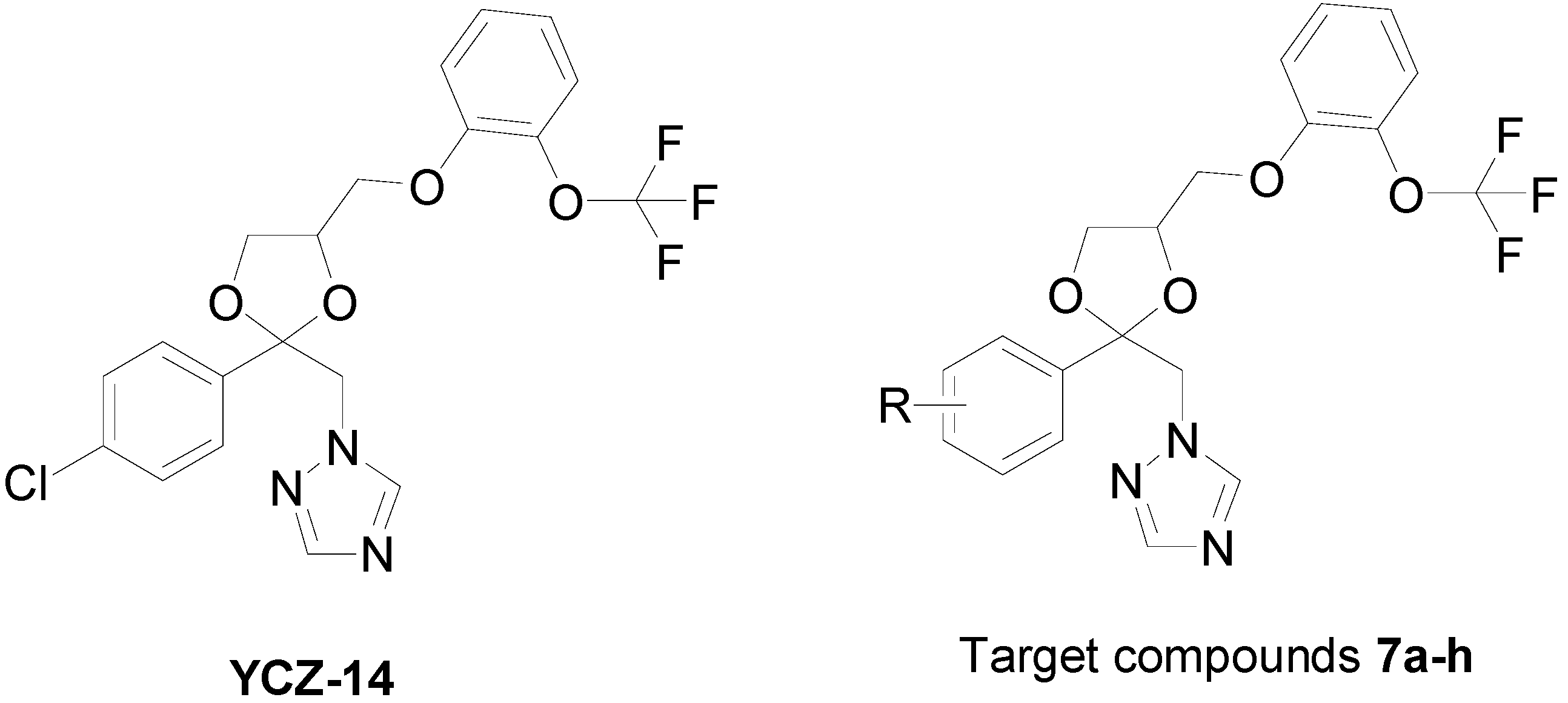
      <p>Our research interests are in developing novel plant hormone biosynthesis inhibitors and the use of these compounds to explore the functions of plant hormones in plant growth and development [<xref ref-type="bibr" rid="B18-molecules-17-04460">18</xref>,<xref ref-type="bibr" rid="B19-molecules-17-04460">19</xref>,<xref ref-type="bibr" rid="B20-molecules-17-04460">20</xref>,<xref ref-type="bibr" rid="B21-molecules-17-04460">21</xref>]. In the previous work, we have shown that 2<italic>RS</italic>,4<italic>RS</italic>-1-[2-(4-chlorophenyl)-4-[2-(2-trifluoromethoxy-phenoxy)-ethyl]-1,3-dioxolan-2-yl-methyl]-1<italic>H</italic>-1,2,4-triazole (<bold>YCZ-14</bold>, <xref ref-type="fig" rid="molecules-17-04460-f001">Figure 1</xref>) is a potent inhibitor of BR biosynthesis [<xref ref-type="bibr" rid="B22-molecules-17-04460">22</xref>]. </p>
      <fig id="molecules-17-04460-f001" position="anchor">
        <label>Figure 1</label>
        <caption>
          <p>Chemical structure of <bold>YCZ-14</bold> and general structure of the target compounds <bold>7a</bold>–<bold>h</bold>.</p>
        </caption>
        <graphic xmlns:xlink="http://www.w3.org/1999/xlink" xlink:href="molecules-17-04460-g001.tif"/>
      </fig>
      <p>The biological activity of this synthetic series (<bold>YCZ</bold> series) was evaluated by testing the ability of the compounds on retardation stem elongation of <italic>Arabidopsis</italic> seedlings. The compound-induced hypocotyls dwarfism were counteracted by the co-application of 10 nM brassinolide, the most potent BR, but not 1 μM GA<sub>3</sub>, which produced seedlings that resembled BR-deficient mutants. In order to further study the structure-activity relationships of <bold>YCZ</bold> series, we report herein the synthesis of new triazole derivatives with different aromatic structure at the position 2 of the 1,3-dioxolane moiety to mimic the partial structure of 4-chlorophenyl moiety found in <bold>YCZ-14</bold> (The general structure of target compounds <bold>7a</bold>–<bold>h</bold> is shown in <xref ref-type="fig" rid="molecules-17-04460-f001">Figure 1</xref>). Structure-activity relationships of newly synthesized compounds were discussed.</p>
    </sec>
    <sec sec-type="results">
      <title>2. Results and Discussion</title>
      <sec>
        <title>2.1. Chemistry</title>
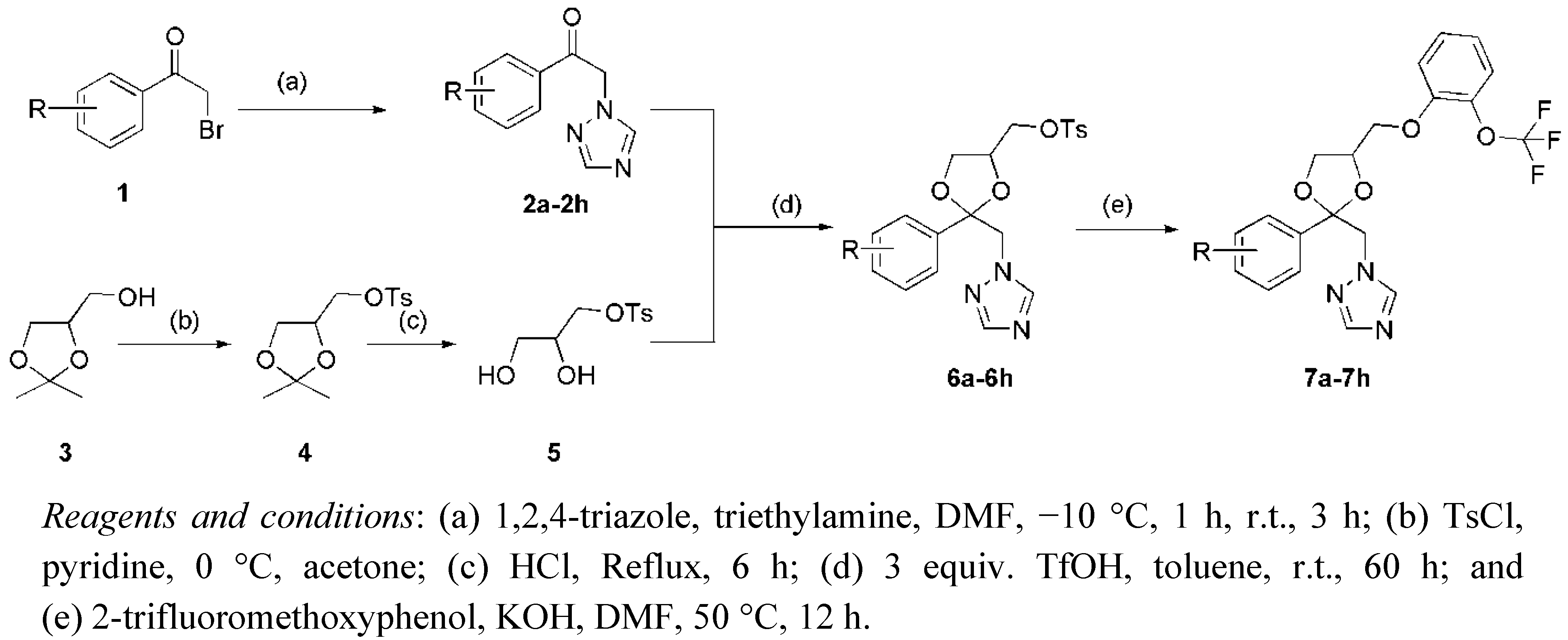
        <p>Target compounds <bold>7a</bold>–<bold>h</bold> were prepared according to a synthetic route (<xref ref-type="scheme" rid="molecules-17-04460-f002">Scheme 1</xref>) as we previously described [<xref ref-type="bibr" rid="B22-molecules-17-04460">22</xref>]. </p>
        <fig id="molecules-17-04460-f002" position="anchor">
          <object-id pub-id-type="pii">molecules-17-04460-f002_Scheme 1</object-id>
          <label>Scheme 1</label>
          <caption>
            <p>The chemical synthesis of target compounds.</p>
          </caption>
          <graphic xmlns:xlink="http://www.w3.org/1999/xlink" xlink:href="molecules-17-04460-g002.tif"/>
        </fig>
        <p>The key transformation of <bold>2a</bold>–<bold>h</bold> with compound <bold>5</bold> consisted of four steps: (1) formation of ethanones <bold>2a</bold>–<bold>h</bold>; (2) tosylation of isopropylideneglycerol <bold>3</bold>; (3) deprotection of isopropylidene ketal <bold>4</bold>; and (4) ketal formation to generate <bold>6a</bold>–<bold>h</bold>. Compounds <bold>2a</bold>–<bold>h</bold> were prepared by reacting different kinds of commercially available <italic>a</italic>-bromoketones <bold>1</bold> with triazole in DMF using a method that we described previously [<xref ref-type="bibr" rid="B23-molecules-17-04460">23</xref>]. The alkylation of isopropylidene glycerol <bold>3</bold> was achieved using a method we described previously [<xref ref-type="bibr" rid="B22-molecules-17-04460">22</xref>], and hydrolysis with 1 M HCl in MeOH yielded glyceryl tosylate <bold>5</bold>. Ketal formation to generate <bold>6a</bold>–<bold>h</bold> were carried out using three equivalents of trifluoromethanesulfonic acid (TfOH) in toluene at room temperature for 60 h, according to a method previously described [<xref ref-type="bibr" rid="B22-molecules-17-04460">22</xref>]. All of the compounds synthesized in this work consist of four stereoisomers, and they were subjected to biological studies without further purification.</p>
      </sec>
      <sec>
        <title>2.2. Bioassay Methods</title>
        <p>The bioassay used for determination the activity of BR biosynthesis inhibitors was carried out by a method as we described previously [<xref ref-type="bibr" rid="B22-molecules-17-04460">22</xref>]. <italic>Arabidopsis</italic> BR synthesis-deficient mutants such as <italic>dwarf 1 </italic>show remarkable dwarfism and the opening of the apical hook of cotyledons in the dark [<xref ref-type="bibr" rid="B4-molecules-17-04460">4</xref>]. This unique de-etiolation in the dark phenotype has been used for screening for BR biosynthesis inhibitors [<xref ref-type="bibr" rid="B24-molecules-17-04460">24</xref>]. In the present study, we adapted this assay method to determine the effects of test compounds on hypocotyls elongation of <italic>Arabidopsis</italic> seedlings grown in the dark, and we co-applied BL and GA with the test compounds to determine the reversibility of their effects. With this assay system, we evaluated the biological activities of synthesized compounds.</p>
      </sec>
      <sec>
        <title>2.3. Biological Activities of Newly Synthesized Brassinosteroid Biosynthesis Inhibitors</title>
        <p>The chemical structures of compounds applied for biological studies are shown in <xref ref-type="table" rid="molecules-17-04460-t001">Table 1</xref>. To identify the aromatic chemical structure at position 2 of 1,3-dioxolane ring responsible for the retardation of <italic>Arabidopsis </italic>stem elongation<italic>, </italic>various aromatic substituent were introduced to the inhibitors <bold>7a</bold>–<bold>h</bold>. </p>
        <table-wrap id="molecules-17-04460-t001" position="anchor">
          <object-id pub-id-type="pii">molecules-17-04460-t001_Table 1</object-id>
          <label>Table 1</label>
          <caption>
            <p>Inhibitory activity of triazole derivatives on <italic>Arabidopsis</italic> seedling growth.</p><p><inline-graphic xmlns:xlink="http://www.w3.org/1999/xlink" xlink:href="molecules-17-04460-i001.tif"/></p>
          </caption>
          <table rules="all" style="border:solid thin">
            <thead>
              <tr>
                <th align="center" valign="middle">No.</th>
                <th align="center" valign="middle">-R</th>
                <th align="center" valign="middle">Inhibition of 
                <italic>Arabidopsis</italic>stem elongation (IC<sub>50</sub>, μM) <sup>a</sup></th>
              </tr>
            </thead>
            <tbody>
              <tr>
                <td align="center" valign="top"><bold>7a</bold></td>
                <td align="center" valign="top"><inline-graphic xmlns:xlink="http://www.w3.org/1999/xlink" xlink:href="molecules-17-04460-i002.tif"/></td>
                <td align="center" valign="top">0.46 ± 0.04</td>
              </tr>
              <tr>
                <td align="center" valign="top"><bold>7b</bold></td>
                <td align="center" valign="top"><inline-graphic xmlns:xlink="http://www.w3.org/1999/xlink" xlink:href="molecules-17-04460-i003.tif"/></td>
                <td align="center" valign="top">0.26 ± 0.05</td>
              </tr>
              <tr>
                <td align="center" valign="top"><bold>7c</bold></td>
                <td align="center" valign="top"><inline-graphic xmlns:xlink="http://www.w3.org/1999/xlink" xlink:href="molecules-17-04460-i004.tif"/></td>
                <td align="center" valign="top">0.21 ± 0.01</td>
              </tr>
              <tr>
                <td align="center" valign="top"><bold>7d</bold></td>
                <td align="center" valign="top"><inline-graphic xmlns:xlink="http://www.w3.org/1999/xlink" xlink:href="molecules-17-04460-i005.tif"/></td>
                <td align="center" valign="top">0.73 ± 0.06</td>
              </tr>
              <tr>
                <td align="center" valign="top"><bold>7e</bold></td>
                <td align="center" valign="top"><inline-graphic xmlns:xlink="http://www.w3.org/1999/xlink" xlink:href="molecules-17-04460-i006.tif"/></td>
                <td align="center" valign="top">&gt;10</td>
              </tr>
              <tr>
                <td align="center" valign="top"><bold>7f </bold></td>
                <td align="center" valign="top"><inline-graphic xmlns:xlink="http://www.w3.org/1999/xlink" xlink:href="molecules-17-04460-i007.tif"/></td>
                <td align="center" valign="top">2.63 ± 0.39</td>
              </tr>
              <tr>
                <td align="center" valign="top"><bold>7g </bold></td>
                <td align="center" valign="top"><inline-graphic xmlns:xlink="http://www.w3.org/1999/xlink" xlink:href="molecules-17-04460-i008.tif"/></td>
                <td align="center" valign="top">0.19 ± 0.05</td>
              </tr>
              <tr>
                <td align="center" valign="top"><bold>7h </bold></td>
                <td align="center" valign="top"><inline-graphic xmlns:xlink="http://www.w3.org/1999/xlink" xlink:href="molecules-17-04460-i009.tif"/></td>
                <td align="center" valign="top">2.40 ± 0.22</td>
              </tr>
              <tr>
                <td align="center" valign="top"><bold>YCZ-14</bold></td>
                <td align="center" valign="top"><inline-graphic xmlns:xlink="http://www.w3.org/1999/xlink" xlink:href="molecules-17-04460-i010.tif"/></td>
                <td align="center" valign="top">0.12 ± 0.04</td>
              </tr>
              <tr>
                <td align="center" valign="top"><bold>Brz</bold></td>
                <td align="center" valign="top">‒</td>
                <td align="center" valign="top">0.73 ± 0.13</td>
              </tr>
            </tbody>
          </table>
    <table-wrap-foot>
      <fn>
        <p><sup>a</sup> The IC<sub>50</sub> values of the test compounds for the inhibition of <italic>Arabidopsis</italic> stem elongation were calculated as described in experiment section. All of the experiments were performed at least in duplicate to establish the repeatability.</p>
      </fn>
    </table-wrap-foot>		
		</table-wrap>
        <p>We used <bold>YCZ-14</bold> and <bold>Brz</bold> as positive controls. A phenyl analogue (compound <bold>7a</bold>) was used as a baseline reference for structure-activity relationships discussions. The concentrations of all of the test compounds as well as <bold>Brz</bold> were assigned to be 0, 0.01, 0.05, 0.1, 0.5, 1 and 10 μM, and the IC<sub>50</sub> values were calculated accordingly. As shown in <xref ref-type="table" rid="molecules-17-04460-t001">Table 1</xref>, compound <bold>7a</bold> exhibits inhibitory activity on retarding hypocotyls elongation of <italic>Arabidopsis</italic> seedling grown in the dark, with an IC<sub>50</sub> value of 0.46 ± 0.04 μM, while the IC<sub>50</sub> of <bold>YCZ-14 </bold>was 0.12 ± 0.04 and <bold>Brz</bold> was 0.73 ± 0.13 μM, respectively. This result indicates that the inhibitory potency of <bold>YCZ-14</bold> (4-chlorophenyl analogue) is stronger than that of <bold>7a</bold> and that a mono substituent at position 4 of the phenyl moiety may promote the inhibitory activity. To verify this possibility, we further introduce 4-methylphenyl, 4-fluorophenyl and 4-trifluoromethylphenyl moieties into the inhibitor (analogues <bold>7b</bold>–<bold>d</bold>) to evaluate their effect on inhibitory activity. </p>
        <p>We found that analogues with methyl and fluorine atom substituents at position 4 of the phenyl ring (compounds <bold>7b</bold>,<bold>c</bold>) have a positive effect on promoting the inhibitory activity compared with that of <bold>7a</bold>, with IC<sub>50</sub> values of 0.26 ± 0.05 and 0.21 ± 0.01 μM, respectively. Interestingly, introducing a 4-trifluoromethylphenyl moiety (compound <bold>7d) </bold>to the position 2 of 1,3-dioxolane, however, showed a significant negative effect on promoting inhibitory activity, with an IC<sub>50</sub> value approximately 0.73 ± 0.06 μM. It is worthwhile to note that compound <bold>7d</bold> shares the common 4-trifluoromethylphenyl moiety with Brz220, the most potent inhibitor of BR biosynthesis inhibitor reported by Asami<italic>et al.</italic> (the <bold>Brz</bold> series) [<xref ref-type="bibr" rid="B25-molecules-17-04460">25</xref>]. Data obtained in this work suggests that the structure requirements for these two synthetic series (<bold>Brz</bold> and <bold>YCZ</bold>) on inhibition of BR biosynthesis are different. This observation implies the binding site of <bold>YCZ</bold> series may be different from <bold>Brz</bold> series. In order to further determine the structure-activity relationships of <bold>YCZ</bold> synthetic series, we next introduced a bulky aromatic moiety to the inhibitor. As shown in <xref ref-type="table" rid="molecules-17-04460-t001">Table 1</xref>, the IC<sub>50</sub> value of the biphenyl analogue <bold>7e</bold> and naphthalene analogue <bold>7f</bold> are greater than 10 and 2.63 ± 0.39 μM, respectively. This result indicates that a bulky aromatic moiety significantly reduces the inhibitory activity. Although the variation of aromatic structure greatly affects the inhibitory activity of this synthetic series, the 4-chlorophenyl analogue (<bold>YCZ-14</bold>) is the most potent inhibitor. This observation suggests that the substituent(s) of chlorine atom on the phenyl moiety enhance the inhibitory activity of this synthetic series. Thus, we next synthesized 2,4-dichlorophenyl analogue <bold>7g</bold> and 3,4-dichloro-phenyl analog <bold>7h</bold> for further structure-activity relationships studies. We found the IC<sub>50</sub> values for <bold>7g</bold> and <bold>7h</bold> are 0.19 ± 0.05 and 2.40 ± 0.22 μM, respectively. Although the structural difference of these two analogues is the position of the chlorine atom, the inhibition potencies of these two analogues are quite different. This result indicates that the position of the chlorine atom on the phenyl ring is sensitive to the binding site. Compared the inhibitory potency of analogues reported in this work with <bold>Brz</bold>, we found the potency of several <bold>YCZ</bold> analogues are greater than <bold>Brz</bold>, except <bold>7d</bold>, <bold>7e</bold>, <bold>7f</bold> and <bold>7g</bold>. Nevertheless, among the compounds studied in this work, <bold>YCZ-14</bold> is the most potent inhibitor on retardation stem elongation of <italic>Arabidopsis </italic>seedlings.</p>
        <p>It is known that GA biosynthesis inhibitors, such as paclobutrazol, retard the stem elongation of many plant species by blocking <italic>ent</italic>-kaurene oxidation and also mildly affect other cytochrome P450 mono-oxygenases [<xref ref-type="bibr" rid="B25-molecules-17-04460">25</xref>]. This retardation can be rescued by the application of GA. In order to rule out the GA biosynthesis inhibitor among these analogues, we tested the effects of brassinolide, the most biologically active BR, and GA on the recovery of chemical induced dwarfism of <italic>Arabidopsis</italic> seedlings grown in the dark. Accordingly, we selected analogues with IC<sub>50</sub> values less than 1 μM for studying the mode of actions. As shown in <xref ref-type="table" rid="molecules-17-04460-t002">Table 2</xref>, compounds <bold>7a</bold> to <bold>7d</bold> and <bold>7g</bold> were subjected to the bioassay at a concentration of 0.5 μM and <italic>Arabidopsis</italic> seedlings were grown in the presence of BL (10 nM) or GA (1 μM) for 5 days in the dark. Data were expressed in percentage by the comparison of none chemical treated control.</p>
        <table-wrap id="molecules-17-04460-t002" position="anchor">
          <object-id pub-id-type="pii">molecules-17-04460-t002_Table 2</object-id>
          <label>Table 2</label>
          <caption>
            <p>Retardation of <italic>Arabidopsis</italic> seedling growth by triazole derivatives and rescue of growth by BL and GA.</p><p><inline-graphic xmlns:xlink="http://www.w3.org/1999/xlink" xlink:href="molecules-17-04460-i011.tif"/></p>
          </caption>
          <table rules="all" style="border:solid thin">
            <thead>
              <tr>
                <th rowspan="2" align="center" valign="middle">No.</th>
                <th rowspan="2" align="center" valign="middle">-R</th>
                <th colspan="3" align="center" valign="middle">Hypocotyl length, % relative to untreated 
                <italic>Arabidopsis</italic> seedlings (%)</th>
              </tr>
              <tr>
                <th align="center" valign="middle">Chem *.</th>
                <th align="center" valign="middle">Chem. + BL (10 nM)</th>
                <th align="center" valign="middle">Chem. + GA (1 µM)</th>
              </tr>
            </thead>
            <tbody>
              <tr>
                <td align="center" valign="top"><bold>Control</bold></td>
                <td align="center" valign="top">-</td>
                <td align="center" valign="top">100</td>
                <td align="center" valign="top">114.3 ± 8.0</td>
                <td align="center" valign="top">104.3 ± 5.4</td>
              </tr>
              <tr>
                <td align="center" valign="top"><bold>7a</bold></td>
                <td align="center" valign="top"><inline-graphic xmlns:xlink="http://www.w3.org/1999/xlink" xlink:href="molecules-17-04460-i012.tif"/></td>
                <td align="center" valign="top">45.9 ± 2.5</td>
                <td align="center" valign="top">99.8 ± 4.4</td>
                <td align="center" valign="top">48.0 ± 3.7</td>
              </tr>
              <tr>
                <td align="center" valign="top"><bold>7b</bold></td>
                <td align="center" valign="top"><inline-graphic xmlns:xlink="http://www.w3.org/1999/xlink" xlink:href="molecules-17-04460-i013.tif"/></td>
                <td align="center" valign="top">37.6 ± 3.2</td>
                <td align="center" valign="top">95.4 ± 4.9</td>
                <td align="center" valign="top">43.8 ± 3.7</td>
              </tr>
              <tr>
                <td align="center" valign="top"><bold>7c</bold></td>
                <td align="center" valign="top"><inline-graphic xmlns:xlink="http://www.w3.org/1999/xlink" xlink:href="molecules-17-04460-i014.tif"/></td>
                <td align="center" valign="top">32.5 ± 3.2</td>
                <td align="center" valign="top">101.2 ± 4.5</td>
                <td align="center" valign="top">39.7 ± 2.5</td>
              </tr>
              <tr>
                <td align="center" valign="top"><bold>7d</bold></td>
                <td align="center" valign="top"><inline-graphic xmlns:xlink="http://www.w3.org/1999/xlink" xlink:href="molecules-17-04460-i015.tif"/></td>
                <td align="center" valign="top">56.7 ± 1.1</td>
                <td align="center" valign="top">103.3 ± 4.5</td>
                <td align="center" valign="top">51.8 ± 2.8</td>
              </tr>
              <tr>
                <td align="center" valign="top"><bold>7g</bold></td>
                <td align="center" valign="top"><inline-graphic xmlns:xlink="http://www.w3.org/1999/xlink" xlink:href="molecules-17-04460-i016.tif"/></td>
                <td align="center" valign="top">21.2 ± 2.3</td>
                <td align="center" valign="top">104.1 ± 3.3</td>
                <td align="center" valign="top">31.5 ± 3.7</td>
              </tr>
              <tr>
                <td align="center" valign="top"><bold>YCZ-14</bold></td>
                <td align="center" valign="top"><inline-graphic xmlns:xlink="http://www.w3.org/1999/xlink" xlink:href="molecules-17-04460-i017.tif"/></td>
                <td align="center" valign="top">18.2 ± 2.0</td>
                <td align="center" valign="top">97.0 ± 3.9</td>
                <td align="center" valign="top">25.5 ± 3.0</td>
              </tr>
              <tr>
                <td align="center" valign="top"><bold>Brz</bold></td>
                <td align="center" valign="top">‒</td>
                <td align="center" valign="top">56.0 ± 3.3</td>
                <td align="center" valign="top">63.0 ± 6.1</td>
                <td align="center" valign="top">61.8 ± 2.3</td>
              </tr>
            </tbody>
          </table>
    <table-wrap-foot>
      <fn>
        <p>* Data obtained from 20 seedlings grown in the dark. Chem. was assigned to be at a final concentration of 0.5 µM. All the experiments were done at least three times to establish the repeatability. </p>
      </fn>
    </table-wrap-foot>		
		</table-wrap>
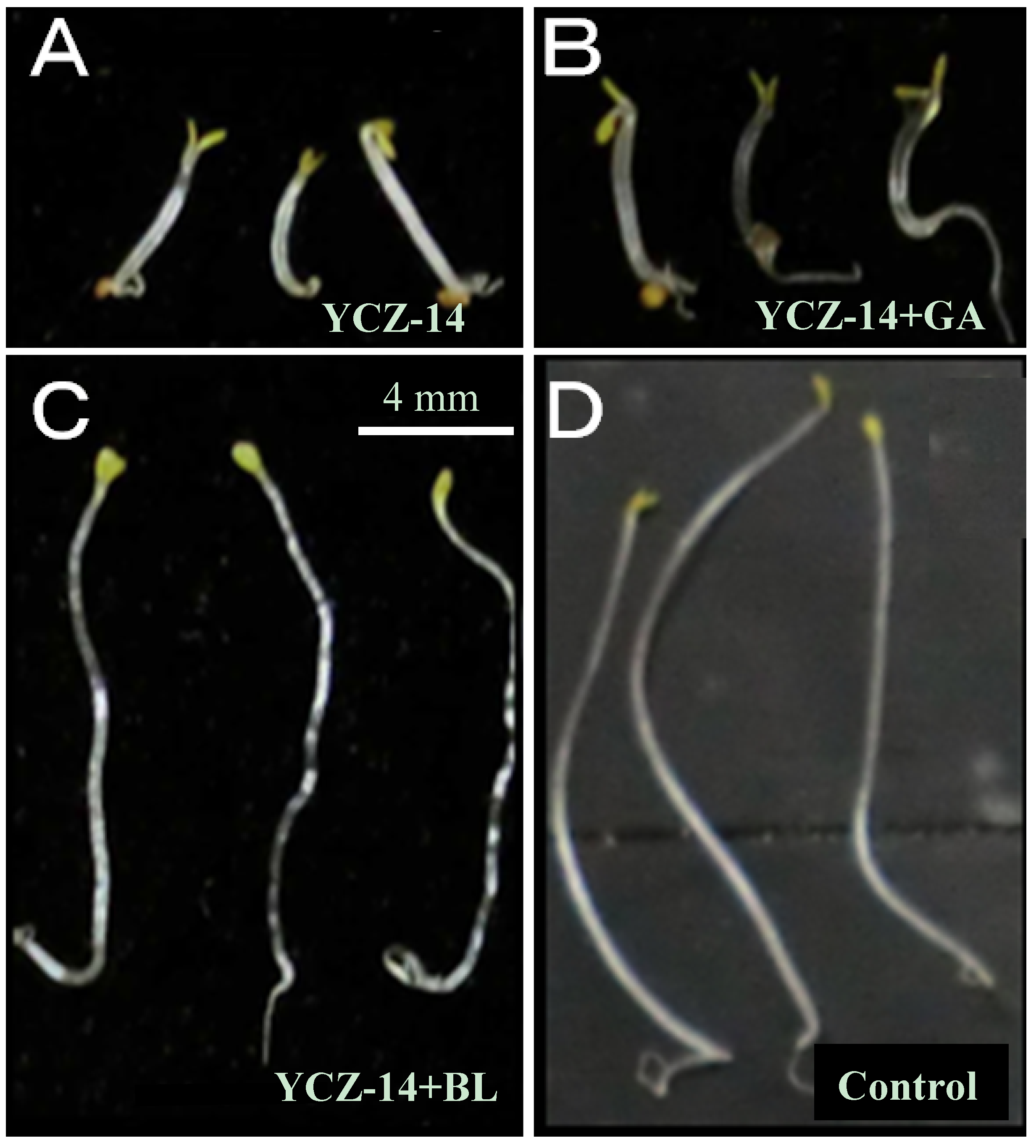
        <p>As shown by the data, in the presence of BL (10 nM) or GA (1 μM), the average hypocotyls length of <italic>Arabidopsis</italic> seedlings were approximately 114.3 ± 8.0 and 104.3 ± 5.4%, respectively. This result indicates that BL and GA stimulate hypocotyls elongation of <italic>Arabidopsis</italic> seedlings. We found all the test compounds exhibited high inhibitory activity on <italic>Arabidopsis</italic> seedlings elongation. The hypocotyls length <italic>Arabidopsis</italic> seedlings treated with <bold>7a</bold> to <bold>7d</bold> and <bold>7g</bold> are approximately 45.9 ± 2.5, 37.6 ± 3.2, 32.5 ± 3.2, 56.7 ± 1.1 and 21.2 ± 2.3% of non-chemically treated seedlings, respectively, while the positive control of <bold>YCZ-14</bold> was approximately 18.2 ± 2.0%, and that of <bold>Brz</bold> was 56.0 ± 3.3%, respectively. This result indicate that at a concentration of 0.5 μM of chemicals, <bold>YCZ-14</bold> and <bold>7g</bold> strongly inhibited hypocotyls elongation of <italic>Arabidopsis</italic> seedlings, while <bold>Brz </bold>inhibited hypocotyls elongation at a degree about 56%. This result clearly indicates that the potency of <bold>YCZ-14</bold> and <bold>7g</bold> are greater than that of Brz on inhibition hypocotyls elongation in <italic>Arabidopsis</italic> seedlings. Co-application of BL (10 nM) showed different recovery to different test compounds. Among the compounds listed in <xref ref-type="table" rid="molecules-17-04460-t002">Table 2</xref>, all the <bold>YCZ</bold> analogues showed good recovery to BL, the hypocotyls length were 99.8 ± 4.4, 95.4 ± 4.9, 101.2 ± 4.5, 103.3 ± 4.5 and 104.1 ± 3.3% of none chemical treated control, respectively, while the recovery degree of <bold>Brz</bold> is 63.0 ± 6.1%. Co-application of GA (1 μM) did not show significant recovery for <bold>YCZ</bold> analogues (from 31 to 51%), while the recovery of <bold>Brz</bold> for <bold>GA</bold> treatment is 61.8 ± 2.3%. Interestingly, <bold>YCZ-14</bold> not only inhibited hypocotyls elongation of <italic>Arabidopsis</italic> seedlings, it also induced morphological changes of <italic>Arabidopsis</italic> seedlings grown in the dark (As shown in <xref ref-type="fig" rid="molecules-17-04460-f003">Figure 2</xref>). These physiological changes can be counteracted by application of BL (<xref ref-type="fig" rid="molecules-17-04460-f003">Figure 2</xref>C) but not GA (<xref ref-type="fig" rid="molecules-17-04460-f003">Figure 2</xref>B).</p>
        <fig id="molecules-17-04460-f003" position="anchor">
          <label>Figure 2</label>
          <caption>
            <p>Effect of <bold>YCZ-14</bold> on 5 days old <italic>Arabidopsis</italic> seedlings grown in the dark. A: <bold>YCZ-14</bold> (0.5 µM); B: <bold>YCZ-14</bold> (0.5 µM) + GA (1 µM); C: <bold>YCZ-14</bold> (0.5 µM) + BL (10 nM); D: Control.</p>
          </caption>
          <graphic xmlns:xlink="http://www.w3.org/1999/xlink" xlink:href="molecules-17-04460-g003.tif"/>
        </fig>
      </sec>
    </sec>
    <sec sec-type="methods">
      <title>3. Experimental</title>
      <sec>
        <title>3.1. General</title>
        <p>Chemicals for synthesis were purchased from Kanto Chemicals Co. Ltd. (Tokyo, Japan) and Tokyo Kasei Co. Ltd. (Tokyo, Japan). Reagents are of the highest grade commercially available. Melting points (mp) were determined with a Yanako melting point apparatus (Tokyo, Japan). <sup>1</sup>H-NMR spectra were recorded with a JEOL ECP-400 spectrometer (Tokyo, Japan), chemical shifts being expressed in ppm downfield from TMS as an internal standard. High resolution electrospray ionization Fourier transform ion cyclotron resonance mass spectra (ESI-FTICR) were recorded on an Exactive MS System (Thermo Fisher Scientific, Waltham, MA, USA).</p>
      </sec>
      <sec>
        <title>3.2. Synthesis</title>
        <p><italic>Preparation of 1-phenyl-2-(1,2,4-triazol-1-yl)ethanone </italic> (<bold>2a</bold>). Compound <bold>2a</bold> was prepared using phenacyl bromide as the starting material, as described previously [<xref ref-type="bibr" rid="B23-molecules-17-04460">23</xref>]. To a vigorously stirred suspension of 1<italic>H</italic>-1,2,4-triazole (5.52 g, 0.08 mol) and phenacyl bromide <bold>1a</bold> (9.95 g, 0.05 mol) in 30 mL acetone, was added triethylamine (8.1 g, 0.05 mol) dropwise over a period of 1 h with the temperature kept below 0 °C, and the reaction mixture was stirred for another 30 min at room temperature. The mixture was filtered to remove triethylamine hydrobromide salt precipitates, the precipitates was washed with 3 × 10 mL acetone, the combined washings and filtrate were evaporated under reduced pressure, and the residues were dissolved in 50 mL chloroform and then washed with 2 × 25 mL water. After evaporation of chloroform, the yellow solid was recrystallized with 2-propanol, and 1-phenyl-2-(1,2,4-triazol-1-yl) ethanone (<bold>2a</bold>) was obtained as a white solid with a yield of 22.7%. <sup>1</sup>H-NMR (CDCl<sub>3</sub>), δ: 5.69 (s, 2H), 7.55 (t, <italic>J</italic> = 7.8 Hz, 2H), 7.68 (t, <italic>J </italic>= 7.5 Hz, 1H), 8.00 (d, <italic>J</italic> = 7.8 Hz, 2H), 8.03 (s, 1H), 8.26 (s, 1H). Other compounds <bold>2b</bold>–<bold>h</bold> were prepared in a similar way by the reaction of triazole with the corresponding phenacyl bromide.</p>
        <p><italic>1-(4-Methylphenyl)-2-(1,2,4-triazol-1-yl)ethanone </italic>(<bold>2b</bold>). Yield: 61.0%. <sup>1</sup>H-NMR (CDCl<sub>3</sub>), δ: 2.46 (s, 3H), 5.66 (s, 2H), 7.34 (d, <italic>J</italic> = 8.1 Hz, 2H), 7.89 (d, <italic>J</italic> = 8.1 Hz, 2H), 8.02 (s, 1H), 8.25 (s, 1H).</p>
        <p><italic>1-(4-Fluorophenyl)-2-(1,2,4-triazol-1-yl)ethanone </italic>(<bold>2c</bold>).Yield: 50.6%. <sup>1</sup>H-NMR (CDCl<sub>3</sub>), δ: 5.66 (s, 2H), 7.21~7.25 (m, 2H), 8.02 (s, 1H), 8.03~8.07 (m, 2H), 8.25 (s, 1H).</p>
        <p><italic>1-(4-Trifluoromethylphenyl)-2-(1,2,4-triazol-1-yl)ethanone </italic>(<bold>2d</bold>). Yield: 19.8%. <sup>1</sup>H-NMR (CDCl<sub>3</sub>), δ: 5.71 (s, 1H), 7.83 (d, <italic>J</italic> = 8.1 Hz, 2H), 8.04 (s, 1H), 8.12 (d, <italic>J</italic> = 8.8 Hz, 2H), 8.26 (s, 1H).</p>
        <p><italic>1-Biphenyl-4-yl-2-(1,2,4-triazol-1-yl)ethanone</italic> (<bold>2e</bold>). Yield: 48.7%. <sup>1</sup>H-NMR (CDCl<sub>3</sub>), δ: 5.67 (s, 2H), 7.37~7.59 (m, 3H), 7.70 (d, <italic>J</italic> = 8.1 Hz, 2H), 7.70 (d, <italic>J</italic> = 8.1 Hz, 2H), 8.01 (d, <italic>J</italic> = 4.0 Hz, 2H), 8.02 (s, 1H), 8.32 (s, 1H).</p>
        <p><italic>1-Naphthalen-2-yl-2-(1,2,4-triazol-1-yl)ethanone</italic> (<bold>2f</bold>). Yield: 52.1%. <sup>1</sup>H-NMR (CDCl<sub>3</sub>), δ: 5.84 (s, 2H), 7.60~7.70 (m, 2H), 7.91~8.03 (m, 5H), 8.32 (s, 1H), 8.52 (s, 1H).</p>
        <p><italic>1-(2,4-Dichlorophenyl)-2-(1,2,4-triazol-1-yl)ethanone </italic>(<bold>2g</bold>). Yield: 52.6%. <sup>1</sup>H-NMR (CDCl<sub>3</sub>), δ: 5.33 (s, 2H), 6.92 (s, 1H), 7.02 (s, 1H), 7.38 (d, <italic>J</italic> = 9.1 Hz, 1H), 7.51 (s, 2H), 7.57 (d, <italic>J</italic> = 9.1 Hz, 1H). </p>
        <p><italic>1-(3,4-Dichlorophenyl)-2-(1,2,4-triazol-1-yl)ethanone </italic>(<bold>2h</bold>). Yield: 65.2%. <sup>1</sup>H-NMR (CDCl<sub>3</sub>), δ: 5.65 (s, 2H), 7.65 (d, <italic>J</italic> = 8.4 Hz, 1H), 7.83 (dd, <italic>J</italic><sub>1</sub> = 2.2 Hz, <italic>J</italic><sub>2</sub> = 8.4 Hz, 1H), 8.03~8.09 (m, 1H), 8.21 (s, 1H), 8.25 (s, 1H).</p>
        <p><italic>Preparation of 2,2-dimethyl-4-(4-methylbenzenesulfonate)-1,3-dioxolane-4-methanol </italic>(<bold>4</bold>). A dry 50 mL round-bottomed flask was charged with <italic>p</italic>-toluenesulfonyl chloride (7.1 g, 37 mmol), to which pyridine (15 mL) was added while stirring under nitrogen with a magnetic stir bar. The reaction flask was placed inside a container; an ice/water mixture could be added in the event that the reaction becomes too exothermic. 2,2-Dimethyl-1,3-dioxolane-4-methanol (3.29 g, 25 mmol) was added slowly and stirred for 1.5 h. The mixture was slowly added to a vigorously stirred mixture of de-ionized water (70 mL) and crushed ice (70 g) in a 300 mL Erlenmeyer flask and allowed to stir for an additional 0.5 h. The white precipitate was collected on filter paper and washed with cold water (H<sub>2</sub>O). The product was dried under high vacuum and/or anhydrous sodium sulfate to obtain target compound <bold>4</bold> (4.15 g, 58.0% yield). <sup>1</sup>H-NMR (CDCl<sub>3</sub>), δ: 1.32 (s, 3H), 1.34 (s, 3H), 2.46 (s, 3H), 3.77 (dd, J = 4.9, 9.0 Hz, 1H), 3.95–4.06 (m, 3H), 4.25–4.31 (m, 1H), 7.35 (d, J = 8.1 Hz, 2H), 7.80 (d, J = 8.4 Hz, 2H).</p>
        <p><italic>Preparation of 1-tosyloxy-2, 3-propanediol </italic>(<bold>5</bold>). Compound <bold>4</bold> (8.21 g, 30 mmol) was dissolved in methanol (300 mL). Then, 0.5 <italic>N</italic> hydrochloric acid (30 mL) was added, and the resulting mixture was heated to reflux. Acetone and methanol were slowly distilled off. Additional methanol (50 mL) and 0.5 <italic>N </italic>hydrochloric acid (20 mL) was added, and the mixture was kept at room temperature until ketal hydrolysis was completed. The mixture was diluted with saturated sodium bicarbonate solution and extracted with EtOAc (3 × 80 mL). The EtOAc extracts were combined, washed with brine (20 mL), dried over anhydrous sodium sulfate, filtered, concentrated, and purified by flash chromatography on silica gel (EtOAc/hexanes = 7:3), affording target compound 5 (4.57 g, 64.8% yield). <sup>1</sup>H-NMR (CDCl<sub>3</sub>), δ: 2.46 (s, 3H), 3.63 (dd, <italic>J </italic>= 5.1, 11.4 Hz, 1H), 3.71 (dd, <italic>J </italic>= 4.2, 11.5 Hz, 1H), 3.92–3.99 (m, 1H), 4.06–4.13 (m, 2H), 7.37 (d, <italic>J </italic>= 6.6 Hz, 2H), and 7.81 (d, <italic>J </italic>= 6.6 Hz, 2H).</p>
        <p><italic>Preparation of 2RS,4RS-toluene-4-sulfonic acid 2-phenyl-2-1,2,4-triazol-1-ylmethyl-1,3-dioxolan-4-ylmethyl ester</italic> (<bold>6a</bold>). Trifluoromethanesulfonic acid (1.5 mL, 16 mmol) was added to a solution of 1-tosyloxy-2, 3-propanediol (<bold>5</bold>, 1 g, 4.0 mmol) and ketone <bold>2a</bold> (1 g, 3.9 mmol) in toluene (10 mL) under nitrogen. Then, the reaction mixture was stirred at room temperature for 60 h. The reaction was quenched by adding saturated sodium bicarbonate solution (25 mL), extracted with EtOAc (3 × 30 mL), washed with brine, and dried over anhydrous sodium sulfate. The solvent was removed, and the residue was re-dissolved in 2 mL EtOAc. <italic>p</italic>-Toluensulfonic acid monohydrate (750 mg, 3.9 mmol) in EtOAc (2 mL) was added dropwise to preferentially precipitate <bold>6</bold> as a white solid. The mixture was stirred for 30 min and filtered to obtain target compound salt <bold>6</bold>, which was recrystallized from acetonitrile (49.5% yield). <sup>1</sup>H-NMR (CD<sub>3</sub>OD), δ: 2.36 (s, 3H), 2.46 (s, 3H), 3.62 (dd, <italic>J </italic>= 5.1, 8.4 Hz, 1H), 3.73–3.80 (m, 2H), 3.94–3.97 (m, 1H), 4.20–4.22 (m, 1H), 4.77 (s, 2H), 7.22–7.24 (m, 2H), 7.41–7.51 (m, 6H), 7.69–7.71 (m, 2H), 7.76–7.78 (m, 2H), 8.50 (s, 1H), and 9.29 (s, 1H).</p>
        <p>Other compounds <bold>6b</bold>–<bold>h</bold> were prepared in a similar way by the reaction of <bold>5</bold> with the corresponding ketone <bold>2</bold>.</p>
        <p><italic>2RS,4RS-Toluene-4-sulfonic acid 2-(4methylphenyl)-2-1,2,4-triazol-1-ylmethyl-1,3-dioxolan-4-yl-methyl ester </italic>(<bold>6b</bold>). (23.1%). <sup>1</sup>H-NMR (CD<sub>3</sub>OD), δ: 2.35 (d, <italic>J</italic> = 7.3 Hz, 6H), 3.60 (dd, <italic>J </italic>= 4.9, 8.6 Hz, 1H), 3.71–3.79 (m, 2H), 3.92–3.95 (m, 1H), 4.17–4.20 (m, 1H), 4.73 (s, 2H), 7.41 (d, <italic>J</italic> = 8.1 Hz, 2H), 7.46 (d, <italic>J</italic> = 8.4 Hz, 2H), 7.70 (d, <italic>J</italic> = 8.4 Hz, 2H), 7.76 (d, <italic>J </italic>= 8.1 Hz, 2H), 8.66 (s, 1H), 9.53 (d, 1H).</p>
        <p><italic>2RS,4RS-Toluene-4-sulfonic acid 2-(4-fluorophenyl)-2-1,2,4-triazol-1-ylmethyl-1,3-dioxolan-4-yl-methyl ester </italic>(<bold>6c</bold>). (36.5%). <sup>1</sup>H-NMR (CDCl<sub>3</sub>), δ: 2.47 (s, 3H), 3.49–3.53 (m, 1H), 3.69 (dd, <italic>J</italic> = 4.4, 8.8 Hz, 1H), 3.77–3.83 (m, 2H), 4.21–4.27 (m, 1H), 4.45 (s, 2H), 7.02–7.08 (m, 2H), 7.37–7.41 (m, 4H), 7.77–7.81 (m, 3H), 8.10 (s, 1H).</p>
        <p><italic>2RS,4RS-Toluene-4-sulfonic acid 2-(4-trifluoromethylphenyl)-2-1,2,4-triazol-1-yl-methyl-1,3-di-oxolan-4-yl-methyl ester </italic>(<bold>6d</bold>). (36.1%). <sup>1</sup>H-NMR (CDCl<sub>3</sub>), δ: 2.48 (s, 3H), 3.55 (dd, <italic>J</italic> = 5.6, 10.6 Hz, 1H), 3.78–3.85 (m, 3H), 4.22–4.28 (m, 1H), 4.48 (s, 2H), 7.36–7.41 (m, 2H), 7.54–7.69 (m, 4H), 7.78–7.82 (m, 3H), 8.11 (s, 1H).</p>
        <p><italic>2RS,4RS-Toluene-4-sulfonic acid 2-(biphenyl-4-yl</italic><italic>)-2-1,2,4-triazol-1-yl-methyl-1,3-dioxolan-4-yl-methyl ester </italic>(<bold>6e</bold>). (42.7%). <sup>1</sup>H-NMR (CDCl<sub>3</sub>), δ: 2.48 (s, 3H), 3.48 (dd, <italic>J</italic> = 6.2, 10.3 Hz, 1H), 3.69 (dd, <italic>J</italic> = 4.4, 8.8 Hz, 1H), 3.79–3.86 (m, 2H), 4.27–4.30 (m, 1H), 4.50 (d, <italic>J</italic> = 1.5 Hz, 2H), 7.37–7.41 (m, 3H), 7.43–7.50 (m, 4H), 7.57–7.60 (m, 4H), 7.79 (d, <italic>J </italic>= 8.4 Hz, 2H), 7.83 (s, 1H), 8.10 (s, 1H).</p>
        <p><italic>2RS,4RS-Toluene-4-sulfonic acid 2-(naphthalen-2-yl</italic><italic>)-2-1,2,4-triazol-1-yl-methyl-1,3-dioxolan-4-yl-methyl ester </italic>(<bold>6f</bold>). (26.3%). <sup>1</sup>H-NMR (CDCl<sub>3</sub>), δ: 2.48 (s, 3H), 3.53 (dd, <italic>J</italic> = 6.2, 10.6 Hz, 1H), 3.61–3.65 (m, 1H), 3.81–3.86 (m, 2H), 4.28–4.30 (m, 1H), 4.56 (d, <italic>J</italic> = 2.2 Hz, 2H), 7.39 (dd, <italic>J</italic> = 8.1, 11.7 Hz, 3H), 7.49–7.56 (m, 2H), 7.79–7.95 (m, 7H), 8.13 (s, 1H).</p>
        <p><italic>2RS,4RS-Toluene-4-sulfonic acid 2-(2,4-dichlorophyenyl</italic><italic>)-2-1,2,4-triazol-1-yl-methyl-1,3-dioxolan-4-yl-methyl ester </italic>(<bold>6g</bold>) (14.0%). <sup>1</sup>H-NMR (CDCl<sub>3</sub>), δ: 2.47 (s, 3H), 3.51 (dd, <italic>J</italic> = 6.4, 10.4 Hz, 1H), 3.71 (dd, <italic>J</italic> = 4.3, 9.3 Hz, 1H), 3.80–3.85 (m, 2H), 4.25–4.28 (m, 1H), 4.67–4.79 (m, 2H), 7.38–7.47 (m, 4H), 7.77–7.81 (m, 4H), 8.11 (s, 1H).</p>
        <p><italic>2RS,4RS-Toluene-4-sulfonic acid 2-(3,4-dichlorophyenyl</italic><italic>)-2-1,2,4-triazol-1-yl-methyl-1,3-dioxolan-4-yl-methyl ester </italic>(<bold>6h</bold>). (45.8%). <sup>1</sup>H-NMR (CD<sub>3</sub>OD), δ: 2.46 (s, 3H), 3.64 (dd, <italic>J </italic>= 5.1, 8.8 Hz, 1H), 3.76–3.81 (m, 2H), 3.95–3.98 (m, 1H), 4.22–4.24 (m, 1H), 4.79 (s, 2H), 7.23 (d, <italic>J</italic> = 8.1 Hz, 2H), 7.44–7.48 (m, 3H), 7.77 (d, <italic>J </italic>= 8.4 Hz, 2H), 8.62 (s, 1H), 9.48 (s, 1H).</p>
        <p><italic>Preparation of 1-[2-Phenyl-4-(2-trifluoromethoxyphenoxymethyl)-1,3-dioxolan-2-yl-methyl]-1H-1,2,4-triazole</italic><italic> (<bold>7a</bold>)</italic>. Potassium hydroxide (160 mg, 2.8 mmol) was added to a solution of tosylate <bold>6</bold> (485 mg, 0.78 mmol) and 2-trifluoromethoxyphenol (133 mg, 0.72 mmol) in dry DMF (5 mL), and the reaction mixture was heated at 50 °C overnight. After cooling to room temperature, the reaction mixture was diluted with water (20 mL) and EtOAc (20 mL), and the organic phase was separated. The aqueous phase was extracted with EtOAc (3 × 20 mL). All of the organic layers were combined, washed with brine (20 mL), dried over anhydrous sodium sulfate, filtered, concentrated, and purified by flash chromatography on silica gel (EtOAc/hexanes = 1:1), affording target compound <bold>7a</bold> (58.9% yield), mp: 100–103 °C. <sup>1</sup>H-NMR (CD<sub>3</sub>OD), δ: 3.34–3.38 (m, 1H), 3.86–3.95 (m, 3H), 4.40–4.44 (m, 1H), 4.51–4.60 (m, 2H), 6.87–6.89 (m, 1H), 6.95–7.00 (m, 1H), 7.21–7.28 (m, 2H), 7.40–7.44 (m, 3H), 7.51–7.54 (m, 2H), 7.93 (s, 1H), 8.17 (s, 1H). HRMS-ESI calculated for C<sub>19</sub>H<sub>19</sub>N<sub>3</sub>O<sub>3</sub>Na [M+Na]<sup>+</sup> was 394.0928, and 394.0891 was the experimental value.</p>
        <p>Other compounds <bold>7b</bold>–<bold>h</bold> were prepared in a similar method, by reacting 2-trifluoromethoxyphenol with the corresponding <bold>6</bold>.</p>
        <p><italic>1-[2-p-Tolyl-4-(2-trifluoromethoxyphenoxymethyl)-1,3-dioxolan-2-ylmethyl]-1H-1,2,4-triazole</italic> (<bold>7b</bold>).(69.6%). mp: 79.8–81.3 °C. <sup>1</sup>H-NMR (CDCl<sub>3</sub>); δ: 2.37(s, 3H), 3.33–3.37 (m, 1H), 3.84–3.94 (m, 3H), 4.37–4.43 (m, 1H), 4,49–4.57 (m, 2H), 6.86–6.89 (m, 1H), 6.95–6.99 (m, 1H), 7.20–7.28 (m, 4H), 7.38–7.41 (m, 2H), 7.93 (s, 1H), 8.16 (s, 1H). HRMS-ESI <italic>m/z</italic> calculated for C<sub>21</sub>H<sub>20</sub>F<sub>3</sub>N<sub>3</sub>O<sub>4</sub>Na [M+Na]<sup>+</sup> 458.1298, found 458.1248.</p>
        <p><italic>1-[2-(4-Fluorophenyl)-4-(2-trifluoromethoxyphenoxymethyl)-1,3-dioxolan-2-ylmethyl]-</italic><italic>1H-1,2,4-triazole</italic> (<bold>7c</bold>). (31.6%). mp: 60.8–62.5 °C. <sup>1</sup>H-NMR (CDCl<sub>3</sub>), δ: 3.40 (dd, <italic>J</italic> = 7.1, 9.3 Hz, 1H), 3.86–3.94 (m, 3H), 4.39–4.43 (m, 1H), 4.53 (d, <italic>J</italic> = 5.1 Hz, 2H), 6.87–6.89 (m, 1H), 6.96–7.05 (m, 1H), 7.06–7.10 (m, 2H), 7.21–7.28 (m, 2H), 7.46–7.50 (m, 2H), 7.91 (s, 1H), 8.16 (s, 1H). HRMS-ESI <italic>m/z</italic> calculated for C<sub>20</sub>H<sub>17</sub>F<sub>4</sub>N<sub>3</sub>O<sub>4</sub>Na [M+Na]<sup>+</sup> 462.1047, found 462.0999.</p>
        <p><italic>1-[2-(4-Trifluoromethylphenyl)-4-(2-trifluoromethoxyphenoxymethyl)-1,3-dioxolan-2-ylmethyl]-1H-1,</italic><italic>2,4-triazole </italic>(<bold>7d</bold>). (28.2%). mp: 93.1–94.5 °C. <sup>1</sup>H-NMR (CDCl<sub>3</sub>), δ: 3.43–3.48 (m, 1H), 3.83–3.93 (m, 3H), 4.41–4.45 (m, 1H), 4.51–4.60 (m, 2H), 6.88–6.90 (m, 1H), 6.97–7.02 (m, 1H), 7.22–7.29 (m, 2H), 7.63–7.68 (m, 4H), 7.92 (s, 1H), 8.19 (s, 1H). HRMS-ESI <italic>m/z</italic> calculated for C<sub>21</sub>H<sub>17</sub>F<sub>6</sub>N<sub>3</sub>O<sub>4</sub>Na [M+Na]<sup>+</sup> 512.1015, found 512.0963.</p>
        <p><italic>1-[2-Biphenyl-4-yl-4-(2-trifluoromethoxyphenoxymethyl)-1,3-dioxolan-2-ylmethyl]-1H-1,2,4-tria</italic><italic>zole </italic>(<bold>7e</bold>). (30.6%). mp: 116.6–117.8 °C. <sup>1</sup>H-NMR (CDCl<sub>3</sub>), δ: 3.35–3.40 (m, 1H), 3.87–3.91 (m, 2H), 3.96–4.00 (m, 1H), 4.44–4.48 (m, 1H), 4.55–4.64 (m, 2H), 6.88–6.91 (m, 1H), 6.96–7.00 (m, 1H), 7.21–7.29 (m, 2H), 7.36–7.40 (m, 1H), 7.45–7.48 (m, 2H), 7.58–7.64 (m, 6H), 7.95 (s, 1H), 8.21 (s, 1H). HRMS-ESI <italic>m/z</italic> calculated for C<sub>26</sub>H<sub>22</sub>F<sub>3</sub>N<sub>3</sub>O<sub>4</sub>Na [M+Na]<sup>+</sup> 520.1454, found 520.1404.</p>
        <p><italic>1-Naphthalen-2-yl-4-(2-triflu</italic><italic>oromethoxyphenoxymethyl)-1,3-dioxolan-2-ylmethyl]-1H-1,2,4-triazole </italic>(<bold>7f</bold>). (30.5%). mp: 98.5–99.6 °C. <sup>1</sup>H-NMR (CDCl<sub>3</sub>), δ: 3.39–3.43 (m, 1H), 3.88–3.99 (m, 3H), 4.47–4.48 (m, 1H), 4.59–4.68 (m, 2H), 6.89–7.02 (m, 2H), 7.21–7.28 (m, 2H), 7.51–7.61 (m, 3H), 7.85–8.02 (m, 5H), 8.21 (s, 1H). HRMS-ESI <italic>m/z</italic> calculated for C<sub>24</sub>H<sub>20</sub>F<sub>3</sub>N<sub>3</sub>O<sub>4</sub>Na [M+Na]<sup>+</sup> was 494.1298, and 494.1248 was found.</p>
        <p><italic>1-[2-(2,4-Dichlorophenyl)-4-(2-trifluoromethoxyphenoxymethyl)-1,3-dioxolan-2-ylmethyl]-1H</italic><italic>-1,2,4-triazole </italic>(<bold>7g</bold>). (43.6%). <sup>1</sup>H-NMR (CDCl<sub>3</sub>), δ: 3.42–3.46 (m, 1H), 3.82–3.98 (m, 3H), 4.40–4.46 (m, 1H), 4.75–4.88 (m, 2H), 6.88–6.90 (m, 1H), 6.96–7.02 (m, 1H), 7.22–7.29 (m, 3H), 7.47–7.55 (m, 2H), 7.90 (s, 1H), 8.19 (s, 1H). HRMS-ESI <italic>m/z</italic> calculated for C<sub>20</sub>H<sub>16</sub>Cl<sub>2</sub>F<sub>3</sub>N<sub>3</sub>O<sub>4</sub>Na [M+Na]<sup>+</sup> 512.0362, found 512.0310.</p>
        <p><italic>1-[2-(3,4-Dichlorophenyl)-4-(2-trifluoromethoxyphenoxymethyl)-1,3-dioxolan-2-ylmethyl]-1H-1,2,4-</italic><italic>triazole </italic>(<bold>7h</bold>). (42.7%) mp: 81.5–82.3 °C. <sup>1</sup>H-NMR (CDCl<sub>3</sub>), δ: 3.43–3.47 (m, 1H), 3.86–3.96 (m, 3H), 4.40–4.46 (m, 1H), 4.48–4.57 (m, 2H), 6.87–6.90 (m, 1H), 6.97–7.01 (m, 1H), 7.22–7.33 (m, 3H), 7.46–7.48 (m, 1H), 7.60–7.61 (m, 1H), 7.92 (s, 1H), 8.18 (s, 1H). HRMS-ESI <italic>m/z</italic> calculated for C<sub>20</sub>H<sub>16</sub>Cl<sub>2</sub>F<sub>3</sub>N<sub>3</sub>O<sub>4</sub>Na [M+Na]<sup>+</sup> 512.0362, found 512.0311.</p>
      </sec>
      <sec>
        <title>3.3. Bioassay Methods for Evaluation Brassinosteroid Biosynthesis Inhibitor</title>
        <p>Seeds of <italic>Arabidopsis</italic> (Columbia ecotype) were purchased from Lehle Seeds (Round Rock, TX, USA). The seeds used for the assay were sterilized in 1% NaOCl for 20 min and washed with sterile distilled water. Seeds were sown on a 1% solidified agar medium containing half Murashige and Skoog salt in Petri dishes with or without chemicals. Plants were grown in 16 h light (240 µE/m<sup>2</sup>s) and 8 h dark conditions at 22 °C in a growth chamber with or without added chemicals. For the dark condition, Petri dishes were wrapped in four layers of aluminum foil. The biological activities of the test compounds were measured 5 days after sowing the seeds. The hypocotyl length of 15–20 <italic>Arabidopsis</italic> seedlings was measured with a ruler, and each experiment was repeated at least two times.</p>
      </sec>
    </sec>
    <sec sec-type="conclusions">
      <title>4. Conclusions</title>
      <p>We have reported the synthesis and structure-activity relationships studies of 2<italic>RS</italic>,4<italic>RS</italic>-1-[2-phenyl-4-[2-(2-trifluromethoxyphenoxy)-ethyl]-1,3-dioxolan-2-yl-methyl]-1<italic>H</italic>-1,2,4-triazole derivatives as potent inhibitors of brassinosteroid biosynthesis. The analogues with different aromatic substituent at position 2 of dioxolane were successfully synthesized by a method we described previously [<xref ref-type="bibr" rid="B22-molecules-17-04460">22</xref>]. The biological activity of the test compounds were evaluated by a method using <italic>Arabidopsis</italic> seedlings grown in the dark. We found that the variation of aromatic substituent significantly affect the inhibitory potency. Structure-activity relationships studies indicated that a 4-chlorophenyl analogue is the most potent inhibitor of BR biosynthesis, with an IC<sub>50</sub> value approximately 0.12 ± 0.04 μM, while a bulky biphenyl group exhibited a great negative effect on promoting the inhibitory potency with an IC<sub>50</sub> larger than 10 μM.</p>
    </sec>
  </body>
  <back>
    <ack>
      <title>Acknowledgments</title>
      <p>This work was supported in whole or in part by Japan Science and Technology Agency Grant No. AS232Z01258E (to K. OH).</p>
    </ack>
    <ref-list>
      <title>References and Notes</title>
      <ref id="B1-molecules-17-04460">
        <label>1.</label>
        <citation citation-type="journal">
          <person-group person-group-type="author">
            <name>
              <surname>Clouse</surname>
              <given-names>S.D.</given-names>
            </name>
            <name>
              <surname>Sasse</surname>
              <given-names>J.M.</given-names>
            </name>
          </person-group>
          <article-title>Brassinosteroids: Essential regulators of plant growth and development</article-title>
          <source>Annu. Rev. Plant Physiol. Plant Mol. Biol.</source>
          <year>1998</year>
          <volume>49</volume>
          <fpage>427</fpage>
          <lpage>451</lpage>
        <pub-id pub-id-type="doi">10.1146/annurev.arplant.49.1.427</pub-id><pub-id pub-id-type="pmid">15012241</pub-id></citation>
      </ref>
      <ref id="B2-molecules-17-04460">
        <label>2.</label>
        <citation citation-type="journal">
          <person-group person-group-type="author">
            <name>
              <surname>Sasse</surname>
              <given-names>J.</given-names>
            </name>
          </person-group>
          <article-title>Physiological actions of brassinosteroids: An update</article-title>
          <source>J. Plant Growth Regul.</source>
          <year>2003</year>
          <volume>22</volume>
          <fpage>276</fpage>
          <lpage>288</lpage>
        <pub-id pub-id-type="doi">10.1007/s00344-003-0062-3</pub-id><pub-id pub-id-type="pmid">14676971</pub-id></citation>
      </ref>
      <ref id="B3-molecules-17-04460">
        <label>3.</label>
        <citation citation-type="journal">
          <person-group person-group-type="author">
            <name>
              <surname>Krishna</surname>
              <given-names>P.</given-names>
            </name>
          </person-group>
          <article-title>Brassinosteroid-mediated stress responses</article-title>
          <source>J. Plant Growth Regul.</source>
          <year>2003</year>
          <volume>22</volume>
          <fpage>289</fpage>
          <lpage>297</lpage>
        <pub-id pub-id-type="doi">10.1007/s00344-003-0058-z</pub-id><pub-id pub-id-type="pmid">14676968</pub-id></citation>
      </ref>
      <ref id="B4-molecules-17-04460">
        <label>4.</label>
        <citation citation-type="journal">
          <person-group person-group-type="author">
            <name>
              <surname>Choe</surname>
              <given-names>S.</given-names>
            </name>
            <name>
              <surname>Dilkes</surname>
              <given-names>B.P.</given-names>
            </name>
            <name>
              <surname>Gregory</surname>
              <given-names>B.D.</given-names>
            </name>
            <name>
              <surname>Ross</surname>
              <given-names>A.S.</given-names>
            </name>
            <name>
              <surname>Yuan</surname>
              <given-names>H.</given-names>
            </name>
            <name>
              <surname>Noguchi</surname>
              <given-names>T.</given-names>
            </name>
            <name>
              <surname>Fujioka</surname>
              <given-names>S.</given-names>
            </name>
            <name>
              <surname>Takatsuto</surname>
              <given-names>S.</given-names>
            </name>
            <name>
              <surname>Tanaka</surname>
              <given-names>A.</given-names>
            </name>
            <name>
              <surname>Yoshida</surname>
              <given-names>S.</given-names>
            </name>
            <etal/>
          </person-group>
          <article-title>The <italic>Arabidopsis</italic> dwarf1 mutant is defective in the conversion of 24-methylenecholesterol to campesterol in brassinosteroid biosynthesis</article-title>
          <source>Plant Physiol.</source>
          <year>1999</year>
          <volume>119</volume>
          <fpage>897</fpage>
          <lpage>907</lpage>
        <pub-id pub-id-type="doi">10.1104/pp.119.3.897</pub-id><pub-id pub-id-type="pmid">10069828</pub-id></citation>
      </ref>
      <ref id="B5-molecules-17-04460">
        <label>5.</label>
        <citation citation-type="journal">
          <person-group person-group-type="author">
            <name>
              <surname>Bishop</surname>
              <given-names>G.J.</given-names>
            </name>
            <name>
              <surname>Nomura</surname>
              <given-names>T.</given-names>
            </name>
            <name>
              <surname>Yokota</surname>
              <given-names>T.</given-names>
            </name>
            <name>
              <surname>Harrison</surname>
              <given-names>K.</given-names>
            </name>
            <name>
              <surname>Noguchi</surname>
              <given-names>T.</given-names>
            </name>
            <name>
              <surname>Fujioka</surname>
              <given-names>S.</given-names>
            </name>
            <name>
              <surname>Takatsuto</surname>
              <given-names>S.</given-names>
            </name>
            <name>
              <surname>Jones</surname>
              <given-names>J.D.</given-names>
            </name>
            <name>
              <surname>Kamiya</surname>
              <given-names>Y.</given-names>
            </name>
          </person-group>
          <article-title>The tomato DWARF enzyme catalyses C-6 oxidation in brassinosteroid biosynthesis</article-title>
          <source>Proc. Natl. Acad. Sci. USA</source>
          <year>1999</year>
          <volume>96</volume>
          <fpage>1761</fpage>
          <lpage>1766</lpage>
        <pub-id pub-id-type="doi">10.1073/pnas.96.4.1761</pub-id><pub-id pub-id-type="pmid">9990098</pub-id></citation>
      </ref>
      <ref id="B6-molecules-17-04460">
        <label>6.</label>
        <citation citation-type="journal">
          <person-group person-group-type="author">
            <name>
              <surname>Hong</surname>
              <given-names>Z.</given-names>
            </name>
            <name>
              <surname>Ueguchi-Tanaka</surname>
              <given-names>M.</given-names>
            </name>
            <name>
              <surname>Umemura</surname>
              <given-names>K.</given-names>
            </name>
            <name>
              <surname>Uozu</surname>
              <given-names>S.</given-names>
            </name>
            <name>
              <surname>Fujioka</surname>
              <given-names>S.</given-names>
            </name>
            <name>
              <surname>Takatsuto</surname>
              <given-names>S.</given-names>
            </name>
            <name>
              <surname>Yoshida</surname>
              <given-names>S.</given-names>
            </name>
            <name>
              <surname>Ashikari</surname>
              <given-names>M.</given-names>
            </name>
            <name>
              <surname>Kitano</surname>
              <given-names>H.</given-names>
            </name>
            <name>
              <surname>Matsuoka</surname>
              <given-names>M.</given-names>
            </name>
          </person-group>
          <article-title>A rice brassinosteroid-deficient mutant, ebisu dwarf (d2), is caused by a loss of function of a new member of cytochrome P450</article-title>
          <source>Pant Cell</source>
          <year>2003</year>
          <volume>15</volume>
          <fpage>2900</fpage>
          <lpage>2910</lpage>
        <pub-id pub-id-type="doi">10.1105/tpc.014712</pub-id></citation>
      </ref>
      <ref id="B7-molecules-17-04460">
        <label>7.</label>
        <citation citation-type="journal">
          <person-group person-group-type="author">
            <name>
              <surname>Nomura</surname>
              <given-names>T.</given-names>
            </name>
            <name>
              <surname>Nakayama</surname>
              <given-names>M.</given-names>
            </name>
            <name>
              <surname>Reid</surname>
              <given-names>J.B.</given-names>
            </name>
            <name>
              <surname>Takeuchi</surname>
              <given-names>Y.</given-names>
            </name>
            <name>
              <surname>Yokota</surname>
              <given-names>T.</given-names>
            </name>
          </person-group>
          <article-title>Blockage of Brassinosteroid Biosynthesis and Sensitivity Causes Dwarfism in Garden Pea</article-title>
          <source>Plant Physiol.</source>
          <year>1997</year>
          <volume>113</volume>
          <fpage>31</fpage>
          <lpage>37</lpage>
        <pub-id pub-id-type="pmid">12223591</pub-id></citation>
      </ref>
      <ref id="B8-molecules-17-04460">
        <label>8.</label>
        <citation citation-type="journal">
          <person-group person-group-type="author">
            <name>
              <surname>Wu</surname>
              <given-names>C.Y.</given-names>
            </name>
            <name>
              <surname>Trieu</surname>
              <given-names>A.</given-names>
            </name>
            <name>
              <surname>Radhakrishnan</surname>
              <given-names>P.</given-names>
            </name>
            <name>
              <surname>Kwok</surname>
              <given-names>S.F.</given-names>
            </name>
            <name>
              <surname>Harris</surname>
              <given-names>S.</given-names>
            </name>
            <name>
              <surname>Zhang</surname>
              <given-names>K.</given-names>
            </name>
            <name>
              <surname>Wang</surname>
              <given-names>J.</given-names>
            </name>
            <name>
              <surname>Wan</surname>
              <given-names>J.</given-names>
            </name>
            <name>
              <surname>Zhai</surname>
              <given-names>H.</given-names>
            </name>
            <name>
              <surname>Takatsuto</surname>
              <given-names>S.</given-names>
            </name>
            <etal/>
          </person-group>
          <article-title>Brassinosteroids regulate grain filling in rice</article-title>
          <source>Plant Cell</source>
          <year>2008</year>
          <volume>20</volume>
          <fpage>2130</fpage>
          <lpage>2145</lpage>
        <pub-id pub-id-type="doi">10.1105/tpc.107.055087</pub-id><pub-id pub-id-type="pmid">18708477</pub-id></citation>
      </ref>
      <ref id="B9-molecules-17-04460">
        <label>9.</label>
        <citation citation-type="journal">
          <person-group person-group-type="author">
            <name>
              <surname>Sakamoto</surname>
              <given-names>T.</given-names>
            </name>
            <name>
              <surname>Morinaka</surname>
              <given-names>Y.</given-names>
            </name>
            <name>
              <surname>Ohnishi</surname>
              <given-names>T.</given-names>
            </name>
            <name>
              <surname>Sunohara</surname>
              <given-names>H.</given-names>
            </name>
            <name>
              <surname>Fujioka</surname>
              <given-names>S.</given-names>
            </name>
            <name>
              <surname>Ueguchi-Tanaka</surname>
              <given-names>M.</given-names>
            </name>
            <name>
              <surname>Mizutani</surname>
              <given-names>M.</given-names>
            </name>
            <name>
              <surname>Sakata</surname>
              <given-names>K.</given-names>
            </name>
            <name>
              <surname>Takatsuto</surname>
              <given-names>S.</given-names>
            </name>
            <name>
              <surname>Yoshida</surname>
              <given-names>S.</given-names>
            </name>
            <etal/>
          </person-group>
          <article-title>Erect leaves caused by brassinosteroid deficiency increase biomass production and grain yield in rice</article-title>
          <source>Nat. Biotechnol.</source>
          <year>2006</year>
          <volume>24</volume>
          <fpage>105</fpage>
          <lpage>109</lpage>
          <pub-id pub-id-type="doi">10.1038/nbt1173</pub-id>
        </citation>
      </ref>
      <ref id="B10-molecules-17-04460">
        <label>10.</label>
        <citation citation-type="journal">
          <person-group person-group-type="author">
            <name>
              <surname>Min</surname>
              <given-names>Y.K.</given-names>
            </name>
            <name>
              <surname>Asami</surname>
              <given-names>T.</given-names>
            </name>
            <name>
              <surname>Fujioka</surname>
              <given-names>S.</given-names>
            </name>
            <name>
              <surname>Murofushi</surname>
              <given-names>N.</given-names>
            </name>
            <name>
              <surname>Yamaguchi</surname>
              <given-names>I.</given-names>
            </name>
            <name>
              <surname>Yoshida</surname>
              <given-names>S.</given-names>
            </name>
          </person-group>
          <article-title>New lead compounds for brassinosteroid biosynthesis inhibitors</article-title>
          <source>Bioorg. Med. Chem. Lett.</source>
          <year>1999</year>
          <volume>9</volume>
          <fpage>425</fpage>
          <lpage>430</lpage>
          <pub-id pub-id-type="doi">10.1016/S0960-894X(99)00008-6</pub-id>
        </citation>
      </ref>
      <ref id="B11-molecules-17-04460">
        <label>11.</label>
        <citation citation-type="journal">
          <person-group person-group-type="author">
            <name>
              <surname>Asami</surname>
              <given-names>T.</given-names>
            </name>
            <name>
              <surname>Min</surname>
              <given-names>Y.K.</given-names>
            </name>
            <name>
              <surname>Nagata</surname>
              <given-names>N.</given-names>
            </name>
            <name>
              <surname>Yamagishi</surname>
              <given-names>K.</given-names>
            </name>
            <name>
              <surname>Takatsuto</surname>
              <given-names>S.</given-names>
            </name>
            <name>
              <surname>Fujioka</surname>
              <given-names>S.</given-names>
            </name>
            <name>
              <surname>Murofushi</surname>
              <given-names>N.</given-names>
            </name>
            <name>
              <surname>Yamaguchi</surname>
              <given-names>I.</given-names>
            </name>
            <name>
              <surname>Yoshida</surname>
              <given-names>S.</given-names>
            </name>
          </person-group>
          <article-title>Characterization of brassinazole, a triazole-type brassinosteroid biosynthesis inhibitor</article-title>
          <source>Plant Physiol.</source>
          <year>2000</year>
          <volume>123</volume>
          <fpage>93</fpage>
          <lpage>100</lpage>
        <pub-id pub-id-type="doi">10.1104/pp.123.1.93</pub-id><pub-id pub-id-type="pmid">10806228</pub-id></citation>
      </ref>
      <ref id="B12-molecules-17-04460">
        <label>12.</label>
        <citation citation-type="journal">
          <person-group person-group-type="author">
            <name>
              <surname>Wang</surname>
              <given-names>Z.Y.</given-names>
            </name>
            <name>
              <surname>Nakano</surname>
              <given-names>T.</given-names>
            </name>
            <name>
              <surname>Gendron</surname>
              <given-names>J.</given-names>
            </name>
            <name>
              <surname>He</surname>
              <given-names>J.</given-names>
            </name>
            <name>
              <surname>Chen</surname>
              <given-names>M.</given-names>
            </name>
            <name>
              <surname>Vafeados</surname>
              <given-names>D.</given-names>
            </name>
            <name>
              <surname>Yang</surname>
              <given-names>Y.</given-names>
            </name>
            <name>
              <surname>Fujioka</surname>
              <given-names>S.</given-names>
            </name>
            <name>
              <surname>Yoshida</surname>
              <given-names>S.</given-names>
            </name>
            <name>
              <surname>Asami</surname>
              <given-names>T.</given-names>
            </name>
            <etal/>
          </person-group>
          <article-title>Nuclear-localized BZR1 mediates brassinosteroid-induced growth and feedback suppression of brassinosteroid biosynthesis</article-title>
          <source>Dev. Cell</source>
          <year>2002</year>
          <volume>4</volume>
          <fpage>505</fpage>
          <lpage>513</lpage>
        </citation>
      </ref>
      <ref id="B13-molecules-17-04460">
        <label>13.</label>
        <citation citation-type="journal">
          <person-group person-group-type="author">
            <name>
              <surname>Mathur</surname>
              <given-names>J.</given-names>
            </name>
            <name>
              <surname>Molnár</surname>
              <given-names>G.</given-names>
            </name>
            <name>
              <surname>Fujioka</surname>
              <given-names>S.</given-names>
            </name>
            <name>
              <surname>Takatsuto</surname>
              <given-names>S.</given-names>
            </name>
            <name>
              <surname>Sakurai</surname>
              <given-names>A.</given-names>
            </name>
            <name>
              <surname>Yokota</surname>
              <given-names>T.</given-names>
            </name>
            <name>
              <surname>Adam</surname>
              <given-names>G.</given-names>
            </name>
            <name>
              <surname>Voigt</surname>
              <given-names>B.</given-names>
            </name>
            <name>
              <surname>Nagy</surname>
              <given-names>F.</given-names>
            </name>
            <name>
              <surname>Maas</surname>
              <given-names>C.</given-names>
            </name>
            <etal/>
          </person-group>
          <article-title>Transcription of the <italic>Arabidopsis</italic> CPD gene, encoding a steroidogenic cytochrome P450, is negatively controlled by brassinosteroids</article-title>
          <source>Plant J.</source>
          <year>1998</year>
          <volume>14</volume>
          <fpage>593</fpage>
          <lpage>602</lpage>
          <pub-id pub-id-type="doi">10.1046/j.1365-313X.1998.00158.x</pub-id>
        </citation>
      </ref>
      <ref id="B14-molecules-17-04460">
        <label>14.</label>
        <citation citation-type="journal">
          <person-group person-group-type="author">
            <name>
              <surname>Kim</surname>
              <given-names>T.W.</given-names>
            </name>
            <name>
              <surname>Chang</surname>
              <given-names>S.C.</given-names>
            </name>
            <name>
              <surname>Lee</surname>
              <given-names>J.S.</given-names>
            </name>
            <name>
              <surname>Hwang</surname>
              <given-names>B.</given-names>
            </name>
            <name>
              <surname>Takatsuto</surname>
              <given-names>S.</given-names>
            </name>
            <name>
              <surname>Yokota</surname>
              <given-names>T.</given-names>
            </name>
            <name>
              <surname>Kim</surname>
              <given-names>S.K.</given-names>
            </name>
          </person-group>
          <article-title>Cytochrome P450-catalyzed brassinosteroid pathway activation through synthesis of castasterone and brassinolide in Phaseolus vulgaris</article-title>
          <source>Phytochemistry</source>
          <year>2004</year>
          <volume>65</volume>
          <fpage>679</fpage>
          <lpage>689</lpage>
        <pub-id pub-id-type="doi">10.1016/j.phytochem.2004.01.007</pub-id><pub-id pub-id-type="pmid">15016564</pub-id></citation>
      </ref>
      <ref id="B15-molecules-17-04460">
        <label>15.</label>
        <citation citation-type="journal">
          <person-group person-group-type="author">
            <name>
              <surname>Kim</surname>
              <given-names>T.W.</given-names>
            </name>
            <name>
              <surname>Hwang</surname>
              <given-names>J.Y.</given-names>
            </name>
            <name>
              <surname>Kim</surname>
              <given-names>Y.S.</given-names>
            </name>
            <name>
              <surname>Joo</surname>
              <given-names>S.H.</given-names>
            </name>
            <name>
              <surname>Chang</surname>
              <given-names>S.C.</given-names>
            </name>
            <name>
              <surname>Lee</surname>
              <given-names>J.S.</given-names>
            </name>
            <name>
              <surname>Takatsuto</surname>
              <given-names>S.</given-names>
            </name>
            <name>
              <surname>Kim</surname>
              <given-names>S.K.</given-names>
            </name>
          </person-group>
          <article-title><italic>Arabidopsis</italic> CYP85A2, a cytochrome P450, mediates the Baeyer-Villiger oxidation of castasterone to brassinolide in brassinosteroid biosynthesis</article-title>
          <source>Plant Cell</source>
          <year>2005</year>
          <volume>17</volume>
          <fpage>2397</fpage>
          <lpage>2412</lpage>
        <pub-id pub-id-type="doi">10.1105/tpc.105.033738</pub-id><pub-id pub-id-type="pmid">16024588</pub-id></citation>
      </ref>
      <ref id="B16-molecules-17-04460">
        <label>16.</label>
        <citation citation-type="journal">
          <person-group person-group-type="author">
            <name>
              <surname>Testa</surname>
              <given-names>B.</given-names>
            </name>
            <name>
              <surname>Jenner</surname>
              <given-names>P.</given-names>
            </name>
          </person-group>
          <article-title>Inhibitors of Cytochrome P-450s and their mechanism of action</article-title>
          <source>Drug Metab. Rev.</source>
          <year>1981</year>
          <volume>12</volume>
          <fpage>1</fpage>
          <lpage>117</lpage>
        <pub-id pub-id-type="doi">10.3109/03602538109011082</pub-id><pub-id pub-id-type="pmid">7028434</pub-id></citation>
      </ref>
      <ref id="B17-molecules-17-04460">
        <label>17.</label>
        <citation citation-type="journal">
          <person-group person-group-type="author">
            <name>
              <surname>Rogerson</surname>
              <given-names>T.D.</given-names>
            </name>
            <name>
              <surname>Wilkinson</surname>
              <given-names>C.F.</given-names>
            </name>
            <name>
              <surname>Hetarski</surname>
              <given-names>K.</given-names>
            </name>
          </person-group>
          <article-title>Steric factors in the inhibitory interaction of imidazoles with microsomal enzymes</article-title>
          <source>Biochem. Pharmacol.</source>
          <year>1977</year>
          <volume>26</volume>
          <fpage>1039</fpage>
          <lpage>1042</lpage>
        <pub-id pub-id-type="doi">10.1016/0006-2952(77)90241-6</pub-id><pub-id pub-id-type="pmid">880256</pub-id></citation>
      </ref>
      <ref id="B18-molecules-17-04460">
        <label>18.</label>
        <citation citation-type="journal">
          <person-group person-group-type="author">
            <name>
              <surname>Oh</surname>
              <given-names>K.</given-names>
            </name>
          </person-group>
          <article-title>Jasmonic acid biosynthesis inhibitor</article-title>
          <source>Regul. Plant Growth Devel.</source>
          <year>2009</year>
          <volume>44</volume>
          <fpage>166</fpage>
          <lpage>169</lpage>
        </citation>
      </ref>
      <ref id="B19-molecules-17-04460">
        <label>19.</label>
        <citation citation-type="journal">
          <person-group person-group-type="author">
            <name>
              <surname>Oh</surname>
              <given-names>K.</given-names>
            </name>
            <name>
              <surname>Murofushi</surname>
              <given-names>N.</given-names>
            </name>
          </person-group>
          <article-title>Design and synthesis of novel imidazole derivatives as potent inhibitors of allene oxide synthase (CYP74)</article-title>
          <source>Bioorg. Med. Chem.</source>
          <year>2002</year>
          <volume>10</volume>
          <fpage>3707</fpage>
          <lpage>3711</lpage>
        <pub-id pub-id-type="doi">10.1016/S0968-0896(02)00422-4</pub-id><pub-id pub-id-type="pmid">12413826</pub-id></citation>
      </ref>
      <ref id="B20-molecules-17-04460">
        <label>20.</label>
        <citation citation-type="journal">
          <person-group person-group-type="author">
            <name>
              <surname>Oh</surname>
              <given-names>K.</given-names>
            </name>
            <name>
              <surname>Seki</surname>
              <given-names>Y.</given-names>
            </name>
            <name>
              <surname>Murofushi</surname>
              <given-names>N.</given-names>
            </name>
            <name>
              <surname>Yoshizawa</surname>
              <given-names>Y.</given-names>
            </name>
          </person-group>
          <article-title>Effect of miconazole, an antifungal agent, on allene oxide synthase: Inhibition, kinetics, and binding</article-title>
          <source>Pestic. Biochem. Physiol.</source>
          <year>2009</year>
          <volume>94</volume>
          <fpage>107</fpage>
          <lpage>111</lpage>
          <pub-id pub-id-type="doi">10.1016/j.pestbp.2009.04.016</pub-id>
        </citation>
      </ref>
      <ref id="B21-molecules-17-04460">
        <label>21.</label>
        <citation citation-type="journal">
          <person-group person-group-type="author">
            <name>
              <surname>Oh</surname>
              <given-names>K.</given-names>
            </name>
            <name>
              <surname>Asami</surname>
              <given-names>T.</given-names>
            </name>
            <name>
              <surname>Matsui</surname>
              <given-names>K.</given-names>
            </name>
            <name>
              <surname>Howe</surname>
              <given-names>G.A.</given-names>
            </name>
            <name>
              <surname>Murofushi</surname>
              <given-names>N.</given-names>
            </name>
          </person-group>
          <article-title>Characterization of novel imidazole derivative, JM-8686, a potent inhibitor of allene oxide synthase</article-title>
          <source>FEBS Lett.</source>
          <year>2006</year>
          <volume>580</volume>
          <fpage>5791</fpage>
          <lpage>5796</lpage>
          <pub-id pub-id-type="doi">10.1016/j.febslet.2006.09.044</pub-id>
        </citation>
      </ref>
      <ref id="B22-molecules-17-04460">
        <label>22.</label>
        <citation citation-type="journal">
          <person-group person-group-type="author">
            <name>
              <surname>Oh</surname>
              <given-names>K.</given-names>
            </name>
            <name>
              <surname>Yamada</surname>
              <given-names>K.</given-names>
            </name>
            <name>
              <surname>Asami</surname>
              <given-names>T.</given-names>
            </name>
            <name>
              <surname>Yoshizawa</surname>
              <given-names>Y.</given-names>
            </name>
          </person-group>
          <article-title>Synthesis of novel brassinosteroid biosynthesis inhibitors based on the ketoconazole scaffold</article-title>
          <source>Bioorg. Med. Chem. Lett.</source>
          <year>2012</year>
          <volume>22</volume>
          <fpage>1625</fpage>
          <lpage>1628</lpage>
        <pub-id pub-id-type="doi">10.1016/j.bmcl.2011.12.120</pub-id><pub-id pub-id-type="pmid">22264483</pub-id></citation>
      </ref>
      <ref id="B23-molecules-17-04460">
        <label>23.</label>
        <citation citation-type="journal">
          <person-group person-group-type="author">
            <name>
              <surname>Oh</surname>
              <given-names>K.</given-names>
            </name>
            <name>
              <surname>Shimura</surname>
              <given-names>Y.</given-names>
            </name>
            <name>
              <surname>Ishikawa</surname>
              <given-names>K.</given-names>
            </name>
            <name>
              <surname>Ito</surname>
              <given-names>Y.</given-names>
            </name>
            <name>
              <surname>Asami</surname>
              <given-names>T.</given-names>
            </name>
            <name>
              <surname>Murofushi</surname>
              <given-names>N.</given-names>
            </name>
            <name>
              <surname>Yoshizawa</surname>
              <given-names>Y.</given-names>
            </name>
          </person-group>
          <article-title>Asymmetric synthesis and stereochemical structure-activity relationship of (<italic>R</italic>)- and (<italic>S</italic>)-8-[1-(2,4-dichlorophenyl)-2-imidazol-1-yl-ethoxy] octanoic acid heptyl ester, a potent inhibitor of allene oxide synthase</article-title>
          <source>Bioorg. Med. Chem.</source>
          <year>2008</year>
          <volume>16</volume>
          <fpage>1090</fpage>
          <lpage>1095</lpage>
          <pub-id pub-id-type="doi">10.1016/j.bmc.2007.10.095</pub-id>
        </citation>
      </ref>
      <ref id="B24-molecules-17-04460">
        <label>24.</label>
        <citation citation-type="journal">
          <person-group person-group-type="author">
            <name>
              <surname>Sekimata</surname>
              <given-names>K.</given-names>
            </name>
            <name>
              <surname>Ohnishi</surname>
              <given-names>T.</given-names>
            </name>
            <name>
              <surname>Mizutani</surname>
              <given-names>M.</given-names>
            </name>
            <name>
              <surname>Todoroki</surname>
              <given-names>Y.</given-names>
            </name>
            <name>
              <surname>Han</surname>
              <given-names>S.Y.</given-names>
            </name>
            <name>
              <surname>Uzawa</surname>
              <given-names>J.</given-names>
            </name>
            <name>
              <surname>Fujioka</surname>
              <given-names>S.</given-names>
            </name>
            <name>
              <surname>Yoneyama</surname>
              <given-names>K.</given-names>
            </name>
            <name>
              <surname>Takeuchi</surname>
              <given-names>Y.</given-names>
            </name>
            <name>
              <surname>Takatsuto</surname>
              <given-names>S.</given-names>
            </name>
            <etal/>
          </person-group>
          <article-title>Brz220 interacts with DWF4, a cytochrome P450 monooxygenase in brassinosteroid biosynthesis, and exerts biological activity</article-title>
          <source>Biosci. Biotechnol. Biochem.</source>
          <year>2008</year>
          <volume>72</volume>
          <fpage>7</fpage>
          <lpage>12</lpage>
          <pub-id pub-id-type="doi">10.1271/bbb.70141</pub-id>
        </citation>
      </ref>
      <ref id="B25-molecules-17-04460">
        <label>25.</label>
        <citation citation-type="journal">
          <person-group person-group-type="author">
            <name>
              <surname>Sekimata</surname>
              <given-names>K.</given-names>
            </name>
            <name>
              <surname>Han</surname>
              <given-names>S.Y.</given-names>
            </name>
            <name>
              <surname>Yoneyama</surname>
              <given-names>K.</given-names>
            </name>
            <name>
              <surname>Takeuchi</surname>
              <given-names>Y.</given-names>
            </name>
            <name>
              <surname>Yoshida</surname>
              <given-names>S.</given-names>
            </name>
            <name>
              <surname>Asami</surname>
              <given-names>T.</given-names>
            </name>
          </person-group>
          <article-title>A specific and potent inhibitor of brassinosteroid biosynthesis possessing a dioxolane ring</article-title>
          <source>J. Agric. Food Chem.</source>
          <year>2002</year>
          <volume>50</volume>
          <fpage>3486</fpage>
          <lpage>3490</lpage>
        <pub-id pub-id-type="doi">10.1021/jf011716w</pub-id><pub-id pub-id-type="pmid">12033815</pub-id></citation>
      </ref>
    </ref-list>
 <fn-group>
  <fn>
    <p><italic>Sample Availability</italic>: Samples of the compounds are available from the authors.</p>
  </fn>
 </fn-group>	  
  </back>
</article>