<?xml version="1.0" encoding="UTF-8"?>
<!DOCTYPE article PUBLIC "-//NLM//DTD Journal Publishing DTD v2.3 20070202//EN" "journalpublishing.dtd">
<article xmlns:mml="http://www.w3.org/1998/Math/MathML" xmlns:xlink="http://www.w3.org/1999/xlink" xml:lang="en" article-type="review-article">
  <front>
    <journal-meta>
      <journal-id journal-id-type="publisher-id">molecules</journal-id>
      <journal-title>Molecules</journal-title>
      <abbrev-journal-title abbrev-type="publisher">Molecules</abbrev-journal-title>
      <abbrev-journal-title abbrev-type="pubmed">Molecules</abbrev-journal-title>
      <issn pub-type="epub">1420-3049</issn>
      <publisher>
        <publisher-name>MDPI</publisher-name>
      </publisher>
    </journal-meta>
    <article-meta>
      <article-id pub-id-type="doi">10.3390/molecules17043866</article-id>
      <article-id pub-id-type="publisher-id">molecules-17-03866</article-id>
      <article-categories>
        <subj-group>
          <subject>Review</subject>
        </subj-group>
      </article-categories>
      <title-group>
        <article-title>Chemistry and Biological Activities of Terpenoids from Copaiba (<italic>Copaifera</italic> spp.) Oleoresins</article-title>
      </title-group>
      
      <contrib-group>
        <contrib contrib-type="author">
          <name>
            <surname>Leandro</surname>
            <given-names>Lidiam Maia</given-names>
          </name>
          <xref rid="af1-molecules-17-03866" ref-type="aff">1</xref>
        </contrib>
        <contrib contrib-type="author">
          <name>
            <surname>de Sousa Vargas</surname>
            <given-names>Fabiano</given-names>
          </name>
          <xref rid="af1-molecules-17-03866" ref-type="aff">1</xref>
        </contrib>
        <contrib contrib-type="author">
          <name>
            <surname>Barbosa</surname>
            <given-names>Paula Cristina Souza</given-names>
          </name>
          <xref rid="af1-molecules-17-03866" ref-type="aff">1</xref>
        </contrib>
        <contrib contrib-type="author">
          <name>
            <surname>Neves</surname>
            <given-names>Jamilly Kelly Oliveira</given-names>
          </name>
          <xref rid="af2-molecules-17-03866" ref-type="aff">2</xref>
        </contrib>
        <contrib contrib-type="author">
          <name>
            <surname>da Silva</surname>
            <given-names>José Alexsandro</given-names>
          </name>
          <xref rid="af2-molecules-17-03866" ref-type="aff">2</xref>
        </contrib>
        <contrib contrib-type="author">
          <name>
            <surname>da Veiga-Junior</surname>
            <given-names>Valdir Florêncio</given-names>
          </name>
          <xref rid="af1-molecules-17-03866" ref-type="aff">1</xref>
          <xref rid="c1-molecules-17-03866" ref-type="corresp">*</xref>
        </contrib>
      </contrib-group>
      <aff id="af1-molecules-17-03866"><label>1 </label>Chemistry Department, Amazonas Federal University, Av. Gal. Rodrigo Octávio, 6.200, Japiim, Manaus-AM, 69080-900, Brazil</aff>
      <aff id="af2-molecules-17-03866"><label>2 </label>Graduate Program on Pharmaceutical Sciences, Paraíba State University, Rua Baraúnas, 351, Bairro Universitário, Campina Grande-PB, 58429-500, Brazil</aff>
      <author-notes>
        <corresp id="c1-molecules-17-03866"><label>*</label> Author  to whom correspondence should be addressed; Email: <email>valdirveiga@ufam.edu.br</email>; Tel.: +55-92-9903-6771.</corresp>
      </author-notes>
      <pub-date pub-type="epub">
        <day>30</day>
        <month>03</month>
        <year>2012</year>
      </pub-date>
      <pub-date pub-type="collection">
        <month>04</month>
        <year>2012</year>
      </pub-date>
      <volume>17</volume>
      <issue>4</issue>
      <fpage>3866</fpage>
      <lpage>3889</lpage>
      <history>
        <date date-type="received">
          <day>12</day>
          <month>12</month>
          <year>2011</year>
        </date>
        <date date-type="rev-recd">
          <day>18</day>
          <month>03</month>
          <year>2012</year>
        </date>
        <date date-type="accepted">
          <day>22</day>
          <month>03</month>
          <year>2012</year>
        </date>
      </history>
      <permissions>
        <copyright-statement>©  2012 by the authors; licensee MDPI, Basel, Switzerland.</copyright-statement>
        <copyright-year>2012</copyright-year>
        <license xmlns:xlink="http://www.w3.org/1999/xlink" license-type="open-access" xlink:href="http://creativecommons.org/licenses/by/3.0/">
          <p>This article is an open-access article distributed under the terms and conditions of the Creative Commons Attribution license (http://creativecommons.org/licenses/by/3.0/).</p>
        </license>
      </permissions>
      <abstract>
        <p>Copaiba oleoresins are exuded from the trunks of trees of the <italic>Copaifera</italic> species (Leguminosae-Caesalpinoideae). This oleoresin is a solution of diterpenoids, especially, mono- and di-acids, solubilized by sesquiterpene hydrocarbons. The sesquiterpenes and diterpenes (labdane, clerodane and kaurane skeletons) are different for each <italic>Copaifera</italic> species and have been linked to several reported biological activities, ranging from anti-tumoral to embriotoxic effects. This review presents all the substances already described in this oleoresin, together with structures and activities of its main terpenoids.</p>
      </abstract>
      <kwd-group>
        <kwd>copaiba oil</kwd>
        <kwd>oleoresin</kwd>
        <kwd>sesquiterpenes</kwd>
        <kwd>diterpenes</kwd>
        <kwd>pharmacological activities</kwd>
      </kwd-group>
    </article-meta>
  </front>
  <body>
    <sec sec-type="intro">
      <title>1. Introduction</title>
      <p>The Copaiba oleoresin is obtained from the trunk of several <italic>Copaifera </italic>L. species (Leguminosae-Caesalpinoideae). These trees are native to the tropical regions of Latin America and Western Africa. There are more than twenty species occurring in the Brazilian territory, the most abundant being <italic>C. officinalis </italic>L., <italic>C. guianensis </italic>Desf., <italic>C. reticulata </italic>Ducke, <italic>C. multijuga</italic> Hayne, <italic>C. confertiflora </italic>Bth., <italic>C. langsdorffii </italic>Desf., <italic>C.</italic> <italic>coriacea </italic>Mart. and <italic>C. cearensis </italic>Huber ex Ducke [<xref ref-type="bibr" rid="B1-molecules-17-03866">1</xref>,<xref ref-type="bibr" rid="B2-molecules-17-03866">2</xref>,<xref ref-type="bibr" rid="B3-molecules-17-03866">3</xref>].</p>
      <p>Copaiba oleoresin is widely used as a popular medicine, through topical and oral administration. It has various ethnopharmacological indications, including: gonorrhea, bronchitis, pains in general, back pain, injury, blennorrhagia, leucorrhea, psoriasis, “catarro da bexiga”, wounds, asthma, as an antiseptic for wounds, skin ulcers, aching joints, ovarian cysts, uterine myoma, weak uterus, vaginal discharge, ovarian problem, ulcers, sore throat, uterine infections, general inflammations, as a tonic and to treat ulcers and other digestive diseases, and cancer, and leishmanioses [<xref ref-type="bibr" rid="B4-molecules-17-03866">4</xref>,<xref ref-type="bibr" rid="B5-molecules-17-03866">5</xref>,<xref ref-type="bibr" rid="B6-molecules-17-03866">6</xref>,<xref ref-type="bibr" rid="B7-molecules-17-03866">7</xref>,<xref ref-type="bibr" rid="B8-molecules-17-03866">8</xref>,<xref ref-type="bibr" rid="B9-molecules-17-03866">9</xref>,<xref ref-type="bibr" rid="B10-molecules-17-03866">10</xref>,<xref ref-type="bibr" rid="B11-molecules-17-03866">11</xref>,<xref ref-type="bibr" rid="B12-molecules-17-03866">12</xref>].</p>
      <p>Many studies have been performed in order to confirm these properties scientifically, and validate the widespread use of this oleoresin and its various pharmacological activities. Despite the many published papers, some of the data on the chemical composition and pharmacological activity of copaiba oleoresin remains contradictory. This study aims to expand knowledge about the chemical composition, biological activities and pharmacological actions of copaiba oleoresin and its major constituents.</p>
    </sec>
    <sec>
      <title>2. Biological Studies with Crude Copaiba Oleoresins</title>
      <p>Athough many species of <italic>Copaifera</italic> have been decribed, only nine of those have some biological study in the literature that evaluates the traditional uses. In some cases, these studies do not discriminate among the <italic>Copaifera</italic> species being studied, sometimes using commercial copaiba oleoresins. <xref ref-type="table" rid="molecules-17-03866-t001">Table 1</xref> shows all the biological and pharmacological activities that have been already tested for <italic>Copaifera</italic> oleoresins.</p>
      <table-wrap id="molecules-17-03866-t001" position="anchor">
        <object-id pub-id-type="pii">molecules-17-03866-t001_Table 1</object-id>
        <label>Table 1</label>
        <caption>
          <p>Biological activities tested in different species of <italic>Copaifera</italic> oleoresins.</p>
        </caption>
        <table>
          <thead>
            <tr>
              <th align="center" valign="middle">Species</th>
              <th align="center" valign="middle">Biological activity evaluated</th>
              <th align="center" valign="middle">Ref.</th>
            </tr>
          </thead>
          <tbody>
            <tr style="border-top: solid thin">
              <td rowspan="3" align="center" valign="middle"><italic>C. cearensis</italic> Huber ex Ducke</td>
              <td align="center" valign="middle">Antimicrobial</td>
              <td align="center" valign="middle">[<xref ref-type="bibr" rid="B13-molecules-17-03866">13</xref>]</td>
            </tr>
            <tr>
              <td align="center" valign="middle">Anti-inflammatory</td>
              <td align="center" valign="middle">[<xref ref-type="bibr" rid="B14-molecules-17-03866">14</xref>]</td>
            </tr>
            <tr>
              <td align="center" valign="middle">Antileishmanial</td>
              <td align="center" valign="middle">[<xref ref-type="bibr" rid="B15-molecules-17-03866">15</xref>]</td>
            </tr>
            <tr style="border-top: solid thin">
              <td rowspan="5" align="center" valign="middle"><italic>C. duckei</italic> Dwyer</td>
              <td align="center" valign="middle">antiproliferative</td>
              <td align="center" valign="middle">[<xref ref-type="bibr" rid="B16-molecules-17-03866">16</xref>]</td>
            </tr>
            <tr>
              <td align="center" valign="middle">Antimutagenic</td>
              <td align="center" valign="middle">[<xref ref-type="bibr" rid="B17-molecules-17-03866">17</xref>]</td>
            </tr>
            <tr>
              <td align="center" valign="middle">Embriotoxicity</td>
              <td align="center" valign="middle">[<xref ref-type="bibr" rid="B18-molecules-17-03866">18</xref>]</td>
            </tr>
            <tr>
              <td align="center" valign="middle">Anti-inflammatory</td>
              <td align="center" valign="middle">[<xref ref-type="bibr" rid="B19-molecules-17-03866">19</xref>]</td>
            </tr>
            <tr>
              <td align="center" valign="middle">Analgesic</td>
              <td align="center" valign="middle">[<xref ref-type="bibr" rid="B19-molecules-17-03866">19</xref>]</td>
            </tr>
            <tr style="border-top: solid thin">
              <td rowspan="3" align="center" valign="middle"><italic>C. langsdorffii </italic>Desf.</td>
              <td align="center" valign="middle">Antimicrobial</td>
              <td align="center" valign="middle">[<xref ref-type="bibr" rid="B13-molecules-17-03866">13</xref>,<xref ref-type="bibr" rid="B20-molecules-17-03866">20</xref>,<xref ref-type="bibr" rid="B21-molecules-17-03866">21</xref>,<xref ref-type="bibr" rid="B22-molecules-17-03866">22</xref>,<xref ref-type="bibr" rid="B23-molecules-17-03866">23</xref>]</td>
            </tr>
            <tr>
              <td align="center" valign="middle">Attenuation of ischemia/reperfusion-induced intestinal</td>
              <td align="center" valign="middle">[<xref ref-type="bibr" rid="B24-molecules-17-03866">24</xref>]</td>
            </tr>
            <tr>
              <td align="center" valign="middle">Gastroprotective effect on experimental gastric ulcer models in rats</td>
              <td align="center" valign="middle">[<xref ref-type="bibr" rid="B25-molecules-17-03866">25</xref>]</td>
            </tr>
            <tr style="border-top: solid thin">
              <td rowspan="7" align="center" valign="middle"><italic>C. langsdorffii </italic>Desf.</td>
              <td align="center" valign="middle">Ischemia-Reperfusion of Randomized Skin Flaps</td>
              <td align="center" valign="middle">[<xref ref-type="bibr" rid="B26-molecules-17-03866">26</xref>]</td>
            </tr>
            <tr>
              <td align="center" valign="middle">Antileishmanial</td>
              <td align="center" valign="middle">[<xref ref-type="bibr" rid="B15-molecules-17-03866">15</xref>]</td>
            </tr>
            <tr>
              <td align="center" valign="middle">Wound Healing</td>
              <td align="center" valign="middle">[<xref ref-type="bibr" rid="B27-molecules-17-03866">27</xref>,<xref ref-type="bibr" rid="B28-molecules-17-03866">28</xref>,<xref ref-type="bibr" rid="B29-molecules-17-03866">29</xref>]</td>
            </tr>
            <tr>
              <td align="center" valign="middle">Antioxidant</td>
              <td align="center" valign="middle">[<xref ref-type="bibr" rid="B30-molecules-17-03866">30</xref>]</td>
            </tr>
            <tr>
              <td align="center" valign="middle">Insecticide</td>
              <td align="center" valign="middle">[<xref ref-type="bibr" rid="B31-molecules-17-03866">31</xref>]</td>
            </tr>
            <tr>
              <td align="center" valign="middle">Anti-inflammatory</td>
              <td align="center" valign="middle">[<xref ref-type="bibr" rid="B32-molecules-17-03866">32</xref>,<xref ref-type="bibr" rid="B33-molecules-17-03866">33</xref>]</td>
            </tr>
            <tr>
              <td align="center" valign="middle">Antimutagenic</td>
              <td align="center" valign="middle">[<xref ref-type="bibr" rid="B34-molecules-17-03866">34</xref>]</td>
            </tr>
            <tr style="border-top: solid thin">
              <td rowspan="2" align="center" valign="middle"><italic>C. lucens</italic> Dwyer</td>
              <td align="center" valign="middle">Antimicrobial</td>
              <td align="center" valign="middle">[<xref ref-type="bibr" rid="B13-molecules-17-03866">13</xref>]</td>
            </tr>
            <tr>
              <td align="center" valign="middle">Antileishmanial</td>
              <td align="center" valign="middle">[<xref ref-type="bibr" rid="B15-molecules-17-03866">15</xref>]</td>
            </tr>
            <tr style="border-top: solid thin">
              <td rowspan="2" align="center" valign="middle"><italic>C. martii</italic> Hayne</td>
              <td align="center" valign="middle">Antimicrobial</td>
              <td align="center" valign="middle">[<xref ref-type="bibr" rid="B13-molecules-17-03866">13</xref>]</td>
            </tr>
            <tr>
              <td align="center" valign="middle">Antileishmanial</td>
              <td align="center" valign="middle">[<xref ref-type="bibr" rid="B15-molecules-17-03866">15</xref>,<xref ref-type="bibr" rid="B35-molecules-17-03866">35</xref>]</td>
            </tr>
            <tr style="border-top: solid thin">
              <td rowspan="6" align="center" valign="middle"><italic>C. multijuga</italic> Hayne</td>
              <td align="center" valign="middle">Anti-inflammatory</td>
              <td align="center" valign="middle">[<xref ref-type="bibr" rid="B14-molecules-17-03866">14</xref>,<xref ref-type="bibr" rid="B36-molecules-17-03866">36</xref>,<xref ref-type="bibr" rid="B37-molecules-17-03866">37</xref>,<xref ref-type="bibr" rid="B38-molecules-17-03866">38</xref>]</td>
            </tr>
            <tr>
              <td align="center" valign="middle">Antimicrobial</td>
              <td align="center" valign="middle">[<xref ref-type="bibr" rid="B13-molecules-17-03866">13</xref>,<xref ref-type="bibr" rid="B39-molecules-17-03866">39</xref>,<xref ref-type="bibr" rid="B40-molecules-17-03866">40</xref>,<xref ref-type="bibr" rid="B41-molecules-17-03866">41</xref>,<xref ref-type="bibr" rid="B42-molecules-17-03866">42</xref>]</td>
            </tr>
            <tr>
              <td align="center" valign="middle">Antitumor</td>
              <td align="center" valign="middle">[<xref ref-type="bibr" rid="B43-molecules-17-03866">43</xref>,<xref ref-type="bibr" rid="B44-molecules-17-03866">44</xref>]</td>
            </tr>
            <tr>
              <td align="center" valign="middle">Antinociceptive</td>
              <td align="center" valign="middle">[<xref ref-type="bibr" rid="B36-molecules-17-03866">36</xref>,<xref ref-type="bibr" rid="B45-molecules-17-03866">45</xref>]</td>
            </tr>
            <tr>
              <td align="center" valign="middle">Antileishmanial</td>
              <td align="center" valign="middle">[<xref ref-type="bibr" rid="B15-molecules-17-03866">15</xref>]</td>
            </tr>
            <tr>
              <td align="center" valign="middle">Healing</td>
              <td align="center" valign="middle">[<xref ref-type="bibr" rid="B46-molecules-17-03866">46</xref>]</td>
            </tr>
            <tr style="border-top: solid thin">
              <td rowspan="6" align="center" valign="middle"><italic>C. officinalis</italic> (Jacq.) L.</td>
              <td align="center" valign="middle">Antimicrobial</td>
              <td align="center" valign="middle">[<xref ref-type="bibr" rid="B13-molecules-17-03866">13</xref>,<xref ref-type="bibr" rid="B22-molecules-17-03866">22</xref>,<xref ref-type="bibr" rid="B23-molecules-17-03866">23</xref>,<xref ref-type="bibr" rid="B47-molecules-17-03866">47</xref>,<xref ref-type="bibr" rid="B48-molecules-17-03866">48</xref>]</td>
            </tr>
            <tr>
              <td align="center" valign="middle">Antischemic</td>
              <td align="center" valign="middle">[<xref ref-type="bibr" rid="B49-molecules-17-03866">49</xref>]</td>
            </tr>
            <tr>
              <td align="center" valign="middle">Anti-inflammatory</td>
              <td align="center" valign="middle">[<xref ref-type="bibr" rid="B50-molecules-17-03866">50</xref>]</td>
            </tr>
            <tr>
              <td align="center" valign="middle">Antileishmanial</td>
              <td align="center" valign="middle">[<xref ref-type="bibr" rid="B15-molecules-17-03866">15</xref>]</td>
            </tr>
            <tr>
              <td align="center" valign="middle">Inhibition of human leukocyte elastase</td>
              <td align="center" valign="middle">[<xref ref-type="bibr" rid="B51-molecules-17-03866">51</xref>]</td>
            </tr>
            <tr>
              <td align="center" valign="middle">Effect Antitumor (Walker 256 carcinoma)</td>
              <td align="center" valign="middle">[<xref ref-type="bibr" rid="B52-molecules-17-03866">52</xref>]</td>
            </tr>
            <tr style="border-top: solid thin">
              <td rowspan="2" align="center" valign="middle"><italic>C. paupera</italic> (Herzog) Dwyer</td>
              <td align="center" valign="middle">Antimicrobial</td>
              <td align="center" valign="middle">[<xref ref-type="bibr" rid="B13-molecules-17-03866">13</xref>]</td>
            </tr>
            <tr>
              <td align="center" valign="middle">Antileishmanial</td>
              <td align="center" valign="middle">[<xref ref-type="bibr" rid="B15-molecules-17-03866">15</xref>,<xref ref-type="bibr" rid="B53-molecules-17-03866">53</xref>]</td>
            </tr>
            <tr style="border-top: solid thin">
              <td rowspan="9" align="center" valign="middle"><italic>C. reticulata</italic> Ducke</td>
              <td align="center" valign="middle">Antiinflammatory</td>
              <td align="center" valign="middle">[<xref ref-type="bibr" rid="B14-molecules-17-03866">14</xref>]</td>
            </tr>
            <tr>
              <td align="center" valign="middle">Antimicrobial</td>
              <td align="center" valign="middle">[<xref ref-type="bibr" rid="B13-molecules-17-03866">13</xref>,<xref ref-type="bibr" rid="B54-molecules-17-03866">54</xref>]</td>
            </tr>
            <tr>
              <td align="center" valign="middle">Inseticide</td>
              <td align="center" valign="middle">[<xref ref-type="bibr" rid="B55-molecules-17-03866">55</xref>,<xref ref-type="bibr" rid="B56-molecules-17-03866">56</xref>,<xref ref-type="bibr" rid="B57-molecules-17-03866">57</xref>,<xref ref-type="bibr" rid="B58-molecules-17-03866">58</xref>]</td>
            </tr>
            <tr>
              <td align="center" valign="middle">Antinociceptive</td>
              <td align="center" valign="middle">[<xref ref-type="bibr" rid="B45-molecules-17-03866">45</xref>]</td>
            </tr>
            <tr>
              <td align="center" valign="middle">Teratogenicity and embriotoxicity</td>
              <td align="center" valign="middle">[<xref ref-type="bibr" rid="B59-molecules-17-03866">59</xref>]</td>
            </tr>
            <tr>
              <td align="center" valign="middle">Toxicity</td>
              <td align="center" valign="middle">[<xref ref-type="bibr" rid="B60-molecules-17-03866">60</xref>]</td>
            </tr>
            <tr>
              <td align="center" valign="middle">Antileishmanial</td>
              <td align="center" valign="middle">[<xref ref-type="bibr" rid="B15-molecules-17-03866">15</xref>,<xref ref-type="bibr" rid="B61-molecules-17-03866">61</xref>]</td>
            </tr>
            <tr>
              <td align="center" valign="middle">Wound Healing</td>
              <td align="center" valign="middle">[<xref ref-type="bibr" rid="B62-molecules-17-03866">62</xref>,<xref ref-type="bibr" rid="B63-molecules-17-03866">63</xref>]</td>
            </tr>
            <tr>
              <td align="center" valign="middle">Anxiolytic</td>
              <td align="center" valign="middle">[<xref ref-type="bibr" rid="B64-molecules-17-03866">64</xref>]</td>
            </tr>
            <tr style="border-top: solid thin">
              <td rowspan="4" align="center" valign="middle"><italic>C. </italic>sp. (commercial copaiba oleoresins)</td>
              <td align="center" valign="middle">Antimicrobial</td>
              <td align="center" valign="middle">[<xref ref-type="bibr" rid="B40-molecules-17-03866">40</xref>]</td>
            </tr>
            <tr>
              <td align="center" valign="middle">Anti-inflammatory</td>
              <td align="center" valign="middle">[<xref ref-type="bibr" rid="B65-molecules-17-03866">65</xref>,<xref ref-type="bibr" rid="B66-molecules-17-03866">66</xref>]</td>
            </tr>
            <tr>
              <td align="center" valign="middle">Skin perfusion</td>
              <td align="center" valign="middle">[<xref ref-type="bibr" rid="B67-molecules-17-03866">67</xref>]</td>
            </tr>
            <tr>
              <td align="center" valign="middle">Insecticide</td>
              <td align="center" valign="middle">[<xref ref-type="bibr" rid="B68-molecules-17-03866">68</xref>,<xref ref-type="bibr" rid="B69-molecules-17-03866">69</xref>,<xref ref-type="bibr" rid="B70-molecules-17-03866">70</xref>,<xref ref-type="bibr" rid="B71-molecules-17-03866">71</xref>]</td>
            </tr>
          </tbody>
  </table>
      </table-wrap>
      <p>Of the various ethnopharmacological indications of copaiba oleoresins, some, such as anti-inflammatory, wound healing, antimicrobial, antileishmanial, larvicidal, antineoplasic and antinoceptive activities have been confirmed by pharmacological studies, as will be detailed below.</p>
      <p>The very first study aiming to demonstrate the anti-inflammatory activity of copaiba oleoresin was performed by Basile <italic>et al</italic>. [<xref ref-type="bibr" rid="B65-molecules-17-03866">65</xref>]. The activity found was related to the anti-oedematogenic effect observed in carragenin induced rat paw oedema, and was later confirmed by Veiga, Jr. <italic>et al</italic>. [<xref ref-type="bibr" rid="B66-molecules-17-03866">66</xref>]. This later study also showed that the activity varies with copaiba oleoresins from different species, and using different flogistic agents. All these studies were performed with commercial copaiba oleoresins, but without identifying the individual species. Baylac and Racine [<xref ref-type="bibr" rid="B50-molecules-17-03866">50</xref>] showed that <italic>C. officinalis</italic> oleoresin causes <italic>in vitro </italic>inhibition of 5-lipoxygenases, an important enzyme of the inflammatory cascade. The same authors [<xref ref-type="bibr" rid="B51-molecules-17-03866">51</xref>] showed that the copaiba oleoresin obtained from <italic>C. officinalis</italic> was not capable of causing <italic>in vitro</italic> inhibition of HLE (Human leukocyte elastase), one of the main proteases in the neutrophils, which play an important role in the pathogenesis of many inflammatory disorders.</p>
      <p>Veiga, Jr. <italic>et al.</italic> [<xref ref-type="bibr" rid="B14-molecules-17-03866">14</xref>] evaluated the anti-inflammatory activity of three different copaiba oleoresins (<italic>C. multijuga </italic>Hayne, <italic>C. cearensis </italic>Huber ex Ducke and <italic>C. reticulata</italic> Ducke), and demonstrated that although similar in composition, they showed different activities. The assay was evaluated <italic>in vitro</italic> by measuring NO production by murine macrophages and <italic>in vivo</italic> using the zymosan induced pleurisy model in mice. The <italic>C. multijuga </italic>Hayne oleoresin was the most potent, inhibiting the NO production at a low concentration (5 µg/mL). The oleoresins from <italic>C. cearensis </italic>and <italic>C.</italic> <italic>reticulata </italic>presented similar activities but with less intensity (50 µg/mL and 500 µg/mL, respectively). Veiga, Jr. <italic>et al.</italic> [<xref ref-type="bibr" rid="B37-molecules-17-03866">37</xref>] evaluated and afirmed that the crude <italic>C. multijuga</italic> Hayne oleoresin and its fractions (hexane, dichloromethane and methanolic) have anti-inflammatory properties against carrageenan- and bradykinin-induced oedema formation in the rat paw. Gomes <italic>et al</italic>. [<xref ref-type="bibr" rid="B36-molecules-17-03866">36</xref>] suggest that <italic>C. multijuga</italic> Hayne oleoresin has anti-inflammatory activity by inhibiting histamine and the serotonine pathways. The <italic>C. duckei</italic> Dwyer oleoresin demonstrated anti-oedematogenic effect observed on carragenin induced rat paw oedema [<xref ref-type="bibr" rid="B19-molecules-17-03866">19</xref>]. Araujo, Jr. <italic>et al.</italic> [<xref ref-type="bibr" rid="B49-molecules-17-03866">49</xref>] studied the anti-inflammatory activity of <italic>C. oficinalis</italic> oleoresin in aminotransferases in rats submitted to hepatic ischemic and reperfusion, and found that it presented no activity. In a similar study, Brito <italic>et al</italic>. [<xref ref-type="bibr" rid="B38-molecules-17-03866">38</xref>] evaluated the effect of the oleoresin of <italic>C. multijuga</italic> on urea and creatinine serum levels in rats submitted to ischemia and reperfusion kidney. They observed a decrease in vascular permeability to proinflammatory agents caused by copaiba oleoresin, when in turn, decreased the migration of toxic agents to the renal parenchyma, thereby mitigating the damage of this organ. Nogueira Neto <italic>et al</italic>. [<xref ref-type="bibr" rid="B33-molecules-17-03866">33</xref>] tested the <italic>C. langsdorffii</italic> oleoresin on endometriosis foci in female rats, and found significant histological changes, with a reduction in volume of the endometrioses. </p>
      <p>The strong healing activity of copaiba oleoresins is one of the properties most frequently cited in ethnopharmacological studies. Despite this fact, the pharmacological studies are controversial. Brito <italic>et al</italic>. [<xref ref-type="bibr" rid="B62-molecules-17-03866">62</xref>,<xref ref-type="bibr" rid="B63-molecules-17-03866">63</xref>] observed that wounded rats treated with copaiba oleoresin obtained from <italic>C. reticulata</italic> took longer to heal and showed more inflammation than the control animals (saline). Similar results were obtained by Vieira <italic>et al</italic>. [<xref ref-type="bibr" rid="B28-molecules-17-03866">28</xref>], who found that copaiba oleoresin from <italic>C. langsdorffii </italic>impairs the normal process of wound repair in the presence of a foreign body. Westphal <italic>et al</italic>. [<xref ref-type="bibr" rid="B46-molecules-17-03866">46</xref>] observed an increase in tissue inflammation in rats treated by intrapleural injection of <italic>C. multijuga</italic> oleoresin. Also, according to Comelli, Jr <italic>et al</italic>. [<xref ref-type="bibr" rid="B29-molecules-17-03866">29</xref>] the crude <italic>C. langsdoffii</italic> oleoresin has no effect on wound healing in intestinal mucosa of rats oil-treated orally. On the other hand, Paiva <italic>et al.</italic> [<xref ref-type="bibr" rid="B27-molecules-17-03866">27</xref>] investigated the activity of wound healing in rats treated with copaiba oleoresin from <italic>C. langsdorffii</italic>, and obtained results that allowed them to affirm the benefits of this copaiba oleoresin, justifying its traditional use. These contradictory results may be due to the fact that oleoresins have different sources, because depending on environmental factors, plants produce different metabolites that can directly influence the activity [<xref ref-type="bibr" rid="B72-molecules-17-03866">72</xref>].</p>
      <p>Antimicrobial activity of oleoresin of copaiba is one of the most frequently studied properties, and various works have evaluated its antimicrobial activity against the following bacteria: <italic>Escherichia coli</italic> [<xref ref-type="bibr" rid="B21-molecules-17-03866">21</xref>,<xref ref-type="bibr" rid="B39-molecules-17-03866">39</xref>], <italic>Staphylococcus aureus</italic> [<xref ref-type="bibr" rid="B13-molecules-17-03866">13</xref>,<xref ref-type="bibr" rid="B20-molecules-17-03866">20</xref>,<xref ref-type="bibr" rid="B23-molecules-17-03866">23</xref>,<xref ref-type="bibr" rid="B39-molecules-17-03866">39</xref>,<xref ref-type="bibr" rid="B40-molecules-17-03866">40</xref>,<xref ref-type="bibr" rid="B54-molecules-17-03866">54</xref>], <italic>Pseudomonas aeruginosa </italic>[<xref ref-type="bibr" rid="B23-molecules-17-03866">23</xref>,<xref ref-type="bibr" rid="B39-molecules-17-03866">39</xref>], methicillin-resistant <italic>S. aureus </italic>[<xref ref-type="bibr" rid="B13-molecules-17-03866">13</xref>], <italic>Listeria monocytogenes</italic> [<xref ref-type="bibr" rid="B21-molecules-17-03866">21</xref>], <italic>Staphylococcus epidermidis </italic>[<xref ref-type="bibr" rid="B13-molecules-17-03866">13</xref>], <italic>Bacillus subtilis </italic>[<xref ref-type="bibr" rid="B13-molecules-17-03866">13</xref>,<xref ref-type="bibr" rid="B20-molecules-17-03866">20</xref>,<xref ref-type="bibr" rid="B40-molecules-17-03866">40</xref>], <italic>Streptococcus mutans</italic> [<xref ref-type="bibr" rid="B47-molecules-17-03866">47</xref>], <italic>Streptococcus salivarius </italic>[<xref ref-type="bibr" rid="B47-molecules-17-03866">47</xref>], <italic>Streptococcus pyogenes </italic>[<xref ref-type="bibr" rid="B47-molecules-17-03866">47</xref>], <italic>Proteus mirabilis</italic> [<xref ref-type="bibr" rid="B13-molecules-17-03866">13</xref>,<xref ref-type="bibr" rid="B23-molecules-17-03866">23</xref>], <italic>Klebsiella pneumoniae </italic>[<xref ref-type="bibr" rid="B13-molecules-17-03866">13</xref>,<xref ref-type="bibr" rid="B23-molecules-17-03866">23</xref>], <italic>Shigella flexinerii</italic> [<xref ref-type="bibr" rid="B13-molecules-17-03866">13</xref>,<xref ref-type="bibr" rid="B23-molecules-17-03866">23</xref>], <italic>Enterobacter cloacae</italic> [<xref ref-type="bibr" rid="B13-molecules-17-03866">13</xref>], <italic>Enterococcus faecalis </italic>[<xref ref-type="bibr" rid="B13-molecules-17-03866">13</xref>,<xref ref-type="bibr" rid="B47-molecules-17-03866">47</xref>], <italic>Citrobacter freundi</italic> [<xref ref-type="bibr" rid="B23-molecules-17-03866">23</xref>], <italic>Actinobacillus pleuropneumoniae</italic> [<xref ref-type="bibr" rid="B23-molecules-17-03866">23</xref>], <italic>Haemophilus parasuis</italic> [<xref ref-type="bibr" rid="B23-molecules-17-03866">23</xref>], <italic>Paenibacillus alginolyticus</italic> [<xref ref-type="bibr" rid="B48-molecules-17-03866">48</xref>], <italic>P. pabuli</italic> [<xref ref-type="bibr" rid="B48-molecules-17-03866">48</xref>], <italic>P. azotofixans</italic> [<xref ref-type="bibr" rid="B48-molecules-17-03866">48</xref>], <italic>P. borealis</italic> [<xref ref-type="bibr" rid="B48-molecules-17-03866">48</xref>], <italic>P. gluconolyticus</italic> [<xref ref-type="bibr" rid="B48-molecules-17-03866">48</xref>], <italic>P. validus</italic> [<xref ref-type="bibr" rid="B48-molecules-17-03866">48</xref>], <italic>P. thiaminolyticus</italic> [<xref ref-type="bibr" rid="B48-molecules-17-03866">48</xref>] and <italic>P. larvae</italic> [<xref ref-type="bibr" rid="B48-molecules-17-03866">48</xref>]; yeasts: <italic>Candida albicans</italic> [<xref ref-type="bibr" rid="B13-molecules-17-03866">13</xref>], <italic>C. parapsilosis</italic> [<xref ref-type="bibr" rid="B13-molecules-17-03866">13</xref>,<xref ref-type="bibr" rid="B41-molecules-17-03866">41</xref>,<xref ref-type="bibr" rid="B42-molecules-17-03866">42</xref>], <italic>C. tropicalis</italic> [<xref ref-type="bibr" rid="B13-molecules-17-03866">13</xref>,<xref ref-type="bibr" rid="B41-molecules-17-03866">41</xref>,<xref ref-type="bibr" rid="B42-molecules-17-03866">42</xref>] and <italic>C.</italic> <italic>guilliermondii </italic>[<xref ref-type="bibr" rid="B41-molecules-17-03866">41</xref>,<xref ref-type="bibr" rid="B42-molecules-17-03866">42</xref>]; and fungi: <italic>Aspergillus flavus</italic> [<xref ref-type="bibr" rid="B41-molecules-17-03866">41</xref>,<xref ref-type="bibr" rid="B42-molecules-17-03866">42</xref>], <italic>A. niger </italic>[<xref ref-type="bibr" rid="B41-molecules-17-03866">41</xref>,<xref ref-type="bibr" rid="B42-molecules-17-03866">42</xref>], <italic>A. tamari </italic>[<xref ref-type="bibr" rid="B41-molecules-17-03866">41</xref>,<xref ref-type="bibr" rid="B42-molecules-17-03866">42</xref>], <italic>A. terreus </italic>[<xref ref-type="bibr" rid="B41-molecules-17-03866">41</xref>,<xref ref-type="bibr" rid="B42-molecules-17-03866">42</xref>], <italic>Trichophyton rubrum </italic>[<xref ref-type="bibr" rid="B13-molecules-17-03866">13</xref>], <italic>T. mentagrophytes </italic>[<xref ref-type="bibr" rid="B13-molecules-17-03866">13</xref>], <italic>Microsporum canis</italic> [<xref ref-type="bibr" rid="B13-molecules-17-03866">13</xref>] and <italic>M. gypseum</italic> [<xref ref-type="bibr" rid="B13-molecules-17-03866">13</xref>].</p>
      <p>Copaiba oleoresin from <italic>C. multijuga</italic> showed antimicrobial activity against <italic>E. coli</italic>, <italic>S. aureus</italic> and <italic>P. aeruginosa</italic> [<xref ref-type="bibr" rid="B39-molecules-17-03866">39</xref>]. However, Pacheco <italic>et al</italic>. [<xref ref-type="bibr" rid="B40-molecules-17-03866">40</xref>] did not observe any activity of the copaiba oleoresin from <italic>C. multijuga</italic> against <italic>S. aureus</italic> (or against any other bacteria analyzed). The authors also mention that another copaiba oleoresin (species not identified) showed no activity against <italic>B. subtilis</italic> and <italic>S. aureus</italic>. The fungicidal activity fungicida of <italic>C. multijuga </italic>oleoresin <italic>in natura</italic>, and a volatile fraction obtained of the hydrodistillation of this oleoresin, were evaluated <italic>in vitro</italic> against filamentous fungi (<italic>Aspergillus</italic>) and yeast (<italic>Candida</italic>). Samples were compared with the antibiotic drug Miconazole nitrate (MIC = 0.1–0.5 µg/mL), the volatile fraction being more active (MIC = 0.08–0.5 µg/mL) [<xref ref-type="bibr" rid="B41-molecules-17-03866">41</xref>,<xref ref-type="bibr" rid="B42-molecules-17-03866">42</xref>]. </p>
      <p>Oleoresins obtained from the species <italic>C. martii</italic>, <italic>C. officinalis</italic> and <italic>C. reticulata</italic> showed <italic>in vitro</italic> bactericidal activity against <italic>S. aureus</italic>, methicillin-resistant <italic>S. aureus</italic>, <italic>S. epidermidis</italic>, <italic>B. subtilis</italic>, and <italic>E. faecalis </italic>with minimum inhibitory concentrations ranging from 31.3–62.5 μg/mL [<xref ref-type="bibr" rid="B13-molecules-17-03866">13</xref>]. The oleoresin from <italic>C. reticulata</italic> showed high activity against <italic>S. aureus </italic>multidrug resistant (MIC = 2.5 µg/mL) and <italic>S. aureus </italic>ATCC strains (MIC = 5.0 µg/mL) [<xref ref-type="bibr" rid="B54-molecules-17-03866">54</xref>]. Pieri <italic>et al.</italic> [<xref ref-type="bibr" rid="B47-molecules-17-03866">47</xref>] showed the ability of the <italic>C. officinalis</italic> oleoresin to inhibit bacterial adhesion in dog’s teeth by clinical and microbiological trials. </p>
      <p>Antimicrobial activity of two solutions containing oleoresins of two different species of <italic>Copaifera</italic> was tested against 27 strains of <italic>Escherichia coli</italic> obtained from mastitic milk of animal origin. The solution of <italic>C. langsdorffii</italic> oleoresin inhibited the growth of eight strains and another solution containing <italic>C. officinalis</italic> inhibited the growth of seven isolates. The results of this study suggest that the copaiba oleoresin may be a potential source of new and selective antimicrobial agents [<xref ref-type="bibr" rid="B22-molecules-17-03866">22</xref>]. Pieri <italic>et al</italic>. [<xref ref-type="bibr" rid="B21-molecules-17-03866">21</xref>] found that <italic>C. langsdorffii </italic>oleoresin did not alter its antimicrobial activity against bacteria of the <italic>Listeria monocytogenes</italic> species after exposure to high temperatures in an autoclave. In another study, two copaiba oleoresins were evaluated for antibacterial activity against pathogenic species of interest to animal and human health. The <italic>C. langsdorffii</italic> and <italic>C. officinalis</italic> oleoresins showed activities against <italic>E. coli</italic>, <italic>P. aeruginosa</italic>, <italic>S. flexneri</italic> and <italic>S. aureus</italic> [<xref ref-type="bibr" rid="B23-molecules-17-03866">23</xref>]. Santos <italic>et al</italic>. [<xref ref-type="bibr" rid="B48-molecules-17-03866">48</xref>] demonstrated that the essential oil of <italic>C. officinalis</italic> presents high activity against <italic>Paenibacillus</italic> species. These results show that some copaiba oleoresins have antimicrobial activity, confirming the findings of the ethnopharmacological studies. </p>
      <p>The studies of Paiva <italic>et al. </italic>[<xref ref-type="bibr" rid="B25-molecules-17-03866">25</xref>] with <italic>C. langsdorffii</italic> copaiba oleoresin found a reduction in gastric wounds induced by ethanol, and a hypothermic restraint-stress in the indomethacin model mediated through its effect on mucus production and by its antiacid secretory properties. Later, Paiva <italic>et al.</italic> [<xref ref-type="bibr" rid="B24-molecules-17-03866">24</xref>] demonstrated the protector activity of this oleoresin against ischemia/reperfusion-induced intestinal tissue damage.</p>
      <p>The anticancer activity of copaiba oleoresins from some species has been studied using diverse models. The <italic>C. multijuga </italic>oleoresin and its (hexane and chloroform) fractions obtained by fractionation using KOH impregnated gel column chromatography demonstrated significant inhibitory effect on Erlich tumor-bearing mice [<xref ref-type="bibr" rid="B44-molecules-17-03866">44</xref>], and found that it reduced the growth of melanoma cells on mice [<xref ref-type="bibr" rid="B43-molecules-17-03866">43</xref>], both after oral administration, confirming its use by traditional medicine. However, Brito <italic>et al.</italic> [<xref ref-type="bibr" rid="B52-molecules-17-03866">52</xref>] found that the species <italic>C. officinalis</italic> stimulated the tumor growth of Walker 256 carcinoma inoculated into the vagina and uterine cervix of rats. </p>
      <p>Gomes <italic>et al.</italic> [<xref ref-type="bibr" rid="B45-molecules-17-03866">45</xref>] observed a central and peripheral antinociceptive activity in two copaiba oleoresins (<italic>C. multijuga</italic> and <italic>C. reticulata</italic>), and suggest that fractions (hexane, chloroform and methanol) obtained from <italic>C.</italic> <italic>multijuga</italic> oleoresin after a KOH impregnated gel column chromatography have antinociceptive effect mediated by the opioid receptors [<xref ref-type="bibr" rid="B36-molecules-17-03866">36</xref>]. Carvalho <italic>et al.</italic> [<xref ref-type="bibr" rid="B19-molecules-17-03866">19</xref>] demonstrated the existence of analgesic activity from <italic>C. duckei</italic> Dwyer oleoresin by intraperitoneal administration of acetic acid solution in mice.</p>
      <p>The mutagenic and cytotoxic activity of <italic>C. langsdorffii</italic> oleoresin were evaluated in erythrocytes of <italic>Mus musculos</italic> mice treated with crude oleoresin by oral administration, in which dose-dependant toxic capacity was found [<xref ref-type="bibr" rid="B34-molecules-17-03866">34</xref>]. The mutagenic and cytotoxic activities of <italic>C. duckei</italic> oleoresin were evaluated in Wistar rats by dermal application, and was found to have no toxicity to the peripheral blood reticulocytes and bone marrow cells [<xref ref-type="bibr" rid="B17-molecules-17-03866">17</xref>]. In another study, the acude toxic and neurotoxic effects of <italic>C. reticulata</italic> oleoresin administered orally to the Wistar rats species were evaluated, presenting low mortality and a very high toxic dose [<xref ref-type="bibr" rid="B60-molecules-17-03866">60</xref>]. The same author evaluated the embriotoxicity of oleoresin from <italic>C. reticulata</italic> in pregnant rats. The oleoresin was toxic to the mother and embryotoxic, but not letal at any dose level [<xref ref-type="bibr" rid="B59-molecules-17-03866">59</xref>].</p>
      <p>Lima <italic>et al</italic>. [<xref ref-type="bibr" rid="B18-molecules-17-03866">18</xref>] performed a pre-clinical trial in Wistar rats (<italic>Rattus norvegicus</italic>) of a vaginal cream containing 2.5% of <italic>C. duckei</italic> oleoresin. This study demonstrated the absence of maternal toxicity, embryofoetotoxicity and fetotoxicity at the dose administered (10 times that recommended in humans), and it was concluded that the vaginal cream is safe during pregnancy.</p>
      <p>The anxiolytic activity was evaluated in an ethological study in rats treated with <italic>C. reticulata</italic> oleoresin. The studies demonstrated that copaiba oleoresin produced dose-dependent anxiolytic-like effects across all the dose ranges tested, within conventional and ethological parameters, without adversely affecting general activity [<xref ref-type="bibr" rid="B64-molecules-17-03866">64</xref>].</p>
      <p>Many studies still report insecticidal activity of great interest in popular knowledge, such as <italic>C. reticulata</italic> oleoresin tested for its insecticidal activities against the Japanese termite (<italic>Reticulitermes speratus</italic> Kolbe) using a fumigation bioassay, which did not demonstrate insecticidal activity [<xref ref-type="bibr" rid="B57-molecules-17-03866">57</xref>]. </p>
      <p>A study evaluated the use of commercially available insect repellents used by military personnel in a jungle environment in the Amazon region. The repellent DEET (<italic>N,N</italic>-diethyl-3-methylbenzamide) was compared with natural oil-repellents containing <italic>Copaifera spp.</italic> oleoresin. The results showed a higher degree of perceived protection against damage caused by insects with the repellant containing copaiba oleoresin [<xref ref-type="bibr" rid="B68-molecules-17-03866">68</xref>]. </p>
      <p>The acaricidal activity of oleoresinous extract from <italic>C. reticulata</italic> was investigated; larval mortality was tested after treatment with a solution containing the oleoresin, and the concentration was evaluated to determine lethal concentrations [<xref ref-type="bibr" rid="B58-molecules-17-03866">58</xref>]. </p>
      <p>Larvicidal activity of <italic>C. reticulata </italic>oleoresin was observed for <italic>Culex quinquefasciatus</italic>, the main transmitter of <italic>Bancroftian filariasis </italic>[<xref ref-type="bibr" rid="B56-molecules-17-03866">56</xref>]. Copaiba oleoresins from <italic>C. langsdorffii</italic> showed significant activities against <italic>Aedes aegypti</italic> (LC<sub>50</sub> = 41 µg/L) in the larvicidal assay [<xref ref-type="bibr" rid="B31-molecules-17-03866">31</xref>]. Another study demonstrated the potential of <italic>Copaifera spp.</italic> oleoresin to inhibit <italic>A. aegypti</italic> proliferation, showing larvicidal activity at low concentrations (LC<sub>50</sub> = 44–51 mg/mL), and a gradual reduction in activity was observed over several days [<xref ref-type="bibr" rid="B69-molecules-17-03866">69</xref>]. Silva <italic>et al</italic>. [<xref ref-type="bibr" rid="B55-molecules-17-03866">55</xref>] showed that the hexanic and methanolic fractions of oleoresin from <italic>C. reticulata</italic> exhibited high toxicity against <italic>A. aegypti</italic> larvae. Prophiro <italic>et al</italic>. [<xref ref-type="bibr" rid="B71-molecules-17-03866">71</xref>] investigated the efficiency of solution prepared with <italic>Copaifera spp.</italic> oleoresin as a larvicide in wild populations of <italic>A. aegypti</italic> with resistence to organophosphate, showing larvicidal activity in all concentrations tested. The same author studied the start time of larvicidal activity, residual effect, and the effect of very low concentrations of this oleoresin on <italic>A. aegypti</italic>; the results demonstrated a lethal effect between the first 2 and 3 h of larval development, with the toxic effect remaining totally effective (100% mortality) until the sixth day for <italic>Copaifera sp.</italic> (90 mg/L) [<xref ref-type="bibr" rid="B70-molecules-17-03866">70</xref>].</p>
      <p>Santos <italic>et al.</italic> [<xref ref-type="bibr" rid="B15-molecules-17-03866">15</xref>] screened eight different Brazilian copaiba oleoresins for antileishmanial activity, and observed a variable level of activity against <italic>Leishmania amazonensis</italic> (IC<sub>50</sub> = 5.0 to 22 µg/mL), with the oleoresin from <italic>C. reticulata </italic>showing the strongest antileishmanial activity (IC<sub>50</sub> = 5 μg mL<sup>−1</sup>) for promastigote forms of <italic>L. amazonensis</italic> after 72 h of incubation. Kvist <italic>et al</italic>. [<xref ref-type="bibr" rid="B53-molecules-17-03866">53</xref>] observed moderate leismanicide activity for <italic>C. paupera</italic> oleoresin (IC<sub>50</sub> = 17 µg/mL), lower than that found by Santos <italic>et al.</italic> [<xref ref-type="bibr" rid="B15-molecules-17-03866">15</xref>], that was IC<sub>50</sub> = 11 µg/mL. The oral treatment with <italic>C. martii</italic> oleoresin showed a significant reduction in the average lesion size (1.1 ± 0.4 mm) caused by <italic>L. amazonensis</italic> when compared with untreated mice (4.4 ± 1.3 mm), and histopathological evaluation did not reveal any changes in the animals treated with copaiba oleoresin, compared with the control animals. In this study, morphological and ultrastructural analyses demonstrated notable changes in parasite cells treated with this oleoresin [<xref ref-type="bibr" rid="B35-molecules-17-03866">35</xref>]. Significant antileishmanial activity of copaiba oleoresin from <italic>C. reticulata</italic> was demonstrated against axenic amastigote (IC<sub>50</sub> = 15.0 μg/mL) and intracellular amastigote (IC<sub>50</sub> = 20.0 μg/mL), forms of the parasite <italic>L. amazonensis</italic> [<xref ref-type="bibr" rid="B61-molecules-17-03866">61</xref>].</p>
      <p>Copaiba oleoresin is also used by the cosmetics and varnish industries [<xref ref-type="bibr" rid="B12-molecules-17-03866">12</xref>]. Oliveira <italic>et al.</italic> [<xref ref-type="bibr" rid="B67-molecules-17-03866">67</xref>] observed that copaiba oleoresin has potential for use in topical formulation, as a stimulant agent for the absorption of hydrofilic bioactive substances. Despite the high volume of published works on copaiba oleoresin and its biological activities, there are few references that identifiy the compounds responsible for its biological activity. </p>
    </sec>
    <sec>
      <title>3. Chemical Composition of Copaiba Oleoresins</title>
      <p>Copaiba oleoresin is a transparent liquid with variable colour and viscosity. It consists of a mixture of sesquiterpenes and diterpenes. The oldest chemical study with copaiba oleoresin dates back to the beginning of the 19th century, when Schweitzer, in 1829, described how copaiba oleoresin, when left standing, turned into a solid substance and crystallized. He called this substance copaivic acid [<xref ref-type="bibr" rid="B12-molecules-17-03866">12</xref>]. It is difficult to say precisely what the structure of this substance was, due to the lack of information described, and the unavailability of identification techniques at that time. </p>
      <p>A review article from 2002 listed the sesquiterpenes and diterpenes described in the literature on copaiba oleoresins [<xref ref-type="bibr" rid="B12-molecules-17-03866">12</xref>]. New substances and other undescribed terpenoids have been published since then. At least 38 other sesquiterpenes were identified. Of these, 35 were found in oleoresins of <italic>C.</italic> <italic>duckei</italic>, <italic>C. paupera</italic>, <italic>C. piresii</italic>, <italic>C. pubiflora </italic>and <italic>C. reticulata</italic>: cyclosativene [<xref ref-type="bibr" rid="B73-molecules-17-03866">73</xref>,<xref ref-type="bibr" rid="B74-molecules-17-03866">74</xref>,<xref ref-type="bibr" rid="B75-molecules-17-03866">75</xref>,<xref ref-type="bibr" rid="B76-molecules-17-03866">76</xref>], 7-episesquithujene [<xref ref-type="bibr" rid="B76-molecules-17-03866">76</xref>], cyperene [<xref ref-type="bibr" rid="B76-molecules-17-03866">76</xref>], <italic>cis</italic>-α-bergamotene [<xref ref-type="bibr" rid="B73-molecules-17-03866">73</xref>,<xref ref-type="bibr" rid="B76-molecules-17-03866">76</xref>], <italic>trans</italic>-α-bergamotene [<xref ref-type="bibr" rid="B73-molecules-17-03866">73</xref>,<xref ref-type="bibr" rid="B74-molecules-17-03866">74</xref>,<xref ref-type="bibr" rid="B75-molecules-17-03866">75</xref>,<xref ref-type="bibr" rid="B76-molecules-17-03866">76</xref>], (Z)-β-farnesene [<xref ref-type="bibr" rid="B75-molecules-17-03866">75</xref>,<xref ref-type="bibr" rid="B76-molecules-17-03866">76</xref>], guaia-6,9-diene [<xref ref-type="bibr" rid="B76-molecules-17-03866">76</xref>], <italic>epi</italic>-β-santalene [<xref ref-type="bibr" rid="B73-molecules-17-03866">73</xref>,<xref ref-type="bibr" rid="B76-molecules-17-03866">76</xref>], (<italic>E</italic>)-β-farnesene [<xref ref-type="bibr" rid="B73-molecules-17-03866">73</xref>,<xref ref-type="bibr" rid="B76-molecules-17-03866">76</xref>], sesquisabinene [<xref ref-type="bibr" rid="B76-molecules-17-03866">76</xref>], 4,5-diepiaristolochene [<xref ref-type="bibr" rid="B76-molecules-17-03866">76</xref>], germacrene A, [<xref ref-type="bibr" rid="B74-molecules-17-03866">74</xref>], <italic>trans</italic>-cadina-1(6),4-diene [<xref ref-type="bibr" rid="B74-molecules-17-03866">74</xref>], β-chamigrene [<xref ref-type="bibr" rid="B73-molecules-17-03866">73</xref>,<xref ref-type="bibr" rid="B76-molecules-17-03866">76</xref>], <italic>cis</italic>-β-guaiene [<xref ref-type="bibr" rid="B76-molecules-17-03866">76</xref>]; viridiflorene [<xref ref-type="bibr" rid="B76-molecules-17-03866">76</xref>], γ-gurjunene [<xref ref-type="bibr" rid="B73-molecules-17-03866">73</xref>], γ-curcumene [<xref ref-type="bibr" rid="B73-molecules-17-03866">73</xref>], <italic>epi</italic>-cubebol [<xref ref-type="bibr" rid="B74-molecules-17-03866">74</xref>], valencene [<xref ref-type="bibr" rid="B73-molecules-17-03866">73</xref>,<xref ref-type="bibr" rid="B76-molecules-17-03866">76</xref>], trans-β-guaiene [<xref ref-type="bibr" rid="B76-molecules-17-03866">76</xref>], (<italic>E,E</italic>)-α-farnesene [<xref ref-type="bibr" rid="B76-molecules-17-03866">76</xref>], (<italic>Z</italic>)-α-bisabolene [<xref ref-type="bibr" rid="B73-molecules-17-03866">73</xref>,<xref ref-type="bibr" rid="B75-molecules-17-03866">75</xref>,<xref ref-type="bibr" rid="B76-molecules-17-03866">76</xref>], α-bulnesene [<xref ref-type="bibr" rid="B73-molecules-17-03866">73</xref>], β-curcumene [<xref ref-type="bibr" rid="B73-molecules-17-03866">73</xref>], (<italic>Z</italic>)-γ-bisabolene [<xref ref-type="bibr" rid="B76-molecules-17-03866">76</xref>], 7-<italic>epi</italic>-α-selinene, [<xref ref-type="bibr" rid="B74-molecules-17-03866">74</xref>,<xref ref-type="bibr" rid="B75-molecules-17-03866">75</xref>,<xref ref-type="bibr" rid="B76-molecules-17-03866">76</xref>], <italic>trans</italic>-cadina-1(2),4-diene [<xref ref-type="bibr" rid="B74-molecules-17-03866">74</xref>], (<italic>E</italic>)-γ-bisabolene [<xref ref-type="bibr" rid="B73-molecules-17-03866">73</xref>,<xref ref-type="bibr" rid="B75-molecules-17-03866">75</xref>,<xref ref-type="bibr" rid="B76-molecules-17-03866">76</xref>], globulol [<xref ref-type="bibr" rid="B74-molecules-17-03866">74</xref>], humulene epoxide II [<xref ref-type="bibr" rid="B75-molecules-17-03866">75</xref>], <italic>epi</italic>-cubenol [<xref ref-type="bibr" rid="B74-molecules-17-03866">74</xref>], cubenol, [<xref ref-type="bibr" rid="B74-molecules-17-03866">74</xref>], <italic>epi</italic>-α-muurolol [<xref ref-type="bibr" rid="B74-molecules-17-03866">74</xref>] and <italic>e</italic><italic>pi</italic>-β-bisabolol [<xref ref-type="bibr" rid="B73-molecules-17-03866">73</xref>]. From hydrodistillation of the <italic>C. langsdorffi</italic> and <italic>C. martii</italic> oleoresins, a further identified three sesquiterpenes were identified: seline-3,7(11)-diene [<xref ref-type="bibr" rid="B77-molecules-17-03866">77</xref>], α-calacorene [<xref ref-type="bibr" rid="B78-molecules-17-03866">78</xref>] and gleenol [<xref ref-type="bibr" rid="B78-molecules-17-03866">78</xref>]. Even with the great variation that the chemical composition of these oleoresins usually presents, β-caryophyllene, considered a chemical marker of these oleoresins, is usually the major constituent [<xref ref-type="bibr" rid="B79-molecules-17-03866">79</xref>]. However, α-copaene was the major constituent of samples of <italic>C. paupera</italic> and <italic>C. piresii</italic> oleoresins collected in Acre and Rondônia, respectively [<xref ref-type="bibr" rid="B74-molecules-17-03866">74</xref>], and was also the major constituent in the samples of <italic>C. martii</italic> oleoresins collected in Pará, subjected to hydrodistillation [<xref ref-type="bibr" rid="B78-molecules-17-03866">78</xref>]. Meanwhile, β-bisabolene was the major constituent in several samples of <italic>C. duckei </italic>and <italic>C. reticulata</italic> collected in Pará [<xref ref-type="bibr" rid="B73-molecules-17-03866">73</xref>,<xref ref-type="bibr" rid="B75-molecules-17-03866">75</xref>].</p>
      <p>As for the diterpenes, at least 15 other diterpenes not reported in the review article of 2002 were identified, including four with kaurane-type skeletons: <italic>ent</italic>-kaur-16-ene [<xref ref-type="bibr" rid="B80-molecules-17-03866">80</xref>], <italic>ent</italic>-kaur-16-en-19-al [<xref ref-type="bibr" rid="B80-molecules-17-03866">80</xref>], 19-<italic>nor</italic>-kaur-16-en-4α-ol [<xref ref-type="bibr" rid="B80-molecules-17-03866">80</xref>,<xref ref-type="bibr" rid="B81-molecules-17-03866">81</xref>] and <italic>ent</italic>-kaur-16-en-19-ol [<xref ref-type="bibr" rid="B80-molecules-17-03866">80</xref>]; three of clerodane-type skeleton: clerodan-15,18-dioic acid [<xref ref-type="bibr" rid="B82-molecules-17-03866">82</xref>], 7α-acetoxyhardwickiic acid [<xref ref-type="bibr" rid="B83-molecules-17-03866">83</xref>] and 7α-acetoxybacchotricuneatin D [<xref ref-type="bibr" rid="B84-molecules-17-03866">84</xref>]; and eight with labdane-type skeletons: <italic>ent-</italic>4-epi-agathic acid [<xref ref-type="bibr" rid="B81-molecules-17-03866">81</xref>], 3-hydroxycopalic acid [<xref ref-type="bibr" rid="B85-molecules-17-03866">85</xref>], 3-acetoxy-copalic acid [<xref ref-type="bibr" rid="B79-molecules-17-03866">79</xref>], 14, 15-dinorlabd-8(17)-en-13-one [<xref ref-type="bibr" rid="B86-molecules-17-03866">86</xref>], (-)-3-β-hydroxy-15,16-dinorlabd-8(17)-ene-13-one [<xref ref-type="bibr" rid="B84-molecules-17-03866">84</xref>], (-)-15,16-dinorlabd-8(17)-en-3β,13-diol [<xref ref-type="bibr" rid="B87-molecules-17-03866">87</xref>], (-)-13(<italic>R</italic>)-14,15-dinorlabd-8(17)-ene-3,13-diol [<xref ref-type="bibr" rid="B88-molecules-17-03866">88</xref>] and pauperol [<xref ref-type="bibr" rid="B86-molecules-17-03866">86</xref>].</p>
      <p>There are some doubts as to the exact structures of these two last diterpenes. The <italic>ent</italic>-dinorlabdane (-)-13(<italic>R</italic>)-14,15-dinorlabd-8(17)-ene-3,13-diol, was isolated from a commercial copaiba oleoresin [<xref ref-type="bibr" rid="B88-molecules-17-03866">88</xref>]. This substance may have been degraded from 3-hydroxycopalic acid, since the oleoresin, without identification, would have been exposed to light and temperature conditions that could lead to loss of part of the side chain. The other is a C35 methyl ester, a substance produced by the coupling of a labdanoic diterpene and a sesquiterpene alcohol, giving the ester pauperol, isolated from <italic>C. paupera </italic>[<xref ref-type="bibr" rid="B86-molecules-17-03866">86</xref>]. Indeed, this substance may not be originally present in the oleoresin, since the authors report that they performed esterification (diazomethane) prior to the isolation.</p>
      <p>The perfume and cosmetics industries have shown great interest in the sesquiterpene fraction, which is responsible for the aroma of copaiba oleoresin. The commercial value of concentrates of sesquiterpenes of <italic>Copaifera </italic>is as much as six hundred times higher than that of the whole copaiba oleoresin. Sant’Anna <italic>et al</italic>. [<xref ref-type="bibr" rid="B89-molecules-17-03866">89</xref>] evaluated the volatile fraction of <italic>C. multijuga</italic> oleoresin and indicated minor compounds such as δ-cadinene, δ-cadinol, (<italic>Z</italic>)-α-santalol, caryophyllene oxide, α-cadinol and τ-muurolol as the most intense compounds in the aroma of the copaiba oleoresin studied. Chiral GC-O-MS proved (+)-δ cadinene to be the only enantiomer present in the oleoresin, with a sweet, green, refreshing aroma.</p>
      <sec>
        <title>3.1. Pharmacological Activities of the Main Sesquiterpenes from Copaiba Oleoresin</title>
        <p>Many studies have shown that sesquiterpenes are the main substances present in copaiba oleoresins. Sometimes, these account for more than 90% of their composition. Because they are the major components, many of the pharmacological activities of copaiba oleoresins are attributed to the main sesquiterpenes from the oleoresin. However, the pharmacological effect of the oleoresin, cannot be attributed to just one constituent, because the constituents present in oleoresin may interact synergistically in the promotion of the activity observed.</p>

        <p>The main sesquiterpenes found in copaiba oleoresins are: β-caryophyllene, caryophyllene oxide, α-humulene, δ-cadinene, α-cadinol, α-cubebene, α- and β-selinene, β-elemene, α-copaene, <italic>trans</italic>-α-bergamotene, and β-bisabolene (<xref ref-type="fig" rid="molecules-17-03866-f001">Figure 1</xref>).</p>
        <fig id="molecules-17-03866-f001" position="anchor">
          <label>Figure 1</label>
          <caption>
            <p>Main sesquiterpenes detected in copaiba oleoresin.</p>
          </caption>
          <graphic xmlns:xlink="http://www.w3.org/1999/xlink" xlink:href="molecules-17-03866-g001.tif"/>
        </fig>
        <p>Some of the sesquiterpenes are major components in the oleoresin and others, although present in minor proportions, are often detected. Some studies of the pharmacological activities of some of the main sesquiterpenes found in the copaiba oleoresin are described below. </p>
        <p>The sesquiterpenes β-caryophyllene and its oxide are both commonly found in copaiba oleoresins and in many other plant species [<xref ref-type="bibr" rid="B90-molecules-17-03866">90</xref>,<xref ref-type="bibr" rid="B91-molecules-17-03866">91</xref>]. Cascon <italic>et al</italic>. [<xref ref-type="bibr" rid="B79-molecules-17-03866">79</xref>] suggested that caryophyllene oxide is possibly an oxidative artefact produced during storage of oleoresin. Several biological activities are attributed to β-caryophyllene, such as insecticidal [<xref ref-type="bibr" rid="B92-molecules-17-03866">92</xref>,<xref ref-type="bibr" rid="B93-molecules-17-03866">93</xref>], antimicrobial [<xref ref-type="bibr" rid="B94-molecules-17-03866">94</xref>,<xref ref-type="bibr" rid="B95-molecules-17-03866">95</xref>], local anaesthetic [<xref ref-type="bibr" rid="B96-molecules-17-03866">96</xref>], anticarcinogenic [<xref ref-type="bibr" rid="B97-molecules-17-03866">97</xref>,<xref ref-type="bibr" rid="B98-molecules-17-03866">98</xref>,<xref ref-type="bibr" rid="B99-molecules-17-03866">99</xref>,<xref ref-type="bibr" rid="B100-molecules-17-03866">100</xref>,<xref ref-type="bibr" rid="B101-molecules-17-03866">101</xref>], and anti-inflammatory [<xref ref-type="bibr" rid="B90-molecules-17-03866">90</xref>,<xref ref-type="bibr" rid="B91-molecules-17-03866">91</xref>] activities.</p>
        <p>Rodilla <italic>et al</italic>. [<xref ref-type="bibr" rid="B92-molecules-17-03866">92</xref>] isolated β-caryophyllene and its oxide from <italic>Laurus novocanariensis</italic> leaves essential oil and they showed that both were strong antifeedants to <italic>Leptinotarsa decemlineata</italic> and <italic>Spodoptera littoralis</italic>. Another study demonstrated the repellent effect of caryophyllene oxide against <italic>Anopheles</italic> <italic>gambiae</italic> [<xref ref-type="bibr" rid="B93-molecules-17-03866">93</xref>]. The sesquiterpenes β-caryophyllene and caryophyllene oxide, isolated from the oil of <italic>Calocedrus formosana </italic>leaves, presented antitermitic activity and antifungal activity against <italic>L. sulphureus </italic>[<xref ref-type="bibr" rid="B95-molecules-17-03866">95</xref>]. Goren <italic>et al</italic>. [<xref ref-type="bibr" rid="B94-molecules-17-03866">94</xref>] reported that β-caryophyllene presented antimicrobial activity against <italic>E. coli</italic>, <italic>S. aureus</italic>, <italic>K. pneumonia</italic>, <italic>P. aeruginosa</italic> and <italic>C. albicans</italic>, and caryophyllene oxide showed activity only for <italic>C. albicans</italic>. Ghelardini <italic>et al</italic>. [<xref ref-type="bibr" rid="B96-molecules-17-03866">96</xref>] demonstrated that β-caryophyllene has a strong local anaesthetic action.</p>
        <p>Many authors have reported the anticarcinogenic properties of β-caryophyllene. According to Silva <italic>et al.</italic> [<xref ref-type="bibr" rid="B97-molecules-17-03866">97</xref>] and Kubo <italic>et al</italic>. [<xref ref-type="bibr" rid="B98-molecules-17-03866">98</xref>], this sesquiterpene exhibits cytotoxic activity against several solid tumor cell lines. A previous study showed that β-caryophyllene exhibited antiproliferative activity in human renal adenocarcinoma and amelanotic melanoma cells [<xref ref-type="bibr" rid="B102-molecules-17-03866">102</xref>]. Futhermore, β-caryophyllene has also been reported to increase the anticancer activity of α-humulene, isocaryophyllene and paclitaxel against tumour cell lines [<xref ref-type="bibr" rid="B101-molecules-17-03866">101</xref>]. In study by Zheng <italic>et al</italic>. [<xref ref-type="bibr" rid="B99-molecules-17-03866">99</xref>], the compounds: β-caryophyllene, β-caryophyllene oxide, and α-humulene (all present in the copaiba oleoresins) showed significant activity as inducers of the detoxifying enzyme glutathione S-transferase in mouse liver and small intestine. Finally, antimutagenic activity of the β-caryophyllene was observed by Di Sotto <italic>et al</italic>. [<xref ref-type="bibr" rid="B100-molecules-17-03866">100</xref>]. According to the authors, this sesquiterpene was able to protect human lymphocytes cultivated with genotoxic damage induced by ethylic methanesulfonate and colcemid.</p>
        <p>Many studies have also confirmed the anti-inflammatory activity of β-caryophyllene and/or caryophyllene oxide. Tung <italic>et al</italic>. [<xref ref-type="bibr" rid="B90-molecules-17-03866">90</xref>] studied anti-inflammatory activities of essential oil from <italic>C</italic><italic>innamomum</italic> <italic>osmophloeum</italic> twigs and its main constituents. In this study, the sesquiterpenes β-caryophyllene and its oxide exhibited excellent anti-inflammatory activities in suppressing nitric oxide production by LPS-stimulated macrophages. In other studies, caryophyllene oxide showed significant central as well as peripheral analgesic, along with anti-inflammatory, activity [<xref ref-type="bibr" rid="B91-molecules-17-03866">91</xref>] and showed inhibitory effect on histamine-induced contraction in guinea pig ileum [<xref ref-type="bibr" rid="B103-molecules-17-03866">103</xref>]. Cho <italic>et al</italic>. [<xref ref-type="bibr" rid="B104-molecules-17-03866">104</xref>] demonstrated the ameliorative effect of oral administration of β-caryophyllene in mice on experimental colitis induced by dextran sulfate sodium. </p>
        <p>The sesquiterpenes β-caryophyllene and α-humulene, isolated from <italic>Cordia verbenacea</italic> leaves essential oil, showed systemic anti-inflammatory activity in rat paw oedema induced by carregeenin, bradykinin, P Substance, histamin and plaquetary activating fator (PAF), and also oedema induced by <italic>Apis mellifera</italic> venom or ovalbumin in sensitized rats. In the same paper, a decreasing in TNF level was observed, without this affecting the production of interleukin-1 [<xref ref-type="bibr" rid="B105-molecules-17-03866">105</xref>]. The link between isolated α<italic>-</italic>humulene and β-caryophyllene and the release of inflammatory mediators, such as bradykinin, FAP, histamine, interleukin-1β, TNF and prostaglandins, was observed, together with COX-2 inhibition NF-KB [<xref ref-type="bibr" rid="B106-molecules-17-03866">106</xref>]. </p>
        <p>Likewise, a solution of α-humulene and β-caryophyllene showed action against allergy-related inflammation in an experimental model in which this solution was used to treat mice sensitized with oral or nasal administration. α-Humulene showed activity even in therapeutic or preventive treatments, reducing the eotaxin and interleukin-5 levels of the mediastine lymph nodes (<italic>in vitro</italic>), a result not shown for β-caryophyllene. α-Humulene also reduced the nuclear transcription factor (NF-KB), P-selectin expression in the lung tissue and mucus secretion from the lungs, results that suggest its potential use for the treatment of asthma and allergy-related inflammatory diseases [<xref ref-type="bibr" rid="B107-molecules-17-03866">107</xref>]. Furthermore, α-humulene showed cytotoxity activity against several solid tumor cell lines, including breast cancer adenocarcinoma, prostatic adenocarcinoma, lung carcinoma, colon adenocarcinoma lines, and human melanoma cell line, besides mouse colon cell line. The authors suggested that the cytotoxicity of α-humulene resulted in cellular glutathione depletion and reactive oxygen species production [<xref ref-type="bibr" rid="B108-molecules-17-03866">108</xref>]. </p>
        <p>Other common sesquiterpenes in the copaiba oleoresin are δ-cadinene and α-cadinol. δ-Cadinene inhibited the growth of <italic>Streptococcus mutans</italic> (one of the most important cariogenic bacteria) and <italic>Propionibacterium acnes</italic> (one of the bacteria responsible for acne) [<xref ref-type="bibr" rid="B109-molecules-17-03866">109</xref>]. Pérez-Lopez <italic>et al.</italic> [<xref ref-type="bibr" rid="B110-molecules-17-03866">110</xref>] performed a bioassay-guided fractionation of the essential oil obtained from the fruit of <italic>Schinus molle</italic> against <italic>S. pneumonia</italic> resistant to conventional antibiotics, which led to the identification of δ-cadinene as the principal active constituent (MIC of 31.25 μg/mL) from the oil. </p>
        <p>Previous studies have reported that α-cadinol showed antitermitic activity [<xref ref-type="bibr" rid="B95-molecules-17-03866">95</xref>], insecticidal activity against yellow fever mosquito larvae, and was selectively cytotoxic against human colon adeno-carcinoma [<xref ref-type="bibr" rid="B111-molecules-17-03866">111</xref>]. Furthermore, it exhibited antifungal activity against <italic>C. versicolor </italic>[<xref ref-type="bibr" rid="B112-molecules-17-03866">112</xref>] and <italic>L. sulphureus </italic>[<xref ref-type="bibr" rid="B95-molecules-17-03866">95</xref>,<xref ref-type="bibr" rid="B112-molecules-17-03866">112</xref>].</p>
        <p>Elemene is mainly composed of β- and δ- and γ-elemene, with β-elemene accounting for 60%–72% of all three isoforms [<xref ref-type="bibr" rid="B113-molecules-17-03866">113</xref>]. β-Elemene is a broad-spectrum antitumor agent. It has been shown that this sesquiterpene is an effective treatment for various types of cancer, including gastric [<xref ref-type="bibr" rid="B114-molecules-17-03866">114</xref>], lung [<xref ref-type="bibr" rid="B115-molecules-17-03866">115</xref>], laryngeal [<xref ref-type="bibr" rid="B116-molecules-17-03866">116</xref>], ovarian [<xref ref-type="bibr" rid="B117-molecules-17-03866">117</xref>], brain [<xref ref-type="bibr" rid="B118-molecules-17-03866">118</xref>], prostate [<xref ref-type="bibr" rid="B119-molecules-17-03866">119</xref>] cancer, and leukemia [<xref ref-type="bibr" rid="B120-molecules-17-03866">120</xref>].</p>
        <p>Liu <italic>et al</italic>. [<xref ref-type="bibr" rid="B114-molecules-17-03866">114</xref>] investigated the anti-tumor effect of β-elemene on human gastric cancer cells, and the molecular mechanism involved. The data provides the first evidence that β-elemene induces protective autophagy and prevents human gastric cancer cells from undergoing apoptosis. Wang <italic>et al</italic>. [<xref ref-type="bibr" rid="B115-molecules-17-03866">115</xref>] indicated that human lung carcinoma cells were more sensitive to β-elemene than the others. </p>
        <p>The inhibitory effects and mechanism of elemene were also investigated in the growth of laryngeal cancer cells <italic>in vitro</italic> and <italic>in vivo</italic>, transplanting cell subcutaneously to BALB/c nude mice to produce solid tumors. Increased apoptosis was observed in elemene administered cells. <italic>In vivo</italic>, the growth of HEp-2 cell-transplanted tumors in nude mice was inhibited by intraperitoneal injection of elemene [<xref ref-type="bibr" rid="B116-molecules-17-03866">116</xref>].</p>
        <p>Li <italic>et al</italic>. [<xref ref-type="bibr" rid="B117-molecules-17-03866">117</xref>] showed that β-elemene inhibited the proliferation of cisplatin resistant human ovarian cancer cells and their parental cells, but had only a marginal effect in human ovary cells, indicating differential inhibitory effects on cell growth when comparing ovarian cancer cells with normal ovary cells. It was also demonstrated for the first time that β-elemene markedly enhanced cisplatin induced growth inhibition in resistant cells compared to sensitive cells.</p>
        <p>β-Elemene induced the formation of apoptotic bodies and DNA ladder on K562 leukemia cells, an effect that was dose- and time-dependent in β-elemene treated cells as compared with the untreated control cells [<xref ref-type="bibr" rid="B120-molecules-17-03866">120</xref>]. Moreover, β-elemene has been shown to antagonize glioblastoma (the most prevalent type of primary brain tumor in adults) cells by inducing apoptosis disrupting the formation of a key step in maintaining the conformation stability of Hsp90/Raf-1 complex [<xref ref-type="bibr" rid="B118-molecules-17-03866">118</xref>].</p>
        <p>Another study was performed to assess the effect of β-elemene on prostate cancer cells, as well as other types of tumour cells, and to determine whether the effect of β-elemene on prostate cancer cell death was mediated through the induction of apoptosis. It was demonstrated that β-elemene suppresses the growth and proliferation of prostate cancer cells and other types of tumour cells <italic>in vitro </italic>[<xref ref-type="bibr" rid="B119-molecules-17-03866">119</xref>].</p>
        <p>Inhibition of cell proliferation [<xref ref-type="bibr" rid="B121-molecules-17-03866">121</xref>] and induction of apoptosis [<xref ref-type="bibr" rid="B122-molecules-17-03866">122</xref>] have been proposed as the underlying mechanism of the anti-tumor effects of β-elemene. Furthermore, several studies have indicated that β-elemene enhances the cytotoxic effect of radiation <italic>in vitro</italic> and <italic>in vivo</italic>. Li <italic>et al</italic>. [<xref ref-type="bibr" rid="B123-molecules-17-03866">123</xref>] suggested that β-elemene can enhance lung (A549) cell radiosensitivity through the enhancement of DNA damage and the suppression of DNA repair.</p>
      </sec>
      <sec>
        <title>3.2. Pharmacological Activities of the Main Diterpenes from Copaiba Oleoresin</title>
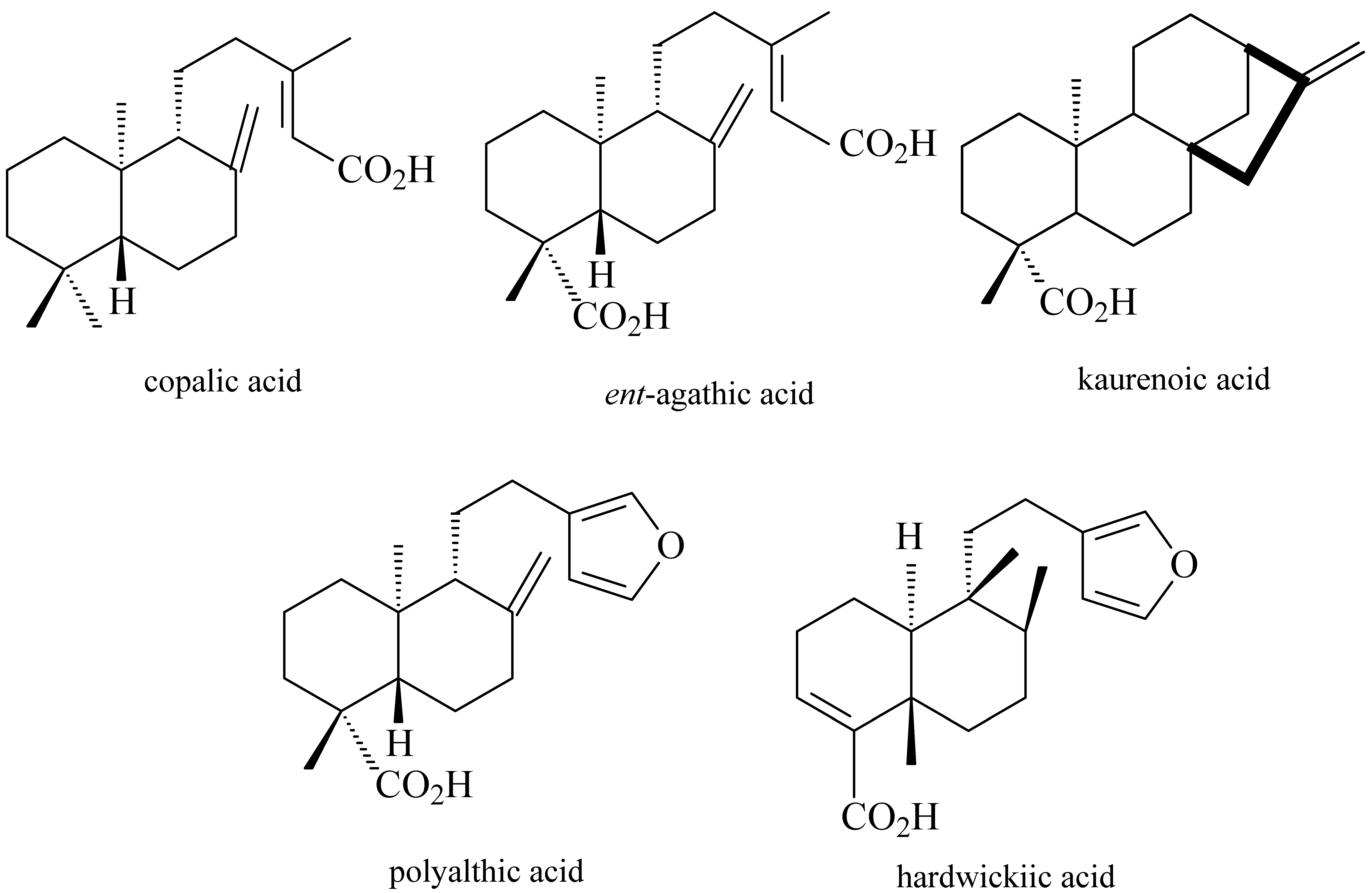
        <p>The diterpenes most commonly found in copaiba oleoresins are copalic, polyalthic, hardwickiic, kaurenoic and <italic>ent</italic>-kaurenoic acids, together with their derivatives 3-hydroxy-copalic, 3-acetoxy-copalic, and <italic>ent</italic>-agathic (<xref ref-type="fig" rid="molecules-17-03866-f002">Figure 2</xref>).</p>
        <fig id="molecules-17-03866-f002" position="anchor">
          <label>Figure 2</label>
          <caption>
            <p>Main diterpenes detected in copaiba oleoresin.</p>
          </caption>
          <graphic xmlns:xlink="http://www.w3.org/1999/xlink" xlink:href="molecules-17-03866-g002.tif"/>
        </fig>
        <p>Copalic acid was first described by Nakano and Djerassi [<xref ref-type="bibr" rid="B124-molecules-17-03866">124</xref>], who isolated it from <italic>Hymenea courbaril </italic>resin samples. This diterpene is considered a biomarker for this genus <italic>Copaifera</italic> and some studies have been performed to evaluate the antibacterial activities of this substance. It has been demonstrated to have significant antimicrobial activity against <italic>B. subtilis</italic>, <italic>S. aureus</italic>, and <italic>S. epidermidis</italic> [<xref ref-type="bibr" rid="B86-molecules-17-03866">86</xref>]. Recently, Souza <italic>et al.</italic> [<xref ref-type="bibr" rid="B125-molecules-17-03866">125</xref>] investigated the antimicrobial activity of four labdane-type diterpenes [(-)-copalic acid, (-)-acetoxycopalic acid, (-)-hydroxycopalic acid and (-)-agathic acid] isolated from the copaiba oleoresin from <italic>C. langsdorffii </italic>against a representative panel of microorganisms responsible for periodontitis. Copalic acid was the most active diterpene, displaying a very promising MIC value (3.1 μg mL<sup>−1</sup>) against the key pathogen (<italic>Porphyromonas gingivalis</italic>) involved in this infectious disease. Moreover, it did not exhibit cytotoxicity when tested in human fibroblasts. In another paper, Souza <italic>et al</italic>. [<xref ref-type="bibr" rid="B126-molecules-17-03866">126</xref>] reported that copalic acid was active against the main microorganisms responsible for dental caries: <italic>Streptococcus salivarius</italic>, <italic>S. sobrinus</italic>, <italic>S. mutans</italic>, <italic>S. mitis</italic>, <italic>S. sanguinis </italic>and <italic>Lactobacillus casei</italic>. </p>
        <p>Hardwickiic acid is another diterpene that is very common in copaiba oleoresins, being detected in about 42% of them [<xref ref-type="bibr" rid="B127-molecules-17-03866">127</xref>]. Some studies have been performed with this diterpene to determine its antibicrobial activity [<xref ref-type="bibr" rid="B128-molecules-17-03866">128</xref>]. It has shown significant qualitative antibacterial activity against <italic>B. subtilis</italic>, <italic>S. aureus</italic> and <italic>Mycobacterium smegmatis</italic>. Moreover, hardwickiic acid, isolated from the stem bark of <italic>Irvingia gabonensis</italic>, inhibited the growth of several bacteria and fungus species using dilution methods [<xref ref-type="bibr" rid="B129-molecules-17-03866">129</xref>]. However, in a recent study, when it was assayed against a collection of Gram-negative multidrug-resistant bacteria, the diterpene was inactive [<xref ref-type="bibr" rid="B130-molecules-17-03866">130</xref>].</p>
        <p>Kaurenoic acid (<italic>ent</italic>-kaur-16-en-19-oic acid) was first described in 1971 by Ferrari <italic>et al</italic>. [<xref ref-type="bibr" rid="B131-molecules-17-03866">131</xref>]. However, this acid was only detected in copaiba oleoresins in 1998 by Braga <italic>et al.</italic> [<xref ref-type="bibr" rid="B132-molecules-17-03866">132</xref>] who isolated it from <italic>C. cearensis</italic> using ion-exchange chromatography. Although this diterpene is present in about 30% of copaiba oleoresins [<xref ref-type="bibr" rid="B124-molecules-17-03866">124</xref>], it sometimes cannot be detected by GC because its retention time is similar to with that of copalic acid, resulting in co-elution. Therefore, it was not possible to distinguish the kaurenoic (or the copalic) acid [<xref ref-type="bibr" rid="B133-molecules-17-03866">133</xref>]. Several pharmacological studies were performed with kauran acid, to determine it uterine muscle relaxant [<xref ref-type="bibr" rid="B134-molecules-17-03866">134</xref>], anti-inflammatory [<xref ref-type="bibr" rid="B135-molecules-17-03866">135</xref>], bactericidal [<xref ref-type="bibr" rid="B86-molecules-17-03866">86</xref>], and cytotoxicity [<xref ref-type="bibr" rid="B136-molecules-17-03866">136</xref>] effects, activity against <italic>Trypanosoma cruzi </italic>tripomastigotes [<xref ref-type="bibr" rid="B137-molecules-17-03866">137</xref>], genotoxicity induction [<xref ref-type="bibr" rid="B138-molecules-17-03866">138</xref>], and vasodilatory effects [<xref ref-type="bibr" rid="B139-molecules-17-03866">139</xref>].</p>
        <p>The uterine relaxant effects of kaurenoic acid were reported by Cunha <italic>et al</italic>. [<xref ref-type="bibr" rid="B134-molecules-17-03866">134</xref>], who isolated this diterpene from <italic>C. langsdorffii</italic> oleoresin. Accoding to these authors, kaurenoic acid exerts this relaxant effect principally through calcium blockade and in part, by the opening of ATP-sensitive potassium channels. Another study investigated the mechanisms involved in the vasorelaxant action of kaurenoic acid in isolated aortic rings in rats [<xref ref-type="bibr" rid="B139-molecules-17-03866">139</xref>].</p>
        <p>According to Cavalcanti <italic>et al</italic>. [<xref ref-type="bibr" rid="B138-molecules-17-03866">138</xref>], kaurenoic acid has DNA damaging activity in cultured Chinese hamster fibroblasts (V79 cells) under the conditions of the Comet assays. Costa-Lotufo <italic>et al.</italic> [<xref ref-type="bibr" rid="B136-molecules-17-03866">136</xref>] indicated the potential cytotoxicity of kaurenoic acid by the destruction of sea urchin embryos, the inhibition of tumor cell growth and the hemolysis of mouse and human erythrocytes.</p>
        <p>Anti-inflammatory activity was reported by Paiva <italic>et al</italic>. [<xref ref-type="bibr" rid="B135-molecules-17-03866">135</xref>] who isolated the kaurenoic acid from oleoresin of <italic>C. langsdorffii</italic> Desf. In this study, it was observed that kaurenoic acid prevented tissue damage in the rat model of acetic acid colitis, an effect which the authors verified through macroscopic, histological and biochemical changes.</p>
        <p>It has been reported also that kaurenoic acid, isolated from <italic>C. paupera</italic> oleoresin, showed antibacterial activity against <italic>B. subtilis</italic>, <italic>S. aureus</italic>, <italic>S. epidermidis </italic>[<xref ref-type="bibr" rid="B86-molecules-17-03866">86</xref>]. In other study, kaurenoic acid, and some of its derivatives, showed <italic>in vitro </italic>activity against trypomastigote forms of <italic>Trypanosoma cruzi </italic>[<xref ref-type="bibr" rid="B137-molecules-17-03866">137</xref>], with kaurenoic acid derivatives presenting less side effects than the acid. </p>
        <p>Souza <italic>et al. </italic>[<xref ref-type="bibr" rid="B140-molecules-17-03866">140</xref>] showed that kaurenoic and polyalthic acids (the latter less active) were capable of promoting inhibition of rhodamine 6G efflux in <italic>Saccharomyces cerevisiae </italic>with Pdr5p enzyme (protein that confers multiple drug resistance).</p>
        <p>Another diterpene detected in copaiba oleoresin, 3α-hydroxy-kaurenoic acid presented higher fungitoxic activity against <italic>Botrytis cinerea </italic>(a phytopathogenic fungus that attacks the flowers, fruits, leaves, and stems of several plants). The authors suggest that the diterpene probably acts by inhibiting germination and mycelium growth this fungus [<xref ref-type="bibr" rid="B141-molecules-17-03866">141</xref>].</p>
        <p>Larvicidal activity has also been reported against <italic>A. aegypti </italic>larvae, of two labdane diterpenes isolated from <italic>C. reticulata </italic>oleoresin: (-)-3β-hydroxilabd-8(17)-13-dien-15-oic acid and 3-β-acetoxy-labd-8(17)-13-dien-15-oic acid [<xref ref-type="bibr" rid="B142-molecules-17-03866">142</xref>]. In another study, this latter diterpene was reported to cause death of the <italic>A. aegypti </italic>larvae by cell destruction in the midgut [<xref ref-type="bibr" rid="B143-molecules-17-03866">143</xref>]. Also, another diterpene present in copaiba oleoresin, kovalenol, showed potent antitumor activity against IMC carcinoma (murine tumor) in mice [<xref ref-type="bibr" rid="B144-molecules-17-03866">144</xref>].</p>
      </sec>
    </sec>
    <sec sec-type="conclusions">
      <title>4. Conclusions</title>
      <p>Although many papers have been published on the chemical composition of copaiba oleoresins, several questions remain unsolved, such as the fingerprint of the chemical composition of the different species and the presence of biomarkers, probably a combination of sesquiterpenes and diterpernic acids. Ethnopharmacological studies indicate many activities that are still not fully understood through pharmacological experiments. Also, the activities of the isolated compounds do not explain the strong activities of crude oleoresins. Indeed, several substances have being described, and new biological studies have been published that go some way to unraveling the action mechanism of the isolated sesquiterpenes and diterpenes. All these topics still require further investigation, as copaiba oil is a resource on which there is still much work to be done.</p>
    </sec>
  </body>
  <back>
    <ack>
    <title>Acknowledgments</title>
      <p>This study was supported by Conselho Nacional de Desenvolvimento Científico e Tecnológico (CNPq), FAPEAM, FACEPE and CAPES.</p>
    </ack>
   <notes>
   <title>Conflict of Interest</title>
      <p>The authors declare no conflict of interest.</p>
   </notes>
   <ref-list>
      <title>References</title>
      <ref id="B1-molecules-17-03866">
        <label>1.</label>
        <citation citation-type="journal">
          <person-group person-group-type="author">
            <name>
              <surname>Dwyer</surname>
              <given-names>J.D.</given-names>
            </name>
          </person-group>
          <article-title>The Central American, West Indian and South American species of <italic>Copaifera</italic> (Caesalpinaceae)</article-title>
          <source>Brittonia</source>
          <year>1951</year>
          <volume>7</volume>
          <fpage>143</fpage>
          <lpage>172</lpage>
        <pub-id pub-id-type="doi">10.2307/2804703</pub-id></citation>
      </ref>
      <ref id="B2-molecules-17-03866">
        <label>2.</label>
        <citation citation-type="journal">
          <person-group person-group-type="author">
            <name>
              <surname>Martins-da-Silva</surname>
              <given-names>R.C.V.</given-names>
            </name>
            <name>
              <surname>Pereira</surname>
              <given-names>J.F.</given-names>
            </name>
            <name>
            <surname>Lima</surname>
              <given-names>H.C.</given-names>
            </name>
          </person-group>
          <article-title>O gênero <italic>Copaifera</italic> (Leguminosae-Caesalpinioideae) na Amazônia Brasileira</article-title>
          <source>Rodriguesia</source>
          <year>2008</year>
          <fpage>455</fpage>
          <lpage>476</lpage>
        </citation>
      </ref>
      <ref id="B3-molecules-17-03866">
        <label>3.</label>
        <citation citation-type="book">
          <person-group person-group-type="author">
            <name>
              <surname>Pio Corrêa</surname>
              <given-names>M.</given-names>
            </name>
          </person-group>
          <source>Dicionário das Plantas Úteis do Brasil</source>
          <publisher-name>Ministério da Agricultura</publisher-name>
          <publisher-loc>Rio de Janeiro, Brazil</publisher-loc>
          <year>1931</year>
          <fpage>370</fpage>
        </citation>
      </ref>
      <ref id="B4-molecules-17-03866">
        <label>4.</label>
        <citation citation-type="journal">
          <person-group person-group-type="author">
            <name>
              <surname>Albuquerque</surname>
              <given-names>U.P.</given-names>
            </name>
            <name>
              <surname>Medeiros</surname>
              <given-names>P.M.</given-names>
            </name>
            <name>
              <surname>Almeida</surname>
              <given-names>A.L.S.</given-names>
            </name>
            <name>
              <surname>Monteiro</surname>
              <given-names>J.M.</given-names>
            </name>
            <name>
              <surname>Lins Neto</surname>
              <given-names>E.M.F.</given-names>
            </name>
            <name>
              <surname>Melo</surname>
              <given-names>J.G.</given-names>
            </name>
            <name>
              <surname>Santos</surname>
              <given-names>J.P.</given-names>
            </name>
          </person-group>
          <article-title>Medicinal plants of the <italic>caatinga</italic> (semi-arid) vegetation of NE Brazil: A quantitative approach</article-title>
          <source>J. Ethnopharmacol.</source>
          <year>2007</year>
          <volume>114</volume>
          <fpage>325</fpage>
          <lpage>354</lpage>
        <pub-id pub-id-type="doi">10.1016/j.jep.2007.08.017</pub-id><pub-id pub-id-type="pmid">17900836</pub-id></citation>
      </ref>
      <ref id="B5-molecules-17-03866">
        <label>5.</label>
        <citation citation-type="journal">
          <person-group person-group-type="author">
            <name>
              <surname>Brandão</surname>
              <given-names>M.G.L.</given-names>
            </name>
            <name>
              <surname>Zanetti</surname>
              <given-names>N.N.S.</given-names>
            </name>
            <name>
              <surname>Oliveira</surname>
              <given-names>P.</given-names>
            </name>
            <name>
              <surname>Grael</surname>
              <given-names>C.F.F.</given-names>
            </name>
            <name>
              <surname>Santos</surname>
              <given-names>A.C.P.</given-names>
            </name>
            <name>
              <surname>Monte-Mór</surname>
              <given-names>R.L.M.</given-names>
            </name>
          </person-group>
          <article-title>Brazilian medicinal plants described by 19th century European naturalists and in the Official Pharmacopoeia</article-title>
          <source>J. Ethnopharmacol.</source>
          <year>2008</year>
          <volume>120</volume>
          <fpage>141</fpage>
          <lpage>148</lpage>
        <pub-id pub-id-type="doi">10.1016/j.jep.2008.08.004</pub-id><pub-id pub-id-type="pmid">18762237</pub-id></citation>
      </ref>
      <ref id="B6-molecules-17-03866">
        <label>6.</label>
        <citation citation-type="journal">
          <person-group person-group-type="author">
            <name>
              <surname>Sanz-Biset</surname>
              <given-names>J.</given-names>
            </name>
            <name>
              <surname>Campos-de-la-Cruz</surname>
              <given-names>J.</given-names>
            </name>
            <name>
              <surname>Epiquién-Rivera</surname>
              <given-names>M.A.</given-names>
            </name>
            <name>
              <surname>Canigueral</surname>
              <given-names>S.</given-names>
            </name>
          </person-group>
          <article-title>A first survey on the medicinal plants of the Chazuta valley (Peruvian Amazon)</article-title>
          <source>J. Ethnopharmacol.</source>
          <year>2009</year>
          <volume>122</volume>
          <fpage>333</fpage>
          <lpage>362</lpage>
        <pub-id pub-id-type="doi">10.1016/j.jep.2008.12.009</pub-id><pub-id pub-id-type="pmid">19146943</pub-id></citation>
      </ref>
      <ref id="B7-molecules-17-03866">
        <label>7.</label>
        <citation citation-type="journal">
          <person-group person-group-type="author">
            <name>
              <surname>Coelho-Ferreira</surname>
              <given-names>M.</given-names>
            </name>
          </person-group>
          <article-title>Medicinal knowledge and plant utilization in an Amazonian coastal community of Marudá, Pará State (Brazil)</article-title>
          <source>J. Ethnopharmacol.</source>
          <year>2009</year>
          <volume>126</volume>
          <fpage>159</fpage>
          <lpage>175</lpage>
        <pub-id pub-id-type="doi">10.1016/j.jep.2009.07.016</pub-id><pub-id pub-id-type="pmid">19632314</pub-id></citation>
      </ref>
      <ref id="B8-molecules-17-03866">
        <label>8.</label>
        <citation citation-type="journal">
          <person-group person-group-type="author">
            <name>
              <surname>Desmarchelier</surname>
              <given-names>C.</given-names>
            </name>
            <name>
              <surname>Gurni</surname>
              <given-names>A.</given-names>
            </name>
            <name>
              <surname>Ciccia</surname>
              <given-names>G.</given-names>
            </name>
            <name>
              <surname>Giulietti</surname>
              <given-names>A.M.</given-names>
            </name>
          </person-group>
          <article-title>Ritual and medicinal plants of the Ese’ejas of the Amazonian rainforest (Madre de Dios, Perú)</article-title>
          <source>J. Ethnopharmacol.</source>
          <year>1996</year>
          <volume>52</volume>
          <fpage>45</fpage>
          <lpage>51</lpage>
        <pub-id pub-id-type="doi">10.1016/0378-8741(96)01390-6</pub-id><pub-id pub-id-type="pmid">8733119</pub-id></citation>
      </ref>
      <ref id="B9-molecules-17-03866">
        <label>9.</label>
        <citation citation-type="journal">
          <person-group person-group-type="author">
            <name>
              <surname>Sanz-Biset</surname>
              <given-names>J.</given-names>
            </name>
            <name>
              <surname>Canigueral</surname>
              <given-names>S.</given-names>
            </name>
          </person-group>
          <article-title>Plant use in the medicinal practices known as “strict diets” in Chazuta valley (Peruvian Amazon)</article-title>
          <source>J. Ethnopharmacol.</source>
          <year>2011</year>
          <volume>137</volume>
          <fpage>271</fpage>
          <lpage>288</lpage>
        <pub-id pub-id-type="doi">10.1016/j.jep.2011.05.021</pub-id><pub-id pub-id-type="pmid">21627986</pub-id></citation>
      </ref>
      <ref id="B10-molecules-17-03866">
        <label>10.</label>
        <citation citation-type="journal">
          <person-group person-group-type="author">
            <name>
              <surname>Mello</surname>
              <given-names>J.F.</given-names>
            </name>
          </person-group>
          <article-title>Plants in traditional medicine en Brazil</article-title>
          <source>J. Ethnopharmacol.</source>
          <year>1980</year>
          <volume>2</volume>
          <fpage>49</fpage>
          <lpage>55</lpage>
        <pub-id pub-id-type="doi">10.1016/0378-8741(80)90030-6</pub-id><pub-id pub-id-type="pmid">7464183</pub-id></citation>
      </ref>
      <ref id="B11-molecules-17-03866">
        <label>11.</label>
        <citation citation-type="journal">
          <person-group person-group-type="author">
            <name>
              <surname>Calderon</surname>
              <given-names>L.A.</given-names>
            </name>
            <name>
              <surname>Silva-Jardim</surname>
              <given-names>I.</given-names>
            </name>
            <name>
              <surname>Zuliani</surname>
              <given-names>J.P.</given-names>
            </name>
            <name>
              <surname>Silva</surname>
              <given-names>A.A.</given-names>
            </name>
            <name>
              <surname>Ciancaglini</surname>
              <given-names>P.</given-names>
            </name>
            <name>
              <surname>Silva</surname>
              <given-names>L.H.P.</given-names>
            </name>
            <name>
              <surname>Stábeli</surname>
              <given-names>R.G.</given-names>
            </name>
          </person-group>
          <article-title>Amazonian biodiversity: A view of drug development for Leishmaniasis and malaria</article-title>
          <source>J. Braz. Chem. Soc.</source>
          <year>2009</year>
          <volume>20</volume>
          <fpage>1011</fpage>
          <lpage>1023</lpage>
        </citation>
      </ref>
      <ref id="B12-molecules-17-03866">
        <label>12.</label>
        <citation citation-type="journal">
          <person-group person-group-type="author">
            <name>
              <surname>Veiga</surname>
              <given-names>V.F.</given-names>
              <suffix>Jr.</suffix>
            </name>
            <name>
              <surname>Pinto</surname>
              <given-names>A.C.</given-names>
            </name>
          </person-group>
          <article-title>O Gênero <italic>Copaifera</italic> L</article-title>
          <source>Quim. Nova</source>
          <year>2002</year>
          <volume>25</volume>
          <fpage>273</fpage>
          <lpage>286</lpage>
        <pub-id pub-id-type="doi">10.1590/S0100-40422002000200016</pub-id></citation>
      </ref>
      <ref id="B13-molecules-17-03866">
        <label>13.</label>
        <citation citation-type="journal">
          <person-group person-group-type="author">
            <name>
              <surname>Santos</surname>
              <given-names>A.O.</given-names>
            </name>
            <name>
              <surname>Ueda-Nakamura</surname>
              <given-names>T.</given-names>
            </name>
            <name>
              <surname>Dias Filho</surname>
              <given-names>B.P.</given-names>
            </name>
            <name>
              <surname>Veiga</surname>
              <given-names>V.F.</given-names>
              <suffix>Jr.</suffix>
            </name>
            <name>
              <surname>Pinto</surname>
              <given-names>A.C.</given-names>
            </name>
            <name>
              <surname>Nakamura</surname>
              <given-names>C.V.</given-names>
            </name>
          </person-group>
          <article-title>Antimicrobial activity of Brazilian copaiba oils obtained from different species of the <italic>Copaifera</italic> genus</article-title>
          <source>Mem. Inst. Oswaldo Cruz</source>
          <year>2008</year>
          <volume>103</volume>
          <fpage>277</fpage>
          <lpage>281</lpage>
        <pub-id pub-id-type="doi">10.1590/S0074-02762008005000015</pub-id><pub-id pub-id-type="pmid">18545856</pub-id></citation>
      </ref>
      <ref id="B14-molecules-17-03866">
        <label>14.</label>
        <citation citation-type="journal">
          <person-group person-group-type="author">
            <name>
              <surname>Veiga</surname>
              <given-names>V.F.</given-names>
              <suffix>Jr.</suffix>
            </name>
            <name>
              <surname>Rosas</surname>
              <given-names>E.C.</given-names>
            </name>
            <name>
              <surname>Carvalho</surname>
              <given-names>M.V.</given-names>
            </name>
            <name>
              <surname>Henriques</surname>
              <given-names>M.G.M.O.</given-names>
            </name>
            <name>
              <surname>Pinto</surname>
              <given-names>A.C.</given-names>
            </name>
          </person-group>
          <article-title>Chemical composition and anti-inflammatory activity of copaiba oils from <italic>Copaifera cearensis</italic> Huber ex Ducke, <italic>Copaifera reticulata</italic> Ducke and <italic>Copaifera multijuga</italic> Hayne-A comparative study</article-title>
          <source>J. Ethnopharmacol.</source>
          <year>2007</year>
          <volume>112</volume>
          <fpage>248</fpage>
          <lpage>254</lpage>
        <pub-id pub-id-type="doi">10.1016/j.jep.2007.03.005</pub-id><pub-id pub-id-type="pmid">17446019</pub-id></citation>
      </ref>
      <ref id="B15-molecules-17-03866">
        <label>15.</label>
        <citation citation-type="journal">
          <person-group person-group-type="author">
            <name>
              <surname>Santos</surname>
              <given-names>A.O.</given-names>
            </name>
            <name>
              <surname>Ueda-Nakamura</surname>
              <given-names>T.</given-names>
            </name>
            <name>
              <surname>Dias Filho</surname>
              <given-names>B.P.</given-names>
            </name>
            <name>
              <surname>Veiga</surname>
              <given-names>V.F.</given-names>
              <suffix>Jr.</suffix>
            </name>
            <name>
              <surname>Pinto</surname>
              <given-names>A.C.</given-names>
            </name>
            <name>
              <surname>Nakamura</surname>
              <given-names>C.V.</given-names>
            </name>
          </person-group>
          <article-title>Effect of Brazilian copaiba oils on <italic>Leishmania amazonensis</italic></article-title>
          <source>J. Ethnopharmacol.</source>
          <year>2008</year>
          <volume>120</volume>
          <fpage>204</fpage>
          <lpage>208</lpage>
        <pub-id pub-id-type="doi">10.1016/j.jep.2008.08.007</pub-id><pub-id pub-id-type="pmid">18775772</pub-id></citation>
      </ref>
      <ref id="B16-molecules-17-03866">
        <label>16.</label>
        <citation citation-type="journal">
          <person-group person-group-type="author">
            <name>
              <surname>Castro-e-Silva</surname>
              <given-names>O.</given-names>
              <suffix>Jr.</suffix>
            </name>
            <name>
              <surname>Zucoloto</surname>
              <given-names>S.</given-names>
            </name>
            <name>
              <surname>Ramalho</surname>
              <given-names>F.S.</given-names>
            </name>
            <name>
              <surname>Ramalho</surname>
              <given-names>L.N.Z.</given-names>
            </name>
            <name>
              <surname>Reis</surname>
              <given-names>J.M.C.</given-names>
            </name>
            <name>
              <surname>Bastos</surname>
              <given-names>A.A.C.</given-names>
            </name>
            <name>
              <surname>Brito</surname>
              <given-names>M.V.H.</given-names>
            </name>
          </person-group>
          <article-title>Antiproliferative activity of <italic>Copaifera duckei</italic> oleoresin on liver regeneration in rats</article-title>
          <source>Phytother. Res.</source>
          <year>2004</year>
          <volume>18</volume>
          <fpage>92</fpage>
          <lpage>94</lpage>
        <pub-id pub-id-type="doi">10.1002/ptr.1351</pub-id><pub-id pub-id-type="pmid">14750209</pub-id></citation>
      </ref>
      <ref id="B17-molecules-17-03866">
        <label>17.</label>
        <citation citation-type="journal">
          <person-group person-group-type="author">
            <name>
              <surname>Maistro</surname>
              <given-names>E.L.</given-names>
            </name>
            <name>
              <surname>Carvalho</surname>
              <given-names>J.C.T.</given-names>
            </name>
            <name>
              <surname>Cascon</surname>
              <given-names>V.</given-names>
            </name>
            <name>
              <surname>Kaplan</surname>
              <given-names>M.A.C.</given-names>
            </name>
          </person-group>
          <article-title><italic>In vivo</italic> evaluation of the mutagenic potential and phytochemical characterization of oleoresin from <italic>Copaifera duckei</italic> Dwyer</article-title>
          <source>Genet. Mol. Biol.</source>
          <year>2005</year>
          <volume>28</volume>
          <fpage>833</fpage>
          <lpage>838</lpage>
        <pub-id pub-id-type="doi">10.1590/S1415-47572005000500028</pub-id></citation>
      </ref>
      <ref id="B18-molecules-17-03866">
        <label>18.</label>
        <citation citation-type="journal">
          <person-group person-group-type="author">
            <name>
              <surname>Lima</surname>
              <given-names>C.S.</given-names>
            </name>
            <name>
              <surname>Medeiros</surname>
              <given-names>B.J.L.</given-names>
            </name>
            <name>
              <surname>Favacho</surname>
              <given-names>H.A.S.</given-names>
            </name>
            <name>
              <surname>Santos</surname>
              <given-names>K.C.</given-names>
            </name>
            <name>
              <surname>Oliveira</surname>
              <given-names>B.R.</given-names>
            </name>
            <name>
              <surname>Taglialegna</surname>
              <given-names>J.C.</given-names>
            </name>
            <name>
              <surname>Costa</surname>
              <given-names>E.V.M.</given-names>
            </name>
            <name>
              <surname>Campos</surname>
              <given-names>K.J.</given-names>
            </name>
            <name>
              <surname>Carvalho</surname>
              <given-names>J.C.T.</given-names>
            </name>
          </person-group>
          <article-title>Pré-clinical validation of a vaginal cream containing copaiba oil (reproductive toxicology study)</article-title>
          <source>Phytomedicine</source>
          <year>2011</year>
          <volume>18</volume>
          <fpage>1013</fpage>
          <lpage>1023</lpage>
        <pub-id pub-id-type="doi">10.1016/j.phymed.2011.05.004</pub-id><pub-id pub-id-type="pmid">21665449</pub-id></citation>
      </ref>
      <ref id="B19-molecules-17-03866">
        <label>19.</label>
        <citation citation-type="journal">
          <person-group person-group-type="author">
            <name>
              <surname>Carvalho</surname>
              <given-names>J.C.T.</given-names>
            </name>
            <name>
              <surname>Cascon</surname>
              <given-names>V.</given-names>
            </name>
            <name>
              <surname>Possebon</surname>
              <given-names>L.S.</given-names>
            </name>
            <name>
              <surname>Morimoto</surname>
              <given-names>M.S.S.</given-names>
            </name>
            <name>
              <surname>Cardoso</surname>
              <given-names>L.G.V.</given-names>
            </name>
            <name>
              <surname>Kaplan</surname>
              <given-names>M.A.C.</given-names>
            </name>
            <name>
              <surname>Gilbert</surname>
              <given-names>B.</given-names>
            </name>
          </person-group>
          <article-title>Topical antiinflammatory and analgesic activities of <italic>Copaifera duckei</italic> Dwyer</article-title>
          <source>Phytother. Res.</source>
          <year>2005</year>
          <volume>19</volume>
          <fpage>946</fpage>
          <lpage>950</lpage>
        <pub-id pub-id-type="doi">10.1002/ptr.1762</pub-id><pub-id pub-id-type="pmid">16317651</pub-id></citation>
      </ref>
      <ref id="B20-molecules-17-03866">
        <label>20.</label>
        <citation citation-type="journal">
          <person-group person-group-type="author">
            <name>
              <surname>Oliveira</surname>
              <given-names>D.F.</given-names>
            </name>
            <name>
              <surname>Pereira</surname>
              <given-names>A.C.</given-names>
            </name>
            <name>
              <surname>Figueiredo</surname>
              <given-names>H.C.P.</given-names>
            </name>
            <name>
              <surname>Carvalho</surname>
              <given-names>D.A.</given-names>
            </name>
            <name>
              <surname>Silva</surname>
              <given-names>G.</given-names>
            </name>
            <name>
              <surname>Nunes</surname>
              <given-names>A.S.</given-names>
            </name>
            <name>
              <surname>Alves</surname>
              <given-names>D.S.</given-names>
            </name>
            <name>
              <surname>Carvalho</surname>
              <given-names>H.W.P.</given-names>
            </name>
          </person-group>
          <article-title>Antibacterial activity of plant extracts from Brazilian southeast region</article-title>
          <source>Fitoterapia</source>
          <year>2007</year>
          <volume>78</volume>
          <fpage>142</fpage>
          <lpage>145</lpage>
        <pub-id pub-id-type="doi">10.1016/j.fitote.2006.09.027</pub-id><pub-id pub-id-type="pmid">17169500</pub-id></citation>
      </ref>
      <ref id="B21-molecules-17-03866">
        <label>21.</label>
        <citation citation-type="journal">
          <person-group person-group-type="author">
            <name>
              <surname>Pieri</surname>
              <given-names>F.A.</given-names>
            </name>
            <name>
              <surname>José</surname>
              <given-names>R.M.</given-names>
            </name>
            <name>
              <surname>Galvão</surname>
              <given-names>N.N.</given-names>
            </name>
            <name>
              <surname>Nero</surname>
              <given-names>L.A.</given-names>
            </name>
            <name>
              <surname>Moreira</surname>
              <given-names>M.A.S.</given-names>
            </name>
          </person-group>
          <article-title>Antimicrobial activity of autoclaved and non autoclaved copaiba oil on <italic>Listeria monocytogenes</italic></article-title>
          <source>Cienc. Rural</source>
          <year>2010</year>
          <volume>40</volume>
          <fpage>1797</fpage>
          <lpage>1801</lpage>
        <pub-id pub-id-type="doi">10.1590/S0103-84782010000800020</pub-id></citation>
      </ref>
      <ref id="B22-molecules-17-03866">
        <label>22.</label>
        <citation citation-type="journal">
          <person-group person-group-type="author">
            <name>
              <surname>Pieri</surname>
              <given-names>F.A.</given-names>
            </name>
            <name>
              <surname>Souza</surname>
              <given-names>C.F.</given-names>
            </name>
            <name>
              <surname>Costa</surname>
              <given-names>J.C.M.</given-names>
            </name>
            <name>
              <surname>Barrero</surname>
              <given-names>M.A.O.</given-names>
            </name>
            <name>
              <surname>Espeschit</surname>
              <given-names>I.F.</given-names>
            </name>
            <name>
              <surname>Silva</surname>
              <given-names>V.O.</given-names>
            </name>
            <name>
              <surname>Moreira</surname>
              <given-names>M.A.S.</given-names>
            </name>
          </person-group>
          <article-title>Inhibition of <italic>Escherichia coli</italic> from mastitic milk by copaiba oil</article-title>
          <source>Semin. Ciências Agrárias</source>
          <year>2011</year>
          <volume>32</volume>
          <fpage>1929</fpage>
          <lpage>1934</lpage>
        <pub-id pub-id-type="doi">10.5433/1679-0359.2011v32Splp1929</pub-id></citation>
      </ref>
      <ref id="B23-molecules-17-03866">
        <label>23.</label>
        <citation citation-type="confproc">
          <person-group person-group-type="author">
            <name>
              <surname>Pieri</surname>
              <given-names>F.A.</given-names>
            </name>
            <name>
              <surname>Costa</surname>
              <given-names>J.C.M.</given-names>
            </name>
            <name>
              <surname>Souza</surname>
              <given-names>C.F.</given-names>
            </name>
            <name>
              <surname>Santos</surname>
              <given-names>L.</given-names>
            </name>
            <name>
              <surname>Moreira</surname>
              <given-names>M.A.S.</given-names>
            </name>
          </person-group>
          <article-title>Antimicrobial Profile Screening of Two Oils of <italic>Copaifera</italic> Genus</article-title>
          <source>Proceeding of the 37th CONBRAVET</source>
          <publisher-name>Brazilian Congress of Veterinary Medicine (CONBRAVET)</publisher-name>
          <conf-loc>Rio de Janeiro, Brazil</conf-loc>
          <conf-date>July 2010</conf-date>
        </citation>
      </ref>
      <ref id="B24-molecules-17-03866">
        <label>24.</label>
        <citation citation-type="journal">
          <person-group person-group-type="author">
            <name>
              <surname>Paiva</surname>
              <given-names>L.A.F.</given-names>
            </name>
            <name>
              <surname>Gurgel</surname>
              <given-names>L.A.</given-names>
            </name>
            <name>
              <surname>Campos</surname>
              <given-names>A.R.</given-names>
            </name>
            <name>
              <surname>Silveira</surname>
              <given-names>E.R.</given-names>
            </name>
            <name>
              <surname>Rao</surname>
              <given-names>V.S.N.</given-names>
            </name>
          </person-group>
          <article-title>Attenuation of ischemia/reperfusion-induced intestinal injury by oleo-resin from <italic>Copaifera langsdorffii</italic> in rats</article-title>
          <source>Life Sci.</source>
          <year>2004</year>
          <volume>75</volume>
          <fpage>1979</fpage>
          <lpage>1987</lpage>
        <pub-id pub-id-type="doi">10.1016/j.lfs.2004.05.011</pub-id><pub-id pub-id-type="pmid">15306165</pub-id></citation>
      </ref>
      <ref id="B25-molecules-17-03866">
        <label>25.</label>
        <citation citation-type="journal">
          <person-group person-group-type="author">
            <name>
              <surname>Paiva</surname>
              <given-names>L.A.F.</given-names>
            </name>
            <name>
              <surname>Rao</surname>
              <given-names>V.S.N.</given-names>
            </name>
            <name>
              <surname>Gramosa</surname>
              <given-names>N.V.</given-names>
            </name>
            <name>
              <surname>Silveira</surname>
              <given-names>E.R.</given-names>
            </name>
          </person-group>
          <article-title>Gastroprotective effect of <italic>Copaifera langsdorffii</italic> oleo- resin on experimetal gastric ulcer models in rats</article-title>
          <source>J. Ethnopharmacol.</source>
          <year>1998</year>
          <volume>62</volume>
          <fpage>73</fpage>
          <lpage>78</lpage>
        <pub-id pub-id-type="doi">10.1016/S0378-8741(98)00058-0</pub-id><pub-id pub-id-type="pmid">9720615</pub-id></citation>
      </ref>
      <ref id="B26-molecules-17-03866">
        <label>26.</label>
        <citation citation-type="journal">
          <person-group person-group-type="author">
            <name>
              <surname>Silva</surname>
              <given-names>J.J.L.</given-names>
            </name>
            <name>
              <surname>Guimarães</surname>
              <given-names>S.B.</given-names>
            </name>
            <name>
              <surname>Silveira</surname>
              <given-names>E.R.</given-names>
            </name>
            <name>
              <surname>Vasconcelos</surname>
              <given-names>P.R.L.</given-names>
            </name>
            <name>
              <surname>Lima</surname>
              <given-names>G.G.</given-names>
            </name>
            <name>
              <surname>Torres</surname>
              <given-names>S.M.</given-names>
            </name>
            <name>
              <surname>Vasconcelos</surname>
              <given-names>R.C.</given-names>
            </name>
          </person-group>
          <article-title>Effects of <italic>Copaifera langsdorffii</italic> Desf. on ischemia-reperfusionof randomized skin flaps in rats</article-title>
          <source>Aesthet. Plast. Surg.</source>
          <year>2009</year>
          <volume>33</volume>
          <fpage>104</fpage>
          <lpage>109</lpage>
          <pub-id pub-id-type="doi">10.1007/s00266-008-9263-2</pub-id>
        </citation>
      </ref>
      <ref id="B27-molecules-17-03866">
        <label>27.</label>
        <citation citation-type="journal">
          <person-group person-group-type="author">
            <name>
              <surname>Paiva</surname>
              <given-names>L.A.F.</given-names>
            </name>
            <name>
              <surname>Cunha</surname>
              <given-names>K.M.A.</given-names>
            </name>
            <name>
              <surname>Santos</surname>
              <given-names>F.A.</given-names>
            </name>
            <name>
              <surname>Gramosa</surname>
              <given-names>N.V.</given-names>
            </name>
            <name>
              <surname>Silveira</surname>
              <given-names>E.R.</given-names>
            </name>
            <name>
              <surname>Rao</surname>
              <given-names>V.S.N.</given-names>
            </name>
          </person-group>
          <article-title>Investigation on the wound healing activity of oleo-resin from <italic>Copaifera langsdorffii</italic> in rats</article-title>
          <source>Phytother. Res.</source>
          <year>2002</year>
          <volume>16</volume>
          <fpage>737</fpage>
          <lpage>739</lpage>
        <pub-id pub-id-type="doi">10.1002/ptr.1049</pub-id><pub-id pub-id-type="pmid">12458476</pub-id></citation>
      </ref>
      <ref id="B28-molecules-17-03866">
        <label>28.</label>
        <citation citation-type="journal">
          <person-group person-group-type="author">
            <name>
              <surname>Vieira</surname>
              <given-names>R.C.</given-names>
            </name>
            <name>
              <surname>Bombardiere</surname>
              <given-names>E.</given-names>
            </name>
            <name>
              <surname>Oliveira</surname>
              <given-names>J.J.</given-names>
            </name>
            <name>
              <surname>Lino-Júnior</surname>
              <given-names>R.S.</given-names>
            </name>
            <name>
              <surname>Brito</surname>
              <given-names>L.A.B.</given-names>
            </name>
            <name>
              <surname>Junqueira-Kipnis</surname>
              <given-names>A.P.</given-names>
            </name>
          </person-group>
          <article-title>Influência do óleo de <italic>Copaifera langsdorffii</italic> no reparo de ferida cirúrgica em presença de corpo estranho</article-title>
          <source>Pesq. Vet. Bras.</source>
          <year>2008</year>
          <volume>28</volume>
          <fpage>358</fpage>
          <lpage>366</lpage>
        </citation>
      </ref>
      <ref id="B29-molecules-17-03866">
        <label>29.</label>
        <citation citation-type="journal">
          <person-group person-group-type="author">
            <name>
              <surname>Comelli-Júnior</surname>
              <given-names>E.</given-names>
            </name>
            <name>
              <surname>Skinovski</surname>
              <given-names>J.</given-names>
            </name>
            <name>
              <surname>Sigwalt</surname>
              <given-names>M.F.</given-names>
            </name>
            <name>
              <surname>Branco</surname>
              <given-names>A.B.</given-names>
            </name>
            <name>
              <surname>Luz</surname>
              <given-names>S.R.</given-names>
            </name>
            <name>
              <surname>Baulé</surname>
              <given-names>C.P.</given-names>
            </name>
          </person-group>
          <article-title>Rupture point analysis of intestinal anastomotic healing in rats under the action of pure Copaíba (<italic>Copaifera langsdorfii</italic>) oil</article-title>
          <source>Acta Cir. Bras.</source>
          <year>2010</year>
          <volume>25</volume>
          <fpage>362</fpage>
          <lpage>367</lpage>
        <pub-id pub-id-type="pmid">20676496</pub-id></citation>
      </ref>
      <ref id="B30-molecules-17-03866">
        <label>30.</label>
        <citation citation-type="journal">
          <person-group person-group-type="author">
            <name>
              <surname>Maciel</surname>
              <given-names>H.P.F.</given-names>
            </name>
            <name>
              <surname>Gouvêa</surname>
              <given-names>C.M.C.P.</given-names>
            </name>
            <name>
              <surname>Toyama</surname>
              <given-names>M.</given-names>
            </name>
            <name>
              <surname>Smolka</surname>
              <given-names>M.</given-names>
            </name>
            <name>
              <surname>Marangoni</surname>
              <given-names>S.</given-names>
            </name>
            <name>
              <surname>Pastore</surname>
              <given-names>G.M.</given-names>
            </name>
          </person-group>
          <article-title>Extraction, purification and biochemical characterization of a peroxidase from <italic>Copaifera langsdorffii</italic> leaves</article-title>
          <source>Quim. Nova</source>
          <year>2007</year>
          <volume>30</volume>
          <fpage>1067</fpage>
          <lpage>1071</lpage>
        <pub-id pub-id-type="doi">10.1590/S0100-40422007000500003</pub-id></citation>
      </ref>
      <ref id="B31-molecules-17-03866">
        <label>31.</label>
        <citation citation-type="journal">
          <person-group person-group-type="author">
            <name>
              <surname>Mendonça</surname>
              <given-names>F.A.C.</given-names>
            </name>
            <name>
              <surname>Silva</surname>
              <given-names>K.F.S.</given-names>
            </name>
            <name>
              <surname>Santos</surname>
              <given-names>K.K.</given-names>
            </name>
            <name>
              <surname>Ribeiro</surname>
              <given-names>K.A.L.</given-names>
              <suffix>Jr.</suffix>
            </name>
            <name>
              <surname>Sant’Ana</surname>
              <given-names>A.E.G.</given-names>
            </name>
          </person-group>
          <article-title>Activities of some Brazilian plants against larvae of the mosquito <italic>Aedes aegypti</italic></article-title>
          <source>Fitoterapia</source>
          <year>2005</year>
          <volume>76</volume>
          <fpage>629</fpage>
          <lpage>636</lpage>
        <pub-id pub-id-type="doi">10.1016/j.fitote.2005.06.013</pub-id><pub-id pub-id-type="pmid">16253435</pub-id></citation>
      </ref>
      <ref id="B32-molecules-17-03866">
        <label>32.</label>
        <citation citation-type="journal">
          <person-group person-group-type="author">
            <name>
              <surname>Paiva</surname>
              <given-names>L.A.F.</given-names>
            </name>
            <name>
              <surname>Gurgel</surname>
              <given-names>L.A.</given-names>
            </name>
            <name>
              <surname>Sousa</surname>
              <given-names>E.T.</given-names>
            </name>
            <name>
              <surname>Silveira</surname>
              <given-names>E.R.</given-names>
            </name>
            <name>
              <surname>Silva</surname>
              <given-names>R.M.</given-names>
            </name>
            <name>
              <surname>Santos</surname>
              <given-names>F.A.</given-names>
            </name>
            <name>
              <surname>Rao</surname>
              <given-names>V.S.N.</given-names>
            </name>
          </person-group>
          <article-title>Protective effect of <italic>Copaifera langsdorffii</italic> oleo-resin against acetic acid-induced colitis in rats</article-title>
          <source>J. Ethnopharmacol.</source>
          <year>2004</year>
          <volume>93</volume>
          <fpage>51</fpage>
          <lpage>56</lpage>
        <pub-id pub-id-type="doi">10.1016/j.jep.2004.03.028</pub-id><pub-id pub-id-type="pmid">15182904</pub-id></citation>
      </ref>
      <ref id="B33-molecules-17-03866">
        <label>33.</label>
        <citation citation-type="journal">
          <person-group person-group-type="author">
            <name>
              <surname>Nogueira-Neto</surname>
              <given-names>J.</given-names>
            </name>
            <name>
              <surname>Lindoso</surname>
              <given-names>M.J.S.</given-names>
            </name>
            <name>
              <surname>Coelho</surname>
              <given-names>L.F.</given-names>
            </name>
            <name>
              <surname>Carvalho</surname>
              <given-names>R.A.F.</given-names>
            </name>
            <name>
              <surname>Rodrigues</surname>
              <given-names>T.G.P.M.</given-names>
            </name>
            <name>
              <surname>Araújo</surname>
              <given-names>A.G.P.</given-names>
            </name>
            <name>
              <surname>Girão</surname>
              <given-names>M.J.B.C.</given-names>
            </name>
            <name>
              <surname>Schor</surname>
              <given-names>E.</given-names>
            </name>
          </person-group>
          <article-title>Changes in the volume and histology of endometriosis foci in rats treated with copaiba oil (<italic>Copaifera langsdorffii</italic>)</article-title>
          <source>Acta Cir. Bras.</source>
          <year>2011</year>
          <volume>26</volume>
          <fpage>20</fpage>
          <lpage>24</lpage>
        <pub-id pub-id-type="doi">10.1590/S0102-86502011000800005</pub-id><pub-id pub-id-type="pmid">22030810</pub-id></citation>
      </ref>
      <ref id="B34-molecules-17-03866">
        <label>34.</label>
        <citation citation-type="journal">
          <person-group person-group-type="author">
            <name>
              <surname>Chen-Chen</surname>
              <given-names>L.</given-names>
            </name>
            <name>
              <surname>Sena</surname>
              <given-names>M.A.</given-names>
            </name>
          </person-group>
          <article-title>Atividade toxica e mutagênica do óleo de copaiba (<italic>Copaifera langsdorffii</italic> Desfon) em camundongos</article-title>
          <source>Rev. Bras. Plant Med.</source>
          <year>2002</year>
          <volume>5</volume>
          <fpage>37</fpage>
          <lpage>40</lpage>
        </citation>
      </ref>
      <ref id="B35-molecules-17-03866">
        <label>35.</label>
        <citation citation-type="journal">
          <person-group person-group-type="author">
            <name>
              <surname>Santos</surname>
              <given-names>A.O.</given-names>
            </name>
            <name>
              <surname>Costa</surname>
              <given-names>M.A.</given-names>
            </name>
            <name>
              <surname>Ueda-Nakamura</surname>
              <given-names>T.</given-names>
            </name>
            <name>
              <surname>Dias-Filho</surname>
              <given-names>B.P.</given-names>
            </name>
            <name>
              <surname>Veiga</surname>
              <given-names>V.F.</given-names>
              <suffix>Jr.</suffix>
            </name>
            <name>
              <surname>Lima</surname>
              <given-names>M.M.S.</given-names>
            </name>
            <name>
              <surname>Nakamura</surname>
              <given-names>C.V.</given-names>
            </name>
          </person-group>
          <article-title><italic>Leishmania amazonensis</italic>: Effects of oral treatment with copaiba oil in mice</article-title>
          <source>Experim. Parasitol.</source>
          <year>2011</year>
          <volume>129</volume>
          <fpage>145</fpage>
          <lpage>151</lpage>
        <pub-id pub-id-type="doi">10.1016/j.exppara.2011.06.016</pub-id></citation>
      </ref>
      <ref id="B36-molecules-17-03866">
        <label>36.</label>
        <citation citation-type="journal">
          <person-group person-group-type="author">
            <name>
              <surname>Gomes</surname>
              <given-names>N.M.</given-names>
            </name>
            <name>
              <surname>Rezende</surname>
              <given-names>C.M.</given-names>
            </name>
            <name>
              <surname>Fontes</surname>
              <given-names>S.P.</given-names>
            </name>
            <name>
              <surname>Matheus</surname>
              <given-names>M.E.</given-names>
            </name>
            <name>
              <surname>Pinto</surname>
              <given-names>A.C.</given-names>
            </name>
            <name>
              <surname>Fernandes</surname>
              <given-names>P.D.</given-names>
            </name>
          </person-group>
          <article-title>Characterization of the antinociceptive and anti-inflammatory activities of fractions obtained from <italic>Copaifera multijuga</italic> Hayne</article-title>
          <source>J. Ethnopharmacol.</source>
          <year>2010</year>
          <volume>128</volume>
          <fpage>177</fpage>
          <lpage>183</lpage>
        <pub-id pub-id-type="doi">10.1016/j.jep.2010.01.005</pub-id><pub-id pub-id-type="pmid">20064592</pub-id></citation>
      </ref>
      <ref id="B37-molecules-17-03866">
        <label>37.</label>
        <citation citation-type="journal">
          <person-group person-group-type="author">
            <name>
              <surname>Veiga</surname>
              <given-names>V.F.</given-names>
              <suffix>Jr.</suffix>
            </name>
            <name>
              <surname>Zunino</surname>
              <given-names>L.</given-names>
            </name>
            <name>
              <surname>Patitucci</surname>
              <given-names>M.L.</given-names>
            </name>
            <name>
              <surname>Pinto</surname>
              <given-names>A.C.</given-names>
            </name>
            <name>
              <surname>Calixto</surname>
              <given-names>J.B.</given-names>
            </name>
          </person-group>
          <article-title>The inhibition of paw oedema formation caused by the oil of <italic>Copaifera multijuga</italic> Hayne and its fractions</article-title>
          <source>J. Pharm. Pharmacol.</source>
          <year>2006</year>
          <volume>58</volume>
          <fpage>1405</fpage>
          <lpage>1410</lpage>
        <pub-id pub-id-type="doi">10.1111/j.2042-7158.2006.tb01659.x</pub-id><pub-id pub-id-type="pmid">17034665</pub-id></citation>
      </ref>
      <ref id="B38-molecules-17-03866">
        <label>38.</label>
        <citation citation-type="journal">
          <person-group person-group-type="author">
            <name>
              <surname>Brito</surname>
              <given-names>M.V.H.</given-names>
            </name>
            <name>
              <surname>Moreira</surname>
              <given-names>R.J.</given-names>
            </name>
            <name>
              <surname>Tavares</surname>
              <given-names>M.L.C.</given-names>
            </name>
            <name>
              <surname>Carballo</surname>
              <given-names>M.C.S.</given-names>
            </name>
            <name>
              <surname>Carneiro</surname>
              <given-names>T.X.</given-names>
            </name>
            <name>
              <surname>Santos</surname>
              <given-names>A.A.S.</given-names>
            </name>
          </person-group>
          <article-title>Efeito do óleo de copaíba nos níveis séricos de uréia e creatinina em ratos submetidos à síndrome de isquemia e reperfusão renal</article-title>
          <source>Acta Cir. Bras.</source>
          <year>2005</year>
          <volume>20</volume>
          <fpage>243</fpage>
          <lpage>246</lpage>
        <pub-id pub-id-type="pmid">16033184</pub-id></citation>
      </ref>
      <ref id="B39-molecules-17-03866">
        <label>39.</label>
        <citation citation-type="journal">
          <person-group person-group-type="author">
            <name>
              <surname>Mendonça</surname>
              <given-names>D.E.</given-names>
            </name>
            <name>
              <surname>Onofre</surname>
              <given-names>S.B.</given-names>
            </name>
          </person-group>
          <article-title>Atividade antimicrobiana do óleo-resina produzido pela copaiba – <italic>Copaifera multijuga</italic> Hayne (Leguminosae)</article-title>
          <source>Rev. Bras. Farmacogn.</source>
          <year>2009</year>
          <volume>19</volume>
          <fpage>577</fpage>
          <lpage>581</lpage>
        <pub-id pub-id-type="doi">10.1590/S0102-695X2009000400012</pub-id></citation>
      </ref>
      <ref id="B40-molecules-17-03866">
        <label>40.</label>
        <citation citation-type="journal">
          <person-group person-group-type="author">
            <name>
              <surname>Pacheco</surname>
              <given-names>T.A.R.C.</given-names>
            </name>
            <name>
              <surname>Barata</surname>
              <given-names>L.E.S.</given-names>
            </name>
            <name>
              <surname>Duarte</surname>
              <given-names>M.C.T.</given-names>
            </name>
          </person-group>
          <article-title>Antimicrobial activity of copaiba (<italic>Copaifera </italic>spp.) balsams</article-title>
          <source>Rev. Bras. Pl. Med.</source>
          <year>2006</year>
          <volume>8</volume>
          <fpage>123</fpage>
          <lpage>124</lpage>
        </citation>
      </ref>
      <ref id="B41-molecules-17-03866">
        <label>41.</label>
        <citation citation-type="journal">
          <person-group person-group-type="author">
            <name>
              <surname>Deus</surname>
              <given-names>R.J.A.</given-names>
            </name>
            <name>
              <surname>Carvalho</surname>
              <given-names>A.S.C.</given-names>
            </name>
            <name>
              <surname>Banna</surname>
              <given-names>D.A.D.S.</given-names>
            </name>
            <name>
              <surname>Arruda</surname>
              <given-names>M.S.P.</given-names>
            </name>
            <name>
              <surname>Alves</surname>
              <given-names>C.N.</given-names>
            </name>
            <name>
              <surname>Santos</surname>
              <given-names>A.S.</given-names>
            </name>
          </person-group>
          <article-title>Efeito fungitóxico <italic>in vitro</italic> do óleo resina e do óleo essencial de copaíba (<italic>Copaifera multijuga</italic> Hayne)</article-title>
          <source>Rev. Bras. Pl. Med.</source>
          <year>2009</year>
          <volume>11</volume>
          <fpage>347</fpage>
          <lpage>353</lpage>
        <pub-id pub-id-type="doi">10.1590/S1516-05722009000300018</pub-id></citation>
      </ref>
      <ref id="B42-molecules-17-03866">
        <label>42.</label>
        <citation citation-type="journal">
          <person-group person-group-type="author">
            <name>
              <surname>Deus</surname>
              <given-names>R.J.A.</given-names>
            </name>
            <name>
              <surname>Alves</surname>
              <given-names>C.N.</given-names>
            </name>
            <name>
              <surname>Arruda</surname>
              <given-names>M.S.P.</given-names>
            </name>
          </person-group>
          <article-title>Avaliação do efeito antifúngico do óleo resina e do óleo essencial de copaíba (<italic>Copaifera multijuga</italic> Hayne)</article-title>
          <source>Rev. Bras. Pl. Med.</source>
          <year>2011</year>
          <volume>13</volume>
          <fpage>1</fpage>
          <lpage>7</lpage>
        <pub-id pub-id-type="doi">10.1590/S1516-05722011000100001</pub-id></citation>
      </ref>
      <ref id="B43-molecules-17-03866">
        <label>43.</label>
        <citation citation-type="journal">
          <person-group person-group-type="author">
            <name>
              <surname>Lima</surname>
              <given-names>S.R.M.</given-names>
            </name>
            <name>
              <surname>Veiga</surname>
              <given-names>V.F.</given-names>
              <suffix>Jr.</suffix>
            </name>
            <name>
              <surname>Christo</surname>
              <given-names>H.B.</given-names>
            </name>
            <name>
              <surname>Pinto</surname>
              <given-names>A.C.</given-names>
            </name>
            <name>
              <surname>Fernandes</surname>
              <given-names>P.D.</given-names>
            </name>
          </person-group>
          <article-title><italic>In vivo</italic> and <italic>in vitro</italic> studies on the anticancer activity of <italic>Copaifera multijuga</italic> Hayne and its fractions</article-title>
          <source>Phytother. Res.</source>
          <year>2003</year>
          <volume>17</volume>
          <fpage>1048</fpage>
          <lpage>1053</lpage>
        <pub-id pub-id-type="doi">10.1002/ptr.1295</pub-id><pub-id pub-id-type="pmid">14595585</pub-id></citation>
      </ref>
      <ref id="B44-molecules-17-03866">
        <label>44.</label>
        <citation citation-type="journal">
          <person-group person-group-type="author">
            <name>
              <surname>Gomes</surname>
              <given-names>N.M.</given-names>
            </name>
            <name>
              <surname>Rezende</surname>
              <given-names>C.M.</given-names>
            </name>
            <name>
              <surname>Fontes</surname>
              <given-names>S.P.</given-names>
            </name>
            <name>
              <surname>Hovell</surname>
              <given-names>A.M.C.</given-names>
            </name>
            <name>
              <surname>Landgraf</surname>
              <given-names>R.G.</given-names>
            </name>
            <name>
              <surname>Matheus</surname>
              <given-names>M.E.</given-names>
            </name>
            <name>
              <surname>Pinto</surname>
              <given-names>A.C.</given-names>
            </name>
            <name>
              <surname>Fernandes</surname>
              <given-names>P.D.</given-names>
            </name>
          </person-group>
          <article-title>Antineoplasic activity of <italic>Copaifera multijuga</italic> oil and fractions against ascitic and solid ehrlich tumor</article-title>
          <source>J. Ethnopharmacol.</source>
          <year>2008</year>
          <volume>119</volume>
          <fpage>179</fpage>
          <lpage>184</lpage>
        <pub-id pub-id-type="doi">10.1016/j.jep.2008.06.033</pub-id><pub-id pub-id-type="pmid">18647645</pub-id></citation>
      </ref>
      <ref id="B45-molecules-17-03866">
        <label>45.</label>
        <citation citation-type="journal">
          <person-group person-group-type="author">
            <name>
              <surname>Gomes</surname>
              <given-names>N.M.</given-names>
            </name>
            <name>
              <surname>Rezende</surname>
              <given-names>C.M.</given-names>
            </name>
            <name>
              <surname>Fontes</surname>
              <given-names>S.P.</given-names>
            </name>
            <name>
              <surname>Matheus</surname>
              <given-names>M.E.</given-names>
            </name>
            <name>
              <surname>Fernandes</surname>
              <given-names>P.D.</given-names>
            </name>
          </person-group>
          <article-title>Antinociceptive activity of Amazonian copaiba oils</article-title>
          <source>J. Ethnopharmacol.</source>
          <year>2007</year>
          <volume>109</volume>
          <fpage>486</fpage>
          <lpage>492</lpage>
        <pub-id pub-id-type="doi">10.1016/j.jep.2006.08.018</pub-id><pub-id pub-id-type="pmid">17029841</pub-id></citation>
      </ref>
      <ref id="B46-molecules-17-03866">
        <label>46.</label>
        <citation citation-type="journal">
          <person-group person-group-type="author">
            <name>
              <surname>Westphal</surname>
              <given-names>F.L.</given-names>
            </name>
            <name>
              <surname>Lima</surname>
              <given-names>L.C.</given-names>
            </name>
            <name>
              <surname>Guimarães</surname>
              <given-names>R.A.</given-names>
            </name>
            <name>
              <surname>Souza</surname>
              <given-names>R.F.S.</given-names>
            </name>
            <name>
              <surname>Couto</surname>
              <given-names>S.B.</given-names>
            </name>
            <name>
              <surname>Nakajima</surname>
              <given-names>S.R.</given-names>
            </name>
          </person-group>
          <article-title>Avaliação das alterações pleuropulmonares após a injeção de óleo de resina de copaíba, extrato aquoso de crajiru e polivinilpirrolidona iodado (PVPI) na pleura e parênquima pulmonar de ratos</article-title>
          <source>Rev. Col. Bras. Cir.</source>
          <year>2007</year>
          <volume>34</volume>
          <fpage>170</fpage>
          <lpage>176</lpage>
        <pub-id pub-id-type="doi">10.1590/S0100-69912007000300007</pub-id></citation>
      </ref>
      <ref id="B47-molecules-17-03866">
        <label>47.</label>
        <citation citation-type="journal">
          <person-group person-group-type="author">
            <name>
              <surname>Pieri</surname>
              <given-names>F.A.</given-names>
            </name>
            <name>
              <surname>Mussi</surname>
              <given-names>M.C.</given-names>
            </name>
            <name>
              <surname>Fiorini</surname>
              <given-names>J.E.</given-names>
            </name>
            <name>
              <surname>Schneedorf</surname>
              <given-names>J.M.</given-names>
            </name>
          </person-group>
          <article-title>Efeitos clínicos e microbiológicos do óleo de copaiba (<italic>Copaifera officinalis</italic>) sobre bactérias formadoras de placa dental em cães</article-title>
          <source>Arq. Bras. Med. Vet. Zootec.</source>
          <year>2010</year>
          <volume>62</volume>
          <fpage>578</fpage>
          <lpage>585</lpage>
        <pub-id pub-id-type="doi">10.1590/S0102-09352010000300012</pub-id></citation>
      </ref>
      <ref id="B48-molecules-17-03866">
        <label>48.</label>
        <citation citation-type="journal">
          <person-group person-group-type="author">
            <name>
              <surname>Santos</surname>
              <given-names>R.C.V.</given-names>
            </name>
            <name>
              <surname>Alves</surname>
              <given-names>C.F.S.</given-names>
            </name>
            <name>
              <surname>Schneider</surname>
              <given-names>T.</given-names>
            </name>
            <name>
              <surname>Lopes</surname>
              <given-names>L.Q.S.</given-names>
            </name>
            <name>
              <surname>Aurich</surname>
              <given-names>C.</given-names>
            </name>
            <name>
              <surname>Giongo</surname>
              <given-names>J.L.</given-names>
            </name>
            <name>
              <surname>Brandelli</surname>
              <given-names>A.</given-names>
            </name>
            <name>
              <surname>Vaucher</surname>
              <given-names>R.A.</given-names>
            </name>
          </person-group>
          <article-title>Antimicrobial activity of Amazonian oils against paenibacillus species</article-title>
          <source>J. Invertebr. Pathol.</source>
          <year>2012</year>
          <volume>109</volume>
          <fpage>265</fpage>
          <lpage>268</lpage>
        <pub-id pub-id-type="doi">10.1016/j.jip.2011.12.002</pub-id><pub-id pub-id-type="pmid">22200645</pub-id></citation>
      </ref>
      <ref id="B49-molecules-17-03866">
        <label>49.</label>
        <citation citation-type="journal">
          <person-group person-group-type="author">
            <name>
              <surname>Araújo</surname>
              <given-names>F.A.</given-names>
              <suffix>Jr.</suffix>
            </name>
            <name>
              <surname>Braz</surname>
              <given-names>M.N.</given-names>
            </name>
            <name>
              <surname>Rocha Neto</surname>
              <given-names>O.G.</given-names>
            </name>
            <name>
              <surname>Costa</surname>
              <given-names>F.D.</given-names>
            </name>
            <name>
              <surname>Brito</surname>
              <given-names>M.V.H.</given-names>
            </name>
          </person-group>
          <article-title>Efeito do óleo de copaíba nas aminotransferases de ratos submetidos à isquemia e reperfusão hepática com e sem pré-condicionamento isquêmico</article-title>
          <source>Acta Cir. Bras.</source>
          <year>2005</year>
          <volume>20</volume>
          <fpage>93</fpage>
          <lpage>99</lpage>
        <pub-id pub-id-type="pmid">15810470</pub-id></citation>
      </ref>
      <ref id="B50-molecules-17-03866">
        <label>50.</label>
        <citation citation-type="journal">
          <person-group person-group-type="author">
            <name>
              <surname>Baylac</surname>
              <given-names>S.</given-names>
            </name>
            <name>
              <surname>Racine</surname>
              <given-names>P.</given-names>
            </name>
          </person-group>
          <article-title>Inhibition of 5-lipoxygenase by essential oils and other natural fragrant extracts</article-title>
          <source>Int. J. Aromather.</source>
          <year>2003</year>
          <volume>13</volume>
          <fpage>138</fpage>
          <lpage>142</lpage>
        <pub-id pub-id-type="doi">10.1016/S0962-4562(03)00083-3</pub-id></citation>
      </ref>
      <ref id="B51-molecules-17-03866">
        <label>51.</label>
        <citation citation-type="journal">
          <person-group person-group-type="author">
            <name>
              <surname>Baylac</surname>
              <given-names>S.</given-names>
            </name>
            <name>
              <surname>Racine</surname>
              <given-names>P.</given-names>
            </name>
          </person-group>
          <article-title>Inhibition of human leukocyte elastase by natural fragrant extracts of aromatic plants</article-title>
          <source>Int. J. Aromather.</source>
          <year>2004</year>
          <volume>14</volume>
          <fpage>179</fpage>
          <lpage>182</lpage>
        <pub-id pub-id-type="doi">10.1016/j.ijat.2004.09.008</pub-id></citation>
      </ref>
      <ref id="B52-molecules-17-03866">
        <label>52.</label>
        <citation citation-type="journal">
          <person-group person-group-type="author">
            <name>
              <surname>Brito</surname>
              <given-names>N.M.B.</given-names>
            </name>
            <name>
              <surname>Brito</surname>
              <given-names>M.V.H.</given-names>
            </name>
            <name>
              <surname>Carvalho</surname>
              <given-names>R.K.V.</given-names>
            </name>
            <name>
              <surname>Matos</surname>
              <given-names>L.T.M.B.</given-names>
            </name>
            <name>
              <surname>Lobato</surname>
              <given-names>R.C.</given-names>
            </name>
            <name>
              <surname>Correa</surname>
              <given-names>S.C.</given-names>
            </name>
            <name>
              <surname>Brito</surname>
              <given-names>R.B.</given-names>
            </name>
          </person-group>
          <article-title>The effect of copaiba balsam on Walker 256 carcinoma inoculated into the vagina and uterine cervix of female rats</article-title>
          <source>Acta Cir. Bras.</source>
          <year>2010</year>
          <volume>25</volume>
          <fpage>176</fpage>
          <lpage>180</lpage>
        <pub-id pub-id-type="doi">10.1590/S0102-86502010000200010</pub-id><pub-id pub-id-type="pmid">20305885</pub-id></citation>
      </ref>
      <ref id="B53-molecules-17-03866">
        <label>53.</label>
        <citation citation-type="journal">
          <person-group person-group-type="author">
            <name>
              <surname>Kvist</surname>
              <given-names>L.P.</given-names>
            </name>
            <name>
              <surname>Christensen</surname>
              <given-names>S.B.</given-names>
            </name>
            <name>
              <surname>Rasmussen</surname>
              <given-names>H.B.</given-names>
            </name>
            <name>
              <surname>Mejia</surname>
              <given-names>K.</given-names>
            </name>
            <name>
              <surname>Gonzalez</surname>
              <given-names>A.</given-names>
            </name>
          </person-group>
          <article-title>Identification and evaluation of Peruvian plants used to treat malaria and leishmaniasis</article-title>
          <source>J. Ethnopharmacol.</source>
          <year>2006</year>
          <volume>106</volume>
          <fpage>390</fpage>
          <lpage>402</lpage>
        <pub-id pub-id-type="doi">10.1016/j.jep.2006.01.020</pub-id><pub-id pub-id-type="pmid">16517108</pub-id></citation>
      </ref>
      <ref id="B54-molecules-17-03866">
        <label>54.</label>
        <citation citation-type="journal">
          <person-group person-group-type="author">
            <name>
              <surname>Correia</surname>
              <given-names>A.F.</given-names>
            </name>
            <name>
              <surname>Segovia</surname>
              <given-names>J.F.O.</given-names>
            </name>
            <name>
              <surname>Gonçalves</surname>
              <given-names>M.C.A.</given-names>
            </name>
            <name>
              <surname>Oliveira</surname>
              <given-names>V.L.</given-names>
            </name>
            <name>
              <surname>Silveira</surname>
              <given-names>D.</given-names>
            </name>
            <name>
              <surname>Carvalho</surname>
              <given-names>J.C.T.</given-names>
            </name>
            <name>
              <surname>Kanzaki</surname>
              <given-names>L.I.B.</given-names>
            </name>
          </person-group>
          <article-title>Amazonian plant crude extract screening for activity against multidrug-resistant bactéria</article-title>
          <source>Eur.Rev. Med. Pharmacol. Sci.</source>
          <year>2008</year>
          <volume>12</volume>
          <fpage>369</fpage>
          <lpage>380</lpage>
        <pub-id pub-id-type="pmid">19146199</pub-id></citation>
      </ref>
      <ref id="B55-molecules-17-03866">
        <label>55.</label>
        <citation citation-type="journal">
          <person-group person-group-type="author">
            <name>
              <surname>Silva</surname>
              <given-names>H.H.G.</given-names>
            </name>
            <name>
              <surname>Geris</surname>
              <given-names>R.</given-names>
            </name>
            <name>
              <surname>Rodrigues-Filho</surname>
              <given-names>E.</given-names>
            </name>
            <name>
              <surname>Rocha</surname>
              <given-names>C.</given-names>
            </name>
            <name>
              <surname>Silva</surname>
              <given-names>I.G.</given-names>
            </name>
          </person-group>
          <article-title>Larvicidal activity of oil-resin fractions from the Brazilian medicinal plant <italic>Copaifera reticulata</italic> Ducke (Leguminosae-Caesalpinoideae) against <italic>Aedes aegypti</italic> (Diptera, Culicidae)</article-title>
          <source>Rev. Soc. Bras. Med. Trop.</source>
          <year>2007</year>
          <volume>40</volume>
          <fpage>264</fpage>
          <lpage>267</lpage>
        <pub-id pub-id-type="doi">10.1590/S0037-86822007000300002</pub-id><pub-id pub-id-type="pmid">17653457</pub-id></citation>
      </ref>
      <ref id="B56-molecules-17-03866">
        <label>56.</label>
        <citation citation-type="journal">
          <person-group person-group-type="author">
            <name>
              <surname>Silva</surname>
              <given-names>I.G.</given-names>
            </name>
            <name>
              <surname>Zanon</surname>
              <given-names>V.O.M.</given-names>
            </name>
            <name>
              <surname>Silva</surname>
              <given-names>H.H.G.</given-names>
            </name>
          </person-group>
          <article-title>Larvicidal activity of <italic>Copaifera reticulata</italic> Ducke oil-resin against <italic>Culex quinquefasciatus</italic> say (Diptera: Culicidae)</article-title>
          <source>Neotrop. Entomol.</source>
          <year>2003</year>
          <volume>32</volume>
          <fpage>729</fpage>
          <lpage>732</lpage>
        <pub-id pub-id-type="doi">10.1590/S1519-566X2003000400029</pub-id></citation>
      </ref>
      <ref id="B57-molecules-17-03866">
        <label>57.</label>
        <citation citation-type="journal">
          <person-group person-group-type="author">
            <name>
              <surname>Seo</surname>
              <given-names>S.M.</given-names>
            </name>
            <name>
              <surname>Kim</surname>
              <given-names>J.</given-names>
            </name>
            <name>
              <surname>Lee</surname>
              <given-names>S.G.</given-names>
            </name>
            <name>
              <surname>Hoonshin</surname>
              <given-names>C.H.</given-names>
            </name>
            <name>
              <surname>Shin</surname>
              <given-names>S.C.</given-names>
            </name>
            <name>
              <surname>Park</surname>
              <given-names>I.K.</given-names>
            </name>
          </person-group>
          <article-title>Fumigant antitermitic activity of plant essential oils and components from ajowan (<italic>Trachyspermum ammi</italic>), allspice (<italic>Pimenta dioica</italic>), caraway (<italic>Carum carvi</italic>), dill (<italic>Anethum graveolens</italic>), geranium (<italic>Pelargonium graveolens</italic>), and litsea (<italic>Litsea cubeba</italic>) oils against Japanese termite (<italic>Reticulitermes speratus</italic> Kolbe)</article-title>
          <source>J. Agric. Food Chem.</source>
          <year>2009</year>
          <volume>57</volume>
          <fpage>6596</fpage>
          <lpage>6602</lpage>
        <pub-id pub-id-type="doi">10.1021/jf9015416</pub-id><pub-id pub-id-type="pmid">19722567</pub-id></citation>
      </ref>
      <ref id="B58-molecules-17-03866">
        <label>58.</label>
        <citation citation-type="journal">
          <person-group person-group-type="author">
            <name>
              <surname>Fernandes</surname>
              <given-names>F.F.</given-names>
            </name>
            <name>
              <surname>Freitas</surname>
              <given-names>E.P.S.</given-names>
            </name>
          </person-group>
          <article-title>Acaricidal activity of an oleoresinous extract from <italic>Copaifera reticulata</italic> (Leguminosae: Caesalpinioideae) against larvae of the southern cattle tick, rhipicephalus (Boophilus) microplus (Acari: Ixodidae)</article-title>
          <source>Vet. Parasitol.</source>
          <year>2007</year>
          <volume>147</volume>
          <fpage>150</fpage>
          <lpage>154</lpage>
        <pub-id pub-id-type="doi">10.1016/j.vetpar.2007.02.035</pub-id><pub-id pub-id-type="pmid">17478043</pub-id></citation>
      </ref>
      <ref id="B59-molecules-17-03866">
        <label>59.</label>
        <citation citation-type="journal">
          <person-group person-group-type="author">
            <name>
              <surname>Sachetti</surname>
              <given-names>C.G.</given-names>
            </name>
            <name>
              <surname>Carvalho</surname>
              <given-names>R.R.</given-names>
            </name>
            <name>
              <surname>Paumgartten</surname>
              <given-names>F.J.R.</given-names>
            </name>
            <name>
              <surname>Lameira</surname>
              <given-names>O.A.</given-names>
            </name>
            <name>
              <surname>Caldas</surname>
              <given-names>E.D.</given-names>
            </name>
          </person-group>
          <article-title>Developmental toxicity of copaiba tree (<italic>Copaifera reticulata</italic> Ducke, Fabaceae) oleoresin in rat</article-title>
          <source>Food Chem. Toxicol.</source>
          <year>2011</year>
          <volume>49</volume>
          <fpage>1080</fpage>
          <lpage>1085</lpage>
        <pub-id pub-id-type="doi">10.1016/j.fct.2011.01.015</pub-id><pub-id pub-id-type="pmid">21266184</pub-id></citation>
      </ref>
      <ref id="B60-molecules-17-03866">
        <label>60.</label>
        <citation citation-type="journal">
          <person-group person-group-type="author">
            <name>
              <surname>Sachetti</surname>
              <given-names>C.G.</given-names>
            </name>
            <name>
              <surname>Fascineli</surname>
              <given-names>M.L.</given-names>
            </name>
            <name>
              <surname>Sampaio</surname>
              <given-names>J.A.</given-names>
            </name>
            <name>
              <surname>Lameira</surname>
              <given-names>O.A.</given-names>
            </name>
            <name>
              <surname>Caldas</surname>
              <given-names>E.D.</given-names>
            </name>
          </person-group>
          <article-title>Avaliação da toxicidade aguda e potencial neurotóxico do óleo-resina de copaíba (<italic>Copaifera reticulata</italic> Ducke, Fabaceae)</article-title>
          <source>Braz. J. Pharmacog.</source>
          <year>2009</year>
          <volume>19</volume>
          <fpage>937</fpage>
          <lpage>941</lpage>
        </citation>
      </ref>
      <ref id="B61-molecules-17-03866">
        <label>61.</label>
        <citation citation-type="journal">
          <person-group person-group-type="author">
            <name>
              <surname>Santos</surname>
              <given-names>A.O.</given-names>
            </name>
            <name>
              <surname>Ueda-Nakamura</surname>
              <given-names>T.</given-names>
            </name>
            <name>
              <surname>Dias Filho</surname>
              <given-names>B.P.</given-names>
            </name>
            <name>
              <surname>Veiga-Junior</surname>
              <given-names>V.F.</given-names>
            </name>
            <name>
              <surname>Nakamura</surname>
              <given-names>C.V.</given-names>
            </name>
          </person-group>
          <article-title>Copaiba oil: An alternative to development of new drugs against leishmaniasis</article-title>
          <source>Evid. Based Complement. Alternat. Med.</source>
          <year>2012</year>
          <volume>2012</volume>
          <fpage>1</fpage>
          <lpage>7</lpage>
        </citation>
      </ref>
      <ref id="B62-molecules-17-03866">
        <label>62.</label>
        <citation citation-type="journal">
          <person-group person-group-type="author">
            <name>
              <surname>Brito</surname>
              <given-names>N.M.B.</given-names>
            </name>
            <name>
              <surname>Simões</surname>
              <given-names>M.J.</given-names>
            </name>
            <name>
              <surname>Pessoa</surname>
              <given-names>A.F.</given-names>
            </name>
            <name>
              <surname>Melo</surname>
              <given-names>M.C.F.</given-names>
            </name>
          </person-group>
          <article-title>Efeitos do óleo de copaíba na cicatrização de feridas cutâneas abertas de ratos</article-title>
          <source>Rev. Para. Med.</source>
          <year>1998</year>
          <volume>12</volume>
          <fpage>28</fpage>
          <lpage>32</lpage>
        </citation>
      </ref>
      <ref id="B63-molecules-17-03866">
        <label>63.</label>
        <citation citation-type="journal">
          <person-group person-group-type="author">
            <name>
              <surname>Brito</surname>
              <given-names>N.M.B.</given-names>
            </name>
            <name>
              <surname>Simões</surname>
              <given-names>M.J.</given-names>
            </name>
            <name>
              <surname>Gomes</surname>
              <given-names>P.O.</given-names>
            </name>
            <name>
              <surname>Pessoa</surname>
              <given-names>A.F.</given-names>
            </name>
            <name>
              <surname>Melo</surname>
              <given-names>M.C.F.</given-names>
            </name>
          </person-group>
          <article-title>Aspecto microscópicos da cicatrização de feridas cutâneas abertas tratadas com óleo de copaíba em ratos</article-title>
          <source>Rev. Para. Med.</source>
          <year>1999</year>
          <volume>13</volume>
          <fpage>12</fpage>
          <lpage>17</lpage>
        </citation>
      </ref>
      <ref id="B64-molecules-17-03866">
        <label>64.</label>
        <citation citation-type="journal">
          <person-group person-group-type="author">
            <name>
              <surname>Curio</surname>
              <given-names>M.</given-names>
            </name>
            <name>
              <surname>Jacone</surname>
              <given-names>H.</given-names>
            </name>
            <name>
              <surname>Perrut</surname>
              <given-names>J.</given-names>
            </name>
            <name>
              <surname>Pinto</surname>
              <given-names>A.C.</given-names>
            </name>
            <name>
              <surname>Veiga-Filho</surname>
              <given-names>V.F.</given-names>
            </name>
            <name>
              <surname>Silva</surname>
              <given-names>R.C.B.</given-names>
            </name>
          </person-group>
          <article-title>Acute effect of <italic>Copaifera reticulata</italic> Ducke copaiba oil in rats tested in the elevated plus-maze: An ethological analysis</article-title>
          <source>J. Pharm. Pharmacol.</source>
          <year>2009</year>
          <volume>61</volume>
          <fpage>1105</fpage>
          <lpage>1110</lpage>
        <pub-id pub-id-type="pmid">19703355</pub-id></citation>
      </ref>
      <ref id="B65-molecules-17-03866">
        <label>65.</label>
        <citation citation-type="journal">
          <person-group person-group-type="author">
            <name>
              <surname>Basile</surname>
              <given-names>A.C.</given-names>
            </name>
            <name>
              <surname>Sertie</surname>
              <given-names>J.A.A.</given-names>
            </name>
            <name>
              <surname>Freitas</surname>
              <given-names>P.C.D.</given-names>
            </name>
            <name>
              <surname>Zanini</surname>
              <given-names>A.C.</given-names>
            </name>
          </person-group>
          <article-title>Anti-inflammatory activity of oleoresin from Brazilian copaifera</article-title>
          <source>J. Ethnopharmacol.</source>
          <year>1988</year>
          <volume>22</volume>
          <fpage>101</fpage>
          <lpage>109</lpage>
        <pub-id pub-id-type="doi">10.1016/0378-8741(88)90235-8</pub-id><pub-id pub-id-type="pmid">3352280</pub-id></citation>
      </ref>
      <ref id="B66-molecules-17-03866">
        <label>66.</label>
        <citation citation-type="journal">
          <person-group person-group-type="author">
            <name>
              <surname>Veiga</surname>
              <given-names>V.F.</given-names>
              <suffix>Jr.</suffix>
            </name>
            <name>
              <surname>Zunino</surname>
              <given-names>L.</given-names>
            </name>
            <name>
              <surname>Calixto</surname>
              <given-names>J.B.</given-names>
            </name>
            <name>
              <surname>Patitucci</surname>
              <given-names>M.L.</given-names>
            </name>
            <name>
              <surname>Pinto</surname>
              <given-names>A.C.</given-names>
            </name>
          </person-group>
          <article-title>Phytochemical and antioedematogenic studies of commercial copaiba oils available in Brazil</article-title>
          <source>Phytother. Res.</source>
          <year>2001</year>
          <volume>15</volume>
          <fpage>476</fpage>
          <lpage>480</lpage>
        <pub-id pub-id-type="doi">10.1002/ptr.976</pub-id><pub-id pub-id-type="pmid">11536374</pub-id></citation>
      </ref>
      <ref id="B67-molecules-17-03866">
        <label>67.</label>
        <citation citation-type="journal">
          <person-group person-group-type="author">
            <name>
              <surname>Oliveira</surname>
              <given-names>R.V.M.</given-names>
            </name>
            <name>
              <surname>Ohara</surname>
              <given-names>M.T.</given-names>
            </name>
            <name>
              <surname>Vila</surname>
              <given-names>M.M.D.C.</given-names>
            </name>
            <name>
              <surname>Gonçalves</surname>
              <given-names>M.M.</given-names>
            </name>
          </person-group>
          <article-title><italic>In vitro</italic> evaluation of copaiba oil as a kojic acid skin enhancer</article-title>
          <source>Braz. J. Pharm. Sci.</source>
          <year>2010</year>
          <volume>46</volume>
          <fpage>363</fpage>
          <lpage>370</lpage>
        <pub-id pub-id-type="doi">10.1590/S1984-82502010000200024</pub-id></citation>
      </ref>
      <ref id="B68-molecules-17-03866">
        <label>68.</label>
        <citation citation-type="journal">
          <person-group person-group-type="author">
            <name>
              <surname>Ribas</surname>
              <given-names>J.</given-names>
            </name>
            <name>
              <surname>Carreño</surname>
              <given-names>A.M.</given-names>
            </name>
          </person-group>
          <article-title>Avaliação do uso de repelentes contra picada de mosquitos em militares na Bacia Amazônica</article-title>
          <source>An. Bras. Dermatol.</source>
          <year>2010</year>
          <volume>85</volume>
          <fpage>33</fpage>
          <lpage>38</lpage>
        <pub-id pub-id-type="doi">10.1590/S0365-05962010000100004</pub-id><pub-id pub-id-type="pmid">20464084</pub-id></citation>
      </ref>
      <ref id="B69-molecules-17-03866">
        <label>69.</label>
        <citation citation-type="journal">
          <person-group person-group-type="author">
            <name>
              <surname>Kanis</surname>
              <given-names>L.A.</given-names>
            </name>
            <name>
              <surname>Prophiro</surname>
              <given-names>J.S.</given-names>
            </name>
            <name>
              <surname>Vieira</surname>
              <given-names>E.S.</given-names>
            </name>
            <name>
              <surname>Nascimento</surname>
              <given-names>M.P.</given-names>
            </name>
            <name>
              <surname>Zepon</surname>
              <given-names>K.M.</given-names>
            </name>
            <name>
              <surname>Kulkamp-Guerreiro</surname>
              <given-names>I.C.</given-names>
            </name>
            <name>
              <surname>Silva</surname>
              <given-names>O.S.</given-names>
            </name>
          </person-group>
          <article-title>Larvicida activity of <italic>Copaifera spp.</italic> (Leguminosae) oleoresin microcapsules against <italic>Aedes aegypti</italic> (Diptera: Culicidae) larvae</article-title>
          <source>Parasitol. Res.</source>
          <year>2012</year>
          <volume>110</volume>
          <fpage>1173</fpage>
          <lpage>1178</lpage>
        <pub-id pub-id-type="doi">10.1007/s00436-011-2610-2</pub-id><pub-id pub-id-type="pmid">21850452</pub-id></citation>
      </ref>
      <ref id="B70-molecules-17-03866">
        <label>70.</label>
        <citation citation-type="journal">
          <person-group person-group-type="author">
            <name>
              <surname>Prophiro</surname>
              <given-names>J.S.</given-names>
            </name>
            <name>
              <surname>Silva</surname>
              <given-names>M.A.N.</given-names>
            </name>
            <name>
              <surname>Kanis</surname>
              <given-names>L.</given-names>
            </name>
            <name>
              <surname>Silva</surname>
              <given-names>B.M.</given-names>
            </name>
            <name>
              <surname>Duque-Luna</surname>
              <given-names>J.E.</given-names>
            </name>
            <name>
              <surname>Silva</surname>
              <given-names>O.S.</given-names>
            </name>
          </person-group>
          <article-title>Evaluation of time toxicity, residual effect, and growth-inhibiting property of <italic>Carapa guianensis</italic> and <italic>Copaifera sp</italic>. in <italic>Aedes aegypti</italic></article-title>
          <source>Parasitol. Res.</source>
          <year>2012</year>
          <volume>110</volume>
          <fpage>713</fpage>
          <lpage>719</lpage>
        <pub-id pub-id-type="doi">10.1007/s00436-011-2547-5</pub-id><pub-id pub-id-type="pmid">21766235</pub-id></citation>
      </ref>
      <ref id="B71-molecules-17-03866">
        <label>71.</label>
        <citation citation-type="journal">
          <person-group person-group-type="author">
            <name>
              <surname>Prophiro</surname>
              <given-names>J.S.</given-names>
            </name>
            <name>
              <surname>Silva</surname>
              <given-names>M.A.N.</given-names>
            </name>
            <name>
              <surname>Kanis</surname>
              <given-names>L.</given-names>
            </name>
            <name>
              <surname>Rocha</surname>
              <given-names>L.C.B.P.</given-names>
            </name>
            <name>
              <surname>Duque-Luna</surname>
              <given-names>J.E.</given-names>
            </name>
            <name>
              <surname>Silva</surname>
              <given-names>O.S.</given-names>
            </name>
          </person-group>
          <article-title>First report on susceptibility of wild <italic>Aedes aegypti</italic> (Diptera: Culicidae) using <italic>Carapa guianensis</italic> (Meliaceae) and <italic>Copaifera spp.</italic> (Leguminosae)</article-title>
          <source>Parasitol. Res.</source>
          <year>2012</year>
          <volume>110</volume>
          <fpage>699</fpage>
          <lpage>705</lpage>
        <pub-id pub-id-type="doi">10.1007/s00436-011-2545-7</pub-id><pub-id pub-id-type="pmid">21779861</pub-id></citation>
      </ref>
      <ref id="B72-molecules-17-03866">
        <label>72.</label>
        <citation citation-type="journal">
          <person-group person-group-type="author">
            <name>
              <surname>Gobbo-Neto</surname>
              <given-names>L.</given-names>
            </name>
            <name>
              <surname>Lopes</surname>
              <given-names>N.P.</given-names>
            </name>
          </person-group>
          <article-title>Plantas medicinais: Fatores de influência no conteúdo de metabólitos secundários</article-title>
          <source>Quim. Nova</source>
          <year>2007</year>
          <volume>30</volume>
          <fpage>374</fpage>
          <lpage>381</lpage>
        <pub-id pub-id-type="doi">10.1590/S0100-40422007000200026</pub-id></citation>
      </ref>
      <ref id="B73-molecules-17-03866">
        <label>73.</label>
        <citation citation-type="journal">
          <person-group person-group-type="author">
            <name>
              <surname>Lameira</surname>
              <given-names>O.S.</given-names>
            </name>
            <name>
              <surname>Martins-da-Silva</surname>
              <given-names>R.C.V.</given-names>
            </name>
            <name>
              <surname>Zoghbi</surname>
              <given-names>M.G.B.</given-names>
            </name>
            <name>
              <surname>Oliveira</surname>
              <given-names>E.C.P.</given-names>
            </name>
          </person-group>
          <article-title>Seasonal variation in the volatiles of <italic>Copaifera duckei</italic> Dwyer growing wild in the state of Pará – Brazil</article-title>
          <source>J. Essent. Oil Res.</source>
          <year>2009</year>
          <volume>21</volume>
          <fpage>105</fpage>
          <lpage>107</lpage>
        <pub-id pub-id-type="doi">10.1080/10412905.2009.9700124</pub-id></citation>
      </ref>
      <ref id="B74-molecules-17-03866">
        <label>74.</label>
        <citation citation-type="journal">
          <person-group person-group-type="author">
            <name>
              <surname>Zoghbi</surname>
              <given-names>M.G.B.</given-names>
            </name>
            <name>
              <surname>Martins-da-Silva</surname>
              <given-names>R.C.V.</given-names>
            </name>
            <name>
              <surname>Trigo</surname>
              <given-names>J.R.</given-names>
            </name>
          </person-group>
          <article-title>Volatiles of oleoresins of <italic>Copaifera paupera </italic>(Herzog) Dwyer, <italic>C. piresii</italic> Dwyer and <italic>C. pubiflora </italic>Benth. (Leguminosae)</article-title>
          <source>J. Essent. Oil Res.</source>
          <year>2009</year>
          <volume>21</volume>
          <fpage>403</fpage>
          <lpage>404</lpage>
        <pub-id pub-id-type="doi">10.1080/10412905.2009.9700203</pub-id></citation>
      </ref>
      <ref id="B75-molecules-17-03866">
        <label>75.</label>
        <citation citation-type="journal">
          <person-group person-group-type="author">
            <name>
              <surname>Zoghbi</surname>
              <given-names>M.G.B.</given-names>
            </name>
            <name>
              <surname>Andrade</surname>
              <given-names>E.H.A.</given-names>
            </name>
            <name>
              <surname>Martins-da-Silva</surname>
              <given-names>R.C.V.</given-names>
            </name>
            <name>
              <surname>Trigo</surname>
              <given-names>J.R.</given-names>
            </name>
          </person-group>
          <article-title>Chemical variation in the volatiles of <italic>Copaifera reticulata</italic> Ducke (Leguminosae) growing wild in the states of Pará and Amapá, Brazil</article-title>
          <source>J. Essent. Oil Res.</source>
          <year>2009</year>
          <volume>21</volume>
          <fpage>501</fpage>
          <lpage>503</lpage>
        <pub-id pub-id-type="doi">10.1080/10412905.2009.9700228</pub-id></citation>
      </ref>
      <ref id="B76-molecules-17-03866">
        <label>76.</label>
        <citation citation-type="journal">
          <person-group person-group-type="author">
            <name>
              <surname>Herrero-Jáuregui</surname>
              <given-names>C.</given-names>
            </name>
            <name>
              <surname>Casado</surname>
              <given-names>M.A.</given-names>
            </name>
            <name>
              <surname>Zoghbi</surname>
              <given-names>M.G.B.</given-names>
            </name>
            <name>
              <surname>Martins-da-Silva</surname>
              <given-names>R.C.V.</given-names>
            </name>
          </person-group>
          <article-title>Chemical variability of <italic>Copaifera reticulata</italic> Ducke oleoresin</article-title>
          <source>Chem. Biodivers.</source>
          <year>2011</year>
          <volume>8</volume>
          <fpage>674</fpage>
          <lpage>685</lpage>
        <pub-id pub-id-type="doi">10.1002/cbdv.201000258</pub-id><pub-id pub-id-type="pmid">21480513</pub-id></citation>
      </ref>
      <ref id="B77-molecules-17-03866">
        <label>77.</label>
        <citation citation-type="journal">
          <person-group person-group-type="author">
            <name>
              <surname>Gramosa</surname>
              <given-names>N.V.</given-names>
            </name>
            <name>
              <surname>Silveira</surname>
              <given-names>E.R.</given-names>
            </name>
          </person-group>
          <article-title>Volatiles constituents of <italic>Copaifera langsdorffii</italic> from the Brazilian Northeast</article-title>
          <source>J. Essent. Oil Res.</source>
          <year>2005</year>
          <volume>17</volume>
          <fpage>130</fpage>
          <lpage>132</lpage>
        <pub-id pub-id-type="doi">10.1080/10412905.2005.9698853</pub-id></citation>
      </ref>
      <ref id="B78-molecules-17-03866">
        <label>78.</label>
        <citation citation-type="journal">
          <person-group person-group-type="author">
            <name>
              <surname>Zoghbi</surname>
              <given-names>M.G.B.</given-names>
            </name>
            <name>
              <surname>Lameira</surname>
              <given-names>O.S.</given-names>
            </name>
            <name>
              <surname>Oliveira</surname>
              <given-names>E.C.P.</given-names>
            </name>
          </person-group>
          <article-title>Seasonal variation of oleoresin and volatiles from <italic>Copaifera martii</italic> Hayne growing wild in the state of Pará, Brazil</article-title>
          <source>J. Essent. Oil Res.</source>
          <year>2007</year>
          <volume>19</volume>
          <fpage>504</fpage>
          <lpage>506</lpage>
        <pub-id pub-id-type="doi">10.1080/10412905.2007.9699316</pub-id></citation>
      </ref>
      <ref id="B79-molecules-17-03866">
        <label>79.</label>
        <citation citation-type="journal">
          <person-group person-group-type="author">
            <name>
              <surname>Cascon</surname>
              <given-names>V.</given-names>
            </name>
            <name>
              <surname>Gilbert</surname>
              <given-names>B.</given-names>
            </name>
          </person-group>
          <article-title>Characterization of the chemical composition of oleoresins of <italic>Copaifera guianensis</italic> Desf., <italic>Copaifera duckei</italic> Dwyer and <italic>Copaifera multijuga</italic> Hayne</article-title>
          <source>Phytochemistry</source>
          <year>2000</year>
          <volume>55</volume>
          <fpage>773</fpage>
          <lpage>778</lpage>
        <pub-id pub-id-type="doi">10.1016/S0031-9422(00)00284-3</pub-id><pub-id pub-id-type="pmid">11190394</pub-id></citation>
      </ref>
      <ref id="B80-molecules-17-03866">
        <label>80.</label>
        <citation citation-type="thesis">
          <person-group person-group-type="author">
            <name>
              <surname>Gramosa</surname>
              <given-names>N.V.</given-names>
            </name>
          </person-group>
          <article-title>Estudo Químico-Farmacológico de <italic>Copaifera langsdorffii</italic> Desf</article-title>
          <source>Doctoral Thesis in Chemistry</source>
          <publisher-name>Federal University of Ceará</publisher-name>
          <publisher-loc>Ceará, Brasil</publisher-loc>
          <year>2001</year>
        </citation>
      </ref>
      <ref id="B81-molecules-17-03866">
        <label>81.</label>
        <citation citation-type="journal">
          <person-group person-group-type="author">
            <name>
              <surname>Gramosa</surname>
              <given-names>N.V.</given-names>
            </name>
            <name>
              <surname>Silveira</surname>
              <given-names>E.R.</given-names>
            </name>
            <name>
              <surname>Cavalcanti</surname>
              <given-names>B.C.</given-names>
            </name>
            <name>
              <surname>Ferreira</surname>
              <given-names>J.R.O.</given-names>
            </name>
            <name>
              <surname>Almeida</surname>
              <given-names>F.S.</given-names>
            </name>
            <name>
              <surname>Rao</surname>
              <given-names>V.S.</given-names>
            </name>
            <name>
              <surname>Costa-Lotufo</surname>
              <given-names>L.V.</given-names>
            </name>
            <name>
              <surname>Odorico-de-Moraes</surname>
              <given-names>M.</given-names>
            </name>
            <name>
              <surname>Pessoa</surname>
              <given-names>C.</given-names>
            </name>
          </person-group>
          <article-title>Chemistry and pharmacology of <italic>Copaifera langsdorffii</italic> Desf.: An overview</article-title>
          <source>Rec. Prog. Med. Plants</source>
          <year>2010</year>
          <volume>27</volume>
          <fpage>235</fpage>
          <lpage>260</lpage>
        </citation>
      </ref>
      <ref id="B82-molecules-17-03866">
        <label>82.</label>
        <citation citation-type="journal">
          <person-group person-group-type="author">
            <name>
              <surname>Pinto</surname>
              <given-names>A.C.</given-names>
            </name>
            <name>
              <surname>Braga</surname>
              <given-names>W.F.</given-names>
            </name>
            <name>
              <surname>Rezende</surname>
              <given-names>C.M.</given-names>
            </name>
            <name>
              <surname>Garrido</surname>
              <given-names>F.M.S.</given-names>
            </name>
            <name>
              <surname>Veiga</surname>
              <given-names>V.F.</given-names>
              <suffix>Jr.</suffix>
            </name>
            <name>
              <surname>Bergter</surname>
              <given-names>L.</given-names>
            </name>
            <name>
              <surname>Patitucci</surname>
              <given-names>M.L.</given-names>
            </name>
            <name>
              <surname>Antunes</surname>
              <given-names>O.A.C.</given-names>
            </name>
          </person-group>
          <article-title>Separation of Acid Diterpenes of <italic>Copaifera cearensis</italic> Huber ex ducke by flash chromatography using potassium hydroxide impregnated silica gel</article-title>
          <source>J. Braz. Chem. Soc.</source>
          <year>2000</year>
          <volume>11</volume>
          <fpage>355</fpage>
          <lpage>360</lpage>
        <pub-id pub-id-type="doi">10.1590/S0103-50532000000400005</pub-id></citation>
      </ref>
      <ref id="B83-molecules-17-03866">
        <label>83.</label>
        <citation citation-type="journal">
          <person-group person-group-type="author">
            <name>
              <surname>Spanevello</surname>
              <given-names>R.O.</given-names>
            </name>
            <name>
              <surname>Vila</surname>
              <given-names>A.J.</given-names>
            </name>
          </person-group>
          <article-title>7-α-acetoxyhardwickiic acid: A furanoid clerodane</article-title>
          <source>Phytochemistry</source>
          <year>1994</year>
          <volume>35</volume>
          <fpage>537</fpage>
          <lpage>538</lpage>
        <pub-id pub-id-type="doi">10.1016/S0031-9422(00)94797-6</pub-id></citation>
      </ref>
      <ref id="B84-molecules-17-03866">
        <label>84.</label>
        <citation citation-type="journal">
          <person-group person-group-type="author">
            <name>
              <surname>Monti</surname>
              <given-names>H.</given-names>
            </name>
            <name>
              <surname>Tiliacos</surname>
              <given-names>N.</given-names>
            </name>
            <name>
              <surname>Faure</surname>
              <given-names>R.</given-names>
            </name>
          </person-group>
          <article-title>Two diterpenoids from copaiba oil</article-title>
          <source>Phytochemistry</source>
          <year>1996</year>
          <volume>42</volume>
          <fpage>1653</fpage>
          <lpage>1656</lpage>
        <pub-id pub-id-type="doi">10.1016/0031-9422(96)00162-8</pub-id></citation>
      </ref>
      <ref id="B85-molecules-17-03866">
        <label>85.</label>
        <citation citation-type="journal">
          <person-group person-group-type="author">
            <name>
              <surname>Mahajan</surname>
              <given-names>J.R.</given-names>
            </name>
            <name>
              <surname>Ferreira</surname>
              <given-names>G.A.L.</given-names>
            </name>
          </person-group>
          <article-title>New diterpenoids from copaiba oil</article-title>
          <source>An. Acad. Bras. Cienc.</source>
          <year>1971</year>
          <volume>43</volume>
          <fpage>611</fpage>
          <lpage>613</lpage>
        </citation>
      </ref>
      <ref id="B86-molecules-17-03866">
        <label>86.</label>
        <citation citation-type="journal">
          <person-group person-group-type="author">
            <name>
              <surname>Tincusi</surname>
              <given-names>B.M.</given-names>
            </name>
            <name>
              <surname>Jiménez</surname>
              <given-names>I.A.</given-names>
            </name>
            <name>
              <surname>Bazzocchi</surname>
              <given-names>I.L.</given-names>
            </name>
            <name>
              <surname>Moujir</surname>
              <given-names>L.M.</given-names>
            </name>
            <name>
              <surname>Mamani</surname>
              <given-names>Z.A.</given-names>
            </name>
            <name>
              <surname>Barroso</surname>
              <given-names>J.P.</given-names>
            </name>
            <name>
              <surname>Ravelo</surname>
              <given-names>A.G.</given-names>
            </name>
            <name>
              <surname>Hernández</surname>
              <given-names>B.V.</given-names>
            </name>
          </person-group>
          <article-title>Antimicrobial terpenoids from the oleoresin of the peruvian medicinal plant <italic>Copaifera paupera</italic></article-title>
          <source>Planta Med.</source>
          <year>2002</year>
          <volume>68</volume>
          <fpage>808</fpage>
          <lpage>812</lpage>
        <pub-id pub-id-type="doi">10.1055/s-2002-34399</pub-id><pub-id pub-id-type="pmid">12357392</pub-id></citation>
      </ref>
      <ref id="B87-molecules-17-03866">
        <label>87.</label>
        <citation citation-type="journal">
          <person-group person-group-type="author">
            <name>
              <surname>Monti</surname>
              <given-names>H.</given-names>
            </name>
            <name>
              <surname>Tiliacos</surname>
              <given-names>N.</given-names>
            </name>
            <name>
              <surname>Faure</surname>
              <given-names>R.</given-names>
            </name>
          </person-group>
          <article-title>Copaiba oil: Isolation and charaterization of a new diterpenoid with the dinorlabdane skeleton</article-title>
          <source>Phytochemistry</source>
          <year>1999</year>
          <volume>51</volume>
          <fpage>1013</fpage>
          <lpage>1015</lpage>
        <pub-id pub-id-type="doi">10.1016/S0031-9422(98)00711-0</pub-id></citation>
      </ref>
      <ref id="B88-molecules-17-03866">
        <label>88.</label>
        <citation citation-type="journal">
          <person-group person-group-type="author">
            <name>
              <surname>Romero</surname>
              <given-names>A.L.</given-names>
            </name>
            <name>
              <surname>Baptistella</surname>
              <given-names>L.H.B.</given-names>
            </name>
            <name>
              <surname>Imamura</surname>
              <given-names>P.M.</given-names>
            </name>
          </person-group>
          <article-title>Absolute configuration of some dinorlabdanes from the copaiba oil</article-title>
          <source>J. Braz. Chem. Soc.</source>
          <year>2009</year>
          <volume>20</volume>
          <fpage>1036</fpage>
          <lpage>1040</lpage>
        <pub-id pub-id-type="doi">10.1590/S0103-50532009000600006</pub-id></citation>
      </ref>
      <ref id="B89-molecules-17-03866">
        <label>89.</label>
        <citation citation-type="journal">
          <person-group person-group-type="author">
            <name>
              <surname>Sant’Anna</surname>
              <given-names>B.M.P.</given-names>
            </name>
            <name>
              <surname>Fontes</surname>
              <given-names>S.P.</given-names>
            </name>
            <name>
              <surname>Pinto</surname>
              <given-names>A.C.</given-names>
            </name>
            <name>
              <surname>Rezende</surname>
              <given-names>C.M.</given-names>
            </name>
          </person-group>
          <article-title>Characterization of woody odorant contributors in copaiba oil (<italic>Copaifera multijuga</italic> Hayne)</article-title>
          <source>J. Braz. Chem. Soc.</source>
          <year>2007</year>
          <volume>18</volume>
          <fpage>984</fpage>
          <lpage>989</lpage>
        <pub-id pub-id-type="doi">10.1590/S0103-50532007000500016</pub-id></citation>
      </ref>
      <ref id="B90-molecules-17-03866">
        <label>90.</label>
        <citation citation-type="journal">
          <person-group person-group-type="author">
            <name>
              <surname>Tung</surname>
              <given-names>Y.T.</given-names>
            </name>
            <name>
              <surname>Chua</surname>
              <given-names>M.T.</given-names>
            </name>
            <name>
              <surname>Wang</surname>
              <given-names>S.Y.</given-names>
            </name>
            <name>
              <surname>Chang</surname>
              <given-names>S.T.</given-names>
            </name>
          </person-group>
          <article-title>Anti-inflammation activities of essential oil and its constituentes from indigenous Cinnamon (<italic>Cinnamomun osmophloeum</italic>) twigs</article-title>
          <source>Bioresour. Technol.</source>
          <year>2008</year>
          <volume>99</volume>
          <fpage>3908</fpage>
          <lpage>3913</lpage>
        <pub-id pub-id-type="doi">10.1016/j.biortech.2007.07.050</pub-id><pub-id pub-id-type="pmid">17826984</pub-id></citation>
      </ref>
      <ref id="B91-molecules-17-03866">
        <label>91.</label>
        <citation citation-type="journal">
          <person-group person-group-type="author">
            <name>
              <surname>Chavan</surname>
              <given-names>M.J.</given-names>
            </name>
            <name>
              <surname>Wakte</surname>
              <given-names>P.S.</given-names>
            </name>
            <name>
              <surname>Shinde</surname>
              <given-names>D.B.</given-names>
            </name>
          </person-group>
          <article-title>Analgesic and anti-inflammatory activity of caryophyllene oxide from <italic>Annona squamosa</italic> L. bark</article-title>
          <source>Phytomedicine</source>
          <year>2010</year>
          <volume>17</volume>
          <fpage>149</fpage>
          <lpage>151</lpage>
        <pub-id pub-id-type="doi">10.1016/j.phymed.2009.05.016</pub-id><pub-id pub-id-type="pmid">19576741</pub-id></citation>
      </ref>
      <ref id="B92-molecules-17-03866">
        <label>92.</label>
        <citation citation-type="journal">
          <person-group person-group-type="author">
            <name>
              <surname>Rodilla</surname>
              <given-names>J.M.</given-names>
            </name>
            <name>
              <surname>Tinoco</surname>
              <given-names>M.T.</given-names>
            </name>
            <name>
              <surname>Morais</surname>
              <given-names>J.C.</given-names>
            </name>
            <name>
              <surname>Gimenez</surname>
              <given-names>C.</given-names>
            </name>
            <name>
              <surname>Cabrera</surname>
              <given-names>R.</given-names>
            </name>
            <name>
              <surname>Martín-Benito</surname>
              <given-names>D.</given-names>
            </name>
            <name>
              <surname>Castillo</surname>
              <given-names>L.</given-names>
            </name>
            <name>
              <surname>Gonzalez-Coloma</surname>
              <given-names>A.</given-names>
            </name>
          </person-group>
          <article-title><italic>Laurus novocanariensis</italic> essential oil: Seasonal variation and valorization</article-title>
          <source>Biochem. Syst. Ecol.</source>
          <year>2008</year>
          <volume>36</volume>
          <fpage>167</fpage>
          <lpage>176</lpage>
        <pub-id pub-id-type="doi">10.1016/j.bse.2007.09.001</pub-id></citation>
      </ref>
      <ref id="B93-molecules-17-03866">
        <label>93.</label>
        <citation citation-type="journal">
          <person-group person-group-type="author">
            <name>
              <surname>Omolo</surname>
              <given-names>M.O.</given-names>
            </name>
            <name>
              <surname>Okinyo</surname>
              <given-names>D.</given-names>
            </name>
            <name>
              <surname>Ndiege</surname>
              <given-names>I.O.</given-names>
            </name>
            <name>
              <surname>Lwande</surname>
              <given-names>W.L.</given-names>
            </name>
            <name>
              <surname>Hassanali</surname>
              <given-names>A.</given-names>
            </name>
          </person-group>
          <article-title>Repellency of essential oils of some Kenyan plants against <italic>Anopheles gambiae</italic></article-title>
          <source>Phytochemistry</source>
          <year>2004</year>
          <volume>65</volume>
          <fpage>2797</fpage>
          <lpage>2802</lpage>
        <pub-id pub-id-type="doi">10.1016/j.phytochem.2004.08.035</pub-id><pub-id pub-id-type="pmid">15474566</pub-id></citation>
      </ref>
      <ref id="B94-molecules-17-03866">
        <label>94.</label>
        <citation citation-type="journal">
          <person-group person-group-type="author">
            <name>
              <surname>Goren</surname>
              <given-names>A.C.</given-names>
            </name>
            <name>
              <surname>Piozzi</surname>
              <given-names>F.</given-names>
            </name>
            <name>
              <surname>Akcicek</surname>
              <given-names>E.</given-names>
            </name>
            <name>
              <surname>Kılıç</surname>
              <given-names>T.</given-names>
            </name>
            <name>
              <surname>ÇarıkçI</surname>
              <given-names>S.</given-names>
            </name>
            <name>
              <surname>Mozioglu</surname>
              <given-names>E.</given-names>
            </name>
            <name>
              <surname>Setzer</surname>
              <given-names>W.N.</given-names>
            </name>
          </person-group>
          <article-title>Essential oil composition of twenty-two <italic>Stachys</italic> species (mountain tea) and their biological activities</article-title>
          <source>Phytochem. Lett.</source>
          <year>2011</year>
          <volume>4</volume>
          <fpage>448</fpage>
          <lpage>453</lpage>
        <pub-id pub-id-type="doi">10.1016/j.phytol.2011.04.013</pub-id></citation>
      </ref>
      <ref id="B95-molecules-17-03866">
        <label>95.</label>
        <citation citation-type="journal">
          <person-group person-group-type="author">
            <name>
              <surname>Cheng</surname>
              <given-names>S.S.</given-names>
            </name>
            <name>
              <surname>Wu</surname>
              <given-names>C.L.</given-names>
            </name>
            <name>
              <surname>Chang</surname>
              <given-names>H.T.</given-names>
            </name>
            <name>
              <surname>Kao</surname>
              <given-names>Y.T.</given-names>
            </name>
            <name>
              <surname>Chang</surname>
              <given-names>S.T.</given-names>
            </name>
          </person-group>
          <article-title>Antitermitic and antifungal activities of essential oil of <italic>Calocedrus formosana</italic> leaf and its composition</article-title>
          <source>J. Chem. Ecol.</source>
          <year>2004</year>
          <volume>30</volume>
          <fpage>1957</fpage>
          <lpage>1967</lpage>
        <pub-id pub-id-type="doi">10.1023/B:JOEC.0000045588.67710.74</pub-id><pub-id pub-id-type="pmid">15609830</pub-id></citation>
      </ref>
      <ref id="B96-molecules-17-03866">
        <label>96.</label>
        <citation citation-type="journal">
          <person-group person-group-type="author">
            <name>
              <surname>Ghelardini</surname>
              <given-names>C.</given-names>
            </name>
            <name>
              <surname>Galeotti</surname>
              <given-names>N.</given-names>
            </name>
            <name>
              <surname>Mannelli</surname>
              <given-names>L.D.C.</given-names>
            </name>
            <name>
              <surname>Mazzanti</surname>
              <given-names>G.</given-names>
            </name>
            <name>
              <surname>Bartolini</surname>
              <given-names>A.</given-names>
            </name>
          </person-group>
          <article-title>Local anaesthetic activity of β-caryophyllene</article-title>
          <source>Il Farmaco</source>
          <year>2001</year>
          <volume>56</volume>
          <fpage>387</fpage>
          <lpage>389</lpage>
        <pub-id pub-id-type="doi">10.1016/S0014-827X(01)01092-8</pub-id><pub-id pub-id-type="pmid">11482764</pub-id></citation>
      </ref>
      <ref id="B97-molecules-17-03866">
        <label>97.</label>
        <citation citation-type="journal">
          <person-group person-group-type="author">
            <name>
              <surname>Silva</surname>
              <given-names>S.L.</given-names>
            </name>
            <name>
              <surname>Figueiredo</surname>
              <given-names>P.M.S.</given-names>
            </name>
            <name>
              <surname>Yano</surname>
              <given-names>T.</given-names>
            </name>
          </person-group>
          <article-title>Chemotherapeutic potential of the volatile oils from <italic>Zanthoxylum rhoifolium</italic> Lam leaves</article-title>
          <source>Eur. J. Pharmacol.</source>
          <year>2007</year>
          <volume>576</volume>
          <fpage>180</fpage>
          <lpage>188</lpage>
        <pub-id pub-id-type="doi">10.1016/j.ejphar.2007.07.065</pub-id><pub-id pub-id-type="pmid">17716654</pub-id></citation>
      </ref>
      <ref id="B98-molecules-17-03866">
        <label>98.</label>
        <citation citation-type="journal">
          <person-group person-group-type="author">
            <name>
              <surname>Kubo</surname>
              <given-names>I.</given-names>
            </name>
            <name>
              <surname>Chaudhuri</surname>
              <given-names>S.K.</given-names>
            </name>
            <name>
              <surname>Kubo</surname>
              <given-names>Y.</given-names>
            </name>
            <name>
              <surname>Sanchez</surname>
              <given-names>Y.</given-names>
            </name>
            <name>
              <surname>Ogura</surname>
              <given-names>T.</given-names>
            </name>
            <name>
              <surname>Saito</surname>
              <given-names>T.</given-names>
            </name>
            <name>
              <surname>Ishikawa</surname>
              <given-names>H.</given-names>
            </name>
            <name>
              <surname>Haraguchi</surname>
              <given-names>H.</given-names>
            </name>
          </person-group>
          <article-title>Cytotoxic and antioxidative sesquiterpenoids from <italic>Heterotheca inuloides</italic></article-title>
          <source>Planta Med.</source>
          <year>1996</year>
          <volume>62</volume>
          <fpage>427</fpage>
          <lpage>430</lpage>
        <pub-id pub-id-type="doi">10.1055/s-2006-957932</pub-id><pub-id pub-id-type="pmid">8923808</pub-id></citation>
      </ref>
      <ref id="B99-molecules-17-03866">
        <label>99.</label>
        <citation citation-type="journal">
          <person-group person-group-type="author">
            <name>
              <surname>Zheng</surname>
              <given-names>G.Q.</given-names>
            </name>
            <name>
              <surname>Kenney</surname>
              <given-names>P.M.</given-names>
            </name>
            <name>
              <surname>Lam</surname>
              <given-names>L.K.T.</given-names>
            </name>
          </person-group>
          <article-title>Sesquiterpenes from clove (<italic>Eugenia caryophyllata</italic>) as potential anticarcinogenic agents</article-title>
          <source>J. Nat. Prod.</source>
          <year>1992</year>
          <volume>55</volume>
          <fpage>999</fpage>
          <lpage>1003</lpage>
        <pub-id pub-id-type="doi">10.1021/np50085a029</pub-id><pub-id pub-id-type="pmid">1402962</pub-id></citation>
      </ref>
      <ref id="B100-molecules-17-03866">
        <label>100.</label>
        <citation citation-type="journal">
          <person-group person-group-type="author">
            <name>
              <surname>Di Sotto</surname>
              <given-names>A.</given-names>
            </name>
            <name>
              <surname>Mazzanti</surname>
              <given-names>G.</given-names>
            </name>
            <name>
              <surname>Carbone</surname>
              <given-names>F.</given-names>
            </name>
            <name>
              <surname>Hrelia</surname>
              <given-names>P.</given-names>
            </name>
            <name>
              <surname>Maffei</surname>
              <given-names>F.</given-names>
            </name>
          </person-group>
          <article-title>Inhibition by β-caryophyllene of ethyl methanesulfonate-induced clastogenicity in cultured human lymphocytes</article-title>
          <source>Mutat. Res.</source>
          <year>2010</year>
          <volume>699</volume>
          <fpage>23</fpage>
          <lpage>28</lpage>
        <pub-id pub-id-type="doi">10.1016/j.mrgentox.2010.04.008</pub-id><pub-id pub-id-type="pmid">20398787</pub-id></citation>
      </ref>
      <ref id="B101-molecules-17-03866">
        <label>101.</label>
        <citation citation-type="journal">
          <person-group person-group-type="author">
            <name>
              <surname>Legault</surname>
              <given-names>J.</given-names>
            </name>
            <name>
              <surname>Pichette</surname>
              <given-names>A.</given-names>
            </name>
          </person-group>
          <article-title>Potentiating effect of β-caryophyllene on anticancer activity of α-humulene, isocaryophyllene and paclitaxel</article-title>
          <source>J. Pharm. Pharmacol.</source>
          <year>2007</year>
          <volume>59</volume>
          <fpage>1643</fpage>
          <lpage>1647</lpage>
        <pub-id pub-id-type="doi">10.1211/jpp.59.12.0005</pub-id><pub-id pub-id-type="pmid">18053325</pub-id></citation>
      </ref>
      <ref id="B102-molecules-17-03866">
        <label>102.</label>
        <citation citation-type="journal">
          <person-group person-group-type="author">
            <name>
              <surname>Loizzo</surname>
              <given-names>M.R.</given-names>
            </name>
            <name>
              <surname>Tundis</surname>
              <given-names>R.</given-names>
            </name>
            <name>
              <surname>Menichini</surname>
              <given-names>F.</given-names>
            </name>
            <name>
              <surname>Saab</surname>
              <given-names>A.M.</given-names>
            </name>
            <name>
              <surname>Statti</surname>
              <given-names>G.A.</given-names>
            </name>
            <name>
              <surname>Menichini</surname>
              <given-names>F.</given-names>
            </name>
          </person-group>
          <article-title>Antiproliferative effects of essential oils and their major constituents in human renal adenocarcinoma and amelanotic melanoma cells</article-title>
          <source>Cell Prolif.</source>
          <year>2008</year>
          <volume>41</volume>
          <fpage>1002</fpage>
          <lpage>1012</lpage>
        <pub-id pub-id-type="doi">10.1111/j.1365-2184.2008.00561.x</pub-id><pub-id pub-id-type="pmid">19040575</pub-id></citation>
      </ref>
      <ref id="B103-molecules-17-03866">
        <label>103.</label>
        <citation citation-type="journal">
          <person-group person-group-type="author">
            <name>
              <surname>Shimizu</surname>
              <given-names>M.</given-names>
            </name>
            <name>
              <surname>Shogawa</surname>
              <given-names>H.</given-names>
            </name>
            <name>
              <surname>Matsuzawa</surname>
              <given-names>T.</given-names>
            </name>
            <name>
              <surname>Yonezawa</surname>
              <given-names>S.</given-names>
            </name>
            <name>
              <surname>Hayashi</surname>
              <given-names>T.</given-names>
            </name>
            <name>
              <surname>Arisawa</surname>
              <given-names>M.</given-names>
            </name>
            <name>
              <surname>Suzuki</surname>
              <given-names>S.</given-names>
            </name>
            <name>
              <surname>Yoshizaki</surname>
              <given-names>M.</given-names>
            </name>
            <name>
              <surname>Morita</surname>
              <given-names>N.</given-names>
            </name>
            <name>
              <surname>Ferro</surname>
              <given-names>E.</given-names>
            </name>
            <etal/>
          </person-group>
          <article-title>Anti-inflamamatory effects of paraguayan crude drug “Alhucema” (<italic>Lavandula latifolia</italic> Vill)</article-title>
          <source>Chem. Pharm. Bull.</source>
          <year>1990</year>
          <volume>38</volume>
          <fpage>2283</fpage>
          <lpage>2284</lpage>
        <pub-id pub-id-type="doi">10.1248/cpb.38.2283</pub-id><pub-id pub-id-type="pmid">2279292</pub-id></citation>
      </ref>
      <ref id="B104-molecules-17-03866">
        <label>104.</label>
        <citation citation-type="journal">
          <person-group person-group-type="author">
            <name>
              <surname>Cho</surname>
              <given-names>J.Y.</given-names>
            </name>
            <name>
              <surname>Chang</surname>
              <given-names>H.J.</given-names>
            </name>
            <name>
              <surname>Lee</surname>
              <given-names>S.K.</given-names>
            </name>
            <name>
              <surname>Kim</surname>
              <given-names>H.J.</given-names>
            </name>
            <name>
              <surname>Hwang</surname>
              <given-names>J.K.</given-names>
            </name>
            <name>
              <surname>Chun</surname>
              <given-names>H.S.</given-names>
            </name>
          </person-group>
          <article-title>Amelioration of dextran sulfate sodium-induced colitis in mice by oral administration of β-caryophyllene, a sesquiterpene</article-title>
          <source>Life Sci.</source>
          <year>2007</year>
          <volume>80</volume>
          <fpage>932</fpage>
          <lpage>939</lpage>
        <pub-id pub-id-type="doi">10.1016/j.lfs.2006.11.038</pub-id><pub-id pub-id-type="pmid">17188718</pub-id></citation>
      </ref>
      <ref id="B105-molecules-17-03866">
        <label>105.</label>
        <citation citation-type="journal">
          <person-group person-group-type="author">
            <name>
              <surname>Fernandes</surname>
              <given-names>E.S.</given-names>
            </name>
            <name>
              <surname>Passos</surname>
              <given-names>G.F.</given-names>
            </name>
            <name>
              <surname>Medeiros</surname>
              <given-names>R.</given-names>
            </name>
            <name>
              <surname>Cunha</surname>
              <given-names>F.M.</given-names>
            </name>
            <name>
              <surname>Ferreira</surname>
              <given-names>J.</given-names>
            </name>
            <name>
              <surname>Campos</surname>
              <given-names>M.M.</given-names>
            </name>
            <name>
              <surname>Pianowski</surname>
              <given-names>L.F.</given-names>
            </name>
            <name>
              <surname>Calixto</surname>
              <given-names>J.B.</given-names>
            </name>
          </person-group>
          <article-title>Anti-inflammatory effects of compounds alpha-humulene and (-)-<italic>trans</italic>-caryophyllene isolated from the essential oil of <italic>Cordia verbenacea</italic></article-title>
          <source>Eur. J. Pharmacol.</source>
          <year>2007</year>
          <volume>569</volume>
          <fpage>228</fpage>
          <lpage>236</lpage>
        <pub-id pub-id-type="doi">10.1016/j.ejphar.2007.04.059</pub-id><pub-id pub-id-type="pmid">17559833</pub-id></citation>
      </ref>
      <ref id="B106-molecules-17-03866">
        <label>106.</label>
        <citation citation-type="journal">
          <person-group person-group-type="author">
            <name>
              <surname>Passos</surname>
              <given-names>G.F.</given-names>
            </name>
            <name>
              <surname>Fernandes</surname>
              <given-names>E.S.</given-names>
            </name>
            <name>
              <surname>Cunha</surname>
              <given-names>F.M.</given-names>
            </name>
            <name>
              <surname>Ferreira</surname>
              <given-names>J.</given-names>
            </name>
            <name>
              <surname>Pianowski</surname>
              <given-names>L.F.</given-names>
            </name>
            <name>
              <surname>Camposa</surname>
              <given-names>M.M.</given-names>
            </name>
            <name>
              <surname>Calixto</surname>
              <given-names>J.B.</given-names>
            </name>
          </person-group>
          <article-title>Anti-inflammatory and anti-allergic properties of the essential oil and active compounds from <italic>Cordia verbenacea</italic></article-title>
          <source>J. Ethnopharmacol.</source>
          <year>2007</year>
          <volume>110</volume>
          <fpage>323</fpage>
          <lpage>333</lpage>
        <pub-id pub-id-type="doi">10.1016/j.jep.2006.09.032</pub-id><pub-id pub-id-type="pmid">17084568</pub-id></citation>
      </ref>
      <ref id="B107-molecules-17-03866">
        <label>107.</label>
        <citation citation-type="journal">
          <person-group person-group-type="author">
            <name>
              <surname>Rogério</surname>
              <given-names>A.P.</given-names>
            </name>
            <name>
              <surname>Andrade</surname>
              <given-names>E.L.</given-names>
            </name>
            <name>
              <surname>Leite</surname>
              <given-names>D.F.P.</given-names>
            </name>
            <name>
              <surname>Figueiredo</surname>
              <given-names>C.P.</given-names>
            </name>
            <name>
              <surname>Calixto</surname>
              <given-names>J.B.</given-names>
            </name>
          </person-group>
          <article-title>Preventive and therapeutic anti-inflammatory properties of the sesquiterpene α-humulene in experimental airways allergic inflammation</article-title>
          <source>Brit. J. Pharmacol.</source>
          <year>2009</year>
          <volume>158</volume>
          <fpage>1074</fpage>
          <lpage>1087</lpage>
        <pub-id pub-id-type="doi">10.1111/j.1476-5381.2009.00177.x</pub-id></citation>
      </ref>
      <ref id="B108-molecules-17-03866">
        <label>108.</label>
        <citation citation-type="journal">
          <person-group person-group-type="author">
            <name>
              <surname>Legault</surname>
              <given-names>J.</given-names>
            </name>
            <name>
              <surname>Dahl</surname>
              <given-names>W.</given-names>
            </name>
            <name>
              <surname>Debiton</surname>
              <given-names>E.</given-names>
            </name>
            <name>
              <surname>Pichette</surname>
              <given-names>A.</given-names>
            </name>
            <name>
              <surname>Madelmont</surname>
              <given-names>J.-C.</given-names>
            </name>
          </person-group>
          <article-title>Antitumor activity of balsam fir oil: Production of reactive oxygen species induced by α-humulene as possible mechanism of action</article-title>
          <source>Planta Med.</source>
          <year>2003</year>
          <volume>69</volume>
          <fpage>402</fpage>
          <lpage>407</lpage>
        <pub-id pub-id-type="doi">10.1055/s-2003-39695</pub-id><pub-id pub-id-type="pmid">12802719</pub-id></citation>
      </ref>
      <ref id="B109-molecules-17-03866">
        <label>109.</label>
        <citation citation-type="journal">
          <person-group person-group-type="author">
            <name>
              <surname>Kubo</surname>
              <given-names>I.</given-names>
            </name>
            <name>
              <surname>Muroi</surname>
              <given-names>H.</given-names>
            </name>
            <name>
              <surname>Himejima</surname>
              <given-names>M.</given-names>
            </name>
          </person-group>
          <article-title>Antimicrobial activity of green tea flavor components and their combination effects</article-title>
          <source>J. Agric. Food Chem.</source>
          <year>1992</year>
          <volume>40</volume>
          <fpage>245</fpage>
          <lpage>248</lpage>
        <pub-id pub-id-type="doi">10.1021/jf00014a015</pub-id></citation>
      </ref>
      <ref id="B110-molecules-17-03866">
        <label>110.</label>
        <citation citation-type="journal">
          <person-group person-group-type="author">
            <name>
              <surname>Pérez-López</surname>
              <given-names>A.</given-names>
            </name>
            <name>
              <surname>Cirio</surname>
              <given-names>A.T.</given-names>
            </name>
            <name>
              <surname>Rivas-Galindo</surname>
              <given-names>V.M.</given-names>
            </name>
            <name>
              <surname>Aranda</surname>
              <given-names>R.S.</given-names>
            </name>
            <name>
              <surname>Torres</surname>
              <given-names>N.W.</given-names>
            </name>
          </person-group>
          <article-title>Activity against <italic>Streptococcus pneumoniae</italic> of the essential oil and δ-cadinene isolated from <italic>Schinus molle</italic> fruit</article-title>
          <source>J. Essent. Oil Res.</source>
          <year>2011</year>
          <volume>23</volume>
          <fpage>25</fpage>
          <lpage>28</lpage>
        </citation>
      </ref>
      <ref id="B111-molecules-17-03866">
        <label>111.</label>
        <citation citation-type="journal">
          <person-group person-group-type="author">
            <name>
              <surname>He</surname>
              <given-names>K.</given-names>
            </name>
            <name>
              <surname>Zeng</surname>
              <given-names>L.</given-names>
            </name>
            <name>
              <surname>Shi</surname>
              <given-names>G.</given-names>
            </name>
            <name>
              <surname>Zhao</surname>
              <given-names>G.X.</given-names>
            </name>
            <name>
              <surname>Kozlowski</surname>
              <given-names>J.F.</given-names>
            </name>
            <name>
              <surname>McLaughlin</surname>
              <given-names>J.L.</given-names>
            </name>
          </person-group>
          <article-title>Bioactive compounds from <italic>Taiwania cryptomerioides</italic></article-title>
          <source>J. Nat. Prod.</source>
          <year>1997</year>
          <volume>60</volume>
          <fpage>38</fpage>
          <lpage>40</lpage>
        <pub-id pub-id-type="doi">10.1021/np960513c</pub-id><pub-id pub-id-type="pmid">9014350</pub-id></citation>
      </ref>
      <ref id="B112-molecules-17-03866">
        <label>112.</label>
        <citation citation-type="journal">
          <person-group person-group-type="author">
            <name>
              <surname>Chang</surname>
              <given-names>S.T.</given-names>
            </name>
            <name>
              <surname>Wang</surname>
              <given-names>S.Y.</given-names>
            </name>
            <name>
              <surname>Wu</surname>
              <given-names>C.L.</given-names>
            </name>
            <name>
              <surname>Chen</surname>
              <given-names>P.F.</given-names>
            </name>
            <name>
              <surname>Kuo</surname>
              <given-names>Y.H.</given-names>
            </name>
          </person-group>
          <article-title>Comparison of the antifungal activity of cadinane skeletal sesquiterpenoids from Taiwania (<italic>Taiwania cryptomerioides</italic> Hayata) heartwood</article-title>
          <source>Holzforschung</source>
          <year>2000</year>
          <volume>54</volume>
          <fpage>241</fpage>
          <lpage>245</lpage>
        </citation>
      </ref>
      <ref id="B113-molecules-17-03866">
        <label>113.</label>
        <citation citation-type="journal">
          <person-group person-group-type="author">
            <name>
              <surname>Tan</surname>
              <given-names>W.</given-names>
            </name>
            <name>
              <surname>Lu</surname>
              <given-names>J.J.</given-names>
            </name>
            <name>
              <surname>Huang</surname>
              <given-names>M.</given-names>
            </name>
            <name>
              <surname>Li</surname>
              <given-names>Y.</given-names>
            </name>
            <name>
              <surname>Chen</surname>
              <given-names>M.</given-names>
            </name>
            <name>
              <surname>Wu</surname>
              <given-names>G.</given-names>
            </name>
            <name>
              <surname>Gon</surname>
              <given-names>J.</given-names>
            </name>
            <name>
              <surname>Zhong</surname>
              <given-names>Z.G.</given-names>
            </name>
            <name>
              <surname>Xu</surname>
              <given-names>Z.</given-names>
            </name>
            <name>
              <surname>Dang</surname>
              <given-names>Y.</given-names>
            </name>
            <etal/>
          </person-group>
          <article-title>Anti-cancer natural products isolated from chinese medicinal herbs</article-title>
          <source>Chin. Med.</source>
          <year>2011</year>
          <volume>6</volume>
          <fpage>27:1</fpage>
          <lpage>27:15</lpage>
        </citation>
      </ref>
      <ref id="B114-molecules-17-03866">
        <label>114.</label>
        <citation citation-type="journal">
          <person-group person-group-type="author">
            <name>
              <surname>Liu</surname>
              <given-names>J.</given-names>
            </name>
            <name>
              <surname>Zhang</surname>
              <given-names>Y.</given-names>
            </name>
            <name>
              <surname>Qu</surname>
              <given-names>J.</given-names>
            </name>
            <name>
              <surname>Xu</surname>
              <given-names>L.</given-names>
            </name>
            <name>
              <surname>Hou</surname>
              <given-names>K.</given-names>
            </name>
            <name>
              <surname>Zhang</surname>
              <given-names>J.</given-names>
            </name>
            <name>
              <surname>Qu</surname>
              <given-names>X.</given-names>
            </name>
            <name>
              <surname>Liu</surname>
              <given-names>Y.</given-names>
            </name>
          </person-group>
          <article-title>β-Elemene-induced autophagy protects human gastric cancer cells from undergoing apoptosis</article-title>
          <source>BMC Cancer</source>
          <year>2011</year>
          <volume>11</volume>
          <fpage>183:1</fpage>
          <lpage>183:10</lpage>
        </citation>
      </ref>
      <ref id="B115-molecules-17-03866">
        <label>115.</label>
        <citation citation-type="journal">
          <person-group person-group-type="author">
            <name>
              <surname>Wang</surname>
              <given-names>G.</given-names>
            </name>
            <name>
              <surname>Li</surname>
              <given-names>X.</given-names>
            </name>
            <name>
              <surname>Huang</surname>
              <given-names>F.</given-names>
            </name>
            <name>
              <surname>Zhao</surname>
              <given-names>J.</given-names>
            </name>
            <name>
              <surname>Ding</surname>
              <given-names>H.</given-names>
            </name>
            <name>
              <surname>Cunningham</surname>
              <given-names>C.</given-names>
            </name>
            <name>
              <surname>Coad</surname>
              <given-names>J.E.</given-names>
            </name>
            <name>
              <surname>Flynn</surname>
              <given-names>D.C.</given-names>
            </name>
            <name>
              <surname>Reed</surname>
              <given-names>E.</given-names>
            </name>
            <name>
              <surname>Li</surname>
              <given-names>Q.Q.</given-names>
            </name>
          </person-group>
          <article-title>Antitumor effect of β-Elemene in non-small-cell lung cancer cells is mediated via induction of cell cycle arrest and apoptotic cell death</article-title>
          <source>Cell. Mol. Life Sci.</source>
          <year>2005</year>
          <volume>62</volume>
          <fpage>881</fpage>
          <lpage>893</lpage>
        <pub-id pub-id-type="doi">10.1007/s00018-005-5017-3</pub-id><pub-id pub-id-type="pmid">15868411</pub-id></citation>
      </ref>
      <ref id="B116-molecules-17-03866">
        <label>116.</label>
        <citation citation-type="journal">
          <person-group person-group-type="author">
            <name>
              <surname>Tao</surname>
              <given-names>L.</given-names>
            </name>
            <name>
              <surname>Zhou</surname>
              <given-names>L.</given-names>
            </name>
            <name>
              <surname>Zheng</surname>
              <given-names>L.</given-names>
            </name>
            <name>
              <surname>Yao</surname>
              <given-names>M.</given-names>
            </name>
          </person-group>
          <article-title>Elemene displays anti-cancer ability on laryngeal cancer cells <italic>in vitro</italic> and <italic>in vivo</italic></article-title>
          <source>Cancer Chemother. Pharmacol.</source>
          <year>2006</year>
          <volume>58</volume>
          <fpage>24</fpage>
          <lpage>34</lpage>
        <pub-id pub-id-type="doi">10.1007/s00280-005-0137-x</pub-id><pub-id pub-id-type="pmid">16283311</pub-id></citation>
      </ref>
      <ref id="B117-molecules-17-03866">
        <label>117.</label>
        <citation citation-type="journal">
          <person-group person-group-type="author">
            <name>
              <surname>Li</surname>
              <given-names>X.</given-names>
            </name>
            <name>
              <surname>Wang</surname>
              <given-names>G.</given-names>
            </name>
            <name>
              <surname>Zhao</surname>
              <given-names>J.</given-names>
            </name>
            <name>
              <surname>Ding</surname>
              <given-names>H.</given-names>
            </name>
            <name>
              <surname>Cunningham</surname>
              <given-names>C.</given-names>
            </name>
            <name>
              <surname>Chen</surname>
              <given-names>F.</given-names>
            </name>
            <name>
              <surname>Flynn</surname>
              <given-names>D.C.</given-names>
            </name>
            <name>
              <surname>Reed</surname>
              <given-names>E.</given-names>
            </name>
            <name>
              <surname>Li</surname>
              <given-names>Q.Q.</given-names>
            </name>
          </person-group>
          <article-title>Antiproliferative effect of β-elemene in chemoresistant ovarian carcinoma cells is mediated through arrest of the cell cycle at the G2-M phase</article-title>
          <source>Cell. Mol. Life Sci.</source>
          <year>2005</year>
          <volume>62</volume>
          <fpage>894</fpage>
          <lpage>904</lpage>
        <pub-id pub-id-type="doi">10.1007/s00018-005-5027-1</pub-id><pub-id pub-id-type="pmid">15868412</pub-id></citation>
      </ref>
      <ref id="B118-molecules-17-03866">
        <label>118.</label>
        <citation citation-type="journal">
          <person-group person-group-type="author">
            <name>
              <surname>Zhao</surname>
              <given-names>Y.S.</given-names>
            </name>
            <name>
              <surname>Zhu</surname>
              <given-names>T.Z.</given-names>
            </name>
            <name>
              <surname>Chen</surname>
              <given-names>Y.W.</given-names>
            </name>
            <name>
              <surname>Yao</surname>
              <given-names>Y.Q.</given-names>
            </name>
            <name>
              <surname>Wu</surname>
              <given-names>C.M.</given-names>
            </name>
            <name>
              <surname>Wei</surname>
              <given-names>Z.Q.</given-names>
            </name>
            <name>
              <surname>Wang</surname>
              <given-names>W.</given-names>
            </name>
            <name>
              <surname>Xu</surname>
              <given-names>Y.H.</given-names>
            </name>
          </person-group>
          <article-title>β-Elemene inhibits Hsp90/Raf-1 molecular complex inducing apoptosis of glioblastoma cells</article-title>
          <source>J. Neurooncol.</source>
          <year>2011</year>
          <volume>107</volume>
          <fpage>307</fpage>
          <lpage>314</lpage>
        <pub-id pub-id-type="pmid">22160627</pub-id></citation>
      </ref>
      <ref id="B119-molecules-17-03866">
        <label>119.</label>
        <citation citation-type="journal">
          <person-group person-group-type="author">
            <name>
              <surname>Li</surname>
              <given-names>Q.Q.</given-names>
            </name>
            <name>
              <surname>Wang</surname>
              <given-names>G.</given-names>
            </name>
            <name>
              <surname>Huang</surname>
              <given-names>F.</given-names>
            </name>
            <name>
              <surname>Banda</surname>
              <given-names>M.</given-names>
            </name>
            <name>
              <surname>Reed</surname>
              <given-names>E.</given-names>
            </name>
          </person-group>
          <article-title>Antineoplastic effect of β-elemene on prostate cancer cells and other types of solid tumour cells</article-title>
          <source>J. Pharm. Pharmacol.</source>
          <year>2010</year>
          <volume>62</volume>
          <fpage>1018</fpage>
          <lpage>1027</lpage>
        <pub-id pub-id-type="doi">10.1111/j.2042-7158.2010.01135.x</pub-id><pub-id pub-id-type="pmid">20663036</pub-id></citation>
      </ref>
      <ref id="B120-molecules-17-03866">
        <label>120.</label>
        <citation citation-type="journal">
          <person-group person-group-type="author">
            <name>
              <surname>Zou</surname>
              <given-names>L.</given-names>
            </name>
            <name>
              <surname>Liu</surname>
              <given-names>W.</given-names>
            </name>
            <name>
              <surname>Yu</surname>
              <given-names>L.</given-names>
            </name>
          </person-group>
          <article-title>β-Elemene induces apoptosis of K562 leukemia cells</article-title>
          <source>Zhonghua Zhong Liu Za Zhi</source>
          <year>2001</year>
          <volume>23</volume>
          <fpage>196</fpage>
          <lpage>198</lpage>
        <pub-id pub-id-type="pmid">11783084</pub-id></citation>
      </ref>
      <ref id="B121-molecules-17-03866">
        <label>121.</label>
        <citation citation-type="journal">
          <person-group person-group-type="author">
            <name>
              <surname>Sun</surname>
              <given-names>Y.</given-names>
            </name>
            <name>
              <surname>Liu</surname>
              <given-names>G.</given-names>
            </name>
            <name>
              <surname>Zhang</surname>
              <given-names>Y.</given-names>
            </name>
            <name>
              <surname>Zhu</surname>
              <given-names>H.</given-names>
            </name>
            <name>
              <surname>Ren</surname>
              <given-names>Y.</given-names>
            </name>
            <name>
              <surname>Shen</surname>
              <given-names>Y.M.</given-names>
            </name>
          </person-group>
          <article-title>Synthesis and <italic>in vitro</italic> anti-proliferative activity of β-elemene monosubstituted derivatives in HeLa cells mediated through arrest of cell cycle at the G1 phase</article-title>
          <source>Bioorg. Med. Chem.</source>
          <year>2009</year>
          <volume>17</volume>
          <fpage>1118</fpage>
          <lpage>1124</lpage>
        <pub-id pub-id-type="doi">10.1016/j.bmc.2008.12.040</pub-id><pub-id pub-id-type="pmid">19128976</pub-id></citation>
      </ref>
      <ref id="B122-molecules-17-03866">
        <label>122.</label>
        <citation citation-type="journal">
          <person-group person-group-type="author">
            <name>
              <surname>Yu</surname>
              <given-names>Z.</given-names>
            </name>
            <name>
              <surname>Wang</surname>
              <given-names>R.</given-names>
            </name>
            <name>
              <surname>Xu</surname>
              <given-names>L.</given-names>
            </name>
            <name>
              <surname>Dong</surname>
              <given-names>J.</given-names>
            </name>
            <name>
              <surname>Jing</surname>
              <given-names>Y.</given-names>
            </name>
          </person-group>
          <article-title><italic>N</italic>-(β-Elemene-13-yl)tryptophan methyl ester induces apoptosis in human leukemia cells and synergizes with arsenic trioxide through a hydrogen peroxide dependent pathway</article-title>
          <source>Cancer Lett.</source>
          <year>2008</year>
          <volume>269</volume>
          <fpage>165</fpage>
          <lpage>173</lpage>
        <pub-id pub-id-type="doi">10.1016/j.canlet.2008.04.034</pub-id><pub-id pub-id-type="pmid">18538921</pub-id></citation>
      </ref>
      <ref id="B123-molecules-17-03866">
        <label>123.</label>
        <citation citation-type="journal">
          <person-group person-group-type="author">
            <name>
              <surname>Li</surname>
              <given-names>L.J.</given-names>
            </name>
            <name>
              <surname>Zhong</surname>
              <given-names>L.F.</given-names>
            </name>
            <name>
              <surname>Jiang</surname>
              <given-names>L.P.</given-names>
            </name>
            <name>
              <surname>Geng</surname>
              <given-names>C.Y.</given-names>
            </name>
            <name>
              <surname>Zou</surname>
              <given-names>L.J.</given-names>
            </name>
          </person-group>
          <article-title>β-Elemene radiosensitizes lung cancer A549 cells by enhancing DNA damage and inhibiting DNA repair</article-title>
          <source>Phytother. Res.</source>
          <year>2011</year>
          <volume>25</volume>
          <fpage>1095</fpage>
          <lpage>1097</lpage>
        <pub-id pub-id-type="doi">10.1002/ptr.3367</pub-id><pub-id pub-id-type="pmid">22692988</pub-id></citation>
      </ref>
      <ref id="B124-molecules-17-03866">
        <label>124.</label>
        <citation citation-type="journal">
          <person-group person-group-type="author">
            <name>
              <surname>Nakano</surname>
              <given-names>T.</given-names>
            </name>
            <name>
              <surname>Djerassi</surname>
              <given-names>C.</given-names>
            </name>
          </person-group>
          <article-title>Terpenoids. XLVI. Copalic Acid</article-title>
          <source>J. Org. Chem.</source>
          <year>1961</year>
          <volume>26</volume>
          <fpage>167</fpage>
          <lpage>173</lpage>
          <pub-id pub-id-type="doi">10.1021/jo01060a040</pub-id>
        </citation>
      </ref>
      <ref id="B125-molecules-17-03866">
        <label>125.</label>
        <citation citation-type="journal">
          <person-group person-group-type="author">
            <name>
              <surname>Souza</surname>
              <given-names>A.B.</given-names>
            </name>
            <name>
              <surname>Souza</surname>
              <given-names>M.G.M.</given-names>
            </name>
            <name>
              <surname>Moreira</surname>
              <given-names>M.A.</given-names>
            </name>
            <name>
              <surname>Moreira</surname>
              <given-names>M.R.</given-names>
            </name>
            <name>
              <surname>Furtado</surname>
              <given-names>N.A.J.C.</given-names>
            </name>
            <name>
              <surname>Martins</surname>
              <given-names>C.H.G.</given-names>
            </name>
            <name>
              <surname>Bastos</surname>
              <given-names>J.K.</given-names>
            </name>
            <name>
              <surname>Santos</surname>
              <given-names>R.A.</given-names>
            </name>
            <name>
              <surname>Heleno</surname>
              <given-names>V.C.G.</given-names>
            </name>
            <name>
              <surname>Ambrosio</surname>
              <given-names>S.R.</given-names>
            </name>
            <etal/>
          </person-group>
          <article-title>Antimicrobial evaluation of diterpenes from <italic>Copaifera langsdorffii</italic> Oleoresin against periodontal anaerobic bacteria</article-title>
          <source>Molecules</source>
          <year>2011</year>
          <volume>16</volume>
          <fpage>9611</fpage>
          <lpage>9619</lpage>
        <pub-id pub-id-type="doi">10.3390/molecules16119611</pub-id><pub-id pub-id-type="pmid">22101836</pub-id></citation>
      </ref>
      <ref id="B126-molecules-17-03866">
        <label>126.</label>
        <citation citation-type="journal">
          <person-group person-group-type="author">
            <name>
              <surname>Souza</surname>
              <given-names>A.B.</given-names>
            </name>
            <name>
              <surname>Martins</surname>
              <given-names>C.H.G.</given-names>
            </name>
            <name>
              <surname>Souza</surname>
              <given-names>M.G.M.</given-names>
            </name>
            <name>
              <surname>Furtado</surname>
              <given-names>N.A.J.C.</given-names>
            </name>
            <name>
              <surname>Heleno</surname>
              <given-names>V.C.G.</given-names>
            </name>
            <name>
              <surname>Sousa</surname>
              <given-names>J.P.B.</given-names>
            </name>
            <name>
              <surname>Rocha</surname>
              <given-names>E.M.P.</given-names>
            </name>
            <name>
              <surname>Bastos</surname>
              <given-names>J.K.</given-names>
            </name>
            <name>
              <surname>Cunha</surname>
              <given-names>W.R.</given-names>
            </name>
            <name>
              <surname>Veneziani</surname>
              <given-names>R.C.S.</given-names>
            </name>
            <etal/>
          </person-group>
          <article-title>Antimicrobial activity of terpenoids from <italic>Copaifera langsdorfﬁi</italic> Desf. against cariogenic bacteria</article-title>
          <source>Phytother. Res.</source>
          <year>2011</year>
          <volume>25</volume>
          <fpage>215</fpage>
          <lpage>220</lpage>
        <pub-id pub-id-type="pmid">20632306</pub-id></citation>
      </ref>
      <ref id="B127-molecules-17-03866">
        <label>127.</label>
        <citation citation-type="journal">
          <person-group person-group-type="author">
            <name>
              <surname>Veiga</surname>
              <given-names>V.F.</given-names>
              <suffix>Jr.</suffix>
            </name>
            <name>
              <surname>Patitucci</surname>
              <given-names>M.L.</given-names>
            </name>
            <name>
              <surname>Pinto</surname>
              <given-names>A.C.</given-names>
            </name>
          </person-group>
          <article-title>Controle de autenticidade de óleos de copaíba comerciais por cromatografia gasosa de alta resolução</article-title>
          <source>Quim. Nova</source>
          <year>1997</year>
          <volume>20</volume>
          <fpage>612</fpage>
          <lpage>615</lpage>
        </citation>
      </ref>
      <ref id="B128-molecules-17-03866">
        <label>128.</label>
        <citation citation-type="journal">
          <person-group person-group-type="author">
            <name>
              <surname>Mcchesneya</surname>
              <given-names>J.D.</given-names>
            </name>
            <name>
              <surname>Clark</surname>
              <given-names>A.M.</given-names>
            </name>
            <name>
              <surname>Silveira</surname>
              <given-names>E.R.</given-names>
            </name>
          </person-group>
          <article-title>Antimicrobial diterpenes of <italic>Croton sonderzanus</italic>, 1-Hardwickic and 3,4-secotrachylobanoic acids</article-title>
          <source>J. Nat. Prod.</source>
          <year>1991</year>
          <volume>54</volume>
          <fpage>1625</fpage>
          <lpage>1633</lpage>
        <pub-id pub-id-type="doi">10.1021/np50078a021</pub-id><pub-id pub-id-type="pmid">1812213</pub-id></citation>
      </ref>
      <ref id="B129-molecules-17-03866">
        <label>129.</label>
        <citation citation-type="journal">
          <person-group person-group-type="author">
            <name>
              <surname>Kuete</surname>
              <given-names>V.</given-names>
            </name>
            <name>
              <surname>Wabo</surname>
              <given-names>G.F.</given-names>
            </name>
            <name>
              <surname>Ngameni</surname>
              <given-names>B.</given-names>
            </name>
            <name>
              <surname>Mbaveng</surname>
              <given-names>A.T.</given-names>
            </name>
            <name>
              <surname>Metuno</surname>
              <given-names>R.</given-names>
            </name>
            <name>
              <surname>Etoa</surname>
              <given-names>F.X.</given-names>
            </name>
            <name>
              <surname>Ngadjui</surname>
              <given-names>B.T.</given-names>
            </name>
            <name>
              <surname>Benga</surname>
              <given-names>V.P.</given-names>
            </name>
            <name>
              <surname>Meyer</surname>
              <given-names>J.J.M.</given-names>
            </name>
            <name>
              <surname>Lall</surname>
              <given-names>N.</given-names>
            </name>
          </person-group>
          <article-title>Antimicrobial activity of the methanolic extract, fractions and compounds from the stem bark of <italic>Irvingia gabonensis</italic> (Ixonanthaceae)</article-title>
          <source>J. Ethnopharmacol.</source>
          <year>2007</year>
          <volume>114</volume>
          <fpage>54</fpage>
          <lpage>60</lpage>
        <pub-id pub-id-type="doi">10.1016/j.jep.2007.07.025</pub-id><pub-id pub-id-type="pmid">17766070</pub-id></citation>
      </ref>
      <ref id="B130-molecules-17-03866">
        <label>130.</label>
        <citation citation-type="journal">
          <person-group person-group-type="author">
            <name>
              <surname>Kuete</surname>
              <given-names>V.</given-names>
            </name>
            <name>
              <surname>Franco</surname>
              <given-names>S.A.</given-names>
            </name>
            <name>
              <surname>Eyong</surname>
              <given-names>K.O.</given-names>
            </name>
            <name>
              <surname>Ngameni</surname>
              <given-names>B.</given-names>
            </name>
            <name>
              <surname>Folefoc</surname>
              <given-names>G.N.</given-names>
            </name>
            <name>
              <surname>Nguemeving</surname>
              <given-names>J.R.</given-names>
            </name>
            <name>
              <surname>Tangmouo</surname>
              <given-names>J.G.</given-names>
            </name>
            <name>
              <surname>Fotso</surname>
              <given-names>G.W.</given-names>
            </name>
            <name>
              <surname>Komguem</surname>
              <given-names>J.</given-names>
            </name>
            <name>
              <surname>Ouahouo</surname>
              <given-names>B.M.W.</given-names>
            </name>
            <etal/>
          </person-group>
          <article-title>Antibacterial activity of some natural products against bacteria expressing a multidrug-resistant phenotype</article-title>
          <source>Int. J. Antimicrob. Agents</source>
          <year>2011</year>
          <volume>37</volume>
          <fpage>156</fpage>
          <lpage>161</lpage>
          <pub-id pub-id-type="doi">10.1016/j.ijantimicag.2010.10.020</pub-id>
        </citation>
      </ref>
      <ref id="B131-molecules-17-03866">
        <label>131.</label>
        <citation citation-type="journal">
          <person-group person-group-type="author">
            <name>
              <surname>Ferrari</surname>
              <given-names>M.</given-names>
            </name>
            <name>
              <surname>Pagnoni</surname>
              <given-names>U.M.</given-names>
            </name>
            <name>
              <surname>Pelizzoni</surname>
              <given-names>F.</given-names>
            </name>
            <name>
              <surname>Ferreri</surname>
              <given-names>V.L.G.</given-names>
            </name>
          </person-group>
          <article-title>Leguminosae. Terpenoids from <italic>copaifera langsdorfii</italic></article-title>
          <source>Phytochemistry</source>
          <year>1971</year>
          <volume>10</volume>
          <fpage>905</fpage>
          <lpage>907</lpage>
          <pub-id pub-id-type="doi">10.1016/S0031-9422(00)97176-0</pub-id>
        </citation>
      </ref>
      <ref id="B132-molecules-17-03866">
        <label>132.</label>
        <citation citation-type="journal">
          <person-group person-group-type="author">
            <name>
              <surname>Braga</surname>
              <given-names>W.F.</given-names>
            </name>
            <name>
              <surname>Rezende</surname>
              <given-names>C.M.</given-names>
            </name>
            <name>
              <surname>Antunes</surname>
              <given-names>O.A.C.</given-names>
            </name>
            <name>
              <surname>Pinto</surname>
              <given-names>A.C.</given-names>
            </name>
          </person-group>
          <article-title>Terpenoids from <italic>Copaifera cearensis</italic></article-title>
          <source>Phytochemistry</source>
          <year>1998</year>
          <volume>49</volume>
          <fpage>263</fpage>
          <lpage>264</lpage>
        <pub-id pub-id-type="doi">10.1016/S0031-9422(97)00899-6</pub-id></citation>
      </ref>
      <ref id="B133-molecules-17-03866">
        <label>133.</label>
        <citation citation-type="journal">
          <person-group person-group-type="author">
            <name>
              <surname>Veiga</surname>
              <given-names>V.F.</given-names>
              <suffix>Jr.</suffix>
            </name>
            <name>
              <surname>Pinto</surname>
              <given-names>A.C.</given-names>
            </name>
          </person-group>
          <article-title>A utilização do monitoramento seletivo de íons como ferramenta para a detecção de adulterações em óleos de copaíba</article-title>
          <source>Rev. Fitos</source>
          <year>2005</year>
          <volume>1</volume>
          <fpage>52</fpage>
          <lpage>56</lpage>
        </citation>
      </ref>
      <ref id="B134-molecules-17-03866">
        <label>134.</label>
        <citation citation-type="journal">
          <person-group person-group-type="author">
            <name>
              <surname>Cunha</surname>
              <given-names>K.M.A.</given-names>
            </name>
            <name>
              <surname>Paiva</surname>
              <given-names>L.A.</given-names>
            </name>
            <name>
              <surname>Santos</surname>
              <given-names>F.A.</given-names>
            </name>
            <name>
              <surname>Gramosa</surname>
              <given-names>N.V.</given-names>
            </name>
            <name>
              <surname>Silveira</surname>
              <given-names>E.R.</given-names>
            </name>
            <name>
              <surname>Rao</surname>
              <given-names>V.S.</given-names>
            </name>
          </person-group>
          <article-title>Smooth muscle relaxant effect of kaurenoic acid, a diterpene from <italic>Copaifera langsdorffii </italic>on rat uterus <italic>in vitro</italic></article-title>
          <source>Phytother. Res.</source>
          <year>2003</year>
          <volume>17</volume>
          <fpage>320</fpage>
          <lpage>324</lpage>
          <pub-id pub-id-type="doi">10.1002/ptr.1133</pub-id>
        </citation>
      </ref>
      <ref id="B135-molecules-17-03866">
        <label>135.</label>
        <citation citation-type="journal">
          <person-group person-group-type="author">
            <name>
              <surname>Paiva</surname>
              <given-names>L.A.F.</given-names>
            </name>
            <name>
              <surname>Gurgel</surname>
              <given-names>L.A.</given-names>
            </name>
            <name>
              <surname>Silva</surname>
              <given-names>R.M.</given-names>
            </name>
            <name>
              <surname>Tomé</surname>
              <given-names>A.R.</given-names>
            </name>
            <name>
              <surname>Gramosa</surname>
              <given-names>N.V.</given-names>
            </name>
            <name>
              <surname>Silveira</surname>
              <given-names>E.R.</given-names>
            </name>
            <name>
              <surname>Santos</surname>
              <given-names>F.A.</given-names>
            </name>
            <name>
              <surname>Rao</surname>
              <given-names>V.S.N.</given-names>
            </name>
          </person-group>
          <article-title>Anti-inflammatory effect of kaurenoic acid, a diterpene from <italic>Copaifera langsdorffii</italic> on acetic acid-induced colitis in rats</article-title>
          <source>Vascul. Pharmacol.</source>
          <year>2003</year>
          <volume>39</volume>
          <fpage>303</fpage>
          <lpage>307</lpage>
        </citation>
      </ref>
      <ref id="B136-molecules-17-03866">
        <label>136.</label>
        <citation citation-type="journal">
          <person-group person-group-type="author">
            <name>
              <surname>Costa-Lotufo</surname>
              <given-names>L.V.</given-names>
            </name>
            <name>
              <surname>Cunha</surname>
              <given-names>G.M.A.</given-names>
            </name>
            <name>
              <surname>Farias</surname>
              <given-names>P.A.M.</given-names>
            </name>
            <name>
              <surname>Viana</surname>
              <given-names>G.S.B.</given-names>
            </name>
            <name>
              <surname>Cunha</surname>
              <given-names>K.M.A.</given-names>
            </name>
            <name>
              <surname>Pessoa</surname>
              <given-names>C.</given-names>
            </name>
            <name>
              <surname>Moraes</surname>
              <given-names>M.O.</given-names>
            </name>
            <name>
              <surname>Silveira</surname>
              <given-names>E.R.</given-names>
            </name>
            <name>
              <surname>Gramosa</surname>
              <given-names>N.V.</given-names>
            </name>
            <name>
              <surname>Rao</surname>
              <given-names>V.S.N.</given-names>
            </name>
          </person-group>
          <article-title>The cytotoxic and embryotoxic effects of kaurenoic acid, a diterpene isolated from <italic>Copaifera langsdorffii</italic> oleo-resin</article-title>
          <source>Toxicon</source>
          <year>2002</year>
          <volume>40</volume>
          <fpage>1231</fpage>
          <lpage>1234</lpage>
        <pub-id pub-id-type="doi">10.1016/S0041-0101(02)00128-9</pub-id><pub-id pub-id-type="pmid">12165328</pub-id></citation>
      </ref>
      <ref id="B137-molecules-17-03866">
        <label>137.</label>
        <citation citation-type="journal">
          <person-group person-group-type="author">
            <name>
              <surname>Vieira</surname>
              <given-names>H.S.</given-names>
            </name>
            <name>
              <surname>Takahashi</surname>
              <given-names>J.A.</given-names>
            </name>
            <name>
              <surname>Oliveira</surname>
              <given-names>A.B.</given-names>
            </name>
            <name>
              <surname>Chiari</surname>
              <given-names>E.</given-names>
            </name>
            <name>
              <surname>Boaventura</surname>
              <given-names>M.A.D.</given-names>
            </name>
          </person-group>
          <article-title>Novel derivatives of kaurenoic acid: Preparation and evaluation of their trypanocidal activity</article-title>
          <source>J. Braz. Chem. Soc.</source>
          <year>2002</year>
          <volume>13</volume>
          <fpage>151</fpage>
          <lpage>157</lpage>
        <pub-id pub-id-type="doi">10.1590/S0103-50532002000200004</pub-id></citation>
      </ref>
      <ref id="B138-molecules-17-03866">
        <label>138.</label>
        <citation citation-type="journal">
          <person-group person-group-type="author">
            <name>
              <surname>Cavalcanti</surname>
              <given-names>B.C.</given-names>
            </name>
            <name>
              <surname>Costa-lotufo</surname>
              <given-names>L.V.</given-names>
            </name>
            <name>
              <surname>Moraes</surname>
              <given-names>M.O.</given-names>
            </name>
            <name>
              <surname>Burbano</surname>
              <given-names>R.R.</given-names>
            </name>
            <name>
              <surname>Silveira</surname>
              <given-names>E.R.</given-names>
            </name>
            <name>
              <surname>Cunha</surname>
              <given-names>K.M.A.</given-names>
            </name>
            <name>
              <surname>Rao</surname>
              <given-names>V.S.N.</given-names>
            </name>
            <name>
              <surname>Moura</surname>
              <given-names>D.J.</given-names>
            </name>
            <name>
              <surname>Rosa</surname>
              <given-names>R.M.</given-names>
            </name>
            <name>
              <surname>Henriques</surname>
              <given-names>J.A.P.</given-names>
            </name>
            <etal/>
          </person-group>
          <article-title>Genotoxicity evaluation of kaurenoic acid, a bioactive diterpenoid present in Copaiba oil</article-title>
          <source>Food Chem. Toxicol.</source>
          <year>2006</year>
          <volume>44</volume>
          <fpage>388</fpage>
          <lpage>392</lpage>
          <pub-id pub-id-type="doi">10.1016/j.fct.2005.08.011</pub-id>
        </citation>
      </ref>
      <ref id="B139-molecules-17-03866">
        <label>139.</label>
        <citation citation-type="journal">
          <person-group person-group-type="author">
            <name>
              <surname>Tirapelli</surname>
              <given-names>C.R.</given-names>
            </name>
            <name>
              <surname>Ambrosio</surname>
              <given-names>S.R.</given-names>
            </name>
            <name>
              <surname>Costa</surname>
              <given-names>F.B.</given-names>
            </name>
            <name>
              <surname>Coutinho</surname>
              <given-names>S.T.</given-names>
            </name>
            <name>
              <surname>Oliveira</surname>
              <given-names>D.C.R.</given-names>
            </name>
            <name>
              <surname>Oliveira</surname>
              <given-names>A.M.</given-names>
            </name>
          </person-group>
          <article-title>Analysis of the mechanisms underlying the vasorelaxant action of kaurenoic acid in the isolated rat aorta</article-title>
          <source>Eur. J. Pharmacol.</source>
          <year>2004</year>
          <volume>492</volume>
          <fpage>233</fpage>
          <lpage>241</lpage>
        <pub-id pub-id-type="doi">10.1016/j.ejphar.2004.04.003</pub-id><pub-id pub-id-type="pmid">15178370</pub-id></citation>
      </ref>
      <ref id="B140-molecules-17-03866">
        <label>140.</label>
        <citation citation-type="journal">
          <person-group person-group-type="author">
            <name>
              <surname>Souza</surname>
              <given-names>P.A.</given-names>
            </name>
            <name>
              <surname>Rangel</surname>
              <given-names>L.P.</given-names>
            </name>
            <name>
              <surname>Oigman</surname>
              <given-names>S.S.</given-names>
            </name>
            <name>
              <surname>Elias</surname>
              <given-names>M.M.</given-names>
            </name>
            <name>
              <surname>Ferreira-Pereira</surname>
              <given-names>A.</given-names>
            </name>
            <name>
              <surname>Lucasa</surname>
              <given-names>N.C.</given-names>
            </name>
            <name>
              <surname>Leitão</surname>
              <given-names>G.G.</given-names>
            </name>
          </person-group>
          <article-title>Isolation of two bioactive diterpenic acids from <italic>Copaifera glycycarpa</italic> oleoresin by high-speed counter-current chromatography</article-title>
          <source>Phytochem. Anal.</source>
          <year>2010</year>
          <volume>21</volume>
          <fpage>539</fpage>
          <lpage>543</lpage>
        <pub-id pub-id-type="doi">10.1002/pca.1229</pub-id><pub-id pub-id-type="pmid">21043038</pub-id></citation>
      </ref>
      <ref id="B141-molecules-17-03866">
        <label>141.</label>
        <citation citation-type="journal">
          <person-group person-group-type="author">
            <name>
              <surname>Cotoras</surname>
              <given-names>M.</given-names>
            </name>
            <name>
              <surname>Folch</surname>
              <given-names>C.</given-names>
            </name>
            <name>
              <surname>Mendoza</surname>
              <given-names>L.</given-names>
            </name>
          </person-group>
          <article-title>Characterization of the antifungal activity on <italic>Botrytis cinerea</italic> of the natural diterpenoids kaurenoic acid and 3β-hydroxy-kaurenoic acid</article-title>
          <source>J. Agric. Food Chem.</source>
          <year>2004</year>
          <volume>52</volume>
          <fpage>2821</fpage>
          <lpage>2826</lpage>
        <pub-id pub-id-type="doi">10.1021/jf030672j</pub-id><pub-id pub-id-type="pmid">15137820</pub-id></citation>
      </ref>
      <ref id="B142-molecules-17-03866">
        <label>142.</label>
        <citation citation-type="journal">
          <person-group person-group-type="author">
            <name>
              <surname>Geris</surname>
              <given-names>R.</given-names>
            </name>
            <name>
              <surname>Silva</surname>
              <given-names>I.G.</given-names>
            </name>
            <name>
              <surname>Silva</surname>
              <given-names>H.H.G.</given-names>
            </name>
            <name>
              <surname>Barison</surname>
              <given-names>A.</given-names>
            </name>
            <name>
              <surname>Rodrigues-Filho</surname>
              <given-names>E.</given-names>
            </name>
            <name>
              <surname>Ferreira</surname>
              <given-names>A.G.</given-names>
            </name>
          </person-group>
          <article-title>Diterpenoids from <italic>Copaifera reticulata</italic> Ducke with larvicidal activity against <italic>Aedes aegypti</italic> (L.) (Diptera, Culicidae)</article-title>
          <source>Rev. Inst. Med. Trop. S. Paulo</source>
          <year>2008</year>
          <volume>50</volume>
          <fpage>25</fpage>
          <lpage>28</lpage>
        <pub-id pub-id-type="pmid">18383630</pub-id></citation>
      </ref>
      <ref id="B143-molecules-17-03866">
        <label>143.</label>
        <citation citation-type="journal">
          <person-group person-group-type="author">
            <name>
              <surname>Valotto</surname>
              <given-names>C.F.B.</given-names>
            </name>
            <name>
              <surname>Silva</surname>
              <given-names>H.H.G.</given-names>
            </name>
            <name>
              <surname>Cavasin</surname>
              <given-names>G.</given-names>
            </name>
            <name>
              <surname>Geris</surname>
              <given-names>R.</given-names>
            </name>
            <name>
              <surname>Rodrigues-Filho</surname>
              <given-names>E.</given-names>
            </name>
            <name>
              <surname>Silva</surname>
              <given-names>I.G.</given-names>
            </name>
          </person-group>
          <article-title>Alterações ultraestruturais em larvas de <italic>Aedes aegypti </italic>submetidas ao diterpeno labdano, isolado de <italic>Copaifera reticulata </italic>(Leguminosae), e à uma fração rica em taninos de <italic>Magonia pubescens </italic>(<italic>S</italic>apindaceae)</article-title>
          <source>Rev. Soc. Bras. Med. Trop.</source>
          <year>2011</year>
          <volume>44</volume>
          <fpage>194</fpage>
          <lpage>200</lpage>
          <pub-id pub-id-type="doi">10.1590/S0037-86822011005000010</pub-id>
        </citation>
      </ref>
      <ref id="B144-molecules-17-03866">
        <label>144.</label>
        <citation citation-type="journal">
          <person-group person-group-type="author">
            <name>
              <surname>Ohsaki</surname>
              <given-names>A.</given-names>
            </name>
            <name>
              <surname>Lu</surname>
              <given-names>T.Y.</given-names>
            </name>
            <name>
              <surname>Ito</surname>
              <given-names>S.</given-names>
            </name>
            <name>
              <surname>Edatsugi</surname>
              <given-names>H.</given-names>
            </name>
            <name>
              <surname>Iwata</surname>
              <given-names>D.</given-names>
            </name>
            <name>
              <surname>Kmoda</surname>
              <given-names>Y.</given-names>
            </name>
          </person-group>
          <article-title>The isolation and <italic>in vivo</italic> potent antitumor activity of clerodane diterpenoid from the oleoresin of the Brazilian medicinal plant, <italic>Copaifera langsdorffii</italic> Desf</article-title>
          <source>Bioorg. Med. Chem. Lett.</source>
          <year>1994</year>
          <volume>4</volume>
          <fpage>2889</fpage>
          <lpage>2892</lpage>
        <pub-id pub-id-type="doi">10.1016/S0960-894X(01)80834-9</pub-id></citation>
      </ref>
    </ref-list>
  </back>
</article>