
<?xml version="1.0" encoding="UTF-8"?>
<!DOCTYPE article PUBLIC "-//NLM//DTD Journal Publishing DTD v2.3 20070202//EN" "journalpublishing.dtd">
<article xmlns:mml="http://www.w3.org/1998/Math/MathML" xmlns:xlink="http://www.w3.org/1999/xlink" xml:lang="en" article-type="review-article">
  <front>
    <journal-meta>
      <journal-id journal-id-type="publisher-id">molecules</journal-id>
      <journal-title>Molecules</journal-title>
      <abbrev-journal-title abbrev-type="publisher">Molecules</abbrev-journal-title>
      <abbrev-journal-title abbrev-type="pubmed">Molecules</abbrev-journal-title>
      <issn pub-type="epub">1420-3049</issn>
      <publisher>
        <publisher-name>MDPI</publisher-name>
      </publisher>
    </journal-meta>
    <article-meta>
      <article-id pub-id-type="doi">10.3390/molecules171011763</article-id>
      <article-id pub-id-type="publisher-id">molecules-17-11763</article-id>
      <article-categories>
        <subj-group>
          <subject>Review</subject>
        </subj-group>
      </article-categories>
      <title-group>
        <article-title>Molecular Assemblies of Porphyrins and Macrocyclic Receptors: Recent Developments in Their Synthesis and Applications</article-title>
      </title-group>
      <contrib-group>
        <contrib contrib-type="author">
          <name>
            <surname>Vinodh</surname>
            <given-names>Mickey</given-names>
          </name>
        </contrib>
        <contrib contrib-type="author">
          <name>
            <surname>Alipour</surname>
            <given-names>Fatemeh H.</given-names>
          </name>
        </contrib>
        <contrib contrib-type="author">
          <name>
            <surname>Mohamod</surname>
            <given-names>Abdirahman A.</given-names>
          </name>
        </contrib>
        <contrib contrib-type="author">
          <name>
            <surname>Al-Azemi</surname>
            <given-names>Talal F.</given-names>
          </name>
          <xref rid="c1-molecules-17-11763" ref-type="corresp">*</xref>
        </contrib>
      </contrib-group>
      <aff id="af1-molecules-17-11763">Chemistry Department, Kuwait University, P.O. Box 5969, Safat 13060, Kuwait</aff>
      <author-notes>
        <corresp id="c1-molecules-17-11763"><label>*</label> Author  to whom correspondence should be addressed; Email: <email>t.alazemi@ku.edu.kw</email>; Tel.: +965-2498-5540; Fax: +965-2481-6482.</corresp>
      </author-notes>
      <pub-date pub-type="epub">
        <day>09</day>
        <month>10</month>
        <year>2012</year>
      </pub-date>
      <pub-date pub-type="collection"><month>10</month>
        <year>2012</year>
      </pub-date>
      <volume>17</volume>
      <issue>10</issue>
      <fpage>11763</fpage>
      <lpage>11799</lpage>
      <history>
        <date date-type="received">
          <day>01</day>
          <month>08</month>
          <year>2012</year>
        </date>
        <date date-type="rev-recd">
          <day>08</day>
          <month>09</month>
          <year>2012</year>
        </date>
        <date date-type="accepted">
          <day>11</day>
          <month>09</month>
          <year>2012</year>
        </date>
      </history>
      <permissions>
        <copyright-statement>© 2012 by the authors; licensee MDPI, Basel, Switzerland.</copyright-statement>
        <copyright-year>2012</copyright-year>
        <license xmlns:xlink="http://www.w3.org/1999/xlink" license-type="open-access" xlink:href="http://creativecommons.org/licenses/by/3.0/">
          <p>This article is an open-access article distributed under the terms and conditions of the Creative Commons Attribution license (http://creativecommons.org/licenses/by/3.0/).</p>
        </license>
      </permissions>
      <abstract>
        <p> Metalloporphyrins which form the core of many bioenzymes and natural light harvesting or electron transport systems, exhibit a variety of selective functional properties depending on the state and surroundings with which they exist in biological systems. The specificity and ease with which they function in each of their bio-functions appear to be largely governed by the nature and disposition of the protein globule around the porphyrin reaction center. Synthetic porphyrin frameworks confined within or around a pre-organized molecular entity like the protein network in natural systems have attracted considerable attraction, especially in the field of biomimetic reactions. At the same time a large number of macrocyclic oligomers such as calixarenes, resorcinarenes, spherands, cyclodextrins and crown ethers have been investigated in detail as efficient molecular receptors. These molecular receptors are synthetic host molecules with enclosed interiors, which are designed three dimensionally to ensure strong and precise molecular encapsulation/recognition. Due to their complex structures, enclosed guest molecules reside in an environment isolated from the outside and as a consequence, physical properties and chemical reactions specific to that environment in these guest species can be identified. The facile incorporation of such molecular receptors into the highly photoactive and catalytically efficient porphyrin framework allows for convenient design of useful molecular systems with unique structural and functional properties. Such systems have provided over the years attractive model systems for the study of various biological and chemical processes, and the design of new materials and molecular devices. This review focuses on the recent developments in the synthesis of porphyrin assemblies associated with cyclodextrins, calixarenes and resorcinarenes and their potential applications in the fields of molecular encapsulation/recognition, and chemical catalysis.</p>
      </abstract>
      <kwd-group>
        <kwd>porphyrin</kwd>
        <kwd>cyclodextrin</kwd>
        <kwd>calixarene</kwd>
        <kwd>resorcinarene</kwd>
        <kwd>molecular recognition</kwd>
        <kwd>host-guest systems</kwd>
      </kwd-group>
    </article-meta>
  </front>
  <body>
    <sec sec-type="intro">
      <title>1. Introduction</title>
      <p>Nature shows a magnificent example of porphyrin usefulness, whereby this basic macrocyclic framework nature is able to perform the most essential life processes- activate and/or transport molecular oxygen in animals and convert sunlight in plant photosynthetic systems. The selectivity and specificity exhibited by pophyrins in each of their biological forms confirms it to be greatly influenced by the nature of the protein network around the porphyrin center [<xref ref-type="bibr" rid="B1-molecules-17-11763">1</xref>,<xref ref-type="bibr" rid="B2-molecules-17-11763">2</xref>,<xref ref-type="bibr" rid="B3-molecules-17-11763">3</xref>]. Nowadays investigation of biomimetic reactions is very intense and a variety of synthetic porphyrins and their metalloderivatives have been demonstrated to be efficient model systems for many life processes and enzyme actions [<xref ref-type="bibr" rid="B4-molecules-17-11763">4</xref>,<xref ref-type="bibr" rid="B5-molecules-17-11763">5</xref>,<xref ref-type="bibr" rid="B6-molecules-17-11763">6</xref>,<xref ref-type="bibr" rid="B7-molecules-17-11763">7</xref>,<xref ref-type="bibr" rid="B8-molecules-17-11763">8</xref>,<xref ref-type="bibr" rid="B9-molecules-17-11763">9</xref>,<xref ref-type="bibr" rid="B10-molecules-17-11763">10</xref>]. The special features of porphyrin include rigid, planar geometries, high stability at elevated temperatures or pH variations, easy oxidation and reduction, inherent symmetry, easily tunable electronic and redox properties and excellent photosensitization. The porphyrin macrocyle is a versatile platform for additional substitutions and construction of pre-organized functional materials based on macrocyclic porphyrin entities is a fascinating field of research [<xref ref-type="bibr" rid="B11-molecules-17-11763">11</xref>,<xref ref-type="bibr" rid="B12-molecules-17-11763">12</xref>,<xref ref-type="bibr" rid="B13-molecules-17-11763">13</xref>,<xref ref-type="bibr" rid="B14-molecules-17-11763">14</xref>,<xref ref-type="bibr" rid="B15-molecules-17-11763">15</xref>,<xref ref-type="bibr" rid="B16-molecules-17-11763">16</xref>,<xref ref-type="bibr" rid="B17-molecules-17-11763">17</xref>,<xref ref-type="bibr" rid="B18-molecules-17-11763">18</xref>]. Such intriguing architectures, beside their intrinsic intellectual stimuli, is of importance in many fields of chemistry and technology, such as material chemistry, catalysis, and light harvesting and sensor applications.</p>
      <p>In this context, the new millennium has witnessed tremendous development in the generation of some novel porphyrin systems by incorporating into them some suitable foreign host material, called molecular receptors. Molecular receptors are macrocyclic, three-dimensional host molecules with guest inclusion capabilities to ensure strong and precise molecular recognition [<xref ref-type="bibr" rid="B19-molecules-17-11763">19</xref>,<xref ref-type="bibr" rid="B20-molecules-17-11763">20</xref>,<xref ref-type="bibr" rid="B21-molecules-17-11763">21</xref>,<xref ref-type="bibr" rid="B22-molecules-17-11763">22</xref>,<xref ref-type="bibr" rid="B23-molecules-17-11763">23</xref>,<xref ref-type="bibr" rid="B24-molecules-17-11763">24</xref>,<xref ref-type="bibr" rid="B25-molecules-17-11763">25</xref>,<xref ref-type="bibr" rid="B26-molecules-17-11763">26</xref>,<xref ref-type="bibr" rid="B27-molecules-17-11763">27</xref>,<xref ref-type="bibr" rid="B28-molecules-17-11763">28</xref>,<xref ref-type="bibr" rid="B29-molecules-17-11763">29</xref>]. Molecular recognition using synthetic compounds is a process where some molecules (hosts) selectively bind other molecules or ions (guests) to produce a well structurally organized system through intermolecular forces and to mimic the mode of action of a natural enzyme by catalyzing specific reactions at ambient conditions. Most commonly the host is a concave organic molecule with an enclosed interior—the molecular cavity—large enough to selectively bind ionic or small molecular substrates (guests) by means of various intermolecular interactions. Host-guest chemistry is the simplest form of supramolecular chemistry. In complex formation and self-assembly, host-guest systems utilize noncovalent interactions, which include hydrogen bonds, hydrophobic/hydrophilic effects, aromatic π character and van der Waals interactions. Host-guest encapsulation can be achieved both in solution as well as in the solid state since dissolution of the host does not result in disappearance of the cavity. Due to their complex structures, enclosed guest molecules reside in a molecular cavity is at a different environment isolated from the outside. As a consequence, physical properties and chemical reactions specific to the environment can be identified. Such characteristics are similar to those of the protein tertiary structure of natural enzymes. Therefore, it is obvious that the molecular receptors could appropriately tune the reactivity of an attached porphyrin/metalloporphyrin just like all activities of natural porphyrins are controlled by the surrounding protein globule in biosystems.</p>
      <p>Macrocyclic oligomers such as calixarenes, resorcinarenes, spherands, cyclodextrins and crown ethers are found to be attractive molecular host systems possessing excellent recognition ability. Construction of novel ensembles comprising porphyrins and such macrocyclic cavitants is one of the efficient strategies for enzyme-like molecular recognition. The combination of the unique catalytic and photosensitizing efficiency of metalloporphyrins with the receptor characteristics of these cavitants for selected species is basic foundation for such molecular recognition. Last two decades have witnessed highly active research work on this concept and achieved much progress in the synthesis and applications of porphyrin-cavitant systems.</p>
      <p>In this review we attempt to cover the developments in the synthesis and application of porphyrin-attached molecular receptors which have appeared in the last 5 years. We are concentrated only on three major 3-dimensional molecular host materials—cyclodextrins, calixarenes and resorcinarenes. Different modes of incorporation of porphyrins into these cavitants are discussed, which include porphyrins covalently bonded to the cavitants, electrostatic self-assembly of charged porphyrins with cavitants and porphyrins encapsulated within the macrocyclic cavities.</p>
    </sec>
    <sec>
      <title>2. Cyclodextrin-Porphyrin Assemblies</title>
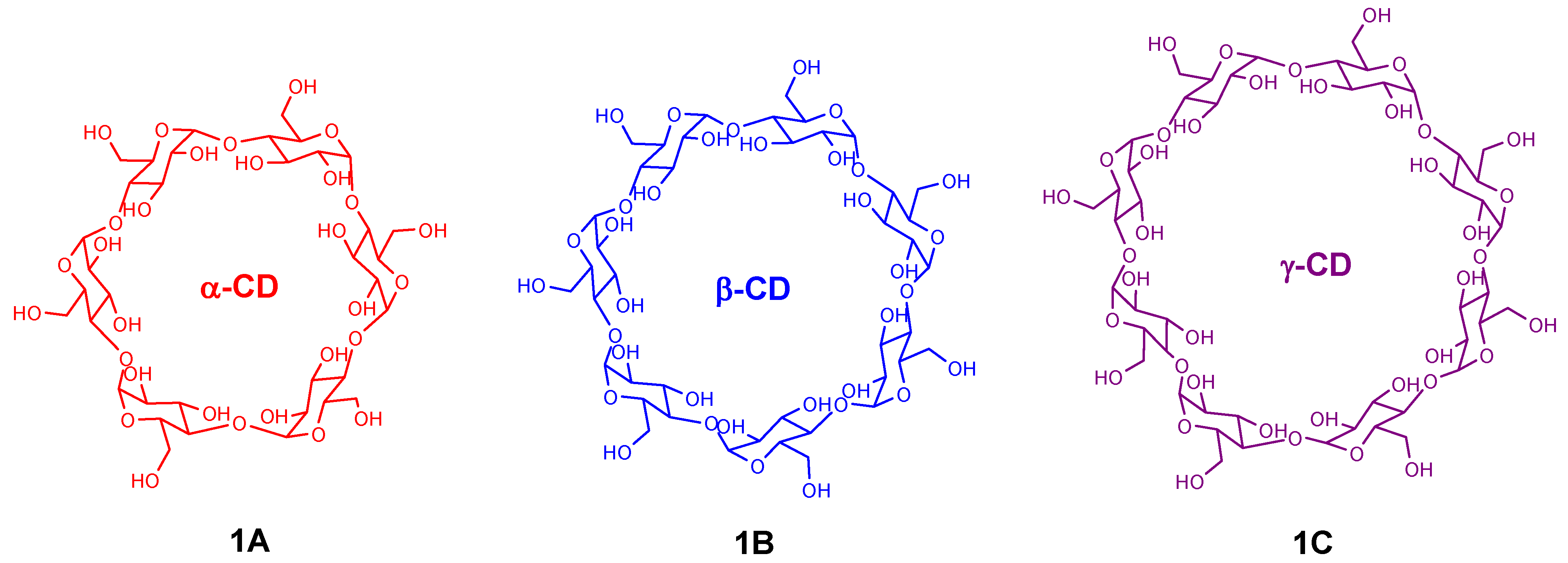
      <p>The cyclodextrins (CDs) are a family of cyclic oligosaccharides linked by α-1,4-glucopyranose units. The family is made up of three major and well-known CDs: α-, β-, and γ-CD, containing six (<bold>1A</bold>), seven (<bold>1B</bold>) and eight (<bold>1C</bold>) glucose subunits, respectively (<xref ref-type="fig" rid="molecules-17-11763-f001">Figure 1</xref>). Cyclodextrins feature a hydrophobic inner cavity and a hydrophilic outer surface with their shape resembling a truncated cone. CDs are extensively used not only as excellent receptors for molecular recognition but also as sophisticated building blocks for supramolecular architectures. The unique applications of cyclodextrins are mainly due to (i) their high water solubility; (ii) their ability to accommodate a wide variety of guest molecules and (iii) their well-defined molecular structure [<xref ref-type="bibr" rid="B21-molecules-17-11763">21</xref>,<xref ref-type="bibr" rid="B22-molecules-17-11763">22</xref>,<xref ref-type="bibr" rid="B23-molecules-17-11763">23</xref>,<xref ref-type="bibr" rid="B24-molecules-17-11763">24</xref>,<xref ref-type="bibr" rid="B25-molecules-17-11763">25</xref>,<xref ref-type="bibr" rid="B30-molecules-17-11763">30</xref>,<xref ref-type="bibr" rid="B31-molecules-17-11763">31</xref>,<xref ref-type="bibr" rid="B32-molecules-17-11763">32</xref>,<xref ref-type="bibr" rid="B33-molecules-17-11763">33</xref>,<xref ref-type="bibr" rid="B34-molecules-17-11763">34</xref>].</p>
      <fig id="molecules-17-11763-f001" position="float">
        <label>Figure 1</label>
        <caption>
          <p>Structures of α-cyclodextrin (<bold>1A</bold>), β-cyclodextrin (<bold>1B</bold>) and γ-cyclodextrin (<bold>1C</bold>).</p>
        </caption>
        <graphic xmlns:xlink="http://www.w3.org/1999/xlink" xlink:href="molecules-17-11763-g001.tif"/>
      </fig>
      <p>The binding interactions between porphyrins and cyclodextrins have provided novel molecular assemblies. Porphyrin-cyclodextrin interactions can be of different types: mutual bonding between them through ionic or covalent bonds or just simple encapsulation of the porphyrin into a CD cavity without any bonding interaction. After binding with CDs, some dynamic and static properties of porphyrin molecules, namely physical, photophysical, and photochemical properties, can change dramatically, and can cause changes in the equilibrium between monomer and assembled aggregates. All unique properties of CDs together with the catalytic and photosensitizing efficiency of porphyrin macrocycle have made the CD-porphyrin ensembles precious functional materials.</p>
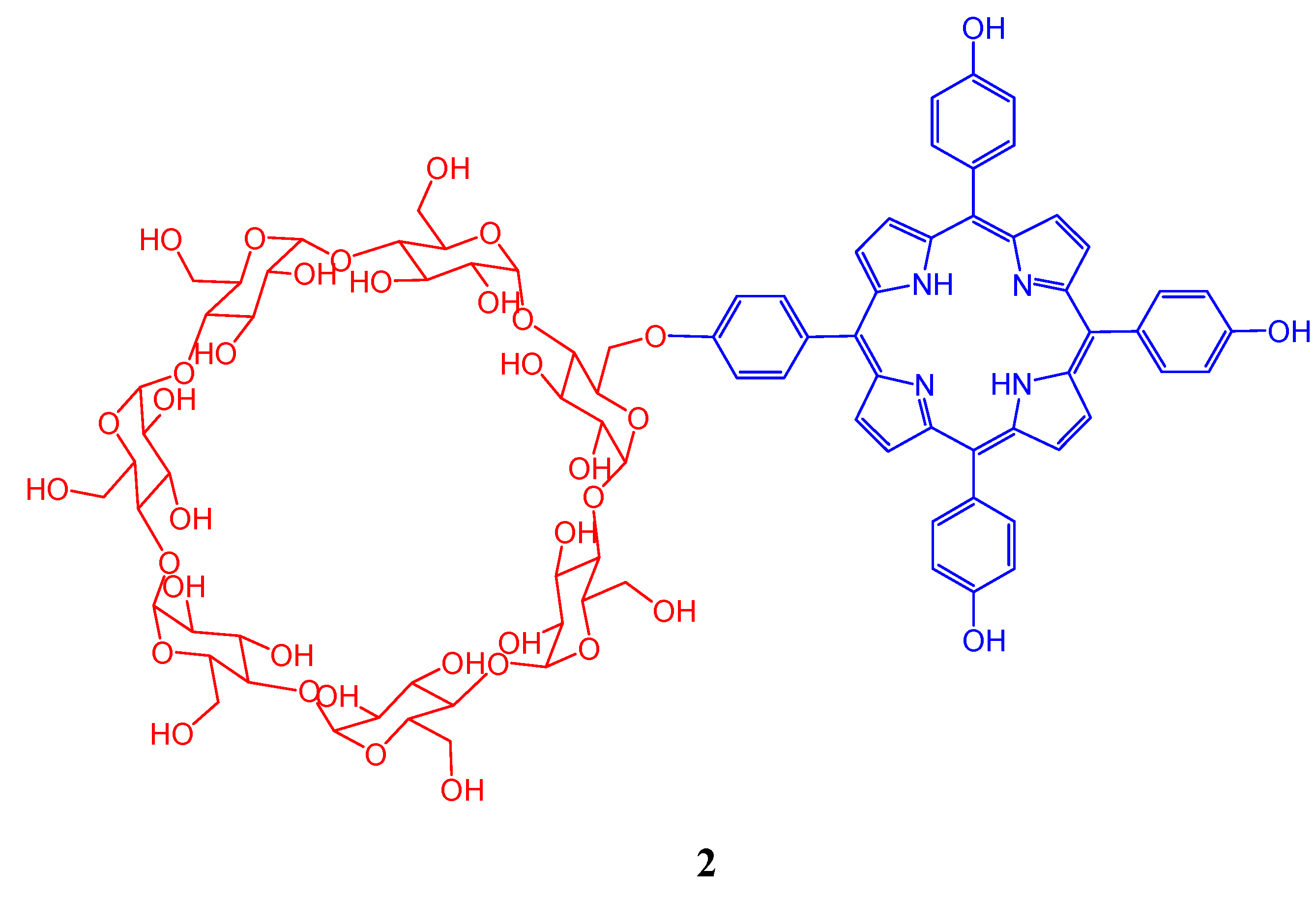
      <p>The covalent attachment between functionalized cyclodextrins with suitable porphyrin units are an attractive strategy to build up novel host-guest systems. A novel porphyrin-cyclodextrin conjugate, 5[4-(6-<italic>O</italic>-β-cyclodextrin)-phenyl],10,15,20-tris(4-hydroxyphenyl)-porphyrin (CD-THPP) (<xref ref-type="fig" rid="molecules-17-11763-f002">Figure 2</xref>), has been synthesized by Puglisi <italic>et al</italic>. in good yield starting from 6-<italic>O</italic>-tosyl-β-cyclodextrin using 5,10,15,20-tetra(4-hydroxyphenyl)porphyrin (<italic>p</italic>-THPP) as a nucleophile [<xref ref-type="bibr" rid="B35-molecules-17-11763">35</xref>]. In neat methanol, CD-THPP is found to be present in monomeric form and exhibits spectroscopic features virtually identical to that of <italic>p</italic>-THPP. In water-methanol solvent mixture (9:1; v/v), CD-THPP shows a tendency to self-arrange as a dimer, whose formation is strongly encouraged by stacking interactions between the aromatic rings and intermolecular hydrophobic porphyrin-cyclodextrin interactions. This supramolecular species exhibited a strong exciton coupling and, contrary to the parent <italic>p</italic>-THPP, showed a good response to light excitation, as confirmed by the considerable fluorescence emission and triplet-triplet transient absorption. The authors also reported that incorporation of suitable guests into the CD cavity triggers a new rearrangement of the dimer with a higher degree of overlap between the porphyrin chromophores, facilitating the occurrence of intramolecular photoinduced electron transfer between the guest and the porphyrin unit.</p>
      <fig id="molecules-17-11763-f002" position="float">
        <label>Figure 2</label>
        <caption>
          <p>Schematic representation of 5[4-(6-<italic>O</italic>-β-cyclodextrin)-phenyl],10,15,20-tris(4-hydroxyphenyl)-porphyrin.</p>
        </caption>
        <graphic xmlns:xlink="http://www.w3.org/1999/xlink" xlink:href="molecules-17-11763-g002.tif"/>
      </fig>
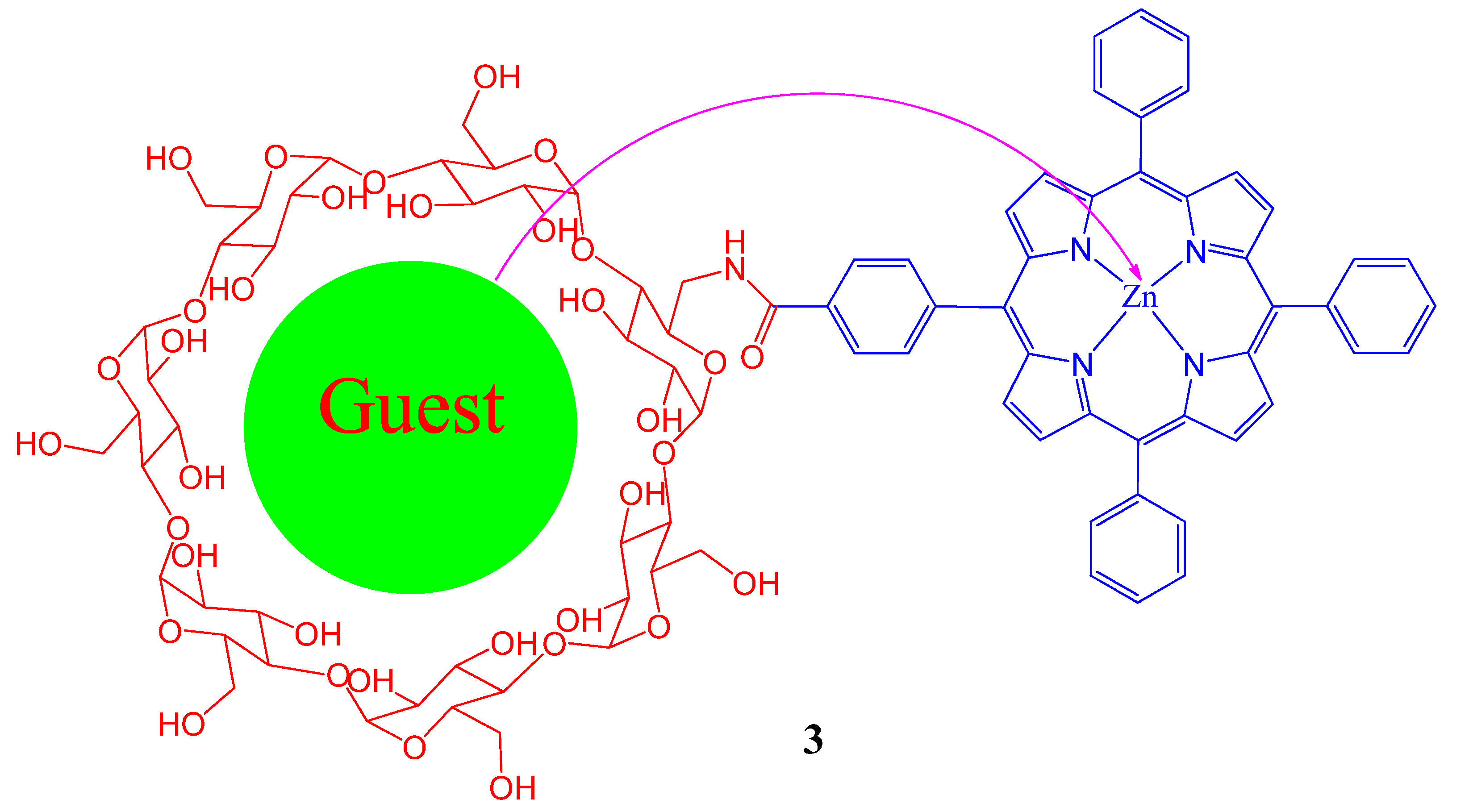
      <p>It is reported that covalent attachment of a porphyrin head group onto a guanine-rich oligonucleotide strand can enhance the self-assembly of DNA quadruplexes through porphyrin-based π-π interactions [<xref ref-type="bibr" rid="B36-molecules-17-11763">36</xref>]. Modulation of these allosteric interactions is found to be possible by addition of a porphyrin-cyclodextrin complexing derivative which allows a high degree of control over the formation and disassembly of these guanine quadruplexes. A composite of Zn tetraphenylporphyrin linked with β-cyclodextrin (<xref ref-type="fig" rid="molecules-17-11763-f003">Figure 3</xref>), was prepared as a convenient scaffold for a self-assembled energy-transfer complex and the energy-transfer properties of this host-complex were studied for several organic guests by fluorescence and fluorescence-excitation spectroscopies [<xref ref-type="bibr" rid="B37-molecules-17-11763">37</xref>].</p>
      <fig id="molecules-17-11763-f003" position="float">
        <label>Figure 3</label>
        <caption>
          <p>Energy transfer from the guest species to metalloporphyrin of the cyclodextrin-porphyrin conjugate.</p>
        </caption>
        <graphic xmlns:xlink="http://www.w3.org/1999/xlink" xlink:href="molecules-17-11763-g003.tif"/>
      </fig>
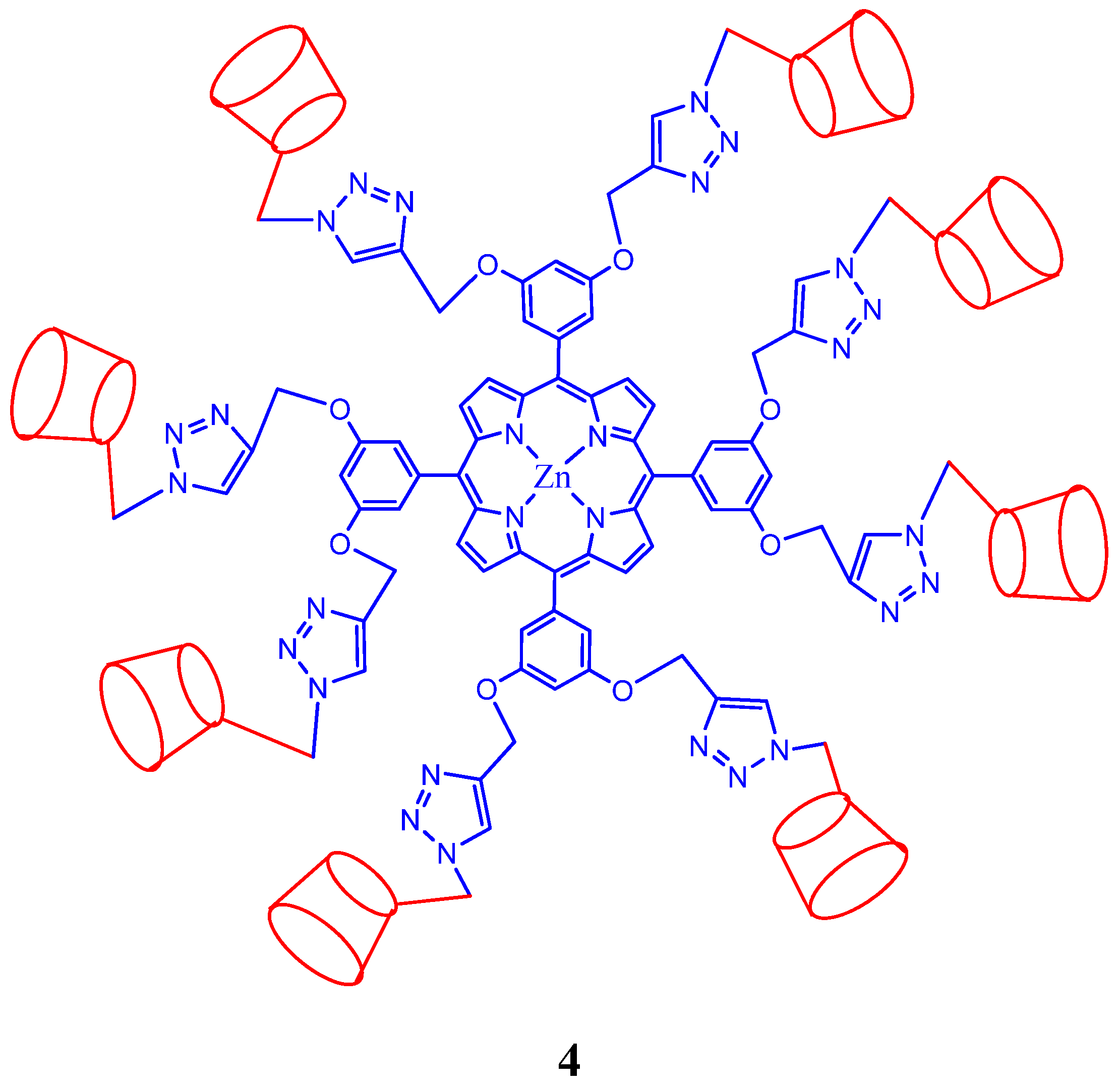
      <p>A novel water soluble nano-rod, synthesized by self-assembly of pristine C<sub>60</sub> and a double-sided porphyrin projecting four β-cyclodextrins from each face, as shown in <xref ref-type="fig" rid="molecules-17-11763-f004">Figure 4</xref>, has been reported by Fathalla <italic>et al</italic>. [<xref ref-type="bibr" rid="B38-molecules-17-11763">38</xref>].</p>
      <fig id="molecules-17-11763-f004" position="float">
        <label>Figure 4</label>
        <caption>
          <p>Schematic representation of cyclodextrin-Zinc porphyrin system.</p>
        </caption>
        <graphic xmlns:xlink="http://www.w3.org/1999/xlink" xlink:href="molecules-17-11763-g004.tif"/>
      </fig>
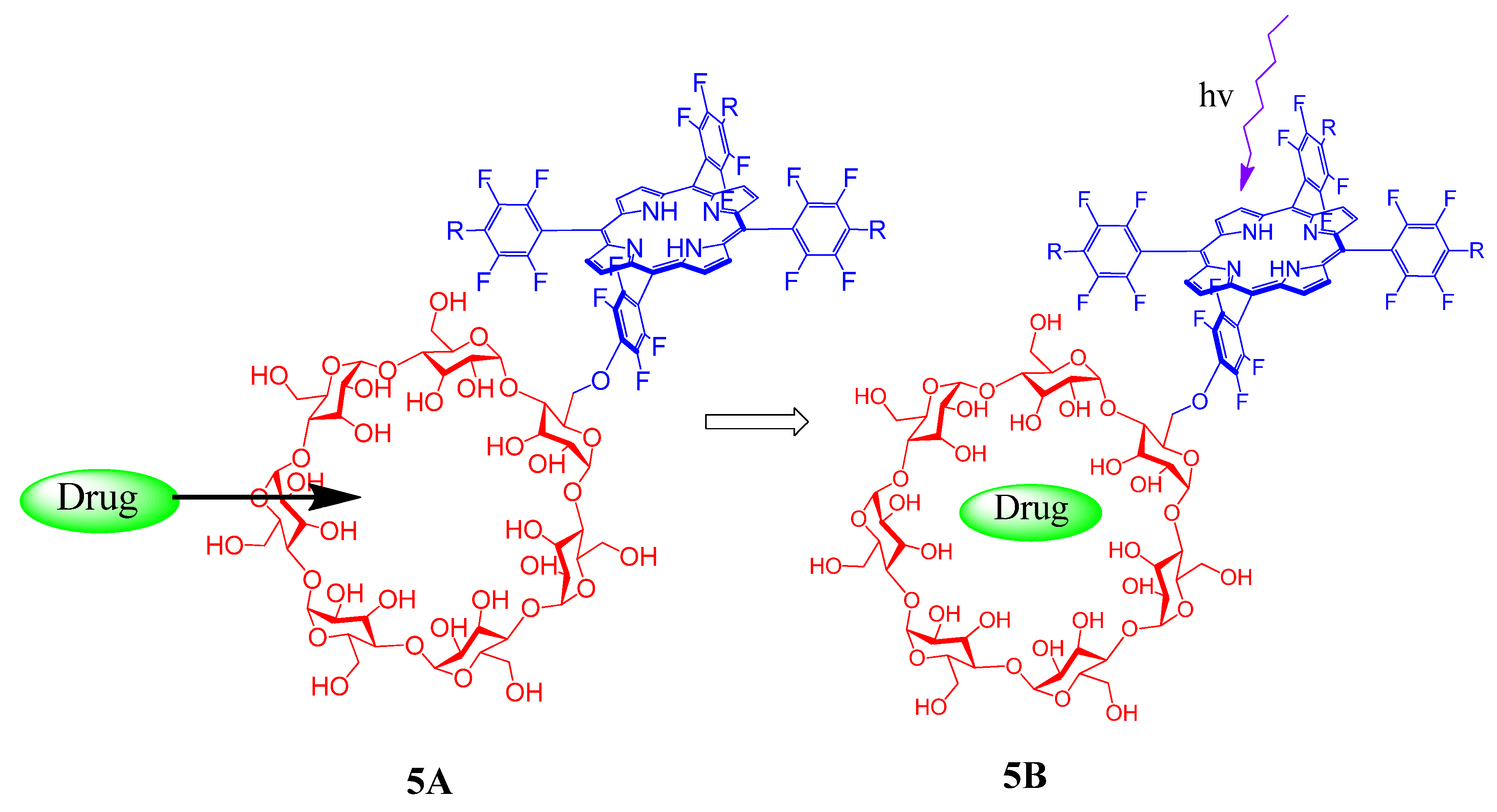
      <p>The most fascinating area of cyclodextrin-porphyrin system is in the field of drug delivery and related biomedical applications. Many porphyrin-cyclodextrin conjugates were prepared and tested for selective and effective multifunctional drug delivery and therapy. A porphyrin-CD system <bold>5A</bold> (<xref ref-type="fig" rid="molecules-17-11763-f005">Figure 5</xref>) in which efficient binding of the selected drug to the cyclodextrin cavity and photosensitizing properties of the porphyrin moiety causes photodamage to the cancer tissues is described by Kralova <italic>et al</italic>. [<xref ref-type="bibr" rid="B39-molecules-17-11763">39</xref>]. This combined effect of chemotherapy and photodynamic therapy (compound <bold>5B</bold>) has been demonstrated by various <italic>in vitro</italic> and <italic>in vivo</italic> studies.</p>
      <fig id="molecules-17-11763-f005" position="float">
        <label>Figure 5</label>
        <caption>
          <p>Schematic representation of combined chemotherapy and photodynamic therapy achieved by a drug encapsulated cyclodextrin-porphyrin conjugate (<bold>5B</bold>).</p>
        </caption>
        <graphic xmlns:xlink="http://www.w3.org/1999/xlink" xlink:href="molecules-17-11763-g005.tif"/>
      </fig>
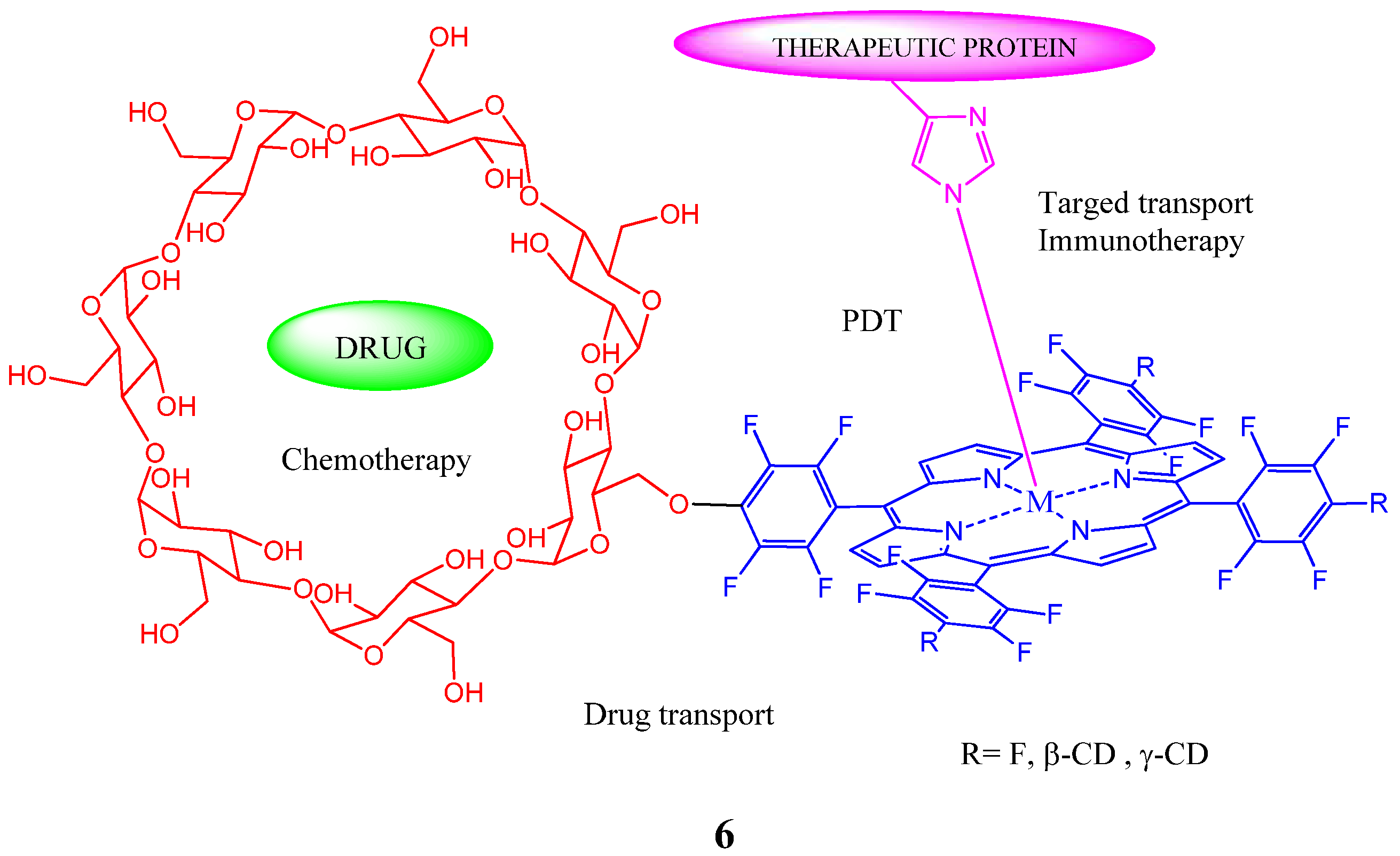
      <p>The coordination attachment of therapeutic proteins to a drug delivery system consists of cyclodextrin conjugated metalloporphyrin <bold>6</bold> (<xref ref-type="fig" rid="molecules-17-11763-f006">Figure 6</xref>), and its application in combined therapy is demonstrated by Kejik <italic>et al</italic>. [<xref ref-type="bibr" rid="B40-molecules-17-11763">40</xref>].</p>
      <fig id="molecules-17-11763-f006" position="float">
        <label>Figure 6</label>
        <caption>
          <p>Therapeutic protein coordinated drug delivery system (<bold>6</bold>).</p>
        </caption>
        <graphic xmlns:xlink="http://www.w3.org/1999/xlink" xlink:href="molecules-17-11763-g006.tif"/>
      </fig>
      <p>Proof of concept is described by the synthesizing a drug delivery system for cytostatics, which is based on a combination of Zn-porphyrin-cyclodextrin conjugates and their supramolecular coordination complexes with various therapeutic proteins. This system allows combined photodynamic therapy, cell targeted chemotherapy and immunotherapy. Compared to the efficiency of building blocks used for the construction of the system, this coordination assembly exhibited therapeutic superiority, when tested in a mouse model with human C32 carcinoma.</p>
      <p>Supramolecular materials, made up of cyclodextrin-porphyrin combinations generated via the intermolecular non-covalent association of monomeric building blocks by the “bottom up” approach, have become highly active research area in the field of nanosynthesis, pharmaceutical and biomimetic applications. As discussed earlier, cyclodextrins, which are excellent receptors for molecular recognition are convenient building blocks to construct nanostructured supramolecular materials especially bioactive and environment sensitive ones. On the other hand, porphyrins particularly ionic ones are widely used in photodynamic therapy (PDT) and have very important applications as functional materials, in the oxygen transport and activation in biological processes. Therefore, the combination of CD and ionic porphyrin in a supramolecular network may bring a breakthrough in many fields of material science, biological/medicinal chemistry owing to several inherent advantages. For example, the strong association of the CD cavity with anionic porphyrin in water can not only prevent the unfavorable porphyrin-porphyrin aggregation, but also enable the high stability of CD/porphyrin system in the biological environments such as body fluid. The presence of cyclodextrin also protects the porphyrin component in its transportation to the appropriate cellular site without undesirable damage.</p>
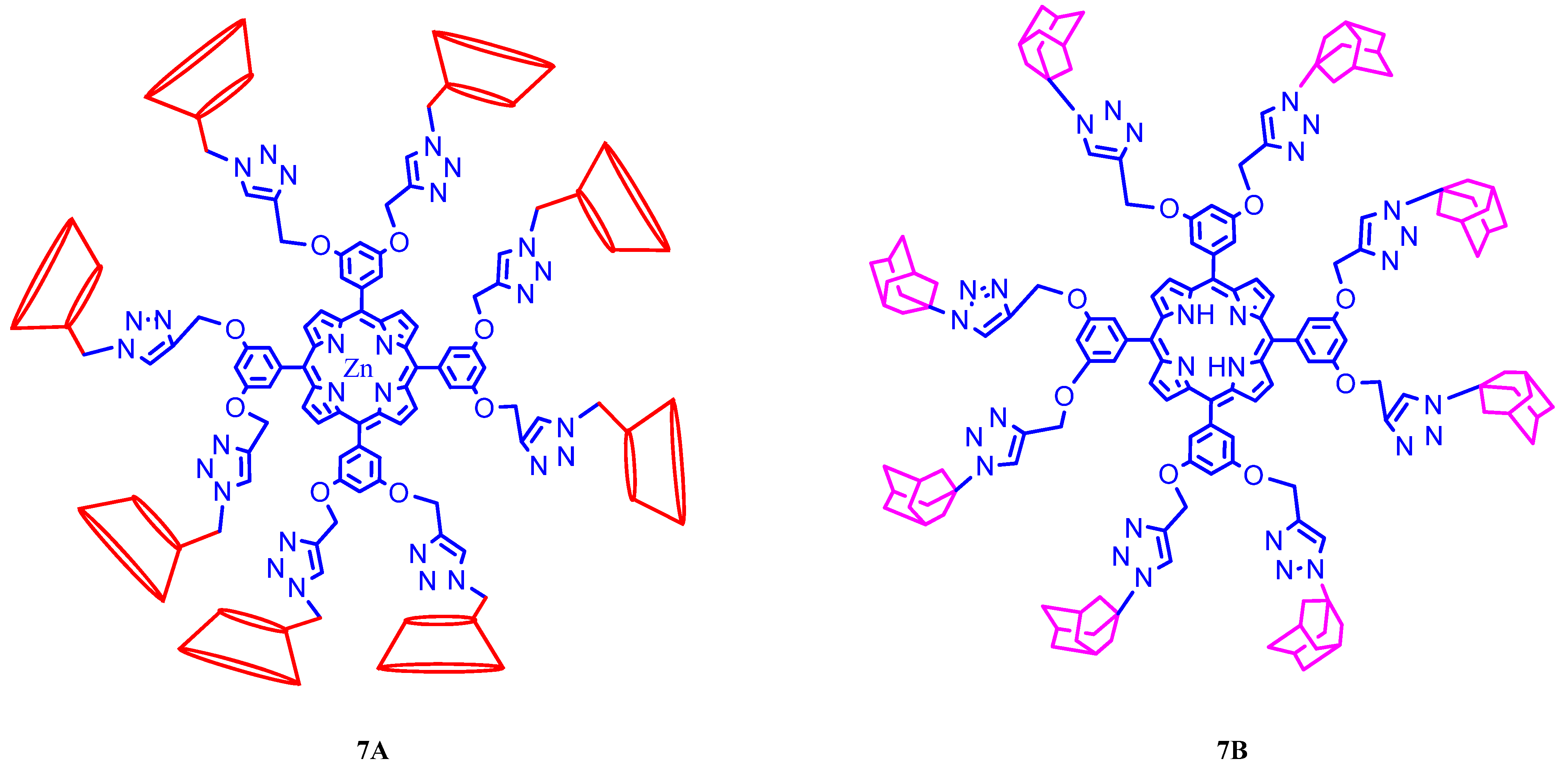
      <p>Supramolecular 1:1 inclusion complexes of 5-(<italic>p</italic>-hydroxyphenyl)-10,15,20-tris-(4-chlorophenyl)-porphyrin (<italic>p</italic>-HTClPP) with four different types of cyclodextrins, namely β-cyclodextrin (β-CD), heptakis(2,3,6-tri-<italic>O</italic>-methyl)-β-CD (TM-β-CD), carboxymethyl-β-cyclodextrin (CM-β-CD) and thio- butylether-β-CD (SBE-β-CD) were studied by absorption, fluorescence and <sup>1</sup>H-NMR spectroscopy. The formation of inclusion complexes was confirmed by observing the changes of spectroscopy properties [<xref ref-type="bibr" rid="B41-molecules-17-11763">41</xref>]. Compared with parent native β-CD, the inclusion abilities of modified β-CDs with <italic>p</italic>-HTClPP are found to be stronger. The hydrophobic effect plays an important role in the inclusion procedure. Interesting variations in fluorescence intensity of the <italic>p</italic>-HTClPP is also observed in these inclusion complexes. A complex of tetrakis(4-hydroxylphenyl)porphyrin (THPP) and cyclodextrin-modified multi-walled carbon nanotubes (MWNTs-CD) was prepared by Zhang and coworkers [<xref ref-type="bibr" rid="B42-molecules-17-11763">42</xref>]. The electron distribution of THPP is found to not be influenced by MWNTs-CD as evidenced by the UV-Vis spectra. On the other hand, the fluorescence of THPP is quenched, suggesting that there exists energy transfer between THPP and MWNTs-CD. The electrochemical behavior of porphyrin complex is similar to that of the inclusion complex of amino-modified cyclodextrin and THPP, but different from that of the MWNTs-CD. These phenomena indicate that the cyclodextrin moieties play an important role in the interaction between THPP and MWNTs-CD. It is also reported that self-assembly of porphyrin-CD conjugates <bold>7A</bold> (<xref ref-type="fig" rid="molecules-17-11763-f007">Figure 7</xref>) and porphyrin-adamantane conjugates <bold>7B</bold> in water yielded well-defined stable porphyrin nanowires wherein the individual monomers do not aggregate via π-π interactions [<xref ref-type="bibr" rid="B43-molecules-17-11763">43</xref>].</p>
     <p>Interaction of <italic>meso</italic>-tetrakis(2-thienyl)porphyrin (H2TTP) and its Cu-derivative (Cu-TTP) with α-cyclodextrin (α-CD), β-CD, γ-CD, heptakis(2,3,6-tri-<italic>O</italic>-methyl)-β-CD (TM-β-CD) was studied in phosphate buffer [<xref ref-type="bibr" rid="B44-molecules-17-11763">44</xref>]. The H2TTP and Cu-TTP can form 1:2 inclusion complexes with TM-β-CD and 1:1 inclusion complexes with the other three cyclodextrins. Also the inclusion ability of α-CD with H2TTP and Cu-TTP is the strongest among the three native CDs. The inclusion ability of TM-β-CD with H2TTP and Cu-TTP is stronger, compared to the native β-CD, which indicates that the capacity matching plays a crucial role in the inclusion procedure except for the hydrophobic effect.</p>
       <fig id="molecules-17-11763-f007" position="float">
        <label>Figure 7</label>
        <caption>
          <p>Porphyrin-cyclodextrin conjugate (<bold>7A</bold>) and porphyrin-adamantane conjugate (<bold>7B)</bold> employed to generate porphyrin nanowares.</p>
        </caption>
        <graphic xmlns:xlink="http://www.w3.org/1999/xlink" xlink:href="molecules-17-11763-g007.tif"/>
      </fig>
      <p>A porphyrin ([([5,15-bis(4-(3-(1<italic>H</italic>-pyrrol-1-yl)propoxy)phenyl)-10,20-diphenylporphinato]zinc(II)) film on an indium-tin oxide (ITO) electrode was prepared in which the self-aggregation of the porphyrin film was suppressed by encapsulation of the porphyrin unit in the cavity of cyclodextrin [<xref ref-type="bibr" rid="B45-molecules-17-11763">45</xref>]. The photocurrent density and the quantum yield in this porphyrin-cyclodextrin system are found to be improved and it was demonstrated that this high quantum yield, perhaps 25 times larger, arises from the isolation of the porphyrin unit by cyclodextrin through host-guest interactions.</p>
      <p>The interaction of 5-pyridyl-10,15,20-tris-(<italic>p</italic>-chlorophenyl)porphyrin (PyTPP) with β-CD and heptakis(2,3,6-tri-<italic>O</italic>-methyl)-β-CD (TM-β-CD) were studied by Guo <italic>et al</italic>. [<xref ref-type="bibr" rid="B46-molecules-17-11763">46</xref>]. Compared to β-CD, the inclusion ability of TM-β-CD with PyTPP is stronger. PyTPP also prefers to form the 1:1 inclusion complex with TM-β-CD, but hardly forms inclusion complex with β-CD. The interaction of PyTPP with DNA was further also carried out in the presence and absence of TM-β-CD. In the presence of TM-β-CD a significant decrease of the binding constant and binding numbers were observed and the interaction of porphyrin-bound DNA has been inhibited, which was due to the fact that PyTPP enter into the cavity of TM-β-CD and influence binding affinity of PyTPP to DNA. The aggregation behavior of the zinc porphyrin-β-CD conjugate in a water/ethanol binary mixed solution was investigated [<xref ref-type="bibr" rid="B47-molecules-17-11763">47</xref>]. The spectroscopic data and the atomic force microscopy (AFM) image strongly suggest that a part of a Zn porphyrin is included in the β-CD nanocavity of another ZnP-β-CD conjugate at certain concentrations and hence leading to the formation of Zn porphyrin J-aggregates.</p>
      <p>A novel multiple supramolecular assembly fabricated through non-covalent interactions was reported recently, in which a folic acid-modified β-cyclodextrin acted as a target unit, an adamantanyl porphyrin acted as a linker unit, and graphene oxide acted as a carrier unit [<xref ref-type="bibr" rid="B48-molecules-17-11763">48</xref>]. In this system, the graphene oxide unit could associate with the anticancer drug doxorubicin through π-π interactions, and the folic acid-modified β-cyclodextrin unit could recognize the folic acid receptors in cancer cells. Due to the cooperative contribution of these three units, the resulting supramolecular assembly, after association with doxorubicin, exhibited better drug activity and much lower toxicity than free doxorubicin <italic>in vivo</italic>.</p>
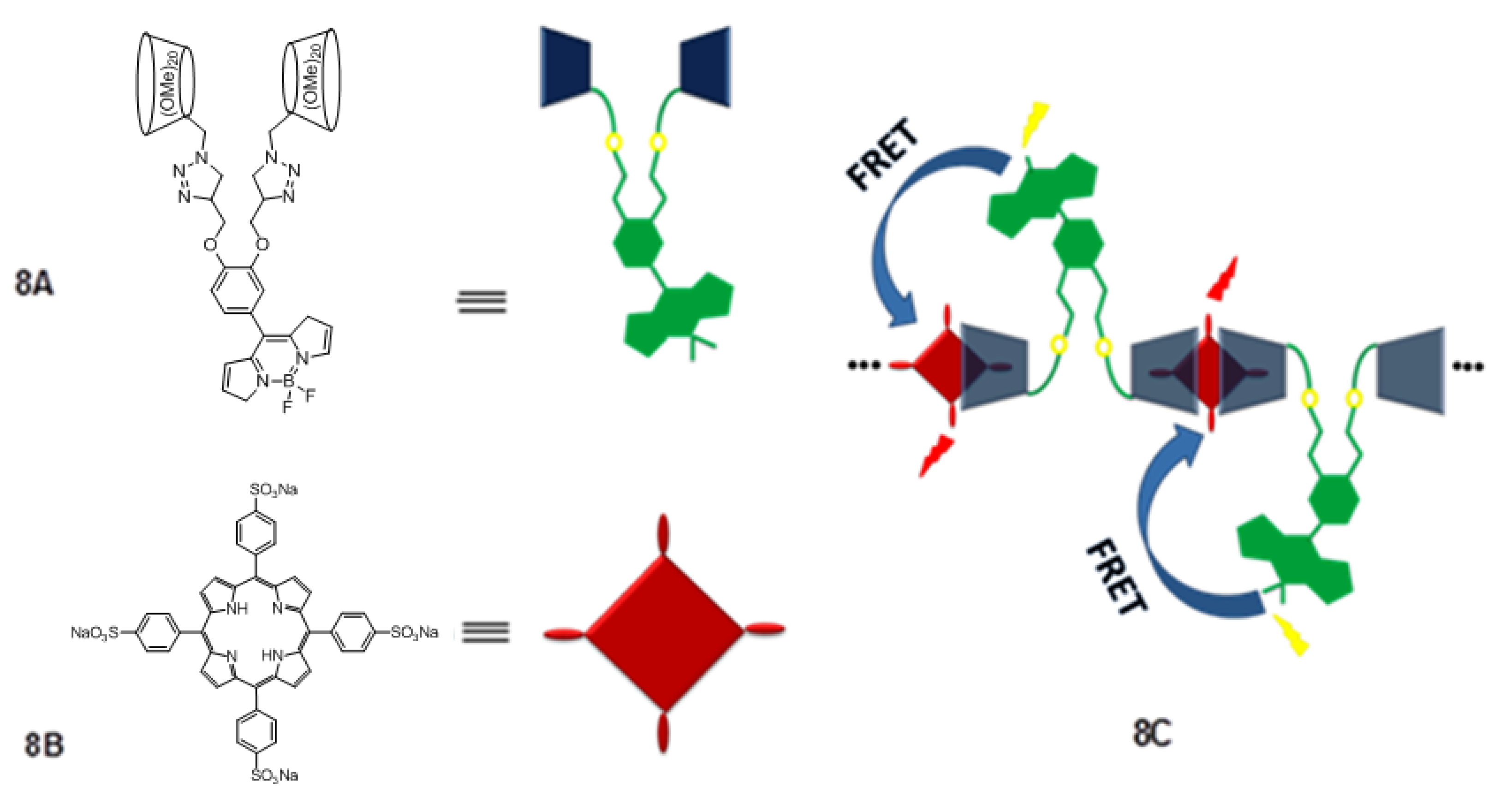
      <p>Many research groups are interested in the synthesis of inclusion complexes formed between anionic or cationic porphyrins with suitable cyclodextrins. 4,4-Difluoro-4-bora-3a,4a-diaza-s-indacene-bridged bis(permethyl-β-cyclodextrins) {3,4-[β-CD-triazole-CH<sub>2</sub>O]<sub>2</sub>C<sub>6</sub>H<sub>3</sub>}-BODIPY, (<xref ref-type="fig" rid="molecules-17-11763-f008">Figure 8</xref>, <bold>8A</bold>) was synthesized by Liu and coworkers through click chemistry, and it forms a well-defined linear assembly with 5,10,15,20-tetrakis(4-sulfonatophenyl)porphyrin (<xref ref-type="fig" rid="molecules-17-11763-f008">Figure 8</xref>, <bold>8B</bold>) via extremely strong host-guest interactions, (<italic>i.e</italic>. <xref ref-type="fig" rid="molecules-17-11763-f008">Figure 8</xref>, <bold>8C</bold>) [<xref ref-type="bibr" rid="B49-molecules-17-11763">49</xref>]. This host-guest system exhibited highly efficient fluorescence resonance energy transfer (FRET) from BODIPY donor to porphyrin acceptor and is observed that the energy transfer quantum yield is as high as 94% by virtue of such a noncovalent path. BODIPY was employed as an energy donor because it has strong UV absorption that emits a relatively sharp fluorescence peak with high quantum yield, and is relatively insensitive to the polarity and pH, and reasonably stable to physiological conditions. Porphyrin was used as the energy acceptor because its Q-band absorption overlaps BODIPY’s emission. Although this system is built by noncovalent approach, its accuracy of controlling location and orientation can compare well with that by the covalent approach because of the exceptionally strong binding ability, unambiguous binding stoichiometry, and geometry of permethyl-β-cyclodextin with porphyrin. In addition, the obtained assembly has benign water-solubility, allowing its potential application in biological system.</p>
      <fig id="molecules-17-11763-f008" position="float">
        <label>Figure 8</label>
        <caption>
          <p>Representation of fluorescence resonance energy transfer (FRET) from modified cyclodextrin donor to porphyrin acceptor.</p>
        </caption>
        <graphic xmlns:xlink="http://www.w3.org/1999/xlink" xlink:href="molecules-17-11763-g008.tif"/>
      </fig>
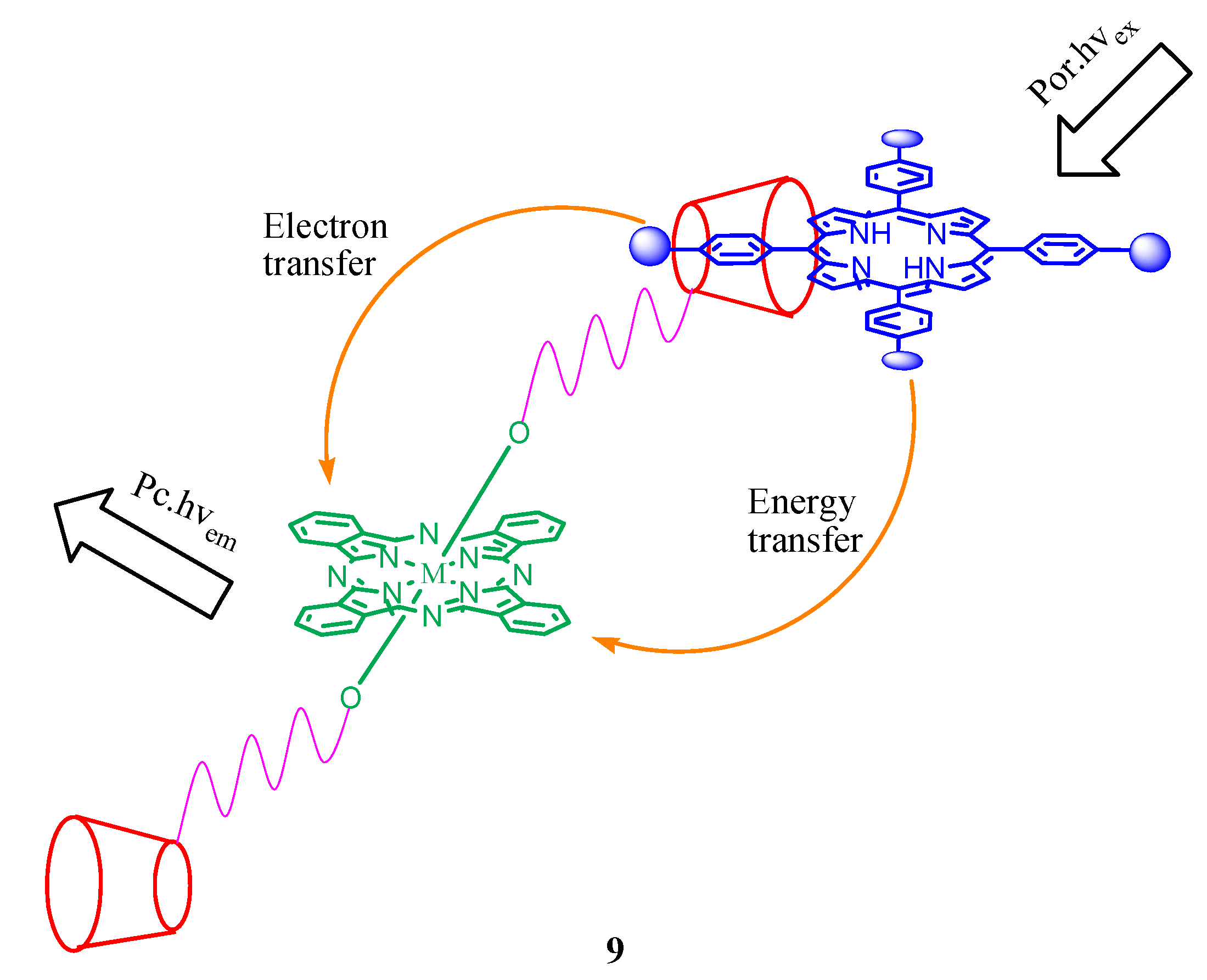
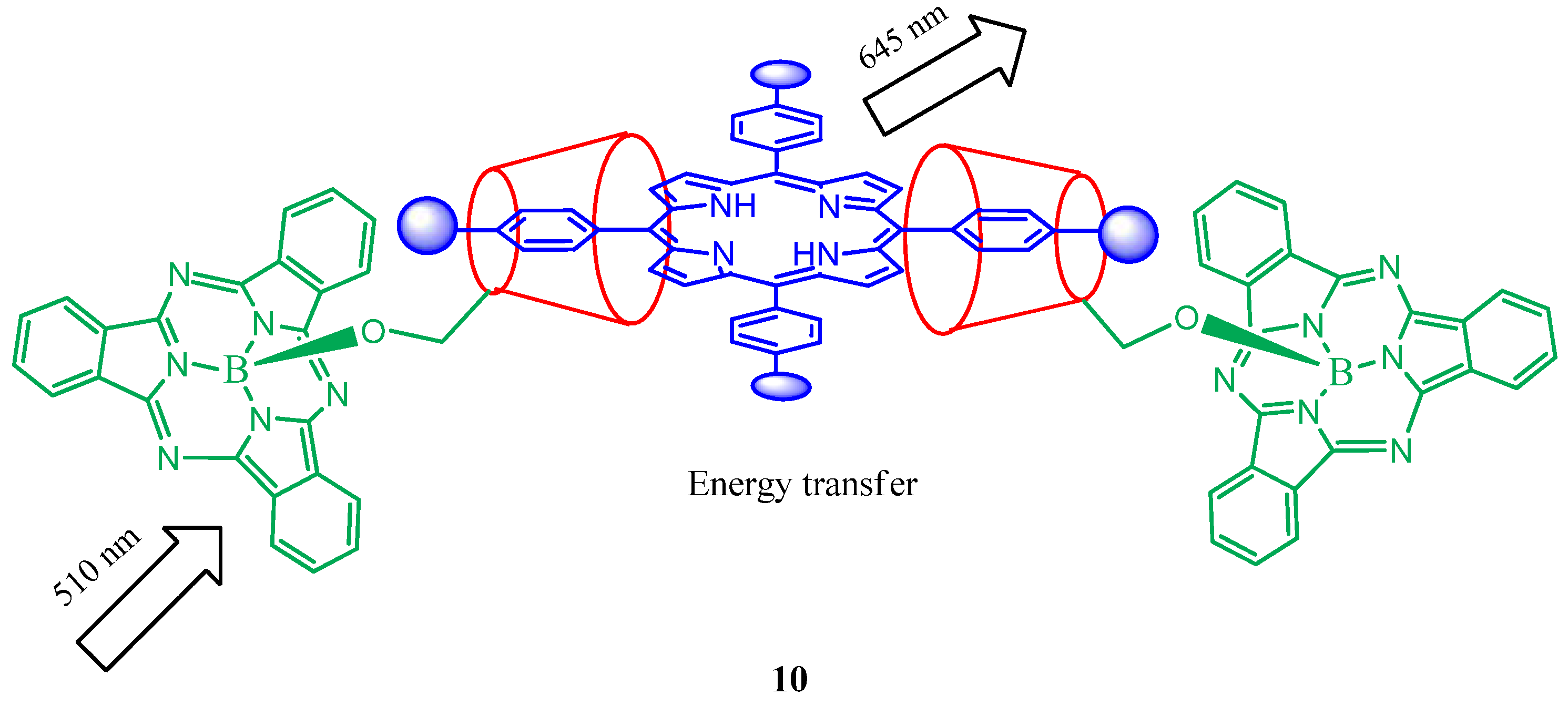
      <p>A series of host-guest 1:1 complexes <bold>9</bold> (<xref ref-type="fig" rid="molecules-17-11763-f009">Figure 9</xref>) formed between a tetrasulfonated porphyrin and several silicon (IV) phthalocyanines substituted axially with two permethylated β-cyclodextrin units via different spacers has been reported [<xref ref-type="bibr" rid="B50-molecules-17-11763">50</xref>]. It is found that the two major photoinduced processes, namely fluorescence resonance energy transfer and charge transfer are involved between the porphyrin and pthalocyanine which are controlled by the spacer between the β-cyclodextrin units and the silicon centre of phthalocyanine. The spacer having a tetraethylene glycol or oxo linker exhibited an efficient charge transfer from the excited phthalocyanine to the porphyrin entity. A stable 2:1 host-guest complex (<xref ref-type="fig" rid="molecules-17-11763-f010">Figure 10</xref>) was also reported to form between a β-cyclodextrin-conjugated subphthalocyanine and a tetrasulfonated porphyrin in water [<xref ref-type="bibr" rid="B51-molecules-17-11763">51</xref>]. The complex exhibits energy transfer from the excited subphthalocyanine to the porphyrin core with an excitation energy transfer quantum yield of 0.38.</p>
      <fig id="molecules-17-11763-f009" position="float">
        <label>Figure 9</label>
        <caption>
          <p>Energy- and electron-transfer between the porphyrin and pthalocyanine connected through a β-cyclodextrin spacer (<bold>9</bold>).</p>
        </caption>
        <graphic xmlns:xlink="http://www.w3.org/1999/xlink" xlink:href="molecules-17-11763-g009.tif"/>
      </fig>
      <fig id="molecules-17-11763-f010" position="float">
        <label>Figure 10</label>
        <caption>
          <p>Representation of the 2:1 host-guest complex (<bold>10</bold>) formed by a β-cyclodextrin-conjugated subphthalocyanine and tetrasulfonated porphyrin and its energy transfer abilities.</p>
        </caption>
        <graphic xmlns:xlink="http://www.w3.org/1999/xlink" xlink:href="molecules-17-11763-g010.tif"/>
      </fig>
      <p>A cytochrome P<sub>450</sub> model comprised of a 1:1 inclusion complex [tetrakis(<italic>p</italic>-sulfonato-phenyl)porphyrinato]Fe(III), TPPSFeCl, TPPS4FeCl, and 2-hydroxypropyl-β-cyclodextrin, HP-β-CD is reported by Khavasi <italic>et al</italic>. [<xref ref-type="bibr" rid="B52-molecules-17-11763">52</xref>]. The inclusion behavior of HP-β-CD depends on the pH and the inclusion ability of the TPPS4FeCl/HP-β-CD system is strongest in neutral solution. This inclusion complex has been examined for the aqueous catalytic oxidation of styrene under different reaction conditions and is observed that addition of HP-β-CD to the porphyrin solution increases catalytic activity and selectivity of the system. Tetrakis(permethyl-β-cyclodextrin)-modified Zn(II) porphyrin) and tetra(β-cyclodextrin)-modified Zn(II) porphyrin were synthesized via click chemistry by Liu <italic>et al</italic>. [<xref ref-type="bibr" rid="B53-molecules-17-11763">53</xref>]. Intermolecular inclusion complexation of these structurally similar systems with tetrasodium tetraphenylporphyrin tetrasulfonate gave two distinctly different nano-architectures with alternate porphyrin and cyclodextrin arrays, which were proven to be network and nanorod aggregates, respectively. The authors also proposed the mechanism that results in nanorod to network aggregates transition observed in these nanosystems. Solvent controlled photoinduced electron transfer (PET) between an anionic porphyrin and a cyclodextrin modified carbon nanotube is also reported by the same group and is shown that the CD cavities play a vital role on the control of the PET process [<xref ref-type="bibr" rid="B54-molecules-17-11763">54</xref>]. 1:1 inclusion complexes are reported to form from cationic 5,10,15,20-tetrakis[4-(3-pyridinium-propoxy)phenyl]porphyrintetrakis-bromide (TPPOC3P) and β-cyclodextrins [<xref ref-type="bibr" rid="B55-molecules-17-11763">55</xref>] or from <italic>meso</italic>-tetrakis(2-hydroxy-5-sulfonatophenyl)porphyrin with six different cyclodexrtins [<xref ref-type="bibr" rid="B56-molecules-17-11763">56</xref>]. Kano <italic>et al</italic>. reported a novel system in which an anionic cyclodextrin bonded electrostatically with cationic cytochrome c where the cyclodextrin covers the hemin pockets of about two-thirds of the cytochrome molecules. This association complex is then further complexes with a non-ionic porphyrin to form a ternary complex in which static fluorescence quenching of the porphyrin by cytochrome c takes place [<xref ref-type="bibr" rid="B57-molecules-17-11763">57</xref>].</p>
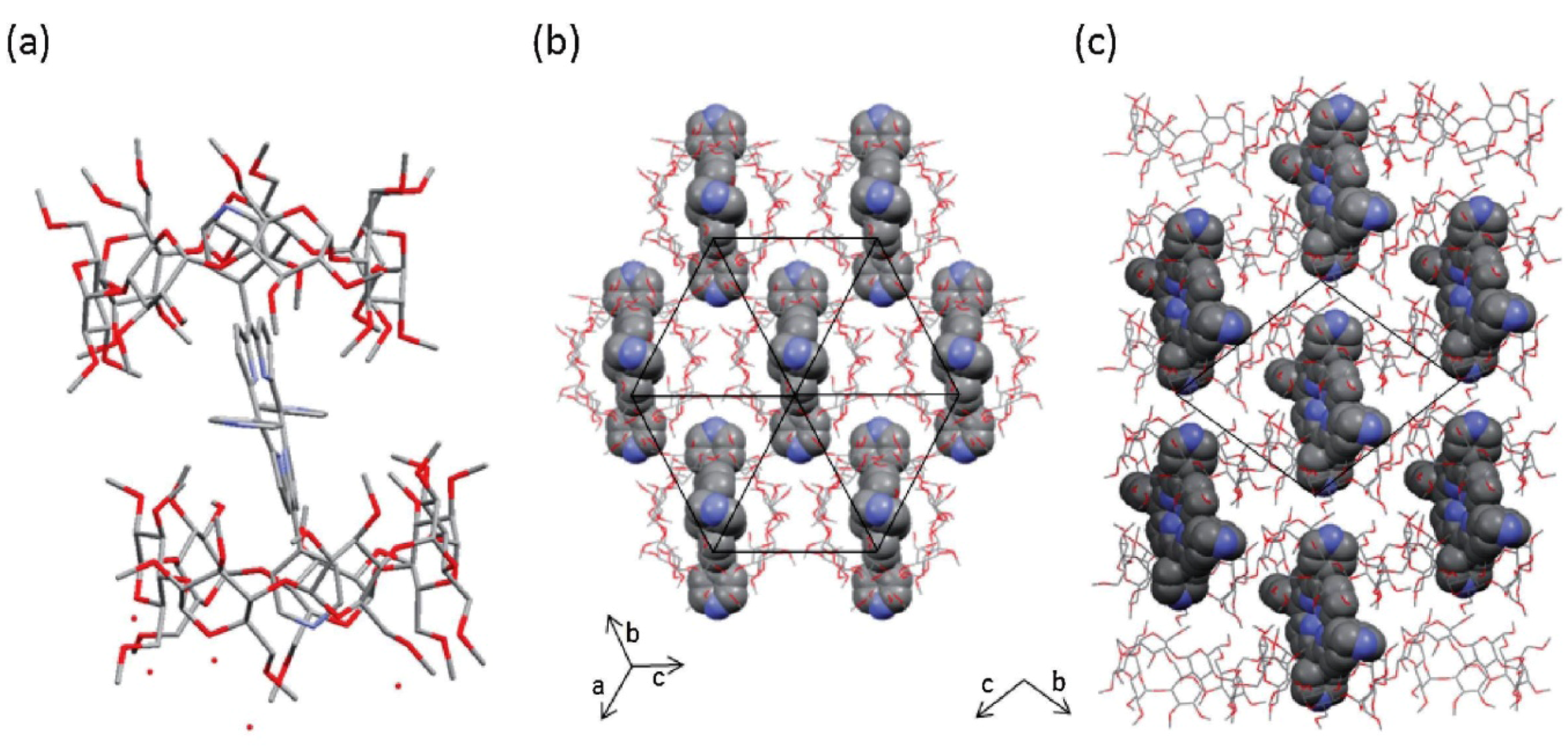
      <p>A single crystal X-structure of porphyrin bicapped with cyclodextrin (<xref ref-type="fig" rid="molecules-17-11763-f011">Figure 11</xref>) was reported recently by Tsuchiya <italic>et al</italic>. [<xref ref-type="bibr" rid="B58-molecules-17-11763">58</xref>]. </p>
      <fig id="molecules-17-11763-f011" position="float">
        <label>Figure 11</label>
        <caption>
          <p>Crystal structure porphyrin-CD complex from ref [58]; (<bold>a</bold>) unit cell, (<bold>b</bold>) (111) plane and (<bold>c</bold>) along the axis. The hydrogen atoms are omitted (reproduced with permission from The Chemical Society of Japan). </p>
        </caption>
        <graphic xmlns:xlink="http://www.w3.org/1999/xlink" xlink:href="molecules-17-11763-g011.tif"/>
      </fig>
      <p>In this study the authors used 2,3,6-Trimethyl-β-cyclodextrin and 5,10,15,20-tetrapyridylporphyrin to form host guest complex and got crystal from an aqueous solution of porphyrin containing an excess amount of cyclodextrin at 60 °C.</p>
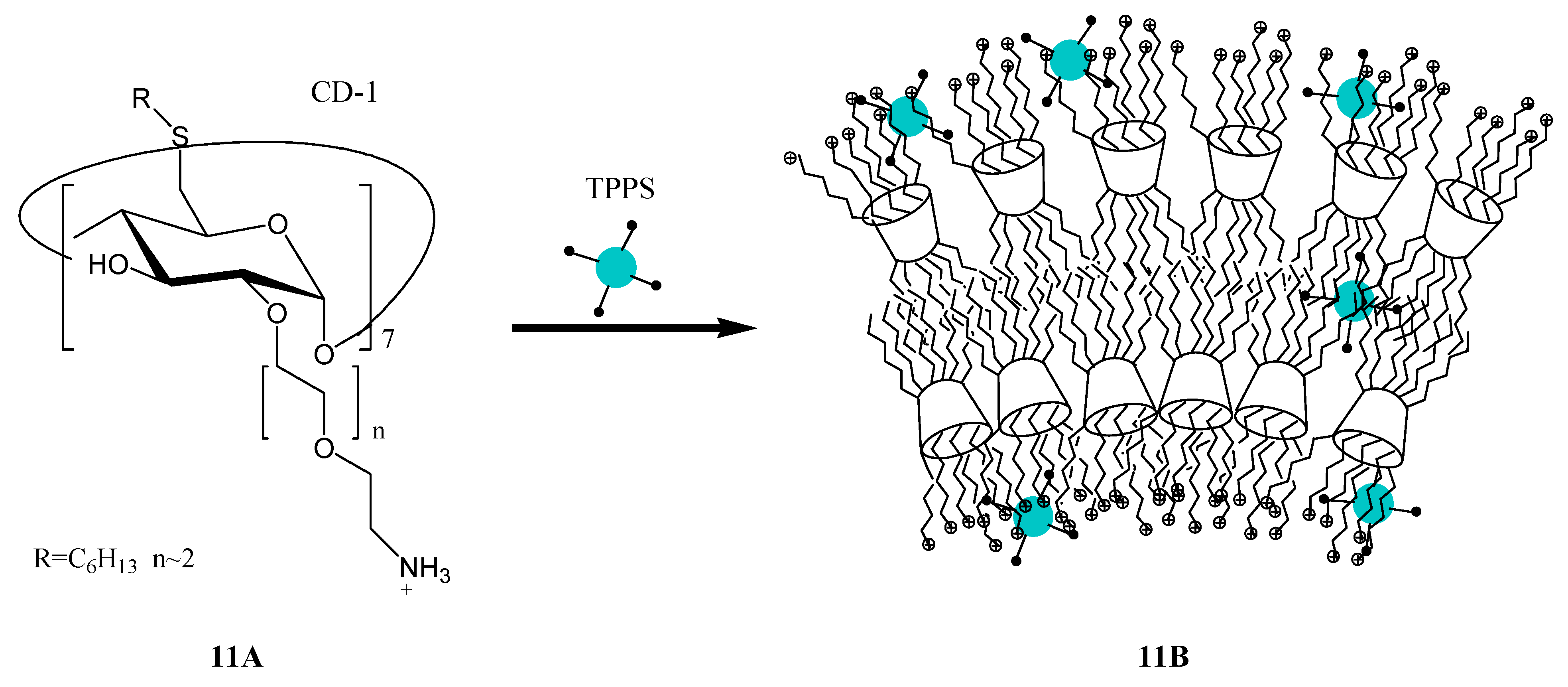
      <p>The capability of biocompatible nanoparticles (NPs, <xref ref-type="fig" rid="molecules-17-11763-f012">Figure 12</xref>, <bold>11B</bold>,) of cationic amphiphilic cyclodextrins (<xref ref-type="fig" rid="molecules-17-11763-f012">Figure 12</xref>, <bold>11A</bold>), entangling the anionic hydrophilic 5,10,15,20-tetrakis(4-sulfonatophenyl)-21<italic>H</italic>,23<italic>H</italic>-porphyrin (TPPS) to facilitate photoinduced energy and electron transfer with suitable donor and acceptor guest molecules has been demonstrated by Callari and coworkers [<xref ref-type="bibr" rid="B59-molecules-17-11763">59</xref>]. Anthracene (AN) and anthraquinone-2-sulfonate (AQS), which could be employed as appropriate energy donor and electron acceptor, respectively are found to be trapped within this NPs network. Fluorescence experiments provided clear evidence that the amphiphilic NPs strongly encourage singlet-singlet energy transfer from AN to TPPS as well as photoinduced electron transfer from TPPS to AQS. In view of the biocompatibility and drug-carrying properties of the NPs used, these results, according to the authors, can be of interest from the perspective of designing photo-activated drug delivery systems.</p>
      <fig id="molecules-17-11763-f012" position="float">
        <label>Figure 12</label>
        <caption>
          <p>Formation of biocompatible nanoparticles (<bold>11B</bold>) of cationic amphiphilic cyclodextrins entangling the anionic porphyrins.</p>
        </caption>
        <graphic xmlns:xlink="http://www.w3.org/1999/xlink" xlink:href="molecules-17-11763-g012.tif"/>
      </fig>
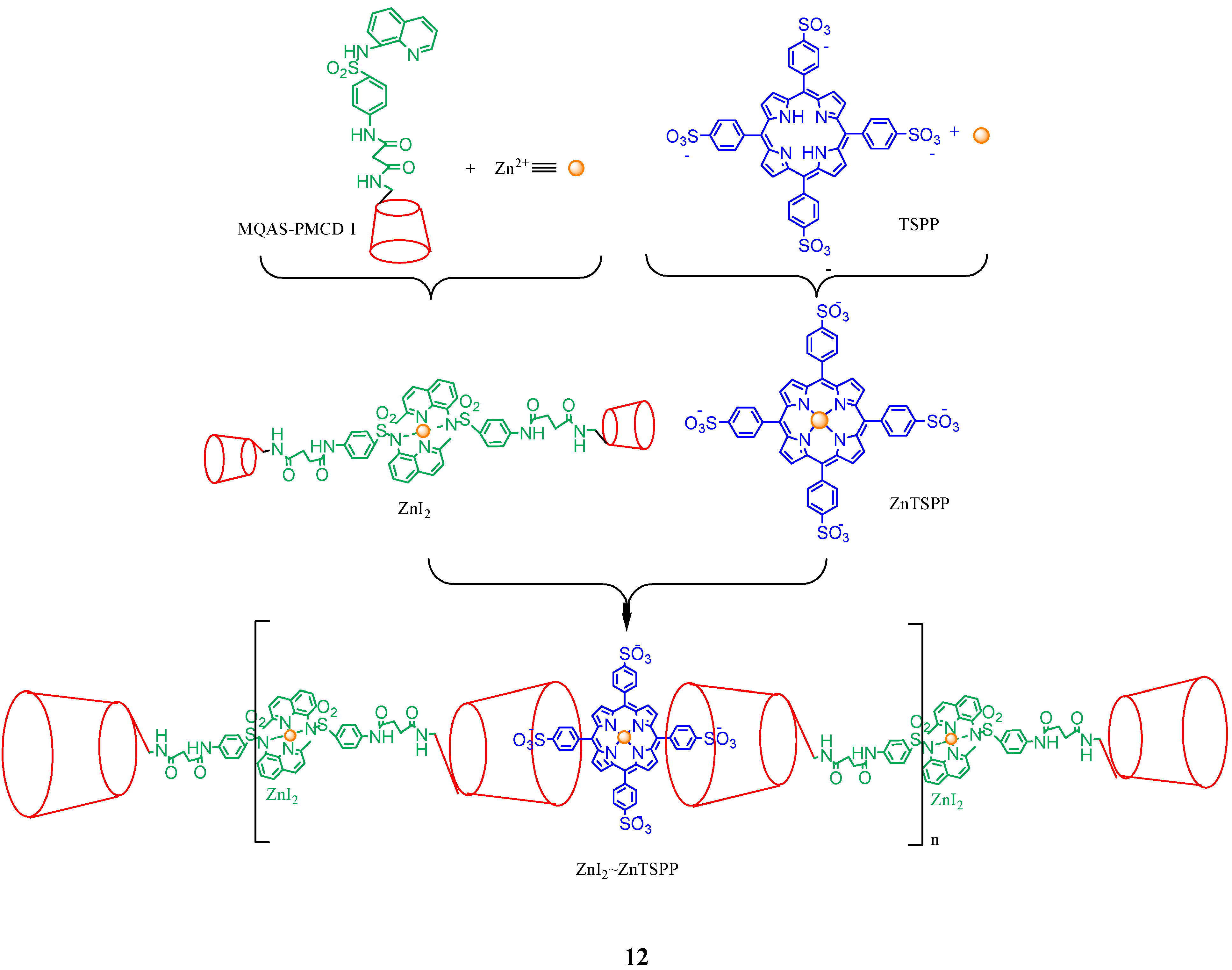
      <p>An environment-sensitive Zn<sup>2+</sup>/cyclodextrin/porphyrin triad supramolecular assembly <bold>12</bold> (<xref ref-type="fig" rid="molecules-17-11763-f013">Figure 13</xref>) was constructed by Yu <italic>et al</italic>. [<xref ref-type="bibr" rid="B60-molecules-17-11763">60</xref>]. When interacting with the cell membrane, this assembly was observed to be disrupted to release its porphyrin components. While the porphyrin part entered the cells, the other components of the complex remained in the cell membrane. The transmembrane dissociation property makes this supramolecular assembly an excellent candidate for the application in drug delivery.</p>
      <p>The photoinduced energy and electron transfer within cyclodextrin-porphyrin system with or without suitable donor and acceptor guest molecules is investigated by many and these results can be of great interest from the perspective of designing photo-activated drug delivery systems and suitable PDT agents.</p>
      <p>Chemical and biological nanocavities are provided to an anionic 5,10,15,20-tetrakis(4-sulfonatophenyl)-porphyrin (TPPS) via forming 1:1 and 1:2 encapsulation complexes with a quaternary ammonium modified β-cyclodextrin (QA-β-CD) and human serum albumin (HSA) protein in aqueous solution [<xref ref-type="bibr" rid="B61-molecules-17-11763">61</xref>]. The effect of O<sub>2</sub> on the relaxation of the triplet state of the free and encapsulated TSPP is studied and the obtained results could be correlated with the effect provided by those chemical and biological cavities. These nano-cavities have notable effects on the fluorescence lifetimes also. The observed difference, longer triplet lifetime upon encapsulation, according to the authors, is relevant to the efficiency of this porphyrin in photodynamic therapy. An emitting nanoassembly composed of a novel amphiphilic cyclodextrin functionalized with a covalently appended fluorophore and an anionic porphyrin internalizes effectively in tumor cells, allowing simultaneously the detection of carrier and photosensitizer has also been reported recently [<xref ref-type="bibr" rid="B62-molecules-17-11763">62</xref>].</p>
      <fig id="molecules-17-11763-f013" position="float">
        <label>Figure 13</label>
        <caption>
          <p>Schematic representation of the synthesis of the Zn<sup>2+</sup>/cyclodextrin/porphyrin triad (<bold>12</bold>).</p>
        </caption>
        <graphic xmlns:xlink="http://www.w3.org/1999/xlink" xlink:href="molecules-17-11763-g013.tif"/>
      </fig>
      <p>The combination of monocationic <italic>meso</italic>-substituted porphyrin 5-[4-(1-dodecanoylpyridinium)]-10,15,20-triphenylporphine (TDPyP) with supramolecular aggregates of cationic amphiphilic β-cyclodextrin (SC6NH2) can act as singlet oxygen generation system having very high quantum yield (ΦΔ = 0.90). Although the yield of <sup>1</sup>O<sub>2</sub> generation was comparable to that obtained after TDPyP incorporation into cationic unilamellar liposomes of <italic>N</italic>-[1-(2,3-dioleoyloxy)propyl]-<italic>N</italic>,<italic>N</italic>,<italic>N</italic>-trimethylammonium chloride (DOTAP) , SC6NH2-bound TDPyP was more active than DOTAP-bound TDPyP in photosensitizing the inactivation of the Gram-positive methicillin-resistant bacterium <italic>Staphylococcus aureus</italic> (MRSA) [<xref ref-type="bibr" rid="B63-molecules-17-11763">63</xref>]. In addition, the photo activated SC6NH2-bound TDPyP is also efficient in photokilling of Gram-negative bacterial pathogens, such as <italic>Escherichia coli</italic>. Transmission electron microscopy studies revealed that the high photobactericidal effect of the SC6NH2-bound TDPyP is the consequence of the carrier’s ability to facilitate an efficient crossing of the very tightly organized three-dimensional bacterial outer wall by the embedded porphyrin so that a prompt interaction between the short-lived photogenerated <sup>1</sup>O<sub>2</sub> and the targets tissues can take place. The photodynamic activity of a novel porphyrin derivative associated with β-cyclodextrin is also reported by Mora <italic>et al</italic>. [<xref ref-type="bibr" rid="B64-molecules-17-11763">64</xref>].</p>
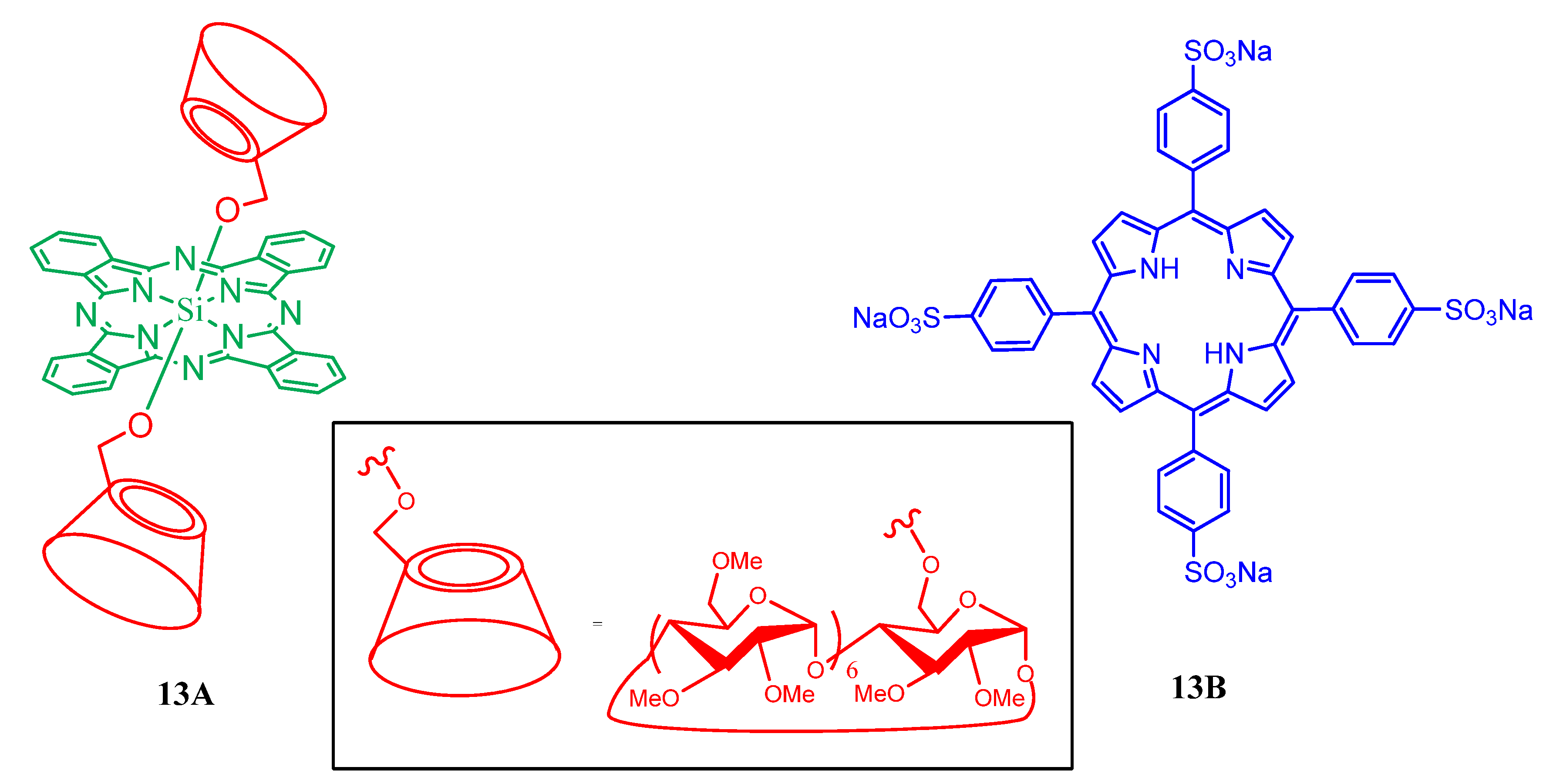
      <p>The linear nano-architecture of an inclusion complex of 5,10,15,20-tetrakis(4-sulfonatophenyl)-porphyrin with mono-6-deoxy-6-iodo-β-cyclodextrin having a 6,7-bis(methylsulfanyl)-2,3-bis(2-cycanoethylsulfanyl)tetrathiafulvalene linker is reported by Zhang <italic>et al</italic>. [<xref ref-type="bibr" rid="B65-molecules-17-11763">65</xref>]. Upon light irradiation, efficient quenching of the porphyrin fluorescence observed in this supramolecular complex, which is due to the significant photoinduced electron transfer (PET) process between the tetrathiafulvalene moiety and the porphyrin unit. The porphyrin fluorescence is then recovered by the formation of tetrathiafulvalene cations in the presence of H<sub>2</sub>O<sub>2</sub>. The same research team also reported linear supramolecular architectures with a width of about 2 nm and a length ranging from hundreds of nanometers to micron dimension were conveniently constructed by interacting 5,10,15,20-tetrakis(4-sulfonato-phenyl)porphyrin or its Zn(II) derivative with bis{4-methyl[1–3]triazolyl}malonic ester-bridged bis(permethyl-β-cyclodextrin) having an attached fullerene. Efficient photoinduced electron-transfer between porphyrin and C<sub>60</sub> moieties are observed in these new fullerene bridged bis(permethyl-β-cyclodextrin)-porphyrin [<xref ref-type="bibr" rid="B66-molecules-17-11763">66</xref>]. Leng <italic>et al</italic>. reported a stable 1:1 host-guest complex in which a Si(IV) phthalocyanine conjugated axially with two permethylated β-cyclodextrin units (<xref ref-type="fig" rid="molecules-17-11763-f014">Figure 14</xref>, compound <bold>13A</bold>) and a tetrasulfonated porphyrin <bold>13B</bold> (<xref ref-type="fig" rid="molecules-17-11763-f014">Figure 14</xref>). This complex exhibited light-harvesting property and worked as an efficient photosensitizing system, causing photokilling of HT29 human colon adenocarcinoma cells efficiently [<xref ref-type="bibr" rid="B67-molecules-17-11763">67</xref>].</p>
      <fig id="molecules-17-11763-f014" position="float">
        <label>Figure 14</label>
        <caption>
          <p>Si(IV) phthalocyanine conjugated permethylated β-cyclodextrin (<bold>13A</bold>) and tetrasulfonated porphyrin (<bold>13B</bold>) used to make host-guest complex.</p>
        </caption>
        <graphic xmlns:xlink="http://www.w3.org/1999/xlink" xlink:href="molecules-17-11763-g014.tif"/>
      </fig>
      <p>Densely packed hybrid monolayers of amphiphilic cyclodextrins incorporating hydrophilic porphyrins were prepared at the air/water interface through electrostatic interaction by Valli <italic>et al</italic>. and are transferred onto quartz substrates by Langmuir-Schaefer deposition [<xref ref-type="bibr" rid="B68-molecules-17-11763">68</xref>]. The resulting multilayers exhibit a good response to light excitation as proven by fluorescence emission, triplet-triplet absorption and singlet oxygen photogeneration. A supramolecular self-assembly constructed by perylene-bridged bis(β-cyclodextrin)s with water-soluble porphyrin through hydrophobic interactions is also reported recently in which a strong excitonic coupling interactions between perylene backbones and included porphyrins is observed [<xref ref-type="bibr" rid="B69-molecules-17-11763">69</xref>].</p>
      <p>The interactions of tetraphenylporphyrin (TPP), [tetraphenylporphyrinato]Co(II) (CoTPP) and a protein in the presence of a cyclodextrin derivative, heptakis(2,6-di-<italic>O</italic>-<italic>n</italic>-octyl)-β-cyclodextrin (Oc-β-CD), have been investigated by Liping <italic>et al</italic>. [<xref ref-type="bibr" rid="B70-molecules-17-11763">70</xref>]. In the presence of Oc-β-CD, significant increase of TPP fluorescence was observed, but the increased fluorescence was quenched by the presence of CoTPP. Again the quenching fluorescence of TPP was restored upon interacting with protein. The restoration of TPP fluorescence is fast and accomplished upon interaction with bovine serum albumin (BSA) or human serum albumin (HSA). The mechanism of TPP fluorescence quenching is proposed to be the formation of a ground-state complex of TPP and CoTPP, and the fluorescence restoration is attributed to the binding of CoTPP with the protein molecule which destroys the aggregate, releasing the free base porphyrin. According to the authors this method could be used for the direct assay of HSA content in human serum.</p>
      <p>Investigation on cyclodextrin-porphyrin systems have led to a significant expansion of the field of artificial enzymes or enzyme mimics. It is obvious that many novel catalysts can be constructed, based on cyclodextrins scaffold and attachment of catalytic active porphyrin function to a cyclodextrin can afford interesting enzyme mimics.</p>
      <p>A new type of artificial smart bifunctional enzyme with both superoxide dismutase (SOD) and glutathione peroxidase (GPx) activities was successfully constructed by the self-assembly of [tetra(1-(1-adamantylmethylketone)-4-pyridyl)porphyrinato]Mn(III), (MnTPyP-M-Ad), with four suspensory adamantyl moieties and β-cyclodextrin-terminated temperature-sensitive copolymer through host-guest interaction in aqueous solution [<xref ref-type="bibr" rid="B71-molecules-17-11763">71</xref>]. The Mn(III) porphyrin was designed as both a “supramolecular linker” and an efficient active site of SOD. This bifunctional enzyme exhibited stable SOD-like activity and high GPx catalytic efficiency with temperature responsive dependence characteristic. Another supramolecular artificial enzyme was successfully constructed by the self-assembly of the same Mn(III)<italic>meso</italic>-tetra[1-(1-adamantylmethylketone)-4-pyridyl]porphyrin (MnTPyP-M-Ad) and cyclodextrin-based telluronic acid (2-CD-TeO<sub>3</sub>H) through host-guest interaction in aqueous solution. The self-assembly of the adamantyl moieties of Mn(III) porphyrin and the β-CD cavities was also demonstrated along with this work. In this enzyme model, the Mn(III) porphyrin center acted as an efficient active site of SOD and tellurol moiety endowed GPx activity. The SOD-like activity of the new catalyst was found to be exhibit 2.56% of the activity of the native SOD. Besides this, enzyme model also showed a high GPx activity, and a remarkable rate enhancement of 27-fold compared to the well-known GPx mimic ebselen was observed. More importantly, this supramolecular artificial enzyme showed good thermal stability too [<xref ref-type="bibr" rid="B72-molecules-17-11763">72</xref>].</p>
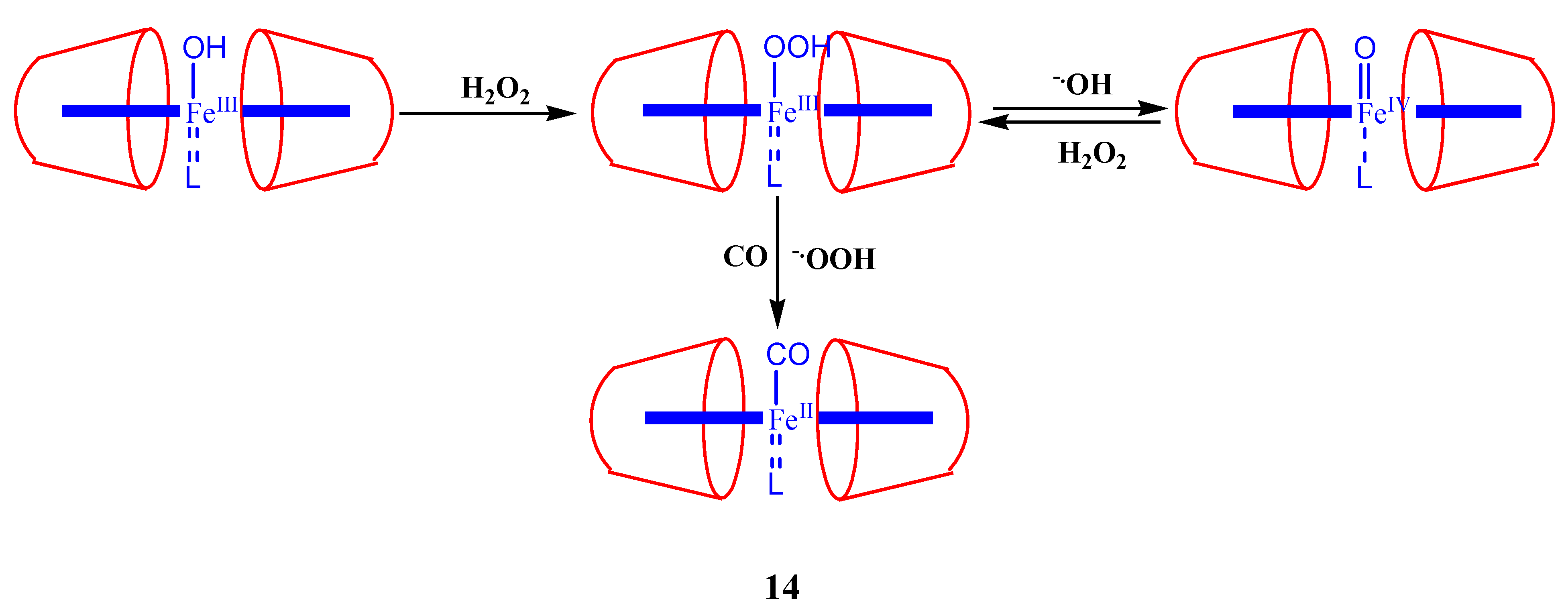
      <p>The synthesis, spectroscopic characterization and enzyme-like activities of manganese(III) complexes of 5[4-(6-<italic>O</italic>-β-cyclodextrin)-phenyl],10,15,20-tri(4-hydroxyphenyl)-porphyrin is reported by Oliveri <italic>et al</italic>. [<xref ref-type="bibr" rid="B73-molecules-17-11763">73</xref>]. Stable J-aggregates of diprotonated 5,10,15,20-tetrakis(4-sulfonatopheny)porphyrin (H<sub>4</sub>TPPS<sup>2−</sup>) containing per-<italic>O</italic>-methylated β-cyclodextrin is prepared by Kano <italic>et al</italic>. after binding them to the surface of α-chymotrypsin (ChT) [<xref ref-type="bibr" rid="B74-molecules-17-11763">74</xref>]. This porphyrin aggregates can function effectively to control/modulate the enzyme activity of chymotrypsin. The same group also successfully demonstrated how to to regulate α-chymotrypsin catalysis by iron porphyrins when a suitable cyclodextrin is introduced in the system [<xref ref-type="bibr" rid="B75-molecules-17-11763">75</xref>]. The developments in enzyme mimic research carried out on porphyrin-cyclodextrin systems are so fast that in near future we can expect interesting artificial enzymes based on this combination. The uptake of H<sub>2</sub>O<sub>2</sub> by a pyridine-coordinated ferric porphyrin encapsulated in a cyclodextrin dimer yielded variety of iron-oxo intermediates, as shown in <xref ref-type="fig" rid="molecules-17-11763-f015">Figure 15</xref> [<xref ref-type="bibr" rid="B76-molecules-17-11763">76</xref>].</p>
      <fig id="molecules-17-11763-f015" position="float">
        <label>Figure 15</label>
        <caption>
          <p>Schematic representation of iron-oxo intermediate formation after the uptake of H<sub>2</sub>O<sub>2</sub> by a pyridine-coordinated ferric porphyrin encapsulated in the cyclodextrin dimer.</p>
        </caption>
        <graphic xmlns:xlink="http://www.w3.org/1999/xlink" xlink:href="molecules-17-11763-g015.tif"/>
      </fig>
      <p>There are also reports describing the binding of dioxygen, carbon monoxide or cyanide to the porphyrins associated with cyclodextrin analogy to the natural heme systems. In these host-guest inclusion model, cyclodextrin being regarded as the protein component, which acts as a carrier enveloping the active site of heme prosthetic group within its hydrophobic environment, provides a protective sheath for the porphyrin. Metalloporphyrins, on the other hand, could serve as the heme analogs in such heme protein model compounds [<xref ref-type="bibr" rid="B77-molecules-17-11763">77</xref>,<xref ref-type="bibr" rid="B78-molecules-17-11763">78</xref>,<xref ref-type="bibr" rid="B79-molecules-17-11763">79</xref>,<xref ref-type="bibr" rid="B80-molecules-17-11763">80</xref>,<xref ref-type="bibr" rid="B81-molecules-17-11763">81</xref>].</p>
      <p>Poly(acrylic acid) modified by supramolecular complex composed of 10,15,20-tris(4-sulfonato-phenyl)porphyrinato]Fe(III) and a per-<italic>O</italic>-methylated β-cyclodextrin dimer is reported recently. The oxygen uptake capability and subsequent autoxidation of the oxo-adduct of different combinations of these systems are then investigated in detail. (CD_A12). Kano <italic>et al</italic>. reported a 1:1 complex (hemoCD) of [5,10,15,20-tetrakis(4-sulfonatophenyl)porphyrinato]Fe(II) (Fe[II]TPPS) and a per-<italic>O</italic>-methylated β-cyclodextrin dimer having a pyridine linker (Py3CD). This hemo-CD binds O<sub>2</sub> reversibly in aqueous solution. Encapsulation of the iron center of Fe(II)TPPS by two cyclodextrin truncated cones is supposed to be the determining factor for binding of O<sub>2</sub> to the ferrous center of the porphyrin [<xref ref-type="bibr" rid="B79-molecules-17-11763">79</xref>]. An anionic iron porphyrin complexed with per-<italic>O</italic>-methylated β-cyclodextrin dimer having an imidazole linker is reported to be a much better cyanide receptor <italic>in vivo</italic> than hydroxocobalamin [<xref ref-type="bibr" rid="B80-molecules-17-11763">80</xref>].</p>
    </sec>
    <sec>
      <title>3. Calixarene-Porphyrin Assemblies</title>
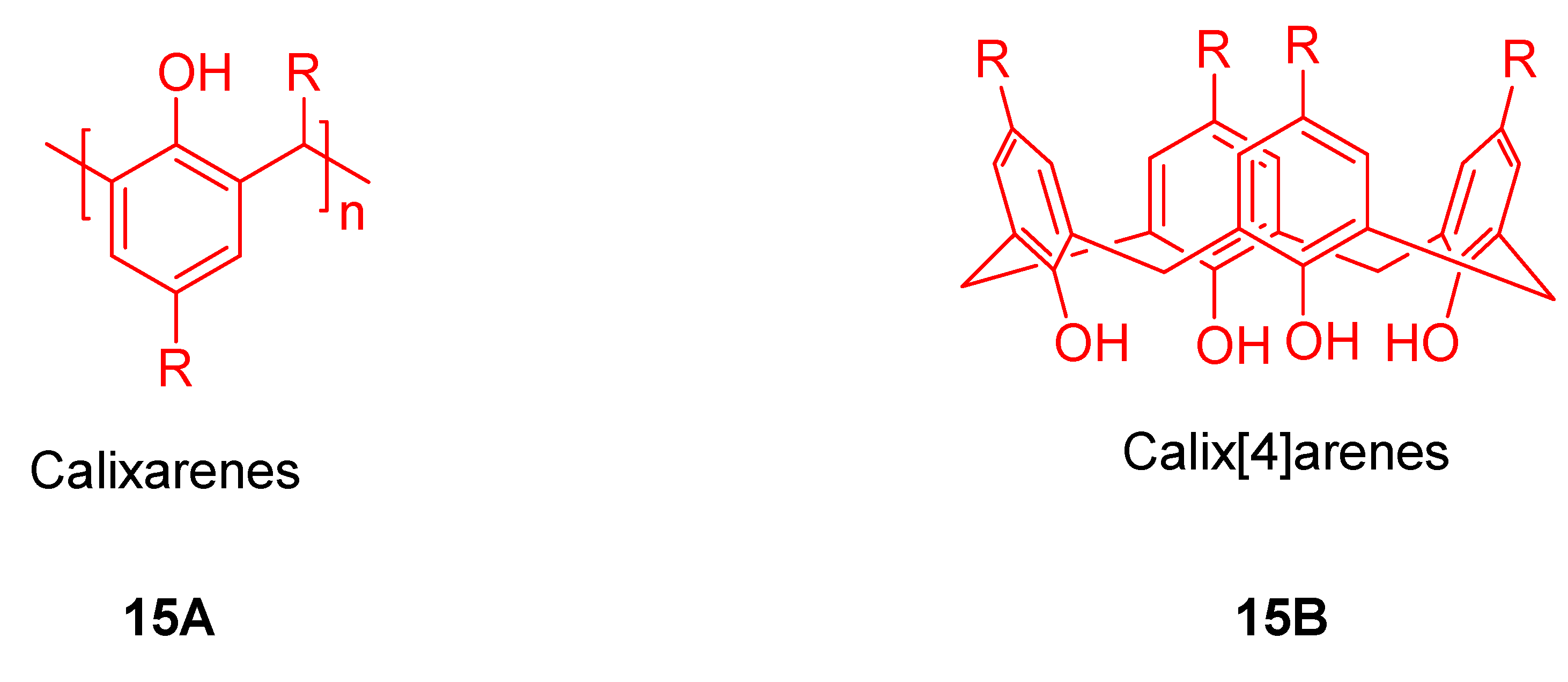
      <p>The calixarenes are a class of cyclooligomers formed via a phenol-aldehyde condensation (<xref ref-type="fig" rid="molecules-17-11763-f016">Figure 16</xref>, compounds <bold>15A</bold>,<bold>B</bold>). They exist in a cup-like shape with a defined upper and lower rim and a centre annulus. Calixarenes have come a long way in offering tailor made candidates for diverse applications in the field of host-guest chemistry [<xref ref-type="bibr" rid="B25-molecules-17-11763">25</xref>,<xref ref-type="bibr" rid="B26-molecules-17-11763">26</xref>,<xref ref-type="bibr" rid="B27-molecules-17-11763">27</xref>,<xref ref-type="bibr" rid="B28-molecules-17-11763">28</xref>,<xref ref-type="bibr" rid="B29-molecules-17-11763">29</xref>,<xref ref-type="bibr" rid="B82-molecules-17-11763">82</xref>,<xref ref-type="bibr" rid="B83-molecules-17-11763">83</xref>,<xref ref-type="bibr" rid="B84-molecules-17-11763">84</xref>,<xref ref-type="bibr" rid="B29-molecules-17-11763">29</xref>,<xref ref-type="bibr" rid="B82-molecules-17-11763">82</xref>]. Calixarenes have many conformational isomers because of two possible rotational modes of phenol units. The size and geometry of calixarenes were determined by the functionalization of the upper rim, lower rim or both. Calixarenes are superior to crown ethers and cyclodextrins in the aspect. Interesting building blocks in supramolecular chemistry have been constructed by combining porphyrin and calixarene. These blocks possess different topologies and electronic properties, and their combination allows the creation of receptors taking advantage of both precursors.</p>
      <fig id="molecules-17-11763-f016" position="float">
        <label>Figure 16</label>
        <caption>
          <p>Schematic representation of calix[n]arene (<bold>15A</bold>) and calix[4]arene (<bold>15B</bold>).</p>
        </caption>
        <graphic xmlns:xlink="http://www.w3.org/1999/xlink" xlink:href="molecules-17-11763-g016.tif"/>
      </fig>
      <p>Investigations on molecular tweezers formed by bridging of a calixarene fragment between two porphyrin rings attract a strong interest by many researchers [<xref ref-type="bibr" rid="B85-molecules-17-11763">85</xref>,<xref ref-type="bibr" rid="B86-molecules-17-11763">86</xref>,<xref ref-type="bibr" rid="B87-molecules-17-11763">87</xref>,<xref ref-type="bibr" rid="B88-molecules-17-11763">88</xref>,<xref ref-type="bibr" rid="B89-molecules-17-11763">89</xref>,<xref ref-type="bibr" rid="B90-molecules-17-11763">90</xref>,<xref ref-type="bibr" rid="B91-molecules-17-11763">91</xref>,<xref ref-type="bibr" rid="B92-molecules-17-11763">92</xref>,<xref ref-type="bibr" rid="B93-molecules-17-11763">93</xref>,<xref ref-type="bibr" rid="B94-molecules-17-11763">94</xref>,<xref ref-type="bibr" rid="B95-molecules-17-11763">95</xref>,<xref ref-type="bibr" rid="B96-molecules-17-11763">96</xref>,<xref ref-type="bibr" rid="B97-molecules-17-11763">97</xref>]. A combination of these structural fragments in a single molecule via covalent bonds opens unique possibilities for building up cavities to bind both ionic and neutral species because the flexible porphyrinic ring can evolve toward a conformation that allows the complexation.</p>
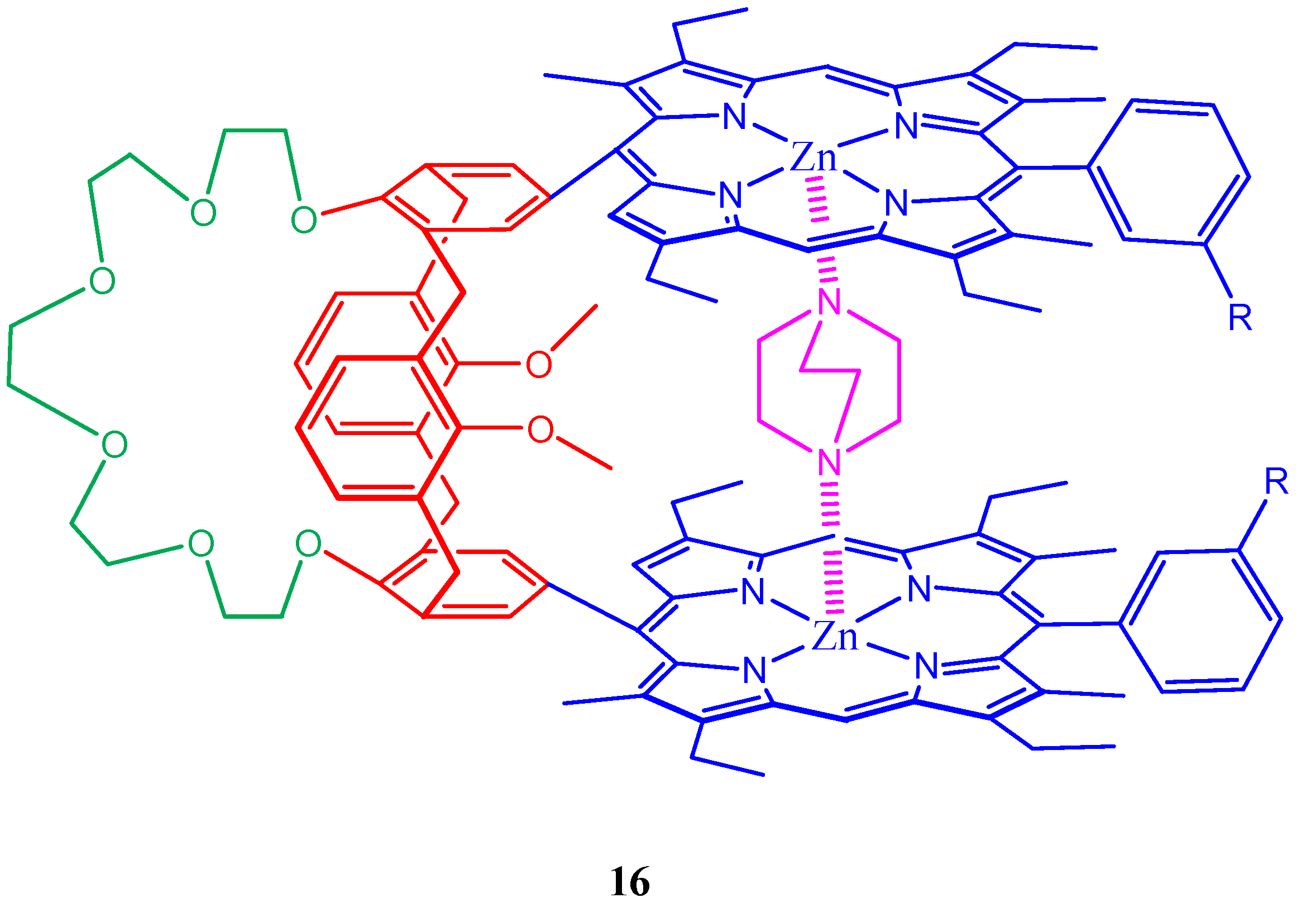
      <p>Synthesis of the heterotopic receptors on the basis bisporphyrin-calix[4]arene crown ethers was reported by Mamardashvili et al. [86]. The idea is to covalently combine in one molecule a crown-calix[4]arene fragment and two appropriately functionalized porphyrin macrocycles (<xref ref-type="fig" rid="molecules-17-11763-f017">Figure 17</xref>). This system allows the creation of sterically preorganized hetrotropic receptors possessing polyfunctional complexing power toward both charged particles and neutral molecules of various natures. Their spectral properties and complexing ability toward the alkali metal cations, organic diamines, and dicarboxylic acid esters were also described. A 1,3-bis[Zn(II) porphyrin]-substituted calix[4]arene (cone conformation) is reported by Arimura et al. which served as selective molecular tweezers for DABCO, leading to the formation of calix[4]arene-supported porphyrin-Zn-DABCO-Zn-porphyrin ensemble [<xref ref-type="bibr" rid="B87-molecules-17-11763">87</xref>]. <sup>13</sup>C-NMR longitudinal relaxation time studies of these molecular tweezers upon DABCO incorporation is also discussed in the same paper.</p>
      <fig id="molecules-17-11763-f017" position="float">
        <label>Figure 17</label>
        <caption>
          <p>The heterotopic receptors based on bisporphyrin-calix[4]arene crown ether.</p>
        </caption>
        <graphic xmlns:xlink="http://www.w3.org/1999/xlink" xlink:href="molecules-17-11763-g017.tif"/>
      </fig>
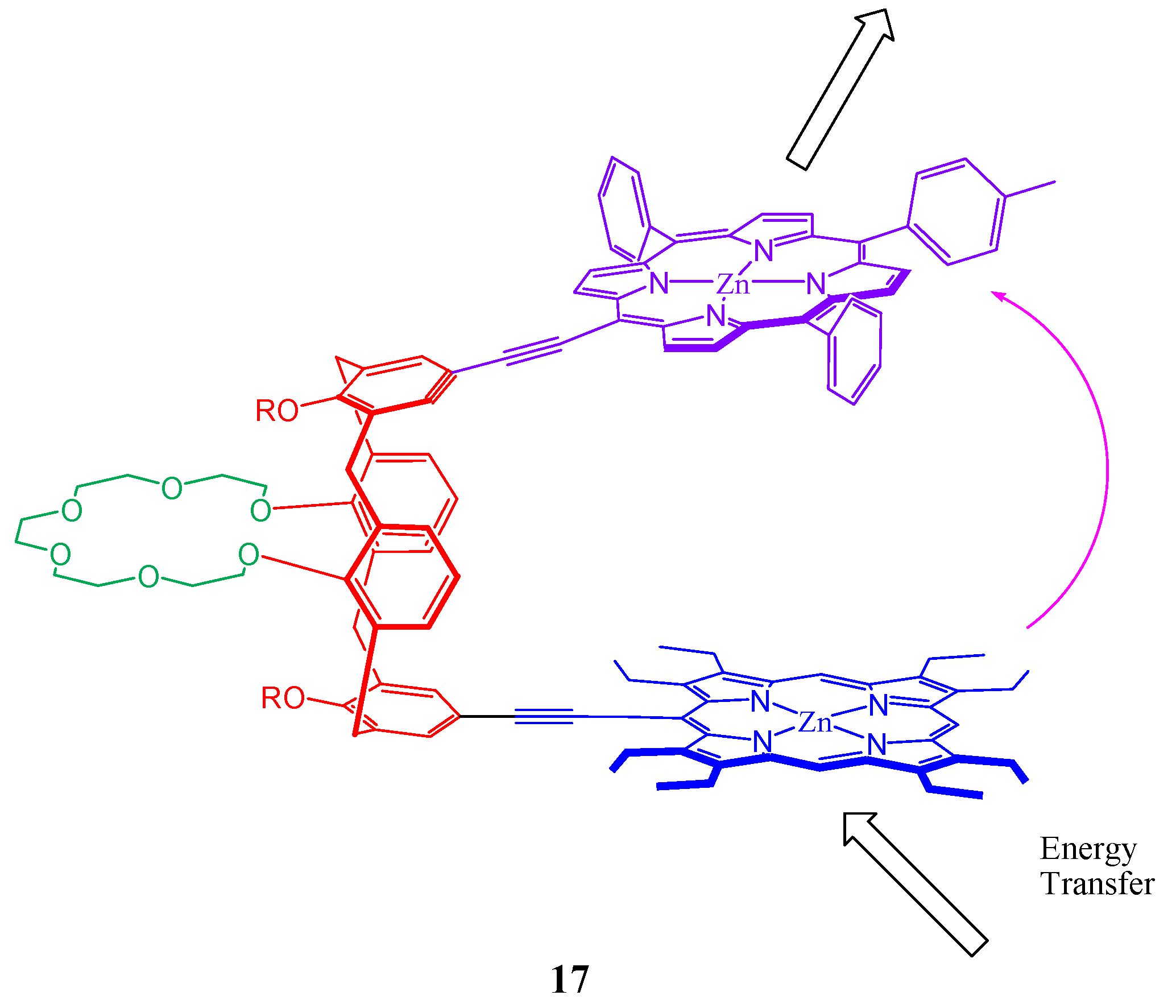
	  <p>Synthesis of a Pacman heterobis(porphyrin) containing an [octaethylporphyrinato]zinc (ZnOEP) energy donor and a (triarylporphyrinato)zinc (ZntPP) energy acceptor around a crown[6]-dipropoxy-calix[4]arene spacer is described (<xref ref-type="fig" rid="molecules-17-11763-f018">Figure 18</xref>). Remarkable photoinduced energy transfer is found to be observed in this tweezer molecular system [<xref ref-type="bibr" rid="B88-molecules-17-11763">88</xref>]. This was evidenced by increase of luminescence in the ZntPP moiety and a corresponding quenching of the OEP moiety’s emission, which are independent of the excitation wavelength. Ivanova <italic>et al</italic>. showed that the distance between the reaction centers of the porphyrin fragments of their calixarene-bis-porphyrin system can be controlled by varying the solution acidity and thus arousing the possibility of developing molecular switches [<xref ref-type="bibr" rid="B89-molecules-17-11763">89</xref>]. A Zinc complex of <italic>meso</italic>-(aminophenyl)-substituted calixarene-bis-porphyrin was also reported which has been found to form a stable 1:1 complex with dimethyl maleate in toluene [<xref ref-type="bibr" rid="B90-molecules-17-11763">90</xref>]. Induction of chirality on noncovalently bound-[Ru(phen)<sub>3</sub>]<sup>2+</sup> enantiomers in a porphyrin-(bis)calixarene assemblies is demonstrated by D’Urso <italic>et al</italic>. [<xref ref-type="bibr" rid="B91-molecules-17-11763">91</xref>].</p>
      <fig id="molecules-17-11763-f018" position="float">
        <label>Figure 18</label>
        <caption>
          <p>Possible photoinduced energy transfer observed in the tweezer molecular system (<bold>17</bold>) containing porphyrins, calixerene and crown ether.</p>
        </caption>
        <graphic xmlns:xlink="http://www.w3.org/1999/xlink" xlink:href="molecules-17-11763-g018.tif"/>
      </fig>
      <p>It has been observed that several calixarene-porphyrin-tweezer systems are capable of size-selective complexation with fullerenes. Designing effective host molecules for such fullerene selectivity is highly important to reduce costs due to laborious fullerenes purification and its isolation procedures and thus to facilitate their application in chemistry and material science. Also porphyrin-fullerene architectures can lead to molecular assemblies ideally suited for devising integrated, multicomponent model systems to transmit and process solar energy [<xref ref-type="bibr" rid="B98-molecules-17-11763">98</xref>,<xref ref-type="bibr" rid="B99-molecules-17-11763">99</xref>]. The geometrical complimentary of concave calixarene cavities and spherical fullerenes has attained active interest of chemists. At the same time the curved π surface of C60 or C70 fullerenes can interect with the metalloporphyrin moiety by attractive π-π interactions, which can be applied to produce discrete host-guest systems possessing unique properties based on diverse supramolecular charge transfer.</p>
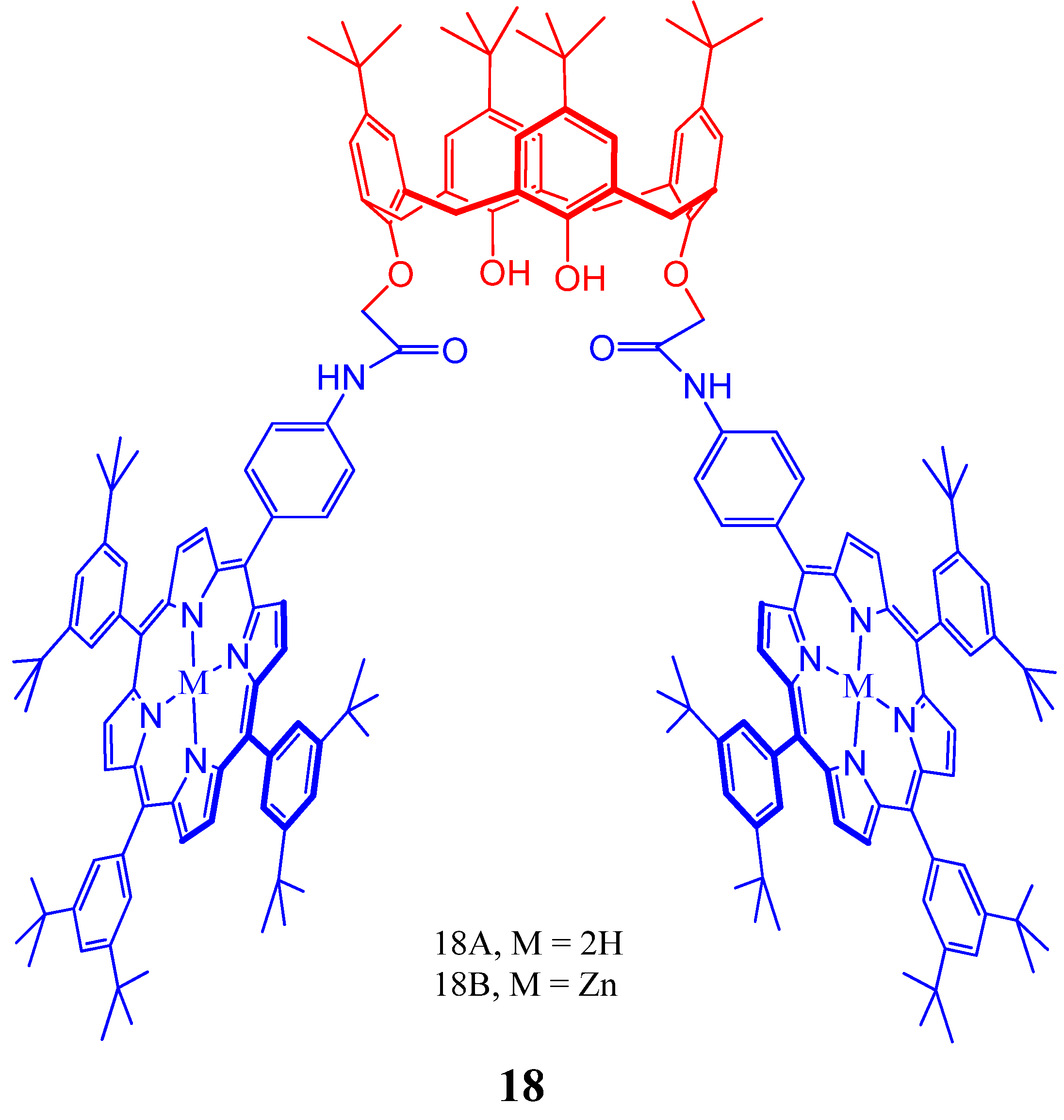
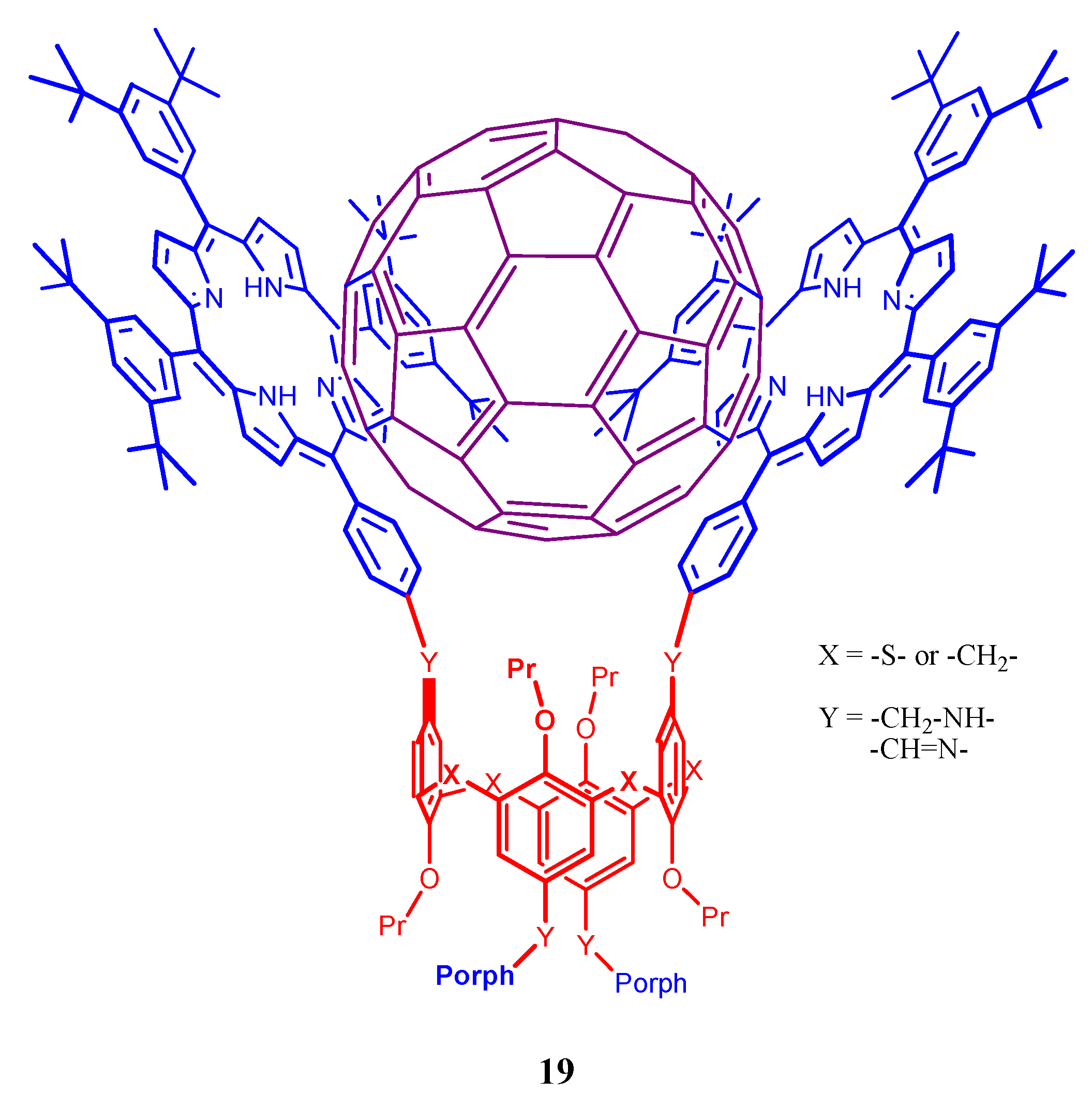
      <p>Supramolecular interactions of calixarene scaffold bearing bisporphyrins as hosts with fullerenes have been reported by many [<xref ref-type="bibr" rid="B86-molecules-17-11763">86</xref>,<xref ref-type="bibr" rid="B95-molecules-17-11763">95</xref>,<xref ref-type="bibr" rid="B96-molecules-17-11763">96</xref>,<xref ref-type="bibr" rid="B97-molecules-17-11763">97</xref>]. Grimm <italic>et al</italic>. reported an oxidative charge transfer (<italic>i.e.</italic>, electron transfer from the bisporphyrin to the fullerene) for the C<sub>60</sub> inclusion complexes, while a reductive charge transfer (<italic>i.e.</italic>, electron transfer from the fullerene to porphyrin) is operative in the endohedral metallofullerene host-guest complexes, (<xref ref-type="fig" rid="molecules-17-11763-f019">Figure 19</xref>) [<xref ref-type="bibr" rid="B95-molecules-17-11763">95</xref>]. Molecular tweezer <bold>19</bold> (<xref ref-type="fig" rid="molecules-17-11763-f020">Figure 20</xref>) based on aminoporphyrin and tetraformylcalixarene was also reported to form 1:1 complexes with C<sub>60</sub> and C<sub>70</sub> fullerenes and possess high selectivity toward C70 [<xref ref-type="bibr" rid="B96-molecules-17-11763">96</xref>].</p>
      <fig id="molecules-17-11763-f019" position="float">
        <label>Figure 19</label>
        <caption>
          <p>Calixarene-bisporphyrins system (<bold>18</bold>) capable of achieving electronic charge transfer during host-gust interactions.</p>
        </caption>
        <graphic xmlns:xlink="http://www.w3.org/1999/xlink" xlink:href="molecules-17-11763-g019.tif"/>
      </fig>
      <fig id="molecules-17-11763-f020" position="float">
        <label>Figure 20</label>
        <caption>
          <p>Molecular tweezer (<bold>19</bold>) based on aminoporphyrin and tetraformylcalixarene and its selectivity towards C<sub>70</sub>.</p>
        </caption>
        <graphic xmlns:xlink="http://www.w3.org/1999/xlink" xlink:href="molecules-17-11763-g020.tif"/>
      </fig>
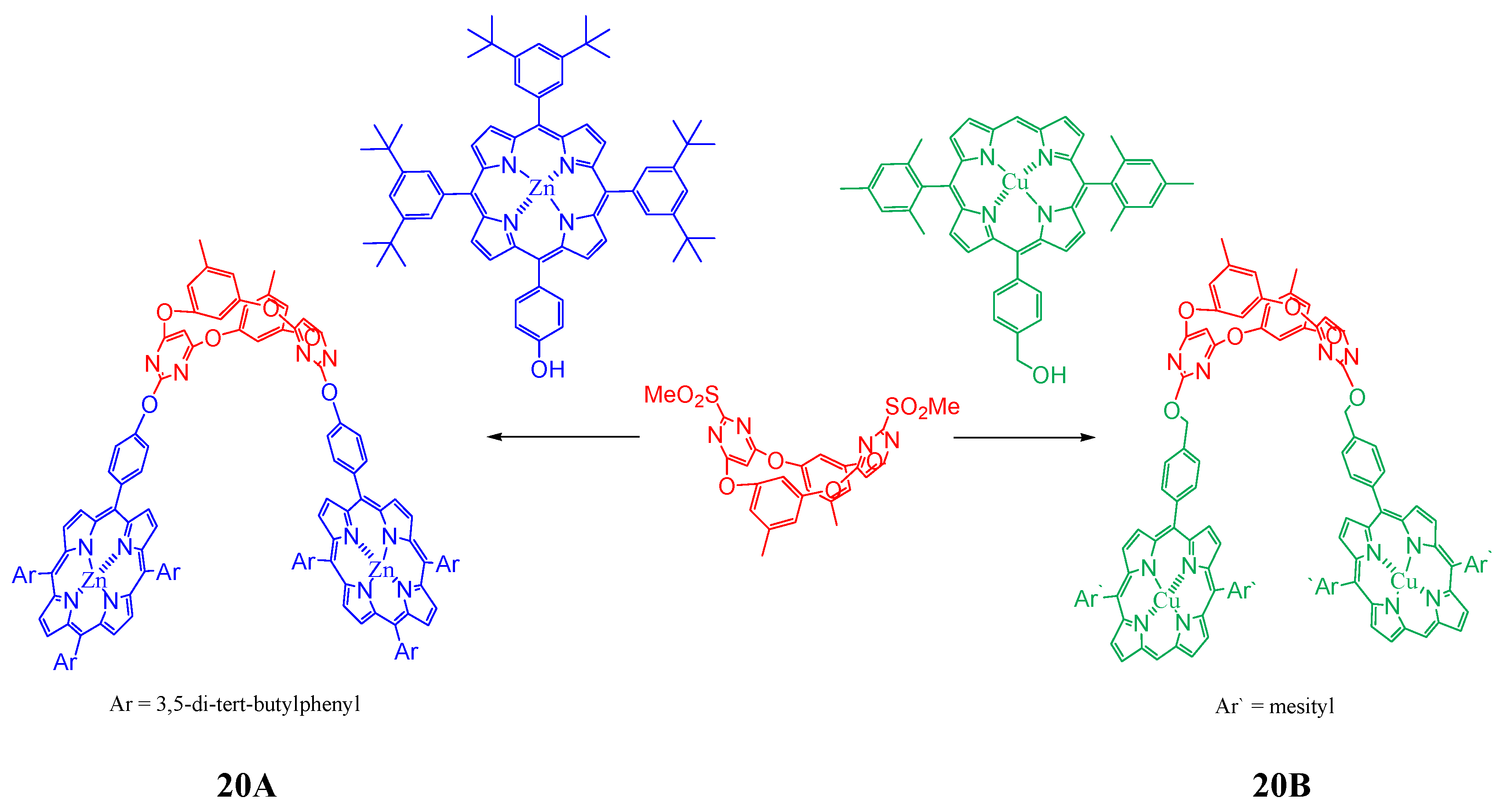
      <p>An oxacalix[2]arene[2]pyrimidine-bis(Zn-porphyrin) tweezer <bold>20A</bold> (<xref ref-type="fig" rid="molecules-17-11763-f021">Figure 21</xref>) was demonstrated to be an excellent selective receptor towards fullerene C<sub>70</sub> by Rossom <italic>et al</italic>. [<xref ref-type="bibr" rid="B97-molecules-17-11763">97</xref>]. This tweezer is found to form 1:1 complex with C<sub>70</sub> while no complexation occurred with C<sub>60</sub>. On the other hand an analogous oxacalix[4]arene-bis(Cu-corrole) <bold>20B</bold> (<xref ref-type="fig" rid="molecules-17-11763-f021">Figure 21</xref>) conjugate did not show any measurable C<sub>60</sub> or C<sub>70</sub> fullerene binding.</p>
      <fig id="molecules-17-11763-f021" position="float">
        <label>Figure 21</label>
        <caption>
          <p>Oxaclixarene tweezers based on porphyrin (<bold>20A</bold>) and corrole (<bold>20B</bold>).</p>
        </caption>
        <graphic xmlns:xlink="http://www.w3.org/1999/xlink" xlink:href="molecules-17-11763-g021.tif"/>
      </fig>
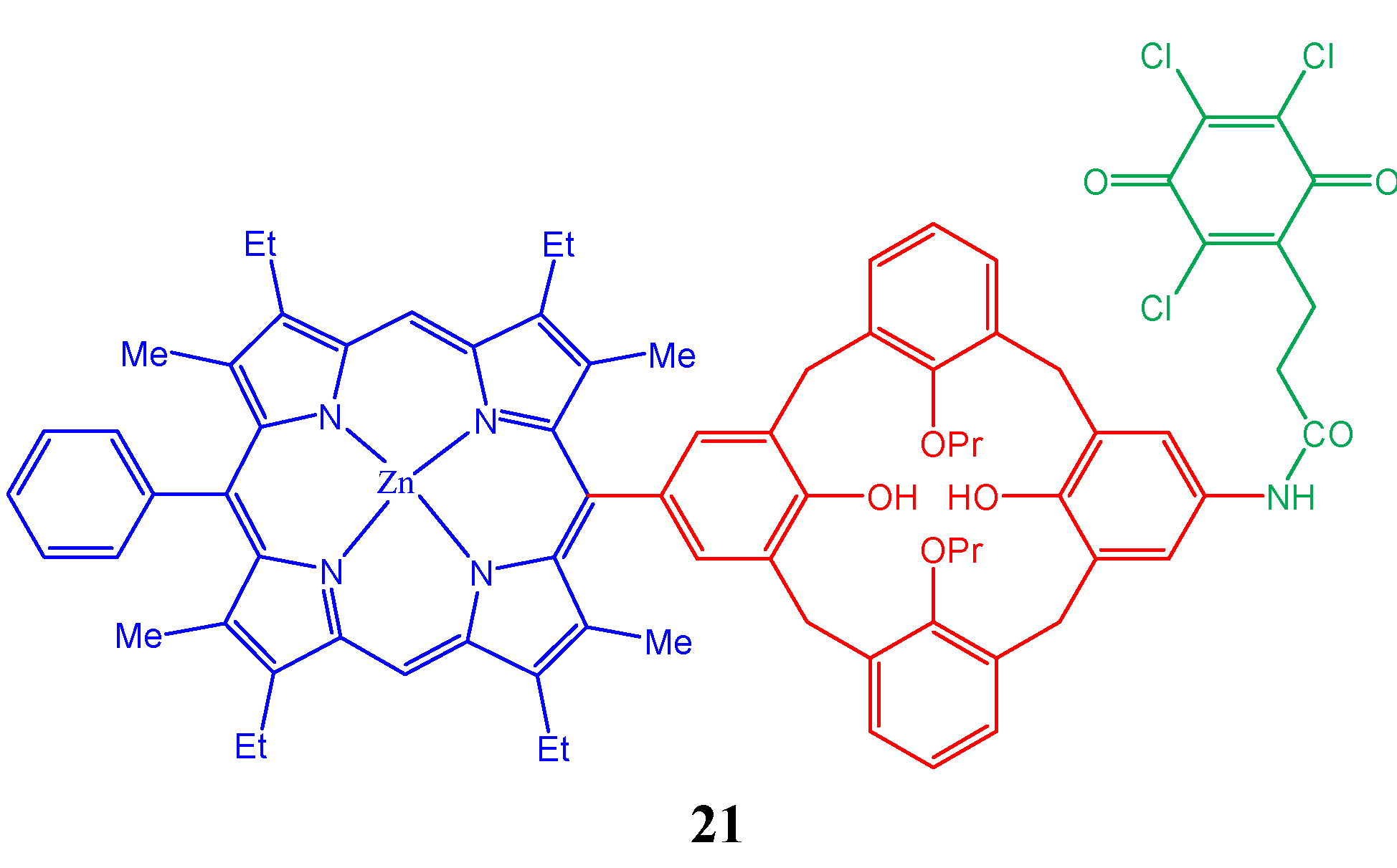
      <p>Conjugation/coordination of a third functional substrate to the porphyrin-calixarene system also allows construction of devices such as donor-acceptor systems for photoinduced electron transfer. A new calixarene-based supramolecular system, <bold>21</bold> (<xref ref-type="fig" rid="molecules-17-11763-f022">Figure 22</xref>), containing porphyrin and trichloroquinone is also reported in which through-space donor-to-acceptor electron transfer is observed upon photoexcitation [<xref ref-type="bibr" rid="B100-molecules-17-11763">100</xref>]. Synthesis of mono- and heteronuclear lanthanide-containing complexes on the basis of 1,3-disubstituted <italic>p</italic>-<italic>tert</italic>-butylcalix[4]arenes modified with porphyrin and benzimidazole fragments are reported recently [<xref ref-type="bibr" rid="B101-molecules-17-11763">101</xref>]. The analysis of the relationship between spectral-luminescent properties of these compounds and their structure has also been carried out. A calixarene-based bisporphyrin in which the calixarene scaffold is connected with porphyrin units by an alkyl chain as a spacer is reported and it exhibits extremely high affinity for diazabicyclo-[2.2.2]octane (DABCO) [<xref ref-type="bibr" rid="B102-molecules-17-11763">102</xref>].</p>
      <fig id="molecules-17-11763-f022" position="float">
        <label>Figure 22</label>
        <caption>
          <p>Schematic representation of the supramolecular system (<bold>21</bold>) based on porphyrin-calixarene- trichloroquinone.</p>
        </caption>
        <graphic xmlns:xlink="http://www.w3.org/1999/xlink" xlink:href="molecules-17-11763-g022.tif"/>
      </fig>
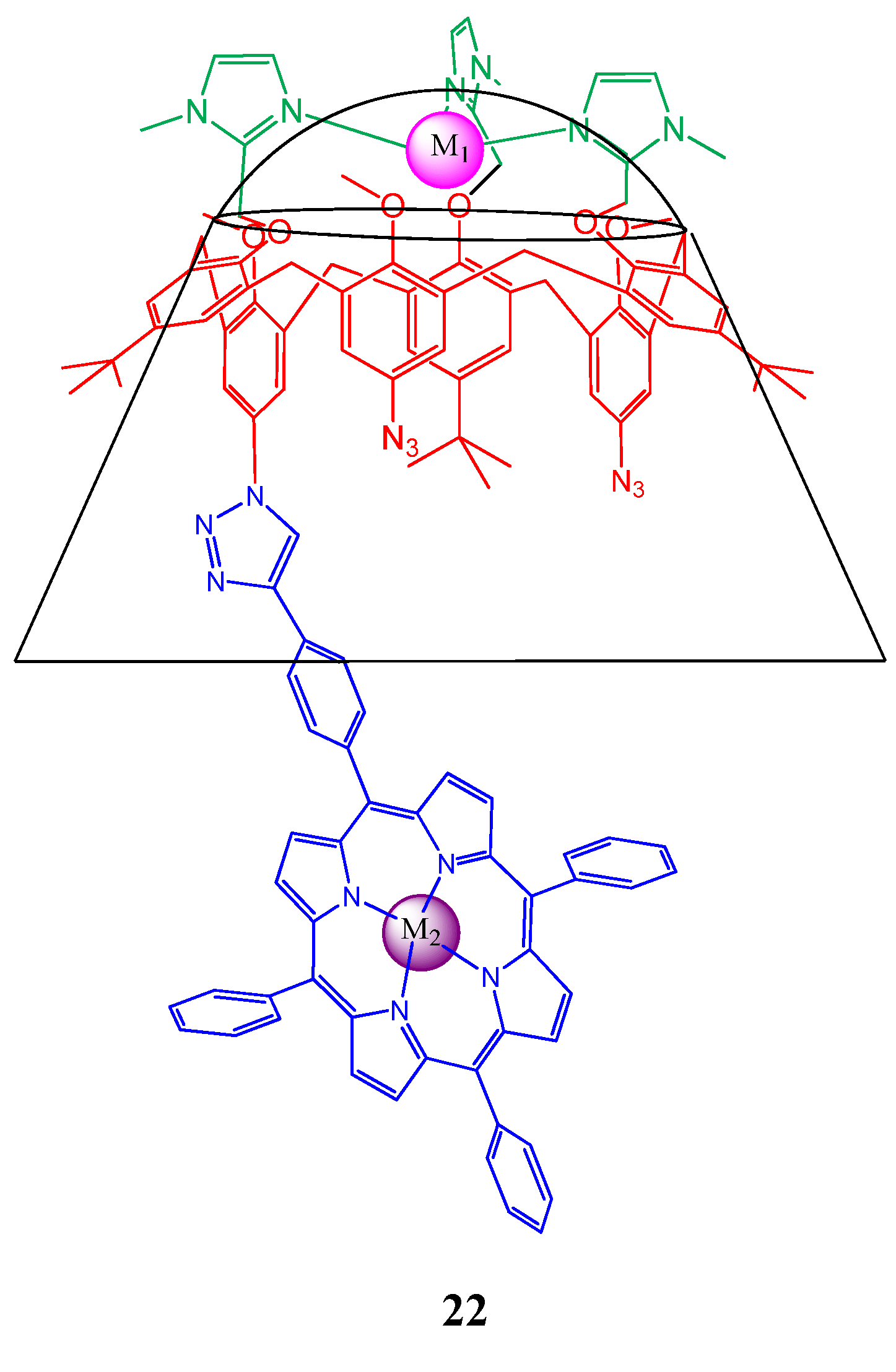
      <p>Monnereau <italic>et al</italic>. synthesized a novel calix[6]arene derivative <bold>22</bold> (<xref ref-type="fig" rid="molecules-17-11763-f023">Figure 23</xref>) bearing a tridentate imidazole metal coordination site at its small rim and a single porphyrin ligand appended to its large rim [<xref ref-type="bibr" rid="B103-molecules-17-11763">103</xref>]. This calixarene derivative behaves as a ditopic ligand because in addition to the metallatedporphyrin, the tris-imidazole site are readily accommodate one Zn(II) cation.</p>
      <fig id="molecules-17-11763-f023" position="float">
        <label>Figure 23</label>
        <caption>
          <p>Calix[6]arene based ditopic ligand (<bold>22</bold>) bearing a tridentate imidazole metal coordination site at its small rim and a single porphyrin ligand appended to its large rim.</p>
        </caption>
        <graphic xmlns:xlink="http://www.w3.org/1999/xlink" xlink:href="molecules-17-11763-g023.tif"/>
      </fig>
      <p>The coordination of Zn to the tris-imidazole is found to rigidify the calixarene, locking it into a cone conformation, and concomitantly provides a new coordination site controlled by the calixarene cavity. The corresponding calix(Zn)P(Zn) is then able to accommodate 1 equivalent of primary amine inside the calixarene cavity and is the thermodynamically favored one too. The use of a diamine with a C-12 aliphatic chain led to the formation of a heterodipotic complex highlights the possibility of generating cooperative interactions between the three components; calixarene-guest-porphyrin similar to interactions governing enzymatic catalysis. Synthesis and conformational analysis of some porphyrin derivatives substituted with calyx[4]arene subunits were also carried out recently by Holler <italic>et al</italic>. [<xref ref-type="bibr" rid="B104-molecules-17-11763">104</xref>].</p>
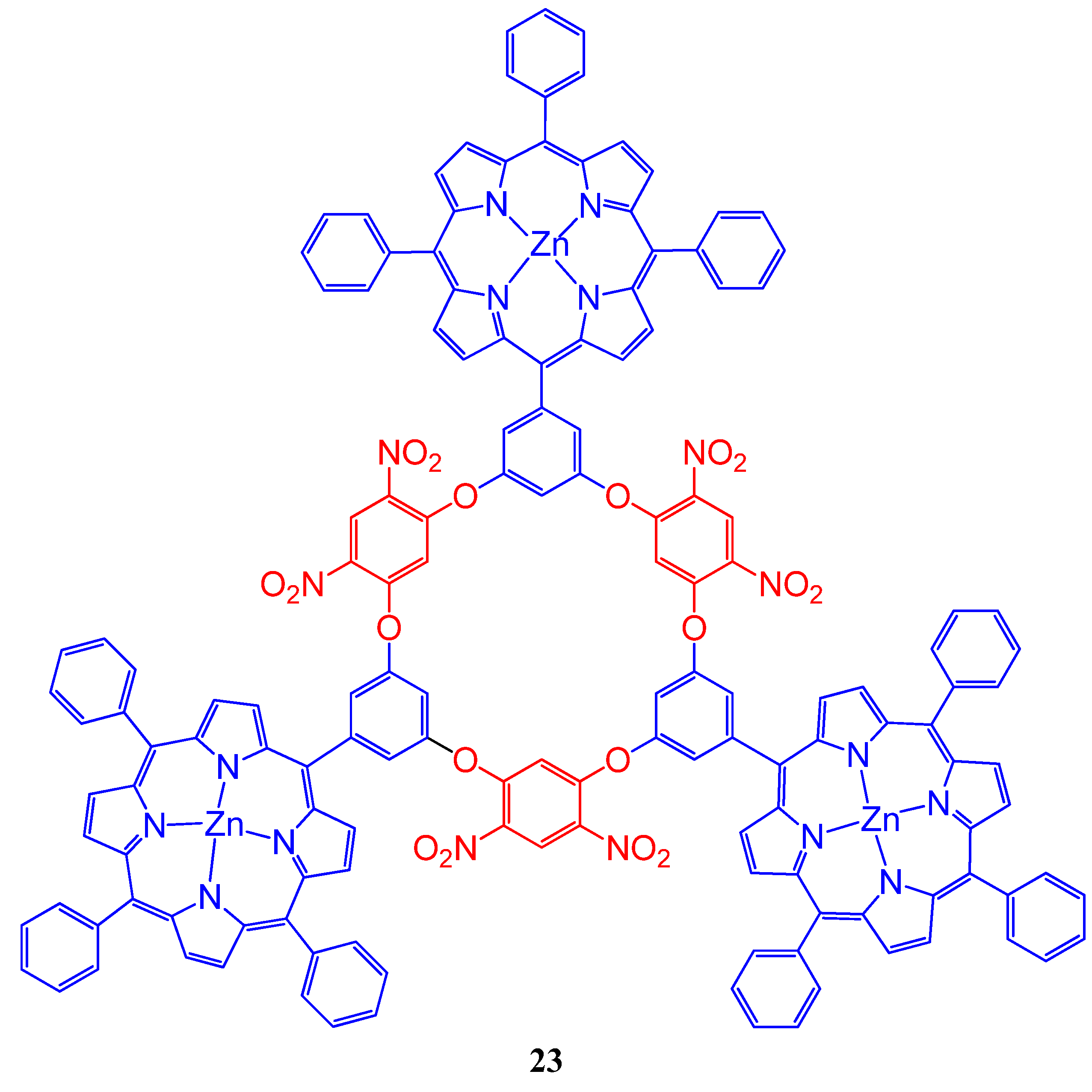
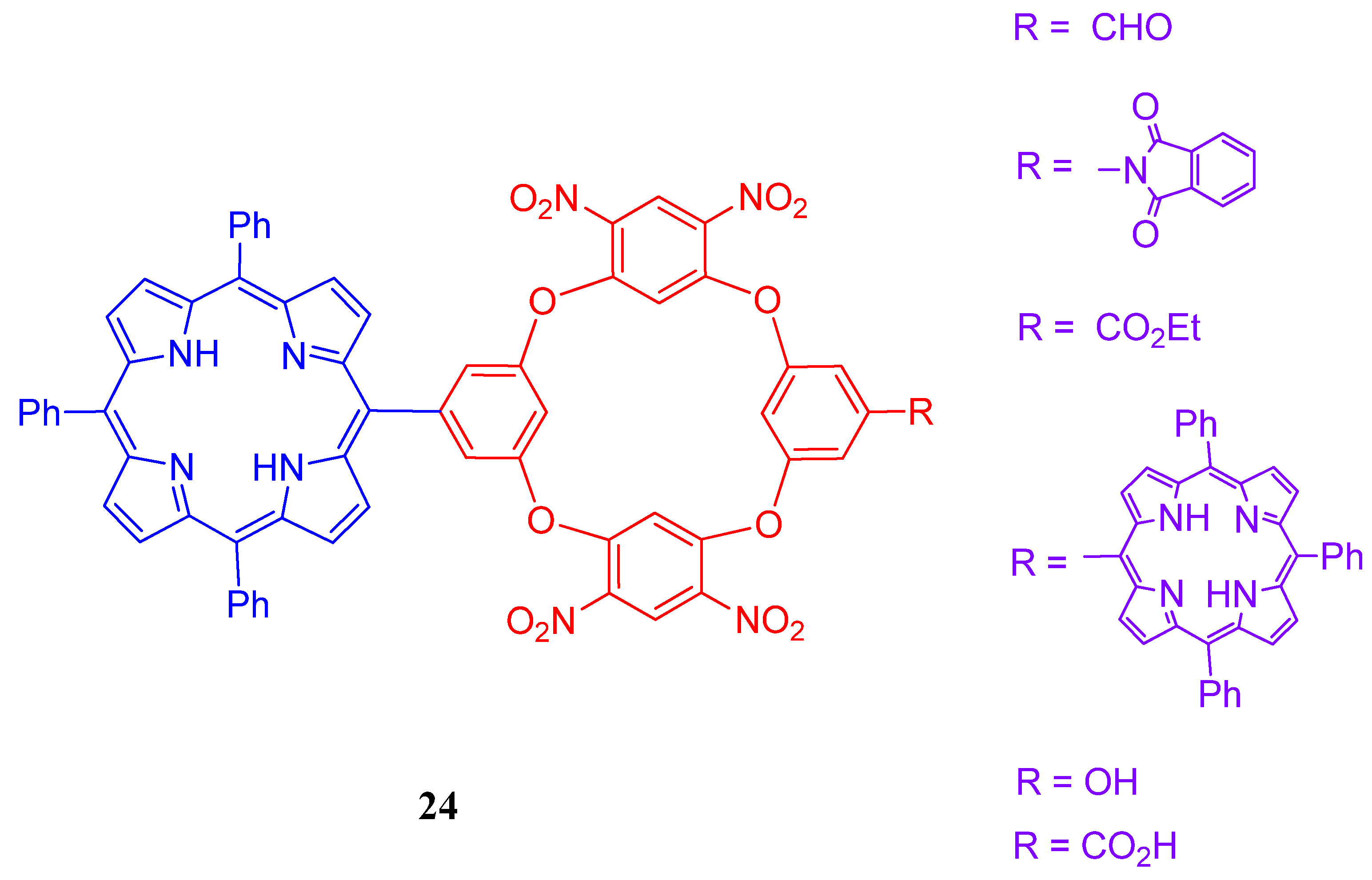
      <p>Wu and coworkers synthesized a new fluorogenic oxacalix[6]arene system <bold>23</bold> (<xref ref-type="fig" rid="molecules-17-11763-f024">Figure 24</xref>) bearing three Zn(II) porphyrins. This trimeric system and crystal violet found to form 1:1 complex and the fluorescence intensity of the porphyrin system is quenched regularly due to this complex formation. According to the authors, this compound can be found an application in the fluorometric titration method as an efficient detection agent for crystal violet with good linearity in the concentration range of 1.40–37.4 μmol/L [<xref ref-type="bibr" rid="B105-molecules-17-11763">105</xref>]. Some functionalized oxacalix[4]areneporphyrins, <bold>24</bold>, (<xref ref-type="fig" rid="molecules-17-11763-f025">Figure 25</xref>) (R = CHO, CO<sub>2</sub>H, CO<sub>2</sub>Et, OH, phthalimido), were synthesized via a high-yielding “3+1” condensation between <italic>meso</italic>-(3,5-dihydroxyphenyl)triphenylporphyrin and readily available new fluorodinitrobenzene-containing trimers were synthesized and photophysical properties were discussed by Jiao <italic>et al</italic>. [<xref ref-type="bibr" rid="B106-molecules-17-11763">106</xref>].</p>
      <fig id="molecules-17-11763-f024" position="float">
        <label>Figure 24</label>
        <caption>
          <p>The fluorogenic oxacalix[6]arene system (<bold>23</bold>) bearing three Zn(II) porphyrins.</p>
        </caption>
        <graphic xmlns:xlink="http://www.w3.org/1999/xlink" xlink:href="molecules-17-11763-g024.tif"/>
      </fig>
      <fig id="molecules-17-11763-f025" position="float">
        <label>Figure 25</label>
        <caption>
          <p>Schematic representation of functionalized oxacalix[4]arene porphyrins, <bold>24</bold>.</p>
        </caption>
        <graphic xmlns:xlink="http://www.w3.org/1999/xlink" xlink:href="molecules-17-11763-g025.tif"/>
      </fig>
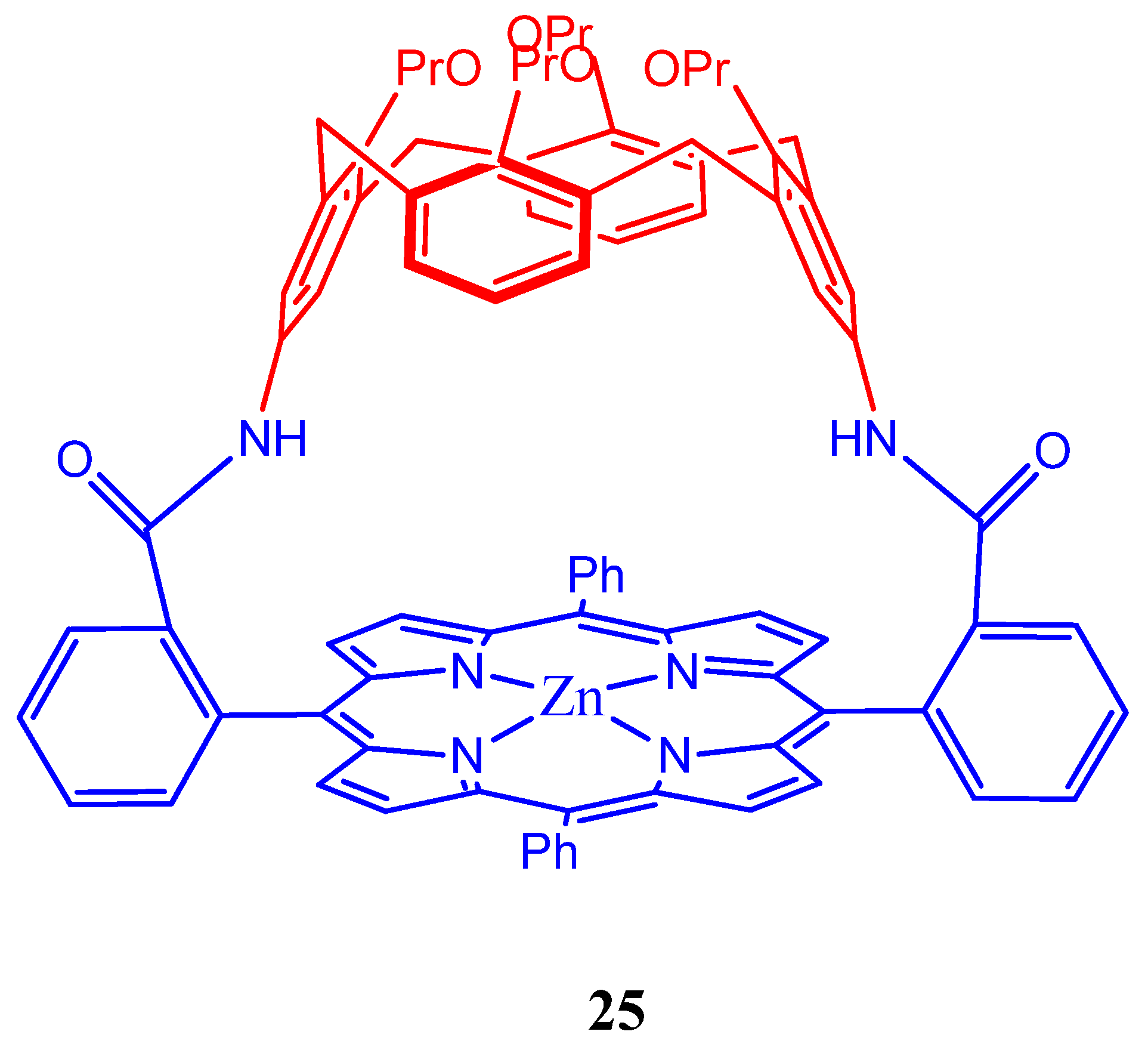
      <p>Highly shape selective guest encapsulation is achieved recently by a calix[4]arene-capped Zn(II) porphyrin <bold>25</bold> (<xref ref-type="fig" rid="molecules-17-11763-f026">Figure 26</xref>) which precisely recognizes the shape of small N-containing aromatic species in the confined inner cavity [<xref ref-type="bibr" rid="B107-molecules-17-11763">107</xref>].</p>
      <fig id="molecules-17-11763-f026" position="float">
        <label>Figure 26</label>
        <caption>
          <p>Calix[4]arene-capped Zn(II) porphyrin (<bold>25</bold>) capable of recognizing <italic>N</italic>-containing aromatic species.</p>
        </caption>
        <graphic xmlns:xlink="http://www.w3.org/1999/xlink" xlink:href="molecules-17-11763-g026.tif"/>
      </fig>
      <p>Construction of multilayers comprising calixarene and porphyrin units is another important research area [<xref ref-type="bibr" rid="B108-molecules-17-11763">108</xref>,<xref ref-type="bibr" rid="B109-molecules-17-11763">109</xref>,<xref ref-type="bibr" rid="B110-molecules-17-11763">110</xref>,<xref ref-type="bibr" rid="B111-molecules-17-11763">111</xref>,<xref ref-type="bibr" rid="B112-molecules-17-11763">112</xref>,<xref ref-type="bibr" rid="B113-molecules-17-11763">113</xref>,<xref ref-type="bibr" rid="B114-molecules-17-11763">114</xref>] and a promising application of such porphyrin based receptor arrays is in the field of cross responsive sensors for the generalized detection of volatile organic compounds and for recognition of organic compounds. For example, 4 zinc porphyrin molecules were linked covalently to a central amphiphilic calix[4]arene molecule to form a zinc calix-porphyrin, which displays enhanced sensitivity to dibutylamine compared to both the discrete zinc porphyrin and two-component mixtures of zinc porphyrin with calixarene [<xref ref-type="bibr" rid="B109-molecules-17-11763">109</xref>]. The dense packing of the monomeric porphyrin moieties leads to a high absorbance per layer and thus a large sensing signal compared to other LB films capable of amine-detection. This zinc calix-porphyrin is selectively responsive to the secondary amine, dibutylamine, compared to the primary and tertiary compounds. Mixed LB Films containing a cationic porphyrin and an anionic calix[8]arene octacarboxylic acid derivative were prepared and analyzed [<xref ref-type="bibr" rid="B110-molecules-17-11763">110</xref>]. The porphyrin aggregation is a result of a double comb configuration, where porphyrins from opposite layers are interwoven in a linear infinite J-aggregate. The cationic porphyrin tends to self-aggregate strongly, provided the electrostatic repulsions of their peripheral groups are cancelled by the anionic groups of the calixarene matrix.</p>
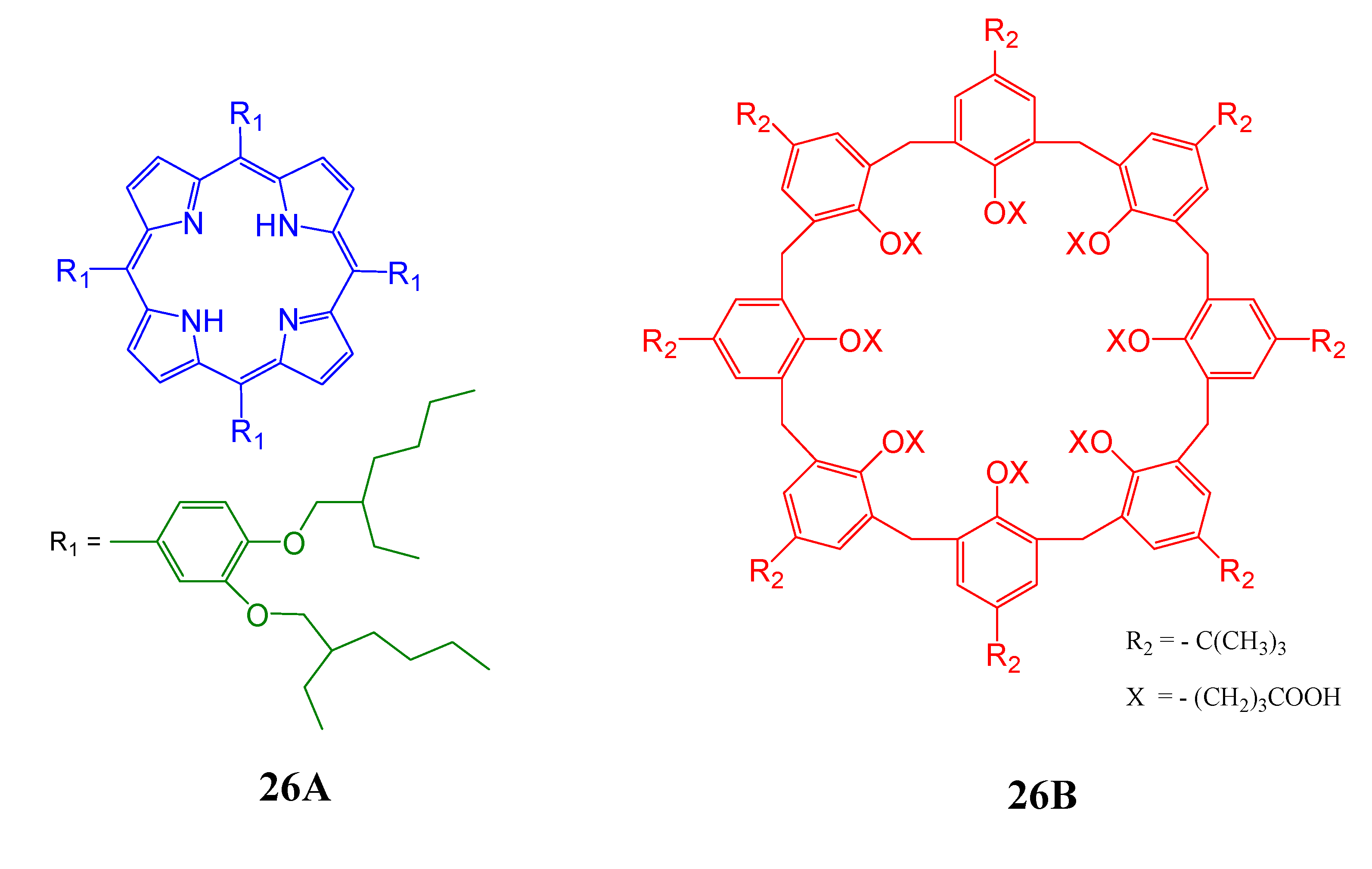
      <p>The gas sensing capabilities of Langmuir-Blodgett (LB) mixed films of 5,10,15,20-tetrakis[3,4-bis(2-ethylhexyloxy)phenyl]-21<italic>H</italic>,23<italic>H</italic>-porphine (<xref ref-type="fig" rid="molecules-17-11763-f027">Figure 27</xref>, <bold>26A</bold>) and <italic>p</italic>-<italic>tert</italic>-butylcalix[8]arene (<xref ref-type="fig" rid="molecules-17-11763-f027">Figure 27</xref>, <bold>26B</bold>) have been studied by Roales <italic>et al</italic>. [<xref ref-type="bibr" rid="B111-molecules-17-11763">111</xref>]. Although the parent is known to be very sensitive to NO<sub>2</sub> gas, this study demonstrated that the LB layer matrix was found to improve the sensing properties of the porphyrin molecule in the solid state. In AFM images, this LB films appeared with sharper surfaces than those made of pure porphyrin, allowing a better accessibility of the gas molecules to the active binding sites. The same porphyrin was also highly sensitive to low concentration of NO<sub>2</sub> in nitrogen when organized at the air-water interface using the host calix[8]arene matrix mentioned above [<xref ref-type="bibr" rid="B112-molecules-17-11763">112</xref>]. The distribution of the porphyrin molecules at the air-water interface in the calixarene matrix was found to be more homogeneous than that of the pure porphyrin monolayers. According to the authors, this homogeneous organization of porphyrin molecules in these mixed films is clearly manifested by the enhancement of response (faster), reproducibility (higher), sensitivity (higher) and temperature (wide range, being interesting for industrial applications) during exposure to NO<sub>2</sub>, in comparison with those results previously obtained for the pure porphyrin film.</p>
      <fig id="molecules-17-11763-f027" position="float">
        <label>Figure 27</label>
        <caption>
          <p>Schematic representation of 5,10,15,20-tetrakis[3,4-bis(2-ethylhexyloxy)phenyl]-21<italic>H</italic>,23<italic>H</italic>-porphine (<bold>26A</bold>) and <italic>p</italic>-<italic>tert</italic>-butylcalix[8]arene (<bold>26B</bold>).</p>
        </caption>
        <graphic xmlns:xlink="http://www.w3.org/1999/xlink" xlink:href="molecules-17-11763-g027.tif"/>
      </fig>
      <p>Zn and Mn derivatives of 5,10,15,20-tetrakis[3,4-bis(2-ethylhexyloxy)phenyl]porphyrins (EHO) have been mixed with calix[8]arene to enhance to the quality of the porphyrin films and their response to amine gases and also to increase the film lifetime [<xref ref-type="bibr" rid="B113-molecules-17-11763">113</xref>]. ZnEHO showed considerable spectral changes under exposure to each of the primary, secondary and tertary amine gases when compared to that of MnEHO and the authors claimed that ZnEHO is highly efficient for amine sensing in a sensing device.</p>
      <p>The self-assembly of charged, water soluble porphyrins as well as calixarenes also provide important host-guest systems for variety of applications [<xref ref-type="bibr" rid="B115-molecules-17-11763">115</xref>,<xref ref-type="bibr" rid="B116-molecules-17-11763">116</xref>,<xref ref-type="bibr" rid="B117-molecules-17-11763">117</xref>,<xref ref-type="bibr" rid="B118-molecules-17-11763">118</xref>,<xref ref-type="bibr" rid="B119-molecules-17-11763">119</xref>,<xref ref-type="bibr" rid="B120-molecules-17-11763">120</xref>,<xref ref-type="bibr" rid="B121-molecules-17-11763">121</xref>,<xref ref-type="bibr" rid="B122-molecules-17-11763">122</xref>,<xref ref-type="bibr" rid="B123-molecules-17-11763">123</xref>]. D’Urso <italic>et al</italic>. employed a water-soluble calixarene (1,6-bis[5,11,17,23-tetrakis(trimethylammoniomethyl)-25,26,27-tripropoxy-28-(oxy)calix[4]arene]) as a templating agent for the assembly of a tetraanionic porphyrin ([tetrakis(4-sulfonatephenyl)porphyrinato]Cu(II)) [<xref ref-type="bibr" rid="B115-molecules-17-11763">115</xref>]. The self-assembly in this condition resulted the noncovalent synthesis of 2-dimensional or 3-dimensional multiporphyrin assemblies and remarkable stability of these assemblies permitted a stepwise synthesis that makes it possible to choose the desired porphyrin sequence.</p>
      <p>Noncovalent synthesis of discrete supramolecular entities was also reported by Tabbi <italic>et al</italic>. [<xref ref-type="bibr" rid="B116-molecules-17-11763">116</xref>]. In this work, metalated <italic>meso</italic>-tetrakis(<italic>N</italic>-methyl-4-pyridyl)porphyrin (MTMPyP) and 5,11,17,23-tetra-sulfonato-25,26,27,28-tetrakis-(hydroxylcarbonylmethoxy)-calix[4]arene (C4TsTc) were used as key components for building up discrete supramolecular entities starting from the formation of the template species MTMPyP:C4TsTc (1:4, M = Cu, Zn). The stepwise addition of further amount of porphyrin allows the facile noncovalent synthesis of discrete supramolecular systems (2:4 and 3:4) which can be built up just by programming the right stoichiometric addition of the proper porphyrin. The authors reported that the electrochemistry of each of these supramolecular complexes is different from that of the parent components. This anomalous behavior can be explained only considering each of these supramolecular complexes as a unique entity, in which internal electronic communication might occur. A highly nanoporous material has been obtained by self-assembly of the polyanionic calixarene 5,11,17,23-tetrasulfonato-25,26,27,28-tetrakis(hydroxycarbonylmethoxy)calix[4]arene (C4TsTcn-) in the cone conformation and the tetracationic <italic>meso</italic>-tetrakis(4-<italic>N</italic>-methylpyridyl)porphyrin (H2TMPyP) building blocks [<xref ref-type="bibr" rid="B117-molecules-17-11763">117</xref>,<xref ref-type="bibr" rid="B118-molecules-17-11763">118</xref>]. This supramolecular zeolite-like structure was successively functionalized by diffusion and coordination of metal ions to form a new bi-functionalized nanoporous material containing a porphyrinic pigment together with a metal center. Supramolecular tetramer assemblies with parallel and perpendicular arrangement of tetrapyrrole macrocyclic rings are synthesized from calix[4]arene-bis(tin(IV)porphyrin systems by Mamardashvili <italic>et al</italic>. [<xref ref-type="bibr" rid="B119-molecules-17-11763">119</xref>]. Anionic bis(<italic>p</italic>-sulfonatocalix[5]arenes) and cationic porphyrins, respectively, are self-assembled to form two well-defined nano-architectures with 2-D netlike and 1-D linear topological structures, in which an unambiguous PET process is observed in nanoscale region [<xref ref-type="bibr" rid="B120-molecules-17-11763">120</xref>].</p>
    </sec>
    <sec>
      <title>4. Resorcinarenes-Porphyrin Assemblies</title>
      <p>Resorcinarenes, which are cyclic tetramers of resorcinol <bold>27A</bold>,<bold>B</bold> (<xref ref-type="fig" rid="molecules-17-11763-f028">Figure 28</xref>), are valuable three dimensional building blocks for molecular recognition. Usually in resorcinarenes, the resorcinol rings are connected with bridging moieties which results in a locked conformation called a cavitant. They are excellent molecular receptors that contain an enforced cavity large enough to accommodate simple organic compounds or ions [<xref ref-type="bibr" rid="B124-molecules-17-11763">124</xref>,<xref ref-type="bibr" rid="B125-molecules-17-11763">125</xref>,<xref ref-type="bibr" rid="B126-molecules-17-11763">126</xref>,<xref ref-type="bibr" rid="B127-molecules-17-11763">127</xref>,<xref ref-type="bibr" rid="B128-molecules-17-11763">128</xref>]. Resorcinarenes can be functionalized by introducing many different ligand moieties containing atoms O, S, N, and P both at upper and lower rim.</p>
      <fig id="molecules-17-11763-f028" position="float">
        <label>Figure 28</label>
        <caption>
          <p>Schematic representation of resorcin[n]arene (<bold>27A</bold>) and resorcin[4]arene (<bold>27B</bold>).</p>
        </caption>
        <graphic xmlns:xlink="http://www.w3.org/1999/xlink" xlink:href="molecules-17-11763-g028.tif"/>
      </fig>
      <p>Resorcinarenes are reported to form host-guest complexes with a variety of guest molecules, mostly with small organic molecules and ions, but also with alkali metal cations. Introduction of electronically and sterically diverse groups on the hydroxyls (upper rim) of resorcinarene significantly alters their physical, conformational, and binding properties. Also the hydroxyl groups at the upper rim of resorcinarene, or attached substituents, can engage in hydrogen bonding, while the π-basic cavity can form cation-π, CH-π, and π-π interactions with the guest. Resorcinarenes can also be employed as building blocks for self-assembled mono- and multilayers and can act as precursors to carceplexes, carcerands or hermicarcerands. All these fascinating properties of resorcinarenes make this class of compounds very prospective from the point of view of supramolecular chemistry, creation of valuable receptor molecules as well as new systems for biomimicking. Surprisingly, combination of porphyrin-resorcinarene systems are not much studied when compared to the corresponding porphyrin-calixarene or porphyrin-cyclodextrin conjugates.</p>
      <p>The present authors are interested in the synthesis of covalently bonded porphyrin-resorcinarene conjugates [<xref ref-type="bibr" rid="B129-molecules-17-11763">129</xref>]. The strategy we employed was to construct functionalized resorcinarene moieties and to couple them with suitable porphyrins. The resorcinarene framework used is either conformationally rigid cavitand or flexible unfirm structure in order to appropriately tune the flexibility and rigidity of this host receptor for the encapsulation characteristics. The conformationally locked bowl shape resorcin[4]arene (<xref ref-type="fig" rid="molecules-17-11763-f029">Figure 29</xref>, <bold>28A</bold>), was synthesized by reacting parent octahydroxyresorcinol with BrClCH<sub>2</sub>, which introduced methylene bridges between four sets of proximate oxygens of resorcin[4]arenes. The synthesis of the unlocked compound <bold>28B</bold> (<xref ref-type="fig" rid="molecules-17-11763-f029">Figure 29</xref>) was achieved by the reaction of octa-hydroxy resorcinol with methyl iodide [<xref ref-type="bibr" rid="B129-molecules-17-11763">129</xref>,<xref ref-type="bibr" rid="B130-molecules-17-11763">130</xref>]. Monobromination of one of the benzylic hydrogens of both resorcin[4]arenes upper rim is then carried out for introducing a suitable functional group to couple with porphyrins. The monobromomethylresorcin[4]arenes <bold>28C,D</bold> (<xref ref-type="fig" rid="molecules-17-11763-f029">Figure 29</xref>) were finally reacted with meso-5-(3-hydroxyphenyl)-10,15,20-tritolulyporphyrin to obtain the targeted cavient as well as the flexible unfirm resorcin[4]areneporphyrin systems <bold>29A,B</bold> (<xref ref-type="fig" rid="molecules-17-11763-f029">Figure 29</xref>).</p>
      <p>The influence of the resorcin[4]arene fragment on the porphyrin fluorescence was investigated by adding four structurally different fluorescence quenching quinones—benzoquinone (BQ), 1,4-naphthoquinone (NQ), phenanthrenequinone (PAQ) and dichlorodicyanobenzoquinone (DDQ)—to these porphyrin-resorcin[4]areneconjugates.</p>
      <fig id="molecules-17-11763-f029" position="float">
        <label>Figure 29</label>
        <caption>
          <p>Synthetic pathways of resorcin[4]arene (<bold>28A-D</bold>) for the preparation of porphyrin conjugated rigid resorcin[4]arene (<bold>29A</bold>) and its flexible analogue (<bold>29B</bold>).</p>
        </caption>
        <graphic xmlns:xlink="http://www.w3.org/1999/xlink" xlink:href="molecules-17-11763-g029.tif"/>
      </fig>
      <p>It was observed that at low concentration of quinones, the fluorescence quenching of the porphyrin considerably enhanced by the attachment of resorcin[4]arene. The flexible unfirm resorcin[4]arene system <bold>29B</bold> (<xref ref-type="fig" rid="molecules-17-11763-f029">Figure 29</xref>) exhibited more fluorescence quenching compared to the rigid counterpart <bold>29A</bold> (<xref ref-type="fig" rid="molecules-17-11763-f029">Figure 29</xref>) when bulkier quinones are present which indicate the easy encapsulation of the bigger quinones within this flexible molecular system. At the same time when small sized benzoquinone was present, both rigid and flexible resorcin[4]arene-porphyrin system showed almost same fluorescence quenching. Nakazawa <italic>et al</italic>. synthesized a stable, quadruple hydrogen bonded capsule <bold>30</bold> (<xref ref-type="fig" rid="molecules-17-11763-f030">Figure 30</xref>) from tetracarboxy resorcinarene and 2-pyridylporphyrins [<xref ref-type="bibr" rid="B131-molecules-17-11763">131</xref>]. This capsule is reported to encapsulate small molecules of various sizes from methane to cyclopentane. Various kinetic and thermodynamic parameters related to the process of encapsulation of small hydrocarbons into a resorcinarene-porphyrin conjugate and its guest exchanges rates has also been reported by the same group [<xref ref-type="bibr" rid="B132-molecules-17-11763">132</xref>].</p>
      <fig id="molecules-17-11763-f030" position="float">
        <label>Figure 30</label>
        <caption>
          <p>Small molecule encapsulation within the hydrogen bonded capsule (<bold>30</bold>).</p>
        </caption>
        <graphic xmlns:xlink="http://www.w3.org/1999/xlink" xlink:href="molecules-17-11763-g030.tif"/>
      </fig>
      <p>Synthesis of novel resorcin[4]arene-capped porphyrin capsules <bold>31</bold> (<xref ref-type="fig" rid="molecules-17-11763-f031">Figure 31</xref>)was reported by McKay and coworkers [<xref ref-type="bibr" rid="B133-molecules-17-11763">133</xref>].</p>
      <fig id="molecules-17-11763-f031" position="float">
        <label>Figure 31</label>
        <caption>
          <p>Representation of the resorcin[4]arene-capped porphyrin capsule (<bold>31</bold>).</p>
        </caption>
        <graphic xmlns:xlink="http://www.w3.org/1999/xlink" xlink:href="molecules-17-11763-g031.tif"/>
      </fig>
      <p>They used microwave (MW) irradiation (in conjunction with Adler conditions) to make this important capsule and observed significant improvement in product yield relative to the traditional refluxing protocol.</p>
      <p>Self-assembled (1:1) supramolecular resorcinarene-Zn porphyrin capsules containing coordinated bifunctional ligands such as 4,4'-bipyridine were synthesized by Stefanelli <italic>et al</italic>. [<xref ref-type="bibr" rid="B134-molecules-17-11763">134</xref>]. The formation of these capsules depends on key structural factors, such as the size of the cavity, and the possibility of the onset of hydrogen bonds, π-π and π-cation interactions. The same preparative protocol is extended with chiral bifunctional ligands, such as (+)-cinchonine and (−)-cinchonidine, and cinchona alkaloid derivatives and resulted in the achievement of supramolecular structures with chiral cavities, whose configuration is dependent on the asymmetry of the bound ditopic ligand.</p>
    </sec>
    <sec sec-type="conclusions">
      <title>5. Conclusions</title>
      <p>Cyclodextrin/calixarene/resorcinarene macrocyles can be used as preorganized three dimensional molecular receptors and functional materials by combination with porphyrins or metalloporphyrins. Owing to the cooperative contribution of the structural units, such molecular assemblies find unique application in catalysis, sensor devices, light harvesting or model structures for biomimetic research. The forthcoming research on these porphyrin incorporated molecular receptors is expected show an exponential growth because we are at a stage when researchers around the World are actively involved in biomimetic studies and nanosynthesis.</p>
    </sec>
  </body>
  <back>
    <ack>
      <title>Acknowledgments</title>
      <p>The financial support of Kuwait University received through research grant (SC09/09) is gratefully acknowledged.</p>
    </ack>
    <ref-list>
      <title>References</title>
      <ref id="B1-molecules-17-11763">
        <label>1.</label>
        <citation citation-type="book">
          <person-group person-group-type="author">
            <name>
              <surname>Voet</surname>
              <given-names>D.</given-names>
            </name>
            <name>
              <surname>Voet</surname>
              <given-names>J.D.</given-names>
            </name>
          </person-group>
          <source>Biochemistry</source>
          <edition>3rd</edition>
          <publisher-name>Wiley</publisher-name>
          <publisher-loc>New York, NY, USA</publisher-loc>
          <year>2004</year>
          <fpage>1</fpage>
          <lpage>1606</lpage>
        </citation>
      </ref>
      <ref id="B2-molecules-17-11763">
        <label>2.</label>
        <citation citation-type="book">
          <person-group person-group-type="author">
            <name>
              <surname>Kadish</surname>
              <given-names>K.M.</given-names>
              <suffix>Smith</suffix>
            </name>
          </person-group>
          <article-title>Biochemistry and Binding: Activation of Small Molecules</article-title>
          <source>The Porphyrin Handbook</source>
          <publisher-name>Academic Press</publisher-name>
          <publisher-loc>San Diego, CA, USA</publisher-loc>
          <year>2000</year>
          <volume>4</volume>
          <fpage>1</fpage>
          <lpage>341</lpage>
        </citation>
      </ref>
      <ref id="B3-molecules-17-11763">
        <label>3.</label>
        <citation citation-type="book">
          <person-group person-group-type="author">
            <name>
              <surname>Kadish</surname>
              <given-names>K.M.</given-names>
              <suffix>Smith</suffix>
            </name>
          </person-group>
          <article-title>Bioinorganic and Bioorganic Chemistry</article-title>
          <source>The Porphyrin Handbook</source>
          <publisher-name>Academic Press</publisher-name>
          <publisher-loc>San Diego, CA, USA</publisher-loc>
          <year>2003</year>
          <volume>11</volume>
          <fpage>1</fpage>
          <lpage>277</lpage>
        </citation>
      </ref>
      <ref id="B4-molecules-17-11763">
        <label>4.</label>
        <citation citation-type="journal">
          <person-group person-group-type="author">
            <name>
              <surname>Milanesio</surname>
              <given-names>M.E.</given-names>
            </name>
            <name>
              <surname>Alvarez</surname>
              <given-names>M.G.</given-names>
            </name>
            <name>
              <surname>Durantini</surname>
              <given-names>E.N.</given-names>
            </name>
          </person-group>
          <article-title>Methoxyphenylporphyrin derivatives as phototherapeutic agents</article-title>
          <source>Curr. Bioact. Compd.</source>
          <year>2010</year>
          <volume>6</volume>
          <fpage>97</fpage>
          <lpage>105</lpage>
          <pub-id pub-id-type="doi">10.2174/157340710791184840</pub-id>
        </citation>
      </ref>
      <ref id="B5-molecules-17-11763">
        <label>5.</label>
        <citation citation-type="journal">
          <person-group person-group-type="author">
            <name>
              <surname>De Visser</surname>
              <given-names>S.P.</given-names>
            </name>
            <name>
              <surname>Valentine</surname>
              <given-names>J.S.</given-names>
            </name>
            <name>
              <surname>Nam</surname>
              <given-names>W.</given-names>
            </name>
          </person-group>
          <article-title>A biomimetic ferric hydroperoxoporphyrin intermediate</article-title>
          <source>Angew. Chem. Int. Ed. Engl.</source>
          <year>2010</year>
          <volume>49</volume>
          <fpage>2099</fpage>
          <lpage>2101</lpage>
          <pub-id pub-id-type="doi">10.1002/anie.200906736</pub-id>
        </citation>
      </ref>
      <ref id="B6-molecules-17-11763">
        <label>6.</label>
        <citation citation-type="journal">
          <person-group person-group-type="author">
            <name>
              <surname>Rocha Gonsalves</surname>
              <given-names>A.M.A.</given-names>
            </name>
            <name>
              <surname>Serra</surname>
              <given-names>A.C.</given-names>
            </name>
            <name>
              <surname>Pineiro</surname>
              <given-names>M.</given-names>
            </name>
          </person-group>
          <article-title>The small stones of Coimbra in the huge tetrapyrrolic chemistry building</article-title>
          <source>J. Porphyr. Phthalocya.</source>
          <year>2009</year>
          <volume>13</volume>
          <fpage>429</fpage>
          <lpage>445</lpage>
          <pub-id pub-id-type="doi">10.1142/S1088424609000607</pub-id>
        </citation>
      </ref>
      <ref id="B7-molecules-17-11763">
        <label>7.</label>
        <citation citation-type="journal">
          <person-group person-group-type="author">
            <name>
              <surname>Maeda</surname>
              <given-names>C.</given-names>
            </name>
            <name>
              <surname>Kamada</surname>
              <given-names>T.</given-names>
            </name>
            <name>
              <surname>Aratani</surname>
              <given-names>N.</given-names>
            </name>
            <name>
              <surname>Osuka</surname>
              <given-names>A.</given-names>
            </name>
          </person-group>
          <article-title>Chiral self-discriminative self-assembling of meso-meso linked diporphyrins</article-title>
          <source>Coord. Chem. Rev.</source>
          <year>2007</year>
          <volume>251</volume>
          <fpage>2743</fpage>
          <lpage>2752</lpage>
          <pub-id pub-id-type="doi">10.1016/j.ccr.2007.02.017</pub-id>
        </citation>
      </ref>
      <ref id="B8-molecules-17-11763">
        <label>8.</label>
        <citation citation-type="journal">
          <person-group person-group-type="author">
            <name>
              <surname>Hori</surname>
              <given-names>T.</given-names>
            </name>
            <name>
              <surname>Nakamura</surname>
              <given-names>Y.</given-names>
            </name>
            <name>
              <surname>Aratani</surname>
              <given-names>N.</given-names>
            </name>
            <name>
              <surname>Osuka</surname>
              <given-names>A.</given-names>
            </name>
          </person-group>
          <article-title>Exploration of electronically interactive cyclic porphyrin arrays</article-title>
          <source>J. Organomet. Chem.</source>
          <year>2007</year>
          <volume>692</volume>
          <fpage>148</fpage>
          <lpage>155</lpage>
        <pub-id pub-id-type="doi">10.1016/j.jorganchem.2006.08.044</pub-id></citation>
      </ref>
      <ref id="B9-molecules-17-11763">
        <label>9.</label>
        <citation citation-type="journal">
          <person-group person-group-type="author">
            <name>
              <surname>Savitsky</surname>
              <given-names>A.</given-names>
            </name>
            <name>
              <surname>Möbius</surname>
              <given-names>K.</given-names>
            </name>
          </person-group>
          <article-title>Photochemical reactions and photoinduced electron-transfer processes in liquids, frozen solutions, and proteins as studied by multifrequency time-resolved EPR spectroscopy</article-title>
          <source>Helv. Chim. Acta</source>
          <year>2006</year>
          <volume>89</volume>
          <fpage>2544</fpage>
          <lpage>2589</lpage>
          <pub-id pub-id-type="doi">10.1002/hlca.200690232</pub-id>
        </citation>
      </ref>
      <ref id="B10-molecules-17-11763">
        <label>10.</label>
        <citation citation-type="journal">
          <person-group person-group-type="author">
            <name>
              <surname>Balaban</surname>
              <given-names>T.S.</given-names>
            </name>
          </person-group>
          <article-title>Tailoring porphyrins and chlorins for self-assembly in biomimetic artificial antenna systems</article-title>
          <source>Acc. Chem. Res.</source>
          <year>2005</year>
          <volume>38</volume>
          <fpage>612</fpage>
          <lpage>623</lpage>
          <pub-id pub-id-type="doi">10.1021/ar040211z</pub-id>
        </citation>
      </ref>
      <ref id="B11-molecules-17-11763">
        <label>11.</label>
        <citation citation-type="journal">
          <person-group person-group-type="author">
            <name>
              <surname>Carofiglio</surname>
              <given-names>T.</given-names>
            </name>
            <name>
              <surname>Lubian</surname>
              <given-names>E.</given-names>
            </name>
            <name>
              <surname>Varotto</surname>
              <given-names>A.</given-names>
            </name>
          </person-group>
          <article-title>Synthesis, heterogenization and sensing properties of melamine-bridged bis-porphyrin dimers</article-title>
          <source>J. Porphyr. Phthalocya.</source>
          <year>2010</year>
          <volume>14</volume>
          <fpage>701</fpage>
          <lpage>707</lpage>
          <pub-id pub-id-type="doi">10.1142/S1088424610002550</pub-id>
        </citation>
      </ref>
      <ref id="B12-molecules-17-11763">
        <label>12.</label>
        <citation citation-type="journal">
          <person-group person-group-type="author">
            <name>
              <surname>Samaroo</surname>
              <given-names>D.</given-names>
            </name>
            <name>
              <surname>Vinodu</surname>
              <given-names>M.</given-names>
            </name>
            <name>
              <surname>Chen</surname>
              <given-names>X.</given-names>
            </name>
            <name>
              <surname>Drain</surname>
              <given-names>C.M.</given-names>
            </name>
          </person-group>
          <article-title>meso-Tetra(pentafluorophenyl)porphyrin as an efficient platform for combinatorial synthesis and the selection of new photodynamic therapeutics using a cancer cell line</article-title>
          <source>J. Comb. Chem.</source>
          <year>2007</year>
          <volume>9</volume>
          <fpage>998</fpage>
          <lpage>1011</lpage>
          <pub-id pub-id-type="doi">10.1021/cc070067j</pub-id>
        </citation>
      </ref>
      <ref id="B13-molecules-17-11763">
        <label>13.</label>
        <citation citation-type="journal">
          <person-group person-group-type="author">
            <name>
              <surname>Tsuda</surname>
              <given-names>A.</given-names>
            </name>
          </person-group>
          <article-title>Design of porphyrin nanoclusters toward discovery of novel properties and functions</article-title>
          <source>Bull. Chem. Soc. Jpn.</source>
          <year>2009</year>
          <volume>82</volume>
          <fpage>11</fpage>
          <lpage>28</lpage>
          <pub-id pub-id-type="doi">10.1246/bcsj.82.11</pub-id>
        </citation>
      </ref>
      <ref id="B14-molecules-17-11763">
        <label>14.</label>
        <citation citation-type="journal">
          <person-group person-group-type="author">
            <name>
              <surname>Goldberg</surname>
              <given-names>I.</given-names>
            </name>
          </person-group>
          <article-title>Crystal engineering of nanoporous architectures and chiral porphyrin assemblies</article-title>
          <source>CrystEngComm</source>
          <year>2008</year>
          <volume>10</volume>
          <fpage>637</fpage>
          <lpage>645</lpage>
          <pub-id pub-id-type="doi">10.1039/b800107c</pub-id>
        </citation>
      </ref>
      <ref id="B15-molecules-17-11763">
        <label>15.</label>
        <citation citation-type="journal">
          <person-group person-group-type="author">
            <name>
              <surname>Shinoda</surname>
              <given-names>S.</given-names>
            </name>
          </person-group>
          <article-title>Nanoscale substrate recognition by porphyrin dendrimers with patched structures</article-title>
          <source>J. Incl. Phenom. Macro.</source>
          <year>2007</year>
          <volume>59</volume>
          <fpage>1</fpage>
          <lpage>9</lpage>
          <pub-id pub-id-type="doi">10.1007/s10847-007-9315-2</pub-id>
        </citation>
      </ref>
      <ref id="B16-molecules-17-11763">
        <label>16.</label>
        <citation citation-type="journal">
          <person-group person-group-type="author">
            <name>
              <surname>Boyd</surname>
              <given-names>P.D.W.</given-names>
            </name>
            <name>
              <surname>Reed</surname>
              <given-names>C.A.</given-names>
            </name>
          </person-group>
          <article-title>Fullerene-porphyrin constructs</article-title>
          <source>Acc. Chem. Res.</source>
          <year>2005</year>
          <volume>38</volume>
          <fpage>235</fpage>
          <lpage>242</lpage>
          <pub-id pub-id-type="doi">10.1021/ar040168f</pub-id>
        </citation>
      </ref>
      <ref id="B17-molecules-17-11763">
        <label>17.</label>
        <citation citation-type="journal">
          <person-group person-group-type="author">
            <name>
              <surname>Jurow</surname>
              <given-names>M.</given-names>
            </name>
            <name>
              <surname>Schuckman</surname>
              <given-names>A.E.</given-names>
            </name>
            <name>
              <surname>Batteas</surname>
              <given-names>J.D.</given-names>
            </name>
            <name>
              <surname>Drain</surname>
              <given-names>C.M.</given-names>
            </name>
          </person-group>
          <article-title>Porphyrins as molecular electronic components of functional devices</article-title>
          <source>Coord. Chem. Rev.</source>
          <year>2010</year>
          <volume>254</volume>
          <fpage>2297</fpage>
          <lpage>2310</lpage>
          <pub-id pub-id-type="doi">10.1016/j.ccr.2010.05.014</pub-id>
        </citation>
      </ref>
      <ref id="B18-molecules-17-11763">
        <label>18.</label>
        <citation citation-type="journal">
          <person-group person-group-type="author">
            <name>
              <surname>Beletskaya</surname>
              <given-names>I.</given-names>
            </name>
            <name>
              <surname>Tyurin</surname>
              <given-names>V.S.</given-names>
            </name>
            <name>
              <surname>Tsivadze</surname>
              <given-names>A.Y.</given-names>
            </name>
            <name>
              <surname>Gulard</surname>
              <given-names>R.</given-names>
            </name>
            <name>
              <surname>Stern</surname>
              <given-names>C.</given-names>
            </name>
          </person-group>
          <article-title>Supramolecular chemistry of metalloporphyrins</article-title>
          <source>Chem. Rev.</source>
          <year>2009</year>
          <volume>109</volume>
          <fpage>1659</fpage>
          <lpage>1713</lpage>
          <pub-id pub-id-type="doi">10.1021/cr800247a</pub-id>
        </citation>
      </ref>
      <ref id="B19-molecules-17-11763">
        <label>19.</label>
        <citation citation-type="journal">
          <person-group person-group-type="author">
            <name>
              <surname>Chen</surname>
              <given-names>Y.</given-names>
            </name>
            <name>
              <surname>Zhang</surname>
              <given-names>Y.</given-names>
            </name>
            <name>
              <surname>Liu</surname>
              <given-names>Y.</given-names>
            </name>
          </person-group>
          <article-title>Molecular selective binding and nano-fabrication of cucurbituril/cyclodextrin pairs</article-title>
          <source>Isr. J. Chem.</source>
          <year>2011</year>
          <volume>51</volume>
          <fpage>515</fpage>
          <lpage>524</lpage>
          <pub-id pub-id-type="doi">10.1002/ijch.201100010</pub-id>
        </citation>
      </ref>
      <ref id="B20-molecules-17-11763">
        <label>20.</label>
        <citation citation-type="journal">
          <person-group person-group-type="author">
            <name>
              <surname>Endo</surname>
              <given-names>T.</given-names>
            </name>
          </person-group>
          <article-title>Vital significance of addition of “shape similarity” between solutes to shape complementarity for more precise molecular recognition in aqueous binary solvents</article-title>
          <source>Chem. Rec.</source>
          <year>2011</year>
          <volume>11</volume>
          <fpage>146</fpage>
          <lpage>157</lpage>
          <pub-id pub-id-type="doi">10.1002/tcr.201100001</pub-id>
        </citation>
      </ref>
      <ref id="B21-molecules-17-11763">
        <label>21.</label>
        <citation citation-type="journal">
          <person-group person-group-type="author">
            <name>
              <surname>Kraus</surname>
              <given-names>T.</given-names>
            </name>
          </person-group>
          <article-title>Modified cyclodextrins with pendant cationic and anionic moieties as hosts for highly stable inclusion complexes and molecular recognition</article-title>
          <source>Curr. Org. Chem.</source>
          <year>2011</year>
          <volume>15</volume>
          <fpage>802</fpage>
          <lpage>814</lpage>
          <pub-id pub-id-type="doi">10.2174/138527211794518907</pub-id>
        </citation>
      </ref>
      <ref id="B22-molecules-17-11763">
        <label>22.</label>
        <citation citation-type="journal">
          <person-group person-group-type="author">
            <name>
              <surname>De Rossi</surname>
              <given-names>R.H.</given-names>
            </name>
            <name>
              <surname>Silva</surname>
              <given-names>O.F.</given-names>
            </name>
            <name>
              <surname>Vico</surname>
              <given-names>R.V.</given-names>
            </name>
            <name>
              <surname>Gonzalez</surname>
              <given-names>C.J.</given-names>
            </name>
          </person-group>
          <article-title>Molecular organization and recognition properties of amphiphiliccyclodextrins</article-title>
          <source>Pure Appl. Chem.</source>
          <year>2009</year>
          <volume>81</volume>
          <fpage>755</fpage>
          <lpage>765</lpage>
          <pub-id pub-id-type="doi">10.1351/PAC-CON-08-08-13</pub-id>
        </citation>
      </ref>
      <ref id="B23-molecules-17-11763">
        <label>23.</label>
        <citation citation-type="journal">
          <person-group person-group-type="author">
            <name>
              <surname>Sallas</surname>
              <given-names>F.</given-names>
            </name>
            <name>
              <surname>Darcy</surname>
              <given-names>R.</given-names>
            </name>
          </person-group>
          <article-title>Amphiphiliccyclodextrins—Advances in synthesis and supramolecular chemistry</article-title>
          <source>Eur. J. Org. Chem.</source>
          <year>2008</year>
          <volume>6</volume>
          <fpage>957</fpage>
          <lpage>969</lpage>
          <pub-id pub-id-type="doi">10.1002/ejoc.200700933</pub-id>
        </citation>
      </ref>
      <ref id="B24-molecules-17-11763">
        <label>24.</label>
        <citation citation-type="journal">
          <person-group person-group-type="author">
            <name>
              <surname>Korendovych</surname>
              <given-names>I.V.</given-names>
            </name>
            <name>
              <surname>Roesner</surname>
              <given-names>R.A.</given-names>
            </name>
            <name>
              <surname>Rybak-Akimova</surname>
              <given-names>E.V.</given-names>
            </name>
          </person-group>
          <article-title>Molecular recognition of neutral and charged guests using metallomacrocyclic hosts</article-title>
          <source>Adv. Inorg. Chem.</source>
          <year>2007</year>
          <volume>59</volume>
          <fpage>109</fpage>
          <lpage>173</lpage>
        </citation>
      </ref>
      <ref id="B25-molecules-17-11763">
        <label>25.</label>
        <citation citation-type="journal">
          <person-group person-group-type="author">
            <name>
              <surname>Wang</surname>
              <given-names>M.</given-names>
            </name>
          </person-group>
          <article-title>Nitrogen and oxygen bridged calixaromatics: Synthesis, structure, functionalization, and molecular recognition</article-title>
          <source>Acc. Chem. Res.</source>
          <year>2012</year>
          <volume>45</volume>
          <fpage>182</fpage>
          <lpage>195</lpage>
          <pub-id pub-id-type="doi">10.1021/ar200108c</pub-id>
        </citation>
      </ref>
      <ref id="B26-molecules-17-11763">
        <label>26.</label>
        <citation citation-type="journal">
          <person-group person-group-type="author">
            <name>
              <surname>Joseph</surname>
              <given-names>R.</given-names>
            </name>
            <name>
              <surname>Rao</surname>
              <given-names>C.P.</given-names>
            </name>
          </person-group>
          <article-title>Ion and molecular recognition by lower rim 1,3-di-conjugates of calix[4]arene as receptors</article-title>
          <source>Chem. Rev.</source>
          <year>2011</year>
          <volume>111</volume>
          <fpage>4658</fpage>
          <lpage>4702</lpage>
          <pub-id pub-id-type="doi">10.1021/cr1004524</pub-id>
        </citation>
      </ref>
      <ref id="B27-molecules-17-11763">
        <label>27.</label>
        <citation citation-type="journal">
          <person-group person-group-type="author">
            <name>
              <surname>Evtugyn</surname>
              <given-names>G.A.</given-names>
            </name>
            <name>
              <surname>Stoikova</surname>
              <given-names>E.E.</given-names>
            </name>
            <name>
              <surname>Shamagsumova</surname>
              <given-names>R.V.</given-names>
            </name>
          </person-group>
          <article-title>Molecular receptors and electrochemical sensors based on functionalized calixarenes</article-title>
          <source>Russ. Chem. Rev.</source>
          <year>2010</year>
          <volume>79</volume>
          <fpage>1071</fpage>
          <lpage>1097</lpage>
        </citation>
      </ref>
      <ref id="B28-molecules-17-11763">
        <label>28.</label>
        <citation citation-type="journal">
          <person-group person-group-type="author">
            <name>
              <surname>Mokhtari</surname>
              <given-names>B.</given-names>
            </name>
            <name>
              <surname>Pourabdollah</surname>
              <given-names>K.</given-names>
            </name>
            <name>
              <surname>Dalali</surname>
              <given-names>N.</given-names>
            </name>
          </person-group>
          <article-title>Molecule and ion recognition of nano-baskets of calixarenes since 2005</article-title>
          <source>J. Coord. Chem.</source>
          <year>2011</year>
          <volume>64</volume>
          <fpage>743</fpage>
          <lpage>794</lpage>
          <pub-id pub-id-type="doi">10.1080/00958972.2011.555538</pub-id>
        </citation>
      </ref>
      <ref id="B29-molecules-17-11763">
        <label>29.</label>
        <citation citation-type="journal">
          <person-group person-group-type="author">
            <name>
              <surname>Sansone</surname>
              <given-names>F.</given-names>
            </name>
            <name>
              <surname>Baldini</surname>
              <given-names>L.</given-names>
            </name>
            <name>
              <surname>Casnati</surname>
              <given-names>A.</given-names>
            </name>
            <name>
              <surname>Ungaro</surname>
              <given-names>R.</given-names>
            </name>
          </person-group>
          <article-title>Calixarenes: From biomimetic receptors to multivalent ligands for biomolecular recognition</article-title>
          <source>New J. Chem.</source>
          <year>2010</year>
          <volume>34</volume>
          <fpage>2715</fpage>
          <lpage>2728</lpage>
          <pub-id pub-id-type="doi">10.1039/c0nj00285b</pub-id>
        </citation>
      </ref>
      <ref id="B30-molecules-17-11763">
        <label>30.</label>
        <citation citation-type="journal">
          <person-group person-group-type="author">
            <name>
              <surname>Thatiparti</surname>
              <given-names>T.R.</given-names>
            </name>
            <name>
              <surname>Shoffstall</surname>
              <given-names>A.J.</given-names>
            </name>
            <name>
              <surname>von Recum</surname>
              <given-names>H.A.</given-names>
            </name>
          </person-group>
          <article-title>Cyclodextrin-based device coatings for affinity-based release of antibiotics</article-title>
          <source>Biomaterials</source>
          <year>2010</year>
          <volume>31</volume>
          <fpage>2335</fpage>
          <lpage>2347</lpage>
          <pub-id pub-id-type="doi">10.1016/j.biomaterials.2009.11.087</pub-id>
        </citation>
      </ref>
      <ref id="B31-molecules-17-11763">
        <label>31.</label>
        <citation citation-type="journal">
          <person-group person-group-type="author">
            <name>
              <surname>Liu</surname>
              <given-names>Y.</given-names>
            </name>
            <name>
              <surname>Chen</surname>
              <given-names>Y.</given-names>
            </name>
          </person-group>
          <article-title>Cooperative binding and multiple recognition by bridged bis(β-cyclodextrin)s with functional linkers</article-title>
          <source>Acc. Chem. Res.</source>
          <year>2006</year>
          <volume>39</volume>
          <fpage>681</fpage>
          <lpage>691</lpage>
          <pub-id pub-id-type="doi">10.1021/ar0502275</pub-id>
        </citation>
      </ref>
      <ref id="B32-molecules-17-11763">
        <label>32.</label>
        <citation citation-type="journal">
          <person-group person-group-type="author">
            <name>
              <surname>Easton</surname>
              <given-names>C.J.</given-names>
            </name>
            <name>
              <surname>Lincoln</surname>
              <given-names>S.F.</given-names>
            </name>
          </person-group>
          <article-title>Chiral discrimination by modified cyclodextrins</article-title>
          <source>Chem. Soc. Rev.</source>
          <year>1996</year>
          <volume>25</volume>
          <fpage>163</fpage>
          <lpage>170</lpage>
        <pub-id pub-id-type="doi">10.1039/cs9962500163</pub-id></citation>
      </ref>
      <ref id="B33-molecules-17-11763">
        <label>33.</label>
        <citation citation-type="journal">
          <person-group person-group-type="author">
            <name>
              <surname>Murakami</surname>
              <given-names>Y.</given-names>
            </name>
            <name>
              <surname>Kikuchi</surname>
              <given-names>J.</given-names>
            </name>
            <name>
              <surname>Hisaeda</surname>
              <given-names>Y.</given-names>
            </name>
            <name>
              <surname>Hayashida</surname>
              <given-names>O.</given-names>
            </name>
          </person-group>
          <article-title>Artificial enzymes</article-title>
          <source>Chem. Rev.</source>
          <year>1996</year>
          <volume>96</volume>
          <fpage>721</fpage>
          <lpage>758</lpage>
          <pub-id pub-id-type="doi">10.1021/cr9403704</pub-id>
        </citation>
      </ref>
      <ref id="B34-molecules-17-11763">
        <label>34.</label>
        <citation citation-type="journal">
          <person-group person-group-type="author">
            <name>
              <surname>Walker</surname>
              <given-names>B.D.</given-names>
            </name>
            <name>
              <surname>Joshi</surname>
              <given-names>G.</given-names>
            </name>
            <name>
              <surname>Davis</surname>
              <given-names>A.P.</given-names>
            </name>
          </person-group>
          <article-title>Progress in biomimetic carbohydrate recognition</article-title>
          <source>Cell. Mol. Life Sci.</source>
          <year>2009</year>
          <volume>66</volume>
          <fpage>3177</fpage>
          <lpage>3191</lpage>
          <pub-id pub-id-type="doi">10.1007/s00018-009-0081-8</pub-id>
        </citation>
      </ref>
      <ref id="B35-molecules-17-11763">
        <label>35.</label>
        <citation citation-type="journal">
          <person-group person-group-type="author">
            <name>
              <surname>Puglisi</surname>
              <given-names>A.</given-names>
            </name>
            <name>
              <surname>Purrello</surname>
              <given-names>R.</given-names>
            </name>
            <name>
              <surname>Rizzarelli</surname>
              <given-names>E.</given-names>
            </name>
            <name>
              <surname>Sortino</surname>
              <given-names>S.</given-names>
            </name>
            <name>
              <surname>Vecchio</surname>
              <given-names>G.</given-names>
            </name>
          </person-group>
          <article-title>Spectroscopic and self-association behavior of a porphyrin-β-cyclodextrin conjugate</article-title>
          <source>New J. Chem.</source>
          <year>2007</year>
          <volume>31</volume>
          <fpage>1499</fpage>
          <lpage>1506</lpage>
          <pub-id pub-id-type="doi">10.1039/b703680a</pub-id>
        </citation>
      </ref>
      <ref id="B36-molecules-17-11763">
        <label>36.</label>
        <citation citation-type="journal">
          <person-group person-group-type="author">
            <name>
              <surname>Jayawickramarajah</surname>
              <given-names>J.</given-names>
            </name>
            <name>
              <surname>Tagore</surname>
              <given-names>D.M.</given-names>
            </name>
            <name>
              <surname>Tsou</surname>
              <given-names>L.K.</given-names>
            </name>
            <name>
              <surname>Hamilton</surname>
              <given-names>A.D.</given-names>
            </name>
          </person-group>
          <article-title>Allosteric control of self-assembly: Modulating the formation of guanine quadruplexes through orthogonal aromatic interactions</article-title>
          <source>Angew. Chem. Int. Ed. Engl.</source>
          <year>2007</year>
          <volume>46</volume>
          <fpage>7583</fpage>
          <lpage>7586</lpage>
          <pub-id pub-id-type="doi">10.1002/anie.200701883</pub-id>
        </citation>
      </ref>
      <ref id="B37-molecules-17-11763">
        <label>37.</label>
        <citation citation-type="journal">
          <person-group person-group-type="author">
            <name>
              <surname>Hosokawa</surname>
              <given-names>K.</given-names>
            </name>
            <name>
              <surname>Miura</surname>
              <given-names>Y.</given-names>
            </name>
            <name>
              <surname>Kiba</surname>
              <given-names>T.</given-names>
            </name>
            <name>
              <surname>Kakuchi</surname>
              <given-names>T.</given-names>
            </name>
            <name>
              <surname>Sato</surname>
              <given-names>S.</given-names>
            </name>
          </person-group>
          <article-title>Fluorescence resonance energy transfer in host-guest inclusion complexes of cyclodextrin-porphyrin composite in aqueous solution</article-title>
          <source>Chem. Lett.</source>
          <year>2008</year>
          <volume>37</volume>
          <fpage>60</fpage>
          <lpage>61</lpage>
          <pub-id pub-id-type="doi">10.1246/cl.2008.60</pub-id>
        </citation>
      </ref>
      <ref id="B38-molecules-17-11763">
        <label>38.</label>
        <citation citation-type="journal">
          <person-group person-group-type="author">
            <name>
              <surname>Fathalla</surname>
              <given-names>M.</given-names>
            </name>
            <name>
              <surname>Li</surname>
              <given-names>S.</given-names>
            </name>
            <name>
              <surname>Diebold</surname>
              <given-names>U.</given-names>
            </name>
            <name>
              <surname>Alb</surname>
              <given-names>A.</given-names>
            </name>
            <name>
              <surname>Jayawickramarajah</surname>
              <given-names>J.</given-names>
            </name>
          </person-group>
          <article-title>Water-soluble nano-rods self-assembled via pristine C60 and porphyrin moieties</article-title>
          <source>Chem. Commun.</source>
          <year>2009</year>
          <volume>2009</volume>
          <fpage>4209</fpage>
          <lpage>4211</lpage>
        </citation>
      </ref>
      <ref id="B39-molecules-17-11763">
        <label>39.</label>
        <citation citation-type="journal">
          <person-group person-group-type="author">
            <name>
              <surname>Kralova</surname>
              <given-names>J.</given-names>
            </name>
            <name>
              <surname>Kejik</surname>
              <given-names>Z.</given-names>
            </name>
            <name>
              <surname>Briza</surname>
              <given-names>T.</given-names>
            </name>
            <name>
              <surname>Pouckova</surname>
              <given-names>P.</given-names>
            </name>
            <name>
              <surname>Kral</surname>
              <given-names>A.</given-names>
            </name>
            <name>
              <surname>Martasek</surname>
              <given-names>P.</given-names>
            </name>
            <name>
              <surname>Kral</surname>
              <given-names>V.</given-names>
            </name>
          </person-group>
          <article-title>Porphyrin-cyclodextrinconjugates as a nanosystem for versatile drug delivery and multimodal cancer therapy</article-title>
          <source>J. Med. Chem.</source>
          <year>2010</year>
          <volume>53</volume>
          <fpage>128</fpage>
          <lpage>138</lpage>
          <pub-id pub-id-type="doi">10.1021/jm9007278</pub-id>
        </citation>
      </ref>
      <ref id="B40-molecules-17-11763">
        <label>40.</label>
        <citation citation-type="journal">
          <person-group person-group-type="author">
            <name>
              <surname>Kejik</surname>
              <given-names>Z.</given-names>
            </name>
            <name>
              <surname>Briza</surname>
              <given-names>T.</given-names>
            </name>
            <name>
              <surname>Kralova</surname>
              <given-names>J.</given-names>
            </name>
            <name>
              <surname>Pouckova</surname>
              <given-names>P.</given-names>
            </name>
            <name>
              <surname>Kral</surname>
              <given-names>A.</given-names>
            </name>
            <name>
              <surname>Martasek</surname>
              <given-names>P.</given-names>
            </name>
            <name>
              <surname>Kral</surname>
              <given-names>V.</given-names>
            </name>
          </person-group>
          <article-title>Coordination conjugates of therapeutic proteins with drug carriers: A new approach for versatile advanced drug delivery</article-title>
          <source>Bioorg. Med. Chem. Lett.</source>
          <year>2011</year>
          <volume>21</volume>
          <fpage>5514</fpage>
          <lpage>5520</lpage>
        <pub-id pub-id-type="doi">10.1016/j.bmcl.2011.06.101</pub-id><pub-id pub-id-type="pmid">21784635</pub-id></citation>
      </ref>
      <ref id="B41-molecules-17-11763">
        <label>41.</label>
        <citation citation-type="journal">
          <person-group person-group-type="author">
            <name>
              <surname>Guo</surname>
              <given-names>Y.</given-names>
            </name>
            <name>
              <surname>Zhang</surname>
              <given-names>P.</given-names>
            </name>
            <name>
              <surname>Chao</surname>
              <given-names>J.</given-names>
            </name>
            <name>
              <surname>Shuang</surname>
              <given-names>S.</given-names>
            </name>
            <name>
              <surname>Dong</surname>
              <given-names>C.</given-names>
            </name>
          </person-group>
          <article-title>Study on the supramolecular system of 5-(p-hydroxyphenyl)-10,15,20-tris-(4-chlorophenyl)porphyrin with cyclodextrins and its analytical characteristics</article-title>
          <source>Spectrochim. Acta A</source>
          <year>2008</year>
          <volume>71A</volume>
          <fpage>946</fpage>
          <lpage>950</lpage>
        </citation>
      </ref>
      <ref id="B42-molecules-17-11763">
        <label>42.</label>
        <citation citation-type="journal">
          <person-group person-group-type="author">
            <name>
              <surname>Zhang</surname>
              <given-names>L.</given-names>
            </name>
            <name>
              <surname>Li</surname>
              <given-names>X.</given-names>
            </name>
            <name>
              <surname>Kang</surname>
              <given-names>S.-Z.</given-names>
            </name>
            <name>
              <surname>Mu</surname>
              <given-names>J.</given-names>
            </name>
          </person-group>
          <article-title>Complex of porphyrins and cyclodextrin-modified multi-walled carbon nanotubes: Preparation and its properties</article-title>
          <source>Supramol. Chem.</source>
          <year>2008</year>
          <volume>20</volume>
          <fpage>601</fpage>
          <lpage>604</lpage>
          <pub-id pub-id-type="doi">10.1080/10610270701543423</pub-id>
        </citation>
      </ref>
      <ref id="B43-molecules-17-11763">
        <label>43.</label>
        <citation citation-type="journal">
          <person-group person-group-type="author">
            <name>
              <surname>Fathalla</surname>
              <given-names>M.</given-names>
            </name>
            <name>
              <surname>Neuberger</surname>
              <given-names>A.</given-names>
            </name>
            <name>
              <surname>Li</surname>
              <given-names>S.-C.</given-names>
            </name>
            <name>
              <surname>Schmehl</surname>
              <given-names>R.</given-names>
            </name>
            <name>
              <surname>Diebold</surname>
              <given-names>U.</given-names>
            </name>
            <name>
              <surname>Jayawickramarajah</surname>
              <given-names>J.</given-names>
            </name>
          </person-group>
          <article-title>Straightforward self-assembly of porphyrin nanowires in water: Harnessing adamantane/β-cyclodextrin interactions</article-title>
          <source>J. Am. Chem. Soc.</source>
          <year>2010</year>
          <volume>132</volume>
          <fpage>9966</fpage>
          <lpage>9967</lpage>
        <pub-id pub-id-type="doi">10.1021/ja1030722</pub-id><pub-id pub-id-type="pmid">20597548</pub-id></citation>
      </ref>
      <ref id="B44-molecules-17-11763">
        <label>44.</label>
        <citation citation-type="journal">
          <person-group person-group-type="author">
            <name>
              <surname>Li</surname>
              <given-names>X.-X.</given-names>
            </name>
            <name>
              <surname>Wang</surname>
              <given-names>J.-W.</given-names>
            </name>
            <name>
              <surname>Guo</surname>
              <given-names>Y.-J.</given-names>
            </name>
            <name>
              <surname>Kong</surname>
              <given-names>L.-H.</given-names>
            </name>
            <name>
              <surname>Pan</surname>
              <given-names>J.-H.</given-names>
            </name>
          </person-group>
          <article-title>Study on inclusion complexes of meso-tetrakis(2-thienyl)porphyrin and Cu-meso-tetrakis(2-thienyl)porphyrin with cyclodextrins by spectroscopy method</article-title>
          <source>J. Incl. Phenom. Macro.</source>
          <year>2007</year>
          <volume>58</volume>
          <fpage>307</fpage>
          <lpage>315</lpage>
          <pub-id pub-id-type="doi">10.1007/s10847-006-9158-2</pub-id>
        </citation>
      </ref>
      <ref id="B45-molecules-17-11763">
        <label>45.</label>
        <citation citation-type="journal">
          <person-group person-group-type="author">
            <name>
              <surname>Arimura</surname>
              <given-names>T.</given-names>
            </name>
            <name>
              <surname>Tsuchiya</surname>
              <given-names>Y.</given-names>
            </name>
            <name>
              <surname>Tashiro</surname>
              <given-names>M.</given-names>
            </name>
            <name>
              <surname>Tachiya</surname>
              <given-names>M.</given-names>
            </name>
          </person-group>
          <article-title>Photocurrent generators derived from non-covalently assembled cyclodextrinnano-system</article-title>
          <source>J. Photopolym. Sci. Tech.</source>
          <year>2007</year>
          <volume>20</volume>
          <fpage>533</fpage>
          <lpage>538</lpage>
          <pub-id pub-id-type="doi">10.2494/photopolymer.20.533</pub-id>
        </citation>
      </ref>
      <ref id="B46-molecules-17-11763">
        <label>46.</label>
        <citation citation-type="journal">
          <person-group person-group-type="author">
            <name>
              <surname>Guo</surname>
              <given-names>Y.-J.</given-names>
            </name>
            <name>
              <surname>Chao</surname>
              <given-names>J.-B.</given-names>
            </name>
            <name>
              <surname>Pan</surname>
              <given-names>J.-H.</given-names>
            </name>
          </person-group>
          <article-title>Study on the interaction of 5-pyridine-10,15,20-tris-(p-chlorophenyl)porphyrin with cyclodextrins and DNA by spectroscopy</article-title>
          <source>Spectrochim. Acta A</source>
          <year>2007</year>
          <volume>68A</volume>
          <fpage>231</fpage>
          <lpage>236</lpage>
        </citation>
      </ref>
      <ref id="B47-molecules-17-11763">
        <label>47.</label>
        <citation citation-type="journal">
          <person-group person-group-type="author">
            <name>
              <surname>Kiba</surname>
              <given-names>T.</given-names>
            </name>
            <name>
              <surname>Suzuki</surname>
              <given-names>H.</given-names>
            </name>
            <name>
              <surname>Hosokawa</surname>
              <given-names>K.</given-names>
            </name>
            <name>
              <surname>Kobayashi</surname>
              <given-names>H.</given-names>
            </name>
            <name>
              <surname>Baba</surname>
              <given-names>S.</given-names>
            </name>
            <name>
              <surname>Kakuchi</surname>
              <given-names>T.</given-names>
            </name>
            <name>
              <surname>Sato</surname>
              <given-names>S.</given-names>
            </name>
          </person-group>
          <article-title>Supramolecular J-aggregate assembly of a covalently linked zinc Porphyrin-β-cyclodextrin conjugate in a water/ethanol binary mixture</article-title>
          <source>J. Phys. Chem. B.</source>
          <year>2009</year>
          <volume>113</volume>
          <fpage>11560</fpage>
          <lpage>11563</lpage>
        <pub-id pub-id-type="pmid">19653623</pub-id></citation>
      </ref>
      <ref id="B48-molecules-17-11763">
        <label>48.</label>
        <citation citation-type="journal">
          <person-group person-group-type="author">
            <name>
              <surname>Yang</surname>
              <given-names>Y.</given-names>
            </name>
            <name>
              <surname>Zhang</surname>
              <given-names>Y.-M.</given-names>
            </name>
            <name>
              <surname>Chen</surname>
              <given-names>Y.</given-names>
            </name>
            <name>
              <surname>Zhao</surname>
              <given-names>D.</given-names>
            </name>
            <name>
              <surname>Chen</surname>
              <given-names>J.-T.</given-names>
            </name>
            <name>
              <surname>Liu</surname>
              <given-names>Y.</given-names>
            </name>
          </person-group>
          <article-title>Construction of a grapheme oxide based noncovalent multiple nanosupramolecular assembly as a scaffold for drug delivery</article-title>
          <source>Chem. Eur. J.</source>
          <year>2012</year>
          <volume>18</volume>
          <fpage>4208</fpage>
          <lpage>4215</lpage>
        <pub-id pub-id-type="pmid">22374621</pub-id><pub-id pub-id-type="doi">10.1002/chem.201103445</pub-id></citation>
      </ref>
      <ref id="B49-molecules-17-11763">
        <label>49.</label>
        <citation citation-type="journal">
          <person-group person-group-type="author">
            <name>
              <surname>Gu</surname>
              <given-names>Z.-Y.</given-names>
            </name>
            <name>
              <surname>Guo</surname>
              <given-names>D.-S.</given-names>
            </name>
            <name>
              <surname>Sun</surname>
              <given-names>M.</given-names>
            </name>
            <name>
              <surname>Liu</surname>
              <given-names>Y.</given-names>
            </name>
          </person-group>
          <article-title>Effective enlargement of fluorescence resonance energy transfer of poly-porphyrinmediated by β-cyclodextrindimers</article-title>
          <source>J. Org. Chem.</source>
          <year>2010</year>
          <volume>75</volume>
          <fpage>3600</fpage>
          <lpage>3607</lpage>
        <pub-id pub-id-type="doi">10.1021/jo100351f</pub-id><pub-id pub-id-type="pmid">20443534</pub-id></citation>
      </ref>
      <ref id="B50-molecules-17-11763">
        <label>50.</label>
        <citation citation-type="journal">
          <person-group person-group-type="author">
            <name>
              <surname>Ermilov</surname>
              <given-names>E.A.</given-names>
            </name>
            <name>
              <surname>Menting</surname>
              <given-names>R.</given-names>
            </name>
            <name>
              <surname>Lau</surname>
              <given-names>J.T.F.</given-names>
            </name>
            <name>
              <surname>Leng</surname>
              <given-names>X.</given-names>
            </name>
            <name>
              <surname>Roeder</surname>
              <given-names>B.</given-names>
            </name>
            <name>
              <surname>Ng</surname>
              <given-names>D.K.P.</given-names>
            </name>
          </person-group>
          <article-title>Switching the photoinduced processes in host-guest complexes of β-cyclodextrin-substituted silicon(iv) phthalocyanines and a tetrasulfonatedporphyrin</article-title>
          <source>Phys. Chem. Chem. Phys.</source>
          <year>2011</year>
          <volume>13</volume>
          <fpage>17633</fpage>
          <lpage>17641</lpage>
        <pub-id pub-id-type="doi">10.1039/c1cp21930h</pub-id><pub-id pub-id-type="pmid">21887428</pub-id></citation>
      </ref>
      <ref id="B51-molecules-17-11763">
        <label>51.</label>
        <citation citation-type="journal">
          <person-group person-group-type="author">
            <name>
              <surname>Xu</surname>
              <given-names>H.</given-names>
            </name>
            <name>
              <surname>Ermilov</surname>
              <given-names>E.A.</given-names>
            </name>
            <name>
              <surname>Roeder</surname>
              <given-names>B.</given-names>
            </name>
            <name>
              <surname>Ng</surname>
              <given-names>D.K.P.</given-names>
            </name>
          </person-group>
          <article-title>Formation and energy transfer property of a subphthalocyanine-porphyrin complex held by host-guest interactions</article-title>
          <source>Phys. Chem. Chem. Phys.</source>
          <year>2010</year>
          <volume>12</volume>
          <fpage>7366</fpage>
          <lpage>7370</lpage>
        <pub-id pub-id-type="doi">10.1039/c004373g</pub-id><pub-id pub-id-type="pmid">20520887</pub-id></citation>
      </ref>
      <ref id="B52-molecules-17-11763">
        <label>52.</label>
        <citation citation-type="journal">
          <person-group person-group-type="author">
            <name>
              <surname>Khavasi</surname>
              <given-names>H.R.</given-names>
            </name>
            <name>
              <surname>Sasan</surname>
              <given-names>K.</given-names>
            </name>
            <name>
              <surname>Safari</surname>
              <given-names>N.</given-names>
            </name>
          </person-group>
          <article-title>Inclusion complex of iron meso-tetrakis(<italic>p</italic>-sulfonatophenyl)porphyrin and 2-hydroxypropyl-β-cyclodextrin as a functional model of cytochrome P-450; study on a supramolecular formation and its application in aqueous oxidation of styrene</article-title>
          <source>J. Porphyr. Phthalocya.</source>
          <year>2007</year>
          <volume>11</volume>
          <fpage>874</fpage>
          <lpage>882</lpage>
          <pub-id pub-id-type="doi">10.1142/S1088424607000990</pub-id>
        </citation>
      </ref>
      <ref id="B53-molecules-17-11763">
        <label>53.</label>
        <citation citation-type="journal">
          <person-group person-group-type="author">
            <name>
              <surname>Liu</surname>
              <given-names>Y.</given-names>
            </name>
            <name>
              <surname>Ke</surname>
              <given-names>C.-F.</given-names>
            </name>
            <name>
              <surname>Zhang</surname>
              <given-names>H.-Y.</given-names>
            </name>
            <name>
              <surname>Cui</surname>
              <given-names>J.</given-names>
            </name>
            <name>
              <surname>Ding</surname>
              <given-names>F.</given-names>
            </name>
          </person-group>
          <article-title>Complexation-induced transition of nanorod to network aggregates: Alternate porphyrin and cyclodextrinarrays</article-title>
          <source>J. Am. Chem. Soc.</source>
          <year>2008</year>
          <volume>130</volume>
          <fpage>600</fpage>
          <lpage>605</lpage>
        <pub-id pub-id-type="doi">10.1021/ja075981v</pub-id><pub-id pub-id-type="pmid">18095681</pub-id></citation>
      </ref>
      <ref id="B54-molecules-17-11763">
        <label>54.</label>
        <citation citation-type="journal">
          <person-group person-group-type="author">
            <name>
              <surname>Liang</surname>
              <given-names>P.</given-names>
            </name>
            <name>
              <surname>Zhang</surname>
              <given-names>H.-Y.</given-names>
            </name>
            <name>
              <surname>Yu</surname>
              <given-names>Z.-L.</given-names>
            </name>
            <name>
              <surname>Liu</surname>
              <given-names>Y.</given-names>
            </name>
          </person-group>
          <article-title>Solvent-controlled photoinduced electron transfer between porphyrin and carbon nanotubes</article-title>
          <source>J. Org. Chem.</source>
          <year>2008</year>
          <volume>73</volume>
          <fpage>2163</fpage>
          <lpage>2168</lpage>
        <pub-id pub-id-type="doi">10.1021/jo702400k</pub-id><pub-id pub-id-type="pmid">18288863</pub-id></citation>
      </ref>
      <ref id="B55-molecules-17-11763">
        <label>55.</label>
        <citation citation-type="journal">
          <person-group person-group-type="author">
            <name>
              <surname>Qiu</surname>
              <given-names>W.-G.</given-names>
            </name>
            <name>
              <surname>Li</surname>
              <given-names>Z.-F.</given-names>
            </name>
            <name>
              <surname>Bai</surname>
              <given-names>G.-M.</given-names>
            </name>
            <name>
              <surname>Meng</surname>
              <given-names>S.-N.</given-names>
            </name>
            <name>
              <surname>Dai</surname>
              <given-names>H.-X.</given-names>
            </name>
            <name>
              <surname>He</surname>
              <given-names>H.</given-names>
            </name>
          </person-group>
          <article-title>Study on the inclusion behavior between meso-tetrakis[4-(3-pyridinium-propoxy)phenyl]porphyrintetrakis-bromide and β-cyclodextrinderivatives in aqueous solution</article-title>
          <source>Spectrochim. Acta A</source>
          <year>2007</year>
          <volume>66A</volume>
          <fpage>1189</fpage>
          <lpage>1193</lpage>
        </citation>
      </ref>
      <ref id="B56-molecules-17-11763">
        <label>56.</label>
        <citation citation-type="journal">
          <person-group person-group-type="author">
            <name>
              <surname>Guo</surname>
              <given-names>Y.-J.</given-names>
            </name>
            <name>
              <surname>Guo</surname>
              <given-names>L.</given-names>
            </name>
            <name>
              <surname>Pan</surname>
              <given-names>J.-H.</given-names>
            </name>
          </person-group>
          <article-title>Study on the supramolecular system of tetrakis(2-hydroxy-5-sulfonatophenyl)porphyrin with cyclodextrins by spectroscopy</article-title>
          <source>Phys. Chem. Liq.</source>
          <year>2007</year>
          <volume>45</volume>
          <fpage>261</fpage>
          <lpage>269</lpage>
          <pub-id pub-id-type="doi">10.1080/00319100601137213</pub-id>
        </citation>
      </ref>
      <ref id="B57-molecules-17-11763">
        <label>57.</label>
        <citation citation-type="journal">
          <person-group person-group-type="author">
            <name>
              <surname>Kano</surname>
              <given-names>K.</given-names>
            </name>
            <name>
              <surname>Ishida</surname>
              <given-names>Y.</given-names>
            </name>
          </person-group>
          <article-title>Supramolecular complex of cytochrome c with a polyanionic β-cyclodextrin</article-title>
          <source>Angew. Chem. Int. Ed. Engl.</source>
          <year>2007</year>
          <volume>46</volume>
          <fpage>727</fpage>
          <lpage>730</lpage>
          <pub-id pub-id-type="doi">10.1002/anie.200603471</pub-id>
        </citation>
      </ref>
      <ref id="B58-molecules-17-11763">
        <label>58.</label>
        <citation citation-type="journal">
          <person-group person-group-type="author">
            <name>
              <surname>Tsuchiya</surname>
              <given-names>Y.</given-names>
            </name>
            <name>
              <surname>Yamano</surname>
              <given-names>A.</given-names>
            </name>
            <name>
              <surname>Shiraki</surname>
              <given-names>T.</given-names>
            </name>
            <name>
              <surname>Sada</surname>
              <given-names>K.</given-names>
            </name>
            <name>
              <surname>Shinkai</surname>
              <given-names>S.</given-names>
            </name>
          </person-group>
          <article-title>Single-crystal structure of porphyrin bicapped with trimethyl-β-cyclodextrins: A novel dye-oriented material</article-title>
          <source>Chem. Lett.</source>
          <year>2011</year>
          <volume>40</volume>
          <fpage>99</fpage>
          <lpage>101</lpage>
          <pub-id pub-id-type="doi">10.1246/cl.2011.99</pub-id>
        </citation>
      </ref>
      <ref id="B59-molecules-17-11763">
        <label>59.</label>
        <citation citation-type="journal">
          <person-group person-group-type="author">
            <name>
              <surname>Callari</surname>
              <given-names>F.L.</given-names>
            </name>
            <name>
              <surname>Mazzaglia</surname>
              <given-names>A.</given-names>
            </name>
            <name>
              <surname>Scolaro</surname>
              <given-names>L.M.</given-names>
            </name>
            <name>
              <surname>Valli</surname>
              <given-names>L.</given-names>
            </name>
            <name>
              <surname>Sortino</surname>
              <given-names>S.</given-names>
            </name>
          </person-group>
          <article-title>Biocompatible nanoparticles of amphiphilic cyclodextrins entangling porphyrins as suitable vessels for light-induced energy and electron transfer</article-title>
          <source>J. Mater. Chem.</source>
          <year>2008</year>
          <volume>18</volume>
          <fpage>802</fpage>
          <lpage>805</lpage>
          <pub-id pub-id-type="doi">10.1039/b717260e</pub-id>
        </citation>
      </ref>
      <ref id="B60-molecules-17-11763">
        <label>60.</label>
        <citation citation-type="journal">
          <person-group person-group-type="author">
            <name>
              <surname>Yu</surname>
              <given-names>M.</given-names>
            </name>
            <name>
              <surname>Chen</surname>
              <given-names>Y.</given-names>
            </name>
            <name>
              <surname>Zhang</surname>
              <given-names>N.</given-names>
            </name>
            <name>
              <surname>Liu</surname>
              <given-names>Y.</given-names>
            </name>
          </person-group>
          <article-title>Construction and transmembrane dissociation behavior of supramolecular assembly of quinolinocyclodextrin with porphyrin</article-title>
          <source>Org. Biomol. Chem.</source>
          <year>2010</year>
          <volume>8</volume>
          <fpage>4148</fpage>
          <lpage>4154</lpage>
          <pub-id pub-id-type="doi">10.1039/c0ob00080a</pub-id>
        </citation>
      </ref>
      <ref id="B61-molecules-17-11763">
        <label>61.</label>
        <citation citation-type="journal">
          <person-group person-group-type="author">
            <name>
              <surname>Wang</surname>
              <given-names>Y.</given-names>
            </name>
            <name>
              <surname>Cohen</surname>
              <given-names>B.</given-names>
            </name>
            <name>
              <surname>Jicsinszky</surname>
              <given-names>L.</given-names>
            </name>
            <name>
              <surname>Douhal</surname>
              <given-names>A.</given-names>
            </name>
          </person-group>
          <article-title>Femtosecond to second studies of a water-soluble porphyrin derivative in chemical and biological nanocavities</article-title>
          <source>Langmuir</source>
          <year>2012</year>
          <volume>28</volume>
          <fpage>4363</fpage>
          <lpage>4372</lpage>
          <pub-id pub-id-type="doi">10.1021/la204949e</pub-id>
        </citation>
      </ref>
      <ref id="B62-molecules-17-11763">
        <label>62.</label>
        <citation citation-type="journal">
          <person-group person-group-type="author">
            <name>
              <surname>Mazzaglia</surname>
              <given-names>A.</given-names>
            </name>
            <name>
              <surname>Valerio</surname>
              <given-names>A.</given-names>
            </name>
            <name>
              <surname>Micali</surname>
              <given-names>N.</given-names>
            </name>
            <name>
              <surname>Villari</surname>
              <given-names>V.</given-names>
            </name>
            <name>
              <surname>Quaglia</surname>
              <given-names>F.</given-names>
            </name>
            <name>
              <surname>Castriciano</surname>
              <given-names>M.A.</given-names>
            </name>
            <name>
              <surname>Scolaro</surname>
              <given-names>L.M.</given-names>
            </name>
            <name>
              <surname>Giuffre</surname>
              <given-names>M.</given-names>
            </name>
            <name>
              <surname>Siracusano</surname>
              <given-names>G.</given-names>
            </name>
            <name>
              <surname>Sciortino</surname>
              <given-names>M.T.</given-names>
            </name>
          </person-group>
          <article-title>Effective cell uptake of nanoassemblies of a fluorescent amphiphilic cyclodextrin and an anionic porphyrin</article-title>
          <source>Chem. Commun.</source>
          <year>2011</year>
          <volume>47</volume>
          <fpage>9140</fpage>
          <lpage>9142</lpage>
        <pub-id pub-id-type="doi">10.1039/c1cc12821c</pub-id></citation>
      </ref>
      <ref id="B63-molecules-17-11763">
        <label>63.</label>
        <citation citation-type="journal">
          <person-group person-group-type="author">
            <name>
              <surname>Ferro</surname>
              <given-names>S.</given-names>
            </name>
            <name>
              <surname>Jori</surname>
              <given-names>G.</given-names>
            </name>
            <name>
              <surname>Sortino</surname>
              <given-names>S.</given-names>
            </name>
            <name>
              <surname>Stancanelli</surname>
              <given-names>R.</given-names>
            </name>
            <name>
              <surname>Nikolov</surname>
              <given-names>P.</given-names>
            </name>
            <name>
              <surname>Tognon</surname>
              <given-names>G.</given-names>
            </name>
            <name>
              <surname>Ricchelli</surname>
              <given-names>F.</given-names>
            </name>
            <name>
              <surname>Mazzaglia</surname>
              <given-names>A.</given-names>
            </name>
          </person-group>
          <article-title>Inclusion of 5-[4-(1-Dodecanoylpyridinium)]-10,15,20-triphenylporphine in supramolecular aggregates of cationic amphiphilic cyclodextrins: Physicochemical characterization of the complexes and strengthening of the antimicrobial photosensitizing activity</article-title>
          <source>Biomacromolecules</source>
          <year>2009</year>
          <volume>10</volume>
          <fpage>2592</fpage>
          <lpage>2600</lpage>
          <pub-id pub-id-type="doi">10.1021/bm900533r</pub-id>
        </citation>
      </ref>
      <ref id="B64-molecules-17-11763">
        <label>64.</label>
        <citation citation-type="journal">
          <person-group person-group-type="author">
            <name>
              <surname>Mora</surname>
              <given-names>S.J.</given-names>
            </name>
            <name>
              <surname>Cormick</surname>
              <given-names>M.P.</given-names>
            </name>
            <name>
              <surname>Milanesio</surname>
              <given-names>M.E.</given-names>
            </name>
            <name>
              <surname>Durantini</surname>
              <given-names>E.N.</given-names>
            </name>
          </person-group>
          <article-title>The photodynamic activity of a novel porphyrin derivative bearing a fluconazole structure in different media and against Candida albicans</article-title>
          <source>Dyes Pigm.</source>
          <year>2010</year>
          <volume>87</volume>
          <fpage>234</fpage>
          <lpage>240</lpage>
          <pub-id pub-id-type="doi">10.1016/j.dyepig.2010.04.001</pub-id>
        </citation>
      </ref>
      <ref id="B65-molecules-17-11763">
        <label>65.</label>
        <citation citation-type="journal">
          <person-group person-group-type="author">
            <name>
              <surname>Zhang</surname>
              <given-names>Y.-M.</given-names>
            </name>
            <name>
              <surname>Chen</surname>
              <given-names>Y.</given-names>
            </name>
            <name>
              <surname>Zhuang</surname>
              <given-names>R.-J.</given-names>
            </name>
            <name>
              <surname>Liu</surname>
              <given-names>Y.</given-names>
            </name>
          </person-group>
          <article-title>Supramolecular architecture of tetrathiafulvalene-bridged bis(β-cyclodextrin) with porphyrin and its electron transfer behaviors</article-title>
          <source>Photochem. Photobiol. Sci.</source>
          <year>2011</year>
          <volume>10</volume>
          <fpage>1393</fpage>
          <lpage>1398</lpage>
          <pub-id pub-id-type="doi">10.1039/c0pp00224k</pub-id>
        </citation>
      </ref>
      <ref id="B66-molecules-17-11763">
        <label>66.</label>
        <citation citation-type="journal">
          <person-group person-group-type="author">
            <name>
              <surname>Zhang</surname>
              <given-names>Y.-M.</given-names>
            </name>
            <name>
              <surname>Chen</surname>
              <given-names>Y.</given-names>
            </name>
            <name>
              <surname>Yang</surname>
              <given-names>Y.</given-names>
            </name>
            <name>
              <surname>Liu</surname>
              <given-names>P.</given-names>
            </name>
            <name>
              <surname>Liu</surname>
              <given-names>Y.</given-names>
            </name>
          </person-group>
          <article-title>Supramolecular architectures by fullerene-bridged bis(permethyl-β-cyclodextrin)s with porphyrins</article-title>
          <source>Chem. Eur. J.</source>
          <year>2009</year>
          <volume>15</volume>
          <fpage>11333</fpage>
          <lpage>11340</lpage>
          <pub-id pub-id-type="doi">10.1002/chem.200901641</pub-id>
        </citation>
      </ref>
      <ref id="B67-molecules-17-11763">
        <label>67.</label>
        <citation citation-type="journal">
          <person-group person-group-type="author">
            <name>
              <surname>Leng</surname>
              <given-names>X.</given-names>
            </name>
            <name>
              <surname>Choi</surname>
              <given-names>C.-F.</given-names>
            </name>
            <name>
              <surname>Lo</surname>
              <given-names>P.-C.</given-names>
            </name>
            <name>
              <surname>Ng</surname>
              <given-names>D.K.P.</given-names>
            </name>
          </person-group>
          <article-title>Assembling a mixed phthalocyanine-porphyrin array in aqueous media through host-guest interactions</article-title>
          <source>Org. Lett.</source>
          <year>2007</year>
          <volume>9</volume>
          <fpage>231</fpage>
          <lpage>234</lpage>
        <pub-id pub-id-type="doi">10.1021/ol0626645</pub-id><pub-id pub-id-type="pmid">17217272</pub-id></citation>
      </ref>
      <ref id="B68-molecules-17-11763">
        <label>68.</label>
        <citation citation-type="journal">
          <person-group person-group-type="author">
            <name>
              <surname>Valli</surname>
              <given-names>L.</given-names>
            </name>
            <name>
              <surname>Giancane</surname>
              <given-names>G.</given-names>
            </name>
            <name>
              <surname>Mazzaglia</surname>
              <given-names>A.</given-names>
            </name>
            <name>
              <surname>Scolaro</surname>
              <given-names>L.M.</given-names>
            </name>
            <name>
              <surname>Conoci</surname>
              <given-names>S.</given-names>
            </name>
            <name>
              <surname>Sortino</surname>
              <given-names>S.</given-names>
            </name>
          </person-group>
          <article-title>Photoresponsive multilayer films by assembling cationic amphiphilic cyclodextrins and anionic porphyrins at the air/water interface</article-title>
          <source>J. Mater. Chem.</source>
          <year>2007</year>
          <volume>17</volume>
          <fpage>1660</fpage>
          <lpage>1663</lpage>
          <pub-id pub-id-type="doi">10.1039/b703067c</pub-id>
        </citation>
      </ref>
      <ref id="B69-molecules-17-11763">
        <label>69.</label>
        <citation citation-type="journal">
          <person-group person-group-type="author">
            <name>
              <surname>Wang</surname>
              <given-names>K.-R</given-names>
            </name>
            <name>
              <surname>Guo</surname>
              <given-names>D.-S.</given-names>
            </name>
            <name>
              <surname>Jiang</surname>
              <given-names>B.-P.</given-names>
            </name>
            <name>
              <surname>Liu</surname>
              <given-names>Y.</given-names>
            </name>
          </person-group>
          <article-title>Excitonic coupling interactions in the self-assembly of perylene-bridged bis(β-cyclodextrin)s and porphyrin</article-title>
          <source>Chem. Commun.</source>
          <year>2012</year>
          <volume>48</volume>
          <fpage>3644</fpage>
          <lpage>3646</lpage>
          <pub-id pub-id-type="doi">10.1039/c2cc17786b</pub-id>
        </citation>
      </ref>
      <ref id="B70-molecules-17-11763">
        <label>70.</label>
        <citation citation-type="journal">
          <person-group person-group-type="author">
            <name>
              <surname>Long</surname>
              <given-names>L.</given-names>
            </name>
            <name>
              <surname>Jin</surname>
              <given-names>J.Y.</given-names>
            </name>
            <name>
              <surname>Zhang</surname>
              <given-names>Y.</given-names>
            </name>
            <name>
              <surname>Yang</surname>
              <given-names>R.</given-names>
            </name>
            <name>
              <surname>Wang</surname>
              <given-names>K.</given-names>
            </name>
          </person-group>
          <article-title>Interactions between protein and porphyrin-containing cyclodextrin supramolecular system: A fluorescent sensing approach for albumin</article-title>
          <source>Analyst</source>
          <year>2008</year>
          <volume>133</volume>
          <fpage>1201</fpage>
          <lpage>1208</lpage>
          <pub-id pub-id-type="doi">10.1039/b808754g</pub-id>
        </citation>
      </ref>
      <ref id="B71-molecules-17-11763">
        <label>71.</label>
        <citation citation-type="journal">
          <person-group person-group-type="author">
            <name>
              <surname>Yu</surname>
              <given-names>S.</given-names>
            </name>
            <name>
              <surname>Yin</surname>
              <given-names>Y.</given-names>
            </name>
            <name>
              <surname>Zhu</surname>
              <given-names>J.</given-names>
            </name>
            <name>
              <surname>Huang</surname>
              <given-names>X.</given-names>
            </name>
            <name>
              <surname>Luo</surname>
              <given-names>Q.</given-names>
            </name>
            <name>
              <surname>Xu</surname>
              <given-names>J.</given-names>
            </name>
            <name>
              <surname>Shen</surname>
              <given-names>J.</given-names>
            </name>
            <name>
              <surname>Liu</surname>
              <given-names>J.</given-names>
            </name>
          </person-group>
          <article-title>A modulatory bifunctional artificial enzyme with both SOD and GPx activities based on a smart star-shaped pseudo-block copolymer</article-title>
          <source>Soft Matter</source>
          <year>2010</year>
          <volume>6</volume>
          <fpage>5342</fpage>
          <lpage>5350</lpage>
          <pub-id pub-id-type="doi">10.1039/c0sm00162g</pub-id>
        </citation>
      </ref>
      <ref id="B72-molecules-17-11763">
        <label>72.</label>
        <citation citation-type="journal">
          <person-group person-group-type="author">
            <name>
              <surname>Yu</surname>
              <given-names>S.</given-names>
            </name>
            <name>
              <surname>Huang</surname>
              <given-names>X.</given-names>
            </name>
            <name>
              <surname>Miao</surname>
              <given-names>L.</given-names>
            </name>
            <name>
              <surname>Zhu</surname>
              <given-names>J.</given-names>
            </name>
            <name>
              <surname>Yin</surname>
              <given-names>Y.</given-names>
            </name>
            <name>
              <surname>Luo</surname>
              <given-names>Q.</given-names>
            </name>
            <name>
              <surname>Xu</surname>
              <given-names>J.</given-names>
            </name>
            <name>
              <surname>Shen</surname>
              <given-names>J.</given-names>
            </name>
            <name>
              <surname>Liu</surname>
              <given-names>J.</given-names>
            </name>
          </person-group>
          <article-title>A supramolecular bifunctional artificial enzyme with superoxide dismutase and glutathione peroxidase activities</article-title>
          <source>Bioorg. Chem.</source>
          <year>2010</year>
          <volume>38</volume>
          <fpage>159</fpage>
          <lpage>164</lpage>
          <pub-id pub-id-type="doi">10.1016/j.bioorg.2010.03.001</pub-id>
        </citation>
      </ref>
      <ref id="B73-molecules-17-11763">
        <label>73.</label>
        <citation citation-type="journal">
          <person-group person-group-type="author">
            <name>
              <surname>Oliveri</surname>
              <given-names>V.</given-names>
            </name>
            <name>
              <surname>Puglisi</surname>
              <given-names>A.</given-names>
            </name>
            <name>
              <surname>Vecchio</surname>
              <given-names>G.</given-names>
            </name>
          </person-group>
          <article-title>New conjugates of β-cyclodextrin with manganese(III) salophen and porphyrin complexes as antioxidant systems</article-title>
          <source>Dalton Trans.</source>
          <year>2011</year>
          <volume>40</volume>
          <fpage>2913</fpage>
          <lpage>2919</lpage>
        <pub-id pub-id-type="doi">10.1039/c0dt01480j</pub-id><pub-id pub-id-type="pmid">21321734</pub-id></citation>
      </ref>
      <ref id="B74-molecules-17-11763">
        <label>74.</label>
        <citation citation-type="journal">
          <person-group person-group-type="author">
            <name>
              <surname>Watanabe</surname>
              <given-names>K.</given-names>
            </name>
            <name>
              <surname>Kano</surname>
              <given-names>K.</given-names>
            </name>
          </person-group>
          <article-title>Time-dependent enzyme activity dominated by dissociation of J-aggregates bound to protein surface</article-title>
          <source>Bioconjug. Chem.</source>
          <year>2010</year>
          <volume>21</volume>
          <fpage>2332</fpage>
          <lpage>2338</lpage>
          <pub-id pub-id-type="doi">10.1021/bc100355v</pub-id>
        </citation>
      </ref>
      <ref id="B75-molecules-17-11763">
        <label>75.</label>
        <citation citation-type="journal">
          <person-group person-group-type="author">
            <name>
              <surname>Kano</surname>
              <given-names>K.</given-names>
            </name>
            <name>
              <surname>Ishida</surname>
              <given-names>Y.</given-names>
            </name>
          </person-group>
          <article-title>Regulation of α-chymotrypsin catalysis by ferric porphyrins and cyclodextrins</article-title>
          <source>Chem. Asian J.</source>
          <year>2008</year>
          <volume>3</volume>
          <fpage>678</fpage>
          <lpage>686</lpage>
          <pub-id pub-id-type="doi">10.1002/asia.200700383</pub-id>
        </citation>
      </ref>
      <ref id="B76-molecules-17-11763">
        <label>76.</label>
        <citation citation-type="journal">
          <person-group person-group-type="author">
            <name>
              <surname>Kitagishi</surname>
              <given-names>H.</given-names>
            </name>
            <name>
              <surname>Tamaki</surname>
              <given-names>M.</given-names>
            </name>
            <name>
              <surname>Ueda</surname>
              <given-names>T.</given-names>
            </name>
            <name>
              <surname>Hirota</surname>
              <given-names>S.</given-names>
            </name>
            <name>
              <surname>Ohta</surname>
              <given-names>T.</given-names>
            </name>
            <name>
              <surname>Naruta</surname>
              <given-names>Y.</given-names>
            </name>
            <name>
              <surname>Kano</surname>
              <given-names>K.</given-names>
            </name>
          </person-group>
          <article-title>Oxoferryl porphyrin/hydrogen peroxide system whose behavior is equivalent to hydroperoxoferric porphyrin</article-title>
          <source>J. Am. Chem. Soc.</source>
          <year>2010</year>
          <volume>132</volume>
          <fpage>16730</fpage>
          <lpage>16732</lpage>
          <pub-id pub-id-type="doi">10.1021/ja106798a</pub-id>
        </citation>
      </ref>
      <ref id="B77-molecules-17-11763">
        <label>77.</label>
        <citation citation-type="journal">
          <person-group person-group-type="author">
            <name>
              <surname>Kano</surname>
              <given-names>K.</given-names>
            </name>
          </person-group>
          <article-title>Porphyrin-cyclodextrin supramolecular complexes as myoglobin model in water</article-title>
          <source>Colloid Polym. Sci.</source>
          <year>2008</year>
          <volume>286</volume>
          <fpage>79</fpage>
          <lpage>84</lpage>
          <pub-id pub-id-type="doi">10.1007/s00396-007-1724-7</pub-id>
        </citation>
      </ref>
      <ref id="B78-molecules-17-11763">
        <label>78.</label>
        <citation citation-type="journal">
          <person-group person-group-type="author">
            <name>
              <surname>Kano</surname>
              <given-names>K.</given-names>
            </name>
            <name>
              <surname>Ochi</surname>
              <given-names>T.</given-names>
            </name>
            <name>
              <surname>Okunaka</surname>
              <given-names>S.</given-names>
            </name>
            <name>
              <surname>Ota</surname>
              <given-names>Y.</given-names>
            </name>
            <name>
              <surname>Karasugi</surname>
              <given-names>K.</given-names>
            </name>
            <name>
              <surname>Ueda</surname>
              <given-names>T.</given-names>
            </name>
            <name>
              <surname>Kitagishi</surname>
              <given-names>H.</given-names>
            </name>
          </person-group>
          <article-title>Preparation and function of poly(acrylic acid)s modified by supramolecular complex composed of porphinatoiron and a cyclodextrin dimer that bind diatomic molecules (O<sub>2</sub> and CO) in aqueous solution</article-title>
          <source>Chem. Asian J.</source>
          <year>2011</year>
          <volume>6</volume>
          <fpage>2946</fpage>
          <lpage>2955</lpage>
          <pub-id pub-id-type="doi">10.1002/asia.201100354</pub-id>
        </citation>
      </ref>
      <ref id="B79-molecules-17-11763">
        <label>79.</label>
        <citation citation-type="journal">
          <person-group person-group-type="author">
            <name>
              <surname>Kano</surname>
              <given-names>K.</given-names>
            </name>
            <name>
              <surname>Kitagishi</surname>
              <given-names>H.</given-names>
            </name>
          </person-group>
          <article-title>Hemo CD as an artificial oxygen carrier: Oxygen binding and autoxidation</article-title>
          <source>Artif. Organs</source>
          <year>2009</year>
          <volume>33</volume>
          <fpage>177</fpage>
          <lpage>182</lpage>
          <pub-id pub-id-type="doi">10.1111/j.1525-1594.2008.00704.x</pub-id>
        </citation>
      </ref>
      <ref id="B80-molecules-17-11763">
        <label>80.</label>
        <citation citation-type="journal">
          <person-group person-group-type="author">
            <name>
              <surname>Watanabe</surname>
              <given-names>K.</given-names>
            </name>
            <name>
              <surname>Kitagishi</surname>
              <given-names>H.</given-names>
            </name>
            <name>
              <surname>Kano</surname>
              <given-names>K.</given-names>
            </name>
          </person-group>
          <article-title>Supramolecular ferric porphyrins as cyanide receptors in aqueous solution</article-title>
          <source>ACS Med. Chem. Lett.</source>
          <year>2011</year>
          <volume>2</volume>
          <fpage>943</fpage>
          <lpage>947</lpage>
          <pub-id pub-id-type="doi">10.1021/ml200231x</pub-id>
        </citation>
      </ref>
      <ref id="B81-molecules-17-11763">
        <label>81.</label>
        <citation citation-type="journal">
          <person-group person-group-type="author">
            <name>
              <surname>Kano</surname>
              <given-names>K.</given-names>
            </name>
            <name>
              <surname>Kitagishi</surname>
              <given-names>H.</given-names>
            </name>
            <name>
              <surname>Dagallier</surname>
              <given-names>C.</given-names>
            </name>
            <name>
              <surname>Kodera</surname>
              <given-names>M.</given-names>
            </name>
            <name>
              <surname>Matsuo</surname>
              <given-names>T.</given-names>
            </name>
            <name>
              <surname>Hayashi</surname>
              <given-names>T.</given-names>
            </name>
            <name>
              <surname>Hisaeda</surname>
              <given-names>Y.</given-names>
            </name>
            <name>
              <surname>Hirota</surname>
              <given-names>S.</given-names>
            </name>
          </person-group>
          <article-title>Iron porphyrin-cyclodextrin supramolecular complex as a functional model of myoglobin in aqueous solution</article-title>
          <source>Inorg. Chem.</source>
          <year>2006</year>
          <volume>45</volume>
          <fpage>4448</fpage>
          <lpage>4460</lpage>
        <pub-id pub-id-type="doi">10.1021/ic060137b</pub-id><pub-id pub-id-type="pmid">16711695</pub-id></citation>
      </ref>
      <ref id="B82-molecules-17-11763">
        <label>82.</label>
        <citation citation-type="journal">
          <person-group person-group-type="author">
            <name>
              <surname>Baldini</surname>
              <given-names>L.</given-names>
            </name>
            <name>
              <surname>Casnati</surname>
              <given-names>A.</given-names>
            </name>
            <name>
              <surname>Sansone</surname>
              <given-names>F.</given-names>
            </name>
            <name>
              <surname>Ungaro</surname>
              <given-names>R.</given-names>
            </name>
          </person-group>
          <article-title>Calixarene-based multivalent ligands</article-title>
          <source>Chem. Soc. Rev.</source>
          <year>2007</year>
          <volume>36</volume>
          <fpage>254</fpage>
          <lpage>266</lpage>
          <pub-id pub-id-type="doi">10.1039/b603082n</pub-id>
        </citation>
      </ref>
      <ref id="B83-molecules-17-11763">
        <label>83.</label>
        <citation citation-type="journal">
          <person-group person-group-type="author">
            <name>
              <surname>Hosseini</surname>
              <given-names>A.</given-names>
            </name>
            <name>
              <surname>Taylor</surname>
              <given-names>S.</given-names>
            </name>
            <name>
              <surname>Accorsi</surname>
              <given-names>G.</given-names>
            </name>
            <name>
              <surname>Armaroli</surname>
              <given-names>N.</given-names>
            </name>
            <name>
              <surname>Reed</surname>
              <given-names>C.A.</given-names>
            </name>
            <name>
              <surname>Boyd</surname>
              <given-names>P.D.</given-names>
            </name>
          </person-group>
          <article-title>Calix[4]arene-linked bisporphyrin hosts for fullerenes: Binding strength, solvation effects, and porphyrin-fullerene charge transfer bands</article-title>
          <source>J. Am. Chem. Soc.</source>
          <year>2006</year>
          <volume>128</volume>
          <fpage>15903</fpage>
          <lpage>15913</lpage>
        <pub-id pub-id-type="doi">10.1021/ja066031x</pub-id><pub-id pub-id-type="pmid">17147403</pub-id></citation>
      </ref>
      <ref id="B84-molecules-17-11763">
        <label>84.</label>
        <citation citation-type="journal">
          <person-group person-group-type="author">
            <name>
              <surname>Pognon</surname>
              <given-names>G.</given-names>
            </name>
            <name>
              <surname>Boudon</surname>
              <given-names>C.</given-names>
            </name>
            <name>
              <surname>Schenk</surname>
              <given-names>K.J.</given-names>
            </name>
            <name>
              <surname>Bonin</surname>
              <given-names>M.</given-names>
            </name>
            <name>
              <surname>Bach</surname>
              <given-names>B.</given-names>
            </name>
            <name>
              <surname>Weiss</surname>
              <given-names>J.</given-names>
            </name>
          </person-group>
          <article-title>Electrochemically triggered open and closed pacman bis-metalloporphyrins</article-title>
          <source>J. Am. Chem. Soc.</source>
          <year>2006</year>
          <volume>128</volume>
          <fpage>3488</fpage>
          <lpage>3489</lpage>
        <pub-id pub-id-type="doi">10.1021/ja058132l</pub-id><pub-id pub-id-type="pmid">16536500</pub-id></citation>
      </ref>
      <ref id="B85-molecules-17-11763">
        <label>85.</label>
        <citation citation-type="journal">
          <person-group person-group-type="author">
            <name>
              <surname>Ivanova</surname>
              <given-names>Y.B.</given-names>
            </name>
            <name>
              <surname>Churakhina</surname>
              <given-names>Y.I.</given-names>
            </name>
            <name>
              <surname>Mamardashvili</surname>
              <given-names>N.Z.</given-names>
            </name>
          </person-group>
          <article-title>Synthesis and basic properties of bisporphyrinocalix[4]arene</article-title>
          <source>Russ. J. Gen. Chem</source>
          <year>2008</year>
          <volume>78</volume>
          <fpage>673</fpage>
          <lpage>677</lpage>
          <pub-id pub-id-type="doi">10.1134/S1070363208040269</pub-id>
        </citation>
      </ref>
      <ref id="B86-molecules-17-11763">
        <label>86.</label>
        <citation citation-type="journal">
          <person-group person-group-type="author">
            <name>
              <surname>Mamardashvili</surname>
              <given-names>G.M.</given-names>
            </name>
            <name>
              <surname>Zvezdina</surname>
              <given-names>S.V.</given-names>
            </name>
            <name>
              <surname>Mamardashvili</surname>
              <given-names>N.Z.</given-names>
            </name>
          </person-group>
          <article-title>Bisporphyrin-calix[4]arene heterotopic receptors of multifunctional substrates</article-title>
          <source>Russ. J. Gen. Chem.</source>
          <year>2011</year>
          <volume>81</volume>
          <fpage>594</fpage>
          <lpage>601</lpage>
          <pub-id pub-id-type="doi">10.1134/S1070363211030273</pub-id>
        </citation>
      </ref>
      <ref id="B87-molecules-17-11763">
        <label>87.</label>
        <citation citation-type="journal">
          <person-group person-group-type="author">
            <name>
              <surname>Arimura</surname>
              <given-names>T.</given-names>
            </name>
            <name>
              <surname>Nishioka</surname>
              <given-names>T.</given-names>
            </name>
            <name>
              <surname>Suga</surname>
              <given-names>Y.</given-names>
            </name>
            <name>
              <surname>Kumamoto</surname>
              <given-names>S.</given-names>
            </name>
            <name>
              <surname>Tsuchiya</surname>
              <given-names>Y.</given-names>
            </name>
            <name>
              <surname>Yamaguchi</surname>
              <given-names>T.</given-names>
            </name>
            <name>
              <surname>Tachiya</surname>
              <given-names>M.</given-names>
            </name>
          </person-group>
          <article-title><sup>13</sup>C-NMR longitudinal relaxation time studies of a molecular tweezers derived from a calixarene-porphyrin conjugate</article-title>
          <source>J. Oleo Sci.</source>
          <year>2007</year>
          <volume>56</volume>
          <fpage>155</fpage>
          <lpage>158</lpage>
          <pub-id pub-id-type="doi">10.5650/jos.56.155</pub-id>
        </citation>
      </ref>
      <ref id="B88-molecules-17-11763">
        <label>88.</label>
        <citation citation-type="journal">
          <person-group person-group-type="author">
            <name>
              <surname>Pognon</surname>
              <given-names>G.</given-names>
            </name>
            <name>
              <surname>Wytko</surname>
              <given-names>J.A.</given-names>
            </name>
            <name>
              <surname>Weiss</surname>
              <given-names>J.</given-names>
            </name>
          </person-group>
          <article-title>Unsymmetrical calix[4]arene bisporphyrin pacman</article-title>
          <source>Org. Lett.</source>
          <year>2007</year>
          <volume>9</volume>
          <fpage>785</fpage>
          <lpage>788</lpage>
          <pub-id pub-id-type="doi">10.1021/ol062945c</pub-id>
        </citation>
      </ref>
      <ref id="B89-molecules-17-11763">
        <label>89.</label>
        <citation citation-type="journal">
          <person-group person-group-type="author">
            <name>
              <surname>Ivanova</surname>
              <given-names>Y.B.</given-names>
            </name>
            <name>
              <surname>Kumeev</surname>
              <given-names>R.S.</given-names>
            </name>
            <name>
              <surname>Mamardashvili</surname>
              <given-names>N.Z.</given-names>
            </name>
          </person-group>
          <article-title>pH-Dependent conformational changes in bisporphyrincalix[4]arene</article-title>
          <source>Russ. J. Gen. Chem.</source>
          <year>2008</year>
          <volume>78</volume>
          <fpage>485</fpage>
          <lpage>492</lpage>
          <pub-id pub-id-type="doi">10.1134/S1070363208030249</pub-id>
        </citation>
      </ref>
      <ref id="B90-molecules-17-11763">
        <label>90.</label>
        <citation citation-type="journal">
          <person-group person-group-type="author">
            <name>
              <surname>Zvezdina</surname>
              <given-names>S.V.</given-names>
            </name>
            <name>
              <surname>Churakhina</surname>
              <given-names>Y.I.</given-names>
            </name>
            <name>
              <surname>Mamardashvili</surname>
              <given-names>N.Z.</given-names>
            </name>
          </person-group>
          <article-title>Synthesis and design of supramolecular systems on the basis of tetrapyrrole macrocycles</article-title>
          <source>Russ. J. Org. Chem.</source>
          <year>2007</year>
          <volume>43</volume>
          <fpage>1864</fpage>
          <lpage>1869</lpage>
          <pub-id pub-id-type="doi">10.1134/S1070428007120214</pub-id>
        </citation>
      </ref>
      <ref id="B91-molecules-17-11763">
        <label>91.</label>
        <citation citation-type="journal">
          <person-group person-group-type="author">
            <name>
              <surname>D’Urso</surname>
              <given-names>A.</given-names>
            </name>
            <name>
              <surname>Nicotra</surname>
              <given-names>P.F.</given-names>
            </name>
            <name>
              <surname>Centonze</surname>
              <given-names>G.</given-names>
            </name>
            <name>
              <surname>Fragala</surname>
              <given-names>M.E.</given-names>
            </name>
            <name>
              <surname>Gattuso</surname>
              <given-names>G.</given-names>
            </name>
            <name>
              <surname>Notti</surname>
              <given-names>A.</given-names>
            </name>
            <name>
              <surname>Pappalardo</surname>
              <given-names>A.</given-names>
            </name>
            <name>
              <surname>Pappalardo</surname>
              <given-names>S.</given-names>
            </name>
            <name>
              <surname>Parisi</surname>
              <given-names>M.F.</given-names>
            </name>
            <name>
              <surname>Purrello</surname>
              <given-names>R. </given-names>
            </name>
          </person-group>
          <article-title>Induction of chirality in porphyrin-(bis)calixarene assemblies: A mixed covalent-non-covalent <italic>vs</italic>. a fully non-covalent approach</article-title>
          <source>Chem. Commun</source>
          <year>2012</year>
          <volume>48</volume>
          <fpage>4046</fpage>
          <lpage>4048</lpage>
        <pub-id pub-id-type="doi">10.1039/c2cc30366c</pub-id></citation>
      </ref>
      <ref id="B92-molecules-17-11763">
        <label>92.</label>
        <citation citation-type="journal">
          <person-group person-group-type="author">
            <name>
              <surname>Mamardashvili</surname>
              <given-names>N.Z.</given-names>
            </name>
            <name>
              <surname>Koifman</surname>
              <given-names>O.I.</given-names>
            </name>
          </person-group>
          <article-title>Synthesis of calix[4]arene bis-porphyrin on the basis of biladiene-a,c dihydrobromide</article-title>
          <source>Macrohetrocycles</source>
          <year>2009</year>
          <volume>2</volume>
          <fpage>30</fpage>
          <lpage>32</lpage>
        </citation>
      </ref>
      <ref id="B93-molecules-17-11763">
        <label>93.</label>
        <citation citation-type="journal">
          <person-group person-group-type="author">
            <name>
              <surname>Mamardashvili</surname>
              <given-names>G.M.</given-names>
            </name>
            <name>
              <surname>Shinkar’</surname>
              <given-names>I.A.</given-names>
            </name>
            <name>
              <surname>Mamardashvili</surname>
              <given-names>N.Z.</given-names>
            </name>
            <name>
              <surname>Koifman</surname>
              <given-names>O.I.</given-names>
            </name>
          </person-group>
          <article-title>Calix[4]arene-porphyrin molecular receptors for selective binding of ethylenediamines</article-title>
          <source>Russ. J. Coord. Chem.</source>
          <year>2007</year>
          <volume>33</volume>
          <fpage>774</fpage>
          <lpage>778</lpage>
        <pub-id pub-id-type="doi">10.1134/S1070328407100119</pub-id></citation>
      </ref>
      <ref id="B94-molecules-17-11763">
        <label>94.</label>
        <citation citation-type="journal">
          <person-group person-group-type="author">
            <name>
              <surname>Kas</surname>
              <given-names>M.</given-names>
            </name>
            <name>
              <surname>Lang</surname>
              <given-names>K.</given-names>
            </name>
            <name>
              <surname>Stibor</surname>
              <given-names>I.</given-names>
            </name>
            <name>
              <surname>Lhotak</surname>
              <given-names>P.</given-names>
            </name>
          </person-group>
          <article-title>Novel fullerene receptors based on calixarene-porphyrin conjugates</article-title>
          <source>Tetrahedron Lett.</source>
          <year>2007</year>
          <volume>48</volume>
          <fpage>477</fpage>
          <lpage>481</lpage>
          <pub-id pub-id-type="doi">10.1016/j.tetlet.2006.11.044</pub-id>
        </citation>
      </ref>
      <ref id="B95-molecules-17-11763">
        <label>95.</label>
        <citation citation-type="journal">
          <person-group person-group-type="author">
            <name>
              <surname>Grimm</surname>
              <given-names>B.</given-names>
            </name>
            <name>
              <surname>Schornbaum</surname>
              <given-names>J.</given-names>
            </name>
            <name>
              <surname>Cardona</surname>
              <given-names>C.M.</given-names>
            </name>
            <name>
              <surname>van Paauwe</surname>
              <given-names>J.D.</given-names>
            </name>
            <name>
              <surname>Boyd</surname>
              <given-names>P.D.W.</given-names>
            </name>
            <name>
              <surname>Guldi</surname>
              <given-names>D.M.</given-names>
            </name>
          </person-group>
          <article-title>Enhanced binding strengths of acyclic porphyrin hosts with endohedral metallofullerenes</article-title>
          <source>Chem. Sci.</source>
          <year>2011</year>
          <volume>2</volume>
          <fpage>1530</fpage>
          <lpage>1537</lpage>
          <pub-id pub-id-type="doi">10.1039/c0sc00569j</pub-id>
        </citation>
      </ref>
      <ref id="B96-molecules-17-11763">
        <label>96.</label>
        <citation citation-type="journal">
          <person-group person-group-type="author">
            <name>
              <surname>Kundrat</surname>
              <given-names>O.</given-names>
            </name>
            <name>
              <surname>Kas</surname>
              <given-names>M.</given-names>
            </name>
            <name>
              <surname>Tkadlecova</surname>
              <given-names>M.</given-names>
            </name>
            <name>
              <surname>Lang</surname>
              <given-names>K.</given-names>
            </name>
            <name>
              <surname>Cvacka</surname>
              <given-names>J.</given-names>
            </name>
            <name>
              <surname>Stibor</surname>
              <given-names>I.</given-names>
            </name>
            <name>
              <surname>Lhotak</surname>
              <given-names>P.</given-names>
            </name>
          </person-group>
          <article-title>Thiacalix[4]arene-porphyrin conjugates with high selectivity towards fullerene C70</article-title>
          <source>TetrahedronLett.</source>
          <year>2007</year>
          <volume>48</volume>
          <fpage>6620</fpage>
          <lpage>6623</lpage>
        <pub-id pub-id-type="doi">10.1016/j.tetlet.2007.07.137</pub-id></citation>
      </ref>
      <ref id="B97-molecules-17-11763">
        <label>97.</label>
        <citation citation-type="journal">
          <person-group person-group-type="author">
            <name>
              <surname>Rossom</surname>
              <given-names>W.V.</given-names>
            </name>
            <name>
              <surname>Kundrat</surname>
              <given-names>O.</given-names>
            </name>
            <name>
              <surname>Ngo</surname>
              <given-names>T.H.</given-names>
            </name>
            <name>
              <surname>Lhotak</surname>
              <given-names>P.</given-names>
            </name>
            <name>
              <surname>Dehaen</surname>
              <given-names>W.</given-names>
            </name>
            <name>
              <surname>Maes</surname>
              <given-names>W.</given-names>
            </name>
          </person-group>
          <article-title>n oxacalix[2]arene[2]pyrimidine-bis(Zn-porphyrin) tweezer as a selective receptor towards fullerene C-70</article-title>
          <source>Tetrahedron Lett.</source>
          <year>2010</year>
          <volume>51</volume>
          <fpage>2423</fpage>
          <lpage>2426</lpage>
          <pub-id pub-id-type="doi">10.1016/j.tetlet.2010.02.137</pub-id>
        </citation>
      </ref>
      <ref id="B98-molecules-17-11763">
        <label>98.</label>
        <citation citation-type="journal">
          <person-group person-group-type="author">
            <name>
              <surname>Sun</surname>
              <given-names>D.</given-names>
            </name>
            <name>
              <surname>Tham</surname>
              <given-names>F.S.</given-names>
            </name>
            <name>
              <surname>Reed</surname>
              <given-names>C.A.</given-names>
            </name>
            <name>
              <surname>Chaker</surname>
              <given-names>L.</given-names>
            </name>
            <name>
              <surname>Burgess</surname>
              <given-names>M.</given-names>
            </name>
            <name>
              <surname>Boyd</surname>
              <given-names>P.D.W.</given-names>
            </name>
          </person-group>
          <article-title>Porphyrin-fullerene host-guest chemistry</article-title>
          <source>J. Am. Chem. Soc.</source>
          <year>2000</year>
          <volume>122</volume>
          <fpage>10704</fpage>
          <lpage>10705</lpage>
        <pub-id pub-id-type="doi">10.1021/ja002214m</pub-id></citation>
      </ref>
      <ref id="B99-molecules-17-11763">
        <label>99.</label>
        <citation citation-type="journal">
          <person-group person-group-type="author">
            <name>
              <surname>Guldi</surname>
              <given-names>D.M.</given-names>
            </name>
          </person-group>
          <article-title>Fullerene-porphyrin architectures; photosynthetic antenna and reaction center models</article-title>
          <source>Chem. Soc. Rev.</source>
          <year>2002</year>
          <volume>31</volume>
          <fpage>22</fpage>
          <lpage>36</lpage>
          <pub-id pub-id-type="doi">10.1039/b106962b</pub-id>
        </citation>
      </ref>
      <ref id="B100-molecules-17-11763">
        <label>100.</label>
        <citation citation-type="journal">
          <person-group person-group-type="author">
            <name>
              <surname>Arimura</surname>
              <given-names>T.</given-names>
            </name>
            <name>
              <surname>Ide</surname>
              <given-names>S.</given-names>
            </name>
            <name>
              <surname>Suga</surname>
              <given-names>Y.</given-names>
            </name>
            <name>
              <surname>Tachiya</surname>
              <given-names>M.</given-names>
            </name>
          </person-group>
          <article-title>Syntheses and characterizations of a new calixarene-porphyrin conjugate as electron transfer system</article-title>
          <source>J. Oleo Sci.</source>
          <year>2007</year>
          <volume>56</volume>
          <fpage>149</fpage>
          <lpage>153</lpage>
          <pub-id pub-id-type="doi">10.5650/jos.56.149</pub-id>
        </citation>
      </ref>
      <ref id="B101-molecules-17-11763">
        <label>101.</label>
        <citation citation-type="journal">
          <person-group person-group-type="author">
            <name>
              <surname>Snurnikova</surname>
              <given-names>O.V.</given-names>
            </name>
            <name>
              <surname>Lukyanenko</surname>
              <given-names>A.P.</given-names>
            </name>
            <name>
              <surname>Alekseeva</surname>
              <given-names>E.A.</given-names>
            </name>
            <name>
              <surname>Korovin</surname>
              <given-names>Y.V.</given-names>
            </name>
            <name>
              <surname>Rusakova</surname>
              <given-names>N.V.</given-names>
            </name>
          </person-group>
          <article-title>Synthesis and spectral-luminescent properties of polynuclear lanthanide complexes with functionalized calix[4]arenes</article-title>
          <source>Macroheterocycles</source>
          <year>2011</year>
          <volume>4</volume>
          <fpage>93</fpage>
          <lpage>96</lpage>
          <pub-id pub-id-type="doi">10.6060/mhc2011.2.05</pub-id>
        </citation>
      </ref>
      <ref id="B102-molecules-17-11763">
        <label>102.</label>
        <citation citation-type="journal">
          <person-group person-group-type="author">
            <name>
              <surname>Tsuge</surname>
              <given-names>A.</given-names>
            </name>
            <name>
              <surname>Kunimune</surname>
              <given-names>T.</given-names>
            </name>
            <name>
              <surname>Ikeda</surname>
              <given-names>Y.</given-names>
            </name>
            <name>
              <surname>Moriguchi</surname>
              <given-names>T.</given-names>
            </name>
            <name>
              <surname>Araki</surname>
              <given-names>K.</given-names>
            </name>
          </person-group>
          <article-title>Binding properties of calixarene-based cofacial bisporphyrins</article-title>
          <source>Chem. Lett.</source>
          <year>2010</year>
          <volume>39</volume>
          <fpage>1155</fpage>
          <lpage>1157</lpage>
          <pub-id pub-id-type="doi">10.1246/cl.2010.1155</pub-id>
        </citation>
      </ref>
      <ref id="B103-molecules-17-11763">
        <label>103.</label>
        <citation citation-type="journal">
          <person-group person-group-type="author">
            <name>
              <surname>Monnereau</surname>
              <given-names>C.</given-names>
            </name>
            <name>
              <surname>Rebilly</surname>
              <given-names>J.-N.</given-names>
            </name>
            <name>
              <surname>Reinaud</surname>
              <given-names>O.</given-names>
            </name>
          </person-group>
          <article-title>Synthesis and first studies of the host-guest and substrate recognition properties of a porphyrin-tethered calix[6]arene ditopic ligand</article-title>
          <source>Eur. J. Org. Chem.</source>
          <year>2011</year>
          <volume>2011</volume>
          <fpage>166</fpage>
          <lpage>175</lpage>
          <pub-id pub-id-type="doi">10.1002/ejoc.201001225</pub-id>
        </citation>
      </ref>
      <ref id="B104-molecules-17-11763">
        <label>104.</label>
        <citation citation-type="journal">
          <person-group person-group-type="author">
            <name>
              <surname>Holler</surname>
              <given-names>M.</given-names>
            </name>
            <name>
              <surname>Schmitt</surname>
              <given-names>M.</given-names>
            </name>
            <name>
              <surname>Nierengarten</surname>
              <given-names>J.-F.</given-names>
            </name>
          </person-group>
          <article-title>Synthesis and conformational analysis of porphyrin derivatives substituted with calix[4]arene subunits</article-title>
          <source>J. Porphyr. Phthalocya.</source>
          <year>2011</year>
          <volume>15</volume>
          <fpage>1183</fpage>
          <lpage>1188</lpage>
          <pub-id pub-id-type="doi">10.1142/S1088424611004099</pub-id>
        </citation>
      </ref>
      <ref id="B105-molecules-17-11763">
        <label>105.</label>
        <citation citation-type="journal">
          <person-group person-group-type="author">
            <name>
              <surname>Wu</surname>
              <given-names>L.</given-names>
            </name>
            <name>
              <surname>Jiao</surname>
              <given-names>L.</given-names>
            </name>
            <name>
              <surname>Lu</surname>
              <given-names>Q.</given-names>
            </name>
            <name>
              <surname>Hao</surname>
              <given-names>E.</given-names>
            </name>
            <name>
              <surname>Zhou</surname>
              <given-names>Y.</given-names>
            </name>
          </person-group>
          <article-title>Spectrofluorometric studies on the interaction between oxacalix[6]arene-locked trizinc(II)porphyrins and crystal violet</article-title>
          <source>Spectrochim. Acta A</source>
          <year>2009</year>
          <volume>73</volume>
          <fpage>353</fpage>
          <lpage>357</lpage>
          <pub-id pub-id-type="doi">10.1016/j.saa.2009.02.039</pub-id>
        </citation>
      </ref>
      <ref id="B106-molecules-17-11763">
        <label>106.</label>
        <citation citation-type="journal">
          <person-group person-group-type="author">
            <name>
              <surname>Jiao</surname>
              <given-names>L.</given-names>
            </name>
            <name>
              <surname>Hao</surname>
              <given-names>E.</given-names>
            </name>
            <name>
              <surname>Fronczek</surname>
              <given-names>F.R.</given-names>
            </name>
            <name>
              <surname>Smith</surname>
              <given-names>K.M.</given-names>
            </name>
            <name>
              <surname>Vicente</surname>
              <given-names>M.G.H.</given-names>
            </name>
          </person-group>
          <article-title>Syntheses and properties of functionalized oxacalix[4]arene porphyrins</article-title>
          <source>Tetrahedron</source>
          <year>2007</year>
          <volume>63</volume>
          <fpage>4011</fpage>
          <lpage>4017</lpage>
          <pub-id pub-id-type="doi">10.1016/j.tet.2007.03.005</pub-id>
        </citation>
      </ref>
      <ref id="B107-molecules-17-11763">
        <label>107.</label>
        <citation citation-type="journal">
          <person-group person-group-type="author">
            <name>
              <surname>Iwamoto</surname>
              <given-names>H.</given-names>
            </name>
            <name>
              <surname>Nishi</surname>
              <given-names>S.</given-names>
            </name>
            <name>
              <surname>Haino</surname>
              <given-names>T.</given-names>
            </name>
          </person-group>
          <article-title>Highly shape-selective guest encapsulation in the precisely defined cavity of a calix[4]arene-capped metalloporphyrin</article-title>
          <source>Chem. Commun.</source>
          <year>2011</year>
          <volume>47</volume>
          <fpage>12670</fpage>
          <lpage>12672</lpage>
          <pub-id pub-id-type="doi">10.1039/c1cc14739k</pub-id>
        </citation>
      </ref>
      <ref id="B108-molecules-17-11763">
        <label>108.</label>
        <citation citation-type="journal">
          <person-group person-group-type="author">
            <name>
              <surname>Giancane</surname>
              <given-names>G.</given-names>
            </name>
            <name>
              <surname>Valli</surname>
              <given-names>L. </given-names>
            </name>
          </person-group>
          <article-title>State of art in porphyrin Langmuir-Blodgett films as chemical sensors</article-title>
          <source>Adv. Colloid Interface Sci.</source>
          <year>2012</year>
          <volume>171-172</volume>
          <fpage>17</fpage>
          <lpage>35</lpage>
          <pub-id pub-id-type="doi">10.1016/j.cis.2012.01.001</pub-id>
        </citation>
      </ref>
      <ref id="B109-molecules-17-11763">
        <label>109.</label>
        <citation citation-type="journal">
          <person-group person-group-type="author">
            <name>
              <surname>Brittle</surname>
              <given-names>S.A.</given-names>
            </name>
            <name>
              <surname>Richardson</surname>
              <given-names>T.H.</given-names>
            </name>
            <name>
              <surname>Varley</surname>
              <given-names>L.</given-names>
            </name>
            <name>
              <surname>Hunter</surname>
              <given-names>C.A.</given-names>
            </name>
          </person-group>
          <article-title>Amine-sensing properties of a covalently linked calix[4]arene-porphyrin (“calixporph”) multilayered</article-title>
          <source>J. Porphyr. Phthalocya.</source>
          <year>2010</year>
          <volume>14</volume>
          <fpage>1027</fpage>
          <lpage>1033</lpage>
          <pub-id pub-id-type="doi">10.1142/S1088424610002859</pub-id>
        </citation>
      </ref>
      <ref id="B110-molecules-17-11763">
        <label>110.</label>
        <citation citation-type="journal">
          <person-group person-group-type="author">
            <name>
              <surname>De Miguel</surname>
              <given-names>G.</given-names>
            </name>
            <name>
              <surname>Perez-Morales</surname>
              <given-names>M.</given-names>
            </name>
            <name>
              <surname>Martin-Romero</surname>
              <given-names>M.T.</given-names>
            </name>
            <name>
              <surname>Munoz</surname>
              <given-names>E.</given-names>
            </name>
            <name>
              <surname>Richardson</surname>
              <given-names>T.H.</given-names>
            </name>
            <name>
              <surname>Camacho</surname>
              <given-names>L.</given-names>
            </name>
          </person-group>
          <article-title>J-aggregation of a water-soluble tetracationic porphyrin in mixed LB films with a calix[8]arene carboxylic acid derivative</article-title>
          <source>Langmuir</source>
          <year>2007</year>
          <volume>23</volume>
          <fpage>3794</fpage>
          <lpage>3801</lpage>
          <pub-id pub-id-type="doi">10.1021/la062934s</pub-id>
        </citation>
      </ref>
      <ref id="B111-molecules-17-11763">
        <label>111.</label>
        <citation citation-type="journal">
          <person-group person-group-type="author">
            <name>
              <surname>Roales</surname>
              <given-names>J.</given-names>
            </name>
            <name>
              <surname>Pedrosa</surname>
              <given-names>J.M.</given-names>
            </name>
            <name>
              <surname>Castillero</surname>
              <given-names>P.</given-names>
            </name>
            <name>
              <surname>Cano</surname>
              <given-names>M.</given-names>
            </name>
            <name>
              <surname>Richardson</surname>
              <given-names>T.H.</given-names>
            </name>
          </person-group>
          <article-title>Optimization of mixed Langmuir-Blodgett films of a water insoluble porphyrin in a calixarene matrix for optical gas sensing</article-title>
          <source>Thin Solid Films</source>
          <year>2011</year>
          <volume>519</volume>
          <fpage>2025</fpage>
          <lpage>2030</lpage>
          <pub-id pub-id-type="doi">10.1016/j.tsf.2010.10.038</pub-id>
        </citation>
      </ref>
      <ref id="B112-molecules-17-11763">
        <label>112.</label>
        <citation citation-type="journal">
          <person-group person-group-type="author">
            <name>
              <surname>De Miguel</surname>
              <given-names>G.</given-names>
            </name>
            <name>
              <surname>Martin-Romero</surname>
              <given-names>M.T.</given-names>
            </name>
            <name>
              <surname>Pedrosa</surname>
              <given-names>J.M.</given-names>
            </name>
            <name>
              <surname>Munoz</surname>
              <given-names>E.</given-names>
            </name>
            <name>
              <surname>Perez-Morales</surname>
              <given-names>M.</given-names>
            </name>
            <name>
              <surname>Richardson</surname>
              <given-names>T.H.</given-names>
            </name>
            <name>
              <surname>Camacho</surname>
              <given-names>L.</given-names>
            </name>
          </person-group>
          <article-title>Improvement of optical gas sensing using LB films containing a water insoluble porphyrin organized in a calixarene matrix</article-title>
          <source>J. Mater. Chem.</source>
          <year>2007</year>
          <volume>17</volume>
          <fpage>2914</fpage>
          <lpage>2920</lpage>
          <pub-id pub-id-type="doi">10.1039/b701811h</pub-id>
        </citation>
      </ref>
      <ref id="B113-molecules-17-11763">
        <label>113.</label>
        <citation citation-type="journal">
          <person-group person-group-type="author">
            <name>
              <surname>Brittle</surname>
              <given-names>S.A.</given-names>
            </name>
            <name>
              <surname>Richardson</surname>
              <given-names>T.H.</given-names>
            </name>
            <name>
              <surname>Hutchinson</surname>
              <given-names>J.</given-names>
            </name>
            <name>
              <surname>Hunter</surname>
              <given-names>C.A.</given-names>
            </name>
          </person-group>
          <article-title>Comparing zinc and manganese porphyrin LB films as amine vapor sensing materials</article-title>
          <source>Colloids Surf. A</source>
          <year>2008</year>
          <volume>321</volume>
          <fpage>29</fpage>
          <lpage>33</lpage>
          <pub-id pub-id-type="doi">10.1016/j.colsurfa.2008.02.042</pub-id>
        </citation>
      </ref>
      <ref id="B114-molecules-17-11763">
        <label>114.</label>
        <citation citation-type="journal">
          <person-group person-group-type="author">
            <name>
              <surname>De Miguel</surname>
              <given-names>G.</given-names>
            </name>
            <name>
              <surname>Martin-Romero</surname>
              <given-names>M.T.</given-names>
            </name>
            <name>
              <surname>Pedrosa</surname>
              <given-names>J.M.</given-names>
            </name>
            <name>
              <surname>Munoz</surname>
              <given-names>E.</given-names>
            </name>
            <name>
              <surname>Perez-Morales</surname>
              <given-names>M.</given-names>
            </name>
            <name>
              <surname>Richardson</surname>
              <given-names>T.H.</given-names>
            </name>
            <name>
              <surname>Camacho</surname>
              <given-names>L.</given-names>
            </name>
          </person-group>
          <article-title>Dis-aggregation of an insoluble porphyrin in a calixarene matrix: Characterization of aggregate modes by extended dipole model</article-title>
          <source>Phys. Chem. Chem. Phys.</source>
          <year>2008</year>
          <volume>10</volume>
          <fpage>1569</fpage>
          <lpage>1576</lpage>
        <pub-id pub-id-type="doi">10.1039/b717737b</pub-id><pub-id pub-id-type="pmid">18327313</pub-id></citation>
      </ref>
      <ref id="B115-molecules-17-11763">
        <label>115.</label>
        <citation citation-type="journal">
          <person-group person-group-type="author">
            <name>
              <surname>D’Urso</surname>
              <given-names>A.</given-names>
            </name>
            <name>
              <surname>Cristaldi</surname>
              <given-names>D.A.</given-names>
            </name>
            <name>
              <surname>Fragala</surname>
              <given-names>M.E.</given-names>
            </name>
            <name>
              <surname>Gattuso</surname>
              <given-names>G.</given-names>
            </name>
            <name>
              <surname>Pappalardo</surname>
              <given-names>A.</given-names>
            </name>
            <name>
              <surname>Villari</surname>
              <given-names>V.</given-names>
            </name>
            <name>
              <surname>Micali</surname>
              <given-names>N.</given-names>
            </name>
            <name>
              <surname>Pappalardo</surname>
              <given-names>S.</given-names>
            </name>
            <name>
              <surname>Parisi</surname>
              <given-names>M.F.</given-names>
            </name>
            <name>
              <surname>Purrello</surname>
              <given-names>R.</given-names>
            </name>
          </person-group>
          <article-title>Sequence, stoichiometry, and dimensionality control in porphyrin/bis-calix[4]arene self-assemblies in aqueous solution</article-title>
          <source>Chem. Eur. J.</source>
          <year>2010</year>
          <volume>16</volume>
          <fpage>10439</fpage>
          <lpage>10446</lpage>
          <pub-id pub-id-type="doi">10.1002/chem.201000803</pub-id>
        </citation>
      </ref>
      <ref id="B116-molecules-17-11763">
        <label>116.</label>
        <citation citation-type="journal">
          <person-group person-group-type="author">
            <name>
              <surname>Tabbi</surname>
              <given-names>G.</given-names>
            </name>
            <name>
              <surname>di Mauro</surname>
              <given-names>G.</given-names>
            </name>
            <name>
              <surname>Purrello</surname>
              <given-names>R.</given-names>
            </name>
            <name>
              <surname>Bonomo</surname>
              <given-names>R.P.</given-names>
            </name>
          </person-group>
          <article-title>Electrochemical characterization of ordered arrays of metallo-porphyrins in aqueous solution</article-title>
          <source>Dalton Trans.</source>
          <year>2011</year>
          <volume>40</volume>
          <fpage>4223</fpage>
          <lpage>4229</lpage>
          <pub-id pub-id-type="doi">10.1039/c0dt01538e</pub-id>
        </citation>
      </ref>
      <ref id="B117-molecules-17-11763">
        <label>117.</label>
        <citation citation-type="journal">
          <person-group person-group-type="author">
            <name>
              <surname>De Zorzi</surname>
              <given-names>R.</given-names>
            </name>
            <name>
              <surname>Guidolin</surname>
              <given-names>N.</given-names>
            </name>
            <name>
              <surname>Randaccio</surname>
              <given-names>L.</given-names>
            </name>
            <name>
              <surname>Purrello</surname>
              <given-names>R.</given-names>
            </name>
            <name>
              <surname>Geremia</surname>
              <given-names>S.</given-names>
            </name>
          </person-group>
          <article-title>Nanoporous crystals of calixarene/porphyrin supramolecular complex functionalized by diffusion and coordination of metal ions</article-title>
          <source>J. Am. Chem. Soc.</source>
          <year>2009</year>
          <volume>131</volume>
          <fpage>2487</fpage>
          <lpage>2489</lpage>
          <pub-id pub-id-type="doi">10.1021/ja808850d</pub-id>
        </citation>
      </ref>
      <ref id="B118-molecules-17-11763">
        <label>118.</label>
        <citation citation-type="journal">
          <person-group person-group-type="author">
            <name>
              <surname>De Zorzi</surname>
              <given-names>R.</given-names>
            </name>
            <name>
              <surname>Guidolin</surname>
              <given-names>N.</given-names>
            </name>
            <name>
              <surname>Randaccio</surname>
              <given-names>L.</given-names>
            </name>
            <name>
              <surname>Geremia</surname>
              <given-names>S.</given-names>
            </name>
          </person-group>
          <article-title>A bifunctionalized porous material containing discrete assemblies of copper-porphyrins and calixarenes metalated by ion diffusion</article-title>
          <source>CrystEngComm</source>
          <year>2010</year>
          <volume>12</volume>
          <fpage>4056</fpage>
          <lpage>4058</lpage>
          <pub-id pub-id-type="doi">10.1039/c0ce00440e</pub-id>
        </citation>
      </ref>
      <ref id="B119-molecules-17-11763">
        <label>119.</label>
        <citation citation-type="journal">
          <person-group person-group-type="author">
            <name>
              <surname>Mamardashvili</surname>
              <given-names>G.M.</given-names>
            </name>
            <name>
              <surname>Chizhova</surname>
              <given-names>N.V.</given-names>
            </name>
            <name>
              <surname>Mamardashvili</surname>
              <given-names>N.Z.</given-names>
            </name>
          </person-group>
          <article-title>Synthesis of calix[4]arene-bis(tin(IV)porphyrins) and supramolecular complexes on their basis</article-title>
          <source>Russ. J. Inorg. Chem.</source>
          <year>2012</year>
          <volume>57</volume>
          <fpage>390</fpage>
          <lpage>397</lpage>
        <pub-id pub-id-type="doi">10.1134/S0036023612030187</pub-id></citation>
      </ref>
      <ref id="B120-molecules-17-11763">
        <label>120.</label>
        <citation citation-type="journal">
          <person-group person-group-type="author">
            <name>
              <surname>Guo</surname>
              <given-names>D.-S.</given-names>
            </name>
            <name>
              <surname>Chen</surname>
              <given-names>K.</given-names>
            </name>
            <name>
              <surname>Zhang</surname>
              <given-names>H.-Q.</given-names>
            </name>
            <name>
              <surname>Liu</surname>
              <given-names>Y.</given-names>
            </name>
          </person-group>
          <article-title>Nano-supramolecular assemblies constructed from water-soluble bis(calix[5]arenes) with porphyrins and their photoinduced electron transfer properties</article-title>
          <source>Chem. Asian J.</source>
          <year>2009</year>
          <volume>4</volume>
          <fpage>436</fpage>
          <lpage>445</lpage>
          <pub-id pub-id-type="doi">10.1002/asia.200800410</pub-id>
        </citation>
      </ref>
      <ref id="B121-molecules-17-11763">
        <label>121.</label>
        <citation citation-type="journal">
          <person-group person-group-type="author">
            <name>
              <surname>D’Urso</surname>
              <given-names>A.</given-names>
            </name>
            <name>
              <surname>Fragala</surname>
              <given-names>M. E.</given-names>
            </name>
            <name>
              <surname>Purrello</surname>
              <given-names>R.</given-names>
            </name>
          </person-group>
          <article-title>From self-assembly to noncovalent synthesis of programmable porphyrins’ arrays in aqueous solution</article-title>
          <source>Chem. Commun.</source>
          <year>2012</year>
          <volume>48</volume>
          <fpage>8165</fpage>
          <lpage>8176</lpage>
          <pub-id pub-id-type="doi">10.1039/c2cc31856c</pub-id>
        </citation>
      </ref>
      <ref id="B122-molecules-17-11763">
        <label>122.</label>
        <citation citation-type="journal">
          <person-group person-group-type="author">
            <name>
              <surname>Kubat</surname>
              <given-names>P.</given-names>
            </name>
            <name>
              <surname>Sebera</surname>
              <given-names>J.</given-names>
            </name>
            <name>
              <surname>Zalis</surname>
              <given-names>S.</given-names>
            </name>
            <name>
              <surname>Langmaier</surname>
              <given-names>J.</given-names>
            </name>
            <name>
              <surname>Fuciman</surname>
              <given-names>M.</given-names>
            </name>
            <name>
              <surname>Polivka</surname>
              <given-names>T.</given-names>
            </name>
            <name>
              <surname>Lang</surname>
              <given-names>K.</given-names>
            </name>
          </person-group>
          <article-title>Charge transfer in porphyrin-calixarene complexes: Ultrafast kinetics, cyclic voltammetry, and DFT calculations</article-title>
          <source>Phys. Chem. Chem. Phys.</source>
          <year>2011</year>
          <volume>13</volume>
          <fpage>6947</fpage>
          <lpage>6954</lpage>
        <pub-id pub-id-type="doi">10.1039/c0cp01726d</pub-id><pub-id pub-id-type="pmid">21399801</pub-id></citation>
      </ref>
      <ref id="B123-molecules-17-11763">
        <label>123.</label>
        <citation citation-type="journal">
          <person-group person-group-type="author">
            <name>
              <surname>Kubat</surname>
              <given-names>P.</given-names>
            </name>
            <name>
              <surname>Lang</surname>
              <given-names>K.</given-names>
            </name>
            <name>
              <surname>Lhotak</surname>
              <given-names>P.</given-names>
            </name>
            <name>
              <surname>Janda</surname>
              <given-names>P.</given-names>
            </name>
            <name>
              <surname>Sykora</surname>
              <given-names>J.</given-names>
            </name>
            <name>
              <surname>Matejicek</surname>
              <given-names>P.</given-names>
            </name>
            <name>
              <surname>Hof</surname>
              <given-names>M.</given-names>
            </name>
            <name>
              <surname>Prochazka</surname>
              <given-names>K.</given-names>
            </name>
            <name>
              <surname>Zelinger</surname>
              <given-names>Z.</given-names>
            </name>
          </person-group>
          <article-title>Porphyrin/calixarene self-assemblies in aqueous solution</article-title>
          <source>J. Photochem. Photobiol. A Chem.</source>
          <year>2008</year>
          <volume>198</volume>
          <fpage>18</fpage>
          <lpage>25</lpage>
          <pub-id pub-id-type="doi">10.1016/j.jphotochem.2008.02.010</pub-id>
        </citation>
      </ref>
      <ref id="B124-molecules-17-11763">
        <label>124.</label>
        <citation citation-type="journal">
          <person-group person-group-type="author">
            <name>
              <surname>Schroeder</surname>
              <given-names>T.</given-names>
            </name>
            <name>
              <surname>Sahu</surname>
              <given-names>S.N.</given-names>
            </name>
            <name>
              <surname>Mattay</surname>
              <given-names>J.</given-names>
            </name>
          </person-group>
          <article-title>Molecular capsules derived from resorcin[4]arenes by metal-coordination</article-title>
          <source>Top. Curr. Chem.</source>
          <year>2012</year>
          <volume>319</volume>
          <fpage>99</fpage>
          <lpage>124</lpage>
        <pub-id pub-id-type="pmid">22160427</pub-id></citation>
      </ref>
      <ref id="B125-molecules-17-11763">
        <label>125.</label>
        <citation citation-type="journal">
          <person-group person-group-type="author">
            <name>
              <surname>Beyeh</surname>
              <given-names>N.K.</given-names>
            </name>
            <name>
              <surname>Rissanen</surname>
              <given-names>K.</given-names>
            </name>
          </person-group>
          <article-title>Dimeric resorcin[4]arene capsules in the solid state</article-title>
          <source>Isr. J. Chem.</source>
          <year>2011</year>
          <volume>51</volume>
          <fpage>769</fpage>
          <lpage>780</lpage>
        <pub-id pub-id-type="doi">10.1002/ijch.201100049</pub-id></citation>
      </ref>
      <ref id="B126-molecules-17-11763">
        <label>126.</label>
        <citation citation-type="journal">
          <person-group person-group-type="author">
            <name>
              <surname>Pinalli</surname>
              <given-names>R.</given-names>
            </name>
            <name>
              <surname>Boccini</surname>
              <given-names>F.</given-names>
            </name>
            <name>
              <surname>Dalcanale</surname>
              <given-names>E.</given-names>
            </name>
          </person-group>
          <article-title>Cavitand-based coordination cages: Achievements and current challenges</article-title>
          <source>Isr. J. Chem.</source>
          <year>2011</year>
          <volume>51</volume>
          <fpage>781</fpage>
          <lpage>797</lpage>
        <pub-id pub-id-type="doi">10.1002/ijch.201100057</pub-id></citation>
      </ref>
      <ref id="B127-molecules-17-11763">
        <label>127.</label>
        <citation citation-type="journal">
          <person-group person-group-type="author">
            <name>
              <surname>Jain</surname>
              <given-names>V.K.</given-names>
            </name>
            <name>
              <surname>Kanaiya</surname>
              <given-names>P.H.</given-names>
            </name>
          </person-group>
          <article-title>Chemistry of calix[4]resorcinarenes</article-title>
          <source>Russ. Chem. Rev.</source>
          <year>2011</year>
          <volume>80</volume>
          <fpage>75</fpage>
          <lpage>102</lpage>
          <pub-id pub-id-type="doi">10.1070/RC2011v080n01ABEH004127</pub-id>
        </citation>
      </ref>
      <ref id="B128-molecules-17-11763">
        <label>128.</label>
        <citation citation-type="journal">
          <person-group person-group-type="author">
            <name>
              <surname>Dalgarno</surname>
              <given-names>S.J.</given-names>
            </name>
            <name>
              <surname>Power</surname>
              <given-names>N.P.</given-names>
            </name>
            <name>
              <surname>Atwood</surname>
              <given-names>J.L.</given-names>
            </name>
          </person-group>
          <article-title>Metallo-supramolecular capsules</article-title>
          <source>Coord. Chem. Rev.</source>
          <year>2008</year>
          <volume>252</volume>
          <fpage>825</fpage>
          <lpage>841</lpage>
          <pub-id pub-id-type="doi">10.1016/j.ccr.2007.10.010</pub-id>
        </citation>
      </ref>
      <ref id="B129-molecules-17-11763">
        <label>129.</label>
        <citation citation-type="journal">
          <person-group person-group-type="author">
            <name>
              <surname>Al-Azemi</surname>
              <given-names>T.F.</given-names>
            </name>
            <name>
              <surname>Vinodh</surname>
              <given-names>M.</given-names>
            </name>
          </person-group>
          <article-title>Synthesis of porphyrin conjugates based on conformationally rigid and flexible resorcin[4]arene frameworks</article-title>
          <source>Tetrahedron</source>
          <year>2011</year>
          <volume>67</volume>
          <fpage>2585</fpage>
          <lpage>2590</lpage>
          <pub-id pub-id-type="doi">10.1016/j.tet.2011.02.024</pub-id>
        </citation>
      </ref>
      <ref id="B130-molecules-17-11763">
        <label>130.</label>
        <citation citation-type="journal">
          <person-group person-group-type="author">
            <name>
              <surname>Wu</surname>
              <given-names>R.</given-names>
            </name>
            <name>
              <surname>Al-Azemi</surname>
              <given-names>T.F.</given-names>
            </name>
            <name>
              <surname>Bisht</surname>
              <given-names>K.S.</given-names>
            </name>
          </person-group>
          <article-title>Spatially directional multiarm poly(ε-caprolactone) based on resorcin[4]arene cavitand core</article-title>
          <source>Chem. Commun.</source>
          <year>2009</year>
          <volume>2009</volume>
          <fpage>1822</fpage>
          <lpage>1824</lpage>
        </citation>
      </ref>
      <ref id="B131-molecules-17-11763">
        <label>131.</label>
        <citation citation-type="journal">
          <person-group person-group-type="author">
            <name>
              <surname>Nakazawa</surname>
              <given-names>J.</given-names>
            </name>
            <name>
              <surname>Mizuki</surname>
              <given-names>M.</given-names>
            </name>
            <name>
              <surname>Shimazaki</surname>
              <given-names>Y.</given-names>
            </name>
            <name>
              <surname>Tani</surname>
              <given-names>F.</given-names>
            </name>
            <name>
              <surname>Naruta</surname>
              <given-names>Y.</given-names>
            </name>
          </person-group>
          <article-title>Encapsulation of small molecules by a cavitand porphyrin self-assembled via quadruple hydrogen bonds</article-title>
          <source>Org. Lett.</source>
          <year>2006</year>
          <volume>8</volume>
          <fpage>4275</fpage>
          <lpage>4278</lpage>
          <pub-id pub-id-type="doi">10.1021/ol061561j</pub-id>
        </citation>
      </ref>
      <ref id="B132-molecules-17-11763">
        <label>132.</label>
        <citation citation-type="journal">
          <person-group person-group-type="author">
            <name>
              <surname>Nakazawa</surname>
              <given-names>J.</given-names>
            </name>
            <name>
              <surname>Sakae</surname>
              <given-names>Y.</given-names>
            </name>
            <name>
              <surname>Aida</surname>
              <given-names>M.</given-names>
            </name>
            <name>
              <surname>Naruta</surname>
              <given-names>Y.</given-names>
            </name>
          </person-group>
          <article-title>Kinetic investigations of the process of encapsulation of small hydrocarbons into a cavitand-porphyrin</article-title>
          <source>J. Org. Chem.</source>
          <year>2007</year>
          <volume>72</volume>
          <fpage>9448</fpage>
          <lpage>9455</lpage>
          <pub-id pub-id-type="doi">10.1021/jo701299v</pub-id>
        </citation>
      </ref>
      <ref id="B133-molecules-17-11763">
        <label>133.</label>
        <citation citation-type="journal">
          <person-group person-group-type="author">
            <name>
              <surname>McKay</surname>
              <given-names>M.G.</given-names>
            </name>
            <name>
              <surname>Cwele</surname>
              <given-names>T.</given-names>
            </name>
            <name>
              <surname>Friedrich</surname>
              <given-names>H.B.</given-names>
            </name>
            <name>
              <surname>Maguire</surname>
              <given-names>G.E.M.</given-names>
            </name>
          </person-group>
          <article-title>Microwave-assisted synthesis of a new series of resorcin[4]arene cavitand-capped porphyrin capsules</article-title>
          <source>Org. Biomol. Chem.</source>
          <year>2009</year>
          <volume>7</volume>
          <fpage>3958</fpage>
          <lpage>3968</lpage>
          <pub-id pub-id-type="doi">10.1039/b907547j</pub-id>
        </citation>
      </ref>
      <ref id="B134-molecules-17-11763">
        <label>134.</label>
        <citation citation-type="journal">
          <person-group person-group-type="author">
            <name>
              <surname>Stefanelli</surname>
              <given-names>M.</given-names>
            </name>
            <name>
              <surname>Monti</surname>
              <given-names>D.</given-names>
            </name>
            <name>
              <surname>Van Axel Castelli</surname>
              <given-names>V.</given-names>
            </name>
            <name>
              <surname>Ercolani</surname>
              <given-names>G.</given-names>
            </name>
            <name>
              <surname>Venanzi</surname>
              <given-names>M.</given-names>
            </name>
            <name>
              <surname>Pomarico</surname>
              <given-names>G.</given-names>
            </name>
            <name>
              <surname>Paolesse</surname>
              <given-names>R.</given-names>
            </name>
          </person-group>
          <article-title>Chiral supramolecular capsule by ligand promoted self-assembly of resorcinarene-Zn porphyrin conjugate</article-title>
          <source>J. Porphyr. Phthalocya.</source>
          <year>2008</year>
          <volume>12</volume>
          <fpage>1279</fpage>
          <lpage>1288</lpage>
          <pub-id pub-id-type="doi">10.1142/S1088424608000662</pub-id>
        </citation>
      </ref>
    </ref-list>
  </back>
</article>