Agriculture 2026, 16(6), 684; https://doi.org/10.3390/agriculture16060684 - 18 Mar 2026
Viewed by 328
Abstract
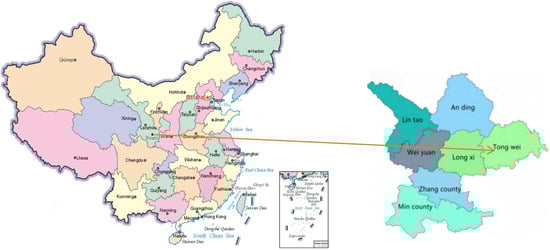
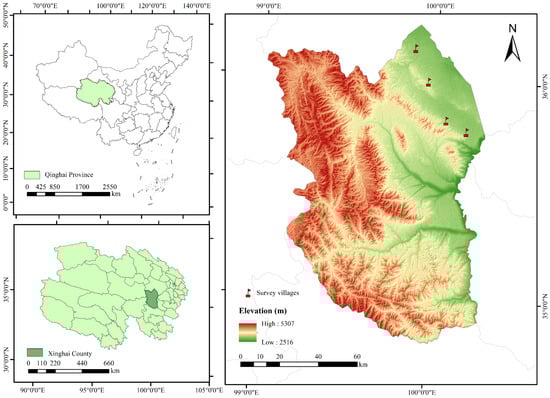
Amid the dual pressures of ecological conservation and livelihood sustainability on the Qinghai–Tibet Plateau, investigating the economic effects of herders’ adaptation strategies holds practical relevance. Focusing on grass-based livestock husbandry, this study examines 327 pastoral households in Xinghai County, Qinghai Province, using endogenous
[...] Read more.
Amid the dual pressures of ecological conservation and livelihood sustainability on the Qinghai–Tibet Plateau, investigating the economic effects of herders’ adaptation strategies holds practical relevance. Focusing on grass-based livestock husbandry, this study examines 327 pastoral households in Xinghai County, Qinghai Province, using endogenous switching regression models to empirically analyze the determinants, economic effects, and underlying mechanisms of herders’ production transformation. The main contribution is providing new empirical evidence for understanding herders’ adaptive strategies and informing policy design. The findings reveal that: (1) Transformation decisions are rational choices shaped by household resource endowments. Households with more labor and larger pasture areas are more likely to transform, while non-pastoral employment partially substitutes for such transformation. (2) Production transformation significantly increases herders’ pastoral income. Under the counterfactual framework, the income enhancement effect amounts to 21,509.08 Yuan for the transformed group and 741.30 Yuan for the non-transformed group. Income growth in the transformed group mainly stems from specialized livestock production, whereas the non-transformed group relies more on gradual improvements and policy compensation. (3) Production transformation promotes large-scale breeding without affecting livestock mortality rates. Efficiency gains from transformation are significant only for the transformed group; forcing non-transformers to adopt transformation under current endowments may lead to efficiency losses. These findings suggest that the government should prioritize supporting herders with both the capacity and willingness to transform, address barriers faced by vulnerable groups, and emphasize productivity enhancement and moderate-scale operations to facilitate sustainable income growth.
Full article
(This article belongs to the Section Agricultural Economics, Policies and Rural Management)
►
Show Figures
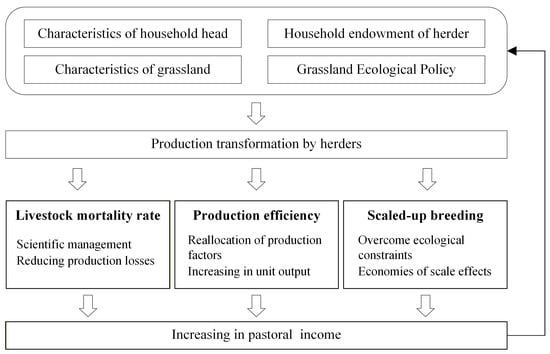
Figure 1