Skip to Content
  • 2.3
    Impact Factor
  • 4.4
    CiteScore
  • 23 days
    Submission to First Decision
  • 5 days
    Acceptance to Publication

Geosciences

Geosciences is an international, peer-reviewed open access journal on geoscience, future earth and planetary science, published monthly online by MDPI. The European Federation of Geologists (EFG) is affiliated with Geosciences and its members receive a discount on the article processing charges.

Get Alerted

Add your email address to receive forthcoming issues of this journal.

All Articles (4,423)

  • Article
  • Open Access

An integrated petrographic–geophysical workflow is applied to the Castellina Fortress (16th century AD) to investigate: the masonry texture, construction techniques and lithological provenance. The field activities focused on several architectural structures of the Castellina, including the main façade that was embedded inside the fortress out of a previous building, named Podestà Palace (13th century AD). The petrographic analyses document the use of lithoid limestones from the Maiolica, Scaglia Bianca and Scaglia Rossa Formations (Umbria–Marche Stratigraphic Succession) in the Podestà Palace, while limestone breccias can be mainly found in the cloister columns. The Ground-Penetrating Radar (GPR) data, supported by advanced numerical modelling, show a heterogeneous internal texture in the Castellina Fortress related to the use of both lithoid materials and earthquake-derived debris for the columns. The provenance analysis points out that the limestones were quarried from Monte di Colle, Monte Belvedere and Monte Poggio Vallaccone (southeast of Norcia), whereas the breccias largely derived from debris cones composed of breccia, gravel, and conglomerate deposits that still crop out today in the mountainous area surrounding the plains of Norcia and Santa Scolastica. This study demonstrates the potential of combining two different geoscience disciplines to reconstruct material supply zones and building characteristics in the field of cultural heritage.

Geosciences

13 October 2026
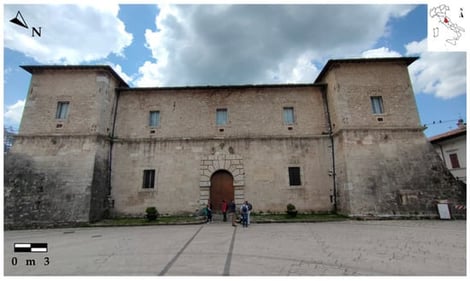
The Castellina Fortress (1554–1570).
  • Article
  • Open Access

Right and bowhead whales represent key species in modern-day marine ecosystems because of their capacity to catch enormous amounts of prey items (especially calanoid copepod crustaceans). However, their evolutionary history is still not completely understood. Morphology- and molecule-based phylogenetic analyses failed to find a consensus view about the relationships of balaenids and other mysticete species and in determining the intra-family relationships of extant and fossil taxa. The fossil record may help in increasing the precision of morphology-based phylogenetic results when new balaenid species are discovered because the new fossils may add new character combinations able to change previously published hypotheses of relationships. Here, we describe a new balaenid genus and species, Quasibalaena portisantuerpiae, based on a partial skull from the Early Pliocene of Belgium. The new specimen preserves relevant portions of the cranium, periotic and tympanic bulla, and shows a character combination never observed up to now in other balaenid fossils. We compared the new taxon to all the other balaenid species known and included it in a morphology-based phylogenetic analysis. The results suggest that Balaenidae includes a stem group and two main subclades, respectively related to the extant bowhead whale (Balaena mysticetus) and to the right whales (genus Eubalaena). Quasibalaena portisantuerpiae belongs in the former subclade. Body size reconstruction allowed us to infer that the origin of the Balaena-related clade was characterized by a miniaturization process and that gigantism occurred independently in bowhead and right whales.

Geosciences

13 October 2026

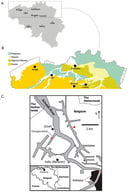
Location of the discovery of the holotype of Quasibalaena portisantuerpiae gen. et sp. nov. (A) map of Belgium; the rectangle indicates the region magnified in (B). (B) geological map of northern Belgium showing the main outcrops. (C) Close-up map of Antwerp and the location of the discovery of the holotype; the red triangle indicates the tunnel–canal–dock and the red rectangle indicates the Kattendijkdok; the discovery locality (red point) is indicated in the Antwerp harbor, a hotspot of past diversity and encourages further studies, valorization and conservation efforts.
  • Review
  • Open Access

Root systems, the hidden half of terrestrial plants, have been a fundamental geological agent since the late Early Paleozoic, with their evolution preserved in a rich but underutilized archive of soils and sediments. This review adopts a rhizolith-centric perspective to trace the co-evolution of root systems and the Earth’s surface environment from the Silurian to the present. Two profound, linked transitions are recognized. The first is the Devonian “Rooting Revolution,” during which true roots and their mycorrhizal partners scaled up silicate weathering, drawing down atmospheric CO2 and contributing to the initiation of the Late Paleozoic Ice Age. The second is the Mesozoic–Cenozoic “Rhizosphere Expansion,” led by angiosperms, which greatly amplified the existing weathering engine through higher transpiration, denser fibrous roots, and more diverse rhizosphere microbial and mycorrhizal communities. Reading rhizoliths through their morphology, mineralogy, and isotopic signatures makes it possible to reconstruct how roots became central regulators of long-term carbon and phosphorus cycling, builders of the pedosphere, and stabilizers of landscapes. Beyond these geochemical roles, this also integrates the dimension of roots as a persistent nutritional resource for terrestrial vertebrates—from Early Permian stem amniotes and early synapsids and reptiles to Pleistocene megafauna and early hominins. By synthesizing evidence from paleontology, sedimentology, geochemistry, and vertebrate paleoecology, this review offers a rhizolith-centric framework—anchored by the two linked transitions described above—for refining Earth system models and for understanding the feedbacks between root evolution and global environmental change.

Geosciences

13 October 2026

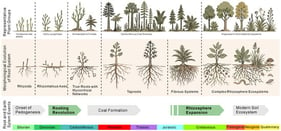
Plant root system evolution and transitions through Earth history. Schematic timeline showing major evolutionary stages of root systems (up) and corresponding Earth system responses (down) from the Silurian to present. Key transitions—the Devonian “Rooting Revolution” and Cretaceous–Cenozoic “Rhizosphere Expansion”—are highlighted.
  • Article
  • Open Access

Parametric Controls on Dynamic CO2 Storage Capacity in a Saline Aquifer: The Lopín Structure Case Study (Ebro Basin, NE Spain)

  • Camilo Antonio Quintero-Tejada,
  • Ignasi Herms and
  • Paula Fernández-Canteli
  • + 2 authors

Pressure-limited dynamic capacity in the Lopín structure is controlled primarily by reservoir transmissibility rather than by static pore volume. This study applies a MATLAB/MRST vertical-equilibrium (VE) workflow to the Lopín horst, a deep Triassic Buntsandstein aquifer in the Ebro Basin, NE Spain, and evaluates the sensitivity of the results to seven petrophysical, fluid, and operational parameters using a one-at-a-time sensitivity design (35 sensitivity cases plus one base case). Across the tested range, horizontal permeability produced the largest variation in maximum injectable CO2 mass, from 4.67 to 16.25 Mt (range 11.59 Mt), followed by the adopted BHP threshold (range 5.33 Mt) and CO2 density (range 4.74 Mt). Porosity and brine compressibility had only minor effects, whereas injection rate and residual CO2 saturation did not change the BHP-limited capacity under the adopted capacity-search formulation. The base-case operational BHP limit was 28.5 MPa, selected below the site-specific allowable- and estimated fracture-pressure thresholds reported for Lopín. These results show that pressure dissipation, hydraulic transmissibility, and the explicit choice of operational pressure criterion are the dominant controls on dynamic CO2 storage capacity in this fault-bounded saline aquifer.

Geosciences

11 October 2026

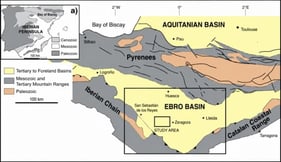
Regional setting of the Ebro Basin in northeastern Spain. (a) Simplified geological map of the Iberian Peninsula.

Highly Accessed Articles

News & Conferences

Latest Issues

Open for Submission

Journal Sections

Editorial Board Members’ Collection Series
Reprint

Editorial Board Members’ Collection Series

“New Horizons in Geophysics: From Theory to Applications”
Editors: Luciano Telesca, Lev Eppelbaum, Georgios Balasis
XFacebookLinkedIn
Geosciences - ISSN 2076-3263