Skip to Content

C — Journal of Carbon Research

C — Journal of Carbon Research is an international, scientific, peer-reviewed, open access journal on carbon research, published quarterly online by MDPI. The Spanish Carbon Group (GEC) is affiliated with C — Journal of Carbon Research and its members receive discounts on article processing charges.
  • Open Access— free for readers, with article processing charges (APC) paid by authors or their institutions.
  • High Visibility: indexed within ESCI (Web of Science), Scopus, CAPlus / SciFinder, and other databases.
  • Journal Rank: JCR - Q2 (Materials Science, Multidisciplinary) / CiteScore - Q2 (Environmental Science (miscellaneous))
  • Rapid Publication: manuscripts are peer-reviewed and a first decision is provided to authors approximately 15.7 days after submission; acceptance to publication is undertaken in 4.6 days (median values for papers published in this journal in the first half of 2026).
  • Recognition of Reviewers: Reviewers whose reports are timely and of high quality receive an APC discount voucher for a future publication in an MDPI journal. Become a reviewer.

Get Alerted

Add your email address to receive forthcoming issues of this journal.

All Articles (873)

  • Article
  • Open Access

The escalating depletion of fossil fuels and the attendant environmental concerns have spurred the pursuit of advanced energy storage systems. Aqueous zinc-ion batteries (AZIBs) stand out as promising candidates due to their inherent safety, cost-effectiveness, and abundant zinc resources. However, vanadium-based cathodes, a leading class of materials for AZIBs, are plagued by structural instability and inadequate electrical conductivity, which severely hamper their electrochemical performance. In this work, a one-step hydrothermal method was used to fabricate LaVO4/rGO (denoted as LVG) composites, in which La3+ species act as interlayer pillars to suppress the dissolution of active materials, while the conductive rGO network promotes rapid electron migration, collectively leading to improved electrochemical performance. AZIBs assembled with the LVG-2 cathode (LaVO4/rGO composite prepared with an initial GO loading of 80 mg) achieve a high specific capacity of 311 mAh g−1 at 0.2 A g−1, accompanied by a maximum energy density of 249 Wh kg−1 and a peak power density of 4000 W kg−1. The LVG-2 electrode delivers a reversible capacity of 133 mAh g−1 after 1000 cycles at 5 A g−1, with a capacity retention of 62%, owing to the rGO-enhanced conductivity and stable interlayer structure. Furthermore, flexible AZIBs incorporating the LVG-2 cathode exhibit stable performance under repeated bending. In addition, it can successfully power on a humidity meter and a warning light, which can serve as a warning for safe travel on the highway.

C

30 September 2026
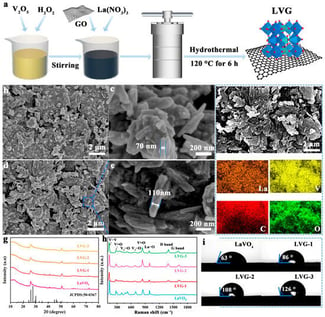
(a) Schematic illustration of the synthesis of LVG composite, (b,c) SEM image of LaVO4, (d,e) SEM image of LVG-2 and (f) element mapping, (g) XRD patterns and (h) Raman spectrogram of LVGs and LaVO4, (i) WCA of various cathode material.
  • Article
  • Open Access

Sodium-ion batteries are generally considered a promising alternative to lithium-ion batteries due to the abundance and low cost of sodium. However, their main limitation is the lack of an appropriate anode, since the usual graphite electrode used in lithium batteries is incompatible with the larger ionic radius of sodium. In this work, the theoretical behavior of pillared graphene as a possible anode is analyzed via computational simulations based on Density Functional Theory (DFT) using the FIREBALL program. The structural relaxation results reveal that staggered pillars are more stable than the aligned alternative. The adsorption energy of sodium is shown to be significantly higher than for graphite, with a maximum value of −2.23 eV, leading to an important energetic benefit. The diffusion analysis shows high mobility for sodium, with migration barriers comparable to those of lithium ions both in the flat regions of the structure and close to the nanotubes. The values are comparable to those of the standard graphite used in current batteries. Finally, the charge analysis confirms significant electronic transfer from both sodium and lithium to the lattice. These data indicate that pillared graphene can be a good candidate for the optimization of charge dynamics in sodium-ion batteries.

C

30 September 2026

Initial ARM-60 structures aligned (a) and staggered (b), where the colors red, green, and blue correspond to the X, Y, and Z lattice vectors, respectively; (c) shows the junction between the (6, 0) CNT and graphene [50].
  • Review
  • Open Access

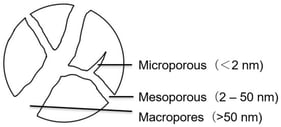
This review examines the adsorption of trihalomethanes (THMs) by activated carbon by treating surface hydration and internal pore structure as a continuous and interconnected sequence of phenomena. At pore entrances, an initial hydration layer is first established, and the superposition of hydration retained by surface acidic functional groups on this water distribution may influence the accessibility of THM molecules to pore walls. Within micropores, particularly in the primary adsorption region corresponding to pore widths of 0.6–0.9 nm (6–9 Å), dispersion interactions dominate. In this region, the interfacial environment is affected by stepwise changes in the state of water, proceeding from isolated molecules to critical density and subsequent clustering. In addition, the connectivity of pores from access pores to the primary adsorption region may affect molecular mobility during penetration into the internal pore network and plays a crucial role in determining reachability under flowing water conditions. These phenomena do not act independently. Rather, five factors—(i) initial hydration at pore entrances, (ii) hydration environments retained around surface acidic functional groups, (iii) stepwise changes in water structure within the primary adsorption region, (iv) pore connectivity from access pores to the primary adsorption region, and (v) the characteristics of the primary adsorption region governing equilibrium capacity—interact at different spatial locations to collectively shape THM adsorption behavior. When an appropriate balance among these factors is achieved, both the accessibility and reachability of THMs to activated carbon surfaces are effectively expressed under practical operating conditions. This integrated understanding may contribute to improved drinking water safety by supporting the development of activated carbons with enhanced THM removal performance through the integrated control of pore architecture, surface chemistry, and hydration environments.

C

29 September 2026

Schematic classification of the internal surface, external surface, and pore types in a solid adsorbent (based on the IUPAC classification).
  • Article
  • Open Access

Soak-and-Squeeze Deposition of Graphene Oxide on Open-Cell Foams for Detergent Removal

  • Alessandro Migliavacca,
  • Carlo Antonini and
  • Alessandro Mansutti

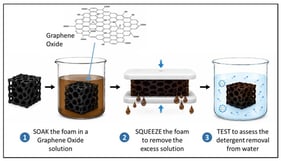
This study investigates the deposition of graphene oxide (GO) coatings on open-cell polyurethane foams through a soak-and-squeeze process for detergent removal. GO dispersions between 0.25 and 4 g/L were rheologically characterised to relate apparent viscosity to coating deposition. A first rationalisation of the squeeze-coating process was proposed by estimating the characteristic shear rates during squeezing, obtaining values of 12.2 s−1 and 50.4 s−1 for 20 and 60 PPI foams, respectively. Multiple deposition cycles were performed, achieving GO loads up to 12.7 wt% for both types of foam. The adsorption behaviour of GO powder toward a commercial detergent solution containing linear alkylbenzene sulphonate (LAS) was investigated at 25, 40 and 60 °C. UV-Vis spectroscopy was used to monitor concentration changes, while conductivity analyses investigated the temperature-dependent aggregation behaviour of the detergent system. The adsorption kinetics were well described by the Elovich model, suggesting adsorption on heterogeneous GO surfaces. Filtration tests using GO-coated foams showed a decrease in conductivity during flow-through experiments, whereas UV-Vis measurements indicated limited LAS removal under dynamic conditions, likely due to insufficient contact time between the detergent and the coated surface. Static contact tests performed for 1 h at 25 °C showed a reproducible detergent concentration decrease of approximately 16–18%. This value was further increased up to 65% under optimised conditions by modifying the GO-to-detergent ratio and foam configuration. The results demonstrate that the soak-and-squeeze approach is a simple and effective method for producing reproducible GO coatings on open-cell foams, while indicating that sufficient contact time is required to promote detergent removal.

C

25 September 2026

(a) The 20 PPI foam at 10×; (b) 60 PPI foam at 30×.

Highly Accessed Articles

News & Conferences

Latest Issues

Open for Submission

Journal Sections

XFacebookLinkedIn
C - ISSN 2311-5629