
<?xml version="1.0" encoding="UTF-8"?>
<!DOCTYPE article PUBLIC "-//NLM//DTD Journal Publishing DTD v2.3 20070202//EN" "journalpublishing.dtd">
<article xmlns:mml="http://www.w3.org/1998/Math/MathML" xmlns:xlink="http://www.w3.org/1999/xlink" xml:lang="en" article-type="review-article">
  <front>
    <journal-meta>
      <journal-id journal-id-type="publisher-id">coatings</journal-id>
      <journal-title>Coatings</journal-title>
      <abbrev-journal-title abbrev-type="publisher">Coatings</abbrev-journal-title>
      <abbrev-journal-title abbrev-type="pubmed">Coatings</abbrev-journal-title>
      <issn pub-type="epub">2079-6412</issn>
      <publisher>
        <publisher-name>MDPI</publisher-name>
      </publisher>
    </journal-meta>
    <article-meta>
      <article-id pub-id-type="doi">10.3390/coatings2040210</article-id>
      <article-id pub-id-type="publisher-id">coatings-02-00210</article-id>
      <article-categories>
        <subj-group>
          <subject>Review</subject>
        </subj-group>
      </article-categories>
      <title-group>
        <article-title>Protection and Reinforcement of Tooth Structures by Dental Coating Materials</article-title>
      </title-group>
      <contrib-group>
        <contrib contrib-type="author">
          <name>
            <surname>Nikaido</surname>
            <given-names>Toru</given-names>
          </name>
          <xref rid="af1-coatings-02-00210" ref-type="aff">1</xref>
          <xref rid="c1-coatings-02-00210" ref-type="corresp">*</xref>
        </contrib>
        <contrib contrib-type="author">
          <name>
            <surname>Takahashi</surname>
            <given-names>Rena</given-names>
          </name>
          <xref rid="af1-coatings-02-00210" ref-type="aff">1</xref>
        </contrib>
        <contrib contrib-type="author">
          <name>
            <surname>Ariyoshi</surname>
            <given-names>Meu</given-names>
          </name>
          <xref rid="af1-coatings-02-00210" ref-type="aff">1</xref>
        </contrib>
        <contrib contrib-type="author">
          <name>
            <surname>Sadr</surname>
            <given-names>Alireza</given-names>
          </name>
          <xref rid="af2-coatings-02-00210" ref-type="aff">2</xref>
        </contrib>
        <contrib contrib-type="author">
          <name>
            <surname>Tagami</surname>
            <given-names>Junji</given-names>
          </name>
          <xref rid="af1-coatings-02-00210" ref-type="aff">1</xref>
          <xref rid="af2-coatings-02-00210" ref-type="aff">2</xref>
        </contrib>
      </contrib-group>
      <aff id="af1-coatings-02-00210"><label>1 </label>Cariology and Operative Dentistry, Department of Oral Health Sciences, Graduate School of Medical and Dental Sciences, Tokyo Medical and Dental University, 1-5-45 Yushima, Bunkyo-ku, Tokyo 113-8549, Japan; Email: <email>renatakahashi@hotmail.com</email> (R.T.); <email>ariyoshipirro@yahoo.co.jp</email> (M.A.); <email>tagami.ope@tmd.ac.jp</email> (J.T.)</aff>
      <aff id="af2-coatings-02-00210"><label>2 </label>Global Center of Excellence Program, International Research Center for Molecular Science in Tooth and Bone Diseases, Tokyo Medical and Dental University, 1-5-45 Yushima, Bunkyo-ku, Tokyo 113-8549, Japan; Email: <email>alireza.ope@tmd.ac.jp</email> </aff>
      <author-notes>
        <corresp id="c1-coatings-02-00210"><label>*</label> Author to whom correspondence should be addressed; Email: <email>nikaido.ope@tmd.ac.jp</email>; Tel.: +81-3-5803-5483; Fax: +81-3-5803-0195.</corresp>
      </author-notes>
      <pub-date pub-type="epub">
        <day>08</day>
        <month>10</month>
        <year>2012</year>
      </pub-date>
      <pub-date pub-type="collection">
        <month>12</month>
        <year>2012</year>
      </pub-date>
      <volume>2</volume>
      <issue>4</issue>
      <fpage>210</fpage>
      <lpage>220</lpage>
      <history>
        <date date-type="received">
          <day>11</day>
          <month>06</month>
          <year>2012</year>
        </date>
        <date date-type="rev-recd">
          <day>05</day>
          <month>09</month>
          <year>2012</year>
        </date>
        <date date-type="accepted">
          <day>12</day>
          <month>09</month>
          <year>2012</year>
        </date>
      </history>
      <permissions>
        <copyright-statement>© 2012 by the authors; licensee MDPI, Basel, Switzerland.</copyright-statement>
        <copyright-year>2012</copyright-year>
        <license xmlns:xlink="http://www.w3.org/1999/xlink" license-type="open-access" xlink:href="http://creativecommons.org/licenses/by/3.0/">
          <p>This article is an open-access article distributed under the terms and conditions of the Creative Commons Attribution license (http://creativecommons.org/licenses/by/3.0/).</p>
        </license>
      </permissions>
      <abstract>
        <p>It has been proposed that a resin coating can serve as a means to protect dental structure after preparation of the tooth for indirect restorations, sealing the exposed dentin. The resin coating is applied on the cut surfaces immediately after tooth preparation and before making an impression by assembling a dentin bonding system and a flowable composite. Resin coatings minimize pulp irritation and improve the bond strength between a resin cement and tooth when bonding the restoration to tooth. Recently, thin-film coating dental materials based on all-in-one adhesive technology were introduced for resin coating of indirect restorations. The thin coating materials are applied in a single clinical step and create a barrier-like film layer on the prepared dentin. The thin coatings play an important role in protecting the dentin from physical, chemical, and biological irritation. In addition, these thin-film coating materials reportedly prevent marginal leakage beneath inlays or crown restorations. In light of the many benefits provided by such a protective layer, these all-in-one adhesive materials may therefore also have the potential to cover exposed root dentin surfaces and prevent caries formation. In this paper, recent progress of the dental coating materials and their clinical applications are reviewed.</p>
      </abstract>
      <kwd-group>
        <kwd>minimal intervention</kwd>
        <kwd>adhesive dentistry</kwd>
        <kwd>dentin bonding</kwd>
        <kwd>hybrid layer</kwd>
        <kwd>acid-base resistant zone</kwd>
        <kwd>resin coating technique</kwd>
        <kwd>super dentin</kwd>
      </kwd-group>
    </article-meta>
  </front>
  <body>
    <sec sec-type="intro">
      <title>1. Introduction</title>
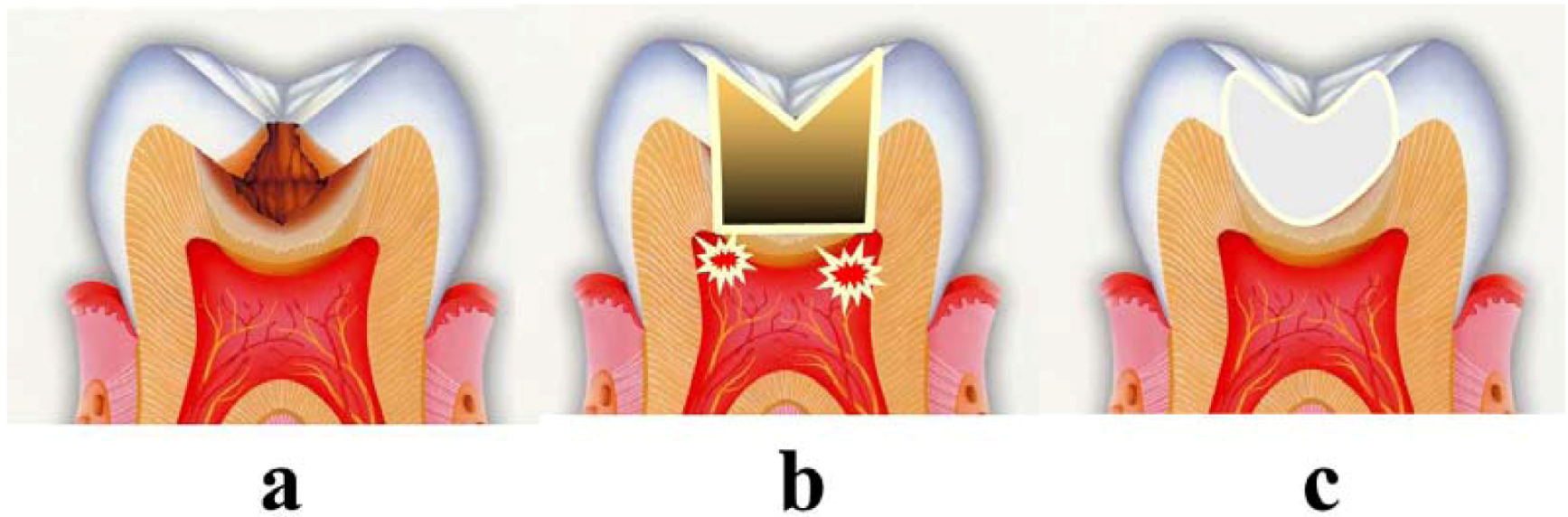
      <p>Dentin is the main hard substance of the tooth which is covered by enamel on the crown and cementum on the root. Dentin is the calcified product of the odontoblasts which line the inner surface of the dentin within the periphery of the external pulp tissue. Therefore, the dentin and pulp are morphologically and embryologically a single unit. Dental caries (tooth decay) is a multi-factorial disease associated with a cariogenic diet and microbiological invasion of the teeth that result in localized dissolution and destruction of the calcified tissues. It is essential to understand that cavitations in teeth (destruction of the tooth surface, creating a cavity) are signs of dominant loss of mineral from tooth as a result of bacterial acid production. In clinical practice, it is possible to lose sight of this fact and focus entirely on the restorative treatment of the lesion, thereby failing to treat the underlying cause of the disease. Those parts of dentin which are already infected by the bacteria and lost their structural integrity (known as caries-infected dentin) should be removed in the procedure of preparing the tooth for a restoration (<xref ref-type="fig" rid="coatings-02-00210-f001">Figure 1</xref>). Conventionally, intact and sound dental tissues were removed to establish the mechanical retention form of the cavity to avoid failure of the restoration, which were performed by materials without a strong adhesion to the tooth. Nowadays, the concept of minimal cavity preparation which requires only the infected parts to be removed has become widely accepted for the placement of direct composite restorations by using an adhesive system [<xref ref-type="bibr" rid="B1-coatings-02-00210">1</xref>,<xref ref-type="bibr" rid="B2-coatings-02-00210">2</xref>].</p>
      <fig id="coatings-02-00210-f001" position="anchor">
        <label>Figure 1</label>
        <caption>
          <p>Conventional and minimal invasive caries treatments: (<bold>a</bold>) cavitated dentin caries; (<bold>b</bold>) in the conventional restorations, sound dentin was sacrificed to obtain mechanical retention of the restorations; (<bold>c</bold>) minimal cavity preparation can be achieved for direct composite restorations by using adhesive systems.</p>
        </caption>
        <graphic xmlns:xlink="http://www.w3.org/1999/xlink" xlink:href="coatings-02-00210-g001.tif"/>
      </fig>
    </sec>
    <sec>
      <title>2. Advances in Adhesive Materials</title>
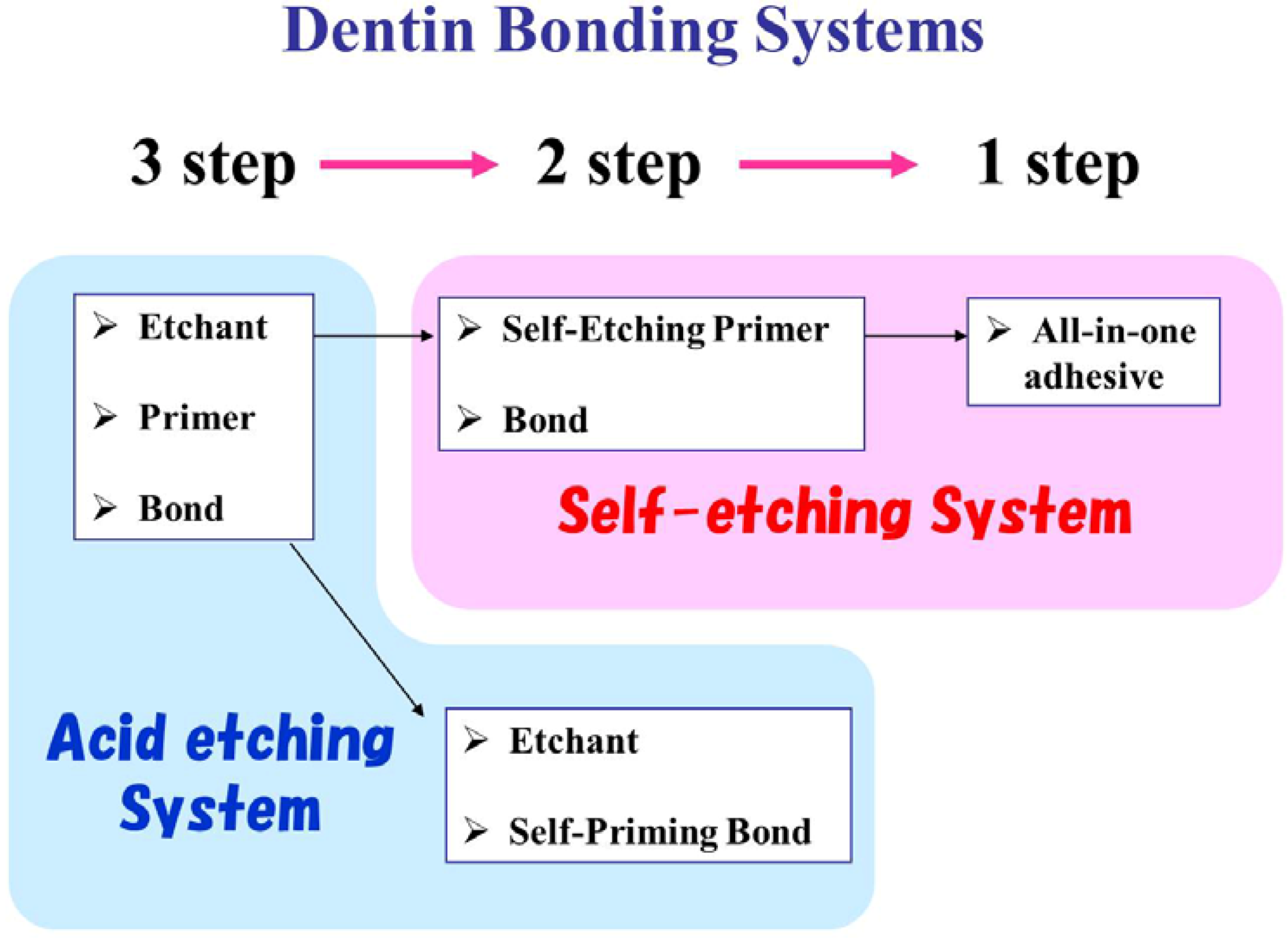
      <p>Recent dentin bonding systems have been improved and simplified, and can be classified into two main categories; self-etching systems and acid etching systems as shown in <xref ref-type="fig" rid="coatings-02-00210-f002">Figure 2</xref>. The category of self-etching systems is further divided into two sub-categories; two-step self-etching systems and one-step self-etching systems, or so-called “all-in-one adhesive systems”. </p>
      <fig id="coatings-02-00210-f002" position="anchor">
        <label>Figure 2</label>
        <caption>
          <p>Classification of dentin bonding systems; Dentin bonding systems are improved and simplified.</p>
        </caption>
        <graphic xmlns:xlink="http://www.w3.org/1999/xlink" xlink:href="coatings-02-00210-g002.tif"/>
      </fig>
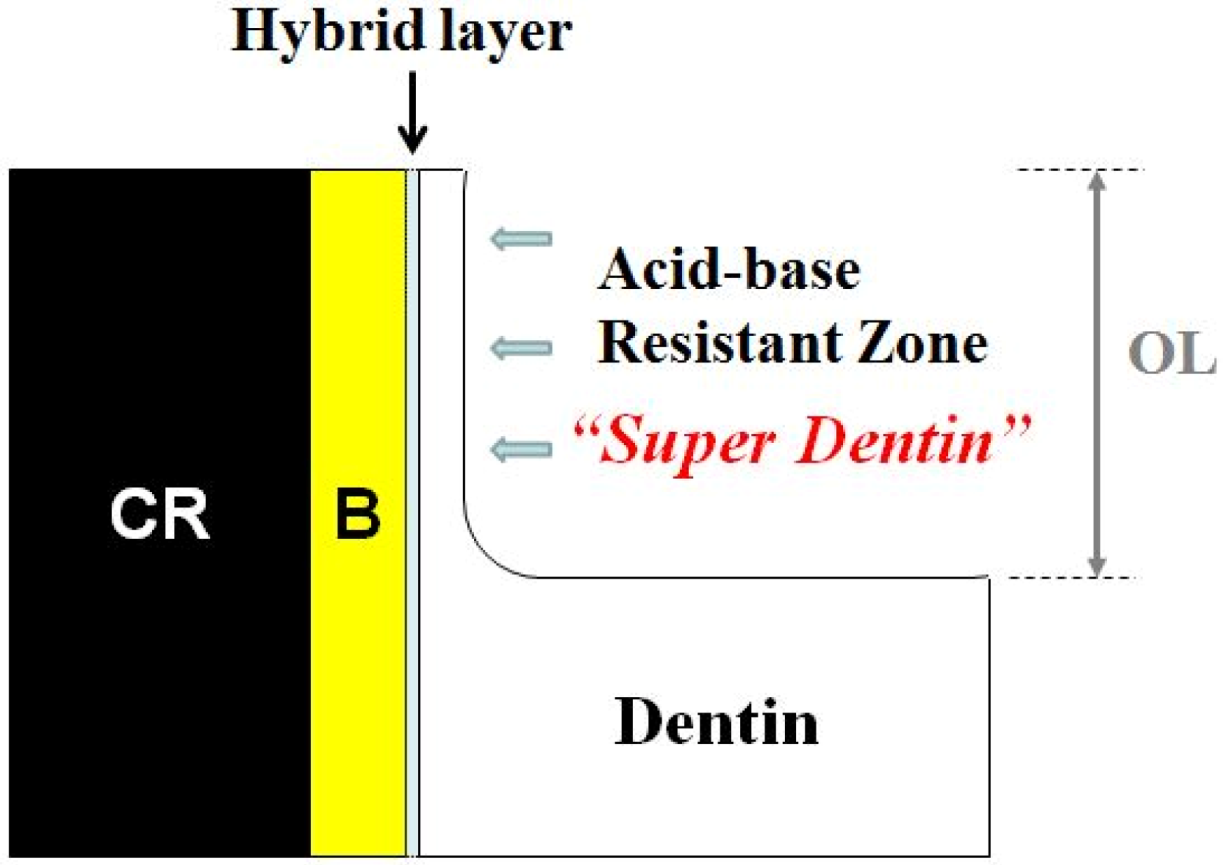
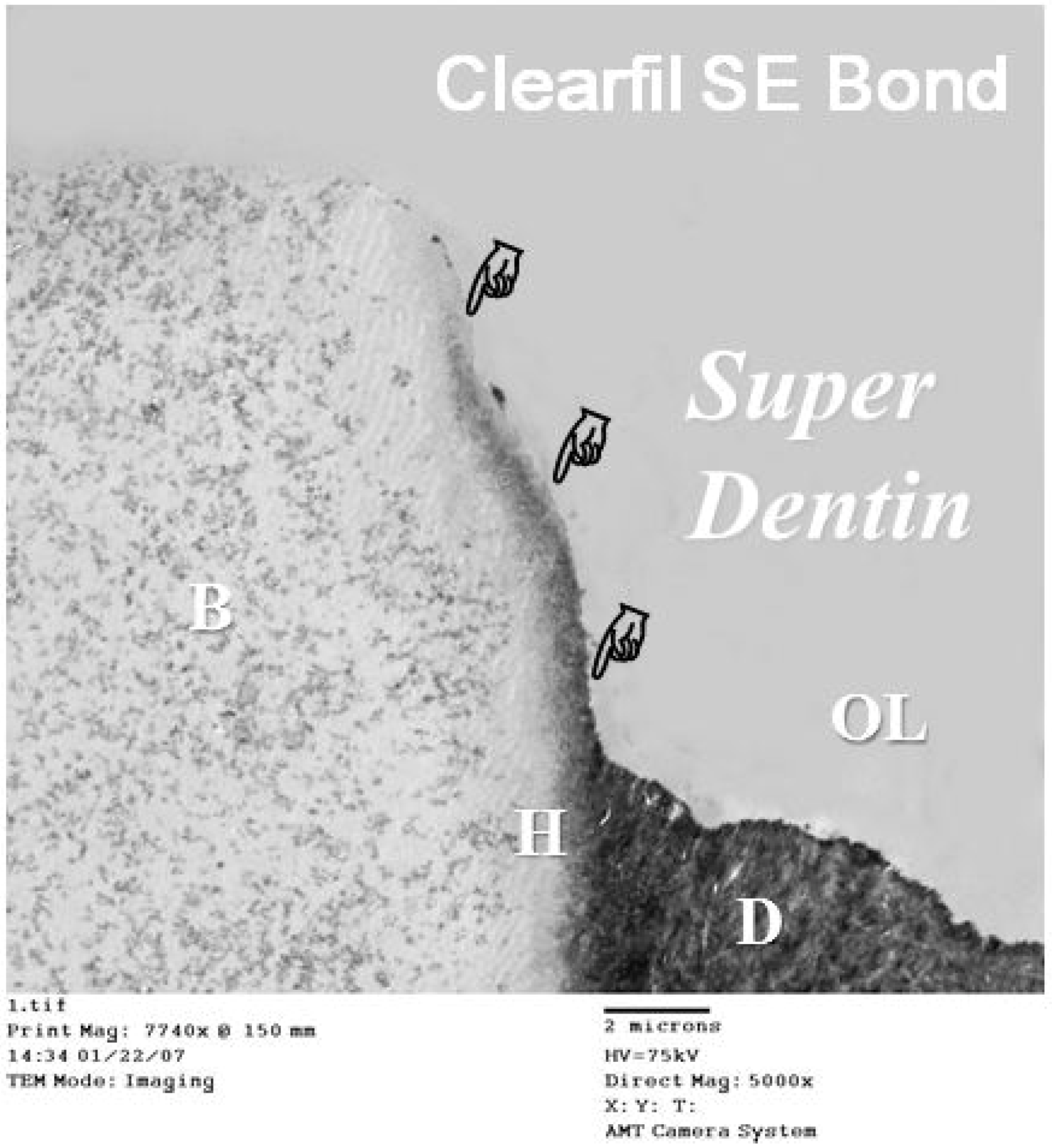
      <p>Monomer penetration into dentin and its polymerization <italic>in situ</italic> creates a hybrid layer, which is essential to obtain good bonding to dentin [<xref ref-type="bibr" rid="B3-coatings-02-00210">3</xref>]. Theoretically, the hybrid layer can provide marginal sealing of the cavity and resist against acid challenge to prevent secondary caries [<xref ref-type="bibr" rid="B2-coatings-02-00210">2</xref>]. On the other hand, recurrent caries is still considered to be one of the major reasons for replacement of resin composite restorations [<xref ref-type="bibr" rid="B4-coatings-02-00210">4</xref>]. Tsuchiya and others foremost observed artificial secondary caries inhibition around adhesive restorations [<xref ref-type="bibr" rid="B5-coatings-02-00210">5</xref>]. The dentin surface was demineralized by the acid challenge to create the outer lesion (OL). A new zone, the so called “acid-base resistant zone” (ABRZ) beneath the hybrid layer was found adjacent to OL (<xref ref-type="fig" rid="coatings-02-00210-f003">Figure 3</xref>). These regions with apatite crystallites were expected to be continuous with the normal dentin (<xref ref-type="fig" rid="coatings-02-00210-f004">Figure 4</xref>) [<xref ref-type="bibr" rid="B6-coatings-02-00210">6</xref>]. This zone was created only in the self-etching systems, but not in the acid etching systems [<xref ref-type="bibr" rid="B7-coatings-02-00210">7</xref>]. The ABRZ should be ascribed to an effective diffusion of the acidic monomer of the self-etching system beyond the hybrid layer, and their chemical bonding potential with apatite as the substrate. Based on the attributes of this zone, which was more resistant against acidic and basic attack compared to the underlying normal dentin, the reinforced dentin was proposed to be called as “Super Dentin” [<xref ref-type="bibr" rid="B8-coatings-02-00210">8</xref>], which should be superior to the normal dentin mechanically, chemically and biologically. </p>
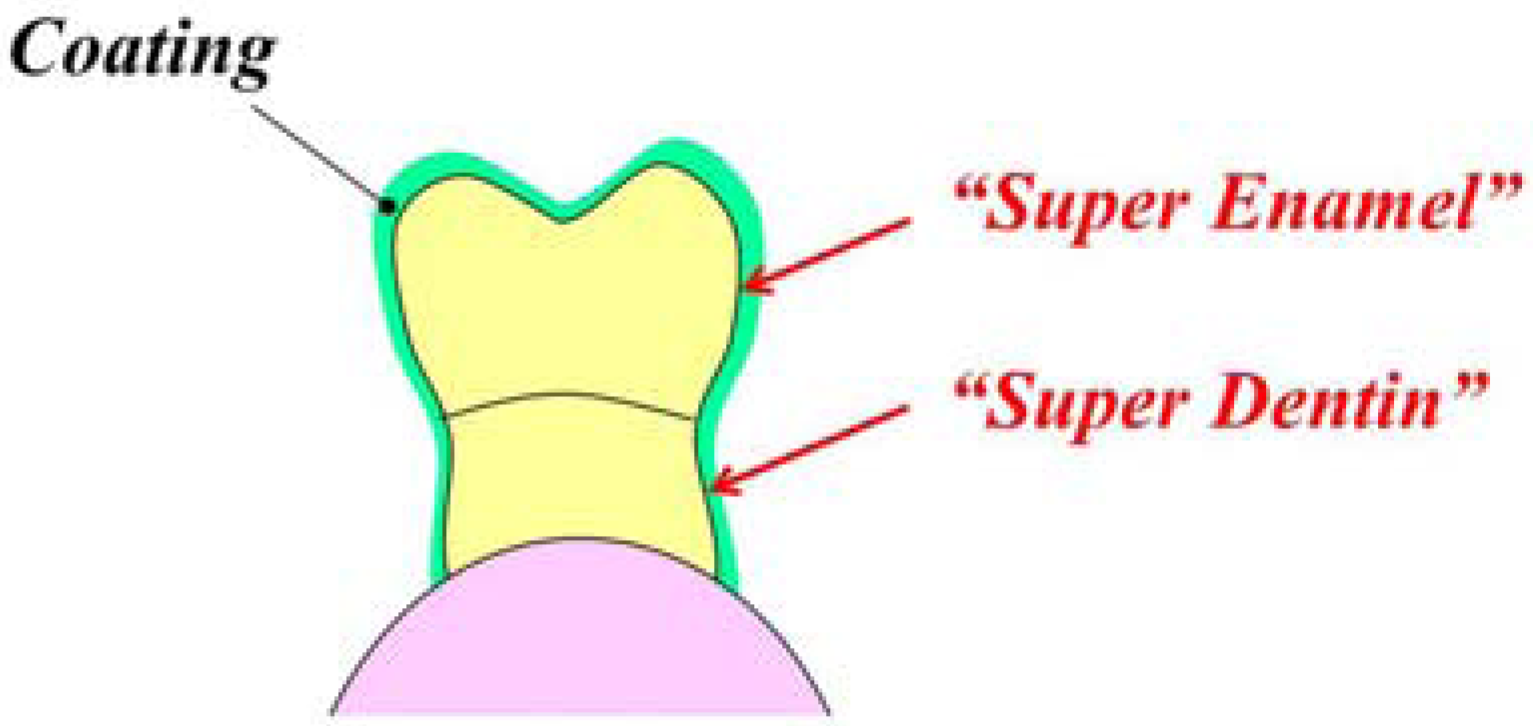
      <p>Previous studies reported that the ABRZ was also observed at the adhesive-enamel interface in the two-step self-etching system, in which a functional monomer, 10-methacryloxydecyl dihydrogen phosphate (MDP), was included either in the primer or in the bonding agent [<xref ref-type="bibr" rid="B9-coatings-02-00210">9</xref>]. It has been found that MDP interacts chemically with hydroxyapatite intensively and stably [<xref ref-type="bibr" rid="B10-coatings-02-00210">10</xref>]. This monomer is capable of forming strong ionic bonds with calcium, producing MDP-calcium salts that have a low solubility. The enamel ABRZ demonstrated an increased resistance of the interface to acid challenge, suggesting the “Super Enamel” formation. Using the self-etching technology, formation of “Super Dentin/Enamel” may become a key strategy to protect and reinforce tooth structures.</p>
      <fig id="coatings-02-00210-f003" position="anchor">
        <label>Figure 3</label>
        <caption>
          <p>Acid-base resistant zone (ABRZ) is created beneath the hybrid layer, which is expected to resist against demineralization from an acid attack from the microorganisms in primary and secondary caries. The reinforced dentin was proposed to be called as “Super Dentin”. CR; resin composite, B; bonding resin, OL; outer lesion.</p>
        </caption>
        <graphic xmlns:xlink="http://www.w3.org/1999/xlink" xlink:href="coatings-02-00210-g003.tif"/>
      </fig>
      <fig id="coatings-02-00210-f004" position="anchor">
        <label>Figure 4</label>
        <caption>
          <p>TEM image of the interface between a two-step self-etch adhesive system (Clearfil SE Bond, Kuraray Noritake Dental, Tokyo, Japan) and dentin after acid-base challenge. The specimen was first subjected to 100 mL buffered demineralizing solution (pH 4.5, 2.2 mmol/L CaCl<sub>2</sub>, 2.2 mmol/L NaH<sub>2</sub>PO<sub>4</sub> and 50 mmol/L acetic acid) for 90 min to create artificial secondary caries, and then to 5% NaClO for 30 min to remove any denatured collagen fibrils. The ABRZ with apatite crystallites (“Super Dentin”) were expected to be continuous with the dentin. Magnification; ´7740, B; bonding resin, H; hybrid layer, D; dentin, OL; outer lesion [<xref ref-type="bibr" rid="B6-coatings-02-00210">6</xref>]. </p>
        </caption>
        <graphic xmlns:xlink="http://www.w3.org/1999/xlink" xlink:href="coatings-02-00210-g004.tif"/>
      </fig>
    </sec>
    <sec>
      <title>3. Resin Coating Technique in Indirect Restoration</title>
      <p>As described above, recent advances in adhesive materials and technologies have resulted in the routine placement of adhesive restorations in the clinic. Direct composite restorations are the preferred treatment over indirect restorations because of the achievement of the minimal intervention concept [<xref ref-type="bibr" rid="B1-coatings-02-00210">1</xref>,<xref ref-type="bibr" rid="B2-coatings-02-00210">2</xref>]. Indirect restorations are still among the main options when the prepared cavity is extensive. However, conventional inlay/onlay restorations have some inherent drawbacks. When a cavity is prepared for an indirect inlay/onlay restoration, intact tooth structure has to be sacrificed to obtain the retention and resistance forms, especially because the conventional luting cements have a poor capability of bonding to tooth structure (see <xref ref-type="fig" rid="coatings-02-00210-f001">Figure 1</xref>b,c). Furthermore, dentin exposed after cavity preparation ought to be considered as a pulp tissue indirect exposure, since dentin is connected to pulp tissue through dentinal tubules. Therefore, the exposed dentin should be protected immediately after the preparation. Although temporary sealing of the prepared cavities has routinely been performed, the poor sealing with such a temporary material may easily fail, resulting in accidental exposure of the prepared dentin in the oral cavity, and irrigation from physical, chemical and/or bacterial stimuli [<xref ref-type="bibr" rid="B11-coatings-02-00210">11</xref>,<xref ref-type="bibr" rid="B12-coatings-02-00210">12</xref>].</p>
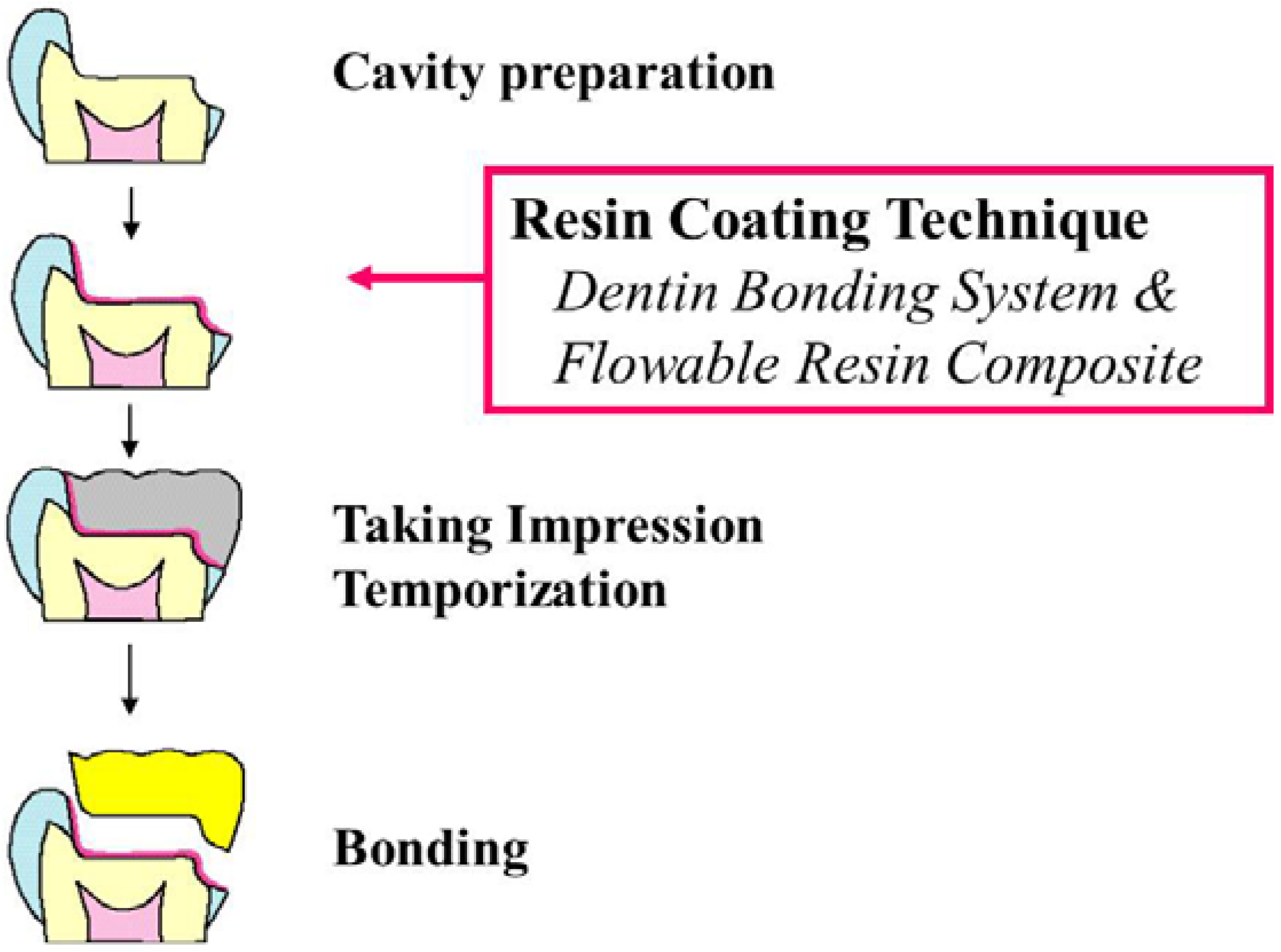
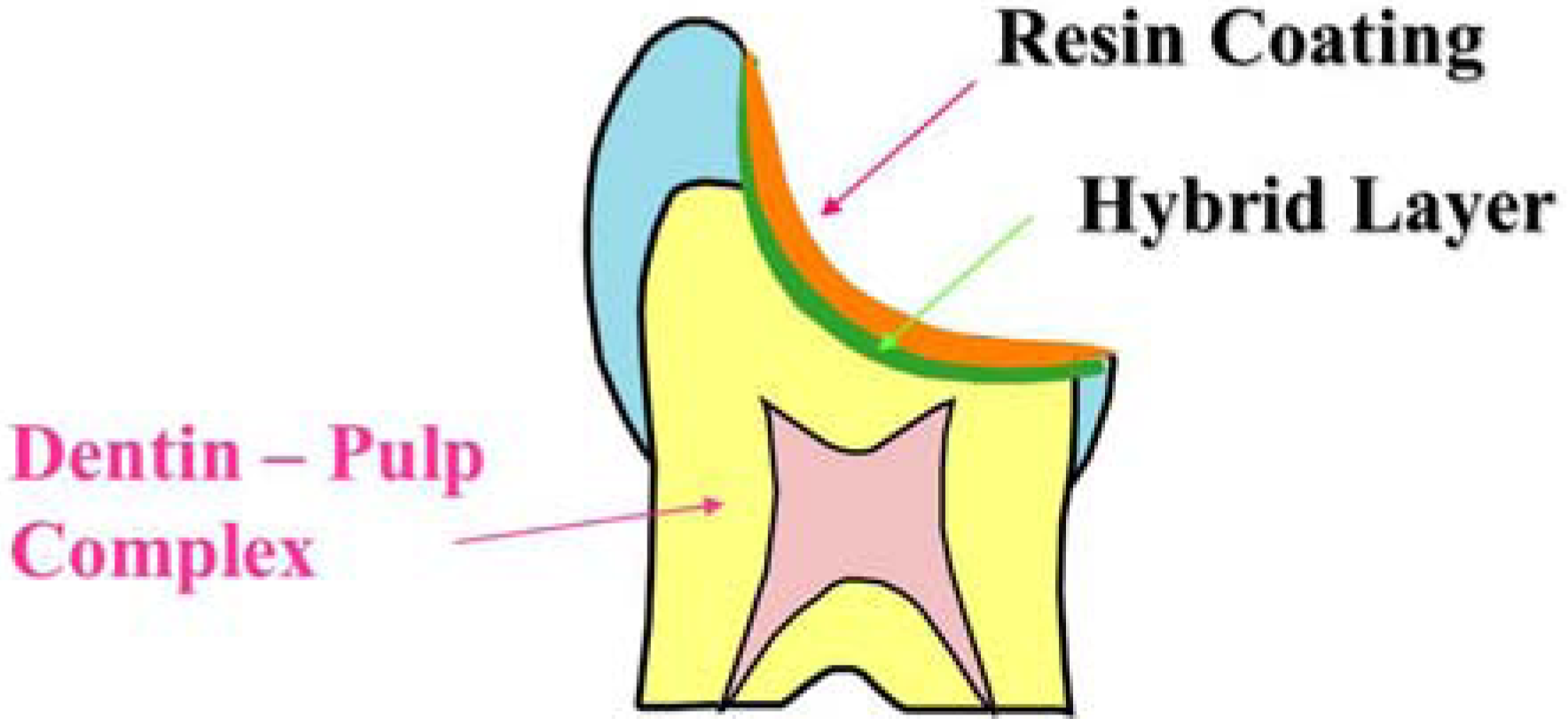
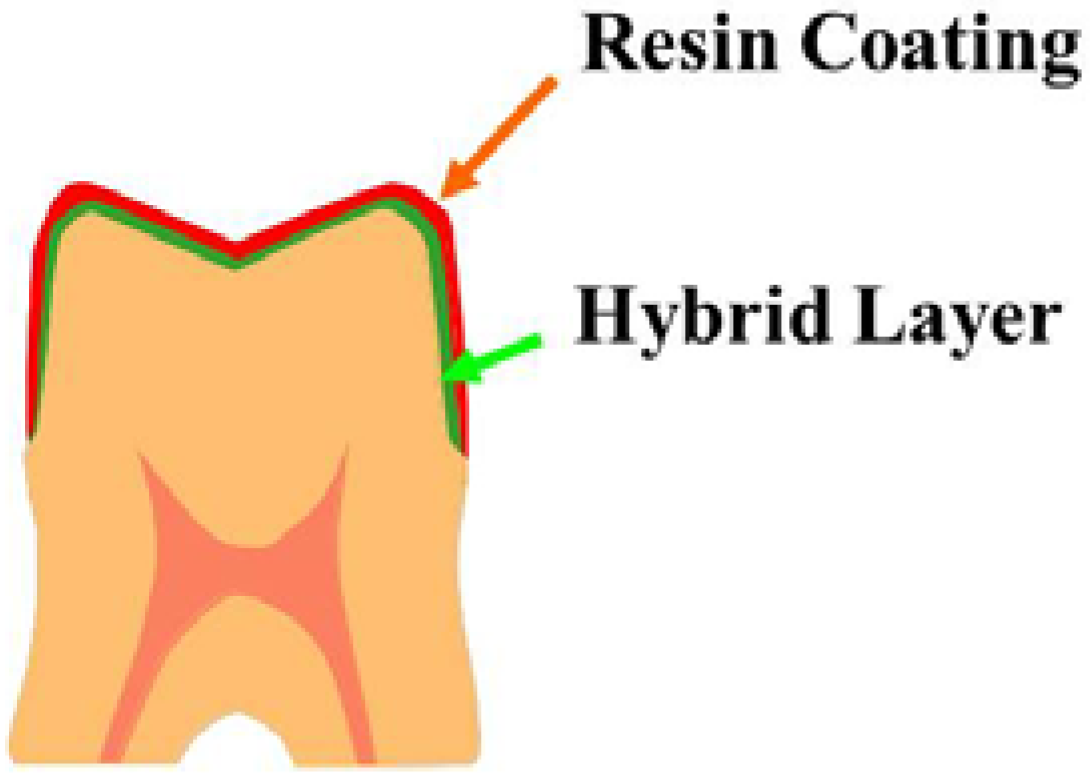
      <p>Without doubt, the sealing property of modern dentin adhesive systems is superior to those of the temporary sealing materials [<xref ref-type="bibr" rid="B13-coatings-02-00210">13</xref>]. A previous study also demonstrated that a recent dentin bonding system has good biocompatibility to pulp tissue [<xref ref-type="bibr" rid="B14-coatings-02-00210">14</xref>]. In order to protect the exposed dentin surface after cavity preparation for indirect restorations, a resin coating technique was proposed in the early 1990’s [<xref ref-type="bibr" rid="B15-coatings-02-00210">15</xref>,<xref ref-type="bibr" rid="B16-coatings-02-00210">16</xref>]. The clinical procedures of the resin coating technique are illustrated in <xref ref-type="fig" rid="coatings-02-00210-f005">Figure 5</xref>. For the resin coating technique, a combination of a dentin bonding system and a flowable resin composite was applied on the preparation just after cavity preparation and before taking the impression, producing a hybrid layer and tight sealing film are produced on the dentin surface using a combination of a dentin bonding system and a flowable composite (<xref ref-type="fig" rid="coatings-02-00210-f006">Figure 6</xref>) [<xref ref-type="bibr" rid="B17-coatings-02-00210">17</xref>].</p>
      <fig id="coatings-02-00210-f005" position="anchor">
        <label>Figure 5</label>
        <caption>
          <p>The clinical procedures of the resin coating technique. A combination of a dentin bonding system and a flowable resin composite is applied on the preparation just after cavity preparation and before taking the impression.</p>
        </caption>
        <graphic xmlns:xlink="http://www.w3.org/1999/xlink" xlink:href="coatings-02-00210-g005.tif"/>
      </fig>
      <fig id="coatings-02-00210-f006" position="anchor">
        <label>Figure 6</label>
        <caption>
          <p>The resin coating technique produces a hybrid layer and tight sealing film on the dentin surface and protect dentin-pulp complex.</p>
        </caption>
        <graphic xmlns:xlink="http://www.w3.org/1999/xlink" xlink:href="coatings-02-00210-g006.tif"/>
      </fig>
      <p>This technique is beneficial in improving the dentin adhesion of a resin cement for indirect restorations and enhancing marginal integrity [<xref ref-type="bibr" rid="B18-coatings-02-00210">18</xref>,<xref ref-type="bibr" rid="B19-coatings-02-00210">19</xref>]. However, selection of the coating material influences immediate dentin bonding performance [<xref ref-type="bibr" rid="B20-coatings-02-00210">20</xref>] and also dentin bonding durability [<xref ref-type="bibr" rid="B21-coatings-02-00210">21</xref>,<xref ref-type="bibr" rid="B22-coatings-02-00210">22</xref>]. If a good bonding is obtained using the resin coating technique, removal of intact tooth structure would be unnecessary for retention and/or resistance form. According to the Black’s principles, sacrifice of the dental tissue is required to establish mechanical retention and resistance of restoration; however, in the new concept of adhesion, only the infected caries should be removed, thus preserving the caries-affected dentin and intact dentin even when teeth have extensive caries. When the lost tooth structure is to be replaced by an indirect restoration, the exposed enamel and dentin should be immediately sealed using the resin coating technique. This rational approach to adhesion has a positive influence on tooth structure preservation, patient comfort, and the long-term survival of indirect bonded restorations. Therefore, the resin coating technique has the potential for introducing the minimal intervention concept into indirect restorations [<xref ref-type="bibr" rid="B11-coatings-02-00210">11</xref>].</p>
      <p>Paul <italic>et al.</italic> and Bertschinger <italic>et al.</italic> reported “dual application” [<xref ref-type="bibr" rid="B23-coatings-02-00210">23</xref>,<xref ref-type="bibr" rid="B24-coatings-02-00210">24</xref>]. Magne <italic>et al.</italic> proposed “immediate dentin sealing (IDS)” [<xref ref-type="bibr" rid="B25-coatings-02-00210">25</xref>,<xref ref-type="bibr" rid="B26-coatings-02-00210">26</xref>]. These ideas are believed to share the same concepts of the resin coating technique.</p>
      <p>The idea of having an additional resin coating placed on the preparation raised concernes about the thickness of the coating and possible interferences with complete seating of the restoration. This dilemma was resolved by proper sequencing of the procedure and placement of the coating material before impression making. In addition, the incompletely polymerized resin coating can inhibit the polymerization reaction of impression materials, which depends on selection of the materials [<xref ref-type="bibr" rid="B27-coatings-02-00210">27</xref>]. The contamination of the resin coating by the temporary filling material also remains an issue, as it may alter the bond between the existing resin coating and the luting agent [<xref ref-type="bibr" rid="B20-coatings-02-00210">20</xref>,<xref ref-type="bibr" rid="B27-coatings-02-00210">27</xref>]. Further studies are needed to elucidate the exact mechanism of these interactions, allowing the optimization of the coating materials and the development of surface conditioners for the application of the resin coating technique. </p>
    </sec>
    <sec>
      <title>4. Development of Thin Film Coating Materials</title>
      <p>The combination of a dentin bonding system and a low viscosity micro-filled resin creates a thick coating layer, more than 100 µm in thickness, on the dentin surface. Such a thick coating is not suitable for a crown preparation, because of the possibility of deformation of the preparation by the resin coating [<xref ref-type="bibr" rid="B28-coatings-02-00210">28</xref>].</p>
      <p>Recently, a thin-film coating material has been developed by using the all-in-one adhesive technology. Such coating materials are clinically used for sealing the crown preparation and also for desensitizing the hypersensitive dentin. Application of the coating material can create a thin coating layer with less than 10 µm in thickness on the dentin surface, which is useful for the resin coating materials of the crown preparation (<xref ref-type="fig" rid="coatings-02-00210-f007">Figure 7</xref>). It was demonstrated that the thin-film coating material improved the dentin bonding performance of resin cement, and prevented marginal leakage beneath the restorations [<xref ref-type="bibr" rid="B12-coatings-02-00210">12</xref>,<xref ref-type="bibr" rid="B19-coatings-02-00210">19</xref>,<xref ref-type="bibr" rid="B29-coatings-02-00210">29</xref>]. </p>
      <p>We are now able to select the two different application methods for the resin coating, such as a combination of a dentin bonding system and a flowable resin composite, and a thin film coating material. The combination method demonstrates more reliable dentin bonding performance than the thin film coating. However, the resin coating with the thin film coating material is easily removed even in the gingival sulcus after curing. Therefore, the two coating methods should be chosen according to the clinical cases of the indirect restorations.</p>
      <fig id="coatings-02-00210-f007" position="anchor">
        <label>Figure 7</label>
        <caption>
          <p>Thin-film coating for sealing the crown preparation.</p>
        </caption>
        <graphic xmlns:xlink="http://www.w3.org/1999/xlink" xlink:href="coatings-02-00210-g007.tif"/>
      </fig>
    </sec>
    <sec>
      <title>5. Dental Coating Materials in the Future</title>
      <p>Recent years have seen a rapid increase in the dentate elderly population, especially in developed countries, due to increase in life expectancy, awareness of dental health measures, and availability of dental care delivery systems. However, a concomitant development is the increasing incidences of root caries, tooth wear and tooth fracture in the middle-aged and elderly. These incidences are potentially important risk factors causing tooth loss. To achieve a good quality of life, it is important to maintain natural tooth structures sound for the whole life.</p>
      <p>The concept of pit and fissure sealing with composite resins has been widely accepted for enamel caries prevention in children and young adults [<xref ref-type="bibr" rid="B30-coatings-02-00210">30</xref>]. Recently, approaches have been made to extend this preventive concept to smooth enamel surfaces [<xref ref-type="bibr" rid="B31-coatings-02-00210">31</xref>,<xref ref-type="bibr" rid="B32-coatings-02-00210">32</xref>]. The superficial penetration and surface coating of the adhesive and/or caries infiltrant is considered as a treatment option for protecting enamel dissolution [<xref ref-type="bibr" rid="B33-coatings-02-00210">33</xref>].</p>
      <p>Soft tissue recession due to age, traumatic toothbrush habits, periodontal disease or surgical periodontal treatment will unavoidably result in exposure of susceptible root surface and the high incidence of root caries and dentin hypersensitivity [<xref ref-type="bibr" rid="B34-coatings-02-00210">34</xref>]. Simple single-visit methods to protect the exposed root surfaces from long-term caries attack are advantageous. However, a promising approach to prevent root caries has not become available yet. </p>
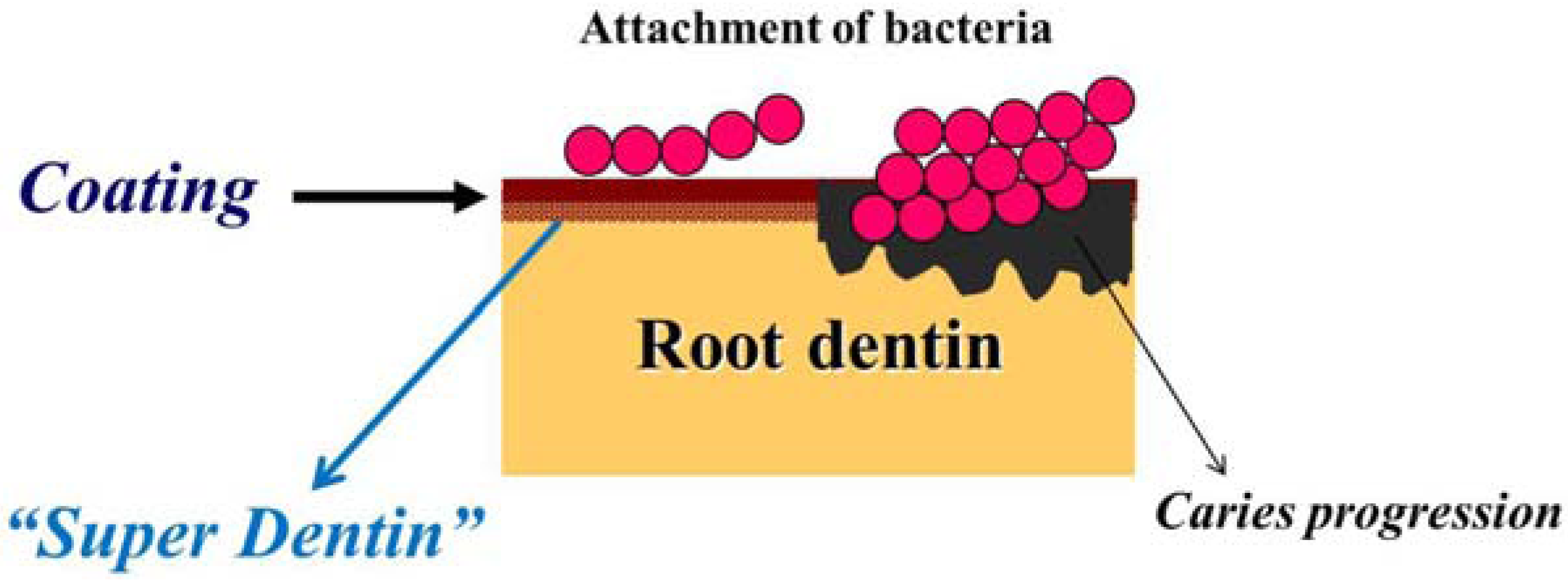
      <p>Root surface coating with the dentin bonding systems is considered to be an effective measure for protection against caries, erosion and abrasion [<xref ref-type="bibr" rid="B35-coatings-02-00210">35</xref>], as it provides a strong physical barrier with the formation of “Super Dentin” (<xref ref-type="fig" rid="coatings-02-00210-f008">Figure 8</xref>). From the clinical stand point, to control the biofilm adherence on the coating material is also important to reduce caries risk in the oral environment [<xref ref-type="bibr" rid="B36-coatings-02-00210">36</xref>]. A series of experimental coating materials with self-cleaning surface property have been developed, which demonstrated such surface property had good potential to inhibit biofilm adherence [<xref ref-type="bibr" rid="B37-coatings-02-00210">37</xref>] (<xref ref-type="fig" rid="coatings-02-00210-f009">Figure 9</xref>). If such materials with a surface property could be combined with the current adhesive technology, the surface coating will become a promising therapy in preventive dentistry in the future. </p>
      <fig id="coatings-02-00210-f008" position="anchor">
        <label>Figure 8</label>
        <caption>
          <p>Surface coating strategy in the future; Surface coating can provide a strong physical barrier with the formation of “Super Dentin” and also “Super Enamel” for protection against caries, erosion and abrasion. </p>
        </caption>
        <graphic xmlns:xlink="http://www.w3.org/1999/xlink" xlink:href="coatings-02-00210-g008.tif"/>
      </fig>
      <fig id="coatings-02-00210-f009" position="anchor">
        <label>Figure 9</label>
        <caption>
          <p>Root surface coating with the dentin bonding systems; Covering the exposed root dentin surfaces using the coating materials have the potential to become an effective therapy to prevent root dentin caries. </p>
        </caption>
        <graphic xmlns:xlink="http://www.w3.org/1999/xlink" xlink:href="coatings-02-00210-g009.tif"/>
      </fig>
    </sec>
  </body>
  <back>
    <ack>
      <title>Acknowledgements</title>
      <p>This work was supported by the grant from the Global Center of Excellence (GCOE) Program, International Research Center for Molecular Science in Tooth and Bone Diseases at Tokyo Medical and Dental University and a Grant-in Aid from the Japan Society for the Promotion of Science (JSPS No. 22592116). </p>
    </ack>
    <ref-list>
      <title>References</title>
      <ref id="B1-coatings-02-00210">
        <label>1.</label>
        <citation citation-type="journal">
          <person-group person-group-type="author">
            <name>
              <surname>Tyas</surname>
              <given-names>M.J.</given-names>
            </name>
            <name>
              <surname>Anusavice</surname>
              <given-names>K.J.</given-names>
            </name>
            <name>
              <surname>Frencken</surname>
              <given-names>J.E.</given-names>
            </name>
            <name>
              <surname>Mount</surname>
              <given-names>G.J.</given-names>
            </name>
          </person-group>
          <article-title>Minimal intervention dentistry—A review, FDI Commission Project 1–97</article-title>
          <source>Int. Dent. J.</source>
          <year>2000</year>
          <volume>50</volume>
          <fpage>1</fpage>
          <lpage>12</lpage>
          <pub-id pub-id-type="doi">10.1111/j.1875-595X.2000.tb00540.x</pub-id>
        </citation>
      </ref>
      <ref id="B2-coatings-02-00210">
        <label>2.</label>
        <citation citation-type="journal">
          <person-group person-group-type="author">
            <name>
              <surname>Momoi</surname>
              <given-names>Y.</given-names>
            </name>
            <name>
              <surname>Fujitani</surname>
              <given-names>M.</given-names>
            </name>
            <name>
              <surname>Fukushima</surname>
              <given-names>M.</given-names>
            </name>
            <name>
              <surname>Hayashi</surname>
              <given-names>M.</given-names>
            </name>
            <name>
              <surname>Imazato</surname>
              <given-names>S.</given-names>
            </name>
            <name>
              <surname>Kubo</surname>
              <given-names>S.</given-names>
            </name>
            <name>
              <surname>Nikaido</surname>
              <given-names>T.</given-names>
            </name>
            <name>
              <surname>Shimizu</surname>
              <given-names>A.</given-names>
            </name>
            <name>
              <surname>Unemori</surname>
              <given-names>M.</given-names>
            </name>
            <name>
              <surname>Yamaki</surname>
              <given-names>M.</given-names>
            </name>
          </person-group>
          <article-title>Clinical guidelines for treating caries in adults following a minimal intervention policy, evidence and consensus based report</article-title>
          <source>J. Dent.</source>
          <year>2012</year>
          <volume>40</volume>
          <fpage>95</fpage>
          <lpage>105</lpage>
          <pub-id pub-id-type="doi">10.1016/j.jdent.2011.10.011</pub-id>
        </citation>
      </ref>
      <ref id="B3-coatings-02-00210">
        <label>3.</label>
        <citation citation-type="journal">
          <person-group person-group-type="author">
            <name>
              <surname>Nakabayashi</surname>
              <given-names>N.</given-names>
            </name>
            <name>
              <surname>Nakamura</surname>
              <given-names>M.</given-names>
            </name>
            <name>
              <surname>Yasuda</surname>
              <given-names>N.</given-names>
            </name>
          </person-group>
          <article-title>Hybrid layer as a dentin bonding mechanism</article-title>
          <source>J. Aesthet. Dent.</source>
          <year>1991</year>
          <volume>3</volume>
          <fpage>133</fpage>
          <lpage>138</lpage>
          <pub-id pub-id-type="doi">10.1111/j.1708-8240.1991.tb00985.x</pub-id>
        </citation>
      </ref>
      <ref id="B4-coatings-02-00210">
        <label>4.</label>
        <citation citation-type="journal">
          <person-group person-group-type="author">
            <name>
              <surname>Fontana</surname>
              <given-names>M.</given-names>
            </name>
            <name>
              <surname>Gonzalez–Cabezas</surname>
              <given-names>C.</given-names>
            </name>
          </person-group>
          <article-title>Secondary caries and restoration replacement: An unresolved problem</article-title>
          <source>Compend. Contin. Educ. Dent.</source>
          <year>2000</year>
          <volume>21</volume>
          <fpage>15</fpage>
          <lpage>26</lpage>
        <pub-id pub-id-type="pmid">11199687</pub-id></citation>
      </ref>
      <ref id="B5-coatings-02-00210">
        <label>5.</label>
        <citation citation-type="journal">
          <person-group person-group-type="author">
            <name>
              <surname>Tsuchiya</surname>
              <given-names>S.</given-names>
            </name>
            <name>
              <surname>Nikaido</surname>
              <given-names>T.</given-names>
            </name>
            <name>
              <surname>Sonoda</surname>
              <given-names>H.</given-names>
            </name>
            <name>
              <surname>Foxton</surname>
              <given-names>R.M.</given-names>
            </name>
            <name>
              <surname>Tagami</surname>
              <given-names>J.</given-names>
            </name>
          </person-group>
          <article-title>Ultrastructure of the dentin-adhesive interface after acid-base challenge</article-title>
          <source>J. Adhes. Dent.</source>
          <year>2004</year>
          <volume>6</volume>
          <fpage>183</fpage>
          <lpage>190</lpage>
        <pub-id pub-id-type="pmid">15536847</pub-id></citation>
      </ref>
      <ref id="B6-coatings-02-00210">
        <label>6.</label>
        <citation citation-type="journal">
          <person-group person-group-type="author">
            <name>
              <surname>Waidyasekera</surname>
              <given-names>K.</given-names>
            </name>
            <name>
              <surname>Nikaido</surname>
              <given-names>T.</given-names>
            </name>
            <name>
              <surname>Weerasinghe</surname>
              <given-names>D.S.</given-names>
            </name>
            <name>
              <surname>Ichinose</surname>
              <given-names>S.</given-names>
            </name>
            <name>
              <surname>Tagami</surname>
              <given-names>J.</given-names>
            </name>
          </person-group>
          <article-title>Reinforcement of dentin in self-etch adhesive technology: A new concept</article-title>
          <source>J. Dent.</source>
          <year>2009</year>
          <volume>37</volume>
          <fpage>604</fpage>
          <lpage>609</lpage>
          <pub-id pub-id-type="doi">10.1016/j.jdent.2009.03.021</pub-id>
        </citation>
      </ref>
      <ref id="B7-coatings-02-00210">
        <label>7.</label>
        <citation citation-type="journal">
          <person-group person-group-type="author">
            <name>
              <surname>Nurrohman</surname>
              <given-names>H.</given-names>
            </name>
            <name>
              <surname>Nikaido</surname>
              <given-names>T.</given-names>
            </name>
            <name>
              <surname>Takagaki</surname>
              <given-names>T.</given-names>
            </name>
            <name>
              <surname>Sadr</surname>
              <given-names>A.</given-names>
            </name>
            <name>
              <surname>Ichinose</surname>
              <given-names>S.</given-names>
            </name>
            <name>
              <surname>Tagami</surname>
              <given-names>J.</given-names>
            </name>
          </person-group>
          <article-title>Hydroxyapatite crystal protection against acid-attack beneath resin-dentin interface with four adhesives. TEM and crystallography evidence</article-title>
          <source>Dent. Mater.</source>
          <year>2012</year>
          <volume>28</volume>
          <fpage>e89</fpage>
          <lpage>e98</lpage>
          <pub-id pub-id-type="doi">10.1016/j.dental.2012.04.025</pub-id>
        </citation>
      </ref>
      <ref id="B8-coatings-02-00210">
        <label>8.</label>
        <citation citation-type="journal">
          <person-group person-group-type="author">
            <name>
              <surname>Nikaido</surname>
              <given-names>T.</given-names>
            </name>
            <name>
              <surname>Weerasinghe</surname>
              <given-names>D.D.</given-names>
            </name>
            <name>
              <surname>Waidyasekera</surname>
              <given-names>K.</given-names>
            </name>
            <name>
              <surname>Inoue</surname>
              <given-names>G.</given-names>
            </name>
            <name>
              <surname>Foxton</surname>
              <given-names>R.M.</given-names>
            </name>
            <name>
              <surname>Tagami</surname>
              <given-names>J.</given-names>
            </name>
          </person-group>
          <article-title>Assessment of the nanostructure of acid-base resistant zone by the application of all-in-one adhesive systems: Super dentin formation</article-title>
          <source>Biomed. Mater. Eng.</source>
          <year>2009</year>
          <volume>19</volume>
          <fpage>163</fpage>
          <lpage>171</lpage>
        <pub-id pub-id-type="pmid">19581710</pub-id></citation>
      </ref>
      <ref id="B9-coatings-02-00210">
        <label>9.</label>
        <citation citation-type="journal">
          <person-group person-group-type="author">
            <name>
              <surname>Li</surname>
              <given-names>N.</given-names>
            </name>
            <name>
              <surname>Nikaido</surname>
              <given-names>T.</given-names>
            </name>
            <name>
              <surname>Takagaki</surname>
              <given-names>T.</given-names>
            </name>
            <name>
              <surname>Sadr</surname>
              <given-names>A.</given-names>
            </name>
            <name>
              <surname>Makishi</surname>
              <given-names>P.</given-names>
            </name>
            <name>
              <surname>Chen</surname>
              <given-names>J.</given-names>
            </name>
            <name>
              <surname>Tagami</surname>
              <given-names>J.</given-names>
            </name>
          </person-group>
          <article-title>The role of functional monomers in bonding to enamel: Acid-base resistant zone and bonding performance</article-title>
          <source>J. Dent.</source>
          <year>2010</year>
          <volume>38</volume>
          <fpage>722</fpage>
          <lpage>730</lpage>
          <pub-id pub-id-type="doi">10.1016/j.jdent.2010.05.015</pub-id>
        </citation>
      </ref>
      <ref id="B10-coatings-02-00210">
        <label>10.</label>
        <citation citation-type="journal">
          <person-group person-group-type="author">
            <name>
              <surname>Yoshida</surname>
              <given-names>Y.</given-names>
            </name>
            <name>
              <surname>Nagakane</surname>
              <given-names>K.</given-names>
            </name>
            <name>
              <surname>Fukuda</surname>
              <given-names>R.</given-names>
            </name>
            <name>
              <surname>Okazaki</surname>
              <given-names>M.</given-names>
            </name>
            <name>
              <surname>Shintani</surname>
              <given-names>H.</given-names>
            </name>
            <name>
              <surname>Inoue</surname>
              <given-names>S.</given-names>
            </name>
            <name>
              <surname>Tagawa</surname>
              <given-names>Y.</given-names>
            </name>
            <name>
              <surname>Suzuki</surname>
              <given-names>K.</given-names>
            </name>
            <name>
              <surname>De Munck</surname>
              <given-names>J.</given-names>
            </name>
            <name>
              <surname>Van Meerbeek</surname>
              <given-names>B.</given-names>
            </name>
          </person-group>
          <article-title>Comparative study on adhesive performance of functional monomers</article-title>
          <source>J. Dent. Res.</source>
          <year>2004</year>
          <volume>83</volume>
          <fpage>454</fpage>
          <lpage>458</lpage>
          <pub-id pub-id-type="doi">10.1177/154405910408300604</pub-id>
        </citation>
      </ref>
      <ref id="B11-coatings-02-00210">
        <label>11.</label>
        <citation citation-type="journal">
          <person-group person-group-type="author">
            <name>
              <surname>Nikaido</surname>
              <given-names>T.</given-names>
            </name>
            <name>
              <surname>Yoda</surname>
              <given-names>A.</given-names>
            </name>
            <name>
              <surname>Foxton</surname>
              <given-names>R.M.</given-names>
            </name>
            <name>
              <surname>Tagami</surname>
              <given-names>J.</given-names>
            </name>
          </person-group>
          <article-title>A resin coating technique to achieve minimal intervention in indirect resin composites: A case report</article-title>
          <source>Int. Chin. J. Dent.</source>
          <year>2003</year>
          <volume>3</volume>
          <fpage>62</fpage>
          <lpage>68</lpage>
        </citation>
      </ref>
      <ref id="B12-coatings-02-00210">
        <label>12.</label>
        <citation citation-type="journal">
          <person-group person-group-type="author">
            <name>
              <surname>Islam</surname>
              <given-names>M.R.</given-names>
            </name>
            <name>
              <surname>Takada</surname>
              <given-names>T.</given-names>
            </name>
            <name>
              <surname>Weerasinghe</surname>
              <given-names>D.S.</given-names>
            </name>
            <name>
              <surname>Uzzaman</surname>
              <given-names>M.A.</given-names>
            </name>
            <name>
              <surname>Foxton</surname>
              <given-names>R.M.</given-names>
            </name>
            <name>
              <surname>Nikaido</surname>
              <given-names>T.</given-names>
            </name>
            <name>
              <surname>Tagami</surname>
              <given-names>T.</given-names>
            </name>
          </person-group>
          <article-title>Effect of resin coating on adhesion of composite crown restoration</article-title>
          <source>Dent. Mater. J.</source>
          <year>2006</year>
          <volume>25</volume>
          <fpage>272</fpage>
          <lpage>279</lpage>
          <pub-id pub-id-type="doi">10.4012/dmj.25.272</pub-id>
        </citation>
      </ref>
      <ref id="B13-coatings-02-00210">
        <label>13.</label>
        <citation citation-type="journal">
          <person-group person-group-type="author">
            <name>
              <surname>Pashley</surname>
              <given-names>E.L.</given-names>
            </name>
            <name>
              <surname>Comer</surname>
              <given-names>R.W.</given-names>
            </name>
            <name>
              <surname>Simpson</surname>
              <given-names>M.D.</given-names>
            </name>
            <name>
              <surname>Horner</surname>
              <given-names>J.A.</given-names>
            </name>
            <name>
              <surname>Pashley</surname>
              <given-names>D.H.</given-names>
            </name>
            <name>
              <surname>Caughman</surname>
              <given-names>W.F.</given-names>
            </name>
          </person-group>
          <article-title>Dentin permeability: Sealing the dentin in crown preparations</article-title>
          <source>Oper. Dent.</source>
          <year>1992</year>
          <volume>17</volume>
          <fpage>13</fpage>
          <lpage>20</lpage>
        <pub-id pub-id-type="pmid">1437680</pub-id></citation>
      </ref>
      <ref id="B14-coatings-02-00210">
        <label>14.</label>
        <citation citation-type="journal">
          <person-group person-group-type="author">
            <name>
              <surname>Kitasako</surname>
              <given-names>Y.</given-names>
            </name>
            <name>
              <surname>Murray</surname>
              <given-names>P.E.</given-names>
            </name>
            <name>
              <surname>Tagami</surname>
              <given-names>J.</given-names>
            </name>
            <name>
              <surname>Smith</surname>
              <given-names>A.J.</given-names>
            </name>
          </person-group>
          <article-title>Histomorphometric analysis of dentinal bridge formation and pulpal inflammation</article-title>
          <source>Quintessence. Int.</source>
          <year>2002</year>
          <volume>33</volume>
          <fpage>600</fpage>
          <lpage>608</lpage>
        <pub-id pub-id-type="pmid">12238692</pub-id></citation>
      </ref>
      <ref id="B15-coatings-02-00210">
        <label>15.</label>
        <citation citation-type="journal">
          <person-group person-group-type="author">
            <name>
              <surname>Inokoshi</surname>
              <given-names>S.</given-names>
            </name>
          </person-group>
          <article-title>Temporary sealing-pulp and dentin protection using low viscosity composite (in Japanese)</article-title>
          <source>Adhes. Dent.</source>
          <year>1992</year>
          <volume>10</volume>
          <fpage>250</fpage>
        </citation>
      </ref>
      <ref id="B16-coatings-02-00210">
        <label>16.</label>
        <citation citation-type="journal">
          <person-group person-group-type="author">
            <name>
              <surname>Sato</surname>
              <given-names>M.</given-names>
            </name>
            <name>
              <surname>Goto</surname>
              <given-names>H.</given-names>
            </name>
            <name>
              <surname>Inai</surname>
              <given-names>N.</given-names>
            </name>
            <name>
              <surname>Nikaido</surname>
              <given-names>T.</given-names>
            </name>
            <name>
              <surname>Tagami</surname>
              <given-names>J.</given-names>
            </name>
            <name>
              <surname>Inokoshi</surname>
              <given-names>S.</given-names>
            </name>
            <name>
              <surname>Yamada</surname>
              <given-names>T.</given-names>
            </name>
            <name>
              <surname>Takatsu</surname>
              <given-names>T.</given-names>
            </name>
          </person-group>
          <article-title>How to use “Liner Bond System” as a dentin and pulp protector in indirect restorations (in Japanese)</article-title>
          <source>Adhes. Dent.</source>
          <year>1994</year>
          <volume>12</volume>
          <fpage>41</fpage>
          <lpage>48</lpage>
        </citation>
      </ref>
      <ref id="B17-coatings-02-00210">
        <label>17.</label>
        <citation citation-type="journal">
          <person-group person-group-type="author">
            <name>
              <surname>Otsuki</surname>
              <given-names>M.</given-names>
            </name>
            <name>
              <surname>Yamada</surname>
              <given-names>T.</given-names>
            </name>
            <name>
              <surname>Inokoshi</surname>
              <given-names>S.</given-names>
            </name>
            <name>
              <surname>Takatsu</surname>
              <given-names>T.</given-names>
            </name>
            <name>
              <surname>Hosoda</surname>
              <given-names>H.</given-names>
            </name>
          </person-group>
          <article-title>Establishment of a composite resin inlay technique part 7. Use of low viscous resin (in Japanese)</article-title>
          <source>Jpn. J. Conserv. Dent.</source>
          <year>1993</year>
          <volume>36</volume>
          <fpage>1324</fpage>
          <lpage>1330</lpage>
        </citation>
      </ref>
      <ref id="B18-coatings-02-00210">
        <label>18.</label>
        <citation citation-type="journal">
          <person-group person-group-type="author">
            <name>
              <surname>Jayasooriya</surname>
              <given-names>P.R.</given-names>
            </name>
            <name>
              <surname>Pereira</surname>
              <given-names>P.N.R.</given-names>
            </name>
            <name>
              <surname>Nikaido</surname>
              <given-names>T.</given-names>
            </name>
            <name>
              <surname>Tagami</surname>
              <given-names>J.</given-names>
            </name>
          </person-group>
          <article-title>Effect of a “Resin-coating” on the interfacial adaptation of composite inlays</article-title>
          <source>Oper. Dent.</source>
          <year>2003</year>
          <volume>28</volume>
          <fpage>28</fpage>
          <lpage>35</lpage>
        <pub-id pub-id-type="pmid">12540115</pub-id></citation>
      </ref>
      <ref id="B19-coatings-02-00210">
        <label>19.</label>
        <citation citation-type="journal">
          <person-group person-group-type="author">
            <name>
              <surname>Kosaka</surname>
              <given-names>S.</given-names>
            </name>
            <name>
              <surname>Kajihara</surname>
              <given-names>H.</given-names>
            </name>
            <name>
              <surname>Kurashige</surname>
              <given-names>H.</given-names>
            </name>
            <name>
              <surname>Tanaka</surname>
              <given-names>T.</given-names>
            </name>
          </person-group>
          <article-title>Effect of resin coating as a means of preventing marginal leakage beneath full cast crowns</article-title>
          <source>Dent. Mater. J.</source>
          <year>2005</year>
          <volume>24</volume>
          <fpage>117</fpage>
          <lpage>122</lpage>
          <pub-id pub-id-type="doi">10.4012/dmj.24.117</pub-id>
        </citation>
      </ref>
      <ref id="B20-coatings-02-00210">
        <label>20.</label>
        <citation citation-type="journal">
          <person-group person-group-type="author">
            <name>
              <surname>Nikaido</surname>
              <given-names>T.</given-names>
            </name>
            <name>
              <surname>Cho</surname>
              <given-names>E.</given-names>
            </name>
            <name>
              <surname>Nakajima</surname>
              <given-names>M.</given-names>
            </name>
            <name>
              <surname>Tashiro</surname>
              <given-names>H.</given-names>
            </name>
            <name>
              <surname>Toba</surname>
              <given-names>S.</given-names>
            </name>
            <name>
              <surname>Burrow</surname>
              <given-names>M.F.</given-names>
            </name>
            <name>
              <surname>Tagami</surname>
              <given-names>J.</given-names>
            </name>
          </person-group>
          <article-title>Tensile bond strengths of resin cements to bovine dentin using resin coating</article-title>
          <source>Am. J. Dent.</source>
          <year>2003</year>
          <volume>16</volume>
          <fpage>41</fpage>
          <lpage>46</lpage>
        </citation>
      </ref>
      <ref id="B21-coatings-02-00210">
        <label>21.</label>
        <citation citation-type="journal">
          <person-group person-group-type="author">
            <name>
              <surname>Kitasako</surname>
              <given-names>Y.</given-names>
            </name>
            <name>
              <surname>Burrow</surname>
              <given-names>M.F.</given-names>
            </name>
            <name>
              <surname>Nikaido</surname>
              <given-names>T.</given-names>
            </name>
            <name>
              <surname>Tagami</surname>
              <given-names>J.</given-names>
            </name>
          </person-group>
          <article-title>Effect of resin coating technique on dentin bond strengths over 3 years</article-title>
          <source>J. Esthet. Restor. Dent.</source>
          <year>2002</year>
          <volume>14</volume>
          <fpage>115</fpage>
          <lpage>122</lpage>
          <pub-id pub-id-type="doi">10.1111/j.1708-8240.2002.tb00160.x</pub-id>
        </citation>
      </ref>
      <ref id="B22-coatings-02-00210">
        <label>22.</label>
        <citation citation-type="journal">
          <person-group person-group-type="author">
            <name>
              <surname>Nikaido</surname>
              <given-names>T.</given-names>
            </name>
            <name>
              <surname>Kitasako</surname>
              <given-names>Y.</given-names>
            </name>
            <name>
              <surname>Burrow</surname>
              <given-names>M.F.</given-names>
            </name>
            <name>
              <surname>Umino</surname>
              <given-names>A.</given-names>
            </name>
            <name>
              <surname>Maruoka</surname>
              <given-names>R.</given-names>
            </name>
            <name>
              <surname>Ikeda</surname>
              <given-names>M.</given-names>
            </name>
            <name>
              <surname>Tagami</surname>
              <given-names>J.</given-names>
            </name>
          </person-group>
          <article-title>Effect of resin coating on dentin bond durability of a resin cement over 1 year</article-title>
          <source>Am. J. Dent.</source>
          <year>2008</year>
          <volume>21</volume>
          <fpage>64</fpage>
          <lpage>68</lpage>
        <pub-id pub-id-type="pmid">18435380</pub-id></citation>
      </ref>
      <ref id="B23-coatings-02-00210">
        <label>23.</label>
        <citation citation-type="journal">
          <person-group person-group-type="author">
            <name>
              <surname>Paul</surname>
              <given-names>S.J.</given-names>
            </name>
            <name>
              <surname>Schärer</surname>
              <given-names>P.</given-names>
            </name>
          </person-group>
          <article-title>The dual bonding technique: A modified method to improve adhesive luting procedures</article-title>
          <source>Int. J. Periodontics Restor. Dent.</source>
          <year>1997</year>
          <volume>17</volume>
          <fpage>536</fpage>
          <lpage>545</lpage>
        </citation>
      </ref>
      <ref id="B24-coatings-02-00210">
        <label>24.</label>
        <citation citation-type="journal">
          <person-group person-group-type="author">
            <name>
              <surname>Bertschinger</surname>
              <given-names>C.</given-names>
            </name>
            <name>
              <surname>Paul</surname>
              <given-names>S.J.</given-names>
            </name>
            <name>
              <surname>Lüthy</surname>
              <given-names>H.</given-names>
            </name>
            <name>
              <surname>Schärer</surname>
              <given-names>P.</given-names>
            </name>
          </person-group>
          <article-title>Dual application of dentin bonding agents: Effect on bond strength</article-title>
          <source>Am. J. Dent.</source>
          <year>1996</year>
          <volume>9</volume>
          <fpage>115</fpage>
          <lpage>119</lpage>
        <pub-id pub-id-type="pmid">9002801</pub-id></citation>
      </ref>
      <ref id="B25-coatings-02-00210">
        <label>25.</label>
        <citation citation-type="journal">
          <person-group person-group-type="author">
            <name>
              <surname>Magne</surname>
              <given-names>P.</given-names>
            </name>
          </person-group>
          <article-title>Immediate dentin sealing: A fundamental procedure for indirect bonded restorations</article-title>
          <source>J. Esthet. Restor. Dent.</source>
          <year>2005</year>
          <volume>17</volume>
          <fpage>144</fpage>
          <lpage>154</lpage>
          <pub-id pub-id-type="doi">10.1111/j.1708-8240.2005.tb00103.x</pub-id>
        </citation>
      </ref>
      <ref id="B26-coatings-02-00210">
        <label>26.</label>
        <citation citation-type="journal">
          <person-group person-group-type="author">
            <name>
              <surname>Magne</surname>
              <given-names>P.</given-names>
            </name>
            <name>
              <surname>Kim</surname>
              <given-names>T.H.</given-names>
            </name>
            <name>
              <surname>Cascione</surname>
              <given-names>D.</given-names>
            </name>
            <name>
              <surname>Donovan</surname>
              <given-names>T.E.</given-names>
            </name>
          </person-group>
          <article-title>Immediate dentin sealing improves the bond strength of indirect restorations</article-title>
          <source>J. Prosthet. Dent.</source>
          <year>2005</year>
          <volume>94</volume>
          <fpage>511</fpage>
          <lpage>519</lpage>
          <pub-id pub-id-type="doi">10.1016/j.prosdent.2005.10.010</pub-id>
        </citation>
      </ref>
      <ref id="B27-coatings-02-00210">
        <label>27.</label>
        <citation citation-type="journal">
          <person-group person-group-type="author">
            <name>
              <surname>Magne</surname>
              <given-names>P.</given-names>
            </name>
            <name>
              <surname>Nielsen</surname>
              <given-names>B.</given-names>
            </name>
          </person-group>
          <article-title>Interaction between impression materials and immediate dentin sealing</article-title>
          <source>J. Prosthet. Dent.</source>
          <year>2009</year>
          <volume>102</volume>
          <fpage>298</fpage>
          <lpage>305</lpage>
          <pub-id pub-id-type="doi">10.1016/S0022-3913(09)60178-5</pub-id>
        </citation>
      </ref>
      <ref id="B28-coatings-02-00210">
        <label>28.</label>
        <citation citation-type="journal">
          <person-group person-group-type="author">
            <name>
              <surname>Nikaido</surname>
              <given-names>T.</given-names>
            </name>
            <name>
              <surname>Nakaoki</surname>
              <given-names>Y.</given-names>
            </name>
            <name>
              <surname>Ogata</surname>
              <given-names>M.</given-names>
            </name>
            <name>
              <surname>Foxton</surname>
              <given-names>R.M.</given-names>
            </name>
            <name>
              <surname>Tagami</surname>
              <given-names>J.</given-names>
            </name>
          </person-group>
          <article-title>The resin-coating technique. Effect of a single-step bonding system on dentin bond strengths</article-title>
          <source>J. Adhes. Dent.</source>
          <year>2003</year>
          <volume>5</volume>
          <fpage>293</fpage>
          <lpage>300</lpage>
        <pub-id pub-id-type="pmid">15008336</pub-id></citation>
      </ref>
      <ref id="B29-coatings-02-00210">
        <label>29.</label>
        <citation citation-type="journal">
          <person-group person-group-type="author">
            <name>
              <surname>Takahashi</surname>
              <given-names>R.</given-names>
            </name>
            <name>
              <surname>Nikaido</surname>
              <given-names>T.</given-names>
            </name>
            <name>
              <surname>Ariyoshi</surname>
              <given-names>M.</given-names>
            </name>
            <name>
              <surname>Kitayama</surname>
              <given-names>S.</given-names>
            </name>
            <name>
              <surname>Sadr</surname>
              <given-names>A.</given-names>
            </name>
            <name>
              <surname>Foxton</surname>
              <given-names>R.M.</given-names>
            </name>
            <name>
              <surname>Tagami</surname>
              <given-names>J.</given-names>
            </name>
          </person-group>
          <article-title>Thin resin coating by dual-application of all-in-one adhesives improves dentin bond strength of resin cements for indirect restorations</article-title>
          <source>Dent. Mater. J.</source>
          <year>2010</year>
          <volume>29</volume>
          <fpage>615</fpage>
          <lpage>622</lpage>
          <pub-id pub-id-type="doi">10.4012/dmj.2009-110</pub-id>
        </citation>
      </ref>
      <ref id="B30-coatings-02-00210">
        <label>30.</label>
        <citation citation-type="journal">
          <person-group person-group-type="author">
            <name>
              <surname>Horowitz</surname>
              <given-names>H.S.</given-names>
            </name>
            <name>
              <surname>Heifetz</surname>
              <given-names>S.B.</given-names>
            </name>
            <name>
              <surname>Poulsen</surname>
              <given-names>S.</given-names>
            </name>
          </person-group>
          <article-title>Retention and effectiveness of a single application of an adhesive sealant in preventing occlusal caries: Final report after five years of a study in Kalispell, Montana</article-title>
          <source>J. Am. Dent. Assoc.</source>
          <year>1977</year>
          <volume>95</volume>
          <fpage>1133</fpage>
          <lpage>2119</lpage>
        <pub-id pub-id-type="pmid">271677</pub-id></citation>
      </ref>
      <ref id="B31-coatings-02-00210">
        <label>31.</label>
        <citation citation-type="journal">
          <person-group person-group-type="author">
            <name>
              <surname>Paris</surname>
              <given-names>S.</given-names>
            </name>
            <name>
              <surname>Meyer-Luekel</surname>
              <given-names>H.</given-names>
            </name>
            <name>
              <surname>Mueller</surname>
              <given-names>J.</given-names>
            </name>
            <name>
              <surname>Hummel</surname>
              <given-names>M.</given-names>
            </name>
            <name>
              <surname>Keilbassa</surname>
              <given-names>A.M.</given-names>
            </name>
          </person-group>
          <article-title>Progression of sealed initial vovine enamel lesions under demineralizing conditions <italic>in vitro</italic></article-title>
          <source>Caries Res.</source>
          <year>2006</year>
          <volume>40</volume>
          <fpage>124</fpage>
          <lpage>129</lpage>
          <pub-id pub-id-type="doi">10.1159/000091058</pub-id>
        </citation>
      </ref>
      <ref id="B32-coatings-02-00210">
        <label>32.</label>
        <citation citation-type="journal">
          <person-group person-group-type="author">
            <name>
              <surname>Phark</surname>
              <given-names>J.H.</given-names>
            </name>
            <name>
              <surname>Durate</surname>
              <given-names>S.J.</given-names>
            </name>
            <name>
              <surname>Meyer-Lueckel</surname>
              <given-names>H.</given-names>
            </name>
            <name>
              <surname>Paris</surname>
              <given-names>S.</given-names>
            </name>
          </person-group>
          <article-title>Caries infiltration with resins: A novel treatment option for interproximal caries</article-title>
          <source>Compend. Contin. Educ. Dent.</source>
          <year>2009</year>
          <volume>30</volume>
          <fpage>13</fpage>
          <lpage>17</lpage>
        <pub-id pub-id-type="pmid">19891346</pub-id></citation>
      </ref>
      <ref id="B33-coatings-02-00210">
        <label>33.</label>
        <citation citation-type="journal">
          <person-group person-group-type="author">
            <name>
              <surname>Schmidlin</surname>
              <given-names>P.R.</given-names>
            </name>
            <name>
              <surname>Sener</surname>
              <given-names>B.</given-names>
            </name>
            <name>
              <surname>Attin</surname>
              <given-names>T.</given-names>
            </name>
            <name>
              <surname>Wiefand</surname>
              <given-names>A.</given-names>
            </name>
          </person-group>
          <article-title>Protection of sound enamel and artificial enamel lesions against demineralization: Caries infiltrant <italic>versus</italic> adhesive</article-title>
          <source>J Dent.</source>
          <year>2012</year>
          <volume>40</volume>
          <fpage>851</fpage>
          <lpage>856</lpage>
          <pub-id pub-id-type="doi">10.1016/j.jdent.2012.07.003</pub-id>
        </citation>
      </ref>
      <ref id="B34-coatings-02-00210">
        <label>34.</label>
        <citation citation-type="journal">
          <person-group person-group-type="author">
            <name>
              <surname>Heijnsbroek</surname>
              <given-names>M.</given-names>
            </name>
            <name>
              <surname>Paraskevas</surname>
              <given-names>S.</given-names>
            </name>
            <name>
              <surname>van der Weijden</surname>
              <given-names>G.A.</given-names>
            </name>
          </person-group>
          <article-title>Fluoride interventions for root caries: A review</article-title>
          <source>Oral. Health. Prev. Dent.</source>
          <year>2007</year>
          <volume>5</volume>
          <fpage>145</fpage>
          <lpage>152</lpage>
        <pub-id pub-id-type="pmid">17722442</pub-id></citation>
      </ref>
      <ref id="B35-coatings-02-00210">
        <label>35.</label>
        <citation citation-type="journal">
          <person-group person-group-type="author">
            <name>
              <surname>Kaneshiro</surname>
              <given-names>A.V.</given-names>
            </name>
            <name>
              <surname>Imazato</surname>
              <given-names>S.</given-names>
            </name>
            <name>
              <surname>Ebisu</surname>
              <given-names>S.</given-names>
            </name>
            <name>
              <surname>Tanaka</surname>
              <given-names>S.</given-names>
            </name>
            <name>
              <surname>Tanaka</surname>
              <given-names>Y.</given-names>
            </name>
            <name>
              <surname>Sano</surname>
              <given-names>H.</given-names>
            </name>
          </person-group>
          <article-title>Effects of a self-etching resin coating system to prevent demineralization of root surfaces</article-title>
          <source>Dent. Mater.</source>
          <year>2008</year>
          <volume>24</volume>
          <fpage>1420</fpage>
          <lpage>1427</lpage>
          <pub-id pub-id-type="doi">10.1016/j.dental.2008.03.003</pub-id>
        </citation>
      </ref>
      <ref id="B36-coatings-02-00210">
        <label>36.</label>
        <citation citation-type="journal">
          <person-group person-group-type="author">
            <name>
              <surname>Daneshmehr</surname>
              <given-names>L.</given-names>
            </name>
            <name>
              <surname>Matin</surname>
              <given-names>K.</given-names>
            </name>
            <name>
              <surname>Nikaido</surname>
              <given-names>T.</given-names>
            </name>
            <name>
              <surname>Tagami</surname>
              <given-names>J.</given-names>
            </name>
          </person-group>
          <article-title>Effects of root dentin surface coating with all-in-one adhesive materials on biofilm adherence</article-title>
          <source>J. Dent.</source>
          <year>2008</year>
          <volume>36</volume>
          <fpage>33</fpage>
          <lpage>41</lpage>
          <pub-id pub-id-type="doi">10.1016/j.jdent.2007.10.010</pub-id>
        </citation>
      </ref>
      <ref id="B37-coatings-02-00210">
        <label>37.</label>
        <citation citation-type="journal">
          <person-group person-group-type="author">
            <name>
              <surname>Tajima</surname>
              <given-names>K.</given-names>
            </name>
            <name>
              <surname>Nikaido</surname>
              <given-names>T.</given-names>
            </name>
            <name>
              <surname>Inoue</surname>
              <given-names>G.</given-names>
            </name>
            <name>
              <surname>Ikeda</surname>
              <given-names>M.</given-names>
            </name>
            <name>
              <surname>Tagami</surname>
              <given-names>J.</given-names>
            </name>
          </person-group>
          <article-title>Effects of coating root dentin surfaces with adhesive materials</article-title>
          <source>Dent. Mater. J.</source>
          <year>2009</year>
          <volume>28</volume>
          <fpage>578</fpage>
          <lpage>586</lpage>
          <pub-id pub-id-type="doi">10.4012/dmj.28.578</pub-id>
        </citation>
      </ref>
    </ref-list>
  </back>
</article>