Display options:
Normal
Show Abstracts
Compact
Select/unselect all
Displaying article 1-3
p. 88-107
Received: 1 August 2011; in revised form: 22 September 2011 / Accepted: 26 September 2011 / Published: 3 October 2011
Show/Hide Abstract
| Download PDF Full-text (2851 KB) | Download XML Full-text Abstract: Reactive plasma spraying is a promising technology for the in situ formation of aluminum nitride (AlN) coatings. Recently, it became possible to fabricate cubic-AlN-(c -AlN) based coatings through reactive plasma spraying of Al powder in an ambient atmosphere. However, it was difficult to fabricate a coating with high AlN content and suitable thickness due to the coalescence of the Al particles. In this study, the influence of using AlN additive (h -AlN) to increase the AlN content of the coating and improve the reaction process was investigated. The simple mixing of Al and AlN powders was not suitable for fabricating AlN coatings through reactive plasma spraying. However, it was possible to prepare a homogenously mixed, agglomerated and dispersed Al/AlN mixture (which enabled in-flight interaction between the powder and the surrounding plasma) by wet-mixing in a planetary mill. Increasing the AlN content in the mixture prevented coalescence and increased the nitride content gradually. Using 30 to 40 wt% AlN was sufficient to fabricate a thick (more than 200 µm) AlN coating with high hardness (approximately 1000 Hv). The AlN additive prevented the coalescence of Al metal and enhanced post-deposition nitriding through N2 plasma irradiation by allowing the nitriding species in the plasma to impinge on a larger Al surface area. Using AlN as a feedstock additive was found to be a suitable method for fabricating AlN coatings by reactive plasma spraying. Moreover, the fabricated coatings consist of hexagonal (h -AlN), c -AlN (rock-salt and zinc-blend phases) and certain oxides: aluminum oxynitride (Al5 O6 N), cubic sphalerite Al23 O27 N5 (ALON) and Al2 O3 . The zinc-blend c -AlN and ALON phases were attributed to the transformation of the h -AlN feedstock during the reactive plasma spraying. Thus, the zinc-blend c -AlN and ALON phases were not included in the feedstock and were not formed through nitriding of the Al.
p. 108-116
Received: 20 September 2011; in revised form: 5 December 2011 / Accepted: 7 December 2011 / Published: 13 December 2011
Show/Hide Abstract
| Download PDF Full-text (600 KB) | Download XML Full-text Abstract: Porous light-absorbing and thermoregulating low-vacuum aluminum coatings (AC) precipitated by thermal evaporation were the object of this study. The small-angle X-ray scattering (SAXS), electron microscopy, precision hydrostatic weighing, and the dynamical technique for argon low-temperature desorption were used for our investigations. It was shown that AC pore formation in open space (OS) is conditioned by the reduction of molecular flow orienting impact and the increase of the diffusing-vacancy mechanism on coatings formation in zero-gravity conditions, which causes the formation of coarse and equiaxed pores with lowered polydispersity levels.
p. 117-132
Received: 30 October 2011; in revised form: 11 December 2011 / Accepted: 17 December 2011 / Published: 20 December 2011
Show/Hide Abstract
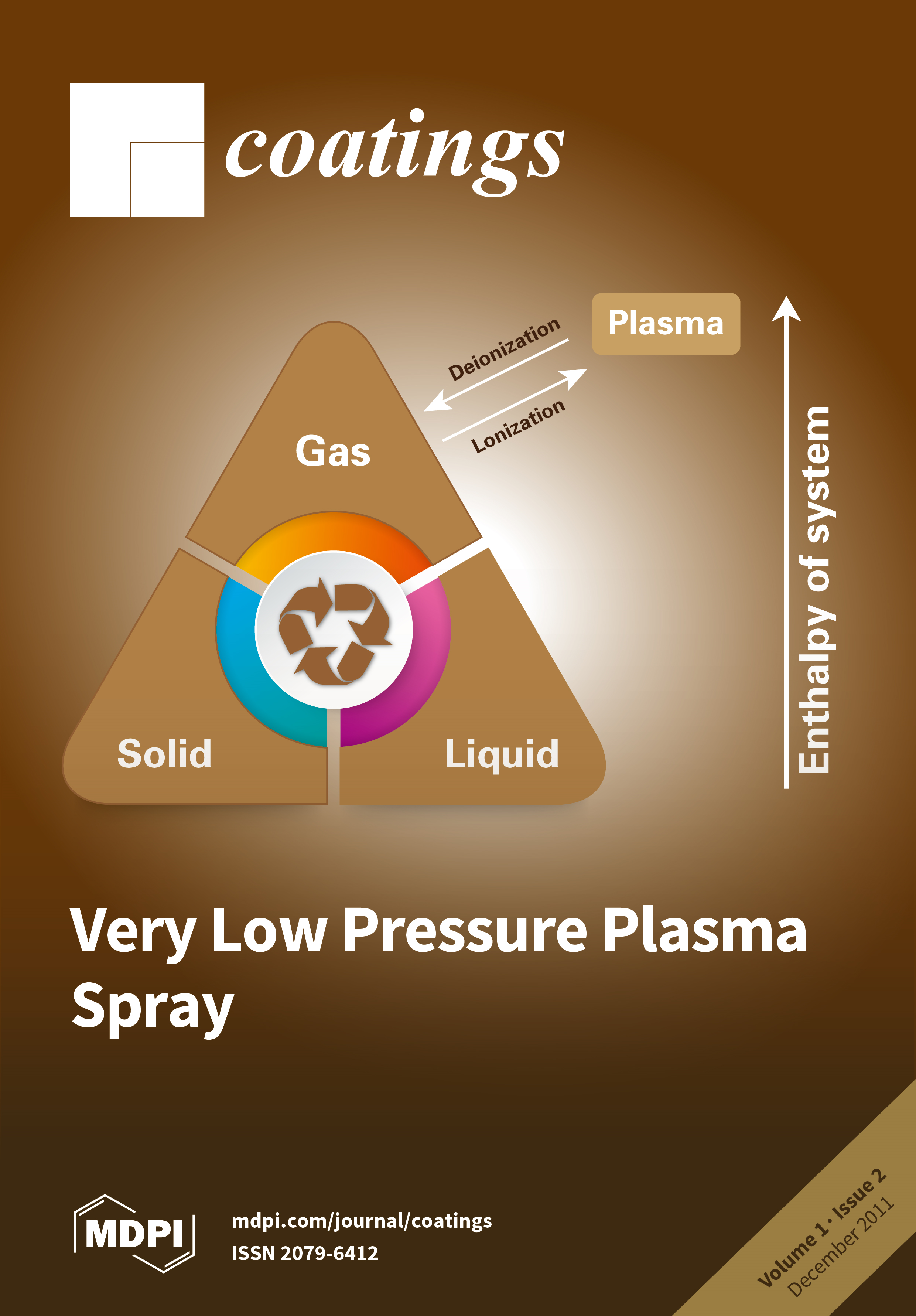
| Download PDF Full-text (2272 KB) | Download XML Full-text Abstract: A fundamentally new family of thermal spray processes has emerged. These new processes, collectively known as very low pressure plasma spray or VLPPS, differ from traditional thermal spray processes in that coatings are deposited at unusually low chamber pressures, typically less than ~800 Pa (6 Torr). Depending upon the specific process, deposition may be in the form of very fine molten droplets, vapor phase deposition, or a mixture of vapor and droplet deposition. Resulting coatings are similar in quality to coatings produced by alternative coating technologies, such as physical vapor deposition (PVD) or chemical vapor deposition (CVD), but deposition rates can be roughly an order of magnitude higher with VLPPS. With these new process technologies modified low pressure plasma spray (LPPS) systems can now be used to produce dense, high quality coatings in the 1 to 100 micron thickness range with lamellar or columnar microstructures. A history of pioneering work in VLPPS technology is presented, deposition mechanisms are discussed, potential new applications are reviewed, and challenges for the future are outlined.
Select/unselect all
Displaying article 1-3
Export citation of selected articles as:
Plain Text
BibTeX
BibTeX (without abstracts)
Endnote
Endnote (without abstracts)
Tab-delimited
PubMed XML
DOAJ XML
AGRIS XML