
<?xml version="1.0" encoding="UTF-8"?>
<!DOCTYPE article PUBLIC "-//NLM//DTD Journal Publishing DTD v2.3 20070202//EN" "journalpublishing.dtd">
<article xmlns:mml="http://www.w3.org/1998/Math/MathML" xmlns:xlink="http://www.w3.org/1999/xlink" xml:lang="en" article-type="review-article">
  <front>
    <journal-meta>
      <journal-id journal-id-type="publisher-id">antibiotics</journal-id>
      <journal-title>Antibiotics</journal-title>
      <abbrev-journal-title abbrev-type="publisher">Antibiotics</abbrev-journal-title>
      <abbrev-journal-title abbrev-type="pubmed">Antibiotics</abbrev-journal-title>
      <issn pub-type="epub">2079-6382</issn>
      <publisher>
        <publisher-name>MDPI</publisher-name>
      </publisher>
    </journal-meta>
    <article-meta>
      <article-id pub-id-type="doi">10.3390/antibiotics2010028</article-id>
      <article-id pub-id-type="publisher-id">antibiotics-02-00028</article-id>
      <article-categories>
        <subj-group>
          <subject>Review</subject>
        </subj-group>
      </article-categories>
      <title-group>
        <article-title>Recent Advances in Multi-Drug Resistance (MDR) Efflux Pump Inhibitors of Gram-Positive Bacteria <italic>S. aureus</italic></article-title>
      </title-group>
      
      <contrib-group>
        <contrib contrib-type="author">
          <name>
            <surname>Handzlik</surname>
            <given-names>Jadwiga</given-names>
          </name>
          <xref rid="c1-antibiotics-02-00028" ref-type="corresp">*</xref>
        </contrib>
        <contrib contrib-type="author">
          <name>
            <surname>Matys</surname>
            <given-names>Anna</given-names>
          </name>
        </contrib>
        <contrib contrib-type="author">
          <name>
            <surname>Kieć-Kononowicz</surname>
            <given-names>Katarzyna</given-names>
          </name>
        </contrib>
      </contrib-group>
      <aff id="af1-antibiotics-02-00028">Department of Technology and Biotechnology of Drugs, Faculty of Pharmacy, Jagiellonian University-Medical College / ul. Medyczna 9, 31-688 Cracow, Poland; E-Mails: <email>anna.dymek@uj.edu.pl</email> (A.M.); <email>mfkonono@cyf-kr.edu.pl</email> (K.K.-K.) </aff>
	  <author-notes>
        <corresp id="c1-antibiotics-02-00028"><label>*</label> Author to whom correspondence should be addressed; E-Mail: <email>j.handzlik@uj.edu.pl</email>; Tel.: +48-126-205-580; Fax: +48-126-205-596.</corresp>
      </author-notes>
      <pub-date pub-type="epub">
        <day>05</day>
        <month>02</month>
        <year>2013</year>
      </pub-date>
      <pub-date pub-type="collection"> <month>03</month>
        <year>2013</year>
      </pub-date>
      <volume>2</volume>
      <issue>1</issue>
      <fpage>28</fpage>
      <lpage>45</lpage>
      <history>
        <date date-type="received">
          <day>04</day>
          <month>01</month>
          <year>2013</year>
        </date>
        <date date-type="rev-recd">
          <day>29</day>
          <month>01</month>
          <year>2013</year>
        </date>
        <date date-type="accepted">
          <day>30</day>
          <month>01</month>
          <year>2013</year>
        </date>
      </history>
      <permissions>
        <copyright-statement>© 2013 by the authors; licensee MDPI, Basel, Switzerland.</copyright-statement>
        <copyright-year>2013</copyright-year>
        <license xmlns:xlink="http://www.w3.org/1999/xlink" license-type="open-access" xlink:href="http://creativecommons.org/licenses/by/3.0/">
          <p>This article is an open access article distributed under the terms and conditions of the Creative Commons Attribution license (http://creativecommons.org/licenses/by/3.0/).</p>
        </license>
      </permissions>
      <abstract>
        <p>The paper focuses on recent achievements in the search for new chemical compounds able to inhibit multidrug resistance (MDR) mechanisms in Gram-positive pathogens. An analysis of the results of the search for new efflux pump inhibitors (EPIs) for Gram-positive bacteria, which have been performed over the last decade, indicates that almost all efforts are focused on the NorA (MFS) efflux pump in <italic>S. aureus</italic>. Considering the chemical structures of the NorA EPIs that have been identified, it can be observed that the most active agents belong to the families of compounds possessing conjugated double bonds, e.g., chalcones, piperine-like compounds, N-cinnamoylphenalkylamides or citral amide derivatives. Indole-, dihydronaphthyl-, 2-chloro-5-bromo-phenyl- or piperidine moieties seem to be profitable for the EPI properties, as well. These results, together with an increasing knowledge about a variety of efflux pumps that are involved in MDR of Gram-positive pathogens underline that further search for new EPIs should pay more attention to develop MDR efflux protein targets, including SMR, MATE, ABC or other members of the MFS family.</p>
      </abstract>
      <kwd-group>
        <kwd>bacterial multidrug resistance</kwd>
        <kwd>MDR</kwd>
        <kwd>efflux pump inhibitors</kwd>
        <kwd>EPIs</kwd>
        <kwd>NorA </kwd>
      </kwd-group>
    </article-meta>
  </front>
  <body>
    <sec sec-type="intro">
      <title>1. Introduction</title>
      <p>As a consequence of the intense fight against infections, bacteria have evolved through numerous defenses against antimicrobial agents [<xref ref-type="bibr" rid="B1-antibiotics-02-00028">1</xref>]. The main mechanisms whereby the bacteria develop resistance to antimicrobial agents include enzymatic inactivation [<xref ref-type="bibr" rid="B2-antibiotics-02-00028">2</xref>,<xref ref-type="bibr" rid="B3-antibiotics-02-00028">3</xref>], modification of the drug target(s) [<xref ref-type="bibr" rid="B3-antibiotics-02-00028">3</xref>,<xref ref-type="bibr" rid="B4-antibiotics-02-00028">4</xref>], and reduction of intracellular drug concentration by changes in membrane permeability [<xref ref-type="bibr" rid="B3-antibiotics-02-00028">3</xref>,<xref ref-type="bibr" rid="B5-antibiotics-02-00028">5</xref>] or by the overexpression of efflux pumps [<xref ref-type="bibr" rid="B3-antibiotics-02-00028">3</xref>,<xref ref-type="bibr" rid="B6-antibiotics-02-00028">6</xref>]. With respect to efflux pumps, they provide a self-defense mechanism by which antibiotics are actively removed from the cell. For antibacterials, this results in sublethal drug concentrations at the active site that in turn may predispose the organism to the development of high-level target-based resistance [<xref ref-type="bibr" rid="B3-antibiotics-02-00028">3</xref>,<xref ref-type="bibr" rid="B7-antibiotics-02-00028">7</xref>]. Therefore, efflux pumps are viable antibacterial targets and identification and development of potent efflux pump inhibitors is a promising and valid strategy [<xref ref-type="bibr" rid="B3-antibiotics-02-00028">3</xref>,<xref ref-type="bibr" rid="B8-antibiotics-02-00028">8</xref>] which can restore the susceptibility of resistant strains to antibacterial agents that are substrates of efflux pumps [<xref ref-type="bibr" rid="B3-antibiotics-02-00028">3</xref>,<xref ref-type="bibr" rid="B9-antibiotics-02-00028">9</xref>]. The combination of a resistance inhibitor with an antibiotic has already proven its efficacy with the clavulanic acid (inhibitor of beta-lactamase)/amoxicillin association [<xref ref-type="bibr" rid="B10-antibiotics-02-00028">10</xref>]. Predominantly, the world search for new tools to combat multidrug resistance (MDR) among bacterial pathogens is concentrated on Gram-negative bacteria aspects [<xref ref-type="bibr" rid="B11-antibiotics-02-00028">11</xref>,<xref ref-type="bibr" rid="B12-antibiotics-02-00028">12</xref>,<xref ref-type="bibr" rid="B13-antibiotics-02-00028">13</xref>,<xref ref-type="bibr" rid="B14-antibiotics-02-00028">14</xref>,<xref ref-type="bibr" rid="B15-antibiotics-02-00028">15</xref>,<xref ref-type="bibr" rid="B16-antibiotics-02-00028">16</xref>,<xref ref-type="bibr" rid="B17-antibiotics-02-00028">17</xref>,<xref ref-type="bibr" rid="B18-antibiotics-02-00028">18</xref>] because of their more complicated MDR mechanisms due to their double-membrane cells, which allow the expression of a tripartite efflux pump system such as AcrA/AcrB/TolC in <italic>Enterobacteriaceae</italic> [<xref ref-type="bibr" rid="B19-antibiotics-02-00028">19</xref>,<xref ref-type="bibr" rid="B20-antibiotics-02-00028">20</xref>,<xref ref-type="bibr" rid="B21-antibiotics-02-00028">21</xref>] or MexA/ MexB/OprM in <italic>Pseudomonas aeruginosa</italic> [<xref ref-type="bibr" rid="B22-antibiotics-02-00028">22</xref>,<xref ref-type="bibr" rid="B23-antibiotics-02-00028">23</xref>,<xref ref-type="bibr" rid="B24-antibiotics-02-00028">24</xref>]. Although the 3D-structures of protein components of the tripartite efflux pumps have been identified experimentally [<xref ref-type="bibr" rid="B25-antibiotics-02-00028">25</xref>], which should simplify studies on inhibitor-binding pockets, the knowledge about the pump-inhibitor interactions is still not sufficient to involve the “protein-ligand drug design” approach in the search for new EPIs for Gram-negative pathogens. Results of recent microbiological- and medicinal chemistry studies allowed us to identify several chemical families of compounds inhibiting tripartite MFP/RND/OMF pump action [<xref ref-type="bibr" rid="B12-antibiotics-02-00028">12</xref>,<xref ref-type="bibr" rid="B13-antibiotics-02-00028">13</xref>,<xref ref-type="bibr" rid="B16-antibiotics-02-00028">16</xref>,<xref ref-type="bibr" rid="B25-antibiotics-02-00028">25</xref>] but it is hard to find a good pharmacophore model resulting from the studies that could be applicable in further design of new potent EPIs.</p>
      <p>Indeed, various lines of evidence [<xref ref-type="bibr" rid="B1-antibiotics-02-00028">1</xref>,<xref ref-type="bibr" rid="B3-antibiotics-02-00028">3</xref>,<xref ref-type="bibr" rid="B10-antibiotics-02-00028">10</xref>,<xref ref-type="bibr" rid="B26-antibiotics-02-00028">26</xref>,<xref ref-type="bibr" rid="B27-antibiotics-02-00028">27</xref>,<xref ref-type="bibr" rid="B28-antibiotics-02-00028">28</xref>,<xref ref-type="bibr" rid="B29-antibiotics-02-00028">29</xref>,<xref ref-type="bibr" rid="B30-antibiotics-02-00028">30</xref>,<xref ref-type="bibr" rid="B31-antibiotics-02-00028">31</xref>,<xref ref-type="bibr" rid="B32-antibiotics-02-00028">32</xref>,<xref ref-type="bibr" rid="B33-antibiotics-02-00028">33</xref>,<xref ref-type="bibr" rid="B34-antibiotics-02-00028">34</xref>,<xref ref-type="bibr" rid="B35-antibiotics-02-00028">35</xref>,<xref ref-type="bibr" rid="B36-antibiotics-02-00028">36</xref>,<xref ref-type="bibr" rid="B37-antibiotics-02-00028">37</xref>,<xref ref-type="bibr" rid="B38-antibiotics-02-00028">38</xref>] have indicated a significant development of medicinal chemistry tools useful in the search for efflux pump inhibitors for Gram-positive pathogens. As multidrug resistant Gram-positive bacteria have been and still are a current therapeutic problem, it is of great importance to analyze the recent progress in the search for new tools to combat it. Thus, this paper focuses on recent achievements in the search for new chemical compounds able to inhibit MDR mechanisms in Gram-positive pathogens. </p>
    </sec>
    <sec>
      <title>2. Efflux Pumps in Gram Positive Bacteria</title>
      <p>Efflux pumps in Gram-positive bacteria belong to four unrelated families (<xref ref-type="table" rid="antibiotics-02-00028-t001">Table 1</xref>): MFS (major facilitator superfamily), SMR (small multidrug resistance), ABC (ATP-binding cassette) and MATE (Multidrug And Toxic Compound Extrusion) [<xref ref-type="bibr" rid="B9-antibiotics-02-00028">9</xref>,<xref ref-type="bibr" rid="B39-antibiotics-02-00028">39</xref>,<xref ref-type="bibr" rid="B40-antibiotics-02-00028">40</xref>,<xref ref-type="bibr" rid="B41-antibiotics-02-00028">41</xref>,<xref ref-type="bibr" rid="B42-antibiotics-02-00028">42</xref>,<xref ref-type="bibr" rid="B43-antibiotics-02-00028">43</xref>,<xref ref-type="bibr" rid="B44-antibiotics-02-00028">44</xref>,<xref ref-type="bibr" rid="B45-antibiotics-02-00028">45</xref>,<xref ref-type="bibr" rid="B46-antibiotics-02-00028">46</xref>,<xref ref-type="bibr" rid="B47-antibiotics-02-00028">47</xref>,<xref ref-type="bibr" rid="B48-antibiotics-02-00028">48</xref>,<xref ref-type="bibr" rid="B49-antibiotics-02-00028">49</xref>,<xref ref-type="bibr" rid="B50-antibiotics-02-00028">50</xref>,<xref ref-type="bibr" rid="B51-antibiotics-02-00028">51</xref>,<xref ref-type="bibr" rid="B52-antibiotics-02-00028">52</xref>,<xref ref-type="bibr" rid="B53-antibiotics-02-00028">53</xref>,<xref ref-type="bibr" rid="B54-antibiotics-02-00028">54</xref>]. </p>
      <p>MFS transporters are typically composed of approx. 400 amino acids that are putatively arranged into 12 membrane-spanning helices, with a large cytoplasmic loop between helices six and seven [<xref ref-type="bibr" rid="B39-antibiotics-02-00028">39</xref>,<xref ref-type="bibr" rid="B55-antibiotics-02-00028">55</xref>,<xref ref-type="bibr" rid="B56-antibiotics-02-00028">56</xref>]. The examples of MFS efflux pumps in Gram-positive bacteria are NorA, NorB, MdeA, Tet38 (<italic>Staphylococcus aureus</italic>), LmrB, Bmr, Bmr3, Blt (<italic>Bacillus subtilis</italic>), MefA (<italic>Streptococcus pyogenes</italic>), MefE (<italic>Streptococcus pneumoniae</italic>) or CmlR <italic>(Streptococcus coelicor)</italic> [<xref ref-type="bibr" rid="B39-antibiotics-02-00028">39</xref>,<xref ref-type="bibr" rid="B55-antibiotics-02-00028">55</xref>,<xref ref-type="bibr" rid="B57-antibiotics-02-00028">57</xref>,<xref ref-type="bibr" rid="B58-antibiotics-02-00028">58</xref>,<xref ref-type="bibr" rid="B59-antibiotics-02-00028">59</xref>]. SMR transporters consist of approx. 110 amino acids and contain four transmembrane helices. </p>
      <table-wrap id="antibiotics-02-00028-t001" position="float">
        <object-id pub-id-type="pii">antibiotics-02-00028-t001_Table 1</object-id>
        <label>Table 1</label>
        <caption>
          <p>Efflux pumps in Gram positive bacteria and their role in antibiotics transport.</p>
        </caption>
        <table>
          <thead>
            <tr>
              <th align="center" valign="middle">Bacterial strain</th>
              <th align="center" valign="middle">Transport protein family</th>
              <th align="center" valign="middle">Efflux pump</th>
              <th align="center" valign="middle">Substrates</th>
            </tr>
          </thead>
          <tbody>
            <tr>
              <td rowspan="6" align="center" valign="middle"><italic>Staphylococcus aureus</italic></td>
              <td align="center" valign="middle">MFS [<xref ref-type="bibr" rid="B9-antibiotics-02-00028">9</xref>,<xref ref-type="bibr" rid="B41-antibiotics-02-00028">41</xref>,<xref ref-type="bibr" rid="B42-antibiotics-02-00028">42</xref>,<xref ref-type="bibr" rid="B43-antibiotics-02-00028">43</xref>,<xref ref-type="bibr" rid="B44-antibiotics-02-00028">44</xref>]</td>
              <td align="center" valign="middle">NorA</td>
              <td align="center" valign="middle">NOR, CPX</td>
            </tr>
            <tr>
              <td align="center" valign="middle">&nbsp;</td>
              <td align="center" valign="middle">NorB</td>
              <td align="center" valign="middle">NOR, CPX, SPX</td>
            </tr>
            <tr>
              <td align="center" valign="middle">&nbsp;</td>
              <td align="center" valign="middle">MdeA</td>
              <td align="center" valign="middle">Macrolides</td>
            </tr>
            <tr>
              <td align="center" valign="middle">MATE [<xref ref-type="bibr" rid="B45-antibiotics-02-00028">45</xref>]</td>
              <td align="center" valign="middle">Tet38</td>
              <td align="center" valign="middle">tetracyclines</td>
            </tr>
            <tr>
              <td align="center" valign="middle">&nbsp;</td>
              <td align="center" valign="middle">MepA</td>
              <td align="center" valign="middle">FQ, glycylcyclines</td>
            </tr>
            <tr>
              <td align="center" valign="middle">SMR [<xref ref-type="bibr" rid="B39-antibiotics-02-00028">39</xref>,<xref ref-type="bibr" rid="B60-antibiotics-02-00028">60</xref>,<xref ref-type="bibr" rid="B61-antibiotics-02-00028">61</xref>]</td>
              <td align="center" valign="middle">Smr, QacG, QacH</td>
              <td align="center" valign="middle">-</td>
            </tr>
            <tr>
              <td rowspan="2" align="center" valign="middle"><italic>Staphylococcus spp</italic></td>
              <td align="center" valign="middle">MFS [<xref ref-type="bibr" rid="B9-antibiotics-02-00028">9</xref>,<xref ref-type="bibr" rid="B46-antibiotics-02-00028">46</xref>,<xref ref-type="bibr" rid="B47-antibiotics-02-00028">47</xref>]</td>
              <td align="center" valign="middle">Mef(A)</td>
              <td align="center" valign="middle">Macrolides</td>
            </tr>
            <tr>
              <td align="center" valign="middle">ABC [<xref ref-type="bibr" rid="B47-antibiotics-02-00028">47</xref>,<xref ref-type="bibr" rid="B48-antibiotics-02-00028">48</xref>,<xref ref-type="bibr" rid="B49-antibiotics-02-00028">49</xref>]</td>
              <td align="center" valign="middle">MsrA</td>
              <td align="center" valign="middle">Macrolides, type B streptogramins</td>
            </tr>
            <tr>
              <td align="center" valign="middle"><italic>Staphylococcus haemolyticus</italic></td>
              <td align="center" valign="middle">MFS [<xref ref-type="bibr" rid="B42-antibiotics-02-00028">42</xref>]</td>
              <td align="center" valign="middle">MdeA</td>
              <td align="center" valign="middle">Macrolides, lincosamides type A streptogramins</td>
            </tr>
            <tr>
              <td align="center" valign="middle"><italic>Staphylococcus lentus</italic></td>
              <td align="center" valign="middle">[<xref ref-type="bibr" rid="B54-antibiotics-02-00028">54</xref>]</td>
              <td align="center" valign="middle">FexA</td>
              <td align="center" valign="middle">-</td>
            </tr>
            <tr>
              <td align="center" valign="middle"><italic>Streptomyces coelicolor</italic></td>
              <td align="center" valign="middle">MFS [<xref ref-type="bibr" rid="B38-antibiotics-02-00028">38</xref>]</td>
              <td align="center" valign="middle">CmlR1, CmlR2</td>
              <td align="center" valign="middle">Chloramphenicol</td>
            </tr>
            <tr>
              <td align="center" valign="middle"><italic>Streptomyces spp</italic></td>
              <td align="center" valign="middle">MFS [<xref ref-type="bibr" rid="B50-antibiotics-02-00028">50</xref>]</td>
              <td align="center" valign="middle">Cml, Cmlv, Cmr, Cmx, CmA</td>
              <td align="center" valign="middle">-</td>
            </tr>
            <tr>
              <td align="center" valign="middle"><italic>Streptococcus spp</italic></td>
              <td align="center" valign="middle">MFS [<xref ref-type="bibr" rid="B9-antibiotics-02-00028">9</xref>,<xref ref-type="bibr" rid="B45-antibiotics-02-00028">45</xref>,<xref ref-type="bibr" rid="B47-antibiotics-02-00028">47</xref>]</td>
              <td align="center" valign="middle">Mef(A)</td>
              <td align="center" valign="middle">Macrolides</td>
            </tr>
            <tr>
              <td rowspan="2" align="center" valign="middle"><italic>Streptococcus pneumoniae</italic></td>
              <td align="center" valign="middle">ABC [<xref ref-type="bibr" rid="B51-antibiotics-02-00028">51</xref>]</td>
              <td align="center" valign="middle">Msr(D)</td>
              <td align="center" valign="middle">Macrolides, ketolides</td>
            </tr>
            <tr>
              <td align="center" valign="middle">MFS [<xref ref-type="bibr" rid="B52-antibiotics-02-00028">52</xref>]</td>
              <td align="center" valign="middle">PmrA</td>
              <td align="center" valign="middle">NOR, CPX</td>
            </tr>
            <tr>
              <td rowspan="2" align="center" valign="middle"><italic>Clostridium difficile</italic></td>
              <td align="center" valign="middle">MFS [<xref ref-type="bibr" rid="B53-antibiotics-02-00028">53</xref>]</td>
              <td align="center" valign="middle">Cme</td>
              <td align="center" valign="middle">Erythromycin</td>
            </tr>
            <tr>
              <td align="center" valign="middle">MATE [<xref ref-type="bibr" rid="B45-antibiotics-02-00028">45</xref>]</td>
              <td align="center" valign="middle">CdeA</td>
              <td align="center" valign="middle">FQ</td>
            </tr>
            <tr>
              <td rowspan="2" align="center" valign="middle"><italic>Bacillus subtilis</italic></td>
              <td align="center" valign="middle">MFS [<xref ref-type="bibr" rid="B9-antibiotics-02-00028">9</xref>,<xref ref-type="bibr" rid="B46-antibiotics-02-00028">46</xref>]</td>
              <td align="center" valign="middle">LmrB</td>
              <td align="center" valign="middle">Lincosamides</td>
            </tr>
            <tr>
              <td align="center" valign="middle"> </td>
              <td align="center" valign="middle">Bmr, Bmr3, Blt</td>
              <td align="center" valign="middle">FQ</td>
            </tr>
            <tr>
              <td align="center" valign="middle"><italic>Bacillus glutamicum</italic></td>
              <td align="center" valign="middle">MFS [<xref ref-type="bibr" rid="B9-antibiotics-02-00028">9</xref>,<xref ref-type="bibr" rid="B46-antibiotics-02-00028">46</xref>]</td>
              <td align="center" valign="middle">LmrB</td>
              <td align="center" valign="middle">Lincosamides</td>
            </tr>
          </tbody>
        </table>
		<table-wrap-foot><fn>
		<p>NOR: norfloxacin; CPX: ciprofloxacin; SPX: sparfloxacin; FQ: flouroquinolones.</p>
		</fn></table-wrap-foot>
		</table-wrap>
      
      <p>Owing to the small sizes of the proteins that belong to this family, they probably function as oligomeric complexes [<xref ref-type="bibr" rid="B39-antibiotics-02-00028">39</xref>,<xref ref-type="bibr" rid="B59-antibiotics-02-00028">59</xref>]. The examples of SMR efflux pumps in Gram-positive bacteria are EbrAB (<italic>Bacillus subtilis</italic>) or Smr, QacG, QacH <italic>(Staphylococcus aureus)</italic> [<xref ref-type="bibr" rid="B39-antibiotics-02-00028">39</xref>,<xref ref-type="bibr" rid="B60-antibiotics-02-00028">60</xref>,<xref ref-type="bibr" rid="B61-antibiotics-02-00028">61</xref>]. MATE efflux proteins consist of 400–700 amino acids that form 12 transmembrane helices. All proteins of the MATE family exhibit almost 40% identity of their amino acid sequence. All genes that encode MATE proteins are derived from the same gene which was subsequently duplicated. An example of MATE efflux pump in Gram-positive bacteria is MepA protein found in <italic>Staphylococcus aureus</italic> [<xref ref-type="bibr" rid="B62-antibiotics-02-00028">62</xref>,<xref ref-type="bibr" rid="B63-antibiotics-02-00028">63</xref>]. MFS, SMR and MATE transporters use a transmembrane proton gradient as the driving force for transport [<xref ref-type="bibr" rid="B39-antibiotics-02-00028">39</xref>,<xref ref-type="bibr" rid="B62-antibiotics-02-00028">62</xref>,<xref ref-type="bibr" rid="B63-antibiotics-02-00028">63</xref>,<xref ref-type="bibr" rid="B64-antibiotics-02-00028">64</xref>,<xref ref-type="bibr" rid="B65-antibiotics-02-00028">65</xref>]. The minimal structural organization of an ABC transporter includes the presence of four domains, <italic>i.e</italic>., two nucleotide binding domains (NBDs) and two transmembrane permease domains (TMDs). The TMDs usually consist of six transmembrane α-helices and form homo or heterodimers. Two NBDs bind ATP in the cytoplasmic side and cooperate with transmembrane domains [<xref ref-type="bibr" rid="B39-antibiotics-02-00028">39</xref>,<xref ref-type="bibr" rid="B65-antibiotics-02-00028">65</xref>,<xref ref-type="bibr" rid="B66-antibiotics-02-00028">66</xref>].</p>
      <p>The feature which distinguishes ABC transporters from the remaining families is the energy source for active extrusion of drugs, as it comes from the hydrolysis of ATP. Binding and hydrolysis of ATP triggers conformational changes in the transporter’s structure, which enable export of substrates [<xref ref-type="bibr" rid="B39-antibiotics-02-00028">39</xref>,<xref ref-type="bibr" rid="B67-antibiotics-02-00028">67</xref>]. The examples of ABC efflux pumps in Gram-positive bacteria are LmrA <italic>(Lactococcus lactis)</italic> or Rv1217c–Rv1218c (<italic>Mycobacterium tuberculosis</italic>) [<xref ref-type="bibr" rid="B39-antibiotics-02-00028">39</xref>,<xref ref-type="bibr" rid="B55-antibiotics-02-00028">55</xref>,<xref ref-type="bibr" rid="B68-antibiotics-02-00028">68</xref>].</p>
      <p>Multidrug resistance efflux pumps are recognized as an important component of resistance in both Gram-positive and Gram-negative bacteria. Some bacterial efflux pumps may be selective for one substrate or transport antibiotics of different classes, conferring a multiple drug resistance (MDR) phenotype. Efflux pumps inhibitors (EPIs) are promising therapeutic agents, as they should restore the activity of standard antibiotics. The efflux pump inhibitor-antibiotic combination is expected to increase the intracellular concentration of antibiotics that are expelled by efflux pumps, decrease the intrinsic bacterial resistance to antibiotics, reverse the acquired resistance associated with efflux pumps overexpression, and reduce the frequency of the emergence of resistant mutant strains [<xref ref-type="bibr" rid="B69-antibiotics-02-00028">69</xref>].</p>
      <p>Bypassing efflux pump activity may be achieved through a variety of different approaches: (1) by modifying the chemical design of previous antibiotics to reduce their respective affinity for binding sites and cavities located inside the pump transporter; (2) by increasing the influx of antibiotics, using membrane permeabilizers that subsequently increase the intracellular concentration of drugs; (3) by down-regulating the expression of efflux pump genes and/or decreasing the level of active efflux complexes in the bacterial envelope; (4) by collapsing the energy required to support the drug transport; (5) by inhibiting the functional assembly of efflux pump components; (6) by inserting a carefully-designed molecular plug inside the membrane channels responsible of antibiotic transport (inside the pump cavities or inside the exit channel component) or (7) by generating a dynamic competition, between a decoy- substrate and the antibiotic, during transport flux inside the pump [<xref ref-type="bibr" rid="B12-antibiotics-02-00028">12</xref>].</p>
    </sec>
    <sec>
      <title>3. Current Approaches in Search for EPIs in Gram Positive Bacteria</title>
      <p>The methicillin-resistant <italic>Staphylococcus aureus</italic> (MRSA) is a major multidrug resistant Gram-positive bacteria that is a main cause of healthcare-associated infections (HAIs) resulting in a high death rate. MRSA is able to acquire resistance to various antibiotics, including tetracyclines, aminoglycosides and flouroquinolones. Studies on MDR efflux mechanisms in <italic>S. aureus</italic> indicated that NorA is predominant protein efflux pump [<xref ref-type="bibr" rid="B3-antibiotics-02-00028">3</xref>]. For these two reasons, NorA in <italic>S. aureus</italic> is a frequently studied efflux pump as well as being the main protein target in the search for efflux pump inhibitors in the case of Gram-positive bacteria. </p>
      <p>Recent decades have seen the production of a number of new chemical compounds belonging to various chemical families, which were investigated on their NorA EPI properties [<xref ref-type="bibr" rid="B3-antibiotics-02-00028">3</xref>,<xref ref-type="bibr" rid="B10-antibiotics-02-00028">10</xref>,<xref ref-type="bibr" rid="B26-antibiotics-02-00028">26</xref>,<xref ref-type="bibr" rid="B27-antibiotics-02-00028">27</xref>,<xref ref-type="bibr" rid="B28-antibiotics-02-00028">28</xref>,<xref ref-type="bibr" rid="B29-antibiotics-02-00028">29</xref>,<xref ref-type="bibr" rid="B30-antibiotics-02-00028">30</xref>,<xref ref-type="bibr" rid="B31-antibiotics-02-00028">31</xref>,<xref ref-type="bibr" rid="B32-antibiotics-02-00028">32</xref>,<xref ref-type="bibr" rid="B33-antibiotics-02-00028">33</xref>,<xref ref-type="bibr" rid="B34-antibiotics-02-00028">34</xref>,<xref ref-type="bibr" rid="B35-antibiotics-02-00028">35</xref>,<xref ref-type="bibr" rid="B36-antibiotics-02-00028">36</xref>,<xref ref-type="bibr" rid="B37-antibiotics-02-00028">37</xref>,<xref ref-type="bibr" rid="B38-antibiotics-02-00028">38</xref>,<xref ref-type="bibr" rid="B70-antibiotics-02-00028">70</xref>]. In the studies, an examination of the new compounds on their EPI properties have predominantly been based on: (1) a comparison of antibiotics efficacy in the presence- to that in the absence of the tested compound in the strain over-producing efflux pump and/or (2) the assays of inhibition of a substrate-efflux, mediated by the efflux pump, at various concentrations of the tested compound. In both types of assays, <italic>S. aureus</italic> SA 1199B was the most often used strain over-producing NorA efflux pump, and the wild strain <italic>S. aureus</italic> SA 1199 was involved as a reference one. Ciprofloxacin (CPX) is described as the most often used antibiotic, and ethidium bromide (EtBr) as the main reference substrate of NorA applied in the (real-time) efflux assays.</p>
      <sec>
        <title>3.1. Plant-Derived NorA EPIs and Their Chemical Modifications</title>
        <p>The role of phytochemistry in search for compounds inhibiting NorA of S.aureus is significant as it is reported to be an extremely varied series of plant-derived EPIs displaying different chemical properties, including flavones, isoflavones, acylated glycosides, porphyrin phaeophorbide A or kaempferol rhamnoside [<xref ref-type="bibr" rid="B34-antibiotics-02-00028">34</xref>,<xref ref-type="bibr" rid="B70-antibiotics-02-00028">70</xref>].</p>
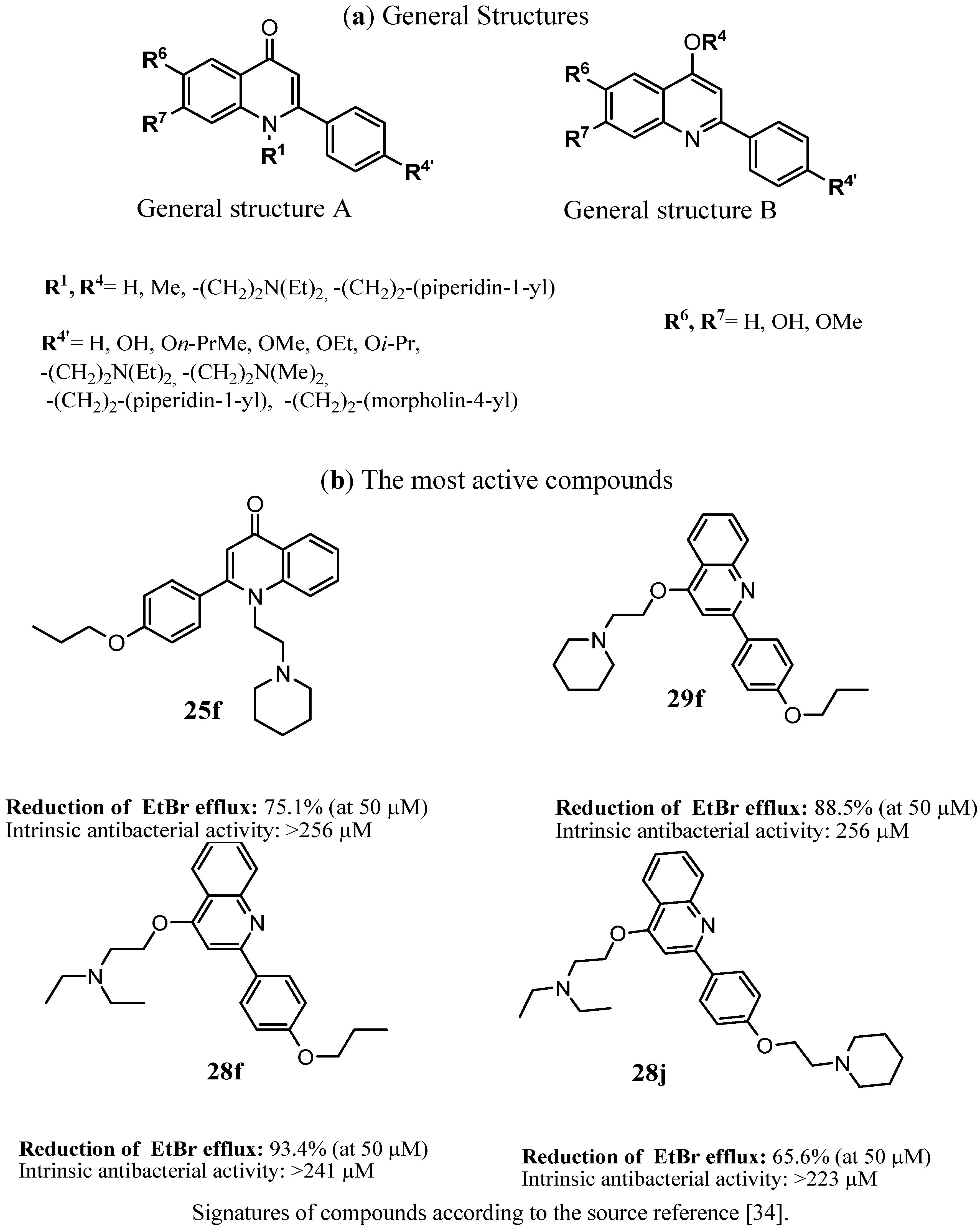
        <p>Chemical structures of the natural EPIs have been a good starting point for further modifications to search for new inhibitors with higher potency and better pharmacological profile. In this context, Sabatini <italic>et al</italic>. [<xref ref-type="bibr" rid="B34-antibiotics-02-00028">34</xref>] described the synthesis of a series of 2-(4-propoxyphenyl)quinoline derivatives, that was designed on the basis of natural flavones nucleus (<xref ref-type="fig" rid="antibiotics-02-00028-f001">Figure 1</xref>). The compounds were investigated on their EPIs action in the ethidium bromide (EtBr) inhibition assays on strain <italic>S. aureus</italic> SA-1199B over-expressing norA. The most active compounds <bold>25f</bold>, <bold>28f</bold>, <bold>28j</bold> and <bold>29f</bold> displayed more than 65% inhibition of EtBr at their 50 µm concentration.</p>
        <fig id="antibiotics-02-00028-f001" position="float">
          <label>Figure 1</label>
          <caption>
            <p>The most active inhibitors of the <italic>S. aureus</italic> NorA efflux pump among 2-(4-propoxyphenyl)quinoline [<xref ref-type="bibr" rid="B34-antibiotics-02-00028">34</xref>].</p>
          </caption>
          <graphic xmlns:xlink="http://www.w3.org/1999/xlink" xlink:href="antibiotics-02-00028-g001.tif"/>
        </fig>
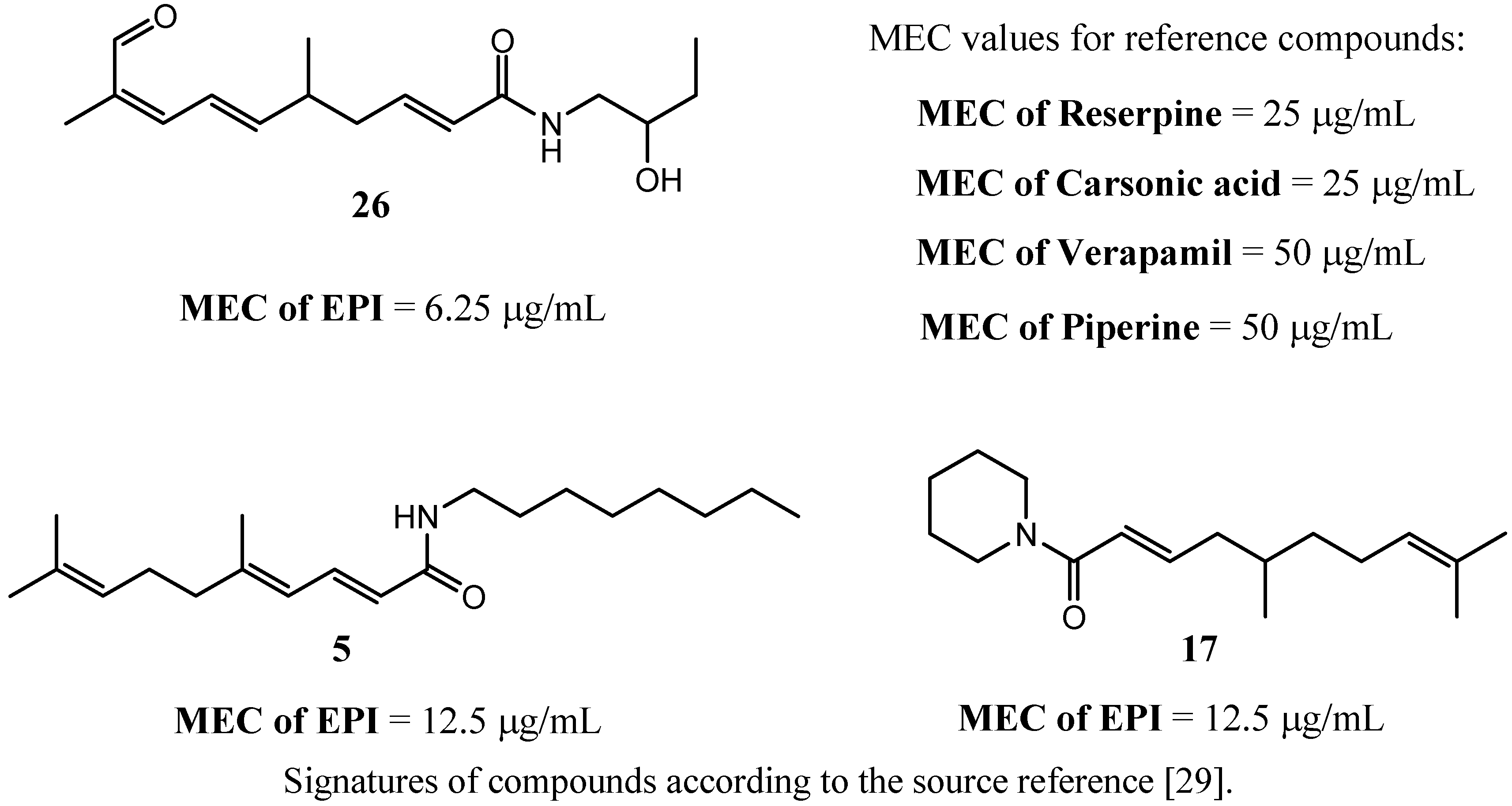
        <p>Thota <italic>et al</italic>. [<xref ref-type="bibr" rid="B29-antibiotics-02-00028">29</xref>] described a series of citral derived amides that have been obtained from monoterpene citral or citronellal (<xref ref-type="fig" rid="antibiotics-02-00028-f002">Figure 2</xref>).</p>
        <fig id="antibiotics-02-00028-f002" position="float">
          <label>Figure 2</label>
          <caption>
            <p>Citral amide derivatives that potentiate MIC of ciprofloxacin on <italic>S. aureus</italic> 1199. The most active compounds found within the assays [<xref ref-type="bibr" rid="B29-antibiotics-02-00028">29</xref>]. MEC value describes minimal effective concentration of the tested compounds.</p>
          </caption>
          <graphic xmlns:xlink="http://www.w3.org/1999/xlink" xlink:href="antibiotics-02-00028-g002.tif"/>
        </fig>
        <p>The compounds were investigated on their abilities to decrease minimal inhibitory concentration of ciprofloxacin in the strains of <italic>S. aureus</italic> over-producing NorA pump. The EPI-action of the compounds was expressed as MEC-value (minimal dose of the tested compound that caused a decrease in the MIC of ciprofloxacin). As reference compounds, reserpine, carsonic acid, verapamil and piperine were used. The most active compound, 2,6,8-trienoic acid amide derivative <bold>26</bold> improved antimicrobial action of ciprofloxacin at the compound concentration 4–8 fold lower than that of reference inhibitors. Dienoic acid piperidide derivative (<bold>17</bold>) and 2,4,8-trienoic derivative of octylamide (<bold>5</bold>) were active at their doses 2–4 fold lower than those of reference EPIs (<xref ref-type="fig" rid="antibiotics-02-00028-f002">Figure 2</xref>) [<xref ref-type="bibr" rid="B29-antibiotics-02-00028">29</xref>].</p>
      </sec>
      <sec>
        <title>3.2. Chalcones and Alkenamide Inhibitors of the NorA in S. aureus</title>
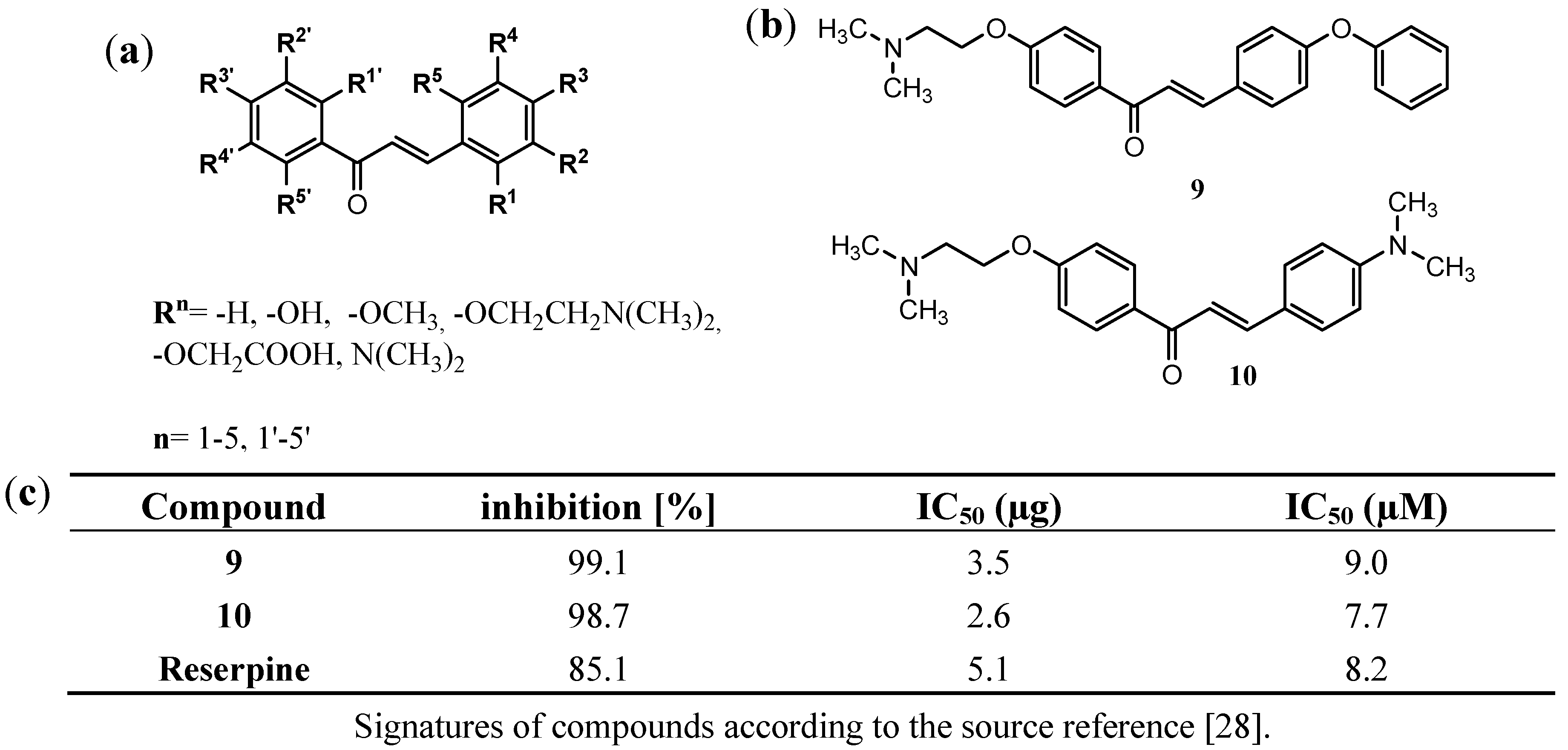
        <p>The newest work of Holler <italic>et al</italic>. [<xref ref-type="bibr" rid="B28-antibiotics-02-00028">28</xref>] focuses on a series of 117 chalcone derivatives modified at each position of both phenyl rings (<xref ref-type="fig" rid="antibiotics-02-00028-f003">Figure 3</xref>a). The compounds were tested on their EPI activity against NorA mediated ethidium bromide efflux in real-time efflux assay (RTE) in the strain SA1199B. Five active compounds were found. Among them two N,N-dimethylaminoethoxyphenyl derivatives <bold>9</bold> and <bold>10</bold> (<xref ref-type="fig" rid="antibiotics-02-00028-f003">Figure 3</xref>b) were equipotent to reserpine, that was used as reference EPI in the studies. The compounds tested at their concentration of 20 µg/mL displayed almost total inhibition of EtBr efflux (<xref ref-type="fig" rid="antibiotics-02-00028-f003">Figure 3</xref>c).</p>
        <fig id="antibiotics-02-00028-f003" position="float">
          <label>Figure 3</label>
          <caption>
            <p>Chalcone inhibitors of the NorA efflux pump in <italic>S. aureus</italic>; (<bold>a</bold>) the general structure of the chalcone EPIs; (<bold>b</bold>) the most active inhibitors found in the real-time efflux (RTE) assay; (<bold>c</bold>) Inhibition of EtBr efflux in SA1199B at compounds concentration of 20 µg/mL for the most active chalcones <bold>9</bold> and <bold>10</bold> [<xref ref-type="bibr" rid="B28-antibiotics-02-00028">28</xref>].</p>
          </caption>
          <graphic xmlns:xlink="http://www.w3.org/1999/xlink" xlink:href="antibiotics-02-00028-g003.tif"/>
        </fig>
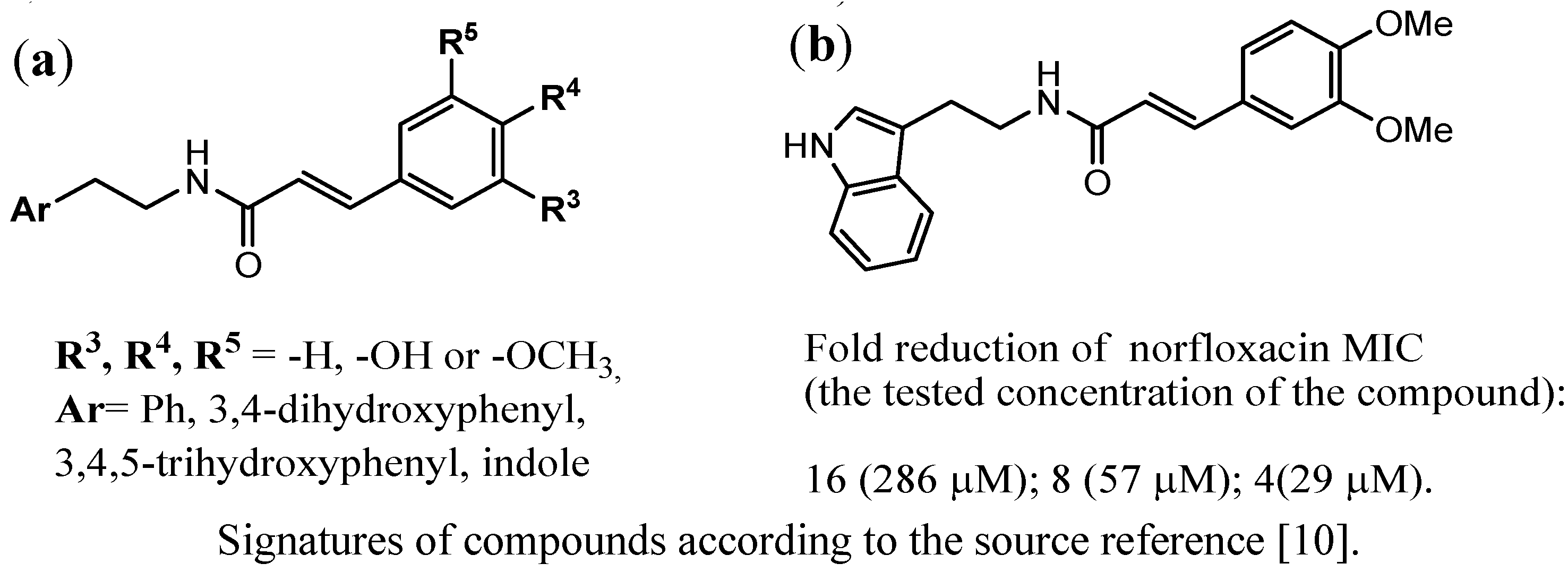
        <p>Michalet <italic>et al</italic>. [<xref ref-type="bibr" rid="B10-antibiotics-02-00028">10</xref>] performed studies among N-cinnamoylphenalkylamide derivatives with (un)substituted phenyl or indole at one terminated fragment and (un)substituted phenyl at the opposite terminate fragment (<xref ref-type="fig" rid="antibiotics-02-00028-f004">Figure 4</xref>a).</p>
        <fig id="antibiotics-02-00028-f004" position="float">
          <label>Figure 4</label>
          <caption>
            <p>N-cinnamoylphenalkylamide derivatives investigated according to their efflux pump inhibitors (EPIs) action in the strain over-producing NorA pump; (<bold>a</bold>) general structures of the N-cinnamoylphenalkylamides; (<bold>b</bold>) the structure of the most active inhibitor [<xref ref-type="bibr" rid="B10-antibiotics-02-00028">10</xref>].</p>
          </caption>
          <graphic xmlns:xlink="http://www.w3.org/1999/xlink" xlink:href="antibiotics-02-00028-g004.tif"/>
        </fig>
        <p>In the case of both aromatic fragments electrodonated substituents were considered. The most active compound (<xref ref-type="fig" rid="antibiotics-02-00028-f004">Figure 4</xref>b), possessing indole moiety and 3,4-dimethoxycinnamoyl fragment, caused a 4-fold reduction of norfloxacin MIC at the lowest concentration of 29 µM.</p>
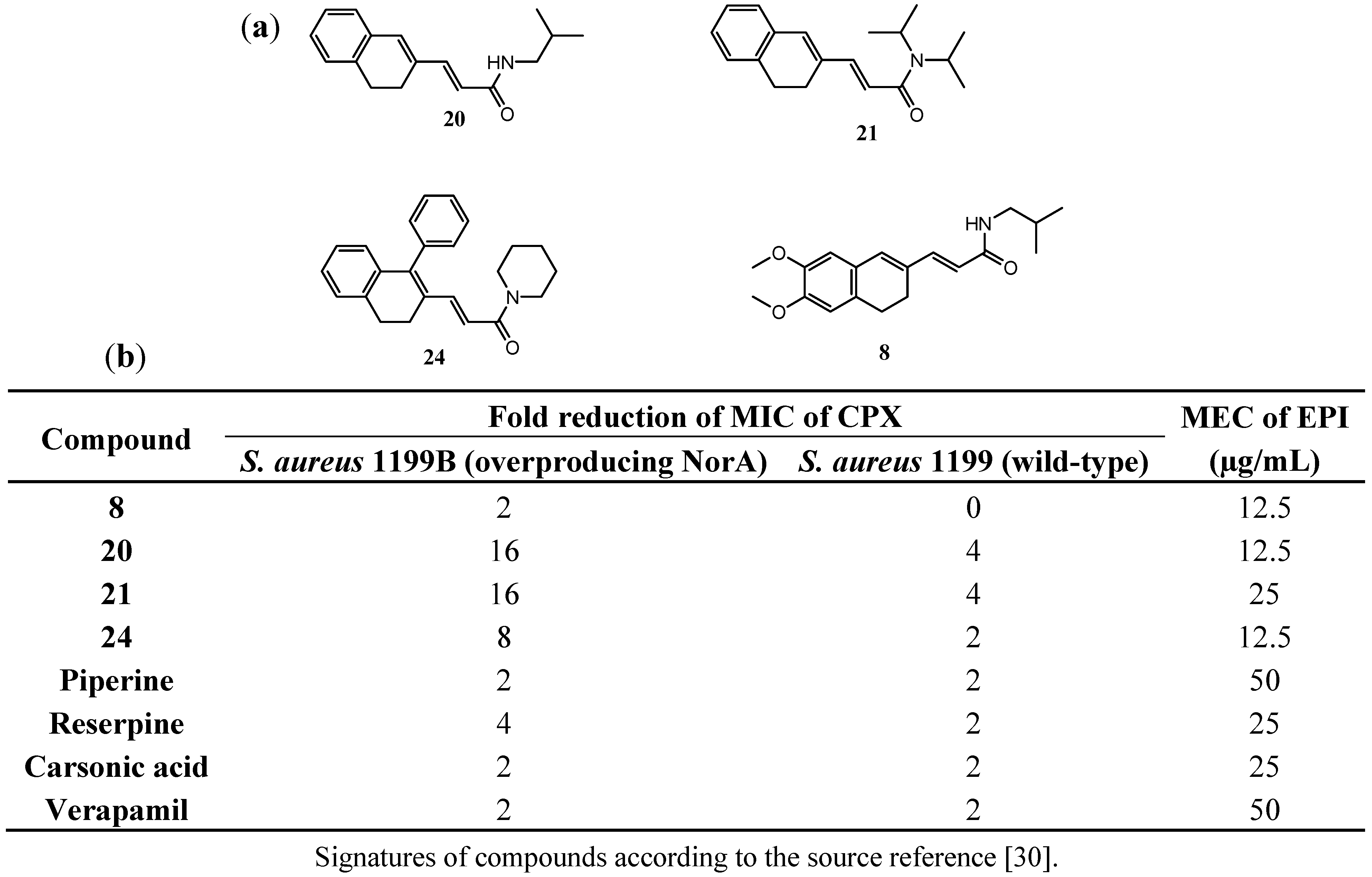
        <p>Compounds with similar topology of conjugated double bonds were obtained and investigated by Thota <italic>et al</italic>. [<xref ref-type="bibr" rid="B30-antibiotics-02-00028">30</xref>], who found new EPIs among derivatives of 3,4-dihydronaphth-2-yl-propenoic acid (<xref ref-type="fig" rid="antibiotics-02-00028-f005">Figure 5</xref>). The compounds were examined according to their ability to improve the efficacy of ciprofloxacine in MDR strains of <italic>S. aureus</italic> (1199B and 1199). The most active compounds included chemical moieties of isobutylamide (<bold>8</bold>, <bold>20</bold>), diisopropylamide (<bold>21</bold>) and piperidide (<bold>24</bold>). The compounds were able to reduce MIC of ciprofloxacine (CPX) in 2–16-fold at their concentrations 1–4 fold lower than those of reference EPI (<xref ref-type="fig" rid="antibiotics-02-00028-f005">Figure 5</xref>). The simple structure of 3-(3,4-dihydronaphth-2-yl)-propenoic acid isobutyl amide (<bold>20</bold>) was the most promising one, which caused a 16-fold reduction of MIC of CPX in strain 1199B and 4-fold in the case of 1199 strain. Its MEC value (12.5 µg/mL) was 4-fold lower than that of piperine and verapamil and 2-fold lower than that of reserpine and carsonic acid.</p>
        <fig id="antibiotics-02-00028-f005" position="float">
          <label>Figure 5</label>
          <caption>
            <p>Dihydronaphthalene inhibitors of the NorA efflux pump in <italic>S. aureus</italic> [<xref ref-type="bibr" rid="B30-antibiotics-02-00028">30</xref>]. (<bold>a</bold>) Structures of the most active compounds (<bold>20</bold>, <bold>21</bold>, <bold>24</bold> and <bold>8</bold>); (<bold>b</bold>) Abilities of the most active compounds to potentiate antimicrobial action of ciprofloxacin (CPX) in comparison to reference compounds.</p>
          </caption>
          <graphic xmlns:xlink="http://www.w3.org/1999/xlink" xlink:href="antibiotics-02-00028-g005.tif"/>
        </fig>
      </sec>
      <sec>
        <title>3.3. Piperine EPIs against NorA in S. aureus</title>
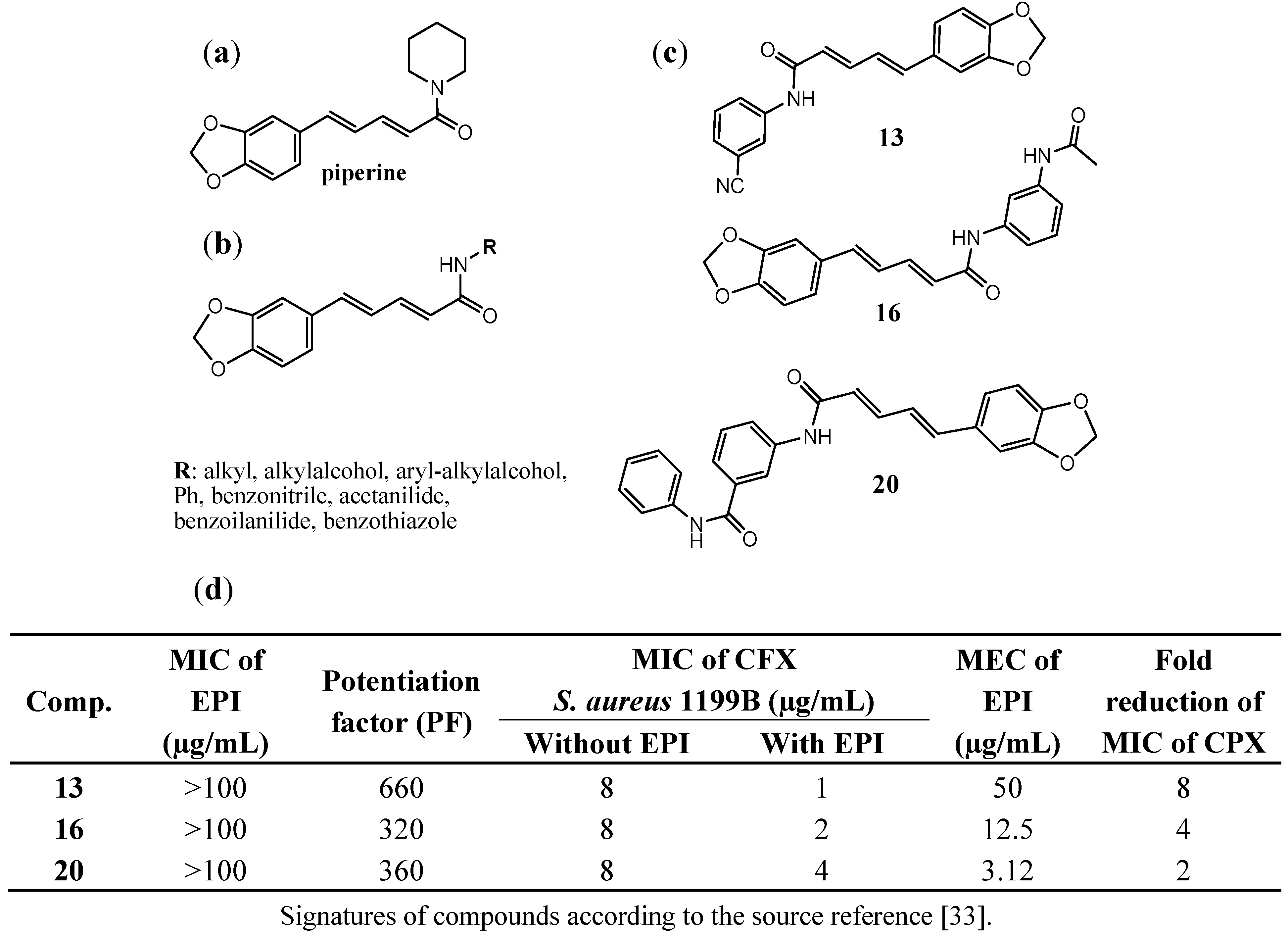
        <p>Piperine (<xref ref-type="fig" rid="antibiotics-02-00028-f006">Figure 6</xref>a) is an alkaloid that was isolated from the fruits of <italic>Piper nigrum</italic> by H.C. Orsted in 1819. This natural compound displays properties of the inhibitors of some proteins important for metabolism and xenobiotics transport and it is used as a reference inhibitor in studies on new efflux pump inhibitors [<xref ref-type="bibr" rid="B29-antibiotics-02-00028">29</xref>,<xref ref-type="bibr" rid="B30-antibiotics-02-00028">30</xref>]. On the basis of the inhibitor properties of piperine, Nargotra <italic>et al</italic>. [<xref ref-type="bibr" rid="B33-antibiotics-02-00028">33</xref>] designed and synthesized a series of piperine analogs, in which piperidine moiety was modified by replacement with other amines (<xref ref-type="fig" rid="antibiotics-02-00028-f006">Figure 6</xref>b). The new compounds were investigated according to their ability to reduce MIC of ciprofloxacin in <italic>S. aureus</italic> 1199B strain using eight different concentrations of the investigated compounds (0–50 µg/mL). Potentiation factor (PF) was calculated to express the potentiation of activity of ciprofloxacin in the presence of the tested new EPIs, reflected in the reduced MIC of combination compared to that of ciprofloxacin alone (Fig 6d). Three of the most promising EPIs were found (<xref ref-type="fig" rid="antibiotics-02-00028-f006">Figure 6</xref>c) in which the piperidine fragment of piperine was replaced with 3-aminobenzonitrile (<bold>13</bold>), N-(3-aminophenyl)acetamide (<bold>16</bold>) or 3-amino-N-phenylbenzamide (<bold>20</bold>). The highest potentiation factor was observed for the benzonitrile amide derivative (<bold>13)</bold>, whereas the 3-amino-N-phenylbenzamide derivative (<bold>20</bold>) displayed EPIs activity at the lowest concentration with its MEC value of 3.12 µg/mL (<xref ref-type="fig" rid="antibiotics-02-00028-f006">Figure 6</xref>d). </p>
        <fig id="antibiotics-02-00028-f006" position="float">
          <label>Figure 6</label>
          <caption>
            <p>Piperine analogs that decrease MIC of ciprofloxacin in MDR <italic>S. aureus</italic> strain over-producing NorA (1199B); (<bold>a</bold>) structure of piperine; (<bold>b</bold>) the general structure of the tested compounds; (<bold>c</bold>) the most active compounds <bold>13</bold>, <bold>16</bold> and <bold>20</bold>; (<bold>d</bold>) Abilities of compounds <bold>13</bold>, <bold>16</bold>, <bold>20</bold> to increase efficacy of ciprofloxacin [<xref ref-type="bibr" rid="B33-antibiotics-02-00028">33</xref>].</p>
          </caption>
          <graphic xmlns:xlink="http://www.w3.org/1999/xlink" xlink:href="antibiotics-02-00028-g006.tif"/>
        </fig>
        <p>The series of compounds was used in quantitative structure-activity relationship studies (QSAR) to evaluate QSAR parameters that are responsible for NorA EPIs. In the QSAR studies, the authors considered seven categories of descriptors as follows: energy-state indices, electronic, information content, spatial, structural, thermodynamic and topological ones. On the basis of the obtained QSAR model, the descriptors of the partial negative surface area (Jurs-PNSA-1) and area of the molecular shadow in the XZ plane (Shadow_XZ) were identified as the most important parameters that contributed to the potentiation of EPI activity. An increase of Jurs-PNSA-1 is connected with the introduction of a polar group into the structure of a modified EPI, which is able to increase the partial negative surface area of the compound. This kind of modifications is postulated to be profitable for NorA efflux pump inhibitory properties. Similarly, changes of the placement of substitutuent(s) (ortho- meta- or para), which increase Shadow_XZ parameter, are profitable for the activity. Furthermore, the parameter of heat of formation (Hf) was demonstrated as a factor important for NorA inhibitory properties in <italic>S. aureus</italic>.</p>
      </sec>
      <sec>
        <title>3.4. Indoles as Inhibitors of the NorA of S. aureus</title>
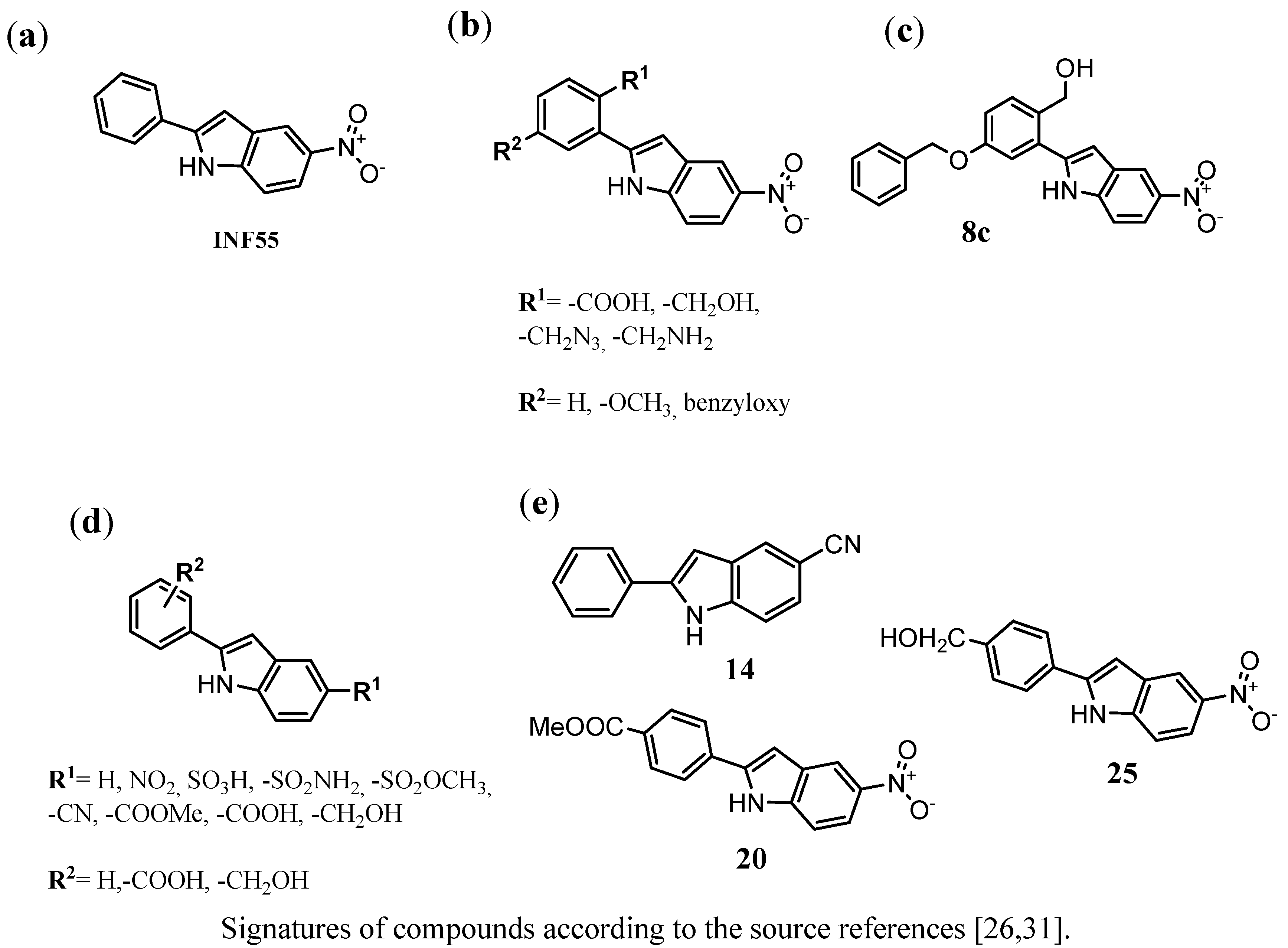
        <p>Compound <bold>INF55</bold>, 5-nitro-2-phenyl-1H-indole (<xref ref-type="fig" rid="antibiotics-02-00028-f007">Figure 7</xref>a), was one of the first identified indole EPIs that was capable of producing 4-fold increase susceptibility of <italic>S. aureus</italic> to ciprofloxacin at its concentration of 1.5 g/mL. </p>
        <fig id="antibiotics-02-00028-f007" position="float">
          <label>Figure 7</label>
          <caption>
            <p>Derivatives or 2-aryl-1H-indoles that display NorA MDR inhibitory activity on <italic>S. aureus</italic> strains (K1758, 8325-4 and K2361); (<bold>a</bold>) lead structure <bold>INF55</bold>; (<bold>b</bold>) the general structure of the chemical group described by Samosorn <italic>et al</italic>. [<xref ref-type="bibr" rid="B31-antibiotics-02-00028">31</xref>]; (<bold>c</bold>) the most active compound (<bold>8a</bold>) identified within the studies [<xref ref-type="bibr" rid="B31-antibiotics-02-00028">31</xref>]; (<bold>d</bold>) the general structure of the chemical group described by Ambrus <italic>et al</italic>. [<xref ref-type="bibr" rid="B26-antibiotics-02-00028">26</xref>]; (<bold>e</bold>) the most promising indoles-EPIs (<bold>14</bold>, <bold>20</bold> and <bold>25</bold>) identified [<xref ref-type="bibr" rid="B26-antibiotics-02-00028">26</xref>]. </p>
          </caption>
          <graphic xmlns:xlink="http://www.w3.org/1999/xlink" xlink:href="antibiotics-02-00028-g007.tif"/>
        </fig>
      </sec>
      <sec>
        <title>3.5. Other Chemical Groups of NorA EPIs</title>
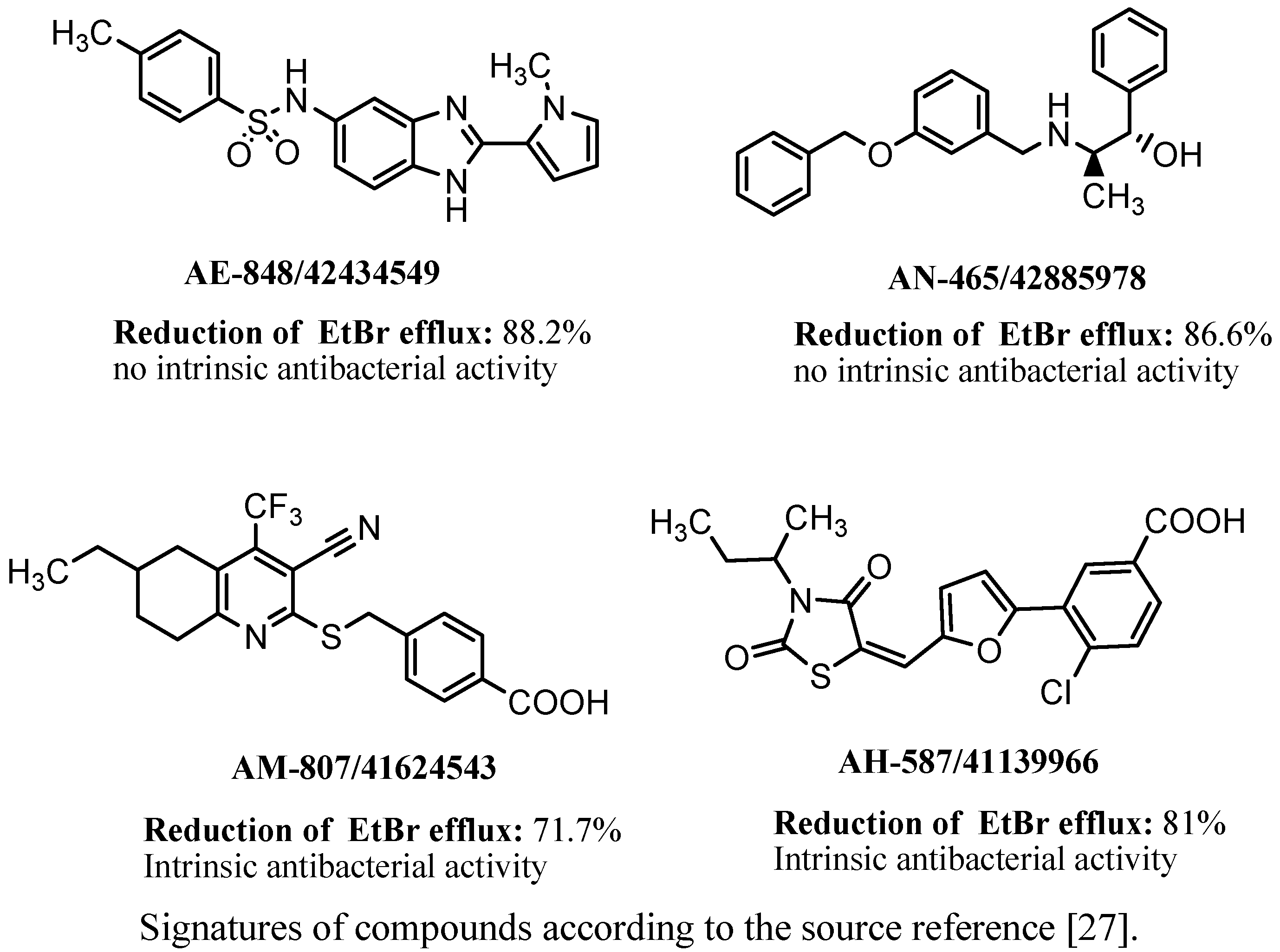
        <p>Brincat <italic>et al</italic>. [<xref ref-type="bibr" rid="B27-antibiotics-02-00028">27</xref>] identified four novel inhibitors of the NorA efflux pump of <italic>S. aureus</italic> belonging to different chemical groups. Structures of the compounds were discovered on the basis of virtual screening that involved FLAP procedure and new methodology using GRID force field descriptors. The compounds created within the ligand-based design were evaluated on their NorA EPI properties <italic>in silico</italic>. The structures identified as active <italic>in silico</italic> were then synthesized and evaluated experimentally on their EtBr efflux inhibition in <italic>S. aureus</italic> strain SA-1199B as well as on their ability to potentiate the antibacterial effect of ciprofloxacin. In this group, the bezimidazole derivative <bold>AE-848/42434549</bold> as well as the benzyloxybezylamine derivative <bold>AN-465/42885978</bold> (<xref ref-type="fig" rid="antibiotics-02-00028-f008">Figure 8</xref>) demonstrated the highest EPIs properties as both of the compounds significantly inhibited EtBr efflux and did not display intrinsic antibacterial activities. Two other compounds, pyridine- and rhodanine derivatives (<xref ref-type="fig" rid="antibiotics-02-00028-f008">Figure 8</xref>), demonstrated significant inhibitory properties but their intrinsic antibacterial action was significant as well.</p>
        <fig id="antibiotics-02-00028-f008" position="float">
          <label>Figure 8</label>
          <caption>
            <p>Four NorA EPIs found by the use of virtual screening and their EPIs potency to inhibit EtBr efflux in SA1199B strain [<xref ref-type="bibr" rid="B27-antibiotics-02-00028">27</xref>].</p>
          </caption>
          <graphic xmlns:xlink="http://www.w3.org/1999/xlink" xlink:href="antibiotics-02-00028-g008.tif"/>
        </fig>
      </sec>
      <sec>
        <title>3.6. PSSRI-Based EPIs of NorA and MepA in S. aureus</title>
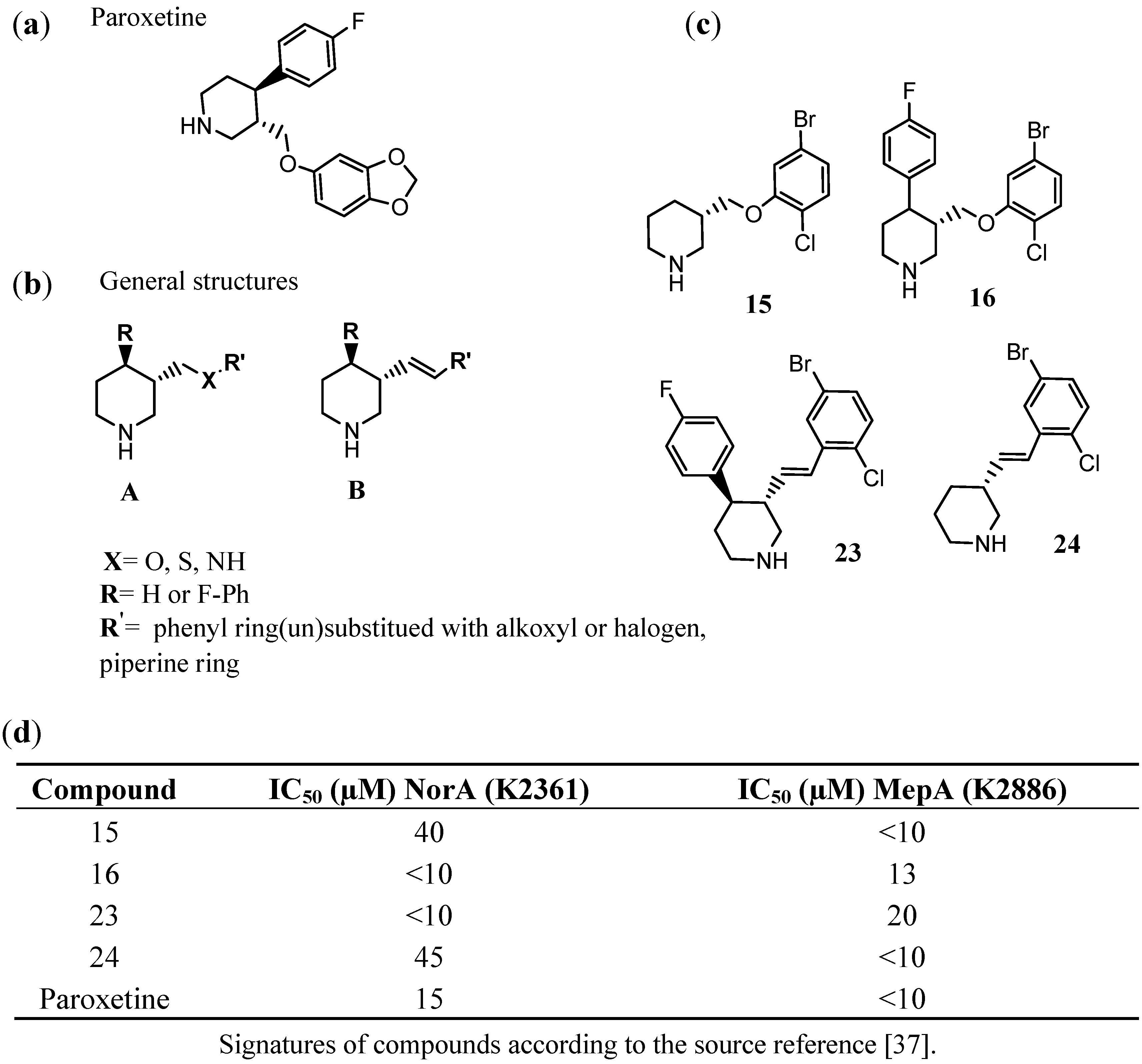
        <p>Phenylpiperidine selective serotonin reuptake inhibitors (PSSRIs) are able to block the function of some MDR efflux pumps. Paroxetine (<xref ref-type="fig" rid="antibiotics-02-00028-f009">Figure 9</xref>a) was one of the first identified PSSRI that inhibits both NorA- (MFS family) and MepA (MATE)-efflux pumps. On the basis of this structure, further chemical modifications were performed (<xref ref-type="fig" rid="antibiotics-02-00028-f009">Figure 9</xref>b) to search for new and more potent EPIs [<xref ref-type="bibr" rid="B35-antibiotics-02-00028">35</xref>,<xref ref-type="bibr" rid="B37-antibiotics-02-00028">37</xref>]. German <italic>et al</italic>. [<xref ref-type="bibr" rid="B37-antibiotics-02-00028">37</xref>] obtained interesting results when replaced benzo[d] [<xref ref-type="bibr" rid="B1-antibiotics-02-00028">1</xref>,<xref ref-type="bibr" rid="B3-antibiotics-02-00028">3</xref>] dioxole moiety of paroxetine with 2-chloro-5-bromo-phenyl fragment (<bold>16</bold>, <xref ref-type="fig" rid="antibiotics-02-00028-f009">Figure 9</xref>c) and exchanged the phenoxyl fragment (ether linker) into arylidene one (<bold>23</bold>, <xref ref-type="fig" rid="antibiotics-02-00028-f009">Figure 9</xref>c). Both compounds (<bold>16</bold>, <bold>23</bold>) displayed an increase of efflux inhibition of NorA comparing to that of paroxetine. A deletion of fluorophenyl substituent was also profitable to give selective EPIs properties for MepA (<bold>15</bold> and <bold>24</bold>, <xref ref-type="fig" rid="antibiotics-02-00028-f009">Figure 9</xref>c,d). </p>
        <fig id="antibiotics-02-00028-f009" position="float">
          <label>Figure 9</label>
          <caption>
            <p>Phenylpiperidine selective serotonin reuptake inhibitor (PSSRI)-based EPIs of <italic>S. aureus</italic>. (<bold>a</bold>) Paroxetine; (<bold>b</bold>) general structures (A and B) of the investigated piperidine derivatives; (<bold>c</bold>) the most promising EPIs found within the assays (<bold>15</bold>, <bold>16</bold>, <bold>23</bold>, <bold>24</bold>) and their EPIs potency, expressed as IC<sub>50</sub> values for inhibition of NorA (SA-K2361) or MepA (SA-K2886) in comparison to those of paroxetine [<xref ref-type="bibr" rid="B35-antibiotics-02-00028">35</xref>,<xref ref-type="bibr" rid="B37-antibiotics-02-00028">37</xref>].</p>
          </caption>
          <graphic xmlns:xlink="http://www.w3.org/1999/xlink" xlink:href="antibiotics-02-00028-g009.tif"/>
        </fig>
      </sec>
      <sec>
        <title>3.7. Search for Inhibitors of Other Efflux Pumps of Gram-Positive Bacteria</title>
        <p>Although most of the studies on efflux pump inhibitors for MDR Gram-positive bacteria are dedicated to NorA in <italic>S. aureus</italic>, a few lines of evidence are focused on other protein targets as well. Studies on MepA-inhibitors were mentioned in previous research [<xref ref-type="bibr" rid="B35-antibiotics-02-00028">35</xref>,<xref ref-type="bibr" rid="B37-antibiotics-02-00028">37</xref>]. Furthermore, Okandeji <italic>et al</italic>. [<xref ref-type="bibr" rid="B38-antibiotics-02-00028">38</xref>] described C-capped dipeptides that inhibited chloramphenicol-specific efflux pumps, cmlR1 and cmlR2, in <italic>Streptomyces coelicolor</italic>, a strain of Gram-positive bacterium that is relative to the human pathogen <italic>M. tuberculosis</italic>.</p>
      </sec>
    </sec>
    <sec sec-type="conclusions">
      <title>4. Conclusions</title>
      <p>An analysis of the results of the search for new efflux pump inhibitors for Gram-positive bacteria which have been performed for last decade indicates that almost all efforts are focused on the NorA efflux pump in <italic>S. aureus</italic>. Considering the chemical structures of the NorA EPIs that have been identified, it can be observed that the most active agents belong to the families of compounds possessing conjugated double bonds, e.g., chalcones, piperine-like compounds, N-cinnamoylphenalkylamides or citral amide derivatives. Indole-, dihydronaphthyl-, 2-chloro-5-bromo-phenyl- or piperidine moieties seem to be profitable for the EPI properties as well. </p>
      <p>To date, no inhibitors of bacterial efflux pumps have been licensed for use in the treatment of bacterial infections in human or veterinary settings, although research continues. As far as Gram-positive bacteria are concerned, none of the efflux pump inhibitors have entered clinical trials yet [<xref ref-type="bibr" rid="B69-antibiotics-02-00028">69</xref>,<xref ref-type="bibr" rid="B71-antibiotics-02-00028">71</xref>]. Nevertheless, in the last decade, studies on MDR Gram-positive EPIs allowed us to identify new active agents of NorA in <italic>S. aureus</italic> with EPI-potency significantly higher than that of reference inhibitors. The active compounds give a new hope for their future therapeutic usage as antibiotics “adjuvants” and should be a subject of wider investigations, including their pharmacokinetic properties and toxic effects. In particular, further studies should be concentrated on the influence of the NorA agents on eucariotic efflux- and influx transport proteins with a special consideration of human transporters belonging to the ABC or SLC families. As human proteins expelling toxic substances out of tissues display significant similarities to those involved in bacterial MDR, bacterial EPIs probably inhibit human detoxification simultaneously with the inhibition of bacterial MDR. This aspect requires thorough research for each active bacterial EPI that is considered as a future “adjuvant” of antibiotics.</p>
      <p>In contrast to NorA inhibitors, a population of EPIs active against other MDR efflux proteins of Gram-positive bacteria, which have been found during the last decade, is very small. These results, together with an increasing knowledge about a variety of efflux pumps that are involved in MDR of Gram-positive pathogens, seem to be an important challenge for current medicinal chemistry. They underline the opinion that, in the future, the search for new EPIs should pay more attention to developing MDR efflux protein targets, including SMR, MATE, ABC or other members of the MFS family.</p>
    </sec>
    
  </body>
  <back>
  <ack>
      <title>Acknowledgments</title>
      <p>Authors thank Leonard Amaral for invitation to this review. The work was inspired by COST action BM0701. </p>
    </ack>
    <notes>
      <title>Conflict of Interest</title>
      <p>The authors declare no conflict of interest. </p>
    </notes>
    <ref-list>
      <title>References and Notes</title>
      <ref id="B1-antibiotics-02-00028">
        <label>1.</label>
        <citation citation-type="journal">
          <person-group person-group-type="author">
            <name>
              <surname>Fournier Dit Chabert</surname>
              <given-names>J.</given-names>
            </name>
            <name>
              <surname>Marquez</surname>
              <given-names>B.</given-names>
            </name>
            <name>
              <surname>Neville</surname>
              <given-names>L.</given-names>
            </name>
            <name>
              <surname>Joucla</surname>
              <given-names>L.</given-names>
            </name>
            <name>
              <surname>Broussous</surname>
              <given-names>S.</given-names>
            </name>
            <name>
              <surname>Bouhours</surname>
              <given-names>P.</given-names>
            </name>
            <name>
              <surname>David</surname>
              <given-names>E.</given-names>
            </name>
            <name>
              <surname>Pellet-Rostaing</surname>
              <given-names>S.</given-names>
            </name>
            <name>
              <surname>Marquet</surname>
              <given-names>B.</given-names>
            </name>
            <name>
              <surname>Moreau</surname>
              <given-names>N.</given-names>
            </name>
            <etal/>
          </person-group>
          <article-title>Synthesis and evaluation of new arylbenzo[b]thiophene and diarylthiophene derivatives as inhibitors of the NorA multidrug transporter of <italic>Staphylococcus aureus</italic></article-title>
          <source>Bioorg. Med. Chem.</source>
          <year>2007</year>
          <volume>15</volume>
          <fpage>4482</fpage>
          <lpage>4497</lpage>
        <pub-id pub-id-type="doi">10.1016/j.bmc.2007.04.023</pub-id><pub-id pub-id-type="pmid">17498961</pub-id></citation>
      </ref>
      <ref id="B2-antibiotics-02-00028">
        <label>2.</label>
        <citation citation-type="journal">
          <person-group person-group-type="author">
            <name>
              <surname>Bush</surname>
              <given-names>K.</given-names>
            </name>
            <name>
              <surname>Miller</surname>
              <given-names>G.H.</given-names>
            </name>
          </person-group>
          <article-title>Bacterial enzymatic resistance: Beta-lactamases and aminoglycoside-modifying enzymes</article-title>
          <source>Curr. Opin. Microbiol.</source>
          <year>1998</year>
          <volume>1</volume>
          <fpage>509</fpage>
          <lpage>515</lpage>
          <pub-id pub-id-type="doi">10.1016/S1369-5274(98)80082-9</pub-id>
        </citation>
      </ref>
      <ref id="B3-antibiotics-02-00028">
        <label>3.</label>
        <citation citation-type="journal">
          <person-group person-group-type="author">
            <name>
              <surname>Sabatini</surname>
              <given-names>S.</given-names>
            </name>
            <name>
              <surname>Gosetto</surname>
              <given-names>F.</given-names>
            </name>
            <name>
              <surname>Serritella</surname>
              <given-names>S.</given-names>
            </name>
            <name>
              <surname>Manfroni</surname>
              <given-names>G.</given-names>
            </name>
            <name>
              <surname>Tabarrini</surname>
              <given-names>O.</given-names>
            </name>
            <name>
              <surname>Iraci</surname>
              <given-names>N.</given-names>
            </name>
            <name>
              <surname>Brincat</surname>
              <given-names>J.P.</given-names>
            </name>
            <name>
              <surname>Carosati</surname>
              <given-names>E.</given-names>
            </name>
            <name>
              <surname>Villarini</surname>
              <given-names>M.</given-names>
            </name>
            <name>
              <surname>Kaatz</surname>
              <given-names>G.W.</given-names>
            </name>
            <etal/>
          </person-group>
          <article-title>Pyrazolo[4,3-c][1,2]benzothiazines 5,5-dioxide: A promising new class of Staphylococcus aureus NorA efflux pump inhibitors</article-title>
          <source>J. Med. Chem.</source>
          <year>2012</year>
          <volume>55</volume>
          <fpage>3568</fpage>
          <lpage>3572</lpage>
          <pub-id pub-id-type="doi">10.1021/jm201446h</pub-id>
        </citation>
      </ref>
      <ref id="B4-antibiotics-02-00028">
        <label>4.</label>
        <citation citation-type="journal">
          <person-group person-group-type="author">
            <name>
              <surname>Ruiz</surname>
              <given-names>J.</given-names>
            </name>
          </person-group>
          <article-title>Mechanisms of resistance to quinolones: Target alterations, decreased accumulation and DNA gyrase protection</article-title>
          <source>J. Antimicrob. Chemother.</source>
          <year>2003</year>
          <volume>51</volume>
          <fpage>1109</fpage>
          <lpage>1117</lpage>
          <pub-id pub-id-type="doi">10.1093/jac/dkg222</pub-id>
        </citation>
      </ref>
      <ref id="B5-antibiotics-02-00028">
        <label>5.</label>
        <citation citation-type="journal">
          <person-group person-group-type="author">
            <name>
              <surname>Nikaido</surname>
              <given-names>H.</given-names>
            </name>
          </person-group>
          <article-title>Molecular basis of bacterial outer membrane permeability revisited</article-title>
          <source>Microbiol. Mol. Biol. Rev.</source>
          <year>2003</year>
          <volume>67</volume>
          <fpage>593</fpage>
          <lpage>656</lpage>
          <pub-id pub-id-type="doi">10.1128/MMBR.67.4.593-656.2003</pub-id>
        </citation>
      </ref>
      <ref id="B6-antibiotics-02-00028">
        <label>6.</label>
        <citation citation-type="journal">
          <person-group person-group-type="author">
            <name>
              <surname>Li</surname>
              <given-names>X.Z.</given-names>
            </name>
            <name>
              <surname>Nikaido</surname>
              <given-names>H.</given-names>
            </name>
          </person-group>
          <article-title>Efflux-mediated drug resistance in bacteria: An update</article-title>
          <source>Drugs</source>
          <year>2009</year>
          <volume>69</volume>
          <fpage>1555</fpage>
          <lpage>1623</lpage>
          <pub-id pub-id-type="doi">10.2165/11317030-000000000-00000</pub-id>
        </citation>
      </ref>
      <ref id="B7-antibiotics-02-00028">
        <label>7.</label>
        <citation citation-type="journal">
          <person-group person-group-type="author">
            <name>
              <surname>Kohler</surname>
              <given-names>T.</given-names>
            </name>
            <name>
              <surname>Pechere</surname>
              <given-names>J.C.</given-names>
            </name>
            <name>
              <surname>Plesiat</surname>
              <given-names>P.</given-names>
            </name>
          </person-group>
          <article-title>Bacterial antibiotic efflux systems of medical importance</article-title>
          <source>Cell Mol. Life Sci.</source>
          <year>1999</year>
          <volume>56</volume>
          <fpage>771</fpage>
          <lpage>778</lpage>
          <pub-id pub-id-type="doi">10.1007/s000180050024</pub-id>
        </citation>
      </ref>
      <ref id="B8-antibiotics-02-00028">
        <label>8.</label>
        <citation citation-type="journal">
          <person-group person-group-type="author">
            <name>
              <surname>Mahamoud</surname>
              <given-names>A.</given-names>
            </name>
            <name>
              <surname>Chevalier</surname>
              <given-names>J.</given-names>
            </name>
            <name>
              <surname>Alibert-Franco</surname>
              <given-names>S.</given-names>
            </name>
            <name>
              <surname>Kern</surname>
              <given-names>W.V.</given-names>
            </name>
            <name>
              <surname>Pages</surname>
              <given-names>J.M.</given-names>
            </name>
          </person-group>
          <article-title>Antibiotic efflux pumps in Gram-negative bacteria: The inhibitor response strategy</article-title>
          <source>J. Antimicrob. Chemother.</source>
          <year>2007</year>
          <volume>59</volume>
          <fpage>1223</fpage>
          <lpage>1229</lpage>
          <pub-id pub-id-type="doi">10.1093/jac/dkl493</pub-id>
        </citation>
      </ref>
      <ref id="B9-antibiotics-02-00028">
        <label>9.</label>
        <citation citation-type="journal">
          <person-group person-group-type="author">
            <name>
              <surname>Poole</surname>
              <given-names>K.</given-names>
            </name>
            <name>
              <surname>Lomovskaya</surname>
              <given-names>O.</given-names>
            </name>
          </person-group>
          <article-title>Can efflux inhibitors really counter resistance?</article-title>
          <source>Drug Discov. Today</source>
          <year>2006</year>
          <volume>3</volume>
          <fpage>145</fpage>
          <lpage>152</lpage>
          <pub-id pub-id-type="doi">10.1016/j.ddtec.2006.06.011</pub-id>
        </citation>
      </ref>
      <ref id="B10-antibiotics-02-00028">
        <label>10.</label>
        <citation citation-type="journal">
          <person-group person-group-type="author">
            <name>
              <surname>Michalet</surname>
              <given-names>S.</given-names>
            </name>
            <name>
              <surname>Cartier</surname>
              <given-names>G.</given-names>
            </name>
            <name>
              <surname>David</surname>
              <given-names>B.</given-names>
            </name>
            <name>
              <surname>Mariotte</surname>
              <given-names>A.M.</given-names>
            </name>
            <name>
              <surname>Dijoux-franca</surname>
              <given-names>M.G.</given-names>
            </name>
            <name>
              <surname>Kaatz</surname>
              <given-names>G.W.</given-names>
            </name>
            <name>
              <surname>Stavri</surname>
              <given-names>M.</given-names>
            </name>
            <name>
              <surname>Gibbons</surname>
              <given-names>S.</given-names>
            </name>
          </person-group>
          <article-title>N-Caffeoylphenalkylamide derivatives as bacterial efflux pump inhibitors</article-title>
          <source>Bioorg. Med. Chem. Lett.</source>
          <year>2007</year>
          <volume>17</volume>
          <fpage>1755</fpage>
          <lpage>1758</lpage>
          <pub-id pub-id-type="doi">10.1016/j.bmcl.2006.12.059</pub-id>
        </citation>
      </ref>
      <ref id="B11-antibiotics-02-00028">
        <label>11.</label>
        <citation citation-type="journal">
          <person-group person-group-type="author">
            <name>
              <surname>Mahamoud</surname>
              <given-names>A.</given-names>
            </name>
            <name>
              <surname>Chevalier</surname>
              <given-names>J.</given-names>
            </name>
            <name>
              <surname>Davin-Regli</surname>
              <given-names>A.</given-names>
            </name>
            <name>
              <surname>Barbe</surname>
              <given-names>J.</given-names>
            </name>
            <name>
              <surname>Pages</surname>
              <given-names>J.M.</given-names>
            </name>
          </person-group>
          <article-title>Quinoline derivatives as promising inhibitors of antibiotic efflux pump in multidrug resistant <italic>Enterobacter aerogenes</italic> isolates</article-title>
          <source>Curr. Drug Targets</source>
          <year>2006</year>
          <volume>7</volume>
          <fpage>843</fpage>
          <lpage>847</lpage>
          <pub-id pub-id-type="doi">10.2174/138945006777709557</pub-id>
        </citation>
      </ref>
      <ref id="B12-antibiotics-02-00028">
        <label>12.</label>
        <citation citation-type="journal">
          <person-group person-group-type="author">
            <name>
              <surname>Pages</surname>
              <given-names>J.M.</given-names>
            </name>
            <name>
              <surname>Amaral</surname>
              <given-names>L.</given-names>
            </name>
            <name>
              <surname>Fanning</surname>
              <given-names>S.</given-names>
            </name>
          </person-group>
          <article-title>An original deal for new molecule: Reversal of efflux pump activity, a rational strategy to combat gram-negative resistant bacteria</article-title>
          <source>Curr. Med. Chem.</source>
          <year>2011</year>
          <volume>18</volume>
          <fpage>2969</fpage>
          <lpage>2980</lpage>
          <pub-id pub-id-type="doi">10.2174/092986711796150469</pub-id>
        </citation>
      </ref>
      <ref id="B13-antibiotics-02-00028">
        <label>13.</label>
        <citation citation-type="journal">
          <person-group person-group-type="author">
            <name>
              <surname>Pages</surname>
              <given-names>J.M.</given-names>
            </name>
            <name>
              <surname>Amaral</surname>
              <given-names>L.</given-names>
            </name>
          </person-group>
          <article-title>Mechanisms of drug efflux and strategies to combat them: Challenging the efflux pump of Gram-negative bacteria</article-title>
          <source>Biochim. Biophys. Acta</source>
          <year>2009</year>
          <volume>1794</volume>
          <fpage>826</fpage>
          <lpage>833</lpage>
          <pub-id pub-id-type="doi">10.1016/j.bbapap.2008.12.011</pub-id>
        </citation>
      </ref>
      <ref id="B14-antibiotics-02-00028">
        <label>14.</label>
        <citation citation-type="journal">
          <person-group person-group-type="author">
            <name>
              <surname>Martins</surname>
              <given-names>M.</given-names>
            </name>
            <name>
              <surname>Dastidar</surname>
              <given-names>S.G.</given-names>
            </name>
            <name>
              <surname>Fanning</surname>
              <given-names>S.</given-names>
            </name>
            <name>
              <surname>Kristiansen</surname>
              <given-names>J.E.</given-names>
            </name>
            <name>
              <surname>Molnar</surname>
              <given-names>J.</given-names>
            </name>
            <name>
              <surname>Pages</surname>
              <given-names>J.M.</given-names>
            </name>
            <name>
              <surname>Schelz</surname>
              <given-names>Z.</given-names>
            </name>
            <name>
              <surname>Spengler</surname>
              <given-names>G.</given-names>
            </name>
            <name>
              <surname>Viveiros</surname>
              <given-names>M.</given-names>
            </name>
            <name>
              <surname>Amaral</surname>
              <given-names>L.</given-names>
            </name>
          </person-group>
          <article-title>Potential role of non-antibiotics (helper compounds) in the treatment of multidrug-resistant Gram-negative infections: Mechanisms for their direct and indirect activities</article-title>
          <source>Int. J. Antimicrob. Agents</source>
          <year>2008</year>
          <volume>31</volume>
          <fpage>198</fpage>
          <lpage>208</lpage>
          <pub-id pub-id-type="doi">10.1016/j.ijantimicag.2007.10.025</pub-id>
        </citation>
      </ref>
      <ref id="B15-antibiotics-02-00028">
        <label>15.</label>
        <citation citation-type="journal">
          <person-group person-group-type="author">
            <name>
              <surname>Nikaido</surname>
              <given-names>H.</given-names>
            </name>
            <name>
              <surname>Pages</surname>
              <given-names>J.M.</given-names>
            </name>
          </person-group>
          <article-title>Broad-specificity efflux pumps and their role in multidrug resistance of Gram-negative bacteria</article-title>
          <source>FEMS Microbiol. Rev.</source>
          <year>2012</year>
          <volume>36</volume>
          <fpage>340</fpage>
          <lpage>363</lpage>
          <pub-id pub-id-type="doi">10.1111/j.1574-6976.2011.00290.x</pub-id>
        </citation>
      </ref>
      <ref id="B16-antibiotics-02-00028">
        <label>16.</label>
        <citation citation-type="journal">
          <person-group person-group-type="author">
            <name>
              <surname>Bolla</surname>
              <given-names>J.M.</given-names>
            </name>
            <name>
              <surname>Alibert-Franco</surname>
              <given-names>S.</given-names>
            </name>
            <name>
              <surname>Handzlik</surname>
              <given-names>J.</given-names>
            </name>
            <name>
              <surname>Chevalier</surname>
              <given-names>J.</given-names>
            </name>
            <name>
              <surname>Mahamoud</surname>
              <given-names>A.</given-names>
            </name>
            <name>
              <surname>Boyer</surname>
              <given-names>G.</given-names>
            </name>
            <name>
              <surname>Kiec-Kononowicz</surname>
              <given-names>K.</given-names>
            </name>
            <name>
              <surname>Pages</surname>
              <given-names>J.M.</given-names>
            </name>
          </person-group>
          <article-title>Strategies for bypassing the membrane barrier in multidrug resistant Gram-negative bacteria</article-title>
          <source>FEBS Lett.</source>
          <year>2011</year>
          <volume>585</volume>
          <fpage>1682</fpage>
          <lpage>1690</lpage>
          <pub-id pub-id-type="doi">10.1016/j.febslet.2011.04.054</pub-id>
        </citation>
      </ref>
      <ref id="B17-antibiotics-02-00028">
        <label>17.</label>
        <citation citation-type="journal">
          <person-group person-group-type="author">
            <name>
              <surname>Handzlik</surname>
              <given-names>J.</given-names>
            </name>
            <name>
              <surname>Szymanska</surname>
              <given-names>E.</given-names>
            </name>
            <name>
              <surname>Chevalier</surname>
              <given-names>J.</given-names>
            </name>
            <name>
              <surname>Otrebska</surname>
              <given-names>E.</given-names>
            </name>
            <name>
              <surname>Kiec-Kononowicz</surname>
              <given-names>K.</given-names>
            </name>
            <name>
              <surname>Pages</surname>
              <given-names>J.M.</given-names>
            </name>
            <name>
              <surname>Alibert</surname>
              <given-names>S.</given-names>
            </name>
          </person-group>
          <article-title>Amine-alkyl derivatives of hydantoin: New tool to combat resistant bacteria</article-title>
          <source>Eur. J. Med. Chem.</source>
          <year>2011</year>
          <volume>46</volume>
          <fpage>5807</fpage>
          <lpage>5816</lpage>
          <pub-id pub-id-type="doi">10.1016/j.ejmech.2011.09.032</pub-id>
        </citation>
      </ref>
      <ref id="B18-antibiotics-02-00028">
        <label>18.</label>
        <citation citation-type="journal">
          <person-group person-group-type="author">
            <name>
              <surname>Handzlik</surname>
              <given-names>J.</given-names>
            </name>
            <name>
              <surname>Szymanska</surname>
              <given-names>E.</given-names>
            </name>
            <name>
              <surname>Alibert</surname>
              <given-names>S.</given-names>
            </name>
            <name>
              <surname>Chevalier</surname>
              <given-names>J.</given-names>
            </name>
            <name>
              <surname>Otrebska</surname>
              <given-names>E.</given-names>
            </name>
            <name>
              <surname>Pekala</surname>
              <given-names>E.</given-names>
            </name>
            <name>
              <surname>Pages</surname>
              <given-names>J.M.</given-names>
            </name>
            <name>
              <surname>Kiec-Kononowicz</surname>
              <given-names>K.</given-names>
            </name>
          </person-group>
          <article-title>Search for new tools to combat Gram-negative resistant bacteria among amine derivatives of 5-arylidenehydantoin</article-title>
          <source>Bioorg. Med. Chem.</source>
          <year>2013</year>
          <volume>21</volume>
          <fpage>135</fpage>
          <lpage>145</lpage>
          <pub-id pub-id-type="doi">10.1016/j.bmc.2012.10.053</pub-id>
        </citation>
      </ref>
      <ref id="B19-antibiotics-02-00028">
        <label>19.</label>
        <citation citation-type="journal">
          <person-group person-group-type="author">
            <name>
              <surname>Pradel</surname>
              <given-names>E.</given-names>
            </name>
            <name>
              <surname>Pages</surname>
              <given-names>J.M.</given-names>
            </name>
          </person-group>
          <article-title>The AcrAB-TolC efflux pump contributes to multidrug resistance in the nosocomial pathogen <italic>Enterobacter aerogenes</italic></article-title>
          <source>Antimicrob. Agents Chemother.</source>
          <year>2002</year>
          <volume>46</volume>
          <fpage>2640</fpage>
          <lpage>2643</lpage>
          <pub-id pub-id-type="doi">10.1128/AAC.46.8.2640-2643.2002</pub-id>
        </citation>
      </ref>
      <ref id="B20-antibiotics-02-00028">
        <label>20.</label>
        <citation citation-type="journal">
          <person-group person-group-type="author">
            <name>
              <surname>Ghisalberti</surname>
              <given-names>D.</given-names>
            </name>
            <name>
              <surname>Masi</surname>
              <given-names>M.</given-names>
            </name>
            <name>
              <surname>Pages</surname>
              <given-names>J.M.</given-names>
            </name>
            <name>
              <surname>Chevalier</surname>
              <given-names>J.</given-names>
            </name>
          </person-group>
          <article-title>Chloramphenicol and expression of multidrug efflux pump in <italic>Enterobacter aerogenes</italic></article-title>
          <source>Biochem. Biophys. Res. Commun.</source>
          <year>2005</year>
          <volume>328</volume>
          <fpage>1113</fpage>
          <lpage>1118</lpage>
          <pub-id pub-id-type="doi">10.1016/j.bbrc.2005.01.069</pub-id>
        </citation>
      </ref>
      <ref id="B21-antibiotics-02-00028">
        <label>21.</label>
        <citation citation-type="journal">
          <person-group person-group-type="author">
            <name>
              <surname>Lavigne</surname>
              <given-names>J.P.</given-names>
            </name>
            <name>
              <surname>Sotto</surname>
              <given-names>A.</given-names>
            </name>
            <name>
              <surname>Nicolas-Chanoine</surname>
              <given-names>M.H.</given-names>
            </name>
            <name>
              <surname>Bouziges</surname>
              <given-names>N.</given-names>
            </name>
            <name>
              <surname>Bourg</surname>
              <given-names>G.</given-names>
            </name>
            <name>
              <surname>Davin-Regli</surname>
              <given-names>A.</given-names>
            </name>
            <name>
              <surname>Pages</surname>
              <given-names>J.M.</given-names>
            </name>
          </person-group>
          <article-title>Membrane permeability, a pivotal function involved in antibiotic resistance and virulence in <italic>Enterobacter aerogenes</italic> clinical isolates</article-title>
          <source>Clin. Microbiol. Infect.</source>
          <year>2012</year>
          <volume>18</volume>
          <fpage>539</fpage>
          <lpage>545</lpage>
          <pub-id pub-id-type="doi">10.1111/j.1469-0691.2011.03607.x</pub-id>
        </citation>
      </ref>
      <ref id="B22-antibiotics-02-00028">
        <label>22.</label>
        <citation citation-type="journal">
          <person-group person-group-type="author">
            <name>
              <surname>Askoura</surname>
              <given-names>M.</given-names>
            </name>
            <name>
              <surname>Mottawea</surname>
              <given-names>W.</given-names>
            </name>
            <name>
              <surname>Abujamel</surname>
              <given-names>T.</given-names>
            </name>
            <name>
              <surname>Taher</surname>
              <given-names>I.</given-names>
            </name>
          </person-group>
          <article-title>Efflux pump inhibitors (EPIs) as new antimicrobial agents against Pseudomonas aeruginosa</article-title>
          <source>Libyan J. Med.</source>
          <year>2011</year>
          <volume>6</volume>
          <pub-id pub-id-type="doi">10.3402/ljm.v6i0.5870</pub-id>
        </citation>
      </ref>
      <ref id="B23-antibiotics-02-00028">
        <label>23.</label>
        <citation citation-type="journal">
          <person-group person-group-type="author">
            <name>
              <surname>Drew</surname>
              <given-names>D.</given-names>
            </name>
            <name>
              <surname>Klepsch</surname>
              <given-names>M.M.</given-names>
            </name>
            <name>
              <surname>Newstead</surname>
              <given-names>S.</given-names>
            </name>
            <name>
              <surname>Flaig</surname>
              <given-names>R.</given-names>
            </name>
            <name>
              <surname>De Gier</surname>
              <given-names>J.W.</given-names>
            </name>
            <name>
              <surname>Iwata</surname>
              <given-names>S.</given-names>
            </name>
            <name>
              <surname>Beis</surname>
              <given-names>K.</given-names>
            </name>
          </person-group>
          <article-title>The structure of the efflux pump AcrB in complex with bile acid</article-title>
          <source>Mol. Membr. Biol.</source>
          <year>2008</year>
          <volume>25</volume>
          <fpage>677</fpage>
          <lpage>682</lpage>
          <pub-id pub-id-type="doi">10.1080/09687680802552257</pub-id>
        </citation>
      </ref>
      <ref id="B24-antibiotics-02-00028">
        <label>24.</label>
        <citation citation-type="journal">
          <person-group person-group-type="author">
            <name>
              <surname>Sennhauser</surname>
              <given-names>G.</given-names>
            </name>
            <name>
              <surname>Bukowska</surname>
              <given-names>M.A.</given-names>
            </name>
            <name>
              <surname>Briand</surname>
              <given-names>C.</given-names>
            </name>
            <name>
              <surname>Grutter</surname>
              <given-names>M.G.</given-names>
            </name>
          </person-group>
          <article-title>Crystal structure of the multidrug exporter MexB from <italic>Pseudomonas aeruginosa</italic></article-title>
          <source>J. Mol. Biol.</source>
          <year>2009</year>
          <volume>389</volume>
          <fpage>134</fpage>
          <lpage>145</lpage>
          <pub-id pub-id-type="doi">10.1016/j.jmb.2009.04.001</pub-id>
        </citation>
      </ref>
      <ref id="B25-antibiotics-02-00028">
        <label>25.</label>
        <citation citation-type="journal">
          <person-group person-group-type="author">
            <name>
              <surname>Pages</surname>
              <given-names>J.M.</given-names>
            </name>
            <name>
              <surname>Sandrine</surname>
              <given-names>A.F.</given-names>
            </name>
            <name>
              <surname>Mahamoud</surname>
              <given-names>A.</given-names>
            </name>
            <name>
              <surname>Bolla</surname>
              <given-names>J.M.</given-names>
            </name>
            <name>
              <surname>Davin-Regli</surname>
              <given-names>A.</given-names>
            </name>
            <name>
              <surname>Chevalier</surname>
              <given-names>J.</given-names>
            </name>
            <name>
              <surname>Garnotel</surname>
              <given-names>E.</given-names>
            </name>
          </person-group>
          <article-title>Efflux pumps of gram-negative bacteria, a new target for new molecules</article-title>
          <source>Curr. Top. Med. Chem.</source>
          <year>2010</year>
          <volume>10</volume>
          <fpage>1848</fpage>
          <lpage>1857</lpage>
          <pub-id pub-id-type="doi">10.2174/156802610793176620</pub-id>
        </citation>
      </ref>
      <ref id="B26-antibiotics-02-00028">
        <label>26.</label>
        <citation citation-type="journal">
          <person-group person-group-type="author">
            <name>
              <surname>Ambrus</surname>
              <given-names>J.I.</given-names>
            </name>
            <name>
              <surname>Kelso</surname>
              <given-names>M.J.</given-names>
            </name>
            <name>
              <surname>Bremner</surname>
              <given-names>J.B.</given-names>
            </name>
            <name>
              <surname>Ball</surname>
              <given-names>A.R.</given-names>
            </name>
            <name>
              <surname>Casadei</surname>
              <given-names>G.</given-names>
            </name>
            <name>
              <surname>Lewis</surname>
              <given-names>K.</given-names>
            </name>
          </person-group>
          <article-title>Structure-activity relationships of 2-aryl-1H-indole inhibitors of the NorA efflux pump in <italic>Staphylococcus aureus</italic></article-title>
          <source>Bioorg. Med. Chem. Lett.</source>
          <year>2008</year>
          <volume>18</volume>
          <fpage>4294</fpage>
          <lpage>4297</lpage>
          <pub-id pub-id-type="doi">10.1016/j.bmcl.2008.06.093</pub-id>
        </citation>
      </ref>
      <ref id="B27-antibiotics-02-00028">
        <label>27.</label>
        <citation citation-type="journal">
          <person-group person-group-type="author">
            <name>
              <surname>Brincat</surname>
              <given-names>J.P.</given-names>
            </name>
            <name>
              <surname>Carosati</surname>
              <given-names>E.</given-names>
            </name>
            <name>
              <surname>Sabatini</surname>
              <given-names>S.</given-names>
            </name>
            <name>
              <surname>Manfroni</surname>
              <given-names>G.</given-names>
            </name>
            <name>
              <surname>Fravolini</surname>
              <given-names>A.</given-names>
            </name>
            <name>
              <surname>Raygada</surname>
              <given-names>J.L.</given-names>
            </name>
            <name>
              <surname>Patel</surname>
              <given-names>D.</given-names>
            </name>
            <name>
              <surname>Kaatz</surname>
              <given-names>G.W.</given-names>
            </name>
            <name>
              <surname>Cruciani</surname>
              <given-names>G.</given-names>
            </name>
          </person-group>
          <article-title>Discovery of novel inhibitors of the NorA multidrug transporter of <italic>Staphylococcus aureus</italic></article-title>
          <source>J. Med. Chem.</source>
          <year>2011</year>
          <volume>54</volume>
          <fpage>354</fpage>
          <lpage>365</lpage>
          <pub-id pub-id-type="doi">10.1021/jm1011963</pub-id>
        </citation>
      </ref>
      <ref id="B28-antibiotics-02-00028">
        <label>28.</label>
        <citation citation-type="journal">
          <person-group person-group-type="author">
            <name>
              <surname>Holler</surname>
              <given-names>J.G.</given-names>
            </name>
            <name>
              <surname>Slotved</surname>
              <given-names>H.C.</given-names>
            </name>
            <name>
              <surname>Molgaard</surname>
              <given-names>P.</given-names>
            </name>
            <name>
              <surname>Olsen</surname>
              <given-names>C.E.</given-names>
            </name>
            <name>
              <surname>Christensen</surname>
              <given-names>S.B.</given-names>
            </name>
          </person-group>
          <article-title>Chalcone inhibitors of the NorA efflux pump in <italic>Staphylococcus</italic> <italic>aureus</italic> whole cells and enriched everted membrane vesicles</article-title>
          <source>Bioorg. Med. Chem.</source>
          <year>2012</year>
          <volume>20</volume>
          <fpage>4514</fpage>
          <lpage>4521</lpage>
          <pub-id pub-id-type="doi">10.1016/j.bmc.2012.05.025</pub-id>
        </citation>
      </ref>
      <ref id="B29-antibiotics-02-00028">
        <label>29.</label>
        <citation citation-type="journal">
          <person-group person-group-type="author">
            <name>
              <surname>Thota</surname>
              <given-names>N.</given-names>
            </name>
            <name>
              <surname>Koul</surname>
              <given-names>S.</given-names>
            </name>
            <name>
              <surname>Reddy</surname>
              <given-names>M.V.</given-names>
            </name>
            <name>
              <surname>Sangwan</surname>
              <given-names>P.L.</given-names>
            </name>
            <name>
              <surname>Khan</surname>
              <given-names>I.A.</given-names>
            </name>
            <name>
              <surname>Kumar</surname>
              <given-names>A.</given-names>
            </name>
            <name>
              <surname>Raja</surname>
              <given-names>A.F.</given-names>
            </name>
            <name>
              <surname>Andotra</surname>
              <given-names>S.S.</given-names>
            </name>
            <name>
              <surname>Qazi</surname>
              <given-names>G.N.</given-names>
            </name>
          </person-group>
          <article-title>Citral derived amides as potent bacterial NorA efflux pump inhibitors</article-title>
          <source>Bioorg. Med. Chem.</source>
          <year>2008</year>
          <volume>16</volume>
          <fpage>6535</fpage>
          <lpage>6543</lpage>
          <pub-id pub-id-type="doi">10.1016/j.bmc.2008.05.030</pub-id>
        </citation>
      </ref>
      <ref id="B30-antibiotics-02-00028">
        <label>30.</label>
        <citation citation-type="journal">
          <person-group person-group-type="author">
            <name>
              <surname>Thota</surname>
              <given-names>N.</given-names>
            </name>
            <name>
              <surname>Reddy</surname>
              <given-names>M.V.</given-names>
            </name>
            <name>
              <surname>Kumar</surname>
              <given-names>A.</given-names>
            </name>
            <name>
              <surname>Khan</surname>
              <given-names>I.A.</given-names>
            </name>
            <name>
              <surname>Sangwan</surname>
              <given-names>P.L.</given-names>
            </name>
            <name>
              <surname>Kalia</surname>
              <given-names>N.P.</given-names>
            </name>
            <name>
              <surname>Koul</surname>
              <given-names>J.L.</given-names>
            </name>
            <name>
              <surname>Koul</surname>
              <given-names>S.</given-names>
            </name>
          </person-group>
          <article-title>Substituted dihydronaphthalenes as efflux pump inhibitors of <italic>Staphylococcus</italic> <italic>aureus</italic></article-title>
          <source>Eur. J. Med. Chem.</source>
          <year>2010</year>
          <volume>45</volume>
          <fpage>3607</fpage>
          <lpage>3616</lpage>
          <pub-id pub-id-type="doi">10.1016/j.ejmech.2010.05.006</pub-id>
        </citation>
      </ref>
      <ref id="B31-antibiotics-02-00028">
        <label>31.</label>
        <citation citation-type="journal">
          <person-group person-group-type="author">
            <name>
              <surname>Samosorn</surname>
              <given-names>S.</given-names>
            </name>
            <name>
              <surname>Bremner</surname>
              <given-names>J.B.</given-names>
            </name>
            <name>
              <surname>Ball</surname>
              <given-names>A.</given-names>
            </name>
            <name>
              <surname>Lewis</surname>
              <given-names>K.</given-names>
            </name>
          </person-group>
          <article-title>Synthesis of functionalized 2-aryl-5-nitro-1<italic>H</italic>-indoles and their activity as bacterial NorA efflux pump inhibitors</article-title>
          <source>Bioorg. Med. Chem.</source>
          <year>2006</year>
          <volume>14</volume>
          <fpage>857</fpage>
          <lpage>865</lpage>
          <pub-id pub-id-type="doi">10.1016/j.bmc.2005.09.019</pub-id>
        </citation>
      </ref>
      <ref id="B32-antibiotics-02-00028">
        <label>32.</label>
        <citation citation-type="journal">
          <person-group person-group-type="author">
            <name>
              <surname>Sangwan</surname>
              <given-names>P.L.</given-names>
            </name>
            <name>
              <surname>Koul</surname>
              <given-names>J.L.</given-names>
            </name>
            <name>
              <surname>Koul</surname>
              <given-names>S.</given-names>
            </name>
            <name>
              <surname>Reddy</surname>
              <given-names>M.V.</given-names>
            </name>
            <name>
              <surname>Thota</surname>
              <given-names>N.</given-names>
            </name>
            <name>
              <surname>Khan</surname>
              <given-names>I.A.</given-names>
            </name>
            <name>
              <surname>Kumar</surname>
              <given-names>A.</given-names>
            </name>
            <name>
              <surname>Kalia</surname>
              <given-names>N.P.</given-names>
            </name>
            <name>
              <surname>Qazi</surname>
              <given-names>G.N.</given-names>
            </name>
          </person-group>
          <article-title>Piperine analogs as potent <italic>Staphylococcus</italic> <italic>aureus</italic> NorA efflux pump inhibitors</article-title>
          <source>Bioorg. Med. Chem.</source>
          <year>2008</year>
          <volume>16</volume>
          <fpage>9847</fpage>
          <lpage>9857</lpage>
        <pub-id pub-id-type="doi">10.1016/j.bmc.2008.09.042</pub-id><pub-id pub-id-type="pmid">18848780</pub-id></citation>
      </ref>
      <ref id="B33-antibiotics-02-00028">
        <label>33.</label>
        <citation citation-type="journal">
          <person-group person-group-type="author">
            <name>
              <surname>Nargotra</surname>
              <given-names>A.</given-names>
            </name>
            <name>
              <surname>Sharma</surname>
              <given-names>S.</given-names>
            </name>
            <name>
              <surname>Koul</surname>
              <given-names>J.L.</given-names>
            </name>
            <name>
              <surname>Sangwan</surname>
              <given-names>P.L.</given-names>
            </name>
            <name>
              <surname>Khan</surname>
              <given-names>I.A.</given-names>
            </name>
            <name>
              <surname>Kumar</surname>
              <given-names>A.</given-names>
            </name>
            <name>
              <surname>Taneja</surname>
              <given-names>S.C.</given-names>
            </name>
            <name>
              <surname>Koul</surname>
              <given-names>S.</given-names>
            </name>
          </person-group>
          <article-title>Quantitative structure activity relationship (QSAR) of piperine analogs for bacterial NorA efflux pump inhibitors</article-title>
          <source>Eur. J. Med. Chem.</source>
          <year>2009</year>
          <volume>44</volume>
          <fpage>4128</fpage>
          <lpage>4135</lpage>
          <pub-id pub-id-type="doi">10.1016/j.ejmech.2009.05.004</pub-id>
        </citation>
      </ref>
      <ref id="B34-antibiotics-02-00028">
        <label>34.</label>
        <citation citation-type="journal">
          <person-group person-group-type="author">
            <name>
              <surname>Sabatini</surname>
              <given-names>S.</given-names>
            </name>
            <name>
              <surname>Gosetto</surname>
              <given-names>F.</given-names>
            </name>
            <name>
              <surname>Manfroni</surname>
              <given-names>G.</given-names>
            </name>
            <name>
              <surname>Tabarrini</surname>
              <given-names>O.</given-names>
            </name>
            <name>
              <surname>Kaatz</surname>
              <given-names>G.W.</given-names>
            </name>
            <name>
              <surname>Patel</surname>
              <given-names>D.</given-names>
            </name>
            <name>
              <surname>Cecchetti</surname>
              <given-names>V.</given-names>
            </name>
          </person-group>
          <article-title>Evolution from a natural flavones nucleus to obtain 2-(4-Propoxyphenyl)quinoline derivatives as potent inhibitors of the <italic>S. aureus</italic> NorA efflux pump</article-title>
          <source>J. Med. Chem.</source>
          <year>2011</year>
          <volume>54</volume>
          <fpage>5722</fpage>
          <lpage>5736</lpage>
          <pub-id pub-id-type="doi">10.1021/jm200370y</pub-id>
        </citation>
      </ref>
      <ref id="B35-antibiotics-02-00028">
        <label>35.</label>
        <citation citation-type="journal">
          <person-group person-group-type="author">
            <name>
              <surname>Wei</surname>
              <given-names>P.</given-names>
            </name>
            <name>
              <surname>Kaatz</surname>
              <given-names>G.W.</given-names>
            </name>
            <name>
              <surname>Kerns</surname>
              <given-names>R.J.</given-names>
            </name>
          </person-group>
          <article-title>Structural differences between paroxetine and femoxetine responsible for differential inhibition of <italic>Staphylococcus aureus</italic> efflux pumps</article-title>
          <source>Bioorg. Med. Chem. Lett.</source>
          <year>2004</year>
          <volume>14</volume>
          <fpage>3093</fpage>
          <lpage>3097</lpage>
          <pub-id pub-id-type="doi">10.1016/j.bmcl.2004.04.018</pub-id>
        </citation>
      </ref>
      <ref id="B36-antibiotics-02-00028">
        <label>36.</label>
        <citation citation-type="journal">
          <person-group person-group-type="author">
            <name>
              <surname>Abulrob</surname>
              <given-names>A.N.</given-names>
            </name>
            <name>
              <surname>Suller</surname>
              <given-names>M.T.</given-names>
            </name>
            <name>
              <surname>Gumbleton</surname>
              <given-names>M.</given-names>
            </name>
            <name>
              <surname>Simons</surname>
              <given-names>C.</given-names>
            </name>
            <name>
              <surname>Russell</surname>
              <given-names>A.D.</given-names>
            </name>
          </person-group>
          <article-title>Identification and biological evaluation of grapefruit oil components as potential novel efflux pump modulators in methicillin-resistant <italic>Staphylococcus</italic> <italic>aureus</italic> bacterial strains</article-title>
          <source>Phytochemistry</source>
          <year>2004</year>
          <volume>65</volume>
          <fpage>3021</fpage>
          <lpage>3027</lpage>
          <pub-id pub-id-type="doi">10.1016/j.phytochem.2004.08.044</pub-id>
        </citation>
      </ref>
      <ref id="B37-antibiotics-02-00028">
        <label>37.</label>
        <citation citation-type="journal">
          <person-group person-group-type="author">
            <name>
              <surname>German</surname>
              <given-names>N.</given-names>
            </name>
            <name>
              <surname>Kaatz</surname>
              <given-names>G.W.</given-names>
            </name>
            <name>
              <surname>Kerns</surname>
              <given-names>R.J.</given-names>
            </name>
          </person-group>
          <article-title>Synthesis and evaluation of PSSRI-based inhibitors of <italic>Staphylococcus</italic> <italic>aureus</italic> multidrug efflux pumps</article-title>
          <source>Bioorg. Med. Chem. Lett.</source>
          <year>2008</year>
          <volume>18</volume>
          <fpage>1368</fpage>
          <lpage>1373</lpage>
          <pub-id pub-id-type="doi">10.1016/j.bmcl.2008.01.014</pub-id>
        </citation>
      </ref>
      <ref id="B38-antibiotics-02-00028">
        <label>38.</label>
        <citation citation-type="journal">
          <person-group person-group-type="author">
            <name>
              <surname>Okandeji</surname>
              <given-names>B.O.</given-names>
            </name>
            <name>
              <surname>Greenwald</surname>
              <given-names>D.M.</given-names>
            </name>
            <name>
              <surname>Wroten</surname>
              <given-names>J.</given-names>
            </name>
            <name>
              <surname>Sello</surname>
              <given-names>J.K.</given-names>
            </name>
          </person-group>
          <article-title>Synthesis and evaluation of inhibitors of bacterial drug efflux pumps of the major facilitator superfamily</article-title>
          <source>Bioorg. Med. Chem.</source>
          <year>2011</year>
          <volume>19</volume>
          <fpage>7679</fpage>
          <lpage>7689</lpage>
          <pub-id pub-id-type="doi">10.1016/j.bmc.2011.10.011</pub-id>
        </citation>
      </ref>
      <ref id="B39-antibiotics-02-00028">
        <label>39.</label>
        <citation citation-type="journal">
          <person-group person-group-type="author">
            <name>
              <surname>Jarmula</surname>
              <given-names>A.</given-names>
            </name>
            <name>
              <surname>Oblak</surname>
              <given-names>E.</given-names>
            </name>
            <name>
              <surname>Wawrzycka</surname>
              <given-names>D.</given-names>
            </name>
            <name>
              <surname>Gutowicz</surname>
              <given-names>J.</given-names>
            </name>
          </person-group>
          <article-title>Efflux-mediated antimicrobial multidrug resistance</article-title>
          <source>Postepy Hig. Med. Dosw. (Online)</source>
          <year>2011</year>
          <volume>65</volume>
          <fpage>216</fpage>
          <lpage>227</lpage>
        <pub-id pub-id-type="doi">10.5604/17322693.937011</pub-id></citation>
      </ref>
      <ref id="B40-antibiotics-02-00028">
        <label>40.</label>
        <citation citation-type="journal">
          <person-group person-group-type="author">
            <name>
              <surname>Li</surname>
              <given-names>X.Z.</given-names>
            </name>
            <name>
              <surname>Nikaido</surname>
              <given-names>H.</given-names>
            </name>
          </person-group>
          <article-title>Efflux-mediated drug resistance in bacteria</article-title>
          <source>Drugs</source>
          <year>2004</year>
          <volume>64</volume>
          <fpage>159</fpage>
          <lpage>204</lpage>
          <pub-id pub-id-type="doi">10.2165/00003495-200464020-00004</pub-id>
        </citation>
      </ref>
      <ref id="B41-antibiotics-02-00028">
        <label>41.</label>
        <citation citation-type="journal">
          <person-group person-group-type="author">
            <name>
              <surname>Tseng</surname>
              <given-names>T.T.</given-names>
            </name>
            <name>
              <surname>Gratwick</surname>
              <given-names>K.S.</given-names>
            </name>
            <name>
              <surname>Kollman</surname>
              <given-names>J.</given-names>
            </name>
            <name>
              <surname>Park</surname>
              <given-names>D.</given-names>
            </name>
            <name>
              <surname>Nies</surname>
              <given-names>D.H.</given-names>
            </name>
            <name>
              <surname>Goffeau</surname>
              <given-names>A.</given-names>
            </name>
            <name>
              <surname>Saier</surname>
              <given-names>M.H.</given-names>
              <suffix>Jr.</suffix>
            </name>
          </person-group>
          <article-title>The RND permease superfamily: An ancient, ubiquitous and diverse family that includes human disease and development proteins</article-title>
          <source>J. Mol. Microbiol. Biotechnol.</source>
          <year>1999</year>
          <volume>1</volume>
          <fpage>107</fpage>
          <lpage>125</lpage>
        <pub-id pub-id-type="pmid">10941792</pub-id></citation>
      </ref>
      <ref id="B42-antibiotics-02-00028">
        <label>42.</label>
        <citation citation-type="journal">
          <person-group person-group-type="author">
            <name>
              <surname>Truong-Bolduc</surname>
              <given-names>Q.C.</given-names>
            </name>
            <name>
              <surname>Dunman</surname>
              <given-names>P.M.</given-names>
            </name>
            <name>
              <surname>Strahilevitz</surname>
              <given-names>J.</given-names>
            </name>
            <name>
              <surname>Projan</surname>
              <given-names>S.J.</given-names>
            </name>
            <name>
              <surname>Hooper</surname>
              <given-names>D.C.</given-names>
            </name>
          </person-group>
          <article-title>MgrA is a multiple regulator of two new efflux pumps in <italic>Staphylococcus</italic> <italic>aureus</italic></article-title>
          <source>J. Bacteriol.</source>
          <year>2005</year>
          <volume>187</volume>
          <fpage>2395</fpage>
          <lpage>2405</lpage>
          <pub-id pub-id-type="doi">10.1128/JB.187.7.2395-2405.2005</pub-id>
        </citation>
      </ref>
      <ref id="B43-antibiotics-02-00028">
        <label>43.</label>
        <citation citation-type="journal">
          <person-group person-group-type="author">
            <name>
              <surname>DeMarco</surname>
              <given-names>C.E.</given-names>
            </name>
            <name>
              <surname>Cushing</surname>
              <given-names>L.A.</given-names>
            </name>
            <name>
              <surname>Frempong-Manso</surname>
              <given-names>E.</given-names>
            </name>
            <name>
              <surname>Seo</surname>
              <given-names>S.M.</given-names>
            </name>
            <name>
              <surname>Jaravaza</surname>
              <given-names>T.A.</given-names>
            </name>
            <name>
              <surname>Kaatz</surname>
              <given-names>G.W.</given-names>
            </name>
          </person-group>
          <article-title>Efflux-related resistance to norfloxacin, dyes, and biocides in bloodstream isolates of <italic>Staphylococcus</italic> <italic>aureus</italic></article-title>
          <source>Antimicrob. Agents Chemother.</source>
          <year>2007</year>
          <volume>51</volume>
          <fpage>3235</fpage>
          <lpage>3239</lpage>
          <pub-id pub-id-type="doi">10.1128/AAC.00430-07</pub-id>
        </citation>
      </ref>
      <ref id="B44-antibiotics-02-00028">
        <label>44.</label>
        <citation citation-type="journal">
          <person-group person-group-type="author">
            <name>
              <surname>Huang</surname>
              <given-names>J.</given-names>
            </name>
            <name>
              <surname>O'Toole</surname>
              <given-names>P.W.</given-names>
            </name>
            <name>
              <surname>Shen</surname>
              <given-names>W.</given-names>
            </name>
            <name>
              <surname>Amrine-Madsen</surname>
              <given-names>H.</given-names>
            </name>
            <name>
              <surname>Jiang</surname>
              <given-names>X.</given-names>
            </name>
            <name>
              <surname>Lobo</surname>
              <given-names>N.</given-names>
            </name>
            <name>
              <surname>Palmer</surname>
              <given-names>L.M.</given-names>
            </name>
            <name>
              <surname>Voelker</surname>
              <given-names>L.</given-names>
            </name>
            <name>
              <surname>Fan</surname>
              <given-names>F.</given-names>
            </name>
            <name>
              <surname>Gwynn</surname>
              <given-names>M.N.</given-names>
            </name>
            <etal/>
          </person-group>
          <article-title>Novel chromosomally encoded multidrug efflux transporter MdeA in <italic>Staphylococcus aureus</italic></article-title>
          <source>Antimicrob. Agents Chemother.</source>
          <year>2004</year>
          <volume>48</volume>
          <fpage>909</fpage>
          <lpage>917</lpage>
          <pub-id pub-id-type="doi">10.1128/AAC.48.3.909-917.2004</pub-id>
        </citation>
      </ref>
      <ref id="B45-antibiotics-02-00028">
        <label>45.</label>
        <citation citation-type="journal">
          <person-group person-group-type="author">
            <name>
              <surname>Kaatz</surname>
              <given-names>G.W.</given-names>
            </name>
            <name>
              <surname>McAleese</surname>
              <given-names>F.</given-names>
            </name>
            <name>
              <surname>Seo</surname>
              <given-names>S.M.</given-names>
            </name>
          </person-group>
          <article-title>Multidrug resistance in <italic>Staphylococcus aureus</italic> due to overexpression of a novel multidrug and toxin extrusion (MATE) transport protein</article-title>
          <source>Antimicrob. Agents Chemother.</source>
          <year>2005</year>
          <volume>49</volume>
          <fpage>1857</fpage>
          <lpage>1864</lpage>
          <pub-id pub-id-type="doi">10.1128/AAC.49.5.1857-1864.2005</pub-id>
        </citation>
      </ref>
      <ref id="B46-antibiotics-02-00028">
        <label>46.</label>
        <citation citation-type="journal">
          <person-group person-group-type="author">
            <name>
              <surname>Piddock</surname>
              <given-names>L.J.</given-names>
            </name>
          </person-group>
          <article-title>Clinically relevant chromosomally encoded multidrug resistance efflux pumps in bacteria</article-title>
          <source>Clin. Microbiol. Rev.</source>
          <year>2006</year>
          <volume>19</volume>
          <fpage>382</fpage>
          <lpage>402</lpage>
          <pub-id pub-id-type="doi">10.1128/CMR.19.2.382-402.2006</pub-id>
        </citation>
      </ref>
      <ref id="B47-antibiotics-02-00028">
        <label>47.</label>
        <citation citation-type="journal">
          <person-group person-group-type="author">
            <name>
              <surname>Pozzi</surname>
              <given-names>G.</given-names>
            </name>
            <name>
              <surname>Iannelli</surname>
              <given-names>F.</given-names>
            </name>
            <name>
              <surname>Oggioni</surname>
              <given-names>M.R.</given-names>
            </name>
            <name>
              <surname>Santagati</surname>
              <given-names>M.</given-names>
            </name>
            <name>
              <surname>Stefani</surname>
              <given-names>S.</given-names>
            </name>
          </person-group>
          <article-title>Genetic elements carrying macrolide efflux genes in streptococci</article-title>
          <source>Curr. Drug Targets Infect. Disord.</source>
          <year>2004</year>
          <volume>4</volume>
          <fpage>203</fpage>
          <lpage>206</lpage>
          <pub-id pub-id-type="doi">10.2174/1568005043340641</pub-id>
        </citation>
      </ref>
      <ref id="B48-antibiotics-02-00028">
        <label>48.</label>
        <citation citation-type="journal">
          <person-group person-group-type="author">
            <name>
              <surname>Reynolds</surname>
              <given-names>E.</given-names>
            </name>
            <name>
              <surname>Ross</surname>
              <given-names>J.I.</given-names>
            </name>
            <name>
              <surname>Cove</surname>
              <given-names>J.H.</given-names>
            </name>
          </person-group>
          <article-title>Msr(A) and related macrolide/streptogramin resistance determinants: incomplete transporters?</article-title>
          <source>Int. J. Antimicrob. Agents</source>
          <year>2003</year>
          <volume>22</volume>
          <fpage>228</fpage>
          <lpage>236</lpage>
          <pub-id pub-id-type="doi">10.1016/S0924-8579(03)00218-8</pub-id>
        </citation>
      </ref>
      <ref id="B49-antibiotics-02-00028">
        <label>49.</label>
        <citation citation-type="journal">
          <person-group person-group-type="author">
            <name>
              <surname>Portillo</surname>
              <given-names>A.</given-names>
            </name>
            <name>
              <surname>Ruiz-Larrea</surname>
              <given-names>F.</given-names>
            </name>
            <name>
              <surname>Zarazaga</surname>
              <given-names>M.</given-names>
            </name>
            <name>
              <surname>Alonso</surname>
              <given-names>A.</given-names>
            </name>
            <name>
              <surname>Martinez</surname>
              <given-names>J.L.</given-names>
            </name>
            <name>
              <surname>Torres</surname>
              <given-names>C.</given-names>
            </name>
          </person-group>
          <article-title>Macrolide resistance genes in <italic>Enterococcus spp</italic></article-title>
          <source>Antimicrob. Agents Chemother.</source>
          <year>2000</year>
          <volume>44</volume>
          <fpage>967</fpage>
          <lpage>971</lpage>
          <pub-id pub-id-type="doi">10.1128/AAC.44.4.967-971.2000</pub-id>
        </citation>
      </ref>
      <ref id="B50-antibiotics-02-00028">
        <label>50.</label>
        <citation citation-type="journal">
          <person-group person-group-type="author">
            <name>
              <surname>Schwarz</surname>
              <given-names>S.</given-names>
            </name>
            <name>
              <surname>Kehrenberg</surname>
              <given-names>C.</given-names>
            </name>
            <name>
              <surname>Doublet</surname>
              <given-names>B.</given-names>
            </name>
            <name>
              <surname>Cloeckaert</surname>
              <given-names>A.</given-names>
            </name>
          </person-group>
          <article-title>Molecular basis of bacterial resistance to chloramphenicol and florfenicol</article-title>
          <source>FEMS Microbiol. Rev.</source>
          <year>2004</year>
          <volume>28</volume>
          <fpage>519</fpage>
          <lpage>542</lpage>
          <pub-id pub-id-type="doi">10.1016/j.femsre.2004.04.001</pub-id>
        </citation>
      </ref>
      <ref id="B51-antibiotics-02-00028">
        <label>51.</label>
        <citation citation-type="journal">
          <person-group person-group-type="author">
            <name>
              <surname>Robertson</surname>
              <given-names>G.T.</given-names>
            </name>
            <name>
              <surname>Doyle</surname>
              <given-names>T.B.</given-names>
            </name>
            <name>
              <surname>Lynch</surname>
              <given-names>A.S.</given-names>
            </name>
          </person-group>
          <article-title>Use of an efflux-deficient streptococcus pneumoniae strain panel to identify ABC-class multidrug transporters involved in intrinsic resistance to antimicrobial agents</article-title>
          <source>Antimicrob. Agents Chemother.</source>
          <year>2005</year>
          <volume>49</volume>
          <fpage>4781</fpage>
          <lpage>4783</lpage>
          <pub-id pub-id-type="doi">10.1128/AAC.49.11.4781-4783.2005</pub-id>
        </citation>
      </ref>
      <ref id="B52-antibiotics-02-00028">
        <label>52.</label>
        <citation citation-type="journal">
          <person-group person-group-type="author">
            <name>
              <surname>Yoshida</surname>
              <given-names>H.</given-names>
            </name>
            <name>
              <surname>Bogaki</surname>
              <given-names>M.</given-names>
            </name>
            <name>
              <surname>Nakamura</surname>
              <given-names>S.</given-names>
            </name>
            <name>
              <surname>Ubukata</surname>
              <given-names>K.</given-names>
            </name>
            <name>
              <surname>Konno</surname>
              <given-names>M.</given-names>
            </name>
          </person-group>
          <article-title>Nucleotide sequence and characterization of the <italic>Staphylococcus aureus</italic> norA gene, which confers resistance to quinolones</article-title>
          <source>J. Bacteriol.</source>
          <year>1990</year>
          <volume>172</volume>
          <fpage>6942</fpage>
          <lpage>6949</lpage>
        <pub-id pub-id-type="pmid">2174864</pub-id></citation>
      </ref>
      <ref id="B53-antibiotics-02-00028">
        <label>53.</label>
        <citation citation-type="journal">
          <person-group person-group-type="author">
            <name>
              <surname>Pumbwe</surname>
              <given-names>L.</given-names>
            </name>
            <name>
              <surname>Piddock</surname>
              <given-names>L.J.</given-names>
            </name>
          </person-group>
          <article-title>Identification and molecular characterisation of CmeB, a <italic>Campylobacter jejuni</italic> multidrug efflux pump</article-title>
          <source>FEMS Microbiol. Lett.</source>
          <year>2002</year>
          <volume>206</volume>
          <fpage>185</fpage>
          <lpage>189</lpage>
          <pub-id pub-id-type="doi">10.1111/j.1574-6968.2002.tb11007.x</pub-id>
        </citation>
      </ref>
      <ref id="B54-antibiotics-02-00028">
        <label>54.</label>
        <citation citation-type="journal">
          <person-group person-group-type="author">
            <name>
              <surname>Kehrenberg</surname>
              <given-names>C.</given-names>
            </name>
            <name>
              <surname>Schwarz</surname>
              <given-names>S.</given-names>
            </name>
          </person-group>
          <article-title>fexA, a novel <italic>Staphylococcus lentus</italic> gene encoding resistance to florfenicol and chloramphenicol</article-title>
          <source>Antimicrob. Agents Chemother.</source>
          <year>2004</year>
          <volume>48</volume>
          <fpage>615</fpage>
          <lpage>618</lpage>
          <pub-id pub-id-type="doi">10.1128/AAC.48.2.615-618.2004</pub-id>
        </citation>
      </ref>
      <ref id="B55-antibiotics-02-00028">
        <label>55.</label>
        <citation citation-type="journal">
          <person-group person-group-type="author">
            <name>
              <surname>Borges-Walmsley</surname>
              <given-names>M.I.</given-names>
            </name>
            <name>
              <surname>McKeegan</surname>
              <given-names>K.S.</given-names>
            </name>
            <name>
              <surname>Walmsley</surname>
              <given-names>A.R.</given-names>
            </name>
          </person-group>
          <article-title>Structure and function of efflux pumps that confer resistance to drugs</article-title>
          <source>Biochem. J.</source>
          <year>2003</year>
          <volume>376</volume>
          <fpage>313</fpage>
          <lpage>338</lpage>
          <pub-id pub-id-type="doi">10.1042/BJ20020957</pub-id>
        </citation>
      </ref>
      <ref id="B56-antibiotics-02-00028">
        <label>56.</label>
        <citation citation-type="journal">
          <person-group person-group-type="author">
            <name>
              <surname>Borges-Walmsley</surname>
              <given-names>M.I.</given-names>
            </name>
            <name>
              <surname>Walmsley</surname>
              <given-names>A.R.</given-names>
            </name>
          </person-group>
          <article-title>The structure and function of drug pumps</article-title>
          <source>Trends Microbiol.</source>
          <year>2001</year>
          <volume>9</volume>
          <fpage>71</fpage>
          <lpage>79</lpage>
          <pub-id pub-id-type="doi">10.1016/S0966-842X(00)01920-X</pub-id>
        </citation>
      </ref>
      <ref id="B57-antibiotics-02-00028">
        <label>57.</label>
        <citation citation-type="journal">
          <person-group person-group-type="author">
            <name>
              <surname>Paulsen</surname>
              <given-names>I.T.</given-names>
            </name>
            <name>
              <surname>Brown</surname>
              <given-names>M.H.</given-names>
            </name>
            <name>
              <surname>Skurray</surname>
              <given-names>R.A.</given-names>
            </name>
          </person-group>
          <article-title>Proton-dependent multidrug efflux systems</article-title>
          <source>Microbiol. Rev.</source>
          <year>1996</year>
          <volume>60</volume>
          <fpage>575</fpage>
          <lpage>608</lpage>
        <pub-id pub-id-type="pmid">8987357</pub-id></citation>
      </ref>
      <ref id="B58-antibiotics-02-00028">
        <label>58.</label>
        <citation citation-type="journal">
          <person-group person-group-type="author">
            <name>
              <surname>Poole</surname>
              <given-names>K.</given-names>
            </name>
          </person-group>
          <article-title>Efflux-mediated antimicrobial resistance</article-title>
          <source>J. Antimicrob. Chemother.</source>
          <year>2005</year>
          <volume>56</volume>
          <fpage>20</fpage>
          <lpage>51</lpage>
          <pub-id pub-id-type="doi">10.1093/jac/dki171</pub-id>
        </citation>
      </ref>
      <ref id="B59-antibiotics-02-00028">
        <label>59.</label>
        <citation citation-type="journal">
          <person-group person-group-type="author">
            <name>
              <surname>Markham</surname>
              <given-names>P.N.</given-names>
            </name>
            <name>
              <surname>Neyfakh</surname>
              <given-names>A.A.</given-names>
            </name>
          </person-group>
          <article-title>Efflux-mediated drug resistance in Gram-positive bacteria</article-title>
          <source>Curr. Opin. Microbiol.</source>
          <year>2001</year>
          <volume>4</volume>
          <fpage>509</fpage>
          <lpage>514</lpage>
          <pub-id pub-id-type="doi">10.1016/S1369-5274(00)00243-5</pub-id>
        </citation>
      </ref>
      <ref id="B60-antibiotics-02-00028">
        <label>60.</label>
        <citation citation-type="journal">
          <person-group person-group-type="author">
            <name>
              <surname>Kikukawa</surname>
              <given-names>T.</given-names>
            </name>
            <name>
              <surname>Nara</surname>
              <given-names>T.</given-names>
            </name>
            <name>
              <surname>Araiso</surname>
              <given-names>T.</given-names>
            </name>
            <name>
              <surname>Miyauchi</surname>
              <given-names>S.</given-names>
            </name>
            <name>
              <surname>Kamo</surname>
              <given-names>N.</given-names>
            </name>
          </person-group>
          <article-title>Two-component bacterial multidrug transporter, EbrAB: Mutations making each component solely functional</article-title>
          <source>Biochim. Biophys. Acta</source>
          <year>2006</year>
          <volume>1758</volume>
          <fpage>673</fpage>
          <lpage>679</lpage>
          <pub-id pub-id-type="doi">10.1016/j.bbamem.2006.04.004</pub-id>
        </citation>
      </ref>
      <ref id="B61-antibiotics-02-00028">
        <label>61.</label>
        <citation citation-type="journal">
          <person-group person-group-type="author">
            <name>
              <surname>Putman</surname>
              <given-names>M.</given-names>
            </name>
            <name>
              <surname>van Veen</surname>
              <given-names>H.W.</given-names>
            </name>
            <name>
              <surname>Konings</surname>
              <given-names>W.N.</given-names>
            </name>
          </person-group>
          <article-title>Molecular properties of bacterial multidrug transporters</article-title>
          <source>Microbiol. Mol. Biol. Rev.</source>
          <year>2000</year>
          <volume>64</volume>
          <fpage>672</fpage>
          <lpage>693</lpage>
          <pub-id pub-id-type="doi">10.1128/MMBR.64.4.672-693.2000</pub-id>
        </citation>
      </ref>
      <ref id="B62-antibiotics-02-00028">
        <label>62.</label>
        <citation citation-type="journal">
          <person-group person-group-type="author">
            <name>
              <surname>Wasaznik</surname>
              <given-names>A.</given-names>
            </name>
            <name>
              <surname>Grinholc</surname>
              <given-names>M.</given-names>
            </name>
            <name>
              <surname>Bielawski</surname>
              <given-names>K.P.</given-names>
            </name>
          </person-group>
          <article-title>Active efflux as the multidrug resistance mechanism</article-title>
          <source>Postepy Hig. Med. Dosw. (Online)</source>
          <year>2009</year>
          <volume>63</volume>
          <fpage>123</fpage>
          <lpage>133</lpage>
        </citation>
      </ref>
      <ref id="B63-antibiotics-02-00028">
        <label>63.</label>
        <citation citation-type="journal">
          <person-group person-group-type="author">
            <name>
              <surname>Omote</surname>
              <given-names>H.</given-names>
            </name>
            <name>
              <surname>Hiasa</surname>
              <given-names>M.</given-names>
            </name>
            <name>
              <surname>Matsumoto</surname>
              <given-names>T.</given-names>
            </name>
            <name>
              <surname>Otsuka</surname>
              <given-names>M.</given-names>
            </name>
            <name>
              <surname>Moriyama</surname>
              <given-names>Y.</given-names>
            </name>
          </person-group>
          <article-title>The MATE proteins as fundamental transporters of metabolic and xenobiotic organic cations</article-title>
          <source>Trends Pharmacol. Sci.</source>
          <year>2006</year>
          <volume>27</volume>
          <fpage>587</fpage>
          <lpage>593</lpage>
          <pub-id pub-id-type="doi">10.1016/j.tips.2006.09.001</pub-id>
        </citation>
      </ref>
      <ref id="B64-antibiotics-02-00028">
        <label>64.</label>
        <citation citation-type="journal">
          <person-group person-group-type="author">
            <name>
              <surname>Van Bambeke</surname>
              <given-names>F.</given-names>
            </name>
            <name>
              <surname>Balzi</surname>
              <given-names>E.</given-names>
            </name>
            <name>
              <surname>Tulkens</surname>
              <given-names>P.M.</given-names>
            </name>
          </person-group>
          <article-title>Antibiotic efflux pumps</article-title>
          <source>Biochem. Pharmacol.</source>
          <year>2000</year>
          <volume>60</volume>
          <fpage>457</fpage>
          <lpage>470</lpage>
          <pub-id pub-id-type="doi">10.1016/S0006-2952(00)00291-4</pub-id>
        </citation>
      </ref>
      <ref id="B65-antibiotics-02-00028">
        <label>65.</label>
        <citation citation-type="journal">
          <person-group person-group-type="author">
            <name>
              <surname>Kumar</surname>
              <given-names>A.</given-names>
            </name>
            <name>
              <surname>Schweizer</surname>
              <given-names>H.P.</given-names>
            </name>
          </person-group>
          <article-title>Bacterial resistance to antibiotics: Active efflux and reduced uptake</article-title>
          <source>Adv. Drug Deliv. Rev.</source>
          <year>2005</year>
          <volume>57</volume>
          <fpage>1486</fpage>
          <lpage>1513</lpage>
          <pub-id pub-id-type="doi">10.1016/j.addr.2005.04.004</pub-id>
        </citation>
      </ref>
      <ref id="B66-antibiotics-02-00028">
        <label>66.</label>
        <citation citation-type="journal">
          <person-group person-group-type="author">
            <name>
              <surname>Lubelski</surname>
              <given-names>J.</given-names>
            </name>
            <name>
              <surname>Konings</surname>
              <given-names>W.N.</given-names>
            </name>
            <name>
              <surname>Driessen</surname>
              <given-names>A.J.</given-names>
            </name>
          </person-group>
          <article-title>Distribution and physiology of ABC-type transporters contributing to multidrug resistance in bacteria</article-title>
          <source>Microbiol. Mol. Biol. Rev.</source>
          <year>2007</year>
          <volume>71</volume>
          <fpage>463</fpage>
          <lpage>476</lpage>
          <pub-id pub-id-type="doi">10.1128/MMBR.00001-07</pub-id>
        </citation>
      </ref>
      <ref id="B67-antibiotics-02-00028">
        <label>67.</label>
        <citation citation-type="journal">
          <person-group person-group-type="author">
            <name>
              <surname>Zgurskaya</surname>
              <given-names>H.I.</given-names>
            </name>
            <name>
              <surname>Nikaido</surname>
              <given-names>H.</given-names>
            </name>
          </person-group>
          <article-title>Multidrug resistance mechanisms: Drug efflux across two membranes</article-title>
          <source>Mol. Microbiol.</source>
          <year>2000</year>
          <volume>37</volume>
          <fpage>219</fpage>
          <lpage>225</lpage>
          <pub-id pub-id-type="doi">10.1046/j.1365-2958.2000.01926.x</pub-id>
        </citation>
      </ref>
      <ref id="B68-antibiotics-02-00028">
        <label>68.</label>
        <citation citation-type="journal">
          <person-group person-group-type="author">
            <name>
              <surname>Wang</surname>
              <given-names>K.</given-names>
            </name>
            <name>
              <surname>Pei</surname>
              <given-names>H.</given-names>
            </name>
            <name>
              <surname>Huang</surname>
              <given-names>B.</given-names>
            </name>
            <name>
              <surname>Zhu</surname>
              <given-names>X.</given-names>
            </name>
            <name>
              <surname>Zhang</surname>
              <given-names>J.</given-names>
            </name>
            <name>
              <surname>Zhou</surname>
              <given-names>B.</given-names>
            </name>
            <name>
              <surname>Zhu</surname>
              <given-names>L.</given-names>
            </name>
            <name>
              <surname>Zhang</surname>
              <given-names>Y.</given-names>
            </name>
            <name>
              <surname>Zhou</surname>
              <given-names>F.F.</given-names>
            </name>
          </person-group>
          <article-title>The Expression of ABC Efflux Pump, Rv1217c-Rv1218c, and Its Association with Multidrug Resistance of <italic>Mycobacterium tuberculosis</italic> in China</article-title>
          <source>Curr. Microbiol.</source>
          <year>2013</year>
          <volume>66</volume>
          <fpage>222</fpage>
          <lpage>226</lpage>
          <pub-id pub-id-type="doi">10.1007/s00284-012-0215-3</pub-id>
        </citation>
      </ref>
      <ref id="B69-antibiotics-02-00028">
        <label>69.</label>
        <citation citation-type="journal">
          <person-group person-group-type="author">
            <name>
              <surname>Zechini</surname>
              <given-names>B.</given-names>
            </name>
            <name>
              <surname>Versace</surname>
              <given-names>I.</given-names>
            </name>
          </person-group>
          <article-title>Inhibitors of multidrug resistant efflux systems in bacteria</article-title>
          <source>Recent. Pat. Antiinfect. Drug Discov.</source>
          <year>2009</year>
          <volume>4</volume>
          <fpage>37</fpage>
          <lpage>50</lpage>
          <pub-id pub-id-type="doi">10.2174/157489109787236256</pub-id>
        </citation>
      </ref>
      <ref id="B70-antibiotics-02-00028">
        <label>70.</label>
        <citation citation-type="journal">
          <person-group person-group-type="author">
            <name>
              <surname>Holler</surname>
              <given-names>J.G.</given-names>
            </name>
            <name>
              <surname>Christensen</surname>
              <given-names>S.B.</given-names>
            </name>
            <name>
              <surname>Slotved</surname>
              <given-names>H.C.</given-names>
            </name>
            <name>
              <surname>Rasmussen</surname>
              <given-names>H.B.</given-names>
            </name>
            <name>
              <surname>Guzman</surname>
              <given-names>A.</given-names>
            </name>
            <name>
              <surname>Olsen</surname>
              <given-names>C.E.</given-names>
            </name>
            <name>
              <surname>Petersen</surname>
              <given-names>B.</given-names>
            </name>
            <name>
              <surname>Molgaard</surname>
              <given-names>P.</given-names>
            </name>
          </person-group>
          <article-title>Novel inhibitory activity of the <italic>Staphylococcus aureus</italic> NorA efflux pump by a kaempferol rhamnoside isolated from <italic>Persea lingue</italic> Nees</article-title>
          <source>J. Antimicrob. Chemother.</source>
          <year>2012</year>
          <volume>67</volume>
          <fpage>1138</fpage>
          <lpage>1144</lpage>
          <pub-id pub-id-type="doi">10.1093/jac/dks005</pub-id>
        </citation>
      </ref>
      <ref id="B71-antibiotics-02-00028">
        <label>71.</label>
        <citation citation-type="web">
          <collab>ClinicalTrials.gov</collab>
          <article-title>A service of the US National Institutes of Health</article-title>
          <comment>Available online:<ext-link xmlns:xlink="http://www.w3.org/1999/xlink" xlink:href="www.clinicaltrials.gov" ext-link-type="uri">www.clinicaltrials.gov</ext-link></comment>
          <access-date>(accessed on 31 January 2013)</access-date>
        </citation>
      </ref>
    </ref-list>
  </back>
</article>