
<?xml version="1.0" encoding="UTF-8"?>
<!DOCTYPE article PUBLIC "-//NLM//DTD Journal Publishing DTD v2.3 20070202//EN" "journalpublishing.dtd">
<article xmlns:mml="http://www.w3.org/1998/Math/MathML" xmlns:xlink="http://www.w3.org/1999/xlink" xml:lang="en" article-type="review-article">
  <front>
    <journal-meta>
      <journal-id journal-id-type="publisher-id">nanomaterials</journal-id>
      <journal-title>Nanomaterials</journal-title>
      <abbrev-journal-title abbrev-type="publisher">Nanomaterials</abbrev-journal-title>
      <abbrev-journal-title abbrev-type="pubmed">Nanomaterials</abbrev-journal-title>
      <issn pub-type="epub">2079-4991</issn>
      <publisher>
        <publisher-name>MDPI</publisher-name>
      </publisher>
    </journal-meta>
    <article-meta>
      <article-id pub-id-type="doi">10.3390/nano2020163</article-id>
      <article-id pub-id-type="publisher-id">nanomaterials-02-00163</article-id>
      <article-categories>
        <subj-group>
          <subject>Review</subject>
        </subj-group>
      </article-categories>
      <title-group>
        <article-title>Porous Copolymer Resins: Tuning Pore Structure and Surface Area with Non Reactive Porogens</article-title>
      </title-group>
      <contrib-group>
        <contrib contrib-type="author">
          <name>
            <surname>Mohamed</surname>
            <given-names>Mohamed H.</given-names>
          </name>
          <xref rid="af1-nanomaterials-02-00163" ref-type="aff">1</xref>
        </contrib>
        <contrib contrib-type="author">
          <name>
            <surname>Wilson</surname>
            <given-names>Lee D.</given-names>
          </name>
          <xref rid="af2-nanomaterials-02-00163" ref-type="aff">2</xref>
          <xref rid="c1-nanomaterials-02-00163" ref-type="corresp">*</xref>
        </contrib>
      </contrib-group>
      <aff id="af1-nanomaterials-02-00163"><label>1</label> Aquatic Ecosystems Protection Research Division, Water Science and Technology Directorate, 11 Innovation Boulevard, Saskatoon, Saskatchewan, S7N 3H5, Canada; Email: <email>mohamed.mohamed@usask.ca</email></aff>
      <aff id="af2-nanomaterials-02-00163"><label>2</label> Department of Chemistry, University of Saskatchewan, 110 Science Place—Room 165, Thorvaldson Building, Saskatoon, Saskatchewan, S7N 5C9, Canada</aff>
      <author-notes>
        <corresp id="c1-nanomaterials-02-00163"><label>*</label> Author  to whom correspondence should be addressed; Email: <email>lee.wilson@usask.ca</email>; Tel.: +1-306-966-2961; Fax: +1-306-966-4730.</corresp>
      </author-notes>
      <pub-date pub-type="epub">
        <day>06</day>
        <month>06</month>
        <year>2012</year>
      </pub-date>
      <pub-date pub-type="collection"><month>06</month>
        <year>2012</year>
      </pub-date>
      <volume>2</volume>
      <issue>2</issue>
      <fpage>163</fpage>
      <lpage>186</lpage>
      <history>
        <date date-type="received">
          <day>03</day>
          <month>05</month>
          <year>2012</year>
        </date>
        <date date-type="rev-recd">
          <day>16</day>
          <month>05</month>
          <year>2012</year>
        </date>
        <date date-type="accepted">
          <day>29</day>
          <month>05</month>
          <year>2012</year>
        </date>
      </history>
      <permissions>
        <copyright-statement>©  2012 by the authors; licensee MDPI, Basel, Switzerland.</copyright-statement>
        <copyright-year>2012</copyright-year>
        <license xmlns:xlink="http://www.w3.org/1999/xlink" license-type="open-access" xlink:href="http://creativecommons.org/licenses/by/3.0/">
          <p>This article is an open-access article distributed under the terms and conditions of the Creative Commons Attribution license (http://creativecommons.org/licenses/by/3.0/).</p>
        </license>
      </permissions>
      <abstract>
        <p>In this review, the preparation of porous copolymer resin (PCR) materials via suspension polymerization with variable properties are described by tuning the polymerization reaction, using solvents which act as porogens, to yield microporous, mesoporous, and macroporous materials. The porogenic properties of solvents are related to traditional solubility parameters which yield significant changes in the surface area, porosity, pore volume, and morphology of the polymeric materials. The mutual solubility characteristics of the solvents, monomer units, and the polymeric resins contribute to the formation of porous materials with tunable pore structures and surface areas. The importance of the initiator solubility, surface effects, the temporal variation of solvent composition during polymerization, and temperature effects contribute to the variable physicochemical properties of the PCR materials. An improved understanding of the factors governing the mechanism of formation for PCR materials will contribute to the development and design of versatile materials with tunable properties for a wide range of technical applications.</p>
      </abstract>
      <kwd-group>
        <kwd>porous copolymer resins</kwd>
        <kwd>porogen</kwd>
        <kwd>suspension polymerization</kwd>
        <kwd>porosity</kwd>
        <kwd>surface area</kwd>
      </kwd-group>
    </article-meta>
  </front>
  <body>
    <sec sec-type="intro">
      <title>1. Introduction</title>
      <sec>
        <title>1.1. Aim</title>
        <p>Since their emergence, porous copolymer resins (PCR) have been used in various applications including sorption [<xref ref-type="bibr" rid="B1-nanomaterials-02-00163">1</xref>,<xref ref-type="bibr" rid="B2-nanomaterials-02-00163">2</xref>,<xref ref-type="bibr" rid="B3-nanomaterials-02-00163">3</xref>], solid supports in catalysis [<xref ref-type="bibr" rid="B4-nanomaterials-02-00163">4</xref>,<xref ref-type="bibr" rid="B5-nanomaterials-02-00163">5</xref>], chemical separations [<xref ref-type="bibr" rid="B6-nanomaterials-02-00163">6</xref>], ion-exchange [<xref ref-type="bibr" rid="B7-nanomaterials-02-00163">7</xref>,<xref ref-type="bibr" rid="B8-nanomaterials-02-00163">8</xref>], chromatography [<xref ref-type="bibr" rid="B7-nanomaterials-02-00163">7</xref>,<xref ref-type="bibr" rid="B8-nanomaterials-02-00163">8</xref>] and other applications. The usage of PCR materials is related to the unique physicochemical properties and the porous structural features of the polymer resins. Some examples of pore design include foaming (use of gaseous porogens), phase separation (use of solvent porogens), emulsions (high internal phase emulsions), and template synthesis (molecular imprinting) [<xref ref-type="bibr" rid="B9-nanomaterials-02-00163">9</xref>].</p>
        <p>This review will focus on the phase separation technique where vinyl and acrylic PCR-based materials are synthesized from acrylates, styrene, divinylbenzene, and vinyl pyridine via suspension polymerization, in the presence of single and/or multi-component solvent porogens [<xref ref-type="bibr" rid="B2-nanomaterials-02-00163">2</xref>,<xref ref-type="bibr" rid="B4-nanomaterials-02-00163">4</xref>,<xref ref-type="bibr" rid="B6-nanomaterials-02-00163">6</xref>,<xref ref-type="bibr" rid="B7-nanomaterials-02-00163">7</xref>,<xref ref-type="bibr" rid="B10-nanomaterials-02-00163">10</xref>,<xref ref-type="bibr" rid="B11-nanomaterials-02-00163">11</xref>,<xref ref-type="bibr" rid="B12-nanomaterials-02-00163">12</xref>,<xref ref-type="bibr" rid="B13-nanomaterials-02-00163">13</xref>]. Suspension polymerization [<xref ref-type="bibr" rid="B14-nanomaterials-02-00163">14</xref>] is a technique where monomer(s), relatively insoluble in water is (are) dispersed as liquid droplets with a steric stabilizer that acts to hinder the coalescence of monomer droplets and the adhesion of partially polymerized particles during polymerization, using vigorous stirring to produce polymer particles as a dispersed phase. A porogen is either a low molecular weight compound [<xref ref-type="bibr" rid="B1-nanomaterials-02-00163">1</xref>,<xref ref-type="bibr" rid="B2-nanomaterials-02-00163">2</xref>,<xref ref-type="bibr" rid="B4-nanomaterials-02-00163">4</xref>,<xref ref-type="bibr" rid="B5-nanomaterials-02-00163">5</xref>,<xref ref-type="bibr" rid="B7-nanomaterials-02-00163">7</xref>,<xref ref-type="bibr" rid="B11-nanomaterials-02-00163">11</xref>,<xref ref-type="bibr" rid="B12-nanomaterials-02-00163">12</xref>,<xref ref-type="bibr" rid="B13-nanomaterials-02-00163">13</xref>,<xref ref-type="bibr" rid="B14-nanomaterials-02-00163">14</xref>] or a polymer [<xref ref-type="bibr" rid="B15-nanomaterials-02-00163">15</xref>,<xref ref-type="bibr" rid="B16-nanomaterials-02-00163">16</xref>,<xref ref-type="bibr" rid="B17-nanomaterials-02-00163">17</xref>] that is miscible with the monomers. The porogen is inert and can be readily removed, resulting in voids after the reaction with the formation of porous polymeric materials. The term “pore-forming agents” [<xref ref-type="bibr" rid="B9-nanomaterials-02-00163">9</xref>,<xref ref-type="bibr" rid="B10-nanomaterials-02-00163">10</xref>,<xref ref-type="bibr" rid="B14-nanomaterials-02-00163">14</xref>,<xref ref-type="bibr" rid="B15-nanomaterials-02-00163">15</xref>,<xref ref-type="bibr" rid="B16-nanomaterials-02-00163">16</xref>,<xref ref-type="bibr" rid="B17-nanomaterials-02-00163">17</xref>,<xref ref-type="bibr" rid="B18-nanomaterials-02-00163">18</xref>,<xref ref-type="bibr" rid="B19-nanomaterials-02-00163">19</xref>,<xref ref-type="bibr" rid="B20-nanomaterials-02-00163">20</xref>,<xref ref-type="bibr" rid="B21-nanomaterials-02-00163">21</xref>,<xref ref-type="bibr" rid="B22-nanomaterials-02-00163">22</xref>,<xref ref-type="bibr" rid="B23-nanomaterials-02-00163">23</xref>] is sometimes used instead of “porogens”.</p>
      </sec>
      <sec>
        <title>1.2. Pore Formation Mechanism</title>
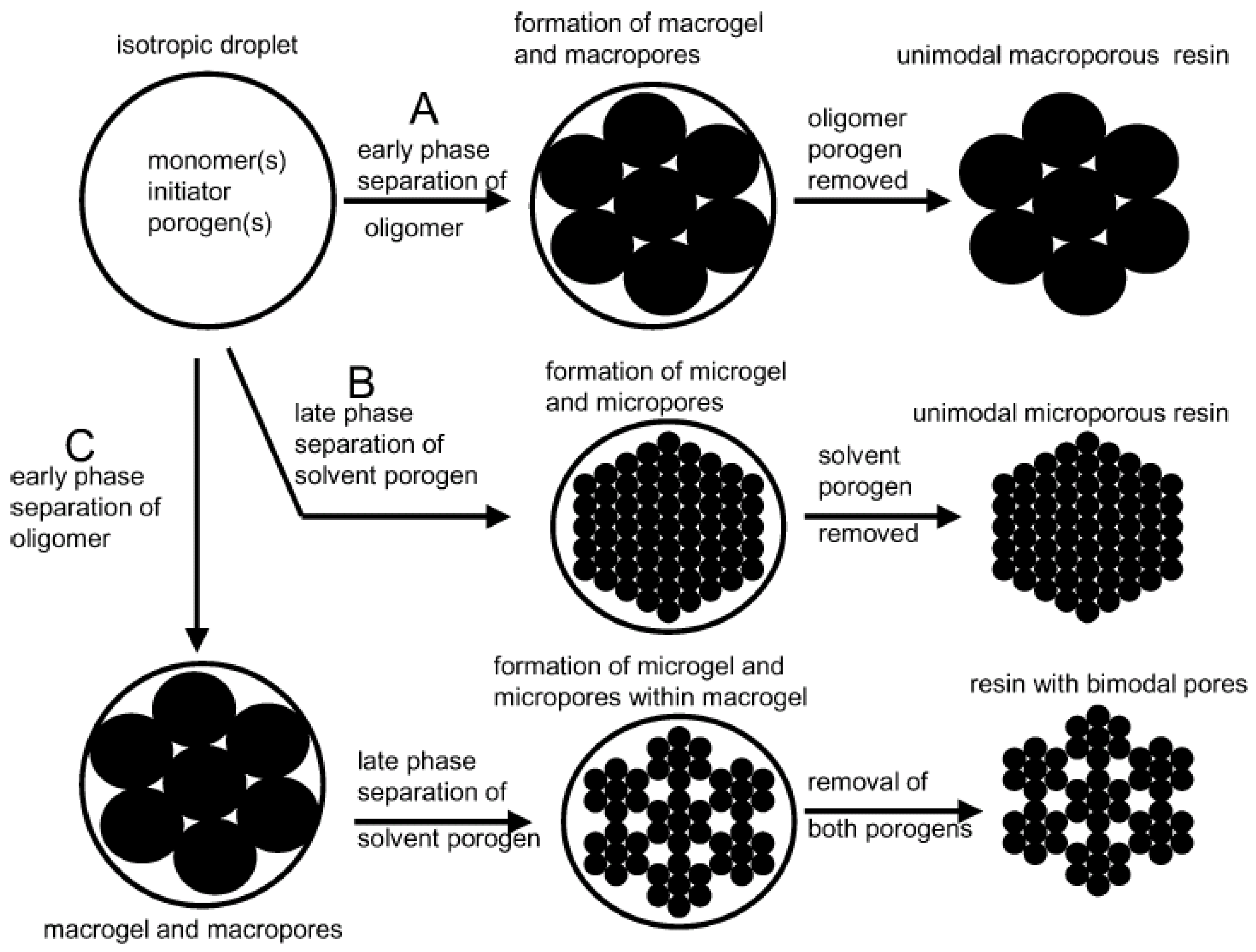
        <p>The general mechanism of how porogens control the resin surface area, pore-size, pore-size distribution (PSD), pore-volume, and morphology is illustrated in <xref ref-type="fig" rid="nanomaterials-02-00163-f001">Figure 1</xref> [<xref ref-type="bibr" rid="B18-nanomaterials-02-00163">18</xref>]. The period of phase separation, shown in <xref ref-type="fig" rid="nanomaterials-02-00163-f001">Figure 1</xref>, is the main rate determining step. As a general rule, phase separation will occur at a much later stage if the porogen is a “good” solvent or a solvating diluent [<xref ref-type="bibr" rid="B24-nanomaterials-02-00163">24</xref>], <italic>i.e</italic>., miscible with both the monomer and its resulting polymer. On the other hand, the “bad” solvent or non-solvating diluent has poor miscibility at the polymer level. If a non-solvating diluent is used (A in <xref ref-type="fig" rid="nanomaterials-02-00163-f001">Figure 1</xref>), microgels [<xref ref-type="bibr" rid="B2-nanomaterials-02-00163">2</xref>,<xref ref-type="bibr" rid="B18-nanomaterials-02-00163">18</xref>] will form, fuse together, and aggregate into larger clusters. This results in an increased volume of the voids (pores) forming larger pores (<italic>i.e</italic>., macropores) and reduced polymer surface area. Unlike non-solvating diluents, a solvating diluent (B in <xref ref-type="fig" rid="nanomaterials-02-00163-f001">Figure 1</xref>) delays phase separation; hence, ensuring that microgels retain their individuality even though they undergo fusion. This leads to a reduced distance between voids or clusters; hence, the pore-sizes are reduced (mesopores and micropores) and the polymer surface area increases. The mixture of A and B in <xref ref-type="fig" rid="nanomaterials-02-00163-f001">Figure 1</xref>, offers two modes of phase separation, <italic>i.e</italic>., early and late. Thus, bimodal pores are formed as follows: micropores/mesopores or mesopores/macropores or micropores/macropores. It is noteworthy that many authors use the term “<italic>good thermodynamic solvent</italic>” instead of “<italic>solvating diluent</italic>”. In this review, the term <italic>solvating diluent</italic> is preferred because the thermodynamic parameters of these solvents are not adequately characterized in the context of PCR materials; therefore, the term “<italic>good thermodynamic solvent</italic>” was not used in view of the existing knowledge gaps (<italic>vide infra</italic>), and to avoid misleading the reader that a thermodynamic analysis of solvation was reviewed herein. </p>
        <fig id="nanomaterials-02-00163-f001" position="anchor">
          <label>Figure 1</label>
          <caption>
            <p>Schematic representation of pore formation in poly(DVB) resins: (<bold>A</bold>) using a “bad” solvent porogen; (<bold>B</bold>) using a thermodynamically “good” solvent porogen; and (<bold>C</bold>) using a mixture of “good” and “bad” solvent porogen as co-porogens. (Reprinted (adapted) with permission from [<xref ref-type="bibr" rid="B18-nanomaterials-02-00163">18</xref>]. Copyright 2004 American Chemical Society). NB: The pores are of different sizes and are not drawn according to scale, as shown below.</p>
          </caption>
          <graphic xmlns:xlink="http://www.w3.org/1999/xlink" xlink:href="nanomaterials-02-00163-g001.tif"/>
        </fig>
      </sec>
      <sec>
        <title>1.3. Review Motivation</title>
        <p>The allure towards this technique is demonstrated by the variation in the surface area (SA), pore-size, pore-size distribution (PSD), pore-volume, and morphology. The SA is found to vary from ~10<sup>1</sup>–10<sup>3</sup> m<sup>2</sup>/g, PSD ranges from microporous, mesoporous and macroporous with unimodal and bimodal distributions. Pore-volumes typically range from ~0–3 cm<sup>3</sup>/g [<xref ref-type="bibr" rid="B1-nanomaterials-02-00163">1</xref>,<xref ref-type="bibr" rid="B2-nanomaterials-02-00163">2</xref>,<xref ref-type="bibr" rid="B4-nanomaterials-02-00163">4</xref>,<xref ref-type="bibr" rid="B5-nanomaterials-02-00163">5</xref>,<xref ref-type="bibr" rid="B7-nanomaterials-02-00163">7</xref>,<xref ref-type="bibr" rid="B11-nanomaterials-02-00163">11</xref>,<xref ref-type="bibr" rid="B12-nanomaterials-02-00163">12</xref>,<xref ref-type="bibr" rid="B13-nanomaterials-02-00163">13</xref>,<xref ref-type="bibr" rid="B14-nanomaterials-02-00163">14</xref>,<xref ref-type="bibr" rid="B15-nanomaterials-02-00163">15</xref>,<xref ref-type="bibr" rid="B16-nanomaterials-02-00163">16</xref>,<xref ref-type="bibr" rid="B21-nanomaterials-02-00163">21</xref>,<xref ref-type="bibr" rid="B22-nanomaterials-02-00163">22</xref>] where the higher SA values are due to solvating diluents. The average pore diameter and PSD may also vary, <italic>i.e</italic>., increase, decrease, or both. Moreover, the morphology coarsens in a less subtle fashion when a non-solvating diluent is used, and does not coarsen or becomes more refined in the case of a solvating diluent [<xref ref-type="bibr" rid="B2-nanomaterials-02-00163">2</xref>,<xref ref-type="bibr" rid="B25-nanomaterials-02-00163">25</xref>,<xref ref-type="bibr" rid="B26-nanomaterials-02-00163">26</xref>].</p>
        <p>Some common types of porogens investigated include organic solvents of variable molecular weight. Examples of low molecular weight solvent porogens include toluene, hexane, cyclohexanone, 2-ethylhexanol, <italic>p</italic>-xylene, <italic>n</italic>-heptane [<xref ref-type="bibr" rid="B2-nanomaterials-02-00163">2</xref>,<xref ref-type="bibr" rid="B4-nanomaterials-02-00163">4</xref>,<xref ref-type="bibr" rid="B15-nanomaterials-02-00163">15</xref>,<xref ref-type="bibr" rid="B16-nanomaterials-02-00163">16</xref>] and an example of a higher molecular weight solvent is poly(ethylene glycol) [<xref ref-type="bibr" rid="B15-nanomaterials-02-00163">15</xref>,<xref ref-type="bibr" rid="B23-nanomaterials-02-00163">23</xref>]. On the other hand, inorganic porogens include sodium chloride [<xref ref-type="bibr" rid="B24-nanomaterials-02-00163">24</xref>,<xref ref-type="bibr" rid="B25-nanomaterials-02-00163">25</xref>,<xref ref-type="bibr" rid="B26-nanomaterials-02-00163">26</xref>], silica [<xref ref-type="bibr" rid="B25-nanomaterials-02-00163">25</xref>], sodium hydrogen carbonate [<xref ref-type="bibr" rid="B27-nanomaterials-02-00163">27</xref>] and supercritical carbon dioxide (SCD) [<xref ref-type="bibr" rid="B25-nanomaterials-02-00163">25</xref>,<xref ref-type="bibr" rid="B26-nanomaterials-02-00163">26</xref>,<xref ref-type="bibr" rid="B27-nanomaterials-02-00163">27</xref>]. SCD is a suitable porogen substitute for other types of solvents that are otherwise challenging to remove from the polymer matrix at the purification stage and/or polymers which are sensitive to very small composition changes of the porogenic solvent mixtures. SCD offers fine control over average pore-sizes and PSD using temperature and pressure conditions to alter the density of SCD. The popular use of organic porogens is traced back to the 1950s [<xref ref-type="bibr" rid="B9-nanomaterials-02-00163">9</xref>]; whereas, the first example of SCD as a porogen for modifying PCR materials was more recently reported by Holmes and Cooper [<xref ref-type="bibr" rid="B28-nanomaterials-02-00163">28</xref>,<xref ref-type="bibr" rid="B29-nanomaterials-02-00163">29</xref>,<xref ref-type="bibr" rid="B30-nanomaterials-02-00163">30</xref>].</p>
        <p>PCR tuning with porogens has not been extensively studied in a systematic manner and is the subject of this review. This paper describes the surface area, pore-size, PSD, pore-volume and changes in the morphological properties when polymers are tuned with porogenic “inert” solvents at various conditions. In addition, knowledge gaps related to this technique will be addressed and some recommendations for future research are suggested herein.</p>
      </sec>
      <sec>
        <title>1.4. Criteria for Porogen Selection</title>
        <p>The criteria for choosing porogenic solvents is often based on their respective molecular size [<xref ref-type="bibr" rid="B24-nanomaterials-02-00163">24</xref>], alky chain length [<xref ref-type="bibr" rid="B31-nanomaterials-02-00163">31</xref>], mixtures of lipophilic and hydrophilic porogens [<xref ref-type="bibr" rid="B32-nanomaterials-02-00163">32</xref>], and solubility parameter (SP) [<xref ref-type="bibr" rid="B33-nanomaterials-02-00163">33</xref>,<xref ref-type="bibr" rid="B34-nanomaterials-02-00163">34</xref>,<xref ref-type="bibr" rid="B35-nanomaterials-02-00163">35</xref>,<xref ref-type="bibr" rid="B36-nanomaterials-02-00163">36</xref>,<xref ref-type="bibr" rid="B37-nanomaterials-02-00163">37</xref>]. The SP was identified as a quantitative criterion for predicting the pore structure properties of polymers; however, the SP was not adequately addressed in other studies [<xref ref-type="bibr" rid="B12-nanomaterials-02-00163">12</xref>,<xref ref-type="bibr" rid="B37-nanomaterials-02-00163">37</xref>]. There are three general types of SP values, <italic>i.e</italic>., a one-component SP is also referred to as the Hildebrand solubility parameter, a two-component solubility (physical-chemical) parameter, and the Hansen’s three-component solubility parameter [<xref ref-type="bibr" rid="B31-nanomaterials-02-00163">31</xref>,<xref ref-type="bibr" rid="B32-nanomaterials-02-00163">32</xref>,<xref ref-type="bibr" rid="B33-nanomaterials-02-00163">33</xref>,<xref ref-type="bibr" rid="B34-nanomaterials-02-00163">34</xref>,<xref ref-type="bibr" rid="B35-nanomaterials-02-00163">35</xref>,<xref ref-type="bibr" rid="B36-nanomaterials-02-00163">36</xref>].</p>
        <p>The three approaches employing SP criteria have been applied in various studies. In view of its simplicity, the Hildebrand one-dimensional SP is used for solutions without molecular polarity or specific intermolecular interactions. The two-dimensional SP is preferred over the Hansen’s three-dimensional SP for solvents with lower molar volumes since they yield comparable results. Hansen’s three-dimensional SP is favored [<xref ref-type="bibr" rid="B33-nanomaterials-02-00163">33</xref>,<xref ref-type="bibr" rid="B36-nanomaterials-02-00163">36</xref>] for solvents with greater molar volumes, such as phthalates, and provides reasonably accurate results.</p>
        <p>The tuning of PCR materials with the aforementioned porogens is determined by various factors [<xref ref-type="bibr" rid="B2-nanomaterials-02-00163">2</xref>,<xref ref-type="bibr" rid="B4-nanomaterials-02-00163">4</xref>,<xref ref-type="bibr" rid="B6-nanomaterials-02-00163">6</xref>,<xref ref-type="bibr" rid="B7-nanomaterials-02-00163">7</xref>,<xref ref-type="bibr" rid="B10-nanomaterials-02-00163">10</xref>,<xref ref-type="bibr" rid="B15-nanomaterials-02-00163">15</xref>,<xref ref-type="bibr" rid="B16-nanomaterials-02-00163">16</xref>,<xref ref-type="bibr" rid="B17-nanomaterials-02-00163">17</xref>,<xref ref-type="bibr" rid="B18-nanomaterials-02-00163">18</xref>,<xref ref-type="bibr" rid="B19-nanomaterials-02-00163">19</xref>,<xref ref-type="bibr" rid="B20-nanomaterials-02-00163">20</xref>,<xref ref-type="bibr" rid="B21-nanomaterials-02-00163">21</xref>,<xref ref-type="bibr" rid="B38-nanomaterials-02-00163">38</xref>], as follows: (<italic>i</italic>) the feed ratio of the porogen to monomer mixture (or porogen volume) yields optimal conditions when the ratio is maximized; (<italic>ii</italic>) porogens with variable SP; (<italic>iii</italic>) mixing multiple porogens, <italic>i.e</italic>., co-porogens; (<italic>iv</italic>) variable temperatures where higher temperatures produce smaller pores; (<italic>v</italic>) variable stirring speeds influence microemulsion formation and the particle size; (<italic>vi</italic>) crosslinking density affects the PSD; (<italic>vii</italic>) polymer composition where the relative monomer type and feed ratio affects the pore-size and PSD; and (<italic>viii</italic>) the nature of the polymerization technique. Baydal <italic>et al. </italic>[<xref ref-type="bibr" rid="B39-nanomaterials-02-00163">39</xref>] investigated the influence of different parameters and found that the type of porogen and the relative volume have a large influence on the copolymer resin properties. Based on their findings, the goal of this review focuses on tunable porogens of variable types, both as pure solvents and their mixtures (co-porogens). In addition, the influence of porogen volume is examined while the other factors are treated as secondary in their importance.</p>
      </sec>
    </sec>
    <sec>
      <title>2. Synthesis and Characterization</title>
      <sec id="sec2dot1-nanomaterials-02-00163">
        <title>2.1. Synthesis</title>
        <p>As mentioned above, this review covers the topic of suspension polymerization as the main synthetic approach for preparing PCR materials. A schematic representation of this polymerization technique was described previously (<italic>cf</italic>. <xref ref-type="fig" rid="nanomaterials-02-00163-f008">Figure 8</xref> in [<xref ref-type="bibr" rid="B40-nanomaterials-02-00163">40</xref>]). In general, there is an organic phase (also referred to as the discontinuous phase) comprised of predetermined amounts of monomer(s), initiator, and solvent(s) which are added into an aqueous phase, and is also referred to as the continuous phase. The mixture is comprised of a suspension stabilizer in water in a reactor vessel at ~60–70 °C with mechanical stirring at a suitable speed for a desired particle size. The reaction is maintained ~80 °C for 3–24 hours and the resulting spherical particles are washed with water, ethanol, or methanol, and extracted with a suitable solvent such as acetone for 24–48 hours [<xref ref-type="bibr" rid="B1-nanomaterials-02-00163">1</xref>,<xref ref-type="bibr" rid="B2-nanomaterials-02-00163">2</xref>,<xref ref-type="bibr" rid="B4-nanomaterials-02-00163">4</xref>,<xref ref-type="bibr" rid="B5-nanomaterials-02-00163">5</xref>,<xref ref-type="bibr" rid="B7-nanomaterials-02-00163">7</xref>,<xref ref-type="bibr" rid="B11-nanomaterials-02-00163">11</xref>,<xref ref-type="bibr" rid="B12-nanomaterials-02-00163">12</xref>,<xref ref-type="bibr" rid="B13-nanomaterials-02-00163">13</xref>,<xref ref-type="bibr" rid="B14-nanomaterials-02-00163">14</xref>,<xref ref-type="bibr" rid="B15-nanomaterials-02-00163">15</xref>,<xref ref-type="bibr" rid="B16-nanomaterials-02-00163">16</xref>,<xref ref-type="bibr" rid="B17-nanomaterials-02-00163">17</xref>,<xref ref-type="bibr" rid="B18-nanomaterials-02-00163">18</xref>,<xref ref-type="bibr" rid="B19-nanomaterials-02-00163">19</xref>,<xref ref-type="bibr" rid="B20-nanomaterials-02-00163">20</xref>,<xref ref-type="bibr" rid="B21-nanomaterials-02-00163">21</xref>,<xref ref-type="bibr" rid="B22-nanomaterials-02-00163">22</xref>,<xref ref-type="bibr" rid="B23-nanomaterials-02-00163">23</xref>,<xref ref-type="bibr" rid="B24-nanomaterials-02-00163">24</xref>,<xref ref-type="bibr" rid="B25-nanomaterials-02-00163">25</xref>,<xref ref-type="bibr" rid="B26-nanomaterials-02-00163">26</xref>,<xref ref-type="bibr" rid="B27-nanomaterials-02-00163">27</xref>,<xref ref-type="bibr" rid="B28-nanomaterials-02-00163">28</xref>,<xref ref-type="bibr" rid="B29-nanomaterials-02-00163">29</xref>,<xref ref-type="bibr" rid="B30-nanomaterials-02-00163">30</xref>,<xref ref-type="bibr" rid="B31-nanomaterials-02-00163">31</xref>,<xref ref-type="bibr" rid="B32-nanomaterials-02-00163">32</xref>,<xref ref-type="bibr" rid="B33-nanomaterials-02-00163">33</xref>,<xref ref-type="bibr" rid="B39-nanomaterials-02-00163">39</xref>,<xref ref-type="bibr" rid="B40-nanomaterials-02-00163">40</xref>]. A commonly used polymerization initiator agent is α-α’-azo-bis-isobutyronitrile (AIBN).</p>
      </sec>
      <sec>
        <title>2.2. Characterization</title>
        <sec>
          <title>2.2.1. Porosimetry</title>
          <p>According to the International Union of Pure and Applied Chemistry (IUPAC), pores are classified into three categories according to their pore size: micropores (less than 2 nm), mesopores (2 to 50 nm), and macropores (larger than 50 nm). In the solid state, nitrogen porosimetry [<xref ref-type="bibr" rid="B2-nanomaterials-02-00163">2</xref>,<xref ref-type="bibr" rid="B4-nanomaterials-02-00163">4</xref>,<xref ref-type="bibr" rid="B7-nanomaterials-02-00163">7</xref>,<xref ref-type="bibr" rid="B10-nanomaterials-02-00163">10</xref>,<xref ref-type="bibr" rid="B15-nanomaterials-02-00163">15</xref>,<xref ref-type="bibr" rid="B16-nanomaterials-02-00163">16</xref>,<xref ref-type="bibr" rid="B17-nanomaterials-02-00163">17</xref>,<xref ref-type="bibr" rid="B38-nanomaterials-02-00163">38</xref>,<xref ref-type="bibr" rid="B41-nanomaterials-02-00163">41</xref>] is used to characterize micro- and mesopores in terms of specific surface area. The determination of the mesopore and macropore characteristics is evaluated on the basis of pore-volume and pore-volume distribution using mercury intrusion porosimetry [<xref ref-type="bibr" rid="B4-nanomaterials-02-00163">4</xref>,<xref ref-type="bibr" rid="B15-nanomaterials-02-00163">15</xref>,<xref ref-type="bibr" rid="B16-nanomaterials-02-00163">16</xref>,<xref ref-type="bibr" rid="B26-nanomaterials-02-00163">26</xref>,<xref ref-type="bibr" rid="B39-nanomaterials-02-00163">39</xref>,<xref ref-type="bibr" rid="B42-nanomaterials-02-00163">42</xref>].</p>
        </sec>
        <sec>
          <title>2.2.2. Solvent Uptake</title>
          <p>The quantification of solvent uptake such as heptane, methanol, and toluene by the polymeric resins provide an indirect measurement of the accessible pore-volume and confirms the estimates obtained from porosimetry [<xref ref-type="bibr" rid="B4-nanomaterials-02-00163">4</xref>,<xref ref-type="bibr" rid="B34-nanomaterials-02-00163">34</xref>,<xref ref-type="bibr" rid="B41-nanomaterials-02-00163">41</xref>] methods. The measurement of pore-volume in the solid state using porosimetry utilizes various backfill gases in which fixed inaccessible pores are evaluated using BET analysis. In contrast, the uptake of solvent enables access to restricted pores through morphological changes (<italic>i.e</italic>. swelling) by filling the fixed pores, expanding pores through uncoiling of framework units, and swelling of highly crosslinked domains.</p>
        </sec>
        <sec>
          <title>2.2.3. Microscopy</title>
          <p>Many studies have examined the use of scanning electron microscopy (SEM), transmission electron microscopy (TEM), and atomic force microscopy (AFM) to identify the morphology and texture of the polymers [<xref ref-type="bibr" rid="B2-nanomaterials-02-00163">2</xref>,<xref ref-type="bibr" rid="B6-nanomaterials-02-00163">6</xref>,<xref ref-type="bibr" rid="B7-nanomaterials-02-00163">7</xref>,<xref ref-type="bibr" rid="B17-nanomaterials-02-00163">17</xref>,<xref ref-type="bibr" rid="B26-nanomaterials-02-00163">26</xref>,<xref ref-type="bibr" rid="B30-nanomaterials-02-00163">30</xref>,<xref ref-type="bibr" rid="B43-nanomaterials-02-00163">43</xref>,<xref ref-type="bibr" rid="B44-nanomaterials-02-00163">44</xref>].</p>
        </sec>
      </sec>
    </sec>
    <sec>
      <title>3. Solubility Parameter</title>
      <p>Research concerning PCR materials utilizes the SP as a relative measure of “good” or “bad” solvents, according to the solvating ability of a diluent. There are three types of SP values that are commonly used, <italic>i.e</italic>., the one-component SP (the Hildebrand solubility parameter), a two-component solubility (physical-chemical) parameter, and Hansen’s three-component SP value [<xref ref-type="bibr" rid="B30-nanomaterials-02-00163">30</xref>,<xref ref-type="bibr" rid="B31-nanomaterials-02-00163">31</xref>,<xref ref-type="bibr" rid="B32-nanomaterials-02-00163">32</xref>,<xref ref-type="bibr" rid="B33-nanomaterials-02-00163">33</xref>,<xref ref-type="bibr" rid="B34-nanomaterials-02-00163">34</xref>,<xref ref-type="bibr" rid="B35-nanomaterials-02-00163">35</xref>].</p>
      <p>The Hildebrand SP (<italic>δ</italic>) of the porogen and the polymer [<xref ref-type="bibr" rid="B36-nanomaterials-02-00163">36</xref>], respectively, are defined as shown in Equation (1) below:</p>
      <p><inline-graphic xmlns:xlink="http://www.w3.org/1999/xlink" xlink:href="nanomaterials-02-00163-i001.tif"/></p>
      <p>where <italic>C</italic> is the cohesive energy density, Δ<italic>H</italic> is the heat of vaporization, <italic>R</italic> is the gas constant, <italic>T</italic> is the temperature, and <italic>V<sub>m</sub></italic> is the molar volume of the solvent. The SI unit for <italic>δ</italic> is MPa<sup>1/2</sup> while the conventional unit is (J/cm<sup>3</sup>)<sup>1/2</sup>. The closer the match between the porogen and the polymer implies a “good” solvent since solvents with similar SP values are generally miscible. In other words, if (|Δ<italic>δ</italic>|) is near zero (where |Δ<italic>δ</italic>| = |<italic>δ</italic><sub>resin</sub>- <italic>δ</italic><sub>solvent</sub>|), then miscibility is favored. In cases where |Δ<italic>δ</italic>| &gt; 3 MPa<sup>1/2</sup>, the solvent is considered “bad” for values between 1-3 MPa<sup>1/2</sup>, the solvent possesses intermediate solubility and is considered “good” and “bad”. However, this criterion has some exceptions when the resin and diluent are both polar or have specific polar-directional group interactions. Therefore, an extension to Hildebrand’s theory was proposed by Hansen [<xref ref-type="bibr" rid="B32-nanomaterials-02-00163">32</xref>] where the SP was divided into three contributions, <italic>i.e</italic>., dispersion forces (<italic>δ<sub>d</sub></italic>), dipolar interactions (<italic>δ<sub>p</sub></italic>) and H-bond capacity (<italic>δ<sub>h</sub></italic>), as shown in Equation (2).</p>
      <p><inline-graphic xmlns:xlink="http://www.w3.org/1999/xlink" xlink:href="nanomaterials-02-00163-i002.tif"/></p>
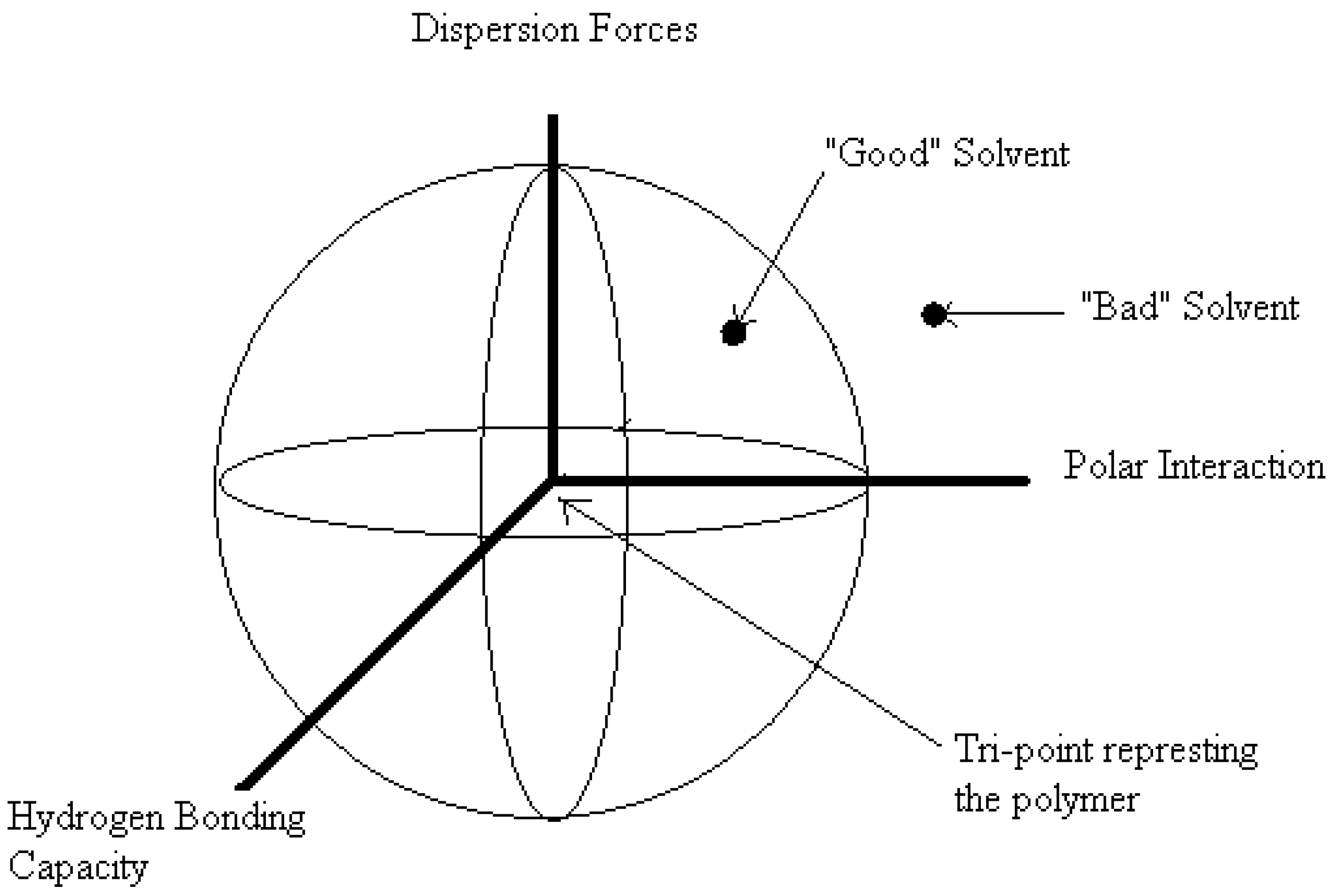
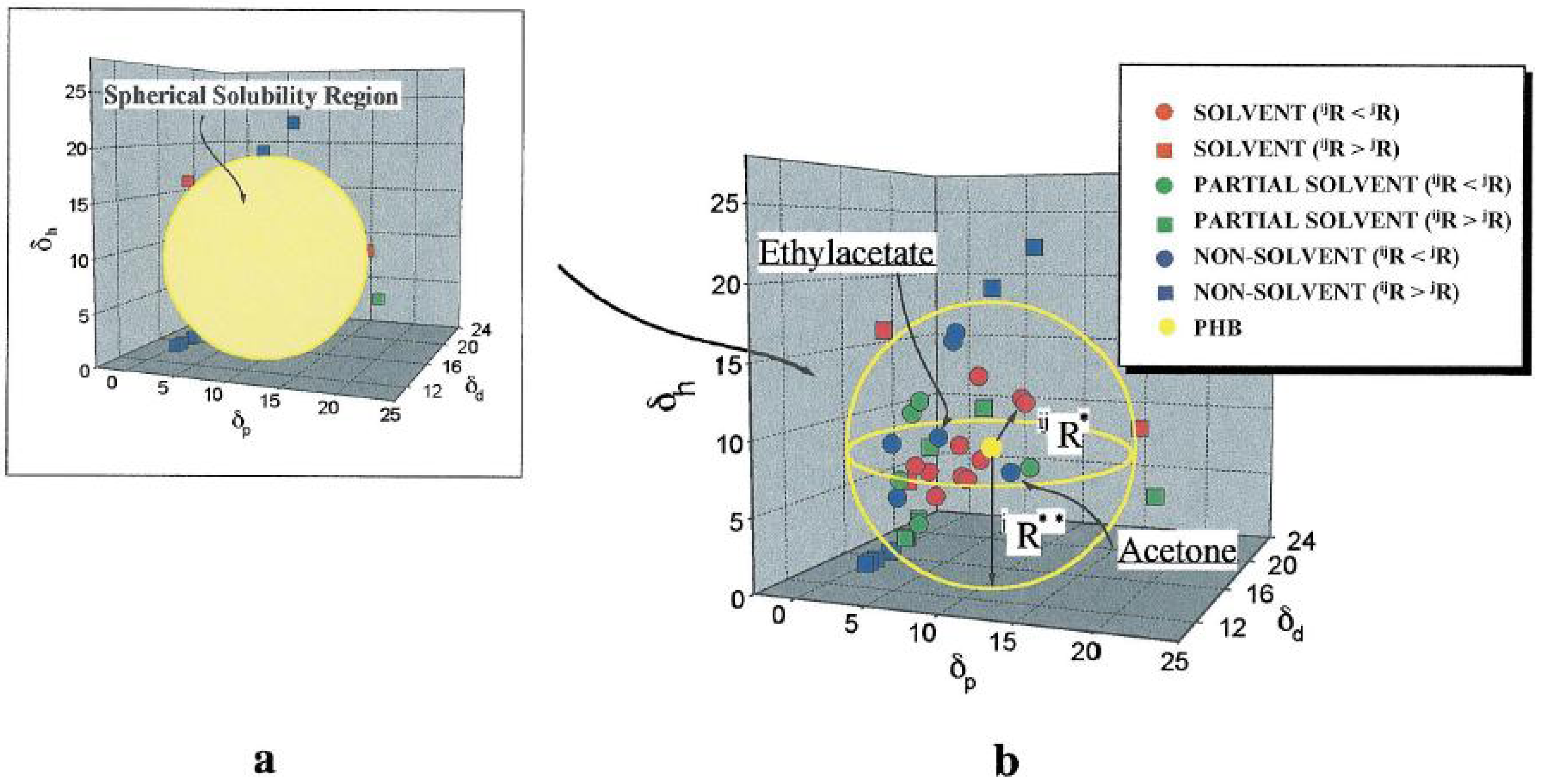
      <p>The above three-dimensional SP (<italic>δ<sub>T</sub></italic>) is assumed to be a vector sum where the three components are treated as solubility coordinates. Hansen reported resin solubility values using a three-dimensional model and concluded that doubling of the dispersion forces (<italic>δ<sub>d</sub></italic>), a spherical volume of solubility would be formed for each resin. The sphere is described in <xref ref-type="fig" rid="nanomaterials-02-00163-f002">Figure 2</xref> where the SP value of a given compound can be visualized as a fixed point and referred to as a tri-point in a three-dimensional space. The coordinates of the tri-point are located by means of three SP values (<italic>δ<sub>d</sub></italic>, <italic>δ<sub>p</sub></italic> and <italic>δ<sub>h</sub></italic>). When the resin is mixed with a single solvent or multiple solvents with SP values lying within the sphere, the compatibility is considered “good” while those solvents lying outside the sphere are considered “bad” (<italic>cf</italic>. <xref ref-type="fig" rid="nanomaterials-02-00163-f003">Figure 3</xref> in [<xref ref-type="bibr" rid="B45-nanomaterials-02-00163">45</xref>]).</p>
      <fig id="nanomaterials-02-00163-f002" position="anchor">
        <label>Figure 2</label>
        <caption>
          <p>A three-dimensional plot of the three solubility parameter (SP) contributions <italic>i.e.</italic>, dispersion forces (<italic>δ<sub>d</sub></italic>), dipolar interactions (<italic>δ<sub>p</sub></italic>), and H-bond capacity (<italic>δ<sub>h</sub></italic>), to the total SP (<italic>δ<sub>T</sub></italic>). The tri-point represents a hypothetical polymer. Interaction radius is the shortest distance between the tri-point and the solvent.</p>
        </caption>
        <graphic xmlns:xlink="http://www.w3.org/1999/xlink" xlink:href="nanomaterials-02-00163-g002.tif"/>
      </fig>
      <fig id="nanomaterials-02-00163-f003" position="anchor">
        <label>Figure 3</label>
        <caption>
          <p>Spherical region characterizing poly(3-hydroxybutyrate) (PHB) solubility in various solvents: (<bold>a</bold>) the outline of the region; and (<bold>b</bold>) the inside of the region. The shapes indicating the solvents depend on whether the point is located inside or outside the solubility region: square and circle represent a position outside the region (<sup>j</sup>R &lt; <sup>ij</sup>R) and one inside the region (<sup>j</sup>R &gt; <sup>ij</sup>R), respectively. <sup>ij</sup>R, distance of solvents at position (δ<sub>d</sub>, δ<sub>p,</sub> δ<sub>h</sub> ) from center of solubility sphere for PHB, calculated from Equation (4). (Reprinted from [<xref ref-type="bibr" rid="B45-nanomaterials-02-00163">45</xref>], Copyright 1999, with permission from Elsevier).</p>
        </caption>
        <graphic xmlns:xlink="http://www.w3.org/1999/xlink" xlink:href="nanomaterials-02-00163-g003.tif"/>
      </fig>
      <p>To aid the SP criterion of Hansen’s methodology for the selection of “good” versus “bad” solvents, the use of relative energy difference (<italic>RED</italic>) was proposed, as shown in Equation (3). In this approach, values of <italic>RED</italic> &lt; 1 imply that the solvent is “good” or the solvent is “bad” when <italic>RED</italic> &gt; 1.</p>
      <p><inline-graphic xmlns:xlink="http://www.w3.org/1999/xlink" xlink:href="nanomaterials-02-00163-i003.tif"/></p>
      <p>where <italic>R<sub>a</sub></italic> is the distance between centre of the polymer solubility sphere for the solvent-solvent system and <italic>R<sub>o</sub></italic> is the radius of the sphere; where R<sub>a</sub> is calculated according to Equation (4).</p>
      <p><inline-graphic xmlns:xlink="http://www.w3.org/1999/xlink" xlink:href="nanomaterials-02-00163-i004.tif"/></p>
      <p>where <italic>δ<sub>xR</sub></italic> and <italic>δ<sub>xS</sub></italic> are the Hansen solubility parameters for the resin and solvent, respectively. The methodology used for the above criterion is not followed unanimously by all authors because an alternate method directly compares the values of R<sub>a</sub> to R<sub>o</sub> without calculating <italic>RED</italic> [<xref ref-type="bibr" rid="B34-nanomaterials-02-00163">34</xref>]. In some cases, Hansen’s three-dimensional approach is simplified with a two-dimensional coordinate system. This method argues that the SP values (<italic>δ<sub>d</sub></italic> and <italic>δ<sub>p</sub></italic>) are similar and may be incorporated as a unified parameter referred to as a volume-dependent SP (<italic>δ<sub>v</sub></italic>) value, as shown in Equation (5) [<xref ref-type="bibr" rid="B37-nanomaterials-02-00163">37</xref>]. Hence, <italic>δ<sub>v</sub></italic> – <italic>δ<sub>h</sub></italic> graphs are used to represent polymer-solvent interactions because this methodology is preferred for practical applications, and overcomes the use of three-dimension graphical representations.</p>
      <p><inline-graphic xmlns:xlink="http://www.w3.org/1999/xlink" xlink:href="nanomaterials-02-00163-i005.tif"/></p>
    </sec>
    <sec>
      <title>4. Pore Formation Mechanism</title>
      <p>In order to have an improved understanding of the research describing the influence of solvents as porogens, the mechanism will be described in further detail. The general aspects of the mechanism are described in <xref ref-type="fig" rid="nanomaterials-02-00163-f001">Figure 1</xref>. As the suspension polymerization process proceeds, the copolymer precipitates within emulsion droplets and forms spherical shapes, referred to as insoluble nuclei. The droplets form due to the relative difference in SP between the copolymer and the solvent (|Δ<italic>δ</italic>|). The nuclei transform into microspheres or microgel phases, and the microspheres agglomerate with each other to form a primary network. Upon further polymerization, the primary network becomes a crosslinked porous network. The phase containing solvent strongly contracts in volume due to the loss of solvating co-monomers; thereafter, network formation and phase separation occurs. As the porogen is removed, the void spaces that remain are referred to as the pores in the polymer network. The pore sizes depend on the solvating ability of the porogen. If the porogen is a solvating diluent, <italic>i.e</italic>., where |Δ<italic>δ</italic>| is close to zero, the polymer chains remain dissolved in the mixture for a longer time prior to phase separation. As the microsphere particles undergo aggregation, they are likely to retain their microparticle nature; thereafter, resulting in smaller pores. As the value for |Δ<italic>δ</italic>| becomes larger for a given porogen, the microsphere fails to retain its individuality and undergoes aggregation into larger clusters. The widening of the voids between subunits results in pore formation in the macropore range (<italic>cf</italic>. Figure 15 in [<xref ref-type="bibr" rid="B40-nanomaterials-02-00163">40</xref>]).</p>
    </sec>
    <sec id="sec5-nanomaterials-02-00163">
      <title>5. Influence of the Solvent (Porogen)</title>
      <sec id="sec5dot1-nanomaterials-02-00163">
        <title>5.1. Pure Solvents</title>
        <p>Research results on the influence of pure solvents as porogens for different resins are summarized in <xref ref-type="table" rid="nanomaterials-02-00163-t001">Table 1</xref> [<xref ref-type="bibr" rid="B10-nanomaterials-02-00163">10</xref>,<xref ref-type="bibr" rid="B15-nanomaterials-02-00163">15</xref>,<xref ref-type="bibr" rid="B16-nanomaterials-02-00163">16</xref>,<xref ref-type="bibr" rid="B46-nanomaterials-02-00163">46</xref>]. <xref ref-type="table" rid="nanomaterials-02-00163-t001">Table 1</xref> illustrates how the surface area varies in accordance with the use of different porogens. Additionally, the results show how a similar class of resins may be tuned to form micro-, meso- and macropores [<xref ref-type="bibr" rid="B7-nanomaterials-02-00163">7</xref>,<xref ref-type="bibr" rid="B12-nanomaterials-02-00163">12</xref>,<xref ref-type="bibr" rid="B44-nanomaterials-02-00163">44</xref>,<xref ref-type="bibr" rid="B45-nanomaterials-02-00163">45</xref>]. As mentioned above, solvents that act as solvating diluents may generate micropores; thereby, increasing the polymer surface area.</p>
        <p>For example, the results from reference [<xref ref-type="bibr" rid="B16-nanomaterials-02-00163">16</xref>] in <xref ref-type="table" rid="nanomaterials-02-00163-t001">Table 1</xref> show that toluene is a solvating diluent and cyclohexanone is a non-solvating diluent. 2-ethylhexanol is an intermediate case between solvating and non-solvating diluent. The results were explained by the trend for the SP values; toluene (18.2 MPa<sup>1/2</sup>), 2-ethylhexanoic acid (19.4 MPa<sup>1/2</sup>), and cyclohexanone (20.3 MPa<sup>1/2</sup>); whereas, the resin is ~17–18 MPa<sup>1/2</sup>. According to the SP values, toluene has a closer match to the resin, and this is based on the one-component SP using Hildebrand solubility parameters. However, this criterion has a fault which is illustrated in <xref ref-type="table" rid="nanomaterials-02-00163-t001">Table 1</xref> (<italic>cf</italic>. [<xref ref-type="bibr" rid="B46-nanomaterials-02-00163">46</xref>]). The authors argue that 1-chlorodecane is a non-solvating diluent for the resin and it yields a greater surface area over the solvating diluents, demonstrating its use as a novel porogen. However, if one looks at the SP value of the solvents investigated, one observes a variation in the SP values; heptane (15.3), cyclohexane (16.8), 1-chlorodecane (17.0), toluene (18.2), and dibutyl phthalate (23.3 MPa<sup>1/2</sup>). The use of a one-component SP criterion to explain the results, <italic>i.e</italic>., if |Δ<italic>δ</italic>| ~ 0, the solvent is the solvating diluent and 1-chlorodecane should not have the greatest surface area. Cyclohexanol should have a surface area &lt;25 m<sup>2</sup>/g when compared to the results from [<xref ref-type="bibr" rid="B2-nanomaterials-02-00163">2</xref>]. In contrast, Rabelo and Coutinho [<xref ref-type="bibr" rid="B34-nanomaterials-02-00163">34</xref>] have illustrated that a pure solvent can mislead the interpretation of results; hence, Hansen’s three-component SP value may be used. An example of this approach will be described further in <xref ref-type="sec" rid="sec7-nanomaterials-02-00163">Section 7</xref>.</p>
        <table-wrap id="nanomaterials-02-00163-t001" position="anchor">
          <object-id pub-id-type="pii">nanomaterials-02-00163-t001_Table 1</object-id>
          <label>Table 1</label>
          <caption>
            <p>Surface area (from nitrogen porosimetry), pore-volume, pore-size and average pore diameter of porous copolymer resin (PCR) synthesized in presence of different types of solvent porogens. The synthesis properties are the same as indicated in <xref ref-type="sec" rid="sec2dot1-nanomaterials-02-00163">Section 2.1</xref>.</p>
          </caption>
          <table rules="all" style="border:solid thin">
  <thead>
              <tr>
                <th align="center" valign="middle">Polymer type</th>
                <th align="center" valign="middle">Porogen</th>
                <th align="center" valign="middle">Surface area (m<sup>2</sup>/g)</th>
                <th align="center" valign="middle">Pore volume (cm<sup>3</sup>/g)</th>
                <th align="center" valign="middle">Porosity(%)</th>
                <th align="center" valign="middle">Average pore diameter (nm)</th>
                <th align="center" valign="middle">Reference</th>
              </tr>
  </thead>
  <tbody>
              <tr>
                <td rowspan="3" align="center" valign="middle">Poly(styrene-
                <italic>co</italic>-divinylbenzene) – 1:3</td>
                <td align="center" valign="middle">Cyclohexanone</td>
                <td align="center" valign="middle">25</td>
                <td align="center" valign="middle">0.22</td>
                <td rowspan="3" align="center" valign="middle">NM <sup>*</sup></td>
                <td align="center" valign="middle">ND <sup>+</sup></td>
                <td rowspan="3" align="center" valign="middle">[<xref ref-type="bibr" rid="B16-nanomaterials-02-00163">16</xref>]</td>
              </tr>
              <tr>
                <td align="center" valign="middle">2-ethylhexanol</td>
                <td align="center" valign="middle">242</td>
                <td align="center" valign="middle">1.13</td>
                <td align="center" valign="middle">20–45</td>
              </tr>
              <tr>
                <td align="center" valign="middle">Toluene</td>
                <td align="center" valign="middle">599</td>
                <td align="center" valign="middle">0.44</td>
                <td align="center" valign="middle">&lt;4</td>
              </tr>
              <tr>
                <td rowspan="8" align="center" valign="middle">Glycidyl methacrylate-
                <italic>co</italic>-trimethylolpropane trimethacrylate – 1:1</td>
                <td align="center" valign="middle">Octan-2-one</td>
                <td align="center" valign="middle">174</td>
                <td align="center" valign="middle">1.31</td>
                <td rowspan="8" align="center" valign="middle">NM <sup>*</sup></td>
                <td rowspan="8" align="center" valign="middle">10–100</td>
                <td rowspan="8" align="center" valign="middle">[<xref ref-type="bibr" rid="B15-nanomaterials-02-00163">15</xref>]</td>
              </tr>
              <tr>
                <td align="center" valign="middle">n-butyl acetate</td>
                <td align="center" valign="middle">170</td>
                <td align="center" valign="middle">1.27</td>
              </tr>
              <tr>
                <td align="center" valign="middle"><italic>p</italic>-xylene</td>
                <td align="center" valign="middle">139</td>
                <td align="center" valign="middle">1.50</td>
              </tr>
              <tr>
                <td align="center" valign="middle">Toluene</td>
                <td align="center" valign="middle">145</td>
                <td align="center" valign="middle">1.02</td>
              </tr>
              <tr>
                <td align="center" valign="middle">Ethyl acetate</td>
                <td align="center" valign="middle">110</td>
                <td align="center" valign="middle">0.66</td>
              </tr>
              <tr>
                <td align="center" valign="middle">Benzonitrile</td>
                <td align="center" valign="middle">&lt;1</td>
                <td align="center" valign="middle">0.07</td>
              </tr>
              <tr>
                <td align="center" valign="middle">Cyclohexanone</td>
                <td align="center" valign="middle">0.2</td>
                <td align="center" valign="middle">0.16</td>
              </tr>
              <tr>
                <td align="center" valign="middle">Dodecan-1-ol</td>
                <td align="center" valign="middle">ND <sup>+</sup></td>
                <td align="center" valign="middle">ND <sup>+</sup></td>
              </tr>
              <tr>
                <td rowspan="2" align="center" valign="middle">Poly(hydroxyethyl methacrylate-
                <italic>co</italic>-ethylene glycol dimethacrylate) - 1:20</td>
                <td align="center" valign="middle">Cyclohexanol</td>
                <td align="center" valign="middle">250</td>
                <td align="center" valign="middle">0.396</td>
                <td rowspan="2" align="center" valign="middle">NM <sup>*</sup></td>
                <td align="center" valign="middle">6.3</td>
                <td rowspan="2" align="center" valign="middle">[<xref ref-type="bibr" rid="B10-nanomaterials-02-00163">10</xref>]</td>
              </tr>
              <tr>
                <td align="center" valign="middle">Dodecanol</td>
                <td align="center" valign="middle">28</td>
                <td align="center" valign="middle">0.06</td>
                <td align="center" valign="middle">8.6</td>
              </tr>
              <tr>
                <td rowspan="12" align="center" valign="middle">Poly(divinylbenzene); mixtures of isomers</td>
                <td rowspan="2" align="center" valign="middle">Heptane</td>
                <td rowspan="2" align="center" valign="middle">482</td>
                <td rowspan="2" align="center" valign="middle">NM <sup>*</sup></td>
                <td align="center" valign="middle">45.3 <sup>a</sup></td>
                <td align="center" valign="middle">6.9 <sup>a</sup></td>
                <td rowspan="12" align="center" valign="middle">[<xref ref-type="bibr" rid="B46-nanomaterials-02-00163">46</xref>]</td>
              </tr>
              <tr>
                <td align="center" valign="middle">69.0 <sup>b</sup></td>
                <td align="center" valign="middle">86.8 <sup>b</sup></td>
              </tr>
              <tr>
                <td rowspan="2" align="center" valign="middle">Cyclohexane</td>
                <td rowspan="2" align="center" valign="middle">640</td>
                <td rowspan="2" align="center" valign="middle">NM <sup>*</sup></td>
                <td align="center" valign="middle">37.9 <sup>a</sup></td>
                <td align="center" valign="middle">3.8 <sup>a</sup></td>
              </tr>
              <tr>
                <td align="center" valign="middle">47.7 <sup>b</sup></td>
                <td align="center" valign="middle">72.4 <sup>b</sup></td>
              </tr>
              <tr>
                <td rowspan="2" align="center" valign="middle">1-chlorodecane</td>
                <td rowspan="2" align="center" valign="middle">720</td>
                <td rowspan="2" align="center" valign="middle">NM <sup>*</sup></td>
                <td align="center" valign="middle">56.3 <sup>a</sup></td>
                <td align="center" valign="middle">7.2 <sup>a</sup></td>
              </tr>
              <tr>
                <td align="center" valign="middle">66.7 <sup>b</sup></td>
                <td align="center" valign="middle">53.4 <sup>b</sup></td>
              </tr>
              <tr>
                <td rowspan="2" align="center" valign="middle">Toluene</td>
                <td rowspan="2" align="center" valign="middle">701</td>
                <td rowspan="2" align="center" valign="middle">NM <sup>*</sup></td>
                <td align="center" valign="middle">35.9 <sup>a</sup></td>
                <td align="center" valign="middle">3.2 <sup>a</sup></td>
              </tr>
              <tr>
                <td align="center" valign="middle">50.5 <sup>b</sup></td>
                <td align="center" valign="middle">68.1 <sup>b</sup></td>
              </tr>
              <tr>
                <td rowspan="2" align="center" valign="middle">Dibutyl phthalate</td>
                <td rowspan="2" align="center" valign="middle">661</td>
                <td rowspan="2" align="center" valign="middle">NM <sup>*</sup></td>
                <td align="center" valign="middle">37.1 <sup>a</sup></td>
                <td align="center" valign="middle">3.6 <sup>a</sup></td>
              </tr>
              <tr>
                <td align="center" valign="middle">61.8 <sup>b</sup></td>
                <td align="center" valign="middle">60.2 <sup>b</sup></td>
              </tr>
              <tr>
                <td rowspan="2" align="center" valign="middle">Cyclohexanol</td>
                <td rowspan="2" align="center" valign="middle">493</td>
                <td rowspan="2" align="center" valign="middle">NM <sup>*</sup></td>
                <td align="center" valign="middle">29.1 <sup>a</sup></td>
                <td align="center" valign="middle">3.3 <sup>a</sup></td>
              </tr>
              <tr>
                <td align="center" valign="middle">47.6 <sup>b</sup></td>
                <td align="center" valign="middle">77.8 <sup>b</sup></td>
              </tr>
  </tbody>
          </table>
    <table-wrap-foot>
      <fn>
        <p>NM <sup>*</sup> = Not Measured, ND <sup>+</sup> = Not Detected, a = Nitrogen Porosimetry, b = Mercury Porosimetry.</p>
      </fn>
    </table-wrap-foot>		
		</table-wrap>
      </sec>
      <sec>
        <title>5.2. Solvent Mixtures</title>
        <p>The preparation of PCR materials using polar co-monomers that do not dissolve in the solvent are the most solvating diluents. The use of non-solvating diluent affects the nature of the products. In this case, the most solvating diluent is mixed with the non-solvating or an intermediary solvating diluent. The prediction of the SP value is shown in Equation (6) [<xref ref-type="bibr" rid="B46-nanomaterials-02-00163">46</xref>].</p>
        <p><inline-graphic xmlns:xlink="http://www.w3.org/1999/xlink" xlink:href="nanomaterials-02-00163-i006.tif"/></p>
        <p>where <italic>φ</italic><sub>1</sub> and <italic>φ</italic><sub>2 </sub>are the volume fractions of the two porogens, and δ<sub>1</sub>and δ<sub>2 </sub>are the respective SP values. Tuning is done by mixing the two solvents at different volume fractions until the desired properties are achieved. <xref ref-type="table" rid="nanomaterials-02-00163-t002">Table 2</xref> shows some of the examples studied for such mixtures. Reference [<xref ref-type="bibr" rid="B16-nanomaterials-02-00163">16</xref>] shows that a non-solvating medium such as dimethylformamide (DMF; <italic>δ</italic> = 24.8 MPa<sup>1/2</sup>) was used as a diluent and mixed with 2-ethylhexanoic acid to yield a higher surface area material with a unimodal size distribution of 20 nm. The product obtained from toluene mixtures has a decreased surface area relative to pure toluene (<italic>cf</italic>. <xref ref-type="table" rid="nanomaterials-02-00163-t001">Table 1</xref>). To this point, it is assumed that a one-component SP value may explain differences in the product characteristics; whereas, the SP values of mixtures are calculated using Equation (6). The respective values are for 2-ethylhexanol:DMF (21.2 MPa<sup>1/2</sup>) and toluene/DMF (20.4 MPa<sup>1/2</sup>). The difference in SP values (|Δ<italic>δ</italic>| &gt; 2) obtained using the high end of the SP scale for the resin indicates polymer formation is not favoured with high surface area and reduced pore size. The importance of using Hansens’s three-component SP is further illustrated by the results obtained for a toluene/DMF mixture. The result of adding two poor H-bonding diluents together describes why DMF contributes to an attenuation of the favourable SP of toluene, as evidenced by a decrease in the surface area of the resin. In the case of the 2-ethyhexanol mixtures, the authors conclude that the SP value increases, as compared to pure toluene and 2-ethyhexanol. The results indicate an increase in the SP value of DMF. This observation highlights one of the knowledge gaps outlined in <xref ref-type="sec" rid="sec7-nanomaterials-02-00163">Section 7</xref> and <xref ref-type="sec" rid="sec8-nanomaterials-02-00163">Section 8</xref>. There is a pronounced effect on the matching of the SP value of the co-monomers rather than the resulting polymeric materials.</p>
        <table-wrap id="nanomaterials-02-00163-t002" position="anchor">
          <object-id pub-id-type="pii">nanomaterials-02-00163-t002_Table 2</object-id>
          <label>Table 2</label>
          <caption>
            <p>Surface area (from nitrogen porosimetry), pore-volume, pore-size and average pore diameters of PCR materials synthesized in presence of various solvent mixtures. The synthesis conditions were outlined in <xref ref-type="sec" rid="sec2dot1-nanomaterials-02-00163">Section 2.1</xref>.</p>
          </caption>
          <table rules="all" style="border:solid thin">
  <thead>
              <tr>
                <th align="center" valign="middle">Polymer type</th>
                <th align="center" valign="middle">Porogen A</th>
                <th align="center" valign="middle">Surface area (m<sup>2</sup>/g)</th>
                <th align="center" valign="middle">Pore volume (cm<sup>3</sup>/g)</th>
                <th align="center" valign="middle">Average pore diameter (nm)</th>
                <th align="center" valign="middle">Reference</th>
              </tr>
            </thead>
            <tbody>
              <tr>
                <td rowspan="2" align="center" valign="middle">Poly(styrene-
                <italic>co</italic>-divinylbenzene) – 1:3</td>
                <td align="center" valign="middle">2-ethylhexanol: DMF (70%:30%) </td>
                <td align="center" valign="middle">375</td>
                <td rowspan="2" align="center" valign="middle">NM <sup>*</sup></td>
                <td align="center" valign="middle">20.0</td>
                <td rowspan="2" align="center" valign="middle">[<xref ref-type="bibr" rid="B16-nanomaterials-02-00163">16</xref>]</td>
              </tr>
              <tr>
                <td align="center" valign="middle">Toluene: DMF (70%:30%)</td>
                <td align="center" valign="middle">555</td>
                <td align="center" valign="middle">NM <sup>*</sup></td>
              </tr>
              <tr>
                <td align="center" valign="middle">Glycidyl methacrylate-
                <italic>co</italic>-trimethylolpropane trimethacrylate – 1:1</td>
                <td align="center" valign="middle">Cyclohexanone : Dodecan-1-ol (9:1)</td>
                <td align="center" valign="middle">140</td>
                <td align="center" valign="middle">1.13</td>
                <td align="center" valign="middle">10–100</td>
                <td align="center" valign="middle">[<xref ref-type="bibr" rid="B15-nanomaterials-02-00163">15</xref>]</td>
              </tr>
              <tr>
                <td rowspan="2" align="center" valign="middle">2-vinylpyridine-
                <italic>co</italic>-styrene-<italic>co</italic>-divinylbenzene – 1:20</td>
                <td align="center" valign="middle">Heptane : Toluene (100%:0%)</td>
                <td align="center" valign="middle">ND <sup>+</sup></td>
                <td align="center" valign="middle">ND <sup>+</sup></td>
                <td align="center" valign="middle">ND <sup>+</sup></td>
                <td rowspan="2" align="center" valign="middle">[<xref ref-type="bibr" rid="B10-nanomaterials-02-00163">10</xref>]</td>
              </tr>
              <tr>
                <td align="center" valign="middle">Heptane : Toluene (70%:30%)</td>
                <td align="center" valign="middle">131</td>
                <td align="center" valign="middle">0.5845</td>
                <td align="center" valign="middle">21.9</td>
              </tr>
            </tbody>
          </table>
    <table-wrap-foot>
      <fn>
        <p>NM <sup>*</sup> = Not Measured, ND <sup>+</sup> = Not Detected.</p>
      </fn>
    </table-wrap-foot>		
		</table-wrap>
      </sec>
      <sec id="sec5dot3-nanomaterials-02-00163">
        <title>5.3. Solvent Volume</title>
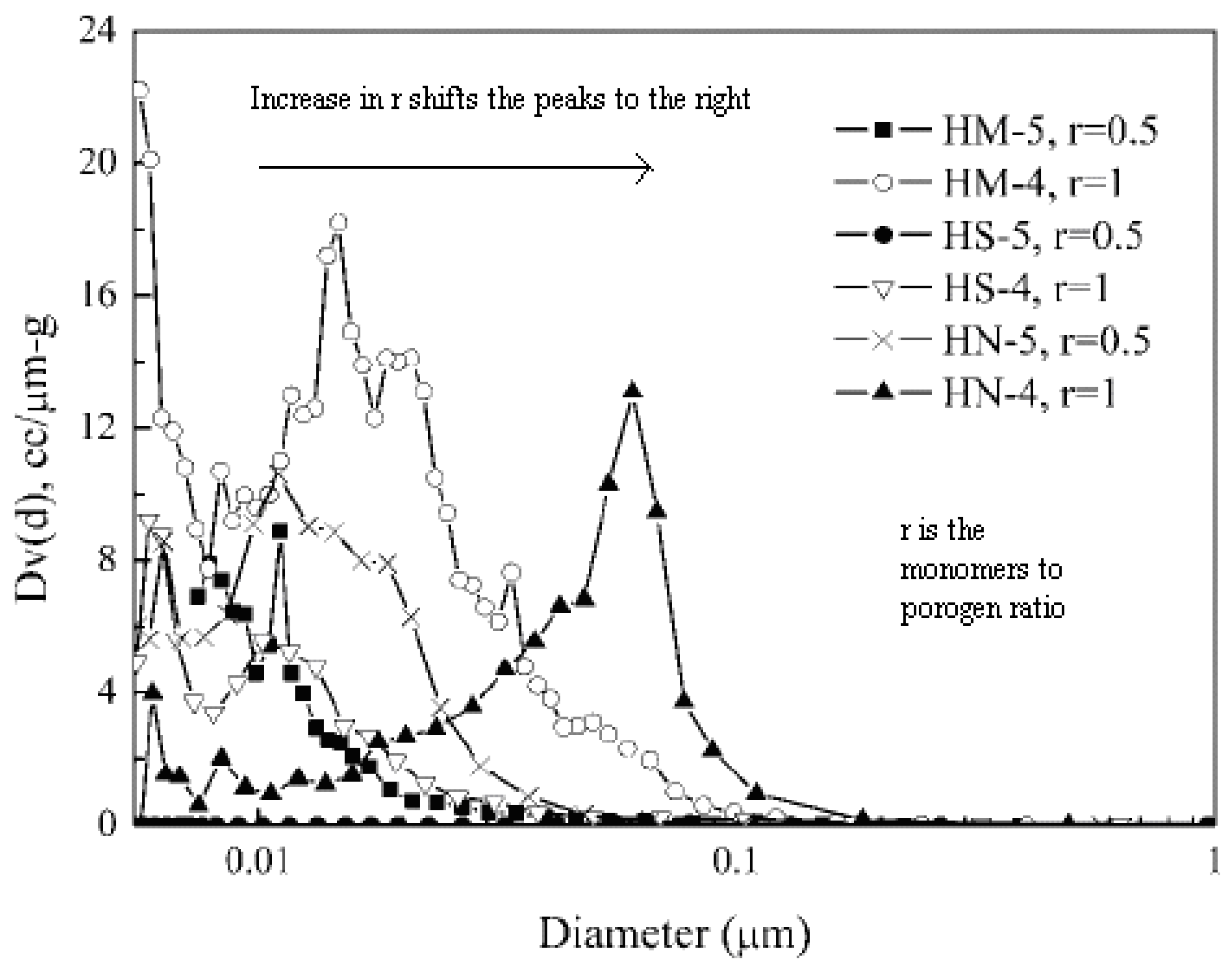
        <p>The volume of the porogenic solvent plays a major role in the structure and morphology of the resins. Previous research indicates that the copolymer resin prepared in the presence of larger amounts of porogen have a looser structure than those obtained with reduced levels of porogen [<xref ref-type="bibr" rid="B39-nanomaterials-02-00163">39</xref>,<xref ref-type="bibr" rid="B43-nanomaterials-02-00163">43</xref>,<xref ref-type="bibr" rid="B44-nanomaterials-02-00163">44</xref>,<xref ref-type="bibr" rid="B45-nanomaterials-02-00163">45</xref>]. In terms of pore formation, <xref ref-type="fig" rid="nanomaterials-02-00163-f004">Figure 4</xref> [<xref ref-type="bibr" rid="B42-nanomaterials-02-00163">42</xref>] illustrates three types of resins produced with higher porogen levels which result in a shift of the PSD toward larger pores (to the right) with greater pore abundance (higher peaks). The resin HS (poly(2-hydroxyethyl methacrylate-<italic>co</italic>-styrene)) has particles with smaller pores; whereas, HN (poly(2-hydroxyethyl methacrylate-<italic>co</italic>-<italic>N</italic>-vinyl-2-pyrrolidone)) particles possess larger pores. Therefore, pore size may be controlled by adjusting the relative porogen ratio. The authors conclude from their results that a lower porogen volume ratio generates fewer pores with a reduced pore size; whereas, a higher volume ratio of porogen contributes to greater numbers of pores with greater pore size. These results are further supported by Liu <italic>et al</italic>. [<xref ref-type="bibr" rid="B46-nanomaterials-02-00163">46</xref>] where greater concentration of 1-chlorodecane reveals that the precipitated phase exhibits limited swelling and the polymer aggregates behave as an immiscible “solid” polymer, similar to bulk microspheres prepared in the absence of porogen. The resulting final pore volume between aggregates should be close to the volume of the non-solvating porogen. In contrast, low levels of 1-chlorodecane yield a precipitated phase that undergoes swelling with a final pore volume less than that of the non-solvating porogen. The relative tuning of solvent porogen composition represents a good technique for tuning PSD.</p>
        <fig id="nanomaterials-02-00163-f004" position="anchor">
          <label>Figure 4</label>
          <caption>
            <p>Pore size distribution of porous HM-poly(2-hydroxyethyl methacrylate-<italic>co</italic>-methyl methacrylate), HS - poly(2-hydroxyethyl methacrylate-<italic>co</italic>-styrene), and HN-poly(2-hydroxyethyl methacrylate-<italic>co</italic>-<italic>N</italic>-vinyl-2-pyrrolidone) particles. r is the ratio of monomer to porogen. PSD shifts to the right side when r increases. (Reprinted (adapted) with permission from [<xref ref-type="bibr" rid="B46-nanomaterials-02-00163">46</xref>]. Copyright 2008 American Chemical Society).</p>
          </caption>
          <graphic xmlns:xlink="http://www.w3.org/1999/xlink" xlink:href="nanomaterials-02-00163-g004.tif"/>
        </fig>
      </sec>
      <sec>
        <title>5.4. Solvent Type</title>
        <p>There are examples of high molecular weight organic porogens and inorganic systems; however, this review is focused on low molecular weight organic solvents in view of the continued research interest in this area. Examples of inorganic porogens of interest include sodium chloride, sodium hydrogen carbonate, silica and supercritical carbon dioxide (SCD). SCD is treated as an inorganic porogen similar to the definition of other carbon halides, sulfides, and oxides as inorganic compounds. SCD is an interesting porogen with versatile tuning capability due to its unique thermodynamic characteristics. Thus, this review will focus on SCD relative to the other types of inorganic porogens.</p>
        <sec>
          <title>5.4.1. Organics</title>
        <sec>
          <title>5.4.1.1. Low Molecular Weight</title>
          <p>Low molecular weight porogenic solvents are mostly used due to the formation of small pores which result in products with high surface area, in addition to their relative ease of removal and low viscosity of their mixtures with monomers [<xref ref-type="bibr" rid="B2-nanomaterials-02-00163">2</xref>,<xref ref-type="bibr" rid="B4-nanomaterials-02-00163">4</xref>,<xref ref-type="bibr" rid="B6-nanomaterials-02-00163">6</xref>,<xref ref-type="bibr" rid="B7-nanomaterials-02-00163">7</xref>,<xref ref-type="bibr" rid="B9-nanomaterials-02-00163">9</xref>,<xref ref-type="bibr" rid="B10-nanomaterials-02-00163">10</xref>,<xref ref-type="bibr" rid="B11-nanomaterials-02-00163">11</xref>,<xref ref-type="bibr" rid="B12-nanomaterials-02-00163">12</xref>,<xref ref-type="bibr" rid="B13-nanomaterials-02-00163">13</xref>,<xref ref-type="bibr" rid="B14-nanomaterials-02-00163">14</xref>,<xref ref-type="bibr" rid="B15-nanomaterials-02-00163">15</xref>]. The opposite is true for high molecular weight porogens [<xref ref-type="bibr" rid="B18-nanomaterials-02-00163">18</xref>,<xref ref-type="bibr" rid="B26-nanomaterials-02-00163">26</xref>] and the influence of such porogens was highlighted in <xref ref-type="sec" rid="sec5dot1-nanomaterials-02-00163">Sections 5.1</xref> to <xref ref-type="sec" rid="sec5dot3-nanomaterials-02-00163">Section 5.3</xref>.</p>
        </sec>
        <sec>
          <title>5.4.1.2. High Molecular Weight</title>
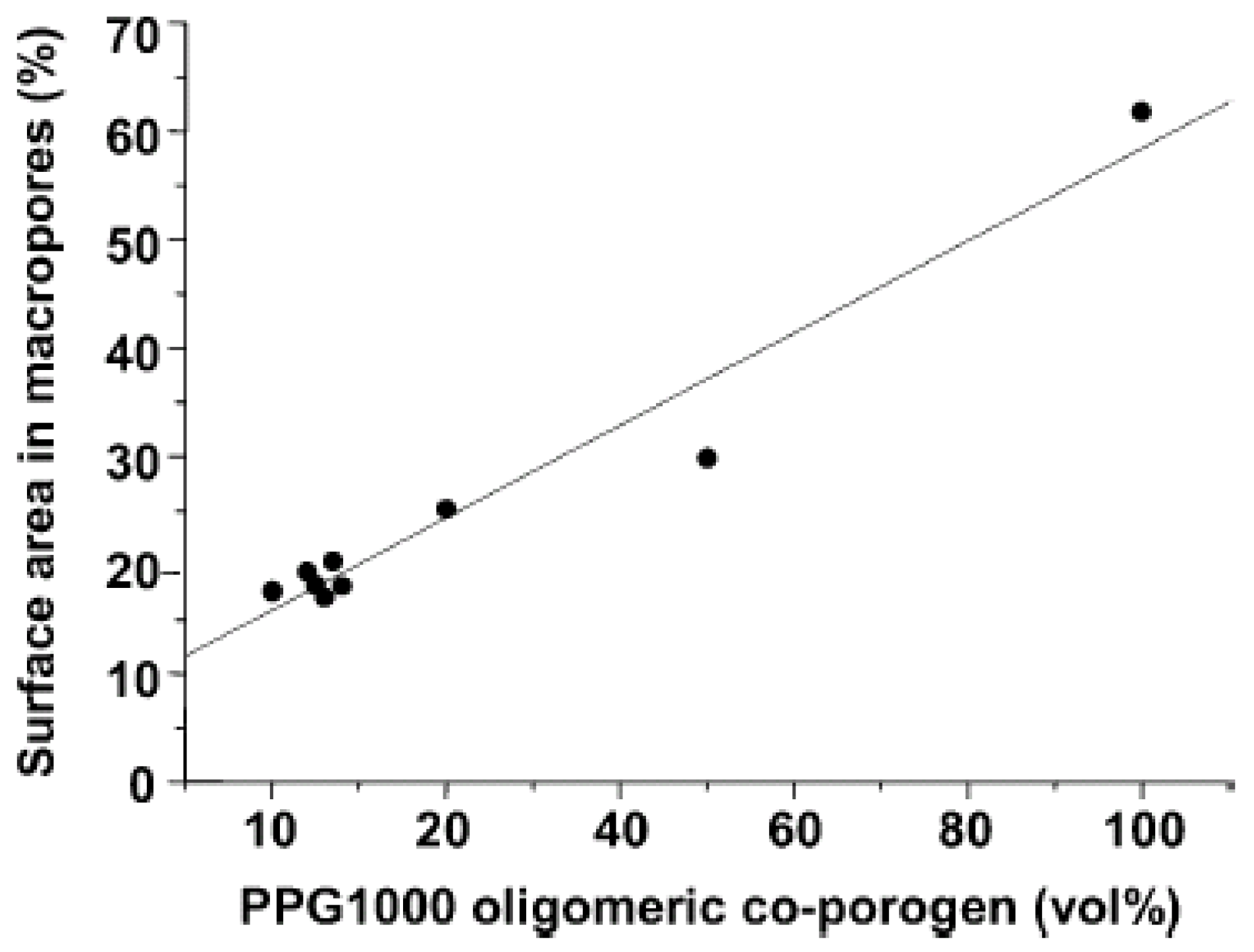
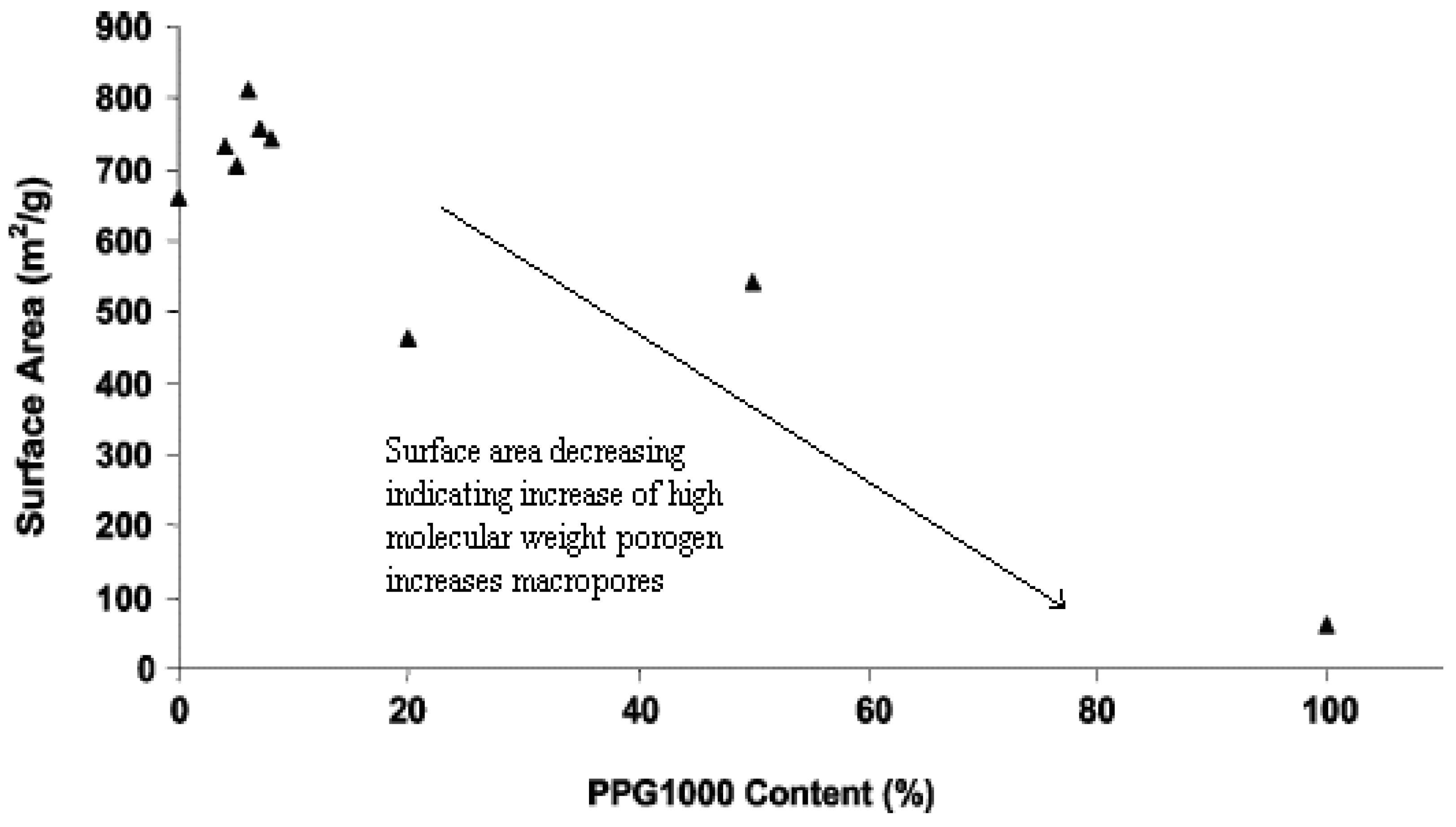
          <p>The viscosity of mixtures of monomers increases sharply with an increase in the porogen molecular weight. This affects the dispersion of droplets during polymerization and even though larger pore sizes were achieved, the pore volumes were relatively low [<xref ref-type="bibr" rid="B18-nanomaterials-02-00163">18</xref>]. Therefore, these porogens are commonly used with a combination of low molecular weight porogens while reducing the polymer porogen to the oligomer size (~5 kDa) regime. An example [<xref ref-type="bibr" rid="B18-nanomaterials-02-00163">18</xref>] using poly (propylene glycol) (PPG) with a molecular weight of ~10<sup>3</sup> Daltons (Da) is mixed with toluene in a divinylbenzene resin. The surface area of the macropores (from mercury porosimetry) and the micropore/mesopore surface area (from nitrogen porosimetry) relationship are shown in <xref ref-type="fig" rid="nanomaterials-02-00163-f005">Figure 5</xref> and <xref ref-type="fig" rid="nanomaterials-02-00163-f006">Figure 6</xref> illustrating results for mixtures of PPG and toluene at different ratios [<xref ref-type="bibr" rid="B18-nanomaterials-02-00163">18</xref>]. The trend observed in <xref ref-type="fig" rid="nanomaterials-02-00163-f004">Figure 4</xref> supports the idea that PPG undergoes phase separation from the resin at early stages resulting in the formation of larger pores and an increase in the surface area of the macropore domains. Surprisingly, the surface area of the micropores/mesopores increase with the addition of small amounts of PPG, as shown in <xref ref-type="fig" rid="nanomaterials-02-00163-f005">Figure 5</xref>. The authors conclude that PPG is unlikely to increase the proportion of small pores and the surface area. A possible explanation is that small pores were already present in the polymer matrix but were inaccessible. The addition of PPG results in larger pores with improved connectivity of the small pores. The use of PPG ~10<sup>3</sup> Da yields a macroporous structure at 100% dilution; whereas, the mixture with toluene yields a mesoporous structure. The use of porogens such as PPG ~4 kDa and poly(dimethylsiloxane) &gt;4 kDa yield polymeric products with an increase in pore size.</p>
        </sec>
        </sec>
        <sec>
          <title>5.4.2. Inorganics</title>
          <p>As stated earlier, various inorganic porogens have been studied such as sodium chloride, silica and sodium hydrogen carbonate but with limited application [<xref ref-type="bibr" rid="B22-nanomaterials-02-00163">22</xref>,<xref ref-type="bibr" rid="B24-nanomaterials-02-00163">24</xref>,<xref ref-type="bibr" rid="B46-nanomaterials-02-00163">46</xref>]. However, SCD [<xref ref-type="bibr" rid="B25-nanomaterials-02-00163">25</xref>,<xref ref-type="bibr" rid="B26-nanomaterials-02-00163">26</xref>,<xref ref-type="bibr" rid="B27-nanomaterials-02-00163">27</xref>,<xref ref-type="bibr" rid="B46-nanomaterials-02-00163">46</xref>] is a particularly interesting inorganic porogen. SCD serves as an alternate type of porogen as compared with conventional solvent porogens that are often challenging to remove from the polymer matrix, polymers that are sensitive to very small changes in the composition of the porogen mixture, or polymeric materials that are highly compressible. Therefore, SCD offers fine control over average pore-sizes and PSD by altering the density of SCD through pressure-temperature conditions.</p>
          <fig id="nanomaterials-02-00163-f005" position="anchor">
            <label>Figure 5</label>
            <caption>
              <p>Plot of the surface area of macropores (%) <italic>vs.</italic> PPG-1000 co-porogen content (vol %) in the dry state for poly(DVB) resins. (Reprinted (adapted) with permission from [<xref ref-type="bibr" rid="B18-nanomaterials-02-00163">18</xref>]. Copyright 2004 American Chemical Society).</p>
            </caption>
            <graphic xmlns:xlink="http://www.w3.org/1999/xlink" xlink:href="nanomaterials-02-00163-g005.tif"/>
          </fig>
          <fig id="nanomaterials-02-00163-f006" position="anchor">
            <label>Figure 6</label>
            <caption>
              <p>Plot of surface area (N<sub>2</sub> BET) <italic>vs.</italic> PPG-1000 co-porogen content (vol %) for dry state poly(DVB) resins showing a maximum ~6 vol% PPG-1000. (Reprinted (adapted) with permission from [<xref ref-type="bibr" rid="B18-nanomaterials-02-00163">18</xref>]. Copyright 2004 American Chemical Society).</p>
            </caption>
            <graphic xmlns:xlink="http://www.w3.org/1999/xlink" xlink:href="nanomaterials-02-00163-g006.tif"/>
          </fig>
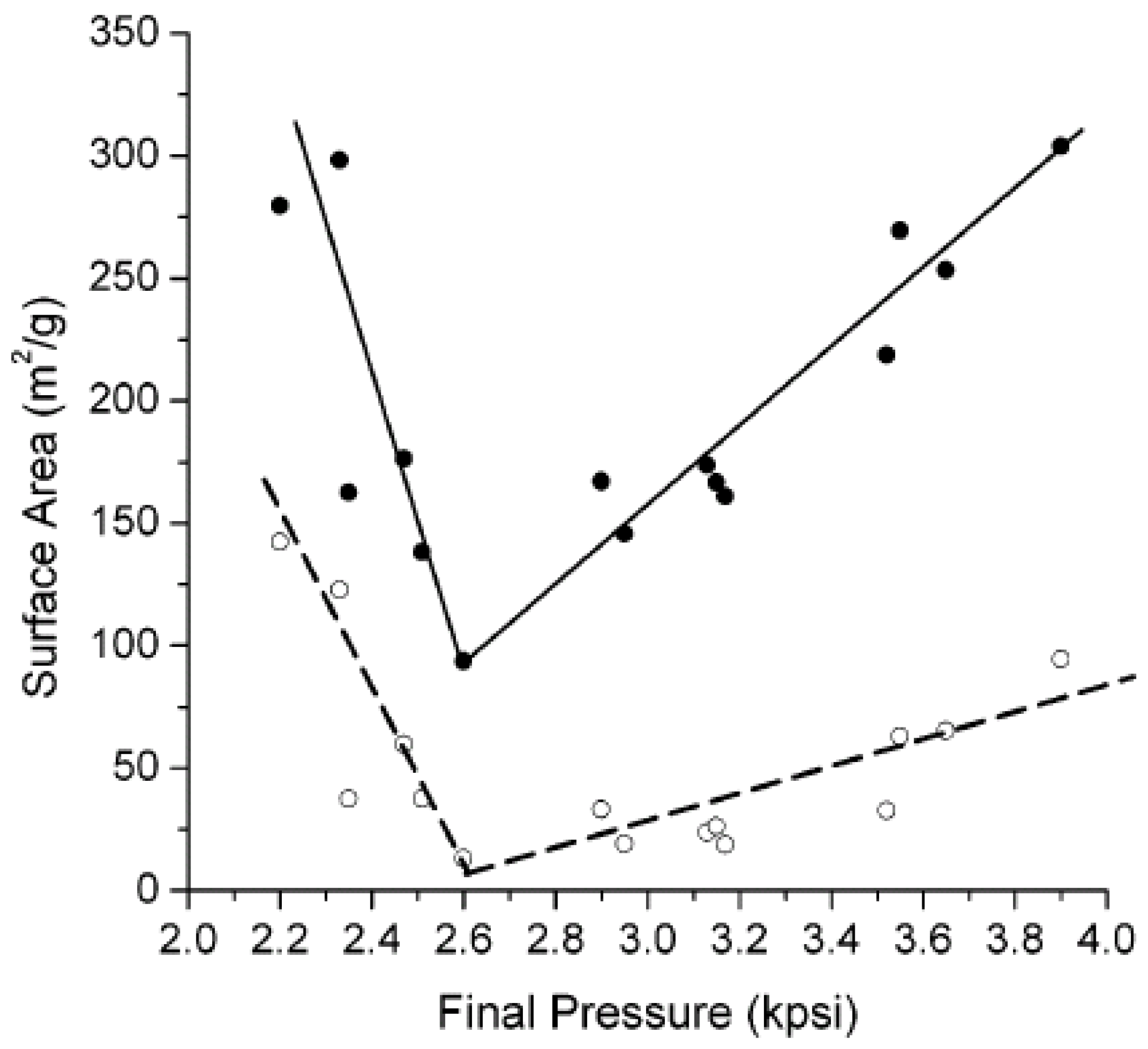
          <p>Cooper and coworkers [<xref ref-type="bibr" rid="B28-nanomaterials-02-00163">28</xref>,<xref ref-type="bibr" rid="B29-nanomaterials-02-00163">29</xref>,<xref ref-type="bibr" rid="B30-nanomaterials-02-00163">30</xref>] are the pioneers of this methodology, as evidenced by their studies on the effect of SCD; where suspension polymerization is carried out in a pressurized reactor containing liquid carbon dioxide. All the other variables are kept constant and only the pressure is varied. The maximum pressure is restricted to the type of reaction vessel in use. The final pressure is variable because (<italic>i</italic>) the thermodynamics of polymerization (<italic>i.e</italic>., exothermic <italic>vs</italic>. endothermic) affect the pressure conditions, (<italic>ii</italic>) thermal equilibrium may not be have been met at the beginning of the reaction, (<italic>iii</italic>) some degree of polymerization may have occurred and (<italic>iv</italic>) the solutions are not ideal which was confirmed by the variation of change in molar volume (mixing of co-monomers and liquid carbon dioxide) as a function of initial pressure conditions. The porogen was removed through depressurization of the reaction mixture because of its unique P-T behaviour. <italic>In situ</italic> supercritical fluid extraction can be used to remove residual monomers where the relative surface area and micropore structure varies with changes in the final pressure, as shown in <xref ref-type="fig" rid="nanomaterials-02-00163-f007">Figure 7</xref> and <xref ref-type="fig" rid="nanomaterials-02-00163-f008">Figure 8</xref> [<xref ref-type="bibr" rid="B30-nanomaterials-02-00163">30</xref>].</p>
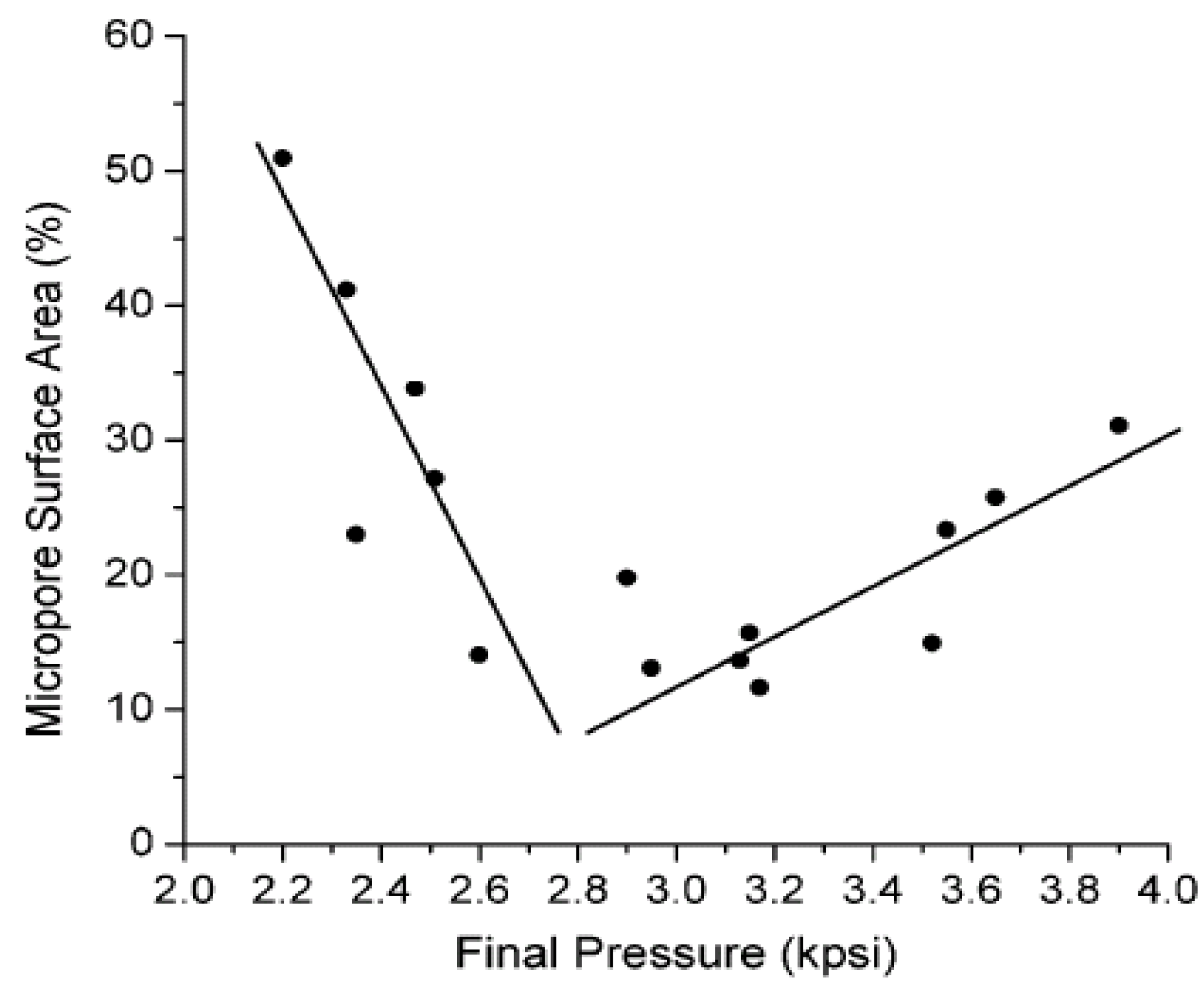
          <p><xref ref-type="fig" rid="nanomaterials-02-00163-f007">Figure 7</xref> shows that the total BET and micropore surface area decreases at pressure conditions of 2200–2600 psi and increases between 2600–4000 psi. The same trend is observed in <xref ref-type="fig" rid="nanomaterials-02-00163-f008">Figure 8</xref> for the percentage of micropore surface area relative to the total surface area. The results indicate that phase separation of SCD from the resin occurs at early stages for conditions between 2200–2600 psi. The opposite case is true between 2600–4000 psi and is supported by the results for conventional solvent porogens, as outlined in <xref ref-type="sec" rid="sec5dot1-nanomaterials-02-00163">Section 5.1 to <xref ref-type="sec" rid="sec5dot3-nanomaterials-02-00163">Section 5.3</xref></xref>. According to the authors, the solvation strength of carbon dioxide increases due to an increase in pressure ~ 2600–4000 psi, due to changes in its density.</p>
          <p>Moreover, the overall solvent properties of SCD change with an increase in pressure similar to the change in conventional solvent properties, as described in <xref ref-type="sec" rid="sec5dot1-nanomaterials-02-00163">Section 5.1</xref>, and parallels the change in the properties of the resins. The exclusive relationship of an increasing SP of SCD with an increase in pressure is limited in its interpretive value, as indicated by Hamedi and Danner [<xref ref-type="bibr" rid="B47-nanomaterials-02-00163">47</xref>]. The relationship does not account for the changes in surface area with an increase in pressure conditions. The surface area will increase or decrease in one direction with an increase in SP. This raises some questions about the potential effect of solvent polarity of SCD with changes in its properties on the mechanism of pore formation with resins [<xref ref-type="bibr" rid="B47-nanomaterials-02-00163">47</xref>]. Coupled with the effect of dipolar interactions for Hansen’s three-component solubility parameter, an improved interpretation of the latter mechanism may be possible, and illustrates another knowledge gap to drive further research to address such questions.</p>
          <fig id="nanomaterials-02-00163-f007" position="anchor">
            <label>Figure 7</label>
            <caption>
              <p>Variation in the total BET surface area (●) and micropore surface area (о) of trimethylolpropane trimethacrylate as a function of the CO<sub>2</sub> final pressure. (Reprinted (adapted) with permission from [<xref ref-type="bibr" rid="B30-nanomaterials-02-00163">30</xref>]. Copyright 2004 American Chemical Society).</p>
            </caption>
            <graphic xmlns:xlink="http://www.w3.org/1999/xlink" xlink:href="nanomaterials-02-00163-g007.tif"/>
          </fig>
        <fig id="nanomaterials-02-00163-f008" position="anchor">
          <label>Figure 8</label>
          <caption>
            <p>Variation of the percentage of micropore surface area (<italic>i.e</italic>., micropore area/total surface area × 100) of trimethylolpropane trimethacrylate as a function of the final pressure of CO<sub>2</sub>. (Reprinted (adapted) with permission from [<xref ref-type="bibr" rid="B30-nanomaterials-02-00163">30</xref>]. Copyright 2004 American Chemical Society).</p>
          </caption>
          <graphic xmlns:xlink="http://www.w3.org/1999/xlink" xlink:href="nanomaterials-02-00163-g008.tif"/>
        </fig>
        </sec>
        </sec>
      </sec>
    <sec>
      <title>6. Property Changes</title>
      <sec>
        <title>6.1. Porosity</title>
        <p>The variation of the surface area, pore volume and pore sizes for different types of PCR materials due to variations in porogenic solvents was discussed in this review with limited commentary on PSD. The tuning of PCR materials can yield three categories of polymers; micro-, meso- and macroporous resins. <xref ref-type="fig" rid="nanomaterials-02-00163-f002">Figure 2</xref> in ref. [<xref ref-type="bibr" rid="B16-nanomaterials-02-00163">16</xref>] shows an example from non-solvating pure solvent (2-ethylhexanol) and a solvating diluent (toluene), respectively [<xref ref-type="bibr" rid="B16-nanomaterials-02-00163">16</xref>]. The PSD characteristics of PCR materials are clearly seen by the shift from a bimodal to a unimodal distribution. The general mechanism of pore formation speculates that larger pores are formed for non-solvating diluents over solvating diluents, but not for bimodal size distributions. One may speculate that the SP does not remain constant but varies continuously during polymerization when mixtures of solvents undergo phase separation, resulting in bimodal distributions. In contrast, the addition of a non-solvating diluent (DMF) to 2-ethylhexanol causes a shift from a bimodal to a unimodal distribution (<italic>cf</italic>. <xref ref-type="fig" rid="nanomaterials-02-00163-f003">Figure 3</xref> in ref. [<xref ref-type="bibr" rid="B16-nanomaterials-02-00163">16</xref>]). The conclusion is speculative since there is strong support that solvent properties apart from SP (although dispersive, dipolar interactions and H-bonding are included in Hansen’s model), are generally unaccounted for in many studies. Therefore, solvent/monomer and solvent/polymer interactions need to be further studied in a systematic fashion to understand the pore formation mechanism. Unimodal and bimodal behaviour was similarly observed in other studies for different PCR materials [<xref ref-type="bibr" rid="B27-nanomaterials-02-00163">27</xref>,<xref ref-type="bibr" rid="B43-nanomaterials-02-00163">43</xref>]. With the aid of tuning experimental variables, as discussed herein, tunable bimodal distribution may be achieved.</p>
      </sec>
      <sec>
        <title>6.2. Morphology</title>
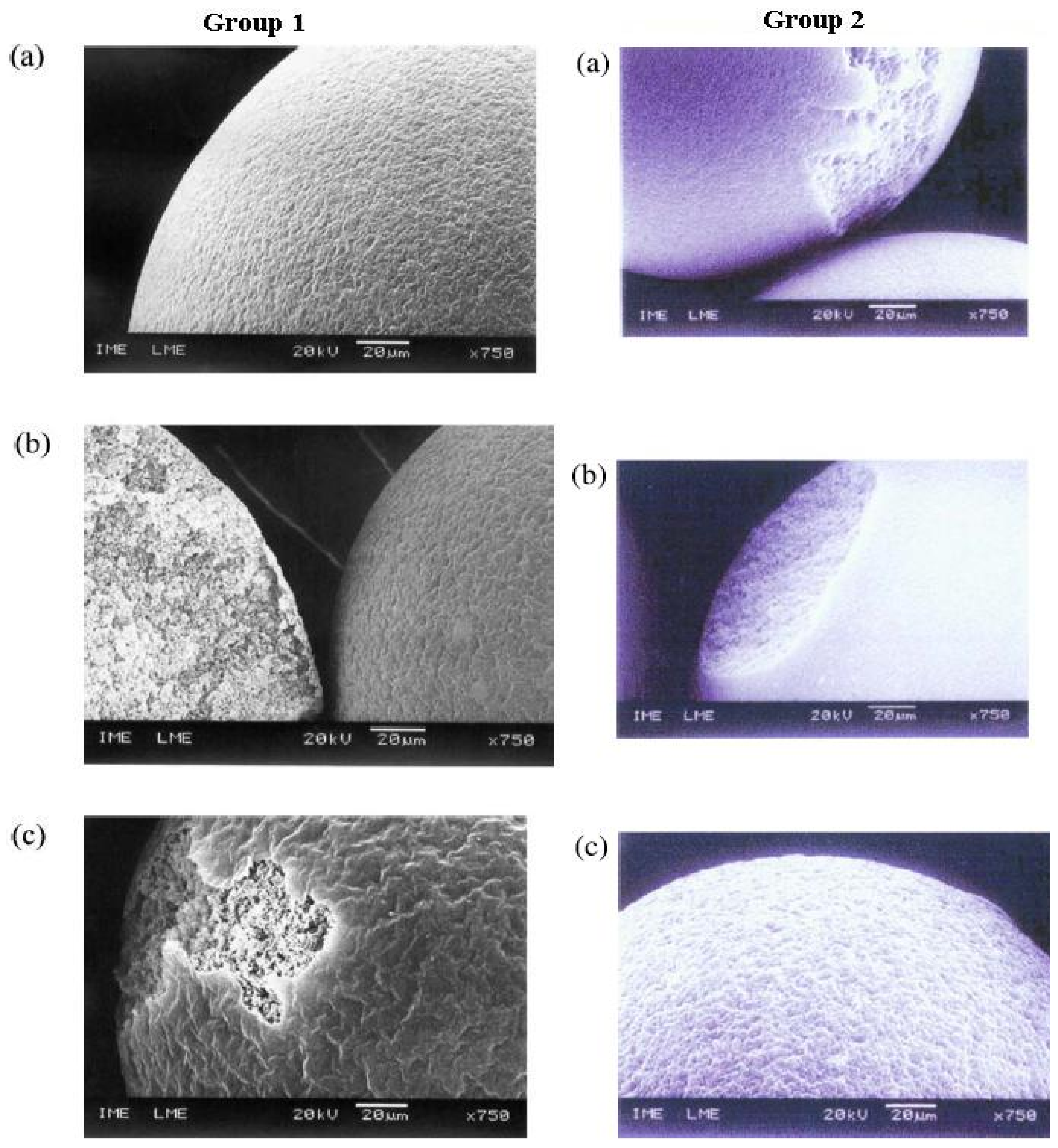
        <p>The morphological properties PCR materials have been reported in various ways. In one case, Ortiz-Palacios and coworkers [<xref ref-type="bibr" rid="B2-nanomaterials-02-00163">2</xref>] argued that solvating diluents retain their individuality as microgels (microspheres), according to the general pore formation mechanism of porogenic solvents. This phenomenon renders the appearance of the morphology of the resin as smooth from the outside and rough on the inside due to micropore formation. The opposite is true for non-solvating diluents where the interior appears dense due to the lack of pore structure. On the contrary, de Santa Maria and coworkers [<xref ref-type="bibr" rid="B48-nanomaterials-02-00163">48</xref>] argue that a solvating diluent will increase porosity; hence, the surface of the resins will appear rough in appearance. There are differences in the appearance of PCR-based materials on the outer surfaces according to the nature of the solvent. The apparent contradiction may be due to the chemical type of PCR material. Ortiz-Palacios and coworkers [<xref ref-type="bibr" rid="B2-nanomaterials-02-00163">2</xref>] studied the styrene-<italic>co</italic>-divinylbenzene resin while de Santa Maria <italic>et al</italic>. [<xref ref-type="bibr" rid="B48-nanomaterials-02-00163">48</xref>] studied 2-vinylpyridine-<italic>co</italic>-styrene-co-divinylbenzene. In support of this, Lin and coworkers [<xref ref-type="bibr" rid="B49-nanomaterials-02-00163">49</xref>] used a solvating diluent which resulted in a smooth and regular surface. The appearance became rough upon addition of another copolymer. <xref ref-type="fig" rid="nanomaterials-02-00163-f009">Figure 9</xref> illustrates an example of the rough (Group 1) and smooth surfaces (Group 2) of the PCR materials at variable porogen composition. This observation was recently explained by Scheler [<xref ref-type="bibr" rid="B50-nanomaterials-02-00163">50</xref>] where he concluded that Hansen’s SP value changed during polymerization due to changes in the composition of the porogenic solvent mixture. The affinity between the resins and the evolving solvent composition, decreases or increases, during polymerization. This leads to differences in the morphology of the PCR materials.</p>
      </sec>
    </sec>
    <sec id="sec7-nanomaterials-02-00163">
      <title>7. Hansen Solubility Parameter</title>
      <p>The three-component Hansen’s SP is a more useful criterion relative to the one- and two-component SP, as concluded by Rabelo and Coutinho [<xref ref-type="bibr" rid="B34-nanomaterials-02-00163">34</xref>]. In their research, they compared the one- and three-component SP values for the formation of styrene-<italic>co</italic>-divinylbenzene copolymer resins. <xref ref-type="table" rid="nanomaterials-02-00163-t003">Table 3</xref> shows their findings and their classification of the solvents according to “good”, intermediary, and “bad” solvents using Equation (1) and (4) for the one- and three-component SP, respectively. <xref ref-type="table" rid="nanomaterials-02-00163-t004">Table 4</xref> shows the textural properties of the resin for the solvents described in <xref ref-type="table" rid="nanomaterials-02-00163-t003">Table 3</xref>.</p>
      <p>The resins with high surface area and low average pore diameter indicate a “good” solvent, <italic>i.e.</italic>, solvating diluent. The results in <xref ref-type="table" rid="nanomaterials-02-00163-t003">Table 3</xref> infer that a one-component SP value does not adequately explain the properties of the resin, as shown in <xref ref-type="table" rid="nanomaterials-02-00163-t004">Table 4</xref>. In contrast, the three-component SP is a better predictor; however, some discrepancies are observed for diethyl phthalate, diisobutyl phthalate and dioctyl phthalate. These solvents yield mesopores with smaller size distributions than acetaphenone and toluene, as expected, according to the prediction of both one- and three-component SP values. The authors interpreted the results arising from differences in molar volume (<italic>V<sub>m</sub></italic>) of the solvents, where <italic>V<sub>m</sub></italic> is proportional to the enthalpy of mixing, as seen in Equation (7).</p>
      <p><inline-graphic xmlns:xlink="http://www.w3.org/1999/xlink" xlink:href="nanomaterials-02-00163-i007.tif"/></p>
      <p>Δ<italic>H<sub>m</sub></italic> is the enthalpy of mixing, <italic>V</italic> is the volume of the mixture, <italic>φ</italic><sub>1</sub> and <italic>φ</italic><sub>2 </sub>are the volume fractions of the two porogens, and <italic>δ</italic><sub>1</sub> and <italic>δ</italic><sub>2 </sub>are their respective SP values. As the magnitude of <italic>V<sub>m</sub></italic> increases, the enthalpy of mixing increases which affects the free energy of mixing, as shown in Equation (8).</p>
      <p><inline-graphic xmlns:xlink="http://www.w3.org/1999/xlink" xlink:href="nanomaterials-02-00163-i008.tif"/></p>
      <p>Δ<italic>G<sub>m</sub></italic> is molar free energy of mixing, ΔS<sub>m </sub>is the molar entropy change of mixing, and T is the absolute temperature. Δ<italic>S<sub>m</sub></italic> depends on the degree of polymerization, dispersion, aggregation and phase separation effects. An understanding of the enthalpy effects alone do not fully account for the interpretation of the trends observed because the value of Δ<italic>S<sub>m</sub></italic> is also required for the process. As outlined in <xref ref-type="sec" rid="sec5-nanomaterials-02-00163">Section 5</xref>, other research has failed to adequately explain the observations using the SP approach until Scheler [<xref ref-type="bibr" rid="B50-nanomaterials-02-00163">50</xref>] suggested a potential explanation for the discrepancies. He observed that the solubility of the initiator such as AIBN dissolved in the porogenic solvent is equally important. Solvents that have comparatively low solubility for the initiator may influence migration of the initiator into the surface layers of the growing polymer nuclei, promoting further polymerization, and propagation. As a consequence, the interparticle voids are shrunken, and mesopores are converted into micropores.</p>
        <fig id="nanomaterials-02-00163-f009" position="anchor">
          <label>Figure 9</label>
          <caption>
            <p><bold>Group 1</bold>: SEM micrographs of the resins prepared with 150 % dilution using <italic>n</italic>-heptane/toluene as a diluent system at variable 2-vinyl pyridine/styrene/divinylbenzene ratios; (<bold>a</bold>) 30/4030;(<bold>b</bold>) 40/30/30 and (<bold>c</bold>) 50/20/30. <bold>Group 2</bold>: SEM micrographs of the resins synthesized with 100% dilution using <italic>n</italic>-heptane/ethyl acetate as a diluent system at 2-vinyl pyridine/styrene/divinylbenzene ratios; (<bold>a</bold>) 30/4030;(<bold>b</bold>) 40/30/30 and (<bold>c</bold>) 50/20/30. (Reprinted from [<xref ref-type="bibr" rid="B48-nanomaterials-02-00163">48</xref>], Copyright 2004, with permission from Elsevier).</p>
          </caption>
          <graphic xmlns:xlink="http://www.w3.org/1999/xlink" xlink:href="nanomaterials-02-00163-g009.tif"/>
        </fig>
      <table-wrap id="nanomaterials-02-00163-t003" position="anchor">
        <object-id pub-id-type="pii">nanomaterials-02-00163-t003_Table 3</object-id>
        <label>Table 3</label>
        <caption>
          <p>Prediction of porogenic solvents in terms of one- and three-component SP criteria; relative energy difference (RED) is calculated using Equation 3. (Data obtained from [<xref ref-type="bibr" rid="B34-nanomaterials-02-00163">34</xref>]).</p>
        </caption>
        <table rules="all" style="border:solid thin">
<thead>
            <tr>
              <th colspan="3" align="center" valign="middle">One-component</th>
              <th colspan="3" align="center" valign="middle">Three-component</th>
            </tr>
          </thead>
          <tbody>
            <tr>
              <td align="center" valign="middle">Solvent</td>
              <td align="center" valign="middle">|Δδ| MPa<sup>0.5</sup></td>
              <td align="center" valign="middle">Prediction</td>
              <td align="center" valign="middle">Solvent</td>
              <td align="center" valign="middle">RED</td>
              <td align="center" valign="middle">Prediction</td>
            </tr>
            <tr>
              <td align="center" valign="middle">Ethyl acetate</td>
              <td align="center" valign="middle">0.2</td>
              <td rowspan="4" align="center" valign="middle">“Good” solvents 
              <italic>i.e.</italic>, |Δδ| &lt; 1.0</td>
              <td align="center" valign="middle">Acetophenone</td>
              <td align="center" valign="middle">0.28</td>
              <td rowspan="6" align="center" valign="middle">“Good” solvents 
              <italic>i.e.</italic>, |Δδ| &lt; 1.0</td>
            </tr>
            <tr>
              <td align="center" valign="middle">Toluene</td>
              <td align="center" valign="middle">0.4</td>
              <td align="center" valign="middle">Diisobutyl phthalate</td>
              <td align="center" valign="middle">0.59</td>
            </tr>
            <tr>
              <td align="center" valign="middle">Diisobutyl phthalate</td>
              <td align="center" valign="middle">0.4</td>
              <td align="center" valign="middle">Toluene</td>
              <td align="center" valign="middle">0.65</td>
            </tr>
            <tr>
              <td align="center" valign="middle">Decaline</td>
              <td align="center" valign="middle">0.6</td>
              <td align="center" valign="middle">Diethyl phthalate</td>
              <td align="center" valign="middle">0.65</td>
            </tr>
            <tr>
              <td align="center" valign="middle">Butyl acetate</td>
              <td align="center" valign="middle">1.2</td>
              <td rowspan="7" align="center" valign="middle">Intermediary solvents 
              <italic>i.e.</italic>, 1.0 |Δδ| &lt; 3.0</td>
              <td align="center" valign="middle">Decaline</td>
              <td align="center" valign="middle">0.73</td>
            </tr>
            <tr>
              <td align="center" valign="middle">Methyl-isobutyl ketone</td>
              <td align="center" valign="middle">1.4</td>
              <td align="center" valign="middle">Dioctyl phthalate</td>
              <td align="center" valign="middle">0.75</td>
            </tr>
            <tr>
              <td align="center" valign="middle">Diethyl phthalate</td>
              <td align="center" valign="middle">1.8</td>
              <td align="center" valign="middle">Benzyl alcohol</td>
              <td align="center" valign="middle">0.87</td>
              <td rowspan="5" align="center" valign="middle">Intermediary solvents, 
              <italic>i.e.</italic>, 1.0 |Δδ| &lt; 3.0</td>
            </tr>
            <tr>
              <td align="center" valign="middle">Isoamyl alcohol</td>
              <td align="center" valign="middle">1.9</td>
              <td align="center" valign="middle">Ethyl acetate</td>
              <td align="center" valign="middle">0.90</td>
            </tr>
            <tr>
              <td align="center" valign="middle">Dioctyl phthalate</td>
              <td align="center" valign="middle">2.4</td>
              <td align="center" valign="middle">Butyl acetate</td>
              <td align="center" valign="middle">0.90</td>
            </tr>
            <tr>
              <td align="center" valign="middle">Isoamyl acetate</td>
              <td align="center" valign="middle">2.6</td>
              <td align="center" valign="middle">Methyl-isobutyl ketone</td>
              <td align="center" valign="middle">0.94</td>
            </tr>
            <tr>
              <td align="center" valign="middle">Acetophenone</td>
              <td align="center" valign="middle">3.1</td>
              <td align="center" valign="middle">Isoamyl alcohol</td>
              <td align="center" valign="middle">0.98</td>
            </tr>
            <tr>
              <td align="center" valign="middle">Heptane</td>
              <td align="center" valign="middle">3.5</td>
              <td rowspan="2" align="center" valign="middle">“Bad” solvents 
              <italic>i.e.</italic>, |Δδ| &gt; 3.0</td>
              <td align="center" valign="middle">Heptane</td>
              <td align="center" valign="middle">1.10</td>
              <td rowspan="2" align="center" valign="middle">“Bad” solvents 
              <italic>i.e.</italic>, |Δδ| &gt; 3.0</td>
            </tr>
            <tr>
              <td align="center" valign="middle">Benzyl alcohol</td>
              <td align="center" valign="middle">6.1</td>
              <td align="center" valign="middle">Isoamyl alcohol</td>
              <td align="center" valign="middle">1.13</td>
            </tr>
          </tbody>
        </table>
      </table-wrap>
      <table-wrap id="nanomaterials-02-00163-t004" position="anchor">
        <object-id pub-id-type="pii">nanomaterials-02-00163-t004_Table 4</object-id>
        <label>Table 4</label>
        <caption>
          <p>Porosity properties of styrene-<italic>co</italic>-divinylbenzene synthesized with different porogenic solvents. The parameters are obtained from nitrogen porosimetry (Data obtained from [<xref ref-type="bibr" rid="B34-nanomaterials-02-00163">34</xref>]).</p>
        </caption>
        <table rules="all" style="border:solid thin">
<thead>
            <tr>
              <th align="center" valign="middle">Solvent</th>
              <th align="center" valign="middle">Fixed pore volume (cm<sup>3</sup>/g)</th>
              <th align="center" valign="middle">Surface area (m<sup>2</sup>/g)</th>
              <th align="center" valign="middle">Average pore diameter (nm)</th>
            </tr>
          </thead>
          <tbody>
            <tr>
              <td align="left" valign="middle">Diethyl phthalate</td>
              <td align="center" valign="middle">0.47</td>
              <td align="center" valign="middle">149</td>
              <td align="center" valign="middle">12.6</td>
            </tr>
            <tr>
              <td align="left" valign="middle">Benzyl alcohol</td>
              <td align="center" valign="middle">0.65</td>
              <td align="center" valign="middle">110</td>
              <td align="center" valign="middle">23.6</td>
            </tr>
            <tr>
              <td align="left" valign="middle">Diisobutyl phthalate</td>
              <td align="center" valign="middle">0.57</td>
              <td align="center" valign="middle">83</td>
              <td align="center" valign="middle">27.5</td>
            </tr>
            <tr>
              <td align="left" valign="middle">Dioctyl phthalate</td>
              <td align="center" valign="middle">0.88</td>
              <td align="center" valign="middle">75</td>
              <td align="center" valign="middle">46.9</td>
            </tr>
            <tr>
              <td align="left" valign="middle">Heptane</td>
              <td align="center" valign="middle">0.99</td>
              <td align="center" valign="middle">68</td>
              <td align="center" valign="middle">58.2</td>
            </tr>
            <tr>
              <td align="left" valign="middle">Isoamyl acetate</td>
              <td align="center" valign="middle">0.34</td>
              <td align="center" valign="middle">30</td>
              <td align="center" valign="middle">45.3</td>
            </tr>
            <tr>
              <td align="left" valign="middle">Isoamyl alcohol</td>
              <td align="center" valign="middle">1.00</td>
              <td align="center" valign="middle">7</td>
              <td align="center" valign="middle">143</td>
            </tr>
            <tr>
              <td align="left" valign="middle">Toluene</td>
              <td align="center" valign="middle">0.01</td>
              <td align="center" valign="middle">0</td>
              <td align="center" valign="middle">–</td>
            </tr>
            <tr>
              <td align="left" valign="middle">Acetophenone</td>
              <td align="center" valign="middle">0.06</td>
              <td align="center" valign="middle">0</td>
              <td align="center" valign="middle">–</td>
            </tr>
            <tr>
              <td align="left" valign="middle">Methyl-isobutyl ketone</td>
              <td align="center" valign="middle">0.06</td>
              <td align="center" valign="middle">0</td>
              <td align="center" valign="middle">–</td>
            </tr>
            <tr>
              <td align="left" valign="middle">Decaline</td>
              <td align="center" valign="middle">0.12</td>
              <td align="center" valign="middle">0</td>
              <td align="center" valign="middle">–</td>
            </tr>
            <tr>
              <td align="left" valign="middle">Ethyl acetate</td>
              <td align="center" valign="middle">0.13</td>
              <td align="center" valign="middle">–</td>
              <td align="center" valign="middle">–</td>
            </tr>
            <tr>
              <td align="left" valign="middle">Butyl acetate</td>
              <td align="center" valign="middle">0.41</td>
              <td align="center" valign="middle">–</td>
              <td align="center" valign="middle">–</td>
            </tr>
          </tbody>
        </table>
      </table-wrap>
    </sec>
    <sec id="sec8-nanomaterials-02-00163">
      <title>8. Knowledge Gaps</title>
      <p>The tuning of PCR materials with porogenic solvents results in products with remarkable properties but there are some knowledge gaps identified herein that are recommended for further study. One of the gaps is the discrepancy of some results that are yet unaccounted for by the SP criteria. Although this has recently been addressed by Scheler [<xref ref-type="bibr" rid="B50-nanomaterials-02-00163">50</xref>] by accounting for the initiator solubility in porogenic solvent(s), it is anticipated to play a major role in the kinetics and thermodynamics of polymerization phenomena. The relationship between the initiator solubility and the resin properties require further research to support Scheler’s results. Rabelo and Coutinho [<xref ref-type="bibr" rid="B34-nanomaterials-02-00163">34</xref>] pointed out that molar volume prevails as a criterion of the SP since it is a measure of the solvating strength; however, the research is limited by the systematic correlations between V<sub>m</sub> and SP. Secondly, the SP value is used for matching the resins and the solvent(s) at standard temperature conditions; however, polymerization often occurs at elevated temperatures ~60–80 <sup>o</sup>C. Since the SP value is anticipated to change with temperature, a better matching of SP values should be calculated for <italic>in-situ</italic> polymerization temperature conditions [<xref ref-type="bibr" rid="B36-nanomaterials-02-00163">36</xref>,<xref ref-type="bibr" rid="B51-nanomaterials-02-00163">51</xref>]. Polarity is also temperature dependent; therefore, an improved knowledge of the solubility parameters for monomers, initiator, and polymer needs to be considered. Thirdly, the use of SP values to account for experimental results described in this review did not reliably address the accuracy of estimates for SP values of resin products. In general, estimates are typically obtained from the theoretical SP values in Hansen’s book [<xref ref-type="bibr" rid="B36-nanomaterials-02-00163">36</xref>]. Copolymers may behave differently depending on the nature of the co-monomers, relative composition, and the type of porogens employed [<xref ref-type="bibr" rid="B51-nanomaterials-02-00163">51</xref>]. There are different methods for estimating SP values of polymers including turbidimetry [<xref ref-type="bibr" rid="B52-nanomaterials-02-00163">52</xref>,<xref ref-type="bibr" rid="B53-nanomaterials-02-00163">53</xref>,<xref ref-type="bibr" rid="B54-nanomaterials-02-00163">54</xref>,<xref ref-type="bibr" rid="B55-nanomaterials-02-00163">55</xref>], intrinsic velocity [<xref ref-type="bibr" rid="B56-nanomaterials-02-00163">56</xref>], and the QSPR model [<xref ref-type="bibr" rid="B57-nanomaterials-02-00163">57</xref>]. The predicted results may vary considerably if more accurate estimates of SP values for the resins are used rather than the approximate values derived from tabulated values in handbooks. The accuracy of SP values has significant implication with respect to surface effect in PCR materials. It is generally underestimated in the literature how surface effects in PCR materials influence the pore formation mechanism, and should be considered in future research. Fourthly, the relationship to the variable morphology of the resins is not clear and whether the types of co-monomer, porogen, or both, are determinant factors. Further systematic studies are required to establish correlations. Finally, the relative influence of the thermodynamics and kinetics of pore formation in the formation of PCR materials is poorly understood at present, and further research is required to develop a more detailed understanding. One may assume that the formation of PCR materials is kinetically controlled by the slow separation of the constituent phases in favor individual microgel/microsphere domains. The other assumption is that it is governed by thermodynamic effects since the SP value is a key criterion for determining the final properties of the resin. </p>
    </sec>
    <sec sec-type="conclusions">
      <title>9. Conclusions</title>
      <p>Porous copolymer resin (PCR) materials are synthesized via suspension polymerization with variable textural properties by tuning the polymerization reaction with solvents which act as porogens. Porogenic solvents yield significant changes in the surface area, porosity, pore volume and morphology of the polymeric materials. The changes in physicochemical properties are attributed to the mutual solubility characteristics of the solvents, monomer units, and the polymeric resins. The closer the match of their mutual solubility parameters results in PCR materials with smaller pores and greater surface area. PCR materials with opposite characteristics are found for solvents with poor immiscibility and solubility.</p>
      <p>Solvent tenability is possible by varying the relative solvent composition for mixtures, in accordance with Young’s rule. The solvent effect observed for PCR materials is thermodynamic (<italic>i.e</italic>., enthalpic) in nature and strongly correlates with the relative molar volume of the porogen solvent. The relative porogen size is not a comprehensive criterion for predicting the porogen properties of low molecular weight solvents; however, size effects are observed for oligomeric solvents such as PPG. Hansen’s three-component SP offers a better criterion for explaining the choice of the solvent system for yielding resin materials with different pore-structure properties. In some cases, there are discrepancies in the pore structure properties which may be attributed to the non-ideality of mixing (<italic>i.e</italic>., enthalpy and volume). Also, the importance of initiator solubility, steric effects due to H-bonding, and the relative immiscibility of monomer units are important considerations. Insolubility of the initiator is a recent finding that was unreported prior to 2007. Its importance relates to kinetic effects in the mechanism of formation of PCR materials. Hansen’s three-component SP provides a thermodynamic basis for understanding the mechanism of PCR-based materials.</p>
      <p>The variation of resin morphology has been ignored for years, and was recently attributed to the temporal variation of the solvent mixture composition as the polymerization process proceeds. The general mechanism does not explain the origin of the bimodal PSD for low molecular weight solvents, such as 2-ethylhexanol, wherein; the effect disappears upon addition of a second solvent. The occurrence of surface effects for immiscible components is anticipated to contribute to considerable variation in the PSD. Therefore, the nature of solvent/polymer, solvent/monomer(s) and solvent/initiator interactions need to be further understood, and their relationship to the stabilization of the metastable structures, and final PCR products. Further research in this area will contribute to an improved understanding of the mechanism of the formation of PCR materials, and contribute to the development of tunable novel materials with versatile properties for a wide range of applications.</p>
    </sec>
  </body>
  <back>
    <ack>
      <title>Acknowledgments</title>
      <p>MHM acknowledges the Natural Sciences and Engineering Research Council (NSERC) for the award of a Visiting Fellowship in Canadian Government Laboratory and the authors gratefully acknowledge the University of Saskatchewan and Environment Canada for supporting this research.</p>
    </ack>
    <ref-list>
      <title>References</title>
      <ref id="B1-nanomaterials-02-00163">
        <label>1.</label>
        <citation citation-type="journal">
          <person-group person-group-type="author">
            <name>
              <surname>Rajiv Gandhi</surname>
              <given-names>M.</given-names>
            </name>
            <name>
              <surname>Viswanathan</surname>
              <given-names>N.</given-names>
            </name>
            <name>
              <surname>Meenakshi</surname>
              <given-names>S.</given-names>
            </name>
          </person-group>
          <article-title>Synthesis and characterization of a few amino-functionalized copolymeric resins and their environmental applications</article-title>
          <source>Ind. Eng. Chem. Res.</source>
          <year>2012</year>
          <volume>51</volume>
          <fpage>5677</fpage>
          <lpage>5684</lpage>
          <pub-id pub-id-type="doi">10.1021/ie3000503</pub-id>
        </citation>
      </ref>
      <ref id="B2-nanomaterials-02-00163">
        <label>2.</label>
        <citation citation-type="journal">
          <person-group person-group-type="author">
            <name>
              <surname>Ortiz-Palacios</surname>
              <given-names>J.</given-names>
            </name>
            <name>
              <surname>Cardoso</surname>
              <given-names>J.</given-names>
            </name>
            <name>
              <surname>Manero</surname>
              <given-names>O.</given-names>
            </name>
          </person-group>
          <article-title>Production of macroporous resins for heavy-metal removal. I. Nonfunctionalized polymers</article-title>
          <source>J. Appl. Polym. Sci.</source>
          <year>2008</year>
          <volume>107</volume>
          <fpage>2203</fpage>
          <lpage>2210</lpage>
          <pub-id pub-id-type="doi">10.1002/app.27243</pub-id>
        </citation>
      </ref>
      <ref id="B3-nanomaterials-02-00163">
        <label>3.</label>
        <citation citation-type="journal">
          <person-group person-group-type="author">
            <name>
              <surname>Charef</surname>
              <given-names>N.</given-names>
            </name>
            <name>
              <surname>Benmaamar</surname>
              <given-names>Z.</given-names>
            </name>
            <name>
              <surname>Arrar</surname>
              <given-names>L.</given-names>
            </name>
            <name>
              <surname>Baghiani</surname>
              <given-names>A.</given-names>
            </name>
            <name>
              <surname>Zalloum</surname>
              <given-names>R.M.</given-names>
            </name>
            <name>
              <surname>Mubarak</surname>
              <given-names>M.S.</given-names>
            </name>
          </person-group>
          <article-title>Preparation of a new polystyrene supported-ethylenediaminediacetic acid resin and its sorption behavior toward divalent metal ions</article-title>
          <source>Solvent Extr. Ion Exch.</source>
          <year>2012</year>
          <volume>30</volume>
          <fpage>101</fpage>
          <lpage>112</lpage>
          <pub-id pub-id-type="doi">10.1080/07366299.2011.581070</pub-id>
        </citation>
      </ref>
      <ref id="B4-nanomaterials-02-00163">
        <label>4.</label>
        <citation citation-type="journal">
          <person-group person-group-type="author">
            <name>
              <surname>Drake</surname>
              <given-names>R.</given-names>
            </name>
            <name>
              <surname>Dunn</surname>
              <given-names>R.</given-names>
            </name>
            <name>
              <surname>Sherrington</surname>
              <given-names>D.C.</given-names>
            </name>
            <name>
              <surname>Thomson</surname>
              <given-names>S.J.</given-names>
            </name>
          </person-group>
          <article-title>Optimisation of polystyrene resin-supported pt catalysts in room temperature, solvent-less, oct-l-ene hydrosilylation using methyldichlorosilane</article-title>
          <source>Comb. Chem. High Throughput Scr.</source>
          <year>2002</year>
          <volume>5</volume>
          <fpage>201</fpage>
          <lpage>209</lpage>
        <pub-id pub-id-type="doi">10.2174/1386207024607293</pub-id></citation>
      </ref>
      <ref id="B5-nanomaterials-02-00163">
        <label>5.</label>
        <citation citation-type="journal">
          <person-group person-group-type="author">
            <name>
              <surname>Siyad</surname>
              <given-names>M.A.</given-names>
            </name>
            <name>
              <surname>Nair</surname>
              <given-names>A.S.V.</given-names>
            </name>
            <name>
              <surname>Kumar</surname>
              <given-names>G.S.V.</given-names>
            </name>
          </person-group>
          <article-title>Solid-phase peptide synthesis of endothelin receptor antagonists on novel flexible, styrene-acryloyloxyhydroxypropyl methacrylate-tripropyleneglycol diacrylate [SAT] resin</article-title>
          <source>J. Comb. Chem.</source>
          <year>2010</year>
          <volume>12</volume>
          <fpage>298</fpage>
          <lpage>305</lpage>
          <pub-id pub-id-type="doi">10.1021/cc900132g</pub-id>
        </citation>
      </ref>
      <ref id="B6-nanomaterials-02-00163">
        <label>6.</label>
        <citation citation-type="journal">
          <person-group person-group-type="author">
            <name>
              <surname>Park</surname>
              <given-names>J.S.</given-names>
            </name>
            <name>
              <surname>Han</surname>
              <given-names>C.</given-names>
            </name>
            <name>
              <surname>Lee</surname>
              <given-names>J.Y.</given-names>
            </name>
            <name>
              <surname>Kim</surname>
              <given-names>S.D.</given-names>
            </name>
            <name>
              <surname>Kim</surname>
              <given-names>J.S.</given-names>
            </name>
            <name>
              <surname>Wee</surname>
              <given-names>J.H.</given-names>
            </name>
          </person-group>
          <article-title>Synthesis of extraction resin containing 2-ethylhexyl phosphonic acid mono-2-ethylhexyl ester and its performance for separation of rare earths (gd, tb)</article-title>
          <source>Separ. Sci. Technol.</source>
          <year>2005</year>
          <volume>43</volume>
          <fpage>111</fpage>
          <lpage>116</lpage>
        </citation>
      </ref>
      <ref id="B7-nanomaterials-02-00163">
        <label>7.</label>
        <citation citation-type="journal">
          <person-group person-group-type="author">
            <name>
              <surname>Lin</surname>
              <given-names>Z.H.</given-names>
            </name>
            <name>
              <surname>Guan</surname>
              <given-names>C.J.</given-names>
            </name>
            <name>
              <surname>Feng</surname>
              <given-names>X.L.</given-names>
            </name>
            <name>
              <surname>Zhao</surname>
              <given-names>C.X.</given-names>
            </name>
          </person-group>
          <article-title>Synthesis of macroreticular p-(omega-sulfonic-perfluoroalkylated)polystyrene ion-exchange resin and its application as solid acid catalyst</article-title>
          <source>J. Mol. Catal. A Chem.</source>
          <year>2006</year>
          <volume>247</volume>
          <fpage>19</fpage>
          <lpage>26</lpage>
          <pub-id pub-id-type="doi">10.1016/j.molcata.2005.11.008</pub-id>
        </citation>
      </ref>
      <ref id="B8-nanomaterials-02-00163">
        <label>8.</label>
        <citation citation-type="book">
          <person-group person-group-type="author">
            <name>
              <surname>Biswas</surname>
              <given-names>M.</given-names>
            </name>
            <name>
              <surname>Packirisamy</surname>
              <given-names>S.</given-names>
            </name>
          </person-group>
          <article-title>Synthetic ion-exchange resins</article-title>
          <source>Key Polymers Properties and Performance</source>
          <person-group person-group-type="editor">
            <name>
              <surname>Benoit</surname>
              <given-names>H.</given-names>
            </name>
            <name>
              <surname>Cantow</surname>
              <given-names>H.-J.</given-names>
            </name>
            <name>
              <surname>Dall’Asta</surname>
              <given-names>G.</given-names>
            </name>
            <name>
              <surname>Dusek</surname>
              <given-names>K.</given-names>
            </name>
            <name>
              <surname>Ferry</surname>
              <given-names>J.D.</given-names>
            </name>
            <name>
              <surname>Fujita</surname>
              <given-names>H.</given-names>
            </name>
            <name>
              <surname>Fujita</surname>
              <given-names>H.</given-names>
            </name>
            <name>
              <surname>Gordon</surname>
              <given-names>M.</given-names>
            </name>
            <name>
              <surname>Henrici-Olive</surname>
              <given-names>G.</given-names>
            </name>
            <name>
              <surname>Heublein</surname>
              <given-names>H.G.</given-names>
            </name>
            <etal/>
          </person-group>
          <publisher-name>Springer-Verlag</publisher-name>
          <publisher-loc>New York, NY, USA</publisher-loc>
          <year>1985</year>
          <volume>70</volume>
          <fpage>71</fpage>
          <lpage>118</lpage>
        </citation>
      </ref>
      <ref id="B9-nanomaterials-02-00163">
        <label>9.</label>
        <citation citation-type="journal">
          <person-group person-group-type="author">
            <name>
              <surname>Hentze</surname>
              <given-names>H.P.</given-names>
            </name>
            <name>
              <surname>Antonietti</surname>
              <given-names>M.</given-names>
            </name>
          </person-group>
          <article-title>Porous polymers and resins for biotechnological and biomedical applications</article-title>
          <source>Rev. Mol. Biotechnol.</source>
          <year>2002</year>
          <volume>90</volume>
          <fpage>27</fpage>
          <lpage>53</lpage>
          <pub-id pub-id-type="doi">10.1016/S1389-0352(01)00046-0</pub-id>
        </citation>
      </ref>
      <ref id="B10-nanomaterials-02-00163">
        <label>10.</label>
        <citation citation-type="journal">
          <person-group person-group-type="author">
            <name>
              <surname>Blondeau</surname>
              <given-names>D.</given-names>
            </name>
            <name>
              <surname>Bigan</surname>
              <given-names>M.</given-names>
            </name>
            <name>
              <surname>Ferreira</surname>
              <given-names>A.</given-names>
            </name>
          </person-group>
          <article-title>Experimental-design study of the influence of the polymerization conditions on the characteristics of copolymers used for liquid chromatography</article-title>
          <source>Chromatographia</source>
          <year>2000</year>
          <volume>51</volume>
          <fpage>713</fpage>
          <lpage>721</lpage>
          <pub-id pub-id-type="doi">10.1007/BF02505410</pub-id>
        </citation>
      </ref>
      <ref id="B11-nanomaterials-02-00163">
        <label>11.</label>
        <citation citation-type="journal">
          <person-group person-group-type="author">
            <name>
              <surname>Millar</surname>
              <given-names>J.R.</given-names>
            </name>
            <name>
              <surname>Smith</surname>
              <given-names>D.G.</given-names>
            </name>
            <name>
              <surname>Marr</surname>
              <given-names>W.E.</given-names>
            </name>
            <name>
              <surname>Kressman</surname>
              <given-names>T.R.E.</given-names>
            </name>
          </person-group>
          <article-title>33. Solvent-modified polymer networks. Part I. The preparation and characterisation of expanded-network and macroporous styrene-divinylbenzene copolymers and their sulphonates</article-title>
          <source>J. Chem. Soc.</source>
          <year>1963</year>
          <fpage>218</fpage>
          <lpage>225</lpage>
        </citation>
      </ref>
      <ref id="B12-nanomaterials-02-00163">
        <label>12.</label>
        <citation citation-type="journal">
          <person-group person-group-type="author">
            <name>
              <surname>Kun</surname>
              <given-names>K.A.</given-names>
            </name>
            <name>
              <surname>Kunin</surname>
              <given-names>R.</given-names>
            </name>
          </person-group>
          <article-title>Macroreticular resins. III. Formation of macroreticular styrene-divinylbenzene copolymers</article-title>
          <source>J. Polym. Sci. Part A-1: Polym. Chem.</source>
          <year>1968</year>
          <volume>6</volume>
          <fpage>2689</fpage>
          <lpage>2701</lpage>
          <pub-id pub-id-type="doi">10.1002/pol.1968.150061001</pub-id>
        </citation>
      </ref>
      <ref id="B13-nanomaterials-02-00163">
        <label>13.</label>
        <citation citation-type="journal">
          <person-group person-group-type="author">
            <name>
              <surname>Okay</surname>
              <given-names>O.</given-names>
            </name>
          </person-group>
          <article-title>Macroporous copolymer networks</article-title>
          <source>Prog. Polym. Sci.</source>
          <year>2000</year>
          <volume>25</volume>
          <fpage>711</fpage>
          <lpage>779</lpage>
          <pub-id pub-id-type="doi">10.1016/S0079-6700(00)00015-0</pub-id>
        </citation>
      </ref>
      <ref id="B14-nanomaterials-02-00163">
        <label>14.</label>
        <citation citation-type="journal">
          <person-group person-group-type="author">
            <name>
              <surname>Vivaldo-Lima</surname>
              <given-names>E.</given-names>
            </name>
            <name>
              <surname>Wood</surname>
              <given-names>P.E.</given-names>
            </name>
            <name>
              <surname>Hamielec</surname>
              <given-names>A.E.</given-names>
            </name>
            <name>
              <surname>Penlidis</surname>
              <given-names>A.</given-names>
            </name>
          </person-group>
          <article-title>An updated review on suspension polymerization</article-title>
          <source>Ind. Eng. Chem. Res.</source>
          <year>1997</year>
          <volume>36</volume>
          <fpage>939</fpage>
          <lpage>965</lpage>
          <pub-id pub-id-type="doi">10.1021/ie960361g</pub-id>
        </citation>
      </ref>
      <ref id="B15-nanomaterials-02-00163">
        <label>15.</label>
        <citation citation-type="journal">
          <person-group person-group-type="author">
            <name>
              <surname>Verweij</surname>
              <given-names>P.D.</given-names>
            </name>
            <name>
              <surname>Sherrington</surname>
              <given-names>D.C.</given-names>
            </name>
          </person-group>
          <article-title>High-surface-area resins derived from 2,3-epoxypropyl methacrylate cross-linked with trimethylolpropane trimethacrylate</article-title>
          <source>J. Mater. Chem.</source>
          <year>1991</year>
          <volume>1</volume>
          <fpage>371</fpage>
          <lpage>374</lpage>
          <pub-id pub-id-type="doi">10.1039/jm9910100371</pub-id>
        </citation>
      </ref>
      <ref id="B16-nanomaterials-02-00163">
        <label>16.</label>
        <citation citation-type="journal">
          <person-group person-group-type="author">
            <name>
              <surname>Deleuzel</surname>
              <given-names>H.</given-names>
            </name>
            <name>
              <surname>Schultze</surname>
              <given-names>X.</given-names>
            </name>
            <name>
              <surname>Sherrington</surname>
              <given-names>D.C.</given-names>
            </name>
          </person-group>
          <article-title>Porosity analysis of some poly(styrene/divinylbenzene) beads by nitrogen sorption and mercury intrusion porosimetry</article-title>
          <source>Polym. Bull.</source>
          <year>2000</year>
          <volume>44</volume>
          <fpage>179</fpage>
          <lpage>189</lpage>
          <pub-id pub-id-type="doi">10.1007/s002890050590</pub-id>
        </citation>
      </ref>
      <ref id="B17-nanomaterials-02-00163">
        <label>17.</label>
        <citation citation-type="journal">
          <person-group person-group-type="author">
            <name>
              <surname>Shen</surname>
              <given-names>S.</given-names>
            </name>
            <name>
              <surname>Zhang</surname>
              <given-names>X.</given-names>
            </name>
            <name>
              <surname>Fan</surname>
              <given-names>L.</given-names>
            </name>
          </person-group>
          <article-title>Hyper-cross-linked resins with controllable pore structure</article-title>
          <source>Mater. Lett.</source>
          <year>2008</year>
          <volume>62</volume>
          <fpage>2392</fpage>
          <lpage>2395</lpage>
          <pub-id pub-id-type="doi">10.1016/j.matlet.2007.12.037</pub-id>
        </citation>
      </ref>
      <ref id="B18-nanomaterials-02-00163">
        <label>18.</label>
        <citation citation-type="journal">
          <person-group person-group-type="author">
            <name>
              <surname>Macintyre</surname>
              <given-names>F.S.</given-names>
            </name>
            <name>
              <surname>Sherrington</surname>
              <given-names>D.C.</given-names>
            </name>
          </person-group>
          <article-title>Control of porous morphology in suspension polymerized poly(divinylbenzene) resins using oligomeric porogens</article-title>
          <source>Macromolecules</source>
          <year>2004</year>
          <volume>37</volume>
          <fpage>7628</fpage>
          <lpage>7636</lpage>
          <pub-id pub-id-type="doi">10.1021/ma0491053</pub-id>
        </citation>
      </ref>
      <ref id="B19-nanomaterials-02-00163">
        <label>19.</label>
        <citation citation-type="journal">
          <person-group person-group-type="author">
            <name>
              <surname>Wang</surname>
              <given-names>Q.C.</given-names>
            </name>
            <name>
              <surname>Hosoya</surname>
              <given-names>K.</given-names>
            </name>
            <name>
              <surname>Svec</surname>
              <given-names>F.</given-names>
            </name>
            <name>
              <surname>Frechet</surname>
              <given-names>J.M.J.</given-names>
            </name>
          </person-group>
          <article-title>Polymeric porogens used in the preparation of novel monodispersed macroporous polymeric separation media for high-performance liquid chromatography</article-title>
          <source>Anal. Chem.</source>
          <year>1992</year>
          <volume>64</volume>
          <fpage>1232</fpage>
          <lpage>1238</lpage>
          <pub-id pub-id-type="doi">10.1021/ac00035a008</pub-id>
        </citation>
      </ref>
      <ref id="B20-nanomaterials-02-00163">
        <label>20.</label>
        <citation citation-type="journal">
          <person-group person-group-type="author">
            <name>
              <surname>Horák</surname>
              <given-names>D.</given-names>
            </name>
            <name>
              <surname>Labský</surname>
              <given-names>J.</given-names>
            </name>
            <name>
              <surname>Pilař</surname>
              <given-names>J.</given-names>
            </name>
            <name>
              <surname>Bleha</surname>
              <given-names>M.</given-names>
            </name>
            <name>
              <surname>Pelzbauer</surname>
              <given-names>Z.</given-names>
            </name>
            <name>
              <surname>Švec</surname>
              <given-names>F.</given-names>
            </name>
          </person-group>
          <article-title>The effect of polymeric porogen on the properties of macroporous poly(glycidyl methacrylate-co-ethylene dimethacrylate)</article-title>
          <source>Polymer</source>
          <year>1993</year>
          <volume>34</volume>
          <fpage>3481</fpage>
          <lpage>3489</lpage>
        <pub-id pub-id-type="doi">10.1016/0032-3861(93)90479-T</pub-id></citation>
      </ref>
      <ref id="B21-nanomaterials-02-00163">
        <label>21.</label>
        <citation citation-type="journal">
          <person-group person-group-type="author">
            <name>
              <surname>Schmidt</surname>
              <given-names>R.H.</given-names>
            </name>
            <name>
              <surname>Haupt</surname>
              <given-names>K.</given-names>
            </name>
          </person-group>
          <article-title>Molecularly imprinted polymer films with binding properties enhanced by the reaction-induced phase separation of a sacrificial polymeric porogen</article-title>
          <source>Chem. Mater.</source>
          <year>2005</year>
          <volume>17</volume>
          <fpage>1007</fpage>
          <lpage>1016</lpage>
          <pub-id pub-id-type="doi">10.1021/cm048392m</pub-id>
        </citation>
      </ref>
      <ref id="B22-nanomaterials-02-00163">
        <label>22.</label>
        <citation citation-type="journal">
          <person-group person-group-type="author">
            <name>
              <surname>Negre</surname>
              <given-names>M.</given-names>
            </name>
            <name>
              <surname>Bartholin</surname>
              <given-names>M.</given-names>
            </name>
            <name>
              <surname>Guyot</surname>
              <given-names>A.</given-names>
            </name>
          </person-group>
          <article-title>Functionalized resins, 1. Gel and macroporous chloromethylated styrenic resins prepared in the presence of toluene as a pore forming agent</article-title>
          <source>Die Angew. Makromol. Chem.</source>
          <year>1982</year>
          <volume>106</volume>
          <fpage>67</fpage>
          <lpage>77</lpage>
          <pub-id pub-id-type="doi">10.1002/apmc.1982.051060106</pub-id>
        </citation>
      </ref>
      <ref id="B23-nanomaterials-02-00163">
        <label>23.</label>
        <citation citation-type="journal">
          <person-group person-group-type="author">
            <name>
              <surname>Guettaf</surname>
              <given-names>H.</given-names>
            </name>
            <name>
              <surname>Iayadene</surname>
              <given-names>F.</given-names>
            </name>
            <name>
              <surname>Bencheikh</surname>
              <given-names>Z.</given-names>
            </name>
            <name>
              <surname>Rabia</surname>
              <given-names>I.</given-names>
            </name>
          </person-group>
          <article-title>Structure and properties of styerene-divinylbenzene-methylmethacrylateterpolymers-ii- effect of methylacrylate at different n-heptane 2-ethyl-1-hexanol diluent composition</article-title>
          <source>Eur. Polym. J.</source>
          <year>1998</year>
          <volume>34</volume>
          <fpage>241</fpage>
          <lpage>246</lpage>
          <pub-id pub-id-type="doi">10.1016/S0014-3057(97)00101-8</pub-id>
        </citation>
      </ref>
      <ref id="B24-nanomaterials-02-00163">
        <label>24.</label>
        <citation citation-type="journal">
          <person-group person-group-type="author">
            <name>
              <surname>Hamid</surname>
              <given-names>M.A.</given-names>
            </name>
            <name>
              <surname>Naheed</surname>
              <given-names>R.</given-names>
            </name>
            <name>
              <surname>Fuzail</surname>
              <given-names>M.</given-names>
            </name>
            <name>
              <surname>Rehman</surname>
              <given-names>E.</given-names>
            </name>
          </person-group>
          <article-title>The effect of different diluents on the formation of n-vinylcarbazole-divinylbenzene copolymer beads</article-title>
          <source>Eur. Polym. J.</source>
          <year>1999</year>
          <volume>35</volume>
          <fpage>1799</fpage>
          <lpage>1811</lpage>
          <pub-id pub-id-type="doi">10.1016/S0014-3057(98)00267-5</pub-id>
        </citation>
      </ref>
      <ref id="B25-nanomaterials-02-00163">
        <label>25.</label>
        <citation citation-type="journal">
          <person-group person-group-type="author">
            <name>
              <surname>Chao</surname>
              <given-names>A.-C.</given-names>
            </name>
            <name>
              <surname>Yu</surname>
              <given-names>S.-H.</given-names>
            </name>
            <name>
              <surname>Chuang</surname>
              <given-names>G.-S.</given-names>
            </name>
          </person-group>
          <article-title>Using nacl particles as porogen to prepare a highly adsorbent chitosan membranes</article-title>
          <source>J. Membr. Sci.</source>
          <year>2006</year>
          <volume>280</volume>
          <fpage>163</fpage>
          <lpage>174</lpage>
          <pub-id pub-id-type="doi">10.1016/j.memsci.2006.01.016</pub-id>
        </citation>
      </ref>
      <ref id="B26-nanomaterials-02-00163">
        <label>26.</label>
        <citation citation-type="journal">
          <person-group person-group-type="author">
            <name>
              <surname>Courtois</surname>
              <given-names>J.</given-names>
            </name>
            <name>
              <surname>Szumski</surname>
              <given-names>M.</given-names>
            </name>
            <name>
              <surname>Georgsson</surname>
              <given-names>F.</given-names>
            </name>
            <name>
              <surname>Irgum</surname>
              <given-names>K.</given-names>
            </name>
          </person-group>
          <article-title>Assessing the macroporous structure of monolithic columns by transmission electron microscopy</article-title>
          <source>Anal. Chem.</source>
          <year>2006</year>
          <volume>79</volume>
          <fpage>335</fpage>
          <lpage>344</lpage>
        </citation>
      </ref>
      <ref id="B27-nanomaterials-02-00163">
        <label>27.</label>
        <citation citation-type="journal">
          <person-group person-group-type="author">
            <name>
              <surname>Zhou</surname>
              <given-names>Z.</given-names>
            </name>
            <name>
              <surname>Liu</surname>
              <given-names>X.</given-names>
            </name>
            <name>
              <surname>Liu</surname>
              <given-names>Q.</given-names>
            </name>
          </person-group>
          <article-title>A comparative study of preparation of porous poly-l-lactide scaffolds using NaHCO<sub>3</sub> and NaCl as porogen materials</article-title>
          <source>J. Macromol. Sci. Part B</source>
          <year>2008</year>
          <volume>47</volume>
          <fpage>667</fpage>
          <lpage>674</lpage>
          <pub-id pub-id-type="doi">10.1080/00222340802118804</pub-id>
        </citation>
      </ref>
      <ref id="B28-nanomaterials-02-00163">
        <label>28.</label>
        <citation citation-type="journal">
          <person-group person-group-type="author">
            <name>
              <surname>Cooper</surname>
              <given-names>A.I.</given-names>
            </name>
            <name>
              <surname>Holmes</surname>
              <given-names>A.B.</given-names>
            </name>
          </person-group>
          <article-title>Synthesis of molded monolithic porous polymers using supercritical carbon dioxide as the porogenic solvent</article-title>
          <source>Adv. Mater.</source>
          <year>1999</year>
          <volume>11</volume>
          <fpage>1270</fpage>
          <lpage>1274</lpage>
          <pub-id pub-id-type="doi">10.1002/(SICI)1521-4095(199910)11:15&lt;1270::AID-ADMA1270&gt;3.0.CO;2-E</pub-id>
        </citation>
      </ref>
      <ref id="B29-nanomaterials-02-00163">
        <label>29.</label>
        <citation citation-type="journal">
          <person-group person-group-type="author">
            <name>
              <surname>Wood</surname>
              <given-names>C.D.</given-names>
            </name>
            <name>
              <surname>Cooper</surname>
              <given-names>A.I.</given-names>
            </name>
          </person-group>
          <article-title>Synthesis of macroporous polymer beads by suspension polymerization using supercritical carbon dioxide as a pressure-adjustable porogen</article-title>
          <source>Macromolecules</source>
          <year>2000</year>
          <volume>34</volume>
          <fpage>5</fpage>
          <lpage>8</lpage>
        </citation>
      </ref>
      <ref id="B30-nanomaterials-02-00163">
        <label>30.</label>
        <citation citation-type="journal">
          <person-group person-group-type="author">
            <name>
              <surname>Hebb</surname>
              <given-names>A.K.</given-names>
            </name>
            <name>
              <surname>Senoo</surname>
              <given-names>K.</given-names>
            </name>
            <name>
              <surname>Bhat</surname>
              <given-names>R.</given-names>
            </name>
            <name>
              <surname>Cooper</surname>
              <given-names>A.I.</given-names>
            </name>
          </person-group>
          <article-title>Structural control in porous cross-linked poly(methacrylate) monoliths using supercritical carbon dioxide as a “pressure-adjustable” porogenic solvent</article-title>
          <source>Chem. Mater.</source>
          <year>2003</year>
          <volume>15</volume>
          <fpage>2061</fpage>
          <lpage>2069</lpage>
          <pub-id pub-id-type="doi">10.1021/cm020979i</pub-id>
        </citation>
      </ref>
      <ref id="B31-nanomaterials-02-00163">
        <label>31.</label>
        <citation citation-type="journal">
          <person-group person-group-type="author">
            <name>
              <surname>Xie</surname>
              <given-names>S.</given-names>
            </name>
            <name>
              <surname>Svec</surname>
              <given-names>F.</given-names>
            </name>
            <name>
              <surname>Fréchet</surname>
              <given-names>J.M.J.</given-names>
            </name>
          </person-group>
          <article-title>Preparation of porous hydrophilic monoliths: Effect of the polymerization conditions on the porous properties of poly(acrylamide-co-n,n′-methylenebisacrylamide) monolithic rods</article-title>
          <source>J. Polym. Sci. Part A</source>
          <year>1997</year>
          <volume>35</volume>
          <fpage>1013</fpage>
          <lpage>1021</lpage>
        </citation>
      </ref>
      <ref id="B32-nanomaterials-02-00163">
        <label>32.</label>
        <citation citation-type="journal">
          <person-group person-group-type="author">
            <name>
              <surname>Viklund</surname>
              <given-names>C.</given-names>
            </name>
            <name>
              <surname>Svec</surname>
              <given-names>F.</given-names>
            </name>
            <name>
              <surname>Fréchet</surname>
              <given-names>J.M.J.</given-names>
            </name>
            <name>
              <surname>Irgum</surname>
              <given-names>K.</given-names>
            </name>
          </person-group>
          <article-title>Monolithic, “molded”, porous materials with high flow characteristics for separations, catalysis, or solid-phase chemistry:  Control of porous properties during polymerization</article-title>
          <source>Chem. Mater.</source>
          <year>1996</year>
          <volume>8</volume>
          <fpage>744</fpage>
          <lpage>750</lpage>
          <pub-id pub-id-type="doi">10.1021/cm950437j</pub-id>
        </citation>
      </ref>
      <ref id="B33-nanomaterials-02-00163">
        <label>33.</label>
        <citation citation-type="journal">
          <person-group person-group-type="author">
            <name>
              <surname>Wernick</surname>
              <given-names>D.L.</given-names>
            </name>
          </person-group>
          <article-title>Stereographic display of three-dimensional solubility parameter correlations</article-title>
          <source>Ind. Eng. Chem. Prod. Res. Dev.</source>
          <year>1984</year>
          <volume>23</volume>
          <fpage>240</fpage>
          <lpage>245</lpage>
          <pub-id pub-id-type="doi">10.1021/i300014a013</pub-id>
        </citation>
      </ref>
      <ref id="B34-nanomaterials-02-00163">
        <label>34.</label>
        <citation citation-type="journal">
          <person-group person-group-type="author">
            <name>
              <surname>Rabelo</surname>
              <given-names>D.</given-names>
            </name>
            <name>
              <surname>Coutinho</surname>
              <given-names>F.M.B.</given-names>
            </name>
          </person-group>
          <article-title>Structure and properties of styrene-divinylbenzene copolymers</article-title>
          <source>Polym. Bull.</source>
          <year>1994</year>
          <volume>33</volume>
          <fpage>479</fpage>
          <lpage>486</lpage>
          <pub-id pub-id-type="doi">10.1007/BF00293494</pub-id>
        </citation>
      </ref>
      <ref id="B35-nanomaterials-02-00163">
        <label>35.</label>
        <citation citation-type="journal">
          <person-group person-group-type="author">
            <name>
              <surname>Krauskopf</surname>
              <given-names>L.G.</given-names>
            </name>
          </person-group>
          <article-title>Prediction of plasticizer solvency using hansen solubility parameters</article-title>
          <source>J. Vinyl Addit. Technol.</source>
          <year>1999</year>
          <volume>5</volume>
          <fpage>101</fpage>
          <lpage>106</lpage>
          <pub-id pub-id-type="doi">10.1002/vnl.10316</pub-id>
        </citation>
      </ref>
      <ref id="B36-nanomaterials-02-00163">
        <label>36.</label>
        <citation citation-type="book">
          <person-group person-group-type="author">
            <name>
              <surname>Hansen</surname>
              <given-names>C.M.</given-names>
            </name>
          </person-group>
          <source>Hansen Solubility Parameters: A User’s Handbook</source>
          <publisher-name>CRC Press</publisher-name>
          <publisher-loc>Boca Raton, FL, USA</publisher-loc>
          <year>2007</year>
        </citation>
      </ref>
      <ref id="B37-nanomaterials-02-00163">
        <label>37.</label>
        <citation citation-type="journal">
          <person-group person-group-type="author">
            <name>
              <surname>zdemir</surname>
              <given-names>C.</given-names>
            </name>
            <name>
              <surname>Güner</surname>
              <given-names>A.</given-names>
            </name>
          </person-group>
          <article-title>Solubility profiles of poly(ethylene glycol)/solvent systems, I: Qualitative comparison of solubility parameter approaches</article-title>
          <source>Eur. Polym. J.</source>
          <year>2007</year>
          <volume>43</volume>
          <fpage>3068</fpage>
          <lpage>3093</lpage>
          <pub-id pub-id-type="doi">10.1016/j.eurpolymj.2007.02.022</pub-id>
        </citation>
      </ref>
      <ref id="B38-nanomaterials-02-00163">
        <label>38.</label>
        <citation citation-type="journal">
          <person-group person-group-type="author">
            <name>
              <surname>Svec</surname>
              <given-names>F.</given-names>
            </name>
            <name>
              <surname>Frechet</surname>
              <given-names>J.M.J.</given-names>
            </name>
          </person-group>
          <article-title>Kinetic control of pore formation in macroporous polymers. Formation of “molded” porous materials with high flow characteristics for separations or catalysis</article-title>
          <source>Chem. Mater.</source>
          <year>1995</year>
          <volume>7</volume>
          <fpage>707</fpage>
          <lpage>715</lpage>
          <pub-id pub-id-type="doi">10.1021/cm00052a016</pub-id>
        </citation>
      </ref>
      <ref id="B39-nanomaterials-02-00163">
        <label>39.</label>
        <citation citation-type="journal">
          <person-group person-group-type="author">
            <name>
              <surname>Badyal</surname>
              <given-names>J.P.</given-names>
            </name>
            <name>
              <surname>Cameron</surname>
              <given-names>A.M.</given-names>
            </name>
            <name>
              <surname>Cameron</surname>
              <given-names>N.R.</given-names>
            </name>
            <name>
              <surname>Oates</surname>
              <given-names>L.J.</given-names>
            </name>
            <name>
              <surname>Øye</surname>
              <given-names>G.</given-names>
            </name>
            <name>
              <surname>Steel</surname>
              <given-names>P.G.</given-names>
            </name>
            <name>
              <surname>Davis</surname>
              <given-names>B.G.</given-names>
            </name>
            <name>
              <surname>Coe</surname>
              <given-names>D.M.</given-names>
            </name>
            <name>
              <surname>Cox</surname>
              <given-names>R.A.</given-names>
            </name>
          </person-group>
          <article-title>Comparison of the effect of pore architecture and bead size on the extent of plasmachemical amine functionalisation of poly(styrene-co-divinylbenzene) permanently porous resins</article-title>
          <source>Polymer</source>
          <year>2004</year>
          <volume>45</volume>
          <fpage>2185</fpage>
          <lpage>2192</lpage>
        <pub-id pub-id-type="doi">10.1016/j.polymer.2004.01.072</pub-id></citation>
      </ref>
      <ref id="B40-nanomaterials-02-00163">
        <label>40.</label>
        <citation citation-type="journal">
          <person-group person-group-type="author">
            <name>
              <surname>Sherrington</surname>
              <given-names>C.D.</given-names>
            </name>
          </person-group>
          <article-title>Preparation, structure and morphology of polymer supports</article-title>
          <source>Chem. Commun.</source>
          <year>1998</year>
          <fpage>2275</fpage>
          <lpage>2286</lpage>
          <pub-id pub-id-type="doi">10.1039/a803757d</pub-id>
        </citation>
      </ref>
      <ref id="B41-nanomaterials-02-00163">
        <label>41.</label>
        <citation citation-type="journal">
          <person-group person-group-type="author">
            <name>
              <surname>Tang</surname>
              <given-names>X.</given-names>
            </name>
            <name>
              <surname>Wang</surname>
              <given-names>X.</given-names>
            </name>
            <name>
              <surname>Yan</surname>
              <given-names>J.</given-names>
            </name>
          </person-group>
          <article-title>Water-swellable hydrophobic porous copolymer resins based on divinylbenzene and acrylonitrile. II. Pore structure and adsorption behavior</article-title>
          <source>J. Appl. Polym. Sci.</source>
          <year>2004</year>
          <volume>94</volume>
          <fpage>2050</fpage>
          <lpage>2056</lpage>
          <pub-id pub-id-type="doi">10.1002/app.21137</pub-id>
        </citation>
      </ref>
      <ref id="B42-nanomaterials-02-00163">
        <label>42.</label>
        <citation citation-type="journal">
          <person-group person-group-type="author">
            <name>
              <surname>Hao</surname>
              <given-names>D.-X.</given-names>
            </name>
            <name>
              <surname>Gong</surname>
              <given-names>F.-L.</given-names>
            </name>
            <name>
              <surname>Wei</surname>
              <given-names>W.</given-names>
            </name>
            <name>
              <surname>Hu</surname>
              <given-names>G.-H.</given-names>
            </name>
            <name>
              <surname>Ma</surname>
              <given-names>G.-H.</given-names>
            </name>
            <name>
              <surname>Su</surname>
              <given-names>Z.-G.</given-names>
            </name>
          </person-group>
          <article-title>Porogen effects in synthesis of uniform micrometer-sized poly(divinylbenzene) microspheres with high surface areas</article-title>
          <source>J. Colloid Interface Sci.</source>
          <year>2008</year>
          <volume>323</volume>
          <fpage>52</fpage>
          <lpage>59</lpage>
          <pub-id pub-id-type="doi">10.1016/j.jcis.2008.03.039</pub-id>
        </citation>
      </ref>
      <ref id="B43-nanomaterials-02-00163">
        <label>43.</label>
        <citation citation-type="journal">
          <person-group person-group-type="author">
            <name>
              <surname>Liu</surname>
              <given-names>Q.</given-names>
            </name>
            <name>
              <surname>Li</surname>
              <given-names>Y.</given-names>
            </name>
            <name>
              <surname>Shen</surname>
              <given-names>S.</given-names>
            </name>
            <name>
              <surname>Xiao</surname>
              <given-names>Q.</given-names>
            </name>
            <name>
              <surname>Chen</surname>
              <given-names>L.</given-names>
            </name>
            <name>
              <surname>Liao</surname>
              <given-names>B.</given-names>
            </name>
            <name>
              <surname>Ou</surname>
              <given-names>B.</given-names>
            </name>
            <name>
              <surname>Ding</surname>
              <given-names>Y.</given-names>
            </name>
          </person-group>
          <article-title>Preparation and characterization of crosslinked polymer beads with tunable pore morphology</article-title>
          <source>J. Appl. Polym. Sci.</source>
          <year>2011</year>
          <volume>121</volume>
          <fpage>654</fpage>
          <lpage>659</lpage>
          <pub-id pub-id-type="doi">10.1002/app.33704</pub-id>
        </citation>
      </ref>
      <ref id="B44-nanomaterials-02-00163">
        <label>44.</label>
        <citation citation-type="journal">
          <person-group person-group-type="author">
            <name>
              <surname>Nyhus</surname>
              <given-names>A.K.</given-names>
            </name>
            <name>
              <surname>Hagen</surname>
              <given-names>S.</given-names>
            </name>
            <name>
              <surname>Berge</surname>
              <given-names>A.</given-names>
            </name>
          </person-group>
          <article-title>Formation of the porous structure during the polymerization of meta-divinylbenzene and para-divinylbenzene with toluene and 2-ethylhexanoic acid (2-eha) as porogens</article-title>
          <source>J. Polym. Sci. Part A</source>
          <year>1999</year>
          <volume>37</volume>
          <fpage>3973</fpage>
          <lpage>3990</lpage>
        <pub-id pub-id-type="doi">10.1002/(SICI)1099-0518(19991101)37:21&lt;3973::AID-POLA12&gt;3.0.CO;2-X</pub-id></citation>
      </ref>
      <ref id="B45-nanomaterials-02-00163">
        <label>45.</label>
        <citation citation-type="journal">
          <person-group person-group-type="author">
            <name>
              <surname>Terada</surname>
              <given-names>M.</given-names>
            </name>
            <name>
              <surname>Marchessault</surname>
              <given-names>R.H.</given-names>
            </name>
          </person-group>
          <article-title>Determination of solubility parameters for poly(3-hydroxyalkanoates)</article-title>
          <source>Int. J. Biol. Macromol.</source>
          <year>1999</year>
          <volume>25</volume>
          <fpage>207</fpage>
          <lpage>215</lpage>
          <pub-id pub-id-type="doi">10.1016/S0141-8130(99)00036-7</pub-id>
        </citation>
      </ref>
      <ref id="B46-nanomaterials-02-00163">
        <label>46.</label>
        <citation citation-type="journal">
          <person-group person-group-type="author">
            <name>
              <surname>Liu</surname>
              <given-names>Q.</given-names>
            </name>
            <name>
              <surname>Wang</surname>
              <given-names>L.</given-names>
            </name>
            <name>
              <surname>Xiao</surname>
              <given-names>A.</given-names>
            </name>
            <name>
              <surname>Yu</surname>
              <given-names>H.</given-names>
            </name>
            <name>
              <surname>Tan</surname>
              <given-names>Q.</given-names>
            </name>
            <name>
              <surname>Ding</surname>
              <given-names>J.</given-names>
            </name>
            <name>
              <surname>Ren</surname>
              <given-names>G.</given-names>
            </name>
          </person-group>
          <article-title>Unexpected behavior of 1-chlorodecane as a novel porogen in the preparation of high-porosity poly(divinylbenzene) microspheres</article-title>
          <source>J. Phys. Chem. C</source>
          <year>2008</year>
          <volume>112</volume>
          <fpage>13171</fpage>
          <lpage>13174</lpage>
        <pub-id pub-id-type="doi">10.1021/jp8037329</pub-id></citation>
      </ref>
      <ref id="B47-nanomaterials-02-00163">
        <label>47.</label>
        <citation citation-type="journal">
          <person-group person-group-type="author">
            <name>
              <surname>Hamedi</surname>
              <given-names>M.</given-names>
            </name>
            <name>
              <surname>Danner</surname>
              <given-names>R.P.</given-names>
            </name>
          </person-group>
          <article-title>Prediction of solubility parameters using the group-contribution lattice-fluid theory</article-title>
          <source>J. Appl. Polym. Sci.</source>
          <year>2001</year>
          <volume>80</volume>
          <fpage>197</fpage>
          <lpage>206</lpage>
          <pub-id pub-id-type="doi">10.1002/1097-4628(20010411)80:2&lt;197::AID-APP1087&gt;3.0.CO;2-6</pub-id>
        </citation>
      </ref>
      <ref id="B48-nanomaterials-02-00163">
        <label>48.</label>
        <citation citation-type="journal">
          <person-group person-group-type="author">
            <name>
              <surname>De Santa Maria</surname>
              <given-names>L.C.</given-names>
            </name>
            <name>
              <surname>de Aguiar</surname>
              <given-names>A.P.</given-names>
            </name>
            <name>
              <surname>Aguiar</surname>
              <given-names>M.R.M.P.</given-names>
            </name>
            <name>
              <surname>Jandrey</surname>
              <given-names>A.C.</given-names>
            </name>
            <name>
              <surname>Guimarães</surname>
              <given-names>P.I.C.</given-names>
            </name>
            <name>
              <surname>Nascimento</surname>
              <given-names>L.G.</given-names>
            </name>
          </person-group>
          <article-title>Microscopic analysis of porosity of 2-vinylpyridine copolymer networks: 1. Influence of diluent</article-title>
          <source>Mater. Lett.</source>
          <year>2004</year>
          <volume>58</volume>
          <fpage>563</fpage>
          <lpage>568</lpage>
        <pub-id pub-id-type="doi">10.1016/S0167-577X(03)00562-7</pub-id></citation>
      </ref>
      <ref id="B49-nanomaterials-02-00163">
        <label>49.</label>
        <citation citation-type="journal">
          <person-group person-group-type="author">
            <name>
              <surname>Lin</surname>
              <given-names>Z.H.</given-names>
            </name>
            <name>
              <surname>Guan</surname>
              <given-names>C.J.</given-names>
            </name>
            <name>
              <surname>Feng</surname>
              <given-names>X.L.</given-names>
            </name>
            <name>
              <surname>Zhao</surname>
              <given-names>C.X.</given-names>
            </name>
          </person-group>
          <article-title>Synthesis of macroreticular p-(ω-sulfonic-perfluoroalkylated)polystyrene ion-exchange resin and its application as solid acid catalyst</article-title>
          <source>J. Mol. Catal. A</source>
          <year>2006</year>
          <volume>247</volume>
          <fpage>19</fpage>
          <lpage>26</lpage>
          <pub-id pub-id-type="doi">10.1016/j.molcata.2005.11.008</pub-id>
        </citation>
      </ref>
      <ref id="B50-nanomaterials-02-00163">
        <label>50.</label>
        <citation citation-type="journal">
          <person-group person-group-type="author">
            <name>
              <surname>Scheler</surname>
              <given-names>S.</given-names>
            </name>
          </person-group>
          <article-title>A novel approach to the interpretation and prediction of solvent effects in the synthesis of macroporous polymers</article-title>
          <source>J. Appl. Polym. Sci.</source>
          <year>2007</year>
          <volume>105</volume>
          <fpage>3121</fpage>
          <lpage>3131</lpage>
          <pub-id pub-id-type="doi">10.1002/app.26431</pub-id>
        </citation>
      </ref>
      <ref id="B51-nanomaterials-02-00163">
        <label>51.</label>
        <citation citation-type="journal">
          <person-group person-group-type="author">
            <name>
              <surname>Chee</surname>
              <given-names>K.K.</given-names>
            </name>
          </person-group>
          <article-title>Temperature dependence of solubility parameters of polymers</article-title>
          <source>Malays. J. Chem.</source>
          <year>2005</year>
          <volume>7</volume>
          <fpage>057</fpage>
          <lpage>061</lpage>
        </citation>
      </ref>
      <ref id="B52-nanomaterials-02-00163">
        <label>52.</label>
        <citation citation-type="journal">
          <person-group person-group-type="author">
            <name>
              <surname>Suh</surname>
              <given-names>K.W.</given-names>
            </name>
            <name>
              <surname>Clarke</surname>
              <given-names>D.H.</given-names>
            </name>
          </person-group>
          <article-title>Cohesive energy densities of polymers from turbidimetric titrations</article-title>
          <source>J. Polym. Sci. Part A-1 Polym. Chem.</source>
          <year>1967</year>
          <volume>5</volume>
          <fpage>1671</fpage>
          <lpage>1681</lpage>
          <pub-id pub-id-type="doi">10.1002/pol.1967.150050716</pub-id>
        </citation>
      </ref>
      <ref id="B53-nanomaterials-02-00163">
        <label>53.</label>
        <citation citation-type="journal">
          <person-group person-group-type="author">
            <name>
              <surname>Suh</surname>
              <given-names>K.W.</given-names>
            </name>
            <name>
              <surname>Corbett</surname>
              <given-names>J.M.</given-names>
            </name>
          </person-group>
          <article-title>Solubility parameters of polymers from turbidimetric titrations</article-title>
          <source>J. Appl. Polym. Sci.</source>
          <year>1968</year>
          <volume>12</volume>
          <fpage>2359</fpage>
          <lpage>2370</lpage>
          <pub-id pub-id-type="doi">10.1002/app.1968.070121012</pub-id>
        </citation>
      </ref>
      <ref id="B54-nanomaterials-02-00163">
        <label>54.</label>
        <citation citation-type="journal">
          <person-group person-group-type="author">
            <name>
              <surname>Tillaev</surname>
              <given-names>R.S.</given-names>
            </name>
            <name>
              <surname>Khasankhanova</surname>
              <given-names>M.</given-names>
            </name>
            <name>
              <surname>Tashmukhamedov</surname>
              <given-names>S.A.</given-names>
            </name>
            <name>
              <surname>Usmanov</surname>
              <given-names>K.U.</given-names>
            </name>
          </person-group>
          <article-title>Determination of solubility parameters of chlorinated poly(vinyl chloride) by turbidimetry and viscosimetry</article-title>
          <source>J. Polym. Sci. Part C Polym. Symp.</source>
          <year>1972</year>
          <volume>39</volume>
          <fpage>107</fpage>
          <lpage>111</lpage>
        </citation>
      </ref>
      <ref id="B55-nanomaterials-02-00163">
        <label>55.</label>
        <citation citation-type="journal">
          <person-group person-group-type="author">
            <name>
              <surname>Ng</surname>
              <given-names>S.C.</given-names>
            </name>
            <name>
              <surname>Chee</surname>
              <given-names>K.K.</given-names>
            </name>
          </person-group>
          <article-title>Solubility parameters of copolymers as determined by turbidimetry</article-title>
          <source>Eur. Polym. J.</source>
          <year>1997</year>
          <volume>33</volume>
          <fpage>749</fpage>
          <lpage>752</lpage>
          <pub-id pub-id-type="doi">10.1016/S0014-3057(96)00155-3</pub-id>
        </citation>
      </ref>
      <ref id="B56-nanomaterials-02-00163">
        <label>56.</label>
        <citation citation-type="journal">
          <person-group person-group-type="author">
            <name>
              <surname>Bozdogan</surname>
              <given-names>A.E.</given-names>
            </name>
          </person-group>
          <article-title>A method for determination of thermodynamic and solubility parameters of polymers from temperature and molecular weight dependence of intrinsic viscosity</article-title>
          <source>Polymer</source>
          <year>2004</year>
          <volume>45</volume>
          <fpage>6415</fpage>
          <lpage>6424</lpage>
          <pub-id pub-id-type="doi">10.1016/j.polymer.2004.04.065</pub-id>
        </citation>
      </ref>
      <ref id="B57-nanomaterials-02-00163">
        <label>57.</label>
        <citation citation-type="journal">
          <person-group person-group-type="author">
            <name>
              <surname>Yu</surname>
              <given-names>X.</given-names>
            </name>
            <name>
              <surname>Wang</surname>
              <given-names>X.</given-names>
            </name>
            <name>
              <surname>Wang</surname>
              <given-names>H.</given-names>
            </name>
            <name>
              <surname>Li</surname>
              <given-names>X.</given-names>
            </name>
            <name>
              <surname>Gao</surname>
              <given-names>J.</given-names>
            </name>
          </person-group>
          <article-title>Prediction of solubility parameters for polymers by a qspr model</article-title>
          <source>QSAR Comb. Sci.</source>
          <year>2006</year>
          <volume>25</volume>
          <fpage>156</fpage>
          <lpage>161</lpage>
          <pub-id pub-id-type="doi">10.1002/qsar.200530138</pub-id>
        </citation>
      </ref>
    </ref-list>
  </back>
</article>