The Hypothermic Influence on CHOP and Ero1-α in an Endoplasmic Reticulum Stress Model of Cerebral Ischemia
Abstract
1. Introduction
2. Methods
2.1. Animals and Cell Lines
2.2. Global Cerebral Ischemia
2.3. Thapsigargin and Hypoxia Stressed PC12 Cells
2.4. RNA Extraction and Complementary DNA (cDNA) Synthesis
2.5. Quantitative-PCR
2.6. Statistical Analysis
3. Results
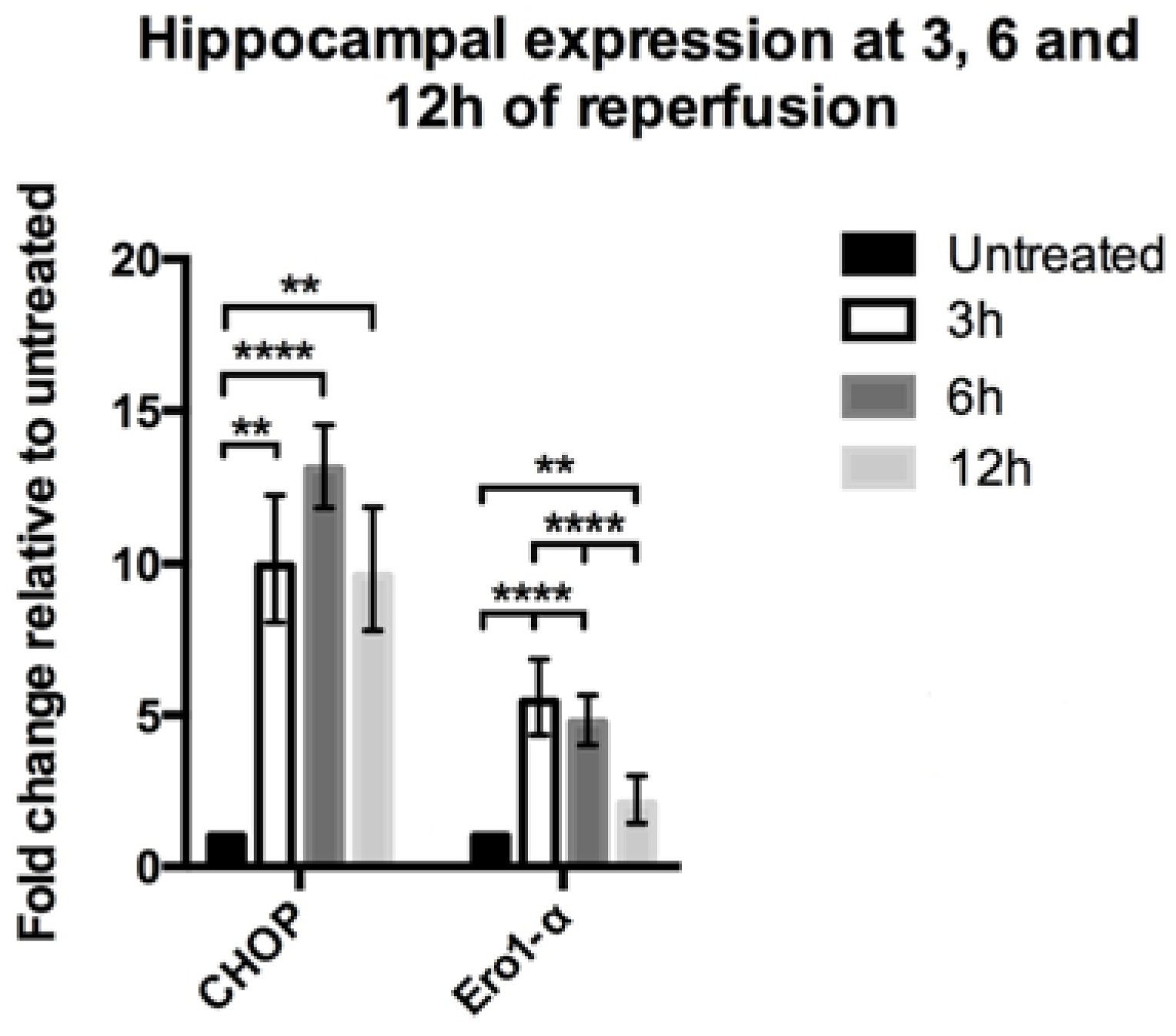
3.1. Global Cerebral Ischemia Induces Up-regulation of CHOP and Ero1-α in Rat Hippocampi
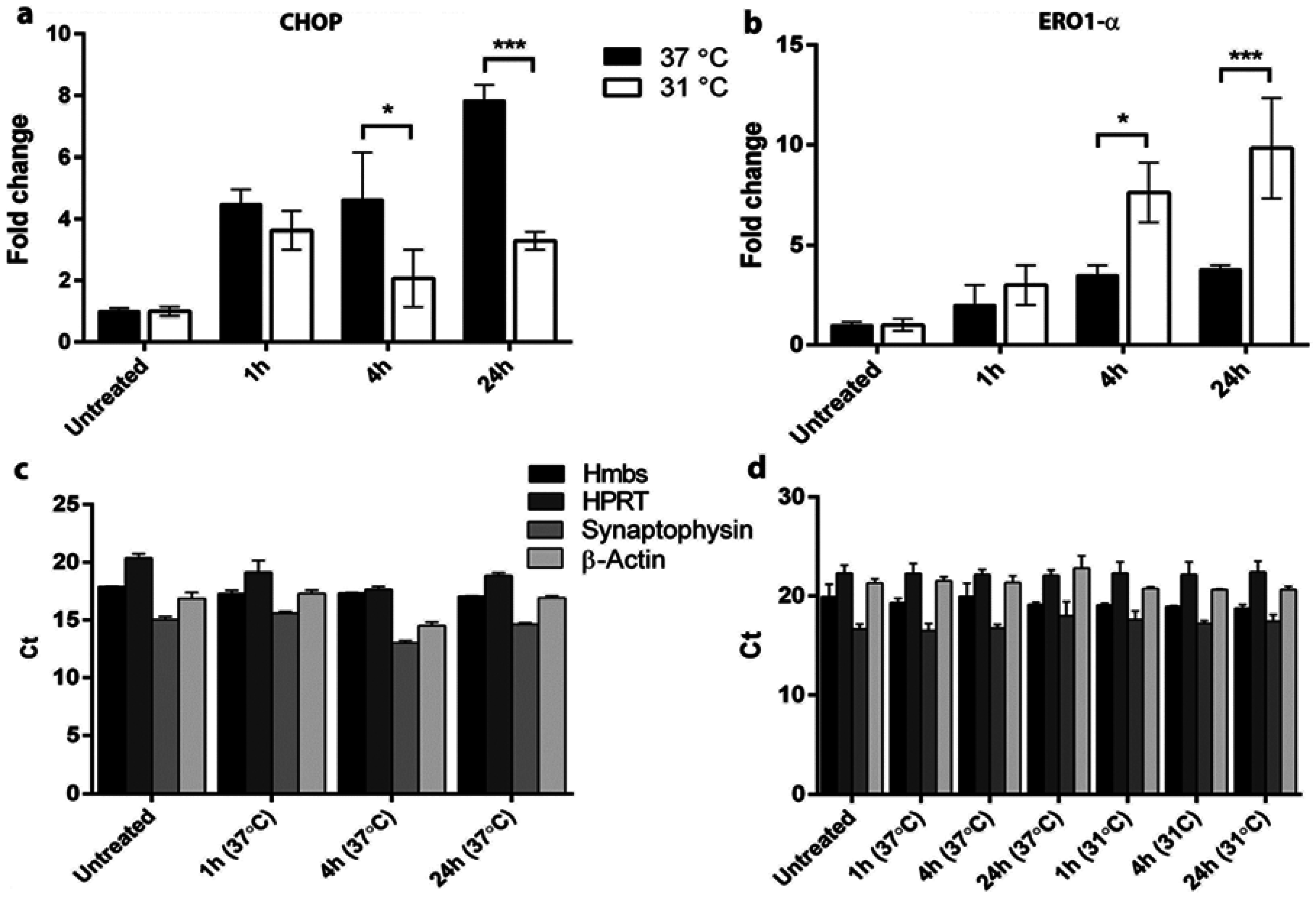
3.2. Thapsigargin and Verification of PC12 Cell Suitability

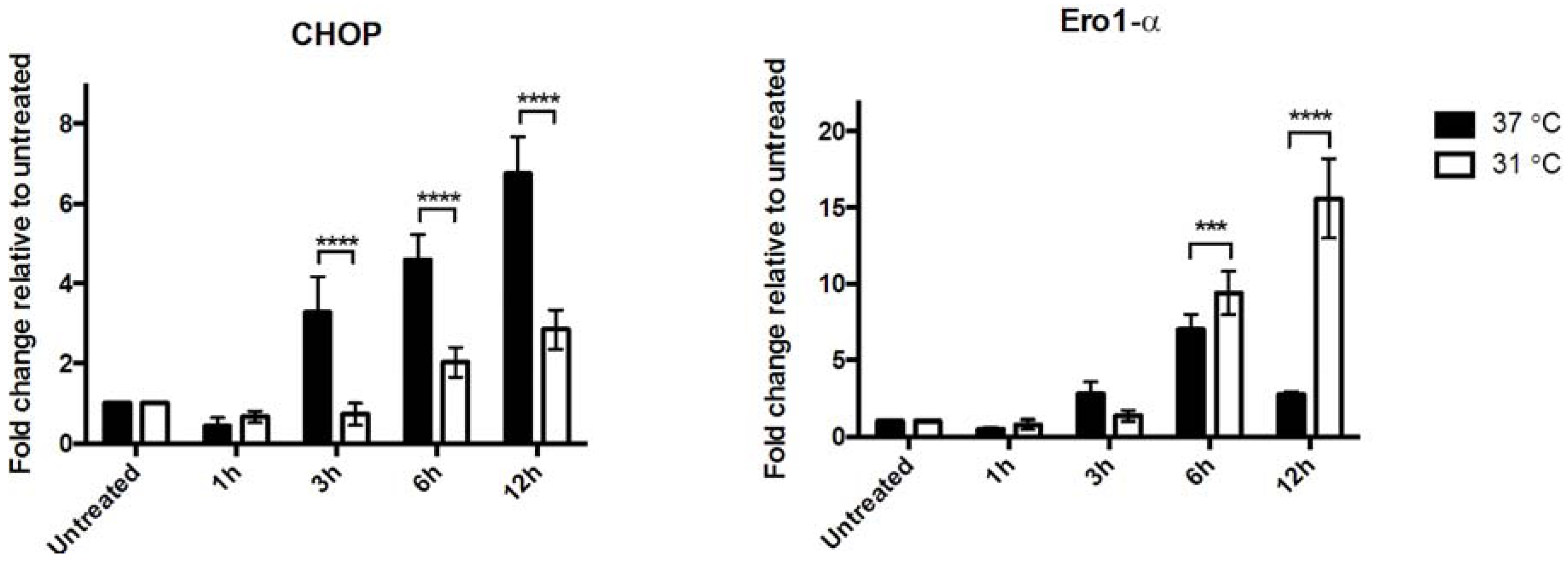
3.3. Hypothermia Attenuates CHOP and Augments Ero1-α Expression in Hypoxic Cells in Vitro

4. Discussion
Acknowledgments
Author Contributions
Conflicts of Interest
References
- Jiang, J.Y.; Xu, W.; Li, W.P.; Gao, G.Y.; Bao, Y.H.; Liang, Y.M.; Luo, Q.Z. Effect of long-term mild hypothermia or short-term mild hypothermia on outcome of patients with severe traumatic brain injury. J. Cereb. Blood Flow Metab. 2006, 26, 771–776. [Google Scholar] [CrossRef]
- Mottillo, S.; Sharma, K.; Eisenberg, M.J. Therapeutic hypothermia in acute myocardial infarction: A systematic review. Can. J. Cardiol. 2011, 27, 555–561. [Google Scholar] [CrossRef]
- England, T.N. Mild therapeutic hypothermia to improve the neurologic outcome after cardiac arrest. N. Engl. J. Med. 2002, 346, 549–556. [Google Scholar] [CrossRef]
- Hong, J.M.; Lee, J.S.; Song, H.J.; Jeong, H.; Choi, H.A.; Lee, K. Therapeutic hypothermia after recanalization in patients with acute ischemic stroke. Stroke 2014, 45, 134–140. [Google Scholar] [CrossRef]
- Krieger, D.W.; Yenari, M.A. Therapeutic hypothermia for acute ischemic stroke: What do laboratory studies teach us? Stroke 2004, 35, 1482–1489. [Google Scholar] [CrossRef]
- Ohta, H.; Terao, Y.; Shintani, Y.; Kiyota, Y. Therapeutic time window of post-ischemic mild hypothermia and the gene expression associated with the neuroprotection in rat focal cerebral ischemia. Neurosci. Res. 2007, 57, 424–433. [Google Scholar] [CrossRef]
- Wang, J.; Chambers, G.; Cottrell, J.E.; Kass, I.S. Differential Fall in ATP Accounts for Effects of Temperature on Hypoxic Damage in Rat Hippocampal Slices. J. Neurophysiol. 2000, 83, 3462–3472. [Google Scholar] [PubMed]
- Zhao, H.; Steinberg, G.K.; Sapolsky, R.M. General versus specific actions of mild-moderate hypothermia in attenuating cerebral ischemic damage. J. Cereb. Blood Flow Metab. 2007, 27, 1879–1894. [Google Scholar] [CrossRef]
- Liu, L.; Kim, J.Y.; Koike, M.A.; Yoon, Y.J.; Tang, X.N.; Ma, H.; Lee, H.; Steinberg, G.K.; Lee, J.E.; Yenari, M.A. FasL shedding is reduced by hypothermia in experimental stroke. J. Neurochem. 2008, 106, 541–550. [Google Scholar] [CrossRef] [PubMed]
- Tajiri, S.; Oyadomari, S.; Yano, S.; Morioka, M.; Gotoh, T.; Hamada, J.I.; Ushio, Y.; Mori, M. Ischemia-induced neuronal cell death is mediated by the endoplasmic reticulum stress pathway involving CHOP. Cell Death Differ. 2004, 11, 403–415. [Google Scholar] [CrossRef]
- Szegezdi, E.; Logue, S.E.; Gorman, A.M.; Samali, A. Mediators of endoplasmic reticulum stress-induced apoptosis. EMBO Rep. 2006, 7, 880–885. [Google Scholar] [CrossRef] [PubMed]
- Harding, H.P.; Zhang, Y.; Zeng, H.; Novoa, I.; Lu, P.D.; Calfon, M.; Sadri, N.; Yun, C.; Popko, B.; Paules, R.; et al. An integrated stress response regulates amino acid metabolism and resistance to oxidative stress. Mol. Cell 2003, 11, 619–633. [Google Scholar]
- Ni, M.; Lee, A.S. ER chaperones in mammalian development and human diseases. FEBS Lett. 2007, 581, 3641–3651. [Google Scholar] [CrossRef] [PubMed]
- Hu, B.R.; Martone, M.E.; Jones, Y.Z.; Liu, C.L. Protein aggregation after transient cerebral ischemia. J. Neurosci. 2000, 20, 3191–3199. [Google Scholar] [PubMed]
- Marciniak, S.J.; Yun, C.Y.; Oyadomari, S.; Novoa, I.; Zhang, Y.; Jungreis, R.; Nagata, K.; Harding, H.P.; Ron, D. CHOP induces death by promoting protein synthesis and oxidation in the stressed endoplasmic reticulum. Genes Dev. 2004, 18, 3066–3077. [Google Scholar] [CrossRef] [PubMed]
- Li, G.; Mongillo, M.; Chin, K.T.; Harding, H.; Ron, D.; Marks, A.R.; Tabas, I. Role of ERO1-alpha-mediated stimulation of inositol 1,4,5-triphosphate receptor activity in endoplasmic reticulum stress-induced apoptosis. J. Cell Biol. 2009, 186, 783–792. [Google Scholar] [CrossRef]
- Kalliokoski, O.; Abelson, K.S.; Koch, J.; Boschian, A.; Thormose, S.F.; Fauerby, N.; Rasmussen, R.S.; Johansen, F.F.; Hau, J. The effect of voluntarily ingested buprenorphine on rats subjected to surgically induced global cerebral ischaemia. In Vivo 2010, 24, 641–646. [Google Scholar] [PubMed]
- Livak, K.J.; Schmittgen, T.D. Analysis of relative gene expression data using real-time quantitative PCR and the 2(-Delta Delta C(T)) Method. Methods 2001, 25, 402–408. [Google Scholar] [CrossRef]
- Liu, X.; Wang, M.; Chen, H.; Guo, Y.; Ma, F.; Shi, F.; Bi, Y.; Li, Y. Hypothermia protects the brain from transient global ischemia/reperfusion by attenuating endoplasmic reticulum response-induced apoptosis through CHOP. PLoS ONE 2013, 8, e53431. [Google Scholar] [CrossRef] [PubMed]
- Aoki, M.; Tamatani, M.; Taniguchi, M.; Yamaguchi, A.; Bando, Y.; Kasai, K.; Miyoshi, Y.; Nakamura, Y.; Vitek, M.P.; Tohyama, M.; et al. Hypothermic treatment restores glucose regulated protein 78 (GRP78) expression in ischemic brain. Mol. Brain Res. 2001, 95, 117–128. [Google Scholar]
- Xu, S.Y.; Hu, Y.F.; Li, W.P.; Wu, Y.M.; Ji, Z.; Wang, S.N.; Li, K.; Pan, S.Y. Intermittent Hypothermia Is Neuroprotective in an in vitro Model of Ischemic Stroke. Int. J. Biol. Sci. 2014, 10, 873–881. [Google Scholar] [CrossRef] [PubMed]
- Gess, B.; Hofbauer, K.H.; Wenger, R.H.; Lohaus, C.; Meyer, H.E.; Kurtz, A. The cellular oxygen tension regulates expression of the endoplasmic oxidoreductase ERO1-Lα. Eur. J. Biochem. 2003, 2235, 2228–2235. [Google Scholar] [CrossRef]
- May, D.; Itin, A.; Gal, O.; Kalinski, H.; Feinstein, E.; Keshet, E. Ero1-L alpha plays a key role in a HIF-1-mediated pathway to improve disulfide bond formation and VEGF secretion under hypoxia: Implication for cancer. Oncogene 2005, 24, 1011–1020. [Google Scholar] [CrossRef]
- Raghubir, R.; Nakka, V.P.; Mehta, S.L. Endoplasmic reticulum stress in brain damage. Methods Enzymol. 2011, 489, 259–275. [Google Scholar] [PubMed]
© 2015 by the authors; licensee MDPI, Basel, Switzerland. This article is an open access article distributed under the terms and conditions of the Creative Commons Attribution license (http://creativecommons.org/licenses/by/4.0/).
Share and Cite
Poone, G.K.; Hasseldam, H.; Munkholm, N.; Rasmussen, R.S.; Grønberg, N.V.; Johansen, F.F. The Hypothermic Influence on CHOP and Ero1-α in an Endoplasmic Reticulum Stress Model of Cerebral Ischemia. Brain Sci. 2015, 5, 178-187. https://doi.org/10.3390/brainsci5020178
Poone GK, Hasseldam H, Munkholm N, Rasmussen RS, Grønberg NV, Johansen FF. The Hypothermic Influence on CHOP and Ero1-α in an Endoplasmic Reticulum Stress Model of Cerebral Ischemia. Brain Sciences. 2015; 5(2):178-187. https://doi.org/10.3390/brainsci5020178
Chicago/Turabian StylePoone, Gagandip K., Henrik Hasseldam, Nina Munkholm, Rune S. Rasmussen, Nina V. Grønberg, and Flemming F. Johansen. 2015. "The Hypothermic Influence on CHOP and Ero1-α in an Endoplasmic Reticulum Stress Model of Cerebral Ischemia" Brain Sciences 5, no. 2: 178-187. https://doi.org/10.3390/brainsci5020178
APA StylePoone, G. K., Hasseldam, H., Munkholm, N., Rasmussen, R. S., Grønberg, N. V., & Johansen, F. F. (2015). The Hypothermic Influence on CHOP and Ero1-α in an Endoplasmic Reticulum Stress Model of Cerebral Ischemia. Brain Sciences, 5(2), 178-187. https://doi.org/10.3390/brainsci5020178