
<?xml version="1.0" encoding="UTF-8"?>
<!DOCTYPE article PUBLIC "-//NLM//DTD Journal Publishing DTD v2.3 20070202//EN" "journalpublishing.dtd">
<article xmlns:mml="http://www.w3.org/1998/Math/MathML" xmlns:xlink="http://www.w3.org/1999/xlink" xml:lang="en" article-type="review-article">
  <front>
    <journal-meta>
      <journal-id journal-id-type="publisher-id">applsci</journal-id>
      <journal-title>Applied Sciences</journal-title>
      <abbrev-journal-title abbrev-type="publisher">Appl. Sci.</abbrev-journal-title>
      <abbrev-journal-title abbrev-type="pubmed">Appl. Sci.</abbrev-journal-title>
      <issn pub-type="epub">2076-3417</issn>
      <publisher>
        <publisher-name>MDPI</publisher-name>
      </publisher>
    </journal-meta>
    <article-meta>
      <article-id pub-id-type="doi">10.3390/app2020245</article-id>
      <article-id pub-id-type="publisher-id">applsci-02-00245</article-id>
      <article-categories>
        <subj-group>
          <subject>Review</subject>
        </subj-group>
      </article-categories>
      <title-group>
        <article-title>Nucleic Acid Based Fluorinated Derivatives: New Tools for Biomedical Applications</article-title>
      </title-group>
      <contrib-group>
        <contrib contrib-type="author">
          <name>
            <surname>Dolain</surname>
            <given-names>Christel</given-names>
          </name>
          <xref rid="af1-applsci-02-00245" ref-type="aff">1</xref>
        </contrib>
        <contrib contrib-type="author">
          <name>
            <surname>Patwa</surname>
            <given-names>Amit</given-names>
          </name>
          <xref rid="af1-applsci-02-00245" ref-type="aff">1</xref>
          <xref rid="af2-applsci-02-00245" ref-type="aff">2</xref>
        </contrib>
        <contrib contrib-type="author">
          <name>
            <surname>Godeau</surname>
            <given-names>Guilhem</given-names>
          </name>
          <xref rid="af1-applsci-02-00245" ref-type="aff">1</xref>
          <xref rid="af2-applsci-02-00245" ref-type="aff">2</xref>
        </contrib>
        <contrib contrib-type="author">
          <name>
            <surname>Barthélémy</surname>
            <given-names>Philippe</given-names>
          </name>
          <xref rid="af1-applsci-02-00245" ref-type="aff">1</xref>
          <xref rid="af2-applsci-02-00245" ref-type="aff">2</xref>
          <xref rid="c1-applsci-02-00245" ref-type="corresp">*</xref>
        </contrib>
      </contrib-group>
      <aff id="af1-applsci-02-00245"><label>1</label> Université de Bordeaux, Bordeaux F-33076, France; Email: <email>c.dolain@iecb.u-bordeaux.fr</email> (C.D.); <email>guilhem.godeau@unice.fr</email> (G.G.)</aff>
      <aff id="af2-applsci-02-00245"><label>2</label> INSERM U869, Bordeaux F-33076, France; Email: <email>amit.patwa@inserm.fr</email> (A.P.)</aff>
      <author-notes>
        <corresp id="c1-applsci-02-00245"><label>*</label> Author  to whom correspondence should be addressed; Email: <email>philippe.barthelemy@inserm.fr</email>; Tel.: +33-0-5-57-57-48-53; Fax: +33-0-5-57-57-10-15.</corresp>
      </author-notes>
      <pub-date pub-type="epub">
        <day>23</day>
        <month>03</month>
        <year>2012</year>
      </pub-date>
      <pub-date pub-type="collection"><month>06</month>
        <year>2012</year>
      </pub-date>
      <volume>2</volume>
      <issue>2</issue>
      <fpage>245</fpage>
      <lpage>259</lpage>
      <history>
        <date date-type="received">
          <day>14</day>
          <month>01</month>
          <year>2012</year>
        </date>
        <date date-type="rev-recd">
          <day>13</day>
          <month>03</month>
          <year>2012</year>
        </date>
        <date date-type="accepted">
          <day>14</day>
          <month>03</month>
          <year>2012</year>
        </date>
      </history>
      <permissions>
        <copyright-statement>©  2012 by the authors; licensee MDPI, Basel, Switzerland.</copyright-statement>
        <copyright-year>2012</copyright-year>
        <license xmlns:xlink="http://www.w3.org/1999/xlink" license-type="open-access" xlink:href="http://creativecommons.org/licenses/by/3.0/">
          <p>This article is an open-access article distributed under the terms and conditions of the Creative Commons Attribution license (http://creativecommons.org/licenses/by/3.0/).</p>
        </license>
      </permissions>
      <abstract>
        <p>Nucleic acid-based fluorinated derivatives, e.g., nucleosides or oligonucleotides connected to highly fluorinated chains or labeled with one or more fluorine atoms, have been investigated recently due to their high potential for biomedical applications. This review deals with recent works on nucleoside and oligonucleotide fluorocarbon amphiphiles as well as with properties and applications of fluorine-labeled oligonucleotide analogues.</p>
      </abstract>
      <kwd-group>
        <kwd>fluorocarbon</kwd>
        <kwd>amphiphile</kwd>
        <kwd>lipids</kwd>
        <kwd>nucleoside</kwd>
        <kwd>oligonucleotides</kwd>
      </kwd-group>
    </article-meta>
  </front>
  <body>
    <sec sec-type="intro">
      <title>1. Introduction</title>
      <p>The nucleic acid architectures stabilized by base-pairing and aryl π−π stacking interactions provides to scientists one of the most sophisticated supramolecular models. Since the determination of the structure of double-stranded DNA (dsDNA) by Watson, Crick, Wilkins and Franklin [<xref ref-type="bibr" rid="B1-applsci-02-00245">1</xref>,<xref ref-type="bibr" rid="B2-applsci-02-00245">2</xref>,<xref ref-type="bibr" rid="B3-applsci-02-00245">3</xref>], artificial bio-inspired molecules featuring nucleic acid units have become a very powerful strategy to construct supramolecular systems [<xref ref-type="bibr" rid="B4-applsci-02-00245">4</xref>,<xref ref-type="bibr" rid="B5-applsci-02-00245">5</xref>,<xref ref-type="bibr" rid="B6-applsci-02-00245">6</xref>]. Of particular interest is the design of hybrid amphiphilic nucleolipids featuring a bi-functionality based on the combination of nucleic acids and lipids [<xref ref-type="bibr" rid="B7-applsci-02-00245">7</xref>,<xref ref-type="bibr" rid="B8-applsci-02-00245">8</xref>,<xref ref-type="bibr" rid="B9-applsci-02-00245">9</xref>,<xref ref-type="bibr" rid="B10-applsci-02-00245">10</xref>,<xref ref-type="bibr" rid="B11-applsci-02-00245">11</xref>,<xref ref-type="bibr" rid="B12-applsci-02-00245">12</xref>,<xref ref-type="bibr" rid="B13-applsci-02-00245">13</xref>,<xref ref-type="bibr" rid="B14-applsci-02-00245">14</xref>,<xref ref-type="bibr" rid="B15-applsci-02-00245">15</xref>]. Interestingly, different bottom-up approaches involving nucleolipids have been used for the construction of nanostructures for different applications, including materials [<xref ref-type="bibr" rid="B16-applsci-02-00245">16</xref>,<xref ref-type="bibr" rid="B17-applsci-02-00245">17</xref>,<xref ref-type="bibr" rid="B18-applsci-02-00245">18</xref>] and biomedical devices [<xref ref-type="bibr" rid="B19-applsci-02-00245">19</xref>,<xref ref-type="bibr" rid="B20-applsci-02-00245">20</xref>,<xref ref-type="bibr" rid="B21-applsci-02-00245">21</xref>]. In parallel to nucleolipid derivatives, the combination of nucleobase units with fluorocarbon hydrophobic and lipophobic moieties to create novel materials, for diagnostics or in medical applications, is still in its infancy. It has been extensively reported that highly fluorinated derivatives possess unique properties, including chemical and biological inertness, strong hydro- and lipophobia. Interestingly, fluorocarbon colloids used for biomedical applications feature high gas solubility, low lipid and water solubility, and outstanding surface characteristics [<xref ref-type="bibr" rid="B22-applsci-02-00245">22</xref>]. </p>
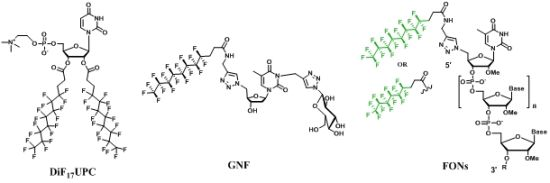
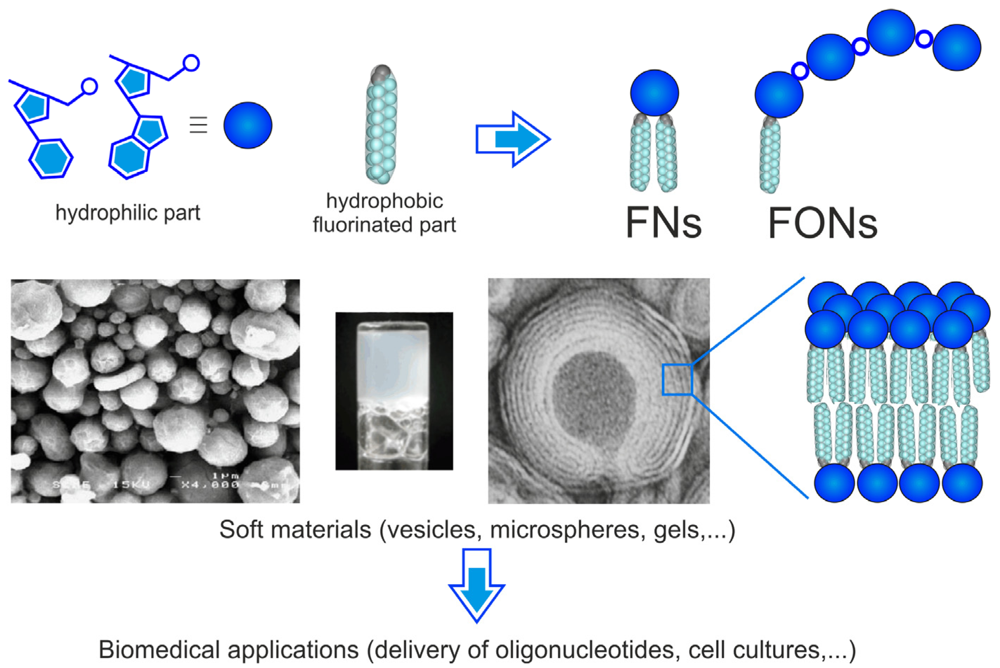
      <p>Hence, material and biomedical sciences could take advantage of the new properties coming from the combination of nucleic acids and fluorocarbon synthetic units for new applications. The availability of chemically modified nucleotides and fluorocarbon synthons and/or reagents, means that Nucleic Acids Fluorocarbon Amphiphiles (NAFAs) could be used in numerous fields of research including engineering, biology and medicine (<xref ref-type="fig" rid="applsci-02-00245-f001">Figure 1</xref>). Recently, the use of nucleoside-based fluorocarbon derivatives has been mainly motivated by three fundamental objectives: (i) construct novel supramolecular materials and/or devices; (ii) develop new drug delivery systems; and (iii) find new therapeutic molecules.</p>
      <fig id="applsci-02-00245-f001" position="anchor">
        <label>Figure 1</label>
        <caption>
          <p>Nucleic Acids Fluorocarbon Amphiphiles (NAFAs), including Fluorocarbon Nucleoside and OligoNucleotide amphiphiles (FNs and FONs, respectively): building blocks for soft materials and biomedical applications. </p>
        </caption>
        <graphic xmlns:xlink="http://www.w3.org/1999/xlink" xlink:href="applsci-02-00245-g001.tif"/>
      </fig>
      <p>This short, non-exhaustive review intends to illustrate the role that highly fluorinated amphiphiles may play in chemistry, biology and material science. It consists primarily of an account of the authors’ own efforts and experience in the field, hence will be limited to some specific aspects of this chemistry. It also intends to outline the potential applications of fluorinated nucleolipids, ranging from chemistry to biomedical research.</p>
      <p>First, we will focus on the recent progress achieved in the fields of fluorocarbon and nucleoside amphiphiles. This first section includes hybrid molecules bearing both a nucleic acid and fluorocarbon chains: namely the Fluorocarbon Nucleoside amphiphiles (FNs). Second, we will present several Fluorocarbon OligoNucleotide amphiphiles (FONs) and fluorinated oligonucleotide analogues.</p>
    </sec>
    <sec>
      <title>2. Fluorocarbon Nucleoside Amphiphiles (FNs)</title>
      <sec>
        <title>2.1. Fluorocarbon Amphiphiles</title>
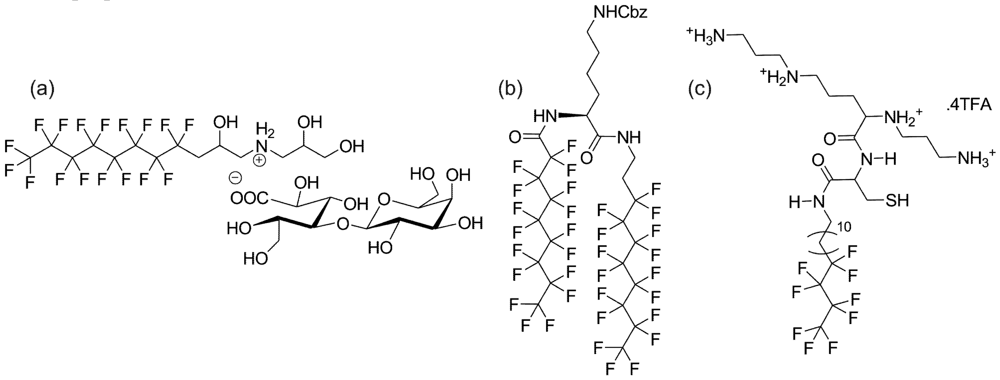
        <p>Due to their unique properties, fluorocarbon chains represent a useful building block for the construction of supramolecular systems. Perfluoroalkyl chains have a larger cross section and are more rigid than their hydrogenated counterparts. They are considerably more hydrophobic and are lipophobic as well. As a result, when dispersed in water, fluorinated amphiphiles exhibit an enhanced capacity to self-assemble into highly stable and well-defined assemblies such as films, membranes, micelles, vesicles and other stable supramolecular systems [<xref ref-type="bibr" rid="B23-applsci-02-00245">23</xref>,<xref ref-type="bibr" rid="B24-applsci-02-00245">24</xref>]. The self-assembling behavior of a variety of synthesized single and double chain neutral, zwitterionicor anionic fluorinated phospholipids [<xref ref-type="bibr" rid="B25-applsci-02-00245">25</xref>,<xref ref-type="bibr" rid="B26-applsci-02-00245">26</xref>,<xref ref-type="bibr" rid="B27-applsci-02-00245">27</xref>,<xref ref-type="bibr" rid="B28-applsci-02-00245">28</xref>], glycolipid [<xref ref-type="bibr" rid="B29-applsci-02-00245">29</xref>,<xref ref-type="bibr" rid="B30-applsci-02-00245">30</xref>], glycophospholipids, glycopeptides [<xref ref-type="bibr" rid="B31-applsci-02-00245">31</xref>,<xref ref-type="bibr" rid="B32-applsci-02-00245">32</xref>] was already explored (<xref ref-type="fig" rid="applsci-02-00245-f002">Figure 2</xref>) [<xref ref-type="bibr" rid="B33-applsci-02-00245">33</xref>], to evaluate the impact of the fluorinated chains on the properties of the resulting aggregates. It enhances stability, low permeability to both hydrophilic and lipophilic material and reduces interaction with biological media. These fluorinated amphiphiles possess a considerable potential for the delivery of materials such as drugs, prodrugs, markers, contrast agents and nucleic acids. Recently, new perfluorinated dimerizable polycationic amphiphiles were designed by Vierling <italic>et al</italic>. to evaluate the ability of the monomer to condense DNA and of the dimer to form stable nanoparticles capable of efficient cell transfection [<xref ref-type="bibr" rid="B34-applsci-02-00245">34</xref>]. Although formulation of small-sized cationic monomolecular DNA nanoparticles (&lt;40 nm) with the dimerizable perfluorinated succeeded, spermine-based amphiphiles proved to be poor non-specific transfection agents in vitro. Improvements are still in progress [<xref ref-type="bibr" rid="B35-applsci-02-00245">35</xref>,<xref ref-type="bibr" rid="B36-applsci-02-00245">36</xref>]. </p>
        <fig id="applsci-02-00245-f002" position="anchor">
          <label>Figure 2</label>
          <caption>
            <p>Examples of fluorocarbon amphiphiles; (<bold>a</bold>) sugar-based fluorocarbon amphiphile [<xref ref-type="bibr" rid="B30-applsci-02-00245">30</xref>]; (<bold>b</bold>) fluorinated amphiphilic building block used for the synthesis of glycopeptide conjugates [<xref ref-type="bibr" rid="B32-applsci-02-00245">32</xref>]; and (<bold>c</bold>) perfluorinated dimerizable polycationic amphiphile [<xref ref-type="bibr" rid="B34-applsci-02-00245">34</xref>].</p>
          </caption>
          <graphic xmlns:xlink="http://www.w3.org/1999/xlink" xlink:href="applsci-02-00245-g002.tif"/>
        </fig>
      </sec>
      <sec>
        <title>2.2. Nucleoside Amphiphiles</title>
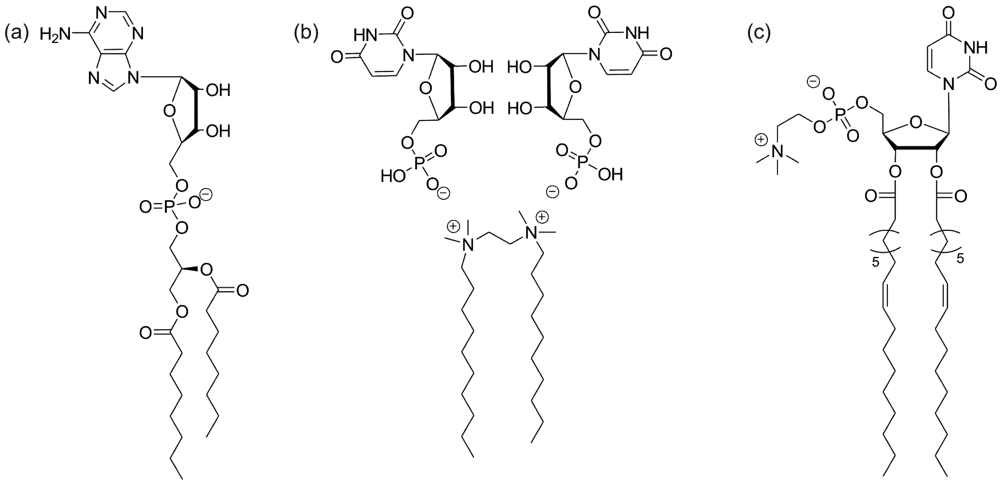
        <p>Nucleoside-based lipids commonly named nucleolipids [<xref ref-type="bibr" rid="B7-applsci-02-00245">7</xref>] are hybrid molecules composed of a nucleobase, a nucleoside, a nucleotide or an oligonucleotide (either DNA or RNA), and a lipophilic moiety, which might be either simply a single- or double-chained alkyl moiety. Several improved nucleolipids have been reported hereafter (<xref ref-type="fig" rid="applsci-02-00245-f003">Figure 3</xref>) [<xref ref-type="bibr" rid="B37-applsci-02-00245">37</xref>,<xref ref-type="bibr" rid="B38-applsci-02-00245">38</xref>,<xref ref-type="bibr" rid="B39-applsci-02-00245">39</xref>,<xref ref-type="bibr" rid="B40-applsci-02-00245">40</xref>,<xref ref-type="bibr" rid="B41-applsci-02-00245">41</xref>,<xref ref-type="bibr" rid="B42-applsci-02-00245">42</xref>,<xref ref-type="bibr" rid="B43-applsci-02-00245">43</xref>,<xref ref-type="bibr" rid="B44-applsci-02-00245">44</xref>,<xref ref-type="bibr" rid="B45-applsci-02-00245">45</xref>,<xref ref-type="bibr" rid="B46-applsci-02-00245">46</xref>,<xref ref-type="bibr" rid="B47-applsci-02-00245">47</xref>]. Most nucleolipids have a polar head group at the 5’ position and hydrophobic groups at both the 2’ and 3’ positions, patterned after natural glycerol phospholipids, which are key components of the cellular membrane. Nucleolipids were designed to interact with nucleic acids through hydrogen bonding, π–π stacking, and nucleobase recognition, as well as electrostatic interactions and the hydrophobic effect. Several cationic [<xref ref-type="bibr" rid="B12-applsci-02-00245">12</xref>,<xref ref-type="bibr" rid="B48-applsci-02-00245">48</xref>,<xref ref-type="bibr" rid="B49-applsci-02-00245">49</xref>,<xref ref-type="bibr" rid="B50-applsci-02-00245">50</xref>,<xref ref-type="bibr" rid="B51-applsci-02-00245">51</xref>] and anionic [<xref ref-type="bibr" rid="B52-applsci-02-00245">52</xref>,<xref ref-type="bibr" rid="B53-applsci-02-00245">53</xref>] nucleolipids were first investigated as potential agents for the delivery of nucleic acids into cells. Indeed their self-assembled structures into lipoplexes mimic cellular membranes and their cationic properties attract both anionic oligonucleotides and negatively charged cellular membranes. New versions comprising neutral, zwitterionic, and anionic nucleolipids are currently evaluated.</p>
        <fig id="applsci-02-00245-f003" position="anchor">
          <label>Figure 3</label>
          <caption>
            <p>Examples of nucleoside amphiphiles; (<bold>a</bold>) diC<sub>8</sub>PA [<xref ref-type="bibr" rid="B37-applsci-02-00245">37</xref>]; (<bold>b</bold>) a gemini nucleotide [<xref ref-type="bibr" rid="B39-applsci-02-00245">39</xref>]; and (<bold>c</bold>) a zwitterionic nucleolipid.</p>
          </caption>
          <graphic xmlns:xlink="http://www.w3.org/1999/xlink" xlink:href="applsci-02-00245-g003.tif"/>
        </fig>
      </sec>
      <sec>
        <title>2.3. Hybrid Fluorocarbon Nucleoside Amphiphiles</title>
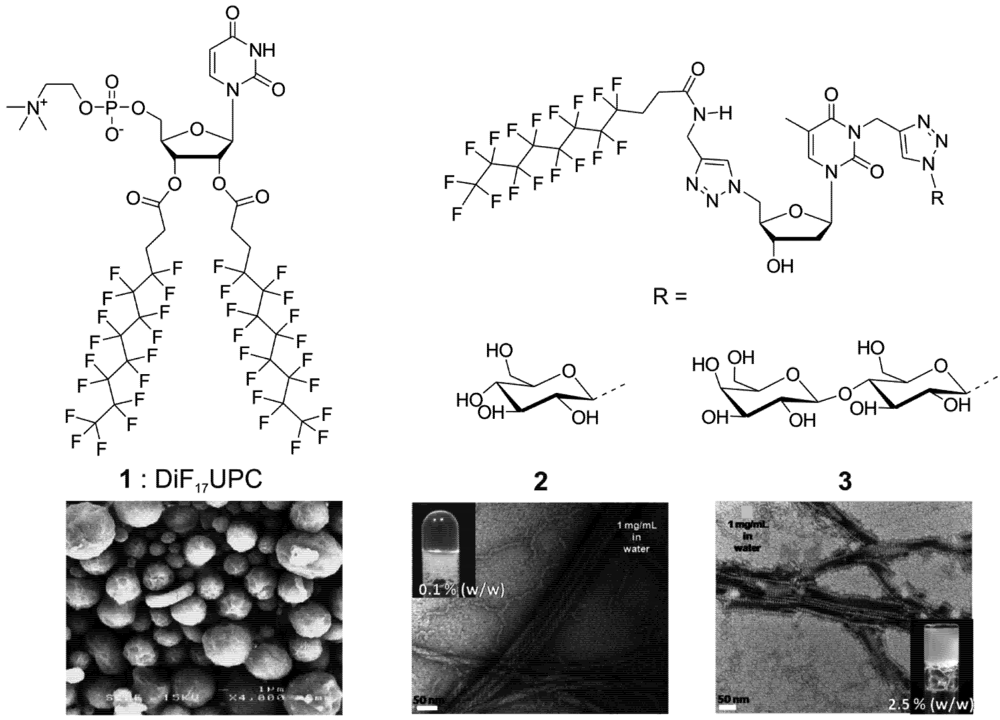
        <p>The combination of the self-assembly potential of nucleoside amphiphiles with the hydrophobic character of highly fluorinated chains is of high relevance to prepare new self-assembled structures with tunable physico-chemical properties and functions. To assess whether fluorinated chains can enhance the scope of supramolecular assemblies formed by hybrid fluorocarbon nucleoside amphiphiles, different molecules were synthesized (<xref ref-type="fig" rid="applsci-02-00245-f004">Figure 4</xref>). </p>
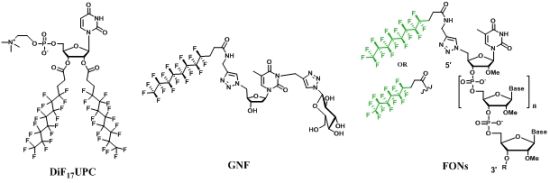
        <p>The fluorocarbon amphiphile <bold>1</bold> is based on a uridine backbone modified by a phosphocholine moiety at the 5’ position, and two <italic>2H</italic>,<italic>2H</italic>,<italic>3H</italic>,<italic>3H</italic>-perfluoroundecanoyl side chains at the 2’ and 3’ positions. One of the goals of the study was to characterize the properties of such new compounds and to compare those results with that observed for the analogous hydrocarbon nucleoamphiphiles. In aqueous solution, fluorocarbon nucleoamphiphiles were surprisingly able to form large vesicular assemblies and unexpected lamellar phases below their <italic>T<sub>m</sub></italic>, contrary to hydrocarbon analogs that self-assemble into helical structures below their <italic>T<sub>m</sub></italic> and bilayers above it [<xref ref-type="bibr" rid="B54-applsci-02-00245">54</xref>]. These highly hydrophobic fluorocarbon amphiphiles exhibited interesting hybrid microspherical supramolecular assemblies in the presence of thorium that were characterized by Scanning Electron Microscopy (SEM) [<xref ref-type="bibr" rid="B55-applsci-02-00245">55</xref>]. </p>
        <fig id="applsci-02-00245-f004" position="anchor">
          <label>Figure 4</label>
          <caption>
            <p>Chemical structures of compounds <bold>1-3</bold>, and corresponding electronic microscopy images of DiF<sub>17</sub>UPC/Th<sup>4+</sup> microspheres (SEM image from [<xref ref-type="bibr" rid="B55-applsci-02-00245">55</xref>]), and supramolecular assemblies formed by GNFs <bold>2</bold> and <bold>3</bold> in water (TEM images from [<xref ref-type="bibr" rid="B58-applsci-02-00245">58</xref>]).</p>
          </caption>
          <graphic xmlns:xlink="http://www.w3.org/1999/xlink" xlink:href="applsci-02-00245-g004.tif"/>
        </fig>
        <p>Recently, two glycosyl-nucleoside fluorinated amphiphiles (GNFs) were designed to construct new supramolecular hydrogels. Molecules <bold>2</bold> and <bold>3</bold> feature both sugar moieties attached to a thymidine base and a <italic>2H</italic>,<italic>2H</italic>,<italic>3H</italic>,<italic>3H</italic>-perfluoroundecanoyl side chain at the 5’ position, linked via triazole bridges resulting from “click” chemistry. The self-assembly and gelation properties of such molecules were investigated. Similarly to their hydrocarbon analogs [<xref ref-type="bibr" rid="B56-applsci-02-00245">56</xref>,<xref ref-type="bibr" rid="B57-applsci-02-00245">57</xref>] GNFs stabilize hydrogels at low concentrations (0.1% w/w for compound <bold>2</bold>). GNFs gelators displayed supramolecular networks of varying morphologies, such as nanofibers and helical springs, which are correlated to the presence of fluorocarbon chains. Moreover, fluorocarbon amphiphile GNF <bold>2</bold> proved to be not toxic for human cells (Huh7) whereas hydrocarbon analogue becomes toxic above 100 µM, demonstrating the greater potential of such fluorocarbon nucleoside amphiphiles for biomedical applications [<xref ref-type="bibr" rid="B58-applsci-02-00245">58</xref>]. </p>
      </sec>
    </sec>
    <sec>
      <title>3. Fluorocarbon OligoNucleotide Amphiphiles (FONs) and Fluorinated Oligonucleotide Analogues</title>
      <p>In the previous section, several examples of nucleoside-based fluorinated amphiphiles have been discussed for gel stabilization. In this section we will discuss on Fluorocarbon OligoNucleotide amphiphiles (FONs). The fluorine atom is likely a mimic of either a hydroxyl group (in terms of electronegativity) [<xref ref-type="bibr" rid="B59-applsci-02-00245">59</xref>,<xref ref-type="bibr" rid="B60-applsci-02-00245">60</xref>,<xref ref-type="bibr" rid="B61-applsci-02-00245">61</xref>,<xref ref-type="bibr" rid="B62-applsci-02-00245">62</xref>] or a hydrogen atom (in terms of steric factor). In this context, we will also provide an overview on properties and applications of oligonucleotides carrying fluorine modifications at different positions.</p>
      <sec>
        <title>3.1. Fluorocarbon OligoNucleotide Amphiphiles (FONs)</title>
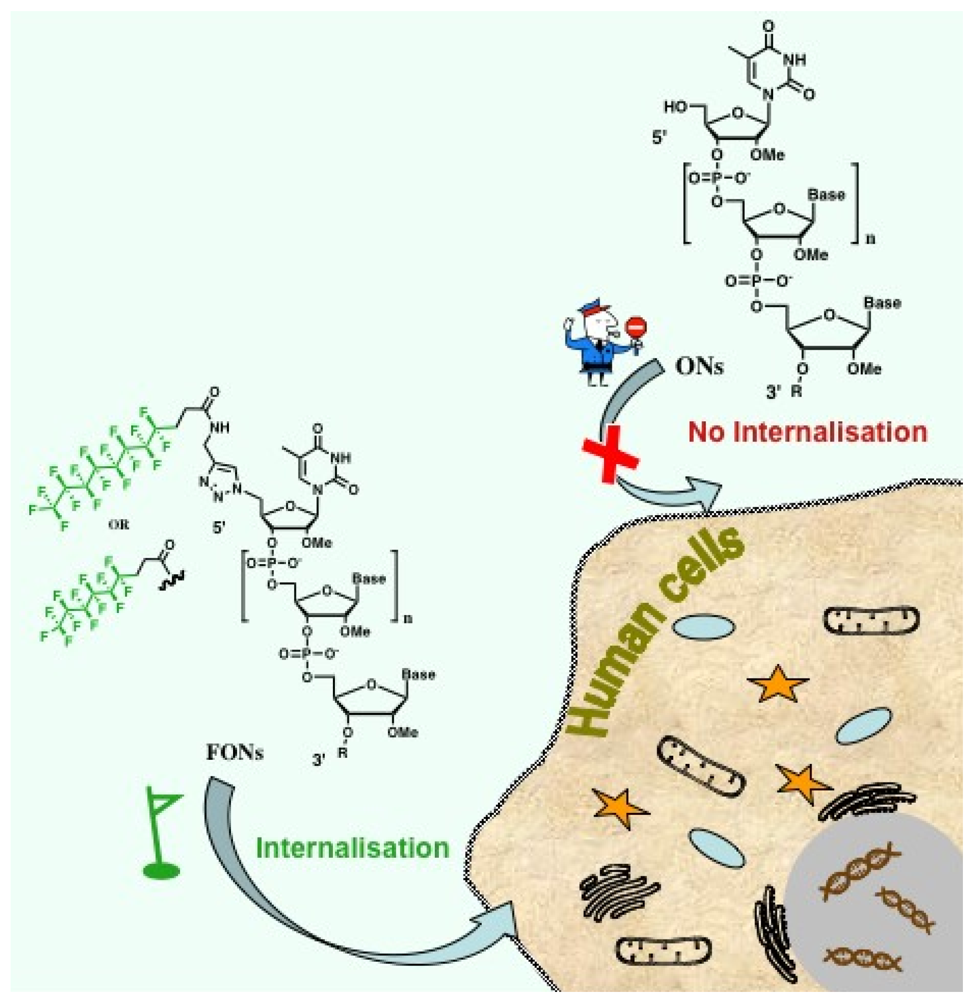
        <p>Recently our group has reported on the synthesis and biological properties of FONs [<xref ref-type="bibr" rid="B63-applsci-02-00245">63</xref>]. In previous studies, our group already reported on the synthesis and cellular uptake studies of lipid-oligonucleotide conjugates (LONs) [<xref ref-type="bibr" rid="B64-applsci-02-00245">64</xref>,<xref ref-type="bibr" rid="B65-applsci-02-00245">65</xref>]. The main purpose of attaching a fluorocarbon chain to a polyanionic oligonucleotide (ONs) was to study how cellular uptake or internalization of ONs are influenced by the nature of the hydrophobic moieties. To address this issue, Godeau <italic>et al.</italic> have synthesized two FONs featuring C<sub>8</sub>F<sub>17</sub> and C<sub>6</sub>F<sub>13</sub> chains using 1,3-dipolar Huisgen’s reaction [<xref ref-type="bibr" rid="B66-applsci-02-00245">66</xref>] via a “<italic>post synthetic</italic>” modification approach. Three different human cell lines were incubated with either FONs or LONs or unconjugated ONs for comparative study of cellular internalization (<xref ref-type="fig" rid="applsci-02-00245-f005">Figure 5</xref>). Moreover, internalization kinetics of FONs, LONs and unconjugated ONs with Huh7 cells were also evaluated. Keeping in mind the hydrophobic and lipophobic properties of fluorocarbon chains, it can be hypothesized that FONs self-assemble outside the cell to form nano aggregates. It is likely that these nanoobjects would be uptaken by the cell via an endocytosis pathway. It is worth mentioning here that to the best of our knowledge, there is no earlier report on oligonucleotide amphiphiles featuring perfluorinated chains.</p>
        <fig id="applsci-02-00245-f005" position="anchor">
          <label>Figure 5</label>
          <caption>
            <p>Conjugation of fluorocarbon chain to the oligonucleotide (FONs) allows the delivery of highly polyanionic oligonucleotides into human cells. </p>
          </caption>
          <graphic xmlns:xlink="http://www.w3.org/1999/xlink" xlink:href="applsci-02-00245-g005.tif"/>
        </fig>
      </sec>
      <sec>
        <title>3.2. Application of Fluorinated Oligonucleotide Analogues</title>
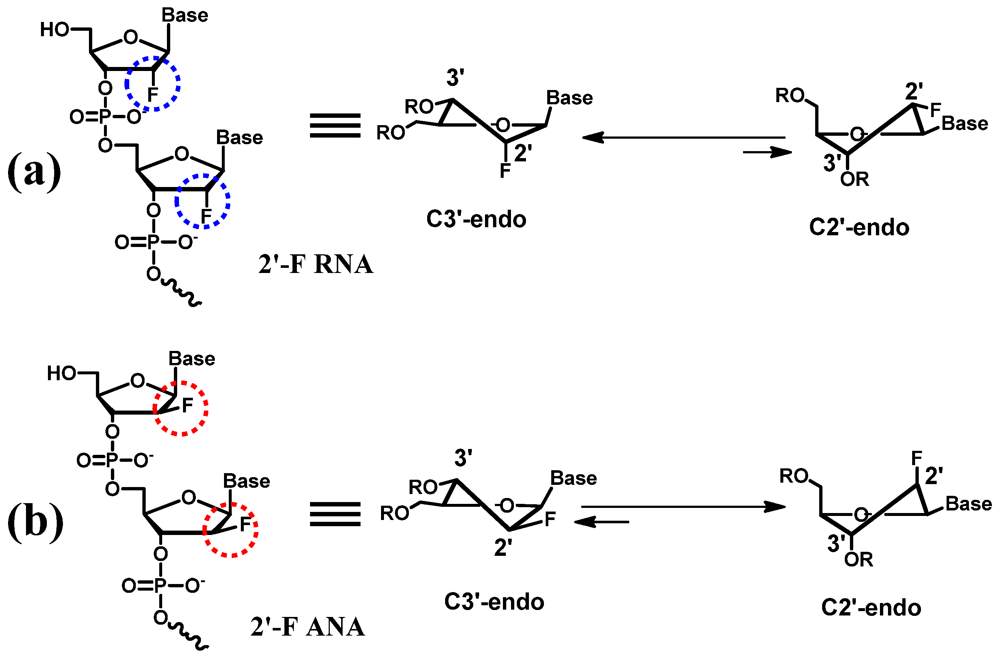
        <p>Various groups have been interested in the synthesis and application of fluorinated oligonucleotide analogues. There are different possible sites for the modification of an oligonucleotide with one or more fluorine atoms for various biological and therapeutical applications. Fluorine atoms have a strong influence on both the electronic and the conformational properties of the nucleic acids’ furanose ring. The 2’-position in the ribose moiety of RNA is prime target for chemical modifications. Extensive research work is going on towards the study of structural properties, biological applications and delivery strategies of oligonucleotides-incorporated with 2’-deoxy-2’fluoronucleotide in combination with other structural modifications [<xref ref-type="bibr" rid="B67-applsci-02-00245">67</xref>,<xref ref-type="bibr" rid="B68-applsci-02-00245">68</xref>,<xref ref-type="bibr" rid="B69-applsci-02-00245">69</xref>,<xref ref-type="bibr" rid="B70-applsci-02-00245">70</xref>,<xref ref-type="bibr" rid="B71-applsci-02-00245">71</xref>,<xref ref-type="bibr" rid="B72-applsci-02-00245">72</xref>,<xref ref-type="bibr" rid="B73-applsci-02-00245">73</xref>,<xref ref-type="bibr" rid="B74-applsci-02-00245">74</xref>,<xref ref-type="bibr" rid="B75-applsci-02-00245">75</xref>,<xref ref-type="bibr" rid="B76-applsci-02-00245">76</xref>,<xref ref-type="bibr" rid="B77-applsci-02-00245">77</xref>,<xref ref-type="bibr" rid="B78-applsci-02-00245">78</xref>,<xref ref-type="bibr" rid="B79-applsci-02-00245">79</xref>,<xref ref-type="bibr" rid="B80-applsci-02-00245">80</xref>,<xref ref-type="bibr" rid="B81-applsci-02-00245">81</xref>,<xref ref-type="bibr" rid="B82-applsci-02-00245">82</xref>,<xref ref-type="bibr" rid="B83-applsci-02-00245">83</xref>,<xref ref-type="bibr" rid="B84-applsci-02-00245">84</xref>]. Oligonucleotides containing 2’-deoxy-2’fluoronucleosides have been synthesized for regiospecific cleavage of RNA by RNase H [<xref ref-type="bibr" rid="B67-applsci-02-00245">67</xref>]. Incorporation of 2’-deoxy-2’-fluoronucleotide into oligonucleotides induces substantial enhancement in their binding affinities to RNA targets [<xref ref-type="bibr" rid="B68-applsci-02-00245">68</xref>]. Damha <italic>et al.</italic> have shown that fluorine-induced sugar pucker in 2’-deoxy-2’fluoro-β-D-ribonucleicacid (2’-F RNA; C3’-<italic>endo</italic>) and 2’-deoxy-2’fluoro-β-D-arabinonucleicacid (2’-F ANA; C2’/O4’-<italic>endo</italic>) can improve the activity of siRNA (<xref ref-type="fig" rid="applsci-02-00245-f006">Figure 6</xref>) and enhance its serum stability. They have also provided the evidences for an important role of a pseudohydrogen bond between the <italic>F</italic><sup>2</sup>’ and <italic>H</italic><sup>8</sup> of the nucleobase for 2’-F ANA:RNA duplex stability [<xref ref-type="bibr" rid="B72-applsci-02-00245">72</xref>,<xref ref-type="bibr" rid="B73-applsci-02-00245">73</xref>,<xref ref-type="bibr" rid="B74-applsci-02-00245">74</xref>,<xref ref-type="bibr" rid="B75-applsci-02-00245">75</xref>,<xref ref-type="bibr" rid="B76-applsci-02-00245">76</xref>,<xref ref-type="bibr" rid="B77-applsci-02-00245">77</xref>,<xref ref-type="bibr" rid="B78-applsci-02-00245">78</xref>,<xref ref-type="bibr" rid="B79-applsci-02-00245">79</xref>,<xref ref-type="bibr" rid="B80-applsci-02-00245">80</xref>,<xref ref-type="bibr" rid="B81-applsci-02-00245">81</xref>,<xref ref-type="bibr" rid="B82-applsci-02-00245">82</xref>,<xref ref-type="bibr" rid="B83-applsci-02-00245">83</xref>,<xref ref-type="bibr" rid="B84-applsci-02-00245">84</xref>].</p>
        <fig id="applsci-02-00245-f006" position="anchor">
          <label>Figure 6</label>
          <caption>
            <p>Structure and sugar puckering equilibrium for (<bold>a</bold>) 2’-deoxy-2’-fluororibonucleic acid (2’-F RNA); C3’-endo is the most stable conformation for 2’-F RNA. (<bold>b</bold>) 2’-deoxy-2’-fluoroarabonucleic acid (2’-F ANA); C2’-endo is the most stable conformation for 2’-F ANA.</p>
          </caption>
          <graphic xmlns:xlink="http://www.w3.org/1999/xlink" xlink:href="applsci-02-00245-g006.tif"/>
        </fig>
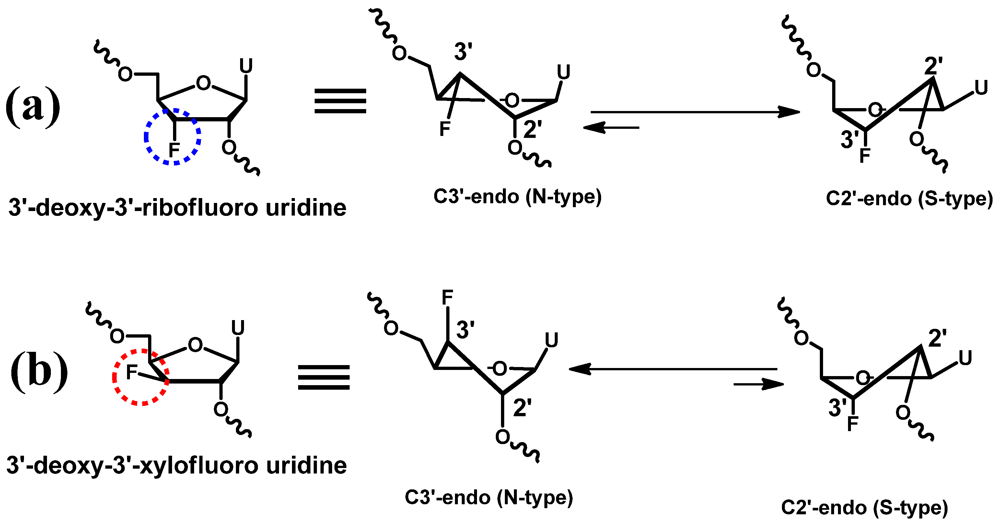
        <p>On the other side, very interesting and novel studies have been carried out by Erande <italic>et al.</italic> using 3’-deoxy-3’ribofluoro/xylofluoro uridine incorporated oligonucleotides (2’-5’-strand) [<xref ref-type="bibr" rid="B85-applsci-02-00245">85</xref>]. They have shown the effect of incorporation of one or more unit of 3’-deoxy-3’-fluoronucleosides (having either locked or frozen S-type/Ntype sugar conformations) on the stability of <italic>iso</italic>DNA:RNA duplexes. For the first time, evidences were given that the DNA strand prefers S-type geometry in stable <italic>iso</italic>DNA:RNA duplexes (<xref ref-type="fig" rid="applsci-02-00245-f007">Figure 7</xref>) [<xref ref-type="bibr" rid="B85-applsci-02-00245">85</xref>].</p>
        <fig id="applsci-02-00245-f007" position="anchor">
          <label>Figure 7</label>
          <caption>
            <p>Structure and sugar puckering equilibrium for (<bold>a</bold>) 3’-deoxy-3’-ribofluorouridine. (<bold>b</bold>) 3’-deoxy-3’-xylofluorouridine.S-type (C2’-endo) conformation (preferred by 3’-deoxy-3’-ribofluorouridine) stabilized <italic>iso</italic>DNA:RNA duplexed while N-type (C3’-endo) conformation (preferred by 3’-deoxy-3’-xylofluorouridine) destabilized <italic>iso</italic>DNA:RNA duplexes.</p>
          </caption>
          <graphic xmlns:xlink="http://www.w3.org/1999/xlink" xlink:href="applsci-02-00245-g007.tif"/>
        </fig>
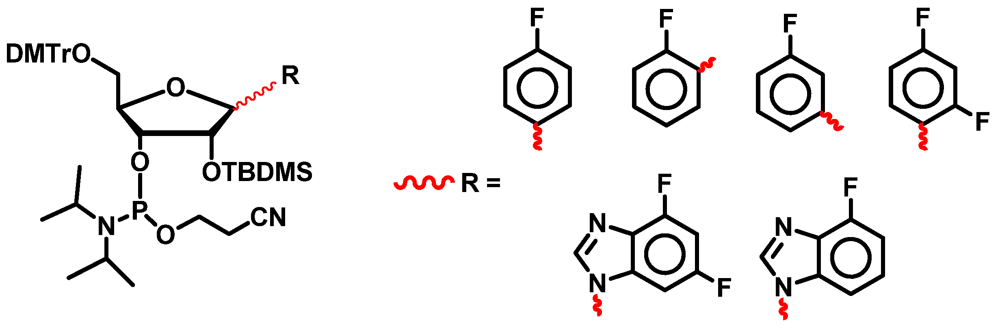
        <p>To investigate the forces (hydrogen bonding, base stacking and solvation) which are responsible for stability of the secondary structure of nucleic acids, Engels <italic>et al.</italic> have synthesized novel nucleic acid analogues in which nucleobases are replaced by their steric mimics, containing one or more fluorine atom. They have utilized fluorobenzene and fluorobenzimidazole derivatives (<xref ref-type="fig" rid="applsci-02-00245-f008">Figure 8</xref>) [<xref ref-type="bibr" rid="B86-applsci-02-00245">86</xref>,<xref ref-type="bibr" rid="B87-applsci-02-00245">87</xref>]. They have discussed how C–F…H–C hydrogen bonds affect the stability of the secondary structure of nucleic acids in details.</p>
        <fig id="applsci-02-00245-f008" position="anchor">
          <label>Figure 8</label>
          <caption>
            <p>Monomer building blocks for the incorporation of fluorine derivative into RNA oligonucleotides by solid-phase synthesis. </p>
          </caption>
          <graphic xmlns:xlink="http://www.w3.org/1999/xlink" xlink:href="applsci-02-00245-g008.tif"/>
        </fig>
        <p>Owing to the favorable NMR properties of fluorine atom (<sup>19</sup>F), fluorinated oligonucleotide derivatives provide a sensitive probe for structural study of nucleic acids in the solution state and their interactions with other biological moieties [<xref ref-type="bibr" rid="B71-applsci-02-00245">71</xref>,<xref ref-type="bibr" rid="B88-applsci-02-00245">88</xref>,<xref ref-type="bibr" rid="B89-applsci-02-00245">89</xref>,<xref ref-type="bibr" rid="B90-applsci-02-00245">90</xref>,<xref ref-type="bibr" rid="B91-applsci-02-00245">91</xref>,<xref ref-type="bibr" rid="B92-applsci-02-00245">92</xref>,<xref ref-type="bibr" rid="B93-applsci-02-00245">93</xref>,<xref ref-type="bibr" rid="B94-applsci-02-00245">94</xref>,<xref ref-type="bibr" rid="B95-applsci-02-00245">95</xref>]. Barhate <italic>et al.</italic> have synthesized nucleosides with perfluorinated <italic>tert</italic>-butyl group and successfully incorporated it into the oligonucleotide at different positions and demonstrated as a sensitive <sup>19</sup>F NMR probe of nucleic acid conformation [<xref ref-type="bibr" rid="B95-applsci-02-00245">95</xref>]. Oligonucleotides, labeled with radioactive isotopes, are new imaging tools to study gene expression at the nucleic acid and protein levels. Due to its positron-emission properties, fluorine-18 (radioactive isotope of fluorine) is widely used for oligonucleotide labeling for <italic>in vivo</italic> PET (Positron Emission Tomography) imaging. Dollé <italic>et al.</italic> [<xref ref-type="bibr" rid="B96-applsci-02-00245">96</xref>,<xref ref-type="bibr" rid="B97-applsci-02-00245">97</xref>,<xref ref-type="bibr" rid="B98-applsci-02-00245">98</xref>,<xref ref-type="bibr" rid="B99-applsci-02-00245">99</xref>,<xref ref-type="bibr" rid="B100-applsci-02-00245">100</xref>]. have developed an original method for labeling oligonucleotides with <sup>18</sup>F in different positions. Several other research groups have also synthesized <sup>18</sup>F labeled oligonucleotide analogues for imaging studies with PET [<xref ref-type="bibr" rid="B101-applsci-02-00245">101</xref>,<xref ref-type="bibr" rid="B102-applsci-02-00245">102</xref>,<xref ref-type="bibr" rid="B103-applsci-02-00245">103</xref>].</p>
      </sec>
    </sec>
    <sec sec-type="conclusions">
      <title>4. Conclusions</title>
      <p>The nucleic acids fluorocarbon amphiphiles belong to a new class of hybrid bioinspired molecules, which is clearly connected to soft materials, nanosciences and biomedical technology. It is a promising and exciting time for NAFAs and the emerging devices developed so far clearly open up interesting routes for the design and development of nanodevices, therapeutic strategies and biotechnological tools. The potential innovations using these fluorocarbon molecules are numerous in terms of chemical architectures, physicochemical and biological properties. This short survey highlights the interest to combine nucleic acids with fluorocarbons for developing soft and complex matters. The history of this field is still at the beginning and we can imagine that remarkable achievements will be realized in the future.</p>
    </sec>
  </body>
  <back>
    <ack>
      <title>Acknowledgments</title>
      <p>P.B. acknowledges financial support from the Army Research Office. This work has been supported by the French National Agency (ANR) in the frame of its programme PNANO (project NANAN, n° ANR-08-NANO-028). </p>
    </ack>
    <notes>
      <title>Conflict of Interest</title>
      <p>The authors declare no conflict of interest. </p>
    </notes>
    <ref-list>
      <title>References</title>
      <ref id="B1-applsci-02-00245">
        <label>1.</label>
        <citation citation-type="journal">
          <person-group person-group-type="author">
            <name>
              <surname>Watson</surname>
              <given-names>J.D.</given-names>
            </name>
          </person-group>
          <article-title>A structure for deoxyribose nucleic acid</article-title>
          <source>Nature</source>
          <year>1953</year>
          <volume>171</volume>
          <fpage>737</fpage>
          <lpage>738</lpage>
          <pub-id pub-id-type="doi">10.1038/171737a0</pub-id>
        </citation>
      </ref>
      <ref id="B2-applsci-02-00245">
        <label>2.</label>
        <citation citation-type="journal">
          <person-group person-group-type="author">
            <name>
              <surname>Franklin</surname>
              <given-names>R.E.</given-names>
            </name>
          </person-group>
          <article-title>Molecular configuration in sodium thymonucleate</article-title>
          <source>Nature</source>
          <year>1953</year>
          <volume>171</volume>
          <fpage>740</fpage>
          <lpage>741</lpage>
        <pub-id pub-id-type="doi">10.1038/171740a0</pub-id><pub-id pub-id-type="pmid">13054694</pub-id></citation>
      </ref>
      <ref id="B3-applsci-02-00245">
        <label>3.</label>
        <citation citation-type="journal">
          <person-group person-group-type="author">
            <name>
              <surname>Wilkins</surname>
              <given-names>M.H.F.</given-names>
            </name>
          </person-group>
          <article-title>Molecular structure of deoxypentose nucleic acids</article-title>
          <source>Nature</source>
          <year>1953</year>
          <volume>171</volume>
          <fpage>738</fpage>
          <lpage>740</lpage>
          <pub-id pub-id-type="doi">10.1038/171738a0</pub-id>
        </citation>
      </ref>
      <ref id="B4-applsci-02-00245">
        <label>4.</label>
        <citation citation-type="journal">
          <person-group person-group-type="author">
            <name>
              <surname>Sessler</surname>
              <given-names>J.L.</given-names>
            </name>
            <name>
              <surname>Lawrence</surname>
              <given-names>C.M.</given-names>
            </name>
            <name>
              <surname>Jayawickramarajah</surname>
              <given-names>J.G.M.</given-names>
            </name>
          </person-group>
          <article-title>Molecular recognition via base-pairing</article-title>
          <source>Chem. Soc. Rev.</source>
          <year>2007</year>
          <volume>36</volume>
          <fpage>314</fpage>
          <lpage>325</lpage>
        <pub-id pub-id-type="doi">10.1039/b604119c</pub-id><pub-id pub-id-type="pmid">17264932</pub-id></citation>
      </ref>
      <ref id="B5-applsci-02-00245">
        <label>5.</label>
        <citation citation-type="journal">
          <person-group person-group-type="author">
            <name>
              <surname>Whitesides</surname>
              <given-names>G.M.</given-names>
            </name>
            <name>
              <surname>Mathias</surname>
              <given-names>J.P.</given-names>
            </name>
            <name>
              <surname>Seto</surname>
              <given-names>C.T.</given-names>
            </name>
          </person-group>
          <article-title>Molecular self-assembly and nanochemistry: A chemical strategy for the synthesis of nanostructures</article-title>
          <source>Science</source>
          <year>1991</year>
          <volume>254</volume>
          <fpage>1312</fpage>
          <lpage>1319</lpage>
        <pub-id pub-id-type="doi">10.1126/science.1962191</pub-id><pub-id pub-id-type="pmid">1962191</pub-id></citation>
      </ref>
      <ref id="B6-applsci-02-00245">
        <label>6.</label>
        <citation citation-type="journal">
          <person-group person-group-type="author">
            <name>
              <surname>Bowden</surname>
              <given-names>N.</given-names>
            </name>
            <name>
              <surname>Terfort</surname>
              <given-names>A.</given-names>
            </name>
            <name>
              <surname>Carbeck</surname>
              <given-names>J.</given-names>
            </name>
            <name>
              <surname>Whitesides</surname>
              <given-names>G.M.</given-names>
            </name>
          </person-group>
          <article-title>Self-assembly of mesoscale objects into ordered two-dimensional arrays</article-title>
          <source>Science</source>
          <year>1997</year>
          <volume>276</volume>
          <fpage>233</fpage>
          <lpage>235</lpage>
        <pub-id pub-id-type="doi">10.1126/science.276.5310.233</pub-id><pub-id pub-id-type="pmid">9092466</pub-id></citation>
      </ref>
      <ref id="B7-applsci-02-00245">
        <label>7.</label>
        <citation citation-type="journal">
          <person-group person-group-type="author">
            <name>
              <surname>Rosemeyer</surname>
              <given-names>H.</given-names>
            </name>
          </person-group>
          <article-title>Nucleolipids: Natural occurrence, synthesis, molecular recognition, and supramolecular assemblies as potential precursors of life and bioorganic materials</article-title>
          <source>Chem. Biodivers.</source>
          <year>2005</year>
          <volume>2</volume>
          <fpage>977</fpage>
          <lpage>1062</lpage>
          <pub-id pub-id-type="doi">10.1002/cbdv.200590082</pub-id>
        </citation>
      </ref>
      <ref id="B8-applsci-02-00245">
        <label>8.</label>
        <citation citation-type="journal">
          <person-group person-group-type="author">
            <name>
              <surname>Gissot</surname>
              <given-names>A.</given-names>
            </name>
            <name>
              <surname>Camplo</surname>
              <given-names>M.</given-names>
            </name>
            <name>
              <surname>Grinstaff</surname>
              <given-names>M.W.</given-names>
            </name>
            <name>
              <surname>Barthélémy</surname>
              <given-names>P.</given-names>
            </name>
          </person-group>
          <article-title>Nucleoside, nucleotide and oligonucleotide based amphiphiles: A successful marriage of nucleic acids with lipids</article-title>
          <source>Org. Biomol. Chem.</source>
          <year>2008</year>
          <volume>6</volume>
          <fpage>1324</fpage>
          <lpage>1333</lpage>
          <pub-id pub-id-type="doi">10.1039/b719280k</pub-id>
        </citation>
      </ref>
      <ref id="B9-applsci-02-00245">
        <label>9.</label>
        <citation citation-type="journal">
          <person-group person-group-type="author">
            <name>
              <surname>Ahlers</surname>
              <given-names>M.</given-names>
            </name>
            <name>
              <surname>Ringsdorf</surname>
              <given-names>H.</given-names>
            </name>
            <name>
              <surname>Rosemeyer</surname>
              <given-names>H.</given-names>
            </name>
            <name>
              <surname>Seela</surname>
              <given-names>F.</given-names>
            </name>
          </person-group>
          <article-title>Orientation, recognition, and photoreaction of nucleolipids in model membranes</article-title>
          <source>Colloid Polym. Sci.</source>
          <year>1990</year>
          <volume>268</volume>
          <fpage>132</fpage>
          <lpage>142</lpage>
          <pub-id pub-id-type="doi">10.1007/BF01513191</pub-id>
        </citation>
      </ref>
      <ref id="B10-applsci-02-00245">
        <label>10.</label>
        <citation citation-type="journal">
          <person-group person-group-type="author">
            <name>
              <surname>Huang</surname>
              <given-names>J.</given-names>
            </name>
            <name>
              <surname>Li</surname>
              <given-names>C.</given-names>
            </name>
            <name>
              <surname>Liang</surname>
              <given-names>Y.</given-names>
            </name>
          </person-group>
          <article-title>FT-SERS studies on molecular recognition capabilities of monolayers of novel nucleolipid amphiphiles</article-title>
          <source>Langmuir</source>
          <year>2000</year>
          <volume>16</volume>
          <fpage>3937</fpage>
          <lpage>3940</lpage>
          <pub-id pub-id-type="doi">10.1021/la990947i</pub-id>
        </citation>
      </ref>
      <ref id="B11-applsci-02-00245">
        <label>11.</label>
        <citation citation-type="journal">
          <person-group person-group-type="author">
            <name>
              <surname>Lebeau</surname>
              <given-names>L.</given-names>
            </name>
            <name>
              <surname>Olland</surname>
              <given-names>S.</given-names>
            </name>
            <name>
              <surname>Oudet</surname>
              <given-names>P.</given-names>
            </name>
            <name>
              <surname>Mioskowski</surname>
              <given-names>C.</given-names>
            </name>
          </person-group>
          <article-title>Rational design and synthesis of phospholipids for the two-dimensional crystallization of DNA gyrase, a key element in chromosome organization</article-title>
          <source>Chem. Phys. Lipid</source>
          <year>1992</year>
          <volume>62</volume>
          <fpage>93</fpage>
          <lpage>103</lpage>
          <pub-id pub-id-type="doi">10.1016/0009-3084(92)90087-6</pub-id>
        </citation>
      </ref>
      <ref id="B12-applsci-02-00245">
        <label>12.</label>
        <citation citation-type="journal">
          <person-group person-group-type="author">
            <name>
              <surname>Barthélémy</surname>
              <given-names>P.</given-names>
            </name>
            <name>
              <surname>Lee</surname>
              <given-names>S.J.</given-names>
            </name>
            <name>
              <surname>Grinstaff</surname>
              <given-names>M.</given-names>
            </name>
          </person-group>
          <article-title>Supramolecular assemblies with DNA</article-title>
          <source>Pure Appl. Chem.</source>
          <year>2005</year>
          <volume>77</volume>
          <fpage>2133</fpage>
          <lpage>2148</lpage>
        <pub-id pub-id-type="doi">10.1351/pac200577122133</pub-id></citation>
      </ref>
      <ref id="B13-applsci-02-00245">
        <label>13.</label>
        <citation citation-type="journal">
          <person-group person-group-type="author">
            <name>
              <surname>Berti</surname>
              <given-names>D.</given-names>
            </name>
            <name>
              <surname>Franchi</surname>
              <given-names>L.</given-names>
            </name>
            <name>
              <surname>Baglioni</surname>
              <given-names>P.</given-names>
            </name>
            <name>
              <surname>Luisi</surname>
              <given-names>P.L.</given-names>
            </name>
          </person-group>
          <article-title>Molecular recognition in monolayers. Complementary base pairing in dioleoylphosphatidyl derivatives of adenosine, uridine, and cytidine</article-title>
          <source>Langmuir</source>
          <year>1997</year>
          <volume>13</volume>
          <fpage>3438</fpage>
          <lpage>3444</lpage>
          <pub-id pub-id-type="doi">10.1021/la970334a</pub-id>
        </citation>
      </ref>
      <ref id="B14-applsci-02-00245">
        <label>14.</label>
        <citation citation-type="journal">
          <person-group person-group-type="author">
            <name>
              <surname>Baglioni</surname>
              <given-names>P.</given-names>
            </name>
            <name>
              <surname>Berti</surname>
              <given-names>D.</given-names>
            </name>
          </person-group>
          <article-title>Self assembly in micelles combining stacking and H-bonding</article-title>
          <source>Curr. Opin. Colloid Interface Sci.</source>
          <year>2003</year>
          <volume>8</volume>
          <fpage>55</fpage>
          <lpage>61</lpage>
          <pub-id pub-id-type="doi">10.1016/S1359-0294(03)00015-3</pub-id>
        </citation>
      </ref>
      <ref id="B15-applsci-02-00245">
        <label>15.</label>
        <citation citation-type="journal">
          <person-group person-group-type="author">
            <name>
              <surname>Fortini</surname>
              <given-names>M.</given-names>
            </name>
            <name>
              <surname>Berti</surname>
              <given-names>D.</given-names>
            </name>
            <name>
              <surname>Baglioni</surname>
              <given-names>P.</given-names>
            </name>
            <name>
              <surname>Ninham</surname>
              <given-names>B.W.</given-names>
            </name>
          </person-group>
          <article-title>Specific anion effects on the aggregation properties of anionic nucleolipids</article-title>
          <source>Curr. Opin. Colloid Interface Sci.</source>
          <year>2004</year>
          <volume>9</volume>
          <fpage>168</fpage>
          <lpage>172</lpage>
          <pub-id pub-id-type="doi">10.1016/j.cocis.2004.05.025</pub-id>
        </citation>
      </ref>
      <ref id="B16-applsci-02-00245">
        <label>16.</label>
        <citation citation-type="journal">
          <person-group person-group-type="author">
            <name>
              <surname>Mulet</surname>
              <given-names>X.</given-names>
            </name>
            <name>
              <surname>Kaasgaard</surname>
              <given-names>T.</given-names>
            </name>
            <name>
              <surname>Conn</surname>
              <given-names>C.E.</given-names>
            </name>
            <name>
              <surname>Waddington</surname>
              <given-names>L.J.</given-names>
            </name>
            <name>
              <surname>Kennedy</surname>
              <given-names>D.F.</given-names>
            </name>
            <name>
              <surname>Weerawardena</surname>
              <given-names>A.</given-names>
            </name>
            <name>
              <surname>Drummond</surname>
              <given-names>C.J.</given-names>
            </name>
          </person-group>
          <article-title>Nanostructured nonionic thymidine nucleolipid self-assembly materials</article-title>
          <source>Langmuir</source>
          <year>2010</year>
          <volume>26</volume>
          <fpage>18415</fpage>
          <lpage>18423</lpage>
        <pub-id pub-id-type="doi">10.1021/la103370q</pub-id><pub-id pub-id-type="pmid">21058676</pub-id></citation>
      </ref>
      <ref id="B17-applsci-02-00245">
        <label>17.</label>
        <citation citation-type="journal">
          <person-group person-group-type="author">
            <name>
              <surname>Murgia</surname>
              <given-names>S.</given-names>
            </name>
            <name>
              <surname>Lampis</surname>
              <given-names>S.</given-names>
            </name>
            <name>
              <surname>Angius</surname>
              <given-names>R.</given-names>
            </name>
            <name>
              <surname>Berti</surname>
              <given-names>D.</given-names>
            </name>
            <name>
              <surname>Monduzzi</surname>
              <given-names>M.</given-names>
            </name>
          </person-group>
          <article-title>Orientation and specific interactions of nucleotides and nucleolipids inside monoolein-based liquid crystals</article-title>
          <source>J. Phys. Chem. B</source>
          <year>2009</year>
          <volume>113</volume>
          <fpage>9205</fpage>
          <lpage>9215</lpage>
          <pub-id pub-id-type="doi">10.1021/jp9035474</pub-id>
        </citation>
      </ref>
      <ref id="B18-applsci-02-00245">
        <label>18.</label>
        <citation citation-type="journal">
          <person-group person-group-type="author">
            <name>
              <surname>Godeau</surname>
              <given-names>G.</given-names>
            </name>
            <name>
              <surname>Barthélémy</surname>
              <given-names>P.</given-names>
            </name>
          </person-group>
          <article-title>Glycosyl-nucleoside lipids as low-molecular-weight gelators</article-title>
          <source>Langmuir</source>
          <year>2009</year>
          <volume>25</volume>
          <fpage>8447</fpage>
          <lpage>8450</lpage>
          <pub-id pub-id-type="doi">10.1021/la900140b</pub-id>
        </citation>
      </ref>
      <ref id="B19-applsci-02-00245">
        <label>19.</label>
        <citation citation-type="journal">
          <person-group person-group-type="author">
            <name>
              <surname>Khiati</surname>
              <given-names>S.</given-names>
            </name>
            <name>
              <surname>Luvino</surname>
              <given-names>D.</given-names>
            </name>
            <name>
              <surname>Oumzil</surname>
              <given-names>K.</given-names>
            </name>
            <name>
              <surname>Chauffert</surname>
              <given-names>B.</given-names>
            </name>
            <name>
              <surname>Camplo</surname>
              <given-names>M.</given-names>
            </name>
            <name>
              <surname>Barthélémy</surname>
              <given-names>P.</given-names>
            </name>
          </person-group>
          <article-title>Nucleoside-lipid-based nanoparticles for cisplatin delivery</article-title>
          <source>ACS Nano</source>
          <year>2011</year>
          <volume>5</volume>
          <fpage>8649</fpage>
          <lpage>8655</lpage>
          <pub-id pub-id-type="doi">10.1021/nn202291k</pub-id>
        </citation>
      </ref>
      <ref id="B20-applsci-02-00245">
        <label>20.</label>
        <citation citation-type="journal">
          <person-group person-group-type="author">
            <name>
              <surname>Hong</surname>
              <given-names>C.I.</given-names>
            </name>
            <name>
              <surname>Nechaev</surname>
              <given-names>A.</given-names>
            </name>
            <name>
              <surname>Kirisits</surname>
              <given-names>A.J.</given-names>
            </name>
            <name>
              <surname>Vig</surname>
              <given-names>R.</given-names>
            </name>
            <name>
              <surname>West</surname>
              <given-names>C.R.</given-names>
            </name>
            <name>
              <surname>Manouilov</surname>
              <given-names>K.K.</given-names>
            </name>
            <name>
              <surname>Chu</surname>
              <given-names>C.K.</given-names>
            </name>
          </person-group>
          <article-title>Synthesis and biological activity of anti-HIV nucleoside conjugates of ether and thioether phospholipids</article-title>
          <source>J. Med. Chem.</source>
          <year>1996</year>
          <volume>39</volume>
          <fpage>1771</fpage>
          <lpage>1777</lpage>
          <pub-id pub-id-type="doi">10.1021/jm950620o</pub-id>
        </citation>
      </ref>
      <ref id="B21-applsci-02-00245">
        <label>21.</label>
        <citation citation-type="journal">
          <person-group person-group-type="author">
            <name>
              <surname>Ambike</surname>
              <given-names>A.</given-names>
            </name>
            <name>
              <surname>Rosilio</surname>
              <given-names>V.</given-names>
            </name>
            <name>
              <surname>Stella</surname>
              <given-names>B.</given-names>
            </name>
            <name>
              <surname>Lepétre-Mouelhi</surname>
              <given-names>S.</given-names>
            </name>
            <name>
              <surname>Couvreur</surname>
              <given-names>P.</given-names>
            </name>
          </person-group>
          <article-title>Interaction of self-assembled squalenoyl gemcitabine nanoparticles with phospholipid−cholesterol monolayers mimicking a biomembrane</article-title>
          <source>Langmuir</source>
          <year>2011</year>
          <volume>27</volume>
          <fpage>4891</fpage>
          <lpage>4899</lpage>
        <pub-id pub-id-type="doi">10.1021/la200002d</pub-id><pub-id pub-id-type="pmid">21413743</pub-id></citation>
      </ref>
      <ref id="B22-applsci-02-00245">
        <label>22.</label>
        <citation citation-type="journal">
          <person-group person-group-type="author">
            <name>
              <surname>Riess</surname>
              <given-names>J.G.</given-names>
            </name>
          </person-group>
          <article-title>Highly fluorinated amphiphilic molecules and self-assemblies with biomedical potential</article-title>
          <source>Curr. Opin. Colloid Interface Sci.</source>
          <year>2009</year>
          <volume>14</volume>
          <fpage>294</fpage>
          <lpage>304</lpage>
          <pub-id pub-id-type="doi">10.1016/j.cocis.2009.05.008</pub-id>
        </citation>
      </ref>
      <ref id="B23-applsci-02-00245">
        <label>23.</label>
        <citation citation-type="journal">
          <person-group person-group-type="author">
            <name>
              <surname>Krafft</surname>
              <given-names>M.P.</given-names>
            </name>
          </person-group>
          <article-title>Controlling phospholipid self-assembly and film properties using highly fluorinated components—Fluorinated monolayers, vesicles, emulsions and microbubbles</article-title>
          <source>Biochimie</source>
          <year>2012</year>
          <volume>94</volume>
          <fpage>11</fpage>
          <lpage>25</lpage>
        <pub-id pub-id-type="pmid">21816205</pub-id></citation>
      </ref>
      <ref id="B24-applsci-02-00245">
        <label>24.</label>
        <citation citation-type="journal">
          <person-group person-group-type="author">
            <name>
              <surname>Krafft</surname>
              <given-names>M.P.</given-names>
            </name>
            <name>
              <surname>Riess</surname>
              <given-names>J.G.</given-names>
            </name>
          </person-group>
          <article-title>Highly fluorinated amphiphiles and colloidal systems, and their applications in the biomedical field. A contribution</article-title>
          <source>Biochimie</source>
          <year>1998</year>
          <volume>80</volume>
          <fpage>489</fpage>
          <lpage>514</lpage>
          <pub-id pub-id-type="doi">10.1016/S0300-9084(00)80016-4</pub-id>
        </citation>
      </ref>
      <ref id="B25-applsci-02-00245">
        <label>25.</label>
        <citation citation-type="journal">
          <person-group person-group-type="author">
            <name>
              <surname>Riess</surname>
              <given-names>J.G.</given-names>
            </name>
            <name>
              <surname>Krafft</surname>
              <given-names>M.P.</given-names>
            </name>
          </person-group>
          <article-title>Fluorinated phosphocholine-based amphiphiles as components of fluorocarbon emulsions and fluorinated vesicles</article-title>
          <source>Chem. Phys. Lipids</source>
          <year>1995</year>
          <volume>75</volume>
          <fpage>1</fpage>
          <lpage>14</lpage>
          <pub-id pub-id-type="doi">10.1016/0009-3084(94)02402-Q</pub-id>
        </citation>
      </ref>
      <ref id="B26-applsci-02-00245">
        <label>26.</label>
        <citation citation-type="journal">
          <person-group person-group-type="author">
            <name>
              <surname>Held</surname>
              <given-names>P.</given-names>
            </name>
            <name>
              <surname>Lach</surname>
              <given-names>F.</given-names>
            </name>
            <name>
              <surname>Lebeau</surname>
              <given-names>L.</given-names>
            </name>
            <name>
              <surname>Mioskowski</surname>
              <given-names>C.</given-names>
            </name>
          </person-group>
          <article-title>Synthesis and preliminary evaluation of a new class of fluorinated amphiphiles designed for in-plane immobilisation of biological macromolecules</article-title>
          <source>Tetrahedron Lett.</source>
          <year>1997</year>
          <volume>38</volume>
          <fpage>1937</fpage>
          <lpage>1940</lpage>
          <pub-id pub-id-type="doi">10.1016/S0040-4039(97)00258-X</pub-id>
        </citation>
      </ref>
      <ref id="B27-applsci-02-00245">
        <label>27.</label>
        <citation citation-type="journal">
          <person-group person-group-type="author">
            <name>
              <surname>Lebeau</surname>
              <given-names>L.</given-names>
            </name>
            <name>
              <surname>Lach</surname>
              <given-names>F.</given-names>
            </name>
            <name>
              <surname>Vénien-Bryan</surname>
              <given-names>C.</given-names>
            </name>
            <name>
              <surname>Renault</surname>
              <given-names>A.</given-names>
            </name>
            <name>
              <surname>Dietrich</surname>
              <given-names>J.</given-names>
            </name>
            <name>
              <surname>Jahn</surname>
              <given-names>T.</given-names>
            </name>
            <name>
              <surname>Palmgren</surname>
              <given-names>M.G.</given-names>
            </name>
            <name>
              <surname>Kühlbrandt</surname>
              <given-names>W.</given-names>
            </name>
            <name>
              <surname>Mioskowski</surname>
              <given-names>C.</given-names>
            </name>
          </person-group>
          <article-title>Two-dimensional crystallization of a membrane protein on a detergent-resistant lipid monolayer</article-title>
          <source>J. Mol. Biol.</source>
          <year>2001</year>
          <volume>308</volume>
          <fpage>639</fpage>
          <lpage>647</lpage>
          <pub-id pub-id-type="doi">10.1006/jmbi.2001.4629</pub-id>
        </citation>
      </ref>
      <ref id="B28-applsci-02-00245">
        <label>28.</label>
        <citation citation-type="journal">
          <person-group person-group-type="author">
            <name>
              <surname>Courty</surname>
              <given-names>S.</given-names>
            </name>
            <name>
              <surname>Lebeau</surname>
              <given-names>L.</given-names>
            </name>
            <name>
              <surname>Martel</surname>
              <given-names>L.</given-names>
            </name>
            <name>
              <surname>Lenné</surname>
              <given-names>P.-F.</given-names>
            </name>
            <name>
              <surname>Balavoine</surname>
              <given-names>F.</given-names>
            </name>
            <name>
              <surname>Dischert</surname>
              <given-names>W.</given-names>
            </name>
            <name>
              <surname>Konovalov</surname>
              <given-names>O.</given-names>
            </name>
            <name>
              <surname>Mioskowski</surname>
              <given-names>C.</given-names>
            </name>
            <name>
              <surname>Legrand</surname>
              <given-names>J.-F.</given-names>
            </name>
            <name>
              <surname>Vénien-Bryan</surname>
              <given-names>C.</given-names>
            </name>
          </person-group>
          <article-title>Two-dimensional crystallization of a histidine-tagged protein on monolayers of fluidity-enhanced Ni<sup>2+</sup>-chelating lipids</article-title>
          <source>Langmuir</source>
          <year>2002</year>
          <volume>18</volume>
          <fpage>9502</fpage>
          <lpage>9512</lpage>
        <pub-id pub-id-type="doi">10.1021/la026261z</pub-id></citation>
      </ref>
      <ref id="B29-applsci-02-00245">
        <label>29.</label>
        <citation citation-type="journal">
          <person-group person-group-type="author">
            <name>
              <surname>Clary</surname>
              <given-names>L.</given-names>
            </name>
            <name>
              <surname>Gadras</surname>
              <given-names>C.</given-names>
            </name>
            <name>
              <surname>Greiner</surname>
              <given-names>J.</given-names>
            </name>
            <name>
              <surname>Rolland</surname>
              <given-names>J.-P.</given-names>
            </name>
            <name>
              <surname>Santaella</surname>
              <given-names>C.</given-names>
            </name>
            <name>
              <surname>Vierling</surname>
              <given-names>P.</given-names>
            </name>
            <name>
              <surname>Gulik</surname>
              <given-names>A.</given-names>
            </name>
          </person-group>
          <article-title>Phase behavior of fluorocarbon and hydrocarbon double-chain hydroxylated and galactosylated amphiphiles and bolaamphiphiles. Long-term shelf-stability of their liposomes</article-title>
          <source>Chem. Phys. Lipids</source>
          <year>1999</year>
          <volume>99</volume>
          <fpage>125</fpage>
          <lpage>137</lpage>
          <pub-id pub-id-type="doi">10.1016/S0009-3084(99)00032-8</pub-id>
        </citation>
      </ref>
      <ref id="B30-applsci-02-00245">
        <label>30.</label>
        <citation citation-type="journal">
          <person-group person-group-type="author">
            <name>
              <surname>Pasc-Banu</surname>
              <given-names>A.</given-names>
            </name>
            <name>
              <surname>Blanzat</surname>
              <given-names>M.</given-names>
            </name>
            <name>
              <surname>Belloni</surname>
              <given-names>M.</given-names>
            </name>
            <name>
              <surname>Perez</surname>
              <given-names>E.</given-names>
            </name>
            <name>
              <surname>Mingotaud</surname>
              <given-names>C.</given-names>
            </name>
            <name>
              <surname>Rico-Lattes</surname>
              <given-names>I.</given-names>
            </name>
            <name>
              <surname>Labrot</surname>
              <given-names>T.</given-names>
            </name>
            <name>
              <surname>Oda</surname>
              <given-names>R.</given-names>
            </name>
          </person-group>
          <article-title>Spontaneous vesicles of single-chain sugar-based fluorocarbon surfactants</article-title>
          <source>J. Fluor. Chem.</source>
          <year>2005</year>
          <volume>126</volume>
          <fpage>33</fpage>
          <lpage>38</lpage>
          <pub-id pub-id-type="doi">10.1016/j.jfluchem.2004.10.004</pub-id>
        </citation>
      </ref>
      <ref id="B31-applsci-02-00245">
        <label>31.</label>
        <citation citation-type="journal">
          <person-group person-group-type="author">
            <name>
              <surname>Roytman</surname>
              <given-names>R.</given-names>
            </name>
            <name>
              <surname>Adler-Abramovich</surname>
              <given-names>L.</given-names>
            </name>
            <name>
              <surname>Ajish</surname>
              <given-names>K.S.</given-names>
            </name>
            <name>
              <surname>Kuan</surname>
              <given-names>T.-C.</given-names>
            </name>
            <name>
              <surname>Lin</surname>
              <given-names>C.-C.</given-names>
            </name>
            <name>
              <surname>Gazit</surname>
              <given-names>E.</given-names>
            </name>
            <name>
              <surname>Brik</surname>
              <given-names>A.</given-names>
            </name>
          </person-group>
          <article-title>Exploring the self-assembly of glycopeptides using a diphenylalanine scaffold</article-title>
          <source>Org. Biomol. Chem.</source>
          <year>2011</year>
          <volume>9</volume>
          <fpage>5755</fpage>
          <lpage>5761</lpage>
        <pub-id pub-id-type="doi">10.1039/c1ob05071k</pub-id><pub-id pub-id-type="pmid">21720631</pub-id></citation>
      </ref>
      <ref id="B32-applsci-02-00245">
        <label>32.</label>
        <citation citation-type="journal">
          <person-group person-group-type="author">
            <name>
              <surname>Platen</surname>
              <given-names>T.</given-names>
            </name>
            <name>
              <surname>Schüler</surname>
              <given-names>T.</given-names>
            </name>
            <name>
              <surname>Tremel</surname>
              <given-names>W.</given-names>
            </name>
            <name>
              <surname>Hoffmann-Röder</surname>
              <given-names>A.</given-names>
            </name>
          </person-group>
          <article-title>Synthesis and antibody bonding of higly fluorinated amphiphilic MUC1 glycopeptide antigens</article-title>
          <source>Eur. J. Org. Chem.</source>
          <year>2011</year>
          <fpage>3878</fpage>
          <lpage>3887</lpage>
        </citation>
      </ref>
      <ref id="B33-applsci-02-00245">
        <label>33.</label>
        <citation citation-type="journal">
          <person-group person-group-type="author">
            <name>
              <surname>Riess</surname>
              <given-names>J.G.</given-names>
            </name>
          </person-group>
          <article-title>Fluorinated vesicles</article-title>
          <source>J. Drug Target.</source>
          <year>1994</year>
          <volume>2</volume>
          <fpage>455</fpage>
          <lpage>468</lpage>
          <pub-id pub-id-type="doi">10.3109/10611869408996822</pub-id>
        </citation>
      </ref>
      <ref id="B34-applsci-02-00245">
        <label>34.</label>
        <citation citation-type="journal">
          <person-group person-group-type="author">
            <name>
              <surname>Fabio</surname>
              <given-names>K.</given-names>
            </name>
            <name>
              <surname>Di Giorgio</surname>
              <given-names>C.</given-names>
            </name>
            <name>
              <surname>Vierling</surname>
              <given-names>P.</given-names>
            </name>
          </person-group>
          <article-title>New perfluorinated polycationic dimerizable detergents for the formulation of monomolecular DNA nanoparticles and their <italic>in vitro</italic> transfection efficiency</article-title>
          <source>Biochim. Biophys. Acta</source>
          <year>1724</year>
          <fpage>203</fpage>
          <lpage>214</lpage>
        </citation>
      </ref>
      <ref id="B35-applsci-02-00245">
        <label>35.</label>
        <citation citation-type="journal">
          <person-group person-group-type="author">
            <name>
              <surname>Klein</surname>
              <given-names>E.</given-names>
            </name>
            <name>
              <surname>Leborgne</surname>
              <given-names>C.</given-names>
            </name>
            <name>
              <surname>Ciobanu</surname>
              <given-names>M.</given-names>
            </name>
            <name>
              <surname>Klein</surname>
              <given-names>J.</given-names>
            </name>
            <name>
              <surname>Frisch</surname>
              <given-names>B.</given-names>
            </name>
            <name>
              <surname>Pons</surname>
              <given-names>F.</given-names>
            </name>
            <name>
              <surname>Zuber</surname>
              <given-names>G.</given-names>
            </name>
            <name>
              <surname>Scherman</surname>
              <given-names>D.</given-names>
            </name>
            <name>
              <surname>Kichler</surname>
              <given-names>A.</given-names>
            </name>
            <name>
              <surname>Lebeau</surname>
              <given-names>L.</given-names>
            </name>
          </person-group>
          <article-title>Nucleic acid transfer with hemifluorinated polycationic lipids</article-title>
          <source>Biomaterials</source>
          <year>2010</year>
          <volume>31</volume>
          <fpage>4781</fpage>
          <lpage>4788</lpage>
        <pub-id pub-id-type="doi">10.1016/j.biomaterials.2010.02.047</pub-id><pub-id pub-id-type="pmid">20303166</pub-id></citation>
      </ref>
      <ref id="B36-applsci-02-00245">
        <label>36.</label>
        <citation citation-type="journal">
          <person-group person-group-type="author">
            <name>
              <surname>Klein</surname>
              <given-names>E.</given-names>
            </name>
            <name>
              <surname>Ciobanu</surname>
              <given-names>M.</given-names>
            </name>
            <name>
              <surname>Klein</surname>
              <given-names>J.</given-names>
            </name>
            <name>
              <surname>MacHi</surname>
              <given-names>V.</given-names>
            </name>
            <name>
              <surname>Leborgne</surname>
              <given-names>C.</given-names>
            </name>
            <name>
              <surname>Vandamme</surname>
              <given-names>T.</given-names>
            </name>
            <name>
              <surname>Frisch</surname>
              <given-names>B.</given-names>
            </name>
            <name>
              <surname>Pons</surname>
              <given-names>F.</given-names>
            </name>
            <name>
              <surname>Kichler</surname>
              <given-names>A.</given-names>
            </name>
            <name>
              <surname>Zuber</surname>
              <given-names>G.</given-names>
            </name>
            <name>
              <surname>Lebeau</surname>
              <given-names>L.</given-names>
            </name>
          </person-group>
          <article-title>"HFP" fluorinated cationic lipids for enhanced lipoplex stability and gene delivery</article-title>
          <source>Bioconjug. Chem.</source>
          <year>2010</year>
          <volume>21</volume>
          <fpage>360</fpage>
          <lpage>371</lpage>
          <pub-id pub-id-type="doi">10.1021/bc900469z</pub-id>
        </citation>
      </ref>
      <ref id="B37-applsci-02-00245">
        <label>37.</label>
        <citation citation-type="journal">
          <person-group person-group-type="author">
            <name>
              <surname>Berti</surname>
              <given-names>D.</given-names>
            </name>
            <name>
              <surname>Montis</surname>
              <given-names>C.</given-names>
            </name>
            <name>
              <surname>Baglioni</surname>
              <given-names>P.</given-names>
            </name>
          </person-group>
          <article-title>Self-assembly of designer biosurfactants</article-title>
          <source>Soft Matter</source>
          <year>2011</year>
          <volume>7</volume>
          <fpage>7150</fpage>
          <lpage>7158</lpage>
        <pub-id pub-id-type="doi">10.1039/c1sm05197k</pub-id></citation>
      </ref>
      <ref id="B38-applsci-02-00245">
        <label>38.</label>
        <citation citation-type="journal">
          <person-group person-group-type="author">
            <name>
              <surname>Wang</surname>
              <given-names>Y.</given-names>
            </name>
            <name>
              <surname>Moreau</surname>
              <given-names>L.</given-names>
            </name>
            <name>
              <surname>Barthélémy</surname>
              <given-names>P.</given-names>
            </name>
            <name>
              <surname>El Maataoui</surname>
              <given-names>M.</given-names>
            </name>
            <name>
              <surname>Grinstaff</surname>
              <given-names>M.W.</given-names>
            </name>
          </person-group>
          <article-title>Supramolecular assemblies of nucleoside phosphocholine amphiphiles</article-title>
          <source>J. Am. Chem. Soc.</source>
          <year>2004</year>
          <volume>126</volume>
          <fpage>7533</fpage>
          <lpage>7539</lpage>
        <pub-id pub-id-type="doi">10.1021/ja039597j</pub-id><pub-id pub-id-type="pmid">15198600</pub-id></citation>
      </ref>
      <ref id="B39-applsci-02-00245">
        <label>39.</label>
        <citation citation-type="journal">
          <person-group person-group-type="author">
            <name>
              <surname>Desbat</surname>
              <given-names>B.</given-names>
            </name>
            <name>
              <surname>Manet</surname>
              <given-names>S.</given-names>
            </name>
            <name>
              <surname>Aimé</surname>
              <given-names>C.</given-names>
            </name>
            <name>
              <surname>Labrot</surname>
              <given-names>T.</given-names>
            </name>
            <name>
              <surname>Oda</surname>
              <given-names>R.</given-names>
            </name>
          </person-group>
          <article-title>Aggregation behaviors of gemini nucleotide at the air-water interface and in solutions induced by adenine-uracil interaction</article-title>
          <source>J. Colloid Interface Sci.</source>
          <year>2005</year>
          <volume>283</volume>
          <fpage>555</fpage>
          <lpage>564</lpage>
          <pub-id pub-id-type="doi">10.1016/j.jcis.2004.09.003</pub-id>
        </citation>
      </ref>
      <ref id="B40-applsci-02-00245">
        <label>40.</label>
        <citation citation-type="journal">
          <person-group person-group-type="author">
            <name>
              <surname>Pincet</surname>
              <given-names>F.</given-names>
            </name>
            <name>
              <surname>Perez</surname>
              <given-names>E.</given-names>
            </name>
            <name>
              <surname>Bryant</surname>
              <given-names>G.</given-names>
            </name>
            <name>
              <surname>Lebeau</surname>
              <given-names>L.</given-names>
            </name>
            <name>
              <surname>Mioskowski</surname>
              <given-names>C.</given-names>
            </name>
          </person-group>
          <article-title>Long-range attraction between nucleosides with short-range specificity: Direct measurements</article-title>
          <source>Phys. Rev. Lett.</source>
          <year>1994</year>
          <volume>73</volume>
          <fpage>2780</fpage>
          <lpage>2783</lpage>
          <pub-id pub-id-type="doi">10.1103/PhysRevLett.73.2780</pub-id>
        </citation>
      </ref>
      <ref id="B41-applsci-02-00245">
        <label>41.</label>
        <citation citation-type="journal">
          <person-group person-group-type="author">
            <name>
              <surname>Pincet</surname>
              <given-names>F.</given-names>
            </name>
            <name>
              <surname>Perez</surname>
              <given-names>E.</given-names>
            </name>
            <name>
              <surname>Lebeau</surname>
              <given-names>L.</given-names>
            </name>
            <name>
              <surname>Mioskowski</surname>
              <given-names>C.</given-names>
            </name>
          </person-group>
          <article-title>Long range H-bond specific interactions between nucleosides</article-title>
          <source>J. Chem. Soc. Faraday Trans.</source>
          <year>1995</year>
          <volume>91</volume>
          <fpage>4329</fpage>
          <lpage>4330</lpage>
          <pub-id pub-id-type="doi">10.1039/ft9959104329</pub-id>
        </citation>
      </ref>
      <ref id="B42-applsci-02-00245">
        <label>42.</label>
        <citation citation-type="journal">
          <person-group person-group-type="author">
            <name>
              <surname>Pincet</surname>
              <given-names>F.</given-names>
            </name>
            <name>
              <surname>Perez</surname>
              <given-names>E.</given-names>
            </name>
            <name>
              <surname>Bryant</surname>
              <given-names>G.</given-names>
            </name>
            <name>
              <surname>Lebeau</surname>
              <given-names>L.</given-names>
            </name>
            <name>
              <surname>Mioskowski</surname>
              <given-names>C.</given-names>
            </name>
          </person-group>
          <article-title>Specific forces between DNA bases</article-title>
          <source>Mod. Phys. Lett. B</source>
          <year>1996</year>
          <volume>10</volume>
          <fpage>81</fpage>
          <lpage>90</lpage>
          <pub-id pub-id-type="doi">10.1142/S0217984996000122</pub-id>
        </citation>
      </ref>
      <ref id="B43-applsci-02-00245">
        <label>43.</label>
        <citation citation-type="journal">
          <person-group person-group-type="author">
            <name>
              <surname>Pincet</surname>
              <given-names>F.</given-names>
            </name>
            <name>
              <surname>Rawicz</surname>
              <given-names>W.</given-names>
            </name>
            <name>
              <surname>Perez</surname>
              <given-names>E.</given-names>
            </name>
            <name>
              <surname>Lebeau</surname>
              <given-names>L.</given-names>
            </name>
            <name>
              <surname>Mioskowski</surname>
              <given-names>C.</given-names>
            </name>
            <name>
              <surname>Evans</surname>
              <given-names>E.</given-names>
            </name>
          </person-group>
          <article-title>Electrostatic nanotitration of weak biochemical bonds</article-title>
          <source>Phys. Rev. Lett.</source>
          <year>1997</year>
          <volume>79</volume>
          <fpage>1949</fpage>
          <lpage>1952</lpage>
          <pub-id pub-id-type="doi">10.1103/PhysRevLett.79.1949</pub-id>
        </citation>
      </ref>
      <ref id="B44-applsci-02-00245">
        <label>44.</label>
        <citation citation-type="journal">
          <person-group person-group-type="author">
            <name>
              <surname>Pincet</surname>
              <given-names>F.</given-names>
            </name>
            <name>
              <surname>Lebeau</surname>
              <given-names>L.</given-names>
            </name>
            <name>
              <surname>Cribier</surname>
              <given-names>S.</given-names>
            </name>
          </person-group>
          <article-title>Short-range specific forces are able to induce hemifusion</article-title>
          <source>Eur. Biophys. J.</source>
          <year>2001</year>
          <volume>30</volume>
          <fpage>91</fpage>
          <lpage>97</lpage>
          <pub-id pub-id-type="doi">10.1007/s002490100131</pub-id>
        </citation>
      </ref>
      <ref id="B45-applsci-02-00245">
        <label>45.</label>
        <citation citation-type="journal">
          <person-group person-group-type="author">
            <name>
              <surname>Perez</surname>
              <given-names>E.</given-names>
            </name>
            <name>
              <surname>Pincet</surname>
              <given-names>F.</given-names>
            </name>
            <name>
              <surname>Goldmann</surname>
              <given-names>M.</given-names>
            </name>
            <name>
              <surname>Mioskowski</surname>
              <given-names>C.</given-names>
            </name>
            <name>
              <surname>Lebeau</surname>
              <given-names>L.</given-names>
            </name>
          </person-group>
          <article-title>Translational order in liquid-expanded lipid monolayers functionalized with nucleosides</article-title>
          <source>Eur. Phys. J. B</source>
          <year>1998</year>
          <volume>6</volume>
          <fpage>1</fpage>
          <lpage>4</lpage>
          <pub-id pub-id-type="doi">10.1007/s100510050519</pub-id>
        </citation>
      </ref>
      <ref id="B46-applsci-02-00245">
        <label>46.</label>
        <citation citation-type="journal">
          <person-group person-group-type="author">
            <name>
              <surname>Tareste</surname>
              <given-names>D.</given-names>
            </name>
            <name>
              <surname>Pincet</surname>
              <given-names>F.</given-names>
            </name>
            <name>
              <surname>Perez</surname>
              <given-names>E.</given-names>
            </name>
            <name>
              <surname>Rickling</surname>
              <given-names>S.</given-names>
            </name>
            <name>
              <surname>Mioskowski</surname>
              <given-names>C.</given-names>
            </name>
            <name>
              <surname>Lebeau</surname>
              <given-names>L.</given-names>
            </name>
          </person-group>
          <article-title>Energy of hydrogen bonds probed by the adhesion of functionalized lipid layers</article-title>
          <source>Biophys. J.</source>
          <year>2002</year>
          <volume>83</volume>
          <fpage>3675</fpage>
          <lpage>3681</lpage>
          <pub-id pub-id-type="doi">10.1016/S0006-3495(02)75367-8</pub-id>
        </citation>
      </ref>
      <ref id="B47-applsci-02-00245">
        <label>47.</label>
        <citation citation-type="journal">
          <person-group person-group-type="author">
            <name>
              <surname>Tareste</surname>
              <given-names>D.</given-names>
            </name>
            <name>
              <surname>Pincet</surname>
              <given-names>F.</given-names>
            </name>
            <name>
              <surname>Lebeau</surname>
              <given-names>L.</given-names>
            </name>
            <name>
              <surname>Perez</surname>
              <given-names>É.</given-names>
            </name>
          </person-group>
          <article-title>Hydrophobic forces and hydrogen bonds in the adhesion between retinoid-coated surfaces</article-title>
          <source>Langmuir</source>
          <year>2007</year>
          <volume>23</volume>
          <fpage>3225</fpage>
          <lpage>3229</lpage>
          <pub-id pub-id-type="doi">10.1021/la0629779</pub-id>
        </citation>
      </ref>
      <ref id="B48-applsci-02-00245">
        <label>48.</label>
        <citation citation-type="journal">
          <person-group person-group-type="author">
            <name>
              <surname>Yang</surname>
              <given-names>H.W.</given-names>
            </name>
            <name>
              <surname>Yi</surname>
              <given-names>J.W.</given-names>
            </name>
            <name>
              <surname>Bang</surname>
              <given-names>E.-K.</given-names>
            </name>
            <name>
              <surname>Jeon</surname>
              <given-names>E.M.</given-names>
            </name>
            <name>
              <surname>Kim</surname>
              <given-names>B.H.</given-names>
            </name>
          </person-group>
          <article-title>Cationic nucleolipids as efficient siRNA carriers</article-title>
          <source>Org. Biomol. Chem.</source>
          <year>2011</year>
          <volume>9</volume>
          <fpage>291</fpage>
          <lpage>296</lpage>
        <pub-id pub-id-type="doi">10.1039/c0ob00580k</pub-id><pub-id pub-id-type="pmid">21082158</pub-id></citation>
      </ref>
      <ref id="B49-applsci-02-00245">
        <label>49.</label>
        <citation citation-type="journal">
          <person-group person-group-type="author">
            <name>
              <surname>Ceballos</surname>
              <given-names>C.</given-names>
            </name>
            <name>
              <surname>Khiati</surname>
              <given-names>S.</given-names>
            </name>
            <name>
              <surname>Prata</surname>
              <given-names>C.A.</given-names>
            </name>
            <name>
              <surname>Zhang</surname>
              <given-names>X.X.</given-names>
            </name>
            <name>
              <surname>Giorgio</surname>
              <given-names>S.</given-names>
            </name>
            <name>
              <surname>Marsal</surname>
              <given-names>P.</given-names>
            </name>
            <name>
              <surname>Grinstaff</surname>
              <given-names>M.W.</given-names>
            </name>
            <name>
              <surname>Barthélémy</surname>
              <given-names>P.</given-names>
            </name>
            <name>
              <surname>Camplo</surname>
              <given-names>M.</given-names>
            </name>
          </person-group>
          <article-title>Cationic nucleoside lipids derived from universal bases: A rational approach for siRNA transfection</article-title>
          <source>Bioconjug. Chem.</source>
          <year>2010</year>
          <volume>21</volume>
          <fpage>1062</fpage>
          <lpage>1069</lpage>
          <pub-id pub-id-type="doi">10.1021/bc100005k</pub-id>
        </citation>
      </ref>
      <ref id="B50-applsci-02-00245">
        <label>50.</label>
        <citation citation-type="journal">
          <person-group person-group-type="author">
            <name>
              <surname>Moreau</surname>
              <given-names>L.</given-names>
            </name>
            <name>
              <surname>Barthélémy</surname>
              <given-names>P.</given-names>
            </name>
            <name>
              <surname>Li</surname>
              <given-names>Y.</given-names>
            </name>
            <name>
              <surname>Luo</surname>
              <given-names>D.</given-names>
            </name>
            <name>
              <surname>Prata</surname>
              <given-names>C.A.H.</given-names>
            </name>
            <name>
              <surname>Grinstaff</surname>
              <given-names>M.W.</given-names>
            </name>
          </person-group>
          <article-title>Nucleoside Phosphocholine Amphiphile for <italic>in vitro</italic> DNA transfection</article-title>
          <source>Mol. BioSyst.</source>
          <year>2005</year>
          <volume>1</volume>
          <fpage>260</fpage>
          <lpage>264</lpage>
          <pub-id pub-id-type="doi">10.1039/b503302k</pub-id>
        </citation>
      </ref>
      <ref id="B51-applsci-02-00245">
        <label>51.</label>
        <citation citation-type="journal">
          <person-group person-group-type="author">
            <name>
              <surname>Chabaud</surname>
              <given-names>P.</given-names>
            </name>
            <name>
              <surname>Camplo</surname>
              <given-names>M.</given-names>
            </name>
            <name>
              <surname>Payet</surname>
              <given-names>D.</given-names>
            </name>
            <name>
              <surname>Serin</surname>
              <given-names>G.</given-names>
            </name>
            <name>
              <surname>Moreau</surname>
              <given-names>L.</given-names>
            </name>
            <name>
              <surname>Barthélémy</surname>
              <given-names>P.</given-names>
            </name>
            <name>
              <surname>Grinstaff</surname>
              <given-names>M.W.</given-names>
            </name>
          </person-group>
          <article-title>Cationic nucleoside lipids for gene delivery</article-title>
          <source>Bioconjug. Chem.</source>
          <year>2006</year>
          <volume>17</volume>
          <fpage>466</fpage>
          <lpage>472</lpage>
          <pub-id pub-id-type="doi">10.1021/bc050162q</pub-id>
        </citation>
      </ref>
      <ref id="B52-applsci-02-00245">
        <label>52.</label>
        <citation citation-type="journal">
          <person-group person-group-type="author">
            <name>
              <surname>Céballos</surname>
              <given-names>C.</given-names>
            </name>
            <name>
              <surname>Khiati</surname>
              <given-names>S.</given-names>
            </name>
            <name>
              <surname>Barthélémy</surname>
              <given-names>P.</given-names>
            </name>
            <name>
              <surname>Camplo</surname>
              <given-names>M.</given-names>
            </name>
          </person-group>
          <article-title>Acyclic anionic nucleolipids for DNA delivery</article-title>
          <source>J. Nanosci. Lett.</source>
          <year>2012</year>
          <volume>2</volume>
          <fpage>20</fpage>
        </citation>
      </ref>
      <ref id="B53-applsci-02-00245">
        <label>53.</label>
        <citation citation-type="journal">
          <person-group person-group-type="author">
            <name>
              <surname>Khiati</surname>
              <given-names>S.</given-names>
            </name>
            <name>
              <surname>Pierre</surname>
              <given-names>N.</given-names>
            </name>
            <name>
              <surname>Andriamanarivo</surname>
              <given-names>S.</given-names>
            </name>
            <name>
              <surname>Grinstaff</surname>
              <given-names>M.W.</given-names>
            </name>
            <name>
              <surname>Arazam</surname>
              <given-names>N.</given-names>
            </name>
            <name>
              <surname>Nallet</surname>
              <given-names>F.</given-names>
            </name>
            <name>
              <surname>Navailles</surname>
              <given-names>L.</given-names>
            </name>
            <name>
              <surname>Barthélémy</surname>
              <given-names>P.</given-names>
            </name>
          </person-group>
          <article-title>Anionic nucleotide-lipids for <italic>in vitro</italic> DNA transfection</article-title>
          <source>Bioconjug. Chem.</source>
          <year>2009</year>
          <volume>20</volume>
          <fpage>1765</fpage>
          <lpage>1772</lpage>
          <pub-id pub-id-type="doi">10.1021/bc900163s</pub-id>
        </citation>
      </ref>
      <ref id="B54-applsci-02-00245">
        <label>54.</label>
        <citation citation-type="journal">
          <person-group person-group-type="author">
            <name>
              <surname>Moreau</surname>
              <given-names>L.</given-names>
            </name>
            <name>
              <surname>Barthélémy</surname>
              <given-names>P.</given-names>
            </name>
            <name>
              <surname>El Maataoui</surname>
              <given-names>M.</given-names>
            </name>
            <name>
              <surname>Grinstaff</surname>
              <given-names>M.W.</given-names>
            </name>
          </person-group>
          <article-title>Supramolecular assemblies of nucleoside phosphocholine amphiphiles</article-title>
          <source>J. Am. Chem. Soc.</source>
          <year>2004</year>
          <volume>126</volume>
          <fpage>7533</fpage>
          <lpage>7539</lpage>
        <pub-id pub-id-type="doi">10.1021/ja039597j</pub-id><pub-id pub-id-type="pmid">15198600</pub-id></citation>
      </ref>
      <ref id="B55-applsci-02-00245">
        <label>55.</label>
        <citation citation-type="journal">
          <person-group person-group-type="author">
            <name>
              <surname>Moreau</surname>
              <given-names>L.</given-names>
            </name>
            <name>
              <surname>Campins</surname>
              <given-names>N.</given-names>
            </name>
            <name>
              <surname>Grinstaff</surname>
              <given-names>M.W.</given-names>
            </name>
            <name>
              <surname>Barthélémy</surname>
              <given-names>P.</given-names>
            </name>
          </person-group>
          <article-title>A fluorocarbon nucleoamphiphile for the construction of actinide loaded microspheres</article-title>
          <source>Tetrahedron Lett.</source>
          <year>2006</year>
          <volume>47</volume>
          <fpage>7117</fpage>
          <lpage>7120</lpage>
        <pub-id pub-id-type="doi">10.1016/j.tetlet.2006.06.182</pub-id></citation>
      </ref>
      <ref id="B56-applsci-02-00245">
        <label>56.</label>
        <citation citation-type="journal">
          <person-group person-group-type="author">
            <name>
              <surname>Godeau</surname>
              <given-names>G.</given-names>
            </name>
            <name>
              <surname>Barthélémy</surname>
              <given-names>P.</given-names>
            </name>
          </person-group>
          <article-title>Glycosyl-nucleoside lipids as low-molecular-weight gelators</article-title>
          <source>Langmuir</source>
          <year>2009</year>
          <volume>25</volume>
          <fpage>8447</fpage>
          <lpage>8450</lpage>
          <pub-id pub-id-type="doi">10.1021/la900140b</pub-id>
        </citation>
      </ref>
      <ref id="B57-applsci-02-00245">
        <label>57.</label>
        <citation citation-type="journal">
          <person-group person-group-type="author">
            <name>
              <surname>Godeau</surname>
              <given-names>G.</given-names>
            </name>
            <name>
              <surname>Bernard</surname>
              <given-names>L.</given-names>
            </name>
            <name>
              <surname>Staedel</surname>
              <given-names>C.</given-names>
            </name>
            <name>
              <surname>Barthélémy</surname>
              <given-names>P.</given-names>
            </name>
          </person-group>
          <article-title>Glycosyl-nucleoside-lipid based supramolecular assembly as a nanostructured material with nucleic acid delivery capabilities</article-title>
          <source>Chem. Commun.</source>
          <year>2009</year>
          <volume>34</volume>
          <fpage>5127</fpage>
          <lpage>5129</lpage>
        </citation>
      </ref>
      <ref id="B58-applsci-02-00245">
        <label>58.</label>
        <citation citation-type="journal">
          <person-group person-group-type="author">
            <name>
              <surname>Godeau</surname>
              <given-names>G.</given-names>
            </name>
            <name>
              <surname>Brun</surname>
              <given-names>C.</given-names>
            </name>
            <name>
              <surname>Arnion</surname>
              <given-names>H.</given-names>
            </name>
            <name>
              <surname>Staedel</surname>
              <given-names>C.</given-names>
            </name>
            <name>
              <surname>Barthélémy</surname>
              <given-names>P.</given-names>
            </name>
          </person-group>
          <article-title>Glycosyl-nucleoside fluorinated amphiphiles as compoents of nanostructured hydrogels</article-title>
          <source>Tetrahedron Lett.</source>
          <year>2010</year>
          <volume>51</volume>
          <fpage>1012</fpage>
          <lpage>1015</lpage>
        <pub-id pub-id-type="doi">10.1016/j.tetlet.2009.12.042</pub-id></citation>
      </ref>
      <ref id="B59-applsci-02-00245">
        <label>59.</label>
        <citation citation-type="journal">
          <person-group person-group-type="author">
            <name>
              <surname>Studer</surname>
              <given-names>A.</given-names>
            </name>
            <name>
              <surname>Hadida</surname>
              <given-names>S.</given-names>
            </name>
            <name>
              <surname>Ferritto</surname>
              <given-names>R.</given-names>
            </name>
            <name>
              <surname>Kim</surname>
              <given-names>S.-Y.</given-names>
            </name>
            <name>
              <surname>Jeger</surname>
              <given-names>P.</given-names>
            </name>
            <name>
              <surname>Wipf</surname>
              <given-names>P.</given-names>
            </name>
            <name>
              <surname>Curran</surname>
              <given-names>D.P.</given-names>
            </name>
          </person-group>
          <article-title>Fluorous synthesis: A fluorous-phase strategy for improving separation efficiency in organic synthesis</article-title>
          <source>Science</source>
          <year>1997</year>
          <volume>275</volume>
          <fpage>823</fpage>
          <lpage>826</lpage>
          <pub-id pub-id-type="doi">10.1126/science.275.5301.823</pub-id>
        </citation>
      </ref>
      <ref id="B60-applsci-02-00245">
        <label>60.</label>
        <citation citation-type="journal">
          <person-group person-group-type="author">
            <name>
              <surname>Pongdee</surname>
              <given-names>R.</given-names>
            </name>
            <name>
              <surname>Liu</surname>
              <given-names>H.-W.</given-names>
            </name>
          </person-group>
          <article-title>Elucidation of enzyme mechanisms using fluorinated substrate analogues</article-title>
          <source>Bioorg. Chem.</source>
          <year>2004</year>
          <volume>32</volume>
          <fpage>393</fpage>
          <lpage>437</lpage>
          <pub-id pub-id-type="doi">10.1016/j.bioorg.2004.06.012</pub-id>
        </citation>
      </ref>
      <ref id="B61-applsci-02-00245">
        <label>61.</label>
        <citation citation-type="journal">
          <person-group person-group-type="author">
            <name>
              <surname>Müller</surname>
              <given-names>K.</given-names>
            </name>
            <name>
              <surname>Faeh</surname>
              <given-names>C.</given-names>
            </name>
            <name>
              <surname>Diederich</surname>
              <given-names>F.</given-names>
            </name>
          </person-group>
          <article-title>Fluorine in pharmaceuticals: Looking beyond intuition</article-title>
          <source>Science</source>
          <year>2007</year>
          <volume>317</volume>
          <fpage>1881</fpage>
          <lpage>1886</lpage>
        <pub-id pub-id-type="doi">10.1126/science.1131943</pub-id><pub-id pub-id-type="pmid">17901324</pub-id></citation>
      </ref>
      <ref id="B62-applsci-02-00245">
        <label>62.</label>
        <citation citation-type="journal">
          <person-group person-group-type="author">
            <name>
              <surname>Curran</surname>
              <given-names>D.P.</given-names>
            </name>
          </person-group>
          <article-title>Chemistry: Fluorous tags unstick messy chemical biology problems</article-title>
          <source>Science</source>
          <year>2008</year>
          <volume>321</volume>
          <fpage>1645</fpage>
          <lpage>1646</lpage>
          <pub-id pub-id-type="doi">10.1126/science.1158721</pub-id>
        </citation>
      </ref>
      <ref id="B63-applsci-02-00245">
        <label>63.</label>
        <citation citation-type="journal">
          <person-group person-group-type="author">
            <name>
              <surname>Godeau</surname>
              <given-names>G.</given-names>
            </name>
            <name>
              <surname>Arnion</surname>
              <given-names>H.</given-names>
            </name>
            <name>
              <surname>Brun</surname>
              <given-names>C.</given-names>
            </name>
            <name>
              <surname>Staedel</surname>
              <given-names>C.</given-names>
            </name>
            <name>
              <surname>Barthélémy</surname>
              <given-names>P.</given-names>
            </name>
          </person-group>
          <article-title>Fluorocarbon oligonucleotide conjugates for nucleic acids delivery</article-title>
          <source>Med. Chem. Commun.</source>
          <year>2010</year>
          <volume>1</volume>
          <fpage>76</fpage>
          <lpage>78</lpage>
          <pub-id pub-id-type="doi">10.1039/c0md00054j</pub-id>
        </citation>
      </ref>
      <ref id="B64-applsci-02-00245">
        <label>64.</label>
        <citation citation-type="journal">
          <person-group person-group-type="author">
            <name>
              <surname>Patwa</surname>
              <given-names>A.</given-names>
            </name>
            <name>
              <surname>Gissot</surname>
              <given-names>A.</given-names>
            </name>
            <name>
              <surname>Bestel</surname>
              <given-names>I.</given-names>
            </name>
            <name>
              <surname>Barthélémy</surname>
              <given-names>P.</given-names>
            </name>
          </person-group>
          <article-title>Hybrid lipid oligonucleotide conjugates: Synthesis, self-assemblies and biomedical applications</article-title>
          <source>Chem. Soc. Rev.</source>
          <year>2011</year>
          <volume>40</volume>
          <fpage>5844</fpage>
          <lpage>5854</lpage>
          <pub-id pub-id-type="doi">10.1039/c1cs15038c</pub-id>
        </citation>
      </ref>
      <ref id="B65-applsci-02-00245">
        <label>65.</label>
        <citation citation-type="journal">
          <person-group person-group-type="author">
            <name>
              <surname>Godeau</surname>
              <given-names>G.</given-names>
            </name>
            <name>
              <surname>Staedel</surname>
              <given-names>C.</given-names>
            </name>
            <name>
              <surname>Barthélémy</surname>
              <given-names>P.</given-names>
            </name>
          </person-group>
          <article-title>Lipid-conjugated oligonucleotides via “click chemistry” efficiently inhibit hepatitis C virus translation</article-title>
          <source>J. Med. Chem.</source>
          <year>2008</year>
          <volume>51</volume>
          <fpage>4374</fpage>
          <lpage>4376</lpage>
          <pub-id pub-id-type="doi">10.1021/jm800518u</pub-id>
        </citation>
      </ref>
      <ref id="B66-applsci-02-00245">
        <label>66.</label>
        <citation citation-type="book">
          <person-group person-group-type="author">
            <name>
              <surname>Huisgen</surname>
              <given-names>R.</given-names>
            </name>
          </person-group>
          <source>1,3-Dipolar Cycloaddition Chemistry</source>
          <publisher-name>Wiley</publisher-name>
          <publisher-loc>New York, NY ,USA</publisher-loc>
          <year>1984</year>
          <volume>1</volume>
          <fpage>1</fpage>
          <lpage>176</lpage>
        </citation>
      </ref>
      <ref id="B67-applsci-02-00245">
        <label>67.</label>
        <citation citation-type="journal">
          <person-group person-group-type="author">
            <name>
              <surname>Schmidt</surname>
              <given-names>S.</given-names>
            </name>
            <name>
              <surname>Niemann</surname>
              <given-names>A.</given-names>
            </name>
            <name>
              <surname>Krynetskaya</surname>
              <given-names>N.F.</given-names>
            </name>
            <name>
              <surname>Oretskaya</surname>
              <given-names>T.S.</given-names>
            </name>
            <name>
              <surname>Metelev</surname>
              <given-names>V.G.</given-names>
            </name>
            <name>
              <surname>Suchomlinov</surname>
              <given-names>V.V.</given-names>
            </name>
            <name>
              <surname>Shabarova</surname>
              <given-names>Z.A.</given-names>
            </name>
            <name>
              <surname>Cech</surname>
              <given-names>D.</given-names>
            </name>
          </person-group>
          <article-title>The use of oligonucleotide probes containing 2'-deoxy-2'-fluoronucleosides for regiospecific cleavage of RNA by RNase H from Escherichia coli</article-title>
          <source>Biochim. Biophys. Acta</source>
          <year>1130</year>
          <fpage>41</fpage>
          <lpage>46</lpage>
        </citation>
      </ref>
      <ref id="B68-applsci-02-00245">
        <label>68.</label>
        <citation citation-type="journal">
          <person-group person-group-type="author">
            <name>
              <surname>Kawasaki</surname>
              <given-names>A.M.</given-names>
            </name>
            <name>
              <surname>Casper</surname>
              <given-names>M.D.</given-names>
            </name>
            <name>
              <surname>Freier</surname>
              <given-names>S.M.</given-names>
            </name>
            <name>
              <surname>Lesnik</surname>
              <given-names>E.A.</given-names>
            </name>
            <name>
              <surname>Zounes</surname>
              <given-names>M.C.</given-names>
            </name>
            <name>
              <surname>Cummins</surname>
              <given-names>L.L.</given-names>
            </name>
            <name>
              <surname>Gonzalez</surname>
              <given-names>C.</given-names>
            </name>
            <name>
              <surname>Dan Cook</surname>
              <given-names>P.</given-names>
            </name>
          </person-group>
          <article-title>Uniformly modified 2′-deoxy-2′-fluoro phosphorothioate oligonucleotides as nuclease-resistant antisense compounds with high affinity and specificity for RNA targets</article-title>
          <source>J. Med. Chem.</source>
          <year>1993</year>
          <volume>36</volume>
          <fpage>831</fpage>
          <lpage>841</lpage>
          <pub-id pub-id-type="doi">10.1021/jm00059a007</pub-id>
        </citation>
      </ref>
      <ref id="B69-applsci-02-00245">
        <label>69.</label>
        <citation citation-type="journal">
          <person-group person-group-type="author">
            <name>
              <surname>Kois</surname>
              <given-names>P.</given-names>
            </name>
            <name>
              <surname>Tocik</surname>
              <given-names>Z.</given-names>
            </name>
            <name>
              <surname>Spassova</surname>
              <given-names>M.</given-names>
            </name>
            <name>
              <surname>Ren</surname>
              <given-names>W.-Y.</given-names>
            </name>
            <name>
              <surname>Rosenberg</surname>
              <given-names>I.</given-names>
            </name>
            <name>
              <surname>Soler</surname>
              <given-names>J.F.</given-names>
            </name>
            <name>
              <surname>Watanabe</surname>
              <given-names>K.A.</given-names>
            </name>
          </person-group>
          <article-title>Synthesis and some properties of modified oligonucleotides. 2. oligonucleotides containing 2'-deoxy-2'-fluoro-β-D-arabinofuranosyl pyrimidine nucleosides</article-title>
          <source>Nucleosides Nucleotides</source>
          <year>1993</year>
          <volume>12</volume>
          <fpage>1093</fpage>
          <lpage>1109</lpage>
          <pub-id pub-id-type="doi">10.1080/07328319308016207</pub-id>
        </citation>
      </ref>
      <ref id="B70-applsci-02-00245">
        <label>70.</label>
        <citation citation-type="journal">
          <person-group person-group-type="author">
            <name>
              <surname>Rosenberg</surname>
              <given-names>I.</given-names>
            </name>
            <name>
              <surname>Soler</surname>
              <given-names>J.F.</given-names>
            </name>
            <name>
              <surname>Tocik</surname>
              <given-names>Z.</given-names>
            </name>
            <name>
              <surname>Ren</surname>
              <given-names>W.-Y.</given-names>
            </name>
            <name>
              <surname>Ciszewski</surname>
              <given-names>L.A.</given-names>
            </name>
            <name>
              <surname>Kois</surname>
              <given-names>P.</given-names>
            </name>
            <name>
              <surname>Pankiewicz</surname>
              <given-names>K.W.</given-names>
            </name>
            <name>
              <surname>Spassova</surname>
              <given-names>M.</given-names>
            </name>
            <name>
              <surname>Watanabe</surname>
              <given-names>K.A.</given-names>
            </name>
          </person-group>
          <article-title>Synthesis of oligodeoxynucleotides containing the C-nucleoside and 2'- deoxy-2'-fluoro-ara-nucleoside moieties by the H-phosphonate method</article-title>
          <source>Nucleosides Nucleotides</source>
          <year>1993</year>
          <volume>12</volume>
          <fpage>381</fpage>
          <lpage>401</lpage>
          <pub-id pub-id-type="doi">10.1080/07328319308017834</pub-id>
        </citation>
      </ref>
      <ref id="B71-applsci-02-00245">
        <label>71.</label>
        <citation citation-type="journal">
          <person-group person-group-type="author">
            <name>
              <surname>Reif</surname>
              <given-names>B.</given-names>
            </name>
            <name>
              <surname>Wittmann</surname>
              <given-names>V.</given-names>
            </name>
            <name>
              <surname>Schwalbe</surname>
              <given-names>H.</given-names>
            </name>
            <name>
              <surname>Griesinger</surname>
              <given-names>C.</given-names>
            </name>
            <name>
              <surname>Wörner</surname>
              <given-names>K.</given-names>
            </name>
            <name>
              <surname>Jahn-Hofmann</surname>
              <given-names>K.</given-names>
            </name>
            <name>
              <surname>Engels</surname>
              <given-names>J.W.</given-names>
            </name>
            <name>
              <surname>Bermel</surname>
              <given-names>W.</given-names>
            </name>
          </person-group>
          <article-title>132. Structural comparison of oligoribonucleotides and their 2′-deoxy-2′-fluoro analogs by heteronuclear NMR spectroscopy</article-title>
          <source>Helv. Chim. Acta</source>
          <year>1997</year>
          <volume>80</volume>
          <fpage>1952</fpage>
          <lpage>1971</lpage>
          <pub-id pub-id-type="doi">10.1002/hlca.19970800614</pub-id>
        </citation>
      </ref>
      <ref id="B72-applsci-02-00245">
        <label>72.</label>
        <citation citation-type="journal">
          <person-group person-group-type="author">
            <name>
              <surname>Damha</surname>
              <given-names>M.J.</given-names>
            </name>
            <name>
              <surname>Wilds</surname>
              <given-names>C.J.</given-names>
            </name>
            <name>
              <surname>Noronha</surname>
              <given-names>A.</given-names>
            </name>
            <name>
              <surname>Brukner</surname>
              <given-names>I.</given-names>
            </name>
            <name>
              <surname>Borkow</surname>
              <given-names>G.</given-names>
            </name>
            <name>
              <surname>Arion</surname>
              <given-names>D.</given-names>
            </name>
            <name>
              <surname>Parniak</surname>
              <given-names>M.A.</given-names>
            </name>
          </person-group>
          <article-title>Hybrids of RNA and arabinonucleic acids (ANA and 2'F-ANA) are substrates of ribonuclease H</article-title>
          <source>J. Am. Chem. Soc.</source>
          <year>1998</year>
          <volume>120</volume>
          <fpage>12976</fpage>
          <lpage>12977</lpage>
        <pub-id pub-id-type="doi">10.1021/ja982325+</pub-id></citation>
      </ref>
      <ref id="B73-applsci-02-00245">
        <label>73.</label>
        <citation citation-type="journal">
          <person-group person-group-type="author">
            <name>
              <surname>Wilds</surname>
              <given-names>C.J.</given-names>
            </name>
            <name>
              <surname>Damha</surname>
              <given-names>M.J.</given-names>
            </name>
          </person-group>
          <article-title>Duplex recognition by oligonucleotides containing 2'-deoxy-2'-fluoro-D-arabinose and 2'-deoxy-2'-fluoro-D-ribose. Intermolecular 2'-OH-phosphate contacts <italic>versus</italic> sugar puckering in the stabilization of triple-helical complexes</article-title>
          <source>Bioconjugate Chem.</source>
          <year>1999</year>
          <volume>10</volume>
          <fpage>299</fpage>
          <lpage>305</lpage>
          <pub-id pub-id-type="doi">10.1021/bc9801171</pub-id>
        </citation>
      </ref>
      <ref id="B74-applsci-02-00245">
        <label>74.</label>
        <citation citation-type="journal">
          <person-group person-group-type="author">
            <name>
              <surname>Wilds</surname>
              <given-names>C.J.</given-names>
            </name>
            <name>
              <surname>Damha</surname>
              <given-names>M.J.</given-names>
            </name>
          </person-group>
          <article-title>2'-Deoxy-2'-fluoro-β-D-arabinonucleosides and oligonucleotides (2'F-ANA): Synthesis and physicochemical studies</article-title>
          <source>Nucleic Acids Res.</source>
          <year>2000</year>
          <volume>28</volume>
          <fpage>3625</fpage>
          <lpage>3635</lpage>
          <pub-id pub-id-type="doi">10.1093/nar/28.18.3625</pub-id>
        </citation>
      </ref>
      <ref id="B75-applsci-02-00245">
        <label>75.</label>
        <citation citation-type="journal">
          <person-group person-group-type="author">
            <name>
              <surname>Damha</surname>
              <given-names>M.J.</given-names>
            </name>
            <name>
              <surname>Noronha</surname>
              <given-names>A.M.</given-names>
            </name>
            <name>
              <surname>Wilds</surname>
              <given-names>C.J.</given-names>
            </name>
            <name>
              <surname>Trempe</surname>
              <given-names>J.-F.</given-names>
            </name>
            <name>
              <surname>Denisov</surname>
              <given-names>A.</given-names>
            </name>
            <name>
              <surname>Pon</surname>
              <given-names>R.T.</given-names>
            </name>
            <name>
              <surname>Gehring</surname>
              <given-names>K.</given-names>
            </name>
          </person-group>
          <article-title>Properties of arabinonucleic acids (ANA &amp; 20′F-ANA): Implications for the design of antisense therapeutics that invoke RNase H cleavage of RNA</article-title>
          <source>Nucleosides Nucleotides Nucleic Acids</source>
          <year>2001</year>
          <volume>20</volume>
          <fpage>429</fpage>
          <lpage>440</lpage>
          <pub-id pub-id-type="doi">10.1081/NCN-100002317</pub-id>
        </citation>
      </ref>
      <ref id="B76-applsci-02-00245">
        <label>76.</label>
        <citation citation-type="journal">
          <person-group person-group-type="author">
            <name>
              <surname>Denisov</surname>
              <given-names>A.Yu.</given-names>
            </name>
            <name>
              <surname>Noronha</surname>
              <given-names>A.M.</given-names>
            </name>
            <name>
              <surname>Wilds</surname>
              <given-names>C.J.</given-names>
            </name>
            <name>
              <surname>Trempe</surname>
              <given-names>J.-F.</given-names>
            </name>
            <name>
              <surname>Pon</surname>
              <given-names>R.T.</given-names>
            </name>
            <name>
              <surname>Gehring</surname>
              <given-names>K.</given-names>
            </name>
            <name>
              <surname>Damha</surname>
              <given-names>M.J.</given-names>
            </name>
          </person-group>
          <article-title>Solution structure of an arabinonucleic acid (ANA)/RNA duplex in a chimeric hairpin: Comparison with 2′-fluoro-ANA/RNA and DNA/RNA hybrids</article-title>
          <source>Nucleic Acids Res.</source>
          <year>2001</year>
          <volume>29</volume>
          <fpage>4284</fpage>
          <lpage>4293</lpage>
          <pub-id pub-id-type="doi">10.1093/nar/29.21.4284</pub-id>
        </citation>
      </ref>
      <ref id="B77-applsci-02-00245">
        <label>77.</label>
        <citation citation-type="journal">
          <person-group person-group-type="author">
            <name>
              <surname>Lok</surname>
              <given-names>C.-N.</given-names>
            </name>
            <name>
              <surname>Viazovkina</surname>
              <given-names>E.</given-names>
            </name>
            <name>
              <surname>Min</surname>
              <given-names>K.-L.</given-names>
            </name>
            <name>
              <surname>Nagy</surname>
              <given-names>E.</given-names>
            </name>
            <name>
              <surname>Wilds</surname>
              <given-names>C.J.</given-names>
            </name>
            <name>
              <surname>Damha</surname>
              <given-names>M.J.</given-names>
            </name>
            <name>
              <surname>Parniak</surname>
              <given-names>M.A.</given-names>
            </name>
          </person-group>
          <article-title>Potent gene-specific inhibitory properties of mixed-backbone antisense oligonucleotides comprised of 2′-deoxy-2′-fluoro-D-arabinose and 2′-deoxyribose nucleotides</article-title>
          <source>Biochemistry</source>
          <year>2002</year>
          <volume>41</volume>
          <fpage>3457</fpage>
          <lpage>3467</lpage>
        <pub-id pub-id-type="doi">10.1021/bi0115075</pub-id><pub-id pub-id-type="pmid">11876654</pub-id></citation>
      </ref>
      <ref id="B78-applsci-02-00245">
        <label>78.</label>
        <citation citation-type="journal">
          <person-group person-group-type="author">
            <name>
              <surname>Doi</surname>
              <given-names>Y.</given-names>
            </name>
            <name>
              <surname>Katafuchi</surname>
              <given-names>A.</given-names>
            </name>
            <name>
              <surname>Fujiwara</surname>
              <given-names>Y.</given-names>
            </name>
            <name>
              <surname>Hitomi</surname>
              <given-names>K.</given-names>
            </name>
            <name>
              <surname>Tainer</surname>
              <given-names>J.A.</given-names>
            </name>
            <name>
              <surname>Ide</surname>
              <given-names>H.</given-names>
            </name>
            <name>
              <surname>Iwai</surname>
              <given-names>S.</given-names>
            </name>
          </person-group>
          <article-title>Synthesis and characterization of oligonucleotides containing 2′-fluorinated thymidine glycol as inhibitors of the endonuclease III reaction</article-title>
          <source>Nucleic Acids Res.</source>
          <year>2006</year>
          <volume>34</volume>
          <fpage>1540</fpage>
          <lpage>1551</lpage>
          <pub-id pub-id-type="doi">10.1093/nar/gkl061</pub-id>
        </citation>
      </ref>
      <ref id="B79-applsci-02-00245">
        <label>79.</label>
        <citation citation-type="journal">
          <person-group person-group-type="author">
            <name>
              <surname>Dowler</surname>
              <given-names>T.</given-names>
            </name>
            <name>
              <surname>Bergeron</surname>
              <given-names>D.</given-names>
            </name>
            <name>
              <surname>Tedeschi</surname>
              <given-names>A.-L.</given-names>
            </name>
            <name>
              <surname>Paquet</surname>
              <given-names>L.</given-names>
            </name>
            <name>
              <surname>Ferrari</surname>
              <given-names>N.</given-names>
            </name>
            <name>
              <surname>Damha</surname>
              <given-names>M.J.</given-names>
            </name>
          </person-group>
          <article-title>Improvements in siRNA properties mediated by 2′-deoxy-2′-fluoro-β-D-arabinonucleic acid (FANA)</article-title>
          <source>Nucleic Acids Res.</source>
          <year>2006</year>
          <volume>34</volume>
          <fpage>1669</fpage>
          <lpage>1675</lpage>
          <pub-id pub-id-type="doi">10.1093/nar/gkl033</pub-id>
        </citation>
      </ref>
      <ref id="B80-applsci-02-00245">
        <label>80.</label>
        <citation citation-type="journal">
          <person-group person-group-type="author">
            <name>
              <surname>Watts</surname>
              <given-names>J.K.</given-names>
            </name>
            <name>
              <surname>Choubdar</surname>
              <given-names>N.</given-names>
            </name>
            <name>
              <surname>Sadalapure</surname>
              <given-names>K.</given-names>
            </name>
            <name>
              <surname>Robert</surname>
              <given-names>F.</given-names>
            </name>
            <name>
              <surname>Wahba</surname>
              <given-names>A.S.</given-names>
            </name>
            <name>
              <surname>Pelletier</surname>
              <given-names>J.</given-names>
            </name>
            <name>
              <surname>Pinto</surname>
              <given-names>B.M.</given-names>
            </name>
            <name>
              <surname>Damha</surname>
              <given-names>M.J.</given-names>
            </name>
          </person-group>
          <article-title>2′-Fluoro-4′-thioarabino-modified oligonucleotides: Conformational switches linked to siRNA activity</article-title>
          <source>Nucleic Acids Res.</source>
          <year>2007</year>
          <volume>35</volume>
          <fpage>1441</fpage>
          <lpage>1451</lpage>
          <pub-id pub-id-type="doi">10.1093/nar/gkl1153</pub-id>
        </citation>
      </ref>
      <ref id="B81-applsci-02-00245">
        <label>81.</label>
        <citation citation-type="journal">
          <person-group person-group-type="author">
            <name>
              <surname>Peng</surname>
              <given-names>C.G.</given-names>
            </name>
            <name>
              <surname>Damha</surname>
              <given-names>M.J.</given-names>
            </name>
          </person-group>
          <article-title>Polymerase-directed synthesis of 2′-deoxy-2′-fluoro-β-D- arabinonucleic acids</article-title>
          <source>J. Am. Chem. Soc.</source>
          <year>2007</year>
          <volume>129</volume>
          <fpage>5310</fpage>
          <lpage>5311</lpage>
          <pub-id pub-id-type="doi">10.1021/ja069100g</pub-id>
        </citation>
      </ref>
      <ref id="B82-applsci-02-00245">
        <label>82.</label>
        <citation citation-type="journal">
          <person-group person-group-type="author">
            <name>
              <surname>Peng</surname>
              <given-names>C.G.</given-names>
            </name>
            <name>
              <surname>Damha</surname>
              <given-names>M.J.</given-names>
            </name>
          </person-group>
          <article-title>G-quadruplex induced stabilization by 2′-deoxy-2′-fluoro-d-arabinonucleic acids (2′F-ANA)</article-title>
          <source>Nucleic Acids Res.</source>
          <year>2007</year>
          <volume>35</volume>
          <fpage>4977</fpage>
          <lpage>4988</lpage>
          <pub-id pub-id-type="doi">10.1093/nar/gkm520</pub-id>
        </citation>
      </ref>
      <ref id="B83-applsci-02-00245">
        <label>83.</label>
        <citation citation-type="journal">
          <person-group person-group-type="author">
            <name>
              <surname>Watts</surname>
              <given-names>J.K.</given-names>
            </name>
            <name>
              <surname>Martín-Pintado</surname>
              <given-names>N.</given-names>
            </name>
            <name>
              <surname>Gómez-Pinto</surname>
              <given-names>I.</given-names>
            </name>
            <name>
              <surname>Schwartzentruber</surname>
              <given-names>J.</given-names>
            </name>
            <name>
              <surname>Portella</surname>
              <given-names>G.</given-names>
            </name>
            <name>
              <surname>Orozco</surname>
              <given-names>M.</given-names>
            </name>
            <name>
              <surname>González</surname>
              <given-names>C.</given-names>
            </name>
            <name>
              <surname>Damha</surname>
              <given-names>M.J.</given-names>
            </name>
          </person-group>
          <article-title>Differential stability of 2′F-ANA•RNA and ANA•RNA hybrid duplexes: Roles of structure, pseudohydrogen bonding, hydration, ion uptake and flexibility</article-title>
          <source>Nucleic Acids Res.</source>
          <year>2010</year>
          <volume>38</volume>
          <fpage>2498</fpage>
          <lpage>2511</lpage>
        <pub-id pub-id-type="doi">10.1093/nar/gkp1225</pub-id><pub-id pub-id-type="pmid">20071751</pub-id></citation>
      </ref>
      <ref id="B84-applsci-02-00245">
        <label>84.</label>
        <citation citation-type="journal">
          <person-group person-group-type="author">
            <name>
              <surname>Deleavey</surname>
              <given-names>G.F.</given-names>
            </name>
            <name>
              <surname>Watts</surname>
              <given-names>J.K.</given-names>
            </name>
            <name>
              <surname>Alain</surname>
              <given-names>T.</given-names>
            </name>
            <name>
              <surname>Robert</surname>
              <given-names>F.</given-names>
            </name>
            <name>
              <surname>Kalota</surname>
              <given-names>A.</given-names>
            </name>
            <name>
              <surname>Aishwarya</surname>
              <given-names>V.</given-names>
            </name>
            <name>
              <surname>Pelletier</surname>
              <given-names>J.</given-names>
            </name>
            <name>
              <surname>Gewirtz</surname>
              <given-names>A.M.</given-names>
            </name>
            <name>
              <surname>Sonenberg</surname>
              <given-names>N.</given-names>
            </name>
            <name>
              <surname>Damha</surname>
              <given-names>M.J.</given-names>
            </name>
          </person-group>
          <article-title>Synergistic effects between analogs of DNA and RNA improve the potency of siRNA-mediated gene silencing</article-title>
          <source>Nucleic Acids Res.</source>
          <year>2010</year>
          <volume>38</volume>
          <fpage>4547</fpage>
          <lpage>4557</lpage>
        <pub-id pub-id-type="doi">10.1093/nar/gkq181</pub-id><pub-id pub-id-type="pmid">20413581</pub-id></citation>
      </ref>
      <ref id="B85-applsci-02-00245">
        <label>85.</label>
        <citation citation-type="journal">
          <person-group person-group-type="author">
            <name>
              <surname>Erande</surname>
              <given-names>N.</given-names>
            </name>
            <name>
              <surname>Gunjal</surname>
              <given-names>A.D.</given-names>
            </name>
            <name>
              <surname>Fernandes</surname>
              <given-names>M.</given-names>
            </name>
            <name>
              <surname>Kumar</surname>
              <given-names>V.A.</given-names>
            </name>
          </person-group>
          <article-title>Probing the furanose conformation in the 2’-5’ strand of i<italic>so</italic>DNA:RNA duplexes by freezing the nucleoside conformations</article-title>
          <source>Chem. Commun.</source>
          <year>2011</year>
          <volume>47</volume>
          <fpage>4007</fpage>
          <lpage>4009</lpage>
        <pub-id pub-id-type="doi">10.1039/c0cc05402j</pub-id></citation>
      </ref>
      <ref id="B86-applsci-02-00245">
        <label>86.</label>
        <citation citation-type="journal">
          <person-group person-group-type="author">
            <name>
              <surname>Parsch</surname>
              <given-names>J.</given-names>
            </name>
            <name>
              <surname>Engels</surname>
              <given-names>J.W.</given-names>
            </name>
          </person-group>
          <article-title>Synthesis of fluorobenzene and benzimidazole nucleic-acid analogues and their influence on stability of RNA duplexes</article-title>
          <source>Helv. Chim. Acta</source>
          <year>2000</year>
          <volume>83</volume>
          <fpage>1791</fpage>
          <lpage>1808</lpage>
          <pub-id pub-id-type="doi">10.1002/1522-2675(20000809)83:8&lt;1791::AID-HLCA1791&gt;3.0.CO;2-K</pub-id>
        </citation>
      </ref>
      <ref id="B87-applsci-02-00245">
        <label>87.</label>
        <citation citation-type="journal">
          <person-group person-group-type="author">
            <name>
              <surname>Parsch</surname>
              <given-names>J.</given-names>
            </name>
            <name>
              <surname>Engels</surname>
              <given-names>J.W.</given-names>
            </name>
          </person-group>
          <article-title>C–F … H–C hydrogen bonds in ribonucleic acids</article-title>
          <source>J. Am. Chem. Soc.</source>
          <year>2002</year>
          <volume>124</volume>
          <fpage>5664</fpage>
          <lpage>5672</lpage>
          <pub-id pub-id-type="doi">10.1021/ja012116g</pub-id>
        </citation>
      </ref>
      <ref id="B88-applsci-02-00245">
        <label>88.</label>
        <citation citation-type="journal">
          <person-group person-group-type="author">
            <name>
              <surname>Rastinejad</surname>
              <given-names>F.</given-names>
            </name>
            <name>
              <surname>Evilia</surname>
              <given-names>C.</given-names>
            </name>
            <name>
              <surname>Lu</surname>
              <given-names>P.</given-names>
            </name>
          </person-group>
          <article-title>Studies of nucleic acids and their protein interactions by <sup>19</sup>F NMR</article-title>
          <source>Methods Enzymol.</source>
          <year>1995</year>
          <volume>261</volume>
          <fpage>560</fpage>
          <lpage>575</lpage>
          <pub-id pub-id-type="doi">10.1016/S0076-6879(95)61025-1</pub-id>
        </citation>
      </ref>
      <ref id="B89-applsci-02-00245">
        <label>89.</label>
        <citation citation-type="journal">
          <person-group person-group-type="author">
            <name>
              <surname>Rastinejad</surname>
              <given-names>F.</given-names>
            </name>
            <name>
              <surname>Lu</surname>
              <given-names>P.</given-names>
            </name>
          </person-group>
          <article-title>Bacteriophage T7 RNA polymerase. <sup>19</sup>F-nuclear magnetic resonance observations at 5-fluorouracil-substituted promoter DNA and RNA transcript</article-title>
          <source>J. Mol. Biol.</source>
          <year>1993</year>
          <volume>232</volume>
          <fpage>105</fpage>
          <lpage>122</lpage>
          <pub-id pub-id-type="doi">10.1006/jmbi.1993.1373</pub-id>
        </citation>
      </ref>
      <ref id="B90-applsci-02-00245">
        <label>90.</label>
        <citation citation-type="journal">
          <person-group person-group-type="author">
            <name>
              <surname>Chu</surname>
              <given-names>W.-C.</given-names>
            </name>
            <name>
              <surname>Feiz</surname>
              <given-names>V.</given-names>
            </name>
            <name>
              <surname>Derrick</surname>
              <given-names>W.B.</given-names>
            </name>
            <name>
              <surname>Horowitz</surname>
              <given-names>J.</given-names>
            </name>
          </person-group>
          <article-title>Fluorine-19 nuclear magnetic resonance as a probe of the solution structure of mutants of 5-Fluorouracil-substituted Escherichia coli valine <italic>t</italic>RNA</article-title>
          <source>J. Mol. Biol.</source>
          <year>1992</year>
          <volume>227</volume>
          <fpage>1164</fpage>
          <lpage>1172</lpage>
          <pub-id pub-id-type="doi">10.1016/0022-2836(92)90528-R</pub-id>
        </citation>
      </ref>
      <ref id="B91-applsci-02-00245">
        <label>91.</label>
        <citation citation-type="journal">
          <person-group person-group-type="author">
            <name>
              <surname>Chu</surname>
              <given-names>W.-C.</given-names>
            </name>
            <name>
              <surname>Horowitz</surname>
              <given-names>J.</given-names>
            </name>
          </person-group>
          <article-title>Fluorine-19 NMR studies of the thermal unfolding of 5-fluorouracil-substituted Escherichia coli valine transfer RNA</article-title>
          <source>FEBS Lett.</source>
          <year>1991</year>
          <volume>295</volume>
          <fpage>159</fpage>
          <lpage>162</lpage>
          <pub-id pub-id-type="doi">10.1016/0014-5793(91)81408-Z</pub-id>
        </citation>
      </ref>
      <ref id="B92-applsci-02-00245">
        <label>92.</label>
        <citation citation-type="journal">
          <person-group person-group-type="author">
            <name>
              <surname>Parisot</surname>
              <given-names>D.</given-names>
            </name>
            <name>
              <surname>Malet-Martino</surname>
              <given-names>M.C.</given-names>
            </name>
            <name>
              <surname>Martino</surname>
              <given-names>R.</given-names>
            </name>
            <name>
              <surname>Crasnier</surname>
              <given-names>P.</given-names>
            </name>
          </person-group>
          <article-title><sup>19</sup>F nuclear magnetic resonance analysis of 5-fluorouracil metabolism in four differently pigmented strains of Nectria haematococca</article-title>
          <source>Appl. Environ. Microbil.</source>
          <year>1991</year>
          <volume>57</volume>
          <fpage>3605</fpage>
          <lpage>3612</lpage>
        </citation>
      </ref>
      <ref id="B93-applsci-02-00245">
        <label>93.</label>
        <citation citation-type="journal">
          <person-group person-group-type="author">
            <name>
              <surname>Tanabe</surname>
              <given-names>K.</given-names>
            </name>
            <name>
              <surname>Sugiura</surname>
              <given-names>M.</given-names>
            </name>
            <name>
              <surname>Nishimoto</surname>
              <given-names>S.-I.</given-names>
            </name>
          </person-group>
          <article-title>Monitoring of duplex and triplex formation by <sup>19</sup>F NMR using oligodeoxynucleotides possessing 5-fluorodeoxyuridine unit as <sup>19</sup>F signal transmitter</article-title>
          <source>Bioorg. Med. Chem.</source>
          <year>2010</year>
          <volume>18</volume>
          <fpage>6690</fpage>
          <lpage>6694</lpage>
          <pub-id pub-id-type="doi">10.1016/j.bmc.2010.07.066</pub-id>
        </citation>
      </ref>
      <ref id="B94-applsci-02-00245">
        <label>94.</label>
        <citation citation-type="journal">
          <person-group person-group-type="author">
            <name>
              <surname>Danielson</surname>
              <given-names>M.A.</given-names>
            </name>
            <name>
              <surname>Falke</surname>
              <given-names>J.J.</given-names>
            </name>
          </person-group>
          <article-title>Use of <sup>19</sup>F NMR to probe protein structure and conformational changes</article-title>
          <source>Annu. Rev. Biophys. Biomol. Struct.</source>
          <year>1996</year>
          <volume>25</volume>
          <fpage>163</fpage>
          <lpage>195</lpage>
          <pub-id pub-id-type="doi">10.1146/annurev.bb.25.060196.001115</pub-id>
        </citation>
      </ref>
      <ref id="B95-applsci-02-00245">
        <label>95.</label>
        <citation citation-type="journal">
          <person-group person-group-type="author">
            <name>
              <surname>Barhate</surname>
              <given-names>N.B.</given-names>
            </name>
            <name>
              <surname>Barhate</surname>
              <given-names>R.N.</given-names>
            </name>
            <name>
              <surname>Cekan</surname>
              <given-names>P.</given-names>
            </name>
            <name>
              <surname>Drobny</surname>
              <given-names>G.</given-names>
            </name>
            <name>
              <surname>Sigurdsson</surname>
              <given-names>S.Th.</given-names>
            </name>
          </person-group>
          <article-title>A nonafluoro nucleoside as a sensitive <sup>19</sup>F NMR probe of nucleic acid conformation</article-title>
          <source>Org. Lett.</source>
          <year>2008</year>
          <volume>10</volume>
          <fpage>2745</fpage>
          <lpage>2747</lpage>
          <pub-id pub-id-type="doi">10.1021/ol800872a</pub-id>
        </citation>
      </ref>
      <ref id="B96-applsci-02-00245">
        <label>96.</label>
        <citation citation-type="journal">
          <person-group person-group-type="author">
            <name>
              <surname>Dollé</surname>
              <given-names>F.</given-names>
            </name>
            <name>
              <surname>Hinnen</surname>
              <given-names>F.</given-names>
            </name>
            <name>
              <surname>Vaufrey</surname>
              <given-names>F.</given-names>
            </name>
            <name>
              <surname>Tavitian</surname>
              <given-names>B.</given-names>
            </name>
            <name>
              <surname>Crouzel</surname>
              <given-names>C.</given-names>
            </name>
          </person-group>
          <article-title>A general method for labeling oligodeoxynucleotides with <sup>18</sup>F for <italic>in vivo</italic> PET imaging</article-title>
          <source>J. Label. Compd. Radiopharm.</source>
          <year>1997</year>
          <volume>39</volume>
          <fpage>319</fpage>
          <lpage>330</lpage>
          <pub-id pub-id-type="doi">10.1002/(SICI)1099-1344(199704)39:4&lt;319::AID-JLCR970&gt;3.0.CO;2-7</pub-id>
        </citation>
      </ref>
      <ref id="B97-applsci-02-00245">
        <label>97.</label>
        <citation citation-type="journal">
          <person-group person-group-type="author">
            <name>
              <surname>Tavitian</surname>
              <given-names>B.</given-names>
            </name>
            <name>
              <surname>Terrazzino</surname>
              <given-names>S.</given-names>
            </name>
            <name>
              <surname>Kühnast</surname>
              <given-names>B.</given-names>
            </name>
            <name>
              <surname>Marzabal</surname>
              <given-names>S.</given-names>
            </name>
            <name>
              <surname>Stettler</surname>
              <given-names>O.</given-names>
            </name>
            <name>
              <surname>Dollé</surname>
              <given-names>F.</given-names>
            </name>
            <name>
              <surname>Deverre</surname>
              <given-names>J.-R.</given-names>
            </name>
            <name>
              <surname>Jobert</surname>
              <given-names>A.</given-names>
            </name>
            <name>
              <surname>Hinnen</surname>
              <given-names>F.</given-names>
            </name>
            <name>
              <surname>Bendriem</surname>
              <given-names>B.</given-names>
            </name>
            <etal/>
          </person-group>
          <article-title><italic>In vivo</italic> imaging of oligonucleotides with positron emission tomography</article-title>
          <source>Nat. Med.</source>
          <year>1998</year>
          <volume>4</volume>
          <fpage>467</fpage>
          <lpage>470</lpage>
          <pub-id pub-id-type="doi">10.1038/nm0498-467</pub-id>
        </citation>
      </ref>
      <ref id="B98-applsci-02-00245">
        <label>98.</label>
        <citation citation-type="journal">
          <person-group person-group-type="author">
            <name>
              <surname>Kuhnast</surname>
              <given-names>B.</given-names>
            </name>
            <name>
              <surname>Dollé</surname>
              <given-names>F.</given-names>
            </name>
            <name>
              <surname>Vaufrey</surname>
              <given-names>F.</given-names>
            </name>
            <name>
              <surname>Hinnen</surname>
              <given-names>F.</given-names>
            </name>
            <name>
              <surname>Crouzel</surname>
              <given-names>C.</given-names>
            </name>
            <name>
              <surname>Tavitian</surname>
              <given-names>B.</given-names>
            </name>
          </person-group>
          <article-title>Fluorine-18 labeling of oligonucleotides bearing chemically-modified ribose-phosphate backbones</article-title>
          <source>J. Label. Compd. Radiopharm.</source>
          <year>2000</year>
          <volume>43</volume>
          <fpage>837</fpage>
          <lpage>848</lpage>
          <pub-id pub-id-type="doi">10.1002/1099-1344(200007)43:8&lt;837::AID-JLCR368&gt;3.0.CO;2-2</pub-id>
        </citation>
      </ref>
      <ref id="B99-applsci-02-00245">
        <label>99.</label>
        <citation citation-type="journal">
          <person-group person-group-type="author">
            <name>
              <surname>Kuhnast</surname>
              <given-names>B.</given-names>
            </name>
            <name>
              <surname>Hinnen</surname>
              <given-names>F.</given-names>
            </name>
            <name>
              <surname>Boisgard</surname>
              <given-names>R.</given-names>
            </name>
            <name>
              <surname>Tavitian</surname>
              <given-names>B.</given-names>
            </name>
            <name>
              <surname>Dollé</surname>
              <given-names>F.</given-names>
            </name>
          </person-group>
          <article-title>Fluorine-18 labelling of oligonucleotides: Prosthetic labelling at the 5′-end using the N-(4-[18F]fluorobenzyl)-2-bromoacetamide reagent</article-title>
          <source>J. Label. Compd. Radiopharm.</source>
          <year>2003</year>
          <volume>46</volume>
          <fpage>1093</fpage>
          <lpage>1103</lpage>
          <pub-id pub-id-type="doi">10.1002/jlcr.742</pub-id>
        </citation>
      </ref>
      <ref id="B100-applsci-02-00245">
        <label>100.</label>
        <citation citation-type="journal">
          <person-group person-group-type="author">
            <name>
              <surname>Viel</surname>
              <given-names>T.</given-names>
            </name>
            <name>
              <surname>Kuhnast</surname>
              <given-names>B.</given-names>
            </name>
            <name>
              <surname>Hinnen</surname>
              <given-names>F.</given-names>
            </name>
            <name>
              <surname>Boisgard</surname>
              <given-names>R.</given-names>
            </name>
            <name>
              <surname>Tavitian</surname>
              <given-names>B.</given-names>
            </name>
            <name>
              <surname>Dollé</surname>
              <given-names>F.</given-names>
            </name>
          </person-group>
          <article-title>Fluorine-18 labelling of small interfering RNAs (siRNAs) for PET imaging</article-title>
          <source>J. Label. Compd. Radiopharm.</source>
          <year>2007</year>
          <volume>50</volume>
          <fpage>1159</fpage>
          <lpage>1168</lpage>
          <pub-id pub-id-type="doi">10.1002/jlcr.1411</pub-id>
        </citation>
      </ref>
      <ref id="B101-applsci-02-00245">
        <label>101.</label>
        <citation citation-type="journal">
          <person-group person-group-type="author">
            <name>
              <surname>Hedberg</surname>
              <given-names>E.</given-names>
            </name>
            <name>
              <surname>Långström</surname>
              <given-names>B.</given-names>
            </name>
          </person-group>
          <article-title>18F-labelling of oligonucleotides using succinimido 4-[18F]fluorobenzoate</article-title>
          <source>Acta Chem. Scand.</source>
          <year>1998</year>
          <volume>52</volume>
          <fpage>1034</fpage>
          <lpage>1039</lpage>
          <pub-id pub-id-type="doi">10.3891/acta.chem.scand.52-1034</pub-id>
        </citation>
      </ref>
      <ref id="B102-applsci-02-00245">
        <label>102.</label>
        <citation citation-type="journal">
          <person-group person-group-type="author">
            <name>
              <surname>Pan</surname>
              <given-names>D.</given-names>
            </name>
            <name>
              <surname>Gambhir</surname>
              <given-names>S.S.</given-names>
            </name>
            <name>
              <surname>Toyokuni</surname>
              <given-names>T.</given-names>
            </name>
            <name>
              <surname>Iyer</surname>
              <given-names>M.R.</given-names>
            </name>
            <name>
              <surname>Acharya</surname>
              <given-names>N.</given-names>
            </name>
            <name>
              <surname>Phelps</surname>
              <given-names>M.E.</given-names>
            </name>
            <name>
              <surname>Barrio</surname>
              <given-names>J.R.</given-names>
            </name>
          </person-group>
          <article-title>Rapid synthesis of a 5'-fluorinated oligodeoxy-nucleotide: A model antisense probe for use in imaging with positron emission tomography (PET)</article-title>
          <source>Bioorg. Med. Chem. Lett.</source>
          <year>1998</year>
          <volume>8</volume>
          <fpage>1317</fpage>
          <lpage>1320</lpage>
          <pub-id pub-id-type="doi">10.1016/S0960-894X(98)00239-X</pub-id>
        </citation>
      </ref>
      <ref id="B103-applsci-02-00245">
        <label>103.</label>
        <citation citation-type="journal">
          <person-group person-group-type="author">
            <name>
              <surname>Mercier</surname>
              <given-names>F.</given-names>
            </name>
            <name>
              <surname>Paris</surname>
              <given-names>J.</given-names>
            </name>
            <name>
              <surname>Kaisin</surname>
              <given-names>G.</given-names>
            </name>
            <name>
              <surname>Thonon</surname>
              <given-names>D.</given-names>
            </name>
            <name>
              <surname>Flagothier</surname>
              <given-names>J.</given-names>
            </name>
            <name>
              <surname>Teller</surname>
              <given-names>N.</given-names>
            </name>
            <name>
              <surname>Lemaire</surname>
              <given-names>C.</given-names>
            </name>
            <name>
              <surname>Luxen</surname>
              <given-names>A.</given-names>
            </name>
          </person-group>
          <article-title>General method for labeling siRNA by click chemistry with fluorine-18 for the purpose of PET imaging</article-title>
          <source>Bioconjug. Chem.</source>
          <year>2011</year>
          <volume>22</volume>
          <fpage>108</fpage>
          <lpage>114</lpage>
          <pub-id pub-id-type="doi">10.1021/bc100263y</pub-id>
        </citation>
      </ref>
    </ref-list>
  </back>
</article>