<?xml version="1.0" encoding="UTF-8"?>
<!DOCTYPE article PUBLIC "-//NLM//DTD Journal Publishing DTD v2.3 20070202//EN" "journalpublishing.dtd">
<article xmlns:mml="http://www.w3.org/1998/Math/MathML" xmlns:xlink="http://www.w3.org/1999/xlink" xml:lang="en" article-type="research-article">
  <front>
    <journal-meta>
      <journal-id journal-id-type="publisher-id">pathogens</journal-id>
      <journal-title>Pathogens</journal-title>
      <abbrev-journal-title abbrev-type="publisher">Pathogens</abbrev-journal-title>
      <abbrev-journal-title abbrev-type="pubmed">Pathogens</abbrev-journal-title>
      <issn pub-type="epub">2076-0817</issn>
      <publisher>
        <publisher-name>MDPI</publisher-name>
      </publisher>
    </journal-meta>
    <article-meta>
      <article-id pub-id-type="doi">10.3390/pathogens1020065</article-id>
      <article-id pub-id-type="publisher-id">pathogens-01-00065</article-id>
      <article-categories>
        <subj-group>
          <subject>Article</subject>
        </subj-group>
      </article-categories>
      <title-group>
        <article-title>Chemoresistance to Valproate Treatment of Bovine Leukemia Virus-Infected Sheep; Identification of Improved HDAC Inhibitors</article-title>
      </title-group>
	  <contrib-group>
        <contrib contrib-type="author">
          <name>
            <surname>Gillet</surname>
            <given-names>Nicolas</given-names>
          </name>
          <xref rid="af1-pathogens-01-00065" ref-type="aff">1</xref>
        </contrib>
        <contrib contrib-type="author">
          <name>
            <surname>Vandermeers</surname>
            <given-names>Fabian</given-names>
          </name>
          <xref rid="af1-pathogens-01-00065" ref-type="aff">1</xref>
        </contrib>
        <contrib contrib-type="author">
          <name>
            <surname>de Brogniez</surname>
            <given-names>Alix</given-names>
          </name>
          <xref rid="af1-pathogens-01-00065" ref-type="aff">1</xref>
        </contrib>
        <contrib contrib-type="author">
          <name>
            <surname>Florins</surname>
            <given-names>Arnaud</given-names>
          </name>
          <xref rid="af1-pathogens-01-00065" ref-type="aff">1</xref>
        </contrib>
        <contrib contrib-type="author">
          <name>
            <surname>Nigro</surname>
            <given-names>Annamaria</given-names>
          </name>
          <xref rid="af1-pathogens-01-00065" ref-type="aff">1</xref>
        </contrib>
        <contrib contrib-type="author">
          <name>
            <surname>François</surname>
            <given-names>Carole</given-names>
          </name>
          <xref rid="af1-pathogens-01-00065" ref-type="aff">1</xref>
        </contrib>
        <contrib contrib-type="author">
          <name>
            <surname>Bouzar</surname>
            <given-names>Amel-Baya</given-names>
          </name>
          <xref rid="af1-pathogens-01-00065" ref-type="aff">1</xref>
        </contrib>
        <contrib contrib-type="author">
          <name>
            <surname>Verlaeten</surname>
            <given-names>Olivier</given-names>
          </name>
          <xref rid="af1-pathogens-01-00065" ref-type="aff">1</xref>
        </contrib>
        <contrib contrib-type="author">
          <name>
            <surname>Stern</surname>
            <given-names>Eric</given-names>
          </name>
          <xref rid="af2-pathogens-01-00065" ref-type="aff">2</xref>
        </contrib>
        <contrib contrib-type="author">
          <name>
            <surname>Lambert</surname>
            <given-names>Didier M.</given-names>
          </name>
          <xref rid="af2-pathogens-01-00065" ref-type="aff">2</xref>
        </contrib>
        <contrib contrib-type="author">
          <name>
            <surname>Wouters</surname>
            <given-names>Johan</given-names>
          </name>
          <xref rid="af3-pathogens-01-00065" ref-type="aff">3</xref>
        </contrib>
        <contrib contrib-type="author">
          <name>
            <surname>Willems</surname>
            <given-names>Luc</given-names>
          </name>
          <xref rid="af1-pathogens-01-00065" ref-type="aff">1</xref>
          <xref rid="c1-pathogens-01-00065" ref-type="corresp">*</xref>
        </contrib>
      </contrib-group>
      
      <aff id="af1-pathogens-01-00065"><label>1 </label>Molecular and Cellular Epigenetics (GIGA) and Molecular Biology (GxABT), University of Liège, Liège 4000, Belgium; Email: <email>n.gillet@ulg.ac.be</email> (N.G.); <email>fabian.vandermeers@ulg.ac.be</email> (F.V.); <email>alix.debrogniez@doct.ulg.ac.be</email> (A.B.); <email>florinsarnaud@hotmail.com</email> (A.F.); <email>annamarianigro@hotmail.it</email> (A.N.); <email>francois-carole@hotmail.com</email> (C.F.); <email>amelbzr@yahoo.com</email> (A.-B.B.); <email>olivier.verlaeten@gmail.com</email> (O.V.)</aff>
      <aff id="af2-pathogens-01-00065"><label>2 </label>Pharmaceutic Chemistry and Radiopharmacy Unit, Louvain Drug Research Institute, University of Louvain, Brussels 1000, Belgium; Email: <email>dr.eric.stern@gmail.com</email> (E.S.); <email>didier.lambert@uclouvain.be</email> (D.M.L.)</aff>
      <aff id="af3-pathogens-01-00065"><label>3 </label>Biological Chemistry, Facultés Universitaires Notre-Dame de la Paix, Namur 5000, Belgium; Email: <email>johan.wouters@fundp.ac.be</email> (J.W.)</aff>
      <author-notes>
        <corresp id="c1-pathogens-01-00065"><label>*</label> Author to whom correspondence should be addressed; Email: <email>luc.willems@ulg.ac.be</email>; Tel.: +32-4-366-93-65.</corresp>
      </author-notes>
      <pub-date pub-type="epub">
        <day>08</day>
        <month>10</month>
        <year>2012</year>
      </pub-date>
      <pub-date pub-type="collection">
	  <month>12</month>
        <year>2012</year>
      </pub-date>
      <volume>1</volume>
      <issue>2</issue>
      <fpage>65</fpage>
      <lpage>82</lpage>
      <history>
        <date date-type="received">
          <day>05</day>
          <month>09</month>
          <year>2012</year>
        </date>
        <date date-type="rev-recd">
          <day>24</day>
          <month>09</month>
          <year>2012</year>
        </date>
        <date date-type="accepted">
          <day>02</day>
          <month>10</month>
          <year>2012</year>
        </date>
      </history>
      <permissions>
        <copyright-statement>©  2012 by the authors; licensee MDPI, Basel, Switzerland.</copyright-statement>
        <copyright-year>2012</copyright-year>
        <license xmlns:xlink="http://www.w3.org/1999/xlink" license-type="open-access" xlink:href="http://creativecommons.org/licenses/by/3.0/">
          <p>This article is an open-access article distributed under the terms and conditions of the Creative Commons Attribution license (<uri>http://creativecommons.org/licenses/by/3.0/</uri>).</p>
        </license>
      </permissions>
      <abstract>
        <p>We previously proved that a histone deacetylase inhibitor (valproate, VPA) decreases the number of leukemic cells in bovine leukemia virus (BLV)-infected sheep. Here, we characterize the mechanisms initiated upon interruption of treatment. We observed that VPA treatment is followed by a decrease of the B cell counts and proviral loads (copies per blood volume). However, all sheep eventually relapsed after different periods of time and became refractory to further VPA treatment. Sheep remained persistently infected with BLV. B lymphocytes isolated throughout treatment and relapse were responsive to VPA-induced apoptosis in cell culture. B cell proliferation is only marginally affected by VPA <italic>ex vivo</italic>. Interestingly, in four out of five sheep, <italic>ex vivo</italic> viral expression was nearly undetectable at the time of relapse. In two sheep, a new tumoral clone arose, most likely revealing a selection process exerted by VPA <italic>in vivo</italic>. We conclude that the interruption of VPA treatment leads to the resurgence of the leukemia in BLV-infected sheep and hypothesize that resistance to further treatment might be due to the failure of viral expression induction. The development of more potent HDAC inhibitors and/or the combination with other compounds can overcome chemoresistance. These observations in the BLV model may be important for therapies against the related Human T-lymphotropic virus type 1.</p>
      </abstract>
      <kwd-group>
        <kwd>BLV</kwd>
        <kwd>HDAC inhibitor</kwd>
        <kwd>leukemia</kwd>
        <kwd>HTLV</kwd>
      </kwd-group>
    </article-meta>
  </front>
  <body>
    <sec sec-type="intro">
      <title>1. Introduction</title>
      <p>Bovine Leukemia Virus (BLV) is the causative agent of Enzootic Bovine Leukemia (EBL), which is characterized by an accumulation of transformed B-cells in the peripheral blood and/or by the onset of tumors in different tissues [<xref ref-type="bibr" rid="B1-pathogens-01-00065">1</xref>]. BLV infection can also be experimentally transmitted to sheep, a species in which pathogenesis is more acute [<xref ref-type="bibr" rid="B2-pathogens-01-00065">2</xref>]. A paradox of BLV pathogenesis is that the virus is apparently not expressed but, concomitantly, a strong immune response against BLV is present in infected animals [<xref ref-type="bibr" rid="B3-pathogens-01-00065">3</xref>,<xref ref-type="bibr" rid="B4-pathogens-01-00065">4</xref>]. We previously proposed a model that recapitulates these mechanisms [<xref ref-type="bibr" rid="B5-pathogens-01-00065">5</xref>]: we postulated that the virus is expressed in a fraction of provirus carrying cells, leading to their destruction by the host immune response. According to this model, silencing of viral expression is a prerequisite for cell persistence and accumulation. We hypothesized that induction of viral expression would deplete the silent pool leading to a reduction of the proviral loads. As a proof of concept, we provided evidence that valproate (VPA), an inhibitor of deacetylases, activates BLV gene expression in transient transfection experiments and in short-term cultures of primary B-lymphocytes. <italic>In vivo</italic>, intravenous injections of VPA were efficient for leukemia/lymphoma therapy in the sheep model leading to decreased lymphocyte numbers and tumor regression [<xref ref-type="bibr" rid="B6-pathogens-01-00065">6</xref>].</p>
      <p>Based on these promising observations in an animal model, a similar approach was initiated in patients infected with HTLV-1 (Human T-lymphotropic Virus-1) [<xref ref-type="bibr" rid="B7-pathogens-01-00065">7</xref>,<xref ref-type="bibr" rid="B8-pathogens-01-00065">8</xref>]. It is estimated that 15 to 20 million persons live with HTLV-1 infection worldwide. HTLV-1 causes adult T-cell leukemia-lymphoma (ATLL), HTLV-1-associated myelopathy/tropical spastic paraparesis (HAM/TSP), uveitis and infective dermatitis [<xref ref-type="bibr" rid="B9-pathogens-01-00065">9</xref>]. There is still no satisfactory treatment of these different diseases [<xref ref-type="bibr" rid="B9-pathogens-01-00065">9</xref>]. Several HDAC inhibitors induce apoptosis of HTLV-1-infected cells and affect tumor growth [<xref ref-type="bibr" rid="B10-pathogens-01-00065">10</xref>,<xref ref-type="bibr" rid="B11-pathogens-01-00065">11</xref>,<xref ref-type="bibr" rid="B12-pathogens-01-00065">12</xref>]. In primary cells isolated from HAM/TSP patients, VPA has been shown to be proapototic, induce hyperacetylation and trigger viral expression [<xref ref-type="bibr" rid="B7-pathogens-01-00065">7</xref>]. Despite some initial fluctuations in the proviral loads, VPA treatment of HAM/TSP patients did not improve clinical symptoms after a two-year period [<xref ref-type="bibr" rid="B8-pathogens-01-00065">8</xref>]. Finally, VPA was used as consolidation therapy upon interruption of AZT-IFN treatment of ATLL patients [<xref ref-type="bibr" rid="B13-pathogens-01-00065">13</xref>]. VPA treatment might thus be of therapeutic interest for the treatment of HTLV-1 induced diseases. Therefore, we aimed at characterizing the mechanisms associated with VPA treatment in the BLV model.</p>
    </sec>
    <sec sec-type="results">
      <title>2. Results and Discussion</title>
      <sec>
        <title>2.1. Reduction of B Cell Counts upon VPA Treatment</title>
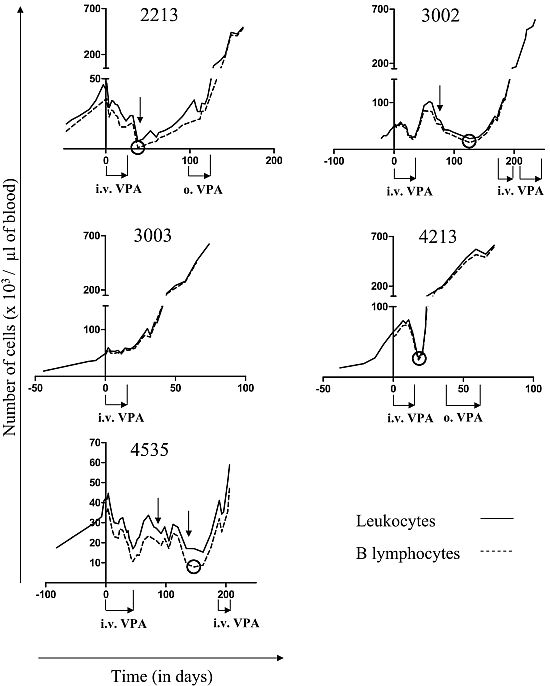
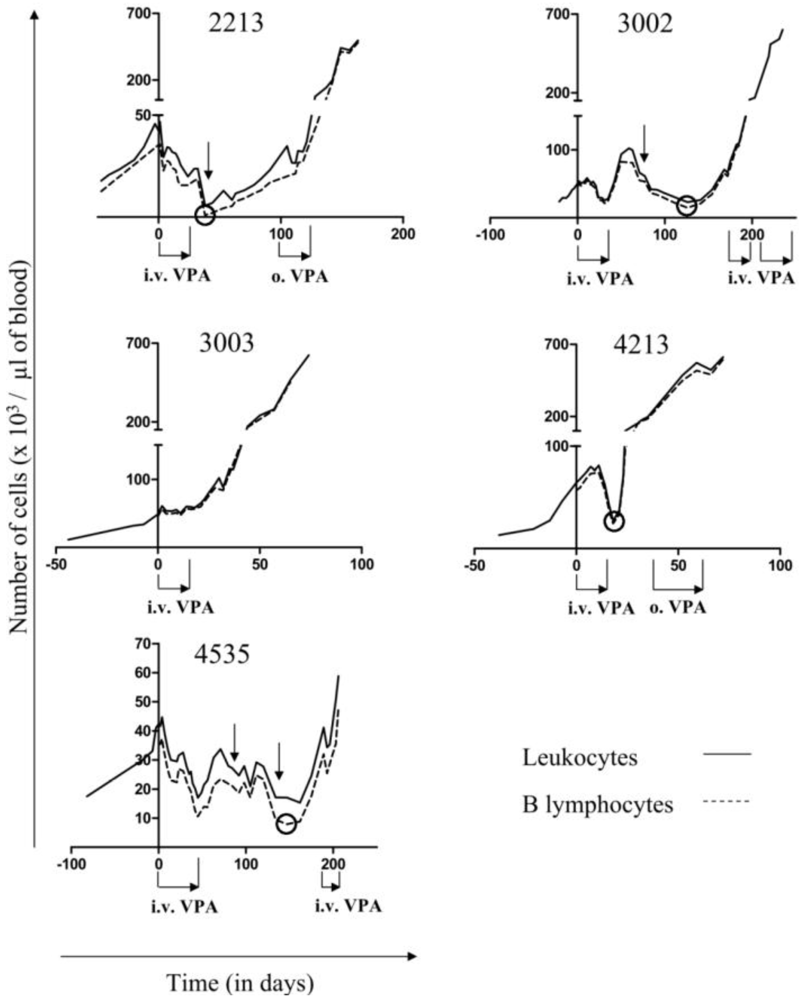
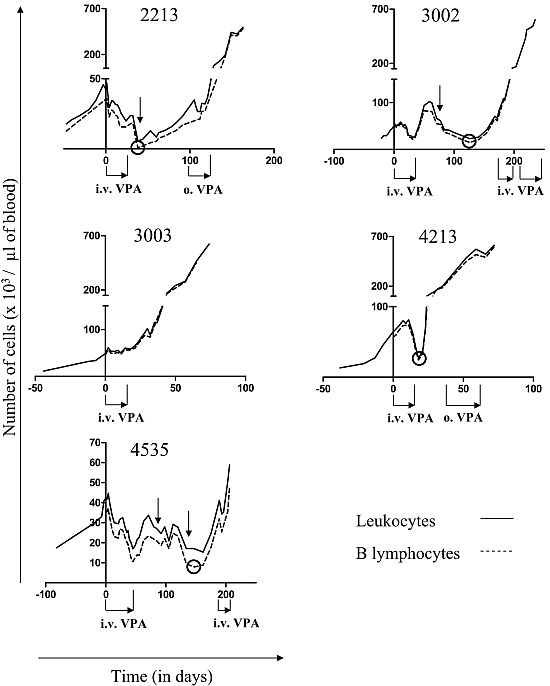
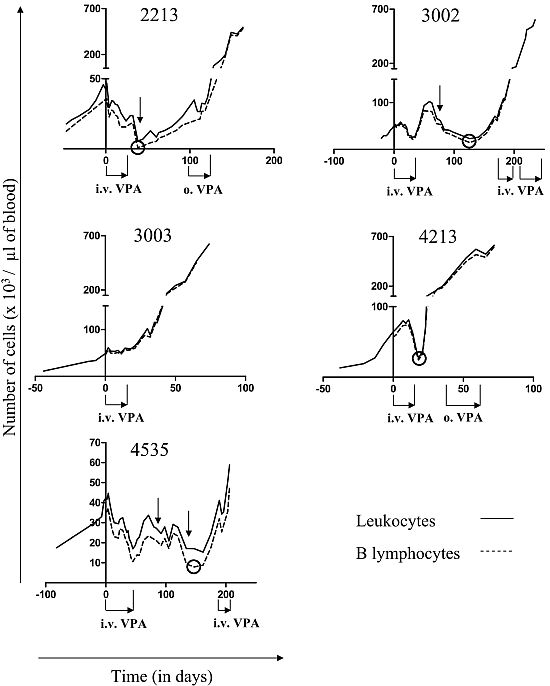
        <p>Long-term disease progression was characterized in five BLV-infected sheep. At initiation of VPA treatment (day 0, <xref ref-type="fig" rid="pathogens-01-00065-f001">Figure 1</xref>), all sheep were in the acute progressive phase of the disease as attested by the rapid increase in their leukocyte counts (<xref ref-type="fig" rid="pathogens-01-00065-f001">Figure 1</xref>, black line), a majority being B-lymphocytes (<xref ref-type="fig" rid="pathogens-01-00065-f001">Figure 1</xref>, dotted line). At this stage, leukemia is quickly lethal within a few days or weeks [<xref ref-type="bibr" rid="B2-pathogens-01-00065">2</xref>,<xref ref-type="bibr" rid="B6-pathogens-01-00065">6</xref>]. Indeed, in absence of treatment, the average time period between the initiation of the acute leukemic phase and the death of the animals is 46 days (with a standard deviation of 39 days) [<xref ref-type="bibr" rid="B6-pathogens-01-00065">6</xref>]. At day 0, numbers of B-cells were 35, 46, 46, 57 and 36 × 10<sup>3</sup> cells per µL of blood in sheep # 2213, 3002, 3003, 4213 and 4535, respectively. The five leukemic BLV-infected sheep were treated by intravenous injections of 10g of VPA (<xref ref-type="fig" rid="pathogens-01-00065-f001">Figure 1</xref>, i.v. VPA), as described previously [<xref ref-type="bibr" rid="B6-pathogens-01-00065">6</xref>]. The treatment provoked a direct reduction in the B-lymphocyte numbers in four sheep (<italic>i.e.</italic>, # 2213, 3002, 4213 and 4535), extending our previous observations [<xref ref-type="bibr" rid="B6-pathogens-01-00065">6</xref>], but not in animal # 3003 (<xref ref-type="fig" rid="pathogens-01-00065-f001">Figure 1</xref>, dotted line). Interestingly, a time delay between VPA treatment and drop of lymphocyte counts could be observed (see vertical arrows on <xref ref-type="fig" rid="pathogens-01-00065-f001">Figure 1</xref>).</p>
        <fig id="pathogens-01-00065-f001" position="anchor">
          <label>Figure 1</label>
          <caption>
            <p>Valproate (VPA) treatment of bovine leukemia virus (BLV)-infected leukemic sheep VPA was administrated intravenously (10 g per injection, as indicated by: i.v. VPA) or orally to BLV-infected sheep (1 g per day as indicated by: o. VPA). The absolute number of leukocytes (black line) was determined with a hematological counter and the proportion of B lymphocytes was evaluated by flow cytometry using an anti-IgM antibody. The numbers of B-cells are represented by the dotted line. The black circles highlight the lower B cell counts observed within each sheep during treatment. The vertical black arrows show the decrease of the leukocyte and B cell counts occurring outside the VPA administration period.</p>
          </caption>
          <graphic xmlns:xlink="http://www.w3.org/1999/xlink" xlink:href="pathogens-01-00065-g001.tif"/>
        </fig>
      </sec>
      <sec>
        <title>2.2. Relapse and Onset of Chemoresistance against VPA Treatment</title>
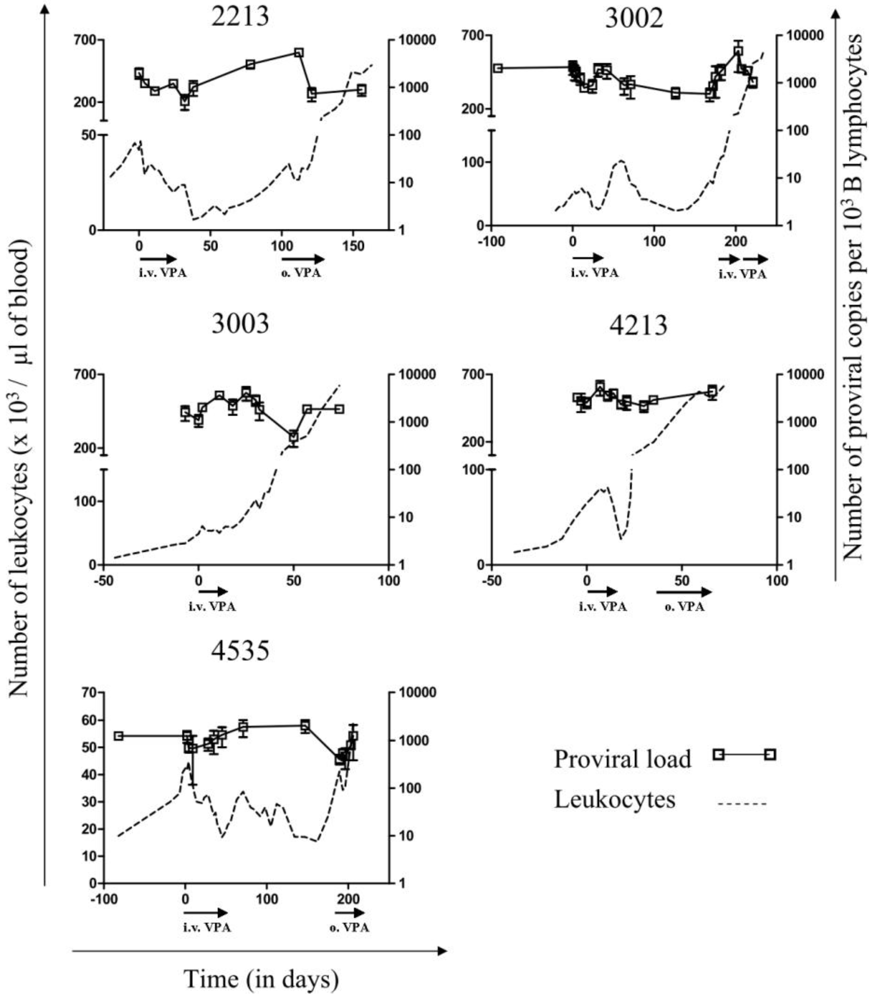
        <p>Upon interruption of treatment, the B-lymphocyte counts eventually increased in all sheep after different periods of time. During relapse, retreatment with VPA either orally (<xref ref-type="fig" rid="pathogens-01-00065-f001">Figure 1</xref>, o. VPA) or intravenously (<xref ref-type="fig" rid="pathogens-01-00065-f001">Figure 1</xref>, i.v. VPA) did not impede disease progression, leading to subsequent death. In other words, all sheep relapsed and evidently became unresponsive to VPA treatment. We next quantified the DNA proviral loads throughout VPA treatment and relapse using real time PCR (<xref ref-type="fig" rid="pathogens-01-00065-f002">Figure 2</xref>, empty squares). In general, the relative proviral load (<italic>i.e.</italic>, the number of proviral copies per B-cell approached 1 (or 1.000 in 10<sup>3</sup> B lymphocytes on the Y axis indicated on the right), with some sporadic fluctuations. This data thus confirms that leukemia in all five sheep was due to the expansion of BLV provirus carrying B lymphocytes. To conclude, it appeared that VPA treatment decreased the number of B-cells and the absolute PVL (<italic>i.e.</italic>, the number of proviral copies per mm<sup>3</sup> of blood) but did not reduce the proportion of infected cells in the B-lymphocyte pool, even when close to normal cell counts were restored (at days 38, 126, 18 and 162 for sheep # 2213, # 3002, # 4213 and # 4535, respectively; see circles in <xref ref-type="fig" rid="pathogens-01-00065-f001">Figure 1</xref>).</p>
        <fig id="pathogens-01-00065-f002" position="anchor">
          <label>Figure 2</label>
          <caption>
            <p>BLV proviral loads during VPA treatment and relapse: The proviral loads (empty squares), represented as numbers of viral copies per 10<sup>3</sup> B-lymphocytes, were measured by real time PCR using genomic DNA isolated from sheep peripheral blood mononuclear cells (PBMCs). Data result from triplicate measurements (error bars represent means ± standard deviations). Absolute leukocyte numbers are indicated as reference (dotted line).</p>
          </caption>
          <graphic xmlns:xlink="http://www.w3.org/1999/xlink" xlink:href="pathogens-01-00065-g002.tif"/>
        </fig>
      </sec>
      <sec>
        <title>2.3. <italic>Ex Vivo</italic> Cell Cycle Distribution and Viral Expression during VPA Treatment and Relapse</title>
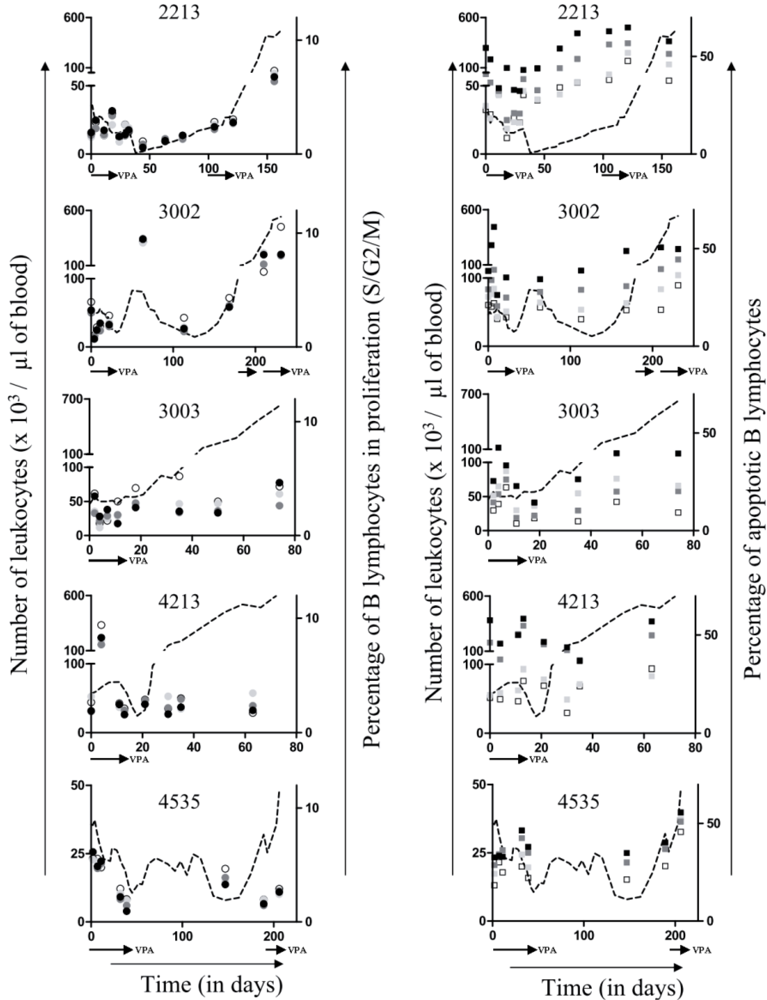
        <p>To further characterize the responsiveness of leukemic cells to VPA, peripheral blood mononuclear cells (PBMCs) were transiently cultivated <italic>ex vivo</italic> and analyzed by flow cytometry to assess apoptosis and cell proliferation. The levels of spontaneous apoptosis and the rates of cell proliferation fluctuated throughout treatment without apparent correlation neither with response efficiency nor with relapse (<xref ref-type="fig" rid="pathogens-01-00065-f003">Figure 3</xref>, □ and ○). When added to the culture medium, VPA had only minor effects on the proportion of B-lymphocytes undergoing proliferation (<xref ref-type="fig" rid="pathogens-01-00065-f003">Figure 3</xref>, left panels, <inline-graphic xmlns:xlink="http://www.w3.org/1999/xlink" xlink:href="pathogens-01-00065-i001.tif"/>, <inline-graphic xmlns:xlink="http://www.w3.org/1999/xlink" xlink:href="pathogens-01-00065-i002.tif"/> and <inline-graphic xmlns:xlink="http://www.w3.org/1999/xlink" xlink:href="pathogens-01-00065-i003.tif"/> for respectively 1, 5 and 10mM of VPA) but clearly triggered apoptosis (<xref ref-type="fig" rid="pathogens-01-00065-f003">Figure 3</xref>, right panels, <inline-graphic xmlns:xlink="http://www.w3.org/1999/xlink" xlink:href="pathogens-01-00065-i004.tif"/>, <inline-graphic xmlns:xlink="http://www.w3.org/1999/xlink" xlink:href="pathogens-01-00065-i005.tif"/> and <inline-graphic xmlns:xlink="http://www.w3.org/1999/xlink" xlink:href="pathogens-01-00065-i006.tif"/> for respectively 1, 5 and 10mM of VPA). Importantly, this proapoptotic effect persisted throughout VPA treatment as well as during relapse.</p>
        <fig id="pathogens-01-00065-f003" position="anchor">
          <label>Figure 3</label>
          <caption>
            <p><italic>Ex vivo</italic> proliferation and apoptosis: PBMCs, isolated from BLV infected sheep during VPA treatment and relapse, were cultivated for 16 hours in absence or in presence of different concentrations of VPA (from 0, 1, 5 and 10 mM). The percentages of cells undergoing proliferation (left panels; ○, <inline-graphic xmlns:xlink="http://www.w3.org/1999/xlink" xlink:href="pathogens-01-00065-i001.tif"/>, <inline-graphic xmlns:xlink="http://www.w3.org/1999/xlink" xlink:href="pathogens-01-00065-i002.tif"/>and <inline-graphic xmlns:xlink="http://www.w3.org/1999/xlink" xlink:href="pathogens-01-00065-i003.tif"/> correspond to 0, 1, 5 and 10 mM of VPA, respectively) and apoptosis (right panels; □, <inline-graphic xmlns:xlink="http://www.w3.org/1999/xlink" xlink:href="pathogens-01-00065-i004.tif"/>, <inline-graphic xmlns:xlink="http://www.w3.org/1999/xlink" xlink:href="pathogens-01-00065-i005.tif"/> and <inline-graphic xmlns:xlink="http://www.w3.org/1999/xlink" xlink:href="pathogens-01-00065-i006.tif"/> for 0, 1, 5 and 10 mM of VPA, respectively) were determined by flow cytometry. Absolute leukocyte numbers are indicated as reference (dotted line).</p>
          </caption>
          <graphic xmlns:xlink="http://www.w3.org/1999/xlink" xlink:href="pathogens-01-00065-g003.tif"/>
        </fig>
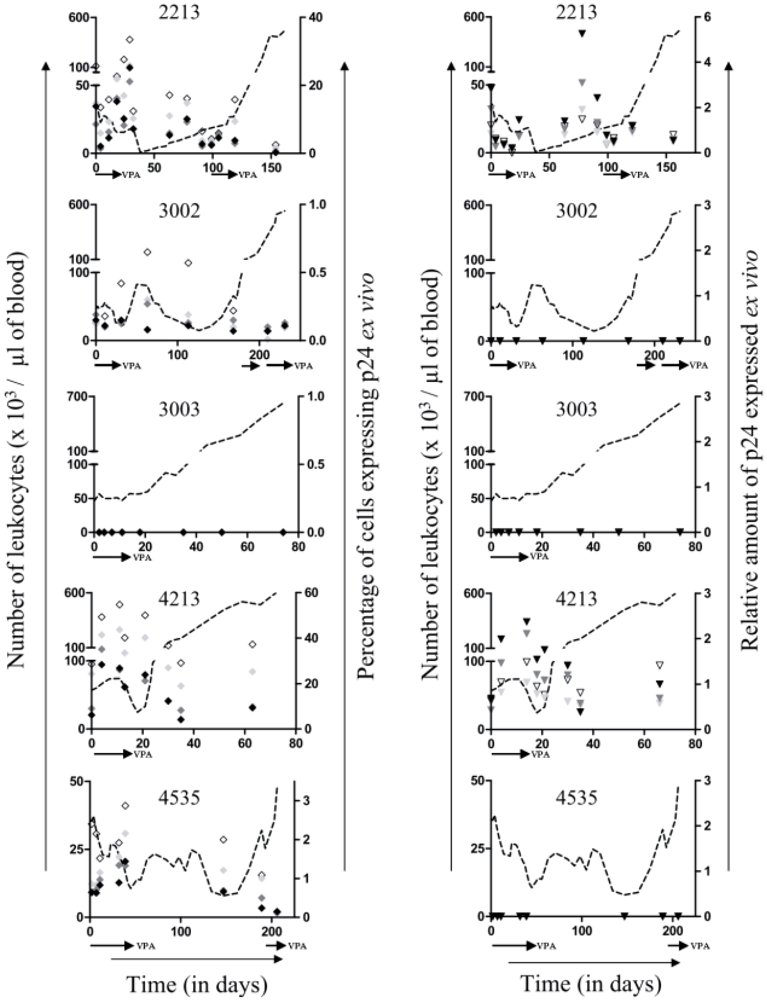
        <p>To evaluate the ability of infected B cells to spontaneously express viral proteins, PBMCs were transiently cultivated <italic>ex vivo</italic> and analyzed for expression of p24, the major core antigen of the viral particle. Two types of complementary techniques were used in parallel: flow cytometry to determine the percentage of cells containing p24 protein (<xref ref-type="fig" rid="pathogens-01-00065-f004">Figure 4</xref>, left panels, ◊ ) and ELISA to quantify the relative amount expressed in the cell culture supernatant (<xref ref-type="fig" rid="pathogens-01-00065-f004">Figure 4</xref>, right panels, ∇ ). It appeared that high levels of spontaneous p24 expression were measured in PBMC cultures from two sheep # 2213 and # 4213. Two other animals (# 3002 and # 4535) yielded low (<italic>i.e.</italic>, below 3%) but detectable percentages of p24-positive cells, the relative amount of p24 being below the sensitivity of the ELISA test (right panels). Finally, PBMCs isolated from one sheep (# 3003) were completely negative for p24 expression. There is thus a large disparity in p24 <italic>ex vivo</italic> expression among the five sheep. When PBMCs were cultivated <italic>ex vivo</italic> in the presence of VPA, the percentages of p24-positive cells decreased (<xref ref-type="fig" rid="pathogens-01-00065-f004">Figure 4</xref>, left panels, <inline-graphic xmlns:xlink="http://www.w3.org/1999/xlink" xlink:href="pathogens-01-00065-i007.tif"/>, <inline-graphic xmlns:xlink="http://www.w3.org/1999/xlink" xlink:href="pathogens-01-00065-i008.tif"/>, and <inline-graphic xmlns:xlink="http://www.w3.org/1999/xlink" xlink:href="pathogens-01-00065-i009.tif"/> for respectively 1, 5 and 10mM of VPA), most likely due to the proapototic effect of VPA. In contrast, the relative amount of p24 antigen increased most of the time (<xref ref-type="fig" rid="pathogens-01-00065-f004">Figure 4</xref>, right panels, <inline-graphic xmlns:xlink="http://www.w3.org/1999/xlink" xlink:href="pathogens-01-00065-i010.tif"/>, <inline-graphic xmlns:xlink="http://www.w3.org/1999/xlink" xlink:href="pathogens-01-00065-i011.tif"/> and <inline-graphic xmlns:xlink="http://www.w3.org/1999/xlink" xlink:href="pathogens-01-00065-i012.tif"/> for respectively 1, 5 and 10mM of VPA) confirming previous observations [<xref ref-type="bibr" rid="B6-pathogens-01-00065">6</xref>]. Because apoptotic cells do not express viral proteins [<xref ref-type="bibr" rid="B2-pathogens-01-00065">2</xref>], the p24 burst is due to an increase of proviral expression.</p>
        </sec>
      <sec>
        <title>2.4. Tumor Clone Replacement in Two out of Five BLV-Infected Sheep</title>
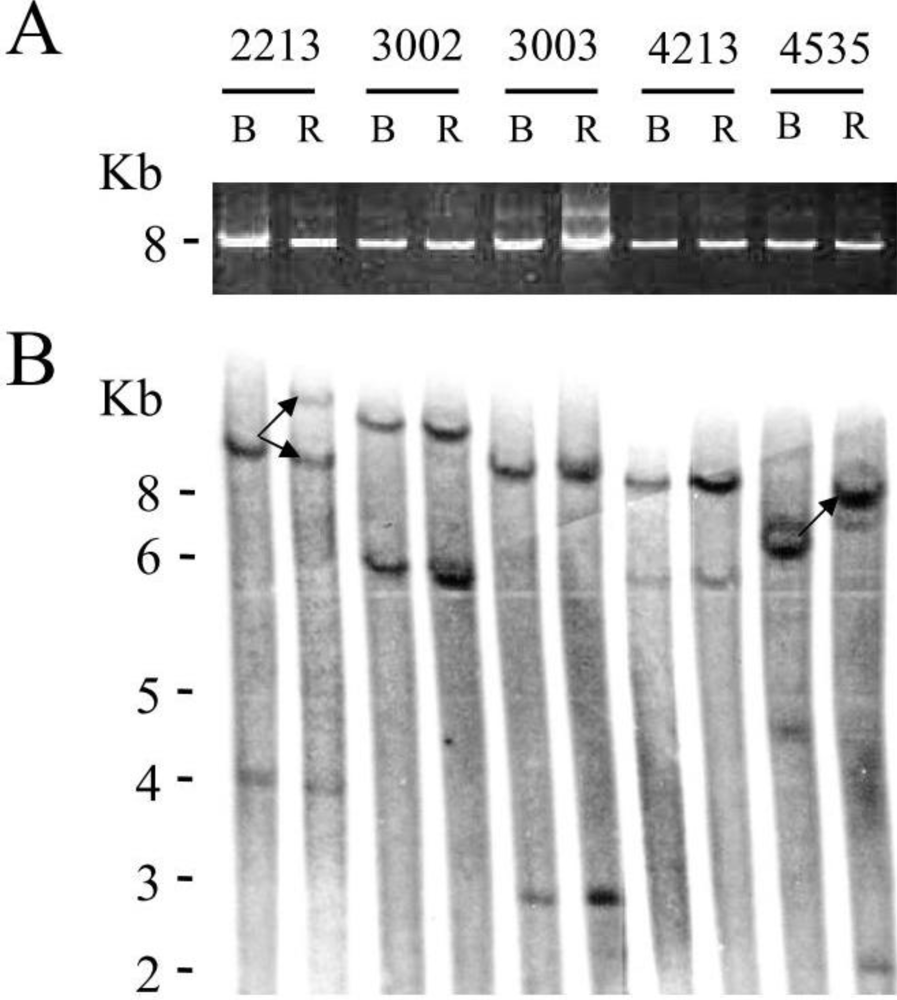
        <p>To evaluate proviral integrity, the full-length BLV genome was amplified by PCR using primers located in the 5' and 3' LTRs. It appeared that all sheep contained full length BLV proviruses before treatment (<xref ref-type="fig" rid="pathogens-01-00065-f005">Figure 5</xref>A, “B”), as well as during relapse (“R”). To assess the clonality of viral integration, cellular DNA was digested with restriction enzyme EcoRI, which cuts the provirus sequence once and is analyzed by Southern blot using a BLV probe. The hybridization profile was altered during relapse in sheep 2213 and 4535 (<xref ref-type="fig" rid="pathogens-01-00065-f005">Figure 5</xref>B, see arrows) indicating that the infected clones expanding before treatment and during relapse were different.</p>
        </sec>
      <sec>
        <title>2.5. Treatment of VPA-Unresponsive Animals with Other HDAC Inhibitors</title>
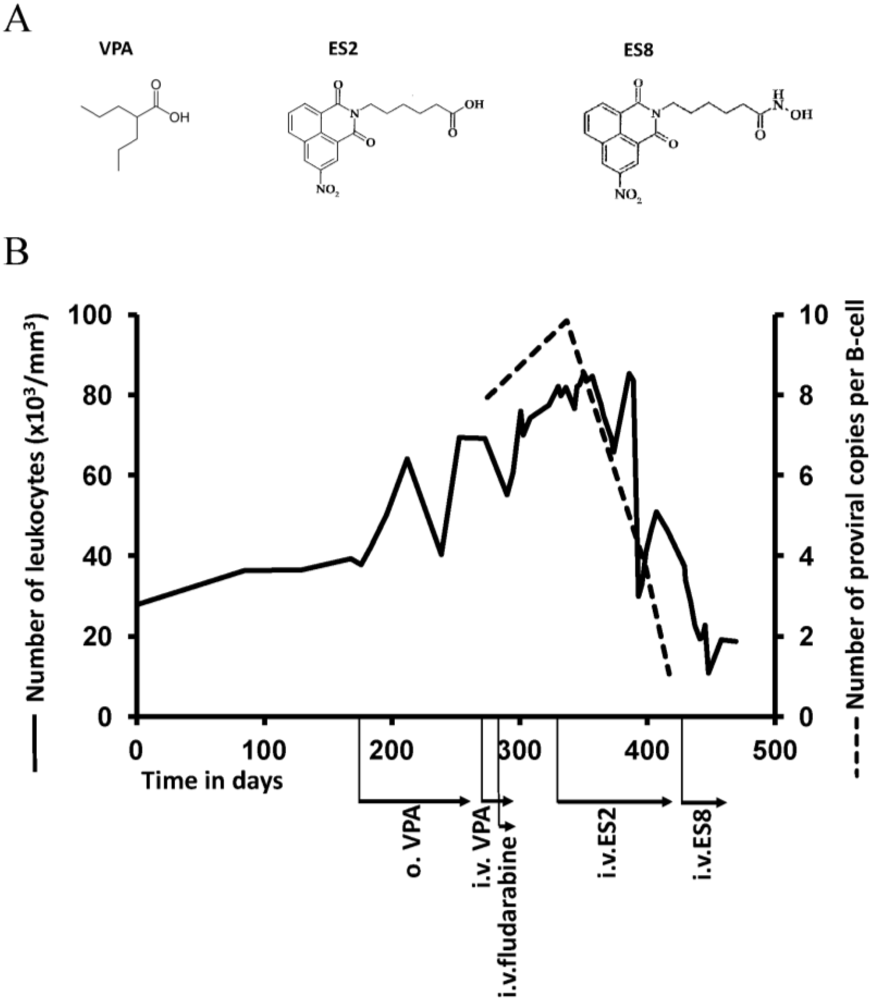
        <p>Treatment of BLV-infected sheep #4270 was initiated at the leukemic phase of the disease (37.7 × 10<sup>3</sup> cells/μL at day 176) with VPA given orally. The aim was to test whether or not this type of treatment could decrease the B-cell counts. This animal received serial oral administrations of VPA (1 g/day) (<xref ref-type="fig" rid="pathogens-01-00065-f006">Figure 6</xref>B). Due to leukemia progression, 3 g of VPA was given daily. Since this increased dose was also inefficient, the sheep received serial i.v. injections of 10 g VPA (7 doses) and of fludarabine (50 mg, 3 doses), a nucleoside analog active in chronic lymphocytic leukemia. These treatments did not impair disease progression leading to very high blood cell counts (80 × 10<sup>3</sup> cells/μL).</p>
		<fig id="pathogens-01-00065-f004" position="anchor">
          <label>Figure 4</label>
          <caption>
            <p><italic>Ex vivo</italic> viral p24 expression: PBMCs, isolated from BLV infected sheep during VPA treatment and relapse, were cultivated during 16 hours in absence or in presence of different concentrations of VPA (from 0, 1, 5 and 10 mM). The percentages of cells expressing the viral protein p24 (left panels; ◊ for 0 mM, <inline-graphic xmlns:xlink="http://www.w3.org/1999/xlink" xlink:href="pathogens-01-00065-i007.tif"/>, <inline-graphic xmlns:xlink="http://www.w3.org/1999/xlink" xlink:href="pathogens-01-00065-i008.tif"/>, and <inline-graphic xmlns:xlink="http://www.w3.org/1999/xlink" xlink:href="pathogens-01-00065-i009.tif"/> for respectively 1, 5 and 10 mM of VPA) were determined by flow cytometry. The amount of p24 in the supernatant (right panels; ∇ for 0 mM, <inline-graphic xmlns:xlink="http://www.w3.org/1999/xlink" xlink:href="pathogens-01-00065-i010.tif"/>, <inline-graphic xmlns:xlink="http://www.w3.org/1999/xlink" xlink:href="pathogens-01-00065-i011.tif"/> and <inline-graphic xmlns:xlink="http://www.w3.org/1999/xlink" xlink:href="pathogens-01-00065-i012.tif"/> for respectively 1, 5 and 10 mM of VPA) was measured by ELISA. Data derives from optical densities measured in the linear range of a standard curve and are represented as relative amounts normalized for non-apoptotic B-cells. Absolute leukocyte numbers are indicated as reference (dotted line).</p>
          </caption>
          <graphic xmlns:xlink="http://www.w3.org/1999/xlink" xlink:href="pathogens-01-00065-g004.tif"/>
        </fig>
      <fig id="pathogens-01-00065-f005" position="anchor">
          <label>Figure 5</label>
          <caption>
            <p>BLV proviral integrity and integration sites during VPA treatment and relapse: A. DNA was extracted from BLV-infected sheep PBMCs (2213, 3002, 3003, 4213, 4535) isolated just before VPA treatment at day 0 (B) and at the end of the relapse period (R). The full length proviral sequence was amplified by PCR using primers located in the 5' and 3' LTRs. PCR amplification products were migrated onto an agarose gel. The molecular weight of the amplicon is indicated in kilobases (8 Kb). B. Southern blot hybridization using a BLV probe of genomic DNA digested with EcoRI. The molecular weight markers (in Kb) are indicated on the left. Lanes correspond to those of panel A.</p>
          </caption>
          <graphic xmlns:xlink="http://www.w3.org/1999/xlink" xlink:href="pathogens-01-00065-g005.tif"/>
        </fig>
        <p>Facing unresponsiveness to VPA, our aim was to overcome chemoresistance and identify an efficient novel treatment of BLV-induced leukemia. Since VPA is a relatively weak HDAC inhibitor active only in the millimolar range, two improved compounds (ES2 and ES8) were developed (Boittiaux <italic>et al.</italic>, in preparation). ES2 shares the carboxyl HDAC inhibitory arm with VPA (<xref ref-type="fig" rid="pathogens-01-00065-f006">Figure 6</xref>A). In ES8, the carboxyl is replaced by a hydroxamic acid which more potently interacts with the zinc ion located in the HDAC catalytic pocket. These inhibitors were tested for their ability to treat leukemia of animal #4270. Intravenous injections of ES2 transiently reduced cell counts but yielded again chemoresistance (<xref ref-type="fig" rid="pathogens-01-00065-f006">Figure 6</xref>B). Further treatment with ES8 induced almost complete clearance of leukemia; B cell counts reaching levels close to normal and proviral loads decreasing dramatically (<xref ref-type="fig" rid="pathogens-01-00065-f006">Figure 6</xref>B, dotted line). The animal died later on from causes unrelated to leukemia (<italic>i.e.</italic>, enterotoxemia). Unfortunately, treatment of 3 other leukemic animals with ES8 was inefficient (data not shown).</p>
        <p>This pilot experiment thus shows that improved HDAC inhibitors can overcome multiple chemoresistances to VPA and fludarabine in 1 out of 4 leukemic sheep.</p>
		<fig id="pathogens-01-00065-f006" position="anchor">
          <label>Figure 6</label>
          <caption>
            <p>Treatment with newly developed HDAC inhibitors: (<bold>A</bold>) Chemical formula of VPA and 2 newly developed HDAC inhibitors; (<bold>B</bold>) Sheep #4270 was successively treated with VPA, Fludarabine, ES2 and ES8 (two newly developed HDAC inhibitors). VPA was mixed with food and administrated at a rate of 1 g/day during 48 days and at 3 g/day during 38 days to the BLV-infected sheep. Ten grams of VPA were also injected intravenously into the jugular vein alone (four times) or in combination with 50 mg of fludarabine (three times) spread over a period of 17 days. Increasing concentrations of ES2 (from 0.1 mg to 7 g, 24 injections) and ES8 (from 1.1mg to 56mg, 9 injections) were given intravenously.</p>
          </caption>
          <graphic xmlns:xlink="http://www.w3.org/1999/xlink" xlink:href="pathogens-01-00065-g006.tif"/>
        </fig>
        
      </sec>
      <sec>
        <title>2.6. Discussion</title>
        <p>We previously provided evidence that VPA activates BLV gene expression in transient transfection experiments and in short-term cultures of primary B-lymphocytes [<xref ref-type="bibr" rid="B6-pathogens-01-00065">6</xref>]. <italic>In vivo</italic>, VPA injections into sheep efficiently decreased the numbers of leukemic cells in the peripheral blood and led to tumor regression. Such VPA treatment does not impact T cell count (CD4, CD8 and γδ) in leukemic sheep, nor modify total leukocyte and B cell count in uninfected sheep [<xref ref-type="bibr" rid="B6-pathogens-01-00065">6</xref>]. In the present study, we describe the long term fate of five BLV-infected sheep upon interruption of VPA treatment. Different responses to treatment were observed: none (# 3003), partial (# 3002 and 4213) and almost complete (<italic>i.e.</italic>, with leukemic cells counts below 10,000 per µL of blood, # 2213 at day 38 and # 4535 at days 45 and 147) (<xref ref-type="fig" rid="pathogens-01-00065-f001">Figure 1</xref>). In any of the treated animals, sequential intravenous injections of VPA led to complete clearance of all provirus carrying cells in the peripheral blood (<xref ref-type="fig" rid="pathogens-01-00065-f002">Figure 2</xref>). Amazingly, a delay can occur between treatment with VPA and the decrease of the B-cell numbers as observed in sheep # 2213, 3002 and 4535 at days 19–22, 60–125 and 70–160, respectively (<xref ref-type="fig" rid="pathogens-01-00065-f001">Figure 1</xref>, vertical arrows). Since the half-life of VPA in the plasma is about 16–17 h, it thus appears that cells may disappear long after having been in contact with the HDAC inhibitor. In fact, we already observed this type of phenomenon in our previous study [<xref ref-type="bibr" rid="B6-pathogens-01-00065">6</xref>]. In presence of a strong antiviral immune response, it is unlikely that cells expressing viral proteins would persist, even transiently, in these BLV-infected sheep. Therefore, we speculate that a second step is required for viral expression and subsequent cell destruction such as for example cell migration to the lymphoid tissues, antigenic dependent T-cell activation or induction of cell proliferation [<xref ref-type="bibr" rid="B2-pathogens-01-00065">2</xref>,<xref ref-type="bibr" rid="B5-pathogens-01-00065">5</xref>]. Further experiments will be required to gain insight into the mechanisms of VPA therapy. However, we think that induction of viral expression is a key parameter of this process because sheep # 3003, which was the only one to be unresponsive to VPA, did not contain any detectable cell that spontaneously expressed p24 viral protein. In addition, there is also a trend towards a reduction in viral expression during relapse of all sheep, when the leukemic cells accumulate exponentially. Importantly, we recently demonstrated that transient stimulation of viral expression <italic>ex vivo</italic> correlates with faster disappearance of B cells <italic>in vivo</italic> [<xref ref-type="bibr" rid="B14-pathogens-01-00065">14</xref>]. Although this model is still hypothetical, we propose that VPA activates viral expression in the silent pool of provirus carrying cells and permits their subsequent destruction by the host’s immune response. Therefore, mechanisms impairing viral expression such as proviral deletions or mutations and/or DNA methylation [<xref ref-type="bibr" rid="B15-pathogens-01-00065">15</xref>] might interfere with VPA efficacy. To achieve complete remission, it may therefore be required to extend the duration of VPA treatment, modify its mode of administration and/or combine with other epigenetic modulators (e.g., a DNMT inhibitor).</p>
        <p>Although we favor an anti-leukemic effect based on transient induction of viral expression and subsequent destruction by the immune response, VPA is known to affect many other cellular mechanisms, including cell cycle arrest, apoptosis, differentiation, and angiogenesis [<xref ref-type="bibr" rid="B16-pathogens-01-00065">16</xref>,<xref ref-type="bibr" rid="B17-pathogens-01-00065">17</xref>]. VPA also potently induces lethal reactive oxygen species and reactivates cell death receptor pathways (TRAIL and CD95L/FasL) [<xref ref-type="bibr" rid="B18-pathogens-01-00065">18</xref>,<xref ref-type="bibr" rid="B19-pathogens-01-00065">19</xref>,<xref ref-type="bibr" rid="B20-pathogens-01-00065">20</xref>]. Consistently, our data of <xref ref-type="fig" rid="pathogens-01-00065-f003">Figure 3</xref> shows that VPA is proapoptotic in cell culture. However there is no direct correlation between VPA proapoptotic effect <italic>ex vivo</italic> and reduction of leukemic cells <italic>in vivo</italic>. To directly address this question, kinetic parameters (<italic>i.e.</italic>, proliferation and apoptosis) could be determined using intravenous injections of bromodeoxyuridine or carboxyfluorescein succinimidyl ester (CFSE) [<xref ref-type="bibr" rid="B21-pathogens-01-00065">21</xref>,<xref ref-type="bibr" rid="B22-pathogens-01-00065">22</xref>]. However, a mechanism based on direct induction of apoptosis by VPA does not fit with the time delay observed between its administration and reduction in leukemic cell numbers (arrows on <xref ref-type="fig" rid="pathogens-01-00065-f001">Figure 1</xref>), further supporting our hypothetical “virus activation/immune destruction” model. In this context, the replacement of tumor clones, as attested by a modification of the proviral integration site (# 2213 and # 4535, <xref ref-type="fig" rid="pathogens-01-00065-f005">Figure 5</xref>), also argues in favor of a selection process directed towards defined cell populations rather than via a general proapoptotic effect of VPA.</p>
        <p>An important overall conclusion of this report is that all five sheep relapsed after different time periods post-treatment. During relapse of leukemia, we were unable to successfully constrict disease progression. As outlined above, inefficacy of VPA might be due to the lack of viral expression and/or impairment of immune response at final stages of leukemia. Resistance to VPA treatment may also be the consequence of VPA clearance. Conjugation with glucuronic acid followed by renal excretion is indeed the major metabolic route for VPA clearance [<xref ref-type="bibr" rid="B23-pathogens-01-00065">23</xref>,<xref ref-type="bibr" rid="B24-pathogens-01-00065">24</xref>,<xref ref-type="bibr" rid="B25-pathogens-01-00065">25</xref>]. However, determination of VPA plasmatic concentrations during relapse did not support this type of resistance process (data not shown). Other potentially contributing mechanisms include intracellular drug trafficking, alterations in drug-target interaction, metabolic changes (e.g., tolerance to stress conditions), escape from checkpoint control or defects in apoptotic pathways [<xref ref-type="bibr" rid="B26-pathogens-01-00065">26</xref>,<xref ref-type="bibr" rid="B27-pathogens-01-00065">27</xref>]. In particular, membrane transporters play important roles in reducing intracellular drug concentrations in tumor cells. ABC (ATP-binding cassette) transporters are frequently associated with decreased cellular accumulation of anticancer drugs and multidrug resistance of tumors [<xref ref-type="bibr" rid="B28-pathogens-01-00065">28</xref>]. However, efflux of VPA was reported to be independent of MRP-1/2 (multidrug resistance proteins) and P-glycoprotein [<xref ref-type="bibr" rid="B29-pathogens-01-00065">29</xref>,<xref ref-type="bibr" rid="B30-pathogens-01-00065">30</xref>,<xref ref-type="bibr" rid="B31-pathogens-01-00065">31</xref>].</p>
        <p>Whatever the mechanism which remains to be further characterized, our report has important conclusions for the ongoing trials evaluating HDAC inhibitors in HTLV-1 therapy. In HAM/TSP, VPA treatment also appeared inefficient in permanently reducing the proviral loads after 2 years [<xref ref-type="bibr" rid="B8-pathogens-01-00065">8</xref>], likely due to similar mechanisms. Perhaps the combination of VPA with an anti-retroviral agent (AZT) could achieve this goal in human as described in STLV-1 infected <italic>P. papio</italic> [<xref ref-type="bibr" rid="B32-pathogens-01-00065">32</xref>]. Alternatively, improved HDAC inhibitors (<xref ref-type="fig" rid="pathogens-01-00065-f006">Figure 6</xref>) may also be useful, although increased potency may correlate with exacerbated toxicity. In ATL, the overall median survival is about one year in its most aggressive forms (reviewed in [<xref ref-type="bibr" rid="B33-pathogens-01-00065">33</xref>]). Encouraging results were obtained in patients undergoing allogeneic stem cell transplantation but this procedure requires available donors and faces the problem of graft versus host disease [<xref ref-type="bibr" rid="B34-pathogens-01-00065">34</xref>]. Recently, a meta-analysis showed that ATL treatment with AZT and IFN induces high response rates and complete remissions and prolongs survival in acute, chronic and smoldering ATL, but not in lymphoma [<xref ref-type="bibr" rid="B35-pathogens-01-00065">35</xref>]. Unfortunately, many patients eventually relapsed, suggesting that AZT+IFN could not cure ATL and that new therapeutic approaches are still needed [<xref ref-type="bibr" rid="B36-pathogens-01-00065">36</xref>]. In this context, recent data from a small scale study indicated that VPA could be used as consolidation therapy after AZT+IFN [<xref ref-type="bibr" rid="B13-pathogens-01-00065">13</xref>]. Conclusions from our present report may be informative for further investigations of this approach.</p>
      </sec>
    </sec>
    <sec sec-type="methods">
      <title>3. Experimental</title>
      <sec>
        <title>3.1. Experimental Design of VPA Treatment</title>
        <p>Five sheep (# 2213, 3002, 3003, 4213, 4535) were maintained under restricted conditions (BSL-2) at the Study Center of Animal Productions (Gembloux, Belgium). Sheep were experimentally infected with a BLV wild-type cloned provirus (strain 344), as previously described [<xref ref-type="bibr" rid="B37-pathogens-01-00065">37</xref>]. At regular intervals of time, total leukocyte counts were determined by using an automated cell counter MS 4–5 vet (Mellet Schloesing Laboratories). To determine the percentages of B lymphocytes, PBMCs were labeled with an anti-IgM monoclonal antibody (clone 1H4), in association with rat anti-mouse IgG1 phycoerythrin, and then analyzed by flow cytometry (Becton Dickinson). Ten thousand events were collected for each sample, and data was analyzed with the Cellquest software (Becton Dickinson Immunocytometry Systems). Leukemic sheep (# 2213, 3002, 3003, 4213, 4535) received intravenous injections of VPA (respectively 9, 40, 9, 9 and 32 doses of 10 g each in 30 mL of sterile NaCl 0.9%) spread over several weeks, as indicated in the legend of <xref ref-type="fig" rid="pathogens-01-00065-f001">Figure 1</xref> (i.v. VPA). This amount of VPA thus corresponds to a daily dose of approximately 80 mg/kg/day, up to 250 mg/kg having been tested in sheep [<xref ref-type="bibr" rid="B24-pathogens-01-00065">24</xref>]. In animal # 3002, we had to interrupt VPA i.v. injections for a few days at the time of relapse because of a side effect (fainting). Since intravenous injections induce a transient but potentially harmful peak of plasmatic VPA concentration [<xref ref-type="bibr" rid="B6-pathogens-01-00065">6</xref>], we provided VPA orally, as for epilepsy therapy in humans. Sheep # 2213 and 4213 received oral VPA administrations (23 doses of 1 g per day each mixed with food) spread over several days, as indicated in the legend of <xref ref-type="fig" rid="pathogens-01-00065-f001">Figure 1</xref> (o. VPA).</p>
      </sec>
      <sec>
        <title>3.2. Determination of the Proviral Loads</title>
        <p>Venous blood was collected by jugular venipuncture and mixed with 0.3% w/v of EDTA used as an anticoagulant. 2 × 10<sup>6</sup> peripheral blood mononuclear cells (PBMCs) were lysed in a buffer containing 100 mM Tris HCl pH 8, 150 mM NaCl, 10 mM EDTA and 0.5% SDS and digested overnight with RNAse A (0.1 mg/mL) and proteinase K (0.2 mg/mL). The cellular DNA was then purified by a phenol-chloroform (1:1) extraction and by ethanol precipitation. One hundred nanograms of genomic DNA were used for real-time PCR amplification of BLV proviral sequences as described previously [<xref ref-type="bibr" rid="B38-pathogens-01-00065">38</xref>,<xref ref-type="bibr" rid="B39-pathogens-01-00065">39</xref>]. Briefly, a segment corresponding to the pol gene (nucleotide coordinates 3,994–4,060 according to the BLV GenBank accession number K02120) was amplified with a pair of primers (5'-GAAACTCCAGAGCAATGGCATAA-3' and 5'-GGTTCGGCCATCGAGACA-3' at 900 nM final concentration) and revealed with a minor groove binder fluorescent probe (250 nM of 6FAM-CTCACCCACTGCAAC-MGB) using the TaqMan PCR universal master mix on a GeneAmp 5700 apparatus (Applied Biosystems). A standard curve was generated after amplification of defined proviral copy numbers (from 1 to 10<sup>7</sup> of plasmid pBLV344) diluted in 100 ng of control genomic DNA. To correct for differences in DNA concentrations the 18S ribosomal DNA was quantified in parallel using probe 6FAM-CATGCCGACGGGCGCTGA-MGB and primers 5'-TTGGATAACTGTGGTAATTCTAGAAGCTAA-3’ and 5’-CGGGTTGGTTTTGATCTGATAAAT-3'.</p>
      </sec>
      <sec>
        <title>3.3. PCR Amplification of the BLV Provirus</title>
        <p>The full length proviral sequence was amplified with primers BLV3'RO (5'-CGCGCTTGTTTCCTGTCTTA-3'; position 232 to 251 according to the BLV GenBank accession number K02120) and BLV3'AS (5'-GACGTCT-CTGTCTGGTTTACGG-3'; position 8,245 to 8,224), using “Expand Long Range” according to the manufacturer’s recommendations (Roche). PCR reaction was performed with 250 ng of genomic cellular DNA template, 300nM of primer and 3% of DMSO with the following thermal cycling parameters: 96 °C 2 min, 10 × (96 °C 10 s, 62 °C 15 s, 68 °C 10 min), 20 × (96 °C 10 s, 62 °C 15 s, 68 °C 10 min + 20 s for each successive cycle), followed by a final elongation step of 7 minutes at 68 °C. PCR amplicons were finally resolved on a 0.8% agarose TAE (Tris acetate EDTA) gel.</p>
      </sec>
      <sec>
        <title>3.4. Analysis of BLV Integration Sites by Southern Blot</title>
        <p>Southern blot was performed with ten µg of genomic DNA digested at 37 °C during 3 hr with EcoRI restriction endonuclease. After ethanol precipitation, the digested DNAs were migrated on a 0.8% agarose gel, transferred onto a Hybond N+ membrane (GE Health), and hybridized with a BLV probe (Sac1 insert of plasmid pBLV344) labeled with α-32 P dCTP (Megaprime, GE Health).</p>
      </sec>
      <sec>
        <title>3.5. Analysis of Apoptosis and Proliferation <italic>ex Vivo</italic> in Short Term Cultures of Peripheral Blood Mononuclear Cells</title>
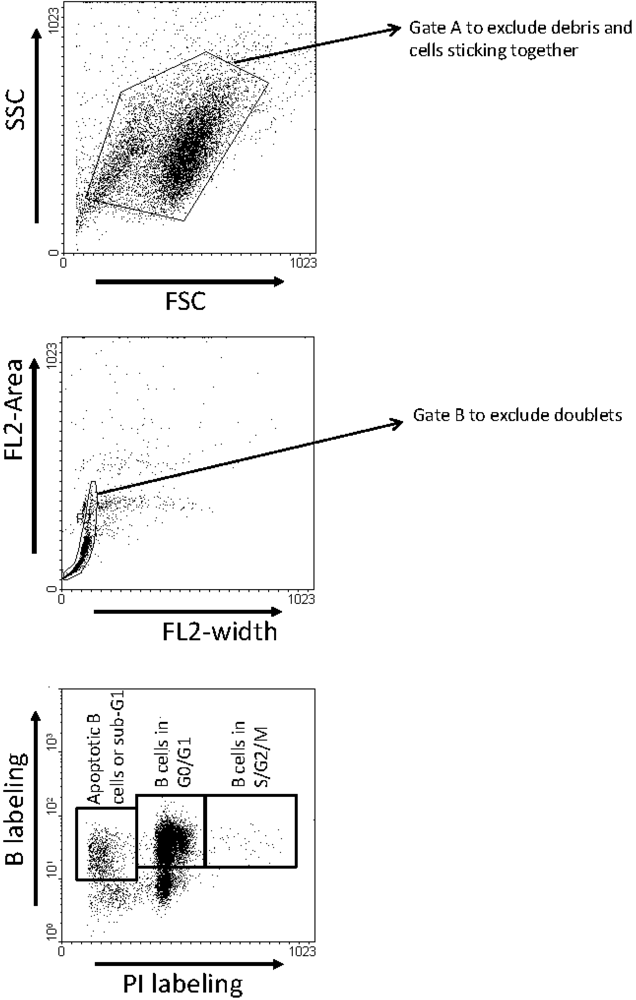
        <p>PBMCs were separated by Percoll density gradient centrifugation (GE Health) and washed twice with phosphate-buffered saline (PBS)/0.075% EDTA and at least three times with PBS alone until complete clearance of platelets. After estimation of their viability by trypan blue dye exclusion, 2 × 10<sup>6</sup> cells were cultivated during 16 hr at 37 °C in complete RPMI 1640 medium (e.g., supplemented with 10% FCS, 2 mM L-glutamine, 100 U of penicillin, 100 µg of streptomycin per mL; Sigma Aldrich) in the presence or the absence of different concentrations of VPA (Sigma Aldrich). After culture, PBMCs were collected, washed twice in PBS containing 10% FCS and incubated for 30 min at 4 °C in the presence of the monoclonal antibody 1H4 recognizing surface immunoglobulin M as a marker for B lymphocytes. Cells were then labeled with FITC-conjugated F(ab’)2 fragments of rabbit anti-mouse immunoglobulins (Dako) and fixed with 70% ethanol at −20 °C for at least 1 hr. After two final washes, the cells were treated with RNase A (50 µg/mL) (Sigma Aldrich) for 30 min at 37 °C, incubated for 5 min at room temperature in the presence of 20 µg per mL of propidium iodide (PI) (Sigma Aldrich) and analyzed by flow cytometry. Doublets were excluded from the analysis by using the (FL2a/FL2h/FL2w) gating method and cells staining in sub-G1 were considered to be apoptotic. Supplementary <xref ref-type="fig" rid="pathogens-01-00065-f007">Supplementary Figure 1</xref> shows a representative B-PI staining and the gating technique.</p>
        </sec>
      <sec>
        <title>3.6. Analysis of Viral Expression <italic>ex Vivo</italic> by Flow Cytometry and ELISA</title>
        <p>To determine the proportion of cells expressing the p24 protein, sheep PBMCs were cultivated during 16 hr, fixed and permeabilized using DAKO IntraStain Reagent A and 1x Becton Dickinson Permeabilizing solution 2. Intracellular detection of p24 was performed by sequential incubation with 4'G9 monoclonal antibody and a rat anti-mouse IgG1 phycoerythrin conjugate (Becton Dickinson) for 30 min at 4 °C. Ten thousand events per sample were collected by flow cytometry and analyzed with the Cellquest software. To assess viral expression, culture supernatants were separated from PBMCs by centrifugation (10 min at 1,500 <italic>g</italic>) and analyzed for p24 protein amount using an enzyme-linked immunosorbent assay (ELISA) procedure. For this purpose, 96-well microtiter plates (Maxisorb immunoplate; Nunc) were coated with 4'G9 monoclonal antibody (300 ng in PBS per well) for 4 hr at room temperature. The plates were washed three times with PBS-Tween 80 (0.2%), and serial threefold dilutions of supernatants were added to the wells in presence of bovine serum albumin (0.67%) and Tween 80 (1.33%). After overnight incubation at 4 °C and three washes, the presence of the p24 major capsid antigen was revealed using two monoclonal antibodies (2'C1 and 4'F5) conjugated with horseradish peroxidase.</p>
      </sec>
    </sec>
    <sec sec-type="conclusions">
      <title>4. Conclusions</title>
      <p>In summary, our data shows that (i) BLV-infected leukemic sheep relapse upon interruption of VPA therapy and may become refractory to further treatment; (ii) B lymphocytes isolated throughout treatment and relapse remain responsive to VPA-induced apoptosis in cell culture; (iii) B cell proliferation is marginally affected by VPA; (iv) <italic>ex vivo</italic> viral expression becomes nearly undetectable at the end of the relapse in four out of five sheep; (v) a new tumoral clone arose during relapse in two out of five sheep, most likely revealing a selection process exerted by VPA <italic>in vivo</italic>, and (vi) improved HDAC inhibitors can overcome chemoresistance in one out of four sheep. These observations in the BLV model may be important to improve current therapies of HTLV-induced diseases.</p>
    </sec>
  </body>
  <back><ack>
      <title>Acknowledgments</title>
      <p>This work was supported by the “Fonds National de la Recherche Scientifique” (FNRS), the Télévie, the Belgian Foundation against Cancer, the Sixth Research Framework Programme of the European Union (project INCA LSHC-CT-2005-018704), the “Neoangio” excellence program and the “Partenariat Public Privé” PPP INCA of the “Direction générale des Technologies, de la Recherche et de l’Energie/DG06” of the Walloon government, the “Action de Recherche Concertée Glyvir” of the “Communauté française de Belgique”, the “Centre anticancéreux près ULg” (CAC), the “Synbiofor” project of GxABT, the “ULg Fonds Spéciaux pour la Recherche”, the “Plan Cancer” of the “Service Public Fédéral,” and the Interuniversity Attraction Poles (IAP) Phase VII BELVIR. We thank the GIGA technology platforms. NG, FV and AF (Postdoctoral Researchers) and LW (Research Director) are members of the FNRS.</p>
    </ack>
    <notes>
      <title>Conflict of Interest</title>
      <p>The authors declare having no conflict of interest.</p>
    </notes>
    <ref-list>
      <title>References</title>
      <ref id="B1-pathogens-01-00065">
        <label>1.</label>
        <citation citation-type="journal">
          <person-group person-group-type="author">
            <name>
              <surname>Burny</surname>
              <given-names>A.</given-names>
            </name>
            <name>
              <surname>Bruck</surname>
              <given-names>C.</given-names>
            </name>
            <name>
              <surname>Cleuter</surname>
              <given-names>Y.</given-names>
            </name>
            <name>
              <surname>Couez</surname>
              <given-names>D.</given-names>
            </name>
            <name>
              <surname>Deschamps</surname>
              <given-names>J.</given-names>
            </name>
            <name>
              <surname>Gregoire</surname>
              <given-names>D.</given-names>
            </name>
            <name>
              <surname>Ghysdael</surname>
              <given-names>J.</given-names>
            </name>
            <name>
              <surname>Kettmann</surname>
              <given-names>R.</given-names>
            </name>
            <name>
              <surname>Mammerickx</surname>
              <given-names>M.</given-names>
            </name>
            <name>
              <surname>Marbaix</surname>
              <given-names>G.</given-names>
            </name>
          </person-group>
          <article-title>Bovine leukaemia virus and enzootic bovine leukosis</article-title>
          <source>Onderstepoort. J. Vet. Res.</source>
          <year>1985</year>
          <volume>52</volume>
          <fpage>133</fpage>
          <lpage>144</lpage>
        <pub-id pub-id-type="pmid">3003647</pub-id></citation>
      </ref>
      <ref id="B2-pathogens-01-00065">
        <label>2.</label>
        <citation citation-type="journal">
          <person-group person-group-type="author">
            <name>
              <surname>Gillet</surname>
              <given-names>N.</given-names>
            </name>
            <name>
              <surname>Florins</surname>
              <given-names>A.</given-names>
            </name>
            <name>
              <surname>Boxus</surname>
              <given-names>M.</given-names>
            </name>
            <name>
              <surname>Burteau</surname>
              <given-names>C.</given-names>
            </name>
            <name>
              <surname>Nigro</surname>
              <given-names>A.</given-names>
            </name>
            <name>
              <surname>Vandermeers</surname>
              <given-names>F.</given-names>
            </name>
            <name>
              <surname>Balon</surname>
              <given-names>H.</given-names>
            </name>
            <name>
              <surname>Bouzar</surname>
              <given-names>A.B.</given-names>
            </name>
            <name>
              <surname>Defoiche</surname>
              <given-names>J.</given-names>
            </name>
            <name>
              <surname>Burny</surname>
              <given-names>A.</given-names>
            </name>
            <name>
              <surname>Reichert</surname>
              <given-names>M.</given-names>
            </name>
            <name>
              <surname>Kettmann</surname>
              <given-names>R.</given-names>
            </name>
            <name>
              <surname>Willems</surname>
              <given-names>L.</given-names>
            </name>
          </person-group>
          <article-title>Mechanisms of leukemogenesis induced by bovine leukemia virus: prospects for novel anti-retroviral therapies in human</article-title>
          <source>Retrovirology</source>
          <year>2007</year>
          <volume>4</volume>
          <fpage>18</fpage>
          <pub-id pub-id-type="doi">10.1186/1742-4690-4-18</pub-id>
        </citation>
      </ref>
      <ref id="B3-pathogens-01-00065">
        <label>3.</label>
        <citation citation-type="journal">
          <person-group person-group-type="author">
            <name>
              <surname>Kerkhofs</surname>
              <given-names>P.</given-names>
            </name>
            <name>
              <surname>Adam</surname>
              <given-names>E.</given-names>
            </name>
            <name>
              <surname>Droogmans</surname>
              <given-names>L.</given-names>
            </name>
            <name>
              <surname>Portetelle</surname>
              <given-names>D.</given-names>
            </name>
            <name>
              <surname>Mammerickx</surname>
              <given-names>M.</given-names>
            </name>
            <name>
              <surname>Burny</surname>
              <given-names>A.</given-names>
            </name>
            <name>
              <surname>Kettmann</surname>
              <given-names>R.</given-names>
            </name>
            <name>
              <surname>Willems</surname>
              <given-names>L.</given-names>
            </name>
          </person-group>
          <article-title>Cellular pathways involved in the ex vivo expression of bovine leukemia virus</article-title>
          <source>J. Virol.</source>
          <year>1996</year>
          <volume>70</volume>
          <fpage>2170</fpage>
          <lpage>2177</lpage>
        <pub-id pub-id-type="pmid">8642639</pub-id></citation>
      </ref>
      <ref id="B4-pathogens-01-00065">
        <label>4.</label>
        <citation citation-type="journal">
          <person-group person-group-type="author">
            <name>
              <surname>Merezak</surname>
              <given-names>C.</given-names>
            </name>
            <name>
              <surname>Reichert</surname>
              <given-names>M.</given-names>
            </name>
            <name>
              <surname>Van Lint</surname>
              <given-names>C.</given-names>
            </name>
            <name>
              <surname>Kerkhofs</surname>
              <given-names>P.</given-names>
            </name>
            <name>
              <surname>Portetelle</surname>
              <given-names>D.</given-names>
            </name>
            <name>
              <surname>Willems</surname>
              <given-names>L.</given-names>
            </name>
            <name>
              <surname>Kettmann</surname>
              <given-names>R.</given-names>
            </name>
          </person-group>
          <article-title>Inhibition of histone deacetylases induces bovine leukemia virus expression <italic>in vitro</italic> and <italic>in vivo</italic></article-title>
          <source>J. Virol.</source>
          <year>2002</year>
          <volume>76</volume>
          <fpage>5034</fpage>
          <lpage>5042</lpage>
          <pub-id pub-id-type="doi">10.1128/JVI.76.10.5034-5042.2002</pub-id>
        </citation>
      </ref>
      <ref id="B5-pathogens-01-00065">
        <label>5.</label>
        <citation citation-type="journal">
          <person-group person-group-type="author">
            <name>
              <surname>Florins</surname>
              <given-names>A.</given-names>
            </name>
            <name>
              <surname>Gillet</surname>
              <given-names>N.</given-names>
            </name>
            <name>
              <surname>Asquith</surname>
              <given-names>B.</given-names>
            </name>
            <name>
              <surname>Boxus</surname>
              <given-names>M.</given-names>
            </name>
            <name>
              <surname>Burteau</surname>
              <given-names>C.</given-names>
            </name>
            <name>
              <surname>Twizere</surname>
              <given-names>J.C.</given-names>
            </name>
            <name>
              <surname>Urbain</surname>
              <given-names>P.</given-names>
            </name>
            <name>
              <surname>Vandermeers</surname>
              <given-names>F.</given-names>
            </name>
            <name>
              <surname>Debacq</surname>
              <given-names>C.</given-names>
            </name>
            <name>
              <surname>Sanchez-Alcaraz</surname>
              <given-names>M.T.</given-names>
            </name>
            <name>
              <surname>Schwartz-Cornil</surname>
              <given-names>I.</given-names>
            </name>
            <name>
              <surname>Kerkhofs</surname>
              <given-names>P.</given-names>
            </name>
            <name>
              <surname>Jean</surname>
              <given-names>G.</given-names>
            </name>
            <name>
              <surname>Thewis</surname>
              <given-names>A.</given-names>
            </name>
            <name>
              <surname>Hay</surname>
              <given-names>J.</given-names>
            </name>
            <name>
              <surname>Mortreux</surname>
              <given-names>F.</given-names>
            </name>
            <name>
              <surname>Wattel</surname>
              <given-names>E.</given-names>
            </name>
            <name>
              <surname>Reichert</surname>
              <given-names>M.</given-names>
            </name>
            <name>
              <surname>Burny</surname>
              <given-names>A.</given-names>
            </name>
            <name>
              <surname>Kettmann</surname>
              <given-names>R.</given-names>
            </name>
            <name>
              <surname>Bangham</surname>
              <given-names>C.</given-names>
            </name>
            <name>
              <surname>Willems</surname>
              <given-names>L.</given-names>
            </name>
          </person-group>
          <article-title>Cell dynamics and immune response to BLV infection: a unifying model</article-title>
          <source>Front Biosci.</source>
          <year>2007</year>
          <volume>12</volume>
          <fpage>1520</fpage>
          <lpage>1531</lpage>
          <pub-id pub-id-type="doi">10.2741/2165</pub-id>
        </citation>
      </ref>
      <ref id="B6-pathogens-01-00065">
        <label>6.</label>
        <citation citation-type="journal">
          <person-group person-group-type="author">
            <name>
              <surname>Achachi</surname>
              <given-names>A.</given-names>
            </name>
            <name>
              <surname>Florins</surname>
              <given-names>A.</given-names>
            </name>
            <name>
              <surname>Gillet</surname>
              <given-names>N.</given-names>
            </name>
            <name>
              <surname>Debacq</surname>
              <given-names>C.</given-names>
            </name>
            <name>
              <surname>Urbain</surname>
              <given-names>P.</given-names>
            </name>
            <name>
              <surname>Foutsop</surname>
              <given-names>G.M.</given-names>
            </name>
            <name>
              <surname>Vandermeers</surname>
              <given-names>F.</given-names>
            </name>
            <name>
              <surname>Jasik</surname>
              <given-names>A.</given-names>
            </name>
            <name>
              <surname>Reichert</surname>
              <given-names>M.</given-names>
            </name>
            <name>
              <surname>Kerkhofs</surname>
              <given-names>P.</given-names>
            </name>
            <name>
              <surname>Lagneaux</surname>
              <given-names>L.</given-names>
            </name>
            <name>
              <surname>Burny</surname>
              <given-names>A.</given-names>
            </name>
            <name>
              <surname>Kettmann</surname>
              <given-names>R.</given-names>
            </name>
            <name>
              <surname>Willems</surname>
              <given-names>L.</given-names>
            </name>
          </person-group>
          <article-title>Valproate activates bovine leukemia virus gene expression, triggers apoptosis, and induces leukemia/lymphoma regression <italic>in vivo</italic></article-title>
          <source>Proc. Natl. Acad. Sci. USA</source>
          <year>2005</year>
          <volume>102</volume>
          <fpage>10309</fpage>
          <lpage>10314</lpage>
        <pub-id pub-id-type="doi">10.1073/pnas.0504248102</pub-id><pub-id pub-id-type="pmid">16006517</pub-id></citation>
      </ref>
      <ref id="B7-pathogens-01-00065">
        <label>7.</label>
        <citation citation-type="journal">
          <person-group person-group-type="author">
            <name>
              <surname>Lezin</surname>
              <given-names>A.</given-names>
            </name>
            <name>
              <surname>Gillet</surname>
              <given-names>N.</given-names>
            </name>
            <name>
              <surname>Olindo</surname>
              <given-names>S.</given-names>
            </name>
            <name>
              <surname>Signate</surname>
              <given-names>A.</given-names>
            </name>
            <name>
              <surname>Grandvaux</surname>
              <given-names>N.</given-names>
            </name>
            <name>
              <surname>Verlaeten</surname>
              <given-names>O.</given-names>
            </name>
            <name>
              <surname>Belrose</surname>
              <given-names>G.</given-names>
            </name>
            <name>
              <surname>de Carvalho Bittencourt</surname>
              <given-names>M.</given-names>
            </name>
            <name>
              <surname>Hiscott</surname>
              <given-names>J.</given-names>
            </name>
            <name>
              <surname>Asquith</surname>
              <given-names>B.</given-names>
            </name>
            <name>
              <surname>Burny</surname>
              <given-names>A.</given-names>
            </name>
            <name>
              <surname>Smadja</surname>
              <given-names>D.</given-names>
            </name>
            <name>
              <surname>Cesaire</surname>
              <given-names>R.</given-names>
            </name>
            <name>
              <surname>Willems</surname>
              <given-names>L.</given-names>
            </name>
          </person-group>
          <article-title>Histone deacetylase mediated transcriptional activation reduces proviral loads in HTLV-1 associated myelopathy/tropical spastic paraparesis patients</article-title>
          <source>Blood</source>
          <year>2007</year>
          <volume>110</volume>
          <fpage>3722</fpage>
          <lpage>3728</lpage>
        <pub-id pub-id-type="doi">10.1182/blood-2007-04-085076</pub-id><pub-id pub-id-type="pmid">17717136</pub-id></citation>
      </ref>
      <ref id="B8-pathogens-01-00065">
        <label>8.</label>
        <citation citation-type="journal">
          <person-group person-group-type="author">
            <name>
              <surname>Olindo</surname>
              <given-names>S.</given-names>
            </name>
            <name>
              <surname>Belrose</surname>
              <given-names>G.</given-names>
            </name>
            <name>
              <surname>Gillet</surname>
              <given-names>N.</given-names>
            </name>
            <name>
              <surname>Rodriguez</surname>
              <given-names>S.</given-names>
            </name>
            <name>
              <surname>Boxus</surname>
              <given-names>M.</given-names>
            </name>
            <name>
              <surname>Verlaeten</surname>
              <given-names>O.</given-names>
            </name>
            <name>
              <surname>Asquith</surname>
              <given-names>B.</given-names>
            </name>
            <name>
              <surname>Bangham</surname>
              <given-names>C.</given-names>
            </name>
            <name>
              <surname>Signate</surname>
              <given-names>A.</given-names>
            </name>
            <name>
              <surname>Smadja</surname>
              <given-names>D.</given-names>
            </name>
            <name>
              <surname>Lezin</surname>
              <given-names>A.</given-names>
            </name>
            <name>
              <surname>Cesaire</surname>
              <given-names>R.</given-names>
            </name>
            <name>
              <surname>Willems</surname>
              <given-names>L.</given-names>
            </name>
          </person-group>
          <article-title>Safety of long-term treatment of HAM/TSP patients with valproic acid</article-title>
          <source>Blood</source>
          <year>2011</year>
          <volume>118</volume>
          <fpage>6306</fpage>
          <lpage>6309</lpage>
        <pub-id pub-id-type="doi">10.1182/blood-2011-04-349910</pub-id><pub-id pub-id-type="pmid">21998206</pub-id></citation>
      </ref>
      <ref id="B9-pathogens-01-00065">
        <label>9.</label>
        <citation citation-type="journal">
          <person-group person-group-type="author">
            <name>
              <surname>Proietti</surname>
              <given-names>F.A.</given-names>
            </name>
            <name>
              <surname>Carneiro-Proietti</surname>
              <given-names>A.B.</given-names>
            </name>
            <name>
              <surname>Catalan-Soares</surname>
              <given-names>B.C.</given-names>
            </name>
            <name>
              <surname>Murphy</surname>
              <given-names>E.L.</given-names>
            </name>
          </person-group>
          <article-title>Global epidemiology of HTLV-I infection and associated diseases</article-title>
          <source>Oncogene</source>
          <year>2005</year>
          <volume>24</volume>
          <fpage>6058</fpage>
          <lpage>6068</lpage>
          <pub-id pub-id-type="doi">10.1038/sj.onc.1208968</pub-id>
        </citation>
      </ref>
      <ref id="B10-pathogens-01-00065">
        <label>10.</label>
        <citation citation-type="journal">
          <person-group person-group-type="author">
            <name>
              <surname>Zimmerman</surname>
              <given-names>B.</given-names>
            </name>
            <name>
              <surname>Sargeant</surname>
              <given-names>A.</given-names>
            </name>
            <name>
              <surname>Landes</surname>
              <given-names>K.</given-names>
            </name>
            <name>
              <surname>Fernandez</surname>
              <given-names>S.A.</given-names>
            </name>
            <name>
              <surname>Chen</surname>
              <given-names>C.S.</given-names>
            </name>
            <name>
              <surname>Lairmore</surname>
              <given-names>M.D.</given-names>
            </name>
          </person-group>
          <article-title>Efficacy of novel histone deacetylase inhibitor, AR42, in a mouse model of, human T-lymphotropic virus type 1 adult T cell lymphoma</article-title>
          <source>Leukemia Res.</source>
          <year>2011</year>
          <volume>35</volume>
          <fpage>1491</fpage>
          <lpage>1497</lpage>
          <pub-id pub-id-type="doi">10.1016/j.leukres.2011.07.015</pub-id>
        </citation>
      </ref>
      <ref id="B11-pathogens-01-00065">
        <label>11.</label>
        <citation citation-type="journal">
          <person-group person-group-type="author">
            <name>
              <surname>Hasegawa</surname>
              <given-names>H.</given-names>
            </name>
            <name>
              <surname>Yamada</surname>
              <given-names>Y.</given-names>
            </name>
            <name>
              <surname>Tsukasaki</surname>
              <given-names>K.</given-names>
            </name>
            <name>
              <surname>Mori</surname>
              <given-names>N.</given-names>
            </name>
            <name>
              <surname>Tsuruda</surname>
              <given-names>K.</given-names>
            </name>
            <name>
              <surname>Sasaki</surname>
              <given-names>D.</given-names>
            </name>
            <name>
              <surname>Usui</surname>
              <given-names>T.</given-names>
            </name>
            <name>
              <surname>Osaka</surname>
              <given-names>A.</given-names>
            </name>
            <name>
              <surname>Atogami</surname>
              <given-names>S.</given-names>
            </name>
            <name>
              <surname>Ishikawa</surname>
              <given-names>C.</given-names>
            </name>
            <name>
              <surname>Machijima</surname>
              <given-names>Y.</given-names>
            </name>
            <name>
              <surname>Sawada</surname>
              <given-names>S.</given-names>
            </name>
            <name>
              <surname>Hayashi</surname>
              <given-names>T.</given-names>
            </name>
            <name>
              <surname>Miyazaki</surname>
              <given-names>Y.</given-names>
            </name>
            <name>
              <surname>Kamihira</surname>
              <given-names>S.</given-names>
            </name>
          </person-group>
          <article-title>LBH589, a deacetylase inhibitor, induces apoptosis in adult T-cell leukemia/lymphoma cells via activation of a novel RAIDD-caspase-2 pathway</article-title>
          <source>Leukemia</source>
          <year>2011</year>
          <volume>25</volume>
          <fpage>575</fpage>
          <lpage>587</lpage>
          <pub-id pub-id-type="doi">10.1038/leu.2010.315</pub-id>
        </citation>
      </ref>
      <ref id="B12-pathogens-01-00065">
        <label>12.</label>
        <citation citation-type="journal">
          <person-group person-group-type="author">
            <name>
              <surname>Nishioka</surname>
              <given-names>C.</given-names>
            </name>
            <name>
              <surname>Ikezoe</surname>
              <given-names>T.</given-names>
            </name>
            <name>
              <surname>Yang</surname>
              <given-names>J.</given-names>
            </name>
            <name>
              <surname>Komatsu</surname>
              <given-names>N.</given-names>
            </name>
            <name>
              <surname>Bandobashi</surname>
              <given-names>K.</given-names>
            </name>
            <name>
              <surname>Taniguchi</surname>
              <given-names>A.</given-names>
            </name>
            <name>
              <surname>Kuwayama</surname>
              <given-names>Y.</given-names>
            </name>
            <name>
              <surname>Togitani</surname>
              <given-names>K.</given-names>
            </name>
            <name>
              <surname>Koeffler</surname>
              <given-names>H.P.</given-names>
            </name>
            <name>
              <surname>Taguchi</surname>
              <given-names>H.</given-names>
            </name>
          </person-group>
          <article-title>Histone deacetylase inhibitors induce growth arrest and apoptosis of HTLV-1-infected T-cells via blockade of signaling by nuclear factor kappaB</article-title>
          <source>Leukemia Res.</source>
          <year>2008</year>
          <volume>32</volume>
          <fpage>287</fpage>
          <lpage>296</lpage>
        <pub-id pub-id-type="doi">10.1016/j.leukres.2007.05.026</pub-id></citation>
      </ref>
      <ref id="B13-pathogens-01-00065">
        <label>13.</label>
        <citation citation-type="journal">
          <person-group person-group-type="author">
            <name>
              <surname>Ramos</surname>
              <given-names>J.T.</given-names>
            </name>
            <name>
              <surname>Diaz</surname>
              <given-names>L.</given-names>
            </name>
            <name>
              <surname>Ruiz</surname>
              <given-names>P.</given-names>
            </name>
            <name>
              <surname>Barber</surname>
              <given-names>G.</given-names>
            </name>
            <name>
              <surname>Harrington</surname>
              <given-names>W.</given-names>
            </name>
          </person-group>
          <article-title>Targeting HTLV-I latency in Adult T-cell Leukemia/Lymphoma</article-title>
          <source>Retrovirology</source>
          <year>2011</year>
          <volume>8 (Suppl. 1)</volume>
          <fpage>A48</fpage>
        <pub-id pub-id-type="pmid">23331949</pub-id></citation>
      </ref>
      <ref id="B14-pathogens-01-00065">
        <label>14.</label>
        <citation citation-type="journal">
          <person-group person-group-type="author">
            <name>
              <surname>Florins</surname>
              <given-names>A.</given-names>
            </name>
            <name>
              <surname>de Brogniez</surname>
              <given-names>A.</given-names>
            </name>
            <name>
              <surname>Elemans</surname>
              <given-names>M.</given-names>
            </name>
            <name>
              <surname>Bouzar</surname>
              <given-names>A.B.</given-names>
            </name>
            <name>
              <surname>Francois</surname>
              <given-names>C.</given-names>
            </name>
            <name>
              <surname>Reichert</surname>
              <given-names>M.</given-names>
            </name>
            <name>
              <surname>Asquith</surname>
              <given-names>B.</given-names>
            </name>
            <name>
              <surname>Willems</surname>
              <given-names>L.</given-names>
            </name>
          </person-group>
          <article-title>Viral expression directs the fate of B cells in bovine leukemia virus-infected sheep</article-title>
          <source>J. Virol.</source>
          <year>2012</year>
          <volume>86</volume>
          <fpage>621</fpage>
          <lpage>624</lpage>
          <pub-id pub-id-type="doi">10.1128/JVI.05718-11</pub-id>
        </citation>
      </ref>
      <ref id="B15-pathogens-01-00065">
        <label>15.</label>
        <citation citation-type="journal">
          <person-group person-group-type="author">
            <name>
              <surname>Merimi</surname>
              <given-names>M.</given-names>
            </name>
            <name>
              <surname>Klener</surname>
              <given-names>P.</given-names>
            </name>
            <name>
              <surname>Szynal</surname>
              <given-names>M.</given-names>
            </name>
            <name>
              <surname>Cleuter</surname>
              <given-names>Y.</given-names>
            </name>
            <name>
              <surname>Kerkhofs</surname>
              <given-names>P.</given-names>
            </name>
            <name>
              <surname>Burny</surname>
              <given-names>A.</given-names>
            </name>
            <name>
              <surname>Martiat</surname>
              <given-names>P.</given-names>
            </name>
            <name>
              <surname>Van den Broeke</surname>
              <given-names>A.</given-names>
            </name>
          </person-group>
          <article-title>Suppression of viral gene expression in bovine leukemia virus-associated B-cell malignancy: interplay of epigenetic modifications leading to chromatin with a repressive histone code</article-title>
          <source>J. Virol.</source>
          <year>2007</year>
          <volume>81</volume>
          <fpage>5929</fpage>
          <lpage>5939</lpage>
          <pub-id pub-id-type="doi">10.1128/JVI.02606-06</pub-id>
        </citation>
      </ref>
      <ref id="B16-pathogens-01-00065">
        <label>16.</label>
        <citation citation-type="journal">
          <person-group person-group-type="author">
            <name>
              <surname>Blaheta</surname>
              <given-names>R.A.</given-names>
            </name>
            <name>
              <surname>Nau</surname>
              <given-names>H.</given-names>
            </name>
            <name>
              <surname>Michaelis</surname>
              <given-names>M.</given-names>
            </name>
            <name>
              <surname>Cinatl</surname>
              <given-names>J.</given-names>
              <suffix>Jr.</suffix>
            </name>
          </person-group>
          <article-title>Valproate and valproate-analogues: potent tools to fight against cancer</article-title>
          <source>Curr. Med. Chem.</source>
          <year>2002</year>
          <volume>9</volume>
          <fpage>1417</fpage>
          <lpage>1433</lpage>
        <pub-id pub-id-type="doi">10.2174/0929867023369763</pub-id><pub-id pub-id-type="pmid">12173980</pub-id></citation>
      </ref>
      <ref id="B17-pathogens-01-00065">
        <label>17.</label>
        <citation citation-type="journal">
          <person-group person-group-type="author">
            <name>
              <surname>Kostrouchova</surname>
              <given-names>M.</given-names>
            </name>
            <name>
              <surname>Kostrouch</surname>
              <given-names>Z.</given-names>
            </name>
          </person-group>
          <article-title>Valproic acid, a molecular lead to multiple regulatory pathways</article-title>
          <source>Folia Biol. (Praha)</source>
          <year>2007</year>
          <volume>53</volume>
          <fpage>37</fpage>
          <lpage>49</lpage>
        </citation>
      </ref>
      <ref id="B18-pathogens-01-00065">
        <label>18.</label>
        <citation citation-type="journal">
          <person-group person-group-type="author">
            <name>
              <surname>Insinga</surname>
              <given-names>A.</given-names>
            </name>
            <name>
              <surname>Monestiroli</surname>
              <given-names>S.</given-names>
            </name>
            <name>
              <surname>Ronzoni</surname>
              <given-names>S.</given-names>
            </name>
            <name>
              <surname>Gelmetti</surname>
              <given-names>V.</given-names>
            </name>
            <name>
              <surname>Marchesi</surname>
              <given-names>F.</given-names>
            </name>
            <name>
              <surname>Viale</surname>
              <given-names>A.</given-names>
            </name>
            <name>
              <surname>Altucci</surname>
              <given-names>L.</given-names>
            </name>
            <name>
              <surname>Nervi</surname>
              <given-names>C.</given-names>
            </name>
            <name>
              <surname>Minucci</surname>
              <given-names>S.</given-names>
            </name>
            <name>
              <surname>Pelicci</surname>
              <given-names>P.G.</given-names>
            </name>
          </person-group>
          <article-title>Inhibitors of histone deacetylases induce tumor-selective apoptosis through activation of the death receptor pathway</article-title>
          <source>Nat. Med.</source>
          <year>2005</year>
          <volume>11</volume>
          <fpage>71</fpage>
          <lpage>76</lpage>
          <pub-id pub-id-type="doi">10.1038/nm1160</pub-id>
        </citation>
      </ref>
      <ref id="B19-pathogens-01-00065">
        <label>19.</label>
        <citation citation-type="journal">
          <person-group person-group-type="author">
            <name>
              <surname>Nebbioso</surname>
              <given-names>A.</given-names>
            </name>
            <name>
              <surname>Clarke</surname>
              <given-names>N.</given-names>
            </name>
            <name>
              <surname>Voltz</surname>
              <given-names>E.</given-names>
            </name>
            <name>
              <surname>Germain</surname>
              <given-names>E.</given-names>
            </name>
            <name>
              <surname>Ambrosino</surname>
              <given-names>C.</given-names>
            </name>
            <name>
              <surname>Bontempo</surname>
              <given-names>P.</given-names>
            </name>
            <name>
              <surname>Alvarez</surname>
              <given-names>R.</given-names>
            </name>
            <name>
              <surname>Schiavone</surname>
              <given-names>E.M.</given-names>
            </name>
            <name>
              <surname>Ferrara</surname>
              <given-names>F.</given-names>
            </name>
            <name>
              <surname>Bresciani</surname>
              <given-names>F.</given-names>
            </name>
            <name>
              <surname>Weisz</surname>
              <given-names>A.</given-names>
            </name>
            <name>
              <surname>de Lera</surname>
              <given-names>A.R.</given-names>
            </name>
            <name>
              <surname>Gronemeyer</surname>
              <given-names>H.</given-names>
            </name>
            <name>
              <surname>Altucci</surname>
              <given-names>L.</given-names>
            </name>
          </person-group>
          <article-title>Tumor-selective action of HDAC inhibitors involves TRAIL induction in acute myeloid leukemia cells</article-title>
          <source>Nat. Med.</source>
          <year>2005</year>
          <volume>11</volume>
          <fpage>77</fpage>
          <lpage>84</lpage>
          <pub-id pub-id-type="doi">10.1038/nm1161</pub-id>
        </citation>
      </ref>
      <ref id="B20-pathogens-01-00065">
        <label>20.</label>
        <citation citation-type="journal">
          <person-group person-group-type="author">
            <name>
              <surname>Vandermeers</surname>
              <given-names>F.</given-names>
            </name>
            <name>
              <surname>Hubert</surname>
              <given-names>P.</given-names>
            </name>
            <name>
              <surname>Delvenne</surname>
              <given-names>P.</given-names>
            </name>
            <name>
              <surname>Mascaux</surname>
              <given-names>C.</given-names>
            </name>
            <name>
              <surname>Grigoriu</surname>
              <given-names>B.</given-names>
            </name>
            <name>
              <surname>Burny</surname>
              <given-names>A.</given-names>
            </name>
            <name>
              <surname>Scherpereel</surname>
              <given-names>A.</given-names>
            </name>
            <name>
              <surname>Willems</surname>
              <given-names>L.</given-names>
            </name>
          </person-group>
          <article-title>Valproate, in combination with pemetrexed and cisplatin, provides additional efficacy to the treatment of malignant mesothelioma</article-title>
          <source>Clin.Cancer Res.</source>
          <year>2009</year>
          <volume>15</volume>
          <fpage>2818</fpage>
          <lpage>2828</lpage>
          <pub-id pub-id-type="doi">10.1158/1078-0432.CCR-08-1579</pub-id>
        </citation>
      </ref>
      <ref id="B21-pathogens-01-00065">
        <label>21.</label>
        <citation citation-type="journal">
          <person-group person-group-type="author">
            <name>
              <surname>Debacq</surname>
              <given-names>C.</given-names>
            </name>
            <name>
              <surname>Gillet</surname>
              <given-names>N.</given-names>
            </name>
            <name>
              <surname>Asquith</surname>
              <given-names>B.</given-names>
            </name>
            <name>
              <surname>Sanchez-Alcaraz</surname>
              <given-names>M.T.</given-names>
            </name>
            <name>
              <surname>Florins</surname>
              <given-names>A.</given-names>
            </name>
            <name>
              <surname>Boxus</surname>
              <given-names>M.</given-names>
            </name>
            <name>
              <surname>Schwartz-Cornil</surname>
              <given-names>I.</given-names>
            </name>
            <name>
              <surname>Bonneau</surname>
              <given-names>M.</given-names>
            </name>
            <name>
              <surname>Jean</surname>
              <given-names>G.</given-names>
            </name>
            <name>
              <surname>Kerkhofs</surname>
              <given-names>P.</given-names>
            </name>
            <name>
              <surname>Hay</surname>
              <given-names>J.</given-names>
            </name>
            <name>
              <surname>Thewis</surname>
              <given-names>A.</given-names>
            </name>
            <name>
              <surname>Kettmann</surname>
              <given-names>R.</given-names>
            </name>
            <name>
              <surname>Willems</surname>
              <given-names>L.</given-names>
            </name>
          </person-group>
          <article-title>Peripheral blood B-cell death compensates for excessive proliferation in lymphoid tissues and maintains homeostasis in bovine leukemia virus-infected sheep</article-title>
          <source>J. Virol.</source>
          <year>2006</year>
          <volume>80</volume>
          <fpage>9710</fpage>
          <lpage>9719</lpage>
        <pub-id pub-id-type="doi">10.1128/JVI.01022-06</pub-id><pub-id pub-id-type="pmid">16973575</pub-id></citation>
      </ref>
      <ref id="B22-pathogens-01-00065">
        <label>22.</label>
        <citation citation-type="journal">
          <person-group person-group-type="author">
            <name>
              <surname>Florins</surname>
              <given-names>A.</given-names>
            </name>
            <name>
              <surname>Gillet</surname>
              <given-names>N.</given-names>
            </name>
            <name>
              <surname>Asquith</surname>
              <given-names>B.</given-names>
            </name>
            <name>
              <surname>Debacq</surname>
              <given-names>C.</given-names>
            </name>
            <name>
              <surname>Jean</surname>
              <given-names>G.</given-names>
            </name>
            <name>
              <surname>Schwartz-Cornil</surname>
              <given-names>I.</given-names>
            </name>
            <name>
              <surname>Bonneau</surname>
              <given-names>M.</given-names>
            </name>
            <name>
              <surname>Burny</surname>
              <given-names>A.</given-names>
            </name>
            <name>
              <surname>Reichert</surname>
              <given-names>M.</given-names>
            </name>
            <name>
              <surname>Kettmann</surname>
              <given-names>R.</given-names>
            </name>
            <name>
              <surname>Willems</surname>
              <given-names>L.</given-names>
            </name>
          </person-group>
          <article-title>Spleen-dependent turnover of CD11b peripheral blood B lymphocytes in bovine leukemia virus-infected sheep</article-title>
          <source>J. Virol.</source>
          <year>2006</year>
          <volume>80</volume>
          <fpage>11998</fpage>
          <lpage>12008</lpage>
        <pub-id pub-id-type="doi">10.1128/JVI.01447-06</pub-id><pub-id pub-id-type="pmid">17035334</pub-id></citation>
      </ref>
      <ref id="B23-pathogens-01-00065">
        <label>23.</label>
        <citation citation-type="journal">
          <person-group person-group-type="author">
            <name>
              <surname>Granneman</surname>
              <given-names>G.R.</given-names>
            </name>
            <name>
              <surname>Wang</surname>
              <given-names>S.I.</given-names>
            </name>
            <name>
              <surname>Machinist</surname>
              <given-names>J.M.</given-names>
            </name>
            <name>
              <surname>Kesterson</surname>
              <given-names>J.W.</given-names>
            </name>
          </person-group>
          <article-title>Aspects of the metabolism of valproic acid</article-title>
          <source>Xenobiotica</source>
          <year>1984</year>
          <volume>14</volume>
          <fpage>375</fpage>
          <lpage>387</lpage>
          <pub-id pub-id-type="doi">10.3109/00498258409151426</pub-id>
        </citation>
      </ref>
      <ref id="B24-pathogens-01-00065">
        <label>24.</label>
        <citation citation-type="journal">
          <person-group person-group-type="author">
            <name>
              <surname>Wong</surname>
              <given-names>H.</given-names>
            </name>
            <name>
              <surname>Rurak</surname>
              <given-names>D.W.</given-names>
            </name>
            <name>
              <surname>Kumar</surname>
              <given-names>S.</given-names>
            </name>
            <name>
              <surname>Kwan</surname>
              <given-names>E.</given-names>
            </name>
            <name>
              <surname>Abbott</surname>
              <given-names>F.S.</given-names>
            </name>
            <name>
              <surname>Riggs</surname>
              <given-names>K.W.</given-names>
            </name>
          </person-group>
          <article-title>Dose-dependent pharmacokinetics and metabolism of valproic acid in newborn lambs and adult sheep</article-title>
          <source>Drug Metab. Dispos.</source>
          <year>2001</year>
          <volume>29</volume>
          <fpage>664</fpage>
          <lpage>675</lpage>
        <pub-id pub-id-type="pmid">11302932</pub-id></citation>
      </ref>
      <ref id="B25-pathogens-01-00065">
        <label>25.</label>
        <citation citation-type="journal">
          <person-group person-group-type="author">
            <name>
              <surname>Wong</surname>
              <given-names>H.</given-names>
            </name>
            <name>
              <surname>Kumar</surname>
              <given-names>S.</given-names>
            </name>
            <name>
              <surname>Rurak</surname>
              <given-names>D.W.</given-names>
            </name>
            <name>
              <surname>Kwan</surname>
              <given-names>E.</given-names>
            </name>
            <name>
              <surname>Abbott</surname>
              <given-names>F.S.</given-names>
            </name>
            <name>
              <surname>Riggs</surname>
              <given-names>K.W.</given-names>
            </name>
          </person-group>
          <article-title>Ontogeny of valproic acid disposition and metabolism: a developmental study in postnatal lambs and adult sheep</article-title>
          <source>Drug Metab. Dispos.</source>
          <year>2000</year>
          <volume>28</volume>
          <fpage>912</fpage>
          <lpage>919</lpage>
        <pub-id pub-id-type="pmid">10901700</pub-id></citation>
      </ref>
      <ref id="B26-pathogens-01-00065">
        <label>26.</label>
        <citation citation-type="journal">
          <person-group person-group-type="author">
            <name>
              <surname>Dequiedt</surname>
              <given-names>F.</given-names>
            </name>
            <name>
              <surname>Kettmann</surname>
              <given-names>R.</given-names>
            </name>
            <name>
              <surname>Burny</surname>
              <given-names>A.</given-names>
            </name>
            <name>
              <surname>Willems</surname>
              <given-names>L.</given-names>
            </name>
          </person-group>
          <article-title>Mutations in the p53 tumor-suppressor gene are frequently associated with bovine leukemia virus-induced leukemogenesis in cattle but not in sheep</article-title>
          <source>Virology</source>
          <year>1995</year>
          <volume>209</volume>
          <fpage>676</fpage>
          <lpage>683</lpage>
          <pub-id pub-id-type="doi">10.1006/viro.1995.1303</pub-id>
        </citation>
      </ref>
      <ref id="B27-pathogens-01-00065">
        <label>27.</label>
        <citation citation-type="journal">
          <person-group person-group-type="author">
            <name>
              <surname>Gatti</surname>
              <given-names>L.</given-names>
            </name>
            <name>
              <surname>Zunino</surname>
              <given-names>F.</given-names>
            </name>
          </person-group>
          <article-title>Overview of tumor cell chemoresistance mechanisms</article-title>
          <source>Methods Mol. Med.</source>
          <year>2005</year>
          <volume>111</volume>
          <fpage>127</fpage>
          <lpage>148</lpage>
        <pub-id pub-id-type="pmid">15911977</pub-id></citation>
      </ref>
      <ref id="B28-pathogens-01-00065">
        <label>28.</label>
        <citation citation-type="journal">
          <person-group person-group-type="author">
            <name>
              <surname>Huang</surname>
              <given-names>Y.</given-names>
            </name>
            <name>
              <surname>Sadee</surname>
              <given-names>W.</given-names>
            </name>
          </person-group>
          <article-title>Membrane transporters and channels in chemoresistance and -sensitivity of tumor cells</article-title>
          <source>Cancer Lett.</source>
          <year>2006</year>
          <volume>239</volume>
          <fpage>168</fpage>
          <lpage>182</lpage>
          <pub-id pub-id-type="doi">10.1016/j.canlet.2005.07.032</pub-id>
        </citation>
      </ref>
      <ref id="B29-pathogens-01-00065">
        <label>29.</label>
        <citation citation-type="journal">
          <person-group person-group-type="author">
            <name>
              <surname>Gibbs</surname>
              <given-names>J.P.</given-names>
            </name>
            <name>
              <surname>Adeyeye</surname>
              <given-names>M.C.</given-names>
            </name>
            <name>
              <surname>Yang</surname>
              <given-names>Z.</given-names>
            </name>
            <name>
              <surname>Shen</surname>
              <given-names>D.D.</given-names>
            </name>
          </person-group>
          <article-title>Valproic acid uptake by bovine brain microvessel endothelial cells: role of active efflux transport</article-title>
          <source>Epilepsy Res.</source>
          <year>2004</year>
          <volume>58</volume>
          <fpage>53</fpage>
          <lpage>66</lpage>
          <pub-id pub-id-type="doi">10.1016/j.eplepsyres.2003.12.008</pub-id>
        </citation>
      </ref>
      <ref id="B30-pathogens-01-00065">
        <label>30.</label>
        <citation citation-type="journal">
          <person-group person-group-type="author">
            <name>
              <surname>Tang</surname>
              <given-names>R.</given-names>
            </name>
            <name>
              <surname>Faussat</surname>
              <given-names>A.M.</given-names>
            </name>
            <name>
              <surname>Majdak</surname>
              <given-names>P.</given-names>
            </name>
            <name>
              <surname>Perrot</surname>
              <given-names>J.Y.</given-names>
            </name>
            <name>
              <surname>Chaoui</surname>
              <given-names>D.</given-names>
            </name>
            <name>
              <surname>Legrand</surname>
              <given-names>O.</given-names>
            </name>
            <name>
              <surname>Marie</surname>
              <given-names>J.P.</given-names>
            </name>
          </person-group>
          <article-title>Valproic acid inhibits proliferation and induces apoptosis in acute myeloid leukemia cells expressing P-gp and MRP1</article-title>
          <source>Leukemia</source>
          <year>2004</year>
          <volume>18</volume>
          <fpage>1246</fpage>
          <lpage>1251</lpage>
          <pub-id pub-id-type="doi">10.1038/sj.leu.2403390</pub-id>
        </citation>
      </ref>
      <ref id="B31-pathogens-01-00065">
        <label>31.</label>
        <citation citation-type="journal">
          <person-group person-group-type="author">
            <name>
              <surname>Baltes</surname>
              <given-names>S.</given-names>
            </name>
            <name>
              <surname>Fedrowitz</surname>
              <given-names>M.</given-names>
            </name>
            <name>
              <surname>Tortos</surname>
              <given-names>C.L.</given-names>
            </name>
            <name>
              <surname>Potschka</surname>
              <given-names>H.</given-names>
            </name>
            <name>
              <surname>Loscher</surname>
              <given-names>W.</given-names>
            </name>
          </person-group>
          <article-title>Valproic acid is not a substrate for P-glycoprotein or multidrug resistance proteins 1 and 2 in a number of <italic>in vitro</italic> and <italic>in vivo</italic> transport assays</article-title>
          <source>J. Pharmacol. Exp. Ther.</source>
          <year>2007</year>
          <volume>320</volume>
          <fpage>331</fpage>
          <lpage>343</lpage>
        <pub-id pub-id-type="pmid">17043155</pub-id></citation>
      </ref>
      <ref id="B32-pathogens-01-00065">
        <label>32.</label>
        <citation citation-type="journal">
          <person-group person-group-type="author">
            <name>
              <surname>Afonso</surname>
              <given-names>P.V.</given-names>
            </name>
            <name>
              <surname>Mekaouche</surname>
              <given-names>M.</given-names>
            </name>
            <name>
              <surname>Mortreux</surname>
              <given-names>F.</given-names>
            </name>
            <name>
              <surname>Toulza</surname>
              <given-names>F.</given-names>
            </name>
            <name>
              <surname>Moriceau</surname>
              <given-names>A.</given-names>
            </name>
            <name>
              <surname>Wattel</surname>
              <given-names>E.</given-names>
            </name>
            <name>
              <surname>Gessain</surname>
              <given-names>A.</given-names>
            </name>
            <name>
              <surname>Bangham</surname>
              <given-names>C.R.</given-names>
            </name>
            <name>
              <surname>Dubreuil</surname>
              <given-names>G.</given-names>
            </name>
            <name>
              <surname>Plumelle</surname>
              <given-names>Y.</given-names>
            </name>
            <name>
              <surname>Hermine</surname>
              <given-names>O.</given-names>
            </name>
            <name>
              <surname>Estaquier</surname>
              <given-names>J.</given-names>
            </name>
            <name>
              <surname>Mahieux</surname>
              <given-names>R.</given-names>
            </name>
          </person-group>
          <article-title>Highly active antiretroviral treatment against STLV-1 infection combining reverse transcriptase and HDAC inhibitors</article-title>
          <source>Blood</source>
          <year>2010</year>
          <volume>116</volume>
          <fpage>3802</fpage>
          <lpage>3808</lpage>
          <pub-id pub-id-type="doi">10.1182/blood-2010-02-270751</pub-id>
        </citation>
      </ref>
      <ref id="B33-pathogens-01-00065">
        <label>33.</label>
        <citation citation-type="journal">
          <person-group person-group-type="author">
            <name>
              <surname>Uozumi</surname>
              <given-names>K.</given-names>
            </name>
          </person-group>
          <article-title>Treatment of adult T-cell leukemia</article-title>
          <source>J. Clin.Exp. Hemat. : JCEH</source>
          <year>2010</year>
          <volume>50</volume>
          <fpage>9</fpage>
          <lpage>25</lpage>
          <pub-id pub-id-type="doi">10.3960/jslrt.50.9</pub-id>
        </citation>
      </ref>
      <ref id="B34-pathogens-01-00065">
        <label>34.</label>
        <citation citation-type="journal">
          <person-group person-group-type="author">
            <name>
              <surname>Hishizawa</surname>
              <given-names>M.</given-names>
            </name>
            <name>
              <surname>Kanda</surname>
              <given-names>J.</given-names>
            </name>
            <name>
              <surname>Utsunomiya</surname>
              <given-names>A.</given-names>
            </name>
            <name>
              <surname>Taniguchi</surname>
              <given-names>S.</given-names>
            </name>
            <name>
              <surname>Eto</surname>
              <given-names>T.</given-names>
            </name>
            <name>
              <surname>Moriuchi</surname>
              <given-names>Y.</given-names>
            </name>
            <name>
              <surname>Tanosaki</surname>
              <given-names>R.</given-names>
            </name>
            <name>
              <surname>Kawano</surname>
              <given-names>F.</given-names>
            </name>
            <name>
              <surname>Miyazaki</surname>
              <given-names>Y.</given-names>
            </name>
            <name>
              <surname>Masuda</surname>
              <given-names>M.</given-names>
            </name>
            <name>
              <surname>Nagafuji</surname>
              <given-names>K.</given-names>
            </name>
            <name>
              <surname>Hara</surname>
              <given-names>M.</given-names>
            </name>
            <name>
              <surname>Takanashi</surname>
              <given-names>M.</given-names>
            </name>
            <name>
              <surname>Kai</surname>
              <given-names>S.</given-names>
            </name>
            <name>
              <surname>Atsuta</surname>
              <given-names>Y.</given-names>
            </name>
            <name>
              <surname>Suzuki</surname>
              <given-names>R.</given-names>
            </name>
            <name>
              <surname>Kawase</surname>
              <given-names>T.</given-names>
            </name>
            <name>
              <surname>Matsuo</surname>
              <given-names>K.</given-names>
            </name>
            <name>
              <surname>Nagamura-Inoue</surname>
              <given-names>T.</given-names>
            </name>
            <name>
              <surname>Kato</surname>
              <given-names>S.</given-names>
            </name>
            <name>
              <surname>Sakamaki</surname>
              <given-names>H.</given-names>
            </name>
            <name>
              <surname>Morishima</surname>
              <given-names>Y.</given-names>
            </name>
            <name>
              <surname>Okamura</surname>
              <given-names>J.</given-names>
            </name>
            <name>
              <surname>Ichinohe</surname>
              <given-names>T.</given-names>
            </name>
            <name>
              <surname>Uchiyama</surname>
              <given-names>T.</given-names>
            </name>
          </person-group>
          <article-title>Transplantation of allogeneic hematopoietic stem cells for adult T-cell leukemia: a nationwide retrospective study</article-title>
          <source>Blood</source>
          <year>2010</year>
          <volume>116</volume>
          <fpage>1369</fpage>
          <lpage>1376</lpage>
        <pub-id pub-id-type="doi">10.1182/blood-2009-10-247510</pub-id><pub-id pub-id-type="pmid">20479287</pub-id></citation>
      </ref>
      <ref id="B35-pathogens-01-00065">
        <label>35.</label>
        <citation citation-type="journal">
          <person-group person-group-type="author">
            <name>
              <surname>Bazarbachi</surname>
              <given-names>A.</given-names>
            </name>
            <name>
              <surname>Plumelle</surname>
              <given-names>Y.</given-names>
            </name>
            <name>
              <surname>Carlos Ramos</surname>
              <given-names>J.</given-names>
            </name>
            <name>
              <surname>Tortevoye</surname>
              <given-names>P.</given-names>
            </name>
            <name>
              <surname>Otrock</surname>
              <given-names>Z.</given-names>
            </name>
            <name>
              <surname>Taylor</surname>
              <given-names>G.</given-names>
            </name>
            <name>
              <surname>Gessain</surname>
              <given-names>A.</given-names>
            </name>
            <name>
              <surname>Harrington</surname>
              <given-names>W.</given-names>
            </name>
            <name>
              <surname>Panelatti</surname>
              <given-names>G.</given-names>
            </name>
            <name>
              <surname>Hermine</surname>
              <given-names>O.</given-names>
            </name>
          </person-group>
          <article-title>Meta-analysis on the use of zidovudine and interferon-alfa in adult T-cell leukemia/lymphoma showing improved survival in the leukemic subtypes</article-title>
          <source>J. Clin. Oncol.</source>
          <year>2010</year>
          <volume>28</volume>
          <fpage>4177</fpage>
          <lpage>4183</lpage>
        <pub-id pub-id-type="doi">10.1200/JCO.2010.28.0669</pub-id><pub-id pub-id-type="pmid">20585095</pub-id></citation>
      </ref>
      <ref id="B36-pathogens-01-00065">
        <label>36.</label>
        <citation citation-type="journal">
          <person-group person-group-type="author">
            <name>
              <surname>Nasr</surname>
              <given-names>R.</given-names>
            </name>
            <name>
              <surname>El Hajj</surname>
              <given-names>H.</given-names>
            </name>
            <name>
              <surname>Kfoury</surname>
              <given-names>Y.</given-names>
            </name>
            <name>
              <surname>de The</surname>
              <given-names>H.</given-names>
            </name>
            <name>
              <surname>Hermine</surname>
              <given-names>O.</given-names>
            </name>
            <name>
              <surname>Bazarbachi</surname>
              <given-names>A.</given-names>
            </name>
          </person-group>
          <article-title>Controversies in targeted therapy of adult T cell leukemia/lymphoma: ON target or OFF target effects?</article-title>
          <source>Viruses</source>
          <year>2011</year>
          <volume>3</volume>
          <fpage>750</fpage>
          <lpage>769</lpage>
          <pub-id pub-id-type="doi">10.3390/v3060750</pub-id>
        </citation>
      </ref>
      <ref id="B37-pathogens-01-00065">
        <label>37.</label>
        <citation citation-type="journal">
          <person-group person-group-type="author">
            <name>
              <surname>Willems</surname>
              <given-names>L.</given-names>
            </name>
            <name>
              <surname>Kettmann</surname>
              <given-names>R.</given-names>
            </name>
            <name>
              <surname>Dequiedt</surname>
              <given-names>F.</given-names>
            </name>
            <name>
              <surname>Portetelle</surname>
              <given-names>D.</given-names>
            </name>
            <name>
              <surname>Voneche</surname>
              <given-names>V.</given-names>
            </name>
            <name>
              <surname>Cornil</surname>
              <given-names>I.</given-names>
            </name>
            <name>
              <surname>Kerkhofs</surname>
              <given-names>P.</given-names>
            </name>
            <name>
              <surname>Burny</surname>
              <given-names>A.</given-names>
            </name>
            <name>
              <surname>Mammerickx</surname>
              <given-names>M.</given-names>
            </name>
          </person-group>
          <article-title><italic>In vivo</italic> infection of sheep by bovine leukemia virus mutants</article-title>
          <source>J. Virol.</source>
          <year>1993</year>
          <volume>67</volume>
          <fpage>4078</fpage>
          <lpage>4085</lpage>
        <pub-id pub-id-type="pmid">8389918</pub-id></citation>
      </ref>
      <ref id="B38-pathogens-01-00065">
        <label>38.</label>
        <citation citation-type="journal">
          <person-group person-group-type="author">
            <name>
              <surname>Lew</surname>
              <given-names>A.E.</given-names>
            </name>
            <name>
              <surname>Bock</surname>
              <given-names>R.E.</given-names>
            </name>
            <name>
              <surname>Miles</surname>
              <given-names>J.</given-names>
            </name>
            <name>
              <surname>Cuttell</surname>
              <given-names>L.B.</given-names>
            </name>
            <name>
              <surname>Steer</surname>
              <given-names>P.</given-names>
            </name>
            <name>
              <surname>Nadin-Davis</surname>
              <given-names>S.A.</given-names>
            </name>
          </person-group>
          <article-title>Sensitive and specific detection of bovine immunodeficiency virus and bovine syncytial virus by 5' Taq nuclease assays with fluorescent 3' minor groove binder-DNA probes</article-title>
          <source>J. Virol. Methods</source>
          <year>2004</year>
          <volume>116</volume>
          <fpage>1</fpage>
          <lpage>9</lpage>
          <pub-id pub-id-type="doi">10.1016/j.jviromet.2003.10.006</pub-id>
        </citation>
      </ref>
      <ref id="B39-pathogens-01-00065">
        <label>39.</label>
        <citation citation-type="journal">
          <person-group person-group-type="author">
            <name>
              <surname>Debacq</surname>
              <given-names>C.</given-names>
            </name>
            <name>
              <surname>Sanchez Alcaraz</surname>
              <given-names>M.T.</given-names>
            </name>
            <name>
              <surname>Mortreux</surname>
              <given-names>F.</given-names>
            </name>
            <name>
              <surname>Kerkhofs</surname>
              <given-names>P.</given-names>
            </name>
            <name>
              <surname>Kettmann</surname>
              <given-names>R.</given-names>
            </name>
            <name>
              <surname>Willems</surname>
              <given-names>L.</given-names>
            </name>
          </person-group>
          <article-title>Reduced proviral loads during primo-infection of sheep by Bovine Leukemia virus attenuated mutants</article-title>
          <source>Retrovirology</source>
          <year>2004</year>
          <volume>1</volume>
          <fpage>31</fpage>
          <pub-id pub-id-type="doi">10.1186/1742-4690-1-31</pub-id>
        </citation>
      </ref>
    </ref-list>
	<app-group>
<app>
<title>Supplementary Material</title>
	  <fig id="pathogens-01-00065-f007" position="anchor">
          <label>Supplementary Figure 1</label>
          <caption>
            <p>B-PI staining and gating technique: PBMCs were isolated from blood using a Percoll gradient. After B-cell labeling, ethanol fixation, and propidium iodide staining, the cells were analyzed by FACS. Cellular debris and clusters of cells were first excluded using Gate A (FSC vs SSC dotplot), then doublets were removed using Gate B (FL2-w vs FL2-A dotplot). A representative B-PI staining shows the 3 populations of B cells: apoptotic B-cells (or sub-G1), G0/G1 B-cells and proliferating B-cells (or S/G2/M).</p>
          </caption>
          <graphic xmlns:xlink="http://www.w3.org/1999/xlink" xlink:href="pathogens-01-00065-g007.tif"/>
        </fig>
      </app>
	  </app-group>
  </back>
</article>