
<?xml version="1.0" encoding="UTF-8"?>
<!DOCTYPE article PUBLIC "-//NLM//DTD Journal Publishing DTD v2.3 20070202//EN" "journalpublishing.dtd">
<article xmlns:mml="http://www.w3.org/1998/Math/MathML" xmlns:xlink="http://www.w3.org/1999/xlink" xml:lang="en" article-type="research-article">
  <front>
    <journal-meta>
      <journal-id journal-id-type="publisher-id">insects</journal-id>
      <journal-title>Insects</journal-title>
      <abbrev-journal-title abbrev-type="publisher">Insects</abbrev-journal-title>
      <abbrev-journal-title abbrev-type="pubmed">Insects</abbrev-journal-title>
      <issn pub-type="epub">2075-4450</issn>
      <publisher>
        <publisher-name>MDPI</publisher-name>
      </publisher>
    </journal-meta>
    <article-meta>
      <article-id pub-id-type="doi">10.3390/insects3030821</article-id>
      <article-id pub-id-type="publisher-id">insects-03-00821</article-id>
      <article-categories>
        <subj-group>
          <subject>Article</subject>
        </subj-group>
      </article-categories>
      <title-group>
        <article-title>Influence of Amitraz and Oxalic Acid on the Cuticle Proteolytic System of <italic>Apis mellifera</italic> L. Workers</article-title>
      </title-group>
      
      <contrib-group>
        <contrib contrib-type="author">
          <name>
            <surname>Strachecka</surname>
            <given-names>Aneta</given-names>
          </name>
        </contrib>
        <contrib contrib-type="author">
          <name>
            <surname>Paleolog</surname>
            <given-names>Jerzy</given-names>
          </name>
          <xref rid="c1-insects-03-00821" ref-type="corresp">*</xref>
        </contrib>
        <contrib contrib-type="author">
          <name>
            <surname>Olszewski</surname>
            <given-names>Krzysztof</given-names>
          </name>
        </contrib>
        <contrib contrib-type="author">
          <name>
            <surname>Borsuk</surname>
            <given-names>Grzegorz</given-names>
          </name>
        </contrib>
      </contrib-group>
      <aff id="af1-insects-03-00821">Laboratory of Experimental and Environmental Biology, Department of Biological Basis of Animal Production, University of Life Sciences in Lublin, ul. Akademicka 13, PL-20-950 Lublin, Poland; Email: <email>aneta.strachecka@up.lublin.pl</email> (A.S.); <email>krzysztof.olszewski@up.lublin.pl</email> (K.O.); <email>grzegorz.borsuk@up.lublin.pl </email>(G.B.)</aff>
      <author-notes>
        <corresp id="c1-insects-03-00821"><label>*</label> Author  to whom correspondence should be addressed; Email: <email>jerzy.paleolog@up.lublin.pl</email>; Tel.: +48-60-2725175; Fax: +48-81-5333549.</corresp>
      </author-notes>
      <pub-date pub-type="epub">
        <day>27</day>
        <month>08</month>
        <year>2012</year>
      </pub-date>
      <pub-date pub-type="collection">
        <month>09</month>
        <year>2012</year>
      </pub-date>
      <volume>3</volume>
      <issue>3</issue>
      <fpage>821</fpage>
      <lpage>832</lpage>
      <history>
        <date date-type="received">
          <day>16</day>
          <month>05</month>
          <year>2012</year>
        </date>
        <date date-type="rev-recd">
          <day>14</day>
          <month>07</month>
          <year>2012</year>
        </date>
        <date date-type="accepted">
          <day>04</day>
          <month>08</month>
          <year>2012</year>
        </date>
      </history>
      <permissions>
        <copyright-statement>© 2012 by the authors; licensee MDPI, Basel, Switzerland.</copyright-statement>
        <copyright-year>2012</copyright-year>
        <license xmlns:xlink="http://www.w3.org/1999/xlink" license-type="open-access" xlink:href="http://creativecommons.org/licenses/by/3.0/">
          <p>This article is an open-access article distributed under the terms and conditions of the Creative Commons Attribution license (http://creativecommons.org/licenses/by/3.0/).</p>
        </license>
      </permissions>
      <abstract>
        <p>This work verifies that amitraz and oxalic acid treatment affect honeybee cuticle proteolytic enzymes (CPE). Three bee groups were monitored: oxalic acid treatment, amitraz treatment, control. Electrophoresis of hydrophilic and hydrophobic CPE was performed. Protease and protease inhibitor activities (<italic>in vitro</italic>) and antifungal/antibacterial efficiencies (<italic>in vivo</italic>), were analyzed. Amitraz and oxalic acid treatment reduced hydrophobic, but did not affect hydrophilic, protein concentrations and reduced both hydrophilic and hydrophobic body surface asparagine and serine protease activities in relation to most substrates and independently of pH. The activities of natural cuticle inhibitors of acidic, neutral, and alkaline proteases were suppressed as a result of the treatments, corresponding with reduced antifungal and antibacterial activity. Electrophoretic patterns of low-, medium-, and high-molecular-weight proteases and protease inhibitors were also affected by the treatments.</p>
      </abstract>
      <kwd-group>
        <kwd>proteases</kwd>
        <kwd>protease inhibitors</kwd>
        <kwd>
          <italic>Apis mellifera</italic>
        </kwd>
        <kwd>bees</kwd>
        <kwd>cuticle</kwd>
        <kwd>amitraz</kwd>
        <kwd>oxalic acid </kwd>
      </kwd-group>
    </article-meta>
  </front>
  <body>
    <sec sec-type="intro">
      <title>1. Introduction</title>
      <p>Proteolytic enzymes (proteases and protease inhibitors) are active in extra- and intracellular proteolysis and take part in such processes as zymogene activation, the release of hormones and active proteins from their precursors, transport through the cell membranes, witin-cell complex protein processing and receptor activation [<xref ref-type="bibr" rid="B1-insects-03-00821">1</xref>,<xref ref-type="bibr" rid="B2-insects-03-00821">2</xref>,<xref ref-type="bibr" rid="B3-insects-03-00821">3</xref>,<xref ref-type="bibr" rid="B4-insects-03-00821">4</xref>,<xref ref-type="bibr" rid="B5-insects-03-00821">5</xref>]. Proteolytic enzymes are present in the honey-bee alimentary duct, hemolymph, moult liquid, and venom [<xref ref-type="bibr" rid="B1-insects-03-00821">1</xref>,<xref ref-type="bibr" rid="B3-insects-03-00821">3</xref>,<xref ref-type="bibr" rid="B6-insects-03-00821">6</xref>,<xref ref-type="bibr" rid="B7-insects-03-00821">7</xref>,<xref ref-type="bibr" rid="B8-insects-03-00821">8</xref>]. It has been recently shown that in <italic>Apis mellifera</italic>, many cuticle proteins display protease and protease inhibitor activities [<xref ref-type="bibr" rid="B9-insects-03-00821">9</xref>,<xref ref-type="bibr" rid="B10-insects-03-00821">10</xref>,<xref ref-type="bibr" rid="B11-insects-03-00821">11</xref>].</p>
      <p>Colony collapse disorder (CCD) has recently inspired numerous studies [<xref ref-type="bibr" rid="B12-insects-03-00821">12</xref>,<xref ref-type="bibr" rid="B13-insects-03-00821">13</xref>,<xref ref-type="bibr" rid="B14-insects-03-00821">14</xref>]. For a better understanding of CCD etiology it is important to examine all mechanisms and conditions of apian resistance [<xref ref-type="bibr" rid="B15-insects-03-00821">15</xref>,<xref ref-type="bibr" rid="B16-insects-03-00821">16</xref>]. A significant component of the resistance is the layer of active cuticle surface proteins that protect the honeybee against pathogen invasion [<xref ref-type="bibr" rid="B9-insects-03-00821">9</xref>,<xref ref-type="bibr" rid="B10-insects-03-00821">10</xref>]. Therefore this proteolytic system may be also important for a better understanding of CCD etiology. To date, serine, cysteine, and asparagine proteases, as well as metalloproteases, have been found on the apian cuticles. The activity of the cuticle proteolytic system was higher in an unpolluted environment than in a polluted one [<xref ref-type="bibr" rid="B11-insects-03-00821">11</xref>]. Therefore, environmental factors may be of crucial importance to the apian body surface resistance.</p>
      <p>The diseases’ complex caused by infestation of <italic>Varroa destructor</italic> in honeybees is a serious problem in contemporary apiculture [<xref ref-type="bibr" rid="B17-insects-03-00821">17</xref>] and is an etiologic factor of CCD. The situation worsened at the beginning of the current century. <italic>V. destructor</italic> was found to be entirely or partially resistant to some varroacids (miticides) [<xref ref-type="bibr" rid="B18-insects-03-00821">18</xref>,<xref ref-type="bibr" rid="B19-insects-03-00821">19</xref>,<xref ref-type="bibr" rid="B20-insects-03-00821">20</xref>,<xref ref-type="bibr" rid="B21-insects-03-00821">21</xref>], including amitraz [<italic>N</italic>-methylbis(2,4-xylyliminomethyl)amine]. Amitraz, an insecticide used to prevent tick and mite infestation of crops, humans, domestic animals and bees, is an α<sub>2</sub>-adrenergic receptor agonist that leads to paralysis and death in mites. </p>
      <p>Oxalic acid ([<xref ref-type="bibr" rid="B21-insects-03-00821">21</xref>,<xref ref-type="bibr" rid="B22-insects-03-00821">22</xref>,<xref ref-type="bibr" rid="B23-insects-03-00821">23</xref>], and review in [<xref ref-type="bibr" rid="B24-insects-03-00821">24</xref>]) has been promoted as a varroacid in response to the reduced effectiveness of other chemotherapeutics. However, bee resistance could decrease as a result of varroacid treatment [<xref ref-type="bibr" rid="B20-insects-03-00821">20</xref>]. Polish apiarists also report during their meeting that amitraz and oxalic acid may promote the development of other diseases, especially diseases caused by fungi (mycosis). This could be connected with the suppression of the body surface proteolytic system.</p>
      <p>Therefore, in this research we studied how amitraz and oxalic acid, administered according to the common veterinarian recommendations, affected the activity of the cuticle proteolytic defense system in <italic>A. mellifera</italic> workers. Bees were examined just before, and two weeks after, the treatments.</p>
    </sec>
    <sec sec-type="results">
      <title>2. Results and Discussion</title>
      <p>Values of all the examined traits were similar in all the groups (differences between group-averages and group-effects were insignificant; <italic>p</italic> &lt; 0.05) in the bee samples taken just before the treatment. Hence, the bees from all the groups were very similar and results are not presented here. </p>
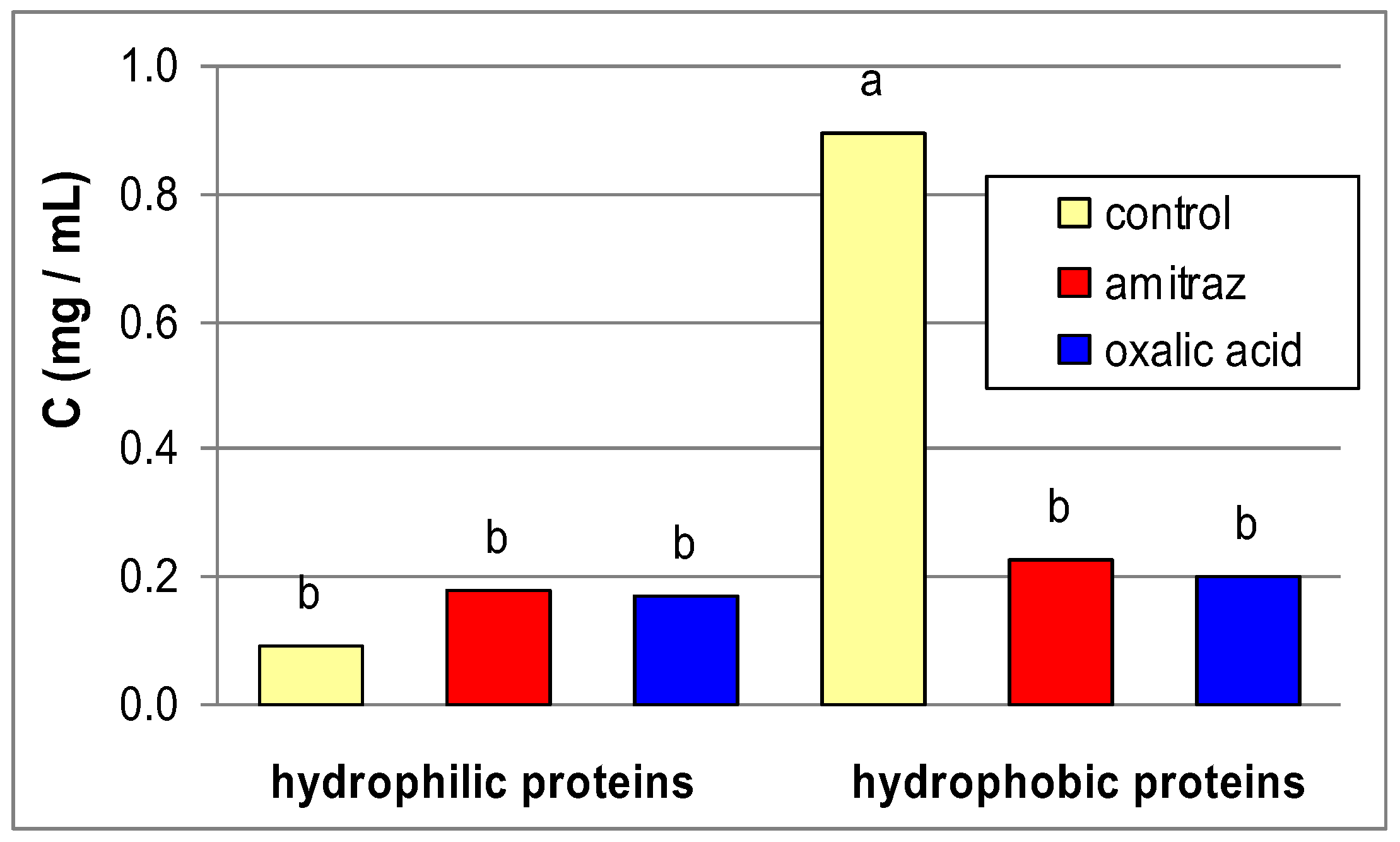
      <p>The amitraz and oxalic acid treatment reduced hydrophobic but did not affect hydrophilic protein concentration (<xref ref-type="fig" rid="insects-03-00821-f001">Figure 1</xref>) on the apian cuticles. Amitraz and oxalic acid treatments reduced both hydrophilic and hydrophobic cuticle protease activities with most of the substrates and independently of the pH value (<xref ref-type="table" rid="insects-03-00821-t001">Table 1</xref>). </p>
      <fig id="insects-03-00821-f001" position="anchor">
        <label>Figure 1</label>
        <caption>
          <p>The influence of amitraz and oxalic acid on mean (n = 60) protein concentrations (<bold>C</bold>) in the cuticle samples of <italic>A. mellifera</italic> workers in comparison to the control. Key: various lowercase letters—the differences are significant for <italic>p</italic> ≤ 0.05, for comparisons made separately within hydrophobic and hydrophilic proteins (2 × ANOVAs and Duncan multiple range tests).</p>
        </caption>
        <graphic xmlns:xlink="http://www.w3.org/1999/xlink" xlink:href="insects-03-00821-g001.tif"/>
      </fig>
      <table-wrap id="insects-03-00821-t001" position="anchor">
        <object-id pub-id-type="pii">insects-03-00821-t001_Table 1</object-id>
        <label>Table 1</label>
        <caption>
          <p>Proteolytic activities [U/mg] in relation to various substrates in the cuticle samples of <italic>A. mellifera</italic> workers treated with amitraz and oxalic acid, as compared with the control.</p>
        </caption>
        <table rules="all">
          <thead>
            <tr>
              <th colspan="3" align="center" valign="middle"> </th>
              <th align="center" valign="middle">Control</th>
              <th align="center" valign="middle">Amitraz</th>
              <th align="center" valign="middle" style="border-right: solid thin">Oxalic acid</th>
            </tr>
            <tr>
              <th align="center" valign="middle" style="border-left: solid thin">Substrate</th>
              <th align="center" valign="middle">proteases</th>
              <th align="center" valign="middle">pH</th>
              <th align="center" valign="middle">Mean ± se</th>
              <th align="center" valign="middle">Mean ± se</th>
              <th align="center" valign="middle" style="border-right: solid thin">Mean ± se</th>
            </tr>
          </thead>
          <tbody>
            <tr>
              <td rowspan="6" align="center" valign="middle" style="border-left: solid thin">Albumin</td>
              <td rowspan="3" align="center" valign="middle">Hydrophilic (rinsed in water)</td>
              <td align="center" valign="middle">2.4</td>
              <td align="center" valign="middle">2.17 ± 0.77</td>
              <td align="center" valign="middle">4.74 ± 3.21</td>
              <td align="center" valign="middle" style="border-right: solid thin">2.55 ± 1.79</td>
            </tr>
            <tr>
              <td align="center" valign="middle">7</td>
              <td align="center" valign="middle">13.88 ± 6.82</td>
              <td align="center" valign="middle">8.63 ± 3.74</td>
              <td align="center" valign="middle" style="border-right: solid thin">7.74 ± 3.42</td>
            </tr>
            <tr>
              <td align="center" valign="middle">11.2</td>
              <td align="center" valign="middle">21.889<sup>a</sup> ± 5.06</td>
              <td align="center" valign="middle">20.15<sup>a</sup> ± 4.61</td>
              <td align="center" valign="middle" style="border-right: solid thin; background:#E6E6E6">10.52<sup>b</sup> ± 1.55</td>
            </tr>
            <tr>
              <td rowspan="3" align="center" valign="middle">Hydrophobic (rinsed in triton)</td>
              <td align="center" valign="middle">2.4</td>
              <td align="center" valign="middle">12.66<sup>b</sup> ± 0.03</td>
              <td align="center" valign="middle">13.74<sup>b</sup> ± 1.93</td>
              <td align="center" valign="middle" style="border-right: solid thin; background:#E6E6E6">19.57<sup>a</sup> ± 4.72</td>
            </tr>
            <tr>
              <td align="center" valign="middle">7</td>
              <td align="center" valign="middle">7.867 ± 0.05</td>
              <td align="center" valign="middle">14.53 ± 1.85</td>
              <td align="center" valign="middle" style="border-right: solid thin">20.13 ± 5.12</td>
            </tr>
            <tr>
              <td align="center" valign="middle">11.2</td>
              <td align="center" valign="middle">167.71<sup>a</sup> ± 0.22</td>
              <td align="center" valign="middle" style="background:#E6E6E6">13.91<sup>b</sup> ± 1.77</td>
              <td align="center" valign="middle" style="border-right: solid thin; background:#E6E6E6">19.54<sup>c</sup> ± 4.70</td>
            </tr>
            <tr>
              <td rowspan="6" align="center" valign="middle" style="border-left: solid thin">hemoglobin</td>
              <td rowspan="3" align="center" valign="middle">Hydrophilic (rinsed in water)</td>
              <td align="center" valign="middle">2.4</td>
              <td align="center" valign="middle">1.87 ± 0.87</td>
              <td align="center" valign="middle">1.00 ± 0.50</td>
              <td align="center" valign="middle" style="border-right: solid thin">1.00 ± 1.00</td>
            </tr>
            <tr>
              <td align="center" valign="middle">7</td>
              <td align="center" valign="middle">1.73 ± 0.16</td>
              <td align="center" valign="middle">1.08 ± 0.43</td>
              <td align="center" valign="middle" style="border-right: solid thin">1.79 ± 1.54</td>
            </tr>
            <tr>
              <td align="center" valign="middle">11.2</td>
              <td align="center" valign="middle">2.56<sup>a</sup> ± 0.33</td>
              <td align="center" valign="middle" style="background:#E6E6E6">0.44<sup>b</sup> ± 0.16</td>
              <td align="center" valign="middle" style="border-right: solid thin">1.55<sup>ab</sup> ± 0.83</td>
            </tr>
            <tr>
              <td rowspan="3" align="center" valign="middle">Hydrophobic(rinsed in triton)</td>
              <td align="center" valign="middle">2.4</td>
              <td align="center" valign="middle">15.58<sup>a</sup> ± 0.14</td>
              <td align="center" valign="middle" style="background:#E6E6E6">5.67<sup>b</sup> ± 0.99</td>
              <td align="center" valign="middle" style="border-right: solid thin; background:#E6E6E6">2.87<sup>c</sup> ± 0.71</td>
            </tr>
            <tr>
              <td align="center" valign="middle">7</td>
              <td align="center" valign="middle">20.64<sup>a</sup> ± 0.07</td>
              <td align="center" valign="middle" style="background:#E6E6E6">5.22<sup>b</sup> ± 1.15</td>
              <td align="center" valign="middle" style="border-right: solid thin; background:#E6E6E6">4.38<sup>b</sup> ± 1.17</td>
            </tr>
            <tr>
              <td align="center" valign="middle">11.2</td>
              <td align="center" valign="middle">10.72<sup>a</sup> ± 0.07</td>
              <td align="center" valign="middle" style="background:#E6E6E6">2.96<sup>b</sup> ± 1.23</td>
              <td align="center" valign="middle" style="border-right: solid thin; background:#E6E6E6">3.29<sup>b</sup> ± 0.72</td>
            </tr>
            <tr>
              <td rowspan="6" align="center" valign="middle" style="border-left: solid thin">cytochrome C</td>
              <td rowspan="3" align="center" valign="middle">Hydrophilic (rinsed in water)</td>
              <td align="center" valign="middle">2.4</td>
              <td align="center" valign="middle">4.65<sup>a</sup> ± 0.61</td>
              <td align="center" valign="middle" style="background:#E6E6E6">0.15<sup>b</sup> ± 0.07</td>
              <td align="center" valign="middle" style="border-right: solid thin; background:#E6E6E6">1.53<sup>c</sup> ± 0.15</td>
            </tr>
            <tr>
              <td align="center" valign="middle">7</td>
              <td align="center" valign="middle">7.42<sup>a</sup> ± 0.82</td>
              <td align="center" valign="middle" style="background:#E6E6E6">0.93<sup>b</sup> ± 0.11</td>
              <td align="center" valign="middle" style="border-right: solid thin; background:#E6E6E6">0.68<sup>b</sup> ± 0.25</td>
            </tr>
            <tr>
              <td align="center" valign="middle">11.2</td>
              <td align="center" valign="middle">9.54<sup>a</sup> ± 0.31</td>
              <td align="center" valign="middle" style="background:#E6E6E6">2.19<sup>b</sup> ± 0.23</td>
              <td align="center" valign="middle" style="border-right: solid thin; background:#E6E6E6">1.05<sup>c</sup> ± 0.11</td>
            </tr>
            <tr>
              <td rowspan="3" align="center" valign="middle">Hydrophobic (rinsed in triton)</td>
              <td align="center" valign="middle">2.4</td>
              <td align="center" valign="middle">12.27<sup>a</sup> ± 0.10</td>
              <td align="center" valign="middle" style="background:#E6E6E6">8.92<sup>b</sup> ± 1.15</td>
              <td align="center" valign="middle" style="border-right: solid thin">12.33<sup>a</sup> ± 1.77</td>
            </tr>
            <tr>
              <td align="center" valign="middle">7</td>
              <td align="center" valign="middle">6.03<sup>b</sup> ± 0.19</td>
              <td align="center" valign="middle" style="background:#E6E6E6">6.57<sup>a</sup> ± 0.57</td>
              <td align="center" valign="middle" style="border-right: solid thin; background:#E6E6E6">6.71<sup>a</sup> ± 0.21</td>
            </tr>
            <tr>
              <td align="center" valign="middle">11.2</td>
              <td align="center" valign="middle">22.13<sup>a</sup> ± 0.16</td>
              <td align="center" valign="middle" style="background:#E6E6E6">6.66<sup>b</sup> ± 0.44</td>
              <td align="center" valign="middle" style="border-right: solid thin; background:#E6E6E6">3.39<sup>c</sup> ± 0.26</td>
            </tr>
            <tr>
              <td rowspan="6" align="center" valign="middle" style="border-left: solid thin">ovoalbumin</td>
              <td rowspan="3" align="center" valign="middle">Hydrophilic (rinsed in water)</td>
              <td align="center" valign="middle">2.4</td>
              <td align="center" valign="middle">1.85<sup>a</sup> ± 0.16</td>
              <td align="center" valign="middle" style="background:#E6E6E6">0.51<sup>b</sup> ± 0.09</td>
              <td align="center" valign="middle" style="border-right: solid thin; background:#E6E6E6">0.65<sup>c</sup> ± 0.22</td>
            </tr>
            <tr>
              <td align="center" valign="middle">7</td>
              <td align="center" valign="middle">14.54<sup>a</sup> ± 0.08</td>
              <td align="center" valign="middle" style="background:#E6E6E6">1.86<sup>b</sup> ± 0.36</td>
              <td align="center" valign="middle" style="border-right: solid thin; background:#E6E6E6">0.00<sup>c</sup> ± 0.00</td>
            </tr>
            <tr>
              <td align="center" valign="middle">11.2</td>
              <td align="center" valign="middle">4.18<sup>a</sup> ± 0.21</td>
              <td align="center" valign="middle" style="background:#E6E6E6">0.00<sup>b</sup> ± 0.00</td>
              <td align="center" valign="middle" style="border-right: solid thin; background:#E6E6E6">0.69<sup>b</sup> ± 0.17</td>
            </tr>
            <tr>
              <td rowspan="3" align="center" valign="middle">Hydrophobic (rinsed in triton)</td>
              <td align="center" valign="middle">2.4</td>
              <td align="center" valign="middle">51.18<sup>a</sup> ± 0.30</td>
              <td align="center" valign="middle" style="background:#E6E6E6">4.17<sup>b</sup> ± 0.31</td>
              <td align="center" valign="middle" style="border-right: solid thin; background:#E6E6E6">2.72<sup>c</sup> ± 0.43</td>
            </tr>
            <tr>
              <td align="center" valign="middle">7</td>
              <td align="center" valign="middle">23.71<sup>a</sup> ± 0.09</td>
              <td align="center" valign="middle" style="background:#E6E6E6">3.00<sup>b</sup> ± 0.49</td>
              <td align="center" valign="middle" style="border-right: solid thin; background:#E6E6E6">2.178<sup>c</sup> ± 0.36</td>
            </tr>
            <tr>
              <td align="center" valign="middle">11.2</td>
              <td align="center" valign="middle">48.32<sup>a</sup> ± 0.22</td>
              <td align="center" valign="middle" style="background:#E6E6E6">3.02<sup>b</sup> ± 0.56</td>
              <td align="center" valign="middle" style="border-right: solid thin; background:#E6E6E6">3.35<sup>b</sup> ± 0.53</td>
            </tr>
          </tbody>
        </table>
        <table-wrap-foot><fn><p>Key: n = 60 for each mean; various lowercase letters—the differences are statistically significant for comparisons in the rows for <italic>p</italic> ≤ 0.05 (ANOVAs and Duncan multiple range tests were performed for each pH within hydrophobic/hydrophilic proteins, separately); shadowed—proteolytic activities significantly decreased after varroacid treatment in comparison to the control. Protease activities were not observed in relation to casein and gelatine (data is not included here).</p></fn></table-wrap-foot>
      </table-wrap>
      
      
      <sec>
        <title>2.1. Cuticle Proteases</title>
        <p>Hydrophobic protease activities were decreased and even not observed at all in relation to casein and gelatine (<xref ref-type="table" rid="insects-03-00821-t001">Table 1</xref>). Asparagine and serine proteases, but no thiolic proteases or metal-proteases, were detected on the apian cuticles because proteolytic activity was identified in the case of pepstatin‑A and phenylmethylsulfonyl fluoride (PMSF) but was not observed in relation to iodoacetamide or o-phenanthroline (diagnostic inhibitors of proteases).</p>
        <p>Amitraz and oxalic acid treatments increased the number of acidic and alkaline protease (both hydrophilic and hydrophobic) and neutral hydrophobic protease bands, and reduced the number of bands associated with neutral hydrophilic proteases in electrophorograms (<xref ref-type="table" rid="insects-03-00821-t002">Table 2</xref>). Furthermore, the width of the bands of alkaline proteases increased, whereas that of neutral proteases diminished. Considering <xref ref-type="table" rid="insects-03-00821-t001">Table 1</xref>, it may be assumed that varroacide treatment may render cuticle proteins/peptides inactive. </p>
        <table-wrap id="insects-03-00821-t002" position="anchor">
          <object-id pub-id-type="pii">insects-03-00821-t002_Table 2</object-id>
          <label>Table 2</label>
          <caption>
            <p>SDS-PAGE zymography of the active proteases on <italic>A. mellifera</italic> worker cuticles.</p>
          </caption>
          <table rules="all">
            <thead>
              <tr>
                <th align="center" valign="middle"> </th>
                <th align="center" valign="middle"> </th>
                <th colspan="4" align="center" valign="middle">Control—no treatment</th>
                <th colspan="4" align="center" valign="middle">Amitraz treatment</th>
                <th colspan="4" align="center" valign="middle" style="border-right: solid thin">Oxalic acid treatment</th>
              </tr>
              <tr>
                <th align="center" valign="middle"> </th>
                <th align="center" valign="middle"> </th>
                <th colspan="2" align="center" valign="middle">hydrophilic protein</th>
                <th colspan="2" align="center" valign="middle">hydrophobic protein</th>
                <th colspan="2" align="center" valign="middle">hydrophilic protein</th>
                <th colspan="2" align="center" valign="middle">hydrophobic protein</th>
                <th colspan="2" align="center" valign="middle">hydrophilic protein</th>
                <th colspan="2" align="center" valign="middle" style="border-right: solid thin">hydrophobic protein</th>
              </tr>
              <tr>
                <th align="center" valign="middle" style="border-left: solid thin">pH</th>
                <th align="center" valign="middle">Rf (mm)</th>
                <th align="center" valign="middle">Band number</th>
                <th align="center" valign="middle">OD</th>
                <th align="center" valign="middle">Band number</th>
                <th align="center" valign="middle">OD</th>
                <th align="center" valign="middle">Band number</th>
                <th align="center" valign="middle">OD</th>
                <th align="center" valign="middle">Band number</th>
                <th align="center" valign="middle">OD</th>
                <th align="center" valign="middle">Band number</th>
                <th align="center" valign="middle">OD</th>
                <th align="center" valign="middle">Band number</th>
                <th align="center" valign="middle" style="border-right: solid thin">OD</th>
              </tr>
            </thead>
            <tbody>
              <tr>
                <td rowspan="3" align="center" valign="middle" style="border-left: solid thin">2.4</td>
                <td align="center" valign="middle">0–40</td>
                <td align="center" valign="middle">1</td>
                <td align="center" valign="middle">0.25</td>
                <td align="center" valign="middle">3</td>
                <td align="center" valign="middle">0.86</td>
                <td align="center" valign="middle">3</td>
                <td align="center" valign="middle">0.21</td>
                <td align="center" valign="middle">4</td>
                <td align="center" valign="middle">0.25</td>
                <td align="center" valign="middle">3</td>
                <td align="center" valign="middle">0.15</td>
                <td align="center" valign="middle">1</td>
                <td align="center" valign="middle" style="border-right: solid thin">0.20</td>
              </tr>
              <tr>
                <td align="center" valign="middle">41–60</td>
                <td align="center" valign="middle">1</td>
                <td align="center" valign="middle">0.40</td>
                <td align="center" valign="middle">2</td>
                <td align="center" valign="middle">0.35</td>
                <td align="center" valign="middle">1</td>
                <td align="center" valign="middle">0.26</td>
                <td align="center" valign="middle">3</td>
                <td align="center" valign="middle">0.43</td>
                <td align="center" valign="middle">1</td>
                <td align="center" valign="middle">0.35</td>
                <td align="center" valign="middle">1</td>
                <td align="center" valign="middle" style="border-right: solid thin">0.23</td>
              </tr>
              <tr>
                <td align="center" valign="middle">61–100</td>
                <td align="center" valign="middle">4</td>
                <td align="center" valign="middle">0.28</td>
                <td align="center" valign="middle">0</td>
                <td align="center" valign="middle">0</td>
                <td align="center" valign="middle">3</td>
                <td align="center" valign="middle">0.36</td>
                <td align="center" valign="middle">4</td>
                <td align="center" valign="middle">0.46</td>
                <td align="center" valign="middle">1</td>
                <td align="center" valign="middle">0.49</td>
                <td align="center" valign="middle">3</td>
                <td align="center" valign="middle" style="border-right: solid thin">0.53</td>
              </tr>
              <tr>
                <td rowspan="3" align="center" valign="middle" style="border-left: solid thin">7.0</td>
                <td align="center" valign="middle">0–40</td>
                <td align="center" valign="middle">5</td>
                <td align="center" valign="middle">0.18</td>
                <td align="center" valign="middle">2</td>
                <td align="center" valign="middle">0.54</td>
                <td align="center" valign="middle">1</td>
                <td align="center" valign="middle">0.49</td>
                <td align="center" valign="middle">4</td>
                <td align="center" valign="middle">0.66</td>
                <td align="center" valign="middle">0</td>
                <td align="center" valign="middle">0</td>
                <td align="center" valign="middle">3</td>
                <td align="center" valign="middle" style="border-right: solid thin">0.48</td>
              </tr>
              <tr>
                <td align="center" valign="middle">41–60</td>
                <td align="center" valign="middle">2</td>
                <td align="center" valign="middle">0.20</td>
                <td align="center" valign="middle">0</td>
                <td align="center" valign="middle">0</td>
                <td align="center" valign="middle">1</td>
                <td align="center" valign="middle">0.63</td>
                <td align="center" valign="middle">1</td>
                <td align="center" valign="middle">0.92</td>
                <td align="center" valign="middle">2</td>
                <td align="center" valign="middle">0.47</td>
                <td align="center" valign="middle">1</td>
                <td align="center" valign="middle" style="border-right: solid thin">0.74</td>
              </tr>
              <tr>
                <td align="center" valign="middle">61–100</td>
                <td align="center" valign="middle">4</td>
                <td align="center" valign="middle">0.25</td>
                <td align="center" valign="middle">3</td>
                <td align="center" valign="middle">0.36</td>
                <td align="center" valign="middle">2</td>
                <td align="center" valign="middle">0.61</td>
                <td align="center" valign="middle">2</td>
                <td align="center" valign="middle">0.68</td>
                <td align="center" valign="middle">3</td>
                <td align="center" valign="middle">0.52</td>
                <td align="center" valign="middle">2</td>
                <td align="center" valign="middle" style="border-right: solid thin">0.74</td>
              </tr>
              <tr>
                <td rowspan="3" align="center" valign="middle" style="border-left: solid thin">11.0</td>
                <td align="center" valign="middle">0–40</td>
                <td align="center" valign="middle">3</td>
                <td align="center" valign="middle">0.25</td>
                <td align="center" valign="middle">0</td>
                <td align="center" valign="middle">0</td>
                <td align="center" valign="middle">1</td>
                <td align="center" valign="middle">0.30</td>
                <td align="center" valign="middle">5</td>
                <td align="center" valign="middle">0.23</td>
                <td align="center" valign="middle">1</td>
                <td align="center" valign="middle">0.12</td>
                <td align="center" valign="middle">2</td>
                <td align="center" valign="middle" style="border-right: solid thin">0.14</td>
              </tr>
              <tr>
                <td align="center" valign="middle">41–60</td>
                <td align="center" valign="middle">0</td>
                <td align="center" valign="middle">0</td>
                <td align="center" valign="middle">0</td>
                <td align="center" valign="middle">0</td>
                <td align="center" valign="middle">1</td>
                <td align="center" valign="middle">0.23</td>
                <td align="center" valign="middle">1</td>
                <td align="center" valign="middle">0.15</td>
                <td align="center" valign="middle">1</td>
                <td align="center" valign="middle">0.19</td>
                <td align="center" valign="middle">1</td>
                <td align="center" valign="middle" style="border-right: solid thin">0.20</td>
              </tr>
              <tr>
                <td align="center" valign="middle">61–100</td>
                <td align="center" valign="middle">1</td>
                <td align="center" valign="middle">0.32</td>
                <td align="center" valign="middle">0</td>
                <td align="center" valign="middle">0</td>
                <td align="center" valign="middle">4</td>
                <td align="center" valign="middle">0.25</td>
                <td align="center" valign="middle">1</td>
                <td align="center" valign="middle">0.18</td>
                <td align="center" valign="middle">2</td>
                <td align="center" valign="middle">0.18</td>
                <td align="center" valign="middle">3</td>
                <td align="center" valign="middle" style="border-right: solid thin">0.38</td>
              </tr>
            </tbody>
          </table>
          <table-wrap-foot><fn><p>Key: Rf-—ranges of the protein migration path (0–40 high-molecular, 41–60 medium-molecular 61–100 low molecular); OD—width of the bands. The results of protease activities in SDS-PAGE zymography are the arithmetic mean (n = 60) of the results obtained in each group. A lack of any considerable differences between electrophoretic patterns within each group was observed even though the electrophoresis were performed five-times (the band pattern was very similar within each group) Therefore no statistics were applied.</p></fn></table-wrap-foot>
        </table-wrap>
        
      </sec>
      <sec>
        <title>2.2. Cuticle Protease Inhibitors</title>
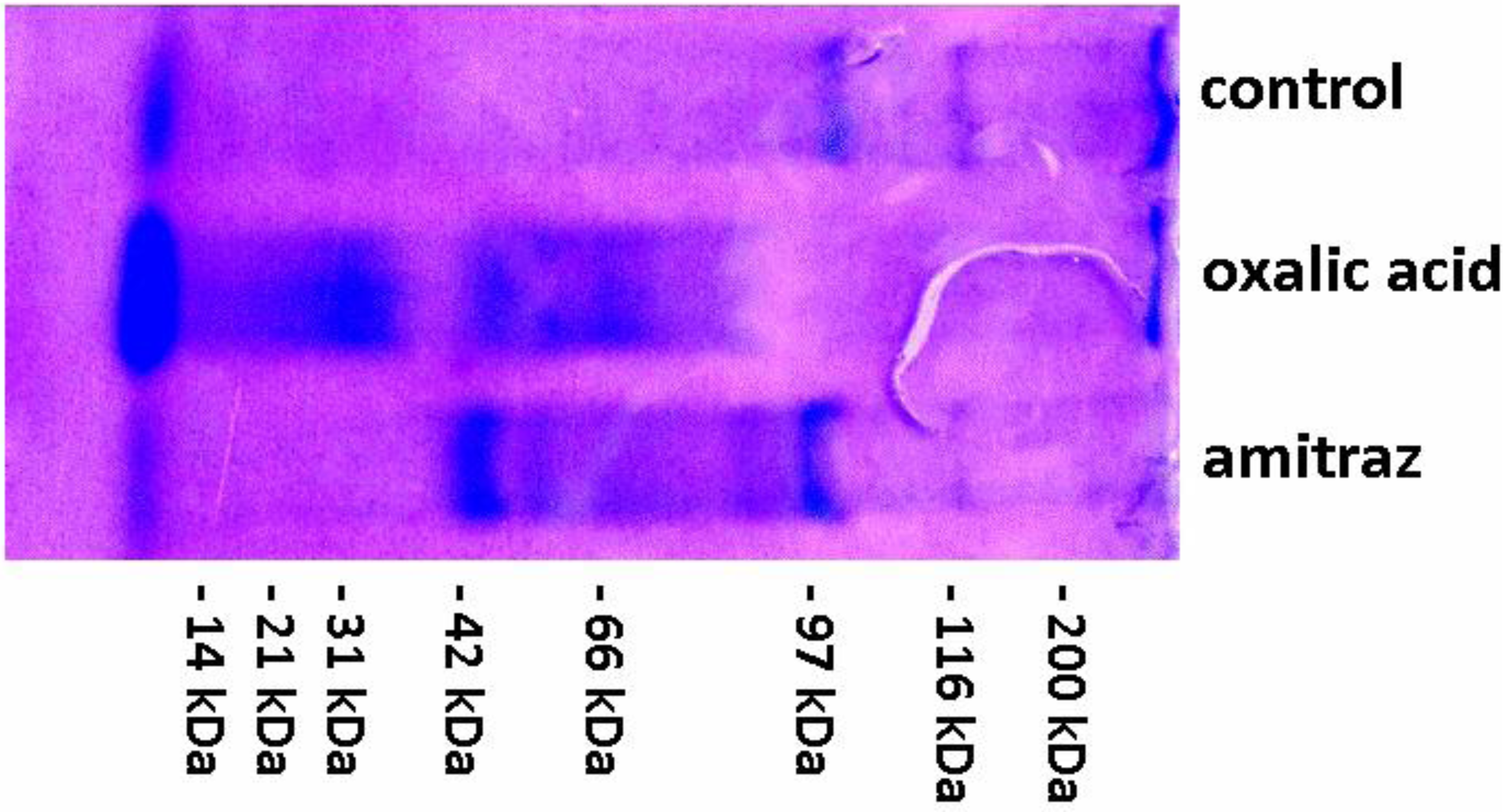
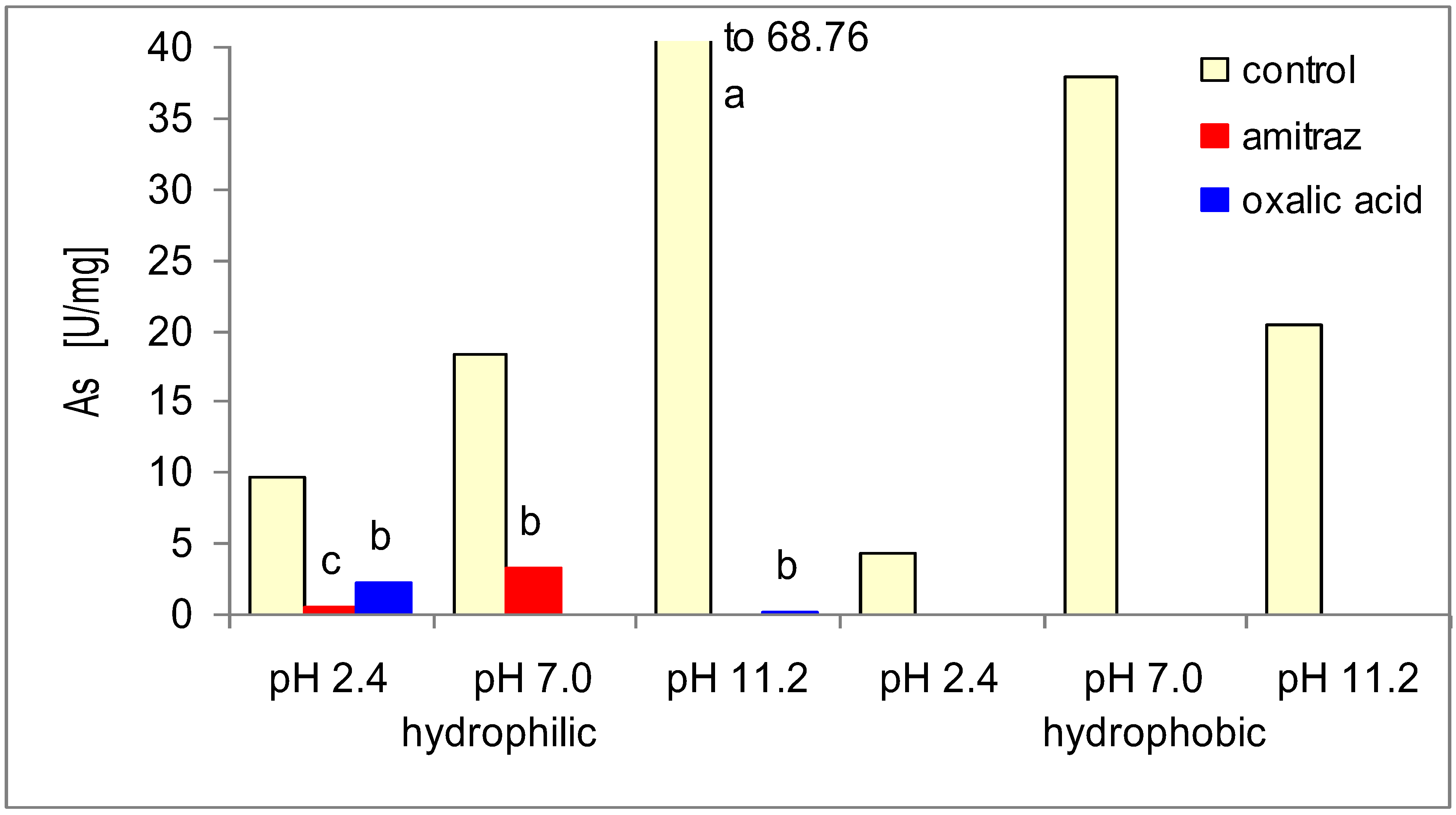
        <p>Amitraz and oxalic acid caused a complete loss or considerable reduction (<xref ref-type="fig" rid="insects-03-00821-f002">Figure 2</xref>) in the activities of natural inhibitors of acidic, neutral, and alkaline proteases (both hydrophilic and hydrophobic). In the electrophorograms of the control group, poorly pronounced narrow bands associated with both high- and low-molecular inhibitors of asparagine and serine proteases were observed (<xref ref-type="fig" rid="insects-03-00821-f003">Figure 3</xref>, <xref ref-type="table" rid="insects-03-00821-t003">Table 3</xref>). After applying amitraz and oxalic acid, additional bands associated with high- and low-molecular protease inhibitors appeared. These were broader and well-pronounced at acidic and neutral but narrower and less prominent at alkaline pH. It may be assumed that amitraz and oxalic acid deactivated protease inhibitors or reacted with the proteases/substrates. Moreover, they may have destroyed the structure of one/multiple components of the protease/substrate/inhibitor complex. In all the cases more inactive cuticle proteins/peptides may appear.</p>
        <fig id="insects-03-00821-f002" position="anchor">
          <label>Figure 2</label>
          <caption>
            <p>Mean (n = 60) activities of natural protease inhibitors (<bold>As</bold>) in the cuticle samples of <italic>A. mellifera</italic> workers treated with amitraz and oxalic acid in comparison to the control. Key: various lowercase letters—the differences are significant for <italic>p</italic> ≤ 0.05. Separate comparisons were made for each pH within hydrophilic and hydrophobic proteins (6 × ANOVAs and Duncan multiple range tests).</p>
          </caption>
          <graphic xmlns:xlink="http://www.w3.org/1999/xlink" xlink:href="insects-03-00821-g002.tif"/>
        </fig>
        <fig id="insects-03-00821-f003" position="anchor">
          <label>Figure 3</label>
          <caption>
            <p>An electrophorogram (example) depicting serine protease inhibitor activities of the samples from cuticles of <italic>A. mellifera</italic> workers treated with amitraz and oxalic acid in comparison to the control.</p>
          </caption>
          <graphic xmlns:xlink="http://www.w3.org/1999/xlink" xlink:href="insects-03-00821-g003.tif"/>
        </fig>
        <table-wrap id="insects-03-00821-t003" position="anchor">
          <object-id pub-id-type="pii">insects-03-00821-t003_Table 3</object-id>
          <label>Table 3</label>
          <caption>
            <p>SDS-PAGE zymography of the active natural protease inhibitors on <italic>A. mellifera</italic> worker cuticles. </p>
          </caption>
          <table rules="all">
            <thead>
              <tr>
                <th rowspan="2" align="center" valign="middle"> </th>
                <th rowspan="2" align="center" valign="middle"> </th>
                <th colspan="4" align="center" valign="middle">Control—no treatment</th>
                <th colspan="4" align="center" valign="middle">Amitraz treatment</th>
                <th colspan="4" align="center" valign="middle" style="border-right: solid thin">Oxalic acid treatment</th>
              </tr>
              <tr>
                <th colspan="2" align="center" valign="middle">hydrophilic protein</th>
                <th colspan="2" align="center" valign="middle">hydrophobic protein</th>
                <th colspan="2" align="center" valign="middle">hydrophilic protein</th>
                <th colspan="2" align="center" valign="middle">hydrophobic protein</th>
                <th colspan="2" align="center" valign="middle">hydrophilic protein</th>
                <th colspan="2" align="center" valign="middle" style="border-right: solid thin">hydrophobic protein</th>
              </tr>
              <tr>
                <th align="center" valign="middle" style="border-left: solid thin">pH</th>
                <th align="center" valign="middle">Rf (mm)</th>
                <th align="center" valign="middle">Band number</th>
                <th align="center" valign="middle">OD</th>
                <th align="center" valign="middle">Band number</th>
                <th align="center" valign="middle">OD</th>
                <th align="center" valign="middle">Band number</th>
                <th align="center" valign="middle">OD</th>
                <th align="center" valign="middle">Band number</th>
                <th align="center" valign="middle">OD</th>
                <th align="center" valign="middle">Band number</th>
                <th align="center" valign="middle">OD</th>
                <th align="center" valign="middle">Band number</th>
                <th align="center" valign="middle" style="border-right: solid thin">OD</th>
              </tr>
            </thead>
            <tbody>
              <tr>
                <td rowspan="3" align="center" valign="middle" style="border-left: solid thin">2.4</td>
                <td align="center" valign="middle">0–40</td>
                <td align="center" valign="middle">4</td>
                <td align="center" valign="middle">0.21</td>
                <td align="center" valign="middle">0</td>
                <td align="center" valign="middle">0</td>
                <td align="center" valign="middle">5</td>
                <td align="center" valign="middle">0.73</td>
                <td align="center" valign="middle">2</td>
                <td align="center" valign="middle">0.74</td>
                <td align="center" valign="middle">4</td>
                <td align="center" valign="middle">0.65</td>
                <td align="center" valign="middle">5</td>
                <td align="center" valign="middle" style="border-right: solid thin">0.63</td>
              </tr>
              <tr>
                <td align="center" valign="middle">41–60</td>
                <td align="center" valign="middle">0</td>
                <td align="center" valign="middle">0</td>
                <td align="center" valign="middle">1</td>
                <td align="center" valign="middle">0.20</td>
                <td align="center" valign="middle">1</td>
                <td align="center" valign="middle">0.58</td>
                <td align="center" valign="middle">1</td>
                <td align="center" valign="middle">0.67</td>
                <td align="center" valign="middle">1</td>
                <td align="center" valign="middle">0.55</td>
                <td align="center" valign="middle">0</td>
                <td align="center" valign="middle" style="border-right: solid thin">0</td>
              </tr>
              <tr>
                <td align="center" valign="middle">61–100</td>
                <td align="center" valign="middle">3</td>
                <td align="center" valign="middle">0.21</td>
                <td align="center" valign="middle">4</td>
                <td align="center" valign="middle">0.14</td>
                <td align="center" valign="middle">5</td>
                <td align="center" valign="middle">0.53</td>
                <td align="center" valign="middle">4</td>
                <td align="center" valign="middle">0.56</td>
                <td align="center" valign="middle">2</td>
                <td align="center" valign="middle">0.58</td>
                <td align="center" valign="middle">3</td>
                <td align="center" valign="middle" style="border-right: solid thin">0.61</td>
              </tr>
              <tr>
                <td rowspan="3" align="center" valign="middle" style="border-left: solid thin">7.0</td>
                <td align="center" valign="middle">0–40</td>
                <td align="center" valign="middle">2</td>
                <td align="center" valign="middle">0.16</td>
                <td align="center" valign="middle">1</td>
                <td align="center" valign="middle">0.23</td>
                <td align="center" valign="middle">2</td>
                <td align="center" valign="middle">0.23</td>
                <td align="center" valign="middle">4</td>
                <td align="center" valign="middle">0.35</td>
                <td align="center" valign="middle">3</td>
                <td align="center" valign="middle">0.26</td>
                <td align="center" valign="middle">1</td>
                <td align="center" valign="middle" style="border-right: solid thin">0.23</td>
              </tr>
              <tr>
                <td align="center" valign="middle">41–60</td>
                <td align="center" valign="middle">0</td>
                <td align="center" valign="middle">0</td>
                <td align="center" valign="middle">0</td>
                <td align="center" valign="middle">0</td>
                <td align="center" valign="middle">1</td>
                <td align="center" valign="middle">0.30</td>
                <td align="center" valign="middle">2</td>
                <td align="center" valign="middle">0.52</td>
                <td align="center" valign="middle">0</td>
                <td align="center" valign="middle">0</td>
                <td align="center" valign="middle">0</td>
                <td align="center" valign="middle" style="border-right: solid thin">0</td>
              </tr>
              <tr>
                <td align="center" valign="middle">61–100</td>
                <td align="center" valign="middle">0</td>
                <td align="center" valign="middle">0</td>
                <td align="center" valign="middle">1</td>
                <td align="center" valign="middle">0.21</td>
                <td align="center" valign="middle">1</td>
                <td align="center" valign="middle">0.27</td>
                <td align="center" valign="middle">4</td>
                <td align="center" valign="middle">0.34</td>
                <td align="center" valign="middle">2</td>
                <td align="center" valign="middle">0.26</td>
                <td align="center" valign="middle">5</td>
                <td align="center" valign="middle" style="border-right: solid thin">0.39</td>
              </tr>
              <tr>
                <td rowspan="3" align="center" valign="middle" style="border-left: solid thin">11.0</td>
                <td align="center" valign="middle">0–40</td>
                <td align="center" valign="middle">3</td>
                <td align="center" valign="middle">0.37</td>
                <td align="center" valign="middle">4</td>
                <td align="center" valign="middle">0.23</td>
                <td align="center" valign="middle">2</td>
                <td align="center" valign="middle">0.14</td>
                <td align="center" valign="middle">2</td>
                <td align="center" valign="middle">0.16</td>
                <td align="center" valign="middle">2</td>
                <td align="center" valign="middle">0.08</td>
                <td align="center" valign="middle">0</td>
                <td align="center" valign="middle" style="border-right: solid thin">0</td>
              </tr>
              <tr>
                <td align="center" valign="middle">41–60</td>
                <td align="center" valign="middle">0</td>
                <td align="center" valign="middle">0</td>
                <td align="center" valign="middle">0</td>
                <td align="center" valign="middle">0</td>
                <td align="center" valign="middle">2</td>
                <td align="center" valign="middle">0.10</td>
                <td align="center" valign="middle">0</td>
                <td align="center" valign="middle">0</td>
                <td align="center" valign="middle">1</td>
                <td align="center" valign="middle">0.11</td>
                <td align="center" valign="middle">0</td>
                <td align="center" valign="middle" style="border-right: solid thin">0</td>
              </tr>
              <tr>
                <td align="center" valign="middle">61–100</td>
                <td align="center" valign="middle">3</td>
                <td align="center" valign="middle">0.36</td>
                <td align="center" valign="middle">0</td>
                <td align="center" valign="middle">0</td>
                <td align="center" valign="middle">0</td>
                <td align="center" valign="middle">0</td>
                <td align="center" valign="middle">3</td>
                <td align="center" valign="middle">0.28</td>
                <td align="center" valign="middle">1</td>
                <td align="center" valign="middle">0.04</td>
                <td align="center" valign="middle">3</td>
                <td align="center" valign="middle" style="border-right: solid thin">0.23</td>
              </tr>
            </tbody>
          </table>
          <table-wrap-foot><fn><p>Key: Rf—range of the protein migration path (0–40 high-molecular, 41–60 medium-molecular 61–100 low molecular), points of protease inhibitor bonding with proteases and substrates in the polyacrylamide gel; OD—width of the bands. The results of protease inhibitor activities in SDS-PAGE zymography are the arithmetic mean (n = 60) of the results obtained in each of the groups. A lack of any considerable differences between electrophoretic patterns within each group was observed even though the electrophoresis were performed five-times (the band pattern was very similar within each group). Therefore no statistics were applied.</p></fn></table-wrap-foot>
        </table-wrap>
        
        
      </sec>
      <sec sec-type="conclusions">
        <title>2.3. Apian Cuticle Proteolytic System — General Comments</title>
        <p>Our results showed that both amitraz and oxalic acid reduced the activities of the cuticle proteolytic systems of worker bees, especially as regards hydrophobic proteases. This was particularly noticeable in the case of natural protease inhibitors. This suppressive effect may stem from the varroacids’ toxicity. Howis <italic>et al.</italic> [<xref ref-type="bibr" rid="B23-insects-03-00821">23</xref>] proved that organic acids damage anatomic and physiological structures of the alimentary and body cover, and can facilitate pathogen penetration by debilitating the proteolytic system. Additionally, organic acids create a favorable environment for fungal development. Moreover, oxalic acid probably has a negative effect on the Krebs cycle. Drugs to fight <italic>V. destructor</italic> used to be selected by their efficacy, ease of application, and affordability [<xref ref-type="bibr" rid="B25-insects-03-00821">25</xref>]. In this context, amitraz seems a good solution. Nevertheless, our results reveal that amitraz is not advantageous as regards the proteolytic barrier. A “vicious circle” is created, in which drug use reduces resistance, leading to weaker colonies, and thereby to more losses in the apiary, which then require more intensive drug application. This finding corresponds with feedback from beekeepers, who have observed the spreading of various diseases in their hives after intensive use of the above drugs [<xref ref-type="bibr" rid="B26-insects-03-00821">26</xref>]. Amitraz-containing drugs considerably reduced the amount of the main biochemical compounds in the hemolymph of adult workers from their emergence until foraging age, and to a lower extent, the amount of proteins in the body tissues of the workers [<xref ref-type="bibr" rid="B27-insects-03-00821">27</xref>]. Our results demonstrate that amitraz also lowers protein concentration and suppresses proteolytic system activity on the body surface of honeybees. Therefore, among the side effects of therapy against <italic>V. destructor</italic>, we should enumerate the extenuation of the proteolytic barrier.</p>
        <p>Our previous experiments proved that some external factors could supress the proteolytic barrier on the apian cuticle. In a polluted environment, lower values of protein concentrations, protease activities, and natural protease inhibitor activities were observed in the worker cuticles as compared with the cuticles of bees from an unpolluted environment [<xref ref-type="bibr" rid="B11-insects-03-00821">11</xref>]. Bee diet may also affect the barrier efficiency [<xref ref-type="bibr" rid="B28-insects-03-00821">28</xref>]. The present study revealed that amitraz and oxalic acid theraphy may also reduce cuticular proteolytic system activity and therefore may be regarded as harmful external factors.</p>
      </sec>
      <sec>
        <title>2.4. Activity towards Model Microorganisms</title>
        <p>The rinsings from the body surface of workers in the control group showed activity in relation to all the microorganisms (<xref ref-type="table" rid="insects-03-00821-t004">Table 4</xref>). In bees treated with amitraz and oxalic acid, no activity towards <italic>A. niger</italic> or <italic>S. aureus</italic> was observed. Moreover, after applying oxalic acid, no activity was identified in relation to <italic>S. typhimurium</italic> or <italic>P. aeruginosa</italic>. This may correspond with a low <italic>in vitro</italic> activity of the proteolytic system, due to the influence of those varroacids, and confirms their suppressive effect on the proteolytic barrier especially in the case of fungal infection. On the other hand, amitraz increased the activity towards <italic>Bacillus subtilis</italic>, <italic>Salmonella typhimurium</italic>, <italic>Pseudomonas aeruginosa</italic>. Hence, suppression was not always observed, though mostly.</p>
        <table-wrap id="insects-03-00821-t004" position="anchor">
          <object-id pub-id-type="pii">insects-03-00821-t004_Table 4</object-id>
          <label>Table 4</label>
          <caption>
            <p>Antifungal and antibacterial activities of cuticle washings of <italic>A. mellifera</italic> workers treated with amitraz and oxalic acid, measured as the area of the infected medium on which there was no microorganism growth (<bold>mm<sup>2</sup></bold>) in comparison to the control. </p>
          </caption>
          <table rules="all">
            <thead>
              <tr>
                <th rowspan="2" align="center" valign="middle" style="border-left: solid thin">Group</th>
                <th colspan="2" align="center" valign="middle">Antifungal activity</th>
                <th colspan="4" align="center" valign="middle" style="border-right: solid thin">Antibacterial activity</th>
              </tr>
              <tr>
                <th align="center" valign="middle">
                  <italic>Candida albicans</italic>
                </th>
                <th align="center" valign="middle">
                  <italic>Aspergillus niger</italic>
                </th>
                <th align="center" valign="middle">
                  <italic>Bacillus subtilis</italic>
                </th>
                <th align="center" valign="middle">
                  <italic>Staphylococcus aureus</italic>
                </th>
                <th align="center" valign="middle">
                  <italic>Salmonella typhimurium</italic>
                </th>
                <th align="center" valign="middle" style="border-right: solid thin">
                  <italic>Pseudomonas aeruginosa</italic>
                </th>
              </tr>
            </thead>
            <tbody>
              <tr>
                <td align="center" valign="middle" style="border-left: solid thin">Control</td>
                <td align="center" valign="middle">978.57</td>
                <td align="center" valign="middle">23.36</td>
                <td align="center" valign="middle">78.36</td>
                <td align="center" valign="middle">308.61</td>
                <td align="center" valign="middle">126.49</td>
                <td align="center" valign="middle" style="border-right: solid thin">101.33</td>
              </tr>
              <tr>
                <td align="center" valign="middle" style="border-left: solid thin">Amitraz</td>
                <td align="center" valign="middle">212.50</td>
                <td align="center" valign="middle">0</td>
                <td align="center" valign="middle">756.51</td>
                <td align="center" valign="middle">0</td>
                <td align="center" valign="middle">259.62</td>
                <td align="center" valign="middle" style="border-right: solid thin">207.24</td>
              </tr>
              <tr>
                <td align="center" valign="middle" style="border-left: solid thin">Oxalic acid</td>
                <td align="center" valign="middle">340.69</td>
                <td align="center" valign="middle">0</td>
                <td align="center" valign="middle">154.18</td>
                <td align="center" valign="middle">0</td>
                <td align="center" valign="middle">0</td>
                <td align="center" valign="middle" style="border-right: solid thin">0</td>
              </tr>
            </tbody>
          </table>
          <table-wrap-foot><fn><p>Key: the portions/samples were polled (60 portions within each the group) and 1 polled sample per group was obtained. So, the totalized group effects were shown here and no statistics were applied. </p></fn></table-wrap-foot>
        </table-wrap>
        
        <p>Ants have protective microbial biofilms on their body surfaces that are affected by various chemical substances [<xref ref-type="bibr" rid="B29-insects-03-00821">29</xref>]. Grzywnowicz et al. [<xref ref-type="bibr" rid="B9-insects-03-00821">9</xref>] suspected that bees might also have such biofilms. If they do, amitraz and oxalic acid could suppress the biofilm activity (anti-pathogen cuticle barrier) conditioned by the proteolytic system. Recent research [<xref ref-type="bibr" rid="B30-insects-03-00821">30</xref>] shows that the V. destructor parasite is equipped with a set of enzymes that belong to the category of asparagine and cysteine proteases, as well as metal‑proteases with a pH range of only 2.0–6.5. In turn, as evidenced in this research, A. mellifera have asparginic and serine proteases on their body surface whose pH range is much broader (2.4–11.2) than that of the acarids, which could help bees block “foreign” proteins. </p>
      </sec>
    </sec>
    <sec>
      <title>3. Experimental Section</title>
      <sec>
        <title>3.1. The Experimental Design</title>
        <p>Three experimental groups with 5 colonies of Buckfast bees in each (headed by sister-queens) were monitored (15 colonies). In the first group bees were sprayed with a 3.2% oxalic acid solution, 50 mL per colony. The solution was made using 15 g oxalic acid dihydrate, 200 g sucrose, and 200 mL water [<xref ref-type="bibr" rid="B24-insects-03-00821">24</xref>]. Each colony in the second group was fumigated with one tablet of Apiowarol AS<sup>®</sup> (12.5 mg amitraz) single-time according to the producer’s recommendations. The treatments were repeated in 2009 and 2010 at the end of July. In the third, control group, neither amitraz nor oxalic acid treatments were performed.</p>
      </sec>
      <sec>
        <title>3.2. Sampling and the Data Base</title>
        <p>Three samples comprising 10 nest worker bees were collected from each colony just before and two weeks after the treatments consecutively in 2009 and 2010 (together 6 samples). Totally the procedure produced 5 colonies × 6 samples × 2 years = 60 samples = 600 bees for each of the three group. The material was frozen in sterile bags at −8°C and stored for 1–2 months. Then, the samples were refrozen and rinsed in 10 ml distilled water for 20 seconds to remove impurities. Proteins were not found in the rinsings using the Lowry method as modified by Schacterle and Pollack [<xref ref-type="bibr" rid="B31-insects-03-00821">31</xref>]. Therefore, the rinsings were discarded. Subsequently, the samples were shaken/rinsed for 4 min at 3,400 rpm in 10 mL distilled water, and finally, after filtering through Miracloth, a solution was obtained that mostly contained hydrophilic proteins. The solution obtained from each sample was then divided into 4 portions, poured into four Eppendorf tubes, and frozen again at −40°C. The procedure produced:</p>
        <list>
          <list-item>
            <p>2 mL—for determining protease and protease inhibitor activities (portion a),</p>
          </list-item>
          <list-item>
            <p>2 mL—for electrophoretic assays (portion b),</p>
          </list-item>
          <list-item>
            <p>2 mL—for determining antifungal and antibacterial activities <italic>in vivo</italic> (portion c),</p>
          </list-item>
          <list-item>
            <p>2 mL—reserve (portion d).</p>
          </list-item>
        </list>
        <p>Altogether, we obtained 60 samples × 4 portions = 240 portions per group.</p>
        <p>Then, the solid samples that remained on the Miracloth were again shaken/rinsed (4 min at 3,400 rpm) in a 1% detergent solution (Triton X-100) in distilled water (10 mL). Similarly to the first rinsing, 4 portions (2 mL) were created from each sample, now containing mostly hydrophobic proteins.</p>
        <p>The entire procedure resulted in a total of 1440 portions (3 groups × 60 samples × 2 rinsings × 4 portions).</p>
      </sec>
      <sec sec-type="methods">
        <title>3.3. The Analytical Procedures</title>
        <p>For each of the three groups, 62 µL of the solution were sampled from each “<bold>portion a</bold>”, and mixed to create a one pooled group-sample (3 pooled group-samples, each consisting of 60 samples) to determine optimal pH values, at which protein activities were high. The values amounted to 2.2–3.4, 6.4–7.6, and 8.2–11.6 in the pooled samples. Therefore, the activities of acid, neutral and alkaline proteases/protease inhibitors were decided to be determinate at pH 2.4, 7.0 and 11.2, respectively. </p>
        <p>Next, the remainder (1.938 mL) of each “<bold>portion a</bold>” was analyzed (portions were not pooled in this case; n = 60) as follows:</p>
        <list>
          <list-item>
            <p>• the general protein content by the Lowry method, as modified by Schacterle and Pollack [<xref ref-type="bibr" rid="B31-insects-03-00821">31</xref>];</p>
          </list-item>
          <list-item>
            <p>• the proteolytic activity in relation to the substrates (gelatine, hemoglobin, ovoalbumin, albumin, cytochrome C, casein were chosen on the basis of our former studies [<xref ref-type="bibr" rid="B9-insects-03-00821">9</xref>,<xref ref-type="bibr" rid="B10-insects-03-00821">10</xref>,<xref ref-type="bibr" rid="B11-insects-03-00821">11</xref>]), according to the Anson method [<xref ref-type="bibr" rid="B32-insects-03-00821">32</xref>]</p>
          </list-item>
          <list-item>
            <p>• the proteolytic activity in relation to the diagnostic inhibitors of proteolytic enzymes (pepstatin A, PMSF, iodoacetamide, o-phenanthroline), by the Lee and Lin method [<xref ref-type="bibr" rid="B33-insects-03-00821">33</xref>];</p>
          </list-item>
          <list-item>
            <p>• the activities of acidic, neutral, and alkaline proteases according to the Anson method [<xref ref-type="bibr" rid="B32-insects-03-00821">32</xref>];</p>
          </list-item>
          <list-item>
            <p>• the levels of natural inhibitors of acidic, neutral, and alkaline proteases, based on the Lee and Lin method [<xref ref-type="bibr" rid="B33-insects-03-00821">33</xref>].</p>
          </list-item>
        </list>
        <p>Polyacrylamide gel electrophoresis was performed using “<bold>portions b</bold>”, which had been previously lyophilized and then combined with 100 µL distilled water. Each portion (n = 60) was analyzed separately in this case. The following analyses were conducted:</p>
        <list>
          <list-item>
            <p>• protease detection using the Laemmli method [<xref ref-type="bibr" rid="B34-insects-03-00821">34</xref>]; <italic>i.e.</italic>, SDS-PAGE method.</p>
          </list-item>
          <list-item>
            <p>• detection of inhibitors of asparagine and serine proteases using the Felicioli <italic>et al.</italic> method [<xref ref-type="bibr" rid="B35-insects-03-00821">35</xref>]; <italic>i.e.</italic>, SDS-PAGE method.</p>
          </list-item>
        </list>
      </sec>
      <sec>
        <title>3.4. <italic>In Vivo</italic> Laboratory Tests</title>
        <p>“<bold>Portions c</bold>” from each group were pooled separately (3 pooled group-samples; each consisting of 60 portions), and then lyophilized to determine antifungal and antibacterial activities. To this end, the lyophilizates were combined with 200 µL distilled water. Subsequently, 10 µL of the mixtures were spackled on culture media using the double application method, with:</p>
        <list>
          <list-item>
            <p>• SABG [<xref ref-type="bibr" rid="B36-insects-03-00821">36</xref>]—to determine activity in relation to <italic>Aspergillus niger</italic>,</p>
          </list-item>
          <list-item>
            <p>• YPD [<xref ref-type="bibr" rid="B37-insects-03-00821">37</xref>]—to determine activity in relation to <italic>Candida albicans</italic>,</p>
          </list-item>
          <list-item>
            <p>• LB [<xref ref-type="bibr" rid="B38-insects-03-00821">38</xref>]—to determine activity in relation to <italic>Staphylococcus ureus</italic> (ATCC 25923), <italic>Bacillus subtilis</italic> (ATCC 6633), <italic>Micrococcus luteus</italic> (ATCC 7468), <italic>Salmonella typhimurium</italic> (ATCC 13311), <italic>Pseudomonas aeruginosa</italic> (ATCC 17853), and <italic>Escherichia coli</italic> (ATCC 10536).</p>
          </list-item>
        </list>
        <p>In all microbiological tests, each dish was photographed (SONY α100) to determine the area on which there was no microorganism growth, using the MultiScanBase [<xref ref-type="bibr" rid="B39-insects-03-00821">39</xref>].</p>
      </sec>
      <sec>
        <title>3.5. Statistics</title>
        <p>To statistically verify an influence of amitraz and oxalic acid (experimental factors) on the protein contents as well as on the protease and protease inhibitor activities, one-way ANOVAs and the Duncan multiple range tests were performed using the SAS [<xref ref-type="bibr" rid="B40-insects-03-00821">40</xref>].</p>
      </sec>
    </sec>
    <sec>
      <title>4. Conclusion</title>
      <p>Amitraz and oxalic acid may upset the cuticle proteolytic defense system in <italic>A. mellifera</italic>. Therefore, a Varroa treatment including these drugs may make honeybee workers more susceptible to pathogenic (especially fungal) invasions. The bees were not age-controlled, thus the drugs’ effects might be direct and indirect (via pupae and within-colony environment; compare [<xref ref-type="bibr" rid="B41-insects-03-00821">41</xref>]).</p>
    </sec>
  </body>
  <back>
    <ref-list>
      <title>References and Notes</title>
      <ref id="B1-insects-03-00821">
        <label>1.</label>
        <citation citation-type="journal">
          <person-group person-group-type="author">
            <name>
              <surname>Terra</surname>
              <given-names>W.R.</given-names>
            </name>
            <name>
              <surname>Ferreira</surname>
              <given-names>C.</given-names>
            </name>
          </person-group>
          <article-title>Insect digestive enzymes: Properties, compartmentalization and function</article-title>
          <source>Comp. Biochem. Physiol.</source>
          <year>1994</year>
          <volume>109</volume>
          <fpage>1</fpage>
          <lpage>62</lpage>
          <pub-id pub-id-type="doi">10.1016/0300-9629(94)90307-7</pub-id>
        </citation>
      </ref>
      <ref id="B2-insects-03-00821">
        <label>2.</label>
        <citation citation-type="book">
          <person-group person-group-type="author">
            <name>
              <surname>Barrett</surname>
              <given-names>A.J.</given-names>
            </name>
          </person-group>
          <article-title>Peptidases: A view of classification and nomenclature</article-title>
          <source>Proteases: New Perspectives</source>
          <edition>2nd</edition>
          <person-group person-group-type="editor">
            <name>
              <surname>Turk</surname>
              <given-names>V.</given-names>
            </name>
          </person-group>
          <publisher-name>Birkhãuser</publisher-name>
          <publisher-loc>Berlin, German</publisher-loc>
          <year>1999</year>
          <volume>1</volume>
          <fpage>1</fpage>
          <lpage>12</lpage>
        </citation>
      </ref>
      <ref id="B3-insects-03-00821">
        <label>3.</label>
        <citation citation-type="journal">
          <person-group person-group-type="author">
            <name>
              <surname>Bode</surname>
              <given-names>W.</given-names>
            </name>
            <name>
              <surname>Fernandez-Catalan</surname>
              <given-names>C.</given-names>
            </name>
            <name>
              <surname>Nagase</surname>
              <given-names>H.</given-names>
            </name>
            <name>
              <surname>Maskos</surname>
              <given-names>K.</given-names>
            </name>
          </person-group>
          <article-title>Endoproteinase—Protein inhibitor interaction</article-title>
          <source>APMIS</source>
          <year>1999</year>
          <volume>107</volume>
          <fpage>3</fpage>
          <lpage>10</lpage>
          <pub-id pub-id-type="doi">10.1111/j.1699-0463.1999.tb01520.x</pub-id>
        </citation>
      </ref>
      <ref id="B4-insects-03-00821">
        <label>4.</label>
        <citation citation-type="journal">
          <person-group person-group-type="author">
            <name>
              <surname>Otlewski</surname>
              <given-names>J.</given-names>
            </name>
            <name>
              <surname>Jaskólski</surname>
              <given-names>M.</given-names>
            </name>
            <name>
              <surname>Buczek</surname>
              <given-names>O.</given-names>
            </name>
            <name>
              <surname>Cierpiński</surname>
              <given-names>T.</given-names>
            </name>
            <name>
              <surname>Czapińska</surname>
              <given-names>H.</given-names>
            </name>
            <name>
              <surname>Krowarsch</surname>
              <given-names>D.</given-names>
            </name>
            <name>
              <surname>Smalas</surname>
              <given-names>A.O.</given-names>
            </name>
            <name>
              <surname>Stachowiak</surname>
              <given-names>D.</given-names>
            </name>
            <name>
              <surname>Szpineta</surname>
              <given-names>A.</given-names>
            </name>
            <name>
              <surname>Dadlez</surname>
              <given-names>M.</given-names>
            </name>
          </person-group>
          <article-title>Structure—Function relationship of serine protease—Protein inhibitor interaction</article-title>
          <source>Acta Bioch. Pol.</source>
          <year>2001</year>
          <volume>48</volume>
          <fpage>419</fpage>
          <lpage>428</lpage>
        </citation>
      </ref>
      <ref id="B5-insects-03-00821">
        <label>5.</label>
        <citation citation-type="journal">
          <person-group person-group-type="author">
            <name>
              <surname>Deraison</surname>
              <given-names>M.C.</given-names>
            </name>
          </person-group>
          <article-title>Isolement, caractérisation et cibles de nouveaux inhibiteurs de protéases pour la création de plantes transgéniques résistantes aux pucerons (in French)</article-title>
          <source>Universite Paris XI UFR Scientique d’orsay</source>
          <year>2004</year>
          <volume>1</volume>
          <fpage>1</fpage>
          <lpage>241</lpage>
        </citation>
      </ref>
      <ref id="B6-insects-03-00821">
        <label>6.</label>
        <citation citation-type="journal">
          <person-group person-group-type="author">
            <name>
              <surname>Lima</surname>
              <given-names>P.R.M.</given-names>
            </name>
            <name>
              <surname>Brochetto-Braga</surname>
              <given-names>M.R.</given-names>
            </name>
            <name>
              <surname>Chaud-Netto</surname>
              <given-names>J.</given-names>
            </name>
          </person-group>
          <article-title>Proteolytic activity of Africanized honeybee (<italic>Apis mellifera</italic>: hymenoptera, apidae) venom</article-title>
          <source>J. Venom. Anim. Toxins</source>
          <year>2000</year>
          <volume>6</volume>
          <fpage>104</fpage>
          <lpage>113</lpage>
        </citation>
      </ref>
      <ref id="B7-insects-03-00821">
        <label>7.</label>
        <citation citation-type="journal">
          <person-group person-group-type="author">
            <name>
              <surname>Sagili</surname>
              <given-names>R.R.</given-names>
            </name>
            <name>
              <surname>Panjiew</surname>
              <given-names>T.</given-names>
            </name>
            <name>
              <surname>Zhu-Salzman</surname>
              <given-names>K.</given-names>
            </name>
          </person-group>
          <article-title>Effects of soybean trypsin inhibitor on hypopharyngeal gland protein content, total midgut protease activity and survival of the honey bee (<italic>Apis mellifera L</italic>.)</article-title>
          <source>J. Insect. Physiol.</source>
          <year>2005</year>
          <volume>51</volume>
          <fpage>953</fpage>
          <lpage>995</lpage>
          <pub-id pub-id-type="doi">10.1016/j.jinsphys.2005.04.003</pub-id>
        </citation>
      </ref>
      <ref id="B8-insects-03-00821">
        <label>8.</label>
        <citation citation-type="journal">
          <person-group person-group-type="author">
            <name>
              <surname>Evans</surname>
              <given-names>J.D.</given-names>
            </name>
            <name>
              <surname>Aronstein</surname>
              <given-names>K.</given-names>
            </name>
            <name>
              <surname>Chen</surname>
              <given-names>Y.P.</given-names>
            </name>
            <name>
              <surname>Hetru</surname>
              <given-names>C.</given-names>
            </name>
            <name>
              <surname>Imler</surname>
              <given-names>J.L.</given-names>
            </name>
            <name>
              <surname>Jiang</surname>
              <given-names>H.</given-names>
            </name>
            <name>
              <surname>Kanost</surname>
              <given-names>M.</given-names>
            </name>
            <name>
              <surname>Thompson</surname>
              <given-names>G.J.</given-names>
            </name>
            <name>
              <surname>Zou</surname>
              <given-names>Z.</given-names>
            </name>
            <name>
              <surname>Hultmark</surname>
              <given-names>D.</given-names>
            </name>
          </person-group>
          <article-title>Immune pathways and defence mechanisms in honey bee <italic>Apis mellifera</italic></article-title>
          <source>Insect Mol. Biol.</source>
          <year>2006</year>
          <volume>15</volume>
          <fpage>645</fpage>
          <lpage>656</lpage>
          <pub-id pub-id-type="doi">10.1111/j.1365-2583.2006.00682.x</pub-id>
        </citation>
      </ref>
      <ref id="B9-insects-03-00821">
        <label>9.</label>
        <citation citation-type="journal">
          <person-group person-group-type="author">
            <name>
              <surname>Grzywnowicz</surname>
              <given-names>K.</given-names>
            </name>
            <name>
              <surname>Ciołek</surname>
              <given-names>A.</given-names>
            </name>
            <name>
              <surname>Tabor</surname>
              <given-names>A.</given-names>
            </name>
            <name>
              <surname>Jaszek</surname>
              <given-names>M.</given-names>
            </name>
          </person-group>
          <article-title>Profiles of body-surface proteolytic system of honey bee: Proteases and their natural inhibitors during ontogenesis and seasonal changes of <italic>Apis mellifera</italic> casts</article-title>
          <source>Apidolgie</source>
          <year>2009</year>
          <volume>40</volume>
          <fpage>4</fpage>
          <lpage>19</lpage>
          <pub-id pub-id-type="doi">10.1051/apido:2008057</pub-id>
        </citation>
      </ref>
      <ref id="B10-insects-03-00821">
        <label>10.</label>
        <citation citation-type="journal">
          <person-group person-group-type="author">
            <name>
              <surname>Strachecka</surname>
              <given-names>A.</given-names>
            </name>
            <name>
              <surname>Paleolog</surname>
              <given-names>J.</given-names>
            </name>
            <name>
              <surname>Grzywnowicz</surname>
              <given-names>K.</given-names>
            </name>
          </person-group>
          <article-title>The surface proteolytic activity in <italic>Apis mellifera</italic></article-title>
          <source>J. Apic. Sci.</source>
          <year>2008</year>
          <volume>52</volume>
          <fpage>49</fpage>
          <lpage>56</lpage>
        </citation>
      </ref>
      <ref id="B11-insects-03-00821">
        <label>11.</label>
        <citation citation-type="journal">
          <person-group person-group-type="author">
            <name>
              <surname>Strachecka</surname>
              <given-names>A.</given-names>
            </name>
            <name>
              <surname>Gryzińska</surname>
              <given-names>M.</given-names>
            </name>
            <name>
              <surname>Krauze</surname>
              <given-names>M.</given-names>
            </name>
          </person-group>
          <article-title>The influence of environmental pollution on the protective proteolytic barrier of the honey bee <italic>Apis mellifera’s</italic> body surface</article-title>
          <source>Pol. J. Environ. Stud.</source>
          <year>2010</year>
          <volume>19</volume>
          <fpage>855</fpage>
          <lpage>859</lpage>
        </citation>
      </ref>
      <ref id="B12-insects-03-00821">
        <label>12.</label>
        <citation citation-type="journal">
          <person-group person-group-type="author">
            <name>
              <surname>Cummins</surname>
              <given-names>J.</given-names>
            </name>
          </person-group>
          <article-title>Requiem for the honeybee</article-title>
          <source>Sci. Soc.</source>
          <year>2007</year>
          <volume>34</volume>
          <fpage>37</fpage>
          <lpage>38</lpage>
        </citation>
      </ref>
      <ref id="B13-insects-03-00821">
        <label>13.</label>
        <citation citation-type="journal">
          <person-group person-group-type="author">
            <name>
              <surname>Ho</surname>
              <given-names>M.W.</given-names>
            </name>
            <name>
              <surname>Cummins</surname>
              <given-names>J.</given-names>
            </name>
          </person-group>
          <article-title>Mystery of disappearing honeybees</article-title>
          <source>Sci. Soc.</source>
          <year>2007</year>
          <volume>34</volume>
          <fpage>35</fpage>
          <lpage>36</lpage>
        </citation>
      </ref>
      <ref id="B14-insects-03-00821">
        <label>14.</label>
        <citation citation-type="journal">
          <person-group person-group-type="author">
            <name>
              <surname>Blanchard</surname>
              <given-names>P.</given-names>
            </name>
            <name>
              <surname>Schurr</surname>
              <given-names>F.</given-names>
            </name>
            <name>
              <surname>Celle</surname>
              <given-names>O.</given-names>
            </name>
            <name>
              <surname>Cougoule</surname>
              <given-names>N.</given-names>
            </name>
            <name>
              <surname>Drajnudel</surname>
              <given-names>P.</given-names>
            </name>
            <name>
              <surname>Thiery</surname>
              <given-names>R.</given-names>
            </name>
            <name>
              <surname>Faucon</surname>
              <given-names>J.P.</given-names>
            </name>
            <name>
              <surname>Ribière</surname>
              <given-names>M.</given-names>
            </name>
          </person-group>
          <article-title>First detection of Israeli acute paralysis virus (IAPV) in France, a dicistrovirus affecting honeybees (Apis mellifera)</article-title>
          <source>J. Invertebr. Pathol.</source>
          <year>2008</year>
          <volume>99</volume>
          <fpage>348</fpage>
          <lpage>350</lpage>
          <pub-id pub-id-type="doi">10.1016/j.jip.2008.07.006</pub-id>
        </citation>
      </ref>
      <ref id="B15-insects-03-00821">
        <label>15.</label>
        <citation citation-type="journal">
          <person-group person-group-type="author">
            <name>
              <surname>Kevan</surname>
              <given-names>P.G.</given-names>
            </name>
            <name>
              <surname>Guzman</surname>
              <given-names>E.</given-names>
            </name>
            <name>
              <surname>Skinder</surname>
              <given-names>A.</given-names>
            </name>
            <name>
              <surname>van Englesdorp</surname>
              <given-names>D.</given-names>
            </name>
          </person-group>
          <article-title>Colony collapse disorder (CCD) in Canada: Do we have problem?</article-title>
          <source>Amer. Bee J.</source>
          <year>2005</year>
          <volume>145</volume>
          <fpage>507</fpage>
          <lpage>509</lpage>
        </citation>
      </ref>
      <ref id="B16-insects-03-00821">
        <label>16.</label>
        <citation citation-type="book">
          <person-group person-group-type="author">
            <name>
              <surname>Johnson</surname>
              <given-names>R.</given-names>
            </name>
          </person-group>
          <source>Recent Honey Bee Colony Declines; Report for US Congress Senate Committee on Agriculture</source>
          <publisher-name>Congressional Research Service, The Library of Congress</publisher-name>
          <publisher-loc>Washington, DC, USA</publisher-loc>
          <day>20</day>
          <month>June</month>
          <year>2007</year>
          <fpage>1</fpage>
          <lpage>9</lpage>
        </citation>
      </ref>
      <ref id="B17-insects-03-00821">
        <label>17.</label>
        <citation citation-type="journal">
          <person-group person-group-type="author">
            <name>
              <surname>Rosenkranz</surname>
              <given-names>P.</given-names>
            </name>
            <name>
              <surname>Aumeier</surname>
              <given-names>P.</given-names>
            </name>
            <name>
              <surname>Zigelmann</surname>
              <given-names>B.</given-names>
            </name>
          </person-group>
          <article-title>Biology and control of <italic>Varroa destructor</italic></article-title>
          <source>J. Invertebr Pathol.</source>
          <year>2010</year>
          <volume>103</volume>
          <fpage>S96</fpage>
          <lpage>S119</lpage>
          <pub-id pub-id-type="doi">10.1016/j.jip.2009.07.016</pub-id>
        </citation>
      </ref>
      <ref id="B18-insects-03-00821">
        <label>18.</label>
        <citation citation-type="journal">
          <person-group person-group-type="author">
            <name>
              <surname>Milani</surname>
              <given-names>N.</given-names>
            </name>
          </person-group>
          <article-title>The resistance of <italic>Varroa jacobsoni</italic> Oud. to pyrethroids a laboratory assay</article-title>
          <source>Apidologie</source>
          <year>1995</year>
          <volume>26</volume>
          <fpage>415</fpage>
          <lpage>429</lpage>
          <pub-id pub-id-type="doi">10.1051/apido:19950507</pub-id>
        </citation>
      </ref>
      <ref id="B19-insects-03-00821">
        <label>19.</label>
        <citation citation-type="journal">
          <person-group person-group-type="author">
            <name>
              <surname>Elzen</surname>
              <given-names>P.J.</given-names>
            </name>
            <name>
              <surname>Baxter</surname>
              <given-names>J.R.</given-names>
            </name>
            <name>
              <surname>Spivak</surname>
              <given-names>M.</given-names>
            </name>
            <name>
              <surname>Wilson</surname>
              <given-names>W.T.</given-names>
            </name>
          </person-group>
          <article-title>Control of <italic>Varroa jacobsoni</italic> Oud. Resistant to fluvalinate and amitraz using coumaphos</article-title>
          <source>Apidologie</source>
          <year>2000</year>
          <volume>31</volume>
          <fpage>437</fpage>
          <lpage>441</lpage>
          <pub-id pub-id-type="doi">10.1051/apido:2000134</pub-id>
        </citation>
      </ref>
      <ref id="B20-insects-03-00821">
        <label>20.</label>
        <citation citation-type="journal">
          <person-group person-group-type="author">
            <name>
              <surname>Lipiński</surname>
              <given-names>Z.</given-names>
            </name>
            <name>
              <surname>Szubstarski</surname>
              <given-names>J.</given-names>
            </name>
          </person-group>
          <article-title>Resistance of <italic>Varroa destructor</italic> to most commonly used synthetic acaricides</article-title>
          <source>Pol. J. Vet. Sci.</source>
          <year>2007</year>
          <volume>10</volume>
          <fpage>289</fpage>
          <lpage>294</lpage>
        <pub-id pub-id-type="pmid">18198547</pub-id></citation>
      </ref>
      <ref id="B21-insects-03-00821">
        <label>21.</label>
        <citation citation-type="journal">
          <person-group person-group-type="author">
            <name>
              <surname>Higes</surname>
              <given-names>M.</given-names>
            </name>
            <name>
              <surname>Meana</surname>
              <given-names>A.</given-names>
            </name>
            <name>
              <surname>Suarez</surname>
              <given-names>M.</given-names>
            </name>
            <name>
              <surname>Llorente</surname>
              <given-names>J.</given-names>
            </name>
          </person-group>
          <article-title>Negative long-term effects on bee colonies treated with oxalic acid against <italic>Varroa jacobsoni</italic> Oud</article-title>
          <source>Apidologie</source>
          <year>1999</year>
          <volume>30</volume>
          <fpage>289</fpage>
          <lpage>292</lpage>
          <pub-id pub-id-type="doi">10.1051/apido:19990404</pub-id>
        </citation>
      </ref>
      <ref id="B22-insects-03-00821">
        <label>22.</label>
        <citation citation-type="journal">
          <person-group person-group-type="author">
            <name>
              <surname>Imdorf</surname>
              <given-names>A.</given-names>
            </name>
            <name>
              <surname>Charrière</surname>
              <given-names>J.D.</given-names>
            </name>
            <name>
              <surname>Kilchenmann</surname>
              <given-names>V.</given-names>
            </name>
            <name>
              <surname>Bogdanov</surname>
              <given-names>S.</given-names>
            </name>
            <name>
              <surname>Fluri</surname>
              <given-names>P.</given-names>
            </name>
          </person-group>
          <article-title>Alternative strategy in central Europe for the control of <italic>Varroa desrtuctor</italic> in honey bee colonies</article-title>
          <source>Apiacta</source>
          <year>2003</year>
          <volume>38</volume>
          <fpage>258</fpage>
          <lpage>285</lpage>
        </citation>
      </ref>
      <ref id="B23-insects-03-00821">
        <label>23.</label>
        <citation citation-type="confproc">
          <person-group person-group-type="author">
            <name>
              <surname>Howis</surname>
              <given-names>M.</given-names>
            </name>
            <name>
              <surname>Chorbiński</surname>
              <given-names>P.</given-names>
            </name>
            <name>
              <surname>Nowakowski</surname>
              <given-names>P.</given-names>
            </name>
          </person-group>
          <article-title>Influence of exposure to formic acid on the physiological status of the apian (<italic>Apis mellifera L</italic>.) midgut</article-title>
          <source>Proceedings of the XLVIII Conference, Scientific Apiculture Conference</source>
          <publisher-name>ISiK Press</publisher-name>
          <publisher-loc>Puławy, Poland</publisher-loc>
          <conf-loc>Puławy, Poland</conf-loc>
          <conf-date>5–7 April 2010</conf-date>
          <year>2010</year>
          <fpage>21</fpage>
        </citation>
      </ref>
      <ref id="B24-insects-03-00821">
        <label>24.</label>
        <citation citation-type="journal">
          <person-group person-group-type="author">
            <name>
              <surname>Rademacher</surname>
              <given-names>E.</given-names>
            </name>
            <name>
              <surname>Harz</surname>
              <given-names>M.</given-names>
            </name>
          </person-group>
          <article-title>Oxalic acid for the control of varroosis in honey bee colonies—A review</article-title>
          <source>Apidologie</source>
          <year>2006</year>
          <volume>37</volume>
          <fpage>98</fpage>
          <lpage>120</lpage>
          <pub-id pub-id-type="doi">10.1051/apido:2005063</pub-id>
        </citation>
      </ref>
      <ref id="B25-insects-03-00821">
        <label>25.</label>
        <citation citation-type="journal">
          <person-group person-group-type="author">
            <name>
              <surname>Chuda-Mickiewicz</surname>
              <given-names>B.</given-names>
            </name>
            <name>
              <surname>Prabucki</surname>
              <given-names>J.</given-names>
            </name>
            <name>
              <surname>Kazimierczak</surname>
              <given-names>J.</given-names>
            </name>
            <name>
              <surname>Samborsk</surname>
              <given-names>J.</given-names>
            </name>
          </person-group>
          <article-title>The varroacidal efficacy of Amitraz</article-title>
          <source>Med. Wet.</source>
          <year>2007</year>
          <volume>63</volume>
          <fpage>110</fpage>
          <lpage>112</lpage>
        </citation>
      </ref>
      <ref id="B26-insects-03-00821">
        <label>26.</label>
        <citation citation-type="other">
          <person-group person-group-type="author">
            <name>
              <surname>Paleolog</surname>
              <given-names>J.</given-names>
            </name>
          </person-group>
          <article-title>Direct mutual contacts with beekeepers during their annual meetings and training workshops, Poland, 2010</article-title>
          <comment>President of the Polish Bee Research Association, Warsaw, Mazovian Voivodship, Poland.</comment>
        </citation>
      </ref>
      <ref id="B27-insects-03-00821">
        <label>27.</label>
        <citation citation-type="journal">
          <person-group person-group-type="author">
            <name>
              <surname>Loucif-Ayad</surname>
              <given-names>W.</given-names>
            </name>
            <name>
              <surname>Aribi</surname>
              <given-names>N.</given-names>
            </name>
            <name>
              <surname>Smagghe</surname>
              <given-names>G.</given-names>
            </name>
            <name>
              <surname>Soltani</surname>
              <given-names>N.</given-names>
            </name>
          </person-group>
          <article-title>A scientific note on the impact of acaracides on the nutritional biochemistry of <italic>Apis mellifera intermissa</italic> (Hymenoptera: Apidae)</article-title>
          <source>Apidologie</source>
          <year>2010</year>
          <volume>41</volume>
          <fpage>135</fpage>
          <lpage>137</lpage>
          <pub-id pub-id-type="doi">10.1051/apido/2009063</pub-id>
        </citation>
      </ref>
      <ref id="B28-insects-03-00821">
        <label>28.</label>
        <citation citation-type="journal">
          <person-group person-group-type="author">
            <name>
              <surname>Paleolog</surname>
              <given-names>J.</given-names>
            </name>
            <name>
              <surname>Strachecka</surname>
              <given-names>A.</given-names>
            </name>
            <name>
              <surname>Burzyński</surname>
              <given-names>S.R.</given-names>
            </name>
            <name>
              <surname>Olszewski</surname>
              <given-names>K.</given-names>
            </name>
            <name>
              <surname>Borsuk</surname>
              <given-names>G.</given-names>
            </name>
          </person-group>
          <article-title>The larval diet supplemented with sodium phenylacetylglutaminate influences the worker cuticle proteolytic system in western honey bee <italic>Apis mellifera</italic> L.</article-title>
          <source>J. Apic. Sci.</source>
          <year>2011</year>
          <volume>55</volume>
          <fpage>73</fpage>
          <lpage>84</lpage>
        </citation>
      </ref>
      <ref id="B29-insects-03-00821">
        <label>29.</label>
        <citation citation-type="journal">
          <person-group person-group-type="author">
            <name>
              <surname>Currie</surname>
              <given-names>C.R.A.</given-names>
            </name>
          </person-group>
          <article-title>Community of ants, fungi and bacteria: A multilateral approach to studying symbiosis</article-title>
          <source>Ann. Rev. Microbiol.</source>
          <year>2001</year>
          <volume>55</volume>
          <fpage>357</fpage>
          <lpage>380</lpage>
          <pub-id pub-id-type="doi">10.1146/annurev.micro.55.1.357</pub-id>
        </citation>
      </ref>
      <ref id="B30-insects-03-00821">
        <label>30.</label>
        <citation citation-type="journal">
          <person-group person-group-type="author">
            <name>
              <surname>Frączek</surname>
              <given-names>R.</given-names>
            </name>
            <name>
              <surname>Żółtowska</surname>
              <given-names>K.</given-names>
            </name>
            <name>
              <surname>Lipiński</surname>
              <given-names>Z.</given-names>
            </name>
            <name>
              <surname>Dymitriuk</surname>
              <given-names>M.</given-names>
            </name>
          </person-group>
          <article-title>Proteolytic activity in the extracts and in the excretory/secretory products from <italic>Varroa destructor</italic> parasitic mite of honeybee</article-title>
          <source>Int. J. Acarol.</source>
          <year>2012</year>
          <volume>38</volume>
          <fpage>101</fpage>
          <lpage>109</lpage>
          <pub-id pub-id-type="doi">10.1080/01647954.2011.610357</pub-id>
        </citation>
      </ref>
      <ref id="B31-insects-03-00821">
        <label>31.</label>
        <citation citation-type="journal">
          <person-group person-group-type="author">
            <name>
              <surname>Schacterle</surname>
              <given-names>G.</given-names>
            </name>
            <name>
              <surname>Pollack</surname>
              <given-names>R.</given-names>
            </name>
          </person-group>
          <article-title>Simplified method for quantitative assay of small amounts of protein in biological material</article-title>
          <source>Anal. Biochem</source>
          <year>1973</year>
          <volume>51</volume>
          <fpage>654</fpage>
          <lpage>655</lpage>
        <pub-id pub-id-type="doi">10.1016/0003-2697(73)90523-X</pub-id><pub-id pub-id-type="pmid">4735559</pub-id></citation>
      </ref>
      <ref id="B32-insects-03-00821">
        <label>32.</label>
        <citation citation-type="journal">
          <person-group person-group-type="author">
            <name>
              <surname>Anson</surname>
              <given-names>M.</given-names>
            </name>
          </person-group>
          <article-title>The estimation of pepsin, tripsin, papain and cathepsin with hemoglobin</article-title>
          <source>J. Gen. Physiol.</source>
          <year>1938</year>
          <volume>22</volume>
          <fpage>79</fpage>
          <lpage>84</lpage>
          <pub-id pub-id-type="doi">10.1085/jgp.22.1.79</pub-id>
        </citation>
      </ref>
      <ref id="B33-insects-03-00821">
        <label>33.</label>
        <citation citation-type="journal">
          <person-group person-group-type="author">
            <name>
              <surname>Lee</surname>
              <given-names>T.</given-names>
            </name>
            <name>
              <surname>Lin</surname>
              <given-names>Y.</given-names>
            </name>
          </person-group>
          <article-title>Trypsin inhibitor and trypsin—Like protease activity in air—Or submergence—Grown rice (Oryza sativa L.) coleoptiles</article-title>
          <source>Plant Sci.</source>
          <year>1995</year>
          <volume>106</volume>
          <fpage>43</fpage>
          <lpage>54</lpage>
          <pub-id pub-id-type="doi">10.1016/0168-9452(95)04058-3</pub-id>
        </citation>
      </ref>
      <ref id="B34-insects-03-00821">
        <label>34.</label>
        <citation citation-type="journal">
          <person-group person-group-type="author">
            <name>
              <surname>Laemmli</surname>
              <given-names>U.</given-names>
            </name>
          </person-group>
          <article-title>Cleavage of structural proteins during the assembly of the head of bacteriophage T4</article-title>
          <source>Nature</source>
          <year>1970</year>
          <volume>227</volume>
          <fpage>680</fpage>
          <lpage>685</lpage>
          <pub-id pub-id-type="doi">10.1038/227680a0</pub-id>
        </citation>
      </ref>
      <ref id="B35-insects-03-00821">
        <label>35.</label>
        <citation citation-type="journal">
          <person-group person-group-type="author">
            <name>
              <surname>Felicioli</surname>
              <given-names>R.</given-names>
            </name>
            <name>
              <surname>Garzelli</surname>
              <given-names>B.</given-names>
            </name>
            <name>
              <surname>Vaccari</surname>
              <given-names>L.</given-names>
            </name>
            <name>
              <surname>Melfi</surname>
              <given-names>D.</given-names>
            </name>
            <name>
              <surname>Balestreri</surname>
              <given-names>E.</given-names>
            </name>
          </person-group>
          <article-title>Activity staining of protein inhibitors of proteases on gelatin-containing polyacrylamide gel electrophoresis</article-title>
          <source>Anal. Biochem.</source>
          <year>1997</year>
          <volume>244</volume>
          <fpage>176</fpage>
          <lpage>179</lpage>
        <pub-id pub-id-type="doi">10.1006/abio.1996.9917</pub-id><pub-id pub-id-type="pmid">9025927</pub-id></citation>
      </ref>
      <ref id="B36-insects-03-00821">
        <label>36.</label>
        <citation citation-type="journal">
          <person-group person-group-type="author">
            <name>
              <surname>Sabouraud</surname>
              <given-names>R.</given-names>
            </name>
          </person-group>
          <article-title>Contribution a l'etude de la trichophytie humaine. Etude clinique, microscopique et bacterioloqique sur la pluralite des trichophytons de l'homme (French)</article-title>
          <source>Ann. Dermatol. Syphil.</source>
          <year>1892</year>
          <volume>3</volume>
          <fpage>1061</fpage>
          <lpage>1087</lpage>
        </citation>
      </ref>
      <ref id="B37-insects-03-00821">
        <label>37.</label>
        <citation citation-type="journal">
          <person-group person-group-type="author">
            <name>
              <surname>Murthy</surname>
              <given-names>M.S.</given-names>
            </name>
            <name>
              <surname>Rao</surname>
              <given-names>B.S.</given-names>
            </name>
            <name>
              <surname>Reddy</surname>
              <given-names>N.M.</given-names>
            </name>
            <name>
              <surname>Subrahmanyam</surname>
              <given-names>P.</given-names>
            </name>
            <name>
              <surname>Madhvanath</surname>
              <given-names>U.</given-names>
            </name>
          </person-group>
          <article-title>Non-equivalence of YEPD and synthetic complete media in yeast reversion studies</article-title>
          <source>Mutat. Res.</source>
          <year>1975</year>
          <volume>2</volume>
          <fpage>219</fpage>
          <lpage>223</lpage>
        </citation>
      </ref>
      <ref id="B38-insects-03-00821">
        <label>38.</label>
        <citation citation-type="journal">
          <person-group person-group-type="author">
            <name>
              <surname>Bertani</surname>
              <given-names>G.</given-names>
            </name>
          </person-group>
          <article-title>Studies on lysogenesis. I. The mode of phage liberation by lysogenic <italic>Escherichia coli</italic></article-title>
          <source>J. Bacteriol.</source>
          <year>1952</year>
          <volume>3</volume>
          <fpage>293</fpage>
          <lpage>300</lpage>
        </citation>
      </ref>
      <ref id="B39-insects-03-00821">
        <label>39.</label>
        <citation citation-type="other">
          <source>MultiScanBase</source>
          <publisher-name>Computer Scanning Systems II</publisher-name>
          <publisher-loc>Warsaw, Poland</publisher-loc>
          <year>1993/2004</year>
          <comment>Computer Scanning Systems, CSS Scan; license no: 148.236.318.</comment>
        </citation>
      </ref>
      <ref id="B40-insects-03-00821">
        <label>40.</label>
        <citation citation-type="other">
          <source>SAS</source>
          <publisher-name>SAS Institute</publisher-name>
          <publisher-loc>Cary, NC, USA</publisher-loc>
          <year>2002–2003</year>
          <comment>version 9.1, revision 9.1.3; license 86636, order 539426.</comment>
        </citation>
      </ref>
      <ref id="B41-insects-03-00821">
        <label>41.</label>
        <citation citation-type="journal">
          <person-group person-group-type="author">
            <name>
              <surname>Strachecka</surname>
              <given-names>A.</given-names>
            </name>
            <name>
              <surname>Paleolog</surname>
              <given-names>J.</given-names>
            </name>
            <name>
              <surname>Borsuk</surname>
              <given-names>G.</given-names>
            </name>
            <name>
              <surname>Olszewski</surname>
              <given-names>K.</given-names>
            </name>
          </person-group>
          <article-title>The influence of formic acid on the body surface proteolytic system at different developmental stages in Apis mellifera L. workers</article-title>
          <source>J. Apic. Res.</source>
          <year>2012</year>
          <volume>51</volume>
          <fpage>252</fpage>
          <lpage>262</lpage>
          <pub-id pub-id-type="doi">10.3896/IBRA.1.51.3.06</pub-id>
        </citation>
      </ref>
    </ref-list>
  </back>
</article>