<?xml version="1.0" encoding="UTF-8"?>
<!DOCTYPE article PUBLIC "-//NLM//DTD Journal Publishing DTD v2.3 20070202//EN" "journalpublishing.dtd">
<article xmlns:mml="http://www.w3.org/1998/Math/MathML" xmlns:xlink="http://www.w3.org/1999/xlink" xml:lang="en" article-type="review-article">
  <front>
    <journal-meta>
      <journal-id journal-id-type="publisher-id">insects</journal-id>
      <journal-title>Insects</journal-title>
      <abbrev-journal-title abbrev-type="publisher">Insects</abbrev-journal-title>
      <abbrev-journal-title abbrev-type="pubmed">Insects</abbrev-journal-title>
      <issn pub-type="epub">2075-4450</issn>
      <publisher>
        <publisher-name>MDPI</publisher-name>
      </publisher>
    </journal-meta>
    <article-meta>
      <article-id pub-id-type="doi">10.3390/insects3020573</article-id>
      <article-id pub-id-type="publisher-id">insects-03-00573</article-id>
      <article-categories>
        <subj-group>
          <subject>Review</subject>
        </subj-group>
      </article-categories>
      <title-group>
        <article-title>Influences of Plant Traits on Immune Responses of Specialist and Generalist Herbivores</article-title>
      </title-group>
      <contrib-group>
        <contrib contrib-type="author">
          <name>
            <surname>Lampert</surname>
            <given-names>Evan</given-names>
          </name>
        </contrib>
      </contrib-group>
      <aff id="af1-insects-03-00573">Department of Biological Sciences, Gainesville State College, Oakwood, GA 30566, USA; Email: <email>elampert@gsc.edu</email>; Tel.: +1-678-717-3804; Fax: +1-678-717-3770</aff>
      <pub-date pub-type="epub">
        <day>19</day>
        <month>06</month>
        <year>2012</year>
      </pub-date>
      <pub-date pub-type="collection">
        <month>06</month>
        <year>2012</year>
      </pub-date>
      <volume>3</volume>
      <issue>2</issue>
      <fpage>573</fpage>
      <lpage>592</lpage>
      <history>
        <date date-type="received">
          <day>30</day>
          <month>04</month>
          <year>2012</year>
        </date>
        <date date-type="rev-recd">
          <day>25</day>
          <month>05</month>
          <year>2012</year>
        </date>
        <date date-type="accepted">
          <day>13</day>
          <month>06</month>
          <year>2012</year>
        </date>
      </history>
      <permissions>
        <copyright-statement>© 2012 by the authors; licensee MDPI, Basel, Switzerland.</copyright-statement>
        <copyright-year>2012</copyright-year>
        <license xmlns:xlink="http://www.w3.org/1999/xlink" license-type="open-access" xlink:href="http://creativecommons.org/licenses/by/3.0/">
          <p>This article is an open-access article distributed under the terms and conditions of the Creative Commons Attribution license (http://creativecommons.org/licenses/by/3.0/).</p>
        </license>
      </permissions>
      <abstract>
        <p>Specialist and generalist insect herbivore species often differ in how they respond to host plant traits, particularly defensive traits, and these responses can include weakened or strengthened immune responses to pathogens and parasites. Accurate methods to measure immune response in the presence and absence of pathogens and parasites are necessary to determine whether susceptibility to these natural enemies is reduced or increased by host plant traits. Plant chemical traits are particularly important in that host plant metabolites may function as antioxidants beneficial to the immune response, or interfere with the immune response of both specialist and generalist herbivores. Specialist herbivores that are adapted to process and sometimes accumulate specific plant compounds may experience high metabolic demands that may decrease immune response, whereas the metabolic demands of generalist species differ due to more broad-substrate enzyme systems. However, the direct deleterious effects of plant compounds on generalist herbivores may weaken their immune responses. Further research in this area is important given that the ecological relevance of plant traits to herbivore immune responses is equally important in natural systems and agroecosystems, due to potential incompatibility of some host plant species and cultivars with biological control agents of herbivorous pests.</p>
      </abstract>
      <kwd-group>
        <kwd>antioxidant</kwd>
        <kwd>ecological immunity</kwd>
        <kwd>encapsulation</kwd>
        <kwd>Lepidoptera</kwd>
        <kwd>secondary compounds</kwd>
        <kwd>sequestration</kwd>
        <kwd>tradeoff</kwd>
      </kwd-group>
    </article-meta>
  </front>
  <body>
    <sec sec-type="intro">
      <title>1. Introduction</title>
      <p>Interest in questions related to ecological immunology arose relatively recently as a synthesis between evolutionary ecology and immunology, and has grown dramatically in the last decade [<xref ref-type="bibr" rid="B1-insects-03-00573">1</xref>]. Ecological immunology refers to the study of how a combination of biotic and abiotic factors influences the immune responses of organisms [<xref ref-type="bibr" rid="B1-insects-03-00573">1</xref>,<xref ref-type="bibr" rid="B2-insects-03-00573">2</xref>]. Much research in ecological immunity has focused on tradeoffs between these biotic and abiotic factors and immune response [<xref ref-type="bibr" rid="B3-insects-03-00573">3</xref>]. Especially well-studied ecological factors that can compete with immune response include limited resource availability (poor nutritional status, <italic>sensu </italic>[<xref ref-type="bibr" rid="B4-insects-03-00573">4</xref>]) and competing physiological needs (such as reproductive status, <italic>sensu</italic> [<xref ref-type="bibr" rid="B5-insects-03-00573">5</xref>]) of the target organism.</p>
      <p>Rolff and Siva-Jothy [<xref ref-type="bibr" rid="B6-insects-03-00573">6</xref>] discussed the need for more research in ecological immunity of invertebrates, in large part because evolutionary ecology of the immune response is easiest researched in organisms with simpler immune responses. Insects, like other invertebrates, rely primarily on innate immune responses to survive attacks by pathogens and endoparasites [<xref ref-type="bibr" rid="B7-insects-03-00573">7</xref>,<xref ref-type="bibr" rid="B8-insects-03-00573">8</xref>]. Insect models such as <italic>Drosophila melanogaster </italic>and <italic>Manduca sexta </italic>have been used extensively to understand innate immune responses [<xref ref-type="bibr" rid="B9-insects-03-00573">9</xref>,<xref ref-type="bibr" rid="B10-insects-03-00573">10</xref>,<xref ref-type="bibr" rid="B11-insects-03-00573">11</xref>,<xref ref-type="bibr" rid="B12-insects-03-00573">12</xref>]. Insects are also important models in ecological research due to their sheer abundance in terrestrial ecosystems.</p>
      <p>Here I call for increased synthetic research uniting two major fields of insect evolutionary ecology, the relatively new and rapidly growing field of ecological immunology, and the long-established field of plant-herbivore interactions. Much research attention has been and continues to be focused on the effects of host plant traits on herbivore-parasite interactions; however, relatively few authors have directly measured immune response itself, and published research so far has been restricted to larval Lepidoptera. A mechanistic approach to studying multitrophic interactions that incorporates measurement of the immune response is important. Interactions between plants and herbivorous insects are among the dominant ecological interactions in many terrestrial ecosystems. These lower trophic level interactions have dramatic effects on higher trophic interactions, in particular herbivore immune response to pathogen infection and endoparasitism. Host responses to pathogens and endoparasites influence population dynamics, colonization, and persistence, thus playing important roles in the structure and function of communities [<xref ref-type="bibr" rid="B13-insects-03-00573">13</xref>,<xref ref-type="bibr" rid="B14-insects-03-00573">14</xref>,<xref ref-type="bibr" rid="B15-insects-03-00573">15</xref>,<xref ref-type="bibr" rid="B16-insects-03-00573">16</xref>]. Basic research in plant-herbivore-parasite interactions is also important for applications in agroecosystems, in which herbivorous insects along with other invertebrates are major causes of economic damage and parasites function as biological control agents [<xref ref-type="bibr" rid="B17-insects-03-00573">17</xref>,<xref ref-type="bibr" rid="B18-insects-03-00573">18</xref>,<xref ref-type="bibr" rid="B19-insects-03-00573">19</xref>]. </p>
    </sec>
    <sec id="sec2-insects-03-00573">
      <title>2. Evolution of Herbivore Diet Breadth and the Potential Role of Parasites and Pathogens</title>
      <p>At least 90% of known herbivorous insect species are restricted to feeding on plant species belonging to three or fewer families [<xref ref-type="bibr" rid="B20-insects-03-00573">20</xref>]. Such species are often referred to as specialists, and specialist insect species may be further referred to as monophagous (feed successfully on a single host species or genus) or oligophagous (feed successfully on a “few” host species, genera, or families). Conversely, herbivore species that can feed successfully on plants from several families are referred to as generalists, or polyphagous. Referring to an insect species as a specialist or generalist can be problematic for multiple seasons, including the lack of complete information regarding host plant range of many species and errant host records for presumed specialist species. For example, populations of <italic>Manduca sexta </italic>(Lepidoptera: Sphingidae), a presumed Solanaceae specialist, have been recorded on <italic>Proboscidea </italic>(Martyniacaeae), belonging to a plant family that is classified in a different order [<xref ref-type="bibr" rid="B21-insects-03-00573">21</xref>]. Moreover, individuals of a species considered to be polyphagous may specialize on only a single host plant species [<xref ref-type="bibr" rid="B22-insects-03-00573">22</xref>,<xref ref-type="bibr" rid="B23-insects-03-00573">23</xref>,<xref ref-type="bibr" rid="B24-insects-03-00573">24</xref>]. Although flexibility exists in defining a species as a specialist or generalist, herbivore species that develop on a narrow range of host plant species with similar chemical and nutritional traits are primarily considered specialists, while generalist species have the ability to consume plants expressing a broad range chemical and nutritional traits [<xref ref-type="bibr" rid="B20-insects-03-00573">20</xref>,<xref ref-type="bibr" rid="B25-insects-03-00573">25</xref>].</p>
      <p>The evolution of narrowed diet breadth in insect herbivores ranks among the most studied, and most varied, areas of research in evolutionary ecology [<xref ref-type="bibr" rid="B26-insects-03-00573">26</xref>], due in part to research supporting two competing groups of models derived from opposing viewpoints of the relative strength of selection provided by lower [<xref ref-type="bibr" rid="B27-insects-03-00573">27</xref>] and higher [<xref ref-type="bibr" rid="B28-insects-03-00573">28</xref>] trophic levels. “Bottom-up” models posit that coevolution between the nutritional and defensive traits of plants and the behavioral and physiological traits of herbivores may potentially explain narrowed feeding ranges [<xref ref-type="bibr" rid="B27-insects-03-00573">27</xref>,<xref ref-type="bibr" rid="B29-insects-03-00573">29</xref>,<xref ref-type="bibr" rid="B30-insects-03-00573">30</xref>]. In particular, adaptation to specific plant secondary metabolites by a herbivore population or species can reduce competition among herbivores and increase metabolic efficiencies. Specialist herbivores that have adapted to process or avoid specific metabolites outperform generalist herbivores when consuming diets containing the metabolites [<xref ref-type="bibr" rid="B20-insects-03-00573">20</xref>,<xref ref-type="bibr" rid="B31-insects-03-00573">31</xref>,<xref ref-type="bibr" rid="B32-insects-03-00573">32</xref>,<xref ref-type="bibr" rid="B33-insects-03-00573">33</xref>,<xref ref-type="bibr" rid="B34-insects-03-00573">34</xref>,<xref ref-type="bibr" rid="B35-insects-03-00573">35</xref>,<xref ref-type="bibr" rid="B36-insects-03-00573">36</xref>,<xref ref-type="bibr" rid="B37-insects-03-00573">37</xref>], at the expense of being restricted to those diets. Moreover, numerous comparative studies examining both generalist and specialist herbivore-natural enemy complexes have found that generalist complexes respond more poorly to plant metabolites than specialist complexes [<xref ref-type="bibr" rid="B38-insects-03-00573">38</xref>,<xref ref-type="bibr" rid="B39-insects-03-00573">39</xref>,<xref ref-type="bibr" rid="B40-insects-03-00573">40</xref>,<xref ref-type="bibr" rid="B41-insects-03-00573">41</xref>], generally due to the herbivore’s reduced nutritional quality to the natural enemy.</p>
      <p>“Top-down” models hypothesize that the mortality caused by natural enemies is an important selective force of all insects, and is potentially a driving selective force in herbivore host range as well [<xref ref-type="bibr" rid="B28-insects-03-00573">28</xref>,<xref ref-type="bibr" rid="B42-insects-03-00573">42</xref>,<xref ref-type="bibr" rid="B43-insects-03-00573">43</xref>]. In particular, specialist natural enemies such as many pathogens and endoparasitic arthropods (endoparasitoids) may exert considerable pressure on herbivore host range as the primary sources of herbivore mortality in many ecosystems [<xref ref-type="bibr" rid="B44-insects-03-00573">44</xref>]. Evidence that pathogens and endoparasitoids may contribute to both narrowed and broadened host ranges comes from examination of the effect of parasitism risk and status on herbivore host selection behavior and how that behavior affects subsequent interactions with endoparasites [<xref ref-type="bibr" rid="B45-insects-03-00573">45</xref>,<xref ref-type="bibr" rid="B46-insects-03-00573">46</xref>]. The parasite-altered behavior of generalist herbivores has provided many insights in this regard. For instance, <italic>Grammia incorrupta </italic>(Lepidoptera: Arctiidae) larvae parasitized by tachinid endoparasitoids in early instars were less attracted to feeding on diets containing toxic plant compounds (hypothesized to reduce immune response) and more attracted to plant species containing antioxidants (hypothesized to improve immune response, see below) [<xref ref-type="bibr" rid="B47-insects-03-00573">47</xref>]. However, <italic>G. incorrupta</italic> larvae parasitized in later instars increased consumption of the same toxic compounds, suggesting a self-medication behavior [<xref ref-type="bibr" rid="B47-insects-03-00573">47</xref>,<xref ref-type="bibr" rid="B48-insects-03-00573">48</xref>]. From an evolutionary and ecological standpoint, it is likely that host selection in natural systems by individual herbivores of several species can be influenced by parasitism risk and status, with individuals making decisions that reduce parasite success more likely to survive and reproduce [<xref ref-type="bibr" rid="B43-insects-03-00573">43</xref>,<xref ref-type="bibr" rid="B49-insects-03-00573">49</xref>,<xref ref-type="bibr" rid="B50-insects-03-00573">50</xref>] even if forced to develop on low-quality host plants [<xref ref-type="bibr" rid="B51-insects-03-00573">51</xref>]. Over time, these decisions may have increased the chances of insect species becoming specialist herbivores, feeding primarily on plant species that provide metabolites that directly or indirectly reduce susceptibility to natural enemies.</p>
    </sec>
    <sec>
      <title>3. Assays for Measuring Immune Responses in Herbivorous Insects</title>
      <p>The insect immune response fits into two categories: (i) the humoral response, in which circulating antimicrobial peptides, RNAs, and lyzosomes are upregulated in response to the presence of viral, bacterial, and fungal pathogens [<xref ref-type="bibr" rid="B7-insects-03-00573">7</xref>,<xref ref-type="bibr" rid="B52-insects-03-00573">52</xref>,<xref ref-type="bibr" rid="B53-insects-03-00573">53</xref>]; and (ii) the cellular response, in which circulating hemocytes phagocytose microbial pathogens and envelop larger foreign bodies [<xref ref-type="bibr" rid="B8-insects-03-00573">8</xref>,<xref ref-type="bibr" rid="B54-insects-03-00573">54</xref>,<xref ref-type="bibr" rid="B55-insects-03-00573">55</xref>]. Both responses rely on recognition of an invasive body, and the upregulation of genes involved in immune response. </p>
      <p>Several assays can be used to measure humoral and cellular responses; careful and accurate measurement of the innate immune response of generalist and specialist insect herbivores is necessary to draw conclusions related to the effects of plant traits. The appropriate assay used to measure an herbivore’s immune response depends on several factors, including the herbivore’s morphology, physiology, and developmental stage, and the objectives of the research (<italic>i.e.</italic>, examining susceptibility to endoparasitoids or viruses) The use of multiple different assays can demonstrate tradeoffs between different immune system traits responding to the same challenges, or how immune response traits appropriate to different challenges (e.g., a virus or an endoparasitic arthropod) each may vary due to individual plant traits (<italic>sensu </italic>[<xref ref-type="bibr" rid="B56-insects-03-00573">56</xref>]). </p>
      <p>The effect of plant traits on the immune response of herbivores has been tested primarily using three techniques (with few published exceptions [<xref ref-type="bibr" rid="B56-insects-03-00573">56</xref>,<xref ref-type="bibr" rid="B57-insects-03-00573">57</xref>], only the cellular responses of larval Lepidoptera to endoparasitoids have been tested for these purposes), which are described in <xref ref-type="sec" rid="sec3dot1-insects-03-00573">Section 3.1</xref> and <xref ref-type="sec" rid="sec3dot2-insects-03-00573">Section 3.2</xref>. While each can be used to measure immune response in both parasitized or unparasitized herbivores, the innate immune response is best tested in parasite-free animals. These techniques have proven to be very practical in studies that have shown correlations between these assays and field parasitism [<xref ref-type="bibr" rid="B58-insects-03-00573">58</xref>] and susceptibility to endoparasites [<xref ref-type="bibr" rid="B59-insects-03-00573">59</xref>]. Nonetheless, laboratory assays of immune response should be carefully interpreted as some studies have reported no correlation between immune assays and field parasitism success [<xref ref-type="bibr" rid="B60-insects-03-00573">60</xref>,<xref ref-type="bibr" rid="B61-insects-03-00573">61</xref>].</p>
      <sec id="sec3dot1-insects-03-00573">
        <title>3.1. The Prophenol Oxidase Pathway</title>
        <p>One of the primary pathways in the both the humoral and cellular immune responses is the prophenol-oxidase (PPO) cascade, which results in the oxidation of tyrosine derivatives such as L-DOPA by activated phenol oxidase (PO), and deposition of melanin on the invasive body [<xref ref-type="bibr" rid="B12-insects-03-00573">12</xref>,<xref ref-type="bibr" rid="B62-insects-03-00573">62</xref>,<xref ref-type="bibr" rid="B63-insects-03-00573">63</xref>]. The product of the PPO pathway is measured using absorbance in spectrophotometric assays. Hemolymph samples are incubated in buffer solution with serine proteases such as chymotrypsin [<xref ref-type="bibr" rid="B64-insects-03-00573">64</xref>] added to activate PO. A substrate such as L-DOPA is added to allow the enzymatic oxidation to proceed. The change in absorbance over time in the product is measured using spectrophotometry, and correlated with enzyme activity and thus immune response. The measurement of PO activity is strongly associated with susceptibility to certain pathogens and arthropod endoparasitoids [<xref ref-type="bibr" rid="B59-insects-03-00573">59</xref>,<xref ref-type="bibr" rid="B65-insects-03-00573">65</xref>], but is not correlated with susceptibility to other pathogens (such as viruses [<xref ref-type="bibr" rid="B57-insects-03-00573">57</xref>,<xref ref-type="bibr" rid="B66-insects-03-00573">66</xref>]). Measurement of PO activity is less parasite-specific than the two following assays, both of which simulate endoparasitoids. Assays of PO activity assays require only hemolymph samples rather than destroying the insect to find and remove an implant, which provides four advantages to the remaining implant-based techniques: (1) it is more easily performed in natural systems; (2) there is no wait for melanization in the hemocoel, and the sample isn’t lost if the insect dies during implantation; (3) one insect can be tested multiple times; (4) a parasitized insect can be tested, then kept alive to allow continued parasite development or emergence.</p>
      </sec>
      <sec id="sec3dot2-insects-03-00573">
        <title>3.2. Simulation of Solitary Endoparasitoids</title>
        <p>Solitary endoparasitoids are those in which single offspring emerge successfully from a single host; the successful endoparasitoid offspring may emerge alone because it was the sole invader, or it killed competing larvae inside its host [<xref ref-type="bibr" rid="B67-insects-03-00573">67</xref>,<xref ref-type="bibr" rid="B68-insects-03-00573">68</xref>]. Solitary development is considered the ancestral trait in Hymenopteran endoparasitoids [<xref ref-type="bibr" rid="B69-insects-03-00573">69</xref>], which more commonly exhibit this lifestyle compared to other endoparasitoid orders [<xref ref-type="bibr" rid="B68-insects-03-00573">68</xref>]. </p>
        <p>Solitary endoparasitoids have been simulated using 2.0 × 0.20 mm nylon microfilament implants placed in the hemocoel of the target insects for a pre-determined amount of time (as short as 1 hr [<xref ref-type="bibr" rid="B65-insects-03-00573">65</xref>,<xref ref-type="bibr" rid="B70-insects-03-00573">70</xref>]) during which encapsulation and melanization of the implant both occur. Implants are photographed upon removal, and the size of the hemocyte capsule and the color of the melanized implant can both be measured using various imaging software packages such as ImageJ, Image Pro, and Adobe Photoshop. Color is scored using grey color caused by melanization, and a non-implanted control microfilament is used as a comparison for both color and size after encapsulation and melanization.</p>
      </sec>
      <sec>
        <title>3.3. Simulation of Gregarious Endoparasitoids</title>
        <p>Gregarious development, the successful development of at least two endoparasitoid larvae in a single host, is considered a derived character in the Hymenoptera [<xref ref-type="bibr" rid="B69-insects-03-00573">69</xref>] and a general feature of endoparasitoids belonging to other orders such as Coleoptera and Diptera [<xref ref-type="bibr" rid="B68-insects-03-00573">68</xref>]. Gregarious development may be the result of superparasitism (several adult female parasitoids insert eggs into the same individual host, or a single female repeatedly oviposits into the same individual host) or large clutches of eggs inserted during one oviposition event.</p>
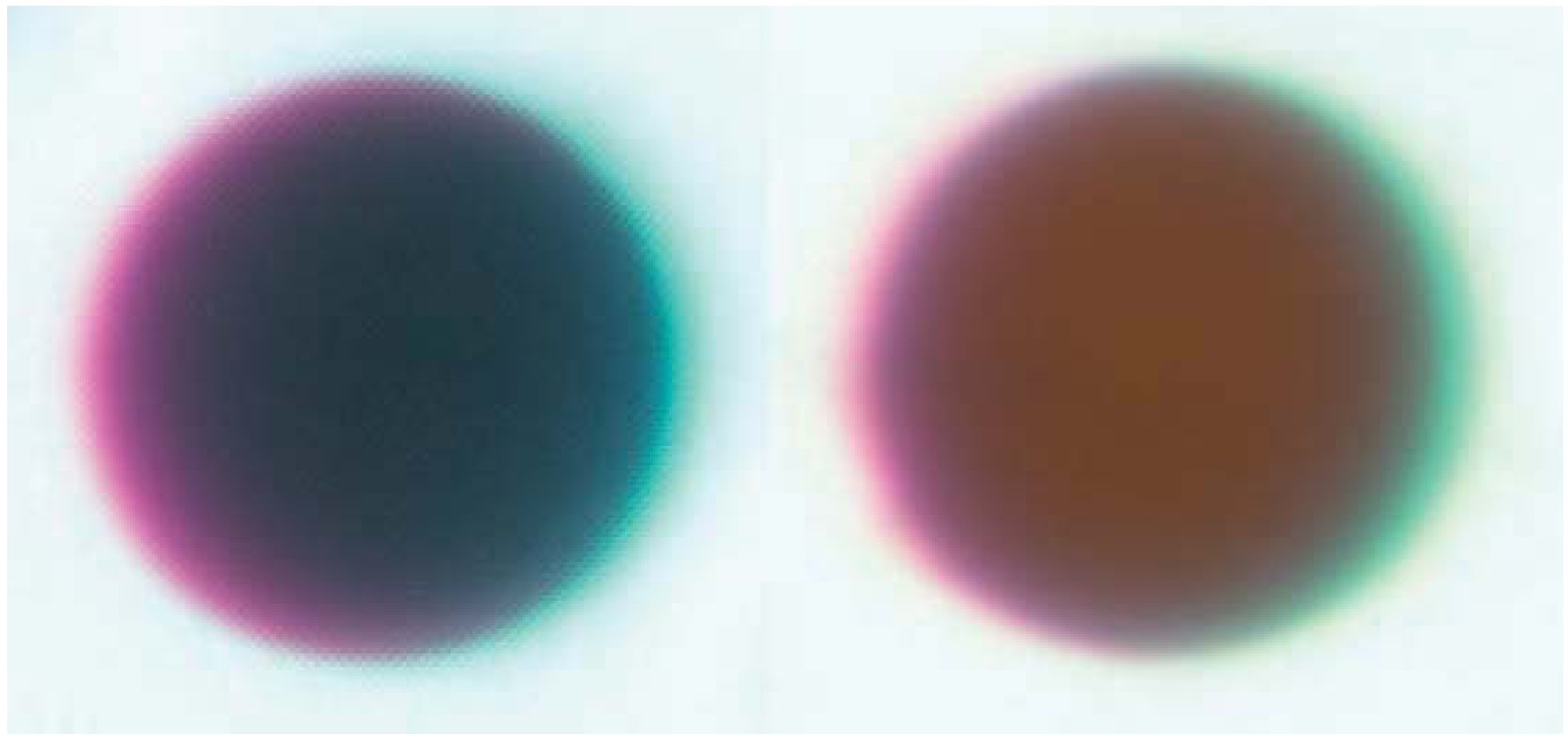
        <p>Gregarious endoparasitoids have been simulated by injecting a group of glass beads in physiological saline into the hemocoel. Sephadex chromatography beads, such as A-25 beads with a diameter of 40–120 µm, are commonly used [<xref ref-type="bibr" rid="B71-insects-03-00573">71</xref>,<xref ref-type="bibr" rid="B72-insects-03-00573">72</xref>,<xref ref-type="bibr" rid="B73-insects-03-00573">73</xref>]. A fixed volume of 10–15 µL saline + beads is injected into the hemocoel, and beads are individually recovered from caterpillars dissected after a pre-determined amount of time has passed for melanization to occur. As with filament implants, the size and color of the capsule can both be measured using images of each bead. Beads are often dyed red to facilitate retrieval; in this case the red color of melanized and control beads is compared to calculate melanization (<xref ref-type="fig" rid="insects-03-00573-f001">Figure 1</xref>). </p>
      </sec>
    </sec>
    <sec>
      <title>4. Host Plant Traits and the Herbivore Immune Response</title>
      <p>Plants provide the major nutritional compounds required for herbivorous insect growth and maintenance, such as carbohydrates, lipids and amino acids. In addition, plants produce a variety of secondary metabolites not used in primary metabolism that have important ecological effects on both herbivores and their interactions with each other and occupants of higher trophic levels [<xref ref-type="bibr" rid="B20-insects-03-00573">20</xref>,<xref ref-type="bibr" rid="B27-insects-03-00573">27</xref>,<xref ref-type="bibr" rid="B74-insects-03-00573">74</xref>]. Plant quality traits include a combination of major nutritional compounds and secondary metabolites, as well as morphological and architectural traits.</p>
        <fig id="insects-03-00573-f001" position="anchor">
          <label>Figure 1</label>
          <caption>
            <p>Representative beads dissected from the generalist <italic>Spodoptera eridania</italic> (Lepidoptera: Noctuidae) larvae reared upon (<bold>left</bold>) <italic>Taraxacum officinale</italic>, a high-quality diet, and (<bold>right</bold>) <italic>Plantago lanceolata</italic>, a low-quality diet [<xref ref-type="bibr" rid="B75-insects-03-00573">75</xref>]. Host plants were determined to be high or low quality based on observations of growth rate, and defensive chemistry of the two plant species. Photos by E.C. Lampert.</p>
          </caption>
          <graphic xmlns:xlink="http://www.w3.org/1999/xlink" xlink:href="insects-03-00573-g001.tif"/>
        </fig>
      <p>The identity and quantities of plant secondary compounds consumed by herbivores have been shown repeatedly to influence their interactions with both predatory and parasitic/pathogenic natural enemies (reviewed in [<xref ref-type="bibr" rid="B76-insects-03-00573">76</xref>,<xref ref-type="bibr" rid="B77-insects-03-00573">77</xref>,<xref ref-type="bibr" rid="B78-insects-03-00573">78</xref>]). These bottom-up tritrophic interactions can be broadly defined as direct, in which exposure to a plant compound within the herbivore has a positive or negative effect on the natural enemy, or indirect, in which the herbivore’s size or quality has been influenced by the compounds. Direct deleterious effects of plant compound sequestration and metabolism on parasitoids and pathogens have been demonstrated repeatedly and reviewed by other authors [<xref ref-type="bibr" rid="B77-insects-03-00573">77</xref>]. Here I focus on indirect effects of plant primary and secondary compounds on potential parasites and pathogens as mediated by enhanced and compromised innate immune responses of herbivores. Species discussed in examples in <xref ref-type="sec" rid="sec4dot1-insects-03-00573">Section 4.1</xref>, <xref ref-type="sec" rid="sec4dot2-insects-03-00573">Section 4.2</xref>, <xref ref-type="sec" rid="sec4dot3-insects-03-00573">Section 4.3</xref> and <xref ref-type="sec" rid="sec4dot4-insects-03-00573">Section 4.4</xref> are all larval Lepidoptera, as appropriate published research to date has been exclusive to this taxon.</p>
      <sec id="sec4dot1-insects-03-00573">
        <title>4.1. Plant Identity, Plant Quality and Immune Responses of Generalist and Specialist Herbivores</title>
        <p>Generalist and specialist herbivores both encounter variation in host plant quality traits while foraging. This variation may be the result of the variation provided by multiple plant species, and variation within a plant species, population, or individual. Generalist herbivores exhibit two foraging strategies; individuals of herbivore species considered generalists at the individual level may sample and consume many plant species [<xref ref-type="bibr" rid="B24-insects-03-00573">24</xref>,<xref ref-type="bibr" rid="B79-insects-03-00573">79</xref>], while those that are generalists at the population level may remain on a single plant individual or members of a single plant species [<xref ref-type="bibr" rid="B80-insects-03-00573">80</xref>,<xref ref-type="bibr" rid="B81-insects-03-00573">81</xref>]. Individual specialist herbivores generally follow a similar strategy to the latter, remaining on a single plant species or even a single plant individual throughout their lifespan [<xref ref-type="bibr" rid="B20-insects-03-00573">20</xref>]. </p>
        <p>Foraging on several plants species can provide herbivores with wide qualitative variation in nutritional and defensive compounds. A mixed diet throughout an individual’s lifespan provides many benefits from a multitrophic perspective, such as improving fecundity, and growth rate [<xref ref-type="bibr" rid="B82-insects-03-00573">82</xref>,<xref ref-type="bibr" rid="B83-insects-03-00573">83</xref>], and pharmacophagy (see [<xref ref-type="bibr" rid="B48-insects-03-00573">48</xref>], <xref ref-type="sec" rid="sec2-insects-03-00573">Section 2</xref>). However, a mixed diet may not necessary improve immune response. For instance, generalist <italic>Parasemia plantaginis</italic> (Lepidoptera: Arctiidae) larvae fed a 3-species mixed diet had a weaker immune response than those feeding on single plant species [<xref ref-type="bibr" rid="B84-insects-03-00573">84</xref>]. In this case, the mixed diets may have diluted the intake of compounds beneficial to growth and the immune response.</p>
        <p>Plant defensive and nutritive traits can vary dramatically at the population level and the individual plant level (through ontogenetic changes and herbivore-induced changes as well as variation among tissues). This variability exposes herbivores consuming a single plant species to a wide variety of biotic conditions, even under similar environmental conditions. <italic>Epirrita autumnata </italic>(Lepidoptera: Geometridae) a generalist that feeds on several deciduous tree species [<xref ref-type="bibr" rid="B85-insects-03-00573">85</xref>], with cyclic population outbreaks, has provided several insights in this regard. Over several seasons and outbreaks, <italic>E. autumnata </italic>immune response has been found to be higher on high-quality trees [<xref ref-type="bibr" rid="B61-insects-03-00573">61</xref>], low-quality trees [<xref ref-type="bibr" rid="B65-insects-03-00573">65</xref>,<xref ref-type="bibr" rid="B86-insects-03-00573">86</xref>], induced trees [<xref ref-type="bibr" rid="B70-insects-03-00573">70</xref>], and alternative tree species [<xref ref-type="bibr" rid="B87-insects-03-00573">87</xref>]. The generally enhanced immune response on low-quality diets in this species (with the exception of [<xref ref-type="bibr" rid="B61-insects-03-00573">61</xref>]) may reflect a tradeoff between growth and immune response, as larvae stressed by diet quality may allocate higher proportions of resources to survival. </p>
        <p>Plant quality is often correlated with immune responses of both specialists and generalists. A survey of published research examining 10 generalist and specialist Lepidoptera species found that cellular immune response (measured as PO activity, implants, and bead injections (<xref ref-type="table" rid="insects-03-00573-t001">Table 1</xref>)) was higher in 5 species (counting <italic>E. autumnata </italic>[<xref ref-type="bibr" rid="B61-insects-03-00573">61</xref>]) when reared on or collected from a “high quality” or preferred plant, as determined by measuring other fitness correlates such as growth rate and larval or pupal mass. Only the generalist <italic>E. autumnata </italic>showed a reduced response and the others showed no change in immune response when reared on high-quality plants compared to low-quality plants (<xref ref-type="table" rid="insects-03-00573-t001">Table 1</xref>). The general association between high-quality diets and strong immune responses in this limited sample broadly fits a pattern showing that invertebrates experiencing favorable conditions also show strengthened immune responses [<xref ref-type="bibr" rid="B88-insects-03-00573">88</xref>,<xref ref-type="bibr" rid="B89-insects-03-00573">89</xref>]. Plant identity was associated with significantly strengthened or weakened immune responses in all of the specialist species and all of the generalist species except <italic>Grammia incorrupta </italic>(which showed a consistent immune response regardless of host plant species) (<xref ref-type="table" rid="insects-03-00573-t001">Table 1</xref>), supporting generally the hypothesis that lower trophic levels influence higher trophic interactions.</p>
        <table-wrap id="insects-03-00573-t001" position="anchor">
          <object-id pub-id-type="pii">insects-03-00573-t001_Table 1</object-id>
          <label>Table 1</label>
          <caption>
            <p>Effects of host plant species and host plant quality on immune response of 9 specialist and generalist Lepidopteran herbivores.</p>
          </caption>
          <table rules="rows">
            <thead>
              <tr>
                <th align="center" valign="middle">Herbivore Species</th>
                <th align="center" valign="middle">Diet Breadth</th>
                <th align="center" valign="middle">Plants Used</th>
                <th align="center" valign="middle">Measurement</th>
                <th align="center" valign="middle">Immune Response</th>
                <th align="center" valign="middle">Citation</th>
              </tr>
            </thead>
            <tbody>
              <tr>
                <td align="center" valign="middle">
                  <italic>Epirrita autumnata</italic>
                </td>
                <td align="center" valign="middle">generalist</td>
                <td align="center" valign="middle"><italic>Betula pubescens </italic>and alternate tree hosts</td>
                <td align="center" valign="middle">implants</td>
                <td align="center" valign="middle">varied among cultivars and species, higher in induced and low-quality trees</td>
                <td align="center" valign="middle">[<xref ref-type="bibr" rid="B65-insects-03-00573">65</xref>,<xref ref-type="bibr" rid="B70-insects-03-00573">70</xref>,<xref ref-type="bibr" rid="B87-insects-03-00573">87</xref>]</td>
              </tr>
              <tr>
                <td align="center" valign="middle"/>
                <td align="center" valign="middle"/>
                <td align="center" valign="middle"/>
                <td align="center" valign="middle"/>
                <td align="center" valign="middle">higher in high-quality trees</td>
                <td align="center" valign="middle">[<xref ref-type="bibr" rid="B61-insects-03-00573">61</xref>]</td>
              </tr>
              <tr>
                <td align="center" valign="middle"/>
                <td align="center" valign="middle"/>
                <td align="center" valign="middle">high and low quality 
                <italic>Betula pubescens</italic></td>
                <td align="center" valign="middle">PO activity</td>
                <td align="center" valign="middle">no effect</td>
                <td align="center" valign="middle">[<xref ref-type="bibr" rid="B65-insects-03-00573">65</xref>]</td>
              </tr>
              <tr>
                <td align="center" valign="middle">
                  <italic>Eupoecilia ambiguella</italic>
                </td>
                <td align="center" valign="middle">specialist</td>
                <td align="center" valign="middle"><italic>Vitis vinifera </italic>cultivars</td>
                <td align="center" valign="middle">PPO activity</td>
                <td align="center" valign="middle">varied among cultivars</td>
                <td align="center" valign="middle">[<xref ref-type="bibr" rid="B56-insects-03-00573">56</xref>]</td>
              </tr>
              <tr>
                <td align="center" valign="middle">
                  <italic>Grammia incorrupta</italic>
                </td>
                <td align="center" valign="middle">generalist</td>
                <td align="center" valign="middle">three forb species</td>
                <td align="center" valign="middle">beads</td>
                <td align="center" valign="middle">no difference among plants</td>
                <td align="center" valign="middle">[<xref ref-type="bibr" rid="B73-insects-03-00573">73</xref>]</td>
              </tr>
              <tr>
                <td align="center" valign="middle">
                  <italic>Junonia coenia</italic>
                </td>
                <td align="center" valign="middle">specialist</td>
                <td align="center" valign="middle"><italic>Plantago lanceolata</italic>,<italic> P. major</italic></td>
                <td align="center" valign="middle">beads</td>
                <td align="center" valign="middle">higher when fed 
                <italic>P. major</italic></td>
                <td align="center" valign="middle">[<xref ref-type="bibr" rid="B90-insects-03-00573">90</xref>]</td>
              </tr>
              <tr>
                <td align="center" valign="middle">
                  <italic>Manduca sexta</italic>
                </td>
                <td align="center" valign="middle">specialist</td>
                <td align="center" valign="middle"><italic>Nicotiana tabacum </italic>and <italic>Proboscidea louisianica</italic></td>
                <td align="center" valign="middle">beads</td>
                <td align="center" valign="middle">higher on 
                <italic>N. tabacum</italic></td>
                <td align="center" valign="middle">[<xref ref-type="bibr" rid="B91-insects-03-00573">91</xref>]</td>
              </tr>
              <tr>
                <td align="center" valign="middle">
                  <italic>Orgyia antiqua</italic>
                </td>
                <td align="center" valign="middle">specialist</td>
                <td align="center" valign="middle">two 
                <italic>Salix </italic>spp.</td>
                <td align="center" valign="middle">implants</td>
                <td align="center" valign="middle">no effect</td>
                <td align="center" valign="middle">[<xref ref-type="bibr" rid="B92-insects-03-00573">92</xref>]</td>
              </tr>
              <tr>
                <td align="center" valign="middle">
                  <italic>Parasemia plantaginis</italic>
                </td>
                <td align="center" valign="middle">generalist</td>
                <td align="center" valign="middle">four forb species</td>
                <td align="center" valign="middle">implants</td>
                <td align="center" valign="middle">higher on 
                <italic>Lactuga </italic>and <italic>Rumex</italic></td>
                <td align="center" valign="middle">[<xref ref-type="bibr" rid="B84-insects-03-00573">84</xref>]</td>
              </tr>
              <tr>
                <td align="center" valign="middle">
                  <italic>Pieris rapae</italic>
                </td>
                <td align="center" valign="middle">specialist</td>
                <td align="center" valign="middle">wild and cultivated 
                <italic>Brassica</italic></td>
                <td align="center" valign="middle">egg encapsulation</td>
                <td align="center" valign="middle">reduced on induced plants, highest on Brussels sprouts</td>
                <td align="center" valign="middle">[<xref ref-type="bibr" rid="B93-insects-03-00573">93</xref>]</td>
              </tr>
              <tr>
                <td align="center" valign="middle">
                  <italic>Plutella xylostella</italic>
                </td>
                <td align="center" valign="middle">specialist</td>
                <td align="center" valign="middle">four 
                <italic>Brassica </italic>cultivars</td>
                <td align="center" valign="middle">PO activity</td>
                <td align="center" valign="middle">varied among cultivars, no relation to quality</td>
                <td align="center" valign="middle">[<xref ref-type="bibr" rid="B94-insects-03-00573">94</xref>]</td>
              </tr>
              <tr>
                <td align="center" valign="middle">
                  <italic>Trichoplusia ni</italic>
                </td>
                <td align="center" valign="middle">generalist</td>
                <td align="center" valign="middle"><italic>Brassica oleracea</italic> and <italic>Cucumis sativa</italic></td>
                <td align="center" valign="middle">PO activity, hemocyte #</td>
                <td align="center" valign="middle">no effect on PO, higher hemocytes on 
                <italic>B. oleracea</italic></td>
                <td align="center" valign="middle">[<xref ref-type="bibr" rid="B66-insects-03-00573">66</xref>]</td>
              </tr>
            </tbody>
          </table>
        </table-wrap>
      </sec>
      <sec id="sec4dot2-insects-03-00573">
        <title>4.2. Plant Nutritional Resources and Antioxidants May Enhance Melanization</title>
        <p>Melanization and encapsulation responses of insects presented with foreign implants have been clearly linked to nutritional status. Starvation has been shown to reduce immune responses [<xref ref-type="bibr" rid="B4-insects-03-00573">4</xref>,<xref ref-type="bibr" rid="B57-insects-03-00573">57</xref>,<xref ref-type="bibr" rid="B94-insects-03-00573">94</xref>], as have low-quality diets that induce poor nutritional efficiencies [<xref ref-type="bibr" rid="B73-insects-03-00573">73</xref>,<xref ref-type="bibr" rid="B90-insects-03-00573">90</xref>,<xref ref-type="bibr" rid="B95-insects-03-00573">95</xref>]. Nutritional macromolecules such as amino acids and proteins provided by plants have important effects on herbivore growth and fitness [<xref ref-type="bibr" rid="B96-insects-03-00573">96</xref>], the role of these molecules in enhancing immune responses has received recent attention as well. The quality and quantity of nutritional resources are both important to immune response; for example, high-quality protein may contribute more to the nitrogen pool that the immune response draws from [<xref ref-type="bibr" rid="B95-insects-03-00573">95</xref>].</p>
        <p>The PPO cascade that leads to melanization of foreign objects generates abundant reactive oxygen species that can harm the insect [<xref ref-type="bibr" rid="B97-insects-03-00573">97</xref>,<xref ref-type="bibr" rid="B98-insects-03-00573">98</xref>,<xref ref-type="bibr" rid="B99-insects-03-00573">99</xref>]. Plant-provided antioxidant compounds such as flavonoids, phenolics, and carotenoids remove these reactive oxygen species and have been shown to enhance immune response [<xref ref-type="bibr" rid="B100-insects-03-00573">100</xref>,<xref ref-type="bibr" rid="B101-insects-03-00573">101</xref>]. The effects of antioxidants on the immune response are of particular interest in evolution of host plant choices of generalist species. For instance, encapsulation ability of the generalist arctiid <italic>Parasemia plantaginis </italic>fed 3 plant species and an artificial diet was highest when fed plant species contributing compounds high in antioxidant activity such as flavonoids and carotenoids [<xref ref-type="bibr" rid="B84-insects-03-00573">84</xref>]. Moreover, encapsulation responses of other generalist caterpillars reared on <italic>Taraxacum officinale </italic>and <italic>Malva parviflora </italic>have been shown to be consistently high [<xref ref-type="bibr" rid="B73-insects-03-00573">73</xref>,<xref ref-type="bibr" rid="B75-insects-03-00573">75</xref>], and both plants are known to produce high levels of antioxidant flavonoids [<xref ref-type="bibr" rid="B102-insects-03-00573">102</xref>,<xref ref-type="bibr" rid="B103-insects-03-00573">103</xref>]. As mentioned above (<xref ref-type="sec" rid="sec2-insects-03-00573">Section 2</xref>), <italic>Grammia incorrupta </italic>larvae parasitized by dipteran endoparasitoids preferentially select flavonoid-rich <italic>M. parviflora </italic>over plants providing defensive compounds that can be sequestered [<xref ref-type="bibr" rid="B73-insects-03-00573">73</xref>].</p>
        <p>Further evidence that plant antioxidants and other secondary compounds increase encapsulation and melanization comes from comparisons between herbivores reared on whole plants and artificial diets; recipes for the latter include primary nutrients, preservatives, and antibiotics but lack plant secondary compounds unless added separately. Both generalist and specialist herbivores benefit from diets enriched with these compounds. Weakened immune responses have been found in both generalist [<xref ref-type="bibr" rid="B73-insects-03-00573">73</xref>,<xref ref-type="bibr" rid="B84-insects-03-00573">84</xref>] and specialist herbivores [<xref ref-type="bibr" rid="B90-insects-03-00573">90</xref>] reared on artificial diets compared to plant diets. Thus, although a possible link between antioxidants and a strengthened immune response has been observed in a limited number of studies, further research is needed to determine the extent to which parasitism status induces a preference for plants high in antioxidants compared to other compounds.</p>
      </sec>
      <sec id="sec4dot3-insects-03-00573">
        <title>4.3. Plant Defensive Chemistry and Herbivore Immune Response</title>
        <p>One of the key differences between specialist and generalist herbivores is response to consuming plant defensive compounds [<xref ref-type="bibr" rid="B20-insects-03-00573">20</xref>]. Many specialist herbivores possess enzyme systems highly specialized to metabolize specific substrates. Substrate-specialized enzyme systems may be ineffective at metabolizing compounds structurally dissimilar to the substrate, causing specialists to respond poorly to novel compounds. Generalist herbivores are able to consume many more plant species and their various associated compounds due to broad-substrate enzyme systems [<xref ref-type="bibr" rid="B104-insects-03-00573">104</xref>,<xref ref-type="bibr" rid="B105-insects-03-00573">105</xref>]. Although substrate-specific enzymes are present in generalist herbivores [<xref ref-type="bibr" rid="B106-insects-03-00573">106</xref>], the prevalence in generalists of broad-substrate enzyme systems often makes them more susceptible to deleterious effects of defensive compounds compared to specialists. The reduced performance of specialists consuming novel compounds, and both specialists and generalists consuming large amounts of defensive compounds can include a weakened immune response.</p>
        <p>Metabolizing large amounts of consumed plant compounds may be energetically expensive regardless of enzyme system specificity. These costs may divert needed resources away from immune responses. Increased dietary levels of glucosinolates and iridoid glycosides, two plant compounds associated with reduced digestive efficiencies [<xref ref-type="bibr" rid="B73-insects-03-00573">73</xref>,<xref ref-type="bibr" rid="B90-insects-03-00573">90</xref>,<xref ref-type="bibr" rid="B107-insects-03-00573">107</xref>,<xref ref-type="bibr" rid="B108-insects-03-00573">108</xref>] have been shown to have detrimental effects on the immune response of several generalist and specialist Lepidopteran species (<xref ref-type="table" rid="insects-03-00573-t002">Table 2</xref>). </p>
        <p>Performance measures such as growth rate, size, nutritional indices were also reduced along with immune response as higher doses of these compounds were consumed [<xref ref-type="bibr" rid="B75-insects-03-00573">75</xref>,<xref ref-type="bibr" rid="B90-insects-03-00573">90</xref>,<xref ref-type="bibr" rid="B93-insects-03-00573">93</xref>]. One specialist, <italic>Ceratomia undulosa </italic>(Lepidoptera: Sphingidae), was fed leaf discs supplemented with a novel compound (catalpol), with toxic effects of this compounds potentially contributing to its weakened immune response at a low dose [<xref ref-type="bibr" rid="B75-insects-03-00573">75</xref>]. A negative correlation between hydrolyzable tannins in host tree leaves and <italic>Epirrita autumnata </italic>immune response (with a positive correlation between hydrolyzable tannins and growth) was the only exception found to the general pattern of immune response mirroring other performance measures as a function of host plant chemistry [<xref ref-type="bibr" rid="B86-insects-03-00573">86</xref>], likely due to a strong tradeoff in this species between investments in growth <italic>versus </italic>immune response. </p>
        <p>Physiological and behavioral differences between generalists and specialists may explain instances in which the immune response of the former is not influenced by secondary compound consumption. Immune response of the grazing generalist <italic>Grammia incorrupta</italic> is not affected when consuming high doses of either iridoid glycosides or pyrrolizidine alkaloids (references in <xref ref-type="table" rid="insects-03-00573-t002">Table 2</xref>). Unlike many other generalists and most specialists, individual <italic>G. incorrupta</italic> sample several plants providing potentially several distinct chemical classes. The consistently high immune responses of <italic>G. incorrupta</italic> measured regardless of diet may be explained by broad-substrate enzyme systems that do not compete for resources with the immune response, unique enzyme systems in the immune response itself, or some other unique physiological trait of this species. More research is needed to determine if other generalists with a similar feeding style (e.g., other Arctiidae and several groups of Orthoptera) are similarly able to maintain a high immune response regardless of type and dose of dietary defensive compounds.</p>
        <table-wrap id="insects-03-00573-t002" position="anchor">
          <object-id pub-id-type="pii">insects-03-00573-t002_Table 2</object-id>
          <label>Table 2</label>
          <caption>
            <p>Effects of plant secondary metabolites on immune response of specialist and generalist Lepidopteran herbivores.</p>
          </caption>
          <table>
            <thead>
              <tr>
                <th align="center" valign="top">Herbivore species</th>
                <th align="center" valign="top">Diet Breadth</th>
                <th align="center" valign="top">Plant Compound</th>
                <th align="center" valign="top">Immune Response</th>
                <th align="center" valign="top">Citation</th>
              </tr>
            </thead>
            <tbody>
              <tr>
                <td align="center" valign="top">
                  <italic>Parasemia plantaginis</italic>
                </td>
                <td align="center" valign="top">generalist</td>
                <td align="center" valign="top">antioxidants</td>
                <td align="center" valign="top">strengthened with increasing amounts consumed</td>
                <td align="center" valign="top">[<xref ref-type="bibr" rid="B84-insects-03-00573">84</xref>]</td>
              </tr>
              <tr>
                <td align="center" valign="top">
                  <italic>Epirrita autumnata</italic>
                </td>
                <td align="center" valign="top">generalist</td>
                <td align="center" valign="top">flavonoids</td>
                <td align="center" valign="top">no effect</td>
                <td align="center" valign="top">[<xref ref-type="bibr" rid="B86-insects-03-00573">86</xref>]</td>
              </tr>
              <tr>
                <td align="center" valign="top"> </td>
                <td align="center" valign="top"> </td>
                <td align="center" valign="top">hydrolyzable tannins</td>
                <td align="center" valign="top">weakened with increasing amounts consumed</td>
                <td align="center" valign="top">[<xref ref-type="bibr" rid="B86-insects-03-00573">86</xref>]</td>
              </tr>
              <tr>
                <td align="center" valign="top">
                  <italic>Pieris rapae</italic>
                </td>
                <td align="center" valign="top">specialist</td>
                <td align="center" valign="top">glucosinolates</td>
                <td align="center" valign="top">weakened in induced plants</td>
                <td align="center" valign="top">[<xref ref-type="bibr" rid="B93-insects-03-00573">93</xref>]</td>
              </tr>
              <tr>
                <td align="center" valign="top">
                  <italic>Junonia coenia</italic>
                </td>
                <td align="center" valign="top">specialist</td>
                <td align="center" valign="top">iridoid glycosides</td>
                <td align="center" valign="top">negatively correlated with amount consumed and sequestered</td>
                <td align="center" valign="top">[<xref ref-type="bibr" rid="B90-insects-03-00573">90</xref>]</td>
              </tr>
              <tr>
                <td align="center" valign="top">
                  <italic>Melitaea cinxia</italic>
                </td>
                <td align="center" valign="top">specialist</td>
                <td align="center" valign="top">iridoid glycosides</td>
                <td align="center" valign="top">positively correlated with amount consumed</td>
                <td align="center" valign="top">[<xref ref-type="bibr" rid="B109-insects-03-00573">109</xref>]</td>
              </tr>
              <tr>
                <td align="center" valign="top">
                  <italic>Grammia incorrupta</italic>
                </td>
                <td align="center" valign="top">generalist</td>
                <td align="center" valign="top">iridoid glycosides</td>
                <td align="center" valign="top">no effect</td>
                <td align="center" valign="top">[<xref ref-type="bibr" rid="B73-insects-03-00573">73</xref>]</td>
              </tr>
              <tr>
                <td align="center" valign="top">
                  <italic>Ceratomia catalpae</italic>
                </td>
                <td align="center" valign="top">specialist</td>
                <td align="center" valign="top">iridoid glycosides</td>
                <td align="center" valign="top">negatively correlated with amount sequestered</td>
                <td align="center" valign="top">[<xref ref-type="bibr" rid="B75-insects-03-00573">75</xref>]</td>
              </tr>
              <tr>
                <td align="center" valign="top">
                  <italic>Ceratomia undulosa</italic>
                </td>
                <td align="center" valign="top">specialist</td>
                <td align="center" valign="top">iridoid glycosides</td>
                <td align="center" valign="top">weakened with increasing amount consumed</td>
                <td align="center" valign="top">[<xref ref-type="bibr" rid="B75-insects-03-00573">75</xref>]</td>
              </tr>
              <tr>
                <td align="center" valign="top">
                  <italic>Grammia incorrupta</italic>
                </td>
                <td align="center" valign="top">generalist</td>
                <td align="center" valign="top">pyrrolizidine alkaloids</td>
                <td align="center" valign="top">no effect</td>
                <td align="center" valign="top">[<xref ref-type="bibr" rid="B47-insects-03-00573">47</xref>]</td>
              </tr>
            </tbody>
          </table>
        </table-wrap>
      </sec>
      <sec id="sec4dot4-insects-03-00573">
        <title>4.4. Tradeoffs between Defensive Compound Sequestration and Herbivore Immune Response</title>
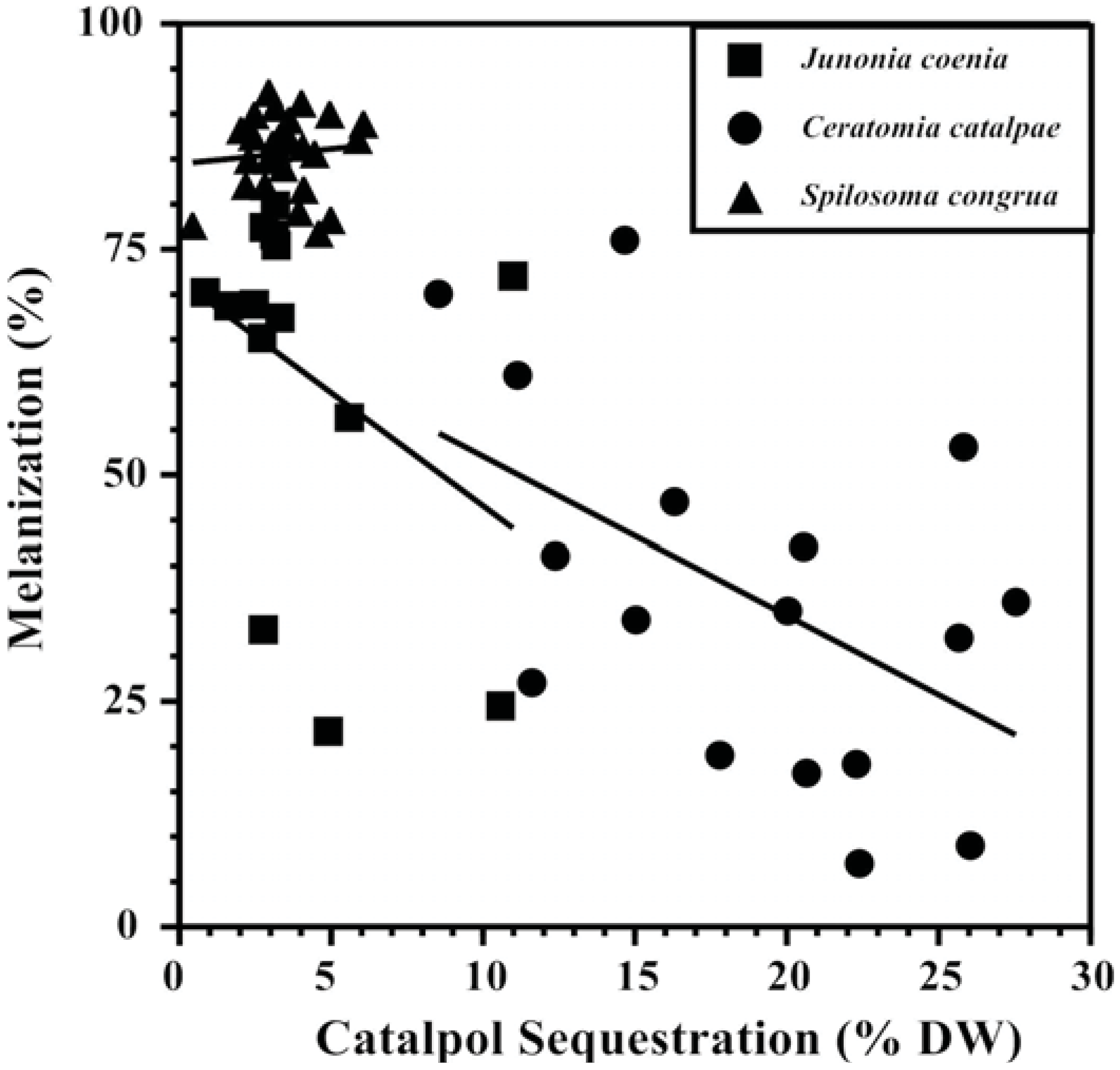
        <p>Sequestration of plant secondary compounds, storing them in the hemocoel or other tissues in concentrations higher than the plant producing them, is common among both specialist and generalist herbivores [<xref ref-type="bibr" rid="B110-insects-03-00573">110</xref>,<xref ref-type="bibr" rid="B111-insects-03-00573">111</xref>], although specialist herbivores may sequester higher concentrations of plant compounds compared to generalists [<xref ref-type="bibr" rid="B43-insects-03-00573">43</xref>,<xref ref-type="bibr" rid="B111-insects-03-00573">111</xref>,<xref ref-type="bibr" rid="B112-insects-03-00573">112</xref>]. Sequestration is noted as an effective form of chemical defense against predators, pathogens, and endoparasitoids [<xref ref-type="bibr" rid="B111-insects-03-00573">111</xref>]. However, several cases have been found in which endoparasitoids are as or more successful in hosts sequestering higher levels of plant compounds compared to those in hosts that do not sequester [<xref ref-type="bibr" rid="B113-insects-03-00573">113</xref>,<xref ref-type="bibr" rid="B114-insects-03-00573">114</xref>,<xref ref-type="bibr" rid="B115-insects-03-00573">115</xref>]. Smilanich <italic>et al</italic>. [<xref ref-type="bibr" rid="B90-insects-03-00573">90</xref>] have proposed the “vulnerable host hypothesis” to explain this phenomenon, positing that defensive compound sequestration and the immune response can be antagonistic metabolic processes. </p>
        <p>Competing metabolic demands between sequestration and immune responses that show a tradeoff between the two processes are central to supporting the “vulnerable host hypothesis.” Plant compounds sequestered in the hemocoel are often modified by enzymes before storage (e.g., [<xref ref-type="bibr" rid="B116-insects-03-00573">116</xref>]) and cross gut epithelia with the help of transport proteins to reach their destination, both energetically expensive processes that may compete with immune response as well as a variety of other life functions [<xref ref-type="bibr" rid="B117-insects-03-00573">117</xref>,<xref ref-type="bibr" rid="B118-insects-03-00573">118</xref>,<xref ref-type="bibr" rid="B119-insects-03-00573">119</xref>]. Evidence that sequestration is energetically expensive was provided by path analysis models revealing that the specialist <italic>Junonia coenia </italic>(Lepidoptera: Nymphalidae) experienced reduced respiration rates as the amount of the iridoid glycoside catalpol sequestered increased [<xref ref-type="bibr" rid="B90-insects-03-00573">90</xref>]. Increasing amounts and concentrations of catalpol sequestered by <italic>J. coenia </italic>has been associated repeatedly with reduced nutritional efficiency and weakened immune response ([<xref ref-type="bibr" rid="B75-insects-03-00573">75</xref>,<xref ref-type="bibr" rid="B90-insects-03-00573">90</xref>,<xref ref-type="bibr" rid="B108-insects-03-00573">108</xref>], <xref ref-type="fig" rid="insects-03-00573-f002">Figure 2</xref>,), while simultaneously reducing susceptibility to invertebrate predators [<xref ref-type="bibr" rid="B120-insects-03-00573">120</xref>,<xref ref-type="bibr" rid="B121-insects-03-00573">121</xref>]. The use of catalpol sequestration to test the “vulnerable host hypothesis” has been extended to two other herbivores as well; melanization response was negatively associated with sequestration in the specialist <italic>Ceratomia catalpae </italic>(Lepidoptera: Sphingidae),but not the generalist <italic>Spilosoma congrua </italic>(Lepidoptera: Arctiidae) (<xref ref-type="fig" rid="insects-03-00573-f002">Figure 2</xref>). Specialized <italic>C. catalpae</italic> enzyme and carrier systems may require more energy for accumulating high catalpol concentrations (5x the concentrations accumulated by <italic>S. congrua</italic>), while <italic>S. congrua </italic>may lack these energy-intensive transport systems. </p>
      </sec>
    </sec>
    <sec>
      <title>5. Future Directions</title>
      <p>The integration of ecological immunity and bottom-up effects of plant traits on herbivore-natural enemy interactions is relatively young (most research in this area has been published within the last decade) and open to expansion in several directions. Publications to date that directly measure herbivore immune response in regards to plant traits have focused almost exclusively on larval Lepidoptera, with floral traits and honeybee immune response as one exception [<xref ref-type="bibr" rid="B122-insects-03-00573">122</xref>]. Although larval Lepidoptera are particularly well-studied from both the perspectives of diet breadth evolution and immune responses, broader themes can be revealed by investigating other insect orders with particularly well-studied herbivorous species of economic and ecological importance (e.g., the Hymenoptera, Diptera, Hemiptera, Orthoptera, and Coleoptera). <italic>Drosophila melanogaster </italic>(Diptera: Drosophilidae) has been studied extensively as a model testing effects of starvation and diet resources on immune response, and yeast strain (presumably nutritional quality) has been shown to affect immune response [<xref ref-type="bibr" rid="B123-insects-03-00573">123</xref>].</p>
      <p>Field tests in natural populations, particularly well-resolved natural systems (e.g., <italic>Depressaria pastinacella</italic> and <italic>Utetheisa ornatrix</italic> and their respective host plants, reviewed in [<xref ref-type="bibr" rid="B124-insects-03-00573">124</xref>,<xref ref-type="bibr" rid="B125-insects-03-00573">125</xref>], will further reveal the selective forces of plant traits on herbivore immune responses. With the exception of the <italic>Betula pubescens</italic>-<italic>E. autumnata</italic> system and a neotropical Lepidoptera assemblage [<xref ref-type="bibr" rid="B58-insects-03-00573">58</xref>], research on the effects of plant species and genotype on innate immune response itself have been primarily confined to laboratory settings. One reason for the lack of field studies is that the study of natural populations prevents experimental control of plant traits, requiring correlative relationships between plant traits and immune responses. Nonetheless, the study of natural populations can allow the assessment of correlation between the measured immune response and population-level parasitism success; a strong relationship has been found in one study [<xref ref-type="bibr" rid="B58-insects-03-00573">58</xref>] whereas no relationship has been found in another [<xref ref-type="bibr" rid="B61-insects-03-00573">61</xref>]. A second reason is that natural systems are not convenient for placing or recovering implants or beads. Hemolymph samples for PPO measurement are ideal in these settings.</p>
        <fig id="insects-03-00573-f002" position="anchor">
          <label>Figure 2</label>
          <caption>
            <p>Tradeoffs between defensive chemistry and immune response of three Lepidopteran herbivores support the “vulnerable host hypothesis” [<xref ref-type="bibr" rid="B90-insects-03-00573">90</xref>]. Catalpol sequestration is negatively correlated with melanization ability of the specialists <italic>Junonia coenia </italic>(Nymphalidae) and <italic>Ceratomia catalpae </italic>(Sphingidae), but not the generalist <italic>Spilosoma congrua</italic> (Arctiidae).</p>
          </caption>
          <graphic xmlns:xlink="http://www.w3.org/1999/xlink" xlink:href="insects-03-00573-g002.tif"/>
        </fig>
      <p>Biological control by pathogens (including nematodes, viruses, bacteria, and fungi) and endoparasitoids and breeding/transgenic plants that express anti-herbivore traits are both important components of integrated pest management programs [<xref ref-type="bibr" rid="B17-insects-03-00573">17</xref>]. Plant traits such as defensive compounds that are detrimental to natural enemies lead to a potential incompatibility between these pest management strategies, and detrimental effects on natural enemies have been shown in several studies (reviewed in [<xref ref-type="bibr" rid="B76-insects-03-00573">76</xref>,<xref ref-type="bibr" rid="B78-insects-03-00573">78</xref>,<xref ref-type="bibr" rid="B126-insects-03-00573">126</xref>]). Careful examination of immune response can elucidate whether detrimental interactions between biocontrol agents and pest-resistant plants are direct or indirect, and potentially make these strategies more compatible. Plant traits have been linked to immune response in important field and greenhouse pests, such as the specialist <italic>Manduca sexta </italic>[<xref ref-type="bibr" rid="B127-insects-03-00573">127</xref>], and the generalist <italic>Trichoplusia ni </italic>[<xref ref-type="bibr" rid="B66-insects-03-00573">66</xref>], although not in agroecosystems. Potential candidates for further study include generalist Lepidoptera (e.g., <italic>Heliothis virescens</italic>, <italic>Helicoverpa zea</italic>, and <italic>Spodoptera </italic>spp., all Noctuidae), Orthoptera, and Hemiptera (e.g., Aphididae) which attack several crop species that are well-studied in plant-herbivore interaction ecological research.</p>
    </sec>
    <sec sec-type="conclusions">
      <title>6. Conclusions</title>
      <p>Host plant traits are important biotic factors with strong influences on the ecology and evolution of herbivores, and their specialist natural enemies such as pathogens and endoparasitoids. Generalist and specialist herbivores can respond very differently to host plant defensive and nutritive traits, and these varied responses may be apparent in higher trophic level interactions as well. A detailed understanding of the effect of plant traits on herbivore immune responses provides a mechanistic explanation for the oft-observed tritrophic interactions among plant, herbivores, and endoparasitic natural enemies, and can produce important insights into the role of biotic and abiotic influences on disease susceptibility and transmission. </p>
    </sec>
  </body>
  <back>
    <ack>
      <title>Acknowledgments</title>
      <p>Carolina Quintero, Mary Jamieson, and two anonymous reviewers have provided insightful comments on an earlier draft of this manuscript.</p>
    </ack>
    <ref-list>
      <title>References</title>
      <ref id="B1-insects-03-00573">
        <label>1.</label>
        <citation citation-type="journal">
          <person-group person-group-type="author">
            <name>
              <surname>Martin</surname>
              <given-names>L.B.</given-names>
            </name>
            <name>
              <surname>Hawley</surname>
              <given-names>D.M.</given-names>
            </name>
            <name>
              <surname>Ardia</surname>
              <given-names>D.R.</given-names>
            </name>
          </person-group>
          <article-title>An introduction to ecological immunology</article-title>
          <source>Funct. Ecol.</source>
          <year>2011</year>
          <volume>25</volume>
          <fpage>1</fpage>
          <lpage>4</lpage>
          <pub-id pub-id-type="doi">10.1111/j.1365-2435.2010.01820.x</pub-id>
        </citation>
      </ref>
      <ref id="B2-insects-03-00573">
        <label>2.</label>
        <citation citation-type="journal">
          <person-group person-group-type="author">
            <name>
              <surname>Schulenburg</surname>
              <given-names>H.</given-names>
            </name>
            <name>
              <surname>Kurtz</surname>
              <given-names>J.</given-names>
            </name>
            <name>
              <surname>Moret</surname>
              <given-names>Y.</given-names>
            </name>
            <name>
              <surname>Siva-Jothy</surname>
              <given-names>M.T.</given-names>
            </name>
          </person-group>
          <article-title>Ecological immunology</article-title>
          <source>Philos. Trans. R. Soc. B-Biol. Sci.</source>
          <year>2009</year>
          <volume>364</volume>
          <fpage>3</fpage>
          <lpage>14</lpage>
          <pub-id pub-id-type="doi">10.1098/rstb.2008.0249</pub-id>
        </citation>
      </ref>
      <ref id="B3-insects-03-00573">
        <label>3.</label>
        <citation citation-type="journal">
          <person-group person-group-type="author">
            <name>
              <surname>Sheldon</surname>
              <given-names>B.C.</given-names>
            </name>
            <name>
              <surname>Verhulst</surname>
              <given-names>S.</given-names>
            </name>
          </person-group>
          <article-title>Ecological immunology: Costly parasite defences and trade-offs in evolutionary ecology</article-title>
          <source>Trends Ecol. Evol.</source>
          <year>1996</year>
          <volume>11</volume>
          <fpage>317</fpage>
          <lpage>321</lpage>
          <pub-id pub-id-type="doi">10.1016/0169-5347(96)10039-2</pub-id>
        </citation>
      </ref>
      <ref id="B4-insects-03-00573">
        <label>4.</label>
        <citation citation-type="journal">
          <person-group person-group-type="author">
            <name>
              <surname>Siva-Jothy</surname>
              <given-names>M.T.</given-names>
            </name>
            <name>
              <surname>Thompson</surname>
              <given-names>J.J.W.</given-names>
            </name>
          </person-group>
          <article-title>Short-term nutrient deprivation affects immune function</article-title>
          <source>Physiol. Entomol.</source>
          <year>2002</year>
          <volume>27</volume>
          <fpage>206</fpage>
          <lpage>212</lpage>
          <pub-id pub-id-type="doi">10.1046/j.1365-3032.2002.00286.x</pub-id>
        </citation>
      </ref>
      <ref id="B5-insects-03-00573">
        <label>5.</label>
        <citation citation-type="journal">
          <person-group person-group-type="author">
            <name>
              <surname>Siva-Jothy</surname>
              <given-names>M.T.</given-names>
            </name>
            <name>
              <surname>Tsubaki</surname>
              <given-names>Y.</given-names>
            </name>
            <name>
              <surname>Hooper</surname>
              <given-names>R.E.</given-names>
            </name>
          </person-group>
          <article-title>Decreased immune response as a proximate cost of copulation and oviposition in a damselfly</article-title>
          <source>Physiol. Entomol.</source>
          <year>1998</year>
          <volume>23</volume>
          <fpage>274</fpage>
          <lpage>277</lpage>
        <pub-id pub-id-type="doi">10.1046/j.1365-3032.1998.233090.x</pub-id></citation>
      </ref>
      <ref id="B6-insects-03-00573">
        <label>6.</label>
        <citation citation-type="journal">
          <person-group person-group-type="author">
            <name>
              <surname>Rolff</surname>
              <given-names>J.</given-names>
            </name>
            <name>
              <surname>Siva-Jothy</surname>
              <given-names>M.T.</given-names>
            </name>
          </person-group>
          <article-title>Invertebrate ecological immunology</article-title>
          <source>Science</source>
          <year>2003</year>
          <volume>301</volume>
          <fpage>472</fpage>
          <lpage>475</lpage>
        <pub-id pub-id-type="doi">10.1126/science.1080623</pub-id><pub-id pub-id-type="pmid">12881560</pub-id></citation>
      </ref>
      <ref id="B7-insects-03-00573">
        <label>7.</label>
        <citation citation-type="journal">
          <person-group person-group-type="author">
            <name>
              <surname>Gillespie</surname>
              <given-names>J.P.</given-names>
            </name>
            <name>
              <surname>Kanost</surname>
              <given-names>M.R.</given-names>
            </name>
            <name>
              <surname>Trenczek</surname>
              <given-names>T.</given-names>
            </name>
          </person-group>
          <article-title>Biological mediators of insect immunity</article-title>
          <source>Annu. Rev. Entomol.</source>
          <year>1997</year>
          <volume>42</volume>
          <fpage>611</fpage>
          <lpage>643</lpage>
          <pub-id pub-id-type="doi">10.1146/annurev.ento.42.1.611</pub-id>
        </citation>
      </ref>
      <ref id="B8-insects-03-00573">
        <label>8.</label>
        <citation citation-type="journal">
          <person-group person-group-type="author">
            <name>
              <surname>Strand</surname>
              <given-names>M.R.</given-names>
            </name>
          </person-group>
          <article-title>The insect cellular immune response</article-title>
          <source>Insect Sci.</source>
          <year>2008</year>
          <volume>15</volume>
          <fpage>1</fpage>
          <lpage>14</lpage>
          <pub-id pub-id-type="doi">10.1111/j.1744-7917.2008.00183.x</pub-id>
        </citation>
      </ref>
      <ref id="B9-insects-03-00573">
        <label>9.</label>
        <citation citation-type="journal">
          <person-group person-group-type="author">
            <name>
              <surname>Hughes</surname>
              <given-names>T.T.</given-names>
            </name>
            <name>
              <surname>Allen</surname>
              <given-names>A.L.</given-names>
            </name>
            <name>
              <surname>Bardin</surname>
              <given-names>J.E.</given-names>
            </name>
            <name>
              <surname>Christian</surname>
              <given-names>M.N.</given-names>
            </name>
            <name>
              <surname>Daimon</surname>
              <given-names>K.</given-names>
            </name>
            <name>
              <surname>Dozier</surname>
              <given-names>K.D.</given-names>
            </name>
            <name>
              <surname>Hansen</surname>
              <given-names>C.L.</given-names>
            </name>
            <name>
              <surname>Holcomb</surname>
              <given-names>L.M.</given-names>
            </name>
            <name>
              <surname>Ahlander</surname>
              <given-names>J.</given-names>
            </name>
          </person-group>
          <article-title><italic>Drosophila</italic> as a genetic model for studying pathogenic human viruses</article-title>
          <source>Virology</source>
          <year>2012</year>
          <volume>423</volume>
          <fpage>1</fpage>
          <lpage>5</lpage>
          <pub-id pub-id-type="doi">10.1016/j.virol.2011.11.016</pub-id>
        </citation>
      </ref>
      <ref id="B10-insects-03-00573">
        <label>10.</label>
        <citation citation-type="journal">
          <person-group person-group-type="author">
            <name>
              <surname>Chamilos</surname>
              <given-names>G.</given-names>
            </name>
            <name>
              <surname>Samonis</surname>
              <given-names>G.</given-names>
            </name>
            <name>
              <surname>Kontoyiannis</surname>
              <given-names>D.P.</given-names>
            </name>
          </person-group>
          <article-title><italic>Drosophila melanogaster</italic> as a model host for the study of microbial pathogenicity and the discovery of novel antimicrobial compounds</article-title>
          <source>Curr. Pharm. Design</source>
          <year>2011</year>
          <volume>17</volume>
          <fpage>1246</fpage>
          <lpage>1253</lpage>
        <pub-id pub-id-type="doi">10.2174/138161211795703744</pub-id></citation>
      </ref>
      <ref id="B11-insects-03-00573">
        <label>11.</label>
        <citation citation-type="journal">
          <person-group person-group-type="author">
            <name>
              <surname>Tang</surname>
              <given-names>H.P.</given-names>
            </name>
          </person-group>
          <article-title>Regulation and function of the melanization reaction in <italic>Drosophila</italic></article-title>
          <source>Fly</source>
          <year>2009</year>
          <volume>3</volume>
          <fpage>105</fpage>
          <lpage>111</lpage>
          <pub-id pub-id-type="doi">10.4161/fly.3.1.7747</pub-id>
        </citation>
      </ref>
      <ref id="B12-insects-03-00573">
        <label>12.</label>
        <citation citation-type="journal">
          <person-group person-group-type="author">
            <name>
              <surname>Gonzalez-Santoyo</surname>
              <given-names>I.</given-names>
            </name>
            <name>
              <surname>Cordoba-Aguilar</surname>
              <given-names>A.</given-names>
            </name>
          </person-group>
          <article-title>Phenoloxidase: A key component of the insect immune system</article-title>
          <source>Entomol. Exp. Appl.</source>
          <year>2012</year>
          <volume>142</volume>
          <fpage>1</fpage>
          <lpage>16</lpage>
          <pub-id pub-id-type="doi">10.1111/j.1570-7458.2011.01187.x</pub-id>
        </citation>
      </ref>
      <ref id="B13-insects-03-00573">
        <label>13.</label>
        <citation citation-type="journal">
          <person-group person-group-type="author">
            <name>
              <surname>Belden</surname>
              <given-names>L.K.</given-names>
            </name>
            <name>
              <surname>Harris</surname>
              <given-names>R.N.</given-names>
            </name>
          </person-group>
          <article-title>Infectious diseases in wildlife: The community ecology context</article-title>
          <source>Front. Ecol. Environ.</source>
          <year>2007</year>
          <volume>5</volume>
          <fpage>533</fpage>
          <lpage>539</lpage>
          <pub-id pub-id-type="doi">10.1890/060122</pub-id>
        </citation>
      </ref>
      <ref id="B14-insects-03-00573">
        <label>14.</label>
        <citation citation-type="journal">
          <person-group person-group-type="author">
            <name>
              <surname>Torchin</surname>
              <given-names>M.E.</given-names>
            </name>
            <name>
              <surname>Mitchell</surname>
              <given-names>C.E.</given-names>
            </name>
          </person-group>
          <article-title>Parasites, pathogens, and invasions by plants and animals</article-title>
          <source>Front. Ecol. Environ.</source>
          <year>2004</year>
          <volume>2</volume>
          <fpage>183</fpage>
          <lpage>190</lpage>
          <pub-id pub-id-type="doi">10.1890/1540-9295(2004)002[0183:PPAIBP]2.0.CO;2</pub-id>
        </citation>
      </ref>
      <ref id="B15-insects-03-00573">
        <label>15.</label>
        <citation citation-type="journal">
          <person-group person-group-type="author">
            <name>
              <surname>McCallum</surname>
              <given-names>H.</given-names>
            </name>
            <name>
              <surname>Dobson</surname>
              <given-names>A.</given-names>
            </name>
          </person-group>
          <article-title>Detecting disease and parasite threats to endangered species and ecosystems</article-title>
          <source>Trends Ecol. Evol.</source>
          <year>1995</year>
          <volume>10</volume>
          <fpage>190</fpage>
          <lpage>194</lpage>
          <pub-id pub-id-type="doi">10.1016/S0169-5347(00)89050-3</pub-id>
        </citation>
      </ref>
      <ref id="B16-insects-03-00573">
        <label>16.</label>
        <citation citation-type="journal">
          <person-group person-group-type="author">
            <name>
              <surname>Rodriguez</surname>
              <given-names>M.A.</given-names>
            </name>
            <name>
              <surname>Hawkins</surname>
              <given-names>B.A.</given-names>
            </name>
          </person-group>
          <article-title>Diversity, function and stability in parasitoid communities</article-title>
          <source>Ecol. Lett.</source>
          <year>2000</year>
          <volume>3</volume>
          <fpage>35</fpage>
          <lpage>40</lpage>
          <pub-id pub-id-type="doi">10.1046/j.1461-0248.2000.00115.x</pub-id>
        </citation>
      </ref>
      <ref id="B17-insects-03-00573">
        <label>17.</label>
        <citation citation-type="book">
          <person-group person-group-type="author">
            <name>
              <surname>Pedigo</surname>
              <given-names>L.</given-names>
            </name>
            <name>
              <surname>Rice</surname>
              <given-names>M.</given-names>
            </name>
          </person-group>
          <source>Entomology and Pest Management</source>
          <edition>6th</edition>
          <publisher-name>Prentice Hall</publisher-name>
          <publisher-loc>Upper Saddle River, NJ, USA</publisher-loc>
          <year>2009</year>
        </citation>
      </ref>
      <ref id="B18-insects-03-00573">
        <label>18.</label>
        <citation citation-type="journal">
          <person-group person-group-type="author">
            <name>
              <surname>Hajek</surname>
              <given-names>A.E.</given-names>
            </name>
            <name>
              <surname>Delalibera</surname>
              <given-names>I.</given-names>
            </name>
          </person-group>
          <article-title>Fungal pathogens as classical biological control agents against arthropods</article-title>
          <source>Biocontrol</source>
          <year>2010</year>
          <volume>55</volume>
          <fpage>147</fpage>
          <lpage>158</lpage>
          <pub-id pub-id-type="doi">10.1007/s10526-009-9253-6</pub-id>
        </citation>
      </ref>
      <ref id="B19-insects-03-00573">
        <label>19.</label>
        <citation citation-type="journal">
          <person-group person-group-type="author">
            <name>
              <surname>Hajek</surname>
              <given-names>A.E.</given-names>
            </name>
            <name>
              <surname>McManus</surname>
              <given-names>M.L.</given-names>
            </name>
            <name>
              <surname>Delalibera</surname>
              <given-names>I.</given-names>
            </name>
          </person-group>
          <article-title>A review of introductions of pathogens and nematodes for classical biological control of insects and mites</article-title>
          <source>Biol. Control</source>
          <year>2007</year>
          <volume>41</volume>
          <fpage>1</fpage>
          <lpage>13</lpage>
          <pub-id pub-id-type="doi">10.1016/j.biocontrol.2006.11.003</pub-id>
        </citation>
      </ref>
      <ref id="B20-insects-03-00573">
        <label>20.</label>
        <citation citation-type="book">
          <person-group person-group-type="author">
            <name>
              <surname>Schoonhoven</surname>
              <given-names>L.</given-names>
            </name>
            <name>
              <surname>van Loon</surname>
              <given-names>J.J.A.</given-names>
            </name>
            <name>
              <surname>Dicke</surname>
              <given-names>M.</given-names>
            </name>
          </person-group>
          <source>Insect-Plant Biology</source>
          <publisher-name>Oxford University Press</publisher-name>
          <publisher-loc>New York, NY, USA</publisher-loc>
          <year>2005</year>
        </citation>
      </ref>
      <ref id="B21-insects-03-00573">
        <label>21.</label>
        <citation citation-type="journal">
          <person-group person-group-type="author">
            <name>
              <surname>Mechaber</surname>
              <given-names>W.L.</given-names>
            </name>
            <name>
              <surname>Hildebrand</surname>
              <given-names>J.G.</given-names>
            </name>
          </person-group>
          <article-title>Novel, non-solanaceous hostplant record for <italic>Manduca sexta</italic> (Lepidoptera : Sphingidae) in the southwestern United States</article-title>
          <source>Ann. Entomol. Soc. Am.</source>
          <year>2000</year>
          <volume>93</volume>
          <fpage>447</fpage>
          <lpage>451</lpage>
          <pub-id pub-id-type="doi">10.1603/0013-8746(2000)093[0447:NNSHRF]2.0.CO;2</pub-id>
        </citation>
      </ref>
      <ref id="B22-insects-03-00573">
        <label>22.</label>
        <citation citation-type="journal">
          <person-group person-group-type="author">
            <name>
              <surname>Fox</surname>
              <given-names>L.R.</given-names>
            </name>
            <name>
              <surname>Morrow</surname>
              <given-names>P.A.</given-names>
            </name>
          </person-group>
          <article-title>Specialization—Species property or local phenomenon</article-title>
          <source>Science</source>
          <year>1981</year>
          <volume>211</volume>
          <fpage>887</fpage>
          <lpage>893</lpage>
        <pub-id pub-id-type="doi">10.1126/science.211.4485.887</pub-id><pub-id pub-id-type="pmid">17819016</pub-id></citation>
      </ref>
      <ref id="B23-insects-03-00573">
        <label>23.</label>
        <citation citation-type="journal">
          <person-group person-group-type="author">
            <name>
              <surname>Bernays</surname>
              <given-names>E.A.</given-names>
            </name>
            <name>
              <surname>Minkenberg</surname>
              <given-names>O.</given-names>
            </name>
          </person-group>
          <article-title>Insect herbivores: Different reasons for being a generalist</article-title>
          <source>Ecology</source>
          <year>1997</year>
          <volume>78</volume>
          <fpage>1157</fpage>
          <lpage>1169</lpage>
          <pub-id pub-id-type="doi">10.1890/0012-9658(1997)078[1157:IHDRFB]2.0.CO;2</pub-id>
        </citation>
      </ref>
      <ref id="B24-insects-03-00573">
        <label>24.</label>
        <citation citation-type="journal">
          <person-group person-group-type="author">
            <name>
              <surname>Bernays</surname>
              <given-names>E.A.</given-names>
            </name>
            <name>
              <surname>Singer</surname>
              <given-names>M.</given-names>
            </name>
          </person-group>
          <article-title>Contrasted foraging tactics in two species of polyphagous caterpillars</article-title>
          <source>Acta Zool. Acad. Sci. Hung.</source>
          <year>2002</year>
          <volume>48</volume>
          <fpage>117</fpage>
          <lpage>135</lpage>
        </citation>
      </ref>
      <ref id="B25-insects-03-00573">
        <label>25.</label>
        <citation citation-type="book">
          <person-group person-group-type="author">
            <name>
              <surname>Berenbaum</surname>
              <given-names>M.R.</given-names>
            </name>
            <name>
              <surname>Feeny</surname>
              <given-names>P.</given-names>
            </name>
          </person-group>
          <article-title>Chemical Mediation of Hostplant Specialization–the <italic>Papilio</italic> Paradigm</article-title>
          <source>Specialization, Speciation, and Radiation: The evolutionary Biology of Herbivorous Insects</source>
          <person-group person-group-type="editor">
            <name>
              <surname>Tilmon</surname>
              <given-names>K.</given-names>
            </name>
          </person-group>
          <publisher-name>University of California Press</publisher-name>
          <publisher-loc>Berkeley, CA, USA</publisher-loc>
          <year>2008</year>
          <fpage>3</fpage>
          <lpage>19</lpage>
        </citation>
      </ref>
      <ref id="B26-insects-03-00573">
        <label>26.</label>
        <citation citation-type="journal">
          <person-group person-group-type="author">
            <name>
              <surname>Strong</surname>
              <given-names>D.R.</given-names>
            </name>
          </person-group>
          <article-title>Insect host range</article-title>
          <source>Ecology</source>
          <year>1988</year>
          <volume>69</volume>
          <fpage>885</fpage>
          <lpage>885</lpage>
          <pub-id pub-id-type="doi">10.2307/1941236</pub-id>
        </citation>
      </ref>
      <ref id="B27-insects-03-00573">
        <label>27.</label>
        <citation citation-type="journal">
          <person-group person-group-type="author">
            <name>
              <surname>Ehrlich</surname>
              <given-names>P.R.</given-names>
            </name>
            <name>
              <surname>Raven</surname>
              <given-names>P.H.</given-names>
            </name>
          </person-group>
          <article-title>Butterflies and plants - a study in coevolution</article-title>
          <source>Evolution</source>
          <year>1964</year>
          <volume>18</volume>
          <fpage>586</fpage>
          <lpage>608</lpage>
          <pub-id pub-id-type="doi">10.2307/2406212</pub-id>
        </citation>
      </ref>
      <ref id="B28-insects-03-00573">
        <label>28.</label>
        <citation citation-type="journal">
          <person-group person-group-type="author">
            <name>
              <surname>Hairston</surname>
              <given-names>N.G.</given-names>
            </name>
            <name>
              <surname>Smith</surname>
              <given-names>F.E.</given-names>
            </name>
            <name>
              <surname>Slobodkin</surname>
              <given-names>L.B.</given-names>
            </name>
          </person-group>
          <article-title>Community structure, population control, and competition</article-title>
          <source>Am. Nat.</source>
          <year>1960</year>
          <volume>94</volume>
          <fpage>421</fpage>
          <lpage>425</lpage>
        <pub-id pub-id-type="doi">10.1086/282146</pub-id></citation>
      </ref>
      <ref id="B29-insects-03-00573">
        <label>29.</label>
        <citation citation-type="journal">
          <person-group person-group-type="author">
            <name>
              <surname>Thompson</surname>
              <given-names>J.N.</given-names>
            </name>
          </person-group>
          <article-title>Coevolution and alternative hypotheses on insect plant interactions</article-title>
          <source>Ecology</source>
          <year>1988</year>
          <volume>69</volume>
          <fpage>893</fpage>
          <lpage>895</lpage>
          <pub-id pub-id-type="doi">10.2307/1941238</pub-id>
        </citation>
      </ref>
      <ref id="B30-insects-03-00573">
        <label>30.</label>
        <citation citation-type="journal">
          <person-group person-group-type="author">
            <name>
              <surname>Tosh</surname>
              <given-names>C.R.</given-names>
            </name>
            <name>
              <surname>Powell</surname>
              <given-names>G.</given-names>
            </name>
            <name>
              <surname>Hardie</surname>
              <given-names>J.</given-names>
            </name>
          </person-group>
          <article-title>Decision making by generalist and specialist aphids with the same genotype</article-title>
          <source>J. Insect Physiol.</source>
          <year>2003</year>
          <volume>49</volume>
          <fpage>659</fpage>
          <lpage>669</lpage>
          <pub-id pub-id-type="doi">10.1016/S0022-1910(03)00066-0</pub-id>
        </citation>
      </ref>
      <ref id="B31-insects-03-00573">
        <label>31.</label>
        <citation citation-type="journal">
          <person-group person-group-type="author">
            <name>
              <surname>Bowers</surname>
              <given-names>M.D.</given-names>
            </name>
            <name>
              <surname>Puttick</surname>
              <given-names>G.M.</given-names>
            </name>
          </person-group>
          <article-title>Response of generalist and specialist insects to qualitative allelochemical variation</article-title>
          <source>J. Chem. Ecol.</source>
          <year>1988</year>
          <volume>14</volume>
          <fpage>319</fpage>
          <lpage>334</lpage>
          <pub-id pub-id-type="doi">10.1007/BF01022549</pub-id>
        </citation>
      </ref>
      <ref id="B32-insects-03-00573">
        <label>32.</label>
        <citation citation-type="journal">
          <person-group person-group-type="author">
            <name>
              <surname>Johnson</surname>
              <given-names>K.S.</given-names>
            </name>
          </person-group>
          <article-title>Comparative detoxification of plant (<italic>Magnolia virginiana</italic>) allelochemicals by generalist and specialist saturniid silkmoths</article-title>
          <source>J. Chem. Ecol.</source>
          <year>1999</year>
          <volume>25</volume>
          <fpage>253</fpage>
          <lpage>269</lpage>
          <pub-id pub-id-type="doi">10.1023/A:1020890628279</pub-id>
        </citation>
      </ref>
      <ref id="B33-insects-03-00573">
        <label>33.</label>
        <citation citation-type="journal">
          <person-group person-group-type="author">
            <name>
              <surname>Richards</surname>
              <given-names>L.A.</given-names>
            </name>
            <name>
              <surname>Dyer</surname>
              <given-names>L.A.</given-names>
            </name>
            <name>
              <surname>Smilanich</surname>
              <given-names>A.M.</given-names>
            </name>
            <name>
              <surname>Dodson</surname>
              <given-names>C.D.</given-names>
            </name>
          </person-group>
          <article-title>Synergistic effects of amides from two <italic>Piper</italic> species on generalist and specialist herbivores</article-title>
          <source>J. Chem. Ecol.</source>
          <year>2010</year>
          <volume>36</volume>
          <fpage>1105</fpage>
          <lpage>1113</lpage>
          <pub-id pub-id-type="doi">10.1007/s10886-010-9852-9</pub-id>
        </citation>
      </ref>
      <ref id="B34-insects-03-00573">
        <label>34.</label>
        <citation citation-type="journal">
          <person-group person-group-type="author">
            <name>
              <surname>Ballhorn</surname>
              <given-names>D.J.</given-names>
            </name>
            <name>
              <surname>Kautz</surname>
              <given-names>S.</given-names>
            </name>
            <name>
              <surname>Lieberei</surname>
              <given-names>R.</given-names>
            </name>
          </person-group>
          <article-title>Comparing responses of generalist and specialist herbivores to various cyanogenic plant features</article-title>
          <source>Entomol. Exp. Appl.</source>
          <year>2010</year>
          <volume>134</volume>
          <fpage>245</fpage>
          <lpage>259</lpage>
          <pub-id pub-id-type="doi">10.1111/j.1570-7458.2009.00961.x</pub-id>
        </citation>
      </ref>
      <ref id="B35-insects-03-00573">
        <label>35.</label>
        <citation citation-type="journal">
          <person-group person-group-type="author">
            <name>
              <surname>Hagele</surname>
              <given-names>B.F.</given-names>
            </name>
            <name>
              <surname>Rowell-Rahier</surname>
              <given-names>M.</given-names>
            </name>
          </person-group>
          <article-title>Choice, performance and heritability of performance of specialist and generalist insect herbivores towards cacalol and seneciphylline, two allelochemicals of <italic>Adenostyles alpina </italic>(Asteraceae)</article-title>
          <source>J. Evol. Biol.</source>
          <year>2000</year>
          <volume>13</volume>
          <fpage>131</fpage>
          <lpage>142</lpage>
        <pub-id pub-id-type="doi">10.1046/j.1420-9101.2000.00145.x</pub-id></citation>
      </ref>
      <ref id="B36-insects-03-00573">
        <label>36.</label>
        <citation citation-type="journal">
          <person-group person-group-type="author">
            <name>
              <surname>Olivares-Donoso</surname>
              <given-names>R.</given-names>
            </name>
            <name>
              <surname>Troncoso</surname>
              <given-names>A.J.</given-names>
            </name>
            <name>
              <surname>Tapia</surname>
              <given-names>D.H.</given-names>
            </name>
            <name>
              <surname>Aguilera-Olivares</surname>
              <given-names>D.</given-names>
            </name>
            <name>
              <surname>Niemeyer</surname>
              <given-names>H.M.</given-names>
            </name>
          </person-group>
          <article-title>Contrasting performances of generalist and specialist <italic>Myzus persicae</italic> (Hemiptera : Aphididae) reveal differential prevalence of maternal effects after host transfer</article-title>
          <source>Bull. Entomol. Res.</source>
          <year>2007</year>
          <volume>97</volume>
          <fpage>61</fpage>
          <lpage>67</lpage>
          <pub-id pub-id-type="doi">10.1017/S0007485307004774</pub-id>
        </citation>
      </ref>
      <ref id="B37-insects-03-00573">
        <label>37.</label>
        <citation citation-type="journal">
          <person-group person-group-type="author">
            <name>
              <surname>Agrawal</surname>
              <given-names>A.A.</given-names>
            </name>
            <name>
              <surname>Gorski</surname>
              <given-names>P.M.</given-names>
            </name>
            <name>
              <surname>Tallamy</surname>
              <given-names>D.W.</given-names>
            </name>
          </person-group>
          <article-title>Polymorphism in plant defense against herbivory: Constitutive and induced resistance in <italic>Cucumis sativus</italic></article-title>
          <source>J. Chem. Ecol.</source>
          <year>1999</year>
          <volume>25</volume>
          <fpage>2285</fpage>
          <lpage>2304</lpage>
          <pub-id pub-id-type="doi">10.1023/A:1020821823794</pub-id>
        </citation>
      </ref>
      <ref id="B38-insects-03-00573">
        <label>38.</label>
        <citation citation-type="journal">
          <person-group person-group-type="author">
            <name>
              <surname>Reudler</surname>
              <given-names>J.H.</given-names>
            </name>
            <name>
              <surname>Biere</surname>
              <given-names>A.</given-names>
            </name>
            <name>
              <surname>Harvey</surname>
              <given-names>J.A.</given-names>
            </name>
            <name>
              <surname>van Nouhuys</surname>
              <given-names>S.</given-names>
            </name>
          </person-group>
          <article-title>Differential performance of a specialist and two generalist herbivores and their parasitoids on <italic>Plantago lanceolata</italic></article-title>
          <source>J. Chem. Ecol.</source>
          <year>2011</year>
          <volume>37</volume>
          <fpage>765</fpage>
          <lpage>778</lpage>
          <pub-id pub-id-type="doi">10.1007/s10886-011-9983-7</pub-id>
        </citation>
      </ref>
      <ref id="B39-insects-03-00573">
        <label>39.</label>
        <citation citation-type="journal">
          <person-group person-group-type="author">
            <name>
              <surname>Lampert</surname>
              <given-names>E.C.</given-names>
            </name>
            <name>
              <surname>Zangerl</surname>
              <given-names>A.R.</given-names>
            </name>
            <name>
              <surname>Berenbaum</surname>
              <given-names>M.R.</given-names>
            </name>
            <name>
              <surname>Ode</surname>
              <given-names>P.J.</given-names>
            </name>
          </person-group>
          <article-title>Generalist and specialist host-parasitoid associations respond differently to wild parsnip (<italic>Pastinaca sativa</italic>) defensive chemistry</article-title>
          <source>Ecol. Entomol.</source>
          <year>2011</year>
          <volume>36</volume>
          <fpage>52</fpage>
          <lpage>61</lpage>
          <pub-id pub-id-type="doi">10.1111/j.1365-2311.2010.01244.x</pub-id>
        </citation>
      </ref>
      <ref id="B40-insects-03-00573">
        <label>40.</label>
        <citation citation-type="journal">
          <person-group person-group-type="author">
            <name>
              <surname>Sznajder</surname>
              <given-names>B.</given-names>
            </name>
            <name>
              <surname>Harvey</surname>
              <given-names>J.A.</given-names>
            </name>
          </person-group>
          <article-title>Second and third trophic level effects of differences in plant species reflect dietary specialisation of herbivores and their endoparasitoids</article-title>
          <source>Entomol. Exp. Appl.</source>
          <year>2003</year>
          <volume>109</volume>
          <fpage>73</fpage>
          <lpage>82</lpage>
          <pub-id pub-id-type="doi">10.1046/j.1570-7458.2003.00096.x</pub-id>
        </citation>
      </ref>
      <ref id="B41-insects-03-00573">
        <label>41.</label>
        <citation citation-type="journal">
          <person-group person-group-type="author">
            <name>
              <surname>Harvey</surname>
              <given-names>J.A.</given-names>
            </name>
            <name>
              <surname>Van Nouhuys</surname>
              <given-names>S.</given-names>
            </name>
            <name>
              <surname>Biere</surname>
              <given-names>A.</given-names>
            </name>
          </person-group>
          <article-title>Effects of quantitative variation in allelochemicals in <italic>Plantago lanceolata</italic> on development of a generalist and a specialist herbivore and their endoparasitoids</article-title>
          <source>J. Chem. Ecol.</source>
          <year>2005</year>
          <volume>31</volume>
          <fpage>287</fpage>
          <lpage>302</lpage>
          <pub-id pub-id-type="doi">10.1007/s10886-005-1341-1</pub-id>
        </citation>
      </ref>
      <ref id="B42-insects-03-00573">
        <label>42.</label>
        <citation citation-type="journal">
          <person-group person-group-type="author">
            <name>
              <surname>Bernays</surname>
              <given-names>E.</given-names>
            </name>
            <name>
              <surname>Graham</surname>
              <given-names>M.</given-names>
            </name>
          </person-group>
          <article-title>On the evolution of host specificity in phytophagous arthropods</article-title>
          <source>Ecology</source>
          <year>1988</year>
          <volume>69</volume>
          <fpage>886</fpage>
          <lpage>892</lpage>
          <pub-id pub-id-type="doi">10.2307/1941237</pub-id>
        </citation>
      </ref>
      <ref id="B43-insects-03-00573">
        <label>43.</label>
        <citation citation-type="journal">
          <person-group person-group-type="author">
            <name>
              <surname>Dyer</surname>
              <given-names>L.A.</given-names>
            </name>
          </person-group>
          <article-title>Tasty generalists and nasty specialists—Antipredator mechanisms in tropical lepidopteran larvae</article-title>
          <source>Ecology</source>
          <year>1995</year>
          <volume>76</volume>
          <fpage>1483</fpage>
          <lpage>1496</lpage>
          <pub-id pub-id-type="doi">10.2307/1938150</pub-id>
        </citation>
      </ref>
      <ref id="B44-insects-03-00573">
        <label>44.</label>
        <citation citation-type="journal">
          <person-group person-group-type="author">
            <name>
              <surname>Hawkins</surname>
              <given-names>B.A.</given-names>
            </name>
            <name>
              <surname>Cornell</surname>
              <given-names>H.V.</given-names>
            </name>
            <name>
              <surname>Hochberg</surname>
              <given-names>M.E.</given-names>
            </name>
          </person-group>
          <article-title>Predators, parasitoids, and pathogens as mortality agents in phytophagous insect populations</article-title>
          <source>Ecology</source>
          <year>1997</year>
          <volume>78</volume>
          <fpage>2145</fpage>
          <lpage>2152</lpage>
          <pub-id pub-id-type="doi">10.1890/0012-9658(1997)078[2145:PPAPAM]2.0.CO;2</pub-id>
        </citation>
      </ref>
      <ref id="B45-insects-03-00573">
        <label>45.</label>
        <citation citation-type="journal">
          <person-group person-group-type="author">
            <name>
              <surname>Singer</surname>
              <given-names>M.S.</given-names>
            </name>
            <name>
              <surname>Stireman</surname>
              <given-names>J.O.</given-names>
            </name>
          </person-group>
          <article-title>Does anti-parasitoid defense explain host-plant selection by a polyphagous caterpillar?</article-title>
          <source>Oikos</source>
          <year>2003</year>
          <volume>100</volume>
          <fpage>554</fpage>
          <lpage>562</lpage>
          <pub-id pub-id-type="doi">10.1034/j.1600-0706.2003.11720.x</pub-id>
        </citation>
      </ref>
      <ref id="B46-insects-03-00573">
        <label>46.</label>
        <citation citation-type="journal">
          <person-group person-group-type="author">
            <name>
              <surname>Singer</surname>
              <given-names>M.S.</given-names>
            </name>
            <name>
              <surname>Stireman</surname>
              <given-names>J.O.</given-names>
            </name>
          </person-group>
          <article-title>The tri-trophic niche concept and adaptive radiation of phytophagous insects</article-title>
          <source>Ecol. Lett.</source>
          <year>2005</year>
          <volume>8</volume>
          <fpage>1247</fpage>
          <lpage>1255</lpage>
          <pub-id pub-id-type="doi">10.1111/j.1461-0248.2005.00835.x</pub-id>
        </citation>
      </ref>
      <ref id="B47-insects-03-00573">
        <label>47.</label>
        <citation citation-type="journal">
          <person-group person-group-type="author">
            <name>
              <surname>Smilanich</surname>
              <given-names>A.M.</given-names>
            </name>
            <name>
              <surname>Mason</surname>
              <given-names>P.A.</given-names>
            </name>
            <name>
              <surname>Sprung</surname>
              <given-names>L.</given-names>
            </name>
            <name>
              <surname>Chase</surname>
              <given-names>T.R.</given-names>
            </name>
            <name>
              <surname>Singer</surname>
              <given-names>M.S.</given-names>
            </name>
          </person-group>
          <article-title>Complex effects of parasitoids on pharmacophagy and diet choice of a polyphagous caterpillar</article-title>
          <source>Oecologia</source>
          <year>2011</year>
          <volume>165</volume>
          <fpage>995</fpage>
          <lpage>1005</lpage>
          <pub-id pub-id-type="doi">10.1007/s00442-010-1803-1</pub-id>
        </citation>
      </ref>
      <ref id="B48-insects-03-00573">
        <label>48.</label>
        <citation citation-type="journal">
          <person-group person-group-type="author">
            <name>
              <surname>Singer</surname>
              <given-names>M.S.</given-names>
            </name>
            <name>
              <surname>Mace</surname>
              <given-names>K.C.</given-names>
            </name>
            <name>
              <surname>Bernays</surname>
              <given-names>E.A.</given-names>
            </name>
          </person-group>
          <article-title>Self-medication as adaptive plasticity: Increased ingestion of plant toxins by parasitized caterpillars</article-title>
          <source>PLoS One</source>
          <year>2009</year>
          <pub-id pub-id-type="doi">10.1371/journal.pone.0004796</pub-id>
        </citation>
      </ref>
      <ref id="B49-insects-03-00573">
        <label>49.</label>
        <citation citation-type="journal">
          <person-group person-group-type="author">
            <name>
              <surname>Lill</surname>
              <given-names>J.T.</given-names>
            </name>
            <name>
              <surname>Marquis</surname>
              <given-names>R.J.</given-names>
            </name>
            <name>
              <surname>Ricklefs</surname>
              <given-names>R.E.</given-names>
            </name>
          </person-group>
          <article-title>Host plants influence parasitism of forest caterpillars</article-title>
          <source>Nature</source>
          <year>2002</year>
          <volume>417</volume>
          <fpage>170</fpage>
          <lpage>173</lpage>
          <pub-id pub-id-type="doi">10.1038/417170a</pub-id>
        </citation>
      </ref>
      <ref id="B50-insects-03-00573">
        <label>50.</label>
        <citation citation-type="journal">
          <person-group person-group-type="author">
            <name>
              <surname>Feder</surname>
              <given-names>J.L.</given-names>
            </name>
          </person-group>
          <article-title>The effects of parasitoids on sympatric host races of <italic>Rhagoletis-pomonella</italic> (Diptera, Tephritidae)</article-title>
          <source>Ecology</source>
          <year>1995</year>
          <volume>76</volume>
          <fpage>801</fpage>
          <lpage>813</lpage>
          <pub-id pub-id-type="doi">10.2307/1939346</pub-id>
        </citation>
      </ref>
      <ref id="B51-insects-03-00573">
        <label>51.</label>
        <citation citation-type="journal">
          <person-group person-group-type="author">
            <name>
              <surname>Mira</surname>
              <given-names>A.</given-names>
            </name>
            <name>
              <surname>Bernays</surname>
              <given-names>E.A.</given-names>
            </name>
          </person-group>
          <article-title>Trade-offs in host use by <italic>Manduca sexta</italic>: Plant characters vs natural enemies</article-title>
          <source>Oikos</source>
          <year>2002</year>
          <volume>97</volume>
          <fpage>387</fpage>
          <lpage>397</lpage>
          <pub-id pub-id-type="doi">10.1034/j.1600-0706.2002.970309.x</pub-id>
        </citation>
      </ref>
      <ref id="B52-insects-03-00573">
        <label>52.</label>
        <citation citation-type="journal">
          <person-group person-group-type="author">
            <name>
              <surname>Dunn</surname>
              <given-names>P.E.</given-names>
            </name>
          </person-group>
          <article-title>Humoral immunity in insects</article-title>
          <source>Bioscience</source>
          <year>1990</year>
          <volume>40</volume>
          <fpage>738</fpage>
          <lpage>744</lpage>
          <pub-id pub-id-type="doi">10.2307/1311506</pub-id>
        </citation>
      </ref>
      <ref id="B53-insects-03-00573">
        <label>53.</label>
        <citation citation-type="journal">
          <person-group person-group-type="author">
            <name>
              <surname>Gillespie</surname>
              <given-names>J.P.</given-names>
            </name>
            <name>
              <surname>Bailey</surname>
              <given-names>A.M.</given-names>
            </name>
            <name>
              <surname>Cobb</surname>
              <given-names>B.</given-names>
            </name>
            <name>
              <surname>Vilcinskas</surname>
              <given-names>A.</given-names>
            </name>
          </person-group>
          <article-title>Fungi as elicitors of insect immune responses</article-title>
          <source>Arch. Insect Biochem. Physiol.</source>
          <year>2000</year>
          <volume>44</volume>
          <fpage>49</fpage>
          <lpage>68</lpage>
          <pub-id pub-id-type="doi">10.1002/1520-6327(200006)44:2&lt;49::AID-ARCH1&gt;3.0.CO;2-F</pub-id>
        </citation>
      </ref>
      <ref id="B54-insects-03-00573">
        <label>54.</label>
        <citation citation-type="journal">
          <person-group person-group-type="author">
            <name>
              <surname>Lavine</surname>
              <given-names>M.D.</given-names>
            </name>
            <name>
              <surname>Strand</surname>
              <given-names>M.R.</given-names>
            </name>
          </person-group>
          <article-title>Insect hemocytes and their role in immunity</article-title>
          <source>Insect Biochem. Mol. Biol.</source>
          <year>2002</year>
          <volume>32</volume>
          <fpage>1295</fpage>
          <lpage>1309</lpage>
          <pub-id pub-id-type="doi">10.1016/S0965-1748(02)00092-9</pub-id>
        </citation>
      </ref>
      <ref id="B55-insects-03-00573">
        <label>55.</label>
        <citation citation-type="journal">
          <person-group person-group-type="author">
            <name>
              <surname>Carton</surname>
              <given-names>Y.</given-names>
            </name>
            <name>
              <surname>Poirie</surname>
              <given-names>M.</given-names>
            </name>
            <name>
              <surname>Nappi</surname>
              <given-names>A.J.</given-names>
            </name>
          </person-group>
          <article-title>Insect immune resistance to parasitoids</article-title>
          <source>Insect Sci.</source>
          <year>2008</year>
          <volume>15</volume>
          <fpage>67</fpage>
          <lpage>87</lpage>
          <pub-id pub-id-type="doi">10.1111/j.1744-7917.2008.00188.x</pub-id>
        </citation>
      </ref>
      <ref id="B56-insects-03-00573">
        <label>56.</label>
        <citation citation-type="journal">
          <person-group person-group-type="author">
            <name>
              <surname>Vogelweith</surname>
              <given-names>F.</given-names>
            </name>
            <name>
              <surname>Thiery</surname>
              <given-names>D.</given-names>
            </name>
            <name>
              <surname>Quaglietti</surname>
              <given-names>B.</given-names>
            </name>
            <name>
              <surname>Moret</surname>
              <given-names>Y.</given-names>
            </name>
            <name>
              <surname>Moreau</surname>
              <given-names>J.</given-names>
            </name>
          </person-group>
          <article-title>Host plant variation plastically impacts different traits of the immune system of a phytophagous insect</article-title>
          <source>Funct. Ecol.</source>
          <year>2011</year>
          <volume>25</volume>
          <fpage>1241</fpage>
          <lpage>1247</lpage>
          <pub-id pub-id-type="doi">10.1111/j.1365-2435.2011.01911.x</pub-id>
        </citation>
      </ref>
      <ref id="B57-insects-03-00573">
        <label>57.</label>
        <citation citation-type="journal">
          <person-group person-group-type="author">
            <name>
              <surname>Myers</surname>
              <given-names>J.H.</given-names>
            </name>
            <name>
              <surname>Cory</surname>
              <given-names>J.S.</given-names>
            </name>
            <name>
              <surname>Ericsson</surname>
              <given-names>J.D.</given-names>
            </name>
            <name>
              <surname>Tseng</surname>
              <given-names>M.L.</given-names>
            </name>
          </person-group>
          <article-title>The effect of food limitation on immunity factors and disease resistance in the western tent caterpillar</article-title>
          <source>Oecologia</source>
          <year>2011</year>
          <volume>167</volume>
          <fpage>647</fpage>
          <lpage>655</lpage>
          <pub-id pub-id-type="doi">10.1007/s00442-011-2023-z</pub-id>
        </citation>
      </ref>
      <ref id="B58-insects-03-00573">
        <label>58.</label>
        <citation citation-type="journal">
          <person-group person-group-type="author">
            <name>
              <surname>Smilanich</surname>
              <given-names>A.M.</given-names>
            </name>
            <name>
              <surname>Dyer</surname>
              <given-names>L.A.</given-names>
            </name>
            <name>
              <surname>Gentry</surname>
              <given-names>G.L.</given-names>
            </name>
          </person-group>
          <article-title>The insect immune response and other putative defenses as effective predictors of parasitism</article-title>
          <source>Ecology</source>
          <year>2009</year>
          <volume>90</volume>
          <fpage>1434</fpage>
          <lpage>1440</lpage>
          <pub-id pub-id-type="doi">10.1890/08-1906.1</pub-id>
        </citation>
      </ref>
      <ref id="B59-insects-03-00573">
        <label>59.</label>
        <citation citation-type="book">
          <person-group person-group-type="author">
            <name>
              <surname>Siva-Jothy</surname>
              <given-names>M.T.</given-names>
            </name>
            <name>
              <surname>Moret</surname>
              <given-names>Y.</given-names>
            </name>
            <name>
              <surname>Rolff</surname>
              <given-names>J.</given-names>
            </name>
          </person-group>
          <article-title>Insect Immunity: An Evolutionary Ecology Perspective</article-title>
          <source>Advances in Insect Physiology, vol 32</source>
          <publisher-name>Elsevier Academic Press Inc</publisher-name>
          <publisher-loc>San Diego, CA, USA</publisher-loc>
          <year>2005</year>
          <volume>32</volume>
          <fpage>1</fpage>
          <lpage>48</lpage>
        </citation>
      </ref>
      <ref id="B60-insects-03-00573">
        <label>60.</label>
        <citation citation-type="journal">
          <person-group person-group-type="author">
            <name>
              <surname>Klemola</surname>
              <given-names>T.</given-names>
            </name>
            <name>
              <surname>Klemola</surname>
              <given-names>N.</given-names>
            </name>
            <name>
              <surname>Andersson</surname>
              <given-names>T.</given-names>
            </name>
            <name>
              <surname>Ruohomaki</surname>
              <given-names>K.</given-names>
            </name>
          </person-group>
          <article-title>Does immune function influence population fluctuations and level of parasitism in the cyclic geometrid moth?</article-title>
          <source>Popul. Ecol.</source>
          <year>2007</year>
          <volume>49</volume>
          <fpage>165</fpage>
          <lpage>178</lpage>
          <pub-id pub-id-type="doi">10.1007/s10144-007-0035-7</pub-id>
        </citation>
      </ref>
      <ref id="B61-insects-03-00573">
        <label>61.</label>
        <citation citation-type="journal">
          <person-group person-group-type="author">
            <name>
              <surname>Klemola</surname>
              <given-names>N.</given-names>
            </name>
            <name>
              <surname>Kapari</surname>
              <given-names>L.</given-names>
            </name>
            <name>
              <surname>Klemola</surname>
              <given-names>T.</given-names>
            </name>
          </person-group>
          <article-title>Host plant quality and defence against parasitoids: No relationship between levels of parasitism and a geometrid defoliator immunoassay</article-title>
          <source>Oikos</source>
          <year>2008</year>
          <volume>117</volume>
          <fpage>926</fpage>
          <lpage>934</lpage>
          <pub-id pub-id-type="doi">10.1111/j.0030-1299.2008.16611.x</pub-id>
        </citation>
      </ref>
      <ref id="B62-insects-03-00573">
        <label>62.</label>
        <citation citation-type="journal">
          <person-group person-group-type="author">
            <name>
              <surname>Nappi</surname>
              <given-names>A.J.</given-names>
            </name>
            <name>
              <surname>Christensen</surname>
              <given-names>B.M.</given-names>
            </name>
          </person-group>
          <article-title>Melanogenesis and associated cytotoxic reactions: Applications to insect innate immunity</article-title>
          <source>Insect Biochem. Mol. Biol.</source>
          <year>2005</year>
          <volume>35</volume>
          <fpage>443</fpage>
          <lpage>459</lpage>
          <pub-id pub-id-type="doi">10.1016/j.ibmb.2005.01.014</pub-id>
        </citation>
      </ref>
      <ref id="B63-insects-03-00573">
        <label>63.</label>
        <citation citation-type="journal">
          <person-group person-group-type="author">
            <name>
              <surname>Marmaras</surname>
              <given-names>V.J.</given-names>
            </name>
            <name>
              <surname>Charalambidis</surname>
              <given-names>N.D.</given-names>
            </name>
            <name>
              <surname>Zervas</surname>
              <given-names>C.G.</given-names>
            </name>
          </person-group>
          <article-title>Immune response in insects: The role of phenoloxidase in defense reactions in relation to melanization and sclerotization</article-title>
          <source>Arch. Insect Biochem. Physiol.</source>
          <year>1996</year>
          <volume>31</volume>
          <fpage>119</fpage>
          <lpage>133</lpage>
          <pub-id pub-id-type="doi">10.1002/(SICI)1520-6327(1996)31:2&lt;119::AID-ARCH1&gt;3.0.CO;2-V</pub-id>
        </citation>
      </ref>
      <ref id="B64-insects-03-00573">
        <label>64.</label>
        <citation citation-type="journal">
          <person-group person-group-type="author">
            <name>
              <surname>Cornet</surname>
              <given-names>S.</given-names>
            </name>
            <name>
              <surname>Biard</surname>
              <given-names>C.</given-names>
            </name>
            <name>
              <surname>Moret</surname>
              <given-names>Y.</given-names>
            </name>
          </person-group>
          <article-title>Variation in immune defence among populations of <italic>Gammarus pulex</italic> (Crustacea: Amphipoda)</article-title>
          <source>Oecologia</source>
          <year>2009</year>
          <volume>159</volume>
          <fpage>257</fpage>
          <lpage>269</lpage>
          <pub-id pub-id-type="doi">10.1007/s00442-008-1211-y</pub-id>
        </citation>
      </ref>
      <ref id="B65-insects-03-00573">
        <label>65.</label>
        <citation citation-type="journal">
          <person-group person-group-type="author">
            <name>
              <surname>Klemola</surname>
              <given-names>N.</given-names>
            </name>
            <name>
              <surname>Klemola</surname>
              <given-names>T.</given-names>
            </name>
            <name>
              <surname>Rantala</surname>
              <given-names>M.J.</given-names>
            </name>
            <name>
              <surname>Ruuhola</surname>
              <given-names>T.</given-names>
            </name>
          </person-group>
          <article-title>Natural host-plant quality affects immune defence of an insect herbivore</article-title>
          <source>Entomol. Exp. Appl.</source>
          <year>2007</year>
          <volume>123</volume>
          <fpage>167</fpage>
          <lpage>176</lpage>
          <pub-id pub-id-type="doi">10.1111/j.1570-7458.2007.00533.x</pub-id>
        </citation>
      </ref>
      <ref id="B66-insects-03-00573">
        <label>66.</label>
        <citation citation-type="journal">
          <person-group person-group-type="author">
            <name>
              <surname>Shikano</surname>
              <given-names>I.</given-names>
            </name>
            <name>
              <surname>Ericsson</surname>
              <given-names>J.D.</given-names>
            </name>
            <name>
              <surname>Cory</surname>
              <given-names>J.S.</given-names>
            </name>
            <name>
              <surname>Myers</surname>
              <given-names>J.H.</given-names>
            </name>
          </person-group>
          <article-title>Indirect plant-mediated effects on insect immunity and disease resistance in a tritrophic system</article-title>
          <source>Basic Appl. Ecol.</source>
          <year>2010</year>
          <volume>11</volume>
          <fpage>15</fpage>
          <lpage>22</lpage>
          <pub-id pub-id-type="doi">10.1016/j.baae.2009.06.008</pub-id>
        </citation>
      </ref>
      <ref id="B67-insects-03-00573">
        <label>67.</label>
        <citation citation-type="book">
          <person-group person-group-type="author">
            <name>
              <surname>Godfray</surname>
              <given-names>H.C.J.</given-names>
            </name>
          </person-group>
          <source>Parasitoids: Behavioral and Evolutionary Ecology</source>
          <publisher-name>Princeton University Press</publisher-name>
          <publisher-loc>Princeton, NJ, USA</publisher-loc>
          <year>1994</year>
        </citation>
      </ref>
      <ref id="B68-insects-03-00573">
        <label>68.</label>
        <citation citation-type="book">
          <person-group person-group-type="author">
            <name>
              <surname>Quicke</surname>
              <given-names>D.</given-names>
            </name>
          </person-group>
          <source>Parasitic Wasps</source>
          <publisher-name>Chapman &amp; Hall</publisher-name>
          <publisher-loc>London, UK</publisher-loc>
          <year>1997</year>
        </citation>
      </ref>
      <ref id="B69-insects-03-00573">
        <label>69.</label>
        <citation citation-type="journal">
          <person-group person-group-type="author">
            <name>
              <surname>Mayhew</surname>
              <given-names>P.J.</given-names>
            </name>
          </person-group>
          <article-title>The evolution of gregariousness in parasitoid wasps</article-title>
          <source>Proc. R. Soc. Lond. Ser. B-Biol. Sci.</source>
          <year>1998</year>
          <volume>265</volume>
          <fpage>383</fpage>
          <lpage>389</lpage>
          <pub-id pub-id-type="doi">10.1098/rspb.1998.0306</pub-id>
        </citation>
      </ref>
      <ref id="B70-insects-03-00573">
        <label>70.</label>
        <citation citation-type="journal">
          <person-group person-group-type="author">
            <name>
              <surname>Kapari</surname>
              <given-names>L.</given-names>
            </name>
            <name>
              <surname>Haukioja</surname>
              <given-names>E.</given-names>
            </name>
            <name>
              <surname>Rantala</surname>
              <given-names>M.J.</given-names>
            </name>
            <name>
              <surname>Ruuhola</surname>
              <given-names>T.</given-names>
            </name>
          </person-group>
          <article-title>Defoliating insect immune defense interacts with induced plant defense during a population outbreak</article-title>
          <source>Ecology</source>
          <year>2006</year>
          <volume>87</volume>
          <fpage>291</fpage>
          <lpage>296</lpage>
          <pub-id pub-id-type="doi">10.1890/05-0362</pub-id>
        </citation>
      </ref>
      <ref id="B71-insects-03-00573">
        <label>71.</label>
        <citation citation-type="journal">
          <person-group person-group-type="author">
            <name>
              <surname>Lavine</surname>
              <given-names>M.D.</given-names>
            </name>
            <name>
              <surname>Beckage</surname>
              <given-names>N.E.</given-names>
            </name>
          </person-group>
          <article-title>Temporal pattern of parasitism-induced immunosuppression in <italic>Manduca sexta</italic> larvae parasitized by <italic>Cotesia congregata</italic></article-title>
          <source>J. Insect Physiol.</source>
          <year>1996</year>
          <volume>42</volume>
          <fpage>41</fpage>
          <lpage>51</lpage>
          <pub-id pub-id-type="doi">10.1016/0022-1910(95)00081-X</pub-id>
        </citation>
      </ref>
      <ref id="B72-insects-03-00573">
        <label>72.</label>
        <citation citation-type="journal">
          <person-group person-group-type="author">
            <name>
              <surname>Lu</surname>
              <given-names>J.F.</given-names>
            </name>
            <name>
              <surname>Hu</surname>
              <given-names>J.</given-names>
            </name>
            <name>
              <surname>Fu</surname>
              <given-names>W.J.</given-names>
            </name>
          </person-group>
          <article-title>Levels of encapsulation and melanization in two larval instars of <italic>Ostrinia furnacalis</italic> Guenee (Lep. Pyralidae) during simulation of parasitization by <italic>Macrocentrus cingulum</italic> Brischke (Hym. Braconidae)</article-title>
          <source>J. Appl. Entomol.</source>
          <year>2006</year>
          <volume>130</volume>
          <fpage>290</fpage>
          <lpage>296</lpage>
          <pub-id pub-id-type="doi">10.1111/j.1439-0418.2006.01054.x</pub-id>
        </citation>
      </ref>
      <ref id="B73-insects-03-00573">
        <label>73.</label>
        <citation citation-type="journal">
          <person-group person-group-type="author">
            <name>
              <surname>Smilanich</surname>
              <given-names>A.M.</given-names>
            </name>
            <name>
              <surname>Vargas</surname>
              <given-names>J.</given-names>
            </name>
            <name>
              <surname>Dyer</surname>
              <given-names>L.A.</given-names>
            </name>
            <name>
              <surname>Bowers</surname>
              <given-names>M.D.</given-names>
            </name>
          </person-group>
          <article-title>Effects of ingested secondary metabolites on the immune response of a polyphagous caterpillar <italic>Grammia incorrupta</italic></article-title>
          <source>J. Chem. Ecol.</source>
          <year>2011</year>
          <volume>37</volume>
          <fpage>239</fpage>
          <lpage>245</lpage>
          <pub-id pub-id-type="doi">10.1007/s10886-011-9924-5</pub-id>
        </citation>
      </ref>
      <ref id="B74-insects-03-00573">
        <label>74.</label>
        <citation citation-type="journal">
          <person-group person-group-type="author">
            <name>
              <surname>Whittaker</surname>
              <given-names>H.</given-names>
            </name>
            <name>
              <surname>Feeny</surname>
              <given-names>P.P.</given-names>
            </name>
          </person-group>
          <article-title>Allelochemics—Chemical interactions between species</article-title>
          <source>Science</source>
          <year>1971</year>
          <volume>171</volume>
          <fpage>757</fpage>
          <lpage>770</lpage>
        <pub-id pub-id-type="doi">10.1126/science.171.3973.757</pub-id><pub-id pub-id-type="pmid">5541160</pub-id></citation>
      </ref>
      <ref id="B75-insects-03-00573">
        <label>75.</label>
        <citation citation-type="other">
          <person-group person-group-type="author">
            <name>
              <surname>Lampert</surname>
              <given-names>E.C.</given-names>
            </name>
          </person-group>
          <publisher-name>Gainesville State College</publisher-name>
          <publisher-loc>Oakwood, GA, USA</publisher-loc>
          <year>2012</year>
          <comment>Unpublished work</comment>
        </citation>
      </ref>
      <ref id="B76-insects-03-00573">
        <label>76.</label>
        <citation citation-type="book">
          <person-group person-group-type="author">
            <name>
              <surname>Hare</surname>
              <given-names>J.D.</given-names>
            </name>
            <name>
              <surname>Luck</surname>
              <given-names>R.F.</given-names>
            </name>
          </person-group>
          <article-title>Plant Genetic Variation in Tritrophic</article-title>
          <source>teractions. In Multitrophic Level Interactions</source>
          <edition>2nd</edition>
          <person-group person-group-type="editor">
            <name>
              <surname>Tscharntke</surname>
              <given-names>T.H.B.</given-names>
            </name>
          </person-group>
          <publisher-name>Cambridge University Press</publisher-name>
          <publisher-loc>Cambridge, UK</publisher-loc>
          <year>2002</year>
        </citation>
      </ref>
      <ref id="B77-insects-03-00573">
        <label>77.</label>
        <citation citation-type="journal">
          <person-group person-group-type="author">
            <name>
              <surname>Cory</surname>
              <given-names>J.S.</given-names>
            </name>
            <name>
              <surname>Hoover</surname>
              <given-names>K.</given-names>
            </name>
          </person-group>
          <article-title>Plant-mediated effects in insect-pathogen interactions</article-title>
          <source>Trends Ecol. Evol.</source>
          <year>2006</year>
          <volume>21</volume>
          <fpage>278</fpage>
          <lpage>286</lpage>
          <pub-id pub-id-type="doi">10.1016/j.tree.2006.02.005</pub-id>
        </citation>
      </ref>
      <ref id="B78-insects-03-00573">
        <label>78.</label>
        <citation citation-type="journal">
          <person-group person-group-type="author">
            <name>
              <surname>Ode</surname>
              <given-names>P.J.</given-names>
            </name>
          </person-group>
          <article-title>Plant chemistry and natural enemy fitness: Effects on herbivore and natural enemy interactions</article-title>
          <source>Annu. Rev. Entomol.</source>
          <year>2006</year>
          <volume>51</volume>
          <fpage>163</fpage>
          <lpage>185</lpage>
          <pub-id pub-id-type="doi">10.1146/annurev.ento.51.110104.151110</pub-id>
        </citation>
      </ref>
      <ref id="B79-insects-03-00573">
        <label>79.</label>
        <citation citation-type="journal">
          <person-group person-group-type="author">
            <name>
              <surname>Bernays</surname>
              <given-names>E.A.</given-names>
            </name>
            <name>
              <surname>Singer</surname>
              <given-names>M.S.</given-names>
            </name>
            <name>
              <surname>Rodrigues</surname>
              <given-names>D.</given-names>
            </name>
          </person-group>
          <article-title>Foraging in nature: Foraging efficiency and attentiveness in caterpillars with different diet breadths</article-title>
          <source>Ecol. Entomol.</source>
          <year>2004</year>
          <volume>29</volume>
          <fpage>389</fpage>
          <lpage>397</lpage>
          <pub-id pub-id-type="doi">10.1111/j.0307-6946.2004.00615.x</pub-id>
        </citation>
      </ref>
      <ref id="B80-insects-03-00573">
        <label>80.</label>
        <citation citation-type="journal">
          <person-group person-group-type="author">
            <name>
              <surname>Chambers</surname>
              <given-names>P.</given-names>
            </name>
            <name>
              <surname>Sword</surname>
              <given-names>G.</given-names>
            </name>
            <name>
              <surname>Angel</surname>
              <given-names>J.E.</given-names>
            </name>
            <name>
              <surname>Behmer</surname>
              <given-names>S.</given-names>
            </name>
            <name>
              <surname>Bernays</surname>
              <given-names>E.A.</given-names>
            </name>
          </person-group>
          <article-title>Foraging by generalist grasshoppers: Two different strategies</article-title>
          <source>Anim. Behav.</source>
          <year>1996</year>
          <volume>52</volume>
          <fpage>155</fpage>
          <lpage>165</lpage>
          <pub-id pub-id-type="doi">10.1006/anbe.1996.0161</pub-id>
        </citation>
      </ref>
      <ref id="B81-insects-03-00573">
        <label>81.</label>
        <citation citation-type="journal">
          <person-group person-group-type="author">
            <name>
              <surname>Howard</surname>
              <given-names>J.J.</given-names>
            </name>
            <name>
              <surname>Raubenheimer</surname>
              <given-names>D.</given-names>
            </name>
            <name>
              <surname>Bernays</surname>
              <given-names>E.A.</given-names>
            </name>
          </person-group>
          <article-title>Population and individual polyphagy in the grasshopper <italic>Taeniopoda eques</italic> during natural foraging</article-title>
          <source>Entomol. Exp. Appl.</source>
          <year>1994</year>
          <volume>71</volume>
          <fpage>167</fpage>
          <lpage>176</lpage>
          <pub-id pub-id-type="doi">10.1111/j.1570-7458.1994.tb01782.x</pub-id>
        </citation>
      </ref>
      <ref id="B82-insects-03-00573">
        <label>82.</label>
        <citation citation-type="journal">
          <person-group person-group-type="author">
            <name>
              <surname>Miura</surname>
              <given-names>K.</given-names>
            </name>
            <name>
              <surname>Ohsaki</surname>
              <given-names>N.</given-names>
            </name>
          </person-group>
          <article-title>Diet mixing and its effect on polyphagous grasshopper nymphs</article-title>
          <source>Ecol. Res.</source>
          <year>2004</year>
          <volume>19</volume>
          <fpage>269</fpage>
          <lpage>274</lpage>
          <pub-id pub-id-type="doi">10.1111/j.1440-1703.2004.00635.x</pub-id>
        </citation>
      </ref>
      <ref id="B83-insects-03-00573">
        <label>83.</label>
        <citation citation-type="journal">
          <person-group person-group-type="author">
            <name>
              <surname>Bernays</surname>
              <given-names>E.A.</given-names>
            </name>
            <name>
              <surname>Bright</surname>
              <given-names>K.L.</given-names>
            </name>
            <name>
              <surname>Gonzalez</surname>
              <given-names>N.</given-names>
            </name>
            <name>
              <surname>Angel</surname>
              <given-names>J.</given-names>
            </name>
          </person-group>
          <article-title>Dietary mixing in a generalist herbivore—Tests of 2 hypotheses</article-title>
          <source>Ecology</source>
          <year>1994</year>
          <volume>75</volume>
          <fpage>1997</fpage>
          <lpage>2006</lpage>
          <pub-id pub-id-type="doi">10.2307/1941604</pub-id>
        </citation>
      </ref>
      <ref id="B84-insects-03-00573">
        <label>84.</label>
        <citation citation-type="journal">
          <person-group person-group-type="author">
            <name>
              <surname>Ojala</surname>
              <given-names>K.</given-names>
            </name>
            <name>
              <surname>Julkunen-Tiito</surname>
              <given-names>R.</given-names>
            </name>
            <name>
              <surname>Lindstrom</surname>
              <given-names>L.</given-names>
            </name>
            <name>
              <surname>Mappes</surname>
              <given-names>J.</given-names>
            </name>
          </person-group>
          <article-title>Diet affects the immune defence and life-history traits of an arctiid moth <italic>Parasemia plantaginis</italic></article-title>
          <source>Evol. Ecol. Res.</source>
          <year>2005</year>
          <volume>7</volume>
          <fpage>1153</fpage>
          <lpage>1170</lpage>
        </citation>
      </ref>
      <ref id="B85-insects-03-00573">
        <label>85.</label>
        <citation citation-type="journal">
          <person-group person-group-type="author">
            <name>
              <surname>Ruohomaki</surname>
              <given-names>K.</given-names>
            </name>
            <name>
              <surname>Tanhuanpaa</surname>
              <given-names>M.</given-names>
            </name>
            <name>
              <surname>Ayres</surname>
              <given-names>M.P.</given-names>
            </name>
            <name>
              <surname>Kaitaniemi</surname>
              <given-names>P.</given-names>
            </name>
            <name>
              <surname>Tammaru</surname>
              <given-names>T.</given-names>
            </name>
            <name>
              <surname>Haukioja</surname>
              <given-names>E.</given-names>
            </name>
          </person-group>
          <article-title>Causes of cyclicity of <italic>Epirrita autumnata</italic> (Lepidoptera, Geometridae): Grandiose theory and tedious practice</article-title>
          <source>Popul. Ecol.</source>
          <year>2000</year>
          <volume>42</volume>
          <fpage>211</fpage>
          <lpage>223</lpage>
          <pub-id pub-id-type="doi">10.1007/PL00012000</pub-id>
        </citation>
      </ref>
      <ref id="B86-insects-03-00573">
        <label>86.</label>
        <citation citation-type="journal">
          <person-group person-group-type="author">
            <name>
              <surname>Haviola</surname>
              <given-names>S.</given-names>
            </name>
            <name>
              <surname>Kapari</surname>
              <given-names>L.</given-names>
            </name>
            <name>
              <surname>Ossipov</surname>
              <given-names>V.</given-names>
            </name>
            <name>
              <surname>Rantala</surname>
              <given-names>M.J.</given-names>
            </name>
            <name>
              <surname>Ruuhola</surname>
              <given-names>T.</given-names>
            </name>
            <name>
              <surname>Haukioja</surname>
              <given-names>E.</given-names>
            </name>
          </person-group>
          <article-title>Foliar phenolics are differently associated with <italic>Epirrita autumnata</italic> growth and immunocompetence</article-title>
          <source>J. Chem. Ecol.</source>
          <year>2007</year>
          <volume>33</volume>
          <fpage>1013</fpage>
          <lpage>1023</lpage>
          <pub-id pub-id-type="doi">10.1007/s10886-007-9271-8</pub-id>
        </citation>
      </ref>
      <ref id="B87-insects-03-00573">
        <label>87.</label>
        <citation citation-type="journal">
          <person-group person-group-type="author">
            <name>
              <surname>Yang</surname>
              <given-names>S.Y.</given-names>
            </name>
            <name>
              <surname>Ruuhola</surname>
              <given-names>T.</given-names>
            </name>
            <name>
              <surname>Haviola</surname>
              <given-names>S.</given-names>
            </name>
            <name>
              <surname>Rantala</surname>
              <given-names>M.J.</given-names>
            </name>
          </person-group>
          <article-title>Effects of host-plant shift on immune and other key life-history traits of an eruptive geometrid, <italic>Epirritaautumnata</italic> (Borkhausen)</article-title>
          <source>Ecol. Entomol.</source>
          <year>2008</year>
          <volume>33</volume>
          <fpage>510</fpage>
          <lpage>516</lpage>
          <pub-id pub-id-type="doi">10.1111/j.1365-2311.2008.01000.x</pub-id>
        </citation>
      </ref>
      <ref id="B88-insects-03-00573">
        <label>88.</label>
        <citation citation-type="journal">
          <person-group person-group-type="author">
            <name>
              <surname>Schmid-Hempel</surname>
              <given-names>P.</given-names>
            </name>
          </person-group>
          <article-title>Variation in immune defence as a question of evolutionary ecology</article-title>
          <source>Proc. R. Soc. Lond. Ser. B-Biol. Sci.</source>
          <year>2003</year>
          <volume>270</volume>
          <fpage>357</fpage>
          <lpage>366</lpage>
          <pub-id pub-id-type="doi">10.1098/rspb.2002.2265</pub-id>
        </citation>
      </ref>
      <ref id="B89-insects-03-00573">
        <label>89.</label>
        <citation citation-type="journal">
          <person-group person-group-type="author">
            <name>
              <surname>Schmid-Hempel</surname>
              <given-names>P.</given-names>
            </name>
          </person-group>
          <article-title>Evolutionary ecology of insect immune defenses</article-title>
          <source>Annu. Rev. Entomol.</source>
          <year>2005</year>
          <volume>50</volume>
          <fpage>529</fpage>
          <lpage>551</lpage>
          <pub-id pub-id-type="doi">10.1146/annurev.ento.50.071803.130420</pub-id>
        </citation>
      </ref>
      <ref id="B90-insects-03-00573">
        <label>90.</label>
        <citation citation-type="journal">
          <person-group person-group-type="author">
            <name>
              <surname>Smilanich</surname>
              <given-names>A.M.</given-names>
            </name>
            <name>
              <surname>Dyer</surname>
              <given-names>L.A.</given-names>
            </name>
            <name>
              <surname>Chambers</surname>
              <given-names>J.Q.</given-names>
            </name>
            <name>
              <surname>Bowers</surname>
              <given-names>M.D.</given-names>
            </name>
          </person-group>
          <article-title>Immunological cost of chemical defence and the evolution of herbivore diet breadth</article-title>
          <source>Ecol. Lett.</source>
          <year>2009</year>
          <volume>12</volume>
          <fpage>612</fpage>
          <lpage>621</lpage>
          <pub-id pub-id-type="doi">10.1111/j.1461-0248.2009.01309.x</pub-id>
        </citation>
      </ref>
      <ref id="B91-insects-03-00573">
        <label>91.</label>
        <citation citation-type="journal">
          <person-group person-group-type="author">
            <name>
              <surname>Diamond</surname>
              <given-names>S.E.</given-names>
            </name>
            <name>
              <surname>Kingsolver</surname>
              <given-names>J.G.</given-names>
            </name>
          </person-group>
          <article-title>Host plant quality, selection history and trade-offs shape the immune responses of <italic>Manduca sexta</italic></article-title>
          <source>Proc. R. Soc. B-Biol. Sci.</source>
          <year>2011</year>
          <volume>278</volume>
          <fpage>289</fpage>
          <lpage>297</lpage>
          <pub-id pub-id-type="doi">10.1098/rspb.2010.1137</pub-id>
        </citation>
      </ref>
      <ref id="B92-insects-03-00573">
        <label>92.</label>
        <citation citation-type="journal">
          <person-group person-group-type="author">
            <name>
              <surname>Sandre</surname>
              <given-names>S.L.</given-names>
            </name>
            <name>
              <surname>Tammaru</surname>
              <given-names>T.</given-names>
            </name>
            <name>
              <surname>Hokkanen</surname>
              <given-names>H.M.T.</given-names>
            </name>
          </person-group>
          <article-title>Pathogen resistance in the moth <italic>Orgyia antiqua</italic>: Direct influence of host plant dominates over the effects of individual condition</article-title>
          <source>Bull. Entomol. Res.</source>
          <year>2011</year>
          <volume>101</volume>
          <fpage>107</fpage>
          <lpage>114</lpage>
          <pub-id pub-id-type="doi">10.1017/S0007485310000258</pub-id>
        </citation>
      </ref>
      <ref id="B93-insects-03-00573">
        <label>93.</label>
        <citation citation-type="journal">
          <person-group person-group-type="author">
            <name>
              <surname>Bukovinszky</surname>
              <given-names>T.</given-names>
            </name>
            <name>
              <surname>Poelman</surname>
              <given-names>E.H.</given-names>
            </name>
            <name>
              <surname>Gols</surname>
              <given-names>R.</given-names>
            </name>
            <name>
              <surname>Prekatsakis</surname>
              <given-names>G.</given-names>
            </name>
            <name>
              <surname>Vet</surname>
              <given-names>L.E.M.</given-names>
            </name>
            <name>
              <surname>Harvey</surname>
              <given-names>J.A.</given-names>
            </name>
            <name>
              <surname>Dicke</surname>
              <given-names>M.</given-names>
            </name>
          </person-group>
          <article-title>Consequences of constitutive and induced variation in plant nutritional quality for immune defence of a herbivore against parasitism</article-title>
          <source>Oecologia</source>
          <year>2009</year>
          <volume>160</volume>
          <fpage>299</fpage>
          <lpage>308</lpage>
          <pub-id pub-id-type="doi">10.1007/s00442-009-1308-y</pub-id>
        </citation>
      </ref>
      <ref id="B94-insects-03-00573">
        <label>94.</label>
        <citation citation-type="journal">
          <person-group person-group-type="author">
            <name>
              <surname>Karimzadeh</surname>
              <given-names>J.</given-names>
            </name>
            <name>
              <surname>Wright</surname>
              <given-names>D.J.</given-names>
            </name>
          </person-group>
          <article-title>Bottom-up cascading effects in a tritrophic system: Interactions between plant quality and host-parasitoid immune responses</article-title>
          <source>Ecol. Entomol.</source>
          <year>2008</year>
          <volume>33</volume>
          <fpage>45</fpage>
          <lpage>52</lpage>
        </citation>
      </ref>
      <ref id="B95-insects-03-00573">
        <label>95.</label>
        <citation citation-type="journal">
          <person-group person-group-type="author">
            <name>
              <surname>Lee</surname>
              <given-names>K.P.</given-names>
            </name>
            <name>
              <surname>Simpson</surname>
              <given-names>S.J.</given-names>
            </name>
            <name>
              <surname>Wilson</surname>
              <given-names>K.</given-names>
            </name>
          </person-group>
          <article-title>Dietary protein-quality influences melanization and immune function in an insect</article-title>
          <source>Funct. Ecol.</source>
          <year>2008</year>
          <volume>22</volume>
          <fpage>1052</fpage>
          <lpage>1061</lpage>
          <pub-id pub-id-type="doi">10.1111/j.1365-2435.2008.01459.x</pub-id>
        </citation>
      </ref>
      <ref id="B96-insects-03-00573">
        <label>96.</label>
        <citation citation-type="journal">
          <person-group person-group-type="author">
            <name>
              <surname>Awmack</surname>
              <given-names>C.S.</given-names>
            </name>
            <name>
              <surname>Leather</surname>
              <given-names>S.R.</given-names>
            </name>
          </person-group>
          <article-title>Host plant quality and fecundity in herbivorous insects</article-title>
          <source>Annu. Rev. Entomol.</source>
          <year>2002</year>
          <volume>47</volume>
          <fpage>817</fpage>
          <lpage>844</lpage>
          <pub-id pub-id-type="doi">10.1146/annurev.ento.47.091201.145300</pub-id>
        </citation>
      </ref>
      <ref id="B97-insects-03-00573">
        <label>97.</label>
        <citation citation-type="journal">
          <person-group person-group-type="author">
            <name>
              <surname>Nappi</surname>
              <given-names>A.J.</given-names>
            </name>
            <name>
              <surname>Vass</surname>
              <given-names>E.</given-names>
            </name>
            <name>
              <surname>Frey</surname>
              <given-names>F.</given-names>
            </name>
            <name>
              <surname>Carton</surname>
              <given-names>Y.</given-names>
            </name>
          </person-group>
          <article-title>Superoxide anion generation in <italic>Drosophila</italic> during melanotic encapsulation of parasites</article-title>
          <source>Eur. J. Cell Biol.</source>
          <year>1995</year>
          <volume>68</volume>
          <fpage>450</fpage>
          <lpage>456</lpage>
        <pub-id pub-id-type="pmid">8690025</pub-id></citation>
      </ref>
      <ref id="B98-insects-03-00573">
        <label>98.</label>
        <citation citation-type="journal">
          <person-group person-group-type="author">
            <name>
              <surname>von Schantz</surname>
              <given-names>T.</given-names>
            </name>
            <name>
              <surname>Bensch</surname>
              <given-names>S.</given-names>
            </name>
            <name>
              <surname>Grahn</surname>
              <given-names>M.</given-names>
            </name>
            <name>
              <surname>Hasselquist</surname>
              <given-names>D.</given-names>
            </name>
            <name>
              <surname>Wittzell</surname>
              <given-names>H.</given-names>
            </name>
          </person-group>
          <article-title>Good genes, oxidative stress and condition-dependent sexual signals</article-title>
          <source>Proc. R. Soc. Lond. Ser. B-Biol. Sci.</source>
          <year>1999</year>
          <volume>266</volume>
          <fpage>1</fpage>
          <lpage>12</lpage>
          <pub-id pub-id-type="doi">10.1098/rspb.1999.0597</pub-id>
        </citation>
      </ref>
      <ref id="B99-insects-03-00573">
        <label>99.</label>
        <citation citation-type="journal">
          <person-group person-group-type="author">
            <name>
              <surname>Sadd</surname>
              <given-names>B.M.</given-names>
            </name>
            <name>
              <surname>Siva-Jothy</surname>
              <given-names>M.T.</given-names>
            </name>
          </person-group>
          <article-title>Self-harm caused by an insect's innate immunity</article-title>
          <source>Proc. R. Soc. B-Biol. Sci.</source>
          <year>2006</year>
          <volume>273</volume>
          <fpage>2571</fpage>
          <lpage>2574</lpage>
          <pub-id pub-id-type="doi">10.1098/rspb.2006.3574</pub-id>
        </citation>
      </ref>
      <ref id="B100-insects-03-00573">
        <label>100.</label>
        <citation citation-type="journal">
          <person-group person-group-type="author">
            <name>
              <surname>Johnson</surname>
              <given-names>K.S.</given-names>
            </name>
            <name>
              <surname>Felton</surname>
              <given-names>G.W.</given-names>
            </name>
          </person-group>
          <article-title>Plant phenolics as dietary antioxidants for herbivorous insects: A test with genetically modified tobacco</article-title>
          <source>J. Chem. Ecol.</source>
          <year>2001</year>
          <volume>27</volume>
          <fpage>2579</fpage>
          <lpage>2597</lpage>
          <pub-id pub-id-type="doi">10.1023/A:1013691802028</pub-id>
        </citation>
      </ref>
      <ref id="B101-insects-03-00573">
        <label>101.</label>
        <citation citation-type="journal">
          <person-group person-group-type="author">
            <name>
              <surname>Babin</surname>
              <given-names>A.</given-names>
            </name>
            <name>
              <surname>Biard</surname>
              <given-names>C.</given-names>
            </name>
            <name>
              <surname>Moret</surname>
              <given-names>Y.</given-names>
            </name>
          </person-group>
          <article-title>Dietary supplementation with carotenoids improves immunity without increasing its cost in a crustacean</article-title>
          <source>Am. Nat.</source>
          <year>2010</year>
          <volume>176</volume>
          <fpage>234</fpage>
          <lpage>241</lpage>
          <pub-id pub-id-type="doi">10.1086/653670</pub-id>
        </citation>
      </ref>
      <ref id="B102-insects-03-00573">
        <label>102.</label>
        <citation citation-type="journal">
          <person-group person-group-type="author">
            <name>
              <surname>Schütz</surname>
              <given-names>K.</given-names>
            </name>
            <name>
              <surname>Carle</surname>
              <given-names>R.</given-names>
            </name>
            <name>
              <surname>Schieber</surname>
              <given-names>A.</given-names>
            </name>
          </person-group>
          <article-title><italic>Taraxacum</italic>—A review on its phytochemical and pharmacological profile</article-title>
          <source>J. Ethnopharmacol.</source>
          <year>2006</year>
          <volume>107</volume>
          <fpage>313</fpage>
          <lpage>323</lpage>
          <pub-id pub-id-type="doi">10.1016/j.jep.2006.07.021</pub-id>
        </citation>
      </ref>
      <ref id="B103-insects-03-00573">
        <label>103.</label>
        <citation citation-type="journal">
          <person-group person-group-type="author">
            <name>
              <surname>Afolayan</surname>
              <given-names>A.J.</given-names>
            </name>
            <name>
              <surname>Aboyade</surname>
              <given-names>O.M.</given-names>
            </name>
            <name>
              <surname>Sofidiya</surname>
              <given-names>M.O.</given-names>
            </name>
          </person-group>
          <article-title>Total phenolic content and free radical scavenging activity of <italic>Malva parviflora</italic> L. (Malvaceae)</article-title>
          <source>J. Biol. Sci.</source>
          <year>2008</year>
          <volume>8</volume>
          <fpage>945</fpage>
          <lpage>949</lpage>
        <pub-id pub-id-type="doi">10.3923/jbs.2008.945.949</pub-id></citation>
      </ref>
      <ref id="B104-insects-03-00573">
        <label>104.</label>
        <citation citation-type="journal">
          <person-group person-group-type="author">
            <name>
              <surname>Li</surname>
              <given-names>X.C.</given-names>
            </name>
            <name>
              <surname>Baudry</surname>
              <given-names>J.</given-names>
            </name>
            <name>
              <surname>Berenbaum</surname>
              <given-names>M.R.</given-names>
            </name>
            <name>
              <surname>Schuler</surname>
              <given-names>M.A.</given-names>
            </name>
          </person-group>
          <article-title>Structural and functional divergence of insect CYP6b proteins: From specialist to generalist cytochrome p450</article-title>
          <source>Proc. Natl. Acad. Sci. USA</source>
          <year>2004</year>
          <volume>101</volume>
          <fpage>2939</fpage>
          <lpage>2944</lpage>
        <pub-id pub-id-type="doi">10.1073/pnas.0308691101</pub-id><pub-id pub-id-type="pmid">14981232</pub-id></citation>
      </ref>
      <ref id="B105-insects-03-00573">
        <label>105.</label>
        <citation citation-type="journal">
          <person-group person-group-type="author">
            <name>
              <surname>Krieger</surname>
              <given-names>R.I.</given-names>
            </name>
            <name>
              <surname>Feeny</surname>
              <given-names>P.P.</given-names>
            </name>
            <name>
              <surname>Wilkinso</surname>
              <given-names>C.f.</given-names>
            </name>
          </person-group>
          <article-title>Detoxication enzymes in guts of caterpillars—evolutionary answer to plant defenses</article-title>
          <source>Science</source>
          <year>1971</year>
          <volume>172</volume>
          <fpage>579</fpage>
          <lpage>581</lpage>
        <pub-id pub-id-type="doi">10.1126/science.172.3983.579</pub-id><pub-id pub-id-type="pmid">5555079</pub-id></citation>
      </ref>
      <ref id="B106-insects-03-00573">
        <label>106.</label>
        <citation citation-type="journal">
          <person-group person-group-type="author">
            <name>
              <surname>Niu</surname>
              <given-names>G.D.</given-names>
            </name>
            <name>
              <surname>Rupasinghe</surname>
              <given-names>S.G.</given-names>
            </name>
            <name>
              <surname>Zangerl</surname>
              <given-names>A.R.</given-names>
            </name>
            <name>
              <surname>Siegel</surname>
              <given-names>J.P.</given-names>
            </name>
            <name>
              <surname>Schuler</surname>
              <given-names>M.A.</given-names>
            </name>
            <name>
              <surname>Berenbaum</surname>
              <given-names>M.R.</given-names>
            </name>
          </person-group>
          <article-title>A substrate-specific cytochrome p450 monooxygenase, CYP6ab11, from the polyphagous navel orangeworm (<italic>Amyelois transitella</italic>)</article-title>
          <source>Insect Biochem. Mol. Biol.</source>
          <year>2011</year>
          <volume>41</volume>
          <fpage>244</fpage>
          <lpage>253</lpage>
          <pub-id pub-id-type="doi">10.1016/j.ibmb.2010.12.009</pub-id>
        </citation>
      </ref>
      <ref id="B107-insects-03-00573">
        <label>107.</label>
        <citation citation-type="journal">
          <person-group person-group-type="author">
            <name>
              <surname>Hopkins</surname>
              <given-names>R.J.</given-names>
            </name>
            <name>
              <surname>van Dam</surname>
              <given-names>N.M.</given-names>
            </name>
            <name>
              <surname>van Loon</surname>
              <given-names>J.J.A.</given-names>
            </name>
          </person-group>
          <article-title>Role of glucosinolates in insect-plant relationships and multitrophic interactions</article-title>
          <source>Annu. Rev. Entomol.</source>
          <year>2009</year>
          <volume>54</volume>
          <fpage>57</fpage>
          <lpage>83</lpage>
          <pub-id pub-id-type="doi">10.1146/annurev.ento.54.110807.090623</pub-id>
        </citation>
      </ref>
      <ref id="B108-insects-03-00573">
        <label>108.</label>
        <citation citation-type="journal">
          <person-group person-group-type="author">
            <name>
              <surname>Camara</surname>
              <given-names>M.D.</given-names>
            </name>
          </person-group>
          <article-title>Physiological mechanisms underlying the costs of chemical defence in <italic>Junonia coenia</italic> Hübner (Nymphalidae): A gravimetric and quantitative genetic analysis</article-title>
          <source>Evol. Ecol.</source>
          <year>1997</year>
          <volume>11</volume>
          <fpage>451</fpage>
          <lpage>469</lpage>
          <pub-id pub-id-type="doi">10.1023/A:1018436908073</pub-id>
        </citation>
      </ref>
      <ref id="B109-insects-03-00573">
        <label>109.</label>
        <citation citation-type="journal">
          <person-group person-group-type="author">
            <name>
              <surname>Laurentz</surname>
              <given-names>M.</given-names>
            </name>
            <name>
              <surname>Reudler</surname>
              <given-names>J.H.</given-names>
            </name>
            <name>
              <surname>Mappes</surname>
              <given-names>J.</given-names>
            </name>
            <name>
              <surname>Friman</surname>
              <given-names>V.</given-names>
            </name>
            <name>
              <surname>Ikonen</surname>
              <given-names>S.</given-names>
            </name>
            <name>
              <surname>Lindstedt</surname>
              <given-names>C.</given-names>
            </name>
          </person-group>
          <article-title>Diet quality can play a critical role in defense efficacy against parasitoids and pathogens in the glanville fritillary (<italic>Melitaea cinxia</italic>)</article-title>
          <source>J. Chem. Ecol.</source>
          <year>2012</year>
          <volume>38</volume>
          <fpage>116</fpage>
          <lpage>125</lpage>
          <pub-id pub-id-type="doi">10.1007/s10886-012-0066-1</pub-id>
        </citation>
      </ref>
      <ref id="B110-insects-03-00573">
        <label>110.</label>
        <citation citation-type="journal">
          <person-group person-group-type="author">
            <name>
              <surname>Nishida</surname>
              <given-names>R.</given-names>
            </name>
          </person-group>
          <article-title>Sequestration of defensive substances from plants by Lepidoptera</article-title>
          <source>Annu. Rev. Entomol.</source>
          <year>2002</year>
          <volume>47</volume>
          <fpage>57</fpage>
          <lpage>92</lpage>
          <pub-id pub-id-type="doi">10.1146/annurev.ento.47.091201.145121</pub-id>
        </citation>
      </ref>
      <ref id="B111-insects-03-00573">
        <label>111.</label>
        <citation citation-type="journal">
          <person-group person-group-type="author">
            <name>
              <surname>Opitz</surname>
              <given-names>S.E.W.</given-names>
            </name>
            <name>
              <surname>Muller</surname>
              <given-names>C.</given-names>
            </name>
          </person-group>
          <article-title>Plant chemistry and insect sequestration</article-title>
          <source>Chemoecology</source>
          <year>2009</year>
          <volume>19</volume>
          <fpage>117</fpage>
          <lpage>154</lpage>
          <pub-id pub-id-type="doi">10.1007/s00049-009-0018-6</pub-id>
        </citation>
      </ref>
      <ref id="B112-insects-03-00573">
        <label>112.</label>
        <citation citation-type="journal">
          <person-group person-group-type="author">
            <name>
              <surname>Lampert</surname>
              <given-names>E.C.</given-names>
            </name>
            <name>
              <surname>Bowers</surname>
              <given-names>M.D.</given-names>
            </name>
          </person-group>
          <article-title>Host plant influences on iridoid glycoside sequestration of generalist and specialist caterpillars</article-title>
          <source>J. Chem. Ecol.</source>
          <year>2010</year>
          <volume>36</volume>
          <fpage>1101</fpage>
          <lpage>1104</lpage>
          <pub-id pub-id-type="doi">10.1007/s10886-010-9849-4</pub-id>
        </citation>
      </ref>
      <ref id="B113-insects-03-00573">
        <label>113.</label>
        <citation citation-type="journal">
          <person-group person-group-type="author">
            <name>
              <surname>Gentry</surname>
              <given-names>G.L.</given-names>
            </name>
            <name>
              <surname>Dyer</surname>
              <given-names>L.A.</given-names>
            </name>
          </person-group>
          <article-title>On the conditional, nature of neotropical caterpillar defenses against their natural enemies</article-title>
          <source>Ecology</source>
          <year>2002</year>
          <volume>83</volume>
          <fpage>3108</fpage>
          <lpage>3119</lpage>
          <pub-id pub-id-type="doi">10.1890/0012-9658(2002)083[3108:OTCNON]2.0.CO;2</pub-id>
        </citation>
      </ref>
      <ref id="B114-insects-03-00573">
        <label>114.</label>
        <citation citation-type="journal">
          <person-group person-group-type="author">
            <name>
              <surname>Lampert</surname>
              <given-names>E.C.</given-names>
            </name>
            <name>
              <surname>Dyer</surname>
              <given-names>L.A.</given-names>
            </name>
            <name>
              <surname>Bowers</surname>
              <given-names>M.D.</given-names>
            </name>
          </person-group>
          <article-title>Caterpillar chemical defense and parasitoid success: <italic>Cotesia congregata</italic> parasitism of <italic>Ceratomia catalpae</italic></article-title>
          <source>J. Chem. Ecol.</source>
          <year>2010</year>
          <volume>36</volume>
          <fpage>992</fpage>
          <lpage>998</lpage>
          <pub-id pub-id-type="doi">10.1007/s10886-010-9840-0</pub-id>
        </citation>
      </ref>
      <ref id="B115-insects-03-00573">
        <label>115.</label>
        <citation citation-type="journal">
          <person-group person-group-type="author">
            <name>
              <surname>Le Guigo</surname>
              <given-names>P.</given-names>
            </name>
            <name>
              <surname>Qu</surname>
              <given-names>Y.</given-names>
            </name>
            <name>
              <surname>Le Corff</surname>
              <given-names>J.</given-names>
            </name>
          </person-group>
          <article-title>Plant-mediated effects on a toxin-sequestering aphid and its endoparasitoid</article-title>
          <source>Basic Appl. Ecol.</source>
          <year>2011</year>
          <volume>12</volume>
          <fpage>72</fpage>
          <lpage>79</lpage>
          <pub-id pub-id-type="doi">10.1016/j.baae.2010.10.006</pub-id>
        </citation>
      </ref>
      <ref id="B116-insects-03-00573">
        <label>116.</label>
        <citation citation-type="journal">
          <person-group person-group-type="author">
            <name>
              <surname>Hartmann</surname>
              <given-names>T.</given-names>
            </name>
            <name>
              <surname>Theuring</surname>
              <given-names>C.</given-names>
            </name>
            <name>
              <surname>Beuerle</surname>
              <given-names>T.</given-names>
            </name>
            <name>
              <surname>Bernays</surname>
              <given-names>E.A.</given-names>
            </name>
            <name>
              <surname>Singer</surname>
              <given-names>M.S.</given-names>
            </name>
          </person-group>
          <article-title>Acquisition, transformation and maintenance of plant pyrrolizidine alkaloids by the polyphagous arctiid <italic>Grammia geneura</italic></article-title>
          <source>Insect Biochem. Mol. Biol.</source>
          <year>2005</year>
          <volume>35</volume>
          <fpage>1083</fpage>
          <lpage>1099</lpage>
          <pub-id pub-id-type="doi">10.1016/j.ibmb.2005.05.011</pub-id>
        </citation>
      </ref>
      <ref id="B117-insects-03-00573">
        <label>117.</label>
        <citation citation-type="journal">
          <person-group person-group-type="author">
            <name>
              <surname>Narberhaus</surname>
              <given-names>I.</given-names>
            </name>
            <name>
              <surname>Papke</surname>
              <given-names>U.</given-names>
            </name>
            <name>
              <surname>Theuring</surname>
              <given-names>C.</given-names>
            </name>
            <name>
              <surname>Beuerle</surname>
              <given-names>T.</given-names>
            </name>
            <name>
              <surname>Hartmann</surname>
              <given-names>T.</given-names>
            </name>
            <name>
              <surname>Dobler</surname>
              <given-names>S.</given-names>
            </name>
          </person-group>
          <article-title>Direct evidence for membrane transport of host-plant-derived pyrrolizidine alkaloid n-oxides in two leaf beetle genera</article-title>
          <source>J. Chem. Ecol.</source>
          <year>2004</year>
          <volume>30</volume>
          <fpage>2003</fpage>
          <lpage>2022</lpage>
          <pub-id pub-id-type="doi">10.1023/B:JOEC.0000045591.26364.72</pub-id>
        </citation>
      </ref>
      <ref id="B118-insects-03-00573">
        <label>118.</label>
        <citation citation-type="book">
          <person-group person-group-type="author">
            <name>
              <surname>Bowers</surname>
              <given-names>M.D.</given-names>
            </name>
          </person-group>
          <article-title>The Evolution of Unpalatability and the Cost of Chemical Defense insects</article-title>
          <source>Insect Chemical Ecology: An Evolutionary Approach</source>
          <person-group person-group-type="editor">
            <name>
              <surname>Roitberg</surname>
              <given-names>B.D.</given-names>
            </name>
            <name>
              <surname>Isman</surname>
              <given-names>M.B.</given-names>
            </name>
          </person-group>
          <publisher-name>Chapman &amp; Hall</publisher-name>
          <publisher-loc>New York, NY, USA</publisher-loc>
          <year>1992</year>
        </citation>
      </ref>
      <ref id="B119-insects-03-00573">
        <label>119.</label>
        <citation citation-type="journal">
          <person-group person-group-type="author">
            <name>
              <surname>Dobler</surname>
              <given-names>S.</given-names>
            </name>
            <name>
              <surname>Petschenka</surname>
              <given-names>G.</given-names>
            </name>
            <name>
              <surname>Pankoke</surname>
              <given-names>H.</given-names>
            </name>
          </person-group>
          <article-title>Coping with toxic plant compounds—The insect's perspective on iridoid glycosides and cardenolides</article-title>
          <source>Phytochemistry</source>
          <year>2011</year>
          <volume>72</volume>
          <fpage>1593</fpage>
          <lpage>1604</lpage>
          <pub-id pub-id-type="doi">10.1016/j.phytochem.2011.04.015</pub-id>
        </citation>
      </ref>
      <ref id="B120-insects-03-00573">
        <label>120.</label>
        <citation citation-type="journal">
          <person-group person-group-type="author">
            <name>
              <surname>Dyer</surname>
              <given-names>L.A.</given-names>
            </name>
            <name>
              <surname>Bowers</surname>
              <given-names>M.D.</given-names>
            </name>
          </person-group>
          <article-title>The importance of sequestered iridoid glycosides as a defense against an ant predator</article-title>
          <source>J. Chem. Ecol.</source>
          <year>1996</year>
          <volume>22</volume>
          <fpage>1527</fpage>
          <lpage>1539</lpage>
          <pub-id pub-id-type="doi">10.1007/BF02027729</pub-id>
        </citation>
      </ref>
      <ref id="B121-insects-03-00573">
        <label>121.</label>
        <citation citation-type="journal">
          <person-group person-group-type="author">
            <name>
              <surname>Camara</surname>
              <given-names>M.D.</given-names>
            </name>
          </person-group>
          <article-title>Predator responses to sequestered plant toxins in buckeye caterpillars: Are tritrophic interactions locally variable?</article-title>
          <source>J. Chem. Ecol.</source>
          <year>1997</year>
          <volume>23</volume>
          <fpage>2093</fpage>
          <lpage>2106</lpage>
          <pub-id pub-id-type="doi">10.1023/B:JOEC.0000006431.34359.c2</pub-id>
        </citation>
      </ref>
      <ref id="B122-insects-03-00573">
        <label>122.</label>
        <citation citation-type="journal">
          <person-group person-group-type="author">
            <name>
              <surname>Alaux</surname>
              <given-names>C.</given-names>
            </name>
            <name>
              <surname>Ducloz</surname>
              <given-names>F.</given-names>
            </name>
            <name>
              <surname>Crauser</surname>
              <given-names>D.</given-names>
            </name>
            <name>
              <surname>Le Conte</surname>
              <given-names>Y.</given-names>
            </name>
          </person-group>
          <article-title>Diet effects on honeybee immunocompetence</article-title>
          <source>Biol. Lett.</source>
          <year>2010</year>
          <volume>6</volume>
          <fpage>562</fpage>
          <lpage>565</lpage>
          <pub-id pub-id-type="doi">10.1098/rsbl.2009.0986</pub-id>
        </citation>
      </ref>
      <ref id="B123-insects-03-00573">
        <label>123.</label>
        <citation citation-type="journal">
          <person-group person-group-type="author">
            <name>
              <surname>Anagnostou</surname>
              <given-names>C.</given-names>
            </name>
            <name>
              <surname>LeGrand</surname>
              <given-names>E.A.</given-names>
            </name>
            <name>
              <surname>Rohlfs</surname>
              <given-names>M.</given-names>
            </name>
          </person-group>
          <article-title>Friendly food for fitter flies?—Influence of dietary microbial species on food choice and parasitoid resistance in <italic>Drosophila</italic></article-title>
          <source>Oikos</source>
          <year>2010</year>
          <volume>119</volume>
          <fpage>533</fpage>
          <lpage>541</lpage>
          <pub-id pub-id-type="doi">10.1111/j.1600-0706.2009.18001.x</pub-id>
        </citation>
      </ref>
      <ref id="B124-insects-03-00573">
        <label>124.</label>
        <citation citation-type="book">
          <person-group person-group-type="author">
            <name>
              <surname>Conner</surname>
              <given-names>W.E.</given-names>
            </name>
          </person-group>
          <article-title><italic>Utetheisa ornatrix</italic>, the Ornate Arctiid</article-title>
          <source>Tiger Moths and Woolly Bears: Behavior, Ecology, and Evolution of the Arctiidae</source>
          <person-group person-group-type="editor">
            <name>
              <surname>Conner</surname>
              <given-names>W.</given-names>
            </name>
          </person-group>
          <publisher-name>Oxford University Press</publisher-name>
          <publisher-loc>New York, NY, USA</publisher-loc>
          <year>2009</year>
        </citation>
      </ref>
      <ref id="B125-insects-03-00573">
        <label>125.</label>
        <citation citation-type="journal">
          <person-group person-group-type="author">
            <name>
              <surname>Berenbaum</surname>
              <given-names>M.R.</given-names>
            </name>
          </person-group>
          <article-title>Evolution of specialization in insect-umbellifer associations</article-title>
          <source>Annu. Rev. Entomol.</source>
          <year>1990</year>
          <volume>35</volume>
          <fpage>319</fpage>
          <lpage>343</lpage>
          <pub-id pub-id-type="doi">10.1146/annurev.en.35.010190.001535</pub-id>
        </citation>
      </ref>
      <ref id="B126-insects-03-00573">
        <label>126.</label>
        <citation citation-type="journal">
          <person-group person-group-type="author">
            <name>
              <surname>Gatehouse</surname>
              <given-names>A.M.R.</given-names>
            </name>
            <name>
              <surname>Ferry</surname>
              <given-names>N.</given-names>
            </name>
            <name>
              <surname>Edwards</surname>
              <given-names>M.G.</given-names>
            </name>
            <name>
              <surname>Bell</surname>
              <given-names>H.A.</given-names>
            </name>
          </person-group>
          <article-title>Insect-resistant biotech crops and their impacts on beneficial arthropods</article-title>
          <source>Philos. Trans. R. Soc. B-Biol. Sci.</source>
          <year>2011</year>
          <volume>366</volume>
          <fpage>1438</fpage>
          <lpage>1452</lpage>
          <pub-id pub-id-type="doi">10.1098/rstb.2010.0330</pub-id>
        </citation>
      </ref>
      <ref id="B127-insects-03-00573">
        <label>127.</label>
        <citation citation-type="journal">
          <person-group person-group-type="author">
            <name>
              <surname>Diamond</surname>
              <given-names>S.E.</given-names>
            </name>
            <name>
              <surname>Kingsolver</surname>
              <given-names>J.G.</given-names>
            </name>
          </person-group>
          <article-title>Fitness consequences of host plant choice: A field experiment</article-title>
          <source>Oikos</source>
          <volume>119</volume>
          <fpage>542</fpage>
          <lpage>550</lpage>
        </citation>
      </ref>
    </ref-list>
  </back>
</article>