
<?xml version="1.0" encoding="UTF-8"?>
<!DOCTYPE article PUBLIC "-//NLM//DTD Journal Publishing DTD v2.3 20070202//EN" "journalpublishing.dtd">
<article xmlns:xlink="http://www.w3.org/1999/xlink" xml:lang="en" article-type="rapid-communication">
<front>
<journal-meta>
<journal-id journal-id-type="publisher-id">Insects</journal-id>
<journal-title>Insects</journal-title>
<issn pub-type="epub">2075-4450</issn>
<publisher>
<publisher-name>Molecular Diversity Preservation International (MDPI)</publisher-name></publisher></journal-meta>
<article-meta>
<article-id pub-id-type="doi">10.3390/insects2040435</article-id>
<article-id pub-id-type="publisher-id">insects-02-00435</article-id>
<article-categories>
<subj-group>
<subject>Communication</subject></subj-group></article-categories>
<title-group>
<article-title>Density-Dependent Effects of Amphibian Prey on the Growth and Survival of an Endangered Giant Water Bug</article-title></title-group>
<contrib-group>
<contrib contrib-type="author">
<name><surname>Ohba</surname><given-names>Shin-ya</given-names></name></contrib>
<aff id="af1-insects-02-00435">Center for Ecological Research, Kyoto University, 2-509-3 Hirano, Otsu 520-2113, Japan; E-Mail: <email>oobug@hotmail.com</email></aff></contrib-group>
<pub-date pub-type="collection">
<year>2011</year></pub-date>
<pub-date pub-type="epub">
<day>30</day>
<month>09</month>
<year>2011</year></pub-date>
<volume>2</volume>
<issue>4</issue>
<fpage>435</fpage>
<lpage>446</lpage>
<history>
<date date-type="received">
<day>07</day>
<month>09</month>
<year>2011</year></date>
<date date-type="rev-recd">
<day>15</day>
<month>09</month>
<year>2011</year></date>
<date date-type="accepted">
<day>27</day>
<month>09</month>
<year>2011</year></date></history>
<permissions>
<copyright-statement>© 2011 by the authors; licensee MDPI, Basel, Switzerland.</copyright-statement>
<copyright-year>2011</copyright-year>
<license>
<p>This article is an open access article distributed under the terms and conditions of the Creative Commons Attribution license (http://creativecommons.org/licenses/by/3.0/).</p></license></permissions>
<abstract>
<p>Amphibian predator-insect prey relationships are common in terrestrial habitats, but amphibian larvae are preyed upon by a variety of aquatic hemipterans in aquatic habitats. This paper suggests that the survival of the nymphs of the endangered aquatic hemipteran <italic>Kirkaldyia (=Lethocerus) deyrolli</italic> (Belostomatidae: Heteroptera) is directly and indirectly affected by the abundance of their amphibian larval prey (tadpoles). Young nymphs of <italic>K. deyrolli</italic> mainly feed on tadpoles, regardless of differences in prey availability. Nymphs provided with tadpoles grow faster than nymphs provided with invertebrate prey. Therefore, tadpole consumption seems to be required to allow the nymphs to complete their larval development. In addition, the survival of <italic>K. deyrolli</italic> nymphs was greater during the period of highest tadpole density (June) than during a period of low tadpole density (July). Higher tadpole density moderates predation pressure from the water scorpion <italic>Laccotrephes japonensis</italic> (Nepidae: Heteroptera) on <italic>K. deyrolli</italic> nymphs; <italic>i.e.</italic>, it has a density-mediated indirect effect. These results suggest that an abundance of tadpoles in June provides food for <italic>K. deyrolli</italic> nymphs (a direct bottom-up effect) and moderates the predation pressure from <italic>L. japonensis</italic> (an indirect bottom-up effect). An abundance of amphibian prey is indispensable for the conservation of this endangered giant water bug species.</p></abstract>
<kwd-group>
<kwd>aquatic insects</kwd>
<kwd>density-dependent indirect effect</kwd>
<kwd>intraguild predation</kwd>
<kwd>life history</kwd>
<kwd>rice fields, temporary water</kwd></kwd-group></article-meta></front>
<body>
<sec sec-type="intro">
<label>1.</label>
<title>Introduction</title>
<sec>
<label>1.1.</label>
<title>Trophic Interactions of Aquatic Insects and Amphibians</title>
<p>The trophic interactions of insects and amphibians have received a significant amount of attention by researchers. Amphibian adults eat a variety of terrestrial arthropods. Insects with a range of gape sizes [<xref ref-type="bibr" rid="b1-insects-02-00435">1</xref>,<xref ref-type="bibr" rid="b2-insects-02-00435">2</xref>] that co-exist in the same habitats as amphibians are exposed to high predation pressure from amphibians [<xref ref-type="bibr" rid="b3-insects-02-00435">3</xref>]. Generally, although amphibians (mainly those of the post-metamorphic stage) are sometimes preyed on by insects ([<xref ref-type="bibr" rid="b4-insects-02-00435">4</xref>], reviewed in Toledo [<xref ref-type="bibr" rid="b5-insects-02-00435">5</xref>]), amphibian predator–insect prey relationships are common in terrestrial habitats. In contrast, these predator–prey relationships are reversed for larval amphibians in aquatic habitats; <italic>i.e.</italic>, amphibian larvae are preyed upon by a variety of aquatic insects such as Coleoptera [<xref ref-type="bibr" rid="b6-insects-02-00435">6</xref>], Heteroptera [<xref ref-type="bibr" rid="b7-insects-02-00435">7</xref>], and Odonata [<xref ref-type="bibr" rid="b8-insects-02-00435">8</xref>]. Amphibian larvae are keystone organisms for aquatic communities because they are important prey resources for aquatic insects. Insect predator-anuran larvae prey relationships in aquatic environments are appropriate model systems for examining predator–prey relationships.</p>
<p>Amphibian larvae show anti-predatory behavior (low activity) and morphological changes (larger heads) in response to predators in order to increase their chances of survival [<xref ref-type="bibr" rid="b9-insects-02-00435">9</xref>-<xref ref-type="bibr" rid="b16-insects-02-00435">16</xref>]. In a study of anurans, Vonesh <italic>et al.</italic> reported that reductions in larval density and size due to egg-stage predators facilitate larval survival in the presence of aquatic predators (predator-induced hatching plasticity) [<xref ref-type="bibr" rid="b17-insects-02-00435">17</xref>-<xref ref-type="bibr" rid="b19-insects-02-00435">19</xref>]. Thus, insect predator-anuran larvae prey relationships have been studied from the viewpoint of behavior and phenotypic plasticity in anuran larvae. However, very few studies have investigated the density-mediated indirect effects of insect predator–anuran larvae prey relationships. Here, I focused on insect predator–anuran larvae prey relationships from the viewpoint of density-mediated indirect effects.</p></sec>
<sec>
<label>1.2.</label>
<title>Are There any Aquatic Heteropteran Predators of Amphibian Larvae?</title>
<p>Generally, dragonfly nymphs are mainly used as insect predators of amphibians in model predator–prey systems [<xref ref-type="bibr" rid="b9-insects-02-00435">9</xref>-<xref ref-type="bibr" rid="b12-insects-02-00435">12</xref>]. In addition, aquatic hemipterans play a significant role as the major component of the aquatic fauna of aquatic environments that are devoid of fish [<xref ref-type="bibr" rid="b20-insects-02-00435">20</xref>,<xref ref-type="bibr" rid="b21-insects-02-00435">21</xref>] and are often at the top of the food chain in such aquatic communities, preying upon a variety of aquatic animals [<xref ref-type="bibr" rid="b22-insects-02-00435">22</xref>,<xref ref-type="bibr" rid="b23-insects-02-00435">23</xref>]. As with Odonata predators, some researchers studied phenotypic changes in amphibians induced by aquatic hemipterans predators [<xref ref-type="bibr" rid="b24-insects-02-00435">24</xref>-<xref ref-type="bibr" rid="b26-insects-02-00435">26</xref>]. Certain environments also reduce predation by aquatic hemipteran predators. Kopp <italic>et al.</italic> [<xref ref-type="bibr" rid="b28-insects-02-00435">28</xref>] showed aquatic vegetation reduces predation rates on tadpoles by aquatic hemipteran predators. Swart and Taylor [<xref ref-type="bibr" rid="b27-insects-02-00435">27</xref>] revealed that tadpoles switched their preference away from black backgrounds in response to chemical signals from a predator (aquatic hemipterans) because the predator killed significantly more tadpoles on dark backgrounds than on light backgrounds. Therefore, aquatic hemipteran predators are regarded as important predators for anuran larvae.</p>
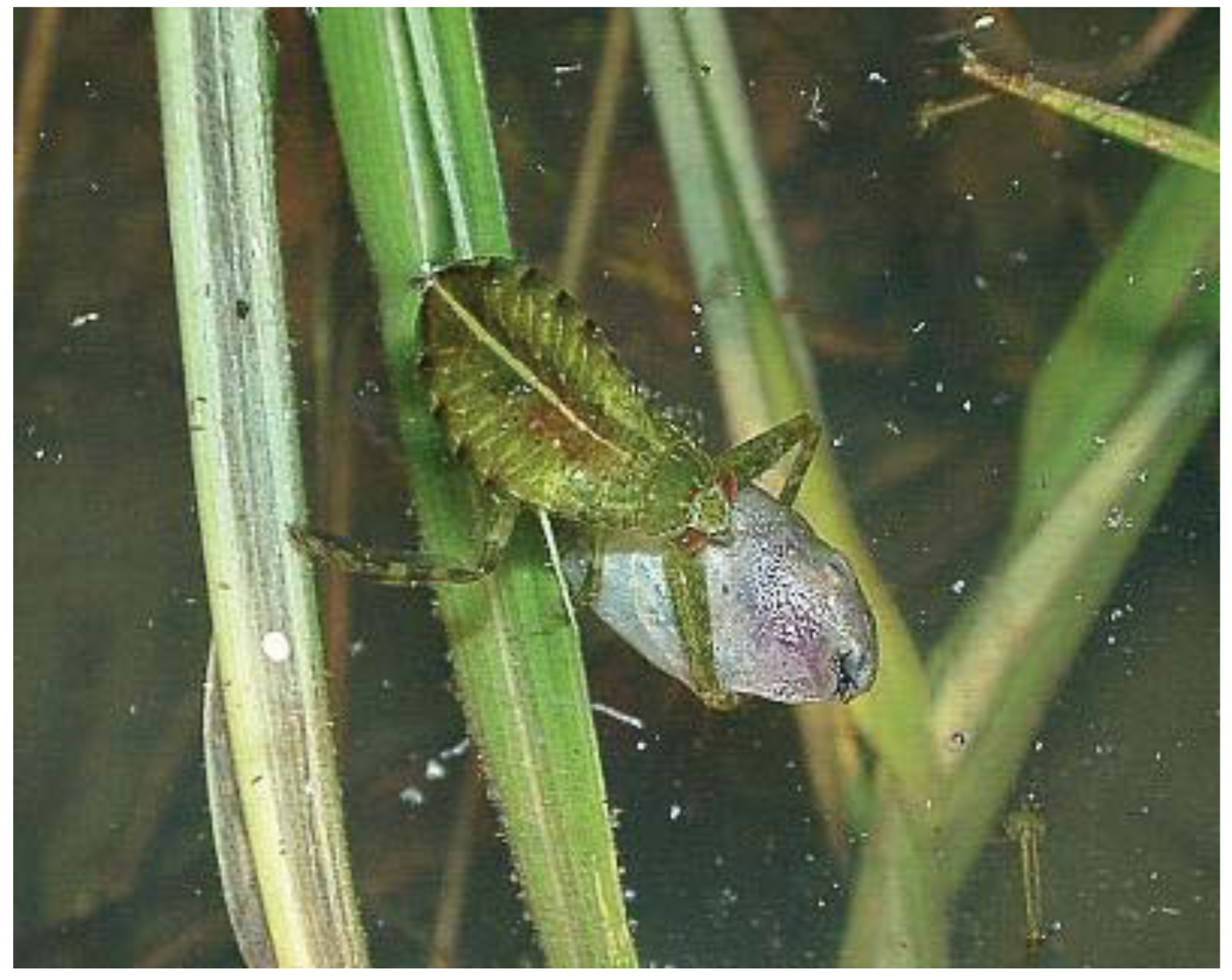
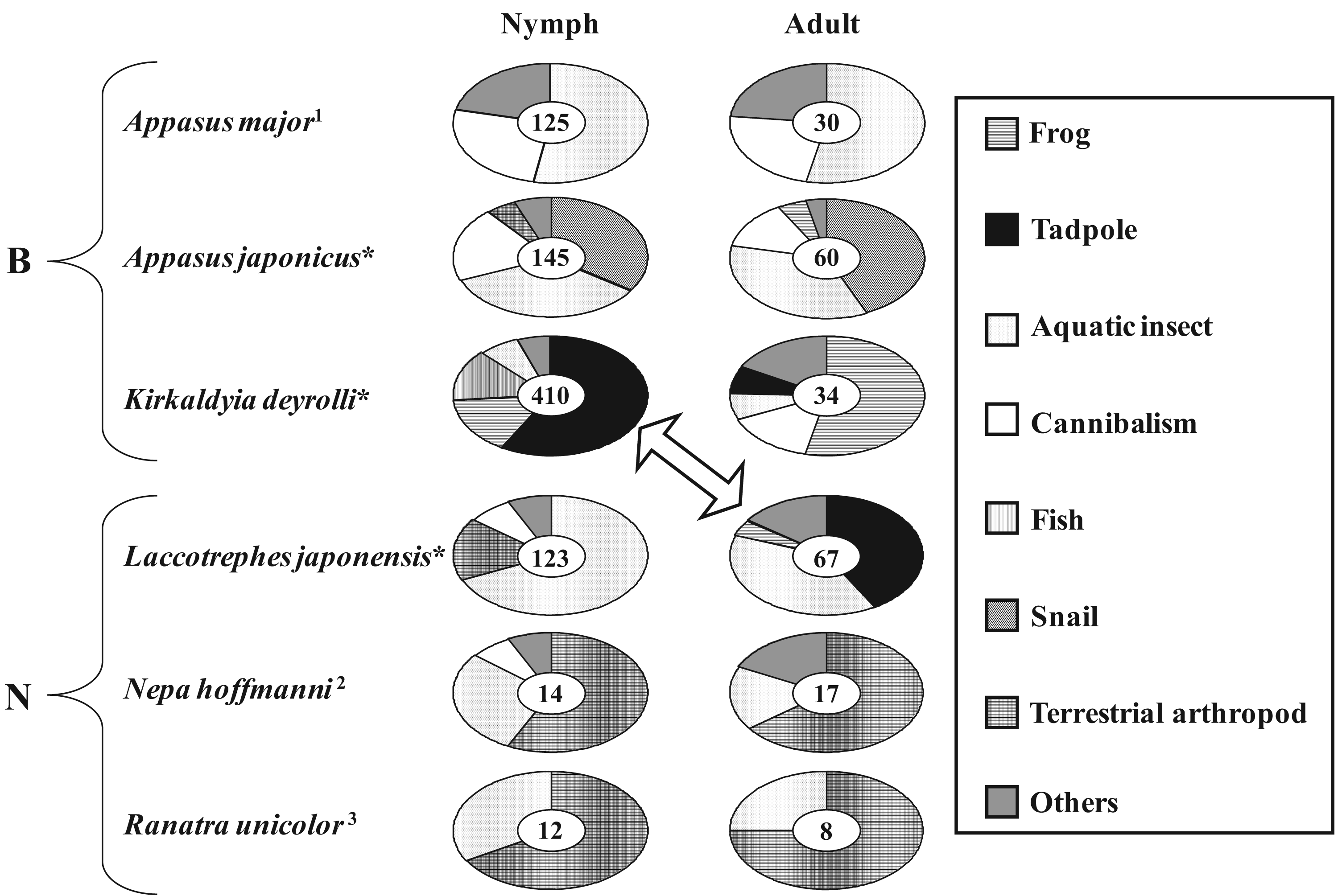
<p>However, most aquatic hemipterans do not often eat tadpoles in Japan. Ohba and Nakasuji [<xref ref-type="bibr" rid="b7-insects-02-00435">7</xref>] investigated the feeding habits of aquatic bugs (Nepoidea, including Belostomatidae and Nepidae) by performing direct observations in wetland areas (see <xref ref-type="fig" rid="f1-insects-02-00435">Figure 1</xref>) and obtaining data from the published literature [<xref ref-type="bibr" rid="b29-insects-02-00435">29</xref>-<xref ref-type="bibr" rid="b31-insects-02-00435">31</xref>]. As a result, it was found that sympatric species (<italic>Appasus japonicus</italic>, <italic>Kirkaldyia deyrolli</italic>, and <italic>Laccotrephes japonensis</italic>) displayed differences in their dietary components (<xref ref-type="fig" rid="f2-insects-02-00435">Figure 2</xref>). Although tadpoles are preyed upon by a variety of aquatic insects, not all aquatic insect species eat tadpoles. Only <italic>K. deyrolli</italic> nymphs and <italic>L. japonensis</italic> adults greatly depend on tadpoles whereas <italic>A. japonicus</italic> does not eat tadpoles. Therefore, <italic>K. deyrolli</italic> nymphs and <italic>L. japonensis</italic> adults seem to be members of the same guild; <italic>i.e.</italic>, they compete with each other, in Japanese wetlands [<xref ref-type="bibr" rid="b32-insects-02-00435">32</xref>].</p>
<p>In this paper, I first introduce that <italic>K. deyrolli</italic> nymphs feed on tadpoles. Second, I introduce that <italic>K. deyrolli</italic> nymph survival is indirectly affected by tadpoles; <italic>i.e.</italic>, by a density-mediated indirect effect. Finally, I discuss aquatic heteropteran predator–amphibian larval prey relationships in relation to temporal dynamic interactions.</p></sec></sec>
<sec>
<label>2.</label>
<title>Tadpole-Feeding by <italic>K. deyrolli</italic> Nymphs</title>
<p>The quantity and quality of prey animals strongly affect a predator’s life history and abundance. Among predacious insects, predatory species that depend upon a particular prey animal, which are known as specialists, breed when their prey animal is abundant [<xref ref-type="bibr" rid="b33-insects-02-00435">33</xref>-<xref ref-type="bibr" rid="b36-insects-02-00435">36</xref>]. Specialist development coincides with the appearance of specific prey animals, especially during the nymphal period [<xref ref-type="bibr" rid="b37-insects-02-00435">37</xref>]. In rice fields, <italic>K. deyrolli</italic> nymphs prey upon tadpoles more than on other kinds of prey (<xref ref-type="fig" rid="f2-insects-02-00435">Figure 2</xref>). The subfamily Lethocerinae, which has the largest body size among Belostomatidae, is known to be a vertebrate specialist [<xref ref-type="bibr" rid="b38-insects-02-00435">38</xref>-<xref ref-type="bibr" rid="b40-insects-02-00435">40</xref>]. Why <italic>K. deyrolli</italic> nymphs mostly feed on tadpoles is not well understood from the viewpoint of nymphal growth and seasonal occurrence.</p>
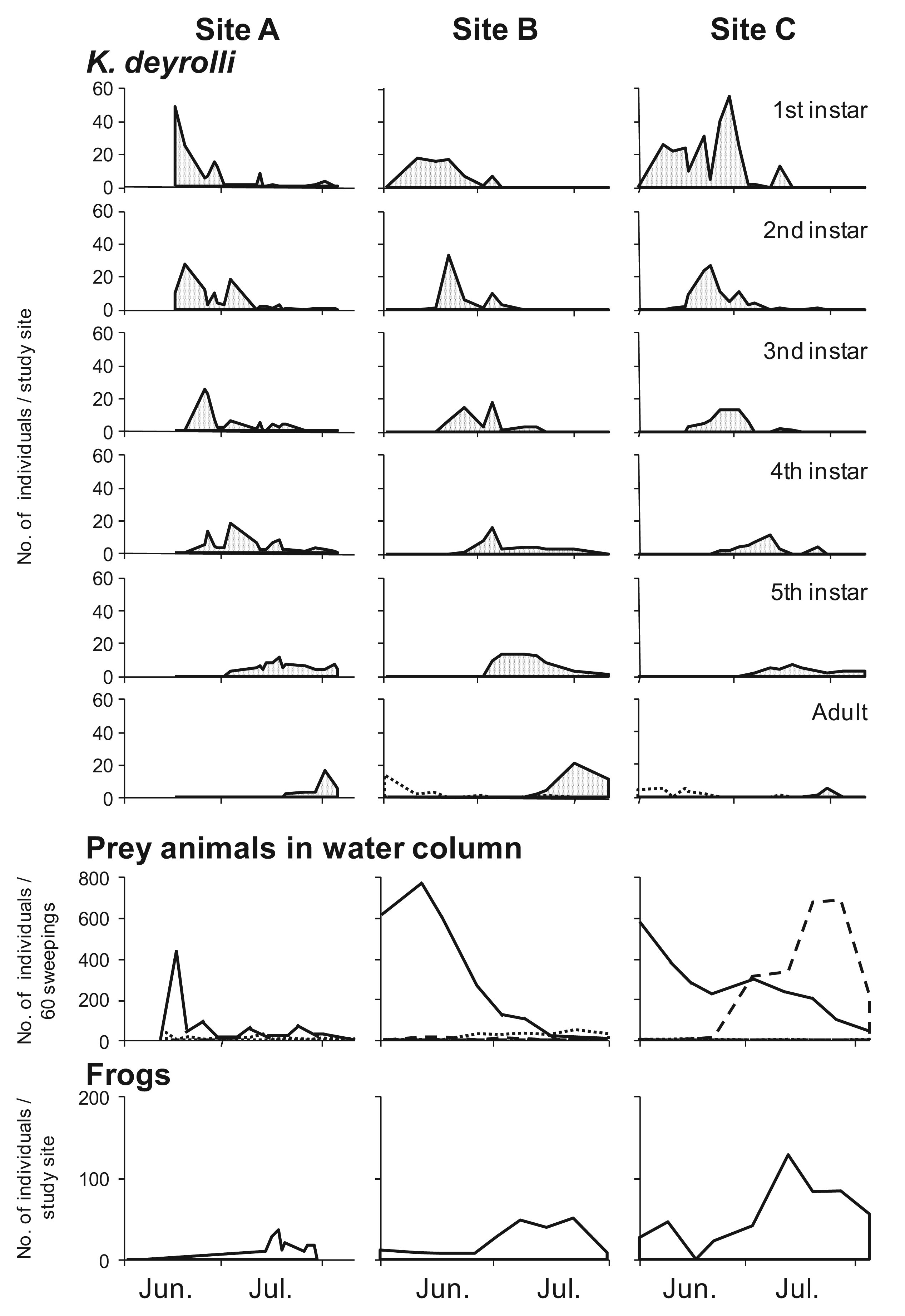
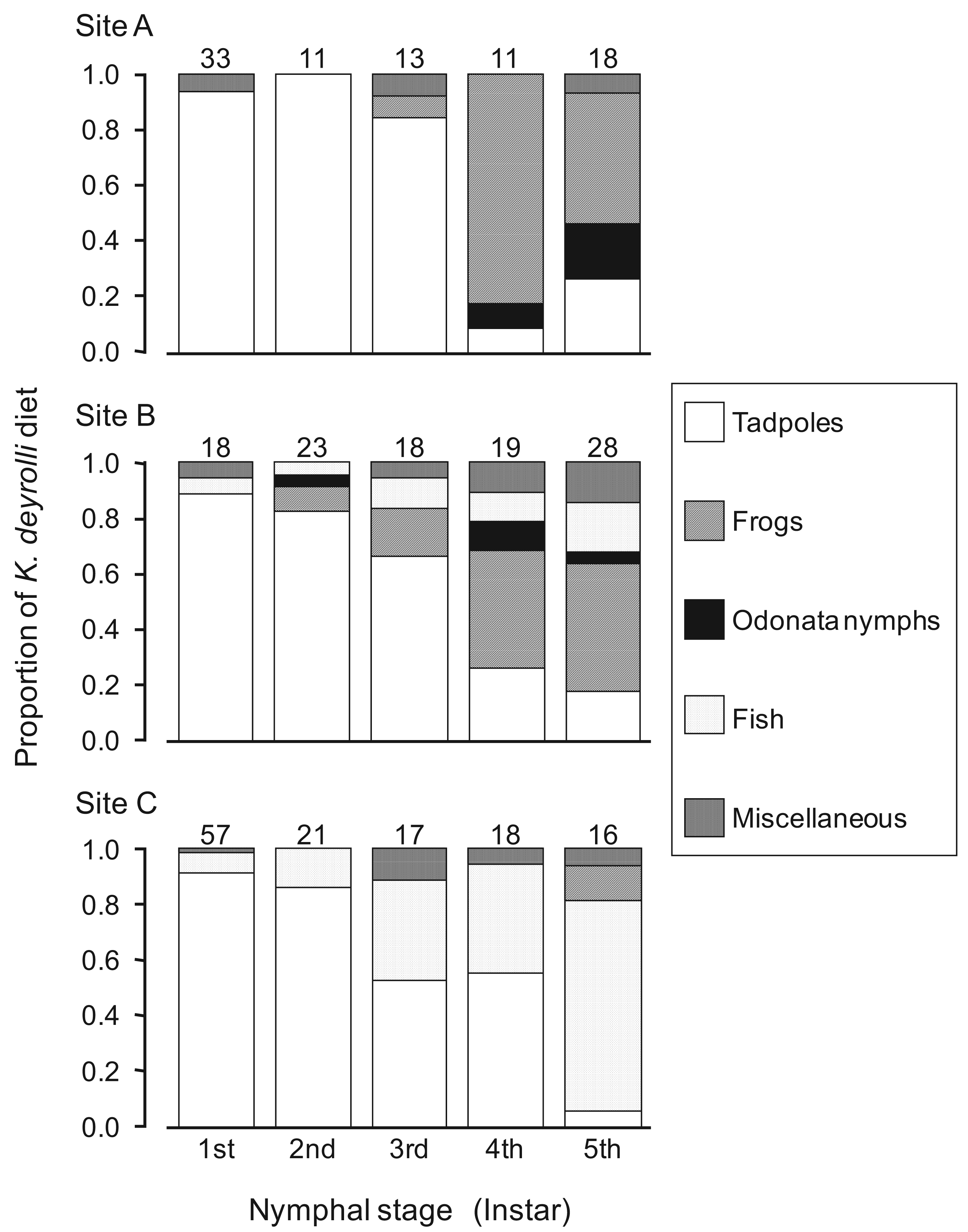
<p>In general, the appearance of younger nymphs of predacious insects when prey animals are abundant is expected to moderate cannibalism due to food shortages [<xref ref-type="bibr" rid="b41-insects-02-00435">41</xref>-<xref ref-type="bibr" rid="b44-insects-02-00435">44</xref>]. Accordingly, Ohba <italic>et al.</italic> [<xref ref-type="bibr" rid="b45-insects-02-00435">45</xref>] studied the ontogenetic diet shift of <italic>K. deyrolli</italic> by quantifying instar abundance and analyzing captured prey and prey relative abundance in rice fields in three localities. The first to third-instar <italic>K. deyrolli</italic> nymphs mainly fed on tadpoles, regardless of differences in prey availability among the three localities (<xref ref-type="fig" rid="f3-insects-02-00435">Figure 3</xref>). A rearing experiment demonstrated that <italic>K. deyrolli</italic> nymphs provided with tadpoles displayed greater growth rates at all nymphal stages, except for the final stage, than nymphs fed on dragonflynymphs. The emergence of young <italic>K. deyrolli</italic> nymphs seemed to coincide with the period when tadpoles became abundant in the rice fields (<xref ref-type="fig" rid="f4-insects-02-00435">Figure 4</xref>). In addition, the appearance of younger <italic>K. deyrolli</italic> nymphs when tadpoles are abundant is expected to moderate cannibalism due to food shortages, as has been demonstrated for other predatory insects such as ladybirds [<xref ref-type="bibr" rid="b41-insects-02-00435">41</xref>-<xref ref-type="bibr" rid="b44-insects-02-00435">44</xref>]. Actually, the frequency of cannibalism in <italic>K. deyrolli</italic> nymphs is lower than that seen in <italic>A. japonicus</italic> nymphs in the field (<xref ref-type="fig" rid="f2-insects-02-00435">Figure 2</xref>) [<xref ref-type="bibr" rid="b7-insects-02-00435">7</xref>].</p></sec>
<sec>
<label>3.</label>
<title>Density-Mediated Indirect Effects of Tadpole Prey</title>
<p>Many specialists breed when certain prey are abundant in order to increase the chance of there being a sufficient amount of food to increase the growth and survival of their young, showing that a high prey density directly supports the predator population, e.g., a bottom-up effect. However, there is little information on the indirect role of higher prey density on the mediation of predation pressure on the predator from other predators within the same guild; <italic>i.e.</italic>, density-mediated indirect effects, in aquatic environments including insect predator–anuran larva prey relationships. As mentioned above, <italic>K. deyrolli</italic> nymphs are considered to feed on tadpoles [<xref ref-type="bibr" rid="b45-insects-02-00435">45</xref>]. In addition, <italic>L. japonensis</italic> prey upon <italic>K. deyrolli</italic> nymphs [<xref ref-type="bibr" rid="b32-insects-02-00435">32</xref>,<xref ref-type="bibr" rid="b46-insects-02-00435">46</xref>] and tadpoles in rice fields [<xref ref-type="bibr" rid="b7-insects-02-00435">7</xref>]. Therefore, <italic>L. japonensis</italic> adults are intraguild predators of <italic>K. deyrolli</italic> nymphs. Consequently, it is predicted that the survivorship of <italic>K. deyrolli</italic> nymphs is affected by their common prey, tadpoles, via a bottom-up effect on survivorship as well as by their predator, <italic>L. japonensis</italic> adults, via a top-down effect. Thus, it is considered that density-mediated indirect relationships exist among the three animal species.</p>
<p>Ohba and Nakasuji [<xref ref-type="bibr" rid="b47-insects-02-00435">47</xref>] demonstrated that the survival of <italic>K. deyrolli</italic> nymphs, which are tadpole specialists, is affected by tadpoles (a direct bottom-up effect). We investigated the survival rates of the first instar nymphs of <italic>K. deyrolli</italic> in June (high tadpole density period) and July (low tadpole density period) using the Kiritani-Nakasuji-Manly method [<xref ref-type="bibr" rid="b48-insects-02-00435">48</xref>,<xref ref-type="bibr" rid="b49-insects-02-00435">49</xref>]. As circumstantial evidence, the survival rate of the first instar nymphs of <italic>K. deyrolli</italic> in a rice paddy field was higher in June (75.1%) than in July (54.2%) [<xref ref-type="bibr" rid="b47-insects-02-00435">47</xref>]. The differences in prey density between June and July probably affected the survival rates of the <italic>K. deyrolli</italic> nymphs, suggesting that bottom-up effects display seasonal variation.</p>
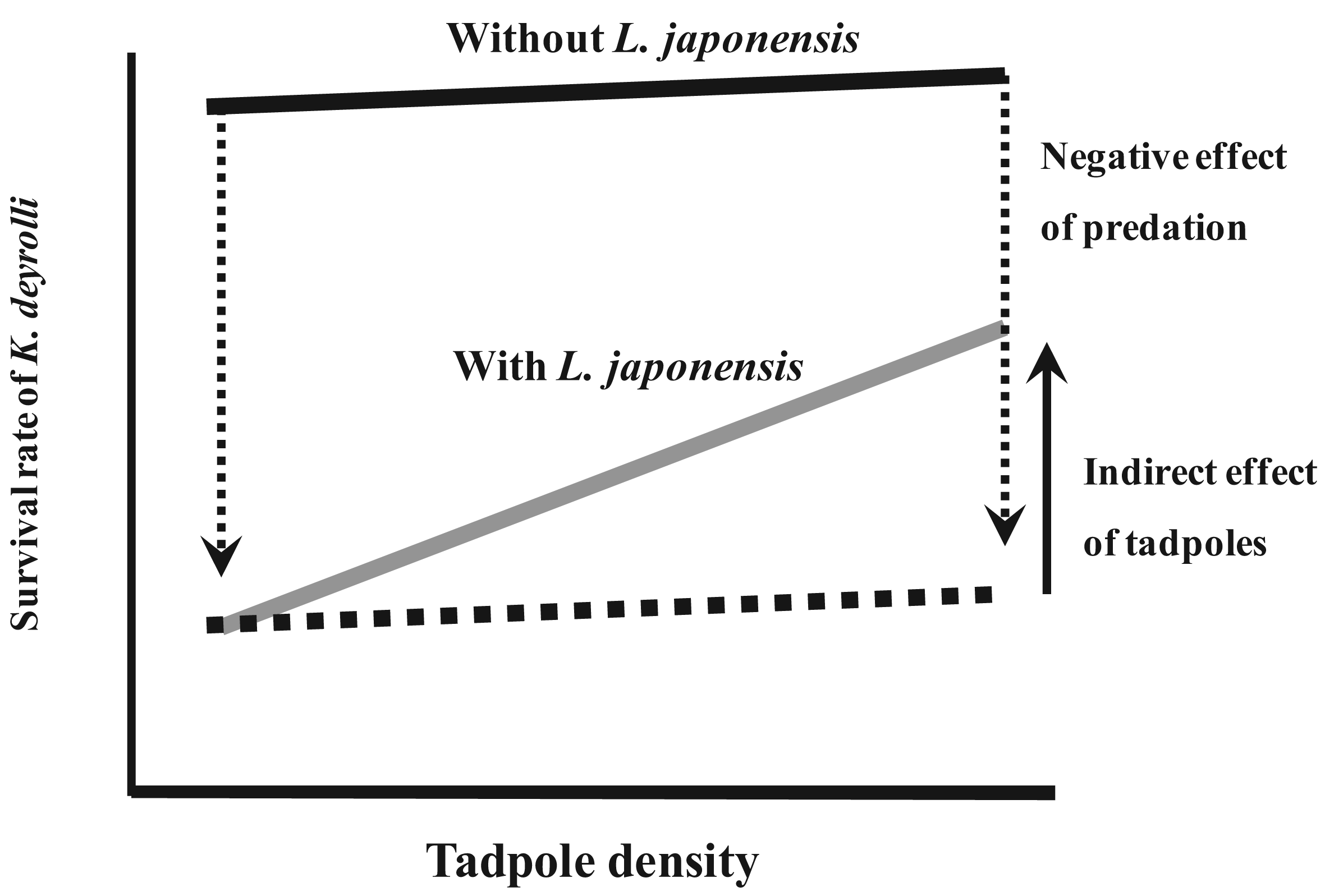
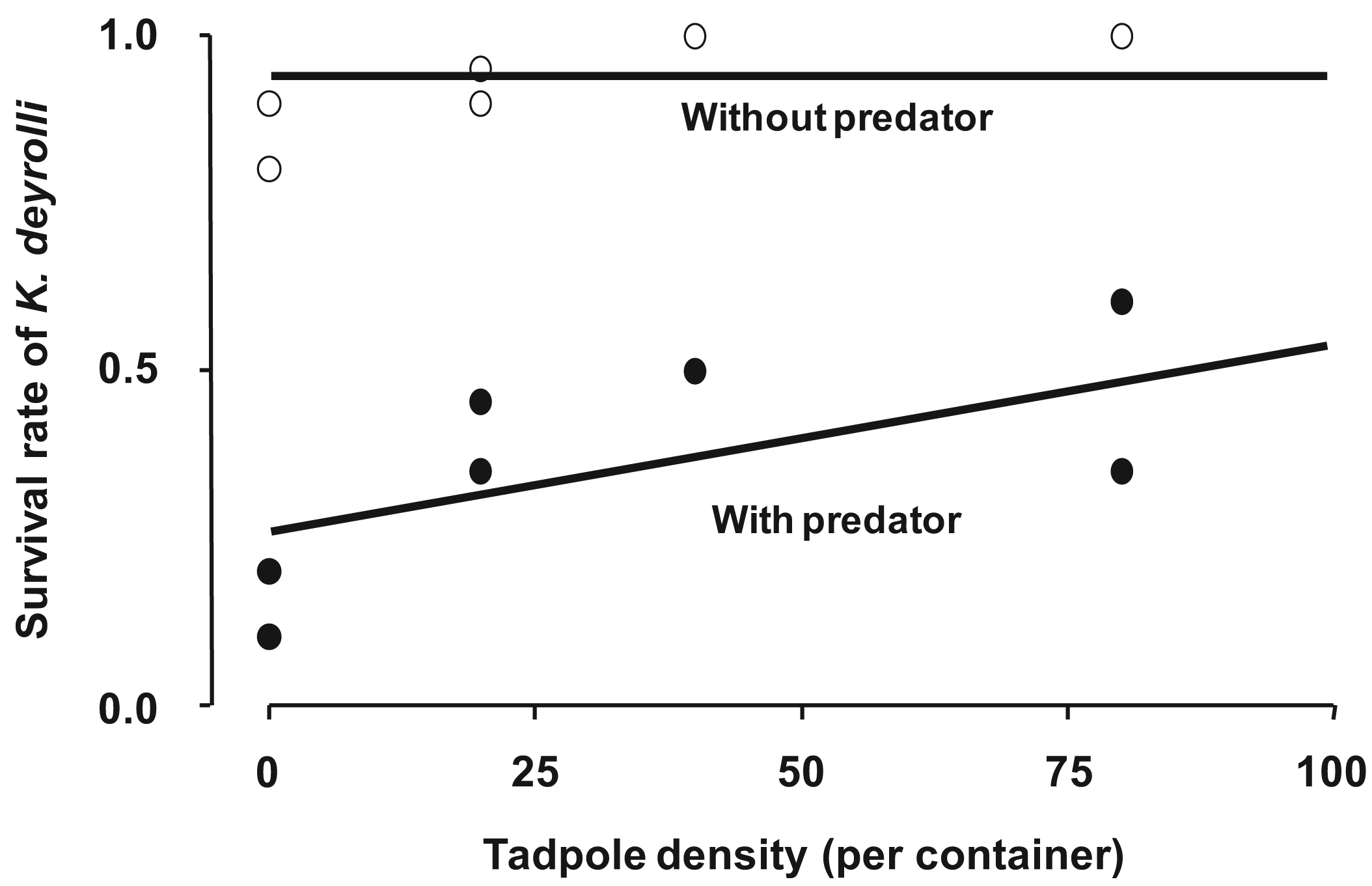
<p>To examine whether a higher tadpole density moderates the predation pressure from <italic>L. japonensis</italic> adults on <italic>K. deyrolli</italic> nymphs, a field experiment was conducted in a rice field. As a result, it was found that a higher tadpole density moderated the predation pressure from <italic>L. japonensis</italic> adults on <italic>K. deyrolli</italic> nymphs (a density-mediated indirect effect; <xref ref-type="fig" rid="f5-insects-02-00435">Figures 5</xref> and <xref ref-type="fig" rid="f6-insects-02-00435">6</xref>) [<xref ref-type="bibr" rid="b50-insects-02-00435">50</xref>,<xref ref-type="bibr" rid="b51-insects-02-00435">51</xref>]. Prey abundance is an important factor for determining the frequency of intraguild predation [<xref ref-type="bibr" rid="b52-insects-02-00435">52</xref>-<xref ref-type="bibr" rid="b54-insects-02-00435">54</xref>], especially in terrestrial aphidophagous predator–aphid prey relationships. Thus, in rice fields the incidence of intraguild predation by <italic>L. japonensis</italic> adults might increase when the tadpole density decreases.</p></sec>
<sec>
<label>4.</label>
<title>Conservation of an Endangered Giant Water Bug</title>
<p>The Japanese populations of <italic>K. deyrolli</italic> have decreased sharply during the last four decades, and this species is now included in the <italic>Red Data List</italic> of species in 45 of 47 Japanese prefectures [<xref ref-type="bibr" rid="b55-insects-02-00435">55</xref>,<xref ref-type="bibr" rid="b56-insects-02-00435">56</xref>]. Contributing factors such as decreases in suitable aquatic habitats, water pollution, and urbanization have been investigated and verified in previous studies [<xref ref-type="bibr" rid="b57-insects-02-00435">57</xref>-<xref ref-type="bibr" rid="b59-insects-02-00435">59</xref>]. In addition to these factors, it is important for the conservation of <italic>K. deyrolli</italic> to reveal the best food for them to eat. Regarding bottom-up effects, Hirai and Hidaka [<xref ref-type="bibr" rid="b60-insects-02-00435">60</xref>] and Hirai [<xref ref-type="bibr" rid="b61-insects-02-00435">61</xref>] emphasized that the frog population is very important for the conservation of the <italic>K. deyrolli</italic> population because frogs are major constituents of the diet of <italic>K. deyrolli</italic> adults.</p>
<p>Previous studies have only focused on direct bottom-up effects of amphibian prey. However, the present study demonstrated an indirect bottom-up effect of amphibian prey. The emergence of young <italic>K. deyrolli</italic> nymphs appeared to coincide with the period when tadpoles became abundant in the rice fields, which allowed the young <italic>K. deyrolli</italic> nymphs to achieve greater growth (<xref ref-type="fig" rid="f4-insects-02-00435">Figure 4</xref> [<xref ref-type="bibr" rid="b45-insects-02-00435">45</xref>]). This indicates that a high prey density directly supports <italic>K. deyrolli</italic> nymphs. In addition to such direct effects, a high tadpole density was also demonstrated to have a beneficial indirect effect on the survival of <italic>K. deyrolli</italic> nymphs (<xref ref-type="fig" rid="f6-insects-02-00435">Figure 6</xref> [<xref ref-type="bibr" rid="b47-insects-02-00435">47</xref>]). Therefore, an abundance of amphibian prey is indispensable for the conservation of this endangered giant water bug species.</p></sec>
<sec sec-type="conclusions">
<label>5.</label>
<title>Conclusions</title>
<p>This paper introduced that young <italic>K. deyrolli</italic> nymphs mainly feed on tadpoles in rice fields and that nymphs provided with tadpoles grow faster than nymphs provided with invertebrate prey. A higher tadpole density moderates the predation pressure from the water scorpion <italic>L. japonensis</italic> on <italic>K. deyrolli</italic> nymphs; <italic>i.e.</italic>, it has a density-mediated indirect effect. These results suggest that an abundance of tadpoles provides sufficient food for <italic>K. deyrolli</italic> nymph growth (a direct bottom-up effect) and moderates the predation pressure exerted on them by <italic>L. japonensis</italic> (an indirect bottom-up effect). An abundance of amphibian prey is indispensable for the conservation of this endangered giant water bug species.</p></sec></body>
<back>
<sec sec-type="display-objects">
<title>Figures</title>
<fig id="f1-insects-02-00435" position="float">
<label>Figure 1.</label>
<caption>
<p>Predation on a tadpole by an aquatic insect. As one example of the recorded dietary items, prey into which a predator’s proboscis had been inserted is shown in this photo.</p></caption>
<graphic xlink:href="insects-02-00435f1.gif"/></fig>
<fig id="f2-insects-02-00435" position="float">
<label>Figure 2.</label>
<caption>
<p>Differences in dietary components among predacious aquatic Heteroptera inhabiting Japanese wetlands (modified from Ohba and Nakasuji [<xref ref-type="bibr" rid="b7-insects-02-00435">7</xref>]). The numbers in the center of each circular graph indicate the sample size. <italic>B</italic>, Belostomatidae; <italic>N</italic>, Nepidae; <italic>1</italic>, Okada and Nakasuji [<xref ref-type="bibr" rid="b29-insects-02-00435">29</xref>]; <italic>2</italic>, Ban <italic>et al.</italic> [<xref ref-type="bibr" rid="b31-insects-02-00435">31</xref>]; <italic>3</italic> Ban [<xref ref-type="bibr" rid="b30-insects-02-00435">30</xref>], * sympatric species. The arrow indicates the relationship between intraguild predators preying upon tadpoles.</p></caption>
<graphic xlink:href="insects-02-00435f2.gif"/></fig>
<fig id="f3-insects-02-00435" position="float">
<label>Figure 3.</label>
<caption>
<p>Prey groups included in the diets of <italic>K. deyrolli</italic> nymphs at three localities (modified from Ohba <italic>et al.</italic> [<xref ref-type="bibr" rid="b45-insects-02-00435">45</xref>]). The numbers indicate sample sizes.</p></caption>
<graphic xlink:href="insects-02-00435f3.gif"/></fig>
<fig id="f4-insects-02-00435" position="float">
<label>Figure 4.</label>
<caption>
<p>Seasonal changes in the frequencies of <italic>K. deyrolli</italic> and four prey categories at the three study sites. For the adult <italic>K. deyrolli</italic> graphs, the solid lines indicate overwintered insects, and the broken lines denote newly emerged adults. In the prey animals in the water column graphs, the solid, broken, and dotted lines indicate tadpoles, fish, and Odonata nymphs, respectively (modified from Ohba <italic>et al.</italic> [<xref ref-type="bibr" rid="b45-insects-02-00435">45</xref>]).</p></caption>
<graphic xlink:href="insects-02-00435f4.gif"/></fig>
<fig id="f5-insects-02-00435" position="float">
<label>Figure 5.</label>
<caption>
<p>Effects of tadpole density and the presence or absence of <italic>L. japonensis</italic> adults (a <italic>K. deyrolli</italic> nymph predator) on <italic>K. deyrolli</italic> nymph survival rates. The regression lines were calculated using a logistic regression model. (modified from Ohba and Nakasuji [<xref ref-type="bibr" rid="b47-insects-02-00435">47</xref>]).</p></caption>
<graphic xlink:href="insects-02-00435f5.gif"/></fig>
<fig id="f6-insects-02-00435" position="float">
<label>Figure 6.</label>
<caption>
<p>Schematic representation of the indirect effects of tadpole density on the survivorship of <italic>K. deyrolli</italic> nymphs in the presence or absence of their predator <italic>L. japonensis</italic> adults (modified from Ohba and Nakasuji [<xref ref-type="bibr" rid="b47-insects-02-00435">47</xref>]).</p></caption>
<graphic xlink:href="insects-02-00435f6.gif"/></fig></sec>
<ref-list>
<title>References</title>
<ref id="b1-insects-02-00435"><label>1.</label><citation citation-type="journal"><person-group person-group-type="author"><name><surname>Toft</surname><given-names>C.A.</given-names></name></person-group><article-title>Feeding ecology of thirteen syntopic species of anurans in a seasonal tropical environment</article-title><source>Oecologia</source><year>1980</year><volume>45</volume><fpage>131</fpage><lpage>141</lpage><pub-id pub-id-type="doi">10.1007/BF00346717</pub-id></citation></ref>
<ref id="b2-insects-02-00435"><label>2.</label><citation citation-type="journal"><person-group person-group-type="author"><name><surname>Hirai</surname><given-names>T.</given-names></name></person-group><article-title>Ontogenetic change in the diet of the pond frog, <italic>Rana nigromaculata</italic></article-title><source>Ecol. Res.</source><year>2002</year><volume>17</volume><fpage>639</fpage><lpage>644</lpage><pub-id pub-id-type="doi">10.1046/j.1440-1703.2002.00521.x</pub-id></citation></ref>
<ref id="b3-insects-02-00435"><label>3.</label><citation citation-type="journal"><person-group person-group-type="author"><name><surname>Honma</surname><given-names>A.</given-names></name><name><surname>Oku</surname><given-names>S.</given-names></name><name><surname>Nishida</surname><given-names>T.</given-names></name></person-group><article-title>Adaptive significance of death feigning posture as a specialized inducible defence against gape-limited predators</article-title><source>Proc. R. Soc. Biol. Sci. Ser. B</source><year>2006</year><volume>273</volume><fpage>1631</fpage><lpage>1636</lpage><pub-id pub-id-type="doi">10.1098/rspb.2006.3501</pub-id></citation></ref>
<ref id="b4-insects-02-00435"><label>4.</label><citation citation-type="journal"><person-group person-group-type="author"><name><surname>Benard</surname><given-names>M.</given-names></name></person-group><article-title>Predators and mates: Conflicting selection on the size of male Pacific treefrogs (<italic>Pseudacris regilla</italic>)</article-title><source>J. Herpetol.</source><year>2007</year><volume>41</volume><fpage>317</fpage><lpage>320</lpage><pub-id pub-id-type="doi">10.1670/0022-1511(2007)41[317:PAMCSO]2.0.CO;2</pub-id></citation></ref>
<ref id="b5-insects-02-00435"><label>5.</label><citation citation-type="journal"><person-group person-group-type="author"><name><surname>Toledo</surname><given-names>L.</given-names></name></person-group><article-title>Predation on seven South American anuran species by water bugs (Belostomatidae)</article-title><source>Phyllomedusa</source><year>2003</year><volume>2</volume><fpage>105</fpage><lpage>108</lpage></citation></ref>
<ref id="b6-insects-02-00435"><label>6.</label><citation citation-type="journal"><person-group person-group-type="author"><name><surname>Ohba</surname><given-names>S.</given-names></name></person-group><article-title>Ontogenetic dietary shift in the larvae of <italic>Cybister japonicus</italic> (Coleoptera: Dytiscidae) in Japanese rice fields</article-title><source>Environ. Entomol.</source><year>2009</year><volume>38</volume><fpage>856</fpage><lpage>860</lpage><pub-id pub-id-type="doi">10.1603/022.038.0339</pub-id><pub-id pub-id-type="pmid">19508796</pub-id></citation></ref>
<ref id="b7-insects-02-00435"><label>7.</label><citation citation-type="journal"><person-group person-group-type="author"><name><surname>Ohba</surname><given-names>S.</given-names></name><name><surname>Nakasuji</surname><given-names>F.</given-names></name></person-group><article-title>Dietary items of predacious aquatic bugs (Nepoidea: Heteroptera) in Japanese wetlands</article-title><source>Limnology</source><year>2006</year><volume>7</volume><fpage>41</fpage><lpage>43</lpage><pub-id pub-id-type="doi">10.1007/s10201-006-0161-5</pub-id></citation></ref>
<ref id="b8-insects-02-00435"><label>8.</label><citation citation-type="book"><person-group person-group-type="author"><name><surname>Corbet</surname><given-names>P.S.</given-names></name></person-group><source>Dragonflies: Behaviour and Ecology of ODONATA</source><publisher-name>Cornell University Press</publisher-name><publisher-loc>Ithaca, NY, USA</publisher-loc><year>1999</year></citation></ref>
<ref id="b9-insects-02-00435"><label>9.</label><citation citation-type="journal"><person-group person-group-type="author"><name><surname>van Buskirk</surname><given-names>J.</given-names></name><name><surname>McCollum</surname><given-names>S.</given-names></name></person-group><article-title>Plasticity and selection explain variation in tadpole phenotype between ponds with different predator composition</article-title><source>Oikos</source><year>1999</year><volume>85</volume><fpage>31</fpage><lpage>39</lpage><pub-id pub-id-type="doi">10.2307/3546789</pub-id></citation></ref>
<ref id="b10-insects-02-00435"><label>10.</label><citation citation-type="journal"><person-group person-group-type="author"><name><surname>Van Buskirk</surname><given-names>J.</given-names></name><name><surname>Relyea</surname><given-names>R.</given-names></name></person-group><article-title>Selection for phenotypic plasticity in <italic>Rana sylvatica</italic> tadpoles</article-title><source>Biol. J. Linn. Soc.</source><year>1998</year><volume>65</volume><fpage>301</fpage><lpage>328</lpage></citation></ref>
<ref id="b11-insects-02-00435"><label>11.</label><citation citation-type="journal"><person-group person-group-type="author"><name><surname>van Buskirk</surname><given-names>J.</given-names></name></person-group><article-title>Phenotypic lability and the evolution of predator-induced plasticity in tadpoles</article-title><source>Evolution</source><year>2002</year><volume>56</volume><fpage>361</fpage><lpage>370</lpage><pub-id pub-id-type="pmid">11926504</pub-id></citation></ref>
<ref id="b12-insects-02-00435"><label>12.</label><citation citation-type="journal"><person-group person-group-type="author"><name><surname>McIntyre</surname><given-names>P.</given-names></name><name><surname>Baldwin</surname><given-names>S.</given-names></name><name><surname>Flecker</surname><given-names>A.</given-names></name></person-group><article-title>Effects of behavioral and morphological plasticity on risk of predation in a Neotropical tadpole</article-title><source>Oecologia</source><year>2004</year><volume>141</volume><fpage>130</fpage><lpage>138</lpage><pub-id pub-id-type="pmid">15278431</pub-id></citation></ref>
<ref id="b13-insects-02-00435"><label>13.</label><citation citation-type="journal"><person-group person-group-type="author"><name><surname>Kishida</surname><given-names>O.</given-names></name><name><surname>Nishimura</surname><given-names>K.</given-names></name></person-group><article-title>Bulgy tadpoles: Inducible defense morph</article-title><source>Oecologia</source><year>2004</year><volume>140</volume><fpage>414</fpage><lpage>421</lpage><pub-id pub-id-type="pmid">15197643</pub-id></citation></ref>
<ref id="b14-insects-02-00435"><label>14.</label><citation citation-type="journal"><person-group person-group-type="author"><name><surname>Takahara</surname><given-names>T.</given-names></name><name><surname>Kohmatsu</surname><given-names>Y.</given-names></name><name><surname>Maruyama</surname><given-names>A.</given-names></name><name><surname>Yamaoka</surname><given-names>R.</given-names></name></person-group><article-title>Benefit of suites of defensive behavior induced by predator chemical cues on anuran tadpoles</article-title><source>Hyla Jpn. Behav. Ecol. Sociobiol.</source><year>2008</year><volume>63</volume><fpage>235</fpage><lpage>240</lpage><pub-id pub-id-type="doi">10.1007/s00265-008-0654-9</pub-id></citation></ref>
<ref id="b15-insects-02-00435"><label>15.</label><citation citation-type="journal"><person-group person-group-type="author"><name><surname>Hettyey</surname><given-names>A.</given-names></name><name><surname>Zsarnoczai</surname><given-names>S.</given-names></name><name><surname>Vincze</surname><given-names>K.</given-names></name><name><surname>Hoi</surname><given-names>H.</given-names></name><name><surname>Laurila</surname><given-names>A.</given-names></name></person-group><article-title>Interactions between the information content of different chemical cues affect induced defences in tadpoles</article-title><source>Oikos</source><year>2010</year><volume>119</volume><fpage>1814</fpage><lpage>1822</lpage><pub-id pub-id-type="doi">10.1111/j.1600-0706.2010.18563.x</pub-id></citation></ref>
<ref id="b16-insects-02-00435"><label>16.</label><citation citation-type="journal"><person-group person-group-type="author"><name><surname>Jara</surname><given-names>F.G.</given-names></name><name><surname>Perotti</surname><given-names>M.G.</given-names></name></person-group><article-title>Toad tadpole responses to predator risk: Ontogenetic change between constitutive and inducible defenses</article-title><source>J. Herpetol.</source><year>2009</year><volume>43</volume><fpage>82</fpage><lpage>88</lpage><pub-id pub-id-type="doi">10.1670/07-229R2.1</pub-id></citation></ref>
<ref id="b17-insects-02-00435"><label>17.</label><citation citation-type="journal"><person-group person-group-type="author"><name><surname>Vonesh</surname><given-names>J.R.</given-names></name></person-group><article-title>Egg predation and predator-induced hatching plasticity in the African reed frog, <italic>Hyperolius spinigularis</italic></article-title><source>Oikos</source><year>2005</year><volume>110</volume><fpage>241</fpage><lpage>252</lpage><pub-id pub-id-type="doi">10.1111/j.0030-1299.2005.13759.x</pub-id></citation></ref>
<ref id="b18-insects-02-00435"><label>18.</label><citation citation-type="journal"><person-group person-group-type="author"><name><surname>Vonesh</surname><given-names>J.R.</given-names></name></person-group><article-title>Sequential predator effects across three life stages of the African tree frog, <italic>Hyperolius spinigularis</italic></article-title><source>Oecologia</source><year>2005</year><volume>143</volume><fpage>280</fpage><lpage>290</lpage><pub-id pub-id-type="doi">10.1007/s00442-004-1806-x</pub-id><pub-id pub-id-type="pmid">15657758</pub-id></citation></ref>
<ref id="b19-insects-02-00435"><label>19.</label><citation citation-type="journal"><person-group person-group-type="author"><name><surname>Vonesh</surname><given-names>J.R.</given-names></name><name><surname>Bolker</surname><given-names>B.M.</given-names></name></person-group><article-title>Compensatory larval responses shift trade-offs associated with predator-induced hatching plasticity</article-title><source>Ecology</source><year>2005</year><volume>86</volume><fpage>1580</fpage><lpage>1591</lpage><pub-id pub-id-type="doi">10.1890/04-0535</pub-id></citation></ref>
<ref id="b20-insects-02-00435"><label>20.</label><citation citation-type="journal"><person-group person-group-type="author"><name><surname>Runck</surname><given-names>C.</given-names></name><name><surname>Blinn</surname><given-names>D.W.</given-names></name></person-group><article-title>Role of <italic>Belostoma bakeri</italic> (Heteroptera) in the trophic ecology of a fishless desert spring</article-title><source>Limnol. Oceanogr.</source><year>1994</year><volume>39</volume><fpage>1800</fpage><lpage>1812</lpage><pub-id pub-id-type="doi">10.4319/lo.1994.39.8.1800</pub-id></citation></ref>
<ref id="b21-insects-02-00435"><label>21.</label><citation citation-type="journal"><person-group person-group-type="author"><name><surname>Blaustein</surname><given-names>L.</given-names></name></person-group><article-title>Influence of the predatory backswimmer, <italic>Notonecta maculata</italic>, on invertebrate community structure</article-title><source>Ecol. Entomol.</source><year>1998</year><volume>23</volume><fpage>246</fpage><lpage>252</lpage><pub-id pub-id-type="doi">10.1046/j.1365-2311.1998.00138.x</pub-id></citation></ref>
<ref id="b22-insects-02-00435"><label>22.</label><citation citation-type="journal"><person-group person-group-type="author"><name><surname>Waters</surname><given-names>T.F.</given-names></name></person-group><article-title>Secondary production in inland waters 1</article-title><source>Adv. Ecol. Res.</source><year>1977</year><volume>10</volume><fpage>91</fpage><lpage>164</lpage></citation></ref>
<ref id="b23-insects-02-00435"><label>23.</label><citation citation-type="journal"><person-group person-group-type="author"><name><surname>Runck</surname><given-names>C.</given-names></name><name><surname>Blinn</surname><given-names>W.</given-names></name></person-group><article-title>Population dynamics and secondary production by <italic>Ranatra montezuma</italic> (Heteroptera: Nepidae)</article-title><source>J. North. Am. Benthol. Soc.</source><year>1990</year><volume>9</volume><fpage>262</fpage><lpage>270</lpage><pub-id pub-id-type="doi">10.2307/1467589</pub-id></citation></ref>
<ref id="b24-insects-02-00435"><label>24.</label><citation citation-type="journal"><person-group person-group-type="author"><name><surname>Gomez</surname><given-names>V.I.</given-names></name><name><surname>Kehr</surname><given-names>A.I.</given-names></name></person-group><article-title>Morphological and developmental responses of anuran larvae (<italic>Physalaemus albonotatus</italic>) to chemical cues from the predators <italic>Moenkhausia dichoroura</italic> (Characiformes: Characidae) and <italic>Belostoma elongatum</italic> (Hemiptera: Belostomatidae)</article-title><source>Zool. Stud.</source><year>2011</year><volume>50</volume><fpage>203</fpage><lpage>210</lpage></citation></ref>
<ref id="b25-insects-02-00435"><label>25.</label><citation citation-type="journal"><person-group person-group-type="author"><name><surname>Kehr</surname><given-names>A.I.</given-names></name><name><surname>Gómez</surname><given-names>V.I.</given-names></name></person-group><article-title>Intestinal, body and tail plasticity in <italic>Rhinella schneideri</italic> (Bufonidae) tadpoles induced by a predator insect (<italic>Belostoma elegans</italic>)</article-title><source>Adv. Stud. Biol.</source><year>2009</year><volume>1</volume><fpage>85</fpage><lpage>94</lpage></citation></ref>
<ref id="b26-insects-02-00435"><label>26.</label><citation citation-type="journal"><person-group person-group-type="author"><name><surname>Hoverman</surname><given-names>J.T.</given-names></name><name><surname>Relyea</surname><given-names>R.A.</given-names></name></person-group><article-title>Temporal environmental variation and phenotypic plasticity: A mechanism underlying priority effects</article-title><source>Oikos</source><year>2008</year><volume>117</volume><fpage>23</fpage><lpage>32</lpage><pub-id pub-id-type="doi">10.1111/j.2007.0030-1299.15969.x</pub-id></citation></ref>
<ref id="b27-insects-02-00435"><label>27.</label><citation citation-type="journal"><person-group person-group-type="author"><name><surname>Swart</surname><given-names>C.C.</given-names></name><name><surname>Taylor</surname><given-names>R.C.</given-names></name></person-group><article-title>Behavioral interactions between the giant water bug (<italic>Belostoma lutarium</italic>) and tadpoles of <italic>Bufo woodhousii</italic></article-title><source>Southeast. Nat.</source><year>2004</year><volume>3</volume><fpage>13</fpage><lpage>24</lpage><pub-id pub-id-type="doi">10.1656/1528-7092(2004)003[0013:BIBTGW]2.0.CO;2</pub-id></citation></ref>
<ref id="b28-insects-02-00435"><label>28.</label><citation citation-type="journal"><person-group person-group-type="author"><name><surname>Kopp</surname><given-names>K.</given-names></name><name><surname>Wachlevski</surname><given-names>M.</given-names></name><name><surname>Eterovick</surname><given-names>P.C.</given-names></name></person-group><article-title>Environmental complexity reduces tadpole predation by water bugs</article-title><source>Can. J. Zool.</source><year>2006</year><volume>84</volume><fpage>136</fpage><lpage>140</lpage><pub-id pub-id-type="doi">10.1139/z05-186</pub-id></citation></ref>
<ref id="b29-insects-02-00435"><label>29.</label><citation citation-type="journal"><person-group person-group-type="author"><name><surname>Okada</surname><given-names>H.</given-names></name><name><surname>Nakasuji</surname><given-names>F.</given-names></name></person-group><article-title>Comparative studies on the seasonal occurrence, nymphal development and food menu in two giant water bugs, <italic>Diplonychus japonicus</italic> Vuillefroy and <italic>Diplonychus major</italic> Esaki (Hemiptera: Belostomatidae)</article-title><source>Res. Popul. Ecol.</source><year>1993</year><volume>35</volume><fpage>15</fpage><lpage>22</lpage><pub-id pub-id-type="doi">10.1007/BF02515641</pub-id></citation></ref>
<ref id="b30-insects-02-00435"><label>30.</label><citation citation-type="journal"><person-group person-group-type="author"><name><surname>Ban</surname><given-names>Y.</given-names></name></person-group><article-title>Some observation on the life cycle of the water scorpion, <italic>Ranatra unicolor</italic> Scott (Hemiptera: Nepidae)</article-title><source>Yamanoshita Bay, Lake Biwa. Verh. Int. Verein. Limnol.</source><year>1981</year><volume>21</volume><fpage>1621</fpage><lpage>1625</lpage></citation></ref>
<ref id="b31-insects-02-00435"><label>31.</label><citation citation-type="book"><person-group person-group-type="author"><name><surname>Ban</surname><given-names>Y.</given-names></name></person-group><source>Water Scorpion NEPA Hoffmani</source><publisher-name>Bun-ichi Sogo Shuppan</publisher-name><publisher-loc>Tokyo, Japan</publisher-loc><year>1988</year></citation></ref>
<ref id="b32-insects-02-00435"><label>32.</label><citation citation-type="journal"><person-group person-group-type="author"><name><surname>Ohba</surname><given-names>S.</given-names></name></person-group><article-title>Notes on predators and their effect on the survivorship of the endangered giant water bug, <italic>Kirkaldyia (=Lethocerus) deyrolli</italic> (Heteroptera, Belostomatidae), in Japanese rice fields</article-title><source>Hydrobiologia</source><year>2007</year><volume>583</volume><fpage>377</fpage><lpage>381</lpage><pub-id pub-id-type="doi">10.1007/s10750-006-0488-2</pub-id></citation></ref>
<ref id="b33-insects-02-00435"><label>33.</label><citation citation-type="journal"><person-group person-group-type="author"><name><surname>Evans</surname><given-names>E.</given-names></name></person-group><article-title>Feeding specialization in predatory insects: Hunting and attack behavior of two stinkbug species (Hemiptera: Pentatomidae)</article-title><source>Am. Midl. Nat.</source><year>1982</year><volume>108</volume><fpage>96</fpage><lpage>104</lpage><pub-id pub-id-type="doi">10.2307/2425297</pub-id></citation></ref>
<ref id="b34-insects-02-00435"><label>34.</label><citation citation-type="journal"><person-group person-group-type="author"><name><surname>Sota</surname><given-names>T.</given-names></name></person-group><article-title>Activity patterns, diets and interspecific interactions of coexisting spring and autumn breeding carabids: <italic>Carabus yaconinu</italic>s and <italic>Leptocarabus kumagaii</italic> (Coleoptera, Carabidae)</article-title><source>Ecol. Entomol.</source><year>1985</year><volume>10</volume><fpage>315</fpage><lpage>324</lpage><pub-id pub-id-type="doi">10.1111/j.1365-2311.1985.tb00728.x</pub-id></citation></ref>
<ref id="b35-insects-02-00435"><label>35.</label><citation citation-type="journal"><person-group person-group-type="author"><name><surname>Hagen</surname><given-names>K.S.</given-names></name></person-group><article-title>Biology and ecology of predaceous Coccinellidae</article-title><source>Annu. Rev. Entomol.</source><year>1962</year><volume>7</volume><fpage>289</fpage><lpage>326</lpage><pub-id pub-id-type="doi">10.1146/annurev.en.07.010162.001445</pub-id></citation></ref>
<ref id="b36-insects-02-00435"><label>36.</label><citation citation-type="journal"><person-group person-group-type="author"><name><surname>Albuquerque</surname><given-names>G.</given-names></name><name><surname>Tauber</surname><given-names>M.</given-names></name><name><surname>Tauber</surname><given-names>C.</given-names></name></person-group><article-title>Life-history adaptations and reproductive costs associated with specialization in predacious insects</article-title><source>J. Anim. Ecol.</source><year>1997</year><volume>66</volume><fpage>307</fpage><lpage>317</lpage><pub-id pub-id-type="doi">10.2307/5977</pub-id></citation></ref>
<ref id="b37-insects-02-00435"><label>37.</label><citation citation-type="book"><person-group person-group-type="author"><name><surname>Elkinton</surname><given-names>J.S.</given-names></name></person-group><article-title>Population Ecology</article-title><source>Encyclopedia of Insects</source><person-group person-group-type="editor"><name><surname>Resh</surname><given-names>V.H.</given-names></name><name><surname>Carde</surname><given-names>R.T.</given-names></name></person-group><publisher-name>Academic press</publisher-name><publisher-loc>San Diego, CA, USA</publisher-loc><year>2003</year><fpage>933</fpage><lpage>947</lpage></citation></ref>
<ref id="b38-insects-02-00435"><label>38.</label><citation citation-type="book"><person-group person-group-type="author"><name><surname>Smith</surname><given-names>R.L.</given-names></name></person-group><article-title>Evolution of Paternal Care in the Giant Water Bugs (Heteroptera: Belostomatidae)</article-title><source>The evolution of social behavior in insects and arachnids</source><person-group person-group-type="editor"><name><surname>Choe</surname><given-names>J.</given-names></name><name><surname>Crespi</surname><given-names>B.</given-names></name></person-group><publisher-name>Cambridge University Press</publisher-name><publisher-loc>Cambridge, UK</publisher-loc><year>1997</year><fpage>116</fpage><lpage>149</lpage></citation></ref>
<ref id="b39-insects-02-00435"><label>39.</label><citation citation-type="journal"><person-group person-group-type="author"><name><surname>Swart</surname><given-names>C.C.</given-names></name><name><surname>Deaton</surname><given-names>L.E.</given-names></name><name><surname>Felgenhauer</surname><given-names>B.E.</given-names></name></person-group><article-title>The salivary gland and salivary enzymes of the giant waterbugs (Heteroptera; Belostomatidae)</article-title><source>Comp. Biochem. Physiol. Part A Mol. Integr. Physiol.</source><year>2006</year><volume>145</volume><fpage>114</fpage><lpage>122</lpage><pub-id pub-id-type="doi">10.1016/j.cbpa.2006.05.010</pub-id></citation></ref>
<ref id="b40-insects-02-00435"><label>40.</label><citation citation-type="journal"><person-group person-group-type="author"><name><surname>Ohba</surname><given-names>S.</given-names></name></person-group><article-title>Field observation of predation on a turtle by a giant water bug</article-title><source>Entomol. Sci.</source><year>2011</year><volume>14</volume><fpage>364</fpage><lpage>365</lpage><pub-id pub-id-type="doi">10.1111/j.1479-8298.2011.00450.x</pub-id></citation></ref>
<ref id="b41-insects-02-00435"><label>41.</label><citation citation-type="journal"><person-group person-group-type="author"><name><surname>Takahashi</surname><given-names>K.</given-names></name></person-group><article-title>Intra- and inter-specific predations of lady beetles in spring alfalfa fields</article-title><source>Jpn. J. Entomol.</source><year>1989</year><volume>57</volume><fpage>199</fpage><lpage>203</lpage></citation></ref>
<ref id="b42-insects-02-00435"><label>42.</label><citation citation-type="journal"><person-group person-group-type="author"><name><surname>Osawa</surname><given-names>N.</given-names></name></person-group><article-title>A life table of the ladybird beetle <italic>Harmonia axyridis</italic> Pallas (Coleoptera, Coccinellidae) in relation to the aphid abundance</article-title><source>Jpn. J. Entomol.</source><year>1992</year><volume>60</volume><fpage>575</fpage><lpage>579</lpage></citation></ref>
<ref id="b43-insects-02-00435"><label>43.</label><citation citation-type="journal"><person-group person-group-type="author"><name><surname>Agarwala</surname><given-names>B.</given-names></name><name><surname>Dixon</surname><given-names>A.</given-names></name></person-group><article-title>Laboratory study of cannibalism and interspecific predation in ladybirds</article-title><source>Ecol. Entomol.</source><year>1992</year><volume>17</volume><fpage>303</fpage><lpage>309</lpage><pub-id pub-id-type="doi">10.1111/j.1365-2311.1992.tb01062.x</pub-id></citation></ref>
<ref id="b44-insects-02-00435"><label>44.</label><citation citation-type="journal"><person-group person-group-type="author"><name><surname>Hironori</surname><given-names>Y.</given-names></name><name><surname>Katsuhiro</surname><given-names>S.</given-names></name></person-group><article-title>Cannibalism and interspecific predation in two predatory ladybirds in relation to prey abundance in the field</article-title><source>Entomophaga</source><year>1997</year><volume>42</volume><fpage>153</fpage><lpage>163</lpage><pub-id pub-id-type="doi">10.1007/BF02769893</pub-id></citation></ref>
<ref id="b45-insects-02-00435"><label>45.</label><citation citation-type="journal"><person-group person-group-type="author"><name><surname>Ohba</surname><given-names>S.</given-names></name><name><surname>Miyasaka</surname><given-names>H.</given-names></name><name><surname>Nakasuji</surname><given-names>F.</given-names></name></person-group><article-title>The role of amphibian prey in the diet and growth of giant water bug nymphs in Japanese rice fields</article-title><source>Popul. Ecol.</source><year>2008</year><volume>50</volume><fpage>9</fpage><lpage>16</lpage><pub-id pub-id-type="doi">10.1007/s10144-007-0058-0</pub-id></citation></ref>
<ref id="b46-insects-02-00435"><label>46.</label><citation citation-type="journal"><person-group person-group-type="author"><name><surname>Ohba</surname><given-names>S.</given-names></name><name><surname>Swart</surname><given-names>C.C.</given-names></name></person-group><article-title>Intraguild predation of water scorpion <italic>Laccotrephes japonensis</italic> (Nepidae: Heteroptera)</article-title><source>Ecol. Res.</source><year>2009</year><volume>24</volume><fpage>1207</fpage><lpage>1211</lpage><pub-id pub-id-type="doi">10.1007/s11284-009-0605-6</pub-id></citation></ref>
<ref id="b47-insects-02-00435"><label>47.</label><citation citation-type="journal"><person-group person-group-type="author"><name><surname>Ohba</surname><given-names>S.</given-names></name><name><surname>Nakasuji</surname><given-names>F.</given-names></name></person-group><article-title>Density-mediated indirect effects of a common prey tadpole on interaction between two predatory bugs: <italic>Kirkaldyia deyrolli</italic> and <italic>Laccotrephes japonensis</italic></article-title><source>Popul. Ecol.</source><year>2007</year><volume>49</volume><fpage>331</fpage><lpage>336</lpage><pub-id pub-id-type="doi">10.1007/s10144-007-0051-7</pub-id></citation></ref>
<ref id="b48-insects-02-00435"><label>48.</label><citation citation-type="journal"><person-group person-group-type="author"><name><surname>Kiritani</surname><given-names>K.</given-names></name><name><surname>Nakasuji</surname><given-names>F.</given-names></name></person-group><article-title>Estimation of the stage-specific survival rate in the insect population with overlapping stages</article-title><source>Res. Popul. Ecol.</source><year>1967</year><volume>9</volume><fpage>143</fpage><lpage>152</lpage><pub-id pub-id-type="doi">10.1007/BF02514921</pub-id></citation></ref>
<ref id="b49-insects-02-00435"><label>49.</label><citation citation-type="journal"><person-group person-group-type="author"><name><surname>Manly</surname><given-names>B.F.J.</given-names></name></person-group><article-title>Extensions to Kiritani and Nakasuji's method for analysing insect stage-frequency data</article-title><source>Res. Popul. Ecol.</source><year>1976</year><volume>17</volume><fpage>191</fpage><lpage>199</lpage><pub-id pub-id-type="doi">10.1007/BF02530770</pub-id></citation></ref>
<ref id="b50-insects-02-00435"><label>50.</label><citation citation-type="journal"><person-group person-group-type="author"><name><surname>Holt</surname><given-names>R.</given-names></name><name><surname>Lawton</surname><given-names>J.</given-names></name></person-group><article-title>The ecological consequences of shared natural enemies</article-title><source>Annu. Rev. Ecol. Syst.</source><year>1994</year><volume>25</volume><fpage>495</fpage><lpage>520</lpage><pub-id pub-id-type="doi">10.1146/annurev.es.25.110194.002431</pub-id></citation></ref>
<ref id="b51-insects-02-00435"><label>51.</label><citation citation-type="journal"><person-group person-group-type="author"><name><surname>Holt</surname><given-names>R.D.</given-names></name></person-group><article-title>Predation, apparent competition, and the structure of prey communities</article-title><source>Theor. Popul. Biol.</source><year>1977</year><volume>12</volume><fpage>197</fpage><lpage>229</lpage><pub-id pub-id-type="doi">10.1016/0040-5809(77)90042-9</pub-id><pub-id pub-id-type="pmid">929457</pub-id></citation></ref>
<ref id="b52-insects-02-00435"><label>52.</label><citation citation-type="journal"><person-group person-group-type="author"><name><surname>Polis</surname><given-names>G.</given-names></name><name><surname>Myers</surname><given-names>C.</given-names></name><name><surname>Holt</surname><given-names>R.</given-names></name></person-group><article-title>The ecology and evolution of intraguild predation: Potential competitors that eat each other</article-title><source>Annu. Rev. Ecol. Syst.</source><year>1989</year><volume>20</volume><fpage>297</fpage><lpage>330</lpage><pub-id pub-id-type="doi">10.1146/annurev.es.20.110189.001501</pub-id></citation></ref>
<ref id="b53-insects-02-00435"><label>53.</label><citation citation-type="journal"><person-group person-group-type="author"><name><surname>Lucas</surname><given-names>E.</given-names></name><name><surname>Coderre</surname><given-names>D.</given-names></name><name><surname>Brodeur</surname><given-names>J.</given-names></name></person-group><article-title>Intraguild predation among aphid predators: Characterization and influence of extraguild prey density</article-title><source>Ecology</source><year>1998</year><volume>79</volume><fpage>1084</fpage><lpage>1092</lpage><pub-id pub-id-type="doi">10.1890/0012-9658(1998)079[1084:IPAAPC]2.0.CO;2</pub-id></citation></ref>
<ref id="b54-insects-02-00435"><label>54.</label><citation citation-type="journal"><person-group person-group-type="author"><name><surname>Hodge</surname><given-names>M.A.</given-names></name></person-group><article-title>The implications of intraguild predation for the role of spiders in biological control</article-title><source>J. Arachnol.</source><year>1999</year><volume>27</volume><fpage>351</fpage><lpage>362</lpage></citation></ref>
<ref id="b55-insects-02-00435"><label>55.</label><citation citation-type="web"><article-title>Search system of Japanese red data</article-title><comment>Available online: <ext-link xlink:href="http://www.jpnrdb.com/index.html" ext-link-type="uri">http://www.jpnrdb.com/index.html</ext-link> (accessed on 16 May 2011)</comment></citation></ref>
<ref id="b56-insects-02-00435"><label>56.</label><citation citation-type="book"><person-group person-group-type="author"><collab>Japan Environment Agency</collab></person-group><source>Threatened Wildlife of Japan. Red Data Book</source><edition>2nd ed.</edition><publisher-name>Environment Agency of Japan</publisher-name><publisher-loc>Tokyo, Japan</publisher-loc><year>2000</year><comment>in Japanese</comment></citation></ref>
<ref id="b57-insects-02-00435"><label>57.</label><citation citation-type="journal"><person-group person-group-type="author"><name><surname>Ho</surname><given-names>C.</given-names></name><name><surname>Kim</surname><given-names>H.</given-names></name><name><surname>Kim</surname><given-names>J.G.</given-names></name></person-group><article-title>Landscape analysis of the effects of artificial lighting around wetland habitats on the giant water bug <italic>Lethocerus deyrollei</italic> in Jeju Island</article-title><source>J. Ecol. Field. Biol.</source><year>2009</year><volume>32</volume><fpage>83</fpage><lpage>86</lpage><pub-id pub-id-type="doi">10.5141/JEFB.2009.32.2.083</pub-id></citation></ref>
<ref id="b58-insects-02-00435"><label>58.</label><citation citation-type="journal"><person-group person-group-type="author"><name><surname>Yoon</surname><given-names>T.</given-names></name><name><surname>Kim</surname><given-names>D.</given-names></name><name><surname>Kim</surname><given-names>S.</given-names></name><name><surname>Jo</surname><given-names>S.</given-names></name><name><surname>Bae</surname><given-names>Y.</given-names></name></person-group><article-title>Light-attraction flight of the giant water bug, <italic>Lethocerus deyrolli</italic> (Hemiptera: Belostomatidae), an endangered wetland insect in east Asia</article-title><source>Aquat. Insects</source><year>2010</year><volume>32</volume><fpage>195</fpage><lpage>203</lpage><pub-id pub-id-type="doi">10.1080/01650424.2010.508045</pub-id></citation></ref>
<ref id="b59-insects-02-00435"><label>59.</label><citation citation-type="journal"><person-group person-group-type="author"><name><surname>Nagaba</surname><given-names>Y.</given-names></name><name><surname>Tufail</surname><given-names>M.</given-names></name><name><surname>Inui</surname><given-names>H.</given-names></name><name><surname>Takeda</surname><given-names>M.</given-names></name></person-group><article-title>Hormonal regulation and effects of four environmental pollutants on vitellogenin gene transcription in the giant water bug, <italic>Lethocerus deyrollei</italic> (Hemiptera: Belostomatidae)</article-title><source>J. Insect Conserv.</source><year>2011</year><volume>15</volume><fpage>421</fpage><lpage>431</lpage><pub-id pub-id-type="doi">10.1007/s10841-010-9315-1</pub-id></citation></ref>
<ref id="b60-insects-02-00435"><label>60.</label><citation citation-type="journal"><person-group person-group-type="author"><name><surname>Hirai</surname><given-names>T.</given-names></name><name><surname>Hidaka</surname><given-names>K.</given-names></name></person-group><article-title>Anuran-dependent predation by the giant water bug, <italic>Lethocerus deyrollei</italic> (Hemiptera: Belostomatidae), in rice fields of Japan</article-title><source>Ecol. Res.</source><year>2002</year><volume>17</volume><fpage>655</fpage><lpage>661</lpage><pub-id pub-id-type="doi">10.1046/j.1440-1703.2002.00523.x</pub-id></citation></ref>
<ref id="b61-insects-02-00435"><label>61.</label><citation citation-type="journal"><person-group person-group-type="author"><name><surname>Hirai</surname><given-names>T.</given-names></name></person-group><article-title>Diet composition of the endangered giant water bug <italic>Lethocerus deyrolli</italic> (Hemiptera: Belostomatidae) in the rice fields of Japan: Which is the most important prey item among frogs, fish, and aquatic insects?</article-title><source>Entomol. Sci.</source><year>2007</year><volume>10</volume><fpage>333</fpage><lpage>336</lpage><pub-id pub-id-type="doi">10.1111/j.1479-8298.2007.00236.x</pub-id></citation></ref></ref-list></back></article>