
Ecological Status of Rivers and Streams in Saxony (Germany) According to the Water Framework Directive and Prospects of Improvement

Abstract
:1. Introduction
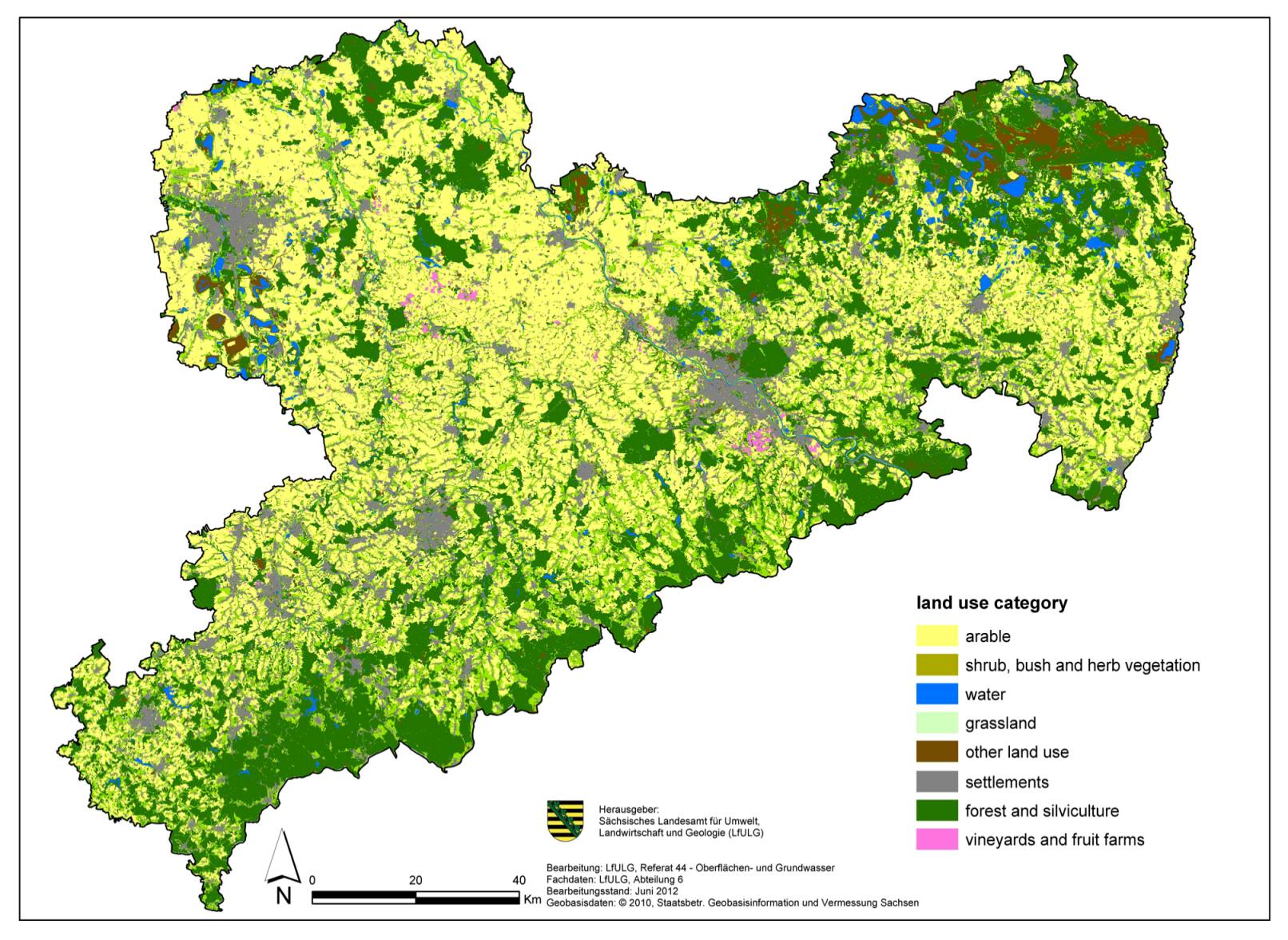
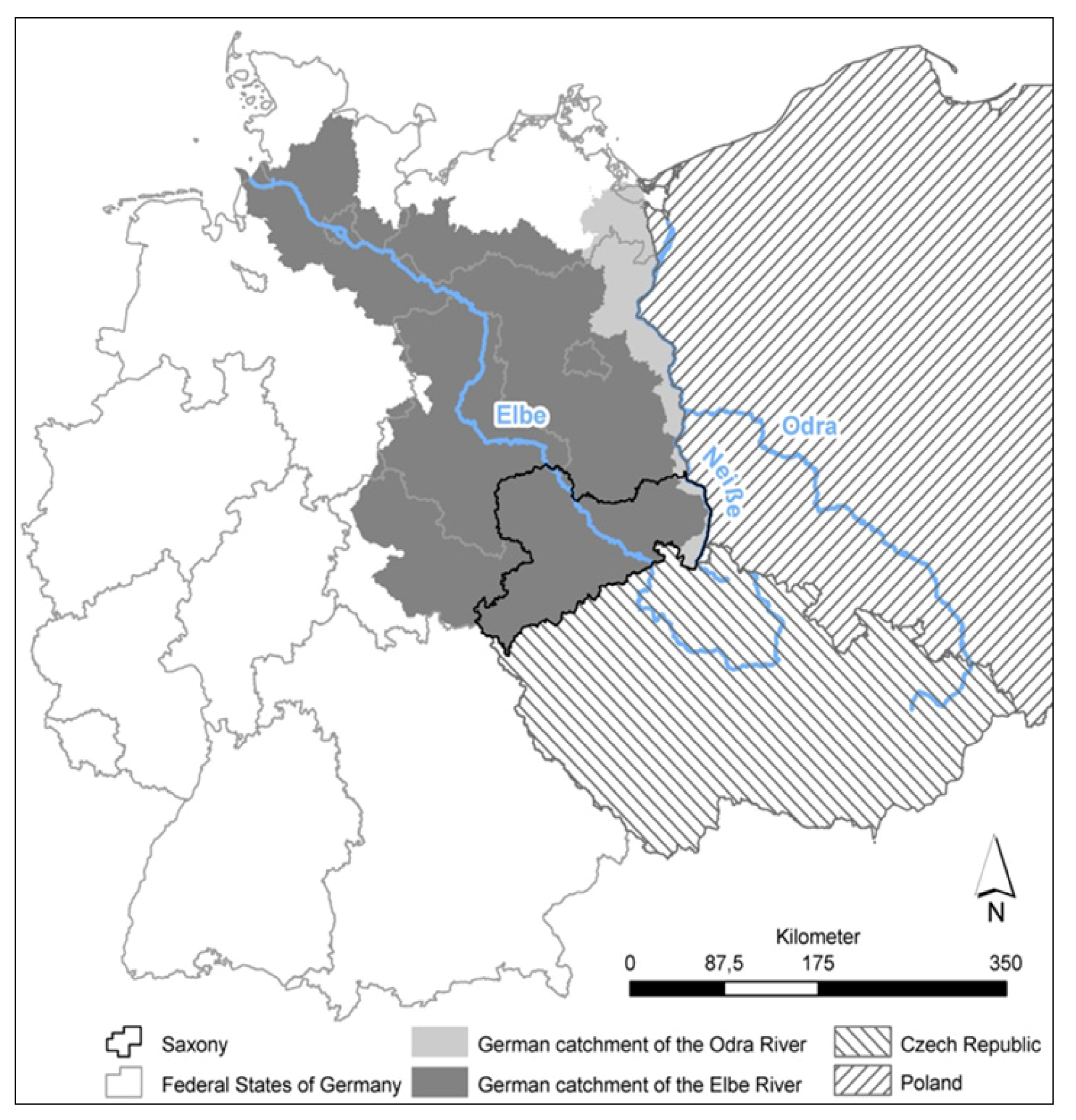
2. Study Area

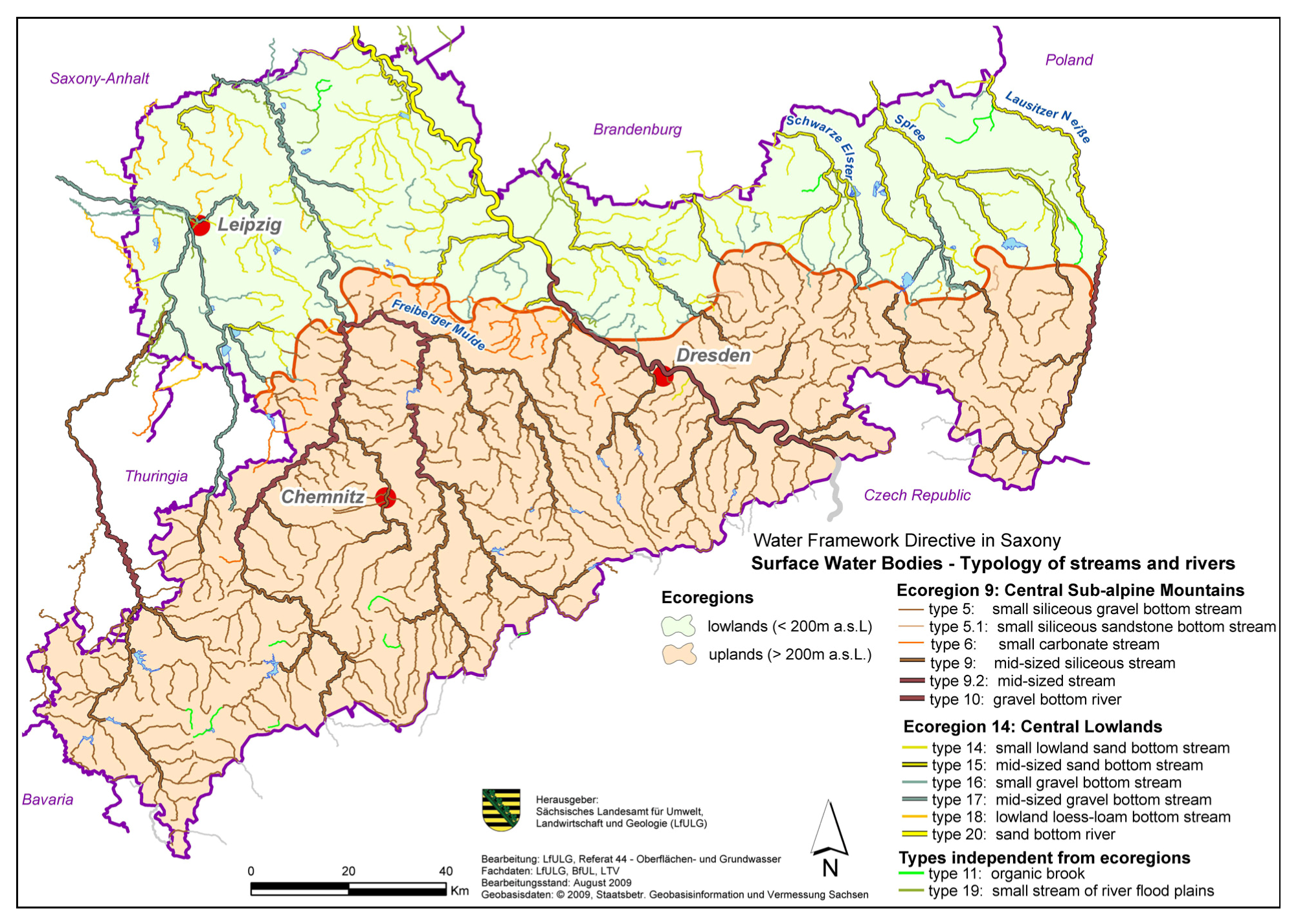
Typology and Delineating of Water Bodies from Rivers and Streams According to Annex II of the WFD

| Stream types | Total length of streams (km) | No. of water bodies |
|---|---|---|
| ecoregion 9: central sub-alpine mountains | - | - |
| type 5: small siliceous gravel bottom stream | 3,207 | 308 |
| type 5.1: small siliceous sandstone bottom stream | 25 | 3 |
| type 6: small carbonate stream | 223 | 26 |
| type 9: mid-sized siliceous stream | 826 | 47 |
| type 9.2: mid-sized stream | 180 | 6 |
| type 10: gravel bottom river | 108 | 2 |
| eco region 14: central lowlands | - | - |
| type 14: small lowland sand bottom stream | 814 | 96 |
| type 15: mid-sized sand bottom stream | 480 | 24 |
| type 16: small gravel bottom stream | 273 | 31 |
| type 17: mid-sized gravel bottom stream | 322 | 15 |
| type 18: lowland loess-loam bottom stream | 175 | 20 |
| type 20: sand bottom river | 75 | 1 |
| types independent from ecoregions | - | - |
| type 11: organic brook | 93 | 12 |
| type 19: small stream of river flood plains | 266 | 26 |
3. Methodological Approach
3.1. Designation of Heavily Modified and Artificial Water Bodies According to Article 4 (3) of the WFD
3.2. Ecological Status of Stream Water Bodies
| BQE | Phyto-plankton | Macrophytes and Phytobenthos | Benthic invertebrates | Fish |
|---|---|---|---|---|
| parameters | species, abundances, biomass, chl-a | species, abundances | species, abundances | species, abundances, age structure |
| sampling time and frequency | sampling of phytoplankton by water scooper during April to October monthly and sampling of chl-a two-weekly both for at least 3 subsequent years | stream section (100 m) representative for most of the stream in terms of water quality and morphology 1 sampling per year during the main vegetative period (June-September), in acidified streams additional sampling after snow melt | stream section (20-100 m, depending on stream width) representative for most of the stream in terms of water quality and morphology sampling at the river Elbe were exceptionally performed at 8 sites due to the size of the river 1 sampling per year | electro-fishing in stream sections depending on fish zonation, (mainly 2 sampling stretches per water body) 1 sampling per year |
| method by | [16] | [17] | [8] | [18] |
| analysis software | PhytoFluss | PHYLIB DV-Tool | ASTERICS | FIBS |
3.3. Impacts and Pressures According to Article 5 of the WFD
| Stream types | O2 (mg/L) | TOC (mg/L) | BOD5 (mg/L) | TP (mg/L) | SRP (mg/L) | NH4-N (mg/L) | pH |
|---|---|---|---|---|---|---|---|
| Ecoregion 9: Central sub-alpine mountains | |||||||
| type 5 | >7 | 7 | 4 | 0.1 | 0.07 | 0.3 | 6.5–8.5 |
| type 5.1 | >7 | 7 | 4 | 0.1 | 0.07 | 0.3 | 6.5–8.5 |
| type 6 | >7 | 7 | 4 | 0.1 | 0.07 | 0.3 | 6.5–8.5 |
| type 9 | >7 | 7 | 4 | 0.1 | 0.07 | 0.3 | 6.5–8.5 |
| type 9.2 | >6 | 7 | 6 | 0.1 | 0.07 | 0.3 | 6.5–8.5 |
| type 10 | >6 | 7 | 6 | 0.15 | 0.07 | 0.3 | 6.5–8.5 |
| Ecoregion 14: Central lowlands | |||||||
| type 14 | >7 | 7 | 4 | 0.1 | 0.07 | 0.3 | 6.5–8.5 |
| type 15 | >6 | 7 | 6 | 0.1–0.15* | 0.07 | 0.3 | 6.5–8.5 |
| type 16 | >7 | 7 | 4 | 0.1 | 0.07 | 0.3 | 6.5–8.5 |
| type 17 | >6 | 7 | 6 | 0.1–0.15* | 0.07 | 0.3 | 6.5–8.5 |
| type 18 | >7 | 7 | 4 | 0.1 | 0.07 | 0.3 | 6.5–8.5 |
| type 20 | >6 | 7 | 6 | 0.15 | 0.07 | 0.3 | 6.5–8.5 |
| Types independent from ecoregions | |||||||
| type 11 | >6 | 10 | 6 | 0.15 | 0.1 | 0.3 | 5–8 |
| type 19 | >6 | 10 | 6 | 0.15 | 0.1 | 0.3 | 5–8 |
3.4. Program of Measures (POM) According to Article 11 of the WFD
4. Results
4.1. Classification of Ecological Status According to Annex V of the WFD
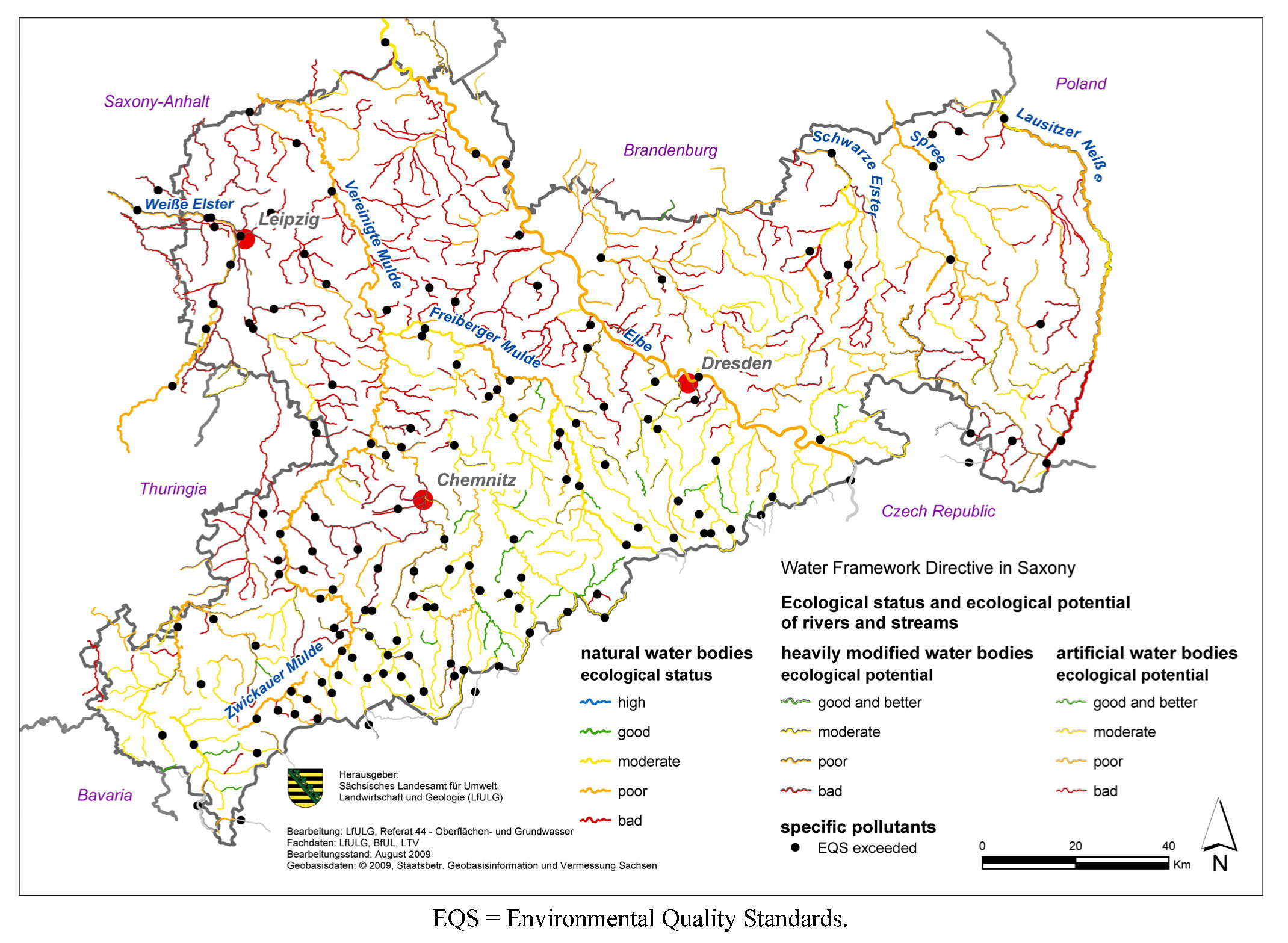
| Ecological status | Phytoplankton* | Macrophytes and Phytobenthos | Benthic invertebrates | Fish | Final classification |
|---|---|---|---|---|---|
| Very good | 0 | 9 | 1 | 26 | 0 |
| Good | 3 | 103 | 132 | 92 | 23 |
| Moderate | 11 | 332 | 185 | 146 | 159** |
| Poor | 4 | 158 | 163 | 107 | 146 |
| Bad | 0 | 15 | 136 | 246 | 289 |
4.2. Significant Pressures and Impacts
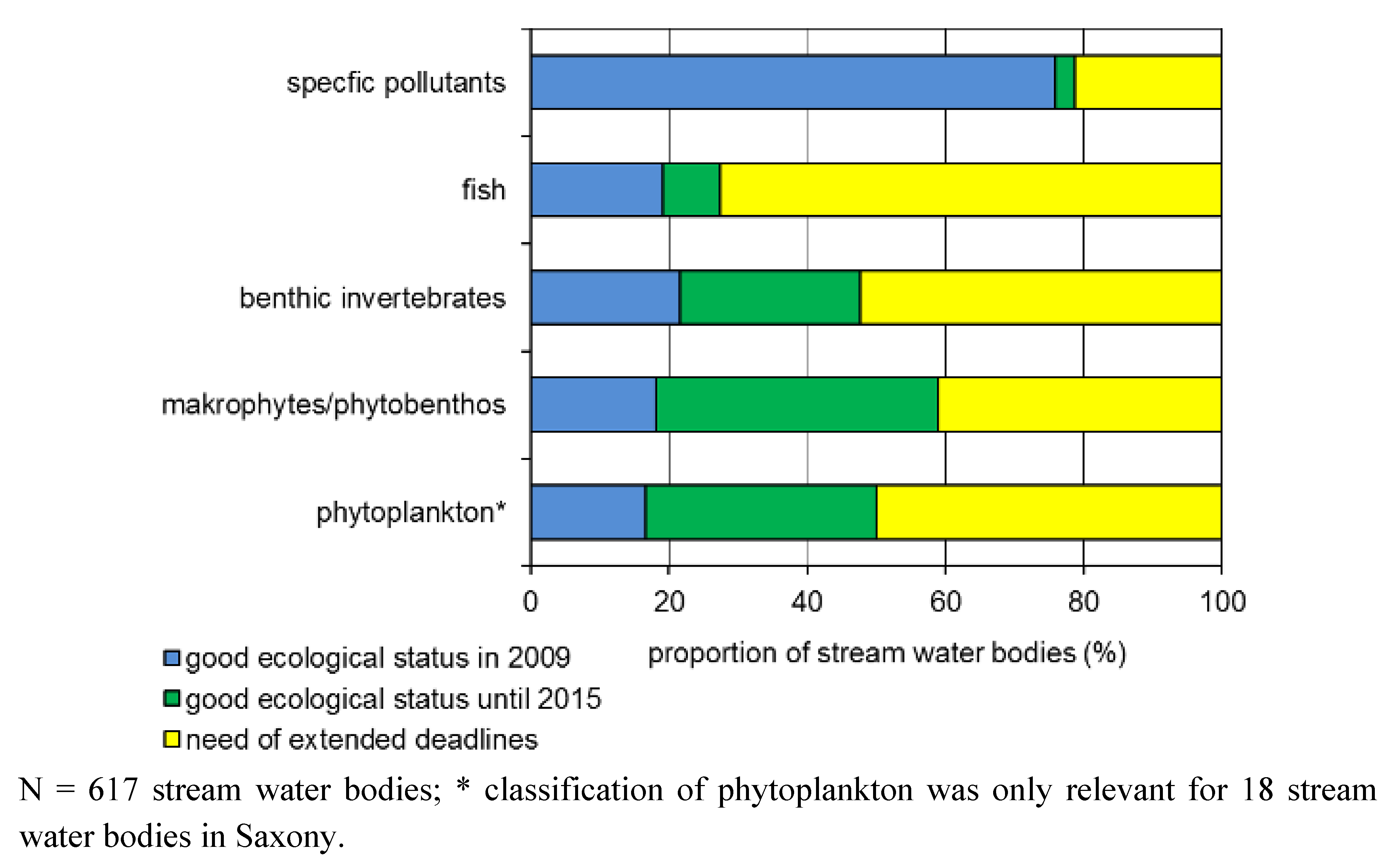
4.3. Prospects of Improvement, Environmental Objectives and Exemptions

5. Conclusions
Acknowledgments
References
- Meybeck, M. Global analysis of river systems: From earth system controls to anthropocene syndromes. Phil. Trans. R. Soc. Lond. B 2003, 358, 1935–1955. [Google Scholar] [CrossRef]
- Canobbio, S.; Mezzanotte, V.; Sanfilippo, U.; Benvenuto, F. Effect of multiple stressors on water quality and macroinvertebrate assemblages in an effluent-dominated stream. Water Air Soil Pollut. 2009, 198, 359–371. [Google Scholar] [CrossRef]
- Kronvang, B.; Bechmann, M.; Lundekvam, H.; Behrendt, H.; Rubæk, G.H.; Schoumans, O.F.; Syversen, N.; Andersen, H.E.; Hoffmann, C.C. Phosphorus losses from agricultural areas in river basins: Effects and uncertainties of targeted mitigation measures. J. Environ. Qual. 2005, 34, 2129–2144. [Google Scholar] [CrossRef]
- Schulz, R. Field studies on exposure, effects, and risk mitigation of aquatic nonpoint-source insecticide pollution: A review. J. Environ. Qual. 2004, 33, 419–448. [Google Scholar] [CrossRef]
- Mestre, M.A. Environmental Impact of Mine Drainage and Its Treatment on Aquatic Communities.
- O’Driscoll, M.; Clinton, S.; Jefferson, A.; Manda, A.; McMillan, S. Urbanization effects on watershed hydrology and in-stream processes in the Southern United States. Water 2010, 2, 605–648. [Google Scholar] [CrossRef]
- European Commission, Directive 2000/60/EC of the European Parliament and of the Council: Establishing a Framework for Community Action in the Field of Water Policy; European Commission: Kirchberg, Luxembourg, 2000.
- Hering, D.; Johnson, R.K.; Kramm, S.; Schmutz, S.; Szoszkiewicz, K.; Verdonschot, P.F.M. Assessment of European streams with diatoms, macrophytes, macroinvertebrates and fish: A comparative metric-based analysis of organism response to stress. Freshwat. Biol. 2010, 51, 1757–1785. [Google Scholar]
- Moss, B. The water framework directive: Total environment or political compromise? Sci. Total Environ. 2008, 400, 32–41. [Google Scholar] [CrossRef]
- European Commission, Common Implementation Strategy for the Water Framework Directive; Guidance for Reporting under the Water Framework Directive, Guidance Document No. 21; Office for Official Publications of the European Communities: Kirchberg, Luxembourg, 2009.
- Saxon State Agency for Environment, Agriculture and Geology. Emissionsbericht Abwasser 2010 (in German); Saxon State Agency for Environment, Agriculture and Geology: Dresden, Germany. Available online: http://www.umwelt.sachsen.de/umwelt/wasser/download/EBAbw2010_gesamt5_karten.pdf (accessed on 1 November 2012).
- European Commission, Common Implementation Strategy for the Water Framework Directive: Identification of Water Bodies; Guidance Document No. 2; Office for Official Publications of the European Communities: Kirchberg, Luxembourg, 2003.
- Illies, J. Limnofauna Europeae (in German), 2nd ed; Gustav Fischer Verlag: Stuttgart, Germany, 1978; p. 552. [Google Scholar]
- European Commission, Common Implementation Strategy for the Water Framework Directive: Identification and Designation of Heavily Modified and Artificial Water Bodies; Guidance Document No. 4; Office for Official Publications of the European Communities: Kirchberg, Luxembourg, 2003.
- European Commission, Common Implementation Strategy for the Water Framework Directive: Overall Approach to the Classification of Ecological Status and Ecological Potential; Guidance Document No. 13; Office for Official Publications of the European Communities: Kirchberg, Luxembourg, 2005.
- Mischke, U.; Behrendt, H. Handbuch zum Bewertungsverfahren von Fließgewässern Mittels Phytoplankton zur Umsetzung der EU-WRRL in Deutschland (in German); Weißensee Verlag: Berlin, Germany, 2007. [Google Scholar]
- Schaumburg, J.; Schranz, C.; Stelzer, D.; Hofmann, G.; Gutowski, A.; Förster, J. Verfahrensanleitung für die ökologische Bewertung von Fließgewässern zur Umsetzung der EU-Wasserrahmenrichtlinie: Makrophyten und Phytobenthos (in German); Bayerisches Landesamt für Umwelt: Augsburg, Germany, 2006. Available online: http://www.lfu.bayern.de/wasser/gewaesserqualitaet_seen/phylib_deutsch/verfahrensanleitung/doc/verfahrensanleitung_fg.pdf (accessed on 21 May 2012).
- Diekmann, M.; Dußling, U.; Berg, R. Handbuch zum fischbasierten Bewertungssystem für Fließgewässer (FIBS) (in German); Fischereiforschungsstelle Baden-Württemberg: Langenargen, Germany, 2005. Available online: http://www.flussgebiete.nrw.de/Unterlagen/FIBS_Handreichungstext_2005.pdf (accessed on 21 May 2012).
- Gebel, M.; Halbfaß, S.; Bürger, S.; Friese, H.; Naumann, S. Modelling of nitrogen turnover and leaching in Saxony. Adv. Geosci. 2010, 27, 139–144. [Google Scholar] [CrossRef]
- McDonald, A.; Lane, S.N.; Haycock, N.E.; Chalk, E.A. Rivers of dreams: On the gulf between theoretical and practical aspects of an upland river restoration. Trans. Inst. Brit. Geogr. 2004, 29, 257–281. [Google Scholar] [CrossRef]
- Adams, M.S.; Ballin, U.; Gaumert, T.; Hale, B.W.; Kausch, H.; Kruse, R. Monitoring selected indicators of ecological change in the Elbe River since the fall of the Iron Curtain. Environ. Conserv. 2001, 28, 333–344. [Google Scholar]
- Vörösmarty, C.J.; McIntyre, P.B.; Gessner, M.O.; Dudgeon, D.; Prusevich, A.; Green, P.; Glidden, S.; Bunn, S.E.; Sullivan, C.A.; Liermann, R.C.; Davies, P.M. Global threats to human water security and river biodiversity. Nature 2010, 467, 555–561. [Google Scholar]
- Hering, D.; Borja, A.; Carstensen, J.; Carvalho, L.; Elliott, M.; Feld, C.K.; Heiskanen, A.-S.; Johnson, R.K.; Moe, J.; Pont, D.; Solheim, A.L.; van de Bund, W. The European Water Framework Directive at the age of 10: A critical review of the achievements with recommendations for the future. Sci. Total Environ. 2010, 408, 4007–4019. [Google Scholar] [Green Version]
- Caroni, R.; van de Bund, W. Review of Approaches for Combining BQEs in WFD Assessment; Wiser Deliverable D6.2-1; WISER (Water bodies in Europe: Integrative Systems to assess Ecological status and Recovery): Essen, Germany, 2012. Available online: http://www.wiser.eu/download/D6.2-1.pdf (accessed on 21 May 2012).
© 2012 by the authors; licensee MDPI, Basel, Switzerland. This article is an open-access article distributed under the terms and conditions of the Creative Commons Attribution license (http://creativecommons.org/licenses/by/3.0/).
Share and Cite
Spänhoff, B.; Dimmer, R.; Friese, H.; Harnapp, S.; Herbst, F.; Jenemann, K.; Mickel, A.; Rohde, S.; Schönherr, M.; Ziegler, K.; et al. Ecological Status of Rivers and Streams in Saxony (Germany) According to the Water Framework Directive and Prospects of Improvement. Water 2012, 4, 887-904. https://doi.org/10.3390/w4040887
Spänhoff B, Dimmer R, Friese H, Harnapp S, Herbst F, Jenemann K, Mickel A, Rohde S, Schönherr M, Ziegler K, et al. Ecological Status of Rivers and Streams in Saxony (Germany) According to the Water Framework Directive and Prospects of Improvement. Water. 2012; 4(4):887-904. https://doi.org/10.3390/w4040887
Chicago/Turabian StyleSpänhoff, Bernd, Roland Dimmer, Holm Friese, Steve Harnapp, Frank Herbst, Kerstin Jenemann, Antje Mickel, Sylvia Rohde, Michaela Schönherr, Katrin Ziegler, and et al. 2012. "Ecological Status of Rivers and Streams in Saxony (Germany) According to the Water Framework Directive and Prospects of Improvement" Water 4, no. 4: 887-904. https://doi.org/10.3390/w4040887