<?xml version="1.0" encoding="UTF-8"?>
<!DOCTYPE article PUBLIC "-//NLM//DTD Journal Publishing DTD v2.3 20070202//EN" "journalpublishing.dtd">
<article xmlns:mml="http://www.w3.org/1998/Math/MathML" xmlns:xlink="http://www.w3.org/1999/xlink" xml:lang="en" article-type="research-article">
  <front>
    <journal-meta>
      <journal-id journal-id-type="publisher-id">water</journal-id>
      <journal-title>Water</journal-title>
      <abbrev-journal-title abbrev-type="publisher">Water</abbrev-journal-title>
      <abbrev-journal-title abbrev-type="pubmed">water</abbrev-journal-title>
      <issn pub-type="epub">2073-4441</issn>
      <publisher>
        <publisher-name>MDPI</publisher-name>
      </publisher>
    </journal-meta>
    <article-meta>
      <article-id pub-id-type="doi">10.3390/w4030533</article-id>
      <article-id pub-id-type="publisher-id">water-04-00533</article-id>
      <article-categories>
        <subj-group>
          <subject>Article</subject>
        </subj-group>
      </article-categories>
      <title-group>
        <article-title>Creation of Carbon Credits by Water Saving</article-title>
      </title-group>
      <contrib-group>
        <contrib contrib-type="author">
          <name>
            <surname>Shimizu</surname>
            <given-names>Yasutoshi</given-names>
          </name>
          <xref rid="af1-water-04-00533" ref-type="aff">1</xref>
          <xref rid="c1-water-04-00533" ref-type="corresp">*</xref>
        </contrib>
        <contrib contrib-type="author">
          <name>
            <surname>Toyosada</surname>
            <given-names>Kanako</given-names>
          </name>
          <xref rid="af1-water-04-00533" ref-type="aff">1</xref>
        </contrib>
        <contrib contrib-type="author">
          <name>
            <surname>Yoshitaka</surname>
            <given-names>Mari</given-names>
          </name>
          <xref rid="af2-water-04-00533" ref-type="aff">2</xref>
        </contrib>
        <contrib contrib-type="author">
          <name>
            <surname>Sakaue</surname>
            <given-names>Kyosuke</given-names>
          </name>
          <xref rid="af3-water-04-00533" ref-type="aff">3</xref>
        </contrib>
      </contrib-group>
      <aff id="af1-water-04-00533"><label>1</label> ESG Promotion Department, TOTO LTD, 2-1-1, Nakashima, Kokurakita-ku, Kitakyushu-City 802-8601, Japan; Email: <email>kanako.toyosada@jp.toto.com</email></aff>
      <aff id="af2-water-04-00533"><label>2</label> CDM/JI Senior Consultant, Clean Energy Finance Committee, Mitsubishi UFJ Morgan Stanley Securities Co., Ltd, 3-3-20, Toyosu, Koto-ku, Tokyo 135-0061, Japan; Email: <email>yoshitaka-mari@sc.mufg.jp</email></aff>
      <aff id="af3-water-04-00533"><label>3</label> Department of Architecture, School of Science and Techinology, Meiji University, 1-1-1, Higashimita, Tama-ku, Kawasaki-City 214-8601, Japan; Email: <email>sakaue@isc.meiji.ac.jp</email></aff>
      <author-notes>
        <corresp id="c1-water-04-00533"><label>*</label> Author to whom correspondence should be addressed; Email: <email>yasutoshi.shimizu@jp.toto.com</email>; Tel.: +81-93-952-3315; Fax: +81-93-952-3468.</corresp>
      </author-notes>
      <pub-date pub-type="epub">
        <day>09</day>
        <month>07</month>
        <year>2012</year>
      </pub-date>
      <pub-date pub-type="collection"><month>09</month>
        <year>2012</year>
      </pub-date>
      <volume>4</volume>
      <issue>3</issue>
      <fpage>533</fpage>
      <lpage>544</lpage>
      <history>
        <date date-type="received">
          <day>13</day>
          <month>06</month>
          <year>2012</year>
        </date>
        <date date-type="rev-recd">
          <day>27</day>
          <month>06</month>
          <year>2012</year>
        </date>
        <date date-type="accepted">
          <day>28</day>
          <month>06</month>
          <year>2012</year>
        </date>
      </history>
      <permissions>
        <copyright-statement>©  2012 by the authors; licensee MDPI, Basel, Switzerland.</copyright-statement>
        <copyright-year>2012</copyright-year>
        <license xmlns:xlink="http://www.w3.org/1999/xlink" license-type="open-access" xlink:href="http://creativecommons.org/licenses/by/3.0/">
          <p>This article is an open-access article distributed under the terms and conditions of the Creative Commons Attribution license (http://creativecommons.org/licenses/by/3.0/).</p>
        </license>
      </permissions>
      <abstract>
        <p>Until now, as a way of reducing greenhouse gas emissions from Japanese homes, the emphasis has been on reduction of energy consumption for air-conditioning and lighting. In recent years, there has been progress in CO<sub>2</sub> emission reduction through research into the water-saving performance of bathroom fixtures such as toilets and showers. Simulations have shown that CO<sub>2</sub> emissions associated with water consumption in Japanese homes can be reduced by 25% (1% of Japan’s total CO<sub>2 </sub>emissions) by 2020 through the adoption of the use of water-saving fixtures. In response to this finding, a program to promote the replacement of current fixtures with water-saving toilet bowls and thermally insulated bathtubs has been added to the Government of Japan’s energy-saving policy. Furthermore, CO<sub>2</sub> emission reduction through widespread use of water-saving fixtures has been adopted by the domestic credit system promoted by the Government of Japan as a way of achieving CO<sub>2</sub> emission-reduction targets; application of this credit system has also begun. As part of a bilateral offset credit mechanism promoted by the Government of Japan, research to evaluate the CO<sub>2</sub> reduction potential of the adoption of water-saving fixtures has been done in the city of Dalian, in China.</p>
      </abstract>
      <kwd-group>
        <kwd>global warming</kwd>
        <kwd>CO<sub>2</sub> reduction</kwd>
        <kwd>water</kwd>
        <kwd>saving-water</kwd>
        <kwd>Japan</kwd>
      </kwd-group>
    </article-meta>
  </front>
  <body>
    <sec sec-type="intro">
      <title>1. Introduction</title>
      <p>Japan is now in the first commitment period (2008 to 2012) of the Kyoto Protocol, and has assumed responsibility for a 6% reduction in greenhouse gas (described as CO<sub>2</sub> below) on the basis of emission in 1990. Under the present circumstances, although a 4.1% reduction in total emissions is being achieved owing to the effort in the industrial world, emissions from the housing sector are increasing by no less than 26.9%. Hence, measures to reduce emissions from the housing sector have become important for promoting future CO<sub>2</sub> reduction [<xref ref-type="bibr" rid="B1-water-04-00533">1</xref>]. Therefore, measures have been implemented for cars and home appliances, which contribute the most to CO<sub>2</sub> emission from the housing sector. In order to promote the replacement of conventional appliances with environmentally friendly cars and energy-saving home appliances and lighting, tax reduction and replacement subsidies, known as home appliance Eco-points, have been introduced.</p>
      <p>In recent years, researches on associated water use and CO<sub>2 </sub>emission have been performed globally [<xref ref-type="bibr" rid="B2-water-04-00533">2</xref>,<xref ref-type="bibr" rid="B3-water-04-00533">3</xref>,<xref ref-type="bibr" rid="B4-water-04-00533">4</xref>]. Also in Japan, research relating to water-saving performance of bathroom fixtures such as toilets and showers with CO<sub>2</sub> reduction has progressed, and the fact that the widespread use of water-saving fixtures can be effective in CO<sub>2</sub> reduction has been recognized. Hence, housing Eco-point subsidies have been introduced to promote the replacement of traditional toilets with water-saving ones.</p>
      <p>The method of reducing CO<sub>2</sub> using water-saving fixtures was adopted in the domestic credit system, which is one of the techniques used in Japan to achieve the targets for reduction of CO<sub>2</sub> emissions. Using the bilateral offset credit mechanism, the potential for CO<sub>2</sub> reduction by using water-saving fixtures was evaluated in China. </p>
      <p>Recent studies on the effect of water saving on global warming and an example demonstrating the application of the carbon credits related to water saving are outlined.</p>
    </sec>
    <sec>
      <title>2. Carbon Credit</title>
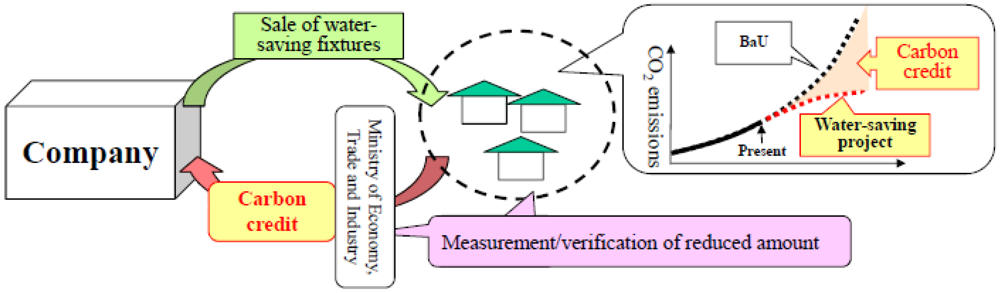
      <p>A credit indicates trust, and a carbon credit is the proof of the amount of reduction in CO<sub>2</sub> emissions. Carbon credits are specified in the Kyoto Protocol adopted by the Framework Convention on Climate Change. In a developed country with a greenhouse gas (GHG) reduction target (<italic>i.e.</italic>, allowance amount), the carbon credit system is one in which credits can be traded and can offset the CO<sub>2</sub> emissions that cannot be reduced only by efforts in the country of origin. The United Nations validates the credits; some credits receive certification from an accredited independent entity, and some from the government of their own country. These carbon credits have been designated as the clean development mechanism (CDM), which has obtained recognition from the United Nations. In existence are also the domestic CDM credit (Ministry of Economy, Trade and Industry recognition) and the J-VER credit (Ministry of Environment recognition), which has been certified as a domestic system by the Government of Japan.</p>
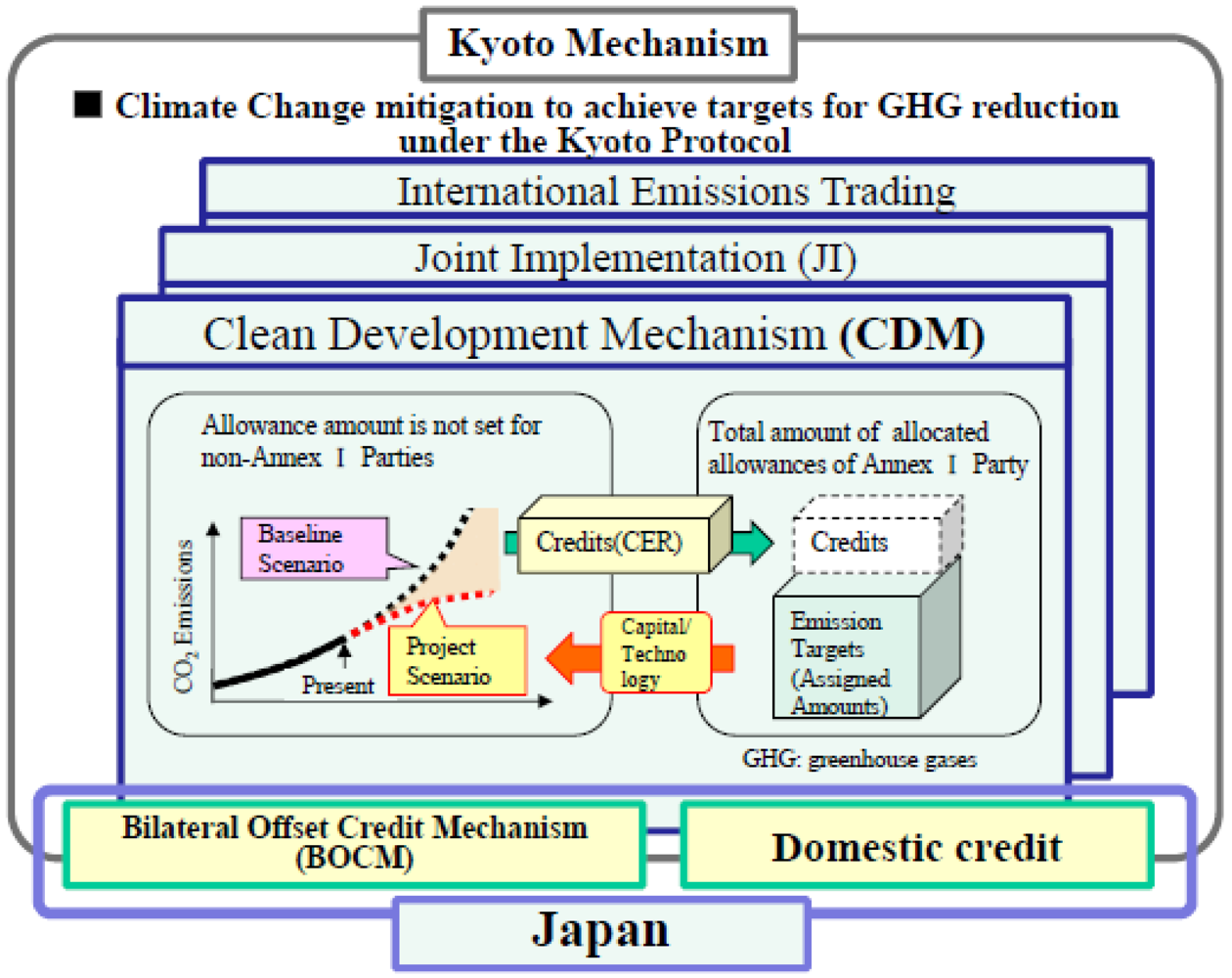
      <p>CDMs are GHG emission reduction projects carried out in developing countries that are not burdened with the targets related to allowance amount, such as use of renewable energy and energy-saving measures. The credit is defined as the reduction in emission caused by implementation of a project, relative to the amount of emission with no project (the baseline emission). The outline is shown in <xref ref-type="fig" rid="water-04-00533-f001">Figure 1</xref>.</p>
      <fig id="water-04-00533-f001" position="anchor">
        <label>Figure 1</label>
        <caption>
          <p>Outline of Carbon Credit.</p>
        </caption>
        <graphic xmlns:xlink="http://www.w3.org/1999/xlink" xlink:href="water-04-00533-g001.tif"/>
      </fig>
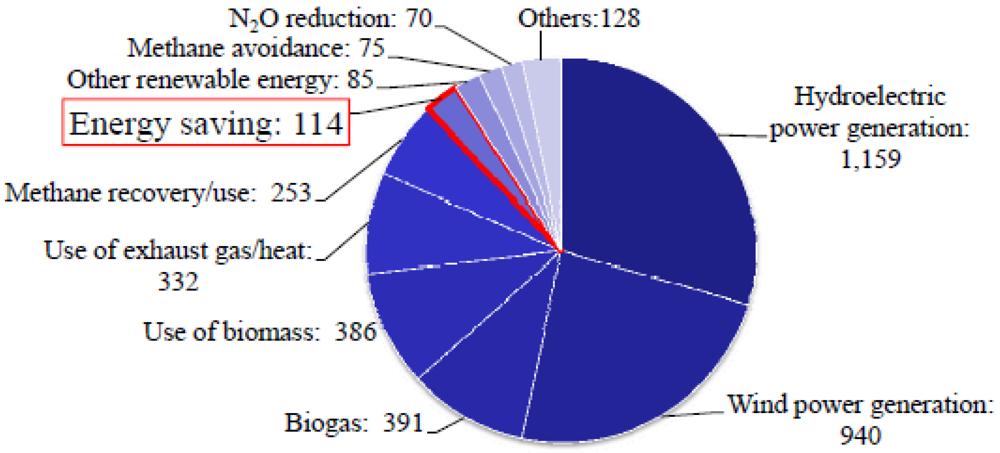
      <p>The number of projects registered with the U.N. CDM executive board was 3933, as of March 2012. The sum total of the predicted reduction in emissions reached a quantity equivalent to 2% of the total amount of the global CO<sub>2</sub> emission, and many projects are underway in developing countries such as China, India, and Brazil [<xref ref-type="bibr" rid="B5-water-04-00533">5</xref>]. The registration project classifications are shown in <xref ref-type="fig" rid="water-04-00533-f002">Figure 2</xref>. CDMs are focused on energy fields with the potential for large CO<sub>2</sub> reductions. </p>
      <p>After the first commitment period (from 2008 to 2012) of the Kyoto Protocol, the 17th UN Framework Convention on Climate Change meetings were held in Durban, South Africa, and it was decided to continue the emission reduction measures. Simultaneously, aside from the Kyoto Protocol, a new mechanism is being tested, and it will be implemented by 2020. </p>
      <p>CDMs require strict verification. Therefore, many verification data and measurements are required as proof of a project. The complicated nature of procedure together with cost factors have constrained the application of CDMs in developing countries.</p>
      <p>The new mechanism was proposed as a solution. For quick reduction in GHGs, rules based on the situation of each country are more effective than a globally enforced uniform rule, formulated by the U.N. (e.g., a CDM). Therefore, Japan has proposed the following. “Japan can provide developing countries with the technology, products, systems, infrastructure, <italic>etc</italic>. that contributes to GHG emission reduction, and the two countries can conduct a collaborative project. Thus, GHG emission reduction helps achieve a medium-term goal for Japan.” This new mechanism is called a bilateral offset credit mechanism (BOCM), and many feasibility investigations have already been carried out since 2010 [<xref ref-type="bibr" rid="B6-water-04-00533">6</xref>]. </p>
      <fig id="water-04-00533-f002" position="anchor">
        <label>Figure 2</label>
        <caption>
          <p>Projects registered in the UN CDM Executive Board.</p>
        </caption>
        <graphic xmlns:xlink="http://www.w3.org/1999/xlink" xlink:href="water-04-00533-g002.tif"/>
      </fig>
    </sec>
    <sec>
      <title>3. Research Associating Water Consumption and CO<sub>2</sub> Emission</title>
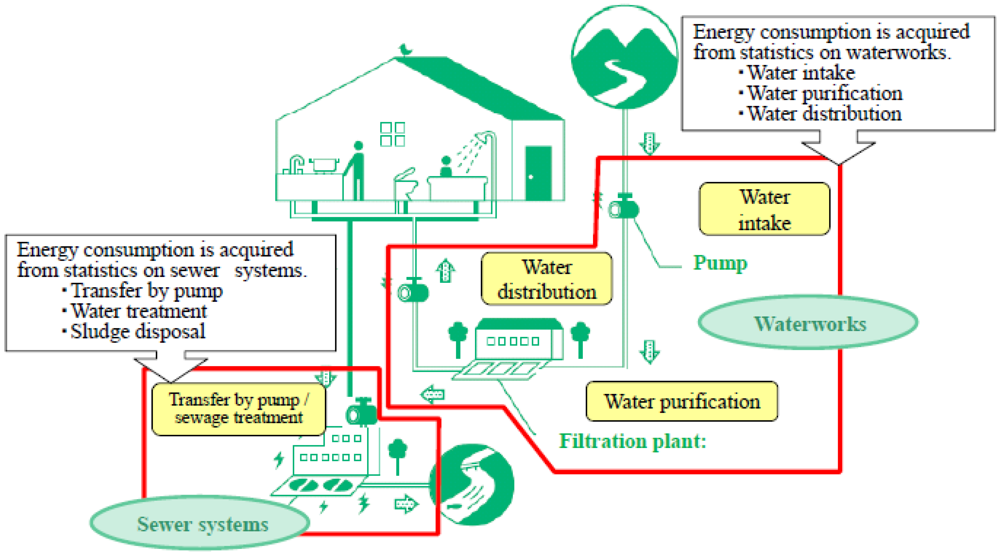
      <p>The relationship between water consumption and CO<sub>2</sub> emission is indicative of the energy consumption in the infrastructure for waterworks and sewer systems, as shown in <xref ref-type="fig" rid="water-04-00533-f003">Figure 3</xref>. The environmental housekeeping book in 1996 states that water consumption per 1 m<sup>3</sup> was equivalent to an emission of 0.59 kg of CO<sub>2</sub> [<xref ref-type="bibr" rid="B7-water-04-00533">7</xref>]. However, it was revised to include only the value of the waterworks and no further study was carried out.</p>
      <fig id="water-04-00533-f003" position="anchor">
        <label>Figure 3</label>
        <caption>
          <p>Calculation boundary for CO<sub>2</sub> emission factor of water.</p>
        </caption>
        <graphic xmlns:xlink="http://www.w3.org/1999/xlink" xlink:href="water-04-00533-g003.tif"/>
      </fig>
      <p>At the Ministry of Environment, the amount of CO<sub>2</sub> emission was classified and announced officially as GHG inventory data [<xref ref-type="bibr" rid="B8-water-04-00533">8</xref>]. CO<sub>2</sub> generated in power plants by energy consumption is divided proportionally by end use as CO<sub>2</sub> emission from electric power consumption. For example, CO<sub>2</sub> discharged by electric power consumption at home is referred to as the housing sector end use. This stimulates energy saving by the end users.</p>
      <p>However, CO<sub>2</sub> emission attributed to water was classified for other sectors as emission from energy consumption in the waterworks and sewer systems, and users were not urged to carry out water-saving measures. Therefore, domestic awareness of the effectiveness of water-saving measures in combating global warming was low. </p>
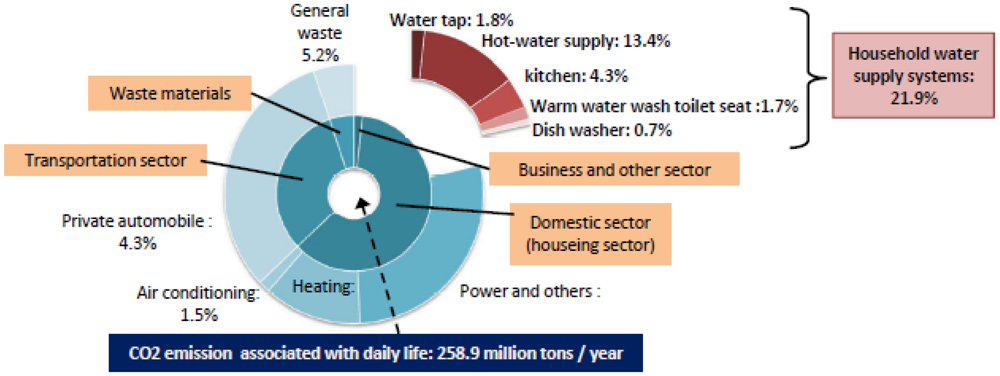
      <p>Therefore, we started estimating the amount of CO<sub>2</sub> emission originating from residential water use in our country. It was found that CO<sub>2</sub> emissions originating from residential water use (including heating of water) comprise up to 5% of the total CO<sub>2 </sub>emission of Japan [<xref ref-type="bibr" rid="B9-water-04-00533">9</xref>]. The breakdown of CO<sub>2</sub> emissions from Japanese houses are shown in <xref ref-type="fig" rid="water-04-00533-f004">Figure 4</xref>.</p>
      <fig id="water-04-00533-f004" position="anchor">
        <label>Figure 4</label>
        <caption>
          <p>Breakdown of CO<sub>2</sub> emissions from Japanese houses [<xref ref-type="bibr" rid="B1-water-04-00533">1</xref>]. CO<sub>2</sub> emissions from the warm water wash toilet seat and the dish washer reported in the “electricity use by equipment at home for FY2005” were added to CO<sub>2</sub> emissions from water supply systems and reconstructed as CO<sub>2</sub> emissions from Japanese houses.</p>
        </caption>
        <graphic xmlns:xlink="http://www.w3.org/1999/xlink" xlink:href="water-04-00533-g004.tif"/>
      </fig>
      <p>It turned out that this is the third major source, following cars and home appliances. Hitherto, the energy-saving measures in the housing sector had concentrated on cars and home appliances. Owing to the result of this research, residential plumbing systems have gained attention.</p>
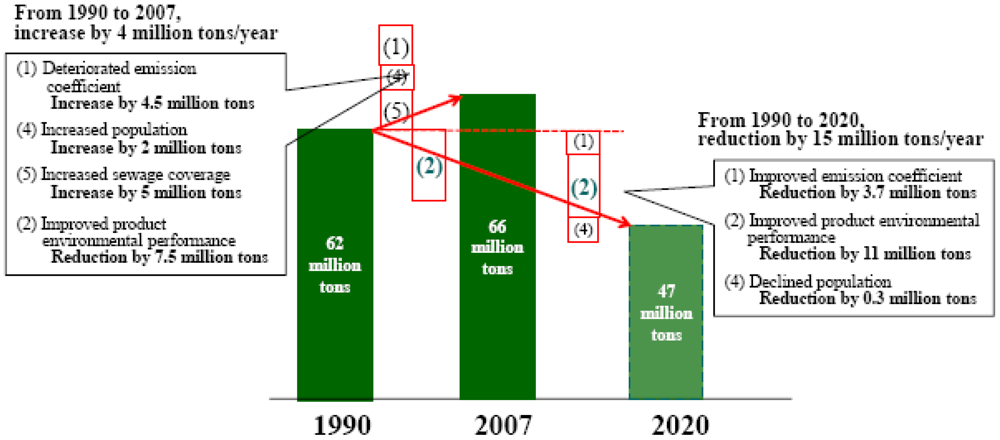
      <p>Moreover, simulations were carried out to study the possible reduction of CO<sub>2</sub> emissions originating from residential water use [<xref ref-type="bibr" rid="B10-water-04-00533">10</xref>]. The results showed that a 25% reduction of such CO<sub>2</sub> emission (1% of the total emission of Japan) can be achieved by 2020 through a combination of development of water-saving fixtures for industry, increased administrative support for the widespread use of these fixtures, and efforts to increase users’ awareness of water-saving measures. A simulation result is shown in <xref ref-type="fig" rid="water-04-00533-f005">Figure 5</xref>.</p>
      <p>The simulation research indicated that the widespread use of water-saving fixtures was effective in reducing CO<sub>2</sub> emissions from the housing sector. Owing to these research results, a replacement subsidy called housing Eco-point has been realized in Japan since 2010.</p>
      <fig id="water-04-00533-f005" position="anchor">
        <label>Figure 5</label>
        <caption>
          <p>Estimated CO<sub>2</sub> emissions derived from water usage for residential fixtures.</p>
        </caption>
        <graphic xmlns:xlink="http://www.w3.org/1999/xlink" xlink:href="water-04-00533-g005.tif"/>
      </fig>
      <p>Thereafter, the development of methods for promoting the widespread use of water-saving fixtures was investigated. As a part of these measures, we aimed at realizing a domestic carbon credit system for water-saving fixtures.</p>
      <p>A credit is calculated by converting the reduction in use of water and hot water (as a result of the use water-saving fixtures) into the amount of CO<sub>2 </sub>that would be saved. A credit can be exchanged for money. Thus, precise determination of the CO<sub>2</sub> emission factor for water is necessary for realizing the credit system.</p>
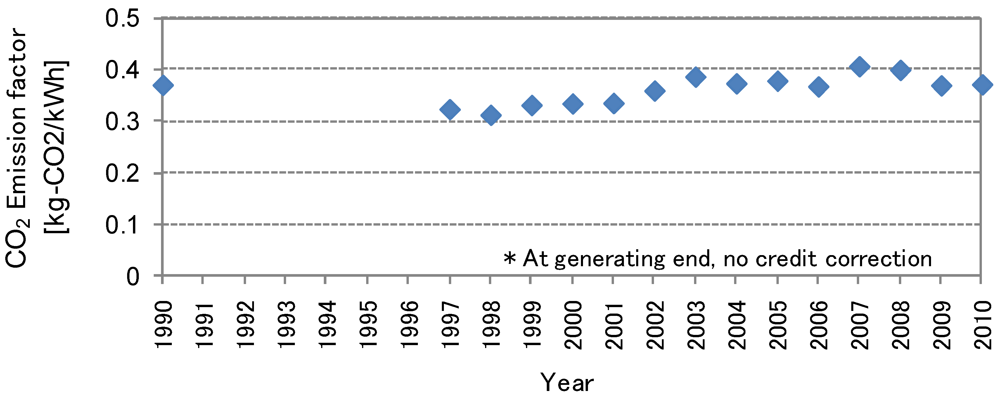
      <p>The CO<sub>2</sub> emission factor of water can be determined from energy consumption and the amount of treated water in waterworks and sewer systems. Electricity contributes about 90% of the energy consumed in these systems. The CO<sub>2</sub> emission factor for electricity has changed annually, as shown in <xref ref-type="fig" rid="water-04-00533-f006">Figure 6</xref>. Therefore, the use of a fixed value (0.59 kg-CO<sub>2</sub>/m<sup>3</sup> of water), as shown in the environmental housekeeping book, is considered unsuitable. </p>
      <fig id="water-04-00533-f006" position="anchor">
        <label>Figure 6</label>
        <caption>
          <p>CO<sub>2 </sub>emission factor of electricity [<xref ref-type="bibr" rid="B11-water-04-00533">11</xref>].</p>
        </caption>
        <graphic xmlns:xlink="http://www.w3.org/1999/xlink" xlink:href="water-04-00533-g006.tif"/>
      </fig>
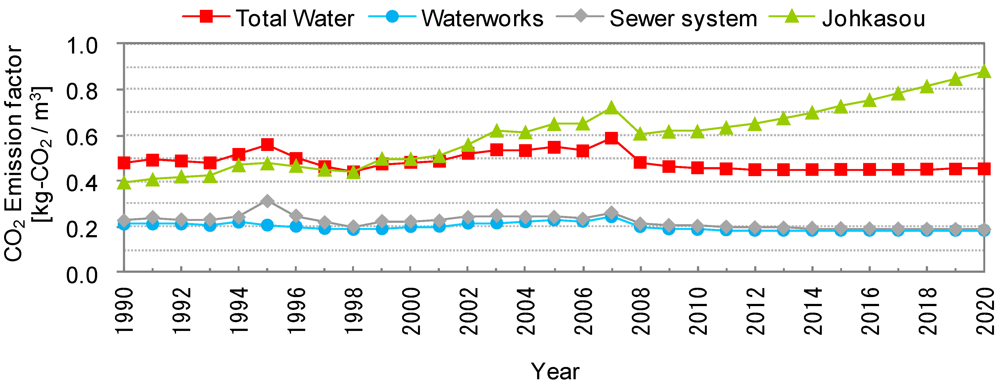
      <p>The operation management data for the waterworks and sewer systems in Japan are reported in terms of statistics of waterworks and statistics of sewer systems each year. Using these data, CO<sub>2 </sub>emission factors of water were calculated by year as average values for the whole of Japan [<xref ref-type="bibr" rid="B12-water-04-00533">12</xref>]. The results are shown in <xref ref-type="fig" rid="water-04-00533-f007">Figure 7</xref>. For the wastewater treatment in Japan, 25% is treated by Johkasou (domestic wastewater treatment tank). Therefore, the effect of Johkasou usage is taken into consideration for the calculation of total water in <xref ref-type="fig" rid="water-04-00533-f007">Figure 7</xref>. </p>
      <p>A study of these results allowed clarification of the relationship between water and CO<sub>2</sub> emission and allowed recognition of the methodology of applying carbon credits to water-saving fixtures in December 2011.</p>
      <fig id="water-04-00533-f007" position="anchor">
        <label>Figure 7</label>
        <caption>
          <p>CO<sub>2 </sub>emission factor of water.</p>
        </caption>
        <graphic xmlns:xlink="http://www.w3.org/1999/xlink" xlink:href="water-04-00533-g007.tif"/>
      </fig>
      <p>The recognized domestic methodology titles are shown below [<xref ref-type="bibr" rid="B13-water-04-00533">13</xref>].</p>
      <list list-type="simple">
        <list-item>
          <p>(1) 043: Replacement with Water-Efficient Housing Equipment;</p>
        </list-item>
        <list-item>
          <p>(2) 043-A: New Installation of Water-Efficient Housing Equipment.</p>
        </list-item>
      </list>
      <p>The scheme is shown in <xref ref-type="fig" rid="water-04-00533-f008">Figure 8</xref>. By adopting a domestic credit system, CO<sub>2</sub> reduction from saving water became a measure that can contribute to the management of Japan's CO<sub>2</sub> reduction target.</p>
      <fig id="water-04-00533-f008" position="anchor">
        <label>Figure 8</label>
        <caption>
          <p>Domestic carbon credit scheme for water saving fixtures.</p>
        </caption>
        <graphic xmlns:xlink="http://www.w3.org/1999/xlink" xlink:href="water-04-00533-g008.tif"/>
      </fig>
    </sec>
    <sec>
      <title>4. Credit Project Using Water-Saving Fixtures in Japan</title>
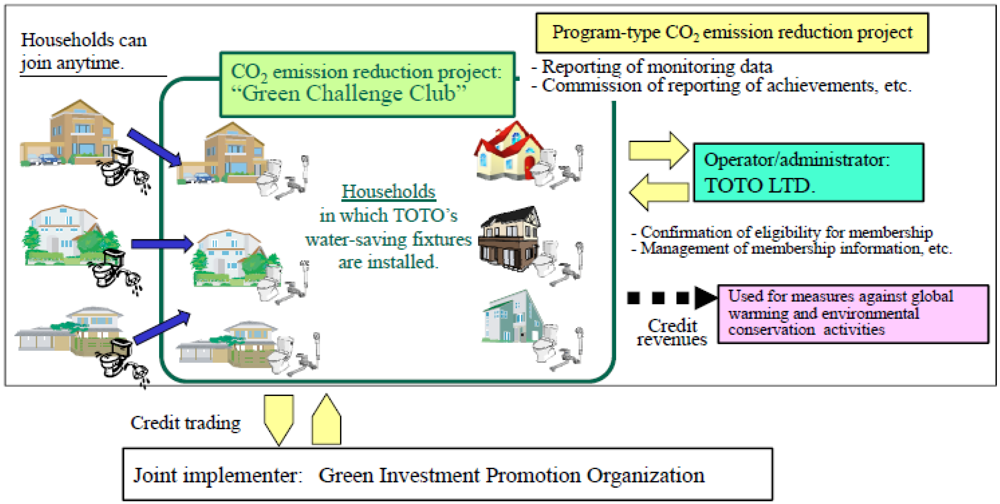
      <p>The introduction of water saving into the credit system represented a global first. In response to the approval of this methodology, a program-type reduction project (one-by-one additional participation) was proposed; this project was started by TOTO, Ltd. in March 2012 (<xref ref-type="fig" rid="water-04-00533-f009">Figure 9</xref>) [<xref ref-type="bibr" rid="B13-water-04-00533">13</xref>]. In the case of a four-person family, a 3.8 L flush toilet bowl and 6.5 L/min air-in shower could provide annual CO<sub>2</sub> reductions of about 23 and 112 kg, respectively. According to the usage survey, duration of air-in shower was not changed compared to normally used (8.5–10 L/min).</p>
      <p>A credit verifies the effect for each defined period after installation of the fixtures, and is published for each usable year. This will contribute to Japan’s CO<sub>2</sub> reduction target during these years. Henceforth, subsidies will be expected to be linked with the credit. A user’s CO<sub>2</sub> reduction efforts are rendered visible by the credit program.</p>
      <fig id="water-04-00533-f009" position="anchor">
        <label>Figure 9</label>
        <caption>
          <p>Outline of water-saving credit project in Japan.</p>
        </caption>
        <graphic xmlns:xlink="http://www.w3.org/1999/xlink" xlink:href="water-04-00533-g009.tif"/>
      </fig>
      <p>This will lead to an upsurge in the users’ environmental awareness, and it is expected that a virtuous circle of domestic CO<sub>2</sub> reduction will arise.</p>
      <p>The present methodology targeted toilet bowls, showers, and bathtubs; an extension of the methodology to other fixtures is also being planned.</p>
    </sec>
    <sec>
      <title>5. Deployment to Asia of Water-Saving Credit</title>
      <p>As part of the feasibility study program on new mechanisms carried out by the Global Environmental Centre Foundation, CO<sub>2</sub> reduction potential evaluation by the adoption of water-saving fixtures has been conducted in the city of Dalian in China under the title “Feasibility study of new energy-saving mechanism associated with reduction of water consumption by diffusion of water-saving hygiene devices in Dalian, China.” The evaluation was conducted in 2011 fiscal year as a joint research project of Mitsubishi UFJ Morgan Stanley, Kitakyushu City, Meiji University, and TOTO.</p>
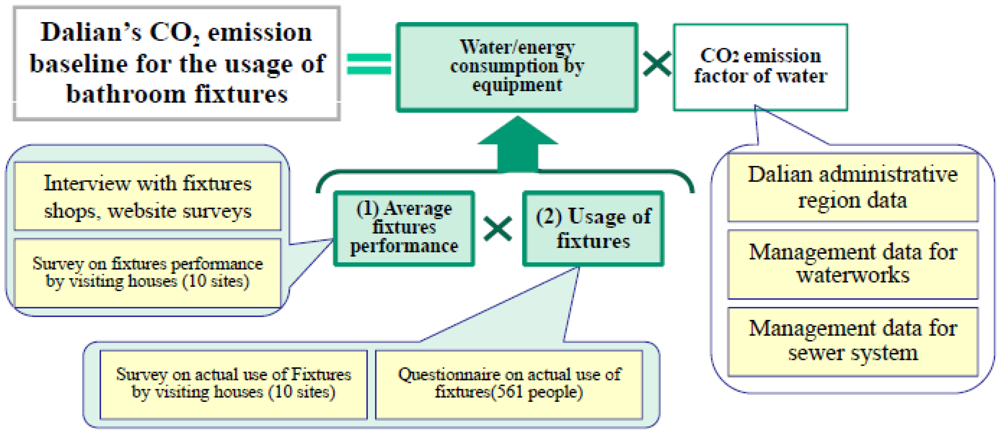
      <p>The feasibility of applying the evaluation method developed in Japan for Dalian was examined. The evaluation formula is shown in <xref ref-type="fig" rid="water-04-00533-f010">Figure 10</xref>. The CO<sub>2</sub> emission factor of water was calculated from the operation management data of the waterworks and sewer systems of the evaluation region. The water-saving performance improvements due to application of the high-efficiency fixtures were given as the differences in performances between currently used or generally sold versions and the project version. These can be studied by conducting interviews in stores, visiting houses, <italic>etc</italic>. A usage model of the fixtures, such as the number of times a toilet is used, the flow rate of a shower, water temperature, and operating time, can be determined by statistical analysis of measurements and from a questionnaire for residents.</p>
      <fig id="water-04-00533-f010" position="anchor">
        <label>Figure 10</label>
        <caption>
          <p>Potential assessment in Dalian.</p>
        </caption>
        <graphic xmlns:xlink="http://www.w3.org/1999/xlink" xlink:href="water-04-00533-g010.tif"/>
      </fig>
      <p>In the case of Japan, the baseline for evaluation was a stock-type society where construction of infrastructure, such as waterworks, sewer systems, and buildings, had almost been completed. The valuation modeling was set up as the replacement for the stock fixtures to the latest ones. On the other hand, modernization and city extension are being carried out in Dalian. Therefore, potential evaluation was carried out by setting up a baseline that also considered a situation where the infrastructure was being developed, corresponding to an increase in population.</p>
      <p>The CO<sub>2</sub> emission factor of the water in Dalian was about three times that in Japan because of the high CO<sub>2</sub> emission factor of electricity. Further, large potential for CO<sub>2</sub> reduction by the widespread use of water-saving fixtures was confirmed.</p>
      <p>Thus, the evaluation method developed in Japan was found to be applicable to a developing country. Rapid modernization and urbanization are occurring in Asian nations. Therefore, the accompanying rise in water consumption and CO<sub>2</sub> emission are serious issues. The widespread use of water-saving fixtures has a good potential to decrease the impact of these issues. Thus, the water-saving-related study will progress from the feasibility study stage to the establishment of a credit system for the Asian region and the actualization of the credit project in Asia, by means of a bilateral offset credit program.</p>
    </sec>
    <sec sec-type="conclusions">
      <title>6. Conclusions and Future View</title>
      <p>Water saving was found to be effective for solving problems related to the shortage of water resources as well as issues related to global warming. Increased user awareness and administrative support are important for realizing water saving. In order to involve the users and administration, it is important to share a future image realizable by water saving. The Japanese estimation method for contribution potential for water-saving in order to develop a future plan was found also to be applicable in China.</p>
      <p>Therefore, an Asian Saving Water Council was established in December 2011 to promote joint research to evaluate the contribution potential of water saving for each Asian country [<xref ref-type="bibr" rid="B14-water-04-00533">14</xref>]. The representatives of each country are introduced in <xref ref-type="table" rid="water-04-00533-t001">Table 1</xref>. At the Asian Saving Water Council, construction of the standard for the fixtures, policy proposals, and social education are also discussed. </p>
      <table-wrap id="water-04-00533-t001" position="anchor">
        <object-id pub-id-type="pii">water-04-00533-t001_Table 1</object-id>
        <label>Table 1</label>
        <caption>
          <p>Organization of the Asian Water Saving Council (for 2011 &amp; 2012).</p>
        </caption>
        <table>
          <tbody>
            <tr>
              <td colspan="2" align="left" valign="middle">
              <bold>Chairman:</bold>              </td>
            </tr>
            <tr>
              <td align="left" valign="middle">&nbsp;</td>
              <td align="left" valign="middle">Kyousuke Sakaue (Japanese representative member: Professor at Meiji University)</td>
            </tr>
            <tr>
              <td colspan="2" align="left" valign="middle">
              <bold>Vice-Chairman:</bold>              </td>
            </tr>
            <tr>
              <td align="left" valign="middle">&nbsp;</td>
              <td align="left" valign="middle">Li Zhao (Chinese representative member: Vice-President of China Architecture Design &amp; Research Group</td>
            </tr>
            <tr>
              <td colspan="2" align="left" valign="middle">
              <bold>Managers:</bold>              </td>
            </tr>
            <tr>
              <td align="left" valign="middle">&nbsp;</td>
              <td align="left" valign="middle">Dong-hoon Lee (Korean representative member: Professor at the University of Seoul)</td>
            </tr>
            <tr>
              <td align="left" valign="middle">&nbsp;</td>
              <td align="left" valign="middle">Cheng-Li Cheng (Taiwanese representative member: Professor at National Taiwan University)</td>
            </tr>
            <tr>
              <td align="left" valign="middle">&nbsp;</td>
              <td align="left" valign="middle">Ling-Tim Wong (Representative member of Hong Kong: Associate Professor at the Hong Kong Polytechnic University)</td>
            </tr>
            <tr>
              <td align="left" valign="middle">&nbsp;</td>
              <td align="left" valign="middle">Akihiko Iio (Japanese vice-representative member: Professor at Japan Women’s University)</td>
            </tr>
            <tr>
              <td align="left" valign="middle">&nbsp;</td>
              <td align="left" valign="middle">Motoyasu Kamata (Japanese member: Emeritus Professor at the University of Tokyo)</td>
            </tr>
            <tr>
              <td align="left" valign="middle">&nbsp;</td>
              <td align="left" valign="middle">Saburo Murakawa (Japanese member: Professor at Hiroshima University)</td>
            </tr>
            <tr>
              <td align="left" valign="middle">&nbsp;</td>
              <td align="left" valign="middle">Yasutoshi Shimizu (Director General)</td>
            </tr>
            <tr>
              <td align="left" valign="middle">&nbsp;</td>
              <td align="left" valign="middle">Kanako Toyosada (Vice Director General), <italic>etc.</italic></td>
            </tr>
          </tbody>
        </table>
      </table-wrap>
      <p>As an extension of this discussion, an Asian Saving Water Council symposium was held at Meiji University in December 2011, supported by the Ministry of Land, Infrastructure, Transport and Tourism, the Ministry of Economy, Trade and Industry, and the Ministry of Environment. The necessity for water saving in Asian countries and a policy for future action in the Council were discussed at the symposium [<xref ref-type="bibr" rid="B14-water-04-00533">14</xref>]. </p>
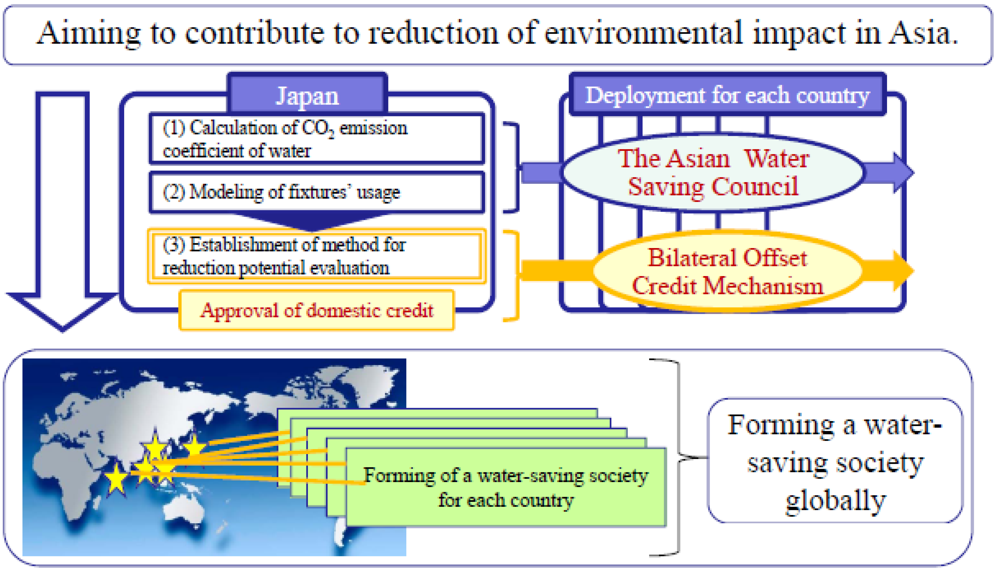
      <p>The Asian Saving Water Council promotes water-saving-related research in each country. A bilateral offset credit program is utilized for intergovernmental negotiations on policy adjustments. As a result of these projects, a water-saving society has been developing in Japan and spreading to Asia, as shown in <xref ref-type="fig" rid="water-04-00533-f011">Figure 11</xref>. </p>
      <p>It is expected that the formation of this water-saving society will be promoted by the participation of many researchers.</p>
      <fig id="water-04-00533-f011" position="anchor">
        <label>Figure 11</label>
        <caption>
          <p>Concept of global deployment of water-saving studies.</p>
        </caption>
        <graphic xmlns:xlink="http://www.w3.org/1999/xlink" xlink:href="water-04-00533-g011.tif"/>
      </fig>
    </sec>
  </body>
  <back>
    <ref-list>
      <title>References</title>
      <ref id="B1-water-04-00533">
        <label>1.</label>
        <citation citation-type="web">
          <source>The GHGs Emissions Data of Japan (1990–2010)</source>
          <publisher-name>The Greenhouse Gas Inventory Office of Japan</publisher-name>
          <publisher-loc>Ibaraki, Japan</publisher-loc>
          <year>2011</year>
          <access-date>(accessed on 28 June 2012)</access-date>
          <comment>Available online:<ext-link xmlns:xlink="http://www.w3.org/1999/xlink" xlink:href="http://www-gio.nies.go.jp/aboutghg/nir/nir-j.html" ext-link-type="uri">http://www-gio.nies.go.jp/aboutghg/nir/nir-j.html</ext-link></comment>
        </citation>
      </ref>
      <ref id="B2-water-04-00533">
        <label>2.</label>
        <citation citation-type="book">
          <person-group person-group-type="author">
            <name>
              <surname>Kenwey</surname>
              <given-names>S.J.</given-names>
            </name>
            <name>
              <surname>Priestly</surname>
              <given-names>A.</given-names>
            </name>
            <name>
              <surname>Cook</surname>
              <given-names>S.</given-names>
            </name>
            <name>
              <surname>Inman</surname>
              <given-names>M.</given-names>
            </name>
            <name>
              <surname>Gregory</surname>
              <given-names>A.</given-names>
            </name>
            <name>
              <surname>Hall</surname>
              <given-names>M.</given-names>
            </name>
          </person-group>
          <source>Energy Use in the Provision and Consumption of Urban Water in Australia and New Zealand</source>
          <publisher-name>Water Services Association of Australia (WSAA)</publisher-name>
          <publisher-loc>Sydney, Australia</publisher-loc>
          <year>2008</year>
        </citation>
      </ref>
      <ref id="B3-water-04-00533">
        <label>3.</label>
        <citation citation-type="journal">
          <person-group person-group-type="author">
            <name>
              <surname>Hackett</surname>
              <given-names>M.J.</given-names>
            </name>
            <name>
              <surname>Gray</surname>
              <given-names>N.F.</given-names>
            </name>
          </person-group>
          <article-title>Carbon dioxide emission savings potential of household wateruse reduction in the UK</article-title>
          <source>J. Sustain. Dev.</source>
          <year>2009</year>
          <volume>2</volume>
          <fpage>36</fpage>
          <lpage>43</lpage>
        </citation>
      </ref>
      <ref id="B4-water-04-00533">
        <label>4.</label>
        <citation citation-type="journal">
          <person-group person-group-type="author">
            <name>
              <surname>Walker</surname>
              <given-names>G.</given-names>
            </name>
          </person-group>
          <article-title>Water and energy use efficiency are increasingly linked</article-title>
          <source>Energy World</source>
          <year>2009</year>
          <volume>369</volume>
          <fpage>18</fpage>
          <lpage>19</lpage>
        </citation>
      </ref>
      <ref id="B5-water-04-00533">
        <label>5.</label>
        <citation citation-type="web">
          <article-title>Kyoto Mechanisms Information Platform Homepage</article-title>
          <access-date>(accessed on 28 June 2012)</access-date>
          <comment>Available online:<ext-link xmlns:xlink="http://www.w3.org/1999/xlink" xlink:href="http://www.kyomecha.org/" ext-link-type="uri">http://www.kyomecha.org/</ext-link></comment>
        </citation>
      </ref>
      <ref id="B6-water-04-00533">
        <label>6.</label>
        <citation citation-type="web">
          <article-title>New Mechanisms Information Platform Homepage</article-title>
          <access-date>(accessed on 28 June 2012)</access-date>
          <comment>Available online:<ext-link xmlns:xlink="http://www.w3.org/1999/xlink" xlink:href="http://www.mmechanisms.org/initiatives/index.html" ext-link-type="uri">http://www.mmechanisms.org/initiatives/index.html</ext-link></comment>
        </citation>
      </ref>
      <ref id="B7-water-04-00533">
        <label>7.</label>
        <citation citation-type="book">
          <source>Environmental Household keeping Book</source>
          <publisher-name>The Ministry of Environment of Japan</publisher-name>
          <publisher-loc>Tokyo, Japan</publisher-loc>
          <year>1996</year>
        </citation>
      </ref>
      <ref id="B8-water-04-00533">
        <label>8.</label>
        <citation citation-type="web">
		<collab>The Ministry of Environment of Japan</collab>
          <source>Greenhouse Gas Emission Data in 2010</source>
          <publisher-loc>Tokyo, Japan</publisher-loc>
          <year>2010</year>
          <access-date>(accessed on 29 June 2012)</access-date>
          <comment>Available online:<ext-link xmlns:xlink="http://www.w3.org/1999/xlink" xlink:href="http://www.env.go.jp/earth/ondanka/ghg/" ext-link-type="uri">http://www.env.go.jp/earth/ondanka/ghg/</ext-link></comment>
        </citation>
      </ref>
      <ref id="B9-water-04-00533">
        <label>9.</label>
        <citation citation-type="journal">
          <person-group person-group-type="author">
            <name>
              <surname>Shimizu</surname>
              <given-names>Y.</given-names>
            </name>
            <name>
              <surname>Toyosada</surname>
              <given-names>K.</given-names>
            </name>
          </person-group>
          <article-title>The economic and environmental impact of remodeling in the case of a water-saving toilet bowl</article-title>
          <source>J. Soc. Heat. Air-Cond. Sanit. Eng. Jpn.</source>
          <year>2009</year>
          <volume>152</volume>
          <fpage>9</fpage>
          <lpage>14</lpage>
        </citation>
      </ref>
      <ref id="B10-water-04-00533">
        <label>10.</label>
        <citation citation-type="journal">
          <person-group person-group-type="author">
            <name>
              <surname>Shimizu</surname>
              <given-names>Y.</given-names>
            </name>
            <name>
              <surname>Toyosada</surname>
              <given-names>K.</given-names>
            </name>
            <name>
              <surname>Nakashima</surname>
              <given-names>K.</given-names>
            </name>
          </person-group>
          <article-title>Prediction of CO<sub>2</sub> emission associated with residential plumbing equipment</article-title>
          <source>J. Soc. Heat. Air-Cond. Sanit. Eng. Jpn.</source>
          <year>2010</year>
          <volume>163</volume>
          <fpage>11</fpage>
          <lpage>18</lpage>
        </citation>
      </ref>
      <ref id="B11-water-04-00533">
        <label>11.</label>
        <citation citation-type="web">
          <source>Voluntary Action Plan on the Environment—The Electricity Emission Factor In Global Warming Countermeasure (2011) (in Japanese)</source>
          <publisher-name>KEIDANREN (Japan Business Federation)</publisher-name>
          <publisher-loc>Tokyo, Japan</publisher-loc>
          <year>2011</year>
          <access-date>(accessed on 29 June 2012)</access-date>
          <comment>Available online:<ext-link xmlns:xlink="http://www.w3.org/1999/xlink" xlink:href="http://www.keidanren.or.jp/japanese/policy/2011/113/honbun.pdf#search='" ext-link-type="uri">http://www.keidanren.or.jp/japanese/policy/2011/113/honbun.pdf#search='</ext-link></comment>
        </citation>
      </ref>
      <ref id="B12-water-04-00533">
        <label>12.</label>
        <citation citation-type="journal">
          <person-group person-group-type="author">
            <name>
              <surname>Toyosada</surname>
              <given-names>K.</given-names>
            </name>
            <name>
              <surname>Dejima</surname>
              <given-names>S.</given-names>
            </name>
            <name>
              <surname>Shimizu</surname>
              <given-names>Y.</given-names>
            </name>
          </person-group>
          <article-title>Estimation of CO<sub>2</sub> emission factor associated with water use</article-title>
          <source>J. Soc. Heat. Air-Cond. Sanit. Eng. Jpn.</source>
          <year>2011</year>
          <volume>176</volume>
          <fpage>1</fpage>
          <lpage>7</lpage>
        </citation>
      </ref>
      <ref id="B13-water-04-00533">
        <label>13.</label>
        <citation citation-type="web">
          <article-title>Domestic Clean Development Mechanism. Methodologies for Emission Reduction</article-title>
          <access-date>(accessed on 29 June 2012)</access-date>
          <comment>Available online:<ext-link xmlns:xlink="http://www.w3.org/1999/xlink" xlink:href="http://jcdm.jp/process/methodology.html" ext-link-type="uri">http://jcdm.jp/process/methodology.html</ext-link></comment>
        </citation>
      </ref>
      <ref id="B14-water-04-00533">
        <label>14.</label>
        <citation citation-type="web">
          <article-title>Asian Saving Water Council Homepage</article-title>
          <access-date>(accessed on 29 June 2012)</access-date>
          <comment>Available online:<ext-link xmlns:xlink="http://www.w3.org/1999/xlink" xlink:href="http://aswc.asia/" ext-link-type="uri">http://aswc.asia/</ext-link></comment>
        </citation>
      </ref>
    </ref-list>
  </back>
</article>