
<?xml version="1.0" encoding="UTF-8"?>
<!DOCTYPE article PUBLIC "-//NLM//DTD Journal Publishing DTD v2.3 20070202//EN" "journalpublishing.dtd">
<article xmlns:mml="http://www.w3.org/1998/Math/MathML" xmlns:xlink="http://www.w3.org/1999/xlink" xml:lang="en" article-type="research-article">
  <front>
    <journal-meta>
      <journal-id journal-id-type="publisher-id">genes</journal-id>
      <journal-title>Genes</journal-title>
      <abbrev-journal-title abbrev-type="publisher">Genes</abbrev-journal-title>
      <abbrev-journal-title abbrev-type="pubmed">Genes</abbrev-journal-title>
      <issn pub-type="epub">2073-4425</issn>
      <publisher>
        <publisher-name>MDPI</publisher-name>
      </publisher>
    </journal-meta>
    <article-meta>
      <article-id pub-id-type="doi">10.3390/genes3040671</article-id>
      <article-id pub-id-type="publisher-id">genes-03-00671</article-id>
      <article-categories>
        <subj-group>
          <subject>Article</subject>
        </subj-group>
      </article-categories>
      <title-group>
        <article-title>The Influence of Competition Among <italic>C. elegans</italic> Small RNA Pathways on Development</article-title>
      </title-group>
      
      <contrib-group>
        <contrib contrib-type="author">
          <name>
            <surname>Zhuang</surname>
            <given-names>Jimmy J.</given-names>
          </name>
        </contrib>
        <contrib contrib-type="author">
          <name>
            <surname>Hunter</surname>
            <given-names>Craig P.</given-names>
          </name>
          <xref rid="c1-genes-03-00671" ref-type="corresp">*</xref>
        </contrib>
      </contrib-group>
     <aff id="af1-genes-03-00671">Department of Molecular and Cellular Biology, Harvard University, Biological Laboratories, Room 3044, 16 Divinity Avenue, Cambridge, MA 02138, USA; E-Mail: <email>jzhuang@mcb.harvard.edu</email></aff>
      <author-notes>
        <corresp id="c1-genes-03-00671"><label>*</label> Author to whom correspondence should be addressed; E-Mail: <email>hunter@mcb.harvard.edu</email>; Tel.: +1-617-495-8309; Fax: +1-617-496-0132.</corresp>
      </author-notes>
      <pub-date pub-type="epub">
        <day>19</day>
        <month>10</month>
        <year>2012</year>
      </pub-date>
      <pub-date pub-type="collection"><month>12</month>
        <year>2012</year>
      </pub-date>
      <volume>3</volume>
      <issue>4</issue>
      <fpage>671</fpage>
      <lpage>685</lpage>
      <history>
        <date date-type="received">
          <day>17</day>
          <month>08</month>
          <year>2012</year>
        </date>
        <date date-type="rev-recd">
          <day>28</day>
          <month>09</month>
          <year>2012</year>
        </date>
        <date date-type="accepted">
          <day>15</day>
          <month>10</month>
          <year>2012</year>
        </date>
      </history>
      <permissions>
        <copyright-statement>©  2012 by the authors; licensee MDPI, Basel, Switzerland.</copyright-statement>
        <copyright-year>2012</copyright-year>
        <license xmlns:xlink="http://www.w3.org/1999/xlink" license-type="open-access" xlink:href="http://creativecommons.org/licenses/by/3.0/">
          <p>This article is an open access article distributed under the terms and conditions of the Creative Commons Attribution license (http://creativecommons.org/licenses/by/3.0/).</p>
        </license>
      </permissions>
      <abstract>
        <p>Small RNAs play a variety of regulatory roles, including highly conserved developmental functions. <italic>Caenorhabditis elegans</italic> not only possesses most known small RNA pathways, it is also an easy system to study their roles and interactions during development. It has been proposed that in <italic>C. elegans</italic>, some small RNA pathways compete for access to common limiting resources. The strongest evidence supporting this model is that disrupting the production or stability of endogenous short interfering RNAs (endo-siRNAs) enhances sensitivity to experimentally induced exogenous RNA interference (exo-RNAi). Here, we examine the relationship between the endo-siRNA and microRNA (miRNA) pathways, and find that, consistent with competition among these endogenous small RNA pathways, endo-siRNA pathway mutants may enhance miRNA efficacy. Furthermore, we show that exo-RNAi may also compete with both endo-siRNAs and miRNAs. Our data thus provide support that all known Dicer-dependent small RNA pathways may compete for limiting common resources. Finally, we observed that both endo-siRNA mutants and animals experiencing exo-RNAi have increased expression of miRNA-regulated stage-specific developmental genes. These observations suggest that perturbing the small RNA flux and/or the induction of exo-RNAi, even in wild-type animals, may impact development via effects on the endo-RNAi and microRNA pathways. </p>
      </abstract>
      <kwd-group>
        <kwd>microRNAs</kwd>
        <kwd>endogenous siRNAs</kwd>
        <kwd>enhanced RNAi</kwd>
        <kwd>exogenous RNAi</kwd>
        <kwd>RNA regulation</kwd>
      </kwd-group>
    </article-meta>
  </front>
  <body>
    <sec sec-type="intro">
      <title>1. Introduction</title>
      <p>Non-coding RNAs regulate a myriad of biological processes [<xref ref-type="bibr" rid="B1-genes-03-00671">1</xref>,<xref ref-type="bibr" rid="B2-genes-03-00671">2</xref>]. Two broad classes of highly conserved non-coding regulatory RNA pathways were discovered in the nematode <italic>Caenorhabditis elegans</italic>. First, microRNAs (miRNAs) were identified as transcribed RNAs corresponding to mutant loci that disrupted stage-specific developmental processes [<xref ref-type="bibr" rid="B3-genes-03-00671">3</xref>,<xref ref-type="bibr" rid="B4-genes-03-00671">4</xref>]. These small RNAs are complementary to nucleotide sequences in the 3’UTR of inferred target mRNAs and act to inhibit translation and/or mRNA target stability [<xref ref-type="bibr" rid="B3-genes-03-00671">3</xref>,<xref ref-type="bibr" rid="B4-genes-03-00671">4</xref>,<xref ref-type="bibr" rid="B5-genes-03-00671">5</xref>]. Subsequent genomic analysis identified scores of 22 nucleotide miRNAs, many broadly conserved in plants and animals [<xref ref-type="bibr" rid="B5-genes-03-00671">5</xref>,<xref ref-type="bibr" rid="B6-genes-03-00671">6</xref>]. Second, mechanistic investigation of the widely used technique of RNA interference (RNAi) revealed the existence of regulatory pathways that produce and use short interfering RNAs (siRNAs), whether derived from exogenous dsRNA (exo-siRNAs) or endogenous loci (endo-siRNAs) [<xref ref-type="bibr" rid="B7-genes-03-00671">7</xref>,<xref ref-type="bibr" rid="B8-genes-03-00671">8</xref>,<xref ref-type="bibr" rid="B9-genes-03-00671">9</xref>,<xref ref-type="bibr" rid="B10-genes-03-00671">10</xref>,<xref ref-type="bibr" rid="B11-genes-03-00671">11</xref>]. Investigations in other systems, including <italic>Drosophila</italic>, <italic>Arabidopsis</italic>, and mammalian cultures, have identified additional non-coding RNA pathways, including piwi-interacting RNA (piRNAs) and long non-coding RNA (lncRNAs), both of which have also been found in <italic>C. elegans</italic> [<xref ref-type="bibr" rid="B12-genes-03-00671">12</xref>,<xref ref-type="bibr" rid="B13-genes-03-00671">13</xref>,<xref ref-type="bibr" rid="B14-genes-03-00671">14</xref>]. The biological processes regulated by these small RNAs are quite extensive, including germline maintenance [<xref ref-type="bibr" rid="B13-genes-03-00671">13</xref>], chromosomal segregation [<xref ref-type="bibr" rid="B15-genes-03-00671">15</xref>], protection against transgenic parasites [<xref ref-type="bibr" rid="B16-genes-03-00671">16</xref>], multi-generational inheritance of RNAi signals [<xref ref-type="bibr" rid="B17-genes-03-00671">17</xref>], and developmental regulation [<xref ref-type="bibr" rid="B18-genes-03-00671">18</xref>].</p>
      <p>Genetic screens have identified mutants in <italic>C. elegans</italic> with enhanced exo-RNAi responses (Eri mutants) [<xref ref-type="bibr" rid="B19-genes-03-00671">19</xref>,<xref ref-type="bibr" rid="B20-genes-03-00671">20</xref>,<xref ref-type="bibr" rid="B21-genes-03-00671">21</xref>,<xref ref-type="bibr" rid="B22-genes-03-00671">22</xref>,<xref ref-type="bibr" rid="B23-genes-03-00671">23</xref>]. Confoundingly, these mutants which enhance exo-RNAi disrupt endo-RNAi [<xref ref-type="bibr" rid="B21-genes-03-00671">21</xref>,<xref ref-type="bibr" rid="B22-genes-03-00671">22</xref>,<xref ref-type="bibr" rid="B23-genes-03-00671">23</xref>,<xref ref-type="bibr" rid="B24-genes-03-00671">24</xref>]. One proposed explanation is that endo-RNAi and exo-RNAi pathways compete for one or more limited common enzymatic resources, so that reduced endo-RNAi activity [<xref ref-type="bibr" rid="B11-genes-03-00671">11</xref>,<xref ref-type="bibr" rid="B25-genes-03-00671">25</xref>] results in greater flux of small RNAs through the exo-RNAi pathway [<xref ref-type="bibr" rid="B8-genes-03-00671">8</xref>,<xref ref-type="bibr" rid="B21-genes-03-00671">21</xref>]. Additional support for this competition model is provided by the identification of limiting RNAi components that are both necessary for the enhanced RNAi response and, when over-expressed, confer enhanced RNAi [<xref ref-type="bibr" rid="B21-genes-03-00671">21</xref>,<xref ref-type="bibr" rid="B26-genes-03-00671">26</xref>]. </p>
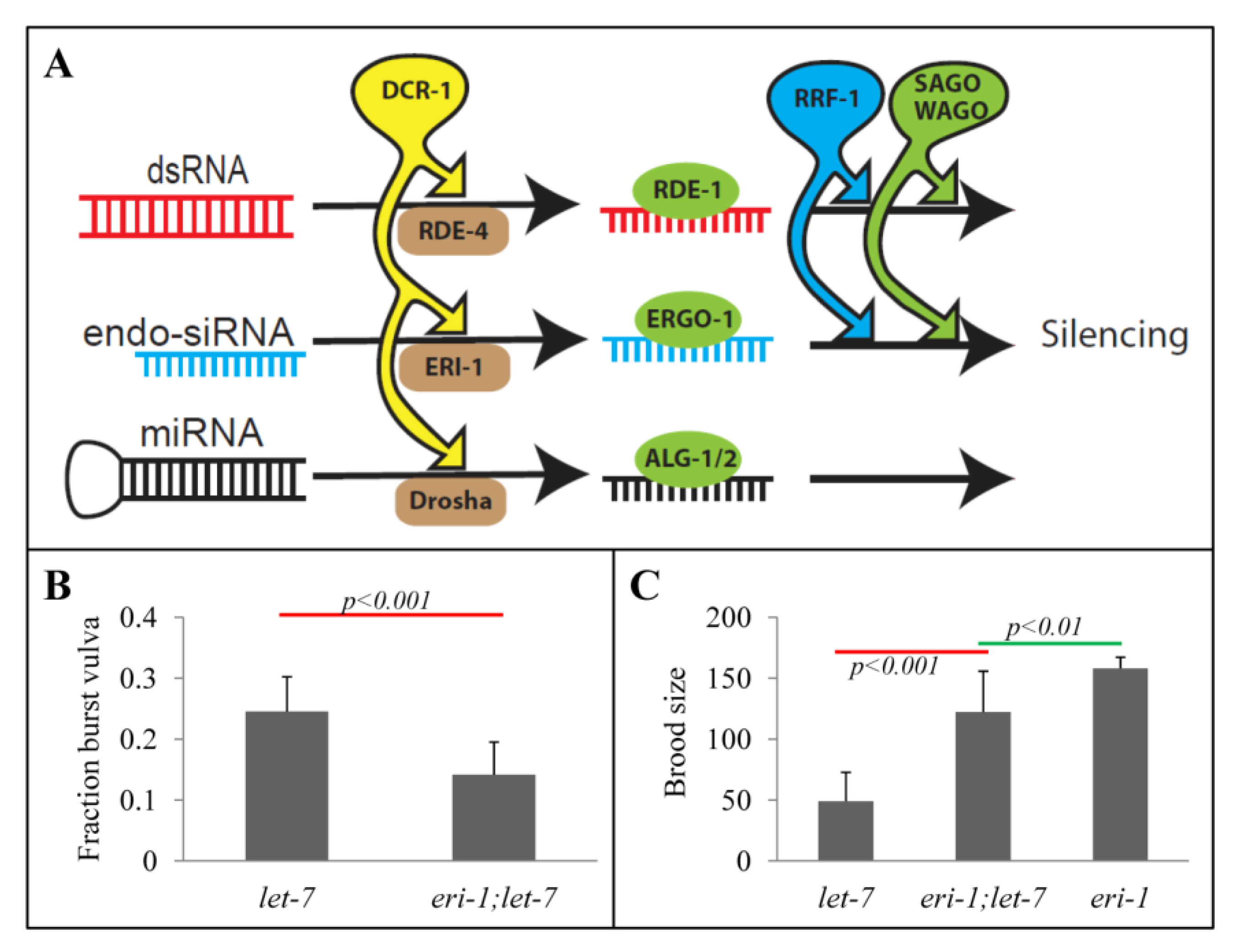
      <p>Although competition has only been inferred between endo- and exo-RNAi pathways, because <italic>C. elegans</italic> has only one <italic>dicer</italic> homolog—<italic>dcr-1</italic>—this competition model has been hypothesized to include other small RNA pathways, particularly the microRNA pathway [<xref ref-type="bibr" rid="B21-genes-03-00671">21</xref>,<xref ref-type="bibr" rid="B26-genes-03-00671">26</xref>]. This model proposes that various <italic>dcr-1</italic>-dependent non-coding RNAs compete for limited common enzymatic resources, including RNA-dependent RNA polymerases (RdRPs) that produce abundant secondary siRNAs and secondary siRNA binding Argonouates (SAGOs) [<xref ref-type="bibr" rid="B21-genes-03-00671">21</xref>] (<xref ref-type="fig" rid="genes-03-00671-f001">Figure 1</xref>A). Consistent with this model, over-expression of some of these resources, specifically the secondary Agos SAGO-1 and SAGO-2, can enhance exo-RNAi [<xref ref-type="bibr" rid="B21-genes-03-00671">21</xref>,<xref ref-type="bibr" rid="B26-genes-03-00671">26</xref>]. However, direct evidence to support this broader competition model is lacking, especially with respect to small RNA pathways other than exo- and endo-RNAi. Moreover, many of these non-coding small RNAs, particularly miRNAs like <italic>lin-4</italic> and <italic>let-7</italic>, are developmentally regulated [<xref ref-type="bibr" rid="B3-genes-03-00671">3</xref>,<xref ref-type="bibr" rid="B4-genes-03-00671">4</xref>], which challenges simple interpretations of the extent of competition. For instance, the loss of one RNAi pathway may impact development, which in turn affects the production or stability of another pathway’s small RNAs. Such competition would not be for common RNAi resources, but rather reflect an indirect result of the physiological changes. The fact that weak alleles or maternal rescue of <italic>dicer</italic> causes sickly phenotypes in animals [<xref ref-type="bibr" rid="B23-genes-03-00671">23</xref>,<xref ref-type="bibr" rid="B27-genes-03-00671">27</xref>] may suggest that this is a realistic concern.</p>
      
      <p>Here, we examine the relationship between endo-RNAi and miRNAi pathways and show that, although the <italic>eri-1</italic> mutant partially rescues the <italic>let-7</italic> mutant’s physiological defects, thus apparently enhancing residual <italic>let-7</italic> activity, Eri mutants also show increased expression of <italic>let-7</italic> targets <italic>lin-14</italic>, <italic>lin-41</italic>, and <italic>daf-12</italic>, thus appearing to simultaneously decrease <italic>let-7</italic> activity. Similarly, we show that engaging the exo-RNAi pathway, by exposing animals to <italic>gfp</italic> dsRNA, also appears to reduce the efficacy of both endoRNAi and miRNAi pathways. Finally, we observed that the relative expression of stage-specific developmental genes differs amongst small RNA pathway mutants, suggesting that in addition to competition for common limiting RNAi resources, perturbing small RNA flux also impacts developmental regulation. This may have large and indirect effects on the activity of endogenous small RNA pathways.</p>
    </sec>
    <sec sec-type="results">
      <title>2. Results and Discussion</title>
      <sec>
        <title>2.1. Rescue of let-7 Phenotypes by the eri-1 Mutant</title>
        <p>To determine whether the <italic>eri</italic> pathway competes with the miRNA pathway (<xref ref-type="fig" rid="genes-03-00671-f001">Figure 1</xref>A), we sought to determine whether, like the genetic interaction between the exo-RNAi and endo-RNAi pathways, similarly disrupting the endo-RNAi pathway could abrogate miRNA developmental defects. To detect changes in miRNA pathway efficacy, we scored fertility and vulva integrity [<xref ref-type="bibr" rid="B28-genes-03-00671">28</xref>] of <italic>let-7(n2853)</italic> single and <italic>let-7(n2853);eri-1(mg366)</italic> double mutant animals. The <italic>n2853</italic> allele is a partial loss-function mutation that remains viable at 15 °C [<xref ref-type="bibr" rid="B4-genes-03-00671">4</xref>]. We found that the <italic>eri-1;let-7</italic> double mutant exhibited a significant reduction in the burst vulva phenotype (<xref ref-type="fig" rid="genes-03-00671-f001">Figure 1</xref>B), and an increase in brood size compared to the <italic>let-7(n2853)</italic> single mutant (<xref ref-type="fig" rid="genes-03-00671-f001">Figure 1</xref>C). Although the rescue was incomplete, these results indicate a genetic interaction between these two small RNA pathways. Because the disruption of endogenous siRNAs seems to suppress the <italic>let-7</italic> phenotypes, the implication is that the endo-siRNA pathway may compete with the miRNA pathway. To our knowledge, this is the first reported genetic interaction between these two pathways.</p>
      </sec>
      <sec>
        <title>2.2. eri-1 Mutant Worms Have Higher Expression of let-7 Regulated Genes at Mid-L4</title>
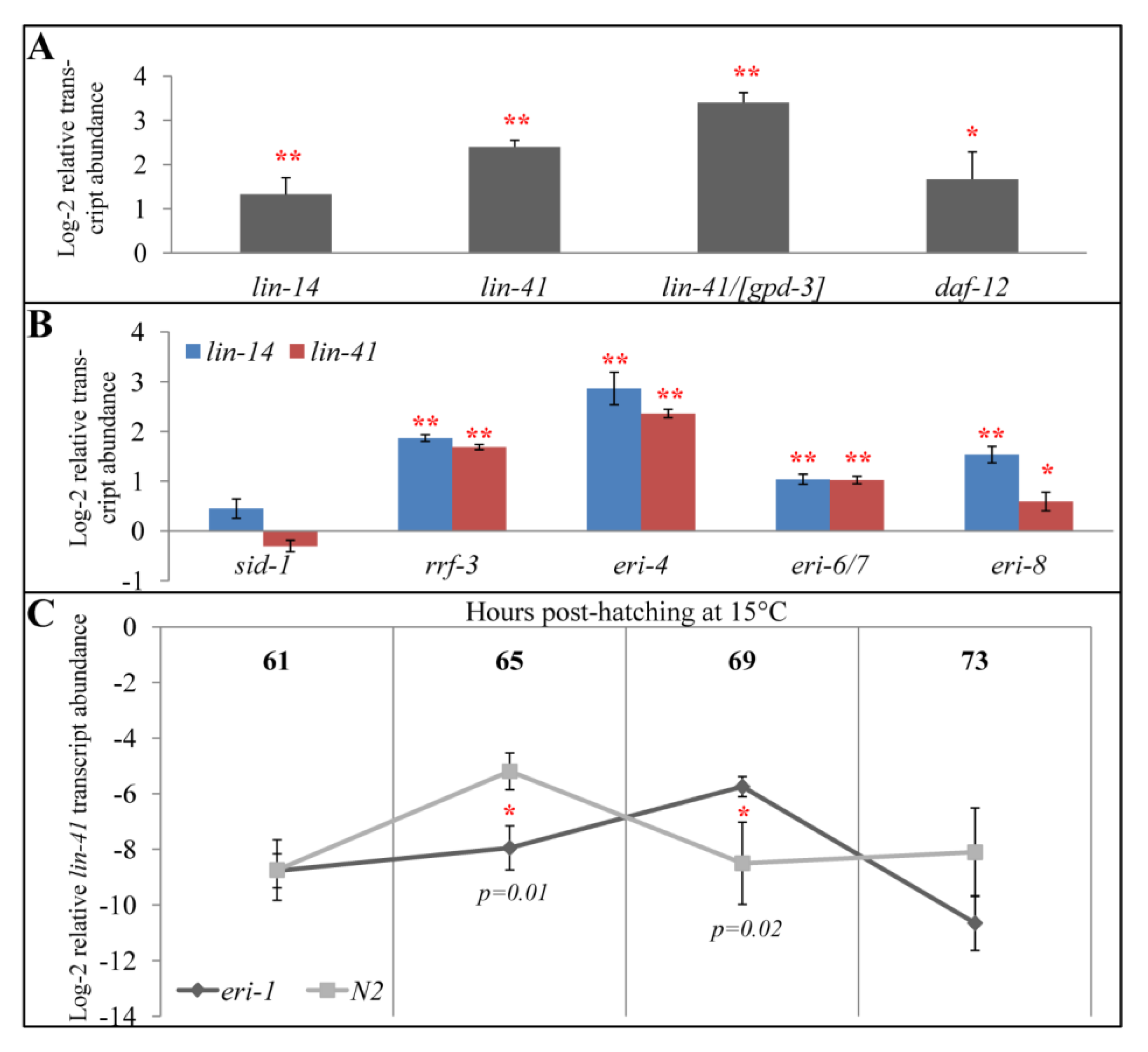
        <p>To determine whether the observed genetic interaction reflects enhanced miRNA efficacy (rather than indirect effects, for example loss of a specific siRNA), we measured the abundance of <italic>let-7</italic> regulatory targets, which increase in abundance in <italic>let-7</italic> mutants [<xref ref-type="bibr" rid="B4-genes-03-00671">4</xref>]. If <italic>eri-1</italic>-mediated repression of <italic>let-7</italic> is via reduced competition and consequently the production of higher <italic>let-7</italic> levels or more effective use of <italic>let-7</italic> miRNA, then the target genes should decrease in abundance in the <italic>eri-1</italic> mutant relative to wild type. However, if the phenotypic suppression of <italic>let-7(2853)</italic> in an <italic>eri-1</italic> mutant background is indirect, then no effect on <italic>let-7</italic> target mRNA levels is expected. An advantage of assaying target mRNA levels is that the competition model does not make any predictions about which stage of small RNA processing or activity the competition occurs. This means the production, stability, or even efficacy of small RNAs could be rate-limiting. A complication is that <italic>let-7</italic> regulates temporally expressed genes, thus it is critical to measure RNA levels from precisely staged animals. Therefore, RNA was extracted from mid-fourth larval stage (L4) worms hatch-synchronized to within 1 hour and then raised at 15 °C for an additional 69 hours. As an additional level of control, we normalized gene expression to <italic>bli-1</italic>, an L4-specific collagen gene that is not known to be regulated by endogenous small RNAs [<xref ref-type="bibr" rid="B29-genes-03-00671">29</xref>]. Thus, in essence, developmental time is redundantly staged, by both “human time”—69 hours post-hatching—as well as “worm time”—<italic>bli-1</italic> mRNA expression. Surprisingly, we observed that the <italic>let-7</italic>-regulated genes <italic>lin-14</italic>, <italic>lin-41</italic>, and <italic>daf-12</italic> [<xref ref-type="bibr" rid="B5-genes-03-00671">5</xref>] all showed increased expression in an <italic>eri-1</italic> mutant background (<xref ref-type="fig" rid="genes-03-00671-f002">Figure 2</xref>A). To ensure that this is not unique to <italic>bli-1</italic> normalization, we assayed for expression levels of <italic>lin-41</italic> normalized to the glyceraldehyde 3-phosphate dehydrogenase <italic>gpd-3</italic>, a stably expressed housekeeping gene that is commonly used for <italic>C. elegans</italic> mRNA normalization [<xref ref-type="bibr" rid="B30-genes-03-00671">30</xref>]. Again, <italic>lin-41</italic> showed increased expression in an <italic>eri-1</italic> mutant background (<xref ref-type="fig" rid="genes-03-00671-f002">Figure 2</xref>A), suggesting that this observation is not a normalization artifact. Thus, <italic>let-7</italic>-regulated genes are affected by endo-siRNA depletion, but rather than an increase in <italic>let-7</italic> activity, we observed an increase in target mRNA levels, which suggests an apparent decrease in <italic>let-7</italic> efficacy.</p>
        <fig id="genes-03-00671-f001" position="float">
        <label>Figure 1</label>
        <caption>
          <p><italic>eri-1</italic> dependent <italic>let-7</italic> reduction-of-function phenotypes<bold>. (A) </bold>Schematic of proposed competing small RNA pathways. MicroRNAs, experimentally introduced double stranded RNAs (dsRNA), and endogenous short interfering RNAs (endo-siRNAs) were proposed [<xref ref-type="bibr" rid="B26-genes-03-00671">26</xref>] to compete for limiting shared resources, including the single <italic>C. elegans</italic> DICER homolog, <italic>dcr-1</italic>, the RNA-directed RNA polymerase RRF-1, and the secondary Argonautes (SAGOs), including the <italic>C. elegans</italic> specific worm Argonautes (WAGOs) that mediated siRNA-dependent silencing. The competition for limiting shared resources implies that reduced flux through one pathway allows for increased access to limiting resources for the other pathways. <bold>(B)</bold> Spontaneous vulva bursting rate of <italic>let-7(n2853)</italic> single (n = 9) and <italic>eri-1(mg366);let-7(n2853)</italic> double (n = 10) mutants at 15 °C. The average of n complete broods is shown. The <italic>eri-1(mg366)</italic> single mutant does not exhibit any burst vulva phenotype. <bold>(C)</bold> Average brood size of <italic>let-7(n2853)</italic> and <italic>eri-1(mg366)</italic> single mutants (n = 5) and <italic>eri-1(mg366);let-7(n2853)</italic> double mutants (n = 8) at 15 °C. Standard deviations are shown. <italic>p</italic>-values are calculated by <italic>t</italic>-test.</p>
        </caption>
        <graphic xmlns:xlink="http://www.w3.org/1999/xlink" xlink:href="genes-03-00671-g001.tif"/>
      </fig>
        
      </sec>
      <sec>
        <title>2.3. All Eri Mutants Have Higher Expression of let-7-regulated Genes at Mid-L4</title>
        <p>Biochemically, the endo-siRNA pathway is diverse and includes RdRPs (RRF-3), siRNases (ERI-1), RNA binding Tudor domain proteins (ERI-5), helicases (ERI-4, ERI-6/7), and Agos (ERI-8). To determine whether the observed increase in <italic>let-7</italic> target mRNA levels is specific to <italic>eri-1(mg366)</italic>, or represents a more general effect of reduced function in the endo-siRNA pathway, we determined the expression levels of <italic>lin-14</italic> and <italic>lin-41</italic> in <italic>rrf-3(pk1426)</italic>, <italic>dcr-1/eri-4(mg375)</italic>, <italic>eri-6/7(tm1917)</italic>, and <italic>ergo-1/eri-8(gg100)</italic> mutant backgrounds. Consistent with our <italic>eri-1</italic> observations, these mutants also showed increased expression of the two <italic>let-7</italic> targets (<xref ref-type="fig" rid="genes-03-00671-f002">Figure 2</xref>B), suggesting that a functional endo-siRNA pathway is important for <italic>let-7</italic> efficacy. </p>
        <p>Included in these experiments were three independent controls. First, as expected, <italic>lin-14</italic> and <italic>lin-41</italic> expression increased between 20 to 60 fold in <italic>let-7(n2853)</italic> mutants compared to N2 wild type. Similarly, the viable <italic>dcr-1(mg375)</italic> allele showed a very strong upward effect on the <italic>let-7</italic> target mRNA levels, as would be expected for a mutation that directly affects miRNA biogenesis [<xref ref-type="bibr" rid="B23-genes-03-00671">23</xref>]. Finally, as a negative control, we assayed <italic>lin-14</italic> and <italic>lin-41</italic> expression levels in a <italic>sid-1(qt9)</italic> background. Because <italic>C. elegans</italic> miRNAs seem to act cell autonomously [<xref ref-type="bibr" rid="B31-genes-03-00671">31</xref>], their activity should not require the systemic double-stranded RNA channel SID-1. As expected, <italic>lin-14</italic> and <italic>lin-41</italic> expression levels were indistinguishable between <italic>sid-1(qt9)</italic> and N2 animals (<xref ref-type="fig" rid="genes-03-00671-f002">Figure 2</xref>B). </p>
      </sec>
      <sec>
        <title>2.4. eri-1 Mutants May Have Delayed Down-regulation of lin-41</title>
        <p>Our findings thus far indicate that mutations in the endo-siRNA pathway phenotypically suppress <italic>let-7</italic>, consistent with the proposed competition model, whereas the effect on the <italic>let-7</italic> target mRNAs was opposite to expectations, showing an increase instead of a decrease (<xref ref-type="fig" rid="genes-03-00671-f002">Figure 2</xref>A, B). While there are many possible explanations, including post-transcriptional silencing versus translational repression, one possibility that should be considered and that can be directly tested is that developmental time is affected in the endo-RNAi mutants. <italic>let-7</italic> acts as a temporal developmental switch, down-regulating target genes to control stage-specific differentiation. Therefore, minor effects on <italic>let-7</italic> temporal activity would be amplified. Although we attempted to control for this possibility by normalizing mRNA levels to the L4-specific collagen <italic>bli-1</italic>, the apparent increase in the abundance of <italic>let-7</italic> target transcripts in endo-RNAi mutants may reflect a developmental time point before <italic>let-7</italic> accumulates to effective levels. That is, the endo-RNAi mutants may slow worm developmental time relative to human time, delaying both accumulation of <italic>let-7</italic> and the predicted transition to L4 gene expression patterns. To test this hypothesis, we collected RNA from hatch-synchronized worms raised at 15 °C for 61, 63, 69 and 73 hours to measure <italic>lin-41</italic> levels prior, during, and after <italic>let-7</italic> regulation. </p>
        <p>Consistent with previous observations, in a wild type background, <italic>lin-41</italic> levels were high at the beginning of the L4 stage (hours 61 to 65), but dropped to undetectable levels at later L4 stages (hours 69 to 73) [<xref ref-type="bibr" rid="B4-genes-03-00671">4</xref>] (<xref ref-type="fig" rid="genes-03-00671-f002">Figure 2</xref>C). Interestingly, in an <italic>eri-1(-)</italic> background, <italic>lin-41</italic> transcript levels remained at the higher level for at least an additional four hours. In wild type, the decrease in <italic>lin-41</italic> levels was detectable at 65 hours, whereas in <italic>eri-1</italic> mutants, the decrease was first detectable at 69 hours. This seems to suggest that there was a temporal delay in the decrease of <italic>lin-41</italic> expression (<xref ref-type="fig" rid="genes-03-00671-f002">Figure 2</xref>C). Although the number of time points is limited, these observations are consistent with a hypothesis that developmental time runs slower in endo-RNAi mutants. Consequently, miRNAs would not be as effective at a particular human time point (<italic>i.e.</italic>, hour 69) because the <italic>eri-1(-)</italic> worms haven’t reached the equivalent worm time (mid-L4) for a maximum <italic>let-7</italic> efficacy. </p>
        <p>However, other trivial explanations may also fit the data, including a very likely possibility that data points at hours 65 and 69 were noise fluctuations in two genes’ expression between the two strains (<xref ref-type="fig" rid="genes-03-00671-f002">Figure 2</xref>C). Unfortunately, we were unable to distinctly quantify differences in <italic>let-7</italic> transcripts itself because of its relative rarity and the relatively subtle differences in expression between mutants, which prevented us from drawing additional support for this delayed development hypothesis.</p>
      </sec>
      <sec>
        <title>2.5. Perturbations to Small RNA Pathways Affect Developmental Timing</title>
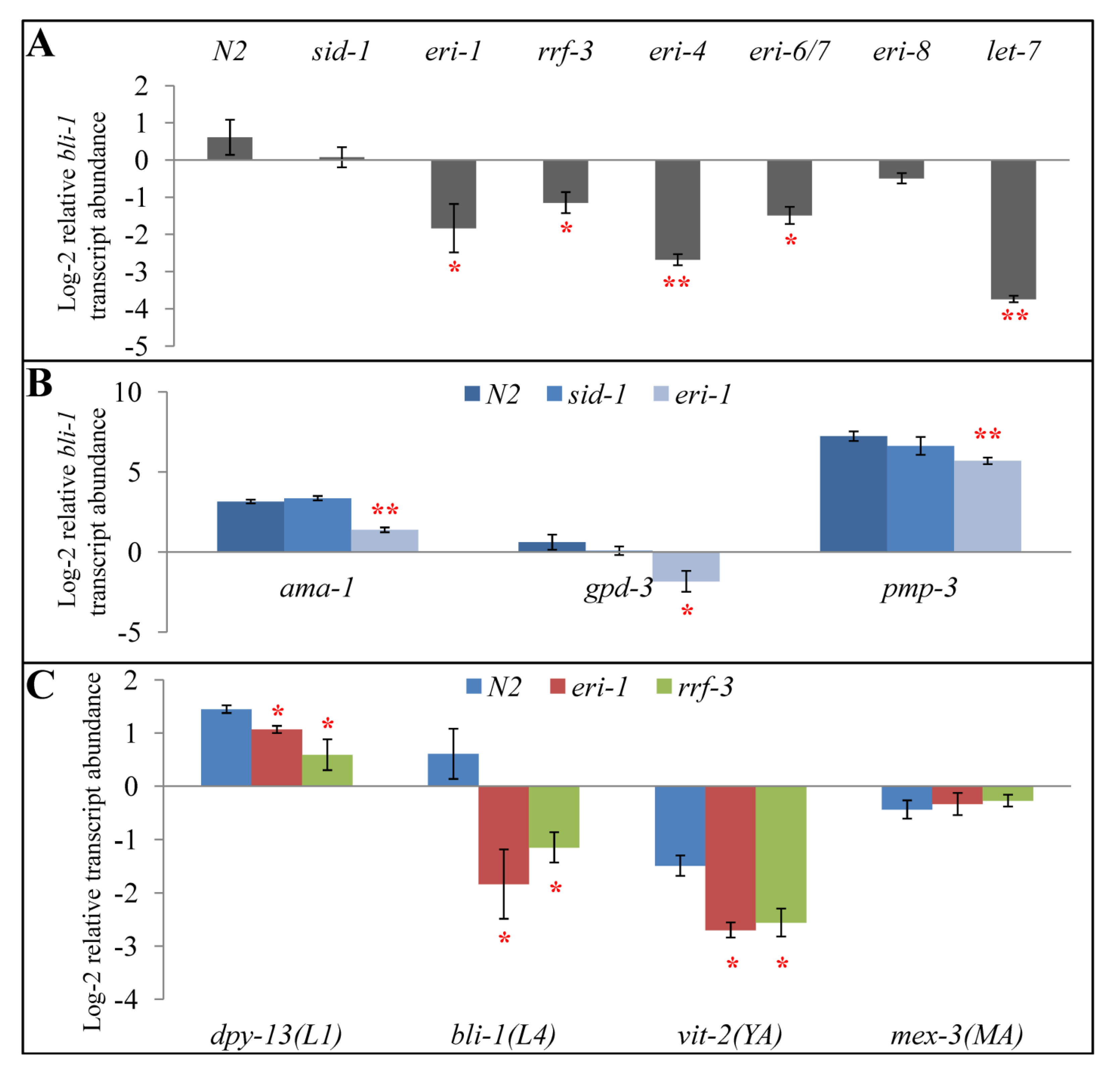
        <p>Therefore, to test, confirm, and generally expand the hypothesis that development is slowed in endo-RNAi mutants, we performed real-time PCR to measure the relative expression levels of a variety of stage-specific mRNAs relative to stable housekeeping genes. The collagen <italic>bli-1</italic> is transcribed specifically during the L4 stage [<xref ref-type="bibr" rid="B29-genes-03-00671">29</xref>]. Consistent with our hypothesis, <italic>bli-1</italic> transcript levels relative to <italic>gpd-3</italic> transcript levels—which are transcribed stably throughout development [<xref ref-type="bibr" rid="B30-genes-03-00671">30</xref>,<xref ref-type="bibr" rid="B32-genes-03-00671">32</xref>]—were reduced in all the endo-RNAi mutants compared to N2 wild type (<xref ref-type="fig" rid="genes-03-00671-f003">Figure 3</xref>A). As with <italic>let-7</italic> target genes, the systemic RNAi mutant <italic>sid-1(qt9)</italic> had no detectable effect. Furthermore, both <italic>let-7(n2853)</italic> and <italic>dcr-1/eri-4(mg375)</italic> mutants, which are known to have significant sickness [<xref ref-type="bibr" rid="B4-genes-03-00671">4</xref>,<xref ref-type="bibr" rid="B5-genes-03-00671">5</xref>,<xref ref-type="bibr" rid="B23-genes-03-00671">23</xref>,<xref ref-type="bibr" rid="B33-genes-03-00671">33</xref>], showed much larger <italic>bli-1</italic> versus <italic>gpd-3</italic> differences than the other endo-RNAi mutants (<xref ref-type="fig" rid="genes-03-00671-f003">Figure 3</xref>A). Finally, the <italic>ergo-1/eri-8(gg100)</italic> allele, which causes the least sterility and brood size reduction [<xref ref-type="bibr" rid="B33-genes-03-00671">33</xref>] of the tested endo-RNAi mutants, showed only a small and not statistically significant reduction in relative <italic>bli-1</italic> transcript levels (<xref ref-type="fig" rid="genes-03-00671-f003">Figure 3</xref>A). </p>
        
        <p>These findings suggests that either endo-RNAi mutants slow development leading to lower <italic>bli-1</italic> levels 69 hours post hatching, or that these mutants affect metabolism leading to an increase in <italic>gpd-3</italic> levels. To control for this second possibility, we used two additional stably expressed housekeeping genes: <italic>ama-1</italic> (a measure of RNAPII levels) and <italic>pmp-3</italic> (a measure of peroxisome activity) [<xref ref-type="bibr" rid="B32-genes-03-00671">32</xref>], in addition to <italic>gpd-3</italic>, to normalize <italic>bli-1</italic> transcript levels (<xref ref-type="fig" rid="genes-03-00671-f003">Figure 3</xref>B). We found that <italic>eri-1</italic> mutants have lower expression of <italic>bli-1</italic> relative to all three stable housekeeping markers compared to N2 and <italic>sid-1(qt9)</italic> mutants. This analysis confirms that at 69 hours post hatching, <italic>eri-1(mg375)</italic> worms compared to N2 and <italic>sid-1(qt9)</italic> worms likely exhibit slowed development. Therefore, these results further suggest that the endo-RNAi mutants reduce the accumulation of L4 specific <italic>bli-1</italic> transcript due to a delay in development. </p>
        <p>Combined with the measurements of <italic>lin-41</italic> transcripts (<xref ref-type="fig" rid="genes-03-00671-f002">Figure 2</xref>C), these results seem to suggest that endo-RNAi mutants delay development to the mid-L4 stage. To determine whether other developmental transitions are delayed in endo-RNAi mutants, we measured in both <italic>eri-1</italic> and <italic>rrf-3</italic> mutants the relative transcript levels of the L1 specific collagen <italic>dpy-13</italic> [<xref ref-type="bibr" rid="B34-genes-03-00671">34</xref>] 22 hours after hatching, the yolk protein gene <italic>vit-2</italic> [<xref ref-type="bibr" rid="B35-genes-03-00671">35</xref>] in young adult 80 hours after hatching, and the germline specific RNA binding protein <italic>mex-3</italic> [<xref ref-type="bibr" rid="B36-genes-03-00671">36</xref>] in mature adults 100 hours after hatching. We found that when compared to N2, the <italic>eri-1</italic> and <italic>rrf-3</italic> mutants showed significantly lower <italic>dpy-13</italic>, <italic>bli-1</italic>, and <italic>vit-2</italic> relative expression levels (<xref ref-type="fig" rid="genes-03-00671-f003">Figure 3</xref>C). However, the expression levels of the germline specific <italic>mex-3</italic> were not affected in either mutant (<xref ref-type="fig" rid="genes-03-00671-f003">Figure 3</xref>C). These results confirm that endo-RNAi mutants display mild developmental delays throughout development, but that by the mature adult stage 24 hours past the last molt, the effect is either no longer distinguishable or that <italic>mex-3</italic> is not a sufficiently sensitive temporal marker.</p>
        <fig id="genes-03-00671-f002" position="float">
          <label>Figure 2</label>
          <caption>
            <p>Expression of <italic>let-7</italic>-regulated transcripts in endo-RNAi mutant backgrounds. <bold>(A)</bold><italic> bli-1</italic> normalized abundance of the <italic>let-7</italic>-repressed <italic>lin-14</italic>, <italic>lin-41</italic>, and <italic>daf-12</italic> transcripts in <italic>eri-1(mg366)</italic> mid-L4 animals (69 hours post hatching at 15 °C) relative to N2 wild type. <italic>gpd-3</italic> normalized <italic>lin-41</italic> transcripts in <italic>eri-1(mg366)</italic> mid-L4 animals relative to N2 is indicated by “<italic>lin-41</italic>/[<italic>gpd-3</italic>]”. <bold>(B)</bold><italic> bli-1</italic> normalized abundance of the <italic>lin-14</italic> and <italic>lin-41</italic> transcripts in the indicated endo-RNAi and control (N2 and <italic>sid-1(qt9)</italic>) mid-L4 animals. <bold>(C) </bold>Developmental analysis of <italic>lin-41</italic> transcripts during the L4-stage in <italic>eri-1(mg366)</italic> and N2 strains, normalized to <italic>gpd-3</italic>. Although <italic>lin-41</italic> transcripts become rare, Ct values remained reliable through 69 hours post hatching (≤30); but by 73 hours post hatching, Ct values were greater than 34 and therefore considered undetectable and unreliable [<xref ref-type="bibr" rid="B37-genes-03-00671">37</xref>,<xref ref-type="bibr" rid="B38-genes-03-00671">38</xref>]. Error bars indicate standard deviation in <bold>(A) </bold>and<bold> (B)</bold>, and 95% confidence interval in <bold>(C)</bold>. * indicates <italic>p &lt; 0.05</italic>; ** indicates <italic>p &lt; 0.01</italic>; no asterisks indicate statistical insignificance. <italic>p</italic>-values are calculated by <italic>t</italic>-test.</p>
          </caption>
          <graphic xmlns:xlink="http://www.w3.org/1999/xlink" xlink:href="genes-03-00671-g002.tif"/>
        </fig>
      </sec>
      <sec>
        <title>2.6. Impact of Developmental Timing Disturbances on Expression Studies</title>
        <p>The developmental delay associated with endo-RNAi mutants may introduce a confounding factor for gene expression and RNAi phenotypic studies. Specifically, we detected two to four fold differences in measured developmental transcript levels in endo-RNAi mutants relative to wild type (<xref ref-type="fig" rid="genes-03-00671-f003">Figure 3</xref>A). Because these differences are likely associated with developmental delays (<xref ref-type="fig" rid="genes-03-00671-f002">Figure 2</xref>C), small changes in gene expression may not reflect a causal relationship between small RNA regulation and transcript abundance. Thus, careful calibration for developmental markers may be required before assigning significance to gene expression changes less than 4-fold among the many current <italic>C. elegans</italic> gene-expression datasets performed in endo-RNAi mutants [<xref ref-type="bibr" rid="B11-genes-03-00671">11</xref>]. In addition, many exoRNAi studies use endo-RNAi mutant backgrounds for their enhanced exo-RNAi phenotype, possibly further subtly confounding the findings.</p>
        <fig id="genes-03-00671-f003" position="float">
          <label>Figure 3</label>
          <caption>
            <p>Abundance of developmentally regulated transcripts in endo-RNAi mutants. <bold>(A) </bold><italic>gpd-3</italic> normalized <italic>bli-1</italic> transcript abundance at mid-L4 (69 hours post hatching at 15 °C) in the indicated mutants. <bold>(B)</bold> Relative <italic>bli-1</italic> transcript levels in <italic>eri-1(mg366)</italic> compared to N2 and <italic>sid-1(qt9)</italic> at mid-L4, normalized to the three indicated housekeeping genes. <bold>(C) </bold>Relative expression of the indicated developmental stage-specific genes at the denoted stages in <italic>eri-1(mg366)</italic> and <italic>rrf-3(pk1426)</italic> mutants compared to N2. At 15 °C, L1 worms had their RNA extracted 22 hours post-hatching, L4 worms had their RNA extracted 69 hours post-hatching, young adult (“YA”) worms had their RNA extracted 80 hours post-hatching, and mature adults (“MA”) worms had their RNA extracted 100 hours post-hatching. Error bars indicate standard deviation. * indicates <italic>p &lt; 0.05</italic>; ** indicates <italic>p &lt; 0.01</italic>; no asterisks indicate statistical insignificance. <italic>p</italic>-values are calculated by <italic>t</italic>-test.</p>
          </caption>
          <graphic xmlns:xlink="http://www.w3.org/1999/xlink" xlink:href="genes-03-00671-g003.tif"/>
        </fig>
      </sec>
      <sec>
        <title>2.7. Exogenous RNAi Causes Higher Expression of Some let-7- and rrf-3- Regulated Genes</title>
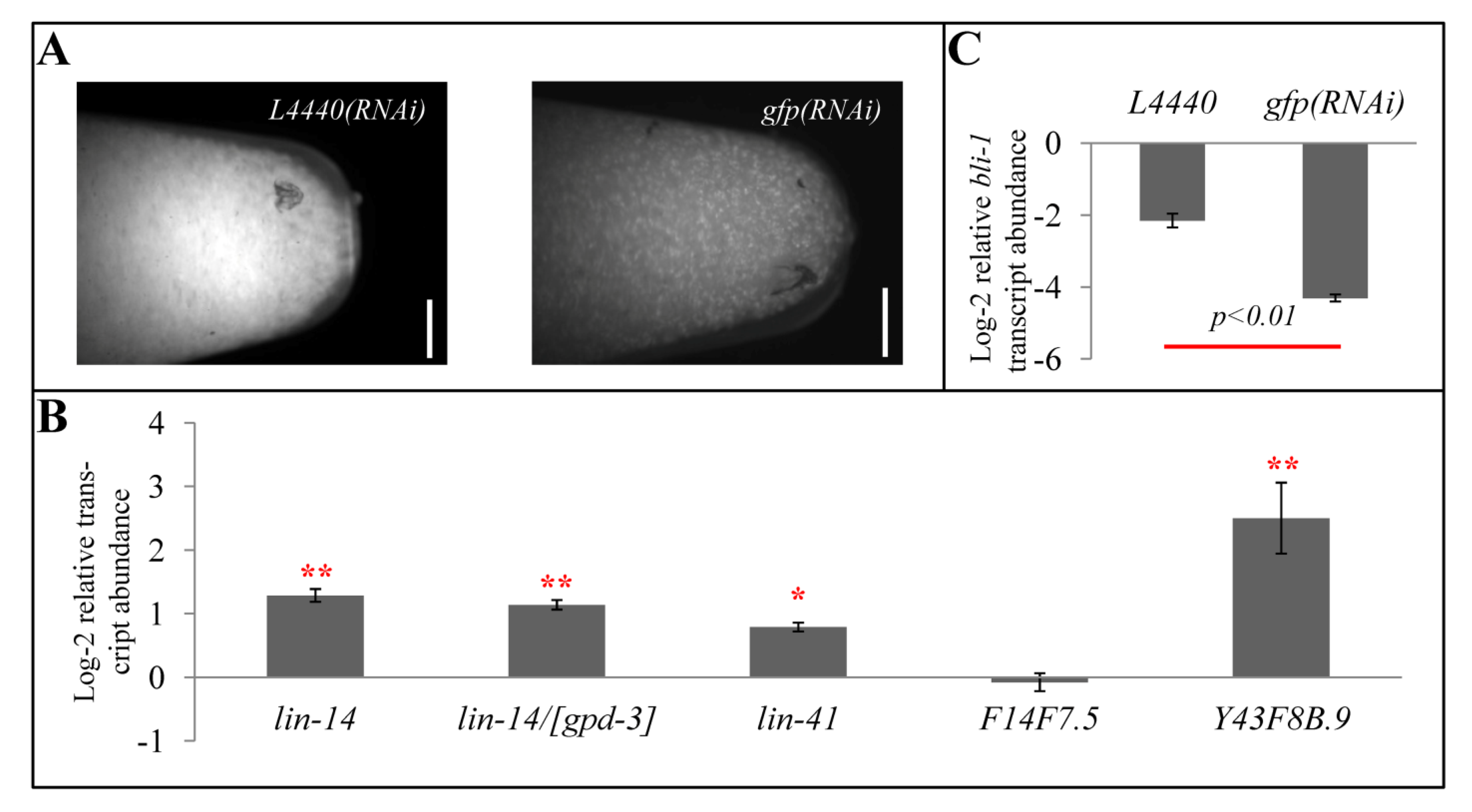
        <p>The competition model for interactions among the small RNA pathways further predicts that engaging the exo-RNAi pathway will reduce available resources for microRNA-regulated gene expression, resulting in increased target gene expression. To test this prediction, we compared the expression of <italic>lin-14</italic> and <italic>lin-41</italic> between control animals and the same strain exposed to dsRNA. Specifically, a strain expressing the ubiquitous <italic>sur-5:gfp</italic> transgene was grown on either empty vector L4440 bacteria (control) or <italic>gfp</italic>-dsRNA expressing bacteria (exo-RNAi(+)) (<xref ref-type="fig" rid="genes-03-00671-f004">Figure 4</xref>A). RNA was then extracted from mid-L4 (69 hour hatch-synchronized) worms raised at 15 °C on each of the bacteria. Quantitative PCR analysis showed that the <italic>lin-14</italic> and <italic>lin-41</italic> transcripts, normalized to <italic>bli-1</italic>, were both elevated when this strain was grown on <italic>gfp</italic> RNAi food (<xref ref-type="fig" rid="genes-03-00671-f004">Figure 4</xref>B). Similar results are obtained when transcripts levels were normalized to <italic>gpd-3</italic> (<xref ref-type="fig" rid="genes-03-00671-f004">Figure 4</xref>B).</p>
        
        <p>To similarly test for competition between the exo-RNAi pathway and the endo-RNAi pathway, we measured the transcript levels of the recently identified <italic>rrf-3</italic>-siRNA targets <italic>F14F7.5</italic> and <italic>Y43F8B.9</italic> [<xref ref-type="bibr" rid="B11-genes-03-00671">11</xref>]. As a control, we found these transcripts to be nearly sixty-fold and nearly eight-fold, respectively, more abundant in <italic>rrf-3(pk1426)</italic> mutant than in wild type mid-L4 worms, similar to previously published findings [<xref ref-type="bibr" rid="B11-genes-03-00671">11</xref>]. Consistent with the competition model, <italic>gfp(RNAi)</italic>-treated animals exhibited higher expression levels of the <italic>Y43F8B.9</italic> gene (<xref ref-type="fig" rid="genes-03-00671-f004">Figure 4</xref>B). However, we found that <italic>gfp(RNAi)</italic>-treated animals did not exhibit significant differences in expression levels of <italic>F14F7.5</italic> compared to vector L4440-treated animals (<xref ref-type="fig" rid="genes-03-00671-f004">Figure 4</xref>B).</p>
        <p>Our results support expanding the competition model to include the microRNA pathway. We hypothesize that mounting an exo-RNAi response reallocates common resources necessary for miRNA and endo-RNAi pathways towards the exo-RNAi pathway, resulting in less effective repression of <italic>let-7</italic> and <italic>rrf-3</italic> target genes. To our knowledge, this is the first reported investigation of the interaction between exoRNAi and miRNA functions. Furthermore, while prior studies of the competition between endoRNAi and exoRNAi focused on the enhanced exoRNAi phenotype of endo-RNAi mutants, we presented data showing that engaging the exo-RNAi pathway compromises the silencing of at least one endoRNAi target. </p>
        <p>Interestingly, engaging the exo-RNAi pathway also reduced a worm’s relative <italic>bli-1</italic> expression at mid-L4 (<xref ref-type="fig" rid="genes-03-00671-f004">Figure 4</xref>C). This result is consistent with delayed development associated with reducedendo-RNAi activity (<xref ref-type="fig" rid="genes-03-00671-f002">Figure 2</xref>C). We therefore propose that reduced small RNA flux through endo-RNAi pathways enhances miRNA and exo-RNAi pathways by enabling greater access to limiting resources as well as independently delaying development. </p>
      </sec>
      <sec>
        <title>2.8. Chicken and Egg: Development and Small RNAs?</title>
        <p>Our findings show that perturbed small RNA flux delays development. This may be caused by interference with miRNA-mediated regulation of the heterochronic genes that control temporal transitions, or the delayed expression of the heterochronic genes may simply reflect non-specific developmental delays. In either case the effects are likely to recursive, such that small initial differences are amplified as development progresses. As more small RNA deep sequencing data and analysis becomes available, it will be intriguing to analyze development from the perspective of small RNAs as master regulators. From an experimental standpoint, it is already important to consider such assumptions. Our data strongly suggest that endo-RNAi pathways are important for development, and although subtle, the effects may confound gene expression studies.</p>
        <fig id="genes-03-00671-f004" position="float">
          <label>Figure 4</label>
          <caption>
            <p>The effect of exogenous RNAi on transcript abundance of miRNA- and endo-RNAi-regulated genes. <bold>(A)</bold> Photomicrograph of ~200 µL of <italic>sur-5::gfp</italic> animals grown on control (empty L4440 vector) or <italic>gfp(RNAi)</italic> bacteria prior to RNA extraction. Scale bar indicates 1 mm. <bold>(B) </bold><italic>bli-1</italic> normalized relative <italic>lin-14</italic>, <italic>lin-41</italic>, <italic>F14F7.5</italic>, and <italic>Y43F8B.9</italic> transcript levels in mid-L4 (69 hours post hatching at 15 °C) <italic>gfp(RNAi)</italic>-treated <italic>sur-5::gfp</italic> animals compared to L4440 vector-fed <italic>sur-5::gfp</italic> animals. <italic>gpd-3</italic> normalized <italic>lin-14</italic> transcripts in mid-L4 <italic>gfp(RNAi)</italic>-treated <italic>sur-5::gfp</italic> animals compared to L4440 vector-fed <italic>sur-5::gfp</italic> animals is indicated by “<italic>lin-14</italic>/[<italic>gpd-3</italic>]”. <bold>(C)</bold><italic> gpd-3</italic> normalized relative <italic>bli-1</italic> transcript levels in mid-L4 <italic>gfp(RNAi)</italic>-treated <italic>sur-5::gfp</italic> animals compared to L4440 vector-fed <italic>sur-5::gfp</italic> animals. * indicates p &lt; 0.05; ** indicates p &lt; 0.01; no asterisks indicate statistical insignificance. <italic>p</italic>-values are calculated by <italic>t</italic>-test.</p>
          </caption>
          <graphic xmlns:xlink="http://www.w3.org/1999/xlink" xlink:href="genes-03-00671-g004.tif"/>
        </fig>
      </sec>
    </sec>
    <sec>
      <title>3. Materials and Methods</title>
      <sec>
        <title>3.1. Strains</title>
        <p>The following strains were used: (FX1917) <italic>eri-6/7(tm1917)</italic>, (GR1373) <italic>eri-1(mg366)</italic>, (HC195) <italic>nrIs20 (sur-5::NLS-GFP)</italic>, (HC196) <italic>sid-1(qt9)</italic>, (HC793) <italic>eri-1(mg366);let-7(n2853)</italic>, (MT7626) <italic>let-7(n2853)</italic>, (NL2099) <italic>rrf-3(pk1426)</italic>, (YY168) <italic>ergo-1/eri-8(gg100)</italic>, and (YY470) <italic>dcr-1/eri-4(mg375)</italic>. All strains and assays were maintained and performed at 15° C as previously described [<xref ref-type="bibr" rid="B39-genes-03-00671">39</xref>].</p>
      </sec>
      <sec>
        <title>3.2. gfp(RNAi)</title>
        <p><italic>gfp(RNAi)</italic> assays were performed as previously described [<xref ref-type="bibr" rid="B40-genes-03-00671">40</xref>]. Bacteria engineered to express dsRNA against <italic>gfp</italic> were prepared as previously described [<xref ref-type="bibr" rid="B41-genes-03-00671">41</xref>].</p>
      </sec>
      <sec>
        <title>3.3. Reverse Transcription Real-time PCR</title>
        <p>Hatch<bold>-</bold>synchronized to within 1 hour, worms from NG large plates, <italic>gfp(RNAi)</italic> plates, or L4440 vector plates grown at 15 °C for needed number of hours were pooled, washed extensively (M9) and then allowed to swim for 20 minutes to clear gut content. RNA was isolated with proteinase K (Omega) followed by phenol:chloroform extraction (Amresco). The RNA pellets were subjected to DNase I (Roche) treatment, and cleaned by RNeasy (Qiagen) per manufacturer’s instructions. All initial RNA input concentrations were normalized to ~30−200 ng/µL.</p>
        <p>Reverse transcription was performed using 20 µL reactions of ~150–600 ng of input RNA by Thermoscript RT (Invitrogen), using gene specific RT primers (available upon request). cDNA quantification was performed using 2 µL of the RT reaction in a 50 µL QuantiTect SYBR Green (Qiagen) reaction with nested PCR primers. The PCR reaction cycles were: 15 minutes 95 degrees, 15 seconds 94 degrees, 30 seconds 52 degrees, 1 minute 72 degrees, read, cycle to step 2 for 45 cycles, using an Eppendorf Mastercycler Realplex4 and Noiseband quantification. Subsequent analysis was performed using the ΔCT approach for expression normalized to another gene, or the ΔΔCT approach for expression normalized to another gene and then relative to wild type’s expression [<xref ref-type="bibr" rid="B42-genes-03-00671">42</xref>]. </p>
        <p>Three to five biological replicates of worms were combined for an RNA prep. This RNA was then quantified in triplicates (error bar generation), and repeated two to four times (representative shown), to determine the precision of relative RNA abundance, similar to prior small RNA qPCR experiments [<xref ref-type="bibr" rid="B25-genes-03-00671">25</xref>].</p>
      </sec>
    </sec>
    <sec sec-type="conclusions">
      <title>4. Conclusions and Future Scope</title>
      <p>Recent publications report on competitive regulation schemes akin to the <italic>C. elegans</italic> small RNA competition model [<xref ref-type="bibr" rid="B8-genes-03-00671">8</xref>] for RNAs in mammalian systems [<xref ref-type="bibr" rid="B43-genes-03-00671">43</xref>,<xref ref-type="bibr" rid="B44-genes-03-00671">44</xref>,<xref ref-type="bibr" rid="B45-genes-03-00671">45</xref>,<xref ref-type="bibr" rid="B46-genes-03-00671">46</xref>,<xref ref-type="bibr" rid="B47-genes-03-00671">47</xref>]. These reports identify competitive endogenous RNAs (ceRNAs) that soak up miRNAs involved in tumorigenicity [<xref ref-type="bibr" rid="B43-genes-03-00671">43</xref>]. The use of miRNA profiling to diagnose cancer is becoming common, thus our findings in <italic>C. elegans</italic>, which suggest that developmental timing is intricately tied to small RNA expression, provides a cautionary caveat to these approaches. That is, while the functions of these ceRNAs are robustly demonstrated <italic>in vitro</italic>, when and how they are expressed <italic>in vivo</italic> for their putative regulation of miRNAs is not fully known. It is reasonable to assume that these ceRNAs are spatially and temporally regulated. Defects in tumors growth can impact small RNA expression, thus attributing causal relationships when developmental factors may indirectly affect both miRNAs and ceRNAs should be done with caution.</p>
      <p>Therapeutic delivery of small RNAs has been a commercial goal of RNAi for many years [<xref ref-type="bibr" rid="B48-genes-03-00671">48</xref>]. Because the mammalian RNAi response apparently lacks an amplified secondary response [<xref ref-type="bibr" rid="B49-genes-03-00671">49</xref>], and the <italic>C. elegans</italic> limiting RNAi resources are largely involved in the biogenesis or execution of the secondary response, analogies to the <italic>C. elegans</italic> competition model were deemed inapplicable. However, our observation that engaging the exoRNAi pathway via experimental dsRNA can cause developmental delays suggests that the indirect aspect of the <italic>C. elegans</italic> small RNA competition can still serve as a model. Off-target effects have long been assumed to result from promiscuous siRNA binding, but our results suggest that perturbed small-RNA flux may also indirectly misregulate biological, processes, including development. </p>
    </sec>
  </body>
  <back>
    <ack>
      <title>Acknowledgements</title>
      <p>We thank members of the Hunter lab for constructive comments, especially Kenneth Pang and Daniel Schott, Elizabeth Wang for technical assistance with RNA extractions, and the <italic>Caenorhabditis</italic> Genetics Center for strain provision. This work was supported by the National Science Foundation grant MCB 0744029 to CPH and a NSF Graduate Research Fellowship to JJZ, and by the National Institutes of Health grant GM089795 to CPH. The authors declare no competing financial interests.</p>
    </ack>
    <ref-list>
      <title>References</title>
      <ref id="B1-genes-03-00671">
        <label>1.</label>
        <citation citation-type="journal">
          <person-group person-group-type="author">
            <name>
              <surname>Fischer</surname>
              <given-names>S.E.</given-names>
            </name>
          </person-group>
          <article-title>Small RNA-mediated gene silencing pathways in C. elegans</article-title>
          <source>Int J. Biochem. Cell Biol.</source>
          <year>2010</year>
          <volume>42</volume>
          <fpage>1306</fpage>
          <lpage>1315</lpage>
          <pub-id pub-id-type="doi">10.1016/j.biocel.2010.03.006</pub-id>
        </citation>
      </ref>
      <ref id="B2-genes-03-00671">
        <label>2.</label>
        <citation citation-type="journal">
          <person-group person-group-type="author">
            <name>
              <surname>Kaikkonen</surname>
              <given-names>M.U.</given-names>
            </name>
            <name>
              <surname>Lam</surname>
              <given-names>M.T.</given-names>
            </name>
            <name>
              <surname>Glass</surname>
              <given-names>C.K.</given-names>
            </name>
          </person-group>
          <article-title>Non-coding RNAs as regulators of gene expression and epigenetics</article-title>
          <source>Cardiovasc. Res.</source>
          <year>2011</year>
          <volume>90</volume>
          <fpage>430</fpage>
          <lpage>440</lpage>
          <pub-id pub-id-type="doi">10.1093/cvr/cvr097</pub-id>
        </citation>
      </ref>
      <ref id="B3-genes-03-00671">
        <label>3.</label>
        <citation citation-type="journal">
          <person-group person-group-type="author">
            <name>
              <surname>Lee</surname>
              <given-names>R.C.</given-names>
            </name>
            <name>
              <surname>Feinbaum</surname>
              <given-names>R.L.</given-names>
            </name>
            <name>
              <surname>Ambros</surname>
              <given-names>V.</given-names>
            </name>
          </person-group>
          <article-title>The C. elegans heterochronic gene lin-4 encodes small RNAs with antisense complementarity to lin-14</article-title>
          <source>Cell</source>
          <year>1993</year>
          <volume>75</volume>
          <fpage>843</fpage>
          <lpage>854</lpage>
          <pub-id pub-id-type="doi">10.1016/0092-8674(93)90529-Y</pub-id>
        </citation>
      </ref>
      <ref id="B4-genes-03-00671">
        <label>4.</label>
        <citation citation-type="journal">
          <person-group person-group-type="author">
            <name>
              <surname>Reinhart</surname>
              <given-names>B.J.</given-names>
            </name>
            <name>
              <surname>Slack</surname>
              <given-names>F.J.</given-names>
            </name>
            <name>
              <surname>Basson</surname>
              <given-names>M.</given-names>
            </name>
            <name>
              <surname>Pasquinelli</surname>
              <given-names>A.E.</given-names>
            </name>
            <name>
              <surname>Bettinger</surname>
              <given-names>J.C.</given-names>
            </name>
            <name>
              <surname>Rougvie</surname>
              <given-names>A.E.</given-names>
            </name>
            <name>
              <surname>Horvitz</surname>
              <given-names>H.R.</given-names>
            </name>
            <name>
              <surname>Ruvkun</surname>
              <given-names>G.</given-names>
            </name>
          </person-group>
          <article-title>The 21-nucleotide let-7 RNA regulates developmental timing in Caenorhabditis elegans</article-title>
          <source>Nature</source>
          <year>2000</year>
          <volume>403</volume>
          <fpage>901</fpage>
          <lpage>906</lpage>
          <pub-id pub-id-type="doi">10.1038/35002607</pub-id>
        </citation>
      </ref>
      <ref id="B5-genes-03-00671">
        <label>5.</label>
        <citation citation-type="journal">
          <person-group person-group-type="author">
            <name>
              <surname>Pasquinelli</surname>
              <given-names>A.E.</given-names>
            </name>
            <name>
              <surname>Reinhart</surname>
              <given-names>B.J.</given-names>
            </name>
            <name>
              <surname>Slack</surname>
              <given-names>F.</given-names>
            </name>
            <name>
              <surname>Martindale</surname>
              <given-names>M.Q.</given-names>
            </name>
            <name>
              <surname>Kuroda</surname>
              <given-names>M.I.</given-names>
            </name>
            <name>
              <surname>Maller</surname>
              <given-names>B.</given-names>
            </name>
            <name>
              <surname>Hayward</surname>
              <given-names>D.C.</given-names>
            </name>
            <name>
              <surname>Ball</surname>
              <given-names>E.E.</given-names>
            </name>
            <name>
              <surname>Degnan</surname>
              <given-names>B.</given-names>
            </name>
            <name>
              <surname>Muller</surname>
              <given-names>P.</given-names>
            </name>
            <name>
              <surname>Spring</surname>
              <given-names>J.</given-names>
            </name>
            <name>
              <surname>Srinivasan</surname>
              <given-names>A.</given-names>
            </name>
            <name>
              <surname>Fishman</surname>
              <given-names>M.</given-names>
            </name>
            <name>
              <surname>Finnerty</surname>
              <given-names>J.</given-names>
            </name>
            <name>
              <surname>Corbo</surname>
              <given-names>J.</given-names>
            </name>
            <name>
              <surname>Levine</surname>
              <given-names>M.</given-names>
            </name>
            <name>
              <surname>Leahy</surname>
              <given-names>P.</given-names>
            </name>
            <name>
              <surname>Davidson</surname>
              <given-names>E.</given-names>
            </name>
            <name>
              <surname>Ruvkun</surname>
              <given-names>G.</given-names>
            </name>
          </person-group>
          <article-title>Conservation of the sequence and temporal expression of let-7 heterochronic regulatory RNA</article-title>
          <source>Nature</source>
          <year>2000</year>
          <volume>408</volume>
          <fpage>86</fpage>
          <lpage>89</lpage>
        <pub-id pub-id-type="doi">10.1038/35040556</pub-id><pub-id pub-id-type="pmid">11081512</pub-id></citation>
      </ref>
      <ref id="B6-genes-03-00671">
        <label>6.</label>
        <citation citation-type="journal">
          <person-group person-group-type="author">
            <name>
              <surname>Kawaji</surname>
              <given-names>H.</given-names>
            </name>
            <name>
              <surname>Hayashizaki</surname>
              <given-names>Y.</given-names>
            </name>
          </person-group>
          <article-title>Exploration of small RNAs</article-title>
          <source>PLoS Genet.</source>
          <year>2008</year>
        </citation>
      </ref>
      <ref id="B7-genes-03-00671">
        <label>7.</label>
        <citation citation-type="journal">
          <person-group person-group-type="author">
            <name>
              <surname>Fire</surname>
              <given-names>A.</given-names>
            </name>
            <name>
              <surname>Xu</surname>
              <given-names>S.</given-names>
            </name>
            <name>
              <surname>Montgomery</surname>
              <given-names>M.K.</given-names>
            </name>
            <name>
              <surname>Kostas</surname>
              <given-names>S.A.</given-names>
            </name>
            <name>
              <surname>Driver</surname>
              <given-names>S.E.</given-names>
            </name>
            <name>
              <surname>Mello</surname>
              <given-names>C.C.</given-names>
            </name>
          </person-group>
          <article-title>Potent and specific genetic interference by double-stranded RNA in Caenorhabditis elegans</article-title>
          <source>Nature</source>
          <year>1998</year>
          <volume>391</volume>
          <fpage>806</fpage>
          <lpage>811</lpage>
          <pub-id pub-id-type="doi">10.1038/35888</pub-id>
        </citation>
      </ref>
      <ref id="B8-genes-03-00671">
        <label>8.</label>
        <citation citation-type="journal">
          <person-group person-group-type="author">
            <name>
              <surname>Lee</surname>
              <given-names>R.C.</given-names>
            </name>
            <name>
              <surname>Hammell</surname>
              <given-names>C.M.</given-names>
            </name>
            <name>
              <surname>Ambros</surname>
              <given-names>V.</given-names>
            </name>
          </person-group>
          <article-title>Interacting endogenous and exogenous RNAi pathways in Caenorhabditis elegans</article-title>
          <source>RNA</source>
          <year>2006</year>
          <volume>12</volume>
          <fpage>589</fpage>
          <lpage>597</lpage>
          <pub-id pub-id-type="doi">10.1261/rna.2231506</pub-id>
        </citation>
      </ref>
      <ref id="B9-genes-03-00671">
        <label>9.</label>
        <citation citation-type="journal">
          <person-group person-group-type="author">
            <name>
              <surname>Grishok</surname>
              <given-names>A.</given-names>
            </name>
          </person-group>
          <article-title>RNAi mechanisms in Caenorhabditis elegans</article-title>
          <source>FEBS Lett.</source>
          <year>2005</year>
          <volume>579</volume>
          <fpage>5932</fpage>
          <lpage>5939</lpage>
          <pub-id pub-id-type="doi">10.1016/j.febslet.2005.08.001</pub-id>
        </citation>
      </ref>
      <ref id="B10-genes-03-00671">
        <label>10.</label>
        <citation citation-type="journal">
          <person-group person-group-type="author">
            <name>
              <surname>Tabara</surname>
              <given-names>H.</given-names>
            </name>
            <name>
              <surname>Sarkissian</surname>
              <given-names>M.</given-names>
            </name>
            <name>
              <surname>Kelly</surname>
              <given-names>W.G.</given-names>
            </name>
            <name>
              <surname>Fleenor</surname>
              <given-names>J.</given-names>
            </name>
            <name>
              <surname>Grishok</surname>
              <given-names>A.</given-names>
            </name>
            <name>
              <surname>Timmons</surname>
              <given-names>L.</given-names>
            </name>
            <name>
              <surname>Fire</surname>
              <given-names>A.</given-names>
            </name>
            <name>
              <surname>Mello</surname>
              <given-names>C.C.</given-names>
            </name>
          </person-group>
          <article-title>The rde-1 gene, RNA interference, and transposon silencing in C. elegans</article-title>
          <source>Cell</source>
          <year>1999</year>
          <volume>99</volume>
          <fpage>123</fpage>
          <lpage>132</lpage>
          <pub-id pub-id-type="doi">10.1016/S0092-8674(00)81644-X</pub-id>
        </citation>
      </ref>
      <ref id="B11-genes-03-00671">
        <label>11.</label>
        <citation citation-type="journal">
          <person-group person-group-type="author">
            <name>
              <surname>Gent</surname>
              <given-names>J.I.</given-names>
            </name>
            <name>
              <surname>Lamm</surname>
              <given-names>A.T.</given-names>
            </name>
            <name>
              <surname>Pavelec</surname>
              <given-names>D.M.</given-names>
            </name>
            <name>
              <surname>Maniar</surname>
              <given-names>J.M.</given-names>
            </name>
            <name>
              <surname>Parameswaran</surname>
              <given-names>P.</given-names>
            </name>
            <name>
              <surname>Tao</surname>
              <given-names>L.</given-names>
            </name>
            <name>
              <surname>Kennedy</surname>
              <given-names>S.</given-names>
            </name>
            <name>
              <surname>Fire</surname>
              <given-names>A.Z.</given-names>
            </name>
          </person-group>
          <article-title>Distinct phases of siRNA synthesis in an endogenous RNAi pathway in C. elegans soma</article-title>
          <source> Mol. Cell</source>
          <year>2010</year>
          <volume>37</volume>
          <fpage>679</fpage>
          <lpage>689</lpage>
          <pub-id pub-id-type="doi">10.1016/j.molcel.2010.01.012</pub-id>
        </citation>
      </ref>
      <ref id="B12-genes-03-00671">
        <label>12.</label>
        <citation citation-type="journal">
          <person-group person-group-type="author">
            <name>
              <surname>Sifuentes-Romero</surname>
              <given-names>I.</given-names>
            </name>
            <name>
              <surname>Milton</surname>
              <given-names>S.L.</given-names>
            </name>
            <name>
              <surname>Garcia-Gasca</surname>
              <given-names>A.</given-names>
            </name>
          </person-group>
          <article-title>Post-transcriptional gene silencing by RNA interference in non-mammalian vertebrate systems: where do we stand?</article-title>
          <source>Mutat. Res.</source>
          <year>2011</year>
          <volume>728</volume>
          <fpage>158</fpage>
          <lpage>171</lpage>
          <pub-id pub-id-type="doi">10.1016/j.mrrev.2011.09.001</pub-id>
        </citation>
      </ref>
      <ref id="B13-genes-03-00671">
        <label>13.</label>
        <citation citation-type="journal">
          <person-group person-group-type="author">
            <name>
              <surname>Das</surname>
              <given-names>P.P.</given-names>
            </name>
            <name>
              <surname>Bagijn</surname>
              <given-names>M.P.</given-names>
            </name>
            <name>
              <surname>Goldstein</surname>
              <given-names>L.D.</given-names>
            </name>
            <name>
              <surname>Woolford</surname>
              <given-names>J.R.</given-names>
            </name>
            <name>
              <surname>Lehrbach</surname>
              <given-names>N.J.</given-names>
            </name>
            <name>
              <surname>Sapetschnig</surname>
              <given-names>A.</given-names>
            </name>
            <name>
              <surname>Buhecha</surname>
              <given-names>H.R.</given-names>
            </name>
            <name>
              <surname>Gilchrist</surname>
              <given-names>M.J.</given-names>
            </name>
            <name>
              <surname>Howe</surname>
              <given-names>K.L.</given-names>
            </name>
            <name>
              <surname>Stark</surname>
              <given-names>R.</given-names>
            </name>
            <name>
              <surname>Matthews</surname>
              <given-names>N.</given-names>
            </name>
            <name>
              <surname>Berezikov</surname>
              <given-names>E.</given-names>
            </name>
            <name>
              <surname>Ketting</surname>
              <given-names>R.F.</given-names>
            </name>
            <name>
              <surname>Tavare</surname>
              <given-names>S.</given-names>
            </name>
            <name>
              <surname>Miska</surname>
              <given-names>E.A.</given-names>
            </name>
          </person-group>
          <article-title>Piwi and piRNAs act upstream of an endogenous siRNA pathway to suppress Tc3 transposon mobility in the Caenorhabditis elegans germline</article-title>
          <source>Mol. Cell</source>
          <year>2008</year>
          <volume>31</volume>
          <fpage>79</fpage>
          <lpage>90</lpage>
          <pub-id pub-id-type="doi">10.1016/j.molcel.2008.06.003</pub-id>
        </citation>
      </ref>
      <ref id="B14-genes-03-00671">
        <label>14.</label>
        <citation citation-type="journal">
          <person-group person-group-type="author">
            <name>
              <surname>Wilusz</surname>
              <given-names>J.E.</given-names>
            </name>
            <name>
              <surname>Sunwoo</surname>
              <given-names>H.</given-names>
            </name>
            <name>
              <surname>Spector</surname>
              <given-names>D.L.</given-names>
            </name>
          </person-group>
          <article-title>Long noncoding RNAs: Functional surprises from the RNA world</article-title>
          <source>Genes Dev.</source>
          <year>2009</year>
          <volume>23</volume>
          <fpage>1494</fpage>
          <lpage>1504</lpage>
          <pub-id pub-id-type="doi">10.1101/gad.1800909</pub-id>
        </citation>
      </ref>
      <ref id="B15-genes-03-00671">
        <label>15.</label>
        <citation citation-type="journal">
          <person-group person-group-type="author">
            <name>
              <surname>Claycomb</surname>
              <given-names>J.M.</given-names>
            </name>
            <name>
              <surname>Batista</surname>
              <given-names>P.J.</given-names>
            </name>
            <name>
              <surname>Pang</surname>
              <given-names>K.M.</given-names>
            </name>
            <name>
              <surname>Gu</surname>
              <given-names>W.</given-names>
            </name>
            <name>
              <surname>Vasale</surname>
              <given-names>J.J.</given-names>
            </name>
            <name>
              <surname>van Wolfswinkel</surname>
              <given-names>J.C.</given-names>
            </name>
            <name>
              <surname>Chaves</surname>
              <given-names>D.A.</given-names>
            </name>
            <name>
              <surname>Shirayama</surname>
              <given-names>M.</given-names>
            </name>
            <name>
              <surname>Mitani</surname>
              <given-names>S.</given-names>
            </name>
            <name>
              <surname>Ketting</surname>
              <given-names>R.F.</given-names>
            </name>
            <name>
              <surname>Conte</surname>
              <given-names>D.</given-names>
              <suffix>Jr.</suffix>
            </name>
            <name>
              <surname>Mello</surname>
              <given-names>C.C.</given-names>
            </name>
          </person-group>
          <article-title>The Argonaute CSR-1 and its 22G-RNA cofactors are required for holocentric chromosome segregation</article-title>
          <source>Cell</source>
          <year>2009</year>
          <volume>139</volume>
          <fpage>123</fpage>
          <lpage>134</lpage>
          <pub-id pub-id-type="doi">10.1016/j.cell.2009.09.014</pub-id>
        </citation>
      </ref>
      <ref id="B16-genes-03-00671">
        <label>16.</label>
        <citation citation-type="journal">
          <person-group person-group-type="author">
            <name>
              <surname>Ohta</surname>
              <given-names>H.</given-names>
            </name>
            <name>
              <surname>Fujiwara</surname>
              <given-names>M.</given-names>
            </name>
            <name>
              <surname>Ohshima</surname>
              <given-names>Y.</given-names>
            </name>
            <name>
              <surname>Ishihara</surname>
              <given-names>T.</given-names>
            </name>
          </person-group>
          <article-title>ADBP-1 regulates an ADAR RNA-editing enzyme to antagonize RNA-interference-mediated gene silencing in Caenorhabditis elegans</article-title>
          <source>Genetics</source>
          <year>2008</year>
          <volume>180</volume>
          <fpage>785</fpage>
          <lpage>796</lpage>
          <pub-id pub-id-type="doi">10.1534/genetics.108.093310</pub-id>
        </citation>
      </ref>
      <ref id="B17-genes-03-00671">
        <label>17.</label>
        <citation citation-type="journal">
          <person-group person-group-type="author">
            <name>
              <surname>Gu</surname>
              <given-names>S.G.</given-names>
            </name>
            <name>
              <surname>Pak</surname>
              <given-names>J.</given-names>
            </name>
            <name>
              <surname>Guang</surname>
              <given-names>S.</given-names>
            </name>
            <name>
              <surname>Maniar</surname>
              <given-names>J.M.</given-names>
            </name>
            <name>
              <surname>Kennedy</surname>
              <given-names>S.</given-names>
            </name>
            <name>
              <surname>Fire</surname>
              <given-names>A.</given-names>
            </name>
          </person-group>
          <article-title>Amplification of siRNA in Caenorhabditis elegans generates a transgenerational sequence-targeted histone H3 lysine 9 methylation footprint</article-title>
          <source>Nat. Genet.</source>
          <year>2012</year>
          <volume>44</volume>
          <fpage>157</fpage>
          <lpage>164</lpage>
          <pub-id pub-id-type="doi">10.1038/ng.1039</pub-id>
        </citation>
      </ref>
      <ref id="B18-genes-03-00671">
        <label>18.</label>
        <citation citation-type="journal">
          <person-group person-group-type="author">
            <name>
              <surname>Azimzadeh Jamalkandi</surname>
              <given-names>S.</given-names>
            </name>
            <name>
              <surname>Masoudi-Nejad</surname>
              <given-names>A.</given-names>
            </name>
          </person-group>
          <article-title>RNAi pathway integration in Caenorhabditis elegans development</article-title>
          <source>Funct. Integr. Genomics</source>
          <year>2011</year>
          <volume>11</volume>
          <fpage>389</fpage>
          <lpage>405</lpage>
          <pub-id pub-id-type="doi">10.1007/s10142-011-0236-1</pub-id>
        </citation>
      </ref>
      <ref id="B19-genes-03-00671">
        <label>19.</label>
        <citation citation-type="journal">
          <person-group person-group-type="author">
            <name>
              <surname>Simmer</surname>
              <given-names>F.</given-names>
            </name>
            <name>
              <surname>Tijsterman</surname>
              <given-names>M.</given-names>
            </name>
            <name>
              <surname>Parrish</surname>
              <given-names>S.</given-names>
            </name>
            <name>
              <surname>Koushika</surname>
              <given-names>S.P.</given-names>
            </name>
            <name>
              <surname>Nonet</surname>
              <given-names>M.L.</given-names>
            </name>
            <name>
              <surname>Fire</surname>
              <given-names>A.</given-names>
            </name>
            <name>
              <surname>Ahringer</surname>
              <given-names>J.</given-names>
            </name>
            <name>
              <surname>Plasterk</surname>
              <given-names>R.H.</given-names>
            </name>
          </person-group>
          <article-title>Loss of the putative RNA-directed RNA polymerase RRF-3 makes C. elegans hypersensitive to RNAi</article-title>
          <source>Curr. Biol.</source>
          <year>2002</year>
          <volume>12</volume>
          <fpage>1317</fpage>
          <lpage>1319</lpage>
          <pub-id pub-id-type="doi">10.1016/S0960-9822(02)01041-2</pub-id>
        </citation>
      </ref>
      <ref id="B20-genes-03-00671">
        <label>20.</label>
        <citation citation-type="journal">
          <person-group person-group-type="author">
            <name>
              <surname>Kennedy</surname>
              <given-names>S.</given-names>
            </name>
            <name>
              <surname>Wang</surname>
              <given-names>D.</given-names>
            </name>
            <name>
              <surname>Ruvkun</surname>
              <given-names>G.</given-names>
            </name>
          </person-group>
          <article-title>A conserved siRNA-degrading RNase negatively regulates RNA interference in C. elegans</article-title>
          <source> Nature</source>
          <year>2004</year>
          <volume>427</volume>
          <fpage>645</fpage>
          <lpage>649</lpage>
          <pub-id pub-id-type="doi">10.1038/nature02302</pub-id>
        </citation>
      </ref>
      <ref id="B21-genes-03-00671">
        <label>21.</label>
        <citation citation-type="journal">
          <person-group person-group-type="author">
            <name>
              <surname>Duchaine</surname>
              <given-names>T.F.</given-names>
            </name>
            <name>
              <surname>Wohlschlegel</surname>
              <given-names>J.A.</given-names>
            </name>
            <name>
              <surname>Kennedy</surname>
              <given-names>S.</given-names>
            </name>
            <name>
              <surname>Bei</surname>
              <given-names>Y.</given-names>
            </name>
            <name>
              <surname>Conte</surname>
              <given-names>D.</given-names>
              <suffix>Jr.</suffix>
            </name>
            <name>
              <surname>Pang</surname>
              <given-names>K.</given-names>
            </name>
            <name>
              <surname>Brownell</surname>
              <given-names>D.R.</given-names>
            </name>
            <name>
              <surname>Harding</surname>
              <given-names>S.</given-names>
            </name>
            <name>
              <surname>Mitani</surname>
              <given-names>S.</given-names>
            </name>
            <name>
              <surname>Ruvkun</surname>
              <given-names>G.</given-names>
            </name>
            <name>
              <surname>Yates</surname>
              <given-names>J.R.</given-names>
              <suffix>3rd</suffix>
            </name>
            <name>
              <surname>Mello</surname>
              <given-names>C.C.</given-names>
            </name>
          </person-group>
          <article-title>Functional proteomics reveals the biochemical niche of C. elegans DCR-1 in multiple small-RNA-mediated pathways</article-title>
          <source>Cell</source>
          <year>2006</year>
          <volume>124</volume>
          <fpage>343</fpage>
          <lpage>354</lpage>
          <pub-id pub-id-type="doi">10.1016/j.cell.2005.11.036</pub-id>
        </citation>
      </ref>
      <ref id="B22-genes-03-00671">
        <label>22.</label>
        <citation citation-type="journal">
          <person-group person-group-type="author">
            <name>
              <surname>Fischer</surname>
              <given-names>S.E.</given-names>
            </name>
            <name>
              <surname>Butler</surname>
              <given-names>M.D.</given-names>
            </name>
            <name>
              <surname>Pan</surname>
              <given-names>Q.</given-names>
            </name>
            <name>
              <surname>Ruvkun</surname>
              <given-names>G.</given-names>
            </name>
          </person-group>
          <article-title>Trans-splicing in C. elegans generates the negative RNAi regulator ERI-6/7</article-title>
          <source>Nature</source>
          <year>2008</year>
          <volume>455</volume>
          <fpage>491</fpage>
          <lpage>496</lpage>
          <pub-id pub-id-type="doi">10.1038/nature07274</pub-id>
        </citation>
      </ref>
      <ref id="B23-genes-03-00671">
        <label>23.</label>
        <citation citation-type="journal">
          <person-group person-group-type="author">
            <name>
              <surname>Pavelec</surname>
              <given-names>D.M.</given-names>
            </name>
            <name>
              <surname>Lachowiec</surname>
              <given-names>J.</given-names>
            </name>
            <name>
              <surname>Duchaine</surname>
              <given-names>T.F.</given-names>
            </name>
            <name>
              <surname>Smith</surname>
              <given-names>H.E.</given-names>
            </name>
            <name>
              <surname>Kennedy</surname>
              <given-names>S.</given-names>
            </name>
          </person-group>
          <article-title>Requirement for the ERI/DICER complex in endogenous RNA interference and sperm development in Caenorhabditis elegans</article-title>
          <source>Genetics</source>
          <year>2009</year>
          <volume>183</volume>
          <fpage>1283</fpage>
          <lpage>1295</lpage>
          <pub-id pub-id-type="doi">10.1534/genetics.109.108134</pub-id>
        </citation>
      </ref>
      <ref id="B24-genes-03-00671">
        <label>24.</label>
        <citation citation-type="journal">
          <person-group person-group-type="author">
            <name>
              <surname>Gent</surname>
              <given-names>J.I.</given-names>
            </name>
            <name>
              <surname>Schvarzstein</surname>
              <given-names>M.</given-names>
            </name>
            <name>
              <surname>Villeneuve</surname>
              <given-names>A.M.</given-names>
            </name>
            <name>
              <surname>Gu</surname>
              <given-names>S.G.</given-names>
            </name>
            <name>
              <surname>Jantsch</surname>
              <given-names>V.</given-names>
            </name>
            <name>
              <surname>Fire</surname>
              <given-names>A.Z.</given-names>
            </name>
            <name>
              <surname>Baudrimont</surname>
              <given-names>A.</given-names>
            </name>
          </person-group>
          <article-title>A Caenorhabditis elegans RNA-directed RNA polymerase in sperm development and endogenous RNA interference</article-title>
          <source>Genetics</source>
          <year>2009</year>
          <volume>183</volume>
          <fpage>1297</fpage>
          <lpage>1314</lpage>
          <pub-id pub-id-type="doi">10.1534/genetics.109.109686</pub-id>
        </citation>
      </ref>
      <ref id="B25-genes-03-00671">
        <label>25.</label>
        <citation citation-type="journal">
          <person-group person-group-type="author">
            <name>
              <surname>Fischer</surname>
              <given-names>S.E.</given-names>
            </name>
            <name>
              <surname>Montgomery</surname>
              <given-names>T.A.</given-names>
            </name>
            <name>
              <surname>Zhang</surname>
              <given-names>C.</given-names>
            </name>
            <name>
              <surname>Fahlgren</surname>
              <given-names>N.</given-names>
            </name>
            <name>
              <surname>Breen</surname>
              <given-names>P.C.</given-names>
            </name>
            <name>
              <surname>Hwang</surname>
              <given-names>A.</given-names>
            </name>
            <name>
              <surname>Sullivan</surname>
              <given-names>C.M.</given-names>
            </name>
            <name>
              <surname>Carrington</surname>
              <given-names>J.C.</given-names>
            </name>
            <name>
              <surname>Ruvkun</surname>
              <given-names>G.</given-names>
            </name>
          </person-group>
          <article-title>The ERI-6/7 Helicase Acts at the First Stage of an siRNA Amplification Pathway That Targets Recent Gene Duplications</article-title>
          <source>PLoS Genet.</source>
          <year>2011</year>
        </citation>
      </ref>
      <ref id="B26-genes-03-00671">
        <label>26.</label>
        <citation citation-type="journal">
          <person-group person-group-type="author">
            <name>
              <surname>Yigit</surname>
              <given-names>E.</given-names>
            </name>
            <name>
              <surname>Batista</surname>
              <given-names>P.J.</given-names>
            </name>
            <name>
              <surname>Bei</surname>
              <given-names>Y.</given-names>
            </name>
            <name>
              <surname>Pang</surname>
              <given-names>K.M.</given-names>
            </name>
            <name>
              <surname>Chen</surname>
              <given-names>C.C.</given-names>
            </name>
            <name>
              <surname>Tolia</surname>
              <given-names>N.H.</given-names>
            </name>
            <name>
              <surname>Joshua-Tor</surname>
              <given-names>L.</given-names>
            </name>
            <name>
              <surname>Mitani</surname>
              <given-names>S.</given-names>
            </name>
            <name>
              <surname>Simard</surname>
              <given-names>M.J.</given-names>
            </name>
            <name>
              <surname>Mello</surname>
              <given-names>C.C.</given-names>
            </name>
          </person-group>
          <article-title>Analysis of the C. elegans Argonaute family reveals that distinct Argonautes act sequentially during RNAi</article-title>
          <source>Cell</source>
          <year>2006</year>
          <volume>127</volume>
          <fpage>747</fpage>
          <lpage>757</lpage>
          <pub-id pub-id-type="doi">10.1016/j.cell.2006.09.033</pub-id>
        </citation>
      </ref>
      <ref id="B27-genes-03-00671">
        <label>27.</label>
        <citation citation-type="journal">
          <person-group person-group-type="author">
            <name>
              <surname>Knight</surname>
              <given-names>S.W.</given-names>
            </name>
            <name>
              <surname>Bass</surname>
              <given-names>B.L.</given-names>
            </name>
          </person-group>
          <article-title>A role for the RNase III enzyme DCR-1 in RNA interference and germ line development in Caenorhabditis elegans</article-title>
          <source>Science</source>
          <year>2001</year>
          <volume>293</volume>
          <fpage>2269</fpage>
          <lpage>2271</lpage>
          <pub-id pub-id-type="doi">10.1126/science.1062039</pub-id>
        </citation>
      </ref>
      <ref id="B28-genes-03-00671">
        <label>28.</label>
        <citation citation-type="journal">
          <person-group person-group-type="author">
            <name>
              <surname>Ketting</surname>
              <given-names>R.F.</given-names>
            </name>
            <name>
              <surname>Fischer</surname>
              <given-names>S.E.J.</given-names>
            </name>
            <name>
              <surname>Bernstein</surname>
              <given-names>E.</given-names>
            </name>
            <name>
              <surname>Sijen</surname>
              <given-names>T.</given-names>
            </name>
            <name>
              <surname>Hannon</surname>
              <given-names>G.J.</given-names>
            </name>
            <name>
              <surname>Plasterk</surname>
              <given-names>R.H.A.</given-names>
            </name>
          </person-group>
          <article-title>Dicer functions in RNA interference and in synthesis of small RNA involved in developmental timing in C-elegans</article-title>
          <source>Gene Dev.</source>
          <year>2001</year>
          <volume>15</volume>
          <fpage>2654</fpage>
          <lpage>2659</lpage>
          <pub-id pub-id-type="doi">10.1101/gad.927801</pub-id>
        </citation>
      </ref>
      <ref id="B29-genes-03-00671">
        <label>29.</label>
        <citation citation-type="web">
          <person-group person-group-type="author">
            <name>
              <surname>Page</surname>
              <given-names>A.P.</given-names>
            </name>
            <name>
              <surname>Johnstone</surname>
              <given-names>I.L.</given-names>
            </name>
          </person-group>
          <article-title>The cuticle</article-title>
          <comment>Available online:<ext-link xmlns:xlink="http://www.w3.org/1999/xlink" xlink:href="http://www.wormbook.org/chapters/www_cuticle/cuticle.html" ext-link-type="uri">http://www.wormbook.org/chapters/www_cuticle/cuticle.html</ext-link></comment>
          <access-date>(accessed on 27 September 2012)</access-date>
        </citation>
      </ref>
      <ref id="B30-genes-03-00671">
        <label>30.</label>
        <citation citation-type="journal">
          <person-group person-group-type="author">
            <name>
              <surname>Welker</surname>
              <given-names>N.C.</given-names>
            </name>
            <name>
              <surname>Pavelec</surname>
              <given-names>D.M.</given-names>
            </name>
            <name>
              <surname>Nix</surname>
              <given-names>D.A.</given-names>
            </name>
            <name>
              <surname>Duchaine</surname>
              <given-names>T.F.</given-names>
            </name>
            <name>
              <surname>Kennedy</surname>
              <given-names>S.</given-names>
            </name>
            <name>
              <surname>Bass</surname>
              <given-names>B.L.</given-names>
            </name>
          </person-group>
          <article-title>Dicer's helicase domain is required for accumulation of some, but not all, C. elegans endogenous siRNAs</article-title>
          <source>RNA</source>
          <year>2010</year>
          <volume>16</volume>
          <fpage>893</fpage>
          <lpage>903</lpage>
          <pub-id pub-id-type="doi">10.1261/rna.2122010</pub-id>
        </citation>
      </ref>
      <ref id="B31-genes-03-00671">
        <label>31.</label>
        <citation citation-type="journal">
          <person-group person-group-type="author">
            <name>
              <surname>Zhang</surname>
              <given-names>H.</given-names>
            </name>
            <name>
              <surname>Fire</surname>
              <given-names>A.Z.</given-names>
            </name>
          </person-group>
          <article-title>Cell autonomous specification of temporal identity by Caenorhabditis elegans microRNA lin-4</article-title>
          <source>Dev. Biol.</source>
          <year>2010</year>
          <volume>344</volume>
          <fpage>603</fpage>
          <lpage>610</lpage>
          <pub-id pub-id-type="doi">10.1016/j.ydbio.2010.05.018</pub-id>
        </citation>
      </ref>
      <ref id="B32-genes-03-00671">
        <label>32.</label>
        <citation citation-type="journal">
          <person-group person-group-type="author">
            <name>
              <surname>Zhang</surname>
              <given-names>Y.</given-names>
            </name>
            <name>
              <surname>Chen</surname>
              <given-names>D.</given-names>
            </name>
            <name>
              <surname>Smith</surname>
              <given-names>M.A.</given-names>
            </name>
            <name>
              <surname>Zhang</surname>
              <given-names>B.</given-names>
            </name>
            <name>
              <surname>Pan</surname>
              <given-names>X.</given-names>
            </name>
          </person-group>
          <article-title>Selection of reliable reference genes in Caenorhabditis elegans for analysis of nanotoxicity</article-title>
          <source>PLoS One</source>
          <year>2012</year>
        </citation>
      </ref>
      <ref id="B33-genes-03-00671">
        <label>33.</label>
        <citation citation-type="journal">
          <person-group person-group-type="author">
            <name>
              <surname>Zhuang</surname>
              <given-names>J.J.</given-names>
            </name>
            <name>
              <surname>Hunter</surname>
              <given-names>C.P.</given-names>
            </name>
          </person-group>
          <article-title>Tissue Specificity of Caenorhabditis elegans Enhanced RNA Interference Mutants</article-title>
          <source>Genetics</source>
          <year>2011</year>
          <volume>188</volume>
          <fpage>235</fpage>
          <lpage>237</lpage>
          <pub-id pub-id-type="doi">10.1534/genetics.111.127209</pub-id>
        </citation>
      </ref>
      <ref id="B34-genes-03-00671">
        <label>34.</label>
        <citation citation-type="journal">
          <person-group person-group-type="author">
            <name>
              <surname>Johnstone</surname>
              <given-names>I.L.</given-names>
            </name>
            <name>
              <surname>Barry</surname>
              <given-names>J.D.</given-names>
            </name>
          </person-group>
          <article-title>Temporal reiteration of a precise gene expression pattern during nematode development</article-title>
          <source>EMBO J.</source>
          <year>1996</year>
          <volume>15</volume>
          <fpage>3633</fpage>
          <lpage>3639</lpage>
        <pub-id pub-id-type="pmid">8670866</pub-id></citation>
      </ref>
      <ref id="B35-genes-03-00671">
        <label>35.</label>
        <citation citation-type="journal">
          <person-group person-group-type="author">
            <name>
              <surname>Schedin</surname>
              <given-names>P.</given-names>
            </name>
            <name>
              <surname>Hunter</surname>
              <given-names>C.P.</given-names>
            </name>
            <name>
              <surname>Wood</surname>
              <given-names>W.B.</given-names>
            </name>
          </person-group>
          <article-title>Autonomy and nonautonomy of sex determination in triploid intersex mosaics of C. elegans</article-title>
          <source>Development</source>
          <year>1991</year>
          <volume>112</volume>
          <fpage>863</fpage>
          <lpage>879</lpage>
        <pub-id pub-id-type="pmid">1935692</pub-id></citation>
      </ref>
      <ref id="B36-genes-03-00671">
        <label>36.</label>
        <citation citation-type="journal">
          <person-group person-group-type="author">
            <name>
              <surname>Yanai</surname>
              <given-names>I.</given-names>
            </name>
            <name>
              <surname>Baugh</surname>
              <given-names>L.R.</given-names>
            </name>
            <name>
              <surname>Smith</surname>
              <given-names>J.J.</given-names>
            </name>
            <name>
              <surname>Roehrig</surname>
              <given-names>C.</given-names>
            </name>
            <name>
              <surname>Shen-Orr</surname>
              <given-names>S.S.</given-names>
            </name>
            <name>
              <surname>Claggett</surname>
              <given-names>J.M.</given-names>
            </name>
            <name>
              <surname>Hill</surname>
              <given-names>A.A.</given-names>
            </name>
            <name>
              <surname>Slonim</surname>
              <given-names>D.K.</given-names>
            </name>
            <name>
              <surname>Hunter</surname>
              <given-names>C.P.</given-names>
            </name>
          </person-group>
          <article-title>Pairing of competitive and topologically distinct regulatory modules enhances patterned gene expression</article-title>
          <source>Mol. Syst. Biol.</source>
          <year>2008</year>
          <volume>4</volume>
          <fpage>163</fpage>
        <pub-id pub-id-type="pmid">18277379</pub-id></citation>
      </ref>
      <ref id="B37-genes-03-00671">
        <label>37.</label>
        <citation citation-type="journal">
          <person-group person-group-type="author">
            <name>
              <surname>Karlen</surname>
              <given-names>Y.</given-names>
            </name>
            <name>
              <surname>McNair</surname>
              <given-names>A.</given-names>
            </name>
            <name>
              <surname>Perseguers</surname>
              <given-names>S.</given-names>
            </name>
            <name>
              <surname>Mazza</surname>
              <given-names>C.</given-names>
            </name>
            <name>
              <surname>Mermod</surname>
              <given-names>N.</given-names>
            </name>
          </person-group>
          <article-title>Statistical significance of quantitative PCR</article-title>
          <source>BMC Bioinf.</source>
          <year>2007</year>
          <volume>8</volume>
          <fpage>131</fpage>
          <pub-id pub-id-type="doi">10.1186/1471-2105-8-131</pub-id>
        </citation>
      </ref>
      <ref id="B38-genes-03-00671">
        <label>38.</label>
        <citation citation-type="journal">
          <person-group person-group-type="author">
            <name>
              <surname>Shen</surname>
              <given-names>J.</given-names>
            </name>
            <name>
              <surname>Xie</surname>
              <given-names>K.</given-names>
            </name>
            <name>
              <surname>Xiong</surname>
              <given-names>L.</given-names>
            </name>
          </person-group>
          <article-title>Global expression profiling of rice microRNAs by one-tube stem-loop reverse transcription quantitative PCR revealed important roles of microRNAs in abiotic stress responses</article-title>
          <source>Mol. Genet. Genomics</source>
          <year>2010</year>
          <volume>284</volume>
          <fpage>477</fpage>
          <lpage>488</lpage>
          <pub-id pub-id-type="doi">10.1007/s00438-010-0581-0</pub-id>
        </citation>
      </ref>
      <ref id="B39-genes-03-00671">
        <label>39.</label>
        <citation citation-type="journal">
          <person-group person-group-type="author">
            <name>
              <surname>Brenner</surname>
              <given-names>S.</given-names>
            </name>
          </person-group>
          <article-title>The genetics of Caenorhabditis elegans</article-title>
          <source>Genetics</source>
          <year>1974</year>
          <volume>77</volume>
          <fpage>71</fpage>
          <lpage>94</lpage>
        <pub-id pub-id-type="pmid">4366476</pub-id></citation>
      </ref>
      <ref id="B40-genes-03-00671">
        <label>40.</label>
        <citation citation-type="journal">
          <person-group person-group-type="author">
            <name>
              <surname>Timmons</surname>
              <given-names>L.</given-names>
            </name>
            <name>
              <surname>Fire</surname>
              <given-names>A.</given-names>
            </name>
          </person-group>
          <article-title>Specific interference by ingested dsRNA</article-title>
          <source>Nature</source>
          <year>1998</year>
          <volume>395</volume>
          <fpage>854</fpage>
          <pub-id pub-id-type="doi">10.1038/27579</pub-id>
        </citation>
      </ref>
      <ref id="B41-genes-03-00671">
        <label>41.</label>
        <citation citation-type="journal">
          <person-group person-group-type="author">
            <name>
              <surname>Winston</surname>
              <given-names>W.M.</given-names>
            </name>
            <name>
              <surname>Molodowitch</surname>
              <given-names>C.</given-names>
            </name>
            <name>
              <surname>Hunter</surname>
              <given-names>C.P.</given-names>
            </name>
          </person-group>
          <article-title>Systemic RNAi in C. elegans requires the putative transmembrane protein SID-1</article-title>
          <source>Science</source>
          <year>2002</year>
          <volume>295</volume>
          <fpage>2456</fpage>
          <lpage>2459</lpage>
          <pub-id pub-id-type="doi">10.1126/science.1068836</pub-id>
        </citation>
      </ref>
      <ref id="B42-genes-03-00671">
        <label>42.</label>
        <citation citation-type="journal">
          <person-group person-group-type="author">
            <name>
              <surname>Livak</surname>
              <given-names>K.J.</given-names>
            </name>
            <name>
              <surname>Schmittgen</surname>
              <given-names>T.D.</given-names>
            </name>
          </person-group>
          <article-title>Analysis of relative gene expression data using real-time quantitative PCR and the 2(-Delta Delta C(T)) Method</article-title>
          <source>Methods</source>
          <year>2001</year>
          <volume>25</volume>
          <fpage>402</fpage>
          <lpage>408</lpage>
          <pub-id pub-id-type="doi">10.1006/meth.2001.1262</pub-id>
        </citation>
      </ref>
      <ref id="B43-genes-03-00671">
        <label>43.</label>
        <citation citation-type="journal">
          <person-group person-group-type="author">
            <name>
              <surname>Khvorova</surname>
              <given-names>A.</given-names>
            </name>
            <name>
              <surname>Wolfson</surname>
              <given-names>A.</given-names>
            </name>
          </person-group>
          <article-title>New competition in RNA regulation</article-title>
          <source>Nat. Biotechnol</source>
          <year>2012</year>
          <volume>30</volume>
          <fpage>58</fpage>
          <lpage>59</lpage>
          <pub-id pub-id-type="doi">10.1038/nbt.2092</pub-id>
        </citation>
      </ref>
      <ref id="B44-genes-03-00671">
        <label>44.</label>
        <citation citation-type="journal">
          <person-group person-group-type="author">
            <name>
              <surname>Karreth</surname>
              <given-names>F.A.</given-names>
            </name>
            <name>
              <surname>Tay</surname>
              <given-names>Y.</given-names>
            </name>
            <name>
              <surname>Perna</surname>
              <given-names>D.</given-names>
            </name>
            <name>
              <surname>Ala</surname>
              <given-names>U.</given-names>
            </name>
            <name>
              <surname>Tan</surname>
              <given-names>S.M.</given-names>
            </name>
            <name>
              <surname>Rust</surname>
              <given-names>A.G.</given-names>
            </name>
            <name>
              <surname>DeNicola</surname>
              <given-names>G.</given-names>
            </name>
            <name>
              <surname>Webster</surname>
              <given-names>K.A.</given-names>
            </name>
            <name>
              <surname>Weiss</surname>
              <given-names>D.</given-names>
            </name>
            <name>
              <surname>Perez-Mancera</surname>
              <given-names>P.A.</given-names>
            </name>
            <name>
              <surname>Krauthammer</surname>
              <given-names>M.</given-names>
            </name>
            <name>
              <surname>Halaban</surname>
              <given-names>R.</given-names>
            </name>
            <name>
              <surname>Provero</surname>
              <given-names>P.</given-names>
            </name>
            <name>
              <surname>Adams</surname>
              <given-names>D.J.</given-names>
            </name>
            <name>
              <surname>Tuveson</surname>
              <given-names>D.A.</given-names>
            </name>
            <name>
              <surname>Pandolfi</surname>
              <given-names>P.P.</given-names>
            </name>
          </person-group>
          <article-title>In vivo identification of tumor- suppressive PTEN ceRNAs in an oncogenic BRAF-induced mouse model of melanoma</article-title>
          <source>Cell</source>
          <year>2011</year>
          <volume>147</volume>
          <fpage>382</fpage>
          <lpage>395</lpage>
          <pub-id pub-id-type="doi">10.1016/j.cell.2011.09.032</pub-id>
        </citation>
      </ref>
      <ref id="B45-genes-03-00671">
        <label>45.</label>
        <citation citation-type="journal">
          <person-group person-group-type="author">
            <name>
              <surname>Tay</surname>
              <given-names>Y.</given-names>
            </name>
            <name>
              <surname>Kats</surname>
              <given-names>L.</given-names>
            </name>
            <name>
              <surname>Salmena</surname>
              <given-names>L.</given-names>
            </name>
            <name>
              <surname>Weiss</surname>
              <given-names>D.</given-names>
            </name>
            <name>
              <surname>Tan</surname>
              <given-names>S.M.</given-names>
            </name>
            <name>
              <surname>Ala</surname>
              <given-names>U.</given-names>
            </name>
            <name>
              <surname>Karreth</surname>
              <given-names>F.</given-names>
            </name>
            <name>
              <surname>Poliseno</surname>
              <given-names>L.</given-names>
            </name>
            <name>
              <surname>Provero</surname>
              <given-names>P.</given-names>
            </name>
            <name>
              <surname>Di Cunto</surname>
              <given-names>F.</given-names>
            </name>
            <name>
              <surname>Lieberman</surname>
              <given-names>J.</given-names>
            </name>
            <name>
              <surname>Rigoutsos</surname>
              <given-names>I.</given-names>
            </name>
            <name>
              <surname>Pandolfi</surname>
              <given-names>P.P.</given-names>
            </name>
          </person-group>
          <article-title>Coding-independent regulation of the tumor suppressor PTEN by competing endogenous mRNAs</article-title>
          <source>Cell</source>
          <year>2011</year>
          <volume>147</volume>
          <fpage>344</fpage>
          <lpage>357</lpage>
          <pub-id pub-id-type="doi">10.1016/j.cell.2011.09.029</pub-id>
        </citation>
      </ref>
      <ref id="B46-genes-03-00671">
        <label>46.</label>
        <citation citation-type="journal">
          <person-group person-group-type="author">
            <name>
              <surname>Cesana</surname>
              <given-names>M.</given-names>
            </name>
            <name>
              <surname>Cacchiarelli</surname>
              <given-names>D.</given-names>
            </name>
            <name>
              <surname>Legnini</surname>
              <given-names>I.</given-names>
            </name>
            <name>
              <surname>Santini</surname>
              <given-names>T.</given-names>
            </name>
            <name>
              <surname>Sthandier</surname>
              <given-names>O.</given-names>
            </name>
            <name>
              <surname>Chinappi</surname>
              <given-names>M.</given-names>
            </name>
            <name>
              <surname>Tramontano</surname>
              <given-names>A.</given-names>
            </name>
            <name>
              <surname>Bozzoni</surname>
              <given-names>I.</given-names>
            </name>
          </person-group>
          <article-title>A long noncoding RNA controls muscle differentiation by functioning as a competing endogenous RNA</article-title>
          <source>Cell</source>
          <year>2011</year>
          <volume>147</volume>
          <fpage>358</fpage>
          <lpage>369</lpage>
          <pub-id pub-id-type="doi">10.1016/j.cell.2011.09.028</pub-id>
        </citation>
      </ref>
      <ref id="B47-genes-03-00671">
        <label>47.</label>
        <citation citation-type="journal">
          <person-group person-group-type="author">
            <name>
              <surname>Sumazin</surname>
              <given-names>P.</given-names>
            </name>
            <name>
              <surname>Yang</surname>
              <given-names>X.</given-names>
            </name>
            <name>
              <surname>Chiu</surname>
              <given-names>H.S.</given-names>
            </name>
            <name>
              <surname>Chung</surname>
              <given-names>W.J.</given-names>
            </name>
            <name>
              <surname>Iyer</surname>
              <given-names>A.</given-names>
            </name>
            <name>
              <surname>Llobet-Navas</surname>
              <given-names>D.</given-names>
            </name>
            <name>
              <surname>Rajbhandari</surname>
              <given-names>P.</given-names>
            </name>
            <name>
              <surname>Bansal</surname>
              <given-names>M.</given-names>
            </name>
            <name>
              <surname>Guarnieri</surname>
              <given-names>P.</given-names>
            </name>
            <name>
              <surname>Silva</surname>
              <given-names>J.</given-names>
            </name>
            <name>
              <surname>Califano</surname>
              <given-names>A.</given-names>
            </name>
          </person-group>
          <article-title>An extensive microRNA-mediated network of RNA-RNA interactions regulates established oncogenic pathways in glioblastoma</article-title>
          <source>Cell</source>
          <year>2011</year>
          <volume>147</volume>
          <fpage>370</fpage>
          <lpage>381</lpage>
          <pub-id pub-id-type="doi">10.1016/j.cell.2011.09.041</pub-id>
        </citation>
      </ref>
      <ref id="B48-genes-03-00671">
        <label>48.</label>
        <citation citation-type="journal">
          <person-group person-group-type="author">
            <name>
              <surname>Leuschner</surname>
              <given-names>F.</given-names>
            </name>
            <name>
              <surname>Dutta</surname>
              <given-names>P.</given-names>
            </name>
            <name>
              <surname>Gorbatov</surname>
              <given-names>R.</given-names>
            </name>
            <name>
              <surname>Novobrantseva</surname>
              <given-names>T.I.</given-names>
            </name>
            <name>
              <surname>Donahoe</surname>
              <given-names>J.S.</given-names>
            </name>
            <name>
              <surname>Courties</surname>
              <given-names>G.</given-names>
            </name>
            <name>
              <surname>Lee</surname>
              <given-names>K.M.</given-names>
            </name>
            <name>
              <surname>Kim</surname>
              <given-names>J.I.</given-names>
            </name>
            <name>
              <surname>Markmann</surname>
              <given-names>J.F.</given-names>
            </name>
            <name>
              <surname>Marinelli</surname>
              <given-names>B.</given-names>
            </name>
            <name>
              <surname>Panizzi</surname>
              <given-names>P.</given-names>
            </name>
            <name>
              <surname>Lee</surname>
              <given-names>W.W.</given-names>
            </name>
            <name>
              <surname>Iwamoto</surname>
              <given-names>Y.</given-names>
            </name>
            <name>
              <surname>Milstein</surname>
              <given-names>S.</given-names>
            </name>
            <name>
              <surname>Epstein-Barash</surname>
              <given-names>H.</given-names>
            </name>
            <name>
              <surname>Cantley</surname>
              <given-names>W.</given-names>
            </name>
            <name>
              <surname>Wong</surname>
              <given-names>J.</given-names>
            </name>
            <name>
              <surname>Cortez-Retamozo</surname>
              <given-names>V.</given-names>
            </name>
            <name>
              <surname>Newton</surname>
              <given-names>A.</given-names>
            </name>
            <name>
              <surname>Love</surname>
              <given-names>K.</given-names>
            </name>
            <name>
              <surname>Libby</surname>
              <given-names>P.</given-names>
            </name>
            <name>
              <surname>Pittet</surname>
              <given-names>M.J.</given-names>
            </name>
            <name>
              <surname>Swirski</surname>
              <given-names>F.K.</given-names>
            </name>
            <name>
              <surname>Koteliansky</surname>
              <given-names>V.</given-names>
            </name>
            <name>
              <surname>Langer</surname>
              <given-names>R.</given-names>
            </name>
            <name>
              <surname>Weissleder</surname>
              <given-names>R.</given-names>
            </name>
            <name>
              <surname>Anderson</surname>
              <given-names>D.G.</given-names>
            </name>
            <name>
              <surname>Nahrendorf</surname>
              <given-names>M.</given-names>
            </name>
          </person-group>
          <article-title>Therapeutic siRNA silencing in inflammatory monocytes in mice</article-title>
          <source>Nat. Biotechnol.</source>
          <year>2011</year>
          <volume>29</volume>
          <fpage>1005</fpage>
          <lpage>1010</lpage>
        <pub-id pub-id-type="doi">10.1038/nbt.1989</pub-id><pub-id pub-id-type="pmid">21983520</pub-id></citation>
      </ref>
      <ref id="B49-genes-03-00671">
        <label>49.</label>
        <citation citation-type="journal">
          <person-group person-group-type="author">
            <name>
              <surname>Stein</surname>
              <given-names>P.</given-names>
            </name>
            <name>
              <surname>Svoboda</surname>
              <given-names>P.</given-names>
            </name>
            <name>
              <surname>Anger</surname>
              <given-names>M.</given-names>
            </name>
            <name>
              <surname>Schultz</surname>
              <given-names>R.M.</given-names>
            </name>
          </person-group>
          <article-title>RNAi: mammalian oocytes do it without RNA-dependent RNA polymerase</article-title>
          <source>RNA</source>
          <year>2003</year>
          <volume>9</volume>
          <fpage>187</fpage>
          <lpage>192</lpage>
          <pub-id pub-id-type="doi">10.1261/rna.2860603</pub-id>
        </citation>
      </ref>
    </ref-list>
  </back>
</article>