<?xml version="1.0" encoding="UTF-8"?>
<!DOCTYPE article PUBLIC "-//NLM//DTD Journal Publishing DTD v2.3 20070202//EN" "journalpublishing.dtd">
<article xmlns:mml="http://www.w3.org/1998/Math/MathML" xmlns:xlink="http://www.w3.org/1999/xlink" article-type="review-article">
  <front>
	<journal-meta>
	<journal-id journal-id-type="publisher-id">11</journal-id>
	<journal-title>Genes</journal-title>
	<abbrev-journal-title abbrev-type="publisher">Genes</abbrev-journal-title>
	<abbrev-journal-title abbrev-type="pubmed">Genes</abbrev-journal-title>
	<abbrev-journal-title abbrev-type="system">genes</abbrev-journal-title>
	<abbrev-journal-title>Genes</abbrev-journal-title>
	<issn pub-type="epub">2073-4425</issn>
	<publisher>
	<publisher-name>MDPI</publisher-name>
	</publisher>
	<abbrev-journal-title abbrev-type="publisher">Genes</abbrev-journal-title><abbrev-journal-title abbrev-type="pubmed">Genes</abbrev-journal-title><abbrev-journal-title abbrev-type="system">genes</abbrev-journal-title></journal-meta>
	<article-meta><article-id pub-id-type="pii">genes-01-00166</article-id>
	<article-id pub-id-type="pii">genes-01-00166</article-id>
	<article-id pub-id-type="doi">10.3390/genes1010166</article-id>
	<article-id pub-id-type="publisher-id">genes1010166</article-id>
	<article-categories>
	<subj-group>
	<subject>Review</subject>
	</subj-group>
	</article-categories>
      <title-group>
        <article-title>Review of the Application of Modern Cytogenetic Methods (FISH/GISH) to the Study of Reticulation (Polyploidy/Hybridisation)</article-title>
      </title-group>
      <contrib-group>
        <contrib contrib-type="author">
          <name>
            <surname>Chester</surname>
            <given-names>Michael</given-names>
          </name>
          <xref rid="aff1" ref-type="aff">1</xref>
        </contrib>
        <contrib contrib-type="author">
          <name>
            <surname>Leitch</surname>
            <given-names>Andrew R. </given-names>
          </name>
          <xref rid="aff2" ref-type="aff">2</xref>
          <xref rid="c1" ref-type="corresp">*</xref>
        </contrib>
        <contrib contrib-type="author">
          <name>
            <surname>Soltis</surname>
            <given-names>Pamela S.</given-names>
          </name>
          <xref rid="aff3" ref-type="aff">3</xref>
        </contrib>
        <contrib contrib-type="author">
          <name>
            <surname>Soltis</surname>
            <given-names>Douglas E.</given-names>
          </name>
          <xref rid="aff1" ref-type="aff">1</xref>
        </contrib>
      </contrib-group>
      <aff id="aff1"><label>1</label>Department of Biology, University of Florida, Gainesville, Florida 32611, USA; E-Mails: mchester@ufl.edu (M.C.); dsoltis@ufl.edu (D.E.S.)</aff>
      <aff id="aff2"><label>2</label>School of Biological and Chemical Sciences, Queen Mary, University of London, UK</aff>
      <aff id="aff3"><label>3</label>Florida Museum of Natural History, University of Florida, Gainesville, Florida 32611, USA; E-Mail: psoltis@flmnh.ufl.edu </aff>      
      <author-notes>
        <corresp id="c1">* Author to whom correspondence should be addressed; E-Mail: a.r.leitch@qmul.ac.uk; Tel.: +44-20-7882-5294; Fax: +44-20-8983-0973.</corresp>
      </author-notes>
      <pub-date pub-type="epub">
        <day>02</day>
        <month>07</month>
        <year>2010</year>
      </pub-date>
      <volume>1</volume>
      <issue>2</issue>
      <fpage>166</fpage>
      <lpage>192</lpage>
      <history>
        <date date-type="received">
          <day>18</day>
          <month>05</month>
          <year>2010</year>
        </date>
        <date date-type="rev-recd">
          <day>30</day>
          <month>06</month>
          <year>2010</year>
        </date>
        <date date-type="accepted">
          <day>30</day>
          <month>06</month>
          <year>2010</year>
        </date>
      </history>
      <permissions>
        <copyright-statement>©  2010 by the authors; licensee MDPI, Basel, Switzerland</copyright-statement>
        <copyright-year>2010</copyright-year>
        <license xmlns:xlink="http://www.w3.org/1999/xlink" license-type="open-access" xlink:href="http://creativecommons.org/licenses/by/3.0/">
          <p>This is an open-access article distributed under the terms of the Creative Commons Attribution License, which permits unrestricted use, distribution, and reproduction in any medium, provided the original work is properly cited.</p>
        </license>
      </permissions>
      <abstract>
        <p>The convergence of distinct lineages upon interspecific hybridisation, including when accompanied by increases in ploidy (allopolyploidy), is a driving force in the origin of many plant species. In plant breeding too, both interspecific hybridisation and allopolyploidy are important because they facilitate introgression of alien DNA into breeding lines enabling the introduction of novel characters. Here we review how fluorescence <italic>in situ </italic>hybridisation (FISH) and genomic <italic>in situ </italic>hybridisation (GISH) have been applied to: 1) studies of interspecific hybridisation and polyploidy in nature, 2) analyses of phylogenetic relationships between species, 3) genetic mapping and 4) analysis of plant breeding materials. We also review how FISH is poised to take advantage of next-generation sequencing (NGS) technologies, helping the rapid characterisation of the repetitive fractions of a genome in natural populations and agricultural plants.</p>
      </abstract>
      <kwd-group>
        <kwd>cytogenetics</kwd>
        <kwd>ISH</kwd>
        <kwd>polyploidy </kwd>
      </kwd-group>
    <supplement>2010</supplement></article-meta>
  </front>
  <body>
    <sec sec-type="intro">
      <title>1. Introduction </title>
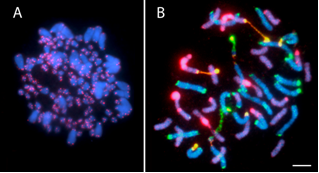
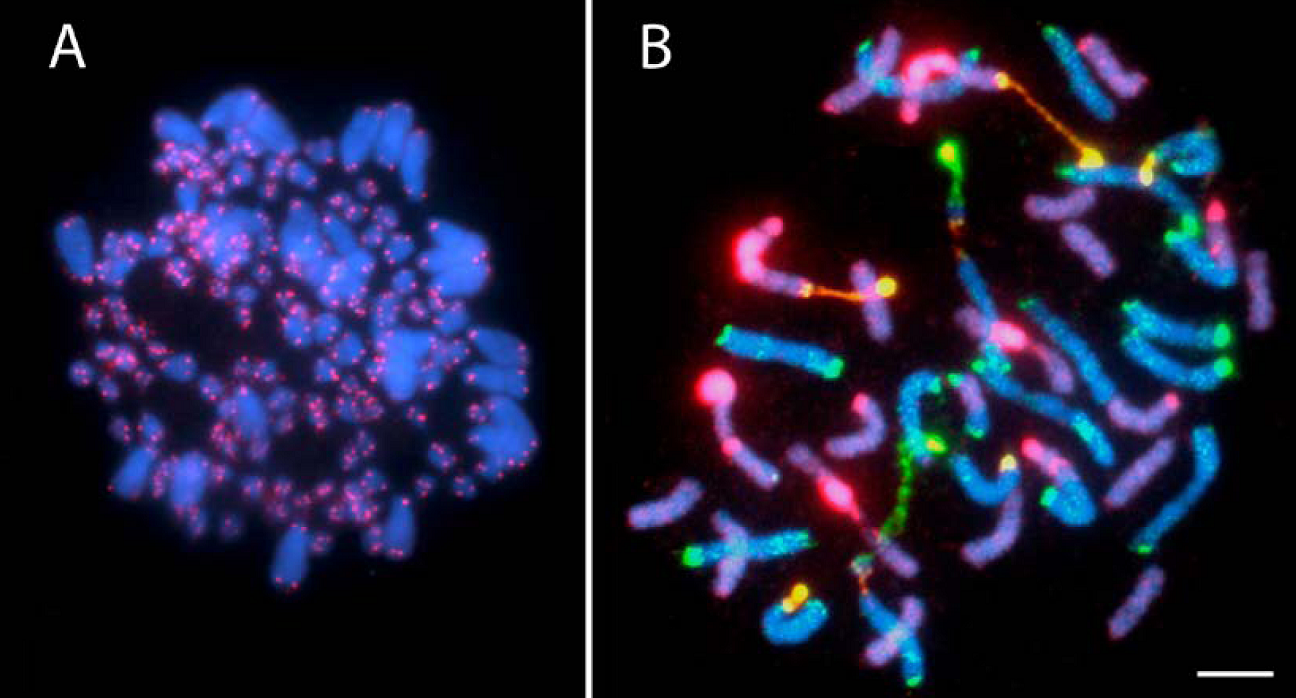
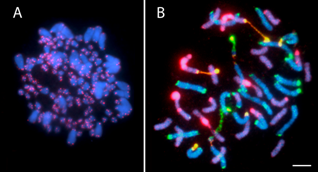
      <p>Classical cytological studies using chromatin staining still contribute much to the present appreciation of chromosomal diversity in wild species. This approach allows the detection of gross karyotypic alterations such as changes in chromosome number and morphology and gives an overview of chromosome behaviour in mitosis and meiosis. However, many recent cytogenetic studies have used FISH to map single cloned or PCR-amplified sequences to chromosomes (<xref ref-type="fig" rid="figure1">Figure 1</xref>A) or GISH with total genomic DNA probes to identify the parental origin of chromatin in hybrids and allopolyploids (<xref ref-type="fig" rid="figure1">Figure 1</xref>B). FISH and GISH together have shed much light on many biological phenomena. Of particular interest to this review are their roles in improving our understanding of interspecific hybridisation and polyploidy, phylogenetic relationships, genetic mapping and plant breeding. These methods also have a role in clarifying patterns of chromatin folding, interphase nuclear organisation and chromatin distribution in different cells of the cell cycle and in development [cf. 1].</p>
      <fig id="figure1" position="float">
        <label>Figure 1</label>
        <caption>
          <p>ISH to root tip metaphase spreads <bold>(A)</bold> FISH to pentaploid <italic>Agave fourcroydes</italic> (2<italic>n</italic> = 5<italic>x</italic> = 150) probed with telomere repeat sequences (TTAGGG)n (biotin labelled probe Cy3 signal, pink), chromosomes counterstained with DAPI (blue). <bold>(B)</bold> GISH to a partial metaphase spread of a <italic>Nicotiana sylvestris</italic> (2<italic>n</italic> = 2<italic>x</italic> = 24) x <italic>N. tomentosiformis</italic> (2<italic>n</italic> = 2<italic>x</italic> = 24) allotetraploid, which has a chromosome complement of 2<italic>n</italic> = 4<italic>x</italic> = 48 (see Kostoff hybrid [<xref ref-type="bibr" rid="B2">2</xref>]). The spread is probed with total genomic DNA from <italic>N. sylvestris</italic> (digoxigenin-labelled probe, FITC signal, green) and from <italic>N. tomentosiformis</italic> (biotin-labelled probe, Cy3 signal, pink), chromosomes are counterstained with DAPI (blue). Depending on the mixture and intensity of the fluorophores other colours are generated. Chromosomes of N. sylvestris origin are shown as cyan and green depending on the strength of the FITC/DAPI signal, while those of <italic>N. tomentosiformis</italic> origin are violet and magenta depending on the strength of the Cy3/DAPI signal. Areas of yellow chromatin represent 35S ribosomal DNA (rDNA) loci that are hybridised with genomic DNA from both parents. Scale bar: 10 µm.</p>
        </caption>
        <graphic xmlns:xlink="http://www.w3.org/1999/xlink" xlink:href="genes-01-00166-g001.tif" scale="0"/>
      </fig>
      <sec>
        <title>Applications of ISH</title>
        <p>Since GISH was first demonstrated in synthetic <italic>Hordeum chilense </italic>x <italic>Secale africanum</italic> [<xref ref-type="bibr" rid="B3">3</xref>] and <italic>Triticum aestivum</italic> (wheat) x <italic>S. cereale</italic> (rye) [<xref ref-type="bibr" rid="B4">4</xref>] it has been used extensively to track the artificial introgression of chromatin in wide crosses [<xref ref-type="bibr" rid="B5">5</xref>,<xref ref-type="bibr" rid="B6">6</xref>,<xref ref-type="bibr" rid="B7">7</xref>,<xref ref-type="bibr" rid="B8">8</xref>]. GISH has also been used to inform on the genome constitution of natural hybrids, sometimes in combination with FISH to identify the parental origin of specific loci. Bennett <italic>et al.</italic> [<xref ref-type="bibr" rid="B9">9</xref>] first used GISH for the purpose of confirming natural hybridisation in the allotetraploid <italic>Milium montianum</italic>. The results predicted an extinct or undiscovered <italic>Milium</italic> parent of <italic>M. montianum</italic>, demonstrating the method’s potential for paleoreconstructions of ancestral or extinct genomes. One question raised by the authors was whether GISH could provide a quantitative measure of chromosome divergence. GISH with a range of genomic DNAs from different species to metaphase spreads of a <italic>Silene </italic>hybrid<italic> </italic>showed that the intensity of fluorescence varied quantitatively based on the relatedness of the species, as determined by divergence of ITS1-5.8S-ITS2 sequences [<xref ref-type="bibr" rid="B10">10</xref>].</p>
        <p>ISH has been applied to allopolyploids identified via morphology, chromosome counts, ecology and other data both to investigate their parentage further and to evaluate chromosomal variation that has arisen since polyploid formation. ISH can provide further evidence for a hypothesised allopolyploid origin and reveal genomic changes, such as intergenomic translocations; examples include <italic>Nicotiana</italic> [<xref ref-type="bibr" rid="B11">11</xref>], <italic>Lepidium</italic> [<xref ref-type="bibr" rid="B12">12</xref>]<italic>, Primula</italic> [<xref ref-type="bibr" rid="B13">13</xref>] and <italic>Oryza</italic> [<xref ref-type="bibr" rid="B14">14</xref>]. Sequence and karyotype divergence has been examined using ISH in allopolyploid species in a phylogenetic context; examples include <italic>Paeonia</italic> [<xref ref-type="bibr" rid="B15">15</xref>], <italic>Aloe</italic> [<xref ref-type="bibr" rid="B16">16</xref>],<italic> Clivia</italic> [<xref ref-type="bibr" rid="B17">17</xref>], <italic>Nicotiana</italic> [<xref ref-type="bibr" rid="B18">18</xref>,<xref ref-type="bibr" rid="B19">19</xref>] and <italic>Pinus</italic> [<xref ref-type="bibr" rid="B20">20</xref>].</p>
        <p>A powerful application of FISH in the genomic era is the physical mapping of eukaryotic genomes [<xref ref-type="bibr" rid="B21">21</xref>]. FISH can anchor BAC contigs to specific chromosome arms, making it possible to construct a comprehensive physical map [<xref ref-type="bibr" rid="B22">22</xref>,<xref ref-type="bibr" rid="B23">23</xref>,<xref ref-type="bibr" rid="B24">24</xref>,<xref ref-type="bibr" rid="B25">25</xref>,<xref ref-type="bibr" rid="B26">26</xref>]. BAC-FISH enabled the designation of six linkage groups to their corresponding chromosomes in cotton (<italic>Gossypium hirsutum</italic>, 2<italic>n </italic>= 4<italic>x </italic>= 52), and cross-hybridisation of BACs to two pairs of loci identified homeologous regions/chromosomes [<xref ref-type="bibr" rid="B27">27</xref>,<xref ref-type="bibr" rid="B28">28</xref>]. During the assembly of the <italic>Carica papaya</italic> genome, BAC-FISH was used to assign two linkage groups to one of the chromosomes [<xref ref-type="bibr" rid="B29">29</xref>]. Using elegant ISH strategies to paint entire chromosomes with BACs, translocations and rearrangements have been described in Brassicaceae, enabling the prediction of ancestral karyotypes [<xref ref-type="bibr" rid="B30">30</xref>,<xref ref-type="bibr" rid="B31">31</xref>]. This method has provided additional evidence for a hypothesised whole-genome triplication in the common ancestor of a clade that includes species of <italic>Brassica </italic>and <italic>Sinapis </italic>(tribe Brassiceae) [<xref ref-type="bibr" rid="B32">32</xref>,<xref ref-type="bibr" rid="B33">33</xref>,<xref ref-type="bibr" rid="B34">34</xref>].</p>
      </sec>
    </sec>
    <sec>
      <title>2. Recently Formed Allopolyploid Species</title>
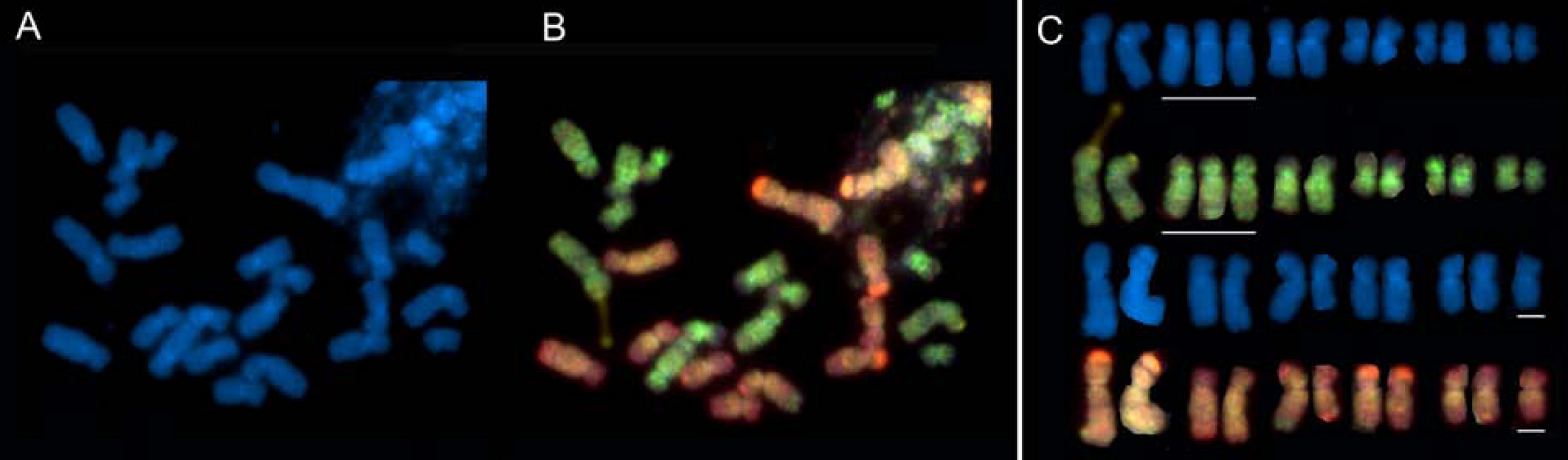
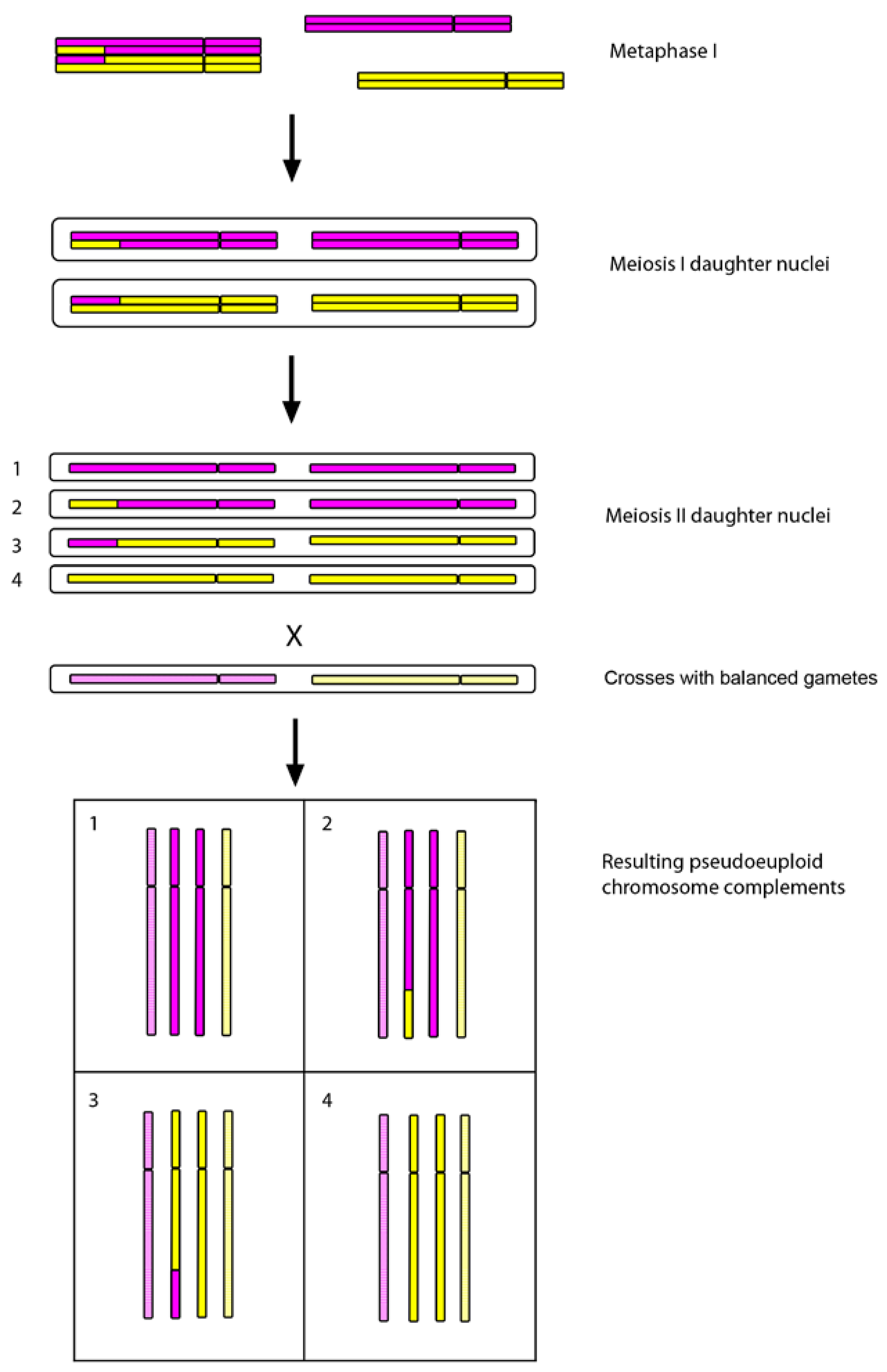
      <p>FISH and GISH have made a contribution to our understanding of early evolution (within the last 150 years) of recently formed polyploid species of <italic>Tragopogon</italic> and <italic>Spartina</italic>. Two allotetraploid species of <italic>Tragopogon</italic> arose in the early 1900s in North America, following the introduction of three diploid (2<italic>n </italic>= 2<italic>x </italic>= 12) species from Europe [<xref ref-type="bibr" rid="B35">35</xref>]. The polyploids (2<italic>n</italic> = 4<italic>x</italic> = 24) share one parent, <italic>T. dubius</italic>, which with <italic>T. pratensis </italic>gave rise to <italic>T. miscellus</italic> and with <italic>T. porrifolius</italic> gave rise to <italic>T. mirus</italic> [<xref ref-type="bibr" rid="B35">35</xref>]. Molecular studies of populations in the states of Washington and Idaho, USA, have identified many independent origins; essentially each population appears to represent a separate origin [<xref ref-type="bibr" rid="B36">36</xref>,<xref ref-type="bibr" rid="B37">37</xref>,<xref ref-type="bibr" rid="B38">38</xref>]. Furthermore, gene flow between populations appears to be absent or extremely rare [<xref ref-type="bibr" rid="B36">36</xref>], and initial experimental crosses between reciprocally formed <italic>T. miscellus</italic> populations failed, suggesting possible chromosomal incompatibilities [<xref ref-type="bibr" rid="B39">39</xref>]. Analyses of the polyploids using GISH revealed that in several numerically (2<italic>n</italic> = 24) euploid plants there was an uneven parental contribution, resulting in plants with karyotypes of 2<italic>n </italic>= 24 -1 +1 or 2<italic>n </italic>= 24 -2 +2. These plants were reciprocally aneuploid for the same or different homeologous chromosomes [<xref ref-type="bibr" rid="B40">40</xref>] (an example of the latter is shown in <xref ref-type="fig" rid="figure2">Figure 2</xref>). One way in which a pseudoeuploid chromosome complement could arise is through homeologous pairing and recombination, as was observed in the pollen mother cells of resynthesised <italic>Brassica napus </italic>(oil seed rape) [<xref ref-type="bibr" rid="B41">41</xref>], an example of which is shown in <xref ref-type="fig" rid="figure3">Figure 3</xref>. Such homeologous associations, if occurring over multiple generations, could explain some of the gene losses identified by homeoSNP-based studies [<xref ref-type="bibr" rid="B42">42</xref>,<xref ref-type="bibr" rid="B43">43</xref>,<xref ref-type="bibr" rid="B44">44</xref>,<xref ref-type="bibr" rid="B45">45</xref>,<xref ref-type="bibr" rid="B46">46</xref>].</p>
      <p>The genus <italic>Spartina</italic> is the other example where GISH has played a role in our understanding of early allopolyploid evolution in nature. <italic>Spartina anglica </italic>(2<italic>n</italic> = 12<italic>x</italic> = 120, 122, 124) arose at Hythe in Southampton Bay, UK, following genome doubling of the sterile homoploid hybrid <italic>S. </italic>x<italic> townsendii</italic> (2<italic>n = </italic>6<italic>x </italic>= 60, 62) in the late 1900s [<xref ref-type="bibr" rid="B47">47</xref>]. <italic>Spartina anglica</italic> has since colonised salt marsh and estuarine habitats around the world through human introductions and aggressive colonisation [<xref ref-type="bibr" rid="B48">48</xref>,<xref ref-type="bibr" rid="B49">49</xref>]. It is not known for certain if <italic>S. anglica </italic>arose from a single hybridisation event or multiple times, as the limited genetic variation that does exist can be explained by multiple origins or genomic restructuring following polyploid formation [<xref ref-type="bibr" rid="B50">50</xref>,<xref ref-type="bibr" rid="B51">51</xref>]. Using total genomic DNA probes of <italic>S. alterniflora </italic>(AA)<italic> </italic>and <italic>S. maritima </italic>(MM), where each A or M represents three basic genomes of <italic>x </italic>= 10, Renny-Byfield <italic>et al</italic>. [<xref ref-type="bibr" rid="B52">52</xref>] were able to determine the parental origin of chromosomes in polyploid material. One of the individuals analysed was found to be a dodecaploid (12<italic>x</italic>, AAMM) as expected, while the other was a nonaploid (9<italic>x</italic>, AAM). Ploidy estimation by flow cytometry of individuals collected at the site showed that nonaploids were present at frequencies comparable to <italic>S. anglica</italic> and <italic>S. maritima</italic>. The data suggest that nonaploids may be arising at the site frequently; it is possible that these allow gene flow between 6<italic>x </italic>and 12<italic>x</italic> species [<xref ref-type="bibr" rid="B52">52</xref>].</p>
      <fig id="figure2" position="float">
        <label>Figure 2</label>
        <caption>
          <p>GISH to root tip metaphase chromosomes of a wild accession of <italic>Tragopogon mirus </italic>2<italic>n</italic> = 4<italic>x</italic> = 24 -1 +1. <bold>(A)</bold> DAPI stained chromosomes. <bold>(B)</bold> Chromosomes hybridised with genomic DNA identifying subgenomes originating from either <italic>T. dubius</italic> (green) or <italic>T. porrifolius</italic> (red). <bold>(C)</bold> Karyotype with DAPI-stained chromosomes (from A) and genomic DNA hybridised chromosomes (from B) originating from <italic>T. dubius</italic> (top two rows) and <italic>T. porrifolius</italic> (lower two rows), respectively. White lines indicate trisomic and monosomic chromosomes, respectively.</p>
        </caption>
        <graphic xmlns:xlink="http://www.w3.org/1999/xlink" xlink:href="genes-01-00166-g002.tif" scale="0"/>
      </fig>
      <fig id="figure3" position="float">
        <label>Figure 3</label>
        <caption>
          <p>A model for pseudoeuploidy involving homeologous chromosomes. Homeologous chromosomes are labelled yellow or purple. An aberrant bivalent is formed between homeologous chromosomes, and a single crossover results in a homeologous translocation; the two remaining homeologues remain unpaired (univalents). Note that if the translocation had already occurred, this might lead to aberrant pairing. Due to missegregation, daughter cells of the 1st meiotic division receive two homologous chromosomes. The resulting gametes from the 2nd meiotic division have the correct numerical complement but are unbalanced. Plants arising from a cross between gametes 1-4 result in the corresponding complements (chromosomes shown in an unreplicated state). Note that other aberrant pairing configurations such as two homeologous bivalents or a quadrivalent may also result in homeologues segregating to the same daughter nuclei in the 1st meiotic division. Such aberrant meioses were observed in 1st-generation synthetic <italic>Brassica napus</italic> lines; monosomic/trisomic plants for chromosome 1 were generated at a frequency of ~5% following backcrossing to natural <italic>B. napus</italic>[<xref ref-type="bibr" rid="B41">41</xref>]. <italic>Tragopogon </italic>allotetraploids in the wild were found to exhibit reciprocal aneuploidy for homologous or homeologous chromosomes [<xref ref-type="bibr" rid="B41">40</xref>].</p>
        </caption>
        <graphic xmlns:xlink="http://www.w3.org/1999/xlink" xlink:href="genes-01-00166-g003.tif" scale="0"/>
      </fig>
    </sec>
    <sec>
      <title>3. Autopolyploidy, Polyploid Species Complexes and Reticulate Evolution</title>
      <p>Some species have a complex range of chromosome numbers; for example, <italic>Agrostis stolonifera </italic>(Poaceae) has a polyploid series based on <italic>n</italic> = 7, with chromosome numbers of 14, 21, 28, 35, 42, 49, 56, 63 and 70, while <italic>Cardamine pratensis</italic> (Brassicaceae) has a series based on <italic>n</italic> = 8 with aneuploidy occurring at several of the ploidal levels (chromosome numbers are 16, 24, 28, 30, 32-38, 40-46, 48, 52-64, 67-96) [<xref ref-type="bibr" rid="B53">53</xref>]. Aneuploid gametes are produced by odd-ploidy plants usually in excess of euploid gametes [<xref ref-type="bibr" rid="B54">54</xref>], due to errors at meiosis such as unequal segregation and non-disjunction [<xref ref-type="bibr" rid="B55">55</xref>,<xref ref-type="bibr" rid="B56">56</xref>,<xref ref-type="bibr" rid="B57">57</xref>,<xref ref-type="bibr" rid="B58">58</xref>,<xref ref-type="bibr" rid="B58">58</xref>]. Furthermore, as exemplified by the <italic>C. pratensis </italic>series above, plants of higher ploidal levels tend to tolerate a greater degree of aneuploidy [<xref ref-type="bibr" rid="B59">59</xref>,<xref ref-type="bibr" rid="B60">60</xref>,<xref ref-type="bibr" rid="B61">61</xref>].</p>
      <p>Polyploid series arising through autopolyploidy (chromosome set multiplication without interspecific hybridisation) or allopolyploidy have been difficult to distinguish when progenitors share the same basic chromosome number [<xref ref-type="bibr" rid="B62">62</xref>]. <italic>Brachypodium distachyon</italic> includes polyploids, with individuals being 2<italic>n</italic> = 10, 20 or 30. This chromosome series was investigated by Hasterok <italic>et al</italic>. [<xref ref-type="bibr" rid="B63">63</xref>], who examined karyotypes with FISH and GISH. The data show that a 2<italic>n</italic> = 30 individual was not an autopolyploid as thought, but an allopolyploid derived from at least two progenitors similar to <italic>B. distachyon </italic>and <italic>B. sylvaticum</italic>, contributing 10 and 20 chromosomes, respectively.</p>
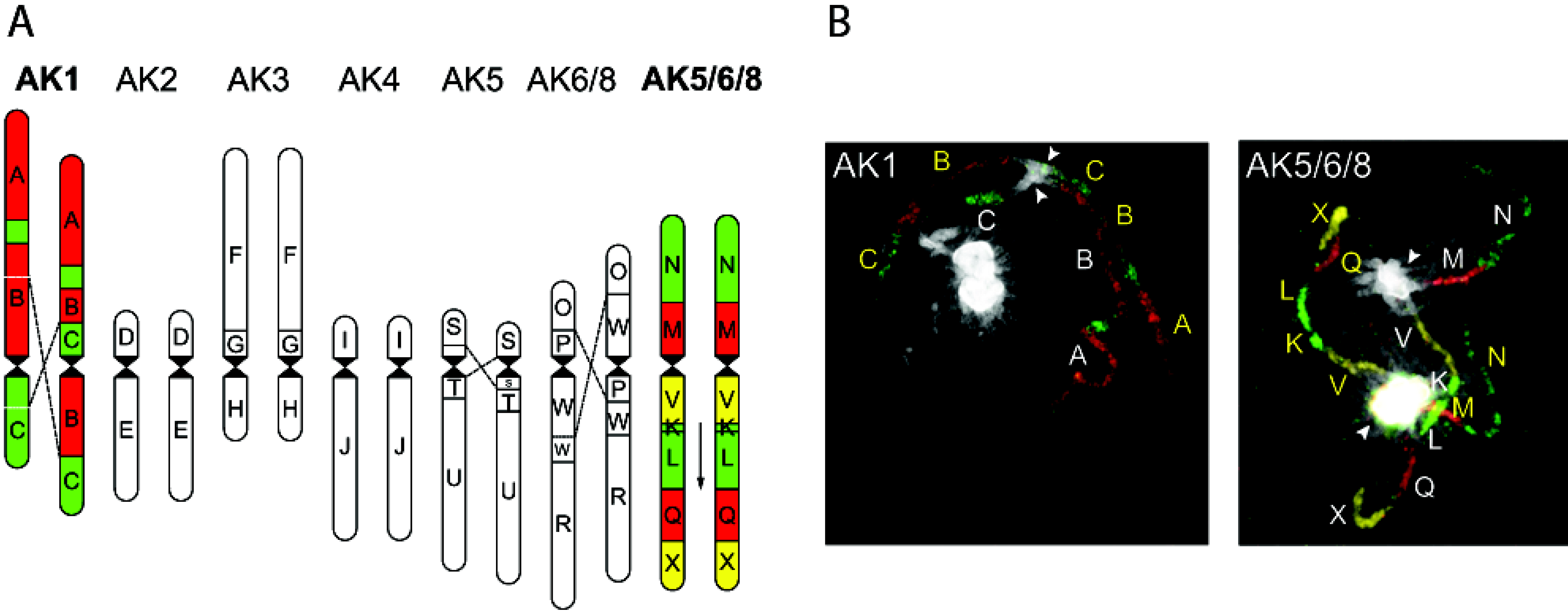
      <p>The homologous genomes of two putative autotetraploid species have been analysed using a BAC-FISH approach. Mandakova and Lysak [<xref ref-type="bibr" rid="B30">30</xref>] found no major rearrangements between the subgenomes of <italic>Calepina irregularis </italic>(2<italic>n</italic> = 4<italic>x </italic>= 28),<bold> </bold>whereas <italic>Golbachia laevigata</italic> (2<italic>n</italic> = 4<italic>x </italic>= 28)<bold> </bold>showed three alterations to colinearity between subgenomes (<xref ref-type="fig" rid="figure4">Figure 4</xref>). In the case of <italic>G. laevigata </italic>it may be that subgenome divergence occurred following autopolyploidisation or alternatively prior to the hybridisation event, which would suggest a possible allopolyploid origin [<xref ref-type="bibr" rid="B30">30</xref>]. </p>
      <p>Given sufficient genetic divergence, GISH can discriminate the parental origin of genomic DNA in hybrids, providing a powerful method to resolve patterns of reticulation in a species complex. An excellent example of this was described in the <italic>Boechera</italic> [<italic>Arabis</italic>]<italic> holboellii</italic> complex, which comprises <italic>B. holboellii </italic>(with variable chromosome numbers arising through polyploidy and aneuploidy), <italic>B. stricta </italic>(typically diploid) and their putative hybrid, <italic>B. divaricarpa</italic>, which probably arose through multiple hybridisation events [<xref ref-type="bibr" rid="B65">65</xref>,<xref ref-type="bibr" rid="B66">66</xref>]. Frequently, crosses between allotetraploids and their diploid parents result in a triploid block because the offspring produced are inviable or the endosperm fails to develop [<xref ref-type="bibr" rid="B67">67</xref>,<xref ref-type="bibr" rid="B68">68</xref>]. GISH identified some accessions of <italic>B. divaricarpa</italic> with unequal parental chromosome contributions. The results are indicative of crosses between differing ploidal levels and involving gametes generated from aberrant meiotic recombination and segregation [<xref ref-type="bibr" rid="B69">69</xref>]. Similarly, in “<italic>B. holboellii</italic>”, GISH revealed several chromosomes originating from <italic>B. stricta</italic>, <italic>i.e.</italic>, 4, 10 or 11 in the case of 2<italic>n</italic> = 15 individuals. Collectively, these data reveal much reticulate evolution and introgression of DNA in species of this complex.</p>
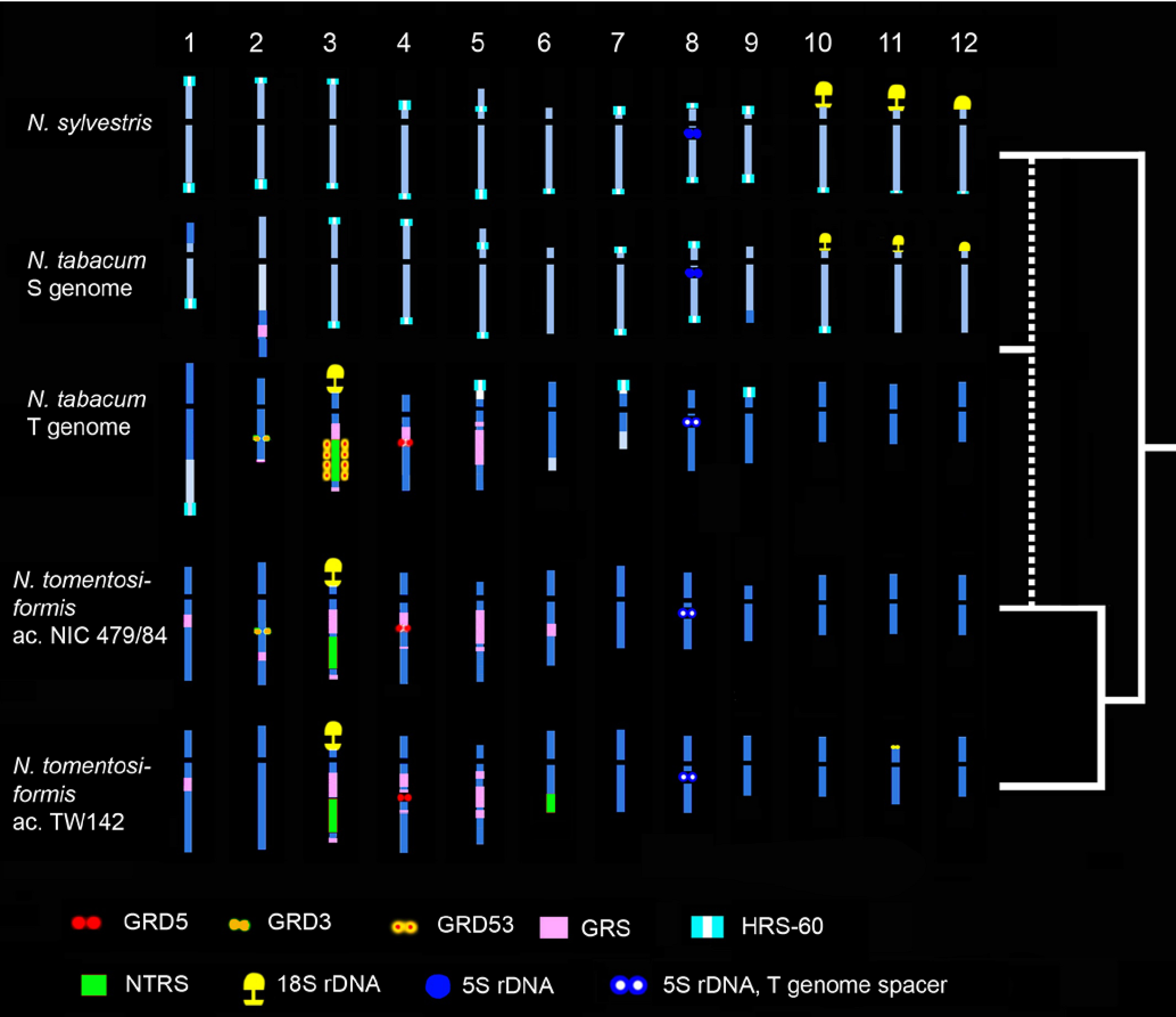
      <p>The presence or absence of repetitive sequences can be used to distinguish genetic lineages [<xref ref-type="bibr" rid="B70">70</xref>]. Within the genus <italic>Nicotiana</italic>,<italic> </italic>several integrations of geminiviral related DNA (GRD) were found as distinct, tandemly repeated clusters, making them ideal FISH markers [<xref ref-type="bibr" rid="B71">71</xref>,<xref ref-type="bibr" rid="B72">72</xref>]. In section <italic>Tomentosae</italic>, mapping with GRD and other repeats enabled a phylogram to be constructed based on the presence or absence of homologous clusters [<xref ref-type="bibr" rid="B72">72</xref>]. Due to variation in the occurrence of a GRD3 cluster in the <italic>N. tomentosiformis</italic> subgenome of <italic>N. tabacum </italic>(tobacco),<italic> </italic>a particular <italic>N. tomentosiformis</italic> lineage could be identified as a likely parent [<xref ref-type="bibr" rid="B73">73</xref>]. Furthermore, sequence analysis of the GRD sequences indicates two independent insertion events; the second event in the <italic>N. tomentosiformis</italic> lineage that gave rise to tobacco involved a recombination event between endogenous GRD, a free-living geminivirus, and potentially a mobile element, e.g., a helitron [<xref ref-type="bibr" rid="B74">74</xref>] (<xref ref-type="fig" rid="figure5">Figure 5</xref>).</p>
      <fig id="figure4" position="float">
        <label>Figure 4</label>
        <caption>
          <p>Idiogram and corresponding FISH to pachytene spreads using <italic>Arabidopsis thaliana</italic> genomic BACs to the autotetraploid <italic>Goldbachia laevigata</italic> (2<italic>n</italic> = 4<italic>x</italic> = 28) (Brassicaceae; Calepineae). <bold>(A)</bold> Chromosomes are annotated corresponding to the ancestral karyotype (AK) for crucifers [<xref ref-type="bibr" rid="B31">31</xref>,<xref ref-type="bibr" rid="B64">64</xref>]. Lines between chromosomes indicate the boundaries of pericentric inversions distinguishing homologous chromosomes, an arrow indicates an inversion relative to the crucifer AK. <bold>(B)</bold> FISH to two pachytene bivalents of AK1 and AK5/6/8 chromosomes hybridised with pooled BACs are shown pseudocoloured as red, yellow and green. Yellow and white letters distinguish each bivalent.</p>
        </caption>
        <graphic xmlns:xlink="http://www.w3.org/1999/xlink" xlink:href="genes-01-00166-g004.tif" scale="0"/>
      </fig>
      <p>GISH methods predominantly rely on dispersed repetitive sequences for differentiating subgenomes [<xref ref-type="bibr" rid="B75">75</xref>,<xref ref-type="bibr" rid="B76">76</xref>]. It had been the case that GISH to very small genomes resulted in no distinction or was limited to the few repeat-rich regions such as the pericentromeres and nucleolar organising regions; for a discussion see [<xref ref-type="bibr" rid="B8">8</xref>,<xref ref-type="bibr" rid="B77">77</xref>]. Ali <italic>et al</italic>. [<xref ref-type="bibr" rid="B78">78</xref>] showed that these problems could be overcome by increasing probe concentration and hybridisation time, facilitating the hybridisation of low-copy sequences. Using the new methodology, whole chromosome arms were painted, revealing the parental origin of <italic>A. suecica</italic> chromosomes<italic> </italic>(AATT, 2<italic>n</italic> = 4<italic>x</italic> = 26), which is derived from <italic>A. thaliana </italic>(TT, 2<italic>n</italic> = 2<italic>x</italic> = 10) and <italic>A. arenosa </italic>(AAAA, 2<italic>n</italic> = 2<italic>x</italic> = 32) [<xref ref-type="bibr" rid="B78">78</xref>]. Sequences of the internal transcribed spacer (ITS) of rDNA indicate that <italic>Arabidopsis suecica</italic> has a single origin [<xref ref-type="bibr" rid="B79">79</xref>,<xref ref-type="bibr" rid="B80">80</xref>], probably about 12,000-300,000 years ago [<xref ref-type="bibr" rid="B81">81</xref>]. When GISH was used against a natural accession thought to be <italic>A. suecica</italic>, the plant was discovered to be a putative backcross of <italic>A. suecica</italic> to<italic> A. arenosa</italic>, with five <italic>A. thaliana </italic>and 24 <italic>A. arenosa </italic>chromosomes (AAAT, 2<italic>n</italic> = 29) [<xref ref-type="bibr" rid="B78">78</xref>]. Meiotic spreads showed that in one cell there were three unpaired <italic>A. thaliana </italic>chromosomes and two chromosomes paired allosyndetically (intergenomically), one in a bivalent, the other in a quadrivalent. Quadrivalent formation was attributed to close homeologue similarity as GISH was unable to resolve any intergenomic translocations [<xref ref-type="bibr" rid="B76">76</xref>]. Madlung <italic>et al</italic>. [<xref ref-type="bibr" rid="B82">82</xref>] showed in synthetic <italic>A. suecica </italic>(2<italic>n</italic> = 4<italic>x</italic> = 26) high levels (30%) of meiotic abnormalities, including bridges and chromosome fragments, but based on the centromeric signals using AaCEN and AtCEN probes, there was no evidence for allosyndetic pairing. Synthetic <italic>A. suecica</italic> also showed somatic instability, with aneuploid cells appearing to arise spontaneously and intermittently [<xref ref-type="bibr" rid="B83">83</xref>]. The stability of the natural species in comparison is presumably a result of the stabilising forces of selection in the wild.</p>
      <fig id="figure5" position="float">
        <label>Figure 5</label>
        <caption>
          <p>Idiograms for the subgenomes of <italic>Nicotiana tabacum</italic> and the extant species representing its hypothesised parental lineages. The positions of repetitive DNA clusters used for predicting genomic relationships are shown (for details see [<xref ref-type="bibr" rid="B73">73</xref>]). The phylogenetic scheme on the right indicates parental species divergence and the hybridisation event (indicated by dotted line) involving a specific lineage of <italic>N. tomentosiformis</italic>.</p>
        </caption>
        <graphic xmlns:xlink="http://www.w3.org/1999/xlink" xlink:href="genes-01-00166-g005.tif" scale="0"/>
      </fig>
      <p>Despite potential problems associated with multivalent formation in early allopolyploid divergence, the presence of some fixed translocations in allopolyploid species may suggest that some intergenomic exchanges are important in stabilising the genome [<xref ref-type="bibr" rid="B84">84</xref>,<xref ref-type="bibr" rid="B85">85</xref>] or alternatively may have arisen as a consequence of genetic drift. GISH detected large translocations in allopolyploids such as<italic> Nicotiana tabacum</italic> [<xref ref-type="bibr" rid="B86">86</xref>,<xref ref-type="bibr" rid="B87">87</xref>], <italic>Avena sativa</italic> [<xref ref-type="bibr" rid="B88">88</xref>,<xref ref-type="bibr" rid="B89">89</xref>], <italic>Avena byzantina, Avena sterilis</italic> [<xref ref-type="bibr" rid="B88">88</xref>],<italic> Avena maroccana</italic> [<xref ref-type="bibr" rid="B90">90</xref>], <italic>Avena fatua</italic> [<xref ref-type="bibr" rid="B91">91</xref>] and <italic>Aegilops cylindrica</italic> [<xref ref-type="bibr" rid="B92">92</xref>]. With <italic>Avena sativa</italic>,<italic> </italic>GISH could not distinguish between A and D subgenomes, instead genome-specific painting was achieved using a dispersed repetitive sequence as a FISH probe [<xref ref-type="bibr" rid="B93">93</xref>].</p>
      <p>In wheat polyploids, pairing control genes (PCGs) such as the <italic>Ph1</italic> locus greatly reduce homeologous pairing during meiosis [<xref ref-type="bibr" rid="B111">111</xref>,<xref ref-type="bibr" rid="B112">112</xref>]. Due to the presence of a functional <italic>Ph1</italic> locus, Mestiri <italic>et al</italic>. [<xref ref-type="bibr" rid="B113">113</xref>] did not observe allosyndetic pairing using GISH; however, the incidence of aneuploid plants was correlated with the frequency of univalents in the preceding meiosis. In <italic>Ph1 </italic>mutants of <italic>T. aestivum</italic>, GISH showed that multivalents arise through both homeologous (see <xref ref-type="fig" rid="figure3">Figure 3</xref>) and homologous pairing of chromosomes [<xref ref-type="bibr" rid="B114">114</xref>]. Multivalents in the former case can result from reciprocal intergenomic translocations [<xref ref-type="bibr" rid="B114">114</xref>].</p>
      <p>The stable integration of alien DNA following hybridisation with a diverged lineage, <italic>i.e.</italic>, introgression, is likely to represent an important process in plant evolution [<xref ref-type="bibr" rid="B94">94</xref>,<xref ref-type="bibr" rid="B95">95</xref>]. In most plants the occurrence or extent of introgression is not appreciated because of the detailed genomic studies that are required to confirm genetic exchange [<xref ref-type="bibr" rid="B96">96</xref>]. In nature, introgression is expected to be most prevalent where genetic divergence between species is lowest, as this is where the fewest barriers to gene flow are expected to have accumulated [<xref ref-type="bibr" rid="B97">97</xref>]. This is particularly so when the hybrid lineage is the same ploidy as the parents [<xref ref-type="bibr" rid="B54">54</xref>]. Introgression can be limited by genic incompatibilities or chromosomal incompatibilities resulting in infertility or hybrid inviability [<xref ref-type="bibr" rid="B98">98</xref>,<xref ref-type="bibr" rid="B99">99</xref>,<xref ref-type="bibr" rid="B100">100</xref>]. In natural diploid hybrids derived from <italic>Helianthus annuus</italic> and <italic>H. petiolaris, </italic>meiotic recombination<italic> </italic>was reduced in regions containing inversions or translocations, whilst other recombinant genotypes had reduced pollen fertility [<xref ref-type="bibr" rid="B101">101</xref>]. It has been argued that by limiting recombination, changes in chromosome structure may promote speciation if they are close to regions which reduce fertility [<xref ref-type="bibr" rid="B102">102</xref>]. Chromosome doubling (polyploidy) before or after interspecific hybridisation may instantly generate isolation barriers because of the differences in ploidal levels. Chromosome doubling also creates identical homologous pairing partners in the hybrids, potentially leading to increased fertility [<xref ref-type="bibr" rid="B103">103</xref>,<xref ref-type="bibr" rid="B104">104</xref>,<xref ref-type="bibr" rid="B105">105</xref>].</p>
    </sec>
    <sec>
      <title>4. Interspecific Hybridisation and Introgression in Plant Breeding</title>
      <p>GISH has played an important role in integrating genetic and physical maps in cereal genetics [<xref ref-type="bibr" rid="B106">106</xref>,<xref ref-type="bibr" rid="B107">107</xref>]. Wheat (<italic>Triticum aestivum</italic>) is an allohexaploid derived from three ancestral diploid species (genome designation: AABBDD, 2<italic>n</italic> = 6<italic>x</italic> = 42) and is particularly amenable to alien chromatin introductions derived from complex interspecific hybrid combinations. Wheat addition lines of barley chromosome 5 [<xref ref-type="bibr" rid="B108">108</xref>], rye chromosome 1 [<xref ref-type="bibr" rid="B109">109</xref>] and barley chromosome 3 [<xref ref-type="bibr" rid="B110">110</xref>] were induced to undergo recombination between the alien and wheat chromosomes through the activities of the gametocidal chromosome (Gc) from <italic>Aegilops cylindrica</italic>. The recombinant products were then mapped by GISH, and PCR was used to confirm the genes carried by those segments. In this way it was possible to define the nature and distribution of the alien chromatin in the wheat lines as well as corroborate gene order from genetic maps.</p>
      <p>The <italic>Lolium-Festuca</italic> complex includes natural hybrids and allopolyploids; there are also synthetic lines, which have been developed to improve fodder-crop quality. GISH can clearly distinguish the parental origin of the chromosomes and has been used to show that homeologous recombination is frequent in diploid and polyploid intergeneric hybrids, reviewed in [<xref ref-type="bibr" rid="B115">115</xref>]. Zwierzykowski [<xref ref-type="bibr" rid="B116">116</xref>] applied GISH to F<sub>2</sub>-F<sub>6</sub> interbreeding allotetraploids generated from a cross between autotetraploids (2<italic>n</italic> = 4<italic>x </italic>= 28) of <italic>Festuca pratensis </italic>and <italic>Lolium perenne</italic>. Over five selfed generations, there was a trend towards an increasing number of recombinant chromosomes but also an increased representation of <italic>Lolium </italic>chromosomes based on centromeric GISH signals. The latter effect was explained by irregular meiotic configurations and centromeric drive, with chromosomes containing <italic>Lolium</italic> centromeres gradually substituting chromosomes with <italic>Festuca </italic>centromeres [<xref ref-type="bibr" rid="B116">116</xref>].</p>
      <p>In tomato breeding programmes, GISH has been used to study the effect of different sized introgressed segments on meiotic pairing and recombination. Ji and Chetelat [<xref ref-type="bibr" rid="B117">117</xref>] painted segments of DNA introgressed from a wild relative (<italic>Solanum lycopersicoides</italic>) to homologues of chromosome 7. Previous work has shown that gene order on chromosome 7 is largely similar between species [<xref ref-type="bibr" rid="B118">118</xref>]. Longer alien introgressed segments reduced pairing and recombination between chromosome 7 homologues more than shorter segments [<xref ref-type="bibr" rid="B118">118</xref>].</p>
      <p>Major structural changes such as translocations have also been shown in synthetic (oil seed rape) allopolyploids using genetic markers [<xref ref-type="bibr" rid="B119">119</xref>]. An examination of similar materials at meiosis revealed numerous aberrant meiotic divisions, e.g. multivalents, bridges and chromosomal laggards, and such processes provide a mechanism for the numerous structural changes observed after only a few generations [<xref ref-type="bibr" rid="B120">120</xref>]. Such changes frequently reduce fitness of the synthetic allopolyploids [<xref ref-type="bibr" rid="B119">119</xref>] and would be selected against in nature. Pairing control genes (PCGs), such as the wheat <italic>Ph </italic>genes, which ensure homologous pairing at meiosis, may have arisen many times in plant evolution, given that most established allopolyploids studied predominantly form bivalents [<xref ref-type="bibr" rid="B121">121</xref>]. Le Comber <italic>et al.</italic> [<xref ref-type="bibr" rid="B122">122</xref>] have suggested the PCGs may not be required to restore bivalent pairing; instead, processes such as gene subfunctionalisation and neofunctionalisation may accelerate subgenome divergence following allopolyploidisation.</p>
    </sec>
    <sec>
      <title>5. Sequence Dynamics</title>
      <p>Small-scale sequence changes are likely to be important in the homogenisation of subgenomes. Comparative genomic data have provided evidence of non-reciprocal recombination (e.g. gene conversion) of short DNA fragments [<xref ref-type="bibr" rid="B123">123</xref>], retrotransposition [<xref ref-type="bibr" rid="B124">124</xref>,<xref ref-type="bibr" rid="B125">125</xref>] and deletions [<xref ref-type="bibr" rid="B126">126</xref>] following hybridisation/allopolyploidisation. </p>
      <p>These changes can be rapid. In natural and synthetic allopolyploids of the Triticeae, deletions include the loss of genome- and chromosome-specific sequences within the first few generations [<xref ref-type="bibr" rid="B127">127</xref>,<xref ref-type="bibr" rid="B128">128</xref>,<xref ref-type="bibr" rid="B129">129</xref>,<xref ref-type="bibr" rid="B130">130</xref>], which leads to genome size reductions of approximately 1-2 Gbp [<xref ref-type="bibr" rid="B131">131</xref>]. Deletion of different repeat sequences was observed in the fourth generation of synthetic lines of <italic>Nicotiana tabacum</italic> [<xref ref-type="bibr" rid="B132">132</xref>]. These genetic changes, although widespread, may not necessarily result in gross karyotypic changes. In early-generation synthetic Triticeae allopolyploids, Han <italic>et al.</italic> [<xref ref-type="bibr" rid="B133">133</xref>] found no significant changes in chromosome structure with GISH, despite molecular analyses showing deletion or recombination among genic and retrotransposon sequences. In <italic>Spartina</italic>,<italic> </italic>very few genetic alterations have been detected [<xref ref-type="bibr" rid="B134">134</xref>,<xref ref-type="bibr" rid="B135">135</xref>,<xref ref-type="bibr" rid="B136">136</xref>], and ISH data suggest that there has been little change in overall chromosome organisation [<xref ref-type="bibr" rid="B52">52</xref>]. However, sequence changes associated with transposable elements (TEs) have been detected and occur mostly as a result of hybridisation, rather than genome doubling [<xref ref-type="bibr" rid="B137">137</xref>].</p>
      <p>Activation of transposable elements is a possible outcome of genome shock following hybridisation [<xref ref-type="bibr" rid="B138">138</xref>] and probably arises through alterations in epigenetically controlled TE suppression mechanisms [<xref ref-type="bibr" rid="B139">139</xref>]. In early generations of synthetic <italic>Arabidopsis suecica </italic>allopolyploids,<italic> En-Spm</italic> transposons and a <italic>Copia</italic> retrotransposon became transcriptionally active [<xref ref-type="bibr" rid="B82">82</xref>]. Likewise, early-generation synthetic Triticeae allopolyploids showed an increase in<italic> </italic>transcripts<italic> </italic>of the <italic>Wis</italic> retrotransposon, including chimeras originating from read-through into adjacent sequences [<xref ref-type="bibr" rid="B140">140</xref>]. In wide synthetic hybrids made from <italic>Oryza sativa</italic> and a wild relative (<italic>Zizania latifolia</italic>), <italic>Gypsy</italic> and <italic>Copia</italic> retrotransposons became transcriptionally active, and their genomic copy number increased; after a few generations, this activity was followed by strong transcriptional resuppression [<xref ref-type="bibr" rid="B141">141</xref>].</p>
      <p>GISH studies in <italic>Nicotiana</italic> allopolyploids that arose at different times show a gradual reduction in GISH being able to differentiate subgenomes, rendering it ineffective in allopolyploids formed more than 5 million years ago (mya) [<xref ref-type="bibr" rid="B19">19</xref>,<xref ref-type="bibr" rid="B142">142</xref>]. The inferred loss of GISH signal over time is thought to be a consequence of ‘genome turnover’ processes [<xref ref-type="bibr" rid="B143">143</xref>] that include homogenisation, amplification and loss of repetitive DNA sequences such as retrotransposons [<xref ref-type="bibr" rid="B19">19</xref>,<xref ref-type="bibr" rid="B142">142</xref>]. Similar data were obtained from detailed analysis of BAC clones in rice, where it was estimated that there is nearly complete replacement of retroelements within 8 million years [<xref ref-type="bibr" rid="B48">48</xref>].</p>
      <p>The distributions of <italic>Tnt1</italic> retrotransposons were mapped by FISH to the allotetraploid <italic>N. tabacum</italic> and its diploid progenitors <italic>N. sylvestris</italic> and <italic>N. tomentosiformis</italic> [<xref ref-type="bibr" rid="B144">144</xref>]. Whilst the distribution of elements broadly reflects the expectation in tobacco, there are also tobacco-specific signals, potentially reflecting insertions in tobacco or losses in the diploid parents since allopolyploidy. An examination of synthetic <italic>N. tabacum</italic> revealed evidence of significant amplification of young <italic>Tnt1</italic> elements in early generations, suggesting that hybridisation and polyploidy had released these elements from normal epigenetic controls [<xref ref-type="bibr" rid="B145">145</xref>]. Interestingly, it is the same family of elements (<italic>Tnt1</italic>) that also deviate from additivity in natural tobacco [<xref ref-type="bibr" rid="B144">144</xref>].</p>
      <p><italic>Gossypium hirsutum</italic> is an allotetraploid that formed 1-2 mya [<xref ref-type="bibr" rid="B146">146</xref>]. FISH to <italic>G. hirsutum</italic> using probes to six high-copy dispersed elements showed hybridisation to both subgenomes; but were absent in one diploid progenitor, <italic>G. raimondii. </italic>These data<italic> </italic>indicate either mobility of the elements between subgenomes in <italic>G. hirsutum</italic> or perhaps a loss/divergence of the elements in <italic>G. raimondii</italic> [<xref ref-type="bibr" rid="B147">147</xref>]. Estimates of <italic>Copia</italic> retrotransposition rates in <italic>G. hirsutum</italic> suggest a gradual process, rather than an immediate burst following allopolyploidisation [<xref ref-type="bibr" rid="B148">148</xref>].</p>
      <p>The centromeres of plants contain long arrays of one or several centromeric tandem repeats, with typically one or a few prominent repeat families being present on all chromosomes [<xref ref-type="bibr" rid="B149">149</xref>]. Studies of the two closest relatives of <italic>Arabidopsis</italic> <italic>thaliana</italic> and <italic>A</italic>. <italic>arenosa</italic> have highlighted the speed at which plant centromere repeats may be replaced by new variants. The centromeres of <italic>Arabidopsis halleri </italic>and <italic>A. lyrata</italic> contained two novel repeat families (pAge1, pAge2) as well as a previously described repeat (pAa, isolated from <italic>Arabidopsis arenosa</italic> [<xref ref-type="bibr" rid="B150">150</xref>]), but none of the repeats were detected on all chromosomes [<xref ref-type="bibr" rid="B151">151</xref>]. A detailed examination of centromere repeats among several accessions of <italic>A. halleri </italic>revealed varied distributions, suggesting transfer and/or rapid expansion and contraction of repeat variants [<xref ref-type="bibr" rid="B152">152</xref>]. A GISH study using genomic DNA from representatives of different tribes of the Poaceae to <italic>Aegilops speltoides </italic>chromosomes showed a cline of DNA conservation increasing from the pericentromeres to the core centromeric region [<xref ref-type="bibr" rid="B153">153</xref>]. A major component of the pericentromeres is retrotransposons, some of which appear to have increased in copy number relatively recently [<xref ref-type="bibr" rid="B154">154</xref>,<xref ref-type="bibr" rid="B155">155</xref>,<xref ref-type="bibr" rid="B156">156</xref>]. With FISH probes to centromere-specific retrotransposons, Liu <italic>et al</italic>. [<xref ref-type="bibr" rid="B157">157</xref>] could distinguish the subgenomes of Triticeae allopolyploids due to differences in element abundance and the resulting probe signal intensity.</p>
    </sec>
    <sec>
      <title>6. Paleoallopolyploidy</title>
      <p>There is growing evidence for paleopolyploidy in the ancestry of all angiosperms [<xref ref-type="bibr" rid="B158">158</xref>,<xref ref-type="bibr" rid="B159">159</xref>,<xref ref-type="bibr" rid="B160">160</xref>,<xref ref-type="bibr" rid="B161">161</xref>,<xref ref-type="bibr" rid="B162">162</xref>]. However, in older whole-genome duplications (WGDs), it is often unknown if they are the result of autopolyploidy or allopolyploidy. Confirming hybrid ancestry is confounded by the extensive changes in the genome as well as the divergence or extinction of parental lineages. Additional duplications through aneuploidy and segmental duplications of chromosomes add further complexity [<xref ref-type="bibr" rid="B163">163</xref>,<xref ref-type="bibr" rid="B164">164</xref>,<xref ref-type="bibr" rid="B165">165</xref>,<xref ref-type="bibr" rid="B166">166</xref>]. In the most recent WGD event of maize (<italic>Zea mays </italic>ssp<italic>. mays</italic>)<italic> </italic>(2<italic>n</italic> = 20), which occurred approximately 11 mya, the genomes of two species were brought together [<xref ref-type="bibr" rid="B167">167</xref>]. Physical mapping suggests that the progenitors were both 2<italic>n</italic> = 20 [<xref ref-type="bibr" rid="B168">168</xref>], and a minimum of 17 fusions were responsible for the observed major rearrangements and reduction in chromosome number [<xref ref-type="bibr" rid="B164">164</xref>]. Since its most recent WGD, the maize genome has lost around 50% of its duplicated genes [<xref ref-type="bibr" rid="B126">126</xref>] and has become diploidised, forming 10 bivalents at meiosis [<xref ref-type="bibr" rid="B169">169</xref>]. Signatures of ancient allopolyploidisation in species of <italic>Zea</italic> can be uncovered by meiotic ISH analysis of synthetic hybrids. Triploids (3<italic>n</italic> = 30) derived from<italic> </italic>maize and <italic>Zea perennis </italic>(2<italic>n</italic> = 20) with the constitution MMPPPP, typically show five bivalents (comprising PP chromosomes), trivalents (PPM) and univalents (M) [<xref ref-type="bibr" rid="B170">170</xref>]. The inclusion of five maize chromosomes in the trivalent suggests these chromosomes still harbour sequences with similarity to one of the ancestral genomes of <italic>Z. perennis</italic> [<xref ref-type="bibr" rid="B170">170</xref>].</p>
      <p>FISH to centromeric regions has been used to provide evidence of ancient hybridisation events, where repeats appear to have remained distinct for several millions of years. This has been shown for soybean (2<italic>n </italic>= 2<italic>x</italic> = 40) through the isolation of novel centromeric repeats via genomic shotgun sequencing and screening for high-copy tandem repeats [<xref ref-type="bibr" rid="B171">171</xref>]. Two centromeric repeat sequences were identified, CentGM-1 and CentGM-2, which are 92 and 91 bp long, respectively. FISH showed that CentGM-1 and CentGM-2 exclusively hybridised to 12 and six pairs of chromosomes, respectively, with two other pairs of chromosomes carrying both repeats but in separate arrays [<xref ref-type="bibr" rid="B171">171</xref>]. The authors suggested that differential painting is due to hybridisation associated with the most recent WGD ~10-15 mya, based on the estimate by Schlueter <italic>et al</italic>. [<xref ref-type="bibr" rid="B172">172</xref>]. This conclusion has since been corroborated by a completed draft sequence of the soybean genome, with synteny revealing ancient homeologous blocks; researchers also estimate that the WGD took place ~13 mya [<xref ref-type="bibr" rid="B173">173</xref>].</p>
      <p>Evidence for ancient hybridisation was provided for <italic>Sorghum bicolor </italic>(2<italic>n </italic>= 20). FISH using either a whole 45-kb centromeric BAC (22B2) or an independently derived clone (pSau3A10) containing 137 bp repeats strongly hybridised to 10 chromosomes and weakly to the other 10 [<xref ref-type="bibr" rid="B174">174</xref>,<xref ref-type="bibr" rid="B175">175</xref>]. Repeats similar to the 137-bp type also hybridised to some chromosomes of an interspecific hybrid of <italic>Saccharum</italic> [<xref ref-type="bibr" rid="B176">176</xref>]. If the pSau3A10 family of repeats did originate from the last known WGD, this implies that the repeat family has persisted for approximately 70 my since WGD in the common ancestor of the Poaceae [<xref ref-type="bibr" rid="B166">166</xref>,<xref ref-type="bibr" rid="B177">177</xref>]. Another centromeric repeat found in <italic>S. bicolor</italic>, pSau3A9, is also centromeric in several other grasses, including rice (subfamily Ehrhartoideae), maize (subfamily Panicoideae) and wheat (subfamily Pooideae) [<xref ref-type="bibr" rid="B178">178</xref>]. This repeat is distributed more uniformly amongst all the centromere regions of <italic>S. bicolor</italic> [<xref ref-type="bibr" rid="B178">178</xref>].</p>
    </sec>
    <sec>
      <title>7. Next-Generation Sequencing (NGS), FISH Studies and the Future</title>
      <p>FISH with markers that identify specific chromosomes provides a powerful approach to studying genomic change. However, there are few highly conserved sequences that can be used as probes across most plants, exceptions being 5S rDNA, 35S rDNA and telomere repeats. Genomic DNA cloned in high capacity vectors such as BACs has been used across species such as sorghum to maize [<xref ref-type="bibr" rid="B24">24</xref>] and <italic>Arabidopsis thaliana </italic>to different Brassicaceae species [<xref ref-type="bibr" rid="B31">31</xref>,<xref ref-type="bibr" rid="B33">33</xref>,<xref ref-type="bibr" rid="B34">34</xref>]. Outside of model plants and their close relatives, obtaining more FISH markers involves sequence isolation for each taxonomic group, requiring considerable, laborious work. Recent advances in NGS and bioinformatics now provide an alternative way to rapidly identify both dispersed and tandem repeat markers suitable for FISH at modest cost.</p>
      <p>NGS enables large amounts of data to be generated rapidly from a complex mixture of genomic DNA. To identify repetitive sequences in the genome, an efficient approach is to carry out low-coverage (~1%) NGS, followed by a bioinformatics-based screening of repeats. Annotation can be aided by comparisons to known repeats present in databases of ESTs and TEs [<xref ref-type="bibr" rid="B179">179</xref>] or genomic sequences (NCBI; www.ncbi.nlm.nih.gov/). Non-coding simple sequence repeats can be detected based on search algorithms such as Tandem Repeat Finder [<xref ref-type="bibr" rid="B180">180</xref>]. Roche’s 454 sequencing is particularly useful if the genome under study is poorly characterised. This method generates copious amounts of sequence of an average length of 400 bp, sufficient to isolate and characterise dispersed and tandem repeats, even with low sequence coverage. When this approach is combined with FISH, it is possible to rapidly characterise genomes. Low-coverage genomic sequencing has been demonstrated for several plants. Swaminathan <italic>et al.</italic> [<xref ref-type="bibr" rid="B181">181</xref>] first used this approach for soybean, which has a haploid genome size of ~1.1 Gbp. Sequencing at ~7% coverage identified high-copy repeat families, such as telomeric and ribosomal DNA and also repeats with potential use as FISH probes, including TEs, centromeric and telomere-associated sequences.</p>
      <p>Macas <italic>et al</italic>. [<xref ref-type="bibr" rid="B182">182</xref>] obtained repeats which together make up almost half of the pea genome, despite sequencing at less than 1% coverage. A subset of 14 repeats, estimated to be present at 2,000 to 51,000 copies per haploid genome, was localised by FISH. The distributions were predominantly centromeric or subtelomeric, on one to all seven pairs of chromosomes, with only one repeat being dispersed [<xref ref-type="bibr" rid="B182">182</xref>]. Wicker <italic>et al.</italic> [<xref ref-type="bibr" rid="B183">183</xref>] obtained ~1% coverage of the barley genome; total TE copy numbers inferred from this whole-genome sampling were compared to actual copy numbers in nine barley genomic BAC sequences. Discrepancies in TE abundance between the two datasets could be attributed to an unequal distribution in the genome, leading to an over- or underestimate based on the genomic position of the BACs. One example is the DNA transposon <italic>Casper</italic>, which was three-fold under-represented in the BAC sequences relative to its inferred genomic copy number; the transposon was localised mostly at the subtelomeres. We are currently using genomic 454 sequences to develop FISH markers for examining chromosomal changes in allotetraploid species of <italic>Tragopogon</italic>. Sequencing their respective diploid progenitors should not only provide many cytological markers, but also indicate those that are enriched in one of the parental genomes.</p>
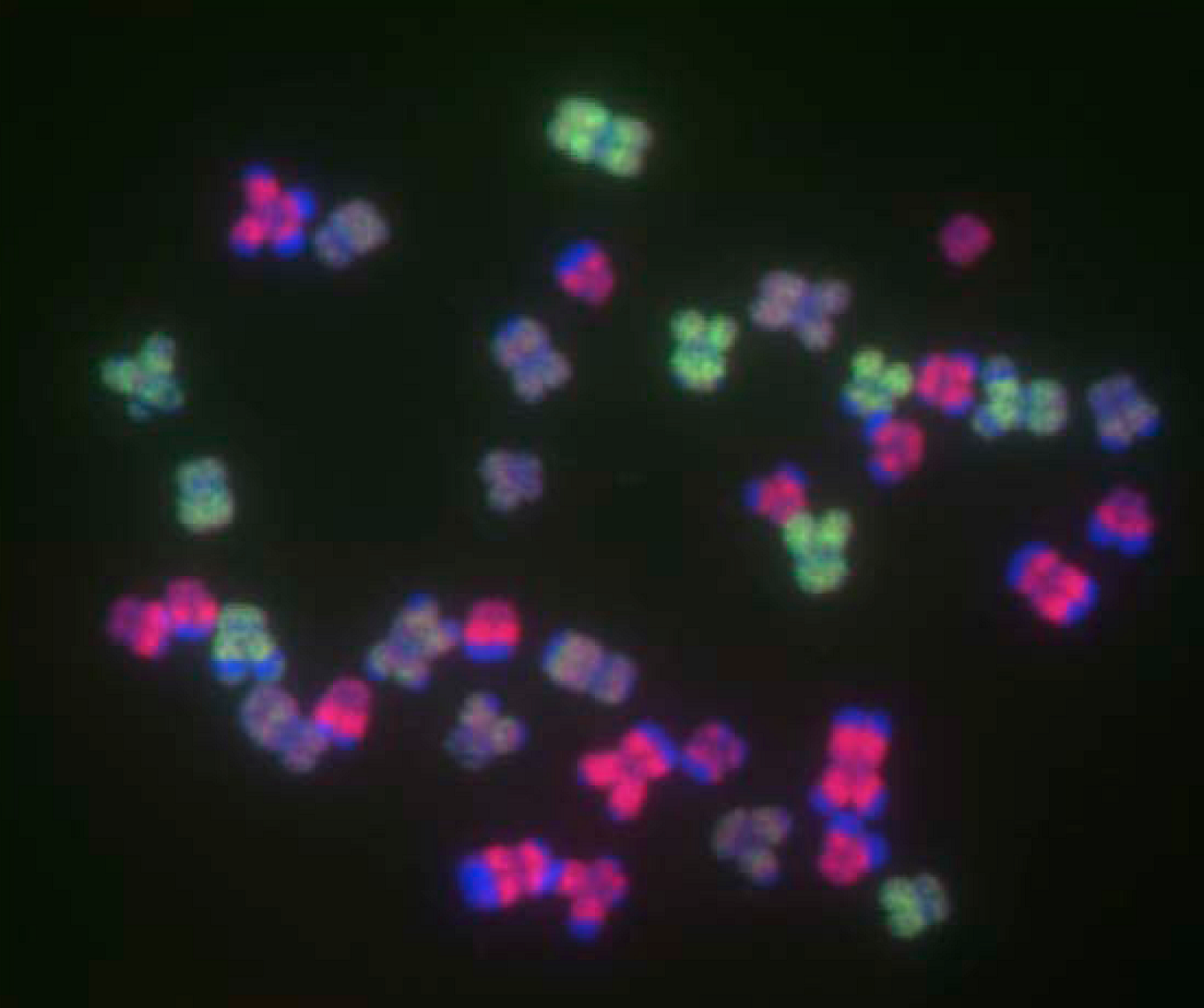
      <p>Another approach for developing non-dispersed FISH markers is to identify clusters of tandemly duplicated genes using a combination of ESTs, gene-mapping data and partial genome sequences (e.g. BACs). Kato <italic>et al.</italic> [<xref ref-type="bibr" rid="B184">184</xref>] applied 1.7 – 4 kb FISH probes to the tandemly repeated <italic>rp1</italic> and <italic>rp3</italic> resistance genes and the <italic>α-zeinA</italic> gene family, to paint single loci in the maize genome. Instead of using fluorescently labelled antibody for indirect detection, probes were directly labelled by a modified nick translation procedure that enables a high incorporation of dNTP-fluorophores [<xref ref-type="bibr" rid="B184">184</xref>]. Two advantages of this direct labelling method are that it reduces non-specific background, allowing smaller targets (~3 kb) to be detected, and it increases the number of probes that can be used simultaneously [<xref ref-type="bibr" rid="B184">184</xref>,<xref ref-type="bibr" rid="B185">185</xref>]. This method was used in a study of synthetic <italic>Zea</italic> ssp<italic>. </italic>x <italic>Tripsacum dactyloides</italic> hybrids and maize lines carrying introgressed DNA [<xref ref-type="bibr" rid="B186">186</xref>]. FISH with genome-enriched genomic clones, such as retrotransposon LTRs, were identified via Southern blotting and enabled the chromosomes of different species to be clearly distinguished. An example of the application of this method to a trispecies hybrid of <italic>T.</italic> <italic>dactyloides</italic> x <italic>Z. mays </italic>x <italic>Z. diploperennis</italic> (3<italic>n =</italic> 3<italic>x</italic> = 38) is shown in <xref ref-type="fig" rid="figure6">Figure 6</xref>.</p>
      <fig id="figure6" position="float">
        <label>Figure 6</label>
        <caption>
          <p>FISH to a partial root tip metaphase preparation of a <italic>Tripsacum </italic>x<italic> Zea </italic>trispecies hybrid (3<italic>n =</italic> 38). Chromosomes are hybridised by a mixture of genomic DNA clones, which have been directly labelled with fluorophores. Chromosomes can be identified as originating from <italic>T. dactyloides</italic> (red signal), <italic>Z. mays </italic>(green signal) or <italic>Z. diploperennis</italic> (mixed red and green signal); chromosomes are counterstained with DAPI (blue). Photo by Tatiana Arias, courtesy of James Birchler.</p>
        </caption>
        <graphic xmlns:xlink="http://www.w3.org/1999/xlink" xlink:href="genes-01-00166-g006.tif" scale="0"/>
      </fig>
      <p>One way of inferring changes that took place in early angiosperm evolution is to include representatives of the basal lineages, such as <italic>Amborella trichopoda</italic> (the sister to all other extant flowering plants) and the Nymphaeales (water lilies) reviewed in [<xref ref-type="bibr" rid="B187">187</xref>]. <italic>Amborella</italic> offers the unique ability to “root” analyses of all angiosperm features, from gene families to genome structure, and from physiology to morphology [<xref ref-type="bibr" rid="B188">188</xref>]<italic> </italic>and has therefore been proposed as a candidate for complete nuclear genome sequencing, because it represents an evolutionary reference genome for all other angiosperms [<xref ref-type="bibr" rid="B188">188</xref>]. As part of this effort, FISH will be used to anchor BAC contigs to <italic>Amborella</italic> chromosomes and aid construction of a physical map.</p>
    </sec>
    <sec sec-type="conclusions">
      <title>8. Conclusions</title>
      <p>Cytogenetics is poised to have an important role in plant biology into the future. The human population is expected to rise from 6 billion to 10 billion by 2100, resulting in huge increased demands on agriculture and land use. This problem is compounded by climate change [<xref ref-type="bibr" rid="B189">189</xref>], which has resulted in the growing of biofuel crops. Biofuels compete with land otherwise needed for food production or damages areas set aside for the conservation of biodiversity. Therefore, informed plant breeding to increase yield and quality and to improve farming practice is urgently needed. Modern cytogenetics will have a role in this, just as traditional cytogenetics was applied so successfully in the past. FISH will be used to map sequences and identify alien chromatin in new breeding lines. Another major issue facing humankind is conservation of biodiversity, an end to which most governments are committed, not least because it was estimated that ecosystem functioning was worth on average 33 trillion US dollars a year [<xref ref-type="bibr" rid="B190">190</xref>]. Characterizing that biodiversity is essential for conservation, and once again cytogenetics will have an important role in documenting biodiversity as well helping to reveal the processes that generate it. Cytogenetic methods in plant breeding and the study of biodiversity will therefore be required into the foreseeable future.</p>
    </sec>
  </body>
  <back>
    <ack>
      <p>We wish to thank Martin Lysak, Tatiana Arias, and James Birchler for kindly providing figures. This work was supported by NSF grant DEB-0922003.</p>
    </ack>
    <ref-list>
      <ref id="B1">
        <citation citation-type="journal">
          <person-group person-group-type="author">
            <name>
              <surname>Leitch</surname>
              <given-names>A.R.</given-names>
            </name>
          </person-group>
          <article-title>Higher levels of organization in the interphase nucleus of cycling and differentiated cells</article-title>
          <source>Microbiol. Mol. Biol. Rev.</source>
          <year>2000</year>
          <volume>64</volume>
          <fpage>138</fpage>
          <lpage>152</lpage>
          <pub-id pub-id-type="doi">10.1128/MMBR.64.1.138-152.2000</pub-id>
          <pub-id pub-id-type="pmid">10704477</pub-id>
        </citation>
      </ref>
      <ref id="B2">
        <citation citation-type="journal">
          <person-group person-group-type="author">
            <name>
              <surname>Lim</surname>
              <given-names>K.Y.</given-names>
            </name>
            <name>
              <surname>Souckova-Skalicka</surname>
              <given-names>K.</given-names>
            </name>
            <name>
              <surname>Sarasan</surname>
              <given-names>V.</given-names>
            </name>
            <name>
              <surname>Clarkson</surname>
              <given-names>J.J.</given-names>
            </name>
            <name>
              <surname>Chase</surname>
              <given-names>M.W.</given-names>
            </name>
            <name>
              <surname>Kovarik</surname>
              <given-names>A.</given-names>
            </name>
            <name>
              <surname>Leitch</surname>
              <given-names>A.R.</given-names>
            </name>
          </person-group>
          <article-title>A genetic appraisal of a new synthetic <italic>Nicotiana tabacum</italic> (Solanaceae) and the Kostoff synthetic tobacco</article-title>
          <source>Am. J. Bot.</source>
          <year>2006</year>
          <volume>93</volume>
          <fpage>875</fpage>
          <lpage>883</lpage>
          <pub-id pub-id-type="doi">10.3732/ajb.93.6.875</pub-id>
        </citation>
      </ref>
      <ref id="B3">
        <citation citation-type="journal">
          <person-group person-group-type="author">
            <name>
              <surname>Schwarzacher</surname>
              <given-names>T.</given-names>
            </name>
            <name>
              <surname>Leitch</surname>
              <given-names>A.R.</given-names>
            </name>
            <name>
              <surname>Bennett</surname>
              <given-names>M.D.</given-names>
            </name>
            <name>
              <surname>Heslop-Harrison</surname>
              <given-names>J.S.</given-names>
            </name>
          </person-group>
          <article-title>In situ localization of parental genomes in a wide hybrid</article-title>
          <source>Ann. Bot.</source>
          <year>1989</year>
          <volume>64</volume>
          <fpage>315</fpage>
          <lpage>324</lpage>
        </citation>
      </ref>
      <ref id="B4">
        <citation citation-type="journal">
          <person-group person-group-type="author">
            <name>
              <surname>Le</surname>
              <given-names>H.</given-names>
            </name>
            <name>
              <surname>Armstrong</surname>
              <given-names>K.</given-names>
            </name>
            <name>
              <surname>Miki</surname>
              <given-names>B.</given-names>
            </name>
          </person-group>
          <article-title>Detection of rye DNA in wheat-rye hybrids and wheat translocation stocks using total genomic DNA as a probe</article-title>
          <source>Plant Mol. Biol. Rep.</source>
          <year>1989</year>
          <volume>7</volume>
          <fpage>150</fpage>
          <lpage>158</lpage>
          <pub-id pub-id-type="doi">10.1007/BF02669631</pub-id>
        </citation>
      </ref>
      <ref id="B5">
        <citation citation-type="journal">
          <person-group person-group-type="author">
            <name>
              <surname>Fedak</surname>
              <given-names>G.</given-names>
            </name>
          </person-group>
          <article-title>Molecular aids for integration of alien chromatin through wide crosses</article-title>
          <source>Genome</source>
          <year>1999</year>
          <volume>42</volume>
          <fpage>584</fpage>
          <lpage>591</lpage>
          <pub-id pub-id-type="doi">10.1139/gen-42-4-584</pub-id>
        </citation>
      </ref>
      <ref id="B6">
        <citation citation-type="journal">
          <person-group person-group-type="author">
            <name>
              <surname>Jauhar</surname>
              <given-names>P.P.</given-names>
            </name>
            <name>
              <surname>Chibbar</surname>
              <given-names>R.N.</given-names>
            </name>
          </person-group>
          <article-title>Chromosome-mediated and direct gene transfers in wheat</article-title>
          <source>Genome</source>
          <year>1999</year>
          <volume>42</volume>
          <fpage>570</fpage>
          <lpage>583</lpage>
          <pub-id pub-id-type="doi">10.1139/gen-42-4-570</pub-id>
        </citation>
      </ref>
      <ref id="B7">
        <citation citation-type="journal">
          <person-group person-group-type="author">
            <name>
              <surname>Thomas</surname>
              <given-names>H.M.</given-names>
            </name>
            <name>
              <surname>Morgan</surname>
              <given-names>W.G.</given-names>
            </name>
            <name>
              <surname>Humphreys</surname>
              <given-names>M.W.</given-names>
            </name>
          </person-group>
          <article-title>Designing grasses with a future - combining the attributes of <italic>Lolium</italic> and <italic>Festuca</italic></article-title>
          <source>Euphytica</source>
          <year>2003</year>
          <volume>133</volume>
          <fpage>19</fpage>
          <lpage>26</lpage>
          <pub-id pub-id-type="doi">10.1023/A:1025694819031</pub-id>
        </citation>
      </ref>
      <ref id="B8">
        <citation citation-type="journal">
          <person-group person-group-type="author">
            <name>
              <surname>Raina</surname>
              <given-names>S.N.</given-names>
            </name>
            <name>
              <surname>Rani</surname>
              <given-names>V.</given-names>
            </name>
          </person-group>
          <article-title>GISH technology in plant genome research</article-title>
          <source>Methods Cell Sci.</source>
          <year>2001</year>
          <volume>23</volume>
          <fpage>83</fpage>
          <lpage>104</lpage>
          <pub-id pub-id-type="doi">10.1023/A:1013197705523</pub-id>
          <pub-id pub-id-type="pmid">11741146</pub-id>
        </citation>
      </ref>
      <ref id="B9">
        <citation citation-type="journal">
          <person-group person-group-type="author">
            <name>
              <surname>Bennett</surname>
              <given-names>S.T.</given-names>
            </name>
            <name>
              <surname>Kenton</surname>
              <given-names>A.Y.</given-names>
            </name>
            <name>
              <surname>Bennett</surname>
              <given-names>M.D.</given-names>
            </name>
          </person-group>
          <article-title>Genomic <italic>in situ</italic> hybridization reveals the allopolyploid nature of <italic>Milium montianum </italic>(Gramineae)</article-title>
          <source>Chromosoma</source>
          <year>1992</year>
          <volume>101</volume>
          <fpage>420</fpage>
          <lpage>424</lpage>
          <pub-id pub-id-type="doi">10.1007/BF00582836</pub-id>
        </citation>
      </ref>
      <ref id="B10">
        <citation citation-type="journal">
          <person-group person-group-type="author">
            <name>
              <surname>Markova</surname>
              <given-names>M.</given-names>
            </name>
            <name>
              <surname>Michu</surname>
              <given-names>E.</given-names>
            </name>
            <name>
              <surname>Vyskot</surname>
              <given-names>B.</given-names>
            </name>
            <name>
              <surname>Janousek</surname>
              <given-names>B.</given-names>
            </name>
            <name>
              <surname>Zluvova</surname>
              <given-names>J.</given-names>
            </name>
          </person-group>
          <article-title>An interspecific hybrid as a tool to study phylogenetic relationships in plants using the GISH technique</article-title>
          <source>Chromosome Res.</source>
          <year>2007</year>
          <volume>15</volume>
          <fpage>1051</fpage>
          <lpage>1059</lpage>
          <pub-id pub-id-type="doi">10.1007/s10577-007-1180-8</pub-id>
          <pub-id pub-id-type="pmid">18075777</pub-id>
        </citation>
      </ref>
      <ref id="B11">
        <citation citation-type="journal">
          <person-group person-group-type="author">
            <name>
              <surname>Chase</surname>
              <given-names>M.W.</given-names>
            </name>
            <name>
              <surname>Knapp</surname>
              <given-names>S.</given-names>
            </name>
            <name>
              <surname>Cox</surname>
              <given-names>A.V.</given-names>
            </name>
            <name>
              <surname>Clarkson</surname>
              <given-names>J.J.</given-names>
            </name>
            <name>
              <surname>Butsko</surname>
              <given-names>Y.</given-names>
            </name>
            <name>
              <surname>Joseph</surname>
              <given-names>J.</given-names>
            </name>
            <name>
              <surname>Savolainen</surname>
              <given-names>V.</given-names>
            </name>
            <name>
              <surname>Parokonny</surname>
              <given-names>A.S.</given-names>
            </name>
          </person-group>
          <article-title>Molecular systematics, GISH and the origin of hybrid taxa in <italic>Nicotiana</italic> (Solanaceae)</article-title>
          <source>Ann. Bot.-London</source>
          <year>2003</year>
          <volume>92</volume>
          <fpage>107</fpage>
          <lpage>127</lpage>
          <pub-id pub-id-type="doi">10.1093/aob/mcg087</pub-id>
        </citation>
      </ref>
      <ref id="B12">
        <citation citation-type="journal">
          <person-group person-group-type="author">
            <name>
              <surname>Dierschke</surname>
              <given-names>T.</given-names>
            </name>
            <name>
              <surname>Mandakova</surname>
              <given-names>T.</given-names>
            </name>
            <name>
              <surname>Lysak</surname>
              <given-names>M.A.</given-names>
            </name>
            <name>
              <surname>Mummenhoff</surname>
              <given-names>K.</given-names>
            </name>
          </person-group>
          <article-title>A bicontinental origin of polyploid Australian/New Zealand <italic>Lepidium</italic> species (Brassicaceae)? Evidence from genomic <italic>in situ</italic> hybridization 
 
</article-title>
          <source>Ann. Bot.</source>
          <year>2009</year>
          <volume>104</volume>
          <fpage>681</fpage>
          <lpage>688</lpage>
           
          <pub-id pub-id-type="doi">10.1093/aob/mcp161</pub-id>
          <pub-id pub-id-type="pmid">19589857</pub-id>
        </citation>
      </ref>
      <ref id="B13">
        <citation citation-type="journal">
          <person-group person-group-type="author">
            <name>
              <surname>Guggisberg</surname>
              <given-names>A.</given-names>
            </name>
            <name>
              <surname>Baroux</surname>
              <given-names>C.</given-names>
            </name>
            <name>
              <surname>Grossniklaus</surname>
              <given-names>U.</given-names>
            </name>
            <name>
              <surname>Conti</surname>
              <given-names>E.</given-names>
            </name>
          </person-group>
          <article-title>Genomic origin and organization of the allopolyploid <italic>Primula egaliksensis</italic> investigated by <italic>in situ</italic> hybridization</article-title>
          <source>Ann. Bot.</source>
          <year>2008</year>
          <volume>101</volume>
          <fpage>919</fpage>
          <lpage>927</lpage>
          <pub-id pub-id-type="doi">10.1093/aob/mcn026</pub-id>
          <pub-id pub-id-type="pmid">18308718</pub-id>
        </citation>
      </ref>
      <ref id="B14">
        <citation citation-type="journal">
          <person-group person-group-type="author">
            <name>
              <surname>Wang</surname>
              <given-names>B.S.</given-names>
            </name>
            <name>
              <surname>Ding</surname>
              <given-names>Z.Y.</given-names>
            </name>
            <name>
              <surname>Liu</surname>
              <given-names>W.</given-names>
            </name>
            <name>
              <surname>Pan</surname>
              <given-names>J.</given-names>
            </name>
            <name>
              <surname>Li</surname>
              <given-names>C.B.</given-names>
            </name>
            <name>
              <surname>Ge</surname>
              <given-names>S.</given-names>
            </name>
            <name>
              <surname>Zhang</surname>
              <given-names>D.M.</given-names>
            </name>
          </person-group>
          <article-title>Polyploid evolution in <italic>Oryza officinalis</italic> complex of the genus <italic>Oryza</italic></article-title>
          <source>BMC Evol. Biol.</source>
          <year>2009</year>
          <volume>9</volume>
          <fpage>250</fpage>
          <pub-id pub-id-type="doi">10.1186/1471-2148-9-250</pub-id>
        </citation>
      </ref>
      <ref id="B15">
        <citation citation-type="journal">
          <person-group person-group-type="author">
            <name>
              <surname>Zhang</surname>
              <given-names>D.M.</given-names>
            </name>
            <name>
              <surname>Sang</surname>
              <given-names>T.</given-names>
            </name>
          </person-group>
          <article-title>Physical mapping of ribosomal RNA genes in peonies (<italic>Paeonia</italic>, Paeoniaceae) by fluorescent in situ hybridization: Implications for phylogeny and concerted evolution</article-title>
          <source>Am. J. Bot.</source>
          <year>1999</year>
          <volume>86</volume>
          <fpage>735</fpage>
          <lpage>740</lpage>
          <pub-id pub-id-type="doi">10.2307/2656583</pub-id>
          <pub-id pub-id-type="pmid">10330077</pub-id>
        </citation>
      </ref>
      <ref id="B16">
        <citation citation-type="journal">
          <person-group person-group-type="author">
            <name>
              <surname>Adams</surname>
              <given-names>S.P.</given-names>
            </name>
            <name>
              <surname>Leitch</surname>
              <given-names>I.J.</given-names>
            </name>
            <name>
              <surname>Bennet</surname>
              <given-names>M.D.</given-names>
            </name>
            <name>
              <surname>Chase</surname>
              <given-names>M.W.</given-names>
            </name>
            <name>
              <surname>Leitch</surname>
              <given-names>A.R.</given-names>
            </name>
          </person-group>
          <article-title>Ribosomal DNA evolution and phylogeny in <italic>Aloe</italic> (Asphodelaceae)</article-title>
          <source>Am. J. Bot.</source>
          <year>2000</year>
          <volume>87</volume>
          <fpage>1578</fpage>
          <lpage>1583</lpage>
          <pub-id pub-id-type="doi">10.2307/2656733</pub-id>
          <pub-id pub-id-type="pmid">11080107</pub-id>
        </citation>
      </ref>
      <ref id="B17">
        <citation citation-type="journal">
          <person-group person-group-type="author">
            <name>
              <surname>Ran</surname>
              <given-names>Y.D.</given-names>
            </name>
            <name>
              <surname>Hammett</surname>
              <given-names>K.R.W.</given-names>
            </name>
            <name>
              <surname>Murray</surname>
              <given-names>B.G.</given-names>
            </name>
          </person-group>
          <article-title>Phylogenetic analysis and karyotype evolution in the genus <italic>Clivia</italic> (Amaryllidaceae)</article-title>
          <source>Ann. Bot.</source>
          <year>2001</year>
          <volume>87</volume>
          <fpage>823</fpage>
          <lpage>830</lpage>
          <pub-id pub-id-type="doi">10.1006/anbo.2001.1422</pub-id>
        </citation>
      </ref>
      <ref id="B18">
        <citation citation-type="journal">
          <person-group person-group-type="author">
            <name>
              <surname>Clarkson</surname>
              <given-names>J.J.</given-names>
            </name>
            <name>
              <surname>Lim</surname>
              <given-names>K.Y.</given-names>
            </name>
            <name>
              <surname>Kovarik</surname>
              <given-names>A.</given-names>
            </name>
            <name>
              <surname>Chase</surname>
              <given-names>M.W.</given-names>
            </name>
            <name>
              <surname>Knapp</surname>
              <given-names>S.</given-names>
            </name>
            <name>
              <surname>Leitch</surname>
              <given-names>A.R.</given-names>
            </name>
          </person-group>
          <article-title>Long-term genome diploidization in allopolyploid <italic>Nicotiana</italic> section Repandae (Solanaceae)</article-title>
          <source>New Phytol.</source>
          <year>2005</year>
          <volume>168</volume>
          <fpage>241</fpage>
          <lpage>252</lpage>
          <pub-id pub-id-type="doi">10.1111/j.1469-8137.2005.01480.x</pub-id>
          <pub-id pub-id-type="pmid">16159337</pub-id>
        </citation>
      </ref>
      <ref id="B19">
        <citation citation-type="journal">
          <person-group person-group-type="author">
            <name>
              <surname>Lim</surname>
              <given-names>K.Y.</given-names>
            </name>
            <name>
              <surname>Kovarik</surname>
              <given-names>A.</given-names>
            </name>
            <name>
              <surname>Matyasek</surname>
              <given-names>R.</given-names>
            </name>
            <name>
              <surname>Chase</surname>
              <given-names>M.W.</given-names>
            </name>
            <name>
              <surname>Clarkson</surname>
              <given-names>J.J.</given-names>
            </name>
            <name>
              <surname>Grandbastien</surname>
              <given-names>M.A.</given-names>
            </name>
            <name>
              <surname>Leitch</surname>
              <given-names>A.R.</given-names>
            </name>
          </person-group>
          <article-title>Sequence of events leading to near-complete genome turnover in allopolyploid <italic>Nicotiana</italic> within five million years</article-title>
          <source>New Phytol.</source>
          <year>2007</year>
          <volume>175</volume>
          <fpage>756</fpage>
          <lpage>763</lpage>
          <pub-id pub-id-type="doi">10.1111/j.1469-8137.2007.02121.x</pub-id>
          <pub-id pub-id-type="pmid">17688590</pub-id>
        </citation>
      </ref>
      <ref id="B20">
        <citation citation-type="journal">
          <person-group person-group-type="author">
            <name>
              <surname>Liu</surname>
              <given-names>Z.L.</given-names>
            </name>
            <name>
              <surname>Zhang</surname>
              <given-names>D.</given-names>
            </name>
            <name>
              <surname>Hong</surname>
              <given-names>D.Y.</given-names>
            </name>
            <name>
              <surname>Wang</surname>
              <given-names>X.R.</given-names>
            </name>
          </person-group>
          <article-title>Chromosomal localization of 5S and 18S-5.8S-25S ribosomal DNA sites in five Asian pines using fluorescence <italic>in situ</italic> hybridization 
 
</article-title>
          <source>Theor. Appl. Genet.</source>
          <year>2003</year>
          <volume>106</volume>
          <fpage>198</fpage>
          <lpage>204</lpage>
           
          <pub-id pub-id-type="pmid">12582844</pub-id>
        </citation>
      </ref>
      <ref id="B21">
        <citation citation-type="journal">
          <person-group person-group-type="author">
            <name>
              <surname>Jiang</surname>
              <given-names>J.M.</given-names>
            </name>
            <name>
              <surname>Gill</surname>
              <given-names>B.S.</given-names>
            </name>
          </person-group>
          <article-title>Current status and the future of fluorescence <italic>in situ</italic> hybridization (FISH) in plant genome research</article-title>
          <source>Genome</source>
          <year>2006</year>
          <volume>49</volume>
          <fpage>1057</fpage>
          <lpage>1068</lpage>
          <pub-id pub-id-type="doi">10.1139/G06-076</pub-id>
          <pub-id pub-id-type="pmid">17110986</pub-id>
        </citation>
      </ref>
      <ref id="B22">
        <citation citation-type="journal">
          <person-group person-group-type="author">
            <name>
              <surname>Jiang</surname>
              <given-names>J.M.</given-names>
            </name>
            <name>
              <surname>Gill</surname>
              <given-names>B.S.</given-names>
            </name>
            <name>
              <surname>Wang</surname>
              <given-names>G.L.</given-names>
            </name>
            <name>
              <surname>Ronald</surname>
              <given-names>P.C.</given-names>
            </name>
            <name>
              <surname>Ward</surname>
              <given-names>D.C.</given-names>
            </name>
          </person-group>
          <article-title>Metaphase and interphase fluorescence <italic>in-situ</italic> hybridization mapping of the rice genome with bacterial artificial chromosomes</article-title>
          <source>Proc. Natl. Acad. Sci. U. S. A.</source>
          <year>1995</year>
          <volume>92</volume>
          <fpage>4487</fpage>
          <lpage>4491</lpage>
          <pub-id pub-id-type="doi">10.1073/pnas.92.10.4487</pub-id>
          <pub-id pub-id-type="pmid">7753830</pub-id>
        </citation>
      </ref>
      <ref id="B23">
        <citation citation-type="journal">
          <person-group person-group-type="author">
            <name>
              <surname>Kim</surname>
              <given-names>J.S.</given-names>
            </name>
            <name>
              <surname>Klein</surname>
              <given-names>P.E.</given-names>
            </name>
            <name>
              <surname>Klein</surname>
              <given-names>R.R.</given-names>
            </name>
            <name>
              <surname>Price</surname>
              <given-names>H.J.</given-names>
            </name>
            <name>
              <surname>Mullet</surname>
              <given-names>J.E.</given-names>
            </name>
            <name>
              <surname>Stelly</surname>
              <given-names>D.M.</given-names>
            </name>
          </person-group>
          <article-title>Chromosome identification and nomenclature of <italic>Sorghum bicolor</italic></article-title>
          <source>Genetics</source>
          <year>2005</year>
          <volume>169</volume>
          <fpage>1169</fpage>
          <lpage>1173</lpage>
          <pub-id pub-id-type="doi">10.1534/genetics.104.035980</pub-id>
          <pub-id pub-id-type="pmid">15489512</pub-id>
        </citation>
      </ref>
      <ref id="B24">
        <citation citation-type="journal">
          <person-group person-group-type="author">
            <name>
              <surname>Koumbaris</surname>
              <given-names>G.L.</given-names>
            </name>
            <name>
              <surname>Bass</surname>
              <given-names>H.W.</given-names>
            </name>
          </person-group>
          <article-title>A new single-locus cytogenetic mapping system for maize (<italic>Zea mays</italic> L.): overcoming FISH detection limits with marker-selected sorghum (S. propinquum L.) BAC clones</article-title>
          <source>Plant J.</source>
          <year>2003</year>
          <volume>35</volume>
          <fpage>647</fpage>
          <lpage>659</lpage>
           
          <pub-id pub-id-type="doi">10.1046/j.1365-313X.2003.01829.x</pub-id>
          <pub-id pub-id-type="pmid">12940957</pub-id>
        </citation>
      </ref>
      <ref id="B25">
        <citation citation-type="journal">
          <person-group person-group-type="author">
            <name>
              <surname>Howell</surname>
              <given-names>E.C.</given-names>
            </name>
            <name>
              <surname>Armstrong</surname>
              <given-names>S.J.</given-names>
            </name>
            <name>
              <surname>Barker</surname>
              <given-names>G.C.</given-names>
            </name>
            <name>
              <surname>Jones</surname>
              <given-names>G.H.</given-names>
            </name>
            <name>
              <surname>King</surname>
              <given-names>G.J.</given-names>
            </name>
            <name>
              <surname>Ryder</surname>
              <given-names>C.D.</given-names>
            </name>
            <name>
              <surname>Kearsey</surname>
              <given-names>M.J.</given-names>
            </name>
          </person-group>
          <article-title>Physical organization of the major duplication on <italic>Brassica oleracea</italic> chromosome O6 revealed through fluorescence<italic> in situ</italic> hybridization with <italic>Arabidopsis</italic> and <italic>Brassica</italic> BAC probes</article-title>
          <source>Genome</source>
          <year>2005</year>
          <volume>48</volume>
          <fpage>1093</fpage>
          <lpage>1103</lpage>
          <pub-id pub-id-type="doi">10.1139/g05-069</pub-id>
          <pub-id pub-id-type="pmid">16391678</pub-id>
        </citation>
      </ref>
      <ref id="B26">
        <citation citation-type="journal">
          <person-group person-group-type="author">
            <name>
              <surname>Walling</surname>
              <given-names>J.G.</given-names>
            </name>
            <name>
              <surname>Shoemaker</surname>
              <given-names>R.</given-names>
            </name>
            <name>
              <surname>Young</surname>
              <given-names>N.</given-names>
            </name>
            <name>
              <surname>Mudge</surname>
              <given-names>J.</given-names>
            </name>
            <name>
              <surname>Jackson</surname>
              <given-names>S.</given-names>
            </name>
          </person-group>
          <article-title>Chromosome-level homeology in paleopolyploid soybean (<italic>Glycine max</italic>) revealed through integration of genetic and chromosome maps</article-title>
          <source>Genetics</source>
          <year>2006</year>
          <volume>172</volume>
          <fpage>1893</fpage>
          <lpage>1900</lpage>
          <pub-id pub-id-type="doi">10.1534/genetics.105.051466</pub-id>
          <pub-id pub-id-type="pmid">16361231</pub-id>
        </citation>
      </ref>
      <ref id="B27">
        <citation citation-type="journal">
          <person-group person-group-type="author">
            <name>
              <surname>Wang</surname>
              <given-names>K.</given-names>
            </name>
            <name>
              <surname>Guo</surname>
              <given-names>W.Z.</given-names>
            </name>
            <name>
              <surname>Zhang</surname>
              <given-names>T.Z.</given-names>
            </name>
          </person-group>
          <article-title>Detection and mapping of homologous and homoeologous segments in homoeologous groups of allotetraploid cotton by BAC-FISH 
 
</article-title>
          <source>BMC Genomics</source>
          <year>2007</year>
          <volume>8</volume>
           
        </citation>
      </ref>
      <ref id="B28">
        <citation citation-type="journal">
          <person-group person-group-type="author">
            <name>
              <surname>Wang</surname>
              <given-names>K.</given-names>
            </name>
            <name>
              <surname>Song</surname>
              <given-names>X.L.</given-names>
            </name>
            <name>
              <surname>Han</surname>
              <given-names>Z.G.</given-names>
            </name>
            <name>
              <surname>Guo</surname>
              <given-names>W.Z.</given-names>
            </name>
            <name>
              <surname>Yu</surname>
              <given-names>J.Z.</given-names>
            </name>
            <name>
              <surname>Sun</surname>
              <given-names>J.</given-names>
            </name>
            <name>
              <surname>Pan</surname>
              <given-names>J.J.</given-names>
            </name>
            <name>
              <surname>Kohel</surname>
              <given-names>R.J.</given-names>
            </name>
            <name>
              <surname>Zhang</surname>
              <given-names>T.Z.</given-names>
            </name>
          </person-group>
          <article-title>Complete assignment of the chromosomes of<italic> Gossypium hirsutum</italic> L. by translocation and fluorescence <italic>in situ</italic> hybridization mapping</article-title>
          <source>Theor. Appl. Genet.</source>
          <year>2006</year>
          <volume>113</volume>
          <fpage>73</fpage>
          <lpage>80</lpage>
          <pub-id pub-id-type="doi">10.1007/s00122-006-0273-7</pub-id>
          <pub-id pub-id-type="pmid">16609860</pub-id>
        </citation>
      </ref>
      <ref id="B29">
        <citation citation-type="journal">
          <person-group person-group-type="author">
            <name>
              <surname>Ming</surname>
              <given-names>R.</given-names>
            </name>
            <name>
              <surname>Hou</surname>
              <given-names>S.B.</given-names>
            </name>
            <name>
              <surname>Feng</surname>
              <given-names>Y.</given-names>
            </name>
            <name>
              <surname>Yu</surname>
              <given-names>Q.Y.</given-names>
            </name>
            <name>
              <surname>Dionne-Laporte</surname>
              <given-names>A.</given-names>
            </name>
            <name>
              <surname>Saw</surname>
              <given-names>J.H.</given-names>
            </name>
            <name>
              <surname>Senin</surname>
              <given-names>P.</given-names>
            </name>
            <name>
              <surname>Wang</surname>
              <given-names>W.</given-names>
            </name>
            <name>
              <surname>Ly</surname>
              <given-names>B.V.</given-names>
            </name>
            <name>
              <surname>Lewis</surname>
              <given-names>K.L.T.</given-names>
            </name>
            <name>
              <surname>et al.</surname>
              <given-names/>
            </name>
          </person-group>
          <article-title>The draft genome of the transgenic tropical fruit tree papaya (<italic>Carica papaya</italic> Linnaeus) 
 
</article-title>
          <source>Nature</source>
          <year>2008</year>
          <volume>452</volume>
          <fpage>U991</fpage>
          <lpage>U997</lpage>
           
          <pub-id pub-id-type="doi">10.1038/nature06856</pub-id>
        </citation>
      </ref>
      <ref id="B30">
        <citation citation-type="journal">
          <person-group person-group-type="author">
            <name>
              <surname>Mandakova</surname>
              <given-names>T.</given-names>
            </name>
            <name>
              <surname>Lysak</surname>
              <given-names>M.A.</given-names>
            </name>
          </person-group>
          <article-title>Chromosomal phylogeny and karyotype evolution in x=7 crucifer species (Brassicaceae)</article-title>
          <source>Plant Cell</source>
          <year>2008</year>
          <volume>20</volume>
          <fpage>2559</fpage>
          <lpage>2570</lpage>
          <pub-id pub-id-type="doi">10.1105/tpc.108.062166</pub-id>
          <pub-id pub-id-type="pmid">18836039</pub-id>
        </citation>
      </ref>
      <ref id="B31">
        <citation citation-type="journal">
          <person-group person-group-type="author">
            <name>
              <surname>Lysak</surname>
              <given-names>M.A.</given-names>
            </name>
            <name>
              <surname>Berr</surname>
              <given-names>A.</given-names>
            </name>
            <name>
              <surname>Pecinka</surname>
              <given-names>A.</given-names>
            </name>
            <name>
              <surname>Schmidt</surname>
              <given-names>R.</given-names>
            </name>
            <name>
              <surname>McBreen</surname>
              <given-names>K.</given-names>
            </name>
            <name>
              <surname>Schubert</surname>
              <given-names>I.</given-names>
            </name>
          </person-group>
          <article-title>Mechanisms of chromosome number reduction in<italic> Arabidopsis thaliana</italic> and related Brassicaceae species</article-title>
          <source>Proc. Natl. Acad. Sci. U. S. A.</source>
          <year>2006</year>
          <volume>103</volume>
          <fpage>5224</fpage>
          <lpage>5229</lpage>
          <pub-id pub-id-type="doi">10.1073/pnas.0510791103</pub-id>
          <pub-id pub-id-type="pmid">16549785</pub-id>
        </citation>
      </ref>
      <ref id="B32">
        <citation citation-type="journal">
          <person-group person-group-type="author">
            <name>
              <surname>Lysak</surname>
              <given-names>M.A.</given-names>
            </name>
            <name>
              <surname>Koch</surname>
              <given-names>M.A.</given-names>
            </name>
            <name>
              <surname>Pecinka</surname>
              <given-names>A.</given-names>
            </name>
            <name>
              <surname>Schubert</surname>
              <given-names>I.</given-names>
            </name>
          </person-group>
          <article-title>Chromosome triplication found across the tribe Brassiceae</article-title>
          <source>Genome Res.</source>
          <year>2005</year>
          <volume>15</volume>
          <fpage>516</fpage>
          <lpage>525</lpage>
          <pub-id pub-id-type="doi">10.1101/gr.3531105</pub-id>
          <pub-id pub-id-type="pmid">15781573</pub-id>
        </citation>
      </ref>
      <ref id="B33">
        <citation citation-type="journal">
          <person-group person-group-type="author">
            <name>
              <surname>Ziolkowski</surname>
              <given-names>P.A.</given-names>
            </name>
            <name>
              <surname>Kaczmarek</surname>
              <given-names>M.</given-names>
            </name>
            <name>
              <surname>Babula</surname>
              <given-names>D.</given-names>
            </name>
            <name>
              <surname>Sadowski</surname>
              <given-names>J.</given-names>
            </name>
          </person-group>
          <article-title>Genome evolution in <italic>Arabidopsis/Brassica</italic>: conservation and divergence of ancient rearranged segments and their breakpoints</article-title>
          <source>Plant J.</source>
          <year>2006</year>
          <volume>47</volume>
          <fpage>63</fpage>
          <lpage>74</lpage>
          <pub-id pub-id-type="doi">10.1111/j.1365-313X.2006.02762.x</pub-id>
          <pub-id pub-id-type="pmid">16824180</pub-id>
        </citation>
      </ref>
      <ref id="B34">
        <citation citation-type="journal">
          <person-group person-group-type="author">
            <name>
              <surname>Lysak</surname>
              <given-names>M.A.</given-names>
            </name>
            <name>
              <surname>Cheung</surname>
              <given-names>K.</given-names>
            </name>
            <name>
              <surname>Kitschke</surname>
              <given-names>M.</given-names>
            </name>
            <name>
              <surname>Bures</surname>
              <given-names>P.</given-names>
            </name>
          </person-group>
          <article-title>Ancestral chromosomal blocks are triplicated in Brassiceae species with varying chromosome number and genome size</article-title>
          <source>Plant Physiol.</source>
          <year>2007</year>
          <volume>145</volume>
          <fpage>402</fpage>
          <lpage>410</lpage>
          <pub-id pub-id-type="doi">10.1104/pp.107.104380</pub-id>
          <pub-id pub-id-type="pmid">17720758</pub-id>
        </citation>
      </ref>
      <ref id="B35">
        <citation citation-type="journal">
          <person-group person-group-type="author">
            <name>
              <surname>Ownbey</surname>
              <given-names>M.</given-names>
            </name>
          </person-group>
          <article-title>Natural hybridization and amphiploidy in the genus <italic>Tragopogon</italic></article-title>
          <source>Am. J. Bot.</source>
          <year>1950</year>
          <volume>37</volume>
          <fpage>487</fpage>
          <lpage>499</lpage>
          <pub-id pub-id-type="doi">10.2307/2438023</pub-id>
        </citation>
      </ref>
      <ref id="B36">
        <citation citation-type="journal">
          <person-group person-group-type="author">
            <name>
              <surname>Symonds</surname>
              <given-names>V.V.</given-names>
            </name>
            <name>
              <surname>Soltis</surname>
              <given-names>P.S.</given-names>
            </name>
            <name>
              <surname>Soltis</surname>
              <given-names>D.E.</given-names>
            </name>
          </person-group>
          <article-title>Dynamics of polyploid formation in <italic>Tragopogon</italic> (Asteracaeae): recurrent formation, gene flow, and population structure 
 
</article-title>
          <source>Evolution</source>
          <year>2010</year>
          <supplement>in press</supplement>
        </citation>
      </ref>
      <ref id="B37">
        <citation citation-type="journal">
          <person-group person-group-type="author">
            <name>
              <surname>Soltis</surname>
              <given-names>P.S.</given-names>
            </name>
            <name>
              <surname>Plunkett</surname>
              <given-names>G.M.</given-names>
            </name>
            <name>
              <surname>Novak</surname>
              <given-names>S.J.</given-names>
            </name>
            <name>
              <surname>Soltis</surname>
              <given-names>D.E.</given-names>
            </name>
          </person-group>
          <article-title>Genetic variation in <italic>Tragopogon</italic> species - additional origins of the allotetraploids <italic>Tmirus and T. miscellus (Compositae)</italic> 
</article-title>
          <source>Am. J. Bot.</source>
          <year>1995</year>
          <volume>82</volume>
          <fpage>1329</fpage>
          <lpage>1341</lpage>
           
          <pub-id pub-id-type="doi">10.2307/2446255</pub-id>
        </citation>
      </ref>
      <ref id="B38">
        <citation citation-type="journal">
          <person-group person-group-type="author">
            <name>
              <surname>Soltis</surname>
              <given-names>P.S.</given-names>
            </name>
            <name>
              <surname>Soltis</surname>
              <given-names>D.E.</given-names>
            </name>
          </person-group>
          <article-title>Multiple origins of the allotetraploid <italic>Tragopogon mirus</italic> (Compositae) - rDNA evidence</article-title>
          <source>Syst. Bot.</source>
          <year>1991</year>
          <volume>16</volume>
          <fpage>407</fpage>
          <lpage>413</lpage>
          <pub-id pub-id-type="doi">10.2307/2419333</pub-id>
        </citation>
      </ref>
      <ref id="B39">
        <citation citation-type="journal">
          <person-group person-group-type="author">
            <name>
              <surname>Ownbey</surname>
              <given-names>M.</given-names>
            </name>
            <name>
              <surname>McCollum</surname>
              <given-names>G.D.</given-names>
            </name>
          </person-group>
          <article-title>Cytoplasmic inheritance and reciprocal amphiploidy in <italic>Tragopogon</italic></article-title>
          <source>Am. J. Bot.</source>
          <year>1953</year>
          <volume>40</volume>
          <fpage>788</fpage>
          <lpage>796</lpage>
          <pub-id pub-id-type="doi">10.2307/2438276</pub-id>
        </citation>
      </ref>
      <ref id="B40">
        <citation citation-type="journal">
          <person-group person-group-type="author">
            <name>
              <surname>Lim</surname>
              <given-names>K.Y.</given-names>
            </name>
            <name>
              <surname>Soltis</surname>
              <given-names>D.E.</given-names>
            </name>
            <name>
              <surname>Soltis</surname>
              <given-names>P.S.</given-names>
            </name>
            <name>
              <surname>Tate</surname>
              <given-names>J.</given-names>
            </name>
            <name>
              <surname>Matyasek</surname>
              <given-names>R.</given-names>
            </name>
            <name>
              <surname>Srubarova</surname>
              <given-names>H.</given-names>
            </name>
            <name>
              <surname>Kovarik</surname>
              <given-names>A.</given-names>
            </name>
            <name>
              <surname>Pires</surname>
              <given-names>J.C.</given-names>
            </name>
            <name>
              <surname>Xiong</surname>
              <given-names>Z.Y.</given-names>
            </name>
            <name>
              <surname>Leitch</surname>
              <given-names>A.R.</given-names>
            </name>
          </person-group>
          <article-title>Rapid chromosome evolution in recently formed polyploids in <italic>Tragopogon</italic> (Asteraceae) 
 
</article-title>
          <source>Plos One</source>
          <year>2008</year>
          <volume>3</volume>
          <fpage>e3353</fpage>
           
          <pub-id pub-id-type="doi">10.1371/journal.pone.0003353</pub-id>
          <pub-id pub-id-type="pmid">18843372</pub-id>
        </citation>
      </ref>
      <ref id="B41">
        <citation citation-type="journal">
          <person-group person-group-type="author">
            <name>
              <surname>Szadkowski</surname>
              <given-names>E.</given-names>
            </name>
            <name>
              <surname>Eber</surname>
              <given-names>F.</given-names>
            </name>
            <name>
              <surname>Huteau</surname>
              <given-names>V.</given-names>
            </name>
            <name>
              <surname>Lode</surname>
              <given-names>M.</given-names>
            </name>
            <name>
              <surname>Huneau</surname>
              <given-names>C.</given-names>
            </name>
            <name>
              <surname>Belcram</surname>
              <given-names>H.</given-names>
            </name>
            <name>
              <surname>Coriton</surname>
              <given-names>O.</given-names>
            </name>
            <name>
              <surname>Manzanares-Dauleux</surname>
              <given-names>M.J.</given-names>
            </name>
            <name>
              <surname>Delourme</surname>
              <given-names>R.</given-names>
            </name>
            <name>
              <surname>King</surname>
              <given-names>G.J.</given-names>
            </name>
            <name>
              <surname>Chalhoub</surname>
              <given-names>B.</given-names>
            </name>
            <name>
              <surname>Jenczewski</surname>
              <given-names>E.</given-names>
            </name>
            <name>
              <surname>Chevre</surname>
              <given-names>A.M.</given-names>
            </name>
          </person-group>
          <article-title>The first meiosis of resynthesized <italic>Brassica napus</italic>, a genome blender</article-title>
          <source>New Phytol.</source>
          <year>2010</year>
          <volume>186</volume>
          <fpage>102</fpage>
          <lpage>112</lpage>
          <pub-id pub-id-type="doi">10.1111/j.1469-8137.2010.03182.x</pub-id>
          <pub-id pub-id-type="pmid">20149113</pub-id>
        </citation>
      </ref>
      <ref id="B42">
        <citation citation-type="journal">
          <person-group person-group-type="author">
            <name>
              <surname>Tate</surname>
              <given-names>J.A.</given-names>
            </name>
            <name>
              <surname>Joshi</surname>
              <given-names>P.</given-names>
            </name>
            <name>
              <surname>Soltis</surname>
              <given-names>K.A.</given-names>
            </name>
            <name>
              <surname>Soltis</surname>
              <given-names>P.S.</given-names>
            </name>
            <name>
              <surname>Soltis</surname>
              <given-names>D.E.</given-names>
            </name>
          </person-group>
          <article-title>On the road to diploidization? Homoeolog loss in independently formed populations of the allopolyploid <italic>Tragopogon miscellus</italic> (Asteraceae) 
 
</article-title>
          <source>BMC Plant Biol.</source>
          <year>2009</year>
          <volume>9</volume>
          <fpage>80</fpage>
           
          <pub-id pub-id-type="doi">10.1186/1471-2229-9-80</pub-id>
          <pub-id pub-id-type="pmid">19558696</pub-id>
        </citation>
      </ref>
      <ref id="B43">
        <citation citation-type="journal">
          <person-group person-group-type="author">
            <name>
              <surname>Buggs</surname>
              <given-names>R.J.A.</given-names>
            </name>
            <name>
              <surname>Doust</surname>
              <given-names>A.N.</given-names>
            </name>
            <name>
              <surname>Tate</surname>
              <given-names>J.A.</given-names>
            </name>
            <name>
              <surname>Koh</surname>
              <given-names>J.</given-names>
            </name>
            <name>
              <surname>Soltis</surname>
              <given-names>K.</given-names>
            </name>
            <name>
              <surname>Feltus</surname>
              <given-names>F.A.</given-names>
            </name>
            <name>
              <surname>Paterson</surname>
              <given-names>A.H.</given-names>
            </name>
            <name>
              <surname>Soltis</surname>
              <given-names>P.S.</given-names>
            </name>
            <name>
              <surname>Soltis</surname>
              <given-names>D.E.</given-names>
            </name>
          </person-group>
          <article-title>Gene loss and silencing in <italic>Tragopogon miscellus</italic> (Asteraceae): comparison of natural and synthetic allotetraploids</article-title>
          <source>Heredity</source>
          <year>2009</year>
          <volume>103</volume>
          <fpage>73</fpage>
          <lpage>81</lpage>
          <pub-id pub-id-type="doi">10.1038/hdy.2009.24</pub-id>
          <pub-id pub-id-type="pmid">19277058</pub-id>
        </citation>
      </ref>
      <ref id="B44">
        <citation citation-type="journal">
          <person-group person-group-type="author">
            <name>
              <surname>Tate</surname>
              <given-names>J.A.</given-names>
            </name>
            <name>
              <surname>Ni</surname>
              <given-names>Z.F.</given-names>
            </name>
            <name>
              <surname>Scheen</surname>
              <given-names>A.C.</given-names>
            </name>
            <name>
              <surname>Koh</surname>
              <given-names>J.</given-names>
            </name>
            <name>
              <surname>Gilbert</surname>
              <given-names>C.A.</given-names>
            </name>
            <name>
              <surname>Lefkowitz</surname>
              <given-names>D.</given-names>
            </name>
            <name>
              <surname>Chen</surname>
              <given-names>Z.J.</given-names>
            </name>
            <name>
              <surname>Soltis</surname>
              <given-names>P.S.</given-names>
            </name>
            <name>
              <surname>Soltis</surname>
              <given-names>D.E.</given-names>
            </name>
          </person-group>
          <article-title>Evolution and expression of homeologous loci in <italic>Tragopogon miscellus</italic> (Asteraceae), a recent and reciprocally formed allopolyploid</article-title>
          <source>Genetics</source>
          <year>2006</year>
          <volume>173</volume>
          <fpage>1599</fpage>
          <lpage>1611</lpage>
          <pub-id pub-id-type="doi">10.1534/genetics.106.057646</pub-id>
          <pub-id pub-id-type="pmid">16648586</pub-id>
        </citation>
      </ref>
      <ref id="B45">
        <citation citation-type="journal">
          <person-group person-group-type="author">
            <name>
              <surname>Buggs</surname>
              <given-names>R.J.A.</given-names>
            </name>
            <name>
              <surname>Chamala</surname>
              <given-names>S.</given-names>
            </name>
            <name>
              <surname>Wu</surname>
              <given-names>W.</given-names>
            </name>
            <name>
              <surname>Gao</surname>
              <given-names>L.</given-names>
            </name>
            <name>
              <surname>May</surname>
              <given-names>G.D.</given-names>
            </name>
            <name>
              <surname>Schnable</surname>
              <given-names>P.S.</given-names>
            </name>
            <name>
              <surname>Soltis</surname>
              <given-names>D.E.</given-names>
            </name>
            <name>
              <surname>Soltis</surname>
              <given-names>P.S.</given-names>
            </name>
            <name>
              <surname>Barbazuk</surname>
              <given-names>W.B.</given-names>
            </name>
          </person-group>
          <article-title>Characterization of duplicate gene evolution in the recent natural allopolyploid <italic>Tragopogon miscellus</italic> by next-generation sequencing and Sequenom iPLEX MassARRAY genotyping</article-title>
          <source>Mol. Ecol.</source>
          <year>2010</year>
          <volume>19</volume>
          <fpage>132</fpage>
          <lpage>146</lpage>
          <pub-id pub-id-type="doi">10.1111/j.1365-294X.2009.04469.x</pub-id>
          <pub-id pub-id-type="pmid">20331776</pub-id>
        </citation>
      </ref>
      <ref id="B46">
        <citation citation-type="journal">
          <person-group person-group-type="author">
            <name>
              <surname>Koh</surname>
              <given-names>J.</given-names>
            </name>
            <name>
              <surname>Soltis</surname>
              <given-names>P.S.</given-names>
            </name>
            <name>
              <surname>Soltis</surname>
              <given-names>D.E.</given-names>
            </name>
          </person-group>
          <article-title>Homeolog loss and expression changes in natural populations of the recently and repeatedly formed allotetraploid <italic>Tragopogon mirus</italic> (Asteraceae)</article-title>
          <source>BMC Genomics</source>
          <year>2010</year>
          <volume>11</volume>
          <fpage>97</fpage>
          <lpage>112</lpage>
          <pub-id pub-id-type="doi">10.1186/1471-2164-11-97</pub-id>
          <pub-id pub-id-type="pmid">20141639</pub-id>
        </citation>
      </ref>
      <ref id="B47">
        <citation citation-type="journal">
          <person-group person-group-type="author">
            <name>
              <surname>Marchant</surname>
              <given-names>C.J.</given-names>
            </name>
          </person-group>
          <article-title>Corrected chromosome numbers for <italic>Spartina</italic> x <italic>townsendii</italic> and its parent species</article-title>
          <source>Nature</source>
          <year>1963</year>
          <volume>199</volume>
          <fpage>929</fpage>
          <pub-id pub-id-type="doi">10.1038/199929a0</pub-id>
        </citation>
      </ref>
      <ref id="B48">
        <citation citation-type="journal">
          <person-group person-group-type="author">
            <name>
              <surname>Ainouche</surname>
              <given-names>M.L.</given-names>
            </name>
            <name>
              <surname>Baumel</surname>
              <given-names>A.</given-names>
            </name>
            <name>
              <surname>Salmon</surname>
              <given-names>A.</given-names>
            </name>
          </person-group>
          <article-title>Spartina anglica C.E. Hubbard: a natural model system for analysing early evolutionary changes that affect allopolyploid genomes</article-title>
          <source>Biol. J. Linn. Soc.</source>
          <year>2004</year>
          <volume>82</volume>
          <fpage>475</fpage>
          <lpage>484</lpage>
           
          <pub-id pub-id-type="doi">10.1111/j.1095-8312.2004.00334.x</pub-id>
        </citation>
      </ref>
      <ref id="B49">
        <citation citation-type="journal">
          <person-group person-group-type="author">
            <name>
              <surname>Hubbard</surname>
              <given-names>J.C.E.</given-names>
            </name>
          </person-group>
          <article-title>Spartina marshes in southern England. 
6. Pattern of invasion in Poole Harbor</article-title>
          <source>J. Ecol.</source>
          <year>1965</year>
          <volume>53</volume>
          <fpage>799</fpage>
          <lpage>813</lpage>
           
          <pub-id pub-id-type="doi">10.2307/2257637</pub-id>
        </citation>
      </ref>
      <ref id="B50">
        <citation citation-type="journal">
          <person-group person-group-type="author">
            <name>
              <surname>Ayres</surname>
              <given-names>D.R.</given-names>
            </name>
            <name>
              <surname>Strong</surname>
              <given-names>D.R.</given-names>
            </name>
          </person-group>
          <article-title>Origin and genetic diversity of <italic>Spartina anglica</italic> (Poaceae) using nuclear DNA markers</article-title>
          <source>Am. J. Bot.</source>
          <year>2001</year>
          <volume>88</volume>
          <fpage>1863</fpage>
          <lpage>1867</lpage>
          <pub-id pub-id-type="doi">10.2307/3558362</pub-id>
        </citation>
      </ref>
      <ref id="B51">
        <citation citation-type="journal">
          <person-group person-group-type="author">
            <name>
              <surname>Raybould</surname>
              <given-names>A.F.</given-names>
            </name>
            <name>
              <surname>Gray</surname>
              <given-names>A.J.</given-names>
            </name>
            <name>
              <surname>Lawrence</surname>
              <given-names>M.J.</given-names>
            </name>
            <name>
              <surname>Marshall</surname>
              <given-names>D.F.</given-names>
            </name>
          </person-group>
          <article-title>The evolution of <italic>Spartina anglica</italic> Hubbard, C.E. (Gramineae) - Genetic variation and status of the parental species in Britain</article-title>
          <source>Biol. J. Linn. Soc.</source>
          <year>1991</year>
          <volume>44</volume>
          <fpage>369</fpage>
          <lpage>380</lpage>
           
          <pub-id pub-id-type="doi">10.1111/j.1095-8312.1991.tb00626.x</pub-id>
        </citation>
      </ref>
      <ref id="B52">
        <citation citation-type="journal">
          <person-group person-group-type="author">
            <name>
              <surname>Renny-Byfield</surname>
              <given-names>S.</given-names>
            </name>
            <name>
              <surname>Ainouche</surname>
              <given-names>M.</given-names>
            </name>
            <name>
              <surname>Leitch</surname>
              <given-names>I.J.</given-names>
            </name>
            <name>
              <surname>Lim</surname>
              <given-names>K.Y.</given-names>
            </name>
            <name>
              <surname>Comber</surname>
              <given-names>S.C.L.</given-names>
            </name>
            <name>
              <surname>Leitch</surname>
              <given-names>A.R.</given-names>
            </name>
          </person-group>
          <article-title>Flow cytometry and GISH reveal mixed ploidy populations and <italic>Spartina</italic> nonaploids with genomes of <italic>Salterniflora and S. maritima origin</italic> 
</article-title>
          <source>Ann. Bot.</source>
          <year>2010</year>
          <volume>105</volume>
          <fpage>527</fpage>
          <lpage>533</lpage>
           
          <pub-id pub-id-type="doi">10.1093/aob/mcq008</pub-id>
          <pub-id pub-id-type="pmid">20150197</pub-id>
        </citation>
      </ref>
      <ref id="B53">
        <citation citation-type="book">
          <person-group person-group-type="author">
            <name>
              <surname>Clapham</surname>
              <given-names>A.R.</given-names>
            </name>
            <name>
              <surname>Tutin</surname>
              <given-names>T.G.</given-names>
            </name>
            <name>
              <surname>Warburg</surname>
              <given-names>E.F.</given-names>
            </name>
          </person-group>
          <source>Flora of the British Isles</source>
          <edition>2nd</edition>
          <publisher-name>Cambridge University Press</publisher-name>
          <publisher-loc>Cambridge; New York, NY, USA</publisher-loc>
          <year>1962</year>
           
        </citation>
      </ref>
      <ref id="B54">
        <citation citation-type="journal">
          <person-group person-group-type="author">
            <name>
              <surname>Ramsey</surname>
              <given-names>J.</given-names>
            </name>
            <name>
              <surname>Schemske</surname>
              <given-names>D.W.</given-names>
            </name>
          </person-group>
          <article-title>Pathways, mechanisms, and rates of polyploid formation in flowering plants</article-title>
          <source>Annu. Rev. Ecol. Syst.</source>
          <year>1998</year>
          <volume>29</volume>
          <fpage>467</fpage>
          <lpage>501</lpage>
          <pub-id pub-id-type="doi">10.1146/annurev.ecolsys.29.1.467</pub-id>
        </citation>
      </ref>
      <ref id="B55">
        <citation citation-type="journal">
          <person-group person-group-type="author">
            <name>
              <surname>Richards</surname>
              <given-names>A.J.</given-names>
            </name>
          </person-group>
          <article-title>Eutriploid Facultative Agamospermy in Taraxacum</article-title>
          <source>New Phytol.</source>
          <year>1970</year>
          <volume>69</volume>
          <fpage>761</fpage>
          <lpage>774</lpage>
          <pub-id pub-id-type="doi">10.1111/j.1469-8137.1970.tb02461.x</pub-id>
        </citation>
      </ref>
      <ref id="B56">
        <citation citation-type="journal">
          <person-group person-group-type="author">
            <name>
              <surname>Tel-Zur</surname>
              <given-names>N.</given-names>
            </name>
            <name>
              <surname>Abbo</surname>
              <given-names>S.</given-names>
            </name>
            <name>
              <surname>Mizrahi</surname>
              <given-names>Y.</given-names>
            </name>
          </person-group>
          <article-title>Cytogenetics of semi-fertile triploid and aneuploid intergeneric vine cacti hybrids</article-title>
          <source>J. Hered.</source>
          <year>2005</year>
          <volume>96</volume>
          <fpage>124</fpage>
          <lpage>131</lpage>
          <pub-id pub-id-type="doi">10.1093/jhered/esi012</pub-id>
          <pub-id pub-id-type="pmid">15618308</pub-id>
        </citation>
      </ref>
      <ref id="B57">
        <citation citation-type="journal">
          <person-group person-group-type="author">
            <name>
              <surname>Upcott</surname>
              <given-names>M.</given-names>
            </name>
            <name>
              <surname>Philp</surname>
              <given-names>J.</given-names>
            </name>
          </person-group>
          <article-title>The genetic structure of <italic>Tulipa</italic> - IV balance, selection and fertility</article-title>
          <source>J. Genet.</source>
          <year>1939</year>
          <volume>38</volume>
          <fpage>91</fpage>
          <lpage>123</lpage>
          <pub-id pub-id-type="doi">10.1007/BF02982166</pub-id>
        </citation>
      </ref>
      <ref id="B58">
        <citation citation-type="journal">
          <person-group person-group-type="author">
            <name>
              <surname>Puizina</surname>
              <given-names>J.</given-names>
            </name>
            <name>
              <surname>Papes</surname>
              <given-names>D.</given-names>
            </name>
          </person-group>
          <article-title>Further cytogenetic analyses of the Croatian triploid shallot "Ljutika" (<italic>Allium </italic>cepa var. <italic>viviparum</italic>, Alliaceae) and its comparison with the Indian triploid "Pran"</article-title>
          <source>Plant Syst. Evol.</source>
          <year>1997</year>
          <volume>208</volume>
          <fpage>11</fpage>
          <lpage>23</lpage>
          <pub-id pub-id-type="doi">10.1007/BF00986079</pub-id>
        </citation>
      </ref>
      <ref id="B59">
        <citation citation-type="journal">
          <person-group person-group-type="author">
            <name>
              <surname>Carputo</surname>
              <given-names>D.</given-names>
            </name>
          </person-group>
          <article-title>Cytological and breeding behavior of pentaploids derived from 3<italic>x</italic> x 4<italic>x</italic> crosses in potato</article-title>
          <source>Theor. Appl. Genet.</source>
          <year>2003</year>
          <volume>106</volume>
          <fpage>883</fpage>
          <lpage>888</lpage>
          <pub-id pub-id-type="pmid">12647063</pub-id>
        </citation>
      </ref>
      <ref id="B60">
        <citation citation-type="journal">
          <person-group person-group-type="author">
            <name>
              <surname>Henry</surname>
              <given-names>I.M.</given-names>
            </name>
            <name>
              <surname>Dilkes</surname>
              <given-names>B.P.</given-names>
            </name>
            <name>
              <surname>Tyagi</surname>
              <given-names>A.P.</given-names>
            </name>
            <name>
              <surname>Lin</surname>
              <given-names>H.Y.</given-names>
            </name>
            <name>
              <surname>Comai</surname>
              <given-names>L.</given-names>
            </name>
          </person-group>
          <article-title>Dosage and parent-of-origin effects shaping aneuploid swarms in <italic>A. thaliana</italic></article-title>
          <source>Heredity</source>
          <year>2009</year>
          <volume>103</volume>
          <fpage>458</fpage>
          <lpage>468</lpage>
          <pub-id pub-id-type="doi">10.1038/hdy.2009.81</pub-id>
          <pub-id pub-id-type="pmid">19603060</pub-id>
        </citation>
      </ref>
      <ref id="B61">
        <citation citation-type="journal">
          <person-group person-group-type="author">
            <name>
              <surname>Laverty</surname>
              <given-names>T.</given-names>
            </name>
            <name>
              <surname>Vorsa</surname>
              <given-names>N.</given-names>
            </name>
          </person-group>
          <article-title>Fertility of aneuploids between the 5<italic>x</italic> and 6<italic>x</italic> levels in blueberry - the potential for gene-transfer from 4<italic>x</italic> to 6<italic>x</italic> Levels</article-title>
          <source>J. Am. Soc. Hort. Sci.</source>
          <year>1991</year>
          <volume>116</volume>
          <fpage>330</fpage>
          <lpage>335</lpage>
        </citation>
      </ref>
      <ref id="B62">
        <citation citation-type="book">
          <person-group person-group-type="author">
            <name>
              <surname>Stebbins</surname>
              <given-names>G.L.</given-names>
            </name>
          </person-group>
          <source>Chromosome evolution in higher plants</source>
          <year>1971</year>
          <publisher-name>J. W. Arrowsmith Ltd.</publisher-name>
          <publisher-loc>Bristol, UK</publisher-loc>
        </citation>
      </ref>
      <ref id="B63">
        <citation citation-type="journal">
          <person-group person-group-type="author">
            <name>
              <surname>Hasterok</surname>
              <given-names>R.</given-names>
            </name>
            <name>
              <surname>Draper</surname>
              <given-names>J.</given-names>
            </name>
            <name>
              <surname>Jenkins</surname>
              <given-names>G.</given-names>
            </name>
          </person-group>
          <article-title>Laying the cytotaxonomic foundations of a new model grass, <italic>Brachypodium distachyon</italic> (L.) Beauv 
 
</article-title>
          <source>Chromosome Res.</source>
          <year>2004</year>
          <volume>12</volume>
          <fpage>397</fpage>
          <lpage>403</lpage>
           
          <pub-id pub-id-type="doi">10.1023/B:CHRO.0000034130.35983.99</pub-id>
          <pub-id pub-id-type="pmid">15241018</pub-id>
        </citation>
      </ref>
      <ref id="B64">
        <citation citation-type="journal">
          <person-group person-group-type="author">
            <name>
              <surname>Schranz</surname>
              <given-names>M.E.</given-names>
            </name>
            <name>
              <surname>Lysak</surname>
              <given-names>M.A.</given-names>
            </name>
            <name>
              <surname>Mitchell-Olds</surname>
              <given-names>T.</given-names>
            </name>
          </person-group>
          <article-title>The ABC's of comparative genomics in the Brassicaceae: building blocks of crucifer genomes</article-title>
          <source>Trends Plant Sci.</source>
          <year>2006</year>
          <volume>11</volume>
          <fpage>535</fpage>
          <lpage>542</lpage>
          <pub-id pub-id-type="doi">10.1016/j.tplants.2006.09.002</pub-id>
          <pub-id pub-id-type="pmid">17029932</pub-id>
        </citation>
      </ref>
      <ref id="B65">
        <citation citation-type="journal">
          <person-group person-group-type="author">
            <name>
              <surname>Dobes</surname>
              <given-names>C.H.</given-names>
            </name>
            <name>
              <surname>Mitchell-Olds</surname>
              <given-names>T.</given-names>
            </name>
            <name>
              <surname>Koch</surname>
              <given-names>M.A.</given-names>
            </name>
          </person-group>
          <article-title>Extensive chloroplast haplotype variation indicates Pleistocene hybridization and radiation of North American <italic>Arabis drummondii</italic>, <italic>A. x divaricarpa, and A. holboellii (Brassicaceae)</italic> 
</article-title>
          <source>Mol. Ecol.</source>
          <year>2004</year>
          <volume>13</volume>
          <fpage>349</fpage>
          <lpage>370</lpage>
           
          <pub-id pub-id-type="doi">10.1046/j.1365-294X.2003.02064.x</pub-id>
          <pub-id pub-id-type="pmid">14717892</pub-id>
        </citation>
      </ref>
      <ref id="B66">
        <citation citation-type="journal">
          <person-group person-group-type="author">
            <name>
              <surname>Dobes</surname>
              <given-names>C.</given-names>
            </name>
            <name>
              <surname>Mitchell-Olds</surname>
              <given-names>T.</given-names>
            </name>
            <name>
              <surname>Koch</surname>
              <given-names>M.A.</given-names>
            </name>
          </person-group>
          <article-title>Intraspecific diversification in North American <italic>Boechera stricta</italic> (=<italic>Arabis drummondii</italic>), <italic>Boechera </italic>x<italic> divaricarpa</italic>, and <italic>Boechera holboellii</italic> (Brassicaceae) inferred from nuclear and chloroplast molecular markers - An integrative approach</article-title>
          <source>Am. J. Bot.</source>
          <year>2004</year>
          <volume>91</volume>
          <fpage>2087</fpage>
          <lpage>2101</lpage>
          <pub-id pub-id-type="doi">10.3732/ajb.91.12.2087</pub-id>
        </citation>
      </ref>
      <ref id="B67">
        <citation citation-type="journal">
          <person-group person-group-type="author">
            <name>
              <surname>Kohler</surname>
              <given-names>C.</given-names>
            </name>
            <name>
              <surname>Scheid</surname>
              <given-names>O.M.</given-names>
            </name>
            <name>
              <surname>Erilova</surname>
              <given-names>A.</given-names>
            </name>
          </person-group>
          <article-title>The impact of the triploid block on the origin and evolution of polyploid plants</article-title>
          <source>Trends Genet.</source>
          <year>2010</year>
          <volume>26</volume>
          <fpage>142</fpage>
          <lpage>148</lpage>
          <pub-id pub-id-type="doi">10.1016/j.tig.2009.12.006</pub-id>
          <pub-id pub-id-type="pmid">20089326</pub-id>
        </citation>
      </ref>
      <ref id="B68">
        <citation citation-type="journal">
          <person-group person-group-type="author">
            <name>
              <surname>Ehlenfeldt</surname>
              <given-names>M.K.</given-names>
            </name>
            <name>
              <surname>Ortiz</surname>
              <given-names>R.</given-names>
            </name>
          </person-group>
          <article-title>Evidence on the nature and origins of endosperm dosage requirements in <italic>Solanum</italic> and other angiosperm genera</article-title>
          <source>Sexual Plant Reproduction</source>
          <year>1995</year>
          <volume>8</volume>
          <fpage>189</fpage>
          <lpage>196</lpage>
          <pub-id pub-id-type="doi">10.1007/BF00228936</pub-id>
        </citation>
      </ref>
      <ref id="B69">
        <citation citation-type="journal">
          <person-group person-group-type="author">
            <name>
              <surname>Kantama</surname>
              <given-names>L.</given-names>
            </name>
            <name>
              <surname>Sharbel</surname>
              <given-names>T.F.</given-names>
            </name>
            <name>
              <surname>Schranz</surname>
              <given-names>M.E.</given-names>
            </name>
            <name>
              <surname>Mitchell-Olds</surname>
              <given-names>T.</given-names>
            </name>
            <name>
              <surname>de Vries</surname>
              <given-names>S.</given-names>
            </name>
            <name>
              <surname>de Jong</surname>
              <given-names>H.</given-names>
            </name>
          </person-group>
          <article-title>Diploid apomicts of the <italic>Boechera holboellii</italic> complex display large-scale chromosome substitutions and aberrant chromosomes</article-title>
          <source>Proc. Natl. Acad. Sci. U. S. A.</source>
          <year>2007</year>
          <volume>104</volume>
          <fpage>14026</fpage>
          <lpage>14031</lpage>
          <pub-id pub-id-type="doi">10.1073/pnas.0706647104</pub-id>
          <pub-id pub-id-type="pmid">17704257</pub-id>
        </citation>
      </ref>
      <ref id="B70">
        <citation citation-type="journal">
          <person-group person-group-type="author">
            <name>
              <surname>Speeckaert</surname>
              <given-names>F.</given-names>
            </name>
            <name>
              <surname>Jacobs</surname>
              <given-names>M.</given-names>
            </name>
          </person-group>
          <article-title>Study of the divergence of moderately repetitive sequences in <italic>Nicotiana</italic> species and in protoclones of <italic>Nicotiana plumbaginifolia</italic> Viviani</article-title>
          <source>Theor. Appl. Genet.</source>
          <year>1988</year>
          <volume>75</volume>
          <fpage>746</fpage>
          <lpage>750</lpage>
          <pub-id pub-id-type="doi">10.1007/BF00265599</pub-id>
        </citation>
      </ref>
      <ref id="B71">
        <citation citation-type="journal">
          <person-group person-group-type="author">
            <name>
              <surname>Kenton</surname>
              <given-names>A.</given-names>
            </name>
            <name>
              <surname>Khashoggi</surname>
              <given-names>A.</given-names>
            </name>
            <name>
              <surname>Parokonny</surname>
              <given-names>A.</given-names>
            </name>
            <name>
              <surname>Bennett</surname>
              <given-names>M.D.</given-names>
            </name>
            <name>
              <surname>Lichtenstein</surname>
              <given-names>C.</given-names>
            </name>
          </person-group>
          <article-title>Chromosomal location of endogenous geminivirus-related DNA sequences in <italic>Nicotiana tabacum</italic> L</article-title>
          <source>Chromosome Res.</source>
          <year>1995</year>
          <volume>3</volume>
          <fpage>346</fpage>
          <lpage>350</lpage>
          <pub-id pub-id-type="doi">10.1007/BF00710015</pub-id>
          <pub-id pub-id-type="pmid">7551549</pub-id>
        </citation>
      </ref>
      <ref id="B72">
        <citation citation-type="journal">
          <person-group person-group-type="author">
            <name>
              <surname>Lim</surname>
              <given-names>K.Y.</given-names>
            </name>
            <name>
              <surname>Matyasek</surname>
              <given-names>R.</given-names>
            </name>
            <name>
              <surname>Lichtenstein</surname>
              <given-names>C.P.</given-names>
            </name>
            <name>
              <surname>Leitch</surname>
              <given-names>A.R.</given-names>
            </name>
          </person-group>
          <article-title>Molecular cytogenetic analyses and phylogenetic studies in the <italic>Nicotiana</italic> section Tomentosae</article-title>
          <source>Chromosoma</source>
          <year>2000</year>
          <volume>109</volume>
          <fpage>245</fpage>
          <lpage>258</lpage>
          <pub-id pub-id-type="doi">10.1007/s004120000074</pub-id>
          <pub-id pub-id-type="pmid">10968253</pub-id>
        </citation>
      </ref>
      <ref id="B73">
        <citation citation-type="journal">
          <person-group person-group-type="author">
            <name>
              <surname>Murad</surname>
              <given-names>L.</given-names>
            </name>
            <name>
              <surname>Lim</surname>
              <given-names>K.Y.</given-names>
            </name>
            <name>
              <surname>Christopodulou</surname>
              <given-names>V.</given-names>
            </name>
            <name>
              <surname>Matyasek</surname>
              <given-names>R.</given-names>
            </name>
            <name>
              <surname>Lichtenstein</surname>
              <given-names>C.P.</given-names>
            </name>
            <name>
              <surname>Kovarik</surname>
              <given-names>A.</given-names>
            </name>
            <name>
              <surname>Leitch</surname>
              <given-names>A.R.</given-names>
            </name>
          </person-group>
          <article-title>The origin of tobacco's T genome is traced to a particular lineage within <italic>Nicotiana tomentosiformis</italic> (Solanaceae)</article-title>
          <source>Am. J. Bot.</source>
          <year>2002</year>
          <volume>89</volume>
          <fpage>921</fpage>
          <lpage>928</lpage>
          <pub-id pub-id-type="doi">10.3732/ajb.89.6.921</pub-id>
        </citation>
      </ref>
      <ref id="B74">
        <citation citation-type="journal">
          <person-group person-group-type="author">
            <name>
              <surname>Murad</surname>
              <given-names>L.</given-names>
            </name>
            <name>
              <surname>Bielawski</surname>
              <given-names>J.P.</given-names>
            </name>
            <name>
              <surname>Matyasek</surname>
              <given-names>R.</given-names>
            </name>
            <name>
              <surname>Kovarik</surname>
              <given-names>A.</given-names>
            </name>
            <name>
              <surname>Nichols</surname>
              <given-names>R.A.</given-names>
            </name>
            <name>
              <surname>Leitch</surname>
              <given-names>A.R.</given-names>
            </name>
            <name>
              <surname>Lichtenstein</surname>
              <given-names>C.P.</given-names>
            </name>
          </person-group>
          <article-title>The origin and evolution of geminivirus-related DNA sequences in <italic>Nicotiana</italic></article-title>
          <source>Heredity</source>
          <year>2004</year>
          <volume>92</volume>
          <fpage>352</fpage>
          <lpage>358</lpage>
          <pub-id pub-id-type="doi">10.1038/sj.hdy.6800431</pub-id>
          <pub-id pub-id-type="pmid">14985783</pub-id>
        </citation>
      </ref>
      <ref id="B75">
        <citation citation-type="journal">
          <person-group person-group-type="author">
            <name>
              <surname>Schubert</surname>
              <given-names>I.</given-names>
            </name>
            <name>
              <surname>Fransz</surname>
              <given-names>P.F.</given-names>
            </name>
            <name>
              <surname>Fuchs</surname>
              <given-names>J.</given-names>
            </name>
            <name>
              <surname>de Jong</surname>
              <given-names>J.H.</given-names>
            </name>
          </person-group>
          <article-title>Chromosome painting in plants</article-title>
          <source>Methods Cell Sci.</source>
          <year>2001</year>
          <volume>23</volume>
          <fpage>57</fpage>
          <lpage>69</lpage>
          <pub-id pub-id-type="doi">10.1023/A:1013137415093</pub-id>
          <pub-id pub-id-type="pmid">11741144</pub-id>
        </citation>
      </ref>
      <ref id="B76">
        <citation citation-type="journal">
          <person-group person-group-type="author">
            <name>
              <surname>Jiang</surname>
              <given-names>J.M.</given-names>
            </name>
            <name>
              <surname>Gill</surname>
              <given-names>B.S.</given-names>
            </name>
          </person-group>
          <article-title>Nonisotopic <italic>in-situ</italic> hybridization and plant genome mapping - the first 10 years</article-title>
          <source>Genome</source>
          <year>1994</year>
          <volume>37</volume>
          <fpage>717</fpage>
          <lpage>725</lpage>
          <pub-id pub-id-type="pmid">18470115</pub-id>
        </citation>
      </ref>
      <ref id="B77">
        <citation citation-type="journal">
          <person-group person-group-type="author">
            <name>
              <surname>Lysak</surname>
              <given-names>M.A.</given-names>
            </name>
            <name>
              <surname>Lexer</surname>
              <given-names>C.</given-names>
            </name>
          </person-group>
          <article-title>Towards the era of comparative evolutionary genomics in Brassicaceae</article-title>
          <source>Plant Syst. Evol.</source>
          <year>2006</year>
          <volume>259</volume>
          <fpage>175</fpage>
          <lpage>198</lpage>
          <pub-id pub-id-type="doi">10.1007/s00606-006-0418-9</pub-id>
        </citation>
      </ref>
      <ref id="B78">
        <citation citation-type="journal">
          <person-group person-group-type="author">
            <name>
              <surname>Ali</surname>
              <given-names>H.B.M.</given-names>
            </name>
            <name>
              <surname>Lysak</surname>
              <given-names>M.A.</given-names>
            </name>
            <name>
              <surname>Schubert</surname>
              <given-names>I.</given-names>
            </name>
          </person-group>
          <article-title>Genomic <italic>in situ</italic> hybridization in plants with small genomes is feasible and elucidates the chromosomal parentage in interspecific <italic>Arabidopsis</italic> hybrids</article-title>
          <source>Genome</source>
          <year>2004</year>
          <volume>47</volume>
          <fpage>954</fpage>
          <lpage>960</lpage>
          <pub-id pub-id-type="doi">10.1139/g04-041</pub-id>
          <pub-id pub-id-type="pmid">15499409</pub-id>
        </citation>
      </ref>
      <ref id="B79">
        <citation citation-type="journal">
          <person-group person-group-type="author">
            <name>
              <surname>Säll</surname>
              <given-names>T.</given-names>
            </name>
            <name>
              <surname>Jakobsson</surname>
              <given-names>M.</given-names>
            </name>
            <name>
              <surname>Lind-Halldén</surname>
              <given-names>C.</given-names>
            </name>
            <name>
              <surname>C.</surname>
              <given-names>H.</given-names>
            </name>
          </person-group>
          <article-title>Chloroplast DNA indicates a single origin of the allotetraploid <italic>Arabidopsis suecica</italic></article-title>
          <source>J. Evol. Biol.</source>
          <year>2003</year>
          <volume>16</volume>
          <fpage>1019</fpage>
          <lpage>1029</lpage>
          <pub-id pub-id-type="doi">10.1046/j.1420-9101.2003.00554.x</pub-id>
          <pub-id pub-id-type="pmid">14635917</pub-id>
        </citation>
      </ref>
      <ref id="B80">
        <citation citation-type="journal">
          <person-group person-group-type="author">
            <name>
              <surname>O'Kane</surname>
              <given-names>S.L.</given-names>
            </name>
            <name>
              <surname>Schaal</surname>
              <given-names>B.A.</given-names>
            </name>
            <name>
              <surname>AlShehbaz</surname>
              <given-names>I.A.</given-names>
            </name>
          </person-group>
          <article-title>The origins of <italic>Arabidopsis suecica</italic> (Brassicaceae) as indicated by nuclear rDNA sequences</article-title>
          <source>Syst. Bot.</source>
          <year>1996</year>
          <volume>21</volume>
          <fpage>559</fpage>
          <lpage>566</lpage>
          <pub-id pub-id-type="doi">10.2307/2419615</pub-id>
        </citation>
      </ref>
      <ref id="B81">
        <citation citation-type="journal">
          <person-group person-group-type="author">
            <name>
              <surname>Jakobsson</surname>
              <given-names>M.</given-names>
            </name>
            <name>
              <surname>Hagenblad</surname>
              <given-names>J.</given-names>
            </name>
            <name>
              <surname>Tavare</surname>
              <given-names>S.</given-names>
            </name>
            <name>
              <surname>Sall</surname>
              <given-names>T.</given-names>
            </name>
            <name>
              <surname>Hallden</surname>
              <given-names>C.</given-names>
            </name>
            <name>
              <surname>Lind-Hallden</surname>
              <given-names>C.</given-names>
            </name>
            <name>
              <surname>Nordborg</surname>
              <given-names>M.</given-names>
            </name>
          </person-group>
          <article-title>A unique recent origin of the allotetraploid species <italic>Arabidopsis</italic><italic>suecica</italic>: Evidence from nuclear DNA markers</article-title>
          <source>Mol. Biol. Evol.</source>
          <year>2006</year>
          <volume>23</volume>
          <fpage>1217</fpage>
          <lpage>1231</lpage>
          <pub-id pub-id-type="doi">10.1093/molbev/msk006</pub-id>
          <pub-id pub-id-type="pmid">16549398</pub-id>
        </citation>
      </ref>
      <ref id="B82">
        <citation citation-type="journal">
          <person-group person-group-type="author">
            <name>
              <surname>Madlung</surname>
              <given-names>A.</given-names>
            </name>
            <name>
              <surname>Tyagi</surname>
              <given-names>A.P.</given-names>
            </name>
            <name>
              <surname>Watson</surname>
              <given-names>B.</given-names>
            </name>
            <name>
              <surname>Jiang</surname>
              <given-names>H.M.</given-names>
            </name>
            <name>
              <surname>Kagochi</surname>
              <given-names>T.</given-names>
            </name>
            <name>
              <surname>Doerge</surname>
              <given-names>R.W.</given-names>
            </name>
            <name>
              <surname>Martienssen</surname>
              <given-names>R.</given-names>
            </name>
            <name>
              <surname>Comai</surname>
              <given-names>L.</given-names>
            </name>
          </person-group>
          <article-title>Genomic changes in synthetic <italic>Arabidopsis</italic> polyploids</article-title>
          <source>Plant J.</source>
          <year>2005</year>
          <volume>41</volume>
          <fpage>221</fpage>
          <lpage>230</lpage>
          <pub-id pub-id-type="doi">10.1111/j.1365-313X.2004.02297.x</pub-id>
          <pub-id pub-id-type="pmid">15634199</pub-id>
        </citation>
      </ref>
      <ref id="B83">
        <citation citation-type="journal">
          <person-group person-group-type="author">
            <name>
              <surname>Wright</surname>
              <given-names>K.M.</given-names>
            </name>
            <name>
              <surname>Pires</surname>
              <given-names>J.C.</given-names>
            </name>
            <name>
              <surname>Madlung</surname>
              <given-names>A.</given-names>
            </name>
          </person-group>
          <article-title>Mitotic instability in resynthesized and natural polyploids of the genus <italic>Arabidopsis</italic> (Brassicaceae)</article-title>
          <source>Am. J. Bot.</source>
          <year>2009</year>
          <volume>96</volume>
          <fpage>1656</fpage>
          <lpage>1664</lpage>
          <pub-id pub-id-type="doi">10.3732/ajb.0800270</pub-id>
        </citation>
      </ref>
      <ref id="B84">
        <citation citation-type="book">
          <person-group person-group-type="author">
            <name>
              <surname>Gill</surname>
              <given-names>B.S.</given-names>
            </name>
          </person-group>
          <article-title>Nucleo-cytoplasmic interaction (NCI) hypothesis of genome evolution and 
speciation in polyploid plants. Nuclear and organellar genomes of wheat 
species 
 
</article-title>
<source>Proceedings of the Kihara Memorial International Symposium on Cytoplasmic Engineering in Wheat</source>
          <person-group person-group-type="editor">
            <name>
              <surname>Sasakuma</surname>
              <given-names>T.</given-names>
            </name>
            <name>
              <surname>Kinoshita</surname>
              <given-names>T.</given-names>
            </name>
          </person-group>          
            <publisher-loc>Yokohama, Japan</publisher-loc>
          <year>1991</year>
          <fpage>48</fpage>
          <lpage>53</lpage>
        </citation>
      </ref>
      <ref id="B85">
        <citation citation-type="journal">
          <person-group person-group-type="author">
            <name>
              <surname>Leitch</surname>
              <given-names>I.J.</given-names>
            </name>
            <name>
              <surname>Bennett</surname>
              <given-names>M.D.</given-names>
            </name>
          </person-group>
          <article-title>Polyploidy in angiosperms</article-title>
          <source>Trends Plant Sci.</source>
          <year>1997</year>
          <volume>2</volume>
          <fpage>470</fpage>
          <lpage>476</lpage>
          <pub-id pub-id-type="doi">10.1016/S1360-1385(97)01154-0</pub-id>
        </citation>
      </ref>
      <ref id="B86">
        <citation citation-type="journal">
          <person-group person-group-type="author">
            <name>
              <surname>Kenton</surname>
              <given-names>A.</given-names>
            </name>
            <name>
              <surname>Parokonny</surname>
              <given-names>A.S.</given-names>
            </name>
            <name>
              <surname>Gleba</surname>
              <given-names>Y.Y.</given-names>
            </name>
            <name>
              <surname>Bennett</surname>
              <given-names>M.D.</given-names>
            </name>
          </person-group>
          <article-title>Characterization of the <italic>Nicotiana tabacum</italic> L genome by molecular cytogenetics</article-title>
          <source>Mol. Gen. Genet.</source>
          <year>1993</year>
          <volume>240</volume>
          <fpage>159</fpage>
          <lpage>169</lpage>
          <pub-id pub-id-type="doi">10.1007/BF00277053</pub-id>
          <pub-id pub-id-type="pmid">8355650</pub-id>
        </citation>
      </ref>
      <ref id="B87">
        <citation citation-type="journal">
          <person-group person-group-type="author">
            <name>
              <surname>Lim</surname>
              <given-names>K.Y.</given-names>
            </name>
            <name>
              <surname>Kovarik</surname>
              <given-names>A.</given-names>
            </name>
            <name>
              <surname>Matyasek</surname>
              <given-names>R.</given-names>
            </name>
            <name>
              <surname>Bezdek</surname>
              <given-names>M.</given-names>
            </name>
            <name>
              <surname>Lichtenstein</surname>
              <given-names>C.P.</given-names>
            </name>
            <name>
              <surname>Leitch</surname>
              <given-names>A.R.</given-names>
            </name>
          </person-group>
          <article-title>Gene conversion of ribosomal DNA in <italic>Nicotiana tabacum</italic> is associated with undermethylated, decondensed and probably active gene units</article-title>
          <source>Chromosoma</source>
          <year>2000</year>
          <volume>109</volume>
          <fpage>161</fpage>
          <lpage>172</lpage>
          <pub-id pub-id-type="doi">10.1007/s004120000074</pub-id>
          <pub-id pub-id-type="pmid">10929194</pub-id>
        </citation>
      </ref>
      <ref id="B88">
        <citation citation-type="journal">
          <person-group person-group-type="author">
            <name>
              <surname>Jellen</surname>
              <given-names>E.N.</given-names>
            </name>
            <name>
              <surname>Gill</surname>
              <given-names>B.S.</given-names>
            </name>
            <name>
              <surname>Cox</surname>
              <given-names>T.S.</given-names>
            </name>
          </person-group>
          <article-title>Genomic <italic>in-situ</italic> hybridization differentiates between A/D-genome and C-genome chromatin and detects intergenomic translocations in polyploid oat species (genus <italic>Avena</italic>)</article-title>
          <source>Genome</source>
          <year>1994</year>
          <volume>37</volume>
          <fpage>613</fpage>
          <lpage>618</lpage>
          <pub-id pub-id-type="doi">10.1139/g94-087</pub-id>
          <pub-id pub-id-type="pmid">18470105</pub-id>
        </citation>
      </ref>
      <ref id="B89">
        <citation citation-type="journal">
          <person-group person-group-type="author">
            <name>
              <surname>Chen</surname>
              <given-names>Q.F.</given-names>
            </name>
            <name>
              <surname>Armstrong</surname>
              <given-names>K.</given-names>
            </name>
          </person-group>
          <article-title>Genomic <italic>in situ</italic> hybridization in <italic>Avena Sativa</italic></article-title>
          <source>Genome</source>
          <year>1994</year>
          <volume>37</volume>
          <fpage>607</fpage>
          <lpage>612</lpage>
          <pub-id pub-id-type="doi">10.1139/g94-086</pub-id>
          <pub-id pub-id-type="pmid">18470104</pub-id>
        </citation>
      </ref>
      <ref id="B90">
        <citation citation-type="journal">
          <person-group person-group-type="author">
            <name>
              <surname>Leggett</surname>
              <given-names>J.M.</given-names>
            </name>
            <name>
              <surname>Thomas</surname>
              <given-names>H.M.</given-names>
            </name>
            <name>
              <surname>Meredith</surname>
              <given-names>M.R.</given-names>
            </name>
            <name>
              <surname>Humphreys</surname>
              <given-names>M.W.</given-names>
            </name>
            <name>
              <surname>Morgan</surname>
              <given-names>W.G.</given-names>
            </name>
            <name>
              <surname>Thomas</surname>
              <given-names>H.</given-names>
            </name>
            <name>
              <surname>King</surname>
              <given-names>I.P.</given-names>
            </name>
          </person-group>
          <article-title>Intergenomic translocations and the genomic composition of <italic>Avena maroccana</italic> Gdgr. revealed by FISH</article-title>
          <source>Chromosome Res.</source>
          <year>1994</year>
          <volume>2</volume>
          <fpage>163</fpage>
          <lpage>164</lpage>
          <pub-id pub-id-type="doi">10.1007/BF01553495</pub-id>
        </citation>
      </ref>
      <ref id="B91">
        <citation citation-type="journal">
          <person-group person-group-type="author">
            <name>
              <surname>Yang</surname>
              <given-names>Q.</given-names>
            </name>
            <name>
              <surname>Hanson</surname>
              <given-names>L.</given-names>
            </name>
            <name>
              <surname>Bennett</surname>
              <given-names>M.D.</given-names>
            </name>
            <name>
              <surname>Leitch</surname>
              <given-names>I.J.</given-names>
            </name>
          </person-group>
          <article-title>Genome structure and evolution in the allohexaploid weed <italic>Avena fatua</italic> L (Poaceae)</article-title>
          <source>Genome</source>
          <year>1999</year>
          <volume>42</volume>
          <fpage>512</fpage>
          <lpage>518</lpage>
          <pub-id pub-id-type="doi">10.1139/gen-42-3-512</pub-id>
          <pub-id pub-id-type="pmid">10382298</pub-id>
        </citation>
      </ref>
      <ref id="B92">
        <citation citation-type="journal">
          <person-group person-group-type="author">
            <name>
              <surname>Linc</surname>
              <given-names>G.</given-names>
            </name>
            <name>
              <surname>Friebe</surname>
              <given-names>B.R.</given-names>
            </name>
            <name>
              <surname>Kynast</surname>
              <given-names>R.G.</given-names>
            </name>
            <name>
              <surname>Molnar-Lang</surname>
              <given-names>M.</given-names>
            </name>
            <name>
              <surname>Koszegi</surname>
              <given-names>B.</given-names>
            </name>
            <name>
              <surname>Sutka</surname>
              <given-names>J.</given-names>
            </name>
            <name>
              <surname>Gill</surname>
              <given-names>B.S.</given-names>
            </name>
          </person-group>
          <article-title>Molecular cytogenetic analysis of <italic>Aegilops cylindrica</italic> Host</article-title>
          <source>Genome</source>
          <year>1999</year>
          <volume>42</volume>
          <fpage>497</fpage>
          <lpage>503</lpage>
          <pub-id pub-id-type="doi">10.1139/gen-42-3-497</pub-id>
          <pub-id pub-id-type="pmid">10382296</pub-id>
        </citation>
      </ref>
      <ref id="B93">
        <citation citation-type="journal">
          <person-group person-group-type="author">
            <name>
              <surname>Linares</surname>
              <given-names>C.</given-names>
            </name>
            <name>
              <surname>Ferrer</surname>
              <given-names>E.</given-names>
            </name>
            <name>
              <surname>Fominaya</surname>
              <given-names>A.</given-names>
            </name>
          </person-group>
          <article-title>Discrimination of the closely related A and D genomes of the hexaploid oat <italic>Avena sativa</italic> L</article-title>
          <source>Proc. Natl. Acad. Sci. U. S. A.</source>
          <year>1998</year>
          <volume>95</volume>
          <fpage>12450</fpage>
          <lpage>12455</lpage>
          <pub-id pub-id-type="doi">10.1073/pnas.95.21.12450</pub-id>
          <pub-id pub-id-type="pmid">9770506</pub-id>
        </citation>
      </ref>
      <ref id="B94">
        <citation citation-type="book">
          <person-group person-group-type="author">
            <name>
              <surname>Arnold</surname>
              <given-names>M.L.</given-names>
            </name>
          </person-group>
          <source>Evolution through genetic exchange</source>
          <year>2006</year>
          <publisher-name>Oxford University Press</publisher-name>
          <publisher-loc>Oxford</publisher-loc>
        </citation>
      </ref>
      <ref id="B95">
        <citation citation-type="book">
          <person-group person-group-type="author">
            <name>
              <surname>Anderson</surname>
              <given-names>E.</given-names>
            </name>
          </person-group>
<source>Introgressive hybridization</source>
          <publisher-name>J. Wiley</publisher-name>
          <publisher-loc>New York, NY, USA</publisher-loc>
          <year>1949</year>
        </citation>
      </ref>
      <ref id="B96">
        <citation citation-type="journal">
          <person-group person-group-type="author">
            <name>
              <surname>Baack</surname>
              <given-names>E.J.</given-names>
            </name>
            <name>
              <surname>Rieseberg</surname>
              <given-names>L.H.</given-names>
            </name>
          </person-group>
          <article-title>A genomic view of introgression and hybrid speciation</article-title>
          <source>Curr. Opin. Genet. Dev.</source>
          <year>2007</year>
          <volume>17</volume>
          <fpage>513</fpage>
          <lpage>518</lpage>
          <pub-id pub-id-type="doi">10.1016/j.gde.2007.09.001</pub-id>
          <pub-id pub-id-type="pmid">17933508</pub-id>
        </citation>
      </ref>
      <ref id="B97">
        <citation citation-type="book">
          <person-group person-group-type="author">
            <name>
              <surname>Rieseberg</surname>
              <given-names>L.H.</given-names>
            </name>
            <name>
              <surname>Wendel</surname>
              <given-names>J.F.</given-names>
            </name>
          </person-group>
          <article-title>Introgression and its consequences in plants  
</article-title>
<source>Hybrid zones and the evolutionary process</source>
          <person-group person-group-type="editor">
            <name>
              <surname>Harrison</surname>
              <given-names>R.G。</given-names>
            </name>
          </person-group>
          <publisher-name>Oxford University Press</publisher-name>
          <publisher-loc>New York, NY, USA</publisher-loc>
          <year>1993</year>
         </citation>
      </ref>
      <ref id="B98">
        <citation citation-type="journal">
          <person-group person-group-type="author">
            <name>
              <surname>Orr</surname>
              <given-names>H.A.</given-names>
            </name>
          </person-group>
          <article-title>The population genetics of speciation - the evolution of hybrid incompatibilities</article-title>
          <source>Genetics</source>
          <year>1995</year>
          <volume>139</volume>
          <fpage>1805</fpage>
          <lpage>1813</lpage>
          <pub-id pub-id-type="pmid">7789779</pub-id>
        </citation>
      </ref>
      <ref id="B99">
        <citation citation-type="journal">
          <person-group person-group-type="author">
            <name>
              <surname>Lexer</surname>
              <given-names>C.</given-names>
            </name>
            <name>
              <surname>Widmer</surname>
              <given-names>A.</given-names>
            </name>
          </person-group>
          <article-title>The genic view of plant speciation: recent progress and emerging questions</article-title>
          <source>Philos. Trans. R. Soc. Lond., Ser. B: Biol. Sci.</source>
          <year>2008</year>
          <volume>363</volume>
          <fpage>3023</fpage>
          <lpage>3036</lpage>
          <pub-id pub-id-type="doi">10.1098/rstb.2008.0078</pub-id>
        </citation>
      </ref>
      <ref id="B100">
        <citation citation-type="journal">
          <person-group person-group-type="author">
            <name>
              <surname>Lowry</surname>
              <given-names>D.B.</given-names>
            </name>
            <name>
              <surname>Modliszewski</surname>
              <given-names>J.L.</given-names>
            </name>
            <name>
              <surname>Wright</surname>
              <given-names>K.M.</given-names>
            </name>
            <name>
              <surname>Wu</surname>
              <given-names>C.A.</given-names>
            </name>
            <name>
              <surname>Willis</surname>
              <given-names>J.H.</given-names>
            </name>
          </person-group>
          <article-title>The strength and genetic basis of reproductive isolating barriers in flowering plants</article-title>
          <source>Philos. Trans. R. Soc. Lond., Ser. B: Biol. Sci.</source>
          <year>2008</year>
          <volume>363</volume>
          <fpage>3009</fpage>
          <lpage>3021</lpage>
          <pub-id pub-id-type="doi">10.1098/rstb.2008.0064</pub-id>
        </citation>
      </ref>
      <ref id="B101">
        <citation citation-type="journal">
          <person-group person-group-type="author">
            <name>
              <surname>Rieseberg</surname>
              <given-names>L.H.</given-names>
            </name>
            <name>
              <surname>Whitton</surname>
              <given-names>J.</given-names>
            </name>
            <name>
              <surname>Gardner</surname>
              <given-names>K.</given-names>
            </name>
          </person-group>
          <article-title>Hybrid zones and the genetic architecture of a barrier to gene flow between two sunflower species</article-title>
          <source>Genetics</source>
          <year>1999</year>
          <volume>152</volume>
          <fpage>713</fpage>
          <lpage>727</lpage>
          <pub-id pub-id-type="pmid">10353912</pub-id>
        </citation>
      </ref>
      <ref id="B102">
        <citation citation-type="journal">
          <person-group person-group-type="author">
            <name>
              <surname>Rieseberg</surname>
              <given-names>L.H.</given-names>
            </name>
          </person-group>
          <article-title>Chromosomal rearrangements and speciation</article-title>
          <source>Trends Ecol. Evol.</source>
          <year>2001</year>
          <volume>16</volume>
          <fpage>351</fpage>
          <lpage>358</lpage>
          <pub-id pub-id-type="doi">10.1016/S0169-5347(01)02187-5</pub-id>
          <pub-id pub-id-type="pmid">11403867</pub-id>
        </citation>
      </ref>
      <ref id="B103">
        <citation citation-type="journal">
          <person-group person-group-type="author">
            <name>
              <surname>Blakeslee</surname>
              <given-names>A.F.</given-names>
            </name>
            <name>
              <surname>Avery</surname>
              <given-names>A.G.</given-names>
            </name>
          </person-group>
          <article-title>Methods of inducing doubling of chromosomes in plants - By treatment with colchicine</article-title>
          <source>J. Hered.</source>
          <year>1937</year>
          <volume>28</volume>
          <fpage>393</fpage>
          <lpage>411</lpage>
        </citation>
      </ref>
      <ref id="B104">
        <citation citation-type="journal">
          <person-group person-group-type="author">
            <name>
              <surname>Smith</surname>
              <given-names>H.H.</given-names>
            </name>
          </person-group>
          <article-title>The induction of polyploidy in <italic>Nicotiana</italic> species and species hybrids</article-title>
          <source>J. Hered.</source>
          <year>1939</year>
          <volume>30</volume>
          <fpage>291</fpage>
          <lpage>306</lpage>
        </citation>
      </ref>
      <ref id="B105">
        <citation citation-type="journal">
          <person-group person-group-type="author">
            <name>
              <surname>Sears</surname>
              <given-names>E.R.</given-names>
            </name>
          </person-group>
          <article-title>Amphidiploids in the Triticinae induced by colchicine</article-title>
          <source>J. Hered.</source>
          <year>1939</year>
          <volume>30</volume>
          <fpage>38</fpage>
          <lpage>43</lpage>
        </citation>
      </ref>
      <ref id="B106">
        <citation citation-type="journal">
          <person-group person-group-type="author">
            <name>
              <surname>Endo</surname>
              <given-names>T.R.</given-names>
            </name>
          </person-group>
          <article-title>Induction of chromosomal structural changes by a chromosome of <italic>Aegilops cylindrica</italic> L in common wheat</article-title>
          <source>J. Hered.</source>
          <year>1988</year>
          <volume>79</volume>
          <fpage>366</fpage>
          <lpage>370</lpage>
        </citation>
      </ref>
      <ref id="B107">
        <citation citation-type="journal">
          <person-group person-group-type="author">
            <name>
              <surname>Friebe</surname>
              <given-names>B.</given-names>
            </name>
            <name>
              <surname>Kynast</surname>
              <given-names>R.G.</given-names>
            </name>
            <name>
              <surname>Gill</surname>
              <given-names>B.S.</given-names>
            </name>
          </person-group>
          <article-title>Gametocidal factor-induced structural rearrangements in rye chromosomes added to common wheat</article-title>
          <source>Chromosome Res.</source>
          <year>2000</year>
          <volume>8</volume>
          <fpage>501</fpage>
          <lpage>511</lpage>
          <pub-id pub-id-type="doi">10.1023/A:1009219722418</pub-id>
        </citation>
      </ref>
      <ref id="B108">
        <citation citation-type="journal">
          <person-group person-group-type="author">
            <name>
              <surname>Ashida</surname>
              <given-names>T.</given-names>
            </name>
            <name>
              <surname>Nasuda</surname>
              <given-names>S.</given-names>
            </name>
            <name>
              <surname>Sat</surname>
              <given-names>K.</given-names>
            </name>
            <name>
              <surname>Endo</surname>
              <given-names>T.R.</given-names>
            </name>
          </person-group>
          <article-title>Dissection of barley chromosome 5H in common wheat</article-title>
          <source>Genes Genet. Syst.</source>
          <year>2007</year>
          <volume>82</volume>
          <fpage>123</fpage>
          <lpage>133</lpage>
          <pub-id pub-id-type="doi">10.1266/ggs.82.123</pub-id>
          <pub-id pub-id-type="pmid">17507778</pub-id>
        </citation>
      </ref>
      <ref id="B109">
        <citation citation-type="journal">
          <person-group person-group-type="author">
            <name>
              <surname>Tsuchida</surname>
              <given-names>M.</given-names>
            </name>
            <name>
              <surname>Fukushima</surname>
              <given-names>T.</given-names>
            </name>
            <name>
              <surname>Nasuda</surname>
              <given-names>S.</given-names>
            </name>
            <name>
              <surname>Masoudi-Nejad</surname>
              <given-names>A.</given-names>
            </name>
            <name>
              <surname>Ishikawa</surname>
              <given-names>G.</given-names>
            </name>
            <name>
              <surname>Nakamura</surname>
              <given-names>T.</given-names>
            </name>
            <name>
              <surname>Endo</surname>
              <given-names>T.R.</given-names>
            </name>
          </person-group>
          <article-title>Dissection of rye chromosome 1R in common wheat</article-title>
          <source>Genes Genet. Syst.</source>
          <year>2008</year>
          <volume>83</volume>
          <fpage>43</fpage>
          <lpage>53</lpage>
          <pub-id pub-id-type="doi">10.1266/ggs.83.43</pub-id>
          <pub-id pub-id-type="pmid">18379133</pub-id>
        </citation>
      </ref>
      <ref id="B110">
        <citation citation-type="journal">
          <person-group person-group-type="author">
            <name>
              <surname>Sakai</surname>
              <given-names>K.</given-names>
            </name>
            <name>
              <surname>Nasuda</surname>
              <given-names>S.</given-names>
            </name>
            <name>
              <surname>Sato</surname>
              <given-names>K.</given-names>
            </name>
            <name>
              <surname>Endo</surname>
              <given-names>T.R.</given-names>
            </name>
          </person-group>
          <article-title>Dissection of barley chromosome 3H in common wheat and a comparison of 3H physical and genetic maps</article-title>
          <source>Genes Genet. Syst.</source>
          <year>2009</year>
          <volume>84</volume>
          <fpage>25</fpage>
          <lpage>34</lpage>
          <pub-id pub-id-type="doi">10.1266/ggs.84.25</pub-id>
          <pub-id pub-id-type="pmid">19420798</pub-id>
        </citation>
      </ref>
      <ref id="B111">
        <citation citation-type="journal">
          <person-group person-group-type="author">
            <name>
              <surname>Riley</surname>
              <given-names>R.</given-names>
            </name>
            <name>
              <surname>Chapman</surname>
              <given-names>V.</given-names>
            </name>
          </person-group>
          <article-title>Genetic control of the cytologically diploid behaviour of hexaploid wheat</article-title>
          <source>Nature</source>
          <year>1958</year>
          <volume>182</volume>
          <fpage>713</fpage>
          <lpage>715</lpage>
          <pub-id pub-id-type="doi">10.1038/182713a0</pub-id>
        </citation>
      </ref>
      <ref id="B112">
        <citation citation-type="journal">
          <person-group person-group-type="author">
            <name>
              <surname>Riley</surname>
              <given-names>R.</given-names>
            </name>
            <name>
              <surname>Chapman</surname>
              <given-names>V.</given-names>
            </name>
            <name>
              <surname>Kimber</surname>
              <given-names>G.</given-names>
            </name>
          </person-group>
          <article-title>Genetic control of chromosome pairing in intergeneric hybrids with wheat</article-title>
          <source>Nature</source>
          <year>1959</year>
          <volume>183</volume>
          <fpage>1244</fpage>
          <lpage>1246</lpage>
          <pub-id pub-id-type="doi">10.1038/1831244a0</pub-id>
          <pub-id pub-id-type="pmid">13657066</pub-id>
        </citation>
      </ref>
      <ref id="B113">
        <citation citation-type="journal">
          <person-group person-group-type="author">
            <name>
              <surname>Mestiri</surname>
              <given-names>I.</given-names>
            </name>
            <name>
              <surname>Chague</surname>
              <given-names>V.</given-names>
            </name>
            <name>
              <surname>Tanguy</surname>
              <given-names>A.M.</given-names>
            </name>
            <name>
              <surname>Huneau</surname>
              <given-names>C.</given-names>
            </name>
            <name>
              <surname>Huteau</surname>
              <given-names>V.</given-names>
            </name>
            <name>
              <surname>Belcram</surname>
              <given-names>H.</given-names>
            </name>
            <name>
              <surname>Coriton</surname>
              <given-names>O.</given-names>
            </name>
            <name>
              <surname>Chalhoub</surname>
              <given-names>B.</given-names>
            </name>
            <name>
              <surname>Jahier</surname>
              <given-names>J.</given-names>
            </name>
          </person-group>
          <article-title>Newly synthesized wheat allohexaploids display progenitor-dependent meiotic stability and aneuploidy but structural genomic additivity</article-title>
          <source>New Phytol.</source>
          <year>2010</year>
          <volume>186</volume>
          <fpage>86</fpage>
          <lpage>101</lpage>
          <pub-id pub-id-type="doi">10.1111/j.1469-8137.2010.03186.x</pub-id>
          <pub-id pub-id-type="pmid">20149116</pub-id>
        </citation>
      </ref>
      <ref id="B114">
        <citation citation-type="journal">
          <person-group person-group-type="author">
            <name>
              <surname>Sanchez-Moran</surname>
              <given-names>E.</given-names>
            </name>
            <name>
              <surname>Benavente</surname>
              <given-names>E.</given-names>
            </name>
            <name>
              <surname>Orellana</surname>
              <given-names>J.</given-names>
            </name>
          </person-group>
          <article-title>Analysis of karyotypic stability of homoeologous-pairing (ph) mutants in allopolyploid wheats</article-title>
          <source>Chromosoma</source>
          <year>2001</year>
          <volume>110</volume>
          <fpage>371</fpage>
          <lpage>377</lpage>
          <pub-id pub-id-type="doi">10.1007/s004120100156</pub-id>
          <pub-id pub-id-type="pmid">11685537</pub-id>
        </citation>
      </ref>
      <ref id="B115">
        <citation citation-type="journal">
          <person-group person-group-type="author">
            <name>
              <surname>Pasakinskiene</surname>
              <given-names>I.</given-names>
            </name>
            <name>
              <surname>Jones</surname>
              <given-names>N.</given-names>
            </name>
          </person-group>
          <article-title>A decade of "chromosome painting" in <italic>Lolium</italic> and <italic>Festuca</italic>. <italic>Cytogenet</italic></article-title>
          <source>Genome Res.</source>
          <year>2005</year>
          <volume>109</volume>
          <fpage>393</fpage>
          <lpage>399</lpage>
        <pub-id pub-id-type="doi">10.1159/000082425</pub-id></citation>
      </ref>
      <ref id="B116">
        <citation citation-type="journal">
          <person-group person-group-type="author">
            <name>
              <surname>Zwierzykowski</surname>
              <given-names>Z.</given-names>
            </name>
            <name>
              <surname>Kosmala</surname>
              <given-names>A.</given-names>
            </name>
            <name>
              <surname>Zwierzykowska</surname>
              <given-names>E.</given-names>
            </name>
            <name>
              <surname>Jones</surname>
              <given-names>N.</given-names>
            </name>
            <name>
              <surname>Joks</surname>
              <given-names>W.</given-names>
            </name>
            <name>
              <surname>Bocianowski</surname>
              <given-names>J.</given-names>
            </name>
          </person-group>
          <article-title>Genome balance in six successive generations of the allotetraploid <italic>Festuca pratensis</italic> x <italic>Lolium perenne</italic></article-title>
          <source>Theor. Appl. Genet.</source>
          <year>2006</year>
          <volume>113</volume>
          <fpage>539</fpage>
          <lpage>547</lpage>
          <pub-id pub-id-type="doi">10.1007/s00122-006-0322-2</pub-id>
          <pub-id pub-id-type="pmid">16773330</pub-id>
        </citation>
      </ref>
      <ref id="B117">
        <citation citation-type="journal">
          <person-group person-group-type="author">
            <name>
              <surname>Ji</surname>
              <given-names>Y.</given-names>
            </name>
            <name>
              <surname>Chetelat</surname>
              <given-names>R.T.</given-names>
            </name>
          </person-group>
          <article-title>GISH analysis of meiotic chromosome pairing in <italic>Solanum lycopersicoides</italic> introgression lines of cultivated tomato</article-title>
          <source>Genome</source>
          <year>2007</year>
          <volume>50</volume>
          <fpage>825</fpage>
          <lpage>833</lpage>
          <pub-id pub-id-type="doi">10.1139/G07-069</pub-id>
          <pub-id pub-id-type="pmid">17893723</pub-id>
        </citation>
      </ref>
      <ref id="B118">
        <citation citation-type="journal">
          <person-group person-group-type="author">
            <name>
              <surname>Chetelat</surname>
              <given-names>R.T.</given-names>
            </name>
            <name>
              <surname>Meglic</surname>
              <given-names>V.</given-names>
            </name>
            <name>
              <surname>Cisneros</surname>
              <given-names>P.</given-names>
            </name>
          </person-group>
          <article-title>A genetic map of tomato based on BC1 <italic>Lycopersicon esculentum </italic>x<italic> Solanum lycopersicoides</italic> reveals overall synteny but suppressed recombination between these homeologous genomes</article-title>
          <source>Genetics</source>
          <year>2000</year>
          <volume>154</volume>
          <fpage>857</fpage>
          <lpage>867</lpage>
          <pub-id pub-id-type="pmid">10655236</pub-id>
        </citation>
      </ref>
      <ref id="B119">
        <citation citation-type="journal">
          <person-group person-group-type="author">
            <name>
              <surname>Gaeta</surname>
              <given-names>R.T.</given-names>
            </name>
            <name>
              <surname>Pires</surname>
              <given-names>J.C.</given-names>
            </name>
            <name>
              <surname>Iniguez-Luy</surname>
              <given-names>F.</given-names>
            </name>
            <name>
              <surname>Leon</surname>
              <given-names>E.</given-names>
            </name>
            <name>
              <surname>Osborn</surname>
              <given-names>T.C.</given-names>
            </name>
          </person-group>
          <article-title>Genomic changes in resynthesized <italic>Brassica napus</italic> and their effect on gene expression and phenotype</article-title>
          <source>Plant Cell</source>
          <year>2007</year>
          <volume>19</volume>
          <fpage>3403</fpage>
          <lpage>3417</lpage>
          <pub-id pub-id-type="doi">10.1105/tpc.107.054346</pub-id>
          <pub-id pub-id-type="pmid">18024568</pub-id>
        </citation>
      </ref>
      <ref id="B120">
        <citation citation-type="journal">
          <person-group person-group-type="author">
            <name>
              <surname>Song</surname>
              <given-names>K.M.</given-names>
            </name>
            <name>
              <surname>Lu</surname>
              <given-names>P.</given-names>
            </name>
            <name>
              <surname>Tang</surname>
              <given-names>K.L.</given-names>
            </name>
            <name>
              <surname>Osborn</surname>
              <given-names>T.C.</given-names>
            </name>
          </person-group>
          <article-title>Rapid genome change in synthetic polyploids of <italic>Brassica</italic> and its implications for polyploid evolution</article-title>
          <source>Proc. Natl. Acad. Sci. U. S. A.</source>
          <year>1995</year>
          <volume>92</volume>
          <fpage>7719</fpage>
          <lpage>7723</lpage>
          <pub-id pub-id-type="doi">10.1073/pnas.92.17.7719</pub-id>
          <pub-id pub-id-type="pmid">7644483</pub-id>
        </citation>
      </ref>
      <ref id="B121">
        <citation citation-type="journal">
          <person-group person-group-type="author">
            <name>
              <surname>Jenczewski</surname>
              <given-names>E.</given-names>
            </name>
            <name>
              <surname>Alix</surname>
              <given-names>K.</given-names>
            </name>
          </person-group>
          <article-title>From diploids to allopolyploids: The emergence of efficient pairing control genes in plants</article-title>
          <source>Crit. Rev. Plant Sci.</source>
          <year>2004</year>
          <volume>23</volume>
          <fpage>21</fpage>
          <lpage>45</lpage>
          <pub-id pub-id-type="doi">10.1080/07352680490273239</pub-id>
        </citation>
      </ref>
      <ref id="B122">
        <citation citation-type="journal">
          <person-group person-group-type="author">
            <name>
              <surname>Le Comber</surname>
              <given-names>S.C.</given-names>
            </name>
            <name>
              <surname>Ainouche</surname>
              <given-names>M.L.</given-names>
            </name>
            <name>
              <surname>Kovarik</surname>
              <given-names>A.</given-names>
            </name>
            <name>
              <surname>Leitch</surname>
              <given-names>A.R.</given-names>
            </name>
          </person-group>
          <article-title>Making a functional diploid: from polysomic to disomic inheritance</article-title>
          <source>New Phytol.</source>
          <year>2010</year>
          <volume>186</volume>
          <fpage>113</fpage>
          <lpage>122</lpage>
          <pub-id pub-id-type="doi">10.1111/j.1469-8137.2009.03117.x</pub-id>
          <pub-id pub-id-type="pmid">20028473</pub-id>
        </citation>
      </ref>
      <ref id="B123">
        <citation citation-type="journal">
          <person-group person-group-type="author">
            <name>
              <surname>Salmon</surname>
              <given-names>A.</given-names>
            </name>
            <name>
              <surname>Flagel</surname>
              <given-names>L.</given-names>
            </name>
            <name>
              <surname>Ying</surname>
              <given-names>B.</given-names>
            </name>
            <name>
              <surname>Udall</surname>
              <given-names>J.A.</given-names>
            </name>
            <name>
              <surname>Wendel</surname>
              <given-names>J.F.</given-names>
            </name>
          </person-group>
          <article-title>Homoeologous nonreciprocal recombination in polyploid cotton</article-title>
          <source>New Phytol.</source>
          <year>2010</year>
          <volume>186</volume>
          <fpage>123</fpage>
          <lpage>134</lpage>
          <pub-id pub-id-type="doi">10.1111/j.1469-8137.2009.03093.x</pub-id>
          <pub-id pub-id-type="pmid">19925554</pub-id>
        </citation>
      </ref>
      <ref id="B124">
        <citation citation-type="journal">
          <person-group person-group-type="author">
            <name>
              <surname>Ungerer</surname>
              <given-names>M.C.</given-names>
            </name>
            <name>
              <surname>Strakosh</surname>
              <given-names>S.C.</given-names>
            </name>
            <name>
              <surname>Zhen</surname>
              <given-names>Y.</given-names>
            </name>
          </person-group>
          <article-title>Genome expansion in three hybrid sunflower species is associated with retrotransposon proliferation 
 
</article-title>
          <source>Curr. Biol.</source>
          <year>2006</year>
          <volume>16</volume>
          <fpage>R872</fpage>
          <lpage>R873</lpage>
           
          <pub-id pub-id-type="doi">10.1016/j.cub.2006.09.020</pub-id>
          <pub-id pub-id-type="pmid">17055967</pub-id>
        </citation>
      </ref>
      <ref id="B125">
        <citation citation-type="journal">
          <person-group person-group-type="author">
            <name>
              <surname>Ungerer</surname>
              <given-names>M.C.</given-names>
            </name>
            <name>
              <surname>Strakosh</surname>
              <given-names>S.C.</given-names>
            </name>
            <name>
              <surname>Stimpson</surname>
              <given-names>K.M.</given-names>
            </name>
          </person-group>
          <article-title>Proliferation of Ty3/<italic>gypsy</italic>-like retrotransposons in hybrid sunflower taxa inferred from phylogenetic data</article-title>
          <source>BMC Biol.</source>
          <year>2009</year>
          <volume>7</volume>
          <fpage>40</fpage>
          <pub-id pub-id-type="doi">10.1186/1741-7007-7-40</pub-id>
          <pub-id pub-id-type="pmid">19594956</pub-id>
        </citation>
      </ref>
      <ref id="B126">
        <citation citation-type="journal">
          <person-group person-group-type="author">
            <name>
              <surname>Lai</surname>
              <given-names>J.S.</given-names>
            </name>
            <name>
              <surname>Ma</surname>
              <given-names>J.X.</given-names>
            </name>
            <name>
              <surname>Swigonova</surname>
              <given-names>Z.</given-names>
            </name>
            <name>
              <surname>Ramakrishna</surname>
              <given-names>W.</given-names>
            </name>
            <name>
              <surname>Linton</surname>
              <given-names>E.</given-names>
            </name>
            <name>
              <surname>Llaca</surname>
              <given-names>V.</given-names>
            </name>
            <name>
              <surname>Tanyolac</surname>
              <given-names>B.</given-names>
            </name>
            <name>
              <surname>Park</surname>
              <given-names>Y.J.</given-names>
            </name>
            <name>
              <surname>Jeong</surname>
              <given-names>Y.</given-names>
            </name>
            <name>
              <surname>Bennetzen</surname>
              <given-names>J.L.</given-names>
            </name>
            <name>
              <surname>Messing</surname>
              <given-names>J.</given-names>
            </name>
          </person-group>
          <article-title>Gene loss and movement in the maize genome</article-title>
          <source>Genome Res.</source>
          <year>2004</year>
          <volume>14</volume>
          <fpage>1924</fpage>
          <lpage>1931</lpage>
          <pub-id pub-id-type="doi">10.1101/gr.2701104</pub-id>
          <pub-id pub-id-type="pmid">15466290</pub-id>
        </citation>
      </ref>
      <ref id="B127">
        <citation citation-type="journal">
          <person-group person-group-type="author">
            <name>
              <surname>Ozkan</surname>
              <given-names>H.</given-names>
            </name>
            <name>
              <surname>Levy</surname>
              <given-names>A.A.</given-names>
            </name>
            <name>
              <surname>Feldman</surname>
              <given-names>M.</given-names>
            </name>
          </person-group>
          <article-title>Allopolyploidy-induced rapid genome evolution in the wheat (<italic>Aegilops</italic>-<italic>Triticum</italic>) group</article-title>
          <source>Plant Cell</source>
          <year>2001</year>
          <volume>13</volume>
          <fpage>1735</fpage>
          <lpage>1747</lpage>
          <pub-id pub-id-type="doi">10.1105/tpc.13.8.1735</pub-id>
          <pub-id pub-id-type="pmid">11487689</pub-id>
        </citation>
      </ref>
      <ref id="B128">
        <citation citation-type="journal">
          <person-group person-group-type="author">
            <name>
              <surname>Shaked</surname>
              <given-names>H.</given-names>
            </name>
            <name>
              <surname>Kashkush</surname>
              <given-names>K.</given-names>
            </name>
            <name>
              <surname>Ozkan</surname>
              <given-names>H.</given-names>
            </name>
            <name>
              <surname>Feldman</surname>
              <given-names>M.</given-names>
            </name>
            <name>
              <surname>Levy</surname>
              <given-names>A.A.</given-names>
            </name>
          </person-group>
          <article-title>Sequence elimination and cytosine methylation are rapid and reproducible responses of the genome to wide hybridization and allopolyploidy in wheat</article-title>
          <source>Plant Cell</source>
          <year>2001</year>
          <volume>13</volume>
          <fpage>1749</fpage>
          <lpage>1759</lpage>
          <pub-id pub-id-type="doi">10.1105/tpc.13.8.1749</pub-id>
          <pub-id pub-id-type="pmid">11487690</pub-id>
        </citation>
      </ref>
      <ref id="B129">
        <citation citation-type="journal">
          <person-group person-group-type="author">
            <name>
              <surname>Liu</surname>
              <given-names>B.</given-names>
            </name>
            <name>
              <surname>Vega</surname>
              <given-names>J.M.</given-names>
            </name>
            <name>
              <surname>Segal</surname>
              <given-names>G.</given-names>
            </name>
            <name>
              <surname>Abbo</surname>
              <given-names>S.</given-names>
            </name>
            <name>
              <surname>Rodova</surname>
              <given-names>H.</given-names>
            </name>
            <name>
              <surname>Feldman</surname>
              <given-names>M.</given-names>
            </name>
          </person-group>
          <article-title>Rapid genomic changes in newly synthesized amphiploids of <italic>Triticum</italic> and <italic>Aegilops. I. Changes in low-copy noncoding DNA sequences</italic> 
</article-title>
          <source>Genome</source>
          <year>1998</year>
          <volume>41</volume>
          <fpage>272</fpage>
          <lpage>277</lpage>
           
          <pub-id pub-id-type="doi">10.1139/gen-41-2-272</pub-id>
        </citation>
      </ref>
      <ref id="B130">
        <citation citation-type="journal">
          <person-group person-group-type="author">
            <name>
              <surname>Han</surname>
              <given-names>F.P.</given-names>
            </name>
            <name>
              <surname>Fedak</surname>
              <given-names>G.</given-names>
            </name>
            <name>
              <surname>Guo</surname>
              <given-names>W.L.</given-names>
            </name>
            <name>
              <surname>Liu</surname>
              <given-names>B.</given-names>
            </name>
          </person-group>
          <article-title>Rapid and repeatable elimination of a parental genome-specific DNA repeat (pGcIR-1a) in newly synthesized wheat allopolyploids</article-title>
          <source>Genetics</source>
          <year>2005</year>
          <volume>170</volume>
          <fpage>1239</fpage>
          <lpage>1245</lpage>
          <pub-id pub-id-type="doi">10.1534/genetics.104.039263</pub-id>
          <pub-id pub-id-type="pmid">15911583</pub-id>
        </citation>
      </ref>
      <ref id="B131">
        <citation citation-type="journal">
          <person-group person-group-type="author">
            <name>
              <surname>Ozkan</surname>
              <given-names>H.</given-names>
            </name>
            <name>
              <surname>Tuna</surname>
              <given-names>M.</given-names>
            </name>
            <name>
              <surname>Arumuganathan</surname>
              <given-names>K.</given-names>
            </name>
          </person-group>
          <article-title>Nonadditive changes in genome size during allopolyploidization in the wheat (<italic>Aegilops</italic>-<italic>Triticum</italic>) group</article-title>
          <source>J. Hered.</source>
          <year>2003</year>
          <volume>94</volume>
          <fpage>260</fpage>
          <lpage>264</lpage>
          <pub-id pub-id-type="doi">10.1093/jhered/esg053</pub-id>
          <pub-id pub-id-type="pmid">12816968</pub-id>
        </citation>
      </ref>
      <ref id="B132">
        <citation citation-type="journal">
          <person-group person-group-type="author">
            <name>
              <surname>Skalicka</surname>
              <given-names>K.</given-names>
            </name>
            <name>
              <surname>Lim</surname>
              <given-names>K.Y.</given-names>
            </name>
            <name>
              <surname>Matyasek</surname>
              <given-names>R.</given-names>
            </name>
            <name>
              <surname>Matzke</surname>
              <given-names>M.</given-names>
            </name>
            <name>
              <surname>Leitch</surname>
              <given-names>A.R.</given-names>
            </name>
            <name>
              <surname>Kovarik</surname>
              <given-names>A.</given-names>
            </name>
          </person-group>
          <article-title>Preferential elimination of repeated DNA sequences from the paternal, <italic>Nicotiana</italic><italic>tomentosiformis</italic> genome donor of a synthetic, allotetraploid tobacco</article-title>
          <source>New Phytol.</source>
          <year>2005</year>
          <volume>166</volume>
          <fpage>291</fpage>
          <lpage>303</lpage>
          <pub-id pub-id-type="doi">10.1111/j.1469-8137.2004.01297.x</pub-id>
          <pub-id pub-id-type="pmid">15760371</pub-id>
        </citation>
      </ref>
      <ref id="B133">
        <citation citation-type="journal">
          <person-group person-group-type="author">
            <name>
              <surname>Han</surname>
              <given-names>F.P.</given-names>
            </name>
            <name>
              <surname>Fedak</surname>
              <given-names>G.</given-names>
            </name>
            <name>
              <surname>Ouellet</surname>
              <given-names>T.</given-names>
            </name>
            <name>
              <surname>Liu</surname>
              <given-names>B.</given-names>
            </name>
          </person-group>
          <article-title>Rapid genomic changes in interspecific and intergeneric hybrids and allopolyploids of Triticeae</article-title>
          <source>Genome</source>
          <year>2003</year>
          <volume>46</volume>
          <fpage>716</fpage>
          <lpage>723</lpage>
          <pub-id pub-id-type="doi">10.1139/g03-049</pub-id>
          <pub-id pub-id-type="pmid">12897878</pub-id>
        </citation>
      </ref>
      <ref id="B134">
        <citation citation-type="journal">
          <person-group person-group-type="author">
            <name>
              <surname>Baumel</surname>
              <given-names>A.</given-names>
            </name>
            <name>
              <surname>Ainouche</surname>
              <given-names>M.L.</given-names>
            </name>
            <name>
              <surname>Levasseur</surname>
              <given-names>J.E.</given-names>
            </name>
          </person-group>
          <article-title>Molecular investigations in populations of <italic>Spartina anglica</italic> C.E. Hubbard (Poaceae) invading coastal Brittany (France)</article-title>
          <source>Mol. Ecol.</source>
          <year>2001</year>
          <volume>10</volume>
          <fpage>1689</fpage>
          <lpage>1701</lpage>
           
          <pub-id pub-id-type="doi">10.1046/j.1365-294X.2001.01299.x</pub-id>
          <pub-id pub-id-type="pmid">11472537</pub-id>
        </citation>
      </ref>
      <ref id="B135">
        <citation citation-type="journal">
          <person-group person-group-type="author">
            <name>
              <surname>Baumel</surname>
              <given-names>A.</given-names>
            </name>
            <name>
              <surname>Ainouche</surname>
              <given-names>M.</given-names>
            </name>
            <name>
              <surname>Kalendar</surname>
              <given-names>R.</given-names>
            </name>
            <name>
              <surname>Schulman</surname>
              <given-names>A.H.</given-names>
            </name>
          </person-group>
          <article-title>Retrotransposons and genomic stability in populations of the young allopolyploid species <italic>Spartina anglica</italic> C.E. Hubbard (Poaceae)</article-title>
          <source>Mol. Biol. Evol.</source>
          <year>2002</year>
          <volume>19</volume>
          <fpage>1218</fpage>
          <lpage>1227</lpage>
           
          <pub-id pub-id-type="pmid">12140233</pub-id>
        </citation>
      </ref>
      <ref id="B136">
        <citation citation-type="journal">
          <person-group person-group-type="author">
            <name>
              <surname>Salmon</surname>
              <given-names>A.</given-names>
            </name>
            <name>
              <surname>Ainouche</surname>
              <given-names>M.L.</given-names>
            </name>
            <name>
              <surname>Wendel</surname>
              <given-names>J.F.</given-names>
            </name>
          </person-group>
          <article-title>Genetic and epigenetic consequences of recent hybridization and polyploidy in <italic>Spartina</italic> (Poaceae)</article-title>
          <source>Mol. Ecol.</source>
          <year>2005</year>
          <volume>14</volume>
          <fpage>1163</fpage>
          <lpage>1175</lpage>
          <pub-id pub-id-type="doi">10.1111/j.1365-294X.2005.02488.x</pub-id>
          <pub-id pub-id-type="pmid">15773943</pub-id>
        </citation>
      </ref>
      <ref id="B137">
        <citation citation-type="journal">
          <person-group person-group-type="author">
            <name>
              <surname>Parisod</surname>
              <given-names>C.</given-names>
            </name>
            <name>
              <surname>Salmon</surname>
              <given-names>A.</given-names>
            </name>
            <name>
              <surname>Zerjal</surname>
              <given-names>T.</given-names>
            </name>
            <name>
              <surname>Tenaillon</surname>
              <given-names>M.</given-names>
            </name>
            <name>
              <surname>Grandbastien</surname>
              <given-names>M.A.</given-names>
            </name>
            <name>
              <surname>Ainouche</surname>
              <given-names>M.</given-names>
            </name>
          </person-group>
          <article-title>Rapid structural and epigenetic reorganization near transposable elements in hybrid and allopolyploid genomes in <italic>Spartina</italic></article-title>
          <source>New Phytol.</source>
          <year>2009</year>
          <volume>184</volume>
          <fpage>1003</fpage>
          <lpage>1015</lpage>
          <pub-id pub-id-type="doi">10.1111/j.1469-8137.2009.03029.x</pub-id>
          <pub-id pub-id-type="pmid">19780987</pub-id>
        </citation>
      </ref>
      <ref id="B138">
        <citation citation-type="journal">
          <person-group person-group-type="author">
            <name>
              <surname>McClintock</surname>
              <given-names>B.</given-names>
            </name>
          </person-group>
          <article-title>The significance of responses of the genome to challenge</article-title>
          <source>Science</source>
          <year>1984</year>
          <volume>226</volume>
          <fpage>792</fpage>
          <lpage>801</lpage>
          <pub-id pub-id-type="pmid">15739260</pub-id>
        </citation>
      </ref>
      <ref id="B139">
        <citation citation-type="journal">
          <person-group person-group-type="author">
            <name>
              <surname>Liu</surname>
              <given-names>B.</given-names>
            </name>
            <name>
              <surname>Wendel</surname>
              <given-names>J.F.</given-names>
            </name>
          </person-group>
          <article-title>Epigenetic phenomena and the evolution of plant allopolyploids</article-title>
          <source>Mol. Phylogen. Evol.</source>
          <year>2003</year>
          <volume>29</volume>
          <fpage>365</fpage>
          <lpage>379</lpage>
          <pub-id pub-id-type="doi">10.1016/S1055-7903(03)00213-6</pub-id>
        </citation>
      </ref>
      <ref id="B140">
        <citation citation-type="journal">
          <person-group person-group-type="author">
            <name>
              <surname>Kashkush</surname>
              <given-names>K.</given-names>
            </name>
            <name>
              <surname>Feldman</surname>
              <given-names>M.</given-names>
            </name>
            <name>
              <surname>Levy</surname>
              <given-names>A.A.</given-names>
            </name>
          </person-group>
          <article-title>Transcriptional activation of retrotransposons alters the expression of adjacent genes in wheat</article-title>
          <source>Nat Genet</source>
          <year>2003</year>
          <volume>33</volume>
          <fpage>102</fpage>
          <lpage>106</lpage>
          <pub-id pub-id-type="doi">10.1038/ng1063</pub-id>
          <pub-id pub-id-type="pmid">12483211</pub-id>
        </citation>
      </ref>
      <ref id="B141">
        <citation citation-type="journal">
          <person-group person-group-type="author">
            <name>
              <surname>Liu</surname>
              <given-names>B.</given-names>
            </name>
            <name>
              <surname>Wendel</surname>
              <given-names>J.F.</given-names>
            </name>
          </person-group>
          <article-title>Retrotransposon activation followed by rapid repression in introgressed rice plants</article-title>
          <source>Genome</source>
          <year>2000</year>
          <volume>43</volume>
          <fpage>874</fpage>
          <lpage>880</lpage>
          <pub-id pub-id-type="doi">10.1139/gen-43-5-874</pub-id>
          <pub-id pub-id-type="pmid">11081978</pub-id>
        </citation>
      </ref>
      <ref id="B142">
        <citation citation-type="journal">
          <person-group person-group-type="author">
            <name>
              <surname>Lim</surname>
              <given-names>K.Y.</given-names>
            </name>
            <name>
              <surname>Kovarik</surname>
              <given-names>A.</given-names>
            </name>
            <name>
              <surname>Matyasek</surname>
              <given-names>R.</given-names>
            </name>
            <name>
              <surname>Chase</surname>
              <given-names>M.W.</given-names>
            </name>
            <name>
              <surname>Knapp</surname>
              <given-names>S.</given-names>
            </name>
            <name>
              <surname>McCarthy</surname>
              <given-names>E.</given-names>
            </name>
            <name>
              <surname>Clarkson</surname>
              <given-names>J.J.</given-names>
            </name>
            <name>
              <surname>Leitch</surname>
              <given-names>A.R.</given-names>
            </name>
          </person-group>
          <article-title>Comparative genomics and repetitive sequence divergence in the species of diploid <italic>Nicotiana</italic> section Alatae</article-title>
          <source>Plant J.</source>
          <year>2006</year>
          <volume>48</volume>
          <fpage>907</fpage>
          <lpage>919</lpage>
          <pub-id pub-id-type="doi">10.1111/j.1365-313X.2006.02930.x</pub-id>
          <pub-id pub-id-type="pmid">17227546</pub-id>
        </citation>
      </ref>
      <ref id="B143">
        <citation citation-type="journal">
          <person-group person-group-type="author">
            <name>
              <surname>Rose</surname>
              <given-names>M.R.</given-names>
            </name>
            <name>
              <surname>Doolittle</surname>
              <given-names>W.F.</given-names>
            </name>
          </person-group>
          <article-title>Molecular biological mechanisms of speciation</article-title>
          <source>Science</source>
          <year>1983</year>
          <volume>220</volume>
          <fpage>157</fpage>
          <lpage>162</lpage>
          <pub-id pub-id-type="pmid">17795801</pub-id>
        </citation>
      </ref>
      <ref id="B144">
        <citation citation-type="journal">
          <person-group person-group-type="author">
            <name>
              <surname>Melayah</surname>
              <given-names>D.</given-names>
            </name>
            <name>
              <surname>Lim</surname>
              <given-names>K.Y.</given-names>
            </name>
            <name>
              <surname>Bonnivard</surname>
              <given-names>E.</given-names>
            </name>
            <name>
              <surname>Chalhoub</surname>
              <given-names>B.</given-names>
            </name>
            <name>
              <surname>De Borne</surname>
              <given-names>F.D.</given-names>
            </name>
            <name>
              <surname>Mhiri</surname>
              <given-names>C.</given-names>
            </name>
            <name>
              <surname>Leitch</surname>
              <given-names>A.R.</given-names>
            </name>
            <name>
              <surname>Grandbastien</surname>
              <given-names>M.A.</given-names>
            </name>
          </person-group>
          <article-title>Distribution of the <italic>Tnt1</italic> retrotransposon family in the amphidiploid tobacco (<italic>Nicotiana</italic><italic>tabacum</italic>) and its wild <italic>Nicotiana</italic> relatives</article-title>
          <source>Biol. J. Linn. Soc.</source>
          <year>2004</year>
          <volume>82</volume>
          <fpage>639</fpage>
          <lpage>649</lpage>
          <pub-id pub-id-type="doi">10.1111/j.1095-8312.2004.00348.x</pub-id>
        </citation>
      </ref>
      <ref id="B145">
        <citation citation-type="journal">
          <person-group person-group-type="author">
            <name>
              <surname>Petit</surname>
              <given-names>M.</given-names>
            </name>
            <name>
              <surname>Guidat</surname>
              <given-names>C.</given-names>
            </name>
            <name>
              <surname>Daniel</surname>
              <given-names>J.</given-names>
            </name>
            <name>
              <surname>Denis</surname>
              <given-names>E.</given-names>
            </name>
            <name>
              <surname>Montoriol</surname>
              <given-names>E.</given-names>
            </name>
            <name>
              <surname>Bui</surname>
              <given-names>Q.T.</given-names>
            </name>
            <name>
              <surname>Lim</surname>
              <given-names>K.Y.</given-names>
            </name>
            <name>
              <surname>Kovarik</surname>
              <given-names>A.</given-names>
            </name>
            <name>
              <surname>Leitch</surname>
              <given-names>A.R.</given-names>
            </name>
            <name>
              <surname>Grandbastien</surname>
              <given-names>M.A.</given-names>
            </name>
            <name>
              <surname>Mhiri</surname>
              <given-names>C.</given-names>
            </name>
          </person-group>
          <article-title>Mobilization of retrotransposons in synthetic allotetraploid tobacco</article-title>
          <source>New Phytol.</source>
          <year>2010</year>
          <volume>186</volume>
          <fpage>135</fpage>
          <lpage>147</lpage>
          <pub-id pub-id-type="doi">10.1111/j.1469-8137.2009.03140.x</pub-id>
          <pub-id pub-id-type="pmid">20074093</pub-id>
        </citation>
      </ref>
      <ref id="B146">
        <citation citation-type="journal">
          <person-group person-group-type="author">
            <name>
              <surname>Senchina</surname>
              <given-names>D.S.</given-names>
            </name>
            <name>
              <surname>Alvarez</surname>
              <given-names>I.</given-names>
            </name>
            <name>
              <surname>Cronn</surname>
              <given-names>R.C.</given-names>
            </name>
            <name>
              <surname>Liu</surname>
              <given-names>B.</given-names>
            </name>
            <name>
              <surname>Rong</surname>
              <given-names>J.K.</given-names>
            </name>
            <name>
              <surname>Noyes</surname>
              <given-names>R.D.</given-names>
            </name>
            <name>
              <surname>Paterson</surname>
              <given-names>A.H.</given-names>
            </name>
            <name>
              <surname>Wing</surname>
              <given-names>R.A.</given-names>
            </name>
            <name>
              <surname>Wilkins</surname>
              <given-names>T.A.</given-names>
            </name>
            <name>
              <surname>Wendel</surname>
              <given-names>J.F.</given-names>
            </name>
          </person-group>
          <article-title>Rate variation among nuclear genes and the age of polyploidy in <italic>Gossypium</italic></article-title>
          <source>Mol. Biol. Evol.</source>
          <year>2003</year>
          <volume>20</volume>
          <fpage>633</fpage>
          <lpage>643</lpage>
          <pub-id pub-id-type="doi">10.1093/molbev/msg065</pub-id>
          <pub-id pub-id-type="pmid">12679546</pub-id>
        </citation>
      </ref>
      <ref id="B147">
        <citation citation-type="journal">
          <person-group person-group-type="author">
            <name>
              <surname>Hanson</surname>
              <given-names>R.E.</given-names>
            </name>
            <name>
              <surname>Islam-Faridi</surname>
              <given-names>M.N.</given-names>
            </name>
            <name>
              <surname>Crane</surname>
              <given-names>C.F.</given-names>
            </name>
            <name>
              <surname>Zwick</surname>
              <given-names>M.S.</given-names>
            </name>
            <name>
              <surname>Czeschin</surname>
              <given-names>D.G.</given-names>
            </name>
            <name>
              <surname>Wendel</surname>
              <given-names>J.F.</given-names>
            </name>
            <name>
              <surname>McKnight</surname>
              <given-names>T.D.</given-names>
            </name>
            <name>
              <surname>Price</surname>
              <given-names>H.J.</given-names>
            </name>
            <name>
              <surname>Stelly</surname>
              <given-names>D.M.</given-names>
            </name>
          </person-group>
          <article-title>Ty1-<italic>copia</italic>-retrotransposon behavior in a polyploid cotton</article-title>
          <source>Chromosome Res.</source>
          <year>2000</year>
          <volume>8</volume>
          <fpage>73</fpage>
          <lpage>76</lpage>
          <pub-id pub-id-type="doi">10.1023/A:1009239522541</pub-id>
        </citation>
      </ref>
      <ref id="B148">
        <citation citation-type="journal">
          <person-group person-group-type="author">
            <name>
              <surname>Hu</surname>
              <given-names>G.</given-names>
            </name>
            <name>
              <surname>Hawkins</surname>
              <given-names>J.S.</given-names>
            </name>
            <name>
              <surname>Grover</surname>
              <given-names>C.E.</given-names>
            </name>
            <name>
              <surname>Wendel</surname>
              <given-names>J.F.</given-names>
            </name>
          </person-group>
          <article-title>The history and disposition of transposable elements in polyploid <italic>Gossypium</italic> 
 
</article-title>
          <source>Genome</source>
          <supplement>in press</supplement>
        </citation>
      </ref>
      <ref id="B149">
        <citation citation-type="book">
          <person-group person-group-type="author">
            <name>
              <surname>Nagaki</surname>
              <given-names>K.</given-names>
            </name>
            <name>
              <surname>Walling</surname>
              <given-names>J.</given-names>
            </name>
            <name>
              <surname>Hirsch</surname>
              <given-names>C.</given-names>
            </name>
            <name>
              <surname>Jiang</surname>
              <given-names>J.</given-names>
            </name>
            <name>
              <surname>Murata</surname>
              <given-names>M.</given-names>
            </name>
          </person-group>
          <article-title>Structure and Evolution of Plant Centromeres  
</article-title>
<source>Centromere</source>
          <person-group person-group-type="editor">
            <name>
              <surname>Ugarkovic</surname>
              <given-names>D.</given-names>
            </name>
          </person-group>
          <publisher-name>Springer-Verlag</publisher-name>
          <publisher-loc>Berlin, Germany</publisher-loc>
          <year>2009</year>
        </citation>
      </ref>
      <ref id="B150">
        <citation citation-type="journal">
          <person-group person-group-type="author">
            <name>
              <surname>Kamm</surname>
              <given-names>A.</given-names>
            </name>
            <name>
              <surname>Galasso</surname>
              <given-names>I.</given-names>
            </name>
            <name>
              <surname>Schmidt</surname>
              <given-names>T.</given-names>
            </name>
            <name>
              <surname>Heslop-Harrison</surname>
              <given-names>J.S.</given-names>
            </name>
          </person-group>
          <article-title>Analysis of a repetitive DNA family from <italic>Arabidopsis arenosa</italic> and relationships between <italic>Arabidopsis</italic> species</article-title>
          <source>Plant Mol. Biol.</source>
          <year>1995</year>
          <volume>27</volume>
          <fpage>853</fpage>
          <lpage>862</lpage>
          <pub-id pub-id-type="doi">10.1007/BF00037014</pub-id>
          <pub-id pub-id-type="pmid">7766876</pub-id>
        </citation>
      </ref>
      <ref id="B151">
        <citation citation-type="journal">
          <person-group person-group-type="author">
            <name>
              <surname>Kawabe</surname>
              <given-names>A.</given-names>
            </name>
            <name>
              <surname>Nasuda</surname>
              <given-names>S.</given-names>
            </name>
          </person-group>
          <article-title>Structure and genomic organization of centromeric repeats in <italic>Arabidopsis</italic> species</article-title>
          <source>Mol. Genet. Genomics</source>
          <year>2005</year>
          <volume>272</volume>
          <fpage>593</fpage>
          <lpage>602</lpage>
          <pub-id pub-id-type="doi">10.1007/s00438-004-1081-x</pub-id>
          <pub-id pub-id-type="pmid">15586291</pub-id>
        </citation>
      </ref>
      <ref id="B152">
        <citation citation-type="journal">
          <person-group person-group-type="author">
            <name>
              <surname>Kawabe</surname>
              <given-names>A.</given-names>
            </name>
            <name>
              <surname>Nasuda</surname>
              <given-names>S.</given-names>
            </name>
          </person-group>
          <article-title>Polymorphic chromosomal specificity of centromere satellite families in <italic>Arabidopsis halleri</italic> ssp</article-title>
          <source>gemmifera. Genetica</source>
          <year>2006</year>
          <volume>126</volume>
          <fpage>335</fpage>
          <lpage>342</lpage>
          <pub-id pub-id-type="doi">10.1007/s10709-005-0718-y</pub-id>
        </citation>
      </ref>
      <ref id="B153">
        <citation citation-type="journal">
          <person-group person-group-type="author">
            <name>
              <surname>Belyayev</surname>
              <given-names>A.</given-names>
            </name>
            <name>
              <surname>Raskina</surname>
              <given-names>O.</given-names>
            </name>
            <name>
              <surname>Nevo</surname>
              <given-names>E.</given-names>
            </name>
          </person-group>
          <article-title>Evolutionary dynamics and chromosomal distribution of repetitive sequences on chromosomes of <italic>Aegilops speltoides</italic> revealed by genomic <italic>in situ</italic> hybridization</article-title>
          <source>Heredity</source>
          <year>2001</year>
          <volume>86</volume>
          <fpage>738</fpage>
          <lpage>742</lpage>
          <pub-id pub-id-type="doi">10.1046/j.1365-2540.2001.00891.x</pub-id>
          <pub-id pub-id-type="pmid">11595054</pub-id>
        </citation>
      </ref>
      <ref id="B154">
        <citation citation-type="journal">
          <person-group person-group-type="author">
            <name>
              <surname>Wang</surname>
              <given-names>Y.</given-names>
            </name>
            <name>
              <surname>Tang</surname>
              <given-names>X.M.</given-names>
            </name>
            <name>
              <surname>Cheng</surname>
              <given-names>Z.K.</given-names>
            </name>
            <name>
              <surname>Mucller</surname>
              <given-names>L.</given-names>
            </name>
            <name>
              <surname>Giovannoni</surname>
              <given-names>J.</given-names>
            </name>
            <name>
              <surname>Tanksley</surname>
              <given-names>S.D.</given-names>
            </name>
          </person-group>
          <article-title>Euchromatin and pericentromeric heterochromatin: Comparative composition in the tomato genome</article-title>
          <source>Genetics</source>
          <year>2006</year>
          <volume>172</volume>
          <fpage>2529</fpage>
          <lpage>2540</lpage>
          <pub-id pub-id-type="doi">10.1534/genetics.106.055772</pub-id>
          <pub-id pub-id-type="pmid">16489216</pub-id>
        </citation>
      </ref>
      <ref id="B155">
        <citation citation-type="journal">
          <person-group person-group-type="author">
            <name>
              <surname>Saunders</surname>
              <given-names>V.A.</given-names>
            </name>
            <name>
              <surname>Houben</surname>
              <given-names>A.</given-names>
            </name>
          </person-group>
          <article-title>The pericentromeric heterochromatin of the grass <italic>Zingeria biebersteiniana</italic> (2<italic>n</italic>=4) is composed of Zbcen1-type tandem repeats that are intermingled with accumulated dispersedly organized sequences</article-title>
          <source>Genome</source>
          <year>2001</year>
          <volume>44</volume>
          <fpage>955</fpage>
          <lpage>961</lpage>
          <pub-id pub-id-type="doi">10.1139/gen-44-6-955</pub-id>
          <pub-id pub-id-type="pmid">11768222</pub-id>
        </citation>
      </ref>
      <ref id="B156">
        <citation citation-type="journal">
          <person-group person-group-type="author">
            <name>
              <surname>Jiang</surname>
              <given-names>N.</given-names>
            </name>
            <name>
              <surname>Bao</surname>
              <given-names>Z.</given-names>
            </name>
            <name>
              <surname>Temnykh</surname>
              <given-names>S.</given-names>
            </name>
            <name>
              <surname>Cheng</surname>
              <given-names>Z.</given-names>
            </name>
            <name>
              <surname>Jiang</surname>
              <given-names>J.</given-names>
            </name>
            <name>
              <surname>Wing</surname>
              <given-names>R.A.</given-names>
            </name>
            <name>
              <surname>McCouch</surname>
              <given-names>S.R.</given-names>
            </name>
            <name>
              <surname>Wessler</surname>
              <given-names>S.R.</given-names>
            </name>
          </person-group>
          <article-title>Dasheng: A recently amplified nonautonomous long terminal repeat element that is a major component of pericentromeric regions in rice</article-title>
          <source>Genetics</source>
          <year>2002</year>
          <volume>161</volume>
          <fpage>1293</fpage>
          <lpage>1305</lpage>
          <pub-id pub-id-type="pmid">12136031</pub-id>
        </citation>
      </ref>
      <ref id="B157">
        <citation citation-type="journal">
          <person-group person-group-type="author">
            <name>
              <surname>Liu</surname>
              <given-names>Z.</given-names>
            </name>
            <name>
              <surname>Yue</surname>
              <given-names>W.</given-names>
            </name>
            <name>
              <surname>Li</surname>
              <given-names>D.Y.</given-names>
            </name>
            <name>
              <surname>Wang</surname>
              <given-names>R.R.C.</given-names>
            </name>
            <name>
              <surname>Kong</surname>
              <given-names>X.Y.</given-names>
            </name>
            <name>
              <surname>Lu</surname>
              <given-names>K.</given-names>
            </name>
            <name>
              <surname>Wang</surname>
              <given-names>G.X.</given-names>
            </name>
            <name>
              <surname>Dong</surname>
              <given-names>Y.S.</given-names>
            </name>
            <name>
              <surname>Jin</surname>
              <given-names>W.W.</given-names>
            </name>
            <name>
              <surname>Zhang</surname>
              <given-names>X.Y.</given-names>
            </name>
          </person-group>
          <article-title>Structure and dynamics of retrotransposons at wheat centromeres and pericentromeres</article-title>
          <source>Chromosoma</source>
          <year>2008</year>
          <volume>117</volume>
          <fpage>445</fpage>
          <lpage>456</lpage>
          <pub-id pub-id-type="doi">10.1007/s00412-008-0161-9</pub-id>
          <pub-id pub-id-type="pmid">18496705</pub-id>
        </citation>
      </ref>
      <ref id="B158">
        <citation citation-type="journal">
          <person-group person-group-type="author">
            <name>
              <surname>Blanc</surname>
              <given-names>G.</given-names>
            </name>
            <name>
              <surname>Barakat</surname>
              <given-names>A.</given-names>
            </name>
            <name>
              <surname>Guyot</surname>
              <given-names>R.</given-names>
            </name>
            <name>
              <surname>Cooke</surname>
              <given-names>R.</given-names>
            </name>
            <name>
              <surname>Delseny</surname>
              <given-names>I.</given-names>
            </name>
          </person-group>
          <article-title>Extensive duplication and reshuffling in the <italic>Arabidopsis</italic> genome</article-title>
          <source>Plant Cell</source>
          <year>2000</year>
          <volume>12</volume>
          <fpage>1093</fpage>
          <lpage>1101</lpage>
          <pub-id pub-id-type="doi">10.1105/tpc.12.7.1093</pub-id>
          <pub-id pub-id-type="pmid">10899976</pub-id>
        </citation>
      </ref>
      <ref id="B159">
        <citation citation-type="journal">
          <person-group person-group-type="author">
            <name>
              <surname>Soltis</surname>
              <given-names>D.E.</given-names>
            </name>
            <name>
              <surname>Albert</surname>
              <given-names>V.A.</given-names>
            </name>
            <name>
              <surname>Leebens-Mack</surname>
              <given-names>J.</given-names>
            </name>
            <name>
              <surname>Bell</surname>
              <given-names>C.D.</given-names>
            </name>
            <name>
              <surname>Paterson</surname>
              <given-names>A.H.</given-names>
            </name>
            <name>
              <surname>Zheng</surname>
              <given-names>C.F.</given-names>
            </name>
            <name>
              <surname>Sankoff</surname>
              <given-names>D.</given-names>
            </name>
            <name>
              <surname>dePamphilis</surname>
              <given-names>C.W.</given-names>
            </name>
            <name>
              <surname>Wall</surname>
              <given-names>P.K.</given-names>
            </name>
            <name>
              <surname>Soltis</surname>
              <given-names>P.S.</given-names>
            </name>
          </person-group>
          <article-title>Polyploidy and angiosperm diversification</article-title>
          <source>Am. J. Bot.</source>
          <year>2009</year>
          <volume>96</volume>
          <fpage>336</fpage>
          <lpage>348</lpage>
          <pub-id pub-id-type="doi">10.3732/ajb.0800079</pub-id>
        </citation>
      </ref>
      <ref id="B160">
        <citation citation-type="journal">
          <person-group person-group-type="author">
            <name>
              <surname>Vision</surname>
              <given-names>T.J.</given-names>
            </name>
            <name>
              <surname>Brown</surname>
              <given-names>D.G.</given-names>
            </name>
            <name>
              <surname>Tanksley</surname>
              <given-names>S.D.</given-names>
            </name>
          </person-group>
          <article-title>The origins of genomic duplications in <italic>Arabidopsis</italic></article-title>
          <source>Science</source>
          <year>2000</year>
          <volume>290</volume>
          <fpage>2114</fpage>
          <lpage>2117</lpage>
          <pub-id pub-id-type="doi">10.1126/science.290.5499.2114</pub-id>
          <pub-id pub-id-type="pmid">11118139</pub-id>
        </citation>
      </ref>
      <ref id="B161">
        <citation citation-type="journal">
          <person-group person-group-type="author">
            <name>
              <surname>Bowers</surname>
              <given-names>J.E.</given-names>
            </name>
            <name>
              <surname>Chapman</surname>
              <given-names>B.A.</given-names>
            </name>
            <name>
              <surname>Rong</surname>
              <given-names>J.K.</given-names>
            </name>
            <name>
              <surname>Paterson</surname>
              <given-names>A.H.</given-names>
            </name>
          </person-group>
          <article-title>Unravelling angiosperm genome evolution by phylogenetic analysis of chromosomal duplication events</article-title>
          <source>Nature</source>
          <year>2003</year>
          <volume>422</volume>
          <fpage>433</fpage>
          <lpage>438</lpage>
          <pub-id pub-id-type="doi">10.1038/nature01521</pub-id>
          <pub-id pub-id-type="pmid">12660784</pub-id>
        </citation>
      </ref>
      <ref id="B162">
        <citation citation-type="journal">
          <person-group person-group-type="author">
            <name>
              <surname>Cui</surname>
              <given-names>L.Y.</given-names>
            </name>
            <name>
              <surname>Wall</surname>
              <given-names>P.K.</given-names>
            </name>
            <name>
              <surname>Leebens-Mack</surname>
              <given-names>J.H.</given-names>
            </name>
            <name>
              <surname>Lindsay</surname>
              <given-names>B.G.</given-names>
            </name>
            <name>
              <surname>Soltis</surname>
              <given-names>D.E.</given-names>
            </name>
            <name>
              <surname>Doyle</surname>
              <given-names>J.J.</given-names>
            </name>
            <name>
              <surname>Soltis</surname>
              <given-names>P.S.</given-names>
            </name>
            <name>
              <surname>Carlson</surname>
              <given-names>J.E.</given-names>
            </name>
            <name>
              <surname>Arumuganathan</surname>
              <given-names>K.</given-names>
            </name>
            <name>
              <surname>Barakat</surname>
              <given-names>A.</given-names>
            </name>
            <name>
              <surname>Albert</surname>
              <given-names>V.A.</given-names>
            </name>
            <name>
              <surname>Ma</surname>
              <given-names>H.</given-names>
            </name>
            <name>
              <surname>dePamphilis</surname>
              <given-names>C.W.</given-names>
            </name>
          </person-group>
          <article-title>Widespread genome duplications throughout the history of flowering plants</article-title>
          <source>Genome Res.</source>
          <year>2006</year>
          <volume>16</volume>
          <fpage>738</fpage>
          <lpage>749</lpage>
          <pub-id pub-id-type="doi">10.1101/gr.4825606</pub-id>
          <pub-id pub-id-type="pmid">16702410</pub-id>
        </citation>
      </ref>
      <ref id="B163">
        <citation citation-type="journal">
          <person-group person-group-type="author">
            <name>
              <surname>Blanc</surname>
              <given-names>G.</given-names>
            </name>
            <name>
              <surname>Wolfe</surname>
              <given-names>K.H.</given-names>
            </name>
          </person-group>
          <article-title>Widespread paleopolyploidy in model plant species inferred from age distributions of duplicate genes</article-title>
          <source>Plant Cell</source>
          <year>2004</year>
          <volume>16</volume>
          <fpage>1667</fpage>
          <lpage>1678</lpage>
          <pub-id pub-id-type="doi">10.1105/tpc.021345</pub-id>
          <pub-id pub-id-type="pmid">15208399</pub-id>
        </citation>
      </ref>
      <ref id="B164">
        <citation citation-type="journal">
          <person-group person-group-type="author">
            <name>
              <surname>Salse</surname>
              <given-names>J.</given-names>
            </name>
            <name>
              <surname>Bolot</surname>
              <given-names>S.</given-names>
            </name>
            <name>
              <surname>Throude</surname>
              <given-names>M.</given-names>
            </name>
            <name>
              <surname>Jouffe</surname>
              <given-names>V.</given-names>
            </name>
            <name>
              <surname>Piegu</surname>
              <given-names>B.</given-names>
            </name>
            <name>
              <surname>Quraishi</surname>
              <given-names>U.M.</given-names>
            </name>
            <name>
              <surname>Calcagno</surname>
              <given-names>T.</given-names>
            </name>
            <name>
              <surname>Cooke</surname>
              <given-names>R.</given-names>
            </name>
            <name>
              <surname>Delseny</surname>
              <given-names>M.</given-names>
            </name>
            <name>
              <surname>Feuillet</surname>
              <given-names>C.</given-names>
            </name>
          </person-group>
          <article-title>Identification and characterization of shared duplications between rice and wheat provide new insight into grass genome evolution</article-title>
          <source>Plant Cell</source>
          <year>2008</year>
          <volume>20</volume>
          <fpage>11</fpage>
          <lpage>24</lpage>
          <pub-id pub-id-type="doi">10.1105/tpc.107.056309</pub-id>
          <pub-id pub-id-type="pmid">18178768</pub-id>
        </citation>
      </ref>
      <ref id="B165">
        <citation citation-type="journal">
          <person-group person-group-type="author">
            <name>
              <surname>Genome sequencing and analysis of the model grass Brachypodium distachyon</surname>
              <given-names/>
            </name>
          </person-group>
          <article-title>Vogel, J.P.; Garvin, D.F.; Mockler, T.C.; Schmutz, J.; Rokhsar, D.; 
Bevan, M.W.; Barry, K.; Lucas, S.; Harmon-Smith, M.; Lail, K.; <italic>et al.</italic> 
 
</article-title>
          <source>Nature</source>
          <year>2010</year>
          <volume>463</volume>
          <fpage>763</fpage>
          <lpage>768</lpage>
           
          <pub-id pub-id-type="doi">10.1038/nature08747</pub-id>
          <pub-id pub-id-type="pmid">20148030</pub-id>
        </citation>
      </ref>
      <ref id="B166">
        <citation citation-type="journal">
          <person-group person-group-type="author">
            <name>
              <surname>Yu</surname>
              <given-names>J.</given-names>
            </name>
            <name>
              <surname>Wang</surname>
              <given-names>J.</given-names>
            </name>
            <name>
              <surname>Lin</surname>
              <given-names>W.</given-names>
            </name>
            <name>
              <surname>Li</surname>
              <given-names>S.G.</given-names>
            </name>
            <name>
              <surname>Li</surname>
              <given-names>H.</given-names>
            </name>
            <name>
              <surname>Zhou</surname>
              <given-names>J.</given-names>
            </name>
            <name>
              <surname>Ni</surname>
              <given-names>P.X.</given-names>
            </name>
            <name>
              <surname>Dong</surname>
              <given-names>W.</given-names>
            </name>
            <name>
              <surname>Hu</surname>
              <given-names>S.N.</given-names>
            </name>
            <name>
              <surname>Zeng</surname>
              <given-names>C.Q.</given-names>
            </name>
            <name>
              <surname>et al.</surname>
              <given-names/>
            </name>
          </person-group>
          <article-title>The<italic> </italic>Genomes of <italic>Oryza sativa</italic>: A history of duplications 
 
</article-title>
          <source>PLoS Biol.</source>
          <year>2005</year>
          <volume>3</volume>
          <fpage>266</fpage>
          <lpage>281</lpage>
          <supplement> </supplement>
          <pub-id pub-id-type="doi">10.1371/journal.pbio.0030038</pub-id>
        </citation>
      </ref>
      <ref id="B167">
        <citation citation-type="journal">
          <person-group person-group-type="author">
            <name>
              <surname>Gaut</surname>
              <given-names>B.S.</given-names>
            </name>
            <name>
              <surname>Doebley</surname>
              <given-names>J.F.</given-names>
            </name>
          </person-group>
          <article-title>DNA sequence evidence for the segmental allotetraploid origin of maize</article-title>
          <source>Proc. Natl. Acad. Sci. U. S. A.</source>
          <year>1997</year>
          <volume>94</volume>
          <fpage>6809</fpage>
          <lpage>6814</lpage>
          <pub-id pub-id-type="doi">10.1073/pnas.94.13.6809</pub-id>
          <pub-id pub-id-type="pmid">11038553</pub-id>
        </citation>
      </ref>
      <ref id="B168">
        <citation citation-type="journal">
          <person-group person-group-type="author">
            <name>
              <surname>Wei</surname>
              <given-names>F.</given-names>
            </name>
            <name>
              <surname>Coe</surname>
              <given-names>E.</given-names>
            </name>
            <name>
              <surname>Nelson</surname>
              <given-names>W.</given-names>
            </name>
            <name>
              <surname>Bharti</surname>
              <given-names>A.K.</given-names>
            </name>
            <name>
              <surname>Engler</surname>
              <given-names>F.</given-names>
            </name>
            <name>
              <surname>Butler</surname>
              <given-names>E.</given-names>
            </name>
            <name>
              <surname>Kim</surname>
              <given-names>H.</given-names>
            </name>
            <name>
              <surname>Goicoechea</surname>
              <given-names>J.L.</given-names>
            </name>
            <name>
              <surname>Chen</surname>
              <given-names>M.</given-names>
            </name>
            <name>
              <surname>Lee</surname>
              <given-names>S.</given-names>
            </name>
            <name>
              <surname>Fuks</surname>
              <given-names>G.</given-names>
            </name>
            <name>
              <surname>Sanchez-Villeda</surname>
              <given-names>H.</given-names>
            </name>
            <name>
              <surname>Schroeder</surname>
              <given-names>S.</given-names>
            </name>
            <name>
              <surname>Fang</surname>
              <given-names>Z.</given-names>
            </name>
            <name>
              <surname>McMullen</surname>
              <given-names>M.</given-names>
            </name>
            <name>
              <surname>Davis</surname>
              <given-names>G.</given-names>
            </name>
            <name>
              <surname>Bowers</surname>
              <given-names>J.E.</given-names>
            </name>
            <name>
              <surname>Paterson</surname>
              <given-names>A.H.</given-names>
            </name>
            <name>
              <surname>Schaeffer</surname>
              <given-names>M.</given-names>
            </name>
            <name>
              <surname>Gardiner</surname>
              <given-names>J.</given-names>
            </name>
            <name>
              <surname>Cone</surname>
              <given-names>K.</given-names>
            </name>
            <name>
              <surname>Messing</surname>
              <given-names>J.</given-names>
            </name>
            <name>
              <surname>Soderlund</surname>
              <given-names>C.</given-names>
            </name>
            <name>
              <surname>Wing</surname>
              <given-names>R.A.</given-names>
            </name>
          </person-group>
          <article-title>Physical and genetic structure of the maize genome reflects its complex evolutionary history</article-title>
          <source>PLoS Genet.</source>
          <year>2007</year>
          <volume>3</volume>
          <fpage>1254</fpage>
          <lpage>1263</lpage>
          <pub-id pub-id-type="doi">10.1371/journal.pgen.0030123</pub-id>
        </citation>
      </ref>
      <ref id="B169">
        <citation citation-type="journal">
          <person-group person-group-type="author">
            <name>
              <surname>Rhoades</surname>
              <given-names>M.M.</given-names>
            </name>
          </person-group>
          <article-title>Meiosis in Maize</article-title>
          <source>J. Hered.</source>
          <year>1950</year>
          <volume>41</volume>
          <fpage>58</fpage>
          <lpage>67</lpage>
        </citation>
      </ref>
      <ref id="B170">
        <citation citation-type="journal">
          <person-group person-group-type="author">
            <name>
              <surname>Gonzalez</surname>
              <given-names>G.</given-names>
            </name>
            <name>
              <surname>Comas</surname>
              <given-names>C.</given-names>
            </name>
            <name>
              <surname>Confalonieri</surname>
              <given-names>V.</given-names>
            </name>
            <name>
              <surname>Naranjo</surname>
              <given-names>C.A.</given-names>
            </name>
            <name>
              <surname>Poggio</surname>
              <given-names>L.</given-names>
            </name>
          </person-group>
          <article-title>Genomic affinities between maize and <italic>Zea perennis</italic> using classical and molecular cytogenetic methods (GISH-FISH)</article-title>
          <source>Chromosome Res.</source>
          <year>2006</year>
          <volume>14</volume>
          <fpage>629</fpage>
          <lpage>635</lpage>
          <pub-id pub-id-type="doi">10.1007/s10577-006-1072-3</pub-id>
          <pub-id pub-id-type="pmid">16964569</pub-id>
        </citation>
      </ref>
      <ref id="B171">
        <citation citation-type="journal">
          <person-group person-group-type="author">
            <name>
              <surname>Gill</surname>
              <given-names>N.</given-names>
            </name>
            <name>
              <surname>Findley</surname>
              <given-names>S.</given-names>
            </name>
            <name>
              <surname>Walling</surname>
              <given-names>J.G.</given-names>
            </name>
            <name>
              <surname>Hans</surname>
              <given-names>C.</given-names>
            </name>
            <name>
              <surname>Ma</surname>
              <given-names>J.X.</given-names>
            </name>
            <name>
              <surname>Doyle</surname>
              <given-names>J.</given-names>
            </name>
            <name>
              <surname>Stacey</surname>
              <given-names>G.</given-names>
            </name>
            <name>
              <surname>Jackson</surname>
              <given-names>S.A.</given-names>
            </name>
          </person-group>
          <article-title>Molecular and chromosomal evidence for allopolyploidy in soybean</article-title>
          <source>Plant Physiol.</source>
          <year>2009</year>
          <volume>151</volume>
          <fpage>1167</fpage>
          <lpage>1174</lpage>
          <pub-id pub-id-type="doi">10.1104/pp.109.137935</pub-id>
          <pub-id pub-id-type="pmid">19605552</pub-id>
        </citation>
      </ref>
      <ref id="B172">
        <citation citation-type="journal">
          <person-group person-group-type="author">
            <name>
              <surname>Schlueter</surname>
              <given-names>J.A.</given-names>
            </name>
            <name>
              <surname>Dixon</surname>
              <given-names>P.</given-names>
            </name>
            <name>
              <surname>Granger</surname>
              <given-names>C.</given-names>
            </name>
            <name>
              <surname>Grant</surname>
              <given-names>D.</given-names>
            </name>
            <name>
              <surname>Clark</surname>
              <given-names>L.</given-names>
            </name>
            <name>
              <surname>Doyle</surname>
              <given-names>J.J.</given-names>
            </name>
            <name>
              <surname>Shoemaker</surname>
              <given-names>R.C.</given-names>
            </name>
          </person-group>
          <article-title>Mining EST databases to resolve evolutionary events in major crop species</article-title>
          <source>Genome</source>
          <year>2004</year>
          <volume>47</volume>
          <fpage>868</fpage>
          <lpage>876</lpage>
          <pub-id pub-id-type="doi">10.1139/g04-047</pub-id>
          <pub-id pub-id-type="pmid">15499401</pub-id>
        </citation>
      </ref>
      <ref id="B173">
        <citation citation-type="journal">
          <person-group person-group-type="author">
            <name>
              <surname>Schmutz</surname>
              <given-names>J.</given-names>
            </name>
            <name>
              <surname>Cannon</surname>
              <given-names>S.B.</given-names>
            </name>
            <name>
              <surname>Schlueter</surname>
              <given-names>J.</given-names>
            </name>
            <name>
              <surname>Ma</surname>
              <given-names>J.X.</given-names>
            </name>
            <name>
              <surname>Mitros</surname>
              <given-names>T.</given-names>
            </name>
            <name>
              <surname>Nelson</surname>
              <given-names>W.</given-names>
            </name>
            <name>
              <surname>Hyten</surname>
              <given-names>D.L.</given-names>
            </name>
            <name>
              <surname>Song</surname>
              <given-names>Q.J.</given-names>
            </name>
            <name>
              <surname>Thelen</surname>
              <given-names>J.J.</given-names>
            </name>
            <name>
              <surname>Cheng</surname>
              <given-names>J.L.</given-names>
            </name>
            <name>
              <surname>et al.</surname>
              <given-names/>
            </name>
          </person-group>
          <article-title>Genome sequence of the palaeopolyploid soybean 
 
</article-title>
          <source>Nature</source>
          <year>2010</year>
          <volume>463</volume>
          <fpage>178</fpage>
          <lpage>183</lpage>
           
          <pub-id pub-id-type="doi">10.1038/nature08670</pub-id>
          <pub-id pub-id-type="pmid">20075913</pub-id>
        </citation>
      </ref>
      <ref id="B174">
        <citation citation-type="journal">
          <person-group person-group-type="author">
            <name>
              <surname>Gomez</surname>
              <given-names>M.I.</given-names>
            </name>
            <name>
              <surname>Islam-Faridi</surname>
              <given-names>M.N.</given-names>
            </name>
            <name>
              <surname>Zwick</surname>
              <given-names>M.S.</given-names>
            </name>
            <name>
              <surname>Jr.</surname>
              <given-names>D.G.C.</given-names>
            </name>
            <name>
              <surname>Hart</surname>
              <given-names>G.E.</given-names>
            </name>
            <name>
              <surname>Wing</surname>
              <given-names>R.A.</given-names>
            </name>
            <name>
              <surname>Stelly</surname>
              <given-names>D.M.</given-names>
            </name>
            <name>
              <surname>Price</surname>
              <given-names>H.J.</given-names>
            </name>
          </person-group>
          <article-title>Tetraploid nature of <italic>Sorgum bicolor </italic>(L.) Moench 
 
</article-title>
          <source>J. Hered.</source>
          <year>1998</year>
          <volume>89</volume>
          <fpage>188</fpage>
          <lpage>190</lpage>
           
          <pub-id pub-id-type="doi">10.1093/jhered/89.2.188</pub-id>
        </citation>
      </ref>
      <ref id="B175">
        <citation citation-type="journal">
          <person-group person-group-type="author">
            <name>
              <surname>Miller</surname>
              <given-names>J.T.</given-names>
            </name>
            <name>
              <surname>Jackson</surname>
              <given-names>S.A.</given-names>
            </name>
            <name>
              <surname>Nasuda</surname>
              <given-names>S.</given-names>
            </name>
            <name>
              <surname>Gill</surname>
              <given-names>B.S.</given-names>
            </name>
            <name>
              <surname>Wing</surname>
              <given-names>R.A.</given-names>
            </name>
            <name>
              <surname>Jiang</surname>
              <given-names>J.</given-names>
            </name>
          </person-group>
          <article-title>Cloning and characterization of a centromere-specific repetitive DNA element from<italic> Sorghum bicolor</italic></article-title>
          <source>Theor. Appl. Genet.</source>
          <year>1998</year>
          <volume>96</volume>
          <fpage>832</fpage>
          <lpage>839</lpage>
          <pub-id pub-id-type="doi">10.1007/s001220050809</pub-id>
        </citation>
      </ref>
      <ref id="B176">
        <citation citation-type="journal">
          <person-group person-group-type="author">
            <name>
              <surname>Zwick</surname>
              <given-names>M.S.</given-names>
            </name>
            <name>
              <surname>Islam-Faridi</surname>
              <given-names>M.N.</given-names>
            </name>
            <name>
              <surname>Zhang</surname>
              <given-names>H.B.</given-names>
            </name>
            <name>
              <surname>Hodnett</surname>
              <given-names>G.L.</given-names>
            </name>
            <name>
              <surname>Gomez</surname>
              <given-names>M.I.</given-names>
            </name>
            <name>
              <surname>Kim</surname>
              <given-names>J.S.</given-names>
            </name>
            <name>
              <surname>Price</surname>
              <given-names>H.J.</given-names>
            </name>
            <name>
              <surname>Stelly</surname>
              <given-names>D.M.</given-names>
            </name>
          </person-group>
          <article-title>Distribution and sequence analysis of the centromere-associated repetitive element CEN38 of <italic>Sorghum bicolor </italic>(Poaceae)</article-title>
          <source>Am. J. Bot.</source>
          <year>2000</year>
          <volume>87</volume>
          <fpage>1757</fpage>
          <lpage>1764</lpage>
          <pub-id pub-id-type="doi">10.2307/2656825</pub-id>
          <pub-id pub-id-type="pmid">11118410</pub-id>
        </citation>
      </ref>
      <ref id="B177">
        <citation citation-type="journal">
          <person-group person-group-type="author">
            <name>
              <surname>Paterson</surname>
              <given-names>A.H.</given-names>
            </name>
            <name>
              <surname>Bowers</surname>
              <given-names>J.E.</given-names>
            </name>
            <name>
              <surname>Chapman</surname>
              <given-names>B.A.</given-names>
            </name>
          </person-group>
          <article-title>Ancient polyploidization predating divergence of the cereals, and its consequences for comparative genomics</article-title>
          <source>Proc. Natl. Acad. Sci. U. S. A.</source>
          <year>2004</year>
          <volume>101</volume>
          <fpage>9903</fpage>
          <lpage>9908</lpage>
          <pub-id pub-id-type="doi">10.1073/pnas.0307901101</pub-id>
          <pub-id pub-id-type="pmid">15161969</pub-id>
        </citation>
      </ref>
      <ref id="B178">
        <citation citation-type="journal">
          <person-group person-group-type="author">
            <name>
              <surname>Jiang</surname>
              <given-names>J.M.</given-names>
            </name>
            <name>
              <surname>Nasuda</surname>
              <given-names>S.</given-names>
            </name>
            <name>
              <surname>Dong</surname>
              <given-names>F.G.</given-names>
            </name>
            <name>
              <surname>Scherrer</surname>
              <given-names>C.W.</given-names>
            </name>
            <name>
              <surname>Woo</surname>
              <given-names>S.S.</given-names>
            </name>
            <name>
              <surname>Wing</surname>
              <given-names>R.A.</given-names>
            </name>
            <name>
              <surname>Gill</surname>
              <given-names>B.S.</given-names>
            </name>
            <name>
              <surname>Ward</surname>
              <given-names>D.C.</given-names>
            </name>
          </person-group>
          <article-title>A conserved repetitive DNA element located in the centromeres of cereal chromosomes</article-title>
          <source>Proc. Natl. Acad. Sci. U. S. A.</source>
          <year>1996</year>
          <volume>93</volume>
          <fpage>14210</fpage>
          <lpage>14213</lpage>
          <pub-id pub-id-type="doi">10.1073/pnas.93.24.14210</pub-id>
          <pub-id pub-id-type="pmid">8943086</pub-id>
        </citation>
      </ref>
      <ref id="B179">
        <citation citation-type="journal">
          <person-group person-group-type="author">
            <name>
              <surname>Jurka</surname>
              <given-names>J.</given-names>
            </name>
            <name>
              <surname>Kapitonov</surname>
              <given-names>V.V.</given-names>
            </name>
            <name>
              <surname>Pavlicek</surname>
              <given-names>A.</given-names>
            </name>
            <name>
              <surname>Klonowski</surname>
              <given-names>P.</given-names>
            </name>
            <name>
              <surname>Kohany</surname>
              <given-names>O.</given-names>
            </name>
            <name>
              <surname>Walichiewicz</surname>
              <given-names>J.</given-names>
            </name>
          </person-group>
          <article-title>Repbase update, a database of eukaryotic repetitive elements. <italic>Cytogenet</italic></article-title>
          <source>Genome Res.</source>
          <year>2005</year>
          <volume>110</volume>
          <fpage>462</fpage>
          <lpage>467</lpage>
        <pub-id pub-id-type="doi">10.1159/000084979</pub-id></citation>
      </ref>
      <ref id="B180">
        <citation citation-type="journal">
          <person-group person-group-type="author">
            <name>
              <surname>Benson</surname>
              <given-names>G.</given-names>
            </name>
          </person-group>
          <article-title>Tandem repeats finder: a program to analyze DNA sequences</article-title>
          <source>Nucleic Acids Res.</source>
          <year>1999</year>
          <volume>27</volume>
          <fpage>573</fpage>
          <lpage>580</lpage>
          <pub-id pub-id-type="doi">10.1093/nar/27.2.573</pub-id>
          <pub-id pub-id-type="pmid">9862982</pub-id>
        </citation>
      </ref>
      <ref id="B181">
        <citation citation-type="journal">
          <person-group person-group-type="author">
            <name>
              <surname>Swaminathan</surname>
              <given-names>K.</given-names>
            </name>
            <name>
              <surname>Varala</surname>
              <given-names>K.</given-names>
            </name>
            <name>
              <surname>Hudson</surname>
              <given-names>M.E.</given-names>
            </name>
          </person-group>
          <article-title>Global repeat discovery and estimation of genomic copy number in a large, complex genome using a high-throughput 454 sequence survey</article-title>
          <source>BMC Genomics</source>
          <year>2007</year>
          <volume>8</volume>
          <fpage>132</fpage>
          <pub-id pub-id-type="doi">10.1186/1471-2164-8-132</pub-id>
        </citation>
      </ref>
      <ref id="B182">
        <citation citation-type="journal">
          <person-group person-group-type="author">
            <name>
              <surname>Macas</surname>
              <given-names>J.</given-names>
            </name>
            <name>
              <surname>Neumann</surname>
              <given-names>P.</given-names>
            </name>
            <name>
              <surname>Navratilova</surname>
              <given-names>A.</given-names>
            </name>
          </person-group>
          <article-title>Repetitive DNA in the pea (<italic>Pisum sativum</italic> L.) genome: comprehensive characterization using 454 sequencing and comparison to soybean and <italic>Medicago truncatula</italic> 
 
</article-title>
          <source>BMC Genomics</source>
          <year>2007</year>
          <volume>8</volume>
          <fpage>427</fpage>
           
          <pub-id pub-id-type="doi">10.1186/1471-2164-8-427</pub-id>
        </citation>
      </ref>
      <ref id="B183">
        <citation citation-type="journal">
          <person-group person-group-type="author">
            <name>
              <surname>Wicker</surname>
              <given-names>T.</given-names>
            </name>
            <name>
              <surname>Taudien</surname>
              <given-names>S.</given-names>
            </name>
            <name>
              <surname>Houben</surname>
              <given-names>A.</given-names>
            </name>
            <name>
              <surname>Keller</surname>
              <given-names>B.</given-names>
            </name>
            <name>
              <surname>Graner</surname>
              <given-names>A.</given-names>
            </name>
            <name>
              <surname>Platzer</surname>
              <given-names>M.</given-names>
            </name>
            <name>
              <surname>Stein</surname>
              <given-names>N.</given-names>
            </name>
          </person-group>
          <article-title>A whole-genome snapshot of 454 sequences exposes the composition of the barley genome and provides evidence for parallel evolution of genome size in wheat and barley</article-title>
          <source>Plant J.</source>
          <year>2009</year>
          <volume>59</volume>
          <fpage>712</fpage>
          <lpage>722</lpage>
          <pub-id pub-id-type="doi">10.1111/j.1365-313X.2009.03911.x</pub-id>
          <pub-id pub-id-type="pmid">19453446</pub-id>
        </citation>
      </ref>
      <ref id="B184">
        <citation citation-type="journal">
          <person-group person-group-type="author">
            <name>
              <surname>Kato</surname>
              <given-names>A.</given-names>
            </name>
            <name>
              <surname>Albert</surname>
              <given-names>P.S.</given-names>
            </name>
            <name>
              <surname>Vega</surname>
              <given-names>J.M.</given-names>
            </name>
            <name>
              <surname>Birchler</surname>
              <given-names>J.A.</given-names>
            </name>
          </person-group>
          <article-title>Sensitive fluorescence<italic> in situ</italic> hybridization signal detection in maize using directly labeled probes produced by high concentration DNA polymerase nick translation</article-title>
          <source>Biotech Histochem</source>
          <year>2006</year>
          <volume>81</volume>
          <fpage>71</fpage>
          <lpage>78</lpage>
          <pub-id pub-id-type="doi">10.1080/10520290600643677</pub-id>
          <pub-id pub-id-type="pmid">16908431</pub-id>
        </citation>
      </ref>
      <ref id="B185">
        <citation citation-type="journal">
          <person-group person-group-type="author">
            <name>
              <surname>Kato</surname>
              <given-names>A.</given-names>
            </name>
            <name>
              <surname>Lamb</surname>
              <given-names>J.C.</given-names>
            </name>
            <name>
              <surname>Birchler</surname>
              <given-names>J.A.</given-names>
            </name>
          </person-group>
          <article-title>Chromosome painting using repetitive DNA sequences as probes for somatic chromosome identification in maize</article-title>
          <source>Proc. Natl. Acad. Sci. U. S. A.</source>
          <year>2004</year>
          <volume>101</volume>
          <fpage>13554</fpage>
          <lpage>13559</lpage>
          <pub-id pub-id-type="doi">10.1073/pnas.0403659101</pub-id>
          <pub-id pub-id-type="pmid">15342909</pub-id>
        </citation>
      </ref>
      <ref id="B186">
        <citation citation-type="journal">
          <person-group person-group-type="author">
            <name>
              <surname>Lamb</surname>
              <given-names>J.C.</given-names>
            </name>
            <name>
              <surname>Birchler</surname>
              <given-names>J.A.</given-names>
            </name>
          </person-group>
          <article-title>Retroelement genome painting: Cytological visualization of retroelement expansions in the genera <italic>Zea</italic> and <italic>Tripsacum</italic></article-title>
          <source>Genetics</source>
          <year>2006</year>
          <volume>173</volume>
          <fpage>1007</fpage>
          <lpage>1021</lpage>
          <pub-id pub-id-type="doi">10.1534/genetics.105.053165</pub-id>
          <pub-id pub-id-type="pmid">16582446</pub-id>
        </citation>
      </ref>
      <ref id="B187">
        <citation citation-type="book">
          <person-group person-group-type="author">
            <name>
              <surname>Soltis</surname>
              <given-names>D.E.</given-names>
            </name>
            <name>
              <surname>Soltis</surname>
              <given-names>P.S.</given-names>
            </name>
            <name>
              <surname>Endress</surname>
              <given-names>P.K.</given-names>
            </name>
            <name>
              <surname>Chase</surname>
              <given-names>M.W.</given-names>
            </name>
          </person-group>
          <source>Phylogeny and evolution of the angiosperms</source>
          <year>2005</year>
          <publisher-name>Sinauer</publisher-name>
          <publisher-loc>Sunderland, MA, USA</publisher-loc>
        </citation>
      </ref>
      <ref id="B188">
        <citation citation-type="journal">
          <person-group person-group-type="author">
            <name>
              <surname>Soltis</surname>
              <given-names>D.E.</given-names>
            </name>
            <name>
              <surname>Bell</surname>
              <given-names>C.D.</given-names>
            </name>
            <name>
              <surname>Kim</surname>
              <given-names>S.</given-names>
            </name>
            <name>
              <surname>Soltis</surname>
              <given-names>P.S.</given-names>
            </name>
          </person-group>
          <article-title>Origin and early evolution of angiosperms</article-title>
          <source>Ann. N. Y. Acad. Sci.</source>
          <year>2008</year>
          <volume>1133</volume>
          <fpage>3</fpage>
          <lpage>25</lpage>
          <pub-id pub-id-type="doi">10.1196/annals.1438.005</pub-id>
          <pub-id pub-id-type="pmid">18559813</pub-id>
        </citation>
      </ref>
      <ref id="B189">
        <citation citation-type="journal">
          <person-group person-group-type="author">
            <name>
              <surname>Stokstad</surname>
              <given-names>K.</given-names>
            </name>
          </person-group>
          <article-title>Will Malthus continue to be wrong</article-title>
          <source>Science</source>
          <year>2005</year>
          <volume>309</volume>
          <fpage>102</fpage>
          <lpage>102</lpage>
          <pub-id pub-id-type="doi">10.1126/science.309.5731.102</pub-id>
          <pub-id pub-id-type="pmid">15994548</pub-id>
        </citation>
      </ref>
      <ref id="B190">
        <citation citation-type="journal">
          <person-group person-group-type="author">
            <name>
              <surname>Costanza</surname>
              <given-names>R.</given-names>
            </name>
            <name>
              <surname>dArge</surname>
              <given-names>R.</given-names>
            </name>
            <name>
              <surname>deGroot</surname>
              <given-names>R.</given-names>
            </name>
            <name>
              <surname>Farber</surname>
              <given-names>S.</given-names>
            </name>
            <name>
              <surname>Grasso</surname>
              <given-names>M.</given-names>
            </name>
            <name>
              <surname>Hannon</surname>
              <given-names>B.</given-names>
            </name>
            <name>
              <surname>Limburg</surname>
              <given-names>K.</given-names>
            </name>
            <name>
              <surname>Naeem</surname>
              <given-names>S.</given-names>
            </name>
            <name>
              <surname>ONeill</surname>
              <given-names>R.V.</given-names>
            </name>
            <name>
              <surname>Paruelo</surname>
              <given-names>J.</given-names>
            </name>
            <name>
              <surname>Raskin</surname>
              <given-names>R.G.</given-names>
            </name>
            <name>
              <surname>Sutton</surname>
              <given-names>P.</given-names>
            </name>
            <name>
              <surname>vandenBelt</surname>
              <given-names>M.</given-names>
            </name>
          </person-group>
          <article-title>The value of the world's ecosystem services and natural capital</article-title>
          <source>Nature</source>
          <year>1997</year>
          <volume>387</volume>
          <fpage>253</fpage>
          <lpage>260</lpage>
          <pub-id pub-id-type="doi">10.1038/387253a0</pub-id>
        </citation>
      </ref>
    </ref-list>
  </back>
</article>