
<?xml version="1.0" encoding="UTF-8"?>
<!DOCTYPE article PUBLIC "-//NLM//DTD Journal Publishing DTD v2.3 20070202//EN" "journalpublishing.dtd">
<article xmlns:mml="http://www.w3.org/1998/Math/MathML" xmlns:xlink="http://www.w3.org/1999/xlink" xml:lang="en" article-type="review-article">
  <front>
    <journal-meta>
      <journal-id journal-id-type="publisher-id">cancers</journal-id>
      <journal-title>Cancers</journal-title>
      <abbrev-journal-title abbrev-type="publisher">Cancers</abbrev-journal-title>
      <abbrev-journal-title abbrev-type="pubmed">cancers</abbrev-journal-title>
      <issn pub-type="epub">2072-6694</issn>
      <publisher>
        <publisher-name>MDPI</publisher-name>
      </publisher>
    </journal-meta>
    <article-meta>
      <article-id pub-id-type="doi">10.3390/cancers4030799</article-id>
      <article-id pub-id-type="publisher-id">cancers-04-00799</article-id>
      <article-categories>
        <subj-group>
          <subject>Review</subject>
        </subj-group>
      </article-categories>
      <title-group>
        <article-title>Endometrial Serous Carcinoma: Its Molecular Characteristics and Histology-Specific Treatment Strategies</article-title>
      </title-group>
	  <contrib-group>
        <contrib contrib-type="author">
          <name>
            <surname>Nakayama</surname>
            <given-names>Kentaro</given-names>
          </name>
          <xref rid="af1-cancers-04-00799" ref-type="aff">1</xref>
          <xref rid="c1-cancers-04-00799" ref-type="corresp">*</xref>
        </contrib>
        <contrib contrib-type="author">
          <name>
            <surname>Nakayama</surname>
            <given-names>Naomi</given-names>
          </name>
          <xref rid="af2-cancers-04-00799" ref-type="aff">2</xref>
        </contrib>
        <contrib contrib-type="author">
          <name>
            <surname>Ishikawa</surname>
            <given-names>Masako</given-names>
          </name>
          <xref rid="af1-cancers-04-00799" ref-type="aff">1</xref>
        </contrib>
        <contrib contrib-type="author">
          <name>
            <surname>Miyazaki</surname>
            <given-names>Kohji</given-names>
          </name>
          <xref rid="af1-cancers-04-00799" ref-type="aff">1</xref>
        </contrib>
      </contrib-group>
      
      <aff id="af1-cancers-04-00799"><label>1 </label>Department of Obstetrics and Gynecology, Shimane University School of Medicine, Izumo 6938501, Japan</aff>
      <aff id="af2-cancers-04-00799"><label>2 </label>Department of Biochemistry, Shimane University School of Medicine, Izumo 6938501, Japan</aff>
      <author-notes>
        <corresp id="c1-cancers-04-00799"><label>*</label> Author to whom correspondence should be addressed; E-Mail: <email>kn88@med.shimane-u.ac.jp</email>; Tel.: +81-853-20-2268; Fax: +81-853-20-2264.</corresp>
      </author-notes>
      <pub-date pub-type="epub">
        <day>07</day>
        <month>08</month>
        <year>2012</year>
      </pub-date>
      <pub-date pub-type="collection"><month>09</month>
        <year>2012</year>
      </pub-date>
      <volume>4</volume>
      <issue>3</issue>
      <fpage>799</fpage>
      <lpage>807</lpage>
      <history>
        <date date-type="received">
          <day>04</day>
          <month>06</month>
          <year>2012</year>
        </date>
        <date date-type="rev-recd">
          <day>28</day>
          <month>07</month>
          <year>2012</year>
        </date>
        <date date-type="accepted">
          <day>01</day>
          <month>08</month>
          <year>2012</year>
        </date>
      </history>
      <permissions>
        <copyright-statement>©  2012 by the authors; licensee MDPI, Basel, Switzerland.</copyright-statement>
        <copyright-year>2012</copyright-year>
        <license xmlns:xlink="http://www.w3.org/1999/xlink" license-type="open-access" xlink:href="http://creativecommons.org/licenses/by/3.0/">
          <p>This article is an open access article distributed under the terms and conditions of the Creative Commons Attribution license (<uri>http://creativecommons.org/licenses/by/3.0/</uri>).</p>
        </license>
      </permissions>
      <abstract>
        <p>Endometrial cancer is the fourth most common malignancy in women, with most cases being classified as early stage endometrioid tumors that carry a favorable prognosis. The endometrial serous histological subtype (ESC), however, while only accounting for 10% of all endometrial cancers is responsible for a disproportionate number of deaths. Unlike the estrogen-dependent, well differentiated endometrioid tumors, which are commonly associated with a younger age of onset, ESCs are estrogen-independent and tend to present at an advanced stage and in older women. Treatment for ESC entails aggressive surgery and multimodal adjuvant therapy. In this review, we describe the clinical behavior, molecular aspects, and treatment strategies for ESC.</p>
      </abstract>
      <kwd-group>
        <kwd>endometrial serous carcinoma</kwd>
        <kwd>endometrial carcinoma</kwd>
        <kwd>Type II endometrial carcinoma</kwd>
        <kwd>estrogen independent</kwd>
      </kwd-group>
    </article-meta>
  </front>
  <body>
    <sec sec-type="intro">
      <title>1. Introduction</title>
      <p>Endometrial cancer is classified into two subtypes: Type I (endometrioid histology) and Type II (ESC, clear cell histology) [<xref ref-type="bibr" rid="B1-cancers-04-00799">1</xref>]. Type I cancers are generally estrogen dependent, low grade, have minimal myometrial invasion and carry a good prognosis. Type II cancers including ESC and clear cell carcinomas, are not associated with increased exposure to estrogen, and carry a poor prognosis. In Japan, the incidence of Type II cancers has increased from 2–3% of all uterine cancers in the early 1990’s to 10% in 2008 [<xref ref-type="bibr" rid="B2-cancers-04-00799">2</xref>]. ESC accounts for 3% of all endometrial carcinomas in Japan [<xref ref-type="bibr" rid="B2-cancers-04-00799">2</xref>]. In Western countries, although ESC only accounts for 10% of all uterine cancers, it is responsible for 40% of uterine cancer deaths [<xref ref-type="bibr" rid="B3-cancers-04-00799">3</xref>]. Historically, endometrial cancer treatment has been dictated by grade and stage; however, it is clear that histology-specific treatment algorithms are also required if the prognosis of ESC is to be improved.</p>
    </sec>
    <sec>
      <title>2. Clinical Characteristics of Endometrial Serous Carcinoma (ESC)</title>
      <p>Endometrial serous adenocarcinoma (ESC) typically arises in postmenopausal women. The tumor bears histological similarity to ovarian serous adenocarcinoma. ESC has a high propensity for early lymphovascular invasion, as well as intraperitoneal and extra-abdominal spread. It commonly presents at an advanced stage. The overall 5-year survival rate is about 30% for all stages and the recurrence rate after surgery is extremely high (50–80%) [<xref ref-type="bibr" rid="B4-cancers-04-00799">4</xref>]. Several groups have reported that 50% of ESC show extra-uterine spread at the time of diagnosis [<xref ref-type="bibr" rid="B4-cancers-04-00799">4</xref>,<xref ref-type="bibr" rid="B5-cancers-04-00799">5</xref>,<xref ref-type="bibr" rid="B6-cancers-04-00799">6</xref>,<xref ref-type="bibr" rid="B7-cancers-04-00799">7</xref>]. Interestingly, unlike Type I tumors, in which spread to the regional lymph nodes may be predicted by the depth of myometrial invasion and tumor grade, there are no clear predictive factors of extra-uterine disease for ESC. For example, 37–63% of ESC with no myometrial invasion have extrauterine spread [<xref ref-type="bibr" rid="B4-cancers-04-00799">4</xref>,<xref ref-type="bibr" rid="B6-cancers-04-00799">6</xref>,<xref ref-type="bibr" rid="B8-cancers-04-00799">8</xref>], and 38% of ESC confined to an endometrial polyp have extra-uterine spread [<xref ref-type="bibr" rid="B8-cancers-04-00799">8</xref>]. ESC sometimes includes endometrial components [<xref ref-type="bibr" rid="B9-cancers-04-00799">9</xref>]. Even if in patients with early-stage disease, a trend toward a worse prognosis was found to exist when ESC comprised even 10% of a tumor [<xref ref-type="bibr" rid="B9-cancers-04-00799">9</xref>]. Investigation into the treatment of endometrial carcinoma should include and document tumors with any percentage comprised of ESC [<xref ref-type="bibr" rid="B9-cancers-04-00799">9</xref>].</p>
    </sec>
    <sec>
      <title>3. Pathological and Molecular Features of ESC</title>
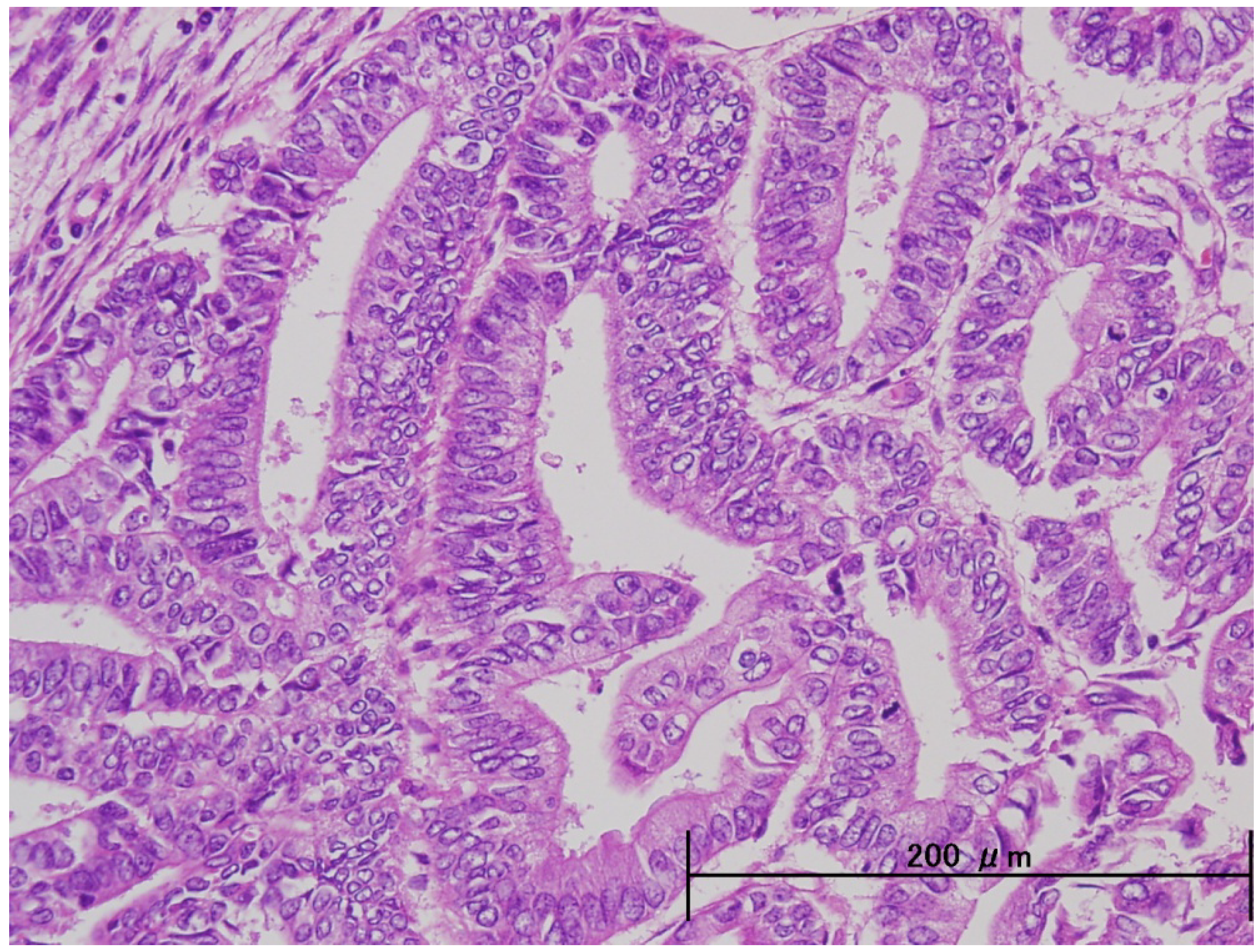
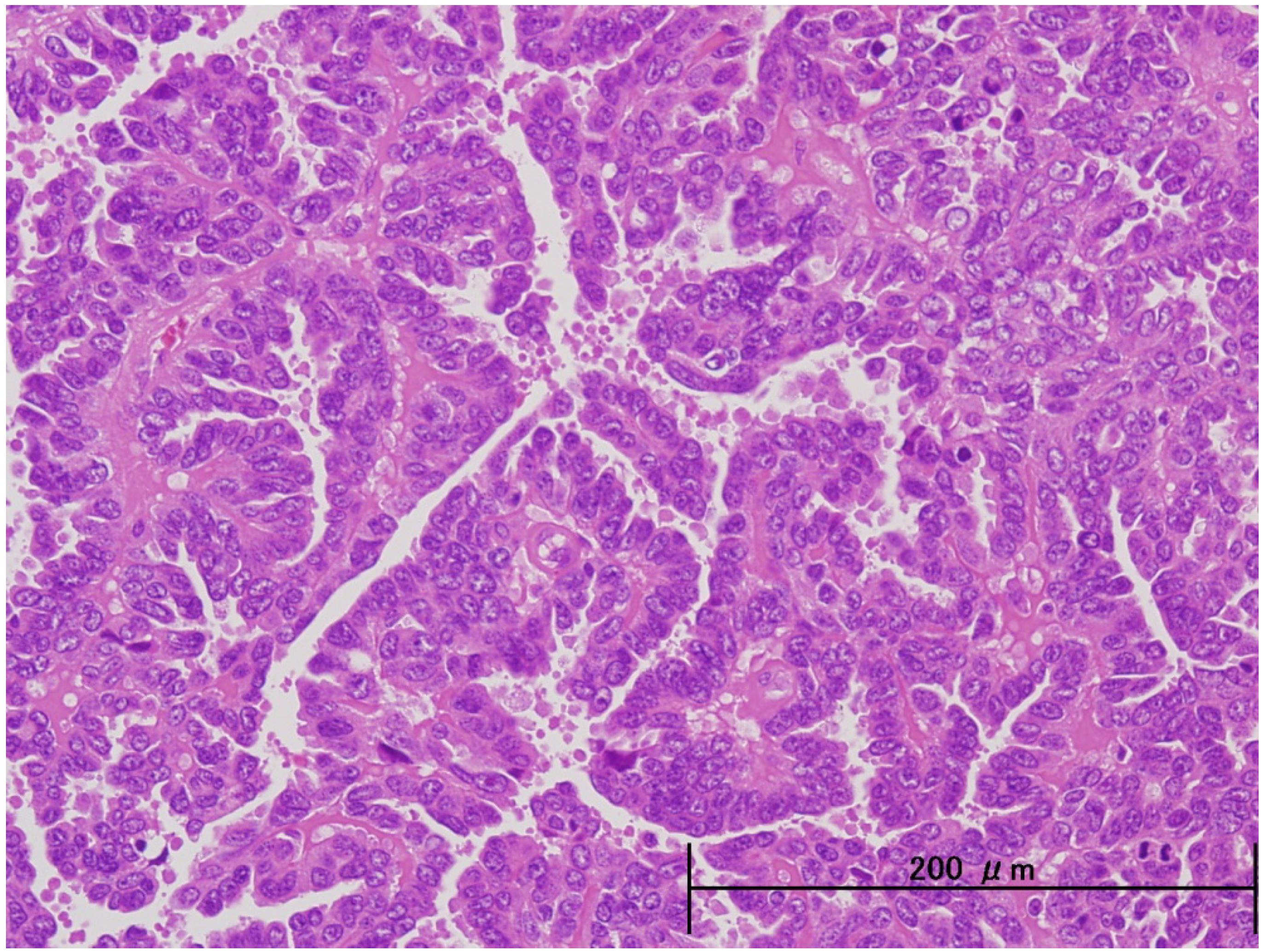
      <p>Unlike endometrioid adenocarcinomas which arise directly from atypical endometrial hyperplasia, the precursor lesion for ESC, endometrial glandular dysplasia and endometrial intraepithelial carcinoma (EIC), originates in atrophic endometrium [<xref ref-type="bibr" rid="B10-cancers-04-00799">10</xref>,<xref ref-type="bibr" rid="B11-cancers-04-00799">11</xref>]. ESC closely resembles serous carcinoma of the ovary and fallopian tube because its papillary growth and cellular features are similar (<xref ref-type="fig" rid="cancers-04-00799-f001">Figure 1</xref>). Contrastingly, endmetrioid carcinoma is the most common form of carcinoma of the endometrium, comprising 75% to 80% of the cases. Grade 1 endometrial carcinomas are well differentiated and are generally associated with a good prognosis (<xref ref-type="fig" rid="cancers-04-00799-f002">Figure 2</xref>).</p>
      <p>Recently, Zheng <italic>et al.</italic> reported a proposed model of ESC carcinogenesis [<xref ref-type="bibr" rid="B11-cancers-04-00799">11</xref>]. According to their model, endometrial serous carcinoma arises predominantly in the resting endometrium, manifesting first as p53 immunoreactive, morphologically normal endometrial cells, evolving to endometrial glandular dysplasia, then to serous endometrial intraepithelial carcinoma (EIC), and finally into fully developed serous carcinoma. Furthermore, they showed that a decreasing percentage of diagnosed lesions express ER, ranging from endometrial glandular dysplasia (EmGD) (70–95%) to serous EIC (&lt;30%) and ESC (&lt;30%) [<xref ref-type="bibr" rid="B11-cancers-04-00799">11</xref>]. Loss of ER expression occurred after mutation of <italic>p53</italic> and is associated with HER2/neu overexpression in ESC [<xref ref-type="bibr" rid="B11-cancers-04-00799">11</xref>].</p>
	  <fig id="cancers-04-00799-f001" position="float">
        <label>Figure 1</label>
        <caption>
          <p>Endometrial serous carcinoma is characterized by high-grade cytological atypia in cells that do not share a common apical border. A papillary architecture is common.</p>
        </caption>
        <graphic xmlns:xlink="http://www.w3.org/1999/xlink" xlink:href="cancers-04-00799-g001.tif"/>
      </fig>
      <fig id="cancers-04-00799-f002" position="float">
        <label>Figure 2</label>
        <caption>
          <p>Endometrioid adenocarcinoma, <underline>grade</underline> 1. The glandular component is a caricature of proliferative phase glands, with stratification and shared luminal border to the neoplastic cells.</p>
        </caption>
        <graphic xmlns:xlink="http://www.w3.org/1999/xlink" xlink:href="cancers-04-00799-g002.tif"/>
      </fig>
      
      <p>ESCs histologically resemble ovarian serous adenocarcinomas. They contain fibrous stroma and show a papillary pattern of proliferation. Tumor cells are pleomorphic, have prominent nuclear atypia, high N/C ratios, distinctive nucleoli, and frequent nuclear fission. Sixty percent of ESCs contain psammoma bodies. Other pathognomonic cellular features include a ballooned or hobnail-like nucleus and stromal hyalinization.</p>
      <p>Type I and Type II endometrial carcinomas also differ on a molecular basis. ESCs are not hormone-sensitive and therefore do not express ER or PR [<xref ref-type="bibr" rid="B12-cancers-04-00799">12</xref>]. <italic>K-ras</italic>, <italic>PTEN</italic>, <italic>β-catenin</italic>, which are often mutated in Type I endometrioid adenocarcinomas, are rarely altered in ESCs [<xref ref-type="bibr" rid="B13-cancers-04-00799">13</xref>]. Instead, mutation of <italic>p53</italic> is often observed [<xref ref-type="bibr" rid="B13-cancers-04-00799">13</xref>]. Exomesequencing of ESC identified the frequency of <italic>p53</italic> mutation was 81.6% [<xref ref-type="bibr" rid="B14-cancers-04-00799">14</xref>]. Amplification of the HER2/neu gene and overexpression of the HER2/neu protein have been shown in many tumors, including ESC [<xref ref-type="bibr" rid="B15-cancers-04-00799">15</xref>,<xref ref-type="bibr" rid="B16-cancers-04-00799">16</xref>]. Some studies showed that the overexpression of HER2/neu was frequently associated with the advanced stage and poor prognosis in ESC [<xref ref-type="bibr" rid="B15-cancers-04-00799">15</xref>,<xref ref-type="bibr" rid="B16-cancers-04-00799">16</xref>,<xref ref-type="bibr" rid="B17-cancers-04-00799">17</xref>]. Interestingly, mutation of <italic>PIK3CA</italic> is common in both endometrioid adenocarcinomas and ESCs [<xref ref-type="bibr" rid="B18-cancers-04-00799">18</xref>]. Very recently, Kuhn <italic>et al</italic>. reported that amplification of CCNE1 was 30.4% in ESCs [<xref ref-type="bibr" rid="B14-cancers-04-00799">14</xref>]. The novel tumor suppressor gene, <italic>ARID1A</italic>, which was recently discovered by an exome sequencing study of ovarian clear cell carcinomas [<xref ref-type="bibr" rid="B19-cancers-04-00799">19</xref>,<xref ref-type="bibr" rid="B20-cancers-04-00799">20</xref>], is rarely mutated in ESCs. In contrast, <italic>PPP2R1A</italic>, another gene implicated in ovarian clear cell carcinomas, is frequently mutated in ESCs [<xref ref-type="bibr" rid="B21-cancers-04-00799">21</xref>,<xref ref-type="bibr" rid="B22-cancers-04-00799">22</xref>]. Previously reported clinicopathological and molecular differences between Type I endometrioid adenocarcinomas and Type II ESCs are summarized in <xref ref-type="table" rid="cancers-04-00799-t001">Table 1</xref> and <xref ref-type="table" rid="cancers-04-00799-t002">Table 2</xref> [<xref ref-type="bibr" rid="B23-cancers-04-00799">23</xref>]. Recently, Zhen <italic>et al</italic>. reported that oncofetal protein IMP3 may be a useful diagnostic marker in the assessment of endometrial cancers and their precursor lesions, particularly when the amount available tissue materials is limited and concern of type II cancer arises [<xref ref-type="bibr" rid="B24-cancers-04-00799">24</xref>].</p>
      <table-wrap id="cancers-04-00799-t001" position="float">
        <object-id pub-id-type="pii">cancers-04-00799-t001_Table 1</object-id>
        <label>Table 1</label>
        <caption>
          <p>Clinicopathological characteristics of uterine endometrioid and serous carcinomas. *</p>
        </caption>
        <table>
          <thead>
            <tr>
              <th align="left" valign="middle"> </th>
              <th align="left" valign="middle">Endometrioid</th>
              <th align="left" valign="middle">Serous</th>
            </tr>
          </thead>
          <tbody>
            <tr>
              <td align="left" valign="middle">Precursor lesion</td>
              <td align="left" valign="middle">Atypical hyperplasis</td>
              <td align="left" valign="middle">Endometrial intraepithelial carcinoma(EIC)</td>
            </tr>
            <tr>
              <td align="left" valign="middle">Estrogen</td>
              <td align="left" valign="middle">Dependent</td>
              <td align="left" valign="middle">Independent</td>
            </tr>
            <tr>
              <td align="left" valign="middle">Age</td>
              <td align="left" valign="middle">50–60 years</td>
              <td align="left" valign="middle">Over 60 years</td>
            </tr>
            <tr>
              <td align="left" valign="middle">Menopause</td>
              <td align="left" valign="middle">Peri menopause</td>
              <td align="left" valign="middle">Post menopausse</td>
            </tr>
            <tr>
              <td align="left" valign="middle">Obesity</td>
              <td align="left" valign="middle">Positive</td>
              <td align="left" valign="middle">Negative</td>
            </tr>
            <tr>
              <td align="left" valign="middle">History of Gravidity and Parity</td>
              <td align="left" valign="middle">Non</td>
              <td align="left" valign="middle">Multi</td>
            </tr>
            <tr>
              <td align="left" valign="middle">Grade</td>
              <td align="left" valign="middle">Low</td>
              <td align="left" valign="middle">High</td>
            </tr>
            <tr>
              <td align="left" valign="middle">Myometrial invasion</td>
              <td align="left" valign="middle">Slight</td>
              <td align="left" valign="middle">Deep</td>
            </tr>
            <tr>
              <td align="left" valign="middle">Pattern of recurrence</td>
              <td align="left" valign="middle">Local</td>
              <td align="left" valign="middle">Distant</td>
            </tr>
            <tr>
              <td align="left" valign="middle">Stage of presentation</td>
              <td align="left" valign="middle">I (73%)</td>
              <td align="left" valign="middle">I (54%)</td>
            </tr>
            <tr>
              <td align="left" valign="middle"> </td>
              <td align="left" valign="middle">II (11%)</td>
              <td align="left" valign="middle">II (8%)</td>
            </tr>
            <tr>
              <td align="left" valign="middle"> </td>
              <td align="left" valign="middle">III (13%)</td>
              <td align="left" valign="middle">III (22%)</td>
            </tr>
            <tr>
              <td align="left" valign="middle"> </td>
              <td align="left" valign="middle">IV (3%)</td>
              <td align="left" valign="middle">IV (16%)</td>
            </tr>
            <tr>
              <td align="left" valign="middle">Survival by stage</td>
              <td align="left" valign="middle">I (85–90%)</td>
              <td align="left" valign="middle">I (50–80%)</td>
            </tr>
            <tr>
              <td align="left" valign="middle"> </td>
              <td align="left" valign="middle">II (70%)</td>
              <td align="left" valign="middle">II (50%)</td>
            </tr>
            <tr>
              <td align="left" valign="middle"> </td>
              <td align="left" valign="middle">III (40–50%)</td>
              <td align="left" valign="middle">III (20%)</td>
            </tr>
            <tr>
              <td align="left" valign="middle"> </td>
              <td align="left" valign="middle">IV (15–20%)</td>
              <td align="left" valign="middle">IV (5–10%)</td>
            </tr>
          </tbody>
        </table>
		<table-wrap-foot><fn><p>*: Revised and cited from [<xref ref-type="bibr" rid="B22-cancers-04-00799">22</xref>].</p></fn></table-wrap-foot>
      </table-wrap>
      
	  <table-wrap id="cancers-04-00799-t002" position="float">
        <object-id pub-id-type="pii">cancers-04-00799-t002_Table 2</object-id>
        <label>Table 2</label>
        <caption>
          <p>Molecular aspects of uterine endometrioid and serous carcinoma.</p>
        </caption>
        <table>
          <thead>
            <tr>
              <th align="left" valign="middle"> </th>
              <th align="left" valign="middle">Endometrioid</th>
              <th align="left" valign="middle">Serous</th>
            </tr>
          </thead>
          <tbody>
            <tr>
              <td align="left" valign="middle">Microsatellite instability</td>
              <td align="left" valign="middle">30%</td>
              <td align="left" valign="middle">0–5%</td>
            </tr>
            <tr>
              <td align="left" valign="middle">p53 mutation</td>
              <td align="left" valign="middle">10%</td>
              <td align="left" valign="middle">90%</td>
            </tr>
            <tr>
              <td align="left" valign="middle">K-ras mutation</td>
              <td align="left" valign="middle">20–40%</td>
              <td align="left" valign="middle">0–5%</td>
            </tr>
            <tr>
              <td align="left" valign="middle">ER/PR expression</td>
              <td align="left" valign="middle">70–80%</td>
              <td align="left" valign="middle">5%</td>
            </tr>
            <tr>
              <td align="left" valign="middle">Her-2 amplification/overexpression</td>
              <td align="left" valign="middle">15–20%</td>
              <td align="left" valign="middle">18–45%</td>
            </tr>
            <tr>
              <td align="left" valign="middle">PTEN mutation</td>
              <td align="left" valign="middle">40–50%</td>
              <td align="left" valign="middle">10%</td>
            </tr>
            <tr>
              <td align="left" valign="middle">b-catenin mutation</td>
              <td align="left" valign="middle">30%</td>
              <td align="left" valign="middle">0–5%</td>
            </tr>
            <tr>
              <td align="left" valign="middle">CCNE1 amplification</td>
              <td align="left" valign="middle">0–5%</td>
              <td align="left" valign="middle">30%</td>
            </tr>
            <tr>
              <td align="left" valign="middle">ARID1A mutation</td>
              <td align="left" valign="middle">57%</td>
              <td align="left" valign="middle">0%</td>
            </tr>
            <tr>
              <td align="left" valign="middle">PPP2R1A mutation</td>
              <td align="left" valign="middle">5%</td>
              <td align="left" valign="middle">41%</td>
            </tr>
            <tr>
              <td align="left" valign="middle">PIK3CA mutation</td>
              <td align="left" valign="middle">40%</td>
              <td align="left" valign="middle">15%</td>
            </tr>
          </tbody>
        </table>
      </table-wrap>
      
    </sec>
    <sec>
      <title>4. Therapeutic Strategies for ESC</title>
      <sec>
        <title>4.1. Surgical Treatment</title>
        <p>Historically, the surgical approach for endometrial cancer has not been histology-specific. Deep myometrial invasion is the strongest predictor of extrauterine spread of disease in endometrioid adenocarcinomas and is a factor used to triage patients for lymphadenectomy. Invasion, however, does not predict nodal or intra-abdominal spread in ESC. Therefore, many have advocated extensive staging including pelvic and para-aortic lymphadenectomy and omentectomy even in ESCs with none or minimal myometrial invasion. As in ovarian cancer, optimal cytoreduction has been shown to improve outcomes in stage III and IV ESC [<xref ref-type="bibr" rid="B25-cancers-04-00799">25</xref>].</p>
      </sec>
      <sec>
        <title>4.2. Chemotherapy</title>
        <p>The benefit of adjuvant chemotherapy in completely resected stage Ia ESC is controversial; however, the recurrence rate in these patients is 14% without adjuvant treatment [<xref ref-type="bibr" rid="B26-cancers-04-00799">26</xref>]. In stage I and II patients with residual disease, the recurrence rate was 43% [<xref ref-type="bibr" rid="B27-cancers-04-00799">27</xref>]. Chemotherapy has been shown to have clear benefit in patients with advanced stage disease.</p>
        <p>Multiple phase III randomized controlled trials, conducted by the GOG, support the efficacy of systemic chemotherapy in stage III/IV endometrial carcinoma. These regimens are summarized in <xref ref-type="table" rid="cancers-04-00799-t003">Table 3</xref>. These trials all contained significant numbers of ESC. The response rate to CAP (cyclophosphamide, doxorubicin and cisplatin) ranged from 18–27% [<xref ref-type="bibr" rid="B28-cancers-04-00799">28</xref>,<xref ref-type="bibr" rid="B29-cancers-04-00799">29</xref>]. The combination of platinum with paclitaxel (T) or docetaxel (D) has been utilized since 2005 in Japan, and has a response rate of about 60% in ESC patients [<xref ref-type="bibr" rid="B30-cancers-04-00799">30</xref>,<xref ref-type="bibr" rid="B31-cancers-04-00799">31</xref>]. The combination of paclitaxel, doxorubicin and cisplatin (TAP) while effective, was also more toxic than the two-drug regimens [<xref ref-type="bibr" rid="B32-cancers-04-00799">32</xref>]. As ESC tends to affect an older population, tolerability is critical. The combination of paclitaxel and carboplatin has recently been shown to be equally efficacious to TAP with minimal toxicity [<xref ref-type="bibr" rid="B33-cancers-04-00799">33</xref>].</p>
        <p>A randomized phase III study, JGOG2043, is presently underway in Japan. Treatment arms are AP, DP, and TC. The study has reached its quota and is closed to accrual with results pending. Ultimately the results of this study will be used to develop histology-specific treatment protocols.</p>
		<table-wrap id="cancers-04-00799-t003" position="float">
          <object-id pub-id-type="pii">cancers-04-00799-t003_Table 3</object-id>
          <label>Table 3</label>
          <caption>
            <p>Chemotherapy and response rate of serous endometrial cancer.</p>
          </caption>
          <table>
            <thead>
              <tr>
                <th align="left" valign="middle">Regimen</th>
                <th align="center" valign="middle">Response rate</th>
              </tr>
            </thead>
            <tbody>
              <tr>
                <td align="left" valign="middle">AP (Adriamycin + Cisplatin)</td>
                <td align="center" valign="middle">42%</td>
              </tr>
              <tr>
                <td align="left" valign="middle">AT (Adriamycin + Paclitaxel)</td>
                <td align="center" valign="middle">37%</td>
              </tr>
              <tr>
                <td align="left" valign="middle">CAP (Cyclophsophamide + Adriamycin + Cisplatin)</td>
                <td align="center" valign="middle">18–27%</td>
              </tr>
              <tr>
                <td align="left" valign="middle">TAP (Paclitaxel + Adriamycin + Cisplatin)</td>
                <td align="center" valign="middle">50%</td>
              </tr>
              <tr>
                <td align="left" valign="middle">Paclitaxel + Platinum agent</td>
                <td align="center" valign="middle">50–60%</td>
              </tr>
            </tbody>
          </table>
        </table-wrap>
        
      </sec>
      <sec>
        <title>4.3. Combination of Chemotherapy and Radiation Therapy</title>
        <p>In Europe and the United States, adjuvant pelvic radiotherapy is frequently employed for endometrial cancer patients with lymph node metastasis [<xref ref-type="bibr" rid="B4-cancers-04-00799">4</xref>,<xref ref-type="bibr" rid="B34-cancers-04-00799">34</xref>]. While adjuvant radiotherapy in early stage (Stages I and II) endometrial cancer has been shown to decrease the rate of pelvic recurrence, a clear survival benefit has not been shown [<xref ref-type="bibr" rid="B4-cancers-04-00799">4</xref>,<xref ref-type="bibr" rid="B35-cancers-04-00799">35</xref>]. We have evaluated the efficacy of chemotherapy combined with adjuvant radiotherapy [<xref ref-type="bibr" rid="B36-cancers-04-00799">36</xref>,<xref ref-type="bibr" rid="B37-cancers-04-00799">37</xref>]. Our retrospective study suggested a survival benefit of chemotherapy combined with radiotherapy in patients with stage III/IV disease. As ESCs have a high metastatic potential, it is plausible that chemotherapy combined with radiotherapy may be particularly beneficial in this subtype. However, combination of chemotherapy and radiation therapy, either sequentially or in sandwich fashion for endometrial cancer is still controversial [<xref ref-type="bibr" rid="B37-cancers-04-00799">37</xref>].</p>
      </sec>
    </sec>
    <sec sec-type="conclusions">
      <title>5. Conclusions</title>
      <p>ESC is uncommon, but accounts for a disproportionate number of endometrial cancer deaths. Histology-specific treatment algorithms are needed to improve outcomes; however, the development of standardized protocols through randomized controlled trials has been hampered by the rarity of the subtype. Evaluation of the currently available retrospective and prospective data suggests that ESCs benefit from complete cytoreduction followed by adjuvant chemotherapy, regardless of stage. It is hoped that JGOG2043 will address key questions regarding adjuvant chemotherapy. Additional trials are also required to clarify the role of radiotherapy in ESCs.</p>
    </sec>
    
  </body>
  <back>
  <notes>
      <title>Conflict of Interest</title>
      <p>We declare that we have no conflict of interest.</p>
    </notes>
    <ref-list>
      <title>References</title>
      <ref id="B1-cancers-04-00799">
        <label>1.</label>
        <citation citation-type="journal">
          <person-group person-group-type="author">
            <name>
              <surname>Bokhaman</surname>
              <given-names>J.V.</given-names>
            </name>
          </person-group>
          <article-title>Two pathogenetic types of endometrial carcinoma</article-title>
          <source>Gynecol. Oncol.</source>
          <year>1983</year>
          <volume>15</volume>
          <fpage>10</fpage>
          <lpage>17</lpage>
          <pub-id pub-id-type="doi">10.1016/0090-8258(83)90111-7</pub-id>
        </citation>
      </ref>
      <ref id="B2-cancers-04-00799">
        <label>2.</label>
        <citation citation-type="journal">
		<collab>JSOG</collab>
          <article-title>Annual report of endometrial cancer, 2008</article-title>
          <source>Acta Obstet. Gynaecol. Jpn.</source>
          <year>2010</year>
          <volume>62</volume>
          <fpage>853</fpage>
          <lpage>876</lpage>
        </citation>
      </ref>
      <ref id="B3-cancers-04-00799">
        <label>3.</label>
        <citation citation-type="journal">
          <person-group person-group-type="author">
            <name>
              <surname>Hamilton</surname>
              <given-names>C.A.</given-names>
            </name>
            <name>
              <surname>Cheung</surname>
              <given-names>M.K.</given-names>
            </name>
            <name>
              <surname>Osann</surname>
              <given-names>K.</given-names>
            </name>
            <name>
              <surname>Chen</surname>
              <given-names>L.</given-names>
            </name>
            <name>
              <surname>Teng</surname>
              <given-names>N.N.</given-names>
            </name>
            <name>
              <surname>Longacre</surname>
              <given-names>T.A.</given-names>
            </name>
            <name>
              <surname>Powell</surname>
              <given-names>M.A.</given-names>
            </name>
            <name>
              <surname>Hendrickson</surname>
              <given-names>M.R.</given-names>
            </name>
            <name>
              <surname>Kapp</surname>
              <given-names>D.S.</given-names>
            </name>
            <name>
              <surname>Chan</surname>
              <given-names>J.K.</given-names>
            </name>
          </person-group>
          <article-title>Uterinepapillary serous and clear cell carcinomas predict for poorer survival compared to grade 3 endometrioid corpus cancers</article-title>
          <source>Br. J. Cancer</source>
          <year>2006</year>
          <volume>94</volume>
          <fpage>642</fpage>
          <lpage>646</lpage>
        <pub-id pub-id-type="pmid">16495918</pub-id></citation>
      </ref>
      <ref id="B4-cancers-04-00799">
        <label>4.</label>
        <citation citation-type="journal">
          <person-group person-group-type="author">
            <name>
              <surname>Slomovitz</surname>
              <given-names>B.M.</given-names>
            </name>
            <name>
              <surname>Burke</surname>
              <given-names>T.W.</given-names>
            </name>
            <name>
              <surname>Eifel</surname>
              <given-names>P.J.</given-names>
            </name>
            <name>
              <surname>Ramondetta</surname>
              <given-names>L.M.</given-names>
            </name>
            <name>
              <surname>Silva</surname>
              <given-names>E.G.</given-names>
            </name>
            <name>
              <surname>Jhingran</surname>
              <given-names>A.</given-names>
            </name>
            <name>
              <surname>Oh</surname>
              <given-names>J.C.</given-names>
            </name>
            <name>
              <surname>Atkinson</surname>
              <given-names>E.N.</given-names>
            </name>
            <name>
              <surname>Broaddus</surname>
              <given-names>R.R.</given-names>
            </name>
            <name>
              <surname>Gershenson</surname>
              <given-names>D.M.</given-names>
            </name>
            <etal/>
          </person-group>
          <article-title>Uterine papillary serous carcinoma (UPSC): A single institution review of 129 cases</article-title>
          <source>Gynecol. Oncol.</source>
          <year>2003</year>
          <volume>91</volume>
          <fpage>463</fpage>
          <lpage>469</lpage>
          <pub-id pub-id-type="doi">10.1016/j.ygyno.2003.08.018</pub-id>
        </citation>
      </ref>
      <ref id="B5-cancers-04-00799">
        <label>5.</label>
        <citation citation-type="journal">
          <person-group person-group-type="author">
            <name>
              <surname>Chan</surname>
              <given-names>J.K.</given-names>
            </name>
            <name>
              <surname>Loizzi</surname>
              <given-names>V.</given-names>
            </name>
            <name>
              <surname>Youssef</surname>
              <given-names>M.</given-names>
            </name>
            <name>
              <surname>Osann</surname>
              <given-names>K.</given-names>
            </name>
            <name>
              <surname>Rutgers</surname>
              <given-names>J.</given-names>
            </name>
            <name>
              <surname>Vasilev</surname>
              <given-names>S.A.</given-names>
            </name>
            <name>
              <surname>Berman</surname>
              <given-names>M.L.</given-names>
            </name>
          </person-group>
          <article-title>Significance of comprehensive surgical staging in noninvasive papillary serous carcinoma of the endometrium</article-title>
          <source>Gynecol. Oncol.</source>
          <year>2003</year>
          <volume>90</volume>
          <fpage>181</fpage>
          <lpage>185</lpage>
          <pub-id pub-id-type="doi">10.1016/S0090-8258(03)00195-1</pub-id>
        </citation>
      </ref>
      <ref id="B6-cancers-04-00799">
        <label>6.</label>
        <citation citation-type="journal">
          <person-group person-group-type="author">
            <name>
              <surname>Gehrig</surname>
              <given-names>P.A.</given-names>
            </name>
            <name>
              <surname>Groben</surname>
              <given-names>P.A.</given-names>
            </name>
            <name>
              <surname>Fowler</surname>
              <given-names>W.C.</given-names>
              <suffix>Jr.</suffix>
            </name>
            <name>
              <surname>Walton</surname>
              <given-names>L.A.</given-names>
            </name>
            <name>
              <surname>van Le</surname>
              <given-names>L.</given-names>
            </name>
          </person-group>
          <article-title>Noninvasive papillary serous carcinoma of the endometrium</article-title>
          <source>Obstet. Gynecol.</source>
          <year>2001</year>
          <volume>97</volume>
          <fpage>153</fpage>
          <lpage>157</lpage>
          <pub-id pub-id-type="doi">10.1016/S0029-7844(00)01096-6</pub-id>
        </citation>
      </ref>
      <ref id="B7-cancers-04-00799">
        <label>7.</label>
        <citation citation-type="journal">
          <person-group person-group-type="author">
            <name>
              <surname>Goff</surname>
              <given-names>B.A.</given-names>
            </name>
            <name>
              <surname>Kato</surname>
              <given-names>D.</given-names>
            </name>
            <name>
              <surname>Schmidt</surname>
              <given-names>R.A.</given-names>
            </name>
            <name>
              <surname>Ek</surname>
              <given-names>M.</given-names>
            </name>
            <name>
              <surname>Ferry</surname>
              <given-names>J.A.</given-names>
            </name>
            <name>
              <surname>Muntz</surname>
              <given-names>H.G.</given-names>
            </name>
            <name>
              <surname>Cain</surname>
              <given-names>J.M.</given-names>
            </name>
            <name>
              <surname>Tamimi</surname>
              <given-names>H.K.</given-names>
            </name>
            <name>
              <surname>Figge</surname>
              <given-names>D.C.</given-names>
            </name>
            <name>
              <surname>Greer</surname>
              <given-names>B.E.</given-names>
            </name>
          </person-group>
          <article-title>Uterine papillary serous carcinoma: Patterns of metastatic spread</article-title>
          <source>Gynecol. Oncol.</source>
          <year>1994</year>
          <volume>54</volume>
          <fpage>264</fpage>
          <lpage>268</lpage>
          <pub-id pub-id-type="doi">10.1006/gyno.1994.1208</pub-id>
        </citation>
      </ref>
      <ref id="B8-cancers-04-00799">
        <label>8.</label>
        <citation citation-type="journal">
          <person-group person-group-type="author">
            <name>
              <surname>Hui</surname>
              <given-names>P.</given-names>
            </name>
            <name>
              <surname>Kelly</surname>
              <given-names>M.</given-names>
            </name>
            <name>
              <surname>O’Malley</surname>
              <given-names>D.M.</given-names>
            </name>
          </person-group>
          <article-title>Minimal uterine serous carcinoma: A clinicopathological study of 40 cases</article-title>
          <source>Mod. Pathol.</source>
          <year>2005</year>
          <volume>18</volume>
          <fpage>75</fpage>
          <lpage>82</lpage>
          <pub-id pub-id-type="doi">10.1038/modpathol.3800271</pub-id>
        </citation>
      </ref>
      <ref id="B9-cancers-04-00799">
        <label>9.</label>
        <citation citation-type="journal">
          <person-group person-group-type="author">
            <name>
              <surname>Boruta</surname>
              <given-names>D.M.</given-names>
              <suffix>2nd.</suffix>
            </name>
            <name>
              <surname>Gehrig</surname>
              <given-names>P.A.</given-names>
            </name>
            <name>
              <surname>Groben</surname>
              <given-names>P.A.</given-names>
            </name>
            <name>
              <surname>Bae-Jump</surname>
              <given-names>V.</given-names>
            </name>
            <name>
              <surname>Boggess</surname>
              <given-names>J.F.</given-names>
            </name>
            <name>
              <surname>Fowler</surname>
              <given-names>W.C.</given-names>
              <suffix>Jr.</suffix>
            </name>
            <name>
              <surname>van Le</surname>
              <given-names>L.</given-names>
            </name>
          </person-group>
          <article-title>Uterine serous and grade 3 endometrioid carcinomas: Is there a survival difference?</article-title>
          <source>Cancer</source>
          <year>2004</year>
          <volume>101</volume>
          <fpage>2214</fpage>
          <lpage>2221</lpage>
          <pub-id pub-id-type="doi">10.1002/cncr.20645</pub-id>
        </citation>
      </ref>
      <ref id="B10-cancers-04-00799">
        <label>10.</label>
        <citation citation-type="journal">
          <person-group person-group-type="author">
            <name>
              <surname>Mutter</surname>
              <given-names>G.L.</given-names>
            </name>
          </person-group>
          <article-title>Endometrial intraepithelial neoplasia (EIN): Will it bringorder to chaos? The Endometrial Collaborative Group</article-title>
          <source>Gynecol. Oncol.</source>
          <year>2000</year>
          <volume>76</volume>
          <fpage>287</fpage>
          <lpage>290</lpage>
          <pub-id pub-id-type="doi">10.1006/gyno.1999.5580</pub-id>
        </citation>
      </ref>
      <ref id="B11-cancers-04-00799">
        <label>11.</label>
        <citation citation-type="journal">
          <person-group person-group-type="author">
            <name>
              <surname>Zheng</surname>
              <given-names>W.</given-names>
            </name>
            <name>
              <surname>Xiang</surname>
              <given-names>L.</given-names>
            </name>
            <name>
              <surname>Fadare</surname>
              <given-names>O.</given-names>
            </name>
            <name>
              <surname>Kong</surname>
              <given-names>B.</given-names>
            </name>
          </person-group>
          <article-title>A proposed model for endometrial serous carcinogenesis</article-title>
          <source>Am. J. Surg. Pathol.</source>
          <year>2011</year>
          <volume>35</volume>
          <fpage>e1</fpage>
          <lpage>e14</lpage>
          <pub-id pub-id-type="doi">10.1097/PAS.0b013e318202772e</pub-id>
        </citation>
      </ref>
      <ref id="B12-cancers-04-00799">
        <label>12.</label>
        <citation citation-type="journal">
          <person-group person-group-type="author">
            <name>
              <surname>Reid-Nicholson</surname>
              <given-names>M.</given-names>
            </name>
            <name>
              <surname>Iyengar</surname>
              <given-names>P.</given-names>
            </name>
            <name>
              <surname>Hummer</surname>
              <given-names>A.J.</given-names>
            </name>
            <name>
              <surname>Linkov</surname>
              <given-names>I.</given-names>
            </name>
            <name>
              <surname>Asher</surname>
              <given-names>M.</given-names>
            </name>
            <name>
              <surname>Soslow</surname>
              <given-names>R.A.</given-names>
            </name>
          </person-group>
          <article-title>Immunophenotypic diversity of endometrial adenocarcinomas: Implications for differential diagnosis</article-title>
          <source>Mod. Pathol.</source>
          <year>2006</year>
          <volume>8</volume>
          <fpage>1091</fpage>
          <lpage>1100</lpage>
        </citation>
      </ref>
      <ref id="B13-cancers-04-00799">
        <label>13.</label>
        <citation citation-type="book">
          <person-group person-group-type="author">
            <name>
              <surname>Oliva</surname>
              <given-names>E.</given-names>
            </name>
          </person-group>
          <source>Unusual Variants of Endometrial Carcinoma: Histologic and Molecular Aspects</source>
          <publisher-name>American Society of Clinical Oncology</publisher-name>
          <publisher-loc>Alexandria, VA, USA</publisher-loc>
          <year>2004</year>
          <fpage>303</fpage>
          <lpage>308</lpage>
        </citation>
      </ref>
      <ref id="B14-cancers-04-00799">
        <label>14.</label>
        <citation citation-type="journal">
          <person-group person-group-type="author">
            <name>
              <surname>Kuhn</surname>
              <given-names>E.</given-names>
            </name>
            <name>
              <surname>Wu</surname>
              <given-names>R.C.</given-names>
            </name>
            <name>
              <surname>Wu</surname>
              <given-names>G.</given-names>
            </name>
            <name>
              <surname>Guan</surname>
              <given-names>B.</given-names>
            </name>
            <name>
              <surname>Zhang</surname>
              <given-names>J.</given-names>
            </name>
            <name>
              <surname>Wang</surname>
              <given-names>Y.</given-names>
            </name>
            <name>
              <surname>Song</surname>
              <given-names>L.</given-names>
            </name>
            <name>
              <surname>Yuan</surname>
              <given-names>X.</given-names>
            </name>
            <name>
              <surname>Wei</surname>
              <given-names>L.</given-names>
            </name>
            <name>
              <surname>Roden</surname>
              <given-names>R.B.</given-names>
            </name>
            <etal/>
          </person-group>
          <article-title>Genome-wide analyses of uterine serous carcinoma identify pathway aberrations involving cyclinE-Fbxw7, PI3K and p53</article-title>
          <source>J. Natl. Cancer Inst.</source>
          <year>2012</year>
          <comment>in press</comment>
        </citation>
      </ref>
      <ref id="B15-cancers-04-00799">
        <label>15.</label>
        <citation citation-type="journal">
          <person-group person-group-type="author">
            <name>
              <surname>Santin</surname>
              <given-names>A.D.</given-names>
            </name>
            <name>
              <surname>Bellone</surname>
              <given-names>S.</given-names>
            </name>
            <name>
              <surname>Gokden</surname>
              <given-names>M.</given-names>
            </name>
            <name>
              <surname>Palmieri</surname>
              <given-names>M.</given-names>
            </name>
            <name>
              <surname>Dunn</surname>
              <given-names>D.</given-names>
            </name>
            <name>
              <surname>Agha</surname>
              <given-names>J.</given-names>
            </name>
            <name>
              <surname>Roman</surname>
              <given-names>J.J.</given-names>
            </name>
            <name>
              <surname>Hutchins</surname>
              <given-names>L.</given-names>
            </name>
            <name>
              <surname>Pecorelli</surname>
              <given-names>S.</given-names>
            </name>
            <name>
              <surname>O’Brien</surname>
              <given-names>T.</given-names>
            </name>
            <etal/>
          </person-group>
          <article-title>Overexpression of HER-2/neu in uterine serous papillary cancer</article-title>
          <source>Clin. Cancer Res.</source>
          <year>2002</year>
          <volume>8</volume>
          <fpage>1271</fpage>
          <lpage>1279</lpage>
        <pub-id pub-id-type="pmid">12006548</pub-id></citation>
      </ref>
      <ref id="B16-cancers-04-00799">
        <label>16.</label>
        <citation citation-type="journal">
          <person-group person-group-type="author">
            <name>
              <surname>Santin</surname>
              <given-names>A.D.</given-names>
            </name>
            <name>
              <surname>Bellone</surname>
              <given-names>S.</given-names>
            </name>
            <name>
              <surname>Siegel</surname>
              <given-names>E.R.</given-names>
            </name>
            <name>
              <surname>Palmieri</surname>
              <given-names>M.</given-names>
            </name>
            <name>
              <surname>Thomas</surname>
              <given-names>M.</given-names>
            </name>
            <name>
              <surname>Cannon</surname>
              <given-names>M.J.</given-names>
            </name>
            <name>
              <surname>Kay</surname>
              <given-names>H.H.</given-names>
            </name>
            <name>
              <surname>Roman</surname>
              <given-names>J.J.</given-names>
            </name>
            <name>
              <surname>Burnett</surname>
              <given-names>A.</given-names>
            </name>
            <name>
              <surname>Pecorelli</surname>
              <given-names>S.</given-names>
            </name>
          </person-group>
          <article-title>Racial differences in the overexpression of epidermal growth factor type II receptor (HER2/neu): A major prognostic indicator in uterine serous papillary cancer</article-title>
          <source>Am. J. Obstet. Gynecol.</source>
          <year>2005</year>
          <volume>192</volume>
          <fpage>813</fpage>
          <lpage>818</lpage>
          <pub-id pub-id-type="doi">10.1016/j.ajog.2004.10.605</pub-id>
        </citation>
      </ref>
      <ref id="B17-cancers-04-00799">
        <label>17.</label>
        <citation citation-type="journal">
          <person-group person-group-type="author">
            <name>
              <surname>Villella</surname>
              <given-names>J.A.</given-names>
            </name>
            <name>
              <surname>Cohen</surname>
              <given-names>S.</given-names>
            </name>
            <name>
              <surname>Smith</surname>
              <given-names>D.H.</given-names>
            </name>
            <name>
              <surname>Hibshoosh</surname>
              <given-names>H.</given-names>
            </name>
            <name>
              <surname>Hershman</surname>
              <given-names>D.</given-names>
            </name>
          </person-group>
          <article-title>HER-2/neu overexpression in uterine papillary serous cancers and its possible therapeutic implications</article-title>
          <source>Int. J. Gynecol. Cancer</source>
          <year>2006</year>
          <volume>16</volume>
          <fpage>1897</fpage>
          <lpage>1902</lpage>
          <pub-id pub-id-type="doi">10.1111/j.1525-1438.2006.00664.x</pub-id>
        </citation>
      </ref>
      <ref id="B18-cancers-04-00799">
        <label>18.</label>
        <citation citation-type="journal">
          <person-group person-group-type="author">
            <name>
              <surname>Hayes</surname>
              <given-names>M.P.</given-names>
            </name>
            <name>
              <surname>Ellenson</surname>
              <given-names>L.H.</given-names>
            </name>
          </person-group>
          <article-title>Molecular alterations in uterine serous carcinoma</article-title>
          <source>Gynecol. Oncol.</source>
          <year>2010</year>
          <volume>116</volume>
          <fpage>286</fpage>
          <lpage>289</lpage>
          <pub-id pub-id-type="doi">10.1016/j.ygyno.2009.11.012</pub-id>
        </citation>
      </ref>
      <ref id="B19-cancers-04-00799">
        <label>19.</label>
        <citation citation-type="journal">
          <person-group person-group-type="author">
            <name>
              <surname>Jones</surname>
              <given-names>S.</given-names>
            </name>
            <name>
              <surname>Wang</surname>
              <given-names>T.L.</given-names>
            </name>
            <name>
              <surname>Shih</surname>
              <given-names>I.M.</given-names>
            </name>
            <name>
              <surname>Mao</surname>
              <given-names>T.L.</given-names>
            </name>
            <name>
              <surname>Nakayama</surname>
              <given-names>K.</given-names>
            </name>
            <name>
              <surname>Roden</surname>
              <given-names>R.</given-names>
            </name>
            <name>
              <surname>Glas</surname>
              <given-names>R.</given-names>
            </name>
            <name>
              <surname>Slamon</surname>
              <given-names>D.</given-names>
            </name>
            <name>
              <surname>Diaz</surname>
              <given-names>L.A.</given-names>
              <suffix>Jr.</suffix>
            </name>
            <name>
              <surname>Vogelstein</surname>
              <given-names>B.</given-names>
            </name>
            <etal/>
          </person-group>
          <article-title>Frequent mutations of chromatin remodeling gene ARID1A in ovarian clear cell carcinoma</article-title>
          <source>Science</source>
          <year>2010</year>
          <volume>6001</volume>
          <fpage>228</fpage>
          <lpage>231</lpage>
        </citation>
      </ref>
      <ref id="B20-cancers-04-00799">
        <label>20.</label>
        <citation citation-type="journal">
          <person-group person-group-type="author">
            <name>
              <surname>Wiegand</surname>
              <given-names>K.C.</given-names>
            </name>
            <name>
              <surname>Shah</surname>
              <given-names>S.P.</given-names>
            </name>
            <name>
              <surname>Al-Agha</surname>
              <given-names>O.M.</given-names>
            </name>
            <name>
              <surname>Zhao</surname>
              <given-names>Y.</given-names>
            </name>
            <name>
              <surname>Tse</surname>
              <given-names>K.</given-names>
            </name>
            <name>
              <surname>Zeng</surname>
              <given-names>T.</given-names>
            </name>
            <name>
              <surname>Senz</surname>
              <given-names>J.</given-names>
            </name>
            <name>
              <surname>McConechy</surname>
              <given-names>M.K.</given-names>
            </name>
            <name>
              <surname>Anglesio</surname>
              <given-names>M.S.</given-names>
            </name>
            <name>
              <surname>Kalloger</surname>
              <given-names>S.E.</given-names>
            </name>
            <etal/>
          </person-group>
          <article-title>ARID1A mutations in endometriosis-associated ovarian carcinomas</article-title>
          <source>N. Engl. J. Med.</source>
          <year>2010</year>
          <volume>16</volume>
          <fpage>1532</fpage>
          <lpage>1543</lpage>
        </citation>
      </ref>
      <ref id="B21-cancers-04-00799">
        <label>21.</label>
        <citation citation-type="journal">
          <person-group person-group-type="author">
            <name>
              <surname>Guan</surname>
              <given-names>B.</given-names>
            </name>
            <name>
              <surname>Mao</surname>
              <given-names>T.L.</given-names>
            </name>
            <name>
              <surname>Panuganti</surname>
              <given-names>P.K.</given-names>
            </name>
            <name>
              <surname>Kuhn</surname>
              <given-names>E.</given-names>
            </name>
            <name>
              <surname>Kurman</surname>
              <given-names>R.J.</given-names>
            </name>
            <name>
              <surname>Maeda</surname>
              <given-names>D.</given-names>
            </name>
            <name>
              <surname>Chen</surname>
              <given-names>E.</given-names>
            </name>
            <name>
              <surname>Jeng</surname>
              <given-names>Y.M.</given-names>
            </name>
            <name>
              <surname>Wang</surname>
              <given-names>T.L.</given-names>
            </name>
            <name>
              <surname>Shih</surname>
              <given-names>I.M.</given-names>
            </name>
          </person-group>
          <article-title>Mutation and loss of expression of ARID1A in uterine low-grade endometrioid carcinoma</article-title>
          <source>Am. J. Surg. Pathol.</source>
          <year>2011</year>
          <volume>35</volume>
          <fpage>625</fpage>
          <lpage>632</lpage>
          <pub-id pub-id-type="doi">10.1097/PAS.0b013e318212782a</pub-id>
        </citation>
      </ref>
      <ref id="B22-cancers-04-00799">
        <label>22.</label>
        <citation citation-type="journal">
          <person-group person-group-type="author">
            <name>
              <surname>McConechy</surname>
              <given-names>M.K.</given-names>
            </name>
            <name>
              <surname>Anglesio</surname>
              <given-names>M.S.</given-names>
            </name>
            <name>
              <surname>Kalloger</surname>
              <given-names>S.E.</given-names>
            </name>
          </person-group>
          <article-title>Subtype-specific mutation of PPP2R1A in endometrial and ovarian carcinomas</article-title>
          <source>J. Pathol.</source>
          <year>2011</year>
          <volume>223</volume>
          <fpage>567</fpage>
          <lpage>573</lpage>
          <pub-id pub-id-type="doi">10.1002/path.2848</pub-id>
        </citation>
      </ref>
      <ref id="B23-cancers-04-00799">
        <label>23.</label>
        <citation citation-type="journal">
          <person-group person-group-type="author">
            <name>
              <surname>Boruta</surname>
              <given-names>D.M.</given-names>
              <suffix>2nd.</suffix>
            </name>
            <name>
              <surname>Gehrig</surname>
              <given-names>P.A.</given-names>
            </name>
            <name>
              <surname>Fader</surname>
              <given-names>A.N.</given-names>
            </name>
            <name>
              <surname>Olawaiye</surname>
              <given-names>A.B.</given-names>
            </name>
          </person-group>
          <article-title>Management of women with uterine papillary serous cancer: A Society of Gynecologic Oncology (SGO) review</article-title>
          <source>Gynecol. Oncol.</source>
          <year>2009</year>
          <volume>115</volume>
          <fpage>142</fpage>
          <lpage>153</lpage>
          <pub-id pub-id-type="doi">10.1016/j.ygyno.2009.06.011</pub-id>
        </citation>
      </ref>
      <ref id="B24-cancers-04-00799">
        <label>24.</label>
        <citation citation-type="journal">
          <person-group person-group-type="author">
            <name>
              <surname>Zheng</surname>
              <given-names>W.</given-names>
            </name>
            <name>
              <surname>Yi</surname>
              <given-names>X.</given-names>
            </name>
            <name>
              <surname>Fadare</surname>
              <given-names>O.</given-names>
            </name>
            <name>
              <surname>Liang</surname>
              <given-names>S.X.</given-names>
            </name>
            <name>
              <surname>Martel</surname>
              <given-names>M.</given-names>
            </name>
            <name>
              <surname>Schwartz</surname>
              <given-names>P.E.</given-names>
            </name>
            <name>
              <surname>Jiang</surname>
              <given-names>Z.</given-names>
            </name>
          </person-group>
          <article-title>The oncofetal protein IMP3: A novel biomarker for endometrial serous carcinoma</article-title>
          <source>Am. J. Surg. Pathol.</source>
          <volume>2008 32</volume>
          <fpage>304</fpage>
          <lpage>315</lpage>
        <pub-id pub-id-type="pmid">23154770</pub-id></citation>
      </ref>
      <ref id="B25-cancers-04-00799">
        <label>25.</label>
        <citation citation-type="journal">
          <person-group person-group-type="author">
            <name>
              <surname>Bristow</surname>
              <given-names>R.E.</given-names>
            </name>
            <name>
              <surname>Zerbe</surname>
              <given-names>M.J.</given-names>
            </name>
            <name>
              <surname>Rosenshein</surname>
              <given-names>N.B.</given-names>
            </name>
            <name>
              <surname>Grumbine</surname>
              <given-names>F.C.</given-names>
            </name>
            <name>
              <surname>Montz</surname>
              <given-names>F.J.</given-names>
            </name>
          </person-group>
          <article-title>Stage IVB endometrial carcinoma: The role of cytoreductive surgery and determinants of survival</article-title>
          <source>Gynecol. Oncol.</source>
          <year>2000</year>
          <volume>78</volume>
          <fpage>85</fpage>
          <lpage>91</lpage>
          <pub-id pub-id-type="doi">10.1006/gyno.2000.5843</pub-id>
        </citation>
      </ref>
      <ref id="B26-cancers-04-00799">
        <label>26.</label>
        <citation citation-type="journal">
          <person-group person-group-type="author">
            <name>
              <surname>Acharya</surname>
              <given-names>S.</given-names>
            </name>
            <name>
              <surname>Hensley</surname>
              <given-names>M.L.</given-names>
            </name>
            <name>
              <surname>Montag</surname>
              <given-names>A.C.</given-names>
            </name>
            <name>
              <surname>Fleming</surname>
              <given-names>G.F.</given-names>
            </name>
          </person-group>
          <article-title>Rare uterine cancers</article-title>
          <source>Lancet Oncol.</source>
          <year>2005</year>
          <volume>6</volume>
          <fpage>961</fpage>
          <lpage>971</lpage>
          <pub-id pub-id-type="doi">10.1016/S1470-2045(05)70463-0</pub-id>
        </citation>
      </ref>
      <ref id="B27-cancers-04-00799">
        <label>27.</label>
        <citation citation-type="journal">
          <person-group person-group-type="author">
            <name>
              <surname>Kelly</surname>
              <given-names>M.G.</given-names>
            </name>
            <name>
              <surname>O’malley</surname>
              <given-names>D.M.</given-names>
            </name>
            <name>
              <surname>Hui</surname>
              <given-names>P.</given-names>
            </name>
            <name>
              <surname>McAlpine</surname>
              <given-names>J.</given-names>
            </name>
            <name>
              <surname>Yu</surname>
              <given-names>H.</given-names>
            </name>
            <name>
              <surname>Rutherford</surname>
              <given-names>T.J.</given-names>
            </name>
            <name>
              <surname>Azodi</surname>
              <given-names>M.</given-names>
            </name>
            <name>
              <surname>Schwartz</surname>
              <given-names>P.E.</given-names>
            </name>
          </person-group>
          <article-title>Improved survival in surgical stage I patients with uterine papillary serous carcinoma (UPSC) treated with adjuvant platinum-based chemotherapy</article-title>
          <source>Gynecol. Oncol.</source>
          <year>2005</year>
          <volume>98</volume>
          <fpage>353</fpage>
          <lpage>359</lpage>
          <pub-id pub-id-type="doi">10.1016/j.ygyno.2005.06.012</pub-id>
        </citation>
      </ref>
      <ref id="B28-cancers-04-00799">
        <label>28.</label>
        <citation citation-type="journal">
          <person-group person-group-type="author">
            <name>
              <surname>Levenback</surname>
              <given-names>C.</given-names>
            </name>
            <name>
              <surname>Burke</surname>
              <given-names>T.W.</given-names>
            </name>
            <name>
              <surname>Silva</surname>
              <given-names>E.</given-names>
            </name>
            <name>
              <surname>Morris</surname>
              <given-names>M.</given-names>
            </name>
            <name>
              <surname>Gershenson</surname>
              <given-names>D.M.</given-names>
            </name>
            <name>
              <surname>Kavanagh</surname>
              <given-names>J.J.</given-names>
            </name>
            <name>
              <surname>Wharton</surname>
              <given-names>J.T.</given-names>
            </name>
          </person-group>
          <article-title>Uterine papillary serous carcinoma (UPSC)treated with cisplatin, doxorubicin, and cyclophosphamide(PAC)</article-title>
          <source>Gynecol. Oncol.</source>
          <year>1992</year>
          <volume>46</volume>
          <fpage>317</fpage>
          <lpage>321</lpage>
          <pub-id pub-id-type="doi">10.1016/0090-8258(92)90224-7</pub-id>
        </citation>
      </ref>
      <ref id="B29-cancers-04-00799">
        <label>29.</label>
        <citation citation-type="journal">
          <person-group person-group-type="author">
            <name>
              <surname>Price</surname>
              <given-names>F.V.</given-names>
            </name>
            <name>
              <surname>Chambers</surname>
              <given-names>S.K.</given-names>
            </name>
            <name>
              <surname>Carcangiu</surname>
              <given-names>M.L.</given-names>
            </name>
            <name>
              <surname>Kohorn</surname>
              <given-names>E.I.</given-names>
            </name>
            <name>
              <surname>Schwartz</surname>
              <given-names>P.E.</given-names>
            </name>
            <name>
              <surname>Chambers</surname>
              <given-names>J.T.</given-names>
            </name>
          </person-group>
          <article-title>Intravenous cisplatin, doxorubicin, and cyclophosphamide in the treatment of uterine papillary serous carcinoma (UPSC)</article-title>
          <source>Gynecol. Oncol.</source>
          <year>1993</year>
          <volume>51</volume>
          <fpage>383</fpage>
          <lpage>389</lpage>
          <pub-id pub-id-type="doi">10.1006/gyno.1993.1308</pub-id>
        </citation>
      </ref>
      <ref id="B30-cancers-04-00799">
        <label>30.</label>
        <citation citation-type="journal">
          <person-group person-group-type="author">
            <name>
              <surname>Hoskins</surname>
              <given-names>P.J.</given-names>
            </name>
            <name>
              <surname>Swenerton</surname>
              <given-names>K.D.</given-names>
            </name>
            <name>
              <surname>Pike</surname>
              <given-names>J.A.</given-names>
            </name>
            <name>
              <surname>Wong</surname>
              <given-names>F.</given-names>
            </name>
            <name>
              <surname>Lim</surname>
              <given-names>P.</given-names>
            </name>
            <name>
              <surname>Acquino-Parsons</surname>
              <given-names>C.</given-names>
            </name>
            <name>
              <surname>Lee</surname>
              <given-names>N.</given-names>
            </name>
          </person-group>
          <article-title>Paclitaxel and carboplatin, alone or with irradiation, in advanced or recurrent endometrial cancer: A phase study</article-title>
          <source>J. Clin. Oncol.</source>
          <year>2001</year>
          <volume>19</volume>
          <fpage>4048</fpage>
          <lpage>4053</lpage>
        <pub-id pub-id-type="pmid">11600606</pub-id></citation>
      </ref>
      <ref id="B31-cancers-04-00799">
        <label>31.</label>
        <citation citation-type="journal">
          <person-group person-group-type="author">
            <name>
              <surname>Zanotti</surname>
              <given-names>K.M.</given-names>
            </name>
            <name>
              <surname>Belinson</surname>
              <given-names>J.L.</given-names>
            </name>
            <name>
              <surname>Kennedy</surname>
              <given-names>A.W.</given-names>
            </name>
            <name>
              <surname>Webster</surname>
              <given-names>K.D.</given-names>
            </name>
            <name>
              <surname>Markman</surname>
              <given-names>M.</given-names>
            </name>
          </person-group>
          <article-title>The use of paclitaxel and platinum-based chemotherapy in uterine papillary serous carcinoma</article-title>
          <source>Gynecol. Oncol.</source>
          <year>1999</year>
          <volume>74</volume>
          <fpage>272</fpage>
          <lpage>277</lpage>
          <pub-id pub-id-type="doi">10.1006/gyno.1999.5444</pub-id>
        </citation>
      </ref>
      <ref id="B32-cancers-04-00799">
        <label>32.</label>
        <citation citation-type="journal">
          <person-group person-group-type="author">
            <name>
              <surname>Goff</surname>
              <given-names>B.A.</given-names>
            </name>
          </person-group>
          <article-title>Uterine papillary serous carcinoma: What have we learned over the past quarter century?</article-title>
          <source>Gynecol. Oncol.</source>
          <year>2005</year>
          <volume>98</volume>
          <fpage>341</fpage>
          <lpage>343</lpage>
          <pub-id pub-id-type="doi">10.1016/j.ygyno.2005.07.006</pub-id>
        </citation>
      </ref>
      <ref id="B33-cancers-04-00799">
        <label>33.</label>
        <citation citation-type="web">
		<collab>National Cancer Institute</collab>
          <article-title>Phase III randomized study of doxorubicin, cisplatin, paclitaxel, and filgrastim (G-CSF) versus carboplatin and paclitaxel in patients with stage III or IV or recurrent endometrial cancer</article-title>
          <comment>Available online:<ext-link xmlns:xlink="http://www.w3.org/1999/xlink" xlink:href="http://www.cancer.gov/clinicaltrials/search/view?cdrid=305940&amp;version=HealthProfessional/" ext-link-type="uri">http://www.cancer.gov/clinicaltrials/search/view?cdrid=305940&amp;version=HealthProfessional/</ext-link></comment>
          <access-date>(accessed on 28 July 2012)</access-date>
        </citation>
      </ref>
      <ref id="B34-cancers-04-00799">
        <label>34.</label>
        <citation citation-type="journal">
          <person-group person-group-type="author">
            <name>
              <surname>Sutton</surname>
              <given-names>G.</given-names>
            </name>
            <name>
              <surname>Axelrod</surname>
              <given-names>J.H.</given-names>
            </name>
            <name>
              <surname>Bundy</surname>
              <given-names>B.N.</given-names>
            </name>
            <name>
              <surname>Roy</surname>
              <given-names>T.</given-names>
            </name>
            <name>
              <surname>Homesley</surname>
              <given-names>H.</given-names>
            </name>
            <name>
              <surname>Lee</surname>
              <given-names>R.B.</given-names>
            </name>
            <name>
              <surname>Gehrig</surname>
              <given-names>P.A.</given-names>
            </name>
            <name>
              <surname>Zaino</surname>
              <given-names>R.</given-names>
            </name>
          </person-group>
          <article-title>Adjuvant whole abdominal irradiation in clinical stages I and II papillary serous or clear cell carcinoma of the endometrium: A phase II study of the Gynecologic Oncology Group</article-title>
          <source>Gynecol. Oncol.</source>
          <year>2006</year>
          <volume>100</volume>
          <fpage>349</fpage>
          <lpage>354</lpage>
          <pub-id pub-id-type="doi">10.1016/j.ygyno.2005.08.037</pub-id>
        </citation>
      </ref>
      <ref id="B35-cancers-04-00799">
        <label>35.</label>
        <citation citation-type="journal">
          <person-group person-group-type="author">
            <name>
              <surname>Fader</surname>
              <given-names>A.N.</given-names>
            </name>
            <name>
              <surname>Starks</surname>
              <given-names>D.</given-names>
            </name>
            <name>
              <surname>Gehrig</surname>
              <given-names>P.A.</given-names>
            </name>
            <name>
              <surname>Secord</surname>
              <given-names>A.A.</given-names>
            </name>
            <name>
              <surname>Frasure</surname>
              <given-names>H.E.</given-names>
            </name>
            <name>
              <surname>O’Malley</surname>
              <given-names>D.M.</given-names>
            </name>
            <name>
              <surname>Tuller</surname>
              <given-names>E.R.</given-names>
            </name>
            <name>
              <surname>Rose</surname>
              <given-names>P.G.</given-names>
            </name>
            <name>
              <surname>Havrilesky</surname>
              <given-names>L.J.</given-names>
            </name>
            <name>
              <surname>Moore</surname>
              <given-names>K.N.</given-names>
            </name>
            <etal/>
          </person-group>
          <article-title>UPSC Consortium. An updated clinicopathologic study of early-stage uterine papillary serous carcinoma (UPSC)</article-title>
          <source>Gynecol. Oncol.</source>
          <year>2009</year>
          <volume>115</volume>
          <fpage>244</fpage>
          <lpage>248</lpage>
          <pub-id pub-id-type="doi">10.1016/j.ygyno.2009.07.030</pub-id>
        </citation>
      </ref>
      <ref id="B36-cancers-04-00799">
        <label>36.</label>
        <citation citation-type="journal">
          <person-group person-group-type="author">
            <name>
              <surname>Nakayama</surname>
              <given-names>K.</given-names>
            </name>
            <name>
              <surname>Nagai</surname>
              <given-names>Y.</given-names>
            </name>
            <name>
              <surname>Ishikawa</surname>
              <given-names>M.</given-names>
            </name>
            <name>
              <surname>Aoki</surname>
              <given-names>Y.</given-names>
            </name>
            <name>
              <surname>Miyazaki</surname>
              <given-names>K.</given-names>
            </name>
          </person-group>
          <article-title>Concomitant postoperative radiation and chemotherapy following surgery was associated with improved overall survival in patients with FIGO stages III and IV endometrial cancer</article-title>
          <source>Int. J. Clin. Oncol.</source>
          <year>2010</year>
          <volume>15</volume>
          <fpage>440</fpage>
          <lpage>446</lpage>
          <pub-id pub-id-type="doi">10.1007/s10147-010-0081-6</pub-id>
        </citation>
      </ref>
      <ref id="B37-cancers-04-00799">
        <label>37.</label>
        <citation citation-type="journal">
          <person-group person-group-type="author">
            <name>
              <surname>Alvarez Secord</surname>
              <given-names>A.</given-names>
            </name>
            <name>
              <surname>Havrilesky</surname>
              <given-names>L.J.</given-names>
            </name>
            <name>
              <surname>Bae-Jump</surname>
              <given-names>V.</given-names>
            </name>
            <name>
              <surname>Chin</surname>
              <given-names>J.</given-names>
            </name>
            <name>
              <surname>Calingaert</surname>
              <given-names>B.</given-names>
            </name>
            <name>
              <surname>Bland</surname>
              <given-names>A.</given-names>
            </name>
            <name>
              <surname>Rutledge</surname>
              <given-names>T.L.</given-names>
            </name>
            <name>
              <surname>Berchuck</surname>
              <given-names>A.</given-names>
            </name>
            <name>
              <surname>Clarke-Pearson</surname>
              <given-names>D.L.</given-names>
            </name>
            <name>
              <surname>Gehrig</surname>
              <given-names>P.A.</given-names>
            </name>
          </person-group>
          <article-title>The role of multi-modality adjuvant chemotherapy and radiation in women with advanced stage endometrial cancer</article-title>
          <source>Gynecol. Oncol.</source>
          <year>2007</year>
          <volume>107</volume>
          <fpage>285</fpage>
          <lpage>291</lpage>
          <pub-id pub-id-type="doi">10.1016/j.ygyno.2007.06.014</pub-id>
        </citation>
      </ref>
    </ref-list>
  </back>
</article>