
<?xml version="1.0" encoding="UTF-8"?>
<!DOCTYPE article PUBLIC "-//NLM//DTD Journal Publishing DTD v2.3 20070202//EN" "journalpublishing.dtd">
<article xmlns:mml="http://www.w3.org/1998/Math/MathML" xmlns:xlink="http://www.w3.org/1999/xlink" xml:lang="en" article-type="research-article">
  <front>
    <journal-meta>
      <journal-id journal-id-type="publisher-id">toxins</journal-id>
      <journal-title>Toxins</journal-title>
      <abbrev-journal-title abbrev-type="publisher">Toxins</abbrev-journal-title>
      <abbrev-journal-title abbrev-type="pubmed">Toxins</abbrev-journal-title>
      <issn pub-type="epub">2072-6651</issn>
      <publisher>
        <publisher-name>MDPI</publisher-name>
      </publisher>
    </journal-meta>
    <article-meta>
      <article-id pub-id-type="doi">10.3390/toxins4121500</article-id>
      <article-id pub-id-type="publisher-id">toxins-04-01500</article-id>
      <article-categories>
        <subj-group>
          <subject>Article</subject>
        </subj-group>
      </article-categories>
      <title-group>
        <article-title><italic>In Vitro</italic> Antiplasmodial Activity of Phospholipases A<sub>2</sub> and a Phospholipase Homologue Isolated from the Venom of the Snake <italic>Bothrops asper</italic></article-title>
      </title-group>
      
      <contrib-group>
        <contrib contrib-type="author">
          <name>
            <surname>Castillo</surname>
            <given-names>Juan Carlos Quintana</given-names>
          </name>
          <xref rid="af1-toxins-04-01500" ref-type="aff">1</xref>
          <xref rid="c1-toxins-04-01500" ref-type="corresp">*</xref>
        </contrib>
        <contrib contrib-type="author">
          <name>
            <surname>Vargas</surname>
            <given-names>Leidy Johana</given-names>
          </name>
          <xref rid="af2-toxins-04-01500" ref-type="aff">2</xref>
        </contrib>
        <contrib contrib-type="author">
          <name>
            <surname>Segura</surname>
            <given-names>Cesar</given-names>
          </name>
          <xref rid="af3-toxins-04-01500" ref-type="aff">3</xref>
        </contrib>
        <contrib contrib-type="author">
          <name>
            <surname>Gutiérrez</surname>
            <given-names>José María</given-names>
          </name>
          <xref rid="af4-toxins-04-01500" ref-type="aff">4</xref>
        </contrib>
        <contrib contrib-type="author">
          <name>
            <surname>Pérez</surname>
            <given-names>Juan Carlos Alarcón</given-names>
          </name>
          <xref rid="af2-toxins-04-01500" ref-type="aff">2</xref>
        </contrib>
      </contrib-group>
      
	  <aff id="af1-toxins-04-01500"><label>1 </label>Center for the Study of Biological Systems, Cooperative University of Colombia, Medellín 050012, Colombia</aff>
      <aff id="af2-toxins-04-01500"><label>2 </label>Ophidism/Escorpionism Program, University of Antioquia, Medellín 050012, Colombia; E-Mails: <email>johana2104@gmail.com</email> (L.J.V.); <email>juan.alarcon@siu.udea.edu.co</email> (J.C.A.P.)</aff>
      <aff id="af3-toxins-04-01500"><label>3 </label>Malaria Group, School of Medicine, University of Antioquia, Medellín 050012, Colombia; E-Mail: <email>cesar.segura@siu.udea.edu.co</email></aff>
      <aff id="af4-toxins-04-01500"><label>4 </label>Clodomiro Picado Institute, School of Microbiology, University of Costa Rica, San José 1000, Costa Rica; E-Mail: <email>jose.gutierrez@ucr.ac.cr</email></aff>
	  <author-notes>
        <corresp id="c1-toxins-04-01500"><label>*</label> Author to whom correspondence should be addressed; E-Mail: <email>juan.quintanac@ucc.edu.co</email>; Tel.: +57-4-219-6536; Fax: +57-4-263-1914.</corresp>
      </author-notes>
      <pub-date pub-type="epub">
        <day>14</day>
        <month>12</month>
        <year>2012</year>
      </pub-date>
      <pub-date pub-type="collection"> <month>12</month>
        <year>2012</year>
      </pub-date>
      <volume>4</volume>
      <issue>12</issue>
      <fpage>1500</fpage>
      <lpage>1516</lpage>
      <history>
        <date date-type="received">
          <day>02</day>
          <month>11</month>
          <year>2012</year>
        </date>
        <date date-type="rev-recd">
          <day>23</day>
          <month>11</month>
          <year>2012</year>
        </date>
        <date date-type="accepted">
          <day>30</day>
          <month>11</month>
          <year>2012</year>
        </date>
      </history>
      <permissions>
        <copyright-statement>© 2012 by the authors; licensee MDPI, Basel, Switzerland.</copyright-statement>
        <copyright-year>2012</copyright-year>
        <license xmlns:xlink="http://www.w3.org/1999/xlink" license-type="open-access" xlink:href="http://creativecommons.org/licenses/by/3.0/">
          <p>This article is an open-access article distributed under the terms and conditions of the Creative Commons Attribution license (http://creativecommons.org/licenses/by/3.0/).</p>
        </license>
      </permissions>
      <abstract>
        <p>The antimicrobial and antiparasite activity of phospholipase A<sub>2</sub> (PLA<sub>2</sub>) from snakes and bees has been extensively explored. We studied the antiplasmodial effect of the whole venom of the snake <italic>Bothrops asper</italic> and of two fractions purified by ion-exchange chromatography: one containing catalytically-active phospholipases A<sub>2</sub> (PLA<sub>2</sub>) (fraction V) and another containing a PLA<sub>2</sub> homologue devoid of enzymatic activity (fraction VI). The antiplasmodial effect was assessed on <italic>in vitro</italic> cultures of <italic>Plasmodium falciparum</italic>. The whole venom of <italic>B. asper</italic>, as well as its fractions V and VI, were active against the parasite at 0.13 ± 0.01 µg/mL, 1.42 ± 0.56 µg/mL and 22.89 ± 1.22 µg/mL, respectively. Differences in the cytotoxic activity on peripheral blood mononuclear cells between the whole venom and fractions V and VI were observed, fraction V showing higher toxicity than total venom and fraction VI. Regarding toxicity in mice, the whole venom showed the highest lethal effect in comparison to fractions V and VI. These results suggest that <italic>B. asper</italic> PLA<sub>2</sub> and its homologue have antiplasmodial potential.</p>
      </abstract>
      <kwd-group>
        <kwd>snake venom</kwd>
        <kwd>
          <italic>Plasmodium falciparum</italic>
        </kwd>
        <kwd>
          <italic>Bothrops asper</italic>
        </kwd>
        <kwd>phospholipase A<sub>2</sub></kwd>
        <kwd>enzymatic activity</kwd>
        <kwd>phospholipase A<sub>2</sub> homologue</kwd>
      </kwd-group>
    </article-meta>
  </front>
  <body>
    <sec sec-type="intro">
      <title>1. Introduction</title>
      <p>Malaria is responsible for approximately 1.5 million deaths every year in the world. Over 85% of them occur in Africa, with <italic>Plasmodium falciparum</italic> as the leading species involved in mortality [<xref ref-type="bibr" rid="B1-toxins-04-01500">1</xref>,<xref ref-type="bibr" rid="B2-toxins-04-01500">2</xref>]. The 2010 WHO report confirmed almost 1 million deaths during the previous year [<xref ref-type="bibr" rid="B3-toxins-04-01500">3</xref>]. Malaria is caused by parasites of the genus <italic>Plasmodium</italic> and is a public health problem in tropical and sub-tropical regions of the world. The most widely used treatment of the clinical syndrome includes artemisinin-based combined therapies [<xref ref-type="bibr" rid="B3-toxins-04-01500">3</xref>]. High rates of antimalarial treatment failure have led to the investigation of possible therapeutic alternatives, among which toxins and poisons of animal and plant extracts are included [<xref ref-type="bibr" rid="B4-toxins-04-01500">4</xref>,<xref ref-type="bibr" rid="B5-toxins-04-01500">5</xref>,<xref ref-type="bibr" rid="B6-toxins-04-01500">6</xref>,<xref ref-type="bibr" rid="B7-toxins-04-01500">7</xref>,<xref ref-type="bibr" rid="B8-toxins-04-01500">8</xref>,<xref ref-type="bibr" rid="B9-toxins-04-01500">9</xref>].</p>
      <p>The viperid snake species <italic>Bothrops asper</italic> is widely distributed throughout America, from southern Mexico to northern Ecuador [<xref ref-type="bibr" rid="B10-toxins-04-01500">10</xref>]. Its venom is a complex mixture of peptides, enzymes and toxins, including metalloproteases (41%–44%), phospholipases A<sub>2</sub> (PLA<sub>2</sub>) (29%–45%), serine proteases (4%–18%), <sc>L</sc>-amino acid oxidases (5%–59%), disintegrins (1%–2%) C-type lectin-like proteins (0.5%) and cysteine-rich secretory proteins (CRISP) (0.1%) [<xref ref-type="bibr" rid="B11-toxins-04-01500">11</xref>], which are responsible for the toxicity of the venom and result in the complex pathophysiology provoked by these envenomations, characterized by coagulopathy, hemorrhage, blistering, edema, nephrotoxicity, shock and myotoxicity [<xref ref-type="bibr" rid="B12-toxins-04-01500">12</xref>].</p>
      <p>The PLA<sub>2</sub> (E.C 3.1.1.4) superfamily includes enzymes that hydrolyze phospholipids, specifically the <italic>sn</italic>-2 ester bond, to produce fatty acids and lysophospholipids. Secreted PLA<sub>2</sub>s (sPLA<sub>2</sub>) share several characteristics: low molecular mass (13–18 kDa), numerous disulfide bonds, histidyl and aspartyl catalytic residues and a highly conserved calcium (Ca<sup>2+</sup>) binding region [<xref ref-type="bibr" rid="B13-toxins-04-01500">13</xref>,<xref ref-type="bibr" rid="B14-toxins-04-01500">14</xref>]. PLA<sub>2</sub>s from snake venom exhibit a variety of pharmacological/toxicological activities, such as myotoxicity, neurotoxicity, anticoagulant activity, edema-forming activity, cardiotoxicity, antibacterial activity, antiparasite effect and anti-aggregation activity on platelets, among others [<xref ref-type="bibr" rid="B15-toxins-04-01500">15</xref>,<xref ref-type="bibr" rid="B16-toxins-04-01500">16</xref>,<xref ref-type="bibr" rid="B17-toxins-04-01500">17</xref>,<xref ref-type="bibr" rid="B18-toxins-04-01500">18</xref>,<xref ref-type="bibr" rid="B19-toxins-04-01500">19</xref>,<xref ref-type="bibr" rid="B20-toxins-04-01500">20</xref>,<xref ref-type="bibr" rid="B21-toxins-04-01500">21</xref>,<xref ref-type="bibr" rid="B22-toxins-04-01500">22</xref>,<xref ref-type="bibr" rid="B23-toxins-04-01500">23</xref>,<xref ref-type="bibr" rid="B24-toxins-04-01500">24</xref>,<xref ref-type="bibr" rid="B25-toxins-04-01500">25</xref>].</p>
      <p>Based on the already described antimicrobial and anti-parasitic activity of PLA<sub>2</sub> [<xref ref-type="bibr" rid="B17-toxins-04-01500">17</xref>,<xref ref-type="bibr" rid="B25-toxins-04-01500">25</xref>,<xref ref-type="bibr" rid="B26-toxins-04-01500">26</xref>,<xref ref-type="bibr" rid="B27-toxins-04-01500">27</xref>,<xref ref-type="bibr" rid="B28-toxins-04-01500">28</xref>] from snake venoms, the antimalarial potential of the venom of <italic>B. asper</italic> and PLA<sub>2</sub>s from this venom were explored. Two PLA<sub>2</sub>s from the whole venom were purified and characterized, and their <italic>in vitro</italic> antiplasmodial activity against <italic>P. falciparum</italic> was investigated. Cytotoxicity on peripheral blood mononuclear cells (PBMC) and acute toxicity in mice were also evaluated. Results indicate that catalytically-active and inactive PLA<sub>2</sub>s isolated from <italic>B. asper</italic> venom are cytotoxic against <italic>P. falciparum</italic> and, thus have the potential as antimalarials.</p>
    </sec>
    <sec sec-type="results">
      <title>2. Results</title>
      <sec>
        <title>2.1. Isolation of Phospholipase A<sub>2</sub> Fractions</title>
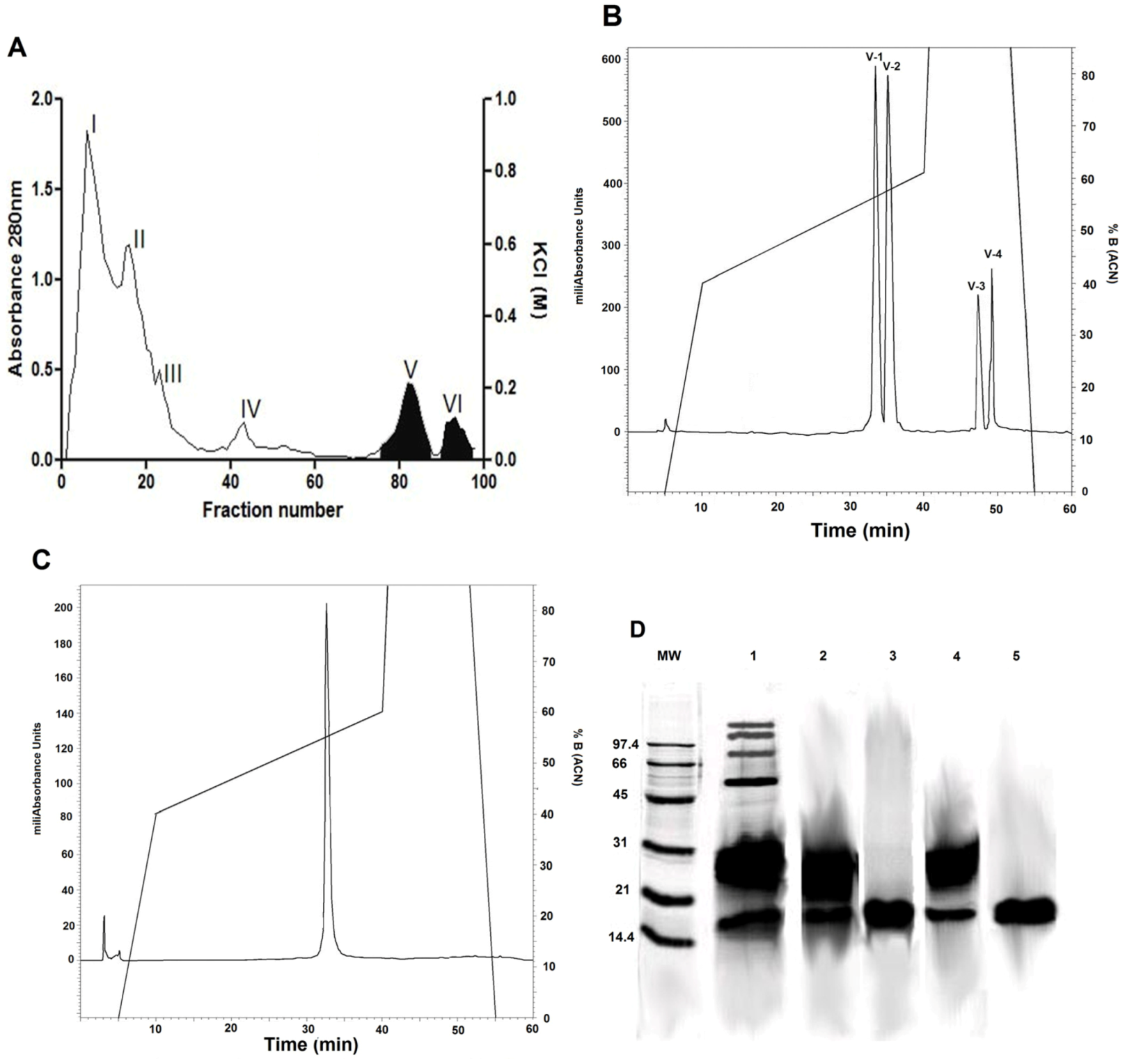
        <p>Six fractions obtained by fractionating <italic>B. asper</italic> venom on ion exchange chromatography on CM-Sephadex C-25 were evaluated for PLA<sub>2</sub> activity. It was found that fraction V was the only positive fraction for PLA<sub>2</sub> activity (see <xref ref-type="fig" rid="toxins-04-01500-f001">Figure 1</xref>A). However, fraction VI, corresponding to a PLA<sub>2</sub> homologue devoid of enzymatic activity (see <xref ref-type="sec" rid="sec3dot2-toxins-04-01500">Section 3.2</xref>), was also analyzed for antiplasmodial activity to determine the possibility of catalytically-independent actions. Fractions V and VI were subjected to further separation by RP-HPLC on a C<sub>18</sub> column. This separation revealed that fraction V had four subfractions (see <xref ref-type="fig" rid="toxins-04-01500-f001">Figure 1</xref>B,C), only one of which (V-4) showed PLA<sub>2</sub> activity, whereas fraction VI showed only one peak. These two fractions were used to assess antiplasmodial activity.</p>
        <fig id="toxins-04-01500-f001" position="float">
          <label>Figure 1</label>
          <caption>
            <p>(<bold>A</bold>) Chromatographic elution profile on CM Sephadex C-25 at 280 nm from the venom of <italic>B. asper</italic>; fractions V and VI (shaded) were further characterized; (<bold>B</bold>) Elution profile on RP-HPLC on a C<sub>18</sub> column of fraction V; (<bold>C</bold>) Elution profile on RP-HPLC on a C<sub>18</sub> column of fraction VI; (<bold>D</bold>) SDS-PAGE (12%) separation of venom and fractions: <italic>MW</italic>, molecular weight markers; lane 1, crude venom; lane 2, fraction V under non-reducing conditions; lane 3, fraction V under reducing conditions; lane 4, fraction VI under non-reducing conditions; lane 5, fraction VI under reducing conditions.</p>
          </caption>
          <graphic xmlns:xlink="http://www.w3.org/1999/xlink" xlink:href="toxins-04-01500-g001.tif"/>
        </fig>
      </sec>
      <sec>
        <title>2.2. Indirect Hemolytic Activity</title>
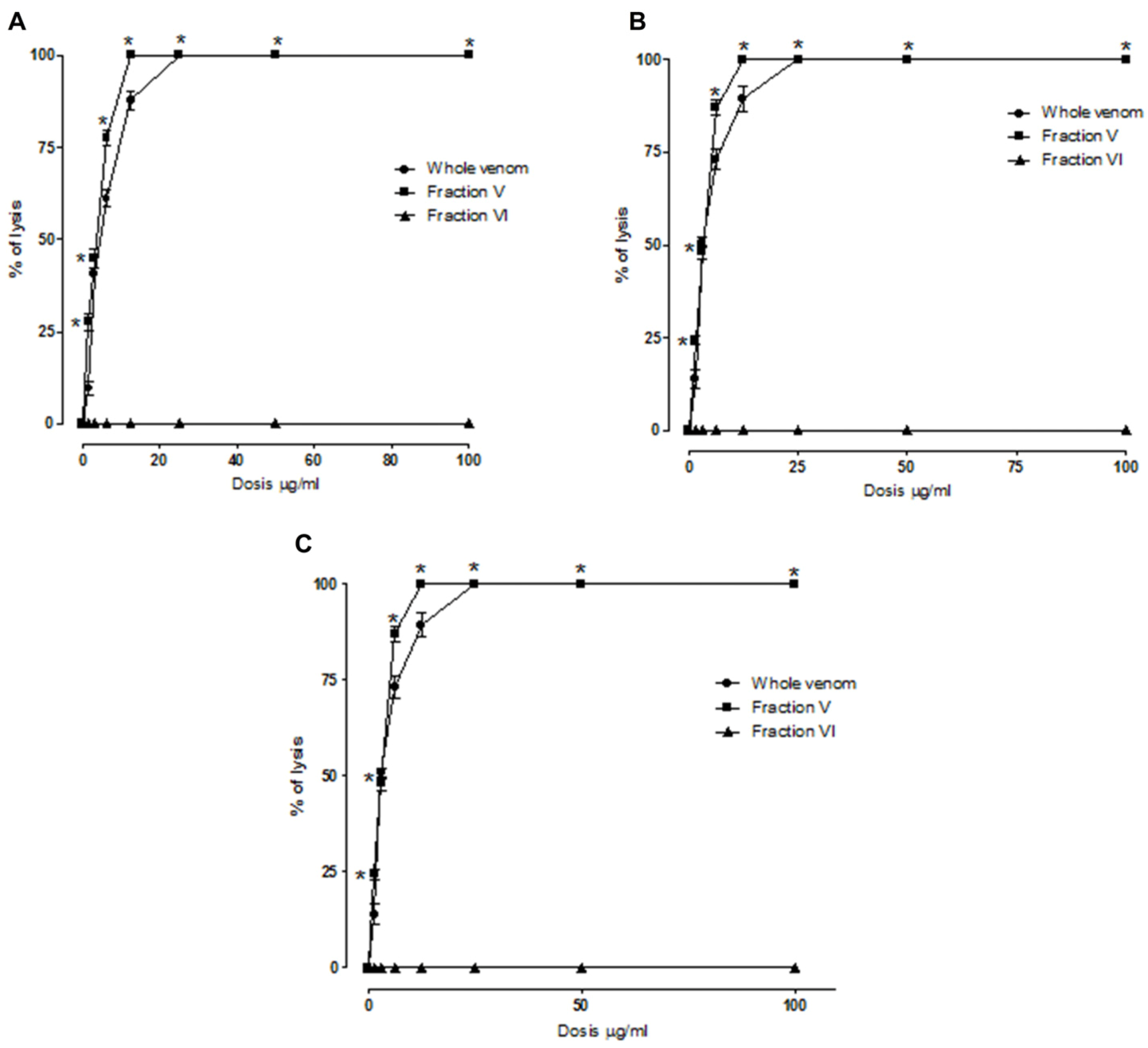
        <p>Fraction V had a minimal indirect hemolytic dose of 1.35 µg, while fraction VI showed no such activity. The PLA<sub>2</sub> isolated by HPLC from fraction V showed a minimum indirect hemolytic dose of 0.82 µg, while the peak obtained by HPLC separation of fraction VI lacked activity (data not shown). The hemolysis test with different substrates (egg yolk, plasma or human serum) yielded similar results in all assays. When indirect hemolytic activity was determined in solution, 100% hemolysis was observed using concentrations of 25 µg/mL for whole venom and 12.5 µg/mL for fraction V, whereas fraction VI lacked PLA<sub>2</sub> activity in all tests (see <xref ref-type="fig" rid="toxins-04-01500-f002">Figure 2</xref>).</p>
        <fig id="toxins-04-01500-f002" position="float">
          <label>Figure 2</label>
          <caption>
            <p>Indirect hemolytic activity in solution of venom and fractions V and VI. Analysis on erythrocyte suspensions containing (<bold>A</bold>) egg yolk; (<bold>B</bold>) inactivated human plasma and (<bold>C</bold>) inactivated human serum. <bold>*</bold> <italic>p</italic> ≤ 0.05.</p>
          </caption>
          <graphic xmlns:xlink="http://www.w3.org/1999/xlink" xlink:href="toxins-04-01500-g002.tif"/>
        </fig>
      </sec>
      <sec>
        <title>2.3. Antiplasmodial Activity of the Venom, Fractions and Purified PLA<sub>2</sub>s</title>
        <p>Both venom and fractions V and VI exhibit antiplasmodial activity on the FCB1 strain of <italic>P. falciparum</italic>, with fraction V being more active than fraction VI (see <xref ref-type="table" rid="toxins-04-01500-t001">Table 1</xref>). On the other hand, the venom was more active than the two fractions evaluated. Guillaume <italic>et al.</italic> showed that removal of phospholipids from cultures of <italic>P. falciparum</italic> reduced the antiplasmodial activity of PLA<sub>2</sub> [<xref ref-type="bibr" rid="B27-toxins-04-01500">27</xref>], confirming the crucial role of PLA<sub>2</sub> enzymatic activity to control the growth of parasites in this test. Our data demonstrate the antimalarial efficacy of fraction with PLA<sub>2</sub> activity. However, a PLA<sub>2</sub> homologue devoid of enzymatic activity also resulted in restriction of <italic>P. falciparum</italic> multiplication, confirming a catalytically-independent antiplasmodial activity. This effect could be due to the perturbing action exerted by the PLA<sub>2</sub> homologue in the plasma membrane, thus resulting in an increase in permeability [<xref ref-type="bibr" rid="B29-toxins-04-01500">29</xref>]. It has been shown that the <italic>C</italic>-terminal region of these PLA<sub>2</sub> homologues is responsible for this catalytically-independent membrane perturbation, as demonstrated in bacteria [<xref ref-type="bibr" rid="B16-toxins-04-01500">16</xref>,<xref ref-type="bibr" rid="B30-toxins-04-01500">30</xref>,<xref ref-type="bibr" rid="B31-toxins-04-01500">31</xref>], being, therefore, a different mechanism from the one described for other PLA<sub>2</sub>s [<xref ref-type="bibr" rid="B26-toxins-04-01500">26</xref>,<xref ref-type="bibr" rid="B27-toxins-04-01500">27</xref>]. </p>
        <table-wrap id="toxins-04-01500-t001" position="float">
          <object-id pub-id-type="pii">toxins-04-01500-t001_Table 1</object-id>
          <label>Table 1</label>
          <caption>
            <p>Antimalarial activity, cytotoxic activity on peripheral blood mononuclear cells and acute toxicity of <italic>B. asper</italic> venom and isolated PLA<sub>2</sub>s. ND: not determined. <sup>£</sup> No deaths were recorded at this dose. <sup>€</sup> <italic>p</italic> ≤ 0.05 when compared with the other treatments.</p>
          </caption>
          <table>
            <thead>
              <tr>
                <th align="center" valign="middle">Compound</th>
                <th align="center" valign="middle">Antimalarial activity IC<sub>50</sub> (µg/mL)</th>
                <th align="center" valign="middle">LD<sub>50</sub> (µg/kg)</th>
                <th align="center" valign="middle">Cytotoxicity CC<sub>50</sub> (µg/mL)</th>
              </tr>
            </thead>
            <tbody>
              <tr>
                <td align="center" valign="middle"><italic>B. asper</italic> venom </td>
                <td align="center" valign="middle">0.13 ± 0.01 <sup>€</sup></td>
                <td align="center" valign="middle">3566 (2561 to 3693)</td>
                <td align="center" valign="middle">38.46 ± 0.95 <sup>Ω</sup></td>
              </tr>
              <tr>
                <td align="center" valign="middle">Fraction V </td>
                <td align="center" valign="middle">1.42 ± 0.56 <sup>€</sup></td>
                <td align="center" valign="middle"><sup>£</sup> &gt; 15000</td>
                <td align="center" valign="middle">26.98 ± 0.51 <sup>Ω</sup></td>
              </tr>
              <tr>
                <td align="center" valign="middle">Fraction VI </td>
                <td align="center" valign="middle">22.89 ± 1.22 <sup>€</sup></td>
                <td align="center" valign="middle"><sup>£</sup> &gt; 15000</td>
                <td align="center" valign="middle">67.43 ± 1.03 <sup>Ω</sup></td>
              </tr>
              <tr>
                <td align="center" valign="middle">CQ *</td>
                <td align="center" valign="middle">323.35 ± 6.97</td>
                <td align="center" valign="middle">ND</td>
                <td align="center" valign="middle">ND</td>
              </tr>
            </tbody>
          </table>
		  <table-wrap-foot><fn>
			<p>* CQ: chloroquine. These results are expressed in nM concentration; CC<sub>50</sub>: Dose that induces 50% cytotoxicity in peripheral blood mononuclear cells. Results are expressed as mean ± S.E.M.; <sup>Ω</sup> <italic>p</italic> ≤ 0.05 when compared with the other treatments.</p>
		</fn></table-wrap-foot>
		  </table-wrap>
       
        <p>The changes observed in the intraerythrocytic development of <italic>Plasmodium</italic> indicate that structural changes occur, as well as modifications in membrane functions in parasitized red blood cells. In addition, increments and changes in the permeability of the membrane have been described, together with the appearance of new parasite-derived proteins and changes in the composition of membrane lipids [<xref ref-type="bibr" rid="B32-toxins-04-01500">32</xref>,<xref ref-type="bibr" rid="B33-toxins-04-01500">33</xref>]. The observed increased permeability could also be responsible for the PLA<sub>2</sub> activity on the parasite, as demonstrated by Moll <italic>et al</italic>., who noted that in the absence of serum in the culture <italic>in vitro</italic>, PLA<sub>2</sub> lysed parasitized cells [<xref ref-type="bibr" rid="B34-toxins-04-01500">34</xref>]. This increase in membrane permeability could also enhance the antimalarial activity of the PLA<sub>2</sub> homologue observed in our experiments.</p>
      </sec>
      <sec>
        <title>2.4. SDS-PAGE</title>
        <p>Electrophoresis showed that proteins of fractions V and VI (lanes 2 and 4, respectively) had molecular weights ranging from 25 kDa and 14 kDa, when fractions were separated in non-reducing conditions, thus evidencing the presence of monomers and dimers, whereas only bands of around 14 kDa were observed (lanes 3 and 5 in <xref ref-type="fig" rid="toxins-04-01500-f001">Figure 1</xref>D, respectively) when these fractions were subjected to reducing conditions, thus corresponding to PLA<sub>2</sub> monomers (<xref ref-type="fig" rid="toxins-04-01500-f001">Figure 1</xref>D).</p>
      </sec>
      <sec>
        <title>2.5. Mass Spectrometry and Identification of the Protein</title>
        <p>We determined the molecular mass of each of the fractions obtained by RP-HPLC: Fraction V (fractions V-1, V-2, V-3 and V-4) and VI. Mass spectrometric analysis showed that V-1 was of 13786.9 Da, V-2 was of 13950.1 Da, V-3 was of 13972.4 Da, V-4 was of 13974.6 Da and VI was of 13725 Da. The tandem mass MS/MS analysis indicated that the PLA<sub>2</sub>s isolated corresponding to the fractions V-1, V-2, V-3 and VI were K49 PLA<sub>2</sub> homologs, and V-4 was D49 PLA2 (<xref ref-type="table" rid="toxins-04-01500-t002">Table 2</xref>).</p>
        <table-wrap id="toxins-04-01500-t002" position="float">
          <object-id pub-id-type="pii">toxins-04-01500-t002_Table 2</object-id>
          <label>Table 2</label>
          <caption>
            <p>Protein identification results for <italic>B. asper</italic>-PLA<sub>2</sub> by ESI MS/MS peptide sequence obtained from mass tandem MS/MS.</p>
          </caption>
          <table>
<thead>
              <tr>
                <th rowspan="2" align="center" valign="middle">Fraction</th>
                <th rowspan="2" align="center" valign="middle">MH<sup>+</sup> (monoisotopic mass )</th>
                <th rowspan="2" align="center" valign="middle"><italic>z</italic></th>
                <th rowspan="2" align="center" valign="middle">MS/MS-derived sequence</th>
                <th rowspan="2" align="center" valign="middle">Data base ID</th>
                <th rowspan="2" align="center" valign="middle">Species</th>
                <th colspan="2" align="center" valign="middle">Score</th>
                <th rowspan="2" align="center" valign="middle">Reference</th>
              </tr>
              <tr style="border-top:solid thin">
                <th align="center" valign="middle">Spectrum mill</th>
                <th align="center" valign="middle">Mascot</th>
              </tr>
            </thead>
            <tbody>
              <tr>
                <td rowspan="4" align="center" valign="top">P V-1</td>
                <td align="center" valign="middle">1944.87</td>
                <td align="center" valign="middle">3+</td>
                <td align="center" valign="middle">NPVTSYGAYGCNCGVLGR</td>
                <td align="center" valign="middle">Q9PVE3.1</td>
                <td align="center" valign="middle"><italic>B. asper</italic> M1-3-3</td>
                <td align="center" valign="middle">17.76</td>
                <td align="center" valign="middle">52</td>
                <td align="center" valign="middle">[<xref ref-type="bibr" rid="B35-toxins-04-01500">35</xref>]</td>
              </tr>
              <tr>
                <td align="center" valign="middle">1394.64</td>
                <td align="center" valign="middle">2+</td>
                <td align="center" valign="middle">TIVCGENNSCLK</td>
                <td align="center" valign="middle">AAF66702.1</td>
                <td align="center" valign="middle"><italic>B. moojeni</italic> Myotoxin II precursor</td>
                <td align="center" valign="middle">14.21</td>
                <td align="center" valign="middle">87</td>
                <td align="center" valign="middle">[<xref ref-type="bibr" rid="B36-toxins-04-01500">36</xref>]</td>
              </tr>
              <tr>
                <td align="center" valign="middle">460.74</td>
                <td align="center" valign="middle">2+</td>
                <td align="center" valign="middle">MILQETGK</td>
                <td align="center" valign="middle">Q9PRT7.1</td>
                <td align="center" valign="middle"><italic>B. asper</italic> Myotoxin IV</td>
                <td align="center" valign="middle">-</td>
                <td align="center" valign="middle">37</td>
                <td align="center" valign="middle">[<xref ref-type="bibr" rid="B37-toxins-04-01500">37</xref>]</td>
              </tr>
              <tr>
                <td align="center" valign="middle">434.05</td>
                <td align="center" valign="middle">2+</td>
                <td align="center" valign="middle">CCYVHK</td>
                <td align="center" valign="middle">AAF66702.1</td>
                <td align="center" valign="middle"><italic>B. moojeni</italic> Myotoxin II precursor</td>
                <td align="center" valign="middle">-</td>
                <td align="center" valign="middle">25</td>
                <td align="center" valign="middle">[<xref ref-type="bibr" rid="B36-toxins-04-01500">36</xref>]</td>
              </tr>
              <tr>
                <td rowspan="6" align="center" valign="top">P V-2</td>
                <td align="center" valign="middle">1944.87</td>
                <td align="center" valign="middle">3+</td>
                <td align="center" valign="middle">NPVTSYGAYGCNCGVLGR</td>
                <td align="center" valign="middle">Q9PVE3.1</td>
                <td align="center" valign="middle"><italic>B. asper</italic> M1-3-3</td>
                <td align="center" valign="middle">12.65</td>
                <td align="center" valign="middle">68</td>
                <td align="center" valign="middle">[<xref ref-type="bibr" rid="B35-toxins-04-01500">35</xref>]</td>
              </tr>
              <tr>
                <td align="center" valign="middle">1394,57</td>
                <td align="center" valign="middle">2+</td>
                <td align="center" valign="middle">TIVCGENNSCLK</td>
                <td align="center" valign="middle">1CLP_B</td>
                <td align="center" valign="middle"><italic>B. asper</italic> Myotoxin II</td>
                <td align="center" valign="middle">-</td>
                <td align="center" valign="middle">53</td>
                <td align="center" valign="middle">[<xref ref-type="bibr" rid="B38-toxins-04-01500">38</xref>]</td>
              </tr>
              <tr>
                <td align="center" valign="middle">1637.76</td>
                <td align="center" valign="middle">3+</td>
                <td align="center" valign="middle">DKTIVCGENNSCLK</td>
                <td align="center" valign="middle">AAF66702.1</td>
                <td align="center" valign="middle"><italic>B. moojeni</italic> Myotoxin II precursor</td>
                <td align="center" valign="middle">12.23</td>
                <td align="center" valign="middle">24</td>
                <td align="center" valign="middle">[<xref ref-type="bibr" rid="B36-toxins-04-01500">36</xref>]</td>
              </tr>
              <tr>
                <td align="center" valign="middle">952.78</td>
                <td align="center" valign="middle">2+</td>
                <td align="center" valign="middle">ELCECDK</td>
                <td align="center" valign="middle">AAF66702.1</td>
                <td align="center" valign="middle"><italic>B. moojeni</italic> Myotoxin II precursor</td>
                <td align="center" valign="middle">-</td>
                <td align="center" valign="middle">27</td>
                <td align="center" valign="middle">[<xref ref-type="bibr" rid="B36-toxins-04-01500">36</xref>]</td>
              </tr>
              <tr>
                <td align="center" valign="middle">996.80</td>
                <td align="center" valign="middle">1+</td>
                <td align="center" valign="middle">ENLDTYNK</td>
                <td align="center" valign="middle">AAF66702.1</td>
                <td align="center" valign="middle"><italic>B. moojeni</italic> Myotoxin II precursor</td>
                <td align="center" valign="middle">12.69</td>
                <td align="center" valign="middle">31</td>
                <td align="center" valign="middle">[<xref ref-type="bibr" rid="B36-toxins-04-01500">36</xref>]</td>
              </tr>
              <tr>
                <td align="center" valign="middle">802.36</td>
                <td align="center" valign="middle">2+</td>
                <td align="center" valign="middle">AVAICLR</td>
                <td align="center" valign="middle">Q9PRT7.1</td>
                <td align="center" valign="middle"><italic>B. asper</italic> Myotoxin IV</td>
                <td align="center" valign="middle">-</td>
                <td align="center" valign="middle">36</td>
                <td align="center" valign="middle">[<xref ref-type="bibr" rid="B37-toxins-04-01500">37</xref>]</td>
              </tr>
              <tr>
                <td rowspan="6" align="center" valign="top">P V-3</td>
                <td align="center" valign="middle">1944.87</td>
                <td align="center" valign="middle">3+</td>
                <td align="center" valign="middle">NPVTSYGAYGCNCGVLGR</td>
                <td align="center" valign="middle">Q9PVE3.1</td>
                <td align="center" valign="middle"><italic>B. asper</italic> M1-3-3</td>
                <td align="center" valign="middle">10.85</td>
                <td align="center" valign="middle">43</td>
                <td align="center" valign="middle">[<xref ref-type="bibr" rid="B35-toxins-04-01500">35</xref>]</td>
              </tr>
              <tr>
                <td align="center" valign="middle">1394.64</td>
                <td align="center" valign="middle">2+</td>
                <td align="center" valign="middle">TIVCGENNSCLK</td>
                <td align="center" valign="middle">AAF66702.1</td>
                <td align="center" valign="middle"><italic>B. moojeni</italic> Myotoxin II precursor</td>
                <td align="center" valign="middle">-</td>
                <td align="center" valign="middle">57</td>
                <td align="center" valign="middle">[<xref ref-type="bibr" rid="B36-toxins-04-01500">36</xref>]</td>
              </tr>
              <tr>
                <td align="center" valign="middle">1637.74</td>
                <td align="center" valign="middle">3+</td>
                <td align="center" valign="middle">DKTIVCGENNSCLK</td>
                <td align="center" valign="middle">AAF66702.1</td>
                <td align="center" valign="middle"><italic>B. moojeni</italic> Myotoxin II precursor</td>
                <td align="center" valign="middle">17.52</td>
                <td align="center" valign="middle">31</td>
                <td align="center" valign="middle">[<xref ref-type="bibr" rid="B36-toxins-04-01500">36</xref>]</td>
              </tr>
              <tr>
                <td align="center" valign="middle">952.78</td>
                <td align="center" valign="middle">2+</td>
                <td align="center" valign="middle">ELCECDK</td>
                <td align="center" valign="middle">AAF66702.1</td>
                <td align="center" valign="middle"><italic>B. moojeni</italic> Myotoxin II precursor</td>
                <td align="center" valign="middle">-</td>
                <td align="center" valign="middle">27</td>
                <td align="center" valign="middle">[<xref ref-type="bibr" rid="B36-toxins-04-01500">36</xref>]</td>
              </tr>
              <tr>
                <td align="center" valign="middle">802.36</td>
                <td align="center" valign="middle">2+</td>
                <td align="center" valign="middle">AVAICLR</td>
                <td align="center" valign="middle">Q9PRT7.1</td>
                <td align="center" valign="middle"><italic>B. asper</italic> Myotoxin IV</td>
                <td align="center" valign="middle">-</td>
                <td align="center" valign="middle">32</td>
                <td align="center" valign="middle">[<xref ref-type="bibr" rid="B37-toxins-04-01500">37</xref>]</td>
              </tr>
              <tr>
                <td align="center" valign="middle">1533.66</td>
                <td align="center" valign="middle">2+</td>
                <td align="center" valign="middle">SYGAYGCNCGVLGR</td>
                <td align="center" valign="middle">AAF66703.1</td>
                <td align="center" valign="middle"><italic>B. neuwiedi pauloensis</italic> PLA2 homolog</td>
                <td align="center" valign="middle">17.32</td>
                <td align="center" valign="middle">63</td>
                <td align="center" valign="middle">[<xref ref-type="bibr" rid="B39-toxins-04-01500">39</xref>]</td>
              </tr>
              <tr>
                <td rowspan="7" align="center" valign="top">P V-4</td>
                <td align="center" valign="middle">2064.41</td>
                <td align="center" valign="middle">2+</td>
                <td align="center" valign="middle">DATDRCCFVHDCCYGK</td>
                <td align="center" valign="middle">P20474.2</td>
                <td align="center" valign="middle"><italic>B. asper</italic> Myotoxin III</td>
                <td align="center" valign="middle">9.51</td>
                <td align="center" valign="middle">30</td>
                <td align="center" valign="middle">[<xref ref-type="bibr" rid="B35-toxins-04-01500">35</xref>]</td>
              </tr>
              <tr>
                <td align="center" valign="middle">1728.75</td>
                <td align="center" valign="middle">2+</td>
                <td align="center" valign="middle">EICECDKAAAVCFR</td>
                <td align="center" valign="middle">1GMZ_A</td>
                <td align="center" valign="middle"><italic>B. pirajai</italic> Piratoxin III</td>
                <td align="center" valign="middle">8.61</td>
                <td align="center" valign="middle">-</td>
                <td align="center" valign="middle">[<xref ref-type="bibr" rid="B40-toxins-04-01500">40</xref>]</td>
              </tr>
              <tr>
                <td align="center" valign="middle">1506.59</td>
                <td align="center" valign="middle">2+</td>
                <td align="center" valign="middle">SGVIICCEGTPCEK</td>
                <td align="center" valign="middle">P20474.2</td>
                <td align="center" valign="middle"><italic>B. asper</italic> Myotoxin III</td>
                <td align="center" valign="middle">-</td>
                <td align="center" valign="middle">64</td>
                <td align="center" valign="middle">[<xref ref-type="bibr" rid="B35-toxins-04-01500">35</xref>]</td>
              </tr>
              <tr>
                <td align="center" valign="middle">862.56</td>
                <td align="center" valign="middle">2+</td>
                <td align="center" valign="middle">MILEETK</td>
                <td align="center" valign="middle">P20474.2</td>
                <td align="center" valign="middle"><italic>B. asper</italic> Myotoxin III</td>
                <td align="center" valign="middle">-</td>
                <td align="center" valign="middle">35</td>
                <td align="center" valign="middle">[<xref ref-type="bibr" rid="B35-toxins-04-01500">35</xref>]</td>
              </tr>
              <tr>
                <td align="center" valign="middle">794.57</td>
                <td align="center" valign="middle">2+</td>
                <td align="center" valign="middle">AAAVCFR</td>
                <td align="center" valign="middle">P86974.1</td>
                <td align="center" valign="middle"><italic>B. leucurus</italic> blD-PLA2</td>
                <td align="center" valign="middle">-</td>
                <td align="center" valign="middle">26</td>
                <td align="center" valign="middle">[<xref ref-type="bibr" rid="B41-toxins-04-01500">41</xref>]</td>
              </tr>
              <tr>
                <td align="center" valign="middle">1273.31</td>
                <td align="center" valign="middle">2+</td>
                <td align="center" valign="middle">YMAYPDLLCK</td>
                <td align="center" valign="middle">P20474.2</td>
                <td align="center" valign="middle"><italic>B. asper</italic> Myotoxin III</td>
                <td align="center" valign="middle">-</td>
                <td align="center" valign="middle">42</td>
                <td align="center" valign="middle">[<xref ref-type="bibr" rid="B35-toxins-04-01500">35</xref>]</td>
              </tr>
              <tr>
                <td align="center" valign="middle">675.45</td>
                <td align="center" valign="middle">2+</td>
                <td align="center" valign="middle">YSYSR</td>
                <td align="center" valign="middle">P20474.2</td>
                <td align="center" valign="middle"><italic>B. asper</italic> Myotoxin III</td>
                <td align="center" valign="middle">-</td>
                <td align="center" valign="middle">23</td>
                <td align="center" valign="middle">[<xref ref-type="bibr" rid="B35-toxins-04-01500">35</xref>]</td>
              </tr>
              <tr>
                <td rowspan="5" align="center" valign="top">P VI</td>
                <td align="center" valign="middle">1329.72</td>
                <td align="center" valign="middle">2+</td>
                <td align="center" valign="middle">MILQETGKNPAK</td>
                <td align="center" valign="middle">Q9IAT9.2</td>
                <td align="center" valign="middle"><italic>B. neuwiedi pauloensis</italic> BnSP-7</td>
                <td align="center" valign="middle">11.63</td>
                <td align="center" valign="middle">42</td>
                <td align="center" valign="middle">[<xref ref-type="bibr" rid="B39-toxins-04-01500">39</xref>]</td>
              </tr>
              <tr>
                <td align="center" valign="middle">1533.66</td>
                <td align="center" valign="middle">2+</td>
                <td align="center" valign="middle">SYGAYGCNCGVLGR</td>
                <td align="center" valign="middle">AAF66703.1</td>
                <td align="center" valign="middle"><italic>B. neuwiedi pauloensis</italic> PLA<sub>2</sub> homolog</td>
                <td align="center" valign="middle">17.92</td>
                <td align="center" valign="middle">52</td>
                <td align="center" valign="middle">[<xref ref-type="bibr" rid="B39-toxins-04-01500">39</xref>]</td>
              </tr>
              <tr>
                <td align="center" valign="middle">790.04</td>
                <td align="center" valign="middle">1+</td>
                <td align="center" valign="middle">LTGCNPK</td>
                <td align="center" valign="middle">P86453.1</td>
                <td align="center" valign="middle"><italic>B. alternatus</italic> BaTx</td>
                <td align="center" valign="middle">-</td>
                <td align="center" valign="middle">28</td>
                <td align="center" valign="middle">[<xref ref-type="bibr" rid="B42-toxins-04-01500">42</xref>]</td>
              </tr>
              <tr>
                <td align="center" valign="middle">1637.56</td>
                <td align="center" valign="middle">2+</td>
                <td align="center" valign="middle">DKTIVCGENNSCLK</td>
                <td align="center" valign="middle">AAF66702.1</td>
                <td align="center" valign="middle"><italic>B. moojeni</italic> Myotoxin II precursor</td>
                <td align="center" valign="middle">-</td>
                <td align="center" valign="middle">21</td>
                <td align="center" valign="middle">[<xref ref-type="bibr" rid="B36-toxins-04-01500">36</xref>]</td>
              </tr>
              <tr>
                <td align="center" valign="middle">1394.57</td>
                <td align="center" valign="middle">2+</td>
                <td align="center" valign="middle">TIVCGENNSCLK</td>
                <td align="center" valign="middle">1CLP_B</td>
                <td align="center" valign="middle"><italic>B. asper</italic> Myotoxin II</td>
                <td align="center" valign="middle">-</td>
                <td align="center" valign="middle">77</td>
                <td align="center" valign="middle">[<xref ref-type="bibr" rid="B38-toxins-04-01500">38</xref>]</td>
              </tr>
            </tbody>
          </table></table-wrap>
        
		<fig id="toxins-04-01500-f003" position="float">
          <label>Figure 3</label>
          <caption>
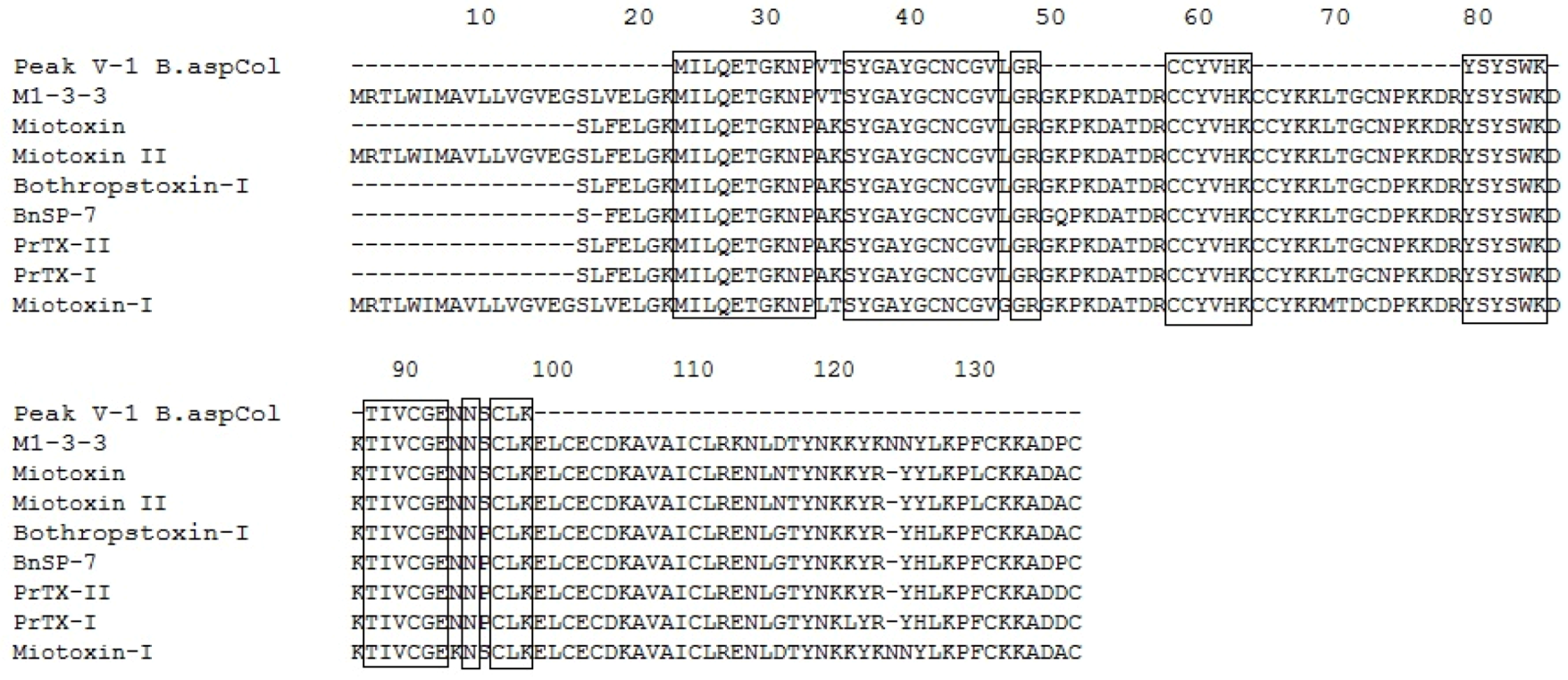
            <p>Multiple sequence alignment of Fraction P V-1. The boxes represent conserved amino acids. <italic>B. asper</italic> M1-3-3 Swiss Protein ID: Q9PVE3.1, GenBank ID: AAF14241.1|AF109911, Myotoxin <italic>B. asper</italic> PDB ID: 1CLP_A, Myotoxin-II <italic>B. asper</italic> Swiss Protein ID: P24605.3, Bothropstoxin-Ia <italic>B. jararacussu</italic> GenBank ID: CAA55334.2, BnSP-7 <italic>B. neuwiedi</italic> Q9IAT9.2, Piratoxin-II <italic>Bothrops pirajai</italic> P82287.1, Piratoxin-I <italic>B. pirajai</italic> Swiss Protein ID: 58399.2, Myotoxin-I <italic>B. atrox</italic> Swiss Protein ID: P82287.1.</p>
          </caption>
          <graphic xmlns:xlink="http://www.w3.org/1999/xlink" xlink:href="toxins-04-01500-g003.tif"/>
        </fig>
        <fig id="toxins-04-01500-f004" position="float">
          <label>Figure 4</label>
          <caption>
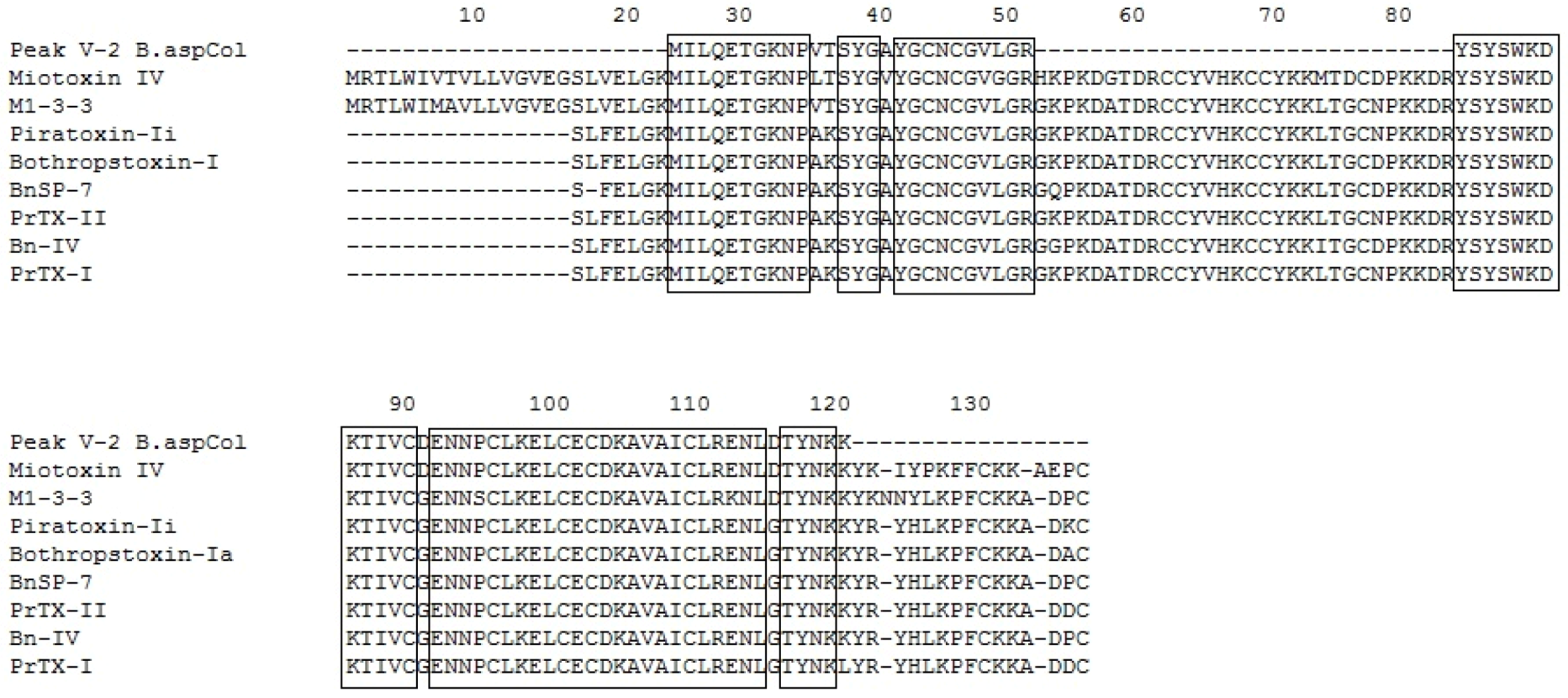
            <p>Multiple sequence alignment of Fraction P V-2. The boxes represent conserved amino acids. Myotoxin- IV <italic>B. asper</italic> Swiss Protein ID: P0C616, M1-3-3 <italic>B. asper</italic> Swiss Protein ID: SP|Q9PVE3.1, GenBank ID: AAF14241.1|AF109911, Piratoxin-Ii <italic>B. pirajai</italic> PDB ID: 2QLL_A, Bothropstoxin-Ia <italic>B. jararacussu</italic> GenBank ID: CAA55334.2, BnSP-7 <italic>B. neuwiedi</italic> Swiss Protein ID: Q9IAT9.2, Piratoxin-II <italic>B. pirajai</italic> Swiss Protein ID: P82287.1, BnIV <italic>B. neuwiedi</italic> PDB ID: 3MLM_A, Piratoxin-I <italic>B. pirajai</italic> Swiss Protein ID: 58399.2.</p>
          </caption>
          <graphic xmlns:xlink="http://www.w3.org/1999/xlink" xlink:href="toxins-04-01500-g004.tif"/>
        </fig>
        
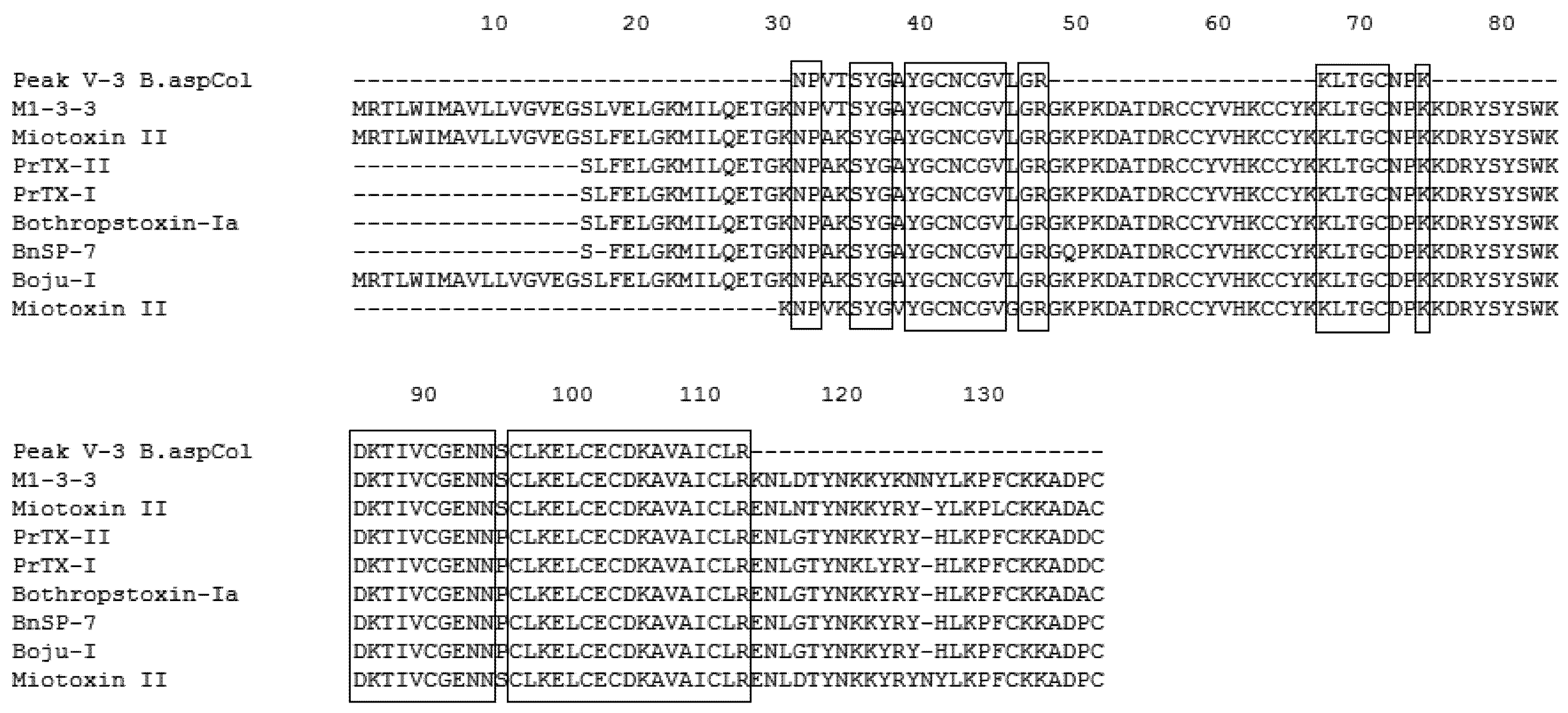
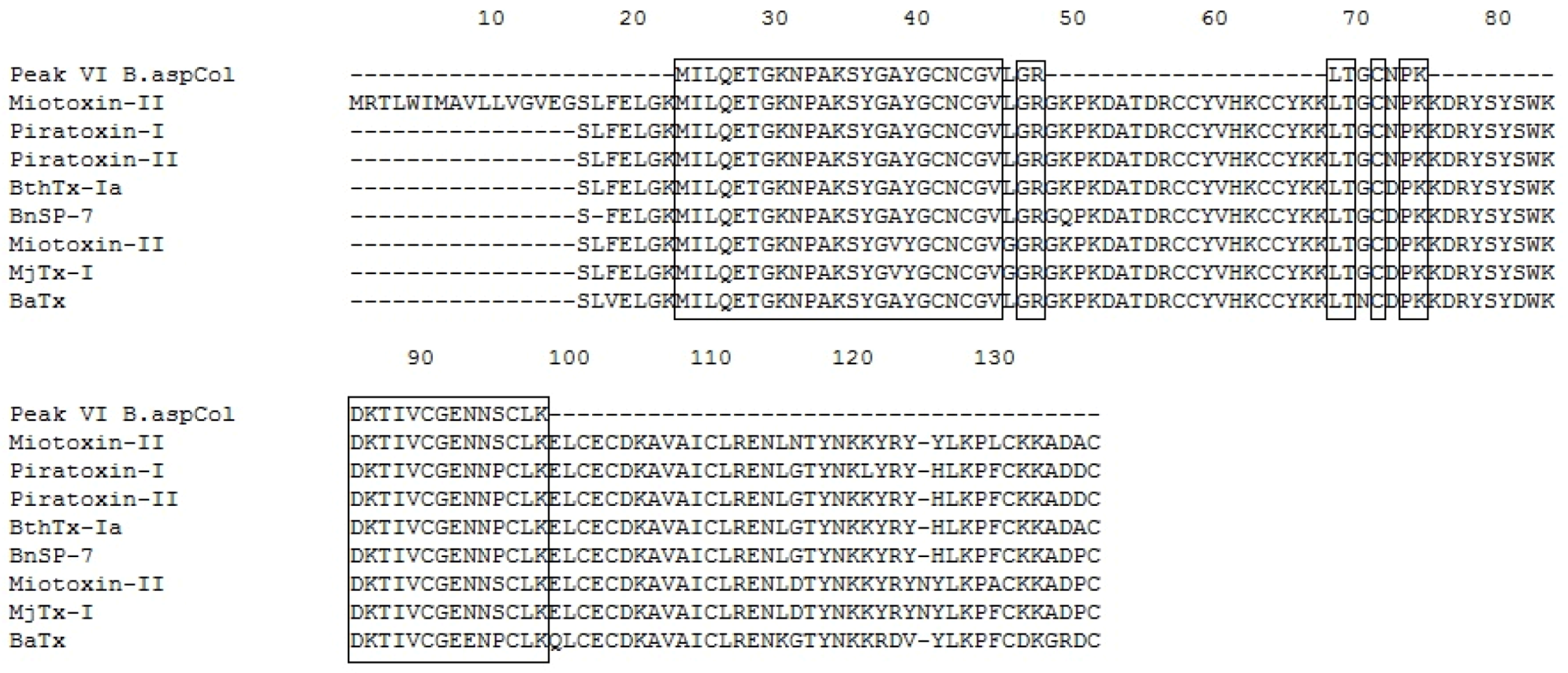
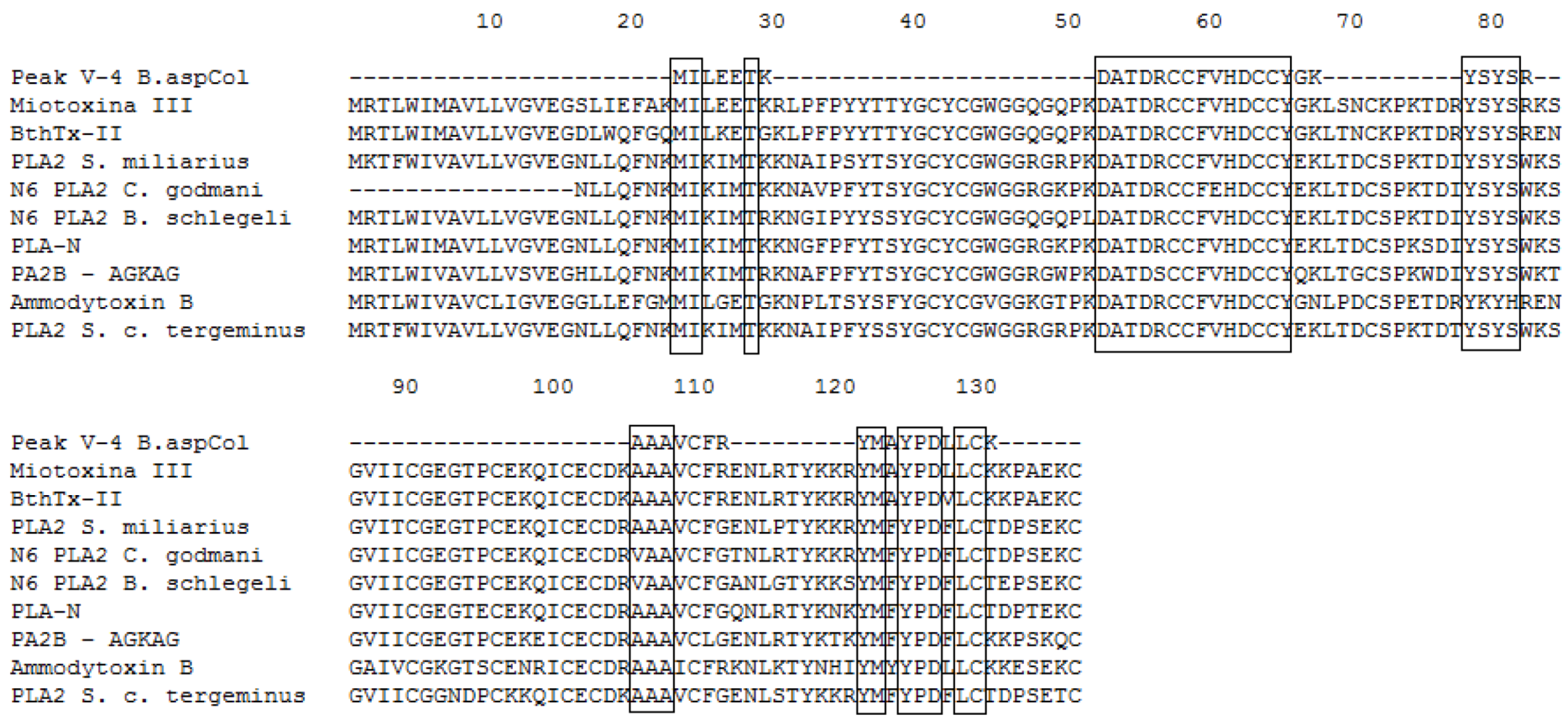
		<p>Additionally, the identified peptides were subjected to BLAST analysis to determine their identity with other phospholipases. The results confirmed the high identity of these peptides with PLA<sub>2</sub>s from the venoms of <italic>B. asper, B. neuwiedi</italic>, <italic>B. jararacussu</italic>, <italic>B. pirajai</italic> and <italic>Cerrophidion godmani</italic>, among others (see <xref ref-type="fig" rid="toxins-04-01500-f003">Figure 3</xref>, <xref ref-type="fig" rid="toxins-04-01500-f004">Figure 4</xref>, <xref ref-type="fig" rid="toxins-04-01500-f005">Figure 5</xref>, <xref ref-type="fig" rid="toxins-04-01500-f006">Figure 6</xref>, <xref ref-type="fig" rid="toxins-04-01500-f007">Figure 7</xref>).</p>
        <fig id="toxins-04-01500-f005" position="float">
          <label>Figure 5</label>
          <caption>
            <p>Multiple sequence alignment of Fraction P V-3. The boxes represent conserved amino acid. M1-3-3 <italic>B. asper</italic> Swiss Protein ID: Q9PVE3.1, Myotoxin-II <italic>B. asper</italic> Swiss Protein ID: P24605.3, piratoxin-II <italic>B. pirajai</italic> Swiss Protein ID: P82287, Piratoxin-I <italic>B. pirajai</italic> Swiss Protein ID: 58399.2, Bothropstoxin-Ia <italic>B. jararacussu</italic> GenBank ID: CAA55334.2, BnSP-7 <italic>B. neuwiedi</italic> Swiss Protein ID: Q9IAT9.2. BOJU-I <italic>B. jararacussu</italic> Swiss Protein ID: Q90249.3, Myotoxin-II <italic>B. moojeni</italic> GenBank ID: AAF66702.1.</p>
          </caption>
          <graphic xmlns:xlink="http://www.w3.org/1999/xlink" xlink:href="toxins-04-01500-g005.tif"/>
        </fig>
        <fig id="toxins-04-01500-f006" position="float">
          <label>Figure 6</label>
          <caption>
            <p>Multiple sequence alignment of Fraction P V-4. The boxes represent conserved amino acid. Myotoxin-III <italic>B. asper</italic> Swiss Protein ID: P20474.2, BthTx-II <italic>B. jararacussu</italic> Swiss Protein ID: P45881.1, PLA<sub>2</sub> <italic>S. miliarius</italic> GenBank ID: ABY77926.1, N6 PLA<sub>2</sub> <italic>C. godmani</italic> GenBank ID: AAR14161.1, N6 PLA<sub>2</sub> <italic>B. schlegelii</italic> GenBank ID: AAR14162.1, PLA-N <italic>T. flavoviridis</italic> GenBank ID: BAC56893, PA2B_AGKAG <italic>D. acutus</italic> Swiss Protein ID: Q1ZY03, Variant ammodytoxin-B <italic>V. aspis</italic> GenBank ID: CAE47279.1, PLA<sub>2</sub> <italic>S. c. tergeminus</italic> Accession number GenBank ID: ABY77930.1.</p>
          </caption>
          <graphic xmlns:xlink="http://www.w3.org/1999/xlink" xlink:href="toxins-04-01500-g006.tif"/>
        </fig>
        
        <fig id="toxins-04-01500-f007" position="float">
          <label>Figure 7</label>
          <caption>
            <p>Multiple sequence alignment of Fraction P VI. The boxes represent conserved amino acid. Myotoxin-II <italic>B. asper</italic> Swiss Protein ID: P24605.1, Piratoxin-I <italic>B. pirajai</italic> Swiss Protein ID: P58399.2, Piratoxin-II <italic>B. pirajai</italic> Swiss Protein ID: P82287.3, BthTx-Ia <italic>B. jararacussu</italic> GenBank ID: CAA55334, BnSP-7 <italic>B. neuwiedi</italic> Swiss Protein ID: Q9IAT9.2, myotoxin-II <italic>B. moojeni</italic> PDB ID: 1XXS_2, MjTx-I <italic>B. moojeni</italic> Swiss Protein ID: P82114.1, BaTx <italic>B. alternatus</italic> Swiss Protein ID: P86453.1.</p>
          </caption>
          <graphic xmlns:xlink="http://www.w3.org/1999/xlink" xlink:href="toxins-04-01500-g007.tif"/>
        </fig>
        <p>The results of the alignments show that the PLA<sub>2</sub>s and PLA<sub>2</sub> homologues purified from the venom of <italic>B. asper</italic> from Colombia are similar to other PLA<sub>2</sub>s and PLA<sub>2</sub> homologues present in other <italic>Bothrops</italic> snakes. In addition, the PLA<sub>2</sub> D49 shows homology with other PLA<sub>2</sub>s from <italic>Bothrops</italic>, being higher with those of <italic>B. asper</italic> from Costa Rica (see <xref ref-type="fig" rid="toxins-04-01500-f005">Figure 5</xref>).</p>
      </sec>
      <sec>
        <title>2.6. Cytotoxic Activity</title>
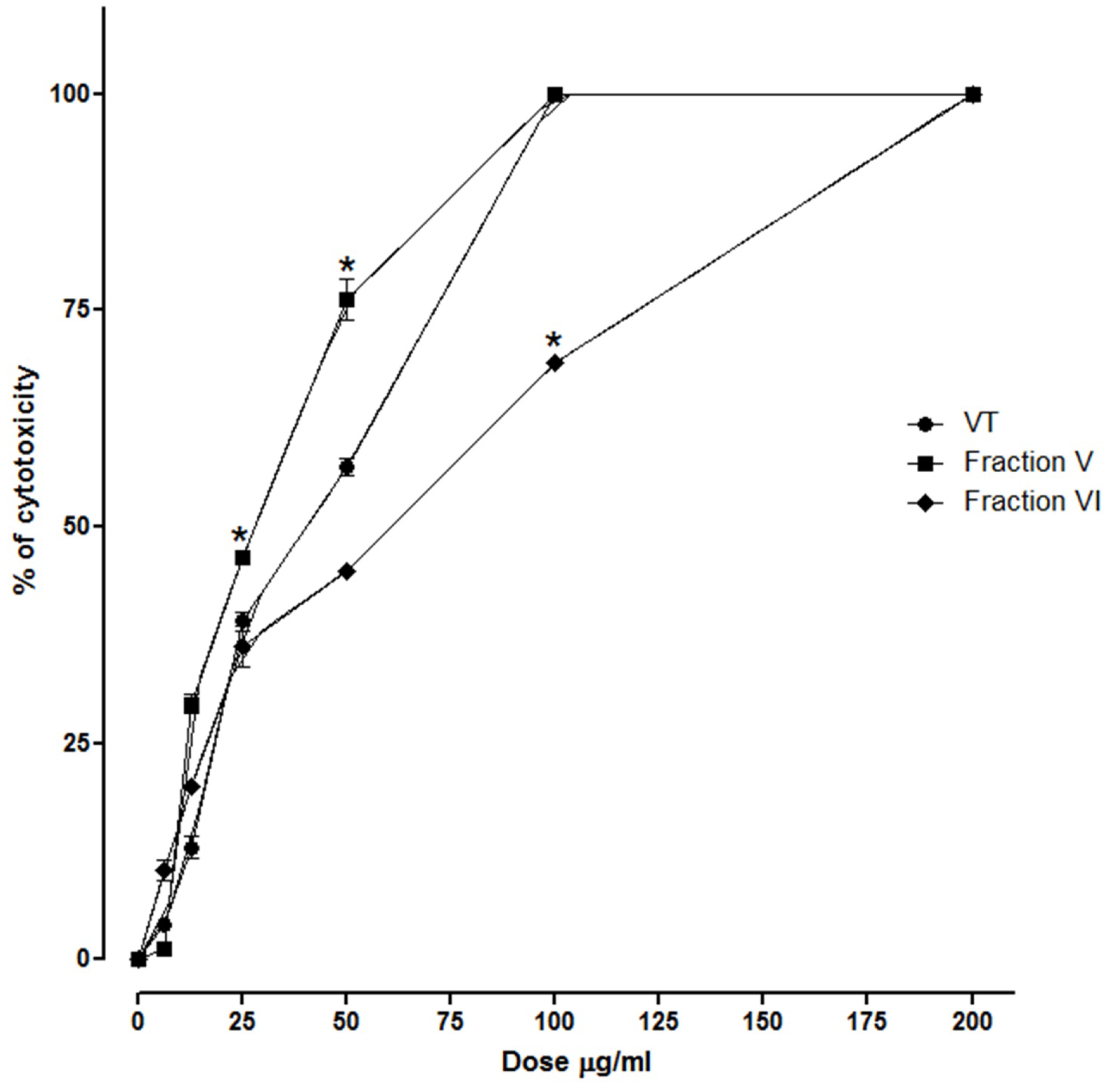
        <p>Analysis of the cytotoxic effect of the whole venom and the different fractions tested showed that fraction V was more cytotoxic than whole venom or fraction VI on PBMC cells (see <xref ref-type="fig" rid="toxins-04-01500-f008">Figure 8</xref>).</p>
        <fig id="toxins-04-01500-f008" position="float">
          <label>Figure 8</label>
          <caption>
            <p>Cytotoxic activity of <italic>B. asper</italic> venom and isolated fractions on human peripheral blood mononuclear cells.VT venom, Fraction V, fraction VI. <bold>*</bold> <italic>p</italic> ≤ 0.05 compared to different doses.</p>
          </caption>
          <graphic xmlns:xlink="http://www.w3.org/1999/xlink" xlink:href="toxins-04-01500-g008.tif"/>
        </fig>
        <p>The cytotoxic activity of venoms and PLA<sub>2</sub>s is a problem in using these in future biomedical applications. However, our results show that the PLA<sub>2</sub> isolated exerts an antimalarial effect at a lower dose than that required to induce cytotoxicity in PBMC and indirect hemolysis.</p>
        <p>Other authors have shown that cytotoxic activity is dependent on serum in suspensions of tumor cells and red blood cells [<xref ref-type="bibr" rid="B43-toxins-04-01500">43</xref>]. In some experiments, we cultured cells with fetal bovine serum 2% (FBS) and inactivated serum or plasma, and in these conditions, the cytotoxic dose was still higher than the antimalarial dose (results not shown).</p>
      </sec>
      <sec>
        <title>2.7. Acute Toxicity</title>
        <p>The LD<sub>50</sub> of the whole venom of <italic>B. asper</italic> was 3566 µg/kg (2561 to 3693), whereas no lethality was observed in mice injected with fractions V and VI at doses as high as 15,000 µg/kg (see <xref ref-type="table" rid="toxins-04-01500-t001">Table 1</xref>). </p>
        <p>The envenoming of <italic>B. asper</italic> induces local and systemic symptoms, such as edema, pain and bleeding, among others, due to the effect of different toxins in the venom, such as PLA<sub>2</sub>, serine proteinases and metalloproteases, among others [<xref ref-type="bibr" rid="B19-toxins-04-01500">19</xref>,<xref ref-type="bibr" rid="B44-toxins-04-01500">44</xref>,<xref ref-type="bibr" rid="B45-toxins-04-01500">45</xref>,<xref ref-type="bibr" rid="B46-toxins-04-01500">46</xref>,<xref ref-type="bibr" rid="B47-toxins-04-01500">47</xref>,<xref ref-type="bibr" rid="B48-toxins-04-01500">48</xref>,<xref ref-type="bibr" rid="B49-toxins-04-01500">49</xref>]. The low toxicity of fraction V and of the PLA<sub>2</sub> homologue isolated from fraction VI compared with the venom indicates their low overall toxicity in mice and reinforces the concept that these fractions are good lead compounds in the search for antimalarial activity. This is in agreement with reports on the use of snake venom PLA<sub>2</sub>s to inhibit microorganisms, such as bacteria and fungi, as well as parasites including <italic>Giardia duodenalis</italic>, <italic>Trypanosoma cruzi</italic>, <italic>Leishmania spp</italic> and <italic>P. falciparum</italic> [<xref ref-type="bibr" rid="B17-toxins-04-01500">17</xref>,<xref ref-type="bibr" rid="B30-toxins-04-01500">30</xref>,<xref ref-type="bibr" rid="B31-toxins-04-01500">31</xref>,<xref ref-type="bibr" rid="B50-toxins-04-01500">50</xref>,<xref ref-type="bibr" rid="B51-toxins-04-01500">51</xref>,<xref ref-type="bibr" rid="B52-toxins-04-01500">52</xref>].</p>
      </sec>
    </sec>
    <sec>
      <title>3. Materials and Methods</title>
      <sec>
        <title>3.1. Venom and Reagents</title>
        <p>The venom was obtained by manual milking of 40 adult specimens from different regions of Colombia held in captivity at the Serpentarium of the University of Antioquia (Medellín, Colombia). Once extracted and pooled, the venoms were centrifuged (3000 rpm, 15 min), and the resulting supernatants were lyophilized and stored at −20 °C until use.</p>
        <p>Acetonitrile (CH<sub>3</sub>CN) and trifluoroacetic acid (CF<sub>3</sub>COOH) HPLC grade were purchased from Fisher Scientific (Loughborough, UK). Histopaque<sup>®</sup>-1077, RPMI-1640 medium culture, Thiazolyl Blue Tretrazolium Bromide (MTT) and dimethyl sulfoxide (DMSO) were purchased from Sigma (Sigma-Aldrich, St Louis, MO, USA). Water for HPLC was deionized to a degree of purity of 17 Ω.</p>
      </sec>
      <sec id="sec3dot2-toxins-04-01500">
        <title>3.2. Venom Fractionation</title>
        <p>PLA<sub>2s</sub> were purified from 50 mg of whole venom of <italic>B. asper</italic> dissolved in phosphate-buffered saline (PBS), pH 7.2, and passed through a CM-Sephadex C<sub>25</sub> ion exchange column (1.8 × 120 cm) at the flow rate 1.0 mL/min on a low-pressure chromatography system (Econo-System, BioRad, Hercules, CA, USA). The resulting fractions were analyzed for their PLA<sub>2</sub> activity and then PLA<sub>2</sub> positive fractions submitted to a reverse phase HPLC (RP-HPLC) (Shimadzu, Model Prominence, Shimadzu Corporation, Kyoto, Japan) in a C<sub>18</sub> column (pore 5 µm, 250 mm × 4.6 mm mark RESTEK Bellefonte, PA, USA) using a linear gradient (0%–100%) acetonitrile (<italic>v</italic>/<italic>v</italic>) in 0.1% (<italic>v</italic>/<italic>v</italic>) trifluoroacetic acid at a flow rate 1.0 mL/min. Finally, fractions were lyophilized and stored at −20 °C until use.</p>
      </sec>
      <sec>
        <title>3.3. Electrophoresis and Molecular Mass Determination</title>
        <p>Protein homogeneity of the obtained fractions were determined by electrophoresis under reducing and non-reducing conditions in SDS-polyacrylamide gel electrophoresis (SDS-PAGE) 15% [<xref ref-type="bibr" rid="B53-toxins-04-01500">53</xref>]. Protein molecular weight was estimated according to a molecular weight markers range of 97.4 to 14.4 kDa (BioRad, Philadelphia, PA, USA). The gels were stained with Coomassie Brilliant Blue G-250. The molecular masses of PLA<sub>2</sub> fractions were confirmed by direct-infusion mass spectrometry in an IonTrap (series 6310, Agilent Technologies, Santa Clara, CA, USA). </p>
      </sec>
      <sec>
        <title>3.4. Protein Iidentification by HPLC-nESI-MS/MS</title>
        <p>The PLA<sub>2</sub>s and PLA<sub>2</sub> homologues isolated from <italic>B. asper</italic> venom (fractions V and VI see results, <xref ref-type="fig" rid="toxins-04-01500-f001">Figure 1</xref>B,C) were digested in solution with trypsin (0.1 ng) at 30 °C (Agilent Technologies, Santa Clara, CA, USA) overnight, according to the manufacturer’s instructions, and injected onto a nano LC-ESI-MS/MS system (Agilent Technologies, Santa Clara, CA, USA) using a nano column C<sub>18</sub> (Agilent Zorbax 300SB-C18, 150 × 0.075mm, 3.5 μm) coupled to a mass spectrometer IonTrap MSD series 6300 (Model 6310, Agilent Technologies, Santa Clara, CA, USA) [<xref ref-type="bibr" rid="B54-toxins-04-01500">54</xref>]. MS/MS mass spectra were obtained in positive mode, dynamic range 200–1200 Da; Electrospray at 2 kV and 230 °C dry temperature, trap drive 200 ms. Charged state deconvolution of the MS/MS spectra were determined using the ChemStation G2070-91126 (Agilent Technologies, Santa Clara, CA, USA). </p>
      </sec>
      <sec>
        <title>3.5. Search Database</title>
        <p>Deconvoluted profile spectra were used to search online the MASCOT [<xref ref-type="bibr" rid="B55-toxins-04-01500">55</xref>] and Spectrum Mill (Agilent Technology, Santa Clara, CA, USA) in the NCBInr database for protein identification. The parameters of the search included digestion with trypsin and Carbamidomethyilation modified (C) as fixed modification. The minimum score for the intensity of each fraction was 50%, monoisotopic mass, mass tolerance of 2.5 Da and a way to search for identity.</p>
      </sec>
      <sec>
        <title>3.6. BLAST Search of the Identified Peptides</title>
        <p>The identified peptides were subjected to a BLAST search [<xref ref-type="bibr" rid="B56-toxins-04-01500">56</xref>] to determine the homology with other PLA<sub>2</sub> family proteins. This homology was performed in BLASTP, the search parameters being non-redundant protein sequence (nr) and a snake organism.</p>
      </sec>
      <sec>
        <title>3.7. Acute Toxicity of the Venom and Fractions</title>
        <p>The Median Lethal Dose (LD<sub>50</sub>) was determined by the Spearman-Karber method (World Health Organization, 1981) using groups of four mice (Swiss-Webster mice strain) injected intraperitoneally (IP) with varying doses of either fractions or whole <italic>B. asper</italic> venom, previously dissolved in 0.5 mL PBS, pH 7.2. Fatalities were recorded within 48 h, and the results were expressed as the average of three repetitions.</p>
      </sec>
      <sec>
        <title>3.8. Cytotoxic Activity</title>
        <p>Peripheral blood mononuclear cells (PBMC) were separated by centrifugation of citrated human blood (400<italic>g</italic>, 30 min) with Histopaque<sup>®</sup>-1077 (Sigma-Aldrich, St Louis, MO, USA), washed with PBS and transferred to 96 well plates at a concentration of 3 × 10<sup>5</sup> cells/well. Cells were cultured with different concentrations of fractions (37 °C, 5% CO<sub>2</sub>) for 24 h. After this time, 40 µL of MTT was added and incubated for 3 h (same conditions as described). The reaction was halted by adding 130 µL of dimethyl sulfoxide (DMSO) and readings were performed in a microplate reader at 420 nm. The 50% cytotoxic dose was calculated by linear regression [<xref ref-type="bibr" rid="B57-toxins-04-01500">57</xref>].</p>
      </sec>
      <sec>
        <title>3.9. Indirect Hemolysis</title>
        <p>This was evaluated following the method that uses agarose gel-erythrocyte-egg yolk [<xref ref-type="bibr" rid="B58-toxins-04-01500">58</xref>,<xref ref-type="bibr" rid="B59-toxins-04-01500">59</xref>]. We estimated the minimum indirect hemolytic dose (MIHD), defined as the dose of venom producing a hemolytic halo of 20 mm in diameter after 20 h. In addition, indirect hemolytic activity was assessed on red blood cells in suspension. For this, different doses of either the whole venom or fractions V and VI were incubated with fresh human red blood cells for 30 min at 37 °C in the presence of 250 µL of inactivated human serum, inactivated human plasma, egg yolk or PBS. Afterwards, samples were centrifuged, and the percentage of lysis was determined by recording the absorbance at 540 nm as an index of released hemoglobin. As a control of 100% hemolysis, 2%Triton X-100 was used. The results were expressed as percentage of lysis, and the venom or toxin concentration producing 100% hemolysis was determined.</p>
      </sec>
      <sec>
        <title>3.10. Cultivation of <italic>Plasmodium falciparum</italic></title>
        <p>Based on the procedure described by Trager and Jensen [<xref ref-type="bibr" rid="B60-toxins-04-01500">60</xref>], parasites were grown at 37 °C in A+ human erythrocytes to a hematocrit of 2% and 3%–6% parasitemia under an atmosphere of 3% CO<sub>2</sub>, 6% O<sub>2</sub> and 91% N<sub>2</sub>. </p>
      </sec>
      <sec>
        <title>3.11. Determination of Percentage of Growth Inhibition of <italic>P. falciparum</italic> by <italic>B. asper</italic> PLA<sub>2</sub> Fractions</title>
        <p>Increasing concentrations of PLA<sub>2</sub> fractions V and VI in complete medium were plated in 96-well plates (100 µL/well) and incubated with asynchronous <italic>P. falciparum</italic> FCB1 (1.5% parasitemia, 4% hematocrit, 100 µL/well). Parasites were incubated as previously described [<xref ref-type="bibr" rid="B60-toxins-04-01500">60</xref>]. After 24 h, 0.5 mCi of <sup>3</sup>H-hypoxanthine was added to the culture, and parasites were cultured for further 24 h at the same conditions. Finally, the plates were freeze-thawed, and parasites were harvested onto filter paper, added to liquid scintillation cocktail and the incorporation of <sup>3</sup>H-hypoxanthine determined in a Microbeta counter 1450 (Wallac, Perkin Elmer, Waltham, MA, USA).</p>
        <p>The percentage of growth inhibition was calculated based on 100% uptake of the 3H-hypoxanthine of controls (parasites in culture medium, incomplete RPMI). Growth inhibition was calculated based on 100% uptake of the 3H-hypoxanthine control in parasites in the absence of PLA<sub>2</sub>s or PLA<sub>2</sub> homologues. The IC<sub>50</sub> values correspond to the venom or toxin concentration required to kill 50% of the parasites within 48 h, and was determined from dose-response curves according to Desjardins <italic>et al</italic>. [<xref ref-type="bibr" rid="B58-toxins-04-01500">58</xref>]. </p>
      </sec>
      <sec>
        <title>3.12. Statistical Analysis</title>
        <p>The results are presented as mean ± S.E.M of three replicates, and experimental differences between means were determined by analysis of variance followed by Dunnett’s test for intragroup comparisons. Significance was set up at <italic>p</italic> &lt; 0.05.</p>
      </sec>
    </sec>
    <sec sec-type="conclusions">
      <title>4. Conclusions</title>
      <p>Our observations suggest that PLA<sub>2</sub>s and PLA<sub>2</sub> homologues present in the venom of <italic>Bothrops asper</italic> represent promising lead compounds in the search for novel antimalarial agents. Further studies should be performed on the identification of the molecular determinants of this activity.</p>
    </sec>
    
  </body>
  <back>
  <notes>
      <title>Conflict of Interest</title>
      <p>The authors declare no conflict of interest. </p>
    </notes>
    <ack>
      <title>Acknowledgements</title>
      <p>The authors thank Carlos Augusto Uribe, for his excellent assistance in the mass spectrometer. This work was supported by the Departamento Administrativo de Ciencia, Tecnología e Innovación (COLCIENCIAS) project number 111540820526, Universidad de Antioquia (Estrategia para la Sostenibilidad de los Grupos 2013–2014) and Universidad Cooperativa de Colombia. This study was performed as partial requirement for the PhD degree of Juan Carlos Quintana Castillo at Universidad de Antioquia.</p>
    </ack>
    <ref-list>
      <title>References</title>
      <ref id="B1-toxins-04-01500">
        <label>1.</label>
        <citation citation-type="web">
          <collab>World Health Organization</collab>
          <article-title>World Malaria Report 2008</article-title>
          <comment>Available online:<ext-link xmlns:xlink="http://www.w3.org/1999/xlink" xlink:href="http://malaria.who.int/wmr2008/malaria2008.pdf" ext-link-type="uri">http://malaria.who.int/wmr2008/malaria2008.pdf</ext-link></comment>
          <access-date>(accessed on 10 August 2012)</access-date>
        </citation>
      </ref>
      <ref id="B2-toxins-04-01500">
        <label>2.</label>
        <citation citation-type="journal">
          <person-group person-group-type="author">
            <name>
              <surname>Breman</surname>
              <given-names>J.G.</given-names>
            </name>
            <name>
              <surname>Alilio</surname>
              <given-names>M.S.</given-names>
            </name>
            <name>
              <surname>Mills</surname>
              <given-names>A.</given-names>
            </name>
          </person-group>
          <article-title>Conquering the intolerable burden of malaria: What’s new, what’s needed: A summary</article-title>
          <source>Am. J. Trop. Med. Hyg.</source>
          <year>2004</year>
          <volume>71</volume>
          <fpage>1</fpage>
          <lpage>15</lpage>
        <pub-id pub-id-type="pmid">15516653</pub-id></citation>
      </ref>
      <ref id="B3-toxins-04-01500">
        <label>3.</label>
        <citation citation-type="web">
          <collab>World Health Organization</collab>
          <article-title>World Malaria Report 2010</article-title>
          <comment>Available online:<ext-link xmlns:xlink="http://www.w3.org/1999/xlink" xlink:href="http://www.who.int/malaria/publications/atoz/artemisinin_resistance_containment_2011.pdf" ext-link-type="uri">http://www.who.int/malaria/publications/atoz/artemisinin_resistance_containment_2011.pdf</ext-link></comment>
          <access-date>(accessed on 13 March 2011)</access-date>
        </citation>
      </ref>
      <ref id="B4-toxins-04-01500">
        <label>4.</label>
        <citation citation-type="journal">
          <person-group person-group-type="author">
            <name>
              <surname>Abdel-Sattar</surname>
              <given-names>E.</given-names>
            </name>
            <name>
              <surname>Maes</surname>
              <given-names>L.</given-names>
            </name>
            <name>
              <surname>Salama</surname>
              <given-names>M.M.</given-names>
            </name>
          </person-group>
          <article-title><italic>In vitro</italic> activities of plant extracts from Saudi Arabia against malaria, leishmaniasis, sleeping sickness and Chagas disease</article-title>
          <source>Phytother. Res.</source>
          <year>2010</year>
          <volume>24</volume>
          <fpage>1322</fpage>
          <lpage>1328</lpage>
          <pub-id pub-id-type="doi">10.1002/ptr.3108</pub-id>
        </citation>
      </ref>
      <ref id="B5-toxins-04-01500">
        <label>5.</label>
        <citation citation-type="journal">
          <person-group person-group-type="author">
            <name>
              <surname>Ayuko</surname>
              <given-names>T.A.</given-names>
            </name>
            <name>
              <surname>Njau</surname>
              <given-names>R.N.</given-names>
            </name>
            <name>
              <surname>Cornelius</surname>
              <given-names>W.</given-names>
            </name>
            <name>
              <surname>Leah</surname>
              <given-names>N.</given-names>
            </name>
            <name>
              <surname>Ndiege</surname>
              <given-names>I.O.</given-names>
            </name>
          </person-group>
          <article-title><italic>In vitro</italic> antiplasmodial activity and toxicity assessment of plant extracts used in traditional malaria therapy in the Lake Victoria Region</article-title>
          <source>Mem. Inst. Oswaldo Cruz.</source>
          <year>2009</year>
          <volume>104</volume>
          <fpage>689</fpage>
          <lpage>694</lpage>
          <pub-id pub-id-type="doi">10.1590/S0074-02762009000500004</pub-id>
        </citation>
      </ref>
      <ref id="B6-toxins-04-01500">
        <label>6.</label>
        <citation citation-type="journal">
          <person-group person-group-type="author">
            <name>
              <surname>Gao</surname>
              <given-names>B.</given-names>
            </name>
            <name>
              <surname>Xu</surname>
              <given-names>J.</given-names>
            </name>
            <name>
              <surname>Rodriguez Mdel</surname>
              <given-names>C.</given-names>
            </name>
            <name>
              <surname>Lanz-Mendoza</surname>
              <given-names>H.</given-names>
            </name>
            <name>
              <surname>Hernandez-Rivas</surname>
              <given-names>R.</given-names>
            </name>
            <name>
              <surname>Du</surname>
              <given-names>W.</given-names>
            </name>
            <name>
              <surname>Zhu</surname>
              <given-names>S.</given-names>
            </name>
          </person-group>
          <article-title>Characterization of two linear cationic antimalarial peptides in the scorpion <italic>Mesobuthus eupeus</italic></article-title>
          <source>Biochimie</source>
          <year>2010</year>
          <volume>92</volume>
          <fpage>350</fpage>
          <lpage>359</lpage>
          <pub-id pub-id-type="doi">10.1016/j.biochi.2010.01.011</pub-id>
        </citation>
      </ref>
      <ref id="B7-toxins-04-01500">
        <label>7.</label>
        <citation citation-type="journal">
          <person-group person-group-type="author">
            <name>
              <surname>Karunamoorthi</surname>
              <given-names>K.</given-names>
            </name>
            <name>
              <surname>Ilango</surname>
              <given-names>K.</given-names>
            </name>
            <name>
              <surname>Murugan</surname>
              <given-names>K.</given-names>
            </name>
          </person-group>
          <article-title>Laboratory evaluation of traditionally used plant-based insect repellent against the malaria vector <italic>Anopheles arabiensis</italic> Patton (Diptera: Culicidae)</article-title>
          <source>Parasitol. Res.</source>
          <year>2010</year>
          <volume>106</volume>
          <fpage>1217</fpage>
          <lpage>1223</lpage>
          <pub-id pub-id-type="doi">10.1007/s00436-010-1797-y</pub-id>
        </citation>
      </ref>
      <ref id="B8-toxins-04-01500">
        <label>8.</label>
        <citation citation-type="journal">
          <person-group person-group-type="author">
            <name>
              <surname>Milhous</surname>
              <given-names>W.K.</given-names>
            </name>
            <name>
              <surname>Weina</surname>
              <given-names>P.J.</given-names>
            </name>
          </person-group>
          <article-title>Plant science. The botanical solution for malaria</article-title>
          <source>Science</source>
          <year>2010</year>
          <volume>327</volume>
          <fpage>279</fpage>
          <lpage>280</lpage>
          <pub-id pub-id-type="doi">10.1126/science.1184780</pub-id>
        </citation>
      </ref>
      <ref id="B9-toxins-04-01500">
        <label>9.</label>
        <citation citation-type="journal">
          <person-group person-group-type="author">
            <name>
              <surname>Muller</surname>
              <given-names>G.C.</given-names>
            </name>
            <name>
              <surname>Beier</surname>
              <given-names>J.C.</given-names>
            </name>
            <name>
              <surname>Traore</surname>
              <given-names>S.F.</given-names>
            </name>
            <name>
              <surname>Toure</surname>
              <given-names>M.B.</given-names>
            </name>
            <name>
              <surname>Traore</surname>
              <given-names>M.M.</given-names>
            </name>
            <name>
              <surname>Bah</surname>
              <given-names>S.</given-names>
            </name>
            <name>
              <surname>Doumbia</surname>
              <given-names>S.</given-names>
            </name>
            <name>
              <surname>Schlein</surname>
              <given-names>Y.</given-names>
            </name>
          </person-group>
          <article-title>Successful field trial of attractive toxic sugar bait (ATSB) plant-spraying methods against malaria vectors in the <italic>Anopheles gambiae</italic> complex in Mali, West Africa</article-title>
          <source>Malar. J.</source>
          <year>2010</year>
          <volume>9</volume>
          <fpage>210</fpage>
          <pub-id pub-id-type="doi">10.1186/1475-2875-9-210</pub-id>
        </citation>
      </ref>
      <ref id="B10-toxins-04-01500">
        <label>10.</label>
        <citation citation-type="book">
          <person-group person-group-type="author">
            <name>
              <surname>Campbell</surname>
              <given-names>J.</given-names>
            </name>
            <name>
              <surname>Lamar</surname>
              <given-names>W.</given-names>
            </name>
          </person-group>
          <source>The Venomous Reptiles of the Western Hemisphere</source>
          <publisher-name>Cornell University Press</publisher-name>
          <publisher-loc>Chichester, Scotland, UK</publisher-loc>
          <year>2004</year>
        </citation>
      </ref>
      <ref id="B11-toxins-04-01500">
        <label>11.</label>
        <citation citation-type="journal">
          <person-group person-group-type="author">
            <name>
              <surname>Alape-Giron</surname>
              <given-names>A.</given-names>
            </name>
            <name>
              <surname>Sanz</surname>
              <given-names>L.</given-names>
            </name>
            <name>
              <surname>Escolano</surname>
              <given-names>J.</given-names>
            </name>
            <name>
              <surname>Flores-Diaz</surname>
              <given-names>M.</given-names>
            </name>
            <name>
              <surname>Madrigal</surname>
              <given-names>M.</given-names>
            </name>
            <name>
              <surname>Sasa</surname>
              <given-names>M.</given-names>
            </name>
            <name>
              <surname>Calvete</surname>
              <given-names>J.J.</given-names>
            </name>
          </person-group>
          <article-title>Snake venomics of the lancehead pitviper Bothrops asper: Geographic, individual, and ontogenetic variations</article-title>
          <source>J. Proteome Res.</source>
          <year>2008</year>
          <volume>7</volume>
          <fpage>3556</fpage>
          <lpage>3571</lpage>
          <pub-id pub-id-type="doi">10.1021/pr800332p</pub-id>
        </citation>
      </ref>
      <ref id="B12-toxins-04-01500">
        <label>12.</label>
        <citation citation-type="journal">
          <person-group person-group-type="author">
            <name>
              <surname>Angulo</surname>
              <given-names>Y.</given-names>
            </name>
            <name>
              <surname>Lomonte</surname>
              <given-names>B.</given-names>
            </name>
          </person-group>
          <article-title>Biochemistry and toxicology of toxins purified from the venom of the snake <italic>Bothrops asper</italic></article-title>
          <source>Toxicon</source>
          <year>2009</year>
          <volume>54</volume>
          <fpage>949</fpage>
          <lpage>957</lpage>
          <pub-id pub-id-type="doi">10.1016/j.toxicon.2008.12.014</pub-id>
        </citation>
      </ref>
      <ref id="B13-toxins-04-01500">
        <label>13.</label>
        <citation citation-type="journal">
          <person-group person-group-type="author">
            <name>
              <surname>Six</surname>
              <given-names>D.A.</given-names>
            </name>
            <name>
              <surname>Dennis</surname>
              <given-names>E.A.</given-names>
            </name>
          </person-group>
          <article-title>The expanding superfamily of phospholipase A(2) enzymes: Classification and characterization</article-title>
          <source>Biochim. Biophys. Acta</source>
          <year>2000</year>
          <volume>1488</volume>
          <fpage>1</fpage>
          <lpage>19</lpage>
          <pub-id pub-id-type="doi">10.1016/S1388-1981(00)00105-0</pub-id>
        </citation>
      </ref>
      <ref id="B14-toxins-04-01500">
        <label>14.</label>
        <citation citation-type="journal">
          <person-group person-group-type="author">
            <name>
              <surname>Talvinen</surname>
              <given-names>K.A.</given-names>
            </name>
            <name>
              <surname>Nevalainen</surname>
              <given-names>T.J.</given-names>
            </name>
          </person-group>
          <article-title>Cloning of a novel phospholipase A<sub>2</sub> from the cnidarian <italic>Adamsia carciniopados</italic></article-title>
          <source>Comp. Biochem. Physiol. B</source>
          <year>2002</year>
          <volume>132</volume>
          <fpage>571</fpage>
          <lpage>578</lpage>
          <pub-id pub-id-type="doi">10.1016/S1096-4959(02)00073-8</pub-id>
        </citation>
      </ref>
      <ref id="B15-toxins-04-01500">
        <label>15.</label>
        <citation citation-type="journal">
          <person-group person-group-type="author">
            <name>
              <surname>Andriao-Escarso</surname>
              <given-names>S.H.</given-names>
            </name>
            <name>
              <surname>Soares</surname>
              <given-names>A.M.</given-names>
            </name>
            <name>
              <surname>Rodrigues</surname>
              <given-names>V.M.</given-names>
            </name>
            <name>
              <surname>Angulo</surname>
              <given-names>Y.</given-names>
            </name>
            <name>
              <surname>Diaz</surname>
              <given-names>C.</given-names>
            </name>
            <name>
              <surname>Lomonte</surname>
              <given-names>B.</given-names>
            </name>
            <name>
              <surname>Gutierrez</surname>
              <given-names>J.M.</given-names>
            </name>
            <name>
              <surname>Giglio</surname>
              <given-names>J.R.</given-names>
            </name>
          </person-group>
          <article-title>Myotoxic phospholipases A(2) in bothrops snake venoms: Effect of chemical modifications on the enzymatic and pharmacological properties of bothropstoxins from <italic>Bothrops jararacussu</italic></article-title>
          <source>Biochimie</source>
          <year>2000</year>
          <volume>82</volume>
          <fpage>755</fpage>
          <lpage>763</lpage>
          <pub-id pub-id-type="doi">10.1016/S0300-9084(00)01150-0</pub-id>
        </citation>
      </ref>
      <ref id="B16-toxins-04-01500">
        <label>16.</label>
        <citation citation-type="journal">
          <person-group person-group-type="author">
            <name>
              <surname>Barbosa</surname>
              <given-names>P.S.</given-names>
            </name>
            <name>
              <surname>Martins</surname>
              <given-names>A.M.</given-names>
            </name>
            <name>
              <surname>Havt</surname>
              <given-names>A.</given-names>
            </name>
            <name>
              <surname>Toyama</surname>
              <given-names>D.O.</given-names>
            </name>
            <name>
              <surname>Evangelista</surname>
              <given-names>J.S.</given-names>
            </name>
            <name>
              <surname>Ferreira</surname>
              <given-names>D.P.</given-names>
            </name>
            <name>
              <surname>Joazeiro</surname>
              <given-names>P.P.</given-names>
            </name>
            <name>
              <surname>Beriam</surname>
              <given-names>L.O.</given-names>
            </name>
            <name>
              <surname>Toyama</surname>
              <given-names>M.H.</given-names>
            </name>
            <name>
              <surname>Fonteles</surname>
              <given-names>M.C.</given-names>
            </name>
            <etal/>
          </person-group>
          <article-title>Renal and antibacterial effects induced by myotoxin I and II isolated from <italic>Bothrops jararacussu</italic> venom</article-title>
          <source>Toxicon</source>
          <year>2005</year>
          <volume>46</volume>
          <fpage>376</fpage>
          <lpage>386</lpage>
          <pub-id pub-id-type="doi">10.1016/j.toxicon.2005.04.024</pub-id>
        </citation>
      </ref>
      <ref id="B17-toxins-04-01500">
        <label>17.</label>
        <citation citation-type="journal">
          <person-group person-group-type="author">
            <name>
              <surname>Costa Torres</surname>
              <given-names>A.F.</given-names>
            </name>
            <name>
              <surname>Dantas</surname>
              <given-names>R.T.</given-names>
            </name>
            <name>
              <surname>Toyama</surname>
              <given-names>M.H.</given-names>
            </name>
            <name>
              <surname>Diz Filho</surname>
              <given-names>E.</given-names>
            </name>
            <name>
              <surname>Zara</surname>
              <given-names>F.J.</given-names>
            </name>
            <name>
              <surname>Rodrigues de Queiroz</surname>
              <given-names>M.G.</given-names>
            </name>
            <name>
              <surname>Pinto Nogueira</surname>
              <given-names>N.A.</given-names>
            </name>
            <name>
              <surname>Rosa de Oliveira</surname>
              <given-names>M.</given-names>
            </name>
            <name>
              <surname>de Oliveira Toyama</surname>
              <given-names>D.</given-names>
            </name>
            <name>
              <surname>Monteiro</surname>
              <given-names>H.S.</given-names>
            </name>
            <etal/>
          </person-group>
          <article-title>Antibacterial and antiparasitic effects of <italic>Bothrops marajoensis</italic> venom and its fractions: Phospholipase A<sub>2</sub> and <sc>L</sc>-amino acid oxidase</article-title>
          <source>Toxicon</source>
          <year>2010</year>
          <volume>55</volume>
          <fpage>795</fpage>
          <lpage>804</lpage>
          <pub-id pub-id-type="doi">10.1016/j.toxicon.2009.11.013</pub-id>
        </citation>
      </ref>
      <ref id="B18-toxins-04-01500">
        <label>18.</label>
        <citation citation-type="journal">
          <person-group person-group-type="author">
            <name>
              <surname>Evangelista</surname>
              <given-names>I.L.</given-names>
            </name>
            <name>
              <surname>Martins</surname>
              <given-names>A.M.</given-names>
            </name>
            <name>
              <surname>Nascimento</surname>
              <given-names>N.R.</given-names>
            </name>
            <name>
              <surname>Havt</surname>
              <given-names>A.</given-names>
            </name>
            <name>
              <surname>Evangelista</surname>
              <given-names>J.S.</given-names>
            </name>
            <name>
              <surname>de Noroes</surname>
              <given-names>T.B.</given-names>
            </name>
            <name>
              <surname>Toyama</surname>
              <given-names>M.H.</given-names>
            </name>
            <name>
              <surname>Diz-Filho</surname>
              <given-names>E.B.</given-names>
            </name>
            <name>
              <surname>toyama Dde</surname>
              <given-names>O.</given-names>
            </name>
            <name>
              <surname>Fonteles</surname>
              <given-names>M.C.</given-names>
            </name>
            <etal/>
          </person-group>
          <article-title>Renal and cardiovascular effects of <italic>Bothrops marajoensis</italic> venom and phospholipase A<sub>2</sub></article-title>
          <source>Toxicon</source>
          <year>2010</year>
          <volume>55</volume>
          <fpage>1061</fpage>
          <lpage>1070</lpage>
          <pub-id pub-id-type="doi">10.1016/j.toxicon.2009.12.004</pub-id>
        </citation>
      </ref>
      <ref id="B19-toxins-04-01500">
        <label>19.</label>
        <citation citation-type="journal">
          <person-group person-group-type="author">
            <name>
              <surname>Gutierrez</surname>
              <given-names>J.M.</given-names>
            </name>
            <name>
              <surname>Lomonte</surname>
              <given-names>B.</given-names>
            </name>
          </person-group>
          <article-title>Phospholipase A<sub>2</sub> myotoxins from <italic>Bothrops</italic> snake venoms</article-title>
          <source>Toxicon</source>
          <year>1995</year>
          <volume>33</volume>
          <fpage>1405</fpage>
          <lpage>1424</lpage>
          <pub-id pub-id-type="doi">10.1016/0041-0101(95)00085-Z</pub-id>
        </citation>
      </ref>
      <ref id="B20-toxins-04-01500">
        <label>20.</label>
        <citation citation-type="journal">
          <person-group person-group-type="author">
            <name>
              <surname>Harris</surname>
              <given-names>J.B.</given-names>
            </name>
            <name>
              <surname>Grubb</surname>
              <given-names>B.D.</given-names>
            </name>
            <name>
              <surname>Maltin</surname>
              <given-names>C.A.</given-names>
            </name>
            <name>
              <surname>Dixon</surname>
              <given-names>R.</given-names>
            </name>
          </person-group>
          <article-title>The neurotoxicity of the venom phospholipases A(2), notexin and taipoxin</article-title>
          <source>Exp. Neurol.</source>
          <year>2000</year>
          <volume>161</volume>
          <fpage>517</fpage>
          <lpage>526</lpage>
          <pub-id pub-id-type="doi">10.1006/exnr.1999.7275</pub-id>
        </citation>
      </ref>
      <ref id="B21-toxins-04-01500">
        <label>21.</label>
        <citation citation-type="journal">
          <person-group person-group-type="author">
            <name>
              <surname>Kini</surname>
              <given-names>R.M.</given-names>
            </name>
          </person-group>
          <article-title>Excitement ahead: Structure, function and mechanism of snake venom phospholipase A<sub>2</sub> enzymes</article-title>
          <source>Toxicon</source>
          <year>2003</year>
          <volume>42</volume>
          <fpage>827</fpage>
          <lpage>840</lpage>
          <pub-id pub-id-type="doi">10.1016/j.toxicon.2003.11.002</pub-id>
        </citation>
      </ref>
      <ref id="B22-toxins-04-01500">
        <label>22.</label>
        <citation citation-type="journal">
          <person-group person-group-type="author">
            <name>
              <surname>Kini</surname>
              <given-names>R.M.</given-names>
            </name>
            <name>
              <surname>Evans</surname>
              <given-names>H.J.</given-names>
            </name>
          </person-group>
          <article-title>Structure-function relationships of phospholipases. The anticoagulant region of phospholipases A<sub>2</sub></article-title>
          <source> J. Biol. Chem.</source>
          <year>1987</year>
          <volume>262</volume>
          <fpage>14402</fpage>
          <lpage>14407</lpage>
        <pub-id pub-id-type="pmid">3117784</pub-id></citation>
      </ref>
      <ref id="B23-toxins-04-01500">
        <label>23.</label>
        <citation citation-type="journal">
          <person-group person-group-type="author">
            <name>
              <surname>Landucci</surname>
              <given-names>E.C.</given-names>
            </name>
            <name>
              <surname>de Castro</surname>
              <given-names>R.C.</given-names>
            </name>
            <name>
              <surname>Toyama</surname>
              <given-names>M.</given-names>
            </name>
            <name>
              <surname>Giglio</surname>
              <given-names>J.R.</given-names>
            </name>
            <name>
              <surname>Marangoni</surname>
              <given-names>S.</given-names>
            </name>
            <name>
              <surname>de Nucci</surname>
              <given-names>G.</given-names>
            </name>
            <name>
              <surname> Antunes</surname>
              <given-names>E.</given-names>
            </name>
          </person-group>
          <article-title>Inflammatory oedema induced by the lys-49 phospholipase A(2) homologue piratoxin-i in the rat and rabbit. Effect of polyanions and p-bromophenacyl bromid</article-title>
          <source>Biochem. Pharmacol.</source>
          <year>2000</year>
          <volume>59</volume>
          <fpage>1289</fpage>
          <lpage>1294</lpage>
        <pub-id pub-id-type="doi">10.1016/S0006-2952(00)00248-3</pub-id><pub-id pub-id-type="pmid">10736429</pub-id></citation>
      </ref>
      <ref id="B24-toxins-04-01500">
        <label>24.</label>
        <citation citation-type="journal">
          <person-group person-group-type="author">
            <name>
              <surname>Murakami</surname>
              <given-names>M.T.</given-names>
            </name>
            <name>
              <surname>Arruda</surname>
              <given-names>E.Z.</given-names>
            </name>
            <name>
              <surname>Melo</surname>
              <given-names>P.A.</given-names>
            </name>
            <name>
              <surname>Martinez</surname>
              <given-names>A.B.</given-names>
            </name>
            <name>
              <surname>Calil-Elias</surname>
              <given-names>S.</given-names>
            </name>
            <name>
              <surname>Tomaz</surname>
              <given-names>M.A.</given-names>
            </name>
            <name>
              <surname>Lomonte</surname>
              <given-names>B.</given-names>
            </name>
            <name>
              <surname>Gutierrez</surname>
              <given-names>J.M.</given-names>
            </name>
            <name>
              <surname>Arni</surname>
              <given-names>R.K.</given-names>
            </name>
          </person-group>
          <article-title>Inhibition of myotoxic activity of <italic>Bothrops asper</italic> myotoxin II by the anti-trypanosomal drug suramin</article-title>
          <source>J. Mol. Biol.</source>
          <year>2005</year>
          <volume>350</volume>
          <fpage>416</fpage>
          <lpage>426</lpage>
          <pub-id pub-id-type="doi">10.1016/j.jmb.2005.04.072</pub-id>
        </citation>
      </ref>
      <ref id="B25-toxins-04-01500">
        <label>25.</label>
        <citation citation-type="journal">
          <person-group person-group-type="author">
            <name>
              <surname>Quintana</surname>
              <given-names>J.C.</given-names>
            </name>
            <name>
              <surname>Chacon</surname>
              <given-names>A.M.</given-names>
            </name>
            <name>
              <surname>Vargas</surname>
              <given-names>L.</given-names>
            </name>
            <name>
              <surname>Segura</surname>
              <given-names>C.</given-names>
            </name>
            <name>
              <surname>Gutierrez</surname>
              <given-names>J.M.</given-names>
            </name>
            <name>
              <surname>Alarcon</surname>
              <given-names>J.C.</given-names>
            </name>
          </person-group>
          <article-title>Antiplasmodial effect of the venom of <italic>Crotalus durissus cumanensis</italic>, crotoxin complex and Crotoxin B</article-title>
          <source>Acta Trop.</source>
          <year>2012</year>
          <volume>124</volume>
          <fpage>126</fpage>
          <lpage>132</lpage>
          <pub-id pub-id-type="doi">10.1016/j.actatropica.2012.07.003</pub-id>
        </citation>
      </ref>
      <ref id="B26-toxins-04-01500">
        <label>26.</label>
        <citation citation-type="journal">
          <person-group person-group-type="author">
            <name>
              <surname>Deregnaucourt</surname>
              <given-names>C.</given-names>
            </name>
            <name>
              <surname>Schrevel</surname>
              <given-names>J.</given-names>
            </name>
          </person-group>
          <article-title>Bee venom phospholipase A2 induces stage-specific growth arrest of the intraerythrocytic Plasmodium falciparum via modifications of human serum components</article-title>
          <source>J. Biol. Chem.</source>
          <year>2000</year>
          <volume>275</volume>
          <fpage>39973</fpage>
          <lpage>39980</lpage>
          <pub-id pub-id-type="doi">10.1074/jbc.M006712200</pub-id>
        </citation>
      </ref>
      <ref id="B27-toxins-04-01500">
        <label>27.</label>
        <citation citation-type="journal">
          <person-group person-group-type="author">
            <name>
              <surname>Guillaume</surname>
              <given-names>C.</given-names>
            </name>
            <name>
              <surname>Deregnaucourt</surname>
              <given-names>C.</given-names>
            </name>
            <name>
              <surname>Clavey</surname>
              <given-names>V.</given-names>
            </name>
            <name>
              <surname>Schrevel</surname>
              <given-names>J.</given-names>
            </name>
          </person-group>
          <article-title>Anti-<italic>Plasmodium</italic> properties of group IA, IB, IIA and III secreted phospholipases A<sub>2</sub> are serum-dependent</article-title>
          <source>Toxicon</source>
          <year>2004</year>
          <volume>43</volume>
          <fpage>311</fpage>
          <lpage>318</lpage>
          <pub-id pub-id-type="doi">10.1016/j.toxicon.2004.01.006</pub-id>
        </citation>
      </ref>
      <ref id="B28-toxins-04-01500">
        <label>28.</label>
        <citation citation-type="journal">
          <person-group person-group-type="author">
            <name>
              <surname>Passero</surname>
              <given-names>L.F.</given-names>
            </name>
            <name>
              <surname>Laurenti</surname>
              <given-names>M.D.</given-names>
            </name>
            <name>
              <surname>Tomokane</surname>
              <given-names>T.Y.</given-names>
            </name>
            <name>
              <surname>Corbett</surname>
              <given-names>C.E.</given-names>
            </name>
            <name>
              <surname>Toyama</surname>
              <given-names>M.H.</given-names>
            </name>
          </person-group>
          <article-title>The effect of phospholipase A2 from <italic>Crotalus durissus collilineatus</italic> on <italic>Leishmania (Leishmania) amazonensis</italic> infection</article-title>
          <source>Parasitol. Res.</source>
          <year>2008</year>
          <volume>102</volume>
          <fpage>1025</fpage>
          <lpage>1033</lpage>
          <pub-id pub-id-type="doi">10.1007/s00436-007-0871-6</pub-id>
        </citation>
      </ref>
      <ref id="B29-toxins-04-01500">
        <label>29.</label>
        <citation citation-type="journal">
          <person-group person-group-type="author">
            <name>
              <surname>Lomonte</surname>
              <given-names>B.</given-names>
            </name>
            <name>
              <surname>Rangel</surname>
              <given-names>J.</given-names>
            </name>
          </person-group>
          <article-title>Snake venom Lys49 myotoxins: From phospholipases A(2) to non-enzymatic membrane disruptors</article-title>
          <source>Toxicon</source>
          <year>2012</year>
          <volume>60</volume>
          <fpage>520</fpage>
          <lpage>530</lpage>
          <pub-id pub-id-type="doi">10.1016/j.toxicon.2012.02.007</pub-id>
        </citation>
      </ref>
      <ref id="B30-toxins-04-01500">
        <label>30.</label>
        <citation citation-type="journal">
          <person-group person-group-type="author">
            <name>
              <surname>Nuñez</surname>
              <given-names>V.</given-names>
            </name>
            <name>
              <surname>Arce</surname>
              <given-names>V.</given-names>
            </name>
            <name>
              <surname>Gutierrez</surname>
              <given-names>J.M.</given-names>
            </name>
            <name>
              <surname>Lomonte</surname>
              <given-names>B.</given-names>
            </name>
          </person-group>
          <article-title>Structural and functional characterization of myotoxin I, a Lys49 phospholipase A<sub>2</sub> homologue from the venom of the snake <italic>Bothrops atrox</italic></article-title>
          <source>Toxicon</source>
          <year>2004</year>
          <volume>44</volume>
          <fpage>91</fpage>
          <lpage>101</lpage>
          <pub-id pub-id-type="doi">10.1016/j.toxicon.2004.04.013</pub-id>
        </citation>
      </ref>
      <ref id="B31-toxins-04-01500">
        <label>31.</label>
        <citation citation-type="journal">
          <person-group person-group-type="author">
            <name>
              <surname>Santamaria</surname>
              <given-names>C.</given-names>
            </name>
            <name>
              <surname>Larios</surname>
              <given-names>S.</given-names>
            </name>
            <name>
              <surname>Quiros</surname>
              <given-names>S.</given-names>
            </name>
            <name>
              <surname>Pizarro-Cerda</surname>
              <given-names>J.</given-names>
            </name>
            <name>
              <surname>Gorvel</surname>
              <given-names>J.P.</given-names>
            </name>
            <name>
              <surname>Lomonte</surname>
              <given-names>B.</given-names>
            </name>
            <name>
              <surname>Moreno</surname>
              <given-names>E.</given-names>
            </name>
          </person-group>
          <article-title>Bactericidal and antiendotoxic properties of short cationic peptides derived from a snake venom Lys49 phospholipase A<sub>2</sub></article-title>
          <source>Antimicrob. Agents Chemother.</source>
          <year>2005</year>
          <volume>49</volume>
          <fpage>1340</fpage>
          <lpage>1345</lpage>
          <pub-id pub-id-type="doi">10.1128/AAC.49.4.1340-1345.2005</pub-id>
        </citation>
      </ref>
      <ref id="B32-toxins-04-01500">
        <label>32.</label>
        <citation citation-type="journal">
          <person-group person-group-type="author">
            <name>
              <surname>Hill</surname>
              <given-names>D.A.</given-names>
            </name>
            <name>
              <surname>Desai</surname>
              <given-names>S.A.</given-names>
            </name>
          </person-group>
          <article-title>Malaria parasite mutants with altered erythrocyte permeability: A new drug resistance mechanism and important molecular tool</article-title>
          <source>Future Microbiol.</source>
          <year>2010</year>
          <volume>5</volume>
          <fpage>81</fpage>
          <lpage>97</lpage>
          <pub-id pub-id-type="doi">10.2217/fmb.09.109</pub-id>
        </citation>
      </ref>
      <ref id="B33-toxins-04-01500">
        <label>33.</label>
        <citation citation-type="book">
          <person-group person-group-type="author">
            <name>
              <surname>Vial</surname>
              <given-names>H.J.</given-names>
            </name>
            <name>
              <surname>Ancelin</surname>
              <given-names>M.L.</given-names>
            </name>
          </person-group>
          <article-title>Malarial lipids</article-title>
          <source>Malaria: Parasite Biology, Pathogenesis, and Protection</source>
          <person-group person-group-type="editor">
            <name>
              <surname>Sherman</surname>
              <given-names>I.W.</given-names>
            </name>
          </person-group>
          <publisher-name>ASM Press</publisher-name>
          <publisher-loc>Washington, DC, USA</publisher-loc>
          <year>1998</year>
          <fpage>159</fpage>
          <lpage>175</lpage>
        </citation>
      </ref>
      <ref id="B34-toxins-04-01500">
        <label>34.</label>
        <citation citation-type="journal">
          <person-group person-group-type="author">
            <name>
              <surname>Moll</surname>
              <given-names>G.N.</given-names>
            </name>
            <name>
              <surname>Vial</surname>
              <given-names>H.J.</given-names>
            </name>
            <name>
              <surname>van der Wiele</surname>
              <given-names>F.C.</given-names>
            </name>
            <name>
              <surname>Ancelin</surname>
              <given-names>M.L.</given-names>
            </name>
            <name>
              <surname>Roelofsen</surname>
              <given-names>B.</given-names>
            </name>
            <name>
              <surname>Slotboom</surname>
              <given-names>A.J.</given-names>
            </name>
            <name>
              <surname>de Haas</surname>
              <given-names>G.H.</given-names>
            </name>
            <name>
              <surname>van Deenen</surname>
              <given-names>L.L.</given-names>
            </name>
            <name>
              <surname>Op den Kamp</surname>
              <given-names>J.A.</given-names>
            </name>
          </person-group>
          <article-title>Selective elimination of malaria infected erythrocytes by a modified phospholipase A<sub>2</sub> <italic>in vitro</italic></article-title>
          <source>Biochim. Biophys. Acta</source>
          <year>1990</year>
          <volume>1024</volume>
          <fpage>189</fpage>
          <lpage>192</lpage>
          <pub-id pub-id-type="doi">10.1016/0005-2736(90)90224-C</pub-id>
        </citation>
      </ref>
      <ref id="B35-toxins-04-01500">
        <label>35.</label>
        <citation citation-type="journal">
          <person-group person-group-type="author">
            <name>
              <surname>Lizano</surname>
              <given-names>S.</given-names>
            </name>
            <name>
              <surname>Lambeau</surname>
              <given-names>G.</given-names>
            </name>
            <name>
              <surname>Lazdunski</surname>
              <given-names>M.</given-names>
            </name>
          </person-group>
          <article-title>Cloning and cDNA sequence analysis of Lys(49) and Asp(49) basic phospholipase A(2) myotoxin isoforms from <italic>Bothrops asper</italic></article-title>
          <source>Int. J. Biochem. Cell Biol.</source>
          <year>2001</year>
          <volume>33</volume>
          <fpage>127</fpage>
          <lpage>132</lpage>
          <pub-id pub-id-type="doi">10.1016/S1357-2725(00)00073-X</pub-id>
        </citation>
      </ref>
      <ref id="B36-toxins-04-01500">
        <label>36.</label>
        <citation citation-type="journal">
          <person-group person-group-type="author">
            <name>
              <surname>Soares</surname>
              <given-names>A.M.</given-names>
            </name>
            <name>
              <surname>Rodrigues</surname>
              <given-names>V.M.</given-names>
            </name>
            <name>
              <surname>Homsi-Brandeburgo</surname>
              <given-names>M.I.</given-names>
            </name>
            <name>
              <surname>Toyama</surname>
              <given-names>M.H.</given-names>
            </name>
            <name>
              <surname>Lombardi</surname>
              <given-names>F.R.</given-names>
            </name>
            <name>
              <surname>Arni</surname>
              <given-names>R.K.</given-names>
            </name>
            <name>
              <surname>Giglio</surname>
              <given-names>J.R.</given-names>
            </name>
          </person-group>
          <article-title>A rapid procedure for the isolation of the Lys-49 myotoxin II from <italic>Bothrops moojeni</italic> (caissaca) venom: Biochemical characterization, crystallization, myotoxic and edematogenic activity</article-title>
          <source>Toxicon</source>
          <year>1998</year>
          <volume>36</volume>
          <fpage>503</fpage>
          <lpage>514</lpage>
          <pub-id pub-id-type="doi">10.1016/S0041-0101(97)00133-5</pub-id>
        </citation>
      </ref>
      <ref id="B37-toxins-04-01500">
        <label>37.</label>
        <citation citation-type="journal">
          <person-group person-group-type="author">
            <name>
              <surname>Diaz</surname>
              <given-names>C.</given-names>
            </name>
            <name>
              <surname>Lomonte</surname>
              <given-names>B.</given-names>
            </name>
            <name>
              <surname>Zamudio</surname>
              <given-names>F.</given-names>
            </name>
            <name>
              <surname>Gutierrez</surname>
              <given-names>J.M.</given-names>
            </name>
          </person-group>
          <article-title>Purification and characterization of myotoxin IV, a phospholipase A2 variant, from <italic>Bothrops asper</italic> snake venom</article-title>
          <source>Nat. Toxins</source>
          <year>1995</year>
          <volume>3</volume>
          <fpage>26</fpage>
          <lpage>31</lpage>
          <pub-id pub-id-type="doi">10.1002/nt.2620030107</pub-id>
        </citation>
      </ref>
      <ref id="B38-toxins-04-01500">
        <label>38.</label>
        <citation citation-type="journal">
          <person-group person-group-type="author">
            <name>
              <surname>Arni</surname>
              <given-names>R.K.</given-names>
            </name>
            <name>
              <surname>Ward</surname>
              <given-names>R.J.</given-names>
            </name>
            <name>
              <surname>Gutierrez</surname>
              <given-names>J.M.</given-names>
            </name>
            <name>
              <surname>Tulinsky</surname>
              <given-names>A.</given-names>
            </name>
          </person-group>
          <article-title>Structure of a calcium-independent phospholipase-like myotoxic protein from <italic>Bothrops asper</italic> venom</article-title>
          <source>Acta Crystallogr. D</source>
          <year>1995</year>
          <volume>51</volume>
          <fpage>311</fpage>
          <lpage>317</lpage>
          <pub-id pub-id-type="doi">10.1107/S0907444994011455</pub-id>
        </citation>
      </ref>
      <ref id="B39-toxins-04-01500">
        <label>39.</label>
        <citation citation-type="journal">
          <person-group person-group-type="author">
            <name>
              <surname>Rodrigues</surname>
              <given-names>V.M.</given-names>
            </name>
            <name>
              <surname>Soares</surname>
              <given-names>A.M.</given-names>
            </name>
            <name>
              <surname>Mancin</surname>
              <given-names>A.C.</given-names>
            </name>
            <name>
              <surname>Fontes</surname>
              <given-names>M.R.</given-names>
            </name>
            <name>
              <surname>Homsi-Brandeburgo</surname>
              <given-names>M.I.</given-names>
            </name>
            <name>
              <surname>Giglio</surname>
              <given-names>J.R.</given-names>
            </name>
          </person-group>
          <article-title>Geographic variations in the composition of myotoxins from <italic>Bothrops neuwiedi</italic> snake venoms: Biochemical characterization and biological activity</article-title>
          <source>Comp. Biochem. Physiol. A</source>
          <year>1998</year>
          <volume>121</volume>
          <fpage>215</fpage>
          <lpage>222</lpage>
          <pub-id pub-id-type="doi">10.1016/S1095-6433(98)10136-8</pub-id>
        </citation>
      </ref>
      <ref id="B40-toxins-04-01500">
        <label>40.</label>
        <citation citation-type="journal">
          <person-group person-group-type="author">
            <name>
              <surname>Rigden</surname>
              <given-names>D.J.</given-names>
            </name>
            <name>
              <surname>Hwa</surname>
              <given-names>L.W.</given-names>
            </name>
            <name>
              <surname>Marangoni</surname>
              <given-names>S.</given-names>
            </name>
            <name>
              <surname>Toyama</surname>
              <given-names>M.H.</given-names>
            </name>
            <name>
              <surname>Polikarpov</surname>
              <given-names>I.</given-names>
            </name>
          </person-group>
          <article-title>The structure of the D49 phospholipase A2 piratoxin III from <italic>Bothrops pirajai</italic> reveals unprecedented structural displacement of the calcium-binding loop: Possiblerelationship to cooperative substrate binding</article-title>
          <source>Acta Crystallogr. D</source>
          <year>2003</year>
          <volume>59</volume>
          <fpage>255</fpage>
          <lpage>262</lpage>
          <pub-id pub-id-type="doi">10.1107/S0907444902021467</pub-id>
        </citation>
      </ref>
      <ref id="B41-toxins-04-01500">
        <label>41.</label>
        <citation citation-type="journal">
          <person-group person-group-type="author">
            <name>
              <surname>Higuchi</surname>
              <given-names>D.A.</given-names>
            </name>
            <name>
              <surname>Barbosa</surname>
              <given-names>C.M.</given-names>
            </name>
            <name>
              <surname>Bincoletto</surname>
              <given-names>C.</given-names>
            </name>
            <name>
              <surname>Chagas</surname>
              <given-names>J.R.</given-names>
            </name>
            <name>
              <surname>Magalhaes</surname>
              <given-names>A.</given-names>
            </name>
            <name>
              <surname>Richardson</surname>
              <given-names>M.</given-names>
            </name>
            <name>
              <surname>Sanchez</surname>
              <given-names>E.F.</given-names>
            </name>
            <name>
              <surname>Pesquero</surname>
              <given-names>J.B.</given-names>
            </name>
            <name>
              <surname>Araujo</surname>
              <given-names>R.C.</given-names>
            </name>
            <name>
              <surname>Pesquero</surname>
              <given-names>J.L.</given-names>
            </name>
          </person-group>
          <article-title>Purification and partial characterization of two phospholipases A2 from <italic>Bothrops leucurus</italic> (white-tailed-jararaca) snake venom</article-title>
          <source>Biochimie</source>
          <year>2007</year>
          <volume>89</volume>
          <fpage>319</fpage>
          <lpage>328</lpage>
          <pub-id pub-id-type="doi">10.1016/j.biochi.2006.10.010</pub-id>
        </citation>
      </ref>
      <ref id="B42-toxins-04-01500">
        <label>42.</label>
        <citation citation-type="journal">
          <person-group person-group-type="author">
            <name>
              <surname>Ponce-Soto</surname>
              <given-names>L.A.</given-names>
            </name>
            <name>
              <surname>Lomonte</surname>
              <given-names>B.</given-names>
            </name>
            <name>
              <surname>Gutierrez</surname>
              <given-names>J.M.</given-names>
            </name>
            <name>
              <surname>Rodrigues-Simioni</surname>
              <given-names>L.</given-names>
            </name>
            <name>
              <surname>Novello</surname>
              <given-names>J.C.</given-names>
            </name>
            <name>
              <surname>Marangoni</surname>
              <given-names>S.</given-names>
            </name>
          </person-group>
          <article-title>Structural and functional properties of BaTX, a new Lys49 phospholipase A2 homologue isolated from the venom of the snake <italic>Bothrops alternatus</italic></article-title>
          <source>Biochim. Biophys. Acta</source>
          <year>2007</year>
          <volume>1770</volume>
          <fpage>585</fpage>
          <lpage>593</lpage>
          <pub-id pub-id-type="doi">10.1016/j.bbagen.2006.11.015</pub-id>
        </citation>
      </ref>
      <ref id="B43-toxins-04-01500">
        <label>43.</label>
        <citation citation-type="journal">
          <person-group person-group-type="author">
            <name>
              <surname>Vadas</surname>
              <given-names>P.</given-names>
            </name>
          </person-group>
          <article-title>Group II phospholipases A<sub>2</sub> are indirectly cytolytic in the presence of exogenous phospholipid</article-title>
          <source>Biochim. Biophys. Acta</source>
          <year>1997</year>
          <volume>1346</volume>
          <fpage>193</fpage>
          <lpage>197</lpage>
          <pub-id pub-id-type="doi">10.1016/S0005-2760(97)00029-5</pub-id>
        </citation>
      </ref>
      <ref id="B44-toxins-04-01500">
        <label>44.</label>
        <citation citation-type="journal">
          <person-group person-group-type="author">
            <name>
              <surname>Otero</surname>
              <given-names>R.</given-names>
            </name>
            <name>
              <surname>Nunez</surname>
              <given-names>V.</given-names>
            </name>
            <name>
              <surname>Osorio</surname>
              <given-names>R.G.</given-names>
            </name>
            <name>
              <surname>Gutierrez</surname>
              <given-names>J.M.</given-names>
            </name>
            <name>
              <surname>Giraldo</surname>
              <given-names>C.A.</given-names>
            </name>
            <name>
              <surname>Posada</surname>
              <given-names>L.E.</given-names>
            </name>
          </person-group>
          <article-title>Ability of six Latin American antivenoms to neutralize the venom of mapana equis (<italic>Bothrops atrox</italic>) from Antioquia and Choco (Colombia)</article-title>
          <source>Toxicon</source>
          <year>1995</year>
          <volume>33</volume>
          <fpage>809</fpage>
          <lpage>815</lpage>
          <pub-id pub-id-type="doi">10.1016/0041-0101(95)00009-B</pub-id>
        </citation>
      </ref>
      <ref id="B45-toxins-04-01500">
        <label>45.</label>
        <citation citation-type="journal">
          <person-group person-group-type="author">
            <name>
              <surname>Otero-Patino</surname>
              <given-names>R.</given-names>
            </name>
          </person-group>
          <article-title>Epidemiological, clinical and therapeutic aspects of <italic>Bothrops asper</italic> bites</article-title>
          <source>Toxicon</source>
          <year>2009</year>
          <volume>54</volume>
          <fpage>998</fpage>
          <lpage>1011</lpage>
          <pub-id pub-id-type="doi">10.1016/j.toxicon.2009.07.001</pub-id>
        </citation>
      </ref>
      <ref id="B46-toxins-04-01500">
        <label>46.</label>
        <citation citation-type="journal">
          <person-group person-group-type="author">
            <name>
              <surname>Otero-Patino</surname>
              <given-names>R.</given-names>
            </name>
            <name>
              <surname>Cardoso</surname>
              <given-names>J.L.</given-names>
            </name>
            <name>
              <surname>Higashi</surname>
              <given-names>H.G.</given-names>
            </name>
            <name>
              <surname>Nunez</surname>
              <given-names>V.</given-names>
            </name>
            <name>
              <surname>Diaz</surname>
              <given-names>A.</given-names>
            </name>
            <name>
              <surname>Toro</surname>
              <given-names>M.F.</given-names>
            </name>
            <name>
              <surname>Garcia</surname>
              <given-names>M.E.</given-names>
            </name>
            <name>
              <surname>Sierra</surname>
              <given-names>A.</given-names>
            </name>
            <name>
              <surname>Garcia</surname>
              <given-names>L.F.</given-names>
            </name>
            <name>
              <surname>Moreno</surname>
              <given-names>A.M.</given-names>
            </name>
            <etal/>
          </person-group>
          <article-title>A randomized, blinded, comparative trial of one pepsin-digested and two whole IgG antivenoms for <italic>Bothrops</italic> snake bites in Uraba, Colombia. The Regional Group on Antivenom Therapy Research (REGATHER)</article-title>
          <source>Am. J. Trop. Med. Hyg.</source>
          <year>1998</year>
          <volume>58</volume>
          <fpage>183</fpage>
          <lpage>189</lpage>
        <pub-id pub-id-type="pmid">9580075</pub-id></citation>
      </ref>
      <ref id="B47-toxins-04-01500">
        <label>47.</label>
        <citation citation-type="journal">
          <person-group person-group-type="author">
            <name>
              <surname>Gutierrez</surname>
              <given-names>J.M.</given-names>
            </name>
            <name>
              <surname>Ownby</surname>
              <given-names>C.L.</given-names>
            </name>
            <name>
              <surname>Odell</surname>
              <given-names>G.V.</given-names>
            </name>
          </person-group>
          <article-title>Pathogenesis of myonecrosis induced by crude venom and a myotoxin of <italic>Bothrops asper</italic></article-title>
          <source>Exp. Mol. Pathol.</source>
          <year>1984</year>
          <volume>40</volume>
          <fpage>367</fpage>
          <lpage>379</lpage>
          <pub-id pub-id-type="doi">10.1016/0014-4800(84)90054-6</pub-id>
        </citation>
      </ref>
      <ref id="B48-toxins-04-01500">
        <label>48.</label>
        <citation citation-type="journal">
          <person-group person-group-type="author">
            <name>
              <surname>Gutierrez</surname>
              <given-names>J.M.</given-names>
            </name>
            <name>
              <surname>Ownby</surname>
              <given-names>C.L.</given-names>
            </name>
            <name>
              <surname>Odell</surname>
              <given-names>G.V.</given-names>
            </name>
          </person-group>
          <article-title>Isolation of a myotoxin from <italic>Bothrops asper</italic> venom: Partial characterization and action on skeletal muscle</article-title>
          <source>Toxicon</source>
          <year>1984</year>
          <volume>22</volume>
          <fpage>115</fpage>
          <lpage>128</lpage>
          <pub-id pub-id-type="doi">10.1016/0041-0101(84)90144-2</pub-id>
        </citation>
      </ref>
      <ref id="B49-toxins-04-01500">
        <label>49.</label>
        <citation citation-type="journal">
          <person-group person-group-type="author">
            <name>
              <surname>Trebien</surname>
              <given-names>H.A.</given-names>
            </name>
            <name>
              <surname>Calixto</surname>
              <given-names>J.B.</given-names>
            </name>
          </person-group>
          <article-title>Pharmacological evaluation of rat paw oedema induced by <italic>Bothrops jararaca</italic> venom</article-title>
          <source>Agents Actions</source>
          <year>1989</year>
          <volume>26</volume>
          <fpage>292</fpage>
          <lpage>300</lpage>
          <pub-id pub-id-type="doi">10.1007/BF01967293</pub-id>
        </citation>
      </ref>
      <ref id="B50-toxins-04-01500">
        <label>50.</label>
        <citation citation-type="journal">
          <person-group person-group-type="author">
            <name>
              <surname>Choi</surname>
              <given-names>S.J.</given-names>
            </name>
            <name>
              <surname>Parent</surname>
              <given-names>R.</given-names>
            </name>
            <name>
              <surname>Guillaume</surname>
              <given-names>C.</given-names>
            </name>
            <name>
              <surname>Deregnaucourt</surname>
              <given-names>C.</given-names>
            </name>
            <name>
              <surname>Delarbre</surname>
              <given-names>C.</given-names>
            </name>
            <name>
              <surname>Ojcius</surname>
              <given-names>D.M.</given-names>
            </name>
            <name>
              <surname>Montagne</surname>
              <given-names>J.J.</given-names>
            </name>
            <name>
              <surname>Celerier</surname>
              <given-names>M.L.</given-names>
            </name>
            <name>
              <surname>Phelipot</surname>
              <given-names>A.</given-names>
            </name>
            <name>
              <surname>Amiche</surname>
              <given-names>M.</given-names>
            </name>
            <etal/>
          </person-group>
          <article-title>Isolation and characterization of Psalmopeotoxin I and II: Two novel antimalarial peptides from the venom of the tarantula <italic>Psalmopoeus cambridgei</italic></article-title>
          <source>FEBS Lett.</source>
          <year>2004</year>
          <volume>572</volume>
          <fpage>109</fpage>
          <lpage>117</lpage>
          <pub-id pub-id-type="doi">10.1016/j.febslet.2004.07.019</pub-id>
        </citation>
      </ref>
      <ref id="B51-toxins-04-01500">
        <label>51.</label>
        <citation citation-type="journal">
          <person-group person-group-type="author">
            <name>
              <surname>Shinohara</surname>
              <given-names>L.</given-names>
            </name>
            <name>
              <surname>de Freitas</surname>
              <given-names>S.F.</given-names>
            </name>
            <name>
              <surname>da Silva</surname>
              <given-names>R.J.</given-names>
            </name>
            <name>
              <surname>Guimaraes</surname>
              <given-names>S.</given-names>
            </name>
          </person-group>
          <article-title><italic>In vitro</italic> effects of <italic>Crotalus durissus terrificus</italic> and <italic>Bothrops jararaca</italic> venoms on <italic>Giardia duodenalis</italic> trophozoites</article-title>
          <source>Parasitol. Res.</source>
          <year>2006</year>
          <volume>98</volume>
          <fpage>339</fpage>
          <lpage>344</lpage>
          <pub-id pub-id-type="doi">10.1007/s00436-005-0037-3</pub-id>
        </citation>
      </ref>
      <ref id="B52-toxins-04-01500">
        <label>52.</label>
        <citation citation-type="journal">
          <person-group person-group-type="author">
            <name>
              <surname>Adade</surname>
              <given-names>C.M.</given-names>
            </name>
            <name>
              <surname>Cons</surname>
              <given-names>B.L.</given-names>
            </name>
            <name>
              <surname>Melo</surname>
              <given-names>P.A.</given-names>
            </name>
            <name>
              <surname>Souto-Padron</surname>
              <given-names>T.</given-names>
            </name>
          </person-group>
          <article-title>Effect of <italic>Crotalus viridis viridis</italic> snake venom on the ultrastructure and intracellular survival of <italic>Trypanosoma cruzi</italic></article-title>
          <source>Parasitology</source>
          <year>2011</year>
          <volume>138</volume>
          <fpage>46</fpage>
          <lpage>58</lpage>
          <pub-id pub-id-type="doi">10.1017/S0031182010000958</pub-id>
        </citation>
      </ref>
      <ref id="B53-toxins-04-01500">
        <label>53.</label>
        <citation citation-type="journal">
          <person-group person-group-type="author">
            <name>
              <surname>Laemmli</surname>
              <given-names>U.K.</given-names>
            </name>
          </person-group>
          <article-title>Cleavage of structural proteins during the assembly of the head of bacteriophage T4</article-title>
          <source>Nature</source>
          <year>1970</year>
          <volume>227</volume>
          <fpage>680</fpage>
          <lpage>685</lpage>
          <pub-id pub-id-type="doi">10.1038/227680a0</pub-id>
        </citation>
      </ref>
      <ref id="B54-toxins-04-01500">
        <label>54.</label>
        <citation citation-type="journal">
          <person-group person-group-type="author">
            <name>
              <surname>Shevchenko</surname>
              <given-names>A.</given-names>
            </name>
            <name>
              <surname>Wilm</surname>
              <given-names>M.</given-names>
            </name>
            <name>
              <surname>Vorm</surname>
              <given-names>O.</given-names>
            </name>
            <name>
              <surname>Mann</surname>
              <given-names>M.</given-names>
            </name>
          </person-group>
          <article-title>Mass spectrometric sequencing of proteins silver-stained polyacrylamide gels</article-title>
          <source>Anal. Chem.</source>
          <year>1996</year>
          <volume>68</volume>
          <fpage>850</fpage>
          <lpage>858</lpage>
          <pub-id pub-id-type="doi">10.1021/ac950914h</pub-id>
        </citation>
      </ref>
      <ref id="B55-toxins-04-01500">
        <label>55.</label>
        <citation citation-type="web">
          <collab>Matrix Science</collab>
          <article-title>Mascot MS/MS Ion Search</article-title>
          <comment>Available online:<ext-link xmlns:xlink="http://www.w3.org/1999/xlink" xlink:href="http://www.matrixscience.com/cgi/search_form.pl?FORMVER=2&amp;SEARCH=MIS" ext-link-type="uri">http://www.matrixscience.com/cgi/search_form.pl?FORMVER=2&amp;SEARCH=MIS</ext-link></comment>
          <access-date>(accessed on 12 May 2012)</access-date>
        </citation>
      </ref>
      <ref id="B56-toxins-04-01500">
        <label>56.</label>
        <citation citation-type="web">
          <collab>NCBI</collab>
          <article-title>Standard Protein Blast</article-title>
          <comment>Available online:<ext-link xmlns:xlink="http://www.w3.org/1999/xlink" xlink:href="http://blast.ncbi.nlm.nih.gov/Blast.cgi?PAGE=Proteins" ext-link-type="uri">http://blast.ncbi.nlm.nih.gov/Blast.cgi?PAGE=Proteins</ext-link></comment>
          <access-date>(accessed on 15 May 2012)</access-date>
        </citation>
      </ref>
      <ref id="B57-toxins-04-01500">
        <label>57.</label>
        <citation citation-type="journal">
          <person-group person-group-type="author">
            <name>
              <surname>Lomonte</surname>
              <given-names>B.</given-names>
            </name>
            <name>
              <surname>Gutierrez</surname>
              <given-names>J.M.</given-names>
            </name>
            <name>
              <surname>Romero</surname>
              <given-names>M.</given-names>
            </name>
            <name>
              <surname>Nunez</surname>
              <given-names>J.</given-names>
            </name>
            <name>
              <surname>Tarkowski</surname>
              <given-names>A.</given-names>
            </name>
            <name>
              <surname>Hanson</surname>
              <given-names>L.A.</given-names>
            </name>
          </person-group>
          <article-title>An MTT-based method for the <italic>in vivo</italic> quantification of myotoxic activity of snake venoms and its neutralization by antibodies</article-title>
          <source>J. Immunol. Methods</source>
          <year>1993</year>
          <volume>161</volume>
          <fpage>231</fpage>
          <lpage>237</lpage>
          <pub-id pub-id-type="doi">10.1016/0022-1759(93)90299-M</pub-id>
        </citation>
      </ref>
      <ref id="B58-toxins-04-01500">
        <label>58.</label>
        <citation citation-type="journal">
          <person-group person-group-type="author">
            <name>
              <surname>Habermann</surname>
              <given-names>E.</given-names>
            </name>
            <name>
              <surname>Hardt</surname>
              <given-names>K.L.</given-names>
            </name>
          </person-group>
          <article-title>A sensitive and specific plate test for the quantitation of phospholipases</article-title>
          <source>Anal. Biochem.</source>
          <year>1972</year>
          <volume>50</volume>
          <fpage>163</fpage>
          <lpage>173</lpage>
        <pub-id pub-id-type="doi">10.1016/0003-2697(72)90495-2</pub-id><pub-id pub-id-type="pmid">4342994</pub-id></citation>
      </ref>
      <ref id="B59-toxins-04-01500">
        <label>59.</label>
        <citation citation-type="journal">
          <person-group person-group-type="author">
            <name>
              <surname>Gutierrez</surname>
              <given-names>J.M.</given-names>
            </name>
            <name>
              <surname>Chaves</surname>
              <given-names>F.</given-names>
            </name>
            <name>
              <surname>Rojas</surname>
              <given-names>E.</given-names>
            </name>
            <name>
              <surname>Elizondo</surname>
              <given-names>J.</given-names>
            </name>
            <name>
              <surname>Avila</surname>
              <given-names>C.</given-names>
            </name>
            <name>
              <surname>Cerdas</surname>
              <given-names>L.</given-names>
            </name>
          </person-group>
          <article-title>Production of monovalent anti-<italic>Bothrops asper</italic> antivenom: Development of immune response in horses and neutralizing ability</article-title>
          <source>Rev. Biol. Trop.</source>
          <year>1988</year>
          <volume>36</volume>
          <fpage>511</fpage>
          <lpage>517</lpage>
        <pub-id pub-id-type="pmid">3078800</pub-id></citation>
      </ref>
      <ref id="B60-toxins-04-01500">
        <label>60.</label>
        <citation citation-type="journal">
          <person-group person-group-type="author">
            <name>
              <surname>Trager</surname>
              <given-names>W.</given-names>
            </name>
            <name>
              <surname>Jenson</surname>
              <given-names>J.B.</given-names>
            </name>
          </person-group>
          <article-title>Cultivation of malarial parasites</article-title>
          <source>Nature</source>
          <year>1978</year>
          <volume>273</volume>
          <fpage>621</fpage>
          <lpage>622</lpage>
          <pub-id pub-id-type="doi">10.1038/273621a0</pub-id>
        </citation>
      </ref>
    </ref-list>
  </back>
</article>