<?xml version="1.0" encoding="UTF-8"?>
<!DOCTYPE article PUBLIC "-//NLM//DTD Journal Publishing DTD v2.3 20070202//EN" "journalpublishing.dtd">
<article xmlns:mml="http://www.w3.org/1998/Math/MathML" xmlns:xlink="http://www.w3.org/1999/xlink" xml:lang="en" article-type="research-article">
  <front>
    <journal-meta>
      <journal-id journal-id-type="publisher-id">toxins</journal-id>
      <journal-title>Toxins</journal-title>
      <abbrev-journal-title abbrev-type="publisher">Toxins</abbrev-journal-title>
      <abbrev-journal-title abbrev-type="pubmed">Toxins</abbrev-journal-title>
      <issn pub-type="epub">2072-6651</issn>
      <publisher>
        <publisher-name>MDPI</publisher-name>
      </publisher>
    </journal-meta>
    <article-meta>
      <article-id pub-id-type="doi">10.3390/toxins4100836</article-id>
      <article-id pub-id-type="publisher-id">toxins-04-00836</article-id>
      <article-categories>
        <subj-group>
          <subject>Article</subject>
        </subj-group>
      </article-categories>
      <title-group>
        <article-title>Estimation of Multi-Mycotoxin Contamination in South African Compound Feeds </article-title>

      </title-group>
      <contrib-group>
        <contrib contrib-type="author">
          <name>
            <surname>Njobeh</surname>
            <given-names>Patrick B.</given-names>
          </name>
          <xref rid="af1-toxins-04-00836" ref-type="aff">1</xref>
          <xref rid="af2-toxins-04-00836" ref-type="aff">2</xref>
          <xref rid="c1-toxins-04-00836" ref-type="corresp">*</xref>
        </contrib>
        <contrib contrib-type="author">
          <name>
            <surname>Dutton</surname>
            <given-names>Mike F.</given-names>
          </name>
          <xref rid="af1-toxins-04-00836" ref-type="aff">1</xref>
        </contrib>
        <contrib contrib-type="author">
          <name>
            <surname>Tevell Åberg</surname>
            <given-names>Annica</given-names>
          </name>
          <xref rid="af3-toxins-04-00836" ref-type="aff">3</xref>
          <xref rid="af4-toxins-04-00836" ref-type="aff">4</xref>
        </contrib>
        <contrib contrib-type="author">
          <name>
            <surname>Haggblom</surname>
            <given-names>Per</given-names>
          </name>
          <xref rid="af3-toxins-04-00836" ref-type="aff">3</xref>
        </contrib>
      </contrib-group>
      <aff id="af1-toxins-04-00836"><label>1</label> Food, Environment and Health Research Group, Faculty of Health Science, University of Johannesburg, Doornfontein Campus, 2028 Gauteng, P.O. Box 17011, South Africa; Email: <email>mdutton@uj.ac.za</email></aff>
      <aff id="af2-toxins-04-00836"><label>2</label> Department of Food Technology, Faculty of Science, University of Johannesburg, Doornfontein Campus, 2028 Gauteng, P.O. Box 17011, South Africa</aff>
      <aff id="af3-toxins-04-00836"><label>3</label> Department of Chemistry, Environment and Food Hygiene, National Veterinary Institute (SVA), Uppsala 75189, Sweden; Email: <email>annica.aberg@sva.se</email> (A.T.A.); <email>per.haggblom@sva.se</email> (P.H.)</aff>
      <aff id="af4-toxins-04-00836"><label>4</label> Division of Analytical Pharmaceutical Chemistry, Uppsala University, Uppsala 75189, Sweden </aff>
      <author-notes>
        <corresp id="c1-toxins-04-00836"><label>*</label> Author  to whom correspondence should be addressed; Email: <email>pnjobeh@uj.ac.za</email>; Tel.: +27-11-559-6803; Fax: +27-11-559-6558.</corresp>
      </author-notes>
      <pub-date pub-type="epub">
        <day>18</day>
        <month>10</month>
        <year>2012</year>
      </pub-date>
      <pub-date pub-type="collection"><month>10</month>
        <year>2012</year>
      </pub-date>
      <volume>4</volume>
      <issue>10</issue>
      <fpage>836</fpage>
      <lpage>848</lpage>
      <history>
        <date date-type="received">
          <day>11</day>
          <month>07</month>
          <year>2012</year>
        </date>
        <date date-type="rev-recd">
          <day>17</day>
          <month>09</month>
          <year>2012</year>
        </date>
        <date date-type="accepted">
          <day>08</day>
          <month>10</month>
          <year>2012</year>
        </date>
      </history>
      <permissions>
        <copyright-statement>©  2012 by the authors; licensee MDPI, Basel, Switzerland.</copyright-statement>
        <copyright-year>2012</copyright-year>
        <license xmlns:xlink="http://www.w3.org/1999/xlink" license-type="open-access" xlink:href="http://creativecommons.org/licenses/by/3.0/">
          <p>This article is an open-access article distributed under the terms and conditions of the Creative Commons Attribution license (http://creativecommons.org/licenses/by/3.0/).</p>
        </license>
      </permissions>
      <abstract>
        <p>A total of 92 commercial compound feeds from South Africa were investigated for various mycotoxins. The data reveal the highest incidence of feed contamination for fumonisins (FB) (range: 104–2999 µg/kg) followed by deoxynivalenol (DON) (range: 124–2352 µg/kg) and zearalenone (ZEA) (range: 30–610 µg/kg). The incidence of ochratoxin A (OTA) and aflatoxins (AF)-contaminated samples were generally low, <italic>i.e.</italic>, 4% and 30% of samples with levels ranging between 6.4 and 17.1 µg/kg (mean: 9.9 µg/kg) for OTA and 0.2 to 71.8 µg/kg (mean: 9.0 µg/kg) for AF. No samples contained T-2 toxin or HT-2 toxin. However, all samples analyzed were contaminated with at least one mycotoxin with a majority containing several mycotoxins. In particular, 3 of 4 positive samples mainly cattle feeds that had relatively high contents of OTA (ranging from 7 to 17.1 µg/kg) also contained high amounts of AF (&gt;27.5 µg/kg) together with FB, DON and ZEA. Apart from a few samples, the levels of mycotoxins may be regarded as safe for livestock production in South Africa. However, the persistent co-occurrence of mycotoxins in samples, especially those at high concentrations, <italic>i.e.</italic>, AF and OTA, together with other mycotoxins studied, may elicit synergistic or additive effects in animals. This should raise concern as multiple contaminations may pose a risk to livestock production and health. </p>
      </abstract>
      <kwd-group>
        <kwd>mycotoxins</kwd>
        <kwd>fungi</kwd>
        <kwd>feeds</kwd>
        <kwd>health</kwd>
        <kwd>South Africa</kwd>
      </kwd-group>
    </article-meta>
  </front>
  <body>
    <sec sec-type="intro">
      <title>1. Introduction</title>
      <p>Mycotoxins are a class of low molecular weight compounds that are produced by toxigenic strains of moulds that infect food and feed commodities. They can cause serious animal health related problems as they may be hepatotoxic, nephrotoxic [<xref ref-type="bibr" rid="B1-toxins-04-00836">1</xref>,<xref ref-type="bibr" rid="B2-toxins-04-00836">2</xref>] and may impair immune responses resulting in increased risk to secondary infection [<xref ref-type="bibr" rid="B3-toxins-04-00836">3</xref>]. In addition, these toxins also compromise animal performance arising from reduced feed intake, poor feed utilization, loss in weight gain, decreased barrier function, reduced reproductive capacity and even death [<xref ref-type="bibr" rid="B4-toxins-04-00836">4</xref>] leading to serious economic losses [<xref ref-type="bibr" rid="B5-toxins-04-00836">5</xref>]. </p>
      <p>Even though several mycotoxins have been detected in various commodities worldwide, those of greatest significance in Africa and other tropical countries are aflatoxins (AF) and fumonisins (FB) [<xref ref-type="bibr" rid="B6-toxins-04-00836">6</xref>]. Literature also seems to suggest that in addition to the AF (AFB<sub>1</sub>, B<sub>2</sub>, G<sub>1</sub> and G<sub>2</sub>) and FB (FB<sub>1</sub>, FB<sub>2</sub> and FB<sub>3</sub>), ochratoxin A (OTA) and the trichothecenes (TH) are also significant. This is not only because of high toxicities of the compounds, but also that their significance rests mainly on the fact that levels above those currently regulated are often encountered in food and feed commodities. It is in such circumstances that monitoring for these mycotoxins in food and feed commodities before they go into the market is imperative, which does not reflect the case in most African countries.</p>
      <p>Contamination of compound feeds by mycotoxins and the potential transfer of these toxins into animal products (egg, organs, meat and milk) for human consumption remain a major concern. The health effects of mycotoxins can be categorized as acute or chronic mycotoxicosis. Most exposures to mycotoxins are detrimental but this may vary from one animal species to the other as well as on the level and duration of exposure. In the Republic of South Africa, outbreaks of mycotoxicoses in animals have been reported due to consumption of contaminated feeds. There have been two episodes of aflatoxicosis reported among dogs, one in 1987 [<xref ref-type="bibr" rid="B7-toxins-04-00836">7</xref>] and another in the early 2011 that left at least 220 dogs dead and several others affected in the Gauteng region [<xref ref-type="bibr" rid="B8-toxins-04-00836">8</xref>]. Monitoring for mycotoxins in feeds or their raw materials is not routinely performed. Due to the recent event of aflatoxicosis outbreak, it has become necessary for the National Department of Agriculture (NDA), to pass a regulation mandating dairy feed and pet food producers to analyze for mycotoxins [<xref ref-type="bibr" rid="B9-toxins-04-00836">9</xref>]. </p>
      <p>In this study, liquid chromatography tandem mass spectrometry (LC-MS/MS) and LC-fluorescence were used to screen for the 11 well known mycotoxins AFB<sub>1</sub>, B<sub>2</sub>, G<sub>1</sub> and G<sub>2</sub>, FB<sub>1</sub>, FB<sub>2</sub>, OTA, DON, ZEA, T-2, and HT-2 in animal feeds from S. Africa. The aim of this report was to shed more light on the distribution patterns and co-occurrence of mycotoxins in feeds produced and marketed in the country. </p>
    </sec>
    <sec>
      <title>2. Materials and Methods</title>
      <sec>
        <title>2.1. Sampling and Sample Preparation</title>
        <p>Between October 2010 and February 2011, a total of 92 feed samples (about 1 kg each) for different classes of animals produced in 2010 and stored in the plant were donated by members of the Animal Feed Manufacturers Association (AFMA) of South Africa and sent to the Food, Environment and Health Research Group (FEHRG), University of Johannesburg. A list of the compound feeds sampled and their main components are presented in <xref ref-type="table" rid="toxins-04-00836-t001">Table 1</xref>. The sampling protocol followed was that described by Reiter <italic>et al</italic>. [<xref ref-type="bibr" rid="B10-toxins-04-00836">10</xref>]. Manual sampling was performed by taking incremental samples using a sampling spear, samples put in sealed plastic bags and sent to FEHRG where they were milled to pass through a 2 mm sieve. Subsequently, samples were thoroughly mixed and further split by coning and sub-samples put in sealed plastic bags and taken to the Department of Chemistry, Environment and Feed Hygiene, National Veterinary Institute, Uppsala, Sweden, where they were kept at 4 °C until analysis. </p>
        <table-wrap id="toxins-04-00836-t001" position="float">
          <object-id pub-id-type="pii">toxins-04-00836-t001_Table 1</object-id>
          <label>Table 1</label>
          <caption>
            <p>Major components of compound feed samples collected</p>
          </caption>
          <table>
            <thead>
              <tr>
                <th align="center" valign="middle">Compound Feed</th>
                <th align="center" valign="middle">N <sup>a</sup></th>
                <th align="center" valign="middle">Major ingredients</th>
              </tr>
            </thead>
            <tbody>
              <tr>
                <td align="center" valign="middle">Poultry</td>
                <td align="center" valign="middle">62</td>
                <td align="center" valign="middle"> </td>
              </tr>
              <tr>
                <td align="center" valign="middle">Breeder</td>
                <td align="center" valign="middle">14</td>
                <td align="center" valign="middle">Cereals (mainly maize), maize germ, soya oilcake, sunflower oilcake</td>
              </tr>
              <tr>
                <td align="center" valign="middle">Broiler</td>
                <td align="center" valign="middle">28</td>
                <td align="center" valign="middle">Cereals (mainly maize), maize germ, soya oilcake, sunflower oilcake</td>
              </tr>
              <tr>
                <td align="center" valign="middle">Layer</td>
                <td align="center" valign="middle">20</td>
                <td align="center" valign="middle">Cereals (mainly maize), maize germ, soya oilcake, sunflower oilcake</td>
              </tr>
              <tr>
                <td align="center" valign="middle">Cattle <sup>b</sup></td>
                <td align="center" valign="middle">25</td>
                <td align="center" valign="middle"> </td>
              </tr>
              <tr>
                <td align="center" valign="middle">Calf grower</td>
                <td align="center" valign="middle">8</td>
                <td align="center" valign="middle">Cereals (mainly maize), maize germ, cottonseed, soya oilcake, sunflower oilcake</td>
              </tr>
              <tr>
                <td align="center" valign="middle">Dairy</td>
                <td align="center" valign="middle">11</td>
                <td align="center" valign="middle">Cereals (mainly maize), maize germ, cottonseed, sunflower oilcake, Lucerne meal</td>
              </tr>
              <tr>
                <td align="center" valign="middle">Finisher</td>
                <td align="center" valign="middle">6</td>
                <td align="center" valign="middle">Cereals (mainly maize), maize germ, cottonseed, sunflower oilcake, Lucerne meal</td>
              </tr>
              <tr>
                <td align="center" valign="middle">Others</td>
                <td align="center" valign="middle">5</td>
                <td align="center" valign="middle"> </td>
              </tr>
              <tr>
                <td align="center" valign="middle">Horse</td>
                <td align="center" valign="middle">3</td>
                <td align="center" valign="middle">Cereals (mainly maize), maize germ, full fat soya, Lucerne meal</td>
              </tr>
              <tr>
                <td align="center" valign="middle">Swine</td>
                <td align="center" valign="middle">2</td>
                <td align="center" valign="middle">Cereals (mainly maize), maize germ, soya oilcake, sunflower oilcake</td>
              </tr>
              <tr>
                <td align="center" valign="middle">
                  <bold>Total</bold>
                </td>
                <td align="center" valign="middle">
                  <bold>92</bold>
                </td>
                <td align="center" valign="middle"> </td>
              </tr>
            </tbody>
          </table>
    <table-wrap-foot>
      <fn>
        <p><sup>a</sup> Number of samples collected and analyzed. </p>
      </fn>
      <fn>
        <p><sup>b</sup> Cotton seed used includes oilcake and full fat cotton estimated at inclusion levels of 5%, 15% &amp; 20% for calf grower, dairy and finisher feeds, respectively.</p>
      </fn>
    </table-wrap-foot>		
		</table-wrap>
      </sec>
      <sec sec-type="methods">
        <title>2.2. Experimental</title>
        <sec>
          <title>2.2.1. Reagents and Apparatus</title>
          <p>All chemicals used for mycotoxin extraction and quantification were of analytical grade. The water used in the study was purified using a Milli-Q purification system (&gt;17 MΩ/cm, Millipore, Bedford, BA, USA). </p>
          <p>(a) Extraction and cleanup columns: MultiSep<sup>®</sup>226 (RomerLabs, Tulln, Austria) and AflaCLEAN™SELECT (LCTech GmbH, Dorfen, Germany).</p>
          <p>(b) Extraction solvents:Acetonitrile:water:formic acid (74:25:1, v/v/v) (Solvent A); 80% acetonitrile (Solvent B). </p>
          <p>(c) Reference substances and preparations: Aflatoxins (B<sub>1</sub>, B<sub>2</sub>, G<sub>1</sub> and G<sub>2</sub>), deoxynivalenol, fumonisins (B<sub>1</sub> and B<sub>2</sub>), HT-2 toxin, T-2 toxin, ochratoxin A, zearalenone and meloxicam sodium salt (Sigma Aldrich, Steinheim, Germany). From mycotoxin standard stock solutions (stored at −20 °C), five working standard concentrations for calibration of the instruments and to establish external calibration plots were prepared in extraction solvent/water (1:1, v/v). Meloxicam was used as an internal standard (25 µL of a 100 ng/mL solution was added to 500 µL of both calibration solutions and samples) to control variation of the LC-MS/MS system between samples in long sample series, not to compensate for any extraction variations.</p>
          <p>(d) Apparatus: Rotina 420R centrifuge (Hettich Lab Technologies, Tuttlingen, Germany); LC-MS/MS: Quaternary Surveyor HPLC system coupled to a TSQ Quantum Discovery triple quadrupole mass spectrometer with an electrospray ionization (ESI) source (Thermo Electron Corp., San José, CA, USA). The HPLC column (Synergi Hydro-RP of 4 µm particle size and 150 × 2.0 mm i.d) and the guard column (Security Guard cartridge 4.0 × 2.0 mm i.d) were both from Phenonenex (supplied by Scandinaviska Genetec, Västra Frölunda, Sweden); HPLC system from Dionex (now Thermo Fisher, Gothenburg, Sweden) equipped with a P680 HPLC pump and an RF2000 fluorescence detector. The HPLC column was a Grace Smart RP18, 5 µm particle size and 150 × 4.6 mm i.d (supplied by Sorbent AB, Västra Frölunda, Sweden).</p>
          <p>(e) LC mobile phases: Water/methanol/1 M ammonium formate/formic acid (90:10:0.1:0.002, v/v/v/v) (Eluent A); methanol/water/1 M ammonium formate/formic acid (95:4.9:0.1:0.002, v/v/v/v) (Eluent B); and 0.15 g potassium bromide, 700 mL water, 100 µL nitric acid, 300 mL methanol and 200 mL acetonitril (Eluent C).</p>
        </sec>
        <sec>
          <title>2.2.2. Methods of Mycotoxin Analyses</title>
        <sec>
          <title>2.2.2.1. Dexynivalenol, Fumonisin B1, Fumonisin B2, HT-2, T-2, Ochratoxin and Zearalenone</title>
          <p>An LC-MS/MS multi-mycotoxin method recently developed and in-house validated by Tevell Åberg <italic>et al</italic>. [<xref ref-type="bibr" rid="B11-toxins-04-00836">11</xref>] was used for the simultaneous quantification of DON, FB<sub>1</sub>, FB<sub>2</sub>, HT-2, T-2, OTA and ZEA. In short, 10 g of sample were extracted with 50 mL Solvent A in an Ehrlenmeyer flask (horizontal shaking for 60 min). The content was transferred to a centrifuge tube and subsequently centrifuged for 10 min at 4000 rpm. 15 mL of the supernatant was defatted using 10 mL of hexane on a rotary shaker for 10 min. The hexane fraction was removed and discarded while the retained extract was divided into two fractions. For one fraction, 0.5 mL of the crude extract was transferred into a test tube containing 0.5 mL water and 25 µL of meloxicam (100 ng/mL), vortexed and afterward, centrifuged for 10 min at 4000 rpm. The content was transferred into a screw-capped vial and stored at 4 °C until analyzed for OTA, FB<sub>1</sub> and FB<sub>2</sub>. From the other fraction, 5 mL of the crude extract was cleaned through a MultiSep<sup>®</sup>226 column (flow rate of 1 mL/min, assisted by vacuum) and then 0.5 mL of the cleaned extract was transferred into a test tube containing 0.5 mL water and 25 µL of meloxicam (100 ng/mL). The content was thoroughly mixed, transferred into a screw-capped vial and stored at 4 °C until quantification of DON, ZEA, T-2 and HT-2. All extracts were stored and analyzed within 24 h.</p>
          <p>The chromatographic separation was achieved with gradient elution of Eluent A and B pumped at a flow rate of 200 µL/min. For DON, ZON, T-2 and HT-2, 100% A was delivered for 1.0 min, then B was gradually increased to 50% within 1.0 min and then held on 50% B for 1.0 min. Between 3.0 and 6.0 min, B was increased to 100%, and then held on 100% B for 7.0 min, followed by equilibration on 100% A between 13 and 17 min. For FB<sub>1</sub>, FB<sub>2</sub> and OTA, the gradient was the same for the first 3.0 min, then B was increased to 100% between 3.0 and 7.0 min, then held on 100% B for 4.0 min, followed by equilibration on 100% A between 11.1 and 15.0 min. The injection volume of both the samples and the mycotoxin standard solutions was 10 µL. Detection and quantification of each mycotoxin was performed in the Selected Reaction Monitoring (SRM) mode, and for detailed conditions, see <xref ref-type="table" rid="toxins-04-00836-t002">Table 2</xref>. </p>
          <table-wrap id="toxins-04-00836-t002" position="float">
            <object-id pub-id-type="pii">toxins-04-00836-t002_Table 2</object-id>
            <label>Table 2</label>
            <caption>
              <p>LC-MS/MS conditions.</p>
            </caption>
            <table>
              <thead>
                <tr>
                  <th align="center" valign="middle"> </th>
                  <th align="center" valign="middle">ESI</th>
                  <th colspan="2" align="center" valign="middle">SRM Transition (<italic>m/z</italic>→<italic>m/z</italic>)</th>
                  <th align="center" valign="middle">Collision</th>
                  <th align="center" valign="middle">~tR</th>
                </tr>
                <tr>
                  <th align="center" valign="middle">Mycotoxin</th>
                  <th align="center" valign="middle">(+ or -)</th>
                  <th align="center" valign="middle">Quantitative</th>
                  <th align="center" valign="middle">Qualitative</th>
                  <th align="center" valign="middle">Energy</th>
                  <th align="center" valign="middle">(min)</th>
                </tr>
              </thead>
              <tbody>
                <tr>
                  <td align="center" valign="middle">DON</td>
                  <td align="center" valign="middle">-</td>
                  <td align="center" valign="middle">341.0→265.0</td>
                  <td align="center" valign="middle">341.0→247.0</td>
                  <td align="center" valign="middle">18</td>
                  <td align="center" valign="middle">6.1</td>
                </tr>
                <tr>
                  <td align="center" valign="middle">HT2</td>
                  <td align="center" valign="middle">+</td>
                  <td align="center" valign="middle">442.2→263.0</td>
                  <td align="center" valign="middle">442.2→215.0</td>
                  <td align="center" valign="middle">18</td>
                  <td align="center" valign="middle">8.9</td>
                </tr>
                <tr>
                  <td align="center" valign="middle">T2</td>
                  <td align="center" valign="middle">+</td>
                  <td align="center" valign="middle">484.2→185.0</td>
                  <td align="center" valign="middle">484.2→305.0</td>
                  <td align="center" valign="middle">18</td>
                  <td align="center" valign="middle">9.3</td>
                </tr>
                <tr>
                  <td align="center" valign="middle">ZON</td>
                  <td align="center" valign="middle">-</td>
                  <td align="center" valign="middle">317.0→174.5</td>
                  <td align="center" valign="middle">317.0→130.5</td>
                  <td align="center" valign="middle">25</td>
                  <td align="center" valign="middle">10.1</td>
                </tr>
                <tr>
                  <td align="center" valign="middle">FB<sub>1</sub></td>
                  <td align="center" valign="middle">+</td>
                  <td align="center" valign="middle">722.5→334.4</td>
                  <td align="center" valign="middle">722.5→352.2</td>
                  <td align="center" valign="middle">40</td>
                  <td align="center" valign="middle">9.2</td>
                </tr>
                <tr>
                  <td align="center" valign="middle">OTA</td>
                  <td align="center" valign="middle">+</td>
                  <td align="center" valign="middle">404.0→239.0</td>
                  <td align="center" valign="middle">404.0→358.4</td>
                  <td align="center" valign="middle">20</td>
                  <td align="center" valign="middle">9.9</td>
                </tr>
                <tr>
                  <td align="center" valign="middle">FB<sub>2</sub></td>
                  <td align="center" valign="middle">+</td>
                  <td align="center" valign="middle">706.4→336.2</td>
                  <td align="center" valign="middle">706.4→354.2</td>
                  <td align="center" valign="middle">35</td>
                  <td align="center" valign="middle">10.2</td>
                </tr>
                <tr>
                  <td align="center" valign="middle">Meloxicam (IS)</td>
                  <td align="center" valign="middle">+</td>
                  <td align="center" valign="middle">-</td>
                  <td align="center" valign="middle">352.0→115.0</td>
                  <td align="center" valign="middle">20</td>
                  <td align="center" valign="middle">8.6/9.1</td>
                </tr>
              </tbody>
            </table>
    <table-wrap-foot>
      <fn>
        <p>ESI: Electrospray ionization; SRM: selected reaction monitoring; tR: time of retention.</p>
      </fn>
    </table-wrap-foot>		  
		  </table-wrap>
        </sec>
        <sec>
          <title>2.2.2.2. Aflatoxins</title>
          <p>Aflatoxins were analyzed by fluorescent detection on an HPLC system as previously described by Barmark and Larsson [<xref ref-type="bibr" rid="B12-toxins-04-00836">12</xref>] with some modifications. Briefly, 10 g of sample were extracted by mechanical shaking for 45 min using 50 mL 80% acetonitrile in a conical flask. The content was filtered through a Whatman 5971/2 filter paper. One ml of the extracted solution was gently mixed with 40 mL water and the extract was cleaned by passing through an immunoaffinity column at a flow rate of 1 drop/s. Assisted with light vacuum, the column was cleaned with 10 mL of water and the analytes were eluted using 1 mL of methanol and subsequently 3 mL of water. The eluent was transferred into a screw-capped vial and stored at 4 °C (&lt;24 h) before quantification of aflatoxins.</p>
          <p>Eluent C was used as the mobile phase run isocratically at 1.0 mL/min. Injection volume of analyte and standard was 250 µL. Aflatoxins were detected at excitation and emission wavelengths of 365 and 430 nm, respectively, after post column derivatization with potassium bromide (cobra cell 100 µA).</p>
        </sec>
        <sec>
          <title>2.2.2.3. Method Performance and Quantification of Mycotoxins</title>
          <p>Quantification of each analyte was performed by external calibration comparing the peak area to the calibration plot of the corresponding mycotoxin standard. For each set of extraction the apparent recoveries of the mycotoxins, including both the yield of the extraction step and the matrix effects, were determined by spiking known amounts of the mycotoxins to one of the samples and to a blank feed. Hence, 10 g of sample was weighed and spiked with 100 µL of a known concentration of mycotoxin reference standard, thoroughly mixed and kept at room temperature in a fume cupboard for at least 30 min to allow for solvent evaporation. The apparent recovery for each mycotoxin was calculated as: % Recovery = [(A−B)/C] × 100 where A and B are the concentrations of the toxin in spiked and non-spiked samples, respectively, while C is the concentration of the toxin spiked. The recovery data is presented in <xref ref-type="table" rid="toxins-04-00836-t003">Table 3</xref> together with the limits of detection (LOD) and quantification (LOQ, calculated as 3 and 10 times, respectively, the noise in the quantitative SRM trace in a blank sample) and the expanded measurement uncertainity (U calculated as 2 times the standard deviation divided by the mean concentration) of the method. Quantification of each analyte was performed by external calibration comparing the peak area to the calibration plot of the corresponding mycotoxin standard. </p>
          <table-wrap id="toxins-04-00836-t003" position="float">
            <object-id pub-id-type="pii">toxins-04-00836-t003_Table 3</object-id>
            <label>Table 3</label>
            <caption>
              <p>Method performance parameters for the detection and quantification of different mycotoxins.</p>
            </caption>
            <table>
              <thead>
                <tr>
                  <th align="center" valign="middle">Mycotoxin</th>
                  <th align="center" valign="middle">Spiking mycotoxins levels(µg/kg) <sup>a</sup></th>
                  <th align="center" valign="middle">Apparent Recovery <sup>b</sup> (%)</th>
                  <th align="center" valign="middle">LOD (µg/kg)</th>
                  <th align="center" valign="middle">LOQ (µg/kg)</th>
                  <th align="center" valign="middle">Expanded Measurement Uncertainty <sup>c</sup> (%)</th>
                </tr>
              </thead>
              <tbody>
                <tr>
                  <td align="center" valign="middle">
                    <bold>DON</bold>
                  </td>
                  <td align="center" valign="middle">300</td>
                  <td align="center" valign="middle">106 ± 5.6</td>
                  <td align="center" valign="middle">72</td>
                  <td align="center" valign="middle">115</td>
                  <td align="center" valign="middle">30</td>
                </tr>
                <tr>
                  <td align="center" valign="middle">
                    <bold>ZON</bold>
                  </td>
                  <td align="center" valign="middle">30.0</td>
                  <td align="center" valign="middle">127 ± 26.0</td>
                  <td align="center" valign="middle">3.5</td>
                  <td align="center" valign="middle">5.2</td>
                  <td align="center" valign="middle">40</td>
                </tr>
                <tr>
                  <td align="center" valign="middle">
                    <bold>T2</bold>
                  </td>
                  <td align="center" valign="middle">40.0</td>
                  <td align="center" valign="middle">149 ± 27.2</td>
                  <td align="center" valign="middle">1.0</td>
                  <td align="center" valign="middle">2.5</td>
                  <td align="center" valign="middle">17</td>
                </tr>
                <tr>
                  <td align="center" valign="middle">
                    <bold>HT2</bold>
                  </td>
                  <td align="center" valign="middle">40.0</td>
                  <td align="center" valign="middle">167 ± 17.3</td>
                  <td align="center" valign="middle">2.5</td>
                  <td align="center" valign="middle">8.0</td>
                  <td align="center" valign="middle">18</td>
                </tr>
                <tr>
                  <td align="center" valign="middle">
                    <bold>FB<sub>1</sub></bold>
                  </td>
                  <td align="center" valign="middle">100</td>
                  <td align="center" valign="middle">104 ± 9.5</td>
                  <td align="center" valign="middle">9.0</td>
                  <td align="center" valign="middle">30</td>
                  <td align="center" valign="middle">32</td>
                </tr>
                <tr>
                  <td align="center" valign="middle">
                    <bold>FB<sub>2</sub></bold>
                  </td>
                  <td align="center" valign="middle">100</td>
                  <td align="center" valign="middle">113 ± 13.4</td>
                  <td align="center" valign="middle">30</td>
                  <td align="center" valign="middle">53</td>
                  <td align="center" valign="middle">30</td>
                </tr>
                <tr>
                  <td align="center" valign="middle">
                    <bold>OTA</bold>
                  </td>
                  <td align="center" valign="middle">5.20</td>
                  <td align="center" valign="middle">145 ± 14.5</td>
                  <td align="center" valign="middle">2.7</td>
                  <td align="center" valign="middle">4.6</td>
                  <td align="center" valign="middle">33</td>
                </tr>
                <tr>
                  <td align="center" valign="middle">
                    <bold>AFB<sub>1</sub></bold>
                  </td>
                  <td align="center" valign="middle">2.70</td>
                  <td align="center" valign="middle">94 ± 14.5</td>
                  <td align="center" valign="middle">0.10</td>
                  <td align="center" valign="middle">0.20</td>
                  <td align="center" valign="middle">32</td>
                </tr>
                <tr>
                  <td align="center" valign="middle">
                    <bold>AFB<sub>2</sub></bold>
                  </td>
                  <td align="center" valign="middle">1.20</td>
                  <td align="center" valign="middle">104 ± 11.5</td>
                  <td align="center" valign="middle">0.10</td>
                  <td align="center" valign="middle">0.20</td>
                  <td align="center" valign="middle">32</td>
                </tr>
                <tr>
                  <td align="center" valign="middle">
                    <bold>AFG<sub>1</sub></bold>
                  </td>
                  <td align="center" valign="middle">2.10</td>
                  <td align="center" valign="middle">100 ± 21.8</td>
                  <td align="center" valign="middle">0.10</td>
                  <td align="center" valign="middle">0.20</td>
                  <td align="center" valign="middle">32</td>
                </tr>
                <tr>
                  <td align="center" valign="middle">
                    <bold>AFG<sub>2</sub></bold>
                  </td>
                  <td align="center" valign="middle">2.10</td>
                  <td align="center" valign="middle">105 ± 10.9</td>
                  <td align="center" valign="middle">0.10</td>
                  <td align="center" valign="middle">0.20</td>
                  <td align="center" valign="middle">32</td>
                </tr>
              </tbody>
            </table>
    <table-wrap-foot>
      <fn>
        <p><sup>a</sup> For the LC-MS/MS and HPLC methods, respectively, 10 g of sample was spiked with 100 µL mycotoxin standard solution.</p>
      </fn>
      <fn>
        <p><sup>b</sup> Mean ± standard deviation.</p>
      </fn>
      <fn>
        <p><sup>c</sup> Coverage factor of 2, Level of confidence 95% according to Tevell Åberg <italic>et al</italic>. [<xref ref-type="bibr" rid="B10-toxins-04-00836">10</xref>].</p>
      </fn>
    </table-wrap-foot>		  
		  </table-wrap>
        </sec>
        </sec>
	  </sec>
    </sec>
    <sec sec-type="results">
      <title>3. Results and Discussion</title>
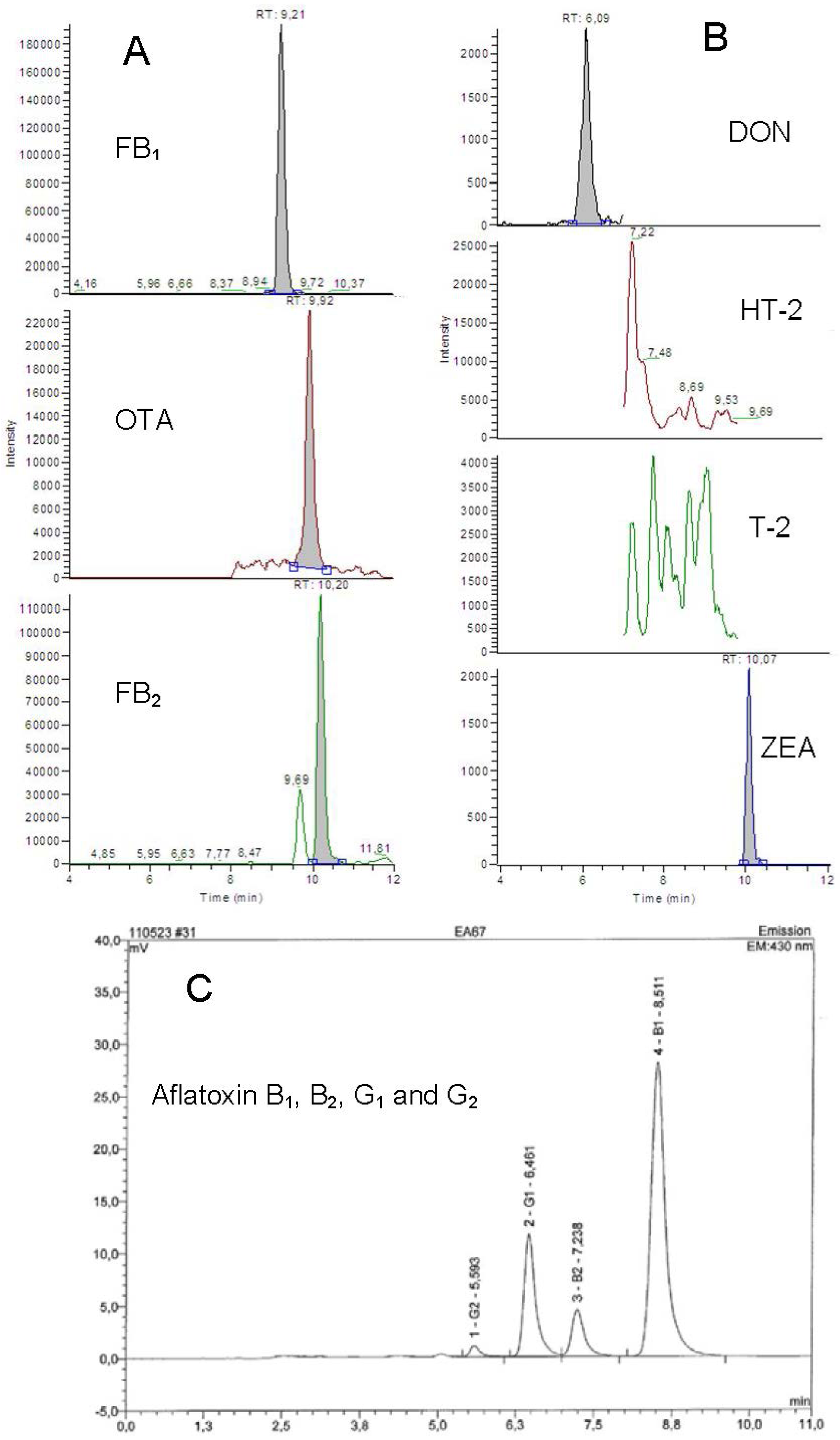
      <p>In this study, 92 feed samples for different classes of animals were analyzed for AFB<sub>1</sub>, B<sub>2</sub>, G<sub>1</sub> and G<sub>2</sub>, FB<sub>1</sub>, FB<sub>2</sub>, OTA, DON, ZEA, T-2, and HT-2. The present study is the first survey on multi-mycotoxin occurrence in feeds from S. Africa using an LC-MS/MS. A summary of the prevalence of mycotoxins and associated levels (unadjusted data) detected is presented in <xref ref-type="table" rid="toxins-04-00836-t004">Table 4</xref>, and chromatograms illustrating a cattle feed sample positive for FB, OTA, DON, ZEA and AFs is presented in <xref ref-type="fig" rid="toxins-04-00836-f001">Figure 1</xref>. The mycotoxin contamination profile clearly demonstrates that AF, FB, OTA, DON and ZEA are common contaminants of S. African compound feeds. All analyzed feed samples were contaminated with mycotoxins, singly or in combination and in order of predominance, FB (100%), DON and ZEA each recovered from 99% of samples, AF and OTA were found in 30% and 4% samples, respectively, meanwhile HT-2 and T-2 were not detected in any of these samples. Except for ZEA and DON, cattle feeds were generally more heavily contaminated (mean levels) with mycotoxins than feeds destined for the other animal species.</p>
      <table-wrap id="toxins-04-00836-t004" position="float">
        <object-id pub-id-type="pii">toxins-04-00836-t004_Table 4</object-id>
        <label>Table 4</label>
        <caption>
          <p>Mycotoxin levels (µg/kg) in compound feeds from South Africa.</p>
        </caption>
        <table>
          <thead>
            <tr>
              <th style="border-bottom:solid thin" align="left" valign="middle"> </th>
              <th style="border-bottom:solid thin" align="left" valign="middle"> </th>
              <th colspan="15" style="border-bottom:solid thin" align="left" valign="middle">Mycotoxins contamination <sup>a</sup></th>
            </tr>
            <tr>
              <th align="left" valign="middle"> </th>
              <th align="left" valign="middle">              </th>
              <th style="border-bottom:solid thin" align="left" valign="middle">AF</th>
              <th style="border-bottom:solid thin" align="left" valign="middle"> </th>
              <th style="border-bottom:solid thin" align="left" valign="middle">              </th>
              <th style="border-bottom:solid thin" align="left" valign="middle">FB</th>
              <th style="border-bottom:solid thin" align="left" valign="middle"> </th>
              <th style="border-bottom:solid thin" align="left" valign="middle"> </th>
              <th style="border-bottom:solid thin" align="left" valign="middle">OTA</th>
              <th style="border-bottom:solid thin" align="left" valign="middle"> </th>
              <th style="border-bottom:solid thin" align="left" valign="middle"> </th>
              <th colspan="2" style="border-bottom:solid thin" align="left" valign="middle">DON</th>
              <th style="border-bottom:solid thin" align="left" valign="middle"> </th>
              <th style="border-bottom:solid thin" align="left" valign="middle"> </th>
              <th style="border-bottom:solid thin" align="left" valign="middle">ZEA</th>
              <th style="border-bottom:solid thin" align="left" valign="middle"> </th>
            </tr>
            <tr>
              <th align="left" valign="middle">Feed</th>
              <th align="left" valign="middle">N <sup>b</sup></th>
              <th align="left" valign="middle">N + ve <sup>c</sup></th>
              <th align="left" valign="middle">Mean <sup>d</sup></th>
              <th align="left" valign="middle">Max</th>
              <th align="left" valign="middle">N + ve <sup>c</sup></th>
              <th align="left" valign="middle">Mean <sup>d</sup></th>
              <th align="left" valign="middle">Max</th>
              <th align="left" valign="middle">N + ve <sup>c</sup></th>
              <th align="left" valign="middle">Mean <sup>d</sup></th>
              <th align="left" valign="middle">Max</th>
              <th align="left" valign="middle">N +ve<sup>c</sup></th>
              <th align="left" valign="middle">Mean <sup>d</sup></th>
              <th align="left" valign="middle">Max</th>
              <th align="left" valign="middle">N + ve <sup>c</sup></th>
              <th align="left" valign="middle">Mean <sup>d</sup></th>
              <th align="left" valign="middle">Max</th>
            </tr>
          </thead>
          <tbody>
            <tr>
              <td align="left" valign="middle">Chicken</td>
              <td align="left" valign="middle">62</td>
              <td align="left" valign="middle">14 (8)</td>
              <td align="left" valign="middle">0.7 ± 0.7</td>
              <td align="left" valign="middle">1.8</td>
              <td align="left" valign="middle">62 (54)</td>
              <td align="left" valign="middle">903 ± 757</td>
              <td align="left" valign="middle">2999</td>
              <td align="left" valign="middle">0 (0)</td>
              <td align="left" valign="middle">-</td>
              <td align="left" valign="middle">-</td>
              <td align="left" valign="middle">62 (35)</td>
              <td align="left" valign="middle">620 ± 386</td>
              <td align="left" valign="middle">1980</td>
              <td align="left" valign="middle">62 (24)</td>
              <td align="left" valign="middle">100 ± 125</td>
              <td align="left" valign="middle">610</td>
            </tr>
            <tr>
              <td align="left" valign="middle">Cattle</td>
              <td align="left" valign="middle">25</td>
              <td align="left" valign="middle">13 (13)</td>
              <td align="left" valign="middle">14.7 ± 22.8</td>
              <td align="left" valign="middle">71.8</td>
              <td align="left" valign="middle">25 (23)</td>
              <td align="left" valign="middle">975 ± 686</td>
              <td align="left" valign="middle">2497</td>
              <td align="left" valign="middle">4 (4)</td>
              <td align="left" valign="middle">9.9 ± 4.9</td>
              <td align="left" valign="middle">17.1</td>
              <td align="left" valign="middle">24 (24)</td>
              <td align="left" valign="middle">891 ± 512</td>
              <td align="left" valign="middle">2280</td>
              <td align="left" valign="middle">24 (19)</td>
              <td align="left" valign="middle">72 ± 43</td>
              <td align="left" valign="middle">123</td>
            </tr>
            <tr>
              <td align="left" valign="middle">Horse</td>
              <td align="left" valign="middle">3</td>
              <td align="left" valign="middle">1 (1) </td>
              <td align="left" valign="middle">0.4 ± 0</td>
              <td align="left" valign="middle">0.4</td>
              <td align="left" valign="middle">3 (3)</td>
              <td align="left" valign="middle">693 ± 617</td>
              <td align="left" valign="middle">1338</td>
              <td align="left" valign="middle">0 (0)</td>
              <td align="left" valign="middle">-</td>
              <td align="left" valign="middle">-</td>
              <td align="left" valign="middle">3 (3)</td>
              <td align="left" valign="middle">742 ± 338</td>
              <td align="left" valign="middle">1133</td>
              <td align="left" valign="middle">3 (2)</td>
              <td align="left" valign="middle">43 ± 5</td>
              <td align="left" valign="middle">46</td>
            </tr>
            <tr>
              <td align="left" valign="middle">Swine</td>
              <td align="left" valign="middle">2</td>
              <td align="left" valign="middle">0 (0)</td>
              <td align="left" valign="middle">-</td>
              <td align="left" valign="middle">-</td>
              <td align="left" valign="middle">2 (1)</td>
              <td align="left" valign="middle">313 ± 0</td>
              <td align="left" valign="middle">313</td>
              <td align="left" valign="middle">0 (0)</td>
              <td align="left" valign="middle">-</td>
              <td align="left" valign="middle">-</td>
              <td align="left" valign="middle">2 (2)</td>
              <td align="left" valign="middle">1,875 ± 713</td>
              <td align="left" valign="middle">2352</td>
              <td align="left" valign="middle">2 (2)</td>
              <td align="left" valign="middle">148 ± 30</td>
              <td align="left" valign="middle">170</td>
            </tr>
            <tr>
              <td align="left" valign="middle">
                <bold>Total</bold>
              </td>
              <td align="left" valign="middle">
                <bold>92</bold>
              </td>
              <td align="left" valign="middle">
                <bold>28 (22)</bold>
              </td>
              <td align="left" valign="middle">
                <bold>9.0 ± 18.7</bold>
              </td>
              <td align="left" valign="middle">
                <bold>71.8</bold>
              </td>
              <td align="left" valign="middle">
                <bold>92 (81)</bold>
              </td>
              <td align="left" valign="middle">
                <bold>916 ± 727</bold>
              </td>
              <td align="left" valign="middle">
                <bold>2999</bold>
              </td>
              <td align="left" valign="middle">
                <bold>4 (4)</bold>
              </td>
              <td align="left" valign="middle">
                <bold>9.9 ± 4.9</bold>
              </td>
              <td align="left" valign="middle">
                <bold>17.1</bold>
              </td>
              <td align="left" valign="middle">
                <bold>91 (64)</bold>
              </td>
              <td align="left" valign="middle">
                <bold>696 ± 490</bold>
              </td>
              <td align="left" valign="middle">
                <bold>2352</bold>
              </td>
              <td align="left" valign="middle">
                <bold>91 (47)</bold>
              </td>
              <td align="left" valign="middle">
                <bold>88 ± 95</bold>
              </td>
              <td align="left" valign="middle">
                <bold>610</bold>
              </td>
            </tr>
          </tbody>
        </table>
    <table-wrap-foot>
      <fn>
        <p><sup>a</sup> T-2 and HT-2 were analyzed but not detected in any of the analyzed samples.</p>
      </fn>
      <fn>
        <p><sup>b</sup> Number of samples analyzed. </p>
      </fn>
      <fn>
        <p><sup>c</sup> Number of samples positive with mycotoxins above LOD [LOQ in parentheses].</p>
      </fn>
      <fn>
        <p><sup>d</sup> Mean levels of mycotoxin contents in positive samples above LOQ expressed as mean ± SD (standard deviation); levels of mycotoxins are not adjusted based on recovery.</p>
      </fn>
      <fn>
        <p>South African regulatory limits for mycotoxins in feeds [<xref ref-type="bibr" rid="B13-toxins-04-00836">13</xref>]: AF is10 µg/kg for chicks, calves and piglets, 20 µg/kg for poultry and swine, 5 and 50 µg/kg, respectively for dairy and beef cattle; FB is 50,000 µg/kg for cattle and chicken, respectively and 1000 µg/kg for swine; OTA is 20 and 50 µg/kg for chicken and swine; ZEA is 20, 300 and 500 µg/kg for dairy/calves, piglets and swine, respectively; and DON is 1000 µg/kg for swine, 2000, 3000 and 5000 µg/kg, respectively, for calves, dairy and beef cattle, 4000 µg/kg for chickens.</p>
      </fn>
    </table-wrap-foot>
	 </table-wrap>
      <fig id="toxins-04-00836-f001" position="anchor">
        <label>Figure 1</label>
        <caption>
          <p>Chromatograms of one of the cattle feed samples analyzed. <bold>A</bold> and <bold>B</bold>: Selected Reaction Monitoring (SRM) chromatograms from the liquid chromatography tandem mass spectrometry (LC-MS/MS) analysis, the sample contained 1800, 17, 520, 850 and 60 µg/kg of FB<sub>1</sub>, OTA, FB<sub>2</sub>, DON and ZON, respectively. T-2 or HT-2 toxin was not detected. <bold>C</bold>: Chromatogram from the HPLC-fluorescence analysis, the sample contained aflatoxins B<sub>1</sub>, B<sub>2</sub>, G<sub>1</sub> and G<sub>2</sub> at concentrations of 41.8, 3.4, 25.4 and 2.3 µg/kg, respectively.</p>
        </caption>
        <graphic xmlns:xlink="http://www.w3.org/1999/xlink" xlink:href="toxins-04-00836-g001.tif"/>
      </fig>
      <p>Fumonisins were the most dominant mycotoxins (max: 2999 µg/kg; mean: 916 ± 727 µg/kg) being present in all samples. Since 1988 when fumonisins were discovered in S. Africa [<xref ref-type="bibr" rid="B14-toxins-04-00836">14</xref>], they have been recognized as the main mycotoxin contaminant in maize and maize-based products including compound feeds. For compound feeds, 11,000 µg/kg is so far the highest contaminated level reported in S. Africa [<xref ref-type="bibr" rid="B15-toxins-04-00836">15</xref>]. Subsequently, surveys of S. African commercial feeds for FB have shown maximum contamination levels below 6000 µg/kg [<xref ref-type="bibr" rid="B16-toxins-04-00836">16</xref>,<xref ref-type="bibr" rid="B17-toxins-04-00836">17</xref>,<xref ref-type="bibr" rid="B18-toxins-04-00836">18</xref>,<xref ref-type="bibr" rid="B19-toxins-04-00836">19</xref>].</p>
      <p>Concentrations of FB<sub>1</sub> were comparatively higher, ranging from 104 to 2371 µg/kg compared to FB<sub>2</sub> where the range was 103 to 673 µg/kg. Higher contamination levels of FB<sub>1</sub> compared to FB<sub>2</sub> in cereal grains and animal feeds are often reported [<xref ref-type="bibr" rid="B19-toxins-04-00836">19</xref>,<xref ref-type="bibr" rid="B20-toxins-04-00836">20</xref>,<xref ref-type="bibr" rid="B21-toxins-04-00836">21</xref>]. Levels of fumonisins were generally found to be slightly higher in cattle feeds than in chicken, swine or horse feeds. This variation could not be directly linked to the different levels of maize included since cattle feed contains a much smaller amount of maize than chicken or swine feed. In the present study all samples contained FB below regulatory levels for animal feed in S. Africa. </p>
      <p>Ochratoxin A was the least predominant mycotoxin being present at detectable levels only in cattle feeds with 4 of the 25 samples containing OTA (mean: 9.9 ± 4.9 µg/kg; max. level: 17.1 µg/kg), whereas no OTA was found in feeds for other animals tested (<xref ref-type="table" rid="toxins-04-00836-t004">Table 4</xref>). Very limited data on OTA contamination of South African animal feeds and feed components is available. In previous surveys on raw materials or finished feeds, neither OTA was found [<xref ref-type="bibr" rid="B16-toxins-04-00836">16</xref>,<xref ref-type="bibr" rid="B17-toxins-04-00836">17</xref>] nor was it analyzed at all [<xref ref-type="bibr" rid="B19-toxins-04-00836">19</xref>]. In the present study, the incidence and levels of OTA were low, however, contrary to the recent study of Stoev <italic>et al.</italic> [<xref ref-type="bibr" rid="B18-toxins-04-00836">18</xref>], finished feeds from S. African swine farms with mycotoxic nephropathy were contaminated with OTA at a much higher incidence rate and in several cases, levels above acceptable limits were found. It therefore follows that OTA seems to be a mycotoxin that could be detected in S. African cattle feeds and regularly in swine feeds. The same mycotoxin has been shown to be a nephrotoxin playing a role supposedly in association with other mycotoxins in the aetiology of mycotoxic nephropathy encountered in some farm animals in S. Africa [<xref ref-type="bibr" rid="B18-toxins-04-00836">18</xref>] and in Northern and Eastern Europe [<xref ref-type="bibr" rid="B22-toxins-04-00836">22</xref>,<xref ref-type="bibr" rid="B23-toxins-04-00836">23</xref>,<xref ref-type="bibr" rid="B24-toxins-04-00836">24</xref>]. It is also carcinogenic and has some immunotoxic properties [<xref ref-type="bibr" rid="B25-toxins-04-00836">25</xref>,<xref ref-type="bibr" rid="B26-toxins-04-00836">26</xref>] thus, increasing animal’s susceptibility to secondary infection. In the country, OTA is regulated in feeds for swine and poultry only but no specific limits are yet to be set for other animals including cattle. </p>
      <p>ZEA was present in 99% of the samples and quantification levels were reached in 47 samples (51%) ranging between 30 and 610 µg/kg. Swine feeds had the highest levels of ZEA (range: 127–170 µg/kg) followed by chicken feeds where the levels ranged from 30 to 610 µg/kg. In horse feeds, the range was 39–46 µg/kg. Generally, we found that the distribution pattern of ZEA was similar and highly correlated with that of DON except that DON levels were generally higher in the respective samples. Such a similarity can best be explained based on the fact that these toxins are produced by the same fungi principally <italic>Fusarium graminearum</italic> and <italic>Fusarium culmorum</italic> and that the requirements for production [<xref ref-type="bibr" rid="B27-toxins-04-00836">27</xref>,<xref ref-type="bibr" rid="B28-toxins-04-00836">28</xref>] are similar. </p>
      <p>Deoxynivalenol is one of the mycotoxins that have received considerable interest in S. Africa [<xref ref-type="bibr" rid="B29-toxins-04-00836">29</xref>] as incidences of high DON contamination levels have been reported in agricultural commodities [<xref ref-type="bibr" rid="B18-toxins-04-00836">18</xref>,<xref ref-type="bibr" rid="B20-toxins-04-00836">20</xref>,<xref ref-type="bibr" rid="B30-toxins-04-00836">30</xref>,<xref ref-type="bibr" rid="B31-toxins-04-00836">31</xref>]. According to the Southern African Grain Laboratory [<xref ref-type="bibr" rid="B30-toxins-04-00836">30</xref>], there are contamination levels in the range of 200–13,000 µg/kg found in maize. Griessler [<xref ref-type="bibr" rid="B17-toxins-04-00836">17</xref>] found that 90% of raw materials and compound feed samples contained very high concentrations (mean: 1015 µg/kg; max. of 11,022 µg/kg) of the toxin. Our data revealed that the two swine feeds analyzed had the highest DON contamination levels (1343 and 2356 µg/kg) that were above regulatory limit of 1000 µg/kg for S. Africa. The lowest contamination level of 620 ± 386 µg/kg for DON was recovered from feeds for chicken, while slightly higher mean levels of 742 ± 338 and 891 ± 512 µg/kg were obtained from horse and cattle feeds, respectively. </p>
      <p>Aflatoxin was present in 30% of the samples. As seen in <xref ref-type="table" rid="toxins-04-00836-t004">Table 4</xref>, cattle feeds (incidence rate of 52%) were the most contaminated with AF (mean: 14.7±22.8 µg/kg; max: 71.8 µg/kg) and 4 of the 25 samples analyzed had levels that exceeded regulatory limits set for South African cattle feeds. Two of these samples were dairy feeds that had levels that were at least 7 times above the limit of 5 µg/kg regulated. The presence of AF particularly AFB<sub>1</sub> in dairy feed is particularly worrying as levels of 10 µg/kg or even less may result in the appearance of aflatoxin M<sub>1</sub> (AFM<sub>1</sub>) in the milk at levels above those now permissible (0.05 µg/kg) in Europe or South Africa [<xref ref-type="bibr" rid="B32-toxins-04-00836">32</xref>]. Poultry and horse feeds also contained AF, but contamination levels were comparatively low (max level: 1.8 µg/kg or below) with none detected in swine feeds. AFB<sub>1</sub> and AFG<sub>1</sub> occurred more frequently and at higher levels than AFB<sub>2</sub> and AFG<sub>2</sub>. However, in 3 samples, AFG<sub>2</sub> was the only AF detected either singly or together with AFG<sub>1</sub>. </p>
      <p>In our study, a quantitative difference in mycotoxin contamination between the different feed types was evident and as previously stated, cattle feeds were the most contaminated. Aflatoxin levels were higher in cattle feeds, <italic>i.e.</italic>, having mean levels &gt;20 times higher than the levels recovered from other types of feed and in particular, OTA was only detected in feeds for cattle (<xref ref-type="table" rid="toxins-04-00836-t004">Table 4</xref>). The most likely reason for this variation may be the use of different feed raw materials for different types of animals and also the level of inclusion (<xref ref-type="table" rid="toxins-04-00836-t001">Table 1</xref>). Breytenbach, L. in an email [<xref ref-type="bibr" rid="B33-toxins-04-00836">33</xref>] stated that in S. Africa, cotton seed oilcake or full fat cotton seed is directed solely for ruminant feed production and the same feed ingredients were consistently found by Reiter <italic>et al</italic>. [<xref ref-type="bibr" rid="B10-toxins-04-00836">10</xref>] and Mngadi <italic>et al</italic>. [<xref ref-type="bibr" rid="B16-toxins-04-00836">16</xref>] to contain high levels of AF. Those raw materials may also contain OTA probably why high levels of these toxins were observed in some cattle feeds.</p>
      <p>Mngadi <italic>et al.</italic> [<xref ref-type="bibr" rid="B16-toxins-04-00836">16</xref>] and Stoev <italic>et al.</italic> [<xref ref-type="bibr" rid="B18-toxins-04-00836">18</xref>] provided some data in which several mycotoxins co-occur in feeds within the country. In our study, the co-existence of mycotoxins within the same sample was very common and data revealed that 91 samples contained multiple mycotoxins, with 67% that with three mycotoxins (FB + DON + ZEA), 26% with 4 mycotoxins (FB + DON + ZEA + AF), while 5 samples had 5 mycotoxins (FB + DON + ZEA + AF + OTA). Based on the S. African feed regulations, 13% of samples, mostly for cattle, contained mycotoxin levels regarded as unfit for livestock feeding. Accordingly, 7 feed samples showed unacceptable levels of ZEA and AF and in 4 of these (calf and dairy feeds), co-contamination of ZEA and AF occurred at unacceptable levels. In addition some cattle feed samples also contained extremely high AF levels and the same samples also contained high amounts of OTA. </p>
      <p>Such multiple mycotoxin contaminations in feeds is crucial as mycotoxins may toxicologically interact with each other eliciting marked synergistic and additive actions [<xref ref-type="bibr" rid="B32-toxins-04-00836">32</xref>] especially between mycotoxins found at high concentrations. These actions provoked by OTA at low levels combined with FB<sub>1</sub>, have been the prime suspect for increased incidence of mycotoxic nephropathy in S. African swine [<xref ref-type="bibr" rid="B18-toxins-04-00836">18</xref>]. This theory was experimentally tested [<xref ref-type="bibr" rid="B34-toxins-04-00836">34</xref>] when swine were fed diets containing OTA and/or FB<sub>1</sub> and the same mycotoxic nephropathy observed under field conditions was enhanced in animals exposed to these mycotoxins in combination. </p>
    </sec>
    <sec sec-type="conclusions">
      <title>4. Conclusions</title>
      <p>From the results of this screening of AFB<sub>1</sub>, B<sub>2</sub>, G<sub>1</sub> and G<sub>2</sub>, FB<sub>1</sub>, FB<sub>2</sub>, OTA, DON, ZEA, T-2, and HT-2 in various kinds of feed, it can be concluded that in South Africa, cattle feeds are probably more contaminated with mycotoxins than feeds for other animal species as they were found to contain the highest mean levels of AF and FB. In addition, OTA contamination only occurred in cattle feeds and in most of the positive samples, this toxin co-existed with other mycotoxins at high contamination levels that could induce some synergistic or additive effects in animals. Because such mycotoxins as AF and OTA can be carried over to animal-derived food products, human exposure to such mycotoxins may be a problem. Feed raw materials and finished feeds should for that reason be routinely monitored in order to identify potential sources of mycotoxins. </p>
    </sec>
  </body>
  <back>
    <ack>
      <title>Acknowledgments</title>
      <p>This study has been financially supported by the National Research Foundation of South Africa under the Post Doctoral Free Standing Fellowship and in part by the European Union-funded Integrated Project BIOTRACER (contract FOOD-2006-CT-036272) under the 6th RTD Framework. The financial contribution made by the Faculty of Health Sciences, University of Johannesburg is also duly acknowledged. We thank the AFMA members who donated samples for analysis. Samples were prepared by Mr Henry Iheanacho of FEHRG, University of Johannesburg, while our sincere gratitude goes to Maria Agnedal, Anna Stepinska and the entire SVA staff for support.</p>
    </ack>
    <notes>
      <title>Conflict of Interest</title>
      <p>The authors declare no conflict of interest. </p>
    </notes>
    <ref-list>
      <title>References</title>
      <ref id="B1-toxins-04-00836">
        <label>1.</label>
        <citation citation-type="journal">
          <person-group person-group-type="author">
            <name>
              <surname>Cusumano</surname>
              <given-names>V.</given-names>
            </name>
            <name>
              <surname>Rossano</surname>
              <given-names>F.</given-names>
            </name>
            <name>
              <surname>Merendino</surname>
              <given-names>R.A.</given-names>
            </name>
            <name>
              <surname>Arena</surname>
              <given-names>A.</given-names>
            </name>
            <name>
              <surname>Costa</surname>
              <given-names>G.B.</given-names>
            </name>
            <name>
              <surname>Mancuso</surname>
              <given-names>G.</given-names>
            </name>
            <name>
              <surname>Baroni</surname>
              <given-names>A.</given-names>
            </name>
            <name>
              <surname>Losi</surname>
              <given-names>E.</given-names>
            </name>
          </person-group>
          <article-title>Immunobiological activities of mould products: functional impairment of human monocytes exposed to aflatoxin B<sub>1</sub></article-title>
          <source>Res. Microbiol.</source>
          <year>1996</year>
          <volume>147</volume>
          <fpage>385</fpage>
          <lpage>391</lpage>
          <pub-id pub-id-type="doi">10.1016/0923-2508(96)84713-9</pub-id>
        </citation>
      </ref>
      <ref id="B2-toxins-04-00836">
        <label>2.</label>
        <citation citation-type="journal">
          <person-group person-group-type="author">
            <name>
              <surname>Sharma</surname>
              <given-names>R.P.</given-names>
            </name>
          </person-group>
          <article-title>Immunotoxicity of mycotoxins</article-title>
          <source>J. Dairy Sci.</source>
          <year>1993</year>
          <volume>76</volume>
          <fpage>892</fpage>
          <lpage>897</lpage>
          <pub-id pub-id-type="doi">10.3168/jds.S0022-0302(93)77415-9</pub-id>
        </citation>
      </ref>
      <ref id="B3-toxins-04-00836">
        <label>3.</label>
        <citation citation-type="journal">
          <person-group person-group-type="author">
            <name>
              <surname>Marguardt</surname>
              <given-names>R.R.</given-names>
            </name>
          </person-group>
          <article-title>Effects of molds and their toxins on livestock performance: A western Canadian perspective</article-title>
          <source>Anim. Feed Sci. Technol.</source>
          <year>1996</year>
          <volume>58</volume>
          <fpage>77</fpage>
          <lpage>89</lpage>
          <pub-id pub-id-type="doi">10.1016/0377-8401(95)00875-6</pub-id>
        </citation>
      </ref>
      <ref id="B4-toxins-04-00836">
        <label>4.</label>
        <citation citation-type="journal">
          <person-group person-group-type="author">
            <name>
              <surname>Fink-Gremmels</surname>
              <given-names>J.</given-names>
            </name>
            <name>
              <surname>Malekinejad</surname>
              <given-names>H.</given-names>
            </name>
          </person-group>
          <article-title>Clinical effects and biochemical mechanisms associated with exposure to the mycoestrogen zearalenone</article-title>
          <source>Anim. Feed Sci. Technol.</source>
          <year>2007</year>
          <volume>137</volume>
          <fpage>326</fpage>
          <lpage>341</lpage>
          <pub-id pub-id-type="doi">10.1016/j.anifeedsci.2007.06.008</pub-id>
        </citation>
      </ref>
      <ref id="B5-toxins-04-00836">
        <label>5.</label>
        <citation citation-type="journal">
          <person-group person-group-type="author">
            <name>
              <surname>Duarte</surname>
              <given-names>S.C.</given-names>
            </name>
            <name>
              <surname>Lino</surname>
              <given-names>C.M.</given-names>
            </name>
            <name>
              <surname>Pena</surname>
              <given-names>A.</given-names>
            </name>
          </person-group>
          <article-title>Ochratoxin A in feed of food-producing animals: An undesirable mycotoxin with health and performance effects</article-title>
          <source>Vet. Microbiol.</source>
          <year>2011</year>
          <volume>154</volume>
          <fpage>1</fpage>
          <lpage>13</lpage>
          <pub-id pub-id-type="doi">10.1016/j.vetmic.2011.05.006</pub-id>
        </citation>
      </ref>
      <ref id="B6-toxins-04-00836">
        <label>6.</label>
        <citation citation-type="web">
          <article-title>World Health Organization. AFRO Food Safety Newsletter. World Health Organization Food safety (FOS). Mycotoxins in African Foods: Implications to Food Safety and Health. Issue No. 2</article-title>
          <month>July</month>
          <year>2006</year>
          <access-date>(accessed on 4 October 2011)</access-date>
          <comment>Available online:<ext-link xmlns:xlink="http://www.w3.org/1999/xlink" xlink:href="http://www.google.com.hk/url?sa=t&amp;rct=j&amp;q= Mycotoxins+in+African+foods:+Implications+to+food+safety+and+health&amp;source=web&amp;cd=1&amp;cad=rja&amp;ved=0CCoQFjAA&amp;url=http%3A%2F%2Fwww.afro.who.int%2Findex.php%3Foption%3Dcom_docman%26task%3Ddoc_download%26gid%3D1724&amp;ei=EfB8UJqlKKqk4gSG8oGYCg&amp;usg=AFQjCNGv5Dli0nQVuHsZFN6QHh7fKG5DNw" ext-link-type="uri">http://www.google.com.hk/url?sa=t&amp;rct=j&amp;q=
Mycotoxins+in+African+foods:+Implications+to+food+safety+and+health&amp;source=web&amp;cd=1&amp;cad=rja&amp;ved=0CCoQFjAA&amp;url=http%3A%2F%2Fwww.afro.who.int%2Findex.php%3Foption%3Dcom_docman%26task%3Ddoc_download%26gid%3D1724&amp;ei=EfB8UJqlKKqk4gSG8oGYCg&amp;usg=AFQjCNGv5Dli0nQVuHsZFN6QHh7fKG5DNw
</ext-link></comment>
        </citation>
      </ref>
      <ref id="B7-toxins-04-00836">
        <label>7.</label>
        <citation citation-type="journal">
          <person-group person-group-type="author">
            <name>
              <surname>Bastianello</surname>
              <given-names>S.S.</given-names>
            </name>
            <name>
              <surname>Nesbit</surname>
              <given-names>J.W.</given-names>
            </name>
            <name>
              <surname>Williams</surname>
              <given-names>M.C.</given-names>
            </name>
            <name>
              <surname>Lange</surname>
              <given-names>A.L.</given-names>
            </name>
          </person-group>
          <article-title>Pathological findings in a natural outbreak of aflatoxicosis in dogs</article-title>
          <source>Onderstepoort J. Vet. Res.</source>
          <year>1987</year>
          <volume>54</volume>
          <fpage>635</fpage>
          <lpage>640</lpage>
        <pub-id pub-id-type="pmid">3444619</pub-id></citation>
      </ref>
      <ref id="B8-toxins-04-00836">
        <label>8.</label>
        <citation citation-type="journal">
          <person-group person-group-type="author">
            <name>
              <surname>Arnot</surname>
              <given-names>L.F.</given-names>
            </name>
            <name>
              <surname>Duncan</surname>
              <given-names>N.M.</given-names>
            </name>
            <name>
              <surname>Coetzer</surname>
              <given-names>H.</given-names>
            </name>
            <name>
              <surname>Botha</surname>
              <given-names>C.J.</given-names>
            </name>
          </person-group>
          <article-title>An outbreak of canine aflatoxicosis in Gauteng Province, South Africa</article-title>
          <source>J. S. Afr. Vet. Assoc.</source>
          <year>2012</year>
          <volume>83</volume>
          <fpage>1</fpage>
          <lpage>4</lpage>
        </citation>
      </ref>
      <ref id="B9-toxins-04-00836">
        <label>9.</label>
        <citation citation-type="commun">
          <person-group person-group-type="author">
            <name>
              <surname>Mbambo</surname>
              <given-names>S.</given-names>
            </name>
          </person-group>
          <article-title>National Department of Agriculture, Forestry and Fisheries, Pretoria, Gauteng, South Africa</article-title>
          <source>Personal communication</source>
          <year>2011</year>
        </citation>
      </ref>
      <ref id="B10-toxins-04-00836">
        <label>10.</label>
        <citation citation-type="journal">
          <person-group person-group-type="author">
            <name>
              <surname>Reiter</surname>
              <given-names>E.V.</given-names>
            </name>
            <name>
              <surname>Dutton</surname>
              <given-names>M.F.</given-names>
            </name>
            <name>
              <surname>Mwanza</surname>
              <given-names>M.</given-names>
            </name>
            <name>
              <surname>Agus</surname>
              <given-names>A.</given-names>
            </name>
            <name>
              <surname>Prawano</surname>
              <given-names>D.</given-names>
            </name>
            <name>
              <surname>Häggblom</surname>
              <given-names>P.</given-names>
            </name>
            <name>
              <surname>Razzazi-Fazeli</surname>
              <given-names>E.</given-names>
            </name>
            <name>
              <surname>Zentek</surname>
              <given-names>J.</given-names>
            </name>
            <name>
              <surname>Andersson</surname>
              <given-names>G.</given-names>
            </name>
            <name>
              <surname>Njobeh</surname>
              <given-names>P.B.</given-names>
            </name>
          </person-group>
          <article-title>Uncertainty from sampling in measurement of aflatoxins in animal feedstuffs: Application of the Eurachem/CITAC guidelines</article-title>
          <source>Analyst</source>
          <year>2011</year>
          <volume>136</volume>
          <fpage>4059</fpage>
          <lpage>4069</lpage>
          <pub-id pub-id-type="doi">10.1039/c1an15124j</pub-id>
        </citation>
      </ref>
      <ref id="B11-toxins-04-00836">
        <label>11.</label>
        <citation citation-type="journal">
          <person-group person-group-type="author">
            <name>
              <surname>Tevell Åberg</surname>
              <given-names>A.</given-names>
            </name>
            <name>
              <surname>Solyakov</surname>
              <given-names>A.</given-names>
            </name>
            <name>
              <surname>Bondesson</surname>
              <given-names>U.</given-names>
            </name>
          </person-group>
          <article-title>Development and in-house validation of an LC-MS/MS method for the simultaneous quantification of the mycotoxins deoxynivalenol, zearalenone, T-2 and HT-2 toxin, ochratoxin A, and fumonisin B<sub>1</sub> and B<sub>2</sub> in vegetable animal feed</article-title>
          <source>Food Addit. Contam. Part A</source>
          <year>2012</year>
          <comment>submitted for publication</comment>
        </citation>
      </ref>
      <ref id="B12-toxins-04-00836">
        <label>12.</label>
        <citation citation-type="journal">
          <person-group person-group-type="author">
            <name>
              <surname>Barmark</surname>
              <given-names>A.L.</given-names>
            </name>
            <name>
              <surname>Larsson</surname>
              <given-names>K.</given-names>
            </name>
          </person-group>
          <article-title>Immunoaffinity column cleanup/liquid chromatographic determination of aflatoxins: An interlaboratory study</article-title>
          <source>J. AOAC Int.</source>
          <year>1994</year>
          <volume>77</volume>
          <fpage>46</fpage>
          <lpage>53</lpage>
        </citation>
      </ref>
      <ref id="B13-toxins-04-00836">
        <label>13.</label>
        <citation citation-type="book">
		<collab>Government Gazette</collab>
          <source>Fertilizers, Farm Feeds, Agricultural Remedies and Stock Remedies Act (Act No. 36 of 1947). No. R70</source>
          <publisher-loc>Pretoria, South Africa</publisher-loc>
          <year>2010</year>
          <fpage>4</fpage>
          <lpage>18</lpage>
        </citation>
      </ref>
      <ref id="B14-toxins-04-00836">
        <label>14.</label>
        <citation citation-type="journal">
          <person-group person-group-type="author">
            <name>
              <surname>Gelderblom</surname>
              <given-names>W.C.A.</given-names>
            </name>
            <name>
              <surname>Jaskiewics</surname>
              <given-names>K.</given-names>
            </name>
            <name>
              <surname>Marasas</surname>
              <given-names>W.F.O.</given-names>
            </name>
            <name>
              <surname>Thiel</surname>
              <given-names>P.G.</given-names>
            </name>
            <name>
              <surname>Horak</surname>
              <given-names>M.J.</given-names>
            </name>
            <name>
              <surname>Vleggaar</surname>
              <given-names>R.</given-names>
            </name>
            <name>
              <surname>Kriek</surname>
              <given-names>N.P.J.</given-names>
            </name>
          </person-group>
          <article-title>Fumonisin-novel mycotoxins with cancer promoting activity produced by <italic>Fusarium moniliforme</italic></article-title>
          <source>Appl. Environ. Microbiol.</source>
          <year>1988</year>
          <volume>54</volume>
          <fpage>1806</fpage>
          <lpage>1811</lpage>
        <pub-id pub-id-type="pmid">2901247</pub-id></citation>
      </ref>
      <ref id="B15-toxins-04-00836">
        <label>15.</label>
        <citation citation-type="journal">
          <person-group person-group-type="author">
            <name>
              <surname>Dutton</surname>
              <given-names>M.F.</given-names>
            </name>
            <name>
              <surname>Kinsey</surname>
              <given-names>A.</given-names>
            </name>
          </person-group>
          <article-title>Occurrence of mycotoxins in cereals and animal feedstuffs in Natal, South Africa 1994</article-title>
          <source>Mycopathologia</source>
          <year>1996</year>
          <volume>131</volume>
          <fpage>31</fpage>
          <lpage>36</lpage>
          <pub-id pub-id-type="doi">10.1007/BF01103901</pub-id>
        </citation>
      </ref>
      <ref id="B16-toxins-04-00836">
        <label>16.</label>
        <citation citation-type="journal">
          <person-group person-group-type="author">
            <name>
              <surname>Mngadi</surname>
              <given-names>P.T.</given-names>
            </name>
            <name>
              <surname>Govinden</surname>
              <given-names>R.</given-names>
            </name>
            <name>
              <surname>Odhav</surname>
              <given-names>B.</given-names>
            </name>
          </person-group>
          <article-title>Co-occurring mycotoxins in animal feeds</article-title>
          <source>Afr. J. Biotechnol.</source>
          <year>2008</year>
          <volume>7</volume>
          <fpage>2239</fpage>
          <lpage>2243</lpage>
        </citation>
      </ref>
      <ref id="B17-toxins-04-00836">
        <label>17.</label>
        <citation citation-type="journal">
          <person-group person-group-type="author">
            <name>
              <surname>Griessler</surname>
              <given-names>K.</given-names>
            </name>
          </person-group>
          <article-title>A survey of mycotoxins in feed samples from South Africa</article-title>
          <source>Pluimvee Poultry Bulletin</source>
          <year>2009</year>
          <fpage>419</fpage>
          <month>July</month>
        </citation>
      </ref>
      <ref id="B18-toxins-04-00836">
        <label>18.</label>
        <citation citation-type="journal">
          <person-group person-group-type="author">
            <name>
              <surname>Stoev</surname>
              <given-names>S.D.</given-names>
            </name>
            <name>
              <surname>Denev</surname>
              <given-names>S.</given-names>
            </name>
            <name>
              <surname>Dutton</surname>
              <given-names>M.F.</given-names>
            </name>
            <name>
              <surname>Njobeh</surname>
              <given-names>P.B.</given-names>
            </name>
            <name>
              <surname>Mosonik</surname>
              <given-names>S.J.</given-names>
            </name>
            <name>
              <surname>Steenkamp</surname>
              <given-names>P.A.</given-names>
            </name>
            <name>
              <surname>Petkov</surname>
              <given-names>J.</given-names>
            </name>
          </person-group>
          <article-title>Complex etiology and pathology of mycotoxic nephropathy in South African pigs</article-title>
          <source>Mycotoxin Res.</source>
          <year>2010</year>
          <volume>26</volume>
          <fpage>31</fpage>
          <lpage>46</lpage>
          <pub-id pub-id-type="doi">10.1007/s12550-009-0038-7</pub-id>
        </citation>
      </ref>
      <ref id="B19-toxins-04-00836">
        <label>19.</label>
        <citation citation-type="journal">
          <person-group person-group-type="author">
            <name>
              <surname>Rodrigues</surname>
              <given-names>I.</given-names>
            </name>
            <name>
              <surname>Handl</surname>
              <given-names>J.</given-names>
            </name>
            <name>
              <surname>Binder</surname>
              <given-names>E.M.</given-names>
            </name>
          </person-group>
          <article-title>Mycotoxin occurrence in commodities, feeds and feed ingredients sourced in the Middle East and Africa</article-title>
          <source>Food Addit. Contam. Part B</source>
          <year>2011</year>
          <volume>4</volume>
          <fpage>168</fpage>
          <lpage>179</lpage>
          <pub-id pub-id-type="doi">10.1080/19393210.2011.589034</pub-id>
        </citation>
      </ref>
      <ref id="B20-toxins-04-00836">
        <label>20.</label>
        <citation citation-type="journal">
          <person-group person-group-type="author">
            <name>
              <surname>Gonzalez</surname>
              <given-names>H.H.</given-names>
            </name>
            <name>
              <surname>Martinez</surname>
              <given-names>E.J.</given-names>
            </name>
            <name>
              <surname>Pacin</surname>
              <given-names>A.M.</given-names>
            </name>
            <name>
              <surname>Pacin</surname>
              <given-names>S.L.</given-names>
            </name>
            <name>
              <surname>Resnik</surname>
              <given-names>S.L.</given-names>
            </name>
            <name>
              <surname>Sydenham</surname>
              <given-names>E.W.</given-names>
            </name>
          </person-group>
          <article-title>Natural co-occurrence of fumonisins, deoxynivalenol, zearalenone and aflatoxins in field trial corn in Argentina</article-title>
          <source>Food Addit. Contam.</source>
          <year>1999</year>
          <volume>16</volume>
          <fpage>565</fpage>
          <lpage>569</lpage>
          <pub-id pub-id-type="doi">10.1080/026520399283704</pub-id>
        </citation>
      </ref>
      <ref id="B21-toxins-04-00836">
        <label>21.</label>
        <citation citation-type="journal">
          <person-group person-group-type="author">
            <name>
              <surname>Dragon</surname>
              <given-names>Y.P.</given-names>
            </name>
            <name>
              <surname>Bidlack</surname>
              <given-names>W.R.</given-names>
            </name>
            <name>
              <surname>Cohen</surname>
              <given-names>S.M.</given-names>
            </name>
            <name>
              <surname>Goldsworthy</surname>
              <given-names>T.L.</given-names>
            </name>
            <name>
              <surname>Hard</surname>
              <given-names>G.C.</given-names>
            </name>
            <name>
              <surname>Howard</surname>
              <given-names>P.C.</given-names>
            </name>
            <name>
              <surname>Riley</surname>
              <given-names>R.T.</given-names>
            </name>
            <name>
              <surname>Voss</surname>
              <given-names>K.A.</given-names>
            </name>
          </person-group>
          <article-title>Implications of apoptosis for toxicity, carcinogenicity, and risk assessment: Fumonisin B<sub>1</sub> as an example</article-title>
          <source>Toxicol. Sci.</source>
          <year>2001</year>
          <volume>61</volume>
          <fpage>6</fpage>
          <lpage>17</lpage>
          <pub-id pub-id-type="doi">10.1093/toxsci/61.1.6</pub-id>
        </citation>
      </ref>
      <ref id="B22-toxins-04-00836">
        <label>22.</label>
        <citation citation-type="journal">
          <person-group person-group-type="author">
            <name>
              <surname>Stoev</surname>
              <given-names>S.D.</given-names>
            </name>
            <name>
              <surname>Hald</surname>
              <given-names>B.</given-names>
            </name>
            <name>
              <surname>Mantle</surname>
              <given-names>P.</given-names>
            </name>
          </person-group>
          <article-title>Porcine nephropathy in Bulgaria: A progressive syndrome of complex of uncertain (mycotoxin) etiology</article-title>
          <source>Vet. Rec.</source>
          <year>1998</year>
          <volume>142</volume>
          <fpage>190</fpage>
          <lpage>194</lpage>
          <pub-id pub-id-type="doi">10.1136/vr.142.8.190</pub-id>
        </citation>
      </ref>
      <ref id="B23-toxins-04-00836">
        <label>23.</label>
        <citation citation-type="journal">
          <person-group person-group-type="author">
            <name>
              <surname>Stoev</surname>
              <given-names>S.D.</given-names>
            </name>
          </person-group>
          <article-title>Complex etiology, prophylaxis and hygiene control in mycotoxic nephropathies in farm animals and humans</article-title>
          <source>Int. J. Mol. Sci.</source>
          <year>2008</year>
          <volume>9</volume>
          <fpage>578</fpage>
          <lpage>605</lpage>
          <pub-id pub-id-type="doi">10.3390/ijms9040578</pub-id>
        </citation>
      </ref>
      <ref id="B24-toxins-04-00836">
        <label>24.</label>
        <citation citation-type="journal">
          <person-group person-group-type="author">
            <name>
              <surname>Stoev</surname>
              <given-names>S.D.</given-names>
            </name>
            <name>
              <surname>Dutton</surname>
              <given-names>M.F.</given-names>
            </name>
            <name>
              <surname>Njobeh</surname>
              <given-names>P.B.</given-names>
            </name>
            <name>
              <surname>Mosonik</surname>
              <given-names>S.J.</given-names>
            </name>
            <name>
              <surname>Steenkamp</surname>
              <given-names>P.A.</given-names>
            </name>
          </person-group>
          <article-title>Mycotoxic nephropathy in Bulgarian pigs and chickins: Complex ethiology and pathology</article-title>
          <source>Food Addit. Contam. Part A</source>
          <year>2010</year>
          <volume>27</volume>
          <fpage>72</fpage>
          <lpage>88</lpage>
          <pub-id pub-id-type="doi">10.1080/02652030903207227</pub-id>
        </citation>
      </ref>
      <ref id="B25-toxins-04-00836">
        <label>25.</label>
        <citation citation-type="gov">
		<collab>International Agency for Research on Cancer</collab>
          <article-title>Toxins Derived from <italic>Fusarium graminearum</italic>,<italic>  F. culmorum </italic> and <italic> F. crookwellense</italic>: Zearalenone, Deoxynivalenol, Nivalenol and Fusarenone X</article-title>
          <source>IARC Monographs on the Evaluation of Carcinogenic Risks to Humans: Some Naturally Occurring Substances; Food Items and Constituents, Hetercyclic Aromatic Amines and Mycotoxins</source>
          <publisher-name>IARC</publisher-name>
          <publisher-loc>Lyon, France</publisher-loc>
          <year>1993</year>
          <volume>56</volume>
          <fpage>445</fpage>
          <lpage>466</lpage>
        </citation>
      </ref>
      <ref id="B26-toxins-04-00836">
        <label>26.</label>
        <citation citation-type="book">
          <person-group person-group-type="author">
            <name>
              <surname>Benford</surname>
              <given-names>D.</given-names>
            </name>
            <name>
              <surname>Boyle</surname>
              <given-names>B.</given-names>
            </name>
            <name>
              <surname>Dekant</surname>
              <given-names>W.</given-names>
            </name>
            <name>
              <surname>Fuchs</surname>
              <given-names>R.</given-names>
            </name>
            <name>
              <surname>Gaylor</surname>
              <given-names>D.W.</given-names>
            </name>
            <name>
              <surname>Hard</surname>
              <given-names>G.</given-names>
            </name>
            <name>
              <surname>McGregor</surname>
              <given-names>D.B.</given-names>
            </name>
            <name>
              <surname>Pitt</surname>
              <given-names>J.I.</given-names>
            </name>
            <name>
              <surname>Plestina</surname>
              <given-names>R.</given-names>
            </name>
            <name>
              <surname>Shephard</surname>
              <given-names>G.</given-names>
            </name>
            <etal/>
          </person-group>
          <source>Ochratoxin A</source>
          <publisher-name>The Joint FAO/WHO Expert Committee on Food Additives</publisher-name>
          <publisher-loc>Geneva, Switzerland</publisher-loc>
          <year>2001</year>
          <fpage>1</fpage>
          <lpage>172</lpage>
        </citation>
      </ref>
      <ref id="B27-toxins-04-00836">
        <label>27.</label>
        <citation citation-type="journal">
          <person-group person-group-type="author">
            <name>
              <surname>Tanaka</surname>
              <given-names>T.</given-names>
            </name>
            <name>
              <surname>Hasegawa</surname>
              <given-names>A.</given-names>
            </name>
            <name>
              <surname>Yamamato</surname>
              <given-names>S.</given-names>
            </name>
            <name>
              <surname>Lee</surname>
              <given-names>S.</given-names>
            </name>
            <name>
              <surname>Sigiura</surname>
              <given-names>Y.</given-names>
            </name>
            <name>
              <surname>Ueno</surname>
              <given-names>Y.</given-names>
            </name>
          </person-group>
          <article-title>Worldwide contamination of cereals by <italic>Fusarium</italic> mycotoxins nivalenol, deoxynivalenol and zearalenone. A survey of 19 countries</article-title>
          <source>J. Agric. Food. Chem.</source>
          <year>1988</year>
          <volume>36</volume>
          <fpage>979</fpage>
          <lpage>983</lpage>
          <pub-id pub-id-type="doi">10.1021/jf00083a019</pub-id>
        </citation>
      </ref>
      <ref id="B28-toxins-04-00836">
        <label>28.</label>
        <citation citation-type="journal">
          <person-group person-group-type="author">
            <name>
              <surname>Wu</surname>
              <given-names>X.</given-names>
            </name>
            <name>
              <surname>Murphy</surname>
              <given-names>P.</given-names>
            </name>
            <name>
              <surname>Cunnick</surname>
              <given-names>J.</given-names>
            </name>
            <name>
              <surname>Hendrich</surname>
              <given-names>S.</given-names>
            </name>
          </person-group>
          <article-title>Synthesis and characterization of deoxynivalenol glucuronide: Its comparative immunotoxicity with deoxynivalenol</article-title>
          <source>Food Chem. Toxicol.</source>
          <year>2007</year>
          <volume>45</volume>
          <fpage>1846</fpage>
          <lpage>1855</lpage>
          <pub-id pub-id-type="doi">10.1016/j.fct.2007.03.018</pub-id>
        </citation>
      </ref>
      <ref id="B29-toxins-04-00836">
        <label>29.</label>
        <citation citation-type="journal">
          <person-group person-group-type="author">
            <name>
              <surname>Sibanda</surname>
              <given-names>L.</given-names>
            </name>
            <name>
              <surname>Marovatsanga</surname>
              <given-names>L.T.</given-names>
            </name>
            <name>
              <surname>Pestka</surname>
              <given-names>J.J.</given-names>
            </name>
          </person-group>
          <article-title>Review of mycotoxin work in sub-Saharan Africa</article-title>
          <source>Food Control</source>
          <year>1997</year>
          <volume>8</volume>
          <fpage>21</fpage>
          <lpage>29</lpage>
          <pub-id pub-id-type="doi">10.1016/S0956-7135(96)00057-6</pub-id>
        </citation>
      </ref>
      <ref id="B30-toxins-04-00836">
        <label>30.</label>
        <citation citation-type="web">
		<collab>South African Grain Laboratories</collab>
          <article-title>Mycotoxin results over ten years-Summary of season 1999/2000 to 2008/</article-title>
          <year>2009</year>
          <access-date>(accessed on 25 October, 2011)</access-date>
          <comment>Available online:<ext-link xmlns:xlink="http://www.w3.org/1999/xlink" xlink:href="http://www.sagl.co.za" ext-link-type="uri">http://www.sagl.co.za</ext-link></comment>
        </citation>
      </ref>
      <ref id="B31-toxins-04-00836">
        <label>31.</label>
        <citation citation-type="journal">
          <person-group person-group-type="author">
            <name>
              <surname>Mashinini</surname>
              <given-names>K.</given-names>
            </name>
            <name>
              <surname>Dutton</surname>
              <given-names>M.F.</given-names>
            </name>
          </person-group>
          <article-title>The incidence of fungi and mycotoxins in South African wheat and wheat-based products</article-title>
          <source>J. Environ. Sci. Health. Part B</source>
          <year>2006</year>
          <volume>41</volume>
          <fpage>285</fpage>
          <lpage>296</lpage>
          <pub-id pub-id-type="doi">10.1080/03601230500357348</pub-id>
        </citation>
      </ref>
      <ref id="B32-toxins-04-00836">
        <label>32.</label>
        <citation citation-type="journal">
		<collab>European Commission</collab>
          <article-title>Commission Regulation (EC) No 1881/2006 of 19 December, as Amended, on Setting Maximum Levels of Certain Contaminants in Foodstuffs</article-title>
          <source>Off. J. Eur. Union</source>
          <year>2006</year>
          <volume>364</volume>
          <fpage>5</fpage>
          <lpage>24</lpage>
        </citation>
      </ref>
      <ref id="B33-toxins-04-00836">
        <label>33.</label>
        <citation citation-type="commun">
          <person-group person-group-type="author">
            <name>
              <surname>Breytenbach</surname>
              <given-names>L.</given-names>
            </name>
          </person-group>
          <article-title>Animal Feed Manufacturers’ Association, Centurion, Gauteng, South Africa</article-title>
          <source>Personal communication</source>
          <year>2011</year>
        </citation>
      </ref>
      <ref id="B34-toxins-04-00836">
        <label>34.</label>
        <citation citation-type="journal">
          <person-group person-group-type="author">
            <name>
              <surname>Stoev</surname>
              <given-names>S.D.</given-names>
            </name>
            <name>
              <surname>Gundasheva</surname>
              <given-names>D.</given-names>
            </name>
            <name>
              <surname>Zarkov</surname>
              <given-names>I.</given-names>
            </name>
            <name>
              <surname>Mircheva</surname>
              <given-names>T.</given-names>
            </name>
            <name>
              <surname>Zapryanova</surname>
              <given-names>D.</given-names>
            </name>
            <name>
              <surname>Denev</surname>
              <given-names>S.</given-names>
            </name>
            <name>
              <surname>Mitev</surname>
              <given-names>Y.</given-names>
            </name>
            <name>
              <surname>Daskalov</surname>
              <given-names>H.</given-names>
            </name>
            <name>
              <surname>Dutton</surname>
              <given-names>M.</given-names>
            </name>
            <name>
              <surname>Mwanza</surname>
              <given-names>M.</given-names>
            </name>
          </person-group>
          <article-title>Experimental mycotoxic nephropathy in pigs provoked by a mouldy diet containing ochratoxin A and fumonisin B<sub>1</sub></article-title>
          <source>Exp. Toxicol. Pathol.</source>
          <year>2011</year>
          <comment>in press</comment>
        </citation>
      </ref>
    </ref-list>
  </back>
</article>