<?xml version="1.0" encoding="UTF-8"?>
<!DOCTYPE article PUBLIC "-//NLM//DTD Journal Publishing DTD v2.3 20070202//EN" "journalpublishing.dtd">
<article xmlns:mml="http://www.w3.org/1998/Math/MathML" xmlns:xlink="http://www.w3.org/1999/xlink" xml:lang="en" article-type="review-article">
  <front>
    <journal-meta>
      <journal-id journal-id-type="publisher-id">toxins</journal-id>
      <journal-title>Toxins</journal-title>
      <abbrev-journal-title abbrev-type="publisher">Toxins</abbrev-journal-title>
      <abbrev-journal-title abbrev-type="pubmed">Toxins</abbrev-journal-title>
      <issn pub-type="epub">2072-6651</issn>
      <publisher>
        <publisher-name>MDPI</publisher-name>
      </publisher>
    </journal-meta>
    <article-meta>
      <article-id pub-id-type="doi">10.3390/toxins2082132</article-id>
      <article-id pub-id-type="publisher-id">toxins-02-02132</article-id>
      <article-categories>
        <subj-group>
          <subject>Review</subject>
        </subj-group>
      </article-categories>
      <title-group>
        <article-title>Toxin Mediated Diarrhea in the 21<sup>st</sup> Century: The Pathophysiology of Intestinal Ion Transport in the Course of ETEC, <italic>V. cholerae</italic> and Rotavirus Infection</article-title>
      </title-group>
      <contrib-group>
        <contrib contrib-type="author">
          <name>
            <surname>Kopic</surname>
            <given-names>Sascha</given-names>
          </name>
        </contrib>
        <contrib contrib-type="author">
          <name>
            <surname>Geibel</surname>
            <given-names>John P.</given-names>
          </name>
          <xref rid="c1-toxins-02-02132" ref-type="corresp">*</xref>
        </contrib>
      </contrib-group>
      <aff id="af1-toxins-02-02132">Departments of Surgery &amp; Cellular and Molecular Physiology, Yale University School of Medicine, New Haven, CT, USA; Email: <email>sascha.kopic@yale.edu</email></aff>
      <author-notes>
        <corresp id="c1-toxins-02-02132"><label>*</label> Author to whom correspondence should be addressed; Email: <email>john.geibel@yale.edu</email>; Tel.:  +1-203-737-4152; Fax: +1-203-737-1464.</corresp>
      </author-notes>
      <pub-date pub-type="epub">
        <day>10</day>
        <month>08</month>
        <year>2010</year>
      </pub-date>
      <pub-date pub-type="collection">
        <month>08</month><year>2010</year>
      </pub-date>
      <volume>2</volume>
      <issue>8</issue>
      <fpage>2132</fpage>
      <lpage>2157</lpage>
      <history>
        <date date-type="received">
          <day>23</day>
          <month>06</month>
          <year>2010</year>
        </date>
        <date date-type="accepted">
          <day>09</day>
          <month>08</month>
          <year>2010</year>
        </date>
      </history>
      <permissions>
        <copyright-statement>©  2010 by the authors; licensee MDPI, Basel, Switzerland</copyright-statement>
        <copyright-year>2010</copyright-year>
        <license xmlns:xlink="http://www.w3.org/1999/xlink" license-type="open-access" xlink:href="http://creativecommons.org/licenses/by/3.0/">
          <p>This article is an open-access article distributed under the terms and conditions of the Creative Commons Attribution license (http://creativecommons.org/licenses/by/3.0/).</p>
        </license>
      </permissions>
      <abstract>
        <p>An estimated 4 billion episodes of diarrhea occur each year. As a result, 2–3 million children and 0.5–1 million adults succumb to the consequences of this major healthcare concern. The majority of these deaths can be attributed to toxin mediated diarrhea by infectious agents, such as <italic>E. coli</italic>, <italic>V. cholerae</italic> or Rotavirus. Our understanding of the pathophysiological processes underlying these infectious diseases has notably improved over the last years. This review will focus on the cellular mechanism of action of the most common enterotoxins and the latest specific therapeutic approaches that have been developed to contain their lethal effects.</p>
      </abstract>
      <kwd-group>
        <kwd>cholera</kwd>
        <kwd>enterotoxigenic <italic>E. coli</italic></kwd>
        <kwd>enterotoxin</kwd>
        <kwd>NSP4</kwd>
        <kwd>STa</kwd>
        <kwd>LT-I</kwd>
      </kwd-group>
    </article-meta>
  </front>
  <body>
    <sec sec-type="intro">
      <title>1. Introduction</title>
      <p>Diarrhea is widely accepted as a major healthcare concern. However, only closer examination of the epidemiological data available to us fully illustrates the massive burden that acute diarrheal illness (ADI) places on our society. Children are particularly vulnerable to the lethal effects of ADI: 3.2 episodes of diarrhea occur per child/year in the age group &lt;5 years [<xref ref-type="bibr" rid="B1-toxins-02-02132">1</xref>]. A total of 2.5 million ADI related deaths worldwide (&lt;5 years) occur each year [<xref ref-type="bibr" rid="B1-toxins-02-02132">1</xref>]. This means that one out of five deaths in children (&lt;5 years) is caused by diarrhea and is, in theory, preventable [<xref ref-type="bibr" rid="B1-toxins-02-02132">1</xref>]. Although the specific infectious agent cannot always be identified, the majority of ADI cases are attributable to Rotavirus and <italic>E. coli</italic> infections.</p>
      <p>In the course of this brief review we will revisit the physiological processes underlying intestinal ion transport and proceed to elucidate how prominent enterotoxigenic bacteria manipulate the cellular biology to induce diarrhea. This review will focus on two bacterial and one viral agent that will serve as a <italic>pars pro toto</italic> for the most common intracellular messaging cascades that are perturbed by enterotoxins: enterotoxigenic <italic>E. coli</italic> (ETEC) and its heat stable enterotoxin (STa) for cGMP induced diarrhea, <italic>V. cholerae</italic> for cAMP induced diarrhea, and Rotavirus for Ca<sup>2+</sup> induced diarrhea. We will additionally discuss the latest specific pharmacological approaches that have been developed to contain the lethal effects of toxin mediated diarrhea. </p>
    </sec>
    <sec>
      <title>2. The Physiology of Intestinal Ion Transport</title>
      <p>In order to fully understand the pathophysiological events that occur during toxin mediated diarrhea, one must appreciate the physiology of intestinal ion and water transport. The enterocyte, which is organized in a columnar epithelial monolayer, is responsible for both electrolyte absorption and secretion in the intestine. Although intestinal electrolyte secretion mainly occurs in the crypt and electrolyte absorption takes place in the villus or surface epithelium, some overlap in terms of function is reported to exist between the two regions [<xref ref-type="bibr" rid="B2-toxins-02-02132">2</xref>,<xref ref-type="bibr" rid="B3-toxins-02-02132">3</xref>,<xref ref-type="bibr" rid="B4-toxins-02-02132">4</xref>,<xref ref-type="bibr" rid="B5-toxins-02-02132">5</xref>,<xref ref-type="bibr" rid="B6-toxins-02-02132">6</xref>]. To account for the conciseness of this overview, the term enterocyte will be used without consideration for functional variability within the mucosa or the intestine in general. </p>
      <sec>
        <title>2.1. Enterocyte Electrolyte Absorption</title>
        <p>Apical electrolyte absorption by the enterocyte can be divided into two major categories: (i) electroneutral absorption and (ii) electrogenic absorption [<xref ref-type="bibr" rid="B5-toxins-02-02132">5</xref>]. </p>
        <p>Electroneutral absorption is a synchronized event that involves Na<sup>+</sup> uptake by the Na<sup>+</sup>, H<sup>+</sup>-Exchanger (NHE) and Cl<sup>−</sup> uptake by Cl<sup>−</sup>,HCO<sub>3</sub><sup>-</sup>-Exchangers. Currently, nine isoforms of NHE are known (for reviews please see [<xref ref-type="bibr" rid="B7-toxins-02-02132">7</xref>,<xref ref-type="bibr" rid="B8-toxins-02-02132">8</xref>]). NHE1 is located on the basolateral surface of the enterocyte and primarily functions as a housekeeping protein for pH and volume homeostasis, whereas NHE2 and NHE3 have an apical localization pattern and conduce to bulk Na<sup>+</sup> absorption [<xref ref-type="bibr" rid="B5-toxins-02-02132">5</xref>,<xref ref-type="bibr" rid="B7-toxins-02-02132">7</xref>,<xref ref-type="bibr" rid="B9-toxins-02-02132">9</xref>,<xref ref-type="bibr" rid="B10-toxins-02-02132">10</xref>,<xref ref-type="bibr" rid="B11-toxins-02-02132">11</xref>,<xref ref-type="bibr" rid="B12-toxins-02-02132">12</xref>,<xref ref-type="bibr" rid="B13-toxins-02-02132">13</xref>]. Although the relative contribution of NHE2 and NHE3, respectively, varies between both species and localization within the intestine, NHE3 is thought to be the main mediator of electroneutral Na<sup>+</sup> uptake [<xref ref-type="bibr" rid="B7-toxins-02-02132">7</xref>]. This assumption is further underscored by the development of NHE2 and NHE3 knockout mouse models. In NHE2 (−/−) animals intestinal Na<sup>+</sup> uptake was unaffected. Still, compensatory elevations of NHE3 mRNA and protein levels were reported [<xref ref-type="bibr" rid="B14-toxins-02-02132">14</xref>]. Conversely, NHE3 (−/−) animals showed a strong intestinal phenotype with intestinal hypertrophy and diarrhea, thereby emphasizing the significance of NHE3 for physiological salt absorption [<xref ref-type="bibr" rid="B14-toxins-02-02132">14</xref>]. Recently, NHE8 has emerged as an important candidate for Na<sup>+</sup> absorption in immature animals, which may account for the observed residual Na<sup>+</sup> uptake in NHE2/3 (−/−) animals [<xref ref-type="bibr" rid="B15-toxins-02-02132">15</xref>,<xref ref-type="bibr" rid="B16-toxins-02-02132">16</xref>]. NHE activity is chiefly regulated by cyclic nucleotides, most notably cAMP. Elevations in cAMP and activation of protein kinase A (PKA) were both shown to inhibit NHE3 [<xref ref-type="bibr" rid="B5-toxins-02-02132">5</xref>,<xref ref-type="bibr" rid="B7-toxins-02-02132">7</xref>]. For effective inhibition to take place, complex formation with accessory proteins, such as NHERF1/2 and the cytoskeleton linker ezrin, is essential [<xref ref-type="bibr" rid="B17-toxins-02-02132">17</xref>,<xref ref-type="bibr" rid="B18-toxins-02-02132">18</xref>,<xref ref-type="bibr" rid="B19-toxins-02-02132">19</xref>]. A close coupling of NHE activity to chloride transport and in particular the cystic fibrosis transmembrane conductance regulator (CFTR) channel has also been discussed [<xref ref-type="bibr" rid="B20-toxins-02-02132">20</xref>,<xref ref-type="bibr" rid="B21-toxins-02-02132">21</xref>]. The importance of this interaction was further supported by the ineffectiveness of cAMP in inhibiting Na<sup>+</sup> uptake in CFTR (−/−) animals. Interestingly, it has been suggested that NHERF1 also interacts with CFTR and is pivotal for NHE inhibition in the pancreas [<xref ref-type="bibr" rid="B22-toxins-02-02132">22</xref>]. CFTR, NHERF1 and NHE3 may thus form an inhibitory complex in response to increased levels of cAMP [<xref ref-type="bibr" rid="B22-toxins-02-02132">22</xref>]. </p>
        <p>Chloride uptake through apical exchange proteins represents the second component of electroneutral absorption. Two members of the solute carrier 26 (SLC26) gene family are expressed on the apical enterocyte membrane: SLC26A3 (also known as DRA) and SLC26A6 (also known as PAT1)[<xref ref-type="bibr" rid="B23-toxins-02-02132">23</xref>]. PAT1 expression is predominant in the small intestine, whereas DRA expression is higher in the colon [<xref ref-type="bibr" rid="B24-toxins-02-02132">24</xref>,<xref ref-type="bibr" rid="B25-toxins-02-02132">25</xref>]. Both exchangers can transport HCO<sub>3</sub><sup>−</sup> in exchange for Cl<sup>−</sup>, but their stoichiometry differs in that PAT1 transports 2 HCO<sub>3</sub><sup>−</sup>, whereas DRA transports 2 Cl<sup>−</sup> [<xref ref-type="bibr" rid="B26-toxins-02-02132">26</xref>,<xref ref-type="bibr" rid="B27-toxins-02-02132">27</xref>]. Despite divergent stoichiometry, the concerted uptake of both exchangers is postulated to be electroneutral. In general, the role of DRA in intestinal absorption is better characterized than PAT1. Mutations of DRA are known to be responsible for autosomal recessive congenital chloride diarrhea (CLD, OMIM 214700)[<xref ref-type="bibr" rid="B28-toxins-02-02132">28</xref>,<xref ref-type="bibr" rid="B29-toxins-02-02132">29</xref>]. CLD was first described in 1945 in patients exhibiting diarrhea with increased chloride content in the stool. Today, more than 250 cases which are mainly clustered in Finland, Poland and Saudi Arabia, have been reported and 30 mutations in DRA that are responsible for CLD have been identified [<xref ref-type="bibr" rid="B29-toxins-02-02132">29</xref>]. Both PAT1 and DRA are regulated by CFTR [<xref ref-type="bibr" rid="B27-toxins-02-02132">27</xref>,<xref ref-type="bibr" rid="B30-toxins-02-02132">30</xref>]. In transfected cells stimulation of CFTR by cAMP leads to a six-fold increase in activity of both exchangers [<xref ref-type="bibr" rid="B27-toxins-02-02132">27</xref>]. Additionally, DRA has been shown to be regulated by intracellular Ca<sup>2+</sup> [<xref ref-type="bibr" rid="B31-toxins-02-02132">31</xref>]. Until recently, some controversy persisted regarding the relative contribution and importance of DRA and PAT1, respectively [<xref ref-type="bibr" rid="B24-toxins-02-02132">24</xref>,<xref ref-type="bibr" rid="B32-toxins-02-02132">32</xref>]. Functional studies in DRA and PAT1 (−/−) animals have now identified DRA as the predominant mediator of electroneutral chloride uptake in the small intestine [<xref ref-type="bibr" rid="B30-toxins-02-02132">30</xref>,<xref ref-type="bibr" rid="B33-toxins-02-02132">33</xref>]. Members of the SLC4 gene family represent the second type of enterocytic anion exchange. SLC4A1 (AE1) localization has been demonstrated on the apical surface of colonic enterocytes in the rat [<xref ref-type="bibr" rid="B34-toxins-02-02132">34</xref>,<xref ref-type="bibr" rid="B35-toxins-02-02132">35</xref>]. These findings could not be reproduced in humans, when investigating mRNA levels throughout the entire intestine [<xref ref-type="bibr" rid="B36-toxins-02-02132">36</xref>]. The contribution of AE1 to physiological Cl<sup>−</sup> uptake thus remains questionable. SLC4A9 (AE4) was also identified in the duodenum, yet subsequent knock-out studies showed that overall HCO<sub>3</sub><sup>-</sup> transport was decreased by only &lt;5% in affected animals [<xref ref-type="bibr" rid="B25-toxins-02-02132">25</xref>,<xref ref-type="bibr" rid="B37-toxins-02-02132">37</xref>].</p>
        <p>Electrogenic electrolyte absorption accounts for the second source of apical ion uptake and can occur through dedicated channels or through symporters as a byproduct of nutrient absorption. ENaC is the most prominent apical Na<sup>+</sup> channel in the colon and allows for Na<sup>+</sup> flux into the cell along its electrochemical gradient [<xref ref-type="bibr" rid="B5-toxins-02-02132">5</xref>,<xref ref-type="bibr" rid="B38-toxins-02-02132">38</xref>]. Comparable to the collecting duct of the kidney, its expression is regulated by aldosterone in response to hypovolemia [<xref ref-type="bibr" rid="B39-toxins-02-02132">39</xref>]. Interestingly, aldosterone can also induce expression of ENaC in the small intestine [<xref ref-type="bibr" rid="B40-toxins-02-02132">40</xref>,<xref ref-type="bibr" rid="B41-toxins-02-02132">41</xref>]. Its modulation by CFTR has been subject of controversial discussion in the past [<xref ref-type="bibr" rid="B42-toxins-02-02132">42</xref>,<xref ref-type="bibr" rid="B43-toxins-02-02132">43</xref>,<xref ref-type="bibr" rid="B44-toxins-02-02132">44</xref>,<xref ref-type="bibr" rid="B45-toxins-02-02132">45</xref>]. It has been suggested that an increase in cAMP concentrations that in turn activates CFTR has an inhibitory effect on ENaC conductance [<xref ref-type="bibr" rid="B42-toxins-02-02132">42</xref>,<xref ref-type="bibr" rid="B43-toxins-02-02132">43</xref>,<xref ref-type="bibr" rid="B45-toxins-02-02132">45</xref>]. However, the expression patterns of both channels in the mucosa do not support this hypothesis, as ENaC expression predominates in the colonic surface cells, whereas CFTR is mainly expressed in the crypt region [<xref ref-type="bibr" rid="B5-toxins-02-02132">5</xref>]. Although this persistent controversy still awaits final clarification, CFTR seems to emerge as a potent regulator in nearly all pathways of electrolyte absorption discussed so far. </p>
        <p>The electrochemical gradient that confers Na<sup>+</sup> absorption through ENaC is utilized by various symporters in the small intestine for secondary active nutrient transport into the enterocyte. Similar to its regulation in the kidney, glucose uptake in the proximal small intestine occurs through a member of the SGLT symporter family. The stoichiometry of the intestinal isoform (SGLT1) differs from the predominant renal isoform (SGLT2), as two Na<sup>+</sup> ions are needed to carry one glucose molecule across the apical membrane [<xref ref-type="bibr" rid="B46-toxins-02-02132">46</xref>,<xref ref-type="bibr" rid="B47-toxins-02-02132">47</xref>,<xref ref-type="bibr" rid="B48-toxins-02-02132">48</xref>]. The WHO issued oral rehydration salts (ORS) solution, which is used as a treatment for diarrheal diseases throughout the world, facilitates electrogenic Na<sup>+</sup> uptake through SGLT1 by containing a particularly high concentration of glucose [<xref ref-type="bibr" rid="B47-toxins-02-02132">47</xref>,<xref ref-type="bibr" rid="B49-toxins-02-02132">49</xref>]. As water follows the absorbed electrolytes osmotically, this therapy has proven itself an effective strategy for rehydration. </p>
        <p>Currently, two inherited diseases that are associated with SGLT malfunction are known [<xref ref-type="bibr" rid="B47-toxins-02-02132">47</xref>]. Mutations in SGLT1 are responsible for glucose/galactose malabsorption (GGM, OMIM 182380) resulting in osmotic diarrhea [<xref ref-type="bibr" rid="B50-toxins-02-02132">50</xref>]. The second disorder, <italic>i.e.</italic>, familial renal glucosuria, affects SGLT2 mediated glucose transport in the kidney [<xref ref-type="bibr" rid="B51-toxins-02-02132">51</xref>]. </p>
        <p>Amino acid transporters in the small intestine take advantage of the same Na<sup>+</sup> gradient across the epithelia to conduct absorption. For a detailed review on the wide variety of involved transporters, please refer to a recent review [<xref ref-type="bibr" rid="B52-toxins-02-02132">52</xref>].</p>
      </sec>
      <sec>
        <title>2.2. Enterocyte Electrolyte Secretion</title>
        <p>An estimated eight liters of fluid are being secreted into the intestine on a daily basis [<xref ref-type="bibr" rid="B2-toxins-02-02132">2</xref>]. Although this fluid is also composed of gastric, pancreatic, and biliary juices as well as saliva, a significant portion of the secreted volume is considered to be <italic>bona fide</italic> enterocyte secretion [<xref ref-type="bibr" rid="B2-toxins-02-02132">2</xref>]. Because it is not possible for enterocytes to actively transport fluid, secretion is linked to the creation of an osmotic gradient that drags water into the intestinal lumen. Apical chloride channels, such as CFTR, are the main generators of this osmotic driving force [<xref ref-type="bibr" rid="B2-toxins-02-02132">2</xref>]. Chloride secretion through apical channels relies on a constant negative membrane potential that is generated by leak current through basolateral potassium channels and a steady intracellular concentration of chloride that is maintained by the basolateral Na<sup>+</sup>, K<sup>+</sup>, 2Cl<sup>−</sup> (NKCC) symporter [<xref ref-type="bibr" rid="B2-toxins-02-02132">2</xref>]. Although these basolateral proteins are crucial for the secretory function of the apical machinery, their review is omitted in the interest of conciseness. For an excellent review on chloride secretion, please refer to [<xref ref-type="bibr" rid="B2-toxins-02-02132">2</xref>].</p>
        <p>CFTR is a cAMP regulated chloride channel that is predominantly expressed in the intestinal crypt and to a lesser extent in the villus region [<xref ref-type="bibr" rid="B53-toxins-02-02132">53</xref>,<xref ref-type="bibr" rid="B54-toxins-02-02132">54</xref>]. The channel consists of two membrane spanning domains (MSDs), two nucleotide binding domains (NBDs) allowing for hydrolysis of ATP and a regulatory (R) domain that mediates regulatory interactions with PKA [<xref ref-type="bibr" rid="B55-toxins-02-02132">55</xref>]. Regulation of CFTR mainly occurs through cAMP-dependent PKA at the R domain, but was also shown to be cGMP, PKC, c-src and calmodulin dependent [<xref ref-type="bibr" rid="B56-toxins-02-02132">56</xref>,<xref ref-type="bibr" rid="B57-toxins-02-02132">57</xref>,<xref ref-type="bibr" rid="B58-toxins-02-02132">58</xref>,<xref ref-type="bibr" rid="B59-toxins-02-02132">59</xref>,<xref ref-type="bibr" rid="B60-toxins-02-02132">60</xref>,<xref ref-type="bibr" rid="B61-toxins-02-02132">61</xref>,<xref ref-type="bibr" rid="B62-toxins-02-02132">62</xref>]. In addition to on-site regulation, trafficking rates to the apical membrane are affected by cAMP, hence amplifying the impact of cAMP stimulation [<xref ref-type="bibr" rid="B63-toxins-02-02132">63</xref>,<xref ref-type="bibr" rid="B64-toxins-02-02132">64</xref>,<xref ref-type="bibr" rid="B65-toxins-02-02132">65</xref>,<xref ref-type="bibr" rid="B66-toxins-02-02132">66</xref>]. Recent work suggests that the R domain is pivotal for regulatory trafficking to occur [<xref ref-type="bibr" rid="B64-toxins-02-02132">64</xref>].</p>
        <p>Mutations in the CFTR gene result in manifestation of cystic fibrosis (CF), which represents the most prevalent genetic disorder in Caucasians. Although the majority of CF symptoms are related to respiratory pathologies, gastrointestinal manifestations of the disease are also frequent [<xref ref-type="bibr" rid="B67-toxins-02-02132">67</xref>]. Meconium ileus, a postnatal intestinal obstruction resulting from hyperviscous stool, is often the first clinical sign of CF. The clinical findings and the correlating observations in knock-out animals that succumb to intestinal obstruction if not medicated with laxatives emphasize the major role of CFTR in the process of intestinal chloride/fluid secretion [<xref ref-type="bibr" rid="B67-toxins-02-02132">67</xref>,<xref ref-type="bibr" rid="B68-toxins-02-02132">68</xref>]. cAMP dependent chloride secretion has been demonstrated throughout the intestine using various experimental approaches and has been validated by its absence in CFTR mutants [<xref ref-type="bibr" rid="B2-toxins-02-02132">2</xref>,<xref ref-type="bibr" rid="B3-toxins-02-02132">3</xref>,<xref ref-type="bibr" rid="B69-toxins-02-02132">69</xref>,<xref ref-type="bibr" rid="B70-toxins-02-02132">70</xref>,<xref ref-type="bibr" rid="B71-toxins-02-02132">71</xref>]. </p>
        <p>Ca<sup>2+</sup> activated chloride channels (CaCCs) are extensively described as an alternate chloride efflux mechanism in colonic T84 cells [<xref ref-type="bibr" rid="B5-toxins-02-02132">5</xref>,<xref ref-type="bibr" rid="B72-toxins-02-02132">72</xref>,<xref ref-type="bibr" rid="B73-toxins-02-02132">73</xref>,<xref ref-type="bibr" rid="B74-toxins-02-02132">74</xref>,<xref ref-type="bibr" rid="B75-toxins-02-02132">75</xref>]. The role of CaCCs in native human intestinal tissue is, however, more ambiguous as several groups reported a failure of intracellular Ca<sup>2+</sup> to increase chloride secretion in CF patients [<xref ref-type="bibr" rid="B76-toxins-02-02132">76</xref>,<xref ref-type="bibr" rid="B77-toxins-02-02132">77</xref>,<xref ref-type="bibr" rid="B78-toxins-02-02132">78</xref>]. Conversely, it has been suggested that a compensatory up regulation of CaCCs increases survival in CFTR mutant mice by alleviating symptoms of constipation [<xref ref-type="bibr" rid="B79-toxins-02-02132">79</xref>]. The molecular identity of CaCCs has also been subject of controversial speculation. hCLCA1 had emerged as a possible candidate, as its expression had been demonstrated to be exclusively confined to the crypt, but was later shown to be a secretory protein rather than a channel [<xref ref-type="bibr" rid="B80-toxins-02-02132">80</xref>]. Today, the list of candidates for CaCCs consists of TMEM16a, bestrophin-2, and hTTYH3 [<xref ref-type="bibr" rid="B81-toxins-02-02132">81</xref>,<xref ref-type="bibr" rid="B82-toxins-02-02132">82</xref>,<xref ref-type="bibr" rid="B83-toxins-02-02132">83</xref>,<xref ref-type="bibr" rid="B84-toxins-02-02132">84</xref>,<xref ref-type="bibr" rid="B85-toxins-02-02132">85</xref>,<xref ref-type="bibr" rid="B86-toxins-02-02132">86</xref>]. Functional evidence for their importance in intestinal chloride secretion has so far only been gained for TMEM16a in a knock-out mouse model [<xref ref-type="bibr" rid="B87-toxins-02-02132">87</xref>]. Yet supplemental studies that define the significance of CaCCs in the human intestine remain to be conducted. </p>
        <p>ClC-2 channels may represent a third route for apical chloride secretion. CF mice with a mild intestinal phenotype showed residual apical chloride conductance, which was attributed to expression of ClC-2 [<xref ref-type="bibr" rid="B88-toxins-02-02132">88</xref>,<xref ref-type="bibr" rid="B89-toxins-02-02132">89</xref>]. However, additional disruption of ClC-2 in a ClC-2/CFTR double knock-out mouse failed to exacerbate intestinal symptoms in the affected animals [<xref ref-type="bibr" rid="B90-toxins-02-02132">90</xref>]. Localization studies in human tissue further showed a supra-nuclear localization pattern that does not correlate well with the postulated secretory function of the channel [<xref ref-type="bibr" rid="B91-toxins-02-02132">91</xref>]. Despite the ambiguous evidence for the involvement of ClC-2 in intestinal ion handling, the purportedly specific ClC-2 agonist lubiprostone is in clinical use to ameliorate symptoms of constipation. A recent study, however, demonstrates that intact CFTR is necessary for lubiprostone to exert its effect, further challenging the suggested importance of ClC-2 ion handling in the enterocyte [<xref ref-type="bibr" rid="B92-toxins-02-02132">92</xref>]. </p>
      </sec>
    </sec>
    <sec>
      <title>3. The Pathophysiology of Enterotoxin Mediated Diarrhea</title>
      <sec>
        <title>3.1. Enterotoxigenic <italic>E. coli</italic></title>
        <p>Enterotoxigenic <italic>E. coli</italic> (ETEC) infection is one of the leading causes of diarrhea in the developing world. Children are especially susceptible to intestinal infection, with 280 million cases of ETEC related diarrhea occurring each year in children under the age of five [<xref ref-type="bibr" rid="B93-toxins-02-02132">93</xref>]. ETEC infection also accounts for 50–60% of all cases of traveler’s diarrhea, which amounts to about 60 million cases per year in total [<xref ref-type="bibr" rid="B94-toxins-02-02132">94</xref>,<xref ref-type="bibr" rid="B95-toxins-02-02132">95</xref>,<xref ref-type="bibr" rid="B96-toxins-02-02132">96</xref>]. In light of these high incidence rates it comes as no surprise that ETEC infection takes its toll with an estimated 370,000 deaths each year, the vast majority of which are children [<xref ref-type="bibr" rid="B93-toxins-02-02132">93</xref>]. </p>
        <p>ETEC produces at least one of two defined enterotoxins: heat stable enterotoxins (ST) or heat labile enterotoxins (LT). LT exists in two classes, only one of which is associated with intestinal disease, namely LT-I. LT-I is a hetero-oligomeric holotoxin, composed of one A subunit and five identical B subunits and thus belongs to the family of AB<sub>5</sub> enterotoxins [<xref ref-type="bibr" rid="B97-toxins-02-02132">97</xref>]. Among other bacterial toxins, the AB<sub>5</sub> enterotoxin family also includes cholera toxin (CTX) and Shiga toxin (STX). Because these toxins exhibit a significant degree of homology in both sequence (the A1 subunits of CTX and LT-I have 78% sequence homology) and pathophysiology, we will regard LT-I and CTX as one entity with respect to their cellular mechanism of action [<xref ref-type="bibr" rid="B98-toxins-02-02132">98</xref>]. The crystal structures of both toxins are now available to us and may aid in further elucidating the sites of action [<xref ref-type="bibr" rid="B99-toxins-02-02132">99</xref>,<xref ref-type="bibr" rid="B100-toxins-02-02132">100</xref>,<xref ref-type="bibr" rid="B101-toxins-02-02132">101</xref>]. It should be noted that disease severity in ETEC infection is generally lower than in cholera infection. While the basic mechanisms for this effect are not fully understood, it has been proposed that the efficiency of toxin secretion may differ between the two bacterial species [<xref ref-type="bibr" rid="B102-toxins-02-02132">102</xref>]. For the pathophysiological processes underlying LT-I infection, please refer to the section on <italic>V. cholerae</italic>.</p>
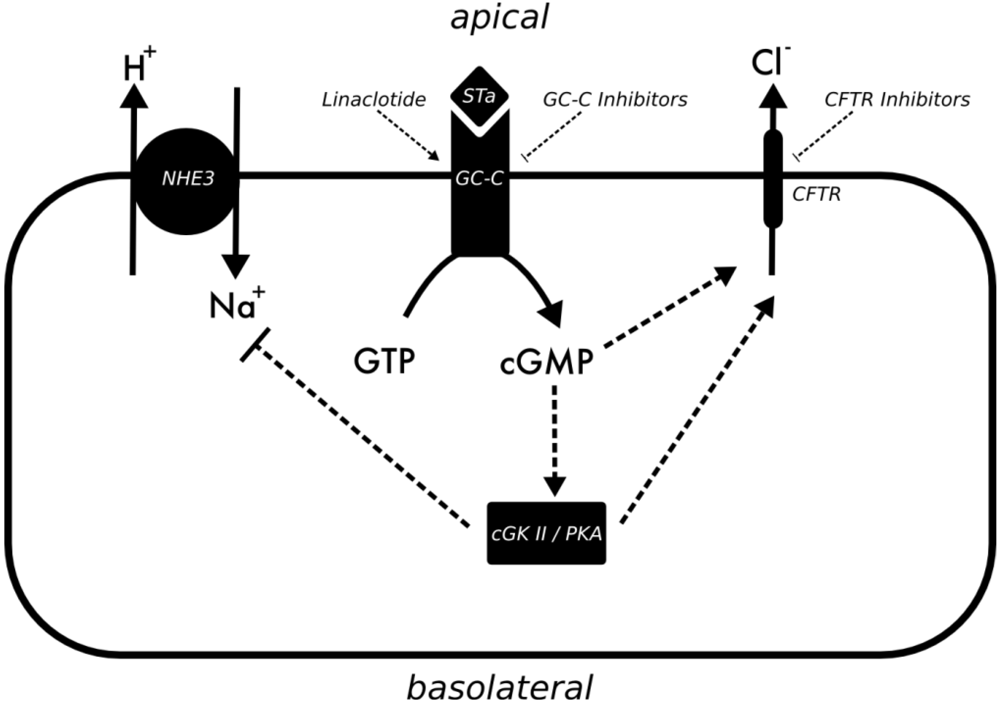
        <p>ETEC produce ST enterotoxins in two variations: STa and STb. Consisting of only 18 or 19 amino acids, STs are considerably smaller in size than LTs and are monomeric in structure [<xref ref-type="bibr" rid="B103-toxins-02-02132">103</xref>,<xref ref-type="bibr" rid="B104-toxins-02-02132">104</xref>,<xref ref-type="bibr" rid="B105-toxins-02-02132">105</xref>,<xref ref-type="bibr" rid="B106-toxins-02-02132">106</xref>,<xref ref-type="bibr" rid="B107-toxins-02-02132">107</xref>]. The STs contain six cysteine residues, forming three disulfide bonds [<xref ref-type="bibr" rid="B103-toxins-02-02132">103</xref>,<xref ref-type="bibr" rid="B104-toxins-02-02132">104</xref>,<xref ref-type="bibr" rid="B106-toxins-02-02132">106</xref>,<xref ref-type="bibr" rid="B108-toxins-02-02132">108</xref>,<xref ref-type="bibr" rid="B109-toxins-02-02132">109</xref>]. The residues and bonds are responsible for the heat stability of the protein and were shown to be essential for its toxicity [<xref ref-type="bibr" rid="B108-toxins-02-02132">108</xref>,<xref ref-type="bibr" rid="B109-toxins-02-02132">109</xref>,<xref ref-type="bibr" rid="B110-toxins-02-02132">110</xref>]. The structure of STs is shared to a significant degree with the heat stable toxins from <italic>V. cholerae</italic> O1/non-O1 and <italic>Yersinia enterocolitica</italic> [<xref ref-type="bibr" rid="B111-toxins-02-02132">111</xref>,<xref ref-type="bibr" rid="B112-toxins-02-02132">112</xref>,<xref ref-type="bibr" rid="B113-toxins-02-02132">113</xref>]. Unlike LT-I, STs do not exert their toxic effects in the cytoplasm of the enterocyte, but rather bind to a receptor on the membrane surface. Receptor quantity decreases with age, which may account for the high prevalence and disease severity of ETEC mediated diarrhea in children [<xref ref-type="bibr" rid="B114-toxins-02-02132">114</xref>]. The receptor has subsequently been cloned and identified as the membrane-bound guanylyl cyclase type C (GC-C), which is comprised of an extracellular receptor domain, a single membrane spanning domain, and an intracellular kinase homology domain followed by the guanylyl cyclase domain [<xref ref-type="bibr" rid="B115-toxins-02-02132">115</xref>,<xref ref-type="bibr" rid="B116-toxins-02-02132">116</xref>]. Stimulation of GC-C leads to an increase in intracellular cGMP concentrations, resulting in activation of PKA or cGMP-dependent protein kinase II (cGK II) and increased chloride secretion through apical CFTR channels [<xref ref-type="bibr" rid="B56-toxins-02-02132">56</xref>,<xref ref-type="bibr" rid="B117-toxins-02-02132">117</xref>,<xref ref-type="bibr" rid="B118-toxins-02-02132">118</xref>]. Both kinases mediate CFTR activation and concomitant NHE3 inhibition via NHERF, leading to increased chloride secretion and reduced sodium absorption [<xref ref-type="bibr" rid="B17-toxins-02-02132">17</xref>,<xref ref-type="bibr" rid="B19-toxins-02-02132">19</xref>,<xref ref-type="bibr" rid="B56-toxins-02-02132">56</xref>,<xref ref-type="bibr" rid="B119-toxins-02-02132">119</xref>,<xref ref-type="bibr" rid="B120-toxins-02-02132">120</xref>]. cGK (−/−) animals were further shown to secrete less fluid in response to STa exposure [<xref ref-type="bibr" rid="B118-toxins-02-02132">118</xref>]. </p>
        <p>Diarrhea ensues as a product of increased luminal osmolarity. Apart from kinase mediated activation, cGMP may influence channel gating directly by binding to CFTR [<xref ref-type="bibr" rid="B121-toxins-02-02132">121</xref>]. As CFTR is the common endpoint for both CTX and STa mediated diarrhea, CF patients and transgenic CF mice seem to have an innate immunity against both toxins [<xref ref-type="bibr" rid="B122-toxins-02-02132">122</xref>,<xref ref-type="bibr" rid="B123-toxins-02-02132">123</xref>]. The exact binding site of STa to GC-C is well characterized by the use of receptor mutagenesis and photoaffinity labeled STa [<xref ref-type="bibr" rid="B124-toxins-02-02132">124</xref>,<xref ref-type="bibr" rid="B125-toxins-02-02132">125</xref>]. Mutation analysis of STa has further revealed that the central β-turn region of the protein (Asn<sup>11</sup>–Cys<sup>14</sup>) is responsible for GC-C binding and that this interaction is dependent on hydrophobic amino acid sidechains [<xref ref-type="bibr" rid="B126-toxins-02-02132">126</xref>,<xref ref-type="bibr" rid="B127-toxins-02-02132">127</xref>,<xref ref-type="bibr" rid="B128-toxins-02-02132">128</xref>,<xref ref-type="bibr" rid="B129-toxins-02-02132">129</xref>]. A GC-C (−/−) model has helped provide us with compelling evidence of the cyclases’s involvement in the process of STa mediated diarrhea, as the affected animals were shown to be resistant against the effects of the toxin [<xref ref-type="bibr" rid="B130-toxins-02-02132">130</xref>,<xref ref-type="bibr" rid="B131-toxins-02-02132">131</xref>]. </p>
        <p>Beside STa, the endogenous peptides uroguanylin and guanylin, which are implicated in the maintenance of salt balance, serve as physiological activators of GC-C [<xref ref-type="bibr" rid="B132-toxins-02-02132">132</xref>,<xref ref-type="bibr" rid="B133-toxins-02-02132">133</xref>,<xref ref-type="bibr" rid="B134-toxins-02-02132">134</xref>,<xref ref-type="bibr" rid="B135-toxins-02-02132">135</xref>,<xref ref-type="bibr" rid="B136-toxins-02-02132">136</xref>]. Guanylin is significantly homologous to STa in its structure and also relies on disulfide linkages for receptor activation [<xref ref-type="bibr" rid="B137-toxins-02-02132">137</xref>]. Membrane guanylyl cyclases also serve as peptide hormone receptors regulating electrolyte homeostasis in other tissues. Atrio-natrioretic peptide, which is secreted by the atrium in response to increased atrial stretch, binds to a similar membrane guanylyl cyclase in the kidney [<xref ref-type="bibr" rid="B138-toxins-02-02132">138</xref>]. GC-C has recently been identified as a pharmacological target in the treatment of constipation. The synthetic 14-peptide GC-C agonist linaclotide (formerly MD-1100) effectively alleviated symptoms of constipation in numerous clinical trials [<xref ref-type="bibr" rid="B139-toxins-02-02132">139</xref>,<xref ref-type="bibr" rid="B140-toxins-02-02132">140</xref>].</p>
        <p>In addition to GC-C, several other STa receptors have been postulated to exist [<xref ref-type="bibr" rid="B141-toxins-02-02132">141</xref>,<xref ref-type="bibr" rid="B142-toxins-02-02132">142</xref>,<xref ref-type="bibr" rid="B143-toxins-02-02132">143</xref>,<xref ref-type="bibr" rid="B144-toxins-02-02132">144</xref>]. This hypothesis has recently been supported by the observation that STa can induce HCO<sub>3</sub><sup>-</sup> secretion in a non-cGMP, non-GC-C and non-CFTR dependent manner [<xref ref-type="bibr" rid="B145-toxins-02-02132">145</xref>,<xref ref-type="bibr" rid="B146-toxins-02-02132">146</xref>]. The fact that this HCO<sub>3</sub><sup>-</sup> secretion is not dependent on CFTR is especially remarkable, as intact CFTR is traditionally regarded to be a prerequisite for HCO<sub>3</sub><sup>-</sup> secretion [<xref ref-type="bibr" rid="B147-toxins-02-02132">147</xref>]. </p>
        <p>Currently, two pharmacological strategies have been employed to specifically counteract the effects of STa: (i) inhibition of GC-C and its signaling; and (ii) inhibition of chloride secretion through CFTR [<xref ref-type="bibr" rid="B148-toxins-02-02132">148</xref>,<xref ref-type="bibr" rid="B149-toxins-02-02132">149</xref>,<xref ref-type="bibr" rid="B150-toxins-02-02132">150</xref>,<xref ref-type="bibr" rid="B151-toxins-02-02132">151</xref>,<xref ref-type="bibr" rid="B152-toxins-02-02132">152</xref>]. The group of pyridopyrimidine derivatives has been demonstrated to decrease cGMP levels in T84 cells and to decrease STa triggered fluid secretion in an isolated intestinal loop model by inhibition of GC-C [<xref ref-type="bibr" rid="B148-toxins-02-02132">148</xref>,<xref ref-type="bibr" rid="B149-toxins-02-02132">149</xref>]. Specificity of the substance is limited, as other GC family members (GC-A,B and soluble forms) were also inhibited [<xref ref-type="bibr" rid="B148-toxins-02-02132">148</xref>]. In addition, the tyrphostin tyrosin kinase inhibitors and the membrane permeable nucleoside analog 2-chloroadenosine were shown to inhibit GC-C activity in a cultured cell model [<xref ref-type="bibr" rid="B150-toxins-02-02132">150</xref>,<xref ref-type="bibr" rid="B151-toxins-02-02132">151</xref>,<xref ref-type="bibr" rid="B152-toxins-02-02132">152</xref>]. However, the most promising substances for inhibiting STa mediated diarrhea are clearly the specific CFTR channel inhibitors, as they are non-absorbable and exert their effects on-site in the intestinal lumen. Except for one study, the majority of data has been generated in a CTX model, as CFTR represents the common endpoint for both CTX and STa mediated diarrhea [<xref ref-type="bibr" rid="B153-toxins-02-02132">153</xref>]. Apart from specific treatment approaches, dietary calcium intake has been show to inhibit ETEC mediated diarrhea in human test subjects [<xref ref-type="bibr" rid="B154-toxins-02-02132">154</xref>]. </p>
        <fig id="toxins-02-02132-f001" position="anchor">
          <label>Figure 1</label>
          <caption>
            <p>Model summarizing cellular processes during STa mediated diarrhea.</p>
          </caption>
          <graphic xmlns:xlink="http://www.w3.org/1999/xlink" xlink:href="toxins-02-02132-g001.tif"/>
        </fig>
      </sec>
      <sec>
        <title>3.2. <italic>Vibrio Cholerae</italic></title>
        <p>In 2008, over 190,000 cases of cholera were reported to the WHO [<xref ref-type="bibr" rid="B155-toxins-02-02132">155</xref>]. It is safe to say that the actual number of annual symptomatic <italic>V. cholerae</italic> infections is much higher as a result of underreporting. Particularly disconcerting is the fact that on average the number of cholera cases has been on the rise in recent years [<xref ref-type="bibr" rid="B155-toxins-02-02132">155</xref>]. As the disease is transmitted feco-orally, cholera is associated with poor sanitary conditions. Cholera outbreaks are thus grim companions of natural catastrophes, political instability and poverty. The disease itself is characterized by a watery diarrhea with typical rice-water stools. The fulminant onset of diarrhea is extremely abrupt and the massive fluid loss of up to 1liter/h can be lethal within hours as a result of dehydration [<xref ref-type="bibr" rid="B156-toxins-02-02132">156</xref>]. Although aggressive rehydration therapy has proven to be an effective countermeasure, the acute nature of the disease calls for rapid accessibility to treatment, which is often a challenging endeavor in underdeveloped regions. </p>
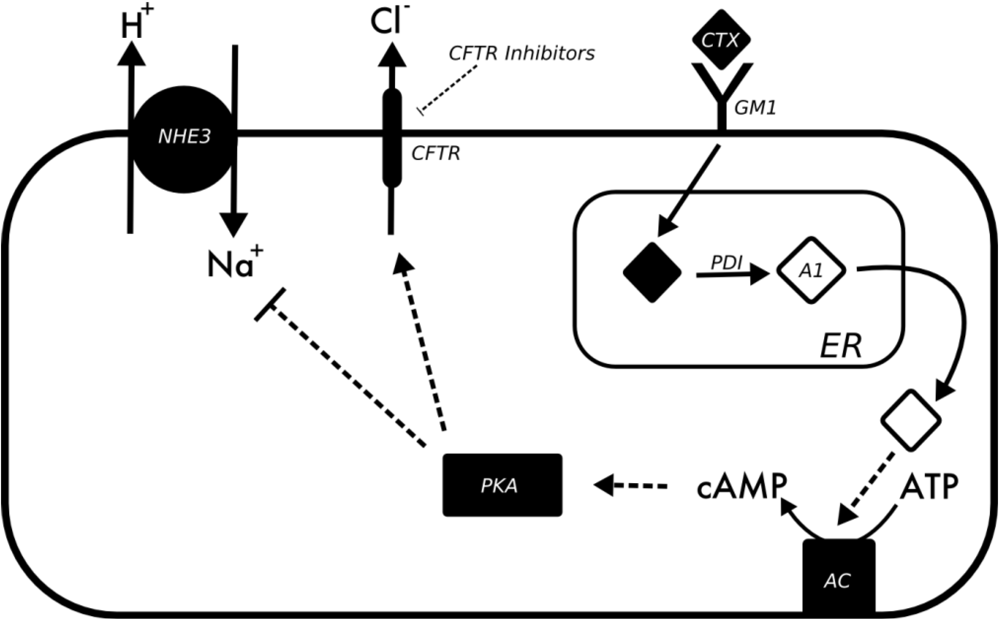
        <p>The effects of cholera are mediated by CTX, which is secreted by the bacterium. Once secreted, the B subunits of CTX bind to the membrane associated ganglioside GM1, which serves as a receptor for CTX on the cell surface. The number of B subunits correlates with toxicity, presumably by facilitating uptake through clustering of multiple GM1s [<xref ref-type="bibr" rid="B157-toxins-02-02132">157</xref>]. Following binding, the CTX-GM1 complex undergoes endocytosis and embarks on a true odyssey through the enterocyte before the toxin finally exerts its pathological effects in the cytosol. The trafficking of CTX through the cell has received an extensive amount of scientific attention, with the hope of identifying a possible pharmacological target for the treatment of LT-I and CTX related diarrhea. The trafficking process is reviewed in great detail elsewhere and will only be described briefly in this review [<xref ref-type="bibr" rid="B158-toxins-02-02132">158</xref>,<xref ref-type="bibr" rid="B159-toxins-02-02132">159</xref>]. After endocytosis, CTX is trafficked via endosomes to the trans-Golgi network in an actin dependent manner [<xref ref-type="bibr" rid="B158-toxins-02-02132">158</xref>,<xref ref-type="bibr" rid="B159-toxins-02-02132">159</xref>,<xref ref-type="bibr" rid="B160-toxins-02-02132">160</xref>]. The toxin subsequently continues its journey to the ER, where protein disulfide isomerase (PDI) unfolds the enzymatically active A1 chain of the holotoxin, allowing A1 to be released from the ER into the cytosol. The pathway through which A1 release occurs is not yet fully understood [<xref ref-type="bibr" rid="B158-toxins-02-02132">158</xref>]. Once in the cytosol, A1 starts to exert its toxic effects. One of the earliest observations on the impact of CTX was made in Ussing chamber experiments on isolated rabbit ileal mucosa, demonstrating an inhibition of short circuit current (SCC; an indicator for chloride secretion) following toxin exposure [<xref ref-type="bibr" rid="B161-toxins-02-02132">161</xref>]. Similar changes could be elicited by cAMP, suggesting that CTX exerts its action through elevation of intracellular cAMP concentrations [<xref ref-type="bibr" rid="B161-toxins-02-02132">161</xref>]. The A1 chain elevates intracellular cAMP concentrations by activating the alpha subunit of a G-Protein (G<sub>s</sub>) which in turn increases adenylyl cyclase activity [<xref ref-type="bibr" rid="B102-toxins-02-02132">102</xref>,<xref ref-type="bibr" rid="B162-toxins-02-02132">162</xref>]. G<sub>s</sub><sub>α</sub> loses its intrinsic GTPase activity by A1 mediated ADP ribosylation of an arginine residue, resulting in prolonged activity of G<sub>s</sub><sub>α</sub> [<xref ref-type="bibr" rid="B163-toxins-02-02132">163</xref>,<xref ref-type="bibr" rid="B164-toxins-02-02132">164</xref>,<xref ref-type="bibr" rid="B165-toxins-02-02132">165</xref>]. Cells from mice lacking the enzyme which antagonizes ADP ribosylation (ADP-ribosyl protein hydrolase) are verifiably more sensitive to CTX [<xref ref-type="bibr" rid="B166-toxins-02-02132">166</xref>]. As outlined above, cAMP is an activator of apical CFTR channels, which was postulated to account for the observed changes in potential difference and SCC [<xref ref-type="bibr" rid="B102-toxins-02-02132">102</xref>]. CTX triggered elevations of cAMP levels further inhibit Na<sup>+</sup> uptake by NHE in the villus cell and thereby increase the osmotic driving force for fluid secretion [<xref ref-type="bibr" rid="B167-toxins-02-02132">167</xref>,<xref ref-type="bibr" rid="B168-toxins-02-02132">168</xref>]. </p>
        <p>Serotonin (5-HT) release from enterochromaffin cells has also been implicated in the mechanism of action of CTX [<xref ref-type="bibr" rid="B169-toxins-02-02132">169</xref>,<xref ref-type="bibr" rid="B170-toxins-02-02132">170</xref>,<xref ref-type="bibr" rid="B171-toxins-02-02132">171</xref>]. A CTX mediated increase of 5-HT release was observed in a preparation of human ileum [<xref ref-type="bibr" rid="B169-toxins-02-02132">169</xref>]. Application of the 5-HT<sub>3</sub> receptor antagonist granisetron resulted in a decrease of both 5-HT release and fluid secretion in isolated rat intestinal segments [<xref ref-type="bibr" rid="B172-toxins-02-02132">172</xref>]. In addition, CTX is capable of modulating the immune response of the host by eliciting IL-6 secretion from the enterocytes, depleting the reserves of CD8+ intraepithelial lymphocytes and by inhibiting CD4+ and CD8+ lymphocytes [<xref ref-type="bibr" rid="B173-toxins-02-02132">173</xref>,<xref ref-type="bibr" rid="B174-toxins-02-02132">174</xref>,<xref ref-type="bibr" rid="B175-toxins-02-02132">175</xref>,<xref ref-type="bibr" rid="B176-toxins-02-02132">176</xref>]. A recent study has also investigated the gene expression patterns in response to CTX exposure by micro-array analysis [<xref ref-type="bibr" rid="B177-toxins-02-02132">177</xref>]. The affected genes are speculated to play a role in the innate defense mechanism of the exposed cell [<xref ref-type="bibr" rid="B177-toxins-02-02132">177</xref>]. </p>
        <p>Prostaglandins of the E family (PGE) were shown to play an important role in the action of CTX mediated diarrhea. An increase of PGE synthesis was observed in rat and pig ileum in response to CTX exposure [<xref ref-type="bibr" rid="B178-toxins-02-02132">178</xref>,<xref ref-type="bibr" rid="B179-toxins-02-02132">179</xref>,<xref ref-type="bibr" rid="B180-toxins-02-02132">180</xref>]. PGE is also able to induce fluid secretion in unexposed tissue [<xref ref-type="bibr" rid="B178-toxins-02-02132">178</xref>,<xref ref-type="bibr" rid="B179-toxins-02-02132">179</xref>] (this view has also been opposed by Hudson <italic>et al.</italic> [<xref ref-type="bibr" rid="B181-toxins-02-02132">181</xref>]). The role of PGE in the genesis of cholera is further emphasized by the successful inhibition of secretion following treatment with cyclooxygenase (COX) inhibitors [<xref ref-type="bibr" rid="B182-toxins-02-02132">182</xref>,<xref ref-type="bibr" rid="B183-toxins-02-02132">183</xref>]. Cells from COX (−/−) animals, however, demonstrated no significantly different behavior from wild-type cells in terms of pathological fluid secretion [<xref ref-type="bibr" rid="B182-toxins-02-02132">182</xref>]. To the present day, the exact relationship and hierarchy between the cAMP, PGE and 5-HT signals have not been thoroughly defined [<xref ref-type="bibr" rid="B102-toxins-02-02132">102</xref>,<xref ref-type="bibr" rid="B184-toxins-02-02132">184</xref>].</p>
        <p>Although the mechanisms of intestinal electrolyte secretion are fairly well understood, the exact route of the ensuing water movement is still unknown [<xref ref-type="bibr" rid="B2-toxins-02-02132">2</xref>]. Aquaporin water channels (AQP) have emerged as possible candidates for transcellular water movement [<xref ref-type="bibr" rid="B2-toxins-02-02132">2</xref>]. Several groups have set out to investigate their role in cholera. CTX was shown to modulate permeability of several AQPs in an oocyte overexpression system [<xref ref-type="bibr" rid="B185-toxins-02-02132">185</xref>]. AQP8 in particular is expressed in the intestine and was shown to be regulated by cAMP in the liver [<xref ref-type="bibr" rid="B186-toxins-02-02132">186</xref>,<xref ref-type="bibr" rid="B187-toxins-02-02132">187</xref>]. Furthermore, observations in rat intestine verify down regulation of AQP8 following CTX exposure [<xref ref-type="bibr" rid="B188-toxins-02-02132">188</xref>](conversely, AQP10 is down regulated in human cholera patients [<xref ref-type="bibr" rid="B189-toxins-02-02132">189</xref>]). However, results in a recent AQP8 (−/−) model do not support the hypothesis that AQP8 serves as an important route for water secretion in cholera, as the affected mice showed a normal secretory response to CTX [<xref ref-type="bibr" rid="B188-toxins-02-02132">188</xref>].</p>
        <p>Chloride secretion through CFTR is canonically regarded to be a major endpoint of CTX toxicity, presumably via elevation of intracellular levels of cAMP [<xref ref-type="bibr" rid="B102-toxins-02-02132">102</xref>]. An early observation emphasizing this theory was made in CF mice that secreted less intestinal fluid in response to CTX [<xref ref-type="bibr" rid="B190-toxins-02-02132">190</xref>]. Subsequently, it has been argued that the high prevalence of CF in our population may be a result of an innate resistance to cholera, thereby conferring an evolutionary advantage on heterozygous mutation carriers [<xref ref-type="bibr" rid="B190-toxins-02-02132">190</xref>]. CFTR has evolved into a popular target for the potential treatment of cholera. Currently, three groups of specific CFTR inhibitors exist. The thiazolidinone CFTRInh-172 was shown to reduce CTX stimulated fluid secretion, assessed by intestinal weight measurements, by as much as 90% [<xref ref-type="bibr" rid="B153-toxins-02-02132">153</xref>,<xref ref-type="bibr" rid="B191-toxins-02-02132">191</xref>]. <italic>In vivo</italic> administration of the herbal extract SP-303 also yielded significantly less fluid accumulation, employing a comparable experimental approach [<xref ref-type="bibr" rid="B192-toxins-02-02132">192</xref>]. The formulation of the original substance has recently been improved; however, <italic>in vivo</italic> data are not yet available [<xref ref-type="bibr" rid="B193-toxins-02-02132">193</xref>]. The glycine hydrazide GlyH-101 was also tested in a closed loop model and reduced CTX induced fluid secretion by 80% [<xref ref-type="bibr" rid="B194-toxins-02-02132">194</xref>]. Nonetheless, none of these substances is currently in clinical use. In the absence of a specific treatment for cholera, aggressive rehydration with ORS solutions remains the most crucial countermeasure against the massive fluid loss that occurs in the course of the disease. The efficacy of ORS treatment is exemplified in a case study from the 70s in which cholera mortality could be decreased among Bangladesh refugees to 3.6% by administration of ORS, compared to 30% in similar refugee camps that relied purely on intravenous fluid substitution therapy [<xref ref-type="bibr" rid="B195-toxins-02-02132">195</xref>]. In addition to rehydration therapy, a single-dose administration of azithromycin has been shown to ameliorate disease severity [<xref ref-type="bibr" rid="B196-toxins-02-02132">196</xref>,<xref ref-type="bibr" rid="B197-toxins-02-02132">197</xref>]. Apart from these strategies, our specific therapeutic resources are limited. A supplemental pharmacological approach is still desirable. The specific CFTR inhibitors may represent a remedy for this need, but their clinical potency still remains to be reviewed.</p>
        <fig id="toxins-02-02132-f002" position="anchor">
          <label>Figure 2</label>
          <caption>
            <p>Model summarizing cellular processes during CTX mediated diarrhea.</p>
          </caption>
          <graphic xmlns:xlink="http://www.w3.org/1999/xlink" xlink:href="toxins-02-02132-g002.tif"/>
        </fig>
      </sec>
      <sec>
        <title>3.3. Rotavirus</title>
        <p>Rotavirus infection is the leading cause of diarrhea related hospitalization in children (&lt;5 years)[<xref ref-type="bibr" rid="B198-toxins-02-02132">198</xref>,<xref ref-type="bibr" rid="B199-toxins-02-02132">199</xref>]. Estimations assert that 611,000 childhood deaths are caused annually by rotavirus, 80% of which occur in developing countries [<xref ref-type="bibr" rid="B200-toxins-02-02132">200</xref>]. Rotavirus infection is a global phenomenon, and the industrialized world is not exempt from its burden. In the US alone, 60,000 hospitalizations per year are attributable to the virus, although mortality is substantially lower with 37 deaths annually [<xref ref-type="bibr" rid="B201-toxins-02-02132">201</xref>].</p>
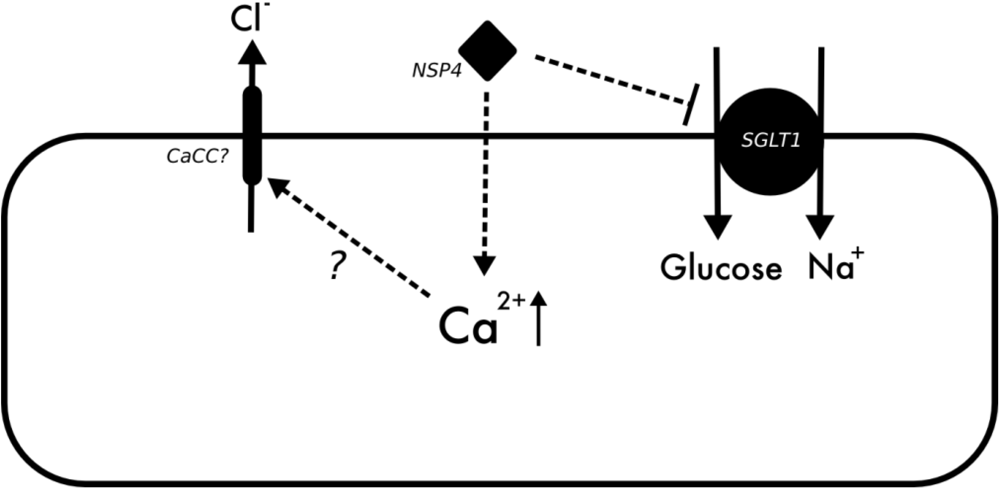
        <p>The RNA of rotavirus encodes six viral proteins (VPs) and six nonstructural proteins (NSPs). One of the NSPs, namely NSP4, is a viral protein that induces diarrhea [<xref ref-type="bibr" rid="B202-toxins-02-02132">202</xref>,<xref ref-type="bibr" rid="B203-toxins-02-02132">203</xref>]. Although several other mechanisms, such as activation of the enteric nervous system, secretion of chemokines and epithelial ischemia, contribute to the diarrheagenic effects of rotavirus, we will limit our scope on the enterotoxin NSP4 [<xref ref-type="bibr" rid="B204-toxins-02-02132">204</xref>,<xref ref-type="bibr" rid="B205-toxins-02-02132">205</xref>,<xref ref-type="bibr" rid="B206-toxins-02-02132">206</xref>]. NSP4 is a multifunctional protein and, besides its role as an enterotoxin, also serves as a receptor on the ER that mediates translocation of viral particles between cytosol and ER [<xref ref-type="bibr" rid="B207-toxins-02-02132">207</xref>,<xref ref-type="bibr" rid="B208-toxins-02-02132">208</xref>,<xref ref-type="bibr" rid="B209-toxins-02-02132">209</xref>]. Recent data suggest that NSP4 can be trafficked from the ER to the plasma membrane where it is secreted by the infected enterocyte [<xref ref-type="bibr" rid="B210-toxins-02-02132">210</xref>,<xref ref-type="bibr" rid="B211-toxins-02-02132">211</xref>,<xref ref-type="bibr" rid="B212-toxins-02-02132">212</xref>,<xref ref-type="bibr" rid="B213-toxins-02-02132">213</xref>]. Given the fairly recent discovery of NSP4, our knowledge about its enterotoxic nature is still limited. We know that NSP4 can directly induce diarrhea and that this effect is not mediated through CFTR, as (−/−) animals were still susceptible to its effects [<xref ref-type="bibr" rid="B203-toxins-02-02132">203</xref>,<xref ref-type="bibr" rid="B214-toxins-02-02132">214</xref>]. In addition, it has been extensively described that NSP4 can increase intracellular Ca<sup>2+</sup> concentrations [<xref ref-type="bibr" rid="B202-toxins-02-02132">202</xref>,<xref ref-type="bibr" rid="B215-toxins-02-02132">215</xref>,<xref ref-type="bibr" rid="B216-toxins-02-02132">216</xref>]. It has recently been speculated that upregulation of the MS4A2 gene, which encodes a protein with a calcium channel activity, could play a role in this process [<xref ref-type="bibr" rid="B217-toxins-02-02132">217</xref>]. Elevations of intracellular Ca<sup>2+</sup> can activate CaCCs and may explain the vulnerability of CFTR (−/−) animals to NSP4. However, evidence for direct NSP4 induced intestinal chloride secretion is still scarce. So far, Ussing chamber studies in a cell culture model demonstrated an NSP4 dependent increase in SCC and I<sup>-</sup> imaging revealed that NSP4 causes non-CFTR mediated anion permeability in isolated murine crypts [<xref ref-type="bibr" rid="B214-toxins-02-02132">214</xref>,<xref ref-type="bibr" rid="B218-toxins-02-02132">218</xref>]. </p>
        <p>A direct inhibition of SGLT1 has also been observed and may cause osmotic diarrhea by impaired uptake of Na<sup>+</sup> and glucose, rather than by increased secretion [<xref ref-type="bibr" rid="B219-toxins-02-02132">219</xref>]. A different group has reported that NSP4 can increase paracellular permeability in a polarized cell model [<xref ref-type="bibr" rid="B220-toxins-02-02132">220</xref>]. In summary, conclusive information on the action of NSP4 on enterocyte ion transport is not available, although changes in Ca<sup>2+</sup> homeostasis seem to be involved. </p>
        <p>As a result of the plethora of cellular mechanisms that are affected by Rotavirus infection, no specific treatment model exists. Yet, remarkable progress has been made in the prevention of the disease with the introduction of Rotavirus vaccines [<xref ref-type="bibr" rid="B221-toxins-02-02132">221</xref>]. </p>
        <fig id="toxins-02-02132-f003" position="anchor">
          <label>Figure 3</label>
          <caption>
            <p>Model summarizing cellular processes during NSP4 mediated diarrhea.</p>
          </caption>
          <graphic xmlns:xlink="http://www.w3.org/1999/xlink" xlink:href="toxins-02-02132-g003.tif"/>
        </fig>
      </sec>
    </sec>
    <sec sec-type="conclusions">
      <title>4. Conclusions</title>
      <p>Our knowledge of the molecular mechanisms underlying ETEC, cholera, and Rotavirus mediated diarrhea has massively improved over the last years. Paradoxically, our arsenal of potential specific therapeutic approaches is still small by comparison. The non-absorbable CFTR inhibitors can be regarded as the most promising advance in the direction of targeted treatment, but proof of their clinical efficacy and benefit is not yet available. Although unspecific, the advent of ORS represents the most revolutionary progress that has been achieved in terms of averting the lethal consequences of ADI in the past decades. The millions of remaining ADI related deaths, however, are a sad reminder that complimentary therapeutic approaches need to be developed and that accessibility to treatment has to be optimized. </p>
    </sec>
  </body>
  <back>
    <ref-list>
      <title>References</title>
      <ref id="B1-toxins-02-02132">
        <label>1.</label>
        <citation citation-type="journal">
          <person-group person-group-type="author">
            <name>
              <surname>Kosek</surname>
              <given-names>M.</given-names>
            </name>
            <name>
              <surname>Bern</surname>
              <given-names>C.</given-names>
            </name>
            <name>
              <surname>Guerrant</surname>
              <given-names>R.L.</given-names>
            </name>
          </person-group>
          <article-title>The global burden of diarrhoeal disease, as estimated from studies published between 1992 and 2000</article-title>
          <source>Bull. World Health Organ.</source>
          <year>2003</year>
          <volume>81</volume>
          <fpage>197</fpage>
          <lpage>204</lpage>
        <pub-id pub-id-type="pmid">12764516</pub-id></citation>
      </ref>
      <ref id="B2-toxins-02-02132">
        <label>2.</label>
        <citation citation-type="journal">
          <person-group person-group-type="author">
            <name>
              <surname>Barrett</surname>
              <given-names>K.E.</given-names>
            </name>
            <name>
              <surname>Keely</surname>
              <given-names>S.J.</given-names>
            </name>
          </person-group>
          <article-title>Chloride secretion by the intestinal epithelium: Molecular basis and regulatory aspects</article-title>
          <source>Annu. Rev. Physiol.</source>
          <year>2000</year>
          <volume>62</volume>
          <fpage>535</fpage>
          <lpage>572</lpage>
        <pub-id pub-id-type="doi">10.1146/annurev.physiol.62.1.535</pub-id><pub-id pub-id-type="pmid">10845102</pub-id></citation>
      </ref>
      <ref id="B3-toxins-02-02132">
        <label>3.</label>
        <citation citation-type="journal">
          <person-group person-group-type="author">
            <name>
              <surname>Singh</surname>
              <given-names>S.K.</given-names>
            </name>
            <name>
              <surname>Binder</surname>
              <given-names>H.J.</given-names>
            </name>
            <name>
              <surname>Boron</surname>
              <given-names>W.F.</given-names>
            </name>
            <name>
              <surname>Geibel</surname>
              <given-names>J.P.</given-names>
            </name>
          </person-group>
          <article-title>Fluid absorption in isolated perfused colonic crypts</article-title>
          <source>J. Clin. Invest.</source>
          <year>1995</year>
          <volume>96</volume>
          <fpage>2373</fpage>
          <lpage>2379</lpage>
        <pub-id pub-id-type="doi">10.1172/JCI118294</pub-id><pub-id pub-id-type="pmid">7593625</pub-id></citation>
      </ref>
      <ref id="B4-toxins-02-02132">
        <label>4.</label>
        <citation citation-type="journal">
          <person-group person-group-type="author">
            <name>
              <surname>Strong</surname>
              <given-names>T.V.</given-names>
            </name>
            <name>
              <surname>Boehm</surname>
              <given-names>K.</given-names>
            </name>
            <name>
              <surname>Collins</surname>
              <given-names>F.S.</given-names>
            </name>
          </person-group>
          <article-title>Localization of cystic fibrosis transmembrane conductance regulator mRNA in the human gastrointestinal tract by <italic>in situ</italic> hybridization</article-title>
          <source>J. Clin. Invest.</source>
          <year>1994</year>
          <volume>93</volume>
          <fpage>347</fpage>
          <lpage>354</lpage>
        <pub-id pub-id-type="doi">10.1172/JCI116966</pub-id><pub-id pub-id-type="pmid">7506713</pub-id></citation>
      </ref>
      <ref id="B5-toxins-02-02132">
        <label>5.</label>
        <citation citation-type="journal">
          <person-group person-group-type="author">
            <name>
              <surname>Kunzelmann</surname>
              <given-names>K.</given-names>
            </name>
            <name>
              <surname>Mall</surname>
              <given-names>M.</given-names>
            </name>
          </person-group>
          <article-title>Electrolyte transport in the mammalian colon: Mechanisms and implications for disease</article-title>
          <source>Physiol. Rev.</source>
          <year>2002</year>
          <volume>82</volume>
          <fpage>245</fpage>
          <lpage>289</lpage>
        <pub-id pub-id-type="pmid">11773614</pub-id></citation>
      </ref>
      <ref id="B6-toxins-02-02132">
        <label>6.</label>
        <citation citation-type="journal">
          <person-group person-group-type="author">
            <name>
              <surname>Kockerling</surname>
              <given-names>A.</given-names>
            </name>
            <name>
              <surname>Fromm</surname>
              <given-names>M.</given-names>
            </name>
          </person-group>
          <article-title>Origin of cAMP-dependent Cl<sup>−</sup> secretion from both crypts and surface epithelia of rat intestine</article-title>
          <source>Am. J. Physiol.</source>
          <year>1993</year>
          <volume>264</volume>
          <fpage>C1294</fpage>
          <lpage>C1301</lpage>
        <pub-id pub-id-type="pmid">8388634</pub-id></citation>
      </ref>
      <ref id="B7-toxins-02-02132">
        <label>7.</label>
        <citation citation-type="journal">
          <person-group person-group-type="author">
            <name>
              <surname>Zachos</surname>
              <given-names>N.C.</given-names>
            </name>
            <name>
              <surname>Tse</surname>
              <given-names>M.</given-names>
            </name>
            <name>
              <surname>Donowitz</surname>
              <given-names>M.</given-names>
            </name>
          </person-group>
          <article-title>Molecular physiology of intestinal Na+/H+ exchange</article-title>
          <source>Annu. Rev. Physiol.</source>
          <year>2005</year>
          <volume>67</volume>
          <fpage>411</fpage>
          <lpage>443</lpage>
        <pub-id pub-id-type="doi">10.1146/annurev.physiol.67.031103.153004</pub-id><pub-id pub-id-type="pmid">15709964</pub-id></citation>
      </ref>
      <ref id="B8-toxins-02-02132">
        <label>8.</label>
        <citation citation-type="journal">
          <person-group person-group-type="author">
            <name>
              <surname>Wakabayashi</surname>
              <given-names>S.</given-names>
            </name>
            <name>
              <surname>Shigekawa</surname>
              <given-names>M.</given-names>
            </name>
            <name>
              <surname>Pouyssegur</surname>
              <given-names>J.</given-names>
            </name>
          </person-group>
          <article-title>Molecular physiology of vertebrate Na+/H+ exchangers</article-title>
          <source>Physiol. Rev.</source>
          <year>1997</year>
          <volume>77</volume>
          <fpage>51</fpage>
          <lpage>74</lpage>
        <pub-id pub-id-type="pmid">9016300</pub-id></citation>
      </ref>
      <ref id="B9-toxins-02-02132">
        <label>9.</label>
        <citation citation-type="journal">
          <person-group person-group-type="author">
            <name>
              <surname>Bookstein</surname>
              <given-names>C.</given-names>
            </name>
            <name>
              <surname>DePaoli</surname>
              <given-names>A.M.</given-names>
            </name>
            <name>
              <surname>Xie</surname>
              <given-names>Y.</given-names>
            </name>
            <name>
              <surname>Niu</surname>
              <given-names>P.</given-names>
            </name>
            <name>
              <surname>Musch</surname>
              <given-names>M.W.</given-names>
            </name>
            <name>
              <surname>Rao</surname>
              <given-names>M.C.</given-names>
            </name>
            <name>
              <surname>Chang</surname>
              <given-names>E.B.</given-names>
            </name>
          </person-group>
          <article-title>Na+/H+ exchangers, NHE-1 and NHE-3, of rat intestin. Expression and localization</article-title>
          <source>J. Clin. Invest.</source>
          <year>1994</year>
          <volume>93</volume>
          <fpage>106</fpage>
          <lpage>113</lpage>
          <pub-id pub-id-type="pmid">8282777</pub-id>
          <pub-id pub-id-type="doi">10.1172/JCI116933</pub-id>
        </citation>
      </ref>
      <ref id="B10-toxins-02-02132">
        <label>10.</label>
        <citation citation-type="journal">
          <person-group person-group-type="author">
            <name>
              <surname>Tse</surname>
              <given-names>C.M.</given-names>
            </name>
            <name>
              <surname>Ma</surname>
              <given-names>A.I.</given-names>
            </name>
            <name>
              <surname>Yang</surname>
              <given-names>V.W.</given-names>
            </name>
            <name>
              <surname>Watson</surname>
              <given-names>A.J.</given-names>
            </name>
            <name>
              <surname>Levine</surname>
              <given-names>S.</given-names>
            </name>
            <name>
              <surname>Montrose</surname>
              <given-names>M.H.</given-names>
            </name>
            <name>
              <surname>Potter</surname>
              <given-names>J.</given-names>
            </name>
            <name>
              <surname>Sardet</surname>
              <given-names>C.</given-names>
            </name>
            <name>
              <surname>Pouyssegur</surname>
              <given-names>J.</given-names>
            </name>
            <name>
              <surname>Donowitz</surname>
              <given-names>M.</given-names>
            </name>
          </person-group>
          <article-title>Molecular cloning and expression of a cDNA encoding the rabbit ileal villus cell basolateral membrane Na+/H+ exchanger</article-title>
          <source>EMBO J.</source>
          <year>1991</year>
          <volume>10</volume>
          <fpage>1957</fpage>
          <lpage>1967</lpage>
        <pub-id pub-id-type="pmid">1712287</pub-id></citation>
      </ref>
      <ref id="B11-toxins-02-02132">
        <label>11.</label>
        <citation citation-type="journal">
          <person-group person-group-type="author">
            <name>
              <surname>Collins</surname>
              <given-names>J.F.</given-names>
            </name>
            <name>
              <surname>Honda</surname>
              <given-names>T.</given-names>
            </name>
            <name>
              <surname>Knobel</surname>
              <given-names>S.</given-names>
            </name>
            <name>
              <surname>Bulus</surname>
              <given-names>N.M.</given-names>
            </name>
            <name>
              <surname>Conary</surname>
              <given-names>J.</given-names>
            </name>
            <name>
              <surname>DuBois</surname>
              <given-names>R.</given-names>
            </name>
            <name>
              <surname>Ghishan</surname>
              <given-names>F.K.</given-names>
            </name>
          </person-group>
          <article-title>Molecular cloning, sequencing, tissue distribution, and functional expression of a Na+/H+ exchanger (NHE-2)</article-title>
          <source>Proc. Natl. Acad. Sci. USA</source>
          <year>1993</year>
          <volume>90</volume>
          <fpage>3938</fpage>
          <lpage>3942</lpage>
        <pub-id pub-id-type="doi">10.1073/pnas.90.9.3938</pub-id><pub-id pub-id-type="pmid">7683411</pub-id></citation>
      </ref>
      <ref id="B12-toxins-02-02132">
        <label>12.</label>
        <citation citation-type="journal">
          <person-group person-group-type="author">
            <name>
              <surname>Brant</surname>
              <given-names>S.R.</given-names>
            </name>
            <name>
              <surname>Yun</surname>
              <given-names>C.H.</given-names>
            </name>
            <name>
              <surname>Donowitz</surname>
              <given-names>M.</given-names>
            </name>
            <name>
              <surname>Tse</surname>
              <given-names>C.M.</given-names>
            </name>
          </person-group>
          <article-title>Cloning, tissue distribution, and functional analysis of the human Na+/N+ exchanger isoform, NHE3</article-title>
          <source>Am. J. Physiol.</source>
          <year>1995</year>
          <volume>269</volume>
          <fpage>C198</fpage>
          <lpage>C206</lpage>
        <pub-id pub-id-type="pmid">7631746</pub-id></citation>
      </ref>
      <ref id="B13-toxins-02-02132">
        <label>13.</label>
        <citation citation-type="journal">
          <person-group person-group-type="author">
            <name>
              <surname>Bookstein</surname>
              <given-names>C.</given-names>
            </name>
            <name>
              <surname>Xie</surname>
              <given-names>Y.</given-names>
            </name>
            <name>
              <surname>Rabenau</surname>
              <given-names>K.</given-names>
            </name>
            <name>
              <surname>Musch</surname>
              <given-names>M.W.</given-names>
            </name>
            <name>
              <surname>McSwine</surname>
              <given-names>R.L.</given-names>
            </name>
            <name>
              <surname>Rao</surname>
              <given-names>M.C.</given-names>
            </name>
            <name>
              <surname>Chang</surname>
              <given-names>E.B.</given-names>
            </name>
          </person-group>
          <article-title>Tissue distribution of Na+/H+ exchanger isoforms NHE2 and NHE4 in rat intestine and kidney</article-title>
          <source>Am. J. Physiol.</source>
          <year>1997</year>
          <volume>273</volume>
          <fpage>C1496</fpage>
          <lpage>C1505</lpage>
        <pub-id pub-id-type="pmid">9374634</pub-id></citation>
      </ref>
      <ref id="B14-toxins-02-02132">
        <label>14.</label>
        <citation citation-type="journal">
          <person-group person-group-type="author">
            <name>
              <surname>Gawenis</surname>
              <given-names>L.R.</given-names>
            </name>
            <name>
              <surname>Stien</surname>
              <given-names>X.</given-names>
            </name>
            <name>
              <surname>Shull</surname>
              <given-names>G.E.</given-names>
            </name>
            <name>
              <surname>Schultheis</surname>
              <given-names>P.J.</given-names>
            </name>
            <name>
              <surname>Woo</surname>
              <given-names>A.L.</given-names>
            </name>
            <name>
              <surname>Walker</surname>
              <given-names>N.M.</given-names>
            </name>
            <name>
              <surname>Clarke</surname>
              <given-names>L.L.</given-names>
            </name>
          </person-group>
          <article-title>Intestinal NaCl transport in NHE2 and NHE3 knockout mice</article-title>
          <source>Am. J. Physiol. Gastrointest. Liver Physiol.</source>
          <year>2002</year>
          <volume>282</volume>
          <fpage>G776</fpage>
          <lpage>G784</lpage>
        <pub-id pub-id-type="pmid">11960774</pub-id></citation>
      </ref>
      <ref id="B15-toxins-02-02132">
        <label>15.</label>
        <citation citation-type="journal">
          <person-group person-group-type="author">
            <name>
              <surname>Xu</surname>
              <given-names>H.</given-names>
            </name>
            <name>
              <surname>Chen</surname>
              <given-names>H.</given-names>
            </name>
            <name>
              <surname>Dong</surname>
              <given-names>J.</given-names>
            </name>
            <name>
              <surname>Lynch</surname>
              <given-names>R.</given-names>
            </name>
            <name>
              <surname>Ghishan</surname>
              <given-names>F.K.</given-names>
            </name>
          </person-group>
          <article-title>Gastrointestinal distribution and kinetic characterization of the sodium-hydrogen exchanger isoform 8 (NHE8)</article-title>
          <source>Cell. Physiol. Biochem.</source>
          <year>2008</year>
          <volume>21</volume>
          <fpage>109</fpage>
          <lpage>116</lpage>
        <pub-id pub-id-type="doi">10.1159/000113752</pub-id><pub-id pub-id-type="pmid">18209477</pub-id></citation>
      </ref>
      <ref id="B16-toxins-02-02132">
        <label>16.</label>
        <citation citation-type="journal">
          <person-group person-group-type="author">
            <name>
              <surname>Xu</surname>
              <given-names>H.</given-names>
            </name>
            <name>
              <surname>Chen</surname>
              <given-names>R.</given-names>
            </name>
            <name>
              <surname>Ghishan</surname>
              <given-names>F.K.</given-names>
            </name>
          </person-group>
          <article-title>Subcloning, localization, and expression of the rat intestinal sodium-hydrogen exchanger isoform 8</article-title>
          <source>Am. J. Physiol. Gastrointest. Liver Physiol.</source>
          <year>2005</year>
          <volume>289</volume>
          <fpage>G36</fpage>
          <lpage>G41</lpage>
        <pub-id pub-id-type="doi">10.1152/ajpgi.00552.2004</pub-id><pub-id pub-id-type="pmid">15731506</pub-id></citation>
      </ref>
      <ref id="B17-toxins-02-02132">
        <label>17.</label>
        <citation citation-type="journal">
          <person-group person-group-type="author">
            <name>
              <surname>Donowitz</surname>
              <given-names>M.</given-names>
            </name>
            <name>
              <surname>Mohan</surname>
              <given-names>S.</given-names>
            </name>
            <name>
              <surname>Zhu</surname>
              <given-names>C.X.</given-names>
            </name>
            <name>
              <surname>Chen</surname>
              <given-names>T.E.</given-names>
            </name>
            <name>
              <surname>Lin</surname>
              <given-names>R.</given-names>
            </name>
            <name>
              <surname>Cha</surname>
              <given-names>B.</given-names>
            </name>
            <name>
              <surname>Zachos</surname>
              <given-names>N.C.</given-names>
            </name>
            <name>
              <surname>Murtazina</surname>
              <given-names>R.</given-names>
            </name>
            <name>
              <surname>Sarker</surname>
              <given-names>R.</given-names>
            </name>
            <name>
              <surname>Li</surname>
              <given-names>X.</given-names>
            </name>
          </person-group>
          <article-title>NHE3 regulatory complexes</article-title>
          <source>J. Exp. Biol.</source>
          <year>2009</year>
          <volume>212</volume>
          <fpage>1638</fpage>
          <lpage>1646</lpage>
        <pub-id pub-id-type="doi">10.1242/jeb.028605</pub-id><pub-id pub-id-type="pmid">19448074</pub-id></citation>
      </ref>
      <ref id="B18-toxins-02-02132">
        <label>18.</label>
        <citation citation-type="journal">
          <person-group person-group-type="author">
            <name>
              <surname>Yun</surname>
              <given-names>C.H.</given-names>
            </name>
            <name>
              <surname>Oh</surname>
              <given-names>S.</given-names>
            </name>
            <name>
              <surname>Zizak</surname>
              <given-names>M.</given-names>
            </name>
            <name>
              <surname>Steplock</surname>
              <given-names>D.</given-names>
            </name>
            <name>
              <surname>Tsao</surname>
              <given-names>S.</given-names>
            </name>
            <name>
              <surname>Tse</surname>
              <given-names>C.M.</given-names>
            </name>
            <name>
              <surname>Weinman</surname>
              <given-names>E.J.</given-names>
            </name>
            <name>
              <surname>Donowitz</surname>
              <given-names>M.</given-names>
            </name>
          </person-group>
          <article-title>cAMP-mediated inhibition of the epithelial brush border Na+/H+ exchanger, NHE3, requires an associated regulatory protein</article-title>
          <source>Proc. Natl. Acad. Sci. USA</source>
          <year>1997</year>
          <volume>94</volume>
          <fpage>3010</fpage>
          <lpage>3015</lpage>
        <pub-id pub-id-type="doi">10.1073/pnas.94.7.3010</pub-id><pub-id pub-id-type="pmid">9096337</pub-id></citation>
      </ref>
      <ref id="B19-toxins-02-02132">
        <label>19.</label>
        <citation citation-type="journal">
          <person-group person-group-type="author">
            <name>
              <surname>Cha</surname>
              <given-names>B.</given-names>
            </name>
            <name>
              <surname>Donowitz</surname>
              <given-names>M.</given-names>
            </name>
          </person-group>
          <article-title>The epithelial brush border Na+/H+ exchanger NHE3 associates with the actin cytoskeleton by binding to ezrin directly and via PDZ domain-containing Na+/H+ exchanger regulatory factor (NHERF) proteins</article-title>
          <source>Clin. Exp. Pharmacol. Physiol.</source>
          <year>2008</year>
          <volume>35</volume>
          <fpage>863</fpage>
          <lpage>871</lpage>
        <pub-id pub-id-type="doi">10.1111/j.1440-1681.2008.04931.x</pub-id><pub-id pub-id-type="pmid">18430067</pub-id></citation>
      </ref>
      <ref id="B20-toxins-02-02132">
        <label>20.</label>
        <citation citation-type="journal">
          <person-group person-group-type="author">
            <name>
              <surname>Rajendran</surname>
              <given-names>V.M.</given-names>
            </name>
            <name>
              <surname>Geibel</surname>
              <given-names>J.</given-names>
            </name>
            <name>
              <surname>Binder</surname>
              <given-names>H.J.</given-names>
            </name>
          </person-group>
          <article-title>Role of Cl channels in Cl-dependent Na/H exchange</article-title>
          <source>Am. J. Physiol.</source>
          <year>1999</year>
          <volume>276</volume>
          <fpage>G73</fpage>
          <lpage>G78</lpage>
        <pub-id pub-id-type="pmid">9886981</pub-id></citation>
      </ref>
      <ref id="B21-toxins-02-02132">
        <label>21.</label>
        <citation citation-type="journal">
          <person-group person-group-type="author">
            <name>
              <surname>Rajendran</surname>
              <given-names>V.M.</given-names>
            </name>
            <name>
              <surname>Geibel</surname>
              <given-names>J.</given-names>
            </name>
            <name>
              <surname>Binder</surname>
              <given-names>H.J.</given-names>
            </name>
          </person-group>
          <article-title>Chloride-dependent Na-H exchange.A novel mechanism of sodium transport in colonic crypts</article-title>
          <source>J. Biol. Chem.</source>
          <year>1995</year>
          <volume>270</volume>
          <fpage>11051</fpage>
          <lpage>11054</lpage>
          <pub-id pub-id-type="pmid">7744735</pub-id>
        </citation>
      </ref>
      <ref id="B22-toxins-02-02132">
        <label>22.</label>
        <citation citation-type="journal">
          <person-group person-group-type="author">
            <name>
              <surname>Ahn</surname>
              <given-names>W.</given-names>
            </name>
            <name>
              <surname>Kim</surname>
              <given-names>K.H.</given-names>
            </name>
            <name>
              <surname>Lee</surname>
              <given-names>J.A.</given-names>
            </name>
            <name>
              <surname>Kim</surname>
              <given-names>J.Y.</given-names>
            </name>
            <name>
              <surname>Choi</surname>
              <given-names>J.Y.</given-names>
            </name>
            <name>
              <surname>Moe</surname>
              <given-names>O.W.</given-names>
            </name>
            <name>
              <surname>Milgram</surname>
              <given-names>S.L.</given-names>
            </name>
            <name>
              <surname>Muallem</surname>
              <given-names>S.</given-names>
            </name>
            <name>
              <surname>Lee</surname>
              <given-names>M.G.</given-names>
            </name>
          </person-group>
          <article-title>Regulatory interaction between the cystic fibrosis transmembrane conductance regulator and HCO3- salvage mechanisms in model systems and the mouse pancreatic duct</article-title>
          <source>J. Biol. Chem.</source>
          <year>2001</year>
          <volume>276</volume>
          <fpage>17236</fpage>
          <lpage>17243</lpage>
        <pub-id pub-id-type="doi">10.1074/jbc.M011763200</pub-id><pub-id pub-id-type="pmid">11278980</pub-id></citation>
      </ref>
      <ref id="B23-toxins-02-02132">
        <label>23.</label>
        <citation citation-type="journal">
          <person-group person-group-type="author">
            <name>
              <surname>Mount</surname>
              <given-names>D.B.</given-names>
            </name>
            <name>
              <surname>Romero</surname>
              <given-names>M.F.</given-names>
            </name>
          </person-group>
          <article-title>The SLC26 gene family of multifunctional anion exchangers</article-title>
          <source>Pflugers Arch.</source>
          <year>2004</year>
          <volume>447</volume>
          <fpage>710</fpage>
          <lpage>721</lpage>
        <pub-id pub-id-type="doi">10.1007/s00424-003-1090-3</pub-id><pub-id pub-id-type="pmid">12759755</pub-id></citation>
      </ref>
      <ref id="B24-toxins-02-02132">
        <label>24.</label>
        <citation citation-type="journal">
          <person-group person-group-type="author">
            <name>
              <surname>Wang</surname>
              <given-names>Z.</given-names>
            </name>
            <name>
              <surname>Petrovic</surname>
              <given-names>S.</given-names>
            </name>
            <name>
              <surname>Mann</surname>
              <given-names>E.</given-names>
            </name>
            <name>
              <surname>Soleimani</surname>
              <given-names>M.</given-names>
            </name>
          </person-group>
          <article-title>Identification of an apical Cl(-)/HCO3(-) exchanger in the small intestine</article-title>
          <source>Am. J. Physiol. Gastrointest. Liver Physiol.</source>
          <year>2002</year>
          <volume>282</volume>
          <fpage>G573</fpage>
          <lpage>G579</lpage>
        <pub-id pub-id-type="pmid">11842009</pub-id></citation>
      </ref>
      <ref id="B25-toxins-02-02132">
        <label>25.</label>
        <citation citation-type="journal">
          <person-group person-group-type="author">
            <name>
              <surname>Simpson</surname>
              <given-names>J.E.</given-names>
            </name>
            <name>
              <surname>Schweinfest</surname>
              <given-names>C.W.</given-names>
            </name>
            <name>
              <surname>Shull</surname>
              <given-names>G.E.</given-names>
            </name>
            <name>
              <surname>Gawenis</surname>
              <given-names>L.R.</given-names>
            </name>
            <name>
              <surname>Walker</surname>
              <given-names>N.M.</given-names>
            </name>
            <name>
              <surname>Boyle</surname>
              <given-names>K.T.</given-names>
            </name>
            <name>
              <surname>Soleimani</surname>
              <given-names>M.</given-names>
            </name>
            <name>
              <surname>Clarke</surname>
              <given-names>L.L.</given-names>
            </name>
          </person-group>
          <article-title>PAT-1 (Slc26a6) is the predominant apical membrane Cl-/HCO3- exchanger in the upper villous epithelium of the murine duodenum</article-title>
          <source>Am. J. Physiol. Gastrointest. Liver Physiol.</source>
          <year>2007</year>
          <volume>292</volume>
          <fpage>G1079</fpage>
          <lpage>1088</lpage>
        <pub-id pub-id-type="pmid">17170027</pub-id></citation>
      </ref>
      <ref id="B26-toxins-02-02132">
        <label>26.</label>
        <citation citation-type="journal">
          <person-group person-group-type="author">
            <name>
              <surname>Xie</surname>
              <given-names>Q.</given-names>
            </name>
            <name>
              <surname>Welch</surname>
              <given-names>R.</given-names>
            </name>
            <name>
              <surname>Mercado</surname>
              <given-names>A.</given-names>
            </name>
            <name>
              <surname>Romero</surname>
              <given-names>M.F.</given-names>
            </name>
            <name>
              <surname>Mount</surname>
              <given-names>D.B.</given-names>
            </name>
          </person-group>
          <article-title>Molecular characterization of the murine Slc26a6 anion exchanger: Functional comparison with Slc26a1</article-title>
          <source>Am. J. Physiol. Renal Physiol.</source>
          <year>2002</year>
          <volume>283</volume>
          <fpage>F826</fpage>
          <lpage>F838</lpage>
        <pub-id pub-id-type="pmid">12217875</pub-id></citation>
      </ref>
      <ref id="B27-toxins-02-02132">
        <label>27.</label>
        <citation citation-type="journal">
          <person-group person-group-type="author">
            <name>
              <surname>Ko</surname>
              <given-names>S.B.</given-names>
            </name>
            <name>
              <surname>Shcheynikov</surname>
              <given-names>N.</given-names>
            </name>
            <name>
              <surname>Choi</surname>
              <given-names>J.Y.</given-names>
            </name>
            <name>
              <surname>Luo</surname>
              <given-names>X.</given-names>
            </name>
            <name>
              <surname>Ishibashi</surname>
              <given-names>K.</given-names>
            </name>
            <name>
              <surname>Thomas</surname>
              <given-names>P.J.</given-names>
            </name>
            <name>
              <surname>Kim</surname>
              <given-names>J.Y.</given-names>
            </name>
            <name>
              <surname>Kim</surname>
              <given-names>K.H.</given-names>
            </name>
            <name>
              <surname>Lee</surname>
              <given-names>M.G.</given-names>
            </name>
            <name>
              <surname>Naruse</surname>
              <given-names>S.</given-names>
            </name>
            <name>
              <surname>Muallem</surname>
              <given-names>S.</given-names>
            </name>
          </person-group>
          <article-title>A molecular mechanism for aberrant CFTR-dependent HCO(3)(-) transport in cystic fibrosis</article-title>
          <source>EMBO J.</source>
          <year>2002</year>
          <volume>21</volume>
          <fpage>5662</fpage>
          <lpage>5672</lpage>
        <pub-id pub-id-type="doi">10.1093/emboj/cdf580</pub-id><pub-id pub-id-type="pmid">12411484</pub-id></citation>
      </ref>
      <ref id="B28-toxins-02-02132">
        <label>28.</label>
        <citation citation-type="journal">
          <person-group person-group-type="author">
            <name>
              <surname>Hoglund</surname>
              <given-names>P.</given-names>
            </name>
            <name>
              <surname>Haila</surname>
              <given-names>S.</given-names>
            </name>
            <name>
              <surname>Socha</surname>
              <given-names>J.</given-names>
            </name>
            <name>
              <surname>Tomaszewski</surname>
              <given-names>L.</given-names>
            </name>
            <name>
              <surname>Saarialho-Kere</surname>
              <given-names>U.</given-names>
            </name>
            <name>
              <surname>Karjalainen-Lindsberg</surname>
              <given-names>M.L.</given-names>
            </name>
            <name>
              <surname>Airola</surname>
              <given-names>K.</given-names>
            </name>
            <name>
              <surname>Holmberg</surname>
              <given-names>C.</given-names>
            </name>
            <name>
              <surname>de la Chapelle</surname>
              <given-names>A.</given-names>
            </name>
            <name>
              <surname>Kere</surname>
              <given-names>J.</given-names>
            </name>
          </person-group>
          <article-title>Mutations of the Down-regulated in adenoma (DRA) gene cause congenital chloride diarrhoea</article-title>
          <source>Nat. Genet.</source>
          <year>1996</year>
          <volume>14</volume>
          <fpage>316</fpage>
          <lpage>319</lpage>
        <pub-id pub-id-type="doi">10.1038/ng1196-316</pub-id><pub-id pub-id-type="pmid">8896562</pub-id></citation>
      </ref>
      <ref id="B29-toxins-02-02132">
        <label>29.</label>
        <citation citation-type="journal">
          <person-group person-group-type="author">
            <name>
              <surname>Makela</surname>
              <given-names>S.</given-names>
            </name>
            <name>
              <surname>Kere</surname>
              <given-names>J.</given-names>
            </name>
            <name>
              <surname>Holmberg</surname>
              <given-names>C.</given-names>
            </name>
            <name>
              <surname>Hoglund</surname>
              <given-names>P.</given-names>
            </name>
          </person-group>
          <article-title>SLC26A3 mutations in congenital chloride diarrhea</article-title>
          <source>Hum. Mutat.</source>
          <year>2002</year>
          <volume>20</volume>
          <fpage>425</fpage>
          <lpage>438</lpage>
        <pub-id pub-id-type="doi">10.1002/humu.10139</pub-id><pub-id pub-id-type="pmid">12442266</pub-id></citation>
      </ref>
      <ref id="B30-toxins-02-02132">
        <label>30.</label>
        <citation citation-type="journal">
          <person-group person-group-type="author">
            <name>
              <surname>Walker</surname>
              <given-names>N.M.</given-names>
            </name>
            <name>
              <surname>Simpson</surname>
              <given-names>J.E.</given-names>
            </name>
            <name>
              <surname>Brazill</surname>
              <given-names>J.M.</given-names>
            </name>
            <name>
              <surname>Gill</surname>
              <given-names>R.K.</given-names>
            </name>
            <name>
              <surname>Dudeja</surname>
              <given-names>P.K.</given-names>
            </name>
            <name>
              <surname>Schweinfest</surname>
              <given-names>C.W.</given-names>
            </name>
            <name>
              <surname>Clarke</surname>
              <given-names>L.L.</given-names>
            </name>
          </person-group>
          <article-title>Role of down-regulated in adenoma anion exchanger in HCO3- secretion across murine duodenum</article-title>
          <source>Gastroenterology</source>
          <year>2009</year>
          <volume>136</volume>
          <fpage>893</fpage>
          <lpage>901</lpage>
        <pub-id pub-id-type="doi">10.1053/j.gastro.2008.11.016</pub-id><pub-id pub-id-type="pmid">19121635</pub-id></citation>
      </ref>
      <ref id="B31-toxins-02-02132">
        <label>31.</label>
        <citation citation-type="journal">
          <person-group person-group-type="author">
            <name>
              <surname>Lamprecht</surname>
              <given-names>G.</given-names>
            </name>
            <name>
              <surname>Hsieh</surname>
              <given-names>C.J.</given-names>
            </name>
            <name>
              <surname>Lissner</surname>
              <given-names>S.</given-names>
            </name>
            <name>
              <surname>Nold</surname>
              <given-names>L.</given-names>
            </name>
            <name>
              <surname>Heil</surname>
              <given-names>A.</given-names>
            </name>
            <name>
              <surname>Gaco</surname>
              <given-names>V.</given-names>
            </name>
            <name>
              <surname>Schafer</surname>
              <given-names>J.</given-names>
            </name>
            <name>
              <surname>Turner</surname>
              <given-names>J.R.</given-names>
            </name>
            <name>
              <surname>Gregor</surname>
              <given-names>M.</given-names>
            </name>
          </person-group>
          <article-title>Intestinal anion exchanger down-regulated in adenoma (DRA) is inhibited by intracellular calcium</article-title>
          <source>J. Biol. Chem.</source>
          <year>2009</year>
          <volume>284</volume>
          <fpage>19744</fpage>
          <lpage>19753</lpage>
        <pub-id pub-id-type="doi">10.1074/jbc.M109.004127</pub-id><pub-id pub-id-type="pmid">19447883</pub-id></citation>
      </ref>
      <ref id="B32-toxins-02-02132">
        <label>32.</label>
        <citation citation-type="journal">
          <person-group person-group-type="author">
            <name>
              <surname>Jacob</surname>
              <given-names>P.</given-names>
            </name>
            <name>
              <surname>Rossmann</surname>
              <given-names>H.</given-names>
            </name>
            <name>
              <surname>Lamprecht</surname>
              <given-names>G.</given-names>
            </name>
            <name>
              <surname>Kretz</surname>
              <given-names>A.</given-names>
            </name>
            <name>
              <surname>Neff</surname>
              <given-names>C.</given-names>
            </name>
            <name>
              <surname>Lin-Wu</surname>
              <given-names>E.</given-names>
            </name>
            <name>
              <surname>Gregor</surname>
              <given-names>M.</given-names>
            </name>
            <name>
              <surname>Groneberg</surname>
              <given-names>D.A.</given-names>
            </name>
            <name>
              <surname>Kere</surname>
              <given-names>J.</given-names>
            </name>
            <name>
              <surname>Seidler</surname>
              <given-names>U.</given-names>
            </name>
          </person-group>
          <article-title>Down-regulated in adenoma mediates apical Cl-/HCO3- exchange in rabbit, rat, and human duodenum</article-title>
          <source>Gastroenterology</source>
          <year>2002</year>
          <volume>122</volume>
          <fpage>709</fpage>
          <lpage>724</lpage>
        <pub-id pub-id-type="doi">10.1053/gast.2002.31875</pub-id><pub-id pub-id-type="pmid">11875004</pub-id></citation>
      </ref>
      <ref id="B33-toxins-02-02132">
        <label>33.</label>
        <citation citation-type="journal">
          <person-group person-group-type="author">
            <name>
              <surname>Walker</surname>
              <given-names>N.M.</given-names>
            </name>
            <name>
              <surname>Simpson</surname>
              <given-names>J.E.</given-names>
            </name>
            <name>
              <surname>Yen</surname>
              <given-names>P.F.</given-names>
            </name>
            <name>
              <surname>Gill</surname>
              <given-names>R.K.</given-names>
            </name>
            <name>
              <surname>Rigsby</surname>
              <given-names>E.V.</given-names>
            </name>
            <name>
              <surname>Brazill</surname>
              <given-names>J.M.</given-names>
            </name>
            <name>
              <surname>Dudeja</surname>
              <given-names>P.K.</given-names>
            </name>
            <name>
              <surname>Schweinfest</surname>
              <given-names>C.W.</given-names>
            </name>
            <name>
              <surname>Clarke</surname>
              <given-names>L.L.</given-names>
            </name>
          </person-group>
          <article-title>Down-regulated in adenoma Cl/HCO3 exchanger couples with Na/H exchanger 3 for NaCl absorption in murine small intestine</article-title>
          <source>Gastroenterology</source>
          <year>2008</year>
          <volume>135</volume>
          <fpage>1645</fpage>
          <lpage>1653</lpage>
          <supplement>e1643</supplement>
          <pub-id pub-id-type="pmid">18930060</pub-id>
        </citation>
      </ref>
      <ref id="B34-toxins-02-02132">
        <label>34.</label>
        <citation citation-type="journal">
          <person-group person-group-type="author">
            <name>
              <surname>Charney</surname>
              <given-names>A.N.</given-names>
            </name>
            <name>
              <surname>Egnor</surname>
              <given-names>R.W.</given-names>
            </name>
            <name>
              <surname>Henner</surname>
              <given-names>D.</given-names>
            </name>
            <name>
              <surname>Rashid</surname>
              <given-names>H.</given-names>
            </name>
            <name>
              <surname>Cassai</surname>
              <given-names>N.</given-names>
            </name>
            <name>
              <surname>Sidhu</surname>
              <given-names>G.S.</given-names>
            </name>
          </person-group>
          <article-title>Acid-base effects on intestinal Cl- absorption and vesicular trafficking</article-title>
          <source>Am. J. Physiol. Cell Physiol.</source>
          <year>2004</year>
          <volume>286</volume>
          <fpage>C1062</fpage>
          <lpage>C1070</lpage>
        <pub-id pub-id-type="pmid">15075205</pub-id></citation>
      </ref>
      <ref id="B35-toxins-02-02132">
        <label>35.</label>
        <citation citation-type="journal">
          <person-group person-group-type="author">
            <name>
              <surname>Rajendran</surname>
              <given-names>V.M.</given-names>
            </name>
            <name>
              <surname>Black</surname>
              <given-names>J.</given-names>
            </name>
            <name>
              <surname>Ardito</surname>
              <given-names>T.A.</given-names>
            </name>
            <name>
              <surname>Sangan</surname>
              <given-names>P.</given-names>
            </name>
            <name>
              <surname>Alper</surname>
              <given-names>S.L.</given-names>
            </name>
            <name>
              <surname>Schweinfest</surname>
              <given-names>C.</given-names>
            </name>
            <name>
              <surname>Kashgarian</surname>
              <given-names>M.</given-names>
            </name>
            <name>
              <surname>Binder</surname>
              <given-names>H.J.</given-names>
            </name>
          </person-group>
          <article-title>Regulation of DRA and AE1 in rat colon by dietary Na depletion</article-title>
          <source>Am. J. Physiol. Gastrointest. Liver Physiol.</source>
          <year>2000</year>
          <volume>279</volume>
          <fpage>G931</fpage>
          <lpage>G942</lpage>
        <pub-id pub-id-type="pmid">11052990</pub-id></citation>
      </ref>
      <ref id="B36-toxins-02-02132">
        <label>36.</label>
        <citation citation-type="journal">
          <person-group person-group-type="author">
            <name>
              <surname>Alrefai</surname>
              <given-names>W.A.</given-names>
            </name>
            <name>
              <surname>Tyagi</surname>
              <given-names>S.</given-names>
            </name>
            <name>
              <surname>Nazir</surname>
              <given-names>T.M.</given-names>
            </name>
            <name>
              <surname>Barakat</surname>
              <given-names>J.</given-names>
            </name>
            <name>
              <surname>Anwar</surname>
              <given-names>S.S.</given-names>
            </name>
            <name>
              <surname>Hadjiagapiou</surname>
              <given-names>C.</given-names>
            </name>
            <name>
              <surname>Bavishi</surname>
              <given-names>D.</given-names>
            </name>
            <name>
              <surname>Sahi</surname>
              <given-names>J.</given-names>
            </name>
            <name>
              <surname>Malik</surname>
              <given-names>P.</given-names>
            </name>
            <name>
              <surname>Goldstein</surname>
              <given-names>J.</given-names>
            </name>
            <name>
              <surname>Layden</surname>
              <given-names>T.J.</given-names>
            </name>
            <name>
              <surname>Ramaswamy</surname>
              <given-names>K.</given-names>
            </name>
            <name>
              <surname>Dudeja</surname>
              <given-names>P.K.</given-names>
            </name>
          </person-group>
          <article-title>Human intestinal anion exchanger isoforms: Expression, distribution, and membrane localization</article-title>
          <source>Biochim. Biophys. Acta.</source>
          <year>2001</year>
          <volume>1511</volume>
          <fpage>17</fpage>
          <lpage>27</lpage>
        <pub-id pub-id-type="doi">10.1016/S0005-2736(00)00366-7</pub-id><pub-id pub-id-type="pmid">11248201</pub-id></citation>
      </ref>
      <ref id="B37-toxins-02-02132">
        <label>37.</label>
        <citation citation-type="journal">
          <person-group person-group-type="author">
            <name>
              <surname>Xu</surname>
              <given-names>J.</given-names>
            </name>
            <name>
              <surname>Barone</surname>
              <given-names>S.</given-names>
            </name>
            <name>
              <surname>Petrovic</surname>
              <given-names>S.</given-names>
            </name>
            <name>
              <surname>Wang</surname>
              <given-names>Z.</given-names>
            </name>
            <name>
              <surname>Seidler</surname>
              <given-names>U.</given-names>
            </name>
            <name>
              <surname>Riederer</surname>
              <given-names>B.</given-names>
            </name>
            <name>
              <surname>Ramaswamy</surname>
              <given-names>K.</given-names>
            </name>
            <name>
              <surname>Dudeja</surname>
              <given-names>P.K.</given-names>
            </name>
            <name>
              <surname>Shull</surname>
              <given-names>G.E.</given-names>
            </name>
            <name>
              <surname>Soleimani</surname>
              <given-names>M.</given-names>
            </name>
          </person-group>
          <article-title>Identification of an apical Cl-/HCO3- exchanger in gastric surface mucous and duodenal villus cells</article-title>
          <source>Am. J. Physiol. Gastrointest. Liver Physiol.</source>
          <year>2003</year>
          <volume>285</volume>
          <fpage>G1225</fpage>
          <lpage>G1234</lpage>
        <pub-id pub-id-type="pmid">12893630</pub-id></citation>
      </ref>
      <ref id="B38-toxins-02-02132">
        <label>38.</label>
        <citation citation-type="journal">
          <person-group person-group-type="author">
            <name>
              <surname>Canessa</surname>
              <given-names>C.M.</given-names>
            </name>
            <name>
              <surname>Schild</surname>
              <given-names>L.</given-names>
            </name>
            <name>
              <surname>Buell</surname>
              <given-names>G.</given-names>
            </name>
            <name>
              <surname>Thorens</surname>
              <given-names>B.</given-names>
            </name>
            <name>
              <surname>Gautschi</surname>
              <given-names>I.</given-names>
            </name>
            <name>
              <surname>Horisberger</surname>
              <given-names>J.D.</given-names>
            </name>
            <name>
              <surname>Rossier</surname>
              <given-names>B.C.</given-names>
            </name>
          </person-group>
          <article-title>Amiloride-sensitive epithelial Na+ channel is made of three homologous subunits</article-title>
          <source>Nature</source>
          <year>1994</year>
          <volume>367</volume>
          <fpage>463</fpage>
          <lpage>467</lpage>
        <pub-id pub-id-type="doi">10.1038/367463a0</pub-id><pub-id pub-id-type="pmid">8107805</pub-id></citation>
      </ref>
      <ref id="B39-toxins-02-02132">
        <label>39.</label>
        <citation citation-type="journal">
          <person-group person-group-type="author">
            <name>
              <surname>Barbry</surname>
              <given-names>P.</given-names>
            </name>
            <name>
              <surname>Hofman</surname>
              <given-names>P.</given-names>
            </name>
          </person-group>
          <article-title>Molecular biology of Na+ absorption</article-title>
          <source>Am. J. Physiol.</source>
          <year>1997</year>
          <volume>273</volume>
          <fpage>G571</fpage>
          <lpage>G585</lpage>
        <pub-id pub-id-type="pmid">9316461</pub-id></citation>
      </ref>
      <ref id="B40-toxins-02-02132">
        <label>40.</label>
        <citation citation-type="journal">
          <person-group person-group-type="author">
            <name>
              <surname>Fukushima</surname>
              <given-names>K.</given-names>
            </name>
            <name>
              <surname>Sato</surname>
              <given-names>S.</given-names>
            </name>
            <name>
              <surname>Naito</surname>
              <given-names>H.</given-names>
            </name>
            <name>
              <surname>Funayama</surname>
              <given-names>Y.</given-names>
            </name>
            <name>
              <surname>Haneda</surname>
              <given-names>S.</given-names>
            </name>
            <name>
              <surname>Shibata</surname>
              <given-names>C.</given-names>
            </name>
            <name>
              <surname>Sasaki</surname>
              <given-names>I.</given-names>
            </name>
          </person-group>
          <article-title>Comparative study of epithelial gene expression in the small intestine among total proctocolectomized, dietary sodium-depleted, and aldosterone-infused rats</article-title>
          <source>J. Gastrointest. Surg.</source>
          <year>2005</year>
          <volume>9</volume>
          <fpage>236</fpage>
          <lpage>244</lpage>
        <pub-id pub-id-type="doi">10.1016/j.gassur.2004.05.017</pub-id><pub-id pub-id-type="pmid">15694820</pub-id></citation>
      </ref>
      <ref id="B41-toxins-02-02132">
        <label>41.</label>
        <citation citation-type="journal">
          <person-group person-group-type="author">
            <name>
              <surname>Will</surname>
              <given-names>P.C.</given-names>
            </name>
            <name>
              <surname>Cortright</surname>
              <given-names>R.N.</given-names>
            </name>
            <name>
              <surname>Groseclose</surname>
              <given-names>R.G.</given-names>
            </name>
            <name>
              <surname>Hopfer</surname>
              <given-names>U.</given-names>
            </name>
          </person-group>
          <article-title>Amiloride-sensitive salt and fluid absorption in small intestine of sodium-depleted rats</article-title>
          <source>Am. J. Physiol.</source>
          <year>1985</year>
          <volume>248</volume>
          <fpage>G133</fpage>
          <lpage>G141</lpage>
        <pub-id pub-id-type="pmid">3966556</pub-id></citation>
      </ref>
      <ref id="B42-toxins-02-02132">
        <label>42.</label>
        <citation citation-type="journal">
          <person-group person-group-type="author">
            <name>
              <surname>Berdiev</surname>
              <given-names>B.K.</given-names>
            </name>
            <name>
              <surname>Qadri</surname>
              <given-names>Y.J.</given-names>
            </name>
            <name>
              <surname>Benos</surname>
              <given-names>D.J.</given-names>
            </name>
          </person-group>
          <article-title>Assessment of the CFTR and ENaC association</article-title>
          <source>Mol. Biosyst.</source>
          <year>2009</year>
          <volume>5</volume>
          <fpage>123</fpage>
          <lpage>127</lpage>
        <pub-id pub-id-type="doi">10.1039/b810471a</pub-id><pub-id pub-id-type="pmid">19156256</pub-id></citation>
      </ref>
      <ref id="B43-toxins-02-02132">
        <label>43.</label>
        <citation citation-type="journal">
          <person-group person-group-type="author">
            <name>
              <surname>Konig</surname>
              <given-names>J.</given-names>
            </name>
            <name>
              <surname>Schreiber</surname>
              <given-names>R.</given-names>
            </name>
            <name>
              <surname>Voelcker</surname>
              <given-names>T.</given-names>
            </name>
            <name>
              <surname>Mall</surname>
              <given-names>M.</given-names>
            </name>
            <name>
              <surname>Kunzelmann</surname>
              <given-names>K.</given-names>
            </name>
          </person-group>
          <article-title>The cystic fibrosis transmembrane conductance regulator (CFTR) inhibits ENaC through an increase in the intracellular Cl- concentration</article-title>
          <source>EMBO Rep.</source>
          <year>2001</year>
          <volume>2</volume>
          <fpage>1047</fpage>
          <lpage>1051</lpage>
        <pub-id pub-id-type="doi">10.1093/embo-reports/kve232</pub-id><pub-id pub-id-type="pmid">11606421</pub-id></citation>
      </ref>
      <ref id="B44-toxins-02-02132">
        <label>44.</label>
        <citation citation-type="journal">
          <person-group person-group-type="author">
            <name>
              <surname>Nagel</surname>
              <given-names>G.</given-names>
            </name>
            <name>
              <surname>Barbry</surname>
              <given-names>P.</given-names>
            </name>
            <name>
              <surname>Chabot</surname>
              <given-names>H.</given-names>
            </name>
            <name>
              <surname>Brochiero</surname>
              <given-names>E.</given-names>
            </name>
            <name>
              <surname>Hartung</surname>
              <given-names>K.</given-names>
            </name>
            <name>
              <surname>Grygorczyk</surname>
              <given-names>R.</given-names>
            </name>
          </person-group>
          <article-title>CFTR fails to inhibit the epithelial sodium channel ENaC expressed in <italic>Xenopus laevis</italic> oocytes</article-title>
          <source>J. Physiol.</source>
          <year>2005</year>
          <volume>564</volume>
          <fpage>671</fpage>
          <lpage>682</lpage>
        <pub-id pub-id-type="doi">10.1113/jphysiol.2004.079046</pub-id><pub-id pub-id-type="pmid">15746174</pub-id></citation>
      </ref>
      <ref id="B45-toxins-02-02132">
        <label>45.</label>
        <citation citation-type="journal">
          <person-group person-group-type="author">
            <name>
              <surname>Mall</surname>
              <given-names>M.</given-names>
            </name>
            <name>
              <surname>Bleich</surname>
              <given-names>M.</given-names>
            </name>
            <name>
              <surname>Kuehr</surname>
              <given-names>J.</given-names>
            </name>
            <name>
              <surname>Brandis</surname>
              <given-names>M.</given-names>
            </name>
            <name>
              <surname>Greger</surname>
              <given-names>R.</given-names>
            </name>
            <name>
              <surname>Kunzelmann</surname>
              <given-names>K.</given-names>
            </name>
          </person-group>
          <article-title>CFTR-mediated inhibition of epithelial Na+ conductance in human colon is defective in cystic fibrosis</article-title>
          <source>Am. J. Physiol.</source>
          <year>1999</year>
          <volume>277</volume>
          <fpage>G709</fpage>
          <lpage>G716</lpage>
        <pub-id pub-id-type="pmid">10484398</pub-id></citation>
      </ref>
      <ref id="B46-toxins-02-02132">
        <label>46.</label>
        <citation citation-type="journal">
          <person-group person-group-type="author">
            <name>
              <surname>Hediger</surname>
              <given-names>M.A.</given-names>
            </name>
            <name>
              <surname>Coady</surname>
              <given-names>M.J.</given-names>
            </name>
            <name>
              <surname>Ikeda</surname>
              <given-names>T.S.</given-names>
            </name>
            <name>
              <surname>Wright</surname>
              <given-names>E.M.</given-names>
            </name>
          </person-group>
          <article-title>Expression cloning and cDNA sequencing of the Na+/glucose co-transporter</article-title>
          <source>Nature</source>
          <year>1987</year>
          <volume>330</volume>
          <fpage>379</fpage>
          <lpage>381</lpage>
        <pub-id pub-id-type="doi">10.1038/330379a0</pub-id><pub-id pub-id-type="pmid">2446136</pub-id></citation>
      </ref>
      <ref id="B47-toxins-02-02132">
        <label>47.</label>
        <citation citation-type="journal">
          <person-group person-group-type="author">
            <name>
              <surname>Wright</surname>
              <given-names>E.M.</given-names>
            </name>
            <name>
              <surname>Hirayama</surname>
              <given-names>B.A.</given-names>
            </name>
            <name>
              <surname>Loo</surname>
              <given-names>D.F.</given-names>
            </name>
          </person-group>
          <article-title>Active sugar transport in health and disease</article-title>
          <source>J. Intern. Med.</source>
          <year>2007</year>
          <volume>261</volume>
          <fpage>32</fpage>
          <lpage>43</lpage>
        <pub-id pub-id-type="doi">10.1111/j.1365-2796.2006.01746.x</pub-id><pub-id pub-id-type="pmid">17222166</pub-id></citation>
      </ref>
      <ref id="B48-toxins-02-02132">
        <label>48.</label>
        <citation citation-type="journal">
          <person-group person-group-type="author">
            <name>
              <surname>Chen</surname>
              <given-names>X.Z.</given-names>
            </name>
            <name>
              <surname>Coady</surname>
              <given-names>M.J.</given-names>
            </name>
            <name>
              <surname>Jackson</surname>
              <given-names>F.</given-names>
            </name>
            <name>
              <surname>Berteloot</surname>
              <given-names>A.</given-names>
            </name>
            <name>
              <surname>Lapointe</surname>
              <given-names>J.Y.</given-names>
            </name>
          </person-group>
          <article-title>Thermodynamic determination of the Na+: Glucose coupling ratio for the human SGLT1 cotransporter</article-title>
          <source>Biophys. J.</source>
          <year>1995</year>
          <volume>69</volume>
          <fpage>2405</fpage>
          <lpage>2414</lpage>
        <pub-id pub-id-type="doi">10.1016/S0006-3495(95)80110-4</pub-id><pub-id pub-id-type="pmid">8599647</pub-id></citation>
      </ref>
      <ref id="B49-toxins-02-02132">
        <label>49.</label>
        <citation citation-type="journal">
          <person-group person-group-type="author">
            <name>
              <surname>Hirschhorn</surname>
              <given-names>N.</given-names>
            </name>
            <name>
              <surname>Kinzie</surname>
              <given-names>J.L.</given-names>
            </name>
            <name>
              <surname>Sachar</surname>
              <given-names>D.B.</given-names>
            </name>
            <name>
              <surname>Northrup</surname>
              <given-names>R.S.</given-names>
            </name>
            <name>
              <surname>Taylor</surname>
              <given-names>J.O.</given-names>
            </name>
            <name>
              <surname>Ahmad</surname>
              <given-names>S.Z.</given-names>
            </name>
            <name>
              <surname>Phillips</surname>
              <given-names>R.A.</given-names>
            </name>
          </person-group>
          <article-title>Decrease in net stool output in cholera during intestinal perfusion with glucose-containing solutions</article-title>
          <source>N. Engl. J. Med.</source>
          <year>1968</year>
          <volume>279</volume>
          <fpage>176</fpage>
          <lpage>181</lpage>
        <pub-id pub-id-type="doi">10.1056/NEJM196807252790402</pub-id><pub-id pub-id-type="pmid">4968807</pub-id></citation>
      </ref>
      <ref id="B50-toxins-02-02132">
        <label>50.</label>
        <citation citation-type="journal">
          <person-group person-group-type="author">
            <name>
              <surname>Turk</surname>
              <given-names>E.</given-names>
            </name>
            <name>
              <surname>Zabel</surname>
              <given-names>B.</given-names>
            </name>
            <name>
              <surname>Mundlos</surname>
              <given-names>S.</given-names>
            </name>
            <name>
              <surname>Dyer</surname>
              <given-names>J.</given-names>
            </name>
            <name>
              <surname>Wright</surname>
              <given-names>E.M.</given-names>
            </name>
          </person-group>
          <article-title>Glucose/galactose malabsorption caused by a defect in the Na+/glucose cotransporter</article-title>
          <source>Nature</source>
          <year>1991</year>
          <volume>350</volume>
          <fpage>354</fpage>
          <lpage>356</lpage>
        <pub-id pub-id-type="doi">10.1038/350354a0</pub-id><pub-id pub-id-type="pmid">2008213</pub-id></citation>
      </ref>
      <ref id="B51-toxins-02-02132">
        <label>51.</label>
        <citation citation-type="journal">
          <person-group person-group-type="author">
            <name>
              <surname>Santer</surname>
              <given-names>R.</given-names>
            </name>
            <name>
              <surname>Calado</surname>
              <given-names>J.</given-names>
            </name>
          </person-group>
          <article-title>Familial renal glucosuria and SGLT2: From a mendelian trait to a therapeutic target</article-title>
          <source>Clin. J. Am. Soc. Nephrol.</source>
          <year>2009</year>
          <volume>5</volume>
          <fpage>133</fpage>
          <lpage>141</lpage>
        <pub-id pub-id-type="pmid">19965550</pub-id></citation>
      </ref>
      <ref id="B52-toxins-02-02132">
        <label>52.</label>
        <citation citation-type="journal">
          <person-group person-group-type="author">
            <name>
              <surname>Broer</surname>
              <given-names>S.</given-names>
            </name>
          </person-group>
          <article-title>Amino acid transport across mammalian intestinal and renal epithelia</article-title>
          <source>Physiol. Rev.</source>
          <year>2008</year>
          <volume>88</volume>
          <fpage>249</fpage>
          <lpage>286</lpage>
        <pub-id pub-id-type="doi">10.1152/physrev.00018.2006</pub-id><pub-id pub-id-type="pmid">18195088</pub-id></citation>
      </ref>
      <ref id="B53-toxins-02-02132">
        <label>53.</label>
        <citation citation-type="journal">
          <person-group person-group-type="author">
            <name>
              <surname>Riordan</surname>
              <given-names>J.R.</given-names>
            </name>
            <name>
              <surname>Rommens</surname>
              <given-names>J.M.</given-names>
            </name>
            <name>
              <surname>Kerem</surname>
              <given-names>B.</given-names>
            </name>
            <name>
              <surname>Alon</surname>
              <given-names>N.</given-names>
            </name>
            <name>
              <surname>Rozmahel</surname>
              <given-names>R.</given-names>
            </name>
            <name>
              <surname>Grzelczak</surname>
              <given-names>Z.</given-names>
            </name>
            <name>
              <surname>Zielenski</surname>
              <given-names>J.</given-names>
            </name>
            <name>
              <surname>Lok</surname>
              <given-names>S.</given-names>
            </name>
            <name>
              <surname>Plavsic</surname>
              <given-names>N.</given-names>
            </name>
            <name>
              <surname>Chou</surname>
              <given-names>J.L.</given-names>
            </name>
            <etal/>
          </person-group>
          <article-title>Identification of the cystic fibrosis gene: Cloning and characterization of complementary DNA</article-title>
          <source>Science</source>
          <year>1989</year>
          <volume>245</volume>
          <fpage>1066</fpage>
          <lpage>1073</lpage>
        <pub-id pub-id-type="doi">10.1126/science.2475911</pub-id><pub-id pub-id-type="pmid">2475911</pub-id></citation>
      </ref>
      <ref id="B54-toxins-02-02132">
        <label>54.</label>
        <citation citation-type="journal">
          <person-group person-group-type="author">
            <name>
              <surname>Ameen</surname>
              <given-names>N.A.</given-names>
            </name>
            <name>
              <surname>Ardito</surname>
              <given-names>T.</given-names>
            </name>
            <name>
              <surname>Kashgarian</surname>
              <given-names>M.</given-names>
            </name>
            <name>
              <surname>Marino</surname>
              <given-names>C.R.</given-names>
            </name>
          </person-group>
          <article-title>A unique subset of rat and human intestinal villus cells express the cystic fibrosis transmembrane conductance regulator</article-title>
          <source>Gastroenterology</source>
          <year>1995</year>
          <volume>108</volume>
          <fpage>1016</fpage>
          <lpage>1023</lpage>
        <pub-id pub-id-type="doi">10.1016/0016-5085(95)90198-1</pub-id><pub-id pub-id-type="pmid">7535272</pub-id></citation>
      </ref>
      <ref id="B55-toxins-02-02132">
        <label>55.</label>
        <citation citation-type="journal">
          <person-group person-group-type="author">
            <name>
              <surname>Sheppard</surname>
              <given-names>D.N.</given-names>
            </name>
            <name>
              <surname>Welsh</surname>
              <given-names>M.J.</given-names>
            </name>
          </person-group>
          <article-title>Structure and function of the CFTR chloride channel</article-title>
          <source>Physiol. Rev.</source>
          <year>1999</year>
          <volume>79</volume>
          <fpage>S23</fpage>
          <lpage>S45</lpage>
        <pub-id pub-id-type="pmid">9922375</pub-id></citation>
      </ref>
      <ref id="B56-toxins-02-02132">
        <label>56.</label>
        <citation citation-type="journal">
          <person-group person-group-type="author">
            <name>
              <surname>Chao</surname>
              <given-names>A.C.</given-names>
            </name>
            <name>
              <surname>de Sauvage</surname>
              <given-names>F.J.</given-names>
            </name>
            <name>
              <surname>Dong</surname>
              <given-names>Y.J.</given-names>
            </name>
            <name>
              <surname>Wagner</surname>
              <given-names>J.A.</given-names>
            </name>
            <name>
              <surname>Goeddel</surname>
              <given-names>D.V.</given-names>
            </name>
            <name>
              <surname>Gardner</surname>
              <given-names>P.</given-names>
            </name>
          </person-group>
          <article-title>Activation of intestinal CFTR Cl- channel by heat-stable enterotoxin and guanylin via cAMP-dependent protein kinase</article-title>
          <source>EMBO J.</source>
          <year>1994</year>
          <volume>13</volume>
          <fpage>1065</fpage>
          <lpage>1072</lpage>
        <pub-id pub-id-type="pmid">7510634</pub-id></citation>
      </ref>
      <ref id="B57-toxins-02-02132">
        <label>57.</label>
        <citation citation-type="journal">
          <person-group person-group-type="author">
            <name>
              <surname>Cheng</surname>
              <given-names>S.H.</given-names>
            </name>
            <name>
              <surname>Rich</surname>
              <given-names>D.P.</given-names>
            </name>
            <name>
              <surname>Marshall</surname>
              <given-names>J.</given-names>
            </name>
            <name>
              <surname>Gregory</surname>
              <given-names>R.J.</given-names>
            </name>
            <name>
              <surname>Welsh</surname>
              <given-names>M.J.</given-names>
            </name>
            <name>
              <surname>Smith</surname>
              <given-names>A.E.</given-names>
            </name>
          </person-group>
          <article-title>Phosphorylation of the R domain by cAMP-dependent protein kinase regulates the CFTR chloride channel</article-title>
          <source>Cell</source>
          <year>1991</year>
          <volume>66</volume>
          <fpage>1027</fpage>
          <lpage>1036</lpage>
        <pub-id pub-id-type="doi">10.1016/0092-8674(91)90446-6</pub-id><pub-id pub-id-type="pmid">1716180</pub-id></citation>
      </ref>
      <ref id="B58-toxins-02-02132">
        <label>58.</label>
        <citation citation-type="journal">
          <person-group person-group-type="author">
            <name>
              <surname>Jia</surname>
              <given-names>Y.</given-names>
            </name>
            <name>
              <surname>Mathews</surname>
              <given-names>C.J.</given-names>
            </name>
            <name>
              <surname>Hanrahan</surname>
              <given-names>J.W.</given-names>
            </name>
          </person-group>
          <article-title>Phosphorylation by protein kinase C is required for acute activation of cystic fibrosis transmembrane conductance regulator by protein kinase A</article-title>
          <source>J. Biol. Chem.</source>
          <year>1997</year>
          <volume>272</volume>
          <fpage>4978</fpage>
          <lpage>4984</lpage>
        <pub-id pub-id-type="doi">10.1074/jbc.272.8.4978</pub-id><pub-id pub-id-type="pmid">9030559</pub-id></citation>
      </ref>
      <ref id="B59-toxins-02-02132">
        <label>59.</label>
        <citation citation-type="journal">
          <person-group person-group-type="author">
            <name>
              <surname>Tabcharani</surname>
              <given-names>J.A.</given-names>
            </name>
            <name>
              <surname>Chang</surname>
              <given-names>X.B.</given-names>
            </name>
            <name>
              <surname>Riordan</surname>
              <given-names>J.R.</given-names>
            </name>
            <name>
              <surname>Hanrahan</surname>
              <given-names>J.W.</given-names>
            </name>
          </person-group>
          <article-title>Phosphorylation-regulated Cl- channel in CHO cells stably expressing the cystic fibrosis gene</article-title>
          <source>Nature</source>
          <year>1991</year>
          <volume>352</volume>
          <fpage>628</fpage>
          <lpage>631</lpage>
        <pub-id pub-id-type="doi">10.1038/352628a0</pub-id><pub-id pub-id-type="pmid">1714039</pub-id></citation>
      </ref>
      <ref id="B60-toxins-02-02132">
        <label>60.</label>
        <citation citation-type="journal">
          <person-group person-group-type="author">
            <name>
              <surname>Vaandrager</surname>
              <given-names>A.B.</given-names>
            </name>
            <name>
              <surname>Tilly</surname>
              <given-names>B.C.</given-names>
            </name>
            <name>
              <surname>Smolenski</surname>
              <given-names>A.</given-names>
            </name>
            <name>
              <surname>Schneider-Rasp</surname>
              <given-names>S.</given-names>
            </name>
            <name>
              <surname>Bot</surname>
              <given-names>A.G.</given-names>
            </name>
            <name>
              <surname>Edixhoven</surname>
              <given-names>M.</given-names>
            </name>
            <name>
              <surname>Scholte</surname>
              <given-names>B.J.</given-names>
            </name>
            <name>
              <surname>Jarchau</surname>
              <given-names>T.</given-names>
            </name>
            <name>
              <surname>Walter</surname>
              <given-names>U.</given-names>
            </name>
            <name>
              <surname>Lohmann</surname>
              <given-names>S.M.</given-names>
            </name>
            <name>
              <surname>Poller</surname>
              <given-names>W.C.</given-names>
            </name>
            <name>
              <surname>de Jonge</surname>
              <given-names>H.R.</given-names>
            </name>
          </person-group>
          <article-title>cGMP stimulation of cystic fibrosis transmembrane conductance regulator Cl- channels co-expressed with cGMP-dependent protein kinase type II but not type Ibeta</article-title>
          <source>J. Biol. Chem.</source>
          <year>1997</year>
          <volume>272</volume>
          <fpage>4195</fpage>
          <lpage>4200</lpage>
        <pub-id pub-id-type="doi">10.1074/jbc.272.7.4195</pub-id><pub-id pub-id-type="pmid">9020133</pub-id></citation>
      </ref>
      <ref id="B61-toxins-02-02132">
        <label>61.</label>
        <citation citation-type="journal">
          <person-group person-group-type="author">
            <name>
              <surname>Wagner</surname>
              <given-names>J.A.</given-names>
            </name>
            <name>
              <surname>Cozens</surname>
              <given-names>A.L.</given-names>
            </name>
            <name>
              <surname>Schulman</surname>
              <given-names>H.</given-names>
            </name>
            <name>
              <surname>Gruenert</surname>
              <given-names>D.C.</given-names>
            </name>
            <name>
              <surname>Stryer</surname>
              <given-names>L.</given-names>
            </name>
            <name>
              <surname>Gardner</surname>
              <given-names>P.</given-names>
            </name>
          </person-group>
          <article-title>Activation of chloride channels in normal and cystic fibrosis airway epithelial cells by multifunctional calcium/calmodulin-dependent protein kinase</article-title>
          <source>Nature</source>
          <year>1991</year>
          <volume>349</volume>
          <fpage>793</fpage>
          <lpage>796</lpage>
        <pub-id pub-id-type="doi">10.1038/349793a0</pub-id><pub-id pub-id-type="pmid">1705665</pub-id></citation>
      </ref>
      <ref id="B62-toxins-02-02132">
        <label>62.</label>
        <citation citation-type="journal">
          <person-group person-group-type="author">
            <name>
              <surname>Fischer</surname>
              <given-names>H.</given-names>
            </name>
            <name>
              <surname>Machen</surname>
              <given-names>T.E.</given-names>
            </name>
          </person-group>
          <article-title>The tyrosine kinase p60c-src regulates the fast gate of the cystic fibrosis transmembrane conductance regulator chloride channel</article-title>
          <source>Biophys. J.</source>
          <year>1996</year>
          <volume>71</volume>
          <fpage>3073</fpage>
          <lpage>3082</lpage>
        <pub-id pub-id-type="doi">10.1016/S0006-3495(96)79501-2</pub-id><pub-id pub-id-type="pmid">8968578</pub-id></citation>
      </ref>
      <ref id="B63-toxins-02-02132">
        <label>63.</label>
        <citation citation-type="journal">
          <person-group person-group-type="author">
            <name>
              <surname>Howard</surname>
              <given-names>M.</given-names>
            </name>
            <name>
              <surname>Jiang</surname>
              <given-names>X.</given-names>
            </name>
            <name>
              <surname>Stolz</surname>
              <given-names>D.B.</given-names>
            </name>
            <name>
              <surname>Hill</surname>
              <given-names>W.G.</given-names>
            </name>
            <name>
              <surname>Johnson</surname>
              <given-names>J.A.</given-names>
            </name>
            <name>
              <surname>Watkins</surname>
              <given-names>S.C.</given-names>
            </name>
            <name>
              <surname>Frizzell</surname>
              <given-names>R.A.</given-names>
            </name>
            <name>
              <surname>Bruton</surname>
              <given-names>C.M.</given-names>
            </name>
            <name>
              <surname>Robbins</surname>
              <given-names>P.D.</given-names>
            </name>
            <name>
              <surname>Weisz</surname>
              <given-names>O.A.</given-names>
            </name>
          </person-group>
          <article-title>Forskolin-induced apical membrane insertion of virally expressed, epitope-tagged CFTR in polarized MDCK cells</article-title>
          <source>Am. J. Physiol. Cell Physiol.</source>
          <year>2000</year>
          <volume>279</volume>
          <fpage>C375</fpage>
          <lpage>C382</lpage>
        <pub-id pub-id-type="pmid">10913004</pub-id></citation>
      </ref>
      <ref id="B64-toxins-02-02132">
        <label>64.</label>
        <citation citation-type="journal">
          <person-group person-group-type="author">
            <name>
              <surname>Lewarchik</surname>
              <given-names>C.M.</given-names>
            </name>
            <name>
              <surname>Peters</surname>
              <given-names>K.W.</given-names>
            </name>
            <name>
              <surname>Qi</surname>
              <given-names>J.</given-names>
            </name>
            <name>
              <surname>Frizzell</surname>
              <given-names>R.A.</given-names>
            </name>
          </person-group>
          <article-title>Regulation of CFTR trafficking by its R domain</article-title>
          <source>J. Biol. Chem.</source>
          <year>2008</year>
          <volume>283</volume>
          <fpage>28401</fpage>
          <lpage>28412</lpage>
        <pub-id pub-id-type="doi">10.1074/jbc.M800516200</pub-id><pub-id pub-id-type="pmid">18694937</pub-id></citation>
      </ref>
      <ref id="B65-toxins-02-02132">
        <label>65.</label>
        <citation citation-type="journal">
          <person-group person-group-type="author">
            <name>
              <surname>Bradbury</surname>
              <given-names>N.A.</given-names>
            </name>
            <name>
              <surname>Jilling</surname>
              <given-names>T.</given-names>
            </name>
            <name>
              <surname>Berta</surname>
              <given-names>G.</given-names>
            </name>
            <name>
              <surname>Sorscher</surname>
              <given-names>E.J.</given-names>
            </name>
            <name>
              <surname>Bridges</surname>
              <given-names>R.J.</given-names>
            </name>
            <name>
              <surname>Kirk</surname>
              <given-names>K.L.</given-names>
            </name>
          </person-group>
          <article-title>Regulation of plasma membrane recycling by CFTR</article-title>
          <source>Science</source>
          <year>1992</year>
          <volume>256</volume>
          <fpage>530</fpage>
          <lpage>532</lpage>
        <pub-id pub-id-type="doi">10.1126/science.1373908</pub-id><pub-id pub-id-type="pmid">1373908</pub-id></citation>
      </ref>
      <ref id="B66-toxins-02-02132">
        <label>66.</label>
        <citation citation-type="journal">
          <person-group person-group-type="author">
            <name>
              <surname>Bertrand</surname>
              <given-names>C.A.</given-names>
            </name>
            <name>
              <surname>Frizzell</surname>
              <given-names>R.A.</given-names>
            </name>
          </person-group>
          <article-title>The role of regulated CFTR trafficking in epithelial secretion</article-title>
          <source>Am. J. Physiol. Cell Physiol.</source>
          <year>2003</year>
          <volume>285</volume>
          <fpage>C1</fpage>
          <lpage>C18</lpage>
        <pub-id pub-id-type="pmid">12777252</pub-id></citation>
      </ref>
      <ref id="B67-toxins-02-02132">
        <label>67.</label>
        <citation citation-type="journal">
          <person-group person-group-type="author">
            <name>
              <surname>Eggermont</surname>
              <given-names>E.</given-names>
            </name>
          </person-group>
          <article-title>Gastrointestinal manifestations in cystic fibrosis</article-title>
          <source>Eur. J. Gastroenterol. Hepatol.</source>
          <year>1996</year>
          <volume>8</volume>
          <fpage>731</fpage>
          <lpage>738</lpage>
        <pub-id pub-id-type="pmid">8864667</pub-id></citation>
      </ref>
      <ref id="B68-toxins-02-02132">
        <label>68.</label>
        <citation citation-type="journal">
          <person-group person-group-type="author">
            <name>
              <surname>Grubb</surname>
              <given-names>B.R.</given-names>
            </name>
            <name>
              <surname>Gabriel</surname>
              <given-names>S.E.</given-names>
            </name>
          </person-group>
          <article-title>Intestinal physiology and pathology in gene-targeted mouse models of cystic fibrosis</article-title>
          <source>Am. J. Physiol.</source>
          <year>1997</year>
          <volume>273</volume>
          <fpage>G258</fpage>
          <lpage>266</lpage>
        <pub-id pub-id-type="pmid">9277402</pub-id></citation>
      </ref>
      <ref id="B69-toxins-02-02132">
        <label>69.</label>
        <citation citation-type="journal">
          <person-group person-group-type="author">
            <name>
              <surname>Clarke</surname>
              <given-names>L.L.</given-names>
            </name>
            <name>
              <surname>Grubb</surname>
              <given-names>B.R.</given-names>
            </name>
            <name>
              <surname>Gabriel</surname>
              <given-names>S.E.</given-names>
            </name>
            <name>
              <surname>Smithies</surname>
              <given-names>O.</given-names>
            </name>
            <name>
              <surname>Koller</surname>
              <given-names>B.H.</given-names>
            </name>
            <name>
              <surname>Boucher</surname>
              <given-names>R.C.</given-names>
            </name>
          </person-group>
          <article-title>Defective epithelial chloride transport in a gene-targeted mouse model of cystic fibrosis</article-title>
          <source>Science</source>
          <year>1992</year>
          <volume>257</volume>
          <fpage>1125</fpage>
          <lpage>1128</lpage>
        <pub-id pub-id-type="doi">10.1126/science.257.5073.1125</pub-id><pub-id pub-id-type="pmid">1380724</pub-id></citation>
      </ref>
      <ref id="B70-toxins-02-02132">
        <label>70.</label>
        <citation citation-type="journal">
          <person-group person-group-type="author">
            <name>
              <surname>Ratcliff</surname>
              <given-names>R.</given-names>
            </name>
            <name>
              <surname>Evans</surname>
              <given-names>M.J.</given-names>
            </name>
            <name>
              <surname>Cuthbert</surname>
              <given-names>A.W.</given-names>
            </name>
            <name>
              <surname>MacVinish</surname>
              <given-names>L.J.</given-names>
            </name>
            <name>
              <surname>Foster</surname>
              <given-names>D.</given-names>
            </name>
            <name>
              <surname>Anderson</surname>
              <given-names>J.R.</given-names>
            </name>
            <name>
              <surname>Colledge</surname>
              <given-names>W.H.</given-names>
            </name>
          </person-group>
          <article-title>Production of a severe cystic fibrosis mutation in mice by gene targeting</article-title>
          <source>Nat. Genet.</source>
          <year>1993</year>
          <volume>4</volume>
          <fpage>35</fpage>
          <lpage>41</lpage>
        <pub-id pub-id-type="doi">10.1038/ng0593-35</pub-id><pub-id pub-id-type="pmid">7685652</pub-id></citation>
      </ref>
      <ref id="B71-toxins-02-02132">
        <label>71.</label>
        <citation citation-type="journal">
          <person-group person-group-type="author">
            <name>
              <surname>Bronsveld</surname>
              <given-names>I.</given-names>
            </name>
            <name>
              <surname>Mekus</surname>
              <given-names>F.</given-names>
            </name>
            <name>
              <surname>Bijman</surname>
              <given-names>J.</given-names>
            </name>
            <name>
              <surname>Ballmann</surname>
              <given-names>M.</given-names>
            </name>
            <name>
              <surname>Greipel</surname>
              <given-names>J.</given-names>
            </name>
            <name>
              <surname>Hundrieser</surname>
              <given-names>J.</given-names>
            </name>
            <name>
              <surname>Halley</surname>
              <given-names>D.J.</given-names>
            </name>
            <name>
              <surname>Laabs</surname>
              <given-names>U.</given-names>
            </name>
            <name>
              <surname>Busche</surname>
              <given-names>R.</given-names>
            </name>
            <name>
              <surname>De Jonge</surname>
              <given-names>H.R.</given-names>
            </name>
            <name>
              <surname>Tummler</surname>
              <given-names>B.</given-names>
            </name>
            <name>
              <surname>Veeze</surname>
              <given-names>H.J.</given-names>
            </name>
          </person-group>
          <article-title>Residual chloride secretion in intestinal tissue of deltaF508 homozygous twins and siblings with cystic fibrosis.The European CF Twin and Sibling Study Consortium</article-title>
          <source>Gastroenterology</source>
          <year>2000</year>
          <volume>119</volume>
          <fpage>32</fpage>
          <lpage>40</lpage>
          <pub-id pub-id-type="pmid">10889152</pub-id>
          <pub-id pub-id-type="doi">10.1053/gast.2000.8524</pub-id>
        </citation>
      </ref>
      <ref id="B72-toxins-02-02132">
        <label>72.</label>
        <citation citation-type="journal">
          <person-group person-group-type="author">
            <name>
              <surname>Barrett</surname>
              <given-names>K.E.</given-names>
            </name>
            <name>
              <surname>Smitham</surname>
              <given-names>J.</given-names>
            </name>
            <name>
              <surname>Traynor-Kaplan</surname>
              <given-names>A.</given-names>
            </name>
            <name>
              <surname>Uribe</surname>
              <given-names>J.M.</given-names>
            </name>
          </person-group>
          <article-title>Inhibition of Ca(2+)-dependent Cl- secretion in T84 cells: Membrane target(s) of inhibition is agonist specific</article-title>
          <source>Am. J. Physiol.</source>
          <year>1998</year>
          <volume>274</volume>
          <fpage>C958</fpage>
          <lpage>C965</lpage>
        <pub-id pub-id-type="pmid">9575792</pub-id></citation>
      </ref>
      <ref id="B73-toxins-02-02132">
        <label>73.</label>
        <citation citation-type="journal">
          <person-group person-group-type="author">
            <name>
              <surname>Kachintorn</surname>
              <given-names>U.</given-names>
            </name>
            <name>
              <surname>Vajanaphanich</surname>
              <given-names>M.</given-names>
            </name>
            <name>
              <surname>Traynor-Kaplan</surname>
              <given-names>A.E.</given-names>
            </name>
            <name>
              <surname>Dharmsathaphorn</surname>
              <given-names>K.</given-names>
            </name>
            <name>
              <surname>Barrett</surname>
              <given-names>K.E.</given-names>
            </name>
          </person-group>
          <article-title>Activation by calcium alone of chloride secretion in T84 epithelial cells</article-title>
          <source>Br. J. Pharmacol.</source>
          <year>1993</year>
          <volume>109</volume>
          <fpage>510</fpage>
          <lpage>517</lpage>
        <pub-id pub-id-type="doi">10.1111/j.1476-5381.1993.tb13599.x</pub-id><pub-id pub-id-type="pmid">8358550</pub-id></citation>
      </ref>
      <ref id="B74-toxins-02-02132">
        <label>74.</label>
        <citation citation-type="journal">
          <person-group person-group-type="author">
            <name>
              <surname>McEwan</surname>
              <given-names>G.T.</given-names>
            </name>
            <name>
              <surname>Hirst</surname>
              <given-names>B.H.</given-names>
            </name>
            <name>
              <surname>Simmons</surname>
              <given-names>N.L.</given-names>
            </name>
          </person-group>
          <article-title>Carbachol stimulates Cl- secretion via activation of two distinct apical Cl- pathways in cultured human T84 intestinal epithelial monolayers</article-title>
          <source>Biochim. Biophys. Acta</source>
          <year>1994</year>
          <volume>1220</volume>
          <fpage>241</fpage>
          <lpage>247</lpage>
        <pub-id pub-id-type="doi">10.1016/0167-4889(94)90144-9</pub-id><pub-id pub-id-type="pmid">8305495</pub-id></citation>
      </ref>
      <ref id="B75-toxins-02-02132">
        <label>75.</label>
        <citation citation-type="journal">
          <person-group person-group-type="author">
            <name>
              <surname>Wagner</surname>
              <given-names>J.A.</given-names>
            </name>
            <name>
              <surname>McDonald</surname>
              <given-names>T.V.</given-names>
            </name>
            <name>
              <surname>Nghiem</surname>
              <given-names>P.T.</given-names>
            </name>
            <name>
              <surname>Lowe</surname>
              <given-names>A.W.</given-names>
            </name>
            <name>
              <surname>Schulman</surname>
              <given-names>H.</given-names>
            </name>
            <name>
              <surname>Gruenert</surname>
              <given-names>D.C.</given-names>
            </name>
            <name>
              <surname>Stryer</surname>
              <given-names>L.</given-names>
            </name>
            <name>
              <surname>Gardner</surname>
              <given-names>P.</given-names>
            </name>
          </person-group>
          <article-title>Antisense oligodeoxynucleotides to the cystic fibrosis transmembrane conductance regulator inhibit cAMP-activated but not calcium-activated chloride currents</article-title>
          <source>Proc. Natl. Acad. Sci. USA</source>
          <year>1992</year>
          <volume>89</volume>
          <fpage>6785</fpage>
          <lpage>6789</lpage>
        <pub-id pub-id-type="doi">10.1073/pnas.89.15.6785</pub-id><pub-id pub-id-type="pmid">1379720</pub-id></citation>
      </ref>
      <ref id="B76-toxins-02-02132">
        <label>76.</label>
        <citation citation-type="journal">
          <person-group person-group-type="author">
            <name>
              <surname>Berschneider</surname>
              <given-names>H.M.</given-names>
            </name>
            <name>
              <surname>Knowles</surname>
              <given-names>M.R.</given-names>
            </name>
            <name>
              <surname>Azizkhan</surname>
              <given-names>R.G.</given-names>
            </name>
            <name>
              <surname>Boucher</surname>
              <given-names>R.C.</given-names>
            </name>
            <name>
              <surname>Tobey</surname>
              <given-names>N.A.</given-names>
            </name>
            <name>
              <surname>Orlando</surname>
              <given-names>R.C.</given-names>
            </name>
            <name>
              <surname>Powell</surname>
              <given-names>D.W.</given-names>
            </name>
          </person-group>
          <article-title>Altered intestinal chloride transport in cystic fibrosis</article-title>
          <source>FASEB J.</source>
          <year>1988</year>
          <volume>2</volume>
          <fpage>2625</fpage>
          <lpage>2629</lpage>
        <pub-id pub-id-type="pmid">2838365</pub-id></citation>
      </ref>
      <ref id="B77-toxins-02-02132">
        <label>77.</label>
        <citation citation-type="journal">
          <person-group person-group-type="author">
            <name>
              <surname>Hardcastle</surname>
              <given-names>J.</given-names>
            </name>
            <name>
              <surname>Hardcastle</surname>
              <given-names>P.T.</given-names>
            </name>
            <name>
              <surname>Taylor</surname>
              <given-names>C.J.</given-names>
            </name>
            <name>
              <surname>Goldhill</surname>
              <given-names>J.</given-names>
            </name>
          </person-group>
          <article-title>Failure of cholinergic stimulation to induce a secretory response from the rectal mucosa in cystic fibrosis</article-title>
          <source>Gut</source>
          <year>1991</year>
          <volume>32</volume>
          <fpage>1035</fpage>
          <lpage>1039</lpage>
        <pub-id pub-id-type="doi">10.1136/gut.32.9.1035</pub-id><pub-id pub-id-type="pmid">1916487</pub-id></citation>
      </ref>
      <ref id="B78-toxins-02-02132">
        <label>78.</label>
        <citation citation-type="journal">
          <person-group person-group-type="author">
            <name>
              <surname>Taylor</surname>
              <given-names>C.J.</given-names>
            </name>
            <name>
              <surname>Baxter</surname>
              <given-names>P.S.</given-names>
            </name>
            <name>
              <surname>Hardcastle</surname>
              <given-names>J.</given-names>
            </name>
            <name>
              <surname>Hardcastle</surname>
              <given-names>P.T.</given-names>
            </name>
          </person-group>
          <article-title>Failure to induce secretion in jejunal biopsies from children with cystic fibrosis</article-title>
          <source>Gut</source>
          <year>1988</year>
          <volume>29</volume>
          <fpage>957</fpage>
          <lpage>962</lpage>
        <pub-id pub-id-type="doi">10.1136/gut.29.7.957</pub-id><pub-id pub-id-type="pmid">2840366</pub-id></citation>
      </ref>
      <ref id="B79-toxins-02-02132">
        <label>79.</label>
        <citation citation-type="journal">
          <person-group person-group-type="author">
            <name>
              <surname>Rozmahel</surname>
              <given-names>R.</given-names>
            </name>
            <name>
              <surname>Wilschanski</surname>
              <given-names>M.</given-names>
            </name>
            <name>
              <surname>Matin</surname>
              <given-names>A.</given-names>
            </name>
            <name>
              <surname>Plyte</surname>
              <given-names>S.</given-names>
            </name>
            <name>
              <surname>Oliver</surname>
              <given-names>M.</given-names>
            </name>
            <name>
              <surname>Auerbach</surname>
              <given-names>W.</given-names>
            </name>
            <name>
              <surname>Moore</surname>
              <given-names>A.</given-names>
            </name>
            <name>
              <surname>Forstner</surname>
              <given-names>J.</given-names>
            </name>
            <name>
              <surname>Durie</surname>
              <given-names>P.</given-names>
            </name>
            <name>
              <surname>Nadeau</surname>
              <given-names>J.</given-names>
            </name>
            <name>
              <surname>Bear</surname>
              <given-names>C.</given-names>
            </name>
            <name>
              <surname>Tsui</surname>
              <given-names>L.C.</given-names>
            </name>
          </person-group>
          <article-title>Modulation of disease severity in cystic fibrosis transmembrane conductance regulator deficient mice by a secondary genetic factor</article-title>
          <source>Nat. Genet.</source>
          <year>1996</year>
          <volume>12</volume>
          <fpage>280</fpage>
          <lpage>287</lpage>
        <pub-id pub-id-type="doi">10.1038/ng0396-280</pub-id><pub-id pub-id-type="pmid">8589719</pub-id></citation>
      </ref>
      <ref id="B80-toxins-02-02132">
        <label>80.</label>
        <citation citation-type="journal">
          <person-group person-group-type="author">
            <name>
              <surname>Gibson</surname>
              <given-names>A.</given-names>
            </name>
            <name>
              <surname>Lewis</surname>
              <given-names>A.P.</given-names>
            </name>
            <name>
              <surname>Affleck</surname>
              <given-names>K.</given-names>
            </name>
            <name>
              <surname>Aitken</surname>
              <given-names>A.J.</given-names>
            </name>
            <name>
              <surname>Meldrum</surname>
              <given-names>E.</given-names>
            </name>
            <name>
              <surname>Thompson</surname>
              <given-names>N.</given-names>
            </name>
          </person-group>
          <article-title>hCLCA1 and mCLCA3 are secreted non-integral membrane proteins and therefore are not ion channels</article-title>
          <source>J. Biol. Chem.</source>
          <year>2005</year>
          <volume>280</volume>
          <fpage>27205</fpage>
          <lpage>27212</lpage>
        <pub-id pub-id-type="doi">10.1074/jbc.M504654200</pub-id><pub-id pub-id-type="pmid">15919655</pub-id></citation>
      </ref>
      <ref id="B81-toxins-02-02132">
        <label>81.</label>
        <citation citation-type="journal">
          <person-group person-group-type="author">
            <name>
              <surname>Suzuki</surname>
              <given-names>M.</given-names>
            </name>
            <name>
              <surname>Mizuno</surname>
              <given-names>A.</given-names>
            </name>
          </person-group>
          <article-title>A novel human Cl(-) channel family related to <italic>Drosophila</italic> flightless locus</article-title>
          <source>J. Biol. Chem.</source>
          <year>2004</year>
          <volume>279</volume>
          <fpage>22461</fpage>
          <lpage>22468</lpage>
        <pub-id pub-id-type="doi">10.1074/jbc.M313813200</pub-id><pub-id pub-id-type="pmid">15010458</pub-id></citation>
      </ref>
      <ref id="B82-toxins-02-02132">
        <label>82.</label>
        <citation citation-type="journal">
          <person-group person-group-type="author">
            <name>
              <surname>Pifferi</surname>
              <given-names>S.</given-names>
            </name>
            <name>
              <surname>Pascarella</surname>
              <given-names>G.</given-names>
            </name>
            <name>
              <surname>Boccaccio</surname>
              <given-names>A.</given-names>
            </name>
            <name>
              <surname>Mazzatenta</surname>
              <given-names>A.</given-names>
            </name>
            <name>
              <surname>Gustincich</surname>
              <given-names>S.</given-names>
            </name>
            <name>
              <surname>Menini</surname>
              <given-names>A.</given-names>
            </name>
            <name>
              <surname>Zucchelli</surname>
              <given-names>S.</given-names>
            </name>
          </person-group>
          <article-title>Bestrophin-2 is a candidate calcium-activated chloride channel involved in olfactory transduction</article-title>
          <source>Proc. Natl. Acad. Sci. USA</source>
          <year>2006</year>
          <volume>103</volume>
          <fpage>12929</fpage>
          <lpage>12934</lpage>
        <pub-id pub-id-type="doi">10.1073/pnas.0604505103</pub-id><pub-id pub-id-type="pmid">16912113</pub-id></citation>
      </ref>
      <ref id="B83-toxins-02-02132">
        <label>83.</label>
        <citation citation-type="journal">
          <person-group person-group-type="author">
            <name>
              <surname>Suzuki</surname>
              <given-names>M.</given-names>
            </name>
          </person-group>
          <article-title>The Drosophila tweety family: Molecular candidates for large-conductance Ca2+-activated Cl- channels</article-title>
          <source>Exp. Physiol.</source>
          <year>2006</year>
          <volume>91</volume>
          <fpage>141</fpage>
          <lpage>147</lpage>
        <pub-id pub-id-type="pmid">16219661</pub-id></citation>
      </ref>
      <ref id="B84-toxins-02-02132">
        <label>84.</label>
        <citation citation-type="journal">
          <person-group person-group-type="author">
            <name>
              <surname>Caputo</surname>
              <given-names>A.</given-names>
            </name>
            <name>
              <surname>Caci</surname>
              <given-names>E.</given-names>
            </name>
            <name>
              <surname>Ferrera</surname>
              <given-names>L.</given-names>
            </name>
            <name>
              <surname>Pedemonte</surname>
              <given-names>N.</given-names>
            </name>
            <name>
              <surname>Barsanti</surname>
              <given-names>C.</given-names>
            </name>
            <name>
              <surname>Sondo</surname>
              <given-names>E.</given-names>
            </name>
            <name>
              <surname>Pfeffer</surname>
              <given-names>U.</given-names>
            </name>
            <name>
              <surname>Ravazzolo</surname>
              <given-names>R.</given-names>
            </name>
            <name>
              <surname>Zegarra-Moran</surname>
              <given-names>O.</given-names>
            </name>
            <name>
              <surname>Galietta</surname>
              <given-names>L.J.</given-names>
            </name>
          </person-group>
          <article-title>TMEM16A, a membrane protein associated with calcium-dependent chloride channel activity</article-title>
          <source>Science</source>
          <year>2008</year>
          <volume>322</volume>
          <fpage>590</fpage>
          <lpage>594</lpage>
        <pub-id pub-id-type="doi">10.1126/science.1163518</pub-id><pub-id pub-id-type="pmid">18772398</pub-id></citation>
      </ref>
      <ref id="B85-toxins-02-02132">
        <label>85.</label>
        <citation citation-type="journal">
          <person-group person-group-type="author">
            <name>
              <surname>Yang</surname>
              <given-names>Y.D.</given-names>
            </name>
            <name>
              <surname>Cho</surname>
              <given-names>H.</given-names>
            </name>
            <name>
              <surname>Koo</surname>
              <given-names>J.Y.</given-names>
            </name>
            <name>
              <surname>Tak</surname>
              <given-names>M.H.</given-names>
            </name>
            <name>
              <surname>Cho</surname>
              <given-names>Y.</given-names>
            </name>
            <name>
              <surname>Shim</surname>
              <given-names>W.S.</given-names>
            </name>
            <name>
              <surname>Park</surname>
              <given-names>S.P.</given-names>
            </name>
            <name>
              <surname>Lee</surname>
              <given-names>J.</given-names>
            </name>
            <name>
              <surname>Lee</surname>
              <given-names>B.</given-names>
            </name>
            <name>
              <surname>Kim</surname>
              <given-names>B.M.</given-names>
            </name>
            <name>
              <surname>Raouf</surname>
              <given-names>R.</given-names>
            </name>
            <name>
              <surname>Shin</surname>
              <given-names>Y.K.</given-names>
            </name>
            <name>
              <surname>Oh</surname>
              <given-names>U.</given-names>
            </name>
          </person-group>
          <article-title>TMEM16A confers receptor-activated calcium-dependent chloride conductance</article-title>
          <source>Nature</source>
          <year>2008</year>
          <volume>455</volume>
          <fpage>1210</fpage>
          <lpage>1215</lpage>
        <pub-id pub-id-type="doi">10.1038/nature07313</pub-id><pub-id pub-id-type="pmid">18724360</pub-id></citation>
      </ref>
      <ref id="B86-toxins-02-02132">
        <label>86.</label>
        <citation citation-type="journal">
          <person-group person-group-type="author">
            <name>
              <surname>Schroeder</surname>
              <given-names>B.C.</given-names>
            </name>
            <name>
              <surname>Cheng</surname>
              <given-names>T.</given-names>
            </name>
            <name>
              <surname>Jan</surname>
              <given-names>Y.N.</given-names>
            </name>
            <name>
              <surname>Jan</surname>
              <given-names>L.Y.</given-names>
            </name>
          </person-group>
          <article-title>Expression cloning of TMEM16A as a calcium-activated chloride channel subunit</article-title>
          <source>Cell</source>
          <year>2008</year>
          <volume>134</volume>
          <fpage>1019</fpage>
          <lpage>1029</lpage>
        <pub-id pub-id-type="doi">10.1016/j.cell.2008.09.003</pub-id><pub-id pub-id-type="pmid">18805094</pub-id></citation>
      </ref>
      <ref id="B87-toxins-02-02132">
        <label>87.</label>
        <citation citation-type="journal">
          <person-group person-group-type="author">
            <name>
              <surname>Ousingsawat</surname>
              <given-names>J.</given-names>
            </name>
            <name>
              <surname>Martins</surname>
              <given-names>J.R.</given-names>
            </name>
            <name>
              <surname>Schreiber</surname>
              <given-names>R.</given-names>
            </name>
            <name>
              <surname>Rock</surname>
              <given-names>J.R.</given-names>
            </name>
            <name>
              <surname>Harfe</surname>
              <given-names>B.D.</given-names>
            </name>
            <name>
              <surname>Kunzelmann</surname>
              <given-names>K.</given-names>
            </name>
          </person-group>
          <article-title>Loss of TMEM16A causes a defect in epithelial Ca2+-dependent chloride transport</article-title>
          <source>J. Biol. Chem.</source>
          <year>2009</year>
          <volume>284</volume>
          <fpage>28698</fpage>
          <lpage>28703</lpage>
        <pub-id pub-id-type="doi">10.1074/jbc.M109.012120</pub-id><pub-id pub-id-type="pmid">19679661</pub-id></citation>
      </ref>
      <ref id="B88-toxins-02-02132">
        <label>88.</label>
        <citation citation-type="journal">
          <person-group person-group-type="author">
            <name>
              <surname>Gyomorey</surname>
              <given-names>K.</given-names>
            </name>
            <name>
              <surname>Garami</surname>
              <given-names>E.</given-names>
            </name>
            <name>
              <surname>Galley</surname>
              <given-names>K.</given-names>
            </name>
            <name>
              <surname>Rommens</surname>
              <given-names>J.M.</given-names>
            </name>
            <name>
              <surname>Bear</surname>
              <given-names>C.E.</given-names>
            </name>
          </person-group>
          <article-title>Non-CFTR chloride channels likely contribute to secretion in the murine small intestine</article-title>
          <source>Pflugers Arch.</source>
          <year>2001</year>
          <volume>443</volume>
          <fpage>S103</fpage>
          <lpage>S106</lpage>
          <supplement>(Suppl. 1)</supplement>
          <pub-id pub-id-type="pmid">11845313</pub-id>
        </citation>
      </ref>
      <ref id="B89-toxins-02-02132">
        <label>89.</label>
        <citation citation-type="journal">
          <person-group person-group-type="author">
            <name>
              <surname>Gyomorey</surname>
              <given-names>K.</given-names>
            </name>
            <name>
              <surname>Yeger</surname>
              <given-names>H.</given-names>
            </name>
            <name>
              <surname>Ackerley</surname>
              <given-names>C.</given-names>
            </name>
            <name>
              <surname>Garami</surname>
              <given-names>E.</given-names>
            </name>
            <name>
              <surname>Bear</surname>
              <given-names>C.E.</given-names>
            </name>
          </person-group>
          <article-title>Expression of the chloride channel ClC-2 in the murine small intestine epithelium</article-title>
          <source>Am. J. Physiol. Cell Physiol.</source>
          <year>2000</year>
          <volume>279</volume>
          <fpage>C1787</fpage>
          <lpage>C1794</lpage>
        <pub-id pub-id-type="pmid">11078693</pub-id></citation>
      </ref>
      <ref id="B90-toxins-02-02132">
        <label>90.</label>
        <citation citation-type="journal">
          <person-group person-group-type="author">
            <name>
              <surname>Zdebik</surname>
              <given-names>A.A.</given-names>
            </name>
            <name>
              <surname>Cuffe</surname>
              <given-names>J.E.</given-names>
            </name>
            <name>
              <surname>Bertog</surname>
              <given-names>M.</given-names>
            </name>
            <name>
              <surname>Korbmacher</surname>
              <given-names>C.</given-names>
            </name>
            <name>
              <surname>Jentsch</surname>
              <given-names>T.J.</given-names>
            </name>
          </person-group>
          <article-title>Additional disruption of the ClC-2 Cl(-) channel does not exacerbate the cystic fibrosis phenotype of cystic fibrosis transmembrane conductance regulator mouse models</article-title>
          <source>J. Biol. Chem.</source>
          <year>2004</year>
          <volume>279</volume>
          <fpage>22276</fpage>
          <lpage>22283</lpage>
        <pub-id pub-id-type="doi">10.1074/jbc.M309899200</pub-id><pub-id pub-id-type="pmid">15007059</pub-id></citation>
      </ref>
      <ref id="B91-toxins-02-02132">
        <label>91.</label>
        <citation citation-type="journal">
          <person-group person-group-type="author">
            <name>
              <surname>Lipecka</surname>
              <given-names>J.</given-names>
            </name>
            <name>
              <surname>Bali</surname>
              <given-names>M.</given-names>
            </name>
            <name>
              <surname>Thomas</surname>
              <given-names>A.</given-names>
            </name>
            <name>
              <surname>Fanen</surname>
              <given-names>P.</given-names>
            </name>
            <name>
              <surname>Edelman</surname>
              <given-names>A.</given-names>
            </name>
            <name>
              <surname>Fritsch</surname>
              <given-names>J.</given-names>
            </name>
          </person-group>
          <article-title>Distribution of ClC-2 chloride channel in rat and human epithelial tissues</article-title>
          <source>Am. J. Physiol. Cell Physiol.</source>
          <year>2002</year>
          <volume>282</volume>
          <fpage>C805</fpage>
          <lpage>C816</lpage>
        <pub-id pub-id-type="pmid">11880269</pub-id></citation>
      </ref>
      <ref id="B92-toxins-02-02132">
        <label>92.</label>
        <citation citation-type="journal">
          <person-group person-group-type="author">
            <name>
              <surname>Bijvelds</surname>
              <given-names>M.J.</given-names>
            </name>
            <name>
              <surname>Bot</surname>
              <given-names>A.G.</given-names>
            </name>
            <name>
              <surname>Escher</surname>
              <given-names>J.C.</given-names>
            </name>
            <name>
              <surname>De Jonge</surname>
              <given-names>H.R.</given-names>
            </name>
          </person-group>
          <article-title>Activation of intestinal Cl- secretion by lubiprostone requires the cystic fibrosis transmembrane conductance regulator</article-title>
          <source>Gastroenterology</source>
          <year>2009</year>
          <volume>137</volume>
          <fpage>976</fpage>
          <lpage>985</lpage>
        <pub-id pub-id-type="doi">10.1053/j.gastro.2009.05.037</pub-id><pub-id pub-id-type="pmid">19454284</pub-id></citation>
      </ref>
      <ref id="B93-toxins-02-02132">
        <label>93.</label>
        <citation citation-type="journal">
          <person-group person-group-type="author">
            <name>
              <surname>Wenneras</surname>
              <given-names>C.</given-names>
            </name>
            <name>
              <surname>Erling</surname>
              <given-names>V.</given-names>
            </name>
          </person-group>
          <article-title>Prevalence of enterotoxigenic <italic>Escherichia coli</italic>-associated diarrhoea and carrier state in the developing world</article-title>
          <source>J. Health Popul. Nutr.</source>
          <year>2004</year>
          <volume>22</volume>
          <fpage>370</fpage>
          <lpage>382</lpage>
        <pub-id pub-id-type="pmid">15663170</pub-id></citation>
      </ref>
      <ref id="B94-toxins-02-02132">
        <label>94.</label>
        <citation citation-type="journal">
          <person-group person-group-type="author">
            <name>
              <surname>Gascon</surname>
              <given-names>J.</given-names>
            </name>
            <name>
              <surname>Vargas</surname>
              <given-names>M.</given-names>
            </name>
            <name>
              <surname>Quinto</surname>
              <given-names>L.</given-names>
            </name>
            <name>
              <surname>Corachan</surname>
              <given-names>M.</given-names>
            </name>
            <name>
              <surname>Jimenez de Anta</surname>
              <given-names>M.T.</given-names>
            </name>
            <name>
              <surname>Vila</surname>
              <given-names>J.</given-names>
            </name>
          </person-group>
          <article-title>Enteroaggregative <italic>Escherichia coli</italic> strains as a cause of traveler's diarrhea: A case-control study</article-title>
          <source>J. Infect. Dis.</source>
          <year>1998</year>
          <volume>177</volume>
          <fpage>1409</fpage>
          <lpage>1412</lpage>
        <pub-id pub-id-type="doi">10.1086/517826</pub-id><pub-id pub-id-type="pmid">9593036</pub-id></citation>
      </ref>
      <ref id="B95-toxins-02-02132">
        <label>95.</label>
        <citation citation-type="journal">
          <person-group person-group-type="author">
            <name>
              <surname>Qadri</surname>
              <given-names>F.</given-names>
            </name>
            <name>
              <surname>Svennerholm</surname>
              <given-names>A.M.</given-names>
            </name>
            <name>
              <surname>Faruque</surname>
              <given-names>A.S.</given-names>
            </name>
            <name>
              <surname>Sack</surname>
              <given-names>R.B.</given-names>
            </name>
          </person-group>
          <article-title>Enterotoxigenic <italic>Escherichia coli</italic> in developing countries: Epidemiology, microbiology, clinical features, treatment, and prevention</article-title>
          <source>Clin. Microbiol. Rev.</source>
          <year>2005</year>
          <volume>18</volume>
          <fpage>465</fpage>
          <lpage>483</lpage>
        <pub-id pub-id-type="doi">10.1128/CMR.18.3.465-483.2005</pub-id><pub-id pub-id-type="pmid">16020685</pub-id></citation>
      </ref>
      <ref id="B96-toxins-02-02132">
        <label>96.</label>
        <citation citation-type="journal">
          <person-group person-group-type="author">
            <name>
              <surname>Jiang</surname>
              <given-names>Z.D.</given-names>
            </name>
            <name>
              <surname>Lowe</surname>
              <given-names>B.</given-names>
            </name>
            <name>
              <surname>Verenkar</surname>
              <given-names>M.P.</given-names>
            </name>
            <name>
              <surname>Ashley</surname>
              <given-names>D.</given-names>
            </name>
            <name>
              <surname>Steffen</surname>
              <given-names>R.</given-names>
            </name>
            <name>
              <surname>Tornieporth</surname>
              <given-names>N.</given-names>
            </name>
            <name>
              <surname>von Sonnenburg</surname>
              <given-names>F.</given-names>
            </name>
            <name>
              <surname>Waiyaki</surname>
              <given-names>P.</given-names>
            </name>
            <name>
              <surname>DuPont</surname>
              <given-names>H.L.</given-names>
            </name>
          </person-group>
          <article-title>Prevalence of enteric pathogens among international travelers with diarrhea acquired in Kenya (Mombasa), India (Goa), or Jamaica (Montego Bay)</article-title>
          <source>J. Infect. Dis.</source>
          <year>2002</year>
          <volume>185</volume>
          <fpage>497</fpage>
          <lpage>502</lpage>
          <pub-id pub-id-type="pmid">11865402</pub-id>
          <pub-id pub-id-type="doi">10.1086/338834</pub-id>
        </citation>
      </ref>
      <ref id="B97-toxins-02-02132">
        <label>97.</label>
        <citation citation-type="journal">
          <person-group person-group-type="author">
            <name>
              <surname>Nataro</surname>
              <given-names>J.P.</given-names>
            </name>
            <name>
              <surname>Kaper</surname>
              <given-names>J.B.</given-names>
            </name>
          </person-group>
          <article-title>Diarrheagenic Escherichia coli</article-title>
          <source>Clin. Microbiol. Rev.</source>
          <year>1998</year>
          <volume>11</volume>
          <fpage>142</fpage>
          <lpage>201</lpage>
        <pub-id pub-id-type="pmid">9457432</pub-id></citation>
      </ref>
      <ref id="B98-toxins-02-02132">
        <label>98.</label>
        <citation citation-type="journal">
          <person-group person-group-type="author">
            <name>
              <surname>Lockman</surname>
              <given-names>H.A.</given-names>
            </name>
            <name>
              <surname>Galen</surname>
              <given-names>J.E.</given-names>
            </name>
            <name>
              <surname>Kaper</surname>
              <given-names>J.B.</given-names>
            </name>
          </person-group>
          <article-title><italic>Vibrio cholerae</italic> enterotoxin genes: Nucleotide sequence analysis of DNA encoding ADP-ribosyltransferase</article-title>
          <source>J. Bacteriol.</source>
          <year>1984</year>
          <volume>159</volume>
          <fpage>1086</fpage>
          <lpage>1089</lpage>
        <pub-id pub-id-type="pmid">6090390</pub-id></citation>
      </ref>
      <ref id="B99-toxins-02-02132">
        <label>99.</label>
        <citation citation-type="journal">
          <person-group person-group-type="author">
            <name>
              <surname>Zhang</surname>
              <given-names>R.G.</given-names>
            </name>
            <name>
              <surname>Scott</surname>
              <given-names>D.L.</given-names>
            </name>
            <name>
              <surname>Westbrook</surname>
              <given-names>M.L.</given-names>
            </name>
            <name>
              <surname>Nance</surname>
              <given-names>S.</given-names>
            </name>
            <name>
              <surname>Spangler</surname>
              <given-names>B.D.</given-names>
            </name>
            <name>
              <surname>Shipley</surname>
              <given-names>G.G.</given-names>
            </name>
            <name>
              <surname>Westbrook</surname>
              <given-names>E.M.</given-names>
            </name>
          </person-group>
          <article-title>The three-dimensional crystal structure of cholera toxin</article-title>
          <source>J. Mol. Biol.</source>
          <year>1995</year>
          <volume>251</volume>
          <fpage>563</fpage>
          <lpage>573</lpage>
        <pub-id pub-id-type="doi">10.1006/jmbi.1995.0456</pub-id><pub-id pub-id-type="pmid">7658473</pub-id></citation>
      </ref>
      <ref id="B100-toxins-02-02132">
        <label>100.</label>
        <citation citation-type="journal">
          <person-group person-group-type="author">
            <name>
              <surname>Sixma</surname>
              <given-names>T.K.</given-names>
            </name>
            <name>
              <surname>Pronk</surname>
              <given-names>S.E.</given-names>
            </name>
            <name>
              <surname>Kalk</surname>
              <given-names>K.H.</given-names>
            </name>
            <name>
              <surname>Wartna</surname>
              <given-names>E.S.</given-names>
            </name>
            <name>
              <surname>van Zanten</surname>
              <given-names>B.A.</given-names>
            </name>
            <name>
              <surname>Witholt</surname>
              <given-names>B.</given-names>
            </name>
            <name>
              <surname>Hol</surname>
              <given-names>W.G.</given-names>
            </name>
          </person-group>
          <article-title>Crystal structure of a cholera toxin-related heat-labile enterotoxin from <italic>E coli</italic></article-title>
          <source>Nature</source>
          <year>1991</year>
          <volume>351</volume>
          <fpage>371</fpage>
          <lpage>377</lpage>
        <pub-id pub-id-type="doi">10.1038/351371a0</pub-id><pub-id pub-id-type="pmid">2034287</pub-id></citation>
      </ref>
      <ref id="B101-toxins-02-02132">
        <label>101.</label>
        <citation citation-type="journal">
          <person-group person-group-type="author">
            <name>
              <surname>Sixma</surname>
              <given-names>T.K.</given-names>
            </name>
            <name>
              <surname>Kalk</surname>
              <given-names>K.H.</given-names>
            </name>
            <name>
              <surname>van Zanten</surname>
              <given-names>B.A.</given-names>
            </name>
            <name>
              <surname>Dauter</surname>
              <given-names>Z.</given-names>
            </name>
            <name>
              <surname>Kingma</surname>
              <given-names>J.</given-names>
            </name>
            <name>
              <surname>Witholt</surname>
              <given-names>B.</given-names>
            </name>
            <name>
              <surname>Hol</surname>
              <given-names>W.G.</given-names>
            </name>
          </person-group>
          <article-title>Refined structure of Escherichia coli heat-labile enterotoxin, a close relative of cholera toxin</article-title>
          <source>J. Mol. Biol.</source>
          <year>1993</year>
          <volume>230</volume>
          <fpage>890</fpage>
          <lpage>918</lpage>
        <pub-id pub-id-type="doi">10.1006/jmbi.1993.1209</pub-id><pub-id pub-id-type="pmid">8478941</pub-id></citation>
      </ref>
      <ref id="B102-toxins-02-02132">
        <label>102.</label>
        <citation citation-type="journal">
          <person-group person-group-type="author">
            <name>
              <surname>Sears</surname>
              <given-names>C.L.</given-names>
            </name>
            <name>
              <surname>Kaper</surname>
              <given-names>J.B.</given-names>
            </name>
          </person-group>
          <article-title>Enteric bacterial toxins: Mechanisms of action and linkage to intestinal secretion</article-title>
          <source>Microbiol. Rev.</source>
          <year>1996</year>
          <volume>60</volume>
          <fpage>167</fpage>
          <lpage>215</lpage>
        <pub-id pub-id-type="pmid">8852900</pub-id></citation>
      </ref>
      <ref id="B103-toxins-02-02132">
        <label>103.</label>
        <citation citation-type="journal">
          <person-group person-group-type="author">
            <name>
              <surname>Aimoto</surname>
              <given-names>S.</given-names>
            </name>
            <name>
              <surname>Takao</surname>
              <given-names>T.</given-names>
            </name>
            <name>
              <surname>Shimonishi</surname>
              <given-names>Y.</given-names>
            </name>
            <name>
              <surname>Hara</surname>
              <given-names>S.</given-names>
            </name>
            <name>
              <surname>Takeda</surname>
              <given-names>T.</given-names>
            </name>
            <name>
              <surname>Takeda</surname>
              <given-names>Y.</given-names>
            </name>
            <name>
              <surname>Miwatani</surname>
              <given-names>T.</given-names>
            </name>
          </person-group>
          <article-title>Amino-acid sequence of a heat-stable enterotoxin produced by human enterotoxigenic <italic>Escherichia coli</italic></article-title>
          <source>Eur. J. Biochem.</source>
          <year>1982</year>
          <volume>129</volume>
          <fpage>257</fpage>
          <lpage>263</lpage>
        <pub-id pub-id-type="doi">10.1111/j.1432-1033.1982.tb07047.x</pub-id><pub-id pub-id-type="pmid">6759126</pub-id></citation>
      </ref>
      <ref id="B104-toxins-02-02132">
        <label>104.</label>
        <citation citation-type="journal">
          <person-group person-group-type="author">
            <name>
              <surname>Ozaki</surname>
              <given-names>H.</given-names>
            </name>
            <name>
              <surname>Sato</surname>
              <given-names>T.</given-names>
            </name>
            <name>
              <surname>Kubota</surname>
              <given-names>H.</given-names>
            </name>
            <name>
              <surname>Hata</surname>
              <given-names>Y.</given-names>
            </name>
            <name>
              <surname>Katsube</surname>
              <given-names>Y.</given-names>
            </name>
            <name>
              <surname>Shimonishi</surname>
              <given-names>Y.</given-names>
            </name>
          </person-group>
          <article-title>Molecular structure of the toxin domain of heat-stable enterotoxin produced by a pathogenic strain of <italic>Escherichia coli</italic>. A putative binding site for a binding protein on rat intestinal epithelial cell membranes</article-title>
          <source>J. Biol. Chem.</source>
          <year>1991</year>
          <volume>266</volume>
          <fpage>5934</fpage>
          <lpage>5941</lpage>
          <pub-id pub-id-type="pmid">2005130</pub-id>
        </citation>
      </ref>
      <ref id="B105-toxins-02-02132">
        <label>105.</label>
        <citation citation-type="journal">
          <person-group person-group-type="author">
            <name>
              <surname>Sukumar</surname>
              <given-names>M.</given-names>
            </name>
            <name>
              <surname>Rizo</surname>
              <given-names>J.</given-names>
            </name>
            <name>
              <surname>Wall</surname>
              <given-names>M.</given-names>
            </name>
            <name>
              <surname>Dreyfus</surname>
              <given-names>L.A.</given-names>
            </name>
            <name>
              <surname>Kupersztoch</surname>
              <given-names>Y.M.</given-names>
            </name>
            <name>
              <surname>Gierasch</surname>
              <given-names>L.M.</given-names>
            </name>
          </person-group>
          <article-title>The structure of <italic>Escherichia coli</italic> heat-stable enterotoxin b by nuclear magnetic resonance and circular dichroism</article-title>
          <source>Protein Sci.</source>
          <year>1995</year>
          <volume>4</volume>
          <fpage>1718</fpage>
          <lpage>1729</lpage>
        <pub-id pub-id-type="doi">10.1002/pro.5560040907</pub-id><pub-id pub-id-type="pmid">8528070</pub-id></citation>
      </ref>
      <ref id="B106-toxins-02-02132">
        <label>106.</label>
        <citation citation-type="journal">
          <person-group person-group-type="author">
            <name>
              <surname>Thompson</surname>
              <given-names>M.R.</given-names>
            </name>
            <name>
              <surname>Giannella</surname>
              <given-names>R.A.</given-names>
            </name>
          </person-group>
          <article-title>Revised amino acid sequence for a heat-stable enterotoxin produced by an <italic>Escherichia coli</italic> strain (18D) that is pathogenic for humans</article-title>
          <source>Infect. Immun.</source>
          <year>1985</year>
          <volume>47</volume>
          <fpage>834</fpage>
          <lpage>836</lpage>
        <pub-id pub-id-type="pmid">3882570</pub-id></citation>
      </ref>
      <ref id="B107-toxins-02-02132">
        <label>107.</label>
        <citation citation-type="journal">
          <person-group person-group-type="author">
            <name>
              <surname>Dreyfus</surname>
              <given-names>L.A.</given-names>
            </name>
            <name>
              <surname>Frantz</surname>
              <given-names>J.C.</given-names>
            </name>
            <name>
              <surname>Robertson</surname>
              <given-names>D.C.</given-names>
            </name>
          </person-group>
          <article-title>Chemical properties of heat-stable enterotoxins produced by enterotoxigenic <italic>Escherichia coli</italic> of different host origins</article-title>
          <source>Infect. Immun.</source>
          <year>1983</year>
          <volume>42</volume>
          <fpage>539</fpage>
          <lpage>548</lpage>
        <pub-id pub-id-type="pmid">6358024</pub-id></citation>
      </ref>
      <ref id="B108-toxins-02-02132">
        <label>108.</label>
        <citation citation-type="journal">
          <person-group person-group-type="author">
            <name>
              <surname>Gariepy</surname>
              <given-names>J.</given-names>
            </name>
            <name>
              <surname>Judd</surname>
              <given-names>A.K.</given-names>
            </name>
            <name>
              <surname>Schoolnik</surname>
              <given-names>G.K.</given-names>
            </name>
          </person-group>
          <article-title>Importance of disulfide bridges in the structure and activity of <italic>Escherichia coli</italic> enterotoxin ST1b</article-title>
          <source>Proc. Natl. Acad. Sci. USA</source>
          <year>1987</year>
          <volume>84</volume>
          <fpage>8907</fpage>
          <lpage>8911</lpage>
        <pub-id pub-id-type="doi">10.1073/pnas.84.24.8907</pub-id><pub-id pub-id-type="pmid">2827159</pub-id></citation>
      </ref>
      <ref id="B109-toxins-02-02132">
        <label>109.</label>
        <citation citation-type="journal">
          <person-group person-group-type="author">
            <name>
              <surname>Okamoto</surname>
              <given-names>K.</given-names>
            </name>
            <name>
              <surname>Yukitake</surname>
              <given-names>J.</given-names>
            </name>
            <name>
              <surname>Kawamoto</surname>
              <given-names>Y.</given-names>
            </name>
            <name>
              <surname>Miyama</surname>
              <given-names>A.</given-names>
            </name>
          </person-group>
          <article-title>Substitutions of cysteine residues of <italic>Escherichia coli</italic> heat-stable enterotoxin by oligonucleotide-directed mutagenesis</article-title>
          <source>Infect. Immun.</source>
          <year>1987</year>
          <volume>55</volume>
          <fpage>2121</fpage>
          <lpage>2125</lpage>
        <pub-id pub-id-type="pmid">3305364</pub-id></citation>
      </ref>
      <ref id="B110-toxins-02-02132">
        <label>110.</label>
        <citation citation-type="journal">
          <person-group person-group-type="author">
            <name>
              <surname>Yoshimura</surname>
              <given-names>S.</given-names>
            </name>
            <name>
              <surname>Ikemura</surname>
              <given-names>H.</given-names>
            </name>
            <name>
              <surname>Watanabe</surname>
              <given-names>H.</given-names>
            </name>
            <name>
              <surname>Aimoto</surname>
              <given-names>S.</given-names>
            </name>
            <name>
              <surname>Shimonishi</surname>
              <given-names>Y.</given-names>
            </name>
            <name>
              <surname>Hara</surname>
              <given-names>S.</given-names>
            </name>
            <name>
              <surname>Takeda</surname>
              <given-names>T.</given-names>
            </name>
            <name>
              <surname>Miwatani</surname>
              <given-names>T.</given-names>
            </name>
            <name>
              <surname>Takeda</surname>
              <given-names>Y.</given-names>
            </name>
          </person-group>
          <article-title>Essential structure for full enterotoxigenic activity of heat-stable enterotoxin produced by enterotoxigenic <italic>Escherichia coli</italic></article-title>
          <source>FEBS Lett.</source>
          <year>1985</year>
          <volume>181</volume>
          <fpage>138</fpage>
          <lpage>142</lpage>
        <pub-id pub-id-type="doi">10.1016/0014-5793(85)81129-7</pub-id><pub-id pub-id-type="pmid">3972100</pub-id></citation>
      </ref>
      <ref id="B111-toxins-02-02132">
        <label>111.</label>
        <citation citation-type="journal">
          <person-group person-group-type="author">
            <name>
              <surname>Takao</surname>
              <given-names>T.</given-names>
            </name>
            <name>
              <surname>Shimonishi</surname>
              <given-names>Y.</given-names>
            </name>
            <name>
              <surname>Kobayashi</surname>
              <given-names>M.</given-names>
            </name>
            <name>
              <surname>Nishimura</surname>
              <given-names>O.</given-names>
            </name>
            <name>
              <surname>Arita</surname>
              <given-names>M.</given-names>
            </name>
            <name>
              <surname>Takeda</surname>
              <given-names>T.</given-names>
            </name>
            <name>
              <surname>Honda</surname>
              <given-names>T.</given-names>
            </name>
            <name>
              <surname>Miwatani</surname>
              <given-names>T.</given-names>
            </name>
          </person-group>
          <article-title>Amino acid sequence of heat-stable enterotoxin produced by <italic>Vibrio cholerae</italic> non-01</article-title>
          <source>FEBS Lett.</source>
          <year>1985</year>
          <volume>193</volume>
          <fpage>250</fpage>
          <lpage>254</lpage>
        <pub-id pub-id-type="doi">10.1016/0014-5793(85)80163-0</pub-id><pub-id pub-id-type="pmid">4065341</pub-id></citation>
      </ref>
      <ref id="B112-toxins-02-02132">
        <label>112.</label>
        <citation citation-type="journal">
          <person-group person-group-type="author">
            <name>
              <surname>Takao</surname>
              <given-names>T.</given-names>
            </name>
            <name>
              <surname>Tominaga</surname>
              <given-names>N.</given-names>
            </name>
            <name>
              <surname>Yoshimura</surname>
              <given-names>S.</given-names>
            </name>
            <name>
              <surname>Shimonishi</surname>
              <given-names>Y.</given-names>
            </name>
            <name>
              <surname>Hara</surname>
              <given-names>S.</given-names>
            </name>
            <name>
              <surname>Inoue</surname>
              <given-names>T.</given-names>
            </name>
            <name>
              <surname>Miyama</surname>
              <given-names>A.</given-names>
            </name>
          </person-group>
          <article-title>Isolation, primary structure and synthesis of heat-stable enterotoxin produced by <italic>Yersinia enterocolitica</italic></article-title>
          <source>Eur. J. Biochem.</source>
          <year>1985</year>
          <volume>152</volume>
          <fpage>199</fpage>
          <lpage>206</lpage>
        <pub-id pub-id-type="doi">10.1111/j.1432-1033.1985.tb09183.x</pub-id><pub-id pub-id-type="pmid">4043080</pub-id></citation>
      </ref>
      <ref id="B113-toxins-02-02132">
        <label>113.</label>
        <citation citation-type="journal">
          <person-group person-group-type="author">
            <name>
              <surname>Yoshino</surname>
              <given-names>K.</given-names>
            </name>
            <name>
              <surname>Miyachi</surname>
              <given-names>M.</given-names>
            </name>
            <name>
              <surname>Takao</surname>
              <given-names>T.</given-names>
            </name>
            <name>
              <surname>Bag</surname>
              <given-names>P.K.</given-names>
            </name>
            <name>
              <surname>Huang</surname>
              <given-names>X.</given-names>
            </name>
            <name>
              <surname>Nair</surname>
              <given-names>G.B.</given-names>
            </name>
            <name>
              <surname>Takeda</surname>
              <given-names>T.</given-names>
            </name>
            <name>
              <surname>Shimonishi</surname>
              <given-names>Y.</given-names>
            </name>
          </person-group>
          <article-title>Purification and sequence determination of heat-stable enterotoxin elaborated by a cholera toxin-producing strain of <italic>Vibrio cholerae</italic> O1</article-title>
          <source>FEBS Lett.</source>
          <year>1993</year>
          <volume>326</volume>
          <fpage>83</fpage>
          <lpage>86</lpage>
        <pub-id pub-id-type="doi">10.1016/0014-5793(93)81766-S</pub-id><pub-id pub-id-type="pmid">8325391</pub-id></citation>
      </ref>
      <ref id="B114-toxins-02-02132">
        <label>114.</label>
        <citation citation-type="journal">
          <person-group person-group-type="author">
            <name>
              <surname>Cohen</surname>
              <given-names>M.B.</given-names>
            </name>
            <name>
              <surname>Guarino</surname>
              <given-names>A.</given-names>
            </name>
            <name>
              <surname>Shukla</surname>
              <given-names>R.</given-names>
            </name>
            <name>
              <surname>Giannella</surname>
              <given-names>R.A.</given-names>
            </name>
          </person-group>
          <article-title>Age-related differences in receptors for <italic>Escherichia coli</italic> heat-stable enterotoxin in the small and large intestine of children</article-title>
          <source>Gastroenterology</source>
          <year>1988</year>
          <volume>94</volume>
          <fpage>367</fpage>
          <lpage>373</lpage>
        <pub-id pub-id-type="pmid">2891585</pub-id></citation>
      </ref>
      <ref id="B115-toxins-02-02132">
        <label>115.</label>
        <citation citation-type="journal">
          <person-group person-group-type="author">
            <name>
              <surname>Schulz</surname>
              <given-names>S.</given-names>
            </name>
            <name>
              <surname>Green</surname>
              <given-names>C.K.</given-names>
            </name>
            <name>
              <surname>Yuen</surname>
              <given-names>P.S.</given-names>
            </name>
            <name>
              <surname>Garbers</surname>
              <given-names>D.L.</given-names>
            </name>
          </person-group>
          <article-title>Guanylyl cyclase is a heat-stable enterotoxin receptor</article-title>
          <source>Cell</source>
          <year>1990</year>
          <volume>63</volume>
          <fpage>941</fpage>
          <lpage>948</lpage>
        <pub-id pub-id-type="doi">10.1016/0092-8674(90)90497-3</pub-id><pub-id pub-id-type="pmid">1701694</pub-id></citation>
      </ref>
      <ref id="B116-toxins-02-02132">
        <label>116.</label>
        <citation citation-type="journal">
          <person-group person-group-type="author">
            <name>
              <surname>de Sauvage</surname>
              <given-names>F.J.</given-names>
            </name>
            <name>
              <surname>Camerato</surname>
              <given-names>T.R.</given-names>
            </name>
            <name>
              <surname>Goeddel</surname>
              <given-names>D.V.</given-names>
            </name>
          </person-group>
          <article-title>Primary structure and functional expression of the human receptor for <italic>Escherichia coli</italic> heat-stable enterotoxin</article-title>
          <source>J. Biol. Chem.</source>
          <year>1991</year>
          <volume>266</volume>
          <fpage>17912</fpage>
          <lpage>17918</lpage>
        <pub-id pub-id-type="pmid">1680854</pub-id></citation>
      </ref>
      <ref id="B117-toxins-02-02132">
        <label>117.</label>
        <citation citation-type="journal">
          <person-group person-group-type="author">
            <name>
              <surname>Field</surname>
              <given-names>M.</given-names>
            </name>
            <name>
              <surname>Graf</surname>
              <given-names>L.H.</given-names>
              <suffix>Jr.</suffix>
            </name>
            <name>
              <surname>Laird</surname>
              <given-names>W.J.</given-names>
            </name>
            <name>
              <surname>Smith</surname>
              <given-names>P.L.</given-names>
            </name>
          </person-group>
          <article-title>Heat-stable enterotoxin of <italic>Escherichia coli</italic>: <italic>In vitro</italic> effects on guanylate cyclase activity, cyclic GMP concentration, and ion transport in small intestine</article-title>
          <source>Proc. Natl. Acad. Sci. USA</source>
          <year>1978</year>
          <volume>75</volume>
          <fpage>2800</fpage>
          <lpage>2804</lpage>
        <pub-id pub-id-type="doi">10.1073/pnas.75.6.2800</pub-id><pub-id pub-id-type="pmid">26915</pub-id></citation>
      </ref>
      <ref id="B118-toxins-02-02132">
        <label>118.</label>
        <citation citation-type="journal">
          <person-group person-group-type="author">
            <name>
              <surname>Pfeifer</surname>
              <given-names>A.</given-names>
            </name>
            <name>
              <surname>Aszodi</surname>
              <given-names>A.</given-names>
            </name>
            <name>
              <surname>Seidler</surname>
              <given-names>U.</given-names>
            </name>
            <name>
              <surname>Ruth</surname>
              <given-names>P.</given-names>
            </name>
            <name>
              <surname>Hofmann</surname>
              <given-names>F.</given-names>
            </name>
            <name>
              <surname>Fassler</surname>
              <given-names>R.</given-names>
            </name>
          </person-group>
          <article-title>Intestinal secretory defects and dwarfism in mice lacking cGMP-dependent protein kinase II</article-title>
          <source>Science</source>
          <year>1996</year>
          <volume>274</volume>
          <fpage>2082</fpage>
          <lpage>2086</lpage>
        <pub-id pub-id-type="doi">10.1126/science.274.5295.2082</pub-id><pub-id pub-id-type="pmid">8953039</pub-id></citation>
      </ref>
      <ref id="B119-toxins-02-02132">
        <label>119.</label>
        <citation citation-type="journal">
          <person-group person-group-type="author">
            <name>
              <surname>Cha</surname>
              <given-names>B.</given-names>
            </name>
            <name>
              <surname>Kim</surname>
              <given-names>J.H.</given-names>
            </name>
            <name>
              <surname>Hut</surname>
              <given-names>H.</given-names>
            </name>
            <name>
              <surname>Hogema</surname>
              <given-names>B.M.</given-names>
            </name>
            <name>
              <surname>Nadarja</surname>
              <given-names>J.</given-names>
            </name>
            <name>
              <surname>Zizak</surname>
              <given-names>M.</given-names>
            </name>
            <name>
              <surname>Cavet</surname>
              <given-names>M.</given-names>
            </name>
            <name>
              <surname>Lee-Kwon</surname>
              <given-names>W.</given-names>
            </name>
            <name>
              <surname>Lohmann</surname>
              <given-names>S.M.</given-names>
            </name>
            <name>
              <surname>Smolenski</surname>
              <given-names>A.</given-names>
            </name>
            <name>
              <surname>Tse</surname>
              <given-names>C.M.</given-names>
            </name>
            <name>
              <surname>Yun</surname>
              <given-names>C.</given-names>
            </name>
            <name>
              <surname>de Jonge</surname>
              <given-names>H.R.</given-names>
            </name>
            <name>
              <surname>Donowitz</surname>
              <given-names>M.</given-names>
            </name>
          </person-group>
          <article-title>cGMP inhibition of Na+/H+ antiporter 3 (NHE3) requires PDZ domain adapter NHERF2, a broad specificity protein kinase G-anchoring protein</article-title>
          <source>J. Biol. Chem.</source>
          <year>2005</year>
          <volume>280</volume>
          <fpage>16642</fpage>
          <lpage>16650</lpage>
        <pub-id pub-id-type="doi">10.1074/jbc.M500505200</pub-id><pub-id pub-id-type="pmid">15722341</pub-id></citation>
      </ref>
      <ref id="B120-toxins-02-02132">
        <label>120.</label>
        <citation citation-type="journal">
          <person-group person-group-type="author">
            <name>
              <surname>French</surname>
              <given-names>P.J.</given-names>
            </name>
            <name>
              <surname>Bijman</surname>
              <given-names>J.</given-names>
            </name>
            <name>
              <surname>Edixhoven</surname>
              <given-names>M.</given-names>
            </name>
            <name>
              <surname>Vaandrager</surname>
              <given-names>A.B.</given-names>
            </name>
            <name>
              <surname>Scholte</surname>
              <given-names>B.J.</given-names>
            </name>
            <name>
              <surname>Lohmann</surname>
              <given-names>S.M.</given-names>
            </name>
            <name>
              <surname>Nairn</surname>
              <given-names>A.C.</given-names>
            </name>
            <name>
              <surname>de Jonge</surname>
              <given-names>H.R.</given-names>
            </name>
          </person-group>
          <article-title>Isotype-specific activation of cystic fibrosis transmembrane conductance regulator-chloride channels by cGMP-dependent protein kinase II</article-title>
          <source>J. Biol. Chem.</source>
          <year>1995</year>
          <volume>270</volume>
          <fpage>26626</fpage>
          <lpage>26631</lpage>
        <pub-id pub-id-type="doi">10.1074/jbc.270.44.26626</pub-id><pub-id pub-id-type="pmid">7592887</pub-id></citation>
      </ref>
      <ref id="B121-toxins-02-02132">
        <label>121.</label>
        <citation citation-type="journal">
          <person-group person-group-type="author">
            <name>
              <surname>Sullivan</surname>
              <given-names>S.K.</given-names>
            </name>
            <name>
              <surname>Agellon</surname>
              <given-names>L.B.</given-names>
            </name>
            <name>
              <surname>Schick</surname>
              <given-names>R.</given-names>
            </name>
          </person-group>
          <article-title>Identification and partial characterization of a domain in CFTR that may bind cyclic nucleotides directly</article-title>
          <source>Curr. Biol.</source>
          <year>1995</year>
          <volume>5</volume>
          <fpage>1159</fpage>
          <lpage>1167</lpage>
        <pub-id pub-id-type="doi">10.1016/S0960-9822(95)00232-6</pub-id><pub-id pub-id-type="pmid">8548288</pub-id></citation>
      </ref>
      <ref id="B122-toxins-02-02132">
        <label>122.</label>
        <citation citation-type="journal">
          <person-group person-group-type="author">
            <name>
              <surname>Cuthbert</surname>
              <given-names>A.W.</given-names>
            </name>
            <name>
              <surname>Hickman</surname>
              <given-names>M.E.</given-names>
            </name>
            <name>
              <surname>MacVinish</surname>
              <given-names>L.J.</given-names>
            </name>
            <name>
              <surname>Evans</surname>
              <given-names>M.J.</given-names>
            </name>
            <name>
              <surname>Colledge</surname>
              <given-names>W.H.</given-names>
            </name>
            <name>
              <surname>Ratcliff</surname>
              <given-names>R.</given-names>
            </name>
            <name>
              <surname>Seale</surname>
              <given-names>P.W.</given-names>
            </name>
            <name>
              <surname>Humphrey</surname>
              <given-names>P.P.</given-names>
            </name>
          </person-group>
          <article-title>Chloride secretion in response to guanylin in colonic epithelial from normal and transgenic cystic fibrosis mice</article-title>
          <source>Br. J. Pharmacol.</source>
          <year>1994</year>
          <volume>112</volume>
          <fpage>31</fpage>
          <lpage>36</lpage>
        <pub-id pub-id-type="doi">10.1111/j.1476-5381.1994.tb13024.x</pub-id><pub-id pub-id-type="pmid">7518307</pub-id></citation>
      </ref>
      <ref id="B123-toxins-02-02132">
        <label>123.</label>
        <citation citation-type="journal">
          <person-group person-group-type="author">
            <name>
              <surname>Goldstein</surname>
              <given-names>J.L.</given-names>
            </name>
            <name>
              <surname>Sahi</surname>
              <given-names>J.</given-names>
            </name>
            <name>
              <surname>Bhuva</surname>
              <given-names>M.</given-names>
            </name>
            <name>
              <surname>Layden</surname>
              <given-names>T.J.</given-names>
            </name>
            <name>
              <surname>Rao</surname>
              <given-names>M.C.</given-names>
            </name>
          </person-group>
          <article-title><italic>Escherichia coli</italic> heat-stable enterotoxin-mediated colonic Cl- secretion is absent in cystic fibrosis</article-title>
          <source>Gastroenterology</source>
          <year>1994</year>
          <volume>107</volume>
          <fpage>950</fpage>
          <lpage>956</lpage>
        <pub-id pub-id-type="pmid">7926485</pub-id></citation>
      </ref>
      <ref id="B124-toxins-02-02132">
        <label>124.</label>
        <citation citation-type="journal">
          <person-group person-group-type="author">
            <name>
              <surname>Wada</surname>
              <given-names>A.</given-names>
            </name>
            <name>
              <surname>Hirayama</surname>
              <given-names>T.</given-names>
            </name>
            <name>
              <surname>Kitaura</surname>
              <given-names>H.</given-names>
            </name>
            <name>
              <surname>Fujisawa</surname>
              <given-names>J.</given-names>
            </name>
            <name>
              <surname>Hasegawa</surname>
              <given-names>M.</given-names>
            </name>
            <name>
              <surname>Hidaka</surname>
              <given-names>Y.</given-names>
            </name>
            <name>
              <surname>Shimonishi</surname>
              <given-names>Y.</given-names>
            </name>
          </person-group>
          <article-title>Identification of ligand recognition sites in heat-stable enterotoxin receptor, membrane-associated guanylyl cyclase C by site-directed mutational analysis</article-title>
          <source>Infect. Immun.</source>
          <year>1996</year>
          <volume>64</volume>
          <fpage>5144</fpage>
          <lpage>5150</lpage>
        <pub-id pub-id-type="pmid">8945558</pub-id></citation>
      </ref>
      <ref id="B125-toxins-02-02132">
        <label>125.</label>
        <citation citation-type="journal">
          <person-group person-group-type="author">
            <name>
              <surname>Hasegawa</surname>
              <given-names>M.</given-names>
            </name>
            <name>
              <surname>Hidaka</surname>
              <given-names>Y.</given-names>
            </name>
            <name>
              <surname>Matsumoto</surname>
              <given-names>Y.</given-names>
            </name>
            <name>
              <surname>Sanni</surname>
              <given-names>T.</given-names>
            </name>
            <name>
              <surname>Shimonishi</surname>
              <given-names>Y.</given-names>
            </name>
          </person-group>
          <article-title>Determination of the binding site on the extracellular domain of guanylyl cyclase C to heat-stable enterotoxin</article-title>
          <source>J. Biol. Chem.</source>
          <year>1999</year>
          <volume>274</volume>
          <fpage>31713</fpage>
          <lpage>31718</lpage>
        <pub-id pub-id-type="doi">10.1074/jbc.274.44.31713</pub-id><pub-id pub-id-type="pmid">10531382</pub-id></citation>
      </ref>
      <ref id="B126-toxins-02-02132">
        <label>126.</label>
        <citation citation-type="journal">
          <person-group person-group-type="author">
            <name>
              <surname>Carpick</surname>
              <given-names>B.W.</given-names>
            </name>
            <name>
              <surname>Gariepy</surname>
              <given-names>J.</given-names>
            </name>
          </person-group>
          <article-title>Structural characterization of functionally important regions of the <italic>Escherichia coli</italic> heat-stable enterotoxin STIb</article-title>
          <source>Biochemistry</source>
          <year>1991</year>
          <volume>30</volume>
          <fpage>4803</fpage>
          <lpage>4809</lpage>
        <pub-id pub-id-type="doi">10.1021/bi00233a023</pub-id><pub-id pub-id-type="pmid">2029521</pub-id></citation>
      </ref>
      <ref id="B127-toxins-02-02132">
        <label>127.</label>
        <citation citation-type="journal">
          <person-group person-group-type="author">
            <name>
              <surname>Hasegawa</surname>
              <given-names>M.</given-names>
            </name>
            <name>
              <surname>Shimonishi</surname>
              <given-names>Y.</given-names>
            </name>
          </person-group>
          <article-title>Recognition and signal transduction mechanism of <italic>Escherichia coli</italic> heat-stable enterotoxin and its receptor, guanylate cyclase C</article-title>
          <source>J. Pept. Res.</source>
          <year>2005</year>
          <volume>65</volume>
          <fpage>261</fpage>
          <lpage>271</lpage>
        <pub-id pub-id-type="pmid">15705168</pub-id></citation>
      </ref>
      <ref id="B128-toxins-02-02132">
        <label>128.</label>
        <citation citation-type="journal">
          <person-group person-group-type="author">
            <name>
              <surname>Waldman</surname>
              <given-names>S.A.</given-names>
            </name>
            <name>
              <surname>O'Hanley</surname>
              <given-names>P.</given-names>
            </name>
          </person-group>
          <article-title>Influence of a glycine or proline substitution on the functional properties of a 14-amino-acid analog of <italic>Escherichia coli</italic> heat-stable enterotoxin</article-title>
          <source>Infect. Immun.</source>
          <year>1989</year>
          <volume>57</volume>
          <fpage>2420</fpage>
          <lpage>2424</lpage>
        <pub-id pub-id-type="pmid">2568345</pub-id></citation>
      </ref>
      <ref id="B129-toxins-02-02132">
        <label>129.</label>
        <citation citation-type="journal">
          <person-group person-group-type="author">
            <name>
              <surname>Yamasaki</surname>
              <given-names>S.</given-names>
            </name>
            <name>
              <surname>Sato</surname>
              <given-names>T.</given-names>
            </name>
            <name>
              <surname>Hidaka</surname>
              <given-names>Y.</given-names>
            </name>
            <name>
              <surname>Ozaki</surname>
              <given-names>H.</given-names>
            </name>
            <name>
              <surname>Ito</surname>
              <given-names>H.</given-names>
            </name>
            <name>
              <surname>Hirayama</surname>
              <given-names>T.</given-names>
            </name>
            <name>
              <surname>Takeda</surname>
              <given-names>Y.</given-names>
            </name>
            <name>
              <surname>Sugimura</surname>
              <given-names>T.</given-names>
            </name>
            <name>
              <surname>Tai</surname>
              <given-names>A.</given-names>
            </name>
            <name>
              <surname>Shimonishi</surname>
              <given-names>Y.</given-names>
            </name>
          </person-group>
          <article-title>Structure-activity relationship of <italic>Escherichia coli</italic> heat-stable enterotoxin: Role of Ala residue at position 14 in toxin-receptor interaction</article-title>
          <source>Bull Chem. Soc. Jpn.</source>
          <year>1990</year>
          <volume>63</volume>
          <fpage>2063</fpage>
          <lpage>2070</lpage>
        <pub-id pub-id-type="doi">10.1246/bcsj.63.2063</pub-id></citation>
      </ref>
      <ref id="B130-toxins-02-02132">
        <label>130.</label>
        <citation citation-type="journal">
          <person-group person-group-type="author">
            <name>
              <surname>Mann</surname>
              <given-names>E.A.</given-names>
            </name>
            <name>
              <surname>Jump</surname>
              <given-names>M.L.</given-names>
            </name>
            <name>
              <surname>Wu</surname>
              <given-names>J.</given-names>
            </name>
            <name>
              <surname>Yee</surname>
              <given-names>E.</given-names>
            </name>
            <name>
              <surname>Giannella</surname>
              <given-names>R.A.</given-names>
            </name>
          </person-group>
          <article-title>Mice lacking the guanylyl cyclase C receptor are resistant to STa-induced intestinal secretion</article-title>
          <source>Biochem. Biophys. Res. Commun.</source>
          <year>1997</year>
          <volume>239</volume>
          <fpage>463</fpage>
          <lpage>466</lpage>
        <pub-id pub-id-type="doi">10.1006/bbrc.1997.7487</pub-id><pub-id pub-id-type="pmid">9344852</pub-id></citation>
      </ref>
      <ref id="B131-toxins-02-02132">
        <label>131.</label>
        <citation citation-type="journal">
          <person-group person-group-type="author">
            <name>
              <surname>Schulz</surname>
              <given-names>S.</given-names>
            </name>
            <name>
              <surname>Lopez</surname>
              <given-names>M.J.</given-names>
            </name>
            <name>
              <surname>Kuhn</surname>
              <given-names>M.</given-names>
            </name>
            <name>
              <surname>Garbers</surname>
              <given-names>D.L.</given-names>
            </name>
          </person-group>
          <article-title>Disruption of the guanylyl cyclase-C gene leads to a paradoxical phenotype of viable but heat-stable enterotoxin-resistant mice</article-title>
          <source>J. Clin. Invest.</source>
          <year>1997</year>
          <volume>100</volume>
          <fpage>1590</fpage>
          <lpage>1595</lpage>
        <pub-id pub-id-type="doi">10.1172/JCI119683</pub-id><pub-id pub-id-type="pmid">9294128</pub-id></citation>
      </ref>
      <ref id="B132-toxins-02-02132">
        <label>132.</label>
        <citation citation-type="journal">
          <person-group person-group-type="author">
            <name>
              <surname>Currie</surname>
              <given-names>M.G.</given-names>
            </name>
            <name>
              <surname>Fok</surname>
              <given-names>K.F.</given-names>
            </name>
            <name>
              <surname>Kato</surname>
              <given-names>J.</given-names>
            </name>
            <name>
              <surname>Moore</surname>
              <given-names>R.J.</given-names>
            </name>
            <name>
              <surname>Hamra</surname>
              <given-names>F.K.</given-names>
            </name>
            <name>
              <surname>Duffin</surname>
              <given-names>K.L.</given-names>
            </name>
            <name>
              <surname>Smith</surname>
              <given-names>C.E.</given-names>
            </name>
          </person-group>
          <article-title>Guanylin: An endogenous activator of intestinal guanylate cyclase</article-title>
          <source>Proc. Natl. Acad. Sci. USA</source>
          <year>1992</year>
          <volume>89</volume>
          <fpage>947</fpage>
          <lpage>951</lpage>
        <pub-id pub-id-type="doi">10.1073/pnas.89.3.947</pub-id><pub-id pub-id-type="pmid">1346555</pub-id></citation>
      </ref>
      <ref id="B133-toxins-02-02132">
        <label>133.</label>
        <citation citation-type="journal">
          <person-group person-group-type="author">
            <name>
              <surname>de Sauvage</surname>
              <given-names>F.J.</given-names>
            </name>
            <name>
              <surname>Keshav</surname>
              <given-names>S.</given-names>
            </name>
            <name>
              <surname>Kuang</surname>
              <given-names>W.J.</given-names>
            </name>
            <name>
              <surname>Gillett</surname>
              <given-names>N.</given-names>
            </name>
            <name>
              <surname>Henzel</surname>
              <given-names>W.</given-names>
            </name>
            <name>
              <surname>Goeddel</surname>
              <given-names>D.V.</given-names>
            </name>
          </person-group>
          <article-title>Precursor structure, expression, and tissue distribution of human guanylin</article-title>
          <source>Proc. Natl. Acad. Sci. USA</source>
          <year>1992</year>
          <volume>89</volume>
          <fpage>9089</fpage>
          <lpage>9093</lpage>
        <pub-id pub-id-type="doi">10.1073/pnas.89.19.9089</pub-id><pub-id pub-id-type="pmid">1409606</pub-id></citation>
      </ref>
      <ref id="B134-toxins-02-02132">
        <label>134.</label>
        <citation citation-type="journal">
          <person-group person-group-type="author">
            <name>
              <surname>Nakazato</surname>
              <given-names>M.</given-names>
            </name>
          </person-group>
          <article-title>Guanylin family: New intestinal peptides regulating electrolyte and water homeostasis</article-title>
          <source>J. Gastroenterol.</source>
          <year>2001</year>
          <volume>36</volume>
          <fpage>219</fpage>
          <lpage>225</lpage>
        <pub-id pub-id-type="doi">10.1007/s005350170106</pub-id><pub-id pub-id-type="pmid">11324723</pub-id></citation>
      </ref>
      <ref id="B135-toxins-02-02132">
        <label>135.</label>
        <citation citation-type="journal">
          <person-group person-group-type="author">
            <name>
              <surname>Lorenz</surname>
              <given-names>J.N.</given-names>
            </name>
            <name>
              <surname>Nieman</surname>
              <given-names>M.</given-names>
            </name>
            <name>
              <surname>Sabo</surname>
              <given-names>J.</given-names>
            </name>
            <name>
              <surname>Sanford</surname>
              <given-names>L.P.</given-names>
            </name>
            <name>
              <surname>Hawkins</surname>
              <given-names>J.A.</given-names>
            </name>
            <name>
              <surname>Elitsur</surname>
              <given-names>N.</given-names>
            </name>
            <name>
              <surname>Gawenis</surname>
              <given-names>L.R.</given-names>
            </name>
            <name>
              <surname>Clarke</surname>
              <given-names>L.L.</given-names>
            </name>
            <name>
              <surname>Cohen</surname>
              <given-names>M.B.</given-names>
            </name>
          </person-group>
          <article-title>Uroguanylin knockout mice have increased blood pressure and impaired natriuretic response to enteral NaCl load</article-title>
          <source>J. Clin. Invest.</source>
          <year>2003</year>
          <volume>112</volume>
          <fpage>1244</fpage>
          <lpage>1254</lpage>
        <pub-id pub-id-type="pmid">14561709</pub-id></citation>
      </ref>
      <ref id="B136-toxins-02-02132">
        <label>136.</label>
        <citation citation-type="journal">
          <person-group person-group-type="author">
            <name>
              <surname>Joo</surname>
              <given-names>N.S.</given-names>
            </name>
            <name>
              <surname>London</surname>
              <given-names>R.M.</given-names>
            </name>
            <name>
              <surname>Kim</surname>
              <given-names>H.D.</given-names>
            </name>
            <name>
              <surname>Forte</surname>
              <given-names>L.R.</given-names>
            </name>
            <name>
              <surname>Clarke</surname>
              <given-names>L.L.</given-names>
            </name>
          </person-group>
          <article-title>Regulation of intestinal Cl- and HCO3-secretion by uroguanylin</article-title>
          <source>Am. J. Physiol.</source>
          <year>1998</year>
          <volume>274</volume>
          <fpage>G633</fpage>
          <lpage>644</lpage>
        <pub-id pub-id-type="pmid">9575844</pub-id></citation>
      </ref>
      <ref id="B137-toxins-02-02132">
        <label>137.</label>
        <citation citation-type="journal">
          <person-group person-group-type="author">
            <name>
              <surname>Skelton</surname>
              <given-names>N.J.</given-names>
            </name>
            <name>
              <surname>Garcia</surname>
              <given-names>K.C.</given-names>
            </name>
            <name>
              <surname>Goeddel</surname>
              <given-names>D.V.</given-names>
            </name>
            <name>
              <surname>Quan</surname>
              <given-names>C.</given-names>
            </name>
            <name>
              <surname>Burnier</surname>
              <given-names>J.P.</given-names>
            </name>
          </person-group>
          <article-title>Determination of the solution structure of the peptide hormone guanylin: Observation of a novel form of topological stereoisomerism</article-title>
          <source>Biochemistry</source>
          <year>1994</year>
          <volume>33</volume>
          <fpage>13581</fpage>
          <lpage>13592</lpage>
        <pub-id pub-id-type="doi">10.1021/bi00250a010</pub-id><pub-id pub-id-type="pmid">7947768</pub-id></citation>
      </ref>
      <ref id="B138-toxins-02-02132">
        <label>138.</label>
        <citation citation-type="journal">
          <person-group person-group-type="author">
            <name>
              <surname>van den Akker</surname>
              <given-names>F.</given-names>
            </name>
          </person-group>
          <article-title>Structural insights into the ligand binding domains of membrane bound guanylyl cyclases and natriuretic peptide receptors</article-title>
          <source>J. Mol. Biol.</source>
          <year>2001</year>
          <volume>311</volume>
          <fpage>923</fpage>
          <lpage>937</lpage>
        <pub-id pub-id-type="doi">10.1006/jmbi.2001.4922</pub-id><pub-id pub-id-type="pmid">11556325</pub-id></citation>
      </ref>
      <ref id="B139-toxins-02-02132">
        <label>139.</label>
        <citation citation-type="journal">
          <person-group person-group-type="author">
            <name>
              <surname>Andresen</surname>
              <given-names>V.</given-names>
            </name>
            <name>
              <surname>Camilleri</surname>
              <given-names>M.</given-names>
            </name>
            <name>
              <surname>Busciglio</surname>
              <given-names>I.A.</given-names>
            </name>
            <name>
              <surname>Grudell</surname>
              <given-names>A.</given-names>
            </name>
            <name>
              <surname>Burton</surname>
              <given-names>D.</given-names>
            </name>
            <name>
              <surname>McKinzie</surname>
              <given-names>S.</given-names>
            </name>
            <name>
              <surname>Foxx-Orenstein</surname>
              <given-names>A.</given-names>
            </name>
            <name>
              <surname>Kurtz</surname>
              <given-names>C.B.</given-names>
            </name>
            <name>
              <surname>Sharma</surname>
              <given-names>V.</given-names>
            </name>
            <name>
              <surname>Johnston</surname>
              <given-names>J.M.</given-names>
            </name>
            <name>
              <surname>Currie</surname>
              <given-names>M.G.</given-names>
            </name>
            <name>
              <surname>Zinsmeister</surname>
              <given-names>A.R.</given-names>
            </name>
          </person-group>
          <article-title>Effect of 5 days linaclotide on transit and bowel function in females with constipation-predominant irritable bowel syndrome</article-title>
          <source>Gastroenterology</source>
          <year>2007</year>
          <volume>133</volume>
          <fpage>761</fpage>
          <lpage>768</lpage>
        <pub-id pub-id-type="doi">10.1053/j.gastro.2007.06.067</pub-id><pub-id pub-id-type="pmid">17854590</pub-id></citation>
      </ref>
      <ref id="B140-toxins-02-02132">
        <label>140.</label>
        <citation citation-type="journal">
          <person-group person-group-type="author">
            <name>
              <surname>Lembo</surname>
              <given-names>A.J.</given-names>
            </name>
            <name>
              <surname>Kurtz</surname>
              <given-names>C.B.</given-names>
            </name>
            <name>
              <surname>Macdougall</surname>
              <given-names>J.E.</given-names>
            </name>
            <name>
              <surname>Lavins</surname>
              <given-names>B.J.</given-names>
            </name>
            <name>
              <surname>Currie</surname>
              <given-names>M.G.</given-names>
            </name>
            <name>
              <surname>Fitch</surname>
              <given-names>D.A.</given-names>
            </name>
            <name>
              <surname>Jeglinski</surname>
              <given-names>B.I.</given-names>
            </name>
            <name>
              <surname>Johnston</surname>
              <given-names>J.M.</given-names>
            </name>
          </person-group>
          <article-title>Efficacy of linaclotide for patients with chronic constipation</article-title>
          <source>Gastroenterology</source>
          <year>2010</year>
          <volume>138</volume>
          <fpage>886</fpage>
          <lpage>895</lpage>
        <pub-id pub-id-type="doi">10.1053/j.gastro.2009.12.050</pub-id><pub-id pub-id-type="pmid">20045700</pub-id></citation>
      </ref>
      <ref id="B141-toxins-02-02132">
        <label>141.</label>
        <citation citation-type="journal">
          <person-group person-group-type="author">
            <name>
              <surname>Hakki</surname>
              <given-names>S.</given-names>
            </name>
            <name>
              <surname>Robertson</surname>
              <given-names>D.C.</given-names>
            </name>
            <name>
              <surname>Waldman</surname>
              <given-names>S.A.</given-names>
            </name>
          </person-group>
          <article-title>A 56 kDa binding protein for <italic>Escherichia coli</italic> heat-stable enterotoxin isolated from the cytoskeleton of rat intestinal membrane does not possess guanylate cyclase activity</article-title>
          <source>Biochim. Biophys. Acta.</source>
          <year>1993</year>
          <volume>1152</volume>
          <fpage>1</fpage>
          <lpage>8</lpage>
        <pub-id pub-id-type="doi">10.1016/0005-2736(93)90224-N</pub-id><pub-id pub-id-type="pmid">8104484</pub-id></citation>
      </ref>
      <ref id="B142-toxins-02-02132">
        <label>142.</label>
        <citation citation-type="journal">
          <person-group person-group-type="author">
            <name>
              <surname>Hugues</surname>
              <given-names>M.</given-names>
            </name>
            <name>
              <surname>Crane</surname>
              <given-names>M.</given-names>
            </name>
            <name>
              <surname>Hakki</surname>
              <given-names>S.</given-names>
            </name>
            <name>
              <surname>O'Hanley</surname>
              <given-names>P.</given-names>
            </name>
            <name>
              <surname>Waldman</surname>
              <given-names>S.A.</given-names>
            </name>
          </person-group>
          <article-title>Identification and characterization of a new family of high-affinity receptors for Escherichia coli heat-stable enterotoxin in rat intestinal membranes</article-title>
          <source>Biochemistry</source>
          <year>1991</year>
          <volume>30</volume>
          <fpage>10738</fpage>
          <lpage>10745</lpage>
        <pub-id pub-id-type="doi">10.1021/bi00108a019</pub-id><pub-id pub-id-type="pmid">1681902</pub-id></citation>
      </ref>
      <ref id="B143-toxins-02-02132">
        <label>143.</label>
        <citation citation-type="journal">
          <person-group person-group-type="author">
            <name>
              <surname>Ivens</surname>
              <given-names>K.</given-names>
            </name>
            <name>
              <surname>Gazzano</surname>
              <given-names>H.</given-names>
            </name>
            <name>
              <surname>O'Hanley</surname>
              <given-names>P.</given-names>
            </name>
            <name>
              <surname>Waldman</surname>
              <given-names>S.A.</given-names>
            </name>
          </person-group>
          <article-title>Heterogeneity of intestinal receptors for <italic>Escherichia coli</italic> heat-stable enterotoxin</article-title>
          <source>Infect. Immun.</source>
          <year>1990</year>
          <volume>58</volume>
          <fpage>1817</fpage>
          <lpage>1820</lpage>
        <pub-id pub-id-type="pmid">2160433</pub-id></citation>
      </ref>
      <ref id="B144-toxins-02-02132">
        <label>144.</label>
        <citation citation-type="journal">
          <person-group person-group-type="author">
            <name>
              <surname>Mann</surname>
              <given-names>E.A.</given-names>
            </name>
            <name>
              <surname>Cohen</surname>
              <given-names>M.B.</given-names>
            </name>
            <name>
              <surname>Giannella</surname>
              <given-names>R.A.</given-names>
            </name>
          </person-group>
          <article-title>Comparison of receptors for <italic>Escherichia coli</italic> heat-stable enterotoxin: Novel receptor present in IEC-6 cells</article-title>
          <source>Am. J. Physiol.</source>
          <year>1993</year>
          <volume>264</volume>
          <fpage>G172</fpage>
          <lpage>G178</lpage>
        <pub-id pub-id-type="pmid">8381596</pub-id></citation>
      </ref>
      <ref id="B145-toxins-02-02132">
        <label>145.</label>
        <citation citation-type="journal">
          <person-group person-group-type="author">
            <name>
              <surname>Sellers</surname>
              <given-names>Z.M.</given-names>
            </name>
            <name>
              <surname>Mann</surname>
              <given-names>E.</given-names>
            </name>
            <name>
              <surname>Smith</surname>
              <given-names>A.</given-names>
            </name>
            <name>
              <surname>Ko</surname>
              <given-names>K.H.</given-names>
            </name>
            <name>
              <surname>Giannella</surname>
              <given-names>R.</given-names>
            </name>
            <name>
              <surname>Cohen</surname>
              <given-names>M.B.</given-names>
            </name>
            <name>
              <surname>Barrett</surname>
              <given-names>K.E.</given-names>
            </name>
            <name>
              <surname>Dong</surname>
              <given-names>H.</given-names>
            </name>
          </person-group>
          <article-title>Heat-stable enterotoxin of <italic>Escherichia coli</italic> (STa) can stimulate duodenal HCO3(-) secretion via a novel GC-C- and CFTR-independent pathway</article-title>
          <source>FASEB J.</source>
          <year>2008</year>
          <volume>22</volume>
          <fpage>1306</fpage>
          <lpage>1316</lpage>
        <pub-id pub-id-type="pmid">18096816</pub-id></citation>
      </ref>
      <ref id="B146-toxins-02-02132">
        <label>146.</label>
        <citation citation-type="journal">
          <person-group person-group-type="author">
            <name>
              <surname>Sellers</surname>
              <given-names>Z.M.</given-names>
            </name>
            <name>
              <surname>Childs</surname>
              <given-names>D.</given-names>
            </name>
            <name>
              <surname>Chow</surname>
              <given-names>J.Y.</given-names>
            </name>
            <name>
              <surname>Smith</surname>
              <given-names>A.J.</given-names>
            </name>
            <name>
              <surname>Hogan</surname>
              <given-names>D.L.</given-names>
            </name>
            <name>
              <surname>Isenberg</surname>
              <given-names>J.I.</given-names>
            </name>
            <name>
              <surname>Dong</surname>
              <given-names>H.</given-names>
            </name>
            <name>
              <surname>Barrett</surname>
              <given-names>K.E.</given-names>
            </name>
            <name>
              <surname>Pratha</surname>
              <given-names>V.S.</given-names>
            </name>
          </person-group>
          <article-title>Heat-stable enterotoxin of <italic>Escherichia coli</italic> stimulates a non-CFTR-mediated duodenal bicarbonate secretory pathway</article-title>
          <source>Am. J. Physiol. Gastrointest. Liver Physiol.</source>
          <year>2005</year>
          <volume>288</volume>
          <fpage>G654</fpage>
          <lpage>663</lpage>
        <pub-id pub-id-type="doi">10.1152/ajpgi.00386.2004</pub-id><pub-id pub-id-type="pmid">15513951</pub-id></citation>
      </ref>
      <ref id="B147-toxins-02-02132">
        <label>147.</label>
        <citation citation-type="journal">
          <person-group person-group-type="author">
            <name>
              <surname>Seidler</surname>
              <given-names>U.</given-names>
            </name>
            <name>
              <surname>Blumenstein</surname>
              <given-names>I.</given-names>
            </name>
            <name>
              <surname>Kretz</surname>
              <given-names>A.</given-names>
            </name>
            <name>
              <surname>Viellard-Baron</surname>
              <given-names>D.</given-names>
            </name>
            <name>
              <surname>Rossmann</surname>
              <given-names>H.</given-names>
            </name>
            <name>
              <surname>Colledge</surname>
              <given-names>W.H.</given-names>
            </name>
            <name>
              <surname>Evans</surname>
              <given-names>M.</given-names>
            </name>
            <name>
              <surname>Ratcliff</surname>
              <given-names>R.</given-names>
            </name>
            <name>
              <surname>Gregor</surname>
              <given-names>M.</given-names>
            </name>
          </person-group>
          <article-title>A functional CFTR protein is required for mouse intestinal cAMP-, cGMP- and Ca(2+)-dependent HCO3- secretion</article-title>
          <source>J. Physiol.</source>
          <year>1997</year>
          <volume>505</volume>
          <fpage>411</fpage>
          <lpage>423</lpage>
          <supplement>(Pt. 2)</supplement>
          <pub-id pub-id-type="pmid">9423183</pub-id>
        </citation>
      </ref>
      <ref id="B148-toxins-02-02132">
        <label>148.</label>
        <citation citation-type="journal">
          <person-group person-group-type="author">
            <name>
              <surname>Kots</surname>
              <given-names>A.Y.</given-names>
            </name>
            <name>
              <surname>Choi</surname>
              <given-names>B.K.</given-names>
            </name>
            <name>
              <surname>Estrella-Jimenez</surname>
              <given-names>M.E.</given-names>
            </name>
            <name>
              <surname>Warren</surname>
              <given-names>C.A.</given-names>
            </name>
            <name>
              <surname>Gilbertson</surname>
              <given-names>S.R.</given-names>
            </name>
            <name>
              <surname>Guerrant</surname>
              <given-names>R.L.</given-names>
            </name>
            <name>
              <surname>Murad</surname>
              <given-names>F.</given-names>
            </name>
          </person-group>
          <article-title>Pyridopyrimidine derivatives as inhibitors of cyclic nucleotide synthesis: Application for treatment of diarrhea</article-title>
          <source>Proc. Natl. Acad. Sci. USA</source>
          <year>2008</year>
          <volume>105</volume>
          <fpage>8440</fpage>
          <lpage>8445</lpage>
        <pub-id pub-id-type="doi">10.1073/pnas.0803096105</pub-id><pub-id pub-id-type="pmid">18559851</pub-id></citation>
      </ref>
      <ref id="B149-toxins-02-02132">
        <label>149.</label>
        <citation citation-type="journal">
          <person-group person-group-type="author">
            <name>
              <surname>Tanifum</surname>
              <given-names>E.A.</given-names>
            </name>
            <name>
              <surname>Kots</surname>
              <given-names>A.Y.</given-names>
            </name>
            <name>
              <surname>Choi</surname>
              <given-names>B.K.</given-names>
            </name>
            <name>
              <surname>Murad</surname>
              <given-names>F.</given-names>
            </name>
            <name>
              <surname>Gilbertson</surname>
              <given-names>S.R.</given-names>
            </name>
          </person-group>
          <article-title>Novel pyridopyrimidine derivatives as inhibitors of stable toxin a (STa) induced cGMP synthesis</article-title>
          <source>Bioorg. Med. Chem. Lett.</source>
          <year>2009</year>
          <volume>19</volume>
          <fpage>3067</fpage>
          <lpage>3071</lpage>
        <pub-id pub-id-type="doi">10.1016/j.bmcl.2009.04.024</pub-id><pub-id pub-id-type="pmid">19409779</pub-id></citation>
      </ref>
      <ref id="B150-toxins-02-02132">
        <label>150.</label>
        <citation citation-type="journal">
          <person-group person-group-type="author">
            <name>
              <surname>Parkinson</surname>
              <given-names>S.J.</given-names>
            </name>
            <name>
              <surname>Alekseev</surname>
              <given-names>A.E.</given-names>
            </name>
            <name>
              <surname>Gomez</surname>
              <given-names>L.A.</given-names>
            </name>
            <name>
              <surname>Wagner</surname>
              <given-names>F.</given-names>
            </name>
            <name>
              <surname>Terzic</surname>
              <given-names>A.</given-names>
            </name>
            <name>
              <surname>Waldman</surname>
              <given-names>S.A.</given-names>
            </name>
          </person-group>
          <article-title>Interruption of <italic>Escherichia coli</italic> heat-stable enterotoxin-induced guanylyl cyclase signaling and associated chloride current in human intestinal cells by 2-chloroadenosine</article-title>
          <source>J. Biol. Chem.</source>
          <year>1997</year>
          <volume>272</volume>
          <fpage>754</fpage>
          <lpage>758</lpage>
        <pub-id pub-id-type="doi">10.1074/jbc.272.2.754</pub-id><pub-id pub-id-type="pmid">8995360</pub-id></citation>
      </ref>
      <ref id="B151-toxins-02-02132">
        <label>151.</label>
        <citation citation-type="journal">
          <person-group person-group-type="author">
            <name>
              <surname>Zhang</surname>
              <given-names>W.</given-names>
            </name>
            <name>
              <surname>Mannan</surname>
              <given-names>I.</given-names>
            </name>
            <name>
              <surname>Schulz</surname>
              <given-names>S.</given-names>
            </name>
            <name>
              <surname>Parkinson</surname>
              <given-names>S.J.</given-names>
            </name>
            <name>
              <surname>Alekseev</surname>
              <given-names>A.E.</given-names>
            </name>
            <name>
              <surname>Gomez</surname>
              <given-names>L.A.</given-names>
            </name>
            <name>
              <surname>Terzic</surname>
              <given-names>A.</given-names>
            </name>
            <name>
              <surname>Waldman</surname>
              <given-names>S.A.</given-names>
            </name>
          </person-group>
          <article-title>Interruption of transmembrane signaling as a novel antisecretory strategy to treat enterotoxigenic diarrhea</article-title>
          <source>FASEB J.</source>
          <year>1999</year>
          <volume>13</volume>
          <fpage>913</fpage>
          <lpage>922</lpage>
        <pub-id pub-id-type="pmid">10224234</pub-id></citation>
      </ref>
      <ref id="B152-toxins-02-02132">
        <label>152.</label>
        <citation citation-type="journal">
          <person-group person-group-type="author">
            <name>
              <surname>Jaleel</surname>
              <given-names>M.</given-names>
            </name>
            <name>
              <surname>Shenoy</surname>
              <given-names>A.R.</given-names>
            </name>
            <name>
              <surname>Visweswariah</surname>
              <given-names>S.S.</given-names>
            </name>
          </person-group>
          <article-title>Tyrphostins are inhibitors of guanylyl and adenylyl cyclases</article-title>
          <source>Biochemistry</source>
          <year>2004</year>
          <volume>43</volume>
          <fpage>8247</fpage>
          <lpage>8255</lpage>
        <pub-id pub-id-type="doi">10.1021/bi036234n</pub-id><pub-id pub-id-type="pmid">15209521</pub-id></citation>
      </ref>
      <ref id="B153-toxins-02-02132">
        <label>153.</label>
        <citation citation-type="journal">
          <person-group person-group-type="author">
            <name>
              <surname>Thiagarajah</surname>
              <given-names>J.R.</given-names>
            </name>
            <name>
              <surname>Broadbent</surname>
              <given-names>T.</given-names>
            </name>
            <name>
              <surname>Hsieh</surname>
              <given-names>E.</given-names>
            </name>
            <name>
              <surname>Verkman</surname>
              <given-names>A.S.</given-names>
            </name>
          </person-group>
          <article-title>Prevention of toxin-induced intestinal ion and fluid secretion by a small-molecule CFTR inhibitor</article-title>
          <source>Gastroenterology</source>
          <year>2004</year>
          <volume>126</volume>
          <fpage>511</fpage>
          <lpage>519</lpage>
        <pub-id pub-id-type="doi">10.1053/j.gastro.2003.11.005</pub-id><pub-id pub-id-type="pmid">14762788</pub-id></citation>
      </ref>
      <ref id="B154-toxins-02-02132">
        <label>154.</label>
        <citation citation-type="journal">
          <person-group person-group-type="author">
            <name>
              <surname>Bovee-Oudenhoven</surname>
              <given-names>I.M.</given-names>
            </name>
            <name>
              <surname>Lettink-Wissink</surname>
              <given-names>M.L.</given-names>
            </name>
            <name>
              <surname>Van Doesburg</surname>
              <given-names>W.</given-names>
            </name>
            <name>
              <surname>Witteman</surname>
              <given-names>B.J.</given-names>
            </name>
            <name>
              <surname>Van Der Meer</surname>
              <given-names>R.</given-names>
            </name>
          </person-group>
          <article-title>Diarrhea caused by enterotoxigenic <italic>Escherichia coli</italic> infection of humans is inhibited by dietary calcium</article-title>
          <source>Gastroenterology</source>
          <year>2003</year>
          <volume>125</volume>
          <fpage>469</fpage>
          <lpage>476</lpage>
        <pub-id pub-id-type="doi">10.1016/S0016-5085(03)00884-9</pub-id><pub-id pub-id-type="pmid">12891550</pub-id></citation>
      </ref>
      <ref id="B155-toxins-02-02132">
        <label>155.</label>
        <citation citation-type="journal">
          <article-title>Cholera: Global surveillance summary, 2008</article-title>
          <source>Wkly Epidemiol. Rec. </source>
          <year>2009</year>
          <volume>84</volume>
          <fpage>309</fpage>
          <lpage>324</lpage>
          <pub-id pub-id-type="pmid">19645127</pub-id>
        </citation>
      </ref>
      <ref id="B156-toxins-02-02132">
        <label>156.</label>
        <citation citation-type="journal">
          <person-group person-group-type="author">
            <name>
              <surname>Sack</surname>
              <given-names>D.A.</given-names>
            </name>
            <name>
              <surname>Sack</surname>
              <given-names>R.B.</given-names>
            </name>
            <name>
              <surname>Nair</surname>
              <given-names>G.B.</given-names>
            </name>
            <name>
              <surname>Siddique</surname>
              <given-names>A.K.</given-names>
            </name>
          </person-group>
          <article-title>Cholera</article-title>
          <source>Lancet</source>
          <year>2004</year>
          <volume>363</volume>
          <fpage>223</fpage>
          <lpage>233</lpage>
        <pub-id pub-id-type="doi">10.1016/S0140-6736(03)15328-7</pub-id><pub-id pub-id-type="pmid">14738797</pub-id></citation>
      </ref>
      <ref id="B157-toxins-02-02132">
        <label>157.</label>
        <citation citation-type="journal">
          <person-group person-group-type="author">
            <name>
              <surname>Wolf</surname>
              <given-names>A.A.</given-names>
            </name>
            <name>
              <surname>Jobling</surname>
              <given-names>M.G.</given-names>
            </name>
            <name>
              <surname>Saslowsky</surname>
              <given-names>D.E.</given-names>
            </name>
            <name>
              <surname>Kern</surname>
              <given-names>E.</given-names>
            </name>
            <name>
              <surname>Drake</surname>
              <given-names>K.R.</given-names>
            </name>
            <name>
              <surname>Kenworthy</surname>
              <given-names>A.K.</given-names>
            </name>
            <name>
              <surname>Holmes</surname>
              <given-names>R.K.</given-names>
            </name>
            <name>
              <surname>Lencer</surname>
              <given-names>W.I.</given-names>
            </name>
          </person-group>
          <article-title>Attenuated endocytosis and toxicity of a mutant cholera toxin with decreased ability to cluster ganglioside GM1 molecules</article-title>
          <source>Infect. Immun.</source>
          <year>2008</year>
          <volume>76</volume>
          <fpage>1476</fpage>
          <lpage>1484</lpage>
        <pub-id pub-id-type="doi">10.1128/IAI.01286-07</pub-id><pub-id pub-id-type="pmid">18212085</pub-id></citation>
      </ref>
      <ref id="B158-toxins-02-02132">
        <label>158.</label>
        <citation citation-type="journal">
          <person-group person-group-type="author">
            <name>
              <surname>Chinnapen</surname>
              <given-names>D.J.</given-names>
            </name>
            <name>
              <surname>Chinnapen</surname>
              <given-names>H.</given-names>
            </name>
            <name>
              <surname>Saslowsky</surname>
              <given-names>D.</given-names>
            </name>
            <name>
              <surname>Lencer</surname>
              <given-names>W.I.</given-names>
            </name>
          </person-group>
          <article-title>Rafting with cholera toxin: Endocytosis and trafficking from plasma membrane to ER</article-title>
          <source>FEMS Microbiol. Lett.</source>
          <year>2007</year>
          <volume>266</volume>
          <fpage>129</fpage>
          <lpage>137</lpage>
        <pub-id pub-id-type="doi">10.1111/j.1574-6968.2006.00545.x</pub-id><pub-id pub-id-type="pmid">17156122</pub-id></citation>
      </ref>
      <ref id="B159-toxins-02-02132">
        <label>159.</label>
        <citation citation-type="journal">
          <person-group person-group-type="author">
            <name>
              <surname>Lencer</surname>
              <given-names>W.I.</given-names>
            </name>
            <name>
              <surname>Saslowsky</surname>
              <given-names>D.</given-names>
            </name>
          </person-group>
          <article-title>Raft trafficking of AB5 subunit bacterial toxins</article-title>
          <source>Biochim. Biophys. Acta.</source>
          <year>2005</year>
          <volume>1746</volume>
          <fpage>314</fpage>
          <lpage>321</lpage>
        <pub-id pub-id-type="doi">10.1016/j.bbamcr.2005.07.007</pub-id><pub-id pub-id-type="pmid">16153723</pub-id></citation>
      </ref>
      <ref id="B160-toxins-02-02132">
        <label>160.</label>
        <citation citation-type="journal">
          <person-group person-group-type="author">
            <name>
              <surname>Badizadegan</surname>
              <given-names>K.</given-names>
            </name>
            <name>
              <surname>Wheeler</surname>
              <given-names>H.E.</given-names>
            </name>
            <name>
              <surname>Fujinaga</surname>
              <given-names>Y.</given-names>
            </name>
            <name>
              <surname>Lencer</surname>
              <given-names>W.I.</given-names>
            </name>
          </person-group>
          <article-title>Trafficking of cholera toxin-ganglioside GM1 complex into Golgi and induction of toxicity depend on actin cytoskeleton</article-title>
          <source>Am. J. Physiol. Cell Physiol.</source>
          <year>2004</year>
          <volume>287</volume>
          <fpage>C1453</fpage>
          <lpage>C1462</lpage>
        <pub-id pub-id-type="doi">10.1152/ajpcell.00189.2004</pub-id><pub-id pub-id-type="pmid">15294854</pub-id></citation>
      </ref>
      <ref id="B161-toxins-02-02132">
        <label>161.</label>
        <citation citation-type="journal">
          <person-group person-group-type="author">
            <name>
              <surname>Field</surname>
              <given-names>M.</given-names>
            </name>
            <name>
              <surname>Fromm</surname>
              <given-names>D.</given-names>
            </name>
            <name>
              <surname>al-Awqati</surname>
              <given-names>Q.</given-names>
            </name>
            <name>
              <surname>Greenough</surname>
              <given-names>W.B.</given-names>
              <suffix>3rd.</suffix>
            </name>
          </person-group>
          <article-title>Effect of cholera enterotoxin on ion transport across isolated ileal mucosa</article-title>
          <source>J. Clin. Invest.</source>
          <year>1972</year>
          <volume>51</volume>
          <fpage>796</fpage>
          <lpage>804</lpage>
        <pub-id pub-id-type="doi">10.1172/JCI106874</pub-id><pub-id pub-id-type="pmid">4335444</pub-id></citation>
      </ref>
      <ref id="B162-toxins-02-02132">
        <label>162.</label>
        <citation citation-type="journal">
          <person-group person-group-type="author">
            <name>
              <surname>Sharp</surname>
              <given-names>G.W.</given-names>
            </name>
            <name>
              <surname>Hynie</surname>
              <given-names>S.</given-names>
            </name>
          </person-group>
          <article-title>Stimulation of intestinal adenyl cyclase by cholera toxin</article-title>
          <source>Nature</source>
          <year>1971</year>
          <volume>229</volume>
          <fpage>266</fpage>
          <lpage>269</lpage>
        <pub-id pub-id-type="doi">10.1038/229266a0</pub-id><pub-id pub-id-type="pmid">4323551</pub-id></citation>
      </ref>
      <ref id="B163-toxins-02-02132">
        <label>163.</label>
        <citation citation-type="journal">
          <person-group person-group-type="author">
            <name>
              <surname>Cassel</surname>
              <given-names>D.</given-names>
            </name>
            <name>
              <surname>Selinger</surname>
              <given-names>Z.</given-names>
            </name>
          </person-group>
          <article-title>Mechanism of adenylate cyclase activation by cholera toxin: Inhibition of GTP hydrolysis at the regulatory site</article-title>
          <source>Proc. Natl. Acad. Sci. USA</source>
          <year>1977</year>
          <volume>74</volume>
          <fpage>3307</fpage>
          <lpage>3311</lpage>
        <pub-id pub-id-type="doi">10.1073/pnas.74.8.3307</pub-id><pub-id pub-id-type="pmid">198781</pub-id></citation>
      </ref>
      <ref id="B164-toxins-02-02132">
        <label>164.</label>
        <citation citation-type="journal">
          <person-group person-group-type="author">
            <name>
              <surname>Freissmuth</surname>
              <given-names>M.</given-names>
            </name>
            <name>
              <surname>Gilman</surname>
              <given-names>A.G.</given-names>
            </name>
          </person-group>
          <article-title>Mutations of GS alpha designed to alter the reactivity of the protein with bacterial toxins. Substitutions at ARG187 result in loss of GTPase activity</article-title>
          <source>J. Biol. Chem.</source>
          <year>1989</year>
          <volume>264</volume>
          <fpage>21907</fpage>
          <lpage>21914</lpage>
          <pub-id pub-id-type="pmid">2557345</pub-id>
        </citation>
      </ref>
      <ref id="B165-toxins-02-02132">
        <label>165.</label>
        <citation citation-type="journal">
          <person-group person-group-type="author">
            <name>
              <surname>Van Dop</surname>
              <given-names>C.</given-names>
            </name>
            <name>
              <surname>Tsubokawa</surname>
              <given-names>M.</given-names>
            </name>
            <name>
              <surname>Bourne</surname>
              <given-names>H.R.</given-names>
            </name>
            <name>
              <surname>Ramachandran</surname>
              <given-names>J.</given-names>
            </name>
          </person-group>
          <article-title>Amino acid sequence of retinal transducin at the site ADP-ribosylated by cholera toxin</article-title>
          <source>J. Biol. Chem.</source>
          <year>1984</year>
          <volume>259</volume>
          <fpage>696</fpage>
          <lpage>698</lpage>
        <pub-id pub-id-type="pmid">6582062</pub-id></citation>
      </ref>
      <ref id="B166-toxins-02-02132">
        <label>166.</label>
        <citation citation-type="journal">
          <person-group person-group-type="author">
            <name>
              <surname>Kato</surname>
              <given-names>J.</given-names>
            </name>
            <name>
              <surname>Zhu</surname>
              <given-names>J.</given-names>
            </name>
            <name>
              <surname>Liu</surname>
              <given-names>C.</given-names>
            </name>
            <name>
              <surname>Moss</surname>
              <given-names>J.</given-names>
            </name>
          </person-group>
          <article-title>Enhanced sensitivity to cholera toxin in ADP-ribosylarginine hydrolase-deficient mice</article-title>
          <source>Mol. Cell Biol.</source>
          <year>2007</year>
          <volume>27</volume>
          <fpage>5534</fpage>
          <lpage>5543</lpage>
        <pub-id pub-id-type="doi">10.1128/MCB.00302-07</pub-id><pub-id pub-id-type="pmid">17526733</pub-id></citation>
      </ref>
      <ref id="B167-toxins-02-02132">
        <label>167.</label>
        <citation citation-type="journal">
          <person-group person-group-type="author">
            <name>
              <surname>Sundaram</surname>
              <given-names>U.</given-names>
            </name>
            <name>
              <surname>Knickelbein</surname>
              <given-names>R.G.</given-names>
            </name>
            <name>
              <surname>Dobbins</surname>
              <given-names>J.W.</given-names>
            </name>
          </person-group>
          <article-title>Mechanism of intestinal secretion: Effect of cyclic AMP on rabbit ileal crypt and villus cells</article-title>
          <source>Proc. Natl. Acad. Sci. USA</source>
          <year>1991</year>
          <volume>88</volume>
          <fpage>6249</fpage>
          <lpage>6253</lpage>
        <pub-id pub-id-type="doi">10.1073/pnas.88.14.6249</pub-id><pub-id pub-id-type="pmid">1648734</pub-id></citation>
      </ref>
      <ref id="B168-toxins-02-02132">
        <label>168.</label>
        <citation citation-type="journal">
          <person-group person-group-type="author">
            <name>
              <surname>Subramanya</surname>
              <given-names>S.B.</given-names>
            </name>
            <name>
              <surname>Rajendran</surname>
              <given-names>V.M.</given-names>
            </name>
            <name>
              <surname>Srinivasan</surname>
              <given-names>P.</given-names>
            </name>
            <name>
              <surname>Nanda Kumar</surname>
              <given-names>N.S.</given-names>
            </name>
            <name>
              <surname>Ramakrishna</surname>
              <given-names>B.S.</given-names>
            </name>
            <name>
              <surname>Binder</surname>
              <given-names>H.J.</given-names>
            </name>
          </person-group>
          <article-title>Differential regulation of cholera toxin-inhibited Na-H exchange isoforms by butyrate in rat ileum</article-title>
          <source>Am. J. Physiol. Gastrointest. Liver Physiol.</source>
          <year>2007</year>
          <volume>293</volume>
          <fpage>G857</fpage>
          <lpage>G863</lpage>
        <pub-id pub-id-type="doi">10.1152/ajpgi.00462.2006</pub-id><pub-id pub-id-type="pmid">17690171</pub-id></citation>
      </ref>
      <ref id="B169-toxins-02-02132">
        <label>169.</label>
        <citation citation-type="journal">
          <person-group person-group-type="author">
            <name>
              <surname>Bearcroft</surname>
              <given-names>C.P.</given-names>
            </name>
            <name>
              <surname>Perrett</surname>
              <given-names>D.</given-names>
            </name>
            <name>
              <surname>Farthing</surname>
              <given-names>M.J.</given-names>
            </name>
          </person-group>
          <article-title>5-hydroxytryptamine release into human jejunum by cholera toxin</article-title>
          <source>Gut</source>
          <year>1996</year>
          <volume>39</volume>
          <fpage>528</fpage>
          <lpage>531</lpage>
        <pub-id pub-id-type="doi">10.1136/gut.39.4.528</pub-id><pub-id pub-id-type="pmid">8944560</pub-id></citation>
      </ref>
      <ref id="B170-toxins-02-02132">
        <label>170.</label>
        <citation citation-type="journal">
          <person-group person-group-type="author">
            <name>
              <surname>Beubler</surname>
              <given-names>E.</given-names>
            </name>
            <name>
              <surname>Kollar</surname>
              <given-names>G.</given-names>
            </name>
            <name>
              <surname>Saria</surname>
              <given-names>A.</given-names>
            </name>
            <name>
              <surname>Bukhave</surname>
              <given-names>K.</given-names>
            </name>
            <name>
              <surname>Rask-Madsen</surname>
              <given-names>J.</given-names>
            </name>
          </person-group>
          <article-title>Involvement of 5-hydroxytryptamine, prostaglandin E2, and cyclic adenosine monophosphate in cholera toxin-induced fluid secretion in the small intestine of the rat <italic>in vivo</italic></article-title>
          <source>Gastroenterology</source>
          <year>1989</year>
          <volume>96</volume>
          <fpage>368</fpage>
          <lpage>376</lpage>
          <pub-id pub-id-type="pmid">2535994</pub-id>
        </citation>
      </ref>
      <ref id="B171-toxins-02-02132">
        <label>171.</label>
        <citation citation-type="journal">
          <person-group person-group-type="author">
            <name>
              <surname>Sundaram</surname>
              <given-names>U.</given-names>
            </name>
            <name>
              <surname>Knickelbein</surname>
              <given-names>R.G.</given-names>
            </name>
            <name>
              <surname>Dobbins</surname>
              <given-names>J.W.</given-names>
            </name>
          </person-group>
          <article-title>Mechanism of intestinal secretion. Effect of serotonin on rabbit ileal crypt and villus cells</article-title>
          <source>J. Clin. Invest.</source>
          <year>1991</year>
          <volume>87</volume>
          <fpage>743</fpage>
          <lpage>746</lpage>
          <pub-id pub-id-type="pmid">1991855</pub-id>
          <pub-id pub-id-type="doi">10.1172/JCI115056</pub-id>
        </citation>
      </ref>
      <ref id="B172-toxins-02-02132">
        <label>172.</label>
        <citation citation-type="journal">
          <person-group person-group-type="author">
            <name>
              <surname>Turvill</surname>
              <given-names>J.L.</given-names>
            </name>
            <name>
              <surname>Connor</surname>
              <given-names>P.</given-names>
            </name>
            <name>
              <surname>Farthing</surname>
              <given-names>M.J.</given-names>
            </name>
          </person-group>
          <article-title>The inhibition of cholera toxin-induced 5-HT release by the 5-HT(3) receptor antagonist, granisetron, in the rat</article-title>
          <source>Br. J. Pharmacol.</source>
          <year>2000</year>
          <volume>130</volume>
          <fpage>1031</fpage>
          <lpage>1036</lpage>
        <pub-id pub-id-type="doi">10.1038/sj.bjp.0703414</pub-id><pub-id pub-id-type="pmid">10882387</pub-id></citation>
      </ref>
      <ref id="B173-toxins-02-02132">
        <label>173.</label>
        <citation citation-type="journal">
          <person-group person-group-type="author">
            <name>
              <surname>McGee</surname>
              <given-names>D.W.</given-names>
            </name>
            <name>
              <surname>Elson</surname>
              <given-names>C.O.</given-names>
            </name>
            <name>
              <surname>McGhee</surname>
              <given-names>J.R.</given-names>
            </name>
          </person-group>
          <article-title>Enhancing effect of cholera toxin on interleukin-6 secretion by IEC-6 intestinal epithelial cells: Mode of action and augmenting effect of inflammatory cytokines</article-title>
          <source>Infect. Immun.</source>
          <year>1993</year>
          <volume>61</volume>
          <fpage>4637</fpage>
          <lpage>4644</lpage>
        <pub-id pub-id-type="pmid">8406861</pub-id></citation>
      </ref>
      <ref id="B174-toxins-02-02132">
        <label>174.</label>
        <citation citation-type="journal">
          <person-group person-group-type="author">
            <name>
              <surname>McGee</surname>
              <given-names>D.W.</given-names>
            </name>
            <name>
              <surname>Beagley</surname>
              <given-names>K.W.</given-names>
            </name>
            <name>
              <surname>Aicher</surname>
              <given-names>W.K.</given-names>
            </name>
            <name>
              <surname>McGhee</surname>
              <given-names>J.R.</given-names>
            </name>
          </person-group>
          <article-title>The regulation of IL-6 secretion from IEC-6 intestinal epithelial cells by cytokines and mucosally important antigens</article-title>
          <source>Adv. Exp. Med. Biol.</source>
          <year>1995</year>
          <volume>371A</volume>
          <fpage>229</fpage>
          <lpage>232</lpage>
        <pub-id pub-id-type="pmid">8525913</pub-id></citation>
      </ref>
      <ref id="B175-toxins-02-02132">
        <label>175.</label>
        <citation citation-type="journal">
          <person-group person-group-type="author">
            <name>
              <surname>Flach</surname>
              <given-names>C.F.</given-names>
            </name>
            <name>
              <surname>Lange</surname>
              <given-names>S.</given-names>
            </name>
            <name>
              <surname>Jennische</surname>
              <given-names>E.</given-names>
            </name>
            <name>
              <surname>Lonnroth</surname>
              <given-names>I.</given-names>
            </name>
            <name>
              <surname>Holmgren</surname>
              <given-names>J.</given-names>
            </name>
          </person-group>
          <article-title>Cholera toxin induces a transient depletion of CD8+ intraepithelial lymphocytes in the rat small intestine as detected by microarray and immunohistochemistry</article-title>
          <source>Infect. Immun.</source>
          <year>2005</year>
          <volume>73</volume>
          <fpage>5595</fpage>
          <lpage>5602</lpage>
        <pub-id pub-id-type="doi">10.1128/IAI.73.9.5595-5602.2005</pub-id><pub-id pub-id-type="pmid">16113276</pub-id></citation>
      </ref>
      <ref id="B176-toxins-02-02132">
        <label>176.</label>
        <citation citation-type="journal">
          <person-group person-group-type="author">
            <name>
              <surname>Elson</surname>
              <given-names>C.O.</given-names>
            </name>
            <name>
              <surname>Holland</surname>
              <given-names>S.P.</given-names>
            </name>
            <name>
              <surname>Dertzbaugh</surname>
              <given-names>M.T.</given-names>
            </name>
            <name>
              <surname>Cuff</surname>
              <given-names>C.F.</given-names>
            </name>
            <name>
              <surname>Anderson</surname>
              <given-names>A.O.</given-names>
            </name>
          </person-group>
          <article-title>Morphologic and functional alterations of mucosal T cells by cholera toxin and its B subunit</article-title>
          <source>J. Immunol.</source>
          <year>1995</year>
          <volume>154</volume>
          <fpage>1032</fpage>
          <lpage>1040</lpage>
        <pub-id pub-id-type="pmid">7822780</pub-id></citation>
      </ref>
      <ref id="B177-toxins-02-02132">
        <label>177.</label>
        <citation citation-type="journal">
          <person-group person-group-type="author">
            <name>
              <surname>Flach</surname>
              <given-names>C.F.</given-names>
            </name>
            <name>
              <surname>Qadri</surname>
              <given-names>F.</given-names>
            </name>
            <name>
              <surname>Bhuiyan</surname>
              <given-names>T.R.</given-names>
            </name>
            <name>
              <surname>Alam</surname>
              <given-names>N.H.</given-names>
            </name>
            <name>
              <surname>Jennische</surname>
              <given-names>E.</given-names>
            </name>
            <name>
              <surname>Lonnroth</surname>
              <given-names>I.</given-names>
            </name>
            <name>
              <surname>Holmgren</surname>
              <given-names>J.</given-names>
            </name>
          </person-group>
          <article-title>Broad up-regulation of innate defense factors during acute cholera</article-title>
          <source>Infect. Immun.</source>
          <year>2007</year>
          <volume>75</volume>
          <fpage>2343</fpage>
          <lpage>2350</lpage>
        <pub-id pub-id-type="doi">10.1128/IAI.01900-06</pub-id><pub-id pub-id-type="pmid">17307946</pub-id></citation>
      </ref>
      <ref id="B178-toxins-02-02132">
        <label>178.</label>
        <citation citation-type="journal">
          <person-group person-group-type="author">
            <name>
              <surname>Peterson</surname>
              <given-names>J.W.</given-names>
            </name>
            <name>
              <surname>Ochoa</surname>
              <given-names>L.G.</given-names>
            </name>
          </person-group>
          <article-title>Role of prostaglandins and cAMP in the secretory effects of cholera toxin</article-title>
          <source>Science</source>
          <year>1989</year>
          <volume>245</volume>
          <fpage>857</fpage>
          <lpage>859</lpage>
        <pub-id pub-id-type="doi">10.1126/science.2549637</pub-id><pub-id pub-id-type="pmid">2549637</pub-id></citation>
      </ref>
      <ref id="B179-toxins-02-02132">
        <label>179.</label>
        <citation citation-type="journal">
          <person-group person-group-type="author">
            <name>
              <surname>Triadafilopoulos</surname>
              <given-names>G.</given-names>
            </name>
            <name>
              <surname>Pothoulakis</surname>
              <given-names>C.</given-names>
            </name>
            <name>
              <surname>Weiss</surname>
              <given-names>R.</given-names>
            </name>
            <name>
              <surname>Giampaolo</surname>
              <given-names>C.</given-names>
            </name>
            <name>
              <surname>Lamont</surname>
              <given-names>J.T.</given-names>
            </name>
          </person-group>
          <article-title>Comparative study of <italic>Clostridium difficile</italic> toxin A and cholera toxin in rabbit ileum</article-title>
          <source>Gastroenterology</source>
          <year>1989</year>
          <volume>97</volume>
          <fpage>1186</fpage>
          <lpage>1192</lpage>
        <pub-id pub-id-type="pmid">2551764</pub-id></citation>
      </ref>
      <ref id="B180-toxins-02-02132">
        <label>180.</label>
        <citation citation-type="journal">
          <person-group person-group-type="author">
            <name>
              <surname>Peterson</surname>
              <given-names>J.W.</given-names>
            </name>
            <name>
              <surname>Whipp</surname>
              <given-names>S.C.</given-names>
            </name>
          </person-group>
          <article-title>Comparison of the mechanisms of action of cholera toxin and the heat-stable enterotoxins of <italic>Escherichia coli</italic></article-title>
          <source>Infect. Immun.</source>
          <year>1995</year>
          <volume>63</volume>
          <fpage>1452</fpage>
          <lpage>1461</lpage>
        <pub-id pub-id-type="pmid">7890409</pub-id></citation>
      </ref>
      <ref id="B181-toxins-02-02132">
        <label>181.</label>
        <citation citation-type="journal">
          <person-group person-group-type="author">
            <name>
              <surname>Hudson</surname>
              <given-names>N.</given-names>
            </name>
            <name>
              <surname>Hindi</surname>
              <given-names>S.E.</given-names>
            </name>
            <name>
              <surname>Wilson</surname>
              <given-names>D.E.</given-names>
            </name>
            <name>
              <surname>Poppe</surname>
              <given-names>L.</given-names>
            </name>
          </person-group>
          <article-title>Prostaglandin E in cholera toxin-induced intestinal secretion. Lack of an intermediary role</article-title>
          <source>Am. J. Dig. Dis.</source>
          <year>1975</year>
          <volume>20</volume>
          <fpage>1035</fpage>
          <lpage>1039</lpage>
          <pub-id pub-id-type="pmid">173182</pub-id>
          <pub-id pub-id-type="doi">10.1007/BF01071191</pub-id>
        </citation>
      </ref>
      <ref id="B182-toxins-02-02132">
        <label>182.</label>
        <citation citation-type="journal">
          <person-group person-group-type="author">
            <name>
              <surname>Gessell-Lee</surname>
              <given-names>D.L.</given-names>
            </name>
            <name>
              <surname>Popov</surname>
              <given-names>V.L.</given-names>
            </name>
            <name>
              <surname>Boldogh</surname>
              <given-names>I.</given-names>
            </name>
            <name>
              <surname>Olano</surname>
              <given-names>J.P.</given-names>
            </name>
            <name>
              <surname>Peterson</surname>
              <given-names>J.W.</given-names>
            </name>
          </person-group>
          <article-title>Role of cyclooxygenase enzymes in a murine model of experimental cholera</article-title>
          <source>Infect. Immun.</source>
          <year>2003</year>
          <volume>71</volume>
          <fpage>6234</fpage>
          <lpage>6242</lpage>
        <pub-id pub-id-type="doi">10.1128/IAI.71.11.6234-6242.2003</pub-id><pub-id pub-id-type="pmid">14573642</pub-id></citation>
      </ref>
      <ref id="B183-toxins-02-02132">
        <label>183.</label>
        <citation citation-type="journal">
          <person-group person-group-type="author">
            <name>
              <surname>Beubler</surname>
              <given-names>E.</given-names>
            </name>
            <name>
              <surname>Schuligoi</surname>
              <given-names>R.</given-names>
            </name>
            <name>
              <surname>Chopra</surname>
              <given-names>A.K.</given-names>
            </name>
            <name>
              <surname>Ribardo</surname>
              <given-names>D.A.</given-names>
            </name>
            <name>
              <surname>Peskar</surname>
              <given-names>B.A.</given-names>
            </name>
          </person-group>
          <article-title>Cholera toxin induces prostaglandin synthesis via post-transcriptional activation of cyclooxygenase-2 in the rat jejunum</article-title>
          <source>J. Pharmacol. Exp. Ther.</source>
          <year>2001</year>
          <volume>297</volume>
          <fpage>940</fpage>
          <lpage>945</lpage>
        <pub-id pub-id-type="pmid">11356914</pub-id></citation>
      </ref>
      <ref id="B184-toxins-02-02132">
        <label>184.</label>
        <citation citation-type="journal">
          <person-group person-group-type="author">
            <name>
              <surname>Peterson</surname>
              <given-names>J.W.</given-names>
            </name>
            <name>
              <surname>Lu</surname>
              <given-names>Y.</given-names>
            </name>
            <name>
              <surname>Duncan</surname>
              <given-names>S.</given-names>
            </name>
            <name>
              <surname>Cantu</surname>
              <given-names>J.</given-names>
            </name>
            <name>
              <surname>Chopra</surname>
              <given-names>A.K.</given-names>
            </name>
          </person-group>
          <article-title>Interactions of intestinal mediators in the mode of action of cholera toxin</article-title>
          <source>J. Med. Microbiol.</source>
          <year>1994</year>
          <volume>41</volume>
          <fpage>3</fpage>
          <lpage>9</lpage>
        <pub-id pub-id-type="doi">10.1099/00222615-41-1-3</pub-id><pub-id pub-id-type="pmid">8006942</pub-id></citation>
      </ref>
      <ref id="B185-toxins-02-02132">
        <label>185.</label>
        <citation citation-type="journal">
          <person-group person-group-type="author">
            <name>
              <surname>Hamabata</surname>
              <given-names>T.</given-names>
            </name>
            <name>
              <surname>Liu</surname>
              <given-names>C.</given-names>
            </name>
            <name>
              <surname>Takeda</surname>
              <given-names>Y.</given-names>
            </name>
          </person-group>
          <article-title>Positive and negative regulation of water channel aquaporins in human small intestine by cholera toxin</article-title>
          <source>Microb. Pathog.</source>
          <year>2002</year>
          <volume>32</volume>
          <fpage>273</fpage>
          <lpage>277</lpage>
        <pub-id pub-id-type="doi">10.1006/mpat.2002.0502</pub-id><pub-id pub-id-type="pmid">12137754</pub-id></citation>
      </ref>
      <ref id="B186-toxins-02-02132">
        <label>186.</label>
        <citation citation-type="journal">
          <person-group person-group-type="author">
            <name>
              <surname>Calamita</surname>
              <given-names>G.</given-names>
            </name>
            <name>
              <surname>Mazzone</surname>
              <given-names>A.</given-names>
            </name>
            <name>
              <surname>Bizzoca</surname>
              <given-names>A.</given-names>
            </name>
            <name>
              <surname>Cavalier</surname>
              <given-names>A.</given-names>
            </name>
            <name>
              <surname>Cassano</surname>
              <given-names>G.</given-names>
            </name>
            <name>
              <surname>Thomas</surname>
              <given-names>D.</given-names>
            </name>
            <name>
              <surname>Svelto</surname>
              <given-names>M.</given-names>
            </name>
          </person-group>
          <article-title>Expression and immunolocalization of the aquaporin-8 water channel in rat gastrointestinal tract</article-title>
          <source>Eur. J. Cell Biol.</source>
          <year>2001</year>
          <volume>80</volume>
          <fpage>711</fpage>
          <lpage>719</lpage>
        <pub-id pub-id-type="doi">10.1078/0171-9335-00210</pub-id><pub-id pub-id-type="pmid">11824790</pub-id></citation>
      </ref>
      <ref id="B187-toxins-02-02132">
        <label>187.</label>
        <citation citation-type="journal">
          <person-group person-group-type="author">
            <name>
              <surname>Garcia</surname>
              <given-names>F.</given-names>
            </name>
            <name>
              <surname>Kierbel</surname>
              <given-names>A.</given-names>
            </name>
            <name>
              <surname>Larocca</surname>
              <given-names>M.C.</given-names>
            </name>
            <name>
              <surname>Gradilone</surname>
              <given-names>S.A.</given-names>
            </name>
            <name>
              <surname>Splinter</surname>
              <given-names>P.</given-names>
            </name>
            <name>
              <surname>LaRusso</surname>
              <given-names>N.F.</given-names>
            </name>
            <name>
              <surname>Marinelli</surname>
              <given-names>R.A.</given-names>
            </name>
          </person-group>
          <article-title>The water channel aquaporin-8 is mainly intracellular in rat hepatocytes, and its plasma membrane insertion is stimulated by cyclic AMP</article-title>
          <source>J. Biol. Chem.</source>
          <year>2001</year>
          <volume>276</volume>
          <fpage>12147</fpage>
          <lpage>12152</lpage>
        <pub-id pub-id-type="doi">10.1074/jbc.M009403200</pub-id><pub-id pub-id-type="pmid">11278499</pub-id></citation>
      </ref>
      <ref id="B188-toxins-02-02132">
        <label>188.</label>
        <citation citation-type="journal">
          <person-group person-group-type="author">
            <name>
              <surname>Flach</surname>
              <given-names>C.F.</given-names>
            </name>
            <name>
              <surname>Lange</surname>
              <given-names>S.</given-names>
            </name>
            <name>
              <surname>Jennische</surname>
              <given-names>E.</given-names>
            </name>
            <name>
              <surname>Lonnroth</surname>
              <given-names>I.</given-names>
            </name>
          </person-group>
          <article-title>Cholera toxin induces expression of ion channels and carriers in rat small intestinal mucosa</article-title>
          <source>FEBS Lett.</source>
          <year>2004</year>
          <volume>561</volume>
          <fpage>122</fpage>
          <lpage>126</lpage>
        <pub-id pub-id-type="doi">10.1016/S0014-5793(04)00139-5</pub-id><pub-id pub-id-type="pmid">15013762</pub-id></citation>
      </ref>
      <ref id="B189-toxins-02-02132">
        <label>189.</label>
        <citation citation-type="journal">
          <person-group person-group-type="author">
            <name>
              <surname>Flach</surname>
              <given-names>C.F.</given-names>
            </name>
            <name>
              <surname>Qadri</surname>
              <given-names>F.</given-names>
            </name>
            <name>
              <surname>Bhuiyan</surname>
              <given-names>T.R.</given-names>
            </name>
            <name>
              <surname>Alam</surname>
              <given-names>N.H.</given-names>
            </name>
            <name>
              <surname>Jennische</surname>
              <given-names>E.</given-names>
            </name>
            <name>
              <surname>Holmgren</surname>
              <given-names>J.</given-names>
            </name>
            <name>
              <surname>Lonnroth</surname>
              <given-names>I.</given-names>
            </name>
          </person-group>
          <article-title>Differential expression of intestinal membrane transporters in cholera patients</article-title>
          <source>FEBS Lett.</source>
          <year>2007</year>
          <volume>581</volume>
          <fpage>3183</fpage>
          <lpage>3188</lpage>
        <pub-id pub-id-type="doi">10.1016/j.febslet.2007.06.001</pub-id><pub-id pub-id-type="pmid">17575980</pub-id></citation>
      </ref>
      <ref id="B190-toxins-02-02132">
        <label>190.</label>
        <citation citation-type="journal">
          <person-group person-group-type="author">
            <name>
              <surname>Gabriel</surname>
              <given-names>S.E.</given-names>
            </name>
            <name>
              <surname>Brigman</surname>
              <given-names>K.N.</given-names>
            </name>
            <name>
              <surname>Koller</surname>
              <given-names>B.H.</given-names>
            </name>
            <name>
              <surname>Boucher</surname>
              <given-names>R.C.</given-names>
            </name>
            <name>
              <surname>Stutts</surname>
              <given-names>M.J.</given-names>
            </name>
          </person-group>
          <article-title>Cystic fibrosis heterozygote resistance to cholera toxin in the cystic fibrosis mouse model</article-title>
          <source>Science</source>
          <year>1994</year>
          <volume>266</volume>
          <fpage>107</fpage>
          <lpage>109</lpage>
        <pub-id pub-id-type="doi">10.1126/science.7524148</pub-id><pub-id pub-id-type="pmid">7524148</pub-id></citation>
      </ref>
      <ref id="B191-toxins-02-02132">
        <label>191.</label>
        <citation citation-type="journal">
          <person-group person-group-type="author">
            <name>
              <surname>Ma</surname>
              <given-names>T.</given-names>
            </name>
            <name>
              <surname>Thiagarajah</surname>
              <given-names>J.R.</given-names>
            </name>
            <name>
              <surname>Yang</surname>
              <given-names>H.</given-names>
            </name>
            <name>
              <surname>Sonawane</surname>
              <given-names>N.D.</given-names>
            </name>
            <name>
              <surname>Folli</surname>
              <given-names>C.</given-names>
            </name>
            <name>
              <surname>Galietta</surname>
              <given-names>L.J.</given-names>
            </name>
            <name>
              <surname>Verkman</surname>
              <given-names>A.S.</given-names>
            </name>
          </person-group>
          <article-title>Thiazolidinone CFTR inhibitor identified by high-throughput screening blocks cholera toxin-induced intestinal fluid secretion</article-title>
          <source>J. Clin. Invest.</source>
          <year>2002</year>
          <volume>110</volume>
          <fpage>1651</fpage>
          <lpage>1658</lpage>
        <pub-id pub-id-type="pmid">12464670</pub-id></citation>
      </ref>
      <ref id="B192-toxins-02-02132">
        <label>192.</label>
        <citation citation-type="journal">
          <person-group person-group-type="author">
            <name>
              <surname>Gabriel</surname>
              <given-names>S.E.</given-names>
            </name>
            <name>
              <surname>Davenport</surname>
              <given-names>S.E.</given-names>
            </name>
            <name>
              <surname>Steagall</surname>
              <given-names>R.J.</given-names>
            </name>
            <name>
              <surname>Vimal</surname>
              <given-names>V.</given-names>
            </name>
            <name>
              <surname>Carlson</surname>
              <given-names>T.</given-names>
            </name>
            <name>
              <surname>Rozhon</surname>
              <given-names>E.J.</given-names>
            </name>
          </person-group>
          <article-title>A novel plant-derived inhibitor of cAMP-mediated fluid and chloride secretion</article-title>
          <source>Am. J. Physiol.</source>
          <year>1999</year>
          <volume>276</volume>
          <fpage>G58</fpage>
          <lpage>G63</lpage>
        <pub-id pub-id-type="pmid">9886979</pub-id></citation>
      </ref>
      <ref id="B193-toxins-02-02132">
        <label>193.</label>
        <citation citation-type="journal">
          <person-group person-group-type="author">
            <name>
              <surname>Fischer</surname>
              <given-names>H.</given-names>
            </name>
            <name>
              <surname>Machen</surname>
              <given-names>T.E.</given-names>
            </name>
            <name>
              <surname>Widdicombe</surname>
              <given-names>J.H.</given-names>
            </name>
            <name>
              <surname>Carlson</surname>
              <given-names>T.J.</given-names>
            </name>
            <name>
              <surname>King</surname>
              <given-names>S.R.</given-names>
            </name>
            <name>
              <surname>Chow</surname>
              <given-names>J.W.</given-names>
            </name>
            <name>
              <surname>Illek</surname>
              <given-names>B.</given-names>
            </name>
          </person-group>
          <article-title>A novel extract SB-300 from the stem bark latex of Croton lechleri inhibits CFTR-mediated chloride secretion in human colonic epithelial cells</article-title>
          <source>J. Ethnopharmacol.</source>
          <year>2004</year>
          <volume>93</volume>
          <fpage>351</fpage>
          <lpage>357</lpage>
        <pub-id pub-id-type="doi">10.1016/j.jep.2004.04.005</pub-id><pub-id pub-id-type="pmid">15234776</pub-id></citation>
      </ref>
      <ref id="B194-toxins-02-02132">
        <label>194.</label>
        <citation citation-type="journal">
          <person-group person-group-type="author">
            <name>
              <surname>Muanprasat</surname>
              <given-names>C.</given-names>
            </name>
            <name>
              <surname>Sonawane</surname>
              <given-names>N.D.</given-names>
            </name>
            <name>
              <surname>Salinas</surname>
              <given-names>D.</given-names>
            </name>
            <name>
              <surname>Taddei</surname>
              <given-names>A.</given-names>
            </name>
            <name>
              <surname>Galietta</surname>
              <given-names>L.J.</given-names>
            </name>
            <name>
              <surname>Verkman</surname>
              <given-names>A.S.</given-names>
            </name>
          </person-group>
          <article-title>Discovery of glycine hydrazide pore-occluding CFTR inhibitors: Mechanism, structure-activity analysis, and <italic>in vivo</italic> efficacy</article-title>
          <source>J. Gen. Physiol.</source>
          <year>2004</year>
          <volume>124</volume>
          <fpage>125</fpage>
          <lpage>137</lpage>
        <pub-id pub-id-type="doi">10.1085/jgp.200409059</pub-id><pub-id pub-id-type="pmid">15277574</pub-id></citation>
      </ref>
      <ref id="B195-toxins-02-02132">
        <label>195.</label>
        <citation citation-type="journal">
          <person-group person-group-type="author">
            <name>
              <surname>Mahalanabis</surname>
              <given-names>D.</given-names>
            </name>
            <name>
              <surname>Choudhuri</surname>
              <given-names>A.B.</given-names>
            </name>
            <name>
              <surname>Bagchi</surname>
              <given-names>N.G.</given-names>
            </name>
            <name>
              <surname>Bhattacharya</surname>
              <given-names>A.K.</given-names>
            </name>
            <name>
              <surname>Simpson</surname>
              <given-names>T.W.</given-names>
            </name>
          </person-group>
          <article-title>Oral fluid therapy of cholera among Bangladesh refugees</article-title>
          <source>Johns Hopkins Med. J.</source>
          <year>1973</year>
          <volume>132</volume>
          <fpage>197</fpage>
          <lpage>205</lpage>
        <pub-id pub-id-type="pmid">4698667</pub-id></citation>
      </ref>
      <ref id="B196-toxins-02-02132">
        <label>196.</label>
        <citation citation-type="journal">
          <person-group person-group-type="author">
            <name>
              <surname>Saha</surname>
              <given-names>D.</given-names>
            </name>
            <name>
              <surname>Karim</surname>
              <given-names>M.M.</given-names>
            </name>
            <name>
              <surname>Khan</surname>
              <given-names>W.A.</given-names>
            </name>
            <name>
              <surname>Ahmed</surname>
              <given-names>S.</given-names>
            </name>
            <name>
              <surname>Salam</surname>
              <given-names>M.A.</given-names>
            </name>
            <name>
              <surname>Bennish</surname>
              <given-names>M.L.</given-names>
            </name>
          </person-group>
          <article-title>Single-dose azithromycin for the treatment of cholera in adults</article-title>
          <source>N. Engl. J. Med.</source>
          <year>2006</year>
          <volume>354</volume>
          <fpage>2452</fpage>
          <lpage>2462</lpage>
        <pub-id pub-id-type="doi">10.1056/NEJMoa054493</pub-id><pub-id pub-id-type="pmid">16760445</pub-id></citation>
      </ref>
      <ref id="B197-toxins-02-02132">
        <label>197.</label>
        <citation citation-type="journal">
          <person-group person-group-type="author">
            <name>
              <surname>Kaushik</surname>
              <given-names>J.S.</given-names>
            </name>
            <name>
              <surname>Gupta</surname>
              <given-names>P.</given-names>
            </name>
            <name>
              <surname>Faridi</surname>
              <given-names>M.M.</given-names>
            </name>
            <name>
              <surname>Das</surname>
              <given-names>S.</given-names>
            </name>
          </person-group>
          <article-title>Single Dose Azithromycin Versus Ciprofloxacin for Cholera in Children: A Randomized Controlled Trial</article-title>
          <source>Indian Pediatr.</source>
          <year>2010</year>
          <volume>47</volume>
          <fpage>309</fpage>
          <lpage>315</lpage>
        <pub-id pub-id-type="doi">10.1007/s13312-010-0059-5</pub-id><pub-id pub-id-type="pmid">19578229</pub-id></citation>
      </ref>
      <ref id="B198-toxins-02-02132">
        <label>198.</label>
        <citation citation-type="journal">
          <person-group person-group-type="author">
            <name>
              <surname>Bresee</surname>
              <given-names>J.</given-names>
            </name>
            <name>
              <surname>Fang</surname>
              <given-names>Z.Y.</given-names>
            </name>
            <name>
              <surname>Wang</surname>
              <given-names>B.</given-names>
            </name>
            <name>
              <surname>Nelson</surname>
              <given-names>E.A.</given-names>
            </name>
            <name>
              <surname>Tam</surname>
              <given-names>J.</given-names>
            </name>
            <name>
              <surname>Soenarto</surname>
              <given-names>Y.</given-names>
            </name>
            <name>
              <surname>Wilopo</surname>
              <given-names>S.A.</given-names>
            </name>
            <name>
              <surname>Kilgore</surname>
              <given-names>P.</given-names>
            </name>
            <name>
              <surname>Kim</surname>
              <given-names>J.S.</given-names>
            </name>
            <name>
              <surname>Kang</surname>
              <given-names>J.O.</given-names>
            </name>
            <name>
              <surname>Lan</surname>
              <given-names>W.S.</given-names>
            </name>
            <name>
              <surname>Gaik</surname>
              <given-names>C.L.</given-names>
            </name>
            <name>
              <surname>Moe</surname>
              <given-names>K.</given-names>
            </name>
            <name>
              <surname>Chen</surname>
              <given-names>K.T.</given-names>
            </name>
            <name>
              <surname>Jiraphongsa</surname>
              <given-names>C.</given-names>
            </name>
            <name>
              <surname>Ponguswanna</surname>
              <given-names>Y.</given-names>
            </name>
            <name>
              <surname>Nguyen</surname>
              <given-names>V.M.</given-names>
            </name>
            <name>
              <surname>Phan</surname>
              <given-names>V.T.</given-names>
            </name>
            <name>
              <surname>Le</surname>
              <given-names>T.L.</given-names>
            </name>
            <name>
              <surname>Hummelman</surname>
              <given-names>E.</given-names>
            </name>
            <name>
              <surname>Gentsch</surname>
              <given-names>J.R.</given-names>
            </name>
            <name>
              <surname>Glass</surname>
              <given-names>R.</given-names>
            </name>
          </person-group>
          <article-title>First report from the Asian Rotavirus Surveillance Network</article-title>
          <source>Emerg. Infect. Dis.</source>
          <year>2004</year>
          <volume>10</volume>
          <fpage>988</fpage>
          <lpage>995</lpage>
        <pub-id pub-id-type="doi">10.3201/eid1006.030519</pub-id><pub-id pub-id-type="pmid">15207047</pub-id></citation>
      </ref>
      <ref id="B199-toxins-02-02132">
        <label>199.</label>
        <citation citation-type="journal">
          <person-group person-group-type="author">
            <name>
              <surname>Nguyen</surname>
              <given-names>V.M.</given-names>
            </name>
            <name>
              <surname>Nguyen</surname>
              <given-names>V.T.</given-names>
            </name>
            <name>
              <surname>Huynh</surname>
              <given-names>P.L.</given-names>
            </name>
            <name>
              <surname>Dang</surname>
              <given-names>D.T.</given-names>
            </name>
            <name>
              <surname>Nguyen</surname>
              <given-names>T.H.</given-names>
            </name>
            <name>
              <surname>Phan</surname>
              <given-names>V.T.</given-names>
            </name>
            <name>
              <surname>Nguyen</surname>
              <given-names>T.L.</given-names>
            </name>
            <name>
              <surname>Le</surname>
              <given-names>T.L.</given-names>
            </name>
            <name>
              <surname>Ivanoff</surname>
              <given-names>B.</given-names>
            </name>
            <name>
              <surname>Gentsch</surname>
              <given-names>J.R.</given-names>
            </name>
            <name>
              <surname>Glass</surname>
              <given-names>R.I.</given-names>
            </name>
          </person-group>
          <article-title>The epidemiology and disease burden of rotavirus in Vietnam: Sentinel surveillance at 6 hospitals</article-title>
          <source>J. Infect. Dis.</source>
          <year>2001</year>
          <volume>183</volume>
          <fpage>1707</fpage>
          <lpage>1712</lpage>
        <pub-id pub-id-type="doi">10.1086/320733</pub-id><pub-id pub-id-type="pmid">11372022</pub-id></citation>
      </ref>
      <ref id="B200-toxins-02-02132">
        <label>200.</label>
        <citation citation-type="journal">
          <person-group person-group-type="author">
            <name>
              <surname>Parashar</surname>
              <given-names>U.D.</given-names>
            </name>
            <name>
              <surname>Gibson</surname>
              <given-names>C.J.</given-names>
            </name>
            <name>
              <surname>Bresse</surname>
              <given-names>J.S.</given-names>
            </name>
            <name>
              <surname>Glass</surname>
              <given-names>R.I.</given-names>
            </name>
          </person-group>
          <article-title>Rotavirus and severe childhood diarrhea</article-title>
          <source>Emerg. Infect. Dis.</source>
          <year>2006</year>
          <volume>12</volume>
          <fpage>304</fpage>
          <lpage>306</lpage>
        <pub-id pub-id-type="doi">10.3201/eid1202.050006</pub-id><pub-id pub-id-type="pmid">16494759</pub-id></citation>
      </ref>
      <ref id="B201-toxins-02-02132">
        <label>201.</label>
        <citation citation-type="journal">
          <person-group person-group-type="author">
            <name>
              <surname>Fischer</surname>
              <given-names>T.K.</given-names>
            </name>
            <name>
              <surname>Viboud</surname>
              <given-names>C.</given-names>
            </name>
            <name>
              <surname>Parashar</surname>
              <given-names>U.</given-names>
            </name>
            <name>
              <surname>Malek</surname>
              <given-names>M.</given-names>
            </name>
            <name>
              <surname>Steiner</surname>
              <given-names>C.</given-names>
            </name>
            <name>
              <surname>Glass</surname>
              <given-names>R.</given-names>
            </name>
            <name>
              <surname>Simonsen</surname>
              <given-names>L.</given-names>
            </name>
          </person-group>
          <article-title>Hospitalizations and deaths from diarrhea and rotavirus among children &lt;5 years of age in the United States, 1993-2003</article-title>
          <source>J. Infect. Dis.</source>
          <year>2007</year>
          <volume>195</volume>
          <fpage>1117</fpage>
          <lpage>1125</lpage>
        <pub-id pub-id-type="doi">10.1086/512863</pub-id><pub-id pub-id-type="pmid">17357047</pub-id></citation>
      </ref>
      <ref id="B202-toxins-02-02132">
        <label>202.</label>
        <citation citation-type="journal">
          <person-group person-group-type="author">
            <name>
              <surname>Dong</surname>
              <given-names>Y.</given-names>
            </name>
            <name>
              <surname>Zeng</surname>
              <given-names>C.Q.</given-names>
            </name>
            <name>
              <surname>Ball</surname>
              <given-names>J.M.</given-names>
            </name>
            <name>
              <surname>Estes</surname>
              <given-names>M.K.</given-names>
            </name>
            <name>
              <surname>Morris</surname>
              <given-names>A.P.</given-names>
            </name>
          </person-group>
          <article-title>The rotavirus enterotoxin NSP4 mobilizes intracellular calcium in human intestinal cells by stimulating phospholipase C-mediated inositol 1,4,5-trisphosphate production</article-title>
          <source>Proc. Natl. Acad. Sci. USA</source>
          <year>1997</year>
          <volume>94</volume>
          <fpage>3960</fpage>
          <lpage>3965</lpage>
        <pub-id pub-id-type="doi">10.1073/pnas.94.8.3960</pub-id><pub-id pub-id-type="pmid">9108087</pub-id></citation>
      </ref>
      <ref id="B203-toxins-02-02132">
        <label>203.</label>
        <citation citation-type="journal">
          <person-group person-group-type="author">
            <name>
              <surname>Ball</surname>
              <given-names>J.M.</given-names>
            </name>
            <name>
              <surname>Tian</surname>
              <given-names>P.</given-names>
            </name>
            <name>
              <surname>Zeng</surname>
              <given-names>C.Q.</given-names>
            </name>
            <name>
              <surname>Morris</surname>
              <given-names>A.P.</given-names>
            </name>
            <name>
              <surname>Estes</surname>
              <given-names>M.K.</given-names>
            </name>
          </person-group>
          <article-title>Age-dependent diarrhea induced by a rotaviral nonstructural glycoprotein</article-title>
          <source>Science</source>
          <year>1996</year>
          <volume>272</volume>
          <fpage>101</fpage>
          <lpage>104</lpage>
        <pub-id pub-id-type="doi">10.1126/science.272.5258.101</pub-id><pub-id pub-id-type="pmid">8600515</pub-id></citation>
      </ref>
      <ref id="B204-toxins-02-02132">
        <label>204.</label>
        <citation citation-type="journal">
          <person-group person-group-type="author">
            <name>
              <surname>Lundgren</surname>
              <given-names>O.</given-names>
            </name>
            <name>
              <surname>Peregrin</surname>
              <given-names>A.T.</given-names>
            </name>
            <name>
              <surname>Persson</surname>
              <given-names>K.</given-names>
            </name>
            <name>
              <surname>Kordasti</surname>
              <given-names>S.</given-names>
            </name>
            <name>
              <surname>Uhnoo</surname>
              <given-names>I.</given-names>
            </name>
            <name>
              <surname>Svensson</surname>
              <given-names>L.</given-names>
            </name>
          </person-group>
          <article-title>Role of the enteric nervous system in the fluid and electrolyte secretion of rotavirus diarrhea</article-title>
          <source>Science</source>
          <year>2000</year>
          <volume>287</volume>
          <fpage>491</fpage>
          <lpage>495</lpage>
        <pub-id pub-id-type="doi">10.1126/science.287.5452.491</pub-id><pub-id pub-id-type="pmid">10642552</pub-id></citation>
      </ref>
      <ref id="B205-toxins-02-02132">
        <label>205.</label>
        <citation citation-type="journal">
          <person-group person-group-type="author">
            <name>
              <surname>Rollo</surname>
              <given-names>E.E.</given-names>
            </name>
            <name>
              <surname>Kumar</surname>
              <given-names>K.P.</given-names>
            </name>
            <name>
              <surname>Reich</surname>
              <given-names>N.C.</given-names>
            </name>
            <name>
              <surname>Cohen</surname>
              <given-names>J.</given-names>
            </name>
            <name>
              <surname>Angel</surname>
              <given-names>J.</given-names>
            </name>
            <name>
              <surname>Greenberg</surname>
              <given-names>H.B.</given-names>
            </name>
            <name>
              <surname>Sheth</surname>
              <given-names>R.</given-names>
            </name>
            <name>
              <surname>Anderson</surname>
              <given-names>J.</given-names>
            </name>
            <name>
              <surname>Oh</surname>
              <given-names>B.</given-names>
            </name>
            <name>
              <surname>Hempson</surname>
              <given-names>S.J.</given-names>
            </name>
            <name>
              <surname>Mackow</surname>
              <given-names>E.R.</given-names>
            </name>
            <name>
              <surname>Shaw</surname>
              <given-names>R.D.</given-names>
            </name>
          </person-group>
          <article-title>The epithelial cell response to rotavirus infection</article-title>
          <source>J. Immunol.</source>
          <year>1999</year>
          <volume>163</volume>
          <fpage>4442</fpage>
          <lpage>4452</lpage>
        <pub-id pub-id-type="pmid">10510386</pub-id></citation>
      </ref>
      <ref id="B206-toxins-02-02132">
        <label>206.</label>
        <citation citation-type="journal">
          <person-group person-group-type="author">
            <name>
              <surname>Osborne</surname>
              <given-names>M.P.</given-names>
            </name>
            <name>
              <surname>Haddon</surname>
              <given-names>S.J.</given-names>
            </name>
            <name>
              <surname>Spencer</surname>
              <given-names>A.J.</given-names>
            </name>
            <name>
              <surname>Collins</surname>
              <given-names>J.</given-names>
            </name>
            <name>
              <surname>Starkey</surname>
              <given-names>W.G.</given-names>
            </name>
            <name>
              <surname>Wallis</surname>
              <given-names>T.S.</given-names>
            </name>
            <name>
              <surname>Clarke</surname>
              <given-names>G.J.</given-names>
            </name>
            <name>
              <surname>Worton</surname>
              <given-names>K.J.</given-names>
            </name>
            <name>
              <surname>Candy</surname>
              <given-names>D.C.</given-names>
            </name>
            <name>
              <surname>Stephen</surname>
              <given-names>J.</given-names>
            </name>
          </person-group>
          <article-title>An electron microscopic investigation of time-related changes in the intestine of neonatal mice infected with murine rotavirus</article-title>
          <source>J. Pediatr. Gastroenterol. Nutr.</source>
          <year>1988</year>
          <volume>7</volume>
          <fpage>236</fpage>
          <lpage>248</lpage>
        <pub-id pub-id-type="doi">10.1097/00005176-198803000-00014</pub-id><pub-id pub-id-type="pmid">2832583</pub-id></citation>
      </ref>
      <ref id="B207-toxins-02-02132">
        <label>207.</label>
        <citation citation-type="journal">
          <person-group person-group-type="author">
            <name>
              <surname>Au</surname>
              <given-names>K.S.</given-names>
            </name>
            <name>
              <surname>Chan</surname>
              <given-names>W.K.</given-names>
            </name>
            <name>
              <surname>Burns</surname>
              <given-names>J.W.</given-names>
            </name>
            <name>
              <surname>Estes</surname>
              <given-names>M.K.</given-names>
            </name>
          </person-group>
          <article-title>Receptor activity of rotavirus nonstructural glycoprotein NS28</article-title>
          <source>J. Virol.</source>
          <year>1989</year>
          <volume>63</volume>
          <fpage>4553</fpage>
          <lpage>4562</lpage>
        <pub-id pub-id-type="pmid">2552139</pub-id></citation>
      </ref>
      <ref id="B208-toxins-02-02132">
        <label>208.</label>
        <citation citation-type="journal">
          <person-group person-group-type="author">
            <name>
              <surname>Bergmann</surname>
              <given-names>C.C.</given-names>
            </name>
            <name>
              <surname>Maass</surname>
              <given-names>D.</given-names>
            </name>
            <name>
              <surname>Poruchynsky</surname>
              <given-names>M.S.</given-names>
            </name>
            <name>
              <surname>Atkinson</surname>
              <given-names>P.H.</given-names>
            </name>
            <name>
              <surname>Bellamy</surname>
              <given-names>A.R.</given-names>
            </name>
          </person-group>
          <article-title>Topology of the non-structural rotavirus receptor glycoprotein NS28 in the rough endoplasmic reticulum</article-title>
          <source>EMBO J.</source>
          <year>1989</year>
          <volume>8</volume>
          <fpage>1695</fpage>
          <lpage>1703</lpage>
        <pub-id pub-id-type="pmid">2548854</pub-id></citation>
      </ref>
      <ref id="B209-toxins-02-02132">
        <label>209.</label>
        <citation citation-type="journal">
          <person-group person-group-type="author">
            <name>
              <surname>Lopez</surname>
              <given-names>T.</given-names>
            </name>
            <name>
              <surname>Camacho</surname>
              <given-names>M.</given-names>
            </name>
            <name>
              <surname>Zayas</surname>
              <given-names>M.</given-names>
            </name>
            <name>
              <surname>Najera</surname>
              <given-names>R.</given-names>
            </name>
            <name>
              <surname>Sanchez</surname>
              <given-names>R.</given-names>
            </name>
            <name>
              <surname>Arias</surname>
              <given-names>C.F.</given-names>
            </name>
            <name>
              <surname>Lopez</surname>
              <given-names>S.</given-names>
            </name>
          </person-group>
          <article-title>Silencing the morphogenesis of rotavirus</article-title>
          <source>J. Virol.</source>
          <year>2005</year>
          <volume>79</volume>
          <fpage>184</fpage>
          <lpage>192</lpage>
        <pub-id pub-id-type="doi">10.1128/JVI.79.1.184-192.2005</pub-id><pub-id pub-id-type="pmid">15596814</pub-id></citation>
      </ref>
      <ref id="B210-toxins-02-02132">
        <label>210.</label>
        <citation citation-type="journal">
          <person-group person-group-type="author">
            <name>
              <surname>Cuadras</surname>
              <given-names>M.A.</given-names>
            </name>
            <name>
              <surname>Bordier</surname>
              <given-names>B.B.</given-names>
            </name>
            <name>
              <surname>Zambrano</surname>
              <given-names>J.L.</given-names>
            </name>
            <name>
              <surname>Ludert</surname>
              <given-names>J.E.</given-names>
            </name>
            <name>
              <surname>Greenberg</surname>
              <given-names>H.B.</given-names>
            </name>
          </person-group>
          <article-title>Dissecting rotavirus particle-raft interaction with small interfering RNAs: Insights into rotavirus transit through the secretory pathway</article-title>
          <source>J. Virol.</source>
          <year>2006</year>
          <volume>80</volume>
          <fpage>3935</fpage>
          <lpage>3946</lpage>
        <pub-id pub-id-type="doi">10.1128/JVI.80.8.3935-3946.2006</pub-id><pub-id pub-id-type="pmid">16571810</pub-id></citation>
      </ref>
      <ref id="B211-toxins-02-02132">
        <label>211.</label>
        <citation citation-type="journal">
          <person-group person-group-type="author">
            <name>
              <surname>Zhang</surname>
              <given-names>M.</given-names>
            </name>
            <name>
              <surname>Zeng</surname>
              <given-names>C.Q.</given-names>
            </name>
            <name>
              <surname>Morris</surname>
              <given-names>A.P.</given-names>
            </name>
            <name>
              <surname>Estes</surname>
              <given-names>M.K.</given-names>
            </name>
          </person-group>
          <article-title>A functional NSP4 enterotoxin peptide secreted from rotavirus-infected cells</article-title>
          <source>J. Virol.</source>
          <year>2000</year>
          <volume>74</volume>
          <fpage>11663</fpage>
          <lpage>11670</lpage>
        <pub-id pub-id-type="doi">10.1128/JVI.74.24.11663-11670.2000</pub-id><pub-id pub-id-type="pmid">11090165</pub-id></citation>
      </ref>
      <ref id="B212-toxins-02-02132">
        <label>212.</label>
        <citation citation-type="journal">
          <person-group person-group-type="author">
            <name>
              <surname>Storey</surname>
              <given-names>S.M.</given-names>
            </name>
            <name>
              <surname>Gibbons</surname>
              <given-names>T.F.</given-names>
            </name>
            <name>
              <surname>Williams</surname>
              <given-names>C.V.</given-names>
            </name>
            <name>
              <surname>Parr</surname>
              <given-names>R.D.</given-names>
            </name>
            <name>
              <surname>Schroeder</surname>
              <given-names>F.</given-names>
            </name>
            <name>
              <surname>Ball</surname>
              <given-names>J.M.</given-names>
            </name>
          </person-group>
          <article-title>Full-length, glycosylated NSP4 is localized to plasma membrane caveolae by a novel raft isolation technique</article-title>
          <source>J. Virol.</source>
          <year>2007</year>
          <volume>81</volume>
          <fpage>5472</fpage>
          <lpage>5483</lpage>
        <pub-id pub-id-type="doi">10.1128/JVI.01862-06</pub-id><pub-id pub-id-type="pmid">17376898</pub-id></citation>
      </ref>
      <ref id="B213-toxins-02-02132">
        <label>213.</label>
        <citation citation-type="journal">
          <person-group person-group-type="author">
            <name>
              <surname>Bugarcic</surname>
              <given-names>A.</given-names>
            </name>
            <name>
              <surname>Taylor</surname>
              <given-names>J.A.</given-names>
            </name>
          </person-group>
          <article-title>Rotavirus nonstructural glycoprotein NSP4 is secreted from the apical surfaces of polarized epithelial cells</article-title>
          <source>J. Virol.</source>
          <year>2006</year>
          <volume>80</volume>
          <fpage>12343</fpage>
          <lpage>12349</lpage>
        <pub-id pub-id-type="doi">10.1128/JVI.01378-06</pub-id><pub-id pub-id-type="pmid">17035333</pub-id></citation>
      </ref>
      <ref id="B214-toxins-02-02132">
        <label>214.</label>
        <citation citation-type="journal">
          <person-group person-group-type="author">
            <name>
              <surname>Morris</surname>
              <given-names>A.P.</given-names>
            </name>
            <name>
              <surname>Scott</surname>
              <given-names>J.K.</given-names>
            </name>
            <name>
              <surname>Ball</surname>
              <given-names>J.M.</given-names>
            </name>
            <name>
              <surname>Zeng</surname>
              <given-names>C.Q.</given-names>
            </name>
            <name>
              <surname>O'Neal</surname>
              <given-names>W.K.</given-names>
            </name>
            <name>
              <surname>Estes</surname>
              <given-names>M.K.</given-names>
            </name>
          </person-group>
          <article-title>NSP4 elicits age-dependent diarrhea and Ca(2+)mediated I(-) influx into intestinal crypts of CF mice</article-title>
          <source>Am. J. Physiol.</source>
          <year>1999</year>
          <volume>277</volume>
          <fpage>G431</fpage>
          <lpage>G444</lpage>
        <pub-id pub-id-type="pmid">10444458</pub-id></citation>
      </ref>
      <ref id="B215-toxins-02-02132">
        <label>215.</label>
        <citation citation-type="journal">
          <person-group person-group-type="author">
            <name>
              <surname>Diaz</surname>
              <given-names>Y.</given-names>
            </name>
            <name>
              <surname>Chemello</surname>
              <given-names>M.E.</given-names>
            </name>
            <name>
              <surname>Pena</surname>
              <given-names>F.</given-names>
            </name>
            <name>
              <surname>Aristimuno</surname>
              <given-names>O.C.</given-names>
            </name>
            <name>
              <surname>Zambrano</surname>
              <given-names>J.L.</given-names>
            </name>
            <name>
              <surname>Rojas</surname>
              <given-names>H.</given-names>
            </name>
            <name>
              <surname>Bartoli</surname>
              <given-names>F.</given-names>
            </name>
            <name>
              <surname>Salazar</surname>
              <given-names>L.</given-names>
            </name>
            <name>
              <surname>Chwetzoff</surname>
              <given-names>S.</given-names>
            </name>
            <name>
              <surname>Sapin</surname>
              <given-names>C.</given-names>
            </name>
            <name>
              <surname>Trugnan</surname>
              <given-names>G.</given-names>
            </name>
            <name>
              <surname>Michelangeli</surname>
              <given-names>F.</given-names>
            </name>
            <name>
              <surname>Ruiz</surname>
              <given-names>M.C.</given-names>
            </name>
          </person-group>
          <article-title>Expression of nonstructural rotavirus protein NSP4 mimics Ca2+ homeostasis changes induced by rotavirus infection in cultured cells</article-title>
          <source>J. Virol.</source>
          <year>2008</year>
          <volume>82</volume>
          <fpage>11331</fpage>
          <lpage>11343</lpage>
        <pub-id pub-id-type="doi">10.1128/JVI.00577-08</pub-id><pub-id pub-id-type="pmid">18787006</pub-id></citation>
      </ref>
      <ref id="B216-toxins-02-02132">
        <label>216.</label>
        <citation citation-type="journal">
          <person-group person-group-type="author">
            <name>
              <surname>Zambrano</surname>
              <given-names>J.L.</given-names>
            </name>
            <name>
              <surname>Diaz</surname>
              <given-names>Y.</given-names>
            </name>
            <name>
              <surname>Pena</surname>
              <given-names>F.</given-names>
            </name>
            <name>
              <surname>Vizzi</surname>
              <given-names>E.</given-names>
            </name>
            <name>
              <surname>Ruiz</surname>
              <given-names>M.C.</given-names>
            </name>
            <name>
              <surname>Michelangeli</surname>
              <given-names>F.</given-names>
            </name>
            <name>
              <surname>Liprandi</surname>
              <given-names>F.</given-names>
            </name>
            <name>
              <surname>Ludert</surname>
              <given-names>J.E.</given-names>
            </name>
          </person-group>
          <article-title>Silencing of rotavirus NSP4 or VP7 expression reduces alterations in Ca2+ homeostasis induced by infection of cultured cells</article-title>
          <source>J. Virol.</source>
          <year>2008</year>
          <volume>82</volume>
          <fpage>5815</fpage>
          <lpage>5824</lpage>
        <pub-id pub-id-type="doi">10.1128/JVI.02719-07</pub-id><pub-id pub-id-type="pmid">18400845</pub-id></citation>
      </ref>
      <ref id="B217-toxins-02-02132">
        <label>217.</label>
        <citation citation-type="journal">
          <person-group person-group-type="author">
            <name>
              <surname>Hulst</surname>
              <given-names>M.</given-names>
            </name>
            <name>
              <surname>Kerstens</surname>
              <given-names>H.</given-names>
            </name>
            <name>
              <surname>de Wit</surname>
              <given-names>A.</given-names>
            </name>
            <name>
              <surname>Smits</surname>
              <given-names>M.</given-names>
            </name>
            <name>
              <surname>van der Meulen</surname>
              <given-names>J.</given-names>
            </name>
            <name>
              <surname>Niewold</surname>
              <given-names>T.</given-names>
            </name>
          </person-group>
          <article-title>Early transcriptional response in the jejunum of germ-free piglets after oral infection with virulent rotavirus</article-title>
          <source>Arch. Virol.</source>
          <year>2008</year>
          <volume>153</volume>
          <fpage>1311</fpage>
          <lpage>1322</lpage>
        <pub-id pub-id-type="doi">10.1007/s00705-008-0118-6</pub-id><pub-id pub-id-type="pmid">18523839</pub-id></citation>
      </ref>
      <ref id="B218-toxins-02-02132">
        <label>218.</label>
        <citation citation-type="journal">
          <person-group person-group-type="author">
            <name>
              <surname>De Marco</surname>
              <given-names>G.</given-names>
            </name>
            <name>
              <surname>Bracale</surname>
              <given-names>I.</given-names>
            </name>
            <name>
              <surname>Buccigrossi</surname>
              <given-names>V.</given-names>
            </name>
            <name>
              <surname>Bruzzese</surname>
              <given-names>E.</given-names>
            </name>
            <name>
              <surname>Canani</surname>
              <given-names>R.B.</given-names>
            </name>
            <name>
              <surname>Polito</surname>
              <given-names>G.</given-names>
            </name>
            <name>
              <surname>Ruggeri</surname>
              <given-names>F.M.</given-names>
            </name>
            <name>
              <surname>Guarino</surname>
              <given-names>A.</given-names>
            </name>
          </person-group>
          <article-title>Rotavirus induces a biphasic enterotoxic and cytotoxic response in human-derived intestinal enterocytes, which is inhibited by human immunoglobulins</article-title>
          <source>J. Infect. Dis.</source>
          <year>2009</year>
          <volume>200</volume>
          <fpage>813</fpage>
          <lpage>819</lpage>
        <pub-id pub-id-type="doi">10.1086/605125</pub-id><pub-id pub-id-type="pmid">19604044</pub-id></citation>
      </ref>
      <ref id="B219-toxins-02-02132">
        <label>219.</label>
        <citation citation-type="journal">
          <person-group person-group-type="author">
            <name>
              <surname>Halaihel</surname>
              <given-names>N.</given-names>
            </name>
            <name>
              <surname>Lievin</surname>
              <given-names>V.</given-names>
            </name>
            <name>
              <surname>Ball</surname>
              <given-names>J.M.</given-names>
            </name>
            <name>
              <surname>Estes</surname>
              <given-names>M.K.</given-names>
            </name>
            <name>
              <surname>Alvarado</surname>
              <given-names>F.</given-names>
            </name>
            <name>
              <surname>Vasseur</surname>
              <given-names>M.</given-names>
            </name>
          </person-group>
          <article-title>Direct inhibitory effect of rotavirus NSP4(114-135) peptide on the Na(+)-D-glucose symporter of rabbit intestinal brush border membrane</article-title>
          <source>J. Virol.</source>
          <year>2000</year>
          <volume>74</volume>
          <fpage>9464</fpage>
          <lpage>9470</lpage>
        <pub-id pub-id-type="doi">10.1128/JVI.74.20.9464-9470.2000</pub-id><pub-id pub-id-type="pmid">11000215</pub-id></citation>
      </ref>
      <ref id="B220-toxins-02-02132">
        <label>220.</label>
        <citation citation-type="journal">
          <person-group person-group-type="author">
            <name>
              <surname>Tafazoli</surname>
              <given-names>F.</given-names>
            </name>
            <name>
              <surname>Zeng</surname>
              <given-names>C.Q.</given-names>
            </name>
            <name>
              <surname>Estes</surname>
              <given-names>M.K.</given-names>
            </name>
            <name>
              <surname>Magnusson</surname>
              <given-names>K.E.</given-names>
            </name>
            <name>
              <surname>Svensson</surname>
              <given-names>L.</given-names>
            </name>
          </person-group>
          <article-title>NSP4 enterotoxin of rotavirus induces paracellular leakage in polarized epithelial cells</article-title>
          <source>J. Virol.</source>
          <year>2001</year>
          <volume>75</volume>
          <fpage>1540</fpage>
          <lpage>1546</lpage>
        <pub-id pub-id-type="doi">10.1128/JVI.75.3.1540-1546.2001</pub-id><pub-id pub-id-type="pmid">11152526</pub-id></citation>
      </ref>
      <ref id="B221-toxins-02-02132">
        <label>221.</label>
        <citation citation-type="journal">
          <person-group person-group-type="author">
            <name>
              <surname>Hyser</surname>
              <given-names>J.M.</given-names>
            </name>
            <name>
              <surname>Estes</surname>
              <given-names>M.K.</given-names>
            </name>
          </person-group>
          <article-title>Rotavirus vaccines and pathogenesis: 2008</article-title>
          <source>Curr. Opin. Gastroenterol.</source>
          <year>2009</year>
          <volume>25</volume>
          <fpage>36</fpage>
          <lpage>43</lpage>
        <pub-id pub-id-type="doi">10.1097/MOG.0b013e328317c897</pub-id><pub-id pub-id-type="pmid">19114772</pub-id></citation>
      </ref>
    </ref-list>
  </back>
</article>