
<?xml version="1.0" encoding="UTF-8"?>
<!DOCTYPE article PUBLIC "-//NLM//DTD Journal Publishing DTD v2.3 20070202//EN" "journalpublishing.dtd">
<article xmlns:mml="http://www.w3.org/1998/Math/MathML" xmlns:xlink="http://www.w3.org/1999/xlink" xml:lang="en" article-type="research-article">
  <front>
    <journal-meta>
      <journal-id journal-id-type="publisher-id">toxins</journal-id>
      <journal-title>Toxins</journal-title>
      <abbrev-journal-title abbrev-type="publisher">Toxins</abbrev-journal-title>
      <abbrev-journal-title abbrev-type="pubmed">Toxins</abbrev-journal-title>
      <issn pub-type="epub">2072-6651</issn>
      <publisher>
        <publisher-name>MDPI</publisher-name>
      </publisher>
    </journal-meta>
    <article-meta>
      <article-id pub-id-type="doi">10.3390/toxins2082106</article-id>
      <article-id pub-id-type="publisher-id">toxins-02-02106</article-id>
      <article-categories>
        <subj-group>
          <subject>Article</subject>
        </subj-group>
      </article-categories>
      <title-group>
        <article-title>How Should Staphylococcal Food Poisoning Outbreaks Be Characterized? </article-title>

      </title-group>
      <contrib-group>
        <contrib contrib-type="author">
          <name>
            <surname>Hennekinne</surname>
            <given-names>Jacques-Antoine</given-names>
          </name>
          <xref rid="c1-toxins-02-02106" ref-type="corresp">*</xref>
        </contrib>
        <contrib contrib-type="author">
          <name>
            <surname>Ostyn</surname>
            <given-names>Annick</given-names>
          </name>
        </contrib>
        <contrib contrib-type="author">
          <name>
            <surname>Guillier</surname>
            <given-names>Florence</given-names>
          </name>
        </contrib>
        <contrib contrib-type="author">
          <name>
            <surname>Herbin</surname>
            <given-names>Sabine</given-names>
          </name>
        </contrib>
        <contrib contrib-type="author">
          <name>
            <surname>Prufer</surname>
            <given-names>Anne-Laure</given-names>
          </name>
        </contrib>
        <contrib contrib-type="author">
          <name>
            <surname>Dragacci</surname>
            <given-names>Sylviane</given-names>
          </name>
        </contrib>
      </contrib-group>
      <aff id="af1-toxins-02-02106">French Agency for Food, Environmental and Occupational Health Safety (Anses)–Food safety laboratory of Maisons-Alfort, European Union Reference Laboratory for Coagulase Positive Staphylococci, 23 avenue du Général de Gaulle, 94706 Maisons-Alfort, France; Email: <email>annick.ostyn@anses.fr</email> (A.O.); <email>florence.guillier@anses.fr</email> (F.G.); <email>sabine.herbin@anses.fr</email> (S.H.); <email>anne-laure.prufer@anses.fr</email> (A.-L.P.); <email>sylviane.dragacci@anses.fr</email> (S.D.)</aff>
      <author-notes>
        <corresp id="c1-toxins-02-02106"><label>*</label> Author  to whom correspondence should be addressed; Email: <email>Jacques-antoine.hennekinne@anses.fr</email>; Tel.: +33 1 49 77 26 24; Fax: +33 1 49 77 46 66.</corresp>
      </author-notes>
      <pub-date pub-type="epub">
        <day>10</day>
        <month>08</month>
        <year>2010</year>
      </pub-date>
      <pub-date pub-type="collection">
        <month>08</month><year>2010</year>
      </pub-date>
      <volume>2</volume>
      <issue>8</issue>
      <fpage>2106</fpage>
      <lpage>2116</lpage>
      <history>
        <date date-type="received">
          <day>21</day>
          <month>06</month>
          <year>2010</year>
        </date>
        <date date-type="accepted">
          <day>05</day>
          <month>08</month>
          <year>2010</year>
        </date>
      </history>
      <permissions>
         <copyright-statement>©  2010 by the authors; licensee MDPI, Basel, Switzerland</copyright-statement>
        <copyright-year>2010</copyright-year>
        <license xmlns:xlink="http://www.w3.org/1999/xlink" license-type="open-access" xlink:href="http://creativecommons.org/licenses/by/3.0/">
          <p>This article is an open-access article distributed under the terms and conditions of the Creative Commons Attribution license (http://creativecommons.org/licenses/by/3.0/).</p>
        </license>
      </permissions>
      <abstract>
        <p>Staphylococcal food poisoning is one of the most common food-borne diseases and results from the ingestion of staphylococcal enterotoxins (SEs) preformed in food by enterotoxigenic strains of <italic>Staphylococcus aureus</italic>. To date, more than 20 SEs have been described: SEA to SElV. All SEs have superantigenic activity whereas only a few have been proved to be emetic, representing a potential hazard for consumers. Characterization of staphylococcal food poisoning outbreaks (SFPOs) has considerably progressed compared to 80 years ago, when staphylococci were simply enumerated and only five enterotoxins were known for qualitative detection. Today, SFPOs can be characterized by a number of approaches, such as the identification of <italic>S. aureus</italic> biovars, PCR and RT-PCR methods to identify the <italic>se</italic> genes involved, immunodetection of specific SEs, and absolute quantification by mass spectrometry. An integrated gene-to-protein approach for characterizing staphylococcal food poisoning is advocated.</p>
      </abstract>
      <kwd-group>
        <kwd>staphylococcal enterotoxin</kwd>
        <kwd>food poisoning</kwd>
        <kwd>enzyme immunoassay</kwd>
        <kwd>molecular tools</kwd>
        <kwd>mass spectrometry</kwd>
      </kwd-group>
    </article-meta>
  </front>
  <body>
    <sec>
      <title>1. Coagulase-Positive Staphylococci and Staphylococcal Enterotoxins</title>
      <sec>
        <title>1.1. Coagulase-Positive Staphylococci</title>
        <p><italic>Staphylococcus</italic> is a spherical, non-sporulating, non-motile bacterium (coccus) that, when observed under the microscope, occurs in pairs, short chains or grape-like clusters. These facultative aero-anaerobic bacteria are Gram- and catalase-positive. Staphylococci are ubiquitous in the environment and can be found in the air, dust, sewage, water, environmental surfaces, humans and animals.</p>
        <p>To date, 50 species and subspecies of staphylococci have been described according to their potential to produce coagulase. Their classification thus distinguishes between coagulase-producing strains, designated as coagulase-positive staphylococci (CPS), and non-coagulase-producing strains, called coagulase-negative staphylococci (CNS). However, only CPS strains have been clearly implicated in food poisoning incidents. Among the seven described species belonging to the CPS group (<xref ref-type="table" rid="toxins-02-02106-t001">Table 1</xref>), <italic>S. aureus</italic> subsp. <italic>aureus</italic> is the main causative agent described in staphylococcal food poisoning outbreaks (SFPOs). During processing and storage, temperatures outside the range of 7–48 °C prevent the growth of <italic>S. aureus</italic>. However, <italic>S. aureus</italic> subsp. <italic>aureus</italic> strains are usually very tolerant to NaCl and grow well in NaCl concentrations of up to 10%; growth is possible, although retarded, even in concentrations of up to 20%.</p>
       <table-wrap id="toxins-02-02106-t001" position="anchor">
          <object-id pub-id-type="pii">toxins-02-02106-t001_Table 1</object-id>
          <label>Table 1</label>
          <caption>
            <p>Genus <italic>Staphylococcus</italic>: coagulase-positive species.</p>
          </caption>
          <table>
            <thead>
              <tr>
                <th align="center" valign="middle">
                  <bold>Species</bold>
                </th>
                <th align="center" valign="middle">
                  <bold>Main sources</bold>
                </th>
                <th align="center" valign="middle">
                  <bold>Ref.</bold>
                </th>
              </tr>
            </thead>
            <tbody>
              <tr>
                <td align="left" valign="middle">
                  <italic>S. aureus</italic> subsp. <italic>aureus</italic>
                </td>
                <td align="left" valign="middle">humans, animals</td>
                <td align="center" valign="middle">
                  <bold>[<xref ref-type="bibr" rid="B1-toxins-02-02106">1</xref>]</bold>
                </td>
              </tr>
              <tr>
                <td align="left" valign="middle">
                  <italic>S. aureus</italic> subsp. <italic>anaerobius</italic>
                </td>
                <td align="left" valign="middle">sheep</td>
                <td align="center" valign="middle">
                  <bold>[<xref ref-type="bibr" rid="B2-toxins-02-02106">2</xref>]</bold>
                </td>
              </tr>
              <tr>
                <td align="left" valign="middle">
                  <italic>S. intermedius</italic>
                </td>
                <td align="left" valign="middle">dog, horse, mink, pigeon</td>
                <td align="center" valign="middle">
                  <bold>[<xref ref-type="bibr" rid="B3-toxins-02-02106">3</xref>]</bold>
                </td>
              </tr>
              <tr>
                <td align="left" valign="middle">
                  <italic>S. hyicus</italic>
                </td>
                <td align="left" valign="middle">pig, chicken</td>
                <td align="center" valign="middle">
                  <bold>[<xref ref-type="bibr" rid="B4-toxins-02-02106">4</xref>]</bold>
                </td>
              </tr>
              <tr>
                <td align="left" valign="middle">
                  <italic>S. delphini</italic>
                </td>
                <td align="left" valign="middle">dolphin</td>
                <td align="center" valign="middle">
                  <bold>[<xref ref-type="bibr" rid="B5-toxins-02-02106">5</xref>]</bold>
                </td>
              </tr>
              <tr>
                <td align="left" valign="middle">
                  <italic>S. schleiferi</italic> subsp. <italic>coagulans</italic>
                </td>
                <td align="left" valign="middle">dog (external ear)</td>
                <td align="center" valign="middle">
                  <bold>[<xref ref-type="bibr" rid="B6-toxins-02-02106">6</xref>]</bold>
                </td>
              </tr>
              <tr>
                <td align="left" valign="middle">
                  <italic>S. lutrae</italic>
                </td>
                <td align="left" valign="middle">otter</td>
                <td align="center" valign="middle">
                  <bold>[<xref ref-type="bibr" rid="B7-toxins-02-02106">7</xref>]</bold>
                </td>
              </tr>
            </tbody>
          </table>
        </table-wrap>
      </sec>
      <sec>
        <title>1.2. Staphylococcal Enterotoxins</title>
        <p>To date, 21 staphylococcal enterotoxins (SEs) and enterotoxin-like (SEl) types have been described (<xref ref-type="table" rid="toxins-02-02106-t002">Table 2</xref>): enterotoxins A (SEA), B (SEB), C<sub>1</sub> (SEC<sub>1</sub>), C<sub>2</sub> (SEC<sub>2</sub>), C<sub>3</sub> (SEC<sub>3</sub>), D (SED), E (SEE), G (SEG), H (SEH), I (SEI), J (SElJ)[<xref ref-type="bibr" rid="B8-toxins-02-02106">8</xref>], K (SElK)[<xref ref-type="bibr" rid="B9-toxins-02-02106">9</xref>], L (SElL), M (SElM), N (SElN), O (SElO)[<xref ref-type="bibr" rid="B10-toxins-02-02106">10</xref>], P (SElP)[<xref ref-type="bibr" rid="B11-toxins-02-02106">11</xref>], Q (SElQ)[<xref ref-type="bibr" rid="B12-toxins-02-02106">12</xref>], R (SER)[<xref ref-type="bibr" rid="B13-toxins-02-02106">13</xref>], S (SES), T (SET)[<xref ref-type="bibr" rid="B14-toxins-02-02106">14</xref>], U (SElU)[<xref ref-type="bibr" rid="B15-toxins-02-02106">15</xref>], and U2 and V, which are located in an open reading frame of the enterotoxin gene cluster <italic>egc</italic> that encodes enterotoxin-like proteins [<xref ref-type="bibr" rid="B16-toxins-02-02106">16</xref>].</p>
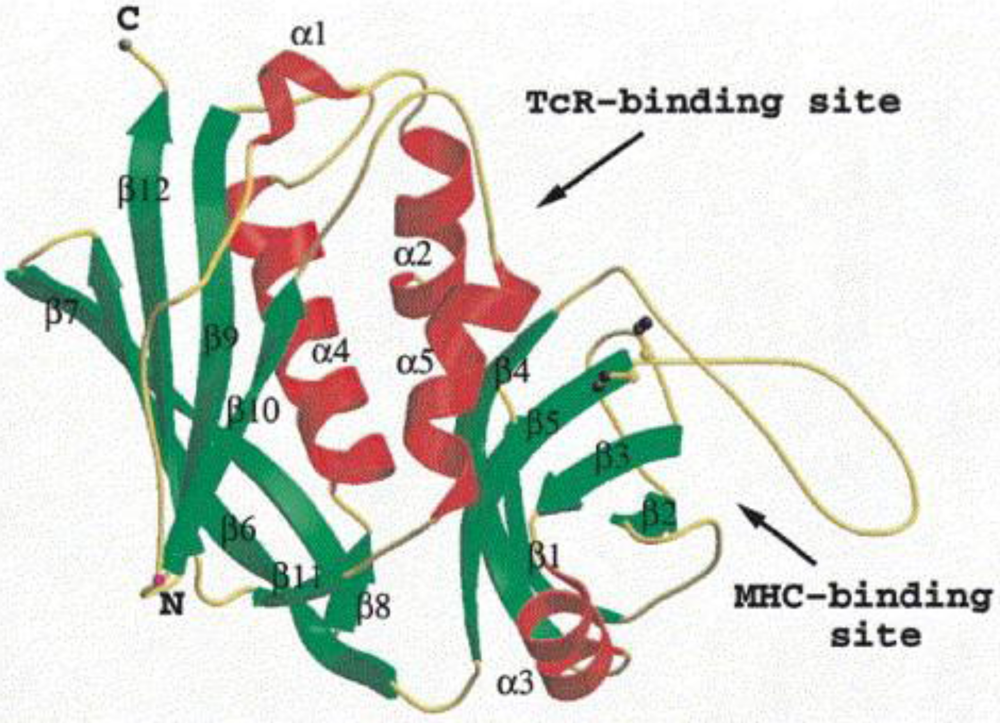
         <p>Enterotoxin and enterotoxin-like proteins are globular, single polypeptides (<xref ref-type="fig" rid="toxins-02-02106-f001">Figure 1</xref>) with molecular weights ranging from 22 to 29 kDa. They can be encoded in prophages [<xref ref-type="bibr" rid="B17-toxins-02-02106">17</xref>], plasmids [<xref ref-type="bibr" rid="B18-toxins-02-02106">18</xref>] or chromosomal pathogenicity islands [<xref ref-type="bibr" rid="B19-toxins-02-02106">19</xref>]. The currently known SEs form a group of serologically distinct, extracellular proteins that share important properties, namely: (1) the ability to cause emesis and gastroenteritis in primates; (2) superantigenicity through an unspecific activation of T lymphocytes followed by cytokine release and systemic shock [<xref ref-type="bibr" rid="B20-toxins-02-02106">20</xref>]; (3) resistance to heat and to digestion by pepsin; and (4) structural similarities [<xref ref-type="bibr" rid="B21-toxins-02-02106">21</xref>].</p>
       <table-wrap id="toxins-02-02106-t002" position="anchor">
          <object-id pub-id-type="pii">toxins-02-02106-t002_Table 2</object-id>
          <label>Table 2</label>
          <caption>
            <p>Staphylococcal enterotoxin characteristics.</p>
          </caption>
          <table>
            <thead>
              <tr>
                <th align="center" valign="middle">
                  <bold>Toxin type</bold>
                </th>
                <th align="center" valign="middle">
                  <bold>Molecular weight (Da)</bold>
                </th>
                <th align="center" valign="middle">
                  <bold>Genetic basis of SE</bold>
                </th>
                <th align="center" valign="middle">
                  <bold>Superantigenic action</bold>
                </th>
                <th align="center" valign="middle">
                  <bold>Emetic action</bold>
                </th>
              </tr>
            </thead>
            <tbody>
              <tr>
                <td align="center" valign="middle">SEA</td>
                <td align="center" valign="middle">27,100</td>
                <td align="center" valign="middle">Prophage</td>
                <td align="center" valign="middle">+</td>
                <td align="center" valign="middle">+</td>
              </tr>
              <tr>
                <td align="center" valign="middle">SEB</td>
                <td align="center" valign="middle">28,336</td>
                <td align="center" valign="middle">Chromosome, plasmid, pathogenicity island</td>
                <td align="center" valign="middle">+</td>
                <td align="center" valign="middle">+</td>
              </tr>
              <tr>
                <td align="center" valign="middle">SEC<sub>1-2-3</sub></td>
                <td align="center" valign="middle">≈27,500</td>
                <td align="center" valign="middle">Plasmid</td>
                <td align="center" valign="middle">+</td>
                <td align="center" valign="middle">+</td>
              </tr>
              <tr>
                <td align="center" valign="middle">SED</td>
                <td align="center" valign="middle">26,360</td>
                <td align="center" valign="middle">Plasmid (pIB485)</td>
                <td align="center" valign="middle">+</td>
                <td align="center" valign="middle">+</td>
              </tr>
              <tr>
                <td align="center" valign="middle">SEE</td>
                <td align="center" valign="middle">26,425</td>
                <td align="center" valign="middle">Prophage</td>
                <td align="center" valign="middle">+</td>
                <td align="center" valign="middle">+</td>
              </tr>
              <tr>
                <td align="center" valign="middle">SEG</td>
                <td align="center" valign="middle">27,043</td>
                <td align="center" valign="middle"><italic>enterotoxin gene cluster (egc)</italic>, chromosome</td>
                <td align="center" valign="middle">+</td>
                <td align="center" valign="middle">+</td>
              </tr>
              <tr>
                <td align="center" valign="middle">SEH</td>
                <td align="center" valign="middle">25,210</td>
                <td align="center" valign="middle">Transposon</td>
                <td align="center" valign="middle">+</td>
                <td align="center" valign="middle">+</td>
              </tr>
              <tr>
                <td align="center" valign="middle">SEI</td>
                <td align="center" valign="middle">24,928</td>
                <td align="center" valign="middle"><italic>egc</italic>, chromosome</td>
                <td align="center" valign="middle">+</td>
                <td align="center" valign="middle">+</td>
              </tr>
              <tr>
                <td align="center" valign="middle">SElJ</td>
                <td align="center" valign="middle">28,565</td>
                <td align="center" valign="middle">Plasmid (pIB485)</td>
                <td align="center" valign="middle">+</td>
                <td align="center" valign="middle">nk</td>
              </tr>
              <tr>
                <td align="center" valign="middle">SEK</td>
                <td align="center" valign="middle">25,539</td>
                <td align="center" valign="middle">Pathogenicity island</td>
                <td align="center" valign="middle">+</td>
                <td align="center" valign="middle">nk</td>
              </tr>
              <tr>
                <td align="center" valign="middle">SElL</td>
                <td align="center" valign="middle">24,593</td>
                <td align="center" valign="middle">Pathogenicity island</td>
                <td align="center" valign="middle">+</td>
                <td align="center" valign="middle">−</td>
              </tr>
              <tr>
                <td align="center" valign="middle">SElM</td>
                <td align="center" valign="middle">24,842</td>
                <td align="center" valign="middle"><italic>egc</italic>, chromosome</td>
                <td align="center" valign="middle">+</td>
                <td align="center" valign="middle">nk</td>
              </tr>
              <tr>
                <td align="center" valign="middle">SElN</td>
                <td align="center" valign="middle">26,067</td>
                <td align="center" valign="middle"><italic>egc</italic>, chromosome</td>
                <td align="center" valign="middle">+</td>
                <td align="center" valign="middle">nk</td>
              </tr>
              <tr>
                <td align="center" valign="middle">SElO</td>
                <td align="center" valign="middle">26,777</td>
                <td align="center" valign="middle"><italic>egc</italic>, chromosome</td>
                <td align="center" valign="middle">+</td>
                <td align="center" valign="middle">nk</td>
              </tr>
              <tr>
                <td align="center" valign="middle">SElP</td>
                <td align="center" valign="middle">26,608</td>
                <td align="center" valign="middle">Prophage (Sa3n)</td>
                <td align="center" valign="middle">+</td>
                <td align="center" valign="middle">nk</td>
              </tr>
              <tr>
                <td align="center" valign="middle">SElQ</td>
                <td align="center" valign="middle">25,076</td>
                <td align="center" valign="middle">Pathogenicity island</td>
                <td align="center" valign="middle">+</td>
                <td align="center" valign="middle">−</td>
              </tr>
              <tr>
                <td align="center" valign="middle">SER</td>
                <td align="center" valign="middle">27,049</td>
                <td align="center" valign="middle">Plasmid (pIB485)</td>
                <td align="center" valign="middle">+</td>
                <td align="center" valign="middle">+</td>
              </tr>
              <tr>
                <td align="center" valign="middle">SES</td>
                <td align="center" valign="middle">26,217</td>
                <td align="center" valign="middle">Plasmid (pIB485)</td>
                <td align="center" valign="middle">+</td>
                <td align="center" valign="middle">+</td>
              </tr>
              <tr>
                <td align="center" valign="middle">SET</td>
                <td align="center" valign="middle">22,614</td>
                <td align="center" valign="middle">Plasmid (pIB485)</td>
                <td align="center" valign="middle">+</td>
                <td align="center" valign="middle">+</td>
              </tr>
              <tr>
                <td align="center" valign="middle">SElU</td>
                <td align="center" valign="middle">27,192</td>
                <td align="center" valign="middle"><italic>egc</italic>, chromosome</td>
                <td align="center" valign="middle">+</td>
                <td align="center" valign="middle">nk</td>
              </tr>
              <tr>
                <td align="center" valign="middle">SElU<sub>2</sub></td>
                <td align="center" valign="middle">26,672</td>
                <td align="center" valign="middle"><italic>egc</italic>, chromosome</td>
                <td align="center" valign="middle">+</td>
                <td align="center" valign="middle">nk</td>
              </tr>
              <tr>
                <td align="center" valign="middle">SElV</td>
                <td align="center" valign="middle">24,997</td>
                <td align="center" valign="middle"><italic>egc</italic>, chromosome</td>
                <td align="center" valign="middle">+</td>
                <td align="center" valign="middle">nk</td>
              </tr>
            </tbody>
          </table>
          <table-wrap-foot><fn><p>+: positive reaction; −: negative reaction; nk: not known.</p></fn></table-wrap-foot>
        </table-wrap>
        <fig id="toxins-02-02106-f001" position="anchor">
          <label>Figure 1</label>
          <caption>
            <p>3D structure of SEB. Reproduced with permission from Elsevier [<xref ref-type="bibr" rid="B22-toxins-02-02106">22</xref>].</p>
          </caption>
          <graphic xmlns:xlink="http://www.w3.org/1999/xlink" xlink:href="toxins-02-02106-g001.tif"/>
        </fig>
      </sec>
    </sec>
    <sec>
      <title>2. SFPOs: Definition and Required Conditions for Their Occurrence (European Data)</title>
      <p>Due to the previously enumerated properties of CPS and SEs, staphylococcal food poisoning (SFP) is one of the most common food-borne diseases and results from the ingestion of SEs preformed in food as these SEs are produced by enterotoxigenic strains of CPS, mainly <italic>Staphylococcus aureus</italic> [<xref ref-type="bibr" rid="B23-toxins-02-02106">23</xref>]. </p>
      <p>The incubation period and severity of symptoms depend on the amount of enterotoxins ingested and the susceptibility of each individual. Initial symptoms—nausea followed by incoercible characteristic vomiting (in spurts)—appear within 30 min to 8 h (3 h on average) after ingestion of contaminated food. Other commonly described symptoms include abdominal pain, diarrhea, dizziness, shivering and general weakness sometimes associated with a moderate fever. In the most severe cases, headache, prostration and low blood pressure have been reported. In the majority of cases, recovery occurs within 24 to 48 h without specific treatment, while diarrhea and general weakness can last 24 h or longer. Death is rare, occurring primarily in those susceptible to dehydration (infants and elderly people) and in those affected by an underlying illness.</p>
      <p>Five conditions are required to induce SFPOs: (1) a source containing enterotoxin-producing staphylococci: raw materials, healthy or infected carrier; (2) transfer of staphylococci from source to food: dirty food preparation tools due to poor hygiene practices; (3) food composition with favorable physico-chemical characteristics for <italic>S. aureus</italic> growth and toxinogenesis; (4) favorable temperature and sufficient time for bacterial growth and toxin production; and (5) ingestion of food containing sufficient amounts of toxin to provoke symptoms. </p>
      <p>Most SFPOs arise due to poor hygiene practices during processing [<xref ref-type="bibr" rid="B24-toxins-02-02106">24</xref>], cooking or distributing the food product [<xref ref-type="bibr" rid="B25-toxins-02-02106">25</xref>]. Staphylococci are commonly found in a wide variety of mammals and birds and transfer of <italic>S. aureus</italic> to food has two main sources: human carriage during food processing and dairy animals in case of mastitis. </p>
      <p>In Europe, the European Food Safety Authority [<xref ref-type="bibr" rid="B26-toxins-02-02106">26</xref>] reported that, in 2008, bacterial toxins were involved in 525 out of 5332 notified food poisoning outbreaks (9.8%), ranking third in pathogenicity after <italic>Salmonella spp.</italic> (35.4%) and viruses (13.1%). Among bacterial toxins, SEs were involved in 291 out of the 525 notified food poisoning outbreaks (55.4%), or 5.5% of all notified outbreaks in 2008. </p>
    </sec>
    <sec>
      <title>3. Analytical Tools Used in SFPO Characterization: Pros and Cons</title>
      <p>Diagnosis of SFP is generally confirmed by one of the following results: (1) the recovery of at least 10<sup>5</sup> <italic>S. aureus/</italic>g from food remnants; (2) the detection of SEs in food remnants; and/or (3) the isolation of the same <italic>S. aureus</italic> strain from both patient and food remnants [<xref ref-type="bibr" rid="B27-toxins-02-02106">27</xref>]. In some cases, confirmation of SFP is difficult because <italic>S. aureus</italic> is heat-sensitive, whereas SEs are not. Thus, in heat-treated food matrices, <italic>S. aureus</italic> may be eliminated without inactivating SEs. In such cases, it is not possible to characterize a food poisoning outbreak by enumerating CPS in food remnants or <italic>a fortiori</italic> detecting <italic>se</italic> genes in isolated strains. </p>
      <p>While <italic>S. aureus</italic> is classically enumerated using microbiological techniques with dedicated media such as Baird Parker or rabbit plasma fibrinogen agar media, three types of methods are usually performed to detect bacterial toxins in food: Bioassays, molecular biology and/or immunological techniques.</p>
      <sec>
        <title>3.1. Bioassays</title>
        <p>Bioassays are based on the capacity of an extract of the suspected food to induce symptoms such as vomiting, gastrointestinal symptoms in animals and/or superantigenic action in cell cultures. Historically, SEs have been detected based on their emetic activity in monkey-feeding and kitten‑intraperitoneal tests [<xref ref-type="bibr" rid="B28-toxins-02-02106">28</xref>,<xref ref-type="bibr" rid="B29-toxins-02-02106">29</xref>] and, more recently, using animal models such as house musk shrews <italic>Suncus murinus</italic> [<xref ref-type="bibr" rid="B14-toxins-02-02106">14</xref>]. Symptoms of SFP appear if the dose ingested by the animals is above 200 ng, a considerably higher amount than those involved in human food poisoning [<xref ref-type="bibr" rid="B24-toxins-02-02106">24</xref>,<xref ref-type="bibr" rid="B25-toxins-02-02106">25</xref>,<xref ref-type="bibr" rid="B26-toxins-02-02106">26</xref>,<xref ref-type="bibr" rid="B27-toxins-02-02106">27</xref>,<xref ref-type="bibr" rid="B28-toxins-02-02106">28</xref>,<xref ref-type="bibr" rid="B29-toxins-02-02106">29</xref>,<xref ref-type="bibr" rid="B30-toxins-02-02106">30</xref>]. Thus, this technique is not appropriate for characterizing SFPOs. More recently, a bioassay to detect the superantigenic activity of SEA has been developed [<xref ref-type="bibr" rid="B31-toxins-02-02106">31</xref>]. This method uses SEA's superantigenic activity to induce in cytotoxic T lymphocytes a cytotoxic response against SEA-bound Raji cells. This test can only detect SEA at picomolar concentrations, and is thus of little interest for laboratories involved in official controls and SFP testings. </p>
        <p>In conclusion, in addition to the fact that the use of laboratory animals for testing is now restricted for ethical reasons, bioassays are not sensitive enough to ensure food safety for consumers. Thus, alternative methods for detecting SEs have been developed.</p>
      </sec>
      <sec>
        <title>3.2. Molecular Tools</title>
        <p>Molecular biology methods often involve the polymerase chain reaction (PCR). These methods usually detect genes encoding enterotoxins in strains of <italic>S. aureus</italic> isolated from contaminated foods. However, these methods have two major limitations: first, staphylococcal strains must be isolated from food, and second, the results inform as to the presence or absence of genes encoding SEs, but do not provide any information on the expression of these genes in food. This method therefore cannot be the sole method to detect SEs in food. However, the PCR approach is a specific, highly sensitive, and rapid method that can characterize the <italic>S. aureus</italic> strains involved in SFPOs, thereby providing highly valuable information. </p>
        <p>To improve SFP characterization, very recent efforts have been directed to determine which genes are involved in the biosynthesis of SEs. Following the huge SFP event which occurred in Japan in July 2000 (more than 13,000 people were intoxicated by powdered or liquid milk), Ikeda <italic>et al.</italic> [<xref ref-type="bibr" rid="B30-toxins-02-02106">30</xref>] developed a PCR-based methodology whereby <italic>sea</italic>, <italic>seg</italic>, <italic>seh</italic> and <italic>sei</italic> genes could be detected in the incriminated powdered skim milk, although cultivable <italic>S. aureus</italic> were not recovered from the sample. Recently, to evaluate the toxic potential of strains isolated from SFPOs, various authors [<xref ref-type="bibr" rid="B32-toxins-02-02106">32</xref>,<xref ref-type="bibr" rid="B33-toxins-02-02106">33</xref>] have designed primers to perform PCR and reverse transcription PCR (RT-PCR) for <italic>se</italic> genes. These approaches demonstrate possible transcription of mRNA from those genes, but do not indicate whether those strains were able to produce detectable or poisonous levels of toxins in food. For example, Derzelle <italic>et al.</italic> [<xref ref-type="bibr" rid="B34-toxins-02-02106">34</xref>] developed an RT-PCR-based procedure to determine the temporal expression of enterotoxin genes, including many of the newly discovered ones, in optimal growth conditions. PCR assays that can screen for 18 <italic>se</italic> genes have been developed and the distribution of these genes was examined on a panel of enterotoxigenic coagulase-positive staphylococci, including reference strains and isolates that have been collected from foods and SFPOs in France since the 1980s. A total of 28 strains displaying multiple enterotoxin genotypes were selected for further mRNA expression kinetics studies. </p>
        <p>More recently, Duquenne <italic>et al.</italic> [<xref ref-type="bibr" rid="B35-toxins-02-02106">35</xref>] developed an efficient method to extract bacterial RNA accessible for RT-quantitative PCR (RT-qPCR) from cheese and adapted a simple, sensitive and reproducible, method for quantifying relative transcript levels to evaluate <italic>S. aureus</italic> enterotoxin gene expression during cheese manufacture. </p>
      </sec>
      <sec>
        <title>3.3. Immunological Tools</title>
        <p>The third and most commonly used method for detecting SEs in food is based on the use of anti‑enterotoxin polyclonal or monoclonal antibodies. Commercially available kits have been developed according to two different principles: (1) enzyme immunoassay (EIA) comprising enzyme-linked immunosorbent assay (ELISA) and enzyme-linked fluorescent assay (ELFA); and (2) reverse passive latex agglutination (RPLA). </p>
        <p>It is widely recognized that the use of immunological methods to detect contaminants in food matrices is a difficult task, mainly due to the lack of specificity and sensitivity of the assay. Many drawbacks impair the development and use of these techniques for detecting SEs. First, highly purified toxins are needed to raise specific antibodies to develop an EIA; purified toxins are difficult and expensive to obtain. Moreover, and until very recently, only antibodies against SEA to SEE, SEG, SEH and SElQ have been available [<xref ref-type="bibr" rid="B36-toxins-02-02106">36</xref>]. The ELISA test will not detect the other SEs, which partly explains some discrepancies that have arisen in the analysis of food extracts from SFPOs. Another drawback is the low specificity of some marketed kits, where false positives may occur depending on food components [<xref ref-type="bibr" rid="B37-toxins-02-02106">37</xref>,<xref ref-type="bibr" rid="B38-toxins-02-02106">38</xref>] as it is well known that some proteins, such as protein A, can interfere with binding to the Fc fragment (and, to a lesser extent, Fab fragments) in immunoglobins G from several animal species, such as mouse or rabbit, but not rat or goat. Other interferences are associated with endogenous enzymes, such as alkaline phosphatase or lactoperoxidase. </p>
        <p>Whatever the detection method used and due to the low amount of SEs present in food, it is crucial to concentrate the extract before performing detection assays. For this purpose, various methodologies have been tested [<xref ref-type="bibr" rid="B39-toxins-02-02106">39</xref>,<xref ref-type="bibr" rid="B40-toxins-02-02106">40</xref>,<xref ref-type="bibr" rid="B41-toxins-02-02106">41</xref>]. Among them, only extraction followed by dialysis concentration has been approved by the EU to extract SEs from food [<xref ref-type="bibr" rid="B42-toxins-02-02106">42</xref>].</p>
        <p>However, up to now, after enumerating CPS strains, conclusive diagnosis of SFPs has been mainly based on demonstrating the presence of SEs in food using commercial EIA kits designed to detect SEA to SEE [<xref ref-type="bibr" rid="B43-toxins-02-02106">43</xref>,<xref ref-type="bibr" rid="B44-toxins-02-02106">44</xref>] or using a confirmatory in-house ELISA method [<xref ref-type="bibr" rid="B45-toxins-02-02106">45</xref>] to differentiate and quantify these types of SEs. </p>
      </sec>
      <sec>
        <title>3.4. Chromatographic Methods for the Detection and Quantification of SEs</title>
        <p>Due to drawbacks and the lack of available antibodies against the newly described SEs, other strategies based on physico-chemical techniques have been developed. Among these, mass spectrometry (MS) has recently emerged as an indispensable and suitable technique to analyze protein and peptide mixtures [<xref ref-type="bibr" rid="B46-toxins-02-02106">46</xref>]. It is among the most sensitive techniques currently available because it provides specific, rapid and reliable analytical results. The development of two soft ionization methods, such as electrospray ionization (ESI) and matrix-assisted laser desorption/ionization (MALDI), and the use of appropriate mass analyzers have revolutionized the analysis of biomolecules. Given the wide range of methodologies available, a single MS technique cannot be used for all proteins [and all purposes]. The MS method thus requires the development of a series of techniques, individually suited for each particular case. </p>
        <p>In the case of food analysis, the situation is complex because the matrix can contain many proteins, lipids and many other molecular species that can interfere with the detection of the targeted toxin and may distort quantification. Sample preparation remains the critical step of the analysis. Several authors have tried to improve this step, by, for example, optimizing digestion parameters [<xref ref-type="bibr" rid="B47-toxins-02-02106">47</xref>] or by adding a purification step [<xref ref-type="bibr" rid="B48-toxins-02-02106">48</xref>]. The strategy of incorporating an isotopically labeled internal standard into the samples has also been developed. In the case of SE detection, some authors have developed MS tools to detect these toxins in culture supernatants and in spiked samples, such as water or apple juice. For example, Bernardo <italic>et al.</italic> [<xref ref-type="bibr" rid="B49-toxins-02-02106">49</xref>] developed a MALDI-TOF method to detect <italic>S. aureus</italic> virulence factors such as enterotoxins and demonstrated that this technique was suitable for detecting SEs other than SEA to SEE in culture supernatants. In contrast, Callahan <italic>et al.</italic> [<xref ref-type="bibr" rid="B50-toxins-02-02106">50</xref>] detected and quantified SEB using liquid chromatography coupled to ESI/MS detection in apple juice used as a model food matrix. In this study, enterotoxin types SEA and SEB were detected in spiked cheese. Recently, Brun <italic>et al.</italic> [<xref ref-type="bibr" rid="B51-toxins-02-02106">51</xref>] developed an MS approach able to perform absolute quantification of SEA and TSST1 in spiked water or urine samples. To improve characterization and absolute quantification of SEs, this latter methodology was successfully used to carry out absolute quantification of SEA in a naturally contaminated cheese sample [<xref ref-type="bibr" rid="B52-toxins-02-02106">52</xref>]. </p>
      </sec>
    </sec>
    <sec>
      <title>4. An Integrated Approach to Improve SFPO Characterization</title>
      <p>To improve SFPO characterization, various techniques, such as immunological and molecular-based methodologies, have been integrated in the diagnosis strategy. The PCR approach is known to provide information on the presence or absence of genes encoding SEs, but not their expression. Nevertheless, PCR supplements classical methods, providing interesting additional data. In a study conducted on 178 <italic>S. aureus</italic> strains corresponding to 31 SFPOs isolated in France between 1981 and 2002, the results from a PCR assay revealed a satisfactory correlation (84%) with the results from immunoassay methods [<xref ref-type="bibr" rid="B53-toxins-02-02106">53</xref>]. </p>
      <p>Due to the satisfactory results obtained, in 2005, the EU Reference Laboratory (EU-RL) for CPS, decided to use the PCR procedure to improve SFPO characterization. The diagnosis of SFPO essentially based on SEs has been significantly strengthened. For example, very recently, PCR on <italic>se</italic> genes has been used to demonstrate for the first time the presence of CPS strains carrying the <italic>see</italic> gene and able to produce the SEE in unpasteurized cheeses involved in six outbreaks in France [<xref ref-type="bibr" rid="B54-toxins-02-02106">54</xref>]. </p>
      <p>To complete SFPO characterization, MS tools have been also used in combination with those presented above. Thus, an overall approach combining microbiology, molecular, immunological and quantitative mass spectrometry techniques was successfully used for investigations of SEs content in cheese [<xref ref-type="bibr" rid="B52-toxins-02-02106">52</xref>] or in a dessert involving in food poisoning outbreaks [<xref ref-type="bibr" rid="B55-toxins-02-02106">55</xref>].</p>
    </sec>
    <sec sec-type="conclusions">
      <title>5. Conclusions</title>
      <p>To conclude, an overall approach combining classical microbiology to enumerate CPS strains coupled with immunological techniques, molecular biology and mass spectrometry-based methods offers an interesting alternative for assigning outbreaks to SEs. Thus, the development of standards to perform absolute quantification will continue. While the quantitative MS method overpasses specific technical limitations of existing ELISA methods for detecting and quantifying SEs, its throughput and cost per analysis compares unfavorably with ELISA. For this reason, when the MS-based method becomes available for all SEs involved in SFPOs it will not be employed for routine analysis, but only in special cases to confirm outbreaks due to SEs. </p>
    </sec>
  </body>
  <back>
    <ref-list>
      <title>References</title>
      <ref id="B1-toxins-02-02106">
        <label>1.</label>
        <citation citation-type="book">
          <person-group person-group-type="author">
            <name>
              <surname>Rosenbach</surname>
              <given-names>F.J.</given-names>
            </name>
          </person-group>
          <source>Microorganismen bei den Wund-Infections-Krankheiten des Menschen</source>
          <person-group person-group-type="editor">
            <name>
              <surname>Bergmann</surname>
              <given-names>J.F.</given-names>
            </name>
          </person-group>
          <publisher-loc>Wiesbaden, Germany</publisher-loc>
          <year>1884</year>
          <fpage>1</fpage>
          <lpage>122</lpage>
        </citation>
      </ref>
      <ref id="B2-toxins-02-02106">
        <label>2.</label>
        <citation citation-type="journal">
          <person-group person-group-type="author">
            <name>
              <surname>De la Fuente</surname>
              <given-names>R.</given-names>
            </name>
            <name>
              <surname>Suarez</surname>
              <given-names>G.</given-names>
            </name>
            <name>
              <surname>Schleifer</surname>
              <given-names>K.H.</given-names>
            </name>
          </person-group>
          <article-title><italic>Staphylococcus aureus</italic> subsp. <italic>Anaerobius subsp</italic>. nov., the causal agent of abscess disease of sheep</article-title>
          <source>Int. J. Syst. Bacteriol.</source>
          <year>1985</year>
          <volume>35</volume>
          <fpage>99</fpage>
          <lpage>102</lpage>
          <pub-id pub-id-type="doi">10.1099/00207713-35-1-99</pub-id>
        </citation>
      </ref>
      <ref id="B3-toxins-02-02106">
        <label>3.</label>
        <citation citation-type="journal">
          <person-group person-group-type="author">
            <name>
              <surname>Hajek</surname>
              <given-names>V.</given-names>
            </name>
          </person-group>
          <article-title>Staphylococcus intermedius, a New Species Isolated from Animals</article-title>
          <source>Int. J. Syst. Bacteriol.</source>
          <year>1976</year>
          <volume>26</volume>
          <fpage>401</fpage>
          <lpage>408</lpage>
        <pub-id pub-id-type="doi">10.1099/00207713-26-4-401</pub-id></citation>
      </ref>
      <ref id="B4-toxins-02-02106">
        <label>4.</label>
        <citation citation-type="journal">
          <person-group person-group-type="author">
            <name>
              <surname>Devriese</surname>
              <given-names>L.A.</given-names>
            </name>
            <name>
              <surname>Hajek</surname>
              <given-names>K.</given-names>
            </name>
            <name>
              <surname>Oeding</surname>
              <given-names>P.</given-names>
            </name>
            <name>
              <surname>Meyer</surname>
              <given-names>S.A.</given-names>
            </name>
            <name>
              <surname>Schleifer</surname>
              <given-names>K.H.</given-names>
            </name>
          </person-group>
          <article-title><italic>Staphylococcus hyicus</italic> (Sompolinsky 1953) <italic>comb. nov</italic>. and <italic>Staphylococcus hyicus subsp</italic>. <italic>chromogenes subsp. nov.</italic></article-title>
          <source>Int. J. Syst. Bacteriol.</source>
          <year>1978</year>
          <volume>28</volume>
          <fpage>482</fpage>
          <lpage>490</lpage>
          <pub-id pub-id-type="doi">10.1099/00207713-28-4-482</pub-id>
        </citation>
      </ref>
      <ref id="B5-toxins-02-02106">
        <label>5.</label>
        <citation citation-type="journal">
          <person-group person-group-type="author">
            <name>
              <surname>Varaldo</surname>
              <given-names>P.E.</given-names>
            </name>
            <name>
              <surname>Kilpper-Balz</surname>
              <given-names>R.</given-names>
            </name>
            <name>
              <surname>Biavasco</surname>
              <given-names>F.</given-names>
            </name>
            <name>
              <surname>Satta</surname>
              <given-names>G.</given-names>
            </name>
            <name>
              <surname>Scheifer</surname>
              <given-names>K.H.</given-names>
            </name>
          </person-group>
          <article-title>Staphylococcus delphini sp. nov., a coagulase-positive species isolated from dolphins</article-title>
          <source>Int. J. Syst. Bacteriol.</source>
          <year>1988</year>
          <volume>38</volume>
          <fpage>436</fpage>
          <lpage>439</lpage>
          <pub-id pub-id-type="doi">10.1099/00207713-38-4-436</pub-id>
        </citation>
      </ref>
      <ref id="B6-toxins-02-02106">
        <label>6.</label>
        <citation citation-type="journal">
          <person-group person-group-type="author">
            <name>
              <surname>Igimi</surname>
              <given-names>S.</given-names>
            </name>
            <name>
              <surname>Takahashi</surname>
              <given-names>E.</given-names>
            </name>
            <name>
              <surname>Mitsouka</surname>
              <given-names>T.</given-names>
            </name>
          </person-group>
          <article-title>Staphylococcus schleiferi subsp. coagulans subsp. nov., isolated from the external auditory meatus of dogs with external ear otitis</article-title>
          <source>Int. J. Syst. Bacteriol.</source>
          <year>1990</year>
          <volume>40</volume>
          <fpage>409</fpage>
          <lpage>411</lpage>
          <pub-id pub-id-type="pmid">2275856</pub-id>
          <pub-id pub-id-type="doi">10.1099/00207713-40-4-409</pub-id>
        </citation>
      </ref>
      <ref id="B7-toxins-02-02106">
        <label>7.</label>
        <citation citation-type="journal">
          <person-group person-group-type="author">
            <name>
              <surname>Foster</surname>
              <given-names>G.</given-names>
            </name>
            <name>
              <surname>Ross</surname>
              <given-names>H.M.</given-names>
            </name>
            <name>
              <surname>Hutson</surname>
              <given-names>R.A.</given-names>
            </name>
            <name>
              <surname>Collins</surname>
              <given-names>M.D.</given-names>
            </name>
          </person-group>
          <article-title>Staphylococcus lutrae sp. nov., a new coagulase-positive species isolated from otters</article-title>
          <source>Int. J. Syst. Bacteriol.</source>
          <year>1997</year>
          <volume>47</volume>
          <fpage>724</fpage>
          <lpage>726</lpage>
          <pub-id pub-id-type="pmid">9226903</pub-id>
          <pub-id pub-id-type="doi">10.1099/00207713-47-3-724</pub-id>
        </citation>
      </ref>
      <ref id="B8-toxins-02-02106">
        <label>8.</label>
        <citation citation-type="journal">
          <person-group person-group-type="author">
            <name>
              <surname>Balaban</surname>
              <given-names>N.</given-names>
            </name>
            <name>
              <surname>Rasooly</surname>
              <given-names>A.</given-names>
            </name>
          </person-group>
          <article-title>Staphylococcal enterotoxins</article-title>
          <source>Int. J. Food Microbiol.</source>
          <year>2000</year>
          <volume>61</volume>
          <fpage>1</fpage>
          <lpage>10</lpage>
        <pub-id pub-id-type="doi">10.1016/S0168-1605(00)00377-9</pub-id><pub-id pub-id-type="pmid">11028954</pub-id></citation>
      </ref>
      <ref id="B9-toxins-02-02106">
        <label>9.</label>
        <citation citation-type="journal">
          <person-group person-group-type="author">
            <name>
              <surname>Orwin</surname>
              <given-names>P.M.</given-names>
            </name>
            <name>
              <surname>Leung</surname>
              <given-names>D.Y.</given-names>
            </name>
            <name>
              <surname>Donahue</surname>
              <given-names>H.L.</given-names>
            </name>
            <name>
              <surname>Novick</surname>
              <given-names>R.P.</given-names>
            </name>
            <name>
              <surname>Schlievert</surname>
              <given-names>P.M.</given-names>
            </name>
          </person-group>
          <article-title>Biochemical and Biological Properties of Staphylococcal Enterotoxin K</article-title>
          <source>Infect. Immun.</source>
          <year>2001</year>
          <volume>69</volume>
          <fpage>360</fpage>
          <lpage>366</lpage>
        <pub-id pub-id-type="doi">10.1128/IAI.69.1.360-366.2001</pub-id><pub-id pub-id-type="pmid">11119525</pub-id></citation>
      </ref>
      <ref id="B10-toxins-02-02106">
        <label>10.</label>
        <citation citation-type="journal">
          <person-group person-group-type="author">
            <name>
              <surname>Jarraud</surname>
              <given-names>S.</given-names>
            </name>
            <name>
              <surname>Peyrat</surname>
              <given-names>M.A.</given-names>
            </name>
            <name>
              <surname>Lim</surname>
              <given-names>A.</given-names>
            </name>
            <name>
              <surname>Tristan</surname>
              <given-names>A.</given-names>
            </name>
            <name>
              <surname>Bes</surname>
              <given-names>M.</given-names>
            </name>
            <name>
              <surname>Mougel</surname>
              <given-names>C.</given-names>
            </name>
            <name>
              <surname>Etienne</surname>
              <given-names>J.</given-names>
            </name>
            <name>
              <surname>Vandenesch</surname>
              <given-names>F.</given-names>
            </name>
            <name>
              <surname>Bonneville</surname>
              <given-names>M.</given-names>
            </name>
            <name>
              <surname>Lina</surname>
              <given-names>G.</given-names>
            </name>
          </person-group>
          <article-title>egc, a highly prevalent operon of enterotoxin gene, forms a putative nursery of superantigens in <italic>Staphylococcus aureus</italic></article-title>
          <source>J. Immunol.</source>
          <year>2001</year>
          <volume>166</volume>
          <fpage>669</fpage>
          <lpage>677</lpage>
        <pub-id pub-id-type="pmid">11123352</pub-id></citation>
      </ref>
      <ref id="B11-toxins-02-02106">
        <label>11.</label>
        <citation citation-type="journal">
          <person-group person-group-type="author">
            <name>
              <surname>Omoe</surname>
              <given-names>K.</given-names>
            </name>
            <name>
              <surname>Imanishi</surname>
              <given-names>K.</given-names>
            </name>
            <name>
              <surname>Hu</surname>
              <given-names>D.L.</given-names>
            </name>
            <name>
              <surname>Kato</surname>
              <given-names>H.</given-names>
            </name>
            <name>
              <surname>Fugane</surname>
              <given-names>Y.</given-names>
            </name>
            <name>
              <surname>Abe</surname>
              <given-names>Y.</given-names>
            </name>
            <name>
              <surname>Hamaoka</surname>
              <given-names>S.</given-names>
            </name>
            <name>
              <surname>Watanabe</surname>
              <given-names>Y.</given-names>
            </name>
            <name>
              <surname>Nakane</surname>
              <given-names>A.</given-names>
            </name>
            <name>
              <surname>Uchiyama</surname>
              <given-names>T.</given-names>
            </name>
            <name>
              <surname>Shinagawa</surname>
              <given-names>K.</given-names>
            </name>
          </person-group>
          <article-title>Characterization of novel staphylococcal enterotoxin-like toxin type P</article-title>
          <source>Infect. Immun.</source>
          <year>2005</year>
          <volume>73</volume>
          <fpage>5540</fpage>
          <lpage>5546</lpage>
        <pub-id pub-id-type="doi">10.1128/IAI.73.9.5540-5546.2005</pub-id><pub-id pub-id-type="pmid">16113270</pub-id></citation>
      </ref>
      <ref id="B12-toxins-02-02106">
        <label>12.</label>
        <citation citation-type="journal">
          <person-group person-group-type="author">
            <name>
              <surname>Orwin</surname>
              <given-names>P.M.</given-names>
            </name>
            <name>
              <surname>Leung</surname>
              <given-names>D.Y.M.</given-names>
            </name>
            <name>
              <surname>Tripp</surname>
              <given-names>T.J.</given-names>
            </name>
            <name>
              <surname>Bohach</surname>
              <given-names>G.A.</given-names>
            </name>
            <name>
              <surname>Earhart</surname>
              <given-names>C.A.</given-names>
            </name>
            <name>
              <surname>Ohlendorf</surname>
              <given-names>D.H.</given-names>
            </name>
            <name>
              <surname>Schlievert</surname>
              <given-names>P.M.</given-names>
            </name>
          </person-group>
          <article-title>Characterization of a novel staphylococcal enterotoxin-like superantigen, a member of the group V subfamily of pyrogenic toxins</article-title>
          <source>Biochemistry</source>
          <year>2002</year>
          <volume>41</volume>
          <fpage>14033</fpage>
          <lpage>14040</lpage>
        <pub-id pub-id-type="doi">10.1021/bi025977q</pub-id><pub-id pub-id-type="pmid">12437361</pub-id></citation>
      </ref>
      <ref id="B13-toxins-02-02106">
        <label>13.</label>
        <citation citation-type="journal">
          <person-group person-group-type="author">
            <name>
              <surname>Omoe</surname>
              <given-names>K.</given-names>
            </name>
            <name>
              <surname>Hu</surname>
              <given-names>D.L.</given-names>
            </name>
            <name>
              <surname>Takahashi-Omoe</surname>
              <given-names>H.</given-names>
            </name>
            <name>
              <surname>Nakane</surname>
              <given-names>A.</given-names>
            </name>
            <name>
              <surname>Shinagawa</surname>
              <given-names>K.</given-names>
            </name>
          </person-group>
          <article-title>Identification and characterization of a new staphylococcal enterotoxin-related putative toxin encoded by two kinds of plasmids</article-title>
          <source>Infect. Immun.</source>
          <year>2003</year>
          <volume>71</volume>
          <fpage>6088</fpage>
          <lpage>6094</lpage>
        <pub-id pub-id-type="doi">10.1128/IAI.71.10.6088-6094.2003</pub-id><pub-id pub-id-type="pmid">14500536</pub-id></citation>
      </ref>
      <ref id="B14-toxins-02-02106">
        <label>14.</label>
        <citation citation-type="journal">
          <person-group person-group-type="author">
            <name>
              <surname>Ono</surname>
              <given-names>H.K.</given-names>
            </name>
            <name>
              <surname>Omoe</surname>
              <given-names>K.</given-names>
            </name>
            <name>
              <surname>Imanishi</surname>
              <given-names>K.</given-names>
            </name>
            <name>
              <surname>Iwakabe</surname>
              <given-names>Y.</given-names>
            </name>
            <name>
              <surname>Hu</surname>
              <given-names>D.L.</given-names>
            </name>
            <name>
              <surname>Kato</surname>
              <given-names>H.</given-names>
            </name>
            <name>
              <surname>Saito</surname>
              <given-names>N.</given-names>
            </name>
            <name>
              <surname>Nakane</surname>
              <given-names>A.</given-names>
            </name>
            <name>
              <surname>Uchiyama</surname>
              <given-names>T.</given-names>
            </name>
            <name>
              <surname>Shinagawa</surname>
              <given-names>K.</given-names>
            </name>
          </person-group>
          <article-title>Identification and characterization of two novel staphylococcal enterotoxins types S and T</article-title>
          <source>Infect. Immun.</source>
          <year>2008</year>
          <volume>76</volume>
          <fpage>4999</fpage>
          <lpage>5005</lpage>
        <pub-id pub-id-type="doi">10.1128/IAI.00045-08</pub-id><pub-id pub-id-type="pmid">18710864</pub-id></citation>
      </ref>
      <ref id="B15-toxins-02-02106">
        <label>15.</label>
        <citation citation-type="journal">
          <person-group person-group-type="author">
            <name>
              <surname>Letertre</surname>
              <given-names>C.</given-names>
            </name>
            <name>
              <surname>Perelle</surname>
              <given-names>S.</given-names>
            </name>
            <name>
              <surname>Dilasser</surname>
              <given-names>F.</given-names>
            </name>
            <name>
              <surname>Fach</surname>
              <given-names>P.</given-names>
            </name>
          </person-group>
          <article-title>Identification of a new putative enterotoxin SEU encoded by the egc cluster of <italic>Staphylococcus aureus</italic></article-title>
          <source>J. Appl. Microbiol.</source>
          <year>2003</year>
          <volume>95</volume>
          <fpage>38</fpage>
          <lpage>43</lpage>
        <pub-id pub-id-type="doi">10.1046/j.1365-2672.2003.01957.x</pub-id><pub-id pub-id-type="pmid">12807452</pub-id></citation>
      </ref>
      <ref id="B16-toxins-02-02106">
        <label>16.</label>
        <citation citation-type="journal">
          <person-group person-group-type="author">
            <name>
              <surname>Thomas</surname>
              <given-names>D.Y.</given-names>
            </name>
            <name>
              <surname>Jarraud</surname>
              <given-names>S.</given-names>
            </name>
            <name>
              <surname>Lemercier</surname>
              <given-names>B.</given-names>
            </name>
            <name>
              <surname>Cozon</surname>
              <given-names>G.</given-names>
            </name>
            <name>
              <surname>Echasserieau</surname>
              <given-names>K.</given-names>
            </name>
            <name>
              <surname>Etienne</surname>
              <given-names>J.</given-names>
            </name>
            <name>
              <surname>Gougeon</surname>
              <given-names>M.L.</given-names>
            </name>
            <name>
              <surname>Lina</surname>
              <given-names>G.</given-names>
            </name>
            <name>
              <surname>Vandenesch</surname>
              <given-names>F.</given-names>
            </name>
          </person-group>
          <article-title>Staphylococcal enterotoxin-like toxins U2 and V, two new staphylococcal superantigens arising from recombination within the enterotoxin gene cluster</article-title>
          <source>Infect. Immun.</source>
          <year>2006</year>
          <volume>74</volume>
          <fpage>4724</fpage>
          <lpage>4734</lpage>
        <pub-id pub-id-type="doi">10.1128/IAI.00132-06</pub-id><pub-id pub-id-type="pmid">16861660</pub-id></citation>
      </ref>
      <ref id="B17-toxins-02-02106">
        <label>17.</label>
        <citation citation-type="journal">
          <person-group person-group-type="author">
            <name>
              <surname>Betley</surname>
              <given-names>M.J.</given-names>
            </name>
            <name>
              <surname>Mekalanos</surname>
              <given-names>J.J.</given-names>
            </name>
          </person-group>
          <article-title>Staphylococcal enterotoxin A is encoded by a phage</article-title>
          <source>Science</source>
          <year>1985</year>
          <volume>229</volume>
          <fpage>185</fpage>
          <lpage>187</lpage>
        <pub-id pub-id-type="doi">10.1126/science.3160112</pub-id><pub-id pub-id-type="pmid">3160112</pub-id></citation>
      </ref>
      <ref id="B18-toxins-02-02106">
        <label>18.</label>
        <citation citation-type="journal">
          <person-group person-group-type="author">
            <name>
              <surname>Bayles</surname>
              <given-names>K.W.</given-names>
            </name>
            <name>
              <surname>Iandolo</surname>
              <given-names>J.J.</given-names>
            </name>
          </person-group>
          <article-title>Genetic and molecular analysis of gene encoding staphylococcal enterotoxin D</article-title>
          <source>J. Bacteriol.</source>
          <year>1989</year>
          <volume>171</volume>
          <fpage>4799</fpage>
          <lpage>4806</lpage>
        <pub-id pub-id-type="pmid">2549000</pub-id></citation>
      </ref>
      <ref id="B19-toxins-02-02106">
        <label>19.</label>
        <citation citation-type="journal">
          <person-group person-group-type="author">
            <name>
              <surname>Yarwood</surname>
              <given-names>J.M</given-names>
            </name>
            <name>
              <surname>McCormick</surname>
              <given-names>J.K.</given-names>
            </name>
            <name>
              <surname>Paustian</surname>
              <given-names>M.L.</given-names>
            </name>
            <name>
              <surname>Orwin</surname>
              <given-names>P.M.</given-names>
            </name>
            <name>
              <surname>Kapur</surname>
              <given-names>V.</given-names>
            </name>
            <name>
              <surname>Schlievert</surname>
              <given-names>P.M.</given-names>
            </name>
          </person-group>
          <article-title>Characterization and expression analysis of <italic>Staphylococcus aureus</italic> pathogenicity island 3. Implications for the evolution of staphylococcal pathogenicity islands</article-title>
          <source>Biol. Chem.</source>
          <year>2002</year>
          <volume>277</volume>
          <fpage>13138</fpage>
          <lpage>13147</lpage>
          <pub-id pub-id-type="doi">10.1074/jbc.M111661200</pub-id>
        </citation>
      </ref>
      <ref id="B20-toxins-02-02106">
        <label>20.</label>
        <citation citation-type="journal">
          <person-group person-group-type="author">
            <name>
              <surname>Papageorgiou</surname>
              <given-names>A.</given-names>
            </name>
            <name>
              <surname>Acharya</surname>
              <given-names>K.</given-names>
            </name>
          </person-group>
          <article-title>Microbial superantigens: from structure to function</article-title>
          <source>Trends Microbiol.</source>
          <year>2000</year>
          <volume>8</volume>
          <fpage>369</fpage>
          <lpage>375</lpage>
        <pub-id pub-id-type="doi">10.1016/S0966-842X(00)01793-5</pub-id><pub-id pub-id-type="pmid">10920396</pub-id></citation>
      </ref>
      <ref id="B21-toxins-02-02106">
        <label>21.</label>
        <citation citation-type="journal">
          <person-group person-group-type="author">
            <name>
              <surname>Dinges</surname>
              <given-names>M.M.</given-names>
            </name>
            <name>
              <surname>Orwin</surname>
              <given-names>P.M.</given-names>
            </name>
            <name>
              <surname>Schlievert</surname>
              <given-names>P.M.</given-names>
            </name>
          </person-group>
          <article-title>Exotoxins of <italic>Staphylococcus aureus</italic></article-title>
          <source>Clin. Microbiol. Rev.</source>
          <year>2000</year>
          <volume>13</volume>
          <fpage>16</fpage>
          <lpage>34</lpage>
        <pub-id pub-id-type="doi">10.1128/CMR.13.1.16-34.2000</pub-id><pub-id pub-id-type="pmid">10627489</pub-id></citation>
      </ref>
      <ref id="B22-toxins-02-02106">
        <label>22.</label>
        <citation citation-type="journal">
          <person-group person-group-type="author">
            <name>
              <surname>Papageorgiou</surname>
              <given-names>A.C.</given-names>
            </name>
            <name>
              <surname>Tranter</surname>
              <given-names>H.S.</given-names>
            </name>
            <name>
              <surname>Acharya</surname>
              <given-names>H.K.</given-names>
            </name>
          </person-group>
          <article-title>Crystal structure of microbial superantigen staphylococcal enterotoxin B at 1.5 Å resolution: Implications for superantigen recognition by MHC class II molecules and T-cell receptors</article-title>
          <source>J. Mol. Biol.</source>
          <year>1998</year>
          <volume>277</volume>
          <fpage>61</fpage>
          <lpage>79</lpage>
          <pub-id pub-id-type="pmid">9514739</pub-id>
          <pub-id pub-id-type="doi">10.1006/jmbi.1997.1577</pub-id>
        </citation>
      </ref>
      <ref id="B23-toxins-02-02106">
        <label>23.</label>
        <citation citation-type="book">
          <person-group person-group-type="author">
            <name>
              <surname>Jablonski</surname>
              <given-names>L.</given-names>
            </name>
            <name>
              <surname>Bohach</surname>
              <given-names>G.A.</given-names>
            </name>
          </person-group>
          <article-title><italic>Staphylococcus</italic> <italic>aureus</italic></article-title>
          <source>Food microbiology fundamentals and frontiers</source>
          <person-group person-group-type="editor">
            <name>
              <surname>Doyle</surname>
              <given-names>M.P.</given-names>
            </name>
            <name>
              <surname>Beuchat</surname>
              <given-names>L.R.</given-names>
            </name>
            <name>
              <surname>Montville</surname>
              <given-names>T.J.</given-names>
            </name>
          </person-group>
          <publisher-name>America society of Microbiology Press</publisher-name>
          <publisher-loc>Washington, DC, USA</publisher-loc>
          <year>2001</year>
          <fpage>411</fpage>
          <lpage>434</lpage>
        </citation>
      </ref>
      <ref id="B24-toxins-02-02106">
        <label>24.</label>
        <citation citation-type="journal">
          <person-group person-group-type="author">
            <name>
              <surname>Asao</surname>
              <given-names>T.</given-names>
            </name>
            <name>
              <surname>Kumeda</surname>
              <given-names>Y.</given-names>
            </name>
            <name>
              <surname>Kawai</surname>
              <given-names>T.</given-names>
            </name>
            <name>
              <surname>Shibata</surname>
              <given-names>T.</given-names>
            </name>
            <name>
              <surname>Oda</surname>
              <given-names>H.</given-names>
            </name>
            <name>
              <surname>Haruki</surname>
              <given-names>K.</given-names>
            </name>
            <name>
              <surname>Nakazawa</surname>
              <given-names>H.</given-names>
            </name>
            <name>
              <surname>Kozaki</surname>
              <given-names>S.</given-names>
            </name>
          </person-group>
          <article-title>An extensive outbreak of staphylococcal food poisoning due to low-fat milk in Japan: Estimation of enterotoxin A in the incriminated milk and powdered skim milk</article-title>
          <source>Epidemiol. Infect.</source>
          <year>2003</year>
          <volume>130</volume>
          <fpage>33</fpage>
          <lpage>40</lpage>
        <pub-id pub-id-type="doi">10.1017/S0950268802007951</pub-id><pub-id pub-id-type="pmid">12613743</pub-id></citation>
      </ref>
      <ref id="B25-toxins-02-02106">
        <label>25.</label>
        <citation citation-type="journal">
          <person-group person-group-type="author">
            <name>
              <surname>Pereira</surname>
              <given-names>M.L.</given-names>
            </name>
            <name>
              <surname>Do Carmo</surname>
              <given-names>L.</given-names>
            </name>
            <name>
              <surname>Dos Santos</surname>
              <given-names>E.J.</given-names>
            </name>
            <name>
              <surname>Pereira</surname>
              <given-names>J.L.</given-names>
            </name>
            <name>
              <surname>Bergdoll</surname>
              <given-names>M.S.</given-names>
            </name>
          </person-group>
          <article-title>Enterotoxin H in staphylococcal food poisoning</article-title>
          <source>J. Food Prot.</source>
          <year>1996</year>
          <volume>59</volume>
          <fpage>559</fpage>
          <lpage>561</lpage>
        </citation>
      </ref>
      <ref id="B26-toxins-02-02106">
        <label>26.</label>
        <citation citation-type="web">
          <article-title>The Community Summary Report on Trends and Sources of Zoonoses, Zoonotic Agents and food-borne outbreaks in the European Union in 2008</article-title>
          <source>EFSA J.</source>
          <year>2010</year>
          <volume>1496</volume>
          <access-date>(accessed on 6 August 2010)</access-date>
          <comment>Available online:<ext-link xmlns:xlink="http://www.w3.org/1999/xlink" xlink:href="http://www.efsa.europa.eu/en/scdocs/doc/s1496.pdf" ext-link-type="uri">http://www.efsa.europa.eu/en/scdocs/doc/s1496.pdf</ext-link></comment>
        </citation>
      </ref>
      <ref id="B27-toxins-02-02106">
        <label>27.</label>
        <citation citation-type="journal">
          <person-group person-group-type="author">
            <name>
              <surname>Bryan</surname>
              <given-names>F.L.</given-names>
            </name>
            <name>
              <surname>Guzewich</surname>
              <given-names>J.J.</given-names>
            </name>
            <name>
              <surname>Todd</surname>
              <given-names>E.C.D.</given-names>
            </name>
          </person-group>
          <article-title>Surveillance of foodborne disease II. Summary and presentation of descriptive data and epidemiologic patterns; their value and limitations</article-title>
          <source>J. Food Prot.</source>
          <year>1997</year>
          <volume>60</volume>
          <fpage>567</fpage>
          <lpage>578</lpage>
        </citation>
      </ref>
      <ref id="B28-toxins-02-02106">
        <label>28.</label>
        <citation citation-type="journal">
          <person-group person-group-type="author">
            <name>
              <surname>Surgalla</surname>
              <given-names>M.</given-names>
            </name>
            <name>
              <surname>Bergdoll</surname>
              <given-names>M.S.</given-names>
            </name>
            <name>
              <surname>Dack</surname>
              <given-names>G.M.</given-names>
            </name>
          </person-group>
          <article-title>Some observations on the assay of staphylococcal enterotoxin by the monkey feeding test</article-title>
          <source>J. Lab. Clin. Med.</source>
          <year>1953</year>
          <volume>41</volume>
          <fpage>782</fpage>
          <lpage>788</lpage>
        <pub-id pub-id-type="pmid">13053035</pub-id></citation>
      </ref>
      <ref id="B29-toxins-02-02106">
        <label>29.</label>
        <citation citation-type="book">
          <person-group person-group-type="author">
            <name>
              <surname>Bergdoll</surname>
              <given-names>M.S.</given-names>
            </name>
          </person-group>
          <article-title>Staphylococcal intoxications</article-title>
          <source>Food-borne Infections and Intoxications</source>
          <person-group person-group-type="editor">
            <name>
              <surname>Riemann</surname>
              <given-names>H.</given-names>
            </name>
            <name>
              <surname>Bryan</surname>
              <given-names>F.L.</given-names>
            </name>
          </person-group>
          <publisher-name>Academic press</publisher-name>
          <publisher-loc>New York, NY, USA</publisher-loc>
          <year>1979</year>
          <fpage>443</fpage>
          <lpage>494</lpage>
        </citation>
      </ref>
      <ref id="B30-toxins-02-02106">
        <label>30.</label>
        <citation citation-type="journal">
          <person-group person-group-type="author">
            <name>
              <surname>Ikeda</surname>
              <given-names>T.</given-names>
            </name>
            <name>
              <surname>Tamate</surname>
              <given-names>N.</given-names>
            </name>
            <name>
              <surname>Yamaguchi</surname>
              <given-names>K.</given-names>
            </name>
            <name>
              <surname>Makino</surname>
              <given-names>S.</given-names>
            </name>
          </person-group>
          <article-title>Mass outbreak of food poisoning disease caused by small amounts of staphylococcal enterotoxins A and H</article-title>
          <source>Appl. Environ. Microbiol.</source>
          <year>2005</year>
          <volume>71</volume>
          <fpage>2793</fpage>
          <lpage>2795</lpage>
        <pub-id pub-id-type="doi">10.1128/AEM.71.5.2793-2795.2005</pub-id><pub-id pub-id-type="pmid">15870376</pub-id></citation>
      </ref>
      <ref id="B31-toxins-02-02106">
        <label>31.</label>
        <citation citation-type="journal">
          <person-group person-group-type="author">
            <name>
              <surname>Hawryluk</surname>
              <given-names>T.</given-names>
            </name>
            <name>
              <surname>Hirshfield</surname>
              <given-names>I.</given-names>
            </name>
          </person-group>
          <article-title>A super antigen bioassay to detect staphylococcal enterotoxin A</article-title>
          <source>J. Food Prot.</source>
          <year>2002</year>
          <volume>65</volume>
          <fpage>1183</fpage>
          <lpage>1187</lpage>
        <pub-id pub-id-type="pmid">12117256</pub-id></citation>
      </ref>
      <ref id="B32-toxins-02-02106">
        <label>32.</label>
        <citation citation-type="journal">
          <person-group person-group-type="author">
            <name>
              <surname>Lee</surname>
              <given-names>Y.D.</given-names>
            </name>
            <name>
              <surname>Moon</surname>
              <given-names>B.Y.</given-names>
            </name>
            <name>
              <surname>Park</surname>
              <given-names>J.H.</given-names>
            </name>
            <name>
              <surname>Chang</surname>
              <given-names>H.I.</given-names>
            </name>
            <name>
              <surname>Kim</surname>
              <given-names>W.J.</given-names>
            </name>
          </person-group>
          <article-title>Expression of enterotoxin genes in <italic>Staphylococcus aureus</italic> isolates based on mRNA analysis</article-title>
          <source>J. Microbiol. Biotechnol.</source>
          <year>2007</year>
          <volume>17</volume>
          <fpage>461</fpage>
          <lpage>467</lpage>
        <pub-id pub-id-type="pmid">18050950</pub-id></citation>
      </ref>
      <ref id="B33-toxins-02-02106">
        <label>33.</label>
        <citation citation-type="journal">
          <person-group person-group-type="author">
            <name>
              <surname>Akineden</surname>
              <given-names>O.</given-names>
            </name>
            <name>
              <surname>Hassan</surname>
              <given-names>A.A.</given-names>
            </name>
            <name>
              <surname>Schneider</surname>
              <given-names>E.</given-names>
            </name>
            <name>
              <surname>Usleber</surname>
              <given-names>E.</given-names>
            </name>
          </person-group>
          <article-title>Enterotoxigenic properties of <italic>Staphylococcus aureus</italic> isolated from goats' milk cheese</article-title>
          <source>Int. J. Food Microbiol.</source>
          <year>2008</year>
          <volume>124</volume>
          <fpage>211</fpage>
          <lpage>216</lpage>
        <pub-id pub-id-type="doi">10.1016/j.ijfoodmicro.2008.03.027</pub-id><pub-id pub-id-type="pmid">18455257</pub-id></citation>
      </ref>
      <ref id="B34-toxins-02-02106">
        <label>34.</label>
        <citation citation-type="journal">
          <person-group person-group-type="author">
            <name>
              <surname>Derzelle</surname>
              <given-names>S.</given-names>
            </name>
            <name>
              <surname>Dilasser</surname>
              <given-names>F.</given-names>
            </name>
            <name>
              <surname>Duquenne</surname>
              <given-names>M.</given-names>
            </name>
            <name>
              <surname>Deperrois</surname>
              <given-names>V.</given-names>
            </name>
          </person-group>
          <article-title>Differential temporal expression of the staphylococcal enterotoxins genes during cell growth</article-title>
          <source>Food Microbiol.</source>
          <year>2009</year>
          <volume>26</volume>
          <fpage>896</fpage>
          <lpage>904</lpage>
        <pub-id pub-id-type="doi">10.1016/j.fm.2009.06.007</pub-id><pub-id pub-id-type="pmid">19835778</pub-id></citation>
      </ref>
      <ref id="B35-toxins-02-02106">
        <label>35.</label>
        <citation citation-type="journal">
          <person-group person-group-type="author">
            <name>
              <surname>Duquenne</surname>
              <given-names>M.</given-names>
            </name>
            <name>
              <surname>Fleurot</surname>
              <given-names>I.</given-names>
            </name>
            <name>
              <surname>Aigle</surname>
              <given-names>M.</given-names>
            </name>
            <name>
              <surname>Darrigo</surname>
              <given-names>C.</given-names>
            </name>
            <name>
              <surname>Borezée-Dupont</surname>
              <given-names>E.</given-names>
            </name>
            <name>
              <surname>Derzelle</surname>
              <given-names>S.</given-names>
            </name>
            <name>
              <surname>Bouix</surname>
              <given-names>M.</given-names>
            </name>
            <name>
              <surname>Deperrois-Lafarge</surname>
              <given-names>V.</given-names>
            </name>
            <name>
              <surname>Delacroix-Buchet</surname>
              <given-names>A.</given-names>
            </name>
          </person-group>
          <article-title>Tool for Quantification of Staphylococcal Enterotoxin Gene Expression in Cheese</article-title>
          <source>Appl. Environ. Microbiol.</source>
          <year>2010</year>
          <volume>76</volume>
          <fpage>1367</fpage>
          <lpage>1374</lpage>
        <pub-id pub-id-type="doi">10.1128/AEM.01736-09</pub-id><pub-id pub-id-type="pmid">20061456</pub-id></citation>
      </ref>
      <ref id="B36-toxins-02-02106">
        <label>36.</label>
        <citation citation-type="journal">
          <person-group person-group-type="author">
            <name>
              <surname>Schlievert</surname>
              <given-names>P.M.</given-names>
            </name>
            <name>
              <surname>Case</surname>
              <given-names>L.C.</given-names>
            </name>
          </person-group>
          <article-title>Molecular analysis of staphylococcal superantigens</article-title>
          <source>Methods Mol. Biol.</source>
          <year>2007</year>
          <volume>391</volume>
          <fpage>113</fpage>
          <lpage>126</lpage>
        <pub-id pub-id-type="pmid">18025673</pub-id></citation>
      </ref>
      <ref id="B37-toxins-02-02106">
        <label>37.</label>
        <citation citation-type="journal">
          <person-group person-group-type="author">
            <name>
              <surname>Park</surname>
              <given-names>C.E.</given-names>
            </name>
            <name>
              <surname>Akhtar</surname>
              <given-names>M.</given-names>
            </name>
            <name>
              <surname>Rayman</surname>
              <given-names>M.K.</given-names>
            </name>
          </person-group>
          <article-title>Nonspecific reactions of a commercial enzyme-linked immunosorbent assay kit (TECRA) for detection of staphylococcal enterotoxins in foods</article-title>
          <source>Appl. Environ. Microbiol.</source>
          <year>1992</year>
          <volume>58</volume>
          <fpage>2509</fpage>
          <lpage>2512</lpage>
          <pub-id pub-id-type="pmid">1514798</pub-id>
        </citation>
      </ref>
      <ref id="B38-toxins-02-02106">
        <label>38.</label>
        <citation citation-type="journal">
          <person-group person-group-type="author">
            <name>
              <surname>Wieneke</surname>
              <given-names>A.A.</given-names>
            </name>
          </person-group>
          <article-title>Comparison of four kits for the detection of staphylococcal enterotoxin in foods from outbreaks of food poisoning</article-title>
          <source>Int. J. Food Microbiol.</source>
          <year>1991</year>
          <volume>14</volume>
          <fpage>305</fpage>
          <lpage>312</lpage>
        <pub-id pub-id-type="doi">10.1016/0168-1605(91)90122-6</pub-id><pub-id pub-id-type="pmid">1790107</pub-id></citation>
      </ref>
      <ref id="B39-toxins-02-02106">
        <label>39.</label>
        <citation citation-type="journal">
          <person-group person-group-type="author">
            <name>
              <surname>Macaluso</surname>
              <given-names>L.</given-names>
            </name>
            <name>
              <surname>Lapeyre</surname>
              <given-names>C.</given-names>
            </name>
            <name>
              <surname>Dragacci</surname>
              <given-names>S.</given-names>
            </name>
          </person-group>
          <article-title>Determination of influential factors during sample preparation for staphylococcal enterotoxin detection in dairy products</article-title>
          <source>Analusis</source>
          <year>1998</year>
          <volume>26</volume>
          <fpage>300</fpage>
          <lpage>304</lpage>
        <pub-id pub-id-type="doi">10.1051/analusis:1998177</pub-id></citation>
      </ref>
      <ref id="B40-toxins-02-02106">
        <label>40.</label>
        <citation citation-type="journal">
          <person-group person-group-type="author">
            <name>
              <surname>Meyrand</surname>
              <given-names>A.</given-names>
            </name>
            <name>
              <surname>Atrache</surname>
              <given-names>V.</given-names>
            </name>
            <name>
              <surname>Bavai</surname>
              <given-names>C.</given-names>
            </name>
            <name>
              <surname>Montet</surname>
              <given-names>M.P.</given-names>
            </name>
            <name>
              <surname>Vernozy-Rozand</surname>
              <given-names>C.</given-names>
            </name>
          </person-group>
          <article-title>Evaluation of an alternative extraction procedure for enterotoxin determination in dairy products</article-title>
          <source>Lett. Appl. Microbiol.</source>
          <year>1999</year>
          <volume>28</volume>
          <fpage>411</fpage>
          <lpage>415</lpage>
        <pub-id pub-id-type="doi">10.1046/j.1365-2672.1999.00562.x</pub-id><pub-id pub-id-type="pmid">10389254</pub-id></citation>
      </ref>
      <ref id="B41-toxins-02-02106">
        <label>41.</label>
        <citation citation-type="journal">
          <person-group person-group-type="author">
            <name>
              <surname>Lapeyre</surname>
              <given-names>C.</given-names>
            </name>
            <name>
              <surname>Maire</surname>
              <given-names>T.</given-names>
            </name>
            <name>
              <surname>Messio</surname>
              <given-names>S.</given-names>
            </name>
            <name>
              <surname>Dragacci</surname>
              <given-names>S.</given-names>
            </name>
          </person-group>
          <article-title>Enzyme immunoassay of staphylococcal enterotoxins in dairy products with cleanup and concentration by immunoaffinity column</article-title>
          <source>J. AOAC Int.</source>
          <year>2001</year>
          <volume>84</volume>
          <fpage>1587</fpage>
          <lpage>1592</lpage>
        <pub-id pub-id-type="pmid">11601480</pub-id></citation>
      </ref>
      <ref id="B42-toxins-02-02106">
        <label>42.</label>
        <citation citation-type="journal">
          <collab collab-type="authors">European Community</collab>
          <article-title>Commission Regulation. No. 1441/2007 of 5 December 2007</article-title>
          <source>Off. J. Eur. Union.</source>
          <year>2007</year>
          <volume>L322</volume>
          <fpage>12</fpage>
          <lpage>29</lpage>
        </citation>
      </ref>
      <ref id="B43-toxins-02-02106">
        <label>43.</label>
        <citation citation-type="journal">
          <person-group person-group-type="author">
            <name>
              <surname>Bennett</surname>
              <given-names>R.W.</given-names>
            </name>
          </person-group>
          <article-title>Staphylococcal enterotoxin and its rapid identification in foods by enzyme-linked immunosorbent assay-based methodology</article-title>
          <source>J. Food Prot.</source>
          <year>2005</year>
          <volume>68</volume>
          <fpage>1264</fpage>
          <lpage>1270</lpage>
        <pub-id pub-id-type="pmid">15954720</pub-id></citation>
      </ref>
      <ref id="B44-toxins-02-02106">
        <label>44.</label>
        <citation citation-type="journal">
          <person-group person-group-type="author">
            <name>
              <surname>Hennekinne</surname>
              <given-names>J.A.</given-names>
            </name>
            <name>
              <surname>Ostyn</surname>
              <given-names>A.</given-names>
            </name>
            <name>
              <surname>Guillier</surname>
              <given-names>F.</given-names>
            </name>
            <name>
              <surname>Gohier</surname>
              <given-names>M.</given-names>
            </name>
            <name>
              <surname>Messio</surname>
              <given-names>S.</given-names>
            </name>
            <name>
              <surname>Dragacci</surname>
              <given-names>S.</given-names>
            </name>
            <name>
              <surname>Krys</surname>
              <given-names>S.</given-names>
            </name>
            <name>
              <surname>Lombard</surname>
              <given-names>B.</given-names>
            </name>
          </person-group>
          <article-title>Interlaboratory validation of the Vidas SET2 detection kit for an use in official controls of staphylococcal enterotoxins detection in milk products especially low-fat cheeses</article-title>
          <source>J. AOAC Int.</source>
          <year>2007</year>
          <volume>90</volume>
          <fpage>756</fpage>
          <lpage>764</lpage>
        <pub-id pub-id-type="pmid">17582877</pub-id></citation>
      </ref>
      <ref id="B45-toxins-02-02106">
        <label>45.</label>
        <citation citation-type="journal">
          <person-group person-group-type="author">
            <name>
              <surname>Lapeyre</surname>
              <given-names>C.</given-names>
            </name>
            <name>
              <surname>Janin</surname>
              <given-names>F.</given-names>
            </name>
            <name>
              <surname>Kaveri</surname>
              <given-names>S.V.</given-names>
            </name>
          </person-group>
          <article-title>Indirect double sandwich ELISA using monoclonal antibodies for detection of staphylococcal enterotoxins A, B, C<sub>1</sub> and D in food samples</article-title>
          <source>Food Microbiol.</source>
          <year>1988</year>
          <volume>5</volume>
          <fpage>25</fpage>
          <lpage>31</lpage>
        <pub-id pub-id-type="doi">10.1016/0740-0020(88)90005-6</pub-id></citation>
      </ref>
      <ref id="B46-toxins-02-02106">
        <label>46.</label>
        <citation citation-type="journal">
          <person-group person-group-type="author">
            <name>
              <surname>Mamone</surname>
              <given-names>G.</given-names>
            </name>
            <name>
              <surname>Picariello</surname>
              <given-names>S.</given-names>
            </name>
            <name>
              <surname>Caira</surname>
              <given-names>F.</given-names>
            </name>
            <name>
              <surname>Addeo</surname>
              <given-names>P.</given-names>
            </name>
          </person-group>
          <article-title>Analysis of food proteins and peptides by mass spectrometry based techniques</article-title>
          <source>J. Chromatogr. A</source>
          <year>2009</year>
          <volume>1216</volume>
          <fpage>7130</fpage>
          <lpage>7142</lpage>
        <pub-id pub-id-type="doi">10.1016/j.chroma.2009.07.052</pub-id><pub-id pub-id-type="pmid">19699482</pub-id></citation>
      </ref>
      <ref id="B47-toxins-02-02106">
        <label>47.</label>
        <citation citation-type="journal">
          <person-group person-group-type="author">
            <name>
              <surname>Norrgran</surname>
              <given-names>J.</given-names>
            </name>
            <name>
              <surname>Williams</surname>
              <given-names>T.L.</given-names>
            </name>
            <name>
              <surname>Woolfitt</surname>
              <given-names>A.R.</given-names>
            </name>
            <name>
              <surname>Solano</surname>
              <given-names>M.I.</given-names>
            </name>
            <name>
              <surname>Pirkle</surname>
              <given-names>J.L.</given-names>
            </name>
            <name>
              <surname>Barr</surname>
              <given-names>J.R.</given-names>
            </name>
          </person-group>
          <article-title>Optimization of digestion parameters for protein quantification</article-title>
          <source>Anal. Biochem.</source>
          <year>2009</year>
          <volume>393</volume>
          <fpage>48</fpage>
          <lpage>55</lpage>
        <pub-id pub-id-type="doi">10.1016/j.ab.2009.05.050</pub-id><pub-id pub-id-type="pmid">19501563</pub-id></citation>
      </ref>
      <ref id="B48-toxins-02-02106">
        <label>48.</label>
        <citation citation-type="journal">
          <person-group person-group-type="author">
            <name>
              <surname>Oeljeklaus</surname>
              <given-names>S.</given-names>
            </name>
            <name>
              <surname>Meyer</surname>
              <given-names>H.E.</given-names>
            </name>
            <name>
              <surname>Warscheid</surname>
              <given-names>B.</given-names>
            </name>
          </person-group>
          <article-title>New dimensions in the study of protein complexes using quantitative mass spectrometry</article-title>
          <source>FEBS Lett.</source>
          <year>2009</year>
          <volume>583</volume>
          <fpage>1674</fpage>
          <lpage>1683</lpage>
        <pub-id pub-id-type="doi">10.1016/j.febslet.2009.04.018</pub-id><pub-id pub-id-type="pmid">19376113</pub-id></citation>
      </ref>
      <ref id="B49-toxins-02-02106">
        <label>49.</label>
        <citation citation-type="journal">
          <person-group person-group-type="author">
            <name>
              <surname>Bernardo</surname>
              <given-names>K.</given-names>
            </name>
            <name>
              <surname>Pakulat</surname>
              <given-names>N.</given-names>
            </name>
            <name>
              <surname>Macht</surname>
              <given-names>M.</given-names>
            </name>
            <name>
              <surname>Krut</surname>
              <given-names>O.</given-names>
            </name>
            <name>
              <surname>Seifert</surname>
              <given-names>H.</given-names>
            </name>
            <name>
              <surname>Fleer</surname>
              <given-names>S.</given-names>
            </name>
            <name>
              <surname>Hunger</surname>
              <given-names>F.</given-names>
            </name>
            <name>
              <surname>Kronke</surname>
              <given-names>M.</given-names>
            </name>
          </person-group>
          <article-title>Identification and discrimination of <italic>Staphylococcus aureus</italic> strains using matrix-assisted laser desorption/ionization-time of flight mass spectrometry</article-title>
          <source>Proteomics</source>
          <year>2002</year>
          <volume>2</volume>
          <fpage>747</fpage>
          <lpage>753</lpage>
        <pub-id pub-id-type="doi">10.1002/1615-9861(200206)2:6&lt;747::AID-PROT747&gt;3.0.CO;2-V</pub-id><pub-id pub-id-type="pmid">12112858</pub-id></citation>
      </ref>
      <ref id="B50-toxins-02-02106">
        <label>50.</label>
        <citation citation-type="journal">
          <person-group person-group-type="author">
            <name>
              <surname>Callahan</surname>
              <given-names>J.H.</given-names>
            </name>
            <name>
              <surname>Shefcheck</surname>
              <given-names>K.J.</given-names>
            </name>
            <name>
              <surname>Williams</surname>
              <given-names>T.L.</given-names>
            </name>
            <name>
              <surname>Musser</surname>
              <given-names>S.M.</given-names>
            </name>
          </person-group>
          <article-title>Detection, confirmation, and quantification of staphylococcal enterotoxin B in food matrixes using liquid chromatography-mass spectrometry</article-title>
          <source>Anal. Chem.</source>
          <year>2006</year>
          <volume>78</volume>
          <fpage>1789</fpage>
          <lpage>1800</lpage>
        <pub-id pub-id-type="doi">10.1021/ac051292v</pub-id><pub-id pub-id-type="pmid">16536413</pub-id></citation>
      </ref>
      <ref id="B51-toxins-02-02106">
        <label>51.</label>
        <citation citation-type="journal">
          <person-group person-group-type="author">
            <name>
              <surname>Brun</surname>
              <given-names>V.</given-names>
            </name>
            <name>
              <surname>Dupuis</surname>
              <given-names>A.</given-names>
            </name>
            <name>
              <surname>Adrait</surname>
              <given-names>A.</given-names>
            </name>
            <name>
              <surname>Marcellin</surname>
              <given-names>M.</given-names>
            </name>
            <name>
              <surname>Thomas</surname>
              <given-names>D.</given-names>
            </name>
            <name>
              <surname>Court</surname>
              <given-names>M.</given-names>
            </name>
            <name>
              <surname>Vandenesch</surname>
              <given-names>F.</given-names>
            </name>
            <name>
              <surname>Garin</surname>
              <given-names>J.</given-names>
            </name>
          </person-group>
          <article-title>Isotope-labeled protein standards: toward absolute quantitative proteomics</article-title>
          <source>Mol. Cell Proteomics</source>
          <year>2007</year>
          <volume>6</volume>
          <fpage>2139</fpage>
          <lpage>2149</lpage>
        <pub-id pub-id-type="doi">10.1074/mcp.M700163-MCP200</pub-id><pub-id pub-id-type="pmid">17848587</pub-id></citation>
      </ref>
      <ref id="B52-toxins-02-02106">
        <label>52.</label>
        <citation citation-type="journal">
          <person-group person-group-type="author">
            <name>
              <surname>Dupuis</surname>
              <given-names>A.</given-names>
            </name>
            <name>
              <surname>Hennekinne</surname>
              <given-names>J.A.</given-names>
            </name>
            <name>
              <surname>Garin</surname>
              <given-names>J.</given-names>
            </name>
            <name>
              <surname>Brun</surname>
              <given-names>V.</given-names>
            </name>
          </person-group>
          <article-title>Protein Standard Absolute Quantification (PSAQ) for improved investigation of staphylococcal food poisoning outbreaks</article-title>
          <source>Proteomics</source>
          <year>2008</year>
          <volume>8</volume>
          <fpage>4633</fpage>
          <lpage>4636</lpage>
        <pub-id pub-id-type="doi">10.1002/pmic.200800326</pub-id><pub-id pub-id-type="pmid">18850633</pub-id></citation>
      </ref>
      <ref id="B53-toxins-02-02106">
        <label>53.</label>
        <citation citation-type="journal">
          <person-group person-group-type="author">
            <name>
              <surname>Kerouanton</surname>
              <given-names>A.</given-names>
            </name>
            <name>
              <surname>Hennekinne</surname>
              <given-names>J.A.</given-names>
            </name>
            <name>
              <surname>Letertre</surname>
              <given-names>C.</given-names>
            </name>
            <name>
              <surname>Petit</surname>
              <given-names>L.</given-names>
            </name>
            <name>
              <surname>Chesneau</surname>
              <given-names>O.</given-names>
            </name>
            <name>
              <surname>Brisabois</surname>
              <given-names>A.</given-names>
            </name>
            <name>
              <surname>De Buyser</surname>
              <given-names>M.L.</given-names>
            </name>
          </person-group>
          <article-title>Characterization of <italic>Staphylococcus aureus</italic> strains associated with food poisoning outbreaks in France</article-title>
          <source>Int. J. Food Microbiol.</source>
          <year>2007</year>
          <volume>115</volume>
          <fpage>369</fpage>
          <lpage>375</lpage>
        <pub-id pub-id-type="doi">10.1016/j.ijfoodmicro.2006.10.050</pub-id><pub-id pub-id-type="pmid">17306397</pub-id></citation>
      </ref>
      <ref id="B54-toxins-02-02106">
        <label>54.</label>
        <citation citation-type="web">
          <person-group person-group-type="author">
            <name>
              <surname>Ostyn</surname>
              <given-names>A.</given-names>
            </name>
            <name>
              <surname>De Buyser</surname>
              <given-names>M.L.</given-names>
            </name>
            <name>
              <surname>Guillier</surname>
              <given-names>F.</given-names>
            </name>
            <name>
              <surname>Groult</surname>
              <given-names>J.</given-names>
            </name>
            <name>
              <surname>Félix</surname>
              <given-names>B.</given-names>
            </name>
            <name>
              <surname>Salah</surname>
              <given-names>S.</given-names>
            </name>
            <name>
              <surname>Delmas</surname>
              <given-names>G.</given-names>
            </name>
            <name>
              <surname>Hennekinne</surname>
              <given-names>J.A.</given-names>
            </name>
          </person-group>
          <article-title>First evidence of a food poisoning outbreak due to staphylococcal enterotoxin type E, France, 2009</article-title>
          <source>EuroSurveillance</source>
          <year>2010</year>
          <volume>15</volume>
          <fpage>19528</fpage>
          <access-date>(accessed on 13 July 2010)</access-date>
          <comment>Available online:<ext-link xmlns:xlink="http://www.w3.org/1999/xlink" xlink:href="http://www.eurosurveillance.org/ViewArticle.aspx?ArticleId=19528" ext-link-type="uri">http://www.eurosurveillance.org/ViewArticle.aspx?ArticleId=19528</ext-link></comment>
        </citation>
      </ref>
      <ref id="B55-toxins-02-02106">
        <label>55.</label>
        <citation citation-type="journal">
          <person-group person-group-type="author">
            <name>
              <surname>Hennekinne</surname>
              <given-names>J.A.</given-names>
            </name>
            <name>
              <surname>Brun</surname>
              <given-names>V.</given-names>
            </name>
            <name>
              <surname>De Buyser</surname>
              <given-names>M.L.</given-names>
            </name>
            <name>
              <surname>Dupuis</surname>
              <given-names>A.</given-names>
            </name>
            <name>
              <surname>Ostyn</surname>
              <given-names>A.</given-names>
            </name>
            <name>
              <surname>Dragacci</surname>
              <given-names>S.</given-names>
            </name>
          </person-group>
          <article-title>Innovative contribution of mass spectrometry to characterise staphylococcal enterotoxins involved in food outbreaks</article-title>
          <source>Appl. Environ. Microbiol.</source>
          <year>2009</year>
          <volume>75</volume>
          <fpage>882</fpage>
          <lpage>884</lpage>
        <pub-id pub-id-type="doi">10.1128/AEM.01924-08</pub-id><pub-id pub-id-type="pmid">19074605</pub-id></citation>
      </ref>
    </ref-list>
  </back>
</article>