<?xml version="1.0" encoding="UTF-8"?>
<!DOCTYPE article PUBLIC "-//NLM//DTD Journal Publishing DTD v2.3 20070202//EN" "journalpublishing.dtd">
<article xmlns:mml="http://www.w3.org/1998/Math/MathML" xmlns:xlink="http://www.w3.org/1999/xlink" xml:lang="en" article-type="review-article">
  <front>
    <journal-meta>
      <journal-id journal-id-type="publisher-id">toxins</journal-id>
      <journal-title>Toxins</journal-title>
      <abbrev-journal-title abbrev-type="publisher">Toxins</abbrev-journal-title>
      <abbrev-journal-title abbrev-type="pubmed">Toxins</abbrev-journal-title>
      <issn pub-type="epub">2072-6651</issn>
      <publisher>
        <publisher-name>MDPI</publisher-name>
      </publisher>
    </journal-meta>
    <article-meta>
      <article-id pub-id-type="doi">10.3390/toxins2071751</article-id>
      <article-id pub-id-type="publisher-id">toxins-02-01751</article-id>
      <article-categories>
        <subj-group>
          <subject>Review</subject>
        </subj-group>
      </article-categories>
      <title-group>
        <article-title>Food Poisoning and <italic>Staphylococcus aureus</italic> Enterotoxins</article-title>
      </title-group>
      <contrib-group>
        <contrib contrib-type="author">
          <name>
            <surname>Argudín</surname>
            <given-names>María Ángeles</given-names>
          </name>
        </contrib>
        <contrib contrib-type="author">
          <name>
            <surname>Mendoza</surname>
            <given-names>María Carmen</given-names>
          </name>
        </contrib>
        <contrib contrib-type="author">
          <name>
            <surname>Rodicio</surname>
            <given-names>María Rosario</given-names>
          </name>
          <xref rid="c1-toxins-02-01751" ref-type="corresp">*</xref>
        </contrib>
      </contrib-group>
      <aff id="af1-toxins-02-01751">Department of Functional Biology (Section of Microbiology) and University Institute of Biotechnology of Asturias (IUBA), University of Oviedo, Oviedo, Spain; Email: <email>argudinmaria@gmail.com</email> (M.A.A.); <email>cmendoza@uniovi.es</email> (M.C.M)</aff>
      <author-notes>
        <corresp id="c1-toxins-02-01751"><label>*</label> Author to whom correspondence should be addressed; Email: <email>rrodicio@fq.uniovi.es</email>; Tel.: +34-985-103-560; Fax: +34-985-103-534.</corresp>
      </author-notes>
      <pub-date pub-type="epub">
        <day>05</day>
        <month>07</month>
        <year>2010</year>
      </pub-date>
      <pub-date pub-type="collection">
        <month>07</month><year>2010</year>
      </pub-date>
      <volume>2</volume>
      <issue>7</issue>
      <fpage>1751</fpage>
      <lpage>1773</lpage>
      <history>
        <date date-type="received">
          <day>03</day>
          <month>05</month>
          <year>2010</year>
        </date>
        <date date-type="rev-recd">
          <day>24</day>
          <month>06</month>
          <year>2010</year>
        </date>
        <date date-type="accepted">
          <day>30</day>
          <month>06</month>
          <year>2010</year>
        </date>
      </history>
      <permissions>
        <copyright-statement>©  2010 by the authors; licensee MDPI, Basel, Switzerland</copyright-statement>
        <copyright-year>2010</copyright-year>
        <license xmlns:xlink="http://www.w3.org/1999/xlink" license-type="open-access" xlink:href="http://creativecommons.org/licenses/by/3.0/">
          <p>This article is an open-access article distributed under the terms and conditions of the Creative Commons Attribution license (http://creativecommons.org/licenses/by/3.0/).</p>
        </license>
      </permissions>
      <abstract>
        <p><italic>Staphylococcus aureus</italic> produces a wide variety of toxins including staphylococcal enterotoxins (SEs; SEA to SEE, SEG to SEI, SER to SET) with demonstrated emetic activity, and staphylococcal-like (SE<italic>l</italic>) proteins, which are not emetic in a primate model (SE<italic>l</italic>L and SE<italic>l</italic>Q) or have yet to be tested (SE<italic>l</italic>J, SE<italic>l</italic>K, SE<italic>l</italic>M to SE<italic>l</italic>P, SE<italic>l</italic>U, SE<italic>l</italic>U2 and SE<italic>l</italic>V). SEs and SE<italic>l</italic>s have been traditionally subdivided into classical (SEA to SEE) and new (SEG to SE<italic>l</italic>U2) types. All possess superantigenic activity and are encoded by accessory genetic elements, including plasmids, prophages, pathogenicity islands, <italic>v</italic>Sa genomic islands, or by genes located next to the staphylococcal cassette chromosome (SCC) implicated in methicillin resistance. SEs are a major cause of food poisoning, which typically occurs after ingestion of different foods, particularly processed meat and dairy products, contaminated with <italic>S. aureus</italic> by improper handling and subsequent storage at elevated temperatures. Symptoms are of rapid onset and include nausea and violent vomiting, with or without diarrhea. The illness is usually self-limiting and only occasionally it is severe enough to warrant hospitalization. SEA is the most common cause of staphylococcal food poisoning worldwide, but the involvement of other classical SEs has been also demonstrated. Of the new SE/SE<italic>l</italic>s, only SEH have clearly been associated with food poisoning. However, genes encoding novel SEs as well as SE<italic>l</italic>s with untested emetic activity are widely represented in <italic>S. aureus</italic>, and their role in pathogenesis may be underestimated.</p>
      </abstract>
      <kwd-group>
        <kwd>
          <italic>Staphylococcus aureus</italic>
        </kwd>
        <kwd>food poisoning</kwd>
        <kwd>staphylococcal enterotoxins</kwd>
        <kwd>emetic activity</kwd>
        <kwd>superantigens</kwd>
        <kwd>gene location</kwd>
      </kwd-group>
    </article-meta>
  </front>
  <body>
    <sec sec-type="intro">
      <title>1. Staphylococcal Food Poisoning</title>
      <p>Staphylococcal food poisoning (SFP) is an intoxication that results from the consumption of foods containing sufficient amounts of one (or more) preformed enterotoxin [<xref ref-type="bibr" rid="B1-toxins-02-01751">1</xref>,<xref ref-type="bibr" rid="B2-toxins-02-01751">2</xref>]. Symptoms of SFP have a rapid onset (2–8 h), and include nausea, violent vomiting, abdominal cramping, with or without diarrhea [<xref ref-type="bibr" rid="B3-toxins-02-01751">3</xref>,<xref ref-type="bibr" rid="B4-toxins-02-01751">4</xref>,<xref ref-type="bibr" rid="B5-toxins-02-01751">5</xref>]. The disease is usually self-limiting and typically resolves within 24–48 h after onset. Occasionally it can be severe enough to warrant hospitalization, particularly when infants, elderly or debilitated people are concerned [<xref ref-type="bibr" rid="B4-toxins-02-01751">4</xref>].</p>
      <p>Food handlers carrying enterotoxin-producing <italic>S. aureus</italic> in their noses or on their hands are regarded as the main source of food contamination, via manual contact or through respiratory secretions. In fact, <italic>S. aureus</italic> is a common commensal of the skin and mucosal membranes of humans, with estimates of 20–30% for persistent and 60% for intermittent colonization [<xref ref-type="bibr" rid="B6-toxins-02-01751">6</xref>]. Because <italic>S. aureus</italic> does not compete well with indigenous microbiota in raw foods, contamination is mainly associated with improper handling of cooked or processed foods, followed by storage under conditions which allow growth of <italic>S. aureus</italic> and production of the enterotoxin(s). However, <italic>S. aureus</italic> is also present in food animals, and dairy cattle, sheep and goats, particularly if affected by subclinical mastitis, are likely contaminants of milk [<xref ref-type="bibr" rid="B7-toxins-02-01751">7</xref>]. Air, dust, and food contact surfaces can also serve as vehicles in the transfer of <italic>S. aureus</italic> to foods.</p>
      <p>Foods that have been frequently incriminated in staphylococcal intoxication include meat and meat products, poultry and egg products, milk and dairy products, salads, bakery products, particularly cream-filled pastries and cakes, and sandwich fillings [<xref ref-type="bibr" rid="B8-toxins-02-01751">8</xref>,<xref ref-type="bibr" rid="B9-toxins-02-01751">9</xref>]. Salted food products, such as ham, have also been implicated [<xref ref-type="bibr" rid="B10-toxins-02-01751">10</xref>], according to the capacity of <italic>S. aureus</italic> to grow at relatively low water activity (a<sub>w</sub> = 0.86; [<xref ref-type="bibr" rid="B11-toxins-02-01751">11</xref>]).</p>
      <p>SFP is a common disease whose real incidence is probably underestimated for a number of reasons, which include misdiagnosis, unreported minor outbreaks, improper sample collection and improper laboratory examination. The control of this disease is of social and economic importance. In fact, it represents a considerable burden in terms of loss of working days and productivity, hospital expenses, and economical losses in food industries, catering companies and restaurants [<xref ref-type="bibr" rid="B2-toxins-02-01751">2</xref>,<xref ref-type="bibr" rid="B3-toxins-02-01751">3</xref>,<xref ref-type="bibr" rid="B12-toxins-02-01751">12</xref>,<xref ref-type="bibr" rid="B13-toxins-02-01751">13</xref>,<xref ref-type="bibr" rid="B14-toxins-02-01751">14</xref>,<xref ref-type="bibr" rid="B15-toxins-02-01751">15</xref>].</p>
    </sec>
    <sec>
      <title>2. <italic>Staphylococcus aureus</italic> Enterotoxins</title>
      <p>The <italic>S. aureus</italic> enterotoxins (SEs) are potent gastrointestinal exotoxins synthesized by <italic>S. aureus</italic> throughout the logarithmic phase of growth or during the transition from the exponential to the stationary phase [<xref ref-type="bibr" rid="B16-toxins-02-01751">16</xref>,<xref ref-type="bibr" rid="B17-toxins-02-01751">17</xref>,<xref ref-type="bibr" rid="B18-toxins-02-01751">18</xref>,<xref ref-type="bibr" rid="B19-toxins-02-01751">19</xref>,<xref ref-type="bibr" rid="B20-toxins-02-01751">20</xref>]. They are active in high nanogram to low microgram quantities [<xref ref-type="bibr" rid="B21-toxins-02-01751">21</xref>], and are resistant to conditions (heat treatment, low pH) that easily destroy the bacteria that produce them, and to proteolytic enzymes, hence retaining their activity in the digestive tract after ingestion [<xref ref-type="bibr" rid="B22-toxins-02-01751">22</xref>,<xref ref-type="bibr" rid="B23-toxins-02-01751">23</xref>,<xref ref-type="bibr" rid="B24-toxins-02-01751">24</xref>].</p>
      <table-wrap id="toxins-02-01751-t001" position="anchor">
          <object-id pub-id-type="pii">toxins-02-01751-t001_Table 1</object-id>
          <label>Table 1</label>
          <caption>
            <p>General properties of SEs and SE<italic>l</italic>s and genomic location of the encoding genes. See text for references. nd, not determined; <sup>a</sup> Emetic activity demonstrated in rabbits (SE<italic>l</italic>L; [<xref ref-type="bibr" rid="B43-toxins-02-01751">43</xref>]) or in the small insectivore <italic>Suncus murinus</italic> (SE<italic>l</italic>P; [<xref ref-type="bibr" rid="B39-toxins-02-01751">39</xref>]) but not in a primate model; <sup>b</sup> Hypothetical location in a prophage [<xref ref-type="bibr" rid="B48-toxins-02-01751">48</xref>].</p>
          </caption>
          <table>
            <thead>
              <tr>
                <th align="center" valign="middle"><bold>Toxin</bold></th>
                <th align="center" valign="middle"><bold>Molecular Mass (kDa)</bold></th>
                <th align="center" valign="middle"><bold>Emetic Activity</bold></th>
                <th align="center" valign="middle"><bold>Crystal Structure Solved</bold></th>
                <th align="center" valign="middle"><bold>Gene</bold></th>
                <th align="center" valign="middle"><bold>Accessory genetic element</bold></th>
              </tr>
            </thead>
            <tbody>
              <tr>
                <td align="center" valign="middle">SEA</td>
                <td align="center" valign="middle">27.1</td>
                <td align="center" valign="middle">yes</td>
                <td align="center" valign="middle">yes</td>
                <td align="center" valign="middle">
                  <italic>sea</italic>
                </td>
                <td align="left" valign="middle">ΦSa3ms, ΦSa3mw, Φ252B, ΦNM3, ΦMu50a</td>
              </tr>
              <tr>
                <td align="center" valign="middle">SEB</td>
                <td align="center" valign="middle">28.4</td>
                <td align="center" valign="middle">yes</td>
                <td align="center" valign="middle">yes</td>
                <td align="center" valign="middle">
                  <italic>seb</italic>
                </td>
                <td align="left" valign="middle">pZA10, SaPI3</td>
              </tr>
              <tr>
                <td align="center" valign="middle">SEC</td>
                <td align="center" valign="middle">27.5–27.6</td>
                <td align="center" valign="middle">yes</td>
                <td align="center" valign="middle">yes</td>
                <td align="center" valign="middle">
                  <italic>sec</italic>
                </td>
                <td align="left" valign="middle">SaPIn1, SaPIm1, SaPImw2, SaPIbov1</td>
              </tr>
              <tr>
                <td align="center" valign="middle">SED</td>
                <td align="center" valign="middle">26.9</td>
                <td align="center" valign="middle">yes</td>
                <td align="center" valign="middle">yes</td>
                <td align="center" valign="middle">
                  <italic>sed</italic>
                </td>
                <td align="left" valign="middle">pIB485-like</td>
              </tr>
              <tr>
                <td align="center" valign="middle">SEE</td>
                <td align="center" valign="middle">26.4</td>
                <td align="center" valign="middle">yes</td>
                <td align="center" valign="middle">no</td>
                <td align="center" valign="middle">
                  <italic>see</italic>
                </td>
                <td align="left" valign="middle">ΦSa <sup>b</sup></td>
              </tr>
              <tr>
                <td align="center" valign="middle">SEG</td>
                <td align="center" valign="middle">27.0</td>
                <td align="center" valign="middle">yes</td>
                <td align="center" valign="middle">yes</td>
                <td align="center" valign="middle">
                  <italic>seg</italic>
                </td>
                <td align="left" valign="middle"><italic>egc</italic>1 (<italic>v</italic>Saβ I); <italic>egc</italic>2 (<italic>v</italic>Saβ III); <italic>egc</italic>3; <italic>egc</italic>4</td>
              </tr>
              <tr>
                <td align="center" valign="middle">SEH</td>
                <td align="center" valign="middle">25.1</td>
                <td align="center" valign="middle">yes</td>
                <td align="center" valign="middle">yes</td>
                <td align="center" valign="middle">
                  <italic>seh</italic>
                </td>
                <td align="left" valign="middle">MGEmw2/mssa476 <italic>seh</italic>/∆<italic>seo</italic></td>
              </tr>
              <tr>
                <td align="center" valign="middle">SEI</td>
                <td align="center" valign="middle">24.9</td>
                <td align="center" valign="middle">weak</td>
                <td align="center" valign="middle">yes</td>
                <td align="center" valign="middle">
                  <italic>sei</italic>
                </td>
                <td align="left" valign="middle"><italic>egc</italic>1 (<italic>v</italic>Saβ I); <italic>egc</italic>2 (<italic>v</italic>Saβ III) ); <italic>egc</italic>3</td>
              </tr>
              <tr>
                <td align="center" valign="middle">SE<italic>l</italic>J</td>
                <td align="center" valign="middle">28.5</td>
                <td align="center" valign="middle">nd</td>
                <td align="center" valign="middle">no</td>
                <td align="center" valign="middle">
                  <italic>selj</italic>
                </td>
                <td align="left" valign="middle">pIB485-like; pF5</td>
              </tr>
              <tr>
                <td align="center" valign="middle">SE<italic>l</italic>K</td>
                <td align="center" valign="middle">26.0</td>
                <td align="center" valign="middle">nd</td>
                <td align="center" valign="middle">yes</td>
                <td align="center" valign="middle">
                  <italic>selk</italic>
                </td>
                <td align="left" valign="middle">ΦSa3ms, ΦSa3mw, SaPI1, SaPI3, SaPIbov1, SaPI5</td>
              </tr>
              <tr>
                <td align="center" valign="middle">SE<italic>l</italic>L</td>
                <td align="center" valign="middle">26.0</td>
                <td align="center" valign="middle">no <sup>a</sup></td>
                <td align="center" valign="middle">no</td>
                <td align="center" valign="middle">
                  <italic>sell</italic>
                </td>
                <td align="left" valign="middle">SaPIn1, SaPIm1, SaPImw2, SaPIbov1</td>
              </tr>
              <tr>
                <td align="center" valign="middle">SE<italic>l</italic>M</td>
                <td align="center" valign="middle">24.8</td>
                <td align="center" valign="middle">nd</td>
                <td align="center" valign="middle">no</td>
                <td align="center" valign="middle">
                  <italic>selm</italic>
                </td>
                <td align="left" valign="middle"><italic>egc</italic>1 (<italic>v</italic>Saβ I); <italic>egc</italic>2 (<italic>v</italic>Saβ III)</td>
              </tr>
              <tr>
                <td align="center" valign="middle">SE<italic>l</italic>N</td>
                <td align="center" valign="middle">26.1</td>
                <td align="center" valign="middle">nd</td>
                <td align="center" valign="middle">no</td>
                <td align="center" valign="middle">
                  <italic>seln</italic>
                </td>
                <td align="left" valign="middle"><italic>egc</italic>1 (<italic>v</italic>Saβ I); <italic>egc</italic>2 (<italic>v</italic>Saβ III); <italic>egc</italic>3; <italic>egc</italic>4</td>
              </tr>
              <tr>
                <td align="center" valign="middle">SE<italic>l</italic>O</td>
                <td align="center" valign="middle">26.7</td>
                <td align="center" valign="middle">nd</td>
                <td align="center" valign="middle">no</td>
                <td align="center" valign="middle">
                  <italic>selo</italic>
                </td>
                <td align="left" valign="middle"><italic>egc</italic>1 (<italic>v</italic>Saβ I); <italic>egc</italic>2 (<italic>v</italic>Saβ III); <italic>egc</italic>3; <italic>egc</italic>4; MGEmw2/mssa476 <italic>seh</italic>/∆<italic>seo</italic></td>
              </tr>
              <tr>
                <td align="center" valign="middle">SE<italic>l</italic>P</td>
                <td align="center" valign="middle">27.0</td>
                <td align="center" valign="middle">nd <sup>a</sup></td>
                <td align="center" valign="middle">no</td>
                <td align="center" valign="middle">
                  <italic>selp</italic>
                </td>
                <td align="left" valign="middle">ΦN315, ΦMu3A</td>
              </tr>
              <tr>
                <td align="center" valign="middle">SE<italic>l</italic>Q</td>
                <td align="center" valign="middle">25.0</td>
                <td align="center" valign="middle">no</td>
                <td align="center" valign="middle">no</td>
                <td align="center" valign="middle">
                  <italic>selq</italic>
                </td>
                <td align="left" valign="middle">ΦSa3ms, ΦSa3mw, SaPI1, SaPI3, SaPI5</td>
              </tr>
              <tr>
                <td align="center" valign="middle">SER</td>
                <td align="center" valign="middle">27.0</td>
                <td align="center" valign="middle">yes</td>
                <td align="center" valign="middle">no</td>
                <td align="center" valign="middle">
                  <italic>ser</italic>
                </td>
                <td align="left" valign="middle">pIB485-like; pF5</td>
              </tr>
              <tr>
                <td align="center" valign="middle">SES</td>
                <td align="center" valign="middle">26.2</td>
                <td align="center" valign="middle">yes</td>
                <td align="center" valign="middle">no</td>
                <td align="center" valign="middle">
                  <italic>ses</italic>
                </td>
                <td align="left" valign="middle">pF5</td>
              </tr>
              <tr>
                <td align="center" valign="middle">SET</td>
                <td align="center" valign="middle">22.6</td>
                <td align="center" valign="middle">weak</td>
                <td align="center" valign="middle">no</td>
                <td align="center" valign="middle">
                  <italic>set</italic>
                </td>
                <td align="left" valign="middle">pF5</td>
              </tr>
              <tr>
                <td align="center" valign="middle">SE<italic>l</italic>U</td>
                <td align="center" valign="middle">27.1</td>
                <td align="center" valign="middle">nd</td>
                <td align="center" valign="middle">no</td>
                <td align="center" valign="middle">
                  <italic>selu</italic>
                </td>
                <td align="left" valign="middle"><italic>egc</italic>2 (<italic>v</italic>Saβ III); <italic>egc</italic>3</td>
              </tr>
              <tr>
                <td align="center" valign="middle">SE<italic>l</italic>U2 (SEW)</td>
                <td align="center" valign="middle">nd</td>
                <td align="center" valign="middle">nd</td>
                <td align="center" valign="middle">no</td>
                <td align="center" valign="middle">
                  <italic>selu2</italic>
                </td>
                <td align="left" valign="middle"><italic>egc</italic>4</td>
              </tr>
              <tr>
                <td align="center" valign="middle">SE<italic>l</italic>V</td>
                <td align="center" valign="middle">nd</td>
                <td align="center" valign="middle">nd</td>
                <td align="center" valign="middle">no</td>
                <td align="center" valign="middle">
                  <italic>selv</italic>
                </td>
                <td align="left" valign="middle"><italic>egc</italic>4</td>
              </tr>
            </tbody>
          </table>
        </table-wrap>
      <sec>
        <title>2.1. Nomenclature</title>
        <p>SEs belong to the broad family of pyrogenic toxin superantigens (SAgs; [<xref ref-type="bibr" rid="B3-toxins-02-01751">3</xref>]). SAgs bypass conventional antigen recognition by interaction with major histocompatibility complex (MHC) class II molecules on the surface of antigen presenting cells, and with T-cell receptors (TCR) on specific T-cell subsets. Interaction typically occurs to the variable region of the TCR β chain (Vβ) but binding to the TCR Vα domain has been reported [<xref ref-type="bibr" rid="B21-toxins-02-01751">21</xref>,<xref ref-type="bibr" rid="B25-toxins-02-01751">25</xref>,<xref ref-type="bibr" rid="B29-toxins-02-01751">29</xref>]. This leads to activation of a large number of T-cells followed by proliferation and massive release of chemokines and proinflammatory cytokines that may led to potentially lethal toxic shock syndrome [<xref ref-type="bibr" rid="B3-toxins-02-01751">3</xref>]. However, staphylococcal enterotoxins have been proposed to be named according to their emetic activities [<xref ref-type="bibr" rid="B30-toxins-02-01751">30</xref>]. Only SAgs that induce vomiting after oral administration in a primate model will be designated as SEs. Related toxins that lack emetic activity or have not been tested for it should be designated as staphylococcal enterotoxin-like (SE<italic>l</italic>s) SAgs. Also, newly discovered toxins with more than 90% amino acid sequence identity with existing SEs or SE<italic>l</italic>s should be designated as a numbered subtype. However, despite this consensus nomenclature some subtypes are still just called variants.</p>
        <p>At the time of this review, the repertoire of <italic>S. aureus</italic> SEs/SE<italic>l</italic>s comprised 22 members, excluding molecular variants: (i) the classical SEA, SEB, SEC (with the SEC1, SEC2 and SEC3, SEC ovine and SEC bovine variants), SED and SEE, which were discovered in studies of <italic>S. aureus</italic> strains involved in SFP outbreaks, and classified in distinct serological types [<xref ref-type="bibr" rid="B31-toxins-02-01751">31</xref>,<xref ref-type="bibr" rid="B32-toxins-02-01751">32</xref>,<xref ref-type="bibr" rid="B33-toxins-02-01751">33</xref>,<xref ref-type="bibr" rid="B34-toxins-02-01751">34</xref>,<xref ref-type="bibr" rid="B35-toxins-02-01751">35</xref>]; and (ii) the new types of SEs (SEG, SEH, SEI, SER, SES, SET) and SE<italic>l</italic>s (SE<italic>l</italic>J, SE<italic>l</italic>K, SE<italic>l</italic>L, SE<italic>l</italic>M, SE<italic>l</italic>N, SE<italic>l</italic>O, SE<italic>l</italic>P, SE<italic>l</italic>Q, SE<italic>l</italic>U, SE<italic>l</italic>U2, and SE<italic>l</italic>V) [<xref ref-type="bibr" rid="B28-toxins-02-01751">28</xref>,<xref ref-type="bibr" rid="B36-toxins-02-01751">36</xref>,<xref ref-type="bibr" rid="B37-toxins-02-01751">37</xref>,<xref ref-type="bibr" rid="B38-toxins-02-01751">38</xref>,<xref ref-type="bibr" rid="B39-toxins-02-01751">39</xref>,<xref ref-type="bibr" rid="B40-toxins-02-01751">40</xref>,<xref ref-type="bibr" rid="B41-toxins-02-01751">41</xref>,<xref ref-type="bibr" rid="B42-toxins-02-01751">42</xref>,<xref ref-type="bibr" rid="B43-toxins-02-01751">43</xref>,<xref ref-type="bibr" rid="B44-toxins-02-01751">44</xref>,<xref ref-type="bibr" rid="B45-toxins-02-01751">45</xref>]. TSST-1, the toxic shock staphylococcal toxin, initially designated as SEF, lacks emetic activity [<xref ref-type="bibr" rid="B46-toxins-02-01751">46</xref>,<xref ref-type="bibr" rid="B47-toxins-02-01751">47</xref>].</p>
      </sec>
      <sec>
        <title>2.2. Structure</title>
        <p>SEs and SE<italic>l</italic>s constitute a family of structurally related exoproteins that range in size from ~22 to 28 kDa (<xref ref-type="table" rid="toxins-02-01751-t001">Table 1</xref>). Based on amino acid sequence comparisons, they have been distributed into four or five groups (<xref ref-type="table" rid="toxins-02-01751-t002">Table 2</xref>), depending on the inclusion or not of SEH within group 1 [<xref ref-type="bibr" rid="B21-toxins-02-01751">21</xref>,<xref ref-type="bibr" rid="B29-toxins-02-01751">29</xref>,<xref ref-type="bibr" rid="B40-toxins-02-01751">40</xref>,<xref ref-type="bibr" rid="B49-toxins-02-01751">49</xref>]. The recently described SET is most related to a putative exotoxin from an <italic>S. aureus</italic> isolate involved in bovine mastitis, and to streptococcal pyrogenic toxin type K (SpeK) [<xref ref-type="bibr" rid="B40-toxins-02-01751">40</xref>]. TSST-1, which is functionally a superantigen with no emetic activity, is more distant to SEs and SE<italic>l</italic>s than to SSLs (staphylococcal superantigen-like proteins) [<xref ref-type="bibr" rid="B50-toxins-02-01751">50</xref>]. The SSLs, first identified by screening staphylococcal genomes using two conserved amino acid motifs placed in the N-terminal and C-terminal domains of SAgs, are not mitogenic to T cells and do not bind MHC class II, although they display a wide array of activities targeting key elements of the innate and specific immunity, such as neutrophils, complement factor C5, and IgA [<xref ref-type="bibr" rid="B51-toxins-02-01751">51</xref>,<xref ref-type="bibr" rid="B52-toxins-02-01751">52</xref>,<xref ref-type="bibr" rid="B53-toxins-02-01751">53</xref>,<xref ref-type="bibr" rid="B54-toxins-02-01751">54</xref>,<xref ref-type="bibr" rid="B55-toxins-02-01751">55</xref>,<xref ref-type="bibr" rid="B56-toxins-02-01751">56</xref>].</p>
        <table-wrap id="toxins-02-01751-t002" position="anchor">
          <object-id pub-id-type="pii">toxins-02-01751-t002_Table 2</object-id>
          <label>Table 2</label>
          <caption>
            <p>Grouping of SEs and SE<italic>l</italic>s based on amino acid sequence comparisons. Modified from Larkin <italic>et al.</italic> [<xref ref-type="bibr" rid="B21-toxins-02-01751">21</xref>]. Enterotoxins encoded by the <italic>egc</italic> cluster are shown in bold. SEH (in parenthesis) has been placed within Group 1 or Group 5, depending on the author [<xref ref-type="bibr" rid="B29-toxins-02-01751">29</xref>,<xref ref-type="bibr" rid="B49-toxins-02-01751">49</xref>].</p>
          </caption>
          <table>
            <thead>
              <tr>
                <th align="center" valign="middle">Group</th>
                <th align="center" valign="middle">SEs and SE<italic>l</italic>s</th>
              </tr>
            </thead>
            <tbody>
              <tr>
                <td align="center" valign="middle">Group 1</td>
                <td align="justify" valign="middle">SEA, SED, SEE, (SEH), SE<italic>l</italic>J, SE<italic>l</italic>N, SE<italic>l</italic>O, SE<italic>l</italic>P, SES </td>
              </tr>
              <tr>
                <td align="center" valign="middle">Group 2</td>
                <td align="justify" valign="middle">SEB, SEC, SEG, SER, SE<italic>l</italic>U, SE<italic>l</italic>U2</td>
              </tr>
              <tr>
                <td align="center" valign="middle">Group 3</td>
                <td align="justify" valign="middle">SEI, SE<italic>l</italic>K, SE<italic>l</italic>L, SE<italic>l</italic>M, SE<italic>l</italic>Q, SE<italic>l</italic>V </td>
              </tr>
              <tr>
                <td align="center" valign="middle">Group 4</td>
                <td align="justify" valign="middle">SET</td>
              </tr>
              <tr>
                <td align="center" valign="middle">(Group 5)</td>
                <td align="justify" valign="middle">(SEH)</td>
              </tr>
            </tbody>
          </table>
        </table-wrap>
        <p>The three-dimensional structures of TSST-1 [<xref ref-type="bibr" rid="B57-toxins-02-01751">57</xref>,<xref ref-type="bibr" rid="B58-toxins-02-01751">58</xref>] and several SEs and SE<italic>l</italic>s [<xref ref-type="bibr" rid="B59-toxins-02-01751">59</xref>,<xref ref-type="bibr" rid="B60-toxins-02-01751">60</xref>,<xref ref-type="bibr" rid="B61-toxins-02-01751">61</xref>,<xref ref-type="bibr" rid="B62-toxins-02-01751">62</xref>,<xref ref-type="bibr" rid="B63-toxins-02-01751">63</xref>,<xref ref-type="bibr" rid="B64-toxins-02-01751">64</xref>,<xref ref-type="bibr" rid="B65-toxins-02-01751">65</xref>,<xref ref-type="bibr" rid="B66-toxins-02-01751">66</xref>,<xref ref-type="bibr" rid="B67-toxins-02-01751">67</xref>,<xref ref-type="bibr" rid="B68-toxins-02-01751">68</xref>,<xref ref-type="bibr" rid="B69-toxins-02-01751">69</xref>] have been solved by crystallography (<xref ref-type="table" rid="toxins-02-01751-t001">Table 1</xref>). The structures are remarkably conserved, although they interact differently with MHC class II molecules, and show different TCR specificity [<xref ref-type="bibr" rid="B70-toxins-02-01751">70</xref>]. They are compact ellipsoidal proteins with two unequal domains separated by a shallow grove. The larger C-terminal domain is a β-grasp fold consisting of four- to five-strand β-sheet that packs against a highly conserved α-helix [<xref ref-type="bibr" rid="B71-toxins-02-01751">71</xref>]. The smaller N-terminal domain consists of a mixed β-barrel with Greek-key topology, similar to the OB (oligosaccharide/oligonucleotide binding)-fold [<xref ref-type="bibr" rid="B72-toxins-02-01751">72</xref>] also found in many other bacterial toxins (SSLs, streptococcal superantigens, nucleases and toxins of the AB<sub>5</sub> family, including cholera and pertussis toxins, and verotoxin) [<xref ref-type="bibr" rid="B29-toxins-02-01751">29</xref>,<xref ref-type="bibr" rid="B50-toxins-02-01751">50</xref>]. The two domains are stabilized by close packing and by a section of the N-terminus that extends over the top of the C-terminal domain. The N-terminal extension contributes substantially to the TCR-binding site, located in the cleft between the two protein domains, while the MHC class II binding site is in the OB-fold [<xref ref-type="bibr" rid="B29-toxins-02-01751">29</xref>,<xref ref-type="bibr" rid="B50-toxins-02-01751">50</xref>]. The top of the N-terminal domain usually contains a highly flexible disulfide loop, which has been implicated with emetic activity (see below).</p>
      </sec>
      <sec>
        <title>2.3. Mode of Action</title>
        <p>Important efforts have been made to identify specific amino acids and domains within SEs which may be important for emesis, but results are still limited and controversial. Like TSST-1, SE<italic>l</italic>L, and SE<italic>l</italic>Q are nonemetic, while SEI displays weak emetic activity [<xref ref-type="bibr" rid="B38-toxins-02-01751">38</xref>,<xref ref-type="bibr" rid="B41-toxins-02-01751">41</xref>,<xref ref-type="bibr" rid="B42-toxins-02-01751">42</xref>]. These toxins lack the disulfide loop characteristically found at the top of the <italic>N</italic>-terminal domain of other SEs. Nonetheless, the loop itself does not appear to be an absolute requirement for emesis, although it may stabilize a crucial conformation important for this activity [<xref ref-type="bibr" rid="B73-toxins-02-01751">73</xref>]. Carboxymethylation of histidines on SEA or SEB generates proteins devoid of enterotoxicity, which still retain superantigenicity [<xref ref-type="bibr" rid="B75-toxins-02-01751">75</xref>,<xref ref-type="bibr" rid="B76-toxins-02-01751">76</xref>]. Analysis of the effects of carboxymethylation of each of the SEA histidines revealed that His61 is important for emesis, but not for T-cell proliferation [<xref ref-type="bibr" rid="B77-toxins-02-01751">77</xref>]. Conversely, Leu48Gly and Phe44Ser mutant forms of SEA and SEB, respectively, do not bind MHC class II molecules or cause T-cell activation, but still provoke vomiting [<xref ref-type="bibr" rid="B78-toxins-02-01751">78</xref>], hence separating emesis and superantigenicity as different functions of the proteins. Despite this, a high correlation exists between the two activities since, in most cases, genetic mutations resulting in a loss of superantigen activity also results in loss of emetic activity [<xref ref-type="bibr" rid="B78-toxins-02-01751">78</xref>].</p>
        <p>In contrast to the case of many other bacterial enterotoxins, specific cells and receptors in the digestive system have not been unequivocally linked to oral intoxication by a SE. It has been suggested that SEs stimulate the vagus nerve in the abdominal viscera, which transmits the signal to the vomiting center in the brain [<xref ref-type="bibr" rid="B79-toxins-02-01751">79</xref>]. Supporting this idea, receptors on vagal afferent neurons are essential for SEA-triggered emesis [<xref ref-type="bibr" rid="B80-toxins-02-01751">80</xref>], and capsaicin, a small molecular weight compound from chilli peppers that depletes peptidergic sensory nerve fibers, also diminishes SE effects in mammals [<xref ref-type="bibr" rid="B21-toxins-02-01751">21</xref>]. In addition, SEs are able to penetrate the gut lining and activate local and systemic immune responses [<xref ref-type="bibr" rid="B81-toxins-02-01751">81</xref>]. Release of inflammatory mediators (including histamine, leukotrienes, and neuroenteric peptide substance P) causes vomiting [<xref ref-type="bibr" rid="B82-toxins-02-01751">82</xref>,<xref ref-type="bibr" rid="B83-toxins-02-01751">83</xref>,<xref ref-type="bibr" rid="B84-toxins-02-01751">84</xref>,<xref ref-type="bibr" rid="B85-toxins-02-01751">85</xref>] and the emetic response can be eliminated by H2- and calcium channel-blockers, which also block the release of histamine [<xref ref-type="bibr" rid="B86-toxins-02-01751">86</xref>]. Local immune system activation could also be responsible for the gastrointestinal damage associated with SE ingestion [<xref ref-type="bibr" rid="B87-toxins-02-01751">87</xref>,<xref ref-type="bibr" rid="B88-toxins-02-01751">88</xref>]. Inflammatory changes are observed in several regions of the gastrointestinal tract, but the most severe lesions appear in the stomach and the upper part of the small intestine [<xref ref-type="bibr" rid="B89-toxins-02-01751">89</xref>]. The diarrhea sometimes associated with SEs intoxication may be due to the inhibition of water and electrolyte reabsorption in the small intestine [<xref ref-type="bibr" rid="B90-toxins-02-01751">90</xref>,<xref ref-type="bibr" rid="B91-toxins-02-01751">91</xref>]. In an attempt to link the two distinct activities of SEs, <italic>i.e.</italic>, superantigenicity and enterotoxicity, it has been postulated that enterotoxin activity could facilitate transcitosis, enabling the toxin to enter the bloodstream and circulate through the body, thus allowing the interaction with antigen presenting- and T-cells that leads to superantigen activity [<xref ref-type="bibr" rid="B3-toxins-02-01751">3</xref>,<xref ref-type="bibr" rid="B92-toxins-02-01751">92</xref>]. In this way, circulation of SEs following ingestion of SEs as well as their spread from a <italic>S. aureus</italic> infection site, could have more profound effects upon the host <italic>versus</italic> if the toxin remains localized [<xref ref-type="bibr" rid="B21-toxins-02-01751">21</xref>].</p>
      </sec>
      <sec>
        <title>2.4. Enterotoxin Gene Location</title>
        <p>All <italic>se</italic> and <italic>sel</italic> genes are located on accessory genetic elements, including plasmids, prophages, <italic>S. aureus</italic> pathogenicity islands (SaPIs), genomic island <italic>v</italic>Sa, or next to the staphylococcal cassette chromosome (SCC) elements (<xref ref-type="table" rid="toxins-02-01751-t001">Table 1</xref>). Most of these are mobile genetic elements, and their spread among <italic>S.</italic> <italic>aureus</italic> isolates can modify their ability to cause disease and contribute to the evolution of this important pathogen.</p>
        <sec>
          <title>2.4.1. Plasmids</title>
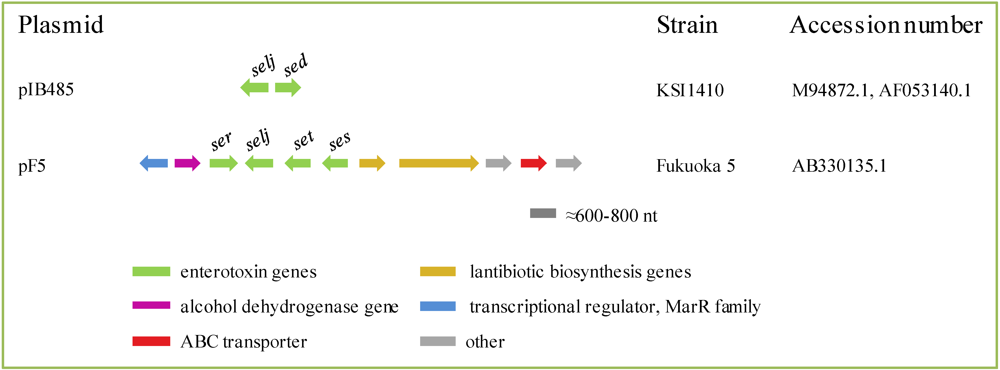
          <p>Plasmids have been long recognized as efficient vehicles for the spread of resistance and virulence determinants through horizontal gene transfer. In <italic>S. aureus</italic>, two kinds of plasmids carrying <italic>se</italic>/<italic>sel</italic> genes have been characterized (<xref ref-type="table" rid="toxins-02-01751-t001">Table 1</xref>; <xref ref-type="fig" rid="toxins-02-01751-f001">Figure 1</xref>). Both contain <italic>sej</italic> and <italic>ser</italic> associated with either <italic>sed</italic> (pIB485-like) or with <italic>ses</italic> and <italic>set</italic> (pF5) [<xref ref-type="bibr" rid="B40-toxins-02-01751">40</xref>,<xref ref-type="bibr" rid="B45-toxins-02-01751">45</xref>,<xref ref-type="bibr" rid="B93-toxins-02-01751">93</xref>].</p>
          <fig id="toxins-02-01751-f001" position="anchor">
            <label>Figure 1</label>
            <caption>
              <p>Enterotoxin and enterotoxin-like genes in plasmids pIB485 and pF5 based on sequencing data deposited under the accession numbers indicated to the right of the figure. Note thatpIB485 also contains <italic>blaZ</italic> and <italic>cad</italic> resistance genes [<xref ref-type="bibr" rid="B94-toxins-02-01751">94</xref>] and probably <italic>ser</italic> [<xref ref-type="bibr" rid="B40-toxins-02-01751">40</xref>,<xref ref-type="bibr" rid="B95-toxins-02-01751">95</xref>].</p>
            </caption>
            <graphic xmlns:xlink="http://www.w3.org/1999/xlink" xlink:href="toxins-02-01751-g001.tif"/>
          </fig>
          <p>The first plasmid described to carry an enterotoxin gene was pIB485, a 27.6 kilobase (kb) plasmid, in which first <italic>sed</italic> and latter <italic>selj</italic> were identified [<xref ref-type="bibr" rid="B45-toxins-02-01751">45</xref>,<xref ref-type="bibr" rid="B94-toxins-02-01751">94</xref>]. Enterotoxin SER was discovered by [<xref ref-type="bibr" rid="B93-toxins-02-01751">93</xref>] in <italic>S. aureus</italic> strains associated with a food poisoning outbreak that occurred in Fukuoka City, Japan, in 1997, and the <italic>ser</italic> gene was shown to be located on a family of closely related plasmids, termed pF5 and pF5-like. These plasmids have similar restriction profiles and carry <italic>selj</italic> along with <italic>ser</italic>. More recently, two novel SE genes (<italic>ses</italic> and <italic>set</italic>) have also been detected on the Fukuoka plasmids [<xref ref-type="bibr" rid="B40-toxins-02-01751">40</xref>,<xref ref-type="bibr" rid="B93-toxins-02-01751">93</xref>]. Interestingly, the <italic>ser</italic> gene, together with <italic>sed</italic> and <italic>selj</italic>, has also been found in pIB485-like plasmids from laboratory strains, food poisoning outbreak isolates and healthy human isolates in Japan [<xref ref-type="bibr" rid="B93-toxins-02-01751">93</xref>] and pIB485-like plasmids, varying in size and/or restriction profile were present in <italic>S. aureus</italic> isolates recovered in Spain from human nasal carriers and manually handled foods [<xref ref-type="bibr" rid="B95-toxins-02-01751">95</xref>]. Two of them, named pUO-Sa-SED1 (~33 kb) and pUO-Sa-SED2 (~36 kb), carried <italic>sed</italic>, <italic>selj</italic> and <italic>ser</italic>, and have restriction patterns identical or similar to that of pIB485, while pUO-Sa-SED3 (53.5 kb; containing <italic>sed</italic>, <italic>selj</italic> and <italic>ser</italic>-like) has a different profile. A BLAST search (<uri>http://www.ncbi.nlm.nih.gov</uri>) of the <italic>sed</italic>, <italic>selj</italic>, <italic>ser</italic>, <italic>ses</italic> and <italic>set</italic> genes revealed additional pIB485-like and pF5-like plasmids obtained from human clinical isolates, whose sequences have been deposited in databases. At present, the evolutionary relationship between the two types of plasmids is unknown.</p>
        </sec>
        <sec>
          <title>2.4.2. Prophages</title>
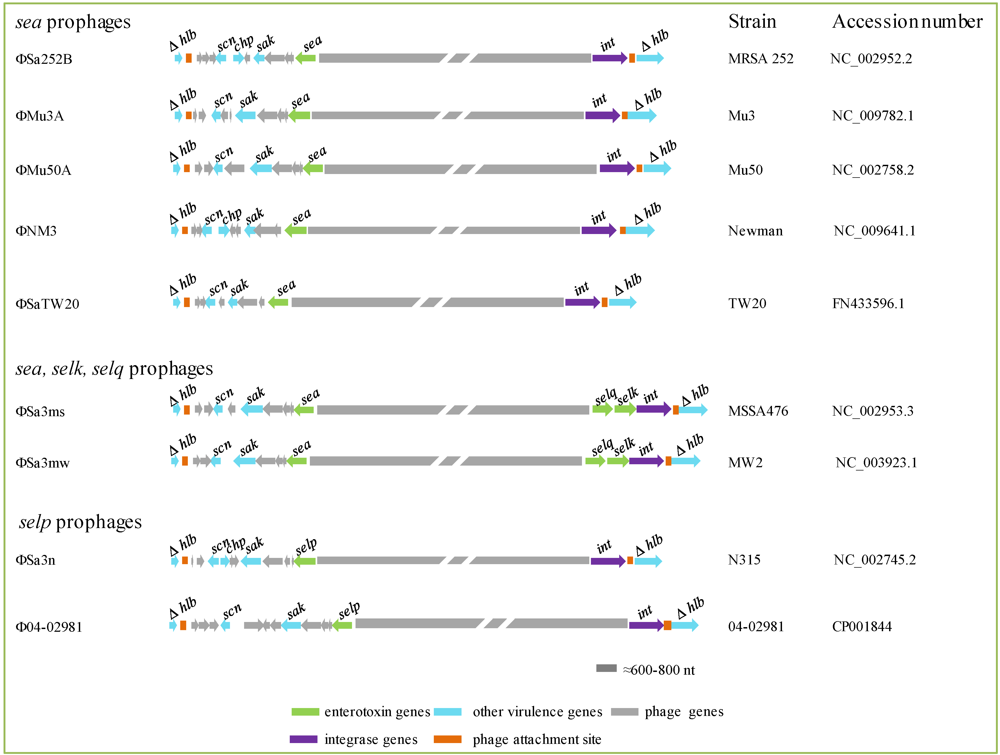
          <p>Like most published <italic>S. aureus</italic> phages, those carrying <italic>se</italic> genes (<italic>sea</italic>, <italic>selk</italic>, <italic>selp</italic> and <italic>selq</italic>) belong to the <italic>Siphoviridae</italic> family. The temperate, tailed bacteriophages within this family have been classified according to three features [<xref ref-type="bibr" rid="B96-toxins-02-01751">96</xref>]: (i) the lysogeny module, particularly the integrase that dictates the insertion site of the phage in the bacterial chromosome; (ii) the serogroup, based on differences in capsid, tail, and tail appendix proteins; and (iii) the holin gene of the lysis module. The <italic>Siphoviridae</italic> prophages carrying <italic>se</italic> genes belong to integrase group Sa3, serogroups Fa and Fb, and holin groups 255a and 255b. Three <italic>se</italic>/<italic>sel</italic> genes (<italic>sea</italic>, <italic>selk</italic> and <italic>selq</italic>) are present together in ФSa3ms and ФSa3mw, while a single <italic>se</italic>/<italic>sel</italic> gene (<italic>sea</italic> or <italic>selp</italic>) is carried by other prophages (<xref ref-type="table" rid="toxins-02-01751-t001">Table 1</xref>; <xref ref-type="fig" rid="toxins-02-01751-f002">Figure 2</xref>). </p>
          <p>Apart from enterotoxins, virulence factors involved in evasion of the innate immunity are also encoded on these phages. These include the chemotaxis inhibitory protein (CHIP, product of the <italic>chp</italic> gene) that binds to host chemokine receptors, particularly the C5a receptor and the formylated peptide receptor, preventing neutrophil chemotaxis and activation [<xref ref-type="bibr" rid="B97-toxins-02-01751">97</xref>]; the staphylococcal complement inhibitor (SCIN, encoded by the <italic>scn</italic> gene) that interferes with all pathways of complement activation by blocking C3 convertases [<xref ref-type="bibr" rid="B98-toxins-02-01751">98</xref>]; the staphylokinase (product of the <italic>sak</italic> gene) that leads to degradation of two major opsonins (IgG and C3b) through activation of surface-bound plasminogen into plasmin, and also inhibits the bactericidal effect of α-defensins [<xref ref-type="bibr" rid="B99-toxins-02-01751">99</xref>,<xref ref-type="bibr" rid="B100-toxins-02-01751">100</xref>]. The region encoding these virulence factors is known as the "innate inmune evasion cluster" [<xref ref-type="bibr" rid="B101-toxins-02-01751">101</xref>] and is located at one or both ends of the phages. Integration of these phages into the <italic>S. aureus</italic> chromosome occurs by a site-specific recombination event between the <italic>attP</italic> site in the phage genome and the <italic>attB</italic> site located within the β-hemolysin gene in the bacterial chromosome [<xref ref-type="bibr" rid="B102-toxins-02-01751">102</xref>]. While integration negatively converts β-hemolysin expression, it supplies other virulence genes.</p>
        </sec>
        <sec>
          <title>2.4.3. <italic>Staphylococcus aureus</italic> Pathogenicity Islands</title>
          <p>The SaPIs are mobile pathogenicity islands, which are widely distributed in <italic>S. aureus</italic> and have also been found in other species of <italic>Staphylococcus</italic>. SaPIs have a highly conserved overall organization, parallel to that of typical temperate bateriophages. Each one occupies a specific chromosomal site (att<italic><sub>S</sub></italic>), and always appears in the same orientation. From its integration site, the island can be induced to excise and replicate by one or more specific staphylococcal helper phages [<xref ref-type="bibr" rid="B103-toxins-02-01751">103</xref>,<xref ref-type="bibr" rid="B104-toxins-02-01751">104</xref>]. Following replication the SaPI DNA is efficiently encapsidated into infectious small-headed phage-like particles resulting in extremely high transfer frequencies.</p>
          <fig id="toxins-02-01751-f002" position="anchor">
            <label>Figure 2</label>
            <caption>
              <p>Enterotoxin genes carried by prophages based on sequencing data deposited under the accession numbers indicated to the right of the figure.</p>
            </caption>
            <graphic xmlns:xlink="http://www.w3.org/1999/xlink" xlink:href="toxins-02-01751-g002.tif"/>
          </fig>
          <fig id="toxins-02-01751-f003" position="anchor">
            <label>Figure 3</label>
            <caption>
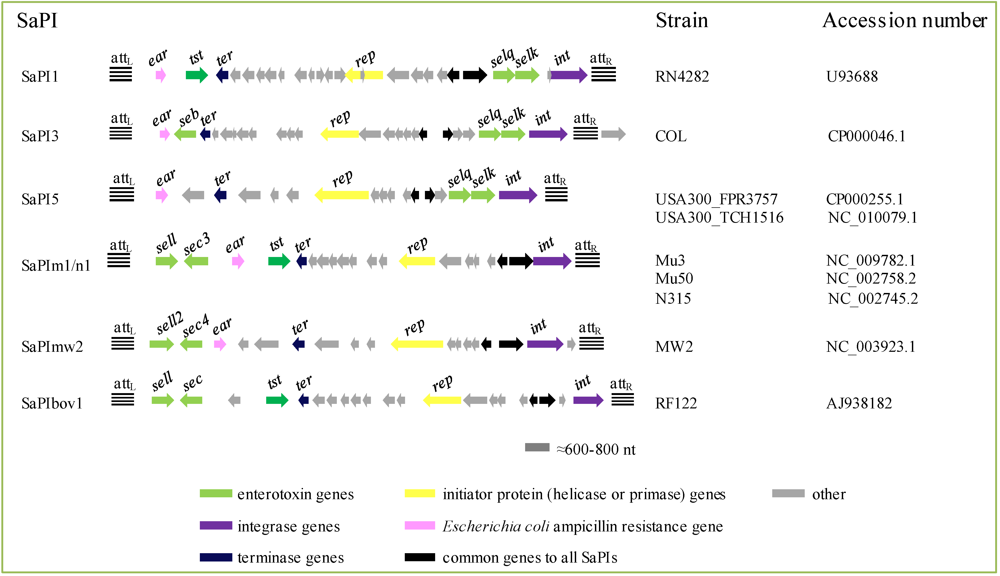
              <p><italic>Staphylococcus aureus</italic> pathogenicity islands (SaPIs) carrying enterotoxin or enterotoxin-like genes. Modified from Novick and Subedi [<xref ref-type="bibr" rid="B105-toxins-02-01751">105</xref>] and based on the accession numbers indicated to the right of the figure.</p>
            </caption>
            <graphic xmlns:xlink="http://www.w3.org/1999/xlink" xlink:href="toxins-02-01751-g003.tif"/>
          </fig>
          <p>SaPIs are very common in <italic>S. aureus</italic> (<xref ref-type="table" rid="toxins-02-01751-t001">Table 1</xref>). They range in size from 15–17 kb, with the exceptions of SaPIbov2 (27 kb) and a highly degenerated SaPI (3.14 kb) present in some sequenced genomes. The complete nucleotide sequence is known for 20 SaPIs, and some of them carry genes encoding TSST-1 and/or one or more SEs (<xref ref-type="fig" rid="toxins-02-01751-f003">Figure 3</xref>). For instance, <italic>tst</italic> is found together with <italic>selk</italic> and <italic>selq</italic> in SaPI1, with <italic>sec3</italic> and <italic>sell</italic> in SaPIm1 and SaPIn1, and with <italic>sell</italic> and <italic>sec</italic> in SaPIbov1; <italic>seb</italic>, <italic>selq</italic> and <italic>selk</italic> have been reported in SaPI3; <italic>selk</italic> and <italic>selq</italic> in SaPI5; and <italic>sec4</italic> and <italic>sell2</italic> in SaPImw2 [<xref ref-type="bibr" rid="B105-toxins-02-01751">105</xref>]. Induction of a SaPI is likely to originate an increase in the copy number of the toxin genes, and therefore to an increase in toxin production, as described for lysogenic phages [<xref ref-type="bibr" rid="B106-toxins-02-01751">106</xref>].</p>
        </sec>
        <sec>
        <title>2.4.4. <italic>v</italic>Sa G<italic>enomic Islands</italic></title>
          <p>The term <italic>v</italic>Sa refers to non-phage and non-SCC genomic islands that are exclusively present in <italic>S. aureus</italic>, often (but not always) encode virulence determinants, are inserted at specific loci in the chromosome and are associated with either intact or remnant DNA recombinases [<xref ref-type="bibr" rid="B107-toxins-02-01751">107</xref>,<xref ref-type="bibr" rid="B108-toxins-02-01751">108</xref>]. Two major <italic>v</italic>Sa genomic islands, namely <italic>v</italic>Saα and <italic>v</italic>Saβ, each of about 20–30 kb, are present in all <italic>S. aureus</italic> genomes sequenced so far, but absent in other <italic>Staphylococcus</italic> species, including <italic>S. epidermidis</italic>. Though <italic>v</italic>Saα and <italic>v</italic>Saβ could have been acquired by horizontal gene transfer, actually there is not evidence that they can move. Each of these islands carries two copies of the genes encoding the recognition (<italic>hsdS</italic>) and methylation (<italic>hsdM</italic>) subunits of the Sau1 type I restriction-modification system. A single copy of the gene for the restriction subunit is located elsewhere in the <italic>S. aureus</italic> chromosome [<xref ref-type="bibr" rid="B109-toxins-02-01751">109</xref>]. The <italic>hsdS</italic> genes of the Sau1 system diverge significantly between members of different lineages and this determines variations in the sequences that will be specifically recognized as targets for modification through methylation. Since only modified sequences will be protected against restriction, exchange of DNA between members of same lineage will be allowed, while DNA transferred between isolates of different lineages will be digested. Because of this, the Sau1 system has been considered as a key factor in the control of lineage evolution.</p>
          <fig id="toxins-02-01751-f004" position="anchor">
            <label>Figure 4</label>
            <caption>
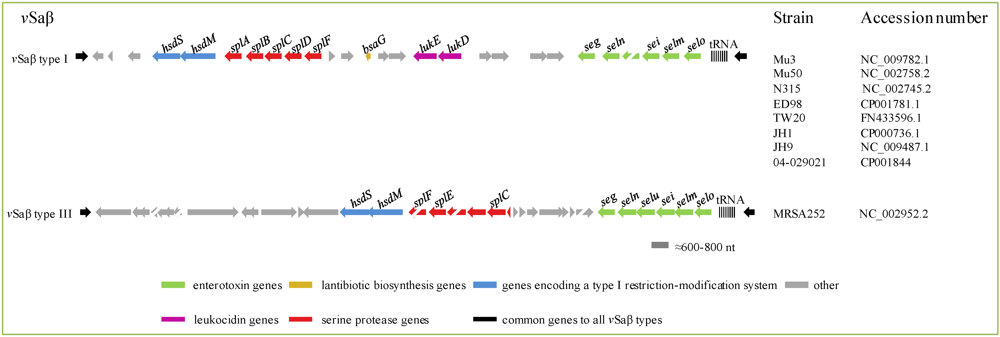
              <p>Structure of two types of the <italic>v</italic>Saβ genomic island containing the enterotoxin gene cluster. Adapted from Baba <italic>et al.</italic> [<xref ref-type="bibr" rid="B108-toxins-02-01751">108</xref>] and based on accession numbers indicated to the right of the figure.</p>
            </caption>
            <graphic xmlns:xlink="http://www.w3.org/1999/xlink" xlink:href="toxins-02-01751-g004.tif"/>
          </fig>
          <p>Both <italic>v</italic>Saα and <italic>v</italic>Saβ contain clusters of genes encoding known or putative virulence factors. <italic>v</italic>Saα carries a cluster of lipoprotein-encoding genes (<italic>lpl</italic> cluster), and the <italic>set</italic> (staphylococcal exotoxin-like) cluster [<xref ref-type="bibr" rid="B55-toxins-02-01751">55</xref>,<xref ref-type="bibr" rid="B110-toxins-02-01751">110</xref>], later re-named as the <italic>ssl</italic> (staphylococcal superantigen-like) cluster [<xref ref-type="bibr" rid="B30-toxins-02-01751">30</xref>]. The <italic>ssl</italic> cluster consists of a series of related genes (between 7 and 11) coding for proteins that share a common architecture with SAgs but do not function as such [<xref ref-type="bibr" rid="B50-toxins-02-01751">50</xref>]. However, they have alternative effects on the host immune system, acting on IgA, complement factor C5 (as demonstrated for SSL7; [<xref ref-type="bibr" rid="B53-toxins-02-01751">53</xref>]), or neutrophils (SSL5 [<xref ref-type="bibr" rid="B111-toxins-02-01751">111</xref>] and SSL11 [<xref ref-type="bibr" rid="B52-toxins-02-01751">52</xref>]). <italic>v</italic>Saβ carries a serine protease gene (<italic>spl</italic>) cluster, genes for the components of the LukED leukocidin (<italic>lukD</italic> and <italic>lukE</italic>), genes for lantibiotic biosynthesis (<italic>bsa</italic>) and/or the enterotoxin gene cluster (<italic>egc</italic>), which includes a variable number of <italic>se</italic>/<italic>sel</italic> genes forming an operon [<xref ref-type="bibr" rid="B36-toxins-02-01751">36</xref>]. Two representative types of vSaβ, the genomic island carrying <italic>se</italic> genes, are showed in <xref ref-type="fig" rid="toxins-02-01751-f004">Figure 4</xref>.</p>
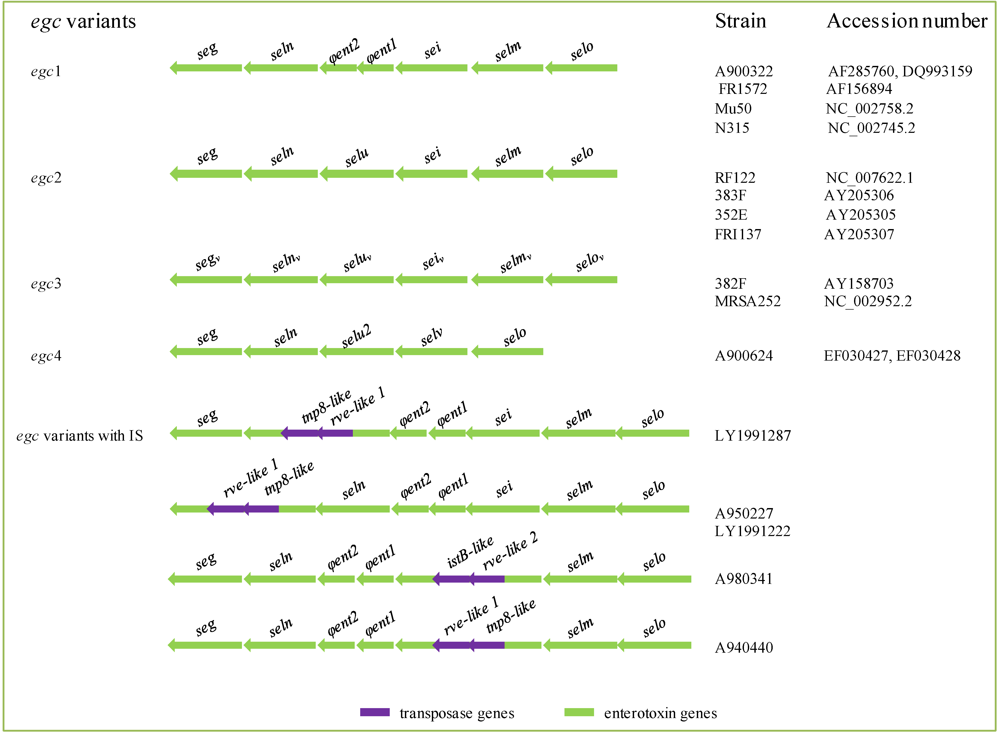
          <p>It has been suggested that the <italic>egc</italic> cluster arose from an ancestral <italic>se</italic> gene, through tandem duplication and further variation, while gene recombination has created variant toxins with different biological activities [<xref ref-type="bibr" rid="B28-toxins-02-01751">28</xref>,<xref ref-type="bibr" rid="B36-toxins-02-01751">36</xref>,<xref ref-type="bibr" rid="B112-toxins-02-01751">112</xref>]. The dynamic evolution of this cluster that has been considered as a nursery of <italic>se</italic>/<italic>sel</italic> genes [<xref ref-type="bibr" rid="B36-toxins-02-01751">36</xref>] is reflected in the number of variants already known (<xref ref-type="fig" rid="toxins-02-01751-f005">Figure 5</xref>).</p>
          <fig id="toxins-02-01751-f005" position="anchor">
            <label>Figure 5</label>
            <caption>
              <p>Structure of <italic>egc</italic> clusters. Modified from Thomas <italic>et al</italic> [<xref ref-type="bibr" rid="B28-toxins-02-01751">28</xref>] and Collery <italic>et al.</italic> [<xref ref-type="bibr" rid="B114-toxins-02-01751">114</xref>], and based on the accession numbers indicated to the right of the figure.</p>
            </caption>
            <graphic xmlns:xlink="http://www.w3.org/1999/xlink" xlink:href="toxins-02-01751-g005.tif"/>
          </fig>
          <p>The first <italic>egc</italic> (<italic>egc1</italic>) was discovered in 2001 and consists of two SE genes (<italic>seg</italic> and <italic>sei</italic>), three SE<italic>l</italic> genes (<italic>selm</italic>, <italic>seln</italic> and <italic>selo</italic>), and two pseudogenes (<italic>φent1</italic> and <italic>φent2</italic>) [<xref ref-type="bibr" rid="B36-toxins-02-01751">36</xref>,<xref ref-type="bibr" rid="B113-toxins-02-01751">113</xref>]. Afterward, a second <italic>egc</italic> variant (<italic>egc2</italic>) containing an additional SE<italic>l</italic> gene (<italic>selu</italic>) was described [<xref ref-type="bibr" rid="B37-toxins-02-01751">37</xref>]. The latter gene has been generated by fusion of the two <italic>egc1</italic> pseudogenes, due to a 15 nucleotide insertion in <italic>φent1</italic> and a single adenine deletion that abolishes a stop codon within the same gene. In addition, allelic variants of each of the <italic>egc2</italic> genes compose the <italic>egc3</italic> cluster [<xref ref-type="bibr" rid="B37-toxins-02-01751">37</xref>,<xref ref-type="bibr" rid="B114-toxins-02-01751">114</xref>,<xref ref-type="bibr" rid="B115-toxins-02-01751">115</xref>], and a new <italic>selu</italic> variant (<italic>selu2</italic>) and a novel <italic>sel</italic> gene (<italic>selv</italic>) are present in <italic>egc4</italic> [<xref ref-type="bibr" rid="B28-toxins-02-01751">28</xref>]. A recombination event between <italic>selm</italic> and <italic>sei</italic> produced <italic>selv</italic>, while deletion of one adenine between the overlapping 5’ and 3’ ends of the <italic>φent2</italic> and <italic>φent1</italic> pseudogenes generated <italic>selu2</italic> (which was proposed to be renamed as <italic>selw</italic>) [<xref ref-type="bibr" rid="B116-toxins-02-01751">116</xref>]. Incomplete <italic>egc</italic> clusters, lacking one or more genes of the classical <italic>egc1</italic>, as well as variants carrying insertion sequences within <italic>seln</italic>, <italic>seg</italic> or <italic>sei</italic>, have also been described [<xref ref-type="bibr" rid="B28-toxins-02-01751">28</xref>,<xref ref-type="bibr" rid="B117-toxins-02-01751">117</xref>]. These structures have been considered as evolutionary intermediates of the <italic>egc</italic> cluster [<xref ref-type="bibr" rid="B28-toxins-02-01751">28</xref>]. Moreover, the fact that each of the three major homology groups of SEs/SEs (<xref ref-type="table" rid="toxins-02-01751-t002">Table 2</xref>) contains enterotoxins encoded by genes of the <italic>egc</italic> operon led to the proposal that all <italic>se</italic>/<italic>sels</italic> originated from the <italic>egc</italic> cluster [<xref ref-type="bibr" rid="B29-toxins-02-01751">29</xref>].</p>
        </sec>
        <sec>
          <title>2.4.5. Enterotoxin Genes in the Proximity of the Staphylococcal Cassette Chromosome</title>
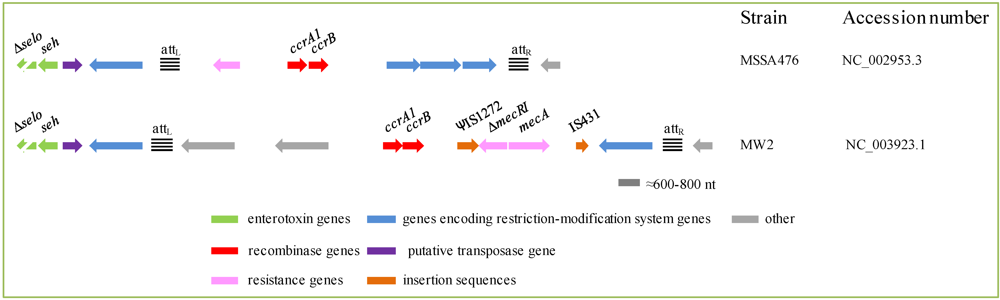
          <p>The <italic>seh</italic> gene, flanked by a truncated <italic>selo</italic> gene and a putative transposase gene, have been found in close proximity of the non-<italic>mecA</italic> containing SCC element harbored by MSSA (methicillin susceptible <italic>S. aureus</italic>) strain 476; the SCC<italic>mec</italic> type IV of <italic>S. aureus</italic> MW2; and the SCC<italic>mec</italic> type IV of a collection of highly related community-associated <italic>S. aureus</italic> ([<xref ref-type="bibr" rid="B118-toxins-02-01751">118</xref>]; <xref ref-type="fig" rid="toxins-02-01751-f006">Figure 6</xref>). In the latter strains, acquisition of the <italic>seh</italic> element could have stabilized the integration of SCC<italic>mec</italic> type IV, which is unable to excise [<xref ref-type="bibr" rid="B118-toxins-02-01751">118</xref>].</p>
          <fig id="toxins-02-01751-f006" position="anchor">
            <label>Figure 6</label>
            <caption>
              <p>Comparison of two allelic forms of SCC elements associated with <italic>seh</italic>. Modified from Noto and Archer [<xref ref-type="bibr" rid="B118-toxins-02-01751">118</xref>] and based on the accession numbers indicated to the right of the figure.</p>
            </caption>
            <graphic xmlns:xlink="http://www.w3.org/1999/xlink" xlink:href="toxins-02-01751-g006.tif"/>
          </fig>
        </sec>
      </sec>
      <sec>
        <title>2.5. Staphylococcal Enterotoxins and Food Poisoning Outbreaks</title>
        <p>Independently of their origin, enterotoxigenic <italic>S. aureus</italic> often differ in the number of mobile genetic elements and <italic>se</italic>/<italic>sel</italic> genes therein, as well as in the enterotoxins they produce. SEA, either alone or together with other SEs/SEls, is the enterotoxin most commonly reported in foods, and is also considered as the main cause of SFP, probably due to its extraordinarily high resistance to proteolytic enzymes [<xref ref-type="bibr" rid="B3-toxins-02-01751">3</xref>,<xref ref-type="bibr" rid="B119-toxins-02-01751">119</xref>,<xref ref-type="bibr" rid="B120-toxins-02-01751">120</xref>]. The predominance of SEA is well documented in different countries. As relevant examples: (i) a comprehensive study of 359 outbreaks that occurred in the United Kingdom (UK) between 1969 and 1990 revealed that 79% of the <italic>S. aureus</italic> strains produced SEA [<xref ref-type="bibr" rid="B121-toxins-02-01751">121</xref>]. Meat, poultry and their products, particularly ham and chicken, were the vehicle in 75% of the incidents. SEA was detected alone in 56.9% of the outbreaks and, in conjunction with SED, SEB, SEC or SEB and SED in a lower number of outbreaks (15.4, 3.4, 2.5 or 1.1%, respectively); (ii) SEA was also the enterotoxin most frequently found among 31 SFP outbreaks in France (69.7%), which were associated with a great variety of foods including milk products, different types of meat, and salads, between 1981 and 2002 [<xref ref-type="bibr" rid="B122-toxins-02-01751">122</xref>]. In agreement with this, <italic>sea</italic> was the most common gene in the isolates tested, followed by <italic>sed</italic>, <italic>seg</italic>, <italic>sei</italic> and <italic>she</italic>; (iii) In Austria, an SFP outbreak that affected 40 children in 2007 was attributed to <italic>S. aureus</italic> isolates producing SEA and SED. Bovine milk products were identified as the source of the outbreak, and the cows, not the dairy owner, were the more likely reservoir of the SEs-producing <italic>S. aureus</italic> [<xref ref-type="bibr" rid="B123-toxins-02-01751">123</xref>]; (iv) SEA was also the most common enterotoxin recovered from food poisoning outbreaks in USA (77.8% of all outbreaks) followed by SED and SEB [<xref ref-type="bibr" rid="B124-toxins-02-01751">124</xref>]; (v) A study of <italic>S. aureus</italic> obtained from dairy products, responsible for 16 outbreaks in Brazil revealed that the most frequently encountered enterotoxin gene was <italic>sea</italic> followed by <italic>seb</italic> [<xref ref-type="bibr" rid="B125-toxins-02-01751">125</xref>]. Finally, (vi) several studies have investigated the distribution of SEs and <italic>se</italic>/<italic>sel</italic> genes in <italic>S. aureus</italic> from foods and SFP outbreaks in Asian countries. Among strains recovered from patients associated with SFP outbreaks during 2001-2003 in Taiwan, <italic>sea</italic> was the most common gene, followed by <italic>seb</italic> and <italic>sec</italic> [<xref ref-type="bibr" rid="B13-toxins-02-01751">13</xref>]. In Korea, about 90% of food poisoning isolates were reported to contain the <italic>sea</italic> gene [<xref ref-type="bibr" rid="B126-toxins-02-01751">126</xref>]. SEA also was the most common SE associated to SFP in Japan [<xref ref-type="bibr" rid="B127-toxins-02-01751">127</xref>]. In this country, an extensive outbreak that occurred in 2000 was attributed to low-fat milk containing SEA [<xref ref-type="bibr" rid="B128-toxins-02-01751">128</xref>], while a recent outbreak (2009) was due to crepes containing SEA and SEC [<xref ref-type="bibr" rid="B129-toxins-02-01751">129</xref>].</p>
        <p>SEB, SEC or SED alone have been also implicated in SFP outbreaks through the world [<xref ref-type="bibr" rid="B121-toxins-02-01751">121</xref>,<xref ref-type="bibr" rid="B122-toxins-02-01751">122</xref>,<xref ref-type="bibr" rid="B125-toxins-02-01751">125</xref>]. Interestingly, an outbreak, which affected three members of the same family in USA, was caused by coleslaw-containing SEC produced by a community-acquired methicillin resistant <italic>S. aureus</italic> from an asymptomatic food handler [<xref ref-type="bibr" rid="B130-toxins-02-01751">130</xref>]. The fifth classical enterotoxin, SEE, has been infrequently reported in foods and food-producing animals, and its involvement in SFP outbreaks has only been demonstrated in rare occasions. However, six SFP outbreaks, which occurred in France at the end of 2009, were caused by SEE present in soft cheese made from unpasteurized milk. This enterotoxin has also been associated with outbreaks in USA and UK [<xref ref-type="bibr" rid="B33-toxins-02-01751">33</xref>,<xref ref-type="bibr" rid="B121-toxins-02-01751">121</xref>,<xref ref-type="bibr" rid="B131-toxins-02-01751">131</xref>,<xref ref-type="bibr" rid="B132-toxins-02-01751">132</xref>,<xref ref-type="bibr" rid="B133-toxins-02-01751">133</xref>].</p>
        <p>In contrast to classical SEs, the relationship between the novel SEs/SE<italic>l</italic>s and SFP is not fully understood. Among them, SEG, SEH and SEI, SER, SES, and SET have shown to be emetic after oral administration in a primate model, while the emetic activity of SE<italic>l</italic>L and SE<italic>l</italic>P has only been demonstrated in rabbits and the small insectivore <italic>Suncus murinus</italic>, respectively [<xref ref-type="bibr" rid="B39-toxins-02-01751">39</xref>,<xref ref-type="bibr" rid="B43-toxins-02-01751">43</xref>]. The remaining SE<italic>l</italic>s either lack emetic properties (SE<italic>l</italic>Q), or have not been tested (SE<italic>l</italic>J, SE<italic>l</italic>K, SE<italic>l</italic>M, SE<italic>l</italic>N, SE<italic>l</italic>O, SE<italic>l</italic>U, SE<italic>l</italic>U2 and SE<italic>l</italic>V). Moreover, commercial kits are not available for immunological detection of these SEs and SE<italic>l</italic>s, although ELISA (enzyme-linked immunosorbent assay) has been described for SEH [<xref ref-type="bibr" rid="B134-toxins-02-01751">134</xref>] and for SEG and SEI [<xref ref-type="bibr" rid="B135-toxins-02-01751">135</xref>]. Of the new enterotoxins, only SEH-producing strains have clearly been involved in SFP outbreaks [<xref ref-type="bibr" rid="B134-toxins-02-01751">134</xref>,<xref ref-type="bibr" rid="B136-toxins-02-01751">136</xref>,<xref ref-type="bibr" rid="B137-toxins-02-01751">137</xref>,<xref ref-type="bibr" rid="B138-toxins-02-01751">138</xref>], but results from different researchers have shown the high incidence of genes encoding new SEs and SE<italic>l</italic>s among food-borne <italic>S. aureus</italic> [<xref ref-type="bibr" rid="B131-toxins-02-01751">131</xref>,<xref ref-type="bibr" rid="B139-toxins-02-01751">139</xref>,<xref ref-type="bibr" rid="B140-toxins-02-01751">140</xref>,<xref ref-type="bibr" rid="B141-toxins-02-01751">141</xref>]. Mc Lauchlin <italic>et al.</italic> [<xref ref-type="bibr" rid="B131-toxins-02-01751">131</xref>] revealed that 23 staphylococcal strains implicated in SFP outbreaks in UK, in which classical <italic>se</italic> genes were not detected, harbored one or more of the new <italic>se</italic>/<italic>sel</italic> genes, <italic>i.e.</italic>, <italic>seg</italic>, <italic>seh</italic>, <italic>sei</italic> or <italic>selj</italic>. It is possible that the corresponding SEs might have been the cause of these outbreaks. The presence of <italic>egc</italic> genes was also shown in food-associated <italic>S. aureus</italic> from other countries [<xref ref-type="bibr" rid="B131-toxins-02-01751">131</xref>,<xref ref-type="bibr" rid="B140-toxins-02-01751">140</xref>,<xref ref-type="bibr" rid="B141-toxins-02-01751">141</xref>,<xref ref-type="bibr" rid="B142-toxins-02-01751">142</xref>,<xref ref-type="bibr" rid="B143-toxins-02-01751">143</xref>,<xref ref-type="bibr" rid="B144-toxins-02-01751">144</xref>], and newly described SE or SE<italic>l</italic> genes, particularly those belonging to the <italic>egc</italic> cluster, were more frequently detected in <italic>S. aureus</italic> strains isolated from raw pork and chicken meat in Korea than genes encoding classical SEs [<xref ref-type="bibr" rid="B145-toxins-02-01751">145</xref>]. Despite this, <italic>egc</italic>-encoded SEs or SE<italic>l</italic>s have not yet been directly implied in typical cases of SFP, although SEG and SEI have been reported as the cause of chronic diarrhea associated with severe but reversible enteropathy in two malnourished neonates [<xref ref-type="bibr" rid="B146-toxins-02-01751">146</xref>].</p>
      </sec>
    </sec>
    <sec sec-type="conclusions">
      <title>3. Conclusions</title>
      <p>SEs and SE<italic>l</italic>s produced by <italic>S. aureus</italic> belong to the fascinating family of superantigens, which sabotage the immune system of the host by targeting the innate and adaptive responses. Members of the family are well characterized with regard to superantigenic activity. However, the bases for the enterotoxigenic activity associated with a number of <italic>S. aureus</italic> superantigens remain elusive. Likewise, a direct relationship of <italic>S. aureus</italic> SEs (with demonstrated emetic activity) and SE<italic>l</italic>s (which lack emetic activity or have yet to be tested) with pathogenicity has not always been established, and the reasons for the redundancy of <italic>se</italic>/<italic>sel</italic> genes within the same bacterium deserve further attention. Of particular interest is the <italic>egc</italic> cluster, regarded as a nursery of <italic>se</italic>/<italic>sel</italic> genes in continuing evolution. The cluster and its multiple variants, located on the νSaβ genomic island, are widely distributed in <italic>S. aureus</italic> of any origin, and results from our group indicate that they are the most common superantigenes in <italic>S. aureus</italic> recovered from clinical samples, healthy carriers, cows with subclinical mastitis and foods [<xref ref-type="bibr" rid="B143-toxins-02-01751">143</xref>,<xref ref-type="bibr" rid="B147-toxins-02-01751">147</xref>,<xref ref-type="bibr" rid="B148-toxins-02-01751">148</xref>,<xref ref-type="bibr" rid="B149-toxins-02-01751">149</xref>]. However, a direct involvement of <italic>egc-</italic>encoded SEs in food poisoning has not been demonstrated, and attempts to elucidate their pathogenic role are still scarce [<xref ref-type="bibr" rid="B146-toxins-02-01751">146</xref>,<xref ref-type="bibr" rid="B150-toxins-02-01751">150</xref>,<xref ref-type="bibr" rid="B151-toxins-02-01751">151</xref>,<xref ref-type="bibr" rid="B152-toxins-02-01751">152</xref>]. In summary, although a wealth of information on SEs and SE<italic>l</italic>s is already available, they still represent an active field of research, which will certainly provide new exciting findings in forthcoming years.</p>
    </sec>
  </body>
  <back>
    <ack>
      <title>Acknowledgements</title>
      <p>Experience in the subject derives from research supported by projects FISS PI052489 and FISS PI080656 from the Spanish Ministry of Science and Innovation (Instituto de Salud Carlos III). M. A. Argudín was supported by grant FPU AP-2004-3641 from the Ministry of Science and Innovation, Spain, co-funded by the European Social Fund.</p>
    </ack>
    <ref-list>
      <title>References</title>
      <ref id="B1-toxins-02-01751">
        <label>1.</label>
        <citation citation-type="journal">
          <person-group person-group-type="author">
            <name>
              <surname>Dinges</surname>
              <given-names>M.M.</given-names>
            </name>
            <name>
              <surname>Orwin</surname>
              <given-names>P.M.</given-names>
            </name>
            <name>
              <surname>Schlievert</surname>
              <given-names>P.M.</given-names>
            </name>
          </person-group>
          <article-title>Exotoxins of <italic>Staphylococcus aureus</italic></article-title>
          <source>Clin. Microbiol. Rev.</source>
          <year>2000</year>
          <volume>13</volume>
          <fpage>16</fpage>
          <lpage>34</lpage>
        <pub-id pub-id-type="doi">10.1128/CMR.13.1.16-34.2000</pub-id><pub-id pub-id-type="pmid">10627489</pub-id></citation>
      </ref>
      <ref id="B2-toxins-02-01751">
        <label>2.</label>
        <citation citation-type="journal">
          <person-group person-group-type="author">
            <name>
              <surname>Le Loir</surname>
              <given-names>Y.</given-names>
            </name>
            <name>
              <surname>Baron</surname>
              <given-names>F.</given-names>
            </name>
            <name>
              <surname>Gautier</surname>
              <given-names>M.</given-names>
            </name>
          </person-group>
          <article-title><italic>Staphylococcus aureus</italic> and food poisoning</article-title>
          <source>Genet. Mol. Res.</source>
          <year>2003</year>
          <volume>2</volume>
          <fpage>63</fpage>
          <lpage>76</lpage>
        <pub-id pub-id-type="pmid">12917803</pub-id></citation>
      </ref>
      <ref id="B3-toxins-02-01751">
        <label>3.</label>
        <citation citation-type="journal">
          <person-group person-group-type="author">
            <name>
              <surname>Balaban</surname>
              <given-names>N.</given-names>
            </name>
            <name>
              <surname>Rasooly</surname>
              <given-names>A.</given-names>
            </name>
          </person-group>
          <article-title>Staphylococcal enterotoxins</article-title>
          <source>Int. J. Food Microbiol.</source>
          <year>2000</year>
          <volume>61</volume>
          <fpage>1</fpage>
          <lpage>10</lpage>
        <pub-id pub-id-type="doi">10.1016/S0168-1605(00)00377-9</pub-id><pub-id pub-id-type="pmid">11028954</pub-id></citation>
      </ref>
      <ref id="B4-toxins-02-01751">
        <label>4.</label>
        <citation citation-type="journal">
          <person-group person-group-type="author">
            <name>
              <surname>Murray</surname>
              <given-names>R.J.</given-names>
            </name>
          </person-group>
          <article-title>Recognition and management of <italic>Staphylococcus aureus</italic> toxin-mediated disease</article-title>
          <source>Intern. Med. J.</source>
          <year>2005</year>
          <volume>2</volume>
          <fpage>S106</fpage>
          <lpage>S119</lpage>
        </citation>
      </ref>
      <ref id="B5-toxins-02-01751">
        <label>5.</label>
        <citation citation-type="journal">
          <person-group person-group-type="author">
            <name>
              <surname>Tranter</surname>
              <given-names>H.S.</given-names>
            </name>
          </person-group>
          <article-title>Foodborne staphylococcal illness</article-title>
          <source>Lancet</source>
          <year>1990</year>
          <volume>336</volume>
          <fpage>1044</fpage>
          <lpage>1046</lpage>
        <pub-id pub-id-type="doi">10.1016/0140-6736(90)92500-H</pub-id><pub-id pub-id-type="pmid">1977028</pub-id></citation>
      </ref>
      <ref id="B6-toxins-02-01751">
        <label>6.</label>
        <citation citation-type="journal">
          <person-group person-group-type="author">
            <name>
              <surname>Kluytmans</surname>
              <given-names>J.A.J.W.</given-names>
            </name>
            <name>
              <surname>Wertheim</surname>
              <given-names>H.F.L.</given-names>
            </name>
          </person-group>
          <article-title>Nasal carriage of <italic>Staphylococcus aureus</italic> and prevention of nosocomial infections</article-title>
          <source>Infection</source>
          <year>2005</year>
          <volume>33</volume>
          <fpage>3</fpage>
          <lpage>8</lpage>
        <pub-id pub-id-type="pmid">16518706</pub-id></citation>
      </ref>
      <ref id="B7-toxins-02-01751">
        <label>7.</label>
        <citation citation-type="book">
          <person-group person-group-type="author">
            <name>
              <surname>Stewart</surname>
              <given-names>G.C.</given-names>
            </name>
          </person-group>
          <article-title><italic>Staphylococcus</italic> <italic>aureus</italic></article-title>
          <source>Foodborne pathogens: Microbiology and Molecular Biology</source>
          <person-group person-group-type="editor">
            <name>
              <surname>Fratamico</surname>
              <given-names>P.M.</given-names>
            </name>
            <name>
              <surname>Bhunia</surname>
              <given-names>A.K.</given-names>
            </name>
            <name>
              <surname>Smith</surname>
              <given-names>J.L.</given-names>
            </name>
          </person-group>
          <publisher-name>Caister Academic Press</publisher-name>
          <publisher-loc>Norfolk, UK</publisher-loc>
          <year>2005</year>
          <fpage>273</fpage>
          <lpage>284</lpage>
        </citation>
      </ref>
      <ref id="B8-toxins-02-01751">
        <label>8.</label>
        <citation citation-type="journal">
          <person-group person-group-type="author">
            <name>
              <surname>Tamarapu</surname>
              <given-names>S.</given-names>
            </name>
            <name>
              <surname>McKillip</surname>
              <given-names>J.L.</given-names>
            </name>
            <name>
              <surname>Drake</surname>
              <given-names>M.</given-names>
            </name>
          </person-group>
          <article-title>Development of a multiplex polymerase chain reaction assay for detection and differentiation of <italic>Staphylococcus aureus</italic> in dairy products</article-title>
          <source>J. Food Prot.</source>
          <year>2001</year>
          <volume>64</volume>
          <fpage>664</fpage>
          <lpage>668</lpage>
        <pub-id pub-id-type="pmid">11347997</pub-id></citation>
      </ref>
      <ref id="B9-toxins-02-01751">
        <label>9.</label>
        <citation citation-type="journal">
          <person-group person-group-type="author">
            <name>
              <surname>Wieneke</surname>
              <given-names>A.A.</given-names>
            </name>
            <name>
              <surname>Roberts</surname>
              <given-names>D.</given-names>
            </name>
            <name>
              <surname>Gilbert</surname>
              <given-names>R.J.</given-names>
            </name>
          </person-group>
          <article-title>Staphylococcal food poisoning in the United Kingdom, 1969–1990</article-title>
          <source>Epidemiol. Infect.</source>
          <year>1993</year>
          <volume>110</volume>
          <fpage>519</fpage>
          <lpage>531</lpage>
        <pub-id pub-id-type="doi">10.1017/S0950268800050949</pub-id><pub-id pub-id-type="pmid">8519317</pub-id></citation>
      </ref>
      <ref id="B10-toxins-02-01751">
        <label>10.</label>
        <citation citation-type="journal">
          <person-group person-group-type="author">
            <name>
              <surname>Qi</surname>
              <given-names>Y.</given-names>
            </name>
            <name>
              <surname>Miller</surname>
              <given-names>K.J.</given-names>
            </name>
          </person-group>
          <article-title>Effect of low water activity on staphylococcal enterotoxin A and B biosynthesis</article-title>
          <source>J. Food Prot.</source>
          <year>2000</year>
          <volume>63</volume>
          <fpage>473</fpage>
          <lpage>478</lpage>
        <pub-id pub-id-type="pmid">10772212</pub-id></citation>
      </ref>
      <ref id="B11-toxins-02-01751">
        <label>11.</label>
        <citation citation-type="journal">
          <person-group person-group-type="author">
            <name>
              <surname>Scott</surname>
              <given-names>W.J.</given-names>
            </name>
          </person-group>
          <article-title>Water relations of <italic>Staphylococcus aureus</italic> at 30 degrees C</article-title>
          <source>Aust. J. Biol. Sci.</source>
          <year>1953</year>
          <volume>6</volume>
          <fpage>549</fpage>
          <lpage>564</lpage>
        <pub-id pub-id-type="pmid">13126033</pub-id></citation>
      </ref>
      <ref id="B12-toxins-02-01751">
        <label>12.</label>
        <citation citation-type="journal">
          <person-group person-group-type="author">
            <anonymous/>
          </person-group>
          <article-title>The community summary report on trends and sources of zoonoses, zoonotic agents, antimicrobial resistance and foodborne outbreaks in the European Union in 2006</article-title>
          <source>EFSA J.</source>
          <year>2007</year>
          <volume>130</volume>
          <fpage>1</fpage>
          <lpage>310</lpage>
        </citation>
      </ref>
      <ref id="B13-toxins-02-01751">
        <label>13.</label>
        <citation citation-type="journal">
          <person-group person-group-type="author">
            <name>
              <surname>Chiang</surname>
              <given-names>Y.C.</given-names>
            </name>
            <name>
              <surname>Liao</surname>
              <given-names>W.W.</given-names>
            </name>
            <name>
              <surname>Fan</surname>
              <given-names>C.M.</given-names>
            </name>
            <name>
              <surname>Pai</surname>
              <given-names>W.Y.</given-names>
            </name>
            <name>
              <surname>Chiou</surname>
              <given-names>C.S.</given-names>
            </name>
            <name>
              <surname>Tsen</surname>
              <given-names>H.Y.</given-names>
            </name>
          </person-group>
          <article-title>PCR detection of staphylococcal enterotoxins (SEs) N, O, P, Q, R, U, and survey of SE types in <italic>Staphylococcus aureus</italic> isolates from food-poisoning cases in Taiwan</article-title>
          <source>Int. J. Food Microbiol.</source>
          <year>2008</year>
          <volume>121</volume>
          <fpage>66</fpage>
          <lpage>73</lpage>
        <pub-id pub-id-type="doi">10.1016/j.ijfoodmicro.2007.10.005</pub-id><pub-id pub-id-type="pmid">18068843</pub-id></citation>
      </ref>
      <ref id="B14-toxins-02-01751">
        <label>14.</label>
        <citation citation-type="book">
          <person-group person-group-type="author">
            <name>
              <surname>Delmas</surname>
              <given-names>G.</given-names>
            </name>
            <name>
              <surname>Le Querrec</surname>
              <given-names>F.</given-names>
            </name>
            <name>
              <surname>Weill</surname>
              <given-names>F.-X.</given-names>
            </name>
            <name>
              <surname>Gallay</surname>
              <given-names>A.</given-names>
            </name>
            <name>
              <surname>Espié</surname>
              <given-names>E.</given-names>
            </name>
            <name>
              <surname>Haeghebaert</surname>
              <given-names>S.</given-names>
            </name>
            <name>
              <surname>Vaillant</surname>
              <given-names>V. </given-names>
            </name>
          </person-group>
          <article-title>Les toxi-infections alimentaires</article-title>
          <source>Surveillance nationale des maladies infectieuses 2001–2003</source>
          <publisher-name>Institut de Veille Sanitaire</publisher-name>
          <publisher-loc>Saint-Maurice, France</publisher-loc>
          <year>2005</year>
          <fpage>1</fpage>
          <lpage>10</lpage>
        </citation>
      </ref>
      <ref id="B15-toxins-02-01751">
        <label>15.</label>
        <citation citation-type="journal">
          <person-group person-group-type="author">
            <name>
              <surname>Mead</surname>
              <given-names>P.S.</given-names>
            </name>
            <name>
              <surname>Slutsker</surname>
              <given-names>L.</given-names>
            </name>
            <name>
              <surname>Dietz</surname>
              <given-names>V.</given-names>
            </name>
            <name>
              <surname>McCaig</surname>
              <given-names>L.F.</given-names>
            </name>
            <name>
              <surname>Bresee</surname>
              <given-names>J.S.</given-names>
            </name>
            <name>
              <surname>Shapiro</surname>
              <given-names>C.</given-names>
            </name>
            <name>
              <surname>Griffin</surname>
              <given-names>P.M.</given-names>
            </name>
            <name>
              <surname>Tauxe</surname>
              <given-names>R.V.</given-names>
            </name>
          </person-group>
          <article-title>Food-related illness and death in the United States</article-title>
          <source>Emerg. Infect. Dis.</source>
          <year>1999</year>
          <volume>5</volume>
          <fpage>607</fpage>
          <lpage>625</lpage>
        <pub-id pub-id-type="doi">10.3201/eid0505.990502</pub-id><pub-id pub-id-type="pmid">10511517</pub-id></citation>
      </ref>
      <ref id="B16-toxins-02-01751">
        <label>16.</label>
        <citation citation-type="journal">
          <person-group person-group-type="author">
            <name>
              <surname>Betley</surname>
              <given-names>M.J.</given-names>
            </name>
            <name>
              <surname>Borst</surname>
              <given-names>D.W.</given-names>
            </name>
            <name>
              <surname>Regassa</surname>
              <given-names>L.B.</given-names>
            </name>
          </person-group>
          <article-title>Staphylococcal enterotoxins, toxic shock syndrome toxin and streptococcal pyrogenic exotoxins: a comparative study of their molecular biology</article-title>
          <source>Chem. Immunol.</source>
          <year>1992</year>
          <volume>55</volume>
          <fpage>1</fpage>
          <lpage>35</lpage>
        <pub-id pub-id-type="pmid">1418613</pub-id></citation>
      </ref>
      <ref id="B17-toxins-02-01751">
        <label>17.</label>
        <citation citation-type="book">
          <person-group person-group-type="author">
            <name>
              <surname>Bergdoll</surname>
              <given-names>M.S.</given-names>
            </name>
          </person-group>
          <article-title>Staphylococcal intoxications</article-title>
          <source>Foodborne Infections and Intoxications</source>
          <person-group person-group-type="editor">
            <name>
              <surname>Reimann</surname>
              <given-names>H.</given-names>
            </name>
            <name>
              <surname>Bryan</surname>
              <given-names>F.L.</given-names>
            </name>
          </person-group>
          <publisher-name>Academic Press Inc</publisher-name>
          <publisher-loc>New York, NY, USA</publisher-loc>
          <year>1979</year>
          <fpage>443</fpage>
          <lpage>494</lpage>
        </citation>
      </ref>
      <ref id="B18-toxins-02-01751">
        <label>18.</label>
        <citation citation-type="journal">
          <person-group person-group-type="author">
            <name>
              <surname>Czop</surname>
              <given-names>J.K.</given-names>
            </name>
            <name>
              <surname>Bergdoll</surname>
              <given-names>M.S.</given-names>
            </name>
          </person-group>
          <article-title>Staphylococcal enterotoxin synthesis during the exponential, transitional, and stationary growth phases</article-title>
          <source>Infect. Inmun.</source>
          <year>1974</year>
          <volume>9</volume>
          <fpage>229</fpage>
          <lpage>235</lpage>
        </citation>
      </ref>
      <ref id="B19-toxins-02-01751">
        <label>19.</label>
        <citation citation-type="journal">
          <person-group person-group-type="author">
            <name>
              <surname>Derzelle</surname>
              <given-names>S.</given-names>
            </name>
            <name>
              <surname>Dilasser</surname>
              <given-names>F.</given-names>
            </name>
            <name>
              <surname>Duquenne</surname>
              <given-names>M.</given-names>
            </name>
            <name>
              <surname>Deperrois</surname>
              <given-names>V.</given-names>
            </name>
          </person-group>
          <article-title>Differential temporal expression of the staphylococcal enterotoxins genes during cell growth</article-title>
          <source>Food Microbiol.</source>
          <year>2009</year>
          <volume>26</volume>
          <fpage>896</fpage>
          <lpage>904</lpage>
        <pub-id pub-id-type="doi">10.1016/j.fm.2009.06.007</pub-id><pub-id pub-id-type="pmid">19835778</pub-id></citation>
      </ref>
      <ref id="B20-toxins-02-01751">
        <label>20.</label>
        <citation citation-type="journal">
          <person-group person-group-type="author">
            <name>
              <surname>Otero</surname>
              <given-names>A.</given-names>
            </name>
            <name>
              <surname>García</surname>
              <given-names>M.L.</given-names>
            </name>
            <name>
              <surname>García</surname>
              <given-names>M.C.</given-names>
            </name>
            <name>
              <surname>Moreno</surname>
              <given-names>B.</given-names>
            </name>
            <name>
              <surname>Bergdoll</surname>
              <given-names>M.S.</given-names>
            </name>
          </person-group>
          <article-title>Production of staphylococcal enterotoxins C1 and C2 and thermonuclease throughout the growth cycle</article-title>
          <source>Appl. Environ. Microbiol.</source>
          <year>1990</year>
          <volume>56</volume>
          <fpage>555</fpage>
          <lpage>559</lpage>
        <pub-id pub-id-type="pmid">2306093</pub-id></citation>
      </ref>
      <ref id="B21-toxins-02-01751">
        <label>21.</label>
        <citation citation-type="journal">
          <person-group person-group-type="author">
            <name>
              <surname>Larkin</surname>
              <given-names>E.A.</given-names>
            </name>
            <name>
              <surname>Carman</surname>
              <given-names>R.J.</given-names>
            </name>
            <name>
              <surname>Krakauer</surname>
              <given-names>T.</given-names>
            </name>
            <name>
              <surname>Stiles</surname>
              <given-names>B.G.</given-names>
            </name>
          </person-group>
          <article-title><italic>Staphylococcus aureus</italic>: the toxic presence of a pathogen extraordinaire</article-title>
          <source>Curr. Med. Chem.</source>
          <year>2009</year>
          <volume>16</volume>
          <fpage>4003</fpage>
          <lpage>4019</lpage>
        <pub-id pub-id-type="doi">10.2174/092986709789352321</pub-id><pub-id pub-id-type="pmid">19747126</pub-id></citation>
      </ref>
      <ref id="B22-toxins-02-01751">
        <label>22.</label>
        <citation citation-type="book">
          <person-group person-group-type="author">
            <name>
              <surname>Bergdoll</surname>
              <given-names>M.S.</given-names>
            </name>
          </person-group>
          <article-title>Enterotoxins</article-title>
          <source>Staphylococci and Staphylococcal Infections</source>
          <person-group person-group-type="editor">
            <name>
              <surname>Easman</surname>
              <given-names>C.S.F.</given-names>
            </name>
            <name>
              <surname>Adlam</surname>
              <given-names>C.</given-names>
            </name>
          </person-group>
          <publisher-name>Academic Press Inc</publisher-name>
          <publisher-loc>London, UK</publisher-loc>
          <year>1983</year>
          <volume>2</volume>
          <fpage>559</fpage>
          <lpage>598</lpage>
        </citation>
      </ref>
      <ref id="B23-toxins-02-01751">
        <label>23.</label>
        <citation citation-type="journal">
          <person-group person-group-type="author">
            <name>
              <surname>Evenson</surname>
              <given-names>M.L.</given-names>
            </name>
            <name>
              <surname>Hinds</surname>
              <given-names>M.W.</given-names>
            </name>
            <name>
              <surname>Bernstein</surname>
              <given-names>R.S.</given-names>
            </name>
            <name>
              <surname>Bergdoll</surname>
              <given-names>M.S.</given-names>
            </name>
          </person-group>
          <article-title>Estimation of human dose of staphylococcal enterotoxin A from a large outbreak of staphylococcal food poisoning involving chocolate milk</article-title>
          <source>Int. J. Food. Microbiol.</source>
          <year>1988</year>
          <volume>7</volume>
          <fpage>311</fpage>
          <lpage>316</lpage>
        <pub-id pub-id-type="doi">10.1016/0168-1605(88)90057-8</pub-id><pub-id pub-id-type="pmid">3275329</pub-id></citation>
      </ref>
      <ref id="B24-toxins-02-01751">
        <label>24.</label>
        <citation citation-type="journal">
          <person-group person-group-type="author">
            <name>
              <surname>Schantz</surname>
              <given-names>E.J.</given-names>
            </name>
            <name>
              <surname>Roessler</surname>
              <given-names>W.G.</given-names>
            </name>
            <name>
              <surname>Wagman</surname>
              <given-names>J.</given-names>
            </name>
            <name>
              <surname>Spero</surname>
              <given-names>L.</given-names>
            </name>
            <name>
              <surname>Dunnery</surname>
              <given-names>D.A.</given-names>
            </name>
            <name>
              <surname>Bergdoll</surname>
              <given-names>M.S.</given-names>
            </name>
          </person-group>
          <article-title>Purification of staphylococcal enterotoxin B</article-title>
          <source>Biochemistry</source>
          <year>1965</year>
          <volume>4</volume>
          <fpage>1011</fpage>
          <lpage>1016</lpage>
        <pub-id pub-id-type="doi">10.1021/bi00882a005</pub-id><pub-id pub-id-type="pmid">4953912</pub-id></citation>
      </ref>
      <ref id="B25-toxins-02-01751">
        <label>25.</label>
        <citation citation-type="journal">
          <person-group person-group-type="author">
            <name>
              <surname>Fleischer</surname>
              <given-names>B.</given-names>
            </name>
            <name>
              <surname>Mittrücker</surname>
              <given-names>H.W.</given-names>
            </name>
            <name>
              <surname>Metzroth</surname>
              <given-names>B.</given-names>
            </name>
            <name>
              <surname>Braun</surname>
              <given-names>M.</given-names>
            </name>
            <name>
              <surname>Hartwig</surname>
              <given-names>U.</given-names>
            </name>
          </person-group>
          <article-title>Mitogenic toxins as MHC class II-dependent probes for T cell antigen receptors</article-title>
          <source>Behring Inst. Mitt.</source>
          <year>1991</year>
          <volume>88</volume>
          <fpage>170</fpage>
          <lpage>176</lpage>
        <pub-id pub-id-type="pmid">2049035</pub-id></citation>
      </ref>
      <ref id="B26-toxins-02-01751">
        <label>26.</label>
        <citation citation-type="journal">
          <person-group person-group-type="author">
            <name>
              <surname>Marrack</surname>
              <given-names>P.</given-names>
            </name>
            <name>
              <surname>Kappler</surname>
              <given-names>J.</given-names>
            </name>
          </person-group>
          <article-title>The staphylococcal enterotoxins and their relatives</article-title>
          <source>Science</source>
          <year>1990</year>
          <volume>248</volume>
          <fpage>1066</fpage>
          <lpage>1068</lpage>
        <pub-id pub-id-type="pmid">2343314</pub-id></citation>
      </ref>
      <ref id="B27-toxins-02-01751">
        <label>27.</label>
        <citation citation-type="journal">
          <person-group person-group-type="author">
            <name>
              <surname>Petersson</surname>
              <given-names>K.</given-names>
            </name>
            <name>
              <surname>Pettersson</surname>
              <given-names>H.</given-names>
            </name>
            <name>
              <surname>Skartved</surname>
              <given-names>N.J.</given-names>
            </name>
            <name>
              <surname>Walse</surname>
              <given-names>B.</given-names>
            </name>
            <name>
              <surname>Forsberg</surname>
              <given-names>G.</given-names>
            </name>
          </person-group>
          <article-title>Staphylococcal enterotoxin H induces V alpha-specific expansion of T cells</article-title>
          <source>J. Immunol.</source>
          <year>2003</year>
          <volume>170</volume>
          <fpage>4148</fpage>
          <lpage>4154</lpage>
        <pub-id pub-id-type="pmid">12682246</pub-id></citation>
      </ref>
      <ref id="B28-toxins-02-01751">
        <label>28.</label>
        <citation citation-type="journal">
          <person-group person-group-type="author">
            <name>
              <surname>Thomas</surname>
              <given-names>D.Y.</given-names>
            </name>
            <name>
              <surname>Jarraud</surname>
              <given-names>S.</given-names>
            </name>
            <name>
              <surname>Lemercier</surname>
              <given-names>B.</given-names>
            </name>
            <name>
              <surname>Cozon</surname>
              <given-names>G.</given-names>
            </name>
            <name>
              <surname>Echasserieau</surname>
              <given-names>K.</given-names>
            </name>
            <name>
              <surname>Etienne</surname>
              <given-names>J.</given-names>
            </name>
            <name>
              <surname>Gougeon</surname>
              <given-names>M.L.</given-names>
            </name>
            <name>
              <surname>Lina</surname>
              <given-names>G.</given-names>
            </name>
            <name>
              <surname>Vandenesch</surname>
              <given-names>F.</given-names>
            </name>
          </person-group>
          <article-title>Staphylocccal enterotoxin-like toxins U2 and V, two new staphylococcal superantigens arising from recombination within the enterotoxin gene cluster</article-title>
          <source>Infect. Immun.</source>
          <year>2006</year>
          <volume>74</volume>
          <fpage>4724</fpage>
          <lpage>4734</lpage>
        <pub-id pub-id-type="doi">10.1128/IAI.00132-06</pub-id><pub-id pub-id-type="pmid">16861660</pub-id></citation>
      </ref>
      <ref id="B29-toxins-02-01751">
        <label>29.</label>
        <citation citation-type="journal">
          <person-group person-group-type="author">
            <name>
              <surname>Thomas</surname>
              <given-names>D.</given-names>
            </name>
            <name>
              <surname>Chou</surname>
              <given-names>S.</given-names>
            </name>
            <name>
              <surname>Dauwalder</surname>
              <given-names>O.</given-names>
            </name>
            <name>
              <surname>Lina</surname>
              <given-names>G.</given-names>
            </name>
          </person-group>
          <article-title>Diversity in <italic>Staphylococcus aureus</italic> enterotoxins</article-title>
          <source>Chem. Immunol. Allergy</source>
          <year>2007</year>
          <volume>93</volume>
          <fpage>24</fpage>
          <lpage>41</lpage>
        <pub-id pub-id-type="pmid">17369698</pub-id></citation>
      </ref>
      <ref id="B30-toxins-02-01751">
        <label>30.</label>
        <citation citation-type="journal">
          <person-group person-group-type="author">
            <name>
              <surname>Lina</surname>
              <given-names>G.</given-names>
            </name>
            <name>
              <surname>Bohach</surname>
              <given-names>G.A.</given-names>
            </name>
            <name>
              <surname>Nair</surname>
              <given-names>S.P.</given-names>
            </name>
            <name>
              <surname>Hiramatsu</surname>
              <given-names>K.</given-names>
            </name>
            <name>
              <surname>Jouvin-Marche</surname>
              <given-names>E.</given-names>
            </name>
            <name>
              <surname>Mariuzza</surname>
              <given-names>R.</given-names>
            </name>
          </person-group>
          <article-title>Standard nomenclature for the superantigens expressed by <italic>Staphylococcus</italic></article-title>
          <source>J. Infect. Dis.</source>
          <year>2004</year>
          <volume>189</volume>
          <fpage>2334</fpage>
          <lpage>2336</lpage>
        <pub-id pub-id-type="doi">10.1086/420852</pub-id><pub-id pub-id-type="pmid">15181583</pub-id></citation>
      </ref>
      <ref id="B31-toxins-02-01751">
        <label>31.</label>
        <citation citation-type="journal">
          <person-group person-group-type="author">
            <name>
              <surname>Bergdoll</surname>
              <given-names>M.S.</given-names>
            </name>
            <name>
              <surname>Surgalla</surname>
              <given-names>M.J.</given-names>
            </name>
            <name>
              <surname>Dack</surname>
              <given-names>G.M.</given-names>
            </name>
          </person-group>
          <article-title>Staphylococcal enterotoxin: Identification of a specific precipitating antibody with enterotoxin neutralizing property</article-title>
          <source>J. Immunol.</source>
          <year>1959</year>
          <volume>83</volume>
          <fpage>334</fpage>
          <lpage>338</lpage>
        <pub-id pub-id-type="pmid">13799262</pub-id></citation>
      </ref>
      <ref id="B32-toxins-02-01751">
        <label>32.</label>
        <citation citation-type="journal">
          <person-group person-group-type="author">
            <name>
              <surname>Bergdoll</surname>
              <given-names>M.S.</given-names>
            </name>
            <name>
              <surname>Borja</surname>
              <given-names>C.R.</given-names>
            </name>
            <name>
              <surname>Avena</surname>
              <given-names>R.M.</given-names>
            </name>
          </person-group>
          <article-title>Identification of a new enterotoxin as enterotoxin C</article-title>
          <source>J. Bacteriol.</source>
          <year>1965</year>
          <volume>90</volume>
          <fpage>1481</fpage>
          <lpage>1485</lpage>
        <pub-id pub-id-type="pmid">4954560</pub-id></citation>
      </ref>
      <ref id="B33-toxins-02-01751">
        <label>33.</label>
        <citation citation-type="journal">
          <person-group person-group-type="author">
            <name>
              <surname>Bergdoll</surname>
              <given-names>M.S.</given-names>
            </name>
            <name>
              <surname>Borja</surname>
              <given-names>C.R.</given-names>
            </name>
            <name>
              <surname>Robbins</surname>
              <given-names>R.N.</given-names>
            </name>
            <name>
              <surname>Weiss</surname>
              <given-names>K.F.</given-names>
            </name>
          </person-group>
          <article-title>Identification of enterotoxin E</article-title>
          <source>Infect. Immun.</source>
          <year>1971</year>
          <volume>4</volume>
          <fpage>593</fpage>
          <lpage>595</lpage>
        <pub-id pub-id-type="pmid">5005309</pub-id></citation>
      </ref>
      <ref id="B34-toxins-02-01751">
        <label>34.</label>
        <citation citation-type="journal">
          <person-group person-group-type="author">
            <name>
              <surname>Casman</surname>
              <given-names>E.P.</given-names>
            </name>
          </person-group>
          <article-title>Further serological studies of staphylococcal enterotoxin</article-title>
          <source>J. Bacteriol.</source>
          <year>1960</year>
          <volume>79</volume>
          <fpage>849</fpage>
          <lpage>856</lpage>
        <pub-id pub-id-type="pmid">13808165</pub-id></citation>
      </ref>
      <ref id="B35-toxins-02-01751">
        <label>35.</label>
        <citation citation-type="journal">
          <person-group person-group-type="author">
            <name>
              <surname>Casman</surname>
              <given-names>E.P.</given-names>
            </name>
            <name>
              <surname>Bennett</surname>
              <given-names>R.W.</given-names>
            </name>
            <name>
              <surname>Dorsey</surname>
              <given-names>A.E.</given-names>
            </name>
            <name>
              <surname>Issa</surname>
              <given-names>J.A.</given-names>
            </name>
          </person-group>
          <article-title>Identification of a fourth staphylococcal enterotoxin, enterotoxin D</article-title>
          <source>J. Bacteriol.</source>
          <year>1967</year>
          <volume>94</volume>
          <fpage>1875</fpage>
          <lpage>1882</lpage>
        <pub-id pub-id-type="pmid">4965366</pub-id></citation>
      </ref>
      <ref id="B36-toxins-02-01751">
        <label>36.</label>
        <citation citation-type="journal">
          <person-group person-group-type="author">
            <name>
              <surname>Jarraud</surname>
              <given-names>S.</given-names>
            </name>
            <name>
              <surname>Peyrat</surname>
              <given-names>M.A.</given-names>
            </name>
            <name>
              <surname>Lim</surname>
              <given-names>A.</given-names>
            </name>
            <name>
              <surname>Tristan</surname>
              <given-names>A.</given-names>
            </name>
            <name>
              <surname>Bes</surname>
              <given-names>M.</given-names>
            </name>
            <name>
              <surname>Mougel</surname>
              <given-names>C.</given-names>
            </name>
            <name>
              <surname>Etienne</surname>
              <given-names>J.</given-names>
            </name>
            <name>
              <surname>Vandenesch</surname>
              <given-names>F.</given-names>
            </name>
            <name>
              <surname>Bonneville</surname>
              <given-names>M.</given-names>
            </name>
            <name>
              <surname>Lina</surname>
              <given-names>G.</given-names>
            </name>
          </person-group>
          <article-title><italic>egc</italic>, a highly prevalent operon of enterotoxin gene, forms a putative nursery of superantigens in <italic>Staphylococcus aureus</italic></article-title>
          <source>J. Immunol.</source>
          <year>2001</year>
          <volume>166</volume>
          <fpage>669</fpage>
          <lpage>677</lpage>
        <pub-id pub-id-type="pmid">11123352</pub-id></citation>
      </ref>
      <ref id="B37-toxins-02-01751">
        <label>37.</label>
        <citation citation-type="journal">
          <person-group person-group-type="author">
            <name>
              <surname>Letertre</surname>
              <given-names>C.</given-names>
            </name>
            <name>
              <surname>Perelle</surname>
              <given-names>S.</given-names>
            </name>
            <name>
              <surname>Dilasser</surname>
              <given-names>F.</given-names>
            </name>
            <name>
              <surname>Fach</surname>
              <given-names>P. </given-names>
            </name>
          </person-group>
          <article-title>Identification of a new putative enterotoxin SEU encoded by the <italic>egc</italic> cluster of <italic>Staphylococcus aureus</italic></article-title>
          <source>J. Appl. Microbiol.</source>
          <year>2003</year>
          <volume>95</volume>
          <fpage>38</fpage>
          <lpage>43</lpage>
          <pub-id pub-id-type="pmid">12807452</pub-id>
          <pub-id pub-id-type="doi">10.1046/j.1365-2672.2003.01957.x</pub-id>
        </citation>
      </ref>
      <ref id="B38-toxins-02-01751">
        <label>38.</label>
        <citation citation-type="journal">
          <person-group person-group-type="author">
            <name>
              <surname>Munson</surname>
              <given-names>S.H.</given-names>
            </name>
            <name>
              <surname>Tremaine</surname>
              <given-names>M.T.</given-names>
            </name>
            <name>
              <surname>Betley</surname>
              <given-names>M.J.</given-names>
            </name>
            <name>
              <surname>Welch</surname>
              <given-names>R.A.</given-names>
            </name>
          </person-group>
          <article-title>Identification and characterization of staphylococcal enterotoxin types G and I from <italic>Staphylococcus aureus</italic></article-title>
          <source>Infect Immun.</source>
          <year>1998</year>
          <volume>66</volume>
          <fpage>3337</fpage>
          <lpage>3348</lpage>
        <pub-id pub-id-type="pmid">9632603</pub-id></citation>
      </ref>
      <ref id="B39-toxins-02-01751">
        <label>39.</label>
        <citation citation-type="journal">
          <person-group person-group-type="author">
            <name>
              <surname>Omoe</surname>
              <given-names>K.</given-names>
            </name>
            <name>
              <surname>Imanishi</surname>
              <given-names>K.</given-names>
            </name>
            <name>
              <surname>Hu</surname>
              <given-names>D.L.</given-names>
            </name>
            <name>
              <surname>Kato</surname>
              <given-names>H.</given-names>
            </name>
            <name>
              <surname>Fugane</surname>
              <given-names>Y.</given-names>
            </name>
            <name>
              <surname>Abe</surname>
              <given-names>Y.</given-names>
            </name>
            <name>
              <surname>Hamaoka</surname>
              <given-names>S.</given-names>
            </name>
            <name>
              <surname>Watanabe</surname>
              <given-names>Y.</given-names>
            </name>
            <name>
              <surname>Nakane</surname>
              <given-names>A.</given-names>
            </name>
            <name>
              <surname>Uchiyama</surname>
              <given-names>T.</given-names>
            </name>
            <name>
              <surname>Shinagawa</surname>
              <given-names>K.</given-names>
            </name>
          </person-group>
          <article-title>Characterization of novel staphylococcal enterotoxin-like toxin type P</article-title>
          <source>Infect. Immun.</source>
          <year>2005</year>
          <volume>73</volume>
          <fpage>5540</fpage>
          <lpage>5546</lpage>
        <pub-id pub-id-type="doi">10.1128/IAI.73.9.5540-5546.2005</pub-id><pub-id pub-id-type="pmid">16113270</pub-id></citation>
      </ref>
      <ref id="B40-toxins-02-01751">
        <label>40.</label>
        <citation citation-type="journal">
          <person-group person-group-type="author">
            <name>
              <surname>Ono</surname>
              <given-names>H.K.</given-names>
            </name>
            <name>
              <surname>Omoe</surname>
              <given-names>K.</given-names>
            </name>
            <name>
              <surname>Imanishi</surname>
              <given-names>K.</given-names>
            </name>
            <name>
              <surname>Iwakabe</surname>
              <given-names>Y.</given-names>
            </name>
            <name>
              <surname>Hu</surname>
              <given-names>D.L.</given-names>
            </name>
            <name>
              <surname>Kato</surname>
              <given-names>H.</given-names>
            </name>
            <name>
              <surname>Saito</surname>
              <given-names>N.</given-names>
            </name>
            <name>
              <surname>Nakane</surname>
              <given-names>A.</given-names>
            </name>
            <name>
              <surname>Uchiyama</surname>
              <given-names>T.</given-names>
            </name>
            <name>
              <surname>Shinagawa</surname>
              <given-names>K.</given-names>
            </name>
          </person-group>
          <article-title>Identification and characterization of two novel staphylococcal enterotoxins, types S and T</article-title>
          <source>Infect. Immun.</source>
          <year>2008</year>
          <volume>76</volume>
          <fpage>4999</fpage>
          <lpage>5005</lpage>
        <pub-id pub-id-type="doi">10.1128/IAI.00045-08</pub-id><pub-id pub-id-type="pmid">18710864</pub-id></citation>
      </ref>
      <ref id="B41-toxins-02-01751">
        <label>41.</label>
        <citation citation-type="journal">
          <person-group person-group-type="author">
            <name>
              <surname>Orwin</surname>
              <given-names>P.M.</given-names>
            </name>
            <name>
              <surname>Leung</surname>
              <given-names>D.Y.</given-names>
            </name>
            <name>
              <surname>Donahue</surname>
              <given-names>H.L.</given-names>
            </name>
            <name>
              <surname>Novick</surname>
              <given-names>R.P.</given-names>
            </name>
            <name>
              <surname>Schlievert</surname>
              <given-names>P.M.</given-names>
            </name>
          </person-group>
          <article-title>Biochemical and biological properties of staphylococcal enterotoxin K</article-title>
          <source>Infect. Immun.</source>
          <year>2001</year>
          <volume>69</volume>
          <fpage>360</fpage>
          <lpage>366</lpage>
        <pub-id pub-id-type="doi">10.1128/IAI.69.1.360-366.2001</pub-id><pub-id pub-id-type="pmid">11119525</pub-id></citation>
      </ref>
      <ref id="B42-toxins-02-01751">
        <label>42.</label>
        <citation citation-type="journal">
          <person-group person-group-type="author">
            <name>
              <surname>Orwin</surname>
              <given-names>P.M.</given-names>
            </name>
            <name>
              <surname>Leung</surname>
              <given-names>D.Y.</given-names>
            </name>
            <name>
              <surname>Tripp</surname>
              <given-names>T.J.</given-names>
            </name>
            <name>
              <surname>Bohach</surname>
              <given-names>G.A.</given-names>
            </name>
            <name>
              <surname>Earhart</surname>
              <given-names>C.A.</given-names>
            </name>
            <name>
              <surname>Ohlendorf</surname>
              <given-names>D.H.</given-names>
            </name>
            <name>
              <surname>Schlievert</surname>
              <given-names>P.M.</given-names>
            </name>
          </person-group>
          <article-title>Characterization of a novel staphylococcal enterotoxin-like superantigen, a member of the group V subfamily of pyrogenic toxins</article-title>
          <source>Biochemistry</source>
          <year>2002</year>
          <volume>41</volume>
          <fpage>14033</fpage>
          <lpage>14040</lpage>
        <pub-id pub-id-type="doi">10.1021/bi025977q</pub-id><pub-id pub-id-type="pmid">12437361</pub-id></citation>
      </ref>
      <ref id="B43-toxins-02-01751">
        <label>43.</label>
        <citation citation-type="journal">
          <person-group person-group-type="author">
            <name>
              <surname>Orwin</surname>
              <given-names>P.M.</given-names>
            </name>
            <name>
              <surname>Fitzgerald</surname>
              <given-names>J.R.</given-names>
            </name>
            <name>
              <surname>Leung</surname>
              <given-names>D.Y.</given-names>
            </name>
            <name>
              <surname>Gutierrez</surname>
              <given-names>J.A.</given-names>
            </name>
            <name>
              <surname>Bohach</surname>
              <given-names>G.A.</given-names>
            </name>
            <name>
              <surname>Schlievert</surname>
              <given-names>P.M.</given-names>
            </name>
          </person-group>
          <article-title>Characterization of <italic>Staphylococcus aureus</italic> enterotoxin L</article-title>
          <source>Infect. Immun.</source>
          <year>2003</year>
          <volume>71</volume>
          <fpage>2916</fpage>
          <lpage>2919</lpage>
        <pub-id pub-id-type="doi">10.1128/IAI.71.5.2916-2919.2003</pub-id><pub-id pub-id-type="pmid">12704169</pub-id></citation>
      </ref>
      <ref id="B44-toxins-02-01751">
        <label>44.</label>
        <citation citation-type="journal">
          <person-group person-group-type="author">
            <name>
              <surname>Su</surname>
              <given-names>Y.C.</given-names>
            </name>
            <name>
              <surname>Wong</surname>
              <given-names>A.C.</given-names>
            </name>
          </person-group>
          <article-title>Identification and purification of a new staphylococcal enterotoxin, H</article-title>
          <source>Appl. Environ. Microbiol.</source>
          <year>1995</year>
          <volume>61</volume>
          <fpage>1438</fpage>
          <lpage>1443</lpage>
        <pub-id pub-id-type="pmid">7747964</pub-id></citation>
      </ref>
      <ref id="B45-toxins-02-01751">
        <label>45.</label>
        <citation citation-type="journal">
          <person-group person-group-type="author">
            <name>
              <surname>Zhang</surname>
              <given-names>S.</given-names>
            </name>
            <name>
              <surname>Iandolo</surname>
              <given-names>J.J.</given-names>
            </name>
            <name>
              <surname>Stewart</surname>
              <given-names>G.C.</given-names>
            </name>
          </person-group>
          <article-title>The enterotoxin D plasmid of <italic>Staphylococcus aureus</italic> encodes a second enterotoxin determinant (<italic>sej</italic>)</article-title>
          <source>FEMS Microbiol. Lett.</source>
          <year>1998</year>
          <volume>168</volume>
          <fpage>227</fpage>
          <lpage>233</lpage>
        <pub-id pub-id-type="doi">10.1111/j.1574-6968.1998.tb13278.x</pub-id><pub-id pub-id-type="pmid">9835033</pub-id></citation>
      </ref>
      <ref id="B46-toxins-02-01751">
        <label>46.</label>
        <citation citation-type="journal">
          <person-group person-group-type="author">
            <name>
              <surname>Bergdoll</surname>
              <given-names>M.S.</given-names>
            </name>
            <name>
              <surname>Crass</surname>
              <given-names>B.A.</given-names>
            </name>
            <name>
              <surname>Reiser</surname>
              <given-names>R.F.</given-names>
            </name>
            <name>
              <surname>Robbins</surname>
              <given-names>R.N.</given-names>
            </name>
            <name>
              <surname>Davis</surname>
              <given-names>J.P.</given-names>
            </name>
          </person-group>
          <article-title>A new staphylococcal enterotoxin, enterotoxin F, associated with toxic-shock-syndrome <italic>Staphylococcus aureus</italic> isolates</article-title>
          <source>Lancet</source>
          <year>1981</year>
          <volume>5</volume>
          <fpage>1017</fpage>
          <lpage>1021</lpage>
        </citation>
      </ref>
      <ref id="B47-toxins-02-01751">
        <label>47.</label>
        <citation citation-type="journal">
          <person-group person-group-type="author">
            <name>
              <surname>Reiser</surname>
              <given-names>R.F.</given-names>
            </name>
            <name>
              <surname>Robbins</surname>
              <given-names>R.N.</given-names>
            </name>
            <name>
              <surname>Khoe</surname>
              <given-names>G.P.</given-names>
            </name>
            <name>
              <surname>Bergdoll</surname>
              <given-names>M.S.</given-names>
            </name>
          </person-group>
          <article-title>Purification and some physicochemical properties of toxic-shock toxin</article-title>
          <source>Biochemistry</source>
          <year>1983</year>
          <volume>22</volume>
          <fpage>3907</fpage>
          <lpage>3912</lpage>
        <pub-id pub-id-type="doi">10.1021/bi00285a028</pub-id><pub-id pub-id-type="pmid">6615808</pub-id></citation>
      </ref>
      <ref id="B48-toxins-02-01751">
        <label>48.</label>
        <citation citation-type="journal">
          <person-group person-group-type="author">
            <name>
              <surname>Couch</surname>
              <given-names>J.L.</given-names>
            </name>
            <name>
              <surname>Soltis</surname>
              <given-names>M.T.</given-names>
            </name>
            <name>
              <surname>Betley</surname>
              <given-names>M.J.</given-names>
            </name>
          </person-group>
          <article-title>Cloning and nucleotide sequence of the type E staphylococcal enterotoxin gene</article-title>
          <source>J. Bacteriol.</source>
          <year>1988</year>
          <volume>170</volume>
          <fpage>2954</fpage>
          <lpage>2960</lpage>
        <pub-id pub-id-type="pmid">3384800</pub-id></citation>
      </ref>
      <ref id="B49-toxins-02-01751">
        <label>49.</label>
        <citation citation-type="book">
          <person-group person-group-type="author">
            <name>
              <surname>Uchiyama</surname>
              <given-names>T.</given-names>
            </name>
            <name>
              <surname>Imanishi</surname>
              <given-names>K.</given-names>
            </name>
            <name>
              <surname>Miyoshi-Akiyama</surname>
              <given-names>T.</given-names>
            </name>
            <name>
              <surname>Kato</surname>
              <given-names>H.</given-names>
            </name>
          </person-group>
          <article-title>Staphylococcal superantigens and the diseases they cause</article-title>
          <source>The Comprehensive Sourcebook of Bacterial Protein Toxins</source>
          <edition>3rd</edition>
          <person-group person-group-type="editor">
            <name>
              <surname>Alouf</surname>
              <given-names>J.E.</given-names>
            </name>
            <name>
              <surname>Popoff</surname>
              <given-names>M.R.</given-names>
            </name>
          </person-group>
          <publisher-name>Academic Press</publisher-name>
          <publisher-loc>Burlington, VT, USA</publisher-loc>
          <year>2006</year>
          <fpage>830</fpage>
          <lpage>843</lpage>
        </citation>
      </ref>
      <ref id="B50-toxins-02-01751">
        <label>50.</label>
        <citation citation-type="journal">
          <person-group person-group-type="author">
            <name>
              <surname>Fraser</surname>
              <given-names>J.D.</given-names>
            </name>
            <name>
              <surname>Proft</surname>
              <given-names>T.</given-names>
            </name>
          </person-group>
          <article-title>The bacterial superantigen and superantigen-like proteins</article-title>
          <source>Immunol. Rev.</source>
          <year>2008</year>
          <volume>225</volume>
          <fpage>226</fpage>
          <lpage>243</lpage>
        <pub-id pub-id-type="doi">10.1111/j.1600-065X.2008.00681.x</pub-id><pub-id pub-id-type="pmid">18837785</pub-id></citation>
      </ref>
      <ref id="B51-toxins-02-01751">
        <label>51.</label>
        <citation citation-type="journal">
          <person-group person-group-type="author">
            <name>
              <surname>Baker</surname>
              <given-names>H.M.</given-names>
            </name>
            <name>
              <surname>Basu</surname>
              <given-names>I.</given-names>
            </name>
            <name>
              <surname>Chung</surname>
              <given-names>M.C.</given-names>
            </name>
            <name>
              <surname>Caradoc-Davies</surname>
              <given-names>T.</given-names>
            </name>
            <name>
              <surname>Fraser</surname>
              <given-names>J.D.</given-names>
            </name>
            <name>
              <surname>Baker</surname>
              <given-names>E.N.</given-names>
            </name>
          </person-group>
          <article-title>Crystal structures of the staphylococcal toxin SSL5 in complex with sialyl Lewis X reveal a conserved binding site that shares common features with viral and bacterial sialic acid binding proteins</article-title>
          <source>J. Mol. Biol.</source>
          <year>2007</year>
          <volume>374</volume>
          <fpage>1298</fpage>
          <lpage>1308</lpage>
        <pub-id pub-id-type="doi">10.1016/j.jmb.2007.09.091</pub-id><pub-id pub-id-type="pmid">17996251</pub-id></citation>
      </ref>
      <ref id="B52-toxins-02-01751">
        <label>52.</label>
        <citation citation-type="journal">
          <person-group person-group-type="author">
            <name>
              <surname>Chung</surname>
              <given-names>M.C.</given-names>
            </name>
            <name>
              <surname>Wines</surname>
              <given-names>B.D.</given-names>
            </name>
            <name>
              <surname>Baker</surname>
              <given-names>H.</given-names>
            </name>
            <name>
              <surname>Langley</surname>
              <given-names>R.J.</given-names>
            </name>
            <name>
              <surname>Baker</surname>
              <given-names>E.N.</given-names>
            </name>
            <name>
              <surname>Fraser</surname>
              <given-names>J.D.</given-names>
            </name>
          </person-group>
          <article-title>The crystal structure of staphylococcal superantigen-like protein 11 in complex with sialyl Lewis X reveals the mechanism for cell binding and immune inhibition</article-title>
          <source>Mol. Microbiol.</source>
          <year>2007</year>
          <volume>66</volume>
          <fpage>1342</fpage>
          <lpage>1355</lpage>
        <pub-id pub-id-type="doi">10.1111/j.1365-2958.2007.05989.x</pub-id><pub-id pub-id-type="pmid">18045383</pub-id></citation>
      </ref>
      <ref id="B53-toxins-02-01751">
        <label>53.</label>
        <citation citation-type="journal">
          <person-group person-group-type="author">
            <name>
              <surname>Langley</surname>
              <given-names>R.</given-names>
            </name>
            <name>
              <surname>Wines</surname>
              <given-names>B.</given-names>
            </name>
            <name>
              <surname>Willoughby</surname>
              <given-names>N.</given-names>
            </name>
            <name>
              <surname>Basu</surname>
              <given-names>I.</given-names>
            </name>
            <name>
              <surname>Proft</surname>
              <given-names>T.</given-names>
            </name>
            <name>
              <surname>Fraser</surname>
              <given-names>J.D.</given-names>
            </name>
          </person-group>
          <article-title>The staphylococcal superantigen-like protein 7 binds IgA and complement C5 and inhibits IgA-Fc alpha RI binding and serum killing of bacteria</article-title>
          <source>J. Immunol.</source>
          <year>2005</year>
          <volume>174</volume>
          <fpage>2926</fpage>
          <lpage>2933</lpage>
        <pub-id pub-id-type="pmid">15728504</pub-id></citation>
      </ref>
      <ref id="B54-toxins-02-01751">
        <label>54.</label>
        <citation citation-type="journal">
          <person-group person-group-type="author">
            <name>
              <surname>Ramsland</surname>
              <given-names>P.A.</given-names>
            </name>
            <name>
              <surname>Willoughby</surname>
              <given-names>N.</given-names>
            </name>
            <name>
              <surname>Trist</surname>
              <given-names>H.M.</given-names>
            </name>
            <name>
              <surname>Farrugia</surname>
              <given-names>W.</given-names>
            </name>
            <name>
              <surname>Hogarth</surname>
              <given-names>P.M.</given-names>
            </name>
            <name>
              <surname>Fraser</surname>
              <given-names>J.D.</given-names>
            </name>
            <name>
              <surname>Wines</surname>
              <given-names>B.D.</given-names>
            </name>
          </person-group>
          <article-title>Structural basis for evasion of IgA immunity by <italic>Staphylococcus aureus</italic> revealed in the complex of SSL7 with Fc of human IgA1</article-title>
          <source>Proc. Natl. Acad. Sci. USA</source>
          <year>2007</year>
          <volume>104</volume>
          <fpage>15051</fpage>
          <lpage>15056</lpage>
        <pub-id pub-id-type="doi">10.1073/pnas.0706028104</pub-id><pub-id pub-id-type="pmid">17848512</pub-id></citation>
      </ref>
      <ref id="B55-toxins-02-01751">
        <label>55.</label>
        <citation citation-type="journal">
          <person-group person-group-type="author">
            <name>
              <surname>Williams</surname>
              <given-names>R.J.</given-names>
            </name>
            <name>
              <surname>Ward</surname>
              <given-names>J.M.</given-names>
            </name>
            <name>
              <surname>Henderson</surname>
              <given-names>B.</given-names>
            </name>
            <name>
              <surname>Poole</surname>
              <given-names>S.</given-names>
            </name>
            <name>
              <surname>O'Hara</surname>
              <given-names>B.P.</given-names>
            </name>
            <name>
              <surname>Wilson</surname>
              <given-names>M.</given-names>
            </name>
            <name>
              <surname>Nair</surname>
              <given-names>S.P.</given-names>
            </name>
          </person-group>
          <article-title>Identification of a novel gene cluster encoding staphylococcal exotoxin-like proteins: Characterization of the prototypic gene and its protein product, SET1</article-title>
          <source>Infect. Immun.</source>
          <year>2000</year>
          <volume>68</volume>
          <fpage>4407</fpage>
          <lpage>4415</lpage>
        <pub-id pub-id-type="doi">10.1128/IAI.68.8.4407-4415.2000</pub-id><pub-id pub-id-type="pmid">10899837</pub-id></citation>
      </ref>
      <ref id="B56-toxins-02-01751">
        <label>56.</label>
        <citation citation-type="journal">
          <person-group person-group-type="author">
            <name>
              <surname>Wines</surname>
              <given-names>B.D.</given-names>
            </name>
            <name>
              <surname>Willoughby</surname>
              <given-names>N.</given-names>
            </name>
            <name>
              <surname>Fraser</surname>
              <given-names>J.D.</given-names>
            </name>
            <name>
              <surname>Hogarth</surname>
              <given-names>P.M.</given-names>
            </name>
          </person-group>
          <article-title>A competitive mechanism for staphylococcal toxin SSL7 inhibiting the leukocyte IgA receptor, Fc alphaRI, is revealed by SSL7 binding at the C alpha2/C alpha3 interface of IgA</article-title>
          <source>J. Biol. Chem.</source>
          <year>2006</year>
          <volume>281</volume>
          <fpage>1389</fpage>
          <lpage>1393</lpage>
        <pub-id pub-id-type="pmid">16293625</pub-id></citation>
      </ref>
      <ref id="B57-toxins-02-01751">
        <label>57.</label>
        <citation citation-type="journal">
          <person-group person-group-type="author">
            <name>
              <surname>Acharya</surname>
              <given-names>K.R.</given-names>
            </name>
            <name>
              <surname>Passalacquam</surname>
              <given-names>E.F.</given-names>
            </name>
            <name>
              <surname>Jones</surname>
              <given-names>E.Y.</given-names>
            </name>
            <name>
              <surname>Harlos</surname>
              <given-names>K.</given-names>
            </name>
            <name>
              <surname>Stuart</surname>
              <given-names>D.I.</given-names>
            </name>
            <name>
              <surname>Brehm</surname>
              <given-names>R.D.</given-names>
            </name>
            <name>
              <surname>Tranter</surname>
              <given-names>H.S.</given-names>
            </name>
          </person-group>
          <article-title>Structural basis of superantigen action inferred from crystal structure of toxic-shock syndrome toxin-1</article-title>
          <source>Nature</source>
          <year>1994</year>
          <volume>367</volume>
          <fpage>94</fpage>
          <lpage>97</lpage>
        <pub-id pub-id-type="doi">10.1038/367094a0</pub-id><pub-id pub-id-type="pmid">8107781</pub-id></citation>
      </ref>
      <ref id="B58-toxins-02-01751">
        <label>58.</label>
        <citation citation-type="journal">
          <person-group person-group-type="author">
            <name>
              <surname>Prasad</surname>
              <given-names>G.S.</given-names>
            </name>
            <name>
              <surname>Earhart</surname>
              <given-names>C.A.</given-names>
            </name>
            <name>
              <surname>Murray</surname>
              <given-names>D.L.</given-names>
            </name>
            <name>
              <surname>Novick</surname>
              <given-names>R.P.</given-names>
            </name>
            <name>
              <surname>Schlievert</surname>
              <given-names>P.M.</given-names>
            </name>
            <name>
              <surname>Ohlendorf</surname>
              <given-names>D.H.</given-names>
            </name>
          </person-group>
          <article-title>Structure of toxic shock syndrome toxin 1</article-title>
          <source>Biochemistry</source>
          <year>1993</year>
          <volume>32</volume>
          <fpage>13761</fpage>
          <lpage>13766</lpage>
        <pub-id pub-id-type="doi">10.1021/bi00213a001</pub-id><pub-id pub-id-type="pmid">8268150</pub-id></citation>
      </ref>
      <ref id="B59-toxins-02-01751">
        <label>59.</label>
        <citation citation-type="journal">
          <person-group person-group-type="author">
            <name>
              <surname>Fernández</surname>
              <given-names>M.M.</given-names>
            </name>
            <name>
              <surname>Bhattacharya</surname>
              <given-names>S.</given-names>
            </name>
            <name>
              <surname>De Marzi</surname>
              <given-names>M.C.</given-names>
            </name>
            <name>
              <surname>Brown</surname>
              <given-names>P.H.</given-names>
            </name>
            <name>
              <surname>Kerzic</surname>
              <given-names>M.</given-names>
            </name>
            <name>
              <surname>Schuck</surname>
              <given-names>P.</given-names>
            </name>
            <name>
              <surname>Mariuzza</surname>
              <given-names>R.A.</given-names>
            </name>
            <name>
              <surname>Malchiodi</surname>
              <given-names>E.L.</given-names>
            </name>
          </person-group>
          <article-title>Superantigen natural affinity maturation revealed by the crystal structure of staphylococcal enterotoxin G and its binding to T-cell receptor Vbeta8.2</article-title>
          <source>Proteins</source>
          <year>2007</year>
          <volume>68</volume>
          <fpage>389</fpage>
          <lpage>402</lpage>
          <pub-id pub-id-type="pmid">17427250</pub-id>
          <pub-id pub-id-type="doi">10.1002/prot.21388</pub-id>
        </citation>
      </ref>
      <ref id="B60-toxins-02-01751">
        <label>60.</label>
        <citation citation-type="journal">
          <person-group person-group-type="author">
            <name>
              <surname>Günther</surname>
              <given-names>S.</given-names>
            </name>
            <name>
              <surname>Varma</surname>
              <given-names>A.K.</given-names>
            </name>
            <name>
              <surname>Moza</surname>
              <given-names>B.</given-names>
            </name>
            <name>
              <surname>Kasper</surname>
              <given-names>K.J.</given-names>
            </name>
            <name>
              <surname>Wyatt</surname>
              <given-names>A.W.</given-names>
            </name>
            <name>
              <surname>Zhu</surname>
              <given-names>P.</given-names>
            </name>
            <name>
              <surname>Rahman</surname>
              <given-names>A.K.</given-names>
            </name>
            <name>
              <surname>Li</surname>
              <given-names>Y.</given-names>
            </name>
            <name>
              <surname>Mariuzza</surname>
              <given-names>R.A.</given-names>
            </name>
            <name>
              <surname>McCormick</surname>
              <given-names>J.K.</given-names>
            </name>
            <name>
              <surname>Sundberg</surname>
              <given-names>E.J.</given-names>
            </name>
          </person-group>
          <article-title>A novel loop domain in superantigens extends their T cell receptor recognition site</article-title>
          <source>J. Mol. Biol.</source>
          <year>2007</year>
          <volume>371</volume>
          <fpage>210</fpage>
          <lpage>221</lpage>
        <pub-id pub-id-type="doi">10.1016/j.jmb.2007.05.038</pub-id><pub-id pub-id-type="pmid">17560605</pub-id></citation>
      </ref>
      <ref id="B61-toxins-02-01751">
        <label>61.</label>
        <citation citation-type="journal">
          <person-group person-group-type="author">
            <name>
              <surname>Håkansson</surname>
              <given-names>M.</given-names>
            </name>
            <name>
              <surname>Petersson</surname>
              <given-names>K.</given-names>
            </name>
            <name>
              <surname>Nilsson</surname>
              <given-names>H.</given-names>
            </name>
            <name>
              <surname>Forsberg</surname>
              <given-names>G.</given-names>
            </name>
            <name>
              <surname>Björk</surname>
              <given-names>P.</given-names>
            </name>
            <name>
              <surname>Antonsson</surname>
              <given-names>P.</given-names>
            </name>
            <name>
              <surname>Svensson</surname>
              <given-names>L.A.</given-names>
            </name>
          </person-group>
          <article-title>The crystal structure of staphylococcal enterotoxin H: implication for binding properties to MHC class II and TcR molecules</article-title>
          <source>J. Mol. Biol.</source>
          <year>2000</year>
          <volume>302</volume>
          <fpage>527</fpage>
          <lpage>537</lpage>
        <pub-id pub-id-type="doi">10.1006/jmbi.2000.4093</pub-id><pub-id pub-id-type="pmid">10986116</pub-id></citation>
      </ref>
      <ref id="B62-toxins-02-01751">
        <label>62.</label>
        <citation citation-type="journal">
          <person-group person-group-type="author">
            <name>
              <surname>Papageorgiou</surname>
              <given-names>A.C.</given-names>
            </name>
            <name>
              <surname>Acharya</surname>
              <given-names>K.R.</given-names>
            </name>
            <name>
              <surname>Shapiro</surname>
              <given-names>R.</given-names>
            </name>
            <name>
              <surname>Passalacqua</surname>
              <given-names>E.F.</given-names>
            </name>
            <name>
              <surname>Brehm</surname>
              <given-names>R.D.</given-names>
            </name>
            <name>
              <surname>Tranter</surname>
              <given-names>H.S</given-names>
            </name>
          </person-group>
          <article-title>Crystal structure of the superantigen enterotoxin C2 from <italic>Staphylococcus aureus</italic> reveals a zinc-binding site</article-title>
          <source>Structure</source>
          <year>1995</year>
          <volume>3</volume>
          <fpage>769</fpage>
          <lpage>779</lpage>
          <pub-id pub-id-type="pmid">7582894</pub-id>
          <pub-id pub-id-type="doi">10.1016/S0969-2126(01)00212-X</pub-id>
        </citation>
      </ref>
      <ref id="B63-toxins-02-01751">
        <label>63.</label>
        <citation citation-type="journal">
          <person-group person-group-type="author">
            <name>
              <surname>Papageorgiou</surname>
              <given-names>A.C.</given-names>
            </name>
            <name>
              <surname>Tranter</surname>
              <given-names>H.S.</given-names>
            </name>
            <name>
              <surname>Acharya</surname>
              <given-names>K.R.</given-names>
            </name>
          </person-group>
          <article-title>Crystal structure of microbial superantigen staphylococcal enterotoxin B at 1.5 A resolution: Implications for superantigen recognition by MHC class II molecules and T-cell receptors</article-title>
          <source>J. Mol. Biol.</source>
          <year>1998</year>
          <volume>277</volume>
          <fpage>61</fpage>
          <lpage>79</lpage>
          <pub-id pub-id-type="pmid">9514739</pub-id>
          <pub-id pub-id-type="doi">10.1006/jmbi.1997.1577</pub-id>
        </citation>
      </ref>
      <ref id="B64-toxins-02-01751">
        <label>64.</label>
        <citation citation-type="journal">
          <person-group person-group-type="author">
            <name>
              <surname>Schad</surname>
              <given-names>E.M.</given-names>
            </name>
            <name>
              <surname>Zaitseva</surname>
              <given-names>I.</given-names>
            </name>
            <name>
              <surname>Zaitsev</surname>
              <given-names>V.N.</given-names>
            </name>
            <name>
              <surname>Dohlsten</surname>
              <given-names>M.</given-names>
            </name>
            <name>
              <surname>Kalland</surname>
              <given-names>T.</given-names>
            </name>
            <name>
              <surname>Schlievert</surname>
              <given-names>P.M.</given-names>
            </name>
            <name>
              <surname>Ohlendorf</surname>
              <given-names>D.H.</given-names>
            </name>
            <name>
              <surname>Svensson</surname>
              <given-names>L.A.</given-names>
            </name>
          </person-group>
          <article-title>Crystal structure of the superantigen staphylococcal enterotoxin type A</article-title>
          <source>EMBO J.</source>
          <year>1995</year>
          <volume>14</volume>
          <fpage>3292</fpage>
          <lpage>3301</lpage>
        <pub-id pub-id-type="pmid">7628431</pub-id></citation>
      </ref>
      <ref id="B65-toxins-02-01751">
        <label>65.</label>
        <citation citation-type="journal">
          <person-group person-group-type="author">
            <name>
              <surname>Singh</surname>
              <given-names>B.R.</given-names>
            </name>
            <name>
              <surname>Fu</surname>
              <given-names>F.N.</given-names>
            </name>
            <name>
              <surname>Ledoux</surname>
              <given-names>D.N.</given-names>
            </name>
          </person-group>
          <article-title>Crystal and solution structures of superantigenic staphylococcal enterotoxins compared</article-title>
          <source>Nat. Struct. Biol.</source>
          <year>1994</year>
          <volume>1</volume>
          <fpage>358</fpage>
          <lpage>360</lpage>
        <pub-id pub-id-type="doi">10.1038/nsb0694-358</pub-id><pub-id pub-id-type="pmid">7664046</pub-id></citation>
      </ref>
      <ref id="B66-toxins-02-01751">
        <label>66.</label>
        <citation citation-type="journal">
          <person-group person-group-type="author">
            <name>
              <surname>Sundström</surname>
              <given-names>M.</given-names>
            </name>
            <name>
              <surname>Hallén</surname>
              <given-names>D.</given-names>
            </name>
            <name>
              <surname>Svensson</surname>
              <given-names>A.</given-names>
            </name>
            <name>
              <surname>Schad</surname>
              <given-names>E.</given-names>
            </name>
            <name>
              <surname>Dohlsten</surname>
              <given-names>M.</given-names>
            </name>
            <name>
              <surname>Abrahmsén</surname>
              <given-names>L.</given-names>
            </name>
          </person-group>
          <article-title>The Co-crystal structure of staphylococcal enterotoxin type A with Zn2+ at 2.7 A resolution. Implications for major histocompatibility complex class II binding</article-title>
          <source>J. Biol. Chem.</source>
          <year>1996</year>
          <volume>271</volume>
          <fpage>32212</fpage>
          <lpage>32216</lpage>
          <pub-id pub-id-type="pmid">8943278</pub-id>
        </citation>
      </ref>
      <ref id="B67-toxins-02-01751">
        <label>67.</label>
        <citation citation-type="journal">
          <person-group person-group-type="author">
            <name>
              <surname>Sundström</surname>
              <given-names>M.</given-names>
            </name>
            <name>
              <surname>Abrahmsén</surname>
              <given-names>L.</given-names>
            </name>
            <name>
              <surname>Antonsson</surname>
              <given-names>P.</given-names>
            </name>
            <name>
              <surname>Mehindate</surname>
              <given-names>K.</given-names>
            </name>
            <name>
              <surname>Mourad</surname>
              <given-names>W.</given-names>
            </name>
            <name>
              <surname>Dohlsten</surname>
              <given-names>M.</given-names>
            </name>
          </person-group>
          <article-title>The crystal structure of staphylococcal enterotoxin D type D reveals Zn2+ mediated homodimersation</article-title>
          <source>EMBO J.</source>
          <year>1996</year>
          <volume>15</volume>
          <fpage>6832</fpage>
          <lpage>6840</lpage>
        <pub-id pub-id-type="pmid">9003758</pub-id></citation>
      </ref>
      <ref id="B68-toxins-02-01751">
        <label>68.</label>
        <citation citation-type="journal">
          <person-group person-group-type="author">
            <name>
              <surname>Swaminathan</surname>
              <given-names>S.</given-names>
            </name>
            <name>
              <surname>Furey</surname>
              <given-names>W.</given-names>
            </name>
            <name>
              <surname>Pletcher</surname>
              <given-names>J.</given-names>
            </name>
            <name>
              <surname>Sax</surname>
              <given-names>M.</given-names>
            </name>
          </person-group>
          <article-title>Crystal structure of staphylococcal enterotoxin B, a superantigen</article-title>
          <source>Nature</source>
          <year>1992</year>
          <volume>359</volume>
          <fpage>801</fpage>
          <lpage>806</lpage>
        <pub-id pub-id-type="doi">10.1038/359801a0</pub-id><pub-id pub-id-type="pmid">1436058</pub-id></citation>
      </ref>
      <ref id="B69-toxins-02-01751">
        <label>69.</label>
        <citation citation-type="journal">
          <person-group person-group-type="author">
            <name>
              <surname>Swaminathan</surname>
              <given-names>S.</given-names>
            </name>
            <name>
              <surname>Furey</surname>
              <given-names>W.</given-names>
            </name>
            <name>
              <surname>Pletcher</surname>
              <given-names>J.</given-names>
            </name>
            <name>
              <surname>Sax</surname>
              <given-names>M.</given-names>
            </name>
          </person-group>
          <article-title>Residues defining V beta specificity in staphylococcal enterotoxins</article-title>
          <source>Nat. Struct. Biol.</source>
          <year>1995</year>
          <volume>8</volume>
          <fpage>680</fpage>
          <lpage>686</lpage>
        </citation>
      </ref>
      <ref id="B70-toxins-02-01751">
        <label>70.</label>
        <citation citation-type="journal">
          <person-group person-group-type="author">
            <name>
              <surname>McCormick</surname>
              <given-names>J.K.</given-names>
            </name>
            <name>
              <surname>Yarwood</surname>
              <given-names>J.M.</given-names>
            </name>
            <name>
              <surname>Schlievert</surname>
              <given-names>P.M.</given-names>
            </name>
          </person-group>
          <article-title>Toxic shock syndrome and bacterial superantigens: An update</article-title>
          <source>Annu. Rev. Microbiol.</source>
          <year>2001</year>
          <volume>55</volume>
          <fpage>77</fpage>
          <lpage>104</lpage>
        <pub-id pub-id-type="doi">10.1146/annurev.micro.55.1.77</pub-id><pub-id pub-id-type="pmid">11544350</pub-id></citation>
      </ref>
      <ref id="B71-toxins-02-01751">
        <label>71.</label>
        <citation citation-type="journal">
          <person-group person-group-type="author">
            <name>
              <surname>Mitchell</surname>
              <given-names>D.T.</given-names>
            </name>
            <name>
              <surname>Levitt</surname>
              <given-names>D.G.</given-names>
            </name>
            <name>
              <surname>Schlievert</surname>
              <given-names>P.M.</given-names>
            </name>
            <name>
              <surname>Ohlendorf</surname>
              <given-names>D.H.</given-names>
            </name>
          </person-group>
          <article-title>Structural evidence for the evolution of pyrogenic toxin superantigens</article-title>
          <source>J. Mol. Evol.</source>
          <year>2000</year>
          <volume>51</volume>
          <fpage>520</fpage>
          <lpage>531</lpage>
        <pub-id pub-id-type="pmid">11116326</pub-id></citation>
      </ref>
      <ref id="B72-toxins-02-01751">
        <label>72.</label>
        <citation citation-type="journal">
          <person-group person-group-type="author">
            <name>
              <surname>Murzin</surname>
              <given-names>A.G.</given-names>
            </name>
          </person-group>
          <article-title>OB(oligonucleotide/oligosaccharide binding)-fold: Common structural and functional solution for non-homologous sequences</article-title>
          <source>EMBO J.</source>
          <year>1993</year>
          <volume>12</volume>
          <fpage>861</fpage>
          <lpage>867</lpage>
        <pub-id pub-id-type="pmid">8458342</pub-id></citation>
      </ref>
      <ref id="B73-toxins-02-01751">
        <label>73.</label>
        <citation citation-type="journal">
          <person-group person-group-type="author">
            <name>
              <surname>Hovde</surname>
              <given-names>C.J.</given-names>
            </name>
            <name>
              <surname>Marr</surname>
              <given-names>J.C.</given-names>
            </name>
            <name>
              <surname>Hoffmann</surname>
              <given-names>M.L.</given-names>
            </name>
            <name>
              <surname>Hackett</surname>
              <given-names>S.P.</given-names>
            </name>
            <name>
              <surname>Chi</surname>
              <given-names>Y.I.</given-names>
            </name>
            <name>
              <surname>Crum</surname>
              <given-names>K.K.</given-names>
            </name>
            <name>
              <surname>Stevens</surname>
              <given-names>D.L.</given-names>
            </name>
            <name>
              <surname>Stauffacher</surname>
              <given-names>C.V.</given-names>
            </name>
            <name>
              <surname>Bohach</surname>
              <given-names>G.A.</given-names>
            </name>
          </person-group>
          <article-title>Investigation of the role of the disulphide bond in the activity and structure of staphylococcal enterotoxin C1</article-title>
          <source>Mol. Microbiol.</source>
          <year>1994</year>
          <volume>13</volume>
          <fpage>897</fpage>
          <lpage>909</lpage>
        <pub-id pub-id-type="doi">10.1111/j.1365-2958.1994.tb00481.x</pub-id><pub-id pub-id-type="pmid">7815947</pub-id></citation>
      </ref>
      <ref id="B74-toxins-02-01751">
        <label>74.</label>
        <citation citation-type="journal">
          <person-group person-group-type="author">
            <name>
              <surname>Wang</surname>
              <given-names>X.</given-names>
            </name>
            <name>
              <surname>Xu</surname>
              <given-names>M.</given-names>
            </name>
            <name>
              <surname>Cai</surname>
              <given-names>Y.</given-names>
            </name>
            <name>
              <surname>Yang</surname>
              <given-names>H.</given-names>
            </name>
            <name>
              <surname>Zhang</surname>
              <given-names>H.</given-names>
            </name>
            <name>
              <surname>Zhang</surname>
              <given-names>C.</given-names>
            </name>
          </person-group>
          <article-title>Functional analysis of the disulphide loop mutant of staphylococcal enterotoxin C2</article-title>
          <source>Appl. Microbiol. Biotechnol.</source>
          <year>2009</year>
          <volume>82</volume>
          <fpage>861</fpage>
          <lpage>871</lpage>
        <pub-id pub-id-type="doi">10.1007/s00253-008-1800-z</pub-id><pub-id pub-id-type="pmid">19082587</pub-id></citation>
      </ref>
      <ref id="B75-toxins-02-01751">
        <label>75.</label>
        <citation citation-type="journal">
          <person-group person-group-type="author">
            <name>
              <surname>Alber</surname>
              <given-names>G.</given-names>
            </name>
            <name>
              <surname>Hammer</surname>
              <given-names>D.K.</given-names>
            </name>
            <name>
              <surname>Fleischer</surname>
              <given-names>B.</given-names>
            </name>
          </person-group>
          <article-title>Relationship between enterotoxic- and T lymphocyte-stimulating activity of staphylococcal enterotoxin B</article-title>
          <source>J. Immunol.</source>
          <year>1990</year>
          <volume>144</volume>
          <fpage>4501</fpage>
          <lpage>4506</lpage>
        <pub-id pub-id-type="pmid">2161873</pub-id></citation>
      </ref>
      <ref id="B76-toxins-02-01751">
        <label>76.</label>
        <citation citation-type="journal">
          <person-group person-group-type="author">
            <name>
              <surname>Stelma</surname>
              <given-names>G.N.</given-names>
            </name>
            <name>
              <surname>Bergdoll</surname>
              <given-names>M.S.</given-names>
            </name>
          </person-group>
          <article-title>Inactivation of staphylococcal enterotoxin A by chemical modification</article-title>
          <source>Biochem. Biophys. Res. Commun.</source>
          <year>1982</year>
          <volume>105</volume>
          <fpage>121</fpage>
          <lpage>126</lpage>
        <pub-id pub-id-type="doi">10.1016/S0006-291X(82)80019-3</pub-id><pub-id pub-id-type="pmid">6807298</pub-id></citation>
      </ref>
      <ref id="B77-toxins-02-01751">
        <label>77.</label>
        <citation citation-type="journal">
          <person-group person-group-type="author">
            <name>
              <surname>Hoffman</surname>
              <given-names>M.</given-names>
            </name>
            <name>
              <surname>Tremaine</surname>
              <given-names>M.</given-names>
            </name>
            <name>
              <surname>Mansfield</surname>
              <given-names>J.</given-names>
            </name>
            <name>
              <surname>Betley</surname>
              <given-names>M.</given-names>
            </name>
          </person-group>
          <article-title>Biochemical and mutational analysis of the histidine residues of staphylococcal enterotoxin A</article-title>
          <source>Infect. Immun.</source>
          <year>1996</year>
          <volume>64</volume>
          <fpage>885</fpage>
          <lpage>890</lpage>
        <pub-id pub-id-type="pmid">8641796</pub-id></citation>
      </ref>
      <ref id="B78-toxins-02-01751">
        <label>78.</label>
        <citation citation-type="journal">
          <person-group person-group-type="author">
            <name>
              <surname>Harris</surname>
              <given-names>T.O.</given-names>
            </name>
            <name>
              <surname>Grossman</surname>
              <given-names>D.</given-names>
            </name>
            <name>
              <surname>Kappler</surname>
              <given-names>J.W.</given-names>
            </name>
            <name>
              <surname>Marrack</surname>
              <given-names>P.</given-names>
            </name>
            <name>
              <surname>Rich</surname>
              <given-names>R.R.</given-names>
            </name>
            <name>
              <surname>Betley</surname>
              <given-names>M.J.</given-names>
            </name>
          </person-group>
          <article-title>Lack of complete correlation between emetic and T-cell-stimulatory activities of staphylococcal enterotoxins</article-title>
          <source>Infect. Immunol.</source>
          <year>1993</year>
          <volume>61</volume>
          <fpage>3175</fpage>
          <lpage>3183</lpage>
        </citation>
      </ref>
      <ref id="B79-toxins-02-01751">
        <label>79.</label>
        <citation citation-type="journal">
          <person-group person-group-type="author">
            <name>
              <surname>Sugiyama</surname>
              <given-names>H.</given-names>
            </name>
            <name>
              <surname>Hayama</surname>
              <given-names>T.</given-names>
            </name>
          </person-group>
          <article-title>Abdominal viscera as site of emetic action for staphylococcal enterotoxin in monkey</article-title>
          <source>J. Infect. Dis.</source>
          <year>1965</year>
          <volume>115</volume>
          <fpage>330</fpage>
          <lpage>336</lpage>
        <pub-id pub-id-type="doi">10.1093/infdis/115.4.330</pub-id><pub-id pub-id-type="pmid">4953783</pub-id></citation>
      </ref>
      <ref id="B80-toxins-02-01751">
        <label>80.</label>
        <citation citation-type="journal">
          <person-group person-group-type="author">
            <name>
              <surname>Hu</surname>
              <given-names>D.L.</given-names>
            </name>
            <name>
              <surname>Zhu</surname>
              <given-names>G.</given-names>
            </name>
            <name>
              <surname>Mori</surname>
              <given-names>F.</given-names>
            </name>
            <name>
              <surname>Omoe</surname>
              <given-names>K.</given-names>
            </name>
            <name>
              <surname>Okada</surname>
              <given-names>M.</given-names>
            </name>
            <name>
              <surname>Wakabayashi</surname>
              <given-names>K.</given-names>
            </name>
            <name>
              <surname>Kaneko</surname>
              <given-names>S.</given-names>
            </name>
            <name>
              <surname>Shinagawa</surname>
              <given-names>K.</given-names>
            </name>
            <name>
              <surname>Nakane</surname>
              <given-names>A.</given-names>
            </name>
          </person-group>
          <article-title>Staphylococcal enterotoxin induces emesis through increasing serotonin release in intestine and it is downregulated by cannabinoid receptor 1</article-title>
          <source>Cell. Microbiol.</source>
          <year>2007</year>
          <volume>9</volume>
          <fpage>2267</fpage>
          <lpage>2277</lpage>
        <pub-id pub-id-type="doi">10.1111/j.1462-5822.2007.00957.x</pub-id><pub-id pub-id-type="pmid">17517065</pub-id></citation>
      </ref>
      <ref id="B81-toxins-02-01751">
        <label>81.</label>
        <citation citation-type="journal">
          <person-group person-group-type="author">
            <name>
              <surname>Shupp</surname>
              <given-names>J.W.</given-names>
            </name>
            <name>
              <surname>Jett</surname>
              <given-names>M.</given-names>
            </name>
            <name>
              <surname>Pontzer</surname>
              <given-names>C.H.</given-names>
            </name>
          </person-group>
          <article-title>Identification of a transcytosis epitope on staphylococcal enterotoxins</article-title>
          <source>Infect. Immun.</source>
          <year>2002</year>
          <volume>70</volume>
          <fpage>2178</fpage>
          <lpage>2186</lpage>
        <pub-id pub-id-type="doi">10.1128/IAI.70.4.2178-2186.2002</pub-id><pub-id pub-id-type="pmid">11895985</pub-id></citation>
      </ref>
      <ref id="B82-toxins-02-01751">
        <label>82.</label>
        <citation citation-type="journal">
          <person-group person-group-type="author">
            <name>
              <surname>Alber</surname>
              <given-names>G.</given-names>
            </name>
            <name>
              <surname>Scheuber</surname>
              <given-names>P.H.</given-names>
            </name>
            <name>
              <surname>Reck</surname>
              <given-names>B.</given-names>
            </name>
            <name>
              <surname>Sailer-Kramer</surname>
              <given-names>B.</given-names>
            </name>
            <name>
              <surname>Hartmann</surname>
              <given-names>A.</given-names>
            </name>
            <name>
              <surname>Hammer</surname>
              <given-names>D.K.</given-names>
            </name>
          </person-group>
          <article-title>Role of substance P in immediate-type skin reactions induced by staphylococcal enterotoxin B in unsensitized monkeys</article-title>
          <source>J. Allergy Clin. Immunol.</source>
          <year>1989</year>
          <volume>6</volume>
          <fpage>880</fpage>
          <lpage>885</lpage>
        </citation>
      </ref>
      <ref id="B83-toxins-02-01751">
        <label>83.</label>
        <citation citation-type="journal">
          <person-group person-group-type="author">
            <name>
              <surname>Jett</surname>
              <given-names>M.</given-names>
            </name>
            <name>
              <surname>Brinkley</surname>
              <given-names>W.</given-names>
            </name>
            <name>
              <surname>Neill</surname>
              <given-names>R.</given-names>
            </name>
            <name>
              <surname>Gemski</surname>
              <given-names>P.</given-names>
            </name>
            <name>
              <surname>Hunt</surname>
              <given-names>R.</given-names>
            </name>
          </person-group>
          <article-title><italic>Staphylococcus aureus</italic> enterotoxin B challenge of monkeys: Correlation of plasma levels of arachidonic acid cascade products with occurrence of illness</article-title>
          <source>Infect. Immun.</source>
          <year>1990</year>
          <volume>58</volume>
          <fpage>3494</fpage>
          <lpage>3499</lpage>
        <pub-id pub-id-type="pmid">2172165</pub-id></citation>
      </ref>
      <ref id="B84-toxins-02-01751">
        <label>84.</label>
        <citation citation-type="journal">
          <person-group person-group-type="author">
            <name>
              <surname>Scheuber</surname>
              <given-names>P.H.</given-names>
            </name>
            <name>
              <surname>Denzlinger</surname>
              <given-names>C.</given-names>
            </name>
            <name>
              <surname>Wilker</surname>
              <given-names>D.</given-names>
            </name>
            <name>
              <surname>Beck</surname>
              <given-names>G.</given-names>
            </name>
            <name>
              <surname>Keppler</surname>
              <given-names>D.</given-names>
            </name>
            <name>
              <surname>Hammer</surname>
              <given-names>D.K.</given-names>
            </name>
          </person-group>
          <article-title>Cysteinyl leukotrienes as mediators of staphylococcal enterotoxin B in the monkey</article-title>
          <source>Eur. J. Clin. Invest.</source>
          <year>1987</year>
          <volume>17</volume>
          <fpage>455</fpage>
          <lpage>459</lpage>
        <pub-id pub-id-type="doi">10.1111/j.1365-2362.1987.tb01142.x</pub-id><pub-id pub-id-type="pmid">2826171</pub-id></citation>
      </ref>
      <ref id="B85-toxins-02-01751">
        <label>85.</label>
        <citation citation-type="journal">
          <person-group person-group-type="author">
            <name>
              <surname>Shanahan</surname>
              <given-names>F.</given-names>
            </name>
            <name>
              <surname>Denburg</surname>
              <given-names>J.A.</given-names>
            </name>
            <name>
              <surname>Fox</surname>
              <given-names>J.</given-names>
            </name>
            <name>
              <surname>Bienenstock</surname>
              <given-names>J.</given-names>
            </name>
            <name>
              <surname>Befus</surname>
              <given-names>D.</given-names>
            </name>
          </person-group>
          <article-title>Mast cell heterogeneity: Effects of neuroenteric peptides on histamine release</article-title>
          <source>J. Inmunol.</source>
          <year>1985</year>
          <volume>135</volume>
          <fpage>1331</fpage>
          <lpage>13337</lpage>
        </citation>
      </ref>
      <ref id="B86-toxins-02-01751">
        <label>86.</label>
        <citation citation-type="journal">
          <person-group person-group-type="author">
            <name>
              <surname>Scheuber</surname>
              <given-names>P.H.</given-names>
            </name>
            <name>
              <surname>Golecki</surname>
              <given-names>J.R.</given-names>
            </name>
            <name>
              <surname>Kickhöfen</surname>
              <given-names>B.</given-names>
            </name>
            <name>
              <surname>Scheel</surname>
              <given-names>D.</given-names>
            </name>
            <name>
              <surname>Beck</surname>
              <given-names>G.</given-names>
            </name>
            <name>
              <surname>Hammer</surname>
              <given-names>D.K.</given-names>
            </name>
          </person-group>
          <article-title>Skin reactivity of unsensitized monkeys upon challenge with staphylococcal enterotoxin B: A new approach for investigating the site of toxin action</article-title>
          <source>Infect. Immun.</source>
          <year>1985</year>
          <volume>50</volume>
          <fpage>869</fpage>
          <lpage>876</lpage>
        <pub-id pub-id-type="pmid">2866161</pub-id></citation>
      </ref>
      <ref id="B87-toxins-02-01751">
        <label>87.</label>
        <citation citation-type="journal">
          <person-group person-group-type="author">
            <name>
              <surname>Holmberg</surname>
              <given-names>S.D.</given-names>
            </name>
            <name>
              <surname>Blake</surname>
              <given-names>P.A.</given-names>
            </name>
          </person-group>
          <article-title>Staphylococcal food poisoning in the United States: New facts and old misconceptions</article-title>
          <source>JAMA</source>
          <year>1984</year>
          <volume>251</volume>
          <fpage>487</fpage>
          <lpage>489</lpage>
        <pub-id pub-id-type="doi">10.1001/jama.1984.03340280037024</pub-id><pub-id pub-id-type="pmid">6690814</pub-id></citation>
      </ref>
      <ref id="B88-toxins-02-01751">
        <label>88.</label>
        <citation citation-type="journal">
          <person-group person-group-type="author">
            <name>
              <surname>Palmer</surname>
              <given-names>E.D.</given-names>
            </name>
          </person-group>
          <article-title>The morphologic consequences of acute exogenous (staphylococcic) gastroenteritis of the gastric mucosa</article-title>
          <source>Gastroenterology</source>
          <year>1951</year>
          <volume>19</volume>
          <fpage>462</fpage>
          <lpage>475</lpage>
        <pub-id pub-id-type="pmid">14887842</pub-id></citation>
      </ref>
      <ref id="B89-toxins-02-01751">
        <label>89.</label>
        <citation citation-type="journal">
          <person-group person-group-type="author">
            <name>
              <surname>Kent</surname>
              <given-names>T.H.</given-names>
            </name>
          </person-group>
          <article-title>Staphylococcal enterotoxin gastroenteritis in rhesus monkeys</article-title>
          <source>Am. J. Pathol.</source>
          <year>1966</year>
          <volume>48</volume>
          <fpage>387</fpage>
          <lpage>407</lpage>
        <pub-id pub-id-type="pmid">4955962</pub-id></citation>
      </ref>
      <ref id="B90-toxins-02-01751">
        <label>90.</label>
        <citation citation-type="journal">
          <person-group person-group-type="author">
            <name>
              <surname>Sheehan</surname>
              <given-names>D.G.</given-names>
            </name>
            <name>
              <surname>Jervis</surname>
              <given-names>H.R.</given-names>
            </name>
            <name>
              <surname>Takeuchi</surname>
              <given-names>A.</given-names>
            </name>
            <name>
              <surname>Sprinz</surname>
              <given-names>H.</given-names>
            </name>
          </person-group>
          <article-title>The effect of staphylococcal enterotoxin on the epithelial mucosubstance of the small intestine of rhesus monkeys</article-title>
          <source>Am. J. Pathol.</source>
          <year>1970</year>
          <volume>60</volume>
          <fpage>1</fpage>
          <lpage>18</lpage>
        <pub-id pub-id-type="pmid">4193441</pub-id></citation>
      </ref>
      <ref id="B91-toxins-02-01751">
        <label>91.</label>
        <citation citation-type="journal">
          <person-group person-group-type="author">
            <name>
              <surname>Sullivan</surname>
              <given-names>R.</given-names>
            </name>
          </person-group>
          <article-title>Effects of enterotoxin B on intestinal transport <italic>in vitro</italic></article-title>
          <source>Proc. Soc. Exp. Biol. Med.</source>
          <year>1969</year>
          <volume>131</volume>
          <fpage>1159</fpage>
          <lpage>1162</lpage>
        <pub-id pub-id-type="pmid">5811968</pub-id></citation>
      </ref>
      <ref id="B92-toxins-02-01751">
        <label>92.</label>
        <citation citation-type="journal">
          <person-group person-group-type="author">
            <name>
              <surname>Hamad</surname>
              <given-names>A.R.</given-names>
            </name>
            <name>
              <surname>Marrack</surname>
              <given-names>P.</given-names>
            </name>
            <name>
              <surname>Kappler</surname>
              <given-names>J.W.</given-names>
            </name>
          </person-group>
          <article-title>Transcytosis of staphylococcal superantigen toxins</article-title>
          <source>J. Exp. Med.</source>
          <year>1997</year>
          <volume>185</volume>
          <fpage>1447</fpage>
          <lpage>1454</lpage>
        <pub-id pub-id-type="doi">10.1084/jem.185.8.1447</pub-id><pub-id pub-id-type="pmid">9126925</pub-id></citation>
      </ref>
      <ref id="B93-toxins-02-01751">
        <label>93.</label>
        <citation citation-type="journal">
          <person-group person-group-type="author">
            <name>
              <surname>Omoe</surname>
              <given-names>K.</given-names>
            </name>
            <name>
              <surname>Hu</surname>
              <given-names>D.L.</given-names>
            </name>
            <name>
              <surname>Takahashi-Omoe</surname>
              <given-names>H.</given-names>
            </name>
            <name>
              <surname>Nakane</surname>
              <given-names>A.</given-names>
            </name>
            <name>
              <surname>Shinagawa</surname>
              <given-names>K.</given-names>
            </name>
          </person-group>
          <article-title>Identification and characterization of a new staphylococcal enterotoxin-related putative toxin encoded by two kinds of plasmids</article-title>
          <source>Infect. Immun.</source>
          <year>2003</year>
          <volume>71</volume>
          <fpage>6088</fpage>
          <lpage>6094</lpage>
        <pub-id pub-id-type="doi">10.1128/IAI.71.10.6088-6094.2003</pub-id><pub-id pub-id-type="pmid">14500536</pub-id></citation>
      </ref>
      <ref id="B94-toxins-02-01751">
        <label>94.</label>
        <citation citation-type="journal">
          <person-group person-group-type="author">
            <name>
              <surname>Bayles</surname>
              <given-names>K.W.</given-names>
            </name>
            <name>
              <surname>Iandolo</surname>
              <given-names>J.J.</given-names>
            </name>
          </person-group>
          <article-title>Genetic and molecular analyses of the gene encoding staphylococcal enterotoxin D</article-title>
          <source>J. Bacteriol.</source>
          <year>1989</year>
          <volume>171</volume>
          <fpage>4799</fpage>
          <lpage>4806</lpage>
        <pub-id pub-id-type="pmid">2549000</pub-id></citation>
      </ref>
      <ref id="B95-toxins-02-01751">
        <label>95.</label>
        <citation citation-type="journal">
          <person-group person-group-type="author">
            <name>
              <surname>Fueyo</surname>
              <given-names>J.M.</given-names>
            </name>
            <name>
              <surname>Mendoza</surname>
              <given-names>M.C.</given-names>
            </name>
            <name>
              <surname>Martín</surname>
              <given-names>M.C.</given-names>
            </name>
          </person-group>
          <article-title>Enterotoxins and toxic shock syndrome toxin in <italic>Staphylococcus aureus</italic> recovered from human nasal carriers and manually handled foods: Epidemiological and genetic findings</article-title>
          <source>Microbes Infect.</source>
          <year>2005</year>
          <volume>7</volume>
          <fpage>187</fpage>
          <lpage>194</lpage>
        <pub-id pub-id-type="doi">10.1016/j.micinf.2004.10.009</pub-id><pub-id pub-id-type="pmid">15715991</pub-id></citation>
      </ref>
      <ref id="B96-toxins-02-01751">
        <label>96.</label>
        <citation citation-type="journal">
          <person-group person-group-type="author">
            <name>
              <surname>Goerke</surname>
              <given-names>C.</given-names>
            </name>
            <name>
              <surname>Pantucek</surname>
              <given-names>R.</given-names>
            </name>
            <name>
              <surname>Silva Holtfreter</surname>
              <given-names>S.</given-names>
            </name>
            <name>
              <surname>Berit Schulte</surname>
              <given-names>B.</given-names>
            </name>
            <name>
              <surname>Manuel Zink</surname>
              <given-names>M.</given-names>
            </name>
            <name>
              <surname>Grumann</surname>
              <given-names>D.</given-names>
            </name>
            <name>
              <surname>Bröker</surname>
              <given-names>B.M.</given-names>
            </name>
            <name>
              <surname>Doskar</surname>
              <given-names>J.</given-names>
            </name>
            <name>
              <surname>Wolz</surname>
              <given-names>C.</given-names>
            </name>
          </person-group>
          <article-title>Diversity of prophages in dominant <italic>Staphylococcus aureus</italic> clonal lineages</article-title>
          <source>J. Bacteriol.</source>
          <year>2009</year>
          <volume>191</volume>
          <fpage>3462</fpage>
          <lpage>3468</lpage>
        <pub-id pub-id-type="doi">10.1128/JB.01804-08</pub-id><pub-id pub-id-type="pmid">19329640</pub-id></citation>
      </ref>
      <ref id="B97-toxins-02-01751">
        <label>97.</label>
        <citation citation-type="journal">
          <person-group person-group-type="author">
            <name>
              <surname>de Haas</surname>
              <given-names>C.J.</given-names>
            </name>
            <name>
              <surname>Veldkamp</surname>
              <given-names>K.E.</given-names>
            </name>
            <name>
              <surname>Peschel</surname>
              <given-names>A.</given-names>
            </name>
            <name>
              <surname>Weerkamp</surname>
              <given-names>F.</given-names>
            </name>
            <name>
              <surname>Van Wamel</surname>
              <given-names>W.J.</given-names>
            </name>
            <name>
              <surname>Heezius</surname>
              <given-names>E.C.</given-names>
            </name>
            <name>
              <surname>Poppelier</surname>
              <given-names>M.J.</given-names>
            </name>
            <name>
              <surname>Van Kessel</surname>
              <given-names>K.P.</given-names>
            </name>
            <name>
              <surname>van Strijp</surname>
              <given-names>J.A.</given-names>
            </name>
          </person-group>
          <article-title>Chemotaxis inhibitory protein of <italic>Staphylococcus aureus</italic>, a bacterial antiinflammatory agent</article-title>
          <source>J. Exp. Med.</source>
          <year>2004</year>
          <volume>199</volume>
          <fpage>687</fpage>
          <lpage>695</lpage>
        <pub-id pub-id-type="doi">10.1084/jem.20031636</pub-id><pub-id pub-id-type="pmid">14993252</pub-id></citation>
      </ref>
      <ref id="B98-toxins-02-01751">
        <label>98.</label>
        <citation citation-type="journal">
          <person-group person-group-type="author">
            <name>
              <surname>Rooijakkers</surname>
              <given-names>S.H.</given-names>
            </name>
            <name>
              <surname>Ruyken</surname>
              <given-names>M.</given-names>
            </name>
            <name>
              <surname>Roos</surname>
              <given-names>A.</given-names>
            </name>
            <name>
              <surname>Daha</surname>
              <given-names>M.R.</given-names>
            </name>
            <name>
              <surname>Presanis</surname>
              <given-names>J.S.</given-names>
            </name>
            <name>
              <surname>Sim</surname>
              <given-names>R.B.</given-names>
            </name>
            <name>
              <surname>van Wamel</surname>
              <given-names>W.J.</given-names>
            </name>
            <name>
              <surname>van Kessel</surname>
              <given-names>K.P.</given-names>
            </name>
            <name>
              <surname>van Strijp</surname>
              <given-names>J.A.</given-names>
            </name>
          </person-group>
          <article-title>Immune evasion by a staphylococcal complement inhibitor that acts on C3 convertases</article-title>
          <source>Nat. Immunol.</source>
          <year>2005</year>
          <volume>6</volume>
          <fpage>920</fpage>
          <lpage>927</lpage>
        <pub-id pub-id-type="doi">10.1038/ni1235</pub-id><pub-id pub-id-type="pmid">16086019</pub-id></citation>
      </ref>
      <ref id="B99-toxins-02-01751">
        <label>99.</label>
        <citation citation-type="journal">
          <person-group person-group-type="author">
            <name>
              <surname>Ji</surname>
              <given-names>Y.</given-names>
            </name>
            <name>
              <surname>Yin</surname>
              <given-names>D.</given-names>
            </name>
            <name>
              <surname>Fox</surname>
              <given-names>B.</given-names>
            </name>
            <name>
              <surname>Holmes</surname>
              <given-names>D.J.</given-names>
            </name>
            <name>
              <surname>Payne</surname>
              <given-names>D.</given-names>
            </name>
            <name>
              <surname>Rosenberg</surname>
              <given-names>M.</given-names>
            </name>
          </person-group>
          <article-title>Validation of antibacterial mechanism of action using regulated antisense RNA expression in <italic>Staphylococcus aureus</italic></article-title>
          <source>FEMS Microbiol. Lett.</source>
          <year>2004</year>
          <volume>231</volume>
          <fpage>177</fpage>
          <lpage>184</lpage>
        <pub-id pub-id-type="doi">10.1016/S0378-1097(03)00931-5</pub-id><pub-id pub-id-type="pmid">14987762</pub-id></citation>
      </ref>
      <ref id="B100-toxins-02-01751">
        <label>100.</label>
        <citation citation-type="journal">
          <person-group person-group-type="author">
            <name>
              <surname>Rooijakkers</surname>
              <given-names>S.H.</given-names>
            </name>
            <name>
              <surname>van Wamel</surname>
              <given-names>W.J.</given-names>
            </name>
            <name>
              <surname>Ruyken</surname>
              <given-names>M.</given-names>
            </name>
            <name>
              <surname>van Kessel</surname>
              <given-names>K.P.</given-names>
            </name>
            <name>
              <surname>van Strijp</surname>
              <given-names>J.A.</given-names>
            </name>
          </person-group>
          <article-title>Anti-opsonic properties of staphylokinase</article-title>
          <source>Microbes Infect.</source>
          <year>2005</year>
          <volume>7</volume>
          <fpage>476</fpage>
          <lpage>484</lpage>
        <pub-id pub-id-type="doi">10.1016/j.micinf.2004.12.014</pub-id><pub-id pub-id-type="pmid">15792635</pub-id></citation>
      </ref>
      <ref id="B101-toxins-02-01751">
        <label>101.</label>
        <citation citation-type="journal">
          <person-group person-group-type="author">
            <name>
              <surname>van Wamel</surname>
              <given-names>W.J.</given-names>
            </name>
            <name>
              <surname>Rooijakkers</surname>
              <given-names>S.H.</given-names>
            </name>
            <name>
              <surname>Ruyken</surname>
              <given-names>M.</given-names>
            </name>
            <name>
              <surname>van Kessel</surname>
              <given-names>K.P.</given-names>
            </name>
            <name>
              <surname>van Strijp</surname>
              <given-names>J.A.</given-names>
            </name>
          </person-group>
          <article-title>The innate immune modulators staphylococcal complement inhibitor and chemotaxis inhibitory protein of <italic>Staphylococcus aureus</italic> are located on beta-hemolysin-converting bacteriophages</article-title>
          <source>J. Bacteriol.</source>
          <year>2006</year>
          <volume>188</volume>
          <fpage>1310</fpage>
          <lpage>1315</lpage>
        <pub-id pub-id-type="doi">10.1128/JB.188.4.1310-1315.2006</pub-id><pub-id pub-id-type="pmid">16452413</pub-id></citation>
      </ref>
      <ref id="B102-toxins-02-01751">
        <label>102.</label>
        <citation citation-type="journal">
          <person-group person-group-type="author">
            <name>
              <surname>Coleman</surname>
              <given-names>D.C.</given-names>
            </name>
            <name>
              <surname>Sullivan</surname>
              <given-names>D.J.</given-names>
            </name>
            <name>
              <surname>Russell</surname>
              <given-names>R.J.</given-names>
            </name>
            <name>
              <surname>Arbuthnott</surname>
              <given-names>J.P.</given-names>
            </name>
            <name>
              <surname>Carey</surname>
              <given-names>B.F.</given-names>
            </name>
            <name>
              <surname>Pomeroy</surname>
              <given-names>H.M.</given-names>
            </name>
          </person-group>
          <article-title><italic>Staphylococcus aureus</italic> bacteriophages mediating the simultaneous lysogenic conversion of beta-lysin, staphylokinase and enterotoxin A: Molecular mechanism of triple conversion</article-title>
          <source>J. Gen. Microbiol.</source>
          <year>1989</year>
          <volume>135</volume>
          <fpage>1679</fpage>
          <lpage>1697</lpage>
        <pub-id pub-id-type="pmid">2533245</pub-id></citation>
      </ref>
      <ref id="B103-toxins-02-01751">
        <label>103.</label>
        <citation citation-type="journal">
          <person-group person-group-type="author">
            <name>
              <surname>Lindsay</surname>
              <given-names>J.A.</given-names>
            </name>
            <name>
              <surname>Ruzin</surname>
              <given-names>A.</given-names>
            </name>
            <name>
              <surname>Ross</surname>
              <given-names>H.F.</given-names>
            </name>
            <name>
              <surname>Kurepina</surname>
              <given-names>N.</given-names>
            </name>
            <name>
              <surname>Novick</surname>
              <given-names>R.P.</given-names>
            </name>
          </person-group>
          <article-title>The gene for toxic shock toxin is carried by a family of mobile pathogenicity islands in <italic>Staphylococcus aureus</italic></article-title>
          <source>Mol. Microbiol.</source>
          <year>1998</year>
          <volume>29</volume>
          <fpage>527</fpage>
          <lpage>543</lpage>
        <pub-id pub-id-type="doi">10.1046/j.1365-2958.1998.00947.x</pub-id><pub-id pub-id-type="pmid">9720870</pub-id></citation>
      </ref>
      <ref id="B104-toxins-02-01751">
        <label>104.</label>
        <citation citation-type="journal">
          <person-group person-group-type="author">
            <name>
              <surname>Tallent</surname>
              <given-names>S.M.</given-names>
            </name>
            <name>
              <surname>Langston</surname>
              <given-names>T.B.</given-names>
            </name>
            <name>
              <surname>Moran</surname>
              <given-names>R.G.</given-names>
            </name>
            <name>
              <surname>Christie</surname>
              <given-names>G.E.</given-names>
            </name>
          </person-group>
          <article-title>Transducing particles of <italic>Staphylococcus aureus</italic> pathogenicity island SaPI1 are comprised of helper phage-encoded proteins</article-title>
          <source>J. Bacteriol.</source>
          <year>2007</year>
          <volume>189</volume>
          <fpage>7520</fpage>
          <lpage>7524</lpage>
        <pub-id pub-id-type="doi">10.1128/JB.00738-07</pub-id><pub-id pub-id-type="pmid">17693489</pub-id></citation>
      </ref>
      <ref id="B105-toxins-02-01751">
        <label>105.</label>
        <citation citation-type="journal">
          <person-group person-group-type="author">
            <name>
              <surname>Novick</surname>
              <given-names>R.P.</given-names>
            </name>
            <name>
              <surname>Subedi</surname>
              <given-names>A.</given-names>
            </name>
          </person-group>
          <article-title>The SaPIs: mobile pathogenicity islands of <italic>Staphylococcus</italic></article-title>
          <source>Chem. Immunol. Allergy</source>
          <year>2007</year>
          <volume>93</volume>
          <fpage>42</fpage>
          <lpage>57</lpage>
        <pub-id pub-id-type="pmid">17369699</pub-id></citation>
      </ref>
      <ref id="B106-toxins-02-01751">
        <label>106.</label>
        <citation citation-type="journal">
          <person-group person-group-type="author">
            <name>
              <surname>Sumby</surname>
              <given-names>P.</given-names>
            </name>
            <name>
              <surname>Waldor</surname>
              <given-names>M.K.</given-names>
            </name>
          </person-group>
          <article-title>Transcription of the toxin genes present within the Staphylococcal phage phiSa3ms is intimately linked with the phage's life cycle</article-title>
          <source>J. Bacteriol.</source>
          <year>2003</year>
          <volume>185</volume>
          <fpage>6841</fpage>
          <lpage>6851</lpage>
        <pub-id pub-id-type="doi">10.1128/JB.185.23.6841-6851.2003</pub-id><pub-id pub-id-type="pmid">14617648</pub-id></citation>
      </ref>
      <ref id="B107-toxins-02-01751">
        <label>107.</label>
        <citation citation-type="journal">
          <person-group person-group-type="author">
            <name>
              <surname>Baba</surname>
              <given-names>T.</given-names>
            </name>
            <name>
              <surname>Takeuchi</surname>
              <given-names>F.</given-names>
            </name>
            <name>
              <surname>Kuroda</surname>
              <given-names>M.</given-names>
            </name>
            <name>
              <surname>Yuzawa</surname>
              <given-names>H.</given-names>
            </name>
            <name>
              <surname>Aoki</surname>
              <given-names>K.</given-names>
            </name>
            <name>
              <surname>Oguchi</surname>
              <given-names>A.</given-names>
            </name>
            <name>
              <surname>Nagai</surname>
              <given-names>Y.</given-names>
            </name>
            <name>
              <surname>Iwama</surname>
              <given-names>N.</given-names>
            </name>
            <name>
              <surname>Asano</surname>
              <given-names>K.</given-names>
            </name>
            <name>
              <surname>Naimi</surname>
              <given-names>T.</given-names>
            </name>
            <name>
              <surname>Kuroda</surname>
              <given-names>H.</given-names>
            </name>
            <name>
              <surname>Cui</surname>
              <given-names>L.</given-names>
            </name>
            <name>
              <surname>Yamamoto</surname>
              <given-names>K.</given-names>
            </name>
            <name>
              <surname>Hiramatsu</surname>
              <given-names>K.</given-names>
            </name>
          </person-group>
          <article-title>Genome and virulence determinants of high virulence community-acquired MRSA</article-title>
          <source>Lancet</source>
          <year>2002</year>
          <volume>359</volume>
          <fpage>1819</fpage>
          <lpage>1827</lpage>
        <pub-id pub-id-type="doi">10.1016/S0140-6736(02)08713-5</pub-id><pub-id pub-id-type="pmid">12044378</pub-id></citation>
      </ref>
      <ref id="B108-toxins-02-01751">
        <label>108.</label>
        <citation citation-type="journal">
          <person-group person-group-type="author">
            <name>
              <surname>Baba</surname>
              <given-names>T.</given-names>
            </name>
            <name>
              <surname>Bae</surname>
              <given-names>T.</given-names>
            </name>
            <name>
              <surname>Schneewind</surname>
              <given-names>O.</given-names>
            </name>
            <name>
              <surname>Takeuchi</surname>
              <given-names>F.</given-names>
            </name>
            <name>
              <surname>Hiramatsu</surname>
              <given-names>K.</given-names>
            </name>
          </person-group>
          <article-title>Genome sequence of <italic>Staphylococcus aureus</italic> strain Newman and comparative analysis of staphylococcal genomes: polymorphism and evolution of two major pathogenicity islands</article-title>
          <source>J. Bacteriol.</source>
          <year>2008</year>
          <volume>190</volume>
          <fpage>300</fpage>
          <lpage>310</lpage>
          <pub-id pub-id-type="pmid">17951380</pub-id>
          <pub-id pub-id-type="doi">10.1128/JB.01000-07</pub-id>
        </citation>
      </ref>
      <ref id="B109-toxins-02-01751">
        <label>109.</label>
        <citation citation-type="journal">
          <person-group person-group-type="author">
            <name>
              <surname>Waldron</surname>
              <given-names>D.E.</given-names>
            </name>
            <name>
              <surname>Lindsay</surname>
              <given-names>J.A.</given-names>
            </name>
          </person-group>
          <article-title>Sau1: A novel lineage-specific type I restriction-modification system that blocks horizontal gene transfer into <italic>Staphylococcus aureus</italic> and between <italic>S. aureus</italic> isolates of different lineages</article-title>
          <source>J. Bacteriol.</source>
          <year>2006</year>
          <volume>188</volume>
          <fpage>5578</fpage>
          <lpage>5585</lpage>
          <pub-id pub-id-type="pmid">16855248</pub-id>
          <pub-id pub-id-type="doi">10.1128/JB.00418-06</pub-id>
        </citation>
      </ref>
      <ref id="B110-toxins-02-01751">
        <label>110.</label>
        <citation citation-type="journal">
          <person-group person-group-type="author">
            <name>
              <surname>Fitzgerald</surname>
              <given-names>J.R.</given-names>
            </name>
            <name>
              <surname>Reid</surname>
              <given-names>S.D.</given-names>
            </name>
            <name>
              <surname>Ruotsalainen</surname>
              <given-names>E.</given-names>
            </name>
            <name>
              <surname>Tripp</surname>
              <given-names>T.J.</given-names>
            </name>
            <name>
              <surname>Liu</surname>
              <given-names>M.</given-names>
            </name>
            <name>
              <surname>Cole</surname>
              <given-names>R.</given-names>
            </name>
            <name>
              <surname>Kuusela</surname>
              <given-names>P.</given-names>
            </name>
            <name>
              <surname>Schlievert</surname>
              <given-names>P.M.</given-names>
            </name>
            <name>
              <surname>Järvinen</surname>
              <given-names>A.</given-names>
            </name>
            <name>
              <surname>Musser</surname>
              <given-names>J.M.</given-names>
            </name>
          </person-group>
          <article-title>Genome diversification in <italic>Staphylococcus aureus</italic>: Molecular evolution of a highly variable chromosomal region encoding the staphylococcal exotoxin-like family of proteins</article-title>
          <source>Infect. Immun.</source>
          <year>2003</year>
          <volume>71</volume>
          <fpage>2827</fpage>
          <lpage>2838</lpage>
        <pub-id pub-id-type="doi">10.1128/IAI.71.5.2827-2838.2003</pub-id><pub-id pub-id-type="pmid">12704157</pub-id></citation>
      </ref>
      <ref id="B111-toxins-02-01751">
        <label>111.</label>
        <citation citation-type="journal">
          <person-group person-group-type="author">
            <name>
              <surname>Bestebroer</surname>
              <given-names>J.</given-names>
            </name>
            <name>
              <surname>Poppelier</surname>
              <given-names>M.J.</given-names>
            </name>
            <name>
              <surname>Ulfman</surname>
              <given-names>L.H.</given-names>
            </name>
            <name>
              <surname>Lenting</surname>
              <given-names>P.J.</given-names>
            </name>
            <name>
              <surname>Denis</surname>
              <given-names>C.V.</given-names>
            </name>
            <name>
              <surname>van Kessel</surname>
              <given-names>K.P.</given-names>
            </name>
            <name>
              <surname>van Strijp</surname>
              <given-names>J.A.</given-names>
            </name>
            <name>
              <surname>de Haas</surname>
              <given-names>C.J.</given-names>
            </name>
          </person-group>
          <article-title>Staphylococcal superantigen-like 5 binds PSGL-1 and inhibits P-selectin-mediated neutrophil rolling</article-title>
          <source>Blood</source>
          <year>2007</year>
          <volume>109</volume>
          <fpage>2936</fpage>
          <lpage>2943</lpage>
        <pub-id pub-id-type="pmid">17132726</pub-id></citation>
      </ref>
      <ref id="B112-toxins-02-01751">
        <label>112.</label>
        <citation citation-type="journal">
          <person-group person-group-type="author">
            <name>
              <surname>Fitzgerald</surname>
              <given-names>J.R.</given-names>
            </name>
            <name>
              <surname>Monday</surname>
              <given-names>S.R.</given-names>
            </name>
            <name>
              <surname>Foster</surname>
              <given-names>T.J.</given-names>
            </name>
            <name>
              <surname>Bohach</surname>
              <given-names>G.A.</given-names>
            </name>
            <name>
              <surname>Hartigan</surname>
              <given-names>P.J.</given-names>
            </name>
            <name>
              <surname>Meaney</surname>
              <given-names>W.J.</given-names>
            </name>
            <name>
              <surname>Smith</surname>
              <given-names>C.J.</given-names>
            </name>
          </person-group>
          <article-title>Characterization of putative pathogenicity island from bovine <italic>Staphylococcus aureus</italic> encoding multiple superantigens</article-title>
          <source>J. Bacteriol.</source>
          <year>2001</year>
          <volume>183</volume>
          <fpage>63</fpage>
          <lpage>70</lpage>
        <pub-id pub-id-type="doi">10.1128/JB.183.1.63-70.2001</pub-id><pub-id pub-id-type="pmid">11114901</pub-id></citation>
      </ref>
      <ref id="B113-toxins-02-01751">
        <label>113.</label>
        <citation citation-type="journal">
          <person-group person-group-type="author">
            <name>
              <surname>Monday</surname>
              <given-names>S.R.</given-names>
            </name>
            <name>
              <surname>Bohach</surname>
              <given-names>G.A.</given-names>
            </name>
          </person-group>
          <article-title>Genes encoding staphylococcal enterotoxins G and I are linked and separated by DNA related to other staphylococcal enterotoxins</article-title>
          <source>J. Nat. Toxins</source>
          <year>2001</year>
          <volume>10</volume>
          <fpage>1</fpage>
          <lpage>8</lpage>
        <pub-id pub-id-type="pmid">11288724</pub-id></citation>
      </ref>
      <ref id="B114-toxins-02-01751">
        <label>114.</label>
        <citation citation-type="journal">
          <person-group person-group-type="author">
            <name>
              <surname>Collery</surname>
              <given-names>M.M.</given-names>
            </name>
            <name>
              <surname>Smyth</surname>
              <given-names>D.S.</given-names>
            </name>
            <name>
              <surname>Tumilty</surname>
              <given-names>J.J.</given-names>
            </name>
            <name>
              <surname>Twohig</surname>
              <given-names>J.M.</given-names>
            </name>
            <name>
              <surname>Smyth</surname>
              <given-names>C.J.</given-names>
            </name>
          </person-group>
          <article-title>Associations between enterotoxin gene cluster types <italic>egc1</italic>, <italic>egc2</italic> and <italic>egc3</italic>, <italic>agr</italic> types, enterotoxin and enterotoxin-like gene profiles, and molecular typing characteristics of human nasal carriage and animal isolates of <italic>Staphylococcus aureus</italic></article-title>
          <source>J. Med. Microbiol.</source>
          <year>2009</year>
          <volume>58</volume>
          <fpage>13</fpage>
          <lpage>25</lpage>
          <pub-id pub-id-type="pmid">19074649</pub-id>
          <pub-id pub-id-type="doi">10.1099/jmm.0.005215-0</pub-id>
        </citation>
      </ref>
      <ref id="B115-toxins-02-01751">
        <label>115.</label>
        <citation citation-type="journal">
          <person-group person-group-type="author">
            <name>
              <surname>Holden</surname>
              <given-names>M.T.</given-names>
            </name>
            <name>
              <surname>Feil</surname>
              <given-names>E.J.</given-names>
            </name>
            <name>
              <surname>Lindsay</surname>
              <given-names>J.A.</given-names>
            </name>
            <name>
              <surname>Peacock</surname>
              <given-names>S.J.</given-names>
            </name>
            <name>
              <surname>Day</surname>
              <given-names>N.P.</given-names>
            </name>
            <name>
              <surname>Enright</surname>
              <given-names>M.C.</given-names>
            </name>
            <name>
              <surname>Foster</surname>
              <given-names>T.J.</given-names>
            </name>
            <name>
              <surname>Moore</surname>
              <given-names>C.E.</given-names>
            </name>
            <name>
              <surname>Hurst</surname>
              <given-names>L.</given-names>
            </name>
            <name>
              <surname>Atkin</surname>
              <given-names>R.</given-names>
            </name>
            <name>
              <surname>Barron</surname>
              <given-names>A.</given-names>
            </name>
            <name>
              <surname>Bason</surname>
              <given-names>N.</given-names>
            </name>
            <name>
              <surname>Bentley</surname>
              <given-names>S.D.</given-names>
            </name>
            <name>
              <surname>Chillingworth</surname>
              <given-names>C.</given-names>
            </name>
            <name>
              <surname>Chillingworth</surname>
              <given-names>T.</given-names>
            </name>
            <name>
              <surname>Churcher</surname>
              <given-names>C.</given-names>
            </name>
            <name>
              <surname>Clark</surname>
              <given-names>L.</given-names>
            </name>
            <name>
              <surname>Corton</surname>
              <given-names>C.</given-names>
            </name>
            <name>
              <surname>Cronin</surname>
              <given-names>A.</given-names>
            </name>
            <name>
              <surname>Doggett</surname>
              <given-names>J.</given-names>
            </name>
            <name>
              <surname>Dowd</surname>
              <given-names>L.</given-names>
            </name>
            <name>
              <surname>Feltwell</surname>
              <given-names>T.</given-names>
            </name>
            <name>
              <surname>Hance</surname>
              <given-names>Z.</given-names>
            </name>
            <name>
              <surname>Harris</surname>
              <given-names>B.</given-names>
            </name>
            <name>
              <surname>Hauser</surname>
              <given-names>H.</given-names>
            </name>
            <name>
              <surname>Holroyd</surname>
              <given-names>S.</given-names>
            </name>
            <name>
              <surname>Jagels</surname>
              <given-names>K.</given-names>
            </name>
            <name>
              <surname>James</surname>
              <given-names>K.D.</given-names>
            </name>
            <name>
              <surname>Lennard</surname>
              <given-names>N.</given-names>
            </name>
            <name>
              <surname>Line</surname>
              <given-names>A.</given-names>
            </name>
            <name>
              <surname>Mayes</surname>
              <given-names>R.</given-names>
            </name>
            <name>
              <surname>Moule</surname>
              <given-names>S.</given-names>
            </name>
            <name>
              <surname>Mungall</surname>
              <given-names>K.</given-names>
            </name>
            <name>
              <surname>Ormond</surname>
              <given-names>D.</given-names>
            </name>
            <name>
              <surname>Quail</surname>
              <given-names>M.A.</given-names>
            </name>
            <name>
              <surname>Rabbinowitsch</surname>
              <given-names>E.</given-names>
            </name>
            <name>
              <surname>Rutherford</surname>
              <given-names>K.</given-names>
            </name>
            <name>
              <surname>Sanders</surname>
              <given-names>M.</given-names>
            </name>
            <name>
              <surname>Sharp</surname>
              <given-names>S.</given-names>
            </name>
            <name>
              <surname>Simmonds</surname>
              <given-names>M.</given-names>
            </name>
            <name>
              <surname>Stevens</surname>
              <given-names>K.</given-names>
            </name>
            <name>
              <surname>Whitehead</surname>
              <given-names>S.</given-names>
            </name>
            <name>
              <surname>Barrell</surname>
              <given-names>B.G.</given-names>
            </name>
            <name>
              <surname>Spratt</surname>
              <given-names>B.G.</given-names>
            </name>
            <name>
              <surname>Parkhill</surname>
              <given-names>J.</given-names>
            </name>
          </person-group>
          <article-title>Complete genomes of two clinical <italic>Staphylococcus aureus</italic> strains: Evidence for the rapid evolution of virulence and drug resistance</article-title>
          <source>Proc. Natl. Acad. Sci. USA</source>
          <year>2004</year>
          <volume>101</volume>
          <fpage>9786</fpage>
          <lpage>9791</lpage>
        <pub-id pub-id-type="doi">10.1073/pnas.0402521101</pub-id><pub-id pub-id-type="pmid">15213324</pub-id></citation>
      </ref>
      <ref id="B116-toxins-02-01751">
        <label>116.</label>
        <citation citation-type="journal">
          <person-group person-group-type="author">
            <name>
              <surname>Collery</surname>
              <given-names>M.M.</given-names>
            </name>
            <name>
              <surname>Smyth</surname>
              <given-names>C.J.</given-names>
            </name>
          </person-group>
          <article-title>Rapid differentiation of <italic>Staphylococcus aureus</italic> isolates harbouring <italic>egc</italic> loci with pseudogenes psi<italic>ent1</italic> and psi<italic>ent2</italic> and the <italic>selu</italic> or <italic>seluv</italic> gene using PCR-RFLP</article-title>
          <source>J. Med. Microbiol.</source>
          <year>2007</year>
          <volume>56</volume>
          <fpage>208</fpage>
          <lpage>216</lpage>
        <pub-id pub-id-type="doi">10.1099/jmm.0.46948-0</pub-id><pub-id pub-id-type="pmid">17244802</pub-id></citation>
      </ref>
      <ref id="B117-toxins-02-01751">
        <label>117.</label>
        <citation citation-type="journal">
          <person-group person-group-type="author">
            <name>
              <surname>Omoe</surname>
              <given-names>K.</given-names>
            </name>
            <name>
              <surname>Hu</surname>
              <given-names>D.L.</given-names>
            </name>
            <name>
              <surname>Takahashi-Omoe</surname>
              <given-names>H.</given-names>
            </name>
            <name>
              <surname>Nakane</surname>
              <given-names>A.</given-names>
            </name>
            <name>
              <surname>Shinagawa</surname>
              <given-names>K.</given-names>
            </name>
          </person-group>
          <article-title>Comprehensive analysis of classical and newly described staphylococcal superantigenic toxin genes in <italic>Staphylococcus aureus</italic> isolates</article-title>
          <source>FEMS Microbiol. Lett.</source>
          <year>2005</year>
          <volume>246</volume>
          <fpage>191</fpage>
          <lpage>198</lpage>
        <pub-id pub-id-type="doi">10.1016/j.femsle.2005.04.007</pub-id><pub-id pub-id-type="pmid">15899405</pub-id></citation>
      </ref>
      <ref id="B118-toxins-02-01751">
        <label>118.</label>
        <citation citation-type="journal">
          <person-group person-group-type="author">
            <name>
              <surname>Noto</surname>
              <given-names>M.J.</given-names>
            </name>
            <name>
              <surname>Archer</surname>
              <given-names>G.L.</given-names>
            </name>
          </person-group>
          <article-title>A subset of <italic>Staphylococcus aureus</italic> strains harboring staphylococcal cassette chromosome <italic>mec</italic> (SCC<italic>mec</italic>) type IV is deficient in CcrAB-mediated SCC<italic>mec</italic> excision</article-title>
          <source>Antimicrob. Agents Chemother.</source>
          <year>2006</year>
          <volume>50</volume>
          <fpage>2782</fpage>
          <lpage>2788</lpage>
        <pub-id pub-id-type="doi">10.1128/AAC.00032-06</pub-id><pub-id pub-id-type="pmid">16870772</pub-id></citation>
      </ref>
      <ref id="B119-toxins-02-01751">
        <label>119.</label>
        <citation citation-type="journal">
          <person-group person-group-type="author">
            <name>
              <surname>Bergdoll</surname>
              <given-names>M.S.</given-names>
            </name>
          </person-group>
          <article-title>Monkey feeding test for staphylococcal enterotoxin</article-title>
          <source>Meth. Enzymol.</source>
          <year>1988</year>
          <volume>165</volume>
          <fpage>324</fpage>
          <lpage>333</lpage>
        <pub-id pub-id-type="pmid">3231111</pub-id></citation>
      </ref>
      <ref id="B120-toxins-02-01751">
        <label>120.</label>
        <citation citation-type="journal">
          <person-group person-group-type="author">
            <name>
              <surname>Holmberg</surname>
              <given-names>S.D.</given-names>
            </name>
            <name>
              <surname>Blake</surname>
              <given-names>P.A.</given-names>
            </name>
          </person-group>
          <article-title>Staphylococcal food poisoning in the United States. New facts and old misconceptions</article-title>
          <source>JAMA</source>
          <year>1984</year>
          <volume>251</volume>
          <fpage>487</fpage>
          <lpage>489</lpage>
          <pub-id pub-id-type="pmid">6690814</pub-id>
        </citation>
      </ref>
      <ref id="B121-toxins-02-01751">
        <label>121.</label>
        <citation citation-type="journal">
          <person-group person-group-type="author">
            <name>
              <surname>Wieneke</surname>
              <given-names>A.A.</given-names>
            </name>
            <name>
              <surname>Roberts</surname>
              <given-names>D.</given-names>
            </name>
            <name>
              <surname>Gilbert</surname>
              <given-names>R.J.</given-names>
            </name>
          </person-group>
          <article-title>Staphylococcal food poisoning in the United Kingdom, 1969–90</article-title>
          <source>Epidemiol. Infect.</source>
          <year>1993</year>
          <volume>110</volume>
          <fpage>519</fpage>
          <lpage>531</lpage>
        <pub-id pub-id-type="doi">10.1017/S0950268800050949</pub-id><pub-id pub-id-type="pmid">8519317</pub-id></citation>
      </ref>
      <ref id="B122-toxins-02-01751">
        <label>122.</label>
        <citation citation-type="journal">
          <person-group person-group-type="author">
            <name>
              <surname>Kérouanton</surname>
              <given-names>A.</given-names>
            </name>
            <name>
              <surname>Hennekinne</surname>
              <given-names>J.A.</given-names>
            </name>
            <name>
              <surname>Letertre</surname>
              <given-names>C.</given-names>
            </name>
            <name>
              <surname>Petit</surname>
              <given-names>L.</given-names>
            </name>
            <name>
              <surname>Chesneau</surname>
              <given-names>O.</given-names>
            </name>
            <name>
              <surname>Brisabois</surname>
              <given-names>A.</given-names>
            </name>
            <name>
              <surname>De Buyser</surname>
              <given-names>M.L.</given-names>
            </name>
          </person-group>
          <article-title>Characterization of <italic>Staphylococcus aureus</italic> strains associated with food poisoning outbreaks in France</article-title>
          <source>Int. J. Food Microbiol.</source>
          <year>2007</year>
          <volume>115</volume>
          <fpage>369</fpage>
          <lpage>375</lpage>
        <pub-id pub-id-type="doi">10.1016/j.ijfoodmicro.2006.10.050</pub-id><pub-id pub-id-type="pmid">17306397</pub-id></citation>
      </ref>
      <ref id="B123-toxins-02-01751">
        <label>123.</label>
        <citation citation-type="journal">
          <person-group person-group-type="author">
            <name>
              <surname>Schmid</surname>
              <given-names>D.</given-names>
            </name>
            <name>
              <surname>Fretz</surname>
              <given-names>R.</given-names>
            </name>
            <name>
              <surname>Winter</surname>
              <given-names>P.</given-names>
            </name>
            <name>
              <surname>Mann</surname>
              <given-names>M.</given-names>
            </name>
            <name>
              <surname>Höger</surname>
              <given-names>G.</given-names>
            </name>
            <name>
              <surname>Stöger</surname>
              <given-names>A.</given-names>
            </name>
            <name>
              <surname>Ruppitsch</surname>
              <given-names>W.</given-names>
            </name>
            <name>
              <surname>Ladstätter</surname>
              <given-names>J.</given-names>
            </name>
            <name>
              <surname>Mayer</surname>
              <given-names>N.</given-names>
            </name>
            <name>
              <surname>de Martin</surname>
              <given-names>A.</given-names>
            </name>
            <name>
              <surname>Allerberger</surname>
              <given-names>F.</given-names>
            </name>
          </person-group>
          <article-title>Outbreak of staphylococcal food intoxication after consumption of pasteurized milk products, June 2007, Austria</article-title>
          <source>Wien. Klin. Wochenschr.</source>
          <year>2009</year>
          <volume>121</volume>
          <fpage>125</fpage>
          <lpage>131</lpage>
        <pub-id pub-id-type="doi">10.1007/s00508-008-1132-0</pub-id><pub-id pub-id-type="pmid">19280138</pub-id></citation>
      </ref>
      <ref id="B124-toxins-02-01751">
        <label>124.</label>
        <citation citation-type="journal">
          <person-group person-group-type="author">
            <name>
              <surname>Casman</surname>
              <given-names>E.P.</given-names>
            </name>
          </person-group>
          <article-title>Staphylococal enterotoxin</article-title>
          <source>Ann. N.Y. Acad. Sci.</source>
          <year>1965</year>
          <volume>128</volume>
          <fpage>124</fpage>
          <lpage>131</lpage>
        <pub-id pub-id-type="pmid">4221871</pub-id></citation>
      </ref>
      <ref id="B125-toxins-02-01751">
        <label>125.</label>
        <citation citation-type="journal">
          <person-group person-group-type="author">
            <name>
              <surname>Veras</surname>
              <given-names>J.F.</given-names>
            </name>
            <name>
              <surname>do Carmo</surname>
              <given-names>L.S.</given-names>
            </name>
            <name>
              <surname>Tong</surname>
              <given-names>L.C.</given-names>
            </name>
            <name>
              <surname>Shupp</surname>
              <given-names>J.W.</given-names>
            </name>
            <name>
              <surname>Cummings</surname>
              <given-names>C.</given-names>
            </name>
            <name>
              <surname>Dos Santos</surname>
              <given-names>D.A.</given-names>
            </name>
            <name>
              <surname>Cerqueira</surname>
              <given-names>M.M.</given-names>
            </name>
            <name>
              <surname>Cantini</surname>
              <given-names>A.</given-names>
            </name>
            <name>
              <surname>Nicoli</surname>
              <given-names>J.R.</given-names>
            </name>
            <name>
              <surname>Jett</surname>
              <given-names>M.</given-names>
            </name>
          </person-group>
          <article-title>A study of the enterotoxigenicity of coagulase-negative and coagulase-positive staphylococcal isolates from food poisoning outbreaks in Minas Gerais, Brazil</article-title>
          <source>Int. J. Infect. Dis.</source>
          <year>2008</year>
          <volume>12</volume>
          <fpage>410</fpage>
          <lpage>415</lpage>
        <pub-id pub-id-type="doi">10.1016/j.ijid.2007.09.018</pub-id><pub-id pub-id-type="pmid">18206412</pub-id></citation>
      </ref>
      <ref id="B126-toxins-02-01751">
        <label>126.</label>
        <citation citation-type="journal">
          <person-group person-group-type="author">
            <name>
              <surname>Cha</surname>
              <given-names>J.O.</given-names>
            </name>
            <name>
              <surname>Lee</surname>
              <given-names>J.K.</given-names>
            </name>
            <name>
              <surname>Jung</surname>
              <given-names>Y.H.</given-names>
            </name>
            <name>
              <surname>Yoo</surname>
              <given-names>J.I.</given-names>
            </name>
            <name>
              <surname>Park</surname>
              <given-names>Y.K.</given-names>
            </name>
            <name>
              <surname>Kim</surname>
              <given-names>B.S.</given-names>
            </name>
            <name>
              <surname>Lee</surname>
              <given-names>Y.S.</given-names>
            </name>
          </person-group>
          <article-title>Molecular analysis of <italic>Staphylococcus aureus</italic> isolates associated with staphylococcal food poisoning in South Korea</article-title>
          <source>J. Appl. Microbiol.</source>
          <year>2006</year>
          <volume>101</volume>
          <fpage>864</fpage>
          <lpage>871</lpage>
        <pub-id pub-id-type="doi">10.1111/j.1365-2672.2006.02957.x</pub-id><pub-id pub-id-type="pmid">16968298</pub-id></citation>
      </ref>
      <ref id="B127-toxins-02-01751">
        <label>127.</label>
        <citation citation-type="journal">
          <person-group person-group-type="author">
            <name>
              <surname>Shimizu</surname>
              <given-names>A.</given-names>
            </name>
            <name>
              <surname>Fujita</surname>
              <given-names>M.</given-names>
            </name>
            <name>
              <surname>Igarashi</surname>
              <given-names>H.</given-names>
            </name>
            <name>
              <surname>Takagi</surname>
              <given-names>M.</given-names>
            </name>
            <name>
              <surname>Nagase</surname>
              <given-names>N.</given-names>
            </name>
            <name>
              <surname>Sasaki</surname>
              <given-names>A.</given-names>
            </name>
            <name>
              <surname>Kawano</surname>
              <given-names>J.</given-names>
            </name>
          </person-group>
          <article-title>Characterization of <italic>Staphylococcus aureus</italic> coagulase type VII isolates from staphylococcal food poisoning outbreaks (1980–1995) in Tokyo, Japan, by pulsed field gel electrophoresis</article-title>
          <source>J. Clin. Microbiol.</source>
          <year>2000</year>
          <volume>38</volume>
          <fpage>3746</fpage>
          <lpage>3749</lpage>
        <pub-id pub-id-type="pmid">11015395</pub-id></citation>
      </ref>
      <ref id="B128-toxins-02-01751">
        <label>128.</label>
        <citation citation-type="journal">
          <person-group person-group-type="author">
            <name>
              <surname>Asao</surname>
              <given-names>T.</given-names>
            </name>
            <name>
              <surname>Kumeda</surname>
              <given-names>Y.</given-names>
            </name>
            <name>
              <surname>Kawai</surname>
              <given-names>T.</given-names>
            </name>
            <name>
              <surname>Shibata</surname>
              <given-names>T.</given-names>
            </name>
            <name>
              <surname>Oda</surname>
              <given-names>H.</given-names>
            </name>
            <name>
              <surname>Haruki</surname>
              <given-names>K.</given-names>
            </name>
            <name>
              <surname>Nakazawa</surname>
              <given-names>H.</given-names>
            </name>
            <name>
              <surname>Kozaki</surname>
              <given-names>S.</given-names>
            </name>
          </person-group>
          <article-title>An extensive outbreak of staphylococcal food poisoning due to low-fat milk in Japan: estimation of enterotoxin A in the incriminated milk and powdered skim milk</article-title>
          <source>Epidemiol. Infect.</source>
          <year>2003</year>
          <volume>130</volume>
          <fpage>33</fpage>
          <lpage>40</lpage>
        <pub-id pub-id-type="doi">10.1017/S0950268802007951</pub-id><pub-id pub-id-type="pmid">12613743</pub-id></citation>
      </ref>
      <ref id="B129-toxins-02-01751">
        <label>129.</label>
        <citation citation-type="journal">
          <person-group person-group-type="author">
            <name>
              <surname>Kitamoto</surname>
              <given-names>M.</given-names>
            </name>
            <name>
              <surname>Kito</surname>
              <given-names>K.</given-names>
            </name>
            <name>
              <surname>Niimi</surname>
              <given-names>Y.</given-names>
            </name>
            <name>
              <surname>Shoda</surname>
              <given-names>S.</given-names>
            </name>
            <name>
              <surname>Takamura</surname>
              <given-names>A.</given-names>
            </name>
            <name>
              <surname>Hiramatsu</surname>
              <given-names>T.</given-names>
            </name>
            <name>
              <surname>Akashi</surname>
              <given-names>T.</given-names>
            </name>
            <name>
              <surname>Yokoi</surname>
              <given-names>Y.</given-names>
            </name>
            <name>
              <surname>Hirano</surname>
              <given-names>H.</given-names>
            </name>
            <name>
              <surname>Hosokawa</surname>
              <given-names>M.</given-names>
            </name>
            <name>
              <surname>Yamamoto</surname>
              <given-names>A.</given-names>
            </name>
            <name>
              <surname>Agata</surname>
              <given-names>N.</given-names>
            </name>
            <name>
              <surname>Hamajima</surname>
              <given-names>N.</given-names>
            </name>
          </person-group>
          <article-title>Food poisoning by <italic>Staphylococcus aureus</italic> at a university festival</article-title>
          <source>Jpn. J. Infect. Dis.</source>
          <year>2009</year>
          <volume>62</volume>
          <fpage>242</fpage>
          <lpage>243</lpage>
        <pub-id pub-id-type="pmid">19468193</pub-id></citation>
      </ref>
      <ref id="B130-toxins-02-01751">
        <label>130.</label>
        <citation citation-type="journal">
          <person-group person-group-type="author">
            <name>
              <surname>Jones</surname>
              <given-names>T.F.</given-names>
            </name>
            <name>
              <surname>Kellum</surname>
              <given-names>M.E.</given-names>
            </name>
            <name>
              <surname>Porter</surname>
              <given-names>S.S.</given-names>
            </name>
            <name>
              <surname>Bell</surname>
              <given-names>M.</given-names>
            </name>
            <name>
              <surname>Schaffner</surname>
              <given-names>W.</given-names>
            </name>
          </person-group>
          <article-title>An outbreak of community-acquired foodborne illness caused by methicillin-resistant <italic>Staphylococcus aureus</italic></article-title>
          <source>Emerg. Infect. Dis.</source>
          <year>2002</year>
          <volume>8</volume>
          <fpage>82</fpage>
          <lpage>84</lpage>
        <pub-id pub-id-type="doi">10.3201/eid0801.010174</pub-id><pub-id pub-id-type="pmid">11749755</pub-id></citation>
      </ref>
      <ref id="B131-toxins-02-01751">
        <label>131.</label>
        <citation citation-type="journal">
          <person-group person-group-type="author">
            <name>
              <surname>McLauchlin</surname>
              <given-names>J.</given-names>
            </name>
            <name>
              <surname>Narayanan</surname>
              <given-names>G.L.</given-names>
            </name>
            <name>
              <surname>Mithani</surname>
              <given-names>V.</given-names>
            </name>
            <name>
              <surname>O’Neil</surname>
              <given-names>G.</given-names>
            </name>
          </person-group>
          <article-title>The detection of enterotoxins and toxic schock síndrome toxin genes in <italic>Staphylococcus aureus</italic> by polymerase chain reaction</article-title>
          <source>J. Food Prot.</source>
          <year>2000</year>
          <volume>63</volume>
          <fpage>479</fpage>
          <lpage>488</lpage>
        <pub-id pub-id-type="pmid">10772213</pub-id></citation>
      </ref>
      <ref id="B132-toxins-02-01751">
        <label>132.</label>
        <citation citation-type="journal">
          <person-group person-group-type="author">
            <name>
              <surname>Morris</surname>
              <given-names>C.A.</given-names>
            </name>
            <name>
              <surname>Conway</surname>
              <given-names>H.D.</given-names>
            </name>
            <name>
              <surname>Everall</surname>
              <given-names>P.H.</given-names>
            </name>
          </person-group>
          <article-title>Food poisoning due to staphylococcal enterotoxin E</article-title>
          <source>Lancet</source>
          <year>1972</year>
          <volume>2</volume>
          <fpage>1375</fpage>
          <lpage>1376</lpage>
        <pub-id pub-id-type="pmid">4118251</pub-id></citation>
      </ref>
      <ref id="B133-toxins-02-01751">
        <label>133.</label>
        <citation citation-type="journal">
          <person-group person-group-type="author">
            <name>
              <surname>Ostyn</surname>
              <given-names>A.</given-names>
            </name>
            <name>
              <surname>De Buyser</surname>
              <given-names>M.L.</given-names>
            </name>
            <name>
              <surname>Guillier</surname>
              <given-names>F.</given-names>
            </name>
            <name>
              <surname>Groult</surname>
              <given-names>J.</given-names>
            </name>
            <name>
              <surname>Felix</surname>
              <given-names>B.</given-names>
            </name>
            <name>
              <surname>Salah</surname>
              <given-names>S.</given-names>
            </name>
            <name>
              <surname>Delmas</surname>
              <given-names>G.</given-names>
            </name>
            <name>
              <surname>Hennekinne</surname>
              <given-names>J.A.</given-names>
            </name>
          </person-group>
          <article-title>First evidence of a food poisoning outbreak due to staphylococcal enterotoxin type E, France, 2009</article-title>
          <source>Euro. Surveill.</source>
          <year>2010</year>
          <volume>15</volume>
          <fpage>pii. 19528</fpage>
          <pub-id pub-id-type="pmid">20394711</pub-id>
        </citation>
      </ref>
      <ref id="B134-toxins-02-01751">
        <label>134.</label>
        <citation citation-type="journal">
          <person-group person-group-type="author">
            <name>
              <surname>Su</surname>
              <given-names>Y.C.</given-names>
            </name>
            <name>
              <surname>Wong</surname>
              <given-names>A.C.</given-names>
            </name>
          </person-group>
          <article-title>Detection of staphylococcal enterotoxin H by an enzyme-linked immunosorbent assay</article-title>
          <source>J. Food Prot.</source>
          <year>1996</year>
          <volume>59</volume>
          <fpage>327</fpage>
          <lpage>330</lpage>
        <pub-id pub-id-type="pmid">10463455</pub-id></citation>
      </ref>
      <ref id="B135-toxins-02-01751">
        <label>135.</label>
        <citation citation-type="journal">
          <person-group person-group-type="author">
            <name>
              <surname>Omoe</surname>
              <given-names>K.</given-names>
            </name>
            <name>
              <surname>Ishikawa</surname>
              <given-names>M.</given-names>
            </name>
            <name>
              <surname>Shimoda</surname>
              <given-names>Y.</given-names>
            </name>
            <name>
              <surname>Hu</surname>
              <given-names>D.L.</given-names>
            </name>
            <name>
              <surname>Ueda</surname>
              <given-names>S.</given-names>
            </name>
            <name>
              <surname>Shinagawa</surname>
              <given-names>K.</given-names>
            </name>
          </person-group>
          <article-title>Detection of <italic>seg</italic>, <italic>seh</italic>, and <italic>sei</italic> genes in <italic>Staphylococcus aureus</italic> isolates and determination of the enterotoxin productivities of <italic>S. aureus</italic> isolates harboring <italic>seg</italic>, <italic>seh</italic>, or <italic>sei</italic> genes</article-title>
          <source>J. Clin. Microbiol.</source>
          <year>2002</year>
          <volume>40</volume>
          <fpage>857</fpage>
          <lpage>862</lpage>
          <pub-id pub-id-type="pmid">11880405</pub-id>
          <pub-id pub-id-type="doi">10.1128/JCM.40.3.857-862.2002</pub-id>
        </citation>
      </ref>
      <ref id="B136-toxins-02-01751">
        <label>136.</label>
        <citation citation-type="journal">
          <person-group person-group-type="author">
            <name>
              <surname>Ikeda</surname>
              <given-names>T.</given-names>
            </name>
            <name>
              <surname>Tamate</surname>
              <given-names>N.</given-names>
            </name>
            <name>
              <surname>Yamaguchi</surname>
              <given-names>K.</given-names>
            </name>
            <name>
              <surname>Makino</surname>
              <given-names>S.</given-names>
            </name>
          </person-group>
          <article-title>Mass outbreak of food poisoning disease caused by small amounts of staphylococcal enterotoxins A and H</article-title>
          <source>Appl. Environ. Microbiol.</source>
          <year>2005</year>
          <volume>71</volume>
          <fpage>2793</fpage>
          <lpage>2795</lpage>
        <pub-id pub-id-type="doi">10.1128/AEM.71.5.2793-2795.2005</pub-id><pub-id pub-id-type="pmid">15870376</pub-id></citation>
      </ref>
      <ref id="B137-toxins-02-01751">
        <label>137.</label>
        <citation citation-type="journal">
          <person-group person-group-type="author">
            <name>
              <surname>Jørgensen</surname>
              <given-names>H.J.</given-names>
            </name>
            <name>
              <surname>Mathisen</surname>
              <given-names>T.</given-names>
            </name>
            <name>
              <surname>Løvseth</surname>
              <given-names>A.</given-names>
            </name>
            <name>
              <surname>Omoe</surname>
              <given-names>K.</given-names>
            </name>
            <name>
              <surname>Qvale</surname>
              <given-names>K.S.</given-names>
            </name>
            <name>
              <surname>Loncarevic</surname>
              <given-names>S.</given-names>
            </name>
          </person-group>
          <article-title>An outbreak of staphylococcal food poisoning caused by enterotoxin H in mashed potato made with raw milk</article-title>
          <source>FEMS Microbiol. Lett.</source>
          <year>2005</year>
          <volume>252</volume>
          <fpage>267</fpage>
          <lpage>272</lpage>
        <pub-id pub-id-type="doi">10.1016/j.femsle.2005.09.005</pub-id><pub-id pub-id-type="pmid">16213675</pub-id></citation>
      </ref>
      <ref id="B138-toxins-02-01751">
        <label>138.</label>
        <citation citation-type="journal">
          <person-group person-group-type="author">
            <name>
              <surname>Pereira</surname>
              <given-names>M.L.</given-names>
            </name>
            <name>
              <surname>do Carmo</surname>
              <given-names>L.S.</given-names>
            </name>
            <name>
              <surname>dos Santos</surname>
              <given-names>E.J.</given-names>
            </name>
            <name>
              <surname>Pereira</surname>
              <given-names>J.L.</given-names>
            </name>
            <name>
              <surname>Bergdoll</surname>
              <given-names>M.S.</given-names>
            </name>
          </person-group>
          <article-title>Enterotoxin H in staphylococcal food poisoning</article-title>
          <source>J. Food Prot.</source>
          <year>1996</year>
          <volume>59</volume>
          <fpage>559</fpage>
          <lpage>561</lpage>
        </citation>
      </ref>
      <ref id="B139-toxins-02-01751">
        <label>139.</label>
        <citation citation-type="journal">
          <person-group person-group-type="author">
            <name>
              <surname>Abe</surname>
              <given-names>J.</given-names>
            </name>
            <name>
              <surname>Ito</surname>
              <given-names>Y.</given-names>
            </name>
            <name>
              <surname>Onimaru</surname>
              <given-names>M.</given-names>
            </name>
            <name>
              <surname>Kohsaka</surname>
              <given-names>T.</given-names>
            </name>
            <name>
              <surname>Takeda</surname>
              <given-names>T.</given-names>
            </name>
          </person-group>
          <article-title>Characterization and distribution of a new enterotoxin-related superantigen produced by <italic>Staphylococcus aureus</italic></article-title>
          <source>Microbiol. Immunol.</source>
          <year>2000</year>
          <volume>44</volume>
          <fpage>79</fpage>
          <lpage>88</lpage>
        <pub-id pub-id-type="pmid">10803494</pub-id></citation>
      </ref>
      <ref id="B140-toxins-02-01751">
        <label>140.</label>
        <citation citation-type="journal">
          <person-group person-group-type="author">
            <name>
              <surname>Bania</surname>
              <given-names>J.</given-names>
            </name>
            <name>
              <surname>Dabrowska</surname>
              <given-names>A.</given-names>
            </name>
            <name>
              <surname>Bystron</surname>
              <given-names>J.</given-names>
            </name>
            <name>
              <surname>Korzekwa</surname>
              <given-names>K.</given-names>
            </name>
            <name>
              <surname>Chrzanowska</surname>
              <given-names>J.</given-names>
            </name>
            <name>
              <surname>Molenda</surname>
              <given-names>J.</given-names>
            </name>
          </person-group>
          <article-title>Distribution of newly described enterotoxin-like genes in <italic>Staphylococcus aureus</italic> from food</article-title>
          <source>Int. J. Food Microbiol.</source>
          <year>2006</year>
          <volume>108</volume>
          <fpage>36</fpage>
          <lpage>41</lpage>
        <pub-id pub-id-type="doi">10.1016/j.ijfoodmicro.2005.10.013</pub-id><pub-id pub-id-type="pmid">16380185</pub-id></citation>
      </ref>
      <ref id="B141-toxins-02-01751">
        <label>141.</label>
        <citation citation-type="journal">
          <person-group person-group-type="author">
            <name>
              <surname>Blaiotta</surname>
              <given-names>G.</given-names>
            </name>
            <name>
              <surname>Ercolini</surname>
              <given-names>D.</given-names>
            </name>
            <name>
              <surname>Pennacchia</surname>
              <given-names>C.</given-names>
            </name>
            <name>
              <surname>Fusco</surname>
              <given-names>V.</given-names>
            </name>
            <name>
              <surname>Casaburi</surname>
              <given-names>A.</given-names>
            </name>
            <name>
              <surname>Pepe</surname>
              <given-names>O.</given-names>
            </name>
            <name>
              <surname>Villani</surname>
              <given-names>F.</given-names>
            </name>
          </person-group>
          <article-title>PCR detection of staphylococcal enterotoxin genes in <italic>Staphylococcus</italic> spp. strains isolated from meat and dairy products. Evidence for new variants of seG and seI in <italic>S. aureus</italic> AB-8802</article-title>
          <source>J. Appl. Microbiol.</source>
          <year>2004</year>
          <volume>97</volume>
          <fpage>719</fpage>
          <lpage>730</lpage>
          <pub-id pub-id-type="pmid">15357721</pub-id>
          <pub-id pub-id-type="doi">10.1111/j.1365-2672.2004.02349.x</pub-id>
        </citation>
      </ref>
      <ref id="B142-toxins-02-01751">
        <label>142.</label>
        <citation citation-type="journal">
          <person-group person-group-type="author">
            <name>
              <surname>Jørgensen</surname>
              <given-names>H.J.</given-names>
            </name>
            <name>
              <surname>Mørk</surname>
              <given-names>T.</given-names>
            </name>
            <name>
              <surname>Caugant</surname>
              <given-names>D.A.</given-names>
            </name>
            <name>
              <surname>Kearns</surname>
              <given-names>A.</given-names>
            </name>
            <name>
              <surname>Rørvik</surname>
              <given-names>L.M.</given-names>
            </name>
          </person-group>
          <article-title>Genetic variation among <italic>Staphylococcus aureus</italic> strains from Norwegian bulk milk</article-title>
          <source>Appl. Environ. Microbiol.</source>
          <year>2005</year>
          <volume>71</volume>
          <fpage>8352</fpage>
          <lpage>8361</lpage>
        <pub-id pub-id-type="doi">10.1128/AEM.71.12.8352-8361.2005</pub-id><pub-id pub-id-type="pmid">16332822</pub-id></citation>
      </ref>
      <ref id="B143-toxins-02-01751">
        <label>143.</label>
        <citation citation-type="journal">
          <person-group person-group-type="author">
            <name>
              <surname>Martin</surname>
              <given-names>M.C.</given-names>
            </name>
            <name>
              <surname>Fueyo</surname>
              <given-names>J.M.</given-names>
            </name>
            <name>
              <surname>González-Hevia</surname>
              <given-names>M.A.</given-names>
            </name>
            <name>
              <surname>Mendoza</surname>
              <given-names>M.C.</given-names>
            </name>
          </person-group>
          <article-title>Genetic procedures for identification of enterotoxigenic strains of <italic>Staphylococcus aureus</italic> from three food poisoning outbreaks</article-title>
          <source>Int. J. Food Microbiol.</source>
          <year>2004</year>
          <volume>94</volume>
          <fpage>279</fpage>
          <lpage>286</lpage>
        <pub-id pub-id-type="doi">10.1016/j.ijfoodmicro.2004.01.011</pub-id><pub-id pub-id-type="pmid">15246239</pub-id></citation>
      </ref>
      <ref id="B144-toxins-02-01751">
        <label>144.</label>
        <citation citation-type="journal">
          <person-group person-group-type="author">
            <name>
              <surname>Rosec</surname>
              <given-names>J.P.</given-names>
            </name>
            <name>
              <surname>Gigaud</surname>
              <given-names>O.</given-names>
            </name>
          </person-group>
          <article-title>Staphylococcal enterotoxin genes of classical and new types detected by PCR in France</article-title>
          <source>Int. J. Food Microbiol.</source>
          <year>2002</year>
          <volume>77</volume>
          <fpage>61</fpage>
          <lpage>70</lpage>
        <pub-id pub-id-type="doi">10.1016/S0168-1605(02)00044-2</pub-id><pub-id pub-id-type="pmid">12076039</pub-id></citation>
      </ref>
      <ref id="B145-toxins-02-01751">
        <label>145.</label>
        <citation citation-type="journal">
          <person-group person-group-type="author">
            <name>
              <surname>Hwang</surname>
              <given-names>S.Y.</given-names>
            </name>
            <name>
              <surname>Kim</surname>
              <given-names>S.H.</given-names>
            </name>
            <name>
              <surname>Jang</surname>
              <given-names>E.J.</given-names>
            </name>
            <name>
              <surname>Kwon</surname>
              <given-names>N.H.</given-names>
            </name>
            <name>
              <surname>Park</surname>
              <given-names>Y.K.</given-names>
            </name>
            <name>
              <surname>Koo</surname>
              <given-names>H.C.</given-names>
            </name>
            <name>
              <surname>Jung</surname>
              <given-names>W.K.</given-names>
            </name>
            <name>
              <surname>Kim</surname>
              <given-names>J.M.</given-names>
            </name>
            <name>
              <surname>Park</surname>
              <given-names>Y.H.</given-names>
            </name>
          </person-group>
          <article-title>Novel multiplex PCR for the detection of the <italic>Staphylococcus aureus</italic> superantigen and its application to raw meat isolates in Korea</article-title>
          <source>Int. J. Food Microbiol.</source>
          <year>2007</year>
          <volume>117</volume>
          <fpage>99</fpage>
          <lpage>105</lpage>
        <pub-id pub-id-type="doi">10.1016/j.ijfoodmicro.2007.02.013</pub-id><pub-id pub-id-type="pmid">17439826</pub-id></citation>
      </ref>
      <ref id="B146-toxins-02-01751">
        <label>146.</label>
        <citation citation-type="journal">
          <person-group person-group-type="author">
            <name>
              <surname>Naik</surname>
              <given-names>S.</given-names>
            </name>
            <name>
              <surname>Smith</surname>
              <given-names>F.</given-names>
            </name>
            <name>
              <surname>Ho</surname>
              <given-names>J.</given-names>
            </name>
            <name>
              <surname>Croft</surname>
              <given-names>N.M.</given-names>
            </name>
            <name>
              <surname>Domizio</surname>
              <given-names>P.</given-names>
            </name>
            <name>
              <surname>Price</surname>
              <given-names>E.</given-names>
            </name>
            <name>
              <surname>Sanderson</surname>
              <given-names>I.R.</given-names>
            </name>
            <name>
              <surname>Meadows</surname>
              <given-names>N.J.</given-names>
            </name>
          </person-group>
          <article-title>Staphylococcal enterotoxins G and I, a cause of severe but reversible neonatal enteropathy</article-title>
          <source>Clin. Gastroenterol. Hepatol.</source>
          <year>2008</year>
          <volume>6</volume>
          <fpage>251</fpage>
          <lpage>254</lpage>
        <pub-id pub-id-type="doi">10.1016/j.cgh.2007.09.004</pub-id><pub-id pub-id-type="pmid">18063418</pub-id></citation>
      </ref>
      <ref id="B147-toxins-02-01751">
        <label>147.</label>
        <citation citation-type="journal">
          <person-group person-group-type="author">
            <name>
              <surname>Argudín</surname>
              <given-names>M.A.</given-names>
            </name>
            <name>
              <surname>Mendoza</surname>
              <given-names>M.C.</given-names>
            </name>
            <name>
              <surname>Méndez</surname>
              <given-names>F.J.</given-names>
            </name>
            <name>
              <surname>Martín</surname>
              <given-names>M.C.</given-names>
            </name>
            <name>
              <surname>Guerra</surname>
              <given-names>B.</given-names>
            </name>
            <name>
              <surname>Rodicio</surname>
              <given-names>M.R.</given-names>
            </name>
          </person-group>
          <article-title>Clonal complexes and diversity of exotoxin gene profiles in methicillin-resistant and methicillin-susceptible <italic>Staphylococcus aureus</italic> isolates from patients in a Spanish hospital</article-title>
          <source>J. Clin. Microbiol.</source>
          <year>2009</year>
          <volume>47</volume>
          <fpage>2097</fpage>
          <lpage>2105</lpage>
        <pub-id pub-id-type="doi">10.1128/JCM.01486-08</pub-id><pub-id pub-id-type="pmid">19458176</pub-id></citation>
      </ref>
      <ref id="B148-toxins-02-01751">
        <label>148.</label>
        <citation citation-type="journal">
          <person-group person-group-type="author">
            <name>
              <surname>Fueyo</surname>
              <given-names>J.M.</given-names>
            </name>
            <name>
              <surname>Mendoza</surname>
              <given-names>M.C.</given-names>
            </name>
            <name>
              <surname>Alvarez</surname>
              <given-names>M.A.</given-names>
            </name>
            <name>
              <surname>Martín</surname>
              <given-names>M.C.</given-names>
            </name>
          </person-group>
          <article-title>Relationships between toxin gene content and genetic background in nasal carried isolates of <italic>Staphylococcus aureus</italic> from Asturias, Spain</article-title>
          <source>FEMS Microbiol. Lett.</source>
          <year>2005</year>
          <volume>243</volume>
          <fpage>447</fpage>
          <lpage>454</lpage>
        <pub-id pub-id-type="doi">10.1016/j.femsle.2005.01.006</pub-id><pub-id pub-id-type="pmid">15686848</pub-id></citation>
      </ref>
      <ref id="B149-toxins-02-01751">
        <label>149.</label>
        <citation citation-type="journal">
          <person-group person-group-type="author">
            <name>
              <surname>Fueyo</surname>
              <given-names>J.M.</given-names>
            </name>
            <name>
              <surname>Mendoza</surname>
              <given-names>M.C.</given-names>
            </name>
            <name>
              <surname>Rodicio</surname>
              <given-names>M.R.</given-names>
            </name>
            <name>
              <surname>Muñiz</surname>
              <given-names>J.</given-names>
            </name>
            <name>
              <surname>Alvarez</surname>
              <given-names>M.A.</given-names>
            </name>
            <name>
              <surname>Martín</surname>
              <given-names>M.C.</given-names>
            </name>
          </person-group>
          <article-title>Cytotoxin and pyrogenic toxin superantigen gene profiles of <italic>Staphylococcus aureus</italic> associated with subclinical mastitis in dairy cows and relationships with macrorestriction genomic profiles</article-title>
          <source>J. Clin. Microbiol.</source>
          <year>2005</year>
          <volume>43</volume>
          <fpage>1278</fpage>
          <lpage>1284</lpage>
        <pub-id pub-id-type="doi">10.1128/JCM.43.3.1278-1284.2005</pub-id><pub-id pub-id-type="pmid">15750096</pub-id></citation>
      </ref>
      <ref id="B150-toxins-02-01751">
        <label>150.</label>
        <citation citation-type="journal">
          <person-group person-group-type="author">
            <name>
              <surname>Dauwalder</surname>
              <given-names>O.</given-names>
            </name>
            <name>
              <surname>Thomas</surname>
              <given-names>D.</given-names>
            </name>
            <name>
              <surname>Ferry</surname>
              <given-names>T.</given-names>
            </name>
            <name>
              <surname>Debard</surname>
              <given-names>A.L.</given-names>
            </name>
            <name>
              <surname>Badiou</surname>
              <given-names>C.</given-names>
            </name>
            <name>
              <surname>Vandenesch</surname>
              <given-names>F.</given-names>
            </name>
            <name>
              <surname>Etienne</surname>
              <given-names>J.</given-names>
            </name>
            <name>
              <surname>Lina</surname>
              <given-names>G.</given-names>
            </name>
            <name>
              <surname>Monneret</surname>
              <given-names>G.</given-names>
            </name>
          </person-group>
          <article-title>Comparative inflammatory properties of staphylococcal superantigenic enterotoxins SEA and SEG: implications for septic shock</article-title>
          <source>J. Leukoc. Biol.</source>
          <year>2006</year>
          <volume>80</volume>
          <fpage>753</fpage>
          <lpage>758</lpage>
        <pub-id pub-id-type="doi">10.1189/jlb.0306232</pub-id><pub-id pub-id-type="pmid">16885504</pub-id></citation>
      </ref>
      <ref id="B151-toxins-02-01751">
        <label>151.</label>
        <citation citation-type="journal">
          <person-group person-group-type="author">
            <name>
              <surname>Dauwalder</surname>
              <given-names>O.</given-names>
            </name>
            <name>
              <surname>Pachot</surname>
              <given-names>A.</given-names>
            </name>
            <name>
              <surname>Cazalis</surname>
              <given-names>M.A.</given-names>
            </name>
            <name>
              <surname>Paye</surname>
              <given-names>M.</given-names>
            </name>
            <name>
              <surname>Faudot</surname>
              <given-names>C.</given-names>
            </name>
            <name>
              <surname>Badiou</surname>
              <given-names>C.</given-names>
            </name>
            <name>
              <surname>Mougin</surname>
              <given-names>B.</given-names>
            </name>
            <name>
              <surname>Vandenesch</surname>
              <given-names>F.</given-names>
            </name>
            <name>
              <surname>Etienne</surname>
              <given-names>J.</given-names>
            </name>
            <name>
              <surname>Lina</surname>
              <given-names>G.</given-names>
            </name>
            <name>
              <surname>Monneret</surname>
              <given-names>G.</given-names>
            </name>
          </person-group>
          <article-title>Early kinetics of the transcriptional response of human leukocytes to staphylococcal superantigenic enterotoxins A and G</article-title>
          <source>Microb. Pathog.</source>
          <year>2009</year>
          <volume>47</volume>
          <fpage>171</fpage>
          <lpage>176</lpage>
        <pub-id pub-id-type="doi">10.1016/j.micpath.2009.07.001</pub-id><pub-id pub-id-type="pmid">19591915</pub-id></citation>
      </ref>
      <ref id="B152-toxins-02-01751">
        <label>152.</label>
        <citation citation-type="journal">
          <person-group person-group-type="author">
            <name>
              <surname>Mempel</surname>
              <given-names>M.</given-names>
            </name>
            <name>
              <surname>Lina</surname>
              <given-names>G.</given-names>
            </name>
            <name>
              <surname>Hojka</surname>
              <given-names>M.</given-names>
            </name>
            <name>
              <surname>Schnopp</surname>
              <given-names>C.</given-names>
            </name>
            <name>
              <surname>Seidl</surname>
              <given-names>H.P.</given-names>
            </name>
            <name>
              <surname>Schäfer</surname>
              <given-names>T.</given-names>
            </name>
            <name>
              <surname>Ring</surname>
              <given-names>J.</given-names>
            </name>
            <name>
              <surname>Vandenesch</surname>
              <given-names>F.</given-names>
            </name>
            <name>
              <surname>Abeck</surname>
              <given-names>D.</given-names>
            </name>
          </person-group>
          <article-title>High prevalence of superantigens associated with the <italic>egc</italic> locus in <italic>Staphylococcus aureus</italic> isolates from patients with atopic eczema</article-title>
          <source>Eur. J. Clin. Microbiol. Infect. Dis.</source>
          <year>2003</year>
          <volume>22</volume>
          <fpage>306</fpage>
          <lpage>309</lpage>
        <pub-id pub-id-type="pmid">12743832</pub-id></citation>
      </ref>
    </ref-list>
  </back>
</article>