
<?xml version="1.0" encoding="UTF-8"?>
<!DOCTYPE article PUBLIC "-//NLM//DTD Journal Publishing DTD v2.3 20070202//EN" "journalpublishing.dtd">
<article xmlns:mml="http://www.w3.org/1998/Math/MathML" xmlns:xlink="http://www.w3.org/1999/xlink" xml:lang="en" article-type="review-article">
  <front>
    <journal-meta>
      <journal-id journal-id-type="publisher-id">toxins</journal-id>
      <journal-title>Toxins</journal-title>
      <abbrev-journal-title abbrev-type="publisher">Toxins</abbrev-journal-title>
      <issn pub-type="epub">2072-6651</issn>
      <publisher>
<publisher-name>MDPI</publisher-name>
      </publisher>
    </journal-meta>
    <article-meta>
      <article-id pub-id-type="doi">10.3390/toxins2040771</article-id>
      <article-id pub-id-type="publisher-id">toxins-02-00771</article-id>
      <article-categories>
        <subj-group>
          <subject>Review</subject>
        </subj-group>
      </article-categories>
      <title-group>
        <article-title>Ochratoxins—Food Contaminants: Impact on Human Health</article-title>
      </title-group>
      <contrib-group>
        <contrib contrib-type="author">
          <name>
            <surname>Reddy</surname>
            <given-names>Lalini</given-names>
          </name>
          <xref rid="af1-toxins-02-00771" ref-type="aff">1</xref>
          <xref rid="c1-toxins-02-00771" ref-type="corresp">*</xref>
        </contrib>
        <contrib contrib-type="author">
          <name>
            <surname>Bhoola</surname>
            <given-names>Kanti</given-names>
          </name>
          <xref rid="af2-toxins-02-00771" ref-type="aff">2</xref>
        </contrib>
      </contrib-group>
      <aff id="af1-toxins-02-00771"><label>1</label>Department of Biotechnology and Food Technology, Durban University of Technology, P. O. Box 1334, Durban, 4000, South Africa</aff>
      <aff id="af2-toxins-02-00771"><label>2</label>University of Western Australia, The Lung Institute of Western Australia, Ground Floor E Block, Sir Charles Gairdner Hospital, Nedlands WA, 6009, Australia; Email: <email>profbhoola@iinet.net.au</email></aff>
      <author-notes>
        <corresp id="c1-toxins-02-00771"><label>*</label> Author to whom correspondence should be addressed; Email: <email>reddyla@dut.ac.za</email>; Tel.: +27-31-373-5108; Fax: +27-86-687-0186.</corresp>
      </author-notes>
      <pub-date pub-type="collection">
        <month>04</month><year>2010</year>
      </pub-date>
      <pub-date pub-type="epub">
        <day>20</day>
        <month>04</month>
        <year>2010</year>
      </pub-date>
      <volume>2</volume>
      <issue>4</issue>
      <fpage>771</fpage>
      <lpage>779</lpage>
      <history>
        <date date-type="received">
          <day>05</day>
          <month>03</month>
          <year>2010</year>
        </date>
        <date date-type="rev-recd">
          <day>07</day>
          <month>04</month>
          <year>2010</year>
        </date>
        <date date-type="accepted">
          <day>19</day>
          <month>04</month>
          <year>2010</year>
        </date>
      </history>
      <permissions>
        <copyright-statement>©  2010 by the authors; licensee MDPI, Basel, Switzerland</copyright-statement>
        <copyright-year>2010</copyright-year>
        <license xmlns:xlink="http://www.w3.org/1999/xlink" license-type="open-access" xlink:href="http://creativecommons.org/licenses/by/3.0/">
          <p>This article is an open-access article distributed under the terms and conditions of the Creative Commons Attribution license (http://creativecommons.org/licenses/by/3.0/).</p>
        </license>
      </permissions>
      <abstract>
        <p>Ochratoxins are secondary metabolites of <italic>Aspergillus</italic> and <italic>Penicillium</italic>, that are hazardous to health through contamination of dietary foods. Ochratoxin A (OTA) remains the single most potent member of this group of mycotoxins. OTA has a long half-life in humans and is thus easily detected in serum. Dietary intake studies have confirmed link between endemic nephrotoxicity in humans to their daily household intake of OTA. OTA has been reported to contribute to endemic nephrotoxicity and carcinogenicity in humans and animals. OTA produces renal tumours, DNA adducts and chromosomal aberrations in kidneys. OTA may be embryotoxic, teratogenic, and immunotoxic only at doses higher than those causing nephrotoxicity. The incidence of endemic nephrotoxicity has been mostly reported in northeast Europe since the early fifties. Recent studies however have warned that OTA and other toxins, such as aristolochic acid, show very similar renal pathology. There is thus the need for thorough co-occurrence studies on toxin incidence.</p>
      </abstract>
      <kwd-group>
        <kwd>ochratoxin</kwd>
        <kwd>food</kwd>
        <kwd>kidney disease</kwd>
      </kwd-group>
    </article-meta>
  </front>
  <body>
    <sec>
      <title>1.Source and Chemical Structure</title>
      <p>Ochatoxins belong to a family of mycotoxins that are secondary metabolites of <italic>Aspergillus sp.</italic> and <italic>Penicillium sp</italic>. Their growth promoting conditions are delineated in <xref ref-type="table" rid="toxins-02-00771-t001">Table 1</xref>. </p>
      <table-wrap id="toxins-02-00771-t001" position="anchor">
        <object-id pub-id-type="pii">toxins-02-00771-t001_Table 1</object-id>
        <label>Table 1</label>
        <caption>
          <p>Growth conditions for ochratoxin production.</p>
        </caption>
        <table>
          <thead>
            <tr>
              <th align="justify" valign="middle">Growth conditions</th>
              <th align="justify" valign="middle">
                <italic>A. ochraceus</italic>
              </th>
              <th align="justify" valign="middle">
                <italic>P. verrucosum</italic>
              </th>
            </tr>
          </thead>
          <tbody>
            <tr>
              <td align="justify" valign="middle">optimum temperature for growth</td>
              <td align="justify" valign="middle">24 to 37 °C</td>
              <td align="justify" valign="middle">20 °C</td>
            </tr>
            <tr>
              <td align="justify" valign="middle">optimum temperature for ochratoxin production </td>
              <td align="justify" valign="middle">31 °C</td>
              <td align="justify" valign="middle">20 °C</td>
            </tr>
            <tr>
              <td align="justify" valign="middle">optimum growth pH</td>
              <td align="justify" valign="middle">3 to 10</td>
              <td align="justify" valign="middle">6.0 to 7.0</td>
            </tr>
            <tr>
              <td align="justify" valign="middle">minimum water activity for ochratoxin production</td>
              <td align="justify" valign="middle">0.8</td>
              <td align="justify" valign="middle">0.86</td>
            </tr>
          </tbody>
        </table>
      </table-wrap>
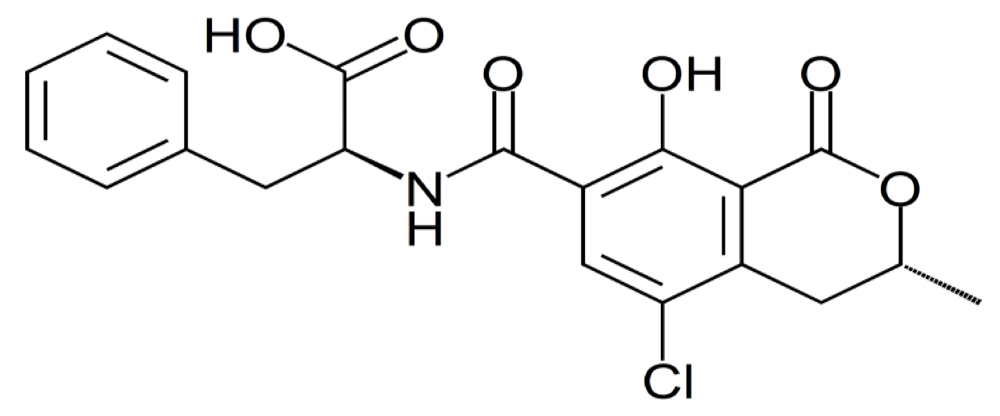
      <p>Several types of ochratoxins occur naturally, namely, ochratoxin A, ochratoxin B (dechlorinated OTA) and ochratoxin C (ethylated OTA), and are often co-produced. Ochratoxin A (<xref ref-type="fig" rid="toxins-02-00771-f001">Figure 1</xref>) is the most prevalent toxin and is classified as a group 2b potential human carcinogen by the International Agency for Research on Cancer [<xref ref-type="bibr" rid="B1-toxins-02-00771">1</xref>]. Aristolochic acids are phytotoxins belonging to the Aristolochiaceae family of plants and have been suspected to induce similar nephrotoxic effects in humans and animals [<xref ref-type="bibr" rid="B2-toxins-02-00771">2</xref>].</p>
      <fig id="toxins-02-00771-f001" position="anchor">
        <label>Figure 1</label>
        <caption>
          <p>Ochratoxin A from <italic>Aspergillus sp.</italic></p>
        </caption>
        <graphic xmlns:xlink="http://www.w3.org/1999/xlink" xlink:href="toxins-02-00771-g001.tif"/>
      </fig>
    </sec>
    <sec>
      <title>2. Occurrence in Food and Dietary Intake</title>
      <p>Ochratoxins occur primarily in cereals in northern Europe and Africa. A few examples of foods containing ochratoxins are listed in <xref ref-type="table" rid="toxins-02-00771-t002">Table 2</xref>. </p>
      <table-wrap id="toxins-02-00771-t002" position="anchor">
        <object-id pub-id-type="pii">toxins-02-00771-t002_Table 2</object-id>
        <label>Table 2</label>
        <caption>
          <p>Food commodities intoxicated with ochratoxins.</p>
        </caption>
        <table>
          <thead>
            <tr>
              <th align="justify" valign="middle">Food commodity</th>
              <th align="justify" valign="middle">Country</th>
            </tr>
          </thead>
          <tbody>
            <tr>
              <td align="justify" valign="middle">Dry beans (5–30 µg/kg) </td>
              <td align="justify" valign="middle">Croatia [<xref ref-type="bibr" rid="B3-toxins-02-00771">3</xref>]</td>
            </tr>
            <tr>
              <td align="justify" valign="middle">Maize (10–50 µg/kg) </td>
              <td align="justify" valign="middle">Croatia [<xref ref-type="bibr" rid="B2-toxins-02-00771">2</xref>], Bulgaria [<xref ref-type="bibr" rid="B4-toxins-02-00771">4</xref>]</td>
            </tr>
            <tr>
              <td align="justify" valign="middle">Wheat , wheat bran</td>
              <td align="justify" valign="middle">Bulgaria [<xref ref-type="bibr" rid="B4-toxins-02-00771">4</xref>]</td>
            </tr>
            <tr>
              <td align="justify" valign="middle">Barley, oats</td>
              <td align="justify" valign="middle">Bulgaria [<xref ref-type="bibr" rid="B4-toxins-02-00771">4</xref>]</td>
            </tr>
            <tr>
              <td align="justify" valign="middle">Wine</td>
              <td align="justify" valign="middle">South Africa [<xref ref-type="bibr" rid="B5-toxins-02-00771">5</xref>]</td>
            </tr>
            <tr>
              <td align="justify" valign="middle">Green coffee beans (18–48 μg/kg)</td>
              <td align="justify" valign="middle">Congo [<xref ref-type="bibr" rid="B6-toxins-02-00771">6</xref>]</td>
            </tr>
          </tbody>
        </table>
      </table-wrap>
      <p>Analysis of OTA and citrinin in food and feed samples were performed by enzyme immunoassays, which gave detection limits of 0.5 and 5 ng/g, respectively. OTA-values were confirmed by high performance liquid chromatography after immunoaffinity chromatography. Vrabcheva and co-workers [<xref ref-type="bibr" rid="B3-toxins-02-00771">3</xref>] found the highest toxin levels in wheat, wheat bran, and oats. South African wines tested (15 white and nine red) were found to contain detectable levels (&gt;0.01 μg/L) of OTA, with a mean of 0.16 μg/L in the white wines and a mean of 0.24 μg/L in the red wines [<xref ref-type="bibr" rid="B5-toxins-02-00771">5</xref>]. Ochratoxins have also been found in meat, dairy and baked products, especially swine sausages and breads [<xref ref-type="bibr" rid="B7-toxins-02-00771">7</xref>,<xref ref-type="bibr" rid="B8-toxins-02-00771">8</xref>]. In humans a dietary intake of 1.21 µg per day has been linked to endemic nephropathy [<xref ref-type="bibr" rid="B7-toxins-02-00771">7</xref>]. Further reports suggest that chronic dietary exposure to OTA, a mycotoxin frequently detected in various food items may be linked to the pathogenesis of endemic nephropathy, a chronic tubulointerstitial kidney disease which occurs in geographically limited areas of the Balkan region [<xref ref-type="bibr" rid="B8-toxins-02-00771">8</xref>]. Contradictory findings have been reported by Mally and co-workers [<xref ref-type="bibr" rid="B9-toxins-02-00771">9</xref>]. Based on food consumption data and OTA serum concentrations, they suggest that human exposure, even in areas with relatively high dietary exposure to OTA, such as endemic villages, is several orders of magnitude below doses known to cause nephrotoxicity and tumour formation in laboratory animals. </p>
    </sec>
    <sec>
      <title>3. Incidence of Disease</title>
      <p>Ochratoxins have been related to human and animal diseases in literature especially since the early 1970s. Most reports indicate that ochratoxin plagued especially the North Eastern European countries, such as Bulgaria, Romania, Serbia, Croatia, Bosnia, Herzegovina, Slovenia, Macedonia, Monte Negro and Africa, such as Congo, South Africa, Tunisia, Morocco and Egypt [<xref ref-type="bibr" rid="B3-toxins-02-00771">3</xref>,<xref ref-type="bibr" rid="B4-toxins-02-00771">4</xref>,<xref ref-type="bibr" rid="B5-toxins-02-00771">5</xref>,<xref ref-type="bibr" rid="B6-toxins-02-00771">6</xref>,<xref ref-type="bibr" rid="B7-toxins-02-00771">7</xref>,<xref ref-type="bibr" rid="B8-toxins-02-00771">8</xref>,<xref ref-type="bibr" rid="B9-toxins-02-00771">9</xref>,<xref ref-type="bibr" rid="B10-toxins-02-00771">10</xref>,<xref ref-type="bibr" rid="B11-toxins-02-00771">11</xref>].</p>
    </sec>
    <sec>
      <title>4. Detection of Disease-Diagnosis</title>
      <p>The concentration range of OTA in human serum is 5–50 ng/mL and OTA has a long serum half-life in various species including humans [<xref ref-type="bibr" rid="B3-toxins-02-00771">3</xref>]. Schwerdt and others [<xref ref-type="bibr" rid="B12-toxins-02-00771">12</xref>] measured OTA concentrations in blood of subjects suffering from various renal diseases as e.g. interstitial nephritis or mesangial proliferating glomerular nephritis and compared these values with those obtained from healthy individuals. OTA was detected in 87% of all samples. There was no significant difference between OTA concentrations of healthy individuals and patients with chronic glomerular nephritis whose sera showed OTA concentration greater than 1.5 nmol/L. In contrast, no values greater than 1.5 nmol/L were present in the sera of patients with membranous or focal-sclerotic glomerular nephritis. These preliminary results suggest that a serum concentration of OTA greater than 1.5 nmol/L may be a biomarker for glomerular nephritis. </p>
      <p>In May 2000, Abouzied and colleagues [<xref ref-type="bibr" rid="B7-toxins-02-00771">7</xref>], using a competitive direct enzyme-lnked immunosorbent assay for OTA (detection limit 1 μg/kg), investigated OTA contamination in 165 samples of home-produced food (beans, potatoes, corn, wheat, flour) and feed from households in villages from the Balkan endemic nephropathy region (Vratza district) of north-western Bulgaria. Samples were collected from: (a) 20 households of Balkan endemic nephropathy villages (n = 8), and 16 households of Balkan endemic nephropathy-free households (within-village household controls) and (b) 22 Balkan endemic nephropathy-free households of Balkan endemic nephropathy-free villages and 22 households between-village controls. Balkan endemic nephropathy households consistently had a higher proportion of OTA-positive samples than within village control households, but similar (for some foods) or lower (for other foods) amounts when compared between village controls. The proportion of OTA-positive samples was also higher in household between village controls when compared to those within village controls. Furthermore, Balkan endemic nephropathy households had a similar number of OTA-positive samples when compared to the pooled values for within and between groups of households. OTA-exposure estimates, derived from our OTA-concentration findings and the reported average per capita monthly consumption of basic foods in rural Bulgaria, showed the highest OTA intake in Balkan endemic nephropathy households (1.21 μg per day), <italic>vs</italic>. 1.03 μg per day in between village control households, and 0.71 μg per day in within village control households. This is in agreement with other studies carried out in the same region [<xref ref-type="bibr" rid="B4-toxins-02-00771">4</xref>,<xref ref-type="bibr" rid="B13-toxins-02-00771">13</xref>]. These OTA intakes are higher than those reported in the European Union, and are close to the upper limits acceptable to several food-safety organizations. These data indicate that OTA may not alone cause Balkan endemic nephropathy but synergistically with other environmental toxicants and/or predisposing genotypes. Peraica <italic>et al.</italic> [<xref ref-type="bibr" rid="B14-toxins-02-00771">14</xref>] recently detected OTA in food collected in the endemic areas and in blood and urine of their residents. In Serbia, a survey showed the prevalence of OTA in Balkan endemic nephropathy families associated with the presence of citrinin [<xref ref-type="bibr" rid="B15-toxins-02-00771">15</xref>]. </p>
    </sec>
    <sec>
      <title>5. Toxicity in Animals and Humans</title>
      <sec>
        <title>5.1. Animal toxicity</title>
        <p><italic>Nephrotoxicity</italic>: Pigs, being most sensitive to ochratoxins, suffer from porcine nephropathy. Field cases of ochratoxin-induced nephropathy in pigs have been reported from many countries. Mycotoxic porcine nephropathy is recognized as an endemic disease entity also in several northern and central European countries. Krogh and others [<xref ref-type="bibr" rid="B16-toxins-02-00771">16</xref>] found epidemics of mycotoxic porcine nephropathy, closely related to excessive climatic conditions, to occur in pigs in the season preceding harvest. Renal damage has been induced by alimentary exposure to ochratoxin A in all single-stomach animals tested so far, including rodents, dogs, pigs and birds, and even in young ruminants still functioning as single-stomach animals. Krogh [<xref ref-type="bibr" rid="B17-toxins-02-00771">17</xref>] states that most information on ochratoxin-induced nephropathy has been obtained in pigs during experimental studies comprising structural as well as functional changes. The renal damage is characterized morphologically by atrophy of the proximal tubules, interstitial cortical fibrosis and sclerotized glomeruli, and functionally by impairment of tubular function indicated by a reduction of maximal tubular excretion of para-aminohippurate per clearance of inulin and an increase in glucose excretion. Further, there is reduced ability to produce concentrated urine. The renal effect has been observed using exposure levels of OTA in the range 200 to 4,000 μg /kg feed [<xref ref-type="bibr" rid="B18-toxins-02-00771">18</xref>]. </p>
        <p>Retrospective studies, in the absence of previous exposure data, have been performed on renal biopsy material to determine the activity of two renal tubular enzymes, phosphoenolpyruvate carboxykinase and gamma-glutamyl transpeptidase. Analysis of the activity suggested that these enzymes were sensitive indicators of OTA-induced porcine nephropathy. In pigs exposed to ochratoxin A for 1 week a 40% reduction of the enzyme activity was observed. The dose-related activity decrease of the two enzymes was accompanied by a dose-related aggravation of renal impairment, as measured by a reduction of tubular excretion of para-aminohippurate per clearance of inulin, suggesting that these enzymes are sensitive indicators of OTA-induced nephropathy [<xref ref-type="bibr" rid="B20-toxins-02-00771">20</xref>]. Embryotoxicity, teratogenicity and immunotoxicity occur only at doses higher than those causing nephrotoxicity [<xref ref-type="bibr" rid="B20-toxins-02-00771">20</xref>].</p>
        <p><italic>Carcinogenesis</italic>: In female pigs exposed to alimentary ochratoxin A for two years, no renal cancer was observed. OTA is metabolized and excreted relatively fast in animals, with an RL<sub>50</sub> (residue elimination) in the pig of a few days for various tissues [<xref ref-type="bibr" rid="B17-toxins-02-00771">17</xref>]. OTA is a recognized renal carcinogen in the mouse and rat [<xref ref-type="bibr" rid="B1-toxins-02-00771">1</xref>,<xref ref-type="bibr" rid="B21-toxins-02-00771">21</xref>,<xref ref-type="bibr" rid="B22-toxins-02-00771">22</xref>]. The pathological lesions observed in kidneys of rats treated with OTA appear be rather different from the clinical and pathological characteristics of endemic nephropathy [<xref ref-type="bibr" rid="B19-toxins-02-00771">19</xref>]. As soon as 1991, Pfohl-Leszkowicz <italic>et al.</italic> [<xref ref-type="bibr" rid="B23-toxins-02-00771">23</xref>] demonstrated that OTA binds covalently with DNA in mice and also in rats [<xref ref-type="bibr" rid="B24-toxins-02-00771">24</xref>]. Male rats appear to be extremely sensitive to OTA due to genetic susceptibility linked to biotransformation [<xref ref-type="bibr" rid="B25-toxins-02-00771">25</xref>]. Recently, the chemical structure of OTA DNA adduct (C-C8dG-OTA) has been demonstrated by MS/MS [<xref ref-type="bibr" rid="B26-toxins-02-00771">26</xref>]. </p>
      </sec>
      <sec>
        <title>5.2. Human toxicity</title>
        <p><italic>Nephropathy:</italic> In humans, ochratoxins cause endemic nephropathy, which has been described in several studies in North Eastern Europe as reported by Walker and Larsen [<xref ref-type="bibr" rid="B27-toxins-02-00771">27</xref>,<xref ref-type="bibr" rid="B28-toxins-02-00771">28</xref>,<xref ref-type="bibr" rid="B29-toxins-02-00771">29</xref>,<xref ref-type="bibr" rid="B30-toxins-02-00771">30</xref>]. Possible OTA-induced acute renal failure was recently reported in Italy after a farmer and his wife worked eight hours in a granary closed for several months. Renal biopsy in the woman who developed nonoliguric acute renal failure revealed lesions of acute tubular necrosis [<xref ref-type="bibr" rid="B31-toxins-02-00771">31</xref>]. A strain of <italic>Aspergillus ochraceus</italic> producing OTA was isolated from the wheat. Chronic nephrotoxicity due to OTA is probably more usual and makes the diagnosis more difficult. Balkan endemic nephropathy, a chronic tubulointerstitial renal disease, could be due to OTA. According to Simon [<xref ref-type="bibr" rid="B32-toxins-02-00771">32</xref>] epidemiologic studies showed that in areas where high OTA levels are reached in food and in the blood of the population, there is a high incidence of nephropathy and renal tumours. The FAO/WHO Joint Expert Committee on Food Additives indicate a provisional tolerable intake of 14.3 ng/kg bw per day, based on the LOEL for renal effects in pigs [<xref ref-type="bibr" rid="B29-toxins-02-00771">29</xref>]. The European Scientific Committee on Food indicates a lower tolerable intake, below 5 ng/kg bw per day [<xref ref-type="bibr" rid="B29-toxins-02-00771">29</xref>]. </p>
        <p><italic>Liver toxicity</italic>: In man OTA exhibits unusual toxicokinetics, with a half-life in blood of 840 h (35 days) after oral ingestion. The delayed excretion of the toxin in man may be due to reabsorption during enterohepatic circulation, reabsorption from the urine after tubular secretion or extensive protein binding [<xref ref-type="bibr" rid="B33-toxins-02-00771">33</xref>]. Since the toxin is ingested with almost every meal, humans may not be free of toxin for very long periods. Liver elimination of OTA is maintained by protein carriers that shuffle the toxin from its protein-bound form in blood into the hepatocyte and subsequently secrete the toxin into bile. The uptake carrier has been identified but less is known about the mechanism involved in the release into bile. A carrier system is also involved in the uptake of OTA by proximal tubule cells, which secrete the toxin into urine. Such systems are biological entrance gates that determine the elimination toxicokinetics of OTA and therefore have a major impact on half-life times and selective organ exposure [<xref ref-type="bibr" rid="B33-toxins-02-00771">33</xref>].</p>
        <p><italic>Carcinogenesis:</italic> Renal tumours often occur on a dietary intake which is greater than 70 µg /kg bw per day of OTA. Individuals in the endemic region of the Balkan countries exposed to OTA developed DNA adducts in renal tissue and tumours [<xref ref-type="bibr" rid="B15-toxins-02-00771">15</xref>,<xref ref-type="bibr" rid="B34-toxins-02-00771">34</xref>,<xref ref-type="bibr" rid="B35-toxins-02-00771">35</xref>]. Karyomegalic interstitial nephritis, characterized by karyomegaly in proximal and distal tubular epithelial cells, has been reported in nine patients by using a new molecular epidemiological approach [<xref ref-type="bibr" rid="B32-toxins-02-00771">32</xref>]. Karyomegaly could be due to an environmental toxin that interferes with DNA replication. Involvement of the oxidative pathway in genotoxicity of OTA is known and oxidant stress induces DNA damage, according to Palma and others [<xref ref-type="bibr" rid="B36-toxins-02-00771">36</xref>]. Therefore, karyomegaly could be a histological marker of interstitial nephritis due to OTA as outlined by Dietrich and Swenberg [<xref ref-type="bibr" rid="B37-toxins-02-00771">37</xref>]. In a carcinogenic study it has been demonstrated that the mechanism by which OTA induced nephrotoxicity (notably reflected by karyomegalies) is different from cacrcinogenicity [<xref ref-type="bibr" rid="B38-toxins-02-00771">38</xref>]. Recently Manderville and Pfohl-Leszkowicz [<xref ref-type="bibr" rid="B39-toxins-02-00771">39</xref>] explained how oxidative pathway lead to OTA genotoxicity.</p>
      </sec>
    </sec>
    <sec>
      <title>6. Co-Occurrence of Nephrotoxins</title>
      <p>Studies have reported that the pathological changes produced by aristolochic acid are comparable to those produced by OTA [<xref ref-type="bibr" rid="B2-toxins-02-00771">2</xref>]. There is therefore the need for toxin co-occurrence studies involving citrinin, fumonisin, aristolochic acid and OTA. Co-contamination of ochratoxin A and citrinin was found in varying number of households in two Balkan villages. Citrinin levels in those samples were clearly higher than those of OTA [<xref ref-type="bibr" rid="B15-toxins-02-00771">15</xref>,<xref ref-type="bibr" rid="B35-toxins-02-00771">35</xref>]. Data on the co-occurrence in food of OTA and other toxic mycotoxins such as citrinin and fumonisin B1 have been reported also [<xref ref-type="bibr" rid="B8-toxins-02-00771">8</xref>,<xref ref-type="bibr" rid="B14-toxins-02-00771">14</xref>]. Cultured cells and laboratory animals treated with combinations of OTA and other nephrotoxins, show synergistic effects [<xref ref-type="bibr" rid="B8-toxins-02-00771">8</xref>]. The occurrence of OTA- and either citrinin or fumonisin increased genotoxicity [<xref ref-type="bibr" rid="B14-toxins-02-00771">14</xref>,<xref ref-type="bibr" rid="B35-toxins-02-00771">35</xref>]. </p>
    </sec>
    <sec>
      <title>7. Concluding Remarks</title>
      <p>Despite many efforts, the aetiology of endemic nephropathy is still unknown [<xref ref-type="bibr" rid="B14-toxins-02-00771">14</xref>]. This disease occurs in the rural population of geographically limited areas of Bulgaria, Bosnia and Herzegovina, Croatia, Romania, and Serbia, and a number of theories have been proposed about its aetiology. The mycotoxin theory has prevailed until now, based on the studies of nephrotoxic mycotoxin OTA that revealed higher frequency of OTA-positive food and blood samples in endemic than in non-endemic Balkan areas. However, recently it has been suggested that aristolochic acid is the aetiological cause of endemic nephropathy, because of the histological similarities in kidney lesions between patients suffering from endemic nephropathy and patients suffering from Chinese herbs nephropathy caused by aristolochic acid. Until now it has not been unequivocally proved that the inhabitants of endemic nephropathy areas are exposed to higher concentration of aristolochic acid than in other regions and the exposure pathways are rather uncertain. There is a paradox between the wide distribution of OTA throughout the world with the expected risk of OTA causing human renal disease and the rarity of reported cases demonstrating its role in chronic renal disease [<xref ref-type="bibr" rid="B32-toxins-02-00771">32</xref>]. OTA and probably other mycotoxins could be major environmental factors in the occurrence of renal disease especially in developing countries according to Tatu and co-workers [<xref ref-type="bibr" rid="B40-toxins-02-00771">40</xref>]. Some studies have found a geographic co-variation between OTA content in food/feed and Balkan endemic nephropathy manifestation; others have not [<xref ref-type="bibr" rid="B7-toxins-02-00771">7</xref>]. The Romanian group [<xref ref-type="bibr" rid="B40-toxins-02-00771">40</xref>] mention two actually competing theories attempting to explain the cause of Balkan endemic nephropathy: (1) the mycotoxin hypothesis, which considers that Balkan endemic nephropathy is produced by ochratoxin A ingested intermittently in small amounts by the individuals in the endemic regions, and (2) the Pliocene lignite hypothesis, which proposes that the disease is caused by long-term exposure to polycyclic aromatic hydrocarbons and other toxic organic compounds leaching into the well drinking water from low rank coals underlying or proximal to the endemic settlements. In this review we have outlined the current knowledge on ochratoxins. Future studies need to focus on possible factors and co-factors involved in aetiology of OTA renal disease and cancer.</p>
    </sec>
  </body>
  <back>
    <ref-list>
      <title>References and Notes</title>
      <ref id="B1-toxins-02-00771">
        <label>1.</label>
        <citation citation-type="book">
        <person-group person-group-type="author">
        <collab>International Agency for Research on Cancer</collab>
        </person-group>
          <article-title>Some Naturally Occurring Substances: Some Food Items and Constituents, Heterocyclic Aromatic Amines and Mycotoxins</article-title>
          <source>IARC Monographs on the Evaluation of Carcinogenic Risks to Humans</source>
          <publisher-name>IARC</publisher-name>
          <publisher-loc>Lyon, France</publisher-loc>
          <year>1993</year>
          <volume>56</volume>
        </citation>
      </ref>
      <ref id="B2-toxins-02-00771">
        <label>2.</label>
        <citation citation-type="journal">
          <person-group person-group-type="author">
            <name>
              <surname>Peraica</surname>
              <given-names>M.</given-names>
            </name>
            <name>
              <surname>Domijan</surname>
              <given-names>A.M.</given-names>
            </name>
            <name>
              <surname>Sarić</surname>
              <given-names>M.</given-names>
            </name>
          </person-group>
          <article-title>Mycotoxic and aristolochic acid theories of the development of endemic nephropathy</article-title>
          <source>Arh Hig Rada Toksikol.</source>
          <year>2008</year>
          <volume>59 (1)</volume>
          <fpage>59</fpage>
          <lpage>65</lpage>
          <pub-id pub-id-type="pmid">18407872</pub-id>
        </citation>
      </ref>
      <ref id="B3-toxins-02-00771">
        <label>3.</label>
        <citation citation-type="journal">
          <person-group person-group-type="author">
            <name>
              <surname>Radic</surname>
              <given-names>B.</given-names>
            </name>
            <name>
              <surname>Fuchs</surname>
              <given-names>R.</given-names>
            </name>
            <name>
              <surname>Peraica</surname>
              <given-names>M.</given-names>
            </name>
            <name>
              <surname>Lucic</surname>
              <given-names>A.</given-names>
            </name>
          </person-group>
          <article-title>Ochratoxin A in human sera in the area with endemic nephropathy in Croatia</article-title>
          <source>Toxicol. Lett.</source>
          <year>1997</year>
          <volume>91</volume>
          <fpage>105</fpage>
          <lpage>109</lpage>
        <pub-id pub-id-type="doi">10.1016/S0378-4274(97)03877-0</pub-id><pub-id pub-id-type="pmid">9175846</pub-id></citation>
      </ref>
      <ref id="B4-toxins-02-00771">
        <label>4.</label>
        <citation citation-type="journal">
          <person-group person-group-type="author">
            <name>
              <surname>Vrabcheva</surname>
              <given-names>T.</given-names>
            </name>
            <name>
              <surname>Usleber</surname>
              <given-names>E.</given-names>
            </name>
            <name>
              <surname>Dietrich</surname>
              <given-names>R.</given-names>
            </name>
            <name>
              <surname>Märtlbauer</surname>
              <given-names>E.</given-names>
            </name>
          </person-group>
          <article-title>Co-occurrence of ochratoxin A and citrinin in cereals from Bulgarian villages with a history of Balkan endemic nephropathy</article-title>
          <source>J. Agric. Food Chem.</source>
          <year>2000</year>
          <volume>48 (6)</volume>
          <fpage>2483</fpage>
          <lpage>2488</lpage>
          <pub-id pub-id-type="pmid">10888572</pub-id>
        </citation>
      </ref>
      <ref id="B5-toxins-02-00771">
        <label>5.</label>
        <citation citation-type="journal">
          <person-group person-group-type="author">
            <name>
              <surname>Shephard</surname>
              <given-names>S.</given-names>
            </name>
            <name>
              <surname>Fabiani</surname>
              <given-names>A.</given-names>
            </name>
            <name>
              <surname>Stockenström</surname>
              <given-names>S.</given-names>
            </name>
            <name>
              <surname>Mshicileli</surname>
              <given-names>N.</given-names>
            </name>
            <name>
              <surname>Sewram</surname>
              <given-names>V.</given-names>
            </name>
          </person-group>
          <article-title>Quantitation of ochratoxin A in South African wines</article-title>
          <source>J. Agric. Food Chem.</source>
          <year>2003</year>
          <volume>51 (4)</volume>
          <fpage>1102</fpage>
          <lpage>1106</lpage>
          <pub-id pub-id-type="pmid">12568580</pub-id>
          <pub-id pub-id-type="doi">10.1021/jf0259866</pub-id>
        </citation>
      </ref>
      <ref id="B6-toxins-02-00771">
        <label>6.</label>
        <citation citation-type="journal">
          <person-group person-group-type="author">
            <name>
              <surname>Romani</surname>
              <given-names>S.</given-names>
            </name>
            <name>
              <surname>Sacchetti</surname>
              <given-names>G.</given-names>
            </name>
            <name>
              <surname>López</surname>
              <given-names>C.C.</given-names>
            </name>
            <name>
              <surname>Pinnavaia</surname>
              <given-names>G.G.</given-names>
            </name>
            <name>
              <surname>Dalla Rosa</surname>
              <given-names>M.</given-names>
            </name>
          </person-group>
          <article-title>Screening on the occurrence of ochratoxin A in green coffee beans of different origins and types</article-title>
          <source>J. Agric. Food Chem.</source>
          <year>2000</year>
          <volume>48 (8)</volume>
          <fpage>3616</fpage>
          <lpage>3619</lpage>
          <pub-id pub-id-type="pmid">10956159</pub-id>
          <pub-id pub-id-type="doi">10.1021/jf990783b</pub-id>
        </citation>
      </ref>
      <ref id="B7-toxins-02-00771">
        <label>7.</label>
        <citation citation-type="journal">
          <person-group person-group-type="author">
            <name>
              <surname>Abouzied</surname>
              <given-names>M.M.</given-names>
            </name>
            <name>
              <surname>Horvath</surname>
              <given-names>A.D.</given-names>
            </name>
            <name>
              <surname>Podlesny</surname>
              <given-names>P.M.</given-names>
            </name>
            <name>
              <surname>Regina</surname>
              <given-names>N.P.</given-names>
            </name>
            <name>
              <surname>Metodiev</surname>
              <given-names>V.D.</given-names>
            </name>
            <name>
              <surname>Kamenova-Tozeva</surname>
              <given-names>R.M.</given-names>
            </name>
            <name>
              <surname>Niagolova</surname>
              <given-names>N.D.</given-names>
            </name>
            <name>
              <surname>Stein</surname>
              <given-names>A.D.</given-names>
            </name>
            <name>
              <surname>Petropoulos</surname>
              <given-names>E.A.</given-names>
            </name>
            <name>
              <surname>Ganev</surname>
              <given-names>V.S.</given-names>
            </name>
          </person-group>
          <article-title>Ochratoxin A concentrations in food and feed from a region with Balkan Endemic Nephropathy</article-title>
          <source>Food Addit. Contam.</source>
          <year>2002</year>
          <volume>19 (8)</volume>
          <fpage>755</fpage>
          <lpage>764</lpage>
          <pub-id pub-id-type="pmid">12227939</pub-id>
          <pub-id pub-id-type="doi">10.1080/02652030210145036</pub-id>
        </citation>
      </ref>
      <ref id="B8-toxins-02-00771">
        <label>8.</label>
        <citation citation-type="journal">
          <person-group person-group-type="author">
            <name>
              <surname>Pfohl-Leszkowicz</surname>
              <given-names>A.</given-names>
            </name>
            <name>
              <surname>Manderville</surname>
              <given-names>R.</given-names>
            </name>
          </person-group>
          <article-title>Review on Ochratoxin A: an overview on toxicity and carcinogenicity in animals and humans</article-title>
          <source>Mol. Nutr. Food Res.</source>
          <year>2007</year>
          <volume>51</volume>
          <fpage>61</fpage>
          <lpage>99</lpage>
        <pub-id pub-id-type="doi">10.1002/mnfr.200600137</pub-id><pub-id pub-id-type="pmid">17195275</pub-id></citation>
      </ref>
      <ref id="B9-toxins-02-00771">
        <label>9.</label>
        <citation citation-type="journal">
          <person-group person-group-type="author">
            <name>
              <surname>Mally</surname>
              <given-names>A.</given-names>
            </name>
            <name>
              <surname>Hard</surname>
              <given-names>G.C.</given-names>
            </name>
            <name>
              <surname>Dekant</surname>
              <given-names>W.</given-names>
            </name>
          </person-group>
          <article-title>Ochratoxin A as a potential etiologic factor in endemic nephropathy: lessons from toxicity studies in rats</article-title>
          <source>Food Chem. Toxicol.</source>
          <year>2007</year>
          <volume>45 (11)</volume>
          <fpage>2254</fpage>
          <lpage>2260</lpage>
          <pub-id pub-id-type="pmid">17629386</pub-id>
          <pub-id pub-id-type="doi">10.1016/j.fct.2007.05.021</pub-id>
        </citation>
      </ref>
      <ref id="B10-toxins-02-00771">
        <label>10.</label>
        <citation citation-type="confproc">
          <person-group person-group-type="author">
            <name>
              <surname>Krogh</surname>
              <given-names>P.</given-names>
            </name>
          </person-group>
          <article-title>Mycotoxic porcine nephropathy–a possible model for Balkan (endemic) nephropathy</article-title>
          <source>Endemic Nephropathy, Proceedings of the Second International Symposium on Endemic Nephropathy</source>
          <publisher-name>Bulgarian Academy of Sciences</publisher-name>
          <publisher-loc>Sofia, Bulgaria</publisher-loc>
          <year>1972</year>
          <fpage>266</fpage>
          <lpage>277</lpage>
        </citation>
      </ref>
      <ref id="B11-toxins-02-00771">
        <label>11.</label>
        <citation citation-type="journal">
          <person-group person-group-type="author">
            <name>
              <surname>Chernozemsky</surname>
              <given-names>I.N.</given-names>
            </name>
            <name>
              <surname>Stoyanov</surname>
              <given-names>I.S.</given-names>
            </name>
            <name>
              <surname>Petkova-Bocharova</surname>
              <given-names>T.K.</given-names>
            </name>
            <name>
              <surname>Nikolov</surname>
              <given-names>I.G.</given-names>
            </name>
            <name>
              <surname>Draganov</surname>
              <given-names>I.V.</given-names>
            </name>
            <name>
              <surname>Stoichev</surname>
              <given-names>I.T.</given-names>
            </name>
            <name>
              <surname>Tanchev</surname>
              <given-names>Y.</given-names>
            </name>
            <name>
              <surname>Naidenov</surname>
              <given-names>D.</given-names>
            </name>
            <name>
              <surname>Kalcheva</surname>
              <given-names>N.D.</given-names>
            </name>
          </person-group>
          <article-title>Geographic correlation between the occurrence of endemic nephropathy and urinary tract tumours in Vratza district Bulgaria</article-title>
          <source>Int. J. Cancer</source>
          <year>1977</year>
          <volume>19</volume>
          <fpage>1</fpage>
          <lpage>11</lpage>
        <pub-id pub-id-type="doi">10.1002/ijc.2910190102</pub-id><pub-id pub-id-type="pmid">832916</pub-id></citation>
      </ref>
      <ref id="B12-toxins-02-00771">
        <label>12.</label>
        <citation citation-type="journal">
          <person-group person-group-type="author">
            <name>
              <surname>Schwerdt</surname>
              <given-names>G.</given-names>
            </name>
            <name>
              <surname>Schuster</surname>
              <given-names>C.</given-names>
            </name>
            <name>
              <surname>Silbernagl</surname>
              <given-names>S.</given-names>
            </name>
            <name>
              <surname>Gareis</surname>
              <given-names>M.</given-names>
            </name>
            <name>
              <surname>Gekle</surname>
              <given-names>M.</given-names>
            </name>
          </person-group>
          <article-title>Preliminary results on Ochratoxin A concentrations in blood of patients with various kidney diseases in Germany</article-title>
          <source>Mycotoxin Res.</source>
          <year>2001</year>
          <volume>17 (2)</volume>
          <fpage>146</fpage>
          <lpage>149</lpage>
          <pub-id pub-id-type="doi">10.1007/BF03036424</pub-id>
        </citation>
      </ref>
      <ref id="B13-toxins-02-00771">
        <label>13.</label>
        <citation citation-type="journal">
          <person-group person-group-type="author">
            <name>
              <surname>Petkova-Bocharova</surname>
              <given-names>T.</given-names>
            </name>
            <name>
              <surname>Castegnaro</surname>
              <given-names>M.</given-names>
            </name>
            <name>
              <surname>Pfohl-Leszkowicz</surname>
              <given-names>A.</given-names>
            </name>
            <name>
              <surname>Garren</surname>
              <given-names>L.</given-names>
            </name>
            <name>
              <surname>Grosso</surname>
              <given-names>F.</given-names>
            </name>
            <name>
              <surname>Nikolov</surname>
              <given-names>I.</given-names>
            </name>
            <name>
              <surname>Vrabcheva</surname>
              <given-names>T.</given-names>
            </name>
            <name>
              <surname>Dragacci</surname>
              <given-names>S.</given-names>
            </name>
            <name>
              <surname>Chernozemsky</surname>
              <given-names>I.</given-names>
            </name>
          </person-group>
          <article-title>Analysis of ochratoxin A in serum and urine of inhabitants from an area with Balkan Endemic Nephropathy: A one month follow up study</article-title>
          <source>Facta universitatis series: medicine and biology</source>
          <year>2003</year>
          <volume>10 (2)</volume>
          <fpage>62</fpage>
          <lpage>68</lpage>
        </citation>
      </ref>
      <ref id="B14-toxins-02-00771">
        <label>14.</label>
        <citation citation-type="journal">
          <person-group person-group-type="author">
            <name>
              <surname>Peraica</surname>
              <given-names>M.</given-names>
            </name>
            <name>
              <surname>Domijan</surname>
              <given-names>A.M.</given-names>
            </name>
            <name>
              <surname>Miletić-Medved</surname>
              <given-names>M.</given-names>
            </name>
            <name>
              <surname>Fuchs</surname>
              <given-names>R.</given-names>
            </name>
          </person-group>
          <article-title>The involvement of mycotoxins in the development of endemic nephropathy</article-title>
          <source>Wien Klin Wochenschr.</source>
          <year>2008</year>
          <volume>120 (13-14)</volume>
          <fpage>402</fpage>
          <lpage>407</lpage>
          <pub-id pub-id-type="pmid">18726664</pub-id>
          <pub-id pub-id-type="doi">10.1007/s00508-008-0981-x</pub-id>
        </citation>
      </ref>
      <ref id="B15-toxins-02-00771">
        <label>15.</label>
        <citation citation-type="journal">
          <person-group person-group-type="author">
            <name>
              <surname>Pfohl-Leszkowicz</surname>
              <given-names>A.</given-names>
            </name>
            <name>
              <surname>Tozlovanu</surname>
              <given-names>M.</given-names>
            </name>
            <name>
              <surname>Manderville</surname>
              <given-names>R.</given-names>
            </name>
            <name>
              <surname>Peraica</surname>
              <given-names>M.</given-names>
            </name>
            <name>
              <surname>Castegnaro</surname>
              <given-names>M.</given-names>
            </name>
            <name>
              <surname>Stefanovic</surname>
              <given-names>V. </given-names>
            </name>
          </person-group>
          <article-title>New molecular and field evidences for the implication of mycotoxins but not aristolochic acid in Human Nephropathy and Urinary tract tumor</article-title>
          <source>Mol. Nutr. Food Res.</source>
          <year>2007</year>
          <volume>51</volume>
          <fpage>131</fpage>
          <lpage>146</lpage>
        </citation>
      </ref>
      <ref id="B16-toxins-02-00771">
        <label>16.</label>
        <citation citation-type="journal">
          <person-group person-group-type="author">
            <name>
              <surname>Krogh</surname>
              <given-names>P.</given-names>
            </name>
            <name>
              <surname>Elling</surname>
              <given-names>F.</given-names>
            </name>
            <name>
              <surname>Friis</surname>
              <given-names>C.</given-names>
            </name>
            <name>
              <surname>Hald</surname>
              <given-names>B.</given-names>
            </name>
            <name>
              <surname>Larsen</surname>
              <given-names>A.E.</given-names>
            </name>
            <name>
              <surname>Lillehøj</surname>
              <given-names>E.B.</given-names>
            </name>
            <name>
              <surname>Madsen</surname>
              <given-names>A.</given-names>
            </name>
            <name>
              <surname>Mortensen</surname>
              <given-names>H.P.</given-names>
            </name>
            <name>
              <surname>Rasmussen</surname>
              <given-names>F.</given-names>
            </name>
            <name>
              <surname>Ravnskov</surname>
              <given-names>U.</given-names>
            </name>
          </person-group>
          <article-title>Porcine nephropathy induced by long-term ingestion of ochratoxin A</article-title>
          <source>Vet. Pathol.</source>
          <year>1979</year>
          <volume>16 (40)</volume>
          <fpage>466</fpage>
          <lpage>475</lpage>
          <pub-id pub-id-type="pmid">452321</pub-id>
        </citation>
      </ref>
      <ref id="B17-toxins-02-00771">
        <label>17.</label>
        <citation citation-type="journal">
          <person-group person-group-type="author">
            <name>
              <surname>Krogh</surname>
              <given-names>P.</given-names>
            </name>
          </person-group>
          <article-title>Role of ochratoxin in disease causation</article-title>
          <source>Food Chem Toxicol.</source>
          <year>1992</year>
          <volume>30 (3)</volume>
          <fpage>213</fpage>
          <lpage>224</lpage>
          <pub-id pub-id-type="pmid">1618445</pub-id>
          <pub-id pub-id-type="doi">10.1016/0278-6915(92)90036-K</pub-id>
        </citation>
      </ref>
      <ref id="B18-toxins-02-00771">
        <label>18.</label>
        <citation citation-type="journal">
          <person-group person-group-type="author">
            <name>
              <surname>Stoev</surname>
              <given-names>S.D.</given-names>
            </name>
            <name>
              <surname>Paskalev</surname>
              <given-names>M.</given-names>
            </name>
            <name>
              <surname>MacDonald</surname>
              <given-names>S.</given-names>
            </name>
            <name>
              <surname>Mantle</surname>
              <given-names>P.G.</given-names>
            </name>
          </person-group>
          <article-title>Experimental 1 year ochratoxin A toxicosis in pigs</article-title>
          <source>Exp. Toxicol. Pathol.</source>
          <year>2002</year>
          <volume>53</volume>
          <fpage>481</fpage>
          <lpage>487</lpage>
        <pub-id pub-id-type="doi">10.1078/0940-2993-00213</pub-id><pub-id pub-id-type="pmid">11926291</pub-id></citation>
      </ref>
      <ref id="B19-toxins-02-00771">
        <label>19.</label>
        <citation citation-type="journal">
          <person-group person-group-type="author">
            <name>
              <surname>Stoev</surname>
              <given-names>S.D.</given-names>
            </name>
          </person-group>
          <article-title>The role of ochratoxin A as a possible cause of Balkan endemic nephropathy and its risk evaluation</article-title>
          <source>Vet. Human Toxicol.</source>
          <year>1998</year>
          <volume>40</volume>
          <fpage>352</fpage>
          <lpage>360</lpage>
        </citation>
      </ref>
      <ref id="B20-toxins-02-00771">
        <label>20.</label>
        <citation citation-type="journal">
          <person-group person-group-type="author">
            <name>
              <surname>Benford</surname>
              <given-names>D.</given-names>
            </name>
            <name>
              <surname>Boyle</surname>
              <given-names>B.</given-names>
            </name>
            <name>
              <surname>Dekant</surname>
              <given-names>W.</given-names>
            </name>
            <name>
              <surname>Fuchs</surname>
              <given-names>R.</given-names>
            </name>
            <name>
              <surname>Gaylor</surname>
              <given-names>D.W.</given-names>
            </name>
            <name>
              <surname>Hard</surname>
              <given-names>G.</given-names>
            </name>
            <name>
              <surname>McGregor</surname>
              <given-names>D.B.</given-names>
            </name>
            <name>
              <surname>Pitt</surname>
              <given-names>J.I.</given-names>
            </name>
            <name>
              <surname>Plestina</surname>
              <given-names>R.</given-names>
            </name>
            <name>
              <surname>Shephard</surname>
              <given-names>G.</given-names>
            </name>
            <name>
              <surname>Solforizzo</surname>
              <given-names>M.</given-names>
            </name>
            <name>
              <surname>Verger</surname>
              <given-names>P.J.P.</given-names>
            </name>
            <name>
              <surname>Walker</surname>
              <given-names>R. </given-names>
            </name>
          </person-group>
          <article-title>Ochratoxin A</article-title>
          <source>JECFA</source>
          <year>2001</year>
          <volume>47</volume>
          <fpage>1</fpage>
          <lpage>172</lpage>
        </citation>
      </ref>
      <ref id="B21-toxins-02-00771">
        <label>21.</label>
        <citation citation-type="journal">
          <person-group person-group-type="author">
            <name>
              <surname>Castegnaro</surname>
              <given-names>M.</given-names>
            </name>
            <name>
              <surname>Mohr</surname>
              <given-names>U.</given-names>
            </name>
            <name>
              <surname>Pfohl-Leszkowicz</surname>
              <given-names>A.</given-names>
            </name>
            <name>
              <surname>Estève</surname>
              <given-names>J.</given-names>
            </name>
            <name>
              <surname>Steinmann</surname>
              <given-names>J.</given-names>
            </name>
            <name>
              <surname>Tillman</surname>
              <given-names>J.</given-names>
            </name>
            <name>
              <surname>Michelon</surname>
              <given-names>J.</given-names>
            </name>
            <name>
              <surname>Bartsch</surname>
              <given-names>H.</given-names>
            </name>
          </person-group>
          <article-title>Sex and Strain-specific induction of renal tumours by ochratoxin A rats correlates with DNA adduction</article-title>
          <source>Int. J. Cancer</source>
          <year>1998</year>
          <volume>77</volume>
          <fpage>70</fpage>
          <lpage>75</lpage>
        <pub-id pub-id-type="doi">10.1002/(SICI)1097-0215(19980703)77:1&lt;70::AID-IJC12&gt;3.0.CO;2-D</pub-id><pub-id pub-id-type="pmid">9639396</pub-id></citation>
      </ref>
      <ref id="B22-toxins-02-00771">
        <label>22.</label>
        <citation citation-type="journal">
          <person-group person-group-type="author">
            <name>
              <surname>Mantle</surname>
              <given-names>P.</given-names>
            </name>
            <name>
              <surname>Kulinskaya</surname>
              <given-names>E.</given-names>
            </name>
            <name>
              <surname>Nestler</surname>
              <given-names>S.</given-names>
            </name>
          </person-group>
          <article-title>Renal tumourigenesis in male rats in response to chronic dietary ochratoxin A</article-title>
          <source>Food Add Contam.</source>
          <year>2005</year>
          <volume>22 (1)</volume>
          <fpage>58</fpage>
          <lpage>64</lpage>
        </citation>
      </ref>
      <ref id="B23-toxins-02-00771">
        <label>23.</label>
        <citation citation-type="book">
          <person-group person-group-type="author">
            <name>
              <surname>Pfohl-Leszkowicz</surname>
              <given-names>A.</given-names>
            </name>
            <name>
              <surname>Chakor</surname>
              <given-names>K.</given-names>
            </name>
            <name>
              <surname>Creppy</surname>
              <given-names>E.E.</given-names>
            </name>
            <name>
              <surname>Dirheimer</surname>
              <given-names>G.</given-names>
            </name>
          </person-group>
          <article-title>DNA-adducts formation after treatment of mice with ochratoxin A</article-title>
          <source>Mycotoxins, Endemic Nephropathy and Urinary Tracts Tumours</source>
          <publisher-name>IARC Scientific Publication</publisher-name>
          <publisher-loc>Lyon, France</publisher-loc>
          <year>1991</year>
          <volume>115</volume>
          <fpage>245</fpage>
          <lpage>253</lpage>
        </citation>
      </ref>
      <ref id="B24-toxins-02-00771">
        <label>24.</label>
        <citation citation-type="journal">
          <person-group person-group-type="author">
            <name>
              <surname>Pfohl-Leszkowicz</surname>
              <given-names>A.</given-names>
            </name>
            <name>
              <surname>Grosse</surname>
              <given-names>Y.</given-names>
            </name>
            <name>
              <surname>Kane</surname>
              <given-names>A.</given-names>
            </name>
            <name>
              <surname>Creppy</surname>
              <given-names>E.E.</given-names>
            </name>
            <name>
              <surname>Dirheimer</surname>
              <given-names>G.</given-names>
            </name>
          </person-group>
          <article-title>Differential DNA adduct formation and disappearance in three mice tissues after treatment by the mycotoxin, ochratoxin A</article-title>
          <source>Mut. Res.</source>
          <year>1993</year>
          <volume>289</volume>
          <fpage>265</fpage>
          <lpage>273</lpage>
        <pub-id pub-id-type="doi">10.1016/0027-5107(93)90077-S</pub-id></citation>
      </ref>
      <ref id="B25-toxins-02-00771">
        <label>25.</label>
        <citation citation-type="journal">
          <person-group person-group-type="author">
            <name>
              <surname>Pfohl-Leszkowicz</surname>
              <given-names>A.</given-names>
            </name>
            <name>
              <surname>Pinelli</surname>
              <given-names>E.</given-names>
            </name>
            <name>
              <surname>Bartsch</surname>
              <given-names>H.</given-names>
            </name>
            <name>
              <surname>Mohr</surname>
              <given-names>U.</given-names>
            </name>
            <name>
              <surname>Castegnaro</surname>
              <given-names>M.</given-names>
            </name>
          </person-group>
          <article-title>Sex and Strain differences in ochratoxin A metabolism and DNA adduction in two strains of rats</article-title>
          <source>Mol. Carcinog.</source>
          <year>1998</year>
          <volume>23</volume>
          <fpage>76</fpage>
          <lpage>83</lpage>
        <pub-id pub-id-type="doi">10.1002/(SICI)1098-2744(199810)23:2&lt;76::AID-MC4&gt;3.0.CO;2-B</pub-id><pub-id pub-id-type="pmid">9808161</pub-id></citation>
      </ref>
      <ref id="B26-toxins-02-00771">
        <label>26.</label>
        <citation citation-type="journal">
          <person-group person-group-type="author">
            <name>
              <surname>Mantle</surname>
              <given-names>P.</given-names>
            </name>
            <name>
              <surname>Faucet-Marquis</surname>
              <given-names>V.</given-names>
            </name>
            <name>
              <surname>Manderville</surname>
              <given-names>R.</given-names>
            </name>
            <name>
              <surname>Sciqualli</surname>
              <given-names>B.</given-names>
            </name>
            <name>
              <surname>Pfohl-Leszkowicz</surname>
              <given-names>A.</given-names>
            </name>
          </person-group>
          <article-title>Structures of covalent adducts between DNA and ochratoxin A: a new factor in debate about genotoxicity and human risk assessment</article-title>
          <source>Chem. Res. Toxicol.</source>
          <year>2010</year>
          <volume>23</volume>
          <fpage>89</fpage>
          <lpage>98</lpage>
        <pub-id pub-id-type="doi">10.1021/tx900295a</pub-id><pub-id pub-id-type="pmid">19928877</pub-id></citation>
      </ref>
      <ref id="B27-toxins-02-00771">
        <label>27.</label>
        <citation citation-type="journal">
          <person-group person-group-type="author">
            <name>
              <surname>Stefanovic</surname>
              <given-names>V.</given-names>
            </name>
            <name>
              <surname>Polenakovic</surname>
              <given-names>M.H.</given-names>
            </name>
          </person-group>
          <article-title>Balkan nephropathy</article-title>
          <source>Am. J. Nephrol.</source>
          <year>1991</year>
          <volume>11</volume>
          <fpage>1</fpage>
          <lpage>11</lpage>
        <pub-id pub-id-type="doi">10.1159/000168264</pub-id><pub-id pub-id-type="pmid">2048572</pub-id></citation>
      </ref>
      <ref id="B28-toxins-02-00771">
        <label>28.</label>
        <citation citation-type="journal">
          <person-group person-group-type="author">
            <name>
              <surname>Vukelic</surname>
              <given-names>M.</given-names>
            </name>
            <name>
              <surname>Sostaric</surname>
              <given-names>B.</given-names>
            </name>
            <name>
              <surname>Belicza</surname>
              <given-names>M.</given-names>
            </name>
          </person-group>
          <article-title>Pathomorphology of Balkan endemic nephropathy</article-title>
          <source>Food Chem. Toxicol.</source>
          <year>1992</year>
          <volume>30</volume>
          <fpage>193</fpage>
          <lpage>200</lpage>
        <pub-id pub-id-type="doi">10.1016/0278-6915(92)90033-H</pub-id><pub-id pub-id-type="pmid">1618442</pub-id></citation>
      </ref>
      <ref id="B29-toxins-02-00771">
        <label>29.</label>
        <citation citation-type="journal">
          <person-group person-group-type="author">
            <name>
              <surname>Walker</surname>
              <given-names>R.</given-names>
            </name>
            <name>
              <surname>Larsen</surname>
              <given-names>J.C.</given-names>
            </name>
          </person-group>
          <article-title>Ochratoxin A: previous risk assessments and issues arising</article-title>
          <source>Food Addit. Contam.</source>
          <year>2005</year>
          <fpage>6</fpage>
          <lpage>9</lpage>
          <pub-id pub-id-type="pmid">16332615</pub-id>
          <pub-id pub-id-type="doi">10.1080/02652030500309343</pub-id>
        </citation>
      </ref>
      <ref id="B30-toxins-02-00771">
        <label>30.</label>
        <citation citation-type="journal">
          <person-group person-group-type="author">
            <name>
              <surname>Fuchs</surname>
              <given-names>R.</given-names>
            </name>
            <name>
              <surname>Peraica</surname>
              <given-names>M.</given-names>
            </name>
          </person-group>
          <article-title>Ochratoxin A in human kidney diseases</article-title>
          <source>Food Addit. Contam.</source>
          <year>2005</year>
          <volume>22 (1)</volume>
          <fpage>53</fpage>
          <lpage>57</lpage>
          <pub-id pub-id-type="pmid">16332622</pub-id>
          <pub-id pub-id-type="doi">10.1080/02652030500309368</pub-id>
        </citation>
      </ref>
      <ref id="B31-toxins-02-00771">
        <label>31.</label>
        <citation citation-type="journal">
          <person-group person-group-type="author">
            <name>
              <surname>Di Paolo</surname>
              <given-names>N.</given-names>
            </name>
            <name>
              <surname>Guarnieri</surname>
              <given-names>A.</given-names>
            </name>
            <name>
              <surname>Loi</surname>
              <given-names>F.</given-names>
            </name>
            <name>
              <surname>Sacchi</surname>
              <given-names>G.</given-names>
            </name>
            <name>
              <surname>Mangiarotti</surname>
              <given-names>A.M.</given-names>
            </name>
            <name>
              <surname>Di. Paolo</surname>
              <given-names>M.</given-names>
            </name>
          </person-group>
          <article-title>Acute renal failure from inhalation of mycotoxins</article-title>
          <source>Nephron</source>
          <year>1993</year>
          <volume>64</volume>
          <fpage>621</fpage>
          <lpage>625</lpage>
        <pub-id pub-id-type="doi">10.1159/000187411</pub-id><pub-id pub-id-type="pmid">8366990</pub-id></citation>
      </ref>
      <ref id="B32-toxins-02-00771">
        <label>32.</label>
        <citation citation-type="journal">
          <person-group person-group-type="author">
            <name>
              <surname>Simon</surname>
              <given-names>P.</given-names>
            </name>
          </person-group>
          <article-title>Ochratoxin and Kidney Disease in the Human</article-title>
          <source>Toxin Rev.</source>
          <year>1996</year>
          <volume>15 (3)</volume>
          <fpage>239</fpage>
          <lpage>249</lpage>
          <pub-id pub-id-type="doi">10.3109/15569549609016446</pub-id>
        </citation>
      </ref>
      <ref id="B33-toxins-02-00771">
        <label>33.</label>
        <citation citation-type="journal">
          <person-group person-group-type="author">
            <name>
              <surname>Petzinger</surname>
              <given-names>E.</given-names>
            </name>
            <name>
              <surname>Weidenbach</surname>
              <given-names>A.</given-names>
            </name>
          </person-group>
          <article-title>Mycotoxins in the food chain: the role of ochratoxins</article-title>
          <source>Livestock Prod. Sci.</source>
          <year>2002</year>
          <volume>76 (3)</volume>
          <fpage>245</fpage>
          <lpage>250</lpage>
          <pub-id pub-id-type="doi">10.1016/S0301-6226(02)00124-0</pub-id>
        </citation>
      </ref>
      <ref id="B34-toxins-02-00771">
        <label>34.</label>
        <citation citation-type="book">
          <person-group person-group-type="author">
            <name>
              <surname>Pfohl-Leszkowicz</surname>
              <given-names>A.</given-names>
            </name>
            <name>
              <surname>Grosse</surname>
              <given-names>Y.</given-names>
            </name>
            <name>
              <surname>Castegnaro</surname>
              <given-names>M.</given-names>
            </name>
            <name>
              <surname>Petkova-Bocharova</surname>
              <given-names>T.</given-names>
            </name>
            <name>
              <surname>Nicolov</surname>
              <given-names>I.G.</given-names>
            </name>
            <name>
              <surname>Chernozemsky</surname>
              <given-names>I.N.</given-names>
            </name>
            <name>
              <surname>Bartsch</surname>
              <given-names>H.</given-names>
            </name>
            <name>
              <surname>Betbeder</surname>
              <given-names>A.M.</given-names>
            </name>
            <name>
              <surname>Creppy</surname>
              <given-names>E.E.</given-names>
            </name>
            <name>
              <surname>Dirheimer</surname>
              <given-names>G.</given-names>
            </name>
          </person-group>
          <article-title>Ochratoxin A related DNA adducts in urinary tract tumours of Bulgarian subjects</article-title>
          <source>Postlabelling methods for detection of DNA adducts</source>
          <publisher-name>IARC Scientific Publication</publisher-name>
          <publisher-loc>Lyon, France</publisher-loc>
          <year>1993</year>
          <volume>124</volume>
          <fpage>141</fpage>
          <lpage>148</lpage>
        </citation>
      </ref>
      <ref id="B35-toxins-02-00771">
        <label>35.</label>
        <citation citation-type="journal">
          <person-group person-group-type="author">
            <name>
              <surname>Pfohl-Leszkowicz</surname>
              <given-names>A.</given-names>
            </name>
          </person-group>
          <article-title>Ochratoxin A and aristolochic acid involvement in nephropathies and associated urothelial tract tumours</article-title>
          <source>Arhiv za higijenu rada i toksikologiju</source>
          <year>2009</year>
          <volume>60 (4)</volume>
          <fpage>465</fpage>
          <lpage>483</lpage>
          <pub-id pub-id-type="pmid">20061248</pub-id>
        </citation>
      </ref>
      <ref id="B36-toxins-02-00771">
        <label>36.</label>
        <citation citation-type="journal">
          <person-group person-group-type="author">
            <name>
              <surname>Palma</surname>
              <given-names>N.</given-names>
            </name>
            <name>
              <surname>Cinelli</surname>
              <given-names>S.</given-names>
            </name>
            <name>
              <surname>Sapora</surname>
              <given-names>O.</given-names>
            </name>
            <name>
              <surname>Wilson</surname>
              <given-names>S.H.</given-names>
            </name>
            <name>
              <surname>Dogliotti</surname>
              <given-names>E.</given-names>
            </name>
          </person-group>
          <article-title>Ochratoxin A-induced mutagenesis in mammalian cells is consistent with the production of oxidative stress</article-title>
          <source>Chem. Res. Toxicol.</source>
          <year>2007</year>
          <volume>20 (7)</volume>
          <fpage>1031</fpage>
          <lpage>1037</lpage>
          <pub-id pub-id-type="pmid">17567156</pub-id>
          <pub-id pub-id-type="doi">10.1021/tx700027j</pub-id>
        </citation>
      </ref>
      <ref id="B37-toxins-02-00771">
        <label>37.</label>
        <citation citation-type="book">
          <person-group person-group-type="author">
            <name>
              <surname>Dietrich</surname>
              <given-names>D.R.</given-names>
            </name>
            <name>
              <surname>Swenberg</surname>
              <given-names>J.A.</given-names>
            </name>
          </person-group>
          <article-title>Renal Carcinogenesis</article-title>
          <source>Toxicology of the Kidney</source>
          <person-group person-group-type="editor">
            <name>
              <surname>Hook</surname>
              <given-names>J.B.</given-names>
            </name>
            <name>
              <surname>Goldstein</surname>
              <given-names>R.</given-names>
            </name>
          </person-group>
          <publisher-name>Raven Press</publisher-name>
          <publisher-loc>New York, NY, USA</publisher-loc>
          <year>1993</year>
          <volume>19</volume>
          <fpage>495</fpage>
          <lpage>537</lpage>
        </citation>
      </ref>
      <ref id="B38-toxins-02-00771">
        <label>38.</label>
        <citation citation-type="journal">
          <person-group person-group-type="author">
            <name>
              <surname>Pfohl-Leszkowicz</surname>
              <given-names>A.</given-names>
            </name>
            <name>
              <surname>Petkova-Bocharova</surname>
              <given-names>T.</given-names>
            </name>
            <name>
              <surname>Chernozemsky</surname>
              <given-names>I.N.</given-names>
            </name>
            <name>
              <surname>Castegnaro</surname>
              <given-names>M. </given-names>
            </name>
          </person-group>
          <article-title>Balkan endemic nephropathy and the associated urinary tract tumours: review on etiological causes, potential role of mycotoxins</article-title>
          <source>Food Add. Contam.</source>
          <year>2002</year>
          <volume>19 (3)</volume>
          <fpage>282</fpage>
          <lpage>302</lpage>
          <pub-id pub-id-type="doi">10.1080/02652030110079815</pub-id>
        </citation>
      </ref>
      <ref id="B39-toxins-02-00771">
        <label>39.</label>
        <citation citation-type="journal">
          <person-group person-group-type="author">
            <name>
              <surname>Manderville</surname>
              <given-names>R.</given-names>
            </name>
            <name>
              <surname>Pfohl-Leszkowicz</surname>
              <given-names>A.</given-names>
            </name>
          </person-group>
          <article-title>Bioactivation and DNA Adduction as a Rationale for Ochratoxin A Carcinogenesis</article-title>
          <source>World Mycotoxin J.</source>
          <year>2008</year>
          <volume>1 (3)</volume>
          <fpage>357</fpage>
          <lpage>367</lpage>
          <pub-id pub-id-type="doi">10.3920/WMJ2008.x039</pub-id>
        </citation>
      </ref>
      <ref id="B40-toxins-02-00771">
        <label>40.</label>
        <citation citation-type="journal">
          <person-group person-group-type="author">
            <name>
              <surname>Tatu</surname>
              <given-names>C.A.</given-names>
            </name>
            <name>
              <surname>Orem</surname>
              <given-names>W.H.</given-names>
            </name>
            <name>
              <surname>Finkelman</surname>
              <given-names>R.B.</given-names>
            </name>
            <name>
              <surname>Feder</surname>
              <given-names>G.L.</given-names>
            </name>
          </person-group>
          <article-title>The etiology of Balkan endemic nephropathy: still more questions than answers</article-title>
          <source>Environ. Health Perspect.</source>
          <year>1998</year>
          <volume>106 (11)</volume>
          <fpage>689</fpage>
          <lpage>700</lpage>
        <pub-id pub-id-type="pmid">22569244</pub-id></citation>
      </ref>
    </ref-list>
  </back>
</article>