
<?xml version="1.0" encoding="UTF-8"?>
<!DOCTYPE article PUBLIC "-//NLM//DTD Journal Publishing DTD v2.3 20070202//EN" "journalpublishing.dtd">
<article xmlns:mml="http://www.w3.org/1998/Math/MathML" xmlns:xlink="http://www.w3.org/1999/xlink" xml:lang="en" article-type="research-article">
  <front>
    <journal-meta>
      <journal-id journal-id-type="publisher-id">toxins</journal-id>
      <journal-title>Toxins</journal-title>
      <abbrev-journal-title abbrev-type="publisher">Toxins</abbrev-journal-title>
      <abbrev-journal-title abbrev-type="pubmed">Toxins</abbrev-journal-title>
      <issn pub-type="epub">2072-6651</issn>
      <publisher>
        <publisher-name>Molecular Diversity Preservation International</publisher-name>
      </publisher>
    </journal-meta>
    <article-meta>
      <article-id pub-id-type="doi">10.3390/toxins2030341</article-id>
      <article-id pub-id-type="publisher-id">toxins-02-00341</article-id>
      <article-categories>
        <subj-group>
          <subject>Article</subject>
        </subj-group>
      </article-categories>
      <title-group>
        <article-title><italic>Porphyromonas gingivalis</italic> Gingipains Trigger a Proinflammatory Response in Human Monocyte-derived Macrophages Through the p38α Mitogen-activated Protein Kinase Signal Transduction Pathway </article-title>

      </title-group>
      <contrib-group>
        <contrib contrib-type="author">
          <name>
            <surname>Grenier</surname>
            <given-names>Daniel</given-names>
          </name>
          <xref rid="c1-toxins-02-00341" ref-type="corresp">*</xref>
        </contrib>
        <contrib contrib-type="author">
          <name>
            <surname>Tanabe</surname>
            <given-names>Shin-ichi</given-names>
          </name>
        </contrib>
      </contrib-group>
      <aff>Groupe de Recherche en Écologie Buccale, Faculté de Médecine Dentaire, Université Laval, 2420 de la Terrasse, Quebec City, Quebec, G1V 0A6, Canada; Email: <email>Tanabes33238@aol.com</email></aff>
      <author-notes>
        <corresp id="c1-toxins-02-00341"><label>*</label> Author to whom correspondence should be addressed; Email: <email>daniel.grenier@greb.ulaval.ca</email>; Tel.:  +1-418-656-7341; Fax: +1-418-656-2861.</corresp>
      </author-notes>
      <pub-date pub-type="epub">
        <day>10</day>
        <month>03</month>
        <year>2010</year>
      </pub-date>
      <pub-date pub-type="collection">
        <month>03</month><year>2010</year>
      </pub-date>
      <volume>2</volume>
      <issue>3</issue>
      <fpage>341</fpage>
      <lpage>352</lpage>
      <history>
        <date date-type="received">
          <day>08</day>
          <month>02</month>
          <year>2010</year>
        </date>
        <date date-type="rev-recd">
          <day>04</day>
          <month>03</month>
          <year>2010</year>
        </date>
        <date date-type="accepted">
          <day>08</day>
          <month>03</month>
          <year>2010</year>
        </date>
      </history>
      <permissions>
        <copyright-statement>©  2010 by the authors; licensee Molecular Diversity Preservation International, Basel, Switzerland</copyright-statement>
        <copyright-year>2010</copyright-year>
        <license xmlns:xlink="http://www.w3.org/1999/xlink" license-type="open-access" xlink:href="http://creativecommons.org/licenses/by/3.0/">
          <p>This article is an open-access article distributed under the terms and conditions of the Creative Commons Attribution license (http://creativecommons.org/licenses/by/3.0/).</p>
        </license>
      </permissions>
      <abstract>
        <p><italic>Porphyromonas gingivalis</italic>, the major etiologic agent of chronic periodontitis, produces a broad spectrum of virulence factors, including Arg- and Lys-gingipain cysteine proteinases. In this study, we investigated the capacity of <italic>P. gingivalis</italic> gingipains to trigger a proinflammatory response in human monocyte-derived macrophages. Both Arg- and Lys-gingipain preparations induced the secretion of TNF-α and IL-8 by macrophages. Stimulation of macrophages with Arg-gingipain A/B preparation at the highest concentration was associated with lower amounts of cytokines detected, a phenomenon likely related to proteolytic degradation. The inflammatory response induced by gingipains was not dependent of their catalytic activity since heat-inactivated preparations were still effective. Stimulating macrophages with gingipain preparations was associated with increased levels of phosphorylated p38α MAPK suggesting its involvement in cell activation. In conclusion, our study brought clear evidence that <italic>P. gingivalis</italic> Arg- and Lys-gingipains may contribute to the host inflammatory response, a critical factor in periodontitis-associated tissue destruction. </p>
      </abstract>
      <kwd-group>
        <kwd>
          <italic>P. gingivalis</italic>
        </kwd>
        <kwd>proteinase</kwd>
        <kwd>macrophage</kwd>
        <kwd>cytokine</kwd>
        <kwd>inflammation</kwd>
        <kwd>p38α MAPK</kwd>
      </kwd-group>
    </article-meta>
  </front>
  <body>
    <sec sec-type="intro">
      <title>1. Introduction</title>
      <p>Periodontitis is an inflammatory disorder that results in the destruction of the supporting structures of the teeth, including the alveolar bone. It is the most important cause of tooth loss among adults and is initiated by an accumulation in subgingival sites of predominantly anaerobic Gram-negative bacteria called periodontopathogens. These bacteria and their products induce host cellular and humoral responses [<xref ref-type="bibr" rid="B1-toxins-02-00341">1</xref>]. In most cases, these responses result in the elimination or control of the pathogens and significant periodontal disease does not become established or progress. However, in other cases, the continuous challenges of the host immune system by periodontopathogens initiate a number of host-mediated destructive processes [<xref ref-type="bibr" rid="B1-toxins-02-00341">1</xref>]. </p>
      <p>Among the various bacterial species associated with the development of periodontitis, <italic>Porphyromonas gingivalis</italic> is suspected to be one of the most important causative agents of the chronic form of this disease [<xref ref-type="bibr" rid="B2-toxins-02-00341">2</xref>]. <italic>P. gingivalis</italic> produces several virulence factors, including outer membrane vesicles, adhesins, lipopolysaccharides (LPS), hemolysins and proteinases [<xref ref-type="bibr" rid="B3-toxins-02-00341">3</xref>,<xref ref-type="bibr" rid="B4-toxins-02-00341">4</xref>]. Arg- and Lys-gingipain cysteine proteinases are the main endopeptidases produced by <italic>P. gingivalis</italic> and are both extracellular and cell-bound [<xref ref-type="bibr" rid="B5-toxins-02-00341">5</xref>]. Two genes code for Arg-gingipains (<italic>rgpA</italic> and <italic>rgpB</italic>), and one codes for Lys-gingipain (<italic>kgp</italic>) [<xref ref-type="bibr" rid="B5-toxins-02-00341">5</xref>,<xref ref-type="bibr" rid="B6-toxins-02-00341">6</xref>]. RgpA and Kgp are made of a catalytic domain and a hemagglutinin/adhesion domain while RgpB does not possess the latter [<xref ref-type="bibr" rid="B6-toxins-02-00341">6</xref>]. Because of their large activity spectrum, RgpA, RgpB, and Kgp are thought to play key roles in the pathogenesis of periodontitis. For instance, several studies have suggested that <italic>P. gingivalis</italic> gingipains can participate to tissue destruction directly by degrading host tissue proteins and indirectly by activating latent matrix metalloproteinases and inactivating host tissue inhibitors of metalloproteinases [<xref ref-type="bibr" rid="B7-toxins-02-00341">7</xref>,<xref ref-type="bibr" rid="B8-toxins-02-00341">8</xref>,<xref ref-type="bibr" rid="B9-toxins-02-00341">9</xref>,<xref ref-type="bibr" rid="B10-toxins-02-00341">10</xref>]. In addition to being critical in the pathogenic process, gingipains may play a number of physiological roles in bacteria, more particularly in controlling the expression of other virulence factors as well as in the stability and/or processing of extracellular or cell surface proteins [<xref ref-type="bibr" rid="B6-toxins-02-00341">6</xref>].</p>
      <p>Monocytes and macrophages, which are present in higher numbers in active periodontal lesions than in inactive sites [<xref ref-type="bibr" rid="B11-toxins-02-00341">11</xref>], are key members of the innate immune system and play a critical role in the host response during chronic infections such as periodontitis [<xref ref-type="bibr" rid="B1-toxins-02-00341">1</xref>]. Previous studies have shown the capacity of <italic>P. gingivalis</italic> cells to induce the secretion of proinflammatory cytokines by macrophages [<xref ref-type="bibr" rid="B12-toxins-02-00341">12</xref>,<xref ref-type="bibr" rid="B13-toxins-02-00341">13</xref>]. Cell surface LPS was identified as a major component contributing to the inflammatory response mediated by <italic>P. gingivalis</italic> [<xref ref-type="bibr" rid="B14-toxins-02-00341">14</xref>]. In this study, we investigated the ability of <italic>P. gingivalis</italic> Arg- and Lys-gingipains to trigger a proinflammatory response in human macrophages. In addition, the signaling pathways leading to cytokine secretion were investigated.</p>
    </sec>
    <sec sec-type="results">
      <title>2. Results</title>
      <p>The Arg- and Lys-gingipain preparations were found to contain less than 5 pg/mL of contaminating LPS, indicating that trace endotoxins could not account for the macrophage responses observed. To investigate the gingipain-induced inflammatory response, monocyte-derived macrophages were stimulated for 18 h with the proteinase preparations (0.2, 1, and 5 units/mL). We first showed that treatments of macrophages with gingipains only slightly affected their viability. Compared to control cells, the viability never decreased by more than 9% (data not shown). </p>
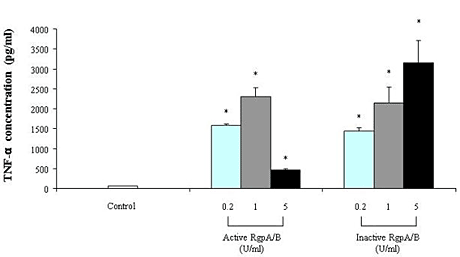
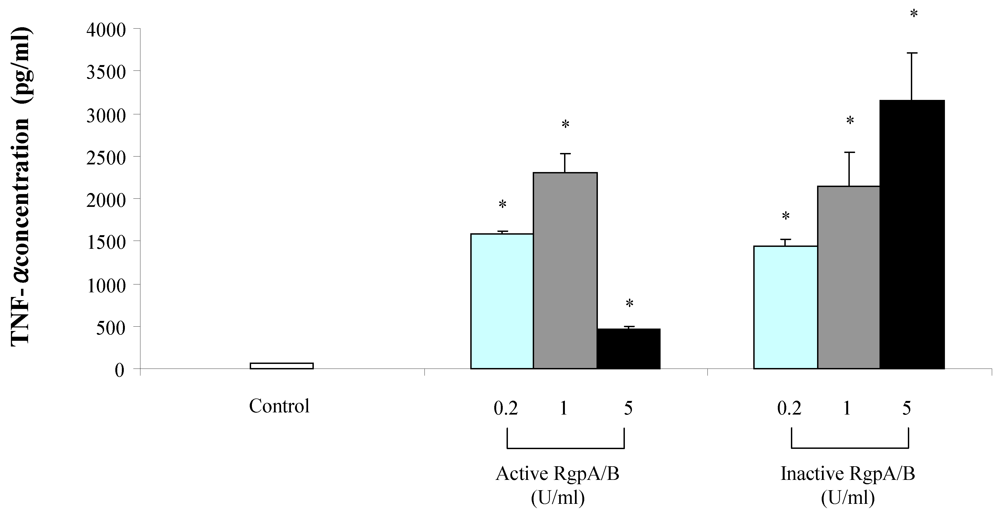
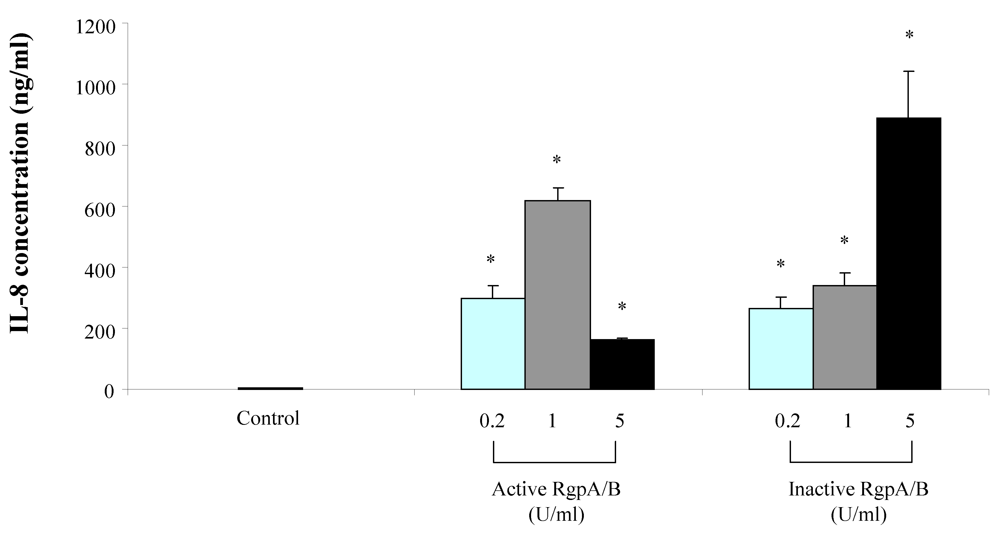
      <p>Stimulating macrophages with the Arg-gingipain preparation significantly induced the secretion of TNF-α and IL-8 (<xref ref-type="fig" rid="toxins-02-00341-f001">Figure 1</xref> and <xref ref-type="fig" rid="toxins-02-00341-f002">Figure 2</xref>). On the one hand, the amounts of TNF-α and IL-8 secreted were higher when stimulation was performed with active Arg-gingipains A/B at 0.2 and 1 unit/mL than at 5 units/mL. On the other hand, the secretion of TNF-α and Il-8 increased dose-dependently when macrophages were stimulated with the Arg-gingipain preparation inactivated by heat treatment. At 1 unit/mL, active Arg-gingipains A/B increased the secretion of TNF-α and IL-8 by 35 and 132 fold, respectively. At the same concentration, heat-inactivated Arg-gingipain A/B increased the secretion of TNF-α and IL-8 by 33 and 73 fold, respectively. To exclude the contribution of LPS contamination in cytokine release by macrophages, stimulations were performed in the presence of polymyxin B (10 µg/mL) in order to neutralize LPS. In all cases, the presence of polymyxin B had no significant effect on TNF-α and IL-8 secretion (data not shown).</p>
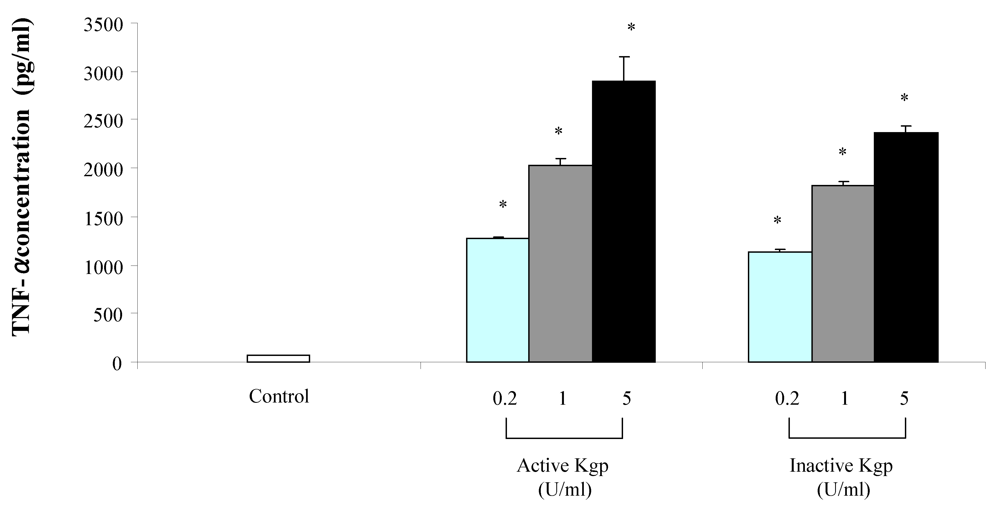
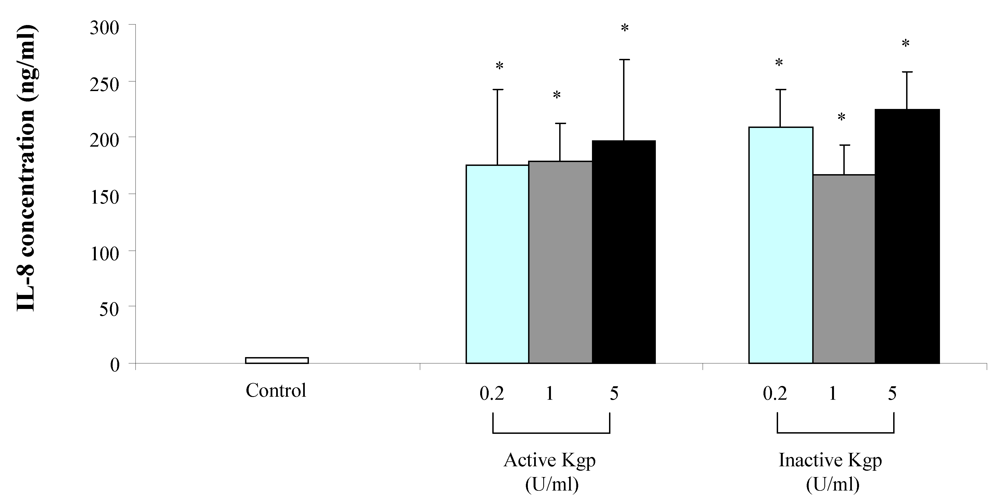
      <p>Macrophage stimulation with the Lys-gingipain preparation, either active or heat-inactivated, dose-dependently increased TNF-α secretion (<xref ref-type="fig" rid="toxins-02-00341-f003">Figure 3</xref>). Regarding IL-8, the Lys-gingipain preparation induced its secretion by macrophages although it was not dose-dependent (<xref ref-type="fig" rid="toxins-02-00341-f004">Figure 4</xref>). Similar results were obtained when the Lys-gingipain preparation was heat-treated. At 1 unit/mL, active Lys-gingipain increased the secretion of TNF-α and IL-8 by 31 and 38 fold, respectively. As for the Arg-gingipain, the presence of polymyxin B did not modify the amounts of secreted cytokines following stimulation of macrophages with the Lys-gingipain preparation (data not shown).</p>
      <fig id="toxins-02-00341-f001" position="anchor">
        <label>Figure 1</label>
        <caption>
          <p>Secretion of TNF-α by macrophages stimulated with the Arg-gingipain A/B preparation (active and heat-inactivated). TNF-α concentrations were determined by ELISA and data are presented as means ± standard deviations of triplicate assays. Data were analyzed with the Student’s t-test (*: P &lt; 0.05 <italic>vs.</italic> control). </p>
        </caption>
        <graphic xmlns:xlink="http://www.w3.org/1999/xlink" xlink:href="toxins-02-00341-g001.tif"/>
      </fig>
      <fig id="toxins-02-00341-f002" position="anchor">
        <label>Figure 2</label>
        <caption>
          <p>Secretion of IL-8 by macrophages stimulated with the Arg-gingipain A/B preparation (active and heat-inactivated). IL-8 concentrations were determined by ELISA and data are presented as means ± standard deviations of triplicate assays. Data were analyzed with the Student’s t-test (*: P &lt; 0.05 <italic>vs</italic>. control). </p>
        </caption>
        <graphic xmlns:xlink="http://www.w3.org/1999/xlink" xlink:href="toxins-02-00341-g002.tif"/>
      </fig>
      <fig id="toxins-02-00341-f003" position="anchor">
        <label>Figure 3</label>
        <caption>
          <p>Secretion of TNF-α by macrophages stimulated with the Lys-gingipain preparation (active and heat-inactivated). TNF-α concentrations were determined by ELISA and data are presented as means ± standard deviations of triplicate assays. Data were analyzed with the Student’s t-test (*: P &lt; 0.05 <italic>vs.</italic> control). </p>
        </caption>
        <graphic xmlns:xlink="http://www.w3.org/1999/xlink" xlink:href="toxins-02-00341-g003.tif"/>
      </fig>
      <fig id="toxins-02-00341-f004" position="anchor">
        <label>Figure 4</label>
        <caption>
          <p>Secretion of IL-8 by macrophages stimulated with the Lys-gingipain preparation (active and heat-inactivated). IL-8 concentrations were determined by ELISA and data are presented as means ± standard deviations of triplicate assays. Data were analyzed with the Student’s t-test (*: P &lt; 0.05 <italic>vs.</italic> control). </p>
        </caption>
        <graphic xmlns:xlink="http://www.w3.org/1999/xlink" xlink:href="toxins-02-00341-g004.tif"/>
      </fig>
      <p>Changes induced by the gingipain preparations in the amount of phosphorylated macrophage intracellular kinases known to be involved in inflammatory signaling pathways were characterized by a multiplex ELISA analysis. As reported in <xref ref-type="table" rid="toxins-02-00341-t001">Table 1</xref>, both the Arg- and Lys-gingipain preparations induced increases in phosphorylated p38α MAPK (+343% for RgpA/B and +227% for Kgp) and to a lesser extent ERK1/2 (+25% for RgpA/B and +32% for Kgp). The amounts of phosphorylated JNK2 were not significantly affected. Since p38α MAPK appeared to be the most important kinase involved in cell activation by gingipains, we used the highly specific inhibitor SB203580 to confirm its role (<xref ref-type="table" rid="toxins-02-00341-t002">Table 2</xref>). In the presence of SB203580, the RgpA/B- or Kgp-induced secretion of TNF-α was reduced by 87% and 79% respectively while that of IL-8 was decreased by 92% and 69% respectively. </p>
      <table-wrap id="toxins-02-00341-t001" position="anchor">
        <label>Table 1</label>
        <caption>
          <p>Effects of Arg- and Lys-gingipain treatments in the amounts of phosphorylated intracellular kinases in macrophages. Macrophages were treated for 90 min with the gingipain preparations. Cell lysates were prepared as described in Materials and Methods and assayed by the Searchlight Kinase Service (Pierce Biotechnology).</p>
        </caption>
        <table>
          <thead>
            <tr>
              <th colspan="1" align="left" valign="middle">
                <bold>Protein</bold>
              </th>
              <th colspan="3" align="center" valign="middle">
                <bold>Signal (% Change)</bold>
              </th>
            </tr>
            <tr>
              <th align="left" valign="middle">
                <bold>Full name and abbreviation</bold>
              </th>
              <th align="center" valign="middle">
                <bold>Epitope</bold>
              </th>
              <th align="center" valign="middle">
                <bold>Unstimulated <italic>vs.</italic> RgpA/B</bold>
              </th>
              <th align="center" valign="middle">
                <bold>Unstimulated <italic>vs.</italic> Kgp</bold>
              </th>
            </tr>
          </thead>
          <tbody>
            <tr>
              <td align="left" valign="middle">Extracellular regulated protein-serine kinase 1/2 (p42, p44 MAP kinase); ERK1/2</td>
              <td align="center" valign="middle">T202/Y204</td>
              <td align="center" valign="middle">+25</td>
              <td align="center" valign="middle">+32</td>
            </tr>
            <tr>
              <td align="left" valign="middle">Jun N-terminus protein-serine kinase (stress-activated protein kinase 2); JNK2</td>
              <td align="center" valign="middle">T183/Y185</td>
              <td align="center" valign="middle">+5</td>
              <td align="center" valign="middle">0</td>
            </tr>
            <tr>
              <td align="left" valign="middle">Mitogen-activated protein-serine kinase p38 alpha; p38α MAPK</td>
              <td align="center" valign="middle">T180/Y182</td>
              <td align="center" valign="middle">+343</td>
              <td align="center" valign="middle">+227</td>
            </tr>
          </tbody>
        </table>
      </table-wrap>
      <table-wrap id="toxins-02-00341-t002" position="anchor">
        <label>Table 2</label>
        <caption>
          <p>Effect of SB203580, a specific inhibitor of p38α MAPK, on secretion of TNF-α and IL-8 by gingipain-stimulated macrophages.</p>
        </caption>
        <table>
          <thead>
            <tr>
              <th rowspan="2" align="left" valign="middle">
                <bold>Gingipain preparation (1 unit/mL)</bold>
              </th>
              <th colspan="2" align="left" valign="middle">
                <bold>% inhibition in the presence of SB203580</bold>
              </th>
            </tr>
            <tr>
              <th align="center" valign="middle"><bold>TNF-</bold>α</th>
              <th align="center" valign="middle">
                <bold>IL-8</bold>
              </th>
            </tr>
          </thead>
          <tbody>
            <tr>
              <td align="left" valign="middle">RgpA/B</td>
              <td align="center" valign="middle">87%</td>
              <td align="center" valign="middle">92%</td>
            </tr>
            <tr>
              <td align="left" valign="middle">Kgp</td>
              <td align="center" valign="middle">79%</td>
              <td align="center" valign="middle">69%</td>
            </tr>
          </tbody>
        </table>
      </table-wrap>
    </sec>
    <sec sec-type="discussion">
      <title>3. Discussion</title>
      <p>Arg- and Lys-gingipains, the major endopeptidases produced by <italic>P. gingivalis</italic>, are thought to be critical virulence factors since deficient mutants are less pathogenic in animal models [<xref ref-type="bibr" rid="B15-toxins-02-00341">15</xref>,<xref ref-type="bibr" rid="B16-toxins-02-00341">16</xref>]. In addition to degrade key tissue and plasma proteins [<xref ref-type="bibr" rid="B5-toxins-02-00341">5</xref>], gingipains may contribute to the development and maintenance of an inflammatory state. A first mechanism that has been proposed is through activation of the kallikrein/kinin-generating cascade, which results in increased vascular permeability [<xref ref-type="bibr" rid="B17-toxins-02-00341">17</xref>]. A second mechanism involves activation by Arg-gingipains of blood coagulation factor X to generate activated factor X (FXa) [<xref ref-type="bibr" rid="B18-toxins-02-00341">18</xref>], which can modulate the production of proinflammatory cytokines [<xref ref-type="bibr" rid="B19-toxins-02-00341">19</xref>]. More recently, it has been reported that <italic>P. gingivalis</italic> gingipains can activate different cell types leading to the secretion of inflammatory mediators [<xref ref-type="bibr" rid="B20-toxins-02-00341">20</xref>,<xref ref-type="bibr" rid="B21-toxins-02-00341">21</xref>,<xref ref-type="bibr" rid="B22-toxins-02-00341">22</xref>]. </p>
      <p>In this study, we investigated the capacity of <italic>P. gingivalis</italic> gingipains to induce an inflammatory response in macrophages through activation of intracellular kinases. We showed that both the Arg- and Lys-gingipain preparations induced the production of TNF-α and IL-8 by macrophages. Two different results support that contaminant LPS is not involved in macrophage activation. First, a chromogenic <italic>Limulus</italic> amoebocyte lysate assay performed on gingipain preparations ruled out the possibility thatcontaminant LPS accounted for the responses observed. Second, the presence of polymyxin B, an LPS inhibitor universally used, did not modify macrophage activation by gingipains. When used at 1 unit/mL, the Arg-gingipain preparation induced the secretion of larger amounts of the cytokines in comparison with the Lys-gingipain preparation. Given the biological properties associated with TNF-α and IL-8, they are likely to contribute to periodontitis [<xref ref-type="bibr" rid="B23-toxins-02-00341">23</xref>,<xref ref-type="bibr" rid="B24-toxins-02-00341">24</xref>]. TNF-α can induce the expression of adhesion molecules and mediators that facilitate and amplify the inflammatory response, matrix metalloproteinase production and bone resorption [<xref ref-type="bibr" rid="B23-toxins-02-00341">23</xref>]. IL-8 is a potent chemotactic and activating cytokine produced by several cell types, including macrophages. It amplifies immune responses by attracting and inducing immune cells such as polymorphonuclear leukocytes, monocytes, and macrophages to produce pro-inflammatory mediators. The stimulation of chemokine production by periodontopathogens is believed to play an important role in initiating inflammatory reactions in gingival tissues [<xref ref-type="bibr" rid="B24-toxins-02-00341">24</xref>]. IL-8 is also able to induce differentiation of hematopoietic precursors of the monocyte-macrophage lineage into osteoclasts suggesting an important role in bone resorption [<xref ref-type="bibr" rid="B25-toxins-02-00341">25</xref>]. IL-8 concentrations in the gingival crevicular fluid of inflamed periodontal sites correlate with the severity of periodontitis [<xref ref-type="bibr" rid="B26-toxins-02-00341">26</xref>]. Stashenko <italic>et al.</italic> [<xref ref-type="bibr" rid="B27-toxins-02-00341">27</xref>] reported a highly significant correlation between the levels of TNF-α and IL-8 in the periodontal tissues of diseased sites, suggesting that the expression of these two mediators is coordinated.</p>
      <p>In a recent study, Uehara <italic>et al.</italic> [<xref ref-type="bibr" rid="B21-toxins-02-00341">21</xref>] demonstrated that Arg- and Lys-gingipains of <italic>P. gingivalis</italic> stimulate the secretion of proinflammatory cytokines by monocytes through protease-activated receptor (PAR)-1, -2, and -3 with synergistic effects when used in combination with pathogen-associated molecular patterns. This capacity was dependent on the proteolytic cleavage of PARs by gingipains. In our study, a different mechanism of activation was involved since stimulation of macrophages leading to TNF-α and IL-8 secretion occurred with heat-inactivated gingipains. A similar observation was reported by Fitzpatrick <italic>et al</italic>. [<xref ref-type="bibr" rid="B22-toxins-02-00341">22</xref>] who observed that gingipain-induced IL-1β secretion by differentiated macrophages involves a nonproteolytic mechanism.</p>
      <p>It was found that stimulating macrophages with the highest concentration (5 units/mL) of Arg-gingipain resulted in lower amounts of both TNF-α and IL-8 detected in cell-free culture supernatant when compared with stimulation with 0.2 and 1 unit/mL. This does not result from loss of cell viability and consequently reduced secretion of cytokines since gingipain preparations showed no significant cytotoxicity. This decreased amount of cytokines is most likely related to proteolytic degradation. Indeed, <italic>P. gingivalis</italic> gingipains have been reported to degrade TNF-α [<xref ref-type="bibr" rid="B28-toxins-02-00341">28</xref>] and IL-8 [<xref ref-type="bibr" rid="B29-toxins-02-00341">29</xref>]. The biological significance of such degradation may be important during the course of periodontitis. Indeed, proteolysis of cytokines by <italic>P. gingivalis</italic> may deregulate the complex host cytokine network responsible for periodontal health and the maintenance of both innate and acquired immunity. The cytokine degradation was gingipain dose-dependent. It suggests that degradation of cytokines may occur especially near the bacterial plaque, where gingipain concentrations are high. In gingival tissue, where bacterial and gingipain concentrations are low, the degradation of cytokines may be a minor phenomenon allowing the development of an intense inflammatory reaction in response to periodontopathogen stimulations.</p>
      <p>Upon receptor activation by stimuli, signaling cascades are activated to lead to inflammatory mediator secretion. In our study, the <italic>P. gingivalis</italic> gingipains appeared to activate the p38α MAPK signal transduction pathway. The p38 MAPK is well known to play a key role in inflammatory and chemokine regulation at both the transcriptional and the post-transcriptional levels [<xref ref-type="bibr" rid="B30-toxins-02-00341">30</xref>]. Evidences have been presented to support an important role of p38 MAPK signaling in periodontal disease [<xref ref-type="bibr" rid="B31-toxins-02-00341">31</xref>].</p>
    </sec>
    <sec>
      <title>4. Experimental Section</title>
      <sec>
        <title>4.1. Bacterial strains and growth conditions</title>
        <p><italic>P. gingivalis</italic> ATCC 33277 and two derivative mutants (KDP112 [<italic>rgpA</italic>, <italic>rgpB</italic>] and KDP129 [<italic>kgp</italic>]) were grown in Todd Hewitt broth (THB, BBL Microbiology Systems, Cockeysville, MD) supplemented with hemin (10 µg/mL) and vitamin K (1 µg/mL). The mutants, which were kindly provided by K. Nakayama (Nagasaki University, Japan), were constructed by insertional mutations as described previously [<xref ref-type="bibr" rid="B32-toxins-02-00341">32</xref>,<xref ref-type="bibr" rid="B33-toxins-02-00341">33</xref>]. All cultures were incubated in an anaerobic chamber (N<sub>2</sub>-CO<sub>2</sub>-H<sub>2</sub>, 80:10:10) at 37 °C. </p>
      </sec>
      <sec>
        <title>4.2. Proteinase purification</title>
        <p>Arg-gingipains A/B and Lys-gingipain were purified from <italic>P. gingivalis</italic> KDP129 and KDP112, respectively. The use of these mutants facilitated the purification of the gingipains, which are difficult to separate from one another. Gingipains were purified from cell envelope extracts by affinity chromatography on arginine Sepharose 4B (Amersham Pharmacia Biotech, Baie d’Urfé, QC), as previously described [<xref ref-type="bibr" rid="B34-toxins-02-00341">34</xref>,<xref ref-type="bibr" rid="B35-toxins-02-00341">35</xref>]. The purity of the preparations was assessed by SDS-PAGE analysis and silver staining. One unit of enzyme activity was defined as the amount required to release 1 nM of <italic>p</italic>-nitroaniline per h using the chromogenic synthetic substrates benzoyl-Arg-<italic>p</italic>-nitroanilide for Arg-gingipain activity and N-<italic>p</italic>-tosyl-Gly-Pro-Lys-<italic>p</italic>-nitroanilide for Lys-gingipain activity. The presence of contaminant LPS in the gingipain preparations was determined using a quantitative chromogenic <italic>Limulus</italic> amoebocyte lysate assay according to the manufacturer's directions (BioWhittaker, Walkersville, MD).</p>
      </sec>
      <sec>
        <title>4.3. Preparation and stimulation of monocyte-derived macrophages</title>
        <p>U937 cells, a macrophage-like cell line, were obtained from the American Type Culture Collection (ATCC; Rockville, MD) and grown in RPMI 1640 medium supplemented with penicillin (50 µg/mL), streptomycin (50 µg/mL) and 10% heat-inactivated fetal bovine serum (FBS) at 37 °C in a 5% CO<sub>2 </sub>atmosphere. The cells were seeded at 2 × 10<sup>5</sup> cells/mL and split approximately three times per week to maintain the cell concentration between 1 × 10<sup>5</sup> and 2 × 10<sup>6</sup> viable cells/mL for optimal growth. To differentiate monocytes into adherent macrophages, phorbol-12-myristate 13-acetate (PMA; Sigma Chemical Co., St. Louis, MO) was added at a concentration of 1 ng/mL and the cells were cultivated for 48 h. Thereafter, the cells were incubated in PMA-free medium for 1 d prior to use. Macrophages were treated with gingipain preparations (0.2, 1 and 5 units/mL) for 18 h at 37 °C in a 5% CO<sub>2 </sub>atmosphere. To investigate whether the catalytic activity of gingipains was involved in cell activation, proteinase preparations were treated at 56 °C for 30 min prior to stimulate macrophages. Such a treatment completely abolished the hydrolytic activity of gingipains. To ensure that contaminating LPS were not responsible for macrophage stimulation, treatments were also performed in the presence of polymyxin B at a final concentration of 10 µg/mL. All assays were run in triplicate in two separate experiments.</p>
      </sec>
      <sec>
        <title>4.4. Macrophage viability</title>
        <p>An MTT (3-[4,5-diethylthiazol-2-yl]-2,5-diphenyltetrazolium bromide) test performed according to the manufacturer’s protocol (Roche Diagnostics, Mannheim, Germany) was used to test the viability of macrophages following treatment with Arg- and Lys-gingipain preparations.</p>
      </sec>
      <sec>
        <title>4.5. Determination of TNF- and IL-8 secretion</title>
        <p>Commercial enzyme-linked immunosorbent assay (ELISA) kits (R&amp;D Systems, Minneapolis, MN, USA) were used to quantify TNF-α and IL-8 concentrations in the cell-free culture supernatants according to the manufacturer’s protocol. The absorbance at 450 nm was read using a microplate reader with the wavelength correction set at 550 nm. The rated sensitivities of the commercial ELISA kits were 15.6 pg/mL for TNF-α and 31.2 pg/mL for IL-8. The differences between the means were analyzed for statistical significance at P &lt; 0.05 using the Student’s t-test.</p>
      </sec>
      <sec>
        <title>4.6. Analysis of phosphorylated macrophage intracellular kinases</title>
        <p>Searchlight kinase assays, which provide quantitative information on phosphorylated intracellular protein kinases, were performed by Pierce Biotechnology (Woburn, MA, USA). The multiplex sandwich ELISA assays use highly specific immunological reagents and a sensitive chemiluminescent detection system. Macrophages were treated for 90 min with the gingipain preparations (1 unit/mL). The cells were washed twice with ice-cold 50 mM phosphate-buffered saline (pH 7.2) and homogenized at 4 °C in a buffer containing 25 mM Tris-HCl (pH 7.6), 150 mM sodium chloride, 1% Nonidet P-40, 1% sodium deoxycholate, and 1% sodium dodecyl sulfate. The buffer was supplemented with Halt Protease inhibitor cocktail and Halt Phosphatase inhibitor cocktail (Pierce Biotechnology), which was used according to the manufacturer’s instructions. The cells were broken by sonication on ice and the lysates were centrifuged at 13,000× <italic>g for 10 min at</italic> 4 °C to remove cell debris. Protein concentrations in the supernatant fractions were determined using the Bradford assay (Bio-Rad Laboratories, Ltd., Mississauga, ON, Canada) and adjusted to 1 mg/mL. Concentrations of phosphorylated intracellular kinases in the samples were measured in duplicate at three dilutions and the mean values of the best measurements were calculated. Data reported in the manuscript are representative of the two experiments.</p>
      </sec>
      <sec>
        <title>4.7. Effect of a p38 MAPK inhibitor on macrophage activation by gingipains</title>
        <p>A specific inhibitor of p38 MAPK, SB203580 purchased from Calbiochem (Mississauga, ON, Canada), was added (2 µM) to macrophages 2 h prior to being stimulated with gingipain preparations (1 unit/mL) for 24 h. TNF-α and IL-8 concentrations in the cell-free culture supernatants were quantified by ELISA as described above.</p>
      </sec>
    </sec>
    <sec sec-type="conclusions">
      <title>5. Conclusions</title>
      <p>The host inflammatory response is a critical factor in periodontitis-associated tissue destruction. Both Arg- and Lys-gingipains produced by <italic>P. gingivalis</italic> induced the secretion of TNF-α and IL-8 by macrophages. This inflammatory response involves the p38α MAPK signal transduction pathway.</p>
    </sec>
  </body>
  <back>
    <ack>
      <title>Acknowledgements</title>
      <p>We wish to thank Koji Nakayama (Nagasaki University, Japan) for providing the gingipain-deficient mutants of <italic>P. gingivalis</italic>. This study was supported by the Canadian Institutes of Health Research.</p>
    </ack>
    <ref-list>
      <title>References</title>
      <ref id="B1-toxins-02-00341">
        <label>1.</label>
        <citation citation-type="journal">
          <person-group person-group-type="author">
            <name>
              <surname>Schenkein</surname>
              <given-names>H.A.</given-names>
            </name>
          </person-group>
          <article-title>Host responses in maintaining periodontal health and determining periodontal disease</article-title>
          <source>Periodontol. 2000</source>
          <year>2006</year>
          <volume>40</volume>
          <fpage>77</fpage>
          <lpage>93</lpage>
          <pub-id pub-id-type="doi">10.1111/j.1600-0757.2005.00144.x</pub-id>
        </citation>
      </ref>
      <ref id="B2-toxins-02-00341">
        <label>2.</label>
        <citation citation-type="journal">
          <person-group person-group-type="author">
            <name>
              <surname>Slots</surname>
              <given-names>J.</given-names>
            </name>
            <name>
              <surname>Ting</surname>
              <given-names>M.</given-names>
            </name>
          </person-group>
          <article-title><italic>Actinobacillus actinomycetemcomitans</italic> and <italic>Porphyromonas gingivalis</italic> in human periodontal disease: occurrence and treatment</article-title>
          <source>Periodontol. 2000</source>
          <year>1999</year>
          <volume>20</volume>
          <fpage>82</fpage>
          <lpage>121</lpage>
          <pub-id pub-id-type="doi">10.1111/j.1600-0757.1999.tb00159.x</pub-id>
        </citation>
      </ref>
      <ref id="B3-toxins-02-00341">
        <label>3.</label>
        <citation citation-type="journal">
          <person-group person-group-type="author">
            <name>
              <surname>Cutler</surname>
              <given-names>C.W.</given-names>
            </name>
            <name>
              <surname>Calmer</surname>
              <given-names>J.R.</given-names>
            </name>
            <name>
              <surname>Genco</surname>
              <given-names>C.A.</given-names>
            </name>
          </person-group>
          <article-title>Pathogenic strategies of the oral anaerobe, <italic>Porphyromonas gingivalis</italic></article-title>
          <source>Trends Microbiol.</source>
          <year>1995</year>
          <volume>3</volume>
          <fpage>45</fpage>
          <lpage>51</lpage>
          <pub-id pub-id-type="doi">10.1016/S0966-842X(00)88874-5</pub-id>
        </citation>
      </ref>
      <ref id="B4-toxins-02-00341">
        <label>4.</label>
        <citation citation-type="book">
          <person-group person-group-type="author">
            <name>
              <surname>Grenier</surname>
              <given-names>D.</given-names>
            </name>
            <name>
              <surname>Mayrand</surname>
              <given-names>D.</given-names>
            </name>
          </person-group>
          <article-title>Periodontitis as an ecological imbalance</article-title>
          <source>Oral Bacterial Ecology: The Molecular Basis</source>
          <person-group person-group-type="editor">
            <name>
              <surname>Kuramitsu</surname>
              <given-names>H.K.</given-names>
            </name>
            <name>
              <surname>Ellen</surname>
              <given-names>R.</given-names>
            </name>
          </person-group>
          <publisher-name>Horizon Scientific Press</publisher-name>
          <publisher-loc>Wymondham,UK</publisher-loc>
          <year>2000</year>
          <fpage>275</fpage>
          <lpage>311</lpage>
        </citation>
      </ref>
      <ref id="B5-toxins-02-00341">
        <label>5.</label>
        <citation citation-type="journal">
          <person-group person-group-type="author">
            <name>
              <surname>Kadowaki</surname>
              <given-names>T.</given-names>
            </name>
            <name>
              <surname>Nakayama</surname>
              <given-names>K.</given-names>
            </name>
            <name>
              <surname>Okamoto</surname>
              <given-names>K.</given-names>
            </name>
            <name>
              <surname>Abe</surname>
              <given-names>N.</given-names>
            </name>
            <name>
              <surname>Baba</surname>
              <given-names>A.</given-names>
            </name>
            <name>
              <surname>Shi</surname>
              <given-names>Y.</given-names>
            </name>
            <name>
              <surname>Ratnayake</surname>
              <given-names>D.B.</given-names>
            </name>
            <name>
              <surname>Yamamoto</surname>
              <given-names>K.</given-names>
            </name>
          </person-group>
          <article-title><italic>Porphyromonas gingivalis</italic> proteinases as virulence determinants in progression of periodontal diseases</article-title>
          <source>J. Biochem.</source>
          <year>2000</year>
          <volume>128</volume>
          <fpage>153</fpage>
          <lpage>159</lpage>
        <pub-id pub-id-type="doi">10.1093/oxfordjournals.jbchem.a022735</pub-id><pub-id pub-id-type="pmid">10920248</pub-id></citation>
      </ref>
      <ref id="B6-toxins-02-00341">
        <label>6.</label>
        <citation citation-type="journal">
          <person-group person-group-type="author">
            <name>
              <surname>Potempa</surname>
              <given-names>J.</given-names>
            </name>
            <name>
              <surname>Sroka</surname>
              <given-names>A.</given-names>
            </name>
            <name>
              <surname>Imamura</surname>
              <given-names>T.</given-names>
            </name>
            <name>
              <surname>Travis</surname>
              <given-names>J.</given-names>
            </name>
          </person-group>
          <article-title>Gingipains, the major cysteine proteinase and virulence factors of <italic>Porphyromonas gingivalis</italic>: Structure, function and assembly of multidomain protein complexes</article-title>
          <source>Curr. Protein Pept. Sci.</source>
          <year>2003</year>
          <volume>4</volume>
          <fpage>397</fpage>
          <lpage>407</lpage>
          <pub-id pub-id-type="pmid">14683426</pub-id>
          <pub-id pub-id-type="doi">10.2174/1389203033487036</pub-id>
        </citation>
      </ref>
      <ref id="B7-toxins-02-00341">
        <label>7.</label>
        <citation citation-type="journal">
          <person-group person-group-type="author">
            <name>
              <surname>Andrian</surname>
              <given-names>E.</given-names>
            </name>
            <name>
              <surname>Grenier</surname>
              <given-names>D.</given-names>
            </name>
            <name>
              <surname>Rouabhia</surname>
              <given-names>M.</given-names>
            </name>
          </person-group>
          <article-title><italic>In vitro</italic> models of tissue penetration and destruction by <italic>Porphyromonas gingivalis</italic></article-title>
          <source>Infect. Immun.</source>
          <year>2004</year>
          <volume>72</volume>
          <fpage>4689</fpage>
          <lpage>4698</lpage>
          <pub-id pub-id-type="doi">10.1128/IAI.72.8.4689-4698.2004</pub-id>
        </citation>
      </ref>
      <ref id="B8-toxins-02-00341">
        <label>8.</label>
        <citation citation-type="journal">
          <person-group person-group-type="author">
            <name>
              <surname>Houle</surname>
              <given-names>M.A.</given-names>
            </name>
            <name>
              <surname>Grenier</surname>
              <given-names>D.</given-names>
            </name>
            <name>
              <surname>Plamondon</surname>
              <given-names>P.</given-names>
            </name>
            <name>
              <surname>Nakayama</surname>
              <given-names>K.</given-names>
            </name>
          </person-group>
          <article-title>The collagenase activity of <italic>Porphyromonas gingivalis</italic> is due to Arg-gingipain</article-title>
          <source>FEMS Microbiol. Lett.</source>
          <year>2003</year>
          <volume>221</volume>
          <fpage>181</fpage>
          <lpage>185</lpage>
          <pub-id pub-id-type="doi">10.1016/S0378-1097(03)00178-2</pub-id>
        </citation>
      </ref>
      <ref id="B9-toxins-02-00341">
        <label>9.</label>
        <citation citation-type="journal">
          <person-group person-group-type="author">
            <name>
              <surname>Grayson</surname>
              <given-names>R.</given-names>
            </name>
            <name>
              <surname>Douglas</surname>
              <given-names>C.W.</given-names>
            </name>
            <name>
              <surname>Heath</surname>
              <given-names>J.</given-names>
            </name>
            <name>
              <surname>Rawlinson</surname>
              <given-names>A.</given-names>
            </name>
            <name>
              <surname>Evans</surname>
              <given-names>G.S.</given-names>
            </name>
          </person-group>
          <article-title>Activation of human matrix metalloproteinase by gingival crevicular fluid and <italic>Porphyromonas gingivalis</italic></article-title>
          <source>J. Clin. Periodontol.</source>
          <year>2003</year>
          <volume>30</volume>
          <fpage>542</fpage>
          <lpage>550</lpage>
          <pub-id pub-id-type="doi">10.1034/j.1600-051X.2003.00301.x</pub-id>
        </citation>
      </ref>
      <ref id="B10-toxins-02-00341">
        <label>10.</label>
        <citation citation-type="journal">
          <person-group person-group-type="author">
            <name>
              <surname>Grenier</surname>
              <given-names>D.</given-names>
            </name>
            <name>
              <surname>Mayrand</surname>
              <given-names>D.</given-names>
            </name>
          </person-group>
          <article-title>Inactivation of tissue inhibitor of metalloproteinase-1 (TIMP-1) by <italic>Porphyromonas gingivalis</italic></article-title>
          <source>FEMS Microbiol. Lett.</source>
          <year>2001</year>
          <volume>203</volume>
          <fpage>161</fpage>
          <lpage>164</lpage>
          <pub-id pub-id-type="doi">10.1111/j.1574-6968.2001.tb10835.x</pub-id>
        </citation>
      </ref>
      <ref id="B11-toxins-02-00341">
        <label>11.</label>
        <citation citation-type="journal">
          <person-group person-group-type="author">
            <name>
              <surname>Zappa</surname>
              <given-names>U.</given-names>
            </name>
            <name>
              <surname>Reinking-Zappa</surname>
              <given-names>M.</given-names>
            </name>
            <name>
              <surname>Graf</surname>
              <given-names>H.</given-names>
            </name>
            <name>
              <surname>Espeland</surname>
              <given-names>M.</given-names>
            </name>
          </person-group>
          <article-title>Cell populations and episodic periodontal attachment loss in humans</article-title>
          <source>J. Clin. Periodontol.</source>
          <year>1991</year>
          <volume>18</volume>
          <fpage>508</fpage>
          <lpage>515</lpage>
          <pub-id pub-id-type="doi">10.1111/j.1600-051X.1991.tb00082.x</pub-id>
        </citation>
      </ref>
      <ref id="B12-toxins-02-00341">
        <label>12.</label>
        <citation citation-type="journal">
          <person-group person-group-type="author">
            <name>
              <surname>Bodet</surname>
              <given-names>C.</given-names>
            </name>
            <name>
              <surname>Chandad</surname>
              <given-names>F.</given-names>
            </name>
            <name>
              <surname>Grenier</surname>
              <given-names>D.</given-names>
            </name>
          </person-group>
          <article-title>Modulation of cytokine production by <italic>Porphyromonas gingivalis</italic> in a macrophage and epithelial cell co-culture model</article-title>
          <source>Microbes Infect.</source>
          <year>2005</year>
          <volume>7</volume>
          <fpage>448</fpage>
          <lpage>456</lpage>
          <pub-id pub-id-type="doi">10.1016/j.micinf.2004.11.021</pub-id>
        </citation>
      </ref>
      <ref id="B13-toxins-02-00341">
        <label>13.</label>
        <citation citation-type="journal">
          <person-group person-group-type="author">
            <name>
              <surname>Sugano</surname>
              <given-names>N.</given-names>
            </name>
            <name>
              <surname>Ikeda</surname>
              <given-names>K.</given-names>
            </name>
            <name>
              <surname>Oshikawa</surname>
              <given-names>M.</given-names>
            </name>
            <name>
              <surname>Sawamoto</surname>
              <given-names>Y.</given-names>
            </name>
            <name>
              <surname>Tanaka</surname>
              <given-names>H.</given-names>
            </name>
            <name>
              <surname>Ito</surname>
              <given-names>K.</given-names>
            </name>
          </person-group>
          <article-title>Differential cytokine induction by two types of <italic>Porphyromonas gingivalis</italic></article-title>
          <source>Oral Microbiol. Immunol.</source>
          <year>2004</year>
          <volume>19</volume>
          <fpage>121</fpage>
          <lpage>123</lpage>
          <pub-id pub-id-type="doi">10.1046/j.0902-0055.2003.00119.x</pub-id>
        </citation>
      </ref>
      <ref id="B14-toxins-02-00341">
        <label>14.</label>
        <citation citation-type="journal">
          <person-group person-group-type="author">
            <name>
              <surname>O’Brien-Simpson</surname>
              <given-names>N.M.</given-names>
            </name>
            <name>
              <surname>Veith</surname>
              <given-names>P.D.</given-names>
            </name>
            <name>
              <surname>Dashper</surname>
              <given-names>S.G.</given-names>
            </name>
            <name>
              <surname>Reynolds</surname>
              <given-names>E.C.</given-names>
            </name>
          </person-group>
          <article-title>Antigens of bacteria associated with periodontitis</article-title>
          <source>Periodontol. 2000</source>
          <year>2004</year>
          <volume>35</volume>
          <fpage>101</fpage>
          <lpage>134</lpage>
          <pub-id pub-id-type="doi">10.1111/j.0906-6713.2004.003559.x</pub-id>
        </citation>
      </ref>
      <ref id="B15-toxins-02-00341">
        <label>15.</label>
        <citation citation-type="journal">
          <person-group person-group-type="author">
            <name>
              <surname>Pathirana</surname>
              <given-names>R.D.</given-names>
            </name>
            <name>
              <surname>O’Brien-Simpson</surname>
              <given-names>N.M.</given-names>
            </name>
            <name>
              <surname>Brammar</surname>
              <given-names>G.C.</given-names>
            </name>
            <name>
              <surname>Slakeski</surname>
              <given-names>N.</given-names>
            </name>
            <name>
              <surname>Reynolds</surname>
              <given-names>E.C.</given-names>
            </name>
          </person-group>
          <article-title>Kgp and RgpB, but not RgpA, are important for <italic>Porphyromonas gingivalis</italic> virulence in the murine periodontitis model</article-title>
          <source>Infect. Immun.</source>
          <year>2007</year>
          <volume>75</volume>
          <fpage>1436</fpage>
          <lpage>1442</lpage>
          <pub-id pub-id-type="pmid">17220315</pub-id>
          <pub-id pub-id-type="doi">10.1128/IAI.01627-06</pub-id>
        </citation>
      </ref>
      <ref id="B16-toxins-02-00341">
        <label>16.</label>
        <citation citation-type="journal">
          <person-group person-group-type="author">
            <name>
              <surname>Yoneda</surname>
              <given-names>M.</given-names>
            </name>
            <name>
              <surname>Hirofuji</surname>
              <given-names>T.</given-names>
            </name>
            <name>
              <surname>Motooka</surname>
              <given-names>N.</given-names>
            </name>
            <name>
              <surname>Anan</surname>
              <given-names>H.</given-names>
            </name>
            <name>
              <surname>Miura</surname>
              <given-names>M.</given-names>
            </name>
            <name>
              <surname>Ishihara</surname>
              <given-names>Y.</given-names>
            </name>
            <name>
              <surname>Maeda</surname>
              <given-names>K.</given-names>
            </name>
          </person-group>
          <article-title>Antibody responses to <italic>Porphyromonas gingivalis</italic> infection in a murine abscess model - involvement of gingipains and responses to re-infection</article-title>
          <source>J. Periodontal Res.</source>
          <year>2003</year>
          <volume>38</volume>
          <fpage>551</fpage>
          <lpage>556</lpage>
          <pub-id pub-id-type="doi">10.1034/j.1600-0765.2003.00685.x</pub-id>
        </citation>
      </ref>
      <ref id="B17-toxins-02-00341">
        <label>17.</label>
        <citation citation-type="journal">
          <person-group person-group-type="author">
            <name>
              <surname>Imamura</surname>
              <given-names>T.</given-names>
            </name>
            <name>
              <surname>Pike</surname>
              <given-names>R.N.</given-names>
            </name>
            <name>
              <surname>Potempa</surname>
              <given-names>J.</given-names>
            </name>
            <name>
              <surname>Travis</surname>
              <given-names>J.</given-names>
            </name>
          </person-group>
          <article-title>Pathogenesis of periodontitis: a major arginine-specific cysteine proteinase from <italic>Porphyromonas gingivalis</italic> induces vascular permeability enhancement through activation of the kallikrein/kinin pathway</article-title>
          <source>J. Clin. Invest.</source>
          <year>1994</year>
          <volume>94</volume>
          <fpage>361</fpage>
          <lpage>367</lpage>
          <pub-id pub-id-type="doi">10.1172/JCI117330</pub-id>
        </citation>
      </ref>
      <ref id="B18-toxins-02-00341">
        <label>18.</label>
        <citation citation-type="journal">
          <person-group person-group-type="author">
            <name>
              <surname>Imamura</surname>
              <given-names>T.</given-names>
            </name>
            <name>
              <surname>Potempa</surname>
              <given-names>J.</given-names>
            </name>
            <name>
              <surname>Tanase</surname>
              <given-names>S.</given-names>
            </name>
            <name>
              <surname>Travis</surname>
              <given-names>J.</given-names>
            </name>
          </person-group>
          <article-title>Activation of blood coagulation factor X by arginine-specific cysteine proteinases (gingipain-Rs) from <italic>Porphyromonas gingivalis</italic></article-title>
          <source>J. Biol. Chem.</source>
          <year>1997</year>
          <volume>272</volume>
          <fpage>16062</fpage>
          <lpage>16067</lpage>
        <pub-id pub-id-type="doi">10.1074/jbc.272.25.16062</pub-id><pub-id pub-id-type="pmid">9188512</pub-id></citation>
      </ref>
      <ref id="B19-toxins-02-00341">
        <label>19.</label>
        <citation citation-type="journal">
          <person-group person-group-type="author">
            <name>
              <surname>Senden</surname>
              <given-names>N.H.</given-names>
            </name>
            <name>
              <surname>Jeunhomme</surname>
              <given-names>T.M.</given-names>
            </name>
            <name>
              <surname>Heemskerk</surname>
              <given-names>J.W.</given-names>
            </name>
            <name>
              <surname>Wagenvoord</surname>
              <given-names>R.</given-names>
            </name>
            <name>
              <surname>van’t Veer</surname>
              <given-names>C.</given-names>
            </name>
            <name>
              <surname>Hemker</surname>
              <given-names>H.C.</given-names>
            </name>
            <name>
              <surname>Buurman</surname>
              <given-names>W.A.</given-names>
            </name>
          </person-group>
          <article-title>Factor Xa induces cytokine production and expression of adhesion molecules by human umbilical vein endothelial cells</article-title>
          <source>J. Immunol.</source>
          <year>1998</year>
          <volume>161</volume>
          <fpage>4318</fpage>
          <lpage>4324</lpage>
        <pub-id pub-id-type="pmid">9780208</pub-id></citation>
      </ref>
      <ref id="B20-toxins-02-00341">
        <label>20.</label>
        <citation citation-type="journal">
          <person-group person-group-type="author">
            <name>
              <surname>O’Brien-Simpson</surname>
              <given-names>N.M.</given-names>
            </name>
            <name>
              <surname>Pathirana</surname>
              <given-names>R.D.</given-names>
            </name>
            <name>
              <surname>Walker</surname>
              <given-names>G.D.</given-names>
            </name>
            <name>
              <surname>Reynolds</surname>
              <given-names>E.C.</given-names>
            </name>
          </person-group>
          <article-title><italic>Porphyromonas gingivalis</italic> RgpA-Kgp proteinase-adhesin complexes penetrate gingival tissue and induce proinflammatory cytokines or apoptosis in a concentration-dependent manner</article-title>
          <source>Infect. Immun.</source>
          <year>2009</year>
          <volume>77</volume>
          <fpage>1246</fpage>
          <lpage>1261</lpage>
        <pub-id pub-id-type="doi">10.1128/IAI.01038-08</pub-id><pub-id pub-id-type="pmid">19114547</pub-id></citation>
      </ref>
      <ref id="B21-toxins-02-00341">
        <label>21.</label>
        <citation citation-type="journal">
          <person-group person-group-type="author">
            <name>
              <surname>Uehara</surname>
              <given-names>A.</given-names>
            </name>
            <name>
              <surname>Imamura</surname>
              <given-names>T.</given-names>
            </name>
            <name>
              <surname>Potempa</surname>
              <given-names>J.</given-names>
            </name>
            <name>
              <surname>Travis</surname>
              <given-names>J.</given-names>
            </name>
            <name>
              <surname>Takada</surname>
              <given-names>H.</given-names>
            </name>
          </person-group>
          <article-title>Gingipains of <italic>Porphyromonas gingivalis</italic> synergistically induce the production of proinflammatory cytokines through protease-activated receptors with Toll-like receptor and NOD1/2 ligands in human monocytic cells</article-title>
          <source>Cell Microbiol.</source>
          <year>2008</year>
          <volume>10</volume>
          <fpage>1181</fpage>
          <lpage>1189</lpage>
          <pub-id pub-id-type="doi">10.1111/j.1462-5822.2008.01119.x</pub-id>
        </citation>
      </ref>
      <ref id="B22-toxins-02-00341">
        <label>22.</label>
        <citation citation-type="journal">
          <person-group person-group-type="author">
            <name>
              <surname>Fitzpatrick</surname>
              <given-names>R.E.</given-names>
            </name>
            <name>
              <surname>Aprico</surname>
              <given-names>A.</given-names>
            </name>
            <name>
              <surname>Wijeyewickrema</surname>
              <given-names>L.C.</given-names>
            </name>
            <name>
              <surname>Pagel</surname>
              <given-names>C.N.</given-names>
            </name>
            <name>
              <surname>Wong</surname>
              <given-names>D.M.</given-names>
            </name>
            <name>
              <surname>Potempa</surname>
              <given-names>J.</given-names>
            </name>
            <name>
              <surname>Mackie</surname>
              <given-names>E.J.</given-names>
            </name>
            <name>
              <surname>Pike</surname>
              <given-names>R.N.</given-names>
            </name>
          </person-group>
          <article-title>High molecular weight gingipains from <italic>Porphyromonas gingivalis</italic> induce cytokine responses from human macrophage-like cells via a nonproteolytic mechanism</article-title>
          <source>J. Innate Immun.</source>
          <year>2009</year>
          <volume>1</volume>
          <fpage>109</fpage>
          <lpage>117</lpage>
          <pub-id pub-id-type="doi">10.1159/000181145</pub-id>
        </citation>
      </ref>
      <ref id="B23-toxins-02-00341">
        <label>23.</label>
        <citation citation-type="journal">
          <person-group person-group-type="author">
            <name>
              <surname>Graves</surname>
              <given-names>D.T.</given-names>
            </name>
            <name>
              <surname>Cochran</surname>
              <given-names>D.</given-names>
            </name>
          </person-group>
          <article-title>The contribution of interleukin-1 and tumor necrosis factor to periodontal tissue destruction</article-title>
          <source>J. Periodontol.</source>
          <year>2003</year>
          <volume>74</volume>
          <fpage>391</fpage>
          <lpage>401</lpage>
          <pub-id pub-id-type="doi">10.1902/jop.2003.74.3.391</pub-id>
        </citation>
      </ref>
      <ref id="B24-toxins-02-00341">
        <label>24.</label>
        <citation citation-type="journal">
          <person-group person-group-type="author">
            <name>
              <surname>Silva</surname>
              <given-names>T.A.</given-names>
            </name>
            <name>
              <surname>Garlet</surname>
              <given-names>G.P.</given-names>
            </name>
            <name>
              <surname>Fukada</surname>
              <given-names>S.Y.</given-names>
            </name>
            <name>
              <surname>Silva</surname>
              <given-names>J.S.</given-names>
            </name>
            <name>
              <surname>Cunha</surname>
              <given-names>F.Q.</given-names>
            </name>
          </person-group>
          <article-title>Chemokines in oral inflammatory diseases: Apical periodontitis and periodontal disease</article-title>
          <source>J. Dent. Res.</source>
          <year>2007</year>
          <volume>86</volume>
          <fpage>306</fpage>
          <lpage>319</lpage>
          <pub-id pub-id-type="doi">10.1177/154405910708600403</pub-id>
        </citation>
      </ref>
      <ref id="B25-toxins-02-00341">
        <label>25.</label>
        <citation citation-type="journal">
          <person-group person-group-type="author">
            <name>
              <surname>Bendre</surname>
              <given-names>M.S.</given-names>
            </name>
            <name>
              <surname>Montague</surname>
              <given-names>D.C.</given-names>
            </name>
            <name>
              <surname>Peery</surname>
              <given-names>T.</given-names>
            </name>
            <name>
              <surname>Akel</surname>
              <given-names>N.S.</given-names>
            </name>
            <name>
              <surname>Gaddy</surname>
              <given-names>D.</given-names>
            </name>
            <name>
              <surname>Suva</surname>
              <given-names>L.J.</given-names>
            </name>
          </person-group>
          <article-title>Interleukin-8 stimulation of osteoclastogenesis and bone resorption is a mechanism for the increased osteolysis of metastatic bone disease</article-title>
          <source>Bone</source>
          <year>2003</year>
          <volume>33</volume>
          <fpage>28</fpage>
          <lpage>37</lpage>
          <pub-id pub-id-type="doi">10.1016/S8756-3282(03)00086-3</pub-id>
        </citation>
      </ref>
      <ref id="B26-toxins-02-00341">
        <label>26.</label>
        <citation citation-type="journal">
          <person-group person-group-type="author">
            <name>
              <surname>Jin</surname>
              <given-names>L.J.</given-names>
            </name>
            <name>
              <surname>Leung</surname>
              <given-names>W.K.</given-names>
            </name>
            <name>
              <surname>Corbet</surname>
              <given-names>E.F.</given-names>
            </name>
            <name>
              <surname>Soder</surname>
              <given-names>B.</given-names>
            </name>
          </person-group>
          <article-title>Relationship of changes in interleukin-8 levels and granulocyte elastase activity in gingival crevicular fluid to subgingival periodontopathogens following non-surgical periodontal therapy in subjects with chronic periodontitis</article-title>
          <source>J. Clin. Periodontol.</source>
          <year>2002</year>
          <volume>29</volume>
          <fpage>604</fpage>
          <lpage>614</lpage>
          <pub-id pub-id-type="doi">10.1034/j.1600-051X.2002.290704.x</pub-id>
        </citation>
      </ref>
      <ref id="B27-toxins-02-00341">
        <label>27.</label>
        <citation citation-type="journal">
          <person-group person-group-type="author">
            <name>
              <surname>Stashenko</surname>
              <given-names>P.</given-names>
            </name>
            <name>
              <surname>Jandinski</surname>
              <given-names>J.J.</given-names>
            </name>
            <name>
              <surname>Fujiyoshi</surname>
              <given-names>P.</given-names>
            </name>
            <name>
              <surname>Rynar</surname>
              <given-names>J.</given-names>
            </name>
            <name>
              <surname>Socransky</surname>
              <given-names>S.S.</given-names>
            </name>
          </person-group>
          <article-title>Tissue levels of bone resorptive cytokines in periodontal disease</article-title>
          <source>J. Periodontol.</source>
          <year>1991</year>
          <volume>62</volume>
          <fpage>504</fpage>
          <lpage>509</lpage>
          <pub-id pub-id-type="doi">10.1902/jop.1991.62.8.504</pub-id>
        </citation>
      </ref>
      <ref id="B28-toxins-02-00341">
        <label>28.</label>
        <citation citation-type="journal">
          <person-group person-group-type="author">
            <name>
              <surname>Calkins</surname>
              <given-names>C.C.</given-names>
            </name>
            <name>
              <surname>Platt</surname>
              <given-names>K.</given-names>
            </name>
            <name>
              <surname>Potempa</surname>
              <given-names>J.</given-names>
            </name>
            <name>
              <surname>Travis</surname>
              <given-names>J.</given-names>
            </name>
          </person-group>
          <article-title>Inactivation of tumor necrosis factor-alpha by proteinases (gingipains) from the periodontal pathogen, <italic>Porphyromonas gingivalis</italic></article-title>
          <source>Implications of immune evasion. J. Biol. Chem.</source>
          <year>1998</year>
          <volume>273</volume>
          <fpage>6611</fpage>
          <lpage>6614</lpage>
        </citation>
      </ref>
      <ref id="B29-toxins-02-00341">
        <label>29.</label>
        <citation citation-type="journal">
          <person-group person-group-type="author">
            <name>
              <surname>Mikolajczyk-Pawlinska</surname>
              <given-names>J.</given-names>
            </name>
            <name>
              <surname>Travis</surname>
              <given-names>J.</given-names>
            </name>
            <name>
              <surname>Potempa</surname>
              <given-names>J.</given-names>
            </name>
          </person-group>
          <article-title>Modulation of interleukin-8 activity by gingipains from <italic>Porphyromonas gingivalis</italic>: Implications for pathogenicity of periodontal disease</article-title>
          <source>FEBS Lett.</source>
          <year>1998</year>
          <volume>440</volume>
          <fpage>282</fpage>
          <lpage>286</lpage>
          <pub-id pub-id-type="doi">10.1016/S0014-5793(98)01461-6</pub-id>
        </citation>
      </ref>
      <ref id="B30-toxins-02-00341">
        <label>30.</label>
        <citation citation-type="journal">
          <person-group person-group-type="author">
            <name>
              <surname>Kyriakis</surname>
              <given-names>J.M.</given-names>
            </name>
            <name>
              <surname>Avruch</surname>
              <given-names>J.</given-names>
            </name>
          </person-group>
          <article-title>Mammalian mitogen-activated protein kinase signal transduction pathways activated by stress and inflammation</article-title>
          <source>Physiol. Rev.</source>
          <year>2001</year>
          <volume>81</volume>
          <fpage>807</fpage>
          <lpage>869</lpage>
        <pub-id pub-id-type="pmid">11274345</pub-id></citation>
      </ref>
      <ref id="B31-toxins-02-00341">
        <label>31.</label>
        <citation citation-type="journal">
          <person-group person-group-type="author">
            <name>
              <surname>Patil</surname>
              <given-names>C.S.</given-names>
            </name>
            <name>
              <surname>Kirkwood</surname>
              <given-names>K.L.</given-names>
            </name>
          </person-group>
          <article-title>p38 MAPK signalling in oral-related diseases</article-title>
          <source>J. Dent. Res.</source>
          <year>2007</year>
          <volume>86</volume>
          <fpage>812</fpage>
          <lpage>825</lpage>
          <pub-id pub-id-type="doi">10.1177/154405910708600903</pub-id>
        </citation>
      </ref>
      <ref id="B32-toxins-02-00341">
        <label>32.</label>
        <citation citation-type="journal">
          <person-group person-group-type="author">
            <name>
              <surname>Nakayama</surname>
              <given-names>K.</given-names>
            </name>
            <name>
              <surname>Kadowaki</surname>
              <given-names>T.</given-names>
            </name>
            <name>
              <surname>Okamoto</surname>
              <given-names>K.</given-names>
            </name>
            <name>
              <surname>Yamamoto</surname>
              <given-names>Y.</given-names>
            </name>
          </person-group>
          <article-title>Construction and characterization of arginine-specific cysteine proteinase (arg-gingipain)-deficient mutants of <italic>Porphyromonas gingivalis</italic></article-title>
          <source>J. Biol. Chem.</source>
          <year>1995</year>
          <volume>270</volume>
          <fpage>23619</fpage>
          <lpage>23626</lpage>
        <pub-id pub-id-type="doi">10.1074/jbc.270.40.23619</pub-id><pub-id pub-id-type="pmid">7559528</pub-id></citation>
      </ref>
      <ref id="B33-toxins-02-00341">
        <label>33.</label>
        <citation citation-type="journal">
          <person-group person-group-type="author">
            <name>
              <surname>Shi</surname>
              <given-names>Y.</given-names>
            </name>
            <name>
              <surname>Ratnayake</surname>
              <given-names>D.B.</given-names>
            </name>
            <name>
              <surname>Okamoto</surname>
              <given-names>K.</given-names>
            </name>
            <name>
              <surname>Abe</surname>
              <given-names>N.</given-names>
            </name>
            <name>
              <surname>Yamamoto</surname>
              <given-names>K.</given-names>
            </name>
            <name>
              <surname>Nakayama</surname>
              <given-names>K.</given-names>
            </name>
          </person-group>
          <article-title>Genetic analyses of proteolysis, hemoglobin binding, and hemagglutination of <italic>Porphyromonas gingivalis</italic>: Construction of mutants with a combination of <italic>rgpA</italic>, <italic>rgpB</italic>, <italic>kgp</italic>, and <italic>hagA</italic></article-title>
          <source>J. Biol. Chem.</source>
          <year>1999</year>
          <volume>274</volume>
          <fpage>17955</fpage>
          <lpage>17960</lpage>
          <pub-id pub-id-type="pmid">10364243</pub-id>
        </citation>
      </ref>
      <ref id="B34-toxins-02-00341">
        <label>34.</label>
        <citation citation-type="journal">
          <person-group person-group-type="author">
            <name>
              <surname>Fujimura</surname>
              <given-names>S.</given-names>
            </name>
            <name>
              <surname>Hirai</surname>
              <given-names>K.</given-names>
            </name>
            <name>
              <surname>Shibata</surname>
              <given-names>Y.</given-names>
            </name>
            <name>
              <surname>Nakayama</surname>
              <given-names>K.</given-names>
            </name>
            <name>
              <surname>Nakamura</surname>
              <given-names>T.</given-names>
            </name>
          </person-group>
          <article-title>Comparative properties of envelope-associated arginine-gingipains and lysine-gingipain of <italic>Porphyromonas gingivalis</italic></article-title>
          <source>FEMS Microbiol. Lett.</source>
          <year>1998</year>
          <volume>163</volume>
          <fpage>173</fpage>
          <lpage>179</lpage>
          <pub-id pub-id-type="doi">10.1111/j.1574-6968.1998.tb13042.x</pub-id>
        </citation>
      </ref>
      <ref id="B35-toxins-02-00341">
        <label>35.</label>
        <citation citation-type="journal">
          <person-group person-group-type="author">
            <name>
              <surname>Pike</surname>
              <given-names>R.</given-names>
            </name>
            <name>
              <surname>McGraw</surname>
              <given-names>W.</given-names>
            </name>
            <name>
              <surname>Potempa</surname>
              <given-names>J.</given-names>
            </name>
            <name>
              <surname>Travis</surname>
              <given-names>J.</given-names>
            </name>
          </person-group>
          <article-title>1994. Lysine- and arginine-specific proteinases from <italic>Porphyromonas gingivalis</italic>. Isolation, characterization, and evidence for the existence of complexes with hemagglutinins</article-title>
          <source>J. Biol. Chem.</source>
          <year>1994</year>
          <volume>269</volume>
          <fpage>406</fpage>
          <lpage>411</lpage>
          <pub-id pub-id-type="pmid">8276827</pub-id>
        </citation>
      </ref>
    </ref-list>
  </back>
</article>