<?xml version="1.0" encoding="UTF-8"?>
<!DOCTYPE article PUBLIC "-//NLM//DTD Journal Publishing DTD v2.3 20070202//EN" "journalpublishing.dtd">
<article xmlns:mml="http://www.w3.org/1998/Math/MathML" xmlns:xlink="http://www.w3.org/1999/xlink" xml:lang="en" article-type="review-article">
  <front>
    <journal-meta>
      <journal-id journal-id-type="publisher-id">toxins</journal-id>
      <journal-title>Toxins</journal-title>
      <abbrev-journal-title abbrev-type="publisher">Toxins</abbrev-journal-title>
      <abbrev-journal-title abbrev-type="pubmed">Toxins</abbrev-journal-title>
      <issn pub-type="epub">2072-6651</issn>
      <publisher>
        <publisher-name>MDPI</publisher-name>
      </publisher>
    </journal-meta>
    <article-meta>
      <article-id pub-id-type="doi">10.3390/toxins2102467</article-id>
      <article-id pub-id-type="publisher-id">toxins-02-02467</article-id>
      <article-categories>
        <subj-group>
          <subject>Review</subject>
        </subj-group>
      </article-categories>
      <title-group>
        <article-title>Verotoxin-1 Treatment or Manipulation of its Receptor Globotriaosylceramide (Gb3) for Reversal of Multidrug Resistance to Cancer Chemotherapy</article-title>
      </title-group>
      <contrib-group>
        <contrib contrib-type="author">
          <name>
            <surname>Behnam-Motlagh</surname>
            <given-names>Parviz</given-names>
          </name>
          <xref rid="af1-toxins-02-02467" ref-type="aff">1</xref>
        </contrib>
        <contrib contrib-type="author">
          <name>
            <surname>Tyler</surname>
            <given-names>Andreas</given-names>
          </name>
          <xref rid="af1-toxins-02-02467" ref-type="aff">1</xref>
        </contrib>
        <contrib contrib-type="author">
          <name>
            <surname>Grankvist</surname>
            <given-names>Kjell</given-names>
          </name>
          <xref rid="af1-toxins-02-02467" ref-type="aff">1</xref>
        </contrib>
        <contrib contrib-type="author">
          <name>
            <surname>Johansson</surname>
            <given-names>Anders</given-names>
          </name>
          <xref rid="af2-toxins-02-02467" ref-type="aff">2</xref>
          <xref rid="c1-toxins-02-02467" ref-type="corresp">*</xref>
        </contrib>
      </contrib-group>
      <aff id="af1-toxins-02-02467"><label>1</label>Department of Medical Biosciences, Umeå University, S-901 85 Umea, Sweden; Email: <email>parviz.behnam@medbio.umu.se</email> (P.B.-M.); <email>andreas.tyler@medbio.umu.se</email> (A.T); <email>kjell.grankvist@medbio.umu.se</email> (K.G.)</aff>
      <aff id="af2-toxins-02-02467"><label>2</label>Department of Odontology, Umeå University, S-901 85 Umea, Sweden</aff>
      <author-notes>
        <corresp id="c1-toxins-02-02467"><label>*</label> Author to whom correspondence should be addressed; Email: <email>anders.johansson@odont.umu.se</email>.</corresp>
      </author-notes>
      <pub-date pub-type="epub">
        <day>25</day>
        <month>10</month>
        <year>2010</year>
      </pub-date>
      <pub-date pub-type="collection">
        <month>10</month><year>2010</year>
      </pub-date>
      <volume>2</volume>
      <issue>10</issue>
      <fpage>2467</fpage>
      <lpage>2477</lpage>
      <history>
        <date date-type="received">
          <day>19</day>
          <month>09</month>
          <year>2010</year>
        </date>
        <date date-type="rev-recd">
          <day>15</day>
          <month>10</month>
          <year>2010</year>
        </date>
        <date date-type="accepted">
          <day>19</day>
          <month>10</month>
          <year>2010</year>
        </date>
      </history>
      <permissions>
        <copyright-statement>©  2010 by the authors; licensee MDPI, Basel, Switzerland</copyright-statement>
        <copyright-year>2010</copyright-year>
        <license xmlns:xlink="http://www.w3.org/1999/xlink" license-type="open-access" xlink:href="http://creativecommons.org/licenses/by/3.0/">
          <p>This article is an open-access article distributed under the terms and conditions of the Creative Commons Attribution license (http://creativecommons.org/licenses/by/3.0/).</p>
        </license>
      </permissions>
      <abstract>
        <p>A major problem with anti-cancer drug treatment is the development of acquired multidrug resistance (MDR) of the tumor cells. Verotoxin-1 (VT-1) exerts its cytotoxicity by targeting the globotriaosylceramide membrane receptor (Gb3), a glycolipid associated with multidrug resistance. Gb3 is overexpressed in many human tumors and tumor cell lines with inherent or acquired MDR. Gb3 is co-expressed and interplays with the membrane efflux transporter P-gp encoded by the <italic>MDR1</italic> gene. P-gp could act as a lipid flippase and stimulate Gb3 induction when tumor cells are exposed to cancer chemotherapy. Recent work has shown that apoptosis and inherent or acquired multidrug resistance in Gb3-expressing tumors could be affected by VT-1 holotoxin, a sub-toxic concentration of the holotoxin concomitant with chemotherapy or its Gb3-binding B-subunit coupled to cytotoxic or immunomodulatory drug, as well as chemical manipulation of Gb3 expression. The interplay between Gb3 and P-gp thus gives a possible physiological approach to augment the chemotherapeutic effect in multidrug resistant tumors. </p>
      </abstract>
      <kwd-group>
        <kwd>apoptosis</kwd>
        <kwd>cancer</kwd>
        <kwd>Gb3</kwd>
        <kwd>verotoxin-1</kwd>
        <kwd>multi-drug resistance</kwd>
        <kwd>
          <italic>MDR1</italic>
        </kwd>
        <kwd>P-gp</kwd>
      </kwd-group>
    </article-meta>
  </front>
  <body>
    <sec>
      <title>1. Shiga Toxins</title>
      <p>The Shiga toxin family, a group of related exotoxins, includes Shiga toxin from <italic>Shigella dysenteriae</italic> and Shiga toxins such as verotoxin-1 (VT-1, Shiga-like toxin-1) produced by pathogenic strains of <italic>Escherichia coli</italic> [<xref ref-type="bibr" rid="B1-toxins-02-02467">1</xref>,<xref ref-type="bibr" rid="B2-toxins-02-02467">2</xref>,<xref ref-type="bibr" rid="B3-toxins-02-02467">3</xref>].</p>
      <p>VT-1 consists of one A and five B subunits. The B subunit binds to the neutral glycosphingolipid cell surface receptor globotriaosylceramide (Gb3) [<xref ref-type="bibr" rid="B4-toxins-02-02467">4</xref>,<xref ref-type="bibr" rid="B5-toxins-02-02467">5</xref>] and is endocytosed. The toxin then follows the retrograde pathway to the endoplasmic reticulum where the A-subunit is translocated to the cytosol and inhibits protein synthesis [<xref ref-type="bibr" rid="B6-toxins-02-02467">6</xref>,<xref ref-type="bibr" rid="B7-toxins-02-02467">7</xref>,<xref ref-type="bibr" rid="B8-toxins-02-02467">8</xref>,<xref ref-type="bibr" rid="B9-toxins-02-02467">9</xref>,<xref ref-type="bibr" rid="B10-toxins-02-02467">10</xref>,<xref ref-type="bibr" rid="B11-toxins-02-02467">11</xref>,<xref ref-type="bibr" rid="B12-toxins-02-02467">12</xref>].</p>
      <p>VT-1 also induces apoptosis through sequential activation of caspases, leading to nuclear changes, such as chromatin condensation and DNA fragmentation. VT-1-induced apoptosis in monocytic THP1 cells requires retrograde transport through the Golgi apparatus to the ER and the activation of caspase-3, the executioner caspase [<xref ref-type="bibr" rid="B13-toxins-02-02467">13</xref>]. Similar apoptotic signaling pathways are triggered by Shiga toxins in different cell lines. </p>
      <p>VT-1 induces a prominent ribotoxic stress signaling response leading to disrupted ribosomal RNA (rRNA) functions, protein synthesis inhibition and altered mitogen-activated protein kinase (MAPK) pathway signaling [<xref ref-type="bibr" rid="B14-toxins-02-02467">14</xref>]. We found that MKK3/6 and JNK was phosphorylated after cisplatin treatment in the cisplatin-sensitive malignant pleural mesothelioma (MPM) cells, but not in the corresponding sub-lines with acquired-cisplatin resistance. VT-1 induced phosphorylation of MKK3/6, which was enhanced when VT-1 was combined with cisplatin [<xref ref-type="bibr" rid="B15-toxins-02-02467">15</xref>]. MKK3/6 is known to activate P38 [<xref ref-type="bibr" rid="B16-toxins-02-02467">16</xref>,<xref ref-type="bibr" rid="B17-toxins-02-02467">17</xref>]. P38, as well as JNK, has been shown to promote apoptosis in response to cellular stress [<xref ref-type="bibr" rid="B18-toxins-02-02467">18</xref>]. Treatment of cells with chemical inhibitors or siRNA targeting P38 was recently shown to specifically inhibit VT-1 transport to the Golgi apparatus complex and reduce VT-1 toxicity [<xref ref-type="bibr" rid="B19-toxins-02-02467">19</xref>], and VT-1 prolonged JNK and P38 MAPK activation of macrophage-like cells [<xref ref-type="bibr" rid="B20-toxins-02-02467">20</xref>]. We have previously demonstrated JNK phosphorylation in response to VT-1 treatment also in glioma and breast cancer cell lines [<xref ref-type="bibr" rid="B21-toxins-02-02467">21</xref>,<xref ref-type="bibr" rid="B22-toxins-02-02467">22</xref>].</p>
      <p>Apoptosis induced by VT-1 was associated with enhanced expression of the pro-apoptotic protein Bax [<xref ref-type="bibr" rid="B23-toxins-02-02467">23</xref>] and overexpression of Bcl-2 protects cells against VT-1-induced cell death [<xref ref-type="bibr" rid="B24-toxins-02-02467">24</xref>]. Shiga toxins also inhibit the expression of the anti-apoptotic Bcl-2 family member Mcl-1 [<xref ref-type="bibr" rid="B25-toxins-02-02467">25</xref>]. Interestingly, acquisition of cisplatin resistance in MPM cells decreased cisplatin activation of the proapoptotic proteins of the Bcl-2 family of proteins [<xref ref-type="bibr" rid="B26-toxins-02-02467">26</xref>] and increased the expression of apoptosis inhibitor proteins [<xref ref-type="bibr" rid="B27-toxins-02-02467">27</xref>].</p>
    </sec>
    <sec>
      <title>2. Glycosphingolipids and Globotriasosylceramide (Gb3)</title>
      <p>Glycosphingolipids (GSLs) are components of all vertebrate cells and play a fundamental role during development and cell differentiation [<xref ref-type="bibr" rid="B28-toxins-02-02467">28</xref>]. GSLs are involved in cellular growth [<xref ref-type="bibr" rid="B29-toxins-02-02467">29</xref>], signal transduction [<xref ref-type="bibr" rid="B30-toxins-02-02467">30</xref>] and cell-cell interaction [<xref ref-type="bibr" rid="B31-toxins-02-02467">31</xref>]. GSL profiling indicates that neutral globo series GSLs (including Gb3) have important roles in mediating MDR1 transactivation and expression [<xref ref-type="bibr" rid="B32-toxins-02-02467">32</xref>]. Deletion of Gb<sub>3</sub> synthase needed for Gb3 synthesis renders mice completely resistant to VT-1 and VT-2 [<xref ref-type="bibr" rid="B33-toxins-02-02467">33</xref>] and GSLs are the only functional VT-1 receptors [<xref ref-type="bibr" rid="B34-toxins-02-02467">34</xref>].</p>
      <p>GSLs in cells are clustered and assembled with specific membrane proteins and signal transducers to form GSL-enriched microdomains or lipid rafts [<xref ref-type="bibr" rid="B35-toxins-02-02467">35</xref>,<xref ref-type="bibr" rid="B36-toxins-02-02467">36</xref>,<xref ref-type="bibr" rid="B37-toxins-02-02467">37</xref>]. Rafts are rich in GSLs, cholesterol, lipid-modified- and transmembrane proteins [<xref ref-type="bibr" rid="B38-toxins-02-02467">38</xref>]. The length of the fatty acyl chain of Gb3 influences its receptor function, intracellular sorting and retro-translocation of VT-1 to the cytosol [<xref ref-type="bibr" rid="B39-toxins-02-02467">39</xref>,<xref ref-type="bibr" rid="B40-toxins-02-02467">40</xref>]. Binding of VT-1 B-subunit with clustered raft-localized Gb3 receptors [<xref ref-type="bibr" rid="B41-toxins-02-02467">41</xref>] is a requirement for the retrograde transport [<xref ref-type="bibr" rid="B42-toxins-02-02467">42</xref>] and for a cytotoxic effect in the ER [<xref ref-type="bibr" rid="B43-toxins-02-02467">43</xref>]. For cells with Gb<sub>3</sub> present in the non-raft plasma membrane fraction, the toxin receptor complex is internalized and trafficked to lysosomes where the toxin is degraded, leading to VT-1 resistant cells. [<xref ref-type="bibr" rid="B44-toxins-02-02467">44</xref>]. Furthermore, VT-1 B subunit binding to Gb3 induces lipid reorganization of the cell membrane leading to enhancement of VT-1 uptake into the cell [<xref ref-type="bibr" rid="B45-toxins-02-02467">45</xref>].</p>
      <p>Gb<sub>3</sub> membrane organization also plays a central role in determining <italic>in vivo</italic> sensitivity to verotoxin-induced glomerular pathology of hemolytic uremia syndrome (HUS). Gb<sub>3</sub> is distributed throughout the human nephron but only the Gb3 of the glomeruli is localized to lipid rafts making glomeruli sensitive to the cytopathology of systemic VT-1. The membrane organization of the glycosphingolipid receptor is the main discriminator for pathology <italic>in vivo</italic> [<xref ref-type="bibr" rid="B34-toxins-02-02467">34</xref>,<xref ref-type="bibr" rid="B46-toxins-02-02467">46</xref>].</p>
      <p>The expression and metabolism of cell surface glycolipids is changed during oncogenic transformation and altered glycosylation patterns affect tumor invasion and metastasis [<xref ref-type="bibr" rid="B37-toxins-02-02467">37</xref>]. Gb<sub>3</sub> is expressed in several human malignancies including breast cancer [<xref ref-type="bibr" rid="B22-toxins-02-02467">22</xref>] and testicular carcinoma [<xref ref-type="bibr" rid="B47-toxins-02-02467">47</xref>]. Gb<sub>3</sub> expression has been detected in lymphoma [<xref ref-type="bibr" rid="B48-toxins-02-02467">48</xref>] and in various solid tumors [<xref ref-type="bibr" rid="B49-toxins-02-02467">49</xref>]. Gb<sub>3</sub> expression in colorectal cancer correlates with invasiveness and metastatic potential [<xref ref-type="bibr" rid="B50-toxins-02-02467">50</xref>]. Elevated levels of Gb3 have also been seen in drug-resistant cancers and cell lines and a functional interplay between membrane Gb3 and MDR1 has been suggested [<xref ref-type="bibr" rid="B51-toxins-02-02467">51</xref>,<xref ref-type="bibr" rid="B52-toxins-02-02467">52</xref>]. These findings suggest that the Gb3-binding specificity of VT-1 could be used to target tumors in the receptive cancer cells.</p>
    </sec>
    <sec>
      <title>3. Multidrug Resistance to Cancer Chemotherapy</title>
      <p>Poor response to cancer chemotherapy is usually due to drug resistance [<xref ref-type="bibr" rid="B53-toxins-02-02467">53</xref>,<xref ref-type="bibr" rid="B54-toxins-02-02467">54</xref>]. In breast cancer alone, nearly 50% of patients demonstrate primary and/or secondary resistance to doxorubicin [<xref ref-type="bibr" rid="B55-toxins-02-02467">55</xref>]. </p>
      <p>Tumor overexpression of the membrane efflux transporter P-glycoprotein (P-gp) is a common alteration in drug resistance [<xref ref-type="bibr" rid="B53-toxins-02-02467">53</xref>,<xref ref-type="bibr" rid="B54-toxins-02-02467">54</xref>,<xref ref-type="bibr" rid="B56-toxins-02-02467">56</xref>]. P-gp, encoded by the <italic>MDR1</italic> gene [<xref ref-type="bibr" rid="B57-toxins-02-02467">57</xref>], was the first ABC protein demonstrated to confer resistance to cancer chemotherapeutics [<xref ref-type="bibr" rid="B58-toxins-02-02467">58</xref>,<xref ref-type="bibr" rid="B59-toxins-02-02467">59</xref>]. Other transporter proteins such as multidrug resistance protein (MRP1) and breast cancer resistance protein (BCRP) have also been described. P-gp plays roles in the absorption, distribution and excretion of compounds in normal tissues. Overexpression of MDR1 in tumors results in active efflux of several types of anticancer agents. P-gp is expressed by many types of primary solid tumors such as breast, colon, renal, and ovarian cancers, as well as hematological malignancies such as acute myeloid leukemia and non-Hodgkin's lymphoma [<xref ref-type="bibr" rid="B60-toxins-02-02467">60</xref>]. </p>
      <p>Exposure to chemotherapy can up-regulate tumor P-gp expression, which occurs in acquired drug resistance [<xref ref-type="bibr" rid="B61-toxins-02-02467">61</xref>] and severely limits the success of chemotherapy [<xref ref-type="bibr" rid="B54-toxins-02-02467">54</xref>,<xref ref-type="bibr" rid="B62-toxins-02-02467">62</xref>]. In small cell lung cancer, acquired resistance to multiple drugs is responsible for a chemotherapeutic cure rate below 10% [<xref ref-type="bibr" rid="B63-toxins-02-02467">63</xref>]. In breast cancer, 55% of the tumors expressed P-gp 55% before and 100% after chemotherapy [<xref ref-type="bibr" rid="B64-toxins-02-02467">64</xref>]. MDR1 inhibitors have been clinically tested in order to block drug efflux. Specific modulators or inhibitors such as GG918 and LY335979 have overcome the toxic adverse effects noted in first generation modulators but still have minor effect when co-administrated with chemotherapeutics in trials [<xref ref-type="bibr" rid="B65-toxins-02-02467">65</xref>,<xref ref-type="bibr" rid="B66-toxins-02-02467">66</xref>] in part due to <italic>MDR1</italic> polymorphisms [<xref ref-type="bibr" rid="B32-toxins-02-02467">32</xref>].</p>
    </sec>
    <sec>
      <title>4. Globotriasosylceramide (Gb3) and MDR1 Expression</title>
      <p>Little is known about the molecular mechanism underlying <italic>MDR1</italic> overexpression and how it interacts with other genes to impart drug-resistance. Overexpression of glucosylceramide synthase (GCS), the first enzyme of GSL synthesis, can result in multidrug resistance. Many cells expressing <italic>MDR1</italic> show elevated levels of glucosylceramide (GlcCer) [<xref ref-type="bibr" rid="B67-toxins-02-02467">67</xref>,<xref ref-type="bibr" rid="B68-toxins-02-02467">68</xref>], and inhibitors of GCS kill MDR cells [<xref ref-type="bibr" rid="B69-toxins-02-02467">69</xref>]. MDR1 can translocate glucosylceramide into the Golgi apparatus for neutral GSL synthesis, including Gb3. P-gp has been proposed as a Golgi glucosylceramide flippase that enhances neutral GSL synthesis as transfection of <italic>MDR1</italic> increases, and inhibition of P-gp decreases neutral GSL biosynthesis in cells [<xref ref-type="bibr" rid="B70-toxins-02-02467">70</xref>]. GCS up-regulates <italic>MDR1</italic> expression and modulates drug resistance of cancer.</p>
      <p>Partial MDR1 and Gb<sub>3</sub> cell surface co-localization has been observed and inhibition of GSL biosynthesis depletes cell surface MDR1. MDR1 may therefore interact with Gb<sub>3</sub>. A significant fraction of surface MDR1 is not co-localized with Gb<sub>3</sub>, and could therefore be VT-1-insensitive. MDR1 can be expressed in cells lacking Gb<sub>3</sub>. However, drug-resistant metastatic ovarian tumor cells have a particularly high Gb<sub>3</sub> content [<xref ref-type="bibr" rid="B49-toxins-02-02467">49</xref>] and Gb<sub>3</sub> is highly expressed in metastatic colon carcinoma [<xref ref-type="bibr" rid="B50-toxins-02-02467">50</xref>]. </p>
      <p>The water-soluble Gb<sub>3</sub> mimic adamantylGb<sub>3</sub>, but not other GSL analogs, reversed MDR1-MDCK cell drug resistance [<xref ref-type="bibr" rid="B51-toxins-02-02467">51</xref>]. Verotoxin-mediated Gb<sub>3</sub> endocytosis also up-regulated total MDR1 and inhibited drug efflux [<xref ref-type="bibr" rid="B71-toxins-02-02467">71</xref>].</p>
      <p>The Gb3 content, which is regulated by the expression of Gb3 synthase, was demonstrated to determine the sensitivity of HeLa cells toward VT-1 [<xref ref-type="bibr" rid="B72-toxins-02-02467">72</xref>]. We recently demonstrated extensive variability in breast cancer cell lines for apoptosis induction by VT-1. Sensitivity was correlated with Gb3 expression, and use of the drug PPMP, which down-regulates glucosylceramide production, inhibited VT-1-mediated apoptosis [<xref ref-type="bibr" rid="B22-toxins-02-02467">22</xref>]. Verotoxin-1 has shown efficacy against meningioma, astrocytoma and renal tumor xenografts in mice [<xref ref-type="bibr" rid="B73-toxins-02-02467">73</xref>,<xref ref-type="bibr" rid="B74-toxins-02-02467">74</xref>,<xref ref-type="bibr" rid="B75-toxins-02-02467">75</xref>].</p>
    </sec>
    <sec>
      <title>5. Tumor Targeting</title>
      <p>The possibility that VT-1 through the A-subunit could cause protein synthesis inhibition and induce apoptosis in normal cells constitutes a concern for the use of the holotoxin as an anticancer agent. The non-toxic VT-1 B subunit is stable at extreme pH, resists proteases, crosses tissue barriers, distributes in the organism and generally resists extra- and intracellular inactivation [<xref ref-type="bibr" rid="B76-toxins-02-02467">76</xref>]. The receptor selectivity of the B subunit has therefore been used to couple it to cytotoxic compounds such as the topoisomerase I inhibitor SN38 [<xref ref-type="bibr" rid="B77-toxins-02-02467">77</xref>] or induce an immune response [<xref ref-type="bibr" rid="B78-toxins-02-02467">78</xref>] with preferential effects on cancer cells. </p>
      <p>Of primary cultures of gastrointestinal tumors, 80% were found to bind the VT-1 B subunit and could be detected on tumor cells after five days. The stable association of VT-1 B subunit with cells might be a useful property for diagnostic or therapeutic delivery strategies. This subunit has little immunologic properties [<xref ref-type="bibr" rid="B79-toxins-02-02467">79</xref>] and is well tolerated in a mouse model [<xref ref-type="bibr" rid="B44-toxins-02-02467">44</xref>]. </p>
      <p>An apparent treatment possibility to reverse MDR is to inhibit GSL biosynthesis by inhibiting GCS or Gb3 synthase enzyme expression and/or activity, or use Gb3 mimics like adamantylGb<sub>3</sub> [<xref ref-type="bibr" rid="B51-toxins-02-02467">51</xref>]. </p>
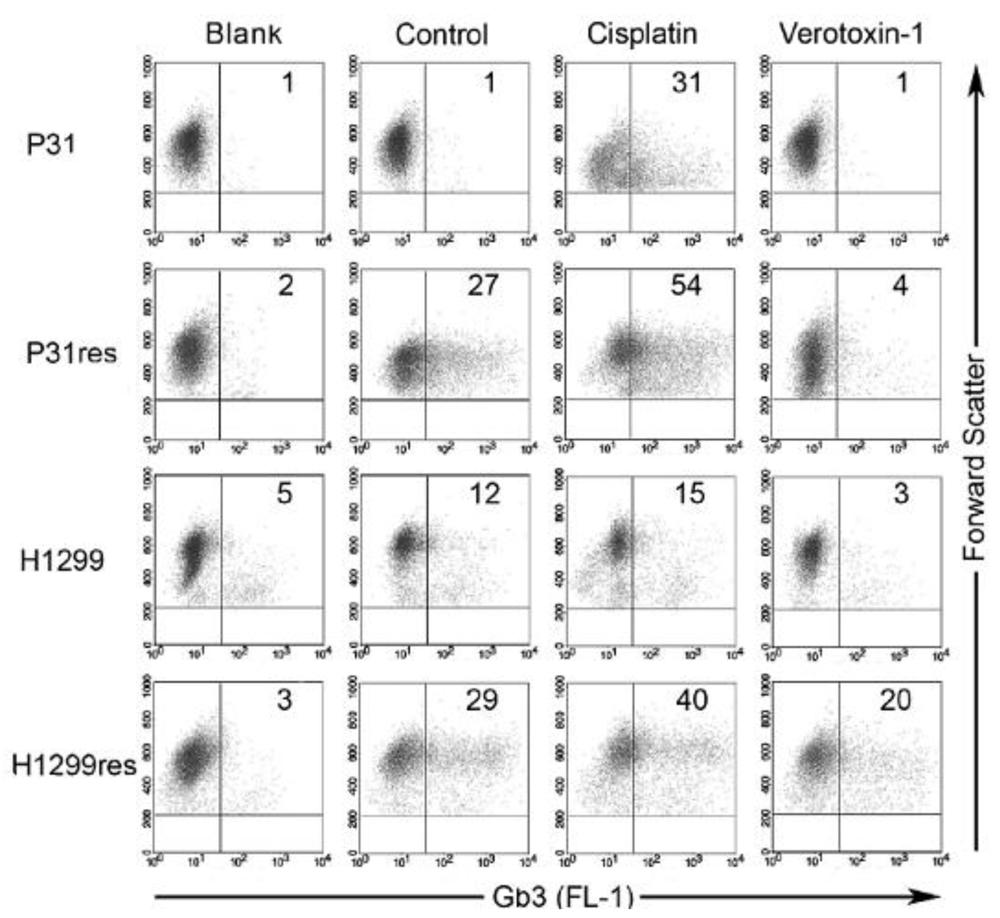
      <p>The treatment obstacle of acquired-cisplatin resistance in malignant plural mesothelioma (MPM) and other cancers makes it necessary to find new strategies to overcome resistance. We showed that cisplatin can up-regulate Gb3 expression in MPM and NSCLC cells and thus sensitize the cells to VT-1-induced cytotoxicity (<xref ref-type="fig" rid="toxins-02-02467-f001">Figure 1</xref>). The increased proportion of Gb3-expressing cells after cisplatin treatment suggests that cisplatin induces Gb3 expression in cancer cells, that cisplatin preferentially eradicates cell with low Gb3 expression and that Gb3 expression is linked to acquired cisplatin-resistance [<xref ref-type="bibr" rid="B15-toxins-02-02467">15</xref>]. We could also correlate increased expression of Gb3 in cisplatin-resistant MPM and NSCLC cells to increased expression of MDR1/PgP. PPMP reduced Gb3 expression in resistant sub-line cells and particularly of the Gb3-expressing fraction that was induced when the mother cell line was made cisplatin-resistant. A strong super-additive effect of combined cisplatin and a sub-toxic concentration of VT-1 in cisplatin-resistant malignant pleural mesothelioma cells were observed, indicating a new potential and urgently needed clinical treatment approach [<xref ref-type="bibr" rid="B15-toxins-02-02467">15</xref>].</p>
      <fig id="toxins-02-02467-f001" position="anchor">
        <label>Figure 1</label>
        <caption>
          <p>Flow cytometry analysis of membrane bound Gb3 expression by cultured cisplatin-resistant (res) and non-resistant malignant pleural mesothelioma cells (P31) and non-small cell lung cancer cells (H1299) not incubated with and cells incubated for 72  h with 5  mg  L<sup>–1</sup> cisplatin or 0.1  <italic>μ</italic>g L<sup>–1</sup> VT-1, respectively. The percentage of Gb3-expressing cells is noted in the right quadrant in each dot plot. Blank shows unspecific secondary antibody binding, whereas control shows cells not incubated with either cisplatin or VT-1. Cisplatin resulted in further enhanced Gb3 expression, while VT-1 treatment resulted in a complete eradication of the Gb3 expressing cell population [<xref ref-type="bibr" rid="B15-toxins-02-02467">15</xref>].</p>
        </caption>
        <graphic xmlns:xlink="http://www.w3.org/1999/xlink" xlink:href="toxins-02-02467-g001.tif"/>
      </fig>
      <p>The MAPK pathway is involved in proapoptotic signaling of VT-1 in stressed cell systems and the pathway is also involved in cisplatin-induced apoptosis and induced cisplatin resistance [<xref ref-type="bibr" rid="B15-toxins-02-02467">15</xref>,<xref ref-type="bibr" rid="B80-toxins-02-02467">80</xref>]. Targeting the MAPK signaling pathway could, therefore, be an additional way to reduce cisplatin-induced tumor cells resistance. </p>
      <p>The partial cell surface co-localization of Gb3/MDR1, the modulation of MDR1 cell surface expression by GSL and the possibility to inhibit MDR1 expression by VT-1/VT-1 B-subunit, all indicate a functional link between Gb3 and MDR1. Targeting the physiological regulation of MDR1 could be an efficient way not only to prevent the development of drug resistance during cancer chemotherapy but also to reverse inherent and acquired drug resistance of cancers.</p>
    </sec>
  </body>
  <back>
    <ack>
      <title>Acknowledgements</title>
      <p>We would like to thank the Lions foundation, the Swedish Cancer Society, the County Council, and the Faculty of Medicine, Umea University, for funding.</p>
    </ack>
    <ref-list>
      <title>References</title>
      <ref id="B1-toxins-02-02467">
        <label>1.</label>
        <citation citation-type="journal">
          <person-group person-group-type="author">
            <name>
              <surname>Cohen</surname>
              <given-names>A.</given-names>
            </name>
            <name>
              <surname>Hannigan</surname>
              <given-names>G.E.</given-names>
            </name>
            <name>
              <surname>Williams</surname>
              <given-names>B.R.</given-names>
            </name>
            <name>
              <surname>Lingwood</surname>
              <given-names>C.A.</given-names>
            </name>
          </person-group>
          <article-title>Roles of globotriosyl- and galabiosylceramide in verotoxin binding and high affinity interferon receptor</article-title>
          <source>J. Biol. Chem.</source>
          <year>1987</year>
          <volume>262</volume>
          <fpage>17088</fpage>
          <lpage>17091</lpage>
        <pub-id pub-id-type="pmid">2824515</pub-id></citation>
      </ref>
      <ref id="B2-toxins-02-02467">
        <label>2.</label>
        <citation citation-type="journal">
          <person-group person-group-type="author">
            <name>
              <surname>Lingwood</surname>
              <given-names>C.A.</given-names>
            </name>
            <name>
              <surname>Law</surname>
              <given-names>H.</given-names>
            </name>
            <name>
              <surname>Richardson</surname>
              <given-names>S.</given-names>
            </name>
            <name>
              <surname>Petric</surname>
              <given-names>M.</given-names>
            </name>
            <name>
              <surname>Brunton</surname>
              <given-names>J.L.</given-names>
            </name>
            <name>
              <surname>De Grandis</surname>
              <given-names>S.</given-names>
            </name>
            <name>
              <surname>Karmali</surname>
              <given-names>M.</given-names>
            </name>
          </person-group>
          <article-title>Glycolipid binding of purified and recombinant <italic>Escherichia coli</italic> produced verotoxin <italic>in vitro</italic></article-title>
          <source>J. Biol. Chem.</source>
          <year>1987</year>
          <volume>262</volume>
          <fpage>8834</fpage>
          <lpage>8839</lpage>
        <pub-id pub-id-type="pmid">3298243</pub-id></citation>
      </ref>
      <ref id="B3-toxins-02-02467">
        <label>3.</label>
        <citation citation-type="journal">
          <person-group person-group-type="author">
            <name>
              <surname>Jacewicz</surname>
              <given-names>M.</given-names>
            </name>
            <name>
              <surname>Feldman</surname>
              <given-names>H.A.</given-names>
            </name>
            <name>
              <surname>Donohue-Rolfe</surname>
              <given-names>A.</given-names>
            </name>
            <name>
              <surname>Balasubramanian</surname>
              <given-names>K.A.</given-names>
            </name>
            <name>
              <surname>Keusch</surname>
              <given-names>G.T.</given-names>
            </name>
          </person-group>
          <article-title>Pathogenesis of <italic>Shigella diarrhea</italic>. XIV. Analysis of Shiga toxin receptors on cloned HeLa cells</article-title>
          <source>J. Infect. Dis.</source>
          <year>1989</year>
          <volume>159</volume>
          <fpage>881</fpage>
          <lpage>889</lpage>
          <pub-id pub-id-type="pmid">2651533</pub-id>
          <pub-id pub-id-type="doi">10.1093/infdis/159.5.881</pub-id>
        </citation>
      </ref>
      <ref id="B4-toxins-02-02467">
        <label>4.</label>
        <citation citation-type="journal">
          <person-group person-group-type="author">
            <name>
              <surname>Lindberg</surname>
              <given-names>A.A.</given-names>
            </name>
            <name>
              <surname>Brown</surname>
              <given-names>J.E.</given-names>
            </name>
            <name>
              <surname>Strömberg</surname>
              <given-names>N.</given-names>
            </name>
            <name>
              <surname>Westling-Ryd</surname>
              <given-names>M.</given-names>
            </name>
            <name>
              <surname>Schultz</surname>
              <given-names>J.E.</given-names>
            </name>
            <name>
              <surname>Karlsson</surname>
              <given-names>K.A.</given-names>
            </name>
          </person-group>
          <article-title>Identification of the carbohydrate receptor for Shiga toxin produced by <italic>Shigella dysenteriae</italic> type 1</article-title>
          <source>J. Biol. Chem.</source>
          <year>1987</year>
          <volume>262</volume>
          <fpage>1779</fpage>
          <lpage>1785</lpage>
        <pub-id pub-id-type="pmid">3543013</pub-id></citation>
      </ref>
      <ref id="B5-toxins-02-02467">
        <label>5.</label>
        <citation citation-type="journal">
          <person-group person-group-type="author">
            <name>
              <surname>Waddell</surname>
              <given-names>T.</given-names>
            </name>
            <name>
              <surname>Cohen</surname>
              <given-names>A.</given-names>
            </name>
            <name>
              <surname>Lingwood</surname>
              <given-names>C.A.</given-names>
            </name>
          </person-group>
          <article-title>Induction of verotoxin sensitivity in receptor-deficient cell lines using the receptor glycolipid globotriosylceramide</article-title>
          <source>Proc. Natl. Acad. Sci. USA</source>
          <year>1990</year>
          <volume>87</volume>
          <fpage>7898</fpage>
          <lpage>7901</lpage>
        <pub-id pub-id-type="doi">10.1073/pnas.87.20.7898</pub-id><pub-id pub-id-type="pmid">2236008</pub-id></citation>
      </ref>
      <ref id="B6-toxins-02-02467">
        <label>6.</label>
        <citation citation-type="journal">
          <person-group person-group-type="author">
            <name>
              <surname>Endo</surname>
              <given-names>Y.</given-names>
            </name>
            <name>
              <surname>Tsurugi</surname>
              <given-names>K.</given-names>
            </name>
            <name>
              <surname>Yutsudo</surname>
              <given-names>T.</given-names>
            </name>
            <name>
              <surname>Takeda</surname>
              <given-names>Y.</given-names>
            </name>
            <name>
              <surname>Ogasawara</surname>
              <given-names>T.</given-names>
            </name>
            <name>
              <surname>Igarashi</surname>
              <given-names>K.</given-names>
            </name>
          </person-group>
          <article-title>Site of action of a Vero toxin (VT2) from <italic>Escherichia coli</italic> O157:H7 and of Shiga toxin on eukaryotic ribosomes. RNA N-glycosidase activity of the toxins</article-title>
          <source>Eur. J. Biochem.</source>
          <year>1988</year>
          <volume>171</volume>
          <fpage>45</fpage>
          <lpage>50</lpage>
          <pub-id pub-id-type="pmid">3276522</pub-id>
          <pub-id pub-id-type="doi">10.1111/j.1432-1033.1988.tb13756.x</pub-id>
        </citation>
      </ref>
      <ref id="B7-toxins-02-02467">
        <label>7.</label>
        <citation citation-type="journal">
          <person-group person-group-type="author">
            <name>
              <surname>Gariepy</surname>
              <given-names>J.</given-names>
            </name>
          </person-group>
          <article-title>The use of Shiga-like toxin 1 in cancer therapy</article-title>
          <source>Crit. Rev. Oncol. Hematol.</source>
          <year>2001</year>
          <volume>39</volume>
          <fpage>99</fpage>
          <lpage>106</lpage>
        <pub-id pub-id-type="doi">10.1016/S1040-8428(01)00126-3</pub-id><pub-id pub-id-type="pmid">11418306</pub-id></citation>
      </ref>
      <ref id="B8-toxins-02-02467">
        <label>8.</label>
        <citation citation-type="journal">
          <person-group person-group-type="author">
            <name>
              <surname>O'Brien</surname>
              <given-names>A.D.</given-names>
            </name>
            <name>
              <surname>Tesh</surname>
              <given-names>V.L.</given-names>
            </name>
            <name>
              <surname>Donohue-Rolfe</surname>
              <given-names>A.</given-names>
            </name>
            <name>
              <surname>Jackson</surname>
              <given-names>M.P.</given-names>
            </name>
            <name>
              <surname>Olsnes</surname>
              <given-names>S.</given-names>
            </name>
            <name>
              <surname>Sandvig</surname>
              <given-names>K.</given-names>
            </name>
            <name>
              <surname>Lindberg</surname>
              <given-names>A.A.</given-names>
            </name>
            <name>
              <surname>Keusch</surname>
              <given-names>G.T.</given-names>
            </name>
          </person-group>
          <article-title>Shiga toxin: biochemistry, genetics, mode of action, and role in pathogenesis</article-title>
          <source>Curr. Top. Microbiol. Immunol.</source>
          <year>1992</year>
          <volume>180</volume>
          <fpage>65</fpage>
          <lpage>94</lpage>
        <pub-id pub-id-type="pmid">1324134</pub-id></citation>
      </ref>
      <ref id="B9-toxins-02-02467">
        <label>9.</label>
        <citation citation-type="journal">
          <person-group person-group-type="author">
            <name>
              <surname>Olsnes</surname>
              <given-names>S.</given-names>
            </name>
            <name>
              <surname>Sandvig</surname>
              <given-names>K.</given-names>
            </name>
          </person-group>
          <article-title>How protein toxins enter and kill cells</article-title>
          <source>Canc. Treat. Res.</source>
          <year>1988</year>
          <volume>37</volume>
          <fpage>39</fpage>
          <lpage>73</lpage>
        </citation>
      </ref>
      <ref id="B10-toxins-02-02467">
        <label>10.</label>
        <citation citation-type="journal">
          <person-group person-group-type="author">
            <name>
              <surname>Raa</surname>
              <given-names>H.</given-names>
            </name>
            <name>
              <surname>Grimmer</surname>
              <given-names>S.</given-names>
            </name>
            <name>
              <surname>Schwudke</surname>
              <given-names>D.</given-names>
            </name>
            <name>
              <surname>Bergan</surname>
              <given-names>J.</given-names>
            </name>
            <name>
              <surname>Walchli</surname>
              <given-names>S.</given-names>
            </name>
            <name>
              <surname>Skotland</surname>
              <given-names>T.</given-names>
            </name>
            <name>
              <surname>Shevchenko</surname>
              <given-names>A.</given-names>
            </name>
            <name>
              <surname>Sandvig</surname>
              <given-names>K.</given-names>
            </name>
          </person-group>
          <article-title>Glycosphingolipid requirements for endosome-to-Golgi transport of Shiga toxin</article-title>
          <source>Traffic</source>
          <year>2009</year>
          <volume>10</volume>
          <fpage>868</fpage>
          <lpage>882</lpage>
        <pub-id pub-id-type="doi">10.1111/j.1600-0854.2009.00919.x</pub-id><pub-id pub-id-type="pmid">19453975</pub-id></citation>
      </ref>
      <ref id="B11-toxins-02-02467">
        <label>11.</label>
        <citation citation-type="journal">
          <person-group person-group-type="author">
            <name>
              <surname>Sandvig</surname>
              <given-names>K.</given-names>
            </name>
            <name>
              <surname>Grimmer</surname>
              <given-names>S.</given-names>
            </name>
            <name>
              <surname>Lauvrak</surname>
              <given-names>S.U.</given-names>
            </name>
            <name>
              <surname>Torgersen</surname>
              <given-names>M.L.</given-names>
            </name>
            <name>
              <surname>Skretting</surname>
              <given-names>G.</given-names>
            </name>
            <name>
              <surname>van Deurs</surname>
              <given-names>B.</given-names>
            </name>
            <name>
              <surname>Iversen</surname>
              <given-names>T.G.</given-names>
            </name>
          </person-group>
          <article-title>Pathways followed by ricin and Shiga toxin into cells</article-title>
          <source>Histochem. Cell Biol.</source>
          <year>2002</year>
          <volume>117</volume>
          <fpage>131</fpage>
          <lpage>141</lpage>
        <pub-id pub-id-type="doi">10.1007/s00418-001-0346-2</pub-id><pub-id pub-id-type="pmid">11935289</pub-id></citation>
      </ref>
      <ref id="B12-toxins-02-02467">
        <label>12.</label>
        <citation citation-type="journal">
          <person-group person-group-type="author">
            <name>
              <surname>Saxena</surname>
              <given-names>S.K.</given-names>
            </name>
            <name>
              <surname>O'Brien</surname>
              <given-names>A.D.</given-names>
            </name>
            <name>
              <surname>Ackerman</surname>
              <given-names>E.J.</given-names>
            </name>
          </person-group>
          <article-title>Shiga toxin, Shiga-like toxin II variant, and ricin are all single-site RNA N-glycosidases of 28 S RNA when microinjected into Xenopus oocytes</article-title>
          <source>J. Biol. Chem.</source>
          <year>1989</year>
          <volume>264</volume>
          <fpage>596</fpage>
          <lpage>601</lpage>
        <pub-id pub-id-type="pmid">2642481</pub-id></citation>
      </ref>
      <ref id="B13-toxins-02-02467">
        <label>13.</label>
        <citation citation-type="journal">
          <person-group person-group-type="author">
            <name>
              <surname>Kojio</surname>
              <given-names>S.</given-names>
            </name>
            <name>
              <surname>Zhang</surname>
              <given-names>H.</given-names>
            </name>
            <name>
              <surname>Ohmura</surname>
              <given-names>M.</given-names>
            </name>
            <name>
              <surname>Gondaira</surname>
              <given-names>F.</given-names>
            </name>
            <name>
              <surname>Kobayashi</surname>
              <given-names>N.</given-names>
            </name>
            <name>
              <surname>Yamamoto</surname>
              <given-names>T.</given-names>
            </name>
          </person-group>
          <article-title>Caspase-3 activation and apoptosis induction coupled with the retrograde transport of Shiga toxin: Inhibition by brefeldin A</article-title>
          <source>FEMS Immunol. Med. Microbiol.</source>
          <year>2000</year>
          <volume>29</volume>
          <fpage>275</fpage>
          <lpage>281</lpage>
        <pub-id pub-id-type="doi">10.1111/j.1574-695X.2000.tb01534.x</pub-id><pub-id pub-id-type="pmid">11118908</pub-id></citation>
      </ref>
      <ref id="B14-toxins-02-02467">
        <label>14.</label>
        <citation citation-type="journal">
          <person-group person-group-type="author">
            <name>
              <surname>Johannes</surname>
              <given-names>L.</given-names>
            </name>
            <name>
              <surname>Römer</surname>
              <given-names>W.</given-names>
            </name>
          </person-group>
          <article-title>Shiga toxins—From cell biology to biomedical applications</article-title>
          <source>Nat. Rev. Microbiol.</source>
          <year>2010</year>
          <volume>8</volume>
          <fpage>105</fpage>
          <lpage>116</lpage>
        <pub-id pub-id-type="pmid">20023663</pub-id></citation>
      </ref>
      <ref id="B15-toxins-02-02467">
        <label>15.</label>
        <citation citation-type="journal">
          <person-group person-group-type="author">
            <name>
              <surname>Johansson</surname>
              <given-names>D.</given-names>
            </name>
            <name>
              <surname>Andersson</surname>
              <given-names>C.</given-names>
            </name>
            <name>
              <surname>Moharer</surname>
              <given-names>J.</given-names>
            </name>
            <name>
              <surname>Johansson</surname>
              <given-names>A.</given-names>
            </name>
            <name>
              <surname>Behnam-Motlagh</surname>
              <given-names>P.</given-names>
            </name>
          </person-group>
          <article-title>Cisplatin-induced expression of Gb3 enables verotoxin-1 treatment of cisplatin resistance in malignant pleural mesothelioma cells</article-title>
          <source>Br. J. Canc.</source>
          <year>2010</year>
          <volume>19</volume>
          <fpage>383</fpage>
          <lpage>391</lpage>
        </citation>
      </ref>
      <ref id="B16-toxins-02-02467">
        <label>16.</label>
        <citation citation-type="journal">
          <person-group person-group-type="author">
            <name>
              <surname>Derijard</surname>
              <given-names>B.</given-names>
            </name>
            <name>
              <surname>Raingeaud</surname>
              <given-names>J.</given-names>
            </name>
            <name>
              <surname>Barrett</surname>
              <given-names>T.</given-names>
            </name>
            <name>
              <surname>Wu</surname>
              <given-names>I.H.</given-names>
            </name>
            <name>
              <surname>Han</surname>
              <given-names>J.</given-names>
            </name>
            <name>
              <surname>Ulevitch</surname>
              <given-names>R.J.</given-names>
            </name>
            <name>
              <surname>Davis</surname>
              <given-names>R.J.</given-names>
            </name>
          </person-group>
          <article-title>Independent human MAP-kinase signal transduction pathways defined by MEK and MKK isoforms</article-title>
          <source>Science</source>
          <year>1995</year>
          <volume>267</volume>
          <fpage>682</fpage>
          <lpage>685</lpage>
        <pub-id pub-id-type="doi">10.1126/science.7839144</pub-id><pub-id pub-id-type="pmid">7839144</pub-id></citation>
      </ref>
      <ref id="B17-toxins-02-02467">
        <label>17.</label>
        <citation citation-type="journal">
          <person-group person-group-type="author">
            <name>
              <surname>Han</surname>
              <given-names>J.</given-names>
            </name>
            <name>
              <surname>Lee</surname>
              <given-names>J.D.</given-names>
            </name>
            <name>
              <surname>Jiang</surname>
              <given-names>Y.</given-names>
            </name>
            <name>
              <surname>Li</surname>
              <given-names>Z.</given-names>
            </name>
            <name>
              <surname>Feng</surname>
              <given-names>L.</given-names>
            </name>
            <name>
              <surname>Ulevitch</surname>
              <given-names>R.J.</given-names>
            </name>
          </person-group>
          <article-title>Characterization of the structure and function of a novel MAP kinase kinase (MKK6)</article-title>
          <source>J. Biol. Chem.</source>
          <year>1996</year>
          <volume>271</volume>
          <fpage>2886</fpage>
          <lpage>2891</lpage>
        <pub-id pub-id-type="doi">10.1074/jbc.271.6.2886</pub-id><pub-id pub-id-type="pmid">8621675</pub-id></citation>
      </ref>
      <ref id="B18-toxins-02-02467">
        <label>18.</label>
        <citation citation-type="journal">
          <person-group person-group-type="author">
            <name>
              <surname>Kim</surname>
              <given-names>B.J.</given-names>
            </name>
            <name>
              <surname>Ryu</surname>
              <given-names>SW.</given-names>
            </name>
            <name>
              <surname>Song</surname>
              <given-names>B.J.</given-names>
            </name>
          </person-group>
          <article-title>JNK- and p38 kinase-mediated phosphorylation of Bax leads to its activation and mitochondrial translocation and to apoptosis of human hepatoma HepG2 cells</article-title>
          <source>J. Biol. Chem.</source>
          <year>2006</year>
          <volume>281</volume>
          <fpage>21256</fpage>
          <lpage>21265</lpage>
        <pub-id pub-id-type="doi">10.1074/jbc.M510644200</pub-id><pub-id pub-id-type="pmid">16709574</pub-id></citation>
      </ref>
      <ref id="B19-toxins-02-02467">
        <label>19.</label>
        <citation citation-type="journal">
          <person-group person-group-type="author">
            <name>
              <surname>Walchli</surname>
              <given-names>S.</given-names>
            </name>
            <name>
              <surname>Skanland</surname>
              <given-names>S.S.</given-names>
            </name>
            <name>
              <surname>Gregers</surname>
              <given-names>T.F.</given-names>
            </name>
            <name>
              <surname>Lauvrak</surname>
              <given-names>S.U.</given-names>
            </name>
            <name>
              <surname>Torgersen</surname>
              <given-names>M.L.</given-names>
            </name>
            <name>
              <surname>Ying</surname>
              <given-names>M.</given-names>
            </name>
            <name>
              <surname>Kuroda</surname>
              <given-names>S.</given-names>
            </name>
            <name>
              <surname>Maturana</surname>
              <given-names>A.</given-names>
            </name>
            <name>
              <surname>Sandvig</surname>
              <given-names>K.</given-names>
            </name>
          </person-group>
          <article-title>The Mitogen-activated protein kinase p38 links Shiga Toxin-dependent signaling and trafficking</article-title>
          <source>Mol. Biol. Cell</source>
          <year>2008</year>
          <volume>19</volume>
          <fpage>95</fpage>
          <lpage>104</lpage>
        <pub-id pub-id-type="doi">10.1091/mbc.E07-06-0565</pub-id><pub-id pub-id-type="pmid">17959827</pub-id></citation>
      </ref>
      <ref id="B20-toxins-02-02467">
        <label>20.</label>
        <citation citation-type="journal">
          <person-group person-group-type="author">
            <name>
              <surname>Lee</surname>
              <given-names>S.Y.</given-names>
            </name>
            <name>
              <surname>Cherla</surname>
              <given-names>R.P.</given-names>
            </name>
            <name>
              <surname>Tesh</surname>
              <given-names>V.L.</given-names>
            </name>
          </person-group>
          <article-title>Simultaneous induction of apoptotic and survival signaling pathways in macrophage-like THP-1 cells by Shiga toxin 1</article-title>
          <source>Infect. Immun.</source>
          <year>2007</year>
          <volume>75</volume>
          <fpage>1291</fpage>
          <lpage>1302</lpage>
        <pub-id pub-id-type="doi">10.1128/IAI.01700-06</pub-id><pub-id pub-id-type="pmid">17194804</pub-id></citation>
      </ref>
      <ref id="B21-toxins-02-02467">
        <label>21.</label>
        <citation citation-type="journal">
          <person-group person-group-type="author">
            <name>
              <surname>Johansson</surname>
              <given-names>D.</given-names>
            </name>
            <name>
              <surname>Johansson</surname>
              <given-names>A.</given-names>
            </name>
            <name>
              <surname>Grankvist</surname>
              <given-names>K.</given-names>
            </name>
            <name>
              <surname>Andersson</surname>
              <given-names>U.</given-names>
            </name>
            <name>
              <surname>Henriksson</surname>
              <given-names>R.</given-names>
            </name>
            <name>
              <surname>Bergström</surname>
              <given-names>P.</given-names>
            </name>
            <name>
              <surname>Brännström</surname>
              <given-names>T.</given-names>
            </name>
            <name>
              <surname>Behnam-Motlagh</surname>
              <given-names>P.</given-names>
            </name>
          </person-group>
          <article-title>Verotoxin-1 induction of apoptosis in Gb3-expressing human glioma cell lines</article-title>
          <source>Canc. Biol. Ther.</source>
          <year>2006</year>
          <volume>5</volume>
          <fpage>1211</fpage>
          <lpage>1217</lpage>
          <pub-id pub-id-type="doi">10.4161/cbt.5.9.3173</pub-id>
        </citation>
      </ref>
      <ref id="B22-toxins-02-02467">
        <label>22.</label>
        <citation citation-type="journal">
          <person-group person-group-type="author">
            <name>
              <surname>Johansson</surname>
              <given-names>D.</given-names>
            </name>
            <name>
              <surname>Kosovac</surname>
              <given-names>E.</given-names>
            </name>
            <name>
              <surname>Moharer</surname>
              <given-names>J.</given-names>
            </name>
            <name>
              <surname>Ljuslinder</surname>
              <given-names>I.</given-names>
            </name>
            <name>
              <surname>Brännström</surname>
              <given-names>T.</given-names>
            </name>
            <name>
              <surname>Johansson</surname>
              <given-names>A.</given-names>
            </name>
            <name>
              <surname>Behnam-Motlagh</surname>
              <given-names>P.</given-names>
            </name>
          </person-group>
          <article-title>Expression of verotoxin-1 receptor Gb3 in breast cancer tissue and verotoxin-1 signal transduction to apoptosis</article-title>
          <source>BMC Cancer</source>
          <year>2009</year>
          <volume>9</volume>
          <fpage>67</fpage>
        <pub-id pub-id-type="doi">10.1186/1471-2407-9-67</pub-id><pub-id pub-id-type="pmid">19245689</pub-id></citation>
      </ref>
      <ref id="B23-toxins-02-02467">
        <label>23.</label>
        <citation citation-type="journal">
          <person-group person-group-type="author">
            <name>
              <surname>Jones</surname>
              <given-names>N.L.</given-names>
            </name>
            <name>
              <surname>Islur</surname>
              <given-names>A.</given-names>
            </name>
            <name>
              <surname>Haq</surname>
              <given-names>R.</given-names>
            </name>
            <name>
              <surname>Mascarenhas</surname>
              <given-names>M.</given-names>
            </name>
            <name>
              <surname>Karmali</surname>
              <given-names>M.A.</given-names>
            </name>
            <name>
              <surname>Perdue</surname>
              <given-names>M.H.</given-names>
            </name>
            <name>
              <surname>Zanke</surname>
              <given-names>B.W.</given-names>
            </name>
            <name>
              <surname>Sherman</surname>
              <given-names>P.M.</given-names>
            </name>
          </person-group>
          <article-title><italic>Escherichia coli</italic> Shiga toxins induce apoptosis in epithelial cells that is regulated by the Bcl-2 family</article-title>
          <source>Am. J. Physiol. Gastrointest. Liver Physiol.</source>
          <year>2000</year>
          <volume>278</volume>
          <fpage>G811</fpage>
          <lpage>G819</lpage>
        <pub-id pub-id-type="pmid">10801274</pub-id></citation>
      </ref>
      <ref id="B24-toxins-02-02467">
        <label>24.</label>
        <citation citation-type="journal">
          <person-group person-group-type="author">
            <name>
              <surname>Suzuki</surname>
              <given-names>A.</given-names>
            </name>
            <name>
              <surname>Doi</surname>
              <given-names>H.</given-names>
            </name>
            <name>
              <surname>Matsuzawa</surname>
              <given-names>F.</given-names>
            </name>
            <name>
              <surname>Aikawa</surname>
              <given-names>S.</given-names>
            </name>
            <name>
              <surname>Takiguchi</surname>
              <given-names>K.</given-names>
            </name>
            <name>
              <surname>Kawano</surname>
              <given-names>H.</given-names>
            </name>
            <name>
              <surname>Hayashida</surname>
              <given-names>M.</given-names>
            </name>
            <name>
              <surname>Ohno</surname>
              <given-names>S.</given-names>
            </name>
          </person-group>
          <article-title>Bcl-2 antiapoptotic protein mediates verotoxin II-induced cell death: Possible association between Bcl-2 and tissue failure by <italic>E. coli</italic> O157:H7</article-title>
          <source>Genes Dev.</source>
          <year>2000</year>
          <volume>14</volume>
          <fpage>1734</fpage>
          <lpage>1740</lpage>
          <pub-id pub-id-type="pmid">10898788</pub-id>
        </citation>
      </ref>
      <ref id="B25-toxins-02-02467">
        <label>25.</label>
        <citation citation-type="journal">
          <person-group person-group-type="author">
            <name>
              <surname>Erwert</surname>
              <given-names>R.D</given-names>
            </name>
            <name>
              <surname>Eiting</surname>
              <given-names>K.T.</given-names>
            </name>
            <name>
              <surname>Tupper</surname>
              <given-names>J.C.</given-names>
            </name>
            <name>
              <surname>Winn</surname>
              <given-names>R.K.</given-names>
            </name>
            <name>
              <surname>Harlan</surname>
              <given-names>J.M.</given-names>
            </name>
            <name>
              <surname>Bannerman</surname>
              <given-names>D.D.</given-names>
            </name>
          </person-group>
          <article-title>Shiga toxin induces decreased expression of the anti-apoptotic protein Mcl-1 concomitant with the onset of endothelial apoptosis</article-title>
          <source>Microb. Pathog.</source>
          <year>2003</year>
          <volume>35</volume>
          <fpage>87</fpage>
          <lpage>93</lpage>
          <pub-id pub-id-type="pmid">12901848</pub-id>
          <pub-id pub-id-type="doi">10.1016/S0882-4010(03)00100-1</pub-id>
        </citation>
      </ref>
      <ref id="B26-toxins-02-02467">
        <label>26.</label>
        <citation citation-type="thesis">
          <person-group person-group-type="author">
            <name>
              <surname>Janson</surname>
              <given-names>V.</given-names>
            </name>
            <name>
              <surname>Henriksson</surname>
              <given-names>R.</given-names>
            </name>
            <name>
              <surname>Grankvist</surname>
              <given-names>K.</given-names>
            </name>
          </person-group>
          <article-title>Acquisition of cisplatin-resistance in malignant mesothelioma cells reregulates pro-apoptotic BH3-only proteins</article-title>
          <publisher-name>PhD Thesis, Umea University</publisher-name>
          <publisher-loc>Umea, Sweden</publisher-loc>
          <year>2010</year>
          <comment>in preparation.</comment>
        </citation>
      </ref>
      <ref id="B27-toxins-02-02467">
        <label>27.</label>
        <citation citation-type="journal">
          <person-group person-group-type="author">
            <name>
              <surname>Janson</surname>
              <given-names>V.</given-names>
            </name>
            <name>
              <surname>Johansson</surname>
              <given-names>A.</given-names>
            </name>
            <name>
              <surname>Grankvist</surname>
              <given-names>K.</given-names>
            </name>
          </person-group>
          <article-title>Resistance to caspase-8 and -9 fragments in a malignant pleural mesothelioma cell line with acquired cosplatin-resistance</article-title>
          <source>Cell Death Dis.</source>
          <year>2010</year>
          <volume>1</volume>
          <fpage>e78</fpage>
        <pub-id pub-id-type="doi">10.1038/cddis.2010.54</pub-id><pub-id pub-id-type="pmid">21364680</pub-id></citation>
      </ref>
      <ref id="B28-toxins-02-02467">
        <label>28.</label>
        <citation citation-type="journal">
          <person-group person-group-type="author">
            <name>
              <surname>Erdmann</surname>
              <given-names>M.</given-names>
            </name>
            <name>
              <surname>Wipfler</surname>
              <given-names>D.</given-names>
            </name>
            <name>
              <surname>Merling</surname>
              <given-names>A.</given-names>
            </name>
            <name>
              <surname>Cao</surname>
              <given-names>Y.</given-names>
            </name>
            <name>
              <surname>Claus</surname>
              <given-names>C.</given-names>
            </name>
            <name>
              <surname>Kniep</surname>
              <given-names>B.</given-names>
            </name>
            <name>
              <surname>Sadick</surname>
              <given-names>H.</given-names>
            </name>
            <name>
              <surname>Bergler</surname>
              <given-names>W.</given-names>
            </name>
            <name>
              <surname>Vlasak</surname>
              <given-names>R.</given-names>
            </name>
            <name>
              <surname>Schwartz-Albiez</surname>
              <given-names>R. </given-names>
            </name>
          </person-group>
          <article-title>Differential surface expression and possible function of 9-<italic>O</italic>- and 7-<italic>O</italic>-acetylated GD3 (CD60 b and c) during activation and apoptosis of human tonsillar B and T lymphocytes</article-title>
          <source>Glycoconj. J.</source>
          <year>2006</year>
          <volume>23</volume>
          <fpage>627</fpage>
          <lpage>638</lpage>
          <pub-id pub-id-type="pmid">17115281</pub-id>
          <pub-id pub-id-type="doi">10.1007/s10719-006-9000-5</pub-id>
        </citation>
      </ref>
      <ref id="B29-toxins-02-02467">
        <label>29.</label>
        <citation citation-type="journal">
          <person-group person-group-type="author">
            <name>
              <surname>Alessandri</surname>
              <given-names>G.</given-names>
            </name>
            <name>
              <surname>De Cristan</surname>
              <given-names>G.</given-names>
            </name>
            <name>
              <surname>Ziche</surname>
              <given-names>M.</given-names>
            </name>
            <name>
              <surname>Cappa</surname>
              <given-names>A.P.</given-names>
            </name>
            <name>
              <surname>Gullino</surname>
              <given-names>P.M.</given-names>
            </name>
          </person-group>
          <article-title>Growth and motility of microvascular endothelium are modulated by the relative concentration of gangliosides in the medium</article-title>
          <source>J. Cell Physiol.</source>
          <year>1992</year>
          <volume>151</volume>
          <fpage>23</fpage>
          <lpage>28</lpage>
        <pub-id pub-id-type="doi">10.1002/jcp.1041510105</pub-id><pub-id pub-id-type="pmid">1560045</pub-id></citation>
      </ref>
      <ref id="B30-toxins-02-02467">
        <label>30.</label>
        <citation citation-type="journal">
          <person-group person-group-type="author">
            <name>
              <surname>Lahiri</surname>
              <given-names>S.</given-names>
            </name>
            <name>
              <surname>Futerman</surname>
              <given-names>A.H.</given-names>
            </name>
          </person-group>
          <article-title>The metabolism and function of sphingolipids and glycosphingolipids</article-title>
          <source>Cell. Mol. Life Sci.</source>
          <year>2007</year>
          <volume>64</volume>
          <fpage>2270</fpage>
          <lpage>2284</lpage>
        <pub-id pub-id-type="doi">10.1007/s00018-007-7076-0</pub-id><pub-id pub-id-type="pmid">17558466</pub-id></citation>
      </ref>
      <ref id="B31-toxins-02-02467">
        <label>31.</label>
        <citation citation-type="journal">
          <person-group person-group-type="author">
            <name>
              <surname>Schnaar</surname>
              <given-names>R.L.</given-names>
            </name>
          </person-group>
          <article-title>Glycolipid-mediated cell-cell recognition in inflammation and nerve regeneration</article-title>
          <source>Arch. Biochem. Biophys.</source>
          <year>2004</year>
          <volume>426</volume>
          <fpage>163</fpage>
          <lpage>172</lpage>
        <pub-id pub-id-type="doi">10.1016/j.abb.2004.02.019</pub-id><pub-id pub-id-type="pmid">15158667</pub-id></citation>
      </ref>
      <ref id="B32-toxins-02-02467">
        <label>32.</label>
        <citation citation-type="journal">
          <person-group person-group-type="author">
            <name>
              <surname>Liu</surname>
              <given-names>Y.Y.</given-names>
            </name>
            <name>
              <surname>Gupta</surname>
              <given-names>V.</given-names>
            </name>
            <name>
              <surname>Patwardhan</surname>
              <given-names>G.A.</given-names>
            </name>
            <name>
              <surname>Bhinge</surname>
              <given-names>K.</given-names>
            </name>
            <name>
              <surname>Zhao</surname>
              <given-names>Y.</given-names>
            </name>
            <name>
              <surname>Bao</surname>
              <given-names>J.</given-names>
            </name>
            <name>
              <surname>Mehendale</surname>
              <given-names>H.</given-names>
            </name>
            <name>
              <surname>Cabot</surname>
              <given-names>M.C.</given-names>
            </name>
            <name>
              <surname>Li</surname>
              <given-names>Y.T.</given-names>
            </name>
            <name>
              <surname>Jazwinski</surname>
              <given-names>S.M.</given-names>
            </name>
          </person-group>
          <article-title>Glucosylceramide synthase upregulate Glucosylceramide synthase upregulates MDR1 expression in the regulation of cancer drug resistance through cSrc and beta-catenin signaling</article-title>
          <source>Mol. Cancer</source>
          <year>2010</year>
          <volume>9</volume>
          <fpage>145</fpage>
        <pub-id pub-id-type="pmid">20540746</pub-id></citation>
      </ref>
      <ref id="B33-toxins-02-02467">
        <label>33.</label>
        <citation citation-type="journal">
          <person-group person-group-type="author">
            <name>
              <surname>Okuda</surname>
              <given-names>T.</given-names>
            </name>
            <name>
              <surname>Tokuda</surname>
              <given-names>N.</given-names>
            </name>
            <name>
              <surname>Numata</surname>
              <given-names>S.</given-names>
            </name>
            <name>
              <surname>Ito</surname>
              <given-names>M.</given-names>
            </name>
            <name>
              <surname>Ohta</surname>
              <given-names>M.</given-names>
            </name>
            <name>
              <surname>Kawamura</surname>
              <given-names>K.</given-names>
            </name>
            <name>
              <surname>Wiels</surname>
              <given-names>J.</given-names>
            </name>
            <name>
              <surname>Urano</surname>
              <given-names>T.</given-names>
            </name>
            <name>
              <surname>Tajima</surname>
              <given-names>O.</given-names>
            </name>
            <name>
              <surname>Furukawa</surname>
              <given-names>K.</given-names>
            </name>
            <name>
              <surname>Furukawa</surname>
              <given-names>K.</given-names>
            </name>
          </person-group>
          <article-title>Targeted disruption of Gb3/CD77 synthase gene resulted in the complete deletion of globo-series glycosphingolipids and loss of sensitivity to verotoxins</article-title>
          <source>J. Biol. Chem.</source>
          <year>2006</year>
          <volume>281</volume>
          <fpage>10230</fpage>
          <lpage>10235</lpage>
        <pub-id pub-id-type="doi">10.1074/jbc.M600057200</pub-id><pub-id pub-id-type="pmid">16476743</pub-id></citation>
      </ref>
      <ref id="B34-toxins-02-02467">
        <label>34.</label>
        <citation citation-type="journal">
          <person-group person-group-type="author">
            <name>
              <surname>Lingwood</surname>
              <given-names>C.A.</given-names>
            </name>
            <name>
              <surname>Binnington</surname>
              <given-names>B.</given-names>
            </name>
            <name>
              <surname>Manis</surname>
              <given-names>A.</given-names>
            </name>
            <name>
              <surname>Branch</surname>
              <given-names>D.R.</given-names>
            </name>
          </person-group>
          <article-title>Globotriaosyl ceramide receptor function—Where membrane structure and pathology intersect</article-title>
          <source>FEBS Lett.</source>
          <year>2010</year>
          <volume>3</volume>
          <fpage>1879</fpage>
          <lpage>1886</lpage>
        </citation>
      </ref>
      <ref id="B35-toxins-02-02467">
        <label>35.</label>
        <citation citation-type="journal">
          <person-group person-group-type="author">
            <name>
              <surname>Chen</surname>
              <given-names>J.K.</given-names>
            </name>
            <name>
              <surname>Capdevila</surname>
              <given-names>J.</given-names>
            </name>
            <name>
              <surname>Harris</surname>
              <given-names>R.C.</given-names>
            </name>
          </person-group>
          <article-title>Overexpression of C-terminal Src kinase blocks 14, 15-epoxyeicosatrienoic acid-induced tyrosine phosphorylation and mitogenesis</article-title>
          <source>J. Biol. Chem.</source>
          <year>2000</year>
          <volume>275</volume>
          <fpage>13789</fpage>
          <lpage>13792</lpage>
        <pub-id pub-id-type="doi">10.1074/jbc.275.18.13789</pub-id><pub-id pub-id-type="pmid">10788500</pub-id></citation>
      </ref>
      <ref id="B36-toxins-02-02467">
        <label>36.</label>
        <citation citation-type="journal">
          <person-group person-group-type="author">
            <name>
              <surname>Kazui</surname>
              <given-names>A.</given-names>
            </name>
            <name>
              <surname>Ono</surname>
              <given-names>M.</given-names>
            </name>
            <name>
              <surname>Handa</surname>
              <given-names>K.</given-names>
            </name>
            <name>
              <surname>Hakomori</surname>
              <given-names>S.</given-names>
            </name>
          </person-group>
          <article-title>Glycosylation affects translocation of integrin, Src, and caveolin into or out of GEM</article-title>
          <source>Biochem. Biophys. Res. Commun.</source>
          <year>2000</year>
          <volume>273</volume>
          <fpage>159</fpage>
          <lpage>163</lpage>
        <pub-id pub-id-type="doi">10.1006/bbrc.2000.2903</pub-id><pub-id pub-id-type="pmid">10873579</pub-id></citation>
      </ref>
      <ref id="B37-toxins-02-02467">
        <label>37.</label>
        <citation citation-type="journal">
          <person-group person-group-type="author">
            <name>
              <surname>Hakomori</surname>
              <given-names>S.</given-names>
            </name>
            <name>
              <surname>Zhang</surname>
              <given-names>Y.</given-names>
            </name>
          </person-group>
          <article-title>Glycosphingolipid antigens and cancer therapy</article-title>
          <source>Chem. Biol.</source>
          <year>1997</year>
          <volume>4</volume>
          <fpage>97</fpage>
          <lpage>104</lpage>
        <pub-id pub-id-type="doi">10.1016/S1074-5521(97)90253-2</pub-id><pub-id pub-id-type="pmid">9190292</pub-id></citation>
      </ref>
      <ref id="B38-toxins-02-02467">
        <label>38.</label>
        <citation citation-type="journal">
          <person-group person-group-type="author">
            <name>
              <surname>Simons</surname>
              <given-names>K.</given-names>
            </name>
            <name>
              <surname>Ikonen</surname>
              <given-names>E.</given-names>
            </name>
          </person-group>
          <article-title>Functional rafts in cell membranes</article-title>
          <source>Nature</source>
          <year>1997</year>
          <volume>387</volume>
          <fpage>569</fpage>
          <lpage>572</lpage>
        <pub-id pub-id-type="doi">10.1038/42408</pub-id><pub-id pub-id-type="pmid">9177342</pub-id></citation>
      </ref>
      <ref id="B39-toxins-02-02467">
        <label>39.</label>
        <citation citation-type="journal">
          <person-group person-group-type="author">
            <name>
              <surname>Lingwood</surname>
              <given-names>C.A.</given-names>
            </name>
          </person-group>
          <article-title>Aglycone modulation of glycolipid receptor function</article-title>
          <source>Glycoconj. J.</source>
          <year>1996</year>
          <volume>13</volume>
          <fpage>495</fpage>
          <lpage>503</lpage>
        <pub-id pub-id-type="doi">10.1007/BF00731435</pub-id><pub-id pub-id-type="pmid">8872104</pub-id></citation>
      </ref>
      <ref id="B40-toxins-02-02467">
        <label>40.</label>
        <citation citation-type="journal">
          <person-group person-group-type="author">
            <name>
              <surname>Sandvig</surname>
              <given-names>K.</given-names>
            </name>
            <name>
              <surname>Garred</surname>
              <given-names>O.</given-names>
            </name>
            <name>
              <surname>van Helvoort</surname>
              <given-names>A.</given-names>
            </name>
            <name>
              <surname>van Meer</surname>
              <given-names>G.</given-names>
            </name>
            <name>
              <surname>van Deurs</surname>
              <given-names>B.</given-names>
            </name>
          </person-group>
          <article-title>Importance of glycolipid synthesis for butyric acid-induced sensitization to Shiga toxin and intracellular sorting of toxin in A431 cells</article-title>
          <source>Mol. Biol. Cell</source>
          <year>1996</year>
          <volume>7</volume>
          <fpage>1391</fpage>
          <lpage>1404</lpage>
          <pub-id pub-id-type="pmid">8885234</pub-id>
        </citation>
      </ref>
      <ref id="B41-toxins-02-02467">
        <label>41.</label>
        <citation citation-type="journal">
          <person-group person-group-type="author">
            <name>
              <surname>Kovbasnjuk</surname>
              <given-names>O.</given-names>
            </name>
            <name>
              <surname>Edidin</surname>
              <given-names>M.</given-names>
            </name>
            <name>
              <surname>Donowitz</surname>
              <given-names>M.</given-names>
            </name>
          </person-group>
          <article-title>Role of lipid rafts in Shiga toxin 1 interaction with the apical surface of Caco-2 cells</article-title>
          <source>J. Cell Sci.</source>
          <year>2001</year>
          <volume>114</volume>
          <fpage>4025</fpage>
          <lpage>4031</lpage>
        <pub-id pub-id-type="pmid">11739634</pub-id></citation>
      </ref>
      <ref id="B42-toxins-02-02467">
        <label>42.</label>
        <citation citation-type="journal">
          <person-group person-group-type="author">
            <name>
              <surname>Falguières</surname>
              <given-names>T.</given-names>
            </name>
            <name>
              <surname>Maak</surname>
              <given-names>M.</given-names>
            </name>
            <name>
              <surname>von Weyhern</surname>
              <given-names>C.</given-names>
            </name>
            <name>
              <surname>Sarr</surname>
              <given-names>M.</given-names>
            </name>
            <name>
              <surname>Sastre</surname>
              <given-names>X.</given-names>
            </name>
            <name>
              <surname>Poupon</surname>
              <given-names>M-F.</given-names>
            </name>
            <name>
              <surname>Robine</surname>
              <given-names>S.</given-names>
            </name>
            <name>
              <surname>Johannes</surname>
              <given-names>L.</given-names>
            </name>
            <name>
              <surname>Janssen</surname>
              <given-names>K-P.</given-names>
            </name>
          </person-group>
          <article-title>Human colorectal tumors and metastases express Gb3 and can be targeted by an intestinal pathogen-based delivery tool</article-title>
          <source>Mol. Cancer Ther.</source>
          <year>2008</year>
          <volume>7</volume>
          <fpage>2498</fpage>
          <lpage>2508</lpage>
          <pub-id pub-id-type="pmid">18687997</pub-id>
        </citation>
      </ref>
      <ref id="B43-toxins-02-02467">
        <label>43.</label>
        <citation citation-type="journal">
          <person-group person-group-type="author">
            <name>
              <surname>Smith</surname>
              <given-names>D.C.</given-names>
            </name>
            <name>
              <surname>Sillence</surname>
              <given-names>D.J.</given-names>
            </name>
            <name>
              <surname>Falguieres</surname>
              <given-names>T.</given-names>
            </name>
            <name>
              <surname>Jarvis</surname>
              <given-names>R.M.</given-names>
            </name>
            <name>
              <surname>Johannes</surname>
              <given-names>L.</given-names>
            </name>
            <name>
              <surname>Lord</surname>
              <given-names>J.M.</given-names>
            </name>
            <name>
              <surname>Platt</surname>
              <given-names>F.M.</given-names>
            </name>
            <name>
              <surname>Roberts</surname>
              <given-names>L.M.</given-names>
            </name>
          </person-group>
          <article-title>The association of Shiga-like toxin with detergent-resistant membranes is modulated by glucosylceramide and is an essential requirement in the endoplasmic reticulum for a cytotoxic effect</article-title>
          <source>Mol. Biol. Cell</source>
          <year>2006</year>
          <volume>17</volume>
          <fpage>1375</fpage>
          <lpage>1387</lpage>
        <pub-id pub-id-type="pmid">16381816</pub-id></citation>
      </ref>
      <ref id="B44-toxins-02-02467">
        <label>44.</label>
        <citation citation-type="journal">
          <person-group person-group-type="author">
            <name>
              <surname>Falguieres</surname>
              <given-names>T.</given-names>
            </name>
            <name>
              <surname>Mallard</surname>
              <given-names>F.</given-names>
            </name>
            <name>
              <surname>Baron</surname>
              <given-names>C.</given-names>
            </name>
            <name>
              <surname>Hanau</surname>
              <given-names>D.</given-names>
            </name>
            <name>
              <surname>Lingwood</surname>
              <given-names>C.</given-names>
            </name>
            <name>
              <surname>Goud</surname>
              <given-names>B.</given-names>
            </name>
            <name>
              <surname>Salamero</surname>
              <given-names>J.</given-names>
            </name>
            <name>
              <surname>Johannes</surname>
              <given-names>L.</given-names>
            </name>
          </person-group>
          <article-title>Targeting of Shiga toxin b-subunit to retrograde transport route in association with detergent-resistant membranes</article-title>
          <source>Mol. Biol. Cell</source>
          <year>2001</year>
          <volume>12</volume>
          <fpage>2453</fpage>
          <lpage>2468</lpage>
        <pub-id pub-id-type="pmid">11514628</pub-id></citation>
      </ref>
      <ref id="B45-toxins-02-02467">
        <label>45.</label>
        <citation citation-type="journal">
          <person-group person-group-type="author">
            <name>
              <surname>Römer</surname>
              <given-names>W.</given-names>
            </name>
            <name>
              <surname>Berland</surname>
              <given-names>L.</given-names>
            </name>
            <name>
              <surname>Chambon</surname>
              <given-names>V.</given-names>
            </name>
            <name>
              <surname>Gaus</surname>
              <given-names>K.</given-names>
            </name>
            <name>
              <surname>Windschiegl</surname>
              <given-names>B.</given-names>
            </name>
            <name>
              <surname>Tenza</surname>
              <given-names>D.</given-names>
            </name>
            <name>
              <surname>Aly</surname>
              <given-names>M.R.</given-names>
            </name>
            <name>
              <surname>Fraisier</surname>
              <given-names>V.</given-names>
            </name>
            <name>
              <surname>Florent</surname>
              <given-names>J.C.</given-names>
            </name>
            <name>
              <surname>Perrais</surname>
              <given-names>D.</given-names>
            </name>
            <name>
              <surname>Lamaze</surname>
              <given-names>C.</given-names>
            </name>
            <name>
              <surname>Raposo</surname>
              <given-names>G.</given-names>
            </name>
            <name>
              <surname>Steinem</surname>
              <given-names>C.</given-names>
            </name>
            <name>
              <surname>Sens</surname>
              <given-names>P.</given-names>
            </name>
            <name>
              <surname> Bassereau</surname>
              <given-names>P.</given-names>
            </name>
            <name>
              <surname>Johannes</surname>
              <given-names>L.</given-names>
            </name>
          </person-group>
          <article-title>Shiga toxin induces tubular membrane invaginations for its uptake into cells</article-title>
          <source>Nature</source>
          <year>2007</year>
          <volume>450</volume>
          <fpage>670</fpage>
          <lpage>675</lpage>
          <pub-id pub-id-type="pmid">18046403</pub-id>
        </citation>
      </ref>
      <ref id="B46-toxins-02-02467">
        <label>46.</label>
        <citation citation-type="journal">
          <person-group person-group-type="author">
            <name>
              <surname>Khan</surname>
              <given-names>F.</given-names>
            </name>
            <name>
              <surname>Proulx</surname>
              <given-names>F.</given-names>
            </name>
            <name>
              <surname>Lingwood</surname>
              <given-names>C.A.</given-names>
            </name>
          </person-group>
          <article-title>Detergent-resistant globotriaosyl ceramide may define verotoxin/glomerular restricted hemolytic uremic syndrome pathology</article-title>
          <source>Kidney Int.</source>
          <year>2009</year>
          <volume>75</volume>
          <fpage>1135</fpage>
          <lpage>1137</lpage>
        <pub-id pub-id-type="doi">10.1038/ki.2009.72</pub-id><pub-id pub-id-type="pmid">19444268</pub-id></citation>
      </ref>
      <ref id="B47-toxins-02-02467">
        <label>47.</label>
        <citation citation-type="journal">
          <person-group person-group-type="author">
            <name>
              <surname>Kang</surname>
              <given-names>E.</given-names>
            </name>
            <name>
              <surname>Rajpert-De Meyts</surname>
              <given-names>E.</given-names>
            </name>
            <name>
              <surname>Wiels</surname>
              <given-names>J.</given-names>
            </name>
            <name>
              <surname>Skakkebæk</surname>
              <given-names>N.E.</given-names>
            </name>
          </person-group>
          <article-title>Expression of the glycolipid globotriaosylceramide (Gb3) in testicular carcinoma <italic>in situ</italic></article-title>
          <source>Virchows Arch.</source>
          <year>1995</year>
          <volume>426</volume>
          <fpage>369</fpage>
          <lpage>374</lpage>
        <pub-id pub-id-type="pmid">7599789</pub-id></citation>
      </ref>
      <ref id="B48-toxins-02-02467">
        <label>48.</label>
        <citation citation-type="journal">
          <person-group person-group-type="author">
            <name>
              <surname>LaCasse</surname>
              <given-names>E.C.</given-names>
            </name>
            <name>
              <surname>Bray</surname>
              <given-names>M.R.</given-names>
            </name>
            <name>
              <surname>Patterson</surname>
              <given-names>B.</given-names>
            </name>
            <name>
              <surname>Lim</surname>
              <given-names>W.M.</given-names>
            </name>
            <name>
              <surname>Perampalam</surname>
              <given-names>S.</given-names>
            </name>
            <name>
              <surname>Radvanyi</surname>
              <given-names>L.G.</given-names>
            </name>
            <name>
              <surname>Keating</surname>
              <given-names>A.</given-names>
            </name>
            <name>
              <surname>Stewart</surname>
              <given-names>A.K.</given-names>
            </name>
            <name>
              <surname>Buckstein</surname>
              <given-names>R.</given-names>
            </name>
            <name>
              <surname>Sandhu</surname>
              <given-names>J.S.</given-names>
            </name>
            <name>
              <surname>Miller</surname>
              <given-names>N.</given-names>
            </name>
            <name>
              <surname>Banerjee</surname>
              <given-names>D.</given-names>
            </name>
            <name>
              <surname>Singh</surname>
              <given-names>D.</given-names>
            </name>
            <name>
              <surname>Belch</surname>
              <given-names>A.R.</given-names>
            </name>
            <name>
              <surname>Pilarski</surname>
              <given-names>L.M.</given-names>
            </name>
            <name>
              <surname>Gariépy</surname>
              <given-names>J.</given-names>
            </name>
          </person-group>
          <article-title>Shiga-like toxin-1 receptor on human breast cancer, lymphoma, and myeloma and absence from CD34(+) hematopoietic stem cells: implications for ex vivo tumor purging and autologous stem cell transplantation</article-title>
          <source>Blood</source>
          <year>1999</year>
          <volume>94</volume>
          <fpage>2901</fpage>
          <lpage>2910</lpage>
        <pub-id pub-id-type="pmid">10515895</pub-id></citation>
      </ref>
      <ref id="B49-toxins-02-02467">
        <label>49.</label>
        <citation citation-type="journal">
          <person-group person-group-type="author">
            <name>
              <surname>Arab</surname>
              <given-names>S.</given-names>
            </name>
            <name>
              <surname>Russel</surname>
              <given-names>E.</given-names>
            </name>
            <name>
              <surname>Chapman</surname>
              <given-names>W.B.</given-names>
            </name>
            <name>
              <surname>Rosen</surname>
              <given-names>B.</given-names>
            </name>
            <name>
              <surname>Lingwood</surname>
              <given-names>C.A.</given-names>
            </name>
          </person-group>
          <article-title>Expression of the verotoxin receptor glycolipid, globotriaosylceramide, in ovarian hyperplasias</article-title>
          <source>Oncol. Res.</source>
          <year>1997</year>
          <volume>9</volume>
          <fpage>553</fpage>
          <lpage>563</lpage>
        <pub-id pub-id-type="pmid">9507533</pub-id></citation>
      </ref>
      <ref id="B50-toxins-02-02467">
        <label>50.</label>
        <citation citation-type="journal">
          <person-group person-group-type="author">
            <name>
              <surname>Kovbasnjuk</surname>
              <given-names>O.</given-names>
            </name>
            <name>
              <surname>Mourtazina</surname>
              <given-names>R.</given-names>
            </name>
            <name>
              <surname>Baibakov</surname>
              <given-names>B.</given-names>
            </name>
            <name>
              <surname>Wang</surname>
              <given-names>T.</given-names>
            </name>
            <name>
              <surname>Elowsky</surname>
              <given-names>C.</given-names>
            </name>
            <name>
              <surname>Choti</surname>
              <given-names>M.A.</given-names>
            </name>
            <name>
              <surname>Kane</surname>
              <given-names>A.</given-names>
            </name>
            <name>
              <surname>Donowitz</surname>
              <given-names>M.</given-names>
            </name>
          </person-group>
          <article-title>The glycosphingolipid globotriaosylceramide in the metastatic transformation of colon cancer</article-title>
          <source>Proc. Natl. Acad. Sci. USA.</source>
          <year>2005</year>
          <volume>102</volume>
          <fpage>19087</fpage>
          <lpage>19092</lpage>
        <pub-id pub-id-type="doi">10.1073/pnas.0506474102</pub-id><pub-id pub-id-type="pmid">16365318</pub-id></citation>
      </ref>
      <ref id="B51-toxins-02-02467">
        <label>51.</label>
        <citation citation-type="journal">
          <person-group person-group-type="author">
            <name>
              <surname>De Rosa</surname>
              <given-names>M.F.</given-names>
            </name>
            <name>
              <surname>Ackerley</surname>
              <given-names>C.</given-names>
            </name>
            <name>
              <surname>Wang</surname>
              <given-names>B.</given-names>
            </name>
            <name>
              <surname>Ito</surname>
              <given-names>S.</given-names>
            </name>
            <name>
              <surname>Clarke</surname>
              <given-names>D.M.</given-names>
            </name>
            <name>
              <surname>Lingwood</surname>
              <given-names>C.</given-names>
            </name>
          </person-group>
          <article-title>Inhibition of multidrug resistance by adamantylgb3, a globotriaosylceramide analog</article-title>
          <source>J. Biol. Chem.</source>
          <year>2008</year>
          <volume>22</volume>
          <fpage>4501</fpage>
          <lpage>4511</lpage>
        </citation>
      </ref>
      <ref id="B52-toxins-02-02467">
        <label>52.</label>
        <citation citation-type="journal">
          <person-group person-group-type="author">
            <name>
              <surname>Mattocks</surname>
              <given-names>M.</given-names>
            </name>
            <name>
              <surname>Bagovich</surname>
              <given-names>M.</given-names>
            </name>
            <name>
              <surname>De Rosa</surname>
              <given-names>M.</given-names>
            </name>
            <name>
              <surname>Bond</surname>
              <given-names>S.</given-names>
            </name>
            <name>
              <surname>Binnington</surname>
              <given-names>B.</given-names>
            </name>
            <name>
              <surname>Rasaiah</surname>
              <given-names>V.I.</given-names>
            </name>
            <name>
              <surname>Medin</surname>
              <given-names>J.</given-names>
            </name>
            <name>
              <surname>Lingwood</surname>
              <given-names>C.</given-names>
            </name>
          </person-group>
          <article-title>Treatment of neutral glycosphingolipid lysosomal storage diseases via inhibition of the ABC drug transporter, MDR1. Cyclosporin A can lower serum and liver globotriaosyl ceramide levels in the Fabry mouse model</article-title>
          <source>FEBS J.</source>
          <year>2006</year>
          <volume>2739</volume>
          <fpage>2064</fpage>
          <lpage>2075</lpage>
        </citation>
      </ref>
      <ref id="B53-toxins-02-02467">
        <label>53.</label>
        <citation citation-type="journal">
          <person-group person-group-type="author">
            <name>
              <surname>Sikic</surname>
              <given-names>B.I.</given-names>
            </name>
          </person-group>
          <article-title>Modulation of multidrug resistance: A paradigm for translational clinical research</article-title>
          <source>Oncology</source>
          <year>1999</year>
          <volume>13</volume>
          <fpage>183</fpage>
          <lpage>187</lpage>
        <pub-id pub-id-type="pmid">10370927</pub-id></citation>
      </ref>
      <ref id="B54-toxins-02-02467">
        <label>54.</label>
        <citation citation-type="journal">
          <person-group person-group-type="author">
            <name>
              <surname>Gottesman</surname>
              <given-names>M.M.</given-names>
            </name>
          </person-group>
          <article-title>Mechanisms of cancer drug resistance</article-title>
          <source>Annu. Rev. Med.</source>
          <year>2002</year>
          <volume>53</volume>
          <fpage>615</fpage>
          <lpage>627</lpage>
        <pub-id pub-id-type="doi">10.1146/annurev.med.53.082901.103929</pub-id><pub-id pub-id-type="pmid">11818492</pub-id></citation>
      </ref>
      <ref id="B55-toxins-02-02467">
        <label>55.</label>
        <citation citation-type="journal">
          <person-group person-group-type="author">
            <name>
              <surname>Kourousis</surname>
              <given-names>C.</given-names>
            </name>
            <name>
              <surname>Kakolyris</surname>
              <given-names>S.</given-names>
            </name>
            <name>
              <surname>Androulakis</surname>
              <given-names>N.</given-names>
            </name>
            <name>
              <surname>Heras</surname>
              <given-names>P.</given-names>
            </name>
            <name>
              <surname>Vlachonicolis</surname>
              <given-names>J.</given-names>
            </name>
            <name>
              <surname>Vamvakas</surname>
              <given-names>L.</given-names>
            </name>
            <name>
              <surname>Vlata</surname>
              <given-names>M.</given-names>
            </name>
            <name>
              <surname>Hatzidaki</surname>
              <given-names>D.</given-names>
            </name>
            <name>
              <surname>Samonis</surname>
              <given-names>G.</given-names>
            </name>
            <name>
              <surname>Georgoulias</surname>
              <given-names>V.</given-names>
            </name>
          </person-group>
          <article-title>Salvage chemotherapy with paclitaxel, vinorelbine, and cisplatin (PVC) in anthracycline-resistant advanced breast cancer</article-title>
          <source>Am. J. Clin. Oncol.</source>
          <year>1998</year>
          <volume>21</volume>
          <fpage>226</fpage>
          <lpage>232</lpage>
        <pub-id pub-id-type="doi">10.1097/00000421-199806000-00003</pub-id><pub-id pub-id-type="pmid">9626786</pub-id></citation>
      </ref>
      <ref id="B56-toxins-02-02467">
        <label>56.</label>
        <citation citation-type="journal">
          <person-group person-group-type="author">
            <name>
              <surname>Bradley</surname>
              <given-names>G.</given-names>
            </name>
            <name>
              <surname>Ling</surname>
              <given-names>V.</given-names>
            </name>
          </person-group>
          <article-title>P-glycoprotein, multidrug resistance and tumor progression</article-title>
          <source>Canc. Metastasis Rev.</source>
          <year>1994</year>
          <volume>13</volume>
          <fpage>223</fpage>
          <lpage>233</lpage>
        <pub-id pub-id-type="doi">10.1007/BF00689638</pub-id></citation>
      </ref>
      <ref id="B57-toxins-02-02467">
        <label>57.</label>
        <citation citation-type="journal">
          <person-group person-group-type="author">
            <name>
              <surname>Ueda</surname>
              <given-names>K.</given-names>
            </name>
            <name>
              <surname>Cornwell</surname>
              <given-names>M.M.</given-names>
            </name>
            <name>
              <surname>Gottesman</surname>
              <given-names>M.M.</given-names>
            </name>
            <name>
              <surname>Pastan</surname>
              <given-names>I.</given-names>
            </name>
            <name>
              <surname>Roninson</surname>
              <given-names>I.B.</given-names>
            </name>
            <name>
              <surname>Ling</surname>
              <given-names>V.</given-names>
            </name>
            <name>
              <surname>Riordan</surname>
              <given-names>J.R.</given-names>
            </name>
          </person-group>
          <article-title>The <italic>mdr1</italic> gene, responsible for multidrug-resistance, codes for P-glycoprotein</article-title>
          <source>Biochem. Biophys. Res. Commun.</source>
          <year>1986</year>
          <volume>141</volume>
          <fpage>956</fpage>
          <lpage>962</lpage>
        <pub-id pub-id-type="doi">10.1016/S0006-291X(86)80136-X</pub-id><pub-id pub-id-type="pmid">2880583</pub-id></citation>
      </ref>
      <ref id="B58-toxins-02-02467">
        <label>58.</label>
        <citation citation-type="journal">
          <person-group person-group-type="author">
            <name>
              <surname>Juliano</surname>
              <given-names>R.L.</given-names>
            </name>
            <name>
              <surname>Ling</surname>
              <given-names>V.</given-names>
            </name>
          </person-group>
          <article-title>A surface glycoprotein modulating drug permeability in Chinese hamster ovary cell mutants</article-title>
          <source>Biochim. Biophys. Acta</source>
          <year>1976</year>
          <volume>455</volume>
          <fpage>152</fpage>
          <lpage>162</lpage>
        <pub-id pub-id-type="doi">10.1016/0005-2736(76)90160-7</pub-id><pub-id pub-id-type="pmid">990323</pub-id></citation>
      </ref>
      <ref id="B59-toxins-02-02467">
        <label>59.</label>
        <citation citation-type="journal">
          <person-group person-group-type="author">
            <name>
              <surname>Gottesman</surname>
              <given-names>M.M.</given-names>
            </name>
            <name>
              <surname>Pastan</surname>
              <given-names>I.</given-names>
            </name>
            <name>
              <surname>Ambudkar</surname>
              <given-names>S-V.</given-names>
            </name>
          </person-group>
          <article-title>P-glycoprotein and multidrug resistance</article-title>
          <source>Curr. Opin. Genet. Dev.</source>
          <year>1996</year>
          <volume>6</volume>
          <fpage>610</fpage>
          <lpage>617</lpage>
          <pub-id pub-id-type="pmid">8939727</pub-id>
          <pub-id pub-id-type="doi">10.1016/S0959-437X(96)80091-8</pub-id>
        </citation>
      </ref>
      <ref id="B60-toxins-02-02467">
        <label>60.</label>
        <citation citation-type="journal">
          <person-group person-group-type="author">
            <name>
              <surname>Sandor</surname>
              <given-names>V.</given-names>
            </name>
            <name>
              <surname>Fojo</surname>
              <given-names>T.</given-names>
            </name>
            <name>
              <surname>Bates</surname>
              <given-names>S.E.</given-names>
            </name>
          </person-group>
          <article-title>Future perspectives for the development of P-glycoprotein modulators</article-title>
          <source>Drug Resist. Updat.</source>
          <year>1998</year>
          <volume>1</volume>
          <fpage>190</fpage>
          <lpage>200</lpage>
        <pub-id pub-id-type="doi">10.1016/S1368-7646(98)80039-3</pub-id><pub-id pub-id-type="pmid">17092805</pub-id></citation>
      </ref>
      <ref id="B61-toxins-02-02467">
        <label>61.</label>
        <citation citation-type="journal">
          <person-group person-group-type="author">
            <name>
              <surname>Chaudhary</surname>
              <given-names>P.M.</given-names>
            </name>
            <name>
              <surname>Roninson</surname>
              <given-names>I.B.</given-names>
            </name>
          </person-group>
          <article-title>Induction of multidrug resistance in human cells by transient exposure to different chemotherapeutic drugs</article-title>
          <source>J. Natl. Canc. Inst.</source>
          <year>1993</year>
          <volume>85</volume>
          <fpage>632</fpage>
          <lpage>639</lpage>
        <pub-id pub-id-type="doi">10.1093/jnci/85.8.632</pub-id></citation>
      </ref>
      <ref id="B62-toxins-02-02467">
        <label>62.</label>
        <citation citation-type="journal">
          <person-group person-group-type="author">
            <name>
              <surname>Sun</surname>
              <given-names>J.</given-names>
            </name>
            <name>
              <surname>He</surname>
              <given-names>Z.G.</given-names>
            </name>
            <name>
              <surname>Cheng</surname>
              <given-names>G.</given-names>
            </name>
            <name>
              <surname>Wang</surname>
              <given-names>S.J.</given-names>
            </name>
            <name>
              <surname>Hao</surname>
              <given-names>X.H.</given-names>
            </name>
            <name>
              <surname>Zou</surname>
              <given-names>M.J.</given-names>
            </name>
          </person-group>
          <article-title>Multidrug resistance P-glycoprotein: Crucial significance in drug disposition and interaction</article-title>
          <source>Med. Sci. Mon.</source>
          <year>2004</year>
          <volume>10</volume>
          <fpage>RA5</fpage>
          <lpage>RA14</lpage>
        </citation>
      </ref>
      <ref id="B63-toxins-02-02467">
        <label>63.</label>
        <citation citation-type="book">
          <person-group person-group-type="author">
            <name>
              <surname>Mirski</surname>
              <given-names>S.E.</given-names>
            </name>
            <name>
              <surname>Cole</surname>
              <given-names>S.P.</given-names>
            </name>
          </person-group>
          <article-title>Multidrug resistance in small cell lung cancer</article-title>
          <source>Drug Resistance in Oncology</source>
          <person-group person-group-type="editor">
            <name>
              <surname>Bernal</surname>
              <given-names>S.D.</given-names>
            </name>
          </person-group>
          <publisher-name>Marcel Dekker Inc.</publisher-name>
          <publisher-loc>New York, NY, USA</publisher-loc>
          <year>1997</year>
          <fpage>27</fpage>
          <lpage>77</lpage>
        </citation>
      </ref>
      <ref id="B64-toxins-02-02467">
        <label>64.</label>
        <citation citation-type="journal">
          <person-group person-group-type="author">
            <name>
              <surname>Rudas</surname>
              <given-names>M.</given-names>
            </name>
            <name>
              <surname>Filipits</surname>
              <given-names>M.</given-names>
            </name>
            <name>
              <surname>Taucher</surname>
              <given-names>S.</given-names>
            </name>
            <name>
              <surname>Stranzl</surname>
              <given-names>T.</given-names>
            </name>
            <name>
              <surname>Steger</surname>
              <given-names>G.G.</given-names>
            </name>
            <name>
              <surname>Jakesz</surname>
              <given-names>R.</given-names>
            </name>
            <name>
              <surname>Pirker</surname>
              <given-names>R.</given-names>
            </name>
            <name>
              <surname>Pohl</surname>
              <given-names>G.</given-names>
            </name>
          </person-group>
          <article-title>Expression of MRP1, LRP and Pgp in breast carcinoma patients treated with preoperative chemotherapy</article-title>
          <source>Breast Canc. Res. Treat.</source>
          <year>2003</year>
          <volume>81</volume>
          <fpage>149</fpage>
          <lpage>157</lpage>
        <pub-id pub-id-type="doi">10.1023/A:1025751631115</pub-id></citation>
      </ref>
      <ref id="B65-toxins-02-02467">
        <label>65.</label>
        <citation citation-type="journal">
          <person-group person-group-type="author">
            <name>
              <surname>Hyafil</surname>
              <given-names>F.</given-names>
            </name>
            <name>
              <surname>Vergely</surname>
              <given-names>C.</given-names>
            </name>
            <name>
              <surname>Du Vignaud</surname>
              <given-names>P.</given-names>
            </name>
            <name>
              <surname>Grand-Perret</surname>
              <given-names>T.</given-names>
            </name>
          </person-group>
          <article-title><italic>In vitro</italic> and <italic>in vivo</italic> reversal of multidrug resistance by GF120918, an acridonecarboxamide derivative</article-title>
          <source>Canc. Res.</source>
          <year>1993</year>
          <volume>53</volume>
          <fpage>4595</fpage>
          <lpage>4602</lpage>
        </citation>
      </ref>
      <ref id="B66-toxins-02-02467">
        <label>66.</label>
        <citation citation-type="journal">
          <person-group person-group-type="author">
            <name>
              <surname>Dantzig</surname>
              <given-names>A.H.</given-names>
            </name>
            <name>
              <surname>Shepard</surname>
              <given-names>R.L.</given-names>
            </name>
            <name>
              <surname>Cao</surname>
              <given-names>J.</given-names>
            </name>
            <name>
              <surname>Law</surname>
              <given-names>K.L.</given-names>
            </name>
            <name>
              <surname>Ehlhardt</surname>
              <given-names>W.J.</given-names>
            </name>
            <name>
              <surname>Baughman</surname>
              <given-names>T.M.</given-names>
            </name>
            <name>
              <surname>Bumol</surname>
              <given-names>T.F.</given-names>
            </name>
            <name>
              <surname>Starling</surname>
              <given-names>J.J.</given-names>
            </name>
          </person-group>
          <article-title>Reversal of P-glycoprotein-mediated multidrug resistance by a potent cyclopropyldibenzosuberane modulator, LY335979</article-title>
          <source>Canc. Res.</source>
          <year>1996</year>
          <volume>56</volume>
          <fpage>4171</fpage>
          <lpage>4179</lpage>
        </citation>
      </ref>
      <ref id="B67-toxins-02-02467">
        <label>67.</label>
        <citation citation-type="journal">
          <person-group person-group-type="author">
            <name>
              <surname>Morjani</surname>
              <given-names>H.</given-names>
            </name>
            <name>
              <surname>Aouali</surname>
              <given-names>N.</given-names>
            </name>
            <name>
              <surname>Belhoussine</surname>
              <given-names>R.</given-names>
            </name>
            <name>
              <surname>Veldman</surname>
              <given-names>R.J.</given-names>
            </name>
            <name>
              <surname>Levade</surname>
              <given-names>T.</given-names>
            </name>
            <name>
              <surname>Manfait</surname>
              <given-names>M.</given-names>
            </name>
          </person-group>
          <article-title>Elevation of glucosylceramide in multidrug-resistant cancer cells and accumulation in cytoplasmic droplets</article-title>
          <source>Int. J. Canc.</source>
          <year>2001</year>
          <volume>94</volume>
          <fpage>157</fpage>
          <lpage>165</lpage>
        <pub-id pub-id-type="doi">10.1002/ijc.1449</pub-id></citation>
      </ref>
      <ref id="B68-toxins-02-02467">
        <label>68.</label>
        <citation citation-type="journal">
          <person-group person-group-type="author">
            <name>
              <surname>Veldman</surname>
              <given-names>J.</given-names>
            </name>
            <name>
              <surname>Klappe</surname>
              <given-names>K.</given-names>
            </name>
            <name>
              <surname>Hinrichs</surname>
              <given-names>J.</given-names>
            </name>
            <name>
              <surname>Hummel</surname>
              <given-names>I.</given-names>
            </name>
            <name>
              <surname>van der Schaaf</surname>
              <given-names>G.</given-names>
            </name>
            <name>
              <surname>Sietsma</surname>
              <given-names>H.</given-names>
            </name>
            <name>
              <surname>Kok</surname>
              <given-names>J.</given-names>
            </name>
          </person-group>
          <article-title>Altered sphingolipid metabolism in multidrug-resistant ovarian cancer cells is due to uncoupling of glycolipid biosynthesis in the Golgi apparatus</article-title>
          <source>FASEB J.</source>
          <year>2002</year>
          <volume>16</volume>
          <fpage>1111</fpage>
          <lpage>1113</lpage>
          <pub-id pub-id-type="pmid">12039850</pub-id>
        </citation>
      </ref>
      <ref id="B69-toxins-02-02467">
        <label>69.</label>
        <citation citation-type="journal">
          <person-group person-group-type="author">
            <name>
              <surname>Nicholson</surname>
              <given-names>K.</given-names>
            </name>
            <name>
              <surname>Quinn</surname>
              <given-names>D.</given-names>
            </name>
            <name>
              <surname>Kellett</surname>
              <given-names>G.</given-names>
            </name>
            <name>
              <surname>Warr</surname>
              <given-names>J.</given-names>
            </name>
          </person-group>
          <article-title>Preferential killing of multidrug-resistant KB cells by inhibitors of glucosylceramide synthase</article-title>
          <source>Br. J. Canc.</source>
          <year>1999</year>
          <volume>81</volume>
          <fpage>423</fpage>
          <lpage>430</lpage>
        <pub-id pub-id-type="doi">10.1038/sj.bjc.6690711</pub-id></citation>
      </ref>
      <ref id="B70-toxins-02-02467">
        <label>70.</label>
        <citation citation-type="journal">
          <person-group person-group-type="author">
            <name>
              <surname>De Rosa</surname>
              <given-names>M.F.</given-names>
            </name>
            <name>
              <surname>Sillence</surname>
              <given-names>D.</given-names>
            </name>
            <name>
              <surname>Ackerley</surname>
              <given-names>C.</given-names>
            </name>
            <name>
              <surname>Lingwood</surname>
              <given-names>C.</given-names>
            </name>
          </person-group>
          <article-title>Role of multiple drug resistance protein 1 in neutral but not acidic glycosphingolipid biosynthesis</article-title>
          <source>J. Biol. Chem.</source>
          <year>2004</year>
          <volume>279</volume>
          <fpage>7867</fpage>
          <lpage>7876</lpage>
        <pub-id pub-id-type="pmid">14662772</pub-id></citation>
      </ref>
      <ref id="B71-toxins-02-02467">
        <label>71.</label>
        <citation citation-type="journal">
          <person-group person-group-type="author">
            <name>
              <surname>Pastan</surname>
              <given-names>I.</given-names>
            </name>
            <name>
              <surname>Gottesman</surname>
              <given-names>M.</given-names>
            </name>
            <name>
              <surname>Ueda</surname>
              <given-names>K.</given-names>
            </name>
            <name>
              <surname>Lovelace</surname>
              <given-names>E.</given-names>
            </name>
            <name>
              <surname>Rutherford</surname>
              <given-names>A.</given-names>
            </name>
            <name>
              <surname>Willingham</surname>
              <given-names>M.</given-names>
            </name>
          </person-group>
          <article-title>A retrovirus carrying an MDR1 cDNA confers multidrug resistance and polarized expression of P-glycoprotein in MDCK cells</article-title>
          <source>Proc. Natl. Acad. Sci. USA</source>
          <year>1988</year>
          <volume>85</volume>
          <fpage>4486</fpage>
          <lpage>4490</lpage>
        <pub-id pub-id-type="doi">10.1073/pnas.85.12.4486</pub-id><pub-id pub-id-type="pmid">2898143</pub-id></citation>
      </ref>
      <ref id="B72-toxins-02-02467">
        <label>72.</label>
        <citation citation-type="journal">
          <person-group person-group-type="author">
            <name>
              <surname>Shin</surname>
              <given-names>I.S.</given-names>
            </name>
            <name>
              <surname>Ishii</surname>
              <given-names>S.</given-names>
            </name>
            <name>
              <surname>Shin</surname>
              <given-names>J.S.</given-names>
            </name>
            <name>
              <surname>Sung</surname>
              <given-names>K.I.</given-names>
            </name>
            <name>
              <surname>Park</surname>
              <given-names>B.S.</given-names>
            </name>
            <name>
              <surname>Jang</surname>
              <given-names>H.Y.</given-names>
            </name>
            <name>
              <surname>Kim</surname>
              <given-names>B.W.</given-names>
            </name>
          </person-group>
          <article-title>Globotriaosylceramide (Gb3) content in HeLa cells is correlated to Shiga toxin-induced cytotoxicity and Gb3 synthase expression</article-title>
          <source>BMB Rep.</source>
          <year>2009</year>
          <volume>31</volume>
          <fpage>310</fpage>
          <lpage>314</lpage>
        </citation>
      </ref>
      <ref id="B73-toxins-02-02467">
        <label>73.</label>
        <citation citation-type="journal">
          <person-group person-group-type="author">
            <name>
              <surname>Arab</surname>
              <given-names>S.</given-names>
            </name>
            <name>
              <surname>Rutka</surname>
              <given-names>J.</given-names>
            </name>
            <name>
              <surname>Lingwood</surname>
              <given-names>C.</given-names>
            </name>
          </person-group>
          <article-title>Verotoxin induces apoptosis and the complete, rapid, long-term elimination of human astrocytoma xenografts in nude mice</article-title>
          <source>Oncol. Res.</source>
          <year>1999</year>
          <volume>11</volume>
          <fpage>33</fpage>
          <lpage>39</lpage>
        <pub-id pub-id-type="pmid">10451029</pub-id></citation>
      </ref>
      <ref id="B74-toxins-02-02467">
        <label>74.</label>
        <citation citation-type="journal">
          <person-group person-group-type="author">
            <name>
              <surname>Ishitoya</surname>
              <given-names>S.</given-names>
            </name>
            <name>
              <surname>Kurazono</surname>
              <given-names>H.</given-names>
            </name>
            <name>
              <surname>Nishiyama</surname>
              <given-names>H.</given-names>
            </name>
            <name>
              <surname>Nakamura</surname>
              <given-names>E.</given-names>
            </name>
            <name>
              <surname>Kamoto</surname>
              <given-names>T.</given-names>
            </name>
            <name>
              <surname>Habuchi</surname>
              <given-names>T.</given-names>
            </name>
            <name>
              <surname>Terai</surname>
              <given-names>A.</given-names>
            </name>
            <name>
              <surname>Ogawa</surname>
              <given-names>O.</given-names>
            </name>
            <name>
              <surname>Yamamoto</surname>
              <given-names>S.</given-names>
            </name>
          </person-group>
          <article-title>Verotoxin induces rapid elimination of human renal tumor xenografts in SCID mice</article-title>
          <source>J. Urol.</source>
          <year>2004</year>
          <volume>171</volume>
          <fpage>1309</fpage>
          <lpage>1313</lpage>
        <pub-id pub-id-type="doi">10.1097/01.ju.0000100110.11129.85</pub-id><pub-id pub-id-type="pmid">14767339</pub-id></citation>
      </ref>
      <ref id="B75-toxins-02-02467">
        <label>75.</label>
        <citation citation-type="journal">
          <person-group person-group-type="author">
            <name>
              <surname>Salhia</surname>
              <given-names>B.</given-names>
            </name>
            <name>
              <surname>Rutka</surname>
              <given-names>J.T.</given-names>
            </name>
            <name>
              <surname>Lingwood</surname>
              <given-names>C.</given-names>
            </name>
            <name>
              <surname>Nutikka</surname>
              <given-names>A.</given-names>
            </name>
            <name>
              <surname>Van Furth</surname>
              <given-names>W.R.</given-names>
            </name>
          </person-group>
          <article-title>The treatment of malignant meningioma with verotoxin</article-title>
          <source>Neoplasia</source>
          <year>2002</year>
          <volume>4</volume>
          <fpage>304</fpage>
          <lpage>311</lpage>
          <pub-id pub-id-type="pmid">12082546</pub-id>
          <pub-id pub-id-type="doi">10.1038/sj.neo.7900243</pub-id>
        </citation>
      </ref>
      <ref id="B76-toxins-02-02467">
        <label>76.</label>
        <citation citation-type="journal">
          <person-group person-group-type="author">
            <name>
              <surname>Johannes</surname>
              <given-names>L.</given-names>
            </name>
            <name>
              <surname>Decaudin</surname>
              <given-names>D.</given-names>
            </name>
          </person-group>
          <article-title>Protein toxins: intracellular trafficking for targeted therapy</article-title>
          <source>Gene Ther.</source>
          <year>2005</year>
          <volume>12</volume>
          <fpage>1360</fpage>
          <lpage>1368</lpage>
        <pub-id pub-id-type="doi">10.1038/sj.gt.3302557</pub-id><pub-id pub-id-type="pmid">15902276</pub-id></citation>
      </ref>
      <ref id="B77-toxins-02-02467">
        <label>77.</label>
        <citation citation-type="journal">
          <person-group person-group-type="author">
            <name>
              <surname>El Alaoui</surname>
              <given-names>A.</given-names>
            </name>
            <name>
              <surname>Schmidt</surname>
              <given-names>F.</given-names>
            </name>
            <name>
              <surname>Amessou</surname>
              <given-names>M.</given-names>
            </name>
            <name>
              <surname>Sarr</surname>
              <given-names>M.</given-names>
            </name>
            <name>
              <surname>Decaudin</surname>
              <given-names>D.</given-names>
            </name>
            <name>
              <surname>Florent</surname>
              <given-names>J.C.</given-names>
            </name>
            <name>
              <surname>Johannes</surname>
              <given-names>L.</given-names>
            </name>
          </person-group>
          <article-title>Shiga toxin-mediated retrograde delivery of a topoisomerase I inhibitor prodrug</article-title>
          <source>Angew. Chem. Int. Ed. Engl.</source>
          <year>2007</year>
          <volume>46</volume>
          <fpage>6469</fpage>
          <lpage>6472</lpage>
        <pub-id pub-id-type="doi">10.1002/anie.200701270</pub-id><pub-id pub-id-type="pmid">17645270</pub-id></citation>
      </ref>
      <ref id="B78-toxins-02-02467">
        <label>78.</label>
        <citation citation-type="journal">
          <person-group person-group-type="author">
            <name>
              <surname>Vingert</surname>
              <given-names>B.</given-names>
            </name>
            <name>
              <surname>Adotevi</surname>
              <given-names>O.</given-names>
            </name>
            <name>
              <surname>Patin</surname>
              <given-names>D.</given-names>
            </name>
            <name>
              <surname>Jung</surname>
              <given-names>S.</given-names>
            </name>
            <name>
              <surname>Shrikant</surname>
              <given-names>P.</given-names>
            </name>
            <name>
              <surname>Freyburger</surname>
              <given-names>L.</given-names>
            </name>
            <name>
              <surname>Eppolito</surname>
              <given-names>C.</given-names>
            </name>
            <name>
              <surname>Sapoznikov</surname>
              <given-names>A.</given-names>
            </name>
            <name>
              <surname>Amessou</surname>
              <given-names>M.</given-names>
            </name>
            <name>
              <surname>Quintin-Colonna</surname>
              <given-names>F.</given-names>
            </name>
            <name>
              <surname>Fridman</surname>
              <given-names>W.H.</given-names>
            </name>
            <name>
              <surname>Johannes</surname>
              <given-names>L.</given-names>
            </name>
            <name>
            <surname>Tartour</surname>
            <given-names>E.</given-names>
            </name>
          </person-group>
          <article-title>The Shiga toxin B-subunit targets antigen <italic>in vivo</italic> to dendritic cells and elicits anti-tumor immunity</article-title>
          <source>Eur. J. Immunol.</source>
          <year>2006</year>
          <volume>36</volume>
          <fpage>1124</fpage>
          <lpage>1135</lpage>
          <pub-id pub-id-type="pmid">16568496</pub-id>
        </citation>
      </ref>
      <ref id="B79-toxins-02-02467">
        <label>79.</label>
        <citation citation-type="journal">
          <person-group person-group-type="author">
            <name>
              <surname>Bast</surname>
              <given-names>D.J.</given-names>
            </name>
            <name>
              <surname>Sandhu</surname>
              <given-names>J.</given-names>
            </name>
            <name>
              <surname>Hozumi</surname>
              <given-names>N.</given-names>
            </name>
            <name>
              <surname>Barber</surname>
              <given-names>B.</given-names>
            </name>
            <name>
              <surname>Brunton</surname>
              <given-names>J.</given-names>
            </name>
          </person-group>
          <article-title>Murine antibody responses to the verotoxin 1 B subunit: demonstration of major histocompatibility complex dependence and an immunodominant epitope involving phenylalanine 30</article-title>
          <source>Infect. Immun.</source>
          <year>1997</year>
          <volume>65</volume>
          <fpage>2978</fpage>
          <lpage>2982</lpage>
        <pub-id pub-id-type="pmid">9199476</pub-id></citation>
      </ref>
      <ref id="B80-toxins-02-02467">
        <label>80.</label>
        <citation citation-type="journal">
          <person-group person-group-type="author">
            <name>
              <surname>Brozovic</surname>
              <given-names>A.</given-names>
            </name>
            <name>
              <surname>Osmak</surname>
              <given-names>M.</given-names>
            </name>
          </person-group>
          <article-title>Activation of mitogen-activated protein kinases by cisplatin and their role in cisplatin-resistance</article-title>
          <source>Canc. Lett.</source>
          <year>2007</year>
          <volume>251</volume>
          <fpage>1</fpage>
          <lpage>16</lpage>
        <pub-id pub-id-type="doi">10.1016/j.canlet.2006.10.007</pub-id></citation>
      </ref>
    </ref-list>
  </back>
</article>