
Combined Fruit and Vegetable Intake Is Correlated with Improved Inflammatory and Oxidant Status from a Cross-Sectional Study in a Community Setting


 ,
,  ,
,
Abstract
:1. Introduction
2. Experimental Section
2.1. Subjects
2.2. Lifestyle and Clinical Measures
2.3. Inflammatory Markers
2.4. Oxidative Status
2.5. Complete Blood Count
2.6. Statistical Procedures
3. Results and Discussion

| Variable, unit of measure | Men | Women | Probability of difference a |
|---|---|---|---|
| N = 394 | N = 606 | ||
| Age, years | 45 ± 17 | 47 ± 16 | 0.09 |
| Married, % | 63% | 54% | 0.0066 |
| White ethnicity, % | 94% | 96% | 0.16 |
| Chronic disease, % | 35% | 39% | 0.27 |
| BMI, kg/m2 | 27.5 ± 5.0 | 26.4 ± 5.9 | 0.0016 |
| Education, years finished | 15.6 ± 2.9 | 15.5 ± 2.7 | 0.70 |
| Smokers, % | 8.4% | 6.8% | 0.36 |
| Physical fitness level, 1–10 scale | 6.9 ± 1.8 | 6.1 ± 2.2 | <0.0001 |
| Categories of fruit intake | ||||
| Variables | <2 servings daily | 2 servings daily | >2 servings daily | p for trend a |
| Category Number | N = 274 | N = 361 | N = 360 | |
| Age, years | 44.2 ± 14.9 | 46.1 ± 16.3 | 47.1 ± 17.1 | 0.13 |
| Female | 52% | 62% | 66% | 0.0064 |
| BMI, kg/m2 | 27.9 ± 5.8 | 26.9 ± 5.8 | 25.9 ± 5.0 | <0.0001 |
| Smokers | 13% | 7% | 4% | 0.0003 |
| Physical fitness level, 1–10 scale | 5.8 ± 2.1 | 6.4 ± 2.0 | 6.8 ± 2.0 | <0.0001 |
| Vegetable levels, 1–5 scale | 1.5 ± 0.8 | 2.0 ± 0.8 | 2.8 ± 1.4 | <0.0001 |
| Red Meat levels, 1–5 scale | 1.0 ± 0.8 | 1.3 ± 0.9 | 1.3 ± 0.9 | <0.0001 |
| Categories of vegetable intake | ||||
| Variables | <3 servings daily | 3 servings daily | >3 servings daily | p for trend a |
| Category Number | N = 292 | N = 409 | N = 301 | |
| Age, years | 44.7 ± 15.7 | 45.1 ± 16.6 | 48.3 ± 16.2 | 0.018 |
| Female | 55% | 58% | 69% | 0.0048 |
| BMI, kg/m2 | 27.1 ± 5.7 | 27.1 ± 5.6 | 26.2 ± 5.4 | 0.051 |
| Smokers | 9% | 8% | 5% | 0.20 |
| Physical fitness level, 1–10 scale | 6.1 ± 2.0 | 6.2 ± 2.1 | 6.9 ± 2.0 | <0.0001 |
| Fruit levels,1–5 scale | 1.4 ± 0.8 | 2.2 ± 0.9 | 3.0 ± 1.1 | <0.0001 |
| Red Meat levels, 1–5 scale | 0.8 ± 0.8 | 1.4 ± 0.9 | 1.3 ± 0.9 | <0.0001 |
| Categories of fruit intake | ||||
| Variables | <2 servings daily | 2 servings daily | >2 servings daily | p for trend a |
| Category Number | N = 266 | N = 357 | N = 345 | |
| CRP, mg/L | 1.80 (1.55–2.08) | 1.42 (1.26–1.62) * | 1.16 (1.02–1.33) * # | 0.0032 |
| IL-6, pg/mL & | 1.81 (1.69–1.94) | 1.59 (1.50–1.69) * | 1.34 (1.26–1.42) * # | <0.0001 |
| TNF-α, pg/mL & | 1.95 (1.79–2.13) | 1.67 (1.54–1.80) * | 1.46 (1.35–1.58) * # | <0.0001 |
| WBC, 109/L | 6.13 (5.94–6.33) | 5.91 (5.75–6.08) * | 5.69 (5.52–5.86) * # | 0.0066 |
| MCP-1, pg/mL | 165 (159–171) | 161 (156–166) | 163 (157–168) | 0.63 |
| GCSF, pg/mL & | 34 (32–35) | 33 (31–34) | 32 (30–33) * | 0.35 |
| IL-10, pg/mL | 1.45 (1.33–1.59) | 1.50 (1.34–1.67) | 1.40 (1.22–1.61) | 0.72 |
| FRAP, µmol/L b& | 544 (528–560) | 598 (584–612) * | 601 (586–615) * | <0.0001 |
| ORAC, µmol/L b& | 28.9 (28.3–29.6) | 29.7 (29.1–30.4) * | 30.1 (29.4–30.8) * | 0.081 |
| F2-isoprostanes, pg/mL | 43.9 (42.3–45.4) | 40.9 (39.6–42.1) * | 36.8 (35.6–37.9) * # | <0.0001 |
| Categories of vegetable intake | ||||
| Variables | <3 servings daily | 3 servings daily | >3 servings daily | p for trend a |
| Category Number | N = 292 | N = 409 | N = 301 | |
| CRP, mg/L | 1.69 (1.47–1.95) | 1.40 (1.24–1.58) * | 1.20 (1.04–1.38) * # | 0.029 |
| IL-6, pg/mL & | 1.73 (1.61–1.85) | 1.56 (1.48–1.66) * | 1.38 (1.29–1.48) * # | <0.0013 |
| TNF-α, pg/mL & | 2.22 (2.05–2.42) | 1.56 (1.45–1.67) * | 1.36 (1.25–1.48) * # | <0.0001 |
| WBC, 109/L | 5.98 (5.79–6.16) | 5.94 (5.79–6.10) | 5.75 (5.57–5.94) * # | 0.56 |
| MCP-1, pg/mL | 164 (158–170) | 162 (157–167) | 162 (156–168) | 0.91 |
| GCSF, pg/mL & | 33 (31–35) | 33 (31–34) | 32 (31–34) | 0.87 |
| IL-10, pg/mL | 1.44 (1.33–1.57) | 1.43 (1.27–1.61) | 1.57 (1.34–1.84) | 0.55 |
| FRAP, µmol/L b& | 537 (521–552) | 607 (594–620) * | 598 (582–614) * | <0.0001 |
| ORAC, µmol/L b& | 28.6 (28.0–29.2) | 30.3 (29.7–30.9) * | 29.9 (29.1–30.6) * | 0.0009 |
| F2-isoprostanes, pg/mL | 42.3 (40.8–43.8) | 40.1 (38.9–41.3) * | 38.2 (36.9–39.6) * # | 0.0023 |
| Category of combined fruit and vegetable intake from low to high | |||||
| Marker | Category 1 N = 181 | Category 2 N = 551 | Category 3 N = 190 | p for trend: age-gender model | p for trend: full model a |
| CRP, mg/L | 1.58 (1.31–1.90) | 1.56 (1.36-–1.80) | 1.43 (1.18–1.73) | 0.0061 | 0.56 |
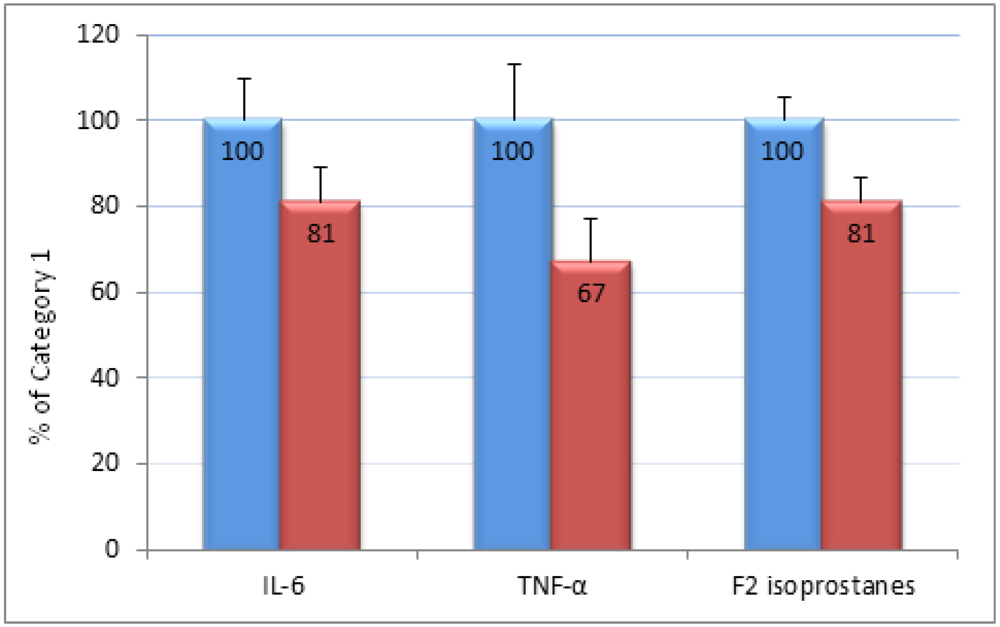
| IL-6, pg/mL | 1.77 (1.61–1.94) | 1.69 (1.58–1.81) | 1.46 (1.32–1.61) * # | <0.0001 | 0.0073 |
| TNF-α, pg/mL | 2.06 (1.81–2.34) | 1.73 (1.57–1.90) * | 1.41 (1.23–1.60) * # | <0.0001 | <0.0001 |
| MCP-1, pg/mL | 6.44 (6.17–6.71) | 6.43 (6.23–6.63) | 6.30 (6.03–6.58) | 0.62 | 0.58 |
| IL-10, pg/mL | 178 (158–197) | 179 (164–194) | 187 (167–207) | 0.85 | 0.91 |
| GCSF, pg/mL | 35.2 (33.8–37.7) | 35.5 (33.7–37.4) | 34.7 (32.1–37.3) | 0.22 | 0.78 |
| WBC, 109/L | 1.43 (1.25–1.64) | 1.52 (1.34–1.72) | 1.70 (1.36–2.13) | 0.77 | 0.33 |
| FRAP, µmol/L b | 529 (504–553) | 579 (561–597) * | 602 (578–627) * | <0.0001 | <0.0001 |
| ORAC, µmol/L b | 28.7 (27.7–29.6) | 29.4 (28.6–30.2) | 30.3 (29.1–31.4) * | 0.0047 | 0.047 |
| F2-isoprostanes, pg/mL | 48.2 (45.6–50.8) | 44.7 (42.7–46.6) * | 39.7 (37.0–42.4) * # | <0.0001 | <0.0001 |
| Category of combined fruit and vegetable intake from low to high for men | |||||
| Variables | Category 1 | Category 2 | Category 3 | p for trend: full model a | p for gender interaction |
| Category Number | N = 93 | N = 221 | N = 62 | ||
| CRP, mg/L | 1.24 (0.97–1.59) | 1.32 (1.08–1.61) | 1.10 (0.81–1.48) | 0.40 | 0.63 |
| IL-6, pg/mL | 1.78 (1.55–2.05) | 1.77 (1.59–1.97) | 1.69 (1.43–2.00) | 0.81 | 0.33 |
| TNF-α, pg/mL | 2.09 (1.74–2.52) | 1.60 (1.38–1.84) * | 1.71 (1.36–2.14) * | 0.018 | 0.0033 |
| WBC, 109/L | 6.15 (5.78–6.53) | 6.37 (6.08–6.66) | 6.29 (5.84–6.73) | 0.52 | 0.32 |
| MCP-1, pg/mL | 173 (162–185) | 169 (161–179) | 177 (163–192) | 0.50 | 0.55 |
| GCSF, pg/mL | 31.0 (27.6–34.4) | 34.7 (32.1–37.3) * | 32.5 (28.5–36.6) | 0.076 | 0.11 |
| IL-10, pg/mL | 1.56 (1.26–1.87) | 1.74 (1.41–2.15) | 2.14 (1.42–3.21) * | 0.28 | 0.61 |
| FRAP, µmol/L b | 1.56 (1.26–1.87) | 1.74 (1.41–2.15) | 2.14 (1.42–3.21) * | 0.28 | 0.61 |
| ORAC, µmol/L b | 28.0 (26.6–29.4) | 29.3 (28.0–30.5) | 29.5 (27.7–31.4) * | 0.13 | 0.59 |
| F2-isoprostanes, pg/mL | 43.7 (40.6–47.0) | 38.1 (35.9–40.2) * | 36.0 (33.0–39.3) * | <0.0001 | 0.0064 |
| Category of combined fruit and vegetable intake from low to high for women | |||||
| Variables | Category 1 | Category 2 | Category 3 | p for trend: full model a | p for gender interaction |
| Category Number | N = 91 | N = 347 | N = 132 | ||
| CRP, mg/L | 1.99 (1.52–2.61) | 1.86 (1.53–2.26) | 1.80 (1.40–2.26) | 0.81 | 0.63 |
| IL-6, pg/mL | 1.76 (1.55–2.00) | 1.62 (1.48–1.78) | 1.34 (1.20–1.51) * # | 0.0003 | 0.33 |
| TNF-α, pg/mL | 2.03 (1.70–2.43) | 1.81 (1.60–2.06) | 1.28 (1.09–1.50) * # | <0.0001 | 0.0033 |
| WBC, 109/L | 6.70 (6.32–7.08) | 6.49 (6.22–6.76) | 6.34 (5.99–6.69) | 0.26 | 0.32 |
| MCP-1, pg/mL | 164 (151–177) | 165 (156–174) | 163 (152–175) | 0.94 | 0.55 |
| GCSF, pg/mL | 39.5 (35.9–43.0) | 36.8 (34.3–39.3) | 36.9 (33.6–40.1) | 0.29 | 0.11 |
| IL-10, pg/mL | 1.32 (1.10–1.59) | 1.36 (1.16–1.58) | 1.43 (1.10–1.87) | 0.86 | 0.61 |
| FRAP, µmol/L b | 467 (435–499) | 534 (512–556) * | 567 (539–596) * # | <0.0001 | 0.61 |
| ORAC, µmol/L b | 29.1 (27.7–30.4) | 29.4 (28.4–30.5) | 30.6 (29.1–32.1) * # | 0.15 | 0.59 |
| F2-isoprostanes, pg/mL | 43.6 (40.4–47.0) | 44.4 (42.1–46.9) | 38.7 (36.1–41.5) * # | <0.0001 | 0.0064 |

4. Conclusions
5. Implications
Acknowledgements
References
- Lock, K.; Pomerleau, J.; Causer, L.; Altmann, D.R.; McKee, M. The global burden of disease attributable to low consumption of fruit and vegetables: Implications for the global strategy on diet. Bull. World Health Organ. 2005, 83, 100–108. [Google Scholar] [PubMed]
- World Health Organization, The World Health Report 2002: Reducing Risks to Health, Promoting Healthy Life; World Health Organization, Geneva, Switzland, 2002.
- van Duyn, M.A.; Pivonka, E. Overview of the health benefits of fruit and vegetable consumption for the dietetics professional: Selected literature. J. Am. Diet Assoc. 2000, 100, 1511–1521. [Google Scholar] [CrossRef] [PubMed]
- Pearson, T.A.; Mensah, G.A.; Alexander, R.W.; Anderson, J.L.; Cannon, R.O., III; Criqui, M.; Fadl, Y.Y.; Fortmann, S.P.; Hong, Y.; Myers, G.L.; et al. Markers of inflammation and cardiovascular disease: Application to clinical and public health practice: A statement for healthcare professionals from the Centers for Disease Control and Prevention and the American Heart Association. Circulation 2003, 107, 499–511. [Google Scholar] [PubMed]
- Holt, E.M.; Steffen, L.M.; Moran, A.; Basu, S.; Steinberger, J.; Ross, J.A.; Hong, C.P.; Sinaiko, A.R. Fruit and vegetable consumption and its relation to markers of inflammation and oxidative stress in adolescents. J. Am. Diet Assoc. 2009, 109, 414–421. [Google Scholar] [CrossRef] [PubMed]
- Esmaillzadeh, A.; Kimiagar, M.; Mehrabi, Y.; Azadbakht, L.; Hu, F.B.; Willett, W.C. Fruit and vegetable intakes, C-reactive protein, and the metabolic syndrome. Am. J. Clin. Nutr. 2006, 84, 1489–1497. [Google Scholar] [PubMed]
- Fowke, J.H.; Morrow, J.D.; Motley, S.; Bostick, R.M.; Ness, R.M. Brassica vegetable consumption reduces urinary F2-isoprostane levels independent of micronutrient intake. Carcinogenesis 2006, 27, 2096–2102. [Google Scholar] [CrossRef] [PubMed]
- Sanchez-Moreno, C.; Cano, M.P.; de Ancos, B.; Plaza, L.; Olmedilla, B.; Granado, F.; Martin, A. Mediterranean vegetable soup consumption increases plasma vitamin C and decreases F2-isoprostanes, prostaglandin E2 and monocyte chemotactic protein-1 in healthy humans. J. Nutr. Biochem. 2006, 17, 183–189. [Google Scholar] [PubMed]
- Jacobs, D.R., Jr.; Steffen, L.M. Nutrients, foods, and dietary patterns as exposures in research: A framework for food synergy. Am. J. Clin. Nutr. 2003, 78, 508S–513S. [Google Scholar] [PubMed]
- Nieman, D.C.; Henson, D.A.; Austin, M.D.; Sha, W. Upper respiratory tract infection is reduced in physically fit and active adults. Br. J. Sports Med. 2011, 45, 987–992. [Google Scholar] [CrossRef] [PubMed]
- Hodge, A.; Patterson, A.J.; Brown, W.J.; Ireland, P.; Giles, G. The Anti Cancer Council of Victoria FFQ: Relative validity of nutrient intakes compared with weighed food records in young to middle-aged women in a study of iron supplementation. Aust. N. Z. J. Public Health 2000, 24, 576–583. [Google Scholar] [PubMed]
- Morrow, J.D.; Roberts, L.J., II. Mass spectrometric quantification of F2-isoprostanes in biological fluids and tissues as measure of oxidant stress. Methods Enzymol. 1999, 300, 3–12. [Google Scholar] [PubMed]
- Shanely, R.A.; Knab, A.M.; Nieman, D.C.; Jin, F.; McAnulty, S.R.; Landram, M.J. Quercetin supplementation does not alter antioxidant status in humans. Free Radic. Res. 2010, 44, 224–231. [Google Scholar] [CrossRef] [PubMed]
- Benzie, I.F.; Strain, J.J. The ferric reducing ability of plasma (FRAP) as a measure of “antioxidant power”: The FRAP assay. Anal. Biochem. 1996, 239, 70–76. [Google Scholar] [PubMed]
- Cao, G.; Alessio, H.M.; Cutler, R.G. Oxygen-radical absorbance capacity assay for antioxidants. Free Radic. Biol. Med. 1993, 14, 303–311. [Google Scholar] [CrossRef] [PubMed]
- Wannamethee, S.G.; Lowe, G.D.; Rumley, A.; Bruckdorfer, K.R.; Whincup, P.H. Associations of vitamin C status, fruit and vegetable intakes, and markers of inflammation and hemostasis. Am. J. Clin. Nutr. 2006, 83, 567–574. [Google Scholar] [PubMed]
- Haldar, S.; Rowland, I.R.; Barnett, Y.A.; Bradbury, I.; Robson, P.J.; Powell, J.; Fletcher, J. Influence of habitual diet on antioxidant status: A study in a population of vegetarians and omnivores. Eur. J. Clin. Nutr. 2007, 61, 1011–1022. [Google Scholar]
- Duthie, S.J.; Jenkinson, A.M.; Crozier, A.; Mullen, W.; Pirie, L.; Kyle, J.; Yap, L.S.; Christen, P.; Duthie, G.G. The effects of cranberry juice consumption on antioxidant status and biomarkers relating to heart disease and cancer in healthy human volunteers. Eur. J. Nutr. 2006, 45, 113–122. [Google Scholar] [CrossRef] [PubMed]
- Bub, A.; Watzl, B.; Abrahamse, L.; Delincee, H.; Adam, S.; Wever, J.; Muller, H.; Rechkemmer, G. Moderate intervention with carotenoid-rich vegetable products reduces lipid peroxidation in men. J. Nutr. 2000, 130, 2200–2206. [Google Scholar] [PubMed]
- Cao, G.; Booth, S.L.; Sadowski, J.A.; Prior, R.L. Increases in human plasma antioxidant capacity after consumption of controlled diets high in fruit and vegetables. Am. J. Clin. Nutr. 1998, 68, 1081–1087. [Google Scholar] [PubMed]
- Cilla, A.; De Palma, G.; Lagarda, M.J.; Barbera, R.; Farre, R.; Clemente, G.; Romero, F. Impact of fruit beverage consumption on the antioxidant status in healthy women. Ann. Nutr. Metab. 2009, 54, 35–42. [Google Scholar]
- Lopez-Garcia, E.; Schulze, M.B.; Fung, T.T.; Meigs, J.B.; Rifai, N.; Manson, J.E.; Hu, F.B. Major dietary patterns are related to plasma concentrations of markers of inflammation and endothelial dysfunction. Am. J. Clin. Nutr. 2004, 80, 1029–1035. [Google Scholar] [PubMed]
- Nettleton, J.A.; Steffen, L.M.; Mayer-Davis, E.J.; Jenny, N.S.; Jiang, R.; Herrington, D.M.; Jacobs, D.R., Jr. Dietary patterns are associated with biochemical markers of inflammation and endothelial activation in the Multi-Ethnic Study of Atherosclerosis (MESA). Am. J. Clin. Nutr. 2006, 83, 1369–1379. [Google Scholar] [PubMed]
- Esmaillzadeh, A.; Kimiagar, M.; Mehrabi, Y.; Azadbakht, L.; Hu, F.B.; Willett, W.C. Dietary patterns and markers of systemic inflammation among Iranian women. J. Nutr. 2007, 137, 992–998. [Google Scholar] [PubMed]
- Ma, Y.; Hebert, J.R.; Li, W.; Bertone-Johnson, E.R.; Olendzki, B.; Pagoto, S.L.; Tinker, L.; Rosal, M.C.; Ockene, I.S.; Ockene, J.K.; et al. Association between dietary fiber and markers of systemic inflammation in the Women’s Health Initiative Observational Study. Nutrition 2008, 24, 941–949. [Google Scholar] [PubMed]
- Cao, G.; Prior, R.L. Comparison of different analytical methods for assessing total antioxidant capacity of human serum. Clin. Chem. 1998, 44, 1309–1315. [Google Scholar] [PubMed]
© 2012 by the authors; licensee MDPI, Basel, Switzerland. This article is an open-access article distributed under the terms and conditions of the Creative Commons Attribution license (http://creativecommons.org/licenses/by/3.0/).
Share and Cite
Root, M.M.; McGinn, M.C.; Nieman, D.C.; Henson, D.A.; Heinz, S.A.; Shanely, R.A.; Knab, A.M.; Jin, F. Combined Fruit and Vegetable Intake Is Correlated with Improved Inflammatory and Oxidant Status from a Cross-Sectional Study in a Community Setting. Nutrients 2012, 4, 29-41. https://doi.org/10.3390/nu4010029
Root MM, McGinn MC, Nieman DC, Henson DA, Heinz SA, Shanely RA, Knab AM, Jin F. Combined Fruit and Vegetable Intake Is Correlated with Improved Inflammatory and Oxidant Status from a Cross-Sectional Study in a Community Setting. Nutrients. 2012; 4(1):29-41. https://doi.org/10.3390/nu4010029
Chicago/Turabian StyleRoot, Martin M., Megan C. McGinn, David C. Nieman, Dru A. Henson, Serena A. Heinz, R. Andrew Shanely, Amy M. Knab, and Fuxia Jin. 2012. "Combined Fruit and Vegetable Intake Is Correlated with Improved Inflammatory and Oxidant Status from a Cross-Sectional Study in a Community Setting" Nutrients 4, no. 1: 29-41. https://doi.org/10.3390/nu4010029
APA StyleRoot, M. M., McGinn, M. C., Nieman, D. C., Henson, D. A., Heinz, S. A., Shanely, R. A., Knab, A. M., & Jin, F. (2012). Combined Fruit and Vegetable Intake Is Correlated with Improved Inflammatory and Oxidant Status from a Cross-Sectional Study in a Community Setting. Nutrients, 4(1), 29-41. https://doi.org/10.3390/nu4010029