<?xml version="1.0" encoding="UTF-8"?>
<!DOCTYPE article PUBLIC "-//NLM//DTD Journal Publishing DTD v2.3 20070202//EN" "journalpublishing.dtd">
<article xmlns:mml="http://www.w3.org/1998/Math/MathML" xmlns:xlink="http://www.w3.org/1999/xlink" xml:lang="en" article-type="review-article">
  <front>
    <journal-meta>
      <journal-id journal-id-type="publisher-id">nutrients</journal-id>
      <journal-title>Nutrients</journal-title>
      <abbrev-journal-title abbrev-type="publisher">Nutrients</abbrev-journal-title>
      <abbrev-journal-title abbrev-type="pubmed">Nutrients</abbrev-journal-title>
      <issn pub-type="epub">2072-6643</issn>
      <publisher>
<publisher-name>MDPI</publisher-name>
      </publisher>
    </journal-meta>
    <article-meta>
      <article-id pub-id-type="doi">10.3390/nu2050482</article-id>
      <article-id pub-id-type="publisher-id">nutrients-02-00482</article-id>
      <article-categories>
        <subj-group>
          <subject>Review</subject>
        </subj-group>
      </article-categories>
      <title-group>
        <article-title>The Relationship between Ultraviolet Radiation Exposure and Vitamin D Status</article-title>
      </title-group>
      <contrib-group>
        <contrib contrib-type="author">
          <name>
            <surname>Engelsen</surname>
            <given-names>Ola</given-names>
          </name>
        </contrib>
      </contrib-group>
      <aff id="af1-nutrients-02-00482">Norwegian  Institute for Air Research (NILU), The Polar Environmental Centre, NO-9296 Tromsø, Norway; Email: <email>ola.engelsen@nilu.no</email></aff>
      <pub-date pub-type="epub">
        <day>04</day>
        <month>05</month>
        <year>2010</year>
      </pub-date>
      <pub-date pub-type="collection">
        <month>05</month><year>2010</year>
      </pub-date>
      <volume>2</volume>
      <issue>5</issue>
      <fpage>482</fpage>
      <lpage>495</lpage>
      <history>
        <date date-type="received">
          <day>01</day>
          <month>03</month>
          <year>2010</year>
        </date>
        <date date-type="rev-recd">
          <day>14</day>
          <month>04</month>
          <year>2010</year>
        </date>
        <date date-type="accepted">
          <day>20</day>
          <month>04</month>
          <year>2010</year>
        </date>
      </history>
      <permissions>
<copyright-statement>©  2010 by the authors; licensee MDPI, Basel, Switzerland</copyright-statement>
        <copyright-year>2010</copyright-year>
        <license xmlns:xlink="http://www.w3.org/1999/xlink" license-type="open-access" xlink:href="http://creativecommons.org/licenses/by/3.0/">
          <p>This article is an open-access article distributed under the terms and conditions of the Creative Commons Attribution license (http://creativecommons.org/licenses/by/3.0/).</p>
        </license>
      </permissions>
      <abstract>
        <p>This paper reviews the main factors influencing the synthesis of vitamin D, with particular focus on ultraviolet radiation exposure. On the global level, the main source of vitamin D is the sun. The effect of solar radiation on vitamin D synthesis depends to some extent on the initial vitamin D levels. At moderate to high latitudes, diet becomes an increasingly important source of vitamin D due to decreased solar intensity and cold temperatures, which discourage skin exposure. During the mid-winter season, these factors result in decreased solar radiation exposure, hindering extensively the synthesis of vitamin D in these populations.</p>
      </abstract>
      <kwd-group>
        <kwd>vitamin D</kwd>
        <kwd>ultraviolet</kwd>
        <kwd>UV</kwd>
        <kwd>sun</kwd>
      </kwd-group>
    </article-meta>
  </front>
  <body>
    <sec sec-type="intro">
      <title>1. Introduction</title>
      <p>Vitamin D is an important nutrient for maintaining a healthy skeleton as it forms an integral part of the bone metabolism, calcium and phosphor homeostasis [<xref ref-type="bibr" rid="B1-nutrients-02-00482">1</xref>]. There are indications that vitamin D may have several other health benefits such as prevention or mitigation of cancer [<xref ref-type="bibr" rid="B2-nutrients-02-00482">2</xref>] and autoimmune diseases [<xref ref-type="bibr" rid="B3-nutrients-02-00482">3</xref>], reduction in hypertension [<xref ref-type="bibr" rid="B4-nutrients-02-00482">4</xref>], and prevention of influenza [<xref ref-type="bibr" rid="B5-nutrients-02-00482">5</xref>]. Anti-carcinogenic effects have been demonstrated in laboratory studies on animals at high doses, but evidence of causality has not been shown in humans, possibly due to too low vitamin D levels in the human population to produce a statistically significant effect [<xref ref-type="bibr" rid="B2-nutrients-02-00482">2</xref>]. Overall, vitamin D seems to have a positive regulatory effect on the immune system. Recent research indicates that vitamin D stimulates antimicrobial activity [<xref ref-type="bibr" rid="B6-nutrients-02-00482">6</xref>] and thus may mitigate certain types of infections. There are vitamin D receptors in many organs [<xref ref-type="bibr" rid="B7-nutrients-02-00482">7</xref>], and long-term vitamin D deficiency may induce a wide range of harmful biological effects. Despite this, only skeletal effects have to date been proven causal in a strict sense [<xref ref-type="bibr" rid="B8-nutrients-02-00482">8</xref>,<xref ref-type="bibr" rid="B9-nutrients-02-00482">9</xref>,<xref ref-type="bibr" rid="B10-nutrients-02-00482">10</xref>]. The existence of an optimal ultraviolet (UV) exposure and its level is a subject of ongoing debate [<xref ref-type="bibr" rid="B2-nutrients-02-00482">2</xref>,<xref ref-type="bibr" rid="B11-nutrients-02-00482">11</xref>,<xref ref-type="bibr" rid="B12-nutrients-02-00482">12</xref>,<xref ref-type="bibr" rid="B13-nutrients-02-00482">13</xref>,<xref ref-type="bibr" rid="B14-nutrients-02-00482">14</xref>,<xref ref-type="bibr" rid="B15-nutrients-02-00482">15</xref>]. Likewise, public recommendations on vitamin D dietary intake and food fortifications are under revision in many countries.</p>
      <p>Worldwide studies have shown that vitamin D status is low across wide ranges of populations and age groups even at very moderate latitudes [<xref ref-type="bibr" rid="B16-nutrients-02-00482">16</xref>,<xref ref-type="bibr" rid="B17-nutrients-02-00482">17</xref>,<xref ref-type="bibr" rid="B18-nutrients-02-00482">18</xref>,<xref ref-type="bibr" rid="B19-nutrients-02-00482">19</xref>,<xref ref-type="bibr" rid="B20-nutrients-02-00482">20</xref>,<xref ref-type="bibr" rid="B21-nutrients-02-00482">21</xref>,<xref ref-type="bibr" rid="B22-nutrients-02-00482">22</xref>,<xref ref-type="bibr" rid="B23-nutrients-02-00482">23</xref>,<xref ref-type="bibr" rid="B24-nutrients-02-00482">24</xref>]. Extremely low vitamin D levels have been observed in individuals with darker skin [<xref ref-type="bibr" rid="B25-nutrients-02-00482">25</xref>,<xref ref-type="bibr" rid="B26-nutrients-02-00482">26</xref>,<xref ref-type="bibr" rid="B27-nutrients-02-00482">27</xref>]. It seems clear that casual vitamin D intake from UV exposure and diet are not adequate. Improved public consciousness in combination with revised policies regarding vitamin D can very likely improve public health at quite moderate costs.</p>
            <fig id="nutrients-02-00482-f001" position="anchor">
        <label>Figure 1</label>
        <caption>
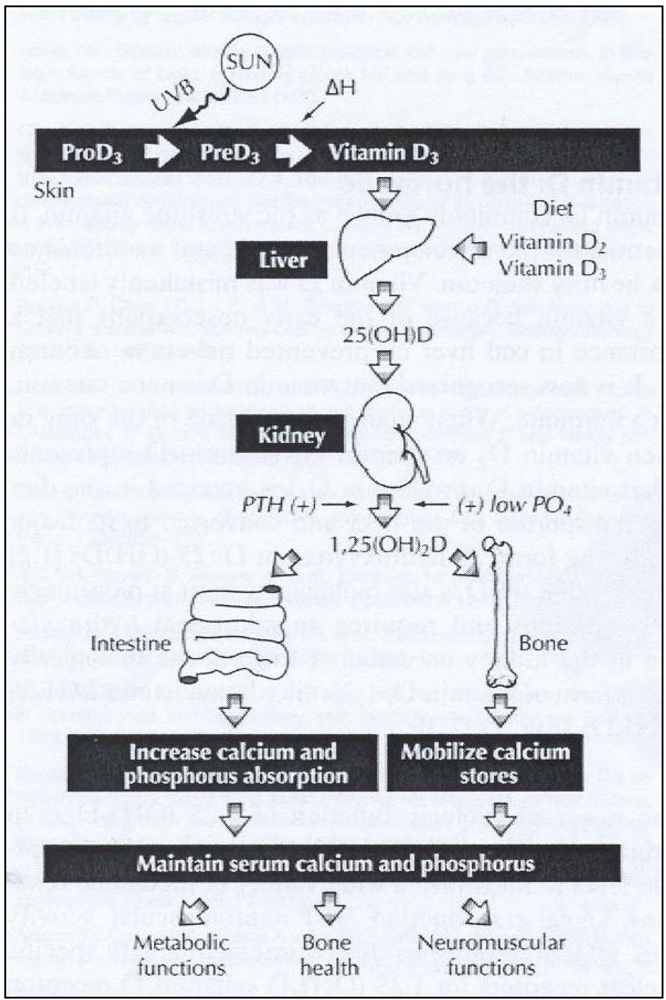
          <p>Outline of vitamin D synthesis and metabolism. From [<xref ref-type="bibr" rid="B7-nutrients-02-00482">7</xref>].</p>
        </caption>
        <graphic xmlns:xlink="http://www.w3.org/1999/xlink" xlink:href="nutrients-02-00482-g001.tif"/>
      </fig>
      <p>The formation, intake and circulation of vitamin D are well described in the literature, and are outlined in <xref ref-type="fig" rid="nutrients-02-00482-f001">Figure 1</xref>. Provitamin D (7-dehydrocholesterol, 7-DHC) is converted to previtamin D in the skin by exposure to UVB radiation. The previtamin D is then isomerized by body heat to form vitamin D<sub>3</sub>. Vitamin D<sub>3</sub> is then transported by the blood to the liver, where it is converted to 25-hydroxyvitamin D (25(OH)D). In the kidneys, the formation of the active form of vitamin D, 1,25-dihydroxyvitamin D (1,25(OH)<sub>2</sub>D), is tightly regulated by the parathyroid hormone (PTH). 1,25-dihydroxyvitamin D is important for the uptake of calcium and mobilization of calcium stores. As mentioned above, many organs have receptors for vitamin D, and consequently vitamin D is important for many bodily functions. More recently, it was found that 1,25-dihydroxyvitamin D can be produced in tissue and cells, decoupling partly the production of 1,25-dihydroxyvitamin D and its effects from the renal functions and PTH, reviewed in [<xref ref-type="bibr" rid="B28-nutrients-02-00482">28</xref>]. Although the underlying processes of vitamin D synthesis and circulation is known, the quantitative relationship of UV exposure to humans and the resulting vitamin D production is inadequately described. This review summarizes the status of knowledge with respect to vitamin D synthesis in the human skin, and attempts to clarify the gaps of knowledge as an aid to future research in the area.</p>
    </sec>
    <sec>
      <title>2. Ultraviolet Radiation Exposure and Effects on Cutaneous Vitamin D Synthesis</title>
      <p>The fundamental processes of vitamin D synthesis and circulation in humans is well understood at a qualitative level (<xref ref-type="fig" rid="nutrients-02-00482-f001">Figure 1</xref>). <italic>In vitro</italic> models [<xref ref-type="bibr" rid="B29-nutrients-02-00482">29</xref>,<xref ref-type="bibr" rid="B30-nutrients-02-00482">30</xref>,<xref ref-type="bibr" rid="B31-nutrients-02-00482">31</xref>] and experiments [<xref ref-type="bibr" rid="B32-nutrients-02-00482">32</xref>,<xref ref-type="bibr" rid="B33-nutrients-02-00482">33</xref>,<xref ref-type="bibr" rid="B34-nutrients-02-00482">34</xref>] describing photoconversion of provitamin D to previtamin D exist. Although they are not necessarily representative for the cutaneous and systemic conditions on a large human population level, they are useful qualitative indicators for how much vitamin D is produced under various solar conditions. </p>
      <p>The factors affecting vitamin D synthesis from ultraviolet B (UVB) radiation have been discussed previously [<xref ref-type="bibr" rid="B35-nutrients-02-00482">35</xref>,<xref ref-type="bibr" rid="B36-nutrients-02-00482">36</xref>]. The effect of some influencing factors can be further explored by running the online facilities described in section 5 for user-specified conditions. The factors are therefore only discussed briefly below:</p>
      <list list-type="bullet">
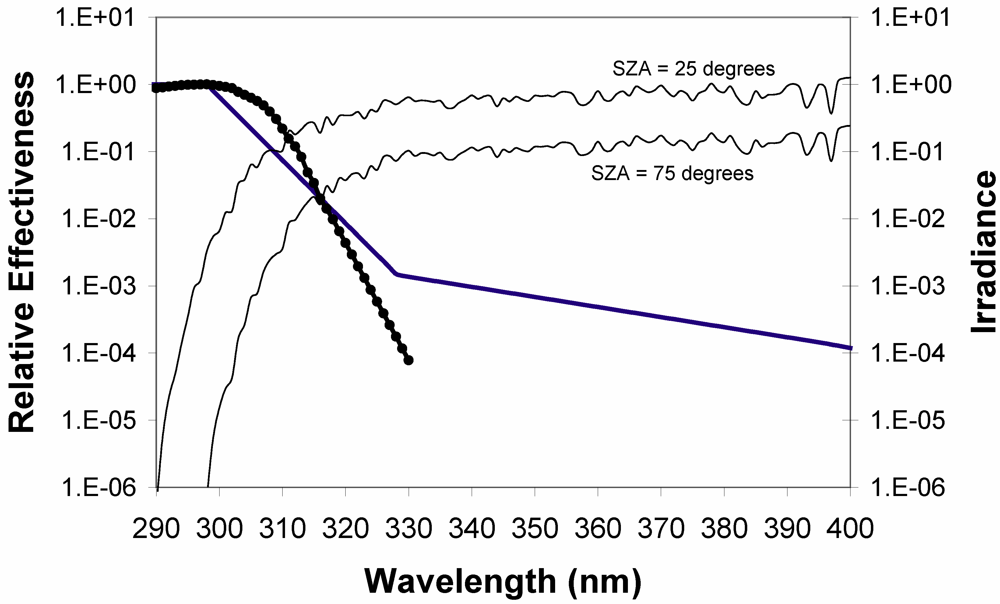
      <list-item><p>Solar zenith angle (season and latitude) have a substantial impact on UVB radiation. At low solar zenith angles, photons must travel longer distances through the ozone layer, increasing the probability of absorption. There is also an enhanced possibility of interaction with air molecules, leading to absorption or scattering back into space, thus effectively attenuating UV radiation (<xref ref-type="fig" rid="nutrients-02-00482-f002">Figure 2</xref>). Because the atmosphere attenuates UV radiation differently for various wavelengths, the UV spectrum varies with solar elevations. The vitamin D effective radiation is described in terms of its action spectrum (<italic>i.e.,</italic> the efficiency of each wavelength to synthesize vitamin D in skin) [<xref ref-type="bibr" rid="B37-nutrients-02-00482">37</xref>]. In broad terms, the action spectrum covers the UVB spectral range with a maximum at about 295 nm (<xref ref-type="fig" rid="nutrients-02-00482-f002">Figure 2</xref>).</p></list-item>
      <list-item><p>Clouds can both attenuate and enhance UVB radiation, although attenuation is generally the case. Completely overcast clouds always attenuate UVB rays, even up to 99% of UVB radiation in extreme cases [<xref ref-type="bibr" rid="B38-nutrients-02-00482">38</xref>]. Up to 50% enhancement of UVB radiation can occur from broken clouds [<xref ref-type="bibr" rid="B39-nutrients-02-00482">39</xref>] or at elevated sites above clouds [<xref ref-type="bibr" rid="B40-nutrients-02-00482">40</xref>].</p></list-item>
      <list-item><p>Ozone effectively absorbs UVB radiation, particularly at shorter wavelengths [<xref ref-type="bibr" rid="B41-nutrients-02-00482">41</xref>]. Besides clouds, it is the most important atmospheric modulator of vitamin D synthesis.</p></list-item>
      <list-item><p>Surface reflection, from snow in particular, reflects up to 95% of UVB radiation [<xref ref-type="bibr" rid="B42-nutrients-02-00482">42</xref>].</p></list-item>
      <list-item><p>Altitude. Solar UVB radiation increases by about 7% every km in altitude under clear sky conditions, and more if the subject is in or above clouds or a turbid atmosphere.</p></list-item>
     <list-item><p>Sunscreen blocks UVB radiation effectively [<xref ref-type="bibr" rid="B43-nutrients-02-00482">43</xref>,<xref ref-type="bibr" rid="B44-nutrients-02-00482">44</xref>]. However, it is questionable whether sunscreen in practise causes any vitamin D deficiency. Absolute full-body coverage of sunscreen is uncommon. Some areas of the skin are always left out. At times and locations where the sun is intense and the temperature is high enough to make the population use sunscreen, its vitamin D status is generally very satisfactory.</p></list-item>
      <list-item><p>Outdoor behavior. There is an ongoing trend towards less outdoor exposure, either through work or preferences in leisure activities. For instance, children in the USA now only spend half-an-hour outdoors a day during week-ends, and only minutes during week-days [<xref ref-type="bibr" rid="B45-nutrients-02-00482">45</xref>]. Furthermore, the orientation of the skin with respect to the sun has a great impact on the personal UV exposure. Nearby objects can obstruct both direct and diffuse UV rays [<xref ref-type="bibr" rid="B46-nutrients-02-00482">46</xref>], and thus affect UV synthesis. The best way to obtain precise personal UV exposure is dosimeters [<xref ref-type="bibr" rid="B47-nutrients-02-00482">47</xref>].</p></list-item>
      <list-item><p>Skin type. Dark (type VI, [<xref ref-type="bibr" rid="B48-nutrients-02-00482">48</xref>]) skins produce up to six-times less vitamin D than pale (type I) skins [<xref ref-type="bibr" rid="B49-nutrients-02-00482">49</xref>,<xref ref-type="bibr" rid="B50-nutrients-02-00482">50</xref>,<xref ref-type="bibr" rid="B51-nutrients-02-00482">51</xref>,<xref ref-type="bibr" rid="B52-nutrients-02-00482">52</xref>,<xref ref-type="bibr" rid="B53-nutrients-02-00482">53</xref>,<xref ref-type="bibr" rid="B54-nutrients-02-00482">54</xref>].</p></list-item>
      <list-item><p>Obesity. Overweight individuals have reduced capacity of vitamin D synthesis [<xref ref-type="bibr" rid="B55-nutrients-02-00482">55</xref>].</p></list-item>
      <list-item><p>Age. Elderly people have thinner skin, and consequently are less capable of synthesizing vitamin D in their skin [<xref ref-type="bibr" rid="B56-nutrients-02-00482">56</xref>].</p></list-item>
     <list-item> <p>Sun beds. The use of sun beds is controversial, but regardless, subjects who regularly use tanning beds that emit UVB radiation are likely to have higher 25(OH)D concentrations [<xref ref-type="bibr" rid="B20-nutrients-02-00482">20</xref>] and also higher bone mineral densities [<xref ref-type="bibr" rid="B57-nutrients-02-00482">57</xref>]. </p></list-item>
      <list-item><p>Clothing (temperature). At cold temperatures the population wears more clothes for comfort, exposing less skin area to UVB radiation, and thereby inhibiting vitamin D synthesis [<xref ref-type="bibr" rid="B58-nutrients-02-00482">58</xref>,<xref ref-type="bibr" rid="B59-nutrients-02-00482">59</xref>]. At moderate and high latitudes, face, neck and hands are generally exposed at best. During freezing temperatures, only the face is usually exposed.</p></list-item>
      </list>
            <fig id="nutrients-02-00482-f002" position="anchor">
        <label>Figure 2</label>
        <caption>
          <p>CIE erythema action spectrum [<xref ref-type="bibr" rid="B60-nutrients-02-00482">60</xref>] (bold line) and the action spectrum for the formation of previtamin D in human skin [<xref ref-type="bibr" rid="B37-nutrients-02-00482">37</xref> ](dots) with solar spectra (thin solid lines) measured at solar zenith angles of 25 and 75 degrees. The units of the irradiances in the solar spectra are Wm<sup>-2</sup>nm<sup>-1</sup>. From [<xref ref-type="bibr" rid="B15-nutrients-02-00482">15</xref>], and the relative effectiveness of the action spectra are unitless.</p>
        </caption>
        <graphic xmlns:xlink="http://www.w3.org/1999/xlink" xlink:href="nutrients-02-00482-g002.tif"/>
      </fig>
    </sec>
    <sec>
      <title>3. Comparative Effect of Diet and UV Exposure on Serum 25-hydroxyvitamin D (25(OH)D) Level</title>
      <p>Holick and co-workers found that one full body UV exposure causing a slight pinkness in skin (one minimum erythemal dose, 1 MED) is equivalent to an oral intake of somewhere in the range 250–625 μg (10,000–25,000 IU) of vitamin D<sub>3</sub> [<xref ref-type="bibr" rid="B61-nutrients-02-00482">61</xref>,<xref ref-type="bibr" rid="B62-nutrients-02-00482">62</xref>,<xref ref-type="bibr" rid="B63-nutrients-02-00482">63</xref>]. This relationship has been confirmed by at least three other studies (see below), including outdoor solar exposure and on only parts of the body. A weakness of the laboratory experiments lies in the fact that the experiments made use of fixed broadband UV lamps. The lamp spectral characteristics are unclear, and assimilation to natural conditions is difficult due to uncertainties in vitamin D action spectrum. Furthermore, relevant laboratory experiments are generally done for very small cohorts in the literature, and this was also the case for these studies. On the basis of the results of Holick and co-workers above [<xref ref-type="bibr" rid="B64-nutrients-02-00482">64</xref>,<xref ref-type="bibr" rid="B65-nutrients-02-00482">65</xref>], a UV exposure of one-quarter of personal MED on one-quarter of skin area (hands, face and arms) yields a dietary equivalent vitamin D dose of about 1000 IU. The exposure times to obtain this recommended UV dose depend greatly on skin type, time and location [<xref ref-type="bibr" rid="B65-nutrients-02-00482">65</xref>] as well as ambient conditions and clothing [<xref ref-type="bibr" rid="B53-nutrients-02-00482">53</xref>]. The latter paper has resulted in a freely accessible internet page, which gives an estimate of how long exposure is required to obtain any vitamin D-effective dose from the sun under user-specified conditions (<uri>http://nadir.nilu.no/~olaeng/fastrt/VitD_quartMED.html</uri>). Limitations of the method have been previously discussed [<xref ref-type="bibr" rid="B53-nutrients-02-00482">53</xref>]. Beneficial exposure times for Australian cities have also been computed from measurements of UV erythemal doses [<xref ref-type="bibr" rid="B66-nutrients-02-00482">66</xref>]. They assume that one-third to one-sixth MEDs at 15% of the body yield the equivalent of the current officially recommended vitamin D dose of 200-600 IUs. Note that the relationship between erythemally weighted doses (or MEDs) and vitamin D effective doses with respect to solar zenith angle is not linear [<xref ref-type="bibr" rid="B67-nutrients-02-00482">67</xref>,<xref ref-type="bibr" rid="B68-nutrients-02-00482">68</xref>]. Therefore, the amount of MEDs can be misleading in terms of cutaneous vitamin D synthesis.</p>
      <p>As mentioned above, at least three additional studies support the concept that one full-body exposure to sunlight can be equivalent to an oral vitamin D intake of 250 μg (10,000 IU) [<xref ref-type="bibr" rid="B69-nutrients-02-00482">69</xref>]. “Stamp [<xref ref-type="bibr" rid="B70-nutrients-02-00482">70</xref>] compared oral vitamin D to the effects of UV light treatment sessions (~1 MED) and found that the rise in 25(OH)D was the same in subjects treated with UV light as in those given 250 μg (10,000 IU) vitamin D/d. In a study of institutionalized elderly, Davie <italic>et al.</italic> [<xref ref-type="bibr" rid="B71-nutrients-02-00482">71</xref>] exposed 600 cm<sup>2</sup>, ~5% of skin surface, to UV light treatments over a 2–3-month period and compared the resulting 25(OH)D concentrations with those achieved with oral vitamin D doses. They calculated a production of vitamin D in the skin equivalent to 0.045 nmol・d<sup>-1</sup>・cm<sup>-2</sup> exposed skin. This is equivalent to 10.9 μg (435 IU) vitamin D/d for 600 cm<sup>2</sup> (5%) of skin surface. If these results for the elderly are extrapolated to total body surface area, it works out to 218 μg (8,700 IU) vitamin D/d that can be acquired by the elderly.” Chel <italic>et al.</italic> [<xref ref-type="bibr" rid="B72-nutrients-02-00482">72</xref>] obtained very similar results for a half MED exposure of 1000cm<sup>2</sup> (one-sixth of the body area) yielding the equivalent of 400 IU corresponding to 9,600 IU for a full body MED exposure. Note that it is well established that the elderly are less capable of synthesizing vitamin D in their skin (see above). Also, their starting 25-hydroxyvitamin D levels were generally quite low (25(OH)D &lt; 25 nmol/L in Holick [<xref ref-type="bibr" rid="B61-nutrients-02-00482">61</xref>], patients requiring vitamin D treatments in Stamp [<xref ref-type="bibr" rid="B70-nutrients-02-00482">70</xref>], 25(OH)D~5.5–16.6 nmol/L in Davie <italic>et al.</italic> [<xref ref-type="bibr" rid="B71-nutrients-02-00482">71</xref>]. 25(OH)D &lt; 30 nmol/L for Chel <italic>et al.</italic> [<xref ref-type="bibr" rid="B72-nutrients-02-00482">72</xref>]). Low vitamin D status yields higher sensitivity to vitamin D intake than normal [see below]. Furthermore, no vitamin D effective doses are given, only the number of MEDs is given as an approximate measure of UV radiation dose.</p>
      <p>There are several studies on the separate effects of dietary intake and UVR exposure on serum 25-hydroxyvitamin D levels. However, there are markedly less studies on the effects on UVR exposure, probably due to a more complex experimental setup as well as ethical problems by exposing subjects with knowingly harmful UV radiation. An extensive list is given in tables 2 and 4 of Vieth [<xref ref-type="bibr" rid="B69-nutrients-02-00482">69</xref>] and Vieth [<xref ref-type="bibr" rid="B73-nutrients-02-00482">73</xref>]. Other studies include [<xref ref-type="bibr" rid="B33-nutrients-02-00482">33</xref>,<xref ref-type="bibr" rid="B74-nutrients-02-00482">74</xref>,<xref ref-type="bibr" rid="B75-nutrients-02-00482">75</xref>,<xref ref-type="bibr" rid="B76-nutrients-02-00482">76</xref>,<xref ref-type="bibr" rid="B77-nutrients-02-00482">77</xref>]. Davie [<xref ref-type="bibr" rid="B71-nutrients-02-00482">71</xref>] devised empirical formulas describing the effect of both dietary intake and UV radiation on the serum 25-hydroxyvitamin D levels based on results from 25 subjects. Devising exact, general formulas are not straightforward because the effect of vitamin D intake on vitamin D production depends on the initial 25(OH)D level. It seems that the effect of vitamin D intake and synthesis is enhanced when the initial vitamin D status is low [<xref ref-type="bibr" rid="B69-nutrients-02-00482">69</xref>,<xref ref-type="bibr" rid="B78-nutrients-02-00482">78</xref>,<xref ref-type="bibr" rid="B79-nutrients-02-00482">79</xref>]. A problem in making comparisons between <italic>in vivo</italic> studies on the effect of UVR exposure is that evaluation of the exact UV doses is complicated by variations in the surface area of skin exposed, skin type, starting levels of serum 25-hydroxyvitamin D, and frequency and duration of exposure. Furthermore, the spectra of the radiation sources are usually variable and inadequately specified, and computing comparable vitamin-D effective doses from the given information is not straightforward. Exact assimilation of the various studies is thus difficult.</p>
      <p>Several journal papers have described the statistical relationships between vitamin D status and an incomplete set of indirect parameters (latitude, hours of exposure, <italic>etc.).</italic> Unfortunately, many of those extensive cohort studies do not contain adequate information to reconstruct the relevant UVR doses at a desirable accuracy.</p>
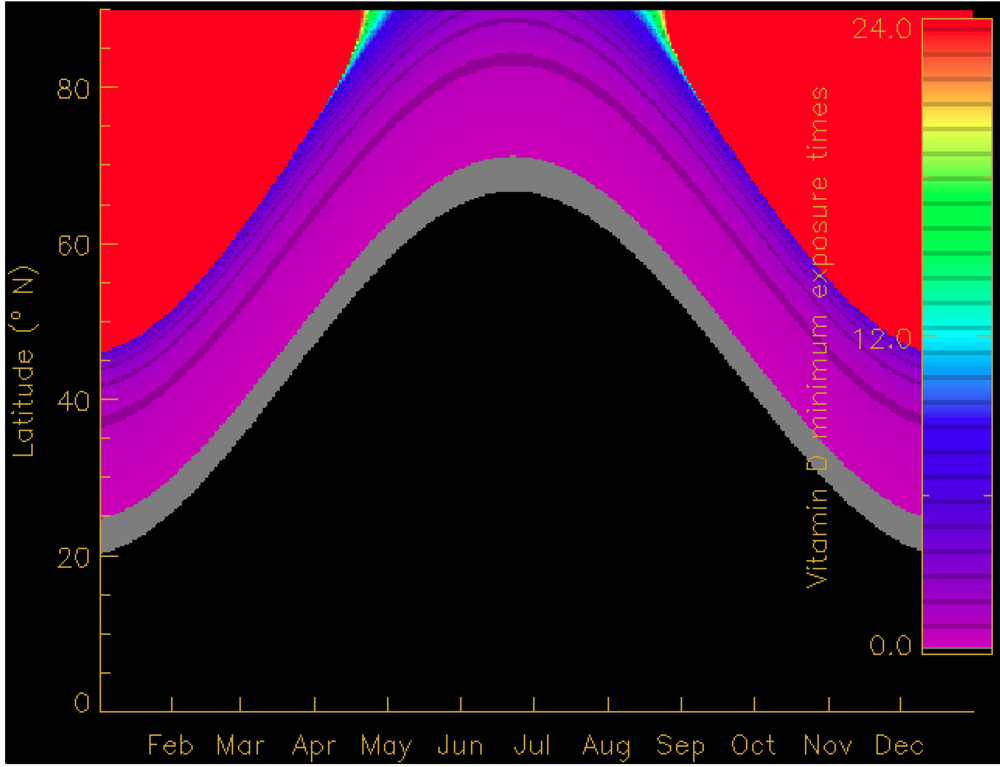
      <p>It has been often claimed that adequate vitamin D is obtained after a few minutes of sun exposure. This is commonly true only when the sun is high and if the equivalent of 400 IU (corresponding to one spoonful of cod liver oil) is desired (<xref ref-type="table" rid="nutrients-02-00482-t001">Table 1</xref>, <xref ref-type="fig" rid="nutrients-02-00482-f003">Figure 3</xref>). However, many research scientists advocate higher intake levels of vitamin D (1,000–4,000 IU). These amounts are usually not available from casual daily exposure (e.g., waiting for the bus to work). The gap between beneficial UV exposure to obtain desirable vitamin D and harmful exposure leading to erythema also narrows (<italic>i.e.,</italic> desirable vitamin D effective dose approaches 1 MED [<xref ref-type="bibr" rid="B15-nutrients-02-00482">15</xref>]). For example, for normal summer clothing, the exposed skin (25.5%) needs to be sunburnt in order to produce 4,000 IU. The skin would then receive a UV dose associated with clearly elevated skin cancer risk.</p>
      <table-wrap id="nutrients-02-00482-t001" position="anchor">
        <object-id pub-id-type="pii">nutrients-02-00482-t001_Table 1</object-id>
        <label>Table 1</label>
        <caption>
          <p>Exposure time in hours and associated MED (in parentheses) for Boston at the spring equinox for all permutations of the variables dietary intake (IU), Skin type (2, 5) and skin area of exposure (F-face, N-neck, H-hands, A-arms, L-legs). From [<xref ref-type="bibr" rid="B15-nutrients-02-00482">15</xref>].</p>
        </caption>
        <table>
          <thead>
            <tr>
              <th align="center" valign="middle"><underline>Vit. D &gt;</underline></th>
              <th colspan="2" align="center" valign="middle">400 IU</th>
              <th colspan="2" align="center" valign="middle">1000 IU</th>
              <th colspan="2" align="center" valign="middle">4000 IU</th>
            </tr>
          </thead>
          <tbody>
            <tr>
              <td align="center" valign="middle"><bold>Skin Type&gt;</bold></td>
              <td align="center" valign="middle"><bold>2</bold></td>
              <td align="center" valign="middle"><bold>5</bold></td>
              <td align="center" valign="middle"><bold>2</bold></td>
              <td align="center" valign="middle"><bold>5</bold></td>
              <td align="center" valign="middle"><bold>2</bold></td>
              <td align="center" valign="middle"><bold>5</bold></td>
            </tr>
            <tr>
              <td align="center" valign="middle"><bold>Area</bold></td>
              <td align="center" valign="middle"> </td>
              <td align="center" valign="middle"> </td>
              <td align="center" valign="middle"> </td>
              <td align="center" valign="middle"> </td>
              <td align="center" valign="middle"> </td>
              <td align="center" valign="middle"> </td>
            </tr>
            <tr>
              <td align="center" valign="middle"><underline><bold>F,N,H (11.5%)</bold></underline></td>
              <td align="center" valign="middle">0.15 (0.21)</td>
              <td align="center" valign="middle">0.35 (0.21)</td>
              <td align="center" valign="middle">0.36 (0.54)</td>
              <td align="center" valign="middle">0.89 (0.54)</td>
              <td align="center" valign="middle">1.49 (2.16)</td>
              <td align="center" valign="middle">3.95 (2.16)</td>
            </tr>
            <tr>
              <td align="center" valign="middle"><bold>F,N,H,A (25.5%)</bold></td>
              <td align="center" valign="middle">0.07 (0.09)</td>
              <td align="center" valign="middle">0.16 (0.09)</td>
              <td align="center" valign="middle">0.17 (0.24)</td>
              <td align="center" valign="middle">0.40 (0.24)</td>
              <td align="center" valign="middle">0.67 (0.97)</td>
              <td align="center" valign="middle">1.62 (0.97)</td>
            </tr>
            <tr>
              <td align="center" valign="middle"><underline><bold>F,N,H,A,L (57.5%)</bold></underline></td>
              <td align="center" valign="middle">0.03 (0.04)</td>
              <td align="center" valign="middle">0.07 (0.04)</td>
              <td align="center" valign="middle">0.07 (0.10)</td>
              <td align="center" valign="middle">0.18 (0.10)</td>
              <td align="center" valign="middle">0.29 (0.43)</td>
              <td align="center" valign="middle">0.70 (0.43)</td>
            </tr>
          </tbody>
        </table>
      </table-wrap>
      <fig id="nutrients-02-00482-f003" position="anchor">
        <label>Figure 3</label>
        <caption>
          <p>Required UV exposure times around noon for a cloudless sky, and typical conditions with respect to latitude and day of year to obtain approximately the equivalent of 400 IU when the face, neck and hands with type I skin are exposed. The red areas illustrate when this vitamin amount is not achievable from the sun. The required dose can be obtained in minutes in the black area. From [<xref ref-type="bibr" rid="B36-nutrients-02-00482">36</xref>,<xref ref-type="bibr" rid="B53-nutrients-02-00482">53</xref>].</p>
        </caption>
        <graphic xmlns:xlink="http://www.w3.org/1999/xlink" xlink:href="nutrients-02-00482-g003.tif"/>
      </fig>
    </sec>
    <sec>
      <title>4. Seasonal and Latitudinal Effects on Vitamin D Synthesis and the Vitamin D Winter</title>
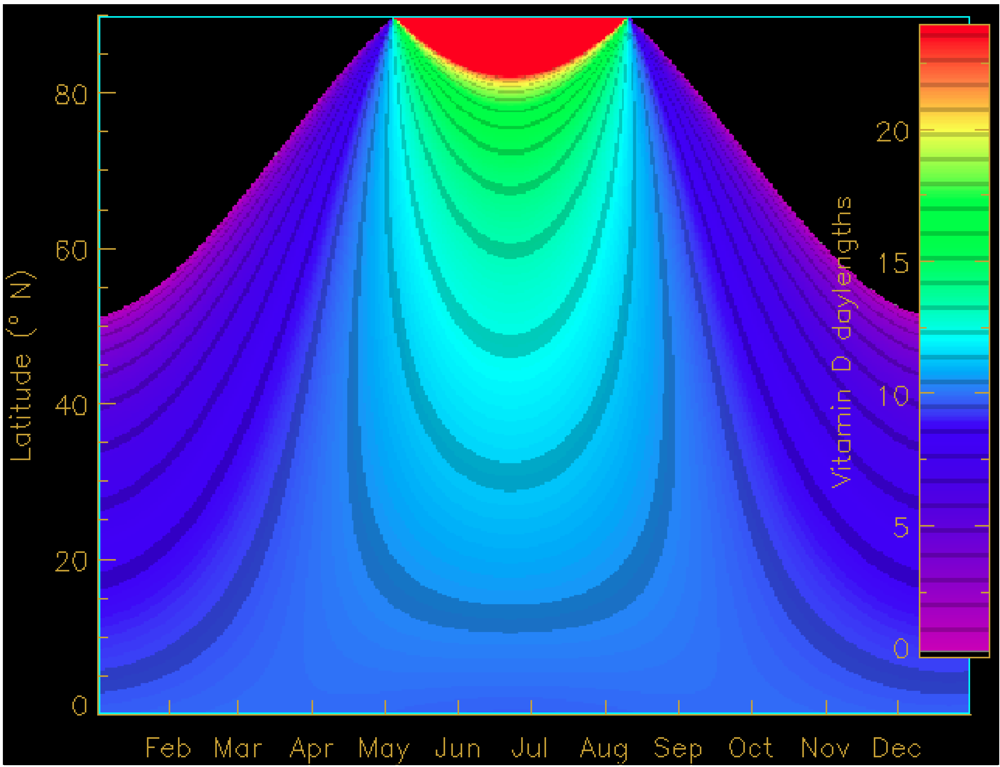
      <p>A dramatic effect of seasonal and latitudinal changes of solar UV radiation on vitamin D synthesis was revealed by Webb <italic>et al.</italic> [<xref ref-type="bibr" rid="B80-nutrients-02-00482">80</xref>]. This work showed that from November to February, there was insufficient solar UVB to synthesize vitamin D in Boston, MA (USA), but by March, previtamin D was formed from 7-DHC in both solution and the skin. This observation, also known as the “vitamin D winter”, has been reported in other journal studies [<xref ref-type="bibr" rid="B81-nutrients-02-00482">81</xref>,<xref ref-type="bibr" rid="B82-nutrients-02-00482">82</xref>]. More moderate estimates of the extent of this “vitamin D winter” have been obtained; however, are based on simulations of UV radiation for clear atmospheric conditions (<xref ref-type="fig" rid="nutrients-02-00482-f004">Figure 4</xref>) [<xref ref-type="bibr" rid="B83-nutrients-02-00482">83</xref>]. The vitamin D effective UV doses depend significantly on latitude and season [<xref ref-type="bibr" rid="B84-nutrients-02-00482">84</xref>,<xref ref-type="bibr" rid="B85-nutrients-02-00482">85</xref>]. Vitamin D production is generally seasonally dependent, being low during late winter with exception to some high-latitude coastal communities where diet seems to be the dominant source of vitamin D [<xref ref-type="bibr" rid="B86-nutrients-02-00482">86</xref>]. There seems to be slightly lower vitamin D levels in women probably due to more body fat [<xref ref-type="bibr" rid="B87-nutrients-02-00482">87</xref>]. Latitude, location, and time of year may also have health implications in regards to vitamin D, where several studies have associated development of various diseases, influenced by vitamin D deficiency, with geography and season, e.g. [<xref ref-type="bibr" rid="B88-nutrients-02-00482">88</xref>,<xref ref-type="bibr" rid="B89-nutrients-02-00482">89</xref>].</p>
      <fig id="nutrients-02-00482-f004" position="anchor">
        <label>Figure 4</label>
        <caption>
          <p>Daily period (in hours) of vitamin D production in terms of time and latitude for a typical clear atmosphere and no surface reflection. From [<xref ref-type="bibr" rid="B83-nutrients-02-00482">83</xref>].</p>
        </caption>
        <graphic xmlns:xlink="http://www.w3.org/1999/xlink" xlink:href="nutrients-02-00482-g004.tif"/>
      </fig>
    </sec>
    <sec>
      <title>5. A Note on Online Vitamin D Calculator Facilities</title>
      <p>User-operated model simulations for vitamin D synthesis and effective doses are available online:</p>
      <list list-type="order">
      <list-item><p>Vitamin D winter duration [<xref ref-type="bibr" rid="B83-nutrients-02-00482">83</xref>] (<uri>http://nadir.nilu.no/~olaeng/fastrt/VitD.html</uri>).</p></list-item>
      <list-item><p>UV exposure times to substitute dietary intake [<xref ref-type="bibr" rid="B53-nutrients-02-00482">53</xref>] (<uri>http://nadir.nilu.no/~olaeng/fastrt/VitD_quartMEDandMED.html</uri>).</p></list-item>
      <list-item><p>Vitamin D effective doses [<xref ref-type="bibr" rid="B85-nutrients-02-00482">85</xref>] (<uri>http://nadir.nilu.no/~olaeng/fastrt/fastrt.html</uri>).</p></list-item>
      </list>
      <p>The user can insert their own atmospheric and surface conditions and calculate UV doses and exposure times for arbitrary times and locations. Note that the results from three online model simulations are not entirely consistent. This is due to the laboratory experiments forming the basis for the calculations of the online facilities. Tool 1 is based on comparison to <italic>in vitro</italic> experiments for low intensities of UV radiation. Tool 2 on the other hand is based on extrapolations from intense erythemal doses of young adults.</p>
    </sec>
    <sec sec-type="conclusions">
      <title>6. Conclusions and Suggestions for Additional Research</title>
      <p>The combined effects of UV radiation and diet on vitamin D status should be explored more rigorously, both in laboratory environments and at the population level.</p>
      <list list-type="bullet">
      <list-item><p>There is a good qualitative understanding of underlying processes, but still cutaneous UV synthesis is inadequately understood for practical purposes. Quantitative modeling is possible, but it is incomplete and is based on very limited cohort experiments.</p></list-item>
      <list-item><p>Individuals risk sun burn if high doses of vitamin D should be obtained by normal skin exposure (face, neck, hands).</p></list-item>
      <list-item><p>Unrealistically long exposure times are sometimes required to obtain recommended vitamin D doses through skin.</p></list-item>
      <list-item><p>Desirable vitamin D doses and erythemal doses are more similar for low solar elevations.</p></list-item>
      </list>
    </sec>
  </body>
  <back>
    <notes>
    <title>Notes Added in Proof</title>
    <p>In the first paragraph of section 3 I state that "The lamp spectral characteristics are unclear, and assimilation to natural conditions is difficult due to uncertainties in vitamin D action spectrum." Regarding the lab experiments of Holick and coworkers, this has now been clarified in John C. Dowdy, Robert M. Sayre, Michael F. Holick, Holick's rule and vitamin D from sunlight, The Journal of Steroid Biochemistry and Molecular Biology, In Press, doi:10.1016/j.jsbmb.2010.04.002. These results will improve simulation model #2 in section 5.</p>
    </notes>
    <ack>
      <title>Acknowledgements</title>
      <p>The author would like to thank Ann Webb, University of Manchester for valuable input to this review paper.</p>
    </ack>
    <ref-list>
      <title>References</title>
      <ref id="B1-nutrients-02-00482">
        <label>1.</label>
        <citation citation-type="book">
          <person-group person-group-type="author">
            <name>
              <surname>Holick</surname>
              <given-names>M.F.</given-names>
            </name>
            <name>
              <surname>Vitamin </surname>
              <given-names>D.</given-names>
            </name>
          </person-group>
          <source>Modern Nutrition in Health and Disease</source>
          <person-group person-group-type="editor">
            <name>
              <surname>Shils</surname>
              <given-names>M.</given-names>
            </name>
            <name>
              <surname>Olson</surname>
              <given-names>J.A.</given-names>
            </name>
            <name>
              <surname>Shike</surname>
              <given-names>M.</given-names>
            </name>
          </person-group>
          <publisher-name>Lea &amp;Febiger</publisher-name>
          <publisher-loc>Malvern, PA, USA</publisher-loc>
          <year>1994</year>
          <fpage>308</fpage>
          <lpage>325</lpage>
        </citation>
      </ref>
      <ref id="B2-nutrients-02-00482">
        <label>2.</label>
        <citation citation-type="journal">
          <person-group person-group-type="author">
            <name>
              <surname>Grant</surname>
              <given-names>W.B.</given-names>
            </name>
            <name>
              <surname>Garland </surname>
              <given-names>C.F.</given-names>
            </name>
            <name>
              <surname>Holick</surname>
              <given-names>M.F.</given-names>
            </name>
          </person-group>
          <article-title>Comparisons of estimated economic burdens due to insufficient solar ultraviolet irradiance and vitamin D and excess solar UV irradiance for the United States</article-title>
          <source>Photochem. Photobiol.</source>
          <year>2005</year>
          <volume>81</volume>
          <fpage>1276</fpage>
          <lpage>1286</lpage>
        <pub-id pub-id-type="doi">10.1562/2005-01-24-RA-424</pub-id><pub-id pub-id-type="pmid">16159309</pub-id></citation>
      </ref>
      <ref id="B3-nutrients-02-00482">
        <label>3.</label>
        <citation citation-type="journal">
          <person-group person-group-type="author">
            <name>
              <surname>Ponsonby</surname>
              <given-names>A.L.</given-names>
            </name>
            <name>
              <surname>Lucas</surname>
              <given-names>R.M.</given-names>
            </name>
            <name>
              <surname>van der Mei</surname>
              <given-names>I.A.</given-names>
            </name>
          </person-group>
          <article-title>UVR, vitamin D and three autoimmune diseases-multiple sclerosis, type 1 diabetes, rheumatoid arthritis</article-title>
          <source>Photochem. Photobiol.</source>
          <year>2005</year>
          <volume>81</volume>
          <fpage>1267</fpage>
          <lpage>1275</lpage>
          <pub-id pub-id-type="pmid">15971932</pub-id>
          <pub-id pub-id-type="doi">10.1562/2005-02-15-IR-441</pub-id>
        </citation>
      </ref>
      <ref id="B4-nutrients-02-00482">
        <label>4.</label>
        <citation citation-type="journal">
          <person-group person-group-type="author">
            <name>
              <surname>Pilz</surname>
              <given-names>S.</given-names>
            </name>
            <name>
              <surname>Tomaschitz</surname>
              <given-names>A.</given-names>
            </name>
            <name>
              <surname>Ritz</surname>
              <given-names>E.</given-names>
            </name>
            <name>
              <surname>Pieber</surname>
              <given-names>T.R.</given-names>
            </name>
          </person-group>
          <collab collab-type="authors">Medscape</collab>
          <article-title>Vitamin D status and arterial hypertension: a systematic review</article-title>
          <source>Nat. Rev. Cardiol.</source>
          <year>2009</year>
          <volume>6</volume>
          <fpage>621</fpage>
          <lpage>630</lpage>
        <pub-id pub-id-type="doi">10.1038/nrcardio.2009.135</pub-id><pub-id pub-id-type="pmid">19687790</pub-id></citation>
      </ref>
      <ref id="B5-nutrients-02-00482">
        <label>5.</label>
        <citation citation-type="journal">
          <person-group person-group-type="author">
            <name>
              <surname>Yamshchikov</surname>
              <given-names>A.V.</given-names>
            </name>
            <name>
              <surname>Desai</surname>
              <given-names>N.S.</given-names>
            </name>
            <name>
              <surname>Blumberg</surname>
              <given-names>H.M.</given-names>
            </name>
            <name>
              <surname>Ziegler</surname>
              <given-names>T.R.</given-names>
            </name>
            <name>
              <surname>Tangpricha</surname>
              <given-names>V.</given-names>
            </name>
          </person-group>
          <article-title>Vitamin D for treatment and prevention of infectious diseases: a systematic review of randomized controlled trials</article-title>
          <source>Endocr. Pract.</source>
          <year>2009</year>
          <volume>15</volume>
          <fpage>438</fpage>
          <lpage>449</lpage>
        <pub-id pub-id-type="doi">10.4158/EP09101.ORR</pub-id><pub-id pub-id-type="pmid">19491064</pub-id></citation>
      </ref>
      <ref id="B6-nutrients-02-00482">
        <label>6.</label>
        <citation citation-type="journal">
          <person-group person-group-type="author">
            <name>
              <surname>Liu</surname>
              <given-names>P.T.</given-names>
            </name>
            <name>
              <surname>Stenger</surname>
              <given-names>S.</given-names>
            </name>
            <name>
              <surname>Li</surname>
              <given-names>H.</given-names>
            </name>
            <name>
              <surname>Wenzel</surname>
              <given-names>L.</given-names>
            </name>
            <name>
              <surname>Tan</surname>
              <given-names>B.H.</given-names>
            </name>
            <name>
              <surname>Krutzik</surname>
              <given-names>S.R.</given-names>
            </name>
            <name>
              <surname>Ochoa</surname>
              <given-names>M.T.</given-names>
            </name>
            <name>
              <surname>Schauber</surname>
              <given-names>J.</given-names>
            </name>
            <name>
              <surname>Wu</surname>
              <given-names>K.</given-names>
            </name>
            <name>
              <surname>Meinken</surname>
              <given-names>C.</given-names>
            </name>
            <name>
              <surname>Kamen</surname>
              <given-names>D.L.</given-names>
            </name>
            <name>
              <surname>Wagner</surname>
              <given-names>M.</given-names>
            </name>
            <name>
              <surname>Bals</surname>
              <given-names>R.</given-names>
            </name>
            <name>
              <surname>Steinmeyer</surname>
              <given-names>A.</given-names>
            </name>
            <name>
              <surname>Zügel</surname>
              <given-names>U.</given-names>
            </name>
            <name>
              <surname>Gallo</surname>
              <given-names>R.L.</given-names>
            </name>
            <name>
              <surname>Eisenberg</surname>
              <given-names>D.</given-names>
            </name>
            <name>
              <surname>Hewison</surname>
              <given-names>M.</given-names>
            </name>
            <name>
              <surname>Hollis</surname>
              <given-names>B.W.</given-names>
            </name>
            <name>
              <surname>Adams</surname>
              <given-names>J.S.</given-names>
            </name>
            <name>
              <surname>Bloom</surname>
              <given-names>B.R.</given-names>
            </name>
            <name>
              <surname>Modlin</surname>
              <given-names>R.L.</given-names>
            </name>
          </person-group>
          <article-title>Toll-Like receptor triggering of a vitamin D-Mediated human antimicrobial response</article-title>
          <source>Science</source>
          <year>2006</year>
          <volume>311</volume>
          <fpage>1770</fpage>
          <lpage>1773</lpage>
          <pub-id pub-id-type="pmid">16497887</pub-id>
        </citation>
      </ref>
      <ref id="B7-nutrients-02-00482">
        <label>7.</label>
        <citation citation-type="journal">
          <person-group person-group-type="author">
            <name>
              <surname>Holick</surname>
              <given-names>M.F.</given-names>
            </name>
          </person-group>
          <article-title>Vitamin D: the underappreciated D-lightful hormone that is important for skeletal and cellular health. Multihormonal systems disorders</article-title>
          <source>Curr. Opin. Endocrinol. Diabetes.</source>
          <year>2002</year>
          <volume>9</volume>
          <fpage>87</fpage>
          <lpage>98</lpage>
          <pub-id pub-id-type="doi">10.1097/00060793-200202000-00011</pub-id>
        </citation>
      </ref>
      <ref id="B8-nutrients-02-00482">
        <label>8.</label>
        <citation citation-type="journal">
          <person-group person-group-type="author">
            <name>
              <surname>Hill</surname>
              <given-names>A.B.</given-names>
            </name>
          </person-group>
          <article-title>The environment and disease: Association or causation?</article-title>
          <source>Proc. R. Soc. Med.</source>
          <year>1965</year>
          <volume>58</volume>
          <fpage>295</fpage>
          <lpage>300</lpage>
          <pub-id pub-id-type="pmid">14283879</pub-id>
        </citation>
      </ref>
      <ref id="B9-nutrients-02-00482">
        <label>9.</label>
        <citation citation-type="journal">
          <person-group person-group-type="author">
            <name>
              <surname>Potischman</surname>
              <given-names>N.</given-names>
            </name>
            <name>
              <surname>Weed</surname>
              <given-names>D.L.</given-names>
            </name>
          </person-group>
          <article-title>Causal criteria in nutritional epidemiology</article-title>
          <source>Am. J. Clin. Nutr.</source>
          <year>1999</year>
          <volume>69</volume>
          <fpage>1309S</fpage>
          <lpage>1314S</lpage>
        <pub-id pub-id-type="pmid">10359231</pub-id></citation>
      </ref>
      <ref id="B10-nutrients-02-00482">
        <label>10.</label>
        <citation citation-type="journal">
          <person-group person-group-type="author">
            <name>
              <surname>Weed</surname>
              <given-names>D.L. </given-names>
            </name>
          </person-group>
          <article-title>Environmental epidemiology: basics and proof of cause-effect</article-title>
          <source>Toxicology</source>
          <year>2002</year>
          <volume>181/182</volume>
          <fpage>399</fpage>
          <lpage>403</lpage>
          <pub-id pub-id-type="doi">10.1016/S0300-483X(02)00476-6</pub-id>
        </citation>
      </ref>
      <ref id="B11-nutrients-02-00482">
        <label>11.</label>
        <citation citation-type="journal">
          <person-group person-group-type="author">
            <name>
              <surname>Lucas</surname>
              <given-names>R.M.</given-names>
            </name>
            <name>
              <surname>McMichael</surname>
              <given-names>A.J.</given-names>
            </name>
            <name>
              <surname>Armstrong</surname>
              <given-names>B.K.</given-names>
            </name>
            <name>
              <surname>Smith</surname>
              <given-names>W.T.</given-names>
            </name>
          </person-group>
          <article-title>Estimating the global disease burden due to ultraviolet radiation exposure</article-title>
          <source>Int. J. Epidemiol.</source>
          <year>2008</year>
          <volume>37</volume>
          <fpage>654</fpage>
          <lpage>667</lpage>
        <pub-id pub-id-type="doi">10.1093/ije/dyn017</pub-id><pub-id pub-id-type="pmid">18276627</pub-id></citation>
      </ref>
      <ref id="B12-nutrients-02-00482">
        <label>12.</label>
        <citation citation-type="journal">
          <person-group person-group-type="author">
            <name>
              <surname>Holick</surname>
              <given-names>M.F.</given-names>
            </name>
          </person-group>
          <article-title>Sunlight, UV-radiation, vitamin D and skin cancer: how much sunlight do we need?</article-title>
          <source>Ad. Exp. Med. Biol.</source>
          <year>2008</year>
          <volume>624</volume>
          <fpage>1</fpage>
          <lpage>15</lpage>
          <pub-id pub-id-type="doi">10.1007/978-0-387-77574-6_1</pub-id>
        </citation>
      </ref>
      <ref id="B13-nutrients-02-00482">
        <label>13.</label>
        <citation citation-type="journal">
          <person-group person-group-type="author">
            <name>
              <surname>Lucas</surname>
              <given-names>R.M.</given-names>
            </name>
            <name>
              <surname>Ponsonby</surname>
              <given-names>A.L.</given-names>
            </name>
          </person-group>
          <article-title>Considering the potential benefits as well as adverse effects of sun exposure: can all the potential benefits be provided by oral vitamin D supplementation?</article-title>
          <source>Prog. Biophys. Mol. Biol.</source>
          <year>2006</year>
          <volume>92</volume>
          <fpage>140</fpage>
          <lpage>149</lpage>
        <pub-id pub-id-type="doi">10.1016/j.pbiomolbio.2006.02.019</pub-id><pub-id pub-id-type="pmid">16616326</pub-id></citation>
      </ref>
      <ref id="B14-nutrients-02-00482">
        <label>14.</label>
        <citation citation-type="journal">
          <person-group person-group-type="author">
            <name>
              <surname>Reichrath</surname>
              <given-names>J.</given-names>
            </name>
          </person-group>
          <article-title>The challenge resulting from positive and negative effects of sunlight: how much solar UV exposure is appropriate to balance between risks of vitamin D deficiency and skin cancer?</article-title>
          <source>Prog. Biophys. Mol. Biol.</source>
          <year>2006</year>
          <volume>92</volume>
          <fpage>9</fpage>
          <lpage>16</lpage>
        <pub-id pub-id-type="doi">10.1016/j.pbiomolbio.2006.02.010</pub-id><pub-id pub-id-type="pmid">16603232</pub-id></citation>
      </ref>
      <ref id="B15-nutrients-02-00482">
        <label>15.</label>
        <citation citation-type="journal">
          <person-group person-group-type="author">
            <name>
              <surname>Webb</surname>
              <given-names>A.R.</given-names>
            </name>
            <name>
              <surname>Engelsen</surname>
              <given-names>O.</given-names>
            </name>
          </person-group>
          <article-title>Ultraviolet exposure scenarios: risks of erythema from recommendations on cutaneous vitamin D synthesis</article-title>
          <source>Adv. Exp. Med. Biol.</source>
          <year>2008</year>
          <volume>624</volume>
          <fpage>72</fpage>
          <lpage>85</lpage>
        <pub-id pub-id-type="pmid">18348448</pub-id></citation>
      </ref>
      <ref id="B16-nutrients-02-00482">
        <label>16.</label>
        <citation citation-type="journal">
          <person-group person-group-type="author">
            <name>
              <surname>Davies</surname>
              <given-names>P.S.</given-names>
            </name>
            <name>
              <surname>Bates</surname>
              <given-names>C.J.</given-names>
            </name>
            <name>
              <surname>Cole</surname>
              <given-names>T.J.</given-names>
            </name>
            <name>
              <surname>Prentice</surname>
              <given-names>A.</given-names>
            </name>
            <name>
              <surname>Clark</surname>
              <given-names>P.C.</given-names>
            </name>
          </person-group>
          <article-title>Vitamin D: seasonal and regional differences in preschool children in Great Britain</article-title>
          <source>Eur. J. Clin. Nutr.</source>
          <year>1999</year>
          <volume>53</volume>
          <fpage>195</fpage>
          <lpage>198</lpage>
        <pub-id pub-id-type="doi">10.1038/sj.ejcn.1600697</pub-id><pub-id pub-id-type="pmid">10201800</pub-id></citation>
      </ref>
      <ref id="B17-nutrients-02-00482">
        <label>17.</label>
        <citation citation-type="journal">
          <person-group person-group-type="author">
            <name>
              <surname>Guillemant</surname>
              <given-names>J.</given-names>
            </name>
          </person-group>
          <article-title>Wintertime vitamin D deficiency in male adolescents: effect on parathyroid function and response to vitamin D supplements</article-title>
          <source>Osteoporosis Intl.</source>
          <year>2001</year>
          <volume>12</volume>
          <fpage>875</fpage>
          <lpage>879</lpage>
        <pub-id pub-id-type="doi">10.1007/s001980170040</pub-id></citation>
      </ref>
      <ref id="B18-nutrients-02-00482">
        <label>18.</label>
        <citation citation-type="journal">
          <person-group person-group-type="author">
            <name>
              <surname>Tangpricha</surname>
              <given-names>V.</given-names>
            </name>
            <name>
              <surname>Pearce</surname>
              <given-names>E.N.</given-names>
            </name>
            <name>
              <surname>Chen </surname>
              <given-names>T.C.</given-names>
            </name>
            <name>
              <surname>Holick</surname>
              <given-names>M.F.</given-names>
            </name>
          </person-group>
          <article-title>Vitamin D insufficiency among free-living healthy young adults</article-title>
          <source>Am. J. Med.</source>
          <year>2002</year>
          <volume>112</volume>
          <fpage>659</fpage>
          <lpage>662</lpage>
          <pub-id pub-id-type="pmid">12034416</pub-id>
          <pub-id pub-id-type="doi">10.1016/S0002-9343(02)01091-4</pub-id>
        </citation>
      </ref>
      <ref id="B19-nutrients-02-00482">
        <label>19.</label>
        <citation citation-type="journal">
          <person-group person-group-type="author">
            <name>
              <surname>Burgaz</surname>
              <given-names>A.</given-names>
            </name>
            <name>
              <surname>Akesson</surname>
              <given-names>A.</given-names>
            </name>
            <name>
              <surname>Oster</surname>
              <given-names>A.</given-names>
            </name>
            <name>
              <surname>Michaëlsson</surname>
              <given-names>K.</given-names>
            </name>
            <name>
              <surname>Wolk</surname>
              <given-names>A. </given-names>
            </name>
          </person-group>
          <article-title>Associations of diet, supplement use, and ultraviolet B radiation exposure with vitamin D status in Swedish women during winter</article-title>
          <source>Am.J. Clin. Nutr.</source>
          <year>2007</year>
          <volume>86</volume>
          <fpage>1399</fpage>
          <lpage>1404</lpage>
          <pub-id pub-id-type="pmid">17991652</pub-id>
        </citation>
      </ref>
      <ref id="B20-nutrients-02-00482">
        <label>20.</label>
        <citation citation-type="journal">
          <person-group person-group-type="author">
            <name>
              <surname>Brustad</surname>
              <given-names>M.</given-names>
            </name>
            <name>
              <surname>Alsaker</surname>
              <given-names>E.</given-names>
            </name>
            <name>
              <surname>Engelsen</surname>
              <given-names>O.</given-names>
            </name>
            <name>
              <surname>Aksnes</surname>
              <given-names>L.</given-names>
            </name>
            <name>
              <surname>Lund</surname>
              <given-names>E.</given-names>
            </name>
          </person-group>
          <article-title>Vitamin D status in middle-aged women at 65-71 ºN in relation to dietary intake and exposure to ultraviolet radiation</article-title>
          <source>Publ. Health Nutr.</source>
          <year>2004</year>
          <volume>7</volume>
          <fpage>327</fpage>
          <lpage>335</lpage>
        </citation>
      </ref>
      <ref id="B21-nutrients-02-00482">
        <label>21.</label>
        <citation citation-type="journal">
          <person-group person-group-type="author">
            <name>
              <surname>Lamberg-Allardt</surname>
              <given-names>C.J.</given-names>
            </name>
             <name>
              <surname>Outila</surname>
              <given-names>T.A.</given-names>
            </name>
            <name>
              <surname>Karkkainen</surname>
              <given-names>M.U.</given-names>
            </name>
            <name>
              <surname>Rita</surname>
              <given-names>H.J.</given-names>
            </name>
            <name>
              <surname>Valsta</surname>
              <given-names>L.M.</given-names>
            </name>
          </person-group>
          <article-title>Vitamin D deficiency and bone health in healthy adults in Finland: could this be a concern in other parts of Europe?</article-title>
          <source>J. Bone Miner Res.</source>
          <year>2001</year>
          <volume>16</volume>
          <fpage>2066</fpage>
          <lpage>2073</lpage>
          <pub-id pub-id-type="pmid">11697803</pub-id>
          <pub-id pub-id-type="doi">10.1359/jbmr.2001.16.11.2066</pub-id>
        </citation>
      </ref>
      <ref id="B22-nutrients-02-00482">
        <label>22.</label>
        <citation citation-type="journal">
          <person-group person-group-type="author">
            <name>
              <surname>Ovesen</surname>
              <given-names>L.</given-names>
            </name>
            <name>
              <surname>Andersen</surname>
              <given-names>R.</given-names>
            </name>
            <name>
              <surname>Jakobsen</surname>
              <given-names>J.</given-names>
            </name>
          </person-group>
          <article-title>Geographical differences in vitamin D status, with particular reference to European countries</article-title>
          <source>Proc. Nutr. Soc.</source>
          <year>2002</year>
          <volume>62</volume>
          <fpage>813</fpage>
          <lpage>821</lpage>
        </citation>
      </ref>
      <ref id="B23-nutrients-02-00482">
        <label>23.</label>
        <citation citation-type="journal">
          <person-group person-group-type="author">
            <name>
              <surname>Rucker</surname>
              <given-names>D.</given-names>
            </name>
            <name>
              <surname>Allan</surname>
              <given-names>J.A.</given-names>
            </name>
            <name>
              <surname>Fick</surname>
              <given-names>G.H.</given-names>
            </name>
            <name>
              <surname>Hanley</surname>
              <given-names>D.A.</given-names>
            </name>
          </person-group>
          <article-title>Vitamin D insufficiency in a population of healthy western Canadians</article-title>
          <source>CMAJ</source>
          <year>2002</year>
          <volume>166</volume>
          <fpage>1517</fpage>
          <lpage>1524</lpage>
        <pub-id pub-id-type="pmid">12074117</pub-id></citation>
      </ref>
      <ref id="B24-nutrients-02-00482">
        <label>24.</label>
        <citation citation-type="journal">
          <person-group person-group-type="author">
            <name>
              <surname>Arya</surname>
              <given-names>V.</given-names>
            </name>
            <name>
              <surname>Bhambri</surname>
              <given-names>R.</given-names>
            </name>
            <name>
              <surname>Godbole</surname>
              <given-names>M.M.</given-names>
            </name>
            <name>
              <surname>Mithal</surname>
              <given-names>A.</given-names>
            </name>
          </person-group>
          <article-title>Vitamin D status and its relationship with bone mineral density in healthy Asian Indians</article-title>
          <source>Osteoporos Int.</source>
          <year>2004</year>
          <volume>15</volume>
          <fpage>56</fpage>
          <lpage>61</lpage>
        <pub-id pub-id-type="doi">10.1007/s00198-003-1491-3</pub-id><pub-id pub-id-type="pmid">13680103</pub-id></citation>
      </ref>
      <ref id="B25-nutrients-02-00482">
        <label>25.</label>
        <citation citation-type="journal">
          <person-group person-group-type="author">
            <name>
              <surname>Shaw</surname>
              <given-names>N.J.</given-names>
            </name>
            <name>
              <surname>Pal</surname>
              <given-names>B.R.</given-names>
            </name>
          </person-group>
          <article-title>Vitamin D deficiency in UK Asian families: activating a new concern</article-title>
          <source>Arch. Dis. Child.</source>
          <year>2002</year>
          <volume>86</volume>
          <fpage>147</fpage>
          <lpage>149</lpage>
        <pub-id pub-id-type="doi">10.1136/adc.86.3.147</pub-id><pub-id pub-id-type="pmid">11861227</pub-id></citation>
      </ref>
      <ref id="B26-nutrients-02-00482">
        <label>26.</label>
        <citation citation-type="journal">
          <person-group person-group-type="author">
            <name>
              <surname>Holvik</surname>
              <given-names>K.</given-names>
            </name>
            <name>
              <surname>Meyer</surname>
              <given-names>H.E.</given-names>
            </name>
            <name>
              <surname>Haug</surname>
              <given-names>E.</given-names>
            </name>
            <name>
              <surname>Brunvand</surname>
              <given-names>L.</given-names>
            </name>
          </person-group>
          <article-title>Prevalence and predictors of vitamin D deficiency in five immigrant groups living in Oslo, Norway: the Oslo Immigrant Health Study</article-title>
          <source>Eur J Clin Nutr.</source>
          <year>2005</year>
          <volume>59</volume>
          <fpage>57</fpage>
          <lpage>63</lpage>
          <pub-id pub-id-type="pmid">15280907</pub-id>
        </citation>
      </ref>
      <ref id="B27-nutrients-02-00482">
        <label>27.</label>
        <citation citation-type="journal">
          <person-group person-group-type="author">
            <name>
              <surname>Stellinga-Boelen</surname>
              <given-names>A.A.M.</given-names>
            </name>
            <name>
              <surname>Wiegersma</surname>
              <given-names>P.A.</given-names>
            </name>
            <name>
              <surname>Storm</surname>
              <given-names>H.</given-names>
            </name>
            <name>
              <surname>Bijleveld</surname>
              <given-names>C.M.A.</given-names>
            </name>
            <name>
              <surname>Verkade</surname>
              <given-names>H.J.</given-names>
            </name>
          </person-group>
          <article-title>Vitamin D levels in children of asylum seekers in The Netherlands in relation to season and dietary intake</article-title>
          <source>Eur. J. Pediatr.</source>
          <year>2007</year>
          <volume>166</volume>
          <fpage>201</fpage>
          <lpage>206</lpage>
        <pub-id pub-id-type="doi">10.1007/s00431-006-0221-1</pub-id><pub-id pub-id-type="pmid">17043847</pub-id></citation>
      </ref>
      <ref id="B28-nutrients-02-00482">
        <label>28.</label>
        <citation citation-type="journal">
          <person-group person-group-type="author">
            <name>
              <surname>Townsend</surname>
              <given-names>K.</given-names>
            </name>
            <name>
              <surname>Evans</surname>
              <given-names>K.N.</given-names>
            </name>
            <name>
              <surname>Campbell</surname>
              <given-names>M.J.</given-names>
            </name>
            <name>
              <surname>Colston</surname>
              <given-names>K.W.</given-names>
            </name>
            <name>
              <surname>Adams</surname>
              <given-names>J.S.</given-names>
            </name>
            <name>
              <surname>Hewison</surname>
              <given-names>M.</given-names>
            </name>
          </person-group>
          <article-title>Biological actions of extra-renal 25-hydroxyvitamin D-1 -hydroxylase and implications for chemoprevention and treatment</article-title>
          <source>J. Ster. Biochem. Molec. Biol.</source>
          <year>2005</year>
          <volume>97</volume>
          <fpage>103</fpage>
          <lpage>109</lpage>
        <pub-id pub-id-type="doi">10.1016/j.jsbmb.2005.06.004</pub-id></citation>
      </ref>
      <ref id="B29-nutrients-02-00482">
        <label>29.</label>
        <citation citation-type="journal">
          <person-group person-group-type="author">
            <name>
              <surname>Galkin</surname>
              <given-names>O.N.</given-names>
            </name>
            <name>
              <surname>Terenetskaya</surname>
              <given-names>I.P.</given-names>
            </name>
          </person-group>
          <article-title>Vitamin D’ biodosimeter: basic characteristics and potential applications</article-title>
          <source>J. Photochem. Photobiol. B: Biol.</source>
          <year>1999</year>
          <volume>53</volume>
          <fpage>12</fpage>
          <lpage>19</lpage>
          <pub-id pub-id-type="doi">10.1016/S1011-1344(99)00115-3</pub-id>
        </citation>
      </ref>
      <ref id="B30-nutrients-02-00482">
        <label>30.</label>
        <citation citation-type="journal">
          <person-group person-group-type="author">
            <name>
              <surname>Lehmann</surname>
              <given-names>B.</given-names>
            </name>
            <name>
              <surname>Genehr</surname>
              <given-names>T.</given-names>
            </name>
            <name>
              <surname>Knuschke</surname>
              <given-names>P.</given-names>
            </name>
            <name>
              <surname>Pietzsch</surname>
              <given-names>J.</given-names>
            </name>
            <name>
              <surname>Meurer</surname>
              <given-names>M.</given-names>
            </name>
          </person-group>
          <article-title>UVB-Induced Conversion of 7-Dehydrocholesterol to 1α,25-Dihydroxyvitamin D3 in an <italic>In Vitro</italic> Human Skin Equivalent Model</article-title>
          <source>J. Investig. Dermatol.</source>
          <year>2001</year>
          <volume>117</volume>
          <fpage>1179</fpage>
          <lpage>1185</lpage>
          <pub-id pub-id-type="doi">10.1046/j.0022-202x.2001.01538.x</pub-id>
        </citation>
      </ref>
      <ref id="B31-nutrients-02-00482">
        <label>31.</label>
        <citation citation-type="journal">
          <person-group person-group-type="author">
            <name>
              <surname>Olds</surname>
              <given-names>W.J.</given-names>
            </name>
            <name>
              <surname>McKinley</surname>
              <given-names>A.R.</given-names>
            </name>
            <name>
              <surname>Moore</surname>
              <given-names>M.R.</given-names>
            </name>
            <name>
              <surname>Kimlin</surname>
              <given-names>M.G.</given-names>
            </name>
          </person-group>
          <article-title><italic>In vitro</italic> model of vitamin D3 (cholecalciferol) synthesis by UV radiation: dose-response relationships</article-title>
          <source>J. Photochem. Photobiol. B.</source>
          <year>2008</year>
          <volume>93</volume>
          <fpage>88</fpage>
          <lpage>93</lpage>
          <pub-id pub-id-type="pmid">18755599</pub-id>
          <pub-id pub-id-type="doi">10.1016/j.jphotobiol.2008.07.004</pub-id>
        </citation>
      </ref>
      <ref id="B32-nutrients-02-00482">
        <label>32.</label>
        <citation citation-type="journal">
          <person-group person-group-type="author">
            <name>
              <surname>Obi-Tabot</surname>
              <given-names>E.T.</given-names>
            </name>
            <name>
              <surname>Tian</surname>
              <given-names>X.Q.</given-names>
            </name>
            <name>
              <surname>Chen</surname>
              <given-names>T.C.</given-names>
            </name>
            <name>
              <surname>Holick</surname>
              <given-names>M.F.</given-names>
            </name>
          </person-group>
          <article-title>A human skin equivalent model that mimics the photoproduction of vitamin D<sub>3</sub> in human skin</article-title>
          <source>In vitro Cell. Dev. Biol. –Animal.</source>
          <year>2000</year>
          <volume>36</volume>
          <fpage>201</fpage>
          <lpage>204</lpage>
        <pub-id pub-id-type="doi">10.1290/1071-2690(2000)036&lt;0201:AHSEMT&gt;2.0.CO;2</pub-id></citation>
      </ref>
      <ref id="B33-nutrients-02-00482">
        <label>33.</label>
        <citation citation-type="journal">
          <person-group person-group-type="author">
            <name>
              <surname>Matsuoka</surname>
              <given-names>L.Y.</given-names>
            </name>
            <name>
              <surname>Wortsman</surname>
              <given-names>J.</given-names>
            </name>
            <name>
              <surname>Haddad</surname>
              <given-names>J.G.</given-names>
            </name>
            <name>
              <surname>Hollis</surname>
              <given-names>B.W.</given-names>
            </name>
          </person-group>
          <article-title><italic>In vivo</italic> threshold for cutaneous synthesis of vitamin D<sub>3</sub></article-title>
          <source>J. Lab. Clin. Med.</source>
          <year>1989</year>
          <volume>114</volume>
          <fpage>301</fpage>
          <lpage>305</lpage>
          <pub-id pub-id-type="pmid">2549141</pub-id>
        </citation>
      </ref>
      <ref id="B34-nutrients-02-00482">
        <label>34.</label>
        <citation citation-type="book">
          <person-group person-group-type="author">
            <name>
              <surname>Holick</surname>
              <given-names>M.F.</given-names>
            </name>
          </person-group>
          <article-title>Sunlight, Vitamin D and Human Health</article-title>
          <source>Biologic Effects of Light</source>
          <person-group person-group-type="editor">
            <name>
              <surname>Holick</surname>
              <given-names>M.F.</given-names>
            </name>
            <name>
              <surname>Jung</surname>
              <given-names>E.G.</given-names>
            </name>
          </person-group>
          <publisher-name>Walter de Gruyter &amp; Co.</publisher-name>
          <publisher-loc>Berlin, Germany</publisher-loc>
          <year>1994</year>
          <fpage>3</fpage>
          <lpage>15</lpage>
        </citation>
      </ref>
      <ref id="B35-nutrients-02-00482">
        <label>35.</label>
        <citation citation-type="journal">
          <person-group person-group-type="author">
            <name>
              <surname>Holick</surname>
              <given-names>M.F.</given-names>
            </name>
          </person-group>
          <article-title>Environmental factors that influence the cutaneous production of vitamin D</article-title>
          <source>Am. J. Clin. Nutr.</source>
          <year>1995</year>
          <volume>61</volume>
          <fpage>638S</fpage>
          <lpage>645S</lpage>
        <pub-id pub-id-type="pmid">7879731</pub-id></citation>
      </ref>
      <ref id="B36-nutrients-02-00482">
        <label>36.</label>
        <citation citation-type="journal">
          <person-group person-group-type="author">
            <name>
              <surname>Webb</surname>
              <given-names>A.R.</given-names>
            </name>
          </person-group>
          <article-title>Who, what, where and when – influences on cutaneous vitamin D synthesis</article-title>
          <source>Prog. Biophys. Mol. Biol.</source>
          <year>2006</year>
          <volume>92</volume>
          <fpage>17</fpage>
          <lpage>25</lpage>
          <pub-id pub-id-type="pmid">16766240</pub-id>
          <pub-id pub-id-type="doi">10.1016/j.pbiomolbio.2006.02.004</pub-id>
        </citation>
      </ref>
      <ref id="B37-nutrients-02-00482">
        <label>37.</label>
        <citation citation-type="book">
        <collab collab-type="authors">CIE 174</collab>
          <source>Action Spectrum for the Production of Previtamin D3 in Human Skin.</source>
          <publisher-name>CIE publication 174, Publisher</publisher-name>
          <publisher-loc>CIE, Vienna, Austria</publisher-loc>
          <year>2006</year>
          <comment>ISBN 3 901 906 50 9</comment>
        </citation>
      </ref>
      <ref id="B38-nutrients-02-00482">
        <label>38.</label>
        <citation citation-type="journal">
          <person-group person-group-type="author">
            <name>
              <surname>Estupiñán</surname>
              <given-names>J.G.</given-names>
            </name>
            <name>
              <surname>Raman</surname>
              <given-names>S.</given-names>
            </name>
            <name>
              <surname>Crescenti</surname>
              <given-names>G.</given-names>
            </name>
            <name>
              <surname>Streicher</surname>
              <given-names>J.J.</given-names>
            </name>
            <name>
              <surname>Barnard</surname>
              <given-names>W.F.</given-names>
            </name>
          </person-group>
          <article-title>Effects of clouds and haze on UV-B radiation</article-title>
          <source>J. Geophys. Res.</source>
          <year>1996</year>
          <volume>101</volume>
          <fpage>16807</fpage>
          <lpage>16908</lpage>
        <pub-id pub-id-type="doi">10.1029/96JD01170</pub-id></citation>
      </ref>
      <ref id="B39-nutrients-02-00482">
        <label>39.</label>
        <citation citation-type="journal">
          <person-group person-group-type="author">
            <name>
              <surname>Sabburg</surname>
              <given-names>J.</given-names>
            </name>
            <name>
              <surname>Calbó</surname>
              <given-names>J.</given-names>
            </name>
          </person-group>
          <article-title>Five years of cloud enhanced surface UV radiation measurements at two sites (in the Northern and Southern Hemispheres)</article-title>
          <source>Atm. Res.</source>
          <year>2009</year>
          <volume>93</volume>
          <fpage>902</fpage>
          <lpage>912</lpage>
          <pub-id pub-id-type="doi">10.1016/j.atmosres.2009.05.003</pub-id>
        </citation>
      </ref>
      <ref id="B40-nutrients-02-00482">
        <label>40.</label>
        <citation citation-type="journal">
          <person-group person-group-type="author">
            <name>
              <surname>McKenzie</surname>
              <given-names>R.L.</given-names>
            </name>
            <name>
              <surname>Johnston</surname>
              <given-names>P.V</given-names>
            </name>
            <name>
              <surname>Smale</surname>
              <given-names>D.</given-names>
            </name>
            <name>
              <surname>Bodhaine</surname>
              <given-names>B.A.</given-names>
            </name>
            <name>
              <surname>Madronich</surname>
              <given-names>S.</given-names>
            </name>
          </person-group>
          <article-title>Altitude effects on UV spectral irradiance deduced from measurements at Lauder, New Zealand, and at Mauna Loa Observatory, Hawaii</article-title>
          <source>J. Geophys. Res.</source>
          <year>2001</year>
          <volume>106</volume>
          <fpage>22,845</fpage>
          <lpage>22,860</lpage>
        </citation>
      </ref>
      <ref id="B41-nutrients-02-00482">
        <label>41.</label>
        <citation citation-type="book">
          <person-group person-group-type="author">
            <name>
              <surname>Bass</surname>
              <given-names>A.M.</given-names>
            </name>
            <name>
              <surname>Paur</surname>
              <given-names>R.J.</given-names>
            </name>
          </person-group>
          <article-title>The ultraviolet cross-sections of ozone, I, The measurements</article-title>
          <source>Atmospheric Ozone</source>
          <person-group person-group-type="editor">
            <name>
              <surname>Zerefos</surname>
              <given-names>C.S.</given-names>
            </name>
            <name>
              <surname>Ghazi</surname>
              <given-names>A.</given-names>
            </name>
          </person-group>
          <publisher-name>D. Reide</publisher-name>
          <publisher-loc>Norwell, MA, USA</publisher-loc>
          <year>1985</year>
          <fpage>606</fpage>
          <lpage>610</lpage>
        </citation>
      </ref>
      <ref id="B42-nutrients-02-00482">
        <label>42.</label>
        <citation citation-type="journal">
          <person-group person-group-type="author">
            <name>
              <surname>Blumthaler</surname>
              <given-names>M.</given-names>
            </name>
            <name>
              <surname>Ambach</surname>
              <given-names>W.</given-names>
            </name>
          </person-group>
          <article-title>Solar UVB-Albedo of various surfaces</article-title>
          <source>Photochem. Photobiol.</source>
          <year>1988</year>
          <volume>48</volume>
          <fpage>85</fpage>
          <lpage>88</lpage>
        <pub-id pub-id-type="pmid">3217444</pub-id></citation>
      </ref>
      <ref id="B43-nutrients-02-00482">
        <label>43.</label>
        <citation citation-type="journal">
          <person-group person-group-type="author">
            <name>
              <surname>Matsuoka</surname>
              <given-names>L.Y.</given-names>
            </name>
            <name>
              <surname>Wortsman</surname>
              <given-names>J.</given-names>
            </name>
            <name>
              <surname>Hanifan</surname>
              <given-names>N.</given-names>
            </name>
            <name>
              <surname>Holick</surname>
              <given-names>M.F.</given-names>
            </name>
          </person-group>
          <article-title>Chronic sunscreen use decreases circulating concentrations of 25-hydroxyvitamin D. A preliminary study</article-title>
          <source>Arch. Dermatol.</source>
          <year>1988</year>
          <volume>124</volume>
          <fpage>1802</fpage>
          <lpage>1804</lpage>
          <pub-id pub-id-type="pmid">3190255</pub-id>
        </citation>
      </ref>
      <ref id="B44-nutrients-02-00482">
        <label>44.</label>
        <citation citation-type="journal">
          <person-group person-group-type="author">
            <name>
              <surname>Matsuoka</surname>
              <given-names>L.Y.</given-names>
            </name>
            <name>
              <surname>Wortsman</surname>
              <given-names>J.</given-names>
            </name>
            <name>
              <surname>Hollis</surname>
              <given-names>B.W.</given-names>
            </name>
          </person-group>
          <article-title>Use of topical sunscreen for the evaluation of regional synthesis of vitamin D<sub>3</sub></article-title>
          <source>J. Am. Acad. Dermatol.</source>
          <year>1990</year>
          <volume>22</volume>
          <fpage>772</fpage>
          <lpage>775</lpage>
        <pub-id pub-id-type="doi">10.1016/0190-9622(90)70107-S</pub-id><pub-id pub-id-type="pmid">2161436</pub-id></citation>
      </ref>
      <ref id="B45-nutrients-02-00482">
        <label>45.</label>
        <citation citation-type="gov">
          <collab collab-type="authors">EPA</collab>
          <article-title>Chapter 15: Activity Factors</article-title>
          <source>Exposure Factors Handbook</source>
          <publisher-name>Environmental Protection Agency</publisher-name>
          <publisher-loc>Boston, MA, USA</publisher-loc>
          <year>1997</year>
        </citation>
      </ref>
      <ref id="B46-nutrients-02-00482">
        <label>46.</label>
        <citation citation-type="journal">
          <person-group person-group-type="author">
            <name>
              <surname>Turnbull</surname>
              <given-names>D.J.</given-names>
            </name>
            <name>
              <surname>Parisi</surname>
              <given-names>A.V.</given-names>
            </name>
            <name>
              <surname>Kimlin</surname>
              <given-names>M.G.</given-names>
            </name>
          </person-group>
          <article-title>Vitamin D effective ultraviolet wavelengths due to scattering in shade</article-title>
          <source>J. Steroid. Biochem. Mol. Biol.</source>
          <year>2005</year>
          <volume>96</volume>
          <fpage>431</fpage>
          <lpage>436</lpage>
        <pub-id pub-id-type="doi">10.1016/j.jsbmb.2005.04.039</pub-id><pub-id pub-id-type="pmid">16005208</pub-id></citation>
      </ref>
      <ref id="B47-nutrients-02-00482">
        <label>47.</label>
        <citation citation-type="journal">
          <person-group person-group-type="author">
            <name>
              <surname>McCarty</surname>
              <given-names>C.A.</given-names>
            </name>
          </person-group>
          <article-title>Sunlight exposure assessment: can we accurately assess vitamin D exposure from sunlight questionnaires?</article-title>
          <source>Am. J. Clin. Nutr.</source>
          <year>2008</year>
          <volume>87</volume>
          <fpage>1097S</fpage>
          <lpage>1101S</lpage>
          <pub-id pub-id-type="pmid">18400741</pub-id>
        </citation>
      </ref>
      <ref id="B48-nutrients-02-00482">
        <label>48.</label>
        <citation citation-type="journal">
          <person-group person-group-type="author">
            <name>
              <surname>Fitzpatrick</surname>
              <given-names>T.B.</given-names>
            </name>
          </person-group>
          <article-title>The validity and practicality of sun-reactive skin types I through VI</article-title>
          <source>Arch. Dermatol.</source>
          <year>1988</year>
          <volume>124</volume>
          <fpage>869</fpage>
          <lpage>871</lpage>
        <pub-id pub-id-type="doi">10.1001/archderm.1988.01670060015008</pub-id><pub-id pub-id-type="pmid">3377516</pub-id></citation>
      </ref>
      <ref id="B49-nutrients-02-00482">
        <label>49.</label>
        <citation citation-type="journal">
          <person-group person-group-type="author">
            <name>
              <surname>Clemens</surname>
              <given-names>T.L.</given-names>
            </name>
            <name>
              <surname>Adams</surname>
              <given-names>J.S.</given-names>
            </name>
            <name>
              <surname>Henderson</surname>
              <given-names>S.L.</given-names>
            </name>
            <name>
              <surname>Holick</surname>
              <given-names>M.F.</given-names>
            </name>
          </person-group>
          <article-title>Increased skin pigment reduces the capacity of skin to synthesise vitamin D3</article-title>
          <source>Lancet</source>
          <year>1982</year>
          <volume>1</volume>
          <fpage>74</fpage>
          <lpage>76</lpage>
        <pub-id pub-id-type="pmid">6119494</pub-id></citation>
      </ref>
      <ref id="B50-nutrients-02-00482">
        <label>50.</label>
        <citation citation-type="journal">
          <person-group person-group-type="author">
            <name>
              <surname>Lo</surname>
              <given-names>C.W.</given-names>
            </name>
            <name>
              <surname>Paris</surname>
              <given-names>P.W.</given-names>
            </name>
            <name>
              <surname>Holick</surname>
              <given-names>M.F.</given-names>
            </name>
          </person-group>
          <article-title>Indian and Pakistani immigrants have the same capacity as Caucasians to produce vitamin D in response to ultraviolet radiation</article-title>
          <source>Am. J. Clin. Nutr.</source>
          <year>1986</year>
          <volume>44</volume>
          <fpage>683</fpage>
          <lpage>685</lpage>
        <pub-id pub-id-type="pmid">3766454</pub-id></citation>
      </ref>
      <ref id="B51-nutrients-02-00482">
        <label>51.</label>
        <citation citation-type="journal">
          <person-group person-group-type="author">
            <name>
              <surname>Armas</surname>
              <given-names>L.A.G.S.</given-names>
            </name>
            <name>
              <surname>Dowell</surname>
              <given-names>R.N.</given-names>
            </name>
            <name>
              <surname>Akhter</surname>
              <given-names>M.</given-names>
            </name>
            <name>
              <surname>Duthuluru</surname>
              <given-names>S.</given-names>
            </name>
            <name>
              <surname>Huerter</surname>
              <given-names>C.</given-names>
            </name>
            <name>
              <surname>Hollis</surname>
              <given-names>B.W.</given-names>
            </name>
            <name>
              <surname>Lund</surname>
              <given-names>R.</given-names>
            </name>
            <name>
              <surname>Heaney</surname>
              <given-names>R.P.</given-names>
            </name>
          </person-group>
          <article-title>Ultraviolet-B radiation increases serum 25-hydroxyvitamin D levels: The effect of UVB dose and skin color</article-title>
          <source>J. Am. Ac. Dermatol.</source>
          <year>2007</year>
          <volume>57</volume>
          <fpage>588</fpage>
          <lpage>593</lpage>
          <pub-id pub-id-type="doi">10.1016/j.jaad.2007.03.004</pub-id>
        </citation>
      </ref>
      <ref id="B52-nutrients-02-00482">
        <label>52.</label>
        <citation citation-type="journal">
          <person-group person-group-type="author">
            <name>
              <surname>Matsuoka</surname>
              <given-names>L.Y,</given-names>
            </name>
            <name>
              <surname>Wortsman</surname>
              <given-names>J.</given-names>
            </name>
            <name>
              <surname>Haddad</surname>
              <given-names>J.G.</given-names>
            </name>
            <name>
              <surname>Kolm</surname>
              <given-names>P.</given-names>
            </name>
            <name>
              <surname>Hollis</surname>
              <given-names>B.W.</given-names>
            </name>
          </person-group>
          <article-title>Racial pigmentation and the cutaneous synthesis of vitamin D</article-title>
          <source>Arch. Dermatol.</source>
          <year>1991</year>
          <volume>127</volume>
          <fpage>536</fpage>
          <lpage>538</lpage>
          <pub-id pub-id-type="pmid">1848745</pub-id>
        </citation>
      </ref>
      <ref id="B53-nutrients-02-00482">
        <label>53.</label>
        <citation citation-type="journal">
          <person-group person-group-type="author">
            <name>
              <surname>Webb</surname>
              <given-names>A.R.</given-names>
            </name>
            <name>
              <surname>Engelsen</surname>
              <given-names>O.</given-names>
            </name>
          </person-group>
          <article-title>Calculated Ultraviolet Exposure Levels for a Healthy Vitamin D Status</article-title>
          <source>Photochem. Photobiol.</source>
          <year>2006</year>
          <volume>82</volume>
          <fpage>1697</fpage>
          <lpage>1703</lpage>
        <pub-id pub-id-type="pmid">16958558</pub-id></citation>
      </ref>
      <ref id="B54-nutrients-02-00482">
        <label>54.</label>
        <citation citation-type="journal">
          <person-group person-group-type="author">
            <name>
              <surname>Chen</surname>
              <given-names>T.C.</given-names>
            </name>
            <name>
              <surname>Chimeh</surname>
              <given-names>F.</given-names>
            </name>
            <name>
              <surname>Lu</surname>
              <given-names>Z.</given-names>
            </name>
            <name>
              <surname>Mathieu</surname>
              <given-names>J.</given-names>
            </name>
            <name>
              <surname>Person</surname>
              <given-names>K.S.</given-names>
            </name>
            <name>
              <surname>Zhang</surname>
              <given-names>A.</given-names>
            </name>
            <name>
              <surname>Kohn</surname>
              <given-names>N.</given-names>
            </name>
            <name>
              <surname>Martinello</surname>
              <given-names>S.</given-names>
            </name>
            <name>
              <surname>Berkowitz</surname>
              <given-names>R.</given-names>
            </name>
            <name>
              <surname>Holick</surname>
              <given-names>M.F.</given-names>
            </name>
          </person-group>
          <article-title>Factors that influence the cutaneous synthesis and dietary sources of vitamin D</article-title>
          <source>Arch. Biochem. Biophys.</source>
          <year>2007</year>
          <volume>460</volume>
          <fpage>213</fpage>
          <lpage>217</lpage>
          <pub-id pub-id-type="pmid">17254541</pub-id>
          <pub-id pub-id-type="doi">10.1016/j.abb.2006.12.017</pub-id>
        </citation>
      </ref>
      <ref id="B55-nutrients-02-00482">
        <label>55.</label>
        <citation citation-type="journal">
          <person-group person-group-type="author">
            <name>
              <surname>Wortsman</surname>
              <given-names>J.</given-names>
            </name>
            <name>
              <surname>Matsuoka</surname>
              <given-names>L.Y.</given-names>
            </name>
            <name>
              <surname>Chen</surname>
              <given-names>T.C.</given-names>
            </name>
            <name>
              <surname>Lu</surname>
              <given-names>Z.</given-names>
            </name>
            <name>
              <surname>Holick</surname>
              <given-names>M.F.</given-names>
            </name>
          </person-group>
          <article-title>Decreased bioavailability of vitamin D in obesity</article-title>
          <source>Am. J. Clin. Nutr.</source>
          <year>2000</year>
          <volume>72</volume>
          <fpage>690</fpage>
          <lpage>693</lpage>
        <pub-id pub-id-type="pmid">10966885</pub-id></citation>
      </ref>
      <ref id="B56-nutrients-02-00482">
        <label>56.</label>
        <citation citation-type="journal">
          <person-group person-group-type="author">
            <name>
              <surname>MacLaughlin</surname>
              <given-names>J.</given-names>
            </name>
            <name>
              <surname>Holick</surname>
              <given-names>M.F.</given-names>
            </name>
          </person-group>
          <article-title>Aging decreases the capacity of human skin to produce vitamin D3</article-title>
          <source>J. Clin. Invest.</source>
          <year>1985</year>
          <volume>76</volume>
          <fpage>1536</fpage>
          <lpage>1538</lpage>
        <pub-id pub-id-type="doi">10.1172/JCI112134</pub-id><pub-id pub-id-type="pmid">2997282</pub-id></citation>
      </ref>
      <ref id="B57-nutrients-02-00482">
        <label>57.</label>
        <citation citation-type="journal">
          <person-group person-group-type="author">
            <name>
              <surname>Tangpricha</surname>
              <given-names>V.</given-names>
            </name>
            <name>
              <surname>Turner</surname>
              <given-names>A.</given-names>
            </name>
            <name>
              <surname>Spina</surname>
              <given-names>C.</given-names>
            </name>
            <name>
              <surname>Decastro</surname>
              <given-names>S</given-names>
            </name>
            <name>
              <surname>Chen</surname>
              <given-names>T.C.</given-names>
            </name>
            <name>
              <surname>Holick</surname>
              <given-names>M.F.</given-names>
            </name>
          </person-group>
          <article-title>Tanning is associated with optimal vitamin D status (serum 25-hydroxyvitamin D concentration) and higher bone mineral density</article-title>
          <source>Am. J. Clin. Nutr.</source>
          <year>2004</year>
          <volume>80</volume>
          <fpage>1645</fpage>
          <lpage>1649</lpage>
          <pub-id pub-id-type="pmid">15585781</pub-id>
        </citation>
      </ref>
      <ref id="B58-nutrients-02-00482">
        <label>58.</label>
        <citation citation-type="journal">
          <person-group person-group-type="author">
            <name>
              <surname>Matsuoka</surname>
              <given-names>L.Y.</given-names>
            </name>
            <name>
              <surname>Wortsman</surname>
              <given-names>J.</given-names>
            </name>
            <name>
              <surname>Dannenberg</surname>
              <given-names>M.J.</given-names>
            </name>
            <name>
              <surname>Hollis</surname>
              <given-names>B.W.</given-names>
            </name>
            <name>
              <surname>Lu</surname>
              <given-names>Z.</given-names>
            </name>
            <name>
              <surname>Holick</surname>
              <given-names>M.F.</given-names>
            </name>
          </person-group>
          <article-title>Clothing Prevents Ultraviolet-B Radiation-Dependent Photosynthesis of Vitamin D<sub>3</sub></article-title>
          <source>J. Clin. Endocrinol. Metab.</source>
          <year>1992</year>
          <volume>75</volume>
          <fpage>1999</fpage>
          <lpage>1103</lpage>
        </citation>
      </ref>
      <ref id="B59-nutrients-02-00482">
        <label>59.</label>
        <citation citation-type="journal">
          <person-group person-group-type="author">
            <name>
              <surname>Parisi</surname>
              <given-names>A.V.</given-names>
            </name>
            <name>
              <surname>Wilson</surname>
              <given-names>C.A.</given-names>
            </name>
          </person-group>
          <article-title>Pre-vitamin D effective ultraviolet transmission through clothing during simulated wear</article-title>
          <source>Photodermatol. Photoimmunol Photomed.</source>
          <year>2005</year>
          <volume>21</volume>
          <fpage>303</fpage>
          <lpage>310</lpage>
        <pub-id pub-id-type="doi">10.1111/j.1600-0781.2005.00180.x</pub-id><pub-id pub-id-type="pmid">16313241</pub-id></citation>
      </ref>
      <ref id="B60-nutrients-02-00482">
        <label>60.</label>
        <citation citation-type="journal">
          <person-group person-group-type="author">
            <name>
              <surname>MacKinley</surname>
              <given-names>A.F.</given-names>
            </name>
            <name>
              <surname>Diffey</surname>
              <given-names>B.L.</given-names>
            </name>
          </person-group>
          <article-title>A reference action spectrum for ultraviolet induced erythema in human skin</article-title>
          <source>CIE J.</source>
          <year>1987</year>
          <volume>6</volume>
          <fpage>17</fpage>
          <lpage>22</lpage>
        </citation>
      </ref>
      <ref id="B61-nutrients-02-00482">
        <label>61.</label>
        <citation citation-type="book">
          <person-group person-group-type="author">
            <name>
              <surname>Holick</surname>
              <given-names>M.F.</given-names>
            </name>
          </person-group>
          <article-title>Sunlight, Vitamin D and Human Health</article-title>
          <source>Biological Effects of Light</source>
          <publisher-name>Walter de Gruyter &amp; Co</publisher-name>
          <publisher-loc>Berlin, Germany</publisher-loc>
          <year>1993</year>
        </citation>
      </ref>
      <ref id="B62-nutrients-02-00482">
        <label>62.</label>
        <citation citation-type="journal">
          <person-group person-group-type="author">
            <name>
              <surname>Lo</surname>
              <given-names>C.W.</given-names>
            </name>
            <name>
              <surname>Paris</surname>
              <given-names>P.W.</given-names>
            </name>
            <name>
              <surname>Clemens</surname>
              <given-names>T.L.</given-names>
            </name>
            <name>
              <surname>Nolan</surname>
              <given-names>J.</given-names>
            </name>
            <name>
              <surname>Holick</surname>
              <given-names>M.F.</given-names>
            </name>
          </person-group>
          <article-title>Vitamin D absorption in healthy subjects and in patients with intestinal malabsorption syndromes</article-title>
          <source>Am. J. Clin. Nutr.</source>
          <year>1985</year>
          <volume>42</volume>
          <fpage>644</fpage>
          <lpage>649</lpage>
        <pub-id pub-id-type="pmid">4050723</pub-id></citation>
      </ref>
      <ref id="B63-nutrients-02-00482">
        <label>63.</label>
        <citation citation-type="journal">
          <person-group person-group-type="author">
            <name>
              <surname>Adams</surname>
              <given-names>J.S.</given-names>
            </name>
            <name>
              <surname>Clemens</surname>
              <given-names>T.L.</given-names>
            </name>
            <name>
              <surname>Parrish</surname>
              <given-names>J.A.</given-names>
            </name>
            <name>
              <surname>Holick</surname>
              <given-names>M.D.</given-names>
            </name>
          </person-group>
          <article-title>Vitamin-D synthesis and metabolism after ultraviolet irradiation of normal and vitamin-D-deficient subjects</article-title>
          <source>N. Engl. J. Med.</source>
          <year>1982</year>
          <volume>306</volume>
          <fpage>722</fpage>
          <lpage>725</lpage>
        <pub-id pub-id-type="doi">10.1056/NEJM198203253061206</pub-id><pub-id pub-id-type="pmid">7038486</pub-id></citation>
      </ref>
      <ref id="B64-nutrients-02-00482">
        <label>64.</label>
        <citation citation-type="journal">
          <person-group person-group-type="author">
            <name>
              <surname>Holick</surname>
              <given-names>M.F.</given-names>
            </name>
          </person-group>
          <article-title>Vitamin D: importance in the prevention of cancers, type 1 diabetes, heart disease and osteoporosis</article-title>
          <source>Am. J. Clin. Nutr.</source>
          <year>2004</year>
          <volume>79</volume>
          <fpage>362</fpage>
          <lpage>371</lpage>
          <pub-id pub-id-type="pmid">14985208</pub-id>
        </citation>
      </ref>
      <ref id="B65-nutrients-02-00482">
        <label>65.</label>
        <citation citation-type="book">
          <person-group person-group-type="author">
            <name>
              <surname>Holick</surname>
              <given-names>M.F.</given-names>
            </name>
          </person-group>
          <source>The Vitamin D Advantage</source>
          <publisher-name>iBooks</publisher-name>
          <publisher-loc>New York, NY, USA</publisher-loc>
          <year>2004</year>
        </citation>
      </ref>
      <ref id="B66-nutrients-02-00482">
        <label>66.</label>
        <citation citation-type="journal">
          <person-group person-group-type="author">
            <name>
              <surname>Samanek</surname>
              <given-names>A.J.</given-names>
            </name>
            <name>
              <surname>Croager</surname>
              <given-names>E.J.</given-names>
            </name>
            <name>
              <surname>Milne</surname>
              <given-names>E.</given-names>
            </name>
            <name>
              <surname>Prince</surname>
              <given-names>R.</given-names>
            </name>
            <name>
              <surname>McMichael</surname>
              <given-names>A.J.</given-names>
            </name>
            <name>
              <surname>Lucas</surname>
              <given-names>R.M.</given-names>
            </name>
            <name>
              <surname>Slevin</surname>
              <given-names>T.</given-names>
            </name>
          </person-group>
          <article-title>Estimates of beneficial and harmful sun exposure times during the year for major Australian population centres</article-title>
          <source>Med. J. Australia</source>
          <year>2006</year>
          <volume>184</volume>
          <fpage>338</fpage>
          <lpage>341</lpage>
        <pub-id pub-id-type="pmid">16584368</pub-id></citation>
      </ref>
      <ref id="B67-nutrients-02-00482">
        <label>67.</label>
        <citation citation-type="journal">
          <person-group person-group-type="author">
            <name>
              <surname>McKenzie</surname>
              <given-names>R.L.</given-names>
            </name>
            <name>
              <surname>Liley</surname>
              <given-names>J.B.</given-names>
            </name>
            <name>
              <surname>Björn</surname>
              <given-names>L.O.</given-names>
            </name>
          </person-group>
          <article-title>UV Radiation: Balancing Risks and Benefits</article-title>
          <source>Photochem. Photobiol.</source>
          <year>2008</year>
          <volume>85</volume>
          <fpage>88</fpage>
          <lpage>98</lpage>
          <pub-id pub-id-type="pmid">18657052</pub-id>
        </citation>
      </ref>
      <ref id="B68-nutrients-02-00482">
        <label>68.</label>
        <citation citation-type="journal">
          <person-group person-group-type="author">
            <name>
              <surname>Fioletov</surname>
              <given-names>V.E.</given-names>
            </name>
            <name>
              <surname>McArthur</surname>
              <given-names>L.J.</given-names>
            </name>
            <name>
              <surname>Mathews</surname>
              <given-names>T.W.</given-names>
            </name>
            <name>
              <surname>Marrett</surname>
              <given-names>L.</given-names>
            </name>
          </person-group>
          <article-title>On the relationship between erythemal and vitamin D action spectrum weighted ultraviolet radiation</article-title>
          <source>J. Photochem. Photobiol. B.</source>
          <year>2009</year>
          <volume>95</volume>
          <fpage>9</fpage>
          <lpage>16</lpage>
        <pub-id pub-id-type="doi">10.1016/j.jphotobiol.2008.11.014</pub-id><pub-id pub-id-type="pmid">19150601</pub-id></citation>
      </ref>
      <ref id="B69-nutrients-02-00482">
        <label>69.</label>
        <citation citation-type="journal">
          <person-group person-group-type="author">
            <name>
              <surname>Vieth</surname>
              <given-names>R.</given-names>
            </name>
          </person-group>
          <article-title>Vitamin D supplementation, 25-hydroxyvitamin D concentrations, and safety</article-title>
          <source>Am. J. Clin. Nutr.</source>
          <year>1999</year>
          <volume>69</volume>
          <fpage>842</fpage>
          <lpage>856</lpage>
          <pub-id pub-id-type="pmid">10232622</pub-id>
        </citation>
      </ref>
      <ref id="B70-nutrients-02-00482">
        <label>70.</label>
        <citation citation-type="journal">
          <person-group person-group-type="author">
            <name>
              <surname>Stamp</surname>
              <given-names>T.C.</given-names>
            </name>
            <name>
              <surname>Haddad</surname>
              <given-names>J.G.</given-names>
            </name>
            <name>
              <surname>Twigg</surname>
              <given-names>C.A.</given-names>
            </name>
          </person-group>
          <article-title>Comparison of oral 25-hydroxycholecalciferol, vitamin D, and ultraviolet light as determinants of circulating 25-hydroxyvitamin D</article-title>
          <source>Lancet</source>
          <year>1977</year>
          <volume>1</volume>
          <fpage>1341</fpage>
          <lpage>1343</lpage>
          <pub-id pub-id-type="pmid">69059</pub-id>
        </citation>
      </ref>
      <ref id="B71-nutrients-02-00482">
        <label>71.</label>
        <citation citation-type="journal">
          <person-group person-group-type="author">
            <name>
              <surname>Davie</surname>
              <given-names>M.W.</given-names>
            </name>
            <name>
              <surname>Lawson</surname>
              <given-names>D.E.</given-names>
            </name>
            <name>
              <surname>Emberson</surname>
              <given-names>C.</given-names>
            </name>
            <name>
              <surname>Barnes</surname>
              <given-names>J.L.</given-names>
            </name>
            <name>
              <surname>Roberts</surname>
              <given-names>G.E.</given-names>
            </name>
            <name>
              <surname>Barnes</surname>
              <given-names>N.D.</given-names>
            </name>
          </person-group>
          <article-title>Vitamin D from skin: contribution to vitamin D status compared with oral vitamin D in normal and anticonvulsant-treated subjects</article-title>
          <source>Clin. Sci.</source>
          <year>1982</year>
          <volume>63</volume>
          <fpage>461</fpage>
          <lpage>472</lpage>
        <pub-id pub-id-type="pmid">6288317</pub-id></citation>
      </ref>
      <ref id="B72-nutrients-02-00482">
        <label>72.</label>
        <citation citation-type="journal">
          <person-group person-group-type="author">
            <name>
              <surname>Chel</surname>
              <given-names>V.G.</given-names>
            </name>
            <name>
              <surname>Ooms</surname>
              <given-names>M.E.</given-names>
            </name>
            <name>
              <surname>Popp-Snijders</surname>
              <given-names>C.</given-names>
            </name>
            <name>
              <surname>Pavel</surname>
              <given-names>S.</given-names>
            </name>
            <name>
              <surname>Schothorst</surname>
              <given-names>A.A.</given-names>
            </name>
            <name>
              <surname>Meulemans</surname>
              <given-names>C.C.</given-names>
            </name>
            <name>
              <surname>Lips</surname>
              <given-names>P.</given-names>
            </name>
          </person-group>
          <article-title>Ultraviolet irradiation corrects vitamin D deficiency and suppresses secondary hyperparathyroidism in the elderly</article-title>
          <source>J. Bone Miner. Res.</source>
          <year>1998</year>
          <volume>13</volume>
          <fpage>1238</fpage>
          <lpage>1242</lpage>
        <pub-id pub-id-type="doi">10.1359/jbmr.1998.13.8.1238</pub-id><pub-id pub-id-type="pmid">9718191</pub-id></citation>
      </ref>
      <ref id="B73-nutrients-02-00482">
        <label>73.</label>
        <citation citation-type="book">
          <person-group person-group-type="author">
            <name>
              <surname>Vieth</surname>
              <given-names>R.</given-names>
            </name>
          </person-group>
          <article-title>The Pharmacology of Vitamin D, Including Fortification Strategies</article-title>
          <source>Vitamin D</source>
          <person-group person-group-type="editor">
            <name>
              <surname>Feldman</surname>
              <given-names>D.</given-names>
            </name>
            <name>
              <surname>Pike</surname>
              <given-names>J.W.</given-names>
            </name>
            <name>
              <surname>Glorieux</surname>
              <given-names>F.H.</given-names>
            </name>
          </person-group>
          <publisher-name>Elsevier</publisher-name>
          <publisher-loc>Amsterdam, The Netherland</publisher-loc>
          <year>2005</year>
        </citation>
      </ref>
      <ref id="B74-nutrients-02-00482">
        <label>74.</label>
        <citation citation-type="journal">
          <person-group person-group-type="author">
            <name>
              <surname>Chuck</surname>
              <given-names>A.</given-names>
            </name>
            <name>
              <surname>Todd</surname>
              <given-names>J.</given-names>
            </name>
            <name>
              <surname>Diffey</surname>
              <given-names>B.</given-names>
            </name>
          </person-group>
          <article-title>Subliminal ultraviolet-B irradiation for the prevention of vitamin D deficiency in the elderly: a feasibility study</article-title>
          <source>Photodermatol. Photoimmunol. Photomed.</source>
          <year>2001</year>
          <volume>17</volume>
          <fpage>168</fpage>
          <lpage>171</lpage>
        <pub-id pub-id-type="doi">10.1034/j.1600-0781.2001.170405.x</pub-id><pub-id pub-id-type="pmid">11499538</pub-id></citation>
      </ref>
      <ref id="B75-nutrients-02-00482">
        <label>75.</label>
        <citation citation-type="journal">
          <person-group person-group-type="author">
            <name>
              <surname>Prystowsky</surname>
              <given-names>J.H.</given-names>
            </name>
            <name>
              <surname>Muzio</surname>
              <given-names>P.J.</given-names>
            </name>
            <name>
              <surname>Sevran</surname>
              <given-names>S.</given-names>
            </name>
            <name>
              <surname>Clemens</surname>
              <given-names>T.L.</given-names>
            </name>
          </person-group>
          <article-title>Effect of UVB phototherapy and oral calcitriol (1,25- dihydroxyvitamin D3) on vitamin D photosynthesis in patients with psoriasis</article-title>
          <source>J. Am. Acad. Dermatol.</source>
          <year>1996</year>
          <volume>35</volume>
          <fpage>690</fpage>
          <lpage>695</lpage>
        <pub-id pub-id-type="doi">10.1016/S0190-9622(96)90722-7</pub-id><pub-id pub-id-type="pmid">8912562</pub-id></citation>
      </ref>
      <ref id="B76-nutrients-02-00482">
        <label>76.</label>
        <citation citation-type="journal">
          <person-group person-group-type="author">
            <name>
              <surname>Holick</surname>
              <given-names>M.F.</given-names>
            </name>
            <name>
              <surname>Tian</surname>
              <given-names>X.Q.</given-names>
            </name>
            <name>
              <surname>Allen</surname>
              <given-names>M.</given-names>
            </name>
          </person-group>
          <article-title>Evolutionary importance for the membrane enhancement of the production of vitamin D3 in the skin of poikilothermic animals</article-title>
          <source>Proc. Natl. Acad. Sci.USA</source>
          <year>1995</year>
          <volume>92</volume>
          <fpage>3124</fpage>
          <lpage>3126</lpage>
        <pub-id pub-id-type="doi">10.1073/pnas.92.8.3124</pub-id><pub-id pub-id-type="pmid">7724526</pub-id></citation>
      </ref>
      <ref id="B77-nutrients-02-00482">
        <label>77.</label>
        <citation citation-type="journal">
          <person-group person-group-type="author">
            <name>
              <surname>Heaney</surname>
              <given-names>R.P.</given-names>
            </name>
            <name>
              <surname>Davies</surname>
              <given-names>K.M.</given-names>
            </name>
            <name>
              <surname>Chen</surname>
              <given-names>T.C.</given-names>
            </name>
            <name>
              <surname>Holick</surname>
              <given-names>M.F.</given-names>
            </name>
            <name>
              <surname>Barger-Lux</surname>
              <given-names>M.J.</given-names>
            </name>
          </person-group>
          <article-title>Human serum 25-hydroxycholecalciferol response to extended oral dosing with cholecalciferol</article-title>
          <source>Am. J. Clin. Nutr.</source>
          <year>2003</year>
          <volume>77</volume>
          <fpage>204</fpage>
          <lpage>210</lpage>
        <pub-id pub-id-type="pmid">12499343</pub-id></citation>
      </ref>
      <ref id="B78-nutrients-02-00482">
        <label>78.</label>
        <citation citation-type="journal">
          <person-group person-group-type="author">
            <name>
              <surname>Snell</surname>
              <given-names>A.P.</given-names>
            </name>
            <name>
              <surname>MacLennan</surname>
              <given-names>W.J.</given-names>
            </name>
            <name>
              <surname>Hamilton</surname>
              <given-names>J.C.</given-names>
            </name>
          </person-group>
          <article-title>Ultra-Violet irradiation and 25-hydroxy-vitamin D levels in sick old people</article-title>
          <source>Age Ageing</source>
          <year>1978</year>
          <volume>7</volume>
          <fpage>225</fpage>
          <lpage>228</lpage>
          <pub-id pub-id-type="pmid">727072</pub-id>
          <pub-id pub-id-type="doi">10.1093/ageing/7.4.225</pub-id>
        </citation>
      </ref>
      <ref id="B79-nutrients-02-00482">
        <label>79.</label>
        <citation citation-type="journal">
          <person-group person-group-type="author">
            <name>
              <surname>Mawer</surname>
              <given-names>E.B.</given-names>
            </name>
            <name>
              <surname>Berry</surname>
              <given-names>J.L.</given-names>
            </name>
            <name>
              <surname>Sommer-Tsilenis</surname>
              <given-names>E.</given-names>
            </name>
            <name>
              <surname>Beykirch</surname>
              <given-names>W.</given-names>
            </name>
            <name>
              <surname>Kuhlwein</surname>
              <given-names>A.</given-names>
            </name>
            <name>
              <surname>Rohde</surname>
              <given-names>B.T.</given-names>
            </name>
          </person-group>
          <article-title>Ultraviolet irradiation increases serum 1,25-dihydroxyvitamin D in vitamin-D-replete adults</article-title>
          <source>Miner. Electrol. Metab.</source>
          <year>1984</year>
          <volume>10</volume>
          <fpage>117</fpage>
          <lpage>121</lpage>
        </citation>
      </ref>
      <ref id="B80-nutrients-02-00482">
        <label>80.</label>
        <citation citation-type="journal">
          <person-group person-group-type="author">
            <name>
              <surname>Webb</surname>
              <given-names>A.R.</given-names>
            </name>
            <name>
              <surname>Kline</surname>
              <given-names>L.</given-names>
            </name>
            <name>
              <surname>Holick</surname>
              <given-names>M.F.</given-names>
            </name>
          </person-group>
          <article-title>Influence of season and latitude on the cutaneous synthesis of vitamin D<sub>3</sub>: exposure to winter sunlight in Boston and Edmonton will not promote vitamin D<sub>3</sub> synthesis in human skin</article-title>
          <source>J. Clin. Endocrinol. Metab.</source>
          <year>1988</year>
          <volume>67</volume>
          <fpage>373</fpage>
          <lpage>378</lpage>
        <pub-id pub-id-type="doi">10.1210/jcem-67-2-373</pub-id><pub-id pub-id-type="pmid">2839537</pub-id></citation>
      </ref>
      <ref id="B81-nutrients-02-00482">
        <label>81.</label>
        <citation citation-type="book">
          <person-group person-group-type="author">
            <name>
              <surname>Chen</surname>
              <given-names>T.C.</given-names>
            </name>
          </person-group>
          <article-title>Photobiology of vitamin D</article-title>
          <source>Vitamin D – Physiology, Molecular Biology, and Clinical Applications</source>
          <person-group person-group-type="editor">
            <name>
              <surname>Holick</surname>
              <given-names>M.F.</given-names>
            </name>
            <name>
              <surname>Totawa</surname>
              <given-names>N.J.</given-names>
            </name>
          </person-group>
          <publisher-name>Humana Press</publisher-name>
          <publisher-loc>Totowa, NJ, USA</publisher-loc>
          <year>1999</year>
          <fpage>17</fpage>
          <lpage>37</lpage>
        </citation>
      </ref>
      <ref id="B82-nutrients-02-00482">
        <label>82.</label>
        <citation citation-type="journal">
          <person-group person-group-type="author">
            <name>
              <surname>Pettifor</surname>
              <given-names>J.M.</given-names>
            </name>
            <name>
              <surname>Moodley</surname>
              <given-names>G.P.</given-names>
            </name>
            <name>
              <surname>Hough</surname>
              <given-names>F.S.</given-names>
            </name>
            <name>
              <surname>Koch</surname>
              <given-names>H.</given-names>
            </name>
            <name>
              <surname>Chen</surname>
              <given-names>T.</given-names>
            </name>
            <name>
              <surname>Lu </surname>
              <given-names>Z.</given-names>
            </name>
            <name>
              <surname>Holick</surname>
              <given-names>M.F.</given-names>
            </name>
          </person-group>
          <article-title>The effect of season and latitude on <italic>in vitro</italic> vitamin D formation by sunlight in South Africa</article-title>
          <source>S. Afr. Med. J.</source>
          <year>1996</year>
          <volume>86</volume>
          <fpage>1270</fpage>
          <lpage>1272</lpage>
          <pub-id pub-id-type="pmid">8955733</pub-id>
        </citation>
      </ref>
      <ref id="B83-nutrients-02-00482">
        <label>83.</label>
        <citation citation-type="journal">
          <person-group person-group-type="author">
            <name>
              <surname>Engelsen</surname>
              <given-names>O.</given-names>
            </name>
            <name>
              <surname>Brustad</surname>
              <given-names>M.</given-names>
            </name>
            <name>
              <surname>Aksnes</surname>
              <given-names>L</given-names>
            </name>
            <name>
              <surname>E. Lund</surname>
              <given-names>E.</given-names>
            </name>
          </person-group>
          <article-title>Daily duration of vitamin D synthesis in human skin with relation to latitude, total ozone, altitude, ground cover, aerosols and cloud thickness</article-title>
          <source>Photochem. Photobiol.</source>
          <year>2005</year>
          <volume>81</volume>
          <fpage>1287</fpage>
          <lpage>1290</lpage>
          <pub-id pub-id-type="pmid">16354110</pub-id>
          <pub-id pub-id-type="doi">10.1562/2004-11-19-RN-375</pub-id>
        </citation>
      </ref>
      <ref id="B84-nutrients-02-00482">
        <label>84.</label>
        <citation citation-type="journal">
          <person-group person-group-type="author">
            <name>
              <surname>Kimlin</surname>
              <given-names>M.G.</given-names>
            </name>
            <name>
              <surname>Schallhorn</surname>
              <given-names>K.A.</given-names>
            </name>
          </person-group>
          <article-title>Estimations of the human 'vitamin D' UV exposure in the USA</article-title>
          <source>Photochem. Photobiol. Sci.</source>
          <year>2004</year>
          <volume>3</volume>
          <fpage>1067</fpage>
          <lpage>1070</lpage>
          <pub-id pub-id-type="pmid">15570398</pub-id>
          <pub-id pub-id-type="doi">10.1039/b404957h</pub-id>
        </citation>
      </ref>
      <ref id="B85-nutrients-02-00482">
        <label>85.</label>
        <citation citation-type="journal">
          <person-group person-group-type="author">
            <name>
              <surname>Engelsen</surname>
              <given-names>O.</given-names>
            </name>
            <name>
              <surname>Kylling</surname>
              <given-names>A.</given-names>
            </name>
          </person-group>
          <article-title>Fast simulation tool for ultraviolet radiation at the earth’s surface</article-title>
          <source>Opt. Eng.</source>
          <year>2005</year>
          <volume>44</volume>
          <fpage>041012.1</fpage>
          <lpage>041012.7</lpage>
        </citation>
      </ref>
      <ref id="B86-nutrients-02-00482">
        <label>86.</label>
        <citation citation-type="journal">
          <person-group person-group-type="author">
            <name>
              <surname>Brustad</surname>
              <given-names>M.</given-names>
            </name>
            <name>
              <surname>Edvardsen</surname>
              <given-names>K.</given-names>
            </name>
            <name>
              <surname>Wilsgaard</surname>
              <given-names>T.</given-names>
            </name>
            <name>
              <surname>Engelsen</surname>
              <given-names>O.</given-names>
            </name>
            <name>
              <surname>Aksnes</surname>
              <given-names>L.</given-names>
            </name>
            <name>
              <surname>Lund</surname>
              <given-names>E.</given-names>
            </name>
          </person-group>
          <article-title>Seasonality of UV-radiation and vitamin D status at 69 degrees north</article-title>
          <source>Photochem. Photobiol. Sci.</source>
          <year>2007</year>
          <volume>6</volume>
          <fpage>903</fpage>
          <lpage>908</lpage>
          <pub-id pub-id-type="pmid">17668121</pub-id>
          <pub-id pub-id-type="doi">10.1039/b702947k</pub-id>
        </citation>
      </ref>
      <ref id="B87-nutrients-02-00482">
        <label>87.</label>
        <citation citation-type="journal">
          <person-group person-group-type="author">
            <name>
              <surname>Scharla</surname>
              <given-names>S.H.</given-names>
            </name>
          </person-group>
          <article-title>Epidemiology of vitamin-D-deficiency/insufficiency in different European countries</article-title>
          <source>J. Für Menopause</source>
          <year>2000</year>
          <volume>7</volume>
          <fpage>29</fpage>
          <lpage>33</lpage>
        </citation>
      </ref>
      <ref id="B88-nutrients-02-00482">
        <label>88.</label>
        <citation citation-type="journal">
          <person-group person-group-type="author">
            <name>
              <surname>Moan</surname>
              <given-names>J.</given-names>
            </name>
            <name>
              <surname>Porojnicu</surname>
              <given-names>A.C.</given-names>
            </name>
            <name>
              <surname>Robsahm</surname>
              <given-names>T.E.</given-names>
            </name>
            <name>
              <surname>Dahlback</surname>
              <given-names>A.</given-names>
            </name>
            <name>
              <surname>Juzeniene</surname>
              <given-names>A.</given-names>
            </name>
            <name>
              <surname>Tretli</surname>
              <given-names>S.</given-names>
            </name>
            <name>
              <surname>Grant</surname>
              <given-names>W.</given-names>
            </name>
          </person-group>
          <article-title>Solar radiation, vitamin D and survival rate of colon cancer in Norway</article-title>
          <source>J. Photochem. Photobiol. B.</source>
          <year>2005</year>
          <volume>78</volume>
          <fpage>189</fpage>
          <lpage>193</lpage>
        <pub-id pub-id-type="doi">10.1016/j.jphotobiol.2004.11.004</pub-id><pub-id pub-id-type="pmid">15708515</pub-id></citation>
      </ref>
      <ref id="B89-nutrients-02-00482">
        <label>89.</label>
        <citation citation-type="journal">
          <person-group person-group-type="author">
            <name>
              <surname>Grant</surname>
              <given-names>W.B.</given-names>
            </name>
          </person-group>
          <article-title>Geographic variation of prostate cancer mortality rates in the United States: implications for prostate cancer risk related to vitamin D</article-title>
          <source>Int. J. Cancer</source>
          <year>2004</year>
          <volume>111</volume>
          <fpage>470</fpage>
          <lpage>471</lpage>
        <pub-id pub-id-type="doi">10.1002/ijc.20220</pub-id><pub-id pub-id-type="pmid">15221981</pub-id></citation>
      </ref>
    </ref-list>
  </back>
</article>