<?xml version="1.0" encoding="UTF-8"?>
<!DOCTYPE article PUBLIC "-//NLM//DTD Journal Publishing DTD v2.3 20070202//EN" "journalpublishing.dtd">
<article xmlns:mml="http://www.w3.org/1998/Math/MathML" xmlns:xlink="http://www.w3.org/1999/xlink" xml:lang="en" article-type="review-article">
  <front>
    <journal-meta>
      <journal-id journal-id-type="publisher-id">viruses</journal-id>
      <journal-title>Viruses</journal-title>
      <abbrev-journal-title abbrev-type="publisher">Viruses</abbrev-journal-title>
      <abbrev-journal-title abbrev-type="pubmed">Viruses</abbrev-journal-title>
      <issn pub-type="epub">1999-4915</issn>
      <publisher>
        <publisher-name>MDPI</publisher-name>
      </publisher>
    </journal-meta>
    <article-meta>
      <article-id pub-id-type="doi">10.3390/v5010374</article-id>
      <article-id pub-id-type="publisher-id">viruses-05-00374</article-id>
      <article-categories>
        <subj-group>
          <subject>Review</subject>
        </subj-group>
      </article-categories>
      <title-group>
        <article-title>Cellular Aspects of Prion Replication <italic>In Vitro</italic></article-title>
      </title-group>
      
      <contrib-group>
        <contrib contrib-type="author">
          <name>
            <surname>Grassmann</surname>
            <given-names>Andrea</given-names>
          </name>
          <xref rid="af1-viruses-05-00374" ref-type="aff">1</xref>
          <xref rid="fn1-viruses-05-00374" ref-type="fn">†</xref>
        </contrib>
        <contrib contrib-type="author">
          <name>
            <surname>Wolf</surname>
            <given-names>Hanna</given-names>
          </name>
          <xref rid="af1-viruses-05-00374" ref-type="aff">1</xref>
          <xref rid="fn1-viruses-05-00374" ref-type="fn">†</xref>
        </contrib>
        <contrib contrib-type="author">
          <name>
            <surname>Hofmann</surname>
            <given-names>Julia</given-names>
          </name>
          <xref rid="af1-viruses-05-00374" ref-type="aff">1</xref>
        </contrib>
        <contrib contrib-type="author">
          <name>
            <surname>Graham</surname>
            <given-names>James</given-names>
          </name>
          <xref rid="af1-viruses-05-00374" ref-type="aff">1</xref>
        </contrib>
        <contrib contrib-type="author">
          <name>
            <surname>Vorberg</surname>
            <given-names>Ina</given-names>
          </name>
          <xref rid="af1-viruses-05-00374" ref-type="aff">1</xref>
          <xref rid="af2-viruses-05-00374" ref-type="aff">2</xref>
          <xref rid="c1-viruses-05-00374" ref-type="corresp">*</xref>
        </contrib>
      </contrib-group>
      <aff id="af1-viruses-05-00374"><label>1 </label>German Center for Neurodegenerative Diseases (DZNE e.V.), Ludwig-Erhard-Allee 2, 53175 Bonn, Germany; E-Mails: <email>andrea.grassmann@dzne.de</email> (A.G.); <email>hanna.wolf@dzne.de</email> (H.W.); <email>julia.hofmann@dzne.de</email> (J.H.); <email>james.graham@dzne.de</email> (J.G.)</aff>
      <aff id="af2-viruses-05-00374"><label>2 </label>Rheinische Friedrich-Wilhelms-Universität Bonn, Bonn, Germany</aff>
      <author-notes>
        <fn id="fn1-viruses-05-00374">
          <label>† </label>
          <p>These authors contributed equally to this work. </p>
        </fn>
        <corresp id="c1-viruses-05-00374"><label>*</label> Author  to whom correspondence should be addressed; E-Mail: <email>ina.vorberg@dzne.de</email>; Tel.: +49-228-43302-560; Fax.: +49-228-43302-689.</corresp>
      </author-notes>
      <pub-date pub-type="epub">
        <day>22</day>
        <month>01</month>
        <year>2013</year>
      </pub-date>
      <pub-date pub-type="collection"><month>01</month>
        <year>2013</year>
      </pub-date>
      <volume>5</volume>
      <issue>1</issue>
      <fpage>374</fpage>
      <lpage>405</lpage>
      <history>
        <date date-type="received">
          <day>12</day>
          <month>12</month>
          <year>2012</year>
        </date>
        <date date-type="rev-recd">
          <day>07</day>
          <month>01</month>
          <year>2013</year>
        </date>
        <date date-type="accepted">
          <day>16</day>
          <month>01</month>
          <year>2013</year>
        </date>
      </history>
      <permissions>
        <copyright-statement>©  2013 by the authors; licensee MDPI, Basel, Switzerland.</copyright-statement>
        <copyright-year>2013</copyright-year>
        <license xmlns:xlink="http://www.w3.org/1999/xlink" license-type="open-access" xlink:href="http://creativecommons.org/licenses/by/3.0/">
          <p>This article is an open-access article distributed under the terms and conditions of the Creative Commons Attribution license (http://creativecommons.org/licenses/by/3.0/).</p>
        </license>
      </permissions>
      <abstract>
        <p>Prion diseases or transmissible spongiform encephalopathies (TSEs) are fatal neurodegenerative disorders in mammals that are caused by unconventional agents predominantly composed of aggregated misfolded prion protein (PrP). Prions self-propagate by recruitment of host-encoded PrP into highly ordered β-sheet rich aggregates. Prion strains differ in their clinical, pathological and biochemical characteristics and are likely to be the consequence of distinct abnormal prion protein conformers that stably replicate their alternate states in the host cell. Understanding prion cell biology is fundamental for identifying potential drug targets for disease intervention. The development of permissive cell culture models has greatly enhanced our knowledge on entry, propagation and dissemination of TSE agents. However, despite extensive research, the precise mechanism of prion infection and potential strain effects remain enigmatic. This review summarizes our current knowledge of the cell biology and propagation of prions derived from cell culture experiments. We discuss recent findings on the trafficking of cellular and pathologic PrP, the potential sites of abnormal prion protein synthesis and potential co-factors involved in prion entry and propagation. </p>
      </abstract>
      <kwd-group>
        <kwd>prion</kwd>
        <kwd>prion strains</kwd>
        <kwd>transmissible spongiform encephalopathies</kwd>
        <kwd>glycosaminoglycans</kwd>
        <kwd>LRP1</kwd>
        <kwd>RPSA</kwd>
      </kwd-group>
    </article-meta>
  </front>
  <body>
    <sec sec-type="intro">
      <title>1. Introduction</title>
      <p>Prion diseases or transmissible spongiform encephalopathies (TSEs) are neurodegenerative disorders that affect many mammalian species. TSEs include Creutzfeldt-Jakob disease, fatal familial insomnia and Gerstmann-Sträussler-Scheinker syndrome in humans, scrapie in sheep and goats, chronic wasting disease in deer and elk and bovine spongiform encephalopathy. In humans, prion diseases can be sporadic, infectious or of genetic origin. Natural genetic prion diseases in animals have not been reported until now. In animals, infection occurs mainly through the intestinal tract due to ingestion of prions present in the food or the natural environment [<xref ref-type="bibr" rid="B1-viruses-05-00374">1</xref>]. During TSE disease, an abnormally folded conformer (PrP<sup>Sc</sup>) of the cellular prion protein (PrP<sup>C</sup>) accumulates in the central nervous and lymphoreticular system of the infected host. According to the prion hypothesis, PrP<sup>Sc</sup> constitutes the major, if not only, component of the proteinaceous infectious particles [<xref ref-type="bibr" rid="B2-viruses-05-00374">2</xref>,<xref ref-type="bibr" rid="B3-viruses-05-00374">3</xref>]. The conversion of the host-encoded PrP<sup>C</sup> to PrP<sup>Sc </sup>is a post-translational process that involves a conformational change from a predominantly α-helical structure to a protein fold increased in ß-sheet. PrP<sup>Sc</sup> is likely generated by a seeded polymerization reaction in which it serves as a template that binds to normal PrP<sup>C</sup> and catalyzes its conformational conversion to an abnormal, aggregated isoform. PrP aggregates consist of fibrils with a cross-ß-structure that is characteristic of amyloid. As the amyloid fibril elongates and matures, it acquires an increase in conformational stability that is resistant to denaturation by heating, detergents and proteases. Amyloid fibrils are associated with many other neurodegenerative protein misfolding disorders, notably Alzheimer’s and Parkinson’s disease [<xref ref-type="bibr" rid="B4-viruses-05-00374">4</xref>]. However, prion diseases are unconventional protein misfolding disorders because they constitute infectious diseases that are often naturally transmitted within species and sometimes even across species barriers. </p>
      <p>The first prion disease studied was scrapie of sheep and goats. Seminal work on scrapie by Pattison and Millson in 1961 laid the foundations for the hypothesis that prions exist as different strains [<xref ref-type="bibr" rid="B5-viruses-05-00374">5</xref>]. At least 20 different prion strains have been isolated from scrapie that can be propagated in the same inbred mouse line. Prion strains are distinguished by several semi-quantitative factors including incubation time before disease onset, lesion profiles in the brain and the areas of deposition of aggregated PrP [<xref ref-type="bibr" rid="B6-viruses-05-00374">6</xref>,<xref ref-type="bibr" rid="B7-viruses-05-00374">7</xref>]. PrP<sup>Sc</sup> molecules associated with prion strains differ in their biochemical and biophysical properties. For example, PrP<sup>Sc</sup> molecules exhibit strain-specific glycosylation profiles, and differ in their resistance to proteases as well as in their binding to conformation-specific antibodies [<xref ref-type="bibr" rid="B8-viruses-05-00374">8</xref>,<xref ref-type="bibr" rid="B9-viruses-05-00374">9</xref>]. This led to the proposal that prion strains are enciphered by the specific fold of PrP<sup>Sc</sup> [<xref ref-type="bibr" rid="B3-viruses-05-00374">3</xref>,<xref ref-type="bibr" rid="B10-viruses-05-00374">10</xref>]. According to this theory, strain-specific PrP<sup>Sc</sup> conformations would be adopted and amplified by the binding and subsequent conversion of PrP<sup>C</sup>, thereby preserving the strain-specific information enciphered by the respective quaternary structures of PrP<sup>Sc</sup>.</p>
    </sec>
    <sec>
      <title>2. The Cellular Prion Protein PrP<sup>C</sup>: Structure, Biosynthesis and Intracellular Trafficking</title>
      <p>In 1985 researchers identified the <italic>Prnp</italic> gene encoding the prion protein [<xref ref-type="bibr" rid="B11-viruses-05-00374">11</xref>,<xref ref-type="bibr" rid="B12-viruses-05-00374">12</xref>] on chromosome 20 in humans and chromosome 2 in mice [<xref ref-type="bibr" rid="B13-viruses-05-00374">13</xref>,<xref ref-type="bibr" rid="B14-viruses-05-00374">14</xref>]. The <italic>Prnp</italic> gene is evolutionary highly conserved, exhibiting a sequence homology of approximately 80% from amphibia to mammals [<xref ref-type="bibr" rid="B15-viruses-05-00374">15</xref>,<xref ref-type="bibr" rid="B16-viruses-05-00374">16</xref>,<xref ref-type="bibr" rid="B17-viruses-05-00374">17</xref>]. The <italic>Prnp</italic> gene contains two to three exons depending on the species, with the last exon encoding the open reading frame [<xref ref-type="bibr" rid="B12-viruses-05-00374">12</xref>]. Cellular prion protein is constitutively expressed in many tissues, including the central and peripheral nervous system as well as the immune, lymphoreticular and intestinal system [<xref ref-type="bibr" rid="B18-viruses-05-00374">18</xref>]. A particularly high expression is found in neurons localized both at pre- and post-synaptic sites [<xref ref-type="bibr" rid="B19-viruses-05-00374">19</xref>] and in glial cells [<xref ref-type="bibr" rid="B20-viruses-05-00374">20</xref>].</p>
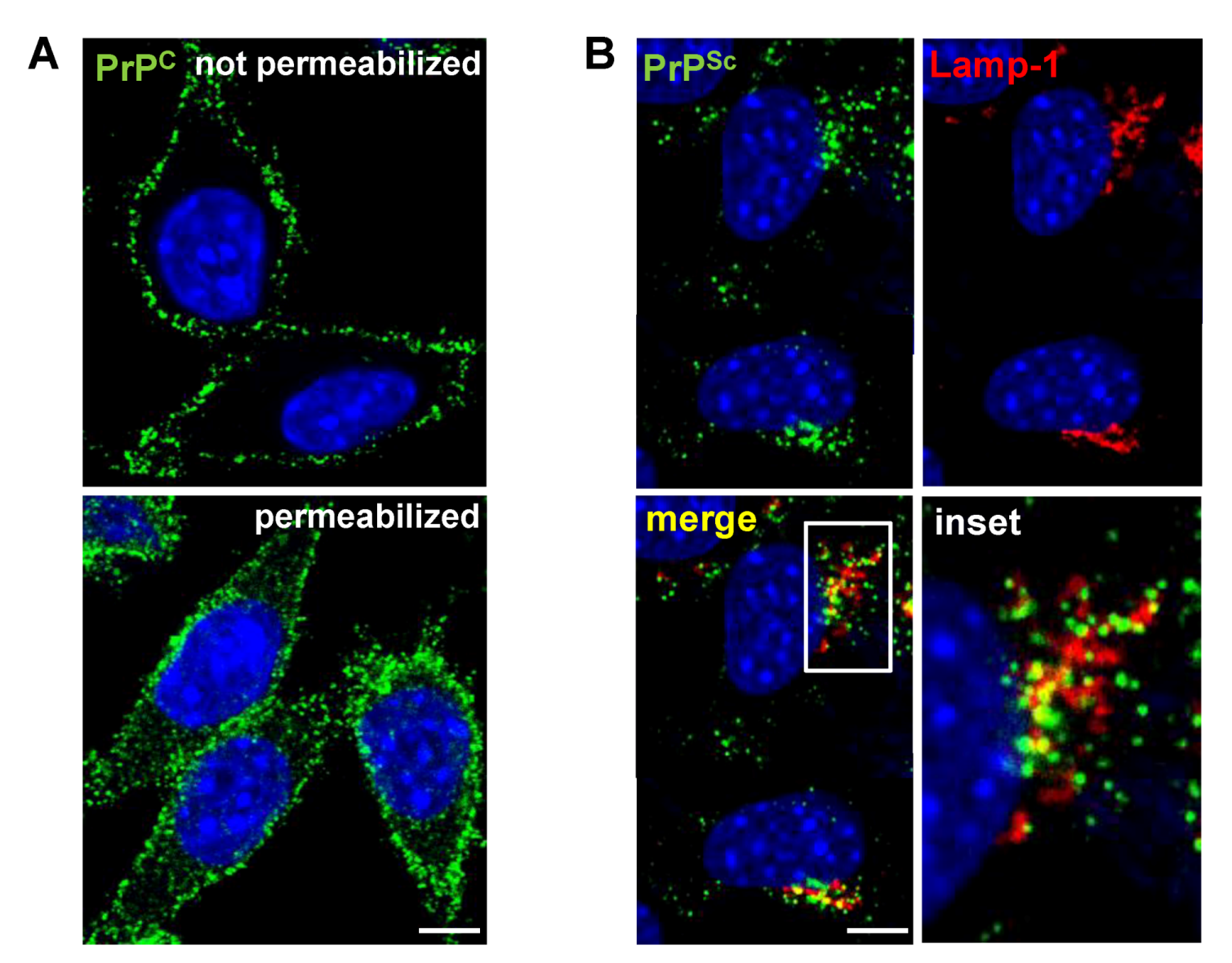
      <p>PrP<sup>C</sup> is synthesized on the rough endoplasmic reticulum (ER) and transits through the Golgi apparatus to the cell surface (<xref ref-type="fig" rid="viruses-05-00374-f001">Figure 1</xref>A). Within the ER and Golgi, PrP<sup>C</sup> becomes glycosylated at two asparagine residues [<xref ref-type="bibr" rid="B21-viruses-05-00374">21</xref>]. Further post-translational modifications include the formation of a disulfide bond between two cysteine residues (amino acid residues 179 and 214 in human PrP) [<xref ref-type="bibr" rid="B22-viruses-05-00374">22</xref>] and the attachment of a glycosyl-phosphatidyl-inositol (GPI) moiety at the carboxy-terminus of the protein [<xref ref-type="bibr" rid="B23-viruses-05-00374">23</xref>]. At the plasma membrane, PrP<sup>C</sup> is incorporated into lipid rafts and caveolae (raft structures with caveolin-1), which are regions of the membrane enriched in cholesterol and sphingolipids [<xref ref-type="bibr" rid="B24-viruses-05-00374">24</xref>,<xref ref-type="bibr" rid="B25-viruses-05-00374">25</xref>]. Targeting to these lipid rafts is mediated by the amino-terminus of PrP<sup>C</sup> [<xref ref-type="bibr" rid="B26-viruses-05-00374">26</xref>,<xref ref-type="bibr" rid="B27-viruses-05-00374">27</xref>]. An early association of PrP<sup>C</sup> with lipid rafts during its biosynthesis appears to be necessary for its correct folding [<xref ref-type="bibr" rid="B28-viruses-05-00374">28</xref>]. Although PrP<sup>C</sup> is normally translocated to the plasma membrane, high concentrations have been detected within multivesicular bodies [<xref ref-type="bibr" rid="B29-viruses-05-00374">29</xref>]. Once on the plasma membrane, PrP<sup>C</sup> can undergo proteolytic processing by metalloproteases, resulting in a membrane-attached carboxyterminal (C1) and an extracellularly released amino-terminal fragment [<xref ref-type="bibr" rid="B30-viruses-05-00374">30</xref>,<xref ref-type="bibr" rid="B31-viruses-05-00374">31</xref>,<xref ref-type="bibr" rid="B32-viruses-05-00374">32</xref>,<xref ref-type="bibr" rid="B33-viruses-05-00374">33</xref>]. In addition, it has been observed that a small percentage of full-length PrP<sup>C</sup> molecules is secreted, either in a soluble form [<xref ref-type="bibr" rid="B34-viruses-05-00374">34</xref>,<xref ref-type="bibr" rid="B35-viruses-05-00374">35</xref>] or in association with exosomes [<xref ref-type="bibr" rid="B36-viruses-05-00374">36</xref>,<xref ref-type="bibr" rid="B37-viruses-05-00374">37</xref>]. Within the cell there is a minor sub-population of PrP<sup>C</sup> molecules present in the cytosol [<xref ref-type="bibr" rid="B38-viruses-05-00374">38</xref>]. Interestingly, using an inducible cell line, PrP23-230 was found in the nucleus of these cells and in association with chromatin [<xref ref-type="bibr" rid="B39-viruses-05-00374">39</xref>]. The physiological relevance of such intranuclear localization so far is unclear.</p>
      
      <p>Extensive research into the biological function of PrP<sup>C</sup> has resulted in a plethora of different possible functions. So far, these include involvement in signaling cascades, neuronal survival, apoptosis, oxidative stress, cell adhesion, differentiation, immunomodulation and more recently, microRNA metabolism [<xref ref-type="bibr" rid="B40-viruses-05-00374">40</xref>,<xref ref-type="bibr" rid="B41-viruses-05-00374">41</xref>]. PrP<sup>C </sup>has a high affinity for metals such as copper, zinc and manganese through binding at its amino-terminus. Binding to PrP<sup>C</sup> mediates neuronal uptake of these metal ions potentially through interaction with other receptors [<xref ref-type="bibr" rid="B42-viruses-05-00374">42</xref>,<xref ref-type="bibr" rid="B43-viruses-05-00374">43</xref>]. PrP<sup>C</sup> has also been proposed to act as a cell surface scaffold protein that interacts with different partners. These mediate the activation of a range of diverse signaling pathways that modulate neuritogenesis and synapse formation [<xref ref-type="bibr" rid="B40-viruses-05-00374">40</xref>]. Interactions of PrP<sup>C </sup>with the neural cell adhesion molecule NCAM or with the laminin receptor precursor LRP/LR have been reported to elicit specific signaling cascades in neurons [<xref ref-type="bibr" rid="B44-viruses-05-00374">44</xref>,<xref ref-type="bibr" rid="B45-viruses-05-00374">45</xref>,<xref ref-type="bibr" rid="B46-viruses-05-00374">46</xref>]. In non-neuronal cells, PrP<sup>C</sup> also plays an important role during embryogenesis or during stem-cell proliferation and differentiation [<xref ref-type="bibr" rid="B47-viruses-05-00374">47</xref>,<xref ref-type="bibr" rid="B48-viruses-05-00374">48</xref>]. Interestingly, PrP has also been shown to bind both RNA and DNA <italic>in vitro </italic>[<xref ref-type="bibr" rid="B49-viruses-05-00374">49</xref>,<xref ref-type="bibr" rid="B50-viruses-05-00374">50</xref>,<xref ref-type="bibr" rid="B51-viruses-05-00374">51</xref>,<xref ref-type="bibr" rid="B52-viruses-05-00374">52</xref>]. Evidence for a physiological role of these nucleic acid-protein associations [<xref ref-type="bibr" rid="B41-viruses-05-00374">41</xref>] is accumulating but needs further clarification.</p>
      <fig id="viruses-05-00374-f001" position="float">
        <label>Figure 1</label>
        <caption>
          <p>Localization of PrP<sup>C</sup> and PrP<sup>Sc</sup> in L929 fibroblast cells. (<bold>A</bold>) Indirect immunofluorescence (IF) staining of cellular PrP (green) in uninfected L929 cells. PrP<sup>C</sup> predominantly resides at the cell surface with some intracellular localization. (<bold>B</bold>) Detection of PrP<sup>Sc</sup> in L929 cells persistently infected with prion strain 22L by IF. In contrast to PrP<sup>C</sup>, PrP<sup>Sc</sup> (green) primarily localizes intracellularly and partially co-localizes with the lysosomal marker Lamp-1 (red). (<bold>A,B</bold>) Nuclei were counterstained with Hoechst (blue). Scale bar: 5 µm.</p>
        </caption>
        <graphic xmlns:xlink="http://www.w3.org/1999/xlink" xlink:href="viruses-05-00374-g001.tif"/>
      </fig>
      <p>PrP<sup>C</sup> is rapidly and constitutively endocytosed from the plasma membrane [<xref ref-type="bibr" rid="B53-viruses-05-00374">53</xref>,<xref ref-type="bibr" rid="B54-viruses-05-00374">54</xref>]. External stimuli such as the binding of copper or stress-inducible protein 1 (STI1) to PrP<sup>C</sup> can stimulate its internalization [<xref ref-type="bibr" rid="B55-viruses-05-00374">55</xref>]. Endocytosis occurs via a dynamin-dependent pathway. PrP<sup>C</sup> transits through Rab5 positive early endosomes (EEs) before it is degraded via the endosomal/lysosomal pathway [<xref ref-type="bibr" rid="B54-viruses-05-00374">54</xref>,<xref ref-type="bibr" rid="B56-viruses-05-00374">56</xref>,<xref ref-type="bibr" rid="B57-viruses-05-00374">57</xref>,<xref ref-type="bibr" rid="B58-viruses-05-00374">58</xref>,<xref ref-type="bibr" rid="B59-viruses-05-00374">59</xref>]. Alternatively, endocytosed PrP<sup>C</sup> can transfer rapidly and directly to recycling endosomes (RE) and back to the cell surface [<xref ref-type="bibr" rid="B54-viruses-05-00374">54</xref>,<xref ref-type="bibr" rid="B56-viruses-05-00374">56</xref>,<xref ref-type="bibr" rid="B60-viruses-05-00374">60</xref>,<xref ref-type="bibr" rid="B61-viruses-05-00374">61</xref>]. It has been proposed that the dynamin-dependent endocytosis of PrP<sup>C</sup> is a GPI-anchor independent event mediated by the interaction of other proteins with specific domains within PrP<sup>C</sup> [<xref ref-type="bibr" rid="B56-viruses-05-00374">56</xref>].</p>
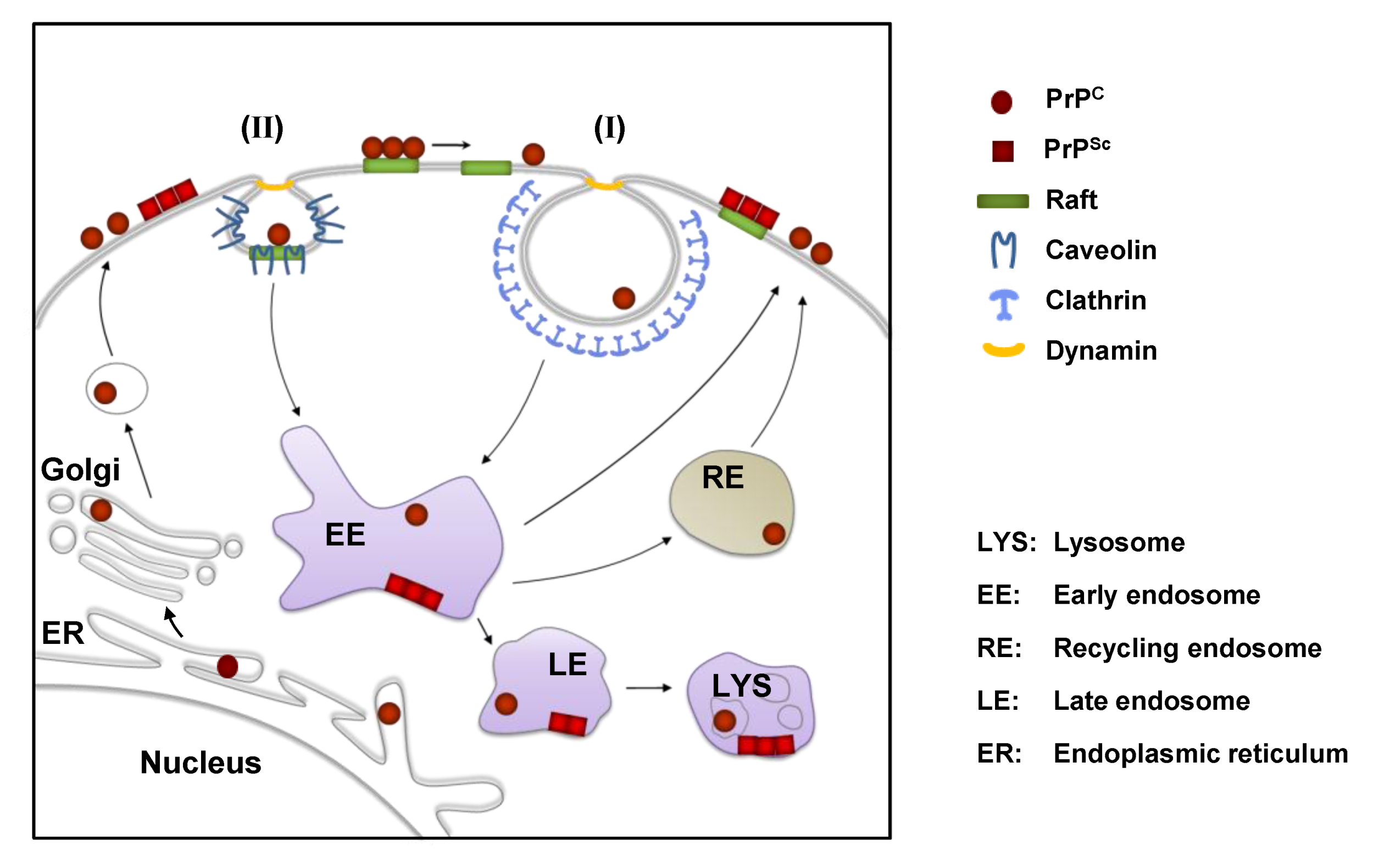
      <p>Both, clathrin-dependent and -independent pathways have been described for PrP<sup>C</sup> internalization [<xref ref-type="bibr" rid="B54-viruses-05-00374">54</xref>,<xref ref-type="bibr" rid="B59-viruses-05-00374">59</xref>,<xref ref-type="bibr" rid="B62-viruses-05-00374">62</xref>,<xref ref-type="bibr" rid="B63-viruses-05-00374">63</xref>,<xref ref-type="bibr" rid="B64-viruses-05-00374">64</xref>] (<xref ref-type="fig" rid="viruses-05-00374-f002">Figure 2</xref>). Although PrP<sup>C</sup> may be endocytosed through rafts in some cells [<xref ref-type="bibr" rid="B62-viruses-05-00374">62</xref>,<xref ref-type="bibr" rid="B64-viruses-05-00374">64</xref>,<xref ref-type="bibr" rid="B65-viruses-05-00374">65</xref>], most studies demonstrate that PrP<sup>C</sup> translocates out of rafts prior to its internalization via clathrin-coated pits in permanent cell cultures and primary neurons [<xref ref-type="bibr" rid="B54-viruses-05-00374">54</xref>,<xref ref-type="bibr" rid="B60-viruses-05-00374">60</xref>,<xref ref-type="bibr" rid="B66-viruses-05-00374">66</xref>,<xref ref-type="bibr" rid="B67-viruses-05-00374">67</xref>,<xref ref-type="bibr" rid="B68-viruses-05-00374">68</xref>,<xref ref-type="bibr" rid="B69-viruses-05-00374">69</xref>]. An amino-terminal, positively charged domain of PrP<sup>C</sup> is important for its endocytosis by clathrin-coated vesicles [<xref ref-type="bibr" rid="B54-viruses-05-00374">54</xref>,<xref ref-type="bibr" rid="B66-viruses-05-00374">66</xref>]. PrP<sup>C</sup> has been detected in clathrin-coated vesicles using electron microscopy [<xref ref-type="bibr" rid="B54-viruses-05-00374">54</xref>,<xref ref-type="bibr" rid="B60-viruses-05-00374">60</xref>,<xref ref-type="bibr" rid="B70-viruses-05-00374">70</xref>]. Still, PrP<sup>C</sup> internalization in mature primary hippocampal neurons appears to depend on rafts and cholesterol [<xref ref-type="bibr" rid="B71-viruses-05-00374">71</xref>]. In agreement with this, Sarnataro <italic>et al.</italic> showed that lipid rafts and clathrin-coated vesicles can co-operate in the internalization of PrP<sup>C</sup> [<xref ref-type="bibr" rid="B72-viruses-05-00374">72</xref>]. The conflicting results obtained in different cell culture models argue that the internalization of PrP<sup>C</sup> is a complex event that may involve different receptors and co-receptors and more than one endocytic route depending on the cell type or stimulus. </p>
      <fig id="viruses-05-00374-f002" position="float">
        <label>Figure 2</label>
        <caption>
          <p>Cell biology of PrP in scrapie-infected cells. PrP<sup>C</sup> is synthesized in the endoplasmic reticulum (ER) and passes through the secretory pathway to the cell surface, where it resides in lipid rafts. In many cells, PrP<sup>C</sup> leaves lipid rafts prior to being internalized by clathrin-dependent endocytosis (I). Clathrin-independent raft/caveolae-dependent internalization (II) of PrP<sup>C</sup> has also been proposed for some cells. PrP<sup>C</sup> can be degraded by lysosomes or rapidly recycled back to the cell surface by recycling endosomes (RE). In cultured scrapie-infected cells the conversion of PrP<sup>C</sup> to PrP<sup>Sc</sup> is believed to take place on the cell surface and/or in vesicles along the endolysosomal pathway. After conversion PrP<sup>Sc</sup> can accumulate at the cell surface or in intracellular vesicles (e.g. lysosomes).</p>
        </caption>
        <graphic xmlns:xlink="http://www.w3.org/1999/xlink" xlink:href="viruses-05-00374-g002.tif"/>
      </fig>
    </sec>
    <sec>
      <title>3. Cell Surface Receptors for PrP<sup>C</sup></title>
      <p>Clathrin-coated vesicles mediate internalization of transmembrane proteins by interaction with accessory proteins [<xref ref-type="bibr" rid="B73-viruses-05-00374">73</xref>]. Since PrP<sup>C</sup> lacks a transmembrane domain capable of interacting with adaptor proteins, co-internalization of PrP<sup>C</sup> with other proteins has been suggested. Several potential receptors for co-internalization have been proposed, including the laminin receptor precursor LRP/LR, the low-density lipoprotein receptor-related protein 1 (LRP1) and glycosaminoglycans (GAGs). Comparative studies on the involvement of these receptors for PrP<sup>C</sup> endocytosis are lacking, so it is still unclear which role these receptors play in certain cell types. Of note, also other so far unidentified receptors might be involved. </p>
      <p>The membrane-associated form of the ribosomal protein SA (RPSA), termed laminin receptor precursor LRP/LR, has been characterized as a potential binding partner of PrP [<xref ref-type="bibr" rid="B74-viruses-05-00374">74</xref>,<xref ref-type="bibr" rid="B75-viruses-05-00374">75</xref>,<xref ref-type="bibr" rid="B76-viruses-05-00374">76</xref>,<xref ref-type="bibr" rid="B77-viruses-05-00374">77</xref>]. RPSA is a multifunctional protein present on the cell surface or associated with cytosolic ribosomes. The 67 kDa membrane-bound form LRP/LR is a high affinity receptor for laminin derived from a 37 kDa polypeptide (37LRP) precursor by homo- or heterodimerization through fatty acid acylation. LRP/LR is expressed in a variety of tissues and cells, including neurons [<xref ref-type="bibr" rid="B78-viruses-05-00374">78</xref>], and also binds growth factors, toxins and pathogens. LRP/LR was first identified in a yeast two-hybrid system using a HeLa cDNA library as prey and PrP as bait [<xref ref-type="bibr" rid="B76-viruses-05-00374">76</xref>]. Interaction of PrP23-231 and LRP/LR, both ectopically expressed, was confirmed in insect cells and N2a cells. Recombinant human PrP also bound to N2a and BHK cells expressing LRP/LR [<xref ref-type="bibr" rid="B74-viruses-05-00374">74</xref>]. Direct binding of recombinant PrP to LRP/LR is mediated through a region in PrP encompassing amino-acid residues 144-179 in human PrP [<xref ref-type="bibr" rid="B77-viruses-05-00374">77</xref>]. Recombinant PrP also indirectly associates with LRP/LR on the surface of CHO cells through the interaction of both molecules with the GAG heparan sulfate proteoglycan (HSPG). Although an association of PrP and LRP/LR was confirmed in an interactome analysis of tagged-PrP expressed in neuroblastoma cells, co-internalization of LRP/LR and endogenously expressed GPI-anchored PrP<sup>C</sup> has not been formally demonstrated [<xref ref-type="bibr" rid="B79-viruses-05-00374">79</xref>]. </p>
      <p>Another putative PrP<sup>C</sup> co-receptor, LRP1, belongs to the low-density lipoprotein (LDL) receptor family and is abundantly expressed in neurons and hepatocytes [<xref ref-type="bibr" rid="B80-viruses-05-00374">80</xref>]. LRP1 acts as a scavenger receptor with two clusters of complement-type repeats with high affinity for at least 24 different ligands [<xref ref-type="bibr" rid="B80-viruses-05-00374">80</xref>]. Ligands either directly adhere to LRP1 or initially bind to HSPG before being scavenged by LRP1 for endocytosis. Thus, HSPGs serve as a primary docking site for ligands acting as a ligand reservoir and thereby regulating LRP1 activity. Recognition sites for cytosolic adaptor proteins in the cytoplasmic tail of the light chain regulate receptor-mediated endocytosis by clathrin-coated pits (CCPs) [<xref ref-type="bibr" rid="B80-viruses-05-00374">80</xref>]. LRP1 transiently associates with rafts before it undergoes rapid endocytosis by CCPs. Partial lipid raft localization has been demonstrated in some, but not all cell lines tested [<xref ref-type="bibr" rid="B81-viruses-05-00374">81</xref>]. LDL receptor family members also physically and functionally interact with other cell surface proteins, including GPI-anchored proteins and thereby modulate their activity [<xref ref-type="bibr" rid="B80-viruses-05-00374">80</xref>]. Bridging of LRP1 to other cell surface receptors by ligands or cytosolic adaptor proteins has been shown to promote their co-internalization [<xref ref-type="bibr" rid="B81-viruses-05-00374">81</xref>]. PrP<sup>C</sup> and LRP1 have been shown to co-localize on the cell surface of SH-SY5Y cells [<xref ref-type="bibr" rid="B82-viruses-05-00374">82</xref>]. In neurons, association of PrP<sup>C</sup> with LRP1 in the secretory pathway assists in trafficking of PrP<sup>C</sup> to the cell membrane [<xref ref-type="bibr" rid="B83-viruses-05-00374">83</xref>]. Both, knock-down of LRP1 or the use of LRP antagonists, inhibit endocytosis of PrP<sup>C</sup> [<xref ref-type="bibr" rid="B82-viruses-05-00374">82</xref>,<xref ref-type="bibr" rid="B83-viruses-05-00374">83</xref>]. A stretch of basic amino acid residues in the amino-terminus of PrP<sup>C</sup> mediates binding to LRP1. HSPGs have been shown to be required for LRP1-protein complex internalization in some cases [<xref ref-type="bibr" rid="B84-viruses-05-00374">84</xref>]. </p>
      <p>The metabolism and trafficking of PrP<sup>C</sup> is influenced by the interaction with cell surface bound GAGs. These are long unbranched polysaccharides, composed of repeating disaccharide units that are highly sulfated. GAGs are either secreted or linked to core proteins to make an entity known as a proteoglycan. Proteoglycans are abundantly expressed on cell surfaces and differ by their polysaccharide backbone and the degree of sulfation. Heparin is a GAG mainly produced and secreted by mast cells that is structurally closely related to heparan sulfate (HS). The most common disaccharide unit within HS consists of glucuronic acid and N-acetylglucosamine. HS side chains are covalently linked to either transmembrane syndecans or GPI-anchored glypicans. The basic amino acid motif KKRPKP present in the amino-terminus of PrP (residues 23-28) and two additional regions (residues 53-93 and 110-120) are important for the association of PrP<sup>C</sup> with HS [<xref ref-type="bibr" rid="B85-viruses-05-00374">85</xref>,<xref ref-type="bibr" rid="B86-viruses-05-00374">86</xref>,<xref ref-type="bibr" rid="B87-viruses-05-00374">87</xref>]. Experimentally, brain-derived PrP<sup>C</sup> as well as recombinant PrP have been shown to bind to heparin or another polyanion, Congo red, <italic>in vitro</italic> [<xref ref-type="bibr" rid="B88-viruses-05-00374">88</xref>,<xref ref-type="bibr" rid="B89-viruses-05-00374">89</xref>]. Recombinant PrP has also been shown to bind to HSPG on the plasma membrane of CHO cells [<xref ref-type="bibr" rid="B90-viruses-05-00374">90</xref>].</p>
      <p>Whether HSPGs are important for the cell surface localization of PrP<sup>C</sup> remains controversial. In N2a cells, degradation of HS by heparinases neither affected the cell surface expression of PrP<sup>C</sup> nor influenced its raft association [<xref ref-type="bibr" rid="B91-viruses-05-00374">91</xref>]. GAG mimetics could potentially modulate cell surface expression of PrP<sup>C</sup> by competing for the binding site of endogenously expressed HSPGs, as exogenously added soluble GAGs have been previously shown to influence cellular PrP<sup>C</sup> levels. Early studies demonstrated that treatment of N2a cells with HS increased total cellular levels of PrP<sup>C</sup> [<xref ref-type="bibr" rid="B88-viruses-05-00374">88</xref>]. While pentosan polysulfate (PPS), a GAG analogue, had no apparent effect on PrP<sup>C</sup> cell surface expression in N2a cells at concentrations of 0.1 μg/mL [<xref ref-type="bibr" rid="B89-viruses-05-00374">89</xref>], a concentration of 100 μg/mL drastically reduced PrP<sup>C</sup> cell membrane localization [<xref ref-type="bibr" rid="B90-viruses-05-00374">90</xref>]. Likewise, other polyanionic compounds such as Congo red and dextran sulfate 500 kDa (DS500) at concentrations of 10 μg/mL reduced the amount of cell surface PrP<sup>C</sup> in N2a cells [<xref ref-type="bibr" rid="B90-viruses-05-00374">90</xref>]. PPS treatment did not affect biosynthesis or trafficking through the secretory pathway but instead enhanced the endocytosis rate of PrP<sup>C</sup>, resulting in a redistribution of a proportion of PrP<sup>C</sup> into late endosomal vesicles. The amino-terminus, comprising residues 25-91, was shown to be important for this. In contrast, GAG analogue suramin was shown to impair PrP<sup>C</sup> folding in the secretory pathway, resulting in the re-routing of PrP<sup>C</sup> to acidic compartments [<xref ref-type="bibr" rid="B92-viruses-05-00374">92</xref>]. </p>
    </sec>
    <sec>
      <title>4. Cellular Models for Studying PrP<sup>Sc</sup> Formation</title>
      <p>Cell culture models replicating prion infectivity were already established in 1970 [<xref ref-type="bibr" rid="B93-viruses-05-00374">93</xref>], even before PrP<sup>Sc</sup> was identified as a surrogate marker and potential TSE agent. PrP<sup>Sc</sup> formation was first detected in the murine neuroblastoma cell line N2a when exposed to mouse-adapted scrapie [<xref ref-type="bibr" rid="B94-viruses-05-00374">94</xref>,<xref ref-type="bibr" rid="B95-viruses-05-00374">95</xref>]. Subsequent infection experiments demonstrated susceptibility of N2a cells to several different mouse-adapted scrapie strains [<xref ref-type="bibr" rid="B96-viruses-05-00374">96</xref>]. Since then, several cell lines of neuronal and non-neuronal origin have been identified to be susceptible to a stable infection with prions (<xref ref-type="table" rid="viruses-05-00374-t001">Table 1</xref>). Once prions have successfully infected a cell line, they can replicate persistently over multiple cell passages, with very few exceptions [<xref ref-type="bibr" rid="B97-viruses-05-00374">97</xref>], without any overt cytopathic effect. Cell lines that have been successfully infected include microglial cells as well as epithelial cells, fibroblasts and myoblasts, which have all been demonstrated to persistently replicate an array of prion strains <italic>in vitro</italic> [<xref ref-type="bibr" rid="B98-viruses-05-00374">98</xref>,<xref ref-type="bibr" rid="B99-viruses-05-00374">99</xref>,<xref ref-type="bibr" rid="B100-viruses-05-00374">100</xref>,<xref ref-type="bibr" rid="B101-viruses-05-00374">101</xref>,<xref ref-type="bibr" rid="B102-viruses-05-00374">102</xref>,<xref ref-type="bibr" rid="B103-viruses-05-00374">103</xref>,<xref ref-type="bibr" rid="B104-viruses-05-00374">104</xref>,<xref ref-type="bibr" rid="B105-viruses-05-00374">105</xref>,<xref ref-type="bibr" rid="B106-viruses-05-00374">106</xref>,<xref ref-type="bibr" rid="B107-viruses-05-00374">107</xref>,<xref ref-type="bibr" rid="B108-viruses-05-00374">108</xref>]. Curiously, a rabbit kidney epithelial cell line genetically engineered to express PrP<sup>C</sup> of different species was shown to be susceptible to a variety of prion strains isolated from different sources [<xref ref-type="bibr" rid="B99-viruses-05-00374">99</xref>,<xref ref-type="bibr" rid="B100-viruses-05-00374">100</xref>,<xref ref-type="bibr" rid="B101-viruses-05-00374">101</xref>,<xref ref-type="bibr" rid="B102-viruses-05-00374">102</xref>,<xref ref-type="bibr" rid="B103-viruses-05-00374">103</xref>,<xref ref-type="bibr" rid="B104-viruses-05-00374">104</xref>,<xref ref-type="bibr" rid="B105-viruses-05-00374">105</xref>,<xref ref-type="bibr" rid="B109-viruses-05-00374">109</xref>]. Several primary cell culture models for prion replication have been reported, some of which show cytopathic effects upon infection [<xref ref-type="bibr" rid="B110-viruses-05-00374">110</xref>,<xref ref-type="bibr" rid="B111-viruses-05-00374">111</xref>,<xref ref-type="bibr" rid="B112-viruses-05-00374">112</xref>,<xref ref-type="bibr" rid="B113-viruses-05-00374">113</xref>,<xref ref-type="bibr" rid="B114-viruses-05-00374">114</xref>,<xref ref-type="bibr" rid="B115-viruses-05-00374">115</xref>].</p>
      <p>Despite recent success with prion cell culture models (<xref ref-type="table" rid="viruses-05-00374-t001">Table 1</xref>), prion infection of cells <italic>in vitro</italic> has been notoriously difficult and often unsuccessful. Most cell lines expressing PrP<sup>C</sup> are resistant to prion infection, and for many prion strains, suitable cell culture models have not been established [<xref ref-type="bibr" rid="B95-viruses-05-00374">95</xref>,<xref ref-type="bibr" rid="B116-viruses-05-00374">116</xref>,<xref ref-type="bibr" rid="B117-viruses-05-00374">117</xref>,<xref ref-type="bibr" rid="B118-viruses-05-00374">118</xref>]. Importantly, <italic>ex vivo</italic> models for the propagation of prion strains of human origin have only been reported once [<xref ref-type="bibr" rid="B119-viruses-05-00374">119</xref>]. Infections with human strains were more successful when prions had been previously adapted to mice [<xref ref-type="bibr" rid="B99-viruses-05-00374">99</xref>,<xref ref-type="bibr" rid="B120-viruses-05-00374">120</xref>]. Whilst expression of PrP<sup>C</sup> is necessary for prion infection <italic>in vitro</italic> [<xref ref-type="bibr" rid="B121-viruses-05-00374">121</xref>,<xref ref-type="bibr" rid="B122-viruses-05-00374">122</xref>], the expression level of PrP<sup>C</sup> does not generally appear to influence susceptibility [<xref ref-type="bibr" rid="B107-viruses-05-00374">107</xref>,<xref ref-type="bibr" rid="B118-viruses-05-00374">118</xref>,<xref ref-type="bibr" rid="B123-viruses-05-00374">123</xref>]. Importantly, infection rates and prion titers in cell culture are usually low and subsequent cloning of infected cells or pre-selection of clones is a necessary process to increase the percentage of infected cells within a cell population [<xref ref-type="bibr" rid="B95-viruses-05-00374">95</xref>,<xref ref-type="bibr" rid="B118-viruses-05-00374">118</xref>,<xref ref-type="bibr" rid="B124-viruses-05-00374">124</xref>,<xref ref-type="bibr" rid="B125-viruses-05-00374">125</xref>,<xref ref-type="bibr" rid="B126-viruses-05-00374">126</xref>,<xref ref-type="bibr" rid="B127-viruses-05-00374">127</xref>]. Remarkably, persistent prion infection is often lost over continuous passage. Changes in growth medium composition and culture conditions can account for prion loss in cell culture [<xref ref-type="bibr" rid="B128-viruses-05-00374">128</xref>,<xref ref-type="bibr" rid="B129-viruses-05-00374">129</xref>]. Additionally, genetic heterogeneity and chromosomal instability have been proposed to affect susceptibility of cell populations over time [<xref ref-type="bibr" rid="B118-viruses-05-00374">118</xref>,<xref ref-type="bibr" rid="B130-viruses-05-00374">130</xref>]. </p>
      <p>Cell lines that are susceptible to some prion strains demonstrate a remarkable resistance to other strains [<xref ref-type="bibr" rid="B107-viruses-05-00374">107</xref>,<xref ref-type="bibr" rid="B118-viruses-05-00374">118</xref>,<xref ref-type="bibr" rid="B125-viruses-05-00374">125</xref>]. The mouse derived fibroblast cell line NIH/3T3 for example has been shown to be susceptible only to mouse-adapted scrapie strain 22L, whilst the murine fibroblast cell line L929 is capable of replicating the strains 22L, RML and ME7 [<xref ref-type="bibr" rid="B107-viruses-05-00374">107</xref>,<xref ref-type="bibr" rid="B125-viruses-05-00374">125</xref>]. The reason for the differences in susceptibility to prion infection is unclear but points to substantial differences in the cell biology of prion strain replication. So far, susceptibility of a cell line to any given prion strain can only be determined empirically.</p>
      <p>A major restriction in the analysis and understanding of prion cell biology is the specific detection of the disease-associated isoform PrP<sup>Sc</sup> over the host-encoded isoform. There is a shortage of antibodies that are suitable for the convincing and specific detection of PrP<sup>Sc</sup> by western blot or immunofluorescence. Therefore, it is extremely difficult to investigate the uptake of PrP<sup>Sc</sup>, the subcellular distribution and location of <italic>de novo</italic> synthesis. Presently, the protocols for the specific detection of the misfolded isoform take advantage of the unique biochemical features of PrP<sup>Sc</sup> and include treatments with denaturants to enhance immunoreactivity [<xref ref-type="bibr" rid="B131-viruses-05-00374">131</xref>]. Moreover, newly generated PrP<sup>Sc</sup> cannot be discriminated from the inoculated PrP<sup>Sc</sup> used, unless either the substrate PrP<sup>C</sup> or template PrP<sup>Sc</sup> are tagged by antibody-specific epitopes or fluorescent labels. In most studies done so far, cells overexpressed tagged PrP<sup>C</sup> [<xref ref-type="bibr" rid="B132-viruses-05-00374">132</xref>,<xref ref-type="bibr" rid="B133-viruses-05-00374">133</xref>,<xref ref-type="bibr" rid="B134-viruses-05-00374">134</xref>]. Thus, either the presence of the tag or overexpression of PrP<sup>C</sup> could influence the conversion process. Amino-acid residue substitutions in PrP often create complications such as a transmission barrier. Tagging of PrP<sup>C</sup> at the amino-terminus with GFP has been shown to compromise prion infection and PrP<sup>Sc</sup> formation <italic>in vivo</italic> and <italic>in vitro</italic> [<xref ref-type="bibr" rid="B135-viruses-05-00374">135</xref>]. Alternatively, fluorescent labeling of purified prion preparations has been successfully used to study prion uptake and intraneuronal transport <italic>in vitro</italic>. However, the uptake characteristics of labeled fibrils show striking differences compared to those of untagged PrP<sup>Sc</sup> from crude brain homogenate preparations [<xref ref-type="bibr" rid="B133-viruses-05-00374">133</xref>,<xref ref-type="bibr" rid="B136-viruses-05-00374">136</xref>]. More recently, 3F4-tagged PrP<sup>Sc</sup> derived from transgenic mice that were infected with prions proved effective in studying prion uptake [<xref ref-type="bibr" rid="B133-viruses-05-00374">133</xref>]. Of note, changes in the PrP amino acid substitutions could affect prion strain characteristics and might thus not be suited to study the cell biology of different prion strains.</p>
      <p>Previously, prion cell culture systems relied on the detection of PrP<sup>Sc</sup> as a marker for infection and prion titers were determined by inoculation of cell lysates into panels of mice [<xref ref-type="bibr" rid="B107-viruses-05-00374">107</xref>]. A major breakthrough came in determining the titers of standard prion strains with the development of the “Standard Scrapie Cell Assay” (SSCA) [<xref ref-type="bibr" rid="B118-viruses-05-00374">118</xref>]. The SSCA incorporates a highly susceptible N2a subclone that is inoculated with serial dilutions of the prion strain RML as a standard. These infected N2a cells are propagated in a microtiter format until <italic>de novo</italic> formed PrP<sup>Sc</sup> accumulates to detectable levels. After three cell passages, defined numbers of cells are filtered onto nitrocellulose membranes and PrP<sup>Sc</sup> positive cells are detected by immunoblot using an ELISPOT reader. The SSCA can also be used as an endpoint assay (SCEPA) to quantify prion titers of individual samples by comparison with the standard titration curve [<xref ref-type="bibr" rid="B137-viruses-05-00374">137</xref>]. The SSCA was subsequently adapted to a panel of cell lines exhibiting selective susceptibility to different strains [<xref ref-type="bibr" rid="B125-viruses-05-00374">125</xref>,<xref ref-type="bibr" rid="B138-viruses-05-00374">138</xref>].</p>
      
      <table-wrap id="viruses-05-00374-t001" position="float">
        <object-id pub-id-type="pii">viruses-05-00374-t001_Table 1</object-id>
        <label>Table 1</label>
        <caption>
          <p>Cell culture models susceptible to transmissible spongiform encephalopathy (TSE) agents.</p>
        </caption>
        <table rules="all">
          <thead>
            <tr>
              <th align="center" valign="middle">Cell designation</th>
              <th align="center" valign="middle">Tissue of origin or cell type</th>
              <th align="center" valign="middle">Species of origin</th>
              <th align="center" valign="middle">Prion strain</th>
              <th align="center" valign="middle">References</th>
            </tr>
          </thead>
          <tbody>
            <tr>
              <td colspan="5" align="left" valign="middle">
                <bold>1. Neuronal or brain-derived cells</bold>              </td>
            </tr>
            <tr>
              <td align="center" valign="middle">N2a</td>
              <td align="center" valign="middle">neuroblastoma cell line*</td>
              <td align="center" valign="middle">mouse</td>
              <td align="center" valign="middle">Chandler, RML, 139A, 22L, C506, Fukuoka-1, FU CJD </td>
              <td align="center" valign="middle">[<xref ref-type="bibr" rid="B95-viruses-05-00374">95</xref>,<xref ref-type="bibr" rid="B96-viruses-05-00374">96</xref>,<xref ref-type="bibr" rid="B127-viruses-05-00374">127</xref>,<xref ref-type="bibr" rid="B139-viruses-05-00374">139</xref>,<xref ref-type="bibr" rid="B140-viruses-05-00374">140</xref>,<xref ref-type="bibr" rid="B141-viruses-05-00374">141</xref>,<xref ref-type="bibr" rid="B142-viruses-05-00374">142</xref>,<xref ref-type="bibr" rid="B143-viruses-05-00374">143</xref>,<xref ref-type="bibr" rid="B144-viruses-05-00374">144</xref>]</td>
            </tr>
            <tr>
              <td align="center" valign="middle">GT1</td>
              <td align="center" valign="middle">hypothalamic cell line</td>
              <td align="center" valign="middle">mouse</td>
              <td align="center" valign="middle">Chandler, RML, 139A, 22L, kCJD, FU CJD , M1000</td>
              <td align="center" valign="middle">[<xref ref-type="bibr" rid="B96-viruses-05-00374">96</xref>,<xref ref-type="bibr" rid="B97-viruses-05-00374">97</xref>,<xref ref-type="bibr" rid="B99-viruses-05-00374">99</xref>,<xref ref-type="bibr" rid="B120-viruses-05-00374">120</xref>,<xref ref-type="bibr" rid="B139-viruses-05-00374">139</xref>,<xref ref-type="bibr" rid="B145-viruses-05-00374">145</xref>]</td>
            </tr>
            <tr>
              <td align="center" valign="middle">SN56</td>
              <td align="center" valign="middle">cholinergic septal cell line</td>
              <td align="center" valign="middle">mouse</td>
              <td align="center" valign="middle">Chandler, ME7, 22L</td>
              <td align="center" valign="middle">[<xref ref-type="bibr" rid="B146-viruses-05-00374">146</xref>]</td>
            </tr>
            <tr>
              <td align="center" valign="middle">HpL3-4</td>
              <td align="center" valign="middle">hippocampal PrP-deficient cell line,<break/>upon ectopic expression of moPrP*</td>
              <td align="center" valign="middle">mouse</td>
              <td align="center" valign="middle">22L</td>
              <td align="center" valign="middle">[<xref ref-type="bibr" rid="B121-viruses-05-00374">121</xref>,<xref ref-type="bibr" rid="B147-viruses-05-00374">147</xref>]</td>
            </tr>
             
            <tr>
              <td align="center" valign="middle">CF10</td>
              <td align="center" valign="middle">brain derived PrP-deficient cell line,<break/>upon ectopic expression of moPrP</td>
              <td align="center" valign="middle">mouse</td>
              <td align="center" valign="middle">22L</td>
              <td align="center" valign="middle">[<xref ref-type="bibr" rid="B122-viruses-05-00374">122</xref>]</td>
            </tr>
           
            <tr>
              <td align="center" valign="middle">SMB</td>
              <td align="center" valign="middle">prion-infected brain cell</td>
              <td align="center" valign="middle">mouse</td>
              <td align="center" valign="middle">Chandler, 139A, 22F, 79A</td>
              <td align="center" valign="middle">[<xref ref-type="bibr" rid="B93-viruses-05-00374">93</xref>,<xref ref-type="bibr" rid="B148-viruses-05-00374">148</xref>,<xref ref-type="bibr" rid="B149-viruses-05-00374">149</xref>]</td>
            </tr>
            <tr>
              <td align="center" valign="middle">CAD</td>
              <td align="center" valign="middle">catecholaminergic cell line</td>
              <td align="center" valign="middle">mouse</td>
              <td align="center" valign="middle">RML, 22L, 22F, 79A, 139A, ME7</td>
              <td align="center" valign="middle">[<xref ref-type="bibr" rid="B125-viruses-05-00374">125</xref>,<xref ref-type="bibr" rid="B150-viruses-05-00374">150</xref>,<xref ref-type="bibr" rid="B151-viruses-05-00374">151</xref>,<xref ref-type="bibr" rid="B152-viruses-05-00374">152</xref>]</td>
            </tr>
            <tr>
              <td align="center" valign="middle">MG20</td>
              <td align="center" valign="middle">microglial cell line overexpressing PrP<sup>C</sup></td>
              <td align="center" valign="middle">tg20 mouse</td>
              <td align="center" valign="middle">Chandler, ME7, Obihiro, mouse-adapted BSE</td>
              <td align="center" valign="middle">[<xref ref-type="bibr" rid="B98-viruses-05-00374">98</xref>]</td>
            </tr>
            <tr>
              <td align="center" valign="middle">PC12</td>
              <td align="center" valign="middle">pheochromocytoma cell line</td>
              <td align="center" valign="middle">rat</td>
              <td align="center" valign="middle">139A, ME7</td>
              <td align="center" valign="middle">[<xref ref-type="bibr" rid="B153-viruses-05-00374">153</xref>,<xref ref-type="bibr" rid="B154-viruses-05-00374">154</xref>,<xref ref-type="bibr" rid="B155-viruses-05-00374">155</xref>]</td>
            </tr>
            <tr>
              <td align="center" valign="middle">HaB</td>
              <td align="center" valign="middle">brain-derived cell line</td>
              <td align="center" valign="middle">hamster</td>
              <td align="center" valign="middle">Sc237</td>
              <td align="center" valign="middle">[<xref ref-type="bibr" rid="B131-viruses-05-00374">131</xref>]</td>
            </tr>
            <tr>
              <td align="center" valign="middle">SH-SY5Y</td>
              <td align="center" valign="middle">neuroblastoma cell line</td>
              <td align="center" valign="middle">human</td>
              <td align="center" valign="middle">sCJD brain material</td>
              <td align="center" valign="middle">[<xref ref-type="bibr" rid="B119-viruses-05-00374">119</xref>]</td>
            </tr>
            <tr>
              <td align="center" valign="middle">MDB</td>
              <td align="center" valign="middle">primary brain cells, <break/>SV40 transformed</td>
              <td align="center" valign="middle">mule deer</td>
              <td align="center" valign="middle">CWD</td>
              <td align="center" valign="middle">[<xref ref-type="bibr" rid="B129-viruses-05-00374">129</xref>]</td>
            </tr>
             
            <tr>
              <td colspan="5" align="left" valign="middle">
                <bold>2. Primary neuronal or brain-derived cells</bold>              </td>
            </tr>
            <tr>
              <td align="center" valign="middle">CGN</td>
              <td align="center" valign="middle">cerebellar granule neurons overexpressing ovine PrP<sup>C</sup></td>
              <td align="center" valign="middle">tgov mouse</td>
              <td align="center" valign="middle">mo 127S</td>
              <td align="center" valign="middle">[<xref ref-type="bibr" rid="B111-viruses-05-00374">111</xref>]</td>
            </tr>
            <tr>
              <td align="center" valign="middle">CAS</td>
              <td align="center" valign="middle">cerebellar astrocytes overexpressing ovine PrP<sup>C</sup></td>
              <td align="center" valign="middle">tgov mouse</td>
              <td align="center" valign="middle">mo 127S</td>
              <td align="center" valign="middle">[<xref ref-type="bibr" rid="B111-viruses-05-00374">111</xref>]</td>
            </tr>
            <tr>
              <td align="center" valign="middle">NSC</td>
              <td align="center" valign="middle">neural stem cells</td>
              <td align="center" valign="middle">mouse</td>
              <td align="center" valign="middle">22L, RML</td>
              <td align="center" valign="middle">[<xref ref-type="bibr" rid="B112-viruses-05-00374">112</xref>,<xref ref-type="bibr" rid="B113-viruses-05-00374">113</xref>,<xref ref-type="bibr" rid="B115-viruses-05-00374">115</xref>]</td>
            </tr>
            <tr>
              <td colspan="5" align="left" valign="middle">
                <bold>3. Non-neuronal cells</bold>              </td>
            </tr>
            <tr>
              <td align="center" valign="middle">C2C12</td>
              <td align="center" valign="middle">skeletal myoblast cell line</td>
              <td align="center" valign="middle">mouse</td>
              <td align="center" valign="middle">22L</td>
              <td align="center" valign="middle">[<xref ref-type="bibr" rid="B108-viruses-05-00374">108</xref>]</td>
            </tr>
            <tr>
              <td align="center" valign="middle">L fibroblasts</td>
              <td align="center" valign="middle">fibroblast cell line</td>
              <td align="center" valign="middle">mouse</td>
              <td align="center" valign="middle">ME7, Chandler</td>
              <td align="center" valign="middle">[<xref ref-type="bibr" rid="B106-viruses-05-00374">106</xref>]</td>
            </tr>
            <tr>
              <td align="center" valign="middle">L929</td>
              <td align="center" valign="middle">fibroblast cell line</td>
              <td align="center" valign="middle">mouse</td>
              <td align="center" valign="middle">22L, RML, ME7</td>
              <td align="center" valign="middle">[<xref ref-type="bibr" rid="B107-viruses-05-00374">107</xref>]</td>
            </tr>
            <tr>
              <td align="center" valign="middle">NIH/3T3</td>
              <td align="center" valign="middle">fibroblast cell line</td>
              <td align="center" valign="middle">mouse</td>
              <td align="center" valign="middle">22L</td>
              <td align="center" valign="middle">[<xref ref-type="bibr" rid="B107-viruses-05-00374">107</xref>]</td>
            </tr>
            <tr>
              <td align="center" valign="middle">MSC-80</td>
              <td align="center" valign="middle">Schwann cell line</td>
              <td align="center" valign="middle">mouse</td>
              <td align="center" valign="middle">Chandler</td>
              <td align="center" valign="middle">[<xref ref-type="bibr" rid="B156-viruses-05-00374">156</xref>]</td>
            </tr>
            <tr>
              <td align="center" valign="middle">MovS</td>
              <td align="center" valign="middle">Schwann cell-like from dorsal root ganglia</td>
              <td align="center" valign="middle">tgov mouse</td>
              <td align="center" valign="middle">PG127, SSBP/1, scrapie field isolates</td>
              <td align="center" valign="middle">[<xref ref-type="bibr" rid="B104-viruses-05-00374">104</xref>,<xref ref-type="bibr" rid="B157-viruses-05-00374">157</xref>]</td>
            </tr>
             
            <tr>
              <td align="center" valign="middle">moRK13</td>
              <td align="center" valign="middle">epithelial cell line expressing mouse PrP<sup>C</sup></td>
              <td align="center" valign="middle">rabbit</td>
              <td align="center" valign="middle">Fukuoka-1, 22L, Chandler, M1000, mo sCJD</td>
              <td align="center" valign="middle">[<xref ref-type="bibr" rid="B99-viruses-05-00374">99</xref>,<xref ref-type="bibr" rid="B100-viruses-05-00374">100</xref>,<xref ref-type="bibr" rid="B101-viruses-05-00374">101</xref>,<xref ref-type="bibr" rid="B120-viruses-05-00374">120</xref>]</td>
            </tr>
             
            <tr>
              <td align="center" valign="middle">voRK13</td>
              <td align="center" valign="middle">epithelial cell line expressing vole PrP<sup>C</sup></td>
              <td align="center" valign="middle">rabbit</td>
              <td align="center" valign="middle">vo BSE </td>
              <td align="center" valign="middle">[<xref ref-type="bibr" rid="B100-viruses-05-00374">100</xref>]</td>
            </tr>
             
            <tr>
              <td align="center" valign="middle">ovRK13/ RoV9</td>
              <td align="center" valign="middle">epithelial cell line expressing ovine PrP<sup>C</sup></td>
              <td align="center" valign="middle">rabbit</td>
              <td align="center" valign="middle">PG127, LA404, SSBP/1, scrapie field isolates</td>
              <td align="center" valign="middle">[<xref ref-type="bibr" rid="B102-viruses-05-00374">102</xref>,<xref ref-type="bibr" rid="B103-viruses-05-00374">103</xref>,<xref ref-type="bibr" rid="B104-viruses-05-00374">104</xref>]</td>
            </tr>
            
            <tr>
              <td align="center" valign="middle">elkRK13</td>
              <td align="center" valign="middle">epithelial cell line expressing elk PrP<sup>C</sup></td>
              <td align="center" valign="middle">rabbit</td>
              <td align="center" valign="middle">CWD</td>
              <td align="center" valign="middle">[<xref ref-type="bibr" rid="B105-viruses-05-00374">105</xref>,<xref ref-type="bibr" rid="B109-viruses-05-00374">109</xref>]</td>
            </tr>
            
            <tr>
              <td colspan="5" align="left" valign="middle">
                <bold>4. Primary non-neuronal cells</bold>              </td>
            </tr>
            <tr>
              <td align="center" valign="middle">BM-derived MSC</td>
              <td align="center" valign="middle">bone marrow derived mesenchymal stem cell</td>
              <td align="center" valign="middle">mouse</td>
              <td align="center" valign="middle">Fukuoka-1</td>
              <td align="center" valign="middle">[<xref ref-type="bibr" rid="B110-viruses-05-00374">110</xref>]</td>
            </tr>
            <tr>
              <td align="center" valign="middle">BM-derived MSC-like</td>
              <td align="center" valign="middle">bone marrow derived mesenchymal stem cell like</td>
              <td align="center" valign="middle">mouse</td>
              <td align="center" valign="middle">Fukuoka-1</td>
              <td align="center" valign="middle">[<xref ref-type="bibr" rid="B114-viruses-05-00374">114</xref>]</td>
            </tr>
          </tbody>
        </table>
<table-wrap-foot>
<fn>

      <p>* some cells overexpress moPrP<sup>C</sup>-A or 3F4 antibody-epitope tagged moPrP<sup>C</sup></p>
</fn>
</table-wrap-foot>
      </table-wrap>
      
    </sec>
    <sec>
      <title>5. PrP<sup>Sc</sup> Uptake During the Infection Process</title>
      <p>The prion infection process <italic>in vitro</italic> can be divided into four main steps: 1) Attachment of PrP<sup>Sc</sup> to the cell; 2) uptake; 3) initiation of PrP<sup>Sc</sup> formation and establishment of productive infection; and 4) persistent propagation. Most of the steps have been studied separately. The use of different prion preparations, strains, and cell lines has complicated direct comparison of results. Consequently, the following paragraphs can only give an overview of the possible infection processes.</p>
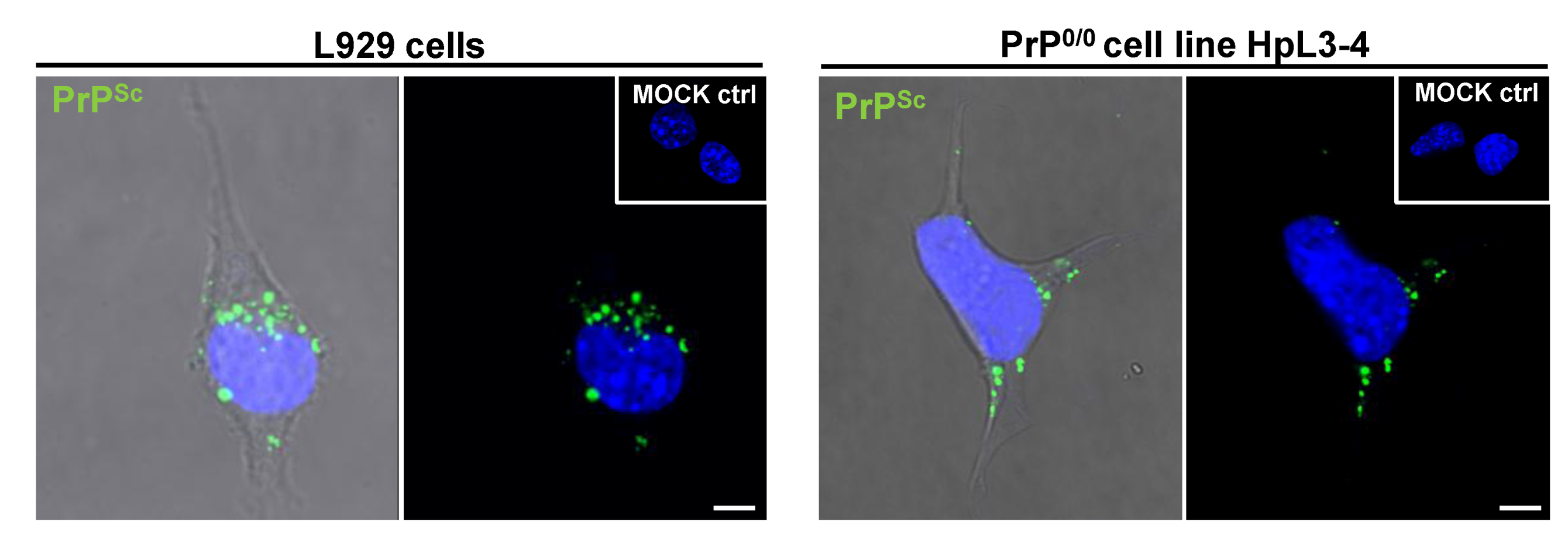
      <p>Most cell lines <italic>in vitro</italic> are capable of taking up PrP<sup>Sc</sup> (<xref ref-type="fig" rid="viruses-05-00374-f003">Figure 3</xref>). Uptake of prion strains was reported to be neither cell type nor strain dependent [<xref ref-type="bibr" rid="B133-viruses-05-00374">133</xref>]. However, even within a cell population exposed to scrapie brain homogenate, uptake is evident only in a subset of cells [<xref ref-type="bibr" rid="B133-viruses-05-00374">133</xref>]. The observed differences in the speed of internalization are at least in part due to variations in the PrP<sup>Sc</sup> sample preparation [<xref ref-type="bibr" rid="B133-viruses-05-00374">133</xref>,<xref ref-type="bibr" rid="B158-viruses-05-00374">158</xref>]. Detergent extraction of PrP<sup>Sc</sup> prior to fluorescence labeling resulted in a slow uptake over a number of days [<xref ref-type="bibr" rid="B136-viruses-05-00374">136</xref>]. However, PrP<sup>Sc</sup> from crude brain homogenate preparations was taken up rapidly within minutes to hours post prion exposure [<xref ref-type="bibr" rid="B132-viruses-05-00374">132</xref>,<xref ref-type="bibr" rid="B133-viruses-05-00374">133</xref>,<xref ref-type="bibr" rid="B159-viruses-05-00374">159</xref>,<xref ref-type="bibr" rid="B160-viruses-05-00374">160</xref>,<xref ref-type="bibr" rid="B161-viruses-05-00374">161</xref>,<xref ref-type="bibr" rid="B162-viruses-05-00374">162</xref>,<xref ref-type="bibr" rid="B163-viruses-05-00374">163</xref>,<xref ref-type="bibr" rid="B164-viruses-05-00374">164</xref>]. Several studies have demonstrated that PrP<sup>Sc</sup> is readily taken up by cells known to be resistant to prion infection [<xref ref-type="bibr" rid="B159-viruses-05-00374">159</xref>,<xref ref-type="bibr" rid="B160-viruses-05-00374">160</xref>,<xref ref-type="bibr" rid="B165-viruses-05-00374">165</xref>,<xref ref-type="bibr" rid="B166-viruses-05-00374">166</xref>], arguing that potential receptors and uptake mechanisms for PrP<sup>Sc</sup> are also present in non-permissive cells.</p>
      
      <p>As physical interaction between PrP<sup>C</sup> and PrP<sup>Sc</sup> is required for the conversion of cellular prion protein to its pathological isoform, PrP<sup>C</sup> might also serve as a receptor for PrP<sup>Sc</sup> uptake. Interestingly, overexpression of PrP<sup>C</sup> did not affect initial binding of PrP<sup>Sc</sup> to CHO cells [<xref ref-type="bibr" rid="B159-viruses-05-00374">159</xref>]. It was later shown that cells devoid of PrP<sup>C</sup> also take up PrP<sup>Sc</sup>, demonstrating that PrP<sup>C</sup> is not generally required for PrP<sup>Sc</sup> uptake (<xref ref-type="fig" rid="viruses-05-00374-f003">Figure 3</xref>) [<xref ref-type="bibr" rid="B133-viruses-05-00374">133</xref>,<xref ref-type="bibr" rid="B136-viruses-05-00374">136</xref>,<xref ref-type="bibr" rid="B159-viruses-05-00374">159</xref>,<xref ref-type="bibr" rid="B162-viruses-05-00374">162</xref>]. But how does PrP<sup>Sc</sup> bind to the cell and how does it enter? Three putative cell surface receptors have been characterized that could be involved in PrP<sup>Sc</sup> uptake. LRP/LR has been found expressed in human small intestinal mucosa [<xref ref-type="bibr" rid="B167-viruses-05-00374">167</xref>], suggesting that it could mediate the initial PrP<sup>Sc</sup> uptake in the gut when the animal is first exposed to prions by food contaminants. Importantly, PrP<sup>Sc</sup> uptake in human intestinal enterocytes in culture depended on both prion preparations and strains [<xref ref-type="bibr" rid="B158-viruses-05-00374">158</xref>]. Uptake of PrP<sup>Sc</sup> present in brain homogenate from mice infected with bovine spongiform encephalopathy was reduced upon preincubation of cells with anti-LRP/LR antibodies, suggesting that LRP/LR is involved in this process. Likewise, uptake of proteinase K treated mouse-adapted scrapie prions into non-permissive BHK cells was dependent on the LRP/LR receptor and HS [<xref ref-type="bibr" rid="B166-viruses-05-00374">166</xref>]. Of note, establishment of prion infection in these systems has not been shown.</p>
      <p>Jen and colleagues recently demonstrated that a specific inhibitor of LRP1 receptors and siRNA-mediated knock-down both drastically impaired binding and uptake of both recombinant PrP fibrils and PrP<sup>Sc</sup> in wildtype and PrP knock-out neurons [<xref ref-type="bibr" rid="B164-viruses-05-00374">164</xref>]. Interestingly, addition of PrP<sup>Sc</sup> to the cells slowed down endocytosis of endogenous PrP<sup>C</sup>, suggesting that PrP<sup>Sc</sup> and PrP<sup>C</sup> were competing for the same binding site on LRP1. Further studies demonstrated that the binding of PrP<sup>Sc</sup> to LRP1 was mediated by cluster 4 of LRP1 that is also implicated in endocytosis of PrP<sup>C</sup> [<xref ref-type="bibr" rid="B82-viruses-05-00374">82</xref>,<xref ref-type="bibr" rid="B83-viruses-05-00374">83</xref>,<xref ref-type="bibr" rid="B164-viruses-05-00374">164</xref>].</p>
      <fig id="viruses-05-00374-f003" position="float">
        <label>Figure 3</label>
        <caption>
          <p>Non-neuronal cells and PrP-deficient cells take up PrP<sup>Sc</sup>. Brain homogenate from mice infected with the 22L prion strain is taken up by L929 fibroblast cells (left panel) and PrP-deficient HpL3-4 cells (right panel). Cells were incubated with infected brain homogenate for 18 hours prior to fixation, permeabilization, guanidine hydrochloride treatment and immunofluorescence staining. Cells incubated with uninfected brain homogenate (MOCK ctrl) served as control for specific detection of PrP<sup>Sc</sup>. PrP<sup>Sc</sup> uptake is observed in both fibroblast cells and PrP-deficient cells. Monoclonal anti-PrP antibody: 4H11. Nuclei were counterstained with Hoechst (blue). Scale bar: 5 µm.</p>
        </caption>
        <graphic xmlns:xlink="http://www.w3.org/1999/xlink" xlink:href="viruses-05-00374-g003.tif"/>
      </fig>
      <p>Proteoglycans could represent the third class of PrP<sup>Sc</sup> receptors necessary for binding and early uptake of exogenous PrP<sup>Sc</sup>. PrP<sup>Sc</sup> binds to the HS analog heparin and disulfonated Congo red <italic>in vitro</italic> [<xref ref-type="bibr" rid="B159-viruses-05-00374">159</xref>,<xref ref-type="bibr" rid="B168-viruses-05-00374">168</xref>]. HS serves as a binding partner for PrP<sup>Sc</sup><italic> in vivo</italic>, as proteinase K digested PrP<sup>Sc</sup> (hamster scrapie Sc237) poorly bound to mutant CHO cells lacking HS or GAGs [<xref ref-type="bibr" rid="B159-viruses-05-00374">159</xref>]. Addition of heparin, a natural HS analog, competitively inhibited binding of PrP<sup>Sc</sup> to N2a and wildtype CHO cells [<xref ref-type="bibr" rid="B159-viruses-05-00374">159</xref>]. GAG mimetics have also been shown to inhibit uptake of PrP<sup>Sc</sup> in cell culture. Incubation of non-permissive CHO cells with heparan mimetic HM2602 drastically impaired uptake of hamster prion rods (strain Sc237) [<xref ref-type="bibr" rid="B165-viruses-05-00374">165</xref>]. Likewise, DS500 and HM2602 impaired entry of hamster prion rods in N2a cells [<xref ref-type="bibr" rid="B160-viruses-05-00374">160</xref>]. Of note, concentrations sufficient to inhibit PrP<sup>Sc</sup> accumulation in RML infected N2a cells were inefficient in inhibiting PrP<sup>Sc</sup> uptake [<xref ref-type="bibr" rid="B160-viruses-05-00374">160</xref>]. A candidate proteoglycan for PrP<sup>Sc</sup> binding and uptake is glypican-1 [<xref ref-type="bibr" rid="B169-viruses-05-00374">169</xref>,<xref ref-type="bibr" rid="B170-viruses-05-00374">170</xref>,<xref ref-type="bibr" rid="B171-viruses-05-00374">171</xref>].</p>
      <p>Although several putative receptors for PrP<sup>Sc</sup> endocytosis have been identified, the exact mechanism of uptake has not been elucidated. Besides the classical endocytosis pathways of clathrin-mediated endocytosis or raft-mediated endocytosis, PrP<sup>Sc</sup> could also be taken up by macropinocytosis. Macropinocytosis is a relatively non-selective process that delivers its cargo to late endosomal and lysosomal compartments. Studies on the uptake of fluorescently labeled detergent extracted, proteinase K treated PrP<sup>Sc</sup> (Chandler scrapie strain) by SN56 cells revealed no co-localization with raft marker choleratoxin [<xref ref-type="bibr" rid="B136-viruses-05-00374">136</xref>]. Instead, extensive co-localization was observed with fluorescent dextran, a marker for internalization by macropinocytosis. Addition of amiloride, an inhibitor of macropinocytosis, to Rov cells (RK13 cells expressing ovine PrP) did not inhibit uptake of exogenous PrP<sup>Sc</sup>, arguing that this internalization process is not involved in PrP<sup>Sc</sup> uptake at least in these cells [<xref ref-type="bibr" rid="B162-viruses-05-00374">162</xref>]. However, productive infection with RML prions was prevented in N2a cells upon addition of macropinocytosis inhibitor EIPA for 48 hours during the infection process [<xref ref-type="bibr" rid="B172-viruses-05-00374">172</xref>]. Whether this treatment influenced external PrP<sup>Sc</sup> uptake or impaired <italic>de novo</italic> PrP<sup>Sc</sup> production has not been shown. Future studies will need to clarify the role of macropinocytosis for PrP<sup>Sc</sup> uptake and establishment of persistent infections.</p>
      <p>In summary, the mechanism of PrP<sup>Sc</sup> internalization is not fully understood. PrP<sup>Sc</sup> uptake might not be restricted to one pathway but could occur through multiple pathways [<xref ref-type="bibr" rid="B173-viruses-05-00374">173</xref>] and host factors are likely to influence the outcome of the infection process [<xref ref-type="bibr" rid="B133-viruses-05-00374">133</xref>,<xref ref-type="bibr" rid="B174-viruses-05-00374">174</xref>,<xref ref-type="bibr" rid="B175-viruses-05-00374">175</xref>]. One important question that needs to be addressed further is if the proposed uptake pathways also lead to a productive prion infection. So far, it cannot be excluded that productive infection requires a distinct internalization route and alternative uptake mechanisms might prevent chronic infection. Furthermore, it is unclear if different prion strains utilize the same entry pathways for establishing chronic infections.</p>
    </sec>
    <sec>
      <title>6. Early Steps of Prion Infection</title>
      <p>The aforementioned studies so far demonstrated that PrP<sup>Sc</sup> can be taken up by a vast majority of cells <italic>in vitro</italic>, independent of PrP<sup>C</sup> expression and receptors such as LRP/LR, LPR1 and proteoglycans might contribute to PrP<sup>Sc</sup> internalization. But where exactly is PrP<sup>Sc</sup> formed, and is the uptake of PrP<sup>Sc</sup> necessary for a productive prion infection? Recent progress in studying the earliest events of prion infection has been made by expressing tagged PrP<sup>C</sup> [<xref ref-type="bibr" rid="B132-viruses-05-00374">132</xref>,<xref ref-type="bibr" rid="B134-viruses-05-00374">134</xref>]. According to these studies, <italic>de novo</italic> PrP<sup>Sc</sup> formation is a fast process, initiated within minutes [<xref ref-type="bibr" rid="B134-viruses-05-00374">134</xref>] to hours post-exposure [<xref ref-type="bibr" rid="B132-viruses-05-00374">132</xref>]. Remarkably, initial PrP<sup>Sc</sup> formation was independent of the scrapie strain and was even apparent in cells that do not become persistently infected or with strains previously not shown to propagate in cell culture. However, PrP<sup>Sc</sup> formation was often transient and did not result in a productive infection [<xref ref-type="bibr" rid="B132-viruses-05-00374">132</xref>]. These data demonstrate that (1) non-permissive cells can transiently produce PrP<sup>Sc</sup>, (2) the establishment of a prion infection is initiated after the first round of PrP<sup>Sc</sup> formation and (3) restricted susceptibility to certain strains is controlled by processes that take place after the initial PrP<sup>Sc</sup> formation. Studies using myc-tagged PrP<sup>C</sup> expressed in N2a cells demonstrated that PrP<sup>Sc</sup> was formed on the plasma membrane within 2 minutes post prion exposure and was then rapidly trafficked to the perinuclear region [<xref ref-type="bibr" rid="B134-viruses-05-00374">134</xref>]. Lipid rafts appeared to be important for PrP<sup>Sc</sup> formation, as treatment with the cholesterol sequestering drug filipin, abolished this process [<xref ref-type="bibr" rid="B134-viruses-05-00374">134</xref>]. Neither <italic>de novo</italic> PrP<sup>Sc</sup> formation nor PrP<sup>Sc</sup> accumulation in perinuclear compartments was abolished by inhibitors of dynamin-dependent endocytosis, CCPs or macropinocytosis. Thus, these endocytic pathways are either not involved in <italic>de novo</italic> formation and trafficking of PrP<sup>Sc</sup> or multiple pathways can be utilized for PrP<sup>Sc</sup> uptake [<xref ref-type="bibr" rid="B134-viruses-05-00374">134</xref>]. The involvement of the LRP1 receptor for the establishment of a productive infection is unclear. Knock-down of LRP1 in sensory neurons during the acute infection step appeared to decrease uptake of PrP<sup>Sc</sup> but had no influence on overall PrP<sup>Sc</sup> levels four weeks post infection, a time point at which PrP<sup>Sc</sup> replication is usually not observed in untreated sensory neurons [<xref ref-type="bibr" rid="B164-viruses-05-00374">164</xref>]. Further experiments will be necessary to prove if the LRP1 receptor is also contributing to the establishment of a productive prion infection.</p>
    </sec>
    <sec>
      <title>7. PrP<sup>Sc</sup> Formation in Persistently Infected Cells</title>
      <p>The cellular compartments involved in PrP<sup>Sc</sup> formation and accumulation are still ill-defined. In cell culture, PrP<sup>Sc</sup> accumulation has been reported mainly on the cell surface and within endocytic compartments [<xref ref-type="bibr" rid="B176-viruses-05-00374">176</xref>,<xref ref-type="bibr" rid="B177-viruses-05-00374">177</xref>,<xref ref-type="bibr" rid="B178-viruses-05-00374">178</xref>], but also within vesicles of the secretory pathway [<xref ref-type="bibr" rid="B179-viruses-05-00374">179</xref>,<xref ref-type="bibr" rid="B180-viruses-05-00374">180</xref>,<xref ref-type="bibr" rid="B181-viruses-05-00374">181</xref>], and even in the nucleus [<xref ref-type="bibr" rid="B182-viruses-05-00374">182</xref>]. PrP<sup>Sc</sup> formation is a post-translational event that requires physical interaction between PrP<sup>Sc</sup> and PrP<sup>C</sup> (<xref ref-type="fig" rid="viruses-05-00374-f002">Figure 2</xref>). Although both PrP<sup>C</sup> and PrP<sup>Sc</sup> are present on the plasma membrane of infected N2a cells [<xref ref-type="bibr" rid="B180-viruses-05-00374">180</xref>,<xref ref-type="bibr" rid="B183-viruses-05-00374">183</xref>], PrP<sup>Sc</sup> localizes primarily intracellularly, with only minor amounts on the cell surface (<xref ref-type="fig" rid="viruses-05-00374-f001">Figure 1</xref>B) [<xref ref-type="bibr" rid="B131-viruses-05-00374">131</xref>]. Still, transport of PrP<sup>C</sup> to the plasma membrane is required for conversion into the abnormal isoform [<xref ref-type="bibr" rid="B92-viruses-05-00374">92</xref>,<xref ref-type="bibr" rid="B134-viruses-05-00374">134</xref>,<xref ref-type="bibr" rid="B177-viruses-05-00374">177</xref>,<xref ref-type="bibr" rid="B178-viruses-05-00374">178</xref>,<xref ref-type="bibr" rid="B181-viruses-05-00374">181</xref>,<xref ref-type="bibr" rid="B184-viruses-05-00374">184</xref>]. Removal of PrP<sup>C</sup> from the plasma membrane by phospholipase C diminishes PrP<sup>Sc</sup> accumulation in N2a cells [<xref ref-type="bibr" rid="B140-viruses-05-00374">140</xref>,<xref ref-type="bibr" rid="B177-viruses-05-00374">177</xref>,<xref ref-type="bibr" rid="B184-viruses-05-00374">184</xref>]. Likewise, impaired transport of PrP<sup>C</sup> to the cell surface by suramin cures chronically infected N2a cells and prevents PrP<sup>Sc</sup> formation [<xref ref-type="bibr" rid="B92-viruses-05-00374">92</xref>]. Lipid rafts appear to play an important role in the formation of PrP<sup>Sc</sup> [<xref ref-type="bibr" rid="B58-viruses-05-00374">58</xref>]. Detergent-resistant microdomains isolated from persistently infected N2a cells contain both PrP<sup>C</sup> and PrP<sup>Sc</sup> [<xref ref-type="bibr" rid="B25-viruses-05-00374">25</xref>,<xref ref-type="bibr" rid="B179-viruses-05-00374">179</xref>,<xref ref-type="bibr" rid="B181-viruses-05-00374">181</xref>,<xref ref-type="bibr" rid="B184-viruses-05-00374">184</xref>]. Inhibition of cellular cholesterol synthesis drastically impairs raft formation and also influences cellular PrP<sup>Sc</sup> levels [<xref ref-type="bibr" rid="B24-viruses-05-00374">24</xref>,<xref ref-type="bibr" rid="B179-viruses-05-00374">179</xref>]. Filipin extraction of membrane cholesterol also affects cellular PrP<sup>Sc</sup> levels in persistently infected N2a cells [<xref ref-type="bibr" rid="B65-viruses-05-00374">65</xref>]. Mutant PrP<sup>C</sup> with a transmembrane anchor that redistributes into non-raft regions is not converted to its abnormal isoform, suggesting that raft association is required for conversion. Of note, changing the PrP amino acid sequence by addition of a transmembrane anchor to PrP could also impair the conversion process <italic>per se</italic>, and the convertibility of such PrP molecule has not been formally proven <italic>in vitro</italic> [<xref ref-type="bibr" rid="B24-viruses-05-00374">24</xref>]. Cells expressing PrP<sup>C</sup> lacking the GPI moiety do not support sustained prion infection <italic>in vitro</italic>, arguing that the anchor is necessary for efficient PrP<sup>Sc</sup> formation in cell culture [<xref ref-type="bibr" rid="B122-viruses-05-00374">122</xref>].</p>
      <p>The role of the secretory pathway for PrP<sup>Sc</sup> formation is unclear. Early studies reported that PrP<sup>Sc</sup> co-localized with Golgi markers [<xref ref-type="bibr" rid="B131-viruses-05-00374">131</xref>]. It has been speculated that either PrP<sup>C</sup> or PrP<sup>Sc</sup> are directly translocated from the cell membrane to the ER by a Rab6 controlled retrograde pathway [<xref ref-type="bibr" rid="B185-viruses-05-00374">185</xref>]. Interestingly, PrP mutants that are retained in the ER or Golgi apparatus can drastically interfere with PrP<sup>Sc</sup> accumulation in RML infected N2a cells, suggesting that the mutants competitively inhibited binding or conversion of wildtype PrP<sup>C</sup> in these compartments [<xref ref-type="bibr" rid="B186-viruses-05-00374">186</xref>]. Alternatively, minute amounts of PrP<sup>C</sup> trafficked correctly through the secretory pathway to the cell surface are capable of dominant negative interference with the conversion of PrP<sup>C</sup>.</p>
      <p>An important role in the conversion of PrP<sup>C</sup> to PrP<sup>Sc </sup>in persistently infected cells is assigned to the endocytic pathway [<xref ref-type="bibr" rid="B176-viruses-05-00374">176</xref>,<xref ref-type="bibr" rid="B177-viruses-05-00374">177</xref>,<xref ref-type="bibr" rid="B178-viruses-05-00374">178</xref>]. In primary hippocampal neurons, PrP<sup>Sc</sup> was found at the cell surface and in early as well as recycling endosomes [<xref ref-type="bibr" rid="B61-viruses-05-00374">61</xref>]. The early recycling compartment was suggested to be the primary location of prion conversion [<xref ref-type="bibr" rid="B187-viruses-05-00374">187</xref>]. Recently, Zurzolo and co-workers studied the intracellular localization of PrP<sup>Sc</sup> in three cell lines persistently infected with different prion strains and detected more than 25% of the protein co-localized with a marker for the early recycling compartment [<xref ref-type="bibr" rid="B187-viruses-05-00374">187</xref>]. Others found that in chronically infected cell lines N2a and GT1, the majority of PrP<sup>Sc</sup> accumulates intracellularly mainly localized within late endosomes and lysosomal compartments [<xref ref-type="bibr" rid="B131-viruses-05-00374">131</xref>,<xref ref-type="bibr" rid="B177-viruses-05-00374">177</xref>,<xref ref-type="bibr" rid="B181-viruses-05-00374">181</xref>,<xref ref-type="bibr" rid="B184-viruses-05-00374">184</xref>,<xref ref-type="bibr" rid="B188-viruses-05-00374">188</xref>,<xref ref-type="bibr" rid="B189-viruses-05-00374">189</xref>]. In endosomal or lysosomal compartments, PrP<sup>Sc</sup> undergoes an initial proteolytic cleavage, leading to PrP<sup>Sc</sup> lacking its amino-terminus [<xref ref-type="bibr" rid="B178-viruses-05-00374">178</xref>,<xref ref-type="bibr" rid="B181-viruses-05-00374">181</xref>,<xref ref-type="bibr" rid="B189-viruses-05-00374">189</xref>,<xref ref-type="bibr" rid="B190-viruses-05-00374">190</xref>]. Importantly, inhibition of amino-terminal trimming does not inhibit PrP<sup>Sc</sup> accumulation, arguing that this step is not essential for PrP<sup>Sc</sup> biogenesis [<xref ref-type="bibr" rid="B176-viruses-05-00374">176</xref>,<xref ref-type="bibr" rid="B178-viruses-05-00374">178</xref>]. In conclusion, while it is unclear if PrP<sup>Sc</sup> replication mechanisms are the same for different strains and in different cell types, most studies argue that PrP<sup>Sc</sup> formation in persistently infected cells takes place either on the cell surface or along the endocytic pathway, with the majority of PrP<sup>Sc</sup> eventually accumulating in the lysosomal compartment (<xref ref-type="fig" rid="viruses-05-00374-f002">Figure 2</xref>B).</p>
    </sec>
    <sec>
      <title>8. GAGs As Co-Factors for PrP<sup>Sc</sup> Formation</title>
      <p>The interaction of PrP<sup>C</sup> and PrP<sup>Sc</sup> with receptors for binding and uptake is closely linked to the conversion process. GAGs are not only involved in the binding and uptake of PrP, but also play an important role for PrP<sup>Sc</sup> formation or stabilization. <italic>In vivo</italic> HS is a prominent component of cerebral prion amyloid plaques and diffuse PrP<sup>Sc</sup> deposits [<xref ref-type="bibr" rid="B191-viruses-05-00374">191</xref>]. Treatment of uninfected cells with lyases that cleave GAG chains from endogenous proteoglycans prevents prion infection, arguing that GAGs are essential for initiation of a productive prion infection [<xref ref-type="bibr" rid="B160-viruses-05-00374">160</xref>]. However, GAGs also play an essential role in PrP<sup>Sc</sup> accumulation in cells chronically infected with prions. Enzymatic digestion of cellular HS, but not cellular chondroitin or dermatan sulfate, reduced PrP<sup>Sc</sup> levels in N2a cells chronically infected with RML prions, suggesting that HS is a major co-factor necessary during PrP<sup>Sc</sup> biogenesis [<xref ref-type="bibr" rid="B91-viruses-05-00374">91</xref>]. In line with this, sodium chlorate and xyloside EDX, inhibitors for sulfation and proteoglycan glycosylation, drastically reduced PrP<sup>Sc</sup> levels in N2a cells chronically infected with RML [<xref ref-type="bibr" rid="B88-viruses-05-00374">88</xref>,<xref ref-type="bibr" rid="B91-viruses-05-00374">91</xref>]. Most exogenously added sulfated glycans interfere with PrP<sup>Sc</sup> accumulation in a variety of persistently infected cell culture models, likely by binding to PrP<sup>Sc</sup> or PrP<sup>C</sup> and by competing for the interaction with endogenous sulfated glycans required for PrP<sup>Sc</sup> formation and/or stabilization [<xref ref-type="bibr" rid="B88-viruses-05-00374">88</xref>,<xref ref-type="bibr" rid="B89-viruses-05-00374">89</xref>,<xref ref-type="bibr" rid="B192-viruses-05-00374">192</xref>]. The degree of sulfation, but also other properties such as the glycan backbone, positioning of sulfates, non-sulfate substituents and glycan chain size are important for the anti-PrP<sup>Sc</sup> activity of GAG analogs [<xref ref-type="bibr" rid="B89-viruses-05-00374">89</xref>,<xref ref-type="bibr" rid="B165-viruses-05-00374">165</xref>]. Disulfonated Congo red and sulfated glycans such as low molecular weight heparin, dextran sulfate, suramin and PPS all reduced PrP<sup>Sc</sup> accumulation in N2a cells persistently infected with RML or Chandler [<xref ref-type="bibr" rid="B88-viruses-05-00374">88</xref>,<xref ref-type="bibr" rid="B89-viruses-05-00374">89</xref>,<xref ref-type="bibr" rid="B92-viruses-05-00374">92</xref>,<xref ref-type="bibr" rid="B192-viruses-05-00374">192</xref>]. Less sulfated HS, high molecular weight heparin, or other GAGs such as dermatan sulfate, chondroitin sulfate and hyaluronic acid exerted no anti-PrP<sup>Sc</sup> activity [<xref ref-type="bibr" rid="B88-viruses-05-00374">88</xref>]. HS side chains on glypican-1 are likely important for facilitating PrP conversion, as siRNA knock-down of glypican-1 significantly reduces total PrP<sup>Sc</sup> levels in N2a cells [<xref ref-type="bibr" rid="B170-viruses-05-00374">170</xref>]. In conclusion, <italic>in vivo</italic> and <italic>in vitro</italic> data argue that endogenous GAGs stimulate prion conversion, potentially by providing a scaffold for PrP<sup>C</sup>/PrP<sup>Sc</sup> clustering and interaction [<xref ref-type="bibr" rid="B193-viruses-05-00374">193</xref>,<xref ref-type="bibr" rid="B194-viruses-05-00374">194</xref>,<xref ref-type="bibr" rid="B195-viruses-05-00374">195</xref>]. Exogenous GAGs competitively inhibit the interaction of PrP<sup>Sc</sup> and PrP<sup>C</sup> with endogenous GAGs and thereby interfere with the conversion process.</p>
    </sec>
    <sec>
      <title>9. Cell-To-Cell Transmission of Prions</title>
      <p>Under the right culturing conditions, prion-infected cells retain stable PrP<sup>Sc</sup> levels over multiple cell divisions. PrP<sup>Sc</sup> accumulation in dividing cells is strongly influenced by the rate of PrP<sup>Sc</sup> synthesis, degradation and cell division [<xref ref-type="bibr" rid="B196-viruses-05-00374">196</xref>]. In persistently infected cells, prion infectivity is primarily transmitted from mother to daughter cells [<xref ref-type="bibr" rid="B196-viruses-05-00374">196</xref>]. Interestingly, an increase of infected cells during cell propagation was observed in some [<xref ref-type="bibr" rid="B118-viruses-05-00374">118</xref>,<xref ref-type="bibr" rid="B197-viruses-05-00374">197</xref>] but not all cell cultures [<xref ref-type="bibr" rid="B107-viruses-05-00374">107</xref>], arguing that at least in some cultures, prions spread to neighboring cells. Two major routes have been described for intercellular spread of prions <italic>in vitro</italic>. Several studies have reported release of PrP<sup>Sc</sup> and/or infectivity into the cell culture medium (<xref ref-type="table" rid="viruses-05-00374-t002">Table 2</xref>). Prions have also been found to be associated with exosomes released from infected cells [<xref ref-type="bibr" rid="B36-viruses-05-00374">36</xref>,<xref ref-type="bibr" rid="B37-viruses-05-00374">37</xref>,<xref ref-type="bibr" rid="B99-viruses-05-00374">99</xref>,<xref ref-type="bibr" rid="B198-viruses-05-00374">198</xref>]. In NIH/3T3 cells, retroviral co-infection enhanced the release of PrP<sup>Sc</sup> and prion infectivity into the cell culture supernatant. Prion proteins were released in association with exosomes and viral particles, suggesting that retroviral co-infection could contribute to prion spreading [<xref ref-type="bibr" rid="B198-viruses-05-00374">198</xref>]. Kanu and colleagues showed that in SMB cells infected with Chandler scrapie, cell-to-cell infection was dependent on close proximity or direct cell contact between donor and recipient cell [<xref ref-type="bibr" rid="B149-viruses-05-00374">149</xref>]. Culturing infected and uninfected cell populations separated by transwells abolished infection of target cells. Likewise, conditioned medium was ineffective at transmitting prions to recipient cells. For some cell lines, secretion of infectivity has been reported, but prions were preferentially transmitted to nearby cells, suggesting that direct cell proximity promoted efficient infection [<xref ref-type="bibr" rid="B197-viruses-05-00374">197</xref>]. The fact that living cells were far more effective in transmitting infectivity than dead cells argues that cell biological processes are involved in prion transmission. The exact mechanism of direct cell-to-cell spread in SMB, Mov and Rov cells needs to be determined, but recent studies argue that cytoplasmic bridges, so called tunneling nanotubes (TNTs), are involved in this process in CAD cells persistently infected with 139A prions [<xref ref-type="bibr" rid="B199-viruses-05-00374">199</xref>]. TNTs are actin and/or microtubule containing cytoplasmic bridges that allow intercellular communication. These sometimes contradictory results might be explained by the use of different cell types and prion strains. Indeed, the intercellular transmission efficiency can differ significantly in different cell lines bearing comparable titers of the same prion strain, arguing that the ability to propagate and to disseminate prions are distinct phenomena [<xref ref-type="bibr" rid="B197-viruses-05-00374">197</xref>].</p>
      <table-wrap id="viruses-05-00374-t002" position="float">
        <object-id pub-id-type="pii">viruses-05-00374-t002_Table 2</object-id>
        <label>Table 2</label>
        <caption>
          <p>Routes of prion dissemination in cell culture.</p>
        </caption>
        <table rules="rows">
          <thead>
            <tr>
              <th align="center" valign="middle">Prion-infected donor cell line</th>
              <th align="center" valign="middle">Prion strain</th>
              <th align="center" valign="middle">Intercellular prion spreading</th>
              <th align="center" valign="middle">PrP<sup>Sc</sup> secreted</th>
              <th align="center" valign="middle">References</th>
            </tr>
          </thead>
          <tbody>
            <tr>
              <td align="center" valign="middle">N2a</td>
              <td align="center" valign="middle">22L</td>
              <td align="center" valign="middle">Yes, via conditioned medium</td>
              <td align="center" valign="middle">Yes, associated with exosomes </td>
              <td align="center" valign="middle">[<xref ref-type="bibr" rid="B36-viruses-05-00374">36</xref>]</td>
            </tr>
            <tr>
              <td align="center" valign="middle">N2a</td>
              <td align="center" valign="middle">RML</td>
              <td align="center" valign="middle">No or inefficient</td>
              <td align="center" valign="middle">Not determined</td>
              <td align="center" valign="middle">[<xref ref-type="bibr" rid="B97-viruses-05-00374">97</xref>,<xref ref-type="bibr" rid="B196-viruses-05-00374">196</xref>]</td>
            </tr>
            <tr>
              <td align="center" valign="middle">SMB</td>
              <td align="center" valign="middle">Chandler</td>
              <td align="center" valign="middle">Yes, via direct cell contact</td>
              <td align="center" valign="middle">Not determined</td>
              <td align="center" valign="middle">[<xref ref-type="bibr" rid="B149-viruses-05-00374">149</xref>]</td>
            </tr>
            <tr>
              <td align="center" valign="middle">HpL3-4*</td>
              <td align="center" valign="middle">22L</td>
              <td align="center" valign="middle">Yes, via conditioned medium</td>
              <td align="center" valign="middle">Not determined</td>
              <td align="center" valign="middle">[<xref ref-type="bibr" rid="B121-viruses-05-00374">121</xref>]</td>
            </tr>
            <tr>
              <td align="center" valign="middle">NIH/3T3</td>
              <td align="center" valign="middle">22L</td>
              <td align="center" valign="middle">Yes, via conditioned medium</td>
              <td align="center" valign="middle">Yes, associated with exosomes</td>
              <td align="center" valign="middle">[<xref ref-type="bibr" rid="B198-viruses-05-00374">198</xref>]</td>
            </tr>
            <tr>
              <td align="center" valign="middle">CAD</td>
              <td align="center" valign="middle">139A</td>
              <td align="center" valign="middle">Yes, via TNTs</td>
              <td align="center" valign="middle">Not determined</td>
              <td align="center" valign="middle">[<xref ref-type="bibr" rid="B200-viruses-05-00374">200</xref>]</td>
            </tr>
            <tr>
              <td align="center" valign="middle">GT1</td>
              <td align="center" valign="middle">RML</td>
              <td align="center" valign="middle">Yes, via conditioned medium</td>
              <td align="center" valign="middle">Not determined</td>
              <td align="center" valign="middle">[<xref ref-type="bibr" rid="B97-viruses-05-00374">97</xref>]</td>
            </tr>
            <tr>
              <td align="center" valign="middle">GT1</td>
              <td align="center" valign="middle">FU CJD</td>
              <td align="center" valign="middle">Yes, via conditioned medium</td>
              <td align="center" valign="middle">Not determined</td>
              <td align="center" valign="middle">[<xref ref-type="bibr" rid="B201-viruses-05-00374">201</xref>]</td>
            </tr>
            <tr>
              <td align="center" valign="middle">GT1</td>
              <td align="center" valign="middle">M1000</td>
              <td align="center" valign="middle">Yes</td>
              <td align="center" valign="middle">Yes, associated with exosomes</td>
              <td align="center" valign="middle">[<xref ref-type="bibr" rid="B99-viruses-05-00374">99</xref>]</td>
            </tr>
            <tr>
              <td align="center" valign="middle">ovRK13/ RoV9</td>
              <td align="center" valign="middle">PG127</td>
              <td align="center" valign="middle">Yes (inefficiently)</td>
              <td align="center" valign="middle">Yes, associated with exosomes</td>
              <td align="center" valign="middle">[<xref ref-type="bibr" rid="B37-viruses-05-00374">37</xref>,<xref ref-type="bibr" rid="B197-viruses-05-00374">197</xref>]</td>
            </tr>
            <tr>
              <td align="center" valign="middle">moRK13</td>
              <td align="center" valign="middle">M1000</td>
              <td align="center" valign="middle">Yes</td>
              <td align="center" valign="middle">Yes, associated with exosomes</td>
              <td align="center" valign="middle">[<xref ref-type="bibr" rid="B99-viruses-05-00374">99</xref>]</td>
            </tr>
            <tr>
              <td align="center" valign="middle">Mov</td>
              <td align="center" valign="middle">PG127</td>
              <td align="center" valign="middle">Yes, via close proximity of cells</td>
              <td align="center" valign="middle">Yes, associated with exosomes</td>
              <td align="center" valign="middle">[<xref ref-type="bibr" rid="B37-viruses-05-00374">37</xref>,<xref ref-type="bibr" rid="B111-viruses-05-00374">111</xref>,<xref ref-type="bibr" rid="B197-viruses-05-00374">197</xref>]</td>
            </tr>
            <tr>
              <td align="center" valign="middle">SN56</td>
              <td align="center" valign="middle">Chandler</td>
              <td align="center" valign="middle">Yes, via conditioned medium</td>
              <td align="center" valign="middle">Yes</td>
              <td align="center" valign="middle">[<xref ref-type="bibr" rid="B202-viruses-05-00374">202</xref>]</td>
            </tr>
          </tbody>
        </table>
        <table-wrap-foot>
        <fn>
           <p>* cells ectopically express 3F4 antibody-epitope tagged moPrP<sup>C</sup></p>
        </fn>
        </table-wrap-foot>
      </table-wrap>
   
    </sec>
    <sec>
      <title>10. Other Protein Aggregates Can Spread and Propagate in Cell Culture</title>
      <p>Over the last few years an increasing number of studies have shown that non-prion protein aggregates associated with other neurodegenerative diseases can spread from cell to cell in a prion-like manner [<xref ref-type="bibr" rid="B203-viruses-05-00374">203</xref>]. The most studied amyloid proteins are Aβ and tau in Alzheimer`s disease (AD), α-synuclein in Parkinson`s disease (PD), superoxide dismutase 1 (SOD1) in amyotrophic lateral sclerosis (ALS), and polyglutamine-rich huntingtin fragments in Huntington`s disease (HD). These proteins differ from PrP in their amino acid sequences, functions and cellular locations, but all share the cross β-sheet conformation in their aggregated states. Although not infectious from a classical point of view, protein aggregates accumulating during those diseases have been shown to spread in tissues <italic>in vivo</italic> [<xref ref-type="bibr" rid="B204-viruses-05-00374">204</xref>,<xref ref-type="bibr" rid="B205-viruses-05-00374">205</xref>,<xref ref-type="bibr" rid="B206-viruses-05-00374">206</xref>,<xref ref-type="bibr" rid="B207-viruses-05-00374">207</xref>] and infect neighboring cells <italic>in vitro</italic> [<xref ref-type="bibr" rid="B208-viruses-05-00374">208</xref>,<xref ref-type="bibr" rid="B209-viruses-05-00374">209</xref>,<xref ref-type="bibr" rid="B210-viruses-05-00374">210</xref>,<xref ref-type="bibr" rid="B211-viruses-05-00374">211</xref>]. Spreading of protein misfolding along interconnected brain regions argues for direct cell contact as a potential route of transmission [<xref ref-type="bibr" rid="B212-viruses-05-00374">212</xref>]. Co-cultures of donor and recipient cell lines demonstrated that tau, α-synuclein and SOD1 could be transmitted via conditioned medium, sometimes in association with exosomes [<xref ref-type="bibr" rid="B208-viruses-05-00374">208</xref>,<xref ref-type="bibr" rid="B209-viruses-05-00374">209</xref>,<xref ref-type="bibr" rid="B210-viruses-05-00374">210</xref>,<xref ref-type="bibr" rid="B213-viruses-05-00374">213</xref>,<xref ref-type="bibr" rid="B214-viruses-05-00374">214</xref>]. A prerequisite of aggregate spreading is the presence of multiple seeds that can be transmitted in the infection process. The high spreading efficiency of prions compared to other amyloidogenic protein aggregates might, at least in part, be due to a more efficient aggregate fragmentation process that produces new seeds [<xref ref-type="bibr" rid="B203-viruses-05-00374">203</xref>]. Using a model system of mammalian cells expressing the yeast prion protein Sup35 we have recently shown that the cytosol of mammalian cells provides an environment for efficient aggregate replication (<xref ref-type="fig" rid="viruses-05-00374-f004">Figure 4</xref>) [<xref ref-type="bibr" rid="B215-viruses-05-00374">215</xref>]. The efficiency at which aggregate seeds are formed might differ depending on the protein aggregate, as Sup35 and SOD1 aggregates could be stably propagated over serial passages, while polyQ aggregates were diluted out over time [<xref ref-type="bibr" rid="B211-viruses-05-00374">211</xref>,<xref ref-type="bibr" rid="B215-viruses-05-00374">215</xref>,<xref ref-type="bibr" rid="B216-viruses-05-00374">216</xref>].</p>
      <fig id="viruses-05-00374-f004" position="float">
        <label>Figure 4</label>
        <caption>
          <p>Propagation of cytosolic prions derived from the S. <italic>cerevisiae</italic> Sup35 prion domain NM. N2a cells ectopically express the HA-tagged prion domain NM of Sup35, which is the most well characterized yeast prion. The left image shows aggregated NM-HA (green) after induction with recombinant NM fibrils, the right image shows the soluble NM-HA (green). NM was stained with anti-HA antibody. F-Actin was stained with fluorescently conjugated phalloidin (red). Nuclei were stained with Hoechst (blue). Scale bar: 5 µm.</p>
        </caption>
        <graphic xmlns:xlink="http://www.w3.org/1999/xlink" xlink:href="viruses-05-00374-g004.tif"/>
      </fig>
    </sec>
    <sec>
      <title>11. Concluding Remarks</title>
      <p>Almost 25 years after the discovery of prion susceptible neuroblastoma cells, persistently infected N2a cells still constitute the prototype cell-culture system for studying prions. Consequently, prion cell biology has been mostly studied in permanent cell lines chronically infected with prion strains RML, Chandler or 22L. Still, it is unclear if the identified pathways and co-factors are required for all prion strains, or if different prion strains utilize different subcellular compartments for efficient propagation. Clearly, pharmacological studies revealed significant differences in the anti-prion efficacy of compounds tested against various prion strains in permanent cells and primary neurons [<xref ref-type="bibr" rid="B111-viruses-05-00374">111</xref>,<xref ref-type="bibr" rid="B217-viruses-05-00374">217</xref>]. Whilst some of the anti-prion effects might be directly attributed to their special binding properties to PrP<sup>C</sup> or PrP<sup>Sc</sup> [<xref ref-type="bibr" rid="B193-viruses-05-00374">193</xref>], some might exert their effect more indirectly by affecting cellular metabolism. Thus, thorough investigations with different strains propagated in the same cell line are necessary to determine if prion strains utilize the same cellular pathways and co-factors for initial infection and sustained propagation.</p>
    </sec>
    
  </body>
  <back>
  <ack>
      <title>Acknowledgments</title>
      <p>This work was funded by the DFG grant VO1277/1-3. We thank Hans Fried and Ireen König for sharing expertise in microscopy and Donato DiMonte and Sybille Krauss for discussions and careful review of this manuscript. </p>
    </ack>
    <notes>
      <title>Conflict of Interest</title>
      <p>The authors declare no conflict of interest. </p>
    </notes>
    <ref-list>
      <title>References</title>
      <ref id="B1-viruses-05-00374">
        <label>1.</label>
        <citation citation-type="journal">
          <person-group person-group-type="author">
            <name>
              <surname>Beekes</surname>
              <given-names>M.</given-names>
            </name>
            <name>
              <surname>McBride</surname>
              <given-names>P.A.</given-names>
            </name>
          </person-group>
          <article-title>The spread of prions through the body in naturally acquired transmissible spongiform encephalopathies</article-title>
          <source>FEBS J.</source>
          <year>2007</year>
          <volume>274</volume>
          <fpage>588</fpage>
          <lpage>605</lpage>
          <pub-id pub-id-type="doi">10.1111/j.1742-4658.2007.05631.x</pub-id>
        </citation>
      </ref>
      <ref id="B2-viruses-05-00374">
        <label>2.</label>
        <citation citation-type="journal">
          <person-group person-group-type="author">
            <name>
              <surname>Bolton</surname>
              <given-names>D.C.</given-names>
            </name>
            <name>
              <surname>McKinley</surname>
              <given-names>M.P.</given-names>
            </name>
            <name>
              <surname>Prusiner</surname>
              <given-names>S.B.</given-names>
            </name>
          </person-group>
          <article-title>Identification of a protein that purifies with the scrapie prion</article-title>
          <source>Science</source>
          <year>1982</year>
          <volume>218</volume>
          <fpage>1309</fpage>
          <lpage>1311</lpage>
        <pub-id pub-id-type="doi">10.1126/science.6815801</pub-id><pub-id pub-id-type="pmid">6815801</pub-id></citation>
      </ref>
      <ref id="B3-viruses-05-00374">
        <label>3.</label>
        <citation citation-type="journal">
          <person-group person-group-type="author">
            <name>
              <surname>Prusiner</surname>
              <given-names>S.B.</given-names>
            </name>
          </person-group>
          <article-title>Novel proteinaceous infectious particles cause scrapie</article-title>
          <source>Science</source>
          <year>1982</year>
          <volume>216</volume>
          <fpage>136</fpage>
          <lpage>144</lpage>
        <pub-id pub-id-type="doi">10.1126/science.6801762</pub-id><pub-id pub-id-type="pmid">6801762</pub-id></citation>
      </ref>
      <ref id="B4-viruses-05-00374">
        <label>4.</label>
        <citation citation-type="journal">
          <person-group person-group-type="author">
            <name>
              <surname>Chiti</surname>
              <given-names>F.</given-names>
            </name>
            <name>
              <surname>Dobson</surname>
              <given-names>C.M.</given-names>
            </name>
          </person-group>
          <article-title>Protein misfolding, functional amyloid, and human disease</article-title>
          <source>Annu Rev. Biochem.</source>
          <year>2006</year>
          <volume>75</volume>
          <fpage>333</fpage>
          <lpage>366</lpage>
          <pub-id pub-id-type="doi">10.1146/annurev.biochem.75.101304.123901</pub-id>
        </citation>
      </ref>
      <ref id="B5-viruses-05-00374">
        <label>5.</label>
        <citation citation-type="journal">
          <person-group person-group-type="author">
            <name>
              <surname>Pattison</surname>
              <given-names>I.H.</given-names>
            </name>
            <name>
              <surname>Millson</surname>
              <given-names>G.C.</given-names>
            </name>
          </person-group>
          <article-title>Scrapie produced experimentally in goats with special reference to the clinical syndrome</article-title>
          <source>J. Comp. Pathol.</source>
          <year>1961</year>
          <volume>71</volume>
          <fpage>101</fpage>
          <lpage>109</lpage>
          <pub-id pub-id-type="doi">10.1016/S0368-1742(61)80013-1</pub-id>
        </citation>
      </ref>
      <ref id="B6-viruses-05-00374">
        <label>6.</label>
        <citation citation-type="journal">
          <person-group person-group-type="author">
            <name>
              <surname>Bessen</surname>
              <given-names>R.A.</given-names>
            </name>
            <name>
              <surname>Marsh</surname>
              <given-names>R.F.</given-names>
            </name>
          </person-group>
          <article-title>Biochemical and physical properties of the prion protein from two strains of the transmissible mink encephalopathy agent</article-title>
          <source>J. Virol.</source>
          <year>1992</year>
          <volume>66</volume>
          <fpage>2096</fpage>
          <lpage>2101</lpage>
        <pub-id pub-id-type="pmid">1347795</pub-id></citation>
      </ref>
      <ref id="B7-viruses-05-00374">
        <label>7.</label>
        <citation citation-type="journal">
          <person-group person-group-type="author">
            <name>
              <surname>Safar</surname>
              <given-names>J.</given-names>
            </name>
            <name>
              <surname>Wille</surname>
              <given-names>H.</given-names>
            </name>
            <name>
              <surname>Itri</surname>
              <given-names>V.</given-names>
            </name>
            <name>
              <surname>Groth</surname>
              <given-names>D.</given-names>
            </name>
            <name>
              <surname>Serban</surname>
              <given-names>H.</given-names>
            </name>
            <name>
              <surname>Torchia</surname>
              <given-names>M.</given-names>
            </name>
            <name>
              <surname>Cohen</surname>
              <given-names>F.E.</given-names>
            </name>
            <name>
              <surname>Prusiner</surname>
              <given-names>S.B.</given-names>
            </name>
          </person-group>
          <article-title>Eight prion strains have prp(sc) molecules with different conformations</article-title>
          <source>Nat. Med.</source>
          <year>1998</year>
          <volume>4</volume>
          <fpage>1157</fpage>
          <lpage>1165</lpage>
        <pub-id pub-id-type="doi">10.1038/2654</pub-id><pub-id pub-id-type="pmid">9771749</pub-id></citation>
      </ref>
      <ref id="B8-viruses-05-00374">
        <label>8.</label>
        <citation citation-type="journal">
          <person-group person-group-type="author">
            <name>
              <surname>Asante</surname>
              <given-names>E.A.</given-names>
            </name>
            <name>
              <surname>Linehan</surname>
              <given-names>J.M.</given-names>
            </name>
            <name>
              <surname>Desbruslais</surname>
              <given-names>M.</given-names>
            </name>
            <name>
              <surname>Joiner</surname>
              <given-names>S.</given-names>
            </name>
            <name>
              <surname>Gowland</surname>
              <given-names>I.</given-names>
            </name>
            <name>
              <surname>Wood</surname>
              <given-names>A.L.</given-names>
            </name>
            <name>
              <surname>Welch</surname>
              <given-names>J.</given-names>
            </name>
            <name>
              <surname>Hill</surname>
              <given-names>A.F.</given-names>
            </name>
            <name>
              <surname>Lloyd</surname>
              <given-names>S.E.</given-names>
            </name>
            <name>
              <surname>Wadsworth</surname>
              <given-names>J.D.</given-names>
            </name>
            <etal/>
          </person-group>
          <article-title>Bse prions propagate as either variant cjd-like or sporadic cjd-like prion strains in transgenic mice expressing human prion protein</article-title>
          <source>EMBO J.</source>
          <year>2002</year>
          <volume>21</volume>
          <fpage>6358</fpage>
          <lpage>6366</lpage>
          <pub-id pub-id-type="doi">10.1093/emboj/cdf653</pub-id>
        </citation>
      </ref>
      <ref id="B9-viruses-05-00374">
        <label>9.</label>
        <citation citation-type="journal">
          <person-group person-group-type="author">
            <name>
              <surname>Cali</surname>
              <given-names>I.</given-names>
            </name>
            <name>
              <surname>Castellani</surname>
              <given-names>R.</given-names>
            </name>
            <name>
              <surname>Alshekhlee</surname>
              <given-names>A.</given-names>
            </name>
            <name>
              <surname>Cohen</surname>
              <given-names>Y.</given-names>
            </name>
            <name>
              <surname>Blevins</surname>
              <given-names>J.</given-names>
            </name>
            <name>
              <surname>Yuan</surname>
              <given-names>J.</given-names>
            </name>
            <name>
              <surname>Langeveld</surname>
              <given-names>J.P.</given-names>
            </name>
            <name>
              <surname>Parchi</surname>
              <given-names>P.</given-names>
            </name>
            <name>
              <surname>Safar</surname>
              <given-names>J.G.</given-names>
            </name>
            <name>
              <surname>Zou</surname>
              <given-names>W.Q.</given-names>
            </name>
            <etal/>
          </person-group>
          <article-title>Co-existence of scrapie prion protein types 1 and 2 in sporadic creutzfeldt-jakob disease: Its effect on the phenotype and prion-type characteristics</article-title>
          <source>Brain</source>
          <year>2009</year>
          <volume>132</volume>
          <fpage>2643</fpage>
          <lpage>2658</lpage>
          <pub-id pub-id-type="doi">10.1093/brain/awp196</pub-id>
        </citation>
      </ref>
      <ref id="B10-viruses-05-00374">
        <label>10.</label>
        <citation citation-type="journal">
          <person-group person-group-type="author">
            <name>
              <surname>Weissmann</surname>
              <given-names>C.</given-names>
            </name>
          </person-group>
          <article-title>Birth of a prion: Spontaneous generation revisited</article-title>
          <source>Cell.</source>
          <year>2005</year>
          <volume>122</volume>
          <fpage>165</fpage>
          <lpage>168</lpage>
          <pub-id pub-id-type="doi">10.1016/j.cell.2005.07.001</pub-id>
        </citation>
      </ref>
      <ref id="B11-viruses-05-00374">
        <label>11.</label>
        <citation citation-type="journal">
          <person-group person-group-type="author">
            <name>
              <surname>Chesebro</surname>
              <given-names>B.</given-names>
            </name>
            <name>
              <surname>Race</surname>
              <given-names>R.</given-names>
            </name>
            <name>
              <surname>Wehrly</surname>
              <given-names>K.</given-names>
            </name>
            <name>
              <surname>Nishio</surname>
              <given-names>J.</given-names>
            </name>
            <name>
              <surname>Bloom</surname>
              <given-names>M.</given-names>
            </name>
            <name>
              <surname>Lechner</surname>
              <given-names>D.</given-names>
            </name>
            <name>
              <surname>Bergstrom</surname>
              <given-names>S.</given-names>
            </name>
            <name>
              <surname>Robbins</surname>
              <given-names>K.</given-names>
            </name>
            <name>
              <surname>Mayer</surname>
              <given-names>L.</given-names>
            </name>
            <name>
              <surname>Keith</surname>
              <given-names>J.M.</given-names>
            </name>
            <etal/>
          </person-group>
          <article-title>Identification of scrapie prion protein-specific mrna in scrapie-infected and uninfected brain</article-title>
          <source>Nature</source>
          <year>1985</year>
          <volume>315</volume>
          <fpage>331</fpage>
          <lpage>333</lpage>
          <pub-id pub-id-type="doi">10.1038/315331a0</pub-id>
        </citation>
      </ref>
      <ref id="B12-viruses-05-00374">
        <label>12.</label>
        <citation citation-type="journal">
          <person-group person-group-type="author">
            <name>
              <surname>Basler</surname>
              <given-names>K.</given-names>
            </name>
            <name>
              <surname>Oesch</surname>
              <given-names>B.</given-names>
            </name>
            <name>
              <surname>Scott</surname>
              <given-names>M.</given-names>
            </name>
            <name>
              <surname>Westaway</surname>
              <given-names>D.</given-names>
            </name>
            <name>
              <surname>Walchli</surname>
              <given-names>M.</given-names>
            </name>
            <name>
              <surname>Groth</surname>
              <given-names>D.F.</given-names>
            </name>
            <name>
              <surname>McKinley</surname>
              <given-names>M.P.</given-names>
            </name>
            <name>
              <surname>Prusiner</surname>
              <given-names>S.B.</given-names>
            </name>
            <name>
              <surname>Weissmann</surname>
              <given-names>C.</given-names>
            </name>
          </person-group>
          <article-title>Scrapie and cellular prp isoforms are encoded by the same chromosomal gene</article-title>
          <source>Cell.</source>
          <year>1986</year>
          <volume>46</volume>
          <fpage>417</fpage>
          <lpage>428</lpage>
          <pub-id pub-id-type="doi">10.1016/0092-8674(86)90662-8</pub-id>
        </citation>
      </ref>
      <ref id="B13-viruses-05-00374">
        <label>13.</label>
        <citation citation-type="journal">
          <person-group person-group-type="author">
            <name>
              <surname>Robakis</surname>
              <given-names>N.K.</given-names>
            </name>
            <name>
              <surname>Sawh</surname>
              <given-names>P.R.</given-names>
            </name>
            <name>
              <surname>Wolfe</surname>
              <given-names>G.C.</given-names>
            </name>
            <name>
              <surname>Rubenstein</surname>
              <given-names>R.</given-names>
            </name>
            <name>
              <surname>Carp</surname>
              <given-names>R.I.</given-names>
            </name>
            <name>
              <surname>Innis</surname>
              <given-names>M.A.</given-names>
            </name>
          </person-group>
          <article-title>Isolation of a cdna clone encoding the leader peptide of prion protein and expression of the homologous gene in various tissues</article-title>
          <source>Proc. Natl. Acad. Sci. USA</source>
          <year>1986</year>
          <volume>83</volume>
          <fpage>6377</fpage>
          <lpage>6381</lpage>
          <pub-id pub-id-type="doi">10.1073/pnas.83.17.6377</pub-id>
        </citation>
      </ref>
      <ref id="B14-viruses-05-00374">
        <label>14.</label>
        <citation citation-type="journal">
          <person-group person-group-type="author">
            <name>
              <surname>Sparkes</surname>
              <given-names>R.S.</given-names>
            </name>
            <name>
              <surname>Simon</surname>
              <given-names>M.</given-names>
            </name>
            <name>
              <surname>Cohn</surname>
              <given-names>V.H.</given-names>
            </name>
            <name>
              <surname>Fournier</surname>
              <given-names>R.E.</given-names>
            </name>
            <name>
              <surname>Lem</surname>
              <given-names>J.</given-names>
            </name>
            <name>
              <surname>Klisak</surname>
              <given-names>I.</given-names>
            </name>
            <name>
              <surname>Heinzmann</surname>
              <given-names>C.</given-names>
            </name>
            <name>
              <surname>Blatt</surname>
              <given-names>C.</given-names>
            </name>
            <name>
              <surname>Lucero</surname>
              <given-names>M.</given-names>
            </name>
            <name>
              <surname>Mohandas</surname>
              <given-names>T.</given-names>
            </name>
            <etal/>
          </person-group>
          <article-title>Assignment of the human and mouse prion protein genes to homologous chromosomes</article-title>
          <source>Proc. Natl. Acad. Sci. USA</source>
          <year>1986</year>
          <volume>83</volume>
          <fpage>7358</fpage>
          <lpage>7362</lpage>
        <pub-id pub-id-type="doi">10.1073/pnas.83.19.7358</pub-id><pub-id pub-id-type="pmid">3094007</pub-id></citation>
      </ref>
      <ref id="B15-viruses-05-00374">
        <label>15.</label>
        <citation citation-type="journal">
          <person-group person-group-type="author">
            <name>
              <surname>Oesch</surname>
              <given-names>B.</given-names>
            </name>
            <name>
              <surname>Westaway</surname>
              <given-names>D.</given-names>
            </name>
            <name>
              <surname>Prusiner</surname>
              <given-names>S.B.</given-names>
            </name>
          </person-group>
          <article-title>Prion protein genes: Evolutionary and functional aspects</article-title>
          <source>Curr. Top. Microbiol. Immunol.</source>
          <year>1991</year>
          <volume>172</volume>
          <fpage>109</fpage>
          <lpage>124</lpage>
        <pub-id pub-id-type="pmid">1687379</pub-id></citation>
      </ref>
      <ref id="B16-viruses-05-00374">
        <label>16.</label>
        <citation citation-type="journal">
          <person-group person-group-type="author">
            <name>
              <surname>Schatzl</surname>
              <given-names>H.M.</given-names>
            </name>
            <name>
              <surname>Da Costa</surname>
              <given-names>M.</given-names>
            </name>
            <name>
              <surname>Taylor</surname>
              <given-names>L.</given-names>
            </name>
            <name>
              <surname>Cohen</surname>
              <given-names>F.E.</given-names>
            </name>
            <name>
              <surname>Prusiner</surname>
              <given-names>S.B.</given-names>
            </name>
          </person-group>
          <article-title>Prion protein gene variation among primates</article-title>
          <source>J. Mol. Biol</source>
          <year>1995</year>
          <volume>245</volume>
          <fpage>362</fpage>
          <lpage>374</lpage>
          <pub-id pub-id-type="doi">10.1006/jmbi.1994.0030</pub-id>
        </citation>
      </ref>
      <ref id="B17-viruses-05-00374">
        <label>17.</label>
        <citation citation-type="journal">
          <person-group person-group-type="author">
            <name>
              <surname>Wopfner</surname>
              <given-names>F.</given-names>
            </name>
            <name>
              <surname>Weidenhofer</surname>
              <given-names>G.</given-names>
            </name>
            <name>
              <surname>Schneider</surname>
              <given-names>R.</given-names>
            </name>
            <name>
              <surname>von Brunn</surname>
              <given-names>A.</given-names>
            </name>
            <name>
              <surname>Gilch</surname>
              <given-names>S.</given-names>
            </name>
            <name>
              <surname>Schwarz</surname>
              <given-names>T.F.</given-names>
            </name>
            <name>
              <surname>Werner</surname>
              <given-names>T.</given-names>
            </name>
            <name>
              <surname>Schatzl</surname>
              <given-names>H.M.</given-names>
            </name>
          </person-group>
          <article-title>Analysis of 27 mammalian and 9 avian prps reveals high conservation of flexible regions of the prion protein</article-title>
          <source>J. Mol. Biol.</source>
          <year>1999</year>
          <volume>289</volume>
          <fpage>1163</fpage>
          <lpage>1178</lpage>
          <pub-id pub-id-type="doi">10.1006/jmbi.1999.2831</pub-id>
        </citation>
      </ref>
      <ref id="B18-viruses-05-00374">
        <label>18.</label>
        <citation citation-type="journal">
          <person-group person-group-type="author">
            <name>
              <surname>Linden</surname>
              <given-names>R.</given-names>
            </name>
            <name>
              <surname>Martins</surname>
              <given-names>V.R.</given-names>
            </name>
            <name>
              <surname>Prado</surname>
              <given-names>M.A.</given-names>
            </name>
            <name>
              <surname>Cammarota</surname>
              <given-names>M.</given-names>
            </name>
            <name>
              <surname>Izquierdo</surname>
              <given-names>I.</given-names>
            </name>
            <name>
              <surname>Brentani</surname>
              <given-names>R.R.</given-names>
            </name>
          </person-group>
          <article-title>Physiology of the prion protein</article-title>
          <source>Physiol. Rev.</source>
          <year>2008</year>
          <volume>88</volume>
          <fpage>673</fpage>
          <lpage>728</lpage>
          <pub-id pub-id-type="doi">10.1152/physrev.00007.2007</pub-id>
        </citation>
      </ref>
      <ref id="B19-viruses-05-00374">
        <label>19.</label>
        <citation citation-type="journal">
          <person-group person-group-type="author">
            <name>
              <surname>Brown</surname>
              <given-names>D.R.</given-names>
            </name>
            <name>
              <surname>Schmidt</surname>
              <given-names>B.</given-names>
            </name>
            <name>
              <surname>Kretzschmar</surname>
              <given-names>H.A.</given-names>
            </name>
          </person-group>
          <article-title>Role of microglia and host prion protein in neurotoxicity of a prion protein fragment</article-title>
          <source>Nature</source>
          <year>1996</year>
          <volume>380</volume>
          <fpage>345</fpage>
          <lpage>347</lpage>
          <pub-id pub-id-type="doi">10.1038/380345a0</pub-id>
        </citation>
      </ref>
      <ref id="B20-viruses-05-00374">
        <label>20.</label>
        <citation citation-type="journal">
          <person-group person-group-type="author">
            <name>
              <surname>Moser</surname>
              <given-names>M.</given-names>
            </name>
            <name>
              <surname>Colello</surname>
              <given-names>R.J.</given-names>
            </name>
            <name>
              <surname>Pott</surname>
              <given-names>U.</given-names>
            </name>
            <name>
              <surname>Oesch</surname>
              <given-names>B.</given-names>
            </name>
          </person-group>
          <article-title>Developmental expression of the prion protein gene in glial cells</article-title>
          <source>Neuron</source>
          <year>1995</year>
          <volume>14</volume>
          <fpage>509</fpage>
          <lpage>517</lpage>
          <pub-id pub-id-type="doi">10.1016/0896-6273(95)90307-0</pub-id>
        </citation>
      </ref>
      <ref id="B21-viruses-05-00374">
        <label>21.</label>
        <citation citation-type="journal">
          <person-group person-group-type="author">
            <name>
              <surname>Haraguchi</surname>
              <given-names>T.</given-names>
            </name>
            <name>
              <surname>Fisher</surname>
              <given-names>S.</given-names>
            </name>
            <name>
              <surname>Olofsson</surname>
              <given-names>S.</given-names>
            </name>
            <name>
              <surname>Endo</surname>
              <given-names>T.</given-names>
            </name>
            <name>
              <surname>Groth</surname>
              <given-names>D.</given-names>
            </name>
            <name>
              <surname>Tarentino</surname>
              <given-names>A.</given-names>
            </name>
            <name>
              <surname>Borchelt</surname>
              <given-names>D.R.</given-names>
            </name>
            <name>
              <surname>Teplow</surname>
              <given-names>D.</given-names>
            </name>
            <name>
              <surname>Hood</surname>
              <given-names>L.</given-names>
            </name>
            <name>
              <surname>Burlingame</surname>
              <given-names>A.</given-names>
            </name>
            <etal/>
          </person-group>
          <article-title>Asparagine-linked glycosylation of the scrapie and cellular prion proteins</article-title>
          <source>Arch. Biochem. Biophys.</source>
          <year>1989</year>
          <volume>274</volume>
          <fpage>1</fpage>
          <lpage>13</lpage>
          <pub-id pub-id-type="doi">10.1016/0003-9861(89)90409-8</pub-id>
        </citation>
      </ref>
      <ref id="B22-viruses-05-00374">
        <label>22.</label>
        <citation citation-type="journal">
          <person-group person-group-type="author">
            <name>
              <surname>Turk</surname>
              <given-names>E.</given-names>
            </name>
            <name>
              <surname>Teplow</surname>
              <given-names>D.B.</given-names>
            </name>
            <name>
              <surname>Hood</surname>
              <given-names>L.E.</given-names>
            </name>
            <name>
              <surname>Prusiner</surname>
              <given-names>S.B.</given-names>
            </name>
          </person-group>
          <article-title>Purification and properties of the cellular and scrapie hamster prion proteins</article-title>
          <source>Eur. J. Biochem.</source>
          <year>1988</year>
          <volume>176</volume>
          <fpage>21</fpage>
          <lpage>30</lpage>
          <pub-id pub-id-type="doi">10.1111/j.1432-1033.1988.tb14246.x</pub-id>
        </citation>
      </ref>
      <ref id="B23-viruses-05-00374">
        <label>23.</label>
        <citation citation-type="journal">
          <person-group person-group-type="author">
            <name>
              <surname>Stahl</surname>
              <given-names>N.</given-names>
            </name>
            <name>
              <surname>Baldwin</surname>
              <given-names>M.A.</given-names>
            </name>
            <name>
              <surname>Hecker</surname>
              <given-names>R.</given-names>
            </name>
            <name>
              <surname>Pan</surname>
              <given-names>K.M.</given-names>
            </name>
            <name>
              <surname>Burlingame</surname>
              <given-names>A.L.</given-names>
            </name>
            <name>
              <surname>Prusiner</surname>
              <given-names>S.B.</given-names>
            </name>
          </person-group>
          <article-title>Glycosylinositol phospholipid anchors of the scrapie and cellular prion proteins contain sialic acid</article-title>
          <source>Biochemistry</source>
          <year>1992</year>
          <volume>31</volume>
          <fpage>5043</fpage>
          <lpage>5053</lpage>
        <pub-id pub-id-type="doi">10.1021/bi00136a600</pub-id><pub-id pub-id-type="pmid">1350920</pub-id></citation>
      </ref>
      <ref id="B24-viruses-05-00374">
        <label>24.</label>
        <citation citation-type="journal">
          <person-group person-group-type="author">
            <name>
              <surname>Taraboulos</surname>
              <given-names>A.</given-names>
            </name>
            <name>
              <surname>Scott</surname>
              <given-names>M.</given-names>
            </name>
            <name>
              <surname>Semenov</surname>
              <given-names>A.</given-names>
            </name>
            <name>
              <surname>Avrahami</surname>
              <given-names>D.</given-names>
            </name>
            <name>
              <surname>Laszlo</surname>
              <given-names>L.</given-names>
            </name>
            <name>
              <surname>Prusiner</surname>
              <given-names>S.B.</given-names>
            </name>
          </person-group>
          <article-title>Cholesterol depletion and modification of cooh-terminal targeting sequence of the prion protein inhibit formation of the scrapie isoform</article-title>
          <source>J. Cell. Biol</source>
          <year>1995</year>
          <volume>129</volume>
          <fpage>121</fpage>
          <lpage>132</lpage>
          <pub-id pub-id-type="doi">10.1083/jcb.129.1.121</pub-id>
        </citation>
      </ref>
      <ref id="B25-viruses-05-00374">
        <label>25.</label>
        <citation citation-type="journal">
          <person-group person-group-type="author">
            <name>
              <surname>Vey</surname>
              <given-names>M.</given-names>
            </name>
            <name>
              <surname>Pilkuhn</surname>
              <given-names>S.</given-names>
            </name>
            <name>
              <surname>Wille</surname>
              <given-names>H.</given-names>
            </name>
            <name>
              <surname>Nixon</surname>
              <given-names>R.</given-names>
            </name>
            <name>
              <surname>DeArmond</surname>
              <given-names>S.J.</given-names>
            </name>
            <name>
              <surname>Smart</surname>
              <given-names>E.J.</given-names>
            </name>
            <name>
              <surname>Anderson</surname>
              <given-names>R.G.</given-names>
            </name>
            <name>
              <surname>Taraboulos</surname>
              <given-names>A.</given-names>
            </name>
            <name>
              <surname>Prusiner</surname>
              <given-names>S.B.</given-names>
            </name>
          </person-group>
          <article-title>Subcellular colocalization of the cellular and scrapie prion proteins in caveolae-like membranous domains</article-title>
          <source>Proc. Natl. Acad. Sci. USA</source>
          <year>1996</year>
          <volume>93</volume>
          <fpage>14945</fpage>
          <lpage>14949</lpage>
        <pub-id pub-id-type="doi">10.1073/pnas.93.25.14945</pub-id><pub-id pub-id-type="pmid">8962161</pub-id></citation>
      </ref>
      <ref id="B26-viruses-05-00374">
        <label>26.</label>
        <citation citation-type="journal">
          <person-group person-group-type="author">
            <name>
              <surname>Baron</surname>
              <given-names>G.S.</given-names>
            </name>
            <name>
              <surname>Wehrly</surname>
              <given-names>K.</given-names>
            </name>
            <name>
              <surname>Dorward</surname>
              <given-names>D.W.</given-names>
            </name>
            <name>
              <surname>Chesebro</surname>
              <given-names>B.</given-names>
            </name>
            <name>
              <surname>Caughey</surname>
              <given-names>B.</given-names>
            </name>
          </person-group>
          <article-title>Conversion of raft associated prion protein to the protease-resistant state requires insertion of prp-res (prp(sc)) into contiguous membranes</article-title>
          <source>EMBO J.</source>
          <year>2002</year>
          <volume>21</volume>
          <fpage>1031</fpage>
          <lpage>1040</lpage>
          <pub-id pub-id-type="doi">10.1093/emboj/21.5.1031</pub-id>
        </citation>
      </ref>
      <ref id="B27-viruses-05-00374">
        <label>27.</label>
        <citation citation-type="journal">
          <person-group person-group-type="author">
            <name>
              <surname>Walmsley</surname>
              <given-names>A.R.</given-names>
            </name>
            <name>
              <surname>Watt</surname>
              <given-names>N.T.</given-names>
            </name>
            <name>
              <surname>Taylor</surname>
              <given-names>D.R.</given-names>
            </name>
            <name>
              <surname>Perera</surname>
              <given-names>W.S.</given-names>
            </name>
            <name>
              <surname>Hooper</surname>
              <given-names>N.M.</given-names>
            </name>
          </person-group>
          <article-title>Alpha-cleavage of the prion protein occurs in a late compartment of the secretory pathway and is independent of lipid rafts</article-title>
          <source>Mol. Cell. Neurosci.</source>
          <year>2009</year>
          <volume>40</volume>
          <fpage>242</fpage>
          <lpage>248</lpage>
          <pub-id pub-id-type="doi">10.1016/j.mcn.2008.10.012</pub-id>
        </citation>
      </ref>
      <ref id="B28-viruses-05-00374">
        <label>28.</label>
        <citation citation-type="journal">
          <person-group person-group-type="author">
            <name>
              <surname>Sarnataro</surname>
              <given-names>D.</given-names>
            </name>
            <name>
              <surname>Campana</surname>
              <given-names>V.</given-names>
            </name>
            <name>
              <surname>Paladino</surname>
              <given-names>S.</given-names>
            </name>
            <name>
              <surname>Stornaiuolo</surname>
              <given-names>M.</given-names>
            </name>
            <name>
              <surname>Nitsch</surname>
              <given-names>L.</given-names>
            </name>
            <name>
              <surname>Zurzolo</surname>
              <given-names>C.</given-names>
            </name>
          </person-group>
          <article-title>Prp(c) association with lipid rafts in the early secretory pathway stabilizes its cellular conformation</article-title>
          <source>Mol. Biol. Cell.</source>
          <year>2004</year>
          <volume>15</volume>
          <fpage>4031</fpage>
          <lpage>4042</lpage>
          <pub-id pub-id-type="doi">10.1091/mbc.E03-05-0271</pub-id>
        </citation>
      </ref>
      <ref id="B29-viruses-05-00374">
        <label>29.</label>
        <citation citation-type="journal">
          <person-group person-group-type="author">
            <name>
              <surname>Mironov</surname>
              <given-names>A.</given-names>
              <suffix>Jr.</suffix>
            </name>
            <name>
              <surname>Latawiec</surname>
              <given-names>D.</given-names>
            </name>
            <name>
              <surname>Wille</surname>
              <given-names>H.</given-names>
            </name>
            <name>
              <surname>Bouzamondo-Bernstein</surname>
              <given-names>E.</given-names>
            </name>
            <name>
              <surname>Legname</surname>
              <given-names>G.</given-names>
            </name>
            <name>
              <surname>Williamson</surname>
              <given-names>R.A.</given-names>
            </name>
            <name>
              <surname>Burton</surname>
              <given-names>D.</given-names>
            </name>
            <name>
              <surname>DeArmond</surname>
              <given-names>S.J.</given-names>
            </name>
            <name>
              <surname>Prusiner</surname>
              <given-names>S.B.</given-names>
            </name>
            <name>
              <surname>Peters</surname>
              <given-names>P.J.</given-names>
            </name>
          </person-group>
          <article-title>Cytosolic prion protein in neurons</article-title>
          <source>J. Neurosci.</source>
          <year>2003</year>
          <volume>23</volume>
          <fpage>7183</fpage>
          <lpage>7193</lpage>
        <pub-id pub-id-type="pmid">12904479</pub-id></citation>
      </ref>
      <ref id="B30-viruses-05-00374">
        <label>30.</label>
        <citation citation-type="journal">
          <person-group person-group-type="author">
            <name>
              <surname>Vincent</surname>
              <given-names>B.</given-names>
            </name>
            <name>
              <surname>Paitel</surname>
              <given-names>E.</given-names>
            </name>
            <name>
              <surname>Frobert</surname>
              <given-names>Y.</given-names>
            </name>
            <name>
              <surname>Lehmann</surname>
              <given-names>S.</given-names>
            </name>
            <name>
              <surname>Grassi</surname>
              <given-names>J.</given-names>
            </name>
            <name>
              <surname>Checler</surname>
              <given-names>F.</given-names>
            </name>
          </person-group>
          <article-title>Phorbol ester-regulated cleavage of normal prion protein in hek293 human cells and murine neurons</article-title>
          <source>J. Biol. Chem.</source>
          <year>2000</year>
          <volume>275</volume>
          <fpage>35612</fpage>
          <lpage>35616</lpage>
        <pub-id pub-id-type="doi">10.1074/jbc.M004628200</pub-id><pub-id pub-id-type="pmid">10952979</pub-id></citation>
      </ref>
      <ref id="B31-viruses-05-00374">
        <label>31.</label>
        <citation citation-type="journal">
          <person-group person-group-type="author">
            <name>
              <surname>Vincent</surname>
              <given-names>B.</given-names>
            </name>
            <name>
              <surname>Paitel</surname>
              <given-names>E.</given-names>
            </name>
            <name>
              <surname>Saftig</surname>
              <given-names>P.</given-names>
            </name>
            <name>
              <surname>Frobert</surname>
              <given-names>Y.</given-names>
            </name>
            <name>
              <surname>Hartmann</surname>
              <given-names>D.</given-names>
            </name>
            <name>
              <surname>De Strooper</surname>
              <given-names>B.</given-names>
            </name>
            <name>
              <surname>Grassi</surname>
              <given-names>J.</given-names>
            </name>
            <name>
              <surname>Lopez-Perez</surname>
              <given-names>E.</given-names>
            </name>
            <name>
              <surname>Checler</surname>
              <given-names>F.</given-names>
            </name>
          </person-group>
          <article-title>The disintegrins adam10 and tace contribute to the constitutive and phorbol ester-regulated normal cleavage of the cellular prion protein</article-title>
          <source>J. Biol. Chem.</source>
          <year>2001</year>
          <volume>276</volume>
          <fpage>37743</fpage>
          <lpage>37746</lpage>
        <pub-id pub-id-type="pmid">11477090</pub-id></citation>
      </ref>
      <ref id="B32-viruses-05-00374">
        <label>32.</label>
        <citation citation-type="journal">
          <person-group person-group-type="author">
            <name>
              <surname>Parkin</surname>
              <given-names>E.T.</given-names>
            </name>
            <name>
              <surname>Watt</surname>
              <given-names>N.T.</given-names>
            </name>
            <name>
              <surname>Turner</surname>
              <given-names>A.J.</given-names>
            </name>
            <name>
              <surname>Hooper</surname>
              <given-names>N.M.</given-names>
            </name>
          </person-group>
          <article-title>Dual mechanisms for shedding of the cellular prion protein</article-title>
          <source>J. Biol. Chem.</source>
          <year>2004</year>
          <volume>279</volume>
          <fpage>11170</fpage>
          <lpage>11178</lpage>
        <pub-id pub-id-type="doi">10.1074/jbc.M312105200</pub-id><pub-id pub-id-type="pmid">14711812</pub-id></citation>
      </ref>
      <ref id="B33-viruses-05-00374">
        <label>33.</label>
        <citation citation-type="journal">
          <person-group person-group-type="author">
            <name>
              <surname>Alfa Cisse</surname>
              <given-names>M.</given-names>
            </name>
            <name>
              <surname>Sunyach</surname>
              <given-names>C.</given-names>
            </name>
            <name>
              <surname>Slack</surname>
              <given-names>B.E.</given-names>
            </name>
            <name>
              <surname>Fisher</surname>
              <given-names>A.</given-names>
            </name>
            <name>
              <surname>Vincent</surname>
              <given-names>B.</given-names>
            </name>
            <name>
              <surname>Checler</surname>
              <given-names>F.</given-names>
            </name>
          </person-group>
          <article-title>M1 and m3 muscarinic receptors control physiological processing of cellular prion by modulating adam17 phosphorylation and activity</article-title>
          <source>J. Neurosci.</source>
          <year>2007</year>
          <volume>27</volume>
          <fpage>4083</fpage>
          <lpage>4092</lpage>
          <pub-id pub-id-type="doi">10.1523/JNEUROSCI.5293-06.2007</pub-id>
        </citation>
      </ref>
      <ref id="B34-viruses-05-00374">
        <label>34.</label>
        <citation citation-type="journal">
          <person-group person-group-type="author">
            <name>
              <surname>Borchelt</surname>
              <given-names>D.R.</given-names>
            </name>
            <name>
              <surname>Rogers</surname>
              <given-names>M.</given-names>
            </name>
            <name>
              <surname>Stahl</surname>
              <given-names>N.</given-names>
            </name>
            <name>
              <surname>Telling</surname>
              <given-names>G.</given-names>
            </name>
            <name>
              <surname>Prusiner</surname>
              <given-names>S.B.</given-names>
            </name>
          </person-group>
          <article-title>Release of the cellular prion protein from cultured cells after loss of its glycoinositol phospholipid anchor</article-title>
          <source>Glycobiology</source>
          <year>1993</year>
          <volume>3</volume>
          <fpage>319</fpage>
          <lpage>329</lpage>
          <pub-id pub-id-type="doi">10.1093/glycob/3.4.319</pub-id>
        </citation>
      </ref>
      <ref id="B35-viruses-05-00374">
        <label>35.</label>
        <citation citation-type="journal">
          <person-group person-group-type="author">
            <name>
              <surname>Starke</surname>
              <given-names>R.</given-names>
            </name>
            <name>
              <surname>Harrison</surname>
              <given-names>P.</given-names>
            </name>
            <name>
              <surname>Drummond</surname>
              <given-names>O.</given-names>
            </name>
            <name>
              <surname>Macgregor</surname>
              <given-names>I.</given-names>
            </name>
            <name>
              <surname>Mackie</surname>
              <given-names>I.</given-names>
            </name>
            <name>
              <surname>Machin</surname>
              <given-names>S.</given-names>
            </name>
          </person-group>
          <article-title>The majority of cellular prion protein released from endothelial cells is soluble</article-title>
          <source>Transfusion</source>
          <year>2003</year>
          <volume>43</volume>
          <fpage>677</fpage>
          <lpage>678</lpage>
          <comment>author reply 678.</comment>
          <pub-id pub-id-type="doi">10.1046/j.1537-2995.2003.00405.x</pub-id>
        </citation>
      </ref>
      <ref id="B36-viruses-05-00374">
        <label>36.</label>
        <citation citation-type="journal">
          <person-group person-group-type="author">
            <name>
              <surname>Alais</surname>
              <given-names>S.</given-names>
            </name>
            <name>
              <surname>Simoes</surname>
              <given-names>S.</given-names>
            </name>
            <name>
              <surname>Baas</surname>
              <given-names>D.</given-names>
            </name>
            <name>
              <surname>Lehmann</surname>
              <given-names>S.</given-names>
            </name>
            <name>
              <surname>Raposo</surname>
              <given-names>G.</given-names>
            </name>
            <name>
              <surname>Darlix</surname>
              <given-names>J.L.</given-names>
            </name>
            <name>
              <surname>Leblanc</surname>
              <given-names>P.</given-names>
            </name>
          </person-group>
          <article-title>Mouse neuroblastoma cells release prion infectivity associated with exosomal vesicles</article-title>
          <source>Biol. Cell</source>
          <year>2008</year>
          <volume>100</volume>
          <fpage>603</fpage>
          <lpage>615</lpage>
          <pub-id pub-id-type="doi">10.1042/BC20080025</pub-id>
        </citation>
      </ref>
      <ref id="B37-viruses-05-00374">
        <label>37.</label>
        <citation citation-type="journal">
          <person-group person-group-type="author">
            <name>
              <surname>Fevrier</surname>
              <given-names>B.</given-names>
            </name>
            <name>
              <surname>Vilette</surname>
              <given-names>D.</given-names>
            </name>
            <name>
              <surname>Archer</surname>
              <given-names>F.</given-names>
            </name>
            <name>
              <surname>Loew</surname>
              <given-names>D.</given-names>
            </name>
            <name>
              <surname>Faigle</surname>
              <given-names>W.</given-names>
            </name>
            <name>
              <surname>Vidal</surname>
              <given-names>M.</given-names>
            </name>
            <name>
              <surname>Laude</surname>
              <given-names>H.</given-names>
            </name>
            <name>
              <surname>Raposo</surname>
              <given-names>G.</given-names>
            </name>
          </person-group>
          <article-title>Cells release prions in association with exosomes</article-title>
          <source>Proc. Natl. Acad. Sci. USA</source>
          <year>2004</year>
          <volume>101</volume>
          <fpage>9683</fpage>
          <lpage>9688</lpage>
        <pub-id pub-id-type="doi">10.1073/pnas.0308413101</pub-id><pub-id pub-id-type="pmid">15210972</pub-id></citation>
      </ref>
      <ref id="B38-viruses-05-00374">
        <label>38.</label>
        <citation citation-type="journal">
          <person-group person-group-type="author">
            <name>
              <surname>Rane</surname>
              <given-names>N.S.</given-names>
            </name>
            <name>
              <surname>Yonkovich</surname>
              <given-names>J.L.</given-names>
            </name>
            <name>
              <surname>Hegde</surname>
              <given-names>R.S.</given-names>
            </name>
          </person-group>
          <article-title>Protection from cytosolic prion protein toxicity by modulation of protein translocation</article-title>
          <source>EMBO J.</source>
          <year>2004</year>
          <volume>23</volume>
          <fpage>4550</fpage>
          <lpage>4559</lpage>
          <pub-id pub-id-type="doi">10.1038/sj.emboj.7600462</pub-id>
        </citation>
      </ref>
      <ref id="B39-viruses-05-00374">
        <label>39.</label>
        <citation citation-type="journal">
          <person-group person-group-type="author">
            <name>
              <surname>Crozet</surname>
              <given-names>C.</given-names>
            </name>
            <name>
              <surname>Vezilier</surname>
              <given-names>J.</given-names>
            </name>
            <name>
              <surname>Delfieu</surname>
              <given-names>V.</given-names>
            </name>
            <name>
              <surname>Nishimura</surname>
              <given-names>T.</given-names>
            </name>
            <name>
              <surname>Onodera</surname>
              <given-names>T.</given-names>
            </name>
            <name>
              <surname>Casanova</surname>
              <given-names>D.</given-names>
            </name>
            <name>
              <surname>Lehmann</surname>
              <given-names>S.</given-names>
            </name>
            <name>
              <surname>Beranger</surname>
              <given-names>F.</given-names>
            </name>
          </person-group>
          <article-title>The truncated 23–230 form of the prion protein localizes to the nuclei of inducible cell lines independently of its nuclear localization signals and is not cytotoxic</article-title>
          <source>Mol. Cell. Neurosci.</source>
          <year>2006</year>
          <volume>32</volume>
          <fpage>315</fpage>
          <lpage>323</lpage>
          <pub-id pub-id-type="doi">10.1016/j.mcn.2006.05.004</pub-id>
        </citation>
      </ref>
      <ref id="B40-viruses-05-00374">
        <label>40.</label>
        <citation citation-type="journal">
          <person-group person-group-type="author">
            <name>
              <surname>Linden</surname>
              <given-names>R.</given-names>
            </name>
            <name>
              <surname>Cordeiro</surname>
              <given-names>Y.</given-names>
            </name>
            <name>
              <surname>Lima</surname>
              <given-names>L.M.</given-names>
            </name>
          </person-group>
          <article-title>Allosteric function and dysfunction of the prion protein</article-title>
          <source>Cell. Mol. Life Sci.</source>
          <year>2012</year>
          <volume>69</volume>
          <fpage>1105</fpage>
          <lpage>1124</lpage>
          <pub-id pub-id-type="doi">10.1007/s00018-011-0847-7</pub-id>
        </citation>
      </ref>
      <ref id="B41-viruses-05-00374">
        <label>41.</label>
        <citation citation-type="journal">
          <person-group person-group-type="author">
            <name>
              <surname>Gibbings</surname>
              <given-names>D.</given-names>
            </name>
            <name>
              <surname>Leblanc</surname>
              <given-names>P.</given-names>
            </name>
            <name>
              <surname>Jay</surname>
              <given-names>F.</given-names>
            </name>
            <name>
              <surname>Pontier</surname>
              <given-names>D.</given-names>
            </name>
            <name>
              <surname>Michel</surname>
              <given-names>F.</given-names>
            </name>
            <name>
              <surname>Schwab</surname>
              <given-names>Y.</given-names>
            </name>
            <name>
              <surname>Alais</surname>
              <given-names>S.</given-names>
            </name>
            <name>
              <surname>Lagrange</surname>
              <given-names>T.</given-names>
            </name>
            <name>
              <surname>Voinnet</surname>
              <given-names>O.</given-names>
            </name>
          </person-group>
          <article-title>Human prion protein binds argonaute and promotes accumulation of microrna effector complexes</article-title>
          <source>Nat. Struct. Mol. Biol.</source>
          <year>2012</year>
          <volume>19</volume>
          <fpage>517</fpage>
          <lpage>524</lpage>
          <comment>S511</comment>
          <pub-id pub-id-type="doi">10.1038/nsmb.2273</pub-id>
        </citation>
      </ref>
      <ref id="B42-viruses-05-00374">
        <label>42.</label>
        <citation citation-type="journal">
          <person-group person-group-type="author">
            <name>
              <surname>Cheng</surname>
              <given-names>F.</given-names>
            </name>
            <name>
              <surname>Lindqvist</surname>
              <given-names>J.</given-names>
            </name>
            <name>
              <surname>Haigh</surname>
              <given-names>C.L.</given-names>
            </name>
            <name>
              <surname>Brown</surname>
              <given-names>D.R.</given-names>
            </name>
            <name>
              <surname>Mani</surname>
              <given-names>K.</given-names>
            </name>
          </person-group>
          <article-title>Copper-dependent co-internalization of the prion protein and glypican-1</article-title>
          <source>J. Neurochem.</source>
          <year>2006</year>
          <volume>98</volume>
          <fpage>1445</fpage>
          <lpage>1457</lpage>
          <pub-id pub-id-type="doi">10.1111/j.1471-4159.2006.03981.x</pub-id>
        </citation>
      </ref>
      <ref id="B43-viruses-05-00374">
        <label>43.</label>
        <citation citation-type="journal">
          <person-group person-group-type="author">
            <name>
              <surname>Watt</surname>
              <given-names>N.T.</given-names>
            </name>
            <name>
              <surname>Taylor</surname>
              <given-names>D.R.</given-names>
            </name>
            <name>
              <surname>Kerrigan</surname>
              <given-names>T.L.</given-names>
            </name>
            <name>
              <surname>Griffiths</surname>
              <given-names>H.H.</given-names>
            </name>
            <name>
              <surname>Rushworth</surname>
              <given-names>J.V.</given-names>
            </name>
            <name>
              <surname>Whitehouse</surname>
              <given-names>I.J.</given-names>
            </name>
            <name>
              <surname>Hooper</surname>
              <given-names>N.M.</given-names>
            </name>
          </person-group>
          <article-title>Prion protein facilitates uptake of zinc into neuronal cells</article-title>
          <source>Nat. Commun.</source>
          <year>2012</year>
          <volume>3</volume>
          <fpage>1134</fpage>
          <pub-id pub-id-type="doi">10.1038/ncomms2135</pub-id>
        </citation>
      </ref>
      <ref id="B44-viruses-05-00374">
        <label>44.</label>
        <citation citation-type="journal">
          <person-group person-group-type="author">
            <name>
              <surname>Graner</surname>
              <given-names>E.</given-names>
            </name>
            <name>
              <surname>Mercadante</surname>
              <given-names>A.F.</given-names>
            </name>
            <name>
              <surname>Zanata</surname>
              <given-names>S.M.</given-names>
            </name>
            <name>
              <surname>Forlenza</surname>
              <given-names>O.V.</given-names>
            </name>
            <name>
              <surname>Cabral</surname>
              <given-names>A.L.</given-names>
            </name>
            <name>
              <surname>Veiga</surname>
              <given-names>S.S.</given-names>
            </name>
            <name>
              <surname>Juliano</surname>
              <given-names>M.A.</given-names>
            </name>
            <name>
              <surname>Roesler</surname>
              <given-names>R.</given-names>
            </name>
            <name>
              <surname>Walz</surname>
              <given-names>R.</given-names>
            </name>
            <name>
              <surname>Minetti</surname>
              <given-names>A.</given-names>
            </name>
            <etal/>
          </person-group>
          <article-title>Cellular prion protein binds laminin and mediates neuritogenesis</article-title>
          <source>Brain Res. Mol.</source>
          <year>2000</year>
          <volume>76</volume>
          <fpage>85</fpage>
          <lpage>92</lpage>
          <pub-id pub-id-type="doi">10.1016/S0169-328X(99)00334-4</pub-id>
        </citation>
      </ref>
      <ref id="B45-viruses-05-00374">
        <label>45.</label>
        <citation citation-type="journal">
          <person-group person-group-type="author">
            <name>
              <surname>Zanata</surname>
              <given-names>S.M.</given-names>
            </name>
            <name>
              <surname>Lopes</surname>
              <given-names>M.H.</given-names>
            </name>
            <name>
              <surname>Mercadante</surname>
              <given-names>A.F.</given-names>
            </name>
            <name>
              <surname>Hajj</surname>
              <given-names>G.N.</given-names>
            </name>
            <name>
              <surname>Chiarini</surname>
              <given-names>L.B.</given-names>
            </name>
            <name>
              <surname>Nomizo</surname>
              <given-names>R.</given-names>
            </name>
            <name>
              <surname>Freitas</surname>
              <given-names>A.R.</given-names>
            </name>
            <name>
              <surname>Cabral</surname>
              <given-names>A.L.</given-names>
            </name>
            <name>
              <surname>Lee</surname>
              <given-names>K.S.</given-names>
            </name>
            <name>
              <surname>Juliano</surname>
              <given-names>M.A.</given-names>
            </name>
            <etal/>
          </person-group>
          <article-title>Stress-inducible protein 1 is a cell surface ligand for cellular prion that triggers neuroprotection</article-title>
          <source>EMBO J.</source>
          <year>2002</year>
          <volume>21</volume>
          <fpage>3307</fpage>
          <lpage>3316</lpage>
        <pub-id pub-id-type="doi">10.1093/emboj/cdf325</pub-id><pub-id pub-id-type="pmid">12093732</pub-id></citation>
      </ref>
      <ref id="B46-viruses-05-00374">
        <label>46.</label>
        <citation citation-type="journal">
          <person-group person-group-type="author">
            <name>
              <surname>Santuccione</surname>
              <given-names>A.</given-names>
            </name>
            <name>
              <surname>Sytnyk</surname>
              <given-names>V.</given-names>
            </name>
            <name>
              <surname>Leshchyns'ka</surname>
              <given-names>I.</given-names>
            </name>
            <name>
              <surname>Schachner</surname>
              <given-names>M.</given-names>
            </name>
          </person-group>
          <article-title>Prion protein recruits its neuronal receptor ncam to lipid rafts to activate p59fyn and to enhance neurite outgrowth</article-title>
          <source>J. Cell. Biol.</source>
          <year>2005</year>
          <volume>169</volume>
          <fpage>341</fpage>
          <lpage>354</lpage>
          <pub-id pub-id-type="doi">10.1083/jcb.200409127</pub-id>
        </citation>
      </ref>
      <ref id="B47-viruses-05-00374">
        <label>47.</label>
        <citation citation-type="journal">
          <person-group person-group-type="author">
            <name>
              <surname>Zhang</surname>
              <given-names>C.C.</given-names>
            </name>
            <name>
              <surname>Steele</surname>
              <given-names>A.D.</given-names>
            </name>
            <name>
              <surname>Lindquist</surname>
              <given-names>S.</given-names>
            </name>
            <name>
              <surname>Lodish</surname>
              <given-names>H.F.</given-names>
            </name>
          </person-group>
          <article-title>Prion protein is expressed on long-term repopulating hematopoietic stem cells and is important for their self-renewal</article-title>
          <source>Proc. Natl. Acad. Sci. USA</source>
          <year>2006</year>
          <volume>103</volume>
          <fpage>2184</fpage>
          <lpage>2189</lpage>
          <pub-id pub-id-type="doi">10.1073/pnas.0510577103</pub-id>
        </citation>
      </ref>
      <ref id="B48-viruses-05-00374">
        <label>48.</label>
        <citation citation-type="journal">
          <person-group person-group-type="author">
            <name>
              <surname>Steele</surname>
              <given-names>A.D.</given-names>
            </name>
            <name>
              <surname>Emsley</surname>
              <given-names>J.G.</given-names>
            </name>
            <name>
              <surname>Ozdinler</surname>
              <given-names>P.H.</given-names>
            </name>
            <name>
              <surname>Lindquist</surname>
              <given-names>S.</given-names>
            </name>
            <name>
              <surname>Macklis</surname>
              <given-names>J.D.</given-names>
            </name>
          </person-group>
          <article-title>Prion protein (prpc) positively regulates neural precursor proliferation during developmental and adult mammalian neurogenesis</article-title>
          <source>Proc. Natl. Acad. Sci. USA</source>
          <year>2006</year>
          <volume>103</volume>
          <fpage>3416</fpage>
          <lpage>3421</lpage>
        <pub-id pub-id-type="doi">10.1073/pnas.0511290103</pub-id><pub-id pub-id-type="pmid">16492732</pub-id></citation>
      </ref>
      <ref id="B49-viruses-05-00374">
        <label>49.</label>
        <citation citation-type="journal">
          <person-group person-group-type="author">
            <name>
              <surname>Gabus</surname>
              <given-names>C.</given-names>
            </name>
            <name>
              <surname>Auxilien</surname>
              <given-names>S.</given-names>
            </name>
            <name>
              <surname>Pechoux</surname>
              <given-names>C.</given-names>
            </name>
            <name>
              <surname>Dormont</surname>
              <given-names>D.</given-names>
            </name>
            <name>
              <surname>Swietnicki</surname>
              <given-names>W.</given-names>
            </name>
            <name>
              <surname>Morillas</surname>
              <given-names>M.</given-names>
            </name>
            <name>
              <surname>Surewicz</surname>
              <given-names>W.</given-names>
            </name>
            <name>
              <surname>Nandi</surname>
              <given-names>P.</given-names>
            </name>
            <name>
              <surname>Darlix</surname>
              <given-names>J.L.</given-names>
            </name>
          </person-group>
          <article-title>The prion protein has DNA strand transfer properties similar to retroviral nucleocapsid protein</article-title>
          <source>J. Mol. Biol.</source>
          <year>2001</year>
          <volume>307</volume>
          <fpage>1011</fpage>
          <lpage>1021</lpage>
          <pub-id pub-id-type="doi">10.1006/jmbi.2001.4544</pub-id>
        </citation>
      </ref>
      <ref id="B50-viruses-05-00374">
        <label>50.</label>
        <citation citation-type="journal">
          <person-group person-group-type="author">
            <name>
              <surname>Gabus</surname>
              <given-names>C.</given-names>
            </name>
            <name>
              <surname>Derrington</surname>
              <given-names>E.</given-names>
            </name>
            <name>
              <surname>Leblanc</surname>
              <given-names>P.</given-names>
            </name>
            <name>
              <surname>Chnaiderman</surname>
              <given-names>J.</given-names>
            </name>
            <name>
              <surname>Dormont</surname>
              <given-names>D.</given-names>
            </name>
            <name>
              <surname>Swietnicki</surname>
              <given-names>W.</given-names>
            </name>
            <name>
              <surname>Morillas</surname>
              <given-names>M.</given-names>
            </name>
            <name>
              <surname>Surewicz</surname>
              <given-names>W.K.</given-names>
            </name>
            <name>
              <surname>Marc</surname>
              <given-names>D.</given-names>
            </name>
            <name>
              <surname>Nandi</surname>
              <given-names>P.</given-names>
            </name>
            <etal/>
          </person-group>
          <article-title>The prion protein has rna binding and chaperoning properties characteristic of nucleocapsid protein ncp7 of hiv-1</article-title>
          <source>J. Biol. Chem.</source>
          <year>2001</year>
          <volume>276</volume>
          <fpage>19301</fpage>
          <lpage>19309</lpage>
        <pub-id pub-id-type="doi">10.1074/jbc.M009754200</pub-id><pub-id pub-id-type="pmid">11278562</pub-id></citation>
      </ref>
      <ref id="B51-viruses-05-00374">
        <label>51.</label>
        <citation citation-type="journal">
          <person-group person-group-type="author">
            <name>
              <surname>Cordeiro</surname>
              <given-names>Y.</given-names>
            </name>
            <name>
              <surname>Machado</surname>
              <given-names>F.</given-names>
            </name>
            <name>
              <surname>Juliano</surname>
              <given-names>L.</given-names>
            </name>
            <name>
              <surname>Juliano</surname>
              <given-names>M.A.</given-names>
            </name>
            <name>
              <surname>Brentani</surname>
              <given-names>R.R.</given-names>
            </name>
            <name>
              <surname>Foguel</surname>
              <given-names>D.</given-names>
            </name>
            <name>
              <surname>Silva</surname>
              <given-names>J.L.</given-names>
            </name>
          </person-group>
          <article-title>DNA converts cellular prion protein into the beta-sheet conformation and inhibits prion peptide aggregation</article-title>
          <source>J. Biol. Chem.</source>
          <year>2001</year>
          <volume>276</volume>
          <fpage>49400</fpage>
          <lpage>49409</lpage>
        <pub-id pub-id-type="doi">10.1074/jbc.M106707200</pub-id><pub-id pub-id-type="pmid">11604397</pub-id></citation>
      </ref>
      <ref id="B52-viruses-05-00374">
        <label>52.</label>
        <citation citation-type="journal">
          <person-group person-group-type="author">
            <name>
              <surname>Lima</surname>
              <given-names>L.M.</given-names>
            </name>
            <name>
              <surname>Cordeiro</surname>
              <given-names>Y.</given-names>
            </name>
            <name>
              <surname>Tinoco</surname>
              <given-names>L.W.</given-names>
            </name>
            <name>
              <surname>Marques</surname>
              <given-names>A.F.</given-names>
            </name>
            <name>
              <surname>Oliveira</surname>
              <given-names>C.L.</given-names>
            </name>
            <name>
              <surname>Sampath</surname>
              <given-names>S.</given-names>
            </name>
            <name>
              <surname>Kodali</surname>
              <given-names>R.</given-names>
            </name>
            <name>
              <surname>Choi</surname>
              <given-names>G.</given-names>
            </name>
            <name>
              <surname>Foguel</surname>
              <given-names>D.</given-names>
            </name>
            <name>
              <surname>Torriani</surname>
              <given-names>I.</given-names>
            </name>
            <etal/>
          </person-group>
          <article-title>Structural insights into the interaction between prion protein and nucleic acid</article-title>
          <source>Biochemistry</source>
          <year>2006</year>
          <volume>45</volume>
          <fpage>9180</fpage>
          <lpage>9187</lpage>
        <pub-id pub-id-type="doi">10.1021/bi060532d</pub-id><pub-id pub-id-type="pmid">16866364</pub-id></citation>
      </ref>
      <ref id="B53-viruses-05-00374">
        <label>53.</label>
        <citation citation-type="journal">
          <person-group person-group-type="author">
            <name>
              <surname>Morris</surname>
              <given-names>R.J.</given-names>
            </name>
            <name>
              <surname>Parkyn</surname>
              <given-names>C.J.</given-names>
            </name>
            <name>
              <surname>Jen</surname>
              <given-names>A.</given-names>
            </name>
          </person-group>
          <article-title>Traffic of prion protein between different compartments on the neuronal surface, and the propagation of prion disease</article-title>
          <source>FEBS Lett.</source>
          <year>2006</year>
          <volume>580</volume>
          <fpage>5565</fpage>
          <lpage>5571</lpage>
          <pub-id pub-id-type="doi">10.1016/j.febslet.2006.07.053</pub-id>
        </citation>
      </ref>
      <ref id="B54-viruses-05-00374">
        <label>54.</label>
        <citation citation-type="journal">
          <person-group person-group-type="author">
            <name>
              <surname>Sunyach</surname>
              <given-names>C.</given-names>
            </name>
            <name>
              <surname>Jen</surname>
              <given-names>A.</given-names>
            </name>
            <name>
              <surname>Deng</surname>
              <given-names>J.</given-names>
            </name>
            <name>
              <surname>Fitzgerald</surname>
              <given-names>K.T.</given-names>
            </name>
            <name>
              <surname>Frobert</surname>
              <given-names>Y.</given-names>
            </name>
            <name>
              <surname>Grassi</surname>
              <given-names>J.</given-names>
            </name>
            <name>
              <surname>McCaffrey</surname>
              <given-names>M.W.</given-names>
            </name>
            <name>
              <surname>Morris</surname>
              <given-names>R.</given-names>
            </name>
          </person-group>
          <article-title>The mechanism of internalization of glycosylphosphatidylinositol-anchored prion protein</article-title>
          <source>EMBO J.</source>
          <year>2003</year>
          <volume>22</volume>
          <fpage>3591</fpage>
          <lpage>3601</lpage>
          <pub-id pub-id-type="doi">10.1093/emboj/cdg344</pub-id>
        </citation>
      </ref>
      <ref id="B55-viruses-05-00374">
        <label>55.</label>
        <citation citation-type="journal">
          <person-group person-group-type="author">
            <name>
              <surname>Caetano</surname>
              <given-names>F.A.</given-names>
            </name>
            <name>
              <surname>Lopes</surname>
              <given-names>M.H.</given-names>
            </name>
            <name>
              <surname>Hajj</surname>
              <given-names>G.N.</given-names>
            </name>
            <name>
              <surname>Machado</surname>
              <given-names>C.F.</given-names>
            </name>
            <name>
              <surname>Pinto Arantes</surname>
              <given-names>C.</given-names>
            </name>
            <name>
              <surname>Magalhaes</surname>
              <given-names>A.C.</given-names>
            </name>
            <name>
              <surname>Vieira Mde</surname>
              <given-names>P.</given-names>
            </name>
            <name>
              <surname>Americo</surname>
              <given-names>T.A.</given-names>
            </name>
            <name>
              <surname>Massensini</surname>
              <given-names>A.R.</given-names>
            </name>
            <name>
              <surname>Priola</surname>
              <given-names>S.A.</given-names>
            </name>
            <etal/>
          </person-group>
          <article-title>Endocytosis of prion protein is required for erk1/2 signaling induced by stress-inducible protein 1</article-title>
          <source>J. Neurosci</source>
          <year>2008</year>
          <volume>28</volume>
          <fpage>6691</fpage>
          <lpage>6702</lpage>
        <pub-id pub-id-type="doi">10.1523/JNEUROSCI.1701-08.2008</pub-id><pub-id pub-id-type="pmid">18579743</pub-id></citation>
      </ref>
      <ref id="B56-viruses-05-00374">
        <label>56.</label>
        <citation citation-type="journal">
          <person-group person-group-type="author">
            <name>
              <surname>Magalhaes</surname>
              <given-names>A.C.</given-names>
            </name>
            <name>
              <surname>Silva</surname>
              <given-names>J.A.</given-names>
            </name>
            <name>
              <surname>Lee</surname>
              <given-names>K.S.</given-names>
            </name>
            <name>
              <surname>Martins</surname>
              <given-names>V.R.</given-names>
            </name>
            <name>
              <surname>Prado</surname>
              <given-names>V.F.</given-names>
            </name>
            <name>
              <surname>Ferguson</surname>
              <given-names>S.S.</given-names>
            </name>
            <name>
              <surname>Gomez</surname>
              <given-names>M.V.</given-names>
            </name>
            <name>
              <surname>Brentani</surname>
              <given-names>R.R.</given-names>
            </name>
            <name>
              <surname>Prado</surname>
              <given-names>M.A.</given-names>
            </name>
          </person-group>
          <article-title>Endocytic intermediates involved with the intracellular trafficking of a fluorescent cellular prion protein</article-title>
          <source>J. Biol. Chem.</source>
          <year>2002</year>
          <volume>277</volume>
          <fpage>33311</fpage>
          <lpage>33318</lpage>
        <pub-id pub-id-type="doi">10.1074/jbc.M203661200</pub-id><pub-id pub-id-type="pmid">12070160</pub-id></citation>
      </ref>
      <ref id="B57-viruses-05-00374">
        <label>57.</label>
        <citation citation-type="journal">
          <person-group person-group-type="author">
            <name>
              <surname>Prado</surname>
              <given-names>M.A.</given-names>
            </name>
            <name>
              <surname>Alves-Silva</surname>
              <given-names>J.</given-names>
            </name>
            <name>
              <surname>Magalhaes</surname>
              <given-names>A.C.</given-names>
            </name>
            <name>
              <surname>Prado</surname>
              <given-names>V.F.</given-names>
            </name>
            <name>
              <surname>Linden</surname>
              <given-names>R.</given-names>
            </name>
            <name>
              <surname>Martins</surname>
              <given-names>V.R.</given-names>
            </name>
            <name>
              <surname>Brentani</surname>
              <given-names>R.R.</given-names>
            </name>
          </person-group>
          <article-title>Prpc on the road: Trafficking of the cellular prion protein</article-title>
          <source>J. Neurochem.</source>
          <year>2004</year>
          <volume>88</volume>
          <fpage>769</fpage>
          <lpage>781</lpage>
          <pub-id pub-id-type="doi">10.1046/j.1471-4159.2003.02199.x</pub-id>
        </citation>
      </ref>
      <ref id="B58-viruses-05-00374">
        <label>58.</label>
        <citation citation-type="journal">
          <person-group person-group-type="author">
            <name>
              <surname>Campana</surname>
              <given-names>V.</given-names>
            </name>
            <name>
              <surname>Sarnataro</surname>
              <given-names>D.</given-names>
            </name>
            <name>
              <surname>Zurzolo</surname>
              <given-names>C.</given-names>
            </name>
          </person-group>
          <article-title>The highways and byways of prion protein trafficking</article-title>
          <source>Trends Cell. Biol.</source>
          <year>2005</year>
          <volume>15</volume>
          <fpage>102</fpage>
          <lpage>111</lpage>
          <pub-id pub-id-type="doi">10.1016/j.tcb.2004.12.002</pub-id>
        </citation>
      </ref>
      <ref id="B59-viruses-05-00374">
        <label>59.</label>
        <citation citation-type="journal">
          <person-group person-group-type="author">
            <name>
              <surname>Stuermer</surname>
              <given-names>C.A.</given-names>
            </name>
            <name>
              <surname>Langhorst</surname>
              <given-names>M.F.</given-names>
            </name>
            <name>
              <surname>Wiechers</surname>
              <given-names>M.F.</given-names>
            </name>
            <name>
              <surname>Legler</surname>
              <given-names>D.F.</given-names>
            </name>
            <name>
              <surname>Von Hanwehr</surname>
              <given-names>S.H.</given-names>
            </name>
            <name>
              <surname>Guse</surname>
              <given-names>A.H.</given-names>
            </name>
            <name>
              <surname>Plattner</surname>
              <given-names>H.</given-names>
            </name>
          </person-group>
          <article-title>Prpc capping in t cells promotes its association with the lipid raft proteins reggie-1 and reggie-2 and leads to signal transduction</article-title>
          <source>FASEB J.</source>
          <year>2004</year>
          <volume>18</volume>
          <fpage>1731</fpage>
          <lpage>1733</lpage>
        <pub-id pub-id-type="pmid">15345693</pub-id></citation>
      </ref>
      <ref id="B60-viruses-05-00374">
        <label>60.</label>
        <citation citation-type="journal">
          <person-group person-group-type="author">
            <name>
              <surname>Shyng</surname>
              <given-names>S.L.</given-names>
            </name>
            <name>
              <surname>Huber</surname>
              <given-names>M.T.</given-names>
            </name>
            <name>
              <surname>Harris</surname>
              <given-names>D.A.</given-names>
            </name>
          </person-group>
          <article-title>A prion protein cycles between the cell surface and an endocytic compartment in cultured neuroblastoma cells</article-title>
          <source>J. Biol. Chem.</source>
          <year>1993</year>
          <volume>268</volume>
          <fpage>15922</fpage>
          <lpage>15928</lpage>
        <pub-id pub-id-type="pmid">8101844</pub-id></citation>
      </ref>
      <ref id="B61-viruses-05-00374">
        <label>61.</label>
        <citation citation-type="journal">
          <person-group person-group-type="author">
            <name>
              <surname>Godsave</surname>
              <given-names>S.F.</given-names>
            </name>
            <name>
              <surname>Wille</surname>
              <given-names>H.</given-names>
            </name>
            <name>
              <surname>Kujala</surname>
              <given-names>P.</given-names>
            </name>
            <name>
              <surname>Latawiec</surname>
              <given-names>D.</given-names>
            </name>
            <name>
              <surname>DeArmond</surname>
              <given-names>S.J.</given-names>
            </name>
            <name>
              <surname>Serban</surname>
              <given-names>A.</given-names>
            </name>
            <name>
              <surname>Prusiner</surname>
              <given-names>S.B.</given-names>
            </name>
            <name>
              <surname>Peters</surname>
              <given-names>P.J.</given-names>
            </name>
          </person-group>
          <article-title>Cryo-immunogold electron microscopy for prions: Toward identification of a conversion site</article-title>
          <source>J. Neurosci.</source>
          <year>2008</year>
          <volume>28</volume>
          <fpage>12489</fpage>
          <lpage>12499</lpage>
        <pub-id pub-id-type="doi">10.1523/JNEUROSCI.4474-08.2008</pub-id><pub-id pub-id-type="pmid">19020041</pub-id></citation>
      </ref>
      <ref id="B62-viruses-05-00374">
        <label>62.</label>
        <citation citation-type="journal">
          <person-group person-group-type="author">
            <name>
              <surname>Peters</surname>
              <given-names>P.J.</given-names>
            </name>
            <name>
              <surname>Mironov</surname>
              <given-names>A..</given-names>
              <suffix>Jr.</suffix>
            </name>
            <name>
              <surname>Peretz</surname>
              <given-names>D.</given-names>
            </name>
            <name>
              <surname>van Donselaar</surname>
              <given-names>E.</given-names>
            </name>
            <name>
              <surname>Leclerc</surname>
              <given-names>E.</given-names>
            </name>
            <name>
              <surname>Erpel</surname>
              <given-names>S.</given-names>
            </name>
            <name>
              <surname>DeArmond</surname>
              <given-names>S.J.</given-names>
            </name>
            <name>
              <surname>Burton</surname>
              <given-names>D.R.</given-names>
            </name>
            <name>
              <surname>Williamson</surname>
              <given-names>R.A.</given-names>
            </name>
            <name>
              <surname>Vey</surname>
              <given-names>M.</given-names>
            </name>
            <etal/>
          </person-group>
          <article-title>Trafficking of prion proteins through a caveolae-mediated endosomal pathway</article-title>
          <source>J. Cell. Biol.</source>
          <year>2003</year>
          <volume>162</volume>
          <fpage>703</fpage>
          <lpage>717</lpage>
          <pub-id pub-id-type="doi">10.1083/jcb.200304140</pub-id>
        </citation>
      </ref>
      <ref id="B63-viruses-05-00374">
        <label>63.</label>
        <citation citation-type="journal">
          <person-group person-group-type="author">
            <name>
              <surname>Baumann</surname>
              <given-names>M.H.</given-names>
            </name>
            <name>
              <surname>Kallijarvi</surname>
              <given-names>J.</given-names>
            </name>
            <name>
              <surname>Lankinen</surname>
              <given-names>H.</given-names>
            </name>
            <name>
              <surname>Soto</surname>
              <given-names>C.</given-names>
            </name>
            <name>
              <surname>Haltia</surname>
              <given-names>M.</given-names>
            </name>
          </person-group>
          <article-title>Apolipoprotein e includes a binding site which is recognized by several amyloidogenic polypeptides</article-title>
          <source>Biochem. J.</source>
          <year>2000</year>
          <volume>349</volume>
          <fpage>77</fpage>
          <lpage>84</lpage>
          <pub-id pub-id-type="doi">10.1042/0264-6021:3490077</pub-id>
        </citation>
      </ref>
      <ref id="B64-viruses-05-00374">
        <label>64.</label>
        <citation citation-type="journal">
          <person-group person-group-type="author">
            <name>
              <surname>Kang</surname>
              <given-names>Y.S.</given-names>
            </name>
            <name>
              <surname>Zhao</surname>
              <given-names>X.</given-names>
            </name>
            <name>
              <surname>Lovaas</surname>
              <given-names>J.</given-names>
            </name>
            <name>
              <surname>Eisenberg</surname>
              <given-names>E.</given-names>
            </name>
            <name>
              <surname>Greene</surname>
              <given-names>L.E.</given-names>
            </name>
          </person-group>
          <article-title>Clathrin-independent internalization of normal cellular prion protein in neuroblastoma cells is associated with the arf6 pathway</article-title>
          <source>J. Cell. Sci.</source>
          <year>2009</year>
          <volume>122</volume>
          <fpage>4062</fpage>
          <lpage>4069</lpage>
          <pub-id pub-id-type="doi">10.1242/jcs.046292</pub-id>
        </citation>
      </ref>
      <ref id="B65-viruses-05-00374">
        <label>65.</label>
        <citation citation-type="journal">
          <person-group person-group-type="author">
            <name>
              <surname>Marella</surname>
              <given-names>M.</given-names>
            </name>
            <name>
              <surname>Lehmann</surname>
              <given-names>S.</given-names>
            </name>
            <name>
              <surname>Grassi</surname>
              <given-names>J.</given-names>
            </name>
            <name>
              <surname>Chabry</surname>
              <given-names>J.</given-names>
            </name>
          </person-group>
          <article-title>Filipin prevents pathological prion protein accumulation by reducing endocytosis and inducing cellular prp release</article-title>
          <source>J. Biol. Chem.</source>
          <year>2002</year>
          <volume>277</volume>
          <fpage>25457</fpage>
          <lpage>25464</lpage>
        <pub-id pub-id-type="doi">10.1074/jbc.M203248200</pub-id><pub-id pub-id-type="pmid">11994310</pub-id></citation>
      </ref>
      <ref id="B66-viruses-05-00374">
        <label>66.</label>
        <citation citation-type="journal">
          <person-group person-group-type="author">
            <name>
              <surname>Taylor</surname>
              <given-names>D.R.</given-names>
            </name>
            <name>
              <surname>Watt</surname>
              <given-names>N.T.</given-names>
            </name>
            <name>
              <surname>Perera</surname>
              <given-names>W.S.</given-names>
            </name>
            <name>
              <surname>Hooper</surname>
              <given-names>N.M.</given-names>
            </name>
          </person-group>
          <article-title>Assigning functions to distinct regions of the n-terminus of the prion protein that are involved in its copper-stimulated, clathrin-dependent endocytosis</article-title>
          <source>J. Cell Sci.</source>
          <year>2005</year>
          <volume>118</volume>
          <fpage>5141</fpage>
          <lpage>5153</lpage>
          <pub-id pub-id-type="doi">10.1242/jcs.02627</pub-id>
        </citation>
      </ref>
      <ref id="B67-viruses-05-00374">
        <label>67.</label>
        <citation citation-type="journal">
          <person-group person-group-type="author">
            <name>
              <surname>Watt</surname>
              <given-names>N.T.</given-names>
            </name>
            <name>
              <surname>Hooper</surname>
              <given-names>N.M.</given-names>
            </name>
          </person-group>
          <article-title>Reactive oxygen species (ros)-mediated beta-cleavage of the prion protein in the mechanism of the cellular response to oxidative stress</article-title>
          <source>Biochem. Soc. Trans.</source>
          <year>2005</year>
          <volume>33</volume>
          <fpage>1123</fpage>
          <lpage>1125</lpage>
          <pub-id pub-id-type="doi">10.1042/BST20051123</pub-id>
        </citation>
      </ref>
      <ref id="B68-viruses-05-00374">
        <label>68.</label>
        <citation citation-type="journal">
          <person-group person-group-type="author">
            <name>
              <surname>Martins</surname>
              <given-names>V.R.</given-names>
            </name>
            <name>
              <surname>Graner</surname>
              <given-names>E.</given-names>
            </name>
            <name>
              <surname>Garcia-Abreu</surname>
              <given-names>J.</given-names>
            </name>
            <name>
              <surname>de Souza</surname>
              <given-names>S.J.</given-names>
            </name>
            <name>
              <surname>Mercadante</surname>
              <given-names>A.F.</given-names>
            </name>
            <name>
              <surname>Veiga</surname>
              <given-names>S.S.</given-names>
            </name>
            <name>
              <surname>Zanata</surname>
              <given-names>S.M.</given-names>
            </name>
            <name>
              <surname>Neto</surname>
              <given-names>V.M.</given-names>
            </name>
            <name>
              <surname>Brentani</surname>
              <given-names>R.R.</given-names>
            </name>
          </person-group>
          <article-title>Complementary hydropathy identifies a cellular prion protein receptor</article-title>
          <source>Nat. Med.</source>
          <year>1997</year>
          <volume>3</volume>
          <fpage>1376</fpage>
          <lpage>1382</lpage>
          <pub-id pub-id-type="doi">10.1038/nm1297-1376</pub-id>
        </citation>
      </ref>
      <ref id="B69-viruses-05-00374">
        <label>69.</label>
        <citation citation-type="journal">
          <person-group person-group-type="author">
            <name>
              <surname>Pauly</surname>
              <given-names>P.C.</given-names>
            </name>
            <name>
              <surname>Harris</surname>
              <given-names>D.A.</given-names>
            </name>
          </person-group>
          <article-title>Copper stimulates endocytosis of the prion protein</article-title>
          <source>J. Biol. Chem.</source>
          <year>1998</year>
          <volume>273</volume>
          <fpage>33107</fpage>
          <lpage>33110</lpage>
          <pub-id pub-id-type="doi">10.1074/jbc.273.50.33107</pub-id>
        </citation>
      </ref>
      <ref id="B70-viruses-05-00374">
        <label>70.</label>
        <citation citation-type="journal">
          <person-group person-group-type="author">
            <name>
              <surname>Madore</surname>
              <given-names>N.</given-names>
            </name>
            <name>
              <surname>Smith</surname>
              <given-names>K.L.</given-names>
            </name>
            <name>
              <surname>Graham</surname>
              <given-names>C.H.</given-names>
            </name>
            <name>
              <surname>Jen</surname>
              <given-names>A.</given-names>
            </name>
            <name>
              <surname>Brady</surname>
              <given-names>K.</given-names>
            </name>
            <name>
              <surname>Hall</surname>
              <given-names>S.</given-names>
            </name>
            <name>
              <surname>Morris</surname>
              <given-names>R.</given-names>
            </name>
          </person-group>
          <article-title>Functionally different gpi proteins are organized in different domains on the neuronal surface</article-title>
          <source>EMBO J.</source>
          <year>1999</year>
          <volume>18</volume>
          <fpage>6917</fpage>
          <lpage>6926</lpage>
          <pub-id pub-id-type="doi">10.1093/emboj/18.24.6917</pub-id>
        </citation>
      </ref>
      <ref id="B71-viruses-05-00374">
        <label>71.</label>
        <citation citation-type="journal">
          <person-group person-group-type="author">
            <name>
              <surname>Galvan</surname>
              <given-names>C.</given-names>
            </name>
            <name>
              <surname>Camoletto</surname>
              <given-names>P.G.</given-names>
            </name>
            <name>
              <surname>Dotti</surname>
              <given-names>C.G.</given-names>
            </name>
            <name>
              <surname>Aguzzi</surname>
              <given-names>A.</given-names>
            </name>
            <name>
              <surname>Ledesma</surname>
              <given-names>M.D.</given-names>
            </name>
          </person-group>
          <article-title>Proper axonal distribution of prp(c) depends on cholesterol-sphingomyelin-enriched membrane domains and is developmentally regulated in hippocampal neurons</article-title>
          <source>Mol. Cell. Neurosci.</source>
          <year>2005</year>
          <volume>30</volume>
          <fpage>304</fpage>
          <lpage>315</lpage>
          <pub-id pub-id-type="doi">10.1016/j.mcn.2005.07.003</pub-id>
        </citation>
      </ref>
      <ref id="B72-viruses-05-00374">
        <label>72.</label>
        <citation citation-type="journal">
          <person-group person-group-type="author">
            <name>
              <surname>Sarnataro</surname>
              <given-names>D.</given-names>
            </name>
            <name>
              <surname>Caputo</surname>
              <given-names>A.</given-names>
            </name>
            <name>
              <surname>Casanova</surname>
              <given-names>P.</given-names>
            </name>
            <name>
              <surname>Puri</surname>
              <given-names>C.</given-names>
            </name>
            <name>
              <surname>Paladino</surname>
              <given-names>S.</given-names>
            </name>
            <name>
              <surname>Tivodar</surname>
              <given-names>S.S.</given-names>
            </name>
            <name>
              <surname>Campana</surname>
              <given-names>V.</given-names>
            </name>
            <name>
              <surname>Tacchetti</surname>
              <given-names>C.</given-names>
            </name>
            <name>
              <surname>Zurzolo</surname>
              <given-names>C.</given-names>
            </name>
          </person-group>
          <article-title>Lipid rafts and clathrin cooperate in the internalization of prp in epithelial frt cells</article-title>
          <source>PLoS One</source>
          <year>2009</year>
          <volume>4</volume>
          <fpage>e5829</fpage>
        <pub-id pub-id-type="doi">10.1371/journal.pone.0005829</pub-id><pub-id pub-id-type="pmid">19503793</pub-id></citation>
      </ref>
      <ref id="B73-viruses-05-00374">
        <label>73.</label>
        <citation citation-type="journal">
          <person-group person-group-type="author">
            <name>
              <surname>Kirchhausen</surname>
              <given-names>T.</given-names>
            </name>
          </person-group>
          <article-title>Clathrin</article-title>
          <source>Annu Rev. Biochem.</source>
          <year>2000</year>
          <volume>69</volume>
          <fpage>699</fpage>
          <lpage>727</lpage>
          <pub-id pub-id-type="doi">10.1146/annurev.biochem.69.1.699</pub-id>
        </citation>
      </ref>
      <ref id="B74-viruses-05-00374">
        <label>74.</label>
        <citation citation-type="journal">
          <person-group person-group-type="author">
            <name>
              <surname>Gauczynski</surname>
              <given-names>S.</given-names>
            </name>
            <name>
              <surname>Peyrin</surname>
              <given-names>J.M.</given-names>
            </name>
            <name>
              <surname>Haik</surname>
              <given-names>S.</given-names>
            </name>
            <name>
              <surname>Leucht</surname>
              <given-names>C.</given-names>
            </name>
            <name>
              <surname>Hundt</surname>
              <given-names>C.</given-names>
            </name>
            <name>
              <surname>Rieger</surname>
              <given-names>R.</given-names>
            </name>
            <name>
              <surname>Krasemann</surname>
              <given-names>S.</given-names>
            </name>
            <name>
              <surname>Deslys</surname>
              <given-names>J.P.</given-names>
            </name>
            <name>
              <surname>Dormont</surname>
              <given-names>D.</given-names>
            </name>
            <name>
              <surname>Lasmezas</surname>
              <given-names>C.I.</given-names>
            </name>
            <etal/>
          </person-group>
          <article-title>The 37-kda/67-kda laminin receptor acts as the cell-surface receptor for the cellular prion protein</article-title>
          <source>EMBO J.</source>
          <year>2001</year>
          <volume>20</volume>
          <fpage>5863</fpage>
          <lpage>5875</lpage>
          <pub-id pub-id-type="doi">10.1093/emboj/20.21.5863</pub-id>
        </citation>
      </ref>
      <ref id="B75-viruses-05-00374">
        <label>75.</label>
        <citation citation-type="journal">
          <person-group person-group-type="author">
            <name>
              <surname>Gauczynski</surname>
              <given-names>S.</given-names>
            </name>
            <name>
              <surname>Hundt</surname>
              <given-names>C.</given-names>
            </name>
            <name>
              <surname>Leucht</surname>
              <given-names>C.</given-names>
            </name>
            <name>
              <surname>Weiss</surname>
              <given-names>S.</given-names>
            </name>
          </person-group>
          <article-title>Interaction of prion proteins with cell surface receptors, molecular chaperones, and other molecules</article-title>
          <source>Adv. Protein. Chem.</source>
          <year>2001</year>
          <volume>57</volume>
          <fpage>229</fpage>
          <lpage>272</lpage>
          <pub-id pub-id-type="doi">10.1016/S0065-3233(01)57024-2</pub-id>
        </citation>
      </ref>
      <ref id="B76-viruses-05-00374">
        <label>76.</label>
        <citation citation-type="journal">
          <person-group person-group-type="author">
            <name>
              <surname>Rieger</surname>
              <given-names>R.</given-names>
            </name>
            <name>
              <surname>Edenhofer</surname>
              <given-names>F.</given-names>
            </name>
            <name>
              <surname>Lasmezas</surname>
              <given-names>C.I.</given-names>
            </name>
            <name>
              <surname>Weiss</surname>
              <given-names>S.</given-names>
            </name>
          </person-group>
          <article-title>The human 37-kda laminin receptor precursor interacts with the prion protein in eukaryotic cells</article-title>
          <source>Nat. Med.</source>
          <year>1997</year>
          <volume>3</volume>
          <fpage>1383</fpage>
          <lpage>1388</lpage>
          <pub-id pub-id-type="doi">10.1038/nm1297-1383</pub-id>
        </citation>
      </ref>
      <ref id="B77-viruses-05-00374">
        <label>77.</label>
        <citation citation-type="journal">
          <person-group person-group-type="author">
            <name>
              <surname>Hundt</surname>
              <given-names>C.</given-names>
            </name>
            <name>
              <surname>Peyrin</surname>
              <given-names>J.M.</given-names>
            </name>
            <name>
              <surname>Haik</surname>
              <given-names>S.</given-names>
            </name>
            <name>
              <surname>Gauczynski</surname>
              <given-names>S.</given-names>
            </name>
            <name>
              <surname>Leucht</surname>
              <given-names>C.</given-names>
            </name>
            <name>
              <surname>Rieger</surname>
              <given-names>R.</given-names>
            </name>
            <name>
              <surname>Riley</surname>
              <given-names>M.L.</given-names>
            </name>
            <name>
              <surname>Deslys</surname>
              <given-names>J.P.</given-names>
            </name>
            <name>
              <surname>Dormont</surname>
              <given-names>D.</given-names>
            </name>
            <name>
              <surname>Lasmezas</surname>
              <given-names>C.I.</given-names>
            </name>
            <etal/>
          </person-group>
          <article-title>Identification of interaction domains of the prion protein with its 37-kda/67-kda laminin receptor</article-title>
          <source>EMBO J.</source>
          <year>2001</year>
          <volume>20</volume>
          <fpage>5876</fpage>
          <lpage>5886</lpage>
          <pub-id pub-id-type="doi">10.1093/emboj/20.21.5876</pub-id>
        </citation>
      </ref>
      <ref id="B78-viruses-05-00374">
        <label>78.</label>
        <citation citation-type="journal">
          <person-group person-group-type="author">
            <name>
              <surname>Douville</surname>
              <given-names>P.J.</given-names>
            </name>
            <name>
              <surname>Harvey</surname>
              <given-names>W.J.</given-names>
            </name>
            <name>
              <surname>Carbonetto</surname>
              <given-names>S.</given-names>
            </name>
          </person-group>
          <article-title>Isolation and partial characterization of high affinity laminin receptors in neural cells</article-title>
          <source>J. Biol. Chem.</source>
          <year>1988</year>
          <volume>263</volume>
          <fpage>14964</fpage>
          <lpage>14969</lpage>
        <pub-id pub-id-type="pmid">2971661</pub-id></citation>
      </ref>
      <ref id="B79-viruses-05-00374">
        <label>79.</label>
        <citation citation-type="journal">
          <person-group person-group-type="author">
            <name>
              <surname>Watts</surname>
              <given-names>J.C.</given-names>
            </name>
            <name>
              <surname>Huo</surname>
              <given-names>H.</given-names>
            </name>
            <name>
              <surname>Bai</surname>
              <given-names>Y.</given-names>
            </name>
            <name>
              <surname>Ehsani</surname>
              <given-names>S.</given-names>
            </name>
            <name>
              <surname>Jeon</surname>
              <given-names>A.H.</given-names>
            </name>
            <name>
              <surname>Shi</surname>
              <given-names>T.</given-names>
            </name>
            <name>
              <surname>Daude</surname>
              <given-names>N.</given-names>
            </name>
            <name>
              <surname>Lau</surname>
              <given-names>A.</given-names>
            </name>
            <name>
              <surname>Young</surname>
              <given-names>R.</given-names>
            </name>
            <name>
              <surname>Xu</surname>
              <given-names>L.</given-names>
            </name>
            <etal/>
          </person-group>
          <article-title>Interactome analyses identify ties of prp and its mammalian paralogs to oligomannosidic n-glycans and endoplasmic reticulum-derived chaperones</article-title>
          <source>PLoS Pathog.</source>
          <year>2009</year>
          <volume>5</volume>
          <fpage>e1000608</fpage>
          <pub-id pub-id-type="doi">10.1371/journal.ppat.1000608</pub-id>
        </citation>
      </ref>
      <ref id="B80-viruses-05-00374">
        <label>80.</label>
        <citation citation-type="journal">
          <person-group person-group-type="author">
            <name>
              <surname>Nykjaer</surname>
              <given-names>A.</given-names>
            </name>
            <name>
              <surname>Willnow</surname>
              <given-names>T.E.</given-names>
            </name>
          </person-group>
          <article-title>The low-density lipoprotein receptor gene family: A cellular swiss army knife?</article-title>
          <source>Trends Cell. Biol.</source>
          <year>2002</year>
          <volume>12</volume>
          <fpage>273</fpage>
          <lpage>280</lpage>
          <pub-id pub-id-type="doi">10.1016/S0962-8924(02)02282-1</pub-id>
        </citation>
      </ref>
      <ref id="B81-viruses-05-00374">
        <label>81.</label>
        <citation citation-type="journal">
          <person-group person-group-type="author">
            <name>
              <surname>Wu</surname>
              <given-names>L.</given-names>
            </name>
            <name>
              <surname>Gonias</surname>
              <given-names>S.L.</given-names>
            </name>
          </person-group>
          <article-title>The low-density lipoprotein receptor-related protein-1 associates transiently with lipid rafts</article-title>
          <source>J. Cell. Biochem.</source>
          <year>2005</year>
          <volume>96</volume>
          <fpage>1021</fpage>
          <lpage>1033</lpage>
          <pub-id pub-id-type="doi">10.1002/jcb.20596</pub-id>
        </citation>
      </ref>
      <ref id="B82-viruses-05-00374">
        <label>82.</label>
        <citation citation-type="journal">
          <person-group person-group-type="author">
            <name>
              <surname>Taylor</surname>
              <given-names>D.R.</given-names>
            </name>
            <name>
              <surname>Hooper</surname>
              <given-names>N.M.</given-names>
            </name>
          </person-group>
          <article-title>The low-density lipoprotein receptor-related protein 1 (lrp1) mediates the endocytosis of the cellular prion protein</article-title>
          <source>Biochem. J.</source>
          <year>2007</year>
          <volume>402</volume>
          <fpage>17</fpage>
          <lpage>23</lpage>
          <pub-id pub-id-type="doi">10.1042/BJ20061736</pub-id>
        </citation>
      </ref>
      <ref id="B83-viruses-05-00374">
        <label>83.</label>
        <citation citation-type="journal">
          <person-group person-group-type="author">
            <name>
              <surname>Parkyn</surname>
              <given-names>C.J.</given-names>
            </name>
            <name>
              <surname>Vermeulen</surname>
              <given-names>E.G.</given-names>
            </name>
            <name>
              <surname>Mootoosamy</surname>
              <given-names>R.C.</given-names>
            </name>
            <name>
              <surname>Sunyach</surname>
              <given-names>C.</given-names>
            </name>
            <name>
              <surname>Jacobsen</surname>
              <given-names>C.</given-names>
            </name>
            <name>
              <surname>Oxvig</surname>
              <given-names>C.</given-names>
            </name>
            <name>
              <surname>Moestrup</surname>
              <given-names>S.</given-names>
            </name>
            <name>
              <surname>Liu</surname>
              <given-names>Q.</given-names>
            </name>
            <name>
              <surname>Bu</surname>
              <given-names>G.</given-names>
            </name>
            <name>
              <surname>Jen</surname>
              <given-names>A.</given-names>
            </name>
            <etal/>
          </person-group>
          <article-title>Lrp1 controls biosynthetic and endocytic trafficking of neuronal prion protein</article-title>
          <source>J. Cell. Sci.</source>
          <year>2008</year>
          <volume>121</volume>
          <fpage>773</fpage>
          <lpage>783</lpage>
          <pub-id pub-id-type="doi">10.1242/jcs.021816</pub-id>
        </citation>
      </ref>
      <ref id="B84-viruses-05-00374">
        <label>84.</label>
        <citation citation-type="journal">
          <person-group person-group-type="author">
            <name>
              <surname>Wang</surname>
              <given-names>S.</given-names>
            </name>
            <name>
              <surname>Herndon</surname>
              <given-names>M.E.</given-names>
            </name>
            <name>
              <surname>Ranganathan</surname>
              <given-names>S.</given-names>
            </name>
            <name>
              <surname>Godyna</surname>
              <given-names>S.</given-names>
            </name>
            <name>
              <surname>Lawler</surname>
              <given-names>J.</given-names>
            </name>
            <name>
              <surname>Argraves</surname>
              <given-names>W.S.</given-names>
            </name>
            <name>
              <surname>Liau</surname>
              <given-names>G.</given-names>
            </name>
          </person-group>
          <article-title>Internalization but not binding of thrombospondin-1 to low density lipoprotein receptor-related protein-1 requires heparan sulfate proteoglycans</article-title>
          <source>J. Cell. Biochem.</source>
          <year>2004</year>
          <volume>91</volume>
          <fpage>766</fpage>
          <lpage>776</lpage>
          <pub-id pub-id-type="doi">10.1002/jcb.10781</pub-id>
        </citation>
      </ref>
      <ref id="B85-viruses-05-00374">
        <label>85.</label>
        <citation citation-type="journal">
          <person-group person-group-type="author">
            <name>
              <surname>Yin</surname>
              <given-names>S.</given-names>
            </name>
            <name>
              <surname>Yu</surname>
              <given-names>S.</given-names>
            </name>
            <name>
              <surname>Li</surname>
              <given-names>C.</given-names>
            </name>
            <name>
              <surname>Wong</surname>
              <given-names>P.</given-names>
            </name>
            <name>
              <surname>Chang</surname>
              <given-names>B.</given-names>
            </name>
            <name>
              <surname>Xiao</surname>
              <given-names>F.</given-names>
            </name>
            <name>
              <surname>Kang</surname>
              <given-names>S.C.</given-names>
            </name>
            <name>
              <surname>Yan</surname>
              <given-names>H.</given-names>
            </name>
            <name>
              <surname>Xiao</surname>
              <given-names>G.</given-names>
            </name>
            <name>
              <surname>Grassi</surname>
              <given-names>J.</given-names>
            </name>
            <etal/>
          </person-group>
          <article-title>Prion proteins with insertion mutations have altered n-terminal conformation and increased ligand binding activity and are more susceptible to oxidative attack</article-title>
          <source>J. Biol. Chem.</source>
          <year>2006</year>
          <volume>281</volume>
          <fpage>10698</fpage>
          <lpage>10705</lpage>
        <pub-id pub-id-type="doi">10.1074/jbc.M511819200</pub-id><pub-id pub-id-type="pmid">16478730</pub-id></citation>
      </ref>
      <ref id="B86-viruses-05-00374">
        <label>86.</label>
        <citation citation-type="journal">
          <person-group person-group-type="author">
            <name>
              <surname>Pan</surname>
              <given-names>T.</given-names>
            </name>
            <name>
              <surname>Wong</surname>
              <given-names>B.S.</given-names>
            </name>
            <name>
              <surname>Liu</surname>
              <given-names>T.</given-names>
            </name>
            <name>
              <surname>Li</surname>
              <given-names>R.</given-names>
            </name>
            <name>
              <surname>Petersen</surname>
              <given-names>R.B.</given-names>
            </name>
            <name>
              <surname>Sy</surname>
              <given-names>M.S.</given-names>
            </name>
          </person-group>
          <article-title>Cell-surface prion protein interacts with glycosaminoglycans</article-title>
          <source>Biochem. J.</source>
          <year>2002</year>
          <volume>368</volume>
          <fpage>81</fpage>
          <lpage>90</lpage>
          <pub-id pub-id-type="doi">10.1042/BJ20020773</pub-id>
        </citation>
      </ref>
      <ref id="B87-viruses-05-00374">
        <label>87.</label>
        <citation citation-type="journal">
          <person-group person-group-type="author">
            <name>
              <surname>Warner</surname>
              <given-names>R.G.</given-names>
            </name>
            <name>
              <surname>Hundt</surname>
              <given-names>C.</given-names>
            </name>
            <name>
              <surname>Weiss</surname>
              <given-names>S.</given-names>
            </name>
            <name>
              <surname>Turnbull</surname>
              <given-names>J.E.</given-names>
            </name>
          </person-group>
          <article-title>Identification of the heparan sulfate binding sites in the cellular prion protein</article-title>
          <source>J. Biol. Chem.</source>
          <year>2002</year>
          <volume>277</volume>
          <fpage>18421</fpage>
          <lpage>18430</lpage>
        <pub-id pub-id-type="doi">10.1074/jbc.M110406200</pub-id><pub-id pub-id-type="pmid">11882649</pub-id></citation>
      </ref>
      <ref id="B88-viruses-05-00374">
        <label>88.</label>
        <citation citation-type="journal">
          <person-group person-group-type="author">
            <name>
              <surname>Gabizon</surname>
              <given-names>R.</given-names>
            </name>
            <name>
              <surname>Meiner</surname>
              <given-names>Z.</given-names>
            </name>
            <name>
              <surname>Halimi</surname>
              <given-names>M.</given-names>
            </name>
            <name>
              <surname>Ben-Sasson</surname>
              <given-names>S.A.</given-names>
            </name>
          </person-group>
          <article-title>Heparin-like molecules bind differentially to prion-proteins and change their intracellular metabolic fate</article-title>
          <source>J. Cell. Physiol.</source>
          <year>1993</year>
          <volume>157</volume>
          <fpage>319</fpage>
          <lpage>325</lpage>
          <pub-id pub-id-type="doi">10.1002/jcp.1041570215</pub-id>
        </citation>
      </ref>
      <ref id="B89-viruses-05-00374">
        <label>89.</label>
        <citation citation-type="journal">
          <person-group person-group-type="author">
            <name>
              <surname>Caughey</surname>
              <given-names>B.</given-names>
            </name>
            <name>
              <surname>Raymond</surname>
              <given-names>G.J.</given-names>
            </name>
          </person-group>
          <article-title>Sulfated polyanion inhibition of scrapie-associated prp accumulation in cultured cells</article-title>
          <source>J. Virol.</source>
          <year>1993</year>
          <volume>67</volume>
          <fpage>643</fpage>
          <lpage>650</lpage>
        <pub-id pub-id-type="pmid">7678300</pub-id></citation>
      </ref>
      <ref id="B90-viruses-05-00374">
        <label>90.</label>
        <citation citation-type="journal">
          <person-group person-group-type="author">
            <name>
              <surname>Shyng</surname>
              <given-names>S.L.</given-names>
            </name>
            <name>
              <surname>Lehmann</surname>
              <given-names>S.</given-names>
            </name>
            <name>
              <surname>Moulder</surname>
              <given-names>K.L.</given-names>
            </name>
            <name>
              <surname>Harris</surname>
              <given-names>D.A.</given-names>
            </name>
          </person-group>
          <article-title>Sulfated glycans stimulate endocytosis of the cellular isoform of the prion protein, prpc, in cultured cells</article-title>
          <source>J. Biol. Chem.</source>
          <year>1995</year>
          <volume>270</volume>
          <fpage>30221</fpage>
          <lpage>30229</lpage>
        <pub-id pub-id-type="doi">10.1074/jbc.270.50.30221</pub-id><pub-id pub-id-type="pmid">8530433</pub-id></citation>
      </ref>
      <ref id="B91-viruses-05-00374">
        <label>91.</label>
        <citation citation-type="journal">
          <person-group person-group-type="author">
            <name>
              <surname>Ben-Zaken</surname>
              <given-names>O.</given-names>
            </name>
            <name>
              <surname>Tzaban</surname>
              <given-names>S.</given-names>
            </name>
            <name>
              <surname>Tal</surname>
              <given-names>Y.</given-names>
            </name>
            <name>
              <surname>Horonchik</surname>
              <given-names>L.</given-names>
            </name>
            <name>
              <surname>Esko</surname>
              <given-names>J.D.</given-names>
            </name>
            <name>
              <surname>Vlodavsky</surname>
              <given-names>I.</given-names>
            </name>
            <name>
              <surname>Taraboulos</surname>
              <given-names>A.</given-names>
            </name>
          </person-group>
          <article-title>Cellular heparan sulfate participates in the metabolism of prions</article-title>
          <source>J. Biol. Chem.</source>
          <year>2003</year>
          <volume>278</volume>
          <fpage>40041</fpage>
          <lpage>40049</lpage>
        <pub-id pub-id-type="doi">10.1074/jbc.M301152200</pub-id><pub-id pub-id-type="pmid">12871949</pub-id></citation>
      </ref>
      <ref id="B92-viruses-05-00374">
        <label>92.</label>
        <citation citation-type="journal">
          <person-group person-group-type="author">
            <name>
              <surname>Gilch</surname>
              <given-names>S.</given-names>
            </name>
            <name>
              <surname>Winklhofer</surname>
              <given-names>K.F.</given-names>
            </name>
            <name>
              <surname>Groschup</surname>
              <given-names>M.H.</given-names>
            </name>
            <name>
              <surname>Nunziante</surname>
              <given-names>M.</given-names>
            </name>
            <name>
              <surname>Lucassen</surname>
              <given-names>R.</given-names>
            </name>
            <name>
              <surname>Spielhaupter</surname>
              <given-names>C.</given-names>
            </name>
            <name>
              <surname>Muranyi</surname>
              <given-names>W.</given-names>
            </name>
            <name>
              <surname>Riesner</surname>
              <given-names>D.</given-names>
            </name>
            <name>
              <surname>Tatzelt</surname>
              <given-names>J.</given-names>
            </name>
            <name>
              <surname>Schatzl</surname>
              <given-names>H.M.</given-names>
            </name>
          </person-group>
          <article-title>Intracellular re-routing of prion protein prevents propagation of prp(sc) and delays onset of prion disease</article-title>
          <source>EMBO J.</source>
          <year>2001</year>
          <volume>20</volume>
          <fpage>3957</fpage>
          <lpage>3966</lpage>
          <pub-id pub-id-type="doi">10.1093/emboj/20.15.3957</pub-id>
        </citation>
      </ref>
      <ref id="B93-viruses-05-00374">
        <label>93.</label>
        <citation citation-type="journal">
          <person-group person-group-type="author">
            <name>
              <surname>Clarke</surname>
              <given-names>M.C.</given-names>
            </name>
            <name>
              <surname>Haig</surname>
              <given-names>D.A.</given-names>
            </name>
          </person-group>
          <article-title>Multiplication of scrapie agent in cell culture</article-title>
          <source>Res. Vet. Sci</source>
          <year>1970</year>
          <volume>11</volume>
          <fpage>500</fpage>
          <lpage>501</lpage>
        <pub-id pub-id-type="pmid">5498935</pub-id></citation>
      </ref>
      <ref id="B94-viruses-05-00374">
        <label>94.</label>
        <citation citation-type="journal">
          <person-group person-group-type="author">
            <name>
              <surname>Caughey</surname>
              <given-names>B.</given-names>
            </name>
            <name>
              <surname>Race</surname>
              <given-names>R.E.</given-names>
            </name>
            <name>
              <surname>Ernst</surname>
              <given-names>D.</given-names>
            </name>
            <name>
              <surname>Buchmeier</surname>
              <given-names>M.J.</given-names>
            </name>
            <name>
              <surname>Chesebro</surname>
              <given-names>B.</given-names>
            </name>
          </person-group>
          <article-title>Prion protein biosynthesis in scrapie-infected and uninfected neuroblastoma cells</article-title>
          <source>J. Virol.</source>
          <year>1989</year>
          <volume>63</volume>
          <fpage>175</fpage>
          <lpage>181</lpage>
        <pub-id pub-id-type="pmid">2562814</pub-id></citation>
      </ref>
      <ref id="B95-viruses-05-00374">
        <label>95.</label>
        <citation citation-type="journal">
          <person-group person-group-type="author">
            <name>
              <surname>Butler</surname>
              <given-names>D.A.</given-names>
            </name>
            <name>
              <surname>Scott</surname>
              <given-names>M.R.</given-names>
            </name>
            <name>
              <surname>Bockman</surname>
              <given-names>J.M.</given-names>
            </name>
            <name>
              <surname>Borchelt</surname>
              <given-names>D.R.</given-names>
            </name>
            <name>
              <surname>Taraboulos</surname>
              <given-names>A.</given-names>
            </name>
            <name>
              <surname>Hsiao</surname>
              <given-names>K.K.</given-names>
            </name>
            <name>
              <surname>Kingsbury</surname>
              <given-names>D.T.</given-names>
            </name>
            <name>
              <surname>Prusiner</surname>
              <given-names>S.B.</given-names>
            </name>
          </person-group>
          <article-title>Scrapie-infected murine neuroblastoma cells produce protease-resistant prion proteins</article-title>
          <source>J. Virol</source>
          <year>1988</year>
          <volume>62</volume>
          <fpage>1558</fpage>
          <lpage>1564</lpage>
        <pub-id pub-id-type="pmid">3282080</pub-id></citation>
      </ref>
      <ref id="B96-viruses-05-00374">
        <label>96.</label>
        <citation citation-type="journal">
          <person-group person-group-type="author">
            <name>
              <surname>Nishida</surname>
              <given-names>N.</given-names>
            </name>
            <name>
              <surname>Harris</surname>
              <given-names>D.A.</given-names>
            </name>
            <name>
              <surname>Vilette</surname>
              <given-names>D.</given-names>
            </name>
            <name>
              <surname>Laude</surname>
              <given-names>H.</given-names>
            </name>
            <name>
              <surname>Frobert</surname>
              <given-names>Y.</given-names>
            </name>
            <name>
              <surname>Grassi</surname>
              <given-names>J.</given-names>
            </name>
            <name>
              <surname>Casanova</surname>
              <given-names>D.</given-names>
            </name>
            <name>
              <surname>Milhavet</surname>
              <given-names>O.</given-names>
            </name>
            <name>
              <surname>Lehmann</surname>
              <given-names>S.</given-names>
            </name>
          </person-group>
          <article-title>Successful transmission of three mouse-adapted scrapie strains to murine neuroblastoma cell lines overexpressing wild-type mouse prion protein</article-title>
          <source>J. Virol.</source>
          <year>2000</year>
          <volume>74</volume>
          <fpage>320</fpage>
          <lpage>325</lpage>
          <pub-id pub-id-type="doi">10.1128/JVI.74.1.320-325.2000</pub-id>
        </citation>
      </ref>
      <ref id="B97-viruses-05-00374">
        <label>97.</label>
        <citation citation-type="journal">
          <person-group person-group-type="author">
            <name>
              <surname>Schatzl</surname>
              <given-names>H.M.</given-names>
            </name>
            <name>
              <surname>Laszlo</surname>
              <given-names>L.</given-names>
            </name>
            <name>
              <surname>Holtzman</surname>
              <given-names>D.M.</given-names>
            </name>
            <name>
              <surname>Tatzelt</surname>
              <given-names>J.</given-names>
            </name>
            <name>
              <surname>DeArmond</surname>
              <given-names>S.J.</given-names>
            </name>
            <name>
              <surname>Weiner</surname>
              <given-names>R.I.</given-names>
            </name>
            <name>
              <surname>Mobley</surname>
              <given-names>W.C.</given-names>
            </name>
            <name>
              <surname>Prusiner</surname>
              <given-names>S.B.</given-names>
            </name>
          </person-group>
          <article-title>A hypothalamic neuronal cell line persistently infected with scrapie prions exhibits apoptosis</article-title>
          <source>J. Virol.</source>
          <year>1997</year>
          <volume>71</volume>
          <fpage>8821</fpage>
          <lpage>8831</lpage>
        <pub-id pub-id-type="pmid">9343242</pub-id></citation>
      </ref>
      <ref id="B98-viruses-05-00374">
        <label>98.</label>
        <citation citation-type="journal">
          <person-group person-group-type="author">
            <name>
              <surname>Iwamaru</surname>
              <given-names>Y.</given-names>
            </name>
            <name>
              <surname>Takenouchi</surname>
              <given-names>T.</given-names>
            </name>
            <name>
              <surname>Ogihara</surname>
              <given-names>K.</given-names>
            </name>
            <name>
              <surname>Hoshino</surname>
              <given-names>M.</given-names>
            </name>
            <name>
              <surname>Takata</surname>
              <given-names>M.</given-names>
            </name>
            <name>
              <surname>Imamura</surname>
              <given-names>M.</given-names>
            </name>
            <name>
              <surname>Tagawa</surname>
              <given-names>Y.</given-names>
            </name>
            <name>
              <surname>Hayashi-Kato</surname>
              <given-names>H.</given-names>
            </name>
            <name>
              <surname>Ushiki-Kaku</surname>
              <given-names>Y.</given-names>
            </name>
            <name>
              <surname>Shimizu</surname>
              <given-names>Y.</given-names>
            </name>
            <etal/>
          </person-group>
          <article-title>Microglial cell line established from prion protein-overexpressing mice is susceptible to various murine prion strains</article-title>
          <source>J. Virol.</source>
          <year>2007</year>
          <volume>81</volume>
          <fpage>1524</fpage>
          <lpage>1527</lpage>
        <pub-id pub-id-type="doi">10.1128/JVI.01379-06</pub-id><pub-id pub-id-type="pmid">17121794</pub-id></citation>
      </ref>
      <ref id="B99-viruses-05-00374">
        <label>99.</label>
        <citation citation-type="journal">
          <person-group person-group-type="author">
            <name>
              <surname>Vella</surname>
              <given-names>L.J.</given-names>
            </name>
            <name>
              <surname>Sharples</surname>
              <given-names>R.A.</given-names>
            </name>
            <name>
              <surname>Lawson</surname>
              <given-names>V.A.</given-names>
            </name>
            <name>
              <surname>Masters</surname>
              <given-names>C.L.</given-names>
            </name>
            <name>
              <surname>Cappai</surname>
              <given-names>R.</given-names>
            </name>
            <name>
              <surname>Hill</surname>
              <given-names>A.F.</given-names>
            </name>
          </person-group>
          <article-title>Packaging of prions into exosomes is associated with a novel pathway of prp processing</article-title>
          <source>J. Pathol.</source>
          <year>2007</year>
          <volume>211</volume>
          <fpage>582</fpage>
          <lpage>590</lpage>
          <pub-id pub-id-type="doi">10.1002/path.2145</pub-id>
        </citation>
      </ref>
      <ref id="B100-viruses-05-00374">
        <label>100.</label>
        <citation citation-type="journal">
          <person-group person-group-type="author">
            <name>
              <surname>Courageot</surname>
              <given-names>M.P.</given-names>
            </name>
            <name>
              <surname>Daude</surname>
              <given-names>N.</given-names>
            </name>
            <name>
              <surname>Nonno</surname>
              <given-names>R.</given-names>
            </name>
            <name>
              <surname>Paquet</surname>
              <given-names>S.</given-names>
            </name>
            <name>
              <surname>Di Bari</surname>
              <given-names>M.A.</given-names>
            </name>
            <name>
              <surname>Le Dur</surname>
              <given-names>A.</given-names>
            </name>
            <name>
              <surname>Chapuis</surname>
              <given-names>J.</given-names>
            </name>
            <name>
              <surname>Hill</surname>
              <given-names>A.F.</given-names>
            </name>
            <name>
              <surname>Agrimi</surname>
              <given-names>U.</given-names>
            </name>
            <name>
              <surname>Laude</surname>
              <given-names>H.</given-names>
            </name>
            <etal/>
          </person-group>
          <article-title>A cell line infectible by prion strains from different species</article-title>
          <source>J. Gen. Virol.</source>
          <year>2008</year>
          <volume>89</volume>
          <fpage>341</fpage>
          <lpage>347</lpage>
          <pub-id pub-id-type="doi">10.1099/vir.0.83344-0</pub-id>
        </citation>
      </ref>
      <ref id="B101-viruses-05-00374">
        <label>101.</label>
        <citation citation-type="journal">
          <person-group person-group-type="author">
            <name>
              <surname>Lawson</surname>
              <given-names>V.A.</given-names>
            </name>
            <name>
              <surname>Vella</surname>
              <given-names>L.J.</given-names>
            </name>
            <name>
              <surname>Stewart</surname>
              <given-names>J.D.</given-names>
            </name>
            <name>
              <surname>Sharples</surname>
              <given-names>R.A.</given-names>
            </name>
            <name>
              <surname>Klemm</surname>
              <given-names>H.</given-names>
            </name>
            <name>
              <surname>Machalek</surname>
              <given-names>D.M.</given-names>
            </name>
            <name>
              <surname>Masters</surname>
              <given-names>C.L.</given-names>
            </name>
            <name>
              <surname>Cappai</surname>
              <given-names>R.</given-names>
            </name>
            <name>
              <surname>Collins</surname>
              <given-names>S.J.</given-names>
            </name>
            <name>
              <surname>Hill</surname>
              <given-names>A.F.</given-names>
            </name>
          </person-group>
          <article-title>Mouse-adapted sporadic human creutzfeldt-jakob disease prions propagate in cell culture</article-title>
          <source>Int. J. Biochem. Cell. Biol.</source>
          <year>2008</year>
          <volume>40</volume>
          <fpage>2793</fpage>
          <lpage>2801</lpage>
          <pub-id pub-id-type="doi">10.1016/j.biocel.2008.05.024</pub-id>
        </citation>
      </ref>
      <ref id="B102-viruses-05-00374">
        <label>102.</label>
        <citation citation-type="journal">
          <person-group person-group-type="author">
            <name>
              <surname>Vilette</surname>
              <given-names>D.</given-names>
            </name>
            <name>
              <surname>Andreoletti</surname>
              <given-names>O.</given-names>
            </name>
            <name>
              <surname>Archer</surname>
              <given-names>F.</given-names>
            </name>
            <name>
              <surname>Madelaine</surname>
              <given-names>M.F.</given-names>
            </name>
            <name>
              <surname>Vilotte</surname>
              <given-names>J.L.</given-names>
            </name>
            <name>
              <surname>Lehmann</surname>
              <given-names>S.</given-names>
            </name>
            <name>
              <surname>Laude</surname>
              <given-names>H.</given-names>
            </name>
          </person-group>
          <article-title><italic>Ex vivo</italic> propagation of infectious sheep scrapie agent in heterologous epithelial cells expressing ovine prion protein</article-title>
          <source>Proc. Natl. Acad. Sci. USA</source>
          <year>2001</year>
          <volume>98</volume>
          <fpage>4055</fpage>
          <lpage>4059</lpage>
        <pub-id pub-id-type="doi">10.1073/pnas.061337998</pub-id><pub-id pub-id-type="pmid">11259656</pub-id></citation>
      </ref>
      <ref id="B103-viruses-05-00374">
        <label>103.</label>
        <citation citation-type="journal">
          <person-group person-group-type="author">
            <name>
              <surname>Sabuncu</surname>
              <given-names>E.</given-names>
            </name>
            <name>
              <surname>Petit</surname>
              <given-names>S.</given-names>
            </name>
            <name>
              <surname>Le Dur</surname>
              <given-names>A.</given-names>
            </name>
            <name>
              <surname>Lan Lai</surname>
              <given-names>T.</given-names>
            </name>
            <name>
              <surname>Vilotte</surname>
              <given-names>J.L.</given-names>
            </name>
            <name>
              <surname>Laude</surname>
              <given-names>H.</given-names>
            </name>
            <name>
              <surname>Vilette</surname>
              <given-names>D.</given-names>
            </name>
          </person-group>
          <article-title>Prp polymorphisms tightly control sheep prion replication in cultured cells</article-title>
          <source>J. Virol.</source>
          <year>2003</year>
          <volume>77</volume>
          <fpage>2696</fpage>
          <lpage>2700</lpage>
        <pub-id pub-id-type="doi">10.1128/JVI.77.4.2696-2700.2003</pub-id><pub-id pub-id-type="pmid">12552009</pub-id></citation>
      </ref>
      <ref id="B104-viruses-05-00374">
        <label>104.</label>
        <citation citation-type="journal">
          <person-group person-group-type="author">
            <name>
              <surname>Neale</surname>
              <given-names>M.H.</given-names>
            </name>
            <name>
              <surname>Mountjoy</surname>
              <given-names>S.J.</given-names>
            </name>
            <name>
              <surname>Edwards</surname>
              <given-names>J.C.</given-names>
            </name>
            <name>
              <surname>Vilette</surname>
              <given-names>D.</given-names>
            </name>
            <name>
              <surname>Laude</surname>
              <given-names>H.</given-names>
            </name>
            <name>
              <surname>Windl</surname>
              <given-names>O.</given-names>
            </name>
            <name>
              <surname>Saunders</surname>
              <given-names>G.C.</given-names>
            </name>
          </person-group>
          <article-title>Infection of cell lines with experimental and natural ovine scrapie agents</article-title>
          <source>J. Virol.</source>
          <year>2010</year>
          <volume>84</volume>
          <fpage>2444</fpage>
          <lpage>2452</lpage>
        <pub-id pub-id-type="doi">10.1128/JVI.01855-09</pub-id><pub-id pub-id-type="pmid">20032176</pub-id></citation>
      </ref>
      <ref id="B105-viruses-05-00374">
        <label>105.</label>
        <citation citation-type="journal">
          <person-group person-group-type="author">
            <name>
              <surname>Bian</surname>
              <given-names>J.</given-names>
            </name>
            <name>
              <surname>Napier</surname>
              <given-names>D.</given-names>
            </name>
            <name>
              <surname>Khaychuck</surname>
              <given-names>V.</given-names>
            </name>
            <name>
              <surname>Angers</surname>
              <given-names>R.</given-names>
            </name>
            <name>
              <surname>Graham</surname>
              <given-names>C.</given-names>
            </name>
            <name>
              <surname>Telling</surname>
              <given-names>G.</given-names>
            </name>
          </person-group>
          <article-title>Cell-based quantification of chronic wasting disease prions</article-title>
          <source>J. Virol.</source>
          <year>2010</year>
          <volume>84</volume>
          <fpage>8322</fpage>
          <lpage>8326</lpage>
          <pub-id pub-id-type="doi">10.1128/JVI.00633-10</pub-id>
        </citation>
      </ref>
      <ref id="B106-viruses-05-00374">
        <label>106.</label>
        <citation citation-type="journal">
          <person-group person-group-type="author">
            <name>
              <surname>Clarke</surname>
              <given-names>M.C.</given-names>
            </name>
            <name>
              <surname>Millson</surname>
              <given-names>G.C.</given-names>
            </name>
          </person-group>
          <article-title>Infection of a cell line of mouse l fibroblasts with scrapie agent</article-title>
          <source>Nature</source>
          <year>1976</year>
          <volume>261</volume>
          <fpage>144</fpage>
          <lpage>145</lpage>
          <pub-id pub-id-type="doi">10.1038/261144a0</pub-id>
        </citation>
      </ref>
      <ref id="B107-viruses-05-00374">
        <label>107.</label>
        <citation citation-type="journal">
          <person-group person-group-type="author">
            <name>
              <surname>Vorberg</surname>
              <given-names>I.</given-names>
            </name>
            <name>
              <surname>Raines</surname>
              <given-names>A.</given-names>
            </name>
            <name>
              <surname>Story</surname>
              <given-names>B.</given-names>
            </name>
            <name>
              <surname>Priola</surname>
              <given-names>S.A.</given-names>
            </name>
          </person-group>
          <article-title>Susceptibility of common fibroblast cell lines to transmissible spongiform encephalopathy agents</article-title>
          <source>J. Infect. Dis.</source>
          <year>2004</year>
          <volume>189</volume>
          <fpage>431</fpage>
          <lpage>439</lpage>
          <pub-id pub-id-type="doi">10.1086/381166</pub-id>
        </citation>
      </ref>
      <ref id="B108-viruses-05-00374">
        <label>108.</label>
        <citation citation-type="journal">
          <person-group person-group-type="author">
            <name>
              <surname>Dlakic</surname>
              <given-names>W.M.</given-names>
            </name>
            <name>
              <surname>Grigg</surname>
              <given-names>E.</given-names>
            </name>
            <name>
              <surname>Bessen</surname>
              <given-names>R.A.</given-names>
            </name>
          </person-group>
          <article-title>Prion infection of muscle cells <italic>in vitro</italic></article-title>
          <source>J. Virol.</source>
          <year>2007</year>
          <volume>81</volume>
          <fpage>4615</fpage>
          <lpage>4624</lpage>
          <pub-id pub-id-type="doi">10.1128/JVI.02628-06</pub-id>
        </citation>
      </ref>
      <ref id="B109-viruses-05-00374">
        <label>109.</label>
        <citation citation-type="journal">
          <person-group person-group-type="author">
            <name>
              <surname>Kim</surname>
              <given-names>H.J.</given-names>
            </name>
            <name>
              <surname>Tark</surname>
              <given-names>D.S.</given-names>
            </name>
            <name>
              <surname>Lee</surname>
              <given-names>Y.H.</given-names>
            </name>
            <name>
              <surname>Kim</surname>
              <given-names>M.J.</given-names>
            </name>
            <name>
              <surname>Lee</surname>
              <given-names>W.Y.</given-names>
            </name>
            <name>
              <surname>Cho</surname>
              <given-names>I.S.</given-names>
            </name>
            <name>
              <surname>Sohn</surname>
              <given-names>H.J.</given-names>
            </name>
            <name>
              <surname>Yokoyama</surname>
              <given-names>T.</given-names>
            </name>
          </person-group>
          <article-title>Establishment of a cell line persistently infected with chronic wasting disease prions</article-title>
          <source>J. Vet. Med. Sci.</source>
          <year>2012</year>
          <volume>74</volume>
          <fpage>1377</fpage>
          <lpage>1380</lpage>
          <pub-id pub-id-type="doi">10.1292/jvms.12-0061</pub-id>
        </citation>
      </ref>
      <ref id="B110-viruses-05-00374">
        <label>110.</label>
        <citation citation-type="journal">
          <person-group person-group-type="author">
            <name>
              <surname>Akimov</surname>
              <given-names>S.</given-names>
            </name>
            <name>
              <surname>Vasilyeva</surname>
              <given-names>I.</given-names>
            </name>
            <name>
              <surname>Yakovleva</surname>
              <given-names>O.</given-names>
            </name>
            <name>
              <surname>McKenzie</surname>
              <given-names>C.</given-names>
            </name>
            <name>
              <surname>Cervenakova</surname>
              <given-names>L.</given-names>
            </name>
          </person-group>
          <article-title>Murine bone marrow stromal cell culture with features of mesenchymal stem cells susceptible to mouse-adapted human tse agent, fukuoka-1</article-title>
          <source>Folia. Neuropathol.</source>
          <year>2009</year>
          <volume>47</volume>
          <fpage>205</fpage>
          <lpage>214</lpage>
        <pub-id pub-id-type="pmid">19618342</pub-id></citation>
      </ref>
      <ref id="B111-viruses-05-00374">
        <label>111.</label>
        <citation citation-type="journal">
          <person-group person-group-type="author">
            <name>
              <surname>Cronier</surname>
              <given-names>S.</given-names>
            </name>
            <name>
              <surname>Laude</surname>
              <given-names>H.</given-names>
            </name>
            <name>
              <surname>Peyrin</surname>
              <given-names>J.M.</given-names>
            </name>
          </person-group>
          <article-title>Prions can infect primary cultured neurons and astrocytes and promote neuronal cell death</article-title>
          <source>Proc. Natl. Acad. Sci. USA</source>
          <year>2004</year>
          <volume>101</volume>
          <fpage>12271</fpage>
          <lpage>12276</lpage>
          <pub-id pub-id-type="doi">10.1073/pnas.0402725101</pub-id>
        </citation>
      </ref>
      <ref id="B112-viruses-05-00374">
        <label>112.</label>
        <citation citation-type="journal">
          <person-group person-group-type="author">
            <name>
              <surname>Giri</surname>
              <given-names>R.K.</given-names>
            </name>
            <name>
              <surname>Young</surname>
              <given-names>R.</given-names>
            </name>
            <name>
              <surname>Pitstick</surname>
              <given-names>R.</given-names>
            </name>
            <name>
              <surname>DeArmond</surname>
              <given-names>S.J.</given-names>
            </name>
            <name>
              <surname>Prusiner</surname>
              <given-names>S.B.</given-names>
            </name>
            <name>
              <surname>Carlson</surname>
              <given-names>G.A.</given-names>
            </name>
          </person-group>
          <article-title>Prion infection of mouse neurospheres</article-title>
          <source>Proc. Natl. Acad. Sci. USA</source>
          <year>2006</year>
          <volume>103</volume>
          <fpage>3875</fpage>
          <lpage>3880</lpage>
        <pub-id pub-id-type="doi">10.1073/pnas.0510902103</pub-id><pub-id pub-id-type="pmid">16495413</pub-id></citation>
      </ref>
      <ref id="B113-viruses-05-00374">
        <label>113.</label>
        <citation citation-type="journal">
          <person-group person-group-type="author">
            <name>
              <surname>Milhavet</surname>
              <given-names>O.</given-names>
            </name>
            <name>
              <surname>Casanova</surname>
              <given-names>D.</given-names>
            </name>
            <name>
              <surname>Chevallier</surname>
              <given-names>N.</given-names>
            </name>
            <name>
              <surname>McKay</surname>
              <given-names>R.D.</given-names>
            </name>
            <name>
              <surname>Lehmann</surname>
              <given-names>S.</given-names>
            </name>
          </person-group>
          <article-title>Neural stem cell model for prion propagation</article-title>
          <source>Stem. Cell.</source>
          <year>2006</year>
          <volume>24</volume>
          <fpage>2284</fpage>
          <lpage>2291</lpage>
          <pub-id pub-id-type="doi">10.1634/stemcells.2006-0088</pub-id>
        </citation>
      </ref>
      <ref id="B114-viruses-05-00374">
        <label>114.</label>
        <citation citation-type="journal">
          <person-group person-group-type="author">
            <name>
              <surname>Cervenakova</surname>
              <given-names>L.</given-names>
            </name>
            <name>
              <surname>Akimov</surname>
              <given-names>S.</given-names>
            </name>
            <name>
              <surname>Vasilyeva</surname>
              <given-names>I.</given-names>
            </name>
            <name>
              <surname>Yakovleva</surname>
              <given-names>O.</given-names>
            </name>
            <name>
              <surname>McKenzie</surname>
              <given-names>C.</given-names>
            </name>
            <name>
              <surname>Cervenak</surname>
              <given-names>J.</given-names>
            </name>
            <name>
              <surname>Piccardo</surname>
              <given-names>P.</given-names>
            </name>
            <name>
              <surname>Asher</surname>
              <given-names>D.M.</given-names>
            </name>
          </person-group>
          <article-title>Fukuoka-1 strain of transmissible spongiform encephalopathy agent infects murine bone marrow-derived cells with features of mesenchymal stem cells</article-title>
          <source>Transfusion</source>
          <year>2011</year>
          <volume>51</volume>
          <fpage>1755</fpage>
          <lpage>1768</lpage>
          <pub-id pub-id-type="doi">10.1111/j.1537-2995.2010.03041.x</pub-id>
        </citation>
      </ref>
      <ref id="B115-viruses-05-00374">
        <label>115.</label>
        <citation citation-type="journal">
          <person-group person-group-type="author">
            <name>
              <surname>Herva</surname>
              <given-names>M.E.</given-names>
            </name>
            <name>
              <surname>Relano-Gines</surname>
              <given-names>A.</given-names>
            </name>
            <name>
              <surname>Villa</surname>
              <given-names>A.</given-names>
            </name>
            <name>
              <surname>Torres</surname>
              <given-names>J.M.</given-names>
            </name>
          </person-group>
          <article-title>Prion infection of differentiated neurospheres</article-title>
          <source>J. Neurosci. Meth.</source>
          <year>2010</year>
          <volume>188</volume>
          <fpage>270</fpage>
          <lpage>275</lpage>
          <pub-id pub-id-type="doi">10.1016/j.jneumeth.2010.02.022</pub-id>
        </citation>
      </ref>
      <ref id="B116-viruses-05-00374">
        <label>116.</label>
        <citation citation-type="journal">
          <person-group person-group-type="author">
            <name>
              <surname>Polymenidou</surname>
              <given-names>M.</given-names>
            </name>
            <name>
              <surname>Trusheim</surname>
              <given-names>H.</given-names>
            </name>
            <name>
              <surname>Stallmach</surname>
              <given-names>L.</given-names>
            </name>
            <name>
              <surname>Moos</surname>
              <given-names>R.</given-names>
            </name>
            <name>
              <surname>Julius</surname>
              <given-names>C.</given-names>
            </name>
            <name>
              <surname>Miele</surname>
              <given-names>G.</given-names>
            </name>
            <name>
              <surname>Lenz-Bauer</surname>
              <given-names>C.</given-names>
            </name>
            <name>
              <surname>Aguzzi</surname>
              <given-names>A.</given-names>
            </name>
          </person-group>
          <article-title>Canine mdck cell lines are refractory to infection with human and mouse prions</article-title>
          <source>Vaccine</source>
          <year>2008</year>
          <volume>26</volume>
          <fpage>2601</fpage>
          <lpage>2614</lpage>
          <pub-id pub-id-type="doi">10.1016/j.vaccine.2008.03.035</pub-id>
        </citation>
      </ref>
      <ref id="B117-viruses-05-00374">
        <label>117.</label>
        <citation citation-type="journal">
          <person-group person-group-type="author">
            <name>
              <surname>Gibson</surname>
              <given-names>P.E.</given-names>
            </name>
            <name>
              <surname>Bell</surname>
              <given-names>T.M.</given-names>
            </name>
            <name>
              <surname>Field</surname>
              <given-names>E.J.</given-names>
            </name>
          </person-group>
          <article-title>Failure of the scrapie agent to replicate in l5178y mouse leukaemic cells</article-title>
          <source>Res. Vet. Sci.</source>
          <year>1972</year>
          <volume>13</volume>
          <fpage>95</fpage>
          <lpage>96</lpage>
        <pub-id pub-id-type="pmid">4336055</pub-id></citation>
      </ref>
      <ref id="B118-viruses-05-00374">
        <label>118.</label>
        <citation citation-type="journal">
          <person-group person-group-type="author">
            <name>
              <surname>Klohn</surname>
              <given-names>P.C.</given-names>
            </name>
            <name>
              <surname>Stoltze</surname>
              <given-names>L.</given-names>
            </name>
            <name>
              <surname>Flechsig</surname>
              <given-names>E.</given-names>
            </name>
            <name>
              <surname>Enari</surname>
              <given-names>M.</given-names>
            </name>
            <name>
              <surname>Weissmann</surname>
              <given-names>C.</given-names>
            </name>
          </person-group>
          <article-title>A quantitative, highly sensitive cell-based infectivity assay for mouse scrapie prions</article-title>
          <source>Proc. Natl. Acad. Sci. USA</source>
          <year>2003</year>
          <volume>100</volume>
          <fpage>11666</fpage>
          <lpage>11671</lpage>
        <pub-id pub-id-type="doi">10.1073/pnas.1834432100</pub-id><pub-id pub-id-type="pmid">14504404</pub-id></citation>
      </ref>
      <ref id="B119-viruses-05-00374">
        <label>119.</label>
        <citation citation-type="journal">
          <person-group person-group-type="author">
            <name>
              <surname>Ladogana</surname>
              <given-names>A.</given-names>
            </name>
            <name>
              <surname>Liu</surname>
              <given-names>Q.</given-names>
            </name>
            <name>
              <surname>Xi</surname>
              <given-names>Y.G.</given-names>
            </name>
            <name>
              <surname>Pocchiari</surname>
              <given-names>M.</given-names>
            </name>
          </person-group>
          <article-title>Proteinase-resistant protein in human neuroblastoma cells infected with brain material from creutzfeldt-jakob patient</article-title>
          <source>Lancet</source>
          <year>1995</year>
          <volume>345</volume>
          <fpage>594</fpage>
          <lpage>595</lpage>
        <pub-id pub-id-type="pmid">7776812</pub-id></citation>
      </ref>
      <ref id="B120-viruses-05-00374">
        <label>120.</label>
        <citation citation-type="journal">
          <person-group person-group-type="author">
            <name>
              <surname>Lewis</surname>
              <given-names>V.</given-names>
            </name>
            <name>
              <surname>Hill</surname>
              <given-names>A.F.</given-names>
            </name>
            <name>
              <surname>Haigh</surname>
              <given-names>C.L.</given-names>
            </name>
            <name>
              <surname>Klug</surname>
              <given-names>G.M.</given-names>
            </name>
            <name>
              <surname>Masters</surname>
              <given-names>C.L.</given-names>
            </name>
            <name>
              <surname>Lawson</surname>
              <given-names>V.A.</given-names>
            </name>
            <name>
              <surname>Collins</surname>
              <given-names>S.J.</given-names>
            </name>
          </person-group>
          <article-title>Increased proportions of c1 truncated prion protein protect against cellular m1000 prion infection</article-title>
          <source>J. Neuropathol. Exp. Neurol.</source>
          <year>2009</year>
          <volume>68</volume>
          <fpage>1125</fpage>
          <lpage>1135</lpage>
          <pub-id pub-id-type="doi">10.1097/NEN.0b013e3181b96981</pub-id>
        </citation>
      </ref>
      <ref id="B121-viruses-05-00374">
        <label>121.</label>
        <citation citation-type="journal">
          <person-group person-group-type="author">
            <name>
              <surname>Maas</surname>
              <given-names>E.</given-names>
            </name>
            <name>
              <surname>Geissen</surname>
              <given-names>M.</given-names>
            </name>
            <name>
              <surname>Groschup</surname>
              <given-names>M.H.</given-names>
            </name>
            <name>
              <surname>Rost</surname>
              <given-names>R.</given-names>
            </name>
            <name>
              <surname>Onodera</surname>
              <given-names>T.</given-names>
            </name>
            <name>
              <surname>Schatzl</surname>
              <given-names>H.</given-names>
            </name>
            <name>
              <surname>Vorberg</surname>
              <given-names>I.M.</given-names>
            </name>
          </person-group>
          <article-title>Scrapie infection of prion protein-deficient cell line upon ectopic expression of mutant prion proteins</article-title>
          <source>J. Biol. Chem.</source>
          <year>2007</year>
          <volume>282</volume>
          <fpage>18702</fpage>
          <lpage>18710</lpage>
        <pub-id pub-id-type="doi">10.1074/jbc.M701309200</pub-id><pub-id pub-id-type="pmid">17468101</pub-id></citation>
      </ref>
      <ref id="B122-viruses-05-00374">
        <label>122.</label>
        <citation citation-type="journal">
          <person-group person-group-type="author">
            <name>
              <surname>McNally</surname>
              <given-names>K.L.</given-names>
            </name>
            <name>
              <surname>Ward</surname>
              <given-names>A.E.</given-names>
            </name>
            <name>
              <surname>Priola</surname>
              <given-names>S.A.</given-names>
            </name>
          </person-group>
          <article-title>Cells expressing anchorless prion protein are resistant to scrapie infection</article-title>
          <source>J. Virol.</source>
          <year>2009</year>
          <volume>83</volume>
          <fpage>4469</fpage>
          <lpage>4475</lpage>
          <pub-id pub-id-type="doi">10.1128/JVI.02412-08</pub-id>
        </citation>
      </ref>
      <ref id="B123-viruses-05-00374">
        <label>123.</label>
        <citation citation-type="journal">
          <person-group person-group-type="author">
            <name>
              <surname>Bosque</surname>
              <given-names>P.J.</given-names>
            </name>
            <name>
              <surname>Ryou</surname>
              <given-names>C.</given-names>
            </name>
            <name>
              <surname>Telling</surname>
              <given-names>G.</given-names>
            </name>
            <name>
              <surname>Peretz</surname>
              <given-names>D.</given-names>
            </name>
            <name>
              <surname>Legname</surname>
              <given-names>G.</given-names>
            </name>
            <name>
              <surname>DeArmond</surname>
              <given-names>S.J.</given-names>
            </name>
            <name>
              <surname>Prusiner</surname>
              <given-names>S.B.</given-names>
            </name>
          </person-group>
          <article-title>Prions in skeletal muscle</article-title>
          <source>Proc. Natl. Acad. Sci. USA</source>
          <year>2002</year>
          <volume>99</volume>
          <fpage>3812</fpage>
          <lpage>3817</lpage>
        <pub-id pub-id-type="doi">10.1073/pnas.052707499</pub-id><pub-id pub-id-type="pmid">11904434</pub-id></citation>
      </ref>
      <ref id="B124-viruses-05-00374">
        <label>124.</label>
        <citation citation-type="journal">
          <person-group person-group-type="author">
            <name>
              <surname>Bosque</surname>
              <given-names>P.J.</given-names>
            </name>
            <name>
              <surname>Prusiner</surname>
              <given-names>S.B.</given-names>
            </name>
          </person-group>
          <article-title>Cultured cell sublines highly susceptible to prion infection</article-title>
          <source>J. Virol.</source>
          <year>2000</year>
          <volume>74</volume>
          <fpage>4377</fpage>
          <lpage>4386</lpage>
          <pub-id pub-id-type="doi">10.1128/JVI.74.9.4377-4386.2000</pub-id>
        </citation>
      </ref>
      <ref id="B125-viruses-05-00374">
        <label>125.</label>
        <citation citation-type="journal">
          <person-group person-group-type="author">
            <name>
              <surname>Mahal</surname>
              <given-names>S.P.</given-names>
            </name>
            <name>
              <surname>Baker</surname>
              <given-names>C.A.</given-names>
            </name>
            <name>
              <surname>Demczyk</surname>
              <given-names>C.A.</given-names>
            </name>
            <name>
              <surname>Smith</surname>
              <given-names>E.W.</given-names>
            </name>
            <name>
              <surname>Julius</surname>
              <given-names>C.</given-names>
            </name>
            <name>
              <surname>Weissmann</surname>
              <given-names>C.</given-names>
            </name>
          </person-group>
          <article-title>Prion strain discrimination in cell culture: The cell panel assay</article-title>
          <source>Proc. Natl. Acad. Sci. USA</source>
          <year>2007</year>
          <volume>104</volume>
          <fpage>20908</fpage>
          <lpage>20913</lpage>
        <pub-id pub-id-type="doi">10.1073/pnas.0710054104</pub-id><pub-id pub-id-type="pmid">18077360</pub-id></citation>
      </ref>
      <ref id="B126-viruses-05-00374">
        <label>126.</label>
        <citation citation-type="journal">
          <person-group person-group-type="author">
            <name>
              <surname>Bach</surname>
              <given-names>C.</given-names>
            </name>
            <name>
              <surname>Gilch</surname>
              <given-names>S.</given-names>
            </name>
            <name>
              <surname>Rost</surname>
              <given-names>R.</given-names>
            </name>
            <name>
              <surname>Greenwood</surname>
              <given-names>A.D.</given-names>
            </name>
            <name>
              <surname>Horsch</surname>
              <given-names>M.</given-names>
            </name>
            <name>
              <surname>Hajj</surname>
              <given-names>G.N.</given-names>
            </name>
            <name>
              <surname>Brodesser</surname>
              <given-names>S.</given-names>
            </name>
            <name>
              <surname>Facius</surname>
              <given-names>A.</given-names>
            </name>
            <name>
              <surname>Schadler</surname>
              <given-names>S.</given-names>
            </name>
            <name>
              <surname>Sandhoff</surname>
              <given-names>K.</given-names>
            </name>
            <etal/>
          </person-group>
          <article-title>Prion-induced activation of cholesterogenic gene expression by srebp2 in neuronal cells</article-title>
          <source>J. Biol. Chem.</source>
          <year>2009</year>
          <volume>284</volume>
          <fpage>31260</fpage>
          <lpage>31269</lpage>
        <pub-id pub-id-type="doi">10.1074/jbc.M109.004382</pub-id><pub-id pub-id-type="pmid">19748890</pub-id></citation>
      </ref>
      <ref id="B127-viruses-05-00374">
        <label>127.</label>
        <citation citation-type="journal">
          <person-group person-group-type="author">
            <name>
              <surname>Race</surname>
              <given-names>R.E.</given-names>
            </name>
            <name>
              <surname>Fadness</surname>
              <given-names>L.H.</given-names>
            </name>
            <name>
              <surname>Chesebro</surname>
              <given-names>B.</given-names>
            </name>
          </person-group>
          <article-title>Characterization of scrapie infection in mouse neuroblastoma cells</article-title>
          <source>J. Gen. Virol</source>
          <year>1987</year>
          <volume>68</volume>
          <fpage>1391</fpage>
          <lpage>1399</lpage>
        <pub-id pub-id-type="doi">10.1099/0022-1317-68-5-1391</pub-id><pub-id pub-id-type="pmid">3106566</pub-id></citation>
      </ref>
      <ref id="B128-viruses-05-00374">
        <label>128.</label>
        <citation citation-type="journal">
          <person-group person-group-type="author">
            <name>
              <surname>Kocisko</surname>
              <given-names>D.A.</given-names>
            </name>
            <name>
              <surname>Caughey</surname>
              <given-names>B.</given-names>
            </name>
          </person-group>
          <article-title>Searching for anti-prion compounds: Cell-based high-throughput <italic>in vitro</italic> assays and animal testing strategies</article-title>
          <source>Methods Enzymol.</source>
          <year>2006</year>
          <volume>412</volume>
          <fpage>223</fpage>
          <lpage>234</lpage>
          <pub-id pub-id-type="doi">10.1016/S0076-6879(06)12014-5</pub-id>
        </citation>
      </ref>
      <ref id="B129-viruses-05-00374">
        <label>129.</label>
        <citation citation-type="journal">
          <person-group person-group-type="author">
            <name>
              <surname>Raymond</surname>
              <given-names>G.J.</given-names>
            </name>
            <name>
              <surname>Olsen</surname>
              <given-names>E.A.</given-names>
            </name>
            <name>
              <surname>Lee</surname>
              <given-names>K.S.</given-names>
            </name>
            <name>
              <surname>Raymond</surname>
              <given-names>L.D.</given-names>
            </name>
            <name>
              <surname>Bryant</surname>
              <given-names>P.K.</given-names>
              <suffix>3rd</suffix>
            </name>
            <name>
              <surname>Baron</surname>
              <given-names>G.S.</given-names>
            </name>
            <name>
              <surname>Caughey</surname>
              <given-names>W.S.</given-names>
            </name>
            <name>
              <surname>Kocisko</surname>
              <given-names>D.A.</given-names>
            </name>
            <name>
              <surname>McHolland</surname>
              <given-names>L.E.</given-names>
            </name>
            <name>
              <surname>Favara</surname>
              <given-names>C.</given-names>
            </name>
            <etal/>
          </person-group>
          <article-title>Inhibition of protease-resistant prion protein formation in a transformed deer cell line infected with chronic wasting disease</article-title>
          <source>J. Virol.</source>
          <year>2006</year>
          <volume>80</volume>
          <fpage>596</fpage>
          <lpage>604</lpage>
          <pub-id pub-id-type="doi">10.1128/JVI.80.2.596-604.2006</pub-id>
        </citation>
      </ref>
      <ref id="B130-viruses-05-00374">
        <label>130.</label>
        <citation citation-type="journal">
          <person-group person-group-type="author">
            <name>
              <surname>Chasseigneaux</surname>
              <given-names>S.</given-names>
            </name>
            <name>
              <surname>Pastore</surname>
              <given-names>M.</given-names>
            </name>
            <name>
              <surname>Britton-Davidian</surname>
              <given-names>J.</given-names>
            </name>
            <name>
              <surname>Manie</surname>
              <given-names>E.</given-names>
            </name>
            <name>
              <surname>Stern</surname>
              <given-names>M.H.</given-names>
            </name>
            <name>
              <surname>Callebert</surname>
              <given-names>J.</given-names>
            </name>
            <name>
              <surname>Catalan</surname>
              <given-names>J.</given-names>
            </name>
            <name>
              <surname>Casanova</surname>
              <given-names>D.</given-names>
            </name>
            <name>
              <surname>Belondrade</surname>
              <given-names>M.</given-names>
            </name>
            <name>
              <surname>Provansal</surname>
              <given-names>M.</given-names>
            </name>
            <etal/>
          </person-group>
          <article-title>Genetic heterogeneity <italic>versus </italic>molecular analysis of prion susceptibility in neuroblasma n2a sublines</article-title>
          <source>Arch. Virol.</source>
          <year>2008</year>
          <volume>153</volume>
          <fpage>1693</fpage>
          <lpage>1702</lpage>
          <pub-id pub-id-type="doi">10.1007/s00705-008-0177-8</pub-id>
        </citation>
      </ref>
      <ref id="B131-viruses-05-00374">
        <label>131.</label>
        <citation citation-type="journal">
          <person-group person-group-type="author">
            <name>
              <surname>Taraboulos</surname>
              <given-names>A.</given-names>
            </name>
            <name>
              <surname>Serban</surname>
              <given-names>D.</given-names>
            </name>
            <name>
              <surname>Prusiner</surname>
              <given-names>S.B.</given-names>
            </name>
          </person-group>
          <article-title>Scrapie prion proteins accumulate in the cytoplasm of persistently infected cultured cells</article-title>
          <source>J. Cell. Biol.</source>
          <year>1990</year>
          <volume>110</volume>
          <fpage>2117</fpage>
          <lpage>2132</lpage>
        <pub-id pub-id-type="doi">10.1083/jcb.110.6.2117</pub-id><pub-id pub-id-type="pmid">1693623</pub-id></citation>
      </ref>
      <ref id="B132-viruses-05-00374">
        <label>132.</label>
        <citation citation-type="journal">
          <person-group person-group-type="author">
            <name>
              <surname>Vorberg</surname>
              <given-names>I.</given-names>
            </name>
            <name>
              <surname>Raines</surname>
              <given-names>A.</given-names>
            </name>
            <name>
              <surname>Priola</surname>
              <given-names>S.A.</given-names>
            </name>
          </person-group>
          <article-title>Acute formation of protease-resistant prion protein does not always lead to persistent scrapie infection <italic>in vitro</italic></article-title>
          <source>J. Biol. Chem.</source>
          <year>2004</year>
          <volume>279</volume>
          <fpage>29218</fpage>
          <lpage>29225</lpage>
        <pub-id pub-id-type="doi">10.1074/jbc.M402576200</pub-id><pub-id pub-id-type="pmid">15133048</pub-id></citation>
      </ref>
      <ref id="B133-viruses-05-00374">
        <label>133.</label>
        <citation citation-type="journal">
          <person-group person-group-type="author">
            <name>
              <surname>Greil</surname>
              <given-names>C.S.</given-names>
            </name>
            <name>
              <surname>Vorberg</surname>
              <given-names>I.M.</given-names>
            </name>
            <name>
              <surname>Ward</surname>
              <given-names>A.E.</given-names>
            </name>
            <name>
              <surname>Meade-White</surname>
              <given-names>K.D.</given-names>
            </name>
            <name>
              <surname>Harris</surname>
              <given-names>D.A.</given-names>
            </name>
            <name>
              <surname>Priola</surname>
              <given-names>S.A.</given-names>
            </name>
          </person-group>
          <article-title>Acute cellular uptake of abnormal prion protein is cell type and scrapie-strain independent</article-title>
          <source>Virology</source>
          <year>2008</year>
          <volume>379</volume>
          <fpage>284</fpage>
          <lpage>293</lpage>
          <pub-id pub-id-type="doi">10.1016/j.virol.2008.07.006</pub-id>
        </citation>
      </ref>
      <ref id="B134-viruses-05-00374">
        <label>134.</label>
        <citation citation-type="journal">
          <person-group person-group-type="author">
            <name>
              <surname>Goold</surname>
              <given-names>R.</given-names>
            </name>
            <name>
              <surname>Rabbanian</surname>
              <given-names>S.</given-names>
            </name>
            <name>
              <surname>Sutton</surname>
              <given-names>L.</given-names>
            </name>
            <name>
              <surname>Andre</surname>
              <given-names>R.</given-names>
            </name>
            <name>
              <surname>Arora</surname>
              <given-names>P.</given-names>
            </name>
            <name>
              <surname>Moonga</surname>
              <given-names>J.</given-names>
            </name>
            <name>
              <surname>Clarke</surname>
              <given-names>A.R.</given-names>
            </name>
            <name>
              <surname>Schiavo</surname>
              <given-names>G.</given-names>
            </name>
            <name>
              <surname>Jat</surname>
              <given-names>P.</given-names>
            </name>
            <name>
              <surname>Collinge</surname>
              <given-names>J.</given-names>
            </name>
            <etal/>
          </person-group>
          <article-title>Rapid cell-surface prion protein conversion revealed using a novel cell system</article-title>
          <source>Nat. Commun.</source>
          <year>2011</year>
          <volume>2</volume>
          <fpage>281</fpage>
          <pub-id pub-id-type="doi">10.1038/ncomms1282</pub-id>
        </citation>
      </ref>
      <ref id="B135-viruses-05-00374">
        <label>135.</label>
        <citation citation-type="journal">
          <person-group person-group-type="author">
            <name>
              <surname>Bian</surname>
              <given-names>J.</given-names>
            </name>
            <name>
              <surname>Nazor</surname>
              <given-names>K.E.</given-names>
            </name>
            <name>
              <surname>Angers</surname>
              <given-names>R.</given-names>
            </name>
            <name>
              <surname>Jernigan</surname>
              <given-names>M.</given-names>
            </name>
            <name>
              <surname>Seward</surname>
              <given-names>T.</given-names>
            </name>
            <name>
              <surname>Centers</surname>
              <given-names>A.</given-names>
            </name>
            <name>
              <surname>Green</surname>
              <given-names>M.</given-names>
            </name>
            <name>
              <surname>Telling</surname>
              <given-names>G.C.</given-names>
            </name>
          </person-group>
          <article-title>Gfp-tagged prp supports compromised prion replication in transgenic mice</article-title>
          <source>Biochem. Biophys. Res. Comm.</source>
          <year>2006</year>
          <volume>340</volume>
          <fpage>894</fpage>
          <lpage>900</lpage>
          <pub-id pub-id-type="doi">10.1016/j.bbrc.2005.12.085</pub-id>
        </citation>
      </ref>
      <ref id="B136-viruses-05-00374">
        <label>136.</label>
        <citation citation-type="journal">
          <person-group person-group-type="author">
            <name>
              <surname>Magalhaes</surname>
              <given-names>A.C.</given-names>
            </name>
            <name>
              <surname>Baron</surname>
              <given-names>G.S.</given-names>
            </name>
            <name>
              <surname>Lee</surname>
              <given-names>K.S.</given-names>
            </name>
            <name>
              <surname>Steele-Mortimer</surname>
              <given-names>O.</given-names>
            </name>
            <name>
              <surname>Dorward</surname>
              <given-names>D.</given-names>
            </name>
            <name>
              <surname>Prado</surname>
              <given-names>M.A.</given-names>
            </name>
            <name>
              <surname>Caughey</surname>
              <given-names>B.</given-names>
            </name>
          </person-group>
          <article-title>Uptake and neuritic transport of scrapie prion protein coincident with infection of neuronal cells</article-title>
          <source>J. Neurosci.</source>
          <year>2005</year>
          <volume>25</volume>
          <fpage>5207</fpage>
          <lpage>5216</lpage>
          <pub-id pub-id-type="doi">10.1523/JNEUROSCI.0653-05.2005</pub-id>
        </citation>
      </ref>
      <ref id="B137-viruses-05-00374">
        <label>137.</label>
        <citation citation-type="journal">
          <person-group person-group-type="author">
            <name>
              <surname>Mahal</surname>
              <given-names>S.P.</given-names>
            </name>
            <name>
              <surname>Demczyk</surname>
              <given-names>C.A.</given-names>
            </name>
            <name>
              <surname>Smith</surname>
              <given-names>E.W.</given-names>
              <suffix>Jr.</suffix>
            </name>
            <name>
              <surname>Klohn</surname>
              <given-names>P.C.</given-names>
            </name>
            <name>
              <surname>Weissmann</surname>
              <given-names>C.</given-names>
            </name>
          </person-group>
          <article-title>Assaying prions in cell culture: The standard scrapie cell assay (ssca) and the scrapie cell assay in end point format (scepa)</article-title>
          <source>Methods Mol. Biol.</source>
          <year>2008</year>
          <volume>459</volume>
          <fpage>49</fpage>
          <lpage>68</lpage>
          <pub-id pub-id-type="doi">10.1007/978-1-59745-234-2_4</pub-id>
        </citation>
      </ref>
      <ref id="B138-viruses-05-00374">
        <label>138.</label>
        <citation citation-type="journal">
          <person-group person-group-type="author">
            <name>
              <surname>Arellano-Anaya</surname>
              <given-names>Z.E.</given-names>
            </name>
            <name>
              <surname>Savistchenko</surname>
              <given-names>J.</given-names>
            </name>
            <name>
              <surname>Mathey</surname>
              <given-names>J.</given-names>
            </name>
            <name>
              <surname>Huor</surname>
              <given-names>A.</given-names>
            </name>
            <name>
              <surname>Lacroux</surname>
              <given-names>C.</given-names>
            </name>
            <name>
              <surname>Andreoletti</surname>
              <given-names>O.</given-names>
            </name>
            <name>
              <surname>Vilette</surname>
              <given-names>D.</given-names>
            </name>
          </person-group>
          <article-title>A simple, versatile and sensitive cell-based assay for prions from various species</article-title>
          <source>PLoS One</source>
          <year>2011</year>
          <volume>6</volume>
          <fpage>e20563</fpage>
        <pub-id pub-id-type="doi">10.1371/journal.pone.0020563</pub-id><pub-id pub-id-type="pmid">21655184</pub-id></citation>
      </ref>
      <ref id="B139-viruses-05-00374">
        <label>139.</label>
        <citation citation-type="journal">
          <person-group person-group-type="author">
            <name>
              <surname>Arjona</surname>
              <given-names>A.</given-names>
            </name>
            <name>
              <surname>Simarro</surname>
              <given-names>L.</given-names>
            </name>
            <name>
              <surname>Islinger</surname>
              <given-names>F.</given-names>
            </name>
            <name>
              <surname>Nishida</surname>
              <given-names>N.</given-names>
            </name>
            <name>
              <surname>Manuelidis</surname>
              <given-names>L.</given-names>
            </name>
          </person-group>
          <article-title>Two creutzfeldt-jakob disease agents reproduce prion protein-independent identities in cell cultures</article-title>
          <source>Proc. Natl. Acad. Sci. USA</source>
          <year>2004</year>
          <volume>101</volume>
          <fpage>8768</fpage>
          <lpage>8773</lpage>
          <pub-id pub-id-type="doi">10.1073/pnas.0400158101</pub-id>
        </citation>
      </ref>
      <ref id="B140-viruses-05-00374">
        <label>140.</label>
        <citation citation-type="journal">
          <person-group person-group-type="author">
            <name>
              <surname>Enari</surname>
              <given-names>M.</given-names>
            </name>
            <name>
              <surname>Flechsig</surname>
              <given-names>E.</given-names>
            </name>
            <name>
              <surname>Weissmann</surname>
              <given-names>C.</given-names>
            </name>
          </person-group>
          <article-title>Scrapie prion protein accumulation by scrapie-infected neuroblastoma cells abrogated by exposure to a prion protein antibody</article-title>
          <source>Proc. Natl. Acad. Sci. USA</source>
          <year>2001</year>
          <volume>98</volume>
          <fpage>9295</fpage>
          <lpage>9299</lpage>
        <pub-id pub-id-type="doi">10.1073/pnas.151242598</pub-id><pub-id pub-id-type="pmid">11470893</pub-id></citation>
      </ref>
      <ref id="B141-viruses-05-00374">
        <label>141.</label>
        <citation citation-type="journal">
          <person-group person-group-type="author">
            <name>
              <surname>Markovits</surname>
              <given-names>P.</given-names>
            </name>
            <name>
              <surname>Dautheville</surname>
              <given-names>C.</given-names>
            </name>
            <name>
              <surname>Dormont</surname>
              <given-names>D.</given-names>
            </name>
            <name>
              <surname>Dianoux</surname>
              <given-names>L.</given-names>
            </name>
            <name>
              <surname>Latarjet</surname>
              <given-names>R.</given-names>
            </name>
          </person-group>
          <article-title><italic>In vitro</italic> propagation of the scrapie agent. I. Transformation of mouse glia and neuroblastoma cells after infection with the mouse-adapted scrapie strain c-506</article-title>
          <source>Acta. Neuropathol.</source>
          <year>1983</year>
          <volume>60</volume>
          <fpage>75</fpage>
          <lpage>80</lpage>
          <pub-id pub-id-type="doi">10.1007/BF00685350</pub-id>
        </citation>
      </ref>
      <ref id="B142-viruses-05-00374">
        <label>142.</label>
        <citation citation-type="journal">
          <person-group person-group-type="author">
            <name>
              <surname>Ostlund</surname>
              <given-names>P.</given-names>
            </name>
            <name>
              <surname>Lindegren</surname>
              <given-names>H.</given-names>
            </name>
            <name>
              <surname>Pettersson</surname>
              <given-names>C.</given-names>
            </name>
            <name>
              <surname>Bedecs</surname>
              <given-names>K.</given-names>
            </name>
          </person-group>
          <article-title>Up-regulation of functionally impaired insulin-like growth factor-1 receptor in scrapie-infected neuroblastoma cells</article-title>
          <source>J. Biol. Chem.</source>
          <year>2001</year>
          <volume>276</volume>
          <fpage>36110</fpage>
          <lpage>36115</lpage>
        <pub-id pub-id-type="doi">10.1074/jbc.M105710200</pub-id><pub-id pub-id-type="pmid">11461928</pub-id></citation>
      </ref>
      <ref id="B143-viruses-05-00374">
        <label>143.</label>
        <citation citation-type="journal">
          <person-group person-group-type="author">
            <name>
              <surname>Race</surname>
              <given-names>R.</given-names>
            </name>
          </person-group>
          <article-title>The scrapie agent <italic>in vitro</italic></article-title>
          <source>Curr Top. Microbiol. Immunol.</source>
          <year>1991</year>
          <volume>172</volume>
          <fpage>181</fpage>
          <lpage>193</lpage>
          <pub-id pub-id-type="doi">10.1007/978-3-642-76540-7_12</pub-id>
        </citation>
      </ref>
      <ref id="B144-viruses-05-00374">
        <label>144.</label>
        <citation citation-type="journal">
          <person-group person-group-type="author">
            <name>
              <surname>Scott</surname>
              <given-names>M.R.</given-names>
            </name>
            <name>
              <surname>Kohler</surname>
              <given-names>R.</given-names>
            </name>
            <name>
              <surname>Foster</surname>
              <given-names>D.</given-names>
            </name>
            <name>
              <surname>Prusiner</surname>
              <given-names>S.B.</given-names>
            </name>
          </person-group>
          <article-title>Chimeric prion protein expression in cultured cells and transgenic mice</article-title>
          <source>Protein. Sci.</source>
          <year>1992</year>
          <volume>1</volume>
          <fpage>986</fpage>
          <lpage>997</lpage>
          <pub-id pub-id-type="doi">10.1002/pro.5560010804</pub-id>
        </citation>
      </ref>
      <ref id="B145-viruses-05-00374">
        <label>145.</label>
        <citation citation-type="journal">
          <person-group person-group-type="author">
            <name>
              <surname>Miyazawa</surname>
              <given-names>K.</given-names>
            </name>
            <name>
              <surname>Emmerling</surname>
              <given-names>K.</given-names>
            </name>
            <name>
              <surname>Manuelidis</surname>
              <given-names>L.</given-names>
            </name>
          </person-group>
          <article-title>High cjd infectivity remains after prion protein is destroyed</article-title>
          <source>J. Cell. Biochem.</source>
          <year>2011</year>
          <volume>112</volume>
          <fpage>3630</fpage>
          <lpage>3637</lpage>
          <pub-id pub-id-type="doi">10.1002/jcb.23286</pub-id>
        </citation>
      </ref>
      <ref id="B146-viruses-05-00374">
        <label>146.</label>
        <citation citation-type="journal">
          <person-group person-group-type="author">
            <name>
              <surname>Baron</surname>
              <given-names>T.G.</given-names>
            </name>
            <name>
              <surname>Biacabe</surname>
              <given-names>A.G.</given-names>
            </name>
            <name>
              <surname>Bencsik</surname>
              <given-names>A.</given-names>
            </name>
            <name>
              <surname>Langeveld</surname>
              <given-names>J.P.</given-names>
            </name>
          </person-group>
          <article-title>Transmission of new bovine prion to mice</article-title>
          <source>Emerg. Infect. Dis.</source>
          <year>2006</year>
          <volume>12</volume>
          <fpage>1125</fpage>
          <lpage>1128</lpage>
          <pub-id pub-id-type="doi">10.3201/eid1207.060107</pub-id>
        </citation>
      </ref>
      <ref id="B147-viruses-05-00374">
        <label>147.</label>
        <citation citation-type="journal">
          <person-group person-group-type="author">
            <name>
              <surname>Nunziante</surname>
              <given-names>M.</given-names>
            </name>
            <name>
              <surname>Ackermann</surname>
              <given-names>K.</given-names>
            </name>
            <name>
              <surname>Dietrich</surname>
              <given-names>K.</given-names>
            </name>
            <name>
              <surname>Wolf</surname>
              <given-names>H.</given-names>
            </name>
            <name>
              <surname>Gadtke</surname>
              <given-names>L.</given-names>
            </name>
            <name>
              <surname>Gilch</surname>
              <given-names>S.</given-names>
            </name>
            <name>
              <surname>Vorberg</surname>
              <given-names>I.</given-names>
            </name>
            <name>
              <surname>Groschup</surname>
              <given-names>M.</given-names>
            </name>
            <name>
              <surname>Schatzl</surname>
              <given-names>H.M.</given-names>
            </name>
          </person-group>
          <article-title>Proteasomal dysfunction and endoplasmic reticulum stress enhance trafficking of prion protein aggregates through the secretory pathway and increase accumulation of pathologic prion protein</article-title>
          <source>J. Biol. Chem.</source>
          <year>2011</year>
          <volume>286</volume>
          <fpage>33942</fpage>
          <lpage>33953</lpage>
        <pub-id pub-id-type="doi">10.1074/jbc.M111.272617</pub-id><pub-id pub-id-type="pmid">21835918</pub-id></citation>
      </ref>
      <ref id="B148-viruses-05-00374">
        <label>148.</label>
        <citation citation-type="journal">
          <person-group person-group-type="author">
            <name>
              <surname>Birkett</surname>
              <given-names>C.R.</given-names>
            </name>
            <name>
              <surname>Hennion</surname>
              <given-names>R.M.</given-names>
            </name>
            <name>
              <surname>Bembridge</surname>
              <given-names>D.A.</given-names>
            </name>
            <name>
              <surname>Clarke</surname>
              <given-names>M.C.</given-names>
            </name>
            <name>
              <surname>Chree</surname>
              <given-names>A.</given-names>
            </name>
            <name>
              <surname>Bruce</surname>
              <given-names>M.E.</given-names>
            </name>
            <name>
              <surname>Bostock</surname>
              <given-names>C.J.</given-names>
            </name>
          </person-group>
          <article-title>Scrapie strains maintain biological phenotypes on propagation in a cell line in culture</article-title>
          <source>EMBO J.</source>
          <year>2001</year>
          <volume>20</volume>
          <fpage>3351</fpage>
          <lpage>3358</lpage>
          <pub-id pub-id-type="doi">10.1093/emboj/20.13.3351</pub-id>
        </citation>
      </ref>
      <ref id="B149-viruses-05-00374">
        <label>149.</label>
        <citation citation-type="journal">
          <person-group person-group-type="author">
            <name>
              <surname>Kanu</surname>
              <given-names>N.</given-names>
            </name>
            <name>
              <surname>Imokawa</surname>
              <given-names>Y.</given-names>
            </name>
            <name>
              <surname>Drechsel</surname>
              <given-names>D.N.</given-names>
            </name>
            <name>
              <surname>Williamson</surname>
              <given-names>R.A.</given-names>
            </name>
            <name>
              <surname>Birkett</surname>
              <given-names>C.R.</given-names>
            </name>
            <name>
              <surname>Bostock</surname>
              <given-names>C.J.</given-names>
            </name>
            <name>
              <surname>Brockes</surname>
              <given-names>J.P.</given-names>
            </name>
          </person-group>
          <article-title>Transfer of scrapie prion infectivity by cell contact in culture</article-title>
          <source>Curr. Biol.</source>
          <year>2002</year>
          <volume>12</volume>
          <fpage>523</fpage>
          <lpage>530</lpage>
          <pub-id pub-id-type="doi">10.1016/S0960-9822(02)00722-4</pub-id>
        </citation>
      </ref>
      <ref id="B150-viruses-05-00374">
        <label>150.</label>
        <citation citation-type="journal">
          <person-group person-group-type="author">
            <name>
              <surname>Dron</surname>
              <given-names>M.</given-names>
            </name>
            <name>
              <surname>Dandoy-Dron</surname>
              <given-names>F.</given-names>
            </name>
            <name>
              <surname>Farooq Salamat</surname>
              <given-names>M.K.</given-names>
            </name>
            <name>
              <surname>Laude</surname>
              <given-names>H.</given-names>
            </name>
          </person-group>
          <article-title>Proteasome inhibitors promote the sequestration of prpsc into aggresomes within the cytosol of prion-infected cad neuronal cells</article-title>
          <source>J. Gen. Virol.</source>
          <year>2009</year>
          <volume>90</volume>
          <fpage>2050</fpage>
          <lpage>2060</lpage>
          <pub-id pub-id-type="doi">10.1099/vir.0.010082-0</pub-id>
        </citation>
      </ref>
      <ref id="B151-viruses-05-00374">
        <label>151.</label>
        <citation citation-type="journal">
          <person-group person-group-type="author">
            <name>
              <surname>Browning</surname>
              <given-names>S.</given-names>
            </name>
            <name>
              <surname>Baker</surname>
              <given-names>C.A.</given-names>
            </name>
            <name>
              <surname>Smith</surname>
              <given-names>E.</given-names>
            </name>
            <name>
              <surname>Mahal</surname>
              <given-names>S.P.</given-names>
            </name>
            <name>
              <surname>Herva</surname>
              <given-names>M.E.</given-names>
            </name>
            <name>
              <surname>Demczyk</surname>
              <given-names>C.A.</given-names>
            </name>
            <name>
              <surname>Li</surname>
              <given-names>J.</given-names>
            </name>
            <name>
              <surname>Weissmann</surname>
              <given-names>C.</given-names>
            </name>
          </person-group>
          <article-title>Abrogation of complex glycosylation by swainsonine results in strain- and cell-specific inhibition of prion replication</article-title>
          <source>J. Biol. Chem.</source>
          <year>2011</year>
          <volume>286</volume>
          <fpage>40962</fpage>
          <lpage>40973</lpage>
        <pub-id pub-id-type="doi">10.1074/jbc.M111.283978</pub-id><pub-id pub-id-type="pmid">21930694</pub-id></citation>
      </ref>
      <ref id="B152-viruses-05-00374">
        <label>152.</label>
        <citation citation-type="journal">
          <person-group person-group-type="author">
            <name>
              <surname>Julius</surname>
              <given-names>C.</given-names>
            </name>
            <name>
              <surname>Hutter</surname>
              <given-names>G.</given-names>
            </name>
            <name>
              <surname>Wagner</surname>
              <given-names>U.</given-names>
            </name>
            <name>
              <surname>Seeger</surname>
              <given-names>H.</given-names>
            </name>
            <name>
              <surname>Kana</surname>
              <given-names>V.</given-names>
            </name>
            <name>
              <surname>Kranich</surname>
              <given-names>J.</given-names>
            </name>
            <name>
              <surname>Klohn</surname>
              <given-names>P.C.</given-names>
            </name>
            <name>
              <surname>Weissmann</surname>
              <given-names>C.</given-names>
            </name>
            <name>
              <surname>Miele</surname>
              <given-names>G.</given-names>
            </name>
            <name>
              <surname>Aguzzi</surname>
              <given-names>A.</given-names>
            </name>
          </person-group>
          <article-title>Transcriptional stability of cultured cells upon prion infection</article-title>
          <source>J. Mol. Biol.</source>
          <year>2008</year>
          <volume>375</volume>
          <fpage>1222</fpage>
          <lpage>1233</lpage>
          <pub-id pub-id-type="doi">10.1016/j.jmb.2007.11.003</pub-id>
        </citation>
      </ref>
      <ref id="B153-viruses-05-00374">
        <label>153.</label>
        <citation citation-type="journal">
          <person-group person-group-type="author">
            <name>
              <surname>Rubenstein</surname>
              <given-names>R.</given-names>
            </name>
            <name>
              <surname>Deng</surname>
              <given-names>H.</given-names>
            </name>
            <name>
              <surname>Race</surname>
              <given-names>R.E.</given-names>
            </name>
            <name>
              <surname>Ju</surname>
              <given-names>W.</given-names>
            </name>
            <name>
              <surname>Scalici</surname>
              <given-names>C.L.</given-names>
            </name>
            <name>
              <surname>Papini</surname>
              <given-names>M.C.</given-names>
            </name>
            <name>
              <surname>Kascsak</surname>
              <given-names>R.J.</given-names>
            </name>
            <name>
              <surname>Carp</surname>
              <given-names>R.I.</given-names>
            </name>
          </person-group>
          <article-title>Demonstration of scrapie strain diversity in infected pc12 cells</article-title>
          <source>J. Gen. Virol</source>
          <year>1992</year>
          <volume>73</volume>
          <fpage>3027</fpage>
          <lpage>3031</lpage>
        <pub-id pub-id-type="doi">10.1099/0022-1317-73-11-3027</pub-id><pub-id pub-id-type="pmid">1359002</pub-id></citation>
      </ref>
      <ref id="B154-viruses-05-00374">
        <label>154.</label>
        <citation citation-type="journal">
          <person-group person-group-type="author">
            <name>
              <surname>Rubenstein</surname>
              <given-names>R.</given-names>
            </name>
            <name>
              <surname>Carp</surname>
              <given-names>R.I.</given-names>
            </name>
            <name>
              <surname>Callahan</surname>
              <given-names>S.M.</given-names>
            </name>
          </person-group>
          <article-title><italic>In vitro</italic> replication of scrapie agent in a neuronal model: Infection of pc12 cells</article-title>
          <source>J. Gen. Virol.</source>
          <year>1984</year>
          <volume>65</volume>
          <fpage>2191</fpage>
          <lpage>2198</lpage>
          <pub-id pub-id-type="doi">10.1099/0022-1317-65-12-2191</pub-id>
        </citation>
      </ref>
      <ref id="B155-viruses-05-00374">
        <label>155.</label>
        <citation citation-type="journal">
          <person-group person-group-type="author">
            <name>
              <surname>Rubenstein</surname>
              <given-names>R.</given-names>
            </name>
            <name>
              <surname>Deng</surname>
              <given-names>H.</given-names>
            </name>
            <name>
              <surname>Scalici</surname>
              <given-names>C.L.</given-names>
            </name>
            <name>
              <surname>Papini</surname>
              <given-names>M.C.</given-names>
            </name>
          </person-group>
          <article-title>Alterations in neurotransmitter-related enzyme activity in scrapie-infected pc12 cells</article-title>
          <source>J. Gen. Virol.</source>
          <year>1991</year>
          <volume>72</volume>
          <fpage>1279</fpage>
          <lpage>1285</lpage>
          <pub-id pub-id-type="doi">10.1099/0022-1317-72-6-1279</pub-id>
        </citation>
      </ref>
      <ref id="B156-viruses-05-00374">
        <label>156.</label>
        <citation citation-type="journal">
          <person-group person-group-type="author">
            <name>
              <surname>Follet</surname>
              <given-names>J.</given-names>
            </name>
            <name>
              <surname>Lemaire-Vieille</surname>
              <given-names>C.</given-names>
            </name>
            <name>
              <surname>Blanquet-Grossard</surname>
              <given-names>F.</given-names>
            </name>
            <name>
              <surname>Podevin-Dimster</surname>
              <given-names>V.</given-names>
            </name>
            <name>
              <surname>Lehmann</surname>
              <given-names>S.</given-names>
            </name>
            <name>
              <surname>Chauvin</surname>
              <given-names>J.P.</given-names>
            </name>
            <name>
              <surname>Decavel</surname>
              <given-names>J.P.</given-names>
            </name>
            <name>
              <surname>Varea</surname>
              <given-names>R.</given-names>
            </name>
            <name>
              <surname>Grassi</surname>
              <given-names>J.</given-names>
            </name>
            <name>
              <surname>Fontes</surname>
              <given-names>M.</given-names>
            </name>
            <etal/>
          </person-group>
          <article-title>Prp expression and replication by schwann cells: Implications in prion spreading</article-title>
          <source>J. Virol.</source>
          <year>2002</year>
          <volume>76</volume>
          <fpage>2434</fpage>
          <lpage>2439</lpage>
        <pub-id pub-id-type="doi">10.1128/jvi.76.5.2434-2439.2002</pub-id><pub-id pub-id-type="pmid">11836421</pub-id></citation>
      </ref>
      <ref id="B157-viruses-05-00374">
        <label>157.</label>
        <citation citation-type="journal">
          <person-group person-group-type="author">
            <name>
              <surname>Archer</surname>
              <given-names>F.</given-names>
            </name>
            <name>
              <surname>Bachelin</surname>
              <given-names>C.</given-names>
            </name>
            <name>
              <surname>Andreoletti</surname>
              <given-names>O.</given-names>
            </name>
            <name>
              <surname>Besnard</surname>
              <given-names>N.</given-names>
            </name>
            <name>
              <surname>Perrot</surname>
              <given-names>G.</given-names>
            </name>
            <name>
              <surname>Langevin</surname>
              <given-names>C.</given-names>
            </name>
            <name>
              <surname>Le Dur</surname>
              <given-names>A.</given-names>
            </name>
            <name>
              <surname>Vilette</surname>
              <given-names>D.</given-names>
            </name>
            <name>
              <surname>Baron-Van Evercooren</surname>
              <given-names>A.</given-names>
            </name>
            <name>
              <surname>Vilotte</surname>
              <given-names>J.L.</given-names>
            </name>
            <etal/>
          </person-group>
          <article-title>Cultured peripheral neuroglial cells are highly permissive to sheep prion infection</article-title>
          <source>J. Virol.</source>
          <year>2004</year>
          <volume>78</volume>
          <fpage>482</fpage>
          <lpage>490</lpage>
        <pub-id pub-id-type="doi">10.1128/JVI.78.1.482-490.2004</pub-id><pub-id pub-id-type="pmid">14671128</pub-id></citation>
      </ref>
      <ref id="B158-viruses-05-00374">
        <label>158.</label>
        <citation citation-type="journal">
          <person-group person-group-type="author">
            <name>
              <surname>Morel</surname>
              <given-names>E.</given-names>
            </name>
            <name>
              <surname>Andrieu</surname>
              <given-names>T.</given-names>
            </name>
            <name>
              <surname>Casagrande</surname>
              <given-names>F.</given-names>
            </name>
            <name>
              <surname>Gauczynski</surname>
              <given-names>S.</given-names>
            </name>
            <name>
              <surname>Weiss</surname>
              <given-names>S.</given-names>
            </name>
            <name>
              <surname>Grassi</surname>
              <given-names>J.</given-names>
            </name>
            <name>
              <surname>Rousset</surname>
              <given-names>M.</given-names>
            </name>
            <name>
              <surname>Dormont</surname>
              <given-names>D.</given-names>
            </name>
            <name>
              <surname>Chambaz</surname>
              <given-names>J.</given-names>
            </name>
          </person-group>
          <article-title>Bovine prion is endocytosed by human enterocytes via the 37 kda/67 kda laminin receptor</article-title>
          <source>Am. J. Pathol.</source>
          <year>2005</year>
          <volume>167</volume>
          <fpage>1033</fpage>
          <lpage>1042</lpage>
          <pub-id pub-id-type="doi">10.1016/S0002-9440(10)61192-3</pub-id>
        </citation>
      </ref>
      <ref id="B159-viruses-05-00374">
        <label>159.</label>
        <citation citation-type="journal">
          <person-group person-group-type="author">
            <name>
              <surname>Hijazi</surname>
              <given-names>N.</given-names>
            </name>
            <name>
              <surname>Kariv-Inbal</surname>
              <given-names>Z.</given-names>
            </name>
            <name>
              <surname>Gasset</surname>
              <given-names>M.</given-names>
            </name>
            <name>
              <surname>Gabizon</surname>
              <given-names>R.</given-names>
            </name>
          </person-group>
          <article-title>Prpsc incorporation to cells requires endogenous glycosaminoglycan expression</article-title>
          <source>J. Biol. Chem.</source>
          <year>2005</year>
          <volume>280</volume>
          <fpage>17057</fpage>
          <lpage>17061</lpage>
        <pub-id pub-id-type="doi">10.1074/jbc.M411314200</pub-id><pub-id pub-id-type="pmid">15668233</pub-id></citation>
      </ref>
      <ref id="B160-viruses-05-00374">
        <label>160.</label>
        <citation citation-type="journal">
          <person-group person-group-type="author">
            <name>
              <surname>Horonchik</surname>
              <given-names>L.</given-names>
            </name>
            <name>
              <surname>Tzaban</surname>
              <given-names>S.</given-names>
            </name>
            <name>
              <surname>Ben-Zaken</surname>
              <given-names>O.</given-names>
            </name>
            <name>
              <surname>Yedidia</surname>
              <given-names>Y.</given-names>
            </name>
            <name>
              <surname>Rouvinski</surname>
              <given-names>A.</given-names>
            </name>
            <name>
              <surname>Papy-Garcia</surname>
              <given-names>D.</given-names>
            </name>
            <name>
              <surname>Barritault</surname>
              <given-names>D.</given-names>
            </name>
            <name>
              <surname>Vlodavsky</surname>
              <given-names>I.</given-names>
            </name>
            <name>
              <surname>Taraboulos</surname>
              <given-names>A.</given-names>
            </name>
          </person-group>
          <article-title>Heparan sulfate is a cellular receptor for purified infectious prions</article-title>
          <source>J. Biol. Chem.</source>
          <year>2005</year>
          <volume>280</volume>
          <fpage>17062</fpage>
          <lpage>17067</lpage>
        <pub-id pub-id-type="doi">10.1074/jbc.M500122200</pub-id><pub-id pub-id-type="pmid">15668247</pub-id></citation>
      </ref>
      <ref id="B161-viruses-05-00374">
        <label>161.</label>
        <citation citation-type="journal">
          <person-group person-group-type="author">
            <name>
              <surname>Mohan</surname>
              <given-names>J.</given-names>
            </name>
            <name>
              <surname>Hopkins</surname>
              <given-names>J.</given-names>
            </name>
            <name>
              <surname>Mabbott</surname>
              <given-names>N.A.</given-names>
            </name>
          </person-group>
          <article-title>Skin-derived dendritic cells acquire and degrade the scrapie agent following <italic>in vitro</italic> exposure</article-title>
          <source>Immunology</source>
          <year>2005</year>
          <volume>116</volume>
          <fpage>122</fpage>
          <lpage>133</lpage>
          <pub-id pub-id-type="doi">10.1111/j.1365-2567.2005.02207.x</pub-id>
        </citation>
      </ref>
      <ref id="B162-viruses-05-00374">
        <label>162.</label>
        <citation citation-type="journal">
          <person-group person-group-type="author">
            <name>
              <surname>Paquet</surname>
              <given-names>S.</given-names>
            </name>
            <name>
              <surname>Daude</surname>
              <given-names>N.</given-names>
            </name>
            <name>
              <surname>Courageot</surname>
              <given-names>M.P.</given-names>
            </name>
            <name>
              <surname>Chapuis</surname>
              <given-names>J.</given-names>
            </name>
            <name>
              <surname>Laude</surname>
              <given-names>H.</given-names>
            </name>
            <name>
              <surname>Vilette</surname>
              <given-names>D.</given-names>
            </name>
          </person-group>
          <article-title>Prpc does not mediate internalization of prpsc but is required at an early stage for de novo prion infection of rov cells</article-title>
          <source>J. Virol.</source>
          <year>2007</year>
          <volume>81</volume>
          <fpage>10786</fpage>
          <lpage>10791</lpage>
          <pub-id pub-id-type="doi">10.1128/JVI.01137-07</pub-id>
        </citation>
      </ref>
      <ref id="B163-viruses-05-00374">
        <label>163.</label>
        <citation citation-type="journal">
          <person-group person-group-type="author">
            <name>
              <surname>Langevin</surname>
              <given-names>C.</given-names>
            </name>
            <name>
              <surname>Gousset</surname>
              <given-names>K.</given-names>
            </name>
            <name>
              <surname>Costanzo</surname>
              <given-names>M.</given-names>
            </name>
            <name>
              <surname>Richard-Le Goff</surname>
              <given-names>O.</given-names>
            </name>
            <name>
              <surname>Zurzolo</surname>
              <given-names>C.</given-names>
            </name>
          </person-group>
          <article-title>Characterization of the role of dendritic cells in prion transfer to primary neurons</article-title>
          <source>Biochem. J.</source>
          <year>2010</year>
          <volume>431</volume>
          <fpage>189</fpage>
          <lpage>198</lpage>
          <pub-id pub-id-type="doi">10.1042/BJ20100698</pub-id>
        </citation>
      </ref>
      <ref id="B164-viruses-05-00374">
        <label>164.</label>
        <citation citation-type="journal">
          <person-group person-group-type="author">
            <name>
              <surname>Jen</surname>
              <given-names>A.</given-names>
            </name>
            <name>
              <surname>Parkyn</surname>
              <given-names>C.J.</given-names>
            </name>
            <name>
              <surname>Mootoosamy</surname>
              <given-names>R.C.</given-names>
            </name>
            <name>
              <surname>Ford</surname>
              <given-names>M.J.</given-names>
            </name>
            <name>
              <surname>Warley</surname>
              <given-names>A.</given-names>
            </name>
            <name>
              <surname>Liu</surname>
              <given-names>Q.</given-names>
            </name>
            <name>
              <surname>Bu</surname>
              <given-names>G.</given-names>
            </name>
            <name>
              <surname>Baskakov</surname>
              <given-names>I.V.</given-names>
            </name>
            <name>
              <surname>Moestrup</surname>
              <given-names>S.</given-names>
            </name>
            <name>
              <surname>McGuinness</surname>
              <given-names>L.</given-names>
            </name>
            <etal/>
          </person-group>
          <article-title>Neuronal low-density lipoprotein receptor-related protein 1 binds and endocytoses prion fibrils via receptor cluster 4</article-title>
          <source>J. Cell. Sci.</source>
          <year>2010</year>
          <volume>123</volume>
          <fpage>246</fpage>
          <lpage>255</lpage>
          <pub-id pub-id-type="doi">10.1242/jcs.058099</pub-id>
        </citation>
      </ref>
      <ref id="B165-viruses-05-00374">
        <label>165.</label>
        <citation citation-type="journal">
          <person-group person-group-type="author">
            <name>
              <surname>Schonberger</surname>
              <given-names>O.</given-names>
            </name>
            <name>
              <surname>Horonchik</surname>
              <given-names>L.</given-names>
            </name>
            <name>
              <surname>Gabizon</surname>
              <given-names>R.</given-names>
            </name>
            <name>
              <surname>Papy-Garcia</surname>
              <given-names>D.</given-names>
            </name>
            <name>
              <surname>Barritault</surname>
              <given-names>D.</given-names>
            </name>
            <name>
              <surname>Taraboulos</surname>
              <given-names>A.</given-names>
            </name>
          </person-group>
          <article-title>Novel heparan mimetics potently inhibit the scrapie prion protein and its endocytosis</article-title>
          <source>Biochem. Biophys. Res. Commun.</source>
          <year>2003</year>
          <volume>312</volume>
          <fpage>473</fpage>
          <lpage>479</lpage>
          <pub-id pub-id-type="doi">10.1016/j.bbrc.2003.10.150</pub-id>
        </citation>
      </ref>
      <ref id="B166-viruses-05-00374">
        <label>166.</label>
        <citation citation-type="journal">
          <person-group person-group-type="author">
            <name>
              <surname>Gauczynski</surname>
              <given-names>S.</given-names>
            </name>
            <name>
              <surname>Nikles</surname>
              <given-names>D.</given-names>
            </name>
            <name>
              <surname>El-Gogo</surname>
              <given-names>S.</given-names>
            </name>
            <name>
              <surname>Papy-Garcia</surname>
              <given-names>D.</given-names>
            </name>
            <name>
              <surname>Rey</surname>
              <given-names>C.</given-names>
            </name>
            <name>
              <surname>Alban</surname>
              <given-names>S.</given-names>
            </name>
            <name>
              <surname>Barritault</surname>
              <given-names>D.</given-names>
            </name>
            <name>
              <surname>Lasmezas</surname>
              <given-names>C.I.</given-names>
            </name>
            <name>
              <surname>Weiss</surname>
              <given-names>S.</given-names>
            </name>
          </person-group>
          <article-title>The 37-kda/67-kda laminin receptor acts as a receptor for infectious prions and is inhibited by polysulfated glycanes</article-title>
          <source>J. Infect. Dis.</source>
          <year>2006</year>
          <volume>194</volume>
          <fpage>702</fpage>
          <lpage>709</lpage>
          <pub-id pub-id-type="doi">10.1086/505914</pub-id>
        </citation>
      </ref>
      <ref id="B167-viruses-05-00374">
        <label>167.</label>
        <citation citation-type="journal">
          <person-group person-group-type="author">
            <name>
              <surname>Shmakov</surname>
              <given-names>A.N.</given-names>
            </name>
            <name>
              <surname>Bode</surname>
              <given-names>J.</given-names>
            </name>
            <name>
              <surname>Kilshaw</surname>
              <given-names>P.J.</given-names>
            </name>
            <name>
              <surname>Ghosh</surname>
              <given-names>S.</given-names>
            </name>
          </person-group>
          <article-title>Diverse patterns of expression of the 67-kd laminin receptor in human small intestinal mucosa: Potential binding sites for prion proteins?</article-title>
          <source>J. Pathol.</source>
          <year>2000</year>
          <volume>191</volume>
          <fpage>318</fpage>
          <lpage>322</lpage>
          <pub-id pub-id-type="doi">10.1002/1096-9896(2000)9999:9999&lt;::AID-PATH640&gt;3.0.CO;2-4</pub-id>
        </citation>
      </ref>
      <ref id="B168-viruses-05-00374">
        <label>168.</label>
        <citation citation-type="journal">
          <person-group person-group-type="author">
            <name>
              <surname>Prusiner</surname>
              <given-names>S.B.</given-names>
            </name>
            <name>
              <surname>McKinley</surname>
              <given-names>M.P.</given-names>
            </name>
            <name>
              <surname>Bowman</surname>
              <given-names>K.A.</given-names>
            </name>
            <name>
              <surname>Bolton</surname>
              <given-names>D.C.</given-names>
            </name>
            <name>
              <surname>Bendheim</surname>
              <given-names>P.E.</given-names>
            </name>
            <name>
              <surname>Groth</surname>
              <given-names>D.F.</given-names>
            </name>
            <name>
              <surname>Glenner</surname>
              <given-names>G.G.</given-names>
            </name>
          </person-group>
          <article-title>Scrapie prions aggregate to form amyloid-like birefringent rods</article-title>
          <source>Cell</source>
          <year>1983</year>
          <volume>35</volume>
          <fpage>349</fpage>
          <lpage>358</lpage>
        <pub-id pub-id-type="doi">10.1016/0092-8674(83)90168-X</pub-id><pub-id pub-id-type="pmid">6418385</pub-id></citation>
      </ref>
      <ref id="B169-viruses-05-00374">
        <label>169.</label>
        <citation citation-type="journal">
          <person-group person-group-type="author">
            <name>
              <surname>Lofgren</surname>
              <given-names>K.</given-names>
            </name>
            <name>
              <surname>Wahlstrom</surname>
              <given-names>A.</given-names>
            </name>
            <name>
              <surname>Lundberg</surname>
              <given-names>P.</given-names>
            </name>
            <name>
              <surname>Langel</surname>
              <given-names>U.</given-names>
            </name>
            <name>
              <surname>Graslund</surname>
              <given-names>A.</given-names>
            </name>
            <name>
              <surname>Bedecs</surname>
              <given-names>K.</given-names>
            </name>
          </person-group>
          <article-title>Antiprion properties of prion protein-derived cell-penetrating peptides</article-title>
          <source>FASEB J.</source>
          <year>2008</year>
          <volume>22</volume>
          <fpage>2177</fpage>
          <lpage>2184</lpage>
          <pub-id pub-id-type="doi">10.1096/fj.07-099549</pub-id>
        </citation>
      </ref>
      <ref id="B170-viruses-05-00374">
        <label>170.</label>
        <citation citation-type="journal">
          <person-group person-group-type="author">
            <name>
              <surname>Taylor</surname>
              <given-names>D.R.</given-names>
            </name>
            <name>
              <surname>Whitehouse</surname>
              <given-names>I.J.</given-names>
            </name>
            <name>
              <surname>Hooper</surname>
              <given-names>N.M.</given-names>
            </name>
          </person-group>
          <article-title>Glypican-1 mediates both prion protein lipid raft association and disease isoform formation</article-title>
          <source>PLoS Pathog.</source>
          <year>2009</year>
          <volume>5</volume>
          <fpage>e1000666</fpage>
          <pub-id pub-id-type="doi">10.1371/journal.ppat.1000666</pub-id>
        </citation>
      </ref>
      <ref id="B171-viruses-05-00374">
        <label>171.</label>
        <citation citation-type="journal">
          <person-group person-group-type="author">
            <name>
              <surname>Hooper</surname>
              <given-names>N.M.</given-names>
            </name>
          </person-group>
          <article-title>Glypican-1 facilitates prion conversion in lipid rafts</article-title>
          <source>J. Neurochem.</source>
          <year>2011</year>
          <volume>116</volume>
          <fpage>721</fpage>
          <lpage>725</lpage>
          <pub-id pub-id-type="doi">10.1111/j.1471-4159.2010.06936.x</pub-id>
        </citation>
      </ref>
      <ref id="B172-viruses-05-00374">
        <label>172.</label>
        <citation citation-type="journal">
          <person-group person-group-type="author">
            <name>
              <surname>Wadia</surname>
              <given-names>J.S.</given-names>
            </name>
            <name>
              <surname>Schaller</surname>
              <given-names>M.</given-names>
            </name>
            <name>
              <surname>Williamson</surname>
              <given-names>R.A.</given-names>
            </name>
            <name>
              <surname>Dowdy</surname>
              <given-names>S.F.</given-names>
            </name>
          </person-group>
          <article-title>Pathologic prion protein infects cells by lipid-raft dependent macropinocytosis</article-title>
          <source>PLoS One</source>
          <year>2008</year>
          <volume>3</volume>
          <fpage>e3314</fpage>
          <pub-id pub-id-type="doi">10.1371/journal.pone.0003314</pub-id>
        </citation>
      </ref>
      <ref id="B173-viruses-05-00374">
        <label>173.</label>
        <citation citation-type="journal">
          <person-group person-group-type="author">
            <name>
              <surname>Taylor</surname>
              <given-names>D.R.</given-names>
            </name>
            <name>
              <surname>Hooper</surname>
              <given-names>N.M.</given-names>
            </name>
          </person-group>
          <article-title>The prion protein and lipid rafts</article-title>
          <source>Mol. Membr. Biol.</source>
          <year>2006</year>
          <volume>23</volume>
          <fpage>89</fpage>
          <lpage>99</lpage>
        <pub-id pub-id-type="doi">10.1080/09687860500449994</pub-id><pub-id pub-id-type="pmid">16611584</pub-id></citation>
      </ref>
      <ref id="B174-viruses-05-00374">
        <label>174.</label>
        <citation citation-type="journal">
          <person-group person-group-type="author">
            <name>
              <surname>Deleault</surname>
              <given-names>N.R.</given-names>
            </name>
            <name>
              <surname>Harris</surname>
              <given-names>B.T.</given-names>
            </name>
            <name>
              <surname>Rees</surname>
              <given-names>J.R.</given-names>
            </name>
            <name>
              <surname>Supattapone</surname>
              <given-names>S.</given-names>
            </name>
          </person-group>
          <article-title>Formation of native prions from minimal components <italic>in vitro</italic></article-title>
          <source>Proc. Natl. Acad. Sci. USA</source>
          <year>2007</year>
          <volume>104</volume>
          <fpage>9741</fpage>
          <lpage>9746</lpage>
        <pub-id pub-id-type="doi">10.1073/pnas.0702662104</pub-id><pub-id pub-id-type="pmid">17535913</pub-id></citation>
      </ref>
      <ref id="B175-viruses-05-00374">
        <label>175.</label>
        <citation citation-type="journal">
          <person-group person-group-type="author">
            <name>
              <surname>Abid</surname>
              <given-names>K.</given-names>
            </name>
            <name>
              <surname>Morales</surname>
              <given-names>R.</given-names>
            </name>
            <name>
              <surname>Soto</surname>
              <given-names>C.</given-names>
            </name>
          </person-group>
          <article-title>Cellular factors implicated in prion replication</article-title>
          <source>FEBS Lett.</source>
          <year>2010</year>
          <volume>584</volume>
          <fpage>2409</fpage>
          <lpage>2414</lpage>
          <pub-id pub-id-type="doi">10.1016/j.febslet.2010.04.040</pub-id>
        </citation>
      </ref>
      <ref id="B176-viruses-05-00374">
        <label>176.</label>
        <citation citation-type="journal">
          <person-group person-group-type="author">
            <name>
              <surname>Caughey</surname>
              <given-names>B.</given-names>
            </name>
            <name>
              <surname>Raymond</surname>
              <given-names>G.J.</given-names>
            </name>
            <name>
              <surname>Ernst</surname>
              <given-names>D.</given-names>
            </name>
            <name>
              <surname>Race</surname>
              <given-names>R.E.</given-names>
            </name>
          </person-group>
          <article-title>N-terminal truncation of the scrapie-associated form of prp by lysosomal protease(s): Implications regarding the site of conversion of prp to the protease-resistant state</article-title>
          <source>J. Virol.</source>
          <year>1991</year>
          <volume>65</volume>
          <fpage>6597</fpage>
          <lpage>6603</lpage>
        <pub-id pub-id-type="pmid">1682507</pub-id></citation>
      </ref>
      <ref id="B177-viruses-05-00374">
        <label>177.</label>
        <citation citation-type="journal">
          <person-group person-group-type="author">
            <name>
              <surname>Borchelt</surname>
              <given-names>D.R.</given-names>
            </name>
            <name>
              <surname>Taraboulos</surname>
              <given-names>A.</given-names>
            </name>
            <name>
              <surname>Prusiner</surname>
              <given-names>S.B.</given-names>
            </name>
          </person-group>
          <article-title>Evidence for synthesis of scrapie prion proteins in the endocytic pathway</article-title>
          <source>J. Biol. Chem.</source>
          <year>1992</year>
          <volume>267</volume>
          <fpage>16188</fpage>
          <lpage>16199</lpage>
        <pub-id pub-id-type="pmid">1353761</pub-id></citation>
      </ref>
      <ref id="B178-viruses-05-00374">
        <label>178.</label>
        <citation citation-type="journal">
          <person-group person-group-type="author">
            <name>
              <surname>Taraboulos</surname>
              <given-names>A.</given-names>
            </name>
            <name>
              <surname>Raeber</surname>
              <given-names>A.J.</given-names>
            </name>
            <name>
              <surname>Borchelt</surname>
              <given-names>D.R.</given-names>
            </name>
            <name>
              <surname>Serban</surname>
              <given-names>D.</given-names>
            </name>
            <name>
              <surname>Prusiner</surname>
              <given-names>S.B.</given-names>
            </name>
          </person-group>
          <article-title>Synthesis and trafficking of prion proteins in cultured cells</article-title>
          <source>Mol. Biol. Cell.</source>
          <year>1992</year>
          <volume>3</volume>
          <fpage>851</fpage>
          <lpage>863</lpage>
        <pub-id pub-id-type="pmid">1356522</pub-id></citation>
      </ref>
      <ref id="B179-viruses-05-00374">
        <label>179.</label>
        <citation citation-type="journal">
          <person-group person-group-type="author">
            <name>
              <surname>Naslavsky</surname>
              <given-names>N.</given-names>
            </name>
            <name>
              <surname>Stein</surname>
              <given-names>R.</given-names>
            </name>
            <name>
              <surname>Yanai</surname>
              <given-names>A.</given-names>
            </name>
            <name>
              <surname>Friedlander</surname>
              <given-names>G.</given-names>
            </name>
            <name>
              <surname>Taraboulos</surname>
              <given-names>A.</given-names>
            </name>
          </person-group>
          <article-title>Characterization of detergent-insoluble complexes containing the cellular prion protein and its scrapie isoform</article-title>
          <source>J. Biol. Chem.</source>
          <year>1997</year>
          <volume>272</volume>
          <fpage>6324</fpage>
          <lpage>6331</lpage>
        <pub-id pub-id-type="doi">10.1074/jbc.272.10.6324</pub-id><pub-id pub-id-type="pmid">9045652</pub-id></citation>
      </ref>
      <ref id="B180-viruses-05-00374">
        <label>180.</label>
        <citation citation-type="journal">
          <person-group person-group-type="author">
            <name>
              <surname>Stahl</surname>
              <given-names>N.</given-names>
            </name>
            <name>
              <surname>Baldwin</surname>
              <given-names>M.A.</given-names>
            </name>
            <name>
              <surname>Burlingame</surname>
              <given-names>A.L.</given-names>
            </name>
            <name>
              <surname>Prusiner</surname>
              <given-names>S.B.</given-names>
            </name>
          </person-group>
          <article-title>Identification of glycoinositol phospholipid linked and truncated forms of the scrapie prion protein</article-title>
          <source>Biochemistry</source>
          <year>1990</year>
          <volume>29</volume>
          <fpage>8879</fpage>
          <lpage>8884</lpage>
          <pub-id pub-id-type="doi">10.1021/bi00490a001</pub-id>
        </citation>
      </ref>
      <ref id="B181-viruses-05-00374">
        <label>181.</label>
        <citation citation-type="journal">
          <person-group person-group-type="author">
            <name>
              <surname>Veith</surname>
              <given-names>N.M.</given-names>
            </name>
            <name>
              <surname>Plattner</surname>
              <given-names>H.</given-names>
            </name>
            <name>
              <surname>Stuermer</surname>
              <given-names>C.A.</given-names>
            </name>
            <name>
              <surname>Schulz-Schaeffer</surname>
              <given-names>W.J.</given-names>
            </name>
            <name>
              <surname>Burkle</surname>
              <given-names>A.</given-names>
            </name>
          </person-group>
          <article-title>Immunolocalisation of prpsc in scrapie-infected n2a mouse neuroblastoma cells by light and electron microscopy</article-title>
          <source>Eur. J. Cell Biol.</source>
          <year>2009</year>
          <volume>88</volume>
          <fpage>45</fpage>
          <lpage>63</lpage>
          <pub-id pub-id-type="doi">10.1016/j.ejcb.2008.08.001</pub-id>
        </citation>
      </ref>
      <ref id="B182-viruses-05-00374">
        <label>182.</label>
        <citation citation-type="journal">
          <person-group person-group-type="author">
            <name>
              <surname>Mange</surname>
              <given-names>A.</given-names>
            </name>
            <name>
              <surname>Crozet</surname>
              <given-names>C.</given-names>
            </name>
            <name>
              <surname>Lehmann</surname>
              <given-names>S.</given-names>
            </name>
            <name>
              <surname>Beranger</surname>
              <given-names>F.</given-names>
            </name>
          </person-group>
          <article-title>Scrapie-like prion protein is translocated to the nuclei of infected cells independently of proteasome inhibition and interacts with chromatin</article-title>
          <source>J. Cell Sci.</source>
          <year>2004</year>
          <volume>117</volume>
          <fpage>2411</fpage>
          <lpage>2416</lpage>
          <pub-id pub-id-type="doi">10.1242/jcs.01094</pub-id>
        </citation>
      </ref>
      <ref id="B183-viruses-05-00374">
        <label>183.</label>
        <citation citation-type="journal">
          <person-group person-group-type="author">
            <name>
              <surname>Lehmann</surname>
              <given-names>S.</given-names>
            </name>
            <name>
              <surname>Harris</surname>
              <given-names>D.A.</given-names>
            </name>
          </person-group>
          <article-title>Mutant and infectious prion proteins display common biochemical properties in cultured cells</article-title>
          <source>J. Biol. Chem.</source>
          <year>1996</year>
          <volume>271</volume>
          <fpage>1633</fpage>
          <lpage>1637</lpage>
          <pub-id pub-id-type="doi">10.1074/jbc.271.3.1633</pub-id>
        </citation>
      </ref>
      <ref id="B184-viruses-05-00374">
        <label>184.</label>
        <citation citation-type="journal">
          <person-group person-group-type="author">
            <name>
              <surname>Caughey</surname>
              <given-names>B.</given-names>
            </name>
            <name>
              <surname>Raymond</surname>
              <given-names>G.J.</given-names>
            </name>
          </person-group>
          <article-title>The scrapie-associated form of prp is made from a cell surface precursor that is both protease- and phospholipase-sensitive</article-title>
          <source>J. Biol. Chem.</source>
          <year>1991</year>
          <volume>266</volume>
          <fpage>18217</fpage>
          <lpage>18223</lpage>
        <pub-id pub-id-type="pmid">1680859</pub-id></citation>
      </ref>
      <ref id="B185-viruses-05-00374">
        <label>185.</label>
        <citation citation-type="journal">
          <person-group person-group-type="author">
            <name>
              <surname>Beranger</surname>
              <given-names>F.</given-names>
            </name>
            <name>
              <surname>Mange</surname>
              <given-names>A.</given-names>
            </name>
            <name>
              <surname>Goud</surname>
              <given-names>B.</given-names>
            </name>
            <name>
              <surname>Lehmann</surname>
              <given-names>S.</given-names>
            </name>
          </person-group>
          <article-title>Stimulation of prp(c) retrograde transport toward the endoplasmic reticulum increases accumulation of prp(sc) in prion-infected cells</article-title>
          <source>J. Biol. Chem.</source>
          <year>2002</year>
          <volume>277</volume>
          <fpage>38972</fpage>
          <lpage>38977</lpage>
        <pub-id pub-id-type="doi">10.1074/jbc.M205110200</pub-id><pub-id pub-id-type="pmid">12163492</pub-id></citation>
      </ref>
      <ref id="B186-viruses-05-00374">
        <label>186.</label>
        <citation citation-type="journal">
          <person-group person-group-type="author">
            <name>
              <surname>Vorberg</surname>
              <given-names>I.</given-names>
            </name>
            <name>
              <surname>Chan</surname>
              <given-names>K.</given-names>
            </name>
            <name>
              <surname>Priola</surname>
              <given-names>S.A.</given-names>
            </name>
          </person-group>
          <article-title>Deletion of beta-strand and alpha-helix secondary structure in normal prion protein inhibits formation of its protease-resistant isoform</article-title>
          <source>J. Virol.</source>
          <year>2001</year>
          <volume>75</volume>
          <fpage>10024</fpage>
          <lpage>10032</lpage>
          <pub-id pub-id-type="doi">10.1128/JVI.75.21.10024-10032.2001</pub-id>
        </citation>
      </ref>
      <ref id="B187-viruses-05-00374">
        <label>187.</label>
        <citation citation-type="journal">
          <person-group person-group-type="author">
            <name>
              <surname>Marijanovic</surname>
              <given-names>Z.</given-names>
            </name>
            <name>
              <surname>Caputo</surname>
              <given-names>A.</given-names>
            </name>
            <name>
              <surname>Campana</surname>
              <given-names>V.</given-names>
            </name>
            <name>
              <surname>Zurzolo</surname>
              <given-names>C.</given-names>
            </name>
          </person-group>
          <article-title>Identification of an intracellular site of prion conversion</article-title>
          <source>PLoS Pathog.</source>
          <year>2009</year>
          <volume>5</volume>
          <fpage>e1000426</fpage>
          <pub-id pub-id-type="doi">10.1371/journal.ppat.1000426</pub-id>
        </citation>
      </ref>
      <ref id="B188-viruses-05-00374">
        <label>188.</label>
        <citation citation-type="journal">
          <person-group person-group-type="author">
            <name>
              <surname>McKinley</surname>
              <given-names>M.P.</given-names>
            </name>
            <name>
              <surname>Taraboulos</surname>
              <given-names>A.</given-names>
            </name>
            <name>
              <surname>Kenaga</surname>
              <given-names>L.</given-names>
            </name>
            <name>
              <surname>Serban</surname>
              <given-names>D.</given-names>
            </name>
            <name>
              <surname>Stieber</surname>
              <given-names>A.</given-names>
            </name>
            <name>
              <surname>DeArmond</surname>
              <given-names>S.J.</given-names>
            </name>
            <name>
              <surname>Prusiner</surname>
              <given-names>S.B.</given-names>
            </name>
            <name>
              <surname>Gonatas</surname>
              <given-names>N.</given-names>
            </name>
          </person-group>
          <article-title>Ultrastructural localization of scrapie prion proteins in cytoplasmic vesicles of infected cultured cells</article-title>
          <source>Lab. Invest.</source>
          <year>1991</year>
          <volume>65</volume>
          <fpage>622</fpage>
          <lpage>630</lpage>
        <pub-id pub-id-type="pmid">1684401</pub-id></citation>
      </ref>
      <ref id="B189-viruses-05-00374">
        <label>189.</label>
        <citation citation-type="journal">
          <person-group person-group-type="author">
            <name>
              <surname>Pimpinelli</surname>
              <given-names>F.</given-names>
            </name>
            <name>
              <surname>Lehmann</surname>
              <given-names>S.</given-names>
            </name>
            <name>
              <surname>Maridonneau-Parini</surname>
              <given-names>I.</given-names>
            </name>
          </person-group>
          <article-title>The scrapie prion protein is present in flotillin-1-positive vesicles in central- but not peripheral-derived neuronal cell lines</article-title>
          <source>Eur. J. Neurosci.</source>
          <year>2005</year>
          <volume>21</volume>
          <fpage>2063</fpage>
          <lpage>2072</lpage>
          <pub-id pub-id-type="doi">10.1111/j.1460-9568.2005.04049.x</pub-id>
        </citation>
      </ref>
      <ref id="B190-viruses-05-00374">
        <label>190.</label>
        <citation citation-type="journal">
          <person-group person-group-type="author">
            <name>
              <surname>McKinley</surname>
              <given-names>M.P.</given-names>
            </name>
            <name>
              <surname>Meyer</surname>
              <given-names>R.K.</given-names>
            </name>
            <name>
              <surname>Kenaga</surname>
              <given-names>L.</given-names>
            </name>
            <name>
              <surname>Rahbar</surname>
              <given-names>F.</given-names>
            </name>
            <name>
              <surname>Cotter</surname>
              <given-names>R.</given-names>
            </name>
            <name>
              <surname>Serban</surname>
              <given-names>A.</given-names>
            </name>
            <name>
              <surname>Prusiner</surname>
              <given-names>S.B.</given-names>
            </name>
          </person-group>
          <article-title>Scrapie prion rod formation <italic>in vitro</italic> requires both detergent extraction and limited proteolysis</article-title>
          <source>J. Virol.</source>
          <year>1991</year>
          <volume>65</volume>
          <fpage>1340</fpage>
          <lpage>1351</lpage>
        <pub-id pub-id-type="pmid">1704926</pub-id></citation>
      </ref>
      <ref id="B191-viruses-05-00374">
        <label>191.</label>
        <citation citation-type="journal">
          <person-group person-group-type="author">
            <name>
              <surname>Snow</surname>
              <given-names>A.D.</given-names>
            </name>
            <name>
              <surname>Kisilevsky</surname>
              <given-names>R.</given-names>
            </name>
            <name>
              <surname>Willmer</surname>
              <given-names>J.</given-names>
            </name>
            <name>
              <surname>Prusiner</surname>
              <given-names>S.B.</given-names>
            </name>
            <name>
              <surname>DeArmond</surname>
              <given-names>S.J.</given-names>
            </name>
          </person-group>
          <article-title>Sulfated glycosaminoglycans in amyloid plaques of prion diseases</article-title>
          <source>Acta. Neuropathol.</source>
          <year>1989</year>
          <volume>77</volume>
          <fpage>337</fpage>
          <lpage>342</lpage>
          <pub-id pub-id-type="doi">10.1007/BF00687367</pub-id>
        </citation>
      </ref>
      <ref id="B192-viruses-05-00374">
        <label>192.</label>
        <citation citation-type="journal">
          <person-group person-group-type="author">
            <name>
              <surname>Adjou</surname>
              <given-names>K.T.</given-names>
            </name>
            <name>
              <surname>Simoneau</surname>
              <given-names>S.</given-names>
            </name>
            <name>
              <surname>Sales</surname>
              <given-names>N.</given-names>
            </name>
            <name>
              <surname>Lamoury</surname>
              <given-names>F.</given-names>
            </name>
            <name>
              <surname>Dormont</surname>
              <given-names>D.</given-names>
            </name>
            <name>
              <surname>Papy-Garcia</surname>
              <given-names>D.</given-names>
            </name>
            <name>
              <surname>Barritault</surname>
              <given-names>D.</given-names>
            </name>
            <name>
              <surname>Deslys</surname>
              <given-names>J.P.</given-names>
            </name>
            <name>
              <surname>Lasmezas</surname>
              <given-names>C.I.</given-names>
            </name>
          </person-group>
          <article-title>A novel generation of heparan sulfate mimetics for the treatment of prion diseases</article-title>
          <source>J. Gen. Virol.</source>
          <year>2003</year>
          <volume>84</volume>
          <fpage>2595</fpage>
          <lpage>2603</lpage>
          <pub-id pub-id-type="doi">10.1099/vir.0.19073-0</pub-id>
        </citation>
      </ref>
      <ref id="B193-viruses-05-00374">
        <label>193.</label>
        <citation citation-type="journal">
          <person-group person-group-type="author">
            <name>
              <surname>Wong</surname>
              <given-names>C.</given-names>
            </name>
            <name>
              <surname>Xiong</surname>
              <given-names>L.W.</given-names>
            </name>
            <name>
              <surname>Horiuchi</surname>
              <given-names>M.</given-names>
            </name>
            <name>
              <surname>Raymond</surname>
              <given-names>L.</given-names>
            </name>
            <name>
              <surname>Wehrly</surname>
              <given-names>K.</given-names>
            </name>
            <name>
              <surname>Chesebro</surname>
              <given-names>B.</given-names>
            </name>
            <name>
              <surname>Caughey</surname>
              <given-names>B.</given-names>
            </name>
          </person-group>
          <article-title>Sulfated glycans and elevated temperature stimulate prp(sc)-dependent cell-free formation of protease-resistant prion protein</article-title>
          <source>EMBO J.</source>
          <year>2001</year>
          <volume>20</volume>
          <fpage>377</fpage>
          <lpage>386</lpage>
          <pub-id pub-id-type="doi">10.1093/emboj/20.3.377</pub-id>
        </citation>
      </ref>
      <ref id="B194-viruses-05-00374">
        <label>194.</label>
        <citation citation-type="journal">
          <person-group person-group-type="author">
            <name>
              <surname>Murayama</surname>
              <given-names>Y.</given-names>
            </name>
            <name>
              <surname>Yoshioka</surname>
              <given-names>M.</given-names>
            </name>
            <name>
              <surname>Masujin</surname>
              <given-names>K.</given-names>
            </name>
            <name>
              <surname>Okada</surname>
              <given-names>H.</given-names>
            </name>
            <name>
              <surname>Iwamaru</surname>
              <given-names>Y.</given-names>
            </name>
            <name>
              <surname>Imamura</surname>
              <given-names>M.</given-names>
            </name>
            <name>
              <surname>Matsuura</surname>
              <given-names>Y.</given-names>
            </name>
            <name>
              <surname>Fukuda</surname>
              <given-names>S.</given-names>
            </name>
            <name>
              <surname>Onoe</surname>
              <given-names>S.</given-names>
            </name>
            <name>
              <surname>Yokoyama</surname>
              <given-names>T.</given-names>
            </name>
            <etal/>
          </person-group>
          <article-title>Sulfated dextrans enhance <italic>in vitro</italic> amplification of bovine spongiform encephalopathy prp(sc) and enable ultrasensitive detection of bovine prp(sc)</article-title>
          <source>PLoS One</source>
          <year>2010</year>
          <volume>5</volume>
        </citation>
      </ref>
      <ref id="B195-viruses-05-00374">
        <label>195.</label>
        <citation citation-type="journal">
          <person-group person-group-type="author">
            <name>
              <surname>Yokoyama</surname>
              <given-names>T.</given-names>
            </name>
            <name>
              <surname>Takeuchi</surname>
              <given-names>A.</given-names>
            </name>
            <name>
              <surname>Yamamoto</surname>
              <given-names>M.</given-names>
            </name>
            <name>
              <surname>Kitamoto</surname>
              <given-names>T.</given-names>
            </name>
            <name>
              <surname>Ironside</surname>
              <given-names>J.W.</given-names>
            </name>
            <name>
              <surname>Morita</surname>
              <given-names>M.</given-names>
            </name>
          </person-group>
          <article-title>Heparin enhances the cell-protein misfolding cyclic amplification efficiency of variant creutzfeldt-jakob disease</article-title>
          <source>Neurosci. Lett.</source>
          <year>2011</year>
          <volume>498</volume>
          <fpage>119</fpage>
          <lpage>123</lpage>
          <pub-id pub-id-type="doi">10.1016/j.neulet.2011.04.072</pub-id>
        </citation>
      </ref>
      <ref id="B196-viruses-05-00374">
        <label>196.</label>
        <citation citation-type="journal">
          <person-group person-group-type="author">
            <name>
              <surname>Ghaemmaghami</surname>
              <given-names>S.</given-names>
            </name>
            <name>
              <surname>Phuan</surname>
              <given-names>P.W.</given-names>
            </name>
            <name>
              <surname>Perkins</surname>
              <given-names>B.</given-names>
            </name>
            <name>
              <surname>Ullman</surname>
              <given-names>J.</given-names>
            </name>
            <name>
              <surname>May</surname>
              <given-names>B.C.</given-names>
            </name>
            <name>
              <surname>Cohen</surname>
              <given-names>F.E.</given-names>
            </name>
            <name>
              <surname>Prusiner</surname>
              <given-names>S.B.</given-names>
            </name>
          </person-group>
          <article-title>Cell division modulates prion accumulation in cultured cells</article-title>
          <source>Proc. Natl. Acad. Sci. USA</source>
          <year>2007</year>
          <volume>104</volume>
          <fpage>17971</fpage>
          <lpage>17976</lpage>
        <pub-id pub-id-type="doi">10.1073/pnas.0708372104</pub-id><pub-id pub-id-type="pmid">17989223</pub-id></citation>
      </ref>
      <ref id="B197-viruses-05-00374">
        <label>197.</label>
        <citation citation-type="journal">
          <person-group person-group-type="author">
            <name>
              <surname>Paquet</surname>
              <given-names>S.</given-names>
            </name>
            <name>
              <surname>Langevin</surname>
              <given-names>C.</given-names>
            </name>
            <name>
              <surname>Chapuis</surname>
              <given-names>J.</given-names>
            </name>
            <name>
              <surname>Jackson</surname>
              <given-names>G.S.</given-names>
            </name>
            <name>
              <surname>Laude</surname>
              <given-names>H.</given-names>
            </name>
            <name>
              <surname>Vilette</surname>
              <given-names>D.</given-names>
            </name>
          </person-group>
          <article-title>Efficient dissemination of prions through preferential transmission to nearby cells</article-title>
          <source>J. Gen. Virol.</source>
          <year>2007</year>
          <volume>88</volume>
          <fpage>706</fpage>
          <lpage>713</lpage>
        <pub-id pub-id-type="doi">10.1099/vir.0.82336-0</pub-id><pub-id pub-id-type="pmid">17251590</pub-id></citation>
      </ref>
      <ref id="B198-viruses-05-00374">
        <label>198.</label>
        <citation citation-type="journal">
          <person-group person-group-type="author">
            <name>
              <surname>Leblanc</surname>
              <given-names>P.</given-names>
            </name>
            <name>
              <surname>Alais</surname>
              <given-names>S.</given-names>
            </name>
            <name>
              <surname>Porto-Carreiro</surname>
              <given-names>I.</given-names>
            </name>
            <name>
              <surname>Lehmann</surname>
              <given-names>S.</given-names>
            </name>
            <name>
              <surname>Grassi</surname>
              <given-names>J.</given-names>
            </name>
            <name>
              <surname>Raposo</surname>
              <given-names>G.</given-names>
            </name>
            <name>
              <surname>Darlix</surname>
              <given-names>J.L.</given-names>
            </name>
          </person-group>
          <article-title>Retrovirus infection strongly enhances scrapie infectivity release in cell culture</article-title>
          <source>EMBO J.</source>
          <year>2006</year>
          <volume>25</volume>
          <fpage>2674</fpage>
          <lpage>2685</lpage>
          <pub-id pub-id-type="doi">10.1038/sj.emboj.7601162</pub-id>
        </citation>
      </ref>
      <ref id="B199-viruses-05-00374">
        <label>199.</label>
        <citation citation-type="journal">
          <person-group person-group-type="author">
            <name>
              <surname>Gousset</surname>
              <given-names>K.</given-names>
            </name>
            <name>
              <surname>Zurzolo</surname>
              <given-names>C.</given-names>
            </name>
          </person-group>
          <article-title>Tunnelling nanotubes: A highway for prion spreading?</article-title>
          <source>Prion</source>
          <year>2009</year>
          <volume>3</volume>
          <fpage>94</fpage>
          <lpage>98</lpage>
          <pub-id pub-id-type="doi">10.4161/pri.3.2.8917</pub-id>
        </citation>
      </ref>
      <ref id="B200-viruses-05-00374">
        <label>200.</label>
        <citation citation-type="journal">
          <person-group person-group-type="author">
            <name>
              <surname>Gousset</surname>
              <given-names>K.</given-names>
            </name>
            <name>
              <surname>Schiff</surname>
              <given-names>E.</given-names>
            </name>
            <name>
              <surname>Langevin</surname>
              <given-names>C.</given-names>
            </name>
            <name>
              <surname>Marijanovic</surname>
              <given-names>Z.</given-names>
            </name>
            <name>
              <surname>Caputo</surname>
              <given-names>A.</given-names>
            </name>
            <name>
              <surname>Browman</surname>
              <given-names>D.T.</given-names>
            </name>
            <name>
              <surname>Chenouard</surname>
              <given-names>N.</given-names>
            </name>
            <name>
              <surname>de Chaumont</surname>
              <given-names>F.</given-names>
            </name>
            <name>
              <surname>Martino</surname>
              <given-names>A.</given-names>
            </name>
            <name>
              <surname>Enninga</surname>
              <given-names>J.</given-names>
            </name>
            <etal/>
          </person-group>
          <article-title>Prions hijack tunnelling nanotubes for intercellular spread</article-title>
          <source>Nat. Cell. Biol.</source>
          <year>2009</year>
          <volume>11</volume>
          <fpage>328</fpage>
          <lpage>336</lpage>
          <pub-id pub-id-type="doi">10.1038/ncb1841</pub-id>
        </citation>
      </ref>
      <ref id="B201-viruses-05-00374">
        <label>201.</label>
        <citation citation-type="journal">
          <person-group person-group-type="author">
            <name>
              <surname>Nishida</surname>
              <given-names>N.</given-names>
            </name>
            <name>
              <surname>Katamine</surname>
              <given-names>S.</given-names>
            </name>
            <name>
              <surname>Manuelidis</surname>
              <given-names>L.</given-names>
            </name>
          </person-group>
          <article-title>Reciprocal interference between specific cjd and scrapie agents in neural cell cultures</article-title>
          <source>Science</source>
          <year>2005</year>
          <volume>310</volume>
          <fpage>493</fpage>
          <lpage>496</lpage>
          <pub-id pub-id-type="doi">10.1126/science.1118155</pub-id>
        </citation>
      </ref>
      <ref id="B202-viruses-05-00374">
        <label>202.</label>
        <citation citation-type="journal">
          <person-group person-group-type="author">
            <name>
              <surname>Baron</surname>
              <given-names>G.S.</given-names>
            </name>
            <name>
              <surname>Magalhaes</surname>
              <given-names>A.C.</given-names>
            </name>
            <name>
              <surname>Prado</surname>
              <given-names>M.A.</given-names>
            </name>
            <name>
              <surname>Caughey</surname>
              <given-names>B.</given-names>
            </name>
          </person-group>
          <article-title>Mouse-adapted scrapie infection of sn56 cells: Greater efficiency with microsome-associated <italic>versus </italic>purified prp-res</article-title>
          <source>J. Virol.</source>
          <year>2006</year>
          <volume>80</volume>
          <fpage>2106</fpage>
          <lpage>2117</lpage>
        <pub-id pub-id-type="doi">10.1128/JVI.80.5.2106-2117.2006</pub-id><pub-id pub-id-type="pmid">16474119</pub-id></citation>
      </ref>
      <ref id="B203-viruses-05-00374">
        <label>203.</label>
        <citation citation-type="journal">
          <person-group person-group-type="author">
            <name>
              <surname>Krammer</surname>
              <given-names>C.</given-names>
            </name>
            <name>
              <surname>Schatzl</surname>
              <given-names>H.M.</given-names>
            </name>
            <name>
              <surname>Vorberg</surname>
              <given-names>I.</given-names>
            </name>
          </person-group>
          <article-title>Prion-like propagation of cytosolic protein aggregates: Insights from cell culture models</article-title>
          <source>Prion</source>
          <year>2009</year>
          <volume>3</volume>
          <fpage>206</fpage>
          <lpage>212</lpage>
          <pub-id pub-id-type="doi">10.4161/pri.3.4.10013</pub-id>
        </citation>
      </ref>
      <ref id="B204-viruses-05-00374">
        <label>204.</label>
        <citation citation-type="journal">
          <person-group person-group-type="author">
            <name>
              <surname>Luk</surname>
              <given-names>K.C.</given-names>
            </name>
            <name>
              <surname>Kehm</surname>
              <given-names>V.M.</given-names>
            </name>
            <name>
              <surname>Zhang</surname>
              <given-names>B.</given-names>
            </name>
            <name>
              <surname>O'Brien</surname>
              <given-names>P.</given-names>
            </name>
            <name>
              <surname>Trojanowski</surname>
              <given-names>J.Q.</given-names>
            </name>
            <name>
              <surname>Lee</surname>
              <given-names>V.M.</given-names>
            </name>
          </person-group>
          <article-title>Intracerebral inoculation of pathological alpha-synuclein initiates a rapidly progressive neurodegenerative alpha-synucleinopathy in mice</article-title>
          <source>J. Exp. Med.</source>
          <year>2012</year>
          <volume>209</volume>
          <fpage>975</fpage>
          <lpage>986</lpage>
        <pub-id pub-id-type="doi">10.1084/jem.20112457</pub-id><pub-id pub-id-type="pmid">22508839</pub-id></citation>
      </ref>
      <ref id="B205-viruses-05-00374">
        <label>205.</label>
        <citation citation-type="journal">
          <person-group person-group-type="author">
            <name>
              <surname>Meyer-Luehmann</surname>
              <given-names>M.</given-names>
            </name>
            <name>
              <surname>Coomaraswamy</surname>
              <given-names>J.</given-names>
            </name>
            <name>
              <surname>Bolmont</surname>
              <given-names>T.</given-names>
            </name>
            <name>
              <surname>Kaeser</surname>
              <given-names>S.</given-names>
            </name>
            <name>
              <surname>Schaefer</surname>
              <given-names>C.</given-names>
            </name>
            <name>
              <surname>Kilger</surname>
              <given-names>E.</given-names>
            </name>
            <name>
              <surname>Neuenschwander</surname>
              <given-names>A.</given-names>
            </name>
            <name>
              <surname>Abramowski</surname>
              <given-names>D.</given-names>
            </name>
            <name>
              <surname>Frey</surname>
              <given-names>P.</given-names>
            </name>
            <name>
              <surname>Jaton</surname>
              <given-names>A.L.</given-names>
            </name>
            <etal/>
          </person-group>
          <article-title>Exogenous induction of cerebral beta-amyloidogenesis is governed by agent and host</article-title>
          <source>Science</source>
          <year>2006</year>
          <volume>313</volume>
          <fpage>1781</fpage>
          <lpage>1784</lpage>
        <pub-id pub-id-type="doi">10.1126/science.1131864</pub-id><pub-id pub-id-type="pmid">16990547</pub-id></citation>
      </ref>
      <ref id="B206-viruses-05-00374">
        <label>206.</label>
        <citation citation-type="journal">
          <person-group person-group-type="author">
            <name>
              <surname>Desplats</surname>
              <given-names>P.</given-names>
            </name>
            <name>
              <surname>Lee</surname>
              <given-names>H.J.</given-names>
            </name>
            <name>
              <surname>Bae</surname>
              <given-names>E.J.</given-names>
            </name>
            <name>
              <surname>Patrick</surname>
              <given-names>C.</given-names>
            </name>
            <name>
              <surname>Rockenstein</surname>
              <given-names>E.</given-names>
            </name>
            <name>
              <surname>Crews</surname>
              <given-names>L.</given-names>
            </name>
            <name>
              <surname>Spencer</surname>
              <given-names>B.</given-names>
            </name>
            <name>
              <surname>Masliah</surname>
              <given-names>E.</given-names>
            </name>
            <name>
              <surname>Lee</surname>
              <given-names>S.J.</given-names>
            </name>
          </person-group>
          <article-title>Inclusion formation and neuronal cell death through neuron-to-neuron transmission of alpha-synuclein</article-title>
          <source>Proc. Natl. Acad. Sci. USA</source>
          <year>2009</year>
          <volume>106</volume>
          <fpage>13010</fpage>
          <lpage>13015</lpage>
        <pub-id pub-id-type="doi">10.1073/pnas.0903691106</pub-id><pub-id pub-id-type="pmid">19651612</pub-id></citation>
      </ref>
      <ref id="B207-viruses-05-00374">
        <label>207.</label>
        <citation citation-type="journal">
          <person-group person-group-type="author">
            <name>
              <surname>Clavaguera</surname>
              <given-names>F.</given-names>
            </name>
            <name>
              <surname>Bolmont</surname>
              <given-names>T.</given-names>
            </name>
            <name>
              <surname>Crowther</surname>
              <given-names>R.A.</given-names>
            </name>
            <name>
              <surname>Abramowski</surname>
              <given-names>D.</given-names>
            </name>
            <name>
              <surname>Frank</surname>
              <given-names>S.</given-names>
            </name>
            <name>
              <surname>Probst</surname>
              <given-names>A.</given-names>
            </name>
            <name>
              <surname>Fraser</surname>
              <given-names>G.</given-names>
            </name>
            <name>
              <surname>Stalder</surname>
              <given-names>A.K.</given-names>
            </name>
            <name>
              <surname>Beibel</surname>
              <given-names>M.</given-names>
            </name>
            <name>
              <surname>Staufenbiel</surname>
              <given-names>M.</given-names>
            </name>
            <etal/>
          </person-group>
          <article-title>Transmission and spreading of tauopathy in transgenic mouse brain</article-title>
          <source>Nat. Cell. Biol</source>
          <year>2009</year>
          <volume>11</volume>
          <fpage>909</fpage>
          <lpage>913</lpage>
          <pub-id pub-id-type="doi">10.1038/ncb1901</pub-id>
        </citation>
      </ref>
      <ref id="B208-viruses-05-00374">
        <label>208.</label>
        <citation citation-type="journal">
          <person-group person-group-type="author">
            <name>
              <surname>Munch</surname>
              <given-names>C.</given-names>
            </name>
            <name>
              <surname>O'Brien</surname>
              <given-names>J.</given-names>
            </name>
            <name>
              <surname>Bertolotti</surname>
              <given-names>A.</given-names>
            </name>
          </person-group>
          <article-title>Prion-like propagation of mutant superoxide dismutase-1 misfolding in neuronal cells</article-title>
          <source>Proc. Natl. Acad. Sci. USA</source>
          <year>2011</year>
          <volume>108</volume>
          <fpage>3548</fpage>
          <lpage>3553</lpage>
          <pub-id pub-id-type="doi">10.1073/pnas.1017275108</pub-id>
        </citation>
      </ref>
      <ref id="B209-viruses-05-00374">
        <label>209.</label>
        <citation citation-type="journal">
          <person-group person-group-type="author">
            <name>
              <surname>Kfoury</surname>
              <given-names>N.</given-names>
            </name>
            <name>
              <surname>Holmes</surname>
              <given-names>B.B.</given-names>
            </name>
            <name>
              <surname>Jiang</surname>
              <given-names>H.</given-names>
            </name>
            <name>
              <surname>Holtzman</surname>
              <given-names>D.M.</given-names>
            </name>
            <name>
              <surname>Diamond</surname>
              <given-names>M.I.</given-names>
            </name>
          </person-group>
          <article-title>Trans-cellular propagation of tau aggregation by fibrillar species</article-title>
          <source>J. Biol. Chem.</source>
          <year>2012</year>
          <volume>287</volume>
          <fpage>19440</fpage>
          <lpage>19451</lpage>
        <pub-id pub-id-type="doi">10.1074/jbc.M112.346072</pub-id><pub-id pub-id-type="pmid">22461630</pub-id></citation>
      </ref>
      <ref id="B210-viruses-05-00374">
        <label>210.</label>
        <citation citation-type="journal">
          <person-group person-group-type="author">
            <name>
              <surname>Hansen</surname>
              <given-names>C.</given-names>
            </name>
            <name>
              <surname>Angot</surname>
              <given-names>E.</given-names>
            </name>
            <name>
              <surname>Bergstrom</surname>
              <given-names>A.L.</given-names>
            </name>
            <name>
              <surname>Steiner</surname>
              <given-names>J.A.</given-names>
            </name>
            <name>
              <surname>Pieri</surname>
              <given-names>L.</given-names>
            </name>
            <name>
              <surname>Paul</surname>
              <given-names>G.</given-names>
            </name>
            <name>
              <surname>Outeiro</surname>
              <given-names>T.F.</given-names>
            </name>
            <name>
              <surname>Melki</surname>
              <given-names>R.</given-names>
            </name>
            <name>
              <surname>Kallunki</surname>
              <given-names>P.</given-names>
            </name>
            <name>
              <surname>Fog</surname>
              <given-names>K.</given-names>
            </name>
            <etal/>
          </person-group>
          <article-title>Alpha-synuclein propagates from mouse brain to grafted dopaminergic neurons and seeds aggregation in cultured human cells</article-title>
          <source>J. Clin. Invest.</source>
          <year>2011</year>
          <volume>121</volume>
          <fpage>715</fpage>
          <lpage>725</lpage>
          <pub-id pub-id-type="doi">10.1172/JCI43366</pub-id>
        </citation>
      </ref>
      <ref id="B211-viruses-05-00374">
        <label>211.</label>
        <citation citation-type="journal">
          <person-group person-group-type="author">
            <name>
              <surname>Ren</surname>
              <given-names>P.H.</given-names>
            </name>
            <name>
              <surname>Lauckner</surname>
              <given-names>J.E.</given-names>
            </name>
            <name>
              <surname>Kachirskaia</surname>
              <given-names>I.</given-names>
            </name>
            <name>
              <surname>Heuser</surname>
              <given-names>J.E.</given-names>
            </name>
            <name>
              <surname>Melki</surname>
              <given-names>R.</given-names>
            </name>
            <name>
              <surname>Kopito</surname>
              <given-names>R.R.</given-names>
            </name>
          </person-group>
          <article-title>Cytoplasmic penetration and persistent infection of mammalian cells by polyglutamine aggregates</article-title>
          <source>Nat. Cell. Biol.</source>
          <year>2009</year>
          <volume>11</volume>
          <fpage>219</fpage>
          <lpage>225</lpage>
          <pub-id pub-id-type="doi">10.1038/ncb1830</pub-id>
        </citation>
      </ref>
      <ref id="B212-viruses-05-00374">
        <label>212.</label>
        <citation citation-type="journal">
          <person-group person-group-type="author">
            <name>
              <surname>Braak</surname>
              <given-names>H.</given-names>
            </name>
            <name>
              <surname>Del Tredici</surname>
              <given-names>K.</given-names>
            </name>
            <name>
              <surname>Rub</surname>
              <given-names>U.</given-names>
            </name>
            <name>
              <surname>de Vos</surname>
              <given-names>R.A.</given-names>
            </name>
            <name>
              <surname>Jansen Steur</surname>
              <given-names>E.N.</given-names>
            </name>
            <name>
              <surname>Braak</surname>
              <given-names>E.</given-names>
            </name>
          </person-group>
          <article-title>Staging of brain pathology related to sporadic parkinson's disease</article-title>
          <source>Neurobiol. Aging</source>
          <year>2003</year>
          <volume>24</volume>
          <fpage>197</fpage>
          <lpage>211</lpage>
          <pub-id pub-id-type="doi">10.1016/S0197-4580(02)00065-9</pub-id>
        </citation>
      </ref>
      <ref id="B213-viruses-05-00374">
        <label>213.</label>
        <citation citation-type="journal">
          <person-group person-group-type="author">
            <name>
              <surname>Lee</surname>
              <given-names>H.J.</given-names>
            </name>
            <name>
              <surname>Patel</surname>
              <given-names>S.</given-names>
            </name>
            <name>
              <surname>Lee</surname>
              <given-names>S.J.</given-names>
            </name>
          </person-group>
          <article-title>Intravesicular localization and exocytosis of alpha-synuclein and its aggregates</article-title>
          <source>J. Neurosci.</source>
          <year>2005</year>
          <volume>25</volume>
          <fpage>6016</fpage>
          <lpage>6024</lpage>
          <pub-id pub-id-type="doi">10.1523/JNEUROSCI.0692-05.2005</pub-id>
        </citation>
      </ref>
      <ref id="B214-viruses-05-00374">
        <label>214.</label>
        <citation citation-type="journal">
          <person-group person-group-type="author">
            <name>
              <surname>Luk</surname>
              <given-names>K.C.</given-names>
            </name>
            <name>
              <surname>Kehm</surname>
              <given-names>V.</given-names>
            </name>
            <name>
              <surname>Carroll</surname>
              <given-names>J.</given-names>
            </name>
            <name>
              <surname>Zhang</surname>
              <given-names>B.</given-names>
            </name>
            <name>
              <surname>O'Brien</surname>
              <given-names>P.</given-names>
            </name>
            <name>
              <surname>Trojanowski</surname>
              <given-names>J.Q.</given-names>
            </name>
            <name>
              <surname>Lee</surname>
              <given-names>V.M.</given-names>
            </name>
          </person-group>
          <article-title>Pathological alpha-synuclein transmission initiates parkinson-like neurodegeneration in nontransgenic mice</article-title>
          <source>Science</source>
          <year>2012</year>
          <volume>338</volume>
          <fpage>949</fpage>
          <lpage>953</lpage>
        <pub-id pub-id-type="doi">10.1126/science.1227157</pub-id><pub-id pub-id-type="pmid">23161999</pub-id></citation>
      </ref>
      <ref id="B215-viruses-05-00374">
        <label>215.</label>
        <citation citation-type="journal">
          <person-group person-group-type="author">
            <name>
              <surname>Krammer</surname>
              <given-names>C.</given-names>
            </name>
            <name>
              <surname>Kryndushkin</surname>
              <given-names>D.</given-names>
            </name>
            <name>
              <surname>Suhre</surname>
              <given-names>M.H.</given-names>
            </name>
            <name>
              <surname>Kremmer</surname>
              <given-names>E.</given-names>
            </name>
            <name>
              <surname>Hofmann</surname>
              <given-names>A.</given-names>
            </name>
            <name>
              <surname>Pfeifer</surname>
              <given-names>A.</given-names>
            </name>
            <name>
              <surname>Scheibel</surname>
              <given-names>T.</given-names>
            </name>
            <name>
              <surname>Wickner</surname>
              <given-names>R.B.</given-names>
            </name>
            <name>
              <surname>Schatzl</surname>
              <given-names>H.M.</given-names>
            </name>
            <name>
              <surname>Vorberg</surname>
              <given-names>I.</given-names>
            </name>
          </person-group>
          <article-title>The yeast sup35nm domain propagates as a prion in mammalian cells</article-title>
          <source>Proc. Natl. Acad. Sci. USA</source>
          <year>2009</year>
          <volume>106</volume>
          <fpage>462</fpage>
          <lpage>467</lpage>
        <pub-id pub-id-type="doi">10.1073/pnas.0811571106</pub-id><pub-id pub-id-type="pmid">19114662</pub-id></citation>
      </ref>
      <ref id="B216-viruses-05-00374">
        <label>216.</label>
        <citation citation-type="journal">
          <person-group person-group-type="author">
            <name>
              <surname>Munch</surname>
              <given-names>C.</given-names>
            </name>
            <name>
              <surname>Bertolotti</surname>
              <given-names>A.</given-names>
            </name>
          </person-group>
          <article-title>Self-propagation and transmission of misfolded mutant sod1: Prion or prion-like phenomenon?</article-title>
          <source>Cell. Cycle.</source>
          <year>2011</year>
          <volume>10</volume>
          <fpage>1711</fpage>
          <pub-id pub-id-type="doi">10.4161/cc.10.11.15560</pub-id>
        </citation>
      </ref>
      <ref id="B217-viruses-05-00374">
        <label>217.</label>
        <citation citation-type="journal">
          <person-group person-group-type="author">
            <name>
              <surname>Kocisko</surname>
              <given-names>D.A.</given-names>
            </name>
            <name>
              <surname>Engel</surname>
              <given-names>A.L.</given-names>
            </name>
            <name>
              <surname>Harbuck</surname>
              <given-names>K.</given-names>
            </name>
            <name>
              <surname>Arnold</surname>
              <given-names>K.M.</given-names>
            </name>
            <name>
              <surname>Olsen</surname>
              <given-names>E.A.</given-names>
            </name>
            <name>
              <surname>Raymond</surname>
              <given-names>L.D.</given-names>
            </name>
            <name>
              <surname>Vilette</surname>
              <given-names>D.</given-names>
            </name>
            <name>
              <surname>Caughey</surname>
              <given-names>B.</given-names>
            </name>
          </person-group>
          <article-title>Comparison of protease-resistant prion protein inhibitors in cell cultures infected with two strains of mouse and sheep scrapie</article-title>
          <source>Neurosci. Lett.</source>
          <year>2005</year>
          <volume>388</volume>
          <fpage>106</fpage>
          <lpage>111</lpage>
          <pub-id pub-id-type="doi">10.1016/j.neulet.2005.06.053</pub-id>
        </citation>
      </ref>
    </ref-list>
  </back>
</article>